Characterization of Nigella sativa Meal (NSM) and the Effects on In Vitro Rumen Fermentation and Degradability
 ,
,  , , , and
Simple Summary
Abstract
1. Introduction
2. Materials and Methods
2.1. Ethical Approval
2.2. Study Period and Location
2.3. Diet Preparation
2.4. Animals and Sampling
2.5. In Vitro Incubation
2.6. NH3-N Level Analysis
2.7. Individual VFA Analysis
2.8. Chemical Properties Analysis
2.9. Statistical Analysis
3. Results
3.1. Bioactive Compounds of NSM
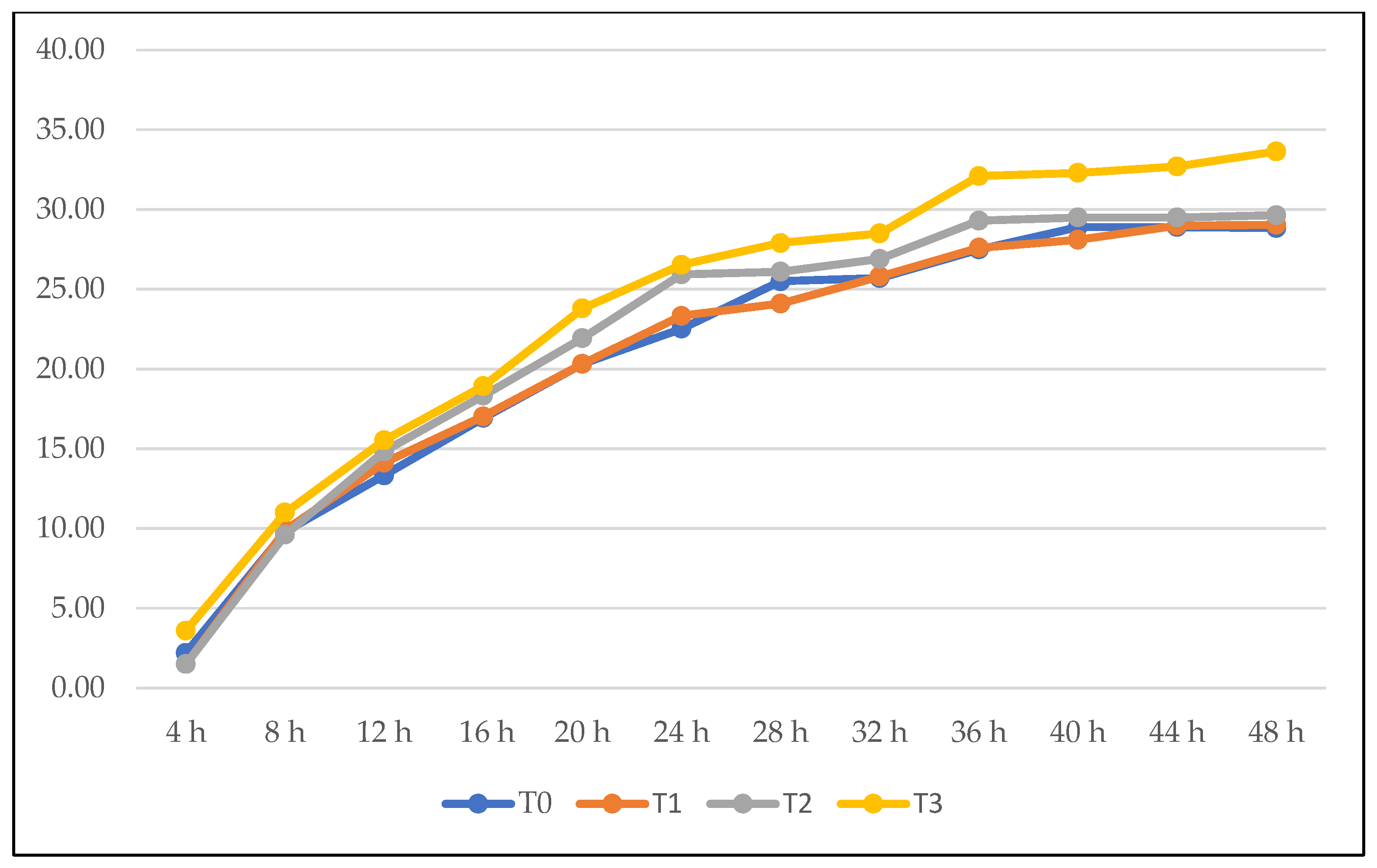
3.2. Effect of NSM Supplementation on Gas Production and Rumen Fermentation Profile
4. Discussion
5. Conclusions
Author Contributions
Funding
Institutional Review Board Statement
Informed Consent Statement
Data Availability Statement
Acknowledgments
Conflicts of Interest
Abbreviations
| ADFom | Amylase-treated, ash-free acid detergent fiber |
| CP | Crude protein |
| DM | Dry matter |
| EE | Ether extract |
| IVDMD | In vitro dry matter degradability |
| IVOMD | In vitro organic matter degradability |
| NDFom | Amylase-treated, ash-free neutral detergent fiber |
| NSM | Nigella sativa meal |
| tGP | Total gas production |
| VFA | Volatile fatty acid |
References
- Ramdani, D.; Juandita, K.N.; Hernaman, I.; Alhuur, K.R.G. Effects of dietary black cumin (Nigella sativa L.) meal on performance, blood metabolites, and digestibility in a rice straw-based diet of fattening Garut lambs. Vet. World 2024, 17, 2152–2158. [Google Scholar] [CrossRef] [PubMed]
- Obeidat, B.S.; Ata, M.; Al-Lataifeh, F. Influence of corn stover on the growth and blood parameters of Awassi lambs fed a concentrate diet. Ital. J. Anim. Sci. 2022, 21, 702–707. [Google Scholar] [CrossRef]
- Rashwan, H.K.; Mahgoub, S.; Abuelezz, N.Z.; Amin, H.K. Black cumin seed (Nigella sativa) in inflammatory disorders: Therapeutic potential and promising molecular mechanisms. Drugs Drug Candidates 2023, 2, 516–537. [Google Scholar] [CrossRef]
- Retnani, Y.; Wiryawa, K.G.; Khotijah, L.; Nurmilati, N.; Agung Gust, R.; Rachmat, I.D. Growth performance, blood metabolites and nitrogen utilization of lambs fed with Nigella sativa meal. Pak. J. Nut. 2019, 18, 247–253. [Google Scholar] [CrossRef]
- Obeidat, B.S. The inclusion of black cumin meal improves the carcass characteristics of growing Awassi lambs. Vet. World 2021, 14, 237–241. [Google Scholar] [CrossRef]
- Widyarini, S.; Nagari, F.S.; Hanim, C.; Bachruddin, Z.; Muhlisin; Yusiati, L. Effect of Nigella sativa L. as saponin sources on in vitro rumen fermentation, enzyme activity and nutrients digestibility. Adv. Anim. Vet. Sci. 2021, 9, 2247–2257. [Google Scholar] [CrossRef]
- Juandita, K.N.; Hernaman, I.; Alhuur, K.R.G.; Ramdani, D. Influence of dietary black cumin meal (Nigella sativa L.) on the performance and body measurements of Garut sheep. Bull. Anim. Sci. 2024, 48, 48. [Google Scholar] [CrossRef]
- Rabee, E.A.; Ghandour, M.M.M.; Sallam, A.M.; Raef, O.; Elwakeel, E.A.; Sabra, E.A.; Abdel-Wahed, A.M.; Bakr, S.A.; ElSamahy, H.S.; Hamed, A.A.; et al. Milk yield, rumen fermentation, and microbiota of Shami goats fed diets supplemented with spirulina and yeast. AMB Express 2025, 15, 108. [Google Scholar] [CrossRef]
- Kearl, L.C. Nutrient Requirements of Ruminants in Developing Countries; Utah State University: Logan, UT, USA, 1982. [Google Scholar]
- Wang, Z.; Li, X.; Zhang, L.; Wu, J.; Zhao, S. Digestibility, fermentation characteristics and rumen microbial community. Animals 2022, 12, 118. [Google Scholar] [CrossRef]
- Rahmatillah, R.S.; Ramdani, D.; Hernaman, I.; Jayanegara, A.; Hidayatik, N. Evaluation of the effects of green tea extract as a dietary supplement in sheep on gas production, volatile fatty acids, and digestibility. Vet. World 2024, 17, 2204–2210. [Google Scholar] [CrossRef]
- McDougall, E.I. Studies on ruminant saliva. 1. The composition and output of sheep’s saliva. Biochem. J. 1948, 43, 99. [Google Scholar] [CrossRef] [PubMed]
- Medjekal, S.; Bodas, R.; Bousseboua, H.; López, S. Evaluation of three medicinal plants for methane production potential, fiber digestion and rumen fermentation in vitro. Energy Procedia 2017, 119, 632–641. [Google Scholar] [CrossRef]
- Sagala, Y.G.; Andadari, L.; Handayani, T.H.; Sholikin, M.M.; Fitri, A.; Fidriyanto, R.; Rohmatussolihat, R.; Ridwan, R.; Astuti, W.D.; Widyastuti, Y.; et al. The effect of silkworms (Bombyx mori) chitosan on rumen fermentation, methanogenesis, and microbial population in vitro. Vet. World 2024, 17, 1216–1226. [Google Scholar] [CrossRef]
- Khan, M.M.H.; Chaudhry, A.S. Chemical composition of selected forages and spices and the effect of these spices on in vitro rumen degradability of some forages. Asian-Aust. J. Anim. Sci. 2010, 23, 889–900. [Google Scholar] [CrossRef]
- AOAC. Official Methods of Analysis, 15th ed.; Association of Official Analytical Chemist: Arlington, VA, USA, 2008. [Google Scholar]
- Van Soest, P.J.; Robertson, J.B.; Lewis, B.A. Methods for dietary fiber, neutral detergent fiber, and nonstarch polysaccharides in relation to animal nutrition. J. Dairy Sci. 1991, 74, 3583–3597. [Google Scholar] [CrossRef]
- Yang, T.; Gao, X.; Zhang, J.; Zhuang, X.; Wang, H.; Zhang, Z. Sulphate resistance of one-part geopolymer synthesized by calcium carbide residue-sodium carbonate-activation of slag. Compos. Part B Eng. 2022, 242, 110024. [Google Scholar] [CrossRef]
- Amin, A.B.; Mao, S. Influence of yeast on rumen fermentation, growth performance and quality of products in ruminants: A review. Anim. Nutr. 2021, 7, 31–41. [Google Scholar] [CrossRef]
- Kim, K.; Baeg, C.; Ullah, W.; Lee, S.; Seong, H.; Jang, Y.; Kim, S.; Kim, J. Synergistic effect of very long-chain fatty acid and α-linolenic acid treatments on enteric methane mitigation in the rumen. Appl. Biol. Chem. 2025, 68, 93. [Google Scholar] [CrossRef]
- Cusiayuni, A.; Nurfatahillah, R.K.; Harahap, R.P.; Wiryawan, K.G.; Evvyernie, D.; Jayanegara, A. Modification of in vitro methanogenesis and rumen fermentation by using lauric acid: A meta analysis. Adv. Anim. Vet. Sci. 2022, 10, 1048–1055. [Google Scholar] [CrossRef]
- Joch, M.; Republic, C.; Resources, N.; Republic, C.; Republic, C. Capric and lauric acid mixture decreased rumen methane production, while combination with nitrate had no further benefit in methane reduction. Ann. Anim. Sci. 2023, 23, 799–808. [Google Scholar] [CrossRef]
- Xiao, M.; Du, L.; Wei, M.; Wang, Y.; Dong, C.; Ju, J.; Zhang, R.; Peng, W. Effects of quercetin on in vitro rumen fermentation parameters, gas production and microflora of beef cattle. Front. Microbiol. 2025, 16, 1527405. [Google Scholar] [CrossRef]
- Kim, E.T.; Guan, L.L.; Lee, S.J.; Lee, S.M.; Lee, S.S.; Lee, I.D.; Lee, S.K.; Lee, S.S. Effects of flavonoid-rich plant extracts on in vitro ruminal methanogenesis, microbial populations and fermentation characteristics. Asian Australas. J. Anim. Sci. 2015, 28, 530–537. [Google Scholar] [CrossRef]
- Eldeeb, F.A.; Abdel-raheem, G.S.E.; Abdelazeem, S.; Nasr, H.A. Evaluating of Nigella sativa meal (black cumin meal) in lamb diets and its impact on the growth performance, digestion coefficient of nutrients, nitrogen balance and rumen fermentation. J. Adv. Vet. Anim. Res. 2026, 16, 199–204. [Google Scholar]
- Nguyen, H.T.D.; Derix, J.; Hendriks, W.H.; Schonewille, J.T.; Nguyen, T.X.; Pellikaan, W.F. Species and harvest time of fresh tropical grasses affect rumen fermentation as determined by in sacco and in vitro incubations. Fermentation 2025, 11, 276. [Google Scholar] [CrossRef]
- Jayanegara, A.; Wina, E.; Takahashi, J. Meta-analysis on methane mitigating properties of saponin-rich sources in the rumen: Influence of addition levels and plant sources. Asian Australas. J. Anim. Sci. 2014, 27, 1426–1435. [Google Scholar] [CrossRef] [PubMed]
- Belanche, A.; Newbold, C.J.; Morgavi, D.P.; Bach, A.; Zweifel, B.; David, R.Y. A meta-analysis describing the effects of the essential oils blend agolin ruminant on performance, rumen fermentation and methane emissions in dairy cows. Animals 2020, 10, 620. [Google Scholar] [CrossRef]
- Lukbun, S.; Suntara, C.; Prachumchai, R.; Khota, W. Exploring the in vitro effects of cassava diets and enterococcus strains on rumen fermentation, gas production, and cyanide concentrations. Animals 2024, 14, 3269. [Google Scholar] [CrossRef]
- Hristov, A.N.; Oh, J.; Firkins, J.L.; Dijkstra, J.; Kebreab, E.; Waghorn, G.; Makkar, H.P.S. Special Topics—Mitigation of methane and nitrous oxide emissions from animal operations: I. A review of enteric methane mitigation options. J. Anim. Sci. 2013, 91, 5045. [Google Scholar] [CrossRef]
- Zhang, H.; Wang, Y.; Hu, L.; Cong, J.; Xu, Z.; Chen, X.; Rao, S.; Li, M.; Shen, Z.; Mauck, J.; et al. Potential role of lauric acid in milk fat synthesis in Chinese Holstein cows based on integrated analysis of ruminal. Animals 2024, 14, 1493. [Google Scholar] [CrossRef]
- Sari, N.F.; Ray, P.; Rymer, C.; Kliem, K.E.; Stergiadis, S. Garlic and its bioactive compounds: Implications for methane emissions and ruminant nutrition. Animals 2022, 12, 2998. [Google Scholar] [CrossRef]
- Soliva, C.R.; Amelchanka, S.L.; Duval, S.M.; Kreuzer, M. Ruminal methane inhibition potential of various pure compounds in comparison with garlic oil as determined with a rumen simulation technique (Rusitec). Br. J. Nutr. 2011, 106, 114–122. [Google Scholar] [CrossRef]
- Plaizier, J.C.; Mesgaran, M.D.; Derakhshani, H.; Golder, H.; Kha, E.; Kleen, J.L.; Lean, I.; Loor, J.; Penner, G.; Zebeli, Q. Review: Enhancing gastrointestinal health in dairy cows. Animal 2018, 12, 399–418. [Google Scholar] [CrossRef]
- El-Zaiat, H.M.; Masood, H.A.; Hinai, S.S.; Al Maamari, R.H.; Al Riyami, S.S.; Al Al-kharousi, K.; Al-Salami, A.H.; Al-Habsi, N. Assessment of different phytogenic-based additives on in vitro rumen fermentation profile and methane emissions. Front. Vet. Sci. 2025, 12, 1591700. [Google Scholar] [CrossRef]
- McDonald, P.; Edwards, R.A.; Greenhalgh, J.F.D.; Morgan, C.A.; Sinclair, L.A.; Wilkinson, R.G. Animal Nutrition, 7th ed.; Prentice Hall: Harlow, London, 2012; p. 180. [Google Scholar]
- Barkah, N.N.; Retnani, Y.; Wiryawan, K.G. In vitro study of Nigella sativa meal as protein source and its combination with the readily available carbohydrates for ruminant diet. IOP Conf. Ser. Earth Environ. Sci. 2019, 251, 012056. [Google Scholar] [CrossRef]
- Batistel, F.; Sears, A. Palmitic acid alone or combined with stearic and oleic enhances ruminal fiber degradation and alters microbiome composition. Front. Microbiol. 2025, 16, 1624738. [Google Scholar] [CrossRef]
- Bellis, P.; De Maggiolino, A.; Albano, C.; Palo, P.; Blado, F. Ensiling grape pomace with and without addition of a Lactiplantibacillus plantarum strain: Effect on polyphenols and microbiological characteristics, in vitro nutrient apparent digestibility, and gas emission. Front. Vet. Sci. 2022, 9, 808293. [Google Scholar] [CrossRef]


| Nutrient Compositions | Level |
|---|---|
| Dry Matter (% fresh sample) | 96.1 ± 3.55 |
| Metabolizable Energy (MJ/kg DM) | 6.55 ± 0.13 |
| Ash (% DM) | 6.94 ± 0.22 |
| Organic matter (% DM) | 93.0 ± 0.22 |
| Crude protein (% DM) | 35.9 ± 5.91 |
| Ether extract (% DM) | 5.79 ± 0.34 |
| Acid detergent fibers (% DM) | 15.2 ± 0.50 |
| Neutral detergent fibers (% DM) | 25.2 ± 0.88 |
| Calcium (% DM) | 0.20 ± 0.04 |
| Phosphorus (% DM) | 1.68 ± 0.32 |
| Ingredients | Experimental Diet | |||
|---|---|---|---|---|
| T0 | T1 | T2 | T3 | |
| Corn Stover (%) | 60.0 | 60.0 | 60.0 | 60.0 |
| Commercial Concentrate (%) | 40.0 | 35.0 | 32.5 | 30.0 |
| Nigella sativa Meal (%) | 0.00 | 5.00 | 7.50 | 10.0 |
| Nutrient Compositions: | ||||
| DM (% fresh sample) | 52.5 | 53.1 | 53.4 | 53.7 |
| ME (MJ/kg DM) | 4.97 | 4.97 | 4.97 | 4.97 |
| Ash (% DM) | 9.39 | 9.23 | 9.14 | 9.06 |
| CP (% DM) | 11.6 | 12.6 | 13.2 | 13.7 |
| EE (% DM) | 4.15 | 4.13 | 4.12 | 4.11 |
| ADFom (% DM) | 35.9 | 35.1 | 34.7 | 34.3 |
| NDFom (% DM) | 58.9 | 57.7 | 57.1 | 56.6 |
| No | Retention Time (min) | Compound Name | Chemical Class | Area (%) |
|---|---|---|---|---|
| 1 | 14.25–14.60 | 1-Nonanol | Alcohol | 4.90 |
| 2 | 15.82–16.19 | 2,4-Decadienal | Aldehyde | 7.86 |
| 3 | 17.88–18.05 | 2-Undecenal | Aldehyde | 8.16 |
| 4 | 19.72–20.16 | 4-Oxononanal | Aldehyde | 5.90 |
| 5 | 20.80–21.16 | Hexanoic acid (C6:0) | Saturated fatty acid | 6.14 |
| 6 | 24.40–24.51 | cis-4,5-Epoxy-(E)-2-decenal | Epoxy-aldehyde | 5.99 |
| 7 | 25.94–26.18 | Octanoic acid (C8:0) | Saturated fatty acid | 6.14 |
| 8 | 34.46–34.56 | Oleic acid methyl ester | Fatty acid ester | 5.50 |
| 9 | 35.14–35.25 | Dodecanoic acid (Lauric acid, C12:0) | Saturated fatty acid | 6.00 |
| 10 | 35.31–35.40 | Linoleic acid methyl ester | Fatty acid ester | 6.70 |
| 11 | 36.09–36.18 | CLA ethyl ester | PUFA ester | 6.70 |
| 12 | 39.21–39.32 | Tetradecanoic acid (C14:0) | Saturated fatty acid | 7.07 |
| 13 | 41.97–42.10 | Glycidyl palmitate | Fatty acid derivative | 7.38 |
| 14 | 43.04–43.70 | n-Hexadecanoic acid (Palmitic acid, C16:0) | Saturated fatty acid | 10.0 |
| 15 | 45.98–46.18 | Oleic acid oxiranylmethyl ester | Unsaturated FA derivative | 8.22 |
| 16 | 46.66–46.97 | Octadecanoic acid (Stearic acid, C18:0) | Saturated fatty acid | 6.08 |
| 17 | 46.99–47.46 | cis-13-Octadecenoic acid (Oleic acid, C18:1) | MUFA | 8.40 |
| 18 | 47.81–48.40 | Conjugated linoleic acid (CLA) | PUFA | 9.51 |
| 19 | 48.69–49.91 | Linoleic acid (C18:2) | PUFA | 8.95 |
| 20 | 51.58–51.69 | Diepoxyhexadecane | Epoxy compound | 4.62 |
| RT (min) | m/z | Ion Mode | Tentative Compound | Chemical Class |
|---|---|---|---|---|
| 3.53–5.68 | 279–313 | [M − H]− | Phenolic acid derivatives | Phenolic |
| 9.51–13.90 | 285–342 | [M + H]+ | Flavonoid aglycones & glycosides | Flavonoid |
| 11.38–16.72 | 203–205 | [M + H]+ | Thymoquinone-related compounds | Quinone |
| 12.95–17.67 | 559–587 | [M + H]+/[M − H]− | Triterpenoid saponin derivatives | Saponin |
| Parameters | Treatments | SEM | p-Value | |||
|---|---|---|---|---|---|---|
| T0 | T1 | T2 | T3 | |||
| Cumulative gas production: | ||||||
| tGP 12 h (mL) | 13.3 | 14.2 | 14.7 | 15.5 | 0.76 | 0.279 |
| tGP 18 h (mL) | 20.4 ab | 19.5 a | 22.2 ab | 23.4 b | 0.96 | 0.048 |
| tGP 24 h (mL) | 22.5 | 23.8 | 25.9 | 26.5 | 1.03 | 0.075 |
| tGP 48 h (mL) | 28.8 a | 29.4 a | 29.6 a | 33.6 b | 1.01 | 0.038 |
| CH4 (%) | 21.2 | 16.2 | 16.8 | 12.7 | 2.34 | 0.121 |
| CH4 (mL/200 mg DM) | 6.32 | 4.86 | 5.08 | 4.34 | 0.82 | 0.414 |
| Rumen fermentation profiles in vitro: | ||||||
| pH | 6.52 | 6.52 | 6.66 | 6.74 | 0.05 | 0.279 |
| NH3-N (mM) | 8.57 ab | 7.39 a | 7.96 ab | 10.33 b | 0.60 | 0.042 |
| IVDMD | 50.0 a | 57.5 b | 58.5 b | 59.4 b | 1.50 | 0.004 |
| IVOMD | 51.5 a | 58.6 b | 59.7 b | 60.1 b | 1.56 | 0.006 |
| Acetate (mM) | 21.9 | 22.3 | 28.4 | 29.3 | 2.88 | 0.149 |
| Propionate (mM) | 5.79 | 5.80 | 7.55 | 7.17 | 0.64 | 0.111 |
| Iso-butyrate (mM) | 1.08 | 0.72 | 2.90 | 1.42 | 0.52 | 0.206 |
| Butyrate (mM) | 0.41 | 1.45 | 2.30 | 1.19 | 0.49 | 0.103 |
| Iso-valerate (mM) | 0.25 | 0.56 | 0.45 | 0.49 | 0.12 | 0.733 |
| Valerate (mM) | 0.33 | 1.71 | 0.39 | 0.34 | 0.25 | 0.085 |
| A:P | 3.76 | 3.94 | 3.88 | 4.13 | 0.41 | 0.967 |
| Total VFAs (mM) | 32.0 | 32.4 | 42.0 | 39.9 | 3.63 | 0.125 |
Disclaimer/Publisher’s Note: The statements, opinions and data contained in all publications are solely those of the individual author(s) and contributor(s) and not of MDPI and/or the editor(s). MDPI and/or the editor(s) disclaim responsibility for any injury to people or property resulting from any ideas, methods, instructions or products referred to in the content. |
© 2026 by the authors. Licensee MDPI, Basel, Switzerland. This article is an open access article distributed under the terms and conditions of the Creative Commons Attribution (CC BY) license.
Share and Cite
Juandita, K.N.; Ramdani, D.; Hernaman, I.; Chaudhry, A.S.; Sukarman; Sarwono, K.A. Characterization of Nigella sativa Meal (NSM) and the Effects on In Vitro Rumen Fermentation and Degradability. Animals 2026, 16, 1091. https://doi.org/10.3390/ani16071091
Juandita KN, Ramdani D, Hernaman I, Chaudhry AS, Sukarman, Sarwono KA. Characterization of Nigella sativa Meal (NSM) and the Effects on In Vitro Rumen Fermentation and Degradability. Animals. 2026; 16(7):1091. https://doi.org/10.3390/ani16071091
Chicago/Turabian StyleJuandita, Karina Natasya, Diky Ramdani, Iman Hernaman, Abdul Shakoor Chaudhry, Sukarman, and Ki Ageng Sarwono. 2026. "Characterization of Nigella sativa Meal (NSM) and the Effects on In Vitro Rumen Fermentation and Degradability" Animals 16, no. 7: 1091. https://doi.org/10.3390/ani16071091
APA StyleJuandita, K. N., Ramdani, D., Hernaman, I., Chaudhry, A. S., Sukarman, & Sarwono, K. A. (2026). Characterization of Nigella sativa Meal (NSM) and the Effects on In Vitro Rumen Fermentation and Degradability. Animals, 16(7), 1091. https://doi.org/10.3390/ani16071091