Article

Dietary Lactobacillus plantarum Supplementation Improves Growth Performance and Antioxidant Status and Upregulates Genes Related to the Toll/Imd and JAK-STAT Signaling Pathways in Red Claw Crayfish (Cherax quadricarinatus)


1
Guangxi Key Laboratory for Polysaccharide Materials and Modifications, Guangxi Marine Microbial Resources Industrialization Engineering Technology Research Center, School of Marine Sciences and Biotechnology, Guangxi Minzu University, 158 University Road, Nanning 530008, China
2
Guangxi Key Laboratory for Aquatic Genetic Breeding and Healthy Aquaculture, Guangxi Academy of Fishery Sciences, 8 Qingshan Road, Nanning 530021, China
*
Authors to whom correspondence should be addressed.
These authors contributed equally to this work.
Animals 2026, 16(7), 1090; https://doi.org/10.3390/ani16071090
Submission received: 7 March 2026 / Revised: 27 March 2026 / Accepted: 31 March 2026 / Published: 2 April 2026
(This article belongs to the Special Issue Applications of Probiotics in Aquaculture)

Simple Summary

Red claw crayfish (Cherax quadricarinatus) is an important aquaculture species, but intensive farming may increase oxidative stress and impair immune-related functions. Lactobacillus plantarum is a widely used probiotic in aquaculture; however, its effects in red claw crayfish remain insufficiently understood. In this study, a 70-day feeding trial was conducted to evaluate the effects of dietary L. plantarum supplementation at 0, 0.1, 1.0, and 10.0 g/kg. The results showed that 1.0 g/kg L. plantarum produced the most favorable overall response, improving growth performance, antioxidant-related parameters, and the expression of several immune-related genes. These findings suggest that dietary L. plantarum may be beneficial for the healthy culture of red claw crayfish and provide a basis for its application in aquafeeds.

Abstract

This study conducted a 70-day feeding trial to evaluate the effects of dietary Lactobacillus plantarum supplementation (0, 0.1, 1.0, and 10.0 g/kg) in red claw crayfish (Cherax quadricarinatus). Growth performance, hepatopancreatic antioxidant-related parameters, and the expression of genes related to the Toll/Imd and JAK-STAT pathways were determined. Results showed that dietary L. plantarum supplementation significantly improved weight gain rate, specific growth rate, daily growth index, and feed efficiency, which were increased by 23.57%, 5.10%, 9.67%, and 7.90%, respectively, and reduced mortality rate by 60.00% compared with the control group (p < 0.05), enhanced the activities of glutathione peroxidase, catalase, superoxide dismutase and total antioxidant capacity, and reduced malondialdehyde levels in the hepatopancreas (p < 0.05). Furthermore, dietary L. plantarum supplementation was associated with the upregulated expression of key genes related to the Toll/Imd and JAK-STAT signaling pathways (p < 0.05). The expression levels of tumor necrosis factor-α, interleukin-1β, and transforming growth factor-β1 were also significantly increased (p < 0.05). Overall, these findings suggest that dietary L. plantarum supplementation improved growth performance and antioxidant-related and immune-related parameters in red claw crayfish, and that these effects were associated with the upregulated expression of genes involved in the Toll/Imd and JAK-STAT pathways. Among the tested treatments, 1.0 g/kg L. plantarum produced the most favorable overall response.

1. Introduction

Red claw crayfish (Cherax quadricarinatus) is a commercially important crustacean in China, and it has developed into a core aquaculture species by virtue of its fast growth rate, robust environmental adaptability, and superior meat quality [1]. With the increasing demand for high-quality aquatic products, the culture scale of red claw crayfish has expanded steadily, and intensive aquaculture has become a common farming mode. However, intensive aquaculture systems often face practical challenges, including water quality deterioration [2], nutritional imbalance in formulated feeds [3], and frequent disease outbreaks [4]. Such adverse factors can significantly compromise the growth performance and farming efficiency of red claw crayfish, thus posing substantial restrictions on the sustainable development of the crayfish farming industry.
To address these challenges, probiotics have been widely used in aquaculture as safe and environmentally friendly feed additives that help reduce antibiotic use and promote animal health [5]. Previous studies have shown that dietary supplementation with probiotics can exert beneficial effects by enhancing immune responses [6], promoting growth performance [7], improving water quality [8], and maintaining intestinal microbial homeostasis [9] in aquatic animals. Lactobacillus plantarum, a commonly used probiotic, has been reported to improve the growth and health status of aquatic animals through multiple mechanisms, including modulation of the gut microbiota, enhancement of immune-related responses, and promotion of nutrient absorption [10]. For instance, in common carp (Cyprinus carpio), dietary supplementation with L. plantarum significantly improved growth performance, digestive enzyme activities, and antioxidant immune parameters, while alleviating heat stress-induced damage [11]. Similarly, in white shrimp (Litopenaeus vannamei), L. plantarum supplementation activated immune-related gene expression, enhanced antioxidant and antibacterial capacities, and increased survival following Vibrio alginolyticus infection [12]. In addition, positive effects of L. plantarum on growth performance, immune responses, and antioxidant capacity have also been reported in blue swimming crab (Portunus pelagicus) [13], coho salmon (Oncorhynchus kisutch) [14], and Nile tilapia (Oreochromis niloticus) [15]. Nevertheless, research efforts addressing the utilization of L. plantarum in red claw crayfish aquaculture remain relatively scarce, and whether this probiotic is associated with changes in antioxidant-related and immune-related responses in this crustacean species remains to be clarified.
In the innate immune system of crustaceans, both the Toll/immune deficiency (Toll/Imd) and Janus kinase-signal transducer and activator of transcription (JAK-STAT) signaling pathways play crucial regulatory roles [16,17]. The Toll/Imd signaling pathway represents a central defense mechanism against pathogen infection. Specifically, the Toll pathway primarily recognizes pathogen-associated molecular patterns, such as lipopolysaccharides and peptidoglycans, thereby activating downstream nuclear factor-κB (NF-κB) transcription factors and inducing the expression of antimicrobial peptides to facilitate pathogen clearance [18]. In contrast, the Imd pathway mainly responds to peptidoglycan derived from Gram-negative bacteria, leading to the activation of downstream signaling molecules such as Relish and the subsequent induction of antimicrobial peptide expression [19]. Accumulating evidence indicates that activation of the Toll/Imd signaling pathway enhances immune capacity in crustaceans and improves their resistance to pathogen infection [20]. Meanwhile, the JAK-STAT signaling pathway, as an important intracellular signal transduction system, is widely involved in immune regulation as well as cell proliferation and differentiation [16]. This pathway is composed of cytokine receptors, JAK, and STAT, and has been reported to act synergistically with the Toll/Imd pathway in regulating immune responses in crustaceans [17]. Therefore, examining whether dietary probiotics are associated with changes in immune-related responses and the expression of genes related to these pathways in red claw crayfish remains of both theoretical and practical interest.
In summary, although L. plantarum has been widely applied in aquaculture, its effects on the growth performance, antioxidant status, and immune-related responses in red claw crayfish have not been systematically elucidated. In particular, information remains limited regarding its association with genes related to the Toll/Imd and JAK-STAT pathways in this species. Therefore, the present study aimed to investigate the effects of dietary L. plantarum supplementation on growth performance, hepatopancreatic antioxidant-related parameters, and immune-related gene expression in red claw crayfish. This study was intended to provide experimental evidence for the potential application of L. plantarum in red claw crayfish culture.

2. Materials and Methods

2.1. Diet Formulation

The freeze-dried L. plantarum strain (GXF5101) used in this study was obtained from a laboratory-maintained culture, with a viable cell concentration exceeding 1010 CFU/g [21].
For long-term storage at −80 °C, L. plantarum was cryopreserved in MRS (De Man, Rogosa & Sharpe) broth containing 30% (v/v) sterile glycerol, following the protocol outlined by Guo et al. [22]. Bacterial isolation was initiated by streaking the cryopreserved culture onto MRS agar, followed by anaerobic incubation at 37 °C for 48 h. From these plates, one isolated colony was randomly picked and aseptically transferred into liquid MRS medium. This inoculated medium was then subjected to aerobic incubation using an orbital shaker incubator set at 37 °C and 180 rpm for 24 h, allowing the culture to reach the logarithmic phase. Bacterial cells were subsequently collected by centrifugation at 4000× g for 10 min at 4 °C. The resulting cell pellet was washed three times using phosphate-buffered saline (PBS), transferred into a 50 mL centrifuge tube, and finally lyophilized for 48 h in a vacuum freeze dryer. The resulting freeze-dried powder contained an active bacterial count of at least 1010 CFU/g and was stored at −80 °C until further use in experiments.
Based on previous studies and safety evaluations [14], four different dietary treatments were designed with gradually increasing supplementation levels of L. plantarum. Specifically, the dietary treatments consisted of a control group (CK, without L. plantarum supplementation, 0 g/kg), a low-dose group (LL, 0.10 g/kg), a medium-dose group (ML, 1.00 g/kg), and a high-dose group (HL, 10.00 g/kg). The raw materials for the basal diet were purchased from Guangdong Hengxing Feed Industry Co., Ltd., Guangzhou, China. These raw materials were first crushed and sieved through a 60-mesh sieve, followed by uniform mixing with freeze-dried L. plantarum powder at the preset dosage levels, and finally subjected to pelleting. To maintain the quality of the diets, all formulated feeds were vacuum-dried until the moisture content dropped below 10%, then packaged and stored in a dark environment at −20 °C. Fresh feed batches were prepared every 4 d to reduce physicochemical degradation to a minimum and prevent microbial contamination. The proximate composition of the experimental diets formulated for red claw crayfish is summarized in Table 1.
In accordance with the method developed by Liu et al. [23], the viable count of L. plantarum in the experimental diets was determined by means of the plate counting method. In detail, 1 g of feed sample from each of the four groups was precisely weighed, homogenized thoroughly in 9 mL of sterilized 0.85% physiological saline with a vortex mixer, and underwent serial tenfold dilutions spanning from 10−3 to 10−8. Then, 100 μL aliquots of each diluted sample were aseptically plated onto the surfaces of sterilized MRS agar plates. For each dilution, three replicate plates were prepared to ensure statistical reliability. The inoculated plates were transferred into an anaerobic incubator maintained at 37 °C with a permissible deviation of ±0.5 °C, where they were incubated for 48 h. After this period, a quantitative evaluation of L. plantarum colonies, which displayed diameters ranging from 0.5 to 2 mm, was performed using a colony counter.
The viable cell count of L. plantarum was calculated with the following formula:
Viable   count   ( CFU / g )   =   B   ×   ( C / 10 )   ×   f
wherein, B represents the total number of colonies grown on the MRS agar plates, C denotes the number of colonies identified as L. plantarum among ten randomly selected colonies, and f stands for the dilution factor.
According to the quantitative analysis performed using the MRS agar plate counting technique, no viable L. plantarum cells were identified in the feed samples from the control group (CK). For the experimental groups supplemented with L. plantarum, the viable bacterial counts were quantified as follows: the low-dose group (LL) exhibited 0.79 ± 0.12 × 10⁶ CFU/g, the medium-dose group (ML) showed 0.87 ± 0.18 × 10⁷ CFU/g, and the high-dose group (HL) reached 1.02 ± 0.07 × 10⁸ CFU/g.

2.2. Experimental Crayfish and Culture

The juvenile red claw crayfish employed in the present study were obtained from the Nanfan Breeding Base of the Guangxi Institute of Fisheries Science, Nanning, China. The initial mean body weight and body length were 0.13 ± 0.02 g and 0.58 ± 0.02 cm, respectively. To facilitate acclimation to the new environment and reduce transportation- and environment-induced stress, all individuals were acclimated for 7 d in a recirculating aquaculture system prior to the initiation of the feeding trial. After the acclimation period, the juveniles with uniform body size, intact morphology, healthy appearance, and robust vitality were selected to ensure comparability among experimental groups and the reliability of the experimental results. These selected juveniles were then used for the feeding trial.
The feeding experiment was carried out in culture tanks (1 × 2 × 1 m) with the water depth maintained at 70 cm. Each culture tank was fitted with 16 PVC pipes as hiding places, and continuous aeration was supplied through air stones. Water hyacinth (Eichhornia crassipes) was added to each tank to provide shelter and help maintain water quality and the overall culture environment, with the plants covering approximately 20–30% of the water surface area. Throughout the experimental period, the water temperature was kept at 26 ± 1 °C, while the dissolved oxygen concentration varied between 4.7 and 6.2 mg/L. The ammonia nitrogen concentration was maintained below 0.25 mg/L, nitrite-nitrogen below 0.01 mg/L, and nitrate-nitrogen was kept in the range of 0–10 mg/L. Additionally, the pH value was stabilized between 7.6 and 7.8, and an approximately natural local photoperiod of about 12 h light:12 h dark was maintained throughout the experiment.
A completely randomized design was adopted in this experiment, consisting of four dietary treatments with three replicates per treatment, resulting in a total of 12 culture tanks. Each tank was stocked with 50 young crayfish, with a total of 600 individuals involved in the 70-day feeding trial. Throughout the experimental period, the growth performance and mortality rate of crayfish in each tank were monitored, and the number of surviving individuals was recorded at regular intervals. The daily feeding amount was adjusted to approximately 5% of the total body weight of crayfish in each tank, and it was flexibly modified according to the feeding activity of the crayfish. The young crayfish were fed twice daily at 08:30 and 18:30. This feeding schedule was determined based on routine nursery management practice and preliminary observations of feeding activity in juvenile red claw crayfish. After the morning feeding, feces and residual feed were siphoned off, followed by partial water replacement. Approximately one-third of the total water volume in each tank was replaced during each water change to ensure the stability of water quality.

2.3. Sample Collection

Upon completion of the 70-day feeding trial, all red claw crayfish were subjected to 24 h of fasting. Subsequently, 12 crayfish individuals were randomly selected from each replicate for sample collection. The selected crayfish were rinsed thoroughly with sterile 0.85% physiological saline and anesthetized on ice prior to the performance of dissection. The final body mass of the crayfish was determined using a high-precision analytical balance (Sartorius CPA225D, Singapore, accuracy: ±0.01 g). Following this, the specimens were placed on a fully sterilized work surface and dissected under strict aseptic conditions. The hepatopancreas was quickly dissected out, promptly frozen in liquid nitrogen, and then stored at −80 °C for subsequent analysis. To determine the enzyme activities in the hepatopancreas, approximately 100 mg of hepatopancreatic tissue from each individual was homogenized in pre-cooled 0.85% physiological saline (pH 7.0) at a tissue-to-saline ratio of 1:9 (w/v), yielding a 10% (w/v) tissue homogenate. The homogenates were centrifuged at 1000× g for 10 min at 4 °C, and the resulting supernatants were harvested and used for the subsequent determination of enzyme activities.

2.4. Growth Performance Calculations

In accordance with the method established by Zhang et al. [24], the weight gain rate (WGR, %), specific growth rate (SGR, %/day), daily growth index (DGI, %/day), feed efficiency (FE, %) and mortality rate (MR, %) of red claw crayfish were calculated using the following formulas:
WGR   ( % )   =   W 1     W 0 W 0   ×   100 %
SGR   ( % / day ) = ln W 1   ln W 0 T   ×   100 %
DGI   ( % / day ) = W 1 1 / 3     W 0 1 / 3   T   ×   100 %
FE   ( % ) = W 1 W 0 W S   ×   100 %
MR ( % ) = ( 1 N 1 N 0 )   ×   100 %
where W0 and W1 represent the initial and final mean body weights (g), respectively; WS represents the total dry feed intake per tank (g); T represents the feeding duration (d); and N0 and N1 represent the initial and final numbers of crayfish per tank, respectively.

2.5. Determination of Antioxidant Enzyme Activities

The hepatopancreatic supernatants obtained following the method established by Zhang et al. [25] were employed to determine the activities of antioxidant-related enzymes. The activities of alkaline phosphatase (AKP) and acid phosphatase (ACP) were assayed via a microplate-based enzyme activity method. The activity unit of AKP was defined as the quantity of enzyme that generates 1 mg of phenol per gram of tissue protein upon incubation with the substrate at 37 °C for 15 min and was denoted as King units (KU/g prot). Correspondingly, the activity unit of ACP was defined as the quantity of enzyme that generates 1 mg of phenol per gram of tissue protein upon incubation with the substrate at 37 °C for 30 min, with the activity also expressed as King units (KU/g prot). Total antioxidant capacity (T-AOC) was measured using the ABTS radical cation scavenging assay, and one activity unit of T-AOC was defined as an absorbance (OD value) increase of 0.01 per milliliter of reaction solution per milligram of tissue protein per minute at 37 °C, denoted as mmol/mg prot. Superoxide dismutase (SOD) activity was determined by the WST-1 method, where one unit was defined as the amount of enzyme that induces a 50% inhibitory rate per milligram of tissue protein in 1 mL of reaction solution at 37 °C (U/mg prot). Catalase (CAT) activity was assayed via the ammonium molybdate-based colorimetric method, with one unit defined as the quantity of enzyme that degrades 1 μmol of H2O2 per milligram of tissue protein per second (U/mg prot). Malondialdehyde (MDA) content was determined using the thiobarbituric acid (TBA) colorimetric method and expressed as nmol/mg prot. Glutathione peroxidase (GSH-PX) activity was measured by a colorimetric assay, where one unit was defined as the amount of enzyme that causes a 1 mol/L reduction in glutathione (GSH) concentration per milligram of tissue protein per minute at 37 °C (U/mg prot). Glutathione (GSH) content was also determined via a colorimetric assay and denoted as nmol/mg prot. All detection kits were purchased from Nanjing Jiancheng Bioengineering Institute (Nanjing, China), and all experimental operations were conducted in strict accordance with the manufacturers’ operating instructions.

2.6. Determination of Relative Gene Expression

According to the method established by Zhang et al. [25], total RNA was isolated from hepatopancreatic samples using the MiniBEST Universal RNA Extraction Kit (TaKaRa, Dalian, China), with all experimental procedures strictly adhering to the manufacturer’s operating protocols. RNA integrity was assessed via 1% agarose gel electrophoresis, while RNA concentration was quantified with a NanoDrop spectrophotometer (Thermo Fisher Scientific, Waltham, MA, USA). Complementary DNA (cDNA) was generated using the PrimeScript™ RT Master Mix (Perfect Real Time; TaKaRa, Dalian, China). Quantitative real-time polymerase chain reaction (RT-qPCR) was carried out with TB Green® Premix Ex Taq™ II (Tli RNaseH Plus; TaKaRa, Dalian, China) in a Q2000B Real-Time PCR System (LongGene, Hangzhou, China).
Gene-specific primers were designed for the selected target genes, including tumor necrosis factor receptor-associated factor 6 (traf6), akirin, interferon regulatory factor 4 (irf4), Toll-like receptor 6 (tlr6), Toll-like receptor 2 (tlr2), imd, tumor necrosis factor α (tnf-α), interleukin-1β (il-1β), transforming growth factor β1 (tgf-β1), jak, and stat. β-actin was employed as the housekeeping gene to normalize the relative transcriptional expression levels of the above target genes. In the present study, β-actin was selected as the reference gene based on its previous use in red claw crayfish and related crustacean RT-qPCR studies. Nevertheless, the use of a single reference gene should be considered a limitation of the present analysis. Melting curve analysis exhibited a single peak for all PCR amplicons, which demonstrated high amplification specificity and further validated the specificity of the designed primers. The detailed sequences of all primers are listed in Table 2.

2.7. Data Statistics and Analysis

All experimental data were first input into Microsoft Excel 2019 for preliminary preprocessing. Subsequent statistical analyses were performed with SPSS Statistics 25.0 software (IBM Corporation, Armonk, NY, USA). One-way ANOVA was used, followed by Tukey’s multiple comparisons test for post hoc analysis. All experimental results are expressed as the mean ± standard error (SE), and a p-value < 0.05 was set as the threshold for statistical significance. All experimental figures were constructed using GraphPad Prism 9 software (GraphPad Software Inc., San Diego, CA, USA). The relative transcriptional expression levels of genes detected by RT-qPCR were calculated via the 2−ΔΔCt method [28], with the obtained results normalized against the expression level of the β-actin housekeeping gene.

3. Results

3.1. Effects of Lactobacillus plantarum Supplementation on Growth Performance in Red Claw Crayfish

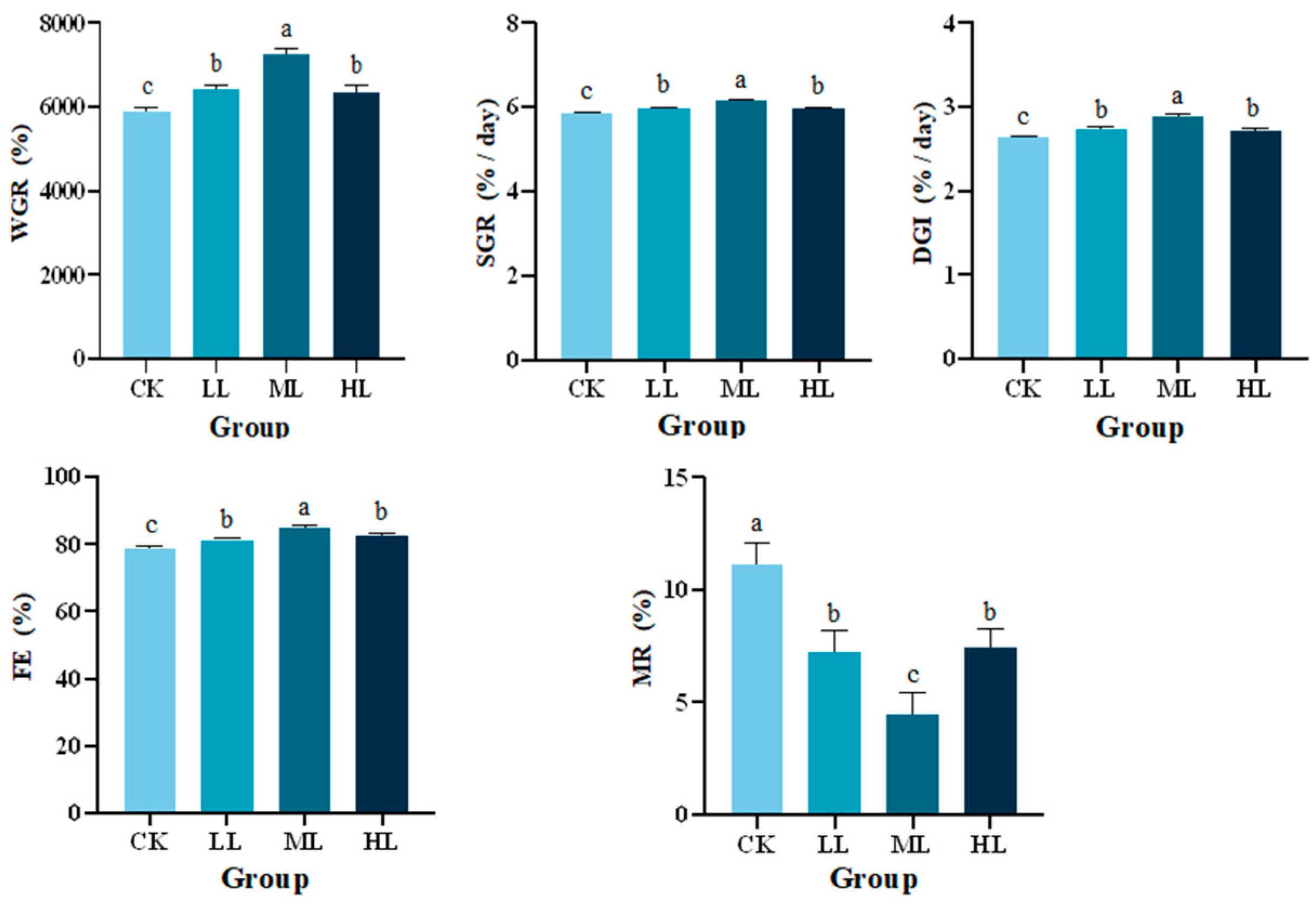
As shown in Figure 1, following the 70-day feeding period, dietary supplementation with L. plantarum resulted in significant elevations in WGR, SGR, DGI, and FE in red claw crayfish relative to the control (CK) group (p < 0.05). For SGR, the LL, ML, and HL groups were all significantly higher than the CK group (adjusted p = 0.0032, p < 0.0001, and p = 0.0079, respectively). Similarly, FE was significantly increased in the LL, ML, and HL groups compared with the CK group (adjusted p = 0.0035, p < 0.0001, and p = 0.0086, respectively), and DGI was also significantly elevated in these groups (adjusted p = 0.0091, p < 0.0001, and p = 0.0007, respectively). Among all L. plantarum-treated groups, the ML group showed the most prominent enhancements in these parameters, with values significantly higher than those of the LL and HL groups (SGR: adjusted p = 0.0003 and 0.0002; FE: adjusted p = 0.0003 and 0.0001; DGI: adjusted p = 0.0024 and 0.0382, respectively), whereas no significant differences were observed between the LL and HL groups (SGR: adjusted p = 0.8797; FE: adjusted p = 0.8807; DGI: adjusted p = 0.2110). Moreover, the MR of all L. plantarum-supplemented groups was markedly decreased compared with the CK group (p < 0.05), and the ML group presented the lowest MR value, which was significantly lower than that of the other treated groups (p < 0.05).

3.2. Effects of Lactobacillus plantarum Supplementation on Antioxidant Enzyme Activities in Red Claw Crayfish

Data presented in Table 3 indicated that 70-day dietary administration of L. plantarum led to marked elevations in GSH-PX, GSH, CAT, SOD, and T-AOC contents in the hepatopancreas of red claw crayfish, relative to the control (CK) group (p < 0.05). Among all L. plantarum-supplemented treatments, the ML group showed the most remarkable increments in GSH-PX, GSH, and CAT levels, which were notably higher than those detected in other supplemented groups (p < 0.05).
In comparison with the CK group, ACP activity was significantly elevated in both ML and HL groups (p < 0.05), whereas no significant difference was found between the LL group and the CK group (p > 0.05). AKP activity was significantly increased only in the ML group (p < 0.05), with no statistically significant differences observed among the LL, HL, and CK groups (p > 0.05).
In addition, MDA content in the hepatopancreas was significantly decreased in all L. plantarum-treated groups compared with the CK group (p < 0.05). The ML group exhibited the lowest MDA level, which was significantly lower relative to the other supplemented groups (p < 0.05).

3.3. Effects of Lactobacillus plantarum Supplementation on the Toll/Imd and JAK-STAT Signaling Pathway in Red Claw Crayfish

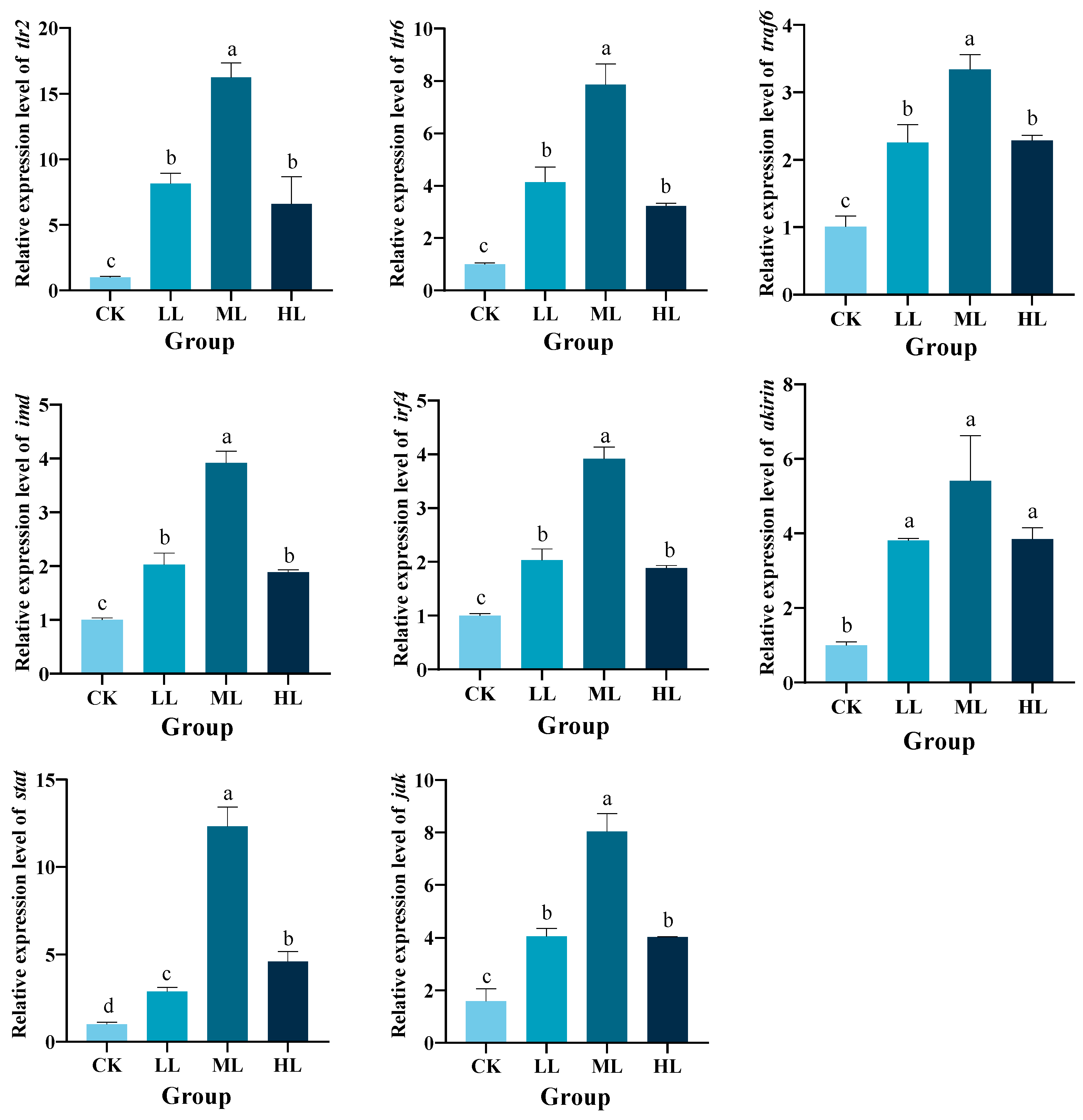
As shown in Figure 2, dietary supplementation with L. plantarum for 70 d significantly upregulated the expression of key genes involved in the Toll/Imd signaling pathway compared to the CK group (p < 0.05), including traf6, akirin, imd, irf4, tlr6, and tlr2 in the hepatopancreas of red claw crayfish. Among the supplemented groups, the traf6, akirin, imd, irf4, tlr6, and tlr2 genes in the ML group exhibited the highest expression levels and were significantly higher than those in the other L. plantarum supplemented groups (p < 0.05).
As shown in Figure 2, dietary supplementation with L. plantarum for 70 d significantly upregulated the expression of key genes involved in the JAK/STAT signaling pathway compared to the CK group (p < 0.05), including jak and stat in the hepatopancreas of red claw crayfish. Among the supplemented groups, the jak and stat genes in the ML group exhibited the highest expression levels and were significantly higher than those in the other L. plantarum-supplemented groups (p < 0.05).

3.4. Effects of Lactobacillus plantarum Supplementation on the Expression of Genes Related to Inflammatory Response in Red Claw Crayfish

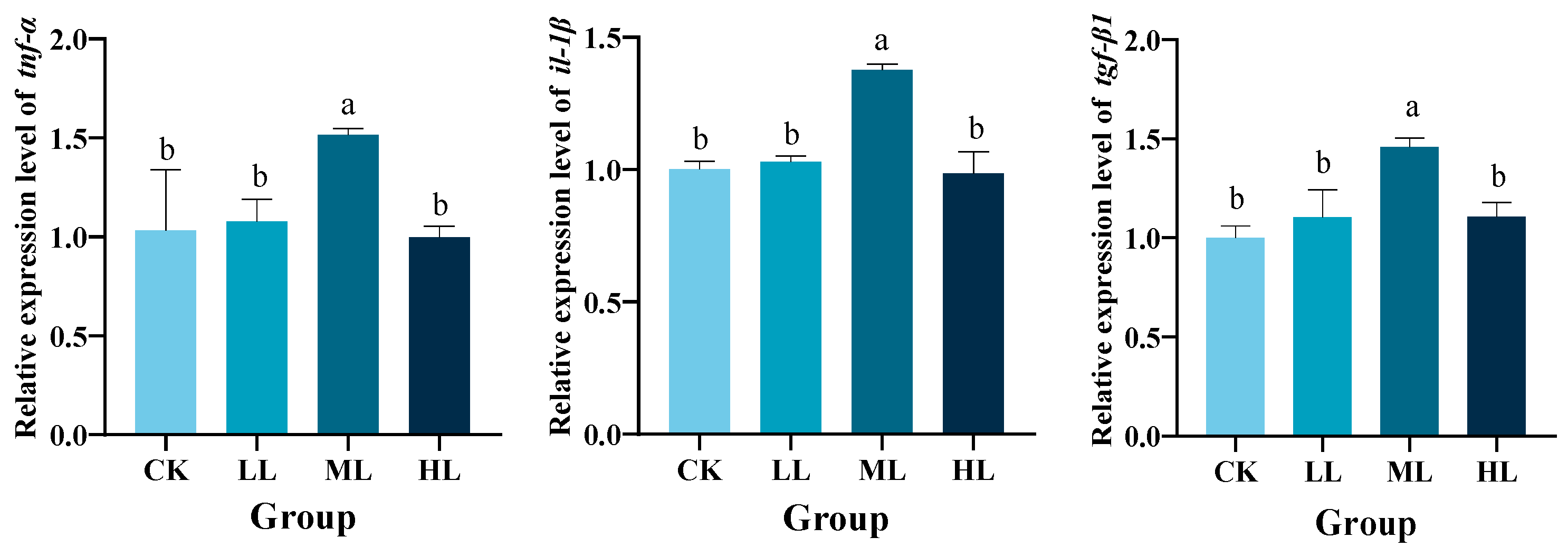
As shown in Figure 3, dietary supplementation with L. plantarum for 70 d significantly upregulated the expression of tnf-α, il-1β, and tgf-β1 genes in the hepatopancreas of red claw crayfish in the ML group compared to the CK group (p < 0.05). However, no significant differences were observed among the CK, LL, and HL groups (p > 0.05).

4. Discussion

In aquaculture, growth performance and mortality rate are pivotal indicators of farming efficiency and sustainability [29]. In the present study, dietary supplementation with 1.0 g/kg L. plantarum significantly increased WGR, SGR, and DGI in juvenile red claw crayfish, indicating a growth-promoting effect. The improvement in FE suggests that L. plantarum may enhance nutrient utilization efficiency. In addition, MR was significantly reduced in all supplemented groups, suggesting that dietary L. plantarum may have improved the physiological status of red claw crayfish. However, this result should not be interpreted as direct evidence of enhanced disease resistance, because no immune challenge or pathogen infection assay was performed in the present study. These effects may be related to improved intestinal barrier function, modulation of gut microbiota homeostasis, and enhanced nutrient utilization [30]. L. plantarum has been reported to promote the localization and expression of tight junction proteins (e.g., occludin and ZO-1), thereby reducing intestinal permeability and inhibiting the colonization and invasion of pathogenic microorganisms. Improved intestinal barrier integrity may reduce immune burden and energy expenditure, thereby allowing more energy to be allocated to growth [31]. In addition, L. plantarum can modulate gut microbiota homeostasis to optimize intestinal microecology and epithelial function, thereby improving the intestinal digestive and absorptive environment and indirectly enhancing feed utilization and host growth [32]. Previous studies have shown that various antimicrobial substances are produced during L. plantarum metabolism, including bacteriocins and lactic acid, can inhibit the proliferation of pathogenic bacteria [33]. Moreover, short-chain fatty acids (SCFAs) generated by L. plantarum not only serve as an important energy source for intestinal epithelial cells [34] but also lower luminal pH and suppress the growth of harmful bacteria, further stabilizing the intestinal microenvironment [35]. Among these, butyrate has been reported to promote epithelial cell proliferation and differentiation and to exert immunomodulatory effects, thereby contributing to the maintenance of intestinal barrier integrity [36]. Collectively, these mechanisms may synergistically enhance nutrient absorption, ultimately leading to concurrent improvements in FE and growth performance. Consistent with this interpretation, previous studies have demonstrated that dietary supplementation with L. plantarum significantly promotes growth performance and feed efficiency in other aquatic animals, such as coho salmon [14], common carp [37], and white shrimp [38], further supporting the considerable application potential of L. plantarum in crustacean aquaculture. It should also be noted that the proximate composition of the experimental diets was broadly comparable among treatments (Table 1), suggesting that the observed differences were unlikely to be explained solely by major variations in basal nutrient composition. Nevertheless, because dietary L. plantarum supplementation was introduced through feed formulation, the immune-related responses observed in the present study should still be interpreted within the overall dietary context rather than as completely nutrition-independent effects.
However, dietary supplementation with L. plantarum at an optimal dosage improved the growth performance of red claw crayfish, whereas increasing the supplementation level to 10.0 g/kg did not yield further growth improvement and instead resulted in reduced performance. This finding suggests that the effects of L. plantarum in red claw crayfish were dose-dependent rather than linearly proportional to the supplementation level. Rather than increasing continuously with the supplementation dose, the efficacy of L. plantarum appears to be constrained within an optimal supplementation range, which may vary with the probiotic strain, host species, and rearing conditions [7,32]. Several non-exclusive hypotheses may explain the weaker response observed at 10.0 g/kg, although these possibilities were not directly tested in the present study. One possible explanation is that excessive supplementation of L. plantarum may have altered intestinal microbial homeostasis, thereby affecting intestinal function and reducing digestive and absorptive efficiency [39,40]. Another possible explanation is that a high probiotic dose may have increased the energy demand associated with physiological regulation, thereby reducing the energy available for somatic growth and other processes [41,42]. It is also possible that excessive accumulation of metabolic products, such as lactic acid and other organic acids, affected the intestinal environment and thereby influenced nutrient utilization efficiency [43]. Therefore, although dietary L. plantarum supplementation improved growth performance at an appropriate level, the weaker response at the higher inclusion level should be interpreted with caution. In the present study, 1.0 g/kg was identified as the most favorable supplementation level, whereas the weaker response at higher inclusion levels requires further verification.
Antioxidant capacity serves as a critical factor in maintaining physiological homeostasis and growth performance in red claw crayfish [44]. Antioxidant biomarkers, such as the activities of SOD, CAT, and GSH-PX, together with the contents of GSH, T-AOC, and MDA, are frequently used to evaluate antioxidant status and oxidative damage in aquatic organisms. Meanwhile, ACP and AKP are generally regarded as important biomarkers reflecting the innate immune status of crustaceans [45]. In the current trial, dietary administration of L. plantarum elevated the activities of SOD, CAT, and GSH-PX, together with the contents of GSH and T-AOC in the hepatopancreatic tissues of red claw crayfish, and significantly reduced MDA accumulation. Furthermore, the activities of innate immune-related enzymes including ACP and AKP, were also enhanced. These results suggest that dietary L. plantarum supplementation may enhance antioxidant capacity and improve basal immune status in red claw crayfish. The underlying mechanisms may involve two aspects. On the one hand, L. plantarum can synthesize bioactive metabolites that directly or indirectly enhance host antioxidant capacity [46]. Previous studies have shown that L. plantarum can synthesize antioxidant molecules de novo or facilitate the host’s synthesis and uptake of antioxidant-related substances and precursors. For example, it can synthesize antioxidant enzymes such as SOD, GR, and GSH-PX and promote the accumulation of GSH [47,48]. Additionally, L. plantarum can metabolize phenolic acids, such as hydroxycinnamic acids [49], and the fermentation process may release cell wall-bound phenolic compounds, thereby further enhancing antioxidant capacity [50]. Collectively, these findings suggest that L. plantarum may participate in the regulation of host antioxidant status through its metabolic activities. On the other hand, SCFAs produced by L. plantarum may regulate host redox balance by enhancing the expression and activities of antioxidant enzyme-related genes, thereby alleviating oxidative stress and maintaining redox homeostasis [51,52]. The enhancement of ACP and AKP activities may also be linked to the regulatory effects of L. plantarum on gut microecology, pathogen reduction, and immune burden alleviation. Similar findings have been reported in other studies: in white shrimp, supplementation with lactic acid bacteria significantly increased multiple nonspecific immune parameters, including ACP and AKP, suggesting an immunostimulatory effect of lactic acid bacteria-based probiotics on basal immunity in crustaceans [53]. In red claw crayfish, dietary supplementation with Bacillus subtilis has also been shown to enhance AKP and ACP activities, accompanied by increased resistance to infection [54]. In summary, dietary L. plantarum may help red claw crayfish maintain physiological homeostasis and improve antioxidant-related and nonspecific immune-related parameters, which may contribute to adaptation to environmental stress.
Findings from the current experiment revealed that dietary inclusion of L. plantarum upregulated the expression of core genes associated with the Toll/Imd and JAK-STAT signaling pathways in the hepatopancreas of red claw crayfish. Among all treatment groups, the 1.0 g/kg L. plantarum supplementation group displayed the most prominent upregulation of these target genes. These results suggest that dietary L. plantarum not only improved several immune-related parameters at the physiological and enzymatic levels but was also associated with the upregulation of genes related to innate immune signaling pathways at the molecular level.
Within the Toll/Imd signaling pathway, the upregulation of key genes, including tlr2, tlr6, traf6, and imd, suggests that dietary L. plantarum was associated with enhanced transcriptional responses related to immune recognition and signal transduction. Meanwhile, the upregulation of akirin and irf4 suggests that the effects of dietary L. plantarum on the Toll/Imd pathway may extend beyond upstream receptor recognition and signal transduction to downstream transcriptional regulation. Akirin, as a key nuclear regulatory factor, functions as a molecular link between the Toll/Imd signaling pathway and NF-κB-dependent immune gene expression in invertebrates. Meanwhile, IRF-family transcription factors regulate the transcription of multiple immune-related genes in crustacean immune responses, participating in the amplification and integration of innate immune signaling [55,56]. Therefore, the upregulation of akirin and irf4 may be associated with reinforced downstream immune effector responses within the Toll/Imd pathway. However, these transcriptional results alone are insufficient to confirm functional activation of the pathway or a direct enhancement of innate immune capacity. Unlike acute immune stress, the upregulation of Toll/Imd pathway-related genes observed in the present study was not accompanied by growth suppression or reduced survival. Instead, it occurred concurrently with significant improvements in WGR, SGR, and DGI, which is consistent with previous findings in crustaceans such as white shrimp, where probiotic supplementation has been shown to promote growth performance and immune function [57]. Previous studies have indicated that, in crustaceans, moderate immunoregulatory responses generally do not exert negative effects on growth, whereas excessive or acute immune stress may increase metabolic burden because of the high energy demands of immune defense [58]. Hernroth et al. [59], using Norway lobster (Nephrops norvegicus) as a model species, reported that under simulated environmental stress conditions, alterations in immune function were accompanied by adjustments in energy allocation, indicating a trade-off between immune responses and energy metabolism. Excessive immune activation may therefore occur at the expense of growth and other physiological processes. Therefore, the transcriptional and enzymatic responses observed in the present study may reflect a mild and sustained immunoregulatory state. However, because no pathogen challenge or functional validation was performed, these findings should not be interpreted as direct evidence of enhanced host defense. This balance is conducive to the maintenance of growth performance and is consistent with the current understanding of the coordinated regulation between immune modulation and metabolic homeostasis in crustaceans [58].
In addition to the Toll/Imd pathway, the present study also found that the expression of the key JAK-STAT signaling pathway genes jak and stat was upregulated, with the most pronounced effects observed in the 1.0 g/kg group, suggesting that dietary L. plantarum was associated with the upregulation of genes related to the JAK-STAT pathway. As an important component of the innate immune system in crustaceans, the JAK-STAT signaling pathway plays a role in mediating cytokine signal transduction, regulating the transcription of immune-related genes, and maintaining immune homeostasis [60]. Previous studies have indicated that in crustaceans, the JAK-STAT pathway usually acts in coordination with the Toll/Imd pathway, participating in the integration and amplification of immune signaling following pathogen recognition [61]. In studies on Chinese white shrimp (Fenneropenaeus chinensis), viral infection has been shown to upregulate the expression of jak, stat, and their associated genes in immune-related tissues such as hemocytes and the hepatopancreas [62], indicating that the JAK-STAT pathway may be involved at an early stage of innate immune responses and participates in immune signal transduction following pathogen invasion. In addition, at the mechanistic level, crustaceans can couple pathogen recognition signals to the JAK-STAT pathway through specific pattern recognition molecules. For example, receptors such as Domeless can mediate the JAK-STAT signaling axis, thereby regulating the expression of downstream immune effector genes [63]. Taken together, evidence from both expression changes and molecular mechanisms indicates that the JAK-STAT pathway plays a conserved and regulatory role in pathogen defense in crustaceans.
Considering the expression changes in the inflammatory cytokines tnf-α and il-1β, as well as the immunoregulatory factor tgf-β1, observed in the present study, the effects of dietary L. plantarum are better interpreted as being associated with the upregulation of genes related to the JAK-STAT pathway rather than as direct evidence of functional activation [64]. Moderate upregulation of tnf-α and il-1β may indicate an enhanced immune-alert state; however, depending on the biological context, it may also reflect inflammatory stimulation. As cytokine-like molecules, they participate in the regulation of hemocyte proliferation and the production of antimicrobial effector molecules. Together, these transcriptional changes may contribute to host defense, but direct functional validation was not performed [65]. In contrast, TGF-β1, as an important immunoregulatory factor, may participate in limiting excessive inflammatory responses and maintaining immune homeostasis; however, the current study did not include functional assays to confirm this role [66,67]. In this context, the transcriptional responses of the JAK-STAT pathway are more likely not to simply reflect enhanced pro-inflammatory responses but rather may function as a regulatory link between inflammatory signaling and immunoregulatory responses, while direct functional confirmation is still lacking. In this process, the Toll/Imd pathway likely serves as an upstream input for immune signaling, whereas the JAK-STAT pathway may participate in regulating the intensity and duration of downstream immune responses, although this has not been verified experimentally. Together, these pathways may form a coordinated immunoregulatory network, while the precise functional interactions remain to be experimentally validated.
The potential mechanisms by which L. plantarum mediates the coordinated regulation of multiple immune pathways may involve two aspects. First, as a typical Gram-positive bacterium, microbe-associated molecular patterns (MAMPs) on the surface of L. plantarum, such as lipoteichoic acids and peptidoglycan, can be recognized by host pattern recognition receptors, thereby initiating upstream immune signaling pathways such as Toll/Imd and inducing downstream changes in the expression of inflammatory cytokines and immunoregulatory factors [68]. Second, the intestinal colonization and metabolic activity of L. plantarum may modulate host innate immune responses and immune homeostasis by altering local microecological structure, nutritional metabolic status, and the production of immune-related signaling molecules, thereby shaping the host immune signaling network [69,70].
Several limitations of the present study should be noted. Although the experimental diets showed broadly comparable proximate composition, probiotic-associated effects could not be completely separated from all dietary background influences. In addition, no pathogen challenge, protein-level validation, or other functional analyses were performed; therefore, the observed changes in enzyme activities and gene expression should be interpreted as evidence of immunomodulation rather than direct proof of enhanced disease resistance or functional activation of the Toll/Imd and JAK-STAT pathways. The study also did not assess whether the administered L. plantarum strain could establish or persist in red claw crayfish. Finally, all analyses were based on three replicates per treatment, and RT-qPCR normalization relied on a single housekeeping gene (β-actin). Future studies should incorporate pathogen challenge experiments, functional validation, assessment of strain persistence, and larger biological replication to further strengthen the mechanistic interpretation.
Overall, dietary L. plantarum supplementation improved growth performance, antioxidant-related parameters, and several immune-related indicators in red claw crayfish, with 1.0 g/kg producing the most favorable overall response. These responses were accompanied by the upregulation of genes related to the Toll/Imd and JAK-STAT pathways, suggesting that these pathways may be involved in the response to dietary L. plantarum.

5. Conclusions

In summary, dietary L. plantarum supplementation improved growth performance, antioxidant-related parameters, and the activities of several nonspecific immune-related enzymes in red claw crayfish. These changes were accompanied by the upregulation of genes related to the Toll/Imd and JAK-STAT pathways, suggesting that these pathways may be involved in the response to dietary L. plantarum supplementation. Among the tested supplementation levels, 1.0 g/kg produced the most favorable overall response. The present study provides experimental support for the use of L. plantarum as a dietary additive in red claw crayfish culture, although further functional validation is needed to clarify the underlying mechanisms.

Author Contributions

Conceptualization, Q.Z., Y.L. and H.Y.; methodology, Q.Z., C.D., J.Z., L.L., J.R., T.T., D.W., R.W., Y.L. and H.Y.; software, C.D.; validation, Q.Z., C.D., J.Z., L.L., J.R., T.T., D.W., R.W., Y.L. and H.Y.; formal analysis, Q.Z., C.D., Y.L. and H.Y.; investigation, Q.Z., C.D., J.Z., L.L., J.R., T.T., D.W., R.W., Y.L. and H.Y.; data curation, Q.Z., C.D., Y.L. and H.Y.; writing—original draft preparation, Q.Z.; writing—review and editing, C.D.; visualization, Q.Z., C.D., J.Z., L.L., J.R., T.T., D.W., R.W., Y.L. and H.Y.; supervision, C.D.; project administration, Y.L. and H.Y.; funding acquisition, Y.L. and H.Y. All authors have read and agreed to the published version of the manuscript.

Funding

This research was supported by the Guangxi Science and Technology Base and Talent Special Project (GuikeAD23026270) and Guangxi Shrimp and Shellfish Industry Innovation Team Construction Project of the National Modern Agricultural Industry Technology System (nycytxgxcxtd-2023-14-02).

Institutional Review Board Statement

All experimental protocols related to red claw crayfish were conducted in accordance with the ethical guidelines established by Guangxi Minzu University, situated in Nanning, China. No human subjects were involved in this study, which is verified by the institutional approval number GXUN 2023-018.

Informed Consent Statement

Not applicable.

Data Availability Statement

The data that support the findings of this study are available from the corresponding authors upon reasonable request.

Conflicts of Interest

The authors declare no conflicts of interest.

References

  1. FAO. Cultured Aquatic Species Information Programme: Cherax quadricarinatus (von Martens, 1868). Available online: https://www.fao.org/fishery/en/culturedspecies/cherax_quadricarinatus/en (accessed on 30 March 2026).
  2. Yusoff, F.M.; Umi, W.A.D.; Ramli, N.M.; Harun, R. Water Quality Management in Aquaculture. Camb. Prism. Water 2024, 2, e8. [Google Scholar] [CrossRef]
  3. Cheng, S.; Han, Y.; Chi, M.; Zheng, J.; Liu, S.; Zhu, C.; Hang, X.; Peng, M.; Li, F.; Jiang, W. Bait Composition, Feeding Frequency, Stocking Density, and Water Quality for the Effective Cultivation of Large-Sized Redclaw Crayfish Seedlings. Isr. J. Aquac.-Bamidgeh 2025, 77, 118–129. [Google Scholar] [CrossRef]
  4. Saoud, I.P.; Ghanawi, J.; Thompson, K.R.; Webster, C.D. A Review of the Culture and Diseases of Redclaw Crayfish Cherax quadricarinatus (Von Martens 1868). J. World Aquac. Soc. 2013, 44, 1–29. [Google Scholar] [CrossRef]
  5. Mohammed, E.A.H.; Ahmed, A.E.M.; Kovács, B.; Pál, K. The Significance of Probiotics in Aquaculture: A Review of Research Trend and Latest Scientific Findings. Antibiotics 2025, 14, 242. [Google Scholar] [CrossRef] [PubMed]
  6. Qiu, Z.; Xu, Q.; Li, S.; Zheng, D.; Zhang, R.; Zhao, J.; Wang, T. Effects of Probiotics on the Water Quality, Growth Performance, Immunity, Digestion, and Intestinal Flora of Giant Freshwater Prawn (Macrobrachium rosenbergii) in the Biofloc Culture System. Water 2023, 15, 1211. [Google Scholar] [CrossRef]
  7. Rahayu, S.; Amoah, K.; Huang, Y.; Cai, J.; Wang, B.; Shija, V.M.; Jin, X.; Anokyewaa, M.A.; Jiang, M. Probiotics Application in Aquaculture: Its Potential Effects, Current Status in China and Future Prospects. Front. Mar. Sci. 2024, 11, 1455905. [Google Scholar] [CrossRef]
  8. Tong, Y.; Zhang, M.; Li, Q.; Hu, X.; Wei, Y.; Zhao, W.; Yu, X.; Peng, M.; Yang, C.; Chen, X.; et al. Effectiveness Evaluation of Five Probiotics on Shrimp and Water Environment. Aquac. Rep. 2025, 45, 103110. [Google Scholar] [CrossRef]
  9. Thakur, K.; Singh, B.; Kumar, S.; Sharma, D.; Sharma, A.K.; Jindal, R.; Kumar, R. Potential of Probiotics and Postbiotics in Aquaculture: Connecting Current Research Gaps and Future Perspectives. Microbe 2025, 8, 100431. [Google Scholar] [CrossRef]
  10. Liu, R.; Wang, S.; Huang, D.; Huang, Y.; He, T.; Chen, X. The Probiotic Roles of Lactiplantibacillus plantarum E2 as a Dietary Supplement in Growth Promotion and Disease Resistance of Juvenile Large Yellow Croaker (Larimichthys crocea). Aquaculture 2024, 578, 740082. [Google Scholar] [CrossRef]
  11. Bakhtiari, F.; Ahmadifar, E.; Moghadam, M.S.; Mohammadzadeh, S.; Mahboub, H.H. Dual Effects of Dietary Lactobacillus helveticus and Chlorogenic Acid on Growth Performance, Digestibility, Immune-Antioxidant Capacity and Resistance against Heat Stress of Juvenile Common Carp. Aquac. Int. 2024, 32, 7911–7927. [Google Scholar] [CrossRef]
  12. Chiu, C.-H.; Guu, Y.-K.; Liu, C.-H.; Pan, T.-M.; Cheng, W. Immune Responses and Gene Expression in White Shrimp, Litopenaeus vannamei, Induced by Lactobacillus plantarum. Fish Shellfish Immunol. 2007, 23, 364–377. [Google Scholar] [CrossRef]
  13. Talpur, A.D.; Ikhwanuddin, M.; Abdullah, M.D.D.; Ambok Bolong, A.-M. Indigenous Lactobacillus plantarum as Probiotic for Larviculture of Blue Swimming Crab, Portunus pelagicus (Linnaeus, 1758): Effects on Survival, Digestive Enzyme Activities and Water Quality. Aquaculture 2013, 416–417, 173–178. [Google Scholar] [CrossRef]
  14. Zhang, Q.; Li, L.; Qin, R.; Meng, L.; Liu, D.; Tong, T.; Xu, L.; Liu, Y.; Kong, W. Effect of Dietary Lactobacillus plantarum Supplementation on the Growth Performance, Intestinal Health, Antioxidant Capacity, and mTOR Signaling Pathway of Juvenile Coho Salmon (Oncorhynchus kisutch). Int. J. Mol. Sci. 2025, 26, 907. [Google Scholar] [CrossRef] [PubMed]
  15. Bahrami, Z.; Roomiani, L.; Javadzadeh, N.; Sary, A.A.; Baboli, M.J. Microencapsulation of Lactobacillus plantarum in the Alginate/Chitosan Improves Immunity, Disease Resistance, and Growth of Nile Tilapia (Oreochromis niloticus). Fish Physiol. Biochem. 2023, 49, 815–828. [Google Scholar] [CrossRef] [PubMed]
  16. Lv, Y.; Qi, J.; Babon, J.J.; Cao, L.; Fan, G.; Lang, J.; Zhang, J.; Mi, P.; Kobe, B.; Wang, F. The JAK-STAT Pathway: From Structural Biology to Cytokine Engineering. Sig. Transduct. Target. Ther. 2024, 9, 221. [Google Scholar] [CrossRef]
  17. Betancourt, J.L.; Rodríguez-Ramos, T.; Dixon, B. Pattern Recognition Receptors in Crustacea: Immunological Roles under Environmental Stress. Front. Immunol. 2024, 15, 1474512. [Google Scholar] [CrossRef]
  18. Li, C.; Wang, S.; He, J. The Two NF-κB Pathways Regulating Bacterial and WSSV Infection of Shrimp. Front. Immunol. 2019, 10, 1785. [Google Scholar] [CrossRef]
  19. Bai, L.; Zhou, K.; Li, H.; Qin, Y.; Wang, Q.; Li, W. Bacteria-Induced IMD-Relish-AMPs Pathway Activation in Chinese Mitten Crab. Fish Shellfish Immunol. 2020, 106, 866–875. [Google Scholar] [CrossRef] [PubMed]
  20. Chen, D.; Wang, H. Redclaw Crayfish (Cherax quadricarinatus) Responds to Vibrio parahaemolyticus Infection by Activating Toll and Immune Deficiency Signaling Pathways and Transcription of Associated Immune Response Genes. Fish Shellfish Immunol. 2022, 127, 611–622. [Google Scholar] [CrossRef]
  21. Zhang, Q.; Li, L.; Lu, H.; Meng, L.; Zeng, Q.; Wang, R.; Wang, D.; Tong, T.; Liu, Y.; Yang, H. Effects of Lactobacillus plantarum Supplementation on Growth Performance, Digestive Enzyme Activity, Antioxidant Capacity, Immune Response, and Intestinal Health in Red Claw Crayfish (Cherax quadricarinatus). Aquac. Rep. 2025, 44, 103077. [Google Scholar] [CrossRef]
  22. Guo, M.; Meng, L.; Li, F.; Liu, Y.; Zhang, Z.; Zhang, Q.; Kong, W. Effects of Dietary Bacillus pumilus on the Growth, Intestinal Health, Lipid Metabolism, and mTOR Signaling Pathway of Juvenile Coho Salmon (Oncorhynchus kisutch). Water Biol. Secur. 2025, 4, 100313. [Google Scholar] [CrossRef]
  23. Liu, Y.; Huang, E.; Li, X.; Xie, Y.; Tong, T.; Wang, J.; Zhang, Q. Effects of Dietary Marine Red Yeast Supplementation on Growth Performance, Antioxidant, Immunity, Lipid Metabolism and mTOR Signaling Pathway in Juvenile Tilapia (Oreochromis niloticus). Aquac. Rep. 2024, 37, 102196. [Google Scholar] [CrossRef]
  24. Zhang, Q.; Liang, Y.; Li, J.; Li, L.; Meng, L.; Zeng, Q.; Wang, D.; Wang, R.; Tong, T.; Liu, Y.; et al. Rhodotorula mucilaginosa Supplementation Could Significantly Affect the Growth Performance, Digestive Enzyme Activity, Antioxidant Capacity, Immune Function, and Intestinal Health in Red Claw Crayfish (Cherax quadricarinatus). Biology 2025, 14, 1164. [Google Scholar] [CrossRef]
  25. Zhang, Q.; Meng, L.; Lu, H.; Li, L.; Zeng, Q.; Wang, D.; Wang, R.; Tong, T.; Liu, Y.; Yang, H. Dietary Supplementation with Rhodotorula mucilaginosa Enhances Resistance to Aeromonas veronii Infection in Red Claw Crayfish (Cherax quadricarinatus). Animals 2025, 15, 1912. [Google Scholar] [CrossRef] [PubMed]
  26. Chen, D. Effects of Vibrio parahaemolyticus Infection on the Transcriptome and Metabolome of the Hepatopancreas and Functional Analysis of Relish and TRAF6 Genes in Red claw Crayfish. Master’s Thesis, Shandong Agricultural University, Tai’an, China, 2022. [Google Scholar]
  27. Chen, X. Molecular Characterization of Cytokine Receptor Domeless and Its Functional Research on WSSV Infection of Cherax quadricarinatus. Master’s Thesis, East China University of Science and Technology, Shanghai, China, 2018. [Google Scholar]
  28. Schmittgen, T.D.; Livak, K.J. Analyzing Real-Time PCR Data by the Comparative CT Method. Nat. Protoc. 2008, 3, 1101–1108. [Google Scholar] [CrossRef] [PubMed]
  29. Cotou, E.; Miliou, H.; Chatzoglou, E.; Schoina, E.; Politakis, N.; Kogiannou, D.; Fountoulaki, E.; Androni, A.; Konstantinopoulou, A.; Assimakopoulou, G.; et al. Growth Performance and Environmental Quality Indices and Biomarkers in a Co-Culture of the European Sea Bass with Filter and Deposit Feeders: A Case Study of an IMTA System. Fishes 2024, 9, 69. [Google Scholar] [CrossRef]
  30. Kiron, V. Fish Immune System and Its Nutritional Modulation for Preventive Health Care. Anim. Feed Sci. Technol. 2012, 173, 111–133. [Google Scholar] [CrossRef]
  31. Ahrne, S.; Hagslatt, M.-L.J. Effect of Lactobacilli on Paracellular Permeability in the Gut. Nutrients 2011, 3, 104–117. [Google Scholar] [CrossRef]
  32. Wang, J.; Ji, H.; Wang, S.; Liu, H.; Zhang, W.; Zhang, D.; Wang, Y. Probiotic Lactobacillus plantarum Promotes Intestinal Barrier Function by Strengthening the Epithelium and Modulating Gut Microbiota. Front. Microbiol. 2018, 9, 1953. [Google Scholar] [CrossRef]
  33. Azzahra, R.N.; Putri, F.D.; Wulandari, A.P.; Lei, J.; Syaputri, Y. Plantaricin: Production Dynamics, Functional Applications, and Challenges in Food Biopreservation. J. Food Process. Preserv. 2025, 2025, 6215738. [Google Scholar] [CrossRef]
  34. LeBlanc, J.G.; Chain, F.; Martín, R.; Bermúdez-Humarán, L.G.; Courau, S.; Langella, P. Beneficial Effects on Host Energy Metabolism of Short-Chain Fatty Acids and Vitamins Produced by Commensal and Probiotic Bacteria. Microb. Cell Fact. 2017, 16, 79. [Google Scholar] [CrossRef] [PubMed]
  35. Gunawan, D.; Juffrie, M.; Helmyati, S.; Rahayu, E. Effect of Lactobacillus plantarum DAD-13 and Fructo-Oligosaccharides on Short-Chain Fatty Acid Profile and Nutritional Status in Indonesian Stunting Children. Open Access Maced. J. Med. Sci. 2021, 9, 1790–1796. [Google Scholar] [CrossRef]
  36. Sankarganesh, P.; Bhunia, A.; Ganesh Kumar, A.; Babu, A.S.; Gopukumar, S.T.; Lokesh, E. Short-Chain Fatty Acids (SCFAs) in Gut Health: Implications for Drug Metabolism and Therapeutics. Med. Microecol. 2025, 25, 100139. [Google Scholar] [CrossRef]
  37. Adeshina, I.; Abubakar, M.I.-O.; Ajala, B.E. Dietary Supplementation with Lactobacillus acidophilus Enhanced the Growth, Gut Morphometry, Antioxidant Capacity, and the Immune Response in Juveniles of the Common Carp, Cyprinus Carpio. Fish Physiol. Biochem. 2020, 46, 1375–1385. [Google Scholar] [CrossRef]
  38. Lee, C.; Kim, S.; Shin, J.; Kim, M.-G.; Gunathilaka, B.E.; Kim, S.H.; Kim, J.E.; Ji, S.-C.; Han, J.E.; Lee, K.-J. Dietary Supplementations of Bacillus Probiotic Improve Digestibility, Growth Performance, Innate Immunity, and Water Ammonia Level for Pacific White Shrimp, Litopenaeus vannamei. Aquac. Int. 2021, 29, 2463–2475. [Google Scholar] [CrossRef]
  39. Hemarajata, P.; Versalovic, J. Effects of Probiotics on Gut Microbiota: Mechanisms of Intestinal Immunomodulation and Neuromodulation. Ther. Adv. Gastroenterol. 2013, 6, 39–51. [Google Scholar] [CrossRef]
  40. Lerner, A.; Shoenfeld, Y.; Matthias, T. Probiotics: If It Does Not Help It Does Not Do Any Harm. Really? Microorganisms 2019, 7, 104. [Google Scholar] [CrossRef]
  41. Ganeshan, K.; Nikkanen, J.; Man, K.; Leong, Y.A.; Sogawa, Y.; Maschek, J.A.; Van Ry, T.; Chagwedera, D.N.; Cox, J.E.; Chawla, A. Energetic Trade-Offs and Hypometabolic States Promote Disease Tolerance. Cell 2019, 177, 399–413.e12. [Google Scholar] [CrossRef]
  42. Bashir-Tanoli, S.; Tinsley, M.C. Immune Response Costs Are Associated with Changes in Resource Acquisition and Not Resource Reallocation. Funct. Ecol. 2014, 28, 1011–1019. [Google Scholar] [CrossRef]
  43. Ding, S.; Yan, W.; Ma, Y.; Fang, J. The Impact of Probiotics on Gut Health via Alternation of Immune Status of Monogastric Animals. Anim. Nutr. 2021, 7, 24–30. [Google Scholar] [CrossRef]
  44. Zhang, Q.; Meng, L.; Li, J.; Li, L.; Zeng, Q.; Wang, R.; Wang, D.; Tong, T.; Liu, Y.; Yang, H. Effects of Rhodotorula mucilaginosa on Growth, Antioxidant, and Immune Function, and Toll/Imd and JAK-STAT Signaling Pathways in Red Claw Crayfish (Cherax quadricanatus). Aquac. Nutr. 2025, 2025, 4904293. [Google Scholar] [CrossRef]
  45. Hao, X.; Lin, H.; Lin, Z.; Yang, K.; Hu, J.; Ma, Z.; Yu, W. Effect of Dietary Astragalus polysaccharides (APS) on the Growth Performance, Antioxidant Responses, Immunological Parameters, and Intestinal Microbiota of Coral Trout (Plectropomus leopardus). Microorganisms 2024, 12, 1980. [Google Scholar] [CrossRef]
  46. Tian, Y.; Wang, Y.; Zhang, N.; Xiao, M.; Zhang, J.; Xing, X.; Zhang, Y.; Fan, Y.; Li, X.; Nan, B.; et al. Antioxidant Mechanism of Lactiplantibacillus plantarum KM1 Under H2O2 Stress by Proteomics Analysis. Front. Microbiol. 2022, 13, 897387. [Google Scholar] [CrossRef]
  47. Lin, M.Y.; Chang, F.J. Antioxidative Effect of Intestinal Bacteria Bifidobacterium longum ATCC 15708 and Lactobacillus acidophilus ATCC 4356. Dig. Dis. Sci. 2000, 45, 1617–1622. [Google Scholar] [CrossRef]
  48. Li, S.; Zhao, Y.; Zhang, L.; Zhang, X.; Huang, L.; Li, D.; Niu, C.; Yang, Z.; Wang, Q. Antioxidant Activity of Lactobacillus plantarum Strains Isolated from Traditional Chinese Fermented Foods. Food Chem. 2012, 135, 1914–1919. [Google Scholar] [CrossRef]
  49. Barthelmebs, L.; Divies, C.; Cavin, J.F. Knockout of the P-Coumarate Decarboxylase Gene from Lactobacillus plantarum Reveals the Existence of Two Other Inducible Enzymatic Activities Involved in Phenolic Acid Metabolism. Appl. Environ. Microbiol. 2000, 66, 3368–3375. [Google Scholar] [CrossRef] [PubMed]
  50. Hunaefi, D.; Akumo, D.N.; Smetanska, I. Effect of Fermentation on Antioxidant Properties of Red Cabbages. Food Biotechnol. 2013, 27, 66–85. [Google Scholar] [CrossRef]
  51. Gao, Y.; Liang, Q.; Sun, J.; Wu, X.; Song, Y.; Xu, Y.; Nie, H.; Huang, J.; Mu, G. Probiotic Potential of Lactic Acid Bacteria with Antioxidant Properties in Modulating Health: Mechanisms, Applications, and Future Directions. Food Biosci. 2025, 66, 106181. [Google Scholar] [CrossRef]
  52. Sun, Z.; Chin, Y.E.; Zhang, D.D. Acetylation of Nrf2 by P300/CBP Augments Promoter-Specific DNA Binding of Nrf2 during the Antioxidant Response. Mol. Cell. Biol. 2009, 29, 2658–2672. [Google Scholar] [CrossRef] [PubMed]
  53. Luo, K.; Liu, Y.; Qin, G.; Wang, S.; Wei, C.; Pan, M.; Guo, Z.; Liu, Q.; Tian, X. A Comparative Study on Effects of Dietary Three Strains of Lactic Acid Bacteria on the Growth Performance, Immune Responses, Disease Resistance and Intestinal Microbiota of Pacific White Shrimp, Penaeus vannamei. Fish Shellfish Immunol. 2023, 136, 108707. [Google Scholar] [CrossRef]
  54. Chen, D.; Wang, S.; An, K.; Feng, X.; Li, Y.; Wang, H. Bacillus subtilis Supplementation Enhances the Growth Performance, Immune Indicators, and Stability of the Intestinal Flora of Cherax quadricarinatus. Aquac. Rep. 2024, 39, 102488. [Google Scholar] [CrossRef]
  55. Soponpong, S.; Amparyup, P.; Kawai, T.; Tassanakajon, A. Penaeus Monodon Interferon Regulatory Factor (PmIRF) Activates IFNs and Antimicrobial Peptide Expression via a STING-Dependent DNA Sensing Pathway. Front. Immunol. 2022, 12, 818267. [Google Scholar] [CrossRef]
  56. Bonnay, F.; Nguyen, X.; Cohen-Berros, E.; Troxler, L.; Batsche, E.; Camonis, J.; Takeuchi, O.; Reichhart, J.; Matt, N. Akirin Specifies NF-κB Selectivity of Drosophila Innate Immune Response via Chromatin Remodeling. EMBO J. 2014, 33, 2349–2362. [Google Scholar] [CrossRef]
  57. Zheng, X.; Duan, Y.; Dong, H.; Zhang, J. Effects of Dietary Lactobacillus plantarum in Different Treatments on Growth Performance and Immune Gene Expression of White Shrimp Litopenaeus annamei under Normal Condition and Stress of Acute Low Salinity. Fish Shellfish Immunol. 2017, 62, 195–201. [Google Scholar] [CrossRef]
  58. Huang, Z.; Aweya, J.J.; Zhu, C.; Tran, N.T.; Hong, Y.; Li, S.; Yao, D.; Zhang, Y. Modulation of Crustacean Innate Immune Response by Amino Acids and Their Metabolites: Inferences From Other Species. Front. Immunol. 2020, 11, 574721. [Google Scholar] [CrossRef]
  59. Hernroth, B.; Sköld, H.N.; Wiklander, K.; Jutfelt, F.; Baden, S. Simulated Climate Change Causes Immune Suppression and Protein Damage in the Crustacean Nephrops norvegicus. Fish Shellfish Immunol. 2012, 33, 1095–1101. [Google Scholar] [CrossRef] [PubMed]
  60. Huang, Y.; Ren, Q. Research Progress in Innate Immunity of Freshwater Crustaceans. Dev. Comp. Immunol. 2020, 104, 103569. [Google Scholar] [CrossRef] [PubMed]
  61. Li, F.; Xiang, J. Signaling Pathways Regulating Innate Immune Responses in Shrimp. Fish Shellfish Immunol. 2013, 34, 973–980. [Google Scholar] [CrossRef] [PubMed]
  62. Sun, C.; Shao, H.-L.; Zhang, X.-W.; Zhao, X.-F.; Wang, J.-X. Molecular Cloning and Expression Analysis of Signal Transducer and Activator of Transcription (STAT) from the Chinese White Shrimp Fenneropenaeus chinensis. Mol. Biol. Rep. 2011, 38, 5313–5319. [Google Scholar] [CrossRef]
  63. Sun, J.-J.; Lan, J.-F.; Zhao, X.-F.; Vasta, G.R.; Wang, J.-X. Binding of a C-Type Lectin’s Coiled-Coil Domain to the Domeless Receptor Directly Activates the JAK/STAT Pathway in the Shrimp Immune Response to Bacterial Infection. PLoS Pathog. 2017, 13, e1006626. [Google Scholar] [CrossRef]
  64. Aghamohammad, S.; Sepehr, A.; Miri, S.T.; Najafi, S.; Rohani, M.; Pourshafiea, M.R. The Effects of the Probiotic Cocktail on Modulation of the NF-kB and JAK/STAT Signaling Pathways Involved in the Inflammatory Response in Bowel Disease Model. BMC Immunol. 2022, 23, 8. [Google Scholar] [CrossRef] [PubMed]
  65. Yingsunthonwattana, W.; Nanakorn, Z.; Tassanakajon, A. Functional Insights into Cytokine-like Molecules in Crustacean Innate Immunity. Dev. Comp. Immunol. 2025, 173, 105528. [Google Scholar] [CrossRef]
  66. Niu, J.; Xie, J.-J.; Guo, T.-Y.; Fang, H.-H.; Zhang, Y.-M.; Liao, S.-Y.; Xie, S.-W.; Liu, Y.-J.; Tian, L.-X. Comparison and Evaluation of Four Species of Macro-Algaes as Dietary Ingredients in Litopenaeus vannamei Under Normal Rearing and WSSV Challenge Conditions: Effect on Growth, Immune Response, and Intestinal Microbiota. Front. Physiol. 2019, 9, 1880. [Google Scholar] [CrossRef] [PubMed]
  67. Sanjabi, S.; Oh, S.A.; Li, M.O. Regulation of the Immune Response by TGF-β: From Conception to Autoimmunity and Infection. Cold Spring Harb. Perspect. Biol. 2017, 9, a022236. [Google Scholar] [CrossRef]
  68. Wang, S.; Li, H.; Li, Q.; Yin, B.; Li, S.; He, J.; Li, C. Signaling Events Induced by Lipopolysaccharide-Activated Toll in Response to Bacterial Infection in Shrimp. Front. Immunol. 2023, 14, 1119879. [Google Scholar] [CrossRef]
  69. Negi, A.; Chen, J.-Y. Modulating the Gut Microbiome-Immune Axis in Shrimp: Use of Probiotics to Enhance Disease Resistance. Aquaculture 2026, 612, 743214. [Google Scholar] [CrossRef]
  70. Ringø, E.; Harikrishnan, R.; Soltani, M.; Ghosh, K. The Effect of Gut Microbiota and Probiotics on Metabolism in Fish and Shrimp. Animals 2022, 12, 3016. [Google Scholar] [CrossRef]
Figure 1. Effects of Lactobacillus plantarum supplementation on weight gain rate (WGR), specific growth rate (SGR), daily growth index (DGI), feed efficiency (FE), and mortality rate (MR) of red claw crayfish. Data are presented as mean ± SE (n = 3). Different superscript letters above bars indicate significant differences among treatments within the same parameter (p < 0.05). CK, control diet without L. plantarum supplementation; LL, diet supplemented with 0.10 g/kg L. plantarum; ML, diet supplemented with 1.00 g/kg L. plantarum; HL, diet supplemented with 10.00 g/kg L. plantarum.
Animals 16 01090 g001
Figure 2. The effects of Lactobacillus plantarum supplementation on the relative expression levels of toll-like receptor 2 (tlr2), toll-like receptor 6 (tlr6), tumor necrosis factor receptor-associated factor 6 (traf6), immune deficiency homolog (imd), akirin, regulatory factor 4 (irf4), janus kinase (jak), and signal transducer activator of transcription (stat) genes in the hepatopancreas of red claw crayfish. All the data are presented as mean ± SE (n = 3). Within the same figure, different superscript letters indicate significant differences between the values (p < 0.05). CK, control diet without L. plantarum supplementation; LL, diet supplemented with 0.10 g/kg L. plantarum; ML, diet supplemented with 1.00 g/kg L. plantarum; HL, diet supplemented with 10.00 g/kg L. plantarum.
Animals 16 01090 g002
Figure 3. The effects of Lactobacillus plantarum supplementation on the relative expression levels of tumor necrosis factor α (tnf-α), interleukin 1β (il-1β), and transforming growth factor β1 (tgf-β1) genes in the hepatopancreas of red claw crayfish. All the data are presented as mean ± SE (n = 3). Within the same figure, different superscript letters indicate significant differences between the values (p < 0.05). CK, control diet without L. plantarum supplementation; LL, diet supplemented with 0.10 g/kg L. plantarum; ML, diet supplemented with 1.00 g/kg L. plantarum; HL, diet supplemented with 10.00 g/kg L. plantarum.
Animals 16 01090 g003
Table 1. The proximate composition of the experimental diets formulated for red claw crayfish (g/kg of dry diet).
IngredientsGroups
CKLLMLHL
Lactobacillus plantarum00.101.0010.00
Fish meal485.00485.00485.00485.00
Soybean meal119.30119.20118.30109.30
Sorghum flour106.50106.50106.50106.50
Wheat flour139.00139.00139.00139.00
Corn flour45.0045.0045.0045.00
Soy Lecithin10.0010.0010.0010.00
Fish oil15.2015.2015.2015.20
Gelatin20.0020.0020.0020.00
Calcium carbonate10.0010.0010.0010.00
Choline chloride5.005.005.005.00
Mineral premixes a20.0020.0020.0020.00
Vitamin premixes b20.0020.0020.0020.00
Vitamin C5.005.005.005.00
Proximal composition (% Dry Matter)
Dry material92.5692.5692.5692.56
Ash7.767.767.767.76
Ethereal extract7.407.407.407.40
Crude protein35.2035.2035.2035.20
Crude lipid7.847.847.847.84
Fiber3.433.433.433.43
Note: a Mineral premixes (mg/kg): KCl, 0.5; MgSO4·7H2O, 0.5; ZnSO4·7H2O, 0.09; MnCl2·4H2O, 0.0234; CuSO4·5H2O, 0.005; KI, 0.005; CoCl2·2H2O, 0.0025; Na2HPO4, 2.37. b Vitamin premixes (mg/kg): Vitamin B12, 0.02; Vitamin A acetate, 5000 IU; Vitamin D3, 4000 IU; α-tocopherol acetate, 100 IU; menadione, 5; thiamine HCl, 60; riboflavin, 25; pyridoxine HCl, 50; folic acid, 10; dl-capantothenic acid, 75; nicotinic acid, 5; biotin, 1; inositol, 5.
Table 2. Primer sequences for RT-qPCR in red claw crayfish.
GenePrimer Sequence (5′→3′)Amplicon Size (bp)Tm (°C)Gene Bank
β-actin  1F: CGCCTGTCCGCTGGAATAAT13560XM_053800817.1
R: ACGATGGAAGGGAAGACAGC
traf6  2F: GTGCCACAGTCCACCATTCT26260XM_053772658.1
R: TACCTCTGGCCGCATGAAAG
akirin  3F: ACGCCGCAAGATATTACAGTGTGG11260XM_053784413.1
R: TGATGGTGAGGTAGGACAGACAGG
imd  4F: CATACCTCCCCGTCTGTGTCA[20]60[20]
R: CCATCTAACCCACCTGCTGTC
irf4  5F: CAGCGAAGTGTTCCGAGTTCCC[26]60[26]
R: TATGCCTCCTCCCGTGTGTTCTC
tlr6  6F: CTACAGTGCCAATGATGCTACCTAC10560XM_053797426.1
R: TCGCTGAAGTCTCTGGAGTGAAG
tlr2  7F: CTCGGACAAGGAGCGGTTAGTTTC13160XM_053771523.1
R: TTCTGATTGATAACCTGCTGGAGTCTG
tnf-α  8F: ACAGCATTAGTGAGAGCAGCAATC12360XM_053772658.1
R: CATTAGGACACATAACTGGTCTGAGG
il-1β  9F: ACGGTCACAGCCTCTAATGGTAC7860XM_053781109.1
R: CTCTCGGTAGTTCGGATTGGTTTG
tgf-β1  10F: CTCCAACACCACCTGAAGATAGATTG9860XM_053797306.1
R: AGTAACAGTGACATAGCAGTAACCATC
jak 11F: TGTGAGGCATAACAGTAACGAAGG[27]60[27]
R: GCCCAAGGAACTCAATGGAATG
stat  12F: CAGAAAATGTAGCCCACAGCCAG[27]60[27]
R: TAAAGCAAGGGGATTATTATTCAGG
Note: F: Forward primer. R: Reverse primer. 1 β-actin: Non-regulatory internal reference gene; 2 traf6: Tumor necrosis factor receptor-associated factor 6 gene; 3 akirin: Akirin gene; 4 imd: Immune deficiency gene; 5 irf4: Interferon regulatory factor 4 gene; 6 tlr6: Toll-like receptor 6 gene; 7 tlr2: Toll-like receptor 2 gene; 8 tnf-α: Tumor necrosis factor α gene; 9 il-1β: Interleukin 1βgene; 10 tgf-β1: Transforming growth factor β1 gene; 11 jak: Janus kinase gene; 12 stat: Signal transducer and activator of transcription gene.
Table 3. The effects of Lactobacillus plantarum supplementation on the antioxidant enzyme activities in the hepatopancreas of red claw crayfish.
IndexGroups
CKLLMLHL
GSH-PX 1 (U/mg prot)574.01 ± 13.75 c660.65 ± 12.88 b746.52 ± 16.12 a664.15 ± 9.55 b
GSH 2 (nmol/mg prot)15.61 ± 1.75 c23.12 ± 0.14 b29.91 ± 0.39 a22.14 ± 1.05 b
ACP 3 (KU/g prot)39.07 ± 2.47 b52.34 ± 6.12 ab63.21 ± 4.49 a65.42 ± 6.47 a
AKP 4 (KU/g prot)18.99 ± 1.01 b20.7 ± 1.00 b29.15 ± 1.14 a21.35 ± 1.52 b
CAT 5 (U/mg prot)8.73 ± 0.33 c10.26 ± 0.41 b13.28 ± 0.28 a10.64 ± 0.70 b
SOD 6 (U/mg prot)46.74 ± 1.06 b54.96 ± 3.12 a55.03 ± 1.48 a53.27 ± 2.81 a
T-AOC 7 (mmol/mg prot)0.13 ± 0.01 c0.20 ± 0.01 b0.25 ± 0.01 a0.21 ± 0.03 ab
MDA 8 (nmol/mg prot)1.5 ± 0.01 a1.08 ± 0.01 c0.85 ± 0.01 d1.22 ± 0.07 b
Note: All the data are presented as mean ± SE (n = 3). Within the same row, different superscript letters indicate significant differences between the values (p < 0.05). 1 GSH-PX: Glutathione peroxidase; 2 GSH: Glutathione; 3 ACP: Acid phosphatase; 4 AKP: Alkaline phosphatase; 5 CAT: Catalase; 6 SOD: Superoxide dismutase; 7 T-AOC: Total antioxidant capacity; 8 MDA: Malondialdehyde.
Disclaimer/Publisher’s Note: The statements, opinions and data contained in all publications are solely those of the individual author(s) and contributor(s) and not of MDPI and/or the editor(s). MDPI and/or the editor(s) disclaim responsibility for any injury to people or property resulting from any ideas, methods, instructions or products referred to in the content.