Introducing an Innovative Pain Scale for Assessing Postpartum Pain in Mares: Preliminary Clinical Evaluation
 ,
,  , and
, and 
Simple Summary
Abstract
1. Introduction
2. Materials and Methods
2.1. The Development of the Pain Scale for Postpartum Mares
- Observation of the mare in its stall (from a distance): observing posture, position, behavior, and response to surroundings.
- Observation of the mare’s head: assessing changes in facial expression, ear position, eyelids, nostrils, lips, and tongue.
- Clinical examination: evaluating respiratory rate and body temperature.
- Palpation of the mammary gland and body torso: detecting tissue swelling and local temperature changes.
- Peristalsis examination: assessment of whether feces are being passed and whether their appearance is normal.
- Hoof examination: checking for local temperature.
- Food test: evaluating the mare’s reaction to tasty treats.
- Examination of walking traits: analyzing gait and willingness to walk and turn.
2.2. Animals
2.3. Using the Created Pain Scale for Postpartum Mares
2.4. Cortisol Measurements
2.5. Statistical Methods
3. Results
3.1. Pain Scale for Postpartum Mares
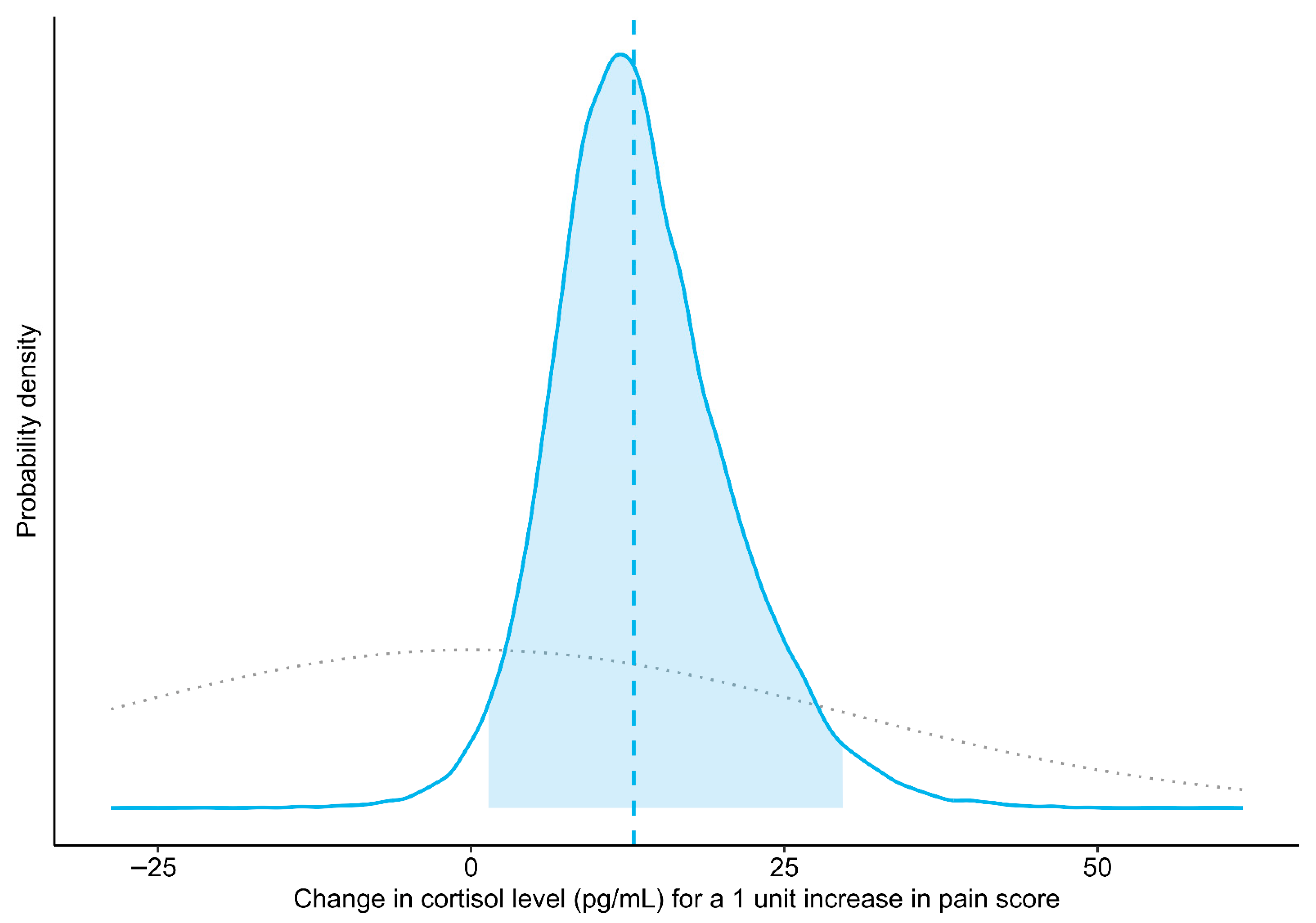
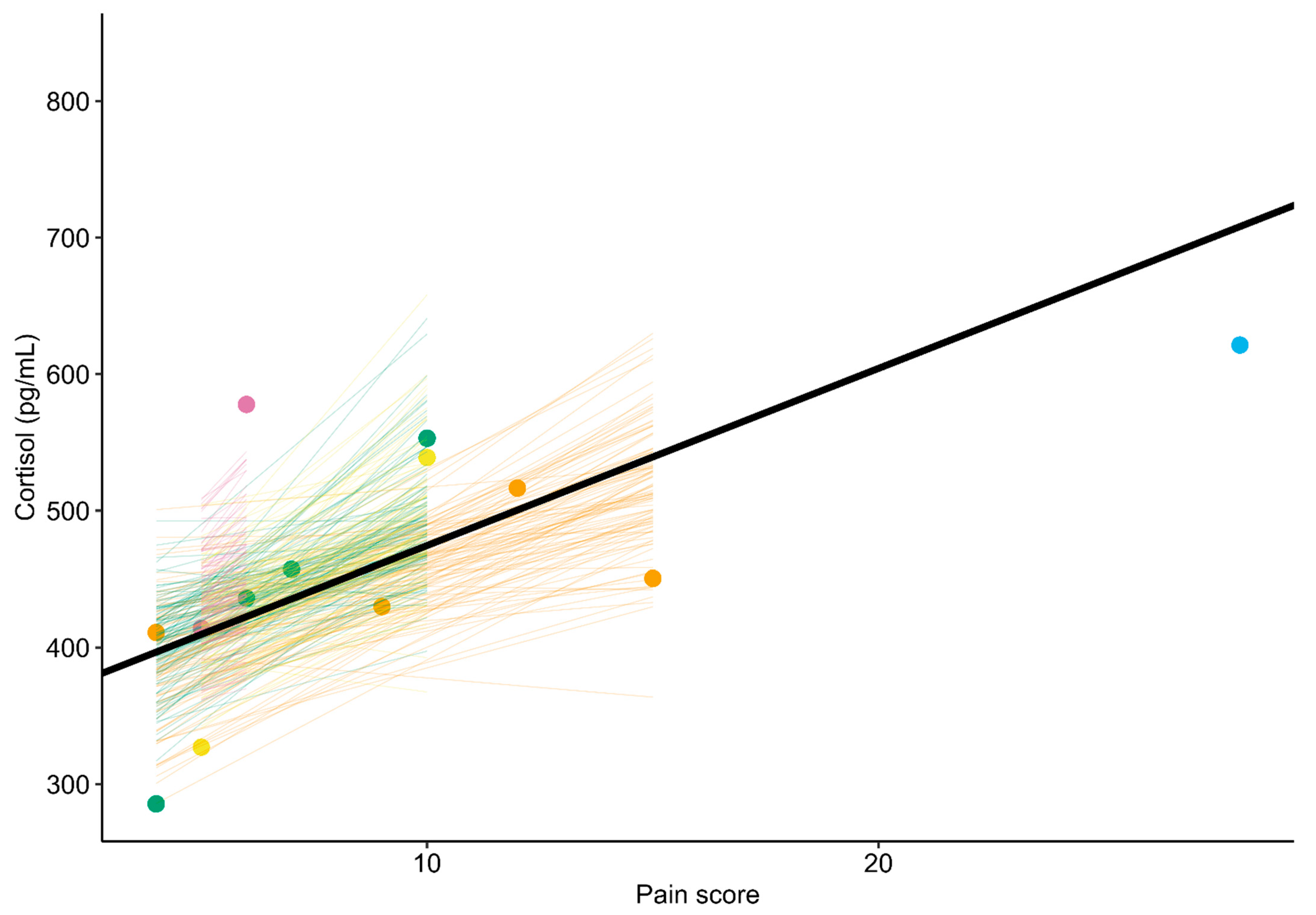
3.2. Validation with Salivary Cortisol
4. Discussion
5. Conclusions
Supplementary Materials
Author Contributions
Funding
Institutional Review Board Statement
Informed Consent Statement
Data Availability Statement
Acknowledgments
Conflicts of Interest
References
- Drewnowska, O.; Stefanik, E.; Samsel, A.; Turek, B. Skale oceny bólu u koni. Mag. Weter. 2021, 30, 2. [Google Scholar]
- Dobrogowski, J.; Zajączkowska, R.; Dutka, J.; Wordliczek, J. Patofizjologia i klasyfikacja bólu. Pol. Przegląd Neurol. 2011, 7, 20–30. [Google Scholar]
- Rapacz, A.; Raś, A.; Raś-Noryńska, M. Wybrane schorzenia okresu okołoporodowego u klaczy. Med. Wet. 2010, 66, 93–96. [Google Scholar]
- Prunier, A.; Mounier, L.; Le Neindre, P.; Leterrier, C.; Mormède, P.; Paulmier, V.; Prunet, P.; Terlouw, C.; Guatteo, R. Identifying and monitoring pain in farm animals: A review. Animal 2013, 7, 998–1010. [Google Scholar] [CrossRef]
- Menéndez, S.; Cabezas, M.A.; Gómez de Segura, I.A. Attitudes to acute pain and the use of pain assessment scales among Spanish small animal veterinarians. Front. Vet. Sci. 2024, 10, 10. [Google Scholar] [CrossRef]
- Gleerup, K.B. Assessing pain in horses. Vet. Rec. 2019, 184, 124. [Google Scholar] [CrossRef]
- Sikorska, U.; Maśko, M.; Ciesielska, A.; Zdrojkowski, Ł.; Domino, M. Role of cortisol in horse’s welfare and health. Agriculture 2023, 13, 2219. [Google Scholar] [CrossRef]
- Herman, J.P.; McKlveen, J.M.; Ghosal, S.; Kopp, B.; Wulsin, A.; Makinson, R.; Scheimann, J.; Myers, B. Regulation of the hypothalamic-pituitary-adrenocortical stress response. Compr. Physiol. 2016, 6, 603–621. [Google Scholar] [CrossRef]
- Choi, M.H. Clinical and technical aspects in free cortisol measurement. Endocrinol. Metab. 2022, 37, 599–607. [Google Scholar] [CrossRef] [PubMed]
- Pritchett, L.C.; Ulibarri, C.; Roberts, M.C.; Schneider, R.K.; Sellon, D.C. Identification of potential physiological and behavioral indicators of postoperative pain in horses after exploratory celiotomy for colic. Appl. Anim. Behav. Sci. 2003, 80, 31–43. [Google Scholar] [CrossRef]
- Bussières, G.; Jacques, C.; Lainay, O.; Beauchamp, G.; Leblond, A.; Cadoré, J.L.; Desmazières, L.M.; Cuvelliez, S.G.; Troncy, E. Development of a composite orthopaedic pain scale in horses. Res. Vet. Sci. 2008, 85, 294–301. [Google Scholar] [CrossRef]
- Menzies-Gow, N.J.; Stevens, K.B.; Sepulveda, M.F.; Jarvis, N.; Marr, C.M. Repeatability and reproducibility of the Obel grading system for equine laminitis. Vet. Rec. 2010, 167, 52–55. [Google Scholar] [CrossRef] [PubMed]
- van Loon, J.P.A.M.; van Dierendonck, M.C. Monitoring acute equine visceral pain with the Equine Utrecht University Scale for Composite Pain Assessment (EQUUS-COMPASS) and the Equine Utrecht University Scale for Facial Assessment of Pain (EQUUS-FAP): A scale-construction study. Vet. J. 2015, 206, 356–364. [Google Scholar] [CrossRef]
- van Loon, J.P.A.M.; Macri, L. Objective assessment of chronic pain in horses using the Horse Chronic Pain Scale (HCPS): A scale-construction study. Animals 2021, 11, 1826. [Google Scholar] [CrossRef] [PubMed]
- Meier, A.; de Laat, M.; Pollitt, C.; Walsh, D.; McGree, J.; Reiche, D.B.; von Salis-Soglio, M.; Wells-Smith, L.; Mengeler, U.; Mesa Salas, D.; et al. A “modified Obel” method for the severity scoring of (endocrinopathic) equine laminitis. PeerJ 2019, 7, e7084. [Google Scholar] [CrossRef]
- Maskato, Y.; Dugdale, A.H.A.; Singer, E.R.; Kelmer, G.; Sutton, G.A. Prospective feasibility and revalidation of the Equine Acute Abdominal Pain Scale (EAAPS) in clinical cases of colic in horses. Animals 2020, 10, 2242. [Google Scholar] [CrossRef]
- van Loon, J.P.A.M.; de Grauw, J.C.; Burden, F.; Vos, J.W.; Bardelmeijer, L.H.; Rickards, K. Objective assessment of chronic pain in donkeys using the Donkey Chronic Pain Scale (DCPS): A scale-construction study. Vet. J. 2021, 267, 105565. [Google Scholar] [CrossRef] [PubMed]
- van Dierendonck, M.C.; Burden, F.A.; Rickards, K.; van Loon, J.P.A.M. Monitoring acute pain in donkeys with the Equine Utrecht University Scale for Donkeys Composite Pain Assessment (EQUUS-DONKEY-COMPASS) and the Equine Utrecht University Scale for Donkey Facial Assessment of Pain (EQUUS-DONKEY-FAP). Animals 2020, 10, 354. [Google Scholar] [CrossRef]
- de Oliveira, M.G.C.; de Paula, V.V.; Mouta, A.N.; Lima, I.O.; de Macêdo, L.B.; Nunes, T.L.; Trindade, P.H.E.; Luna, S.P.L. Validation of the Donkey Pain Scale (DOPS) for assessing postoperative pain in donkeys. Front. Vet. Sci. 2021, 8, 671330. [Google Scholar] [CrossRef]
- Costa, E.D.; Minero, M.; Lebelt, D.; Stucke, D.; Canali, E.; Leach, M.C. Development of the Horse Grimace Scale (HGS) as a pain assessment tool in horses undergoing routine castration. PLoS ONE 2014, 9, e92281. [Google Scholar]
- Gleerup, K.B.; Forkman, B.; Lindegaard, C.; Andersen, P.H. An equine pain face. Vet. Anaesth. Analg. 2015, 42, 103–115. [Google Scholar] [CrossRef]
- Costa, E.D.; Stucke, D.; Dai, F.; Minero, M.; Leach, M.C.; Lebelt, D. Using the horse grimace scale (HGS) to assess pain associated with acute laminitis in horses (Equus caballus). Animals 2016, 6, 47. [Google Scholar] [CrossRef]
- van Loon, J.P.A.M.; Trindade, P.H.E.; da Silva, G.V.; Keus, J.; Huberts, C.; de Grauw, J.C.; Lanci, A. Objective assessment of acute pain in foals using a facial expression-based pain scale. Equine Vet. J. 2025, 57, 1520–1530. [Google Scholar] [CrossRef]
- van Loon, J.P.A.M.; Verhaar, N.; van den Berg, E.; Ross, S.; de Grauw, J. Objective assessment of acute pain in foals using a facial expression-based pain scale. Animals 2020, 10, 1610. [Google Scholar] [CrossRef] [PubMed]
- Lanci, A.; Benedetti, B.; Freccero, F.; Castagnetti, C.; Mariella, J.; van Loon, J.P.A.M.; Padalino, B. Development of a composite pain scale in foals: A pilot study. Animals 2022, 12, 439. [Google Scholar] [CrossRef] [PubMed]
- Wong, D.L.; Baker, C.M. Pain in children: Comparison of assessment scales. Pediatr. Nurs. 1988, 14, 9–17. [Google Scholar] [PubMed]
- Ambuel, B.; Hamlett, K.W.; Marx, C.M.; Blumer, J.L. Assessing distress in pediatric intensive care environments: The COMFORT scale. J. Pediatr. Psychol. 1992, 17, 95–109. [Google Scholar] [CrossRef]
- Hodgkinson, K.; Bear, M.; Thorn, J.; Van Blaricum, S. Measuring pain in neonates: Evaluating an instrument and developing a common language. Aust. J. Adv. Nurs. 1994, 12, 17–22. [Google Scholar]
- Merkel, S.I.; Voepel-Lewis, T.; Shayevitz, J.R.; Malviya, S. The FLACC: A behavioral scale for scoring postoperative pain in young children. Pediatr. Nurs. 1997, 23, 293–297. [Google Scholar]
- Firth, A.M.; Haldane, S.L. Development of a scale to evaluate postoperative pain in dogs. J. Am. Vet. Med. Assoc. 1999, 214, 651–659. [Google Scholar] [CrossRef]
- Warden, V.; Hurley, A.C.; Volicer, L. Development and psychometric evaluation of the Pain Assessment in Advanced Dementia (PAINAD) scale. J. Am. Med. Dir. Assoc. 2003, 4, 9–15. [Google Scholar] [CrossRef]
- Haefeli, M.; Elfering, A. Pain assessment. Eur. Spine J. 2006, 15 (Suppl. 1), S17–S24. [Google Scholar] [CrossRef] [PubMed]
- Brown, D.C.; Boston, R.C.; Coyne, J.C.; Farrar, J.T. Development and psychometric testing of an instrument designed to measure chronic pain in dogs with osteoarthritis. Am. J. Vet. Res. 2007, 68, 631–637. [Google Scholar] [CrossRef] [PubMed]
- Reid, J.; Nolan, A.; Hughes, J.; Lascelles, D.; Pawson, P.; Scott, E. Development of the short-form Glasgow Composite Measure Pain Scale (CMPS-SF) and derivation of an analgesic intervention score. Anim. Welf. 2007, 16, 97–104. [Google Scholar] [CrossRef]
- Brown, D.C.; Boston, R.C.; Coyne, J.C.; Farrar, J.T. Ability of the Canine Brief Pain Inventory to detect response to treatment in dogs with osteoarthritis. J. Am. Vet. Med. Assoc. 2008, 233, 1278–1283. [Google Scholar] [CrossRef]
- Hudson, C.; Whay, H.; Huxley, J. Recognition and management of pain in cattle. Practice 2008, 30, 126–134. [Google Scholar] [CrossRef]
- Hielm-Björkman, A.K.; Rita, H.; Tulamo, R.M. Psychometric testing of the Helsinki Chronic Pain Index by completion of a questionnaire in Finnish by owners of dogs with chronic signs of pain caused by osteoarthritis. Am. J. Vet. Res. 2009, 70, 727–734. [Google Scholar] [CrossRef] [PubMed]
- Brondani, J.T.; Mama, K.R.; Luna, S.P.; Wright, B.D.; Niyom, S.; Ambrosio, J.; Vogel, P.R.; Padovani, C.R. Validation of the English version of the UNESP-Botucatu multidimensional composite pain scale for assessing postoperative pain in cats. BMC Vet. Res. 2013, 9, 143. [Google Scholar] [CrossRef]
- de Oliveira, F.A.; Luna, S.P.; do Amaral, J.B.; Rodrigues, K.A.; Sant’Anna, A.C.; Daolio, M.; Brondani, J.T. Validation of the UNESP-Botucatu unidimensional composite pain scale for assessing postoperative pain in cattle. BMC Vet. Res. 2014, 10, 200. [Google Scholar] [CrossRef]
- Gleerup, K.B.; Andersen, P.H.; Munksgaard, L.; Forkman, B. Pain evaluation in dairy cattle. Appl. Anim. Behav. Sci. 2015, 171, 25–32. [Google Scholar] [CrossRef]
- Reid, J.; Nolan, A.; Scott, E.M. Measuring pain in dogs and cats using structured behavioural observation. Vet. J. 2018, 236, 72–79. [Google Scholar] [CrossRef]
- Evangelista, M.C.; Watanabe, R.; Leung, V.S.; Monteiro, B.P.; O’Toole, E.; Pang, D.S.; Steagall, P.V. Facial expressions of pain in cats: The development and validation of a Feline Grimace Scale. Sci. Rep. 2019, 9, 19128. [Google Scholar] [CrossRef]
- Hernández-Avalos, I.; Mota-Rojas, D.; Mora-Medina, P.; Martínez-Burnes, J.; Casas Alvarado, A.; Verduzco-Mendoza, A.; Lezama-García, K.; Olmos-Hernández, A. A review of different methods used for clinical recognition and assessment of pain in dogs and cats. Int. J. Vet. Sci. Med. 2019, 7, 43–54. [Google Scholar] [CrossRef]
- Belli, M.; de Oliveira, A.R.; de Lima, M.T.; Trindade, P.H.E.; Steagall, P.V.; Luna, S.P.L. Clinical validation of the short and long UNESP-Botucatu scales for feline pain assessment. PeerJ 2021, 9, e11225. [Google Scholar] [CrossRef]
- Tschoner, T. Methods for pain assessment in calves and their use for the evaluation of pain during different procedures—A review. Animals 2021, 11, 1235. [Google Scholar] [CrossRef]
- Wilcox, R.R. A Guide to Robust Statistical Methods; Springer: New York, NY, USA, 2023. [Google Scholar]
- R Core Team. R: A Language and Environment for Statistical Computing; R Foundation for Statistical Computing: Vienna, Austria, 2024; Available online: https://www.R-project.org/ (accessed on 20 November 2025).
- Barr, D.J.; Levy, R.; Scheepers, C.; Tily, H.J. Random effects structure for confirmatory hypothesis testing: Keep it maximal. J. Mem. Lang. 2013, 68, 255–278. [Google Scholar] [CrossRef]
- Lemoine, N.P. Moving beyond noninformative priors: Why and how to choose weakly informative priors in Bayesian analyses. Oikos 2019, 128, 912–928. [Google Scholar] [CrossRef]
- Gelman, A.; Hill, J.; Vehtari, A. Regression and Other Stories; Cambridge University Press: Cambridge, UK, 2021. [Google Scholar]
- Cavallone, E.; Di Giancamillo, M.; Secchiero, B.; Belloli, A.; Pravettoni, D.; Rimoldi, E.M. Variations of serum cortisol in Argentine horses subjected to ship transport and adaptation stress. J. Equine Vet. Sci. 2002, 22, 541–545. [Google Scholar] [CrossRef]
- Cayado, P.; Muñoz-Escassi, B.; Dominguez, C.; Manley, W.; Olabarri, B.; De La Muela, M.S.; Castejon, F.; Marañon, G.; Vara, E. Hormone response to training and competition in athletic horses. Equine Vet. J. 2006, 38, 274–278. [Google Scholar] [CrossRef] [PubMed]
- Irvine, C.H.; Alexander, S.L. Factors affecting the circadian rhythm in plasma cortisol concentrations in the horse. Domest. Anim. Endocrinol. 1994, 11, 227–238. [Google Scholar] [CrossRef] [PubMed]
- Schmidt, A.; Möstl, E.; Wehnert, C.; Aurich, J.; Müller, J.; Aurich, C. Cortisol release and heart rate variability in horses during road transport. Horm. Behav. 2010, 57, 209–215. [Google Scholar] [CrossRef]
- Bohák, Z.S.; Szabó, F.; Beckers, J.F.; de Sousa, N.M.; Kutasi, O.; Nagy, K.; Szenci, O. Monitoring the circadian rhythm of serum and salivary cortisol concentrations in the horse. Domest. Anim. Endocrinol. 2013, 45, 38–42. [Google Scholar] [CrossRef] [PubMed]
- Goodrich, B.; Gabry, J.; Ali, I.; Brilleman, S. rstanarm: Bayesian Applied Regression Modeling via Stan, R package version 2.32.1; R Foundation for Statistical Computing: Vienna, Austria, 2024; Available online: https://mc-stan.org/rstanarm (accessed on 20 November 2025).
- Vehtari, A.; Gelman, A.; Simpson, D.; Carpenter, B.; Bürkner, P.C. Rank-normalization, folding, and localization: An improved ^R for assessing convergence of MCMC (with discussion). Bayesian Anal. 2021, 16, 667–718. [Google Scholar] [CrossRef]
- Bürkner, P.; Gabry, J.; Kay, M.; Vehtari, A. posterior: Tools for Working with Posterior Distributions, R package version 1.6.1; R Foundation for Statistical Computing: Vienna, Austria, 2025; Available online: https://mc-stan.org/posterior (accessed on 20 November 2025).
- Gabry, J.; Mahr, T. bayesplot: Plotting for Bayesian Models, R package version 1.11.1; R Foundation for Statistical Computing: Vienna, Austria, 2024; Available online: https://mc-stan.org/bayesplot (accessed on 20 November 2025).
- Limpert, E.; Stahel, W.A. Problems with Using the Normal Distribution–and Ways to Improve Quality and Efficiency of Data Analysis. PLoS ONE 2011, 6, e21403. [Google Scholar] [CrossRef]
- LeBlanc, M.M. Common peripartum problems in the mare. J. Equine Vet. Sci. 2008, 28, 709–715. [Google Scholar] [CrossRef]
- Canisso, I.F.; Rodriguez, J.S.; Sanz, M.G.; da Silva, M.A.C. A clinical approach to the diagnosis and treatment of retained fetal membranes with an emphasis on the critically ill mare. J. Equine Vet. Sci. 2013, 33, 570–579. [Google Scholar] [CrossRef]
- Rapacz-Leonard, A.; Paździor, K.; Raś, A.; Rotkiewicz, T.; Janowski, T.E. Retained fetal membranes in heavy draft mares associated with histological abnormalities. J. Equine Vet. Sci. 2012, 32, 38–44. [Google Scholar] [CrossRef]
- Torcivia, C.; McDonnell, S. In-Person Caretaker Visits Disrupt Ongoing Discomfort Behavior in Hospitalized Equine Orthopedic Surgical Patients. Animals 2020, 10, 210. [Google Scholar] [CrossRef]
- Hellhammer, D.H.; Wüst, S.; Kudielka, B.M. Salivary cortisol as a biomarker in stress research. Psychoneuroendocrinology 2009, 34, 163–171. [Google Scholar] [CrossRef] [PubMed]
- Peeters, M.; Sulon, J.; Beckers, J.F.; Ledoux, D.; Vandenheede, M. Comparison between blood serum and salivary cortisol concentrations in horses using an ACTH challenge. Equine Vet. J. 2011, 43, 487–493. [Google Scholar] [CrossRef] [PubMed]
- Schmidt, A.; Hödl, S.; Möstl, E.; Aurich, J.; Müller, J.; Aurich, C. Cortisol release, heart rate, and HRV in transport-naïve horses during repeated road transport. Domest. Anim. Endocrinol. 2010, 39, 205–213. [Google Scholar] [CrossRef] [PubMed]
- Schmidt, A.; Möstl, E.; Wehnert, C.; Aurich, J.; Müller, J.; Aurich, C. Changes in cortisol release and heart rate and HRV during initial training of 3-year-old sport horses. Horm. Behav. 2010, 58, 628–636. [Google Scholar] [CrossRef]
- Kędzierski, W.; Strzelec, K.; Cywińska, A.; Kowalik, S. Salivary cortisol concentration in exercised Thoroughbred horses. J. Equine Vet. Sci. 2013, 33, 1106–1109. [Google Scholar] [CrossRef]
- Contreras-Aguilar, M.D.; Escribano, D.; Martín-Cuervo, M.; Tecles, F.; Cerón, J.J. Salivary alpha-amylase activity and cortisol in horses with acute abdominal disease: A pilot study. BMC Vet. Res. 2018, 14, 156. [Google Scholar] [CrossRef] [PubMed]


| PAIN SCALE FOR HEAVY MARES AFTER DELIVERY | |||||||||||||||||||||||||||||||
|---|---|---|---|---|---|---|---|---|---|---|---|---|---|---|---|---|---|---|---|---|---|---|---|---|---|---|---|---|---|---|---|
| Date and time: | |||||||||||||||||||||||||||||||
| Mare’s name: | |||||||||||||||||||||||||||||||
| Breed: | |||||||||||||||||||||||||||||||
| Age: | |||||||||||||||||||||||||||||||
| Weight: | |||||||||||||||||||||||||||||||
| PART 1. Observation of a mare in a stall (gray cells do not score points) | |||||||||||||||||||||||||||||||
| Points to score | 0 | 1 | 2 | 3 | 4 | Score | |||||||||||||||||||||||||
| Posture and weight distribution | Normal, symmetrical weight bearing on all limbs | Occasionally shifting weight off one limb (mild, intermittent favoring) | Abnormal stance without clear favoring of a specific limb | Abnormal stance with obvious favoring of one or more limbs or frequent weight shifting | Marked and continuous weight shifting between limbs; clear reluctance to bear weight on one or more limbs | ||||||||||||||||||||||||||
| Position of the mare’s body | Standing freely with a normal, upright posture | Standing but with obvious muscle tension | Occasional attempts to lie down | Frequently lying down and getting up | Lying down all the time, with visible attempts to roll or wallow | ||||||||||||||||||||||||||
| Position and movement of the mare’s tail | Tail in a normal position with free, calm movements | Elevated tail, with minimal/no movements | |||||||||||||||||||||||||||||
| Mare’s interest in her abdomen/vulvar area | No particular interest in the abdomen or vulvar area | Occasionally looking at her flank/ vulvar area | Marked interest; kicks abdomen with hind limbs | ||||||||||||||||||||||||||||
| Vocalization | No pain related vocalization | Panting/ groaning | |||||||||||||||||||||||||||||
| Mare’s reaction to surroundings and sounds | Interested in surroundings, easy to approach and engage | Observes her surroundings, but reduced response to sounds | Little or no interest in surroundings, minimal or absent response to sounds | ||||||||||||||||||||||||||||
| Sweating | No visible sweating | Visible sweating | |||||||||||||||||||||||||||||
| Other/notes: | Summary: | /19 | |||||||||||||||||||||||||||||
| PART 2. Observation of the mare’s facial expression-Horse Grimace Scale (gray cells do not score points) | |||||||||||||||||||||||||||||||
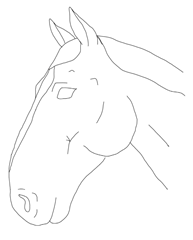 | 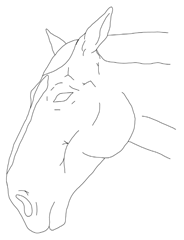 | 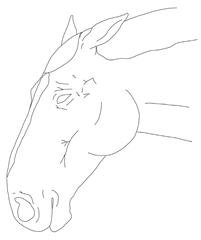 | |||||||||||||||||||||||||||||
| a. Diagram of expression equivalent to 0 points on the scale | b. Diagram of expression equivalent to 1 point on the scale | c. Diagram of expression equivalent to 2 points on the scale | |||||||||||||||||||||||||||||
| Points to score | 0 | 1 | 2 | Score | |||||||||||||||||||||||||||
| Visibility of wrinkles on the head | Wrinkles not visible, relaxed facial expression | Wrinkles visible | Pronounced, clearly visible wrinkles | ||||||||||||||||||||||||||||
| Ear position | Standing up | Slightly laid back | Completely laid back | ||||||||||||||||||||||||||||
| Eyelids | Open | Squinting | Marked squinting, eyelid covers approximately half of the eyeball | ||||||||||||||||||||||||||||
| Nostrils | Relaxed | Abnormally wide | Extremely wide | ||||||||||||||||||||||||||||
| Turning back the lips/teeth gnashing | No | Yes | |||||||||||||||||||||||||||||
| Tongue protruding | No | Yes | |||||||||||||||||||||||||||||
| Other/notes: | Summary: | /12 | |||||||||||||||||||||||||||||
| PART 3. Clinical examination | |||||||||||||||||||||||||||||||
| Instructions for measuring core temperature: Place an electronic thermometer in the mare’s rectum and turn it on. Read the result when the signal is heard indicating that the thermometer is ready. | |||||||||||||||||||||||||||||||
| Instructions for measuring respiratory rate: This examination should be performed when the mare is standing quietly and has not recently undergone any physical effort. The examiner’s palm should be placed close to the mare’s nostril. The respiratory rate is the number of exhalations counted over one minute. | |||||||||||||||||||||||||||||||
| Points to score | 0 | 1 | 2 | Score | |||||||||||||||||||||||||||
Respiratory rate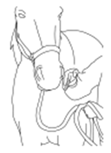 | 8–16 breaths/min | 17–30 breaths/min | >30 breaths/min | ||||||||||||||||||||||||||||
Body temperature | 37.0–38.4 °C | 36.0–36.9 °C/38.5–39.5 °C | <36 °C or >39.5 °C | ||||||||||||||||||||||||||||
| Others/notes: | Summary: | /4 | |||||||||||||||||||||||||||||
| PART 4: Palpation of the mammary gland and body torso | |||||||||||||||||||||||||||||||
| (Presence of swelling and/or areas of increased temperature) | |||||||||||||||||||||||||||||||
| Points to score | 0 | 1 | Score | ||||||||||||||||||||||||||||
Back, loin and croup | No swelling or increased warmth detected | Swelling and/or increased warmth present | |||||||||||||||||||||||||||||
Abdomen and flank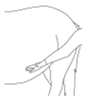 | No swelling or increased warmth detected | Swelling and/or increased warmth present | |||||||||||||||||||||||||||||
Udder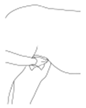 | No swelling or increased warmth detected | Swelling and/or increased warmth present | |||||||||||||||||||||||||||||
| Other/notes | Summary: | /3 | |||||||||||||||||||||||||||||
| PART 5: Peristalsis examination | |||||||||||||||||||||||||||||||
| Points to score | 0 | 1 | Score | ||||||||||||||||||||||||||||
| Fecal output | Normal consistency and regular defecation | Abnormal fecal consistency and/or no feces passed | |||||||||||||||||||||||||||||
| Others/notes | Summary: | /1 | |||||||||||||||||||||||||||||
| PART 6: Hoof examination | |||||||||||||||||||||||||||||||
| Side | Hoof | Points to score: 0 | Points to score: 0.5 | Score | |||||||||||||||||||||||||||
| Left | Front | Normal hoof temperature similar to other limbs | Increased hoof temperature (noticeably warmer than other limbs) | ||||||||||||||||||||||||||||
| Back | Normal hoof temperature similar to other limbs | Increased hoof temperature (noticeably warmer than other limbs) | |||||||||||||||||||||||||||||
| Right | Front | Normal hoof temperature similar to other limbs | Increased hoof temperature (noticeably warmer than other limbs) | ||||||||||||||||||||||||||||
| Back | Normal hoof temperature similar to other limbs | Increased hoof temperature (noticeably warmer than other limbs) | |||||||||||||||||||||||||||||
Others/notes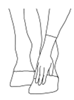 | Summary: | /2 | |||||||||||||||||||||||||||||
| PART 7: Food test | |||||||||||||||||||||||||||||||
| Points to score | 0 | 1 | 2 | Score | |||||||||||||||||||||||||||
| Reaction to tasty treats | Reaches for food, clearly interested; chews normally | Looks at food and shows some interest; attempts to eat but has visible difficulty chewing (feed falls from mouth, abnormal mandible movements) | Complete lack of interest in food and/or bits of food falling out through the nostrils | ||||||||||||||||||||||||||||
| Others/notes | Summary: | /2 | |||||||||||||||||||||||||||||
| PART 8: Examination of walking traits | |||||||||||||||||||||||||||||||
| Points to score | 0 | 2 | 4 | Score | |||||||||||||||||||||||||||
| Behavior in motion | Walks normally with typical gait and behavior | Abnormal gait (e.g., stiffness, reluctance to move, balking, or lameness) | Unable or unwilling to stand and walk; remains lying down and cannot be encouraged to rise | ||||||||||||||||||||||||||||
| Other/notes: | Summary: | /4 | |||||||||||||||||||||||||||||
| GENERAL TOTAL SCORE: ………/…..… | |||||||||||||||||||||||||||||||
| RESULT IN % (of maximum possible score): ………………… | |||||||||||||||||||||||||||||||
Disclaimer/Publisher’s Note: The statements, opinions and data contained in all publications are solely those of the individual author(s) and contributor(s) and not of MDPI and/or the editor(s). MDPI and/or the editor(s) disclaim responsibility for any injury to people or property resulting from any ideas, methods, instructions or products referred to in the content. |
© 2025 by the authors. Licensee MDPI, Basel, Switzerland. This article is an open access article distributed under the terms and conditions of the Creative Commons Attribution (CC BY) license (https://creativecommons.org/licenses/by/4.0/).
Share and Cite
Bolesławska-Szubartowska, J.; Kucharczuk, M.; Skrabska, A.; Zbysław, A.; Adamowicz, J.; Alszko, A.; Domagalska-Stomska, K.; Durska, M.; Dziekcierów, A.; Janiszewska, Z.; et al. Introducing an Innovative Pain Scale for Assessing Postpartum Pain in Mares: Preliminary Clinical Evaluation. Animals 2025, 15, 3454. https://doi.org/10.3390/ani15233454
Bolesławska-Szubartowska J, Kucharczuk M, Skrabska A, Zbysław A, Adamowicz J, Alszko A, Domagalska-Stomska K, Durska M, Dziekcierów A, Janiszewska Z, et al. Introducing an Innovative Pain Scale for Assessing Postpartum Pain in Mares: Preliminary Clinical Evaluation. Animals. 2025; 15(23):3454. https://doi.org/10.3390/ani15233454
Chicago/Turabian StyleBolesławska-Szubartowska, Julia, Magdalena Kucharczuk, Aleksandra Skrabska, Aneta Zbysław, Julia Adamowicz, Agnieszka Alszko, Klementyna Domagalska-Stomska, Marta Durska, Agata Dziekcierów, Zuzanna Janiszewska, and et al. 2025. "Introducing an Innovative Pain Scale for Assessing Postpartum Pain in Mares: Preliminary Clinical Evaluation" Animals 15, no. 23: 3454. https://doi.org/10.3390/ani15233454
APA StyleBolesławska-Szubartowska, J., Kucharczuk, M., Skrabska, A., Zbysław, A., Adamowicz, J., Alszko, A., Domagalska-Stomska, K., Durska, M., Dziekcierów, A., Janiszewska, Z., Korzeniowska, R., Kraujutowicz, K., Kulesza, K., Marciniak, P., Pacyna, Z., Przeborowska, J., Siwek, Z., Leonard, M., & Rapacz-Leonard, A. (2025). Introducing an Innovative Pain Scale for Assessing Postpartum Pain in Mares: Preliminary Clinical Evaluation. Animals, 15(23), 3454. https://doi.org/10.3390/ani15233454