Ability of Surface Electrocardiography in Predicting Ventricular Arrhythmias in Dogs with Secondary Atrial Fibrillation

 , , , ,
  and
and 
Simple Summary
Abstract
1. Introduction
2. Materials and Methods
2.1. Animals
2.2. Routine ECG and 24 h Holter Monitoring
2.3. Statistical Analysis
- Sensitivity (Se): The probability of a positive ECG result (≥1 VPCs) when the Holter identified severe VAs. Specifically, for the purpose of this study, VAs were classified as severe based on two criteria: (1) the presence of more than 100 VPCs and (2) a Lown–Wolf grade ≥ 4.
- Specificity (Sp): The probability of a negative ECG result (VPCs = 0) when the Holter did not detect severe VAs.
- Prevalence: The proportion of dogs with severe VAs detected by Holter, according to each criterion.
- Positive Predictive Value (PPV): The probability that severe VAs are present when the ECG test is positive:PPV = (Se × Prevalence)/[(Se × Prevalence) + ((1 − Sp) × (1 − Prevalence))]
- Negative Predictive Value (NPV): The probability that severe VAs are absent when the ECG test is negative:NPV = (Sp × (1 − Prevalence))/[((1 − Se) × Prevalence) + (Sp × (1 − Prevalence))]
- Accuracy: The overall probability that a dog is correctly classified:Accuracy = (Se × Prevalence) + (Sp × (1 − Prevalence))
3. Results
3.1. Animals
3.2. Electrocardiographic Data
4. Discussion
5. Conclusions
Author Contributions
Funding
Institutional Review Board Statement
Informed Consent Statement
Data Availability Statement
Conflicts of Interest
References
- Guglielmini, C.; Chetboul, V.; Pietra, M.; Pouchelon, J.L.; Capucci, A.; Cipone, M. Influence of left atrial enlargement and body weight on the development of atrial fibrillation: Retrospective study on 205 dogs. Vet. J. 2000, 160, 235–241. [Google Scholar] [CrossRef]
- Guglielmini, C.; Goncalves Sousa, M.; Baron Toaldo, M.; Valente, C.; Bentivoglio, V.; Mazzoldi, C.; Bergamin, I.; Drigo, M.; Poser, H. Prevalence and risk factors for atrial fibrillation in dogs with myxomatous mitral valve disease. J. Vet. Intern. Med. 2020, 34, 2223–2231. [Google Scholar] [CrossRef] [PubMed]
- Baron Toaldo, M.; Mazzoldi, C.; Romito, G.; Poser, H.; Contiero, B.; Cipone, M.; Guglielmini, C. Echocardiographic predictors of first onset of atrial fibrillation in dogs with myxomatous mitral valve disease. J. Vet. Intern. Med. 2020, 34, 1787–1793. [Google Scholar] [CrossRef] [PubMed]
- Guglielmini, C.; Valente, C.; Romito, G.; Mazzoldi, C.; Baron Toaldo, M.; Goncalves Sousa, M.; Wolf, M.; Beluque, T.; Domenech, O.; Patata, V.; et al. Risk factors for atrial fibrillation in dogs with dilated cardiomyopathy. Front. Vet. Sci. 2023, 10, 1183689. [Google Scholar] [CrossRef] [PubMed]
- Crosara, S.; Borgarelli, M.; Perego, M.; Häggström, J.; La Rosa, G.; Tarducci, A.; Santilli, R.A. Holter monitoring in 36 dogs with myxomatous mitral valve disease. Aust. Vet. J. 2010, 88, 386–392. [Google Scholar] [CrossRef]
- Rasmussen, C.E.; Falk, T.; Zois, N.E.; Moesgaard, S.G.; Häggström, J.; Pedersen, H.D.; Ablad, B.; Nilsen, H.Y.; Olsen, L.H. Heart rate, heart rate variability, and arrhythmias in dogs with myxomatous mitral valve disease. J. Vet. Intern. Med. 2012, 26, 76–84. [Google Scholar] [CrossRef]
- Klüser, L.; Holler, P.J.; Simak, J.; Tater, G.; Smets, P.; Rügamer, D.; Küchenhoff, H.; Wess, G. Predictors of Sudden Cardiac Death in Doberman Pinschers with Dilated Cardiomyopathy. J. Vet. Intern. Med. 2016, 30, 722–732. [Google Scholar] [CrossRef]
- Romito, G.; Guglielmini, C.; Poser, H.; Baron Toaldo, M. Lorenz Plot Analysis in Dogs with Sinus Rhythm and Tachyarrhythmias. Animals 2021, 11, 1645. [Google Scholar] [CrossRef]
- Romito, G.; Gemma, N.; Dondi, F.; Mazzoldi, C.; Fasoli, S.; Cipone, M. Efficacy and safety of antiarrhythmic therapy in dogs with naturally acquired tachyarrhythmias treated with amiodarone or sotalol: A retrospective analysis of 64 cases. J. Vet. Cardiol. 2024, 53, 20–35. [Google Scholar] [CrossRef]
- Romito, G.; Mazzoldi, C.; Travaglini, S.; Paradies, P.; Recchia, A.; Castagna, P.; Pelle, N.G.; Valente, C.; Poser, H.; Guglielmini, C. Antiarrhythmic efficacy and safety of oral mexiletine in dogs with ventricular arrhythmias: A multicentre, retrospective analysis. J. Am. Vet. Med. Assoc. 2025, 1–9. [Google Scholar] [CrossRef]
- Borgeat, K.; Pack, M.; Harris, J.; Laver, A.; Seo, J.; Belachsen, O.; Hannabuss, J.; Todd, J.; Ferasin, L.; Payne, J.R. Prevalence of sudden cardiac death in dogs with atrial fibrillation. J. Vet. Intern. Med. 2021, 35, 2588–2595. [Google Scholar] [CrossRef]
- Santilli, R.; Saponaro, V.; Carlucci, L.; Perego, M.; Battaia, S.; Borgarelli, M. Heart rhythm characterization during sudden cardiac death in dogs. J. Vet. Cardiol. 2021, 38, 18–30. [Google Scholar] [CrossRef]
- Keene, B.W.; Atkins, C.E.; Bonagura, J.D.; Fox, P.R.; Häggström, J.; Fuentes, V.L.; Oyama, M.A.; Rush, J.E.; Stepien, R.; Uechi, M. ACVIM consensus guidelines for the diagnosis and treatment of myxomatous mitral valve disease in dogs. J. Vet. Intern. Med. 2019, 33, 1127–1140. [Google Scholar] [CrossRef]
- Wess, G. Screening for dilated cardiomyopathy in dogs. J. Vet. Cardiol. 2022, 40, 51–68. [Google Scholar] [CrossRef] [PubMed]
- Meurs, K.M.; Spier, A.W.; Wright, N.A.; Atkins, C.E.; DeFrancesco, T.C.; Gordon, S.G.; Hamlin, R.L.; Keene, B.W.; Miller, M.W.; Moise, N.S. Comparison of the effects of four antiarrhythmic treatments for familial ventricular arrhythmias in Boxers. J. Am. Vet. Med. Assoc. 2002, 221, 522–527. [Google Scholar] [CrossRef]
- Pedro, B.; Mavropoulou, A.; Oyama, M.A.; Linney, C.; Neves, J.; Dukes-McEwan, J.; Fontes-Sousa, A.P.; Gelzer, A.R. Optimal rate control in dogs with atrial fibrillation-ORCA study-Multicenter prospective observational study: Prognostic impact and predictors of rate control. J. Vet. Intern. Med. 2023, 37, 887–899. [Google Scholar] [CrossRef]
- Pedro, B.; Dukes-McEwan, J.; Oyama, M.A.; Kraus, M.S.; Gelzer, A.R. Retrospective evaluation of the effect of heart rate on survival in dogs with atrial fibrillation. J. Vet. Intern. Med. 2018, 32, 86–92. [Google Scholar] [CrossRef] [PubMed]
- Romito, G.; Castagna, P.; Sabetti, M.C.; Ablondi, M.; Cipone, M. Evaluating the accuracy of a six-lead smartphone-based electrocardiographic device compared with standard electrocardiography in brachymorphic dogs. Vet. Rec. 2023, 193, e2879. [Google Scholar] [PubMed]
- Romito, G.; Bertarello, M.; Mazzoldi, C.; Fasoli, S.; Dondi, F.; Castagna, P.; Pelle, N.G.; Paradies, P.; Valente, C.; Poser, H.; et al. Efficacy and safety of different antiarrhythmic protocols used for rate control in dogs with secondary atrial fibrillation. J. Vet. Cardiol. 2025, 57, 8–19. [Google Scholar] [CrossRef]
- Ward, J.; Ware, W.; Viall, A. Association between atrial fibrillation and right-sided manifestations of congestive heart failure in dogs with degenerative mitral valve disease or dilated cardiomyopathy. J. Vet. Cardiol. 2019, 21, 18–27. [Google Scholar] [CrossRef]
- Wess, G.; Schulze, A.; Geraghty, N.; Hartmann, K. Ability of a 5-minute electrocardiography (ECG) for predicting arrhythmias in Doberman Pinschers with cardiomyopathy in comparison with a 24-hour ambulatory ECG. J. Vet. Intern. Med. 2010, 24, 367–371. [Google Scholar] [CrossRef]
- Meurs, K.M.; Spier, A.W.; Wright, N.A.; Hamlin, R.L. Comparison of in-hospital versus 24-hour ambulatory electrocardiography for detection of ventricular premature complexes in mature Boxers. J. Am. Vet. Med. Assoc. 2001, 218, 222–224. [Google Scholar] [CrossRef]
- Teslenko, A.; Fries, R.C.; Selmic, L.E. Comparison of in-hospital continuous electrocardiography versus recordable Holter monitoring in dogs with ventricular arrhythmias. J. Vet. Emerg. Crit. Care 2021, 31, 758–765. [Google Scholar] [CrossRef]
- Gelzer, A.R.; Kraus, M.S.; Rishniw, M. Evaluation of in-hospital electrocardiography versus 24-hour Holter for rate control in dogs with atrial fibrillation. J. Small Anim. Pract. 2015, 56, 456–462. [Google Scholar] [CrossRef] [PubMed]
- Smith, C.E.; Freeman, L.M.; Rush, J.E.; Cunningham, S.M.; Biourge, V. Omega-3 fatty acids in Boxer dogs with arrhythmogenic right ventricular cardiomyopathy. J. Vet. Intern. Med. 2007, 21, 265–273. [Google Scholar] [PubMed]
- Calvert, C.A.; Jacobs, G.J.; Smith, D.D.; Rathbun, S.L.; Pickus, C.W. Association between results of ambulatory electrocardiography and development of cardiomyopathy during long-term follow-up of Doberman pinschers. J. Am. Vet. Med. Assoc. 2000, 216, 34–39. [Google Scholar] [CrossRef]
- Stern, J.A.; Meurs, K.M.; Spier, A.W.; Koplitz, S.L.; Baumwart, R.D. Ambulatory electrocardiographic evaluation of clinically normal adult Boxers. J. Am. Vet. Med. Assoc. 2010, 236, 430–433. [Google Scholar] [CrossRef]
- Rasmussen, C.E.; Vesterholm, S.; Ludvigsen, T.P.; Häggström, J.; Pedersen, H.D.; Moesgaard, S.G.; Olsen, L.H. Holter monitoring in clinically healthy Cavalier King Charles Spaniels, Wire-haired Dachshunds, and Cairn Terriers. J. Vet. Intern. Med. 2011, 25, 460–468. [Google Scholar] [CrossRef]
- Sanders, R.A.; Kurosawa, T.A.; Sist, M.D. Ambulatory electrocardiographic evaluation of the occurrence of arrhythmias in healthy Salukis. J. Am. Vet. Med. Assoc. 2018, 252, 966–969. [Google Scholar] [CrossRef] [PubMed]
- Lee, J.B.; Lee, Y.S.; Hong, S.P.; Kim, S.Y.; Kim, M.G.; Ryu, J.K.; Choi, J.Y.; Kim, K.S.; Chang, S.G. Prognostic Significance of the Lown Grades and Late Potentials in Patients after Myocardial Infarction. Korean Circ. J. 2008, 38, 17–22. [Google Scholar] [CrossRef]
- Steiness, E. Digoxin toxicity compared with myocardial digoxin and potassium concentration. Br. J. Pharmacol. 1978, 63, 233–237. [Google Scholar] [CrossRef] [PubMed]
- Lynch, J.J.; Montgomery, D.G.; Lucchesi, B.R. Facilitation of lethal ventricular arrhythmias by therapeutic digoxin in conscious post-infarction dogs. Am. Heart J. 1986, 111, 883–890. [Google Scholar] [PubMed]
- Lynch, J.J.; Lucchesi, B.R. Effect of digoxin on the extent of injury and the severity of arrhythmias during acute myocardial ischemia and infarction in the dog. J. Cardiovasc. Pharmacol. 1988, 11, 193–203. [Google Scholar] [CrossRef]
- Gunasekaran, T.; Sanders, R.A. Determining the optimal Holter monitoring duration for detecting ventricular arrhythmia in dogs: A Bayesian approach. J. Vet. Cardiol. 2025, 60, 14–22. [Google Scholar] [CrossRef]
- Spier, A.W.; Meurs, K.M. Evaluation of spontaneous variability in the frequency of ventricular arrhythmias in Boxers with arrhythmogenic right ventricular cardiomyopathy. J. Am. Vet. Med. Assoc. 2004, 224, 538–541. [Google Scholar] [CrossRef] [PubMed]


| Variable | All Dogs | VPCs on ECG | p-Value | |
|---|---|---|---|---|
| Yes | No | |||
| N. of dogs (%) | 35 | 13 (37) | 22 (63) | - |
| Breed: CB, PB (%) | 11 (31), 24 (69) | 5 (38), 8 (62) | 6 (27), 16 (73) | 0.76 |
| Sex: M, F (%) | 24 (69), 11 (31) | 7 (54), 6 (46) | 17 (77), 5 (23) | 0.29 |
| Age (y) | 9.7 ± 3.2 | 10.2 ± 3.0 | 9.4 ± 3.4 | 0.50 |
| Weight (kg) | 31.7 ± 17.5 | 33.4 ± 16.5 | 30.8 ± 18.3 | 0.68 |
| HD: MMVD, DCM, CHD (%) | 23 (66), 9 (26), 3 (8) | 10 (77), 3 (23), 0 (0) | 13 (59), 6 (27), 3 (14) | >0.30 |
| ACVIM stage: B2, C + D (%) | 6 (17), 29 (83) | 2 (15), 11 (85) | 4 (18), 18 (82) | 0.99 |
| Breed | Sex | Age (Year) | BW (kg) | Cardiac Disease | ACVIM Stage | Number of VPCs/ECG | Lown–Wolf Grade/ECG | Number of VPCs/Holter | Lown–Wolf Grade/Holter |
|---|---|---|---|---|---|---|---|---|---|
| Corso | IF | 9 | 72 | MMVD | C | 1 | 1 | 3381 | 5 |
| Crossbred | SF | 9 | 29 | MMVD | C | 1 | 1 | 3580 | 4 |
| German Shepherd | SF | 13 | 41.5 | MMVD | B2 | 1 | 1 | 2606 | 4 |
| Crossbred | IM | 15 | 27.5 | MMVD | C | 1 | 1 | 3388 | 4 |
| Crossbred | SF | 12 | 11.2 | MMVD | D | 1 | 1 | 206 | 5 |
| Dogue de Bordeaux | IF | 3 | 52.5 | DCM | C | 5 | 1 | 12,151 | 4 |
| Doberman Pinscher | IM | 10 | 33.8 | DCM | D | 1 | 1 | 3436 | 4 |
| Weimaraner | CM | 12 | 31.5 | MMVD | C | 4 | 2 | 1417 | 4 |
| Appenzeller Sennehund | IM | 11 | 24.5 | MMVD | C | 9 | 2 | 8926 | 5 |
| Giant Schnauzer | SF | 12 | 31.1 | MMVD | B2 | 9 | 2 | 34,531 | 4 |
| Golden Retriever | IM | 7 | 30 | MMVD | C | 1 | 1 | 5572 | 5 |
| Crossbred | CM | 9 | 41 | DCM | C | 10 | 2 | 12,099 | 5 |
| Crossbred | CM | 11 | 8.2 | MMVD | C | 10 | 4 | 2640 | 5 |
| Breed | Sex | Age (Year) | BW (kg) | Cardiac Disease | ACVIM Stage | Number of VPCs/Holter | Lown–Wolf Class/Holter |
|---|---|---|---|---|---|---|---|
| Dogue de Bordeaux | CM | 7 | 56.5 | DCM | B2 | 72 | 5 |
| Leonberger | IM | 6 | 62 | DCM | C | 1733 | 4 |
| Golden Retriever | IM | 11 | 34.5 | MMVD | C | 1024 | 5 |
| Italian Spinone | CM | 14 | 18.5 | MMVD | C | 4 | 1 |
| Corso | IM | 8 | 73 | DCM | C | 9 | 1 |
| Miniature Pinscher | SF | 9 | 3.4 | MMVD | C | 93 | 4 |
| American Staffordshire Terrier | SF | 9 | 22.5 | MD | C | 329 | 5 |
| German Shepherd | IM | 7 | 33 | MMVD | C | 86 | 2 |
| Weimaraner | SF | 11 | 29 | MMVD | C | 41 | 2 |
| Crossbred | CM | 10 | 29.3 | DCM | C | 719 | 4 |
| Crossbred | CM | 11 | 15.4 | MMVD | C | 2000 | 5 |
| Crossbred | SF | 9 | 46.1 | MMVD | C | 939 | 4 |
| Crossbred | CM | 13 | 30 | MMVD | C | 585 | 4 |
| Pinscher | IM | 11 | 5.9 | MMVD | C | 3 | 4 |
| Dachshund | IM | 9 | 7.5 | MMVD | C | 33 | 1 |
| German Shepherd | IF | 11 | 34 | MMVD | C | 1283 | 4 |
| Crossbred | CM | 13 | 16.5 | MMVD | C | 8638 | 4 |
| American Bulldog | IM | 7 | 46 | DCM | C | 15 | 2 |
| Crossbred | CM | 14 | 8.2 | MMVD | C | 355 | 3 |
| Weimaraner | IM | 2 | 35 | TD | B2 | 24 | 4 |
| Rottweiler | IM | 2 | 37.2 | TD | B2 | 324 | 5 |
| Golden Retriever | IM | 14 | 34 | DCM | B2 | 32 | 1 |
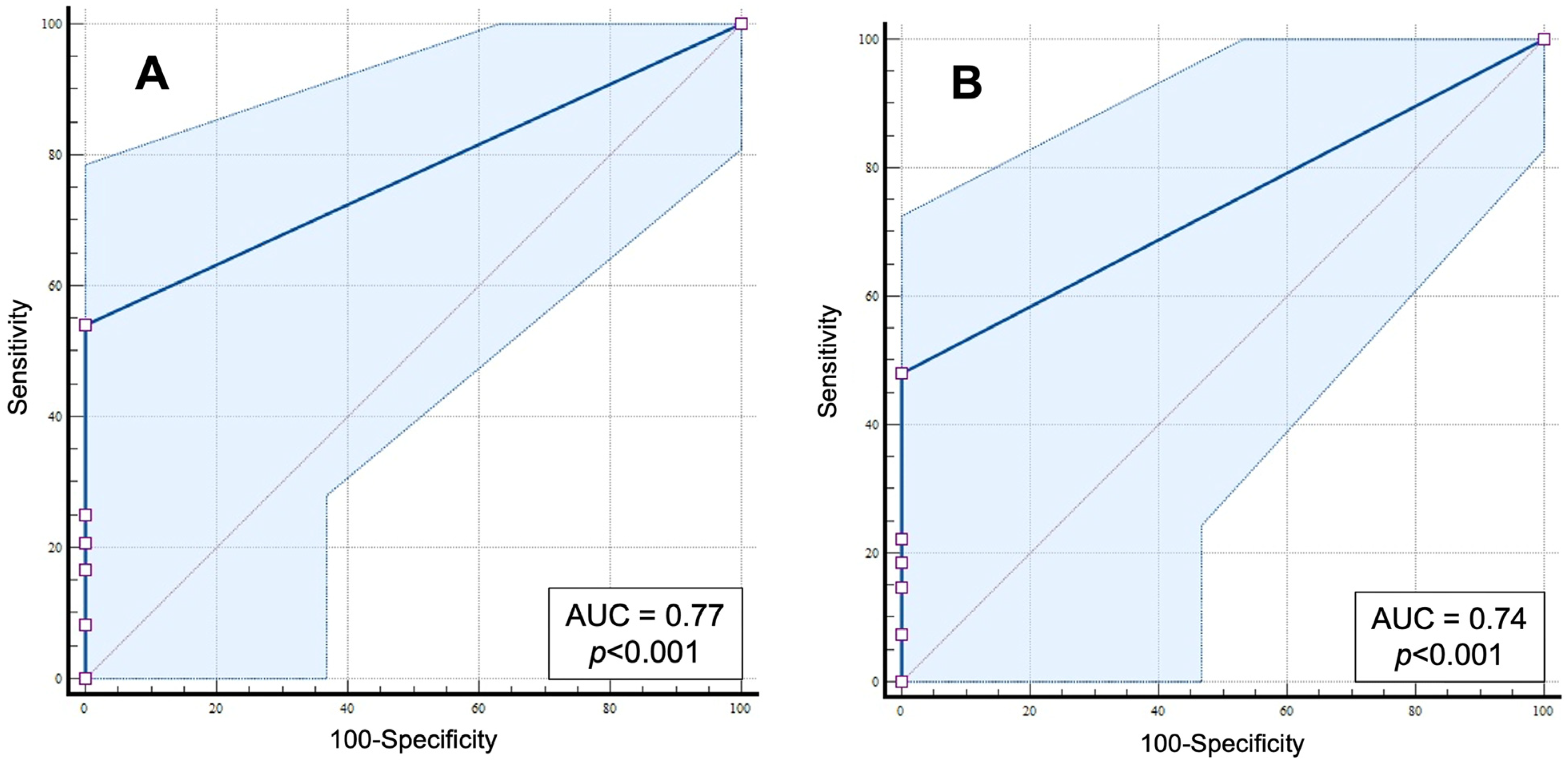
| VA Severity | Number of Dogs (%) | Sensitivity (95% CI) | Specificity (95% CI) | AUC (95% CI) | PPV (95% CI) | NPV (95% CI) | Accuracy (95% CI) |
|---|---|---|---|---|---|---|---|
| >100 VPCs on Holter | 24/35 (69%) | 54.2 (32.8–74.5) | 100 (71.5–100) | 0.77 (0.60–0.89) | 100 (75.3–100) | 50 (39.3–60.7) | 68.6 (51.7–83.1) |
| Lown–Wolf grade ≥ 4 | 27/35 (77%) | 48.1 (28.7–68.1) | 100 (63.1–100) | 0.74 (0.57–0.87) | 100 (75.3–100) | 36.4 (28.4–45.1) | 60 (42.1–76.1) |
Disclaimer/Publisher’s Note: The statements, opinions and data contained in all publications are solely those of the individual author(s) and contributor(s) and not of MDPI and/or the editor(s). MDPI and/or the editor(s) disclaim responsibility for any injury to people or property resulting from any ideas, methods, instructions or products referred to in the content. |
© 2025 by the authors. Licensee MDPI, Basel, Switzerland. This article is an open access article distributed under the terms and conditions of the Creative Commons Attribution (CC BY) license (https://creativecommons.org/licenses/by/4.0/).
Share and Cite
Romito, G.; Mazzoldi, C.; Valente, C.; Poser, H.; Arcuri, G.; Contiero, B.; Guglielmini, C. Ability of Surface Electrocardiography in Predicting Ventricular Arrhythmias in Dogs with Secondary Atrial Fibrillation. Animals 2025, 15, 3057. https://doi.org/10.3390/ani15203057
Romito G, Mazzoldi C, Valente C, Poser H, Arcuri G, Contiero B, Guglielmini C. Ability of Surface Electrocardiography in Predicting Ventricular Arrhythmias in Dogs with Secondary Atrial Fibrillation. Animals. 2025; 15(20):3057. https://doi.org/10.3390/ani15203057
Chicago/Turabian StyleRomito, Giovanni, Chiara Mazzoldi, Carlotta Valente, Helen Poser, Giulia Arcuri, Barbara Contiero, and Carlo Guglielmini. 2025. "Ability of Surface Electrocardiography in Predicting Ventricular Arrhythmias in Dogs with Secondary Atrial Fibrillation" Animals 15, no. 20: 3057. https://doi.org/10.3390/ani15203057
APA StyleRomito, G., Mazzoldi, C., Valente, C., Poser, H., Arcuri, G., Contiero, B., & Guglielmini, C. (2025). Ability of Surface Electrocardiography in Predicting Ventricular Arrhythmias in Dogs with Secondary Atrial Fibrillation. Animals, 15(20), 3057. https://doi.org/10.3390/ani15203057