Prospects for the Use of MICP Technology in the Remediation of Saline–Alkaline Soil Heavy Metal Pollution

Abstract
1. Introduction
- (1)
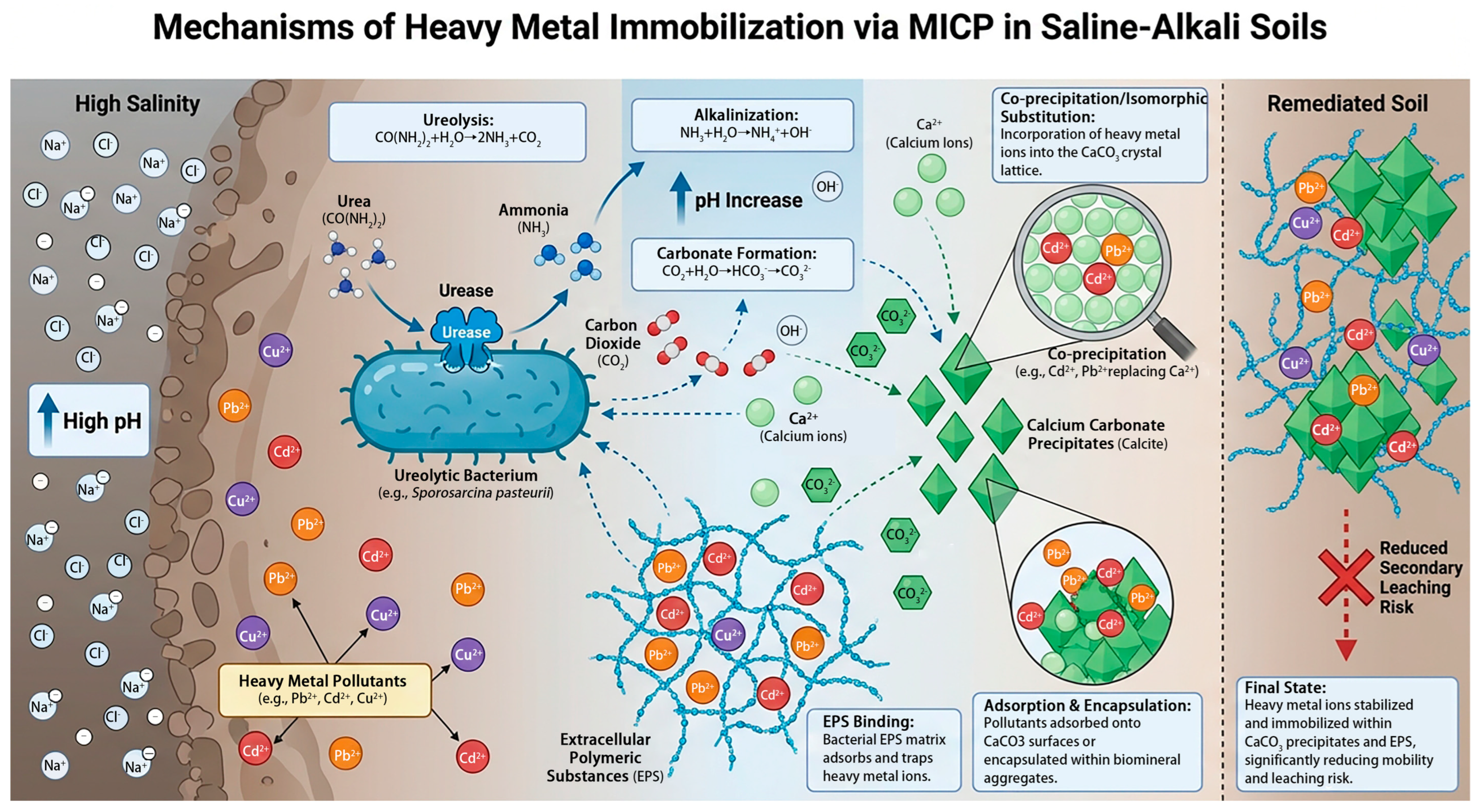
- Urease catalysis:CO(NH2)2 + H2O → 2NH3 + CO2
- (2)
- Carbonate equilibrium:CO2 + H2O → H2CO3 → HCO3− + H+ → CO32− + 2H+
- (3)
- Alkalinization:NH3 + H2O → NH4+ + OH−
- (4)
- Precipitation:Ca2+ + CO32− → CaCO3↓

| Area | Soil Property | Types of Heavy Metals | References |
|---|---|---|---|
| Yellow River Delta, China | Saline–Alkaline Soil (pH 7.35–9.17, salt concentration 0.01–2.00%) | As, Cd, Cr, Ni | [23] |
| Raebareli District, Uttar Pradesh, India | Saline–Alkaline Soil (pH 6.3–9.8, EC 0.24–10.53 μS/cm3) | As, Cu, Pb, Zn, Mn | [24] |
| Murcia, Spain | Saline–Alkaline Soil (pH 6.79–8.47, EC 3.42–17.00 dS m−1) | Mn, Zn, Pb, Cd, Cu, As | [25] |
| Atyrau, Kazakhstan | High-saline soil (salt concentration in dry residue 0.28–0.71%) | Ti, Mn, Mg, Pb, Ni, Cu, Co, Sr, Ag, P, Mo | [26] |
| Yinda Town, China | Saline–Alkaline Soil | Zn, Pb, Hg | [27] |
2. Common Heavy Metal Remediation
2.1. Physical Remediation and Chemical Restoration
2.2. Bioremediation
2.2.1. Phytoremediation
2.2.2. Microbial Remediation
2.3. Combined Remediation
3. The Basic Principle of Using MICP for the Remediation of Heavy Metals in Saline–Alkali Soils
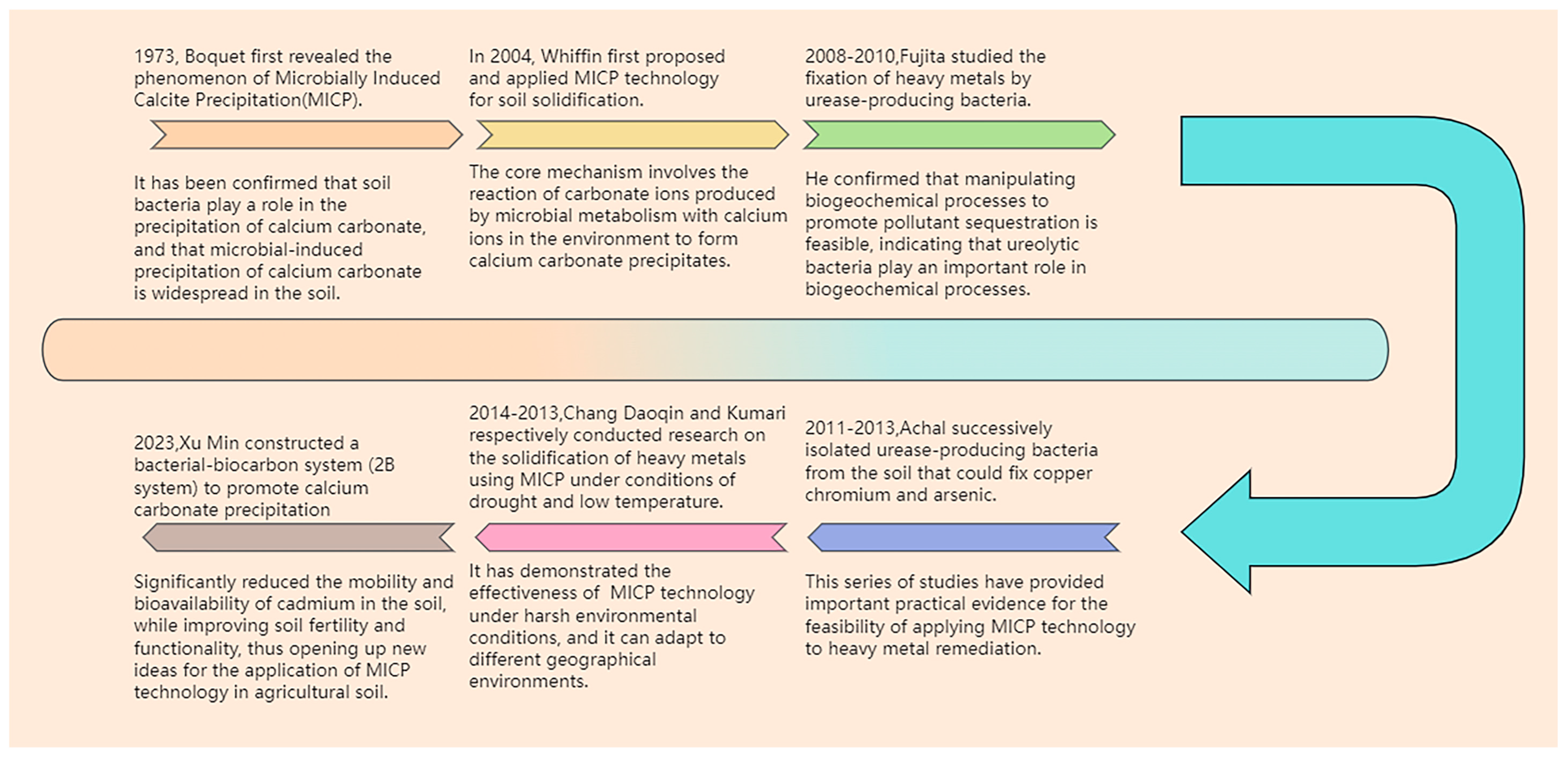
4. The Research Progress of MICP
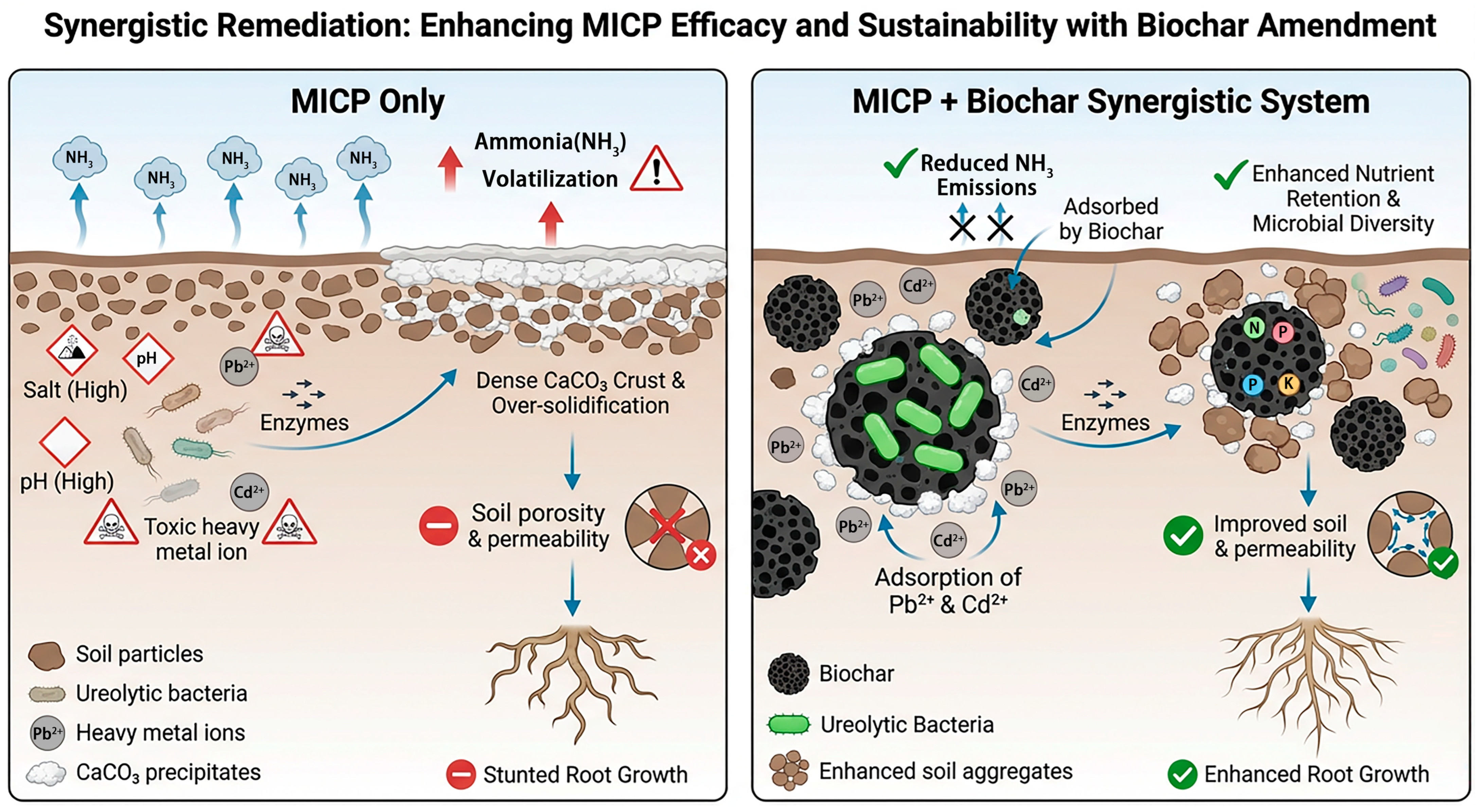
5. The Combination of MICP and Biochar for the Remediation of Heavy Metal Pollution
6. Challenges of Applying MICP Technology to the Remediation of Heavy Metal Pollution in Saline–Alkali Soils
6.1. Salt Stress
6.2. pH
6.3. Ammonia Emission
Author Contributions
Funding
Institutional Review Board Statement
Informed Consent Statement
Data Availability Statement
Acknowledgments
Conflicts of Interest
Abbreviations
| 2B system | Bacteria-biochar system |
| DTPA | Diethylenetriaminepentaacetic acid |
| EPS | Extracellular polymeric substances |
| FAO | Food and agriculture organization of the united nations |
| MICP | Microbially induced calcium carbonate precipitation |
| XPS | X-ray photoelectron spectroscopy |
| XRD | X-ray Diffraction |
References
- FAO. Global Map of Salt-Affected Soils; FAO: Rome, Italy, 2021. [Google Scholar]
- Baloch, M.Y.J.; Zhang, W.; Sultana, T.; Akram, M.; Al Shoumik, B.A.; Khan, Z.; Farooq, M.A. Utilization of sewage sludge to manage saline–alkali soil and increase crop production: Is it safe or not? Environ. Technol. Innov. 2023, 32, 103266. [Google Scholar] [CrossRef]
- Pan, Z.; Gong, T.; Liang, P. Heavy metal exposure and cardiovascular disease. Circ. Res. 2024, 134, 1160–1178. [Google Scholar] [CrossRef] [PubMed]
- Ahamad, M.I.; Song, J.; Sun, H.; Wang, X.; Mehmood, M.S.; Sajid, M.; Su, P.; Khan, A.J. Contamination level, ecological risk, and source identification of heavy metals in the hyporheic zone of the weihe river, China. Int. J. Environ. Res. Public Health 2020, 17, 1070. [Google Scholar] [CrossRef] [PubMed]
- Krishna, A.K.; Govil, P.K. Soil contamination due to heavy metals from an industrial area of surat, gujarat, western india. Environ. Monit. Assess. 2007, 124, 263–275. [Google Scholar] [CrossRef] [PubMed]
- Hawkes, S.J. What is a “heavy metal”? J. Chem. Educ. 1997, 74, 1374. [Google Scholar] [CrossRef]
- Palansooriya, K.N.; Yang, Y.; Tsang, Y.F.; Sarkar, B.; Hou, D.; Cao, X.; Meers, E.; Rinklebe, J.; Kim, K.-H.; Ok, Y.S. Occurrence of contaminants in drinking water sources and the potential of biochar for water quality improvement: A review. Crit. Rev. Environ. Sci. Technol. 2019, 50, 549–611. [Google Scholar] [CrossRef]
- Hou, S.; Yuan, L.; Jin, P.; Ding, B.; Qin, N.; Li, L.; Liu, X.; Wu, Z.; Zhao, G.; Deng, Y. A clinical study of the effects of lead poisoning on the intelligence and neurobehavioral abilities of children. Theor. Biol. Med. Model. 2013, 10, 13. [Google Scholar] [CrossRef]
- Mandal, B.K.; Suzuki, K.T. Arsenic round the world: A review. Talanta 2002, 58, 201–235. [Google Scholar] [CrossRef]
- Jomova, K.; Alomar, S.Y.; Nepovimova, E.; Kuca, K.; Valko, M. Heavy metals: Toxicity and human health effects. Arch. Toxicol. 2025, 99, 153–209. [Google Scholar] [CrossRef]
- Sun, H.; Brocato, J.; Costa, M. Oral chromium exposure and toxicity. Curr. Environ. Health Rep. 2015, 2, 295–303. [Google Scholar] [CrossRef]
- Hou, D.; Jia, X.; Wang, L.; McGrath, S.P.; Zhu, Y.-G.; Hu, Q.; Zhao, F.-J.; Bank, M.S.; O’cOnnor, D.; Nriagu, J. Global soil pollution by toxic metals threatens agriculture and human health. Science 2025, 388, 316–321. [Google Scholar] [CrossRef]
- Usmonkulova, A.; Pugliese, M.; Juliev, M.; Khalilov, I.; Kurbonova, N.; Tillyaxodjayeva, N.; Karimova, R.; Liu, W.; Khalilova, F.; Jabborova, O. Mapping research on microbial remediation of metals in soil (2020–2025). Microbiol. Res. 2026, 17, 10. [Google Scholar] [CrossRef]
- Fortin, D.; Ferris, F.G.; Beveridge, T.J. Surface-mediated mineral development by bacteria. Rev. Mineral. Geochem. 1997, 35, 161–180. [Google Scholar]
- Fattahi, S.M.; Soroush, A.; Huang, N.; Zhang, J.; Abbasi, S.J.; Yu, Y. Durability of biotechnologically induced crusts on sand against wind erosion. J. Arid Environ. 2021, 189, 104508. [Google Scholar] [CrossRef]
- Kang, B.; Zha, F.; Deng, W.; Wang, R.; Sun, X.; Lu, Z. Biocementation of pyrite tailings using microbially induced calcite carbonate precipitation. Molecules 2022, 27, 3608. [Google Scholar] [CrossRef]
- Fang, L.; Niu, Q.; Cheng, L.; Jiang, J.; Yu, Y.-Y.; Chu, J.; Achal, V.; You, T. Ca-mediated alleviation of Cd2+ induced toxicity and improved Cd2+ biomineralization by Sporosarcina pasteurii. Sci. Total Environ. 2021, 787, 147627. [Google Scholar] [CrossRef]
- Phillips, A.J.; Cunningham, A.B.; Gerlach, R.; Hiebert, R.; Hwang, C.; Lomans, B.P.; Westrich, J.; Mantilla, C.; Kirksey, J.; Esposito, R.; et al. Fracture sealing with microbially-induced calcium carbonate precipitation: A field study. Environ. Sci. Technol. 2016, 50, 4111–4117. [Google Scholar] [CrossRef]
- Cuaxinque-Flores, G.; Aguirre-Noyola, J.L.; Hernández-Flores, G.; Martínez-Romero, E.; Romero-Ramírez, Y.; Talavera-Mendoza, O. Bioimmobilization of toxic metals by precipitation of carbonates using sporosarcina luteola: An in vitro study and application to sulfide-bearing tailings. Sci. Total Environ. 2020, 724, 138124. [Google Scholar] [CrossRef]
- Achal, V.; Pan, X.; Zhang, D. Bioremediation of strontium (sr) contaminated aquifer quartz sand based on carbonate precipitation induced by sr resistant halomonas sp. Chemosphere 2012, 89, 764–768. [Google Scholar] [CrossRef]
- Achal, V. Bioremediation of pb-contaminated soil based on microbially induced calcite precipitation. J. Microbiol. Biotechnol. 2012, 22, 244–247. [Google Scholar] [CrossRef]
- Guo, S.; Zhang, J.; Li, M.; Zhou, N.; Song, W.; Wang, Z.; Qi, S. A preliminary study of solid-waste coal gangue based biomineralization as eco-friendly underground backfill material: Material preparation and macro-micro analyses. Sci. Total Environ. 2021, 770, 145241. [Google Scholar] [CrossRef]
- Yu, Y.; Ling, Y.; Li, Y.; Lv, Z.; Du, Z.; Guan, B.; Wang, Z.; Wang, X.; Yang, J.; Yu, J. Distribution and influencing factors of metals in surface soil from the yellow river delta, China. Land 2022, 11, 523. [Google Scholar] [CrossRef]
- Neeraj, A.; Hiranmai, R.Y.; Iqbal, K. Comprehensive assessment of pollution indices, sources apportionment and ecological risk mapping of heavy metals in agricultural soils of raebareli district, uttar pradesh, india, employing a gis approach. Land Degrad. Dev. 2022, 34, 173–195. [Google Scholar] [CrossRef]
- Jiménez-Cárceles, F.J.; Álvarez-Rogel, J.; Alcaraz, H.M.C. Trace element concentrations in saltmarsh soils strongly affected by wastes from metal sulphide mining areas. Water Air Soil Pollut. 2008, 188, 283–295. [Google Scholar] [CrossRef]
- Yessenamanova, M.S.; Sangajieva, L.K.; Yessenamanova, Z.S.; Tlepbergenova, A.E. Migratory activity at the landfill site of microelements of the caspian depression. Ser. Geol. Tech. Sci. 2020, 1, 155–163. [Google Scholar] [CrossRef]
- Zhang, Y. The evaluation of heavy metal pollution in saline-alkali farmland and its sources were analyzed—Taking yinda town, jiuquan city, gansu province as an example. Open J. Nat. Sci. 2023, 11, 450–459. [Google Scholar] [CrossRef]
- Chen, W.; Zhou, L.; Chen, J.; Zhou, X.; Zhang, Y. Research and application progress of chemical sedimentation for thallium removal in steel industrial wastewater. Water Purif. Technol. 2025, 44, 35–43+85. [Google Scholar] [CrossRef]
- Zeng, J.; Wang, Z.; Wei, Y. Research progress on remediation technology for cadmium polluted farmland soil in China. Mod. Agric. Sci. Technol. 2025, 8, 99–103. [Google Scholar] [CrossRef]
- Sun, Z.; Tan, W.; Gong, J.; Wei, G. Electrokinetic remediation of zn-polluted soft clay using a novel electrolyte chamber configuration. Toxics 2023, 11, 263. [Google Scholar] [CrossRef]
- Varga, N.S.; Dalmacija, B.D.; Prica, M.D.; Kerkez, D.V.; Becelic-Tomin, M.D.; Spasojevic, J.M.; Krcmar, D.S. The application of solar cells in the electrokinetic remediation of metal contaminated sediments. Water Environ. Res. 2017, 89, 663–671. [Google Scholar] [CrossRef]
- Yeung, A.T.; Gu, Y.-Y. A review on techniques to enhance electrochemical remediation of contaminated soils. J. Hazard. Mater. 2011, 195, 11–29. [Google Scholar] [CrossRef]
- Zhang, P.; Jin, C.; Sun, Z.; Huang, G.; She, Z. Assessment of acid enhancement schemes for electrokinetic remediation of cd/pb contaminated soil. Water Air Soil Pollut. 2016, 227, 217. [Google Scholar] [CrossRef]
- Cameselle, C.; Gouveia, S.; Cabo, A. Enhanced electrokinetic remediation for the removal of heavy metals from contaminated soils. Appl. Sci. 2021, 11, 1799. [Google Scholar] [CrossRef]
- Xu, W.; Xu, L.; Liu, G. Research on low pollution concentrations of cd soil contamination by electrokinetic r emediation. Ind. Saf. Environ. Prot. 2015, 41, 4–6+72. [Google Scholar]
- Xiao, L.; Deng, Y. Experimental study on the treatment of chemical nickel plating wastewater by improved sulfide precipitation method. Environ. Prot. Technol. 2024, 30, 55–58. [Google Scholar]
- Pan, S. Application of chemical leaching in remediation of cadmium contaminated sites. Guangdong Chem. Ind. 2025, 52, 106–108+01. [Google Scholar]
- Rubio-Noguez, D.; Breton-Deval, L.; Salinas-Peralta, I.; Juárez, K.; Galicia, L. Pollution pressure drives microbial assemblages that improve the phytoremediation potential of heavy metals by ricinus communis. World J. Microbiol. Biotechnol. 2024, 40, 241. [Google Scholar] [CrossRef]
- Pomponi, M.; Censi, V.; Di Girolamo, V.; De Paolis, A.; di Toppi, L.S.; Aromolo, R.; Costantino, P.; Cardarelli, M. Overexpression of arabidopsis phytochelatin synthase in tobacco plants enhances cd2+ tolerance and accumulation but not translocation to the shoot. Planta 2006, 223, 180–190. [Google Scholar] [CrossRef]
- Brunetti, P.; Zanella, L.; Proia, A.; De Paolis, A.; Falasca, G.; Altamura, M.M.; di Toppi, L.S.; Costantino, P.; Cardarelli, M. Cadmium tolerance and phytochelatin content of arabidopsis seedlings over-expressing the phytochelatin synthase gene atpcs1. J. Exp. Bot. 2011, 62, 5509–5519. [Google Scholar] [CrossRef]
- Song, Y.; Yang, J.; Li, Y.; Wei, M. Advancements of microbial remediation techniques for heavy metal polluted soils. J. Munic. Technol. 2025, 43, 145–153+97. [Google Scholar] [CrossRef]
- Xie, J.; Feng, Z.; Yu, X.; Li, L.; Ma, Y.; Zhang, H. Microbial-mediated remediation mechanism of heavy metal-organic compound combined pollution and its applications. J. Nanchang Univ. (Nat. Sci.) 2025, 49, 222–232. [Google Scholar] [CrossRef]
- Shen, G. Study on the Remediation Mechanism of Chromiumcontaminated Soil by chitosan Microspheres Loaded with Bacillus subtilis. Master’s Thesis, Sichuan Normal University, Chengdu, China, 2024. [Google Scholar]
- Zeng, Y.; Chen, Z.; Lyu, Q.; Cheng, Y.; Huan, C.; Jiang, X.; Yan, Z.; Tan, Z. Microbiologically induced calcite precipitation for in situ stabilization of heavy metals contributes to land application of sewage sludge. J. Hazard. Mater. 2023, 441, 129866. [Google Scholar] [CrossRef]
- Priyadarshanee, M.; Das, S. Spectra metrology for interaction of heavy metals with extracellular polymeric substances (eps) of pseudomonas aeruginosa omcs-1 reveals static quenching and complexation dynamics of eps with heavy metals. J. Hazard. Mater. 2024, 466, 133617. [Google Scholar] [CrossRef]
- Yang, K.; Zhao, G.; Li, H.; Tian, X.; Xu, L.; Yan, J.; Xie, X.; Yan, Y.; Yang, M. Modification of yarrowia lipolytica via metabolic engineering for effective remediation of heavy metals from wastewater. J. Hazard. Mater. 2024, 476, 134954. [Google Scholar] [CrossRef]
- Tapia, Y.; Salazar, O.; Seguel, O.; Suazo-Hernández, J.; Urdiales-Flores, D.; Aponte, H.; Urdiales, C. Optimizing heavy metal uptake in carpobrotus aequilaterus through electrokinetic treatment: A comprehensive study on phytoremediation from mine tailings. Toxics 2024, 12, 860. [Google Scholar] [CrossRef]
- Jing, Y.-D.; He, Z.-L.; Yang, X.-E. Role of soil rhizobacteria in phytoremediation of heavy metal contaminated soils. J. Zhejiang Univ. Sci. B 2007, 8, 192–207. [Google Scholar] [CrossRef]
- Xu, M.; Ma, J.; Zhang, X.-H.; Yang, G.; Long, L.-L.; Chen, C.; Song, C.; Wu, J.; Gao, P.; Guan, D.-X. Biochar-bacteria partnership based on microbially induced calcite precipitation improves cd immobilization and soil function. Biochar 2023, 5, 25. [Google Scholar] [CrossRef]
- Krämer, U. Metal hyperaccumulation in plants. Annu. Rev. Plant Biol. 2010, 61, 517–534. [Google Scholar] [CrossRef]
- Sarma, H. Metal hyperaccumulation in plants: A review focusing on phytoremediation technology. J. Environ. Sci. Technol. 2011, 4, 118–138. [Google Scholar] [CrossRef]
- Liu, Y.; Chen, X.; Bai, L.; Yang, J.; Zhang, S.; Wang, Y. Study on remediation of lead contamination in aquatic environments by hydrocotyle rotundifolia combined with microorganisms. J. Anhui Agric. Univ. 2025, 52, 115–122. [Google Scholar] [CrossRef]
- Kumari, D.; Qian, X.-Y.; Pan, X.; Achal, V.; Li, Q.; Gadd, G.M. Chapter two—Microbially-induced carbonate precipitation for immobilization of toxic metals. In Advances in Applied Microbiology; Sariaslani, S., Gadd, G.M., Eds.; Academic Press: Cambridge, MA, USA, 2016; Volume 94, pp. 79–108. [Google Scholar]
- Zhao, C.; Fu, Q.; Song, W.; Zhang, D.; Ahati, J.; Pan, X.; Al-Misned, F.A.; Mortuza, M. Calcifying cyanobacterium (nostoc calcicola) reactor as a promising way to remove cadmium from water. Ecol. Eng. 2015, 81, 107–114. [Google Scholar] [CrossRef]
- Han, L.; Li, J.; Xue, Q.; Chen, Z.; Zhou, Y.; Poon, C.S. Bacterial-induced mineralization (bim) for soil solidification and heavy metal stabilization: A critical review. Sci. Total Environ. 2020, 746, 140967. [Google Scholar] [CrossRef]
- Lu, Z.; Zhou, A.; Du, J.; Bu, Y. Mechanism of CaCO3 nucleation during microbially induced carbonate precipitation reinforcement of siliceous sand considering surface chemistry and calcium concentration. Langmuir 2025, 41, 28500–28512. [Google Scholar] [CrossRef]
- Comadran-Casas, C.; Unluer, C.; Bass, A.M.; Macdonald, J.; Najafi, E.K.; Spruzeniece, L.; Gauchotte-Lindsay, C. Bioremediation of multiple heavy metals through biostimulation of microbial-induced calcite precipitation at varying calcium-to-urea concentrations. J. Hazard. Mater. 2025, 491, 137691. [Google Scholar] [CrossRef]
- Zhou, G.; Jia, X.; Xu, Y.; Gao, X.; Zhao, Z.; Li, L. Efficient remediation of cadmium and lead contaminated soil in coal mining areas by micp application in hydrothermal carbon-based bacterial agents: Nucleation pathways and mineralization mechanisms. J. Environ. Manag. 2024, 370, 122744. [Google Scholar] [CrossRef]
- Qiao, S.; Zeng, G.; Wang, X.; Dai, C.; Sheng, M.; Chen, Q.; Xu, F.; Xu, H. Multiple heavy metals immobilization based on microbially induced carbonate precipitation by ureolytic bacteria and the precipitation patterns exploration. Chemosphere 2021, 274, 129661. [Google Scholar] [CrossRef]
- Hu, H.; Tang, C.-S.; Shen, Z.; Pan, X.; Gu, K.; Fan, X.; Lv, C.; Mu, W.; Shi, B. Enhancing lead immobilization by biochar: Creation of “surface barrier” via bio-treatment. Chemosphere 2023, 327, 138477. [Google Scholar] [CrossRef]
- Duan, Y.; Yuan, Q.; Yu, C.; Zheng, C. A large-scale study on solidification of gold tailings based on microbially induced carbonate precipitation (micp). Biogeotechnics 2025, 3, 100164. [Google Scholar] [CrossRef]
- Boquet, E.; Boronat, A.; Ramos-Cormenzana, A. Production of calcite (calcium carbonate) crystals by soil bacteria is a general phenomenon. Nature 1973, 246, 527–529. [Google Scholar] [CrossRef]
- Whiffin, V.S. Microbial CaCO3 Precipitation for the Production of Biocement. Ph.D. Thesis, Murdoch University, Perth, Australia, 2004. [Google Scholar]
- Fujita, Y.; Taylor, J.L.; Gresham, T.L.T.; Delwiche, M.E.; Colwell, F.S.; McLing, T.L.; Petzke, L.M.; Smith, R.W. Stimulation of microbial urea hydrolysis in groundwater to enhance calcite precipitation. Environ. Sci. Technol. 2008, 42, 3025–3032. [Google Scholar] [CrossRef]
- Fujita, Y.; Taylor, J.L.; Wendt, L.M.; Reed, D.W.; Smith, R.W. Evaluating the potential of native ureolytic microbes to remediate a 90sr contaminated environment. Environ. Sci. Technol. 2010, 44, 7652–7658. [Google Scholar] [CrossRef]
- Achal, V.; Pan, X.; Zhang, D. Remediation of copper-contaminated soil by Kocuria flava cr1, based on microbially induced calcite precipitation. Ecol. Eng. 2011, 37, 1601–1605. [Google Scholar] [CrossRef]
- Achal, V.; Pan, X.; Fu, Q.; Zhang, D. Biomineralization based remediation of as(iii) contaminated soil by sporosarcina ginsengisoli. J. Hazard. Mater. 2012, 201–202, 178–184. [Google Scholar] [CrossRef]
- Achal, V.; Pan, X.; Lee, D.-J.; Kumari, D.; Zhang, D. Remediation of cr(vi) from chromium slag by biocementation. Chemosphere 2013, 93, 1352–1358. [Google Scholar] [CrossRef]
- Kumari, D.; Pan, X.; Lee, D.-J.; Achal, V. Immobilization of cadmium in soil by microbially induced carbonate precipitation with exiguobacterium undae at low temperature. Int. Biodeterior. Biodegrad. 2014, 94, 98–102. [Google Scholar] [CrossRef]
- Chen, D.; Shen, N.; Yang, J.; Mao, S. Remediation effect of micp cementation on heavy metal contaminated tailings soil in an arid area. Chin. J. Ecol. 2023, 42, 2864–2873. [Google Scholar] [CrossRef]
- Omoregie, A.I.; Kan, F.-K.; Basri, H.F.; Silini, M.O.E.; Rajasekar, A. Enhanced micp for soil improvement and heavy metal remediation: Insights from landfill leachate-derived ureolytic bacterial consortium. Microorganisms 2025, 13, 174. [Google Scholar] [CrossRef]
- Jiang, N.-J.; Liu, R.; Du, Y.-J.; Bi, Y.-Z. Microbial induced carbonate precipitation for immobilizing Pb contaminants: Toxic effects on bacterial activity and immobilization efficiency. Sci. Total Environ. 2019, 672, 722–731. [Google Scholar] [CrossRef]
- Proudfoot, D.; Brooks, L.; Gammons, C.H.; Barth, E.; Bless, D.; Nagisetty, R.M.; Lauchnor, E.G. Investigating the potential for microbially induced carbonate precipitation to treat mine waste. J. Hazard. Mater. 2022, 424, 127490. [Google Scholar] [CrossRef]
- Jiang, J.; Chen, Y.; Ye, W.; Wang, Z.; Zhang, H. Effects of ph on micp curing of cadmium-contaminated tailings. Chin. J. Geotech. Eng. 2025, 47, 38–47. [Google Scholar] [CrossRef]
- Xiong, L.; Tian, L.; Zhang, X.; Wang, M.; Ahemaiti, A. Mechanical properties and microstructural analysis of micp-reinforced coarse-grained saline soils under freeze-thaw cycling. PLoS ONE 2025, 20, e0336266. [Google Scholar] [CrossRef] [PubMed]
- Moradi-Choghamarani, F.; Moosavi, A.A.; Sepaskhah, A.R. Sugarcane bagasse derived biochar potential to improve soil structure and water availability in texturally different soils. Sci. Rep. 2024, 14, 26541. [Google Scholar] [CrossRef] [PubMed]
- Kang, X.; Geng, N.; Hou, X.; Wang, H.; Pan, H.; Yang, Q.; Lou, Y.; Zhuge, Y. Potassium permanganate-hematite-modified biochar enhances cadmium and zinc passivation and nutrient availability and promotes soil microbial activity in heavy metal-contaminated soil. J. Environ. Manag. 2025, 376, 124469. [Google Scholar] [CrossRef]
- Jiang, H.; Wu, J.; Guan, J.; Zhao, F.; Tan, L.; Chen, H. Biochar is an innovative strategy for reconstructing microbial communities and enhancing nutrient utilization efficiency in acidic red soils. Front. Microbiol. 2025, 16, 1622408. [Google Scholar] [CrossRef]
- Mao, X.; Yang, Y.; Guan, P.; Geng, L.; Ma, L.; Di, H.; Liu, W.; Li, B. Remediation of organic amendments on soil salinization: Focusing on the relationship between soil salts and microbial communities. Ecotoxicol. Environ. Saf. 2022, 239, 113616. [Google Scholar] [CrossRef] [PubMed]
- Xu, J.-M.; Lu, C.; Wang, W.-J.; Du, Z.-Y.; Pan, J.-J.; Cheng, F.; Wang, Y.-S.; Liu, Z.-Q.; Zheng, Y.-G. Strain screening and particle formation: A Lysinibacillus boronitolerans for self-healing concrete. Appl. Environ. Microbiol. 2022, 88, e0080422. [Google Scholar] [CrossRef]
- Wang, Y.; Konstantinou, C. A comprehensive optimization study of microbially induced carbonate precipitation for soil strength enhancement: Impact of biochemical and environmental factors. J. Geotech. Geoenviron. Eng. 2024, 150, 04024101. [Google Scholar] [CrossRef]
- Yang, J.; Wang, Y. Efficiency and characteristics of micp in environments with elevated salinity, diminished oxygen, and lowered temperature: A microfluidics investigation. J. Geotech. Geoenviron. Eng. 2025, 151, 04024151. [Google Scholar] [CrossRef]
- Kim, G.; Kim, J.; Youn, H. Effect of temperature, ph, and reaction duration on microbially induced calcite precipitation. Appl. Sci. 2018, 8, 1277. [Google Scholar] [CrossRef]
- Omoregie, A.I.; Palombo, E.A.; Nissom, P.M. Bioprecipitation of calcium carbonate mediated by ureolysis: A review. Environ. Eng. Res. 2021, 26, 200379. [Google Scholar] [CrossRef]
- Adegoke, T.O.; Moon, T.-I.; Ku, H.-H. Ammonia emission from sandy loam soil amended with manure compost and urea. Appl. Biol. Chem. 2022, 65, 83. [Google Scholar] [CrossRef]
- Zhao, J.; Yuan, L.; Chen, H.; Chen, X.; He, H.; Zhang, X.; Xie, H.; Lu, C. Reduction of nh3 emissions from urea by long-term no-tillage and stover mulching with inhibitors: An isotopic field study in northeast china. Agronomy 2023, 13, 2235. [Google Scholar] [CrossRef]
- Dawar, K.; Fahad, S.; Jahangir, M.M.R.; Munir, I.; Alam, S.S.; Alam Khan, S.; Mian, I.A.; Datta, R.; Saud, S.; Banout, J.; et al. Biochar and urease inhibitor mitigate NH3 and N2O emissions and improve wheat yield in a urea fertilized alkaline soil. Sci. Rep. 2021, 11, 17413. [Google Scholar] [CrossRef] [PubMed]
- Predrag, I.; Kurilić, S.M.; Mushtaq, Z.; Rashid, A.; Marić, N.; Dragičević, T.L.; Grgas, D.S.; Ljiljana, B.; Dragana, N.M.; Malić, N.; et al. Integrated remediation strategies for urban and industrial pollution: Insights and applications in the incel project. In Proceedings of the Fourth International Conference on Sustainable Environment and Technologies “Create Sustainable Community”, Belgrade, Serbia, 2–4 December 2024. [Google Scholar]


| Physical Remediation | Chemical Restoration | Bioremediation | Combined Remediation | |
|---|---|---|---|---|
| Principle | Physical remediation is a process that uses physical means to remove or control pollutants in the soil in order to achieve soil remediation. | By adding chemical reagents to the soil, the heavy metal ions react with the reagents, causing chemical changes. | Bioremediation is a technology that utilizes the physiological functions and metabolic mechanisms of organisms to achieve the transport, enrichment, and oxidation degradation of heavy metal ions in the soil, thereby effectively reducing their environmental hazards. | Combined remediation is a method for remediating heavy metal pollution by using multiple remediation techniques. |
| Remediation method | Soil replacement, soil amendment, physical sieving, and electrokinetic remediation. | Chemical precipitation, leaching, solvent extraction, chemical reduction/oxidation. | Phytoremediation, microbial remediation. | Phytoremediation-microbe, microbe-organic material, electrokinetic-phytoremediation and others. |
| Advantage | Fast treatment speed, intuitive and stable remediation effects, and strong adaptability to high-concentration and heavily polluted sites. | High efficiency and rapid onset, quickly transform heavy metals into stable fractions and reduce their bioavailability effectively. | Environmentally friendly and sustainable with low cost and low energy consumption. | Combined remediation can improve remediation efficiency through synergistic effects; it is not limited to a single remediation method and is a flexible remediation approach. |
| Disadvantage | Large engineering quantities, high energy consumption and remediation costs, and are difficult to apply to large-scale farmland soil remediation. | Introduce exogenous reagents and cause secondary pollution, strongly affected by soil pH, salinity and other conditions. | Time-consuming with low treatment efficiency, strongly affected by environmental conditions. | -- |
| References | [29,30,31,32,33,34,35] | [28,36,37] | [38,39,40,41,42,43,44,45,46] | [47,48,49] |
| Strain | Initial Concentration | The Content of Exchangeable | The Content of Carbonate-Bound State | References |
|---|---|---|---|---|
| Sporosarcina ginsengisoli CR5 | 500 mg/kg As (III) | 25.85 → 0.88 mg/kg | 14.7% → 22.3% | [67] |
| Bacillus sp. CS8 | 500 mg/kg Cr (VI) | 124.8 → 2.6 mg/kg | 11.2 → 106.4 mg/kg | [68] |
| Kocuria flava CR1 | 340 mg/kg Cu (II) | 67 → 3.5 mg/kg | -- | [66] |
| Exiguobacterium undae YR10 | 100 mg/kg Cd (II) | 36.5 → 1.2 mg/kg (10 °C) | 21 → 67.8 mg/kg (10 °C) | [69] |
| Sporosarcina pasteurii | 2.74 mg/kg Cd | Reduced 23.6% | increase 45.8% | [49] |
Disclaimer/Publisher’s Note: The statements, opinions and data contained in all publications are solely those of the individual author(s) and contributor(s) and not of MDPI and/or the editor(s). MDPI and/or the editor(s) disclaim responsibility for any injury to people or property resulting from any ideas, methods, instructions or products referred to in the content. |
© 2026 by the authors. Licensee MDPI, Basel, Switzerland. This article is an open access article distributed under the terms and conditions of the Creative Commons Attribution (CC BY) license.
Share and Cite
Guo, H.; Wang, N.; Ma, Q.; Wang, J.; Gao, X. Prospects for the Use of MICP Technology in the Remediation of Saline–Alkaline Soil Heavy Metal Pollution. Microorganisms 2026, 14, 681. https://doi.org/10.3390/microorganisms14030681
Guo H, Wang N, Ma Q, Wang J, Gao X. Prospects for the Use of MICP Technology in the Remediation of Saline–Alkaline Soil Heavy Metal Pollution. Microorganisms. 2026; 14(3):681. https://doi.org/10.3390/microorganisms14030681
Chicago/Turabian StyleGuo, Haiyang, Na Wang, Quan Ma, Junshen Wang, and Xiaopeng Gao. 2026. "Prospects for the Use of MICP Technology in the Remediation of Saline–Alkaline Soil Heavy Metal Pollution" Microorganisms 14, no. 3: 681. https://doi.org/10.3390/microorganisms14030681
APA StyleGuo, H., Wang, N., Ma, Q., Wang, J., & Gao, X. (2026). Prospects for the Use of MICP Technology in the Remediation of Saline–Alkaline Soil Heavy Metal Pollution. Microorganisms, 14(3), 681. https://doi.org/10.3390/microorganisms14030681