1. Introduction
Older adults continue to absorb a disproportionate share of the global COVID-19 burden: a recent systematic review calculated a pooled case fatality rate of 13.4% for people ≥ 80 years—tenfold higher than that of the general adult population [
1]. Eastern European surveillance data confirm that advanced age, regional deprivation, and health-system capacity synergistically amplify mortality risk, with Romania occupying the highest quintile of excess deaths per 100,000 inhabitants in 2024 [
2]. Age-related immune and endothelial changes—reduced T-cell diversity, heightened basal inflammation, and microvascular vulnerability—likely amplify COVID-19 severity in the very old. These biology of aging factors interact with frailty and multimorbidity, increasing the risk of respiratory failure and death [
3,
4,
5].
Chronological age rarely acts in isolation. Nursing home outbreaks illustrate how frailty, cognitive impairment, and polypharmacy compound viral lethality: in one multicenter Spanish series, a Clinical Frailty Scale ≥ 6 nearly doubled 30-day mortality despite similar viral loads [
6]. Superimposed bacterial or fungal pneumonia is another geriatric Achilles’ heel, affecting up to one-third of ICU-treated older adults and independently increasing both ventilator days and in-hospital deaths [
7,
8,
9]. These intersecting biological and microbiological vulnerabilities mandate fast, accurate triage tools that transcend simple age cutoffs.
Intensive care and early warning scores capture complementary physiology. APACHE II integrates 12 acute physiologic variables, age, and chronic health points to yield a 0–71 composite reflecting global severity. SOFA (0–24) tracks six organ systems (respiratory, coagulation, liver, cardiovascular, CNS, and renal) and is sensitive to evolving organ dysfunction. CURB-65 (0–5) is pneumonia-focused (confusion, urea, respiratory rate, blood pressure, and age ≥ 65). NEWS2 (0–20) aggregates routine bedside vitals and oxygen requirements for early deterioration detection. While APACHE II and SOFA are widely used in ICU triage, CURB-65 and NEWS2 prioritize bedside simplicity on general wards
Cross-sectional Iranian data showed that an APACHE II > 18 predicted ICU mortality with 78% sensitivity [
10], while Dutch investigators demonstrated that mean SOFA over the first 96 h outperformed admission-only values for 28-day survival discrimination [
11]. However, both reports enrolled mixed-age cohorts, and subsequent work revealed calibration drift in the very old: a multinational analysis of 3882 patients ≥ 80 years noted that chronic organ dysfunction already contributes half of the baseline SOFA score, blunting its acuity signal [
12]. Parallel evidence from Brazil suggested that APACHE II retained acceptable discrimination but required higher cutoffs (≥20) to preserve specificity in octogenarians [
10].
Early warning scores designed for ward escalation—NEWS2, qCSI, and REMS—offer bedside simplicity. A 2024 Malaysian study reported that NEWS2 ≥ 6 predicted respiratory deterioration within 72 h with an AUC of 0.81 [
13], while a Turkish cohort confirmed similar thresholds for ICU transfer [
14]. Nonetheless, incorporation of anthropometric adjustments (age and BMI) appears to refine prognostic granularity: a prospective cohort showed that adding BMI ≥ 30 improved NEWS2 mortality AUC from 0.79 to 0.84 [
15].
Community-acquired pneumonia tools (CURB-65 and PSI) have also been tested. A 2024 Chinese study comparing CURB-65 and PSI found that both predicted 30-day mortality, but CURB-65 underestimated risk in patients ≥ 80 years old when severe lymphopenia was present [
16]. Adding oxygen saturation and respiratory support variables—components captured by the quick COVID-19 Severity Index (qCSI)—improved calibration across age strata [
17]. Despite these refinements, accuracy remains modest in the very old, especially beyond the first 48 h of admission, when secondary infections muddy the clinical picture [
18].
Our primary objective was to quantify how secondary bacterial respiratory infection and antibiotic resistance patterns modify the prognostic performance of day-5 SOFA and APACHE II in older adults (≥80 years) compared with younger adults (<65 years). Secondary objectives were to: (1) describe age-stratified pathogen distributions and first-line antimicrobial susceptibilities in respiratory and pleural cultures; (2) evaluate the joint effect of age group, secondary bacterial pneumonia or empyema, and high severity scores on ICU admission, length of stay, and 28-day mortality; and (3) assess the incremental predictive value of microbiological variables when added to conventional severity scores in prognostic models.
2. Materials and Methods
2.1. Legal and Ethical Considerations
This retrospective cohort study was designed to evaluate the predictive accuracy of clinical scores—APACHE II, CURB-65, SOFA, and NEWS2—at admission and five days after symptom onset in predicting severe COVID-19 outcomes in older adult patients aged 80 years and older. The study was conducted at the Victor Babeș Hospital of Infectious Diseases, Timisoara, affiliated with the Victor Babeș University of Medicine and Pharmacy, a tertiary care hospital, from March 2022 to June 2024. A control group of patients under 65 years old was included for comparative analysis. The study protocol was approved by the Institutional Review Board. Given the retrospective design and use of anonymized routinely collected clinical data, the Institutional Review Board approved the study and waived the requirement for individual informed consent, in accordance with institutional policy. All patients sign on admission a form that allows for data collection for future studies. The study adhered to the ethical standards of the Declaration of Helsinki, EU Good Clinical Practice Directives (2005/28/EC), and the International Council for Harmonisation of Technical Requirements for Pharmaceuticals for Human Use (ICH) guidelines. All patient data were anonymized to ensure confidentiality.
2.2. Inclusion and Exclusion Criteria
Inclusion criteria for the older adult group were patients aged 80 years and older with RT-PCR-confirmed coronavirus disease 2019 (COVID-19). For the control group, patients under 65 years old with a confirmed COVID-19 diagnosis were included. All participants required availability of data necessary for calculating the specified clinical scores at both time points. Exclusion criteria included patients aged 65–79 years, those with incomplete medical records lacking essential data for score calculation, patients who did not consent to participate, and those who were transferred from or to other facilities, making follow-up data collection unreliable.
Patients aged 65–79 years were excluded a priori to create two clearly separated age strata representing contrasting geriatric vulnerability (≥80 years) versus younger adult physiology (<65 years). This design reduces heterogeneity in frailty/comorbidity profiles within the comparator group and minimizes interpretive overlap with score components that incorporate age thresholds (CURB-65) or age-weighting (APACHE II).
2.3. Study Variables
Data were abstracted from the electronic medical record at admission (index time point) and on hospital day 5 (120 ± 12 h post-admission) and included demographics (age and sex), body mass index, residence (home vs. nursing home), smoking/alcohol status, vaccination status, medical history (Charlson Comorbidity Index components), and baseline clinical parameters (vital signs: respiratory rate, heart rate, systolic blood pressure, temperature, and oxygen saturation/oxygen supplementation; mental status; arterial blood gases, including PaO2/FiO2 and pH; and laboratory tests: complete blood count with differential, creatinine, urea/BUN, bilirubin, platelets, CRP, ferritin, D-dimer, IL-6, and procalcitonin). Vaccination was recorded as binary (any prior COVID-19 vaccination: yes/no); dose number, product type, and timing were not available.
Infections were classified as follows. Superimposed bacterial pneumonia was defined as new or progressive radiographic consolidation plus compatible clinical features and either (i) a positive respiratory culture (sputum or tracheal aspirate) for a respiratory pathogen or (ii) a procalcitonin rise compatible with bacterial infection in the opinion of the treating physician. Empyema required radiological evidence of pleural fluid with complex/septated features and either pus on thoracentesis or a positive pleural fluid culture. Bacteremia was defined as ≥1 blood culture positive for a clinically significant organism not considered a contaminant. Resistant pathogens were defined a priori as MRSA or ESBL-producing Enterobacterales. For prognostic analyses, we created binary variables for: (a) any secondary bacterial pneumonia, (b) empyema, (c) bacteremia, and (d) isolation of a resistant pathogen (MRSA and/or ESBL-producing Klebsiella pneumoniae).
The PICO framework was as follows. Population: adults hospitalized with RT-PCR-confirmed COVID-19 at a tertiary infectious diseases hospital, stratified into two age groups (≥80 years and <65 years). Exposures: day-5 SOFA and APACHE II scores dichotomized at data-driven optimal cut-offs, presence of secondary bacterial pneumonia or empyema, and isolation of resistant pathogens (methicillin-resistant Staphylococcus aureus or ESBL-producing Enterobacterales) from respiratory or pleural specimens. Comparators: patients in the opposite age group and/or without secondary infection or resistant isolates. Outcomes: ICU admission, need for invasive mechanical ventilation, ICU length of stay, and 28-day all-cause mortality.
Superimposed bacterial pneumonia was defined as new or progressive radiographic consolidation plus compatible clinical features (fever or hypothermia, purulent sputum, leukocytosis/leukopenia, or increasing oxygen requirement) together with either: (i) a positive respiratory culture (sputum or tracheal aspirate) yielding a clinically significant bacterial pathogen (culture-positive pneumonia) or (ii) culture-negative pneumonia supported by a procalcitonin rise above the institutional bacterial-infection threshold and initiation/escalation of antibacterial therapy by the treating team. For transparency, we report the proportion of pneumonia episodes that were culture-positive versus culture-negative and performed sensitivity analyses restricted to culture-positive episodes.
2.4. Definitions and Calculation of Scores
APACHE II (Acute Physiology and Chronic Health Evaluation II) is a severity-of-disease classification system that evaluates a patient’s risk of mortality based on 12 physiological measurements, age, and previous health conditions within the first 24 h of admission to an intensive care unit. CURB-65 is a clinical tool used to assess the severity of pneumonia and guide treatment decisions based on five criteria: confusion, urea level, respiratory rate, blood pressure, and age 65 or older. SOFA (Sequential Organ Failure Assessment) is used to track a patient’s status during their stay in the ICU and assess the extent and progression of organ dysfunction based on parameters that include respiratory, coagulation, liver, cardiovascular, central nervous system, and renal function. NEWS2 (National Early Warning Score 2) is an enhancement of the original NEWS, designed to improve the detection of clinical deterioration in patients through systematic monitoring of vital signs such as respiratory rate, oxygen saturation, temperature, systolic blood pressure, pulse rate, and level of consciousness.
APACHE II: Sum of (a) worst acute physiologic points within the first 24 h (temperature, mean arterial pressure, heart rate, respiratory rate, oxygenation [PaO2/FiO2 or A–a gradient], arterial pH, serum sodium, potassium, creatinine, hematocrit, WBC, and Glasgow Coma Scale); (b) age points; and (c) chronic health points (immunocompromise or organ insufficiency). CURB-65: One point each for confusion, urea > 7 mmol/L, respiratory rate ≥ 30/min, low blood pressure (SBP < 90 mmHg or DBP ≤ 60 mmHg), and age ≥ 65. SOFA: Six organs scored 0–4 using PaO2/FiO2, platelet count, bilirubin, vasopressor need/mean arterial pressure, Glasgow Coma Scale, and creatinine or urine output; total 0–24. NEWS2: Points assigned to respiratory rate, oxygen saturation (with/without supplemental oxygen), temperature, systolic blood pressure, heart rate, and level of consciousness; total 0–20. In this study, all scores were computed from admission values and hospital day 5 values (120 ± 12 h post-admission) using prespecified rules when multiple measurements were present (worst value selected for SOFA; contemporaneous set used for APACHE II).
Missing data handling was prespecified. For each score time point, if multiple measurements were available, we used the worst value for SOFA components and the contemporaneous physiologic set for APACHE II within the defined window. If a required component was unavailable within the window, we used the nearest value within ±24 h; if still unavailable, that score at that time point was treated as missing, and the patient was excluded from analyses requiring that score (complete-case approach; no imputation).
2.5. Microbiological Methods
Sputum and pleural fluid specimens were processed per EUCAST standards [
19]. Sputum quality was screened using the Bartlett score. Aerobic cultures used 5% sheep blood, chocolate, and MacConkey agar; pleural fluid additionally underwent anaerobic culture (CDC anaerobe 5% sheep blood agar). Identification employed MALDI-TOF MS (Bruker Biotyper; Bruker Daltonics GmbH & Co. KG, Bremen, Germany). Antimicrobial susceptibility testing used EUCAST 2024 breakpoints via VITEK
® 2 and/or disk diffusion with routine quality control strains (e.g.,
E. coli ATCC
® 25922,
S. aureus ATCC
® 29213). ESBL and MRSA were confirmed by EUCAST-recommended phenotypic methods. First-isolate susceptibilities were reported.
2.6. Statistical Analysis and Software
Statistical analysis was performed using SPSS Statistics version 26.0. Continuous variables are presented as means ± standard deviation (SD), and categorical variables are presented as frequencies and percentages. Comparisons between the older adult and control groups were made using the Mann–Whitney U test for continuous variables and the chi-square test for categorical variables. Receiver operating characteristic (ROC) curves were constructed to determine the predictive accuracy of the clinical scores, and the area under the curve (AUC), sensitivity, specificity, and optimal cutoff values were calculated. Kaplan–Meier survival analysis was performed to compare survival times between groups, and the log-rank test was used to assess statistical significance. Cox proportional hazards regression analysis was used to identify independent predictors of mortality. A p-value of less than 0.05 was considered statistically significant. Calibration was assessed by Brier score, calibration slope/intercept from logistic models, and Hosmer–Lemeshow goodness-of-fit (10 groups). Where indicated, bootstrap optimism correction (1000 resamples) was applied.
ChatGPT (GPT-4; OpenAI, San Francisco, CA, USA; accessed August–September 2025) was used solely to improve English grammar, wording, and readability of the manuscript text. Prompts explicitly instructed the model not to alter scientific meaning, numerical values, statistical results, or references. No patient-level or identifiable data were entered into the tool. All AI-suggested edits were independently reviewed, verified, and, where necessary, revised by the authors, who take full responsibility for the content. ChatGPT was not used for data analysis, statistical modeling, literature screening/selection, or interpretation of results.
3. Results
Table 1 compares baseline characteristics, infectious complications, and outcomes between older adults (≥80 years,
n = 152) and younger adults (<65 years,
n = 327) hospitalized with COVID-19. As expected, older adults had a markedly higher mean age (83.46 ± 2.92 vs. 52.37 ± 10.54 years,
p < 0.001), were more often female (59.2% vs. 47.7%,
p = 0.017), and had a lower mean BMI (25.13 ± 4.08 vs. 27.86 ± 5.12 kg/m
2,
p < 0.001). Current smoking was less frequent in older adults (14.5% vs. 23.9%,
p = 0.026), while alcohol use and COVID-19 vaccination rates were similar between groups (alcohol 9.2% vs. 15.0%,
p = 0.071; vaccination 54.6% vs. 53.8%,
p = 0.865). A high comorbidity burden (CCI > 2) was substantially more common in older adults (62.5% vs. 28.1%,
p < 0.001). The distribution of COVID-19 severity shifted towards more severe disease in the older group, with only 30.9% classified as mild compared to 57.5% in younger adults, and a higher proportion with severe/critical illness (30.3% vs. 14.1%). Older adults more frequently required ICU admission (22.4% vs. 8.6%,
p < 0.001), oxygen supplementation (38.2% vs. 15.9%,
p < 0.001), and invasive mechanical ventilation (15.1% vs. 5.5%,
p < 0.001). Superimposed bacterial pneumonia (26.3% vs. 14.7%,
p < 0.001), radiologically confirmed empyema (7.9% vs. 3.1%,
p = 0.021), and blood culture-positive bacteremia (11.8% vs. 6.7%,
p = 0.046) were also more frequent in older adults, who had a slightly longer ICU stay (median 8 (5–14) vs. 6 (4–11) days,
p = 0.033) and a markedly higher 28-day all-cause mortality (17.1% vs. 3.1%,
p < 0.001). When analyzed as a continuous measure, comorbidity burden remained substantially higher in octogenarians (CCI median [IQR] 4 (3–6) vs. 2 (1–3),
p < 0.001), consistent with the higher prevalence of CCI > 2.
Table 2 summarizes respiratory and pleural microbiology and first-line antimicrobial susceptibilities in older versus younger adults. Sputum submission rates were similar (67.1% [102/152] in older vs. 65.7% [215/327] in younger adults,
p = 0.79). Among positive cultures, the pathogen distribution was broadly comparable between age groups:
Streptococcus pneumoniae accounted for around one-quarter of isolates (24.0% vs. 24.3%,
p = 0.96), MSSA for approximately one-fifth (18.7% vs. 20.7%,
p = 0.68), and MRSA for under 10% (9.3% vs. 6.4%,
p = 0.32). ESBL-negative
Klebsiella pneumoniae (16.0% vs. 18.6%,
p = 0.61), ESBL-producing
Klebsiella (6.7% vs. 5.0%,
p = 0.55),
Pseudomonas aeruginosa (12.0% vs. 12.9%,
p = 0.85), and other Gram-negative bacilli (13.3% vs. 12.1%,
p = 0.78) showed no significant age-related differences. Composite susceptibility of isolates indicated generally high activity of key agents in both groups: ceftriaxone susceptibility among
S. pneumoniae and MSSA was 83% in older vs. 94% in younger adults, and levofloxacin susceptibility was 78% vs. 85%. For Gram-negative bacilli, piperacillin–tazobactam susceptibility was 71% vs. 75%, whereas meropenem retained 100% susceptibility in both age strata for ESBL-producing
Klebsiella and
Pseudomonas isolates.
Table 3 focuses on pleural fluid findings in patients with radiological empyema. Empyema was more frequent among older adults (7.9%, 12/152) than younger adults (3.1%, 10/327;
p = 0.021). Diagnostic thoracentesis was performed in the vast majority of empyema cases in both groups (91.7% [11/12] in older vs. 90.0% [9/10] in younger adults,
p = 0.88). Sterile pleural fluid was found in a minority of patients (18.2% [2/11] vs. 33.3% [3/9],
p = 0.63), while positive pleural cultures predominated (81.8% [9/11] in older vs. 66.7% [6/9] in younger adults,
p = 0.64). The microbiological profile was similar, with the
Streptococcus anginosus group being the most common isolate (3 vs. 2 cases), followed by MRSA (2 vs. 1), ESBL-producing
K. pneumoniae (2 vs. 1),
P. aeruginosa (1 vs. 1), and mixed anaerobic flora (1 vs. 1). First-isolate antibiotic susceptibility remained excellent: vancomycin and meropenem showed 100% susceptibility in both age groups, while ceftriaxone susceptibility among
Streptococcus and ESBL-negative
Klebsiella was somewhat lower in older adults (67% vs. 83%). Clindamycin demonstrated 100% susceptibility among anaerobic isolates in both groups.
Table 4 presents day-5 SOFA and APACHE II scores, ICU admission, and 28-day mortality stratified by age group and presence of superimposed bacterial pneumonia. Among older adults (≥80 years), patients without superimposed pneumonia (
n = 112) had a mean day-5 SOFA score of 5.5 ± 2.0 and APACHE II of 21.0 ± 6.1, with ICU admission in 10.7% and 28-day mortality of 9.8%. In contrast, those with superimposed pneumonia (
n = 40) showed higher organ dysfunction and acute illness severity (SOFA 6.6 ± 2.2; APACHE II 24.3 ± 6.7), along with markedly increased ICU admission (55.0%) and mortality (37.5%). A similar pattern was observed in younger adults (<65 years): patients without pneumonia (
n = 279) had lower day-5 SOFA (2.5 ± 1.3) and APACHE II scores (15.4 ± 4.7) and relatively low ICU admission (3.9%) and mortality (1.4%), whereas those with pneumonia (
n = 48) had higher SOFA (3.5 ± 1.5) and APACHE II (17.8 ± 5.8) and substantially higher ICU admission (35.4%) and mortality (12.5%). Overall, the table illustrates a stepwise increase in severity scores, ICU utilization, and short-term mortality associated with both older age and the presence of superimposed bacterial pneumonia.
Five days after symptom onset, older adult patients continued to show worse clinical parameters compared to the control group. Oxygen saturation levels further decreased in the older adult group (89.72 ± 4.57% vs. 93.12 ± 3.14%,
p < 0.001), and the respiratory rate increased (24.16 ± 4.89 breaths per minute vs. 20.14 ± 3.92 breaths per minute,
p < 0.001). The APACHE II score increased in the older adult group (21.85 ± 6.42 vs. 15.78 ± 5.14,
p < 0.001), as did the SOFA score (5.47 ± 2.18 vs. 2.64 ± 1.32,
p < 0.001).
Table 5 presents these findings.
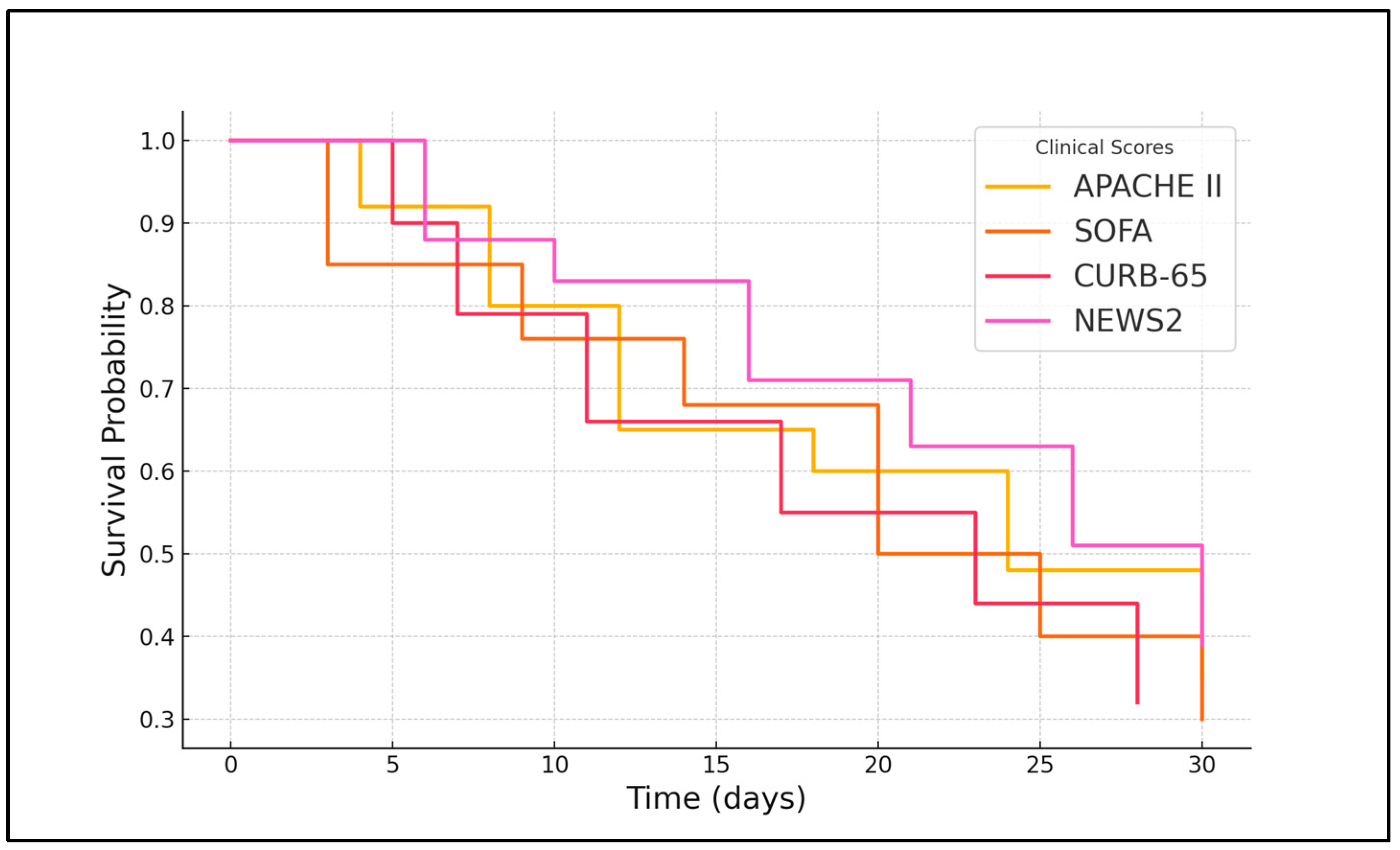
At admission, an APACHE II score greater than 19.50 was significantly associated with an increased risk of mortality, with a hazard ratio (HR) of 1.89 (95% CI: 1.12–3.18,
p = 0.017). The SOFA score showed an even stronger association, with a hazard ratio of 2.72 (95% CI: 1.85–4.02,
p < 0.001), indicating that organ dysfunction at admission was a significant predictor of death in this population. However, the CURB-65 score above 2.50 did not reach statistical significance (
p = 0.061), and the NEWS2 score was not significantly associated with mortality at admission, with an HR of 1.20 (95% CI: 0.85–1.69,
p = 0.299), as seen in
Figure 1.
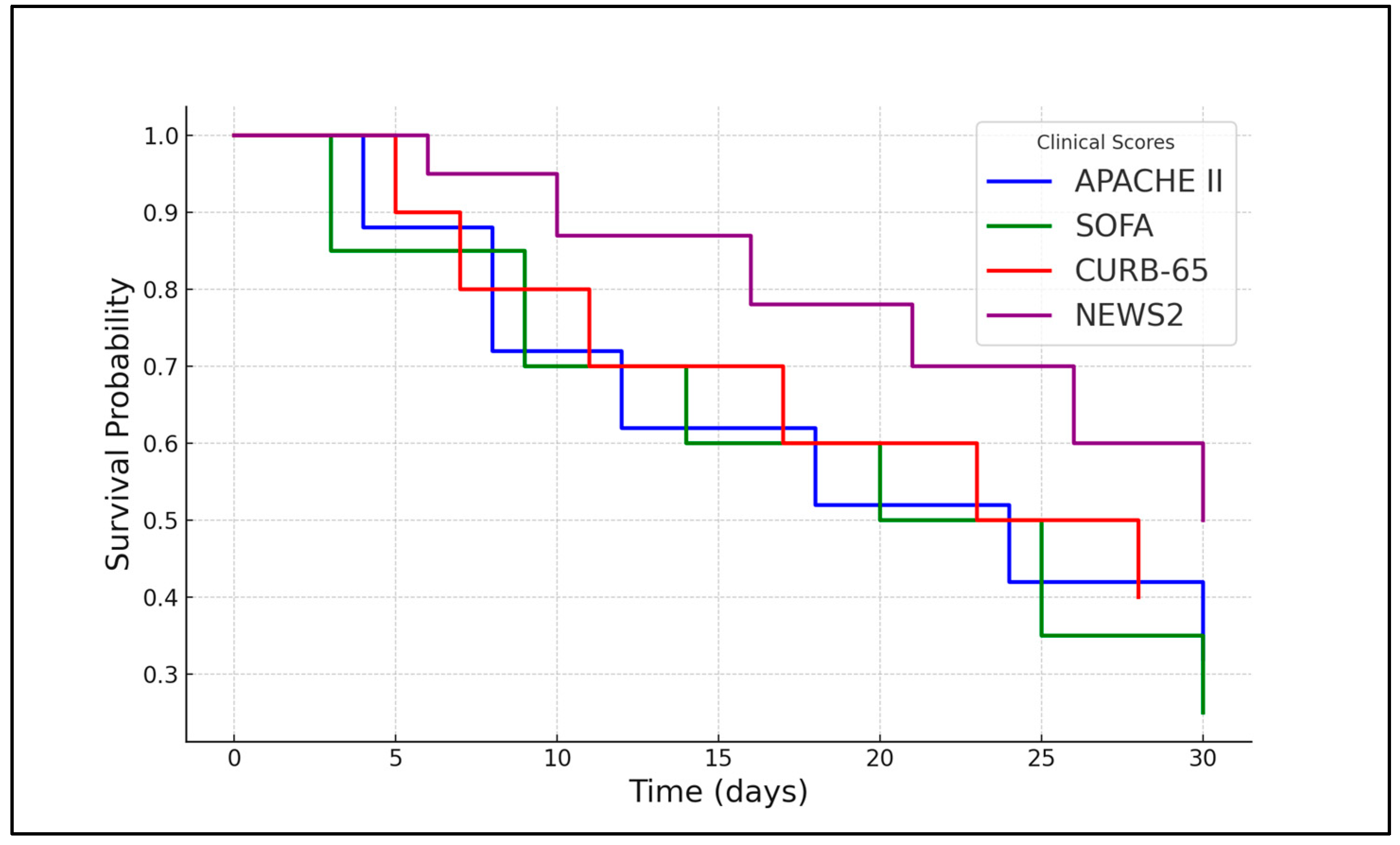
At five days post-symptom onset, the SOFA score remained the most robust predictor of mortality, with an HR of 3.10 (95% CI: 2.05–4.70,
p < 0.001), suggesting that worsening organ function over time strongly correlates with death in older adult patients. APACHE II scores above 21.00 at this time point also indicated a significant increase in mortality risk, with an HR of 2.15 (95% CI: 1.42–3.25,
p = 0.001). In contrast, neither CURB-65 (
p = 0.181) nor NEWS2 (
p = 0.652) scores at five days post-symptom onset showed significant predictive value for mortality in this cohort, as presented in
Table 6 and
Figure 2.
Superimposed bacterial pneumonia complicated the course of more than a quarter of older adult admissions (26.3%) versus 14.7% in younger patients (
p < 0.001), mirroring higher sputum-culture positivity. Empyema echoed that pattern (7.9% vs. 3.1%,
p = 0.021) and contributed to the greater incidence of culture-proven bacteremia in older adults (11.8% vs. 6.7%,
p = 0.046). These infectious complications lengthened ICU stays (median 8 days, IQR (5–14) vs. 6 (4–11),
p = 0.033) and dovetailed with a sharply elevated 28-day mortality of 17.1% compared with 3.1% in controls (
p < 0.001) (
Table 7).
In prespecified subgroup analyses, day 5 SOFA remained the most discriminative score in both octogenarians and younger adults, with lower optimal thresholds in the <65 cohort. Among patients ≥ 80 years, day 5 SOFA ≥ 4.85 achieved the highest AUC (0.854) and was independently associated with severe disease (HR 3.26, 95% CI 2.19–4.84) and 28-day mortality (HR 3.10, 95% CI 2.05–4.70). In patients < 65 years, day 5 SOFA ≥ 3.50 yielded an AUC of 0.828 and mortality HR of 2.42 (95% CI 1.56–3.75), as presented in
Table 8.
To improve bedside interpretability, we calculated empiric adequacy for commonly used agents across culture-positive episodes (
Table 9). Inadequacy of ceftriaxone- or fluoroquinolone-based strategies was primarily driven by MRSA, ESBL-producing
K. pneumoniae, and Gram-negative non-susceptibility patterns, whereas carbapenem-based coverage remained highly reliable in both age strata.
In exploratory models restricted to culture-positive episodes (
Table 10), higher illness severity and healthcare-associated context variables (ICU admission and nursing home residence) showed the strongest associations with empiric inadequacy of ceftriaxone or levofloxacin, supporting their potential utility as bedside surrogates for resistant or non-covered pathogens when culture data are pending (
Table 10).
To directly test whether the association between superimposed bacterial pneumonia and outcomes differed by age stratum, we fit regression models including an age group × pneumonia interaction term (
Table 11). On the multiplicative scale, the interaction was not statistically significant for 28-day mortality (interaction
p = 0.47) or ICU admission (interaction
p = 0.66), indicating that pneumonia increased risk in both age groups without strong evidence of differential relative effect. On the absolute scale, the excess mortality associated with pneumonia was larger in octogenarians (37.5% vs. 9.8%; risk difference 27.7%) than in younger adults (12.5% vs. 1.4%; risk difference 11.1%), supporting a greater absolute clinical impact in the very old.