
Active Disturbance Rejection Predictive Control for Drill-Arm Positioning of Hydraulic Drill-Anchor Robots Based on Friction Compensation and PSO Tuning


Abstract
1. Introduction
- (1)
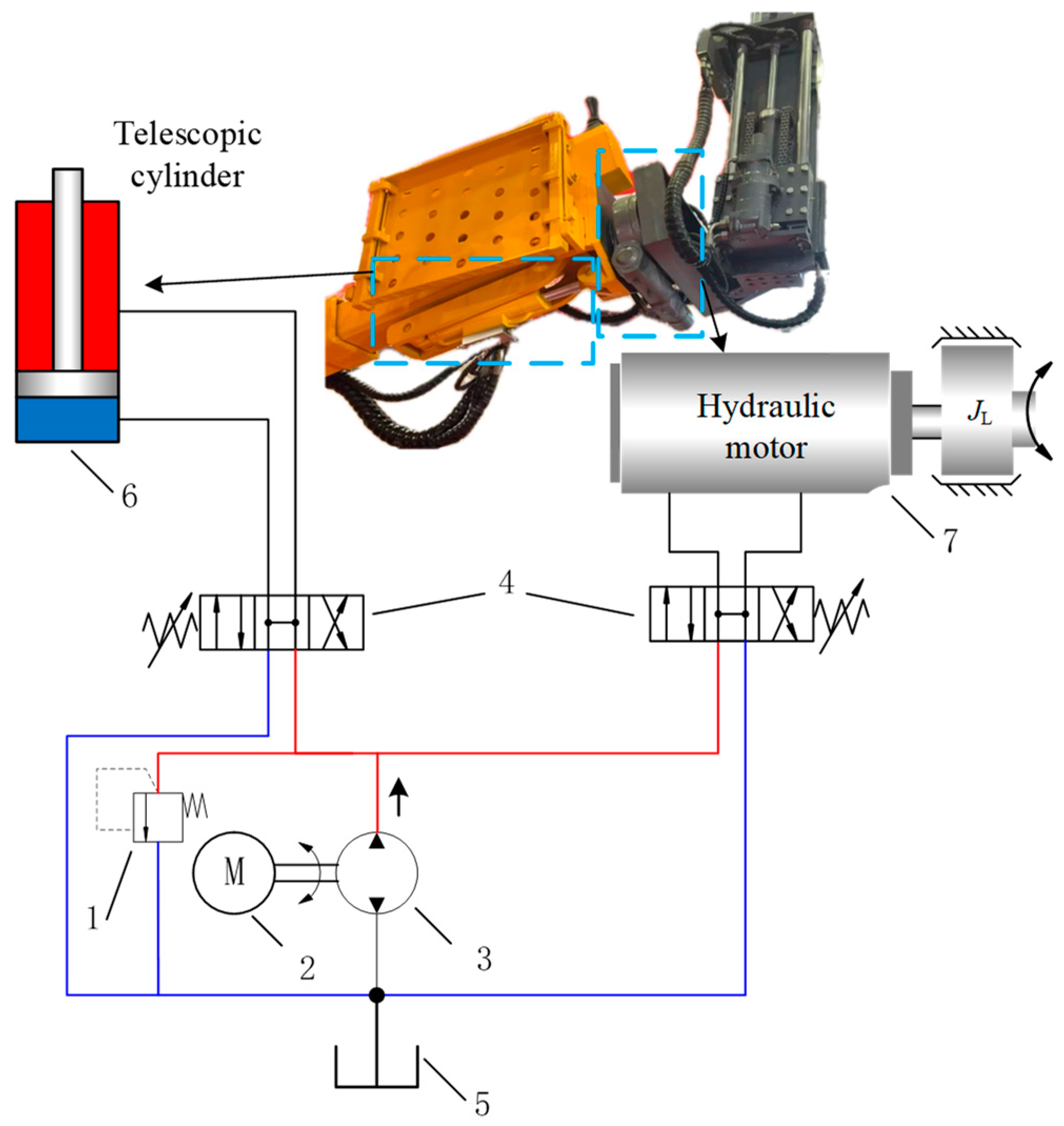
- Aiming at the nonlinear friction in the drill-arm position system, a mathematical model embedded with nonlinear friction terms is established based on the Stribeck friction model. Different from general methods, this model integrates the dynamic characteristics of the worm-gear transmission mechanism and the pitching mechanism, which can accurately characterize the system dynamics and lay a solid foundation for subsequent controller design.
- (2)
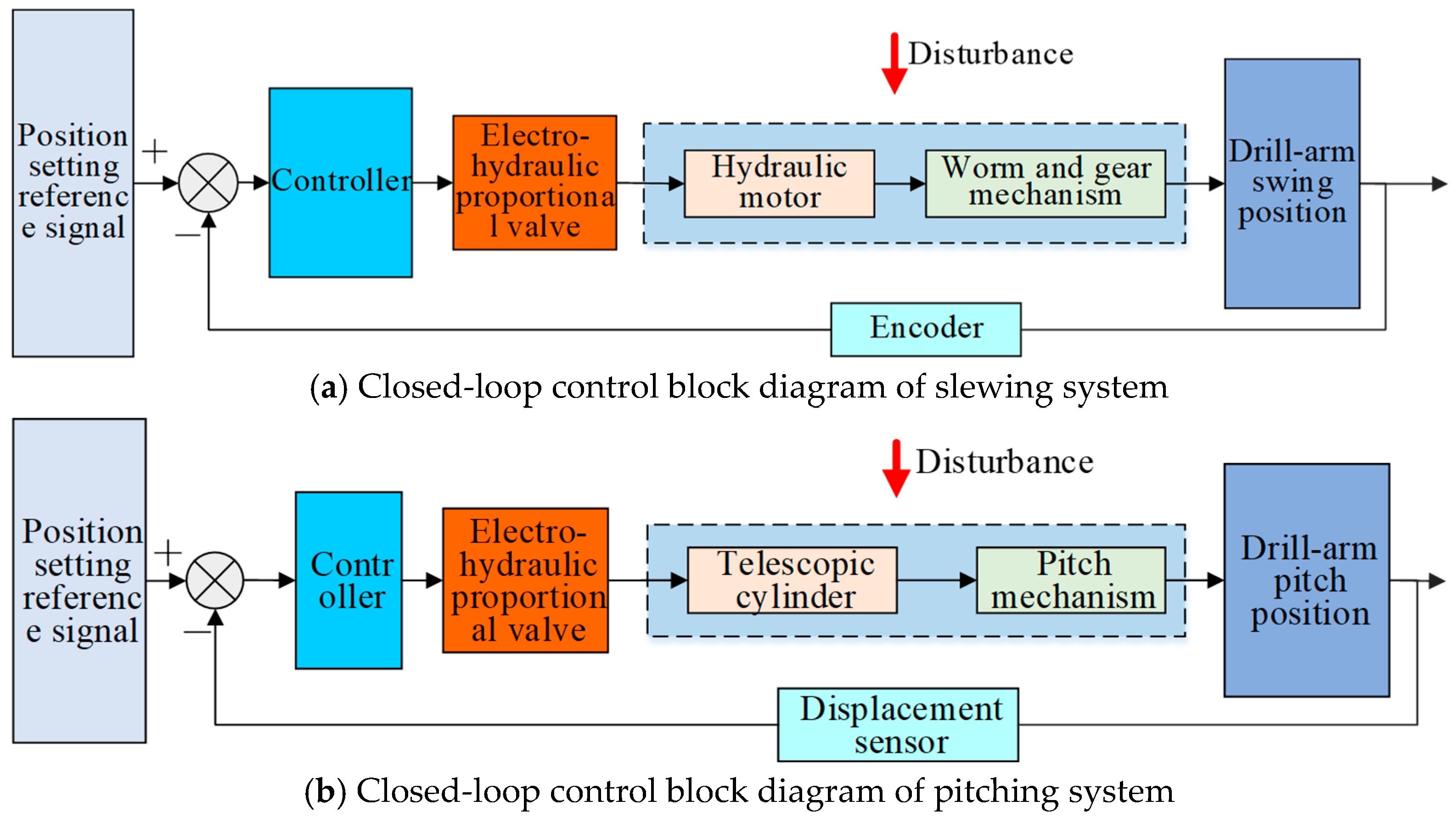
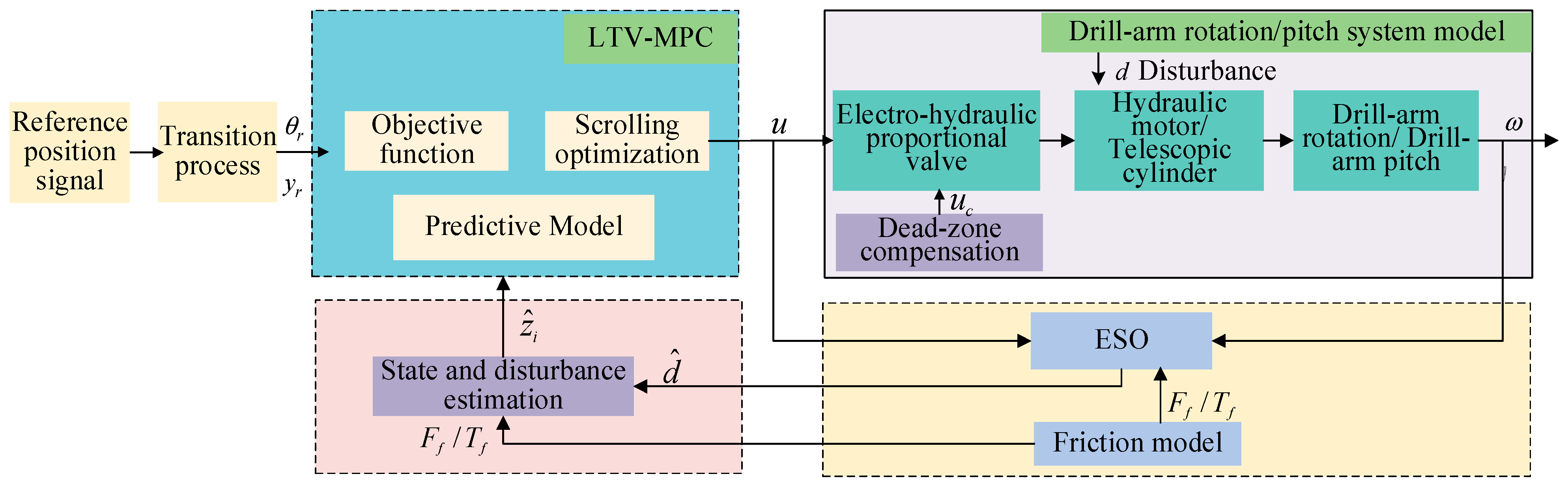
- To solve the problems of time-varying parameters and external disturbances, a linear time-varying model predictive control (LTV-MPC) controller for the drill-arm position is designed. Unlike existing electro-hydraulic control strategies, friction is treated as a known measurable disturbance in the controller design process, which reduces the observation burden of the ESO and further improves the position tracking accuracy and stability of the system.
- (3)
- To address the difficulties in the parameter tuning of LTV-MPC and the suboptimality of traditional tuning methods, an improved multi-objective fitness function is designed. PSO is introduced for global parameter optimization, which achieves optimal parameter matching and significantly enhances the control performance and robustness of the closed-loop system.
2. Modeling of Drill-Arm Position Control System for Drill-Anchor Robots
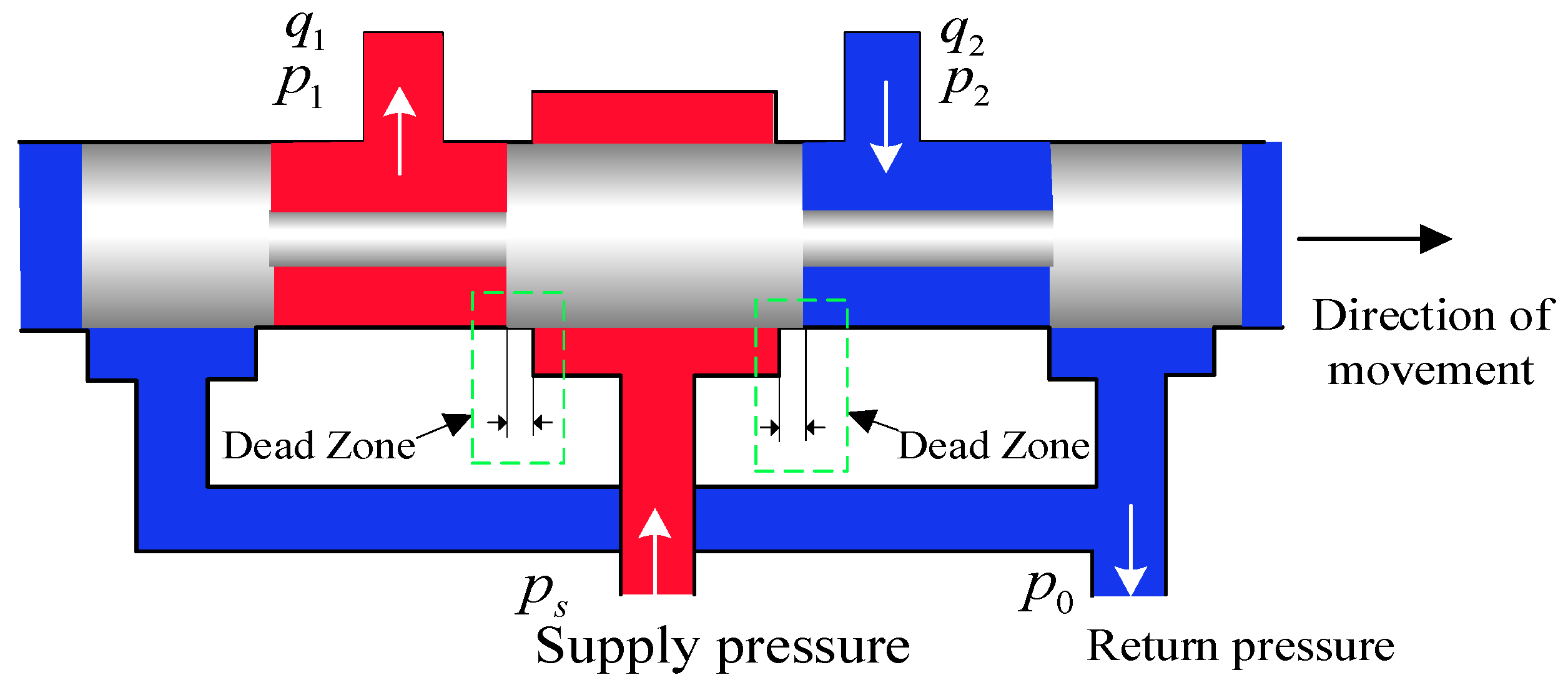
2.1. Friction Model and Dynamic Characteristics of Electro-Hydraulic Proportional Valve
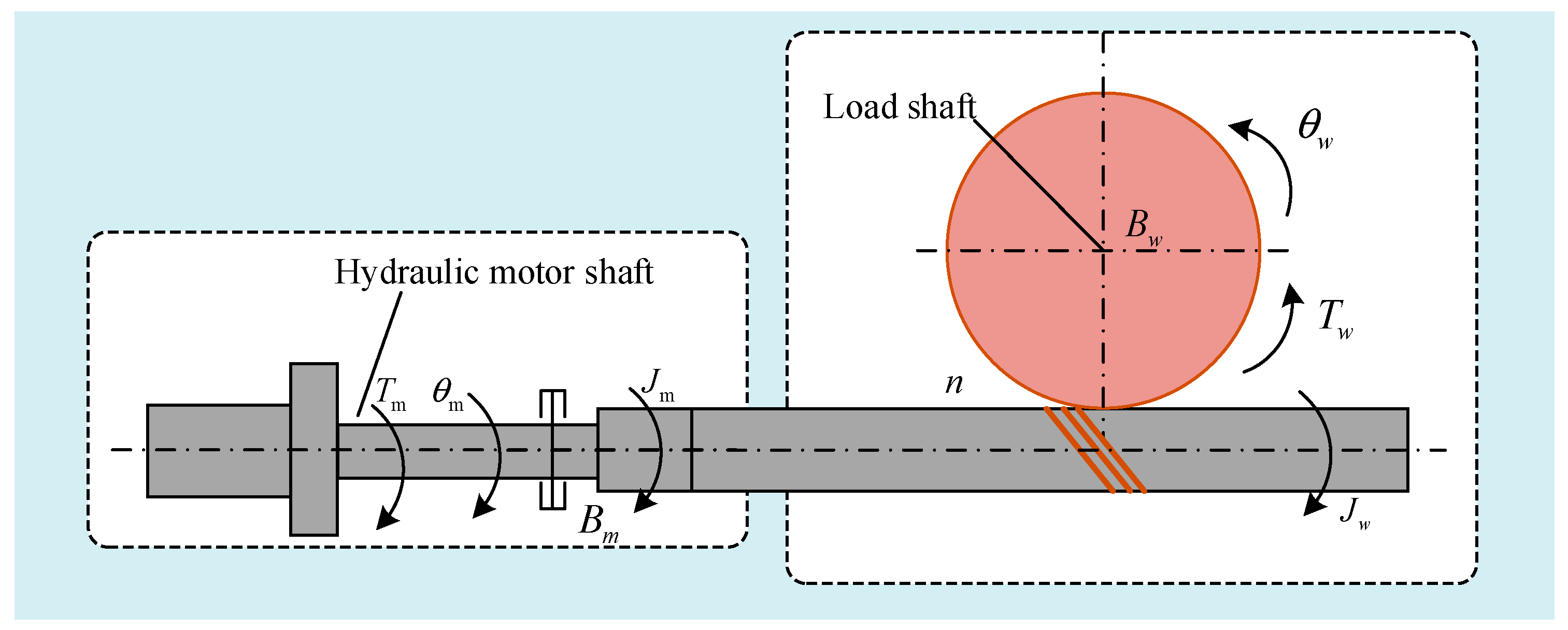
2.2. Modeling of Drill-Arm Slewing System
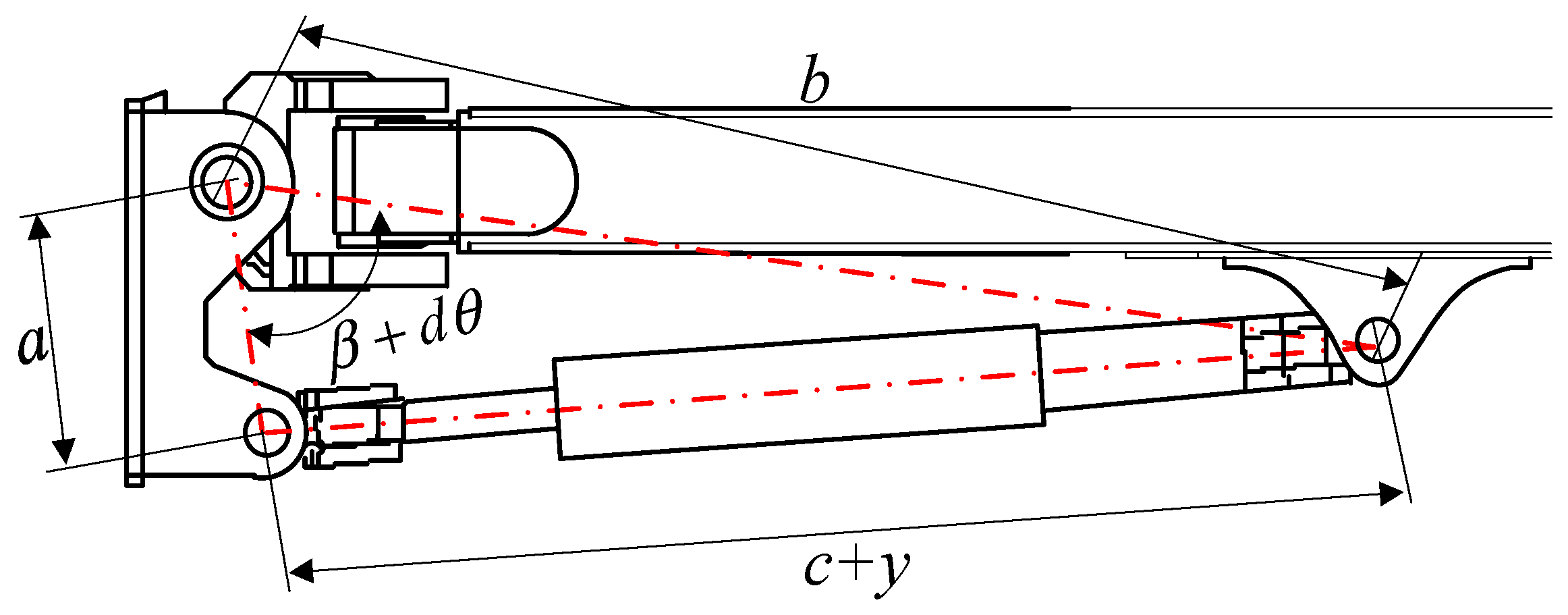
2.3. Modeling of Drill-Arm Pitching System
3. The Design of the Controller
3.1. The Design of LTV-MPC
- (1)
- Predictive Model Establishment
- (2)
- Rolling Optimization Solution
3.2. The Design of the ESO
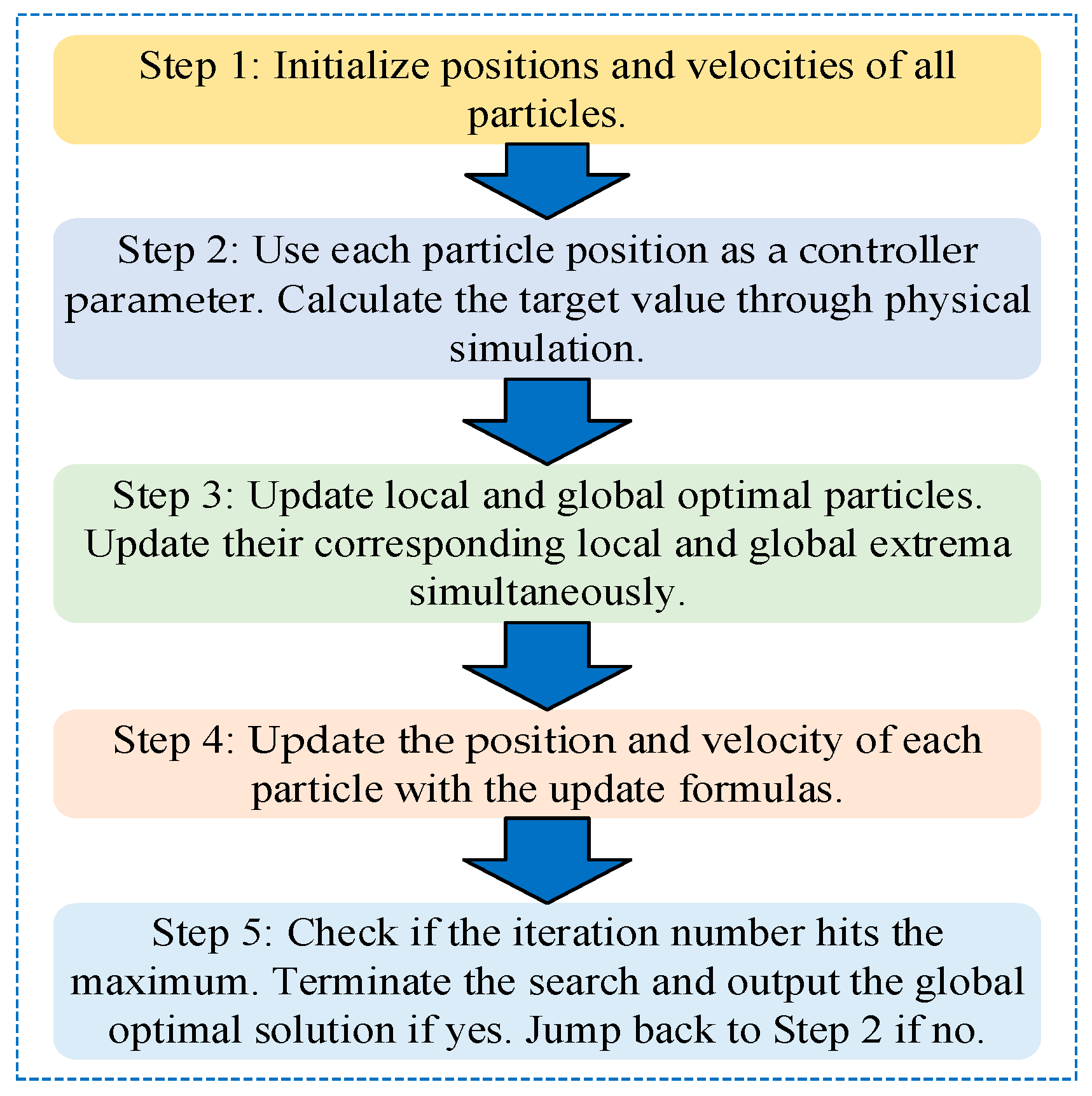
3.3. Controller Parameter Optimization Based on PSO with Improved Objective Function
4. Simulation Verification of the Controller
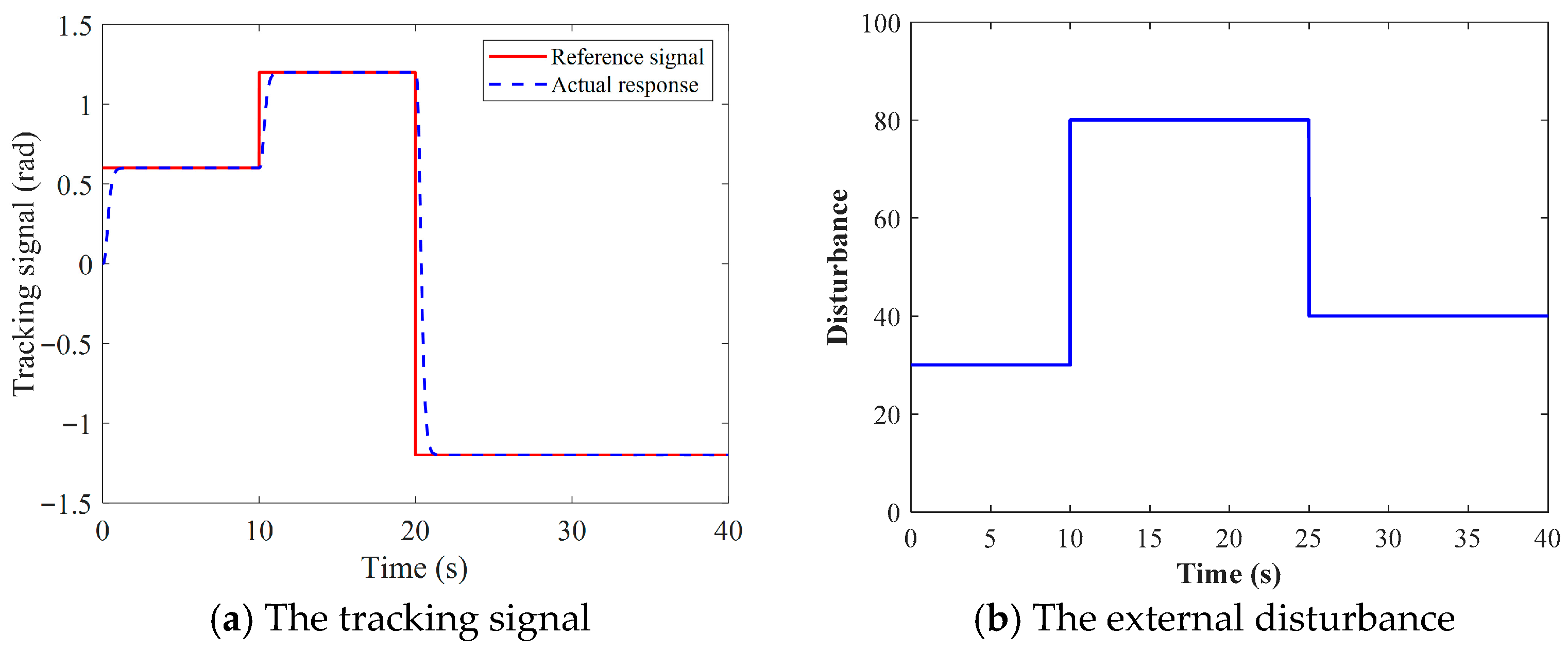
4.1. Analysis of Control Performance for the Drill-Arm Position System Based on PSO Tuning
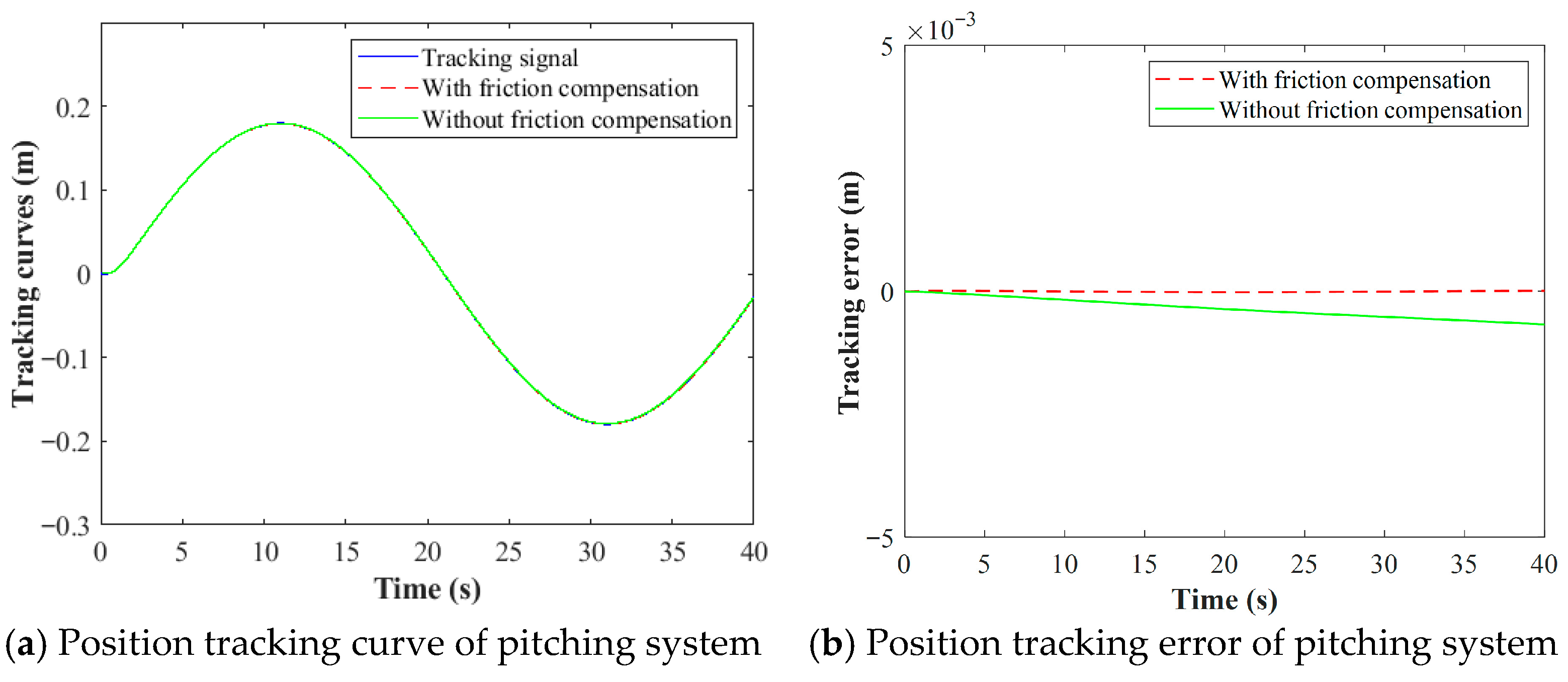
4.2. Analysis of Control Performance of Drill-Arm Position System Based on Friction Compensation
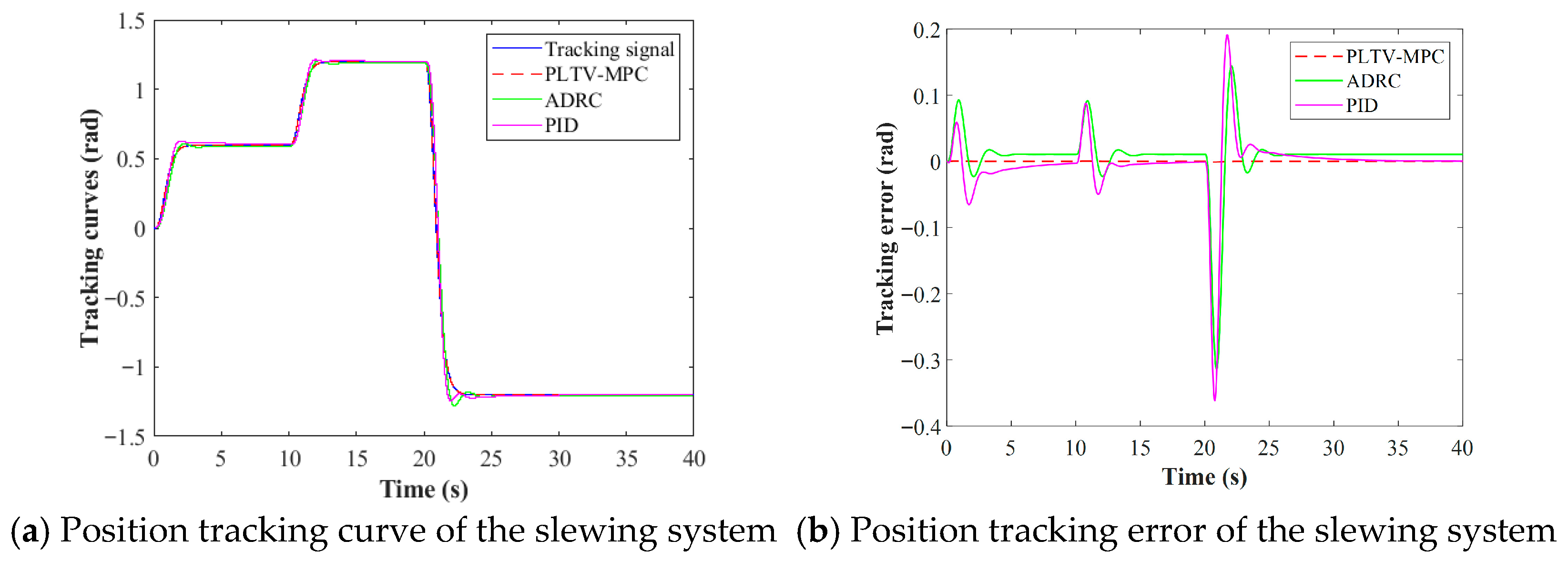
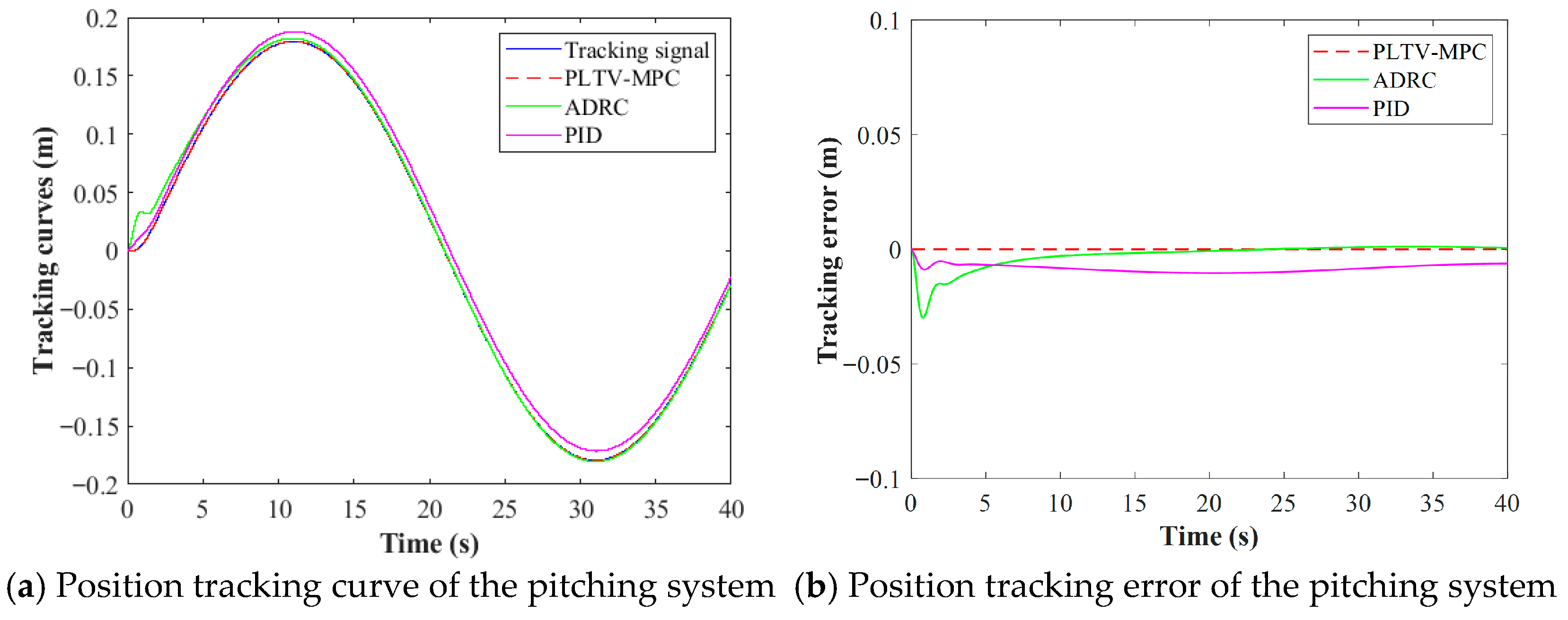
4.3. Comparative Analysis of the Performance for the Proposed Controller
- (1)
- PID: , with the controller parameters are set as 40, 10, and 2.
- (2)
- ADRC: , with the controller parameters are set as , , , , , and ω = 30.
4.4. Practical Implementation Limitations and Engineering Considerations
5. Conclusions
Author Contributions
Funding
Institutional Review Board Statement
Informed Consent Statement
Data Availability Statement
Conflicts of Interest
Abbreviations
| ESO | Extended state observer |
| PSO | Particle swarm optimization |
| MPC | Model predictive control |
| LTV-MPC | Linear time-varying model predictive control |
| ADRC | Active disturbance rejection control |
| PLTV-MPC | PSO-tuning LTV-MPC |
| ITAE | Integral of time-weighted absolute error |
| MEAE | Mean absolute error |
| SDAE | Standard deviation of absolute error |
References
- Li, J.; Yang, H.; Ji, H. Characterization of Two-Cylinder Parallel Electro-hydraulic Force/Position Synchronization Based on RBF Fuzzy Neural Network Control. Int. J. Fuzzy Syst. 2024, 27, 1471–1486. [Google Scholar] [CrossRef] [Scilit]
- Feng, H.; Song, Q.; Ma, S.; Ma, W.; Yin, C.; Cao, D.; Yu, H. A new adaptive sliding mode controller based on the RBF neural network for an electro-hydraulic servo system. ISA Trans. 2022, 129, 472–484. [Google Scholar] [CrossRef] [Scilit] [PubMed]
- Yang, X.; Ge, Y.; Zhu, W.; Deng, W.; Zhao, X.; Yao, J. Adaptive Motion Control for Electro-hydraulic Servo Systems With Appointed-Time Performance. IEEE/ASME Trans. Mechatron. 2025, 30, 7009–7018. [Google Scholar] [CrossRef] [Scilit]
- Gao, Y.C.; Shen, G.; Li, X.; Zhu, Z.C.; Wang, Q.G. An Improved Nonlinear Extended Disturbance Observer for Sliding Mode Control in Electro-Hydraulic Servo System. IEEE/ASME Trans. Mechatron. 2024, 30, 2155–2164. [Google Scholar] [CrossRef] [Scilit]
- Lao, L.; Chen, P. Adaptive sliding mode control of an electro-hydraulic actuator with a kalman extended state observer. IEEE Access 2024, 12, 8970–8982. [Google Scholar] [CrossRef] [Scilit]
- Gao, B.; Guan, H.; Zhang, W.; Shen, W.; Ye, Y. Three kinds of improved designs and comparative analysis based on active disturbance rejection controller. J. Mech. Sci. Technol. 2023, 37, 965–976. [Google Scholar] [CrossRef] [Scilit]
- Xu, Y.; Zhang, K.; Guo, K.; Ming, W.; Ma, J.; Wang, S.; Ye, Y. Design, Modeling, and Experimental Study of a Constant-Force Floating Compensator for a Grinding Robot. Actuators 2025, 15, 4. [Google Scholar] [CrossRef] [Scilit]
- Truong, H.V.A.; Nam, S.; Kim, S.; Kim, Y.; Chung, W.K. Backstepping-sliding-mode-based neural network control for electro-hydraulic actuator subject to completely unknown system dynamics. IEEE Trans. Autom. Sci. Eng. 2023, 21, 6202–6216. [Google Scholar] [CrossRef] [Scilit]
- Razmjooei, H.; Palli, G.; Nazari, M. Disturbance observer-based nonlinear feedback control for position tracking of electro-hydraulic systems in a finite time. Eur. J. Control 2022, 67, 100659. [Google Scholar] [CrossRef] [Scilit]
- Jun, Z.; Yiliang, W.; Liming, C.; Ning, W.; Yuepin, B.; Chaofan, W. Workspace analysis and motion control strategy of robotic mine anchor drilling truck manipulator based on the WOA-FOPID algorithm. Front. Earth Sci. 2022, 10, 954547. [Google Scholar] [CrossRef] [Scilit]
- Zhang, P.; Shi, Z.; Yu, B. Research on friction compensation method of electromechanical actuator based on improved active disturbance rejection control. Actuators 2023, 12, 445. [Google Scholar] [CrossRef] [Scilit]
- Jiang, S.; Zhang, K.; Wang, H.; Zhong, D.; Su, J.; Liu, Z. Research on adaptive friction compensation of digital hydraulic cylinder based on LuGre friction model. Shock. Vib. 2021, 2021, 8854424. [Google Scholar] [CrossRef] [Scilit]
- Liao, J.; Zhou, F.; Zheng, J. An Improved Parameter Identification Algorithm for the Friction Model of Electro-Hydraulic Servo Systems. Sensors 2023, 23, 2076. [Google Scholar] [CrossRef] [Scilit] [PubMed]
- Feng, H.; Yin, C.; Cao, D. Trajectory Tracking of an Electro-Hydraulic Servo System With an New Friction Model-Based Compensation. IEEE/ASME Trans. Mechatron. 2022, 28, 473–482. [Google Scholar] [CrossRef] [Scilit]
- Li, J.; Lu, Y.; He, F.; Miao, L. Motion control of hydraulic actuators with nonlinear friction compensation: Applied to variable valve systems of diesel engine. ISA Trans. 2023, 137, 561–573. [Google Scholar] [CrossRef] [Scilit]
- Chen, Z.; Huang, C.; Liu, Z.; Liu, Y.; Wang, X.; Shi, B.; Li, L. An offset-free explicit model predictive pressure controller for integrated braking system. IEEE Trans. Transp. Electrif. 2023, 10, 2355–2366. [Google Scholar] [CrossRef] [Scilit]
- Chen, H. A backstepping sliding mode control algorithm of electro-hydraulic position servo system of valve-controlled symmetric cylinder based on extended state observer. Mech. Ind. 2024, 25, 6. [Google Scholar] [CrossRef] [Scilit]
- Zhang, D.Y.; Liu, S.Y.; Chen, Y.; Gu, C.C. Neural direct adaptive active disturbance rejection controller for electro-hydraulic servo system. Int. J. Control Autom. Syst. 2022, 20, 2402–2412. [Google Scholar]
- Ma, Y.; Gu, L.C.; Xu, Y.G.; Shi, L.C.; Wang, H.T. Research on control strategy of asymmetric electro-hydraulic servo system based on improved PSO algorithm. Adv. Mech. Eng. 2022, 14, 16878132221096226. [Google Scholar] [CrossRef] [Scilit]
- Guo, K.; Li, M.; Shi, W.; Pan, Y. Adaptive tracking control of hydraulic systems with improved parameter convergence. IEEE Trans. Ind. Electron. 2021, 69, 7140–7150. [Google Scholar] [CrossRef] [Scilit]
- Qin, T.; Li, Y.; Quan, L.; Yang, L. An adaptive robust impedance control considering energy-saving of hydraulic excavator boom and stick systems. IEEE/ASME Trans. Mechatron. 2022, 27, 1928–1936. [Google Scholar] [CrossRef] [Scilit]
- Yang, M.; Yu, C.; Luo, S.; Lian, K. Synchronous control of hydraulic cylinders for tunneling machine based on improved ESO. Mech. Based Des. Struct. Mach. 2024, 53, 3304–3326. [Google Scholar] [CrossRef] [Scilit]
- Coskun, M.Y.; Itik, M. Intelligent PID control of an industrial electro-hydraulic system. ISA Trans. 2023, 139, 484–498. [Google Scholar] [CrossRef] [Scilit] [PubMed]
- Ren, H.P.; Jiao, S.S.; Wang, X.; Kaynak, O. Fractional order integral sliding mode controller based on neural network: Theory and electro-hydraulic benchmark test. IEEE/ASME Trans. Mechatron. 2021, 27, 1457–1466. [Google Scholar] [CrossRef] [Scilit]
- Liu, Y.-C.; Laghrouche, S.; Depernet, D.; N’Diaye, A.; Djerdir, A.; Cirrincione, M. Disturbance-observer-based speed control for SPMSM drives using modified super-twisting algorithm and extended state observer. Asian J. Control 2024, 26, 1089–1102. [Google Scholar] [CrossRef] [Scilit]
- Dang, C.; Dou, M.; Yan, S.; Dang, M.; Wang, Y.; Zhao, D.; Hua, Z. An improved adaptive sliding mode speed control of PMSM drives with an extended state observer. IEEE Trans. Energy Convers. 2024, 39, 2349–2360. [Google Scholar] [CrossRef] [Scilit]
- Hou, T.; Shi, C.; Kou, Z.; Wu, J.; Zhang, B.; Peng, Y. Research on positioning control strategy of hydraulic support pushing system based on multistage speed control valve. Sci. Rep. 2024, 14, 19046. [Google Scholar] [CrossRef] [Scilit]
- Hou, T.; Kou, Z.; Wu, J.; Xu, P.; Zhang, B.; Peng, Y. Positioning control strategy of hydraulic support pushing system in fully mechanized coal face. Electronics 2023, 12, 3628. [Google Scholar] [CrossRef] [Scilit]
- Shi, Q.; He, L. A model predictive control approach for electro-hydraulic braking by wire. IEEE Trans. Ind. Inform. 2022, 19, 1380–1388. [Google Scholar] [CrossRef] [Scilit]
- Lee, S.M. Global-Initialization-Based Model Predictive Control for Mobile Robots Navigating Nonconvex Obstacle Environments. Actuators 2025, 14, 454. [Google Scholar] [CrossRef] [Scilit]
- Nguyen, V.H.; Ahn, K.K. Triad of three system: AI-driven hydraulics for autonomous electric excavators with sustainable energy savings. Autom. Constr. 2025, 180, 106543. [Google Scholar] [CrossRef] [Scilit]
- Feng, H.; Zhong, Y.; Zhou, C.; Ji, S.; Yin, C.; Cao, D. Collaborative high-precision trajectory control for heavy excavators based on an improved particle swarm optimization algorithm. Autom. Constr. 2025, 180, 106546. [Google Scholar] [CrossRef] [Scilit]
- Zhao, J.; Hou, H.; Niu, X.; Liu, Y.; Xia, L.; Men, L.; Ma, Z. Virtual torque control combining with modal decoupling research for hydraulic-driven lower limb exoskeleton robot. ISA Trans. 2025, 159, 191–202. [Google Scholar] [CrossRef] [Scilit]
- Liu, X.; Wang, Z.; Qiu, Z.; Jiao, Z.; Chen, X.; Nie, R. Cascade control method for hydraulic secondary regulation drive system based on adaptive robust control. ISA Trans. 2025, 156, 479–489. [Google Scholar] [CrossRef] [Scilit]
- Qiu, Z.; Liu, X.; Wang, Z.; Chen, X.; Nie, R. Adaptive robust motion control for hydraulic load sensitive systems considering displacement dynamic compensation. ISA Trans. 2025, 156, 490–500. [Google Scholar] [CrossRef] [Scilit]
- Huang, J.; An, H.; Yang, Y.; Wu, C.; Wei, Q.; Ma, H. Model predictive trajectory tracking control of electro-hydraulic actuator in legged robot with multi-scale online estimator. IEEE Access 2020, 8, 95918–95933. [Google Scholar] [CrossRef] [Scilit]



| Parameters | Value | Unit |
|---|---|---|
| Bulk modulus of hydraulic oil | 700 | |
| Displacement of hydraulic motor | 5 × 10⁻⁵ | |
| Total volume of hydraulic motor chamber | 4.5 × 10⁻⁴ | |
| Internal leakage coefficient | 2.336 × 10⁻¹² | |
| Return pressure | 0 | |
| Supply pressure | 7 | |
| Density of hydraulic oil | 850 | |
| Effective area of rodless chamber piston | 0.003848 | |
| Effective area of rod chamber piston | 0.003044 | |
| Total mass of load converted to piston | 10 | |
| Area gradient of electro-hydraulic proportional valve | 1.7 × 10⁻³ | No unit |
| Flow coefficient of electro-hydraulic proportional valve port | 0.67 | No unit |
| Gain coefficient between control input and spool displacement | 0.25 | |
| Flow pressure coefficient | 7 × 10⁻¹² |
| Control Method | MEAE (Rad) | SDAE (Rad) | ITAE |
|---|---|---|---|
| LTV-MPC | 9.4452 × 10⁻⁵ | 0.0001525 | 0.0037781 |
| PLTV-MPC | 5.049 × 10⁻⁵ | 0.00015214 | 0.0020196 |
| Control Method | MEAE (m) | SDAE (m) | ITAE |
|---|---|---|---|
| LTV-MPC | 5.4074 × 10⁻⁵ | 2.6499 × 10⁻⁵ | 0.0021629 |
| PLTV-MPC | 1.0191 × 10⁻⁵ | 7.1937 × 10⁻⁶ | 0.0004077 |
| Control Method | MEAE (Rad) | SDAE (Rad) | ITAE |
|---|---|---|---|
| Without friction compensation | 0.00037753 | 0.00024909 | 0.015101 |
| With friction compensation | 5.049 × 10⁻⁵ | 0.00015214 | 0.0020196 |
| Control Method | MEAE (m) | SDAE (m) | ITAE |
|---|---|---|---|
| Without friction compensation | 0.00034903 | 0.00019807 | 0.0139610 |
| With friction compensation | 1.0191 × 10⁻⁵ | 7.1937 × 10⁻⁶ | 0.0004077 |
| Control Method | MEAE (Rad) | SDAE (Rad) | ITAE |
|---|---|---|---|
| PID | 0.022367 | 0.041027 | 0.89468 |
| ADRC | 0.018724 | 0.045486 | 0.74898 |
| PLTV-MPC | 5.049 × 10⁻⁵ | 0.00015214 | 0.0020196 |
| Control Method | MEAE(m) | SDAE(m) | ITAE |
|---|---|---|---|
| PID | 0.0082963 | 0.0015718 | 0.33185 |
| ADRC | 0.0031975 | 0.0050648 | 0.12790 |
| PLTV-MPC | 1.0191 × 10⁻⁵ | 7.1937 × 10⁻⁶ | 0.0004077 |
Disclaimer/Publisher’s Note: The statements, opinions and data contained in all publications are solely those of the individual author(s) and contributor(s) and not of MDPI and/or the editor(s). MDPI and/or the editor(s) disclaim responsibility for any injury to people or property resulting from any ideas, methods, instructions or products referred to in the content. |
© 2026 by the authors. Licensee MDPI, Basel, Switzerland. This article is an open access article distributed under the terms and conditions of the Creative Commons Attribution (CC BY) license.
Share and Cite
Jiao, F.; Qiao, H.; Tong, X.; Li, K.; Cao, R.; Zhu, R. Active Disturbance Rejection Predictive Control for Drill-Arm Positioning of Hydraulic Drill-Anchor Robots Based on Friction Compensation and PSO Tuning. Actuators 2026, 15, 193. https://doi.org/10.3390/act15040193
Jiao F, Qiao H, Tong X, Li K, Cao R, Zhu R. Active Disturbance Rejection Predictive Control for Drill-Arm Positioning of Hydraulic Drill-Anchor Robots Based on Friction Compensation and PSO Tuning. Actuators. 2026; 15(4):193. https://doi.org/10.3390/act15040193
Chicago/Turabian StyleJiao, Feng, Hongbing Qiao, Xiaolong Tong, Kai Li, Ruihe Cao, and Rongxin Zhu. 2026. "Active Disturbance Rejection Predictive Control for Drill-Arm Positioning of Hydraulic Drill-Anchor Robots Based on Friction Compensation and PSO Tuning" Actuators 15, no. 4: 193. https://doi.org/10.3390/act15040193
APA StyleJiao, F., Qiao, H., Tong, X., Li, K., Cao, R., & Zhu, R. (2026). Active Disturbance Rejection Predictive Control for Drill-Arm Positioning of Hydraulic Drill-Anchor Robots Based on Friction Compensation and PSO Tuning. Actuators, 15(4), 193. https://doi.org/10.3390/act15040193