1. Introduction
The growing global demand for ocean resource exploration, environmental monitoring, and national security has substantially increased human activities in marine environments [
1]. These operations rely critically on high-performance underwater vehicles—such as autonomous underwater vehicles (AUVs), remotely operated vehicles (ROVs), and gliders—which serve as essential platforms [
2,
3,
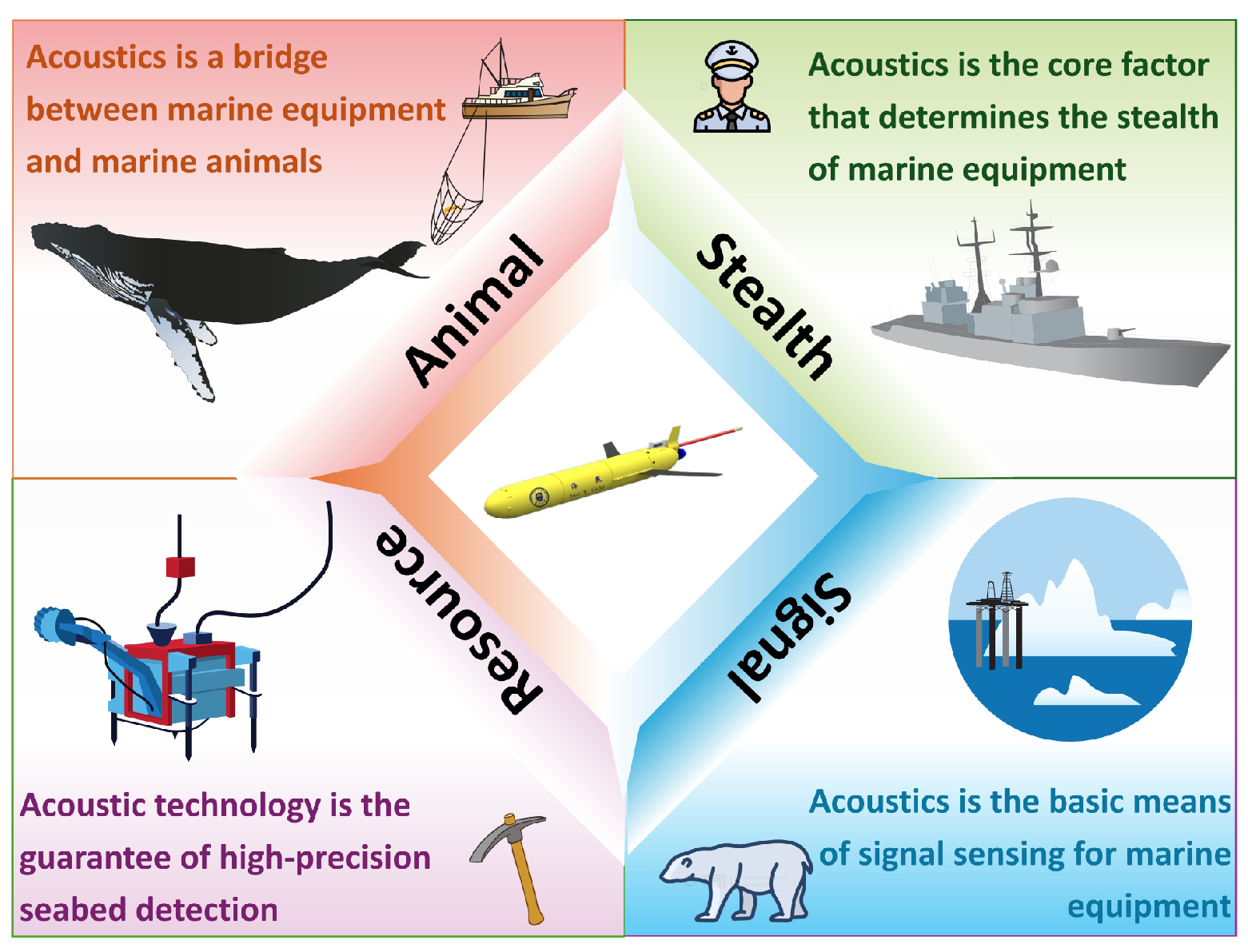
4]. Since sound is the primary medium for information transmission underwater, the acoustic performance of these platforms fundamentally governs their capabilities in sensing, communication, and stealth [
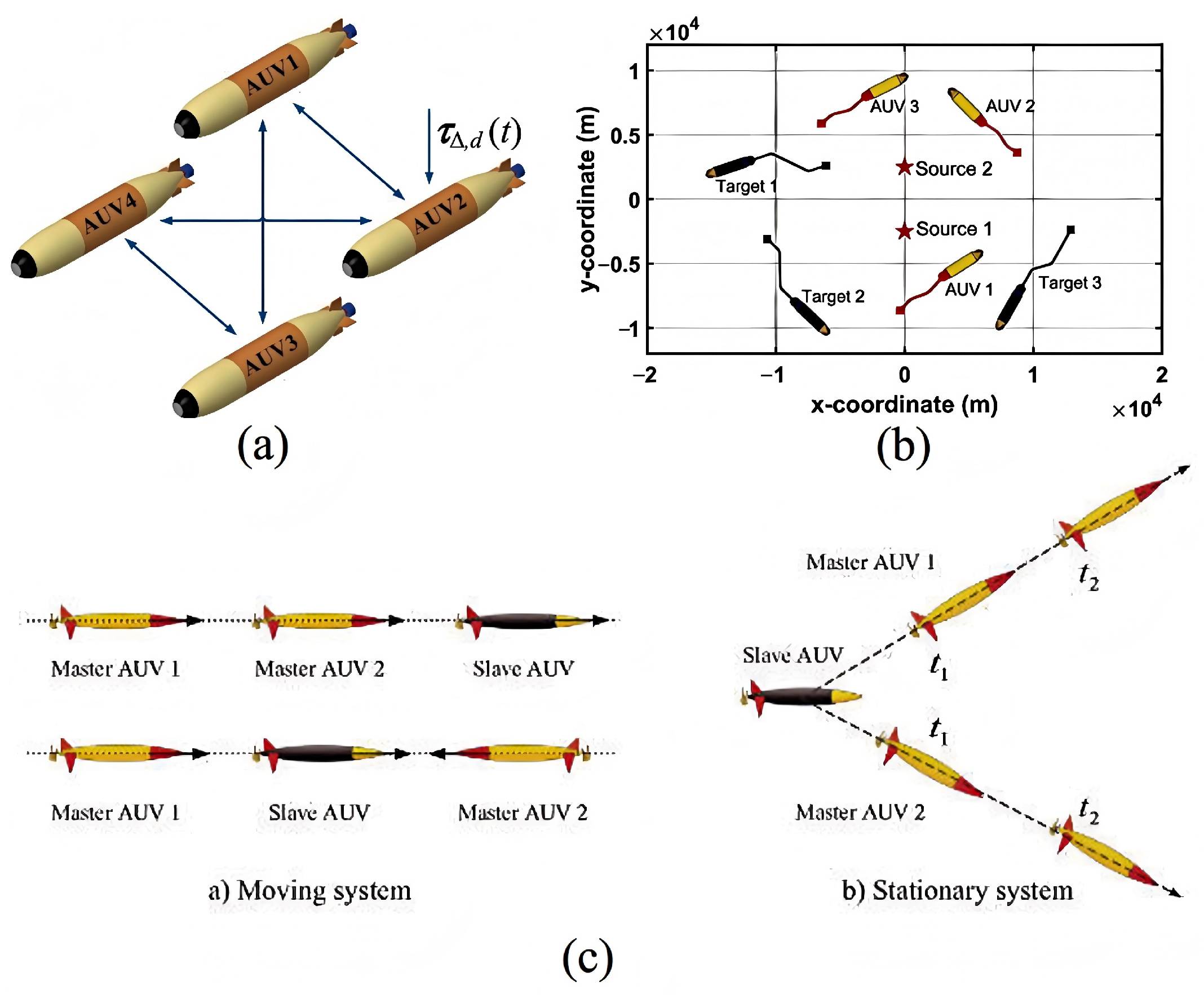
5], as shown in
Figure 1. However, the inherent background noise of the ocean, combined with self-radiated noise from the vehicles themselves, presents a major impediment to enhancing their overall acoustic efficacy [
6]. In realistic deployments, acoustic limitations seldom remain local: they propagate through the sensing–navigation–control loop and may therefore constrain autonomy, safety, endurance, and survivability under time-varying operating conditions.
The acoustic signature of an underwater vehicle arises from multiple sources, including hydrodynamic, mechanical, and propulsion-related origins, each contributing distinctly to the overall noise profile. Hydrodynamic noise results from turbulent boundary layers and vortex shedding around the hull and appendages, and is highly influenced by flow conditions and vehicle geometry [
7]. Mechanical noise originates from rotating machinery such as motors and pumps, as well as structural vibrations caused by bearing friction and imbalances, which intensify during high-load operations [
8,
9]. Propulsion noise, mainly produced by propeller cavitation and blade-rate tones, not only radiates efficiently into the water but also induces structural vibrations. Collectively, these noise components degrade sonar performance by elevating the noise floor and masking target signals, thereby reducing detection range and classification accuracy. Simultaneously, they enhance the vehicle’s detectability by hostile sensors, compromising mission stealth and survivability. Therefore, effective noise reduction is not merely an enhancement but a fundamental requirement for improving acoustic stealth, ensuring reliable communication [
10,
11]. Representative self-noise sources and paths are summarized in
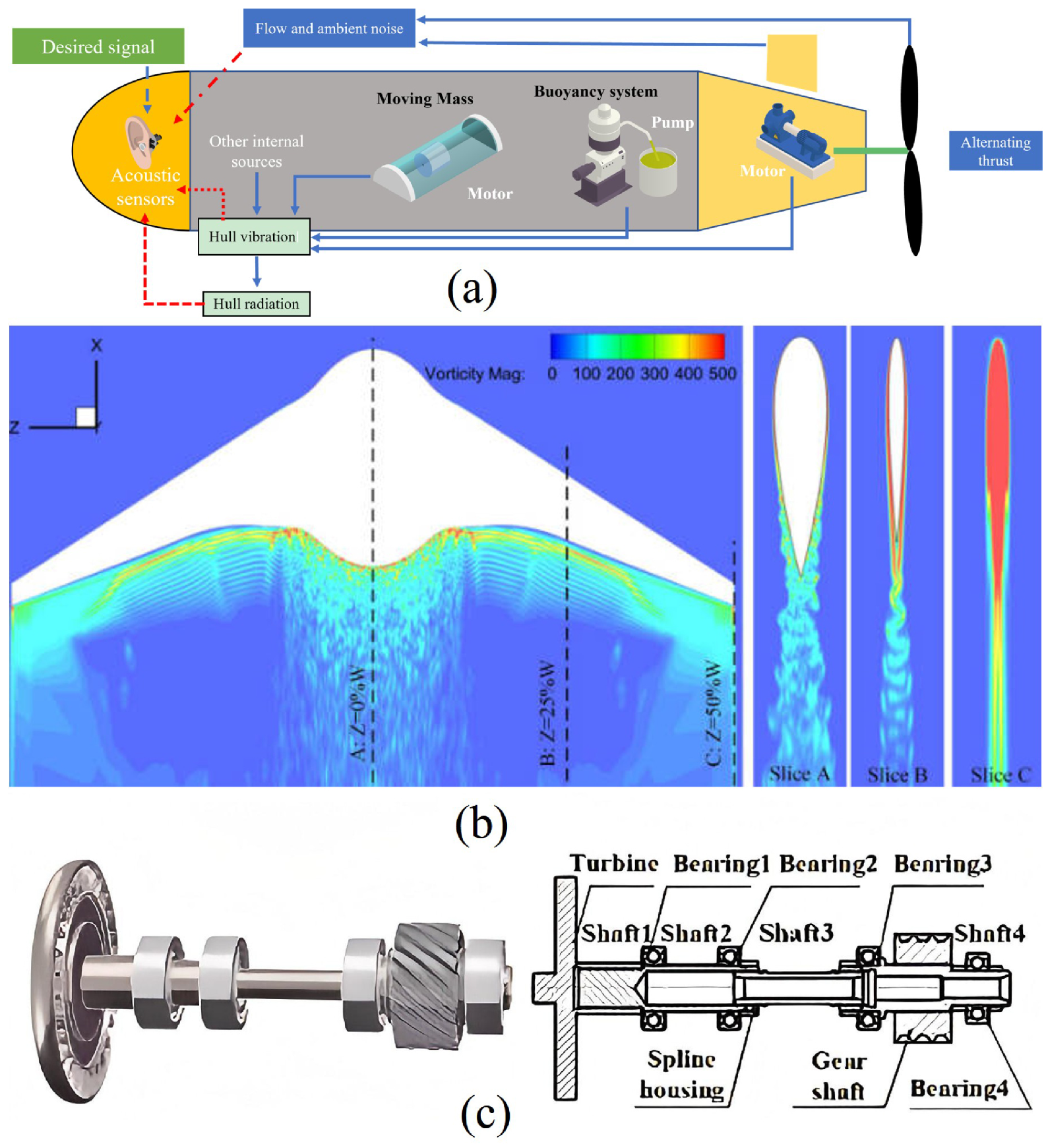
Figure 2. Hydrodynamic turbulence around the hull and appendages is illustrated in
Figure 2b; mechanical rotor-bearing-gear trains are shown in
Figure 2c; a system-level source-to-radiation path example is given in
Figure 2a.
Complex and non-stationary acoustic noise significantly impairs the accuracy of navigation sensors, directly constraining the autonomy, safety, and mission reliability of underwater vehicles in unknown or extreme environments. High-precision underwater navigation systems, such as integrated strapdown inertial navigation system (SINS)/Doppler velocity log (DVL)/ultra-short baseline acoustic positioning system (USBL) configurations, are essential for autonomous operations. Yet key sensors including DVL and USBL positioning systems remain susceptible to interference from both environmental noise and platform self-noise [
15,
16]. Environmental and radiated noise can cause DVL bottom tracking failures and reduce USBL signal-to-noise ratios, preventing effective correction of inertial navigation system errors and leading to unbounded error accumulation [
15]. This positioning inaccuracy triggers cascading effects that undermine path-following precision, increase collision risks with submerged obstacles, and degrade the accuracy of coordinated operations in multi-AUV systems [
16,
17]. Consequently, developing noise-resilient navigation methodologies is imperative to ensure operational safety and reliability in complex underwater settings.
Underwater target detection, classification, and recognition rely fundamentally on acoustic signal processing. Yet these tasks are severely challenged by the inherently low signal-to-noise ratio, multipath propagation, non-stationary ambient noise, and the highly variable acoustic signatures of targets in complex marine environments [
18]. Conventional signal processing techniques, such as matched filtering and energy detection, exhibit considerable performance degradation under these conditions, often resulting in high false alarm rates and poor identification accuracy. This stems primarily from their limited adaptability to the time-varying and spatially heterogeneous nature of underwater acoustic channels, as well as their inability to discriminate faint target echoes from intense background interference and reverberation [
19]. Extracting and identifying weak target signals from contaminated returns thus represents a critical bottleneck in advancing the perceptual capabilities of underwater vehicles, necessitating the development of more sophisticated, intelligent signal processing frameworks capable of robust operation in such adverse scenarios [
20].
Achieving global acoustic performance optimization for underwater vehicles requires a paradigm shift from localized component-level improvements to system-level integration. This involves intelligently harmonizing disturbance-resilient control, multi-agent collaboration, and energy management to realize adaptive acoustic–dynamic coupling. Although advances in specific subsystems—such as optimized biomimetic vortex generators for cavitation and noise reduction [
21] or sliding mode controllers with refined boundary layers and switching gains to mitigate chattering and external disturbances [
22]—show significant potential, they often introduce trade-offs between noise reduction, propulsion efficiency, and maneuverability. System-level challenges encompass real-time rejection of external perturbations like currents, suppression of internally generated vibration noise, management of communication delays and outliers in cooperative localization [
23], and dynamic balancing of stealth and energy consumption. Research in distributed and communication-aware formation control further underscores the complexity of maintaining swarm coordination and navigation accuracy amid environmental uncertainties and acoustic channel limitations [
24]. An integrated intelligent control framework—capable of adaptive decision-making across navigation, perception, propulsion, and communication subsystems—is therefore essential to transcend these individual limitations and achieve robust, efficient, and covert operation in complex underwater environments.
To address these multifaceted acoustic challenges, diverse technological pathways have been developed across material science, structural engineering, signal processing, and control systems. However, each approach remains constrained by specific limitations in adaptability, integration, or real-time performance under real-world conditions. For instance, convolutional neural networks (CNNs) have been used for thruster health monitoring and radiated noise classification based on acoustic signals, showing improvements in diagnostic accuracy and target recognition in controlled settings [
25]. Structural-acoustic optimization methods, including wavenumber spectrum analysis and symmetric thrust bearing designs, have effectively reduced vibration and radiated noise in cylindrical shells and submarine propellers [
26,
27]. Advanced numerical methods that incorporate inertial force coupling enable precise prediction of blade-passing frequency noise in flexible propellers [
21]. In navigation, robust cooperative localization frameworks based on maximum entropy principles and variational Bayesian filters (probabilistic filters that approximate the posterior via variational optimization) have been proposed to mitigate uncertainties from model mismatch and non-Gaussian noise in multi-AUV systems [
22]. Despite these advances, practical deployment is hindered by poor generalization to extreme environments (e.g., deep-sea pressure, ice interference), high computational demands that limit real-time application, and a lack of integrated frameworks that harmonize noise reduction with power efficiency and dynamic control. Thus, while individual technologies show promise in isolation, their fragmented nature and context-specific efficacy highlight the need for holistic, cross-disciplinary solutions to achieve robust acoustic performance in complex and variable marine environments.
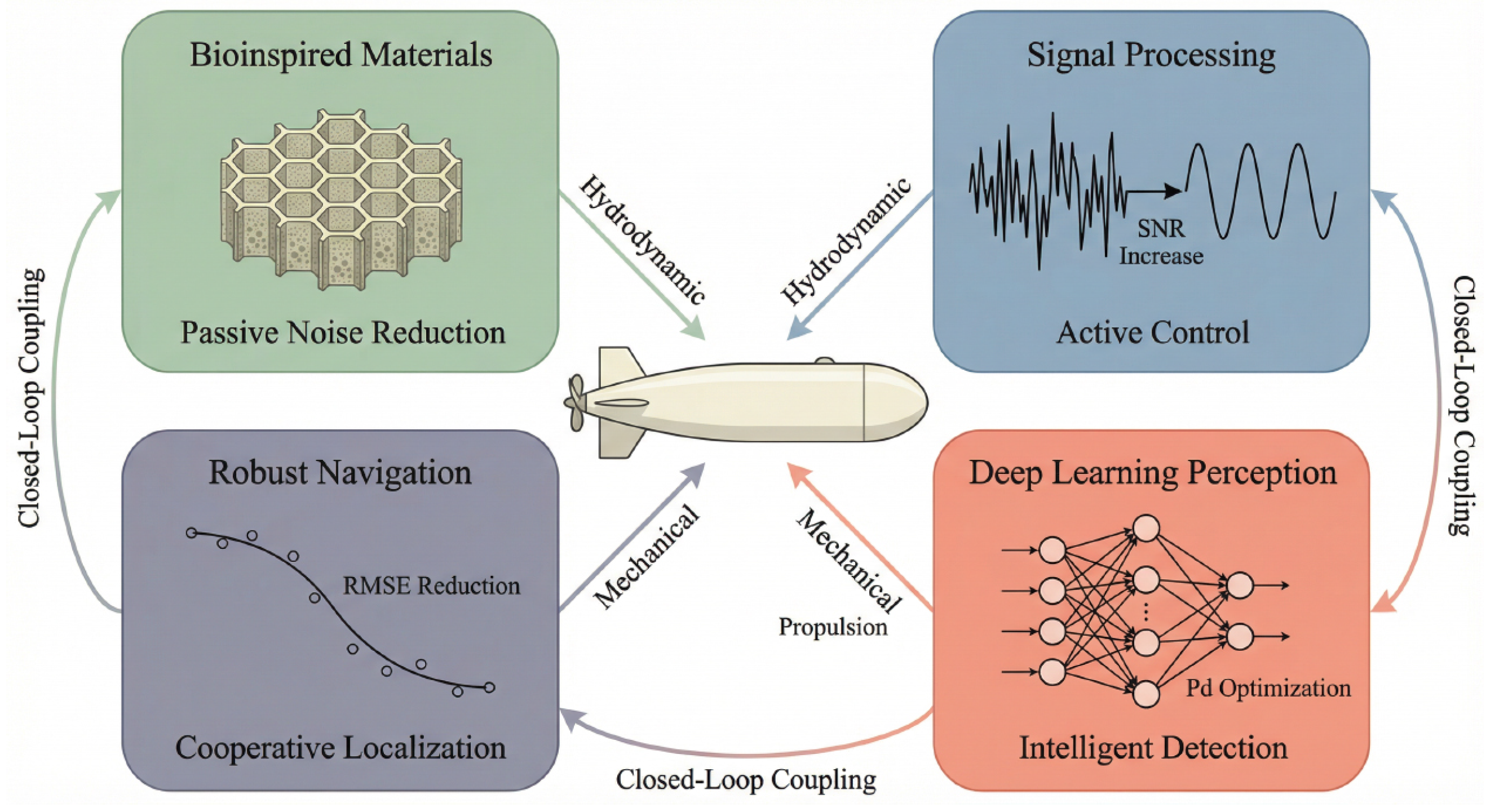
As a focused review of acoustic technology for underwater vehicles, this manuscript provides a comprehensive synthesis of current approaches, bottlenecks, and prospects from a system-performance-oriented perspective. Specifically, we aim to answer the following questions: (i) What innovative strategies are available for noise management in underwater vehicles? (ii) What are the primary bottlenecks that limit real-world deployment under extreme and dynamic conditions? (iii) Which research directions are most promising for future advances? To make the review operationally relevant, we explicitly consider two classes of boundary conditions that are often underreported in the literature: (1) environmental operating envelopes (e.g., depth/pressure, turbulence, ambient noise and reverberation, multipath, and sound speed variability) and (2) durability-oriented assumptions (e.g., pressure cycling, corrosion/biofouling, fatigue, and long-term performance drift). In addition, we adopt a unified, measurable performance language to connect “noise reduction and perception gains” with “closed-loop maneuvering outcomes” in the propulsion/actuation/control stack. Accordingly,
Figure 3 presents a research roadmap: it summarizes the closed-loop coupling from self-noise sources and transmission paths, to acoustic sensing and signal processing, to navigation/perception-driven decision-making and control, and finally to propulsion/actuation execution that feeds back into noise generation.
The remainder of this paper is organized as follows:
Section 2 discusses recent advancements in noise reduction technologies (bionic and intelligent materials for noise reduction, active control technology, and structural optimization engineering).
Section 3 outlines noise-robust navigation and positioning methods.
Section 4 examines intelligent acoustic sensing and signal processing, with an emphasis on reproducible deep learning pipelines and field-relevant reporting.
Section 5 focuses on system-level intelligent control and energy–stealth trade-offs under closed-loop acoustic–mechanical coupling.
Section 6 summarizes the cross-cutting challenges and provides vehicle- and mission-oriented perspectives for future research. To ensure that the above parts are compared under a consistent standard, we embed the unified performance variables and formulations below into the Introduction.
Performance Metrics and Mathematical Formulations
To support a system-performance-oriented review, we define a unified set of measurable variables that connect acoustic stealth and perception to navigation accuracy and closed-loop control quality.
(1) Minimal received signal model. A practical underwater acoustic observation is shaped by propagation (multipath/reverberation) and may vary with time due to environmental dynamics and platform motion. A minimal baseband model is
where
denotes the target-related signal component (or reference),
is the (possibly time-varying) channel impulse response that compactly captures multipath and reverberation, and
aggregates interference including ambient noise and platform self-noise. In the presence of relative motion,
(and thus the received spectrum) can become time-varying due to Doppler effects, which is a key reason why algorithms validated under quasi-static assumptions may degrade in field conditions.
(2) Noise and stealth metrics. Noise level is described using the power spectral density (PSD). Over a frequency band
, the signal-to-noise ratio can be defined as
where
and
are the signal and noise powers (computed over
when appropriate). For radiated-noise or self-noise reduction, improvements are typically reported as PSD reduction (dB) in task-relevant bands.
(3) Detection/recognition metrics. For detection and recognition, system performance is summarized by the probability of detection and the probability of false alarm (or equivalently ROC/PR curves when reported).
(4) Navigation/localization metrics. For navigation and localization, accuracy is represented using the position root-mean-square error (RMSE),
or, equivalently, by the uncertainty level indicated by the estimation covariance.
(5) Closed-loop control and energy metrics. For closed-loop maneuvering, tracking performance can be quantified by the error
and summarized over a mission window
using integral criteria (e.g.,
). Energy-related performance is characterized by
which constrains endurance and operational persistence.
(6) Static versus time-varying validation regimes. When and the noise statistics vary slowly relative to the sensing–decision–control time scale, the environment can be treated as approximately static; otherwise, the system operates under time-varying conditions (e.g., non-stationary ambient noise, time-varying multipath/reverberation, and maneuver-induced self-noise fluctuations).
(7) Mapping reviewed techniques to variables. With these definitions, the four technical areas reviewed in this paper can be consistently mapped to system variables: (i) materials/structures and structural optimization primarily reduce at the source and along source-to-radiation paths; (ii) active noise control and adaptive signal enhancement suppress residual interference and improve band-limited ; (iii) noise-robust navigation/localization reduces (or uncertainty) under degraded and non-Gaussian disturbances; and (iv) deep-learning-based acoustic perception improves at controlled while maintaining robustness under non-stationary interference and domain shifts.
We define system performance as a set of measurable variables
(e.g.,
/PSD improvement,
–
, and
), which depends on (i) the operational environment
x and (ii) the sensing/processing configuration
:
For a representative active-sonar chain, the received
can be written in a compact sonar-equation form,
where
and
are environment-dependent and vary with sea state, depth-dependent sound speed, and reverberation/clutter conditions. Consequently, validation should report both
and the associated
x ranges (e.g., depth/altitude,
profile category, and interference/reverberation level) to enable objective comparison under variable conditions.
2. Innovation in Noise Reduction Technology
Noise reduction technology represents a critical pathway for enhancing the acoustic stealth performance of underwater vehicles, addressing both environmental adaptation and operational concealment requirements. This section systematically examines three interconnected technological strands: bionic and intelligent materials for noise reduction, active control systems, and structural optimization engineering, which collectively form a holistic framework for noise mitigation across multiple physical scales and operational conditions. Key advances include the exploitation of bioinspired surface microstructures and geometric morphologies for turbulence and flow noise reduction, the development of adaptive algorithms and active power-system control for real-time noise reduction, and innovations in propeller design, appendage geometry, and system-level integration for enhanced flow uniformity and vibroacoustic performance. These approaches synergistically bridge material science, fluid dynamics, and control engineering.
In practical deployments, the effectiveness of these noise-mitigation strategies is strongly conditioned by operating envelopes (e.g., depth/pressure, turbulence intensity, and ambient noise) as well as long-term durability (e.g., pressure cycling, corrosion/biofouling, and fatigue). Therefore, when summarizing representative studies in this section, we also report—whenever available—the corresponding validation settings and whether performance gains remain stable under time-varying conditions and long-endurance operation.
2.1. Bionic and Intelligent Materials for Noise Reduction
2.1.1. Turbulent Noise Control Mechanism of Biomimetic Surface Microstructures
Recent bionic acoustic studies highlight the crucial role of biological surface microstructures in passively suppressing turbulent boundary layer noise. Specifically, microstructures such as shark scales and superhydrophobic surfaces (surfaces with extreme water repellency that maintain a thin air layer to reduce wetting and skin-friction drag) effectively reduce flow noise by disrupting vortex coherence and delaying flow separation. For example, optimized tread-scale epidermis design for AUV achieves approximately 5 dB noise reduction in 0–500 Hz range, attributable to diminished boundary layer vortex intensity and attenuated wake-generated noise [
28]. Studies on sea lion vibrissae reveal that although their non-specialized hair structure is more liable to self-generated noise than harbor seals’ undulating morphology, it maintains effective hydrodynamic tracking in high-frequency regimes. This demonstrates that noise control efficacy extends beyond specific structural configurations [
29]. Furthermore, optimized biomimetic vortex generators suppress cavitation phenomena, alleviating high-frequency noise and reducing overall sound pressure level by 5.7 dB [
21]. Integrated superhydrophobic surfaces with flow control modulate vortex shedding to alter flow noise radiation characteristics, confirming significant advantages of bioinspired designs in turbulent noise mitigation [
30]. Collectively, these studies demonstrate the multifaceted potential of biological microstructures for turbulent noise reduction, providing foundational insights for novel acoustic materials and geometric morphology optimization.
2.1.2. Source Suppression of Flow Noise via Bioinspired Geometric Configurations
Building upon biomimetic surface microstructures, serrated trailing edges and wavy leading edges provide robust theoretical and experimental support for fluid-noise source suppression. These geometric features effectively disrupt large-scale vortices, reduce turbulent kinetic energy transfer, and modulate propeller/airfoil radiated noise. Annular propeller (a special propeller type with blades arranged around a hollow circular ring) studies demonstrate that increased blade count and pitch enhance thrust/torque with noise reduction, whereas thickened blades compromise acoustic performance, revealing structural parameter sensitivity [
31]. Humpback-whale-inspired propellers achieve up to 6.67 dB noise reduction via vortex core fragmentation and re-distribution, demonstrating effective flow control [
26]. Owl-tail-feather-modified pump-jet trailing edges (pump-jet trailing edges designed with serrated or wavy features inspired by owl tail feathers to improve flow and noise reduction) enhance flow pulsation pressure, reducing noise by 1.23 dB under self-propulsion [
32]. Wavy leading edges (WLEs) reduce mid-frequency hydrodynamic pulsations, lowering overall sound pressure level by 3 dB and confirming strong flow noise control potential [
33]. Collectively, these bioinspired geometric configurations offer novel solutions for source-suppression design optimization in propulsion systems.
2.1.3. Low-Noise Bioinspired Flexible Systems
Beyond static configurations, bioinspired flexible structures and motion patterns offer innovative solutions for co-optimizing flow noise reduction and frictional drag. Flexible shells thicken boundary layers to attenuate fluid impact while suppressing vibration transmission efficiency, attributable to boundary layer thickening and flow stabilization [
34]. Undulatory propulsion enhances power efficiency and weakens vortex formation via flow re-distribution, enabling significant noise reduction [
35]. However, superior noise control raises concerns about material fatigue and lifespan degradation under high-load cyclic operation. Biomimetic multilayer structures under dynamic loading effectively resist vibration-induced noise [
36]. These approaches establish new paradigms for low-noise design, necessitating balanced material structure optimization to resolve noise performance trade-offs.
2.1.4. Material Parameter Constraints and Topological Optimization
The implementation of noise reduction strategies (e.g., biomimetic structures, metamaterials, and smart materials) is fundamentally constrained by material intrinsic properties. Dynamic adjustments of critical parameters such as Poisson’s ratio and loss factor impose significant limitations on achieving target acoustic performance, particularly in acoustic design and topological optimization. Studies confirm that while optimal Poisson’s ratios enhance material stability, deviations degrade acoustic characteristics and compromise noise reduction efficacy. Moreover, loss factor variations directly govern material energy dissipation capacity and vibration damping performance, with particularly pronounced effects in broadband applications. To mitigate these constraints, multilayer damping topological optimization has been developed, demonstrating superior sound absorption compared to conventional single-layer structures by enhancing broadband vibration suppression [
37]. Nevertheless, implementing this strategy faces substantial challenges, as computational complexity and cost escalate dramatically for complex geometries [
38]. Consequently, comprehending the underlying constraints of dynamic mechanical parameters on acoustic design and addressing them via topological optimization not only establishes a scientific basis for material selection but also provides a critical foundation for innovating future acoustic applications.
2.1.5. Synergistic Mechanisms in Biomimetic Metamaterial Integrated Design
Current advances demonstrate that integrating biomimetic morphologies with acoustic metamaterials represents a frontier research direction, exhibiting significant cross-scale synergistic effects for noise and energy management. This paradigm achieves dual-band noise reduction via coupling aerodynamic flow control with acoustic bandgap mechanisms. Experimental studies confirm that combining compliant skins with phononic crystals enhances broadband sound absorption [
39]. Furthermore, biomimetic shape optimization effectively modulates sound wave propagation, sustaining loss in turbulent boundary layer environments through adaptive impedance tuning [
40]. The performance advantage of bio-metamaterial integration is counterbalanced by significant trade-offs in manufacturability, durability, and environmental robustness. Their acoustic efficacy relies on sub-wavelength structural precision, leading to high fabrication costs and raising concerns about long-term structural integrity and performance preservation under harsh marine conditions (e.g., biofouling, pressure cycles). Furthermore, static metamaterial geometries optimized for specific frequency bands lack the dynamic adaptability to cope with broad-spectrum, time-varying flow noise, limiting their robust noise reduction capability in unsteady operational regimes.
From an operational viewpoint, the above advantages should be interpreted together with durability and time-varying environmental constraints. For example, micro-structured impedance tuning and sub-wavelength resonant units can be sensitive to pressure cycles, biofouling-driven surface roughness changes, and long-term material aging, which may shift resonance bands and reduce broadband effectiveness. Moreover, static geometries optimized for a narrow frequency band may exhibit limited robustness when flow noise becomes broadband and non-stationary in unsteady operational regimes. These considerations motivate the need for envelope-aware design and durability-aware testing protocols when translating biometamaterial concepts to deep-sea deployments.
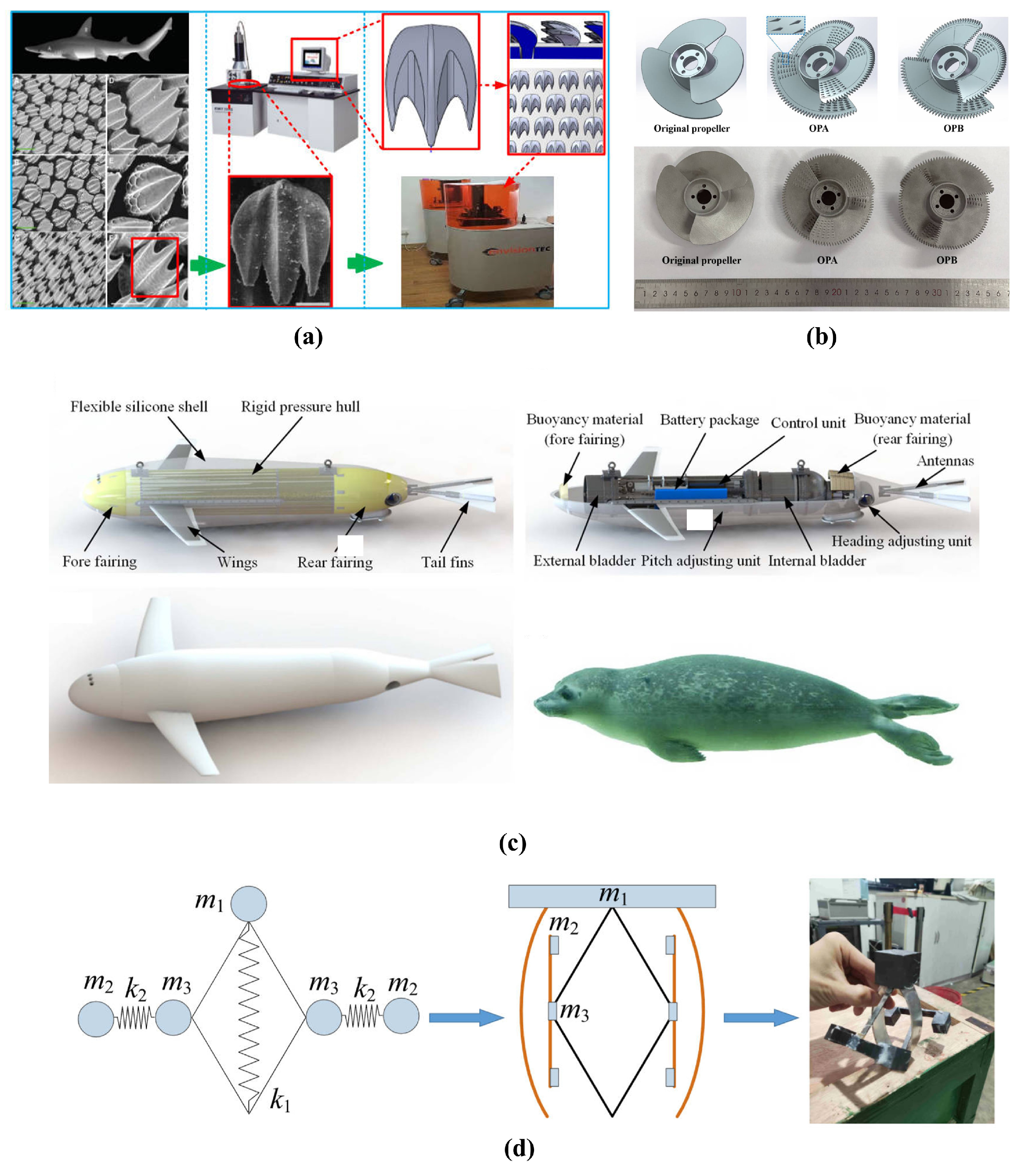
Future research must therefore optimize topological configurations and impedance matching networks while addressing scalability challenges. Collectively, this integrated approach establishes new design frameworks for acoustic engineering and enables cross-disciplinary applications, marking a pivotal evolution in intelligent biomimetic noise control systems. Representative bionic and intelligent material/structure implementations are summarized in
Figure 4.
2.2. Active Control Technology
2.2.1. Innovation and Implementation of Adaptive Control Algorithms
Adaptive filtering algorithms (e.g., FxLMS and RLS) constitute the technical foundation for actively suppressing vibrations and noise. Through online identification and robust optimization, they significantly enhance convergence speed and noise reduction precision. Research shows the FxLMS algorithm reduces sound pressure levels in multi-frequency noise environments, with its real-time signal processing capability being particularly crucial during dynamic adjustments [
42]. Compared to traditional methods, the RLS algorithm demonstrates superior adaptive capability and computational efficiency, improving noise reduction in complex environments. However, despite good performance in theoretical and experimental settings, computational resource consumption and sensitivity to signal-to-noise ratio require attention in practical applications. Furthermore, successful implementation relies on accurate environmental modeling and real-time adjustments to control strategies. Consequently, innovations in adaptive control algorithms provide significant technical support for designing subsequent actuators and control strategies, establishing a theoretical framework for optimizing active noise reduction technologies.
2.2.2. Active Noise Reduction Optimization in Power Systems
Moreover, active noise reduction optimization in power systems (e.g., propellers and motors) significantly reduces electromagnetic vibrations and periodic noise through parameter optimization and medium control, achieving synergy between efficiency and noise reduction. Specifically, parameter optimization strategies like pole-slot combinations and trailing-edge flaps effectively reduce system radiated noise. This optimization also enhances power system efficiency. For instance, research indicates optimized systems have achieved sound pressure reduction in noise reduction [
43]. Furthermore, the literature notes improved medium control technologies enhance operational smoothness and noise control capabilities of power equipment, demonstrating cumulative effects of advanced methods [
44]. The real-time effectiveness of active noise reduction in power systems involves critical trade-offs with system complexity and energy consumption. Computational delays in adaptive algorithms (e.g., FxLMS) may introduce control stability issues for high-frequency noise. Additionally, the added actuators and sensors increase system complexity and potential failure points, while their power consumption conflicts with the limited energy budget of underwater platforms. This dependence on real-time computation and extra power compromises the overall energy robustness and reliability in long-endurance, autonomous missions. Therefore, while pursuing technological outcomes, attention must be paid to balancing economic viability and implementability. This optimization naturally links to downstream structural optimization design.
2.3. Structural Optimization Engineering
2.3.1. Innovation in Propeller Body Parameters and Configurations
Focusing on core noise sources, discrete spectrum noise and turbulent kinetic energy transfer can be effectively suppressed at the source through the following:
(1) Optimization of propeller blade parameters (thickness, pitch); (2) Implementation of configuration innovations (annular, contra-rotating, skewed designs); (3) Application of biomimetic microstructures (serrated and porous trailing edges).
These design changes significantly enhance the acoustic performance of the propeller. Research shows the optimized blade configuration achieves efficiency improvement in kinetic energy transfer [
26,
45]. Biomimetic microstructures effectively reduce turbulence-caused noise levels and improve overall stability and efficiency in specific frequency bands.
However, configuration innovations and parameter adjustments introduce design–manufacturing complexity, making implementation still challenging in practical applications and potentially leading to material fatigue and service-life reduction [
46]. In addition, the noise reduction capability of specific propeller configurations is closely coupled with flow-field interaction, which implies that performance may drift under off-design conditions such as variable loading, turbulence bursts, and long-term surface degradation [
47]. Therefore, beyond initial performance improvements, future propeller-oriented noise reduction engineering should place greater emphasis on durability-aware and envelope-aware validation (e.g., pressure cycling, long-duration hydrodynamic loading, and repeated start–stop operating profiles), so that radiated-noise benefits remain robust throughout mission life.
2.3.2. Optimization of Appendage Geometry and Flow Field Uniformity Enhancement
Extending to propulsor-associated structures, appendage geometry optimization (e.g., X-rudders, twisted rudders, fairing leading-edge modification, connection rounding) aims to improve inflow quality at the blade disc surface, thereby weakening vortex-shedding-induced vibration noise and solving vibration noise amplification from flow field disturbances. These geometric improvements reduce fluid irregularities and enhance flow field uniformity [
48,
49]. Research shows these modifications not only enhance fluid entry state but also reduce vortex formation near the blade disc, diminishing vibration and noise amplification effects with acoustic performance improvements [
10,
50]. Additionally, such structure designs are closely related to surrounding flow field disturbances, and optimizing these features helps mitigate flow field interference during propulsor operation [
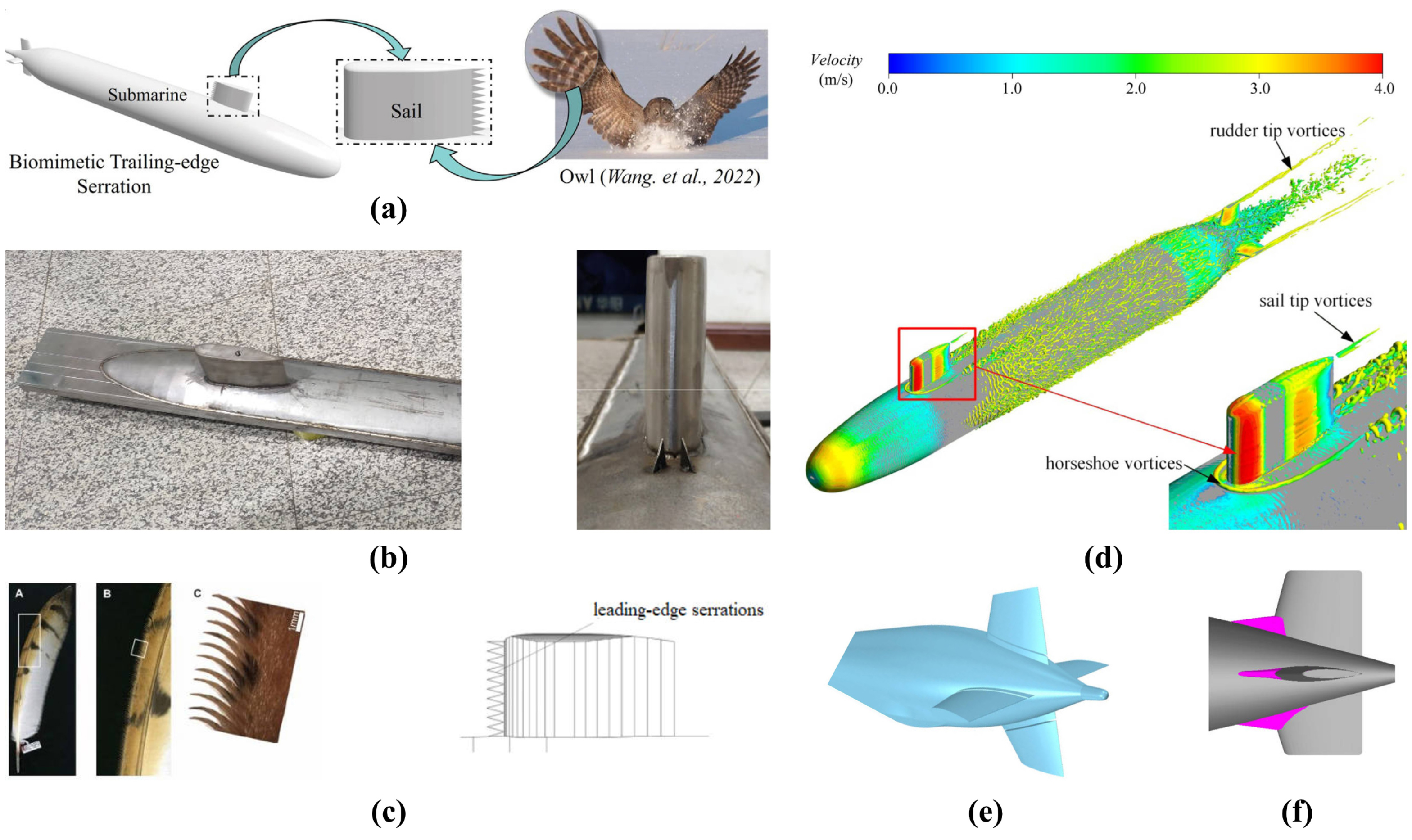
7]. However, despite significant advantages in theoretical and experimental settings, their effectiveness in practical applications requires further verification, especially regarding geometric design adaptability and stability under different working environments. Moreover, complex geometries may pose manufacturing process challenges and increase costs. Therefore, thorough analysis of flow field characteristics and their noise impact is crucial for designing and optimizing propulsor-related appendage structures. Representative bioinspired and geometric designs for appendages that homogenize inflow and suppress vortex-induced vibroacoustic responses are summarized in
Figure 5.
2.3.3. Design of Active Fluid Control Devices
For localized strong noise sources, active fluid control devices (e.g., flow deflectors, vortex generators, vortex breakers) significantly suppress broadband flow noise by intervening in horseshoe vortex evolution processes. These devices improve flow field stability and uniformity by disrupting vortex coherence, thus mitigating localized strong noise source impact [
52]. Research further indicates this active control technology possesses strong theoretical noise reduction capabilities and exhibits high practical efficiency, continuously optimizing paddle system acoustic performance. However, despite positive effects demonstrated by these design methods, challenges remain in device integration with other propulsion systems during implementation, potentially introducing complexity and affecting overall performance. Therefore, the methodology combining active fluid control with propulsor body and appendage structure optimization provides a more comprehensive supplementary solution for noise reduction technology, aiming to further enhance overall system noise performance in complex environments.
2.3.4. System Integration and Global Noise Reduction Engineering
Elevating from localized optimization to system integration level, strategies like hull–propeller coupling layout optimization, propulsion system connection stiffness adjustment, and main engine removal significantly enhance overall acoustic performance. This system-level optimization emphasizes considering interactions between components during design process rather than individually adjusting local parameters [
43]. Specifically, rational hull–propeller coupling layout improves hydrodynamic effects, reduces vortex generation, enhances flow field stability, and diminishes noise source excitation [
53]. System-level noise reduction pursues global optimum at the cost of performance sensitivity and design rigidity due to subsystem coupling. Globally optimized parameters (e.g., hull–propeller layout, connection stiffness) are static and difficult to adjust online. When the vehicle encounters off-design conditions (e.g., extreme flow, variable loading), this static optimization may fail or even induce adverse coupling effects like resonance, demonstrating poor robustness to operational adaptability. Moreover, the accuracy of multi-physics coupling models remains a source of fundamental uncertainty for prediction and optimization. Consequently, system integration strategies provide a new development pathway for noise reduction technology and highlight the complexity of addressing multi-variable dynamic interactions in future research to achieve more efficient global performance optimization.
This section shows that noise mitigation can act on the source (propulsion/actuation), the transmission path (structures/materials), or the sensing location (active control). A consistent limitation across many reported gains is that improvements are often demonstrated under controlled or short-duration conditions, while mission-level robustness under off-design loading and long-term degradation is less frequently quantified.
4. Intelligent Acoustic Sensing and Signal Processing
Intelligent acoustic sensing and signal processing plays a pivotal role in enhancing the operational performance and stealth capabilities of underwater vehicles by enabling accurate noise identification, robust signal enhancement, and advanced target detection. This section systematically addresses these objectives through three interconnected subsections: noise source identification, intelligent signal enhancement, and target detection enhancement, which collectively form a progressive framework from foundational analysis to functional application. Key advances include the development of high-fidelity numerical models and machine learning techniques for noise mechanism interpretation, adaptive and deep learning-based frameworks for noise reduction and signal-to-noise ratio improvement, as well as classification and cooperative detection localization methods for weak target perception.
For obstacle avoidance and seafloor/structure mapping, the perception output is often geometric (e.g., depth, surface normal, or a 3D point cloud) rather than a discrete label. In such cases, the observation is commonly represented by an intensity (backscatter) image produced by side-scan or multibeam sonars, and the mapping from echo intensity to surface geometry is affected by incidence angle and scattering characteristics. A frequently used minimal relationship is a Lambert-type backscatter model in which the received intensity depends on the angle between the incident direction and the local surface normal, thereby linking image intensity to surface gradients.
Accordingly, performance should be reported using geometry-oriented metrics in addition to
, such as (i) depth error or bathymetry
, (ii) point-to-surface distance
for 3D reconstruction, and (iii) map consistency/drift measures over the mission window. These metrics can still be unified with
Section 1 by interpreting the final reconstruction error as an
-type system variable.
4.1. Physical Foundations of Acoustic Sensing
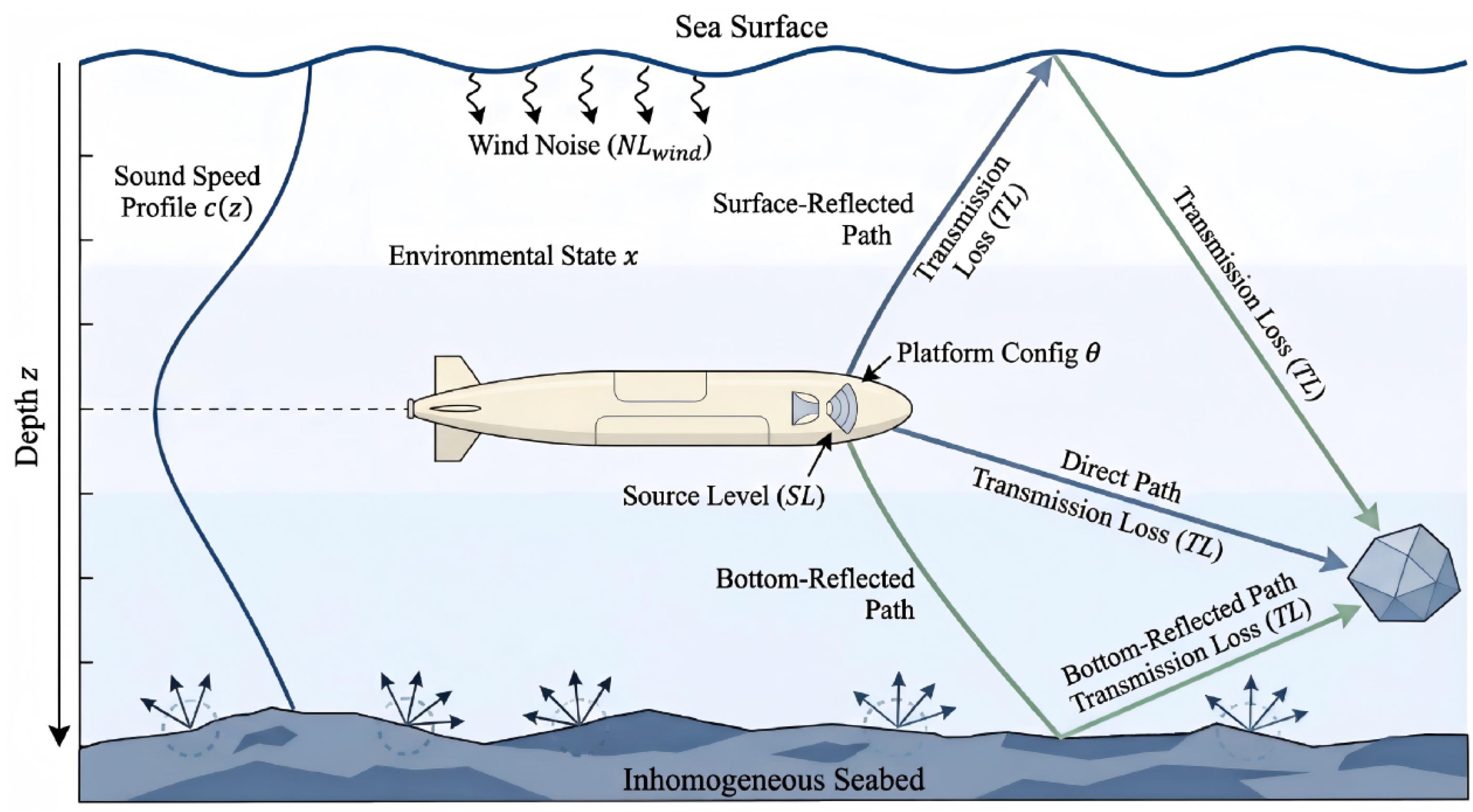
To provide the physical context for the sensing algorithms discussed in this section, the interaction between the UUV and the complex deep-sea environment is illustrated in
Figure 8.
The diagram elucidates the multi-path propagation mechanisms where the active signal (Source Level,
) interacts with the stratified water column, sea surface, and inhomogeneous seabed. As formulated in
Section 1, the received signal is stochastically modulated by the environmental state vector
x, which includes depth-dependent refraction
, wind-induced surface noise
, and Lambertian bottom scattering. This physical complexity serves as the fundamental constraint for the intelligent perception and signal enhancement pipelines that follow.
4.2. Deep Learning Pipeline and Reproducibility Items
To make deep learning-based acoustic perception methods reproducible and operationally relevant, we summarize representative studies using a unified specification that covers (i) the learning pipeline and (ii) mission-dependent preprocessing/corrections when sonar imagery or bathymetry products are involved.
4.2.1. Unified Deep-Learning Pipeline (Task-to-Deployment)
Task definition and metrics. We categorize tasks as noise identification/classification, denoising/enhancement, fault diagnosis/health monitoring, and weak-target detection/recognition; and report task-aligned metrics (e.g., /PSD improvement, accuracy/F1, –, and onboard latency).
Inputs and preprocessing. Inputs include time-domain segments, time–frequency representations (e.g., STFT magnitude), and multi-channel/array features when available. Preprocessing and augmentation should reflect underwater variability ( changes, non-stationary interference, and domain shifts).
Model family and training protocol. We summarize model family (CNN backbones, residual/dense connections, temporal/attention modules), training data volume and labeling strategy, loss design aligned with the task, and data split protocol to avoid leakage across operating conditions.
Deployment constraints. For underwater vehicles, computational cost, memory footprint, and real-time performance are first-order constraints; we report inference latency, model size, and required sampling bandwidth when available.
Validation protocol and reporting. To objectively present results, we report the validation data source (simulation/tank/sea trial), split protocol, and the operational variable ranges associated with each evaluation (e.g., depth/altitude, sound speed profile availability, motion/attitude variability, and interference/reverberation level). This ensures that reported gains in can be interpreted together with x rather than in a single fixed operating condition.
4.2.2. Engineering Corrections for Sonar Mapping
When sonar imagery is used for mapping (e.g., mosaicking) or when bathymetry is derived, reproducibility also depends on mission-dependent engineering corrections, which can dominate downstream geometric consistency.
Geocoding and attitude compensation. Coordinate conversion/geocoding and attitude correction (heading/yaw, roll, pitch) are required to mitigate motion-induced distortion and misalignment in practical mosaicking and mapping workflows.
Sound speed profile correction. Depth/position estimation depends on sound speed variability via ; thus, sound speed profile-based correction should be stated when bathymetry is involved.
Tide correction (depth reference). Whether tide correction is applied and what depth datum/reference is used should be stated.
Time-varying gain and dynamic range control. It should be stated whether TVG/TGC and AGC/MGC (or equivalent gain-control settings) are applied, since they affect image intensity normalization and interpretability.
Reproducibility checklist. For each dataset/experiment, we report: task and metrics; input representation and preprocessing; model and training protocol (including data split); deployment constraints (latency/model size/bandwidth); and, if mapping is involved, geocoding/attitude correction, sound speed correction, tide/datum, and gain control settings.
In the following subsections (
Section 4.3,
Section 4.4 and
Section 4.5), we survey representative studies on noise identification, signal enhancement, and target detection. Rather than applying the above checklist in a rigid, tabular format—which would be impractical for a literature review—we use it as a critical lens to evaluate the field. For each key study, we explicitly note, wherever possible: (i) the task definition and reported metrics, (ii) the nature of inputs and whether preprocessing accounts for underwater variability, (iii) the model family and training data strategy, and (iv) any reported deployment constraints or validation protocols. Where such information is absent in the original literature, we explicitly state the gap, thereby highlighting opportunities for improving reproducibility in future work.
4.3. Noise Source Identification
4.3.1. Noise Numerical Modeling and Validation Methods
Accurate identification of noise sources relies on high-precision predictive models. Finite element, boundary element, and sound pressure spectral models achieve high-precision prediction of underwater equipment noise radiation through experimental validation, demonstrating exceptional capabilities in quantitatively assessing hull scattering effects. These numerical modeling methods not only provide in-depth understanding of noise in complex underwater environments but also establish a solid theoretical foundation for noise identification [
88,
89,
90]. Research results indicate that finite element method simulations accurately replicate noise radiation patterns and quantify nonlinear factor effects on sound pressure distribution, thereby enhancing model applicability and accuracy [
88]. Meanwhile, the boundary element method exhibits flexibility and practicality in noise prediction under open boundary conditions, providing references for real-world applications. These advances strengthen the noise identification theoretical basis while providing scientific basis for subsequent technological innovations and equipment design.
From the perspective of the reproducibility framework outlined in
Section 4.2, these numerical studies primarily address the validation protocol dimension. Their accuracy is typically verified against tank experiments or analytical solutions under controlled conditions. However, the operational variable ranges
x (e.g., varying Reynolds numbers or inflow turbulence) under which these models remain valid are often not systematically reported, limiting cross-study comparability.
4.3.2. Mechanism of Flow Noise Generation
Regarding major noise sources, the physical mechanism of flow noise is central to identification. Flow noise from propellers and pump systems exhibits mixed broadband-discrete spectrum characteristics, where the dominant turbulence pressure mechanism can be quantified via machine learning (error < 7%) [
91,
92,
93,
94], revealing the essential correlation between flow fields and noise. In flow noise generation studies, turbulence dynamic characteristics significantly influence noise amplitude and spectral distribution, while machine learning-based turbulence pressure quantification provides a novel effective analytical tool, enhancing noise source comprehension. Although existing literature identifies flow noise as a primary mechanical system source and different spectral characteristics may indicate flow field feature changes, a consistent theoretical framework for comprehensively describing this complex phenomenon remains lacking. Therefore, despite evident advantages of machine learning in flow noise quantification, future research must explore noise generation mechanisms under varying flow conditions to comprehensively understand generation and control strategies, which is critically important for enhancing underwater equipment stealth capabilities and operational effectiveness.
In terms of the pipeline checklist, machine learning here serves as a regression tool for turbulence pressure. While the reported prediction error provides a clear task metric, the training data regime (e.g., what range of flow conditions were covered) and the model’s generalizability to out-of-distribution flow features are often not specified, which aligns with the persistent challenge of domain shift highlighted in our framework.
4.3.3. Dynamic Characteristics of Environmental Noise
External environmental factors exert significant modulating effects on noise source characteristics. Seasonal variations and depth profiles notably alter environmental noise coherence, with passive acoustic models extending noise source identification to 21.5 m/s wind speeds [
95,
96,
97]. These dynamic characteristics highlight underwater noise complexity, particularly how environmental factors modulate propagation under varying seasonal and depth conditions. Research indicates seasonal changes in biological sound sources and hydrological conditions increase noise coherence, while surface fluctuation-induced noise becomes more pronounced at higher wind speeds. These findings reinforce passive acoustic model applicability, as expanded identification capability enables feasible monitoring of noise variations in real-world environments. Nevertheless, uncertainties exhibited by current models under varying water temperatures and salinities require further investigation and validation. Therefore, despite advancements in passive acoustic technologies, challenges remain in understanding noise modulation mechanisms in variable environments. Future efforts should focus on optimizing model sensitivity and enhancing predictive capabilities to support underwater detection and monitoring technologies.
4.3.4. Coupled Noise from Structural Vibration
Mechanical structural resonance is a key noise amplification mechanism in specific equipment. In submarine cylinder structures, critical distance ratios reaching 3.0 cause 6 dB sound pressure spikes, accurately predicted via vibration–acoustic field coupling models that elucidate sonar self-noise limiting mechanisms [
98,
99]. This research emphasizes mechanical noise enhancement under specific conditions, revealing the critical role of structural resonance in amplification. Particularly underwater, structural vibrations affect both noise generation and propagation characteristics, presenting new challenges for submarine stealth design. Coupling model applications better identify sound pressure spike sources and mitigate noise impacts, though introducing material selection and structural design complexities. While current models successfully predict acoustic field changes, accuracy across various operating conditions requires further validation to ensure broad applicability.
4.3.5. Technological Innovation in New Sensing and Recognition Technologies
Technological innovation provides a novel approach to transcending traditional noise recognition limitations. Distributed Acoustic Sensing (DAS) technology significantly enhances shallow fault recognition capability through submarine optical cable utilization, thereby overcoming conventional acoustic detection constraints. Research indicates that high sensitivity and extensive coverage characteristics of DAS enable effective capture of subtle acoustic changes, facilitating accurate identification of geological structures in complex submarine environments [
100]. Moreover, compared to traditional detection technologies, DAS allows real-time monitoring and data collection, greatly enhancing detection efficiency and measurement accuracy [
100]. Therefore, future research should concentrate on optimizing data processing algorithms to enhance DAS reliability and adaptability. This technology not only offers new tools for shallow fault analysis but also opens prospects for ocean engineering and resource exploration, indicating future directions in conjunction with intelligent signal enhancement technology (
Section 4.4).
4.3.6. Integrated Performance–Noise Correlation
The intrinsic relationship between noise characteristics and equipment performance provides a crucial design benchmark. Self-propulsion numerical model research reveals a positive correlation between submersible maneuverability and noise complexity, offering an important evaluation benchmark for stealth design [
53]. This model application demonstrates noise characteristic variations under different maneuvering states while identifying the potential impact of noise complexity on handling performance, enabling designers to reduce acoustic detectability while meeting maneuverability requirements. Specifically, accurate simulation of submersible acoustic responses under various operational conditions allows better understanding of noise generation mechanisms and their relationship with maneuvering performance, thereby proposing effective strategies for designing more covert underwater platforms.
4.4. Intelligent Signal Enhancement
4.4.1. Adaptive Noise Reduction Technology
The application of adaptive noise reduction technology in underwater signal processing has garnered increasing attention, particularly for addressing the challenge of time-varying channel interference. Specifically, the Adaptive Noise Canceller (ANC), employing a partitioned fast block least-mean-square (PFBLMS)-based adaptive algorithm, achieves a
improvement of up to 20 dB. This enhancement is specifically designed to augment the detection capabilities of towed linear arrays of AUVs, particularly under low ambient noise conditions [
101]. Furthermore, an improved variant of the ANC utilizes the transmitted source signal as a reference, thereby simplifying the complexities inherent in conventional ANC designs and resulting in a power enhancement of 13.8 dB [
102]. Despite the superior performance of adaptive noise reduction techniques in enhancing underwater sonar capabilities, challenges persist regarding dynamic interference, such as the need for real-time processing and adaptability requirements. Collectively, adaptive noise reduction technology establishes a solid foundation for improving signal quality in high-noise underwater environments.
4.4.2. Deep Learning-Enhanced Frameworks
The deep learning enhancement framework introduces an intelligent learning mechanism to break through the limitations of traditional algorithms. It has demonstrated exceptional performance in fault diagnosis and noise filtering, establishing itself as a significant technological advancement in modern signal processing. From the perspective of the reproducibility framework outlined in
Section 4.2, these numerical studies primarily address the validation protocol dimension. Their accuracy is typically verified against tank experiments or analytical solutions under controlled conditions. However, the operational variable ranges
x (e.g., varying Reynolds numbers or inflow turbulence) under which these models remain valid are often not systematically reported, limiting cross-study comparability.
Taking the Convolutional Neural Network Support Vector Machine (CNN-SVM) as an example, this method facilitates the progressive diagnosis of Electrical Submersible Pump (ESP) faults through multi-channel feature fusion. Research indicates that this method introduces twelve representative statistical features to reduce noise, thereby enhancing fault classification accuracy [
103]. Concurrently, the Densely Connected Residual Convolutional Network for Distributed Acoustic Sensor (DAS) data processing (DCRCDNet) effectively addresses noise issues. This network elevates the
from −10.21 dB to 15.61 dB, successfully suppressing multiple complex noise types [
104]. Notably, as indicated in
Table 1, the DCRCDNet was trained and evaluated on real DAS field data collected via a submarine optical cable [
104], making it one of the few deep learning frameworks in underwater acoustic sensing that has been validated with genuine field-deployment data rather than simulation or laboratory data alone. The DCRCDNet, while computationally intensive, demonstrates the potential for offline processing of large-scale DAS data, which is particularly beneficial for gliders conducting basin-wide surveys where real-time constraints are relaxed. Conversely, for computationally constrained AUVs requiring real-time obstacle avoidance, more lightweight models or hardware acceleration are necessary. The discussion of computational intensity and platform suitability (gliders vs. AUVs) directly addresses the deployment constraints dimension, underscoring the trade-off between model complexity (performance) and real-time feasibility that is often overlooked in purely algorithmic papers.
The exceptional performance of deep learning models is critically dependent on large volumes of high-quality, labeled training data, which is extremely costly and scarce in underwater acoustic scenarios. This often leads to overfitting on training sets and a sharp decline in generalization capability when facing out-of-distribution data (e.g., new target types, unencountered noise environments), indicating a lack of robustness to “unexpected” inputs. Moreover, the inference time of complex network models challenges their deployment for real-time processing on edge AUV devices, forming a performance–generalizability–real-time trilemma [
103]. Furthermore, when processing deep-sea underwater signals exhibiting pronounced noise characteristics, a newly developed convolutional filtering method has proven effective in removing diverse interference noise, thereby improving signal clarity and recognition rates [
108]. Consequently, deep learning frameworks require continuous optimization efforts tailored to specific contexts to ensure robustness under conditions of high uncertainty.
4.4.3. Innovations in Hardware Layer Enhancement
The integration of distributed vibration sensing and low-noise amplification is advancing the limits of physical detection by enhancing signal quality from the sensing source, achieving monitoring distances of up to 121.5 km and sensitivities as high as 3.4 mrad/
[
113]. This advancement holds milestone significance for applications such as deep-sea exploration and structural health monitoring, as it effectively improves the sensor’s capability to detect minute movements and vibrations, thereby enhancing signal quality. Specifically, distributed vibration sensors employ high-sensitivity materials within the sensing network, which significantly reduce noise interference while maintaining long-distance signal transmission, thereby enhancing the reliability and accuracy of the data [
113].
4.5. Target Detection Enhancement
4.5.1. Cooperative Optimization of Detection and Localization
The integration of perception and spatial cognition has been achieved through the implementation of ultra-short baseline positioning, the RBPF-SLAM and Fast-SLAM algorithm, which leverage pulse processing and compressed sensing to realize cooperative optimization of target detection and environmental mapping, thereby enhancing system-level performance [
114]. Specifically, this method employs the high-precision capabilities of ultra-short baseline positioning to acquire environmental information, while the RBPF-SLAM algorithm enhances real-time tracking of moving targets through recursive Bayesian filtering [
76]. In practical applications, this combination allows for improved integration of perception and spatial cognition, particularly in complex scenarios, facilitating the accurate identification and mapping of targets [
77]. However, sensitivity to sensor accuracy and environmental noise may affect the reliability and accuracy of measurements. Overall, the synergistic effect of ultra-short baseline positioning and SLAM demonstrates the potential for optimizing detection and localization capabilities in dynamic backgrounds, providing significant insights for the development of intelligent navigation systems.
Viewing this through our pipeline, SLAM-based methods fuse multi-modal inputs (acoustic range, inertial data) to perform the joint task of detection and environmental mapping. The reported improvements in system-level performance align with the task metrics (e.g., localization accuracy, map consistency). However, the deployment constraints dimension is particularly salient here: the computational cost of particle filters (e.g., in RBPF-SLAM) can grow exponentially with state uncertainty, potentially exceeding the real-time capabilities of embedded AUV platforms. This trade-off between estimation accuracy and computational feasibility is a key consideration missing from many algorithmic studies, yet it is essential for assessing operational viability. Future work should report not only accuracy metrics but also inference latency and memory footprint under representative hardware constraints, as advocated in our reproducibility checklist.
4.5.2. Application of Autonomous Operating Systems
Furthermore, the acoustic-guided remote-operated underwater vehicle (ROV) autonomous docking technology has demonstrated the capability to maintain positioning accuracy even under anomalous data conditions, thereby validating the engineering reliability of the detection technology [
109]. As documented in
Table 1, this system was validated during sea trials of the Rover ROV at a deep-sea test site, confirming real-world operational reliability under genuine ocean conditions rather than in simulation. This technology employs advanced acoustic sensors combined with real-time data processing algorithms, enabling the ROV to adaptively adjust its docking strategy in complex underwater environments and effectively overcome uncertainties during data transmission [
109]. Research indicates that acoustic guidance not only enhances the system’s responsiveness to dynamic changes but also increases the success rate of missions under various interference conditions, thereby further promoting the practicality of autonomous operating systems in engineering applications [
109]. Consequently, this technology has validated engineering reliability, while future efforts should focus on ensuring efficient and reliable operation in variable environments to maintain the broad applicability and stability of the technology.
By applying the systematic pipeline proposed in
Section 4.2 as a critical lens, we reveal that while the literature excels at reporting task metrics (e.g.,
gain, accuracy), it frequently under-reports critical dimensions such as validation protocols under time-varying
x and explicit deployment constraints. This gap analysis, enabled by our framework, underscores the urgent need for more reproducible and operationally grounded research in intelligent acoustic sensing.
5. System-Level Intelligent Control
System-level intelligent control is fundamental to advancing the operational autonomy and performance of underwater vehicles, integrating key technologies to enhance robustness, coordination, and stealth across dynamic and uncertain marine environments. This section systematically addresses three core dimensions: interference-resilient control to stabilize individual vehicle operation under disturbances, cluster collaborative optimization to enable adaptive and reliable multi-vehicle coordination, and integrated energy stealth design to harmonize propulsion efficiency with acoustic concealment. Within these sub-themes, adaptive sliding mode control and intelligent observation estimation techniques form the basis for disturbance rejection, while multi-AUV formation strategies—encompassing stability assurance, communication-aware coordination, and cooperative navigation—collectively support scalable swarm intelligence. Further integrating these advances, geometric and propulsion innovations for acoustic scattering reduction alongside stealth-aware path planning establish a closed-loop framework for high-efficiency and low-detectability mission execution.
5.1. Interference-Resilient Control
5.1.1. Adaptive Sliding Mode Control
The improved Linear Optimal Steering (LOS) technique and fast terminal sliding mode control have demonstrated exceptional path stability under tidal current disturbances, with depth error maintained within 3.5 cm, thereby significantly reducing energy consumption [
111,
112]. This adaptive sliding mode control method effectively addresses continuously changing flow conditions in marine environments by precisely adjusting control strategies, thereby enhancing motion control of individual equipment and providing a solid foundation for subsequent dynamic effects. Compared to traditional control methods, this technology not only increases system robustness and accuracy when facing disturbances but also minimizes unnecessary energy waste [
112].
5.1.2. Intelligent Observation and Estimation
Accurate state observation and estimation are crucial for control systems to obtain “clean inputs.” The combination of high-gain observers, Student’s
t-distribution Kalman Filtering (STDKF), and hybrid particle filtering has significantly enhanced the accuracy of state estimation in noisy environments [
115,
116]. This technological breakthrough not only optimizes the system’s responsiveness to dynamically changing conditions but also minimizes the impact of noise on estimation results, thereby providing cleaner inputs for control systems [
117,
118]. However, the stability of these methods under high noise and extreme disturbances still requires further investigation to ensure reliability for widespread applications [
57]. Overall, this combinatorial approach provides robust technical support for subsequent fault diagnosis and optimization of control systems.
5.1.3. Active Vibration Suppression
In addition to observation and control, the active suppression of mechanical vibration interference is a specialized requirement for ensuring equipment structural stability. The integration of harmonic suppression algorithms and magnetic suspension isolation systems effectively reduces rotational vibration transmission, thereby enhancing equipment structural stability [
105,
106]. By applying harmonic suppression algorithms, the system is capable of real-time identification and cancellation of vibrations caused by rotating machinery, thus mitigating noise and vibration impacts within the power system, which is critical for complex mechanical operations [
106]. Simultaneously, the magnetic suspension isolation system further improves vibration isolation by minimizing direct contact friction, thereby maintaining favorable dynamic performance while suppressing vibration transmission. Therefore, these active vibration suppression strategies not only provide new insights for noise management in mechanical systems but also highlight important directions for future designs of high-performance and energy-efficient equipment.
5.1.4. Fault Diagnosis Assurance
Following the implementation of cooperative control, ensuring system reliability has become critical. The actuator and thruster fault detection technology based on Bayesian networks and enhanced Convolutional Neural Networks (CNNs) has significantly improved system reliability under abnormal operating conditions, establishing itself as a key safeguard for modern control systems [
119,
120]. By constructing Bayesian network models, the system effectively handles uncertainties while leveraging the robust learning capabilities of enhanced CNNs to achieve accurate fault diagnosis and prediction [
25,
120]. This integrated approach not only enhances the flexibility of traditional fault detection but also increases analytical capabilities for complex data patterns through deep learning techniques, thereby ensuring system stability in dynamic environments [
25]. However, despite near-real-time detection capabilities, computational complexity and the requirement for large volumes of labeled data remain potential bottlenecks for widespread application [
119,
120].
5.2. Cluster Collaborative Optimization
5.2.1. Fundamental Methods and Stability Assurance for Multi-AUV Formation Control
The underlying stability of collaborative operations among multiple AUVs relies on a robust control framework. Distributed control, virtual leader methods, filtering fallback strategies, and decentralized tracking constitute the core framework for multi-AUV formation control, ensuring the underlying stability of swarm operations through collision avoidance, trajectory tracking, and path stability optimization [
121,
122,
123,
124,
125,
126,
127]. Specifically, distributed control strategies enable effective coordination of AUVs in dynamic environments, enhancing system adaptability. The virtual leader method provides formation flexibility, allowing subsequent vehicles to adjust based on leading vehicles’ dynamic behaviors [
122]. Simultaneously, filter-backstepping methods and decentralized tracking further improve tolerance to uncertainty, enabling stable performance maintenance under unpredictable conditions [
123,
124,
128]. However, technology implementation still faces challenges, particularly regarding collision avoidance and path planning in complex environments, which necessitates ensuring real-time responsiveness to environmental variables [
125,
126]. Therefore, while current technologies lay the foundation for swarm collaboration, further optimization of the control architecture will be required to support advanced optimization algorithms in more complex scenarios.
5.2.2. Intelligent Algorithms for Formation Optimization and Robustness Enhancement
Building upon the foundational control framework, the introduction of intelligent algorithms has significantly enhanced formation optimization capabilities and robustness. Metaheuristic optimizers have markedly improved multi-AUV formation deployment efficiency in complex scenarios, with flexible search mechanisms that effectively respond to dynamically changing environments [
129]. Concurrently, the integration of robust learning models and high-gain observers enables more accurate handling of dynamic uncertainties, thereby enhancing adaptability to environmental disturbances [
130,
131]. Furthermore, formation configuration design directly enhances swarm collaboration robustness through information quality optimization, ensuring efficient cooperation under variable conditions [
132]. Therefore, these intelligent algorithms provide essential technical support for addressing adaptive challenges in complex environments.
5.2.3. Communication-Aware Mechanisms and Dynamic Information Management
Reliable and efficient communication serves as a critical foundation for cooperative optimization of swarms. Communication-aware formation control exhibits strong capabilities in dynamically adjusting swarm size, with the acoustic channel playing a dominant role in network performance that necessitates real-time data sharing to ensure system effectiveness [
121,
133,
134]. Specifically, the communication-aware mechanism enables flexible adjustment of the number of AUVs in the formation based on environmental changes and mission demands, ensuring optimal resource utilization to enhance operational efficiency [
121]. The acoustic channel’s superiority manifests not only in transmission capacity but also in sustaining real-time data sharing amid frequent environmental variations, which is vital for collaborative decision-making within the formation [
133]. Furthermore, the implementation of distributed consensus protocols ensures efficient collaborative decision-making in heterogeneous environments, mitigating potential risks arising from channel instability or information delays [
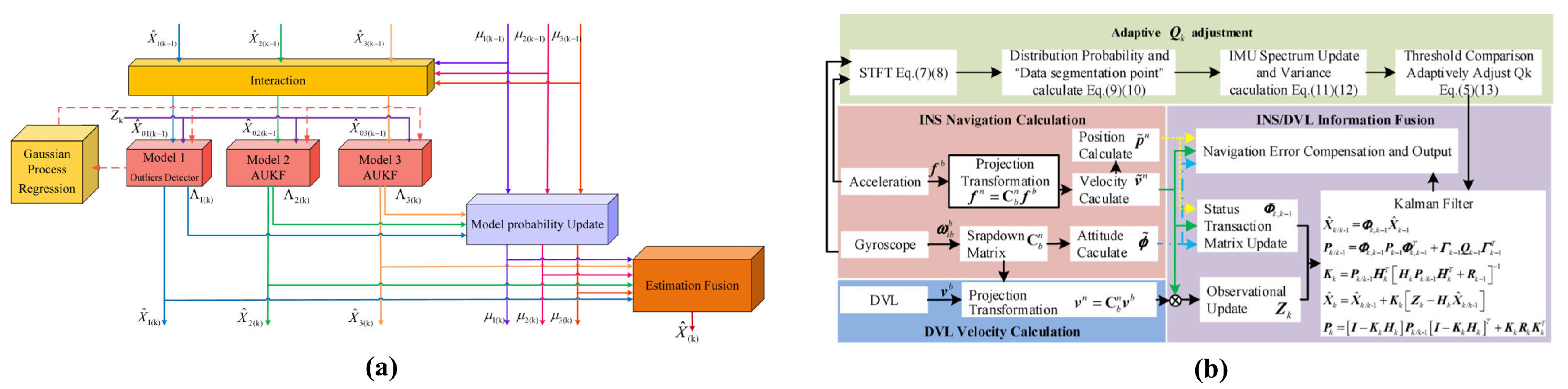
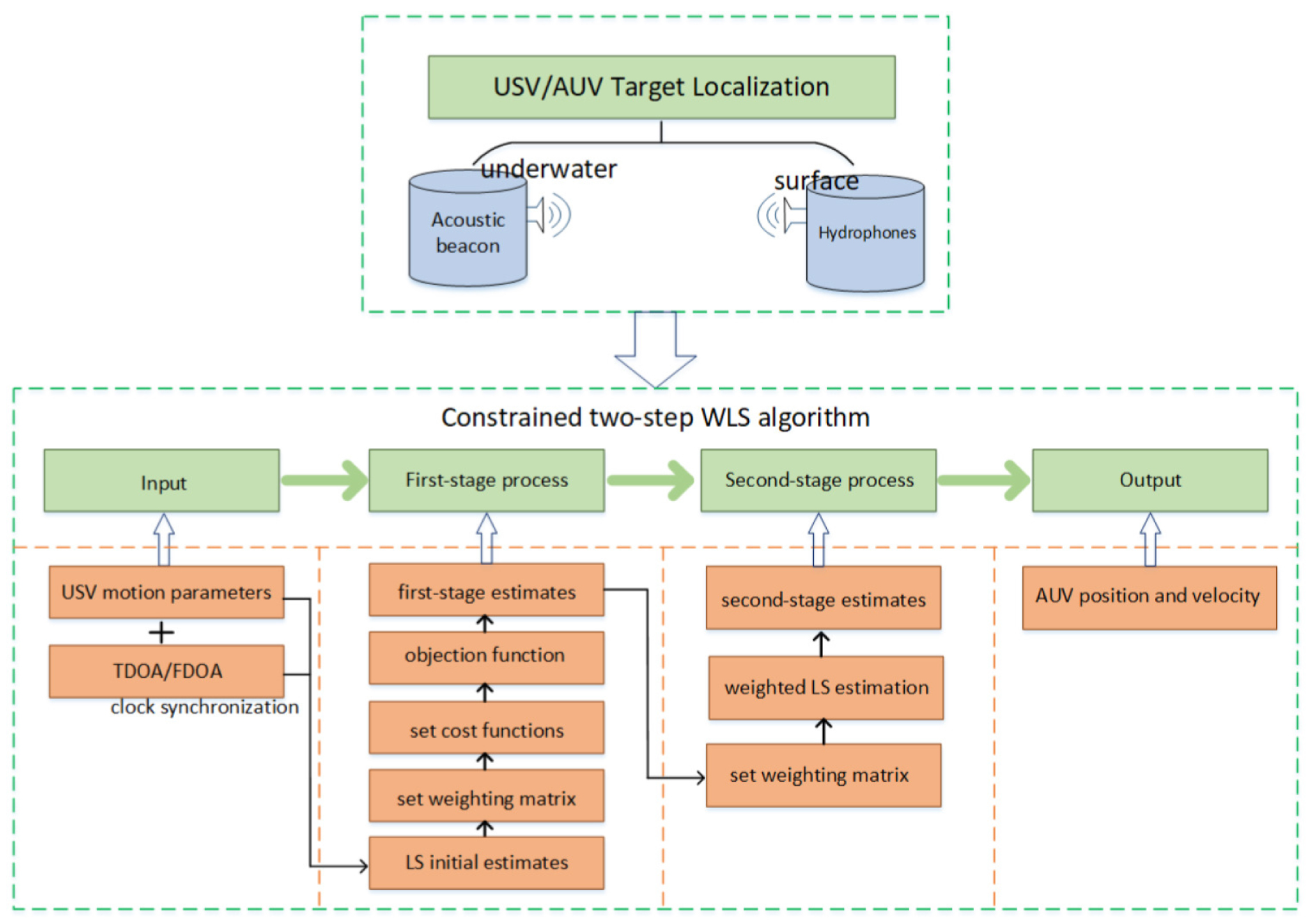
135]. The core strength and critical vulnerability of communication-aware swarm coordination both hinge on the underwater acoustic communication link. The limited bandwidth, high latency, and error-prone nature of the acoustic channel make real-time information sharing a bottleneck. The increased communication overhead required to maintain formation may directly conflict with stealth requirements. In cases of strong interference or link outage, distributed protocols relying on neighbor information can suffer cascading performance degradation or even instability, revealing a fragility threshold in the collaborative robustness contingent on communication connectivity. Representative cooperative positioning topologies and workflows are summarized in
Figure 9.
5.2.4. Technological Innovations in Cooperative Positioning and Navigation Accuracy
By integrating communication support with underlying control, cooperative positioning and navigation technologies have achieved a closed-loop for spatial coordination of swarms. The combination of loosely coordinated passive positioning, dual-leader navigation, and acoustic ranging has significantly enhanced multi-AUV system positioning accuracy. Moreover, consensus estimation and adaptive filtering methods address challenges in resource-constrained environments, directly enhancing swarm navigation capabilities through optimized information quality [
15,
137,
138]. Passive positioning technology relies on mutual information exchange among AUVs, enabling precise localization through collective intelligence, particularly in complex environments [
138]. The dual-leader navigation mechanism employs a hierarchical control strategy to strengthen flexible path planning scheduling, thereby ensuring higher strategic decision-making capacity [
137]. Acoustic ranging, as an effective distance measurement tool, not only improves positioning accuracy but also provides necessary relative location awareness among swarm members [
15]. However, applicability of these technologies in highly dynamic environments remains constrained by signal attenuation and delays [
136,
139]. Therefore, future research should further integrate simultaneous localization and mapping (SLAM) optimization algorithms to reinforce swarm autonomous navigation capabilities, ensuring real-time decision accuracy and effectiveness. The comprehensive application of these technologies lays a solid foundation for enhancing closed-loop spatial coordination performance among swarms.
5.2.5. Task-Level Cooperative Validation for Target Tracking and Monitoring
The effectiveness of the aforementioned technological system is ultimately validated through target tracking and monitoring tasks. The integration of multi-Bernoulli filtering and labeled multi-Bernoulli tracking has significantly optimized dynamic target tracking capability, particularly demonstrating outstanding performance in complex environments requiring precise multi-target identification and tracking [
140,
141]. Both methods enhance algorithmic tracking accuracy while improving system adaptability under dynamic changes [
141]. Additionally, the combination of underwater acoustic monitoring networks and autonomous sonar detection provides a solid validation foundation for cooperative inspection operations, ensuring technological feasibility in practical applications [
142,
143]. Consequently, this integrated technology series successfully validates the closed-loop effects of multi-AUV swarm cooperation at the task level, providing robust case support for system-level optimization (
Section 5.3) and indicating future development directions.
5.3. Integrated Design of Energy Efficiency and Stealth
5.3.1. Innovative Geometric Design for Acoustic Scattering Optimization
The physical foundation of acoustic stealth originates from innovative geometric structure design. The adoption of non-streamlined configurations, such as tetrahedral conning towers, has significantly reduced target strength, demonstrating the critical role of geometric design in acoustic stealth [
144,
145]. Additionally, the hybrid-wing underwater glider achieved an ultra-low sound pressure level of 64.78 dB through hydrodynamic optimization, further validating its effectiveness in acoustic scattering optimization [
13]. This series of research findings indicates that geometric innovations not only enhance stealth performance but also establish a physical foundation for acoustic stealth technologies, providing crucial technical approaches for subsequent energy and system optimization. Thus, despite significant achievements of existing designs in reducing detectability, future research must explore more complex shapes and material combinations to address acoustic environment variability and improve overall stealth capabilities.
5.3.2. Innovations in Low-Noise Power Systems and Energy
Building upon physical structure optimization, innovations in low-noise power systems constitute a critical component of collaborative optimization. The ultra-quiet nuclear reactor (1 MW power/5-year endurance) provides sustainable energy for low-noise power systems, enabling efficient and reliable continuous operation during diving patrols and other underwater missions [
146]. Concurrently, bearing gap control (5–20 μm) effectively suppresses vibration noise, further enhancing equipment concealment and overall performance [
14]. Additionally, propulsion system optimization achieves low-frequency noise as low as 75 dB, establishing a solid foundation for acoustic stealth design [
1]. The synergistic effects of these three components not only construct an efficient low-noise power system but also demonstrate effective integration of energy and mechanical levels in stealth design [
1,
14,
146]. The design of low-noise power systems inherently involves a strong multi-objective trade-off among acoustic stealth, propulsion efficiency, and energy endurance. For instance, noise-reducing features like highly skewed propellers and ultra-quiet bearings often sacrifice some propulsion efficiency; added vibration isolation rafts increase weight and drag. While nuclear power offers endurance, it introduces complexity, high cost, and safety concerns. This static, compromise-based design lacks the ability to dynamically re-balance these factors in response to real-time threats and energy states during a mission, highlighting a deficit in mission-level adaptive balancing capability [
1,
14].
5.3.3. Stealth-Driven Path Planning Strategies
At the task execution level, the stealth-driven behavior strategy achieves dynamic integrated optimization. The noise-prioritized path planning strategy significantly reduces the average detection range by 17%, demonstrating enhanced stealth effectiveness [
110]. Concurrently, integration of a variable buoyancy system enables exploration equipment to effectively adapt to ocean density variations, further augmenting stealth capabilities while achieving a 2000 km operational range [
2]. This dynamic environmental adaptation strategy shifts from static design to dynamic behavior optimization, demonstrating deep integration of stealth and energy efficiency [
2,
110]. However, during implementation, although noise-prioritized path planning effectively reduces detection probability, the system’s real-time responsiveness in complex marine environments requires further enhancement to address challenges and uncertainties posed by environmental changes [
110]. Consequently, this strategy not only optimizes task-level execution efficiency but also provides significant research directions and technical foundations for future dynamic adjustments.
5.4. Case Study: Acoustic–Mechanical Coupling Challenges in the Petrel AUV
As a representative platform for long-range ocean observation, the Petrel series acoustic AUV (see
Figure 2a) illustrates the critical coupling between mechanical durability and acoustic performance under extreme environmental constraints. Applying the generalized performance model
, the challenges specific to this platform can be systematically categorized into pressure induced noise modulation, navigation fidelity, and durability decay.
For Petrel series vehicles operating at depths exceeding 1200 m, the external environmental state vector x, particularly hydrostatic pressure , alters the structural resonance of the cylindrical hull. Research indicates that distance ratio fluctuations in coupled vibration acoustic fields can lead to obvious changes in sound pressure. This validates the requirement to treat self-noise not as a static value, but as a dynamic variable dependent on the depth dependent state vector x.
In long endurance polar missions, maintaining a positioning accuracy of km is constrained by the energy budget E. The technological configuration , such as the sampling rate of the DVL, must be adaptively tuned. High-frequency sensing increases the power consumption , potentially shortening the mission window T. Thus, in the absence of an intelligent filtering system, human operators must manually adjust the filtering strategy based on the detected ambient noise level (where indicates that the noise level is a key element of the system state variable x). When the ambient noise is low, one must switch to low-power intermittent sensing to extend device battery life. When the ambient noise is high, one must switch to high-precision robust filtering to ensure data accuracy and interference resistance.
Furthermore, the operational durability of bioinspired surfaces on the Petrel hull is subject to impedance shifts during repeated pressure cycles. The durability decay function
reflects the degradation of noise suppression efficacy
over mission time
t:
Here, is modulated by biofouling accumulation and material fatigue under variable load operations.
To objectively present the system operational reliability, the mission level acoustic integrity
of the Petrel AUV is modeled as the probability of maintaining the signal-to-noise ratio (
) above the detection threshold
(the minimum
required to ensure valid acoustic detection and navigation) across the mission duration
:
This formulation integrates the external environmental factors , including time-varying sound speed profiles and currents, with the system internal technological states , such as adaptive processing and material integrity. This case study underscores that system-level acoustic performance cannot be separated from decision making and control, because propulsion and actuation decisions feed back into self-noise generation and thus into sensing and navigation quality. For next-generation platforms, acoustic enhancement must move beyond isolated component optimization toward a closed-loop framework that harmonizes durability, energy persistence, and environmental adaptability. Therefore, future studies should report mission profiles, propulsion states, perception latency, energy consumption, and evaluation regimes to ensure that closed-loop claims are supported by comparable operating conditions.
Table 1 enables a systematic assessment of the algorithm-to-data connectivity across the four technical areas reviewed in this work. Several observations emerge.
First, noise reduction technologies (
Section 2) and adaptive signal processing algorithms exhibit the strongest connection to real-world validation data: bioinspired surface designs are tested in lake experiments or laboratory cavitation tunnels, and active noise controllers are validated on actual submarine platforms or AUV-deployed sonar systems. The FxLMS-based ANC system for submarine exhaust noise [
42] and the AUV-mounted ANC for towed arrays [
101] represent particularly well-validated examples with quantitative field or platform-test results.
Second, noise-robust navigation algorithms (
Section 3) present a mixed picture. While cooperative localization with mixture-distribution robust Kalman filtering has been validated in AUV lake experiments [
64], most tightly coupled navigation and robust filtering methods still rely on Monte Carlo simulation. Terrain-aided navigation methods represent a notable intermediate case: they operate on real bathymetric maps even when the vehicle trajectory is simulated [
73], thus incorporating genuine environmental variability into the validation.
Third, deep learning frameworks for acoustic perception (
Section 4) exhibit the largest gap between algorithmic sophistication and real-data validation. DCRCDNet [
104] stands out as a deep learning method trained and evaluated on genuine field DAS data, achieving a
improvement from −10.21 dB to 15.61 dB. By contrast, most CNN-based classification and fault diagnosis studies remain limited to laboratory-collected or simulation-generated datasets. This gap directly reinforces the performance–generalizability–real-time trilemma discussed in
Section 4.4.2 and underscores the urgency of building standardized, open-access underwater acoustic benchmark datasets.
From the perspective of the unified performance model
,
Table 1 reveals that many studies report the performance variable
(e.g.,
gain,
) but under-specify or entirely omit the environmental state vector
x under which validation was conducted. For example, the ANC sea-trial results [
101,
102] do not consistently report the ambient noise level
, the sound speed profile
, or the vehicle operating depth during the trial. Without these contextual variables, cross-study comparison remains qualitative rather than quantitative. We therefore advocate that future publications explicitly report both
and
x alongside their algorithmic contributions, using the reproducibility checklist established in
Section 4.2 as a minimum reporting standard.
This section emphasizes that system-level acoustic performance cannot be separated from decision-making and control, because propulsion/actuation decisions feed back into self-noise generation and thus into sensing and navigation quality. A key gap is that many studies still report subsystem-level improvements without coupled evaluation of acoustic metrics, control performance, and energy cost.
6. Challenges and Prospects
6.1. Summary
This review synthesizes advances in acoustic technologies for underwater vehicles, quantitatively demonstrating that the convergence of biomimetics, adaptive control, and artificial intelligence defines the current paradigm. Key performance metrics underscore three transformative trends:
(1) From Passive to Intelligent Noise Suppression: Bio-inspired designs, from microtextures to propeller geometries, achieve substantial source-level noise reduction. Optimized biomimetic propellers provide up to 6.7 dB reduction in radiated noise, while metamaterial integrations enhance broadband absorption.
(2) Enhanced Navigation Robustness under Uncertainty: Advanced filtering and multi-sensor fusion significantly improve accuracy in dynamic environments. Distributed robust filtering maintains multi-AUV consistency under current and clock uncertainties, and tightly coupled SINS/DVL/USBL navigation reduces long-term positioning error under non-Gaussian interference.
(3) AI-Driven Breakthroughs in Acoustic Perception: Deep learning overcomes traditional signal-to-noise ratio () bottlenecks. Frameworks like DCRCDNet elevate the of distributed acoustic sensing data from −10.21 dB to 15.61 dB, and GRU-based particle filters improve target state estimation accuracy under complex UUV dynamics.
Despite these advances, a persistent, cross-cutting challenge remains: the inability of current systems to achieve real-time, self-adaptive co-optimization across the material structure-algorithm hierarchy under extreme and dynamic environmental variability (e.g., under-ice, deep-sea). This gap, evident in discussed trade-offs, computational limits, and generalization bounds, necessitates the integrated research directions outlined next.
6.2. Challenges
Despite these advances, the field continues to confront critical barriers in translating theoretical innovations into robust operational capabilities. Persistent limitations manifest primarily in three domains: inadequate adaptability to extreme polar and deep-sea conditions, where unmodeled pressure dynamics and ice-induced communication disruptions remain unresolved; suboptimal hardware algorithm integration, evidenced by material-control interface latency and compromised real-time responsiveness in multi-agent systems; and unresolved interdisciplinary synergies, particularly the energy–stealth compromises in propulsion systems and persistent terminology barriers impeding cross-domain knowledge fusion. These systemic constraints collectively hinder the holistic realization of noise-immune underwater platforms.
6.3. Prospective Research Directions
6.3.1. Materials–Structures–AI Synergy
Future research could explore the development of real-time co-optimization frameworks integrating programmable metamaterials with artificial intelligence to overcome the inherent bandwidth limitations of conventional noise reduction approaches. Current metamaterial designs, while effective for specific frequency bands, exhibit constrained adaptability to dynamically changing flow environments due to their static geometric configurations. A promising pathway may involve leveraging metaheuristic-driven topology optimization to enable on-the-fly reconfiguration of microstructural units, thereby achieving dynamic impedance matching across turbulent flow regimes. Such adaptive architectures, potentially combining piezoelectric composites with deep learning-based inverse design, could bridge the gap between broadband acoustic control and operational versatility. This co-design paradigm would extend biomimetic principles toward intelligent material systems capable of autonomously balancing spectral coverage and hydrodynamic compatibility, ultimately enhancing turbulent noise mitigation and thereby improving the operational stability and precision of adjacent control surfaces and thrusters in variable underwater conditions.
6.3.2. Adaptability to Extreme Environments
The advancement of adaptive navigation in polar regions may require establishing noise-correlated acoustic channel models to mitigate multipath interference induced by dynamic ice reflections. Current robust filtering methodologies, while effective in addressing sensor anomalies like DVL failures, exhibit limitations in modeling the coupled effects of temperature-induced sound speed fluctuations, noise variability, and ice-layer dynamics. Integrating deep-sea noise prediction frameworks with fault-tolerant navigation mechanisms could enhance the resilience of collaborative AUV localization in non-structured ice environments. Such integration would extend dynamic baseline positioning principles to accommodate heterogeneous ice obstacles, potentially overcoming signal degradation challenges during under-ice operations. Future efforts might focus on co-designing channel-adaptive estimation algorithms with distributed swarm intelligence to harmonize navigation reliability and environmental adaptability in these critically constrained settings, with explicit closed-loop verification against actuator feedback quality and formation/trajectory control stability under acoustic uncertainty.
6.3.3. Stealth–Energy Efficiency Dynamic Balance Mechanism
Developing real-time game-theoretic frameworks for acoustic signature management and energy allocation might achieve an optimal balance between acoustic stealth (affecting control signal clarity and detectability) and propulsion energy consumption (directly tied to actuator duty cycles and battery life) during covert operations. The inherent conflict between noise reduction in low-noise turbines and propulsion efficiency presents a fundamental challenge, potentially addressed by integrating variable buoyancy systems with H-infinity robust control methodologies. Such co-design approaches could dynamically modulate buoyancy states while minimizing hydrodynamic disturbances, extending mission durations without compromising detectability thresholds. Future frameworks may offer pathways to harmonize geometric stealth optimization with energy system innovations, particularly for prolonged deep-sea exploration where environmental adaptability determines operational success. Implementing adaptive decision models that respond to mission-critical trade-offs remains essential for advancing next-generation autonomous platforms.
6.4. Development Outlook
Future research must address key challenges such as the manufacturing complexity and scalability of biomimetic–metamaterial structures, the computational cost and real-time performance of advanced algorithms, and the integration reliability of multi-sensor systems. Meanwhile, operational durability and long-term stability should be treated as essential requirements rather than secondary considerations, because pressure cycling, fatigue, corrosion, and biofouling may cause non-negligible performance drift over mission life. This necessitates a shift towards durability-aware design and testing protocols for long-term deployments, especially under extreme conditions.
Efforts should focus on optimizing material topologies and impedance matching, enhancing computational efficiency for real-time processing, and improving the adaptability of navigation and control systems in dynamic marine environments. In addition, to facilitate objective and rigorous cross-study comparisons, system performance should be reported using unified mathematical variables (e.g., /PSD, , /uncertainty, and closed-loop tracking error), and validation evidence should be summarized together with key variables (environmental factors and operating envelopes) to enable objective comparisons across studies.
Ultimately, acoustic technologies should be co-designed with the actuation/control stack so that noise mitigation and perception gains translate into measurable closed-loop maneuvering performance and mission-level resilience. The resolution of these issues is crucial for advancing practical applications in deep-sea exploration and long-term marine monitoring, gradually improving the operational robustness and autonomy of underwater systems. This integrated approach will be key to achieving true system-level optimization and unlocking the full potential of next-generation underwater vehicles.
Furthermore, as systematically catalogued in
Table 1, a clear priority for the community is to advance deep learning and cooperative localization algorithms from simulation-dominant validation toward systematic sea-trial and long-endurance field testing. Future work should employ the unified performance language
to report both algorithmic gains
and the associated environmental conditions
x, thereby enabling rigorous, cross-study comparison grounded in real operational data.




 ,
,