Article

Active Disturbance Rejection Predictive Control for Drill-Arm Positioning of Hydraulic Drill-Anchor Robots Based on Friction Compensation and PSO Tuning


1
School of Mechanical and Electronical Engineering, China University of Mining and Technology (Beijing), Beijing 100083, China
2
School of Computer Science and Technology, Hainan University, Haikou 570228, China
*
Authors to whom correspondence should be addressed.
Actuators 2026, 15(4), 193; https://doi.org/10.3390/act15040193
Submission received: 26 February 2026 / Revised: 21 March 2026 / Accepted: 24 March 2026 / Published: 1 April 2026

Abstract

The anchoring effect of drill-anchor equipment directly determines the support quality of roadways. Currently, hydraulic drill-anchor robots suffer from insufficient positioning control precision during operation, and drilling position deviations induce roadway collapse risks and serious safety hazards. Therefore, effectively improving the position control accuracy of the drill arm of drill-anchor robots is a critical prerequisite for ensuring roadway support safety. Aiming at the drill-arm position control system of drill-anchor robots, this study establishes a friction model for friction compensation based on the analysis of the motion mechanism of drill-anchor robots and then constructs mathematical models for the slewing and pitching systems respectively. To realize the precise position control of the drill arm, an active disturbance rejection predictive control scheme is proposed. An extended state observer (ESO) is adopted to observe the system states and unmodeled disturbances, and the particle swarm optimization (PSO) algorithm with an improved objective function is applied to optimize the parameters of the drill-arm position controller. Finally, simulation results demonstrate that the designed active disturbance rejection predictive control method for drill-arm positioning, based on friction compensation and PSO tuning, exhibits excellent control performance and achieves accurate trajectory tracking of the drill-arm position of drill-anchor robots. This research has important theoretical and practical significance for promoting the automatic control of drill-anchor robots in underground engineering.

1. Introduction

Coal mining operations are mostly carried out underground, making the coal mining industry a typical high-risk sector with numerous safety accidents occurring annually. Roof accidents account for more than half of all coal mine safety accidents, which are mainly caused by substandard roadway support that fails to maintain the stability of surrounding rock masses. Hydraulic drill-anchor robots are specialized mechanical equipment for rock anchoring in mine roadways and other underground engineering projects. Their core operational function is to drill bolt holes in surrounding rock for bolt installation, so as to guarantee the safety of on-site workers and the structural stability of engineering constructions. The control accuracy of the drill arm is the key factor determining the quality of bolt support, as the robot is required to perform anchoring operations strictly in accordance with the preset positions of bolt holes.
At present, the drill arm control of drill-anchor robots still relies mainly on manual operation, which imposes high professional skill requirements on operators and leads to large positioning fluctuations. The drill arm of hydraulic drill-anchor robot is driven by electro-hydraulic systems with strong nonlinear characteristics, and the control performance can be effectively improved via the design of advanced control algorithms. Proportional–Integral–Derivative (PID) control is widely used in electro-hydraulic control systems due to its simple structure and easy parameter tuning. However, for complex nonlinear electro-hydraulic control systems, PID control faces prominent challenges such as difficulty in obtaining optimal parameters and weak anti-disturbance capability, resulting in unsatisfactory control effects. Hence, numerous studies have been conducted to improve the performance of PID control. With the continuous maturity of control technology, various advanced control methods have been applied to solve the nonlinear problems of electro-hydraulic control systems, including robust control [1], adaptive control [2,3], sliding mode control [4,5], active disturbance rejection control (ADRC) [6,7], and backstepping control [8,9]. Zhang et al. [10] designed a fractional-order PID controller for a 4-DOF drill-anchor robot to address the position control problem. Aiming at the nonlinear friction problem of control systems, researchers have established various friction models to describe friction characteristics [11], such as the Coulomb friction model, Stribeck friction model, and LuGre model [12]. Liao J [13] adopted the LuGre friction model to comprehensively describe the friction characteristics of electro-hydraulic servo systems. Feng et al. [14] proposed an improved LuGre model to describe friction characteristics related to position, velocity and direction and used the improved PSO algorithm to accurately identify the model parameters. Li et al. [15] introduced a bristle direction coefficient into the LuGre model to describe friction behavior and used an ESO to estimate the friction force and disturbances, then designed a backstepping controller to compensate for nonlinear friction. Chen et al. [16] adopted the Karnopp model for friction feedforward compensation in hydraulic braking systems and used a disturbance observer to estimate the system angle, angular velocity and disturbances, realizing the position control of the braking system. Chen [17] addressed the performance degradation of valve-controlled symmetric cylinders caused by friction nonlinearity, external random disturbances and unmodeled dynamics. Zhang et al. [18] designed neural direct adaptive ADRC based on a reduced-order model of the electro-hydraulic control system and used a linear ESO for uncertain disturbance compensation. Ma et al. [19] proposed a load force compensation fuzzy control algorithm based on improved PSO, which improves the optimization performance of the PSO algorithm through crossover and mutation operations, and verified the effectiveness and superiority of the improved PSO composite control strategy. Guo et al. [20] proposed a composite learning adaptive position tracking controller with improved parameter convergence for electro-hydraulic control systems, which combines the tracking error and prediction error for parameter estimation. The designed controller realizes the convergence of the parameter estimation error while ensuring tracking performance. Qin et al. [21] took the hydraulic system of the boom of a mining hydraulic excavator as the control object and designed an impedance controller based on the ESO and backstepping control considering energy saving and position tracking performance. Yang et al. [22] proposed ADRC based on an improved ESO for the hydraulic system of roadheaders, introduced dead-zone compensation into the electro-hydraulic proportional valve, and integrated the improved and traditional ESO into the ADRC, improving the system control accuracy. Coskun and Itik [23] designed an intelligent PID controller for the position control of nonlinear electro-hydraulic systems and optimized the controller parameters through the PSO algorithm. Experimental results show that the designed controller is superior to the traditional PID controller. Ren et al. [24] proposed a fractional-order integral sliding mode controller based on a radial basis function neural network for an electro-hydraulic control system with model inaccuracy, uncertainty and valve offset. The RBF neural network is used to handle the model uncertainty, and the controller can effectively suppress disturbances and inaccurate valve offset, realizing precise tracking control. Recent studies on ESO-based ADRC have made notable progress. Liu et al. [25] proposed a composite speed controller combining a modified super-twisting sliding mode controller with an ESO, which achieves robust speed control of permanent magnet synchronous motor drives by using an ESO. Dang et al. [26] developed an adaptive sliding mode control strategy integrated with an ESO, enhancing the system’s anti-disturbance capability and dynamic response.
Model predictive control (MPC) has the ability to handle system constraints, which predicts the future dynamic behavior of the system based on a predictive model. Its application in electro-hydraulic control systems can solve practical constraint problems such as mechanical structure limitations, load pressure, and actuator performance. Hou et al. [27,28] proposed an MPC-based positioning control scheme with online predictive feedback for the electro-hydraulic proportional valve. Experiments prove that this method can achieve accurate and fast positioning control. Shi et al. [29] designed an MPC controller to track the braking pressure for an automotive electro-hydraulic braking-by-wire system and established a friction model for compensation, realizing precise tracking and fast response of the braking pressure. They used a projection-corrected gradient method to estimate the characteristic model of the system and adopted generalized predictive control to realize precise position tracking.
By summarizing domestic and foreign research on the drill-arm motion control of drill-anchor robots, it is found that the research on the high-performance motion control of the drill-arm hydraulic system is still insufficient. Due to the nonlinearity and parameter uncertainty of the hydraulic system, traditional control methods cannot meet the requirements of high-precision operations. To address this gap, this paper proposes an active disturbance rejection predictive control scheme for drill-arm positioning, which integrates friction compensation and PSO-based parameter tuning to overcome the key difficulties in high-precision positioning control. The main contributions are as follows:
(1)
Aiming at the nonlinear friction in the drill-arm position system, a mathematical model embedded with nonlinear friction terms is established based on the Stribeck friction model. Different from general methods, this model integrates the dynamic characteristics of the worm-gear transmission mechanism and the pitching mechanism, which can accurately characterize the system dynamics and lay a solid foundation for subsequent controller design.
(2)
To solve the problems of time-varying parameters and external disturbances, a linear time-varying model predictive control (LTV-MPC) controller for the drill-arm position is designed. Unlike existing electro-hydraulic control strategies, friction is treated as a known measurable disturbance in the controller design process, which reduces the observation burden of the ESO and further improves the position tracking accuracy and stability of the system.
(3)
To address the difficulties in the parameter tuning of LTV-MPC and the suboptimality of traditional tuning methods, an improved multi-objective fitness function is designed. PSO is introduced for global parameter optimization, which achieves optimal parameter matching and significantly enhances the control performance and robustness of the closed-loop system.
The rest of this paper is organized as follows: Section 2 establishes the mathematical model of the drill-arm position control system of drill-anchor robots; Section 3 designs the active disturbance rejection predictive controller for the drill-arm positioning of hydraulic drill-anchor robots based on friction compensation and PSO tuning; Section 4 conducts simulation verification to validate the applicability of the active disturbance rejection predictive controller for the drill-arm motion control system; Section 5 summarizes the full text and presents future research work.

2. Modeling of Drill-Arm Position Control System for Drill-Anchor Robots

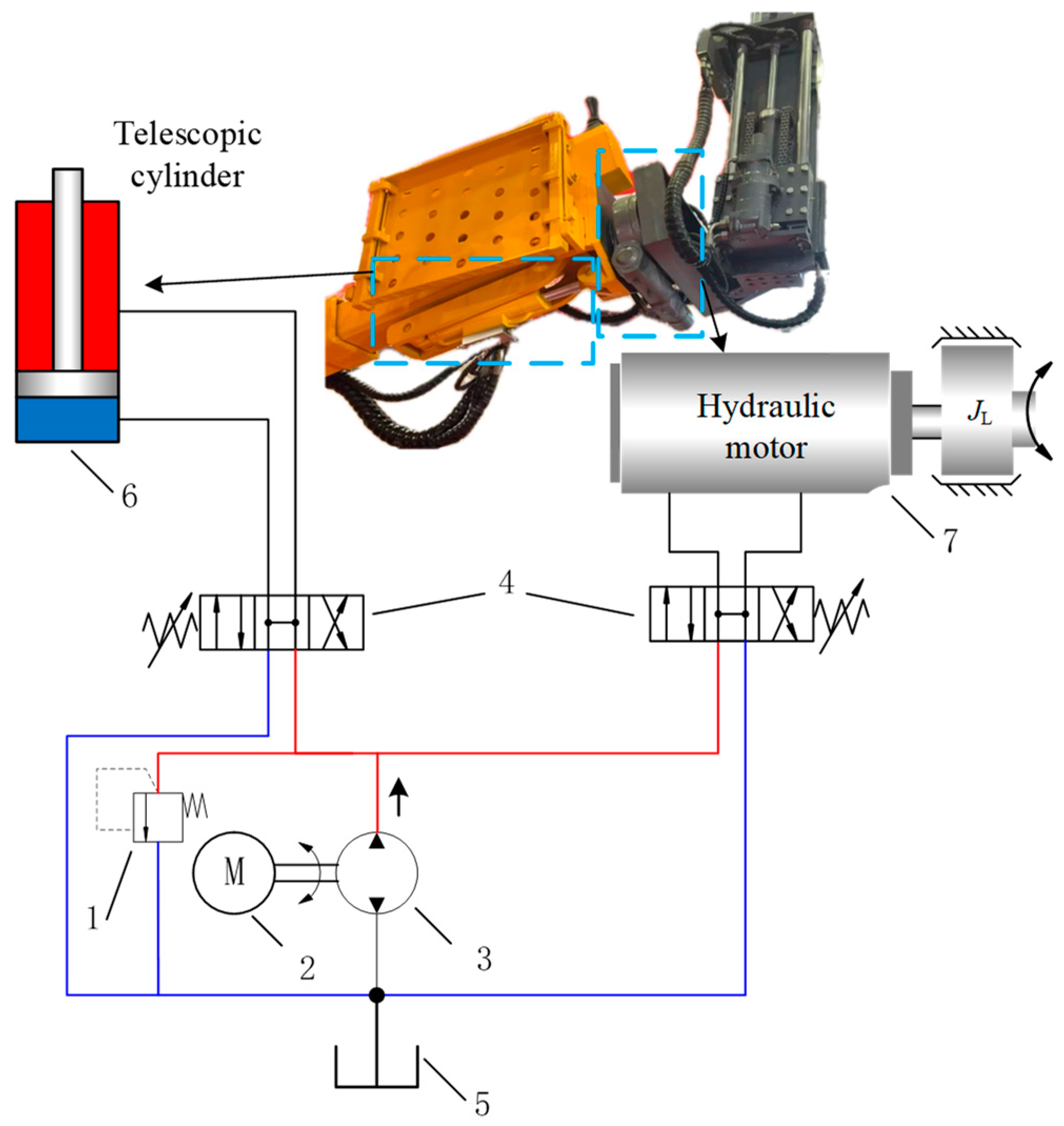
Figure 1 shows the basic principle structure of the drill-arm position system of a hydraulic drill-anchor robot. The system is driven by an AC motor that drives a hydraulic pump to deliver hydraulic oil from the oil tank to a three-position four-way electro-hydraulic proportional valve. By adjusting the spool opening of the electro-hydraulic proportional valve, the pressure in the two chambers of the hydraulic motor and telescopic cylinder is controlled. This allows the hydraulic motor and telescopic cylinder to generate power to drive the drill arm, realizing the slewing and pitching motion of the drill arm respectively.
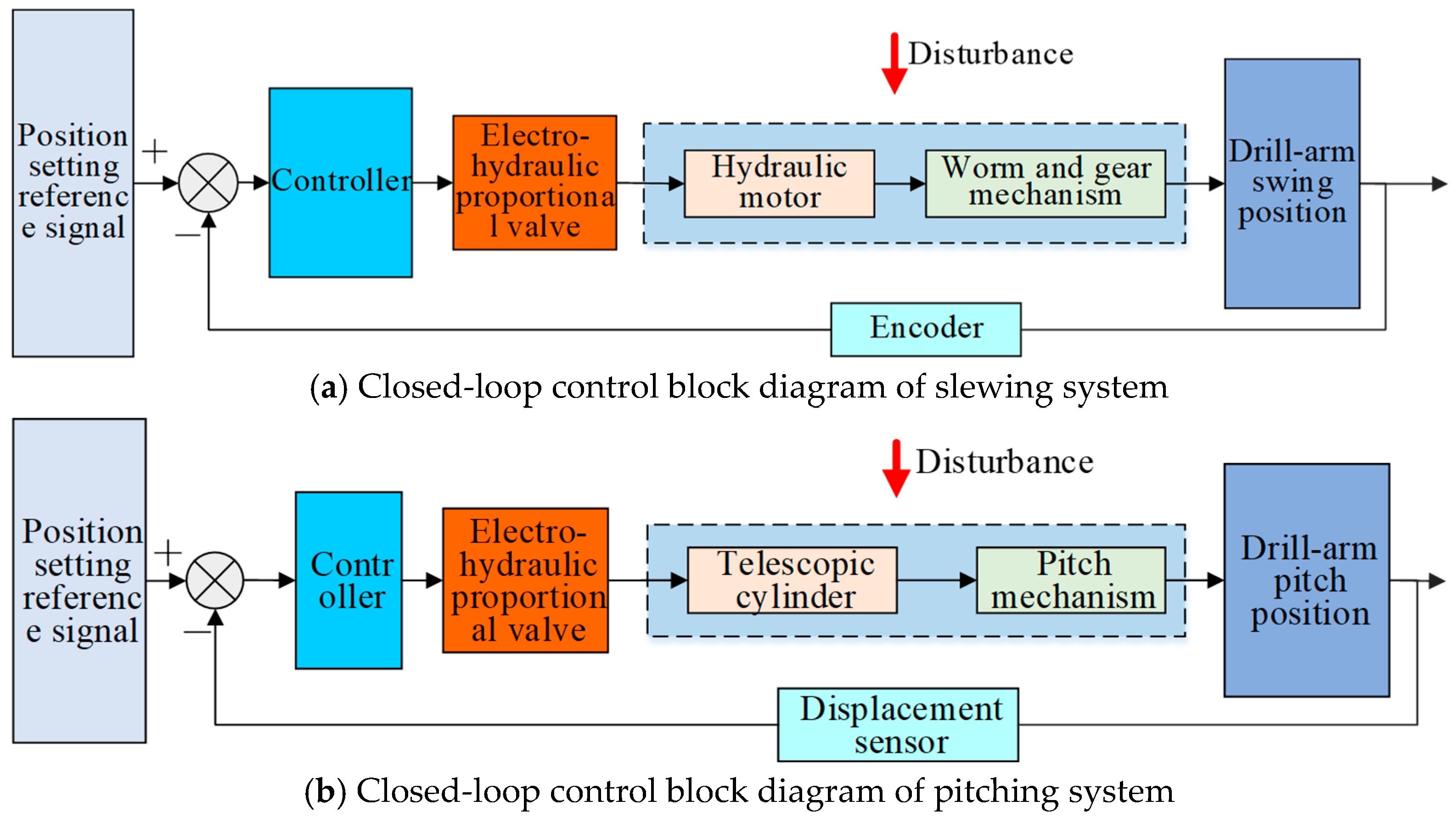
The basic closed-loop control structures of the drill-arm slewing and pitching systems studied in this paper are shown in Figure 2. For the slewing system, an encoder collects the actual value and calculates the error with the target reference value. For the pitching system, a displacement sensor collects the actual displacement value and calculates the error with the target displacement reference value. The controller solves the control law according to the error and converts it into the corresponding current value of the electro-hydraulic proportional valve. The proportional electromagnet generates the corresponding electromagnetic force after being energized, driving the spool of the electro-hydraulic proportional valve to move, so that the rotation angle of the hydraulic motor and the displacement of the telescopic cylinder reach the set values, forming a closed-loop control system for the drill-arm position. The mathematical model of the drill-arm system for the hydraulic drill-anchor robot is established by analyzing the dynamic characteristics of the valve-controlled hydraulic motor and valve-controlled hydraulic cylinder.

2.1. Friction Model and Dynamic Characteristics of Electro-Hydraulic Proportional Valve

During the motion of the drill arm of the drill-anchor robot, nonlinear friction induces steady-state errors when the system enters the steady-state stage. These errors seriously affect the control accuracy and reduce the overall control performance of the drill-arm position system. Establishing an accurate friction model for feedforward compensation is a common and effective method to eliminate the adverse effects of friction in controller design. The motion process of the drill arm from relatively static to motion is the process of the friction contact surface changing from a static state to motion state, during which friction changes with different values. The friction of the drill arm has the characteristics of dynamics and nonlinearity. To accurately capture the friction variation law and identify the parameters of the nonlinear friction model, a high-precision and engineering-applicable friction model is required. A nonlinear friction model incorporating Coulomb friction, static friction, the Stribeck effect and viscous friction is established for the hydraulic motor of the slewing system and the telescopic cylinder of the pitching system. The expressions of friction torque and friction force are given as follows:
T f = T c b + ( T s T c b ) e α f ω / v f sgn ( ω ) + k f ω F f = F c b + ( F s F c b ) e α f v / v f sgn ( v ) + k f v
where T f is the friction torque, F f is the friction force, T c b and F c b are the Coulomb friction torque and force respectively, T s and F s are the maximum static friction torque and force respectively, α f is the Stribeck shape parameter, v f is the Stribeck characteristic velocity, k f is the viscous friction coefficient, ω is the rotational speed of the hydraulic motor, and v is the linear velocity of the telescopic cylinder.
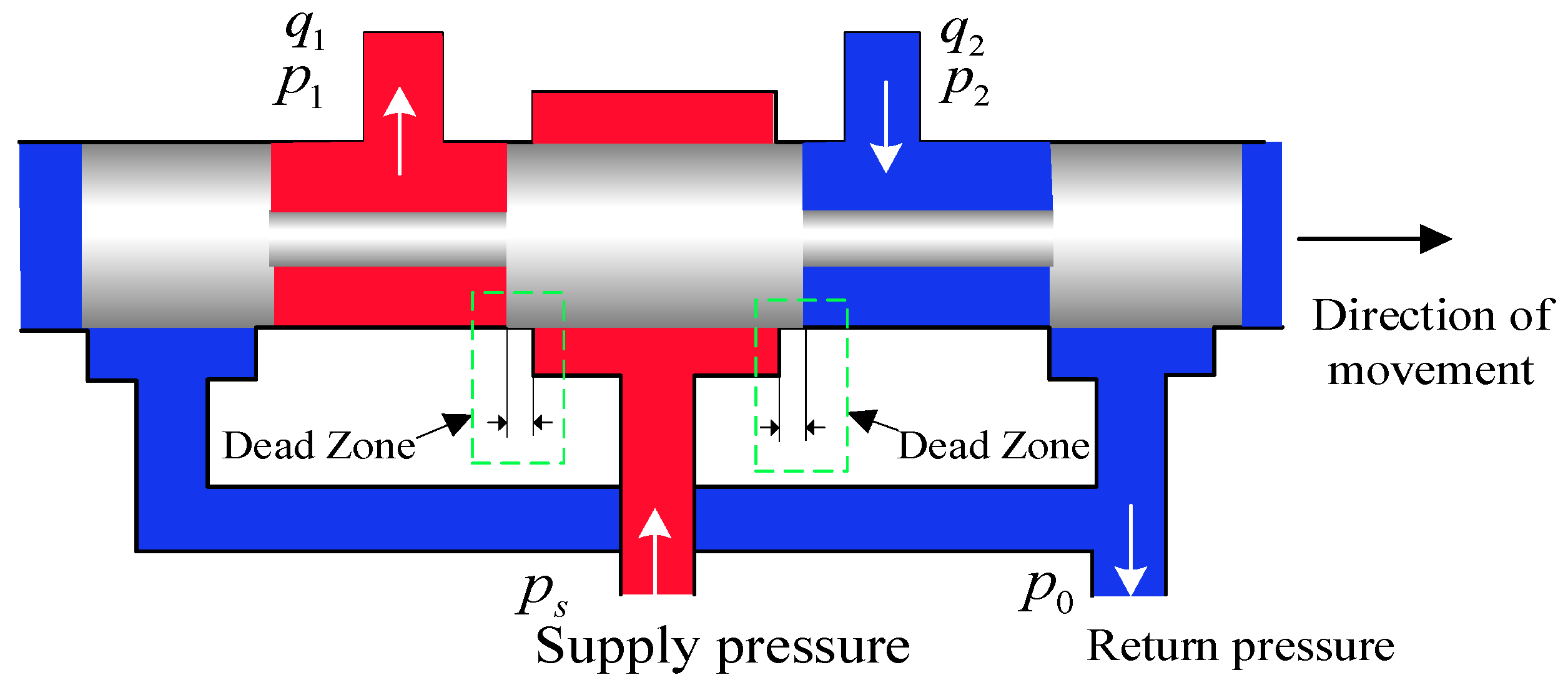
The electro-hydraulic proportional valve is the control actuator of the hydraulic system. To ensure that the spool of the electro-hydraulic proportional valve can effectively isolate the hydraulic oil passing through the valve port and suppress leakage, the width of the spool is usually larger than that of the valve port, forming valve port overlap. Due to the spool overlap, the relationship between the input current and spool displacement is shown in Figure 3.
The dynamic characteristics of the electro-hydraulic proportional valve is expressed as
q 1 = c d ω v x v 2 ρ [ ( 1 + sgn ( x v ) ) p s 2 + ( 1 + sgn ( x v ) ) p 0 2 ] p 1 sgn ( x v ) q 2 = c d ω v x v 2 ρ [ ( 1 sgn ( x v ) ) p s 2 + ( 1 sgn ( x v ) ) p 0 2 ] + p 2 sgn ( x v )
where q 1 and q 2 are the output flow and input flow of the valve respectively, p 1 and p 2 are the output and input pressure respectively, x v is the spool displacement, c d is the flow coefficient, ω v is the area gradient of the throttle port, ρ is the density of hydraulic oil, p s is the supply pressure, and p 0 is the return pressure. The sign function sgn ( ) is defined as
sgn ( x ) = 1       ,           0 0       ,           = 0 1 ,           < 0
When x v 0 , q 1 and q 2 are expressed as
q 1 = c d ω v x v 2 / ρ p s p 1 q 2 = c d ω v x v 2 / ρ p 2
When x v < 0 , q 1 and q 2 are expressed as
q 1 = c d ω v x v 2 / ρ p 1 q 2 = c d ω v x v 2 / ρ p s p 2
The relationship between the spool displacement of the electro-hydraulic proportional valve and the control input current is given by
x v = k v ( u + u c )
where k v is the gain coefficient between the control input and spool displacement, u is the control input, and u c is the dead-zone compensation of the electro-hydraulic proportional valve.

2.2. Modeling of Drill-Arm Slewing System

The drill-arm slewing control system of the drill-anchor robot is mainly driven by a hydraulic motor, which is the core actuator of the drill-arm position control system. When the hydraulic motor is in the slewing state, the load flow q m L = ( q 1 + q 2 ) / 2 , load pressure p m L = p 1 p 2 and total volume V m t = V 10 + V 20 of the hydraulic motor are defined. The load flow equation of the hydraulic motor is
q m L = D m θ ˙ m + C i m p m L + V t 4 β e p ˙ m L + Δ q m
where D m is the displacement of the hydraulic motor, θ m is the rotation angle of the hydraulic motor, C i m is the internal leakage coefficient of the hydraulic motor, V 10 and V 20 are the equivalent initial volumes of the inlet and outlet chambers of the hydraulic motor respectively, β e is the bulk modulus of hydraulic oil, and Δ q m is the unknown flow dynamics.
The load torque balance equation of the hydraulic motor is derived by the force analysis of the hydraulic motor:
D m p m L = J m θ ¨ m + B m θ ˙ m + T f + d m + T m w
where J m is the total moment of inertia of the hydraulic motor and its load, B m is the viscous damping coefficient, d m is the lumped uncertain disturbance, and T m w is the external load torque transmitted from the worm and gear mechanism to the motor shaft.
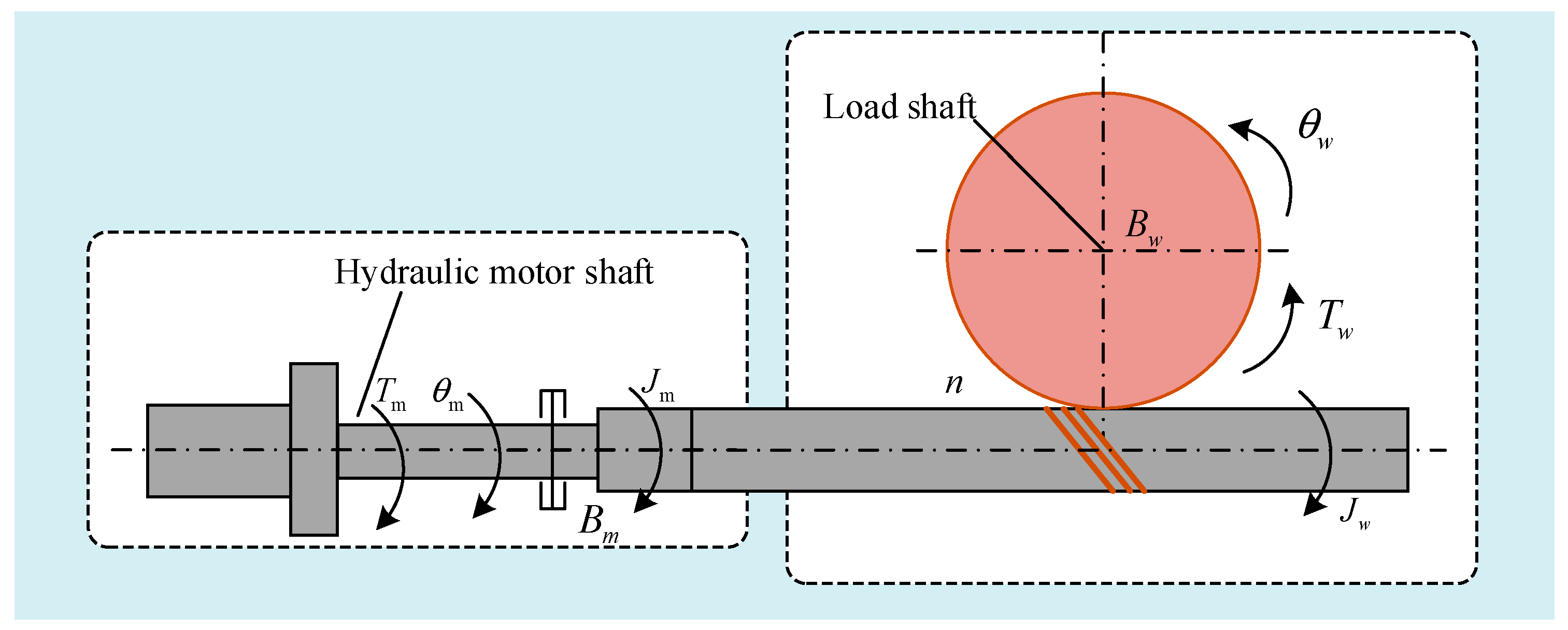
When the hydraulic motor drives the drill arm of the drill-anchor robot to rotate, it drives the drill arm to realize a pitching motion through the worm and gear reduction mechanism. The simplified model of the worm and gear reduction mechanism is shown in Figure 4, which illustrates the transmission relationship between the hydraulic motor and the drill arm.
The pitching motion of the drill arm is realized by the valve-controlled hydraulic motor driving the reduction mechanism, aiming to make the drill arm of the drill-anchor robot rotate accurately to the pre-installation position of the bolt/anchor cable. The transmission ratio n of the worm and gear is
n = θ m θ w
where θ w is the rotation angle of the output gear.
According to the structure and motion characteristics of the actual controlled object, the hydraulic motor drives the worm and gear reduction mechanism to drive the drill arm to rotate. By converting the load torque from the load shaft to the motor shaft, the load shaft torque balance equation of the hydraulic motor is obtained:
T m w = J w d 2 θ w d t 2 + B w d θ w d t + T w
where J w is the moment of inertia of the load shaft, B w is the viscous damping coefficient of the load shaft, and T w is the external load torque acting on the load shaft.
Various loads on the load shaft are converted to the motor shaft, and the equivalent inertia load torque balance equation is calculated by combining Equations (8)–(10):
D m p m L = J t θ ¨ m + B t θ ˙ m + T L + T f + d m
where J t is the total equivalent moment of inertia for the hydraulic motor shaft, expressed as
J t = J m + J w n 2
B t is the total equivalent viscous damping coefficient of the hydraulic motor shaft, expressed as
B t = B m + B w n 2
T L is the equivalent external load torque of the load shaft converted to the hydraulic motor shaft, expressed as
T L = T w n
and p m L is the load pressure, which is expressed as
p m L = p 1 p 2
Thus, Equation (11) is transformed into the following equation:
D m p m L = J t θ ¨ w + B t θ ˙ w + T L + T f + d m
where J t = n J t and B t = n B t .
The state vector of the drill-arm system for the drill-anchor robot is selected as gear angle θ w , gear angular velocity ω w , and gear angular acceleration α w , and the state vector is defined as x 1 x 2 x 3 T = θ w ω w α w T . The nonlinear state space equation of the drill-arm slewing system model is obtained as
x ˙ 1 = x 2 x ˙ 2 = x 3 x ˙ 3 = a m 1 x 2 + a m 2 x 3 + b m ( u + u c ) + T L + T f + d m
where a m 1 = D m 2 / J t V + C i m B t / J t V , a m 2 = C i m / V + B t / J t , b m = D m K q k v / J t V , V = ( 4 β e ) 1 V m t , K q = k a p s p m L sgn ( u ) , and k a = c d ω v 2 / ρ .

2.3. Modeling of Drill-Arm Pitching System

For the telescopic cylinder of the drill-arm pitching system, two reasonable assumptions are made for modeling: the cylinder only has internal leakage without external leakage, and the piston and cylinder barrel are rigid bodies without elastic deformation. When the telescopic cylinder moves in the positive direction, the load flow continuity equation of the inlet chamber of the telescopic cylinder is
q 1 = A 1 d y d t + C i c ( p 1 p 2 ) + V 1 β e d p 1 d t
and the load flow continuity equation of the outlet chamber of the telescopic cylinder is
q 2 = A 2 d y d t + C i c ( p 1 p 2 ) V 2 β e d p 2 d t
where C i c is the internal leakage coefficient of the telescopic cylinder, V 1 and V 2 are the equivalent volumes of the inlet and outlet chambers of the telescopic cylinder respectively, A 1 and A 2 are the effective acting areas of the rodless chamber and rod chamber of the telescopic cylinder, respectively, y is the piston displacement of the telescopic cylinder.
Based on Newton’s second law of motion, the load force balance equation is
A 1 p 1 A 2 p 2 = m c d 2 y d t 2 + B c d y d t + F f + F + d c
where m c is the total mass of the telescopic cylinder and its load, B c is the viscous damping coefficient of the piston-load assembly, F is the external equivalent load force, and d c is the lumped unmodeled dynamics of the system.
From the above equation, we can get p ˙ 1 = β e ( A 1 y ˙ C i c ( p 1 p 2 ) + q 1 ) / V 1 and p ˙ 2 = β e ( A 2 y ˙ + C i c ( p 1 p 2 ) q 2 ) / V 2 .
Then, we have
y = 1 / m c β e / V 1 ( A 1 y ˙ C i c ( p 1 p 2 ) + q 1 ) A 1 β e / V 2 ( A 2 y ˙ + C i c ( p 1 p 2 ) q 2 ) A 2 B c y ¨ F F ˙ f + d c
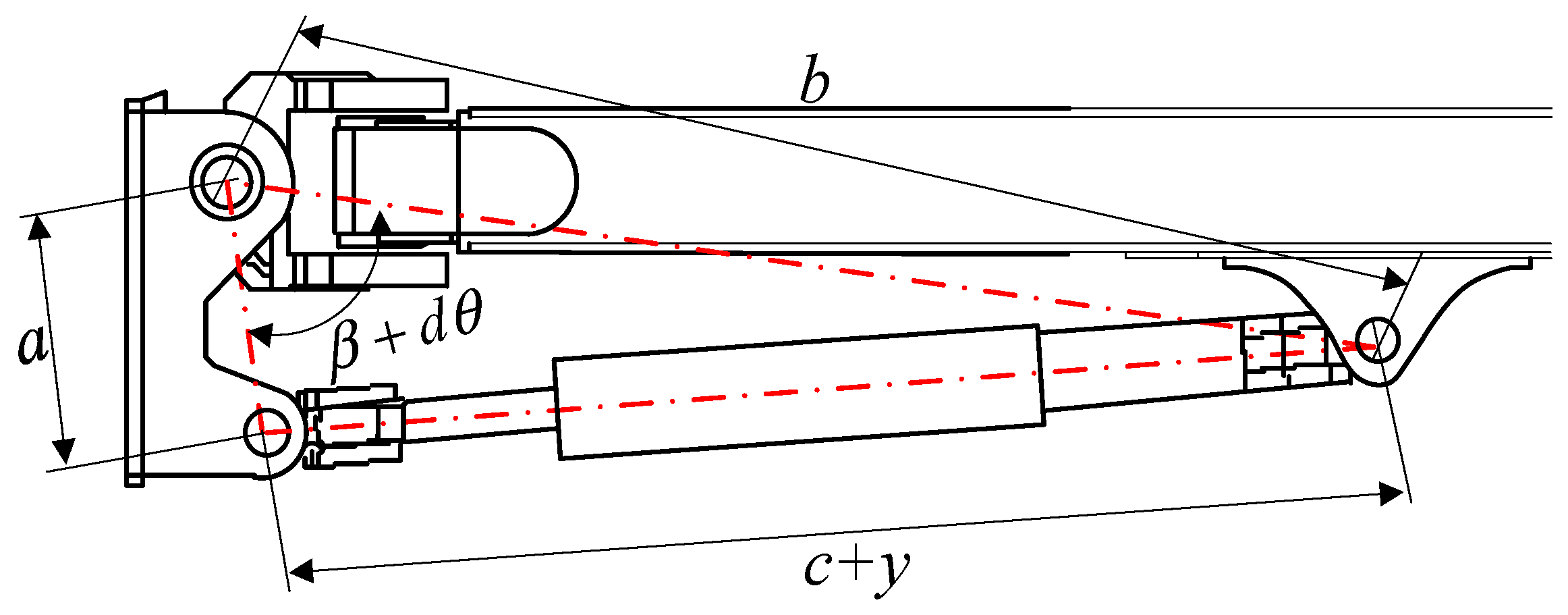
The main function of drill-arm pitching is to adjust the drill arm to a certain height and angle, facilitating the positioning of the drilling mechanism and drill-anchor operation. As shown in Figure 5, in the drill-arm pitching mechanism, the swing of the connecting rod is driven by the telescopic cylinder to realize the angle change in the drill arm.
In Figure 5, y is the displacement of the telescopic cylinder, d θ is the angle change of the corresponding joint. a , b , c and β are the geometric parameters of the corresponding drill arm respectively, and the following equation is obtained according to the geometric relationship:
d θ = arccos cos β d c 2 + 2 · c · d c 2 a b β
The direct relationship between the telescopic cylinder and the joint angle of the drill arm can be obtained from Equation (22), and the telescopic cylinder of the pitching system is also considered in this paper.
Let k q = c d ω v 1 / ρ , g = 2 k q k v , R 1 = [ ( 1 + sgn ( x v ) ) p s 2 + ( 1 + sgn ( x v ) ) p 0 2 ] p 1 sgn ( x v ) , R 2 = [ ( 1 sgn ( x v ) ) p s 2 + ( 1 sgn ( x v ) ) p 0 2 ] + p 2 sgn ( x v ) .
The input and output flow of the electro-hydraulic proportional valve is
q 1 = g R 1 ( u + u c ) q 2 = g R 2 ( u + u c )
The displacement, velocity and acceleration of the telescopic cylinder in the pitching system are selected as the system state variables. The state equation of the pitching system is established as follows:
y ˙ 1 = y 2 y ˙ 2 = y 3 y ˙ 3 = a c 1 y 2 + a c 2 y 3 + b c ( u + u c ) + ξ + d c
where a c 1 = 1 / m c ( β e A 1 2 / V 1 + β e A 2 2 / V 2 ) , a c 2 = B c / m c , b c = 1 / m c ( β e A 1 g R 1 / V 1 + β e A 2 g R 2 / V 2 ) , ξ = 1 / m c ( β e A 1 C i c ( p 1 p 2 ) / V 1 β e A 2 C i c ( p 1 p 2 ) / V 2 F ˙ F ˙ f ) .

3. The Design of the Controller

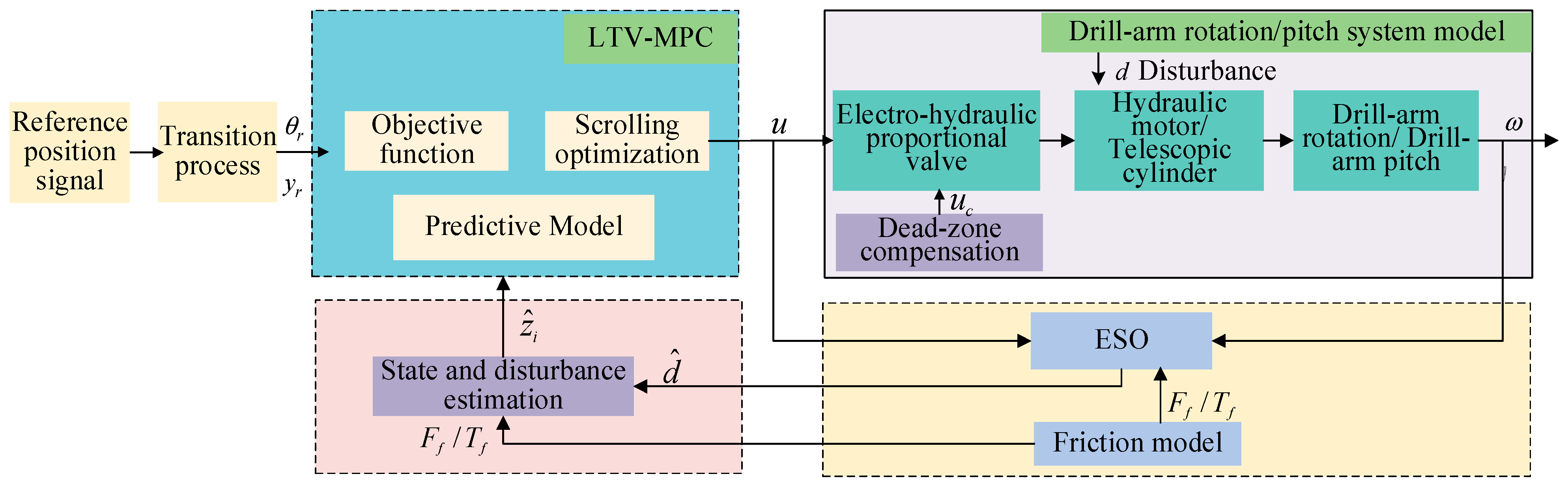
To realize the precise position control of the drill arm, the overall block diagram of the active disturbance rejection predictive control strategy proposed in this paper is shown in Figure 6. The control strategy is mainly composed of an LTV-MPC and an ESO, where clear feedback mapping is established between the actual system states, lumped disturbances and the ESO estimation results. To further improve the anti-disturbance capability of the controller, the identified friction force/torque is introduced as a known disturbance into the control loop, which significantly reduces the observation burden of the ESO for unknown lumped disturbances. The ESO takes the system’s measurable output as the feedback reference and achieves asymptotic tracking of the actual motion states of the drill arm (including the angle, angular velocity, and angular acceleration for the slewing system, and displacement, velocity, and acceleration for the pitching system) through the coupling adjustment of observation error and observer gain, while accurately estimating the unmodeled dynamics, external load disturbances and parameter perturbation that constitute the system’s lumped unknown disturbances. The ESO’s accurate estimated states and disturbance values are then fed back to the predictive model in real time, and the LTV-MPC controller solves the optimal control law based on the corrected model information, finally realizing the high-precision position control of the drill arm with strong anti-disturbance performance.

3.1. The Design of LTV-MPC

The predictive model performs an iterative calculation according to the state at the current moment to obtain the future output states in the prediction horizon. It then compares these states with the expected trajectory to calculate the error, which is incorporated into the rolling optimization stage as part of the objective function. Rolling optimization solves the optimal control sequence at the current sampling moment by solving the optimization problem in the prediction horizon and re-solves the new optimal control sequence according to the new state at the next moment. Feedback correction re-samples the system state at the next moment and re-predicts, forming a closed-loop feedback control.
(1)
Predictive Model Establishment
The state equation of the drill-arm slewing system can be written as Equation (25):
x ˙ = f ( x , u ) y = x 1
Since the established slewing and pitching systems are nonlinear models, they cannot be directly used in LTV-MPC. To design LTV-MPC, the nonlinear model needs to be transformed into a linear time-varying model via real-time linearization. This paper adopts a trajectory linearization method, which updates the linear model in real time according to the real-time state to obtain a linear time-varying model. The nonlinear function in the nonlinear state space expression of Equation (25) is expanded into a Taylor series near the real-time state trajectory, and the partial derivatives of the state variables and control input variables are calculated; only the first-order terms are retained and the higher-order terms are ignored. The following equation is obtained:
x ˙ = f ( x , u ) = f ( x 0 , u 0 ) + f x x 0 u 0 ( x x 0 ) + f u x 0 u 0 ( u u 0 )
It can be written as
x ˙ = f ( x , u ) = f ( x 0 , u 0 ) + J f ( x ) ( x x 0 ) + J f ( u ) ( u u 0 )
where J f x and J f u are the Jacobian matrices of f ( · ) with respect to the state vector x and control input u respectively.
Define the state increment as Δ x = x x 0 and the control input increment as Δ u = u u 0 . The following equation is obtained:
Δ x ˙ = J f ( x ) Δ x + J f ( u ) Δ u
The state and control input increments are replaced by the state and control input, and the following equation is obtained:
x ˙ = J f ( x ) · x + J f ( u ) · u
Considering the error term d e , the above equation is replaced by
x ˙ = A x + B u + d e
where A = J f ( x ) and B = J f ( u ) are the time-varying state matrix and input matrix, respectively.
To realize the digital simulation and practical engineering application of MPC, the continuous-time model needs to be discretized. First-order difference discretization is adopted to obtain the discrete state space expression:
x t + 1 = A x ( t ) + B u ( t ) + d e
where d e = x ^ ( t + 1 ) A x ( t ) B u ( t ) and   x ^ ( t + 1 ) is the one-step prediction result of the nonlinear model based on the current state and input.
To facilitate the constrained optimization solution, the system state is augmented with the control input. Let the augmented state be
ξ ( t ) = x ( t ) u ( t 1 )
The augmented discrete state space expression is obtained:
ξ ( t + 1 t ) = A ¯ ξ ( t ) + B ¯ Δ u ( t ) + d ¯ e
η ( t ) = C ¯ ξ ( t )
where the augmented matrices are defined as
A ¯ = A B 0 I       B ¯ = B I
C ¯ = C 0       d ¯ e = d e 0
Let the prediction horizon of the system be N p and the control horizon be N c . The predicted output vector of the system at future moments is expressed in matrix form as
Y ( t ) = Ε t ξ ( t t ) + Τ t Δ U ( t ) + Π t Μ t
where Ε t is the state prediction matrix, Τ t is the control increment matrix, and Π t Μ t is the disturbance compensation term.
Y t = η ( t + 1 t ) η ( t + 2 t ) η ( t + N c t ) η ( t + N p t ) ,   E t = C ¯ A ¯ C ¯ A ¯ 2 C ¯ A ¯ N c C ¯ A ¯ N p ,   Δ U t = Δ u ( t t ) Δ u ( t + 1 t ) Δ u ( t + N c 1 t )
Τ t = C ¯ B ¯ 0 0 0 C ¯ A ¯ B ¯ C ¯ B ¯ 0 0 C ¯ A ¯ N c 1 B ¯ C ¯ A ¯ N c 2 B ¯ C ¯ B ¯ C ¯ A ¯ N c B ¯ C ¯ A ¯ N c 1 B ¯ C ¯ A ¯ B ¯ C ¯ A ¯ N p 1 B ˜ C ¯ A ¯ N p 2 B ¯ C ¯ A ¯ N p N c 1 B ¯ ,
Π t = C ¯ 0 0 0 C ¯ A ¯ C ¯ 0 0 0 C ¯ A ¯ N p 1 C ¯ A ¯ N p 2 C ¯
Μ t = d ¯ e ( t t ) d ¯ e ( t + 1 t ) d ¯ e ( t + N p 1 t )
The future state quantities and output quantities in the prediction horizon are calculated by the current augmented state ξ ( t t ) of the system and the control increments Δ U ( t ) in the control horizon, realizing the prediction function of the MPC algorithm.
(2)
Rolling Optimization Solution
The optimal control input sequence is obtained by minimizing a designed multi-objective cost function. To ensure the feasible solution of the optimization problem under hard constraints, a slack variable ρ ε 2 is introduced into the cost function. The objective function of LTV-MPC designed in this paper is given as follows:
J = i = 1 N p y ( t + i t ) y r ( t + i t ) Q 2 + i = 0 N c 1 Δ u ( t + i t ) R 2 + i = 0 N c 1 u ( t + i t ) S 2 + ρ ε 2
where y r ( k + i t ) and i = 1 , , N p are the expected output and Q , R , S and ρ are the output weight matrix, control increment weight matrix and control weight matrix respectively.
The constraints of the control input and control input increment are
u min ( t + i t ) u ( t + i t ) u max ( t + i t ) , i = 0 , , N c 1
Δ u min ( t + i t ) Δ u ( t + i t ) Δ u max ( t + i t ) , i = 0 , , N c 1
The optimal control input with the best control performance is obtained by solving the minimum value of the objective function. The optimal control increment sequence Δ U ( t ) is obtained by solution optimization, and the first element of this sequence is taken as the actual control increment applied to the slewing system.
u ( t ) = u ( t 1 ) + 1 , 0 · Δ U ( t )
At the next sampling time, the system updates the current state and re-predicts the future output, obtains the new optimal control increment sequence by re-optimization, and repeats this cycle until the entire control process is completed.

3.2. The Design of the ESO

The LTV-MPC designed in this paper requires accurate state feedback of the hydraulic system. Although the friction is modeled and compensated, unmodeled errors and parameter perturbations still exist. To handle system disturbances and parameter variations, the lumped disturbance is extended as a new state variable and added to the original system to improve the disturbance estimation accuracy. For the state space equation of Equation (16), the lumped disturbance is extended as a new unknown state variable x 4 and added to the original system. Defining the derivative of x 4 as h , the system model after state extension is
x ˙ 1 = x 2 x ˙ 2 = x 3 x ˙ 3 = a m 1 x 2 + a m 2 x 3 + b m ( u + u c ) + T L + T f + d m x ˙ 4 = h
For the mathematical model of the system after state extension, the variable z ^ i is defined as the estimated value of the states by the ESO, and it is designed for the mathematical model of the system after state extension as follows:
z ^ ˙ 1 = z ^ 2 + β 1 x 1 z ^ 1 z ^ ˙ 2 = z ^ 3 + β 2 x 1 z ^ 1 z ^ ˙ 3 = a m 1 z ^ 2 + a m 2 z ^ 3 + b m ( u + u c ) + T L + T f + z ^ 4 + β 3 x 1 z ^ 1 z ^ ˙ 4 = β 4 x 1 z ^ 1
where z ^ 1 is the estimated slewing angle, z ^ 2 is the estimated angular velocity, z ^ 3 is the estimated angular acceleration, z ^ 4 is the estimated lumped disturbance, and β i ( i = 1 , 2 , 3 , 4 ) is the observer gain coefficients.
According to the design of the predictive controller for the slewing system, the predictive controller is applied to the design of the pitching system controller to complete the design of the predictive controller for the pitching system, which is not repeated here.

3.3. Controller Parameter Optimization Based on PSO with Improved Objective Function

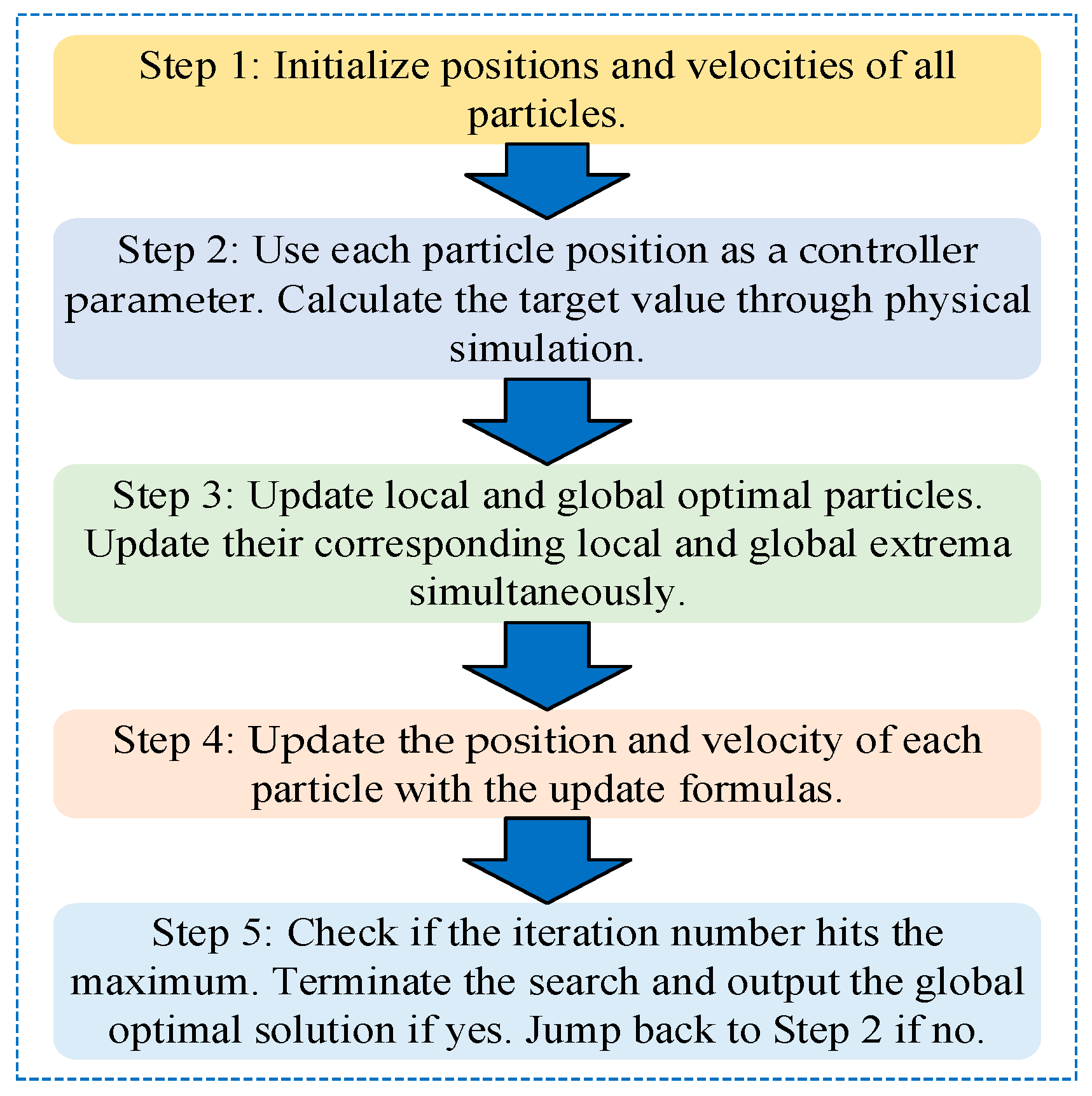
The PSO algorithm is adopted to optimally tune the key parameters of the LTV-MPC controller. In the PSO algorithm, each particle adjusts its velocity and position iteratively to search for the global optimal solution, simulating the foraging behavior of a bird flock. The specific flow of the PSO-based adaptive parameter optimization is shown in Figure 7.
Aiming at the parameter tuning requirements of LTV-MPC, the PSO algorithm is used to perform global optimization on the prediction horizon, control horizon and weights of LTV-MPC, namely PLTV-MPC. To comprehensively consider the overall performance of the control system, the objective function takes the integral of time-weighted absolute error (ITAE) as the core and introduces the integral of squared control input and steady-state error term by weighting. The designed comprehensive objective function takes into account the core requirements of position tracking accuracy, actuator protection and response speed and can more comprehensively evaluate the performance of the drill-anchor robot position control system, which is helpful for improving the control performance [30]. An improved comprehensive objective function integrating trajectory tracking accuracy, actuator protection and steady-state positioning accuracy is constructed as follows:
J = w 1 0 T t | e ( t ) | d t + w 2 0 T u 2 ( t ) d t + w 3 | y ( T ) y ref |
where w 1 , w 2 and w 3 are the weighting coefficients determined by the analytic hierarchy process according to the performance priority of drill-arm positioning control, T is the total simulation time, e ( t ) = y r ( t ) y ( t ) is the real-time tracking error, and y ( T ) is the actual position at the terminal time. The first term is the ITAE term, which is used to punish the error accumulated over time, giving priority to ensuring a fast response and tracking accuracy. The second term is the integral of the squared control input term, which is used to limit the amplitude of the control input and avoid the pressure shock of the hydraulic system. The third term Is the steady-state error term, which is used to ensure the final positioning accuracy and meet the core control requirements of the hydraulic actuator.
The advantages of the Improved objective function compared with the traditional objective function only based on ITAE are as follows: (1) the integral of the squared control input term is introduced to take into account the safety constraints of the actuator, avoiding excessive control input caused by the single-objective optimization of tracking accuracy, which could damage the hydraulic components; (2) the steady-state error term is added to directly constrain the final positioning error of the system, which is more in line with the actual engineering requirements of the drill-anchor robot for high-precision drill-arm positioning; (3) the comprehensive optimization of multiple performance objectives is realized through the weighted coefficients, which solves the problem of performance imbalance caused by single-objective optimization.
PLTV-MPC adopts a computationally efficient trajectory linearization method and performs PSO offline, avoiding online optimization and thus alleviating the online computational burden. The overall low computational complexity renders the proposed controller well-suited for real-time control.

4. Simulation Verification of the Controller

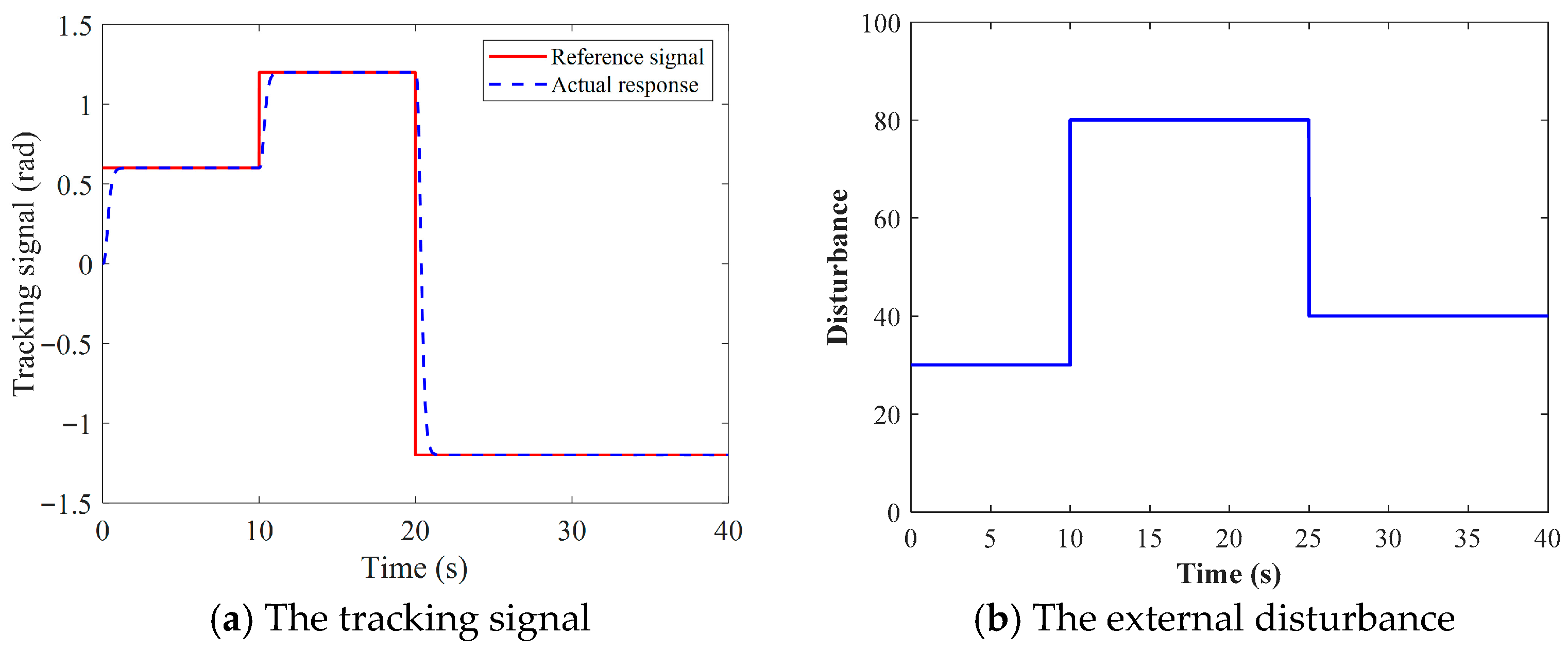
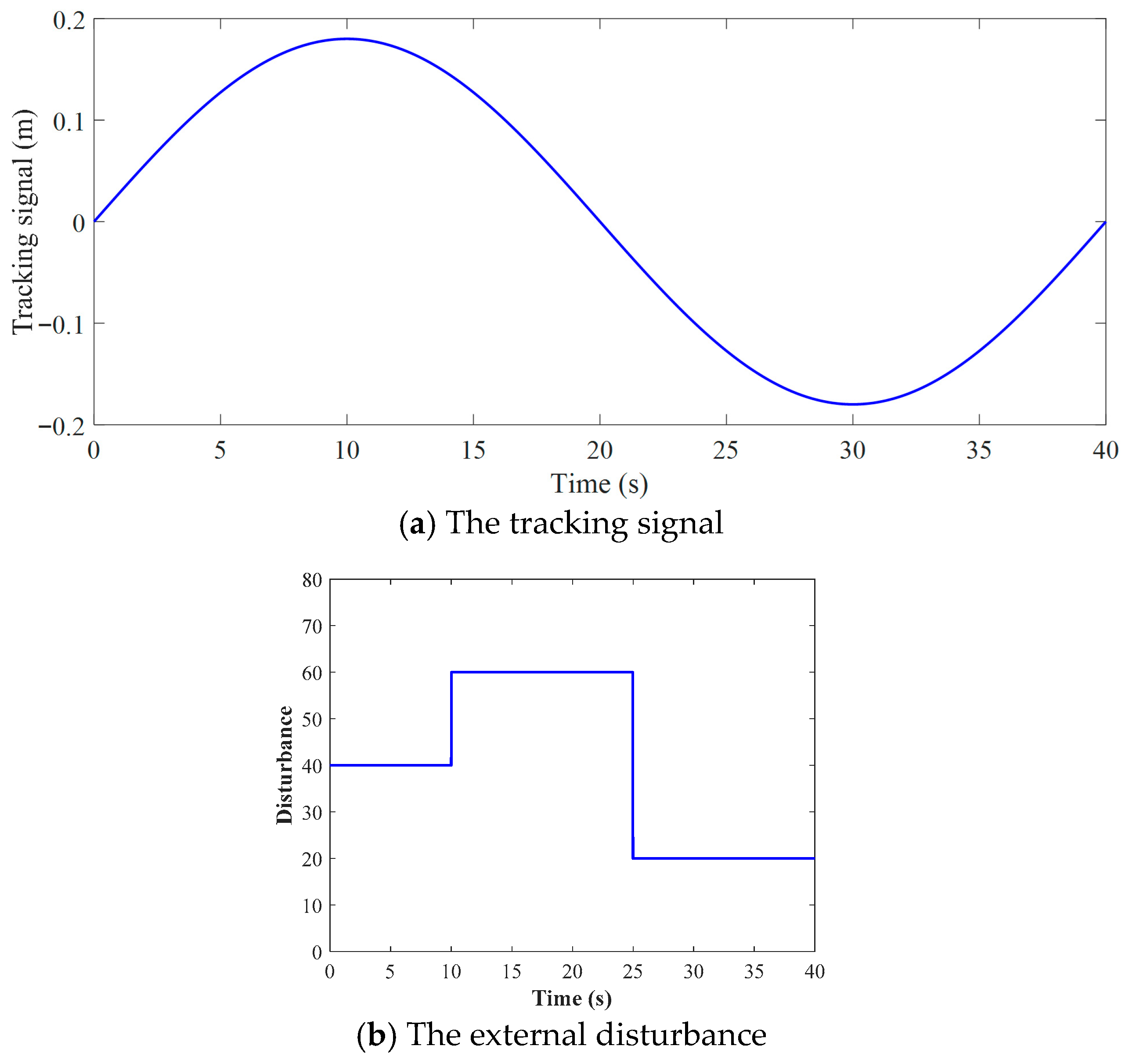
To verify the control effect of the drill-anchor robot position controller proposed in this paper, simulation verification is conducted for the drill-arm slewing and pitching systems of the drill-anchor robot. Based on the established system model, the controller is built in Matlab/Simulink 2024a to verify the tracking performance of the drill-arm position control system under disturbance conditions. The tracking signals adopted for the drill-arm position control system of the drill-anchor robot are shown in Figure 8a and Figure 9a respectively. External disturbances are separately applied to the two systems, as shown in Figure 8b and Figure 9b. Among them, Figure 8a is designed with a transition process to ensure the smooth and shock-free slewing process of the drill arm, effectively avoiding sudden speed changes, excessive overshoot and mechanical shock, as well as providing a smooth, trackable ideal command input for the control system.
The relevant parameters of the drill-arm position system are shown in Table 1. All parameters are obtained from representative engineering references on electro-hydraulic equipment [31,32] and measured data are obtained from practical engineering prototypes. Parameter definitions and physical units strictly follow those in the literature [33]. A small number of secondary parameters not provided in the references use typical values commonly adopted in similar engineering simulations [34,35].

4.1. Analysis of Control Performance for the Drill-Arm Position System Based on PSO Tuning

The search range of PSO tuning parameters is determined based on the engineering application criteria of MPC and the physical constraints of the drill-arm electro-hydraulic system [36]. The weight matrices are determined based on the high-precision positioning requirement of the drill arm, the anti-shock requirement of the electro-hydraulic proportional valve and the rated input range of the valve. The weight coefficients of the improved objective function are calculated by the analytic hierarchy process, with the performance priority of trajectory tracking accuracy > steady-state positioning accuracy > actuator protection.
The search range of the parameters to be tuned are set as N p [ 5 , 20 ] , N c [ 2 , 15 ] , Q [ 2 × 10 10 , 2 × 10 15 ] , R [ 5 × 10 5 , 5 × 10 3 ] , and S [ 500 , 1500 ] . The scale of the particle swarm is designed as 100, and the maximum number of iterations is 100. The optimized parameter values of the controller are ( N p , N c , Q , R , S ) = ( 10 , 3 , 2 × 10 12 , 8 × 10 4 , 1100 ) . The parameters of the ESO are set as β = 4 ω , 6 ω 2 , 4 ω 3 , ω 4 T and ω 0 = 30 . The constraints of the PLTV-MPC controller are set according to the performance limits of the electro-hydraulic proportional valve and the mechanical structure constraints of the drill arm, which are expressed as
20 ( m A ) u ( t + i t ) 20 ( m A ) , i = 0 , , N c 1 0 ( r a d ) y ( t + i t ) 2 ( r a d ) , i = 1 , , N p 0 ( mm ) y ( t + i t ) 180 ( mm ) , i = 1 , , N p
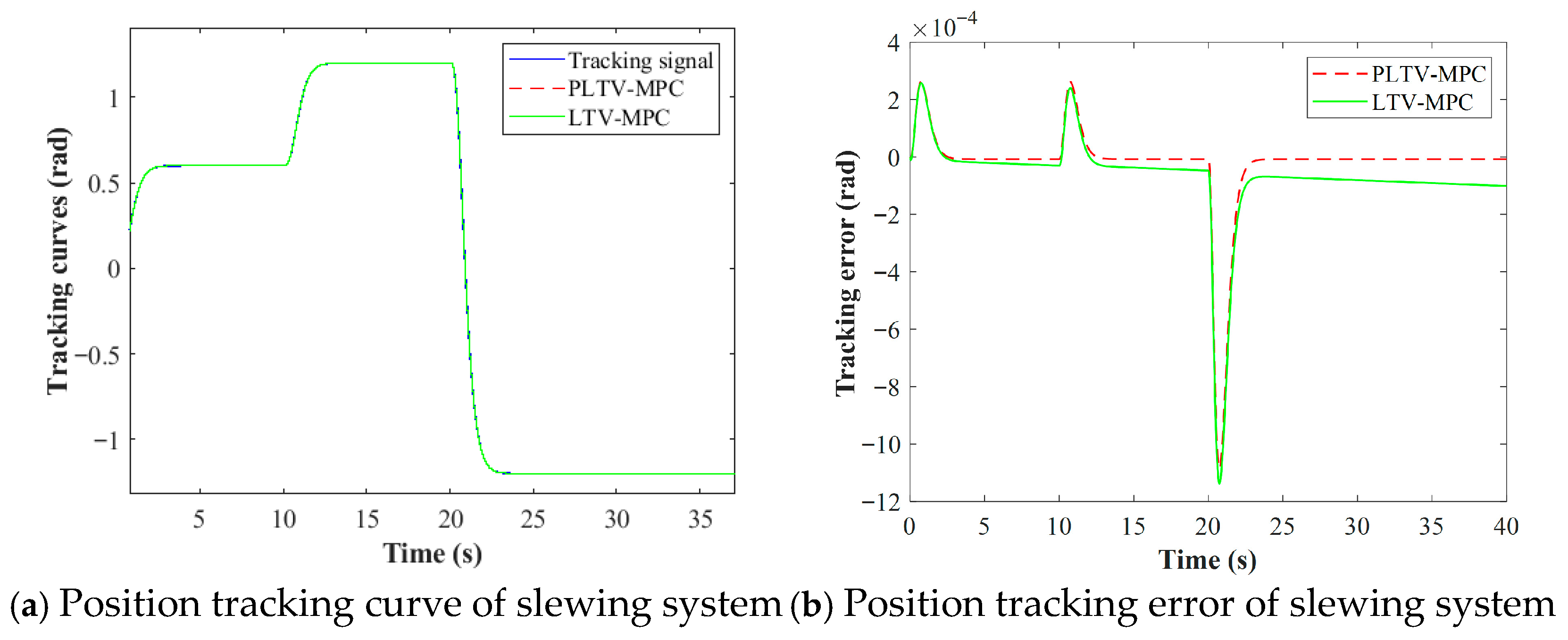
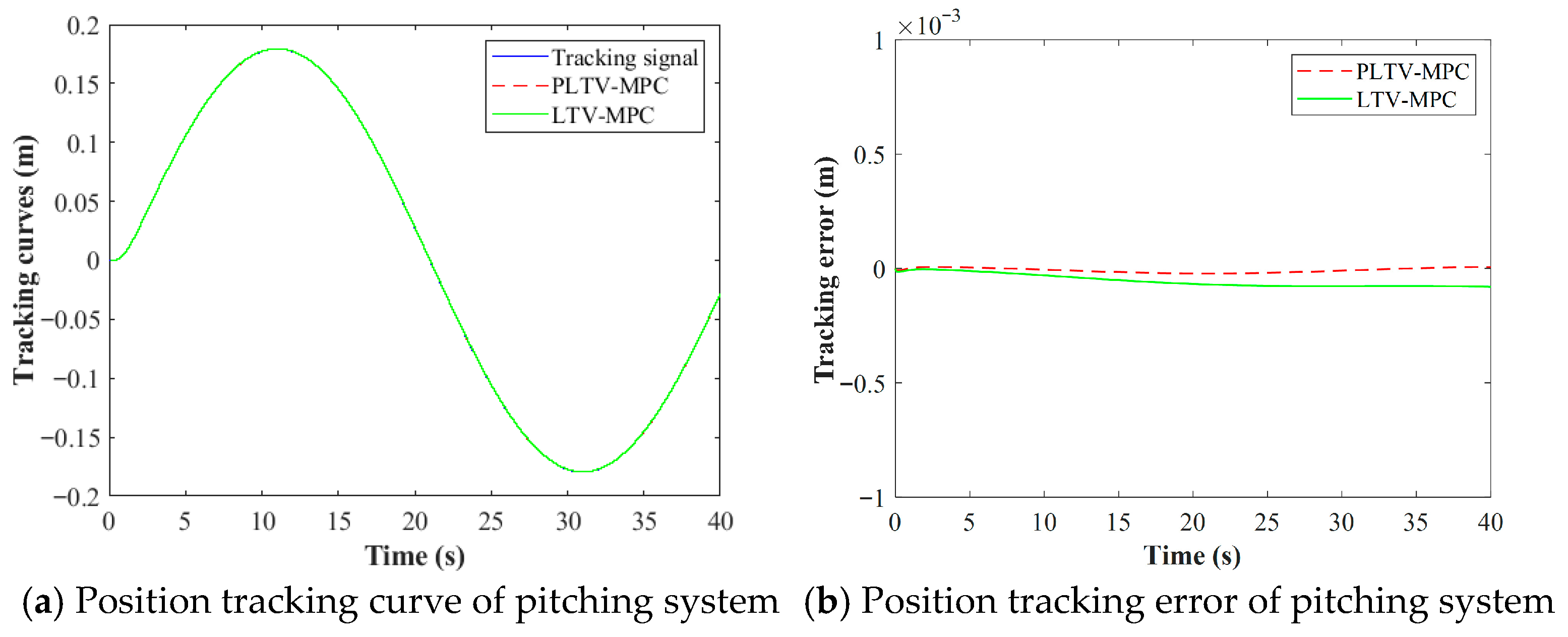
The influence of different parameter values on the drill-arm control performance is tested by step signals. Figure 10 and Figure 11 describe the position tracking trajectory curves and position tracking errors of the drill-arm position control system after optimization respectively. The mean absolute error (MEAE), standard deviation of absolute error (SDAE) and integral of ITAE are selected as the core evaluation indicators. MEAE reflects the overall deviation level of the system position tracking, SDAE characterizes the dispersion degree of the error and directly reflects the system steady-state stability, and ITAE comprehensively considers the error size and duration, which can comprehensively evaluate the dynamic tracking accuracy and response characteristics of the system. Table 2 and Table 3 show the quantitative comparison of the control performance indicators of the two systems respectively.
It can be observed from the tracking error diagrams that the actual trajectory maintains the tracking state within a very small error range after tracking the expected trajectory. The quantitative performance indicators in Table 2 and Table 3 show that the MEAE and ITAE of the PLTV-MPC controller are reduced by about 46.5% and 46.6% for the slewing system and 81.2% and 81.2% for the pitching system, compared with the original LTV-MPC controller. This indicates that the predictive controller optimized by PSO has a significantly improved tracking performance and can achieve a superior control effect for the position control system during the drill-arm motion process.

4.2. Analysis of Control Performance of Drill-Arm Position System Based on Friction Compensation

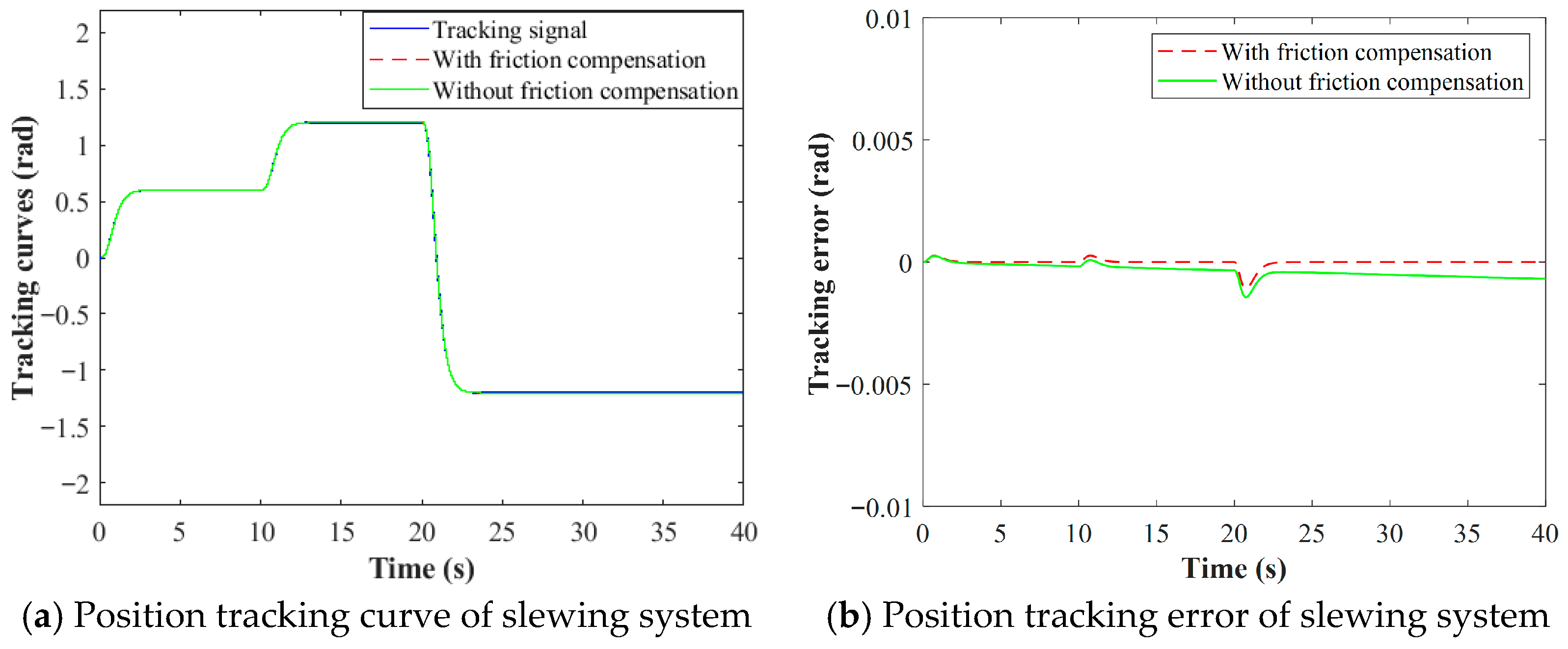
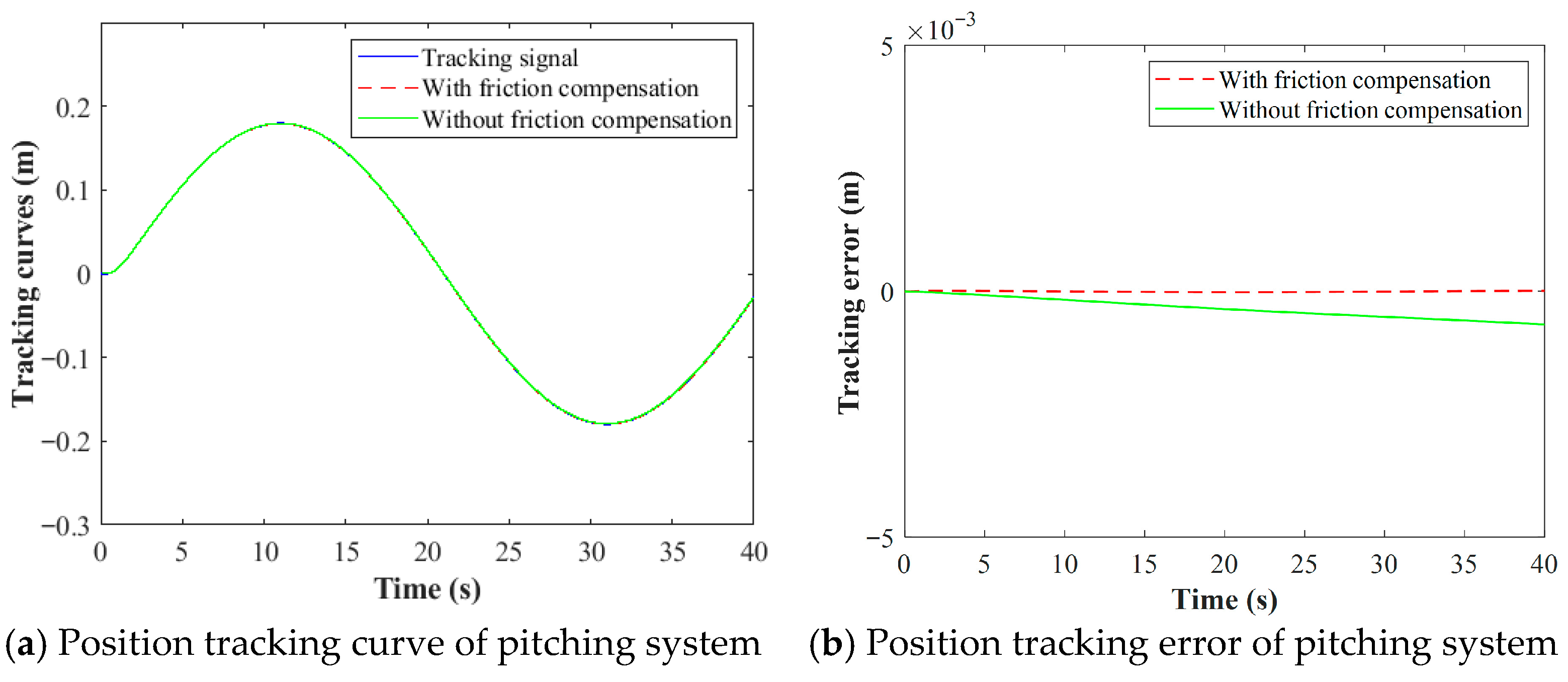
To verify the improvement effect of friction compensation on the performance of the drill-arm position control system and analyze the influence of friction compensation on the performance of the drill-arm controller, a comparative simulation with and without friction compensation is conducted. The simulation results are shown in Figure 12 and Figure 13 and Table 4 and Table 5. Among them, Figure 12 shows the comparative experimental results of the slewing system with and without friction compensation, and Figure 13 shows the comparative experimental results of the pitching system with and without friction compensation. Table 4 and Table 5 show the quantitative comparison of the control performance indicators of the two systems respectively.
The analysis shows that under the condition of friction, the controller proposed in this paper realizes accurate friction compensation through the friction model. Moreover, it effectively suppresses the negative impact of friction on the control performance through the synergistic effect of the optimized controller parameters and the ESO. Both the slewing system and the pitching system exhibit superior tracking accuracy, steady-state stability and response speed.

4.3. Comparative Analysis of the Performance for the Proposed Controller

To further verify the effectiveness of the proposed PLTV-MPC controller, comparative experiments are conducted with the conventional PID controller and the third-order linear ADRC controller, which are widely used in engineering and match the system order. The parameters of PID and ADRC are optimally configured by the classic engineering method combining the trial-and-error method with ITAE index minimization for electro-hydraulic servo systems, rather than random selection. Based on the physical characteristics of the drill-arm electro-hydraulic system, the initial parameter search range is determined first, then the parameters are adjusted step by step with the minimum ITAE index as the objective and finally, multiple simulation verifications under disturbed conditions are carried out to confirm the optimality.
(1)
PID: u = K P e + K I 0 t e   d t + K D e ˙ , with the controller parameters are set as K P = 40, K I = 10, and K D = 2.
(2)
ADRC: u = k 1 e + k 2 e 2 + k 3 e 3 x ^ 4 b 0 , with the controller parameters are set as k 1 = 50 , k 2 = 10 , k 3 = 3 , b 0 = 80 , β = 4 ω , 6 ω 2 , 4 ω 3 , ω 4 T , and ω = 30.
The third-order linear ADRC used in the comparative study matches the system order of the drill arm. It consists of three core components: a Tracking Differentiator (TD), and ESO, and Linear State Error Feedback (LSEF). The TD arranges a smooth transition process for the reference signal to avoid overshoot and generate the desired differential signal. The ESO extends the lumped disturbance as an additional state variable to observe the system states and total disturbance in real time. The LSEF computes the control law based on the errors between the reference trajectory and observed states and compensates for the estimated disturbance in real time. The control law is a linear combination of position error e , velocity error e 2 , and acceleration error e 3 , combined with disturbance compensation x ^ 4 / b 0 to achieve accurate position tracking.
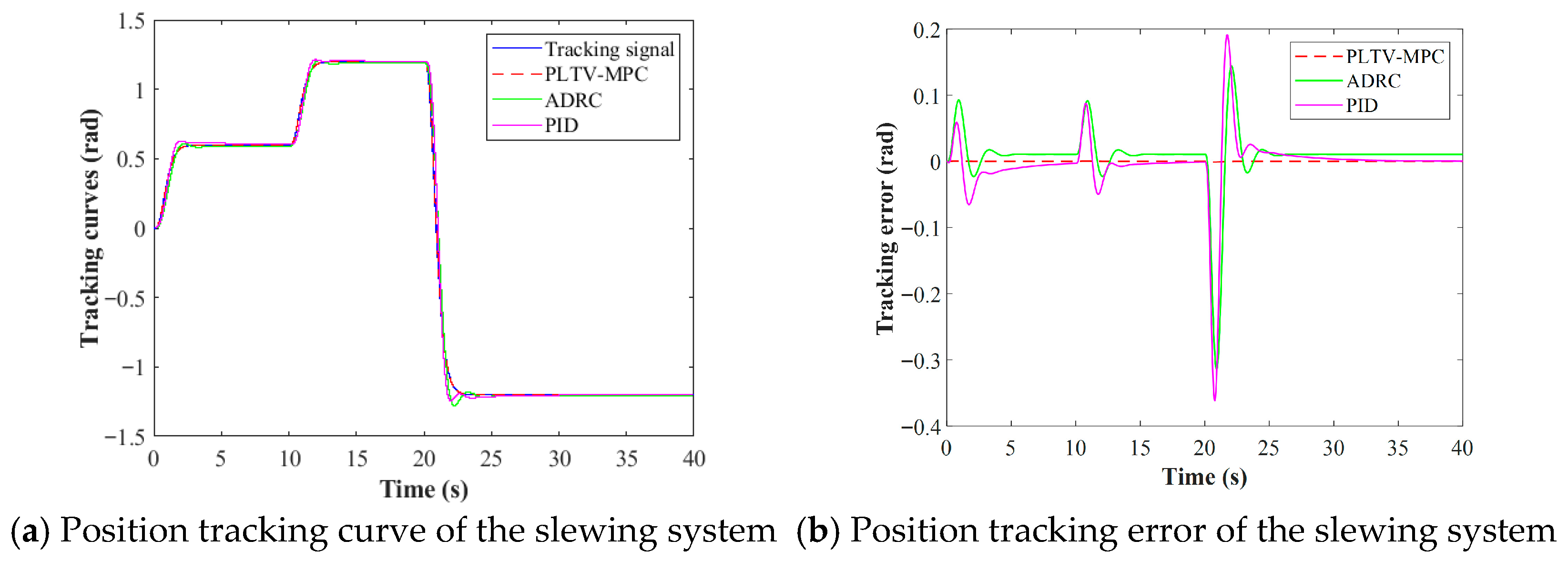
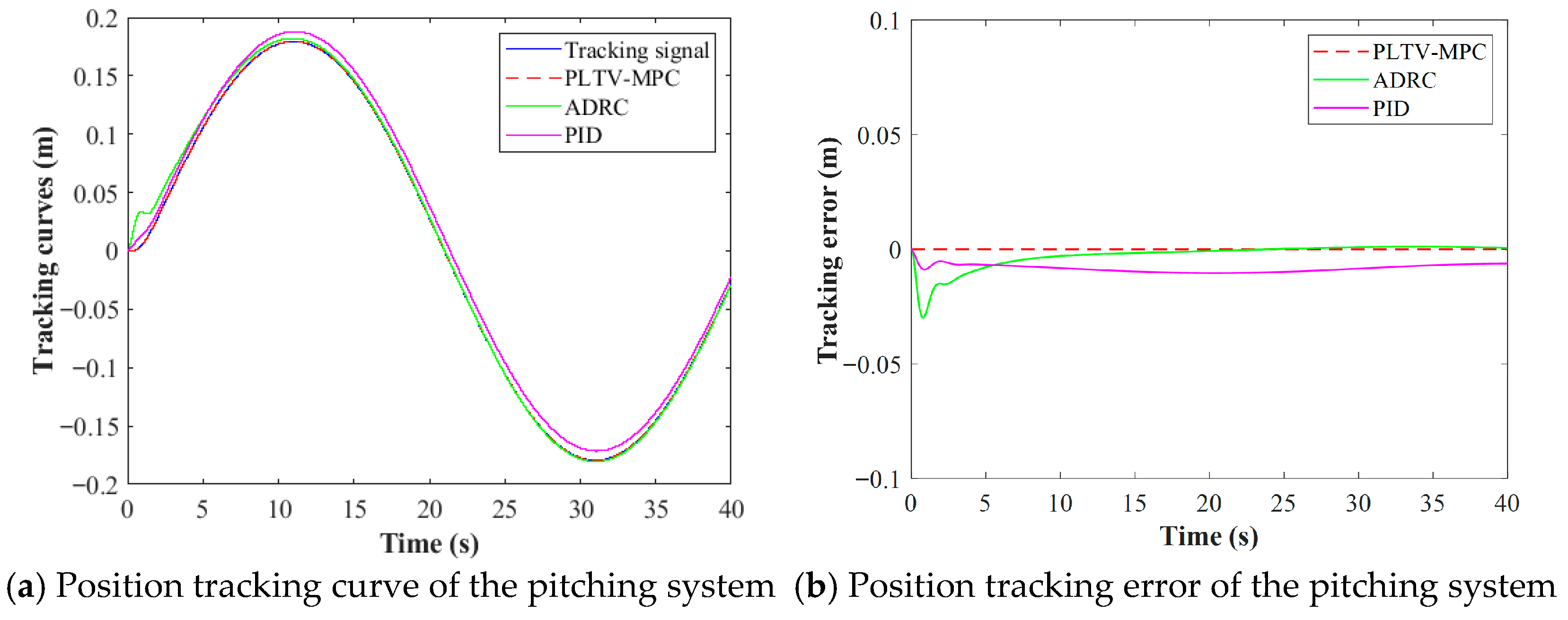
The tracking error comparison results of three control methods for the slewing and pitching systems are presented in Figure 14 and Figure 15, and the corresponding quantitative control performance indicators are listed in Table 6 and Table 7. It can be clearly seen from the figures that the proposed PLTV-MPC controller enables the drill arm to rapidly track the desired position trajectory with almost no overshoot, and the actual trajectory coincides with the reference trajectory after reaching the steady state. In contrast, the PID and ADRC controllers exhibit obvious tracking lag, larger steady-state errors and even position mutation phenomena during the adjustment process.
To intuitively illustrate the control performance of the drill-arm pitching system, Figure 15a,b depict the position tracking curves and position error curves of the drill-arm position control system for the drill-anchor robot. It can be clearly observed that the actual trajectory almost coincides with the desired trajectory once the system tracks the preset path in terms of position and velocity, which demonstrates the excellent tracking performance of the proposed controller. In addition, the position error is found to be extremely small in the figures. In contrast, the ADRC and PID controllers exhibit a prolonged adjustment time and even position mutation issues.
The proposed predictive control method thus shows superior robustness and dynamic response performance, endowing the system with an outstanding tracking effect and achieving high-precision position control of the drill arm.
The comparative simulation results fully demonstrate that the proposed active disturbance rejection predictive control method based on friction compensation and PSO tuning has significant advantages in tracking accuracy, dynamic response speed and steady-state stability. It can effectively suppress the adverse effects of nonlinear friction and disturbances on the system and achieve high-precision position control of the drill arm, which fully meets the technical requirements of the drill-anchor robot for drill-arm positioning.

4.4. Practical Implementation Limitations and Engineering Considerations

Although the proposed friction-compensated, PSO-tuned PLTV-MPC delivers excellent high-precision positioning performance in simulation, several practical limitations and engineering challenges must be fully addressed for reliable field deployment on underground coal mine drill-anchor robots. First, hardware and sensor constraints exist in underground environments. Encoders and displacement sensors used for drill-arm positioning are vulnerable to strong electromagnetic interference, dust, and vibration. These effects often reduce measurement accuracy and cause signal drift. For engineering implementation, high-precision, explosion-proof, and anti-interference sensors are required, supported by filtering methods such as Kalman filtering or moving-average filtering to suppress noise. Second, stringent mine safety and environmental constraints apply. All electrical and control devices must comply with coal mine explosion-proof standards, which impose inherent limits on hardware performance. In addition, mechanical backlash and wear in the worm-gear transmission and pitching mechanism introduce extra positioning errors. Regular mechanical maintenance and real-time error compensation are therefore necessary. Overall, these practical constraints and engineering challenges must be systematically considered and resolved to ensure stable, reliable, and safe operation of the control scheme in real underground coal mine environments.

5. Conclusions

Based on an analysis of the operational principles of drill-anchor robots, this paper established a mathematical model for the drill-arm position control system. Considering the influence of friction on the system, a Stribeck friction model was constructed and applied to friction compensation in the controller design. To realize the high-precision position control of the drill arm, a drill-arm motion controller for the hydraulic drill-anchor robot based on the PLTV-MPC was designed. An ESO was adopted to estimate the system states and unmodeled lumped disturbances in real time, and the established friction model was integrated into the PLTV-MPC to realize the feedforward compensation of nonlinear friction, which reduced the observation burden of the ESO and improved the position tracking accuracy and stability of the system. In addition, the PSO algorithm was introduced, and the key parameters of the LTV-MPC were globally optimized based on an improved multi-objective function integrating trajectory tracking accuracy, actuator protection and steady-state positioning accuracy. Comparative simulation verifications were conducted between the designed controller and other conventional controllers, and the simulation results showed that the proposed controller enabled the system to exhibit excellent control performance. For future research, hydraulic system modeling needs to be further studied since the unmodeled flow dynamics and unmodeled disturbances of hydraulic motors and telescopic cylinders were not fully considered in this paper; thus, the dynamic mathematical model should be improved comprehensively. Moreover, experiments on a real platform should be conducted to verify the superiority and effectiveness of the proposed controller in practical engineering applications.

Author Contributions

Conceptualization, F.J. and H.Q.; methodology, F.J.; software, K.L.; validation, F.J. and X.T.; formal analysis, F.J. and R.C.; investigation, F.J.; resources, F.J.; data curation, F.J.; writing—original draft preparation, F.J.; writing—review and editing, F.J.; visualization, F.J.; supervision, R.Z.; project administration, F.J.; funding acquisition, F.J. All authors have read and agreed to the published version of the manuscript.

Funding

This research received no external funding.

Institutional Review Board Statement

Not applicable.

Informed Consent Statement

Not applicable.

Data Availability Statement

The research data presented in this study are included in the article.

Conflicts of Interest

The authors declare no conflicts of interest.

Abbreviations

The following abbreviations are used in this manuscript:
ESOExtended state observer
PSOParticle swarm optimization
MPCModel predictive control
LTV-MPCLinear time-varying model predictive control
ADRCActive disturbance rejection control
PLTV-MPCPSO-tuning LTV-MPC
ITAEIntegral of time-weighted absolute error
MEAEMean absolute error
SDAEStandard deviation of absolute error

References

  1. Li, J.; Yang, H.; Ji, H. Characterization of Two-Cylinder Parallel Electro-hydraulic Force/Position Synchronization Based on RBF Fuzzy Neural Network Control. Int. J. Fuzzy Syst. 2024, 27, 1471–1486. [Google Scholar] [CrossRef]
  2. Feng, H.; Song, Q.; Ma, S.; Ma, W.; Yin, C.; Cao, D.; Yu, H. A new adaptive sliding mode controller based on the RBF neural network for an electro-hydraulic servo system. ISA Trans. 2022, 129, 472–484. [Google Scholar] [CrossRef] [PubMed]
  3. Yang, X.; Ge, Y.; Zhu, W.; Deng, W.; Zhao, X.; Yao, J. Adaptive Motion Control for Electro-hydraulic Servo Systems With Appointed-Time Performance. IEEE/ASME Trans. Mechatron. 2025, 30, 7009–7018. [Google Scholar] [CrossRef]
  4. Gao, Y.C.; Shen, G.; Li, X.; Zhu, Z.C.; Wang, Q.G. An Improved Nonlinear Extended Disturbance Observer for Sliding Mode Control in Electro-Hydraulic Servo System. IEEE/ASME Trans. Mechatron. 2024, 30, 2155–2164. [Google Scholar] [CrossRef]
  5. Lao, L.; Chen, P. Adaptive sliding mode control of an electro-hydraulic actuator with a kalman extended state observer. IEEE Access 2024, 12, 8970–8982. [Google Scholar] [CrossRef]
  6. Gao, B.; Guan, H.; Zhang, W.; Shen, W.; Ye, Y. Three kinds of improved designs and comparative analysis based on active disturbance rejection controller. J. Mech. Sci. Technol. 2023, 37, 965–976. [Google Scholar] [CrossRef]
  7. Xu, Y.; Zhang, K.; Guo, K.; Ming, W.; Ma, J.; Wang, S.; Ye, Y. Design, Modeling, and Experimental Study of a Constant-Force Floating Compensator for a Grinding Robot. Actuators 2025, 15, 4. [Google Scholar] [CrossRef]
  8. Truong, H.V.A.; Nam, S.; Kim, S.; Kim, Y.; Chung, W.K. Backstepping-sliding-mode-based neural network control for electro-hydraulic actuator subject to completely unknown system dynamics. IEEE Trans. Autom. Sci. Eng. 2023, 21, 6202–6216. [Google Scholar] [CrossRef]
  9. Razmjooei, H.; Palli, G.; Nazari, M. Disturbance observer-based nonlinear feedback control for position tracking of electro-hydraulic systems in a finite time. Eur. J. Control 2022, 67, 100659. [Google Scholar] [CrossRef]
  10. Jun, Z.; Yiliang, W.; Liming, C.; Ning, W.; Yuepin, B.; Chaofan, W. Workspace analysis and motion control strategy of robotic mine anchor drilling truck manipulator based on the WOA-FOPID algorithm. Front. Earth Sci. 2022, 10, 954547. [Google Scholar] [CrossRef]
  11. Zhang, P.; Shi, Z.; Yu, B. Research on friction compensation method of electromechanical actuator based on improved active disturbance rejection control. Actuators 2023, 12, 445. [Google Scholar] [CrossRef]
  12. Jiang, S.; Zhang, K.; Wang, H.; Zhong, D.; Su, J.; Liu, Z. Research on adaptive friction compensation of digital hydraulic cylinder based on LuGre friction model. Shock. Vib. 2021, 2021, 8854424. [Google Scholar] [CrossRef]
  13. Liao, J.; Zhou, F.; Zheng, J. An Improved Parameter Identification Algorithm for the Friction Model of Electro-Hydraulic Servo Systems. Sensors 2023, 23, 2076. [Google Scholar] [CrossRef] [PubMed]
  14. Feng, H.; Yin, C.; Cao, D. Trajectory Tracking of an Electro-Hydraulic Servo System With an New Friction Model-Based Compensation. IEEE/ASME Trans. Mechatron. 2022, 28, 473–482. [Google Scholar] [CrossRef]
  15. Li, J.; Lu, Y.; He, F.; Miao, L. Motion control of hydraulic actuators with nonlinear friction compensation: Applied to variable valve systems of diesel engine. ISA Trans. 2023, 137, 561–573. [Google Scholar] [CrossRef]
  16. Chen, Z.; Huang, C.; Liu, Z.; Liu, Y.; Wang, X.; Shi, B.; Li, L. An offset-free explicit model predictive pressure controller for integrated braking system. IEEE Trans. Transp. Electrif. 2023, 10, 2355–2366. [Google Scholar] [CrossRef]
  17. Chen, H. A backstepping sliding mode control algorithm of electro-hydraulic position servo system of valve-controlled symmetric cylinder based on extended state observer. Mech. Ind. 2024, 25, 6. [Google Scholar] [CrossRef]
  18. Zhang, D.Y.; Liu, S.Y.; Chen, Y.; Gu, C.C. Neural direct adaptive active disturbance rejection controller for electro-hydraulic servo system. Int. J. Control Autom. Syst. 2022, 20, 2402–2412. [Google Scholar]
  19. Ma, Y.; Gu, L.C.; Xu, Y.G.; Shi, L.C.; Wang, H.T. Research on control strategy of asymmetric electro-hydraulic servo system based on improved PSO algorithm. Adv. Mech. Eng. 2022, 14, 16878132221096226. [Google Scholar] [CrossRef]
  20. Guo, K.; Li, M.; Shi, W.; Pan, Y. Adaptive tracking control of hydraulic systems with improved parameter convergence. IEEE Trans. Ind. Electron. 2021, 69, 7140–7150. [Google Scholar] [CrossRef]
  21. Qin, T.; Li, Y.; Quan, L.; Yang, L. An adaptive robust impedance control considering energy-saving of hydraulic excavator boom and stick systems. IEEE/ASME Trans. Mechatron. 2022, 27, 1928–1936. [Google Scholar] [CrossRef]
  22. Yang, M.; Yu, C.; Luo, S.; Lian, K. Synchronous control of hydraulic cylinders for tunneling machine based on improved ESO. Mech. Based Des. Struct. Mach. 2024, 53, 3304–3326. [Google Scholar] [CrossRef]
  23. Coskun, M.Y.; Itik, M. Intelligent PID control of an industrial electro-hydraulic system. ISA Trans. 2023, 139, 484–498. [Google Scholar] [CrossRef] [PubMed]
  24. Ren, H.P.; Jiao, S.S.; Wang, X.; Kaynak, O. Fractional order integral sliding mode controller based on neural network: Theory and electro-hydraulic benchmark test. IEEE/ASME Trans. Mechatron. 2021, 27, 1457–1466. [Google Scholar] [CrossRef]
  25. Liu, Y.-C.; Laghrouche, S.; Depernet, D.; N’Diaye, A.; Djerdir, A.; Cirrincione, M. Disturbance-observer-based speed control for SPMSM drives using modified super-twisting algorithm and extended state observer. Asian J. Control 2024, 26, 1089–1102. [Google Scholar] [CrossRef]
  26. Dang, C.; Dou, M.; Yan, S.; Dang, M.; Wang, Y.; Zhao, D.; Hua, Z. An improved adaptive sliding mode speed control of PMSM drives with an extended state observer. IEEE Trans. Energy Convers. 2024, 39, 2349–2360. [Google Scholar] [CrossRef]
  27. Hou, T.; Shi, C.; Kou, Z.; Wu, J.; Zhang, B.; Peng, Y. Research on positioning control strategy of hydraulic support pushing system based on multistage speed control valve. Sci. Rep. 2024, 14, 19046. [Google Scholar] [CrossRef]
  28. Hou, T.; Kou, Z.; Wu, J.; Xu, P.; Zhang, B.; Peng, Y. Positioning control strategy of hydraulic support pushing system in fully mechanized coal face. Electronics 2023, 12, 3628. [Google Scholar] [CrossRef]
  29. Shi, Q.; He, L. A model predictive control approach for electro-hydraulic braking by wire. IEEE Trans. Ind. Inform. 2022, 19, 1380–1388. [Google Scholar] [CrossRef]
  30. Lee, S.M. Global-Initialization-Based Model Predictive Control for Mobile Robots Navigating Nonconvex Obstacle Environments. Actuators 2025, 14, 454. [Google Scholar] [CrossRef]
  31. Nguyen, V.H.; Ahn, K.K. Triad of three system: AI-driven hydraulics for autonomous electric excavators with sustainable energy savings. Autom. Constr. 2025, 180, 106543. [Google Scholar] [CrossRef]
  32. Feng, H.; Zhong, Y.; Zhou, C.; Ji, S.; Yin, C.; Cao, D. Collaborative high-precision trajectory control for heavy excavators based on an improved particle swarm optimization algorithm. Autom. Constr. 2025, 180, 106546. [Google Scholar] [CrossRef]
  33. Zhao, J.; Hou, H.; Niu, X.; Liu, Y.; Xia, L.; Men, L.; Ma, Z. Virtual torque control combining with modal decoupling research for hydraulic-driven lower limb exoskeleton robot. ISA Trans. 2025, 159, 191–202. [Google Scholar] [CrossRef]
  34. Liu, X.; Wang, Z.; Qiu, Z.; Jiao, Z.; Chen, X.; Nie, R. Cascade control method for hydraulic secondary regulation drive system based on adaptive robust control. ISA Trans. 2025, 156, 479–489. [Google Scholar] [CrossRef]
  35. Qiu, Z.; Liu, X.; Wang, Z.; Chen, X.; Nie, R. Adaptive robust motion control for hydraulic load sensitive systems considering displacement dynamic compensation. ISA Trans. 2025, 156, 490–500. [Google Scholar] [CrossRef]
  36. Huang, J.; An, H.; Yang, Y.; Wu, C.; Wei, Q.; Ma, H. Model predictive trajectory tracking control of electro-hydraulic actuator in legged robot with multi-scale online estimator. IEEE Access 2020, 8, 95918–95933. [Google Scholar] [CrossRef]
Figure 1. Schematic diagram of hydraulic circuit for hydraulic drill-arm control system (1. relief valve, 2. AC motor, 3. hydraulic pump, 4. electro-hydraulic proportional valve, 5. oil tank, 6. hydraulic cylinder, 7. hydraulic motor).
Actuators 15 00193 g001
Figure 2. Closed-loop control block diagram of drill-arm position system.
Actuators 15 00193 g002
Figure 3. Schematic diagram of dead zone of electro-hydraulic proportional valve.
Actuators 15 00193 g003
Figure 4. Simplified model of worm and gear reduction mechanism.
Actuators 15 00193 g004
Figure 5. Schematic diagram of drill-arm pitching mechanism.
Actuators 15 00193 g005
Figure 6. Block diagram of active disturbance rejection predictive control for drill-arm position system.
Actuators 15 00193 g006
Figure 7. Flowchart of PSO-based controller parameter tuning.
Actuators 15 00193 g007
Figure 8. The tracking signal and the external disturbance for drill-arm slewing system.
Actuators 15 00193 g008
Figure 9. The tracking signal and the external disturbance for drill-arm pitching system.
Actuators 15 00193 g009
Figure 10. Control performance comparison between LTV-MPC and PLTV-MPC (slewing system).
Actuators 15 00193 g010
Figure 11. Control performance comparison between LTV-MPC and PLTV-MPC (pitching system).
Actuators 15 00193 g011
Figure 12. Control performance comparison with/without friction compensation (slewing system).
Actuators 15 00193 g012
Figure 13. Comparison experiment with and without friction compensation.
Actuators 15 00193 g013
Figure 14. Comparison of control effects among three controllers.
Actuators 15 00193 g014
Figure 15. Comparison of control effects among three controllers.
Actuators 15 00193 g015
Table 1. Main parameters of the drill-arm system.
ParametersValueUnit
Bulk modulus of hydraulic oil700 ( MPa )
Displacement of hydraulic motor5 × 10−5 ( m 3 / r a d )
Total volume of hydraulic motor chamber4.5 × 10−4 ( m 3 )
Internal leakage coefficient2.336 × 10−12 ( m 3 / ( s · P a ) )
Return pressure0 ( MPa )
Supply pressure7 ( MPa )
Density of hydraulic oil850 ( K g / m 3 )
Effective area of rodless chamber piston0.003848 ( m 2 )
Effective area of rod chamber piston0.003044 ( m 2 )
Total mass of load converted to piston10 ( k g )
Area gradient of electro-hydraulic proportional valve1.7 × 10−3No unit
Flow coefficient of electro-hydraulic proportional valve port0.67No unit
Gain coefficient between control input and spool displacement0.25 ( m / A )
Flow pressure coefficient7 × 10−12 ( m 3 / ( s · P a ) )
Table 2. Control performance indicator comparison (slewing system).
Control MethodMEAE (Rad)SDAE (Rad)ITAE
LTV-MPC9.4452 × 10−50.00015250.0037781
PLTV-MPC5.049 × 10−50.000152140.0020196
Table 3. Control performance indicator comparison (pitching system).
Control MethodMEAE (m)SDAE (m)ITAE
LTV-MPC5.4074 × 10−52.6499 × 10−50.0021629
PLTV-MPC1.0191 × 10−57.1937 × 10−60.0004077
Table 4. Control performance indicator comparison with/without friction compensation (slewing system).
Control MethodMEAE (Rad)SDAE (Rad)ITAE
Without friction compensation0.000377530.000249090.015101
With friction compensation5.049 × 10−50.000152140.0020196
Table 5. Comparison of control performance indicators.
Control MethodMEAE (m)SDAE (m)ITAE
Without friction compensation0.000349030.000198070.0139610
With friction compensation1.0191 × 10−57.1937 × 10−60.0004077
Table 6. Comparison of control performance indicators.
Control MethodMEAE (Rad)SDAE (Rad)ITAE
PID0.0223670.0410270.89468
ADRC0.0187240.0454860.74898
PLTV-MPC5.049 × 10−50.000152140.0020196
Table 7. Comparison of control performance indicators.
Control MethodMEAE(m)SDAE(m)ITAE
PID0.00829630.00157180.33185
ADRC0.00319750.00506480.12790
PLTV-MPC1.0191 × 10−57.1937 × 10−60.0004077
Disclaimer/Publisher’s Note: The statements, opinions and data contained in all publications are solely those of the individual author(s) and contributor(s) and not of MDPI and/or the editor(s). MDPI and/or the editor(s) disclaim responsibility for any injury to people or property resulting from any ideas, methods, instructions or products referred to in the content.