Article

Adaptive Backstepping Control for Battery Pole Strip Mill Systems with Friction and Dead-Zone Input Nonlinearities


1
School of Mechanical Engineering, Yanshan University, Qinhuangdao 066000, China
2
Xinjiang Coal Mine Electromechanical Engineering Technology Research Center, Xinjiang Institute of Engineering, Urumqi 830023, China
3
National Key Laboratory of Metal Forming Technology and Heavy Equipment, China National Heavy Machinery Research Institute Co., Ltd., Xi’an 710018, China
4
Shougang Jingtang United Iron & Steel Co., Ltd., Tangshan 063000, China
*
Author to whom correspondence should be addressed.
Actuators 2025, 14(12), 618; https://doi.org/10.3390/act14120618
Submission received: 17 November 2025 / Revised: 8 December 2025 / Accepted: 11 December 2025 / Published: 17 December 2025

Abstract

The dead-zone input and hydraulic cylinder friction of the pump-controlled automatic gauge control (AGC) system introduce significant challenges to the high-precision rolling of lithium battery pole pieces. To address these nonlinearities, this paper establishes the friction and dead-zone model of the pump-controlled AGC system, and a slide-mode observer is designed to estimate the friction state z in the LuGre model. Furthermore, an adaptive compensation method is adopted to identify the unknown parameters of the input dead-zone and friction models. Meanwhile, combined with the framework of backstepping control design, both matched and mismatched disturbances are effectively compensated. Stability analysis guarantees the convergence of the estimation errors and closed-loop signal boundedness. Finally, experimental results validate the effectiveness and robustness of the proposed control strategy.

1. Introduction

Compared with the non-renewable nature of traditional fossil energy and the environmental pollution problems caused by their combustion, electricity as a secondary energy source offers distinct advantages such as cleanliness, safety, and renewability [1]. Lithium batteries are excellent electricity storage devices with the advantages of high energy density, environmental protection, a long cycle life, and no memory effect [2,3]. They have been widely used in aerospace, electronic products, and other fields, especially as the main power source for electric vehicles [4,5]. Lithium battery electrodes are the core components of lithium batteries, mainly composed of active materials, conductive agents, binders, and current collectors. The forming process of lithium battery electrodes is carried out through the rolling equipment, and its thickness uniformity and compaction density parameters determine the safety and durability of lithium batteries, which puts high demands on the control accuracy of the rolling equipment [6,7,8]. The traditional rolling equipment mostly employs servo valves to control hydraulic cylinders for adjusting the roll gap of rolling mills. However, traditional valve-controlled hydraulic systems have inherent drawbacks, including large energy loss, low efficiency, severe heat generation, and sensitivity to oil contamination [9,10]. To overcome the aforementioned drawbacks, pump-controlled hydraulic systems, with their advantages such as high efficiency, energy savings, high power-to-weight ratio, and environmental friendliness, are expected to become the development trend of electro-hydraulic control technology [11,12]. However, pump-controlled hydraulic systems suffer from inherent drawbacks, including dead zones, mechanical vibration, and hydraulic cylinder friction [13]. These factors collectively pose significant challenges to achieving precise motion control of the system [14]. Therefore, it is highly necessary to improve the control accuracy of pump-controlled hydraulic systems under dead-zone and actuator friction.
The dead-zone phenomenon in pump-controlled hydraulic systems is mainly caused by factors such as mechanical clearance, friction, hydraulic medium compressibility, leakage, algorithmic defects, and noise interference [15]. Reference [16] proposed an improved adaptive finite-time command filtered controller, which effectively addressed the influence of dead-zone uncertainty in the system and achieved high-precision tracking control of electro-hydraulic servo systems. To address the issue that dead-zone nonlinearity degrades the tracking performance of the displacement system of hydraulic roof bolters, reference [17] proposed an improved extended state observer-based global sliding-mode finite-time control. Comparative experiments verified the effectiveness of the proposed control strategy. However, controllers with fixed gains have difficulty accurately estimating the targets of large time-varying disturbances. Reference [18] designed a disturbance observer-based adaptive robust fault-tolerant controller, which addressed the issue of the unknown proportional valve dead-zone in the dual-valve hydraulic system. From a control perspective, numerous control methods have been proposed to handle dead zones in controlled systems, including adaptive control [19], sliding mode control [20], fuzzy control [21], and neural network control [22], among others. However, sliding mode control laws can induce the chattering phenomenon, fuzzy algorithms depend on expert experience, and neural network control requires a large amount of training data for support. In [23], an adaptive sliding mode disturbance observer is designed to compensate for the lumped disturbances of the robotic system, such as model uncertainty and friction. Combined with the fixed-time backstepping control algorithm, the proposed method achieves fast fixed-time high-precision trajectory tracking control for uncertain robotic systems with actuator saturation. An adaptive fixed-time speed controller is proposed to enhance the current and speed tracking performance of permanent magnet synchronous motors in [24]. The introduction of an adaptive law eliminates the assumption that the upper bound of unknown disturbances is known. Experimental results validate the effectiveness and superiority of the proposed method. In [25], an improved adaptive neural network nonsingular terminal sliding-mode control scheme is proposed for manipulators with unmodeled dynamics and input saturation. Experimental results verify that the proposed scheme can mitigate the adverse effects of input saturation caused by the conflict between excessive control force and limited motor torque. Adaptive control possesses excellent online learning capability and can effectively mitigate the impact of parameter uncertainty on the system. Therefore, how to achieve the adaptation and accurate compensation of dead-zone parameters in pump-controlled hydraulic systems is of great importance.
The friction in hydraulic cylinders of pump-controlled hydraulic systems is mainly caused by factors such as the nonlinear characteristics of seals, dynamic deformation of piston rods, viscosity–temperature coupling effect of hydraulic oil, cavitation, and flow fluctuations [26,27]. Reference [28] coupled four friction models of hydraulic cylinders with the equations of motion of hydraulically actuated multibody systems, respectively, and conducted comparative studies on a hydraulically actuated four-bar mechanism and demonstrated that the Brown–McPhee model exhibits the highest numerical efficiency. Reference [29] proposed a friction compensator based on the improved LuGre model, and trajectory experiments conducted on a 23t excavator demonstrated that the designed compensator could enhance the comprehensive performance of the electro-hydraulic servo system. Reference [30] proposed a finite-time tracking control strategy integrating LuGre friction model compensation with prescribed performance constraints for hydraulic servo systems, and the theoretical analysis and comparative simulations verified the effectiveness of the proposed method. Reference [31] proposed an output feedback adaptive controller based on an extended state observer integrating continuous LuGre friction compensation, which effectively eliminated most of the nonlinear dynamics in hydraulic servo systems. Reference [32] introduced the LuGre friction model into the electro-hydraulic proportional system of robotic excavators and, combined with a hybrid optimization algorithm, proposed an adaptive friction compensation controller, which effectively improved the tracking accuracy and eliminated the crawling phenomenon. However, the aforementioned literature has not performed the accurate identification of modeling errors and disturbances, etc. It should be noted that the parameters in the friction model are time-varying, which require adaptation. Therefore, how to realize the adaptation and compensation of friction in hydraulic cylinders of pump-controlled hydraulic systems is of great importance.
Based on the above discussion, this paper considers the input dead zone and hydraulic cylinder friction in the trajectory tracking control of the electro-hydraulic servo pump-controlled AGC system. First, a hydraulic cylinder friction model is established based on the LuGre model, and an accurate mathematical model of the pump-controlled AGC system is derived by integrating the dead-zone model. Then, considering the time-varying nature of model parameters, an adaptive algorithm is employed to adaptively estimate the time-varying parameters in the dead-zone and friction models. Based on the Lyapunov stability theory, an adaptive backstepping controller is designed, and precise compensation and control of the dead zone are realized via the dead-zone inversion method. Finally, the effectiveness of the proposed algorithm is validated on an experimental platform.
The main contributions of this paper are as follows:
(1)
The electro-hydraulic servo pump-controlled system is applied to the AGC system of lithium battery pole piece rolling mills, which reduces the floor space and improves energy utilization efficiency.
(2)
Accurate mathematical models of dead zones and hydraulic cylinder friction have been established, and combined with adaptive control algorithms, real-time correction of model parameters has been implemented.
The structure of the remainder of this paper is as follows: Section 2 outlines the operating principles of the electro-hydraulic servo pump-controlled AGC system and establishes its mathematical model incorporating input dead zones and hydraulic cylinder friction. Section 3 proposes the adaptive backstepping control method and conducts a stability analysis. Section 4 presents experimental investigations, and Section 5 concludes with a summary of the research work presented in this paper.

2. System Description and Model Establishment

2.1. System Description

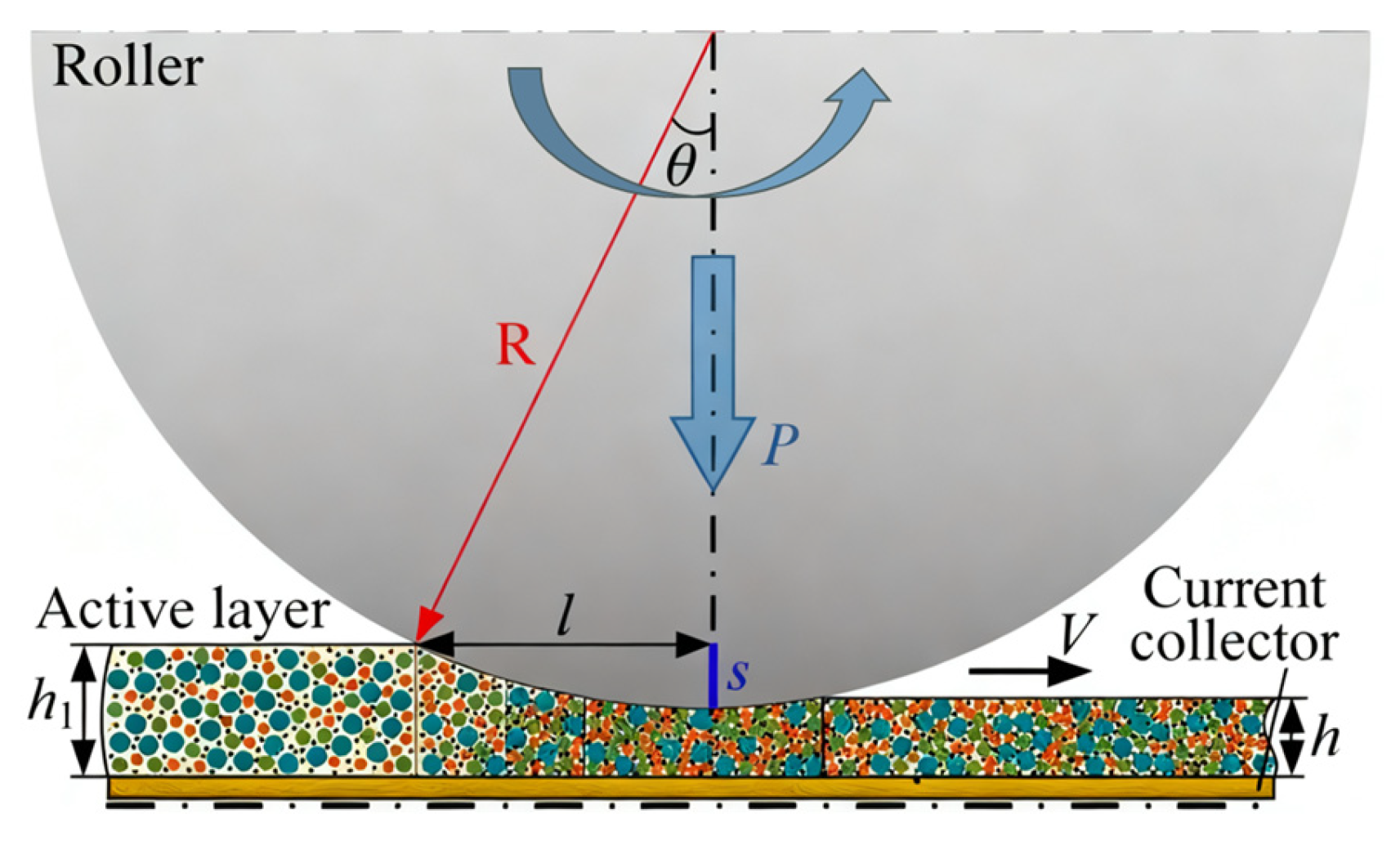
The rolling of a lithium battery pole sheet is usually performed with pole piece mill equipment. The pole piece rolling mill uses the frictional force between the rolls and the battery pole piece to pull it into the rolls and presses the pole piece to the target thickness, as shown in Figure 1, through a hydraulic AGC. An appropriate compaction density can increase the battery’s discharge capacity, reduce its internal resistance, and prolong its life cycle. The displacement and deformation of the electric slurry particles coated on the pole plate after recompression affect the pole plate’s density to varying degrees. Therefore, to ensure the forming quality of the lithium battery pole sheet, the rolling process is divided into two parts: fixed roll-gap rolling and fixed roll-force rolling.
Furthermore, fixed roll-gap rolling is a process mode that controls the distance between the upper and lower rolls by regulating the extension displacement of the AGC cylinder. There are two primary categories of working conditions: no-load operation, generally characterized by large displacement without pressure buildup; and load operation, generally characterized by small displacement with pressure buildup. The fixed roll-force rolling process, as its name suggests, applies constant pressure to the pole piece during rolling by controlling the output of the AGC cylinder.
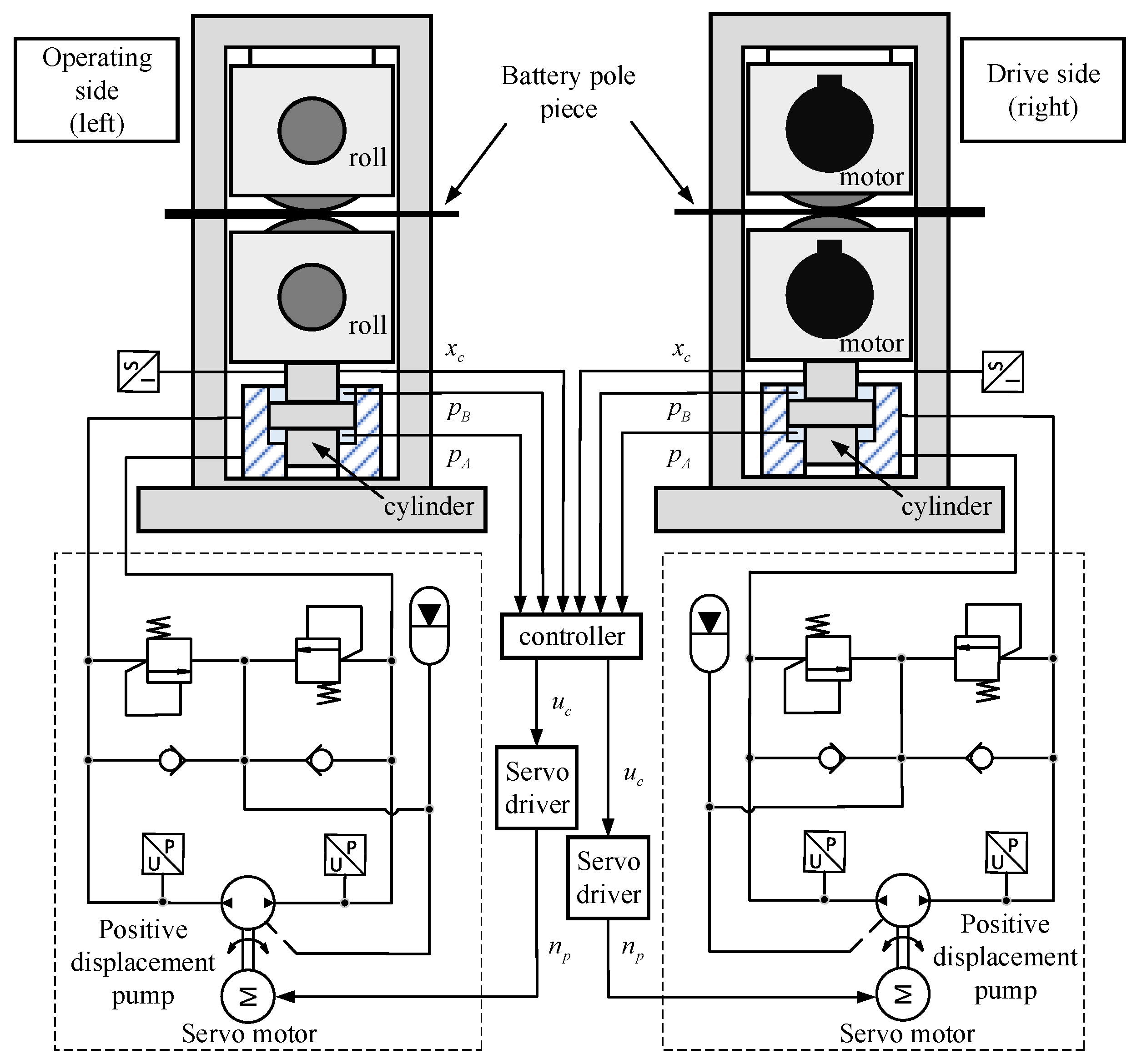
The integrated volume control scheme consisting of the servo motor, positive displacement pump, and hydraulic cylinder proposed in this study adopts a pump-controlled AGC to replace the traditional valve-controlled AGC to realize high-precision rolling of the lithium battery pole piece. The specific configuration comprises a servo motor, positive displacement pump, function valve, accumulator, hydraulic cylinder, and controller. The principle of the system structure is shown in Figure 2.
As shown in Figure 2, the servo motor drives the positive displacement pump coaxially, while the suction and discharge ports of the pump are directly connected to the two load ports of the hydraulic cylinder. In addition, the system uses an accumulator and a combination of check valves to compensate for oil volume losses. The controller sends control instructions to the servo motor to regulate the speed and torque of the positive displacement pump, thereby adjusting the displacement and output of the hydraulic cylinder. Discharging the leaked oil back to the accumulator can transfer the heat generated during the operation of the hydraulic pump to the accumulator, thereby achieving the cooling effect of the hydraulic pump. Meanwhile, the accumulator can maintain stable housing oil leakage pressure, which improves the reliability of the system.

2.2. Models Establishment

2.2.1. Establishment of the Dead-Zone Model

In the pump-controlled AGC system shown in Figure 2, the AC servo motor is responsible for transforming the control input voltage into the motor output speed. As the servo motor possesses a higher response speed and high dynamic speed, the relationship between the motor output speed and the input control signal is considered proportional and is expressed as follows:
n p = K m i c
where n p is the motor output speed, K m is the control gain of the servo motor, and i c is the current signal of the control input.
Ignoring the hydraulic oil compression, internal and external leakage, and other factors, while assuming that the displacement of the radial piston pump is constant, the two-cavity load volumetric flow from the pump to the controlled hydraulic cylinder can be expressed as follows:
q L = D p n p
where q L is the load flow and D p is the displacement of the positive displacement pump.
This simplified relationship reduces the complexity of the model, but it also leads to an inherent deviation between the theoretically calculated flow rate and the actual load flow rate. However, this manuscript establishes a mathematical model of the system’s input dead zone, which can incorporate the internal and external leakage of the hydraulic pump into the dead-zone nonlinearity. Furthermore, the proposed adaptive backstepping control method can further compensate for the flow deviation by adjusting the adaptive parameters.
The electro-hydraulic servo pump-controlled AGC system is an electro-mechanical–hydraulic coupled system. The dead-zone effect of the motor driver, static friction between the motor and hydraulic pump, mechanical transmission backlash, and hydraulic pump leakage all contribute to the presence of a dead-zone phenomenon in the system’s n p input. The asymmetric dead-zone model can be described as follows:
u t = D Z v t = m r v t b r v t b r 0 b l < v t < b r m l v t b l v t b l
where m r , m l , b r , and b l are unknown parameters with m r > 0 , m l > 0 , b r 0 , and b l 0 , and v t   represents the actual control input speed signal.
For the convenience of estimating time-varying parameters, define θ = θ 1 , θ 2 , θ 3 , θ 4 T = m r , m r b r , m l , m l b l T , ω t = σ r t v t , σ r t , σ l t v t , σ l t T , and the expression of σ r t and σ l t can be shown as follows:
σ r t = 1 u t > 0 0 u t 0 , σ l t = 1 u t < 0 0 u t 0
By combining Equations (3) and (4), it can be concluded that
u t = θ T ω t
To effectively compensate for dead-zone behavior, this paper proposes a continuously differentiable approximate dead-zone model as follows for approximating the discontinuous dead-zone inverse function in practice:
v t = D I u t = u t + m r b r m r ϕ r u + u t + m l b l m l ϕ l u
where ϕ r u , ϕ l u are smooth functions with the following definitions:
ϕ r u = e u / e 0 e u / e 0 + e u / e 0 , ϕ l u = e u / e 0 e u / e 0 + e u / e 0

2.2.2. Establishment of the Hydraulic Cylinder Model

Considering the load condition, hydraulic oil compression, internal and external leakage, and other factors, the flow distribution characteristics of the hydraulic cylinder are analyzed, and the flow continuity equation of the two cavities of the hydraulic cylinder is established as follows:
q L = A c x ˙ c + C c p L + V t 4 β e p ˙ L
where A c   is the effective area of the cylinder piston, x c is the piston displacement of the cylinder, C c   is the leakage coefficient of the cylinder, V t   is the total volume of the cylinder cavity, and β e is the effective volumetric elastic modulus.
The force balance equation of the cylinder is as follows:
A c p L = m c x ¨ c + F f
where m c is the total mass transmitted from the load to the piston, and F f is the frictional force.
The friction model F f in this study is based on the traditional LuGre model. This model postulates that two rigid bodies in contact interact through elastic bristles, with the lower surface having higher bristle stiffness than the upper. When a tangential force is applied, these bristles deform. The deformation increases with the force until it becomes large enough to cause macroscopic sliding between the bodies. The equation for the friction model is given below:
F f = σ 0 z + σ 1 x ˙ c x ˙ c f c + f s f c e x ˙ c / x ˙ s λ σ 0 1 z + σ 2 x 2
where σ 0 is the rigidity index of the bristles, σ 1 is the damping coefficient, σ 2 is the viscous friction coefficient, z is the average deformation of the bristles, f c is the Coulomb friction force, f s is the static friction force, x ˙ s is the Stribeck velocity, and λ is the Stribeck index coefficient.

2.2.3. Establishment of the System State Space Equation

Based on the above analysis, define x 1 = x c , x 2 = x ˙ c , and x 3 = p L A c / m c as the system’s state variables and u = i c as the control input; we then formulate the state space equations of the electro-hydraulic servo pump-controlled AGC system as follows:
x ˙ 1 t = x 2 t x ˙ 2 t = x 3 t σ 0 m c z σ 1 m c x 2 x 2 g x 2 z σ 2 m c x 2 x ˙ 3 t = α 1 u t + α 2 x 2 t + α 3 x 3 t
where g x 2 = f c + f s f c e x ˙ c / x ˙ s λ σ 0 1 , α 1 = 4 β e A c D p K m / ( m c V t ) , α 2 = 4 β e A c 2 / ( m c V t ) , and α 3 = 4 β e C c / V t .

3. Controller Design

In this section, the following work is carried out. Firstly, in order to address the challenge of directly measuring the average bristle deformation z in the LuGre model, a state observer is designed for its real-time estimation. Next, adaptive laws for unknown parameters in the dead-zone model, friction model, and hydraulic system are proposed to compensate for real-time changes in model parameters online. Meanwhile, the system’s control law is derived based on the adaptive backstepping control algorithm, and the stability of the system is proven via Lyapunov stability theory.

3.1. State Observer Design for the Average Bristle Deformation z

In this section, a sliding-mode observer is proposed to estimate the state z in the LuGre model. By defining z 1 = x 1 x d , z ˙ 1 = x 2 x ˙ d , the sliding surface of the observer is designed as follows:
s z = z ˙ 1 + λ 1 z 1
where λ 1 is a positive constant.
By differentiating the above equation, we can obtain the following:
s ˙ z = x 3 + σ 0 z + σ 1 x 2 x 2 g x 2 z + σ 2 x 2 x ¨ d + λ 1 x 2 x ˙ d
The estimated z ^ ˙ of the designed bristle is as follows:
z ^ ˙ = x 2 x 2 g x 2 z ^ μ 0 s g n s z
where μ 0 is a positive designed constant.
Then, the derivative of the observation error z ~ ˙ is as follows:
z ˜ ˙ = x ˙ g x ˙ z ˜ + μ 0 s g n s z
Establish the Lyapunov function for the observer error as follows:
V z = 1 2 z ˜ 2
The derivative of the above Lyapunov equation can be obtained as follows:
V ˙ z = z ˜ z ˜ ˙ = z ˜ x ˙ g x ˙ z ˜ + μ 0 s g n s z = x ˙ g x ˙ z ˜ 2 + μ 0 s g n s z z ˜
It can be seen from Equation (17) that by selecting appropriate constants μ 0 < x ˙ z ~ / g x 2 , V ˙ z < 0 can be ensured. Thus, the designed sliding mode observer is able to guarantee that the estimation error z ~ converges to a bounded neighborhood around the origin, and the size of this neighborhood is associated with the design parameter μ 0 and the variation range of system states. Therefore, the stability of the sliding mode observer has been proven.
Remark 1. 
In the electro-hydraulic servo pump-controlled AGC system, due to physical constraints, both the piston speed x 2 of the hydraulic cylinder and the estimation error z ~ of the bristle state are lower-bounded. Meanwhile, by combining it with the actual physical model of the hydraulic cylinder, it can be concluded that g x 2 is upper-bounded. Then, the range of the lower bound for x 2 z ~ / g x 2 can be derived based on the real physical system, and on this basis, the selection range of μ 0 can be determined.
Remark 2. 
The highly variable loads can cause phase lag and amplitude attenuation of the estimated value z ^ of the average deformation of the bristles when tracking the true value z . By adjusting μ 0 and λ 1 , tracking accuracy and convergence speed can be improved, but it also makes the system more sensitive to noise and exacerbates chattering. Even if the observer has a slight lag in tracking rapidly changing z , the adaptive method can compensate for this dynamic error by adjusting other parameters, thus ensuring that the overall friction compensation effect maintains high precision.

3.2. Design of Control Law and Adaptive Law

Step 1: The tracking error of system state x 1 is defined as follows:
z 1 = x 1 x 1 d
where x 1 d is the expected trajectory of x 1 . By combining Equation (11) with (18), the differential of the tracking error can be obtained as follows.
z ˙ 1 = x 2 x ˙ 1 d
The Lyapunov function of the first-order system is defined as follows.
V 1 = 1 2 z 1 2
By differentiating the above equation, we can obtain V ˙ 1 as follows.
V ˙ 1 = z 1 z 2 + x 2 d x ˙ 1 d
The virtual control law of the first-order system is defined as follows.
x 2 d = k 1 z 1 + x ˙ 1 d
By substituting the virtual control law x 2 d into Equation (21), we can obtain
V ˙ 1 = k 1 z 1 2 + z 1 z 2
From Equation (23), it can be seen that, in order to make V ˙ 1 a negative constant, we need to design a control law such that z 2 in the second term of the above equation tends to zero.
Step 2: The tracking error of system state x 2 is defined as follows:
z 2 = x 2 x 2 d
where x 2 d is the expected trajectory of x 2 . By combining Equation (11) with (24), the differential of the tracking error can be obtained as follows.
z ˙ 2 = x 3 x ˙ 2 d σ 0 m c z ^ σ 1 m c x 2 x 2 g x 2 z ^ σ 2 m c x 2
The Lyapunov function of the second-order system is defined as follows.
V 2 = V 1 + 1 2 z 2 2
By differentiating the above equation, we can obtain V ˙ 2 as follows.
V ˙ 2 = k 1 z 1 2 + z 1 z 2 + z 2 z 3 + x 3 d x ˙ 2 d σ 0 m c z ^ σ 1 m c x 2 x 2 g x 2 z ^ σ 2 m c x 2
The virtual control law of the second-order system is defined as follows:
x 3 d = k 2 z 2 z 1 + x ˙ 2 d + σ ^ 0 m c z ^ + σ ^ 1 m c x 2 x 2 g x 2 z ^ + σ ^ 2 m c x 2
where σ ^ 0 ,   σ ^ 1 ,     σ ^ 2 are the estimated values of parameters σ 0 ,   σ 1 ,   σ 2 in the friction model. Considering parameter adaptation, we redesign the Lyapunov function for the second-order system as follows:
V 2 = V 1 + 1 2 z 2 2 + 1 2 δ 0 σ ˜ 0 2 + 1 2 δ 1 σ ˜ 1 2 + 1 2 δ 2 σ ˜ 2 2 + 1 2 z ˜ 2
where σ ~ 0 = σ 0 σ ^ 0 , σ ~ 1 = σ 1 σ ^ 1 , σ ~ 2 = σ 2 σ ^ 2 , and z ~ = z z ^ , δ 0 ,     δ 1 ,   δ 2 are parameter adjustment laws. By differentiating the above equation, we can obtain V ˙ 2 as follows.
V ˙ 2 = k 1 z 1 2 + z 1 z 2 + z 2 z 3 + x 3 d x ˙ 2 d σ 0 m c z ^ σ 1 m c x 2 x 2 g x 2 z ^ σ 2 m c x 2 1 δ 0 σ ˜ 0 σ ^ ˙ 0 1 δ 1 σ ˜ 1 σ ^ ˙ 1 1 δ 2 σ ˜ 2 σ ^ ˙ 2 z ˜ z ^ ˙
By substituting the virtual control law x 3 d from Equation (28) into the above equation and simplifying it, we can obtain
V ˙ 2 = k 1 z 1 2 k 2 z 2 2 + z 2 z 3 σ ˜ 0 z ^ z 2 m c + σ ^ ˙ 0 δ 0 σ ˜ 1 z 2 m c x 2 x 2 g x 2 z ^ + σ ^ ˙ 1 δ 1 σ ˜ 2 x 2 z 2 m c + σ ^ ˙ 2 δ 2 z ˜ z ˜ ˙
From Equation (17), we can obtain that, by selecting appropriate constants μ 0 < x ˙ z ~ / g x 2 , z ~ z ~ ˙ < 0 can be ensured. The design of the adaptive laws for the system is as follows.
σ ^ ˙ 0 = δ 0 z ^ z 2 / m c , σ ^ ˙ 1 = δ 1 z 2 x 2 x 2 g x 2 z ^ / m c , σ ^ ˙ 2 = δ 2 x ˙ z 2 / m c
By substituting the adaptive laws into Equation (31), we can obtain
V ˙ 2 = k 1 z 1 2 k 2 z 2 2 + z 2 z 3 z ˜ z ˜ ˙
From Equation (33), it can be seen that, in order to make V ˙ 2 a negative constant, we need to design a control law such that z 3 tends to zero.
Step 3: The tracking error of system state x 3 is defined as follows:
z 3 = x 3 x 3 d
where x 3 d is the expected trajectory of x 3 . By combining Equation (11) with (34), the differential of the tracking error can be obtained as follows.
z ˙ 3 = α 1 u t + α 2 x 2 t + α 3 x 3 t x ˙ 3 d
In Equation (35), the term α 1 u t couples two parameter estimation errors: the first is the estimation error of parameter α 1 , and the second is the estimation error of the dead-zone parameter. The coupling of these two parameters makes parameter estimation of the system difficult.
By defining β = 1 / α 1 , α 1 u t can be written as follows.
α 1 u t = α 1 β ^ u d 1 t = α 1 β β ˜ u d 1 t = u d 1 t α 1 β ˜ u d 1 t
By defining u d 2 t as the estimated control input, the dead-zone phenomenon can be considered. Then, the expression of u d 2 t can be obtained as follows:
u d 2 t = θ ^ T ω ^ t
where θ ^ is the estimation value of the dead-zone parameter with θ ^ = θ ^ 1 , θ ^ 2 , θ ^ 3 , θ ^ 4 T = m ^ r , m ^ r b ^ r , m ^ l , m ^ l b ^ l T , and ω ^ t is the smooth dead-zone inverse function with ω ^ t = ϕ r t v t , ϕ r t , ϕ l t v t , ϕ l t T .
Based on Equation (37), the estimated error of the control input can be obtained as follows:
u d 1 t u d 2 t = θ ^ θ T ω ^ t + d N t
where d N t = θ T ω ^ t ω t and the boundedness of d N t can be obtained through the following equation, and e 0 is a designed parameter.
d N t = θ T ω ^ t ω t 1 2 e 1 m r m l e 0 + m r b r m l b l e 2 b r / e 0 + 1 v t b r max m r , m l b r b l b l < v t < b r 1 2 e 1 m r m l e 0 + m r b r m l b l e 2 b l / e 0 + 1 v t b l
By substituting Equation (38) into (36), the following equation can be obtained.
α 1 u t = u d 2 t θ ˜ T ω ^ t + d N t α 1 β ˜ u d 1 t
The control law u d 2 t is designed as follows.
u d 2 t = α ^ 2 x 2 α ^ 3 x 3 sgn z 3 D ^ + x ˙ 3 d k 3 z 3 z 2
By substituting Equations (41) and (40) into (35), the following equation can be obtained.
z ˙ 3 = k 3 z 3 z 2 sgn z 3 D ^ + d N t α 1 β ˜ u d 1 t + α ˜ 2 x 2 t + α ˜ 3 x 3 t θ ˜ T ω ^ t
The Lyapunov function of the third-order system is defined as follows.
V 3 = V 2 + 1 2 z 3 2 + α 1 2 γ 1 β ˜ 2 + 1 2 γ 2 α ˜ 2 2 + 1 2 γ 3 α ˜ 3 2 + 1 2 γ 4 D ˜ 2 + 1 2 θ ˜ T Γ 1 θ ˜
By differentiating the above equation, we can obtain V ˙ 3 as follows.
V ˙ 3 = k 1 z 1 2 k 2 z 2 2 k 3 z 3 3 z ˜ z ˜ ˙ + β ˜ α 1 γ 1 β ^ ˙ α 1 u d 1 t z 3 + α ˜ 2 1 γ 2 α ^ ˙ 2 + x 2 z 3 + α ˜ 3 1 γ 3 α ^ ˙ 3 + x 3 z 3 + D ˜ 1 γ 4 D ^ ˙ + z 3 + θ ˜ T Γ 1 θ ^ ˙ ω ^ t z 3
The adaptive laws for the system are designed as follows.
β ^ ˙ = γ 1 u d 1 t z 3 ; α ^ ˙ 2 = γ 2 x 2 z 3 ; α ^ ˙ 3 = γ 3 x 3 z 3 ; D ^ ˙ = γ 4 z 3 ; θ ^ ˙ = Γ ω ^ t z 3
By substituting the adaptive laws into Equation (44), we can obtain
V ˙ 3 = k 1 z 1 2 k 2 z 2 2 k 3 z 3 2 z ˜ z ˜ ˙ 0
Therefore, under the adaptive backstepping control framework proposed in this manuscript, all signals within the closed-loop system (including system states, estimated parameters, etc.) have been proven to be bounded based on Lyapunov stability theory. Furthermore, it can be proven that the system’s tracking error asymptotically converges to zero. The observer error and parameter estimation errors remain bounded within the closed-loop system. By appropriately selecting the control gains and adaptive gains, the transient performance of the system, such as the convergence rate and overshoot, can be effectively regulated. Using the dead-zone inverse transformation, the actual control input of the system can be derived as follows:
v t = D I ^ u d 2 t = u d 2 t + m r b r ^ m ^ r ϕ r u d 2 t + u d 2 t + m l b l ^ m ^ l ϕ l u d 2 t
In summary, when the proposed control laws (47) and parameter adaptive laws (32) and (45) are applied to the electro-hydraulic servo pump-controlled system, the trajectory tracking error of the system can achieve convergence, and the proof for this conclusion is completed.
Remark 3. 
There may exist other unmodeled, unmatched disturbances in the second-order system. After propagating through the system dynamics, these unmodeled, unmatched disturbances will eventually manifest as a lumped and bounded equivalent input disturbance in the control input channel. We attribute this part of the disturbance to the total disturbance term d N t in the third-order system to realize its precise compensation. The design of the adaptive controller is based on the unified Lyapunov stability theory, and this theoretical framework inherently takes into account and constrains the dynamics generated by the interaction between parameter adaptation and system disturbance.

4. Experimental Results

4.1. Introduction to Experimental Platform

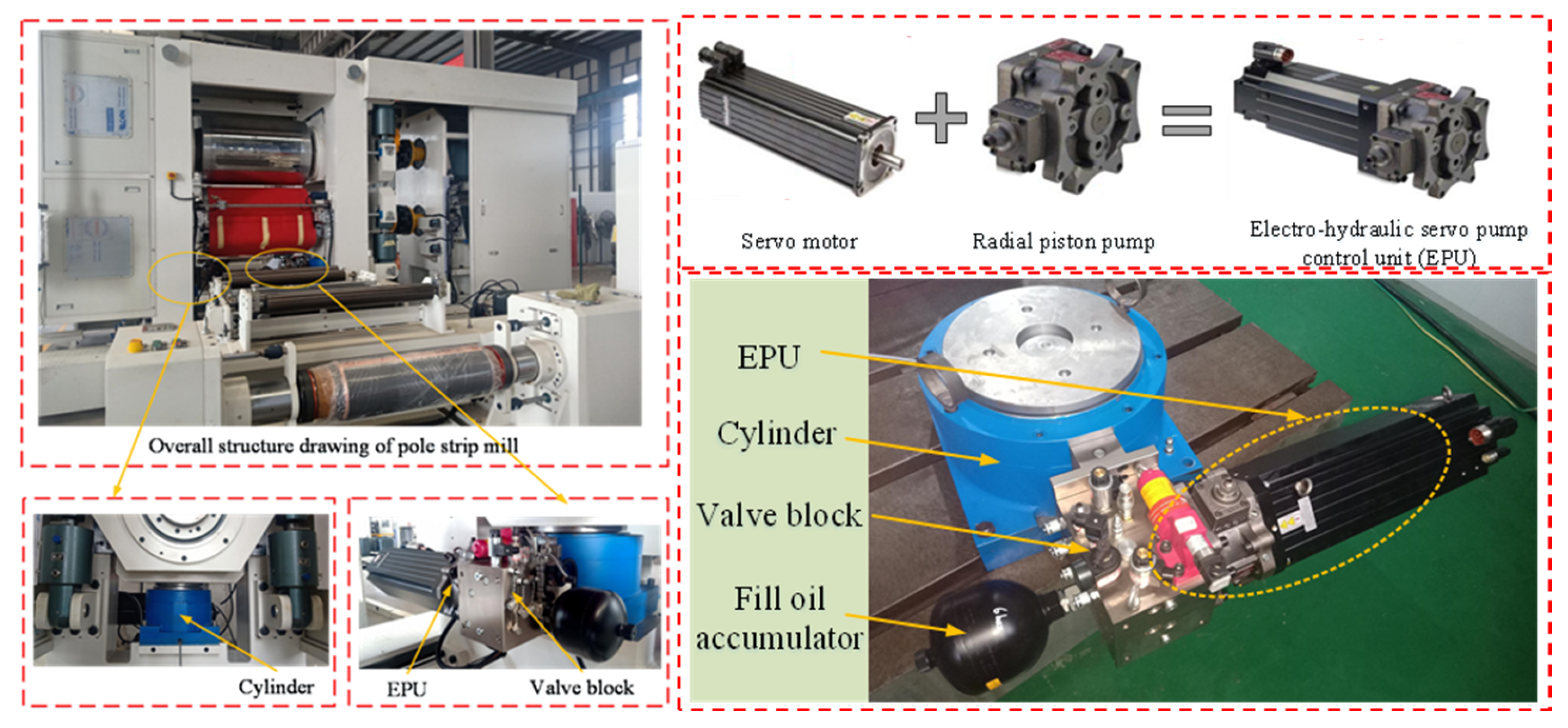
The experimental platform in Figure 3 is integrated with the main structure of the lithium battery pole piece rolling mill and the electro-hydraulic servo pump-controlled AGC system. Specifically, the pump-controlled AGC is primarily composed of a functional valve block, a working cylinder, and an electro-hydraulic servo pump control unit (EPU). The EPU employs a radial piston pump configuration, which is driven by a permanent magnet synchronous servo motor manufactured by Moog. The servo motor drives the piston pump in a coaxial manner, with the suction port and discharge port of the piston pump directly connected to the two respective load ports of the hydraulic cylinder. The speed and torque of the servo motor are regulated by a driver, thereby adjusting the output displacement, velocity, and force of the hydraulic cylinder. To prevent oil contamination and mitigate energy loss of the system to a certain extent, the functional valve block is utilized to integrate the EPU, hydraulic cylinder, and other hydraulic accessories into a unified assembly.
The component specifications of the experimental platform are provided in Table 1.
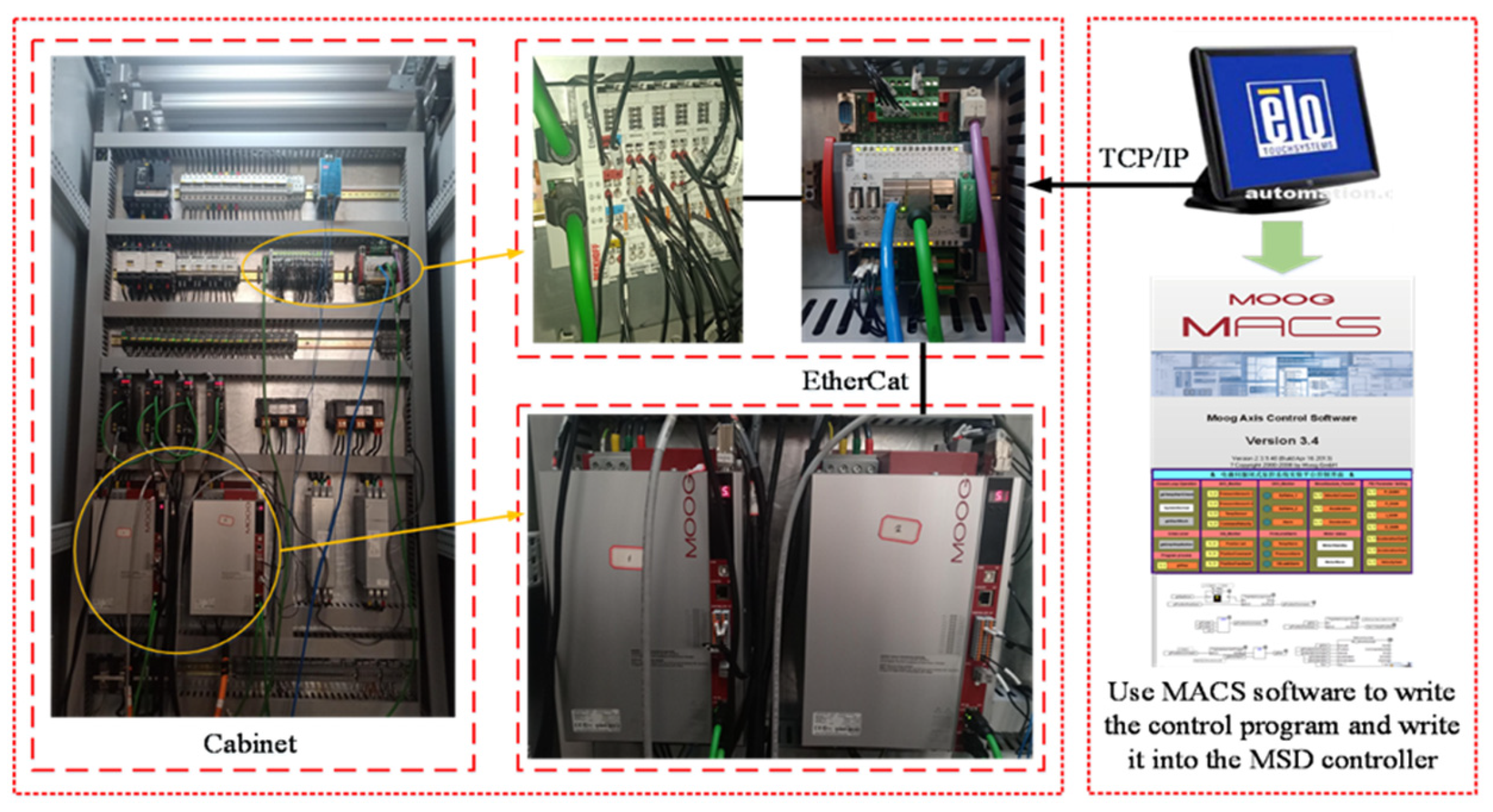
Figure 4 presents the structure of the pump-controlled AGC system. The control hardware comprises an industrial control computer, a signal acquisition module, a motion controller, a servo driver, and other auxiliary components. The industrial control computer used in this study is the ADVANTECH brand, which is manufactured in Taipei City, China. The motion controller and servo driver used in this study are the MOOG brand, which is manufactured in New York City, NY, USA. And the signal acquisition module used in this study is the BECKHOFF brand, which is manufactured in Wales City, Germany. At the industrial control computer, the motion controller software is utilized for writing the main control program. The program is first uploaded to the industrial control computer via TCP/IP, then sends control signals to the servo driver through EtherCat communication, and finally receives feedback signals from the signal acquisition module.

4.2. Experimental Analysis

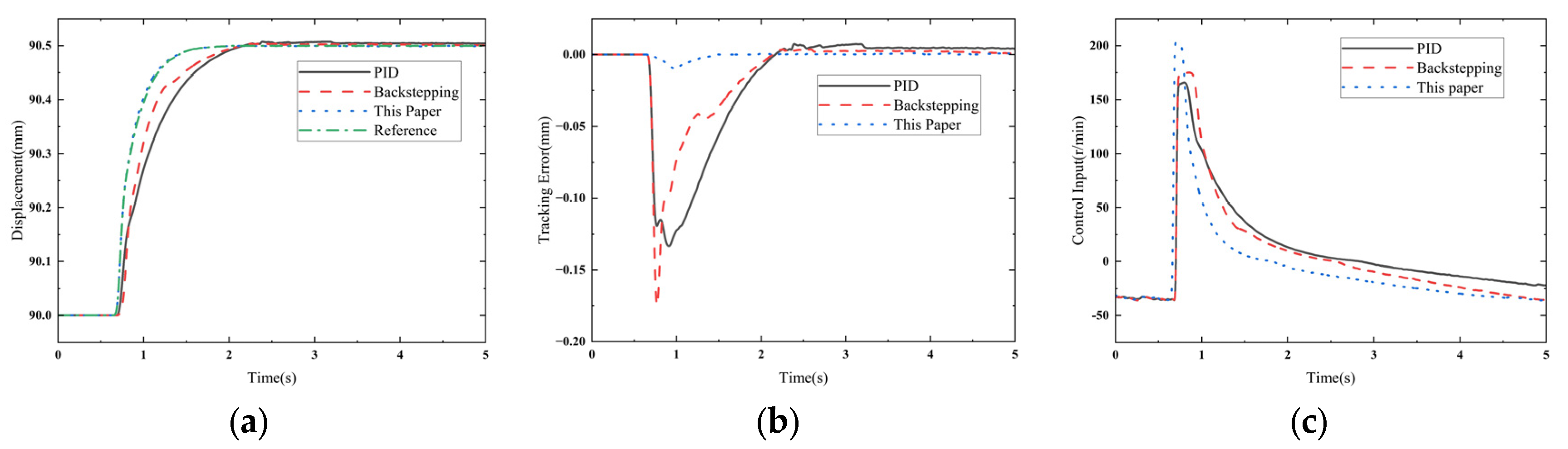
Based on the lithium battery pole piece rolling mill pump-controlled AGC system experimental platform, this section will verify the effectiveness of the proposed adaptive backstepping control method considering input dead zone and friction. The gains of the backstepping controller are selected as k 1 = 12 , k 2 = 25 , and k 3 = 41 . The adaptive gains and sliding-mode observer gains are selected as μ 0 = 0.01 , λ 1 = 13 , δ 0 = 0.05 , δ 1 = 0.03 , δ 2 = 0.08 , γ 1 = 0.02 , γ 2 = 0.04 , γ 3 = 0.02 , and γ 4 = 0.05 . PID and traditional backstepping control methods are employed for comparison with the method proposed in this paper. In the first experiment, a 0.5 mm step-up reference signal is given, and the system’s tracking trajectory, tracking error, and control input are presented in Figure 5.
In Figure 5a, the trajectory tracking curve of the method proposed in this paper almost completely overlaps with the reference trajectory. It achieves precise tracking 0.5 s ahead of the PID control method and 0.3 s ahead of the traditional backstepping method, which fully demonstrate its rapid response and high-precision fitting capabilities for complex trajectories. The tracking error curve in Figure 5b shows that the peak error of the method in this paper is only 0.02 mm, far lower than the 0.18 mm of PID control and the 0.14 mm of the traditional backstepping method. Furthermore, at t = 2 s, the error has converged to within ±0.001 mm, while PID control still has a steady state deviation of 0.1 mm at t = 3 s, and the traditional backstepping method has an error of 0.08 mm at t = 2.5 s. This indicates that the method has significant advantages in suppressing dynamic errors and ensuring steady state accuracy. Figure 5c shows the variation in the control input. It can be seen that the method proposed in this paper has a faster response speed and a higher peak, which is due to the consideration of the input dead zone and friction of the system.
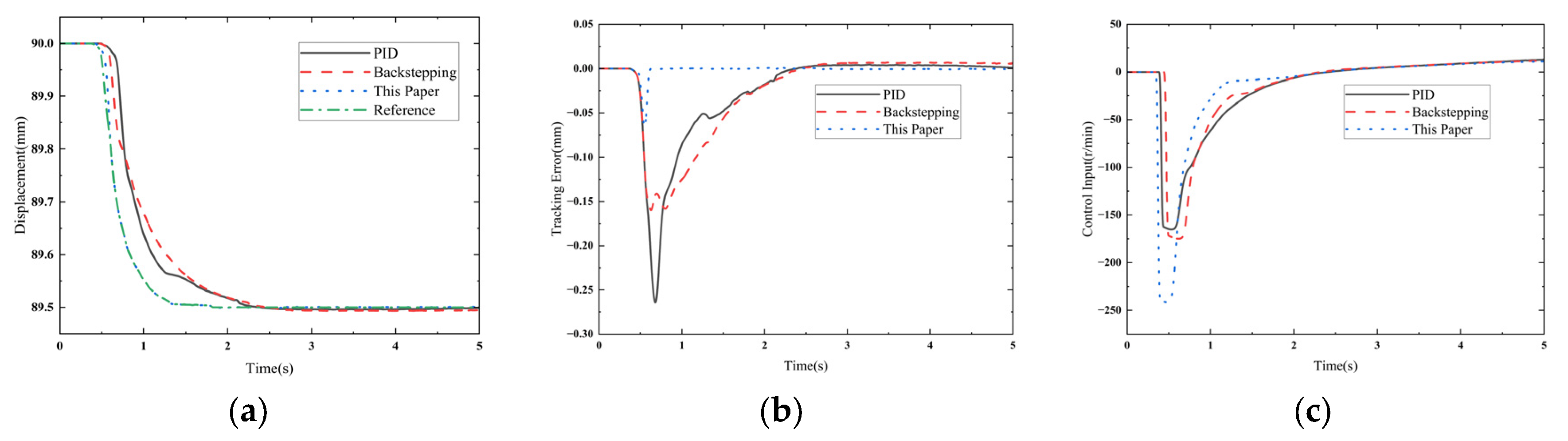
In the second experiment, a 0.5 mm step-down reference signal is given, and the system’s tracking trajectory, tracking error, and control input are presented in Figure 6.
In Figure 6a, the trajectory tracking curve of the method proposed in this paper almost completely overlaps with the reference trajectory. It achieves precise tracking 1.5 s ahead of PID and the traditional backstepping control method, which fully demonstrate its rapid response and high-precision fitting capabilities for complex trajectories. The tracking error curve in Figure 6b shows that the peak error of the method in this paper is only ±0.01 mm, far lower than the 0.27 mm of PID control and the 0.17 mm of the traditional backstepping method. Furthermore, at t = 2.2 s, the error has converged to within ±0.001 mm, while PID control still has a steady state deviation of 0.1 mm, and traditional backstepping method has an error of 0.08 mm. This indicates that the method has significant advantages in suppressing dynamic errors and ensuring steady state accuracy. Figure 6c shows the variation in the control input. It can be seen that the method proposed in this paper has a faster response speed and a higher peak, which is due to the consideration of the input dead zone and friction of the system.
In summary, through comparisons with the PID control and traditional backstepping control, the adaptive backstepping control method considering the input dead zone and friction proposed in this paper exhibits significant advantages in trajectory tracking accuracy, error stability, and control input smoothness, effectively verifying its control effectiveness in such pump-controlled AGC systems.

5. Conclusions

This paper focuses on the challenges of input dead-zone nonlinearity and hydraulic cylinder friction in the pump-controlled AGC position control system for lithium battery pole piece rolling mills, which seriously restrict the rolling precision and system stability. To solve these problems, systematic research has been carried out from model establishment and controller design to experimental verification. Experimental results on the lithium battery pole piece rolling mill platform fully verify the effectiveness and superiority of the proposed method. Compared with the traditional PID control and traditional backstepping control methods, the proposed control method shows significant advantages in trajectory tracking performance: in both 0.5 mm step-up and step-down experiments, it achieves precise tracking 0.3 s–1.5 s earlier, with the peak tracking error reduced to only 0.01 mm–0.02 mm, and the steady state error converges to within ±0.001 mm in a short time. In addition, the control input of the proposed method has better smoothness and faster response speed, which effectively suppresses dynamic errors and improves the system’s anti-disturbance ability.
The application of the electro-hydraulic servo pump-controlled system in the lithium battery pole piece rolling AGC system not only reduces the equipment floor space but also improves energy utilization efficiency, providing a new technical solution for the high-precision rolling of lithium battery pole pieces. Future research may extend the current method to multi-cylinder cooperative control systems, incorporate intelligent learning algorithms for faster parameter convergence, and explore its applicability in other high-precision industrial hydraulic actuation systems.

Author Contributions

Conceptualization, G.Q. and G.C.; methodology, G.Q.; software, G.Q.; validation, G.Q., Y.H. and G.C.; formal analysis, G.Y.; investigation, G.C.; resources, G.Y.; data curation, Y.C.; writing—original draft preparation, G.Q.; writing—review and editing, Y.H.; visualization, G.Q.; supervision, G.C.; project administration, G.Y.; funding acquisition, G.C. All authors have read and agreed to the published version of the manuscript.

Funding

This research was funded by National Natural Science Foundation of China, grant number 52275066; ‘Tianchi Talent’ Introduction Programme, grant number 2024XGYTCYC02; Major Science and Technology Projects of the 12th Division Science and Technology Bureau of Xinjiang Production and Construction Corps in 2022, grant number SRS2022003; Natural Science Foundation of Xinjiang Uygur Autonomous Region, grant number 2025D01E18; National Key Laboratory of Metal Forming Technology and Heavy Equipment, grant number SKLMF-2025-025.

Institutional Review Board Statement

Not applicable.

Informed Consent Statement

Not applicable.

Data Availability Statement

The original contributions presented in the study are included in the article, further inquiries can be directed to the corresponding author.

Conflicts of Interest

Author Yao Chen was employed by the company Shougang Jingtang United Iron & Steel Co., Ltd. The remaining authors declare that the research was conducted in the absence of any commercial or financial relationships that could be construed as a potential conflict of interest.

References

  1. Holechek, J.L.; Geli, H.M.E.; Sawalhah, M.N.; Valdez, R. A Global Assessment: Can Renewable Energy Replace Fossil Fuels by 2050? Sustainability 2022, 14, 4792. [Google Scholar] [CrossRef]
  2. Whittingham, M.S. Lithium batteries and cathode materials. Chem. Rev. 2004, 104, 4271–4302. [Google Scholar] [CrossRef] [PubMed]
  3. Meng, J.; Zhang, F.; Zhang, L.; Liu, L.; Chen, J.; Yang, B.; Yan, X. Rolling up MXene sheets into scrolls to promote their anode performance in lithium-ion batteries. J. Energy Chem. 2020, 46, 256–263. [Google Scholar] [CrossRef]
  4. Zhang, L.; Zhu, C.; Yu, S.; Ge, D.; Zhou, H. Status and challenges facing representative anode materials for rechargeable lithium batteries. J. Energy Chem. 2022, 66, 260–294. [Google Scholar] [CrossRef]
  5. Liu, Y.; Wang, C.; Yang, S.; Cao, F.; Ye, H. 3D MXene architectures as sulfur hosts for high-performance lithium-sulfur batteries. J. Energy Chem. 2022, 66, 429–439. [Google Scholar] [CrossRef]
  6. Yu, W.; Deng, N.; Cheng, K.; Yan, J.; Chen, B.; Kang, W. Advances in preparation methods and mechanism analysis of layered double hydroxide for lithium-ion batteries and lithium-sulfur batteries. J. Energy Chem. 2021, 58, 472–499. [Google Scholar] [CrossRef]
  7. Xu, S.; Zhao, T.; Wang, L.; Huang, Y.; Ye, Y.; Zhang, N.; Feng, T.; Li, L.; Wu, F.; Chen, R. Endoplasmic-reticulum-like catalyst coating on separator to enhance polysulfides conversion for lithium-sulfur batteries. J. Energy Chem. 2022, 67, 423–431. [Google Scholar] [CrossRef]
  8. Qian, C.; Wang, Y.; Hua, C.; Park, K.S. Stability and stabilization for the hydraulic automatic gauge control system of cold rolling mill with time delay and saturation. J. Franklin Inst. 2024, 361, 107050. [Google Scholar] [CrossRef]
  9. Li, S.; Zhang, Z.; Du, H.; Zheng, G.; Zhang, X.; Li, Z. Design and verification of a novel energy-efficient pump-valve primary-auxiliary electro-hydraulic steering system for multi-axle heavy vehicles. Energy 2024, 312, 133473. [Google Scholar] [CrossRef]
  10. Helian, B.; Chen, Z.; Yao, B. Precision motion control of a servomotor-pump direct-drive electrohydraulic system with a non-linear pump flow mapping. IEEE Trans. Ind. Electron. 2019, 67, 8638–8648. [Google Scholar] [CrossRef]
  11. Hao, Y.; Quan, L.; Qiao, S.; Xia, L.; Wang, X. Coordinated control and characteristics of an integrated hydraulic–electric hybrid linear drive system. IEEE/ASME Trans. Mechatron. 2021, 27, 1138–1149. [Google Scholar] [CrossRef]
  12. Liang, Q.; Cai, Y.; Song, J.; Wang, B. Extended state observer-based adaptive dynamic surface prescribed performance control for electro-hydraulic actuators with uncertainties. ISA Trans. 2025, 157, 603–619. [Google Scholar] [CrossRef] [PubMed]
  13. Stosiak, M.; Karpenko, M.; Skačkauskas, P.; Deptuła, A. Identification of pressure pulsation spectrum in a hydraulic system with a vibrating proportional valve. J. Vib. Control 2024, 30, 4917–4930. [Google Scholar] [CrossRef]
  14. Helian, B.; Chen, Z.; Yao, B.; Lyu, L.; Li, C. Accurate motion control of a direct-drive hydraulic system with an adaptive nonlinear pump compensation. IEEE/ASME Trans. Mechatron. 2020, 26, 2593–2603. [Google Scholar] [CrossRef]
  15. Glueck, T.; Lobe, A.; Trachte, A.; Bitzer, M.; Kemmetmuller, W. Hybrid control of hydraulic directional valves: Integrating physics-based and data-driven models for enhanced accuracy and efficiency. ISA Trans. 2025, 157, 280–292. [Google Scholar] [CrossRef]
  16. Jiang, S.; Shen, H.; Cheng, C. Finite-time command filtered electro-hydraulic system position control with dead zone. Appl. Math. Model. 2024, 131, 190–204. [Google Scholar] [CrossRef]
  17. Zhang, Z.; Guo, Y.; Gong, D.; Zhu, S. Improved extended state observer-based global sliding-mode finite-time control for displacement tracking of a hydraulic roofbolter. Nonlinear Dyn. 2023, 111, 11191–11203. [Google Scholar] [CrossRef]
  18. Wang, T.; Zhang, Q.; Fang, J.; Lai, Z.; Feng, R.; Wei, J. Active fault-tolerant control for the dual-valve hydraulic system with unknown dead-zone. ISA Trans. 2024, 145, 399–411. [Google Scholar] [CrossRef]
  19. Zhao, L.; Cheng, H.; Zhang, J.; Xia, Y. Adaptive control for a motion mechanism with pneumatic artificial muscles subject to dead-zones. Mech. Syst. Signal Process. 2021, 148, 107155. [Google Scholar] [CrossRef]
  20. Sun, Z.; Zhang, K.; Chen, C.; Meng, Q. Robust output feedback control of time-delay nonlinear systems with dead-zone input and application to chemical reactor system. Nonlinear Dyn. 2022, 109, 1617–1627. [Google Scholar] [CrossRef]
  21. Ma, H.; Li, Y. A novel dead zone reaching law of discrete-time sliding mode control with disturbance compensation. IEEE Trans. Ind. Electron. 2019, 67, 4815–4825. [Google Scholar] [CrossRef]
  22. Wang, J.; Cui, Y. Adaptive neural network tracking control for robotic manipulator with input dead zone and function constraints on states. Nonlinear Dyn. 2025, 113, 13277–13295. [Google Scholar] [CrossRef]
  23. Liu, Z.; Liu, J.; Zhang, O.; Zhao, Y.; Chen, W.; Gao, Y. Adaptive disturbance observer-based fixed-time tracking control for uncertain robotic systems. IEEE Trans. Ind. Electron. 2024, 71, 14823–14831. [Google Scholar] [CrossRef]
  24. Xu, R.; Liu, J.; Lin, X.; Cai, S.; Liu, Z.; Gao, Y.; Wu, L. Adaptive Fixed-Time Control for Permanent Magnet Synchronous Motors With Unknown Disturbances. IEEE Trans. Power Electron. 2025, 41, 291–302. [Google Scholar] [CrossRef]
  25. Sun, Y.; Liu, J.; Gao, Y.; Liu, Z.; Zhao, Y. Adaptive neural tracking control for manipulators with prescribed performance under input saturation. IEEE ASME Trans. Mechatron. 2022, 28, 1037–1046. [Google Scholar] [CrossRef]
  26. Li, J.; Lu, Y.; He, F.; Miao, L. Motion control of hydraulic actuators with nonlinear friction compensation: Applied to variable valve systems of diesel engine. ISA Trans. 2023, 137, 561–573. [Google Scholar] [CrossRef]
  27. Pan, Q.; Zeng, Y.; Li, Y.; Jiang, X.; Huang, M. Experimental investigation of friction behaviors for double-acting hydraulic actuators with different reciprocating seals. Tribol. Int. 2021, 153, 106506. [Google Scholar] [CrossRef]
  28. Jaiswal, S.; Sopanen, J.; Mikkola, A. Efficiency comparison of various friction models of a hydraulic cylinder in the framework of multibody system dynamics. Nonlinear Dyn. 2021, 104, 3497–3515. [Google Scholar] [CrossRef]
  29. Feng, H.; Yin, C.; Cao, D. Trajectory tracking of an electro-hydraulic servo system with an new friction model-based compensation. IEEE/ASME Trans. Mechatron. 2022, 28, 473–482. [Google Scholar] [CrossRef]
  30. Wan, Y.; Yue, W.; Gao, X.; Chen, Q.; Xu, R. Adaptive finite-time prescribed performance tracking control for hydraulic servo systems with friction compensation. Neurocomputing 2024, 564, 126967. [Google Scholar] [CrossRef]
  31. Luo, C.; Yao, J.; Gu, J. Extended-state-observer-based output feedback adaptive control of hydraulic system with continuous friction compensation. J. Frankl. Inst. 2019, 356, 8414–8437. [Google Scholar] [CrossRef]
  32. Feng, H.; Chang, X.; Jiang, J.; Yin, C.; Cao, D.; Li, C.; Xie, J. Friction compensation control method for a typical excavator system based on the accurate friction model. Expert Syst. Appl. 2024, 254, 124494. [Google Scholar] [CrossRef]
Figure 1. Calendering process of lithium-ion battery pole pieces.
Actuators 14 00618 g001
Figure 2. Schematic diagram of the pump-controlled AGC system in the pole piece rolling mill.
Actuators 14 00618 g002
Figure 3. Lithium battery pole piece rolling mill experimental platform.
Actuators 14 00618 g003
Figure 4. Electrical experimental platform for the pump-controlled AGC system.
Actuators 14 00618 g004
Figure 5. Experimental curve of 0.5 mm signal rise. (a) Tracking trajectory; (b) tracking error; and (c) control input.
Actuators 14 00618 g005
Figure 6. Experimental curve of 0.5 mm signal fall. (a) Tracking trajectory; (b) tracking error; and (c) control input.
Actuators 14 00618 g006
Table 1. Pump control AGC system parameters.
ParameterSymbolNumberUnit
Total Compressed Volume V t 3.96739 × 10⁻³ m 3
Effective Cylinder Working Area A c 0.113354 m 2
Total Mass Translated from the Load to the Piston m c 2000 k g
Viscous Damping Coefficient B c 0.0345 N m 1 s
Total Leakage Factor of Hydraulic System C t 9 × 10⁻¹¹ P a 1 s 1 m 3
Effective Volume Modulus of Oil β e 7 × 10⁸ N m 2
Control Gain K m 300 r m i n 1 V 1
Quantitative Pump Displacement D p 19 m l r 1
Disclaimer/Publisher’s Note: The statements, opinions and data contained in all publications are solely those of the individual author(s) and contributor(s) and not of MDPI and/or the editor(s). MDPI and/or the editor(s) disclaim responsibility for any injury to people or property resulting from any ideas, methods, instructions or products referred to in the content.