Article

Design and Implementation of a Quick-Change End-Effector Control System for Lightweight Robotic Arms in Workpiece Assembly Applications

School of Electronic and Electrical Engineering, Shanghai University of Engineering Science, Shanghai 201620, China
*
Author to whom correspondence should be addressed.
Actuators 2025, 14(12), 619; https://doi.org/10.3390/act14120619
Submission received: 14 November 2025 / Revised: 11 December 2025 / Accepted: 16 December 2025 / Published: 18 December 2025
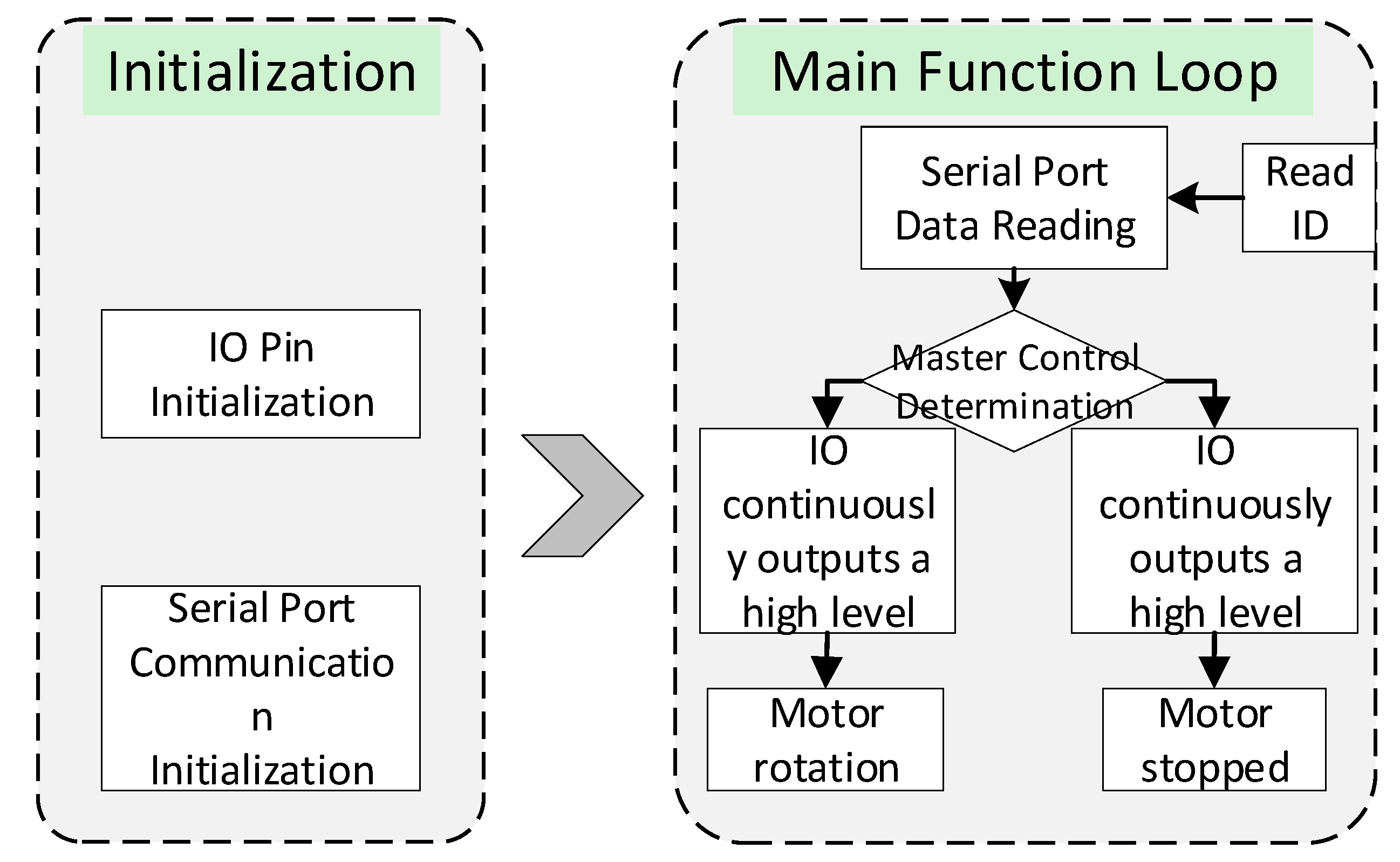
(This article belongs to the Section Actuators for Robotics)

Abstract

This paper presents a lightweight end-effector quick-change control system for robotic arms, designed for scenarios such as workpiece assembly that require rapid switching between multiple end-effectors. The system utilizes a proprietary quick-change mechanism as its hardware foundation. Its main disk employs a modular and lightweight design compatible with small collaborative robots like the UR3. Motor-driven claws enable automatic tool locking and unlocking. To unify control interfaces for heterogeneous motor-driven tools, this paper proposes a universal peripheral adapter circuit based on the RS485 bus and a tool ID recognition mechanism, establishing a standardized four-wire interface for multi-tool sharing. At the control level, embedded control programs were developed for both the quick-change device and the tool end. An upper-level control platform based on ROS and MoveIt was established to achieve automatic quick-change and task sequence control during typical robotic operations such as “drilling-assembly workpiece.” Statistics from 20 locking time and communication success rate tests, along with 30 complete assembly experiments, demonstrate that the average quick-change locking time is 1.81 s, communication success rate is 100%, and a 93.3% assembly process success rate. These results validate the feasibility and stability of the proposed lightweight robotic arm end-effector quick-change control system in workpiece assembly scenarios, providing an expandable and reproducible quick-change control solution for multi-task operations of lightweight robotic arms.

1. Introduction

In the aerospace sector, many operations are performed inside aircraft or beneath wings, typically requiring the use of collaborative arms with lower payloads or lightweight industrial arms. These systems switch between various tools to efficiently complete tasks. For instance, aircraft assembly processes encompass numerous steps such as drilling, grinding, and riveting, each requiring distinct end-of-arm tools [1,2]. Similar scenarios such as equipment manufacturing, electronic assembly, and general industrial production also require large quantities. Consequently, research into lightweight quick-change devices for robotic end-of-arm tools has become particularly crucial [3].
Existing robotic end-effector quick-change technologies are primarily categorized into pneumatic, hydraulic, and electric types. Pneumatic and hydraulic quick-change devices have achieved mature application in industrial robots. However, due to their reliance on external air or hydraulic power sources, the mechanisms driving these quick-change systems feature complex structures and relatively large dimensions [4,5,6,7].
Purely mechanical quick-change systems rely on structures such as mechanical latches, cams, wedges, or threads to achieve rapid tool changes for similar tools like cutting tools. While structurally simple, they offer low automation levels. For example, in quick-change devices designed for multiple tool-changing scenarios, during the process of switching between different tools, since these tools do not require additional electrical control modules, mechanical latches enable rapid docking and undocking between the main disk and the tool end, thereby accomplishing the automatic switching task for a single tool [8].
Electric quick-change mechanisms require no hydraulic or pneumatic power sources, facilitating integrated control and making them suitable for lightweight and collaborative robotic arms. In recent years, lightweight or fully electric quick-change products tailored for low-load robotic arms (such as OnRobot Quick Changer, Gimatic EQC-E, Zimmer HEK-E, Radcoll RS-E, etc.) have been commercialized. Some models also integrate electrical feed-throughs and standard flange interfaces. However, such systems predominantly employ closed-loop hardware and proprietary control protocols tailored to specific tools or processes, making secondary development and unified management challenging in heterogeneous tooling scenarios [9,10,11,12]. Meanwhile, some electric grippers (e.g., Robotiq Hand-E) utilize RS485 bus control but remain primarily designed for single end-effectors rather than multi-tool quick-change systems [13]. In tool-changing solutions for CNC engraving machines, the relatively uniform tool types limit the electrical control system’s applicability to other heterogeneous tools [14]. The MEES system proposed by Li et al. primarily targets tool switching scenarios with unified electrical interfaces, and its compatibility verification for tools with significantly different connection methods remains insufficient [15]. Overall, published academic research on electric quick-change systems predominantly focuses on mechanical design and prototype experimentation [14,15,16]. Implementation details for engineered products remain largely internal to companies, lacking open, reproducible descriptions of control and communication architectures.
In summary, mature quick-change devices in engineering applications have long been dominated by pneumatic or hydraulic products, requiring additional air or hydraulic power sources and featuring relatively complex structures. Purely mechanical mechanisms, while structurally simple, offer limited automation capabilities [4,5,6,7]. Regarding all-electric quick-change solutions for lightweight and collaborative robotic arms, while several commercial products have emerged [9,10,11,12], they generally lack unified communication buses and open control interfaces for diverse heterogeneous tools, resulting in limited scalability and universality. Concurrently, research has begun exploring reconfigurable end effectors, modular interfaces, and universal end platforms to enhance assembly task flexibility and adaptability [17,18,19,20]. However, most efforts remain focused on mechanical interface design or specific task scenarios, with insufficient support for system-level communication and control integration for multiple heterogeneous tools. At the level of publicly available academic research, there remains a lack of integrated control and communication systems specifically designed for lightweight robotic arms, multi-tool quick-change mechanisms, and unified electrical interfaces. Furthermore, the payload capacity of lightweight collaborative robotic arms typically ranges only from 3 to 5 kg, necessitating that the quick-change device itself be as lightweight as possible to preserve more payload capacity for the specific task tools [21].
To address the aforementioned shortcomings, this paper designs a quick-change system with high versatility and lightweight characteristics for multi-tool replacement tasks involving lightweight robotic arms in aircraft assembly. This enhances adaptability in complex assembly scenarios. The main innovations of this paper include:
(1)
A multi-tool quick-change control architecture for lightweight robotic arms has been proposed. An integrated control system comprising a quick-change end controller, tool-end adapter module, and host computer software has been established, enabling the robotic arm to automatically switch between various operational tools for task execution.
(2)
To address inconsistent control interfaces for heterogeneous tools, a universal peripheral adapter circuit for motor-driven tools is designed. This circuit converts motor-driven tool signals into a standardized RS485 (Recommended Standard 485) communication protocol, enabling centralized control of multiple end-effectors via a single bus. Additionally, it identifies each tool’s unique ID to achieve corresponding control for tools of varying power ratings.

2. System Architecture Design

In designated work areas on aircraft fuselage skins or wing surfaces, the typical assembly process usually involves two critical steps: first, drilling a set of mounting holes into the structural surface, followed by precisely inserting the workpiece into the holes. To address the complex challenges of assembling large aircraft components while enhancing operational efficiency, both drill bits and grippers are required as end-effectors, equipped with a dedicated quick-change device to facilitate rapid switching between them.
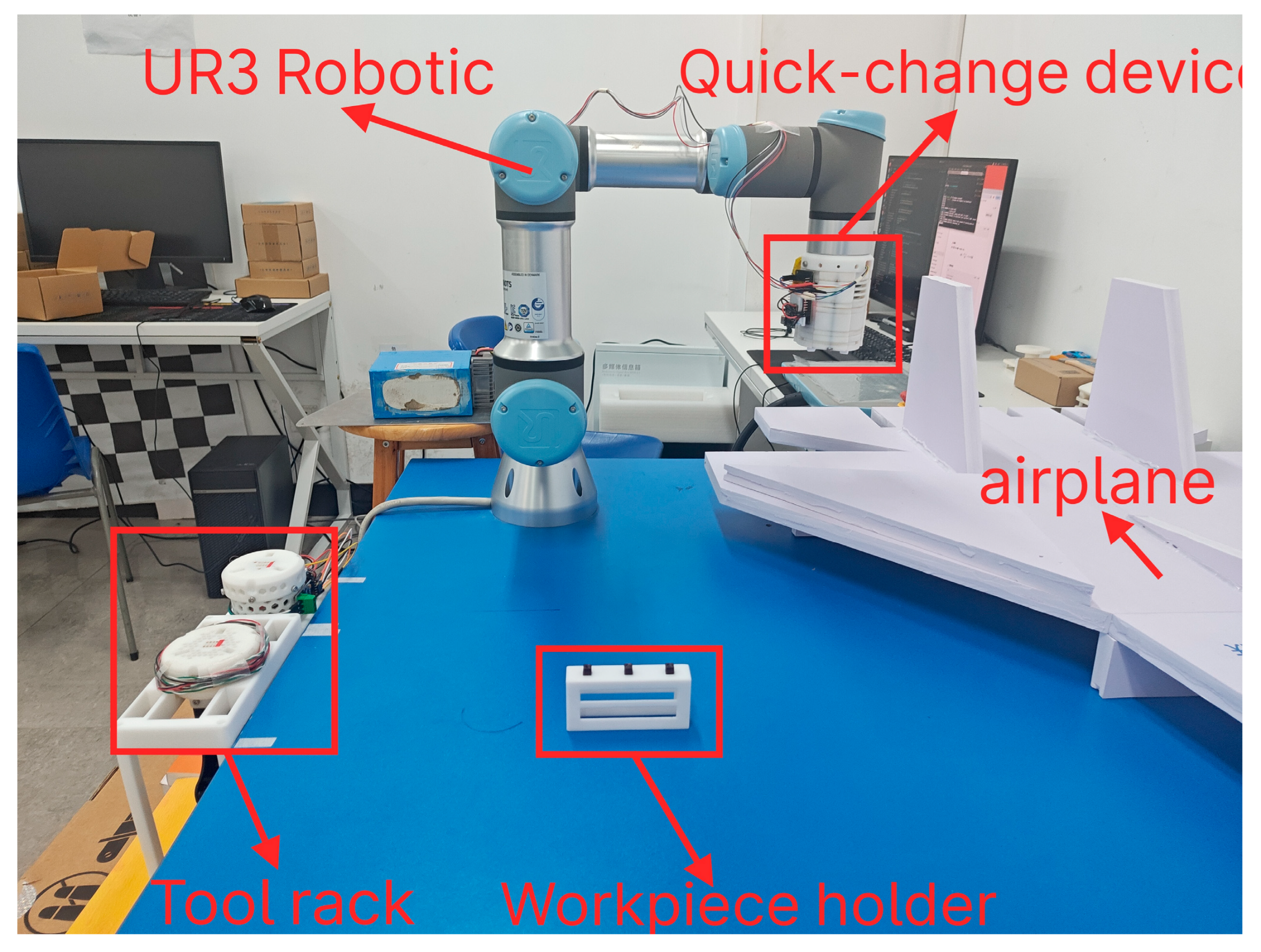
Based on the aforementioned requirements, this paper constructed an integrated experimental platform utilizing the UR3 (Universal Robots Model 3) robotic arm for drilling and inserting workpieces onto aircraft. The experimental platform equipped with the robotic arm’s quick-change system is shown in Figure 1.
The experimental platform primarily consists of a UR3 robotic arm, quick-change device, tool holder, workpiece holder, aircraft, and workbench. Among these components, the UR3 robotic arm and gripper tool utilize commercially available, mature models. The technical specifications of the UR3 robotic arm and the product parameters of the gripper are shown in Table 1 and Table 2.

Quick-Change Hardware Platform Overview

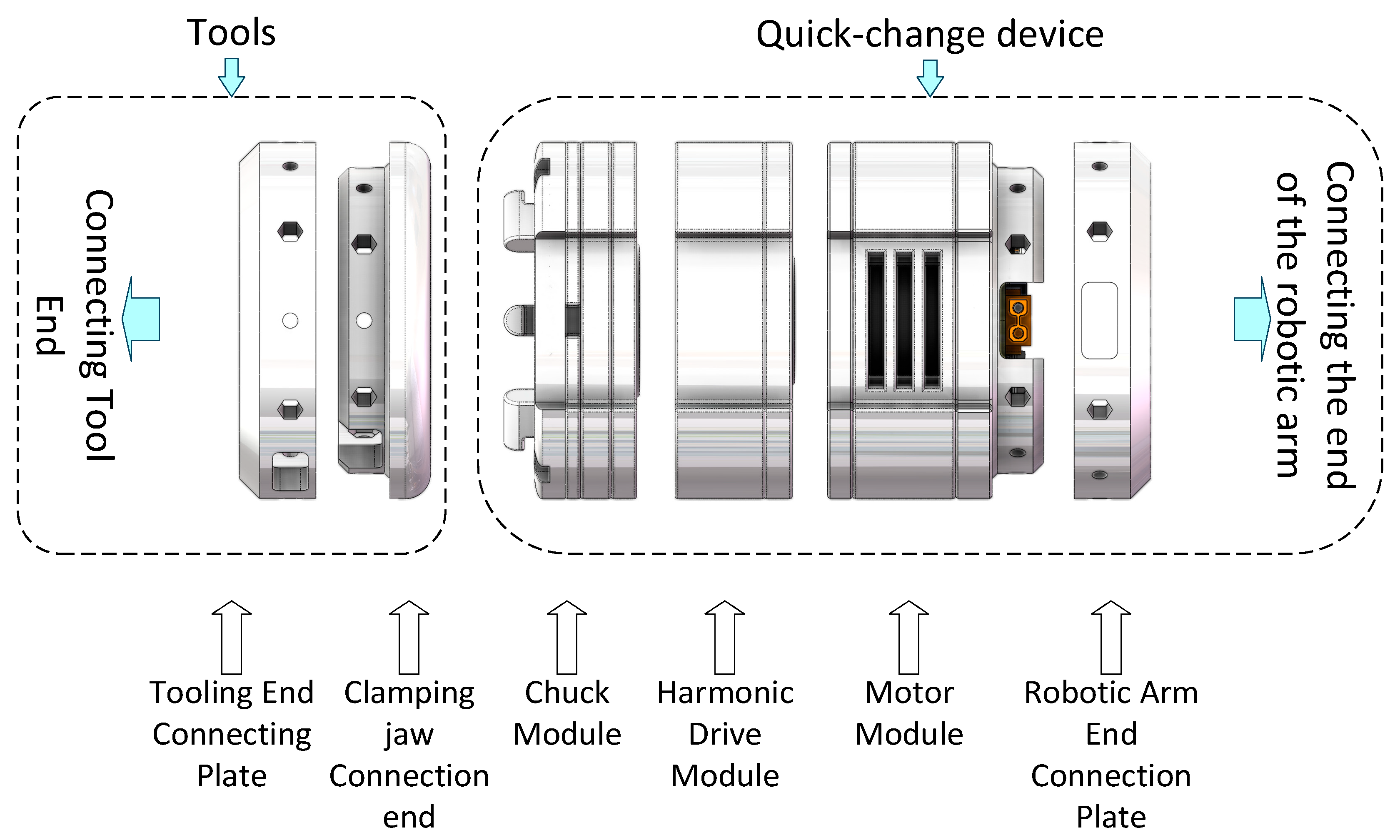
This quick-change system adopts modular architecture, primarily consisting of two major components: the quick-change device and the tool end. The quick-change device incorporates four core components: the robotic arm connection plate, motor module, harmonic drive module, and chuck module. The tool end includes various interchangeable mechanical tools. Taking the gripper tool as an example, it comprises a jaw connection end and a tool connection end. Figure 2 presents an exploded view of the quick-change device and tool structure, clearly illustrating the assembly relationships and spatial layout of each module.
The mechanical interface layout of the quick-change device is as follows: the right end connects to the robotic arm’s end flange via the robotic arm end connection plate, while the left end interfaces with the gripper tool through the chuck module. The tool change process proceeds as follows: During the disengagement phase, the motor drives the internal mechanism of the chuck to rotate, synchronously moving the three jaws to release the constraint on the tool’s jaw connection end. This enables rapid separation between the tool and the chuck module, allowing the robotic arm to immediately unload the current tool. During the loading phase, the robotic arm moves to the new tool’s location, precisely positioning the chuck module’s three jaws to engage the tool’s jaw connection end. The motor reverses rotation to drive the chuck into a locked position, completing the secure installation of the new tool.
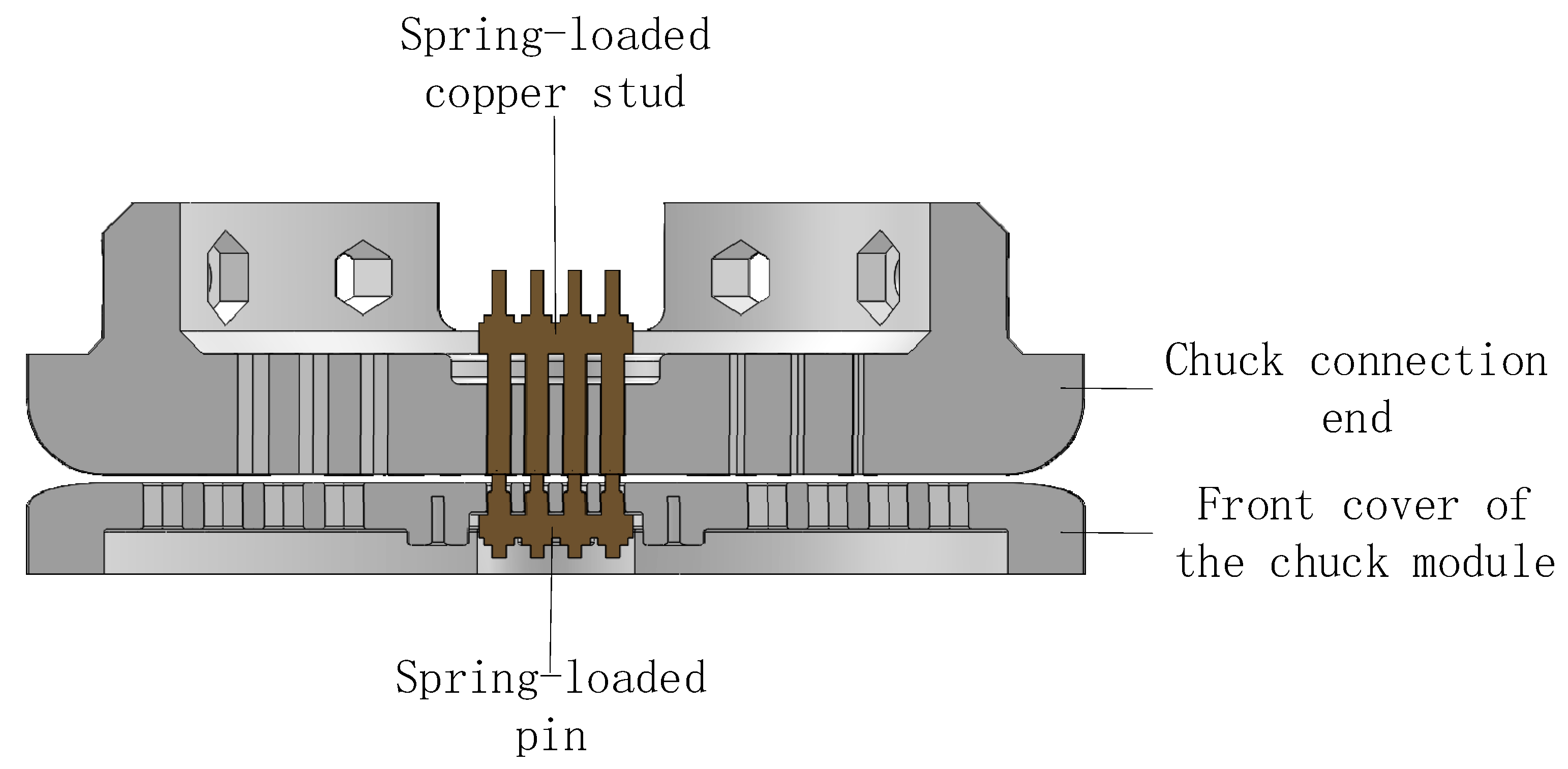
To achieve reliable electrical connectivity between the quick-change device and tool end during frequent separation cycles, this system avoids conventional direct cable connections. Instead, corresponding mating electrical contacts are installed on both the chuck connection end and the front cover of the chuck module. When the chuck mechanism locks, these dual-end contacts form a pathway, ensuring stable transmission of control signals and power to the tool end for normal operation.
Within the quick-change chuck module, electrical connection between the front cover and chuck connection end is achieved via spring-loaded pins and a spring-loaded copper column module. The interface between the robotic arm end and tool end is centrally located within the chuck module. To enhance system reliability, the electrical connection circuitry employs a redundant design. This structure is simple and efficient, capable of meeting the requirements for current transmission below 10 A and low-speed communication signal transmission. The mechanical structure diagram of the electrical connection module is shown in Figure 3.
Additionally, to meet the lightweight design requirements of the quick-change device, both the motor module and harmonic reducer module feature hollow designs to ensure proper electrical connection routing.
For better understanding, the nature and design intent of the experimental platform are explained as follows:
(1)
Platform Positioning: The experimental workstation depicted in Figure 1 is designed for aircraft model assembly, aiming to validate multi-task (drilling, assembly) processes and spatial relationships. It does not represent an industrial production line for actual commercial aircraft fuselages.
(2)
Model Function: The integrated fuselage/wing model depicted is a fixed assembly primarily used to visualize spatial relationships in typical assembly tasks for comprehension purposes. It does not imply actual wing-to-fuselage final assembly at this workstation. The demonstrated “drilling-before-assembly” sequence holds universal applicability in industrial contexts.
(3)
Device Design: The self-developed quick-change device shown in Figure 2 employs photopolymerization 3D printing for rapid prototyping of most white structural components. This design prioritizes rapid construction of a lab-scale functional verification platform to enable efficient iteration and validation of the quick-change control system, interface protocols, and task workflows. It does not pursue ultimate structural strength or service life under industrial conditions.
(4)
Visual Value: This highly visual layout design aids readers in intuitively understanding the multi-tool collaborative assembly process and provides a clear reference for subsequent chapters analyzing the correlation between control logic and physical scenarios.
The focus of this study lies in the design and validation of the quick-change control system. The hardware platform serves solely as an experimental vehicle for implementing the control process; therefore, discussions on the innovation or mechanical properties of the mechanical structure are beyond the scope of this paper.

3. Circuit Design

The electrical components of this quick-change system primarily consist of two major functional modules: the quick-change device control circuit and the tool-end control circuit.

3.1. Quick-Change Device Circuit Design

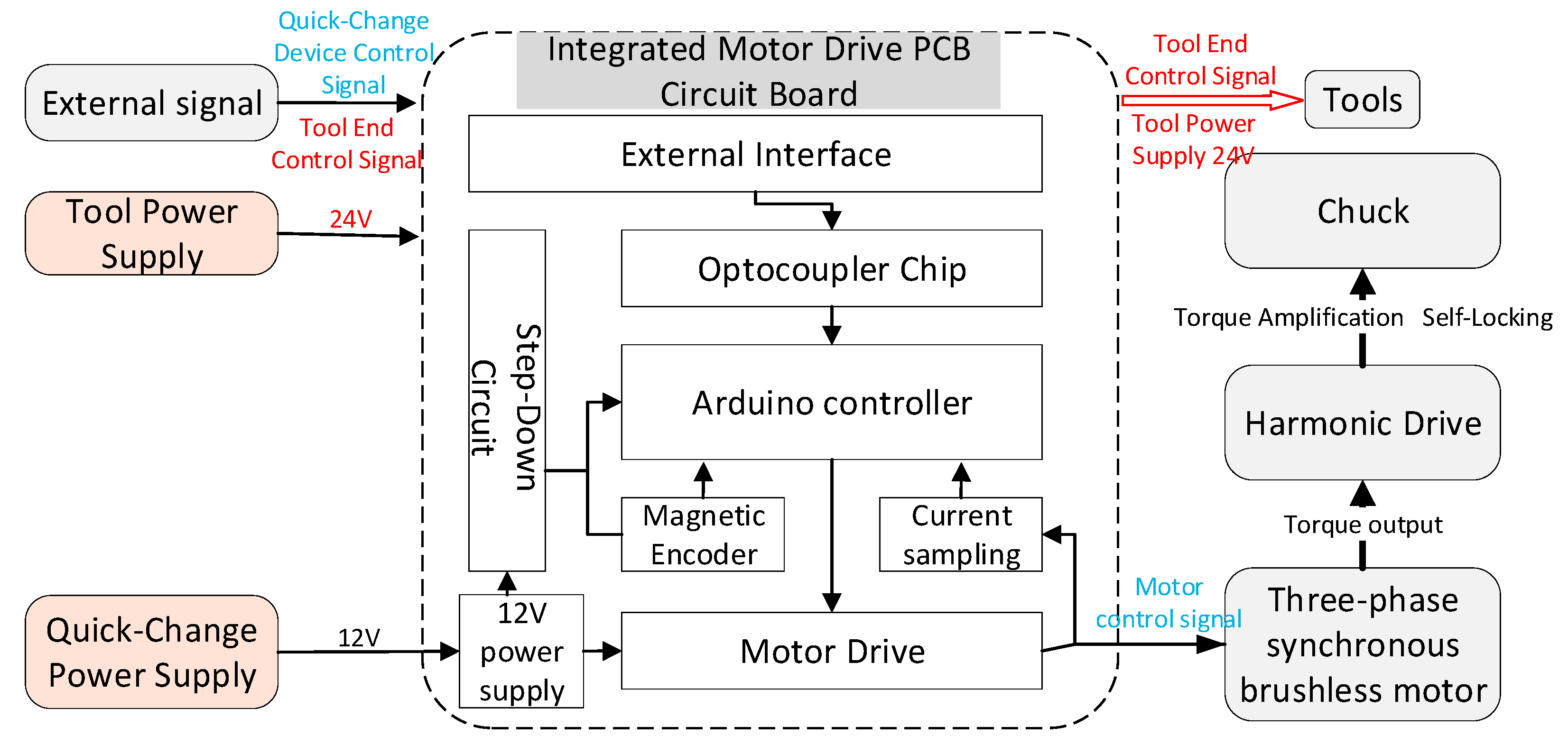
In the quick-change device control circuit, six submodules are integrated to achieve high-precision motor control and system protection: the main control module, external input interface, motor drive unit, magnetic encoder feedback unit, current sampling circuit, and buck power supply. This circuit employs optocouplers to isolate external control signals from the main control unit, transmitting signals to the Arduino main controller. The main controller evaluates command logic to determine whether motor start conditions are met. If drive conditions are satisfied, the motor drive module precisely controls the brushless motor. The control block diagram of the quick-change device is shown in Figure 4.
In Figure 4, the tool-end control signals and the 24 V tool power supply do not pass through the internal circuit board of the motor-drive integrated PCB. This is because they are used to control the tool and are connected to the four spring-loaded pins shown in the electrical connection diagram of Figure 3.

3.2. Tool-End Circuit Design

To ensure rapid tool switching and system compatibility, this design requires unifying the control interfaces for different tools. The selected gripper tool employs a four-wire RS485 communication protocol, enabling direct control via the aforementioned four spring-loaded electrical pins. Consequently, motors in other tools (equipped only with positive and negative power interfaces) must be adapted to the same RS485 control bus.
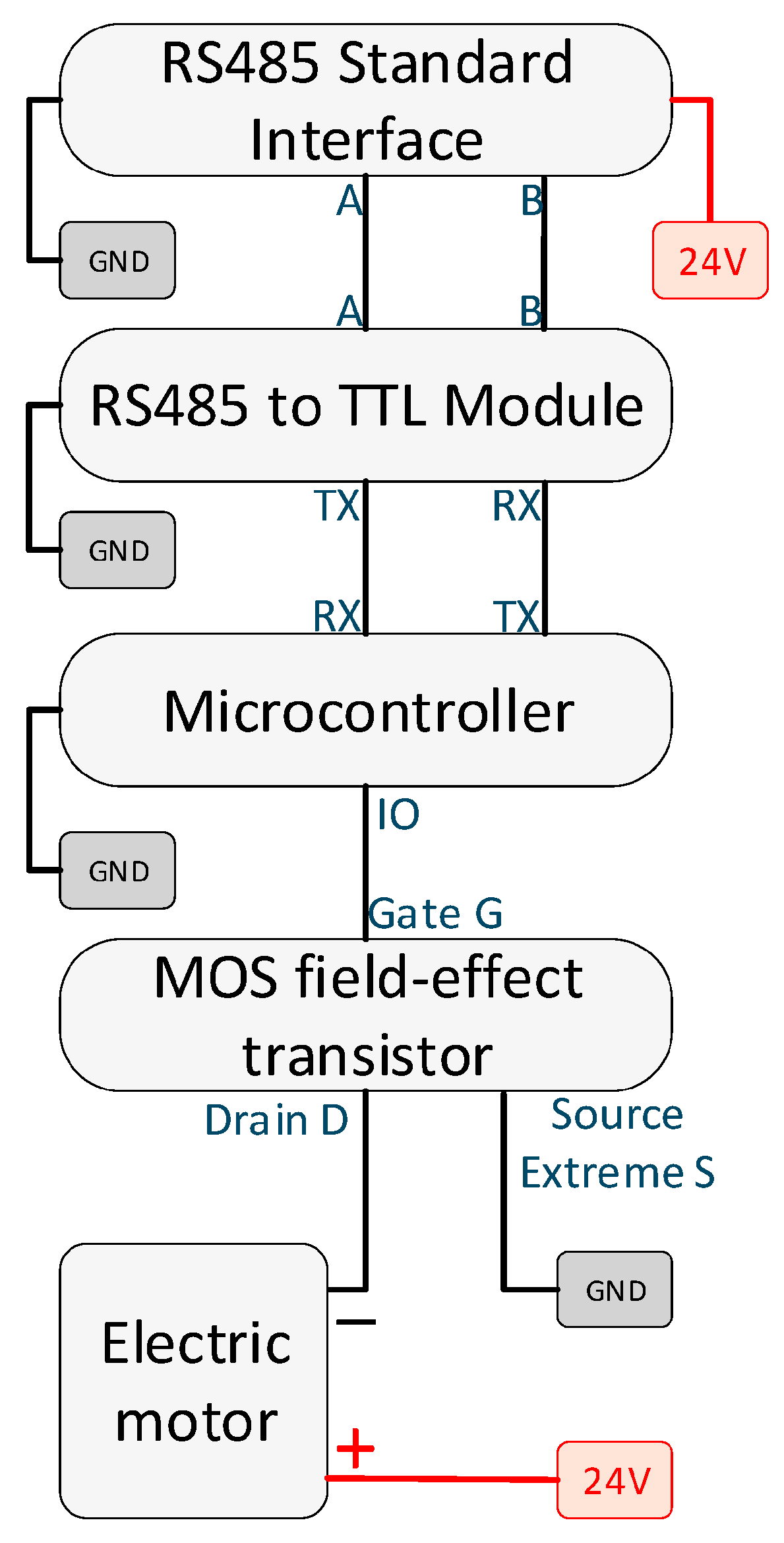
To achieve this objective, this paper proposes an RS485-to-motor-drive-signal conversion solution. This enables precise control over the start/stop functions of the drill motor via the four-wire bus. The specific system architecture is illustrated in Figure 5.
The RS485 standard interface output includes four pins: 24 V positive power supply, GND, A, and B. First, the A and B signals are converted into TTL-level serial signals (TX, RX) via an RS485-to-TTL module for communication with the microcontroller. The microcontroller receives the serial data, parses the communication content, and outputs corresponding IO level signals based on the control commands. This IO signal drives the gate (G) of the MOS field-effect transistor. When the gate is at a high level, the MOS transistor conducts, connecting the drain (D) to the source (S), causing the motor to start rotating. When the gate is at a low level, the MOS transistor turns off, disconnecting the drain from the source, and the motor stops running. The switch drive for the tool-end motor in this paper employs an IRF540NPBF N-channel power MOSFET as the low-side switching device. The drain (D) of the IRF540NPBF is connected in series with the motor circuit, the source (S) is connected to the negative terminal of the system power supply, and the gate (G) is driven by the logic signal output from the controller. By controlling the turn-on and turn-off of the gate-source voltage, the switching control of the motor power supply is achieved. This discrete MOSFET drive solution meets the basic switching requirements of the prototype under rated operating current, enabling verification of the feasibility of the quick-change control process and communication mechanisms. In subsequent designs targeting engineering applications, specialized high-side or low-side driver chips with integrated overcurrent, undervoltage, and reverse connection protection functions can be adopted to enhance system robustness and safety under abnormal operating conditions.

4. Program Design

The program is primarily divided into three parts: quick-change device programming, tool-end programming, and assembly process programming.

4.1. Quick-Change Device Program Design

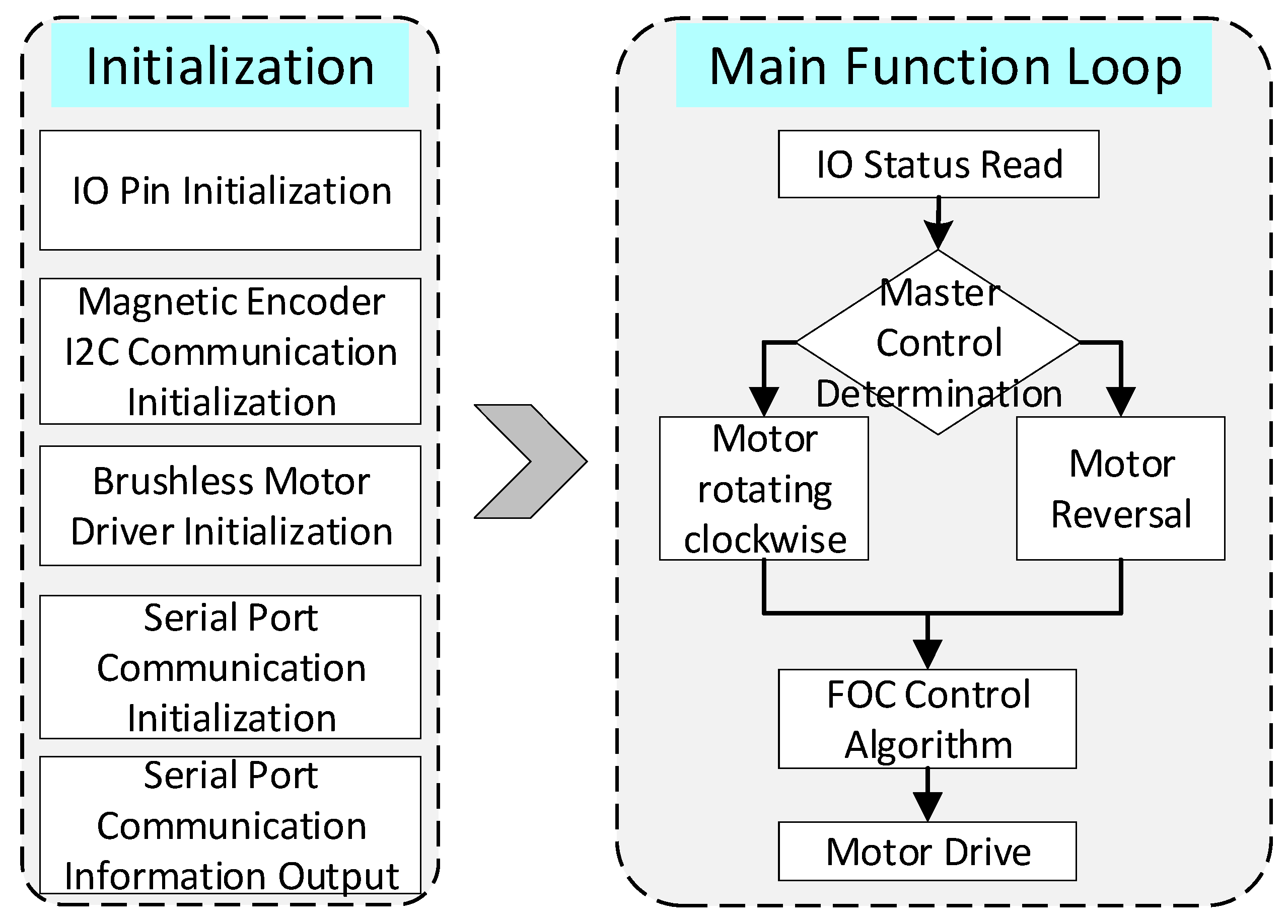
The quick-change device control program’s primary functions are divided into two parts: signal reception and motor control. The signal reception section converts external voltage level signals into IO input signals for the Arduino main control chip. After reading the IO signals, the chip controls the quick-change device’s unlocking and locking processes through the motor control circuit.
The system program logic begins with peripheral initialization and various setup tasks, then enters the main function’s loop structure. Within this loop, the system continuously monitors IO status changes. Upon detecting a valid level transition, it determines the motor rotation direction based on preset logic and generates corresponding control commands. Ultimately, the motor is driven to execute precise rotational motion through the FOC control algorithm. The overall program flow is illustrated in Figure 6.

4.2. Tool-End Program Design

The control program on the tool end adopts a simple polling architecture. After system startup completes the initialization process and reads the ID, it immediately enters the main loop to continuously monitor serial port data. Upon receiving a valid command, the main controller parses the protocol and controls the corresponding GPIO port to continuously output a high or low level, thereby driving the DC motor to rotate or stop. The program logic flow is shown in Figure 7.

4.3. Assembly Process Program Design

After completing the programming for the base quick-change device and drill tools, this paper developed a host computer control program based on the ROS and MoveIt frameworks to achieve a complete assembly process. This program primarily coordinates the robotic arm to sequentially perform tasks such as tool quick-change, drilling, and workpiece installation during the aircraft component assembly process.
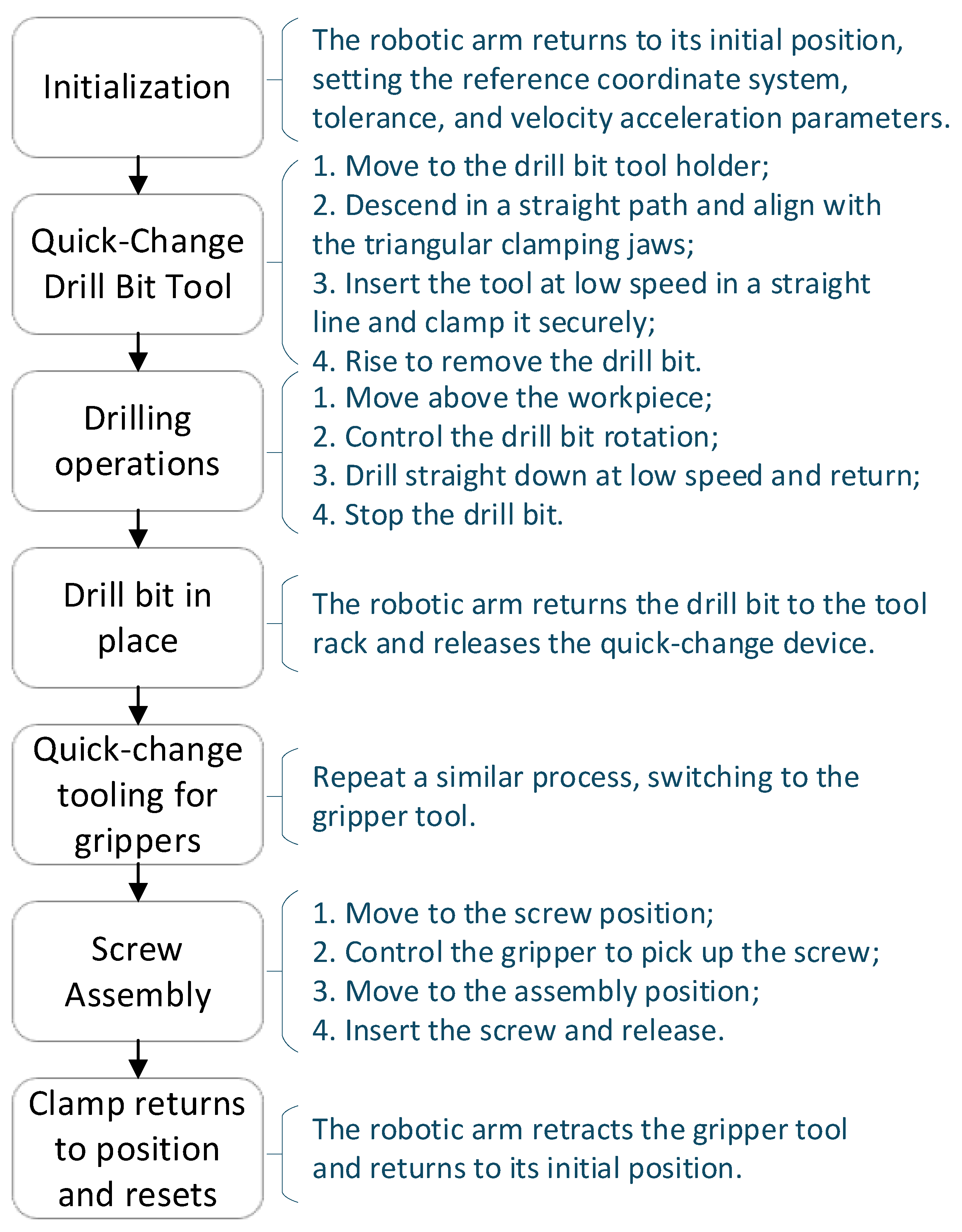
The logic of the main program can be summarized in the steps shown in Figure 8.
The figure above illustrates the overall workflow of the proposed quick-change control system, whose core characteristics distinguish it from existing methods: it integrates robotic arm movement, a unified RS485-based communication interface, and upper-level computer ROS task scheduling into a single complete chain. This enables quick-change execution, tool motion control, and task workflow coordination to be realized within the same unified framework. Unlike conventional single-tool control workflows, this diagram highlights the coupled relationship among three phases: “multi-tool switching,” “tool status verification,” and “task-level sequential execution.” This forms the unique control architecture of the rapid tool change system proposed herein. The workflow not only describes the rapid tool change action itself but also reflects the system’s state transition logic during multi-step operational tasks, aiding in understanding the execution mechanism of the assembly process in subsequent experiments.

5. Experimental Validation and Results

Based on the aforementioned theoretical analysis and system design approach, this paper conducts experimental design to validate the feasibility and adaptability of the proposed quick-change system and its universal motor drive adapter circuit.
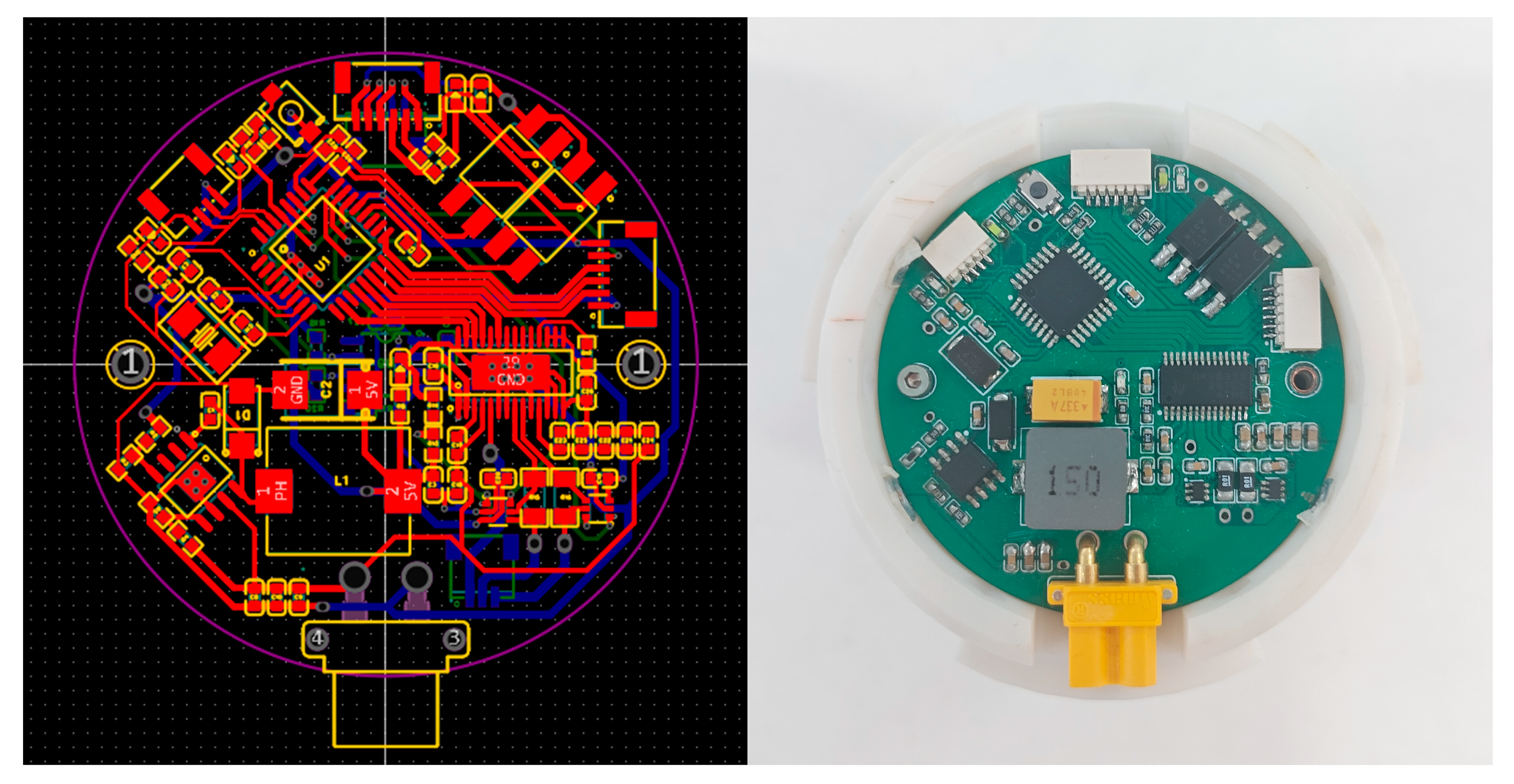
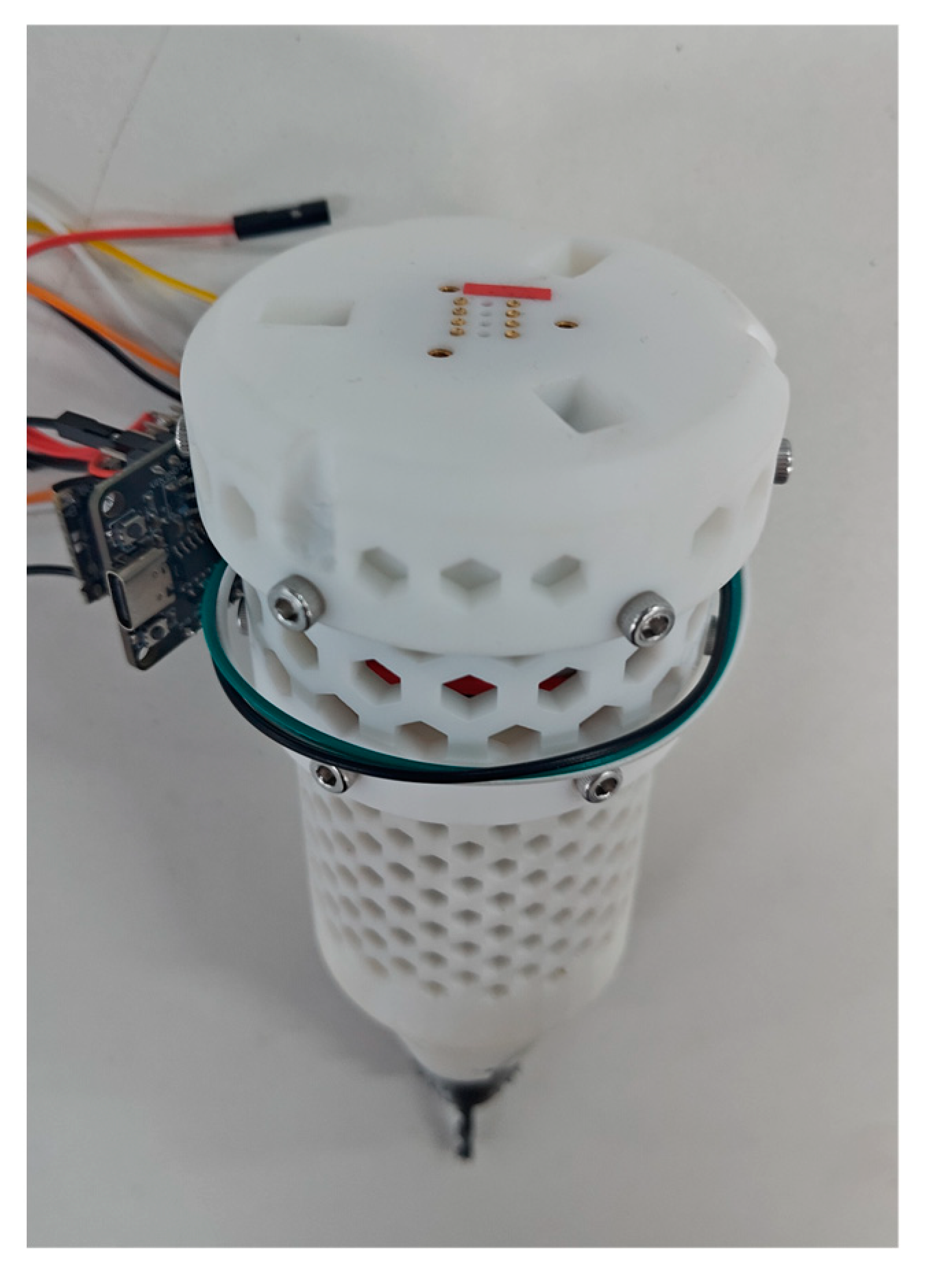
To validate the effectiveness of the universal motor driver and peripheral adaptation circuitry, this paper employs a drill bit tool as an experimental model. The physical drill bit tool is shown in Figure 9. Based on the circuit design methodology proposed in Section 3, the motor driver PCB underwent optimized layout to produce an integrated motor driver circuit board suitable for the quick-change mechanism. Its schematic and physical diagrams are presented in Figure 10.
The left diagram shows the PCB schematic design drawn according to control requirements, illustrating the electrical functional relationships and interface layout of the adapter module. The right diagram depicts the actual circuit board manufactured based on this design. The PCB substrate was manufactured by a professional PCB fabrication facility following the circuit layout in the left diagram. Subsequently, I assembled the components using conventional electronic manufacturing techniques, including soldering the TPS5450 voltage regulator chip, DRV8313 motor driver chip, AS5600 magnetic encoder chip, resistors, capacitors, and other components onto their designated pads using tools such as a soldering iron, solder wire, and hot air gun. The image on the right shows the finished adapter board after soldering. It implements tool-end functions such as RS485 communication, power supply regulation, and motor drive. The two images correspond to the circuit design and actual assembly stages, respectively, collectively illustrating the complete construction process of the adapter module.
This paper validates the system performance through the following three experiments:
(1)
Verifying the feasibility of the motor drive adaptation circuit converting drive signals into the RS485 communication protocol using a drill bit tool as an example;
(2)
Validating the electrical and mechanical connection process between the quick-change device and various end tools;
(3)
Performing an integrated assembly experiment involving drilling and workpiece insertion to evaluate the system’s overall performance and stability in a simulated aircraft assembly environment.

5.1. Experiment 1

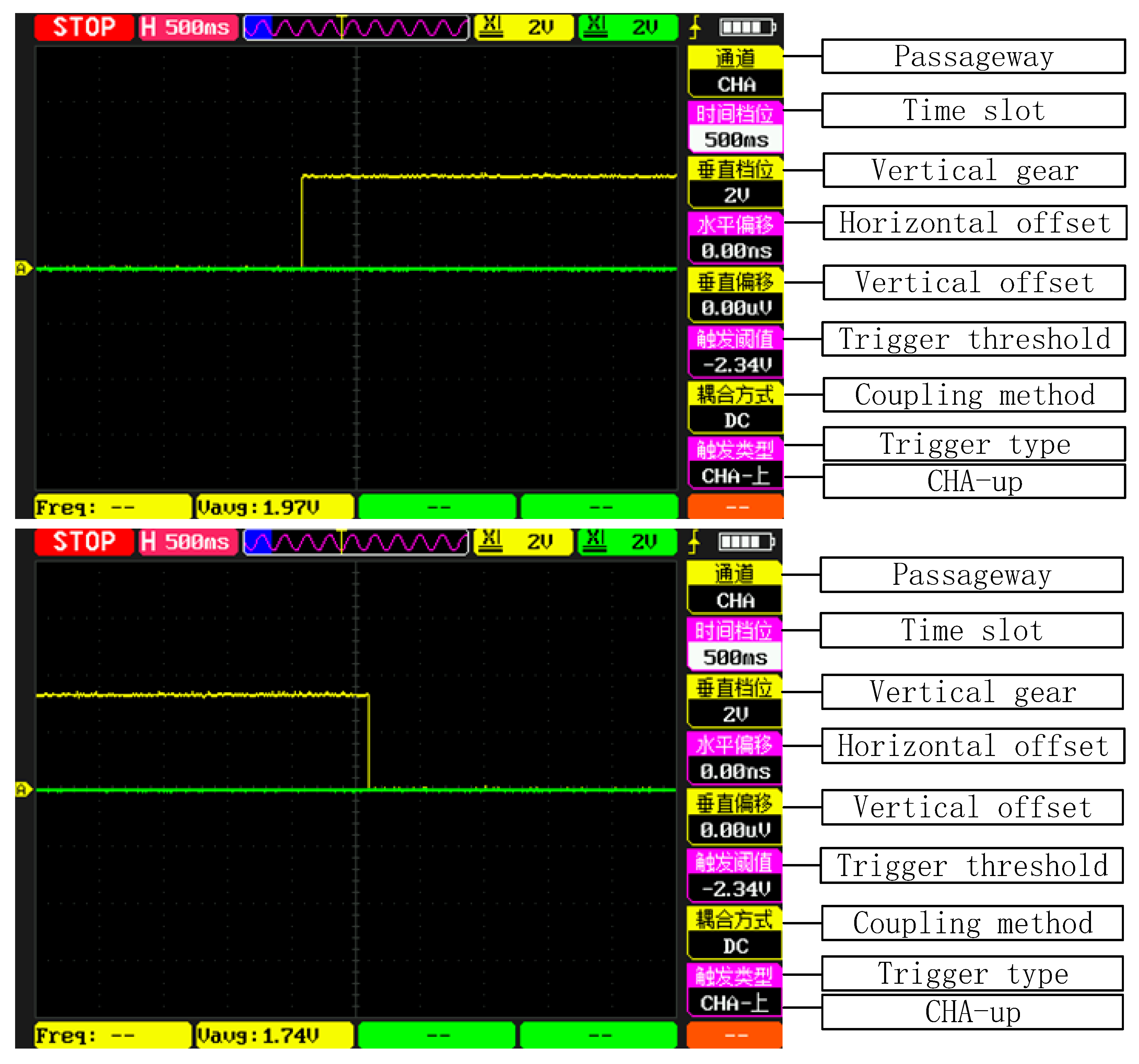
To validate the effectiveness of RS485 communication control, this paper conducted critical tests on signal response characteristics. By sending various commands to the system, changes in the IO port level states were observed. Oscilloscope acquisition results demonstrated that the IO output accurately switches between high and low levels in response to commands, exhibiting rapid response and clear waveforms, thereby verifying the reliability of the communication and control link. Specific test waveforms are shown in Figure 11.
The oscilloscope interface in Figure 11 displays the device’s default Chinese mode. To facilitate understanding of waveform information for readers of different languages, English annotations have been added to the figure. The yellow waveform represents the acquired signal from Channel CH1, while the green waveform represents the acquired signal from Channel CH2. For level acquisition of the I/O port, Channel CH1 is utilized.
Since the signal controlling the drill bit is transmitted from the PC, it passes through multiple intermediate circuits. First, the PC outputs a differential signal via a USB-to-RS485 module. This signal then passes through an RS485-to-TTL module before being output to the microcontroller’s serial port. The microcontroller evaluates the signal and outputs the corresponding GPIO level. The baud rate is set to 115,200 bps across the entire signal transmission chain: PC → USB-RS485 → RS485-TTL → MCU → GPIO.
To measure the delay from PC program execution to the microcontroller GPIO response, this paper simultaneously switches the RTS pin level of the serial module at the critical statement in the PC program. In the experiment, oscilloscope channel CH1 is connected to the RTS pin to mark the moment the PC program executes; channel CH2 is connected to the microcontroller GPIO output pin. By measuring the time difference between the level transition on CH1 and that on CH2, and considering the serial module’s output delay (using a fixed 1 ms module), the complete link delay from PC program execution to MCU pin output is obtained by adding 1 ms to this time difference. Fifteen overall response times were measured, with results shown in Table 3.
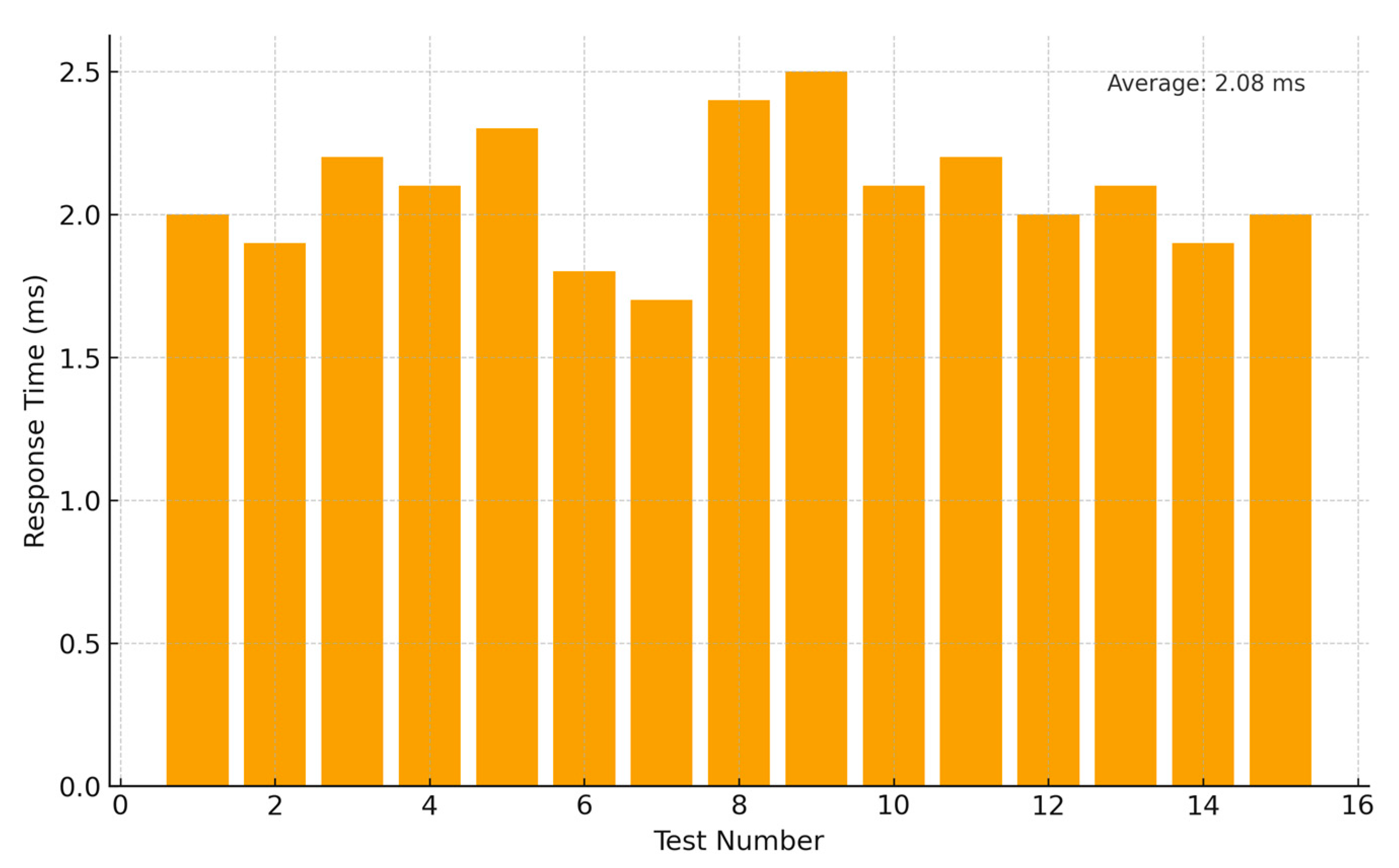
To enhance the readability of response time test data, this paper further plots the response times from 15 tests as a bar chart (see Figure 12). Compared to tabular representations, graphical displays provide a more intuitive visualization of the distribution and fluctuation range of response times.
Based on the average results of 15 independent measurements, the overall system response time is 2.08 ms. This level of latency has a negligible impact on tool operation timing and meets the real-time control requirements for assembly tasks.
In summary, the designed universal peripheral adapter circuit achieves standardized conversion of tool drive signals, resolving the incompatibility issue between different types of motor-driven tools and the RS485 communication interface.

5.2. Experiment 2

Testing the locking and unlocking functions using the IO-controlled quick-change device.
To verify the functional reliability and transmission stability of the designed quick-change device during locking and unlocking operations, the following test environment was established:
(1)
The complete quick-change device assembly, including the motor module, harmonic reducer module, chuck module, etc., is fully assembled and operational.
(2)
The motor drive-control integrated board is powered by a 12 V DC supply with ripple voltage below 100 mV.
(3)
Control signals are input at 3.3 V logic level to trigger the drive-control board to execute commands.
During the quick-change device’s locking process, the motor drive control board drives the brushless motor to rotate at high speed upon receiving the control signal. This rotational speed is converted by the harmonic reducer to produce low-speed, high-torque motion, which in turn slowly rotates the jaw fixing plate within the chuck module. Based on the three-jaw chuck transmission principle described in Section 3.1, the rotation of the fixed plate synchronously drives the three jaws to retract radially and uniformly, achieving reliable locking of the tool end. The unlocking process follows the same principle, but with the motor rotating in the opposite direction, causing the jaws to open radially and enabling smooth separation of the tool.
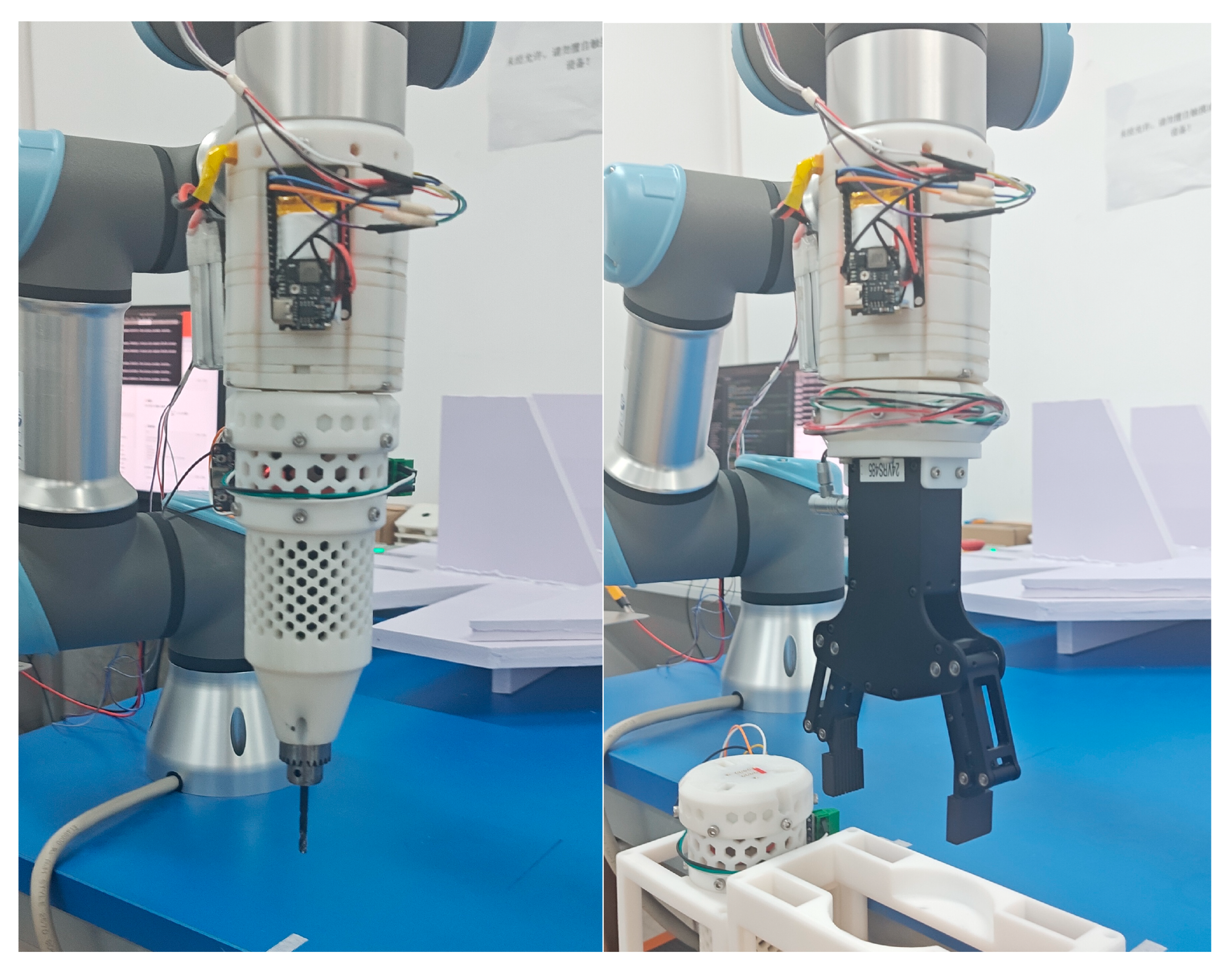
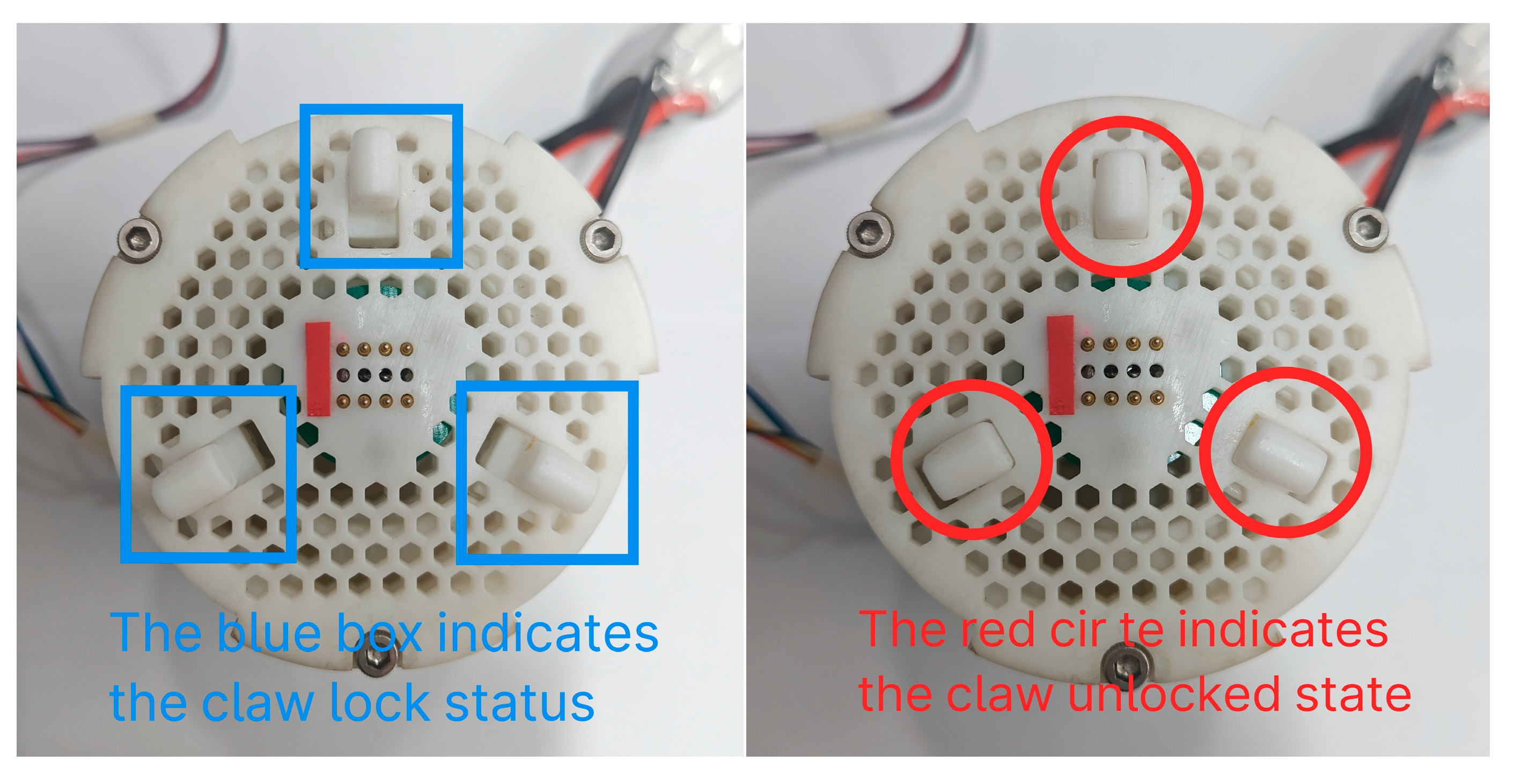
Test results are shown in Figure 13. The left image shows the claw in the locked state, highlighted in blue, while the right image shows the claw in the unlocked state, circled in red. The quick-change device’s locking and unlocking functions operate normally. The chuck module’s locking torque meets the quick-change device’s locking requirements, enabling smooth disengagement from the tool end. Results confirm that the designed quick-change device’s transmission mechanism and control logic are sound, with stable system performance providing a solid foundation for subsequent integrated assembly experiments.
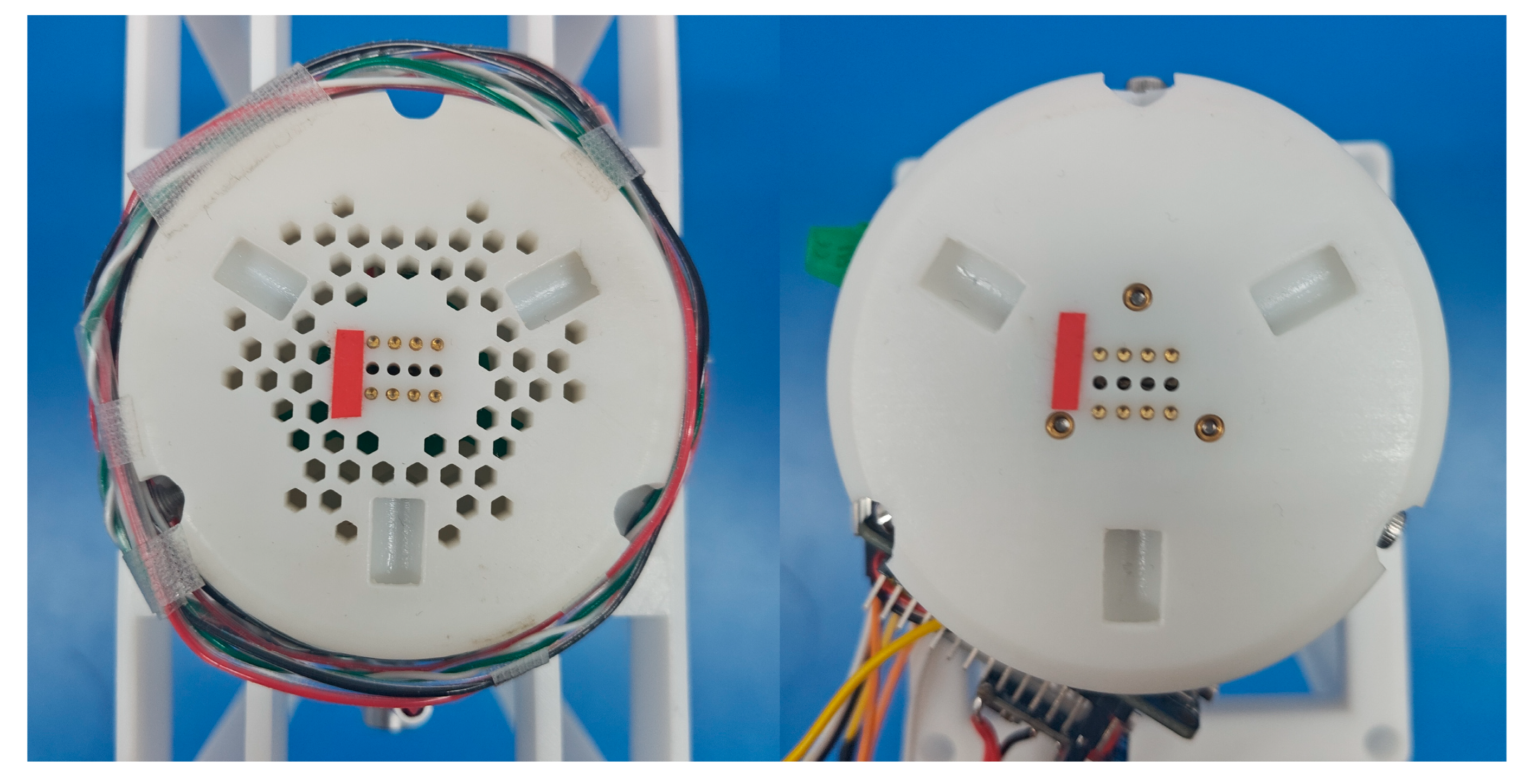
To further validate the mechanical and electrical connection reliability between the quick-change device and the tool end, dedicated docking tests were conducted. Figure 14 illustrates the docking interface structure between the gripper tool, drill tool, and quick-change device, featuring three grooves designed for positioning engagement with the three jaws of the quick-change device. During docking, the grooves are first aligned with the jaws. Subsequently, using the drive method described in Experiment 1, the jaws are controlled to move radially in synchronization, completing the mechanical locking and electrical connection of the tool. The unlocking process achieves simultaneous disengagement of the mechanical and electrical connections by reversing the drive of the jaws.
Electrical connections are established via eight spring-loaded pins on the quick-change device and eight spring-loaded copper columns on the tool end. To enhance connection reliability, the upper and lower rows of contacts employ a signal redundancy design. Each row, from left to right, consists of the 24 V power supply positive terminal, A signal line, B signal line, and GND, collectively forming the four-wire interface required for RS485 communication.
To validate the stability and repeatability of the proposed quick-change control system, repeatability experiments were conducted on both locking time and communication success rate. The experimental platform comprised a UR3 collaborative robot arm, a quick-change device, a tool end, and a ROS-based host computer control program. All experiments were performed under identical environmental conditions.
(1)
Locking Time Test Method
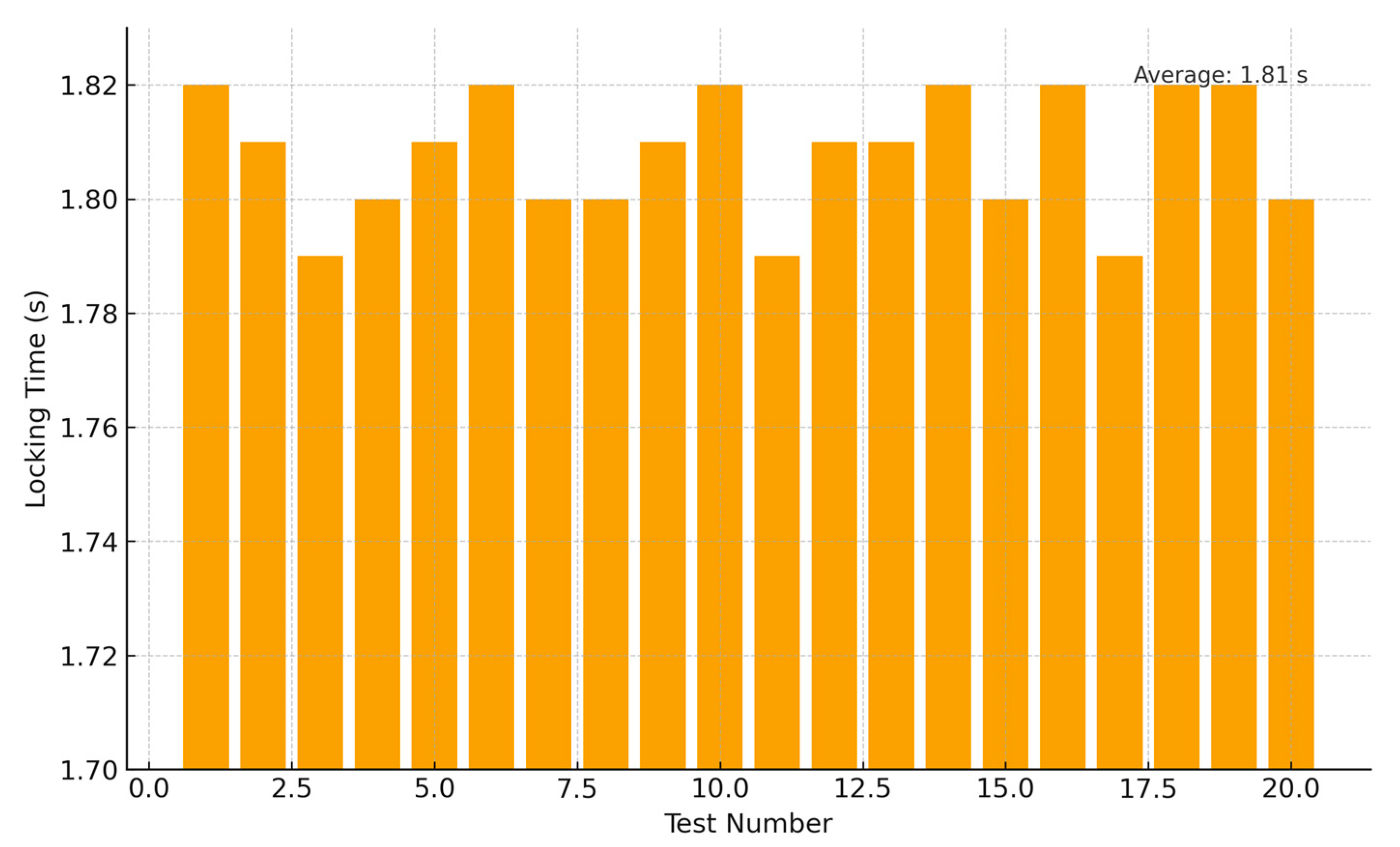
To evaluate the execution consistency of the quick-change process, 20 independent repeatable experiments were conducted. In each experiment, the host computer sent a “lock” command to the quick-change device and recorded the time difference between the command transmission and the motor’s cessation of rotation as the execution time for that locking cycle. Motor stoppage was determined when the encoder position transitioned into a steady-state interval. This metric reflects the control system’s timing stability across different operational cycles.
(2)
Communication Success Rate Test Method
To validate the reliability of RS485 bus communication, after tool locking completion, the host computer continuously sends 10 sets of functional commands to the tool end. Each command set requires the tool end to execute one action feedback, such as jaw opening/closing or module status updates. If all 10 commands receive correct feedback, it is counted as one successful communication process. This process is also repeated 20 times, with successful counts tallied to calculate the communication success rate. This experiment primarily evaluates the control protocol’s stability under multiple command cycles.
Furthermore, to avoid mechanical drift influencing results, this experiment focuses solely on verifying the control system’s temporal response and communication reliability. It does not involve mechanical measurements such as clamping force or structural performance. Specific results are recorded in Table 4.
To enhance the readability of the locking time test data, corresponding bar charts were further plotted (see Figure 15). This graphical representation allows for a more intuitive observation of the distribution and stability of the 20 locking time measurements.
Test results indicate that the quick-change device achieved a 100% communication success rate with the tool end, enabling stable and reliable control over drill bit start/stop and jaw clamping/unclamping operations. The average locking duration was 1.81 s, providing crucial reference data for setting the locking delay parameters in the host computer program. Figure 16 illustrates the physical state of the device after completing the locking process.

5.3. Experiment 3

Based on the aforementioned experimental validation, integrated assembly experiments were conducted to evaluate the system’s overall performance in typical aircraft assembly processes.
The quick-change device is mounted at the end of the UR3 robotic arm. When performing drilling tasks, the robotic arm first moves to the drill tool rack to dock the quick-change device with the drill tool. It then carries the tool to the work area for drilling operations. Upon task completion, the robotic arm returns to the tool rack and executes the tool disengagement operation. The usage process for the gripper tool followed the same sequence.
Based on this workflow, the system completed the typical “drilling-assembly workpiece” process in aircraft assembly: the robotic arm first performed drilling at designated positions on the aircraft model using the drill tool, then switched to the gripper tool to grasp the workpiece and precisely install it into the machined holes. The overall experimental platform layout and initial robotic arm position are shown in Figure 17.
The experimental procedure shall be carried out step by step according to the following process.
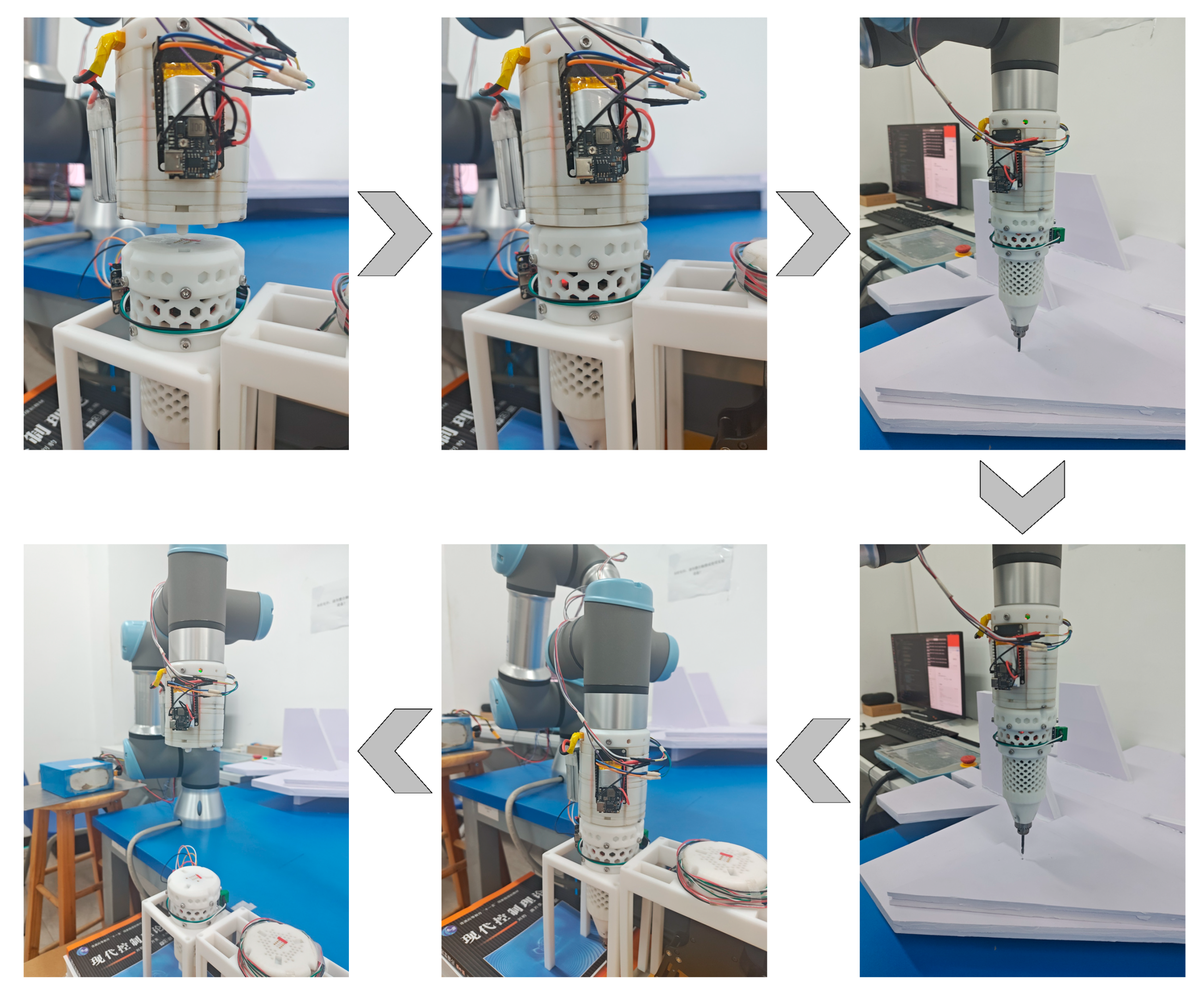
Figure 18 illustrates the complete process of the quick-change device performing drilling operations on an aircraft model using a drill bit tool. The specific steps are as follows:
Step 1: The robotic arm carries the quick-change device and moves directly above the drill bit tool holder.
Step 2: The robotic arm slowly lowers vertically, mechanically locking onto and electrically connecting with the drill bit tool via the claw mechanism.
Step 3: The robotic arm moves the drill tool to the work area. The drill begins rotating and slowly descends to initiate drilling.
Step 4: Upon completing the drilling, the arm slowly ascends and stops the drill’s operation.
Step 5: After drilling is finished, the robotic arm raises to a safe height and then places the drill tool onto the tool rack.
Step 6: The gripper mechanism performs the unlocking action, separating the quick-change device from the drill tool.
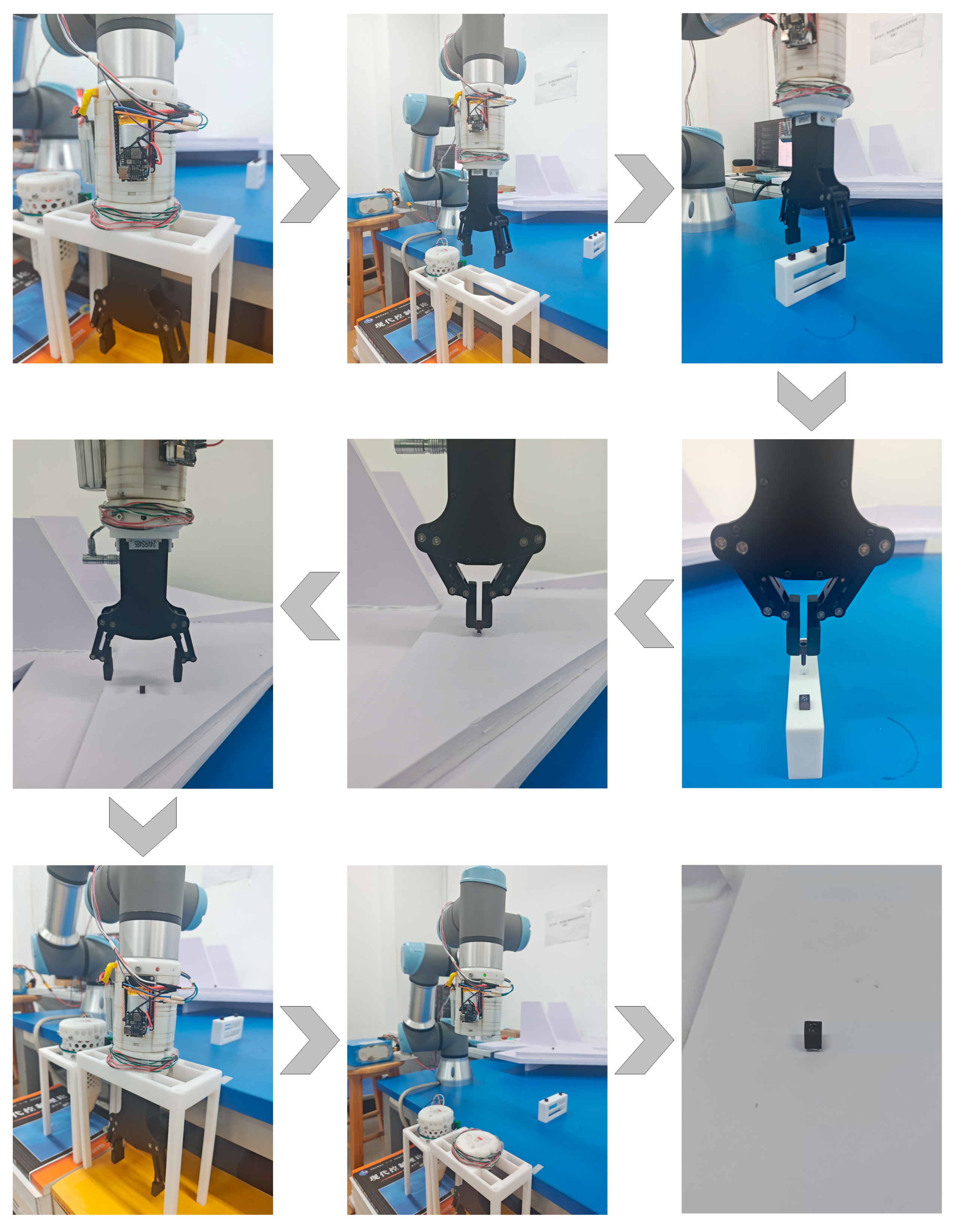
Figure 19 illustrates the complete process of the quick-change device performing workpiece insertion on an aircraft model using a gripper tool, with the following steps:
Step 1: The robotic arm carries the quick-change device and moves it above the gripper tool.
Step 2: After completing the locking mechanism, the robotic arm removes the gripper tool from the tool rack.
Step 3: The robotic arm moves the gripper tool to the workpiece supply area.
Step 4: The gripper is controlled to close and grasp the target workpiece.
Step 5: The robotic arm moves the gripper tool holding the captured workpiece directly above the pre-drilled hole, preparing for insertion.
Step 6: The robotic arm precisely lowers the gripper to insert the workpiece into the hole, then releases the gripper to complete the insertion.
Step 7: The robotic arm returns the gripper tool to the tool rack.
Step 8: The quick-change device is then separated from the tool by releasing the locking claws.
Step 9: The robotic arm carries the quick-change device back to its initial position, completing the entire workpiece installation cycle. At this point, the workpiece is placed onto the aircraft model.
To evaluate the stability and reliability of the proposed quick-change control system in actual workpiece assembly processes, this paper designed and implemented repeatability experiments covering the entire assembly workflow. The experimental process included multiple steps: robotic arm initial homing, selecting the target tool and executing quick-change locking, performing predetermined assembly actions at the tool end (such as drilling, gripping the workpiece, moving to the assembly position, and completing the assembly operation), unlocking, and switching back to the initial state. All steps were automatically executed via commands issued by the host computer through ROS programs, with no operator intervention in specific action execution.
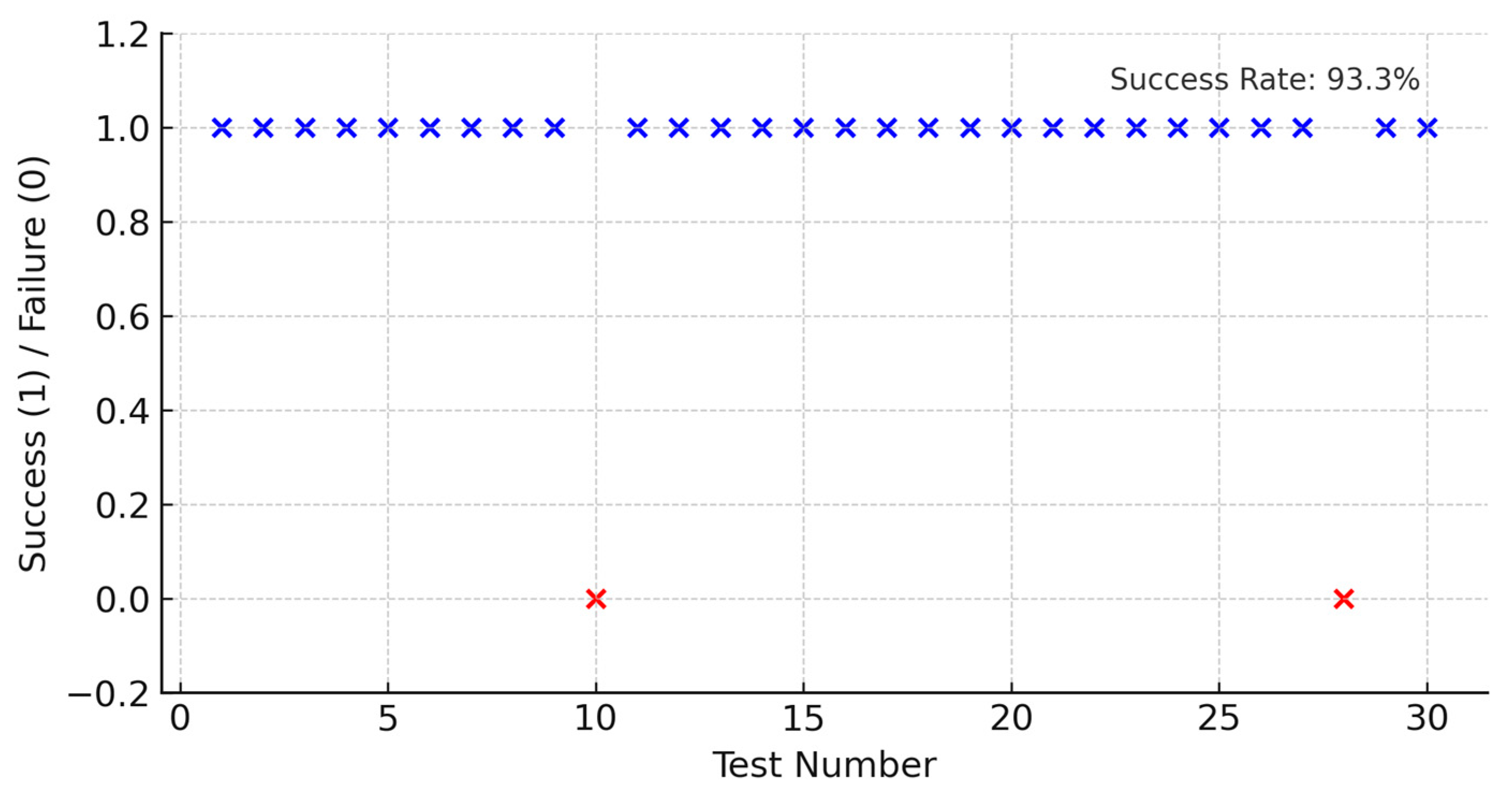
Based on this setup, 30 independent complete assembly experiments were conducted, each starting from the identical initial state. To facilitate quantitative evaluation, a binary success metric was introduced: an experiment is recorded as “1” (successful) if all process steps are completed according to the intended logic (including correct tool identification, normal execution of quick-change locking/unlocking commands, no abnormal interruptions in tool-end actions, and no timeouts or error returns from the host computer). An experiment is recorded as “0” (failure) if any of the following conditions occur during any step:
(1)
Tool ID recognition error or timeout;
(2)
Quick-change locking/unlocking process not completed as expected (e.g., control program aborts due to detected status anomalies);
(3)
Tool end fails to complete action within the specified time or returns an error flag;
(4)
Host computer detects communication failure or process logic anomaly, triggering emergency stop/reset.
The assembly process success rate is calculated by summing the success marks from 30 complete assembly experiments and dividing by the total number of attempts. Statistical results are summarized in Table 5.
To enhance the readability of experimental data for improving assembly success rates, this paper further plots a scatter plot of 30 assembly processes (see Figure 20). The scatter plot directly displays the success or failure of each experiment and highlights the location of failed samples, thereby more intuitively demonstrating the system’s stability in multi-step assembly tasks.
Test results indicate that out of 30 complete assembly experiments, 28 were executed flawlessly throughout the entire process, achieving an assembly success rate of 93.3%. This demonstrates that the constructed quick-change control system exhibits high process reliability in typical workpiece assembly tasks.
The experiments successfully demonstrated the complete process flow of “drilling holes before inserting workpieces” in aircraft assembly scenarios. Results confirm that the developed quick-change device can stably mount and switch tools on lightweight robotic arms. Both drill bits and gripper tools achieve precise control of start/stop and motion functions via the integrated RS485 communication bus.

6. Discussion

Experimental results demonstrate that the quick-change control system proposed in this paper exhibits excellent process stability and communication reliability during tool-changing tasks. The locking time remained consistently around 1.81 s across multiple repeated trials, indicating that the motor-driven locking mechanism delivers consistent response speeds at the control level. In RS-485 communication testing, all 200 commands were executed correctly, demonstrating the stability of the designed communication protocol and tool-end response logic in typical assembly environments. Furthermore, 28 out of 30 trials of the complete assembly process were successfully executed, achieving a success rate of 93.3%, which further validates the system’s overall reliability in multi-step automated tasks.
Regarding commercial electric quick-change devices, several mature products for collaborative robots have emerged in recent years. Represented by the OnRobot Quick Changer, these enable rapid tool changes under 5 s and utilize ISO-9409-1 standard flanges, offering high versatility suitable for most collaborative robot platforms [12]. The Gimatic EQC-E and Zimmer HEK-E series electric quick-change devices demonstrate greater maturity in mechanical precision, repeatability, load capacity, and overall industrial-grade reliability. They typically feature stringent safety certifications, comprehensive overload protection mechanisms, and proven durability. These commercial systems offer distinct advantages in mechanical performance and engineering maturity, representing well-established solutions widely deployed in industrial settings [13,14].
However, compared to the aforementioned commercial quick-change systems, the proposed system in this paper has fundamentally different design objectives. Commercial systems generally employ closed electrical interfaces or brand-specific tool ecosystems, lacking support for user-customized heterogeneous electric tools. For instance, OnRobot systems typically bind their electrical interfaces deeply with proprietary end-of-arm tools, while Gimatic and Zimmer systems emphasize compatibility within their EOAT ecosystems rather than open extensibility [12,13,14]. In contrast, the proposed system prioritizes open interfaces and heterogeneous tool compatibility through a unified four-wire electrical interface, an RS-485-based universal communication bus, and automatic tool ID recognition. This enables rapid integration of commonly used lab tools—including custom-built, non-standard tools, and diverse motor drive units. This feature makes the system particularly suitable for research settings, educational environments, and multi-task experimental platforms, where commercial systems often fall short.
Nevertheless, significant gaps remain between this system and commercial systems in mechanical performance. First, this paper did not conduct systematic testing of the quick-change device’s clamping force, load capacity, repeatability, mechanical stiffness, or durability, preventing direct mechanical performance comparisons with commercial products. Second, commercial systems typically incorporate redundant sensors, mechanical self-locking structures, and safety-compliant designs. In contrast, this prototype relies solely on motor current and encoder position to determine locking status, lacking independent limit switches or redundant detection mechanisms. This remains insufficient for scenarios with stringent safety requirements. Furthermore, commercial systems generally employ industrial-grade drive modules with comprehensive protection against overcurrent, short circuits, reverse connections, electromagnetic interference, and temperature. The MOSFET drive solution used in this paper remains a research prototype design, failing to fully meet the electrical reliability requirements of industrial environments.
In summary, experimental results validate the effectiveness of this quick-change control system at the control and communication levels. Comparisons with commercial systems reveal that its advantages primarily lie in openness and scalability, while significant shortcomings remain in mechanical structural performance, safety redundancy, and industrial-grade reliability. These differences further underscore the positioning of this research: the system aims to provide a flexible, reproducible, and scalable control framework for multi-tool automation studies on lightweight robotic arms, rather than replacing existing commercial industrial products.

7. Conclusions and Future Work

This paper proposes a quick-change control system for multi-tool switching tasks on lightweight robotic arms, designed around three objectives: open interfaces, heterogeneous tool compatibility, and process stability. The system employs a modular quick-change device as its hardware foundation. Through a unified four-wire electrical interface, an RS-485-based communication bus, and an automatic tool ID recognition mechanism, it enables rapid integration of both proprietary tools and various motor-driven tools. At the host computer level, a ROS-based process control architecture enables the robotic arm to perform automatic tool switching and continuous operations in typical tasks like “drilling-assembly.” Experimental results demonstrate high stability in clamping time, communication success rate, and multi-step assembly processes, validating the feasibility of the proposed approach at both control and communication levels.
Nevertheless, this research remains at the prototype system validation stage, with comprehensive testing of the quick-change device’s mechanical performance, service life, safety redundancy, and industrial environment adaptability yet to be conducted. Future work will focus on the following directions:
(1)
Supplement mechanical structure testing, including clamping force, repeatability accuracy, and durability assessment;
(2)
Introduce independent limit switches or redundant sensors to achieve more reliable clamping status detection;
(3)
Adopt industrial-grade motor drive modules and anti-interference circuits to enhance control system stability in complex environments;
(4)
Extend interface protocols to support a broader range of self-developed tools and further develop a task-level multi-tool collaboration framework.
These efforts will advance the current system from a research prototype to an engineering application, providing a more reliable technological foundation for multi-task flexible assembly using lightweight robotic arms.

Author Contributions

All authors contributed to the study. G.L.: Participate in research conception, conduct experiments, conduct data analysis and write papers. R.W.: was responsible for equipment provision, resource management, and experimental setup. L.H.: supervises this research. Constructive discussion helped with manuscript editing and final manuscript polishing. G.L. and L.H.: contributed equally to this work and should be considered co-first authors. All authors have read and agreed to the published version of the manuscript.

Funding

This work was supported in part by the Science and Technology Department of Shanghai of China under Grant 23010501700 and 20DZ2255900, and in part by the National Natural Science Foundation of China under Grant 81960327.

Institutional Review Board Statement

Not applicable.

Informed Consent Statement

Not applicable.

Data Availability Statement

Data are contained within the article.

Conflicts of Interest

There are no conflicts of interest.

Abbreviations

The following abbreviations are used in this manuscript:
UR3Universal Robots Model 3
RS485Recommended Standard 485

References

  1. Zhao, J.Q.; Xu, Z.; Bian, Y.S. Development of Quick Working Condition Change Test Equipment for Joint Stiffness Using Pulley Block. Mach. Des. Manuf. 2022, 1, 48–51. [Google Scholar] [CrossRef]
  2. Feng, F.; Tang, L.N.; Han, F. End-Effector Design of Multi-Function Space Robot for Space on-Orbit Servicing. Aeronaut. Manuf. Technol. 2019, 62, 14–22. [Google Scholar] [CrossRef]
  3. Chen, Y.Q. Research Progress on Multi-Function of Robot End Tool Set. Mod. Manuf. Technol. Equip. 2023, 1, 102–106. [Google Scholar] [CrossRef]
  4. Wang, P.; Jiang, K. Practical Research on Industrial Robot Automation Production Technology. South. Agric. Mach. 2022, 53, 168–170. [Google Scholar] [CrossRef]
  5. Kuvin, B.F. Robotic Tool Changer a Perfect Fit for Cobots: ATI Industrial Automation Booth B23036. Met. Form. 2021, 8, 55. [Google Scholar]
  6. Zhang, Y. Research on the Quick-Change Method and Device for Vulnerable Parts in Nuclear Industry Automation Equipment. Master’s Thesis, Zhejiang University of Science and Technology, Hangzhou, China, 2021. [Google Scholar] [CrossRef]
  7. Wang, Y.H.; Guo, S.; Zhang, J.L.; Ding, H.B.; Zhang, B.; Cao, A.; Sun, X.H.; Zhang, G.X.; Tian, S.H.; Chen, Y.X.; et al. Optimized Design and Deep Vision-Based Operation Control of a Multi-Functional Robotic Gripper for an Automatic Loading System. Actuators 2025, 14, 259. [Google Scholar] [CrossRef]
  8. Deng, Z.Y.; Kang, L.W.; Chiang, H.H.; Li, H.C. Integration of Robotic Vision and Automatic Tool Changer Based on Sequential Motion Primitive for Performing Assembly Tasks. IFAC PapersOnLine 2023, 56, 5320–5325. [Google Scholar] [CrossRef]
  9. OnRobot. Quick Changer—Product Manual and Specifications; OnRobot A/S: Odense, Denmark, 2025. Available online: https://onrobot.com/en/products/quick-changer (accessed on 12 December 2025).
  10. Gimatic Automation. EQC-E Electric Quick Changer—Catalogue; Gimatic S.r.l.: Brescia, Italy, 2025. Available online: https://www.gimatic.com/en/products/quick-changers/eqc-e/ (accessed on 12 December 2025).
  11. Zimmer Group. HEK-E Electric Tool Changer—Product Sheet; Zimmer Group GmbH: Rheinau, Germany, 2025. Available online: https://www.zimmer-group.com (accessed on 12 December 2025).
  12. Radcoll Robotics. RS-E Lightweight Electric Tool Changer—Product Overview; Radcoll Robotics: Shenzhen, China, 2025; Available online: https://crgeoat.com/products/automatic-tool-changer (accessed on 12 December 2025).
  13. Robotiq. Hand-E Instruction Manual for e-Series Robots (RS-485 Communication); Robotiq Inc.: Québec, QC, Canada, 2019; Available online: https://assets.robotiq.com/website-assets/support_documents/document/Hand-E_Instruction_Manual_e-Series_PDF_20190122.pdf (accessed on 12 December 2025).
  14. Zhang, H.; Lu, T.W.; Xia, Z.J.; Zhang, Z.S.; Zhu, J.X. Machining Micro-Error Compensation Methods for External Turning Tool Wear of CNC Machines. Micromachines 2025, 16, 1143. [Google Scholar] [CrossRef] [PubMed]
  15. Li, J.; Teeple, C.; Wood, R.J.; Cappelleri, D.J. Modular End-Effector System for Autonomous Robotic Maintenance & Repair. In Proceedings of the 2022 IEEE International Conference on Robotics and Automation (ICRA), Philadelphia, PA, USA, 23–27 May 2022; pp. 4510–4516. [Google Scholar] [CrossRef]
  16. Zhao, X.S.; Cui, X.W.; Hu, Z.J.; Zhang, Q.; Sun, T. Development of an End-Toothed Disc-Based Quick-Change Fixture for Ultra-Precision Diamond Cutting. Machines 2021, 9, 257. [Google Scholar] [CrossRef]
  17. Zhao, W. Design of Robot End-Effector for Collaborative Robot Works. Ph.D. Thesis, École centrale de Nantes, Nantes, France, 2021. Available online: https://theses.hal.science/tel-04700359v2 (accessed on 17 September 2024).
  18. Gao, W.J.; Liu, J.Z.; Deng, J.; Jiang, Y.; Jin, Y.C. Research Status and Trends in Universal Robotic Picking End-Effectors for Various Fruits. Agronomy 2025, 15, 2283. [Google Scholar] [CrossRef]
  19. Pantano, M.; Blumberg, A.; Regulin, D.; Hauser, T.; Saenz, J.; Lee, D. Design of a Collaborative Modular End Effector Considering Human Values and Safety Requirements for Industrial Use Cases. In Human-Friendly Robotics 2021; Palli, G., Melchiorri, C., Meattini, R., Eds.; Springer Proceedings in Advanced Robotics; Springer: Cham, Switzerland, 2021; Volume 23, pp. 37–50. [Google Scholar] [CrossRef]
  20. Reddy, C.E.; Padayachee, J.; Bright, G. Development and Analysis of Reconfigurable Robotic End-Effector for Machining and Part Handling. S. Afr. J. Ind. Eng. 2021, 32, 56–70. [Google Scholar] [CrossRef]
  21. Li, J.W.; Sun, Z.J. Design and Control of the Manipulator of Magnetic Surgical Forceps with Cable Transmission. Micromachines 2025, 16, 650. [Google Scholar] [CrossRef] [PubMed]
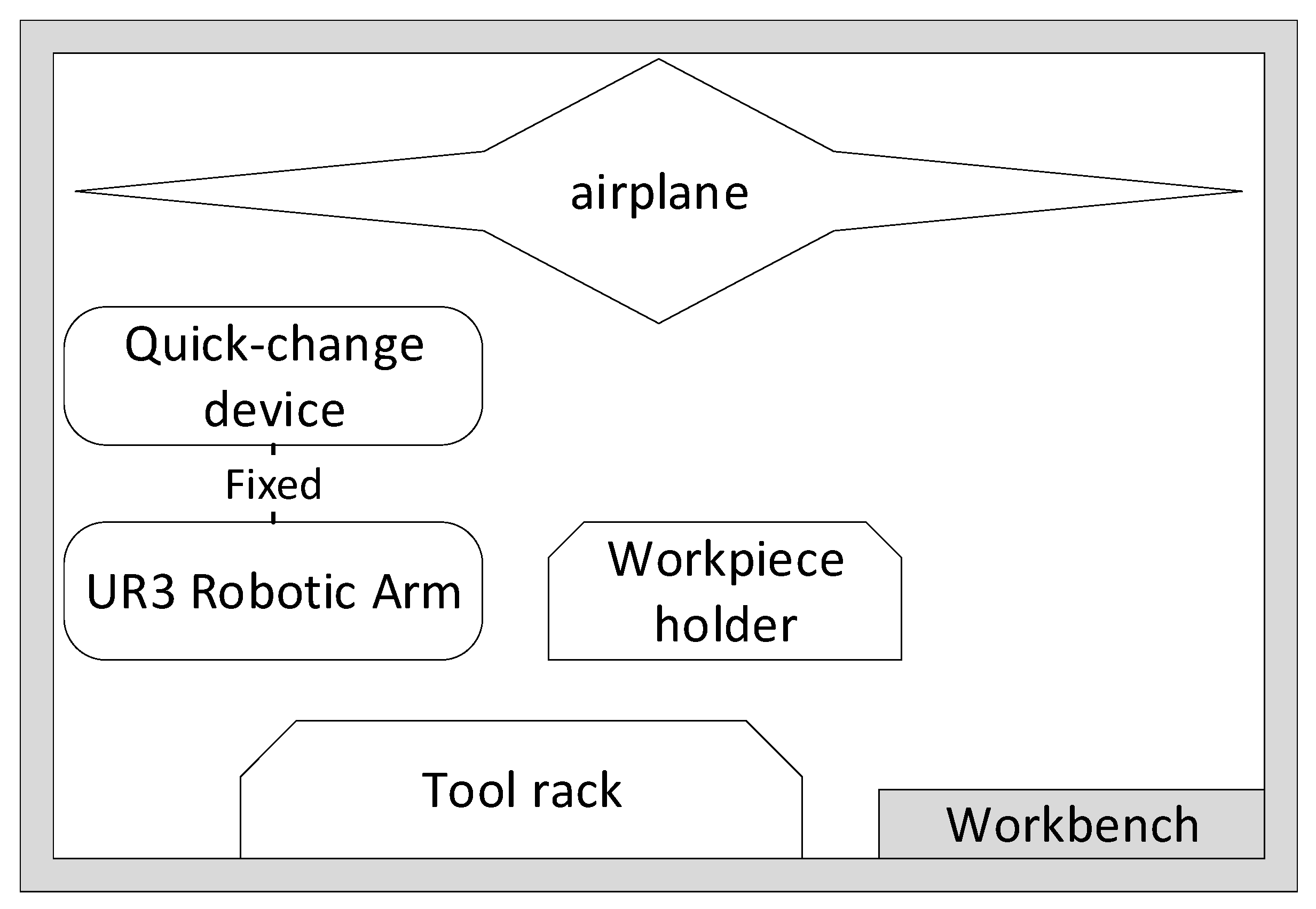
Figure 1. Robotic Arm Quick-Change System Assembly Test Bench.
Actuators 14 00619 g001
Figure 2. Quick-Change Device and Tool Structure Exploded View.
Actuators 14 00619 g002
Figure 3. Electrical Connection Module Mechanical Structure Diagram.
Actuators 14 00619 g003
Figure 4. Quick-Change Device Control Block Diagram.
Actuators 14 00619 g004
Figure 5. RS485 Communication Control Tool Terminal Block Wiring Diagram.
Actuators 14 00619 g005
Figure 6. Quick-Change Device Control Program Logic Flowchart.
Actuators 14 00619 g006
Figure 7. Tool-End Control Program Logic Block Diagram.
Actuators 14 00619 g007
Figure 8. Main Program Logic Flowchart.
Actuators 14 00619 g008
Figure 9. Physical Diagram of Drill Bit Tool.
Actuators 14 00619 g009
Figure 10. Integrated Motor Drive Circuit Board.
Actuators 14 00619 g010
Figure 11. IO Level Transition Oscilloscope Display Diagram.
Actuators 14 00619 g011
Figure 12. Response Time Test Log Bar Chart.
Actuators 14 00619 g012
Figure 13. Quick-Change Device Locking and Unlocking Status Diagram.
Actuators 14 00619 g013
Figure 14. Mating surfaces for gripper tools and drill tools.
Actuators 14 00619 g014
Figure 15. Lock-in Time Test Record Bar Chart.
Actuators 14 00619 g015
Figure 16. Quick-Change Device and Tool Connection Diagram.
Actuators 14 00619 g016
Figure 17. Experimental Platform.
Actuators 14 00619 g017
Figure 18. Drill Bit Tool Drilling Steps.
Actuators 14 00619 g018
Figure 19. Experimental Platform.
Actuators 14 00619 g019
Figure 20. Scatter Plot of Assembly Success and Failure Test Records.
Actuators 14 00619 g020
Table 1. UR3 Robotic Arm Technical Specifications.
Robot TypeUR3
Weight11 kg/24.3 lb
Maximum Payload3 kg/6.6 lb
Range of motionThe tool flange can rotate freely without restriction; all other joints rotate ±360°
degree of freedom6 rotating joint
I/O Power Supply24 V 2 A in Control Box
CommunicationsTCP/IP 1000 Mbit: IEEE 802.3u, 100BASE-T Ethernet interface, Modbus TCP and Ethernet/IP adapters, Profinet
Power supply100–240 VAC, 50–60 Hz
Table 2. Product Specifications for Grippers.
CompanyINSPIRE-ROBOTS
ModelEG2–4C2
Communication InterfaceRS485
Weight231 g
Clamping force0–20 N
Operating VoltageDC24V ± 10%
Static current30 mA
Peak current0.7 A
Table 3. Response Time Test Log.
Number of responses12345678
Response time/ms2.01.92.22.12.31.81.72.4
Number of responses9101112131415average
Response time/ms2.52.12.22.02.11.92.02.08
Table 4. Lock-in Time and Communication Success Rate Test Records.
Number of Locking Tests1234567
Locking time/s1.821.811.791.801.811.821.80
Whether successfulYesYes YesYesYesYesYes
Number of Locking Tests891011121314
Locking time/s1.801.811.821.791.811.811.82
Whether successfulYesYesYesYesYesYesYes
Number of Locking Tests151617181920average
Locking time/s1.801.821.791.821.821.801.81
Whether successfulYesYesYesYesYesYes100%
Table 5. Assembly Success and Failure Test Records.
Number of assemblies12345678
Success/Failure11111111
Number of assemblies910111213141516
Success/Failure1011112.01
Number of assemblies1718192021222324
Success/Failure11111111
Number of assemblies252627282930success rate
Success/Failure11101193.3%
Disclaimer/Publisher’s Note: The statements, opinions and data contained in all publications are solely those of the individual author(s) and contributor(s) and not of MDPI and/or the editor(s). MDPI and/or the editor(s) disclaim responsibility for any injury to people or property resulting from any ideas, methods, instructions or products referred to in the content.