
Article

Research on the Dynamic Behavior of Rotor–Stator Systems Considering Bearing Clearance in Aeroengines

1
School of Energy and Power Engineering, Beihang University, Beijing 102206, China
2
Research Institute of Aero-Engine, Beihang University, Beijing 102206, China
*
Author to whom correspondence should be addressed.
Actuators 2025, 14(12), 594; https://doi.org/10.3390/act14120594
Submission received: 24 October 2025 / Revised: 26 November 2025 / Accepted: 2 December 2025 / Published: 4 December 2025
(This article belongs to the Special Issue Dynamics and Control of Aerospace Systems—2nd Edition)

Abstract

The high-performance aeroengine operates under extreme loads. In engineering practice, the vibration problems caused by stator vibrations have become increasingly prominent, with impacts on the rotor dynamic behavior. This paper takes the rotor–stator system of aeroengines as the analysis object and studies the influence of stator modal vibration on the rotor dynamic behavior. The dynamic model of the rotor–stator system has been established, and the influence of the contact state of cylindrical roller bearings (CRBs) has been analyzed by considering bearing clearance. To precisely capture the transient contact state within the CRBs, a numerical method combining the Newmark-β method with the Event Function has been developed. The numerical calculation results show that the collision effect introduced by the bearing clearance will excite a localized stator mode at the supercritical state, which fundamentally alters the rotor dynamic behavior: generating prominent combination frequencies f M ± f r due to modulation between the rotor rotation f r and the stator vibration f M . Moreover, good consistency between the experimental and calculated results has been obtained. This study demonstrates that the stator modal vibration can critically modify rotor dynamic behavior in supercritical operation, leading to potentially hazardous non-synchronous whirl. The integrated model and numerical method provide a robust framework for analyzing complex rotor–stator interactions, offering significant insights for vibration control and fault diagnosis in high-speed rotating machinery.

1. Introduction

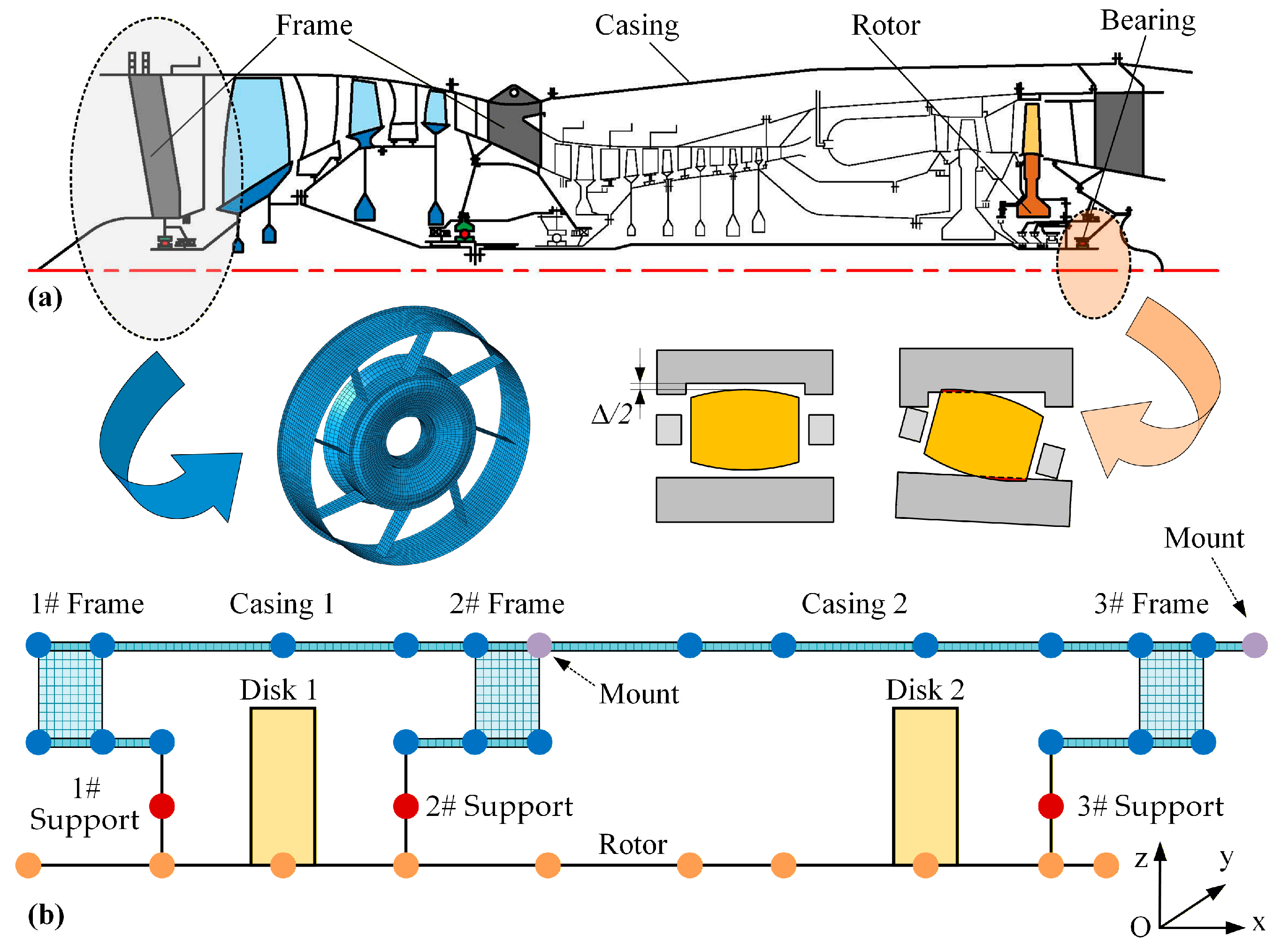
As high-speed rotating machinery, the high-performance aeroengine is subjected to complex operational loads [1,2], as shown in Figure 1. Therefore, the rotating and stationary components in an aeroengine experience substantial loads during operation, leading to more pronounced interaction of the dynamic response between the rotor and stator [3,4,5]. In traditional dynamic analysis of rotating machinery, the focus is usually on the rotor dynamic behavior, while the dynamic characteristics of the stator and the interaction of the dynamic response between the rotor and stator are insufficient [6]. Accurately capturing the coupled rotor–stator dynamics, particularly the influence of stator vibrations on rotor dynamic behavior, is paramount for aeroengine reliability, yet remains a significant challenge. Therefore, this paper takes the rotor–stator system of the high-performance aeroengine as the research object, focusing on the influence of the stator and bearings on rotor dynamic behavior.
Traditional dynamic analysis of the rotating machinery usually focuses on the dynamic response of the rotor. However, some vibration problems caused by the stator have been identified in engineering practice [7,8,9,10]. As the stationary component in an aeroengine, the stator typically comprises the frame, casing, and other auxiliary structures [11,12]. Wang [13] treated the stiffness of the supporting structure as dynamic stiffness and discussed the influence of stiffness uncertainty on the dynamic behavior of the rotor. Liu [14] proposed the judgment index of dynamic stiffness influence to evaluate the degree of dynamic stiffness influence on the dynamic characteristics. Zhou [15] proposed a 5-DOF model, which considers the strong coupling effect and which is integrated into an elastic support-bearing-rotor system to reveal the influence of the strong coupling effect between elastic supports and bearings on rotor systems. Li [16,17] conducted the numerical study and experimental verification on the dynamic stiffness characteristics of a squirrel cage to reveal the effect mechanism of dynamic stiffness on the rotor system. Zeng [18] studied the rubbing dynamic characteristics of the blisk-casing system with elastic supports. Xu [19] studied the nonlinear dynamic response of the rotor-bearing systems with inclined clearance between bearings and supports. In summary, based on sufficient research on the dynamic characteristics of the stator, it is necessary to advance to analyzing the influence of the stator on rotor dynamic behavior.
There is the interaction of the dynamic response between different components, namely the vibration coupling [20,21,22,23]. Thereby, there is also the interaction between the rotating and stationary components. Especially in high-speed rotating machinery, the rotor operates above multiple critical speeds, exhibiting a clearly flexible rotor. In this case, the vibration coupling between the rotor and the stator is more pronounced [24,25]. Matthew [26] was among the first to notice the importance of the rotor–stator vibration coupling and investigated the mutual influence between the rotor and stator. Ma [27] established a rotor-bearing-seal system model and analyzed the nonlinear response due to the breathing effect at the seal under various loading conditions. Mehdi [28] explored the contact interactions between the rotor and stator, solving the constrained motion equations using an implicit prediction-correction time-stepping numerical algorithm. Dai [29] proposed the modeling strategy for the dual-rotor-disk-bearing coupled system with unbalance effect in aeroengines. Liu [30] established a finite element model for the rotor-bearing-casing system of the aeroengine, investigating the strong nonlinear dynamics involving squeeze film dampers and discussing in detail the potential nonlinear mechanical behaviors under rotor-casing friction faults. Wang [31] established a rotor–stator model for the aeroengine to analyze the vibrations caused by friction faults, but the stator finite element model constructed with beam elements is not suitable for accurately representing the large-diameter, thin-walled casing typical in aeroengines. Dai [32] established a dynamic model for dual-rotor support systems using nonlinear springs and dampers, grounded in finite element modeling and Winkler elastic foundation theory. It can be observed that the rotor dynamics behavior in rotating machinery can be accurately analyzed considering the stator dynamic characteristics, and the dynamic model of the rotor–stator system is crucial for studying the rotor dynamic behavior in high-speed rotating machinery [33,34].
As the important interface between the rotating and stationary components, the bearings, particularly the cylindrical roller bearings (CRBs) commonly used in aeroengines [35,36], introduce strong nonlinearities [37,38]. Because of the thermal and centrifugal expansion during the operation, CRBs in the high-performance aeroengine are always designed with clearance [39,40]. It should be noted that the bearing clearance can be classified into the assembly clearance of the outer ring and the radial internal clearance, and this paper focuses on the latter. Researchers have developed analytical models to study bearing clearance effects, including the introduction of Hertzian contact theories [41] and time-varying stiffness models [42,43]. Xu [44,45] coupled the clearance fit model with the bearing analytical stiffness model, thoroughly considering the nonlinear effects of the ball-race contact and the outer ring-bearing seat contact, and analyzed the dynamic response of multi-bearing rotor systems. Jiang [46], combining traditional bearing elements, investigated the dynamic characteristics of bearings and their effects on the rotor system while considering various load factors such as misalignment, lubrication, and thermal effects. Hong [47,48] conducted research on the dynamic response and failure mechanisms of roller bearings after damage. Yang [40] proposed a dynamic model for the rotor-bearing-casing system under local bearing defects, analyzing the impact of defects on system stability. Chen [49] analyzed the transient response of the flexible rotor with the interaction between the time-varying stiffness of the rolling bearing. Based on previous research on bearings, this paper intends to establish a quasi-static model of CRBs considering bearing clearance and roller profile, describing the time-varying stiffness introduced by changes in the contact state. Next, the model will be used in the rotor–stator system of an aeroengine to improve the accuracy of rotor dynamic behavior.
While the aforementioned studies have advanced the understanding of rotor dynamics in simplification, a significant gap remains in capturing the synergistic effects within a fully coupled rotor–stator system. Conventional research has often merely extended the analysis from the rotor-only system to the rotor–stator system, without focusing on elucidating the interaction mechanisms between the two components. In particular, the specific effects of incorporating the stator on the system’s dynamic behavior and the underlying physics are not well understood. This gap impedes the accurate analysis and mitigation of complex vibration phenomena encountered in high-performance aeroengines.
To bridge this gap, this paper presents a comprehensive study on the rotor dynamic behavior influenced by stator modal vibration in the aeroengine, with a specific focus on the nonlinearity introduced by bearing contact state. This paper is organized as follows. Firstly, the dynamic model of the rotor–stator system, including the CRB quasi-static model, has been established in Section 2. Then, a novel numerical method combining the Newmark-β method with the Event Function has been developed in Section 3. Next, the numerical calculation has been conducted on the rotor–stator system, and the mechanism of the rotor dynamic behavior under the stator modal vibration and the bearing contact state has been discussed in Section 4. Moreover, a test rig has been built, and experimental research of the rotor–stator system has been conducted to verify the model and the mechanism in Section 5. Finally, the concluding remarks are presented in Section 6.

2. The Dynamic Model of the Rotor–Stator System

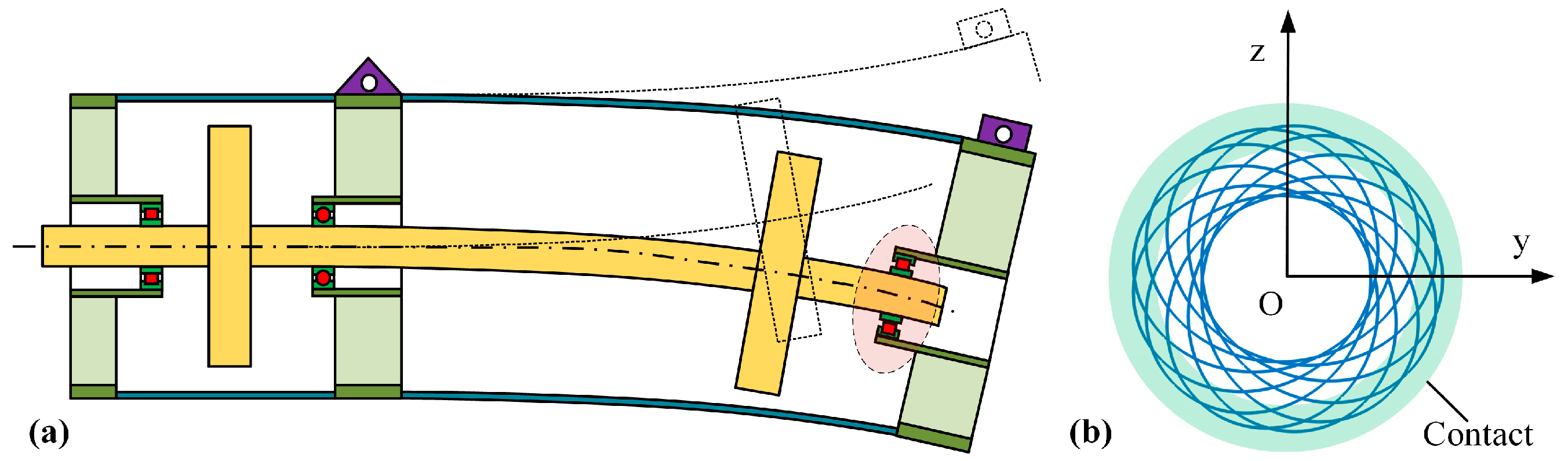
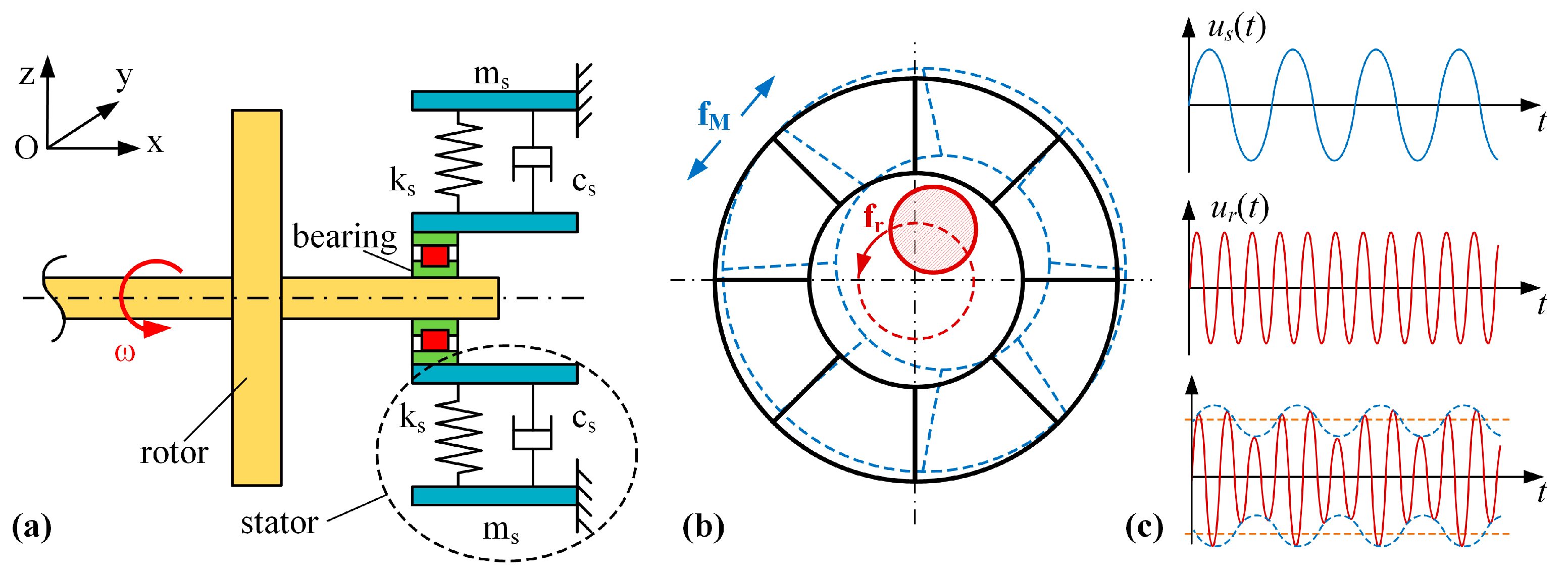
To systematically investigate the influence of stator modal vibration on rotor dynamic behavior in the aeroengine, a rotor–stator system dynamic model has been developed. The rotor and stator in the aeroengine exhibit significant dynamic responses during operation due to combined excitations including unbalanced loads, gyroscopic effects, and other external forcing, as shown in Figure 2a. The dynamic response of the stator demonstrates significant magnitude, and using only the rotor system as the analysis object for computational convenience may introduce non-negligible errors. Thereby necessitates the implementation of fully coupled rotor–stator dynamic models to rigorously investigate the influence of stator dynamics characteristics on rotor dynamic behavior.
Moreover, for the dynamic model of the rotor–stator system, modeling should not only involve an increase in analysis objects but also an increase in analysis factors. As is well known, there are many excitations and nonlinear factors in the aeroengine, including time-varying characteristics of the contact state of bearings, which cause the rotor to operate in the non-synchronous whirl motion, as shown in Figure 2b. The vibration interaction between these components is primarily mediated through the bearings, where dynamic forces are transmitted and amplified. This section considers the nonlinear factors introduced by bearing clearance and roller profile, establishes a rotor–stator system dynamic model considering the contact state of CRBs, and studies the influence of stator modal vibration on the rotor dynamic behavior. The model is built upon the following assumptions: small deformations of the rotor and stator, justifying linear constitutive relations; localization of system nonlinearity at the bearing interface; temperature-insensitive material properties; and rigid disks to simplify inertial distribution properties. The model explicitly incorporates the CRBs as critical transmission elements for rotor–stator interactions. Particular attention is given to modeling the nonlinear effects of bearing clearance and roller profile geometry on the rotor–stator system dynamics response.

2.1. Rotor Modeling with Beam Element

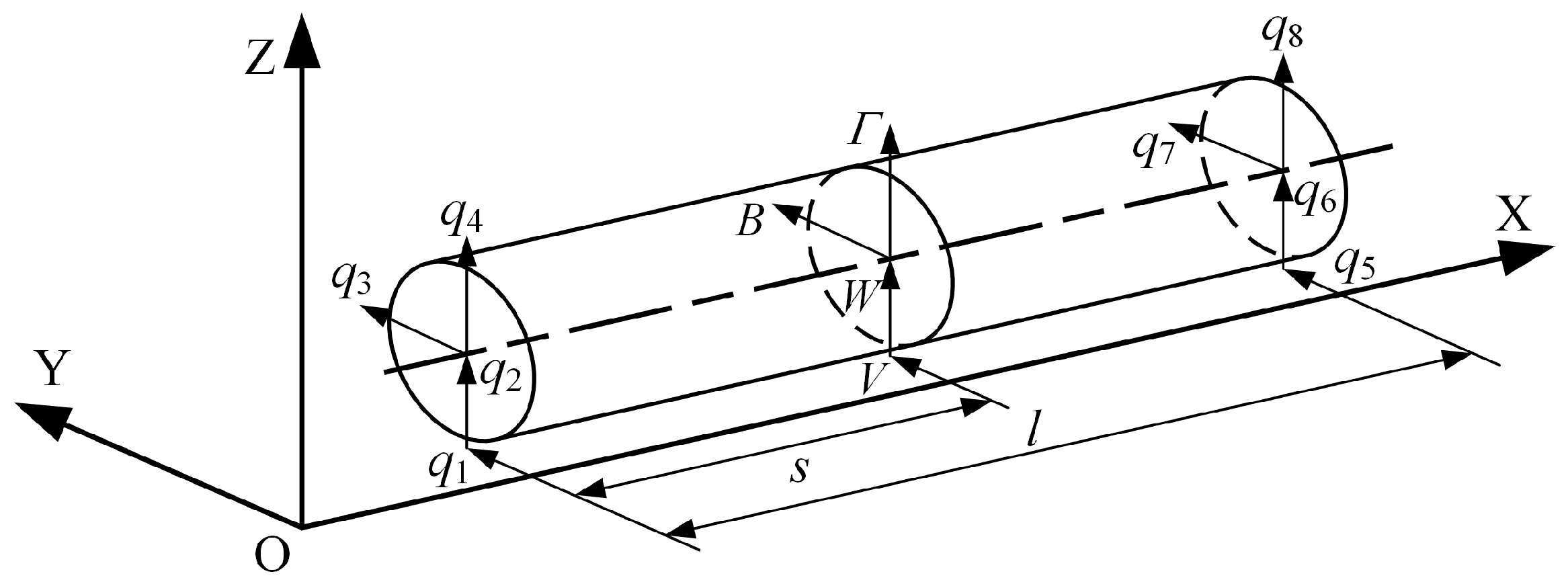
In aeroengine dynamic analysis, the beam element is conventionally used for rotor modeling due to the computational efficiency and adequate accuracy for slender structures. Figure 3 displays the coordinate system and generalized coordinates of the beam element, where each element contains two nodes with four degrees of freedom in total—two translational and two rotational. Additionally, it is generally assumed that the disk is rigid with negligible deformation, and its density is considered temperature-insensitive. Therefore, the coefficient matrix of the disk remains unperturbed by these assumptions.
The following details the modeling process of the rotor using the beam elements. For the arbitrary microelement within the rotor shaft, the 4 DOF generalized coordinates V, W, Β, and Γ can be expressed as a function of 2 nodes’ coordinates.
V W = Ψ q B Γ = Θ q
where the matrices of shape functions for the Timoshenko beam are as follows:
Ψ = Ψ V Ψ W = ψ 1 0 0 ψ 2 ψ 3 0 0 ψ 4 0 ψ 1 ψ 2 0 0 ψ 3 ψ 4 0 Θ = Θ B Θ Γ = 0 θ 1 θ 2 0 0 θ 3 θ 4 0 θ 1 0 0 θ 2 θ 3 0 0 θ 4
When considering the shear deformation, the shear coefficient φ s can be written:
φ s = 12 E I G A l 2 7 + 6 υ 6 1 + υ 1 + 20 + 12 υ 7 + 6 υ D d D 2 + d 2 2
In addition, the matrix of shape functions for transverse shear strains Φ relates to Ψ and Θ :
Φ = Θ Γ Ψ V Θ B Ψ W
Therefore, the parameter matrices of the beam element can be obtained, and the expressions are as follows:
M B e a m = ρ A 0 1 l Ψ T Ψ d ξ + ρ I d 0 1 l Θ T Θ d ξ
G B e a m = ρ I d 0 1 l Θ Γ T Θ B d ξ ρ I d 0 1 l Θ B T Θ Γ d ξ
K B e a m = E I 0 1 l Θ T Θ d ξ + 12 E I φ s l 2 0 1 l Φ T Φ d ξ

2.2. Stator Model with Shell Element

As shown in Figure 1, the stator of an aeroengine primarily consists of the casing and the frame. Both of them are thin-walled structures, which makes them ideally suited for discretization using the shell elements. Consequently, the parameter matrices of the shell element have been adopted for the stator modeling in this study, providing an optimal balance between computational efficiency and modeling accuracy for such thin-walled geometries.
The following details the modeling process of the stator using the shell elements. Any child element with a complex geometric configuration can be transformed into a regular parent element in natural coordinates through isoperimetric mapping, as illustrated in Figure 4. For shell elements, the transformation matrix between the local coordinate system O x y z at any point within the element and the global coordinate system O X Y Z can be expressed as follows:
Θ = e X , e x e X , e y e X , e z e Y , e x e Y , e y e Y , e z e Z , e x e Z , e y e Z , e z
where e X = 1 , 0 , 0 , e Y = 0 , 1 , 0 and e Z = 0 , 0 , 1 are, respectively, the unit vectors in the global coordinate system O X Y Z . The unit vectors e x , e y and e z in the local coordinate system O x y z are defined as follows:
e z = X ξ × X η / X ξ × X η 2 , e y = e z × X ξ ξ = η = ς = 0 / e z × X ξ ξ = η = ς = 0 2 , e x = e y × e z
where X = i = 1 8 N i X i + ς h i e z i / 2 .
Furthermore, the transformation from the global coordinate system O X Y Z to the local coordinate system O x y z requires the following matrices:
T n 2 G = J 1 1 , 1 × I 3 J 1 1 , 2 × I 3 J 1 1 , 3 × I 3 J 1 2 , 1 × I 3 J 1 2 , 2 × I 3 J 1 2 , 3 × I 3 J 1 3 , 1 × I 3 J 1 3 , 2 × I 3 J 1 3 , 3 × I 3 T G 2 L = Θ T Θ T T s = 1 0 0 0 0 0 0 0 0 0 0 0 0 1 0 0 0 0 0 1 0 1 0 0 0 0 0 0 0 0 0 0 1 0 1 0 0 0 1 0 0 0 1 0 0
where J represents the Jacobian matrix of the shell element; ‘ ’ represents the Kronecker product of two matrices.
Consequently, the strain matrix can be expressed as follows:
B = T s T G 2 L T n 2 G B 1 , , B 8
where,
B i = B i , ξ ; B i , η ; B i , ζ = N i ξ I 3 Φ i N i η I 3 Φ i N i ζ I 3 Φ i T
where I 3 represents the 3 × 3 identity matrix, and the Φ i matrix is expressed as follows:
Φ i = 1 2 t h i 0 Θ i 3 , 3 Θ i 2 , 3 Θ i 3 , 3 0 Θ i 1 , 3 Θ i 2 , 3 Θ i 1 , 3 0
where Θ i represents the transformation matrix between the local coordinate system and the global coordinate system at the node i , with the detailed form given by Equation (8).
The shape functions N i of each node of the shell element that appears in the previous equation can be written as follows [50]:
N 1 = 1 4 1 + ξ 1 + η ξ + η 1 , N 2 = 1 4 1 ξ 1 + η ξ + η 1 N 3 = 1 4 1 ξ 1 η ξ η 1 , N 4 = 1 4 1 + ξ 1 η ξ η 1 N 5 = 1 2 1 + η 1 ξ 2 , N 6 = 1 2 1 ξ 1 η 2 N 7 = 1 2 1 η 1 ξ 2 , N 8 = 1 2 1 + ξ 1 η 2
And it can write out the shape function matrix N = N 1 , , N 8 . Among them, the shape function matrices of each node can be written as follows:
N i = N i I 3 Φ i
Therefore, according to the finite element theory, the calculation formulas for the mass matrix and stiffness matrix of the shell element can be obtained:
M s h e l l = V ρ N T N J d ξ d η d ζ K s h e l l = V ρ B T D B J d ξ d η d ζ

2.3. Quasi-Static Bearing Model

The bearings serve as essential support structures in rotating machinery, providing radial load distribution and guiding rotor motion. The stiffness characteristics of CRBs vary dynamically due to the irregularity of the roller profile and the changing contact state between the rollers and the raceways.
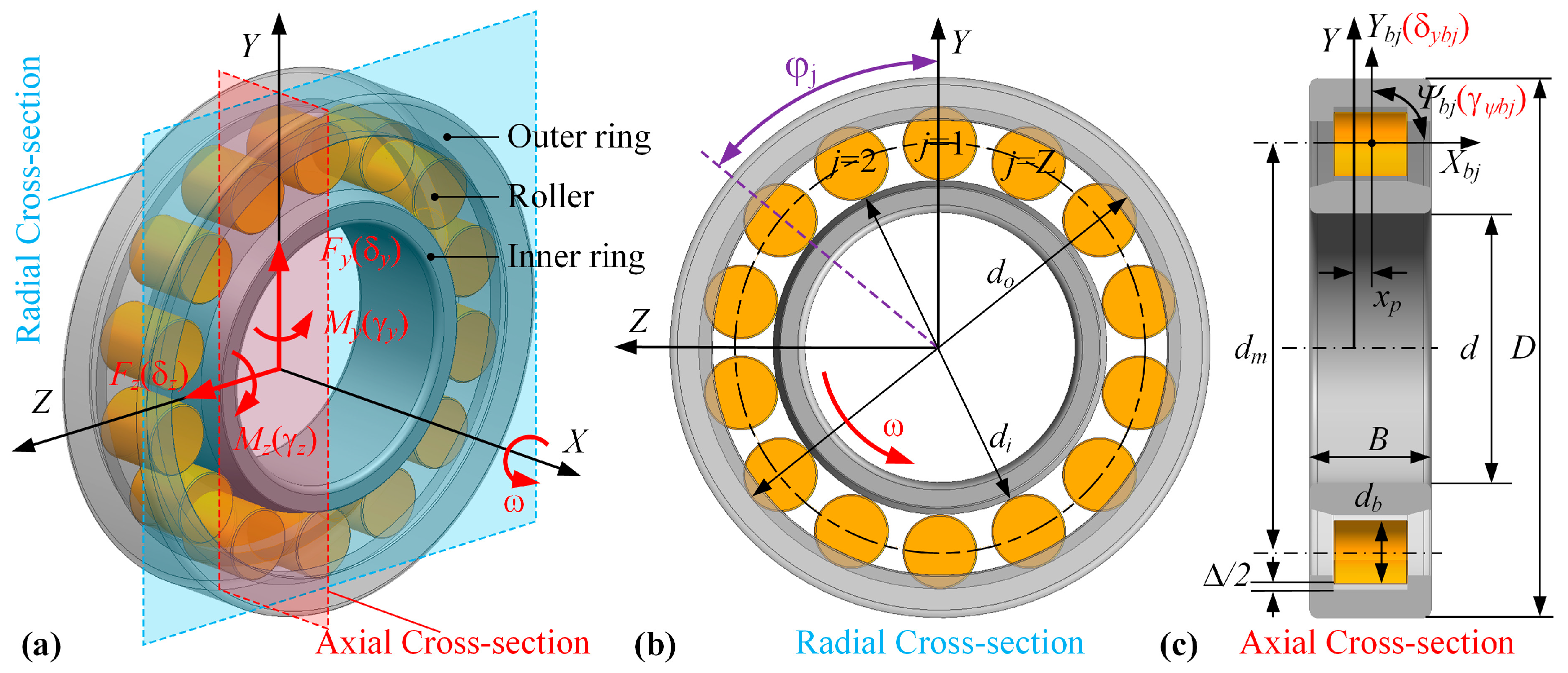
A quasi-static model of the CRB has been established in this section and accounts for transient contact states and nonlinear stiffness variations. The schematic diagram of the CRB is shown in Figure 5. The CRB consists of an inner raceway, an outer raceway, and multiple cylindrical rollers, which are guided by a cage to maintain uniform distribution. The inner and outer raceways are fixed to the rotating shaft and bearing pedestal through an interference fit, ensuring structural stability. During operation, external loads ( F y , F z , M y , M z ) induce radial displacements ( δ y , δ z ) and angular displacements ( γ y , γ z ) in the inner raceway, altering the contact characteristics between the rollers and the raceways, as shown in Figure 5a. This interaction plays a significant role in determining the dynamic stiffness of the bearing, which in turn affects the dynamic response of the rotor–stator system.
It is assumed that the rollers are uniformly distributed in the radial cross-section between inner and outer raceways, as shown in Figure 5b. Therefore, the time-varying azimuth angle φ j of the j-th roller affects the contact characteristics of the internal raceway and the load regions, and it can be expressed as follows:
φ j t = ω c t + 2 π Z j 1 + θ 0
where Z is the number of rollers, θ 0 is the initial position angle, and ω c = 0.5 ω i 1 d b / d m is the cage angular velocity, and where ω i is the angular velocity of the rotor, d b is the roller diameter, and d m is the pitch diameter of the CRB.
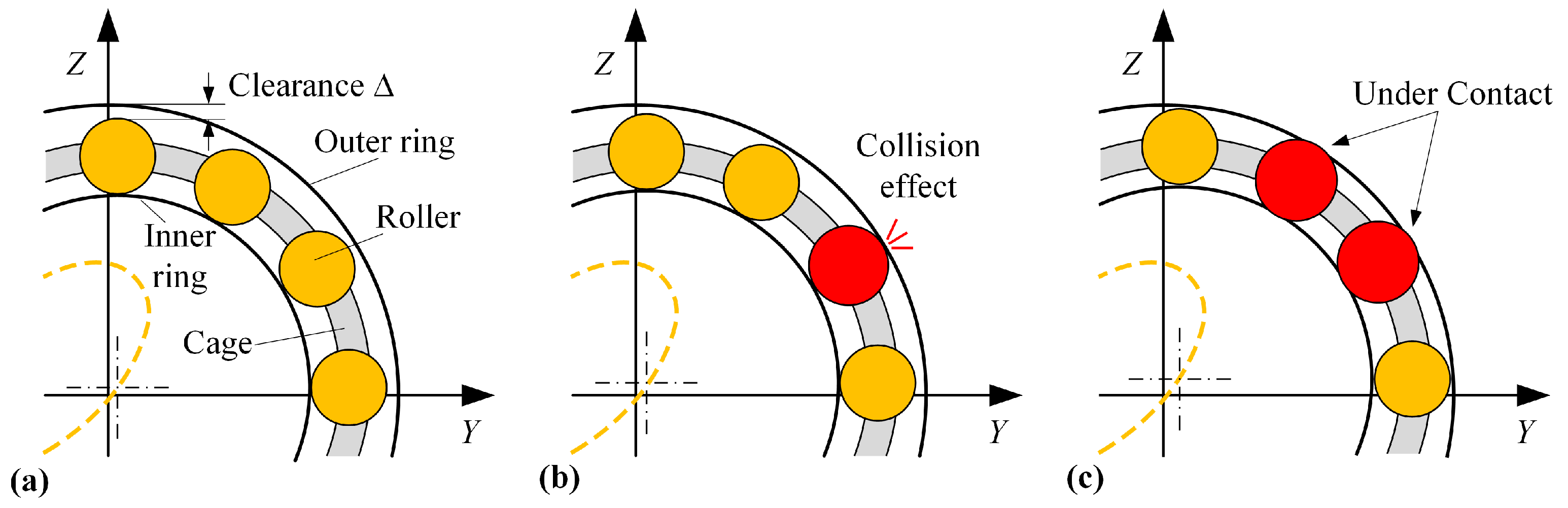
In Figure 6, with the bearing outer ring as the reference, the displacement orbit of the inner ring and rollers has been used to illustrate and explain the variation in the contact state between the rollers and raceway inside the bearing with clearance. As shown in Figure 6a, taking the roller with the inner ring positioning as an example, the rollers are uniformly distributed along the circumference of the inner ring edge and move with it together. Due to the bearing clearance, the rollers do not contact the outer ring in an unloaded state. In Figure 6a, when the inner ring displacement is small, the relative distance between the inner and outer rings exceeds the roller diameter, preventing load transmission between them. Therefore, the bearing contributes negligible stiffness to the system in this state. As the displacement of the inner ring gradually increases, the relative distance between the inner and outer rings decreases until it equals the roller diameter, as shown in Figure 6b, which represents a critical situation where a roller just contacts the outer raceway, marking the transition from the “Under Non-Contact” state to the “Under Contact” state. In addition, the bearing stiffness contribution to the system is no longer zero. Next, as the displacement of the inner ring continues to increase, more rollers contact the outer raceway, as shown in Figure 6c. The effect of the rollers being pressed into the raceway increases, and the bearing stiffness contribution to the system continues to rise; its variation needs to be determined through the bearing model established in the subsequent section.
Therefore, the motion state of the CRBs with clearance can be classified into two conditions: the “Under Non-Contact” and the “Under Contact” states. During the operation, the bearing will repeatedly transition between these two states. In the “Under Non-Contact” state, it can be assumed that there is no interaction between the inner and outer rings, and the stiffness of the bearing contributing to the system is zero. In the “Under Contact” state, the motion state of the rotor and inner ring is transmitted to the outer ring and stator through the contact of the rollers within the raceway. In this case, the bearing stiffness contribution to the system is no longer zero and depends on the extent of roller pressing. The bearing stiffness exhibits pronounced time-varying characteristics due to the roller profile geometry and degree of raceway conformity. The bearing clearance may lead to a periodic transition between non-contact, critical, and full-contact states, which amplifies vibration responses and induces nonlinear effects.
Based on the geometric constraints of the bearing, the displacement of the j-th inner raceway cross-section can be given by the following:
δ y j t = δ y t cos φ j + δ z t sin φ j x p γ y sin φ j + x p γ z cos φ j ψ j t = γ y sin φ j + γ z cos φ j
where δ y and δ z are, respectively, displacements of the inner raceway along the Y-axis and Z-axis directions, and γ y are γ z respectively, the angular displacements of the inner raceway along the Y-axis and Z-axis directions.
When the inner raceway undergoes displacement, the j-th roller will also move accordingly in the local coordinate system. The transient displacement between the j-th roller and the raceways can be written as follows:
δ i j t = δ y j t δ y b j t δ o j t = δ y b j t γ i j t = ψ j t γ ψ b j t γ o j t = γ ψ b j t
where subscripts “ij” and “oj” are, respectively, corresponding contact motions of the j-th roller at the inner and outer raceway.
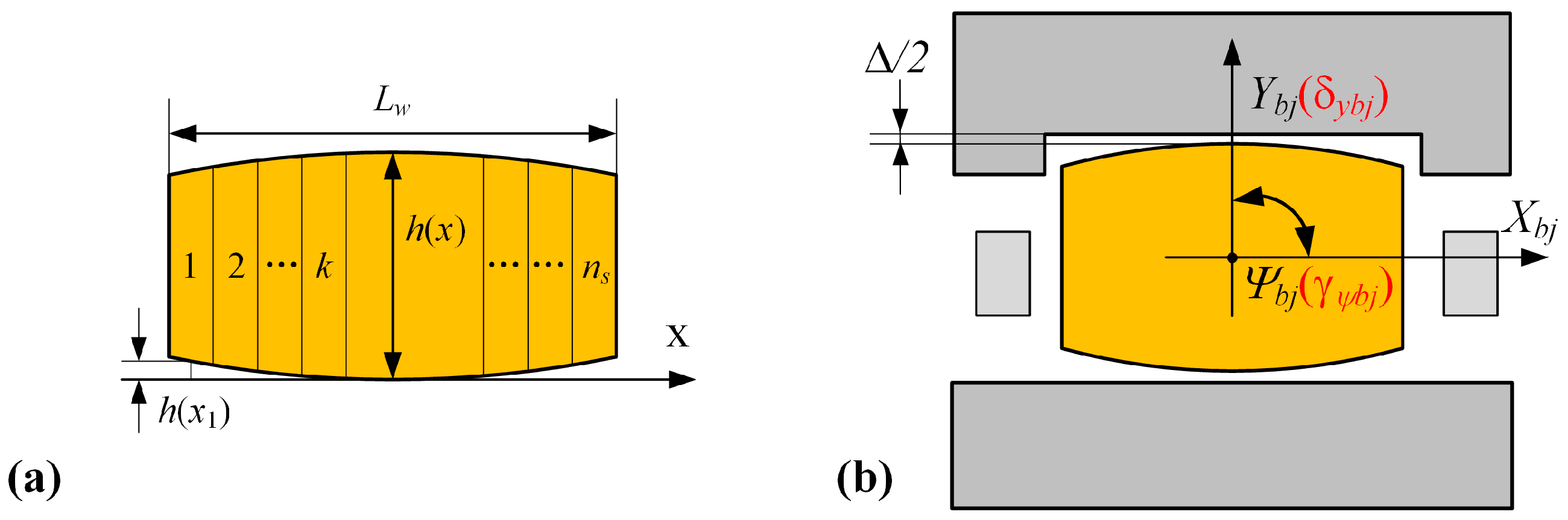
In practical engineering, the profile of the roller is logarithmically modified to consider the contact state between the roller and the raceway [42]. The slice technique can be adopted to demonstrate this profile of the roller, as shown in Figure 7. For the roller of CRBs, the profile function is generally expressed as follows [51]:
h x k = K x d b ln 1 1 2 x k / L w 2
where K x is the coefficient of the profile, x k is the position of the k-th slice and L w is the effective length of the roller. Therefore, the contact deformation between the k-th slice between the roller and the raceways, considering the profile of the roller, can be derived as follows:
δ i j k t = δ i j t h j k x k + γ i j t x k Δ / 2 δ o j k t = δ o j t h j k x k + γ o j t x k Δ / 2
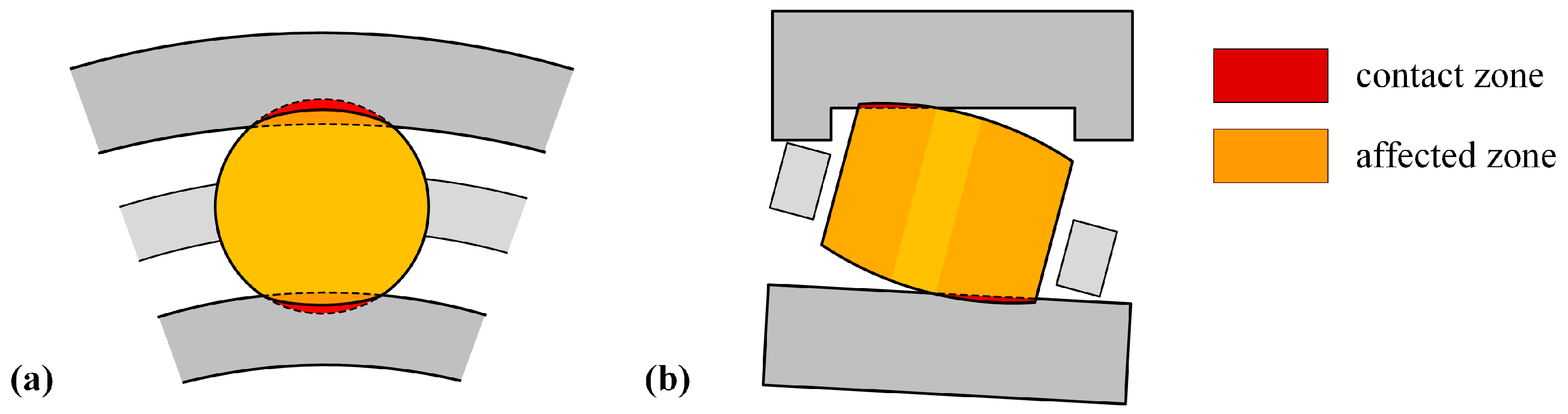
Additionally, when the bearing operates under a contact state, the contacting rollers undergo dynamic alternations corresponding to bearing motion. Both the contact zone and contact severity between rollers and raceways are influenced by the motion state. Figure 8 shows the contact effects between rollers and raceways from both radial and axial cross-sectional perspectives. The rollers under contact experience compressive deformation from both inner and outer raceways, as shown in Figure 8a. Notably, the angular deformation frequently occurs in the bearing, resulting in axial variations in the contact state between rollers and raceways, as shown in Figure 8b. The penetration depth and tilt angle at contact interfaces induce differential stiffness characteristics between rollers and raceways. During operation, the rollers continuously alternate, and their contact severity undergoes real-time variations, collectively contributing to the prominent time-varying stiffness characteristics exhibited by bearings under contact state.
Elastic deformation is considered to occur at the local contact position between the roller and the raceways, and the transformation relationship between deformation and load can be derived using Hertzian theory [15]. Therefore, the contact loads and moments between the j-th roller and the raceways can be obtained by the following:
Q i j / o j t = k = 1 n s K H δ i j k / o j k 10 / 9 t Δ l 8 / 9 M i j / o j t = k = 1 n s K H δ i j k / o j k 10 / 9 t Δ l 8 / 9 x k
where K is the coefficient of contact stiffness, H   ·   is the Heaviside function, which is used to describe the contact state. The rollers of CRBs are required to achieve force balance at their respective transient azimuthal angles. Therefore, the force equilibrium equation for the j-th roller can be expressed as follows:
Q i j t Q o j t + Q c j t = 0 M i j t M o j t = 0
where Q c = 0.5 m b d m ω c 2 is the centrifugal load of the j-th roller.
According to the geometric relationships, the equilibrium equation of the inner raceway in the global frames can be written as follows:
F b t = F y t F z t M y t M z t = j = 1 Z Q i j t cos φ j t Q i j t sin φ j t M i j t sin φ j t M i j t cos φ j t
where F y , F z , M y and M z are the external combined loads, which are equal and opposite forces for the inner ring (rotor) and outer ring (stator).
The derived system of Equation (24) is time-dependent and nonlinear, primarily due to the Heaviside function introduced in Equation (22). This function introduces step discontinuities in the vector function F b t , which arise from the radial clearance and transient contact states, as depicted in Figure 6. In this paper, the Newton–Raphson method has been used to solve the time-varying nonlinear system of equations. Therefore, the dynamic stiffness matrix of the CRB under arbitrary vibrational displacements can be calculated by the following:
K b = k y y k y z k y θ y k y θ z k z y k z z k z θ y k z θ z k θ y y k θ y z k θ y θ y k θ z θ z k θ z y k θ z z k θ z θ y k θ z θ z = F y δ y F y δ z F y γ y F y γ z F z δ y F z δ z F z γ y F z γ y M y δ y M y δ z M y γ y M y γ y M z δ y M z δ z M z γ y M z γ y
During the calculation of the dynamic response, the motion and deformation of the CRBs vary with time. Therefore, at each numerical step, it is necessary to first compute the motion and deformation, then determine the stiffness matrix of the bearing at that particular instant by Equation (25), and subsequently calculate the dynamic response at that step.

2.4. System Assembly and Equation of Motion

Based on the dynamic models of the rotor, stator, and CRBs and the parameter matrices of each component in the previous analysis, the equation of motion of the rotor–stator system of the aeroengine has been derived, and the rotor–stator system model considering the contact state of CRBs has been established.
Based on the established bearing dynamic model, the equations of motion for the rotor–stator system are derived using Lagrange’s method:
M q ¨ + C + ω G q ˙ + K q = Q
where M , C , G and K are, respectively, mass, damping, gyroscope, and stiffness matrix, q is the displacement vector, and Q is the load vector.
For the rotor–stator system of aeroengine, it is necessary to consider the rotor, bearings, and stator separately during the modeling process, so their displacement vectors can be expanded and written as follows:
q = q r q b q s T
where q r , q b and q s are, respectively, the displacement vectors of the rotor, bearing and stator.
Similarly, the load vector can also be expanded and written as follows:
Q = Q r Q b Q s T
Correspondingly, the mass, stiffness, and gyroscopic matrix can be expressed as follows:
M = M r 0 0 0 M b 0 0 0 M s K = K r K r , b 0 K r , b K b K s , b 0 K s , b K s G = G r 0 0 0 0 0 0 0 0
In addition, it is assumed in this study that the damping matrix is composed of viscous damping and is represented by the Rayleigh damping:
C = α M + β K
α = 2 ξ ω 1 ω 2 ω 1 + ω 2 , β = 2 ξ ω 1 + ω 2
where ω 1 and ω 2 are the predetermined frequency range and ξ is the damping ratio. The current model does not account for internal damping within the rotor, which may influence stability at supercritical speeds [29,32].
So, Equation (25) can be expanded and written as follows:
M r 0 0 0 M b 0 0 0 M s q ¨ r q ¨ b q ¨ s + C r C r , b 0 C r , b C b C s , b 0 C s , b C s + ω G r 0 0 0 0 0 0 0 0 q ˙ r q ˙ b q ˙ s + K r K r , b 0 K r , b K b K s , b 0 K s , b K s q r q b q s = Q r Q b Q s
where M r , C r , G r and K r are the submatrices of mass, damping, gyroscope, and stiffness of the rotor, M s , C s and K s are the submatrices of mass, damping, and stiffness of the stator, M b , C b and K b are the submatrices of mass, damping, and stiffness of the bearing.
It should be noted that the bearing clearance effects introduced in the previous section directly impact the stiffness terms K r , b and K s , b , resulting in time-dependent variations in the system dynamics, which need to be modified based on the displacement of the bearing in the transient response.
This section establishes the equations of motion for the rotor–stator system, incorporating mass, damping, stiffness, and gyroscopic effects, which serves as the foundation for numerical simulations and experimental validation in the subsequent sections.

3. Numerical Calculation Method

According to the previous analysis, the contact state between the rollers and the raceway in the CRBs will constantly change with load. If the calculation of the contact state change time and corresponding response cannot be accurate, it will affect the accuracy of the response of the rotor–stator system. A novel numerical calculation method has been proposed in this section, which introduces the Event Function to effectively calculate the contact state between the rollers and the raceway and the dynamic response of the rotor–stator system.
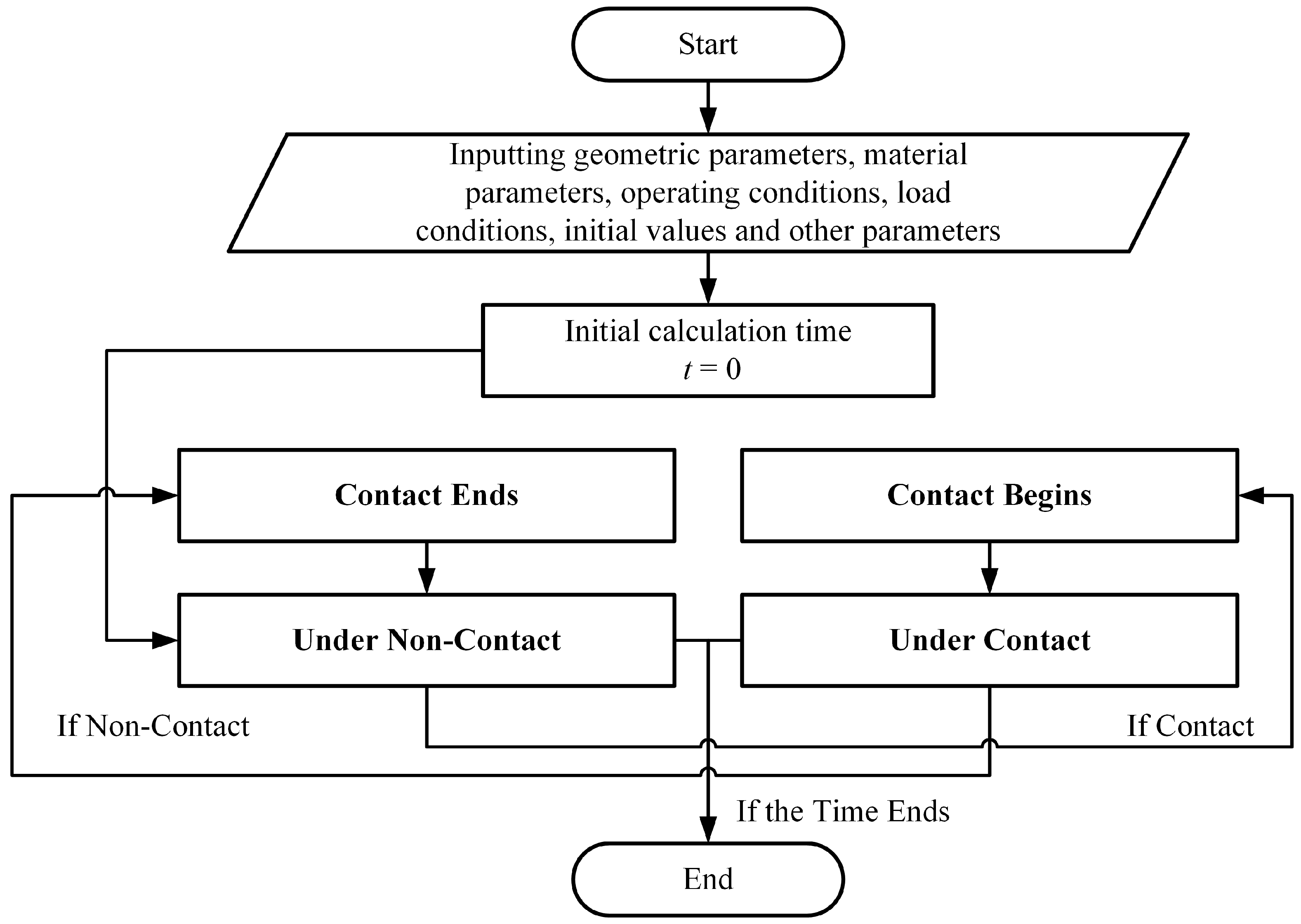
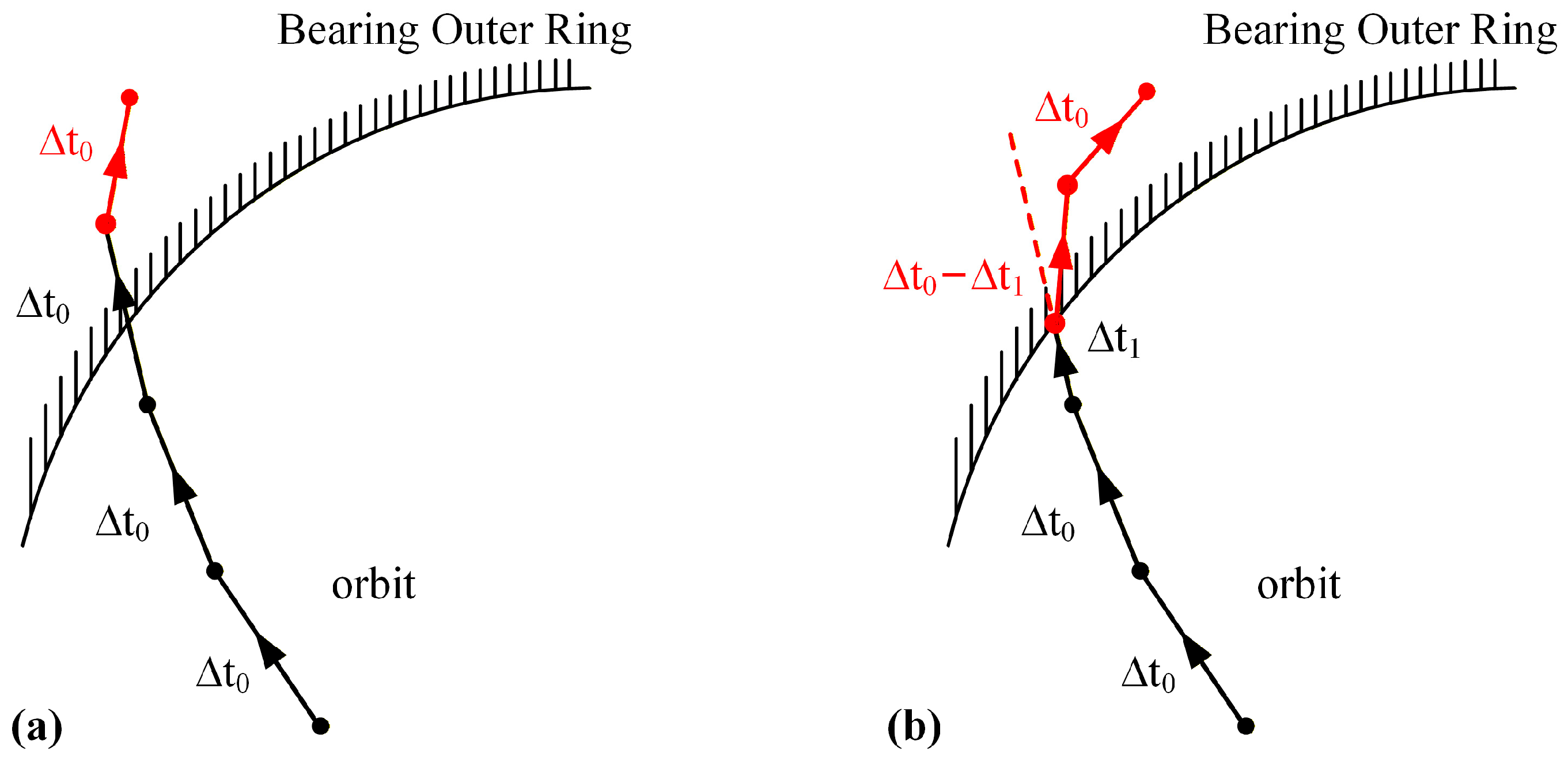
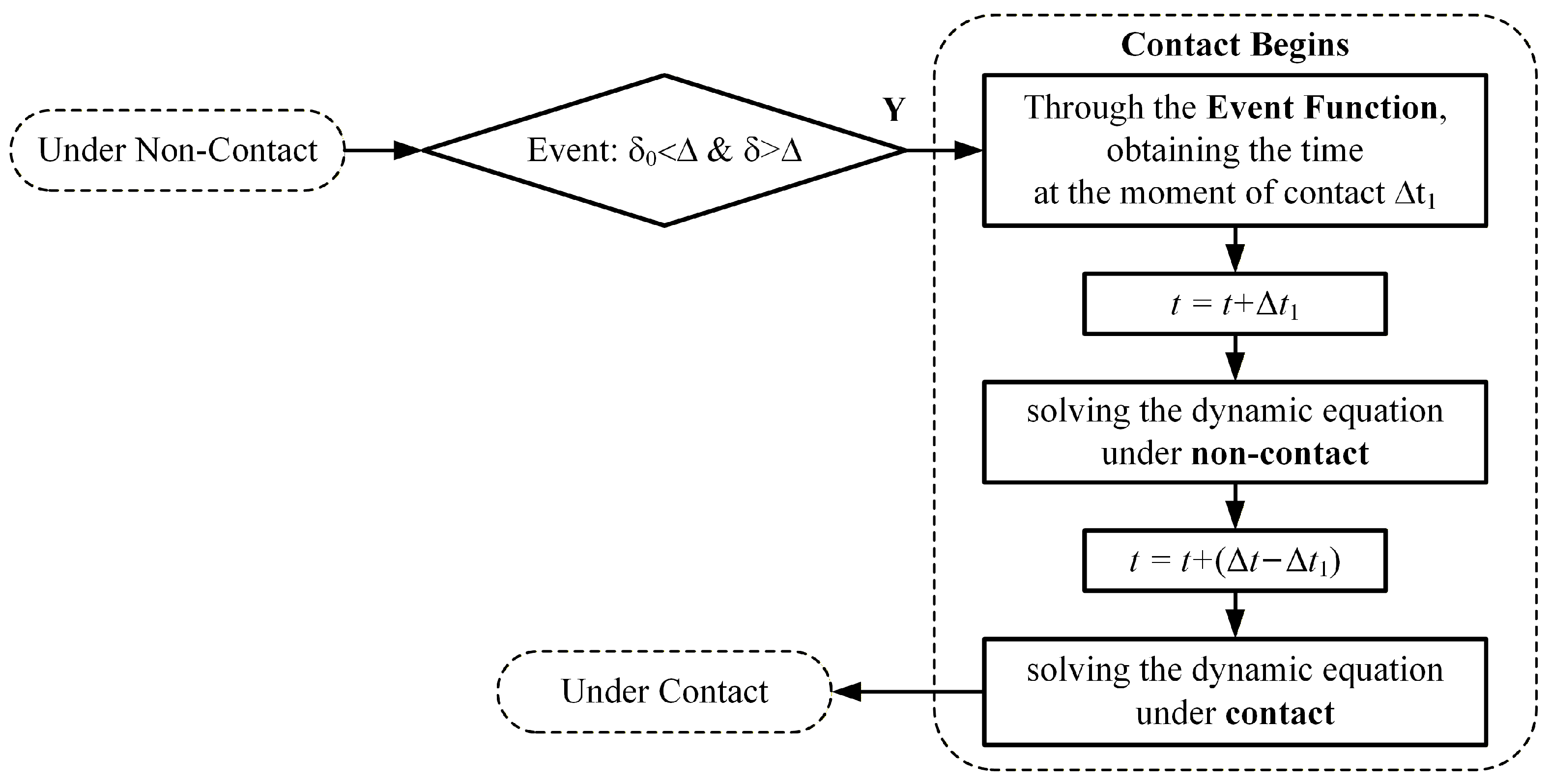
This method, based on the Newmark-β method, introduces the Event Function to precisely track the contact state between the rollers and raceways, ensuring accurate numerical results. And it is designed to address the dynamic response of the rotor–stator system, where bearing clearance leads to periodic contact and collision. By integrating the Event Function [40,52], the method ensures accurate detection of collision events, leading to improved numerical stability and precision. For illustrative clarity, Figure 9 presents a schematic overview of the computational workflow of the method, with the comparison between classical and event-based integration methods shown in Figure 10, while some detailed numerical procedures are shown in Figure 11 and Figure 12.
At the initial stage of the computation, the geometric and material parameters of the rotor–stator system, bearing properties, rotor rotational speed, imbalance distribution, and other applied loads are input into the simulation program. The initial conditions for each degree of freedom (DOF) are also defined. As shown in Figure 9, during the computation, it is assumed that there is initially no contact between the rollers and the raceways; namely, the system is considered “Under non-contact”. Based on the specified time step, the dynamic response of the rotor–stator system is iteratively calculated. If no collisions occur throughout the entire calculation process, these computational steps will be repeated until the set computation time is reached, at which point the calculation process terminates.
At each step of the calculation, the relative distance between the inner and outer rings of the bearing is computed and is given by the following:
δ = y o 2 + z o 2 y i 2 + z i 2
If, in the previous step, no contact occurred between the inner and outer rings, but in the current step contact is detected, it is considered that a collision has occurred, and the calculation proceeds to the “Contact begins” module. The condition for determining whether a collision has occurred can be expressed as follows:
δ 0 < Δ   &   δ > Δ
The following calculation process has been optimized in this paper. According to the classical integration method shown in Figure 10a, the calculation is performed based on the initial state, and any changes in parameters due to contact would only be updated in the subsequent step. In the ‘Contact Begins’ module in this paper, based on the Event Function, the single-step calculation has been divided into two steps, as illustrated in Figure 10b. The time of collision initiation Δ t 1 has been determined by utilizing the Event Function. The calculation is first carried out considering it as “Under non-contact”, and subsequently time Δ t 0 Δ t 1 has been solved and considered as “Under contact”. This approach allows for the continuous variation in the contact-induced load over time, which is then applied to the system to obtain its dynamic response. The computational flowchart of the “Contact begins” module is shown in Figure 11.
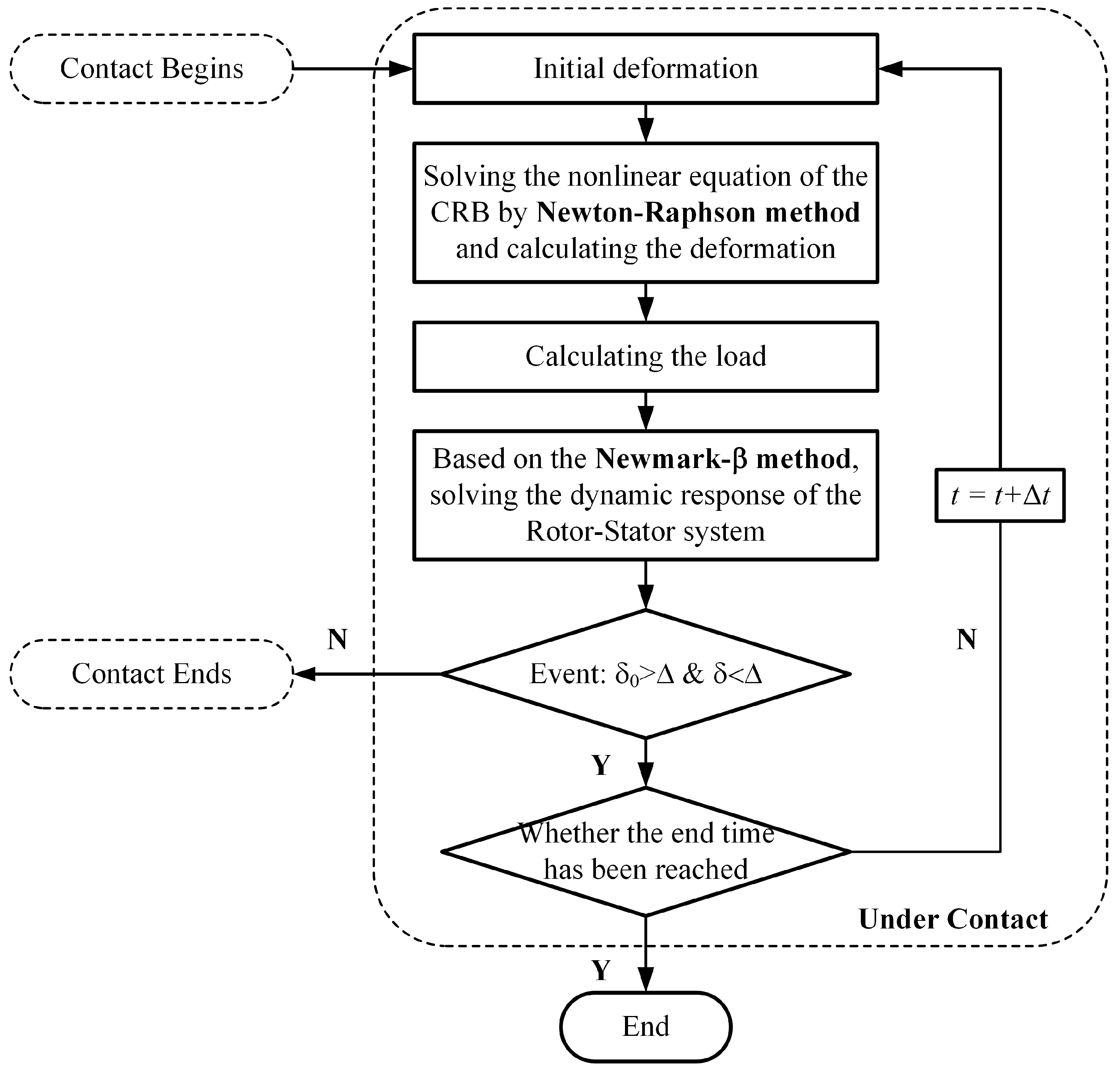
After completing the load step where collision occurs, the motion enters the continuous contact state, namely the “Under contact” module. And the computational flowchart of the “Under contact” module is shown in Figure 12. The deformation obtained from the previous step has been used as the initial condition. The nonlinear system of equations in Equation (24) is then solved using the Newton–Raphson method to determine the deformation of CRB. Based on the deformation, the bearing stiffness matrix for the current load step is computed using Equation (25). Subsequently, the dynamic response has been solved using the Newmark-β method, as described in Equation (32). These computational steps will be repeated until the set computation time is reached, at which point the calculation process terminates.
At each computational step, the relative distance between the inner and outer rings of the bearing is calculated to determine whether the rollers remain in contact with the raceway. If the previous and subsequent load steps are always in the “Under Contact” state, calculate the transient stiffness of the bearing under this load step according to Equation (25) and calculate the dynamic response of the rotor–stator system. If the previous step’s calculation indicated contact between the inner and outer rings, but in the current step, they are no longer in contact, it is considered that the bearing has returned to the “Under Non-Contact” state. This triggers the transition to the “Contact ends” module. The condition for the cessation of contact can be expressed as follows:
δ 0 > Δ   &   δ < Δ
The calculation process in the “Contact ends” module is similar to that of the “Contact begins” module. After the calculation is completed, the process enters the “Under non-contact” module, where the calculations are iteratively performed. Both the “Under non-contact” and “Under contact” modules include checks for the computation time, with exit conditions set to terminate the calculation once the set computation time is reached.
In summary, the computational method for solving dynamic responses, which incorporates the collision process, has been improved in this paper. By introducing the Event Function within the Newmark-β method, this method enhances numerical accuracy in capturing transient contact phenomena and time-varying stiffness in the rotor–stator system.

4. Simulation Analysis

Based on the dynamic model and numerical simulation method established in the previous section, this section refers to an aeroengine to build a rotor–stator system example model and conduct calculations and analysis to study the influence of stator modal vibration on the rotor dynamic behavior.

4.1. Dynamic Characteristics of the Rotor–Stator System

In this section, the dynamic response of the rotor–stator system has been analyzed based on the previously established dynamic model, followed by an analysis and discussion of the results.
Figure 1 shows a high thrust-to-weight ratio turbofan engine, highlighting the LP rotor–stator system. Based on its structural configuration, a rotor–stator system has been refined, including a three-bearing rotor and its corresponding stator, which provides constraint to the rotor, as shown in Figure 13. The rotor consists of two large mass disks, Disk 1 and Disk 2, located between the 1# and 2# Support, and between the 2# and 3# Support, respectively. An elongated shaft is between the 2# Support and the Disk 2, characterized by a long length and low stiffness. The stator consists of the frame corresponding to each bearing, namely the 1#, 2#, and 3# Frames, as well as the casings between these frames, namely Casing 1 and Casing 2. As mentioned earlier, the rotor is modeled using the beam elements, while the stator is modeled using the shell elements. It can be observed that the Frame, as the “double-layer thin-walled with support plate” structure, is discretized using the shell elements. The structural parameters of the rotor–stator system are provided in Table 1.
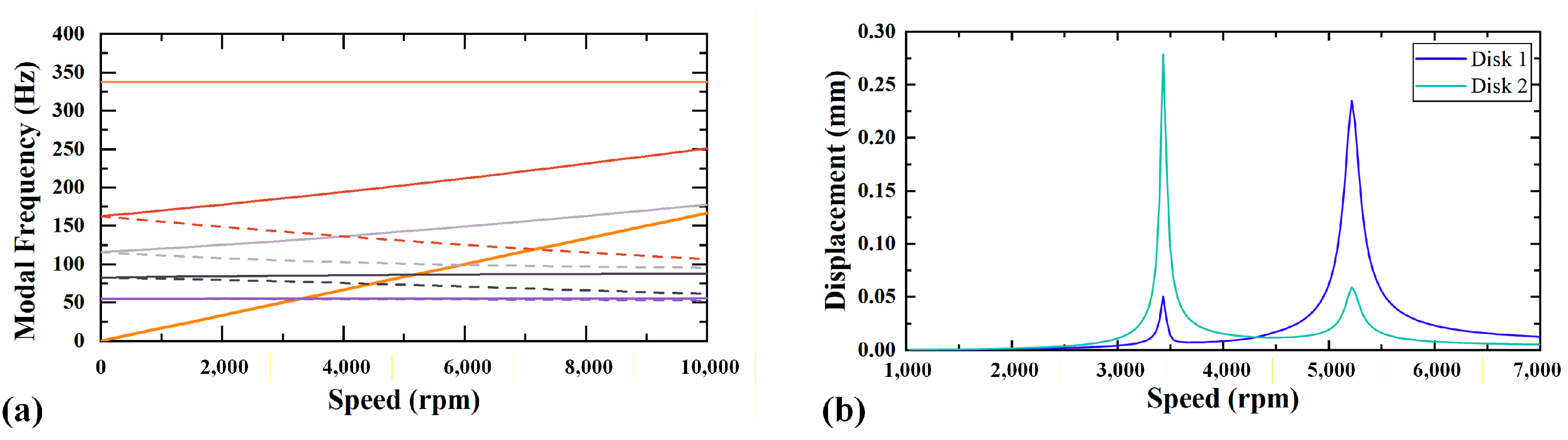
The modal and dynamic response characteristics of the rotor–stator system, which are obtained by the linear system without time-varying bearing effects, have been illustrated in Figure 14.
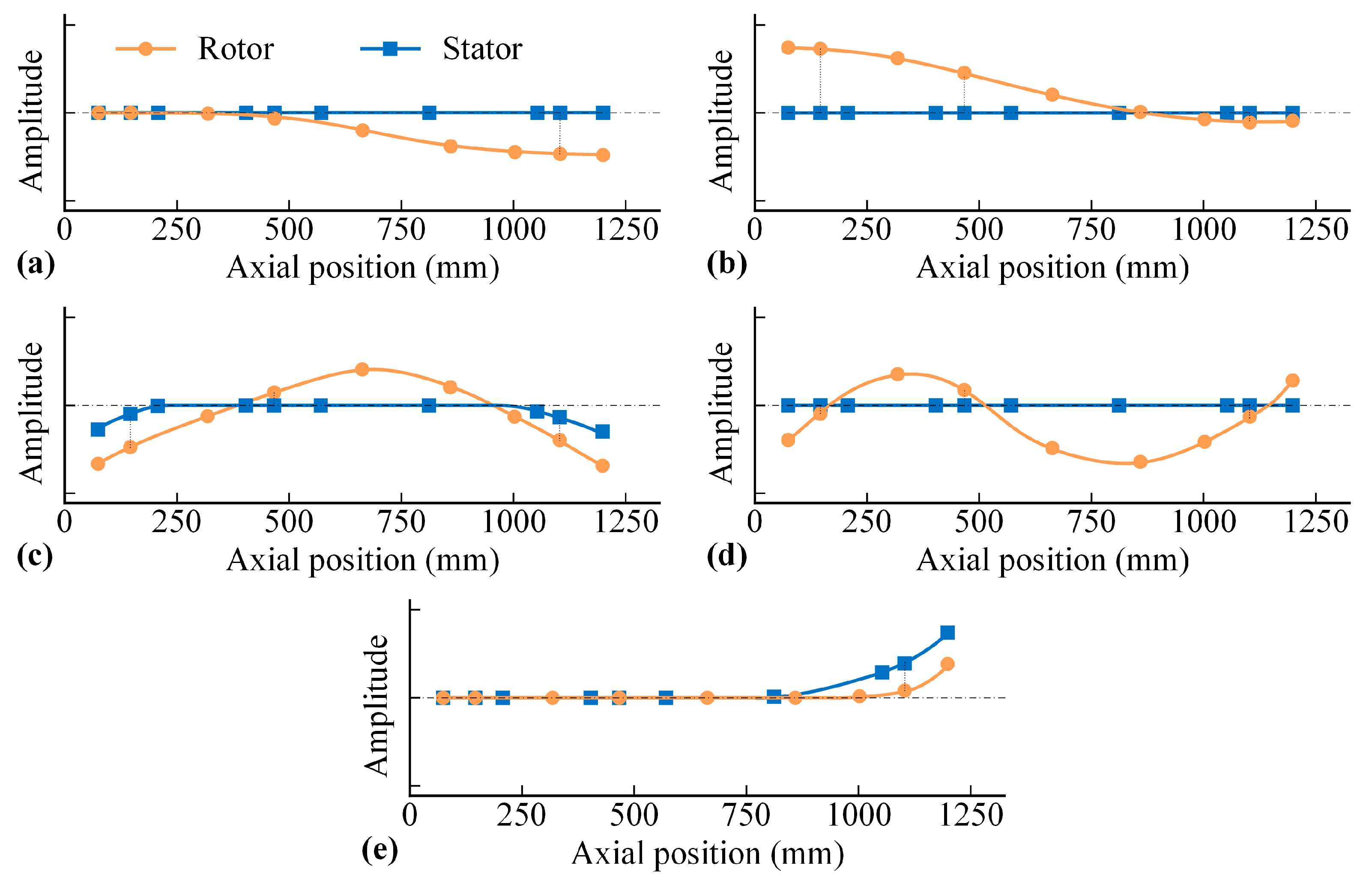
From Figure 14a, the Campbell diagram reveals five pairs of resonance speed lines within the 450 Hz frequency range, corresponding to five distinct modes of the rotor–stator system. The mode shapes of these modes are presented in Figure 15. Notably, the first four modes predominantly involve rotor deformations, and their frequencies vary with rotational speed, aligning well with the patterns observed in the Campbell diagram of Figure 14a. However, as seen in Figure 15e, the fifth mode of the rotor–stator system is primarily characterized by localized deformation of the 3# Frame, a localized stator mode. The frequency of this mode remains nearly constant at 337.6 Hz, independent of rotational speed, which is primarily attributed to the minimal influence of the gyroscopic effect on the stator.
In Figure 14a, the rotational speed frequency line intersects with the precession lines of the first two resonance speeds at approximately 3405 rpm and 5230 rpm, which correspond to the critical rotational speeds of the system. Higher-order modes exhibit significantly higher frequencies that do not intersect with the rotational speed frequency line.
Applying an imbalance of 20 g·mm to both disks, the dynamic response of the rotor–stator system within the rotational speed range of 0 to 7000 rpm has been calculated, as shown in Figure 14b. The results reveal two main response peaks at approximately 3430 rpm and 5210 rpm, which closely align with the critical speeds identified in the Campbell diagram. From the dynamic response, it can be observed that there are two main response peaks within the calculated rotational speed range, occurring at 3430 rpm and 5210 rpm, which are close to the two critical rotational speeds indicated in the Campbell diagram. Additionally, from Figure 14b, it is evident that the dynamic responses of the disks vary significantly with speed. Near the first critical rotational speed, Disk 2 exhibits higher vibration amplitudes than Disk 1, whereas the trend reverses near the second critical speed. This observation is consistent with the modal shapes shown in Figure 15a,b.

4.2. Results and Discussion

Based on the linear model, this section will introduce the nonlinear factors of bearing clearance and analyze their significant impact on the dynamic behavior of the system.
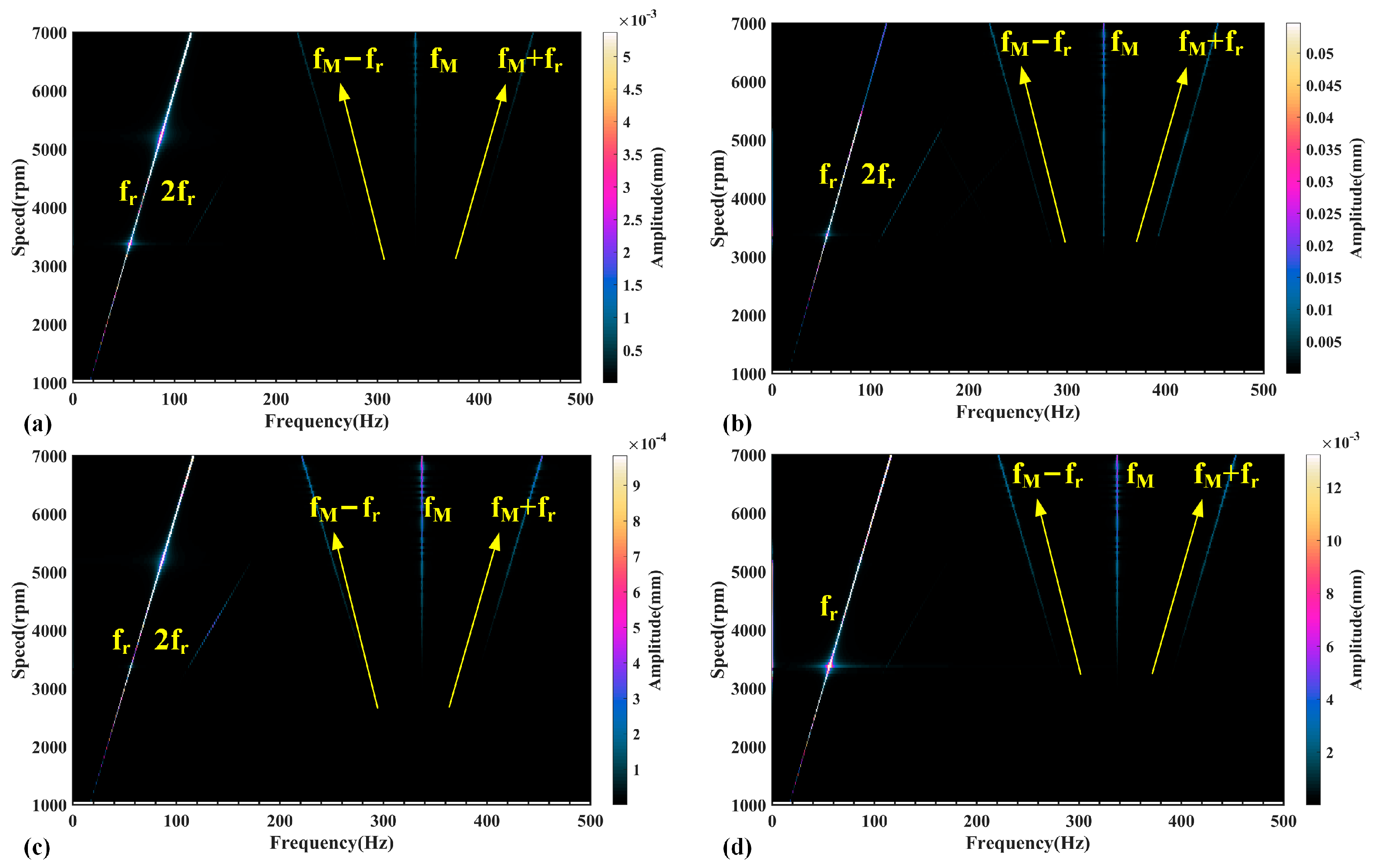
The bearings in the high-performance aeroengine are always designed with clearance to compensate for the thermal expansion during the design operating condition [40]. Therefore, the case where there is clearance in the bearing at the 3# Support has been calculated to simulate the CRBs operating in the turbine components. Therefore, the bearing is set as the quasi-static model established earlier for analysis. The relevant parameters of the bearing are provided in Table 2. In addition, an imbalance of 20 g·mm has been applied to both disks. Using the proposed numerical simulation method, the dynamic response of the rotor–stator system is computed within the 0 to 7000 rpm range. The spectrograms of the dynamic responses from calculations at different positions are shown in Figure 16.
From Figure 16, it can be observed that at the subcritical state, the rotational frequency f r is the dominant component in the spectrum, accompanied by a minor second harmonic 2 f r . As the rotational speed increases and transitions into the supercritical state, a new frequency component emerges at a constant value of 337 Hz, independent of rotational speed. By comparing with the results in the Campbell diagram of Figure 14a, it is identified as the fifth mode frequency f M of the rotor–stator system, primarily associated with the localized stator mode of the 3# Frame, as shown in Figure 15e. Furthermore, it is evident from Figure 16 that the magnitude of this frequency component f M is higher at positions near the 3# Support and weaker at locations farther from it, such as Disk 1. The distribution of dynamic responses and distribution at different positions align closely with the mode shape shown in Figure 15e, confirming that it corresponds to the fifth mode, whose mode shape is dominated by the stator.
Further analysis reveals that the excitation of this frequency component is due to the bearing clearance-induced collision effects between the inner and outer rings. When the contact state between the roller and the raceway transitions from “Under non-contact” to “Under contact”, the collision effect will occur. The periodic collisions generate excitation forces that excite modal vibrations in nearby structures. As these collisions persist, the modal frequency appears consistently in the frequency spectrum.
Moreover, as shown in Figure 16, it can be observed that a pair of frequency components is symmetrically distributed around f M appears, satisfying the relation f C = f M ± f r . This suggests that the rotor’s rotational motion and the stator’s modal vibrations interact, resulting in the modulation effect and the appearance of combination frequencies. This dynamic response phenomenon would be interpreted with Figure 17. The stator’s dynamic response is dominated by modal vibrations, while the rotor supported on the stator performs whirl motion, simultaneously influenced by the stator’s modal vibration. The dynamic interaction manifests as a distinct modulation effect in the rotor dynamic behavior, which is spectrally evidenced by the emergence of a combination frequency in the displacement spectrum.
There are typically mode shapes characterized by localized stator deformation in the rotor–stator system. The dynamic coupling between rotor and stator emerges when rotor operation conditions interact with these modes. This interaction becomes particularly pronounced in the presence of nonlinear factors, such as the collision effect induced by bearing clearance as investigated in this study, leading to a substantial influence of stator modal vibration on the rotor dynamic behavior.
The underlying mechanical mechanism can be summarized as follows: (1) firstly, there are usually the localized stator modes in the rotor–stator system; (2) next, when the rotor enters the non-synchronous whirl motion state, the contact state of CRB frequently switches between “non-contact” and “contact” states, resulting in collision effects and exciting the localized stator mode; (3) finally, there is interaction between the modal vibration of the stator and the dynamic behavior of the rotor, resulting in the modulation effect. In this paper, the rotor entered the non-synchronous whirl motion state for the first time, and due to the localized modal vibration of the 3 # Frame, the dynamic behavior of the rotor has never returned to the synchronous whirl.
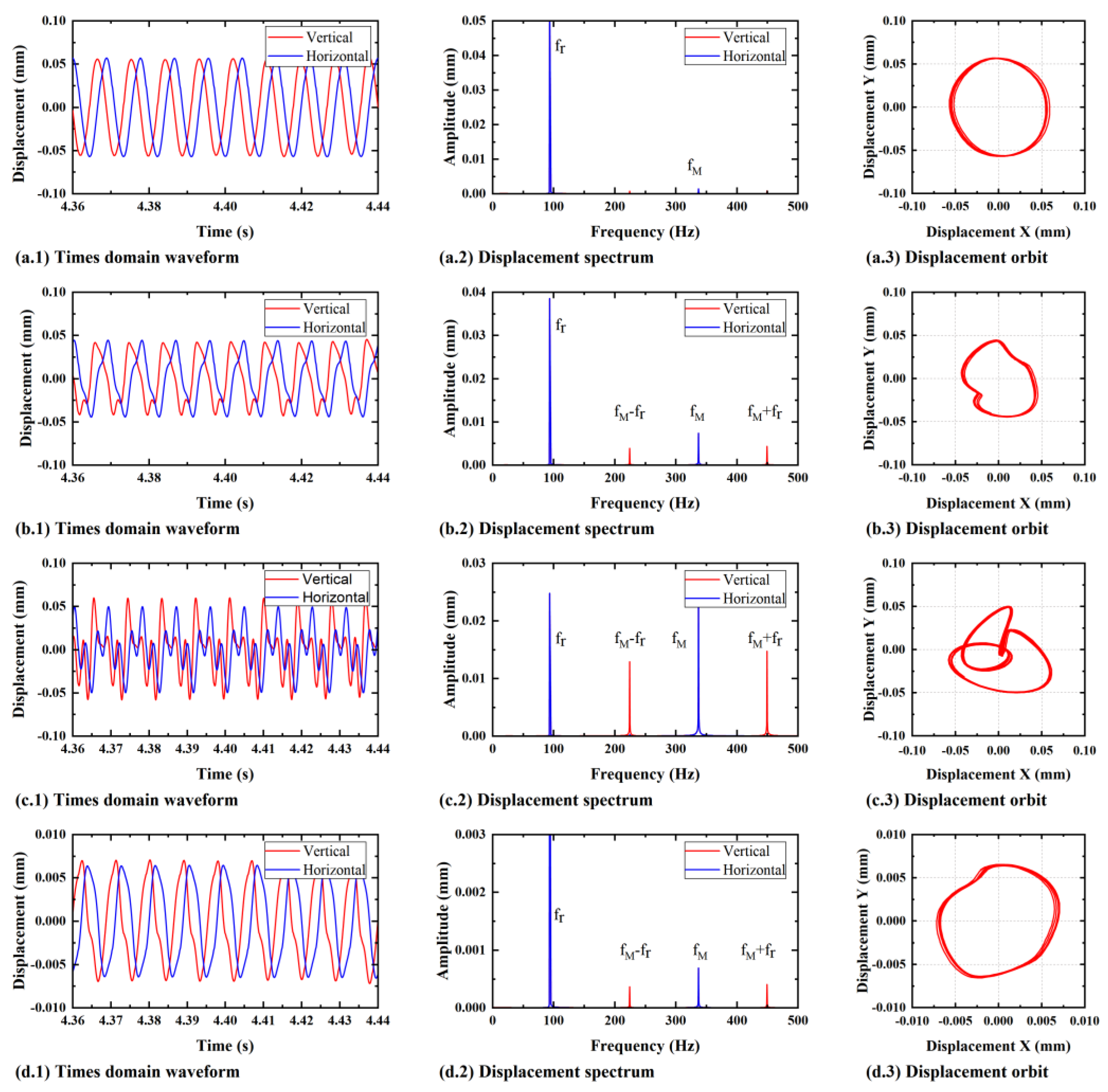
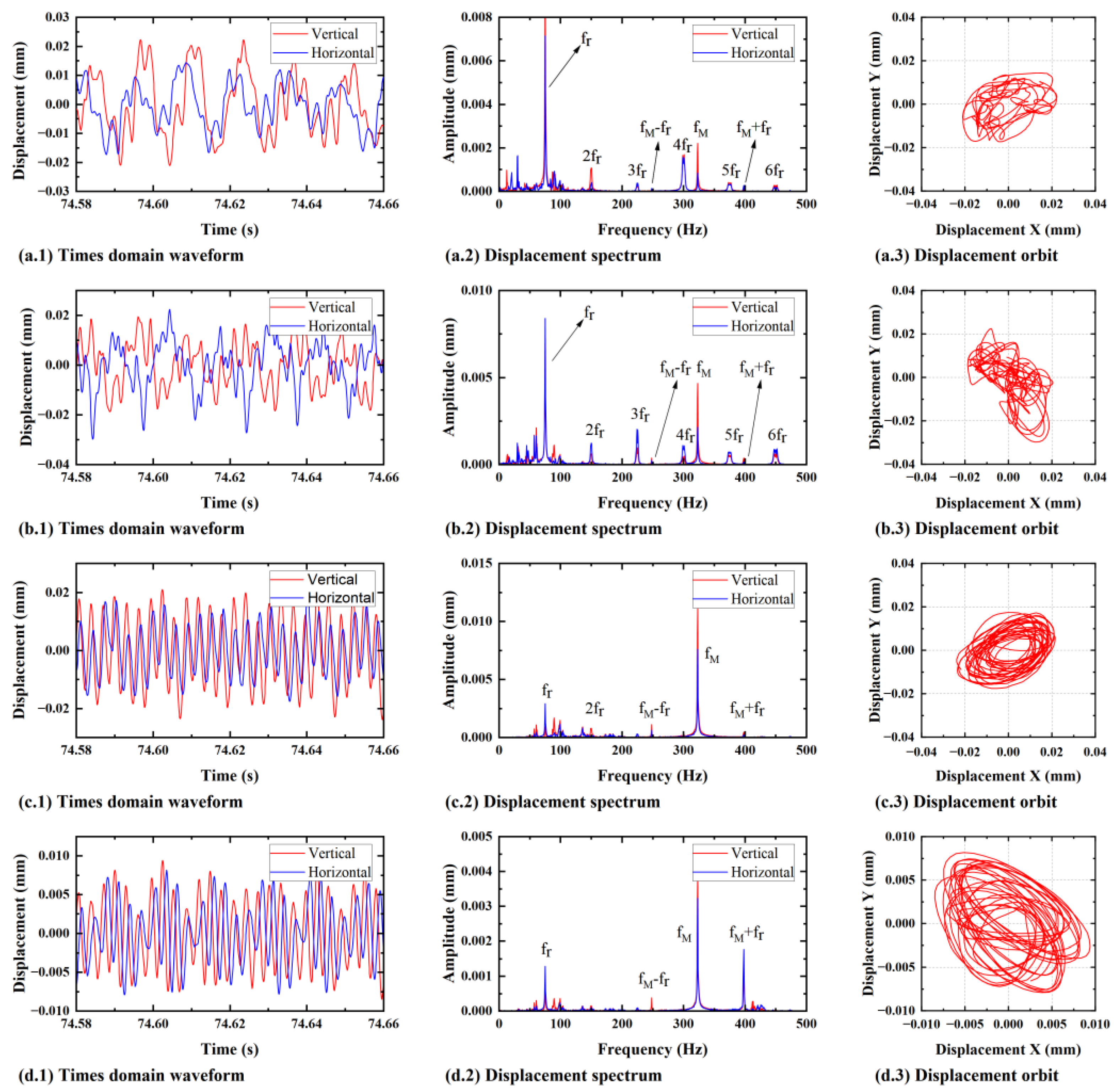
To further investigate the dynamic behavior of the rotor influenced by the stator and the CRBs, the dynamic response at different positions at 5600 rpm has been extracted, as shown in Figure 18, including time-domain signals, frequency domain spectra, and displacement orbits.
From Figure 18a.1–a.3, it can be observed that at Disk 1, the dynamic response is primarily dominated by the rotational frequency f r , with minimal contributions from the modal frequency f M and the combination frequency f M ± f r . Specifically, the amplitude of the modal frequency f M is only 2.5% of the rotational frequency f r , indicating weak coupling between rotor motion and stator vibration at this position. This occurs because the excited mode is the localized stator mode of the 3# Frame, and its influence diminishes farther from the excitation source, and the deformation at the Disk 1 location is relatively small. Therefore, the resulting rotational-vibration coupling is also minimal, leading to a small influence from the modal frequency f M and combination frequencies f M ± f r .
However, the above phenomenon becomes more pronounced near the 3# Support. As shown in Figure 18b.1–b.3, on Disk 2, the spectrum prominently features the rotational frequency f r , the modal frequency f M , and the combination frequencies f M ± f r . The amplitude of the modal frequency f M measures 19.2% of the rotational frequency f r , while the combination frequencies f M f r and f M + f r are, respectively, 9.85% and 11.15% of the rotational frequency f r . Additionally, the time-domain signal deviates from a typical sinusoidal waveform, and the displacement orbit exhibits a complex shape, suggesting the influence of coupling between the rotational motion and the modal vibration, leading to more complex dynamic behavior.
This phenomenon is also evident at the 3# Support and 3# Frame, as shown in Figure 18c.1–c.3,d.1–d.3. At the 3# Support, the amplitudes of the modal frequency f M surpasses that of the rotational frequency f r , reaching 101.2%, while the combination frequencies f M f r and f M + f r measure 52.2% and 59.7%, respectively. This results in highly irregular displacement orbits.
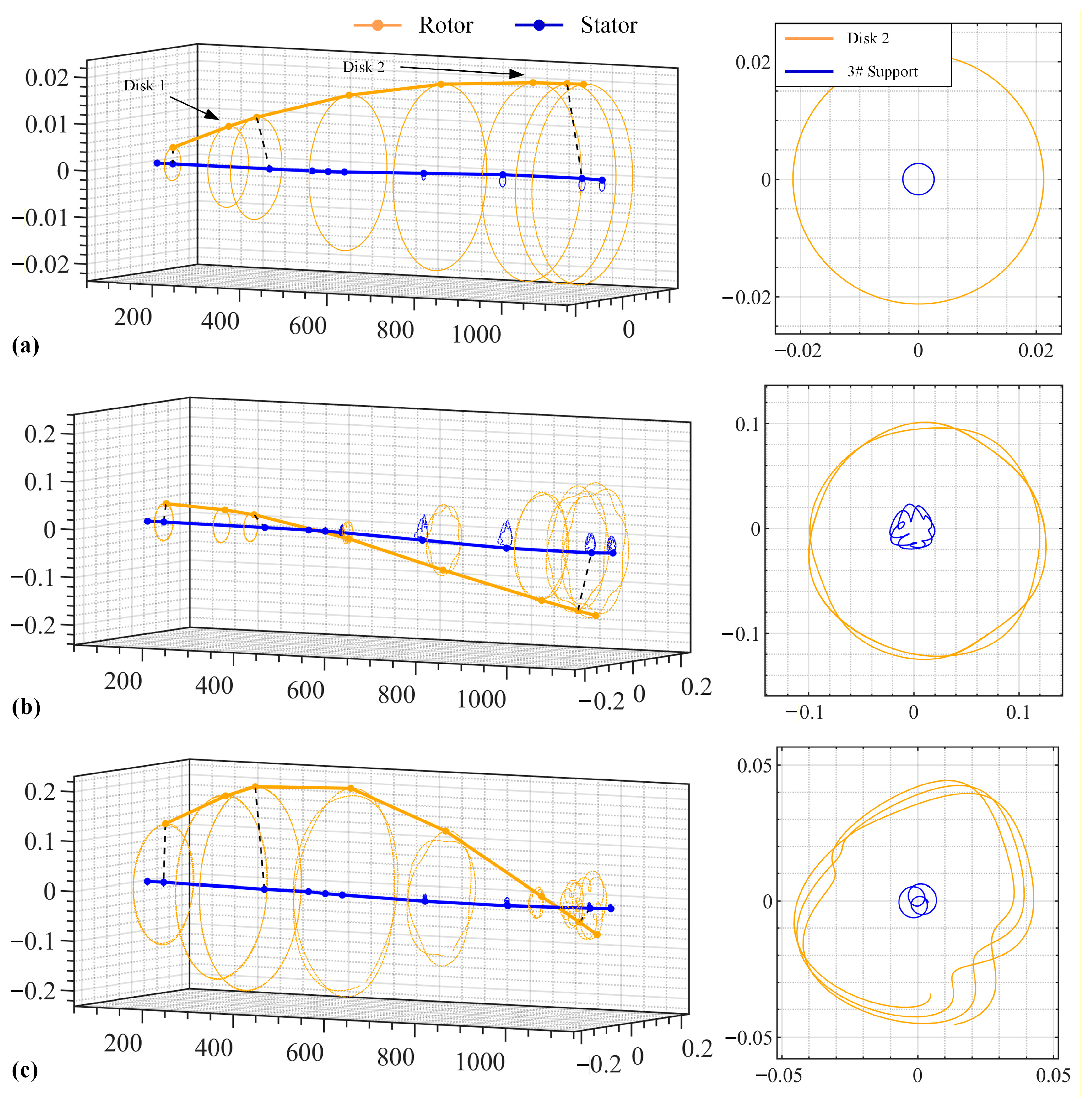
In addition, it can be observed from the radial deformation that the dynamic behavior of the rotor–stator system has changed significantly across different rotational speeds. Multiple nodes along the axial positions of both rotor and stator have been selected, and their dynamic responses have been extracted to draw the elastic curve of the rotor and stator, as shown in Figure 19. These elastic curves, complemented by nodal orbits, provide a complete characterization of both global and local dynamic behaviors. Also, the comparative evolution of orbits on the rotor and stator is shown in Figure 19, focusing on Disk 2 (rotor) and the 3# Frame (stator), which are closer in the axial position.
As shown in Figure 19a, the radial deformation of the rotor and stator is minimal under the subcritical state, with the deformed shape closely matching the first-order mode shape shown in Figure 15a. And all nodal orbits maintain perfect circularity in this region, dominated by rotational frequency. Transition to the supercritical state induces notable changes, as shown in Figure 19b, where the deformed shape progressively approaches the second-order mode shape shown in Figure 15b. This transition is particularly marked at the 3# Support region, which develops complex orbital patterns while other regions retain circular orbits. The rotor enters the non-synchronous whirl motion state, causing the contact state of the CRB to frequently switch between the “Under non-contact” and “Under contact” states, resulting in the collision effect and the modulation effect.
As the rotational speed further increases, the dynamic phenomenon becomes more pronounced. It can be seen from Figure 19c that when the rotational speed reaches 6000 rpm, the deformed shape is significantly similar to the second-order mode shape shown in Figure 15b. Although the response at the 3# Support and Disk 2 decreases significantly, the 3# Support and Disk 2 regions maintain their complex orbital pattern. Conversely, the Disk 1 and near locations preserve remarkably circular orbits despite experiencing significant amplitude magnification. This speed-dependent evolution clearly manifests the system’s progressive transition, highlighting the emergence of localized nonlinear effects at specific components while other regions retain more fundamental response characteristics, ultimately revealing the complex dynamic interactions within the rotor–stator system.
It can be indicated that response amplitude shows negligible correlation with vibration coupling effects. Instead, the interaction between the rotor and stator is predominantly governed by the localized stator mode of the 3# Frame and nonlinear effects at the 3# Support. These combined factors create exceptionally strong coupling between the rotor and stator at this interface. Notably, the presence of the 3# Frame (stator) assembly induces substantial modifications to rotor dynamic behavior, particularly in the vicinity of Disk 2, where the most significant vibrational alterations occur.
These modifications stem from the rotor–stator interaction mediated by the bearing clearance. This interaction critically influences aeroengine design and integrity management in several aspects: (1) The alteration of rotor dynamics by a localized stator mode necessitates an integrated rotor–stator design approach. The natural frequencies of the stator must be carefully positioned to avoid adverse coupling with excitation frequencies induced by rotor whirl motion. (2) The bearing clearance is the key parameter governing the rotor–stator interaction. Its selection represents a trade-off between thermodynamic accommodation and dynamic stability, guiding the choice between standard clearance, preloaded bearings, or active clearance control technologies. (3) The induced non-synchronous vibrations and combination resonances provide distinct spectral features that serve as sensitive indicators for the health of the bearing interface, enabling advanced diagnostic strategies beyond traditional synchronous tracking [10,53].
This section presents a dynamic response simulation of a rotor–stator system considering bearing clearance. These findings demonstrate that the dynamic behavior undergoes substantial changes in both local and frequency domains. Spatially, the stator’s response increases significantly, especially near the 3# Support. In the frequency domain, the presence of the modal frequency f M and the combination frequencies f M ± f r grows, highlighting the strong nonlinear coupling induced by bearing clearance. This shift in both local and frequency distribution demonstrates the strong coupling effect between the rotor and stator, which can lead to more complex and potentially detrimental dynamic behavior. The influence of the stator becomes more significant as the system experiences more pronounced nonlinearities, especially due to the collision effect induced by bearing clearance.

5. Experimental Verification

To validate the dynamic model and the mechanical mechanism mentioned earlier, a rotor–stator system simulation test rig has been constructed in this paper to conduct dynamic experiments.

5.1. Experimental Test Rig Design and Instrumentation

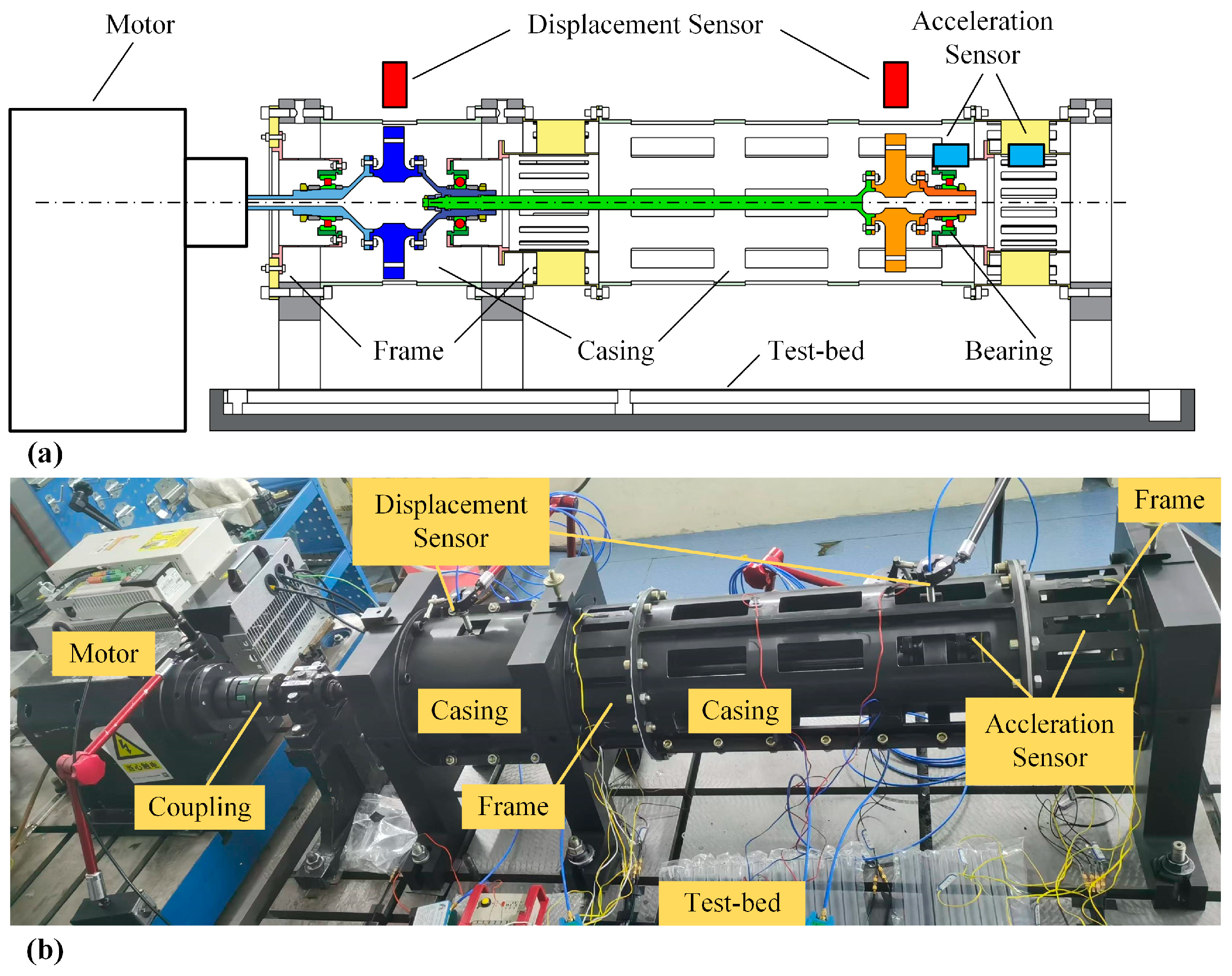
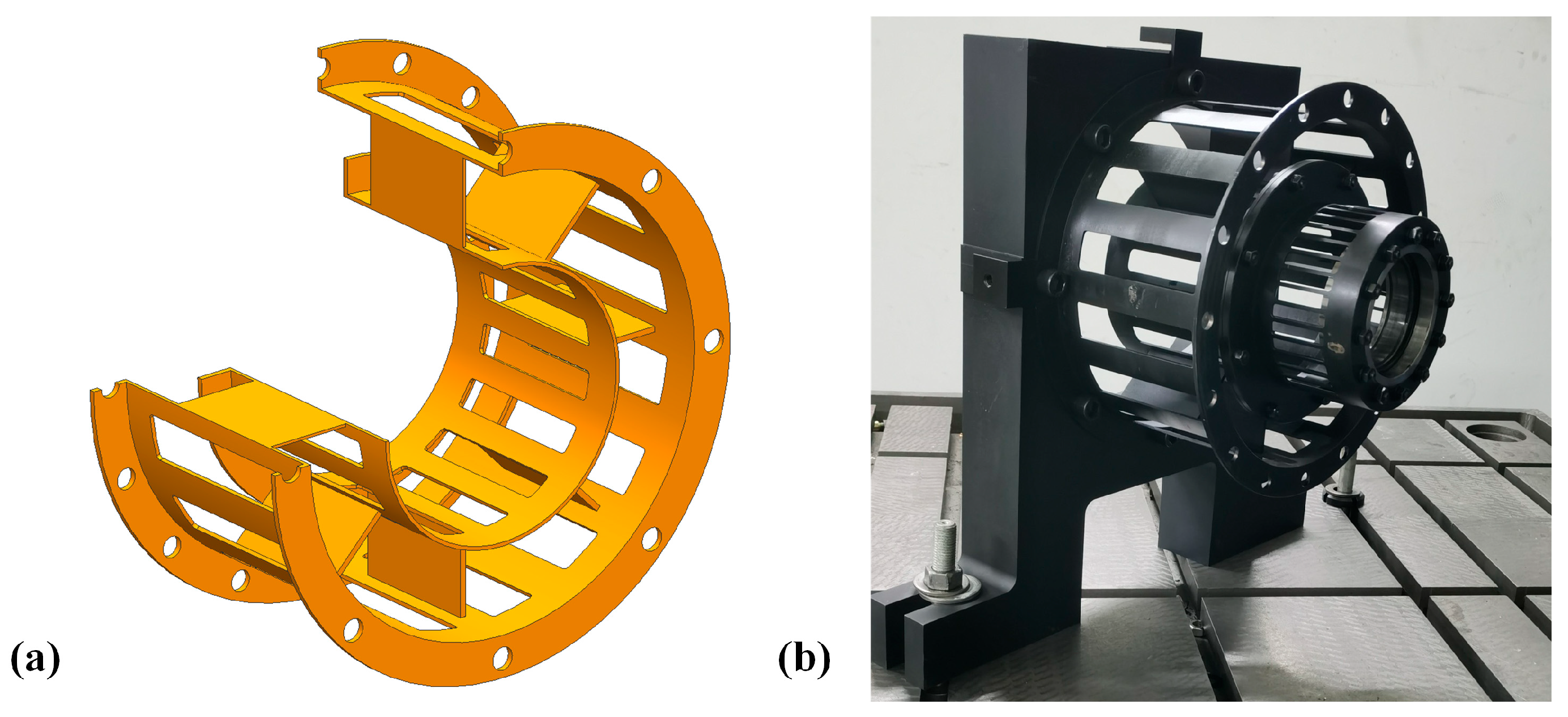
Referring to the rotor–stator system shown in Figure 13, a dedicated tester has been designed, as shown in Figure 20. Specifically, a ball bearing has been used at the 2# Support, while the CRBs have been used at the 1# and 3# Supports. To ensure the experiment’s operation, the shaft section at the 1# Support is connected to the motor shaft to provide torque input. And as mentioned earlier, the 2# Frame and the 3# Frame are designed as the “double-layer thin-walled with support plate” structure, with adjustable stiffness achieved by modifying wall thickness and groove dimensions to ensure the similar stiffness characteristics of the actual stator in the aeroengine. The schematic diagram of the 3# Frame is shown in Figure 21. Between these frames, a casing is mounted via flanges. The casing is split into two halves for easier assembly, ensuring that the dynamic characteristics of the test rig closely match the simulated model. By adjusting the relevant dimensions, the dynamic characteristics of the test rig are made to closely match those of the simulated model.
To effectively monitor the dynamic responses, measurement points have been arranged at multiple locations on the test rig. Non-contact eddy current displacement sensors have been installed at Disk 1 and Disk 2, while contact-type velocity sensors have been positioned at the 3# Support and the 3# Frame. Each measurement point included vertical and horizontal sensors to capture multi-directional vibrations.
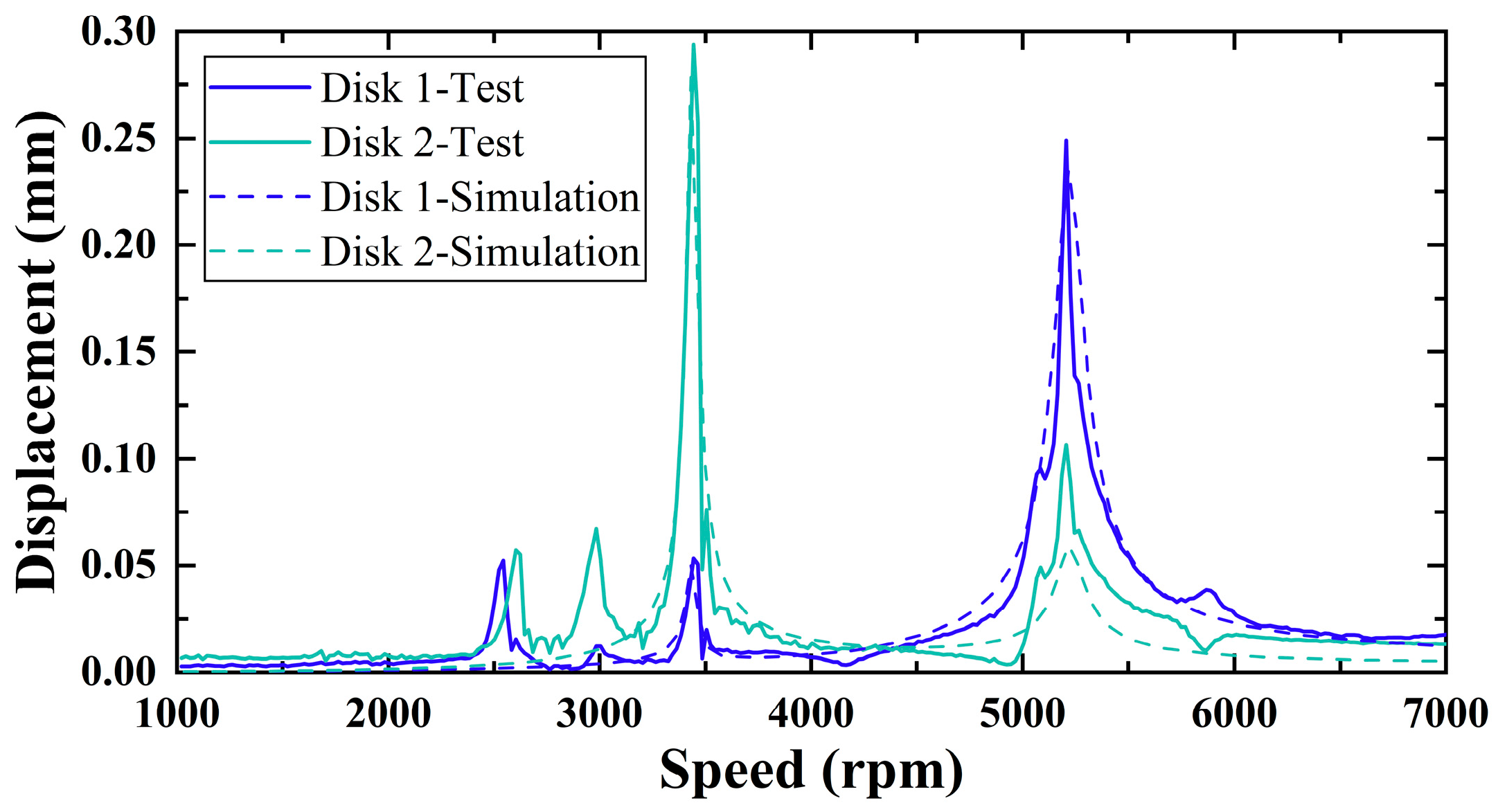
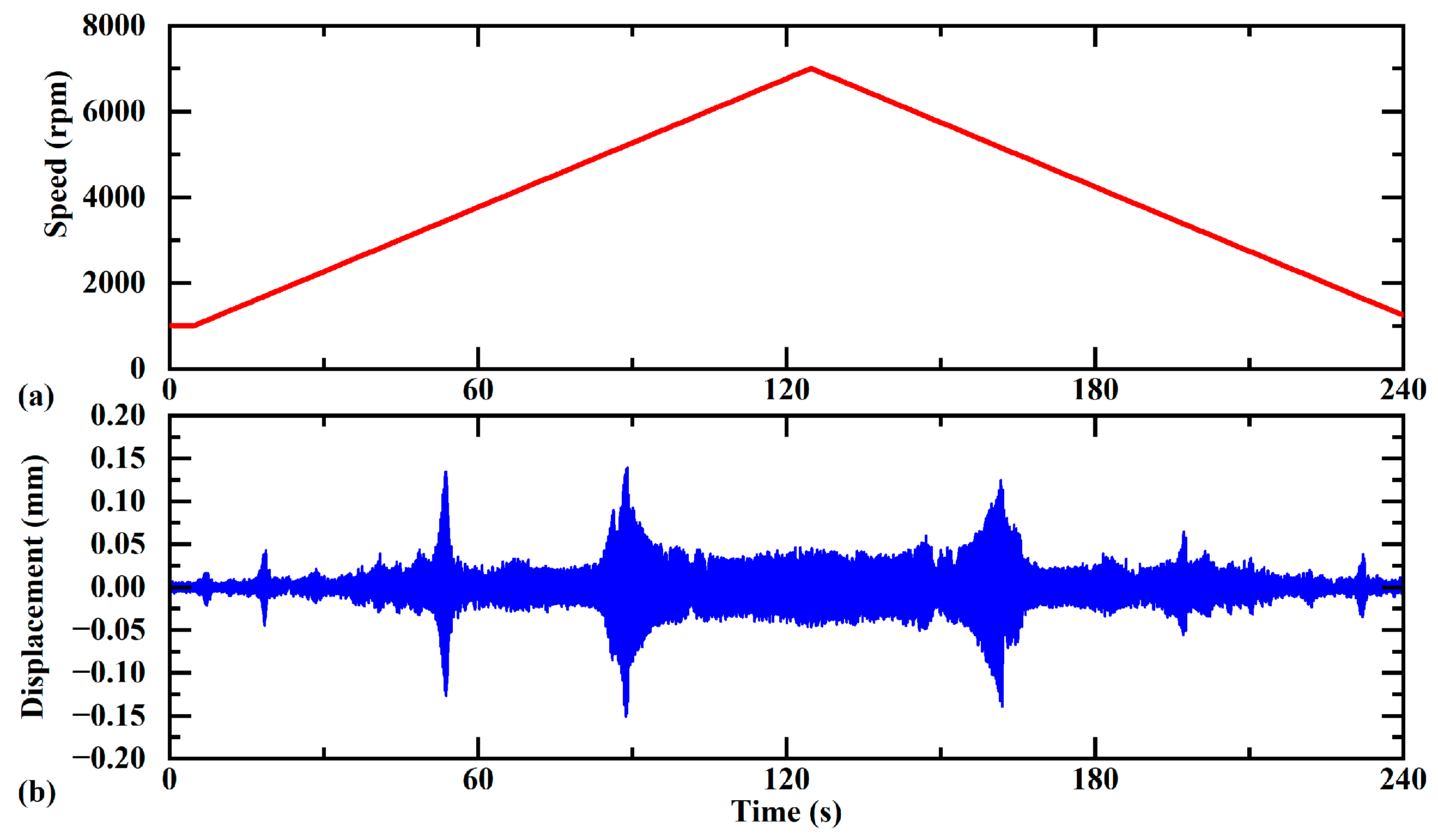
During the experiment, the rotational speed was automatically controlled by the motor, uniformly increasing from 1000 to 7000 rpm, and then gradually decreasing. The speed variation profile during the experiment is shown in Figure 22. From the vibration data collected in Figure 23, it can be observed that there are multiple peaks in the response, which may correspond to local rotor and stator modes. Notably, there are two prominent peaks that appear around 3450 rpm and 5200 rpm in the dynamic response, corresponding to the two critical rotational speeds of the rotor–stator system, aligning with the Campbell diagram in Figure 14a. After the rotational speed exceeds 5200 rpm, the dynamic response significantly decreases, and the rotor operates stably in a range with minimal vibration. Comparison of experimental data with simulation results, as shown in Figure 23, reveals close agreement across a broad speed range, confirming the validity of the simulation model and experimental results.

5.2. Experimental Results and Discussion

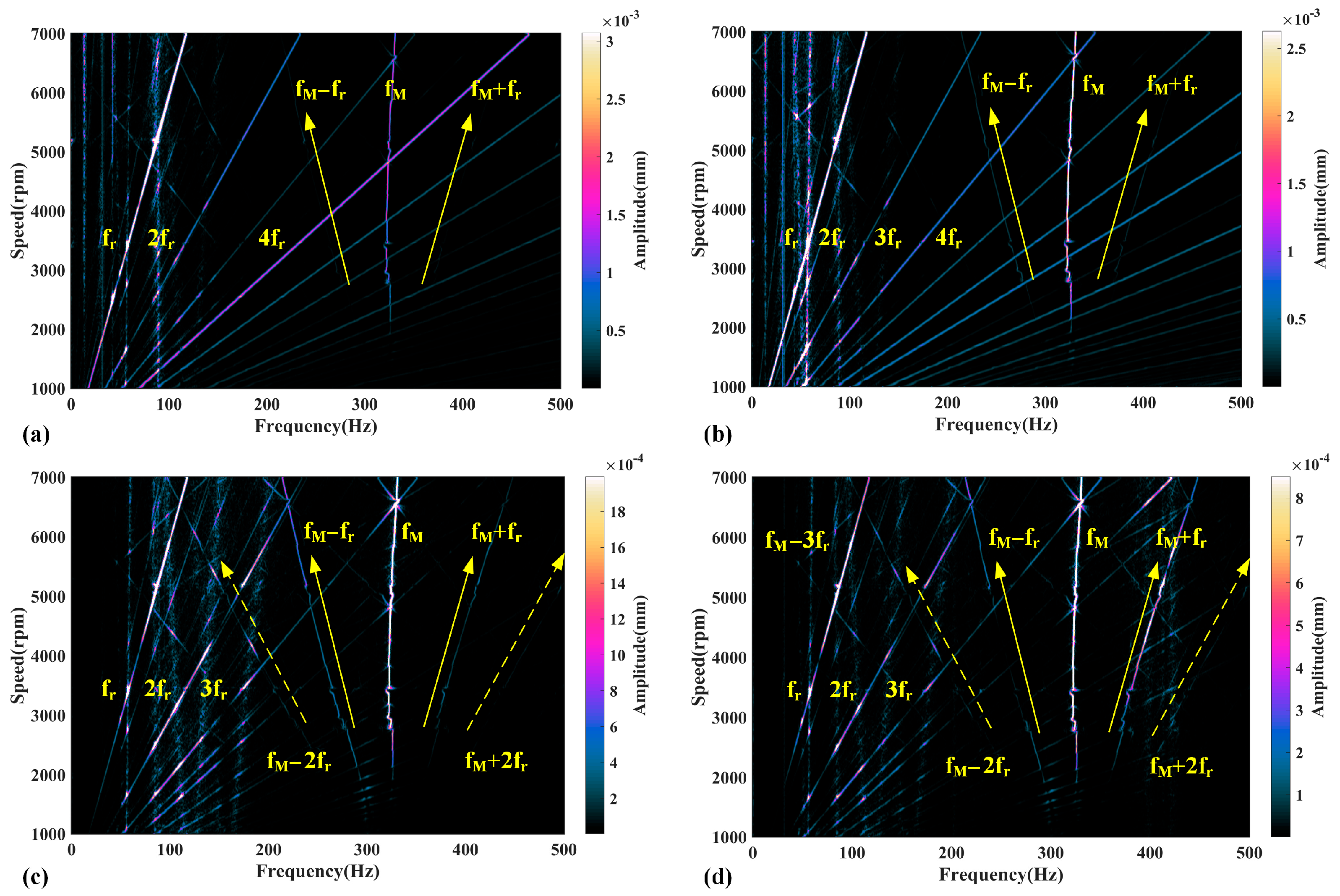
To gain a deeper understanding of the vibration phenomena observed during the experiment, the Fast Fourier Transform (FFT) analysis has been performed on the time-domain signal, and a spectral intensity diagram has been generated, as shown in Figure 24. From the figure, it can be observed that the vibration signal contains two frequency components: (1) the rotational frequency and its harmonics and (2) a frequency line that exhibits minimal variation with respect to the rotational speed, along with its combination frequencies with the rotational frequency, which is approximately around 337 Hz. Based on the previous theoretical and simulation analysis, it has been regarded as the modal frequency of a mode associated with the localized stator mode of the 3# Frame. The occurrence of the modal frequency is attributed to the collision effect induced by the bearing clearance. Additionally, a combination frequency between the modal frequency and the rotational frequency has been observed, which is consistent with the simulation results, thereby confirming the existence of the vibration coupling phenomenon in the rotor–stator system.
From Figure 24, it can be observed that the proportion of frequency in the vibration signal is closely related to the measurement point location, indicating that the local distribution characteristics of the rotor dynamic behavior are obvious. For measurement points on the rotor, as shown in Figure 24a,b, the frequency primarily consists of the rotational frequency f r and its harmonics n × f r , with the modal frequency f M and the combination frequency f M ± f r being relatively weak.
Furthermore, since the position of Disk 2 is closer to the 3# Support than Disk 1, the proportion of the modal frequency f M in the vibration signal of Disk 2 is evidently higher than that of Disk 1. In the measurement points on the stator, the proportion of the modal frequency f M and combination frequency f M ± f r is noticeably larger. Not only the combination frequency f M ± f r can be clearly observed, but also other combination frequencies, such as f M ± 2 f r and f M ± 3 f r , can also be identified.
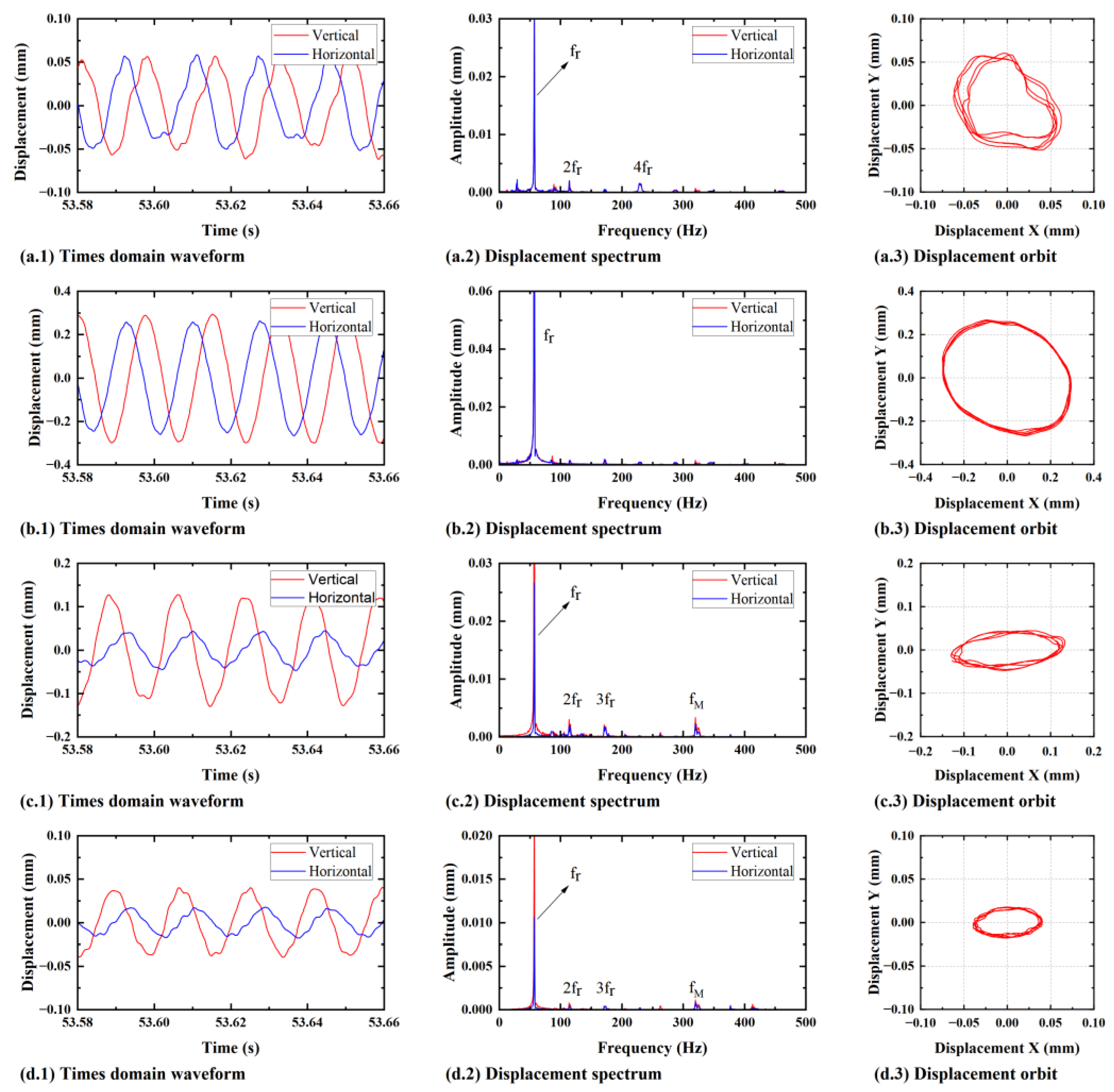
To further investigate the dynamic response of the rotor–stator system, the dynamic responses at the subcritical state and the supercritical state for each measurement point have been shown in Figure 25 and Figure 26, respectively. Each figure displays the time-domain signals, frequency domain signals, and displacement orbit for Disk 1, Disk 2, the 3# Support, and the 3# Frame, respectively.
As shown in Figure 25, at 3400 rpm, the rotational speed approaches the first critical rotational speed of the rotor–stator system, and at the subcritical state, the dynamic response reaches its peak. At this speed, the rotational effect of the rotor has reached maximum, exerting the most significant influence on the dynamic response. The time-domain signals measured at each measurement point are close to sinusoidal waves. It is worth noting that there is a difference in amplitude between the dynamic responses in the two orthogonal directions, and the displacement orbit forms an “ellipse” shape. Furthermore, this asymmetric characteristic is more pronounced in the stator. For example, at the 3# Support, the vertical response amplitude is 31.44% of the horizontal response. This phenomenon is likely caused by the installation method of the test rig, which introduces an asymmetry between the vertical and horizontal directions.
It can be found from the frequency domain distribution of the vibration signal that the rotational frequency f r dominates, while the amplitude of the harmonic frequency n × f r is small. However, at the 3# Support, the harmonic frequency is relatively higher, which is likely due to misalignment. In addition, at this rotational speed, the modal frequency f M has a small amplitude only in the stator. For instance, at the 3# Support, the amplitude of the modal frequency f M is only 8.65% of the rotational frequency f r .
It can be indicated that the collision effect persists throughout the supercritical state from experimental data. From Figure 26, it can be observed that when the rotational speed exceeds the first critical rotational speed and reaches 4500 rpm, the dynamic response caused by imbalance significantly decreases, and the amplitude of the rotational frequency f r decrease substantially. However, the amplitude of the modal frequency f M experience a significant increase and can be effectively monitored at all measurement points.
For the measurement points on the rotor, the modal frequency f M and the combination frequency f M ± f r are prominent in the vibration signals of both Disk 1 and Disk 2, which leads to more chaotic time-domain signals and irregular displacement orbits. It can be indicated that the dynamic behavior of the rotor is heavily disturbed, resulting in a strong, non-synchronous whirl motion state.
For the measurement points on the stator, the amplitude of the modal frequency f M significantly exceeds that of the rotational frequency f r . The ratio of the amplitude of the modal frequency f M to the rotational frequency f r reaches 258.62% at the 3# Support and 619% at the 3# Frame, which is in stark contrast to the typical frequency distribution where the rotational frequency predominates. It can be indicated that, when the collision effect is more pronounced, the localized stator mode will be excited and show a large amplitude. In addition, a significant amount of vibrational energy has been generated at the stator and transmitted throughout the rotor–stator system, becoming the dominant factor in the dynamic response.
Additionally, there is a noticeable combination frequency f M ± f r in the frequency spectrum, such as at the 3# Frame, where the ratios of these amplitudes to the rotational frequency f r are 60.3% and 190.4%, respectively. Although the frequency values exhibit good symmetry around the modal frequency f M , there is a substantial difference in their amplitude. Furthermore, in the time-domain signal shown in Figure 26d.1–d.3, a clear modulation phenomenon can be observed at the 3# Frame.
The experimental results are highly consistent with the calculation results, which can effectively verify the analysis mentioned earlier. A comprehensive analysis of the vibration signals from both the rotor and stator reveals that the excitation of the localized stator mode significantly affects the dynamic behavior of the rotor, resulting in a significant increase in abnormal frequencies within the dynamic response. In addition, the rotor orbit demonstrates pronounced irregularity, and the rotor enters the non-synchronous whirl motion state, which poses a considerable risk to the safe operation of the rotor. It can be indicated that, under these conditions, the system is susceptible to potentially harmful vibrations, which could lead to long-term reliability issues or even catastrophic failure if not properly mitigated.

6. Conclusions

This paper takes the rotor–stator system as the analysis object, systematically investigates the dynamic behavior of an aeroengine rotor–stator system, and specifically focuses on the influence of the bearing clearance-induced nonlinearities and stator modal vibration on rotor dynamic behavior. In the dynamic model of the rotor–stator system, the contact state of the cylindrical roller bearings (CRBs) has been analyzed with a quasi-static model considering the bearing clearance and roller profile. Next, a numerical method combining the Newmark-β method with the Event Function has been developed to precisely capture the transient contact state within the CRBs, enabling precise calculation of the dynamic response of the rotor–stator system. Furthermore, the rotor dynamic behavior considering the stator modal vibration and bearing contact state has been studied through simulation calculations and experimental verification. The following conclusions can be drawn:
(1) The rotor–stator system model provides a more accurate representation of vibration coupling mechanisms, which conform better to the dynamic characteristics of the aeroengine. In traditional dynamic analysis of rotating machinery, only the rotor system is usually taken as the analysis object for calculation convenience. However, for high-speed rotating machinery such as the aeroengine, this simplification may introduce significant errors that cannot be ignored. The study confirms that modeling the rotor and stator as an integrated system better aligns with the dynamic characteristics and mechanical properties of the aeroengine, which offers a more comprehensive understanding of the dynamic behavior of the rotor–stator system.
(2) The bearing contact state constitutes a significant nonlinear factor in the rotor–stator system, exerting a substantial influence on dynamic response. As the interface between the rotating and stationary components, the operational state of bearings is intrinsically linked to the system’s dynamic response. The bearing contact state between rollers and raceways generates pronounced time-varying stiffness accompanied by collision effects. The numerical method combining the Newmark-β method with the Event Function precisely captures the contact state transitions within CRBs, which is fundamental to understanding the dynamic interaction within the rotor–stator system, particularly in exciting stator modes.
(3) The rotor dynamic behavior is affected by the stator modal vibration at the supercritical state. When the rotational speed exceeds the critical speed, the rotor may enter the non-synchronous whirl motion state. Further, the modulation effect is generated by the interaction between the rotor dynamic behavior and the stator modal vibration, and the combination frequencies f M ± f r emerge. The amplitude of the combination frequency will reach the maximum value when it is in the vicinity of natural frequencies, which is the condition for combination resonances, indicating that the interaction may present a substantial threat to the safe operation of the rotor.
The rotor dynamic behavior under the influence of the stator modal vibration and the bearing contact state revealed in this study holds significant guiding value for the efficient and stable operation of the aeroengine. As aeroengine technology advances toward higher rotational speeds and greater performance demands, understanding the influence factors and the mechanism of the rotor dynamic behavior will be crucial for optimizing rotor–stator system design and mitigating excessive vibrations. Future research could explore the nonlinear dynamic response characteristics of the rotor–stator system under different operating conditions. Additionally, combining more precise experimental data with the existing models will refine the current understanding, providing more accurate tools for the optimization design and fault diagnosis of aeroengines.

Author Contributions

Conceptualization, formal analysis, methodology, writing—original draft preparation and visualization, Y.M. (Yongbo Ma); validation, investigation, data curation, software, and writing—review and editing, Z.S.; investigation, software, and supervision, Z.Y.; resources and data curation, C.L.; methodology, supervision, and funding acquisition, Y.M. (Yanhong Ma); investigation and funding acquisition, J.H. All authors have read and agreed to the published version of the manuscript.

Funding

This research was funded by the National Natural Science Foundation of China (52505080) and the Postdoctoral Fellowship Program of CPSF under Grant Number GZB20250942.

Institutional Review Board Statement

Not applicable.

Informed Consent Statement

Not applicable.

Data Availability Statement

The data presented in this study are available on request from the corresponding author. The data are not publicly available due to privacy.

Conflicts of Interest

The authors declare no conflicts of interest. The funders had no role in the design of the study.

References

  1. Heng, A.; Zhang, S.; Tan, A.C.C.; Mathew, J. Rotating Machinery Prognostics: State of the Art, Challenges and Opportunities. Mech. Syst. Signal Process. 2009, 23, 724–739. [Google Scholar] [CrossRef]
  2. Fu, C.; Sinou, J.-J.; Zhu, W.; Lu, K.; Yang, Y. A State-of-the-Art Review on Uncertainty Analysis of Rotor Systems. Mech. Syst. Signal Process. 2023, 183, 109619. [Google Scholar] [CrossRef]
  3. Cheli, F.; Cavalca, K.L.; Dedini, F.G.; Vania, A. Supporting Structure Effects on Rotating Machinery Vibrations; Medical Engineering Publications Ltd.: Glasgow, UK, 1992; Volume 6, p. 543. [Google Scholar]
  4. Oscar De Santiago, E.A. Rotordynamic Analysis of a Power Turbine Including Support Flexibility Effects. In Proceedings of the ASME Turbo Expo 2008: Power for Land, Sea, and Air, Berlin, Germany, 9–13 June 2008. [Google Scholar]
  5. Agrapart, Q.; Nyssen, F.; Lavazec, D.; Dufrénoy, P.; Batailly, A. Multi-Physics Numerical Simulation of an Experimentally Predicted Rubbing Event in Aircraft Engines. J. Sound Vib. 2019, 460, 114869. [Google Scholar] [CrossRef]
  6. Lei, Y.; Lin, J.; He, Z.; Zuo, M.J. A Review on Empirical Mode Decomposition in Fault Diagnosis of Rotating Machinery. Mech. Syst. Signal Process. 2013, 35, 108–126. [Google Scholar] [CrossRef]
  7. Cavalca, K.L.; Cavalcante, P.F.; Okabe, E.P. An Investigation on the Influence of the Supporting Structure on the Dynamics of the Rotor System. Mech. Syst. Signal Process. 2005, 19, 157–174. [Google Scholar] [CrossRef]
  8. Choi, B.L.; Park, J.M. An Improved Rotor Model with Equivalent Dynamic Effects of the Support Structure. J. Sound Vib. 2001, 244, 569–581. [Google Scholar] [CrossRef]
  9. Jyoti, K.; Sinha, A.W.L. The Estimation of Foundation Models of Flexible Machines. In Proceedings of the Third International Conference—Identification in Engineering Systems, Swansea, UK, 15–17 April 2002. [Google Scholar]
  10. De Felice, A.; Sorrentino, S. Frequency Analysis of Dynamic Systems Loaded by Both Parametric and External Excitations, with Application to Rotor Dynamics. Nonlinear Dyn. 2025, 113, 20687–20710. [Google Scholar] [CrossRef]
  11. Yang, Y.; Liu, C.; Jiang, D.; Behdinan, K. Nonlinear Vibration Signatures for Localized Fault of Rolling Element Bearing in Rotor-Bearing-Casing System. Int. J. Mech. Sci. 2020, 173, 105449. [Google Scholar] [CrossRef]
  12. Prabith, K.; Krishna, I.R.P. The Numerical Modeling of Rotor–Stator Rubbing in Rotating Machinery: A Comprehensive Review. Nonlinear Dyn. 2020, 101, 1317–1363. [Google Scholar] [CrossRef]
  13. Wang, Y.; Ma, Y.; Hong, J. Study on Dynamic Stiffness of Supporting Structure and its Influence on Vibration of Rotors. Chin. J. Aeronaut. 2022, 35, 252–263. [Google Scholar] [CrossRef]
  14. Liu, K.; Luo, Z.; Li, L.; Liu, J.; Jiang, G.; Lu, L. Study on the Effect of Dynamic Stiffness of Supporting Structure on Dynamic Characteristics of the Rotor System. Proc. Inst. Mech. Eng. C J. Mech. Eng. Sci. 2023, 237, 5273–5285. [Google Scholar] [CrossRef]
  15. Zhou, J.; Luo, Z.; Li, L.; Ma, T.; Li, H. Numerical and Experimental Analysis of the Influence of Elastic Supports on Bearing-Rotor Systems. Mech. Syst. Signal Process. 2025, 224, 112235. [Google Scholar] [CrossRef]
  16. Luo, Z.; Zhou, J.; Li, L.; Sun, K.; Li, H. An Analytical Method of Dynamic Stiffness of Combined Supporting Structure and Its Effects on Rotor Systems: Simulation and Experiment. Int. J. Non-Linear Mech. 2024, 163, 104758. [Google Scholar] [CrossRef]
  17. Li, L.; Luo, Z.; Liu, K.; Zhou, J. Dynamic Stiffness Characteristics of Aero-Engine Elastic Support Structure and Its Effects on Rotor Systems: Mechanism and Numerical and Experimental Studies. Appl. Math. Mech. 2023, 44, 221–236. [Google Scholar] [CrossRef]
  18. Zeng, J.; Zhao, C.; Ma, H.; Yu, K.; Wen, B. Rubbing Dynamic Characteristics of the Blisk-Casing System with Elastic Supports. Aerosp. Sci. Technol. 2019, 95, 105481. [Google Scholar] [CrossRef]
  19. Xu, H.; Ma, H.; Wen, B.; Yang, Y.; Li, X.; Luo, Z.; Han, Q.; Wen, B. Dynamic Characteristics of Spindle-Bearing with Tilted Pedestal and Clearance fit. Int. J. Mech. Sci. 2024, 261, 108683. [Google Scholar] [CrossRef]
  20. Guan, H.; Wang, P.; Xiong, Q.; Ma, H.; Zhou, S.; Mu, Q.; Zeng, Y.; Chen, Y. Modeling of Misaligned Bearing Induced by Coupling Misalignment and Assembly Errors and Vibration Analysis in Dual-Rotor System. Mech. Syst. Signal Process. 2025, 230, 112656. [Google Scholar] [CrossRef]
  21. Upadhyay, S.H.; Harsha, S.P.; Jain, S.C. Analysis of Nonlinear Phenomena in High Speed Ball Bearings Due to Radial Clearance and Unbalanced Rotor Effects. J. Vib. Control 2009, 16, 65–88. [Google Scholar] [CrossRef]
  22. Harsha, S.P. Rolling Bearing Vibrations—The Effects of Surface Waviness and Radial Internal Clearance. Int. J. Comput. Methods Eng. Sci. Mech. 2006, 7, 91–111. [Google Scholar] [CrossRef]
  23. Tao, Y.; Tohti, G.; He, H.; Geni, M. Study on the Dynamic Optimization and Design of a Flexible Rotationally Symmetric Tangential Support Plate Base. Appl. Sci. 2025, 15, 2554. [Google Scholar] [CrossRef]
  24. Ehehalt, U.; Alber, O.; Markert, R.; Wegener, G. Experimental Observations on Rotor-to-Stator Contact. J. Sound Vib. 2019, 446, 453–467. [Google Scholar] [CrossRef]
  25. Chipato, E.T.; Shaw, A.D.; Friswell, M.I.; Sánchez Crespo, R. Experimental Study of Rotor-Stator Contact Cycles. J. Sound Vib. 2021, 502, 116097. [Google Scholar] [CrossRef]
  26. Cole, M.O.T. On Stability of Rotordynamic Systems with Rotor–Stator Contact Interaction. Proc. R. Soc. A Math. Phys. Eng. Sci. 2008, 464, 3353–3375. [Google Scholar] [CrossRef]
  27. Ma, H.; Li, H.; Niu, H.; Song, R.; Wen, B. Nonlinear Dynamic Analysis of a Rotor-Bearing-Seal System under Two Loading Conditions. J. Sound Vib. 2013, 332, 6128–6154. [Google Scholar] [CrossRef]
  28. Behzad, M.; Alvandi, M. Unbalance-Induced Rub between Rotor and Compliant-Segmented Stator. J. Sound Vib. 2018, 429, 96–129. [Google Scholar] [CrossRef]
  29. Dai, P.; Liang, X.; Li, J.; Wu, D.; Wang, F. Modeling Strategy and Mechanism Analysis for the Dual-Rotor-Disc-Bearing Coupled System with Unbalance Effect in Aeroengines. Mech. Syst. Signal Process. 2025, 224, 112086. [Google Scholar] [CrossRef]
  30. Liu, J.; Fei, Q.; Wu, S.; Tang, Z.; Zhang, D. Nonlinear Vibration Response of a Complex Aeroengine under the Rubbing Fault. Nonlinear Dyn. 2021, 106, 1869–1890. [Google Scholar] [CrossRef]
  31. Wang, N.; Liu, C.; Jiang, D. Prediction of Transient Vibration Response of Dual-Rotor-Blade-Casing System with Blade off. Proc. Inst. Mech. Eng. Part G J. Aerosp. Eng. 2019, 233, 5164–5176. [Google Scholar] [CrossRef]
  32. Dai, W.; Cheng, Q.; Jiang, Z.; Zhang, X.; Pan, Y.; Zhang, Z. Nonlinear Dynamic Modeling and Transient Performance Evaluation of Dual-Rotor Aeroengine Support Systems. Aerosp. Sci. Technol. 2025, 168, 110843. [Google Scholar] [CrossRef]
  33. Bonisoli, E.; Venturini, S.; Cavallaro, S.P. Nonlinear Characterisation of a Rotor on Passive Magnetic Supports. Int. J. Mech. Control 2022, 23, 121–128. [Google Scholar]
  34. Chang-Jian, C.-W.; Chu, L.-M.; Chen, T.-C. Nonlinear Dynamic of Flexible Rotor Supported by Turbulent Bearings with Quadratic Damping and Temperature Dependent Viscosity. Adv. Mech. Eng. 2024, 16, 16878132241293957. [Google Scholar] [CrossRef]
  35. Zhong, Y.; Li, T.; Qu, S.; Huang, H.; Zhang, Z. Failure Analysis of Over-Temperature of Aero-Engine Bearing. J. Fail. Anal. Prev. 2023, 23, 1869–1879. [Google Scholar] [CrossRef]
  36. Cao, H.; Niu, L.; Xi, S.; Chen, X. Mechanical model development of rolling bearing-rotor systems: A review. Mech. Syst. Signal Process. 2018, 102, 37–58. [Google Scholar] [CrossRef]
  37. Breńkacz, Ł.; Witanowski, Ł.; Drosińska-Komor, M.; Szewczuk-Krypa, N. Research and Applications of Active Bearings: A State-of-the-Art Review. Mech. Syst. Signal Process. 2021, 151, 107423. [Google Scholar] [CrossRef]
  38. Jin, Y.; Liu, Z.; Yang, Y.; Li, F.; Chen, Y. Nonlinear Vibrations of a Dual-Rotor-Bearing-Coupling Misalignment System with Blade-Casing Rubbing. J. Sound Vib. 2021, 497, 115948. [Google Scholar] [CrossRef]
  39. Ehrich, F.F. Observations of Nonlinear Phenomena in Rotordynamics. J. Syst. Des. Dyn. 2008, 2, 641–651. [Google Scholar] [CrossRef][Green Version]
  40. Yang, Z.; Hong, J.; Wang, D.; Cheng, R.; Ma, Y. Vibration Analysis of Rotor Systems with Bearing Clearance Using a Novel Conformal Contact Model. Nonlinear Dyn. 2024, 112, 7951–7976. [Google Scholar] [CrossRef]
  41. Xu, H.Y.; Wang, P.F.; Ma, H.; Yang, Y.; Li, X.P.; Luo, Z.; Han, Q.K.; Wen, B.C. Dynamic Behaviors and Contact Characteristics of Ball Bearings in a Multi-Supported Rotor System under the Effects of 3D Clearance Fit. Mech. Syst. Signal Process. 2023, 196, 32. [Google Scholar] [CrossRef]
  42. Li, Y.; Cao, H.; Tang, K. A General Dynamic Model Coupled with EFEM and DBM of Rolling Bearing-Rotor System. Mech. Syst. Signal Process. 2019, 134, 106322. [Google Scholar] [CrossRef]
  43. Wang, P.; Xu, H.; Ma, H.; Han, H.; Yang, Y. Effects of Three Types of Bearing Misalignments on Dynamic Characteristics of Planetary Gear Set-Rotor System. Mech. Syst. Signal Process. 2022, 169, 108736. [Google Scholar] [CrossRef]
  44. Xu, H.; Wang, P.; Yang, Y.; Ma, H.; Luo, Z.; Han, Q.; Wen, B. Effects of Supporting Stiffness of Deep Groove Ball Bearings with Raceway Misalignment on Vibration Behaviors of a Gear-Rotor System. Mech. Mach. Theory 2022, 177, 105041. [Google Scholar] [CrossRef]
  45. Xu, H.; Yang, Y.; Ma, H.; Luo, Z.; Li, X.; Han, Q.; Wen, B. Vibration Characteristics of Bearing-Rotor Systems with Inner Ring Dynamic Misalignment. Int. J. Mech. Sci. 2022, 230, 107536. [Google Scholar] [CrossRef]
  46. Jiang, Z.; Huang, X.; Zheng, Z.; Ding, P.; Hao, J. Transient Characteristics of Misaligned Roller Bearing Considering Thermal-fluid-Solid Coupled. Tribol. Int. 2024, 196, 109693. [Google Scholar] [CrossRef]
  47. Yang, Z.; Hong, J.; Wang, D.; Ma, Y.; Cheng, R. Failure Analysis of an Aero-Engine Inter-Shaft Bearing Due to Clearance between the Outer Ring and Its Housing. Eng. Fail. Anal. 2023, 150, 107298. [Google Scholar] [CrossRef]
  48. Hong, J.; Liu, F.; Ma, Y.; Chen, X.; Wang, Y. Composite Failure Analysis of an Aero-Engine Inter-Shaft Bearing Inner Ring. Eng. Fail. Anal. 2024, 165, 108707. [Google Scholar] [CrossRef]
  49. Chen, R.; Lv, J.; Tian, J.; Ai, Y.; Zhang, F.; Yao, Y. Modeling and Nonlinear Dynamic Characteristics Analysis of Fault Bearing Time-Varying Stiffness-Flexible Rotor Coupling System. Mathematics 2024, 12, 3591. [Google Scholar] [CrossRef]
  50. Guo, X.; Zeng, J.; Ma, H.; Zhao, C.; Yu, X.; Wen, B. A Dynamic Model for Simulating Rubbing between Blade and Flexible Casing. J. Sound Vib. 2020, 466, 115036. [Google Scholar] [CrossRef]
  51. Jiang, Z.; Huang, X.; Liu, H.; Zheng, Z.; Li, S.; Du, S. Dynamic Reliability Analysis of Main Shaft Bearings in Wind Turbines. Int. J. Mech. Sci. 2022, 235, 107721. [Google Scholar] [CrossRef]
  52. Flores, P.; Ambrósio, J.; Lankarani, H.M. Contact-Impact Events with Friction in Multibody Dynamics: Back to Basics. Mech. Mach. Theory 2023, 184, 105305. [Google Scholar] [CrossRef]
  53. Hong, J.; Yang, Z.; Wang, Y.; Cheng, R.; Ma, Y. Combination Resonances of Rotor Systems with Asymmetric Residual Preloads in Bolted Joints. Mech. Syst. Signal Process. 2023, 183, 109626. [Google Scholar] [CrossRef]
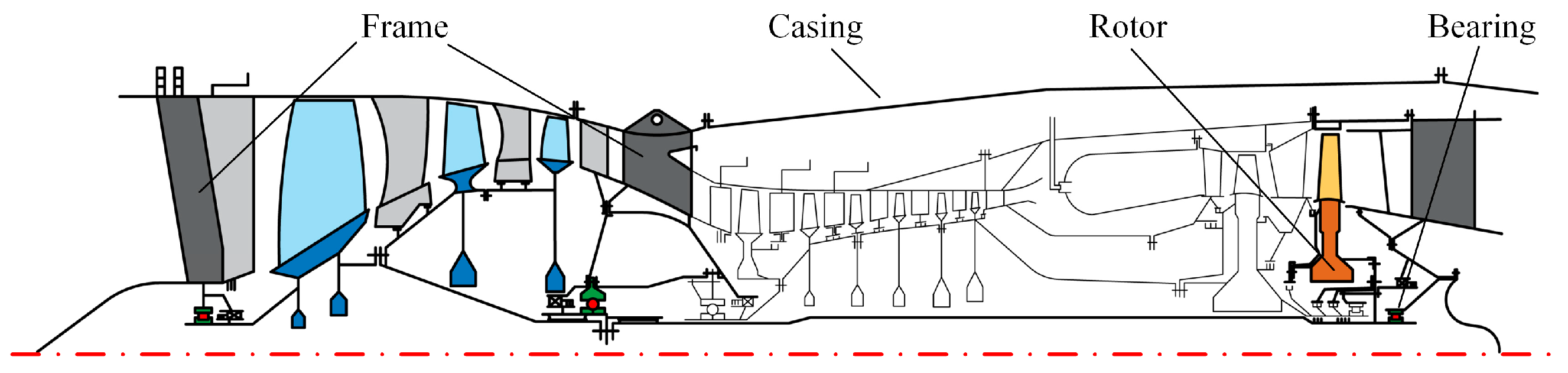
Figure 1. Schematic diagram of a certain type of high thrust-to-weight ratio turbofan engine.
Actuators 14 00594 g001
Figure 2. Schematic diagram of the dynamic model of the rotor–stator system: (a) interaction between the rotor and stator; (b) non-synchronous whirl motion at the bearing.
Actuators 14 00594 g002
Figure 3. Coordinate system and generalized displacement of the beam element.
Actuators 14 00594 g003
Figure 4. Schematic diagram of the shell element: (a) child element; (b) parent element.
Actuators 14 00594 g004
Figure 5. Schematic diagram of the CRB: (a) a 3-D mechanical model; (b) the radial cross-section; (c) the axial cross-section.
Actuators 14 00594 g005
Figure 6. Schematic diagram of the contact state inside the clearance bearing: (a) the bearing schematic and “Under Non-Contact” state; (b) the critical state; (c) “Under Contact” state.
Actuators 14 00594 g006
Figure 7. Schematic diagram of slicing technology (a) the profile of the roller; (b) the local coordinate frames of the roller.
Actuators 14 00594 g007
Figure 8. Schematic diagram of the roller-raceway interaction: (a) the radial cross-section; (b) the axial cross-section.
Actuators 14 00594 g008
Figure 9. Flowchart of the dynamic response solution method.
Actuators 14 00594 g009
Figure 10. Comparison between classical and event-based integration methods for contact problems: (a) the classical integration method; (b) the event-based integration method.
Actuators 14 00594 g010
Figure 11. Flowchart of the “Contact begins” module.
Actuators 14 00594 g011
Figure 12. Flowchart of the “Under contact” module.
Actuators 14 00594 g012
Figure 13. Schematic diagram of the mode of the rotor–stator system: (a) the structure in the aeroengine; (b) the calculating model.
Actuators 14 00594 g013
Figure 14. Dynamic characteristics of the rotor–stator system: (a) the Campbell diagram; (b) the unbalanced response diagram.
Actuators 14 00594 g014
Figure 15. The modal shapes of the rotor–stator system: (a) n = 1+; (b) n = 2+; (c) n = 3+; (d) n = 4+; (e) n = 5+.
Actuators 14 00594 g015
Figure 16. Spectrogram of dynamic response from calculation of various positions of s: (a) Disk 1; (b) Disk 2; (c) 3# Support; (d) 3# Frame.
Actuators 14 00594 g016
Figure 17. Schematic diagram of the dynamic behavior of the rotor–stator system: (a) the rotor–stator system; (b) vibration coupling between rotor and stator; (c) signal modulation.
Actuators 14 00594 g017
Figure 18. Dynamic response diagram of various positions at 5600 rpm. (a.1a.3) Disk 1; (b.1b.3) Disk 2; (c.1c.3) 3# Support; (d.1d.3) 3# Frame.
Actuators 14 00594 g018
Figure 19. Radial deformation of the rotor and stator at different rotational speeds: (a) 2000 rpm; (b) 4000 rpm; (c) 6000 rpm.
Actuators 14 00594 g019
Figure 20. The rotor–stator tester apparatus: (a) sectional drawing; (b) physical photo.
Actuators 14 00594 g020
Figure 21. The schematic diagram of the 3# Frame: (a) the cutaway view; (b) physical photo.
Actuators 14 00594 g021
Figure 22. Experimental data: (a) speed–time curve; (b) vibration signal.
Actuators 14 00594 g022
Figure 23. Signal rotation frequency amplitude–speed curve of various positions.
Actuators 14 00594 g023
Figure 24. Spectrogram of dynamic response from experiments of various positions: (a) Disk 1; (b) Disk 2; (c) 3# Support; (d) 3# Frame.
Actuators 14 00594 g024
Figure 25. Dynamic response diagram of various positions at 3400 rpm (subcritical state). (a.1a.3) Disk 1; (b.1b.3) Disk 2; (c.1c.3) 3# Support; (d.1d.3) 3# Frame.
Actuators 14 00594 g025
Figure 26. Dynamic response diagram of various positions at 4500 rpm (supercritical state). (a.1a.3) Disk 1; (b.1b3) Disk 2; (c.1c.3) 3# Support; (d.1d.3) 3# Frame.
Actuators 14 00594 g026
Table 1. Parameters of the rotor–stator system.
Physical ParameterSymbolValueUnit
Elastic modulus of the rotor and stator E 210GPa
Density of the rotor and stator ρ 7900kg/m3
Poisson ratio of the rotor and stator μ 0.3--
Length of the rotor and stator L r ,   L s 1058, 1205mm
Position of Disk 1 and Disk 2 L d 1 ,   L d 2 215, 945mm
Position of the 1#, 2#, and 3# Support L b 1 ,   L b 2 ,   L b 3 120, 310, 1020mm
Length of the 1#, 2#, and 3# Frame H f 1 ,   H f 2 ,   H f 3 75, 170, 200mm
Length of Casing 1 and Casing 2 H c 1 ,   H c 2 220, 540mm
Outer and inner radius of the bearing seat R b ,   r b 65, 70mm
Outer and inner radius of the casing R s ,   r s 115, 120mm
Stiffness of the 1#, 2#, and 3# Support K 1 ,   K 2 ,   K 3 5, 8, 5 × 10⁷N/m
Mass of Disk 1 and Disk 2 m 1 ,   m 2 10, 8kg
Polar and diametral moment of inertia of Disk 1 J p 1 ,   J d 1 0.06, 0.03kg·m2
Polar and diametral moment of inertia of Disk 2 J p 2 ,   J d 2 0.04, 0.02kg·m2
Table 2. Parameters of the cylinder roller bearing.
Physical ParameterSymbolValueUnit
Outer and inner diameter D , d 80, 40mm
Outer and inner raceway diameter D O ,   D i 71.5, 49.5mm
Number of the roller Z 14--
Roller diameter d b 11mm
Effective length of the roller L w 11mm
Coefficient of profile K x 0.00035--
Pitch diameter d m 60.5mm
Coefficient of contact stiffness K 1.12 × 10¹¹N/m
Clearance of the bearing Δ 0.2mm
Disclaimer/Publisher’s Note: The statements, opinions and data contained in all publications are solely those of the individual author(s) and contributor(s) and not of MDPI and/or the editor(s). MDPI and/or the editor(s) disclaim responsibility for any injury to people or property resulting from any ideas, methods, instructions or products referred to in the content.