Gammaretrovirus Infections in Humans in the Past, Present, and Future: Have We Defeated the Pathogen?


Abstract
1. Introduction
2. Review
2.1. Selection of Gammaretroviruses Included in the Review
2.1.1. Selection of ICTV-Listed Gammaretroviruses to Be Included in the Review
2.1.2. Selection of ICTV-Listed Betaretroviruses with a Gamma-Type Env Gene
2.1.3. Replication-Compentent ERVs Not Listed by ICTV
2.2. Germline Gammaretrovirus Infections in the Human Lineage in the Past
2.3. Ancient Gammaretroviruses in OW Primates with No Evidence of Human Infection
2.4. Gammaretrovirus Detection in Human Samples in the Recent Past
2.4.1. Cell Culture-Associated Gammaretrovirus Detection in the 1970s
2.4.2. MSRV Is an Endogenous Retrovirus, HERV-W
2.4.3. The XMRV Case, 2006–2012
2.5. Current Infectious Gammaretrovirus Species
2.5.1. Infectious Avian Gammaretroviruses
2.5.2. Infectious Mammalian Gammaretroviruses
2.5.3. Replication-Competent ERVs and the Type D Retroviruses
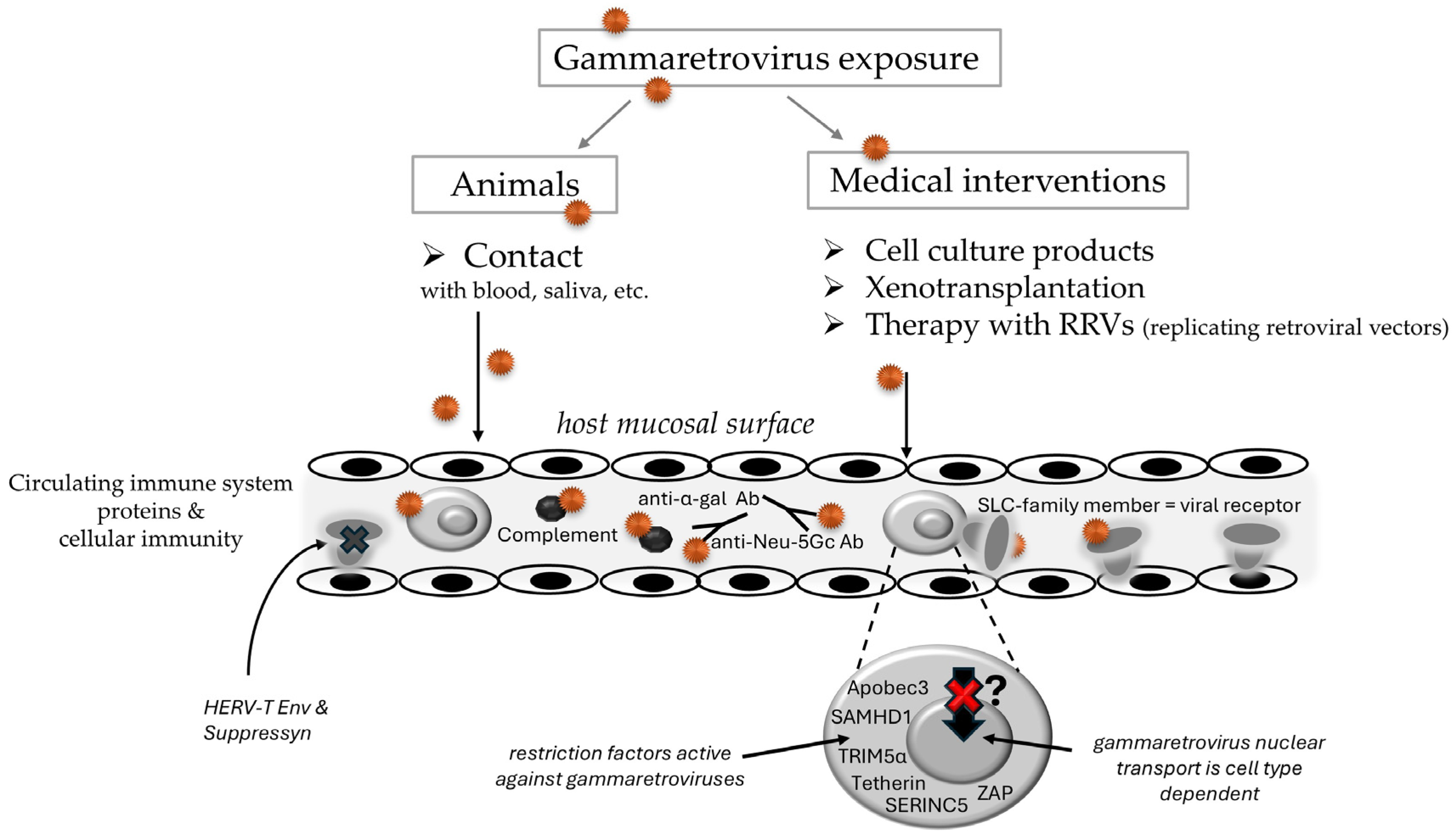
2.6. Genetic and Immune Factors Associated with Gammaretrovirus Resistance in Humans
2.7. Exposure Risk and Gammaretrovirus Infections in Humans
2.7.1. Natural Exposure to Gammaretroviruses
2.7.2. Man-Made Exposure to Gammaretroviruses
Exposure to Domesticated Animals
Exposure Through Cell Culture Products
Exposure Through Animal Tissue and Organ Transplantation
2.8. Consequences of Novel Human Gammaretrovirus Infections
3. Discussion
Funding
Institutional Review Board Statement
Informed Consent Statement
Data Availability Statement
Conflicts of Interest
Abbreviations
| APOBEC3 | Apolipoprotein B mRNA editing enzyme, catalytic polypeptide 3 |
| DNA | Deoxyribonucleic acid |
| HUSH | Human silencing hub |
| PBMC | Peripheral blood mononuclear cells |
| PCR | Polymerase chain reaction |
| RNA | Ribonucleic acid |
| SAMHD1 | SAM domain and HD domain-containing protein 1 |
| SERINC5 | Serine incorporator 5 |
| TRIM5α | Tripartite motif-containing protein 5α |
| ZAP | Zinc finger antiviral protein |
References
- Coffin, J.; Blomberg, J.; Fan, H.; Gifford, R.; Hatziioannou, T.; Lindemann, D.; Mayer, J.; Stoye, J.; Tristem, M.; Johnson, W.; et al. ICTV Virus Taxonomy Profile: Retroviridae 2021. J. Gen. Virol. 2021, 102, 001712. [Google Scholar] [CrossRef]
- International Committee on Taxonomy of Viruses: Retroviridae. Available online: https://ictv.global/report/chapter/retroviridae/retroviridae (accessed on 24 February 2025).
- Poiesz, B.J.; Ruscetti, F.W.; Gazdar, A.F.; Bunn, P.A.; Minna, J.D.; Gallo, R.C. Detection and isolation of type C retrovirus particles from fresh and cultured lymphocytes of a patient with cutaneous T-cell lymphoma. Proc. Natl. Acad. Sci. USA 1980, 77, 7415–7419. [Google Scholar] [CrossRef]
- Lasfargues, E.Y.; Moore, D.H. Proceedings: Search for a viral etiology of human breast cancer. J. Investig. Dermatol. 1974, 63, 125–132. [Google Scholar] [CrossRef]
- Lessi, F.; Grandi, N.; Mazzanti, C.M.; Civita, P.; Scatena, C.; Aretini, P.; Bandiera, P.; Fornaciari, A.; Giuffra, V.; Fornaciari, G.; et al. A human MMTV-like betaretrovirus linked to breast cancer has been present in humans at least since the copper age. Aging 2020, 12, 15978–15994. [Google Scholar] [CrossRef] [PubMed]
- Goubran, M.; Wang, W.; Indik, S.; Faschinger, A.; Wasilenko, S.T.; Bintner, J.; Carpenter, E.J.; Zhang, G.; Nuin, P.; Macintyre, G.; et al. Isolation of a Human Betaretrovirus from Patients with Primary Biliary Cholangitis. Viruses 2022, 14, 886. [Google Scholar] [CrossRef]
- Bevilacqua, G. The Viral Origin of Human Breast Cancer: From the Mouse Mammary Tumor Virus (MMTV) to the Human Betaretrovirus (HBRV). Viruses 2022, 14, 1704. [Google Scholar] [CrossRef]
- Lawson, J.S.; Glenn, W.K. Mouse Mammary Tumour Virus (MMTV) in Human Breast Cancer-The Value of Bradford Hill Criteria. Viruses 2022, 14, 721. [Google Scholar] [CrossRef] [PubMed]
- Brantley, K.D.; Tamimi, R.M. The association between infectious agents and breast cancer: A review of the epidemiologic evidence. Breast Cancer Res. Treat. 2024, 207, 235–252. [Google Scholar] [CrossRef] [PubMed]
- Martinez Cuesta, L.; Lendez, P.A.; Nieto Farias, M.V.; Dolcini, G.L.; Ceriani, M.C. Can Bovine Leukemia Virus Be Related to Human Breast Cancer? A Review of the Evidence. J. Mammary Gland. Biol. Neoplasia 2018, 23, 101–107. [Google Scholar] [CrossRef]
- Hayward, A.; Cornwallis, C.K.; Jern, P. Pan-vertebrate comparative genomics unmasks retrovirus macroevolution. Proc. Natl. Acad. Sci. USA 2015, 112, 464–469. [Google Scholar] [CrossRef]
- van der Kuyl, A.C.; Berkhout, B. Viruses in the reproductive tract: On their way to the germ line? Virus Res. 2020, 286, 198101. [Google Scholar] [CrossRef]
- Wang, J.; Han, G.Z. Genome mining shows that retroviruses are pervasively invading vertebrate genomes. Nat. Commun. 2023, 14, 4968. [Google Scholar] [CrossRef] [PubMed]
- Li, Y.; Zhang, G.; Cui, J. Origin and Deep Evolution of Human Endogenous Retroviruses in Pan-Primates. Viruses 2022, 14, 1370. [Google Scholar] [CrossRef]
- Gifford, R.; Kabat, P.; Martin, J.; Lynch, C.; Tristem, M. Evolution and distribution of class II-related endogenous retroviruses. J. Virol. 2005, 79, 6478–6486. [Google Scholar] [CrossRef]
- van der Kuyl, A.C.; Mang, R.; Dekker, J.T.; Goudsmit, J. Complete nucleotide sequence of simian endogenous type D retrovirus with intact genome organization: Evidence for ancestry to simian retrovirus and baboon endogenous virus. J. Virol. 1997, 71, 3666–3676. [Google Scholar] [CrossRef]
- Henzy, J.E.; Johnson, W.E. Pushing the endogenous envelope. Philos. Trans. R. Soc. Lond. Ser. B Biol. Sci. 2013, 368, 20120506. [Google Scholar] [CrossRef]
- Hogan, V.; Johnson, W.E. Unique Structure and Distinctive Properties of the Ancient and Ubiquitous Gamma-Type Envelope Glycoprotein. Viruses 2023, 15, 274. [Google Scholar] [CrossRef]
- Cordonnier, A.; Casella, J.F.; Heidmann, T. Isolation of novel human endogenous retrovirus-like elements with foamy virus-related pol sequence. J. Virol. 1995, 69, 5890–5897. [Google Scholar] [CrossRef] [PubMed]
- Gifford, R.J.; Katzourakis, A.; Tristem, M.; Pybus, O.G.; Winters, M.; Shafer, R.W. A transitional endogenous lentivirus from the genome of a basal primate and implications for lentivirus evolution. Proc. Natl. Acad. Sci. USA 2008, 105, 20362–20367. [Google Scholar] [CrossRef] [PubMed]
- Gilbert, C.; Maxfield, D.G.; Goodman, S.M.; Feschotte, C. Parallel germline infiltration of a lentivirus in two Malagasy lemurs. PLoS Genet. 2009, 5, e1000425. [Google Scholar] [CrossRef]
- Katzourakis, A.; Aiewsakun, P.; Jia, H.; Wolfe, N.D.; LeBreton, M.; Yoder, A.D.; Switzer, W.M. Discovery of prosimian and afrotherian foamy viruses and potential cross species transmissions amidst stable and ancient mammalian co-evolution. Retrovirology 2014, 11, 61. [Google Scholar] [CrossRef]
- Hron, T.; Elleder, D.; Gifford, R.J. Deltaretroviruses have circulated since at least the Paleogene and infected a broad range of mammalian species. Retrovirology 2019, 16, 33. [Google Scholar] [CrossRef]
- Herniou, E.; Martin, J.; Miller, K.; Cook, J.; Wilkinson, M.; Tristem, M. Retroviral diversity and distribution in vertebrates. J. Virol. 1998, 72, 5955–5966. [Google Scholar] [CrossRef]
- Martin, J.; Herniou, E.; Cook, J.; O’Neill, R.W.; Tristem, M. Interclass transmission and phyletic host tracking in murine leukemia virus-related retroviruses. J. Virol. 1999, 73, 2442–2449. [Google Scholar] [CrossRef]
- Barbacid, M.; Hunter, E.; Aaronson, S.A. Avian reticuloendotheliosis viruses: Evolutionary linkage with mammalian type C retroviruses. J. Virol. 1979, 30, 508–514. [Google Scholar] [CrossRef]
- Niewiadomska, A.M.; Gifford, R.J. The extraordinary evolutionary history of the reticuloendotheliosis viruses. PLoS Biol. 2013, 11, e1001642. [Google Scholar] [CrossRef]
- van der Kuyl, A.C.; Dekker, J.T.; Goudsmit, J. Distribution of baboon endogenous virus among species of African monkeys suggests multiple ancient cross-species transmissions in shared habitats. J. Virol. 1995, 69, 7877–7887. [Google Scholar] [CrossRef]
- Jern, P.; Sperber, G.O.; Blomberg, J. Divergent patterns of recent retroviral integrations in the human and chimpanzee genomes: Probable transmissions between other primates and chimpanzees. J. Virol. 2006, 80, 1367–1375. [Google Scholar] [CrossRef] [PubMed]
- Zhuo, X.; Feschotte, C. Cross-species transmission and differential fate of an endogenous retrovirus in three mammal lineages. PLoS Pathog. 2015, 11, e1005279. [Google Scholar] [CrossRef] [PubMed]
- Alfano, N.; Michaux, J.; Morand, S.; Aplin, K.; Tsangaras, K.; Löber, U.; Fabre, P.H.; Fitriana, Y.; Semiadi, G.; Ishida, Y.; et al. Endogenous Gibbon Ape Leukemia Virus Identified in a Rodent (Melomys burtoni subsp.) from Wallacea (Indonesia). J. Virol. 2016, 90, 8169–8180. [Google Scholar] [CrossRef] [PubMed]
- Sinha, A.; Johnson, W.E. Retroviruses of the RDR superinfection interference group: Ancient origins and broad host distribution of a promiscuous Env gene. Curr. Opin. Virol. 2017, 25, 105–112. [Google Scholar] [CrossRef]
- Greenwood, A.D.; Ishida, Y.; O’Brien, S.P.; Roca, A.L.; Eiden, M.V. Transmission, evolution, and endogenization: Lessons learned from recent retroviral invasions. Microbiol. Mol. Biol. Rev. MMBR 2018, 82, e00044–00017. [Google Scholar] [CrossRef]
- van der Kuyl, A.C. Contemporary distribution, estimated age, and prehistoric migrations of Old World monkey retroviruses. Epidemiologia 2021, 2, 46–67. [Google Scholar] [CrossRef] [PubMed]
- Williams, Z.H.; Imedio, A.D.; Gaucherand, L.; Lee, D.C.; Mostafa, S.M.; Phelan, J.P.; Coffin, J.M.; Johnson, W.E. Recombinant origin and interspecies transmission of a HERV-K(HML-2)-related primate retrovirus with a novel RNA transport element. eLife 2024, 13, e80216. [Google Scholar] [CrossRef]
- Piraino, F.; Krumbiegel, E.R.; Wisniewski, H.J. Serologic survey of man for avian leukosis virus infection. J. Immunol. 1967, 98, 702–706. [Google Scholar] [CrossRef]
- Aaronson, S.A.; Schlom, J. The search for RNA tumor viruses in human cancer. Prog. Clin. Cancer 1975, 6, 51–63. [Google Scholar]
- Szakacs, J.E.; Szakacs, M.R. Search for C-type particles in human neoplasia. Ann. Clin. Lab. Sci. 1975, 5, 14–22. [Google Scholar]
- Aoki, T.; Walling, M.J.; Bushar, G.S.; Liu, M.; Hsu, K.C. Natural antibodies in sera from healthy humans to antigens on surfaces of type C RNA viruses and cells from primates. Proc. Natl. Acad. Sci. USA 1976, 73, 2491–2495. [Google Scholar] [CrossRef]
- Ohtsuki, Y.; Seman, G.; Maruyama, K.; Bowen, J.M.; Johnson, D.E.; Dmochowski, L. Ultrastructural studies of human prostatic neoplasia. Cancer 1976, 37, 2295–2305. [Google Scholar] [CrossRef] [PubMed]
- Stephenson, J.R.; Aaronson, S.A. Search for antigens and antibodies crossreactive with type C viruses of the woolly monkeys and gibbon ape in animal models and in humans. Proc. Natl. Acad. Sci. USA 1976, 73, 1725–1729. [Google Scholar] [CrossRef] [PubMed]
- Charman, H.P.; Rahman, R.; White, M.H.; Kim, N.; Gilden, R.V. Radioimmunoassay for the major structural protein of Mason-Pfizer monkey virus: Attempts to detect the presence of antigen or antibody in humans. Int. J. Cancer 1977, 19, 498–504. [Google Scholar] [CrossRef]
- Lerche, N.W.; Heneine, W.; Kaplan, J.E.; Spira, T.; Yee, J.L.; Khabbaz, R.F. An expanded search for human infection with simian type D retrovirus. AIDS Res. Hum. Retroviruses 1995, 11, 527–529. [Google Scholar] [CrossRef] [PubMed]
- Morozov, V.A.; Lagaye, S.; Lyakh, L.; ter Meulen, J. Type D retrovirus markers in healthy Africans from Guinea. Res. Virol. 1996, 147, 341–351. [Google Scholar] [CrossRef] [PubMed]
- International Committee on Taxonomy of Viruses: ICTV Gammaretroviruses. Available online: https://ictv.global/report/chapter/retroviridae/retroviridae/gammaretrovirus (accessed on 11 January 2025).
- van Zaane, D.; Bloemers, H.P. The genome of the mammalian sarcoma viruses. Biochim. Biophys. Acta 1978, 516, 249–268. [Google Scholar] [CrossRef] [PubMed]
- Robbins, K.C.; Hill, R.L.; Aaronson, S.A. Primate origin of the cell-derived sequences of simian sarcoma virus. J. Virol. 1982, 41, 721–725. [Google Scholar] [CrossRef]
- Vogt, P.K. Retroviral oncogenes: A historical primer. Nat. Rev. Cancer 2012, 12, 639–648. [Google Scholar] [CrossRef]
- Denner, J. Transspecies Transmission of Gammaretroviruses and the Origin of the Gibbon Ape Leukaemia Virus (GaLV) and the Koala Retrovirus (KoRV). Viruses 2016, 8, 336. [Google Scholar] [CrossRef]
- Hayward, J.A.; Tian, S.; Tachedjian, G. GALV-KoRV-related retroviruses in diverse Australian and African rodent species. Virus Evol. 2024, 10, veae061. [Google Scholar] [CrossRef]
- Alfano, N.; Kolokotronis, S.O.; Tsangaras, K.; Roca, A.L.; Xu, W.; Eiden, M.V.; Greenwood, A.D. Episodic Diversifying Selection Shaped the Genomes of Gibbon Ape Leukemia Virus and Related Gammaretroviruses. J. Virol. 2016, 90, 1757–1772. [Google Scholar] [CrossRef]
- Denner, J. Co-Cultivation Assays for Detecting Infectious Human-Tropic Porcine Endogenous Retroviruses (PERVs). Int. J. Mol. Sci. 2025, 26, 7111. [Google Scholar] [CrossRef]
- Sherwin, S.A.; Todaro, G.J. A new endogenous primate type C virus isolated from the Old World monkey Colobus polykomos. Proc. Natl. Acad. Sci. USA 1979, 76, 5041–5045. [Google Scholar] [CrossRef]
- Todaro, G.J.; Benveniste, R.E.; Sherwin, S.A.; Sherr, C.J. MAC-1, a new genetically transmitted type C virus of primates: "low frequency" activation from stumptail monkey cell cultures. Cell 1978, 13, 775–782. [Google Scholar] [CrossRef]
- Cohen, M.; Rein, A.; Stephens, R.M.; O’Connell, C.; Gilden, R.V.; Shure, M.; Nicolson, M.O.; McAllister, R.M.; Davidson, N. Baboon endogenous virus genome: Molecular cloning and structural characterization of nondefective viral genomes from DNA of a baboon cell strain. Proc. Natl. Acad. Sci. USA 1981, 78, 5207–5211. [Google Scholar] [CrossRef]
- Rice, N.R.; Bonner, T.I.; Gilden, R.V. Nucleic acid homology between avian and mammalian type C viruses: Relatedness of reticuloendotheliosis virus cdna to cloned proviral DNA of the endogenous Colobus virus CPC-1. Virology 1981, 114, 286–290. [Google Scholar] [CrossRef]
- Tavaré, S.; Marshall, C.R.; Will, O.; Soligo, C.; Martin, R.D. Using the fossil record to estimate the age of the last common ancestor of extant primates. Nature 2002, 416, 726–729. [Google Scholar] [CrossRef]
- Xu, X.; Zhao, H.; Gong, Z.; Han, G.Z. Endogenous retroviruses of non-avian/mammalian vertebrates illuminate diversity and deep history of retroviruses. PLoS Pathog. 2018, 14, e1007072. [Google Scholar] [CrossRef] [PubMed]
- Sverdlov, E.D. Retroviruses and primate evolution. BioEssays News Rev. Mol. Cell. Dev. Biol. 2000, 22, 161–171. [Google Scholar] [CrossRef]
- Diehl, W.E.; Patel, N.; Halm, K.; Johnson, W.E. Tracking interspecies transmission and long-term evolution of an ancient retrovirus using the genomes of modern mammals. eLife 2016, 5, e12704. [Google Scholar] [CrossRef] [PubMed]
- Bénit, L.; Dessen, P.; Heidmann, T. Identification, phylogeny, and evolution of retroviral elements based on their envelope genes. J. Virol. 2001, 75, 11709–11719. [Google Scholar] [CrossRef]
- Blanco-Melo, D.; Gifford, R.J.; Bieniasz, P.D. Co-option of an endogenous retrovirus envelope for host defense in hominid ancestors. eLife 2017, 6, e22519. [Google Scholar] [CrossRef] [PubMed]
- Magiorkinis, G.; Blanco-Melo, D.; Belshaw, R. The decline of human endogenous retroviruses: Extinction and survival. Retrovirology 2015, 12, 8. [Google Scholar] [CrossRef] [PubMed]
- Marchi, E.; Kanapin, A.; Magiorkinis, G.; Belshaw, R. Unfixed endogenous retroviral insertions in the human population. J. Virol. 2014, 88, 9529–9537. [Google Scholar] [CrossRef]
- Macfarlane, C.M.; Badge, R.M. Genome-wide amplification of proviral sequences reveals new polymorphic HERV-K(HML-2) proviruses in humans and chimpanzees that are absent from genome assemblies. Retrovirology 2015, 12, 35. [Google Scholar] [CrossRef]
- Mi, S.; Lee, X.; Li, X.; Veldman, G.M.; Finnerty, H.; Racie, L.; LaVallie, E.; Tang, X.Y.; Edouard, P.; Howes, S.; et al. Syncytin is a captive retroviral envelope protein involved in human placental morphogenesis. Nature 2000, 403, 785–789. [Google Scholar] [CrossRef]
- Blaise, S.; de Parseval, N.; Bénit, L.; Heidmann, T. Genomewide screening for fusogenic human endogenous retrovirus envelopes identifies syncytin 2, a gene conserved on primate evolution. Proc. Natl. Acad. Sci. USA 2003, 100, 13013–13018. [Google Scholar] [CrossRef]
- Esnault, C.; Cornelis, G.; Heidmann, O.; Heidmann, T. Differential evolutionary fate of an ancestral primate endogenous retrovirus envelope gene, the EnvV syncytin, captured for a function in placentation. PLoS Genet. 2013, 9, e1003400. [Google Scholar] [CrossRef]
- Sugimoto, J.; Sugimoto, M.; Bernstein, H.; Jinno, Y.; Schust, D. A novel human endogenous retroviral protein inhibits cell-cell fusion. Sci. Rep. 2013, 3, 1462. [Google Scholar] [CrossRef]
- Frank, J.A.; Singh, M.; Cullen, H.B.; Kirou, R.A.; Benkaddour-Boumzaouad, M.; Cortes, J.L.; Garcia Pérez, J.; Coyne, C.B.; Feschotte, C. Evolution and antiviral activity of a human protein of retroviral origin. Science 2022, 378, 422–428. [Google Scholar] [CrossRef] [PubMed]
- Mang, R.; Goudsmit, J.; van der Kuyl, A.C. Novel endogenous type C retrovirus in baboons: Complete sequence, providing evidence for baboon endogenous virus gag-pol ancestry. J. Virol. 1999, 73, 7021–7026. [Google Scholar] [CrossRef]
- Todaro, G.J.; Sherr, C.J.; Benveniste, R.E.; Lieber, M.M.; Melnick, J.L. Type C viruses of baboons: Isolation from normal cell cultures. Cell 1974, 2, 55–61. [Google Scholar] [CrossRef] [PubMed]
- Benveniste, R.E.; Lieber, M.M.; Livingston, D.M.; Sherr, C.J.; Todaro, G.J.; Kalter, S.S. Infectious C-type virus isolated from a baboon placenta. Nature 1974, 248, 17–20. [Google Scholar] [CrossRef]
- Bonner, T.I.; Birkenmeier, E.H.; Gonda, M.A.; Mark, G.E.; Searfoss, G.H.; Todaro, G.J. Molecular cloning of a family of retroviral sequences found in chimpanzee but not human DNA. J. Virol. 1982, 43, 914–924. [Google Scholar] [CrossRef]
- Ma, H.; Ma, Y.; Ma, W.; Williams, D.K.; Galvin, T.A.; Khan, A.S. Chemical induction of endogenous retrovirus particles from the vero cell line of African green monkeys. J. Virol. 2011, 85, 6579–6588. [Google Scholar] [CrossRef] [PubMed]
- Sommerfelt, M.A.; Weiss, R.A. Receptor interference groups of 20 retroviruses plating on human cells. Virology 1990, 176, 58–69. [Google Scholar] [CrossRef]
- Girard-Gagnepain, A.; Amirache, F.; Costa, C.; Lévy, C.; Frecha, C.; Fusil, F.; Nègre, D.; Lavillette, D.; Cosset, F.L.; Verhoeyen, E. Baboon envelope pseudotyped LVs outperform VSV-G-LVs for gene transfer into early-cytokine-stimulated and resting HSCs. Blood 2014, 124, 1221–1231. [Google Scholar] [CrossRef] [PubMed]
- Bernadin, O.; Amirache, F.; Girard-Gagnepain, A.; Moirangthem, R.D.; Lévy, C.; Ma, K.; Costa, C.; Nègre, D.; Reimann, C.; Fenard, D.; et al. Baboon envelope LVs efficiently transduced human adult, fetal, and progenitor T cells and corrected SCID-X1 T-cell deficiency. Blood Adv. 2019, 3, 461–475. [Google Scholar] [CrossRef]
- Ikeda, M.; Satomura, K.; Sekizuka, T.; Hanada, K.; Endo, T.; Osada, N. Comprehensive phylogenomic analysis reveals a novel cluster of simian endogenous retroviral sequences in Colobinae monkeys. Am. J. Primatol. 2018, 80, e22882. [Google Scholar] [CrossRef]
- Power, M.D.; Marx, P.A.; Bryant, M.L.; Gardner, M.B.; Barr, P.J.; Luciw, P.A. Nucleotide sequence of SRV-1, a type D simian acquired immune deficiency syndrome retrovirus. Science 1986, 231, 1567–1572. [Google Scholar] [CrossRef] [PubMed]
- Heidecker, G.; Lerche, N.W.; Lowenstine, L.J.; Lackner, A.A.; Osborn, K.G.; Gardner, M.B.; Marx, P.A. Induction of simian acquired immune deficiency syndrome (SAIDS) with a molecular clone of a type D SAIDS retrovirus. J. Virol. 1987, 61, 3066–3071. [Google Scholar] [CrossRef]
- Grant, R.; Keele, B.; Kuller, L.; Watanabe, R.; Perret, A.; Smedley, J. Identification of novel simian endogenous retroviruses that are indistinguishable from simian retrovirus (SRV) on current SRV diagnostic assays. J. Med. Primatol. 2017, 46, 158–161. [Google Scholar] [CrossRef]
- Sakuma, C.; Sekizuka, T.; Kuroda, M.; Kasai, F.; Saito, K.; Ikeda, M.; Yamaji, T.; Osada, N.; Hanada, K. Novel endogenous simian retroviral integrations in Vero cells: Implications for quality control of a human vaccine cell substrate. Sci. Rep. 2018, 8, 644. [Google Scholar] [CrossRef]
- Kiesslich, S.; Kamen, A.A. Vero cell upstream bioprocess development for the production of viral vectors and vaccines. Biotechnol. Adv. 2020, 44, 107608. [Google Scholar] [CrossRef]
- Yohn, C.T.; Jiang, Z.; McGrath, S.D.; Hayden, K.E.; Khaitovich, P.; Johnson, M.E.; Eichler, M.Y.; McPherson, J.D.; Zhao, S.; Pääbo, S.; et al. Lineage-specific expansions of retroviral insertions within the genomes of African great apes but not humans and orangutans. PLoS Biol. 2005, 3, e110. [Google Scholar] [CrossRef] [PubMed]
- Polavarapu, N.; Bowen, N.J.; McDonald, J.F. Identification, characterization and comparative genomics of chimpanzee endogenous retroviruses. Genome Biol. 2006, 7, R51. [Google Scholar] [CrossRef] [PubMed]
- Kim, Y.J.; Han, K. Endogenous retrovirus-mediated genomic variations in chimpanzees. Mob. Genet. Elem. 2014, 4, 1–4. [Google Scholar] [CrossRef]
- AbuEed, L.; Miyake, A.; Wanjala, N.; Pramono, D.; Abdillah, D.; Imamura, M.; Shimojima, M.; Denner, J.; Kawasaki, J.; Nishigaki, K. Riboflavin transporter: Evidence of a role as entry receptor for chimpanzee endogenous retrovirus. Virus Evol. 2025, 11, veaf031. [Google Scholar] [CrossRef] [PubMed]
- Kaiser, S.M.; Malik, H.S.; Emerman, M. Restriction of an extinct retrovirus by the human TRIM5alpha antiviral protein. Science 2007, 316, 1756–1758. [Google Scholar] [CrossRef]
- Rous, P. A sarcoma of the fowl transmissable by an agent separable from the tumor cells. J. Exp. Med. 1911, 13, 397–411. [Google Scholar] [CrossRef]
- Bittner, J.J. The preservation by freezing and drying in vacuo of the milk-influence for the development of breast cancer in mice. Science 1941, 93, 527–528. [Google Scholar] [CrossRef]
- Duran-Reynals, F.; Shrigley, E.W. A study of five transplantable chicken sarcomas induced by viruses. Cancer Res. 1946, 6, 535–544. [Google Scholar]
- Kunii, A.; Furth, J. Mammary carcinoma in mice bearing a transplantable mammotropic tumor, carrying the Bittner virus. Proc. Soc. Exp. Biol. Med. 1963, 114, 709–714. [Google Scholar] [CrossRef]
- McAllister, R.M.; Nicolson, M.; Gardner, M.B.; Rongey, R.W.; Rasheed, S.; Sarma, P.S.; Huebner, R.J.; Hatanaka, M.; Oroszlan, S.; Gilden, R.V.; et al. C-type virus released from cultured human rhabdomyosarcoma cells. Nat. New Biol. 1972, 235, 3–6. [Google Scholar] [CrossRef]
- Fischinger, P.J.; Peebles, P.T.; Nomura, S.; Haapala, D.K. Isolation of RD-114-like oncornavirus from a cat cell line. J. Virol. 1973, 11, 978–985. [Google Scholar] [CrossRef]
- Okabe, H.; Gilden, R.V.; Hatanaka, M. RD 114 virus-specific sequences in feline cellular RNA: Detection and characterization. J. Virol. 1973, 12, 984–994. [Google Scholar] [CrossRef]
- Ruprecht, R.M.; Goodman, N.C.; Spiegelman, S. Determination of natural host taxonomy of RNA tumor viruses by molecular hybridization: Application to RD-114, a candidate human virus. Proc. Natl. Acad. Sci. USA 1973, 70, 1437–1441. [Google Scholar] [CrossRef] [PubMed]
- Gallagher, R.E.; Gallo, R.C. Type C RNA tumor virus isolated from cultured human acute myelogenous leukemia cells. Science 1975, 187, 350–353. [Google Scholar] [CrossRef] [PubMed]
- Teich, N.M.; Weiss, R.A.; Salahuddin, S.Z.; Gallagher, R.E.; Gillespie, D.H.; Gallo, R.C. Infective transmission and characterisation of a C-type virus released by cultured human myeloid leukaemia cells. Nature 1975, 256, 551–555. [Google Scholar] [CrossRef] [PubMed]
- Reitz, M.S.; Miller, N.R.; Wong-Staal, F.; Gallagher, R.E.; Gallo, R.C.; Gillespie, D.H. Primate type-C virus nucleic acid sequences (woolly monkey and baboon types) in tissues from a patient with acute myelogenous leukemia and in viruses isolated from cultured cells of the same patient. Proc. Natl. Acad. Sci. USA 1976, 73, 2113–2117. [Google Scholar] [CrossRef]
- Sahagan, B.G.; Haseltine, W.A. Relationship of retroviruses isolated from human leukemia tissues to the woolly monkey-gibbon ape leukemia viruses. J. Virol. 1980, 34, 390–401. [Google Scholar] [CrossRef]
- Okabe, H.; Gilden, R.V.; Hatanaka, M.; Stephenson, J.R.; Gallagher, R.E.; Aaronson, S.A.; Gallo, R.C.; Tronick, S.R. Immunological and biochemical characterisation of type C viruses isolated from cultured human AML cells. Nature 1976, 260, 264–266. [Google Scholar] [CrossRef]
- Mishra, L.; Hong, D.; Baluda, M.A. Homology between HL-23V and primate viruses and search for proviral DNA sequences of simian sarcoma associated virus and baboon endogenous virus in DNA from human leukemic cells. Leuk. Res. 1979, 3, 285–296. [Google Scholar] [CrossRef]
- Bergholz, C.M.; Wolfe, L.G.; Schulz, G.A.; Deinhardt, F.; Miller, N.R.; Reitz, M.S. Isolation of a virus closely related to gibbon ape leukaemia virus from cells infected with virus (HL-23V) released by human leukaemic cells. J. Gen. Virol. 1980, 48, 111–121. [Google Scholar] [CrossRef]
- Wong-Staal, F.; Gillespie, D.; Gallo, R.C. Proviral sequences of baboon endogenous type C RNA virus in DNA of human leukaemic tissues. Nature 1976, 262, 190–195. [Google Scholar] [CrossRef]
- Aulakh, G.S.; Gallo, R.C. Rauscher-leukemia-virus-related sequences in human DNA: Presence in some tissues of some patients with hemotopoietic neoplasias and absence in DNA from other tissues. Proc. Natl. Acad. Sci. USA 1977, 74, 353–357. [Google Scholar] [CrossRef]
- Griffiths, D.J.; Venables, P.J.; Weiss, R.A.; Boyd, M.T. A novel exogenous retrovirus sequence identified in humans. J. Virol. 1997, 71, 2866–2872. [Google Scholar] [CrossRef]
- Griffiths, D.J.; Voisset, C.; Venables, P.J.; Weiss, R.A. Novel endogenous retrovirus in rabbits previously reported as human retrovirus 5. J. Virol. 2002, 76, 7094–7102. [Google Scholar] [CrossRef]
- Forsman, A.; Uzameckis, D.; Rönnblom, L.; Baecklund, E.; Aleskog, A.; Bindra, A.; Pipkorn, R.; Lejniece, S.; Kozireva, S.; Murovska, M.; et al. Single-tube nested quantitative PCR: A rational and sensitive technique for detection of retroviral DNA. Application to RERV-H/HRV-5 and confirmation of its rabbit origin. J. Virol. Methods 2003, 111, 1–11. [Google Scholar] [CrossRef]
- Perron, H.; Lalande, B.; Gratacap, B.; Laurent, A.; Genoulaz, O.; Geny, C.; Mallaret, M.; Schuller, E.; Stoebner, P.; Seigneurin, J.M. Isolation of retrovirus from patients with multiple sclerosis. Lancet 1991, 337, 862–863. [Google Scholar] [CrossRef]
- Perron, H.; Gratacap, B.; Lalande, B.; Genoulaz, O.; Laurent, A.; Geny, C.; Mallaret, M.; Innocenti, P.; Schuller, E.; Stoebner, P.; et al. In vitro transmission and antigenicity of a retrovirus isolated from a multiple sclerosis patient. Res. Virol. 1992, 143, 337–350. [Google Scholar] [CrossRef]
- Perron, H.; Garson, J.A.; Bedin, F.; Beseme, F.; Paranhos-Baccala, G.; Komurian-Pradel, F.; Mallet, F.; Tuke, P.W.; Voisset, C.; Blond, J.L.; et al. Molecular identification of a novel retrovirus repeatedly isolated from patients with multiple sclerosis. The Collaborative Research Group on Multiple Sclerosis. Proc. Natl. Acad. Sci. USA 1997, 94, 7583–7588. [Google Scholar] [CrossRef]
- Garson, J.A.; Tuke, P.W.; Giraud, P.; Paranhos-Baccala, G.; Perron, H. Detection of virion-associated MSRV-RNA in serum of patients with multiple sclerosis. Lancet 1998, 351, 33. [Google Scholar] [CrossRef] [PubMed]
- Komurian-Pradel, F.; Paranhos-Baccala, G.; Bedin, F.; Ounanian-Paraz, A.; Sodoyer, M.; Ott, C.; Rajoharison, A.; Garcia, E.; Mallet, F.; Mandrand, B.; et al. Molecular cloning and characterization of MSRV-related sequences associated with retrovirus-like particles. Virology 1999, 260, 1–9. [Google Scholar] [CrossRef]
- Morandi, E.; Tanasescu, R.; Tarlinton, R.E.; Constantinescu, C.S.; Zhang, W.; Tench, C.; Gran, B. The association between human endogenous retroviruses and multiple sclerosis: A systematic review and meta-analysis. PLoS ONE 2017, 12, e0172415. [Google Scholar] [CrossRef]
- Voisset, C.; Weiss, R.A.; Griffiths, D.J. Human RNA "rumor" viruses: The search for novel human retroviruses in chronic disease. Microbiol. Mol. Biol. Rev. MMBR 2008, 72, 157–196. [Google Scholar] [CrossRef]
- Coffin, J.M.; Kearney, M.F. False Alarm: XMRV, Cancer, and Chronic Fatigue Syndrome. Annu. Rev. Virol. 2024, 11, 261–281. [Google Scholar] [CrossRef]
- Paprotka, T.; Delviks-Frankenberry, K.A.; Cingöz, O.; Martinez, A.; Kung, H.J.; Tepper, C.G.; Hu, W.S.; Fivash, M.J., Jr.; Coffin, J.M.; Pathak, V.K. Recombinant origin of the retrovirus XMRV. Science 2011, 333, 97–101. [Google Scholar] [CrossRef]
- Deichmann, M.; Huder, J.B.; Kleist, C.; Näher, H.; Schüpbach, J.; Böni, J. Detection of reverse transcriptase activity in human melanoma cell lines and identification of a murine leukemia virus contaminant. Arch. Dermatol. Res. 2005, 296, 345–352. [Google Scholar] [CrossRef]
- Burtonboy, G.; Delferriere, N.; Mousset, B.; Heusterspreute, M. Isolation of a C-type retrovirus from an HIV infected cell line. Arch. Virol. 1993, 130, 289–300. [Google Scholar] [CrossRef] [PubMed]
- Parent, I.; Qin, Y.; Vandenbroucke, A.T.; Walon, C.; Delferrière, N.; Godfroid, E.; Burtonboy, G. Characterization of a C-type retrovirus isolated from an HIV infected cell line: Complete nucleotide sequence. Arch. Virol. 1998, 143, 1077–1092. [Google Scholar] [CrossRef] [PubMed]
- Takeuchi, Y.; McClure, M.O.; Pizzato, M. Identification of gammaretroviruses constitutively released from cell lines used for human immunodeficiency virus research. J. Virol. 2008, 82, 12585–12588. [Google Scholar] [CrossRef]
- Stang, A.; Petrasch-Parwez, E.; Brandt, S.; Dermietzel, R.; Meyer, H.E.; Stühler, K.; Liffers, S.T.; Uberla, K.; Grunwald, T. Unintended spread of a biosafety level 2 recombinant retrovirus. Retrovirology 2009, 6, 86. [Google Scholar] [CrossRef]
- Oda, T.; Ikeda, S.; Watanabe, S.; Hatsushika, M.; Akiyama, K.; Mitsunobu, F. Molecular cloning, complete nucleotide sequence, and gene structure of the provirus genome of a retrovirus produced in a human lymphoblastoid cell line. Virology 1988, 167, 468–476. [Google Scholar] [CrossRef] [PubMed]
- Uphoff, C.C.; Denkmann, S.A.; Steube, K.G.; Drexler, H.G. Detection of EBV, HBV, HCV, HIV-1, HTLV-I and -II, and SMRV in human and other primate cell lines. J. Biomed. Biotechnol. 2010, 2010, 904767. [Google Scholar] [CrossRef]
- Uphoff, C.C.; Lange, S.; Denkmann, S.A.; Garritsen, H.S.; Drexler, H.G. Prevalence and characterization of murine leukemia virus contamination in human cell lines. PLoS ONE 2015, 10, e0125622. [Google Scholar] [CrossRef] [PubMed]
- Purchase, H.G.; Ludford, C.; Nazerian, K.; Cox, H.W. A new group of oncogenic viruses: Reticuloendotheliosis, chick syncytial, duck infectious anemia, and spleen necrosis viruses. J. Natl. Cancer Inst. 1973, 51, 489–499. [Google Scholar]
- Purchase, H.G.; Witter, R.L. The reticuloendotheliosis viruses. Curr. Top. Microbiol. Immunol. 1975, 71, 103–124. [Google Scholar] [CrossRef]
- Gautier, R.; Jiang, A.; Rousseau, V.; Dornburg, R.; Jaffredo, T. Avian reticuloendotheliosis virus strain A and spleen necrosis virus do not infect human cells. J. Virol. 2000, 74, 518–522. [Google Scholar] [CrossRef]
- Schat, K.A.; Erb, H.N. Lack of evidence that avian oncogenic viruses are infectious for humans: A review. Avian Dis. 2014, 58, 345–358. [Google Scholar] [CrossRef]
- Koo, H.M.; Brown, A.M.; Ron, Y.; Dougherty, J.P. Spleen necrosis virus, an avian retrovirus, can infect primate cells. J. Virol. 1991, 65, 4769–4776. [Google Scholar] [CrossRef]
- Awad, A.M.; Abd El-Hamid, H.S.; Abou Rawash, A.A.; Ibrahim, H.H. Detection of reticuloendotheliosis virus as a contaminant of fowl pox vaccines. Poult. Sci. 2010, 89, 2389–2395. [Google Scholar] [CrossRef]
- Fadly, A.; Garcia, M.C. Detection of reticuloendotheliosis virus in live virus vaccines of poultry. Dev. Biol. 2006, 126, 301–305. [Google Scholar]
- Chacón, R.D.; Astolfi-Ferreira, C.S.; Valdeiglesias Ichillumpa, S.; Lage Hagemann, H.; Furlan Rocha, M.; Fernandes Magalhães, L.; Freitas Raso, T.; Ferreira, A.J.P. First Complete Genome of Reticuloendotheliosis Virus in a Mallard Duck from Brazil: Phylogenetic Insights and Evolutionary Analysis. Pathogens 2025, 14, 189. [Google Scholar] [CrossRef]
- Kozak, C.A. Origins of the endogenous and infectious laboratory mouse gammaretroviruses. Viruses 2014, 7, 1–26. [Google Scholar] [CrossRef]
- Specke, V.; Rubant, S.; Denner, J. Productive infection of human primary cells and cell lines with porcine endogenous retroviruses. Virology 2001, 285, 177–180. [Google Scholar] [CrossRef]
- Moalic, Y.; Blanchard, Y.; Félix, H.; Jestin, A. Porcine endogenous retrovirus integration sites in the human genome: Features in common with those of murine leukemia virus. J. Virol. 2006, 80, 10980–10988. [Google Scholar] [CrossRef]
- Lee, D.; Kim, N.Y.; Bae, G.E.; Lee, H.J.; Kwon, M.; Kim, S.S.; Lee, H.T.; Yang, J.M.; Kim, Y.B. Transmissible infection of human 293T cells with porcine endogenous retroviruses subgroup a from NIH-miniature pig. Transpl. Proc. 2008, 40, 3742–3745. [Google Scholar] [CrossRef]
- Denner, J. Monitoring for PERV Following Xenotransplantation. Transpl. Int. 2024, 37, 13491. [Google Scholar] [CrossRef]
- Lamers, C.H.; Willemsen, R.A.; van Elzakker, P.M.; Gratama, J.W.; Debets, R. Gibbon ape leukemia virus poorly replicates in primary human T lymphocytes: Implications for safety testing of primary human T lymphocytes transduced with GALV-pseudotyped vectors. J. Immunother. 2009, 32, 272–279. [Google Scholar] [CrossRef]
- Fiebig, U.; Hartmann, M.G.; Bannert, N.; Kurth, R.; Denner, J. Transspecies transmission of the endogenous koala retrovirus. J. Virol. 2006, 80, 5651–5654. [Google Scholar] [CrossRef]
- Shojima, T.; Hoshino, S.; Abe, M.; Yasuda, J.; Shogen, H.; Kobayashi, T.; Miyazawa, T. Construction and characterization of an infectious molecular clone of Koala retrovirus. J. Virol. 2013, 87, 5081–5088. [Google Scholar] [CrossRef]
- Renner, A.; Stahringer, A.; Ruppel, K.E.; Fricke, S.; Koehl, U.; Schmiedel, D. Development of KoRV-pseudotyped lentiviral vectors for efficient gene transfer into freshly isolated immune cells. Gene Ther. 2024, 31, 378–390. [Google Scholar] [CrossRef]
- Hayward, J.A.; Tachedjian, M.; Kohl, C.; Johnson, A.; Dearnley, M.; Jesaveluk, B.; Langer, C.; Solymosi, P.D.; Hille, G.; Nitsche, A.; et al. Infectious KoRV-related retroviruses circulating in Australian bats. Proc. Natl. Acad. Sci. USA 2020, 117, 9529–9536. [Google Scholar] [CrossRef]
- Simmons, G.; Clarke, D.; McKee, J.; Young, P.; Meers, J. Discovery of a novel retrovirus sequence in an Australian native rodent (Melomys burtoni): A putative link between gibbon ape leukemia virus and koala retrovirus. PLoS ONE 2014, 9, e106954. [Google Scholar] [CrossRef] [PubMed]
- Gregory Stewart, S.; Gervais, H. The Origins of Gibbon Ape Leukaemia Virus. In Primates; Mark, B., Maurice, P., Eds.; IntechOpen: London, UK, 2017. [Google Scholar]
- McMichael, L.; Smith, C.; Gordon, A.; Agnihotri, K.; Meers, J.; Oakey, J. A novel Australian flying-fox retrovirus shares an evolutionary ancestor with Koala, Gibbon and Melomys gamma-retroviruses. Virus Genes 2019, 55, 421–424. [Google Scholar] [CrossRef]
- Siegal-Willott, J.L.; Jensen, N.; Kimi, D.; Taliaferro, D.; Blankenship, T.; Malinsky, B.; Murray, S.; Eiden, M.V.; Xu, W. Evaluation of captive gibbons (Hylobates spp., Nomascus spp., Symphalangus spp.) in North American Zoological Institutions for Gibbon Ape Leukemia Virus (GALV). J. Zoo. Wildl. Med. 2015, 46, 27–33. [Google Scholar] [CrossRef] [PubMed]
- Brown, K.; Tarlinton, R.E. Is gibbon ape leukaemia virus still a threat? Mammal Rev. 2017, 47, 53–61. [Google Scholar] [CrossRef]
- Kawakami, T.G.; Sun, L.; McDowell, T.S. Infectious primate type-C virus shed by healthy gibbons. Nature 1977, 268, 448–450. [Google Scholar] [CrossRef]
- Krakower, J.M.; Tronick, S.R.; Gallagher, R.E.; Gallo, R.C.; Aaronson, S.A. Antigenic characterization of a new gibbon ape leukemia virus isolate: Seroepidemiologic assessment of an outbreak of gibbon leukemia. Int. J. Cancer 1978, 22, 715–720. [Google Scholar] [CrossRef]
- Cornetta, K.; Yao, J.; House, K.; Duffy, L.; Adusumilli, P.S.; Beyer, R.; Booth, C.; Brenner, M.; Curran, K.; Grilley, B.; et al. Replication competent retrovirus testing (RCR) in the National Gene Vector Biorepository: No evidence of RCR in 1,595 post-treatment peripheral blood samples obtained from 60 clinical trials. Mol. Ther. J. Am. Soc. Gene Ther. 2023, 31, 801–809. [Google Scholar] [CrossRef]
- McKee, J.; Clark, N.; Shapter, F.; Simmons, G. A new look at the origins of gibbon ape leukemia virus. Virus Genes 2017, 53, 165–172. [Google Scholar] [CrossRef]
- Sato, K.; Kobayashi, T.; Misawa, N.; Yoshikawa, R.; Takeuchi, J.S.; Miura, T.; Okamoto, M.; Yasunaga, J.; Matsuoka, M.; Ito, M.; et al. Experimental evaluation of the zoonotic infection potency of simian retrovirus type 4 using humanized mouse model. Sci. Rep. 2015, 5, 14040. [Google Scholar] [CrossRef]
- Terry, A.; Kilbey, A.; Naseer, A.; Levy, L.S.; Ahmad, S.; Watts, C.; Mackay, N.; Cameron, E.; Wilson, S.; Neil, J.C. Barriers to Infection of Human Cells by Feline Leukemia Virus: Insights into Resistance to Zoonosis. J. Virol. 2017, 91, e02119-16. [Google Scholar] [CrossRef]
- Mendoza, R.; Anderson, M.M.; Overbaugh, J. A putative thiamine transport protein is a receptor for feline leukemia virus subgroup A. J. Virol. 2006, 80, 3378–3385. [Google Scholar] [CrossRef]
- Butera, S.T.; Brown, J.; Callahan, M.E.; Owen, S.M.; Matthews, A.L.; Weigner, D.D.; Chapman, L.E.; Sandstrom, P.A. Survey of veterinary conference attendees for evidence of zoonotic infection by feline retroviruses. J. Am. Vet. Med. Assoc. 2000, 217, 1475–1479. [Google Scholar] [CrossRef] [PubMed]
- Brown, M.A.; Cunningham, M.W.; Roca, A.L.; Troyer, J.L.; Johnson, W.E.; O’Brien, S.J. Genetic characterization of feline leukemia virus from Florida panthers. Emerg. Infect. Dis. 2008, 14, 252–259. [Google Scholar] [CrossRef] [PubMed]
- Meli, M.L.; Cattori, V.; Martínez, F.; López, G.; Vargas, A.; Simón, M.A.; Zorrilla, I.; Muñoz, A.; Palomares, F.; López-Bao, J.V.; et al. Feline leukemia virus and other pathogens as important threats to the survival of the critically endangered Iberian lynx (Lynx pardinus). PLoS ONE 2009, 4, e4744. [Google Scholar] [CrossRef]
- Petch, R.J.; Gagne, R.B.; Chiu, E.; Mankowski, C.; Rudd, J.; Roelke-Parker, M.; Vickers, T.W.; Logan, K.A.; Alldredge, M.; Clifford, D.; et al. Feline Leukemia Virus Frequently Spills Over from Domestic Cats to North American Pumas. J. Virol. 2022, 96, e0120122. [Google Scholar] [CrossRef]
- Sommerfelt, M.A.; Harkestad, N.; Hunter, E. The endogenous langur type D retrovirus PO-1-Lu and its exogenous counterparts in macaque and langur monkeys. Virology 2003, 315, 275–282. [Google Scholar] [CrossRef] [PubMed]
- Todaro, G.J.; Benveniste, R.E.; Lieber, M.M.; Livingston, D.M. Infectious type C viruses released by normal cat embryo cells. Virology 1973, 55, 506–515. [Google Scholar] [CrossRef]
- Filbert, J.E.; McAllister, R.M.; Nicolson, M.O.; Gilden, R.V.; Lennette, E.H. RD-114 virus infectivity assay by measurements of DNA polymerase activity and virus group specific antigen. Proc. Soc. Exp. Biol. Med. 1974, 145, 366–370. [Google Scholar] [CrossRef]
- Birkenmeier, E.H.; Bonner, T.I.; Reynolds, K.; Searfoss, G.H.; Todaro, G.J. Colobus type C virus: Molecular cloning of unintegrated viral DNA and characterization of the endogenous viral genomes of Colobus. J. Virol. 1982, 41, 842–854. [Google Scholar] [CrossRef]
- Bohannon, R.C.; Donehower, L.A.; Ford, R.J. Isolation of a type D retrovirus from B-cell lymphomas of a patient with AIDS. J. Virol. 1991, 65, 5663–5672. [Google Scholar] [CrossRef]
- Krause, H.; Wunderlich, V.; Uckert, W. Molecular cloning of a type D retrovirus from human cells (PMFV) and its homology to simian acquired immunodeficiency type D retroviruses. Virology 1989, 173, 214–222. [Google Scholar] [CrossRef] [PubMed]
- Asikainen, K.; Vesanen, M.; Kuittinen, T.; Vaheri, A. Identification of human type D retrovirus as a contaminant in a neuroblastoma cell line. Arch. Virol. 1993, 129, 357–361. [Google Scholar] [CrossRef]
- Lerche, N.W.; Switzer, W.M.; Yee, J.L.; Shanmugam, V.; Rosenthal, A.N.; Chapman, L.E.; Folks, T.M.; Heneine, W. Evidence of infection with simian type D retrovirus in persons occupationally exposed to nonhuman primates. J. Virol. 2001, 75, 1783–1789. [Google Scholar] [CrossRef]
- WHO. Public Health Emergencies of International Concern. Available online: www.who.int/publications/m/item/pathogens-prioritization-a-scientific-framework-for-epidemic-and-pandemic-research-preparedness (accessed on 22 May 2025).
- Welsh, R.M., Jr.; Cooper, N.R.; Jensen, F.C.; Oldstone, M.B. Human serum lyses RNA tumour viruses. Nature 1975, 257, 612–614. [Google Scholar] [CrossRef]
- Hoshino, H.; Tanaka, H.; Miwa, M.; Okada, H. Human T-cell leukaemia virus is not lysed by human serum. Nature 1984, 310, 324–325. [Google Scholar] [CrossRef]
- Banapour, B.; Sernatinger, J.; Levy, J.A. The AIDS-associated retrovirus is not sensitive to lysis or inactivation by human serum. Virology 1986, 152, 268–271. [Google Scholar] [CrossRef]
- Takeuchi, Y.; Cosset, F.L.; Lachmann, P.J.; Okada, H.; Weiss, R.A.; Collins, M.K. Type C retrovirus inactivation by human complement is determined by both the viral genome and the producer cell. J. Virol. 1994, 68, 8001–8007. [Google Scholar] [CrossRef]
- Galili, U. Mutations Inactivating Biosynthesis of Dispensable Carbohydrate-Antigens Prevented Extinctions in Primate/Human Lineage Evolution. J. Mol. Evol. 2025, 93, 212–228. [Google Scholar] [CrossRef]
- Rother, R.P.; Fodor, W.L.; Springhorn, J.P.; Birks, C.W.; Setter, E.; Sandrin, M.S.; Squinto, S.P.; Rollins, S.A. A novel mechanism of retrovirus inactivation in human serum mediated by anti-alpha-galactosyl natural antibody. J. Exp. Med. 1995, 182, 1345–1355. [Google Scholar] [CrossRef]
- Moscoso, I.; Hermida-Prieto, M.; Mañez, R.; Lopez-Pelaez, E.; Centeno, A.; Diaz, T.M.; Domenech, N. Lack of cross-species transmission of porcine endogenous retrovirus in pig-to-baboon xenotransplantation with sustained depletion of anti-alphagal antibodies. Transplantation 2005, 79, 777–782. [Google Scholar] [CrossRef]
- Lavillette, D.; Marin, M.; Ruggieri, A.; Mallet, F.; Cosset, F.L.; Kabat, D. The envelope glycoprotein of human endogenous retrovirus type W uses a divergent family of amino acid transporters/cell surface receptors. J. Virol. 2002, 76, 6442–6452. [Google Scholar] [CrossRef]
- Nethe, M.; Berkhout, B.; van der Kuyl, A.C. Retroviral superinfection resistance. Retrovirology 2005, 2, 52. [Google Scholar] [CrossRef]
- Ponferrada, V.G.; Mauck, B.S.; Wooley, D.P. The envelope glycoprotein of human endogenous retrovirus HERV-W induces cellular resistance to spleen necrosis virus. Arch. Virol. 2003, 148, 659–675. [Google Scholar] [CrossRef]
- Gesemann, M.; Lesslauer, A.; Maurer, C.M.; Schönthaler, H.B.; Neuhauss, S.C. Phylogenetic analysis of the vertebrate excitatory/neutral amino acid transporter (SLC1/EAAT) family reveals lineage specific subfamilies. BMC Evol. Biol. 2010, 10, 117. [Google Scholar] [CrossRef]
- Green, R.; Ireton, R.C.; Gale, M., Jr. Interferon-stimulated genes: New platforms and computational approaches. Mamm. Genome 2018, 29, 593–602. [Google Scholar] [CrossRef]
- Schoggins, J.W. Interferon-Stimulated Genes: What Do They All Do? Annu. Rev. Virol. 2019, 6, 567–584. [Google Scholar] [CrossRef]
- Kassiotis, G.; Stoye, J.P. Evolution of antiviral host defenses against a backdrop of endogenous retroelements. Science 2025, 389, 588–593. [Google Scholar] [CrossRef] [PubMed]
- Nchioua, R.; Kmiec, D.; Krchlikova, V.; Mattes, S.; Noettger, S.; Bibollet-Ruche, F.; Russell, R.M.; Sparrer, K.M.J.; Charpentier, T.; Tardy, F.; et al. Host ZAP activity correlates with the levels of CpG suppression in primate lentiviruses. Proc. Natl. Acad. Sci. USA 2025, 122, e2419489122. [Google Scholar] [CrossRef]
- Sáez-Cirión, A.; Manel, N. Immune Responses to Retroviruses. Annu. Rev. Immunol. 2018, 36, 193–220. [Google Scholar] [CrossRef] [PubMed]
- Jin, M.J.; Rogers, J.; Phillips-Conroy, J.E.; Allan, J.S.; Desrosiers, R.C.; Shaw, G.M.; Sharp, P.M.; Hahn, B.H. Infection of a yellow baboon with simian immunodeficiency virus from African green monkeys: Evidence for cross-species transmission in the wild. J. Virol. 1994, 68, 8454–8460. [Google Scholar] [CrossRef]
- Mang, R.; Maas, J.; van Der Kuyl, A.C.; Goudsmit, J. Papio cynocephalus endogenous retrovirus among old world monkeys: Evidence for coevolution and ancient cross-species transmissions. J. Virol. 2000, 74, 1578–1586. [Google Scholar] [CrossRef] [PubMed]
- Nyamota, R.; Owino, V.; Murungi, E.K.; Villinger, J.; Otiende, M.; Masiga, D.; Thuita, J.; Lekolool, I.; Jeneby, M. Broad diversity of simian immunodeficiency virus infecting Chlorocebus species (African green monkey) and evidence of cross-species infection in Papio anubis (olive baboon) in Kenya. J. Med. Primatol. 2020, 49, 165–178. [Google Scholar] [CrossRef]
- Parrish, C.R.; Holmes, E.C.; Morens, D.M.; Park, E.C.; Burke, D.S.; Calisher, C.H.; Laughlin, C.A.; Saif, L.J.; Daszak, P. Cross-species virus transmission and the emergence of new epidemic diseases. Microbiol. Mol. Biol. Rev. MMBR 2008, 72, 457–470. [Google Scholar] [CrossRef]
- Kreuder Johnson, C.; Hitchens, P.L.; Smiley Evans, T.; Goldstein, T.; Thomas, K.; Clements, A.; Joly, D.O.; Wolfe, N.D.; Daszak, P.; Karesh, W.B.; et al. Spillover and pandemic properties of zoonotic viruses with high host plasticity. Sci. Rep. 2015, 5, 14830. [Google Scholar] [CrossRef]
- Zhu, T.; Korber, B.T.; Nahmias, A.J.; Hooper, E.; Sharp, P.M.; Ho, D.D. An African HIV-1 sequence from 1959 and implications for the origin of the epidemic. Nature 1998, 391, 594–597. [Google Scholar] [CrossRef] [PubMed]
- Gao, F.; Bailes, E.; Robertson, D.L.; Chen, Y.; Rodenburg, C.M.; Michael, S.F.; Cummins, L.B.; Arthur, L.O.; Peeters, M.; Shaw, G.M.; et al. Origin of HIV-1 in the chimpanzee Pan troglodytes troglodytes. Nature 1999, 397, 436–441. [Google Scholar] [CrossRef]
- Worobey, M.; Gemmel, M.; Teuwen, D.E.; Haselkorn, T.; Kunstman, K.; Bunce, M.; Muyembe, J.J.; Kabongo, J.M.; Kalengayi, R.M.; Van Marck, E.; et al. Direct evidence of extensive diversity of HIV-1 in Kinshasa by 1960. Nature 2008, 455, 661–664. [Google Scholar] [CrossRef]
- Faria, N.R.; Rambaut, A.; Suchard, M.A.; Baele, G.; Bedford, T.; Ward, M.J.; Tatem, A.J.; Sousa, J.D.; Arinaminpathy, N.; Pépin, J.; et al. HIV epidemiology. The early spread and epidemic ignition of HIV-1 in human populations. Science 2014, 346, 56–61. [Google Scholar] [CrossRef]
- Sharp, P.M.; Hahn, B.H. Origins of HIV and the AIDS pandemic. Cold Spring Harb. Perspect. Med. 2011, 1, a006841. [Google Scholar] [CrossRef]
- Van Dooren, S.; Salemi, M.; Vandamme, A.M. Dating the origin of the African human T-cell lymphotropic virus type-i (HTLV-I) subtypes. Mol. Biol. Evol. 2001, 18, 661–671. [Google Scholar] [CrossRef]
- Calattini, S.; Chevalier, S.A.; Duprez, R.; Bassot, S.; Froment, A.; Mahieux, R.; Gessain, A. Discovery of a new human T-cell lymphotropic virus (HTLV-3) in Central Africa. Retrovirology 2005, 2, 30. [Google Scholar] [CrossRef]
- Wolfe, N.D.; Heneine, W.; Carr, J.K.; Garcia, A.D.; Shanmugam, V.; Tamoufe, U.; Torimiro, J.N.; Prosser, A.T.; Lebreton, M.; Mpoudi-Ngole, E.; et al. Emergence of unique primate T-lymphotropic viruses among central African bushmeat hunters. Proc. Natl. Acad. Sci. USA 2005, 102, 7994–7999. [Google Scholar] [CrossRef]
- Zheng, H.; Wolfe, N.D.; Sintasath, D.M.; Tamoufe, U.; Lebreton, M.; Djoko, C.F.; Diffo Jle, D.; Pike, B.L.; Heneine, W.; Switzer, W.M. Emergence of a novel and highly divergent HTLV-3 in a primate hunter in Cameroon. Virology 2010, 401, 137–145. [Google Scholar] [CrossRef]
- Mahieux, R.; Gessain, A. HTLV-3/STLV-3 and HTLV-4 viruses: Discovery, epidemiology, serology and molecular aspects. Viruses 2011, 3, 1074–1090. [Google Scholar] [CrossRef] [PubMed]
- Heneine, W.; Switzer, W.M.; Sandstrom, P.; Brown, J.; Vedapuri, S.; Schable, C.A.; Khan, A.S.; Lerche, N.W.; Schweizer, M.; Neumann-Haefelin, D.; et al. Identification of a human population infected with simian foamy viruses. Nat. Med. 1998, 4, 403–407. [Google Scholar] [CrossRef] [PubMed]
- Betsem, E.; Rua, R.; Tortevoye, P.; Froment, A.; Gessain, A. Frequent and recent human acquisition of simian foamy viruses through apes’ bites in central Africa. PLoS Pathog. 2011, 7, e1002306. [Google Scholar] [CrossRef] [PubMed]
- Mouinga-Ondémé, A.; Kazanji, M. Simian foamy virus in non-human primates and cross-species transmission to humans in Gabon: An emerging zoonotic disease in central Africa? Viruses 2013, 5, 1536–1552. [Google Scholar] [CrossRef]
- Khan, A.S.; Bodem, J.; Buseyne, F.; Gessain, A.; Johnson, W.; Kuhn, J.H.; Kuzmak, J.; Lindemann, D.; Linial, M.L.; Löchelt, M.; et al. Spumaretroviruses: Updated taxonomy and nomenclature. Virology 2018, 516, 158–164. [Google Scholar] [CrossRef] [PubMed]
- Fábryová, H.; Hron, T.; Kabíčková, H.; Poss, M.; Elleder, D. Induction and characterization of a replication competent cervid endogenous gammaretrovirus (CrERV) from mule deer cells. Virology 2015, 485, 96–103. [Google Scholar] [CrossRef]
- Greenspoon, L.; Ramot, N.; Moran, U.; Roll, U.; Phillips, R.; Noor, E.; Milo, R. The global biomass of mammals since 1850. Nat. Commun. 2025, 16, 8338. [Google Scholar] [CrossRef]
- Sikora, M.; Canteri, E.; Fernandez-Guerra, A.; Oskolkov, N.; Ågren, R.; Hansson, L.; Irving-Pease, E.K.; Mühlemann, B.; Holtsmark Nielsen, S.; Scorrano, G.; et al. The spatiotemporal distribution of human pathogens in ancient Eurasia. Nature 2025, 643, 1011–1019. [Google Scholar] [CrossRef]
- Ishida, Y.; Zhao, K.; Greenwood, A.D.; Roca, A.L. Proliferation of endogenous retroviruses in the early stages of a host germ line invasion. Mol. Biol. Evol. 2015, 32, 109–120. [Google Scholar] [CrossRef]
- Jarosz, A.S.; Pendleton, A.L.; Lashbrook, M.J.; Cech, E.; Altieri, M.; Kunch, A.; Modiano, J.F.; Halo, J.V. Expression and high levels of insertional polymorphism of an endogenous gammaretrovirus lineage in dogs. PLoS Genet. 2023, 19, e1011083. [Google Scholar] [CrossRef]
- Mang, R.; Maas, J.; Chen, X.; Goudsmit, J.; van Der Kuyl, A.C. Identification of a novel type C porcine endogenous retrovirus: Evidence that copy number of endogenous retroviruses increases during host inbreeding. J. Gen. Virol. 2001, 82, 1829–1834. [Google Scholar] [CrossRef] [PubMed]
- Denner, J.; Schuurman, H.J. High Prevalence of Recombinant Porcine Endogenous Retroviruses (PERV-A/Cs) in Minipigs: A Review on Origin and Presence. Viruses 2021, 13, 1869. [Google Scholar] [CrossRef]
- Halo, J.V.; Pendleton, A.L.; Jarosz, A.S.; Gifford, R.J.; Day, M.L.; Kidd, J.M. Origin and recent expansion of an endogenous gammaretroviral lineage in domestic and wild canids. Retrovirology 2019, 16, 6. [Google Scholar] [CrossRef]
- Graves, D.C.; Ferrer, J.F. In vitro transmission and propagation of the bovine leukemia virus in monolayer cell cultures. Cancer Res. 1976, 36, 4152–4159. [Google Scholar] [PubMed]
- Saeedi-Moghaddam, F.; Mohammaditabar, M.; Mozhgani, S.H. Bovine leukemia virus (BLV) and risk of breast cancer; a systematic review and meta-analysis. Retrovirology 2024, 21, 20. [Google Scholar] [CrossRef] [PubMed]
- Blanco, R.; Quezada-Romegialli, C.; Muñoz, J.P. Bovine Leukemia Virus and Human Breast Cancer: A Review of Clinical and Molecular Evidence. Viruses 2025, 17, 324. [Google Scholar] [CrossRef]
- Corredor-Figueroa, A.P.; Olaya-Galán, N.N.; Velandia-Álvarez, S.; Muñoz, M.; Salas-Cárdenas, S.P.; Ibáñez-Pinilla, M.; Patarroyo, M.A.; Gutiérrez, M.F. Co-Circulation of Bovine Leukemia Virus Haplotypes among Humans, Animals, and Food Products: New Insights of Its Zoonotic Potential. Int. J. Environ. Res. Public Health 2021, 18, 4883. [Google Scholar] [CrossRef]
- Miyazawa, T.; Yoshikawa, R.; Golder, M.; Okada, M.; Stewart, H.; Palmarini, M. Isolation of an infectious endogenous retrovirus in a proportion of live attenuated vaccines for pets. J. Virol. 2010, 84, 3690–3694. [Google Scholar] [CrossRef] [PubMed]
- Shimode, S.; Sakuma, T.; Yamamoto, T.; Miyazawa, T. Establishment of CRFK cells for vaccine production by inactivating endogenous retrovirus with TALEN technology. Sci. Rep. 2022, 12, 6641. [Google Scholar] [CrossRef]
- Narushima, R.; Horiuchi, N.; Usui, T.; Ogawa, T.; Takahashi, T.; Shimazaki, T. Experimental infection of dogs with a feline endogenous retrovirus RD-114. Acta Vet. Scand. 2011, 53, 3. [Google Scholar] [CrossRef]
- Yoshikawa, R.; Yasuda, J.; Kobayashi, T.; Miyazawa, T. Canine ASCT1 and ASCT2 are functional receptors for RD-114 virus in dogs. J. Gen. Virol. 2012, 93, 603–607. [Google Scholar] [CrossRef]
- Victoria, J.G.; Wang, C.; Jones, M.S.; Jaing, C.; McLoughlin, K.; Gardner, S.; Delwart, E.L. Viral nucleic acids in live-attenuated vaccines: Detection of minority variants and an adventitious virus. J. Virol. 2010, 84, 6033–6040. [Google Scholar] [CrossRef] [PubMed]
- Fukumoto, H.; Hishima, T.; Hasegawa, H.; Saeki, H.; Kuroda, M.; Katano, H. Evaluation of Vero-cell-derived simian endogenous retrovirus infection in humans by detection of viral genome in clinicopathological samples and commercialized vaccines and by serology of Japanese general population. Vaccine 2016, 34, 2700–2706. [Google Scholar] [CrossRef]
- Tsang, S.X.; Switzer, W.M.; Shanmugam, V.; Johnson, J.A.; Goldsmith, C.; Wright, A.; Fadly, A.; Thea, D.; Jaffe, H.; Folks, T.M.; et al. Evidence of avian leukosis virus subgroup E and endogenous avian virus in measles and mumps vaccines derived from chicken cells: Investigation of transmission to vaccine recipients. J. Virol. 1999, 73, 5843–5851. [Google Scholar] [CrossRef]
- Hussain, A.I.; Shanmugam, V.; Switzer, W.M.; Tsang, S.X.; Fadly, A.; Thea, D.; Helfand, R.; Bellini, W.J.; Folks, T.M.; Heneine, W. Lack of evidence of endogenous avian leukosis virus and endogenous avian retrovirus transmission to measles, mumps, and rubella vaccine recipients. Emerg. Infect. Dis. 2001, 7, 66–72. [Google Scholar] [CrossRef]
- Hussain, A.I.; Johnson, J.A.; Da Silva Freire, M.; Heneine, W. Identification and characterization of avian retroviruses in chicken embryo-derived yellow fever vaccines: Investigation of transmission to vaccine recipients. J. Virol. 2003, 77, 1105–1111. [Google Scholar] [CrossRef]
- Ajayi, O.O.; Cullinan, J.L.; Basria, I.; Fuentes-Arias, M.; Osuna-Najarro, A.; Johnson, S.; Faison, T.; Lute, S. Analysis of Virus Clearance for Biotechnology Manufacturing Processes from Early to Late Phase Development. PDA J. Pharm. Sci. Technol. 2025, 79, 252–273. [Google Scholar] [CrossRef] [PubMed]
- Chin, P.J.; Lambert, C.; Beurdelay, P.; Charlebois, R.L.; Colinet, A.S.; Eloit, M.; Gilchrist, S.; Gilleece, M.; Hess, M.; Leimbach, A.; et al. Virus detection by short read high throughput sequencing in a high virus low cellular background. npj Vaccines 2025, 10, 61. [Google Scholar] [CrossRef]
- Allan, J.S.; Broussard, S.R.; Michaels, M.G.; Starzl, T.E.; Leighton, K.L.; Whitehead, E.M.; Comuzzie, A.G.; Lanford, R.E.; Leland, M.M.; Switzer, W.M.; et al. Amplification of simian retroviral sequences from human recipients of baboon liver transplants. AIDS Res. Hum. Retroviruses 1998, 14, 821–824. [Google Scholar] [CrossRef]
- Michaels, M.G.; Kaufman, C.; Volberding, P.A.; Gupta, P.; Switzer, W.M.; Heneine, W.; Sandstrom, P.; Kaplan, L.; Swift, P.; Damon, L.; et al. Baboon bone-marrow xenotransplant in a patient with advanced HIV disease: Case report and 8-year follow-up. Transplantation 2004, 78, 1582–1589. [Google Scholar] [CrossRef]
- Denner, J.; Jhelum, H.; Ban, J.; Krabben, L.; Kaufer, B.B. How to Detect Porcine Endogenous Retrovirus (PERV) Infections in Patients After Transplantation of Pig Organs. Xenotransplantation 2025, 32, e70028. [Google Scholar] [CrossRef]
- Anand, R.P.; Layer, J.V.; Heja, D.; Hirose, T.; Lassiter, G.; Firl, D.J.; Paragas, V.B.; Akkad, A.; Chhangawala, S.; Colvin, R.B.; et al. Design and testing of a humanized porcine donor for xenotransplantation. Nature 2023, 622, 393–401. [Google Scholar] [CrossRef] [PubMed]
- Kawai, T.; Williams, W.W.; Elias, N.; Fishman, J.A.; Crisalli, K.; Longchamp, A.; Rosales, I.A.; Duggan, M.; Kimura, S.; Morena, L.; et al. Xenotransplantation of a Porcine Kidney for End-Stage Kidney Disease. N. Engl. J. Med. 2025, 392, 1933–1940. [Google Scholar] [CrossRef]
- Fiebig, U.; Krüger, L.; Denner, J. Determination of the Copy Number of Porcine Endogenous Retroviruses (PERV) in Auckland Island Pigs Repeatedly Used for Clinical Xenotransplantation and Elimination of PERV-C. Microorganisms 2024, 12, 98. [Google Scholar] [CrossRef] [PubMed]
- Ma, X.; Li, S.; Wang, J.; Xu, C.; Wang, W. Establishment of a donor pig for xenotransplantation clinical trials based on the principle of Changsha Communiqué. Health Care Sci. 2023, 2, 129–134. [Google Scholar] [CrossRef]
- The Organ Farm. Available online: www.science.org/content/article/can-gene-edited-pigs-solve-organ-transplant-shortage (accessed on 7 November 2025).
- Study to Evaluate the Safety and Efficacy of the 10 GE Xenokidney in Patients With ESRD (EXPAND). Available online: https://clinicaltrials.gov/study/NCT06878560 (accessed on 27 October 2025).
- Ban, J.; Krabben, L.; Kaufer, B.B.; Denner, J. Neutralizing Antibodies Against the Porcine Endogenous Retroviruses (PERVs). Viruses 2025, 17, 1437. [Google Scholar] [CrossRef] [PubMed]
- Fishman, J.A.; Denner, J.; Scobie, L. International Xenotransplantation Association (IXA) Position Paper on Infectious Disease Considerations in Xenotransplantation. Xenotransplantation 2025, 32, e70001. [Google Scholar] [CrossRef] [PubMed]
- Fishman, J.A.; El Khoury, J.; Kawai, T.; Riella, L.V.; Elias, N.; Williams, W.; Crisalli, K.A.; Hashimoto, D.; Bercovici, S.; Lindner, M.; et al. Infectious disease surveillance and management in clinical xenotransplantation: Experience with the first human porcine kidney transplant. Am. J. Transpl. 2025, 25, 2451–2457. [Google Scholar] [CrossRef] [PubMed]
- Suleman, M.U.; Mursaleen, M.; Khalil, U. Harmonizing International Regulatory Standards for Porcine Endogenous Retrovirus (PERV) Screening in Genetically Modified Porcine Donors for First-in-Human Pancreatic Islet Xenotransplantation. Xenotransplantation 2025, 32, e70092. [Google Scholar] [CrossRef]
- Stewart, A.G.; Fishman, J.A. Surveillance and prevention of infection in clinical xenotransplantation. Clin. Microbiol. Rev. 2025, 38, e0015023. [Google Scholar] [CrossRef]
- Maetzig, T.; Galla, M.; Baum, C.; Schambach, A. Gammaretroviral vectors: Biology, technology and application. Viruses 2011, 3, 677–713. [Google Scholar] [CrossRef]
- Watanabe, N.; McKenna, M.K. Generation of CAR T-cells using γ-retroviral vector. Methods Cell Biol. 2022, 167, 171–183. [Google Scholar] [CrossRef]
- Weber, S.L.K.; Heinzel, T.; Iyer-Bierhoff, A. Protocol for ecotropic pseudotyped lentiviral transduction of "murinized" human cells while decreasing risk of infection for laboratory personnel. STAR Protoc. 2025, 6, 103708. [Google Scholar] [CrossRef]
- Taghdiri, M.; Mussolino, C. Viral and Non-Viral Systems to Deliver Gene Therapeutics to Clinical Targets. Int. J. Mol. Sci. 2024, 25, 7333. [Google Scholar] [CrossRef]
- Koppers-Lalic, D.; Hoeben, R.C. Non-human viruses developed as therapeutic agent for use in humans. Rev. Med. Virol. 2011, 21, 227–239. [Google Scholar] [CrossRef] [PubMed]
- Lu, Y.C.; Luo, Y.P.; Wang, Y.W.; Tai, C.K. Highly efficient gene transfer to solid tumors in vivo by tumor-selective replicating retrovirus vectors. Int. J. Mol. Med. 2010, 25, 769–775. [Google Scholar] [CrossRef] [PubMed]
- Lu, Y.C.; Chen, Y.J.; Yu, Y.R.; Lai, Y.H.; Cheng, J.C.; Li, Y.F.; Shen, C.H.; Tai, C.K. Replicating retroviral vectors for oncolytic virotherapy of experimental hepatocellular carcinoma. Oncol. Rep. 2012, 28, 21–26. [Google Scholar] [CrossRef] [PubMed]
- Collins, S.A.; Shah, A.H.; Ostertag, D.; Kasahara, N.; Jolly, D.J. Clinical development of retroviral replicating vector Toca 511 for gene therapy of cancer. Expert. Opin. Biol. Ther. 2021, 21, 1199–1214. [Google Scholar] [CrossRef]
- Hogan, D.J.; Zhu, J.J.; Diago, O.R.; Gammon, D.; Haghighi, A.; Lu, G.; Das, A.; Gruber, H.E.; Jolly, D.J.; Ostertag, D. Molecular Analyses Support the Safety and Activity of Retroviral Replicating Vector Toca 511 in Patients. Clin. Cancer Res. 2018, 24, 4680–4693. [Google Scholar] [CrossRef]
- Donahue, R.E.; Kessler, S.W.; Bodine, D.; McDonagh, K.; Dunbar, C.; Goodman, S.; Agricola, B.; Byrne, E.; Raffeld, M.; Moen, R.; et al. Helper virus induced T cell lymphoma in nonhuman primates after retroviral mediated gene transfer. J. Exp. Med. 1992, 176, 1125–1135. [Google Scholar] [CrossRef]
- Vanin, E.F.; Kaloss, M.; Broscius, C.; Nienhuis, A.W. Characterization of replication-competent retroviruses from nonhuman primates with virus-induced T-cell lymphomas and observations regarding the mechanism of oncogenesis. J. Virol. 1994, 68, 4241–4250. [Google Scholar] [CrossRef]
- Purcell, D.F.; Broscius, C.M.; Vanin, E.F.; Buckler, C.E.; Nienhuis, A.W.; Martin, M.A. An array of murine leukemia virus-related elements is transmitted and expressed in a primate recipient of retroviral gene transfer. J. Virol. 1996, 70, 887–897. [Google Scholar] [CrossRef]
- Farley, D.; Stockdale, S.; Moore-Kelly, C.; Miskin, J.; Reiser, J.; Mitrophanous, K. Risks of replication-competent retro/lentivirus from associated vector systems: Is it time for a roadmap toward reduced testing? Mol. Ther. Methods Clin. Dev. 2025, 33, 101601. [Google Scholar] [CrossRef]
- Wilson, C.A.; Wong, S.; Muller, J.; Davidson, C.E.; Rose, T.M.; Burd, P. Type C retrovirus released from porcine primary peripheral blood mononuclear cells infects human cells. J. Virol. 1998, 72, 3082–3087. [Google Scholar] [CrossRef]
- Lerche, N.W.; Marx, P.A.; Gardner, M.B. Elimination of type D retrovirus infection from group-housed rhesus monkeys using serial testing and removal. Lab. Anim. Sci. 1991, 41, 123–127. [Google Scholar]
- Westman, M.E.; Coggins, S.J.; van Dorsselaer, M.; Norris, J.M.; Squires, R.A.; Thompson, M.; Malik, R. Feline leukaemia virus (FeLV) infection in domestic pet cats in Australia and New Zealand: Guidelines for diagnosis, prevention and management. Aust. Vet. J. 2025, 103, 617–635. [Google Scholar] [CrossRef]
- Olagoke, O.; Miller, D.; Hemmatzadeh, F.; Stephenson, T.; Fabijan, J.; Hutt, P.; Finch, S.; Speight, N.; Timms, P. Induction of neutralizing antibody response against koala retrovirus (KoRV) and reduction in viral load in koalas following vaccination with recombinant KoRV envelope protein. npj Vaccines 2018, 3, 30. [Google Scholar] [CrossRef]
- Elis, E.; Ehrlich, M.; Bacharach, E. Dynamics and restriction of murine leukemia virus cores in mitotic and interphase cells. Retrovirology 2015, 12, 95. [Google Scholar] [CrossRef]
- Salas-Briceno, K.; Zhao, W.; Ross, S.R. Murine leukemia virus infection of non-dividing dendritic cells is dependent on nucleoporins. PLoS Pathog. 2024, 20, e1011640. [Google Scholar] [CrossRef]
- Francis, D.P.; Essex, M.; Hardy, W.D., Jr. Excretion of feline leukaemia virus by naturally infected pet cats. Nature 1977, 269, 252–254. [Google Scholar] [CrossRef]
- Kawakami, T.G.; Sun, L.; McDowell, T.S. Natural transmission of gibbon leukemia virus. J. Natl. Cancer Inst. 1978, 61, 1113–1115. [Google Scholar]
- Gomes-Keller, M.A.; Tandon, R.; Gönczi, E.; Meli, M.L.; Hofmann-Lehmann, R.; Lutz, H. Shedding of feline leukemia virus RNA in saliva is a consistent feature in viremic cats. Vet. Microbiol. 2006, 112, 11–21. [Google Scholar] [CrossRef] [PubMed]
- Cattori, V.; Tandon, R.; Riond, B.; Pepin, A.C.; Lutz, H.; Hofmann-Lehmann, R. The kinetics of feline leukaemia virus shedding in experimentally infected cats are associated with infection outcome. Vet. Microbiol. 2009, 133, 292–296. [Google Scholar] [CrossRef] [PubMed]
- Gallo, R.C.; Gallagher, R.E.; Wong-Staal, F.; Aoki, T.; Markham, P.D.; Schetters, H.; Ruscetti, F.; Valerio, M.; Walling, M.J.; O’Keeffe, R.T.; et al. Isolation and tissue distribution of type-C virus and viral components from a gibbon ape (Hylobates lar) with lymphocytic leukemia. Virology 1978, 84, 359–373. [Google Scholar] [CrossRef] [PubMed]
- Kawakami, T.G.; Huff, S.D.; Buckley, P.M.; Dungworth, D.L.; Synder, S.P.; Gilden, R.V. C-type virus associated with gibbon lymphosarcoma. Nat. New Biol. 1972, 235, 170–171. [Google Scholar] [CrossRef]
- Oliveira, N.M.; Farrell, K.B.; Eiden, M.V. In vitro characterization of a koala retrovirus. J. Virol. 2006, 80, 3104–3107. [Google Scholar] [CrossRef]
- Hanger, J.J.; Bromham, L.D.; McKee, J.J.; O’Brien, T.M.; Robinson, W.F. The nucleotide sequence of koala (Phascolarctos cinereus) retrovirus: A novel type C endogenous virus related to Gibbon ape leukemia virus. J. Virol. 2000, 74, 4264–4272. [Google Scholar] [CrossRef]
- Blyton, M.D.J.; Young, P.R.; Moore, B.D.; Chappell, K.J. Geographic patterns of koala retrovirus genetic diversity, endogenization, and subtype distributions. Proc. Natl. Acad. Sci. USA 2022, 119, e2122680119. [Google Scholar] [CrossRef]
- Garcia-Montojo, M.; Doucet-O’Hare, T.; Henderson, L.; Nath, A. Human endogenous retrovirus-K (HML-2): A comprehensive review. Crit. Rev. Microbiol. 2018, 44, 715–738. [Google Scholar] [CrossRef]
- Karamitros, T.; Hurst, T.; Marchi, E.; Karamichali, E.; Georgopoulou, U.; Mentis, A.; Riepsaame, J.; Lin, A.; Paraskevis, D.; Hatzakis, A.; et al. Human Endogenous Retrovirus-K HML-2 integration within RASGRF2 is associated with intravenous drug abuse and modulates transcription in a cell-line model. Proc. Natl. Acad. Sci. USA 2018, 115, 10434–10439. [Google Scholar] [CrossRef]
- Xue, B.; Sechi, L.A.; Kelvin, D.J. Human Endogenous Retrovirus K (HML-2) in Health and Disease. Front. Microbiol. 2020, 11, 1690. [Google Scholar] [CrossRef] [PubMed]
- van der Kuyl, A.C.; Dekker, J.T.; Goudsmit, J. Discovery of a new endogenous type C retrovirus (FcEV) in cats: Evidence for RD-114 being an FcEV(Gag-Pol)/baboon endogenous virus BaEV(Env) recombinant. J. Virol. 1999, 73, 7994–8002. [Google Scholar] [CrossRef] [PubMed]
- Henzy, J.E.; Gifford, R.J.; Johnson, W.E.; Coffin, J.M. A novel recombinant retrovirus in the genomes of modern birds combines features of avian and mammalian retroviruses. J. Virol. 2014, 88, 2398–2405. [Google Scholar] [CrossRef]
- Vargiu, L.; Rodriguez-Tomé, P.; Sperber, G.O.; Cadeddu, M.; Grandi, N.; Blikstad, V.; Tramontano, E.; Blomberg, J. Classification and characterization of human endogenous retroviruses; mosaic forms are common. Retrovirology 2016, 13, 7. [Google Scholar] [CrossRef] [PubMed]
- Tönjes, R.R.; Löwer, R.; Boller, K.; Denner, J.; Hasenmaier, B.; Kirsch, H.; König, H.; Korbmacher, C.; Limbach, C.; Lugert, R.; et al. HERV-K: The biologically most active human endogenous retrovirus family. J. Acquir. Immune Defic. Syndr. Hum. Retrovirol. 1996, 13, S261–S267. [Google Scholar] [CrossRef]
- Berkhout, B.; Jebbink, M.; Zsiros, J. Identification of an active reverse transcriptase enzyme encoded by a human endogenous HERV-K retrovirus. J. Virol. 1999, 73, 2365–2375. [Google Scholar] [CrossRef]
- Wolfe, N.D.; Switzer, W.M.; Carr, J.K.; Bhullar, V.B.; Shanmugam, V.; Tamoufe, U.; Prosser, A.T.; Torimiro, J.N.; Wright, A.; Mpoudi-Ngole, E.; et al. Naturally acquired simian retrovirus infections in central African hunters. Lancet 2004, 363, 932–937. [Google Scholar] [CrossRef]
- Switzer, W.M.; Bhullar, V.; Shanmugam, V.; Cong, M.E.; Parekh, B.; Lerche, N.W.; Yee, J.L.; Ely, J.J.; Boneva, R.; Chapman, L.E.; et al. Frequent simian foamy virus infection in persons occupationally exposed to nonhuman primates. J. Virol. 2004, 78, 2780–2789. [Google Scholar] [CrossRef]
- Mottaghinia, S.; Stenzel, S.; Tsangaras, K.; Nikolaidis, N.; Laue, M.; Müller, K.; Hölscher, H.; Löber, U.; McEwen, G.K.; Donnellan, S.C.; et al. A recent gibbon ape leukemia virus germline integration in a rodent from New Guinea. Proc. Natl. Acad. Sci. USA 2024, 121, e2220392121. [Google Scholar] [CrossRef]
- Lerche, N.W.; Henrickson, R.V.; Maul, D.H.; Gardner, M.B. Epidemiologic aspects of an outbreak of acquired immunodeficiency in rhesus monkeys (Macaca mulatta). Lab. Anim. Sci. 1984, 34, 146–150. [Google Scholar]
- Gardner, M.B. The history of simian AIDS. J. Med. Primatol. 1996, 25, 148–157. [Google Scholar] [CrossRef]
- Yoshikawa, R.; Okamoto, M.; Sakaguchi, S.; Nakagawa, S.; Miura, T.; Hirai, H.; Miyazawa, T. Simian retrovirus 4 induces lethal acute thrombocytopenia in Japanese macaques. J. Virol. 2015, 89, 3965–3975. [Google Scholar] [CrossRef] [PubMed]
- Murphy, H.W.; Miller, M.; Ramer, J.; Travis, D.; Barbiers, R.; Wolfe, N.D.; Switzer, W.M. Implications of simian retroviruses for captive primate population management and the occupational safety of primate handlers. J. Zoo. Wildl. Med. 2006, 37, 219–233. [Google Scholar] [CrossRef] [PubMed]
- Schroder, M.A.; Fisk, S.K.; Lerche, N.W. Eradication of simian retrovirus type D from a colony of cynomolgus, rhesus, and stump-tailed macaques by using serial testing and removal. Contemp. Top. Lab. Anim. Sci. 2000, 39, 16–23. [Google Scholar] [PubMed]
- Montiel, N.A. An updated review of simian betaretrovirus (SRV) in macaque hosts. J. Med. Primatol. 2010, 39, 303–314. [Google Scholar] [CrossRef] [PubMed]
- Yee, J.L.; Grant, R.; Van Rompay, K.K.; Kuller, L.; Carpenter, A.; Watanabe, R.; Huebner, R.; Agricola, B.; Smedley, J.; Roberts, J.A. Emerging diagnostic challenges and characteristics of simian betaretrovirus infections in captive macaque colonies. J. Med. Primatol. 2017, 46, 149–153. [Google Scholar] [CrossRef]
- Nham, P.; Halley, B.; Van Rompay, K.K.A.; Roberts, J.; Yee, J. Simian retrovirus transmission in rhesus macaques. J. Med. Primatol. 2024, 53, e12726. [Google Scholar] [CrossRef]
- Driscoll, C.A.; Clutton-Brock, J.; Kitchener, A.C.; O’Brien, S.J. The Taming of the cat. Genetic and archaeological findings hint that wildcats became housecats earlier--and in a different place--than previously thought. Sci. Am. 2009, 300, 68–75. [Google Scholar] [CrossRef] [PubMed]
- Benveniste, R.E.; Sherr, C.J.; Todaro, G.J. Evolution of type C viral genes: Origin of feline leukemia virus. Science 1975, 190, 886–888. [Google Scholar] [CrossRef] [PubMed]
- Giselbrecht, J.; Jähne, S.; Bergmann, M.; Meli, M.L.; Pineroli, B.; Boenzli, E.; Teichmann-Knorrn, S.; Zablotski, Y.; Pennisi, M.G.; Layachi, N.; et al. Prevalence of Different Courses of Feline Leukaemia Virus Infection in Four European Countries. Viruses 2023, 15, 1718. [Google Scholar] [CrossRef]
- Stubbe, S.P.; Lang, J.; Nagler, N.; Müller, S.F.; Lierz, M. Prevalence of Antigens of and Specific Antibodies Against Various (Felis silvestris) from Southwest Germany, 2020–2022. J. Wildl. Dis. 2025, 61, 663–673. [Google Scholar] [CrossRef]
- Hashem, M.A.; Kayesh, M.E.H.; Yamato, O.; Maetani, F.; Eiei, T.; Mochizuki, K.; Sakurai, H.; Ito, A.; Kannno, H.; Kasahara, T.; et al. Coinfection with koala retrovirus subtypes A and B and its impact on captive koalas in Japanese zoos. Arch. Virol. 2019, 164, 2735–2745. [Google Scholar] [CrossRef]
- Zheng, H.; Pan, Y.; Tang, S.; Pye, G.W.; Stadler, C.K.; Vogelnest, L.; Herrin, K.V.; Rideout, B.A.; Switzer, W.M. Koala retrovirus diversity, transmissibility, and disease associations. Retrovirology 2020, 17, 34. [Google Scholar] [CrossRef]
- Joyce, B.A.; Blyton, M.D.J.; Johnston, S.D.; Meikle, W.D.; Vinette Herrin, K.; Madden, C.; Young, P.R.; Chappell, K.J. Diversity and transmission of koala retrovirus: A case study in three captive koala populations. Sci. Rep. 2022, 12, 15787. [Google Scholar] [CrossRef]
- Kanda, T.; Yajima, M.; Ikuta, K. Epstein-Barr virus strain variation and cancer. Cancer Sci. 2019, 110, 1132–1139. [Google Scholar] [CrossRef] [PubMed]
- Tocagen’s Cancer Drug Fails to Improve Survival in Glioma Trial. Available online: www.clinicaltrialsarena.com/news/tocagen-glioma-phaseiii-fails/ (accessed on 5 November 2025).
- Cloughesy, T.F.; Petrecca, K.; Walbert, T.; Butowski, N.; Salacz, M.; Perry, J.; Damek, D.; Bota, D.; Bettegowda, C.; Zhu, J.J.; et al. Effect of Vocimagene Amiretrorepvec in Combination With Flucytosine vs Standard of Care on Survival Following Tumor Resection in Patients With Recurrent High-Grade Glioma: A Randomized Clinical Trial. JAMA Oncol. 2020, 6, 1939–1946. [Google Scholar] [CrossRef]
- Reitz, M.S., Jr.; Voltin, M.; Gallo, R.C. Characterization of a partial provirus from a gibbon ape naturally infected with gibbon ape leukemia virus. Virology 1980, 104, 474–481. [Google Scholar] [CrossRef]
- Cohen, J.I.; Iwatsuki, K.; Ko, Y.H.; Kimura, H.; Manoli, I.; Ohshima, K.; Pittaluga, S.; Quintanilla-Martinez, L.; Jaffe, E.S. Epstein-Barr virus NK and T cell lymphoproliferative disease: Report of a 2018 international meeting. Leuk. Lymphoma 2020, 61, 808–819. [Google Scholar] [CrossRef] [PubMed]
- Cancer Today. Available online: https://gco.iarc.fr/today/en (accessed on 11 November 2025).
- Liang, Y.; Tang, Y.; WanYan, Y.; Li, E. Comparative global burden analysis of lymphoma subtypes: A statistical evaluation of severity across global regions. Front. Public Health 2025, 13, 1590093. [Google Scholar] [CrossRef] [PubMed]


| Retrovirus Group | Virus Name * | Abbreviation * | Host Species |
|---|---|---|---|
| ICTV exemplar gammaretroviruses | reticuloendotheliosis virus | REV | bird |
| Trager duck spleen necrosis virus | SNV | bird | |
| chick syncytial virus | CSV | bird | |
| murine leukemia virus | MLV | mouse | |
| feline leukemia virus | FeLV | cat | |
| gibbon ape leukemia virus | GALV | gibbon | |
| koala retrovirus | KoRV | koala | |
| porcine type-C oncovirus | PCOV/PERV | pig | |
| ICTV exemplar gammaretroviruses needing a helper virus | Finkel–Biskis–Jinkins murine sarcoma virus | - | mouse |
| Harvey murine sarcoma virus | - | mouse | |
| Kirsten murine sarcoma virus | - | mouse | |
| Moloney murine sarcoma virus | - | mouse | |
| Hardy–Zuckerman feline sarcoma virus | - | cat | |
| Snyder–Theilen feline sarcoma virus | - | cat | |
| woolly monkey sarcoma virus | WMSV | woolly monkey | |
| ICTV exemplar betaretroviruses with a gamma-type env gene | Po-1-Lu | Po-1-Lu | langur monkey |
| Mason–Pfizer monkey virus | MPMV/SRV3 | rhesus monkey | |
| squirrel monkey retrovirus | SMRV | squirrel monkey | |
| Non-ICTV gammaretroviruses | baboon endogenous virus | BaEV | baboon |
| MAC-1 | MAC-1 | rhesus monkey | |
| CPC-1 | CPC-1 | colobus monkey | |
| Non-ICTV betaretroviruses with a gamma-type env gene | simian endogenous retrovirus | SERV | African green monkey |
| RD-114 | RD-114 | cat |
| Gammaretrovirus | Source | Year [Reference] |
|---|---|---|
| RD-114 | Passaging of human tissue in kittens | 1972 [94] |
| HL23V (GALV variant) | Lab contamination | 1975 [98,99] |
| BaEV + MLV variants | Lab contamination | 1976/1977 [105,106] |
| SMRV | Lab contamination | 1988 [124] |
| MSRV | HERV-W | 1991 [110] |
| GALV | Lab contamination | 1993 [120] |
| XMRV | Lab contamination | 2006 [117] |
| MLV/GALV | Lab contamination screening | 2008 [122] |
| Synthetic MLV variant | Lab contamination | 2009 [123] |
| SMRV | Lab contamination screening | 2010 [125] |
| MLV | Lab contamination screening | 2015 [126] |
| Gammaretrovirus 1 | Possible Infection Source | Recommendation |
|---|---|---|
| Avian gammaretroviruses (REV, SNV, CSV) | Poultry products | Screen flocks |
| GALV | Contact with gibbons Clinical use of RRVs | Protective measures 2 Limit use |
| MLV | Clinical use of RRVs | Limit use |
| FeLV | Contact with pet cats | Vaccinate cats 3 |
| KORV | Exposure to koalas | Protective measures Vaccinate koalas 4 |
| PERV/PCOV | Xenotransplantation | Edit pig genome |
| SRV1-3 | Exposure to primates | Protective measures 2 |
| Primate ERVs 5 (Po-1-Lu, SMRV, BaEV, MAC-1, CPC-1, SERV) | Exposure to primates Cell line products | Protective measures Perform quality checks |
| Cat ERV RD-114 | Cell line products | Edit cell line genome |
| ‘Sarcoma’ retroviruses | None | None |
| Human gammaretrovirus infection |
|
| GALV |
|
| SRV |
|
| Retroviral integration |
|
Disclaimer/Publisher’s Note: The statements, opinions and data contained in all publications are solely those of the individual author(s) and contributor(s) and not of MDPI and/or the editor(s). MDPI and/or the editor(s) disclaim responsibility for any injury to people or property resulting from any ideas, methods, instructions or products referred to in the content. |
© 2026 by the author. Licensee MDPI, Basel, Switzerland. This article is an open access article distributed under the terms and conditions of the Creative Commons Attribution (CC BY) license.
Share and Cite
van der Kuyl, A.C. Gammaretrovirus Infections in Humans in the Past, Present, and Future: Have We Defeated the Pathogen? Pathogens 2026, 15, 104. https://doi.org/10.3390/pathogens15010104
van der Kuyl AC. Gammaretrovirus Infections in Humans in the Past, Present, and Future: Have We Defeated the Pathogen? Pathogens. 2026; 15(1):104. https://doi.org/10.3390/pathogens15010104
Chicago/Turabian Stylevan der Kuyl, Antoinette Cornelia. 2026. "Gammaretrovirus Infections in Humans in the Past, Present, and Future: Have We Defeated the Pathogen?" Pathogens 15, no. 1: 104. https://doi.org/10.3390/pathogens15010104
APA Stylevan der Kuyl, A. C. (2026). Gammaretrovirus Infections in Humans in the Past, Present, and Future: Have We Defeated the Pathogen? Pathogens, 15(1), 104. https://doi.org/10.3390/pathogens15010104