Next Article in Journal
A Combination Native Outer Membrane Vesicle (NOVM) Vaccine to Prevent Meningococcal and Gonococcal Disease
Next Article in Special Issue
Impact of a UV-C Multiemitter Disinfection System on Hospital Environmental Bioburden and Inactivation of Clinically Relevant Pathogens
Previous Article in Journal
Reimagining Tuberculosis Control in the Era of Genomics: The Case for Global Investment in Mycobacterium tuberculosis Genomic Surveillance
Previous Article in Special Issue
Impact of Multifaceted Interventions Including Waterless Patient Care on Endemic Occurrence of Serratia marcescens in an Intensive Care Unit
 
 
Correction published on 27 February 2026, see Pathogens 2026, 15(3), 252.
Article

Optimizing Textile Disinfection in Hospital-Associated Infections Using Gaseous Ozone

1
Department of Medicine, Surgery and Dentistry, Scuola Medica Salernitana, University of Salerno, 84081 Baronissi, Italy
2
Public Health Laboratory for the Analysis of Community Health Needs, Department of Medicine and Surgery, University of Salerno, Baronissi Campus, 84081 Baronissi, Italy
3
Department of Experimental Medicine, University of Campania Luigi Vanvitelli, 80138 Naples, Italy
4
Department of Chemistry and Biology “Adolfo Zambelli”, University of Salerno, 84084 Fisciano, Italy
5
U.O.S. Microbiology and Virology, A.O.U. San Giovanni di Dio e Ruggi d’Aragona, 84131 Salerno, Italy
*
Authors to whom correspondence should be addressed.
These authors contributed equally to this work.
Pathogens 2025, 14(10), 977; https://doi.org/10.3390/pathogens14100977

Submission received: 5 August 2025 / Revised: 19 September 2025 / Accepted: 24 September 2025 / Published: 26 September 2025 / Corrected: 27 February 2026

Abstract

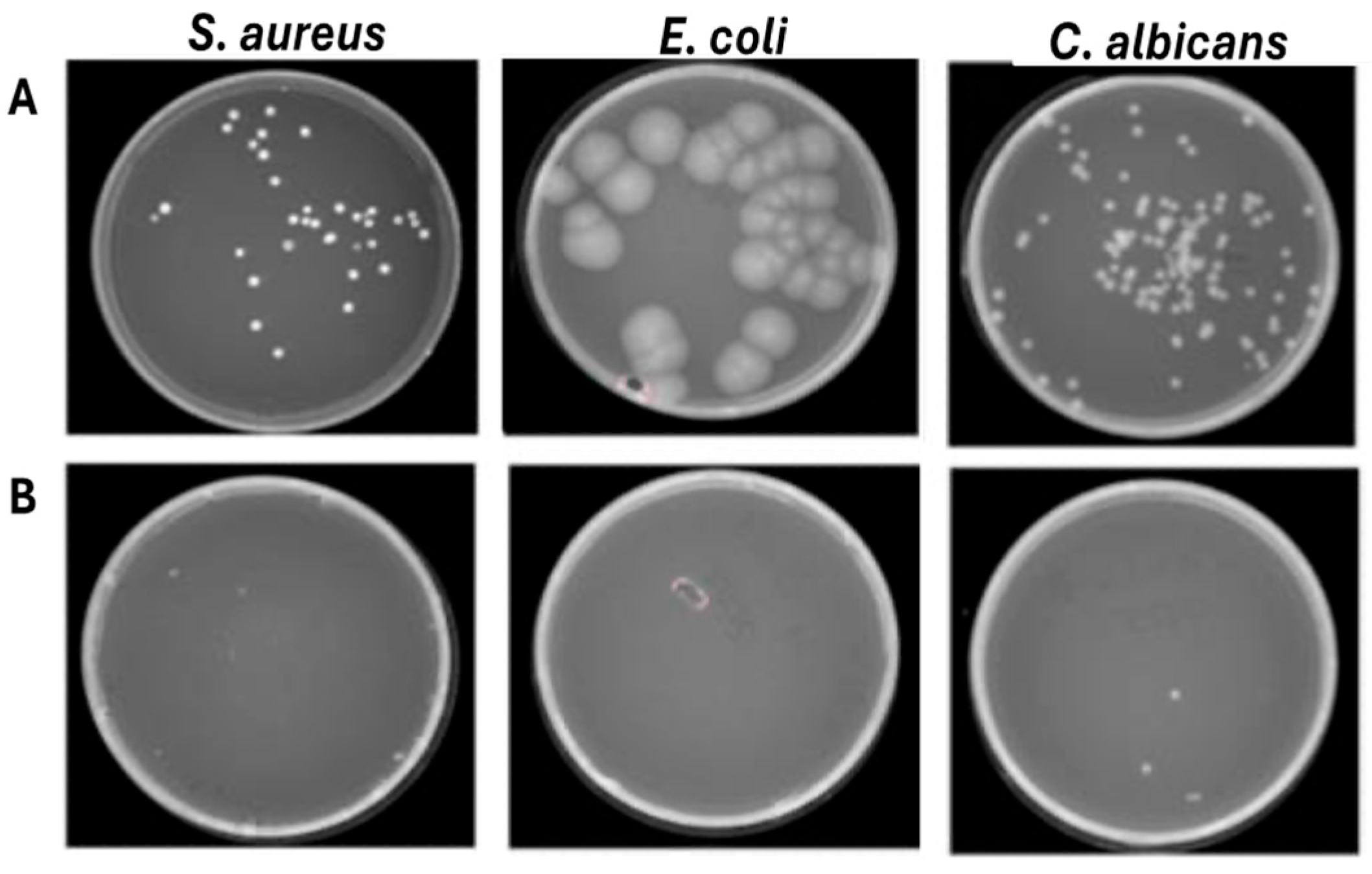
Healthcare-associated infections (HAIs) pose a significant risk in clinical settings by extending hospitalization times and increasing healthcare costs. This study aimed to evaluate the effectiveness of gaseous ozone, generated by an automatic rotary dispenser, in disinfecting hospital fabrics contaminated with common HAI-related pathogens. The antimicrobial efficacy of ozone was tested on cotton, polyester, and blended fabrics artificially contaminated with Staphylococcus aureus, Escherichia coli, and Candida albicans. The fabrics were exposed to ozone treatment cycles of 25 and 45 min. Additional tests were conducted on layered fabrics to assess ozone penetration into folds and seams. A 25 min ozone exposure significantly reduced the microbial load on all tested fabrics. A 45 min cycle resulted in an almost complete elimination of the tested pathogens. Ozone also effectively disinfected inner fabric layers, indicating its ability to reach areas typically resistant to conventional cleaning methods. Gaseous ozone demonstrates high efficacy as a disinfectant for hospital textiles, offering thorough decontamination across various materials and fabric structures. This technology represents a sustainable, residue-free alternative to traditional disinfection methods and promises to reduce the transmission of HAIs in healthcare environments.
Keywords: healthcare-associated infections; antimicrobial resistance; ozone; disinfection; textile decontamination; work safety healthcare-associated infections; antimicrobial resistance; ozone; disinfection; textile decontamination; work safety