Article

The Dead End of Dollar Road: Traces of World War II in Kjartan Fløgstad’s Novels

Department of Linguistic, Literary and Aesthetic Studies, University of Bergen, 5020 Bergen, Norway
Humanities 2026, 15(2), 23; https://doi.org/10.3390/h15020023
Submission received: 1 November 2025 / Revised: 16 January 2026 / Accepted: 26 January 2026 / Published: 30 January 2026
(This article belongs to the Special Issue Memories of World War II in Norwegian Fiction and Life Writing)

Abstract

In his 17 novels, Kjartan Fløgstad (born 1944) has analysed the traces of WWII and possible continuations of right-wing ideology into post-war politics and ideology. In my article, I focus on four novels: Dalen Portland, U3, Grense Jakobselv, and Due og drone (Dove and Drone). Dalen Portland and U3 were published in the context of the Cold War, whereas Grense Jakobselv and Due og drone were published in a context in which history was claimed to have reached its end after the collapse of the Soviet Union. Fløgstad has opposed the end-of-history thesis since it was introduced in the influential study by Francis Fukuyama in 1992. From Fløgstad’s perspective, history has reached a dead end, as democratic ideals are being challenged and economic disparities are widening—even within the welfare states of Northern Europe. In all the novels being discussed, Fløgstad has consistently focused on factual and possible interlinks between right-wing figures of thought and stakeholders of political and economic power. Thus, the only consistent superpower, the United States, has also been an object of Fløgstad’s interest. The importance of the United States is even indicated in the well-chosen title for the English translation of Dalen Portland: Dollar Road. The interpretation of Fløgstad’s novels is simultaneously an interpretation of history. Given the threats to democratic ideals that have emerged in the 2020s, Fløgstad’s analysis has demonstrated notable foresight.

1. Introduction

In this article, I investigate four novels by the Norwegian author Kjartan Fløgstad in search of traces and potential consequences of WWII. To identify and discuss these traces and their potential consequences, I triangulate the scholarly approach of close reading (Hillis Miller 1982) with historical contextualization and thematic analysis on an ideological level. The methodology is grounded in cultural memory studies (Erll and Nünning 2008) and situated within a framework of classic hermeneutics (Gadamer 2013), applied to the analysis of four complex novels. To provide the necessary context for the following analysis and discussion, I will begin by introducing Fløgstad and outlining key characteristics of his authorship. I will then highlight relevant motifs from the selected novels that will be examined within the framework of this study.
Traces of war initially concern experiences of the past that have consequences and may cause trauma for the characters in their present life. Such mechanisms are clearly present in Fløgstad’s novels, particularly in relation to wartime sailors (Fløgstad 1974, p. 8) and women who have been romantically involved with enemy soldiers (Fløgstad 2019, p. 103). In Fløgstad’s novels, however, the traces of war also affect the present on a political and ideological level. Thus, the interpretation of Fløgstad’s novels becomes an interpretation of historical processes (Sandberg 2018) with possible implications for the future development of society. My research questions are:
-
How are the traces of war reflected in the novels?
-
How do the traces of war affect the present life of the characters?
-
How are the traces of war interlinked with the dynamics of economic and political power?
-
To what extent is Fløgstad’s presentation of historical power dynamics relevant to our understanding of present-day power relations?

2. The Poetics of Subversion

Kjartan Fløgstad was born in 1944 and is still a productive author and intellectual in contemporary Norway. Since his debut as an author in 1968, he has released more than 50 books, including 17 novels. War, wartime memories, and the traces of war on different levels are leitmotifs in his authorship. In his novels, Fløgstad is influenced by the Latin-American tradition of magic realism, which he first encountered in his early years when he spent some time as a seaman. Fløgstad imported the tradition of magic realism to Norway, mirroring the importation of industrial raw materials from Latin America to the smelting plant in his hometown Sauda in south-west Norway. Fabulation and metafiction are mixed with subversion as Fløgstad makes use of the smelting plant as a factory of metaphors in highly intellectual novels analysing the evolvement of historical processes.
Fløgstad, in common with the Nobel laureate of 2023 Jon Fosse, writes his books in the minority language Nynorsk (New Norwegian), which is based on a substratum of Norwegian dialects. In contradiction to Fosse, Fløgstad connects modernist prose with colloquial speech and popular culture. For Fløgstad, subversion and political activism are rooted in language itself, and he strongly believes in the Bakhtinian notion of resistance through carnivalesque subversion. Fløgstad’s thoughts about resistance through cultural subversion were highly influential in the seventies and the eighties, following his essay Loven vest for Pecos (The Law West of the Pecos, Fløgstad 1981). On an intellectual level, Fløgstad’s analysis of history corresponds to that of the British historian Eric Hobsbawm (Hobsbawm 1994) and the French economist Thomas Piketty (Piketty 2014).

3. From Dollar Road to the Russian Bridge

The novel Dalen Portland (Fløgstad 1977) was awarded the Nordic Council Literature Prize in 1978. The translation Dollar Road was awarded the Pegasus Prize for Literature in 1989 and, regrettably, remains the only novel by Fløgstad translated into English. The Norwegian title stems from a cement factory in Norway, bringing the local reference to Dalen, where the factory was located, together with Portland, as the product was Portland cement. In her translation, Nadia Christensen coined the title Dollar Road, thereby highlighting an existing road connecting Sauda, located deep within the Boknafjord, with the more densely populated areas further west. The wording “Dollar Road” was used by the locals in the early 1930s, as the actual road was financed by the US-owned smelting plant in Sauda. In the novel, all roads leaving home are linked to Dollar Road. This alludes to the system of market liberalism and US hegemony in the wake of WWII. The main character of the novel is thus “Shipping Out”, leaving home on a “Dollar Road to life and sorrow” (Fløgstad 1989, p. 53).1
Modern Sauda was constructed as a company town for the US corporation Union Carbide through their subsidiary company Electric Furnace Company, Limited (EFPCo). Walking through the streets of Sauda today, you will still find US-made fire hydrants, a rarity elsewhere in Norway. Using Sauda as a model, Fløgstad has built a fictional universe of his own. For artistic and ethical reasons, he has named his fictional town Lovra. Thus, he explores the transformation of Norway, experiencing that globalization was largely already a fact by the beginning of the 1920s, as Union Carbide established its smelting plant in Sauda.
During WWII, the clashes of globalization were brought to the fore as EFP kept producing for their US owners and the German occupation regime planned to build a second smelting plant in the neighbouring village Saudasjøen. The stakeholders of war were all present in differing roles. The Dollar Road had been built with US capital before the war. The Russian Bridge was built by Soviet slave-workers under German command during the war. The US-owned smelting plant in Sauda and the German-planned smelting plant in Saudasjøen were even connected by rail, crossing the Russian Bridge. By the end of the war, the smelting plant in Saudasjøen had never been put into production, but a fair amount of the production equipment was moved to Årdal further north along the coastline.
The merging lines between friends, foes, and capital interests are rather confusing and may even be compromising for the characters involved. These conflicting lines constitute the basic grounds for the traces of WWII in Fløgstad’s novels. As we will see, Fløgstad’s analysis of the merging lines between political power, capital interests, and right-wing philosophy might be of high relevance on the global stage in the 2020s.

4. The War–Industrial Complex

The Nazi regime of the Third Reich had great plans for Norway because of the abundance of natural resources. The planned smelting plant in Saudasjøen, which was intended to produce aluminium, was a part of this industrial grand plan. The enterprise was outsourced to the Norwegian-led company Nordag AG (Storeide 2014). What President Eisenhower labelled as the military–industrial complex (Sterling 2010) during the Cold War was, in this context, a straightforward war–industrial complex. Collaboration with Nazi Germany on a political level was strictly forbidden as the legitimate Norwegian government and the King had fled the country, and Norway had never surrendered after the attack on 9 April 1940. Collaboration on an economic level, however, was part of everyday life and even necessary to keep the wheels turning. In an occupied country, it was business as unusual.
In this situation, the war–industrial complex brought about a twilight zone between reasonable cooperation and highly criticizable collaboration. For example, large amounts of aluminium were required for the production of aircraft for the German Luftwaffe. Thus, the establishing of an aluminium industry in Norway, as was planned close to Sauda, was integrated into the wartime economy from the very beginning.
In the early phases of the war, before the attack on Pearl Harbor and the German defeat at Stalingrad, it was not inconceivable that Nazi Germany might emerge victorious. This made it even more tempting to cooperate with the new regime. The crux of the matter can be formulated as questions such as: How can we ensure that we are not compromised, or even incriminated, as the fortunes of war change? Is it truly possible to keep one’s record clean?
Fløgstad addresses these issues in a series of novels, beginning with Dollar Road. As real-life history evolves into Cold War, neo-liberal celebration of the end of history (Fukuyama 1992), and most recently in conflict with post-communist Russia and tension with an expanding China, Fløgstad keeps examining the traces of war in novels such as U3 (Fløgstad 1983), Grense Jakobselv2 (Fløgstad 2009), and Due og drone (Dove and Drone, Fløgstad 2019). The main conflicting lines are formulated in Dollar Road, but more in the shape of a draft than in the shape of historical explanations.

5. Dalen Portland (1977) and the Epiphany of the Past

Rasmus Høysand is the main character, who is leaving home on a “Dollar Road to life and sorrow” (Fløgstad 1989, p. 53). Rasmus is intentionally presented as a picaresque figure (Ardila 2015). By the end of the novel, he is working at the University Library in Oslo, where picaresque literature is the main object of his work. In Oslo, he hooks up with the uptown girl Alexandra Bernadotte Victoria Voss. As Alexandra becomes pregnant, they plan to get married and Rasmus is introduced to her family. Alexandra’s father declares that he was involved in the building of an aluminium works in Lovra during the war: “I worked for A/S Nor-Dag, an important German-controlled firm which, I might note in parentheses and in all modesty, founded the Norwegian aluminum industry in fact” (Fløgstad 1989, p. 197).3 Mr. Voss elaborates on the ignorance of the “popularly elected officials” who destroyed his “life work” as the plant was dismantled after the war. “The same thing happened, of course, with Nor-Dag’s aluminum-oxide plant in Saudesjøen”, Mr. Voss adds, connecting the fictional story with the factual history of occupied Norway (Fløgstad 1989, p. 198).4
The involvement in the company controlled by the Germans has not resulted in any legal consequences for Mr. Voss. His family lives in Bærum, a rather posh community to the west of the Norwegian capital Oslo. However, as is typical for Fløgstad’s depiction of the traces of war, his personal history has consequences for his daughter and Rasmus. During the war, Mr. Voss had a romantic relation with a local girl named Durdei:
[T]he situation with Durdei was a little delicate. She got pregnant; but people overlooked that, of course, and she, and most likely the child, too, for that matter, is probably still living her simple life there, as they have done since Arild’s time.
(Fløgstad 1989, p. 198)5
It turns out that Rasmus is Alexandra’s half-brother, whereupon Rasmus leaves the luxurious house without much further ado. It transpires that Mr. Voss is his biological father, and Rasmus himself turns out to be an heir of market liberalism as well as an heir of national socialism, as the two facets of ideology were intertwined in wartime Norway. This revelation of history does not take form as a kind of accusation in Dollar Road, but it certainly was a supplement to the trading narratives of wartime Norway. The epiphany of Rasmus Høysand signals that there is more to wartime history than we already know. The well-to-do Mr. Voss has no problems with his past, but Rasmus and Alexandra (not to mention their unborn child) are all struck by the hidden traces of war. In the original, the power relation between Mr. Voss and Rasmus is also made overt by linguistic means: Mr. Voss’s speech is transcribed in the majority language, Bokmål, whereas Rasmus’s speech is transcribed in the minority language Nynorsk.

6. U3 (1983)—Norwegian Maverick Lost in Conspiration

6.1. At the Peak of the Cold War

The novel U3 is named after the Lockheed U-2 surveillance aircraft, which has been in service on behalf of the strategic interests of the United States since the 1950s. In the streets of Bodø in High North Norway, U-2 was colloquially referred to as “Den sorte dame” (the “Black Lady”), as it was sometimes observed during its secret missions during the Cold War. The 1960 U-2 incident was one of the most dramatic moments during the Cold War, as the Soviets managed to shoot down a U-2 aircraft flying well inside their own territory (Helland 2005, p. 80). This actual aircraft was on a mission heading for Bodø.
Without question, the U-2 incident was a violation of the national integrity of the Soviet Union. It was even a violation of Norwegian interests, as the United States was not allowed to use the airbase in Bodø for missions in conflict with international conventions. After WWII, Norway’s foreign policy had been based on balancing the principles of deterrence and reassurance towards the Soviet Union, but this balance was badly shaken by the U-2 incident. After the incident, the Norwegian government even passed a note of protest to the United States (Petersen 2025).
Five years after he received the Nordic Council Literature Prize, Fløgstad invested all his intellectual and artistic capital in challenging the hegemonic models of Western geopolitics. The reception history proves that the novel was interpreted for political reasons, but probably not according to the intentions of the author.

6.2. A Stab in the Back

Although the context of U3 is the Cold War, the conflict is rooted in WWII. As in Dollar Road, Lovra is in focus as the hometown of the main character—the future fighter pilot, Alf Hellot. Hellot is a Norwegian precursor to the hero of the 1986 blockbuster, Top Gun. Just like Tom Cruise’s character Maverick, Hellot is the best of the best at handling his fighter jet in the midst of the Cold War. Fløgstad’s hero even proceeds to make a career as an officer on the global stage. Thus, his personal story is also a story of a class journey, where his family background comes into play.
During WWII, Hellot’s parents were both engaged in political work on the far left with the communists (Fløgstad 1983, p. 55). At the beginning of the war, they adhered to Communist Party doctrine, viewing the conflict as a struggle between imperial powers. On that basis, they kept their powder dry (Fløgstad 1983, p. 55). An unknown brigader who had fought in the Spanish Civil War, however, broke with the party doctrine, stating that he had fought fascism abroad. As fascism had entered Norway, he wanted to fight in his homeland as well (Fløgstad 1983, p. 56).
On 10 April—the day after the German attack on Norway—a ship loaded with young lads from Sauda, Odda, and (fictional) Lovra is heading for Voss, where actual battles took place in April 1940. The squad never enters battle. Behind the backs of the soldiers, the officers make a deal with the Germans, pointing their guns at their own soldiers. As a result, Hellot’s father is imprisoned in Nazi Germany. After the war, he forges a career in the labour movement, encountering real-life politicians at the highest level.
The story about the Norwegian officers making deals with the Germans is a stab-in-the-back myth transformed to a Norwegian context. It alludes to the fact that quite a few of the Norwegian officers were sympathetic to national socialism, regarding communism as the more severe threat (Brevig and Figueiredo 2002, pp. 46, 176). His father’s wartime experiences pose an ethical problem for young Hellot as he decides to be a fighter pilot. Before the war, the armed forces had been an opposing threat to the labour movement. In a famous incident in 1931—the so-called “Battle of Menstad”—armed forces had been deployed during a lockout involving the fertilizer-producer Norsk Hydro. The Minister of Defence at the time of the incident was Vidkun Quisling. Two years later, Quisling founded the Norwegian Nazi party, Nasjonal Samling, and by the beginning of the war, Quisling entered the stage of global history and infamy as he seized office as “MinisterPresident” in occupied Norway.
Young Hellot is surprised as his father accepts his career choice. “Go ahead! Be an officer, my dear Alfieboy”, he says, remembering the war and the officers who had betrayed their own country (Fløgstad 1983, p. 55).6 Hellot’s father realizes how important it is to have officers who are reliable and dedicated to defending the will of the people. On these grounds, he approves of his son’s career choice.

6.3. The Will of the People

The plot is set amid the intrigues and paranoia of the Cold War but is also anchored in the struggle for freedom that had taken place during WWII. Is national freedom, and indeed sovereignty, possible in post-war Europe? In his chosen career, Alf Hellot succeeds in every way. “He is the number one, the winner, and the ace” (Fløgstad 1983, p. 64).7 During his training at Williams AFB, Arizona, he is awarded “best cadet” (Fløgstad 1983, p. 91). Becoming the best of the best seems the easiest thing for him to do; serving the people, however, becomes increasingly difficult as Hellot rises through the ranks.
During service in High North Norway, Hellot becomes directly involved in the U-2 incident. Even historical characters who were involved play roles in the intrigue. During one of his missions, Hellot observes a mysterious plane and takes photos of it. At the same time, his wingman crashes under mysterious circumstances. In this situation, Hellot starts questioning his own role as an officer, echoing the experiences of his father during the war. Can he truly trust his fellow officers? Are they really serving the will of the people, or are they serving the far-away superpower that acts in conflict with the constitution, which defines Norway as a “free, independent, indivisible and inalienable realm”?8

6.4. “The Hunting Grounds of Fascism”

Seen from the viewpoint of prevailing geopolitical theories, Captain Hellot is a fighter pilot who gets lost in conspiracy theories. His wife Linda, who comes from a dynasty of shipowners in bourgeois Bergen, obviously thinks that this is the case. From her perspective, “Norway is a strange country, keeping rather fanciful ambassadors”, as they—along with help from her husband—try to mediate between the East and the West (Fløgstad 1983, p. 207).9
Linda sticks to the geopolitical strategy, which advocates deterrence by military and even nuclear arms as its main strategy. In the background, however, we hear the voice of the US diplomat and recognized scholar George F. Kennan (1904–2005), who outlined the US containment policy during the Cold War (Costigliola 2023). Alf Hellot pricks up his ears as he hears the East Coast-voice of Kennan on the radio. His wife Linda responds by turning the radio off and goes to sleep (Fløgstad 1983, p. 217). The Cold War has entered their marriage, causing their relationship to fall apart. Gradually, Alf Hellot substitutes military deterrence with reassurance and diplomacy as his preferred strategy for the upholding of peace, supporting Norwegian Prime Minister Gerhardsen as he tries to mediate in the conflicting schemes between the East and the West, and dissents from NATO strategies regarding nuclear weapons in continental Europe (Fløgstad 1983, p. 217). Even at this point, the fictional intrigue correlates with factual historical events.
For a politician in a vital democracy, Alf Hellot’s behaviour might be legitimate, but for an officer in the chain of command, his actions pose a problem. Referring to his father’s wartime experiences, he no longer sees himself as serving the will of the people, but rather as an instrument of power politics. However, expressing personal views on geopolitics while flying a supersonic fighter jet proves to be a particularly difficult task. Captain Hellot flies over Lovra, waggling the wings of his jet, but the workers cannot understand his message. Wing waggling is “an international sign and request for altering course” (Fløgstad 1983, p. 155).10 “Are we the ones who are supposed to alter course and leave the territory?” one of the workers responds, turning his back to the symbolic performance in the sky (Fløgstad 1983, p. 313).11
In the chapter “Liberation Day”12, once again alluding to the events of WWII, Alf Hellot ends up deliberately crashing his fighter jet “in the midst of the hunting grounds of fascism” (Fløgstad 1983, p. 347).13 The wording is highly ambiguous, as it refers to the context of the previous war, when the occupation regime took possession of this landscape (Undheim 1999), but it might also refer to the present, signalling that concepts of fascism are still alive.

6.5. The Twists of the Cold War

U3 did not cause discussions about geopolitical strategies in Norway. The future Nobel laureate Jon Fosse, however, did accuse Fløgstad of “political correctness”, blaming him for holding on to a “Marxist scheme” based on the “reification” of human life (Fosse 1989, p. 17). As a paperback edition of U3 was published in 1996, the respected editor and columnist Per Egil Hegge was assigned to author an “Afterword”. Hegge praised Fløgstad for providing facts about the U-2 incident that had previously remained unknown to the public (Hegge 1996, p. 353).
First and foremost, U3 should be read as a highly effective thriller about conflicting geopolitical strategies in the High North. The reception history of the novel explicates that even in the form of fiction, dissenting views on geopolitical strategies may find resonance on the other side of the Iron Curtain. In 1988, at the very final stage of the Cold War, U3 was published in the Soviet Union (Fløgstad 1988b) and in East Germany (Fløgstad 1988a). According to the author (Fløgstad 2007, p. 128), a shortened version of U3 was published in the journal Inostrannaja Literatura in an edition of one million copies prior to the release of the book version in the Soviet Union. The East Germans attempted to publish the translation in West Germany, but when this proved challenging, they framed the obstacles through the themes of the novel (Jager 2014, p. 50). Thus, with the Cold War as its main motif, the novel itself became a part of the cultural warfare between the competing superpowers.
U3 tells the story of the rise and fall of a gifted young man. On an intellectual level, the novel demonstrates the possibilities of fiction, blurring the lines between fiction and propaganda and the interests of us and them. On a psychological level, the novel demonstrates that dissenting views on questions of geopolitics may lead to personal disaster. The maverick Hellot grows increasingly self-conscious in his fighter jet, ultimately questioning the very purpose of his mission. In this respect, U3 reflects the propaganda of the Top Gun blockbuster film in reverse. The American character Maverick never questions the logic of his mission and ends up as a celebrated hero, but the Norwegian maverick Hellot does question the logic of his mission, not least because of his father’s wartime experiences, and it ends with personal disaster.
It is deeply regrettable that U3 was never translated into English, and equally thought-provoking that it was instead translated into Russian and published in the Soviet Union. In an ironic twist of the Cold War, a novel that was designed to question the propaganda of the West ended up being embraced by the propaganda of the East.

7. Grense Jakobselv (2009)—The Conspiracy of the Real

7.1. Double Standards

The High North is an area of great geopolitical importance today as it was during WWII. As the German Wehrmacht withdrew from the High North in the final stage of the war, they employed scorched earth tactics, effectively burning down every building. The Soviet Red Army turned up as liberators for the Norwegian population and, unlike in Eastern Europe, withdrew from the country relatively quickly. Before and after the war, there have generally been friendly connections between the Russians and the Norwegians living on either side of the border. On a civic level, the connections remained friendly during the Cold War but have today been placed under pressure due to the war between Russia and Ukraine.
Fløgstad knows the High North from the inside. In his younger years, he lived with his family in Narvik, internationally known from the Battle of Narvik in the initial phase of WWII (Alfsen 2019). In the early 1980s, Fløgstad lived in Bjørnevatn, which is not far from Grense Jakobselv—a small village nearby the Russian border. In 2009, Fløgstad used the name of this village for his novel about WWII.
In Grense Jakobselv, Fløgstad combines facts with fabulation, bringing historical and fictional characters together. U3 had displayed how the very best man of the people could get lost in the competing discourses of geopolitical strategies. In Grense Jakobselv Fløgstad focuses on people from the upper class, contrasting their humanistic ideals of the present with the actions of fascism from the past. There are two narrators in the book: the German Otto Nebelung and the Norwegian Alf Magnus Mayen. Nebelung was previously married to a cabaret artist of Jewish descent, but they split up as the persecution of the Jews intensified. Mayen has not experienced the war himself, but his parents had been involved in collaboration with the Nazis. It is suggested that Mayen is Nebelung’s biological son, as Mayen’s mother had been involved with several Nazi officers, including Nebelung. This fictional twist recalls the incestuous epiphany in Dollar Road, where Rasmus Høysand realizes that the Nazi collaborator Mr. Voss is his father.
The point of focalization alternates between the German Nebelung and the Norwegian Mayen. The underlying question is to what extent this alternation really matters. The fictional story develops as history evolves by itself. Post-communist Russia is emerging as a growing threat on the other side of the border at Grense Jakobselv. Who are we, the readers of the novel and citizens in a liberal democracy, supposed to trust? “What is truth? What is a pack of lies? What truth is so big that it even incorporates the lies?”, Alf Mayen asks in the final stage of the novel (Fløgstad 2009, p. 368).14
Fløgstad has been accused of idealizing the Soviet Union and communism as an ideology, but he has consistently refused to acknowledge such accusations (Gujord 2018, pp. 360, 408). Even in the 1970s and the 1980s, as many of his prominent author colleagues joined the far-left party AKP, Fløgstad consistently presented himself as unmistakably left-wing yet nevertheless an independent intellectual. However, he has surely focused the searchlight on the possible double standards of the West. How is it possible that members of the Waffen SS Nazi elite corps can be regarded as liberators in a country like Lithuania (Fløgstad 2009, p. 418)? How is it possible that the German chancellor and the French president could meet up with the right-wing author Ernst Jünger, celebrating the unification of Europe (Fløgstad 2009, p. 410)? And how is it possible that the former member of the SS Paul von Damaskus can appear at the University of Oslo, giving a lecture about “humanistic values” in front of an audience who seem to be blissfully ignorant about his past (Fløgstad 2009, p. 24)?
To some extent, the conspiracy theory believed by the fighter pilot Hellot has turned into reality in Fløgstad’s presentation of the evolution of history. Parody is still a part of the discourse, as a female scholar suddenly disappears from a conference in Lithuania commemorating “the heroic defence against the Red Army” (Fløgstad 2009, p. 418).15 As she returns, one of her kidneys has been stolen, probably for transplantation to the former SS frontline fighter Paul von Damaskus. The subtext suggests that the autonomy of scholarship has been overridden by the power of politics, thereby keeping concepts of fascism alive. The female scholar has been used, as one of her kidneys is stolen to keep the former member of the SS alive.

7.2. A Useful Man

In Grense Jakobselv, Fløgstad addresses the judicial, economic, and political development of the West. Factual and possible continuities linking WWII, the Cold War, and the years following the celebration of the “end of history” in the 1990s come to the fore, with reference to historical characters. In addition to the philosopher Heidegger and the author Ernst Jünger, the novel also references the philosopher of law Carl Schmitt, the German intelligence officer Reinhard Gehlen, and many others. Possible continuities of right-wing ideology are not only suggested in a German context but also in a Norwegian context. Fløgstad highlights the fact that the police officer who was responsible for the arrest of the Jews in Norway was never convicted after the war. This paradox has also drawn attention in regular scholarship and in visual arts. The Norwegian Holocaust Centre has displayed a statue of the actual police officer, made by the artist Victor Lind, as he raises his right arm to perform a German salute (Lenz 2008). The statue bears the name “The Perpetrator”—in Norwegian “Gjerningsmannen”—making the police officer responsible for the actions that he organized during the war. Fløgstad suggests that there might be hidden reasons why the police officer was never held accountable for his actions. After the war, the same police officer was involved in the mapping of a supposed enemy growing from within—namely, the communists. Put simply, he was a useful man in post-war Norway (Njølstad 2008, p. 387).16
In the 1990s, a commission appointed by the Norwegian parliament concluded that the surveillance of the communists conflicted with the legislation of civil society (Lund 1996). Fløgstad describes the fact that leading figures of the Norwegian resistance movement, who had been fighting the Nazis during the war, were involved in the illegal surveillance of communists after the war (Fløgstad 2009, p. 305). The pressing question is to what extent this surveillance represented the protection of, or a genuine threat to, civil society? As the committee concluded that the surveillance was in contravention of the legislation, the answer is seemingly clear. During the war, the communists were fought by the Nazis; after the war, they were fought by Norwegian authorities on different levels—this time, “by other means” (Fløgstad 2009, p. 431).17
These aspects of Grense Jakobselv are based on facts, although coded in irony paired with parody and intellectual sarcasm. The message, however, is serious, and Fløgstad quotes the philosophers Adorno and Derrida to underline his general warning to the public. Adorno proposed that he feared the afterlife of Nazism from the inside of democracy more than the afterlife outside and against democracy (Fløgstad 2009, p. 330; Adorno 1970, p. 10). Similarly, one of the characters quotes Derrida, saying, “I do not believe that we as yet know how to think what Nazism is” (Fløgstad 2009, p. 418; Derrida 1988, p. 31). In Grense Jakobselv, Fløgstad uses the novel as a vehicle for investigation and reflection, tracing the threats to democracy not on the other side of the border at Grense Jakobselv but within Western society itself.

8. Due og Drone (2019)—The Horror of History

8.1. Marxist-Hunters

Due og drone (Dove and Drone, Fløgstad 2019) is the most daring of Fløgstad’s war novels. The context of international politics had shifted with Donald Trump’s entry into the White House and Russia’s annexation of Crimea under Vladimir Putin’s tenure in the Kremlin. The tension of contemporary politics is reflected in the novel, as are the possible continuations of right-wing ideology from the 20th to the 21st century.
The novel begins with the celebration of the 70th anniversary of the liberation of the Norwegian High North in 2014. Current politicians from Norway and Russia are present. The atmosphere, however, is tense:
Liberation. It resembled the bond between perpetrator and victim. The liberated appeared as though they might have preferred to remain unliberated, even as Foreign Ministers Brende and Lavrov laid wreaths at the Monument of the Soviet Soldier in Haganes, in the centre of Kirkenes.
The soldiers of the Red Army were greeted as liberators in 1944. In Norway, there were no major conflicts between the Soviets and the civilian population, as had taken place further south on the European continent. “To this day, the people of Finnmark commemorate the Soviets as liberators”, the narrator states (Fløgstad 2019, p. 10).19
This highly factual sketch of history is but one of several parallel discourses in the novel. An important subplot follows the disappearance of a terrorist who has escaped from prison (Langås 2025a). A third subplot presents contemporary Norway as a country occupied by a foreign superpower. Plots of this kind are not unknown in contemporary popular culture. In the TV series Occupied (Skjoldbjærg and Lund 2015), based on an idea by the crime author Jo Nesbø, Norway is occupied by Russia because of its oil and gas resources. In Fløgstad’s novel, however, Norway is occupied by its ally USA and has been converted into a vassal state for geopolitical reasons.
How can it be that the runaway terrorist is nowhere to be found? On this point, the novel alludes to the story of the police officer who, as described in Grense Jakobselv, was never punished for his actions during the war because of his usefulness after the war. The terrorist in Due og drone is referred to as a “MARXIST HUNTER” (Fløgstad 2019, p. 111), as these words were printed on the self-made uniform of the terrorist Anders Behring Breivik during his attack against the Norwegian government and the Norwegian Labour Party on 22 July 2011. After Breivik had blown up the headquarters of the government, he proceeded to the island of Utøya, wearing a fake police uniform, where he tracked down and murdered members of the Workers’ Youth League. In total, Breivik killed 77 people: 8 in Oslo and 69 on Utøya.
In the imaginary world of the novel, the terrorist may have disappeared because of his usefulness—being an expert at hunting down Marxists in the age of neo-liberalism. The subplot of the escaped terrorist is grotesque. By estrangement, however, it pinpoints the paradox of the police officer during the war who was never made accountable for organizing the rounding up of the Jews. The stories of both the real and the fake police officer are paired together, as they are each portrayed as “Marxist-hunters”.

8.2. “From Gas in Auschwitz to Gas in the North Sea”

In Dollar Road, we were introduced to the well-to-do Mr. Voss. During the war, he was working for the company Nordag (Nordische Aluminium Gesellschaft) and claimed that he was engaged in the founding of the aluminium industry in modern Norway (Fløgstad 1989, p. 197). The haunting one-liner “From gas in Auschwitz to gas in the North Sea” (Fløgstad 2019, p. 290)20 is based on the continuity between industrial undertakings in postwar and contemporary Norway and activities that had taken place during the war.
In his novels from Dollar Road to Due og drone, Fløgstad draws a line between the activities of the companies Nordag and Norsk Hydro during the war and the activities of Norsk Hydro after the war. The haunting one-liner quoted above focuses on these connections, highlighting the integration of Norsk Hydro in the war–industrial complex of the Nazi regime. The wording draws upon the collaboration between the German company I.G. Farben Industrie and Norsk Hydro. As is well known, I.G. Farben was the manufacturer of the Zyklon B gas that was used in the extermination of the Jews. In the 1980s, Norsk Hydro developed into an important oil company in the North Sea, thereby making gas one of the company’s main products for sale.
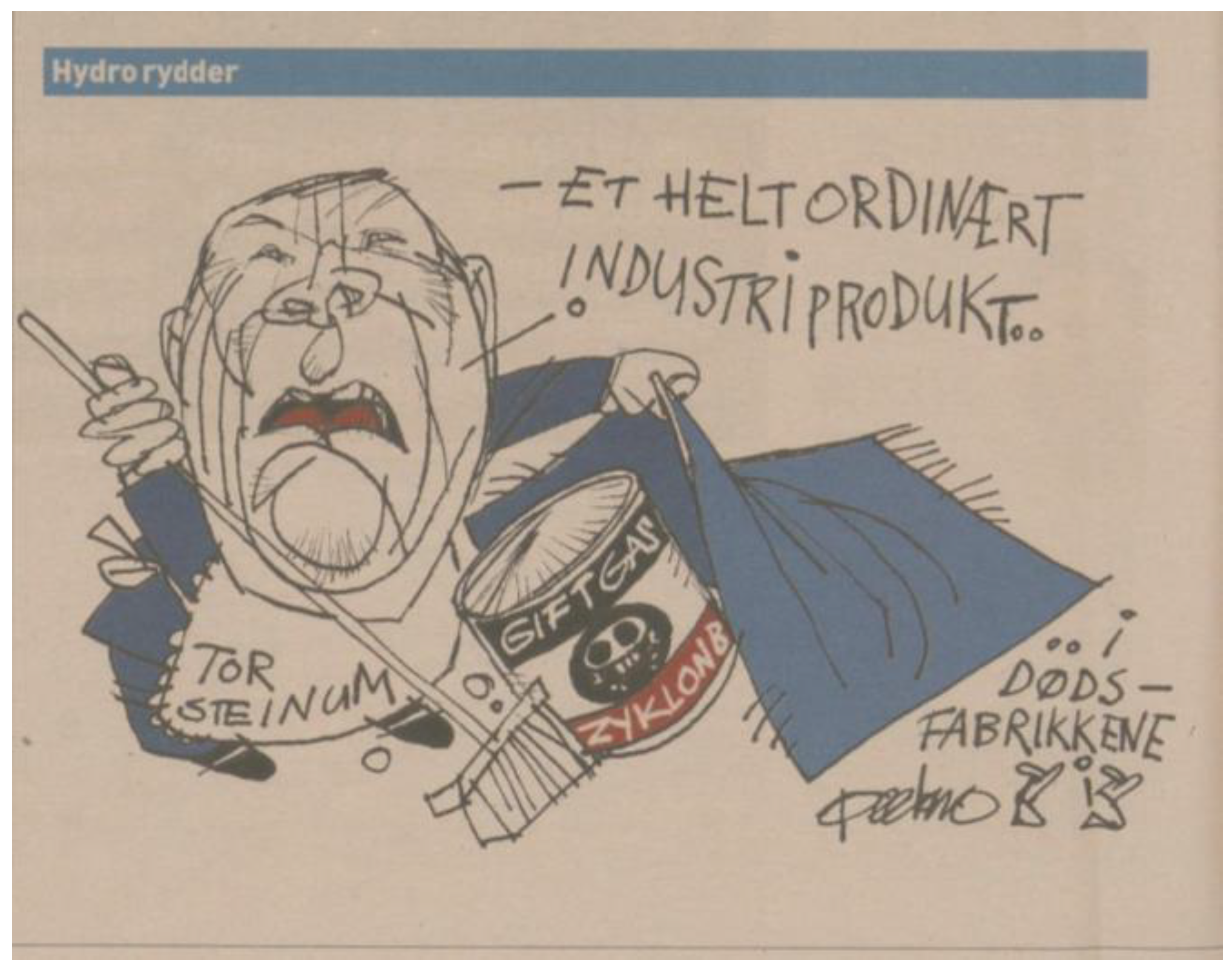
Fløgstad’s line is indeed provocative. The cooperation between I.G. Farben and Norsk Hydro, however, is well-documented. A cartoon by Per Elvestuen, published in the Norwegian daily newspaper Dagens Næringsliv on 22 December 2004 provides a parallel to Fløgstad’s wording, although there were no judicial consequences for the Norwegians involved in the cooperation (Figure 1). Addressing these seeming ironies of history, Fløgstad makes use of the rhetoric of advertising. The phrase “From gas in Auschwitz to gas in the North Sea” might have served as an effective slogan, were it not for the genocidal horror of history. By implication, the genocidal effects of gas and fossil fuels are even connected to the climate crisis of our current time. A further connection was also evident, as the terrorist behind the Oslo and Utøya attacks used fertilizer—originally produced by Norsk Hydro—as the key component in the bomb that destroyed the government building in Oslo (Gujord 2020, p. 139; Langås 2025a, p. 324).
By repurposing the rhetoric of advertising, Fløgstad exposes the underlying responsibility—and potential guilt—of market liberalism itself (Sandberg 2018). Memories and responsibilities of guilt slip through the system of law because of the cynical logics of cost and balance. “The laws were designed to exempt the wealthy from paying taxes—and to ensure that those rich enough would be unable to do anything illegal”, as stated in the novel Nordaustpassasjen (The Northeast Passage, Fløgstad 2012, p. 76).21

8.3. Shades of Guilt

As for Mr. Voss in Dollar Road, the involvement in the war–industrial complex has no consequences for the well-to-do people in Due og drone. The ones who must pay the price are the men and women of the people, such as Rasmus Høysand in Dollar Road, Alf Hellot in U3, and now, in Due og drone, the mysterious woman Kcenia Nyslåttbuktmo. We meet her at the beginning of the novel, as she scrubs her house in Arctic Norway just before the Nazi occupiers are about to set it on fire. The action tends to be rather enigmatic: What is the rationale behind cleaning a house that will go up in flames in the next moment?
The mysterious Kcenia keeps cleaning her abodes rather manically when she moves to Oslo after the war. She is accompanied by her little son, named after an Austrian officer who served with the occupying forces. By means of the manic cleaning, Kcenia is trying to “wash away her own shadow” (Fløgstad 2019, p. 103).22 Her personal story ends with a monumental suicide, as she fills her rucksack with heavy books and jumps off the high-dive platform at Ingierstrand Bath, located on the outskirts of Oslo. The location is well-chosen, as Ingierstrand Bath is known for its clean architecture of functionalism. Kcenia obviously did not manage to wash away the shadows of the past. Now that she has gone, however, her son can move on—he no longer has to worry about the shadows of guilt passed on by his mother.
The story of Kcenia Nyslåttbuktmo is one of the highlights of Fløgstads’s novels. It relates to the stories of romantic relations between Norwegian women and German soldiers in WWII (Langås 2025b). Kcenia’s story is a story of lifelong guilt and shame. Not even the monumental suicide shakes the psychological and realistic foundations of her story. She remains enigmatic, she is “an X in the second degree” (Fløgstad 2019, p. 140)23 as she lives on the second floor in an apartment in postwar Oslo. Her name Kcenia even corresponds to the Latin prefix xeno, signifying that she is an alien. She comes from the High North, from the meeting point of several nations: Norwegians, Finns, Russians, and people of differing Sámi origin. She speaks five languages—including German and Russian (Fløgstad 2019, p. 132)—and she is “chic” (Fløgstad 2019, p. 131). Another thing that we know about her is that she has been intimate with at least two men, and that she does not know which one is the father of her beloved child (Fløgstad 2019, p. 133). Has the gifted and chic Kcenia Nyslåttbuktmo been a spy—or maybe even a double agent?
Kcenia’s story remains enigmatic, which adds to the aesthetic qualities of Due og drone. Neither the manic cleaning nor the burning of her house can remove her shadow. When one of the possible fathers of her child suddenly turns up, working as a journalist during the 1952 Olympic Winter Games in Oslo, she approaches him for a secret rendezvous (Fløgstad 2019, p. 188). The man from the past has—just like Mr. Voss in Dollar Road—been involved in the construction of an aluminium works in Lovra. Even Kcenia’s present lover in the novel, the police officer Olav Sima, had been involved in the project.
Kcenia is a young, chic, and highly competent young woman and a single mother. Her destiny is to live through times of war—takings risks, seizing uncertain opportunities, and always striving to do the best for her child. The narrator does not moralize in any way. The ones to blame in Due og drone—as in Dollar Road and all the subsequent novels by Fløgstad—are the wartime profiteers who are always cashing in and never seem to pay the price. The complacency of the engineer and wartime profiteer Seyss-Jørgensen is reflected in his ugly laugh, which makes him seemingly invulnerable in contrast to Kcenia Nyslåttbuktmo:
The German war industry, ha hah, hah! Cooperation with the enemy! A hey and a ho! Russian slave-workers, ho ho! No laughing matter? Haha. Engineer Seyss-Jørgensen laughed often even now, but his laughter was by no means good. An ugly laughter it was, a really nasty and unjoyous laughter when all is said and done.
The moral stance of the novel draws heavily on the history of the so-called Oslo Consortium—a group of wealthy Norwegians who invested during the war (Storeide 2014) and even had interests in the company Norsk Hydro. The undertakings of Norsk Hydro during the war were investigated by the Norwegian authorities, but there were no serious consequences for the company. The novel addresses this outcome rather ironically:
All of the guilt for the harmful effects to the country from the cooperation with the Germans was placed on the former managing director of Norsk Hydro, Aubert, who very conveniently passed away before the end of the war and the investigation could begin.
The contrast is evident: the young woman, once entangled in romantic affairs with the enemy, never manages to wash away her shadow and ends up taking her own life. The wealthy and the rich cleanse their record with the help of good lawyers and maybe even by the mechanisms of the legal system itself. Even Kcenia’s lover, Olav Sima, ends up as a lawyer for the Oslo Consortium as he himself had been involved in working for the Germans during the war. The engineer Seyss-Jørgensen, who by now has been promoted to general manager, makes him “an offer he cannot refuse” (Fløgstad 2019, p. 205).26 Mr. Seyss-Jørgensen has knowledge of the wartime past of police officer Sima and is able to blackmail him and bribe him into business at the same time. As Olav Sima becomes a partner in Seyss-Jørgensen’s firm, promotion and corruption have become two sides to the same story.

9. The Dead End of History

9.1. The Social Other

Ever since Homer, literature has been instrumentalized to ignite the fighting spirit among soldiers and civilians, dividing us from them. This was certainly a fact in Norway during WWII. The Nazi regime mobilized the ‘Nordic’ tradition for its own racial cause (Sveen 1942) but this was countered by Norwegian authors living in exile (Skard 1942; Reiss-Andersen 1943). The opposing processes of subjectification and othering unfolded along the frontlines of the war.
In Fløgstad’s novels, the other is defined by social and not by national distinctions, even in times of war. The wartime profiteers—Mr. Voss in Dollar Road and Mr. Seyss-Jørgensen in Due og drone—are examples of socially determined others. They are both Norwegians by heritage but are separated from their fellow native citizens not only because of their collaboration with Nazi Germany but also by socially determined cultural distinctions. The cigar of Mr. Voss (Fløgstad 1989, p. 197) and the walking stick of Mr. Seyss-Jørgensen (Fløgstad 2019, p. 57) are symbols of these distinctions. The nickname of the Norwegian war profiteers—brakkebaroner (barracks barons)—accentuates the social aspect of this kind of othering. As Mr. Seyss-Jørgensen waves his stick, a barrack of the most “high-noble” descent rises from the ground, seemingly by “magic” (Fløgstad 2019, p. 61). In Grense Jakobselv, the corporeal distinction between the two narrators—the Norwegian Mayen and the German Nebelung—totally disappears as their two bodies are turned into one in a car crash (Fløgstad 2009, p. 435). The social distinctions, however, prevail.
Among men and women of the people, the mechanisms of othering are quite different in Fløgstad’s novels. First and foremost, the other is one of us. In Due og drone, the actions on our side of the border are followed by parallel actions on the other side of the border. The soldiers on the battlefield are fighting each other but are at the same time united in a fight that transcends the national border. In the battle for Litza on the Murmansk Front, the frontline freezes to a situation of stalemate. The German and the Soviet soldiers are fighting each other but must also fight the mutual enemy of the deadly cold. The probable father of Kcenia Nyslåttbuktmo’s child is a captain serving with the German war press. He is ordered to create “the big narrative about the Heroes of Litza” (Fløgstad 2019, p. 94).27 Creating this kind of narrative proves to be difficult, as friend and foe are entwined in a way that makes it impossible to make a distinction between deadly infighting and the warmth of an embrace:
Friend and foe at sixes and sevens, foe and friend in a real mess. And as noted with astonishment in the high command it seemed as if many of the dead had not fallen in fighting against each other but that they had found together against a mutual enemy.
(…)
Side by side the mortal enemies had been entangled in a united fight against death. In frozen and twisted postures on the frostbitten ground they tried to hang on to their own lives, intertwined in a mortal battle for keeping their bodies warm together. Both with bayonet in hand, shaft inwards, knife blade outwards, pointing out and away from the body; the Soviet with the long and slim model by Mosin-Nagant, the German with the blunt standard bayonet made by Mauser. Both were frozen and both alive as they were found. The German had the uniform of a Wehrmacht officer with a field edition of Goethe on his chest; the Russian was a member of the Red Banner Infantry Battalion and carried Dostoevsky’s The Possessed by his heart.
The German and Soviet soldiers have more in common than what sets them apart. Uniform, bayonets, and even literary classics bind the soldiers together—both in a literal and symbolic struggle against the cold that presses in from without.
“He is my brother but with another mother” (Fløgstad 2019, p. 95), the Norwegian lieutenant concludes as he questions the German captain after the war.29 The lieutenant will go on to become the lover of Kcenia Nyslåttbuktmo and (step)father of her child. He will never know that the German—more precisely, the Austrian—he is questioning is likely the biological father of his future stepson. The dead soldiers, the Austrian captain, the Norwegian police officer, and Kcenia Nyslåttbuktmo are all united as victims of war. The coldness of the enemy is coming from without. The othering of the Norwegian police officer is performed as Mr. Seyss-Jørgensen embraces him by making him a partner in his firm, making him an offer he cannot refuse. This coldness is a systemic coldness cutting off the social band that connects people across national, cultural, and ethnic borders.

9.2. The Ring Is Closed?

Fløgstad introduced the notion of “the social band” in the novel Det 7. klima (The 7th Climate, Fløgstad 1986). In the novel, there is also an actual band called Det sosiale bandThe Social Band in English. Conveniently for Fløgstad’s poetics, in Nynorsk the word band can mean both a bond—as in Robert Nisbet’s study The Social Bond (Nisbet 1970)—and a band in the sense of the classic 1969 album by The Band. In a study published to mark the 75th anniversary of the smelting plant in Sauda, Arbeidets lys (The Light of Work, Fløgstad 1990), Fløgstad elaborated on the motif from a historical perspective. The social band is a symbol of brotherhood that transcends the restraints of national and cultural borders (Gujord 2018, p. 52). Against this backdrop, Fløgstad never joined Fukuyama’s celebration of The End of History, as its free-market assumptions abandoned the utopian ideals of the social band.
Fløgstad has shown interest in the right-wing philosopher of law Carl Schmitt since the late 1990s (Gujord 2018, p. 350). In 2009, Fløgstad also introduced Schmitt into his fiction, where Schmitt has since remained an important point of reference (Fløgstad 2009, p. 410; Fløgstad 2012, p. 90; Fløgstad 2014, pp. 134, 210; Fløgstad 2019, pp. 63, 212, 427; Fløgstad 2022, pp. 34, 51, 124, 162, 167, 183, 192, 194, 198, 247). Fløgstad has also discussed Schmitt in his essays (Fløgstad 2016, pp. 56, 83, 117, 118, 120; Fløgstad 2024, p. 588). In the novel Nordaustpassasjen, Fløgstad maps the motifs of the terrorist Anders Behring Breivik, connecting him to radical right-wing thinkers with roots in the national socialism of the past. Using the novel as a tool of ideological analysis, Fløgstad even looks ahead in time. Nordaustpassasjen is set in 2020, eight years after its date of publication. From this imagined future, the main character reflects on the development of the United States in retrospect. A right-wing president has entered the White House, and the federation is in a state of civil war (Fløgstad 2012, pp. 77, 86). The so-called “Vinland-Confederation” is gradually becoming an openly fascist regime, adorning its speeches with quotations from Nietzsche, Hamsun, and Carl Schmitt (Fløgstad 2012, p. 90). On an analytical level, Schmitt becomes a key figure as Fløgstad examines the ideological continuities between historical fascism and tendencies among contemporary stakeholders of power.
Federico Finchelstein states that for Carl Schmitt “power is rooted in historical human subjectivity and is intrinsic to human relations” (Finchelstein 2017, p. 369). Finchelstein clearly acknowledges that Schmitt’s philosophy is of interest while making no secret of Schmitt’s affinity with fascism and antisemitism. In the aftermath of the 9/11 attacks, Andrew Arato, also drawing on Schmitt, argues that “as citizens, we will have to do everything to arrest any such a trend toward unconstitutional dictatorship whenever emergency rule becomes an option” (Arato 2002, p. 471).
Schmitt’s notion of power amounts to a naturalization of power itself. Consequently, it also legitimizes the use of power, standing in marked contrast to the human rights and common principles articulated in the UN Charter after the end of World War II. The Charter likewise affirms the importance of “justice and respect for the obligations arising from treaties and other sources of international law” (Peters 2015, p. 68). When Arato issued his warning about trends “toward unconstitutional dictatorship” in 2002, he naturally did not have today’s stakeholders of power in mind. His concerns, however, resonate strongly with the series of warnings and critical reflections on Schmitt’s philosophy found in Fløgstad’s texts.
Several scholars have observed parallels between the politics of the current President of the United States and the philosophy of Carl Schmitt (Byrne 2018; Antonio 2019; Arnds 2019; Scheuerman 2019; McNeal 2025; Risse 2025). Members of the so-called oligarchy surrounding the President have even been situated in the framework of Schmitt’s ideas (Glenny 2025). This applies especially to the PayPal-founder Peter Thiel, who is directly influenced by Schmitt—not merely by implication, but explicitly in his own writings (Thiel 2007). In this context, power politics inspired by Schmitt not only collide with the principles of the UN Charter; Schmitt’s fundamental distinction between friend and enemy, which lies at the core of his philosophy (Thiel 2007, p. 199), also stands in direct tension with Fløgstad’s notion of the social band.
The presence of Schmitt’s ideas among stakeholders of capital interests surrounding the President of the United States underscores the continued relevance of Fløgstad’s historical analysis. However provocative the comparison may be, today’s investors and stakeholders within the capital networks surrounding the President can be read as possible parallels to the Norwegian investors who collobrated with the Nazi regime in WWII. The analysis goes both ways, connecting past and present to illuminate how industrial and capital interests may be indifferent to—and at times even hostile towards—basic principles of democracy. These dynamics have been evident in Fløgstad’s books from Dollar Road onward. In Dollar Road, Mr. Voss was involved in what he claims was the founding of the Norwegian aluminium industry during the war, only to denounce “the popularly elected officials” who, through democratic means, destroy what he considers his “life work” (Fløgstad 1989, p. 198) after the war. In Due og drone, Fløgstad directly references the history of wartime Norway by making Mr. Seyss-Jørgensen one of the investors in the Oslo Consortium and even draws a line to Schmitt’s philosophy (Fløgstad 2019, p. 63).
The extent to which these parallels constitute a fair interpretation of the current state of contemporary politics remains to be seen. Nevertheless, this holds true in Fløgstad’s interpretation of how history has developed in both the East and the West:
In the East as well as in the West, the search for new models of leadership laid the ground for a renewed interest in right-wing philosophers of law in the vein of Carl Schmitt, particularly his ideas of authoritarian rule and the supreme power to declare a state of emergency.
In retrospect, history did not end in the 1990s, and Fløgstad’s novels introducing the philosophy of Carl Schmitt as a threat to democracy demonstrated notable foresight. For the individual, Dollar Road might be a path to life and sorrow—and personal success. When judged by the ideals of democracy, however, Dollar Road might ultimately lead to a dead end. As noted by one of the characters in U3, with reference to a novel by the Nazi fellow-traveller Knut Hamsun: “The ring is closed” (Fløgstad 1983, p. 273; Hamsun 2010).

Funding

This research received funding from the Research Council of Norway.

Data Availability Statement

No new data was created.

Conflicts of Interest

The author declares no conflict of interest.

Notes

1
På dollarveien ut i livet (Fløgstad 1977, p. 64).
2
Grense Jakobselv is the name of a village located by the Jakobselva river at the border between Norway and Russia.
3
Jeg arbeidet i hvert fall for det betydelige tyskdominerte konsern A/S Nor-Dag, som i parentes bemerket og i all beskjedenhet faktisk grunnla norsk aluminiumsindustri. (Fløgstad 1977, p. 207).
4
Det samme var jo tilfelle med Nor-Dags anlegg for aluminiumsoksyd i Saudesjøen. (Fløgstad 1977, p. 207).
5
Det ble forresten litt kinkig med Durdei. Hun ble med barn, men det ble jo satt bort, og hun, og vel forsåvidt også barnet, lever vel videre sitt enkle liv, slik de har gjort det fra Arilds tid. (Fløgstad 1989, p. 208).
6
Bli offiser du, Alfemann. (Fløgstad 1983, p. 55) Only Dalen Portland (Dollar Road) of Fløgstad’s novels has been translated to English. With the exception of Dollar Road, all quotations have been translated by me.
7
Han er einaren, vinnaren og esset.
8
Kongeriket Noreg er eit fritt, sjølvstendig, udeleleg og uavhendeleg rike.
9
Norge er eit underleg land, som held seg med svært fantasifulle sendemenn.
10
(…) å vinka med vengene er eit internasjonalt teikn og ei oppmoding om kursendring.
11
Er det vi som skal endra kurs? Er det vi som skal forlata området?
12
Frigjeringsdag.
13
Vi var inne i sjølve veidefeltet, i fascismens jaktlandskap.
14
Kva er sanning? Kva er løgn? Kva for ei sanning er så stor at den også omfattar løgna?
15
(…) det heltemodige forsvaret mot Den raude armeen, (…).
16
Two books about the police officer in question were published in 2025 (Rønnebu 2025; Steinfeld 2025).
17
(…) med andre middel.
18
Frigjering. Det likna på sambandet mellom overgripar og offer. Dei frigjorde såg ut som dei helst ville vore frigjeringa forutan, også då utanriksministrane Brende og Lavrov la ned kransar ved monumentet over sovjetsoldaten på Haganes i sentrum av Kirkenes.
19
Den dag i dag minnest finnmarkingane sovjetarane som frigjerarar.
20
Frå gass i Auschwitz til gass i Nordsjøen.
21
Lovane (sic) hadde blitt laga for at dei rike skulle sleppa å betala skatt, og for at den som var rik nok, skulle vera ute av stand til å gjera noko ulovleg.
22
(…) vaska vekk sin eigen skugge.
23
(…) X i andre.
24
Den tyske krigsindustrien, ha hah, hah! Samarbeid med fienden! Hei og hå! Russiske slavearbeidarar, ho ho! Ingenting å le av? Haha. Ingeniør Seyss-Jørgensen lo ofte også nå, men det var ingen god latter, ein stygg latter var det, ein riktig stygg og uglad latter, når alt kom til alt.
25
All skuld for det landsskadelege samarbeidet med tyskarane blei lagt på Hydros tidlegare generaldirektør Aubert, som hadde vore så vennleg å avgå ved døden før krigen var slutt og etterforskinga kunne starta.
26
(…) eit tilbod han ikkje kunne seia nei til.
27
(…) den store fortellinga om Heltane frå Litza.
28
Ven og fiende om kvarandre, fiende og venn (sic) hulter til bulter. Og til stor oppstandelse i overkommandoen virka det som om mange av dei døde ikkje var falne i kamp med kvarandre, men hadde søkt saman mot ein felles fiende.
(…)
Side om side hadde dødsfiendane kjempa saman for livet mot døden. Frosne fast til kvarandre og i forvridde stillingar på den forfrosne jorda prøvde dei å klamra seg til sine eigne liv, i ein nærkamp på liv og død for å halda varmen i lag. Bajonett i handa hadde dei begge, med skaftet vendt innover, knivbladet utover, bort frå kroppen, sovjetaren den lange smale Moisin-Nagant-modellen (sic), tyskaren Wehrmachts stutte standard Mauser-bajonett. Begge var nedfrosne, og begge levde då dei blei funne. Tyskaren hadde offisersuniform frå Wehrmacht med feltutgåve av Goethe ved brystet, russaren tilhøyrde Raude Fane infanteribataljon og bar Dostojevskijs De besatte ved sitt hjarta.
29
Han er min bror, men med ei anna mor.
30
I Aust som i Vest skapte søkinga etter nye styringsmodellar ny interesse for høgreradikale rettstenkarar av typen Carl Schmitt og hans idear om det autoritære herredømmet og makta til å kunna erklæra unntakstilstand som suveren makt.

References

  1. Adorno, Theodor W. 1970. Was bedeutet: Aufarbeitung der Vergangenheit. In Erziehung zur Mündigkeit. Edited by Gerd Kabelbach. Frankfurt am Main: Suhrkamp, pp. 10–28. [Google Scholar]
  2. Alfsen, Marianne. 2019. The Battle of Narvik. Narvik: Narvik War Museum. [Google Scholar]
  3. Antonio, Robert J. 2019. Ethnoracial Populism: An Alternative to Neoliberal Globalization? Social Epistemology 33: 280–97. [Google Scholar] [CrossRef] [Scilit]
  4. Arato, Andrew. 2002. The Bush Tribunals and the Specter of Dictatorship. Constellations 9: 457–76. Available online: https://onlinelibrary.wiley.com/doi/epdf/10.1111/1467-8675.00296 (accessed on 22 December 2025). [CrossRef] [Scilit]
  5. Ardila, J. A. Garrido, ed. 2015. The Picaresque Novel in Western Literature. Cambridge: Cambridge University Press. [Google Scholar]
  6. Arnds, Peter. 2019. Of Monsters and Migrants: On the Loss of Sanctuaries in Literature as Parable of Biopolitics in the Twentieth and Twenty-First Centuries. HJEAS: Hungarian Journal of English and American Studies 25: 19–36, 227, 232–33. Available online: https://www.proquest.com/docview/2299748549?pq-origsite=primo&sourcetype=Scholarly%20Journals (accessed on 22 December 2025).
  7. Brevig, Hans Olav, and Ivo de Figueiredo. 2002. Den Norske Fascismen: Nasjonal Samling 1933–1940. Oslo: Pax. [Google Scholar]
  8. Byrne, Gavin. 2018. The Jargon of “Law and Order”. From Nazism to the Trump Campaign via Heidegger. Law, Culture and the Humanities 18: 482–508. [Google Scholar] [CrossRef] [Scilit]
  9. Costigliola, Frank. 2023. Kennan. A Life Between Worlds. Princeton: Princeton University Press. [Google Scholar]
  10. Derrida, Jacques. 1988. The Ear of the Other: Otobiography, Transference, Translation: Texts and Discussions with Jacques Derrida. Edited by Christie McDonald. Translated by Peggy Kamuf. Lincoln and London: University of Nebraska Press. [Google Scholar]
  11. Erll, Astrid, and Ansgar Nünning, eds. 2008. Cultural Memory Studies. Berlin: De Gruyter. [Google Scholar]
  12. Finchelstein, Federico. 2017. Carl Schmitt Between History and Myth. History and Theory 56: 362–69. Available online: https://onlinelibrary.wiley.com/doi/epdf/10.1111/hith.12024 (accessed on 22 December 2025). [CrossRef] [Scilit]
  13. Fløgstad, Kjartan. 1974. Rasmus. Oslo: Samlaget. [Google Scholar]
  14. Fløgstad, Kjartan. 1977. Dalen Portland. Oslo: Samlaget. [Google Scholar]
  15. Fløgstad, Kjartan. 1981. Loven Vest for Pecos og Andre Essays om Populær Kunst og Kulturindustri. Oslo: Samlaget. [Google Scholar]
  16. Fløgstad, Kjartan. 1983. U3. Oslo: Samlaget. [Google Scholar]
  17. Fløgstad, Kjartan. 1986. Det 7. Klima: Salim Mahmood i Media Thule. Oslo: Samlaget. [Google Scholar]
  18. Fløgstad, Kjartan. 1988a. U3, oder Fliegen zu den Engeln. Translated by Anne Storm. Rostock: Hinstorff. [Google Scholar]
  19. Fløgstad, Kjartan. 1988b. U-3: Roman. Translated by L. Zdanova. Moscow: Raduga. [Google Scholar]
  20. Fløgstad, Kjartan. 1989. Dollar Road. Translated by Nadia Christensen. Baton Rouge: Louisiana State University Press. [Google Scholar]
  21. Fløgstad, Kjartan. 1990. Arbeidets lys. Tungindustrien i Sauda Gjennom 75 år. Oslo: Samlaget. [Google Scholar]
  22. Fløgstad, Kjartan. 2007. Pyramiden: Portrett av ein Forlaten Utopi. Oslo: Spartacus. [Google Scholar]
  23. Fløgstad, Kjartan. 2009. Grense Jakobselv. Oslo: Gyldendal. [Google Scholar]
  24. Fløgstad, Kjartan. 2012. Nordaustpassasjen. Oslo: Gyldendal. [Google Scholar]
  25. Fløgstad, Kjartan. 2014. Magdalenafjorden. Oslo: Gyldendal. [Google Scholar]
  26. Fløgstad, Kjartan. 2016. Etter i Saumane. Kultur og Politikk i Arbeidarklassens Hundreår. Oslo: Gyldendal. [Google Scholar]
  27. Fløgstad, Kjartan. 2019. Due og Drone. Oslo: Gyldendal. [Google Scholar]
  28. Fløgstad, Kjartan. 2022. Habeas Corpus. Oslo: Gyldendal. [Google Scholar]
  29. Fløgstad, Kjartan. 2024. Skriftarbeid. Artiklar i Utval. Oslo: Gyldendal. [Google Scholar]
  30. Fosse, Jon. 1989. Frå Telling via Showing til Writing. Oslo: Samlaget. [Google Scholar]
  31. Fukuyama, Francis. 1992. The End of History and the Last Man. Riverside: Free Press. [Google Scholar]
  32. Gadamer, Hans-Georg. 2013. Truth and Method. London: Bloomsbury Revelations. [Google Scholar]
  33. Glenny, Misha. 2025. Tech Bros and Total Information Awareness. IWM-Post 135. Available online: https://www.iwm.at/publication/iwmpost-article/tech-bros-and-total-information-awareness (accessed on 22 December 2025).
  34. Gujord, Heming H. 2018. Fløgstad Verk. Oslo: Samlaget. [Google Scholar]
  35. Gujord, Heming H. 2020. Due og Drone: Kjartan Fløgstad som the good, the bad and the ugly. NLÅ 2020: 120–46. [Google Scholar]
  36. Hamsun, Knut. 2010. The Ring Is Closed. Translated by Robert Ferguson. London: Souvenir Press. [Google Scholar]
  37. Hegge, Per Egil. 1996. Etterord. In U3. Authored by Kjartan Fløgstad. Oslo: Samlaget, pp. 353–57. [Google Scholar]
  38. Helland, Frode. 2005. Bilde og ideologi hos Kjartan Fløgstad. Agora 23: 75–102. [Google Scholar] [CrossRef] [Scilit]
  39. Hillis Miller, J. 1982. Fiction and Repetition. Cambridge: Harvard University Press. [Google Scholar]
  40. Hobsbawm, Eric. 1994. Age of Extremes. The Short Twentieth Century 1914–1991. London: Michael Joseph. [Google Scholar]
  41. Jager, Benedikt. 2014. Norsk Litteratur bak Muren: Publikasjons- og Sensurhistorie fra DDR (1951–1990). Bergen: Fagbokforlaget. [Google Scholar]
  42. Langås, Unni. 2025a. Linking Contemporary and Historical Terror: July 22 in the Context of World War II. In Terrorism in Memory Culture: Investigating the Aftermath of July 22 in Norway. Edited by Alexandre Dessingué and Paula Hamilton. Cham: Palgrave Macmillan, pp. 311–28. [Google Scholar] [CrossRef] [Scilit]
  43. Langås, Unni. 2025b. Postmemory Interpretations of Second World War Love Affairs in Twenty-First Century Norwegian Literature. Humanities 14: 135. [Google Scholar] [CrossRef] [Scilit]
  44. Lenz, Claudia. 2008. “Adgang til riket”. Victor Linds Kunst som Erindringspolitisk Intervensjon. Oslo: HL-Senteret. [Google Scholar]
  45. Lund, Ketil. 1996. Rapport til Stortinget fra Kommisjonen som ble Nedsatt av Stortinget for å Granske Påstander om Ulovlig Overvåking av Norske Borgere. Oslo: Stortinget. [Google Scholar]
  46. McNeal, Jon. 2025. Retaliation and Confrontation of the State. Vanderbilt Law Review 78: 617–79. Available online: https://www.proquest.com/scholarly-journals/retaliation-confrontation-state/docview/3236243486/se-2?accountid=8579 (accessed on 22 December 2025).
  47. Nisbet, Robert. 1970. The Social Bond: An Introduction to the Study of Society. New York: Alfred A. Knopf. [Google Scholar]
  48. Njølstad, Olav. 2008. Jens Chr. Hauge. Fullt og Helt. Oslo: Aschehoug. [Google Scholar]
  49. Peters, Laurence. 2015. The United Nations: History and Core Ideas. New York: Palgrave McMillan. Available online: https://ebookcentral.proquest.com/lib/bergen-ebooks/detail.action?docID=4082537 (accessed on 22 December 2025).
  50. Petersen, Tore. 2025. U-2-Episoden in Store Norske Leksikon. Available online: https://snl.no/U-2-episoden (accessed on 22 September 2025).
  51. Piketty, Thomas. 2014. Capital in the Twenty-First Century. Cambridge: Harvard University Press. [Google Scholar]
  52. Reiss-Andersen, Gunnar. 1943. Kampdikt for Norge. Stockholm: Bonnier. [Google Scholar]
  53. Risse, Mathias. 2025. Dividing up the Planet and Championing Illiberal Democracies: Trump Seeks to Make Carl Schmitt’s Vision of World Order Reality. Carr-Ryan Center for Human Rights. March 6. Available online: https://www.hks.harvard.edu/centers/carr-ryan/our-work/carr-ryan-commentary/dividing-planet-and-championing-illiberal (accessed on 22 December 2025).
  54. Rønnebu, Gaute Lund. 2025. Forbrytelse uten Straff: Knut Rød og Ansvaret for Holocaust i Norge. Oslo: Aschehoug. [Google Scholar]
  55. Sandberg, Kristian Lødemel. 2018. Kapitalistisk Skuld Etter 1989: Utviklinga av ein Historiekritikk i Fire Verk av Kjartan Fløgstad. Oslo: ILN & UiO. [Google Scholar]
  56. Scheuerman, William E. 2019. Donald Trump meets Carl Schmitt. Philosophy & Social Criticism 45: 1170–85. [Google Scholar] [CrossRef] [Scilit]
  57. Skard, Sigmund. 1942. For Norge. Duluth: Fuhr Company. [Google Scholar]
  58. Skjoldbjærg, Erik, and Karianne Lund. 2015. Okkupert. Oslo: Nordisk Film. [Google Scholar]
  59. Steinfeld, Dag. 2025. Mannen som gikk fri: Politiinspektør Knut Rød og Deportasjonen av de Norske Jødene. Bergen: Vigmostad Bjørke. [Google Scholar]
  60. Sterling, Michael Pavelec, ed. 2010. The Military-Industrial Complex and American Society. Santa Barbara: ABC-CLIO. [Google Scholar]
  61. Storeide, Anette H. 2014. Norske Krigsprofitører. Nazi-Tysklands Velvillige Medløpere. Oslo: Gyldendal. [Google Scholar]
  62. Sveen, Åsmund, ed. 1942. Norsk ånd og Vilje. Oslo: Stenersens. [Google Scholar]
  63. Thiel, Peter. 2007. The Straussian Moment. In Politics & Apocalypse. Edited by Robert Hamerton-Kelly. East Lansing: Michigan State University Press, pp. 189–218. Available online: https://ebookcentral.proquest.com/lib/bergen-ebooks/detail.action?pq-origsite=primo&docID=3338217 (accessed on 22 December 2025).
  64. Undheim, Magnar. 1999. Njardarheim. Tjørhom: Kvæven Bygdetun. [Google Scholar]
Figure 1. Cartoon by Per Elvestuen. Published in Dagens Næringsliv, 22 December 2004. The text says: “Hydro cleans up: Nothing but an ordinary industrial product… in the death factories.” Giftgass is Norwegian for poison gas. Tor Steinum was director of communications for the company Norsk Hydro in 2004.
Humanities 15 00023 g001
Disclaimer/Publisher’s Note: The statements, opinions and data contained in all publications are solely those of the individual author(s) and contributor(s) and not of MDPI and/or the editor(s). MDPI and/or the editor(s) disclaim responsibility for any injury to people or property resulting from any ideas, methods, instructions or products referred to in the content.