The Dead End of Dollar Road: Traces of World War II in Kjartan Fløgstad’s Novels

Abstract
1. Introduction
- -
- How are the traces of war reflected in the novels?
- -
- How do the traces of war affect the present life of the characters?
- -
- How are the traces of war interlinked with the dynamics of economic and political power?
- -
- To what extent is Fløgstad’s presentation of historical power dynamics relevant to our understanding of present-day power relations?
2. The Poetics of Subversion
3. From Dollar Road to the Russian Bridge
4. The War–Industrial Complex
5. Dalen Portland (1977) and the Epiphany of the Past
[T]he situation with Durdei was a little delicate. She got pregnant; but people overlooked that, of course, and she, and most likely the child, too, for that matter, is probably still living her simple life there, as they have done since Arild’s time.(Fløgstad 1989, p. 198)5
6. U3 (1983)—Norwegian Maverick Lost in Conspiration
6.1. At the Peak of the Cold War
6.2. A Stab in the Back
6.3. The Will of the People
6.4. “The Hunting Grounds of Fascism”
6.5. The Twists of the Cold War
7. Grense Jakobselv (2009)—The Conspiracy of the Real
7.1. Double Standards
7.2. A Useful Man
8. Due og Drone (2019)—The Horror of History
8.1. Marxist-Hunters
Liberation. It resembled the bond between perpetrator and victim. The liberated appeared as though they might have preferred to remain unliberated, even as Foreign Ministers Brende and Lavrov laid wreaths at the Monument of the Soviet Soldier in Haganes, in the centre of Kirkenes.(Fløgstad 2019, p. 11)18
8.2. “From Gas in Auschwitz to Gas in the North Sea”
8.3. Shades of Guilt
The German war industry, ha hah, hah! Cooperation with the enemy! A hey and a ho! Russian slave-workers, ho ho! No laughing matter? Haha. Engineer Seyss-Jørgensen laughed often even now, but his laughter was by no means good. An ugly laughter it was, a really nasty and unjoyous laughter when all is said and done.(Fløgstad 2019, p. 200)24
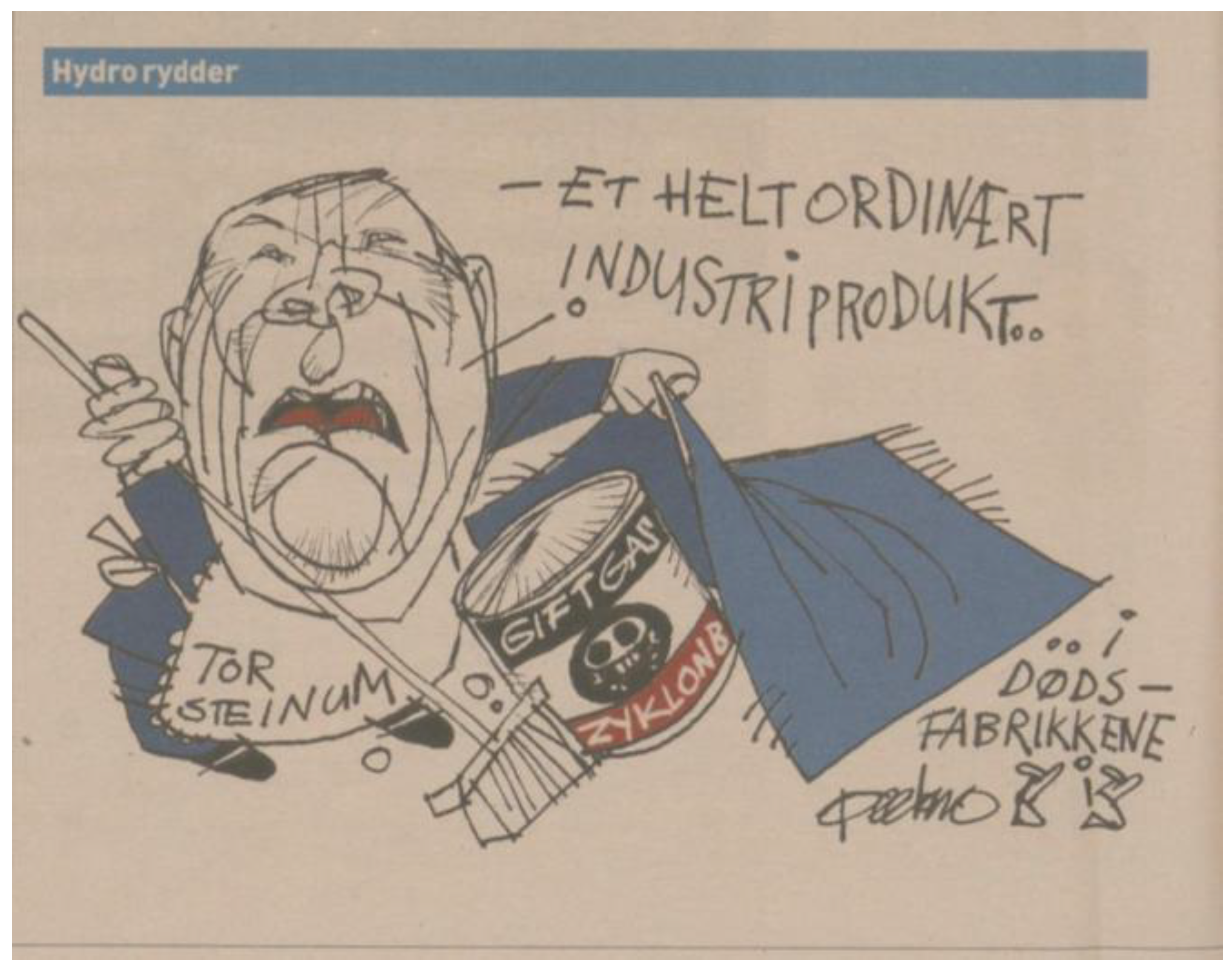
All of the guilt for the harmful effects to the country from the cooperation with the Germans was placed on the former managing director of Norsk Hydro, Aubert, who very conveniently passed away before the end of the war and the investigation could begin.(Fløgstad 2019, p. 124)25
9. The Dead End of History
9.1. The Social Other
Friend and foe at sixes and sevens, foe and friend in a real mess. And as noted with astonishment in the high command it seemed as if many of the dead had not fallen in fighting against each other but that they had found together against a mutual enemy.(Fløgstad 2019, p. 94)
(…)
Side by side the mortal enemies had been entangled in a united fight against death. In frozen and twisted postures on the frostbitten ground they tried to hang on to their own lives, intertwined in a mortal battle for keeping their bodies warm together. Both with bayonet in hand, shaft inwards, knife blade outwards, pointing out and away from the body; the Soviet with the long and slim model by Mosin-Nagant, the German with the blunt standard bayonet made by Mauser. Both were frozen and both alive as they were found. The German had the uniform of a Wehrmacht officer with a field edition of Goethe on his chest; the Russian was a member of the Red Banner Infantry Battalion and carried Dostoevsky’s The Possessed by his heart.(Fløgstad 2019, p. 95)28
9.2. The Ring Is Closed?
In the East as well as in the West, the search for new models of leadership laid the ground for a renewed interest in right-wing philosophers of law in the vein of Carl Schmitt, particularly his ideas of authoritarian rule and the supreme power to declare a state of emergency.(Fløgstad 2024, p. 588)30
Funding
Data Availability Statement
Conflicts of Interest
| 1 | På dollarveien ut i livet (Fløgstad 1977, p. 64). |
| 2 | Grense Jakobselv is the name of a village located by the Jakobselva river at the border between Norway and Russia. |
| 3 | Jeg arbeidet i hvert fall for det betydelige tyskdominerte konsern A/S Nor-Dag, som i parentes bemerket og i all beskjedenhet faktisk grunnla norsk aluminiumsindustri. (Fløgstad 1977, p. 207). |
| 4 | Det samme var jo tilfelle med Nor-Dags anlegg for aluminiumsoksyd i Saudesjøen. (Fløgstad 1977, p. 207). |
| 5 | Det ble forresten litt kinkig med Durdei. Hun ble med barn, men det ble jo satt bort, og hun, og vel forsåvidt også barnet, lever vel videre sitt enkle liv, slik de har gjort det fra Arilds tid. (Fløgstad 1989, p. 208). |
| 6 | Bli offiser du, Alfemann. (Fløgstad 1983, p. 55) Only Dalen Portland (Dollar Road) of Fløgstad’s novels has been translated to English. With the exception of Dollar Road, all quotations have been translated by me. |
| 7 | Han er einaren, vinnaren og esset. |
| 8 | Kongeriket Noreg er eit fritt, sjølvstendig, udeleleg og uavhendeleg rike. |
| 9 | Norge er eit underleg land, som held seg med svært fantasifulle sendemenn. |
| 10 | (…) å vinka med vengene er eit internasjonalt teikn og ei oppmoding om kursendring. |
| 11 | Er det vi som skal endra kurs? Er det vi som skal forlata området? |
| 12 | Frigjeringsdag. |
| 13 | Vi var inne i sjølve veidefeltet, i fascismens jaktlandskap. |
| 14 | Kva er sanning? Kva er løgn? Kva for ei sanning er så stor at den også omfattar løgna? |
| 15 | (…) det heltemodige forsvaret mot Den raude armeen, (…). |
| 16 | Two books about the police officer in question were published in 2025 (Rønnebu 2025; Steinfeld 2025). |
| 17 | (…) med andre middel. |
| 18 | Frigjering. Det likna på sambandet mellom overgripar og offer. Dei frigjorde såg ut som dei helst ville vore frigjeringa forutan, også då utanriksministrane Brende og Lavrov la ned kransar ved monumentet over sovjetsoldaten på Haganes i sentrum av Kirkenes. |
| 19 | Den dag i dag minnest finnmarkingane sovjetarane som frigjerarar. |
| 20 | Frå gass i Auschwitz til gass i Nordsjøen. |
| 21 | Lovane (sic) hadde blitt laga for at dei rike skulle sleppa å betala skatt, og for at den som var rik nok, skulle vera ute av stand til å gjera noko ulovleg. |
| 22 | (…) vaska vekk sin eigen skugge. |
| 23 | (…) X i andre. |
| 24 | Den tyske krigsindustrien, ha hah, hah! Samarbeid med fienden! Hei og hå! Russiske slavearbeidarar, ho ho! Ingenting å le av? Haha. Ingeniør Seyss-Jørgensen lo ofte også nå, men det var ingen god latter, ein stygg latter var det, ein riktig stygg og uglad latter, når alt kom til alt. |
| 25 | All skuld for det landsskadelege samarbeidet med tyskarane blei lagt på Hydros tidlegare generaldirektør Aubert, som hadde vore så vennleg å avgå ved døden før krigen var slutt og etterforskinga kunne starta. |
| 26 | (…) eit tilbod han ikkje kunne seia nei til. |
| 27 | (…) den store fortellinga om Heltane frå Litza. |
| 28 | Ven og fiende om kvarandre, fiende og venn (sic) hulter til bulter. Og til stor oppstandelse i overkommandoen virka det som om mange av dei døde ikkje var falne i kamp med kvarandre, men hadde søkt saman mot ein felles fiende. (…) Side om side hadde dødsfiendane kjempa saman for livet mot døden. Frosne fast til kvarandre og i forvridde stillingar på den forfrosne jorda prøvde dei å klamra seg til sine eigne liv, i ein nærkamp på liv og død for å halda varmen i lag. Bajonett i handa hadde dei begge, med skaftet vendt innover, knivbladet utover, bort frå kroppen, sovjetaren den lange smale Moisin-Nagant-modellen (sic), tyskaren Wehrmachts stutte standard Mauser-bajonett. Begge var nedfrosne, og begge levde då dei blei funne. Tyskaren hadde offisersuniform frå Wehrmacht med feltutgåve av Goethe ved brystet, russaren tilhøyrde Raude Fane infanteribataljon og bar Dostojevskijs De besatte ved sitt hjarta. |
| 29 | Han er min bror, men med ei anna mor. |
| 30 | I Aust som i Vest skapte søkinga etter nye styringsmodellar ny interesse for høgreradikale rettstenkarar av typen Carl Schmitt og hans idear om det autoritære herredømmet og makta til å kunna erklæra unntakstilstand som suveren makt. |
References
- Adorno, Theodor W. 1970. Was bedeutet: Aufarbeitung der Vergangenheit. In Erziehung zur Mündigkeit. Edited by Gerd Kabelbach. Frankfurt am Main: Suhrkamp, pp. 10–28. [Google Scholar]
- Alfsen, Marianne. 2019. The Battle of Narvik. Narvik: Narvik War Museum. [Google Scholar]
- Antonio, Robert J. 2019. Ethnoracial Populism: An Alternative to Neoliberal Globalization? Social Epistemology 33: 280–97. [Google Scholar] [CrossRef] [Scilit]
- Arato, Andrew. 2002. The Bush Tribunals and the Specter of Dictatorship. Constellations 9: 457–76. Available online: https://onlinelibrary.wiley.com/doi/epdf/10.1111/1467-8675.00296 (accessed on 22 December 2025). [CrossRef] [Scilit]
- Ardila, J. A. Garrido, ed. 2015. The Picaresque Novel in Western Literature. Cambridge: Cambridge University Press. [Google Scholar]
- Arnds, Peter. 2019. Of Monsters and Migrants: On the Loss of Sanctuaries in Literature as Parable of Biopolitics in the Twentieth and Twenty-First Centuries. HJEAS: Hungarian Journal of English and American Studies 25: 19–36, 227, 232–33. Available online: https://www.proquest.com/docview/2299748549?pq-origsite=primo&sourcetype=Scholarly%20Journals (accessed on 22 December 2025).
- Brevig, Hans Olav, and Ivo de Figueiredo. 2002. Den Norske Fascismen: Nasjonal Samling 1933–1940. Oslo: Pax. [Google Scholar]
- Byrne, Gavin. 2018. The Jargon of “Law and Order”. From Nazism to the Trump Campaign via Heidegger. Law, Culture and the Humanities 18: 482–508. [Google Scholar] [CrossRef] [Scilit]
- Costigliola, Frank. 2023. Kennan. A Life Between Worlds. Princeton: Princeton University Press. [Google Scholar]
- Derrida, Jacques. 1988. The Ear of the Other: Otobiography, Transference, Translation: Texts and Discussions with Jacques Derrida. Edited by Christie McDonald. Translated by Peggy Kamuf. Lincoln and London: University of Nebraska Press. [Google Scholar]
- Erll, Astrid, and Ansgar Nünning, eds. 2008. Cultural Memory Studies. Berlin: De Gruyter. [Google Scholar]
- Finchelstein, Federico. 2017. Carl Schmitt Between History and Myth. History and Theory 56: 362–69. Available online: https://onlinelibrary.wiley.com/doi/epdf/10.1111/hith.12024 (accessed on 22 December 2025). [CrossRef] [Scilit]
- Fløgstad, Kjartan. 1974. Rasmus. Oslo: Samlaget. [Google Scholar]
- Fløgstad, Kjartan. 1977. Dalen Portland. Oslo: Samlaget. [Google Scholar]
- Fløgstad, Kjartan. 1981. Loven Vest for Pecos og Andre Essays om Populær Kunst og Kulturindustri. Oslo: Samlaget. [Google Scholar]
- Fløgstad, Kjartan. 1983. U3. Oslo: Samlaget. [Google Scholar]
- Fløgstad, Kjartan. 1986. Det 7. Klima: Salim Mahmood i Media Thule. Oslo: Samlaget. [Google Scholar]
- Fløgstad, Kjartan. 1988a. U3, oder Fliegen zu den Engeln. Translated by Anne Storm. Rostock: Hinstorff. [Google Scholar]
- Fløgstad, Kjartan. 1988b. U-3: Roman. Translated by L. Zdanova. Moscow: Raduga. [Google Scholar]
- Fløgstad, Kjartan. 1989. Dollar Road. Translated by Nadia Christensen. Baton Rouge: Louisiana State University Press. [Google Scholar]
- Fløgstad, Kjartan. 1990. Arbeidets lys. Tungindustrien i Sauda Gjennom 75 år. Oslo: Samlaget. [Google Scholar]
- Fløgstad, Kjartan. 2007. Pyramiden: Portrett av ein Forlaten Utopi. Oslo: Spartacus. [Google Scholar]
- Fløgstad, Kjartan. 2009. Grense Jakobselv. Oslo: Gyldendal. [Google Scholar]
- Fløgstad, Kjartan. 2012. Nordaustpassasjen. Oslo: Gyldendal. [Google Scholar]
- Fløgstad, Kjartan. 2014. Magdalenafjorden. Oslo: Gyldendal. [Google Scholar]
- Fløgstad, Kjartan. 2016. Etter i Saumane. Kultur og Politikk i Arbeidarklassens Hundreår. Oslo: Gyldendal. [Google Scholar]
- Fløgstad, Kjartan. 2019. Due og Drone. Oslo: Gyldendal. [Google Scholar]
- Fløgstad, Kjartan. 2022. Habeas Corpus. Oslo: Gyldendal. [Google Scholar]
- Fløgstad, Kjartan. 2024. Skriftarbeid. Artiklar i Utval. Oslo: Gyldendal. [Google Scholar]
- Fosse, Jon. 1989. Frå Telling via Showing til Writing. Oslo: Samlaget. [Google Scholar]
- Fukuyama, Francis. 1992. The End of History and the Last Man. Riverside: Free Press. [Google Scholar]
- Gadamer, Hans-Georg. 2013. Truth and Method. London: Bloomsbury Revelations. [Google Scholar]
- Glenny, Misha. 2025. Tech Bros and Total Information Awareness. IWM-Post 135. Available online: https://www.iwm.at/publication/iwmpost-article/tech-bros-and-total-information-awareness (accessed on 22 December 2025).
- Gujord, Heming H. 2018. Fløgstad Verk. Oslo: Samlaget. [Google Scholar]
- Gujord, Heming H. 2020. Due og Drone: Kjartan Fløgstad som the good, the bad and the ugly. NLÅ 2020: 120–46. [Google Scholar]
- Hamsun, Knut. 2010. The Ring Is Closed. Translated by Robert Ferguson. London: Souvenir Press. [Google Scholar]
- Hegge, Per Egil. 1996. Etterord. In U3. Authored by Kjartan Fløgstad. Oslo: Samlaget, pp. 353–57. [Google Scholar]
- Helland, Frode. 2005. Bilde og ideologi hos Kjartan Fløgstad. Agora 23: 75–102. [Google Scholar] [CrossRef] [Scilit]
- Hillis Miller, J. 1982. Fiction and Repetition. Cambridge: Harvard University Press. [Google Scholar]
- Hobsbawm, Eric. 1994. Age of Extremes. The Short Twentieth Century 1914–1991. London: Michael Joseph. [Google Scholar]
- Jager, Benedikt. 2014. Norsk Litteratur bak Muren: Publikasjons- og Sensurhistorie fra DDR (1951–1990). Bergen: Fagbokforlaget. [Google Scholar]
- Langås, Unni. 2025a. Linking Contemporary and Historical Terror: July 22 in the Context of World War II. In Terrorism in Memory Culture: Investigating the Aftermath of July 22 in Norway. Edited by Alexandre Dessingué and Paula Hamilton. Cham: Palgrave Macmillan, pp. 311–28. [Google Scholar] [CrossRef] [Scilit]
- Langås, Unni. 2025b. Postmemory Interpretations of Second World War Love Affairs in Twenty-First Century Norwegian Literature. Humanities 14: 135. [Google Scholar] [CrossRef] [Scilit]
- Lenz, Claudia. 2008. “Adgang til riket”. Victor Linds Kunst som Erindringspolitisk Intervensjon. Oslo: HL-Senteret. [Google Scholar]
- Lund, Ketil. 1996. Rapport til Stortinget fra Kommisjonen som ble Nedsatt av Stortinget for å Granske Påstander om Ulovlig Overvåking av Norske Borgere. Oslo: Stortinget. [Google Scholar]
- McNeal, Jon. 2025. Retaliation and Confrontation of the State. Vanderbilt Law Review 78: 617–79. Available online: https://www.proquest.com/scholarly-journals/retaliation-confrontation-state/docview/3236243486/se-2?accountid=8579 (accessed on 22 December 2025).
- Nisbet, Robert. 1970. The Social Bond: An Introduction to the Study of Society. New York: Alfred A. Knopf. [Google Scholar]
- Njølstad, Olav. 2008. Jens Chr. Hauge. Fullt og Helt. Oslo: Aschehoug. [Google Scholar]
- Peters, Laurence. 2015. The United Nations: History and Core Ideas. New York: Palgrave McMillan. Available online: https://ebookcentral.proquest.com/lib/bergen-ebooks/detail.action?docID=4082537 (accessed on 22 December 2025).
- Petersen, Tore. 2025. U-2-Episoden in Store Norske Leksikon. Available online: https://snl.no/U-2-episoden (accessed on 22 September 2025).
- Piketty, Thomas. 2014. Capital in the Twenty-First Century. Cambridge: Harvard University Press. [Google Scholar]
- Reiss-Andersen, Gunnar. 1943. Kampdikt for Norge. Stockholm: Bonnier. [Google Scholar]
- Risse, Mathias. 2025. Dividing up the Planet and Championing Illiberal Democracies: Trump Seeks to Make Carl Schmitt’s Vision of World Order Reality. Carr-Ryan Center for Human Rights. March 6. Available online: https://www.hks.harvard.edu/centers/carr-ryan/our-work/carr-ryan-commentary/dividing-planet-and-championing-illiberal (accessed on 22 December 2025).
- Rønnebu, Gaute Lund. 2025. Forbrytelse uten Straff: Knut Rød og Ansvaret for Holocaust i Norge. Oslo: Aschehoug. [Google Scholar]
- Sandberg, Kristian Lødemel. 2018. Kapitalistisk Skuld Etter 1989: Utviklinga av ein Historiekritikk i Fire Verk av Kjartan Fløgstad. Oslo: ILN & UiO. [Google Scholar]
- Scheuerman, William E. 2019. Donald Trump meets Carl Schmitt. Philosophy & Social Criticism 45: 1170–85. [Google Scholar] [CrossRef] [Scilit]
- Skard, Sigmund. 1942. For Norge. Duluth: Fuhr Company. [Google Scholar]
- Skjoldbjærg, Erik, and Karianne Lund. 2015. Okkupert. Oslo: Nordisk Film. [Google Scholar]
- Steinfeld, Dag. 2025. Mannen som gikk fri: Politiinspektør Knut Rød og Deportasjonen av de Norske Jødene. Bergen: Vigmostad Bjørke. [Google Scholar]
- Sterling, Michael Pavelec, ed. 2010. The Military-Industrial Complex and American Society. Santa Barbara: ABC-CLIO. [Google Scholar]
- Storeide, Anette H. 2014. Norske Krigsprofitører. Nazi-Tysklands Velvillige Medløpere. Oslo: Gyldendal. [Google Scholar]
- Sveen, Åsmund, ed. 1942. Norsk ånd og Vilje. Oslo: Stenersens. [Google Scholar]
- Thiel, Peter. 2007. The Straussian Moment. In Politics & Apocalypse. Edited by Robert Hamerton-Kelly. East Lansing: Michigan State University Press, pp. 189–218. Available online: https://ebookcentral.proquest.com/lib/bergen-ebooks/detail.action?pq-origsite=primo&docID=3338217 (accessed on 22 December 2025).
- Undheim, Magnar. 1999. Njardarheim. Tjørhom: Kvæven Bygdetun. [Google Scholar]

Disclaimer/Publisher’s Note: The statements, opinions and data contained in all publications are solely those of the individual author(s) and contributor(s) and not of MDPI and/or the editor(s). MDPI and/or the editor(s) disclaim responsibility for any injury to people or property resulting from any ideas, methods, instructions or products referred to in the content. |
© 2026 by the author. Licensee MDPI, Basel, Switzerland. This article is an open access article distributed under the terms and conditions of the Creative Commons Attribution (CC BY) license.
Share and Cite
Gujord, H.H. The Dead End of Dollar Road: Traces of World War II in Kjartan Fløgstad’s Novels. Humanities 2026, 15, 23. https://doi.org/10.3390/h15020023
Gujord HH. The Dead End of Dollar Road: Traces of World War II in Kjartan Fløgstad’s Novels. Humanities. 2026; 15(2):23. https://doi.org/10.3390/h15020023
Chicago/Turabian StyleGujord, Heming H. 2026. "The Dead End of Dollar Road: Traces of World War II in Kjartan Fløgstad’s Novels" Humanities 15, no. 2: 23. https://doi.org/10.3390/h15020023
APA StyleGujord, H. H. (2026). The Dead End of Dollar Road: Traces of World War II in Kjartan Fløgstad’s Novels. Humanities, 15(2), 23. https://doi.org/10.3390/h15020023