1. Introduction: Survival and Social Reproduction
In the late 2010s, global science fiction cinema returned insistently to planetary survival, often by staging catastrophe as a crisis of care, kinship, and intergenerational continuity. Frant Gwo’s
The Wandering Earth (
2019) imagines a Wandering Earth project that uses giant thrusters to push Earth out of a solar system threatened by an expanding sun. The spectacle of planetary engineering is anchored in a fractured household: astronaut father Liu Peiqiang and his estranged son Liu Qi, mediated by the grandfather who raises Liu Qi in a subterranean city beneath Earth’s frozen surface. Its prequel,
The Wandering Earth II (
2023), supplies institutional detail about the project’s origins while again organizing planetary stakes around kinship dramas, including Liu Peiqiang’s divided obligations to his terminally ill wife and to the space program, and computer engineer Tu Hengyu’s illicit effort to preserve his young daughter as a digital consciousness.
Taken together, the two films juxtapose spectacular infrastructures with constricted interiors, from command centers and cockpits to testing rooms and hospital spaces, and ask not only how the planet might be saved but who will do the everyday work of sustaining life and governing the generation asked to inherit it. They are also notable for what they are not. Although they rework conventions associated with Hollywood disaster and science fiction, they are state-linked Chinese blockbusters whose transnational reach is shaped by domestic theatrical dominance, selective overseas theatrical release, and subsequent licensing to platforms such as Netflix or Amazon Prime. Situating the franchise within this industrial circuitry clarifies its relationship to Hollywood’s familiar crisis grammar, in which catastrophe is frequently resolved through exceptional households and heroic individualism. This positioning also bears on what kinds of labor the films can foreground as publicly consequential, and what kinds remain available only as private attachment or moral residue.
In this sense, the franchise’s institutional imagination is best read not through a generic neoliberal template, but through a crisis political economy in which marketization and state mobilization are braided together. The films’ permanent emergency does not simply reproduce familiar capitalist labor management. It reconfigures it through eligibility, rationing, and administrative allocation, binding life chances and kinship continuity to institutionally legible service. What becomes visible, then, is a mode of governance that treats survival less as a moral horizon than as an operational problem of selection, training, and managed attachment, shaped by a Chinese state-linked cultural apparatus and the global circuits through which it travels.
In what follows, I treat The Wandering Earth films as linked thought experiments in survival governance that emerge from, and speak back to, the franchise’s blockbuster apparatus: a Chinese film industry organized through policy-facing production, domestic theatrical dominance, and platform licensing that extends the franchise’s reach unevenly across borders. Within this circuitry, catastrophe does not merely supply spectacle. It becomes a managerial problem that must be operationalized through allocation, evaluation, and legitimation.
I argue that the films imagine planetary survival as an administrative regime that redistributes reproductive and affective labor under permanent emergency. Care, sacrifice, and intergenerational continuity are repeatedly routed through paternal figures, who convert attachment into socially legible service, while a feminized father–daughter care remains structurally subordinate to masculinized scientific and military labor. At the same time, the prequel intensifies the franchise’s interest in machinic evaluation, showing how computational systems participate in sorting, training, and legitimating subjects for survival.
My intervention shifts the analytic center from infrastructure as spectacle to infrastructure as governance by reading selection policy, evaluative scenes, and formal style as techniques that allocate survivability and format subjects for compliance. At the same time, I argue that the franchise is preoccupied with the operational limits of that governance. The films repeatedly generate forms of paternal attachment that function as excess relative to procedure: they can be recruited in emergencies, but they are not smoothly assimilated. Across the two installments, however, paternal attachment does not occupy a single structural position: Liu’s sacrifice confronts procedure as overt refusal, while Tu’s computational care in the prequel tests how unauthorized labor may be drawn into, and even reorganize, the system’s evolving logic. They precipitate conflicts the system cannot authorize in advance and can only manage retroactively, through after-the-fact legitimation, narrative memorialization, or punitive containment. The result is a survival regime that depends on top-down administration while remaining structurally haunted by the improvisations, refusals, and illicit labors that keep it running.
2. Literature Review: Globality and Infrastructure
Scholarship on
The Wandering Earth has developed quickly, often situating it within debates about Chinese-led globalization and alternatives to Hollywood’s narrative and ideological defaults. Critics have emphasized, among other trajectories, the films’ planetarian scale and rhetoric of collective rescue (
He 2020), their fantastical infrastructure and technological aestheticization (
Wagner 2023), their technology fetishism as an aesthetic mechanism of solidarity (
Khan 2020), the way their user interface technoscapes render coordination and manual digital labor visible (
Tang 2023), and their turn to planetarianism as one constrained by a double-layered restraint imposed by the state and the market (
Wang 2021). These accounts also register the franchise’s emergence within an intensified visibility of state-capital coordination in the PRC: infrastructural spectacle is inseparable from labor discipline and political-economic narrative; the blockbuster form, calibrated for mass domestic circulation and platform afterlives, helps make that discipline formally legible as work on screen.
This visibility is better read against longer genealogies of labor and infrastructure as updated rather than newly invented by the franchise. Yuan Gao’s account of hydraulic engineering and corporeal infrastructure in the PRC foregrounds how infrastructural achievement has historically been staged through disciplined bodies assembled at scale, an aesthetic that renders collective endurance both visible and governable (
Gao 2023). Roy Chan’s discussion of Great Leap Forward temporality likewise shows how accelerated time, urgency, and the demand to synchronize bodies with developmental targets functioned as a political technology of labor, producing speed itself as an ideological and administrative mandate (
Chan 2017). Together, these genealogies frame the franchise’s emphasis on discipline and synchronization as historically resonant.
Within this broader conversation, Ping Zhu’s interventions provide the closest points of contact with the present article’s attention to kinship, governance, and gendered labor. For
The Wandering Earth, Zhu argues that the film adapts Liu Cixin’s novella into a family melodrama that reinforces the authority of the father and the nation-state, shifting from symbolic patricide to symbolic patrilineality (
Zhu 2020). Her account of
The Wandering Earth II names the sequel’s world system a “disaster empire,” a biopolitical order that integrates authoritarian governance with capitalist logic through the constant threat of catastrophe (
Zhu 2025). I build on Zhu’s account of patriarchal legitimation and disaster governance, but I place greater emphasis on friction and contradiction in operational practice, focusing on how governance repeatedly encounters forms of excess it cannot fully pre-script and must continually improvise modes of authorization, containment, and retroactive meaning-making.
To specify how this institutional labor regime is staged as a practical problem of governance, I draw on feminist social reproduction theory, affective and emotional labor scholarship, and critical posthumanism. Social reproduction theory provides vocabulary for reading survival projects as arrangements that allocate life-making work, training, and intergenerational continuity under capitalist crisis and marketization (
Fraser 2013;
Bhattacharya 2017). Emotional and affective labor scholarship clarifies how survival regimes stabilize themselves through managed feeling and authorized attachment (
Hochschild 2012;
Hardt and Negri 2001). Critical posthumanism foregrounds what changes when computational systems become evaluators and governors, including how information is materially instantiated in media, and how algorithmic judgment reorganizes the conditions of recognition, counting, and governance (
Hayles 1999;
Duncan et al. 2023).
Because the franchise stages catastrophe as a durable condition rather than a temporary disruption, these frameworks require a crisis calibration. In the subterranean city regime, labor is not governed primarily through wage, contract, and market exchange, but through qualification, allocation, and the administrative management of scarcity. Social reproduction is therefore not merely a background condition. It becomes an explicit object of governance as shelter access, family continuity, and survivable futures are distributed as benefits attached to strategically legible work. This is also why computational evaluation matters. By converting attachment into data and procedure, systems help stabilize this crisis order, even as they expose its limits when illegible care becomes operationally indispensable.
3. Selection and Screening: Governance in the Subterranean City
Released later but set earlier in the franchise timeline, The Wandering Earth II opens at the moment when planetary survival first becomes a problem of institutional design. As the sun approaches collapse, the United Earth Government (UEG) and the people it governs debate competing futures, including the Moving Mountain Project, which will become the Wandering Earth Project, and the now-banned Digital Life Project, which proposes preserving human consciousness as data rather than relocating the planet. The film also establishes the core distributive constraint: the subterranean cities can accommodate only half of humanity, and ordinary residents must enter through a lottery. Against this policy backdrop, Liu Peiqiang seeks to qualify as an astronaut because the position grants his young son Liu Qi and one designated guardian entry into the underground shelters without lottery risk. In parallel, the film introduces the 550 series as an institutional evaluator and governance interface. The same system becomes, illicitly, the computational substrate Tu Hengyu uses to sustain his deceased young daughter Yaya as a digital consciousness.
The Wandering Earth takes place later, after Earth has already embarked on its centuries-long voyage powered by Earth Engines and sustained by subterranean cities. As Earth approaches Jupiter, cascading disasters pull the planet toward collision. In orbit, Liu Peiqiang confronts MOSS, another name for 550W, which declares the Wandering Earth project a failure and initiates the Helios plan, an evacuation protocol that would abandon Earth while preserving embryos, seeds, DNA maps, and digital archives for restarting elsewhere. Liu rejects this optimization logic and completes the rescue through an act of self-sacrifice: he destroys MOSS and deliberately sacrifices his orbiting station so that Earth can survive the crisis and continue its voyage.
With this narrative baseline in place, it becomes possible to specify how the franchise stages survival governance through selection and screening. Beyond the engineering spectacle, both films return to a mundane but decisive problem: the administrative allocation of survivability and legitimacy. The two installments diverge sharply, however, in how they represent the politics of selection.
The Wandering Earth remains opaque about how access to subterranean cities is determined, leaving interpretive openness around lottery, age priority, occupational exemption, or hybrid policy. It registers the affective shock of selection while withholding the policy architecture that makes selection operational (
Wang 2021).
The Wandering Earth II, by contrast, explicitly frames institutionally legible service and strategically valued labor as grounds for exceptional access to the subterranean cities for both the individual and their immediate family members. The film also stages sortition as a UEG decision, with PRC representatives protesting its fairness and arguing that restricting entry to half the global population violates the Moving Mountain Project’s original intention. This rhetorical choreography displaces responsibility onto a transnational apparatus while allowing the PRC to occupy a position of principled objection, even as the narrative normalizes unequal access. In operational terms, the policy does more than select who is sheltered. It redistributes reproductive capacity and survival labor by binding life chances to institutional service, converting family continuity into a managed benefit attached to strategically legible work. Fraser’s account of crisis usefully clarifies what is at stake here: catastrophe strains the social capacities that reproduce life, from care and continuity to the maintenance of social bonds. The shelter regime renders that strain administrable by turning access and kinship continuity into allocable benefits indexed to institutional service. It also installs a temporal regime of deadlines, synchronization, and administrative urgency, a developmental temporality with recognizable PRC genealogies (
Chan 2017).
Hence, the shift from opacity to administrative clarity reframes planetary survival as a problem of social reproduction under permanent emergency. If marketization and state mobilization routinely push life-sustaining labor into the private sphere and treat it as nonwork, the subterranean city regime reverses that invisibility by turning access to shelter into a question of eligibility and allocation. Sortition introduces a biopolitical ledger that converts life into administrable categories, institutionalizes selection as part of the project’s infrastructure, and invites us to read the subterranean city as survival governance that organizes who can be reproduced, by whom, and on what terms.
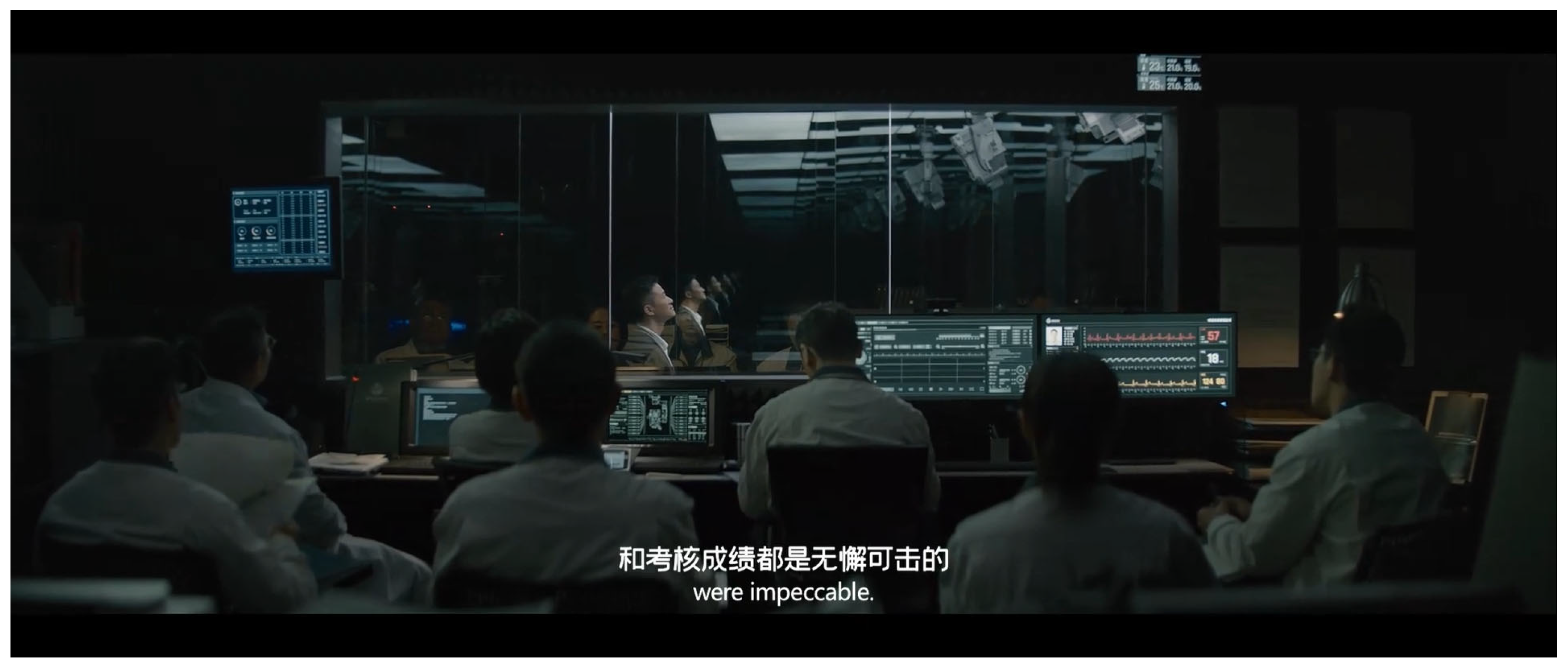
In addition to how selection governs entry, Liu Peiqiang’s storyline also shows how the regime trains those who will serve by converting intimate attachment into legible, governable labor. The Wandering Earth II makes this conversion concrete in the astronaut candidacy interview: Liu enters the interview as a husband trying to secure subterranean shelter access for his wife Han Duoduo and his son, but the scene immediately recodes his emotional attachment as evaluative data, a criterion of institutional legibility. Staged as a set-piece within a state-linked blockbuster, the interview literalizes governance as a spectacle of evaluation, turning institutional screening into a formally legible aesthetic form.
As shown in
Figure 1, the interview unfolds in a cramped testing room that restricts movement and frames the candidate as a body being processed. Positioned high above Liu, 550W forces an upward gaze that literalizes hierarchy. One-way glass walls surround the room, producing an institutional gaze that is total but unreciprocated. Liu cannot see the evaluation team in the adjacent observation room and instead confronts a corridor of reflections as the glass returns his image again and again. Lighting sharpens the asymmetry: Liu’s room is flooded with high-key illumination, a punitive clarity in which nothing can be hidden, while the observation room is staged in low-key light, its human assessors half-submerged in shadow.
The dialogue extends the room’s visual discipline into a procedural discipline of speech and feeling. 550W dictates tempo, forbids metaphor and implication, treats ordinary communicative indirection as noise, and insists on explicit, data-like speech. The interview demands the emotional labor, in Hochschild’s sense of managed feeling, but within a crisis governance register, training Liu to suppress relational complexity and to perform the compliant affect the evaluative apparatus can recognize. The test, in other words, is whether family care can be reformatted as procedural legibility within machinic optimization.
Liu fails the test. At the scene’s climax, 550W insists that he abandon his terminally ill wife and assign his son’s guardianship to his father-in-law because that is his “optimal choice,” reclassifying care as an administrative decision to be optimized for project continuity. Liu breaks down and tries to hurl a chair toward the observation room, only to discover it is bolted to the floor. The bolted chair crystallizes the scene’s contradiction, marking the gap between a protocol that treats kinship as an optimizable variable and a subject who still demands recognition of attachment. The outburst signals an affective remainder the evaluative apparatus cannot readily format, exposing the friction between procedural rationality and lived relation.
The interview not only clarifies how infrastructure functions as governance by demanding legibility, procedural speech, and affective discipline, but also marks the hinge through which care is routed into a labor regime, setting up the paired paternal trajectories of Liu Peiqiang and Tu Hengyu. The next two sections, first on Liu and then on Tu, show how the franchise mobilizes paternal attachment as survival labor, but not in a single register: Liu’s actions confront procedure as overt refusal that must be retroactively legitimated, while Tu’s computational care in the prequel tests a more ambiguous boundary between unauthorized attachment and institutional requisition, where governance oscillates between prohibition, emergency use, and after-the-fact framing.
4. Care and Command: Paternal Futurity as Labor
In Liu Peiqiang’s paternal trajectory,
The Wandering Earth franchise repeatedly masculinizes attachment by translating romance, reproduction, and fatherhood into recognizable forms of public service, technical mastery, and sacrificial risk. Placed within a state-linked blockbuster form, this masculinization is not only thematic but also a mode of making labor publicly legible, routing intimacy into images of competence, command, and institutional legitimacy. This is precisely the kind of reclassification Bhattacharya identifies, in which capitalism “acknowledges productive labor for the market as the sole form of legitimate ‘work,’” while the labor that sustains and reproduces workers is “naturalized into nonexistence” (
Bhattacharya 2017, p. 2). Hardt and Negri help specify what becomes visible once attachment is rerouted into authorized labor forms: affective labor yields “intangible” products, “a feeling of ease, well-being, satisfaction, excitement, or passion,” and even “social networks, forms of community, biopower,” which names how the films repeatedly render cohesion, confidence, hope, and endurance as produced outputs rather than private virtues (
Hardt and Negri 2001, p. 293).
The prequel establishes this logic from the moment Liu first encounters Han Duoduo. Their meeting is staged not as a private introduction but as an arrival into institutionally organized service under conflict. As trainees enter the base, pro-digital-life protesters clash with security, condemning the Moving Mountain Project as costly and futile. When a protester charges the group, Han steps forward and subdues him with decisive efficiency. Liu then fixates on her, and the sequence punctuates his look with a schematic fantasy of heterosexual futurity, including a prominent double-happiness character (a Chinese wedding emblem) and shots that position him as already imagining an infant with her.
Here, the gaze does more than eroticize. It recruits desire into the project’s reproductive horizon by aligning romantic recognition with the promise of family continuity under catastrophe. In the same passage, Liu shows little concern for an injured protester but feels awe toward the massive mechanical apparatus that floors the protester. The sequence aligns attachment, technological wonder, and institutional order. From the outset, care is made convertible by being yoked to the project’s masculinized infrastructure and its policing of dissent. Read against genealogies of corporeal infrastructure in the PRC, the sequence treats disciplined bodies, security action, and technological apparatus as a single aesthetic package through which collective endurance is staged and governed (
Gao 2023).
That conversion intensifies when romance is confirmed through security labor. Liu’s rose-in-hand attempt to confess to Han happens just before a covert attack on the base, a narrative timing that sutures romance to crisis management. His confession gives way to an action sequence that revives the trope of rescuing the woman, then twists it as Han breaks out of the safe zone and joins the fight. She tosses Liu a mechanical hand to strike the attacker, and the impact ejects a screw stamped “Made in China” in emphatic close-up, condensing crisis management into a nationally branded technological object. In the sequence’s climax, Han finishes off the attacker while shouting that he has damaged “my flowers,” then orders Liu and the others to gather the scattered petals and hand them to her. When the screw later becomes their engagement ring, futurity and reproductive promise are literally forged from the project’s technological apparatus. Romance itself becomes survival hardware, a material token through which attachment is rendered institutionally legible. Yet the same conversion also sets up later tension, because it binds intimate life to institutional legitimacy in ways that neither can fully control.
Read against this romance arc, Liu’s breakdown in the testing room registers as a crisis of masculinity produced by a competing patriarchal authority. 550W’s demand that he treat kinship as an “optimal choice,” capped by the bolted chair that renders defiance futile, stages a contest between paternal sovereignties. The machinic patriarch, recognized as an extension of institutional authority, denies Liu jurisdiction over his own family.
After the interview denies Liu authority over his own family, the film shifts to a scene in which he can act as a caregiver again, but only by borrowing the institution’s power. In the hospital, Han asks to see her Shanghai home one last time, a wish framed as nearly impossible now that the planet is in motion and Shanghai has become a flooded ruin far from where they are. Liu responds by mobilizing institutional capital, drawing on his male pilot network to secure permission to use a fighter jet. The institutional chain of command translates his care into authorized action. Radio banter makes this translation audible as Liu thanks his brothers-in-arms with promised drinks and they greet Han as saozi, a customary and respectful Chinese greeting for a senior buddy’s wife, folding her into an institutionally sanctioned male fraternity that validates Liu’s attachment through homosocial ritual.
The film makes the gendered terms of this restoration explicit in the cockpit. When Han challenges Liu’s ability to fly after years away, he answers by accelerating into aerobatic rolls. Han shouts with excitement, and her exhilaration fuses sexual recognition with admiration of masculine competence and the pleasure of reliving her own earlier pilot experience. Care is enacted as mastery of institutionally powered machinery, and intimacy becomes inseparable from the institutional authorization that makes the flight possible.
The ensuing Shanghai sequence pushes the linkage between intimacy and institutional authorization one step further by turning love into an eligibility script for survivability. After the flight, Han lays out the terms of selection. If Liu is not chosen as an astronaut, he must enter the underground cities alone. If he is chosen, her father will take their son underground, because her place would be “wasted.” Her counsel repeats the testing room’s optimization logic, but as intimate reassurance rather than institutional protocol. Intimacy sustains endurance, yet it also normalizes sacrifice, and the franchise keeps presenting such compliance as contingent and continuously produced.
Read through this central tension, Liu’s final confrontation with MOSS appears less as a clean human–machine opposition than as a struggle over authorization, and more specifically as competing patriarchal logics of futurity. MOSS speaks in the idiom of optimization and continuity, reducing survival to maximization and attempting to foreclose Liu’s proposal as impermissible sacrifice. Liu answers not with an alternative administrative calculus but with a paternal insistence on embodied life and meaningful continuity, rejecting a survival logic that would sever futurity from kinship. The encounter therefore turns on who gets to authorize care as proper, and the power to authorize it remains patriarchally coded.
Yet Liu’s refusal is structurally paradoxical. It is what makes salvation possible, but it is also what governance cannot approve in advance. Liu destroys MOSS primarily to reestablish contact with the UEG, which the system has cut off in order to block his appeal for an alternative course of action. Once reconnected, the institution authorizes his action despite initial hesitation, re-describing it as a choice of “hope.” Governance cannot sanction the act beforehand, but it can retroactively absorb it by translating improvisational attachment into an official affect and memorializing self-sacrifice as exemplary service. The franchise thus presents paternal futurity as a survival resource that repeatedly arrives as excess, demanding retroactive legitimation rather than smooth procedural incorporation. In this way, Liu’s attachment both disrupts procedure and generates a surplus that governance can only stabilize after the fact, and the arc closes by rendering paternal futurity as survival labor in its most legible form, the father’s sacrificial mastery converted into a sanctioned narrative of collective endurance, risk, and responsibility.
This ending also sets up the next section’s focus. If Liu’s arc shows how paternal attachment becomes governable through militarized competence and sacrificial exception, Tu’s arc will show how paternal care is translated into immaterial and affective labor through computational mediation, and how the prequel blurs the locus of authority as unauthorized attachment is alternately treated as a violation to be contained, a capability to be requisitioned in emergencies, and a problem of after-the-fact framing within the system’s evolving logic.
5. Code and Kin: Digital Life and Computational Intimacy
Where Liu Peiqiang’s storyline renders care legible only as optimized procedure, Tu Hengyu’s storyline traces the other side of that operation, where computational intimacy turns paternal attachment into a contested form of information work, at once unauthorized and indispensable. The film frames this conversion through a recurring visual apparatus, the one-way-glass testing room and its proliferating reflections, which recast paternal relation as simultaneously prohibited by protocol and rendered legible for institutional evaluation. The conversion is also industrial: within a state-linked franchise built for mass domestic circulation and platform afterlives, this evaluative aesthetic becomes a narratively efficient way to stage governance at scale as a legible form of work.
Tu first appears in the testing-room sequence as a 550-series engineer seated behind the one-way glass among the evaluators. When Liu turns toward the glass and says, “I just want my family to survive,” the film cuts to Tu’s concerned face and overlays Liu’s image with Tu’s reflected gaze. The superimposition briefly collapses the intended separation between evaluated subject and institutional evaluator into a relay of recognition. A car-crash flashback, in which Tu loses his wife and daughter Yaya, clarifies why Liu’s procedural confession registers to him as a demand that exceeds calculation. Tu is structurally doubled. He participates in the metrics that sort lives yet remains haunted by what they cannot contain.
Earlier in the film, Tu preserves Yaya by repeatedly running her as a digital consciousness on the limited 550A system, where she can exist for only two minutes at a time. Each activation returns the same child-care rhythms. She asks him to help solve a puzzle and braid her hair, then, as the session ends, she shivers, asks where her mother is, begs for a hug, and cries. Digital life appears here not as disembodied mind but as compute-limited relational duration. In Hayles’s terms, what Tu sustains is not pure information but a repeatedly instantiated episode of relational time that depends on hardware, compute, and upkeep. This father–daughter care is also coded as a precariously feminized labor form, intimate, repetitive, and institutionally devalued. Tu’s use of 550A is tolerated only as a temporary and revocable exception “out of sympathy,” keeping care at the margins of authorized procedure until crisis renders it actionable into survival labor.
Against this background, the testing room becomes the hinge that links Liu’s disqualification to Tu’s wager and clarifies their divergent orientations toward 550W. For Liu, the system remains an apparatus that disciplines attachment. As the interview ends, however, Tu’s smiling gaze toward 550W reads as a glimpse of how the same apparatus might be repurposed. He later returns to the testing room at night and clandestinely uploads Yaya to the more advanced 550W system, refunctioning an evaluative interface into a different ecology. The one-way-glass architecture becomes a field of proliferating reflections, and Yaya asks whether there are mirrors behind him. The question is diegetic, but it is also diagnostic. It identifies the room as an environment in which the self folds into its own projections, so that person and setting, or consciousness and environment, become one coupled system rather than separable layers. Likewise, Tu’s act does not extract Yaya as pure information. It moves her into a different medium, treating 550W’s compute as the condition for a different kind of time, space, and survivable relation that remains inseparable from Yaya’s mediated embodiment. As shown in
Figure 2, after the upload, the door of Yaya’s virtual room swings open onto an apparently endless array of identical rooms. Computational power is visualized as spatial affordance and temporal extension.
Tu’s arc rhymes with Liu’s in its sequence of emergency requisition and retroactive framing, but it does so under a more unstable locus of authority in which unauthorized care can become a technical capability the system learns to use. After his clandestine upload is discovered, he is subdued and imprisoned, yet he is later pulled back into the project when an operational bottleneck makes his expertise indispensable. The film does not present this reversal as a stable policy logic, but as a pragmatic oscillation between prohibition and necessity. What institutional governance cannot authorize as an openly legitimate practice, it can still requisition in crisis, and then manage afterward through containment, selective recognition, and narrative reframing.
The prequel’s blurred locus of authority complicates this sequence, because the film repeatedly hints that crisis management is not coordinated solely by visible institutional command. MOSS and the 550 series appear not only as tools but as agents that anticipate bottlenecks and reorganize the field of possible action. From this angle, Tu’s illicit care is not simply an external excess absorbed after the fact. It can also be read as a form of experimental labor that the system tacitly enables in order to solve problems it cannot otherwise address, a possibility that makes authorization itself unevenly distributed across human and machinic actors.
The emergency ignition plan crystallizes this logic as a labor problem. Tu’s team is dispatched to a Beijing server node, now underwater, to restore the global Internet that functions as an administrative coordination infrastructure for synchronizing ignition across the planet’s engines. Reconnecting the network requires a host key whose password is 30,000 randomly generated numbers, a task that exceeds ordinary human memory and attention. Yaya, the digital life, is positioned as the only entity able to perform that cognitive labor. Tu’s role is to manufacture the conditions that make her memorization possible and to coordinate her work as the environment collapses. His final act in the physical world is to show Yaya the key and command her to remember it while the room floods, then trigger the transfer at the moment of drowning so his consciousness can enter her space. Inside the digital room, the work shifts from bodily relay to procedural coordination. Tu keeps Yaya on task as she recites the sequence, and they complete the final confirmation together. The regime secures the coordination it needs, but only through a scene in which care is converted into emergency labor under conditions that cannot be institutionally authorized in advance.
This is the point at which Tu’s arc intersects with Zhou Zhezhi, the PRC delegation’s senior representative in the UEG and the film’s most overt voice of official resolve. In the command center, Zhou refuses to delay ignition. If the Internet is not reconnected in time, not all engines can be synchronized, and the resulting imbalance could tear Earth apart. He nevertheless orders ignition at the countdown’s end and declares, “Our people will definitely accomplish the mission,” even as the monitoring screens show the underwater team as lost. The phrase “our people” becomes structurally ambiguous. On one level, it performs confidence and collective unity. On another, it functions as an official cover for a labor the regime cannot publicly legitimate, since the decisive work is carried out by two digital life workers whose status cannot be affirmed as a sanctioned future.
The sequence therefore returns to the posthumanist question with concrete institutional stakes in the sense Duncan, Henry, and Molloy emphasize. Rather than asking whether digital life “counts” as human, the film foregrounds how “people” is produced as an administrative status, allocated through evaluative recognition and verified through work. Digital life is held at the edge of legitimacy, yet it becomes actionable at the project’s limit-point, where embodied labor has already failed. Tu and Yaya can be mobilized precisely because they occupy this liminal position, simultaneously indispensable as workers and illegible as futures the system can openly ratify. Their recruitment does not resolve the contradiction. It reproduces it, because governance must still decide how to name, reward, punish, or forget the labor it needed but could not institutionally authorize in advance.
6. Conclusions: Governance, Excess, and the Franchise Form
Situating The Wandering Earth franchise within its industrial circuitry clarifies its relationship to Hollywood disaster conventions, helping specify why the films repeatedly stage survival as a problem of institutional coordination rather than individual exception. The films borrow a familiar crisis grammar of spectacular escalation and last-minute rescue, but catastrophe is not finally resolved through exceptional households or heroic individualism. Instead, the household functions as an affective relay into institutional scale, where state-linked infrastructure, administrative selection, and procedural mediation define what counts as survival and who can be recruited to secure it. Survival thus appears less as a moral revelation than as a governance problem, one that must be operationalized, justified, and stabilized under conditions of scarcity and urgency.
Read as linked thought experiments about social reproduction under catastrophe, the two films model survivability as something redistributed, disciplined, and institutionally authorized through selection policy, evaluative interfaces, and machinic judgment. Reproductive and affective labor is repeatedly routed through fathers, producing patrilineal sacrifice and a precariously feminized form of father–daughter care that remains structurally secondary to masculinized scientific and military labor. At the same time, the prequel foregrounds computational regimes of evaluation, showing how systems such as 550W and MOSS do not merely assist governance but participate in it, rendering attachment legible to procedure and reorganizing intimate obligation as administrable choice. In this respect, the films’ emphasis on evaluation, coordination, and synchronization resonates with longer PRC histories in which labor has been organized through targets, urgency, and disciplined collective tempo, even as the franchise relocates those logics into machinic interfaces and platform afterlives.
Across both Liu Peiqiang and Tu Hengyu’s arcs, paternal and patriarchal attachment emerges at the edge of procedure, but it does not occupy a single structural position. It becomes actionable at the project’s limit-points, yet Liu’s attachment arrives as overt refusal, while Tu’s computational care is more deeply entangled with the system’s evolving logic and cannot be institutionally stabilized in advance without exposing contradictions in the regime’s categories of legitimacy and value. The survival order therefore relies on a recurrent sequence: emergency conscription of illegible labor, followed by retroactive institutional authorization through official affect, selective recognition, containment, or memorialization. In this sense, “excess” is not a residue outside the system but a structural resource the system must repeatedly manage. The franchise serializes this management as a narrative engine, returning crisis after crisis to restage how governance both depends on, and is unsettled by, the improvised labors and forbidden futures it must use but cannot openly ratify.