
Review

Hazards and Disasters in the Sociocultural Evolution of World-Systems

1
Institute for Research on World-Systems, University of California-Riverside, Riverside, CA 92521, USA
2
Division of AI and Humanities, Department of Chinese History and Culture, The Hong Kong Polytechnic University, Hong Kong
*
Author to whom correspondence should be addressed.
Soc. Sci. 2026, 15(6), 383; https://doi.org/10.3390/socsci15060383

Submission received: 28 February 2026 / Revised: 15 May 2026 / Accepted: 28 May 2026 / Published: 11 June 2026

Abstract

Natural and human-caused disasters have operated as selection mechanisms in the evolution of within-polity and interpolity sociocultural systems by destroying lives and the human-built environment, and they have provoked challenge-and-response dynamics that caused human polities to innovate and to implement innovations that resulted in increases in complexity and hierarchy. Individuals, households, communities, settlements, and polities and interpolity systems that were most prepared and resilient to these selection mechanisms survived and prevailed. This article reviews the theoretical literature in geography, historiography, sociology, anthropology, political science and economics on hypotheses regarding the effects of disasters on human social change, including both increases and decreases in sociocultural complexity and hierarchy.

1. Introduction

Sociocultural evolution1 has seen the number of humans increase greatly, but also has seen an uneven, but persistent, trend from small nomadic foraging bands living in temporary camps to larger sedentary hamlets of diversified hunter-gatherers to yet larger and more complex horticultural villages and more hierarchical chiefdoms, to cities and states and empires and then to the formation of the system of national states and the global political economy of today. Uneven and combined development means that these changes did not occur within all human networks, and the timing of changes was often different in those regions in which they did occur. Diffusion and a process in which larger, more complex and hierarchical networks engulfed and either exterminated or incorporated smaller, less complex and less hierarchical networks were what occurred. As settlements and polities got larger, the networks of systemic interaction also expanded as transportation and communications technologies facilitated proximately consequential interactions among more distant peoples, and so local and regional world-systems merged and engulfed one another to become the single global systemic network of today.2 The main structural sociocultural features that have emerged are complexity and hierarchy. By complexity we mainly mean the division of labor among individuals and groups. By hierarchy we are referring to socially structured inequalities. Our focus in this article is on human institutions and polities as they evolved from processes of interaction among individuals, households, organizations, settlements and polities.3
Waves of uniformitarianism and catastrophism have occurred in explanatory geology, biology and social science. In geology, uniformitarianism is the idea that slow, steady processes always occur in the same ways everywhere and in the past and the future. This stance, especially the part about slow processes, was challenged by a rising tide of catastrophism (Hugget 1997; Marriner et al. 2010). In biology research on intermittent mass extinctions led to a theoretical integration in which both slow processes and catastrophic events combine to produce the history of the evolution of life, so-called punctuated equilibrium (Gould 2002). In sociocultural evolution a roughly analogous stance has emerged in which regional systemic development processes are thought to have been modified by impacts from exogenous shocks4 that altered local and regional trajectories, and by emergent properties in which the logics of systemic development underwent qualitative transformations that altered some, but not all, of the basic demographic and ecological processes driving expansion, deepening and collapses (Chase-Dunn and Hall 1997a).
Biological evolution is not the focus of this article. Rather, we want to examine the role of disasters in human sociocultural evolution. But changes in the genetic makeup of humans also occurred during the Holocene (the past 10,000 years), during which the big transformations in sociocultural evolution emerged. Older and recent genomic evidence have been compared to identify the approximate times and places where these genetic changes happened (Fan et al. 2016; Gao 2024). Most of these were adaptations to changing diets or to new climates into which modern humans had moved. But immune system changes in Eurasia were caused by repeated exposures to pandemics in which zoonotic diseases that emerged from farming and livestock-keeping swept across wide areas. These were accelerated and spread by the rise in large settlements in which diseases were rapidly spread and by long-distance trade and military expeditions (McNeill [1976] 2010; Cliff et al. 1998; Pei et al. 2015). These pandemics fit our definition of disasters (discussed below) and constituted connections between biological and sociocultural evolution that had large consequences for the processes in which larger, older and more complex world regions were able to engulf younger civilizations (Diamond 1999; Denemark 2022).
The term “settlement” is a general category that includes camps, hamlets, villages, towns, and cities.5 We use the term “polity” to generally denote a spatially bounded, theoretically autonomous realm of sovereign authority such as a band, tribe, chiefdom, state, or empire. We prefer the term polity instead of society because autonomous realms of authority are usually easier to bound spatially than societies, as persuasively argued by (Tilly 1984; Mann 1986). Tilly (1984) pointed out that societies (defined as communities that share a common language and culture) are messy entities when we consider the spatial aspects of interaction networks.
Use of the term “evolution” still requires explanation. By sociocultural evolution, we mean long-term patterned change in social structures, especially the development of complex divisions of labor and greater inequality and hierarchy but also increases in the size of settlements and polities (Morris 2013). Scientific study of these changes need not take a stance on whether they constituted progress or regress. By sociocultural complexity, we mean increases in the division of labor—the number and specialization of roles in the mobilization of social labor. Even small-scale human polities have complex languages and kinship systems.

2. Hazards and Disasters

Humans and other life-forms experience large natural disasters when hazardous concentrated pulses of energy that are either internal to our planet (vulcanism, magma uplift, tectonic forces) or that enter our planet from its external environment (sunlight and its effects on weather; supernovas, asteroid/meteor impacts) cascade onto the Earth’s surface where microbes, plants, animals, and humans live. Different time horizons, including geological temporal scales, are useful for understanding the proximate and ultimate causes of many hazards and disastrous events. The topography and sea level of the Earth are themselves the outcomes of a rough balance between internal and external energy flows.6 Anthropogenic disasters occur when human-caused conflicts, technological accidents or economic imbalances injure or kill life-forms or destroy infrastructure. Claudio Cioffi-Revilla developed a formalized general set of disaster causes, probability and severity (Cioffi-Revilla 2016).
Disasters have destructive consequences for humans, but the question we are asking is about their long-term effects on human institutions and social structures. And we are particularly interested in the distinction between natural and human disasters regarding the similar and different ways in which they impact human sociocultural evolution.

3. Our Broad Definition of Disasters

Our definition of disasters is broader than the usual meaning of large and quickly damaging events (short, sharp shocks), though we agree that size and temporality are important. This is because we want to compare types and sizes of disasters to see if they have different effects and to examine the role of disasters in human sociocultural evolution. We include all natural and human-caused (anthropogenic) events and processes that damage the well-being of human or non-human life forms to some relatively great degree. We understand disaster size as a proportion of damages relative to the size of the human population. What is small and what is large depends on contemporary population sizes. The use of proportions (the percentage of the population killed or injured) enables us to compare older, smaller, and low-density human systems with larger, high-density, and more recent ones. We also seek to understand how temporality works regarding the consequences of disasters for social change. Short, sharp shocks get people’s attention, while slowly occurring damage may have large consequences without being noticed. Most broad studies of disasters do not include civil wars, interpolity wars or financial crises and economic depressions, but we do. We employ a broad definition of disasters that includes climate-related and non-climate-related, natural and anthropogenic, small-scale and large-scale, slow versus sudden onset7, frequent and infrequent, as well as those stemming from environmental, technological and biological hazards and risks, and those that affect both humans and non-human life forms.
Our comprehensive list of disaster types includes: tsunamis, impacts from large extraterrestrial objects (asteroids or comets), supernovas, volcanic eruptions, large earthquakes, droughts and water shortages, large storms (torrential rain storms, blizzards, high winds, lightning storms, hurricanes and typhoons, tornadoes, atmospheric rivers) storm surges, floods, landslides, avalanches, urban fires and wildfires, energy-grid blackouts, crime waves, riots, “barbarian” invasions, interpolity warfare, civil wars, rebellions, terrorist attacks, genocides, financial collapses and economic depressions, sea-level rise, atmospheric and marine heat emergencies, cold emergencies, communications black-outs, bio-extinctions, pandemic diseases, famines, increasing obesity and drug addiction and overdose deaths rates, agricultural calamities, industrial and energy production accidents (hazardous material spills and explosions), transportation disruptions and accidents, fuel shortages, land subsidence, financial collapses, supply-chain disruptions and mass migrations.
Disasters also importantly differ in terms of hazardous causes, magnitude, temporality, geography, demography, population density, destructiveness of property and ecosystems and lethality. There are slow and fast disasters, short and long disasters, and small and large disasters in terms of the size and location of the impacted geographical area, lethality, and infrastructure damage. Compound disasters combine two or more of the disaster types above and the connected disasters can be similar or different regarding these other characteristics (Kuecker 2007). We are interested in the ways in which different kinds of disasters may be related to one another, caused by the same or similar hazards or different hazards, and cause one another.

4. The Disaster Governance Industry

Climate science and disaster sociology are institutionalized realms of expertise and knowledge in the modern academic world and in the world of certified expertise (Kreps 1984; Tierney 2007). One can receive training and certification in emergency management, disaster medicine, risk assessment and community emergency response training (CERT). In California, the United States, and other countries of the Global North8 there is a huge and growing disaster governance industry (Tierney 2012) that receives state support and provides, and sometimes sells, services (insurance, security, fire protection, public health measures, support for disadvantaged communities, advice to individuals and households, and products for disaster preparedness and survival). Certifications in Emergency Management and Disaster Medicine are provided by a growing number of colleges and universities and those who obtain these certifications have a good chance of obtaining employment in public and private institutions. For-profit organizations use fear of harm and apocalypse to sell their services and products (Glassner 2018), capitalist entrepreneurs exploit disasters for profits (Gunewardena and Schuller 2008; Jones and Murphy 2009) and political movements get financial support by selling survival gear or public attention by helping disaster victims.9 Global warming deniers have been funded by the fossil fuel industry. Hazards and disasters are geological, biological, economic, political, cultural, and ideological phenomena (Davis 1999) that have had short- and long-term effects on humans and on the development of social structures and institutions. The uneven distribution of specialized disaster prevention and mitigation organizations is mostly due to differences in the ability to afford them which are related to global inequalities. Richer national polities in the Global North have enough resources to support disaster governance institutions and organizations, whereas the economic constraints on less wealthy polities in the Global South confine risk prevention and mitigation readiness to political and policy discourse. Efforts to overcome these disparities are made by multilateral institutions but they are also only lightly supported. We now turn to the more general topic: the types of selection that operate in evolution.

5. Types of Selection and the Evolution of Selection

Natural selection is a biological process discovered by Charles Darwin in which genetic variation produced by accidental mutations is selected for by the environment to favor genes that promote survival and reproductive success. Genes that are adaptive succeed, and this results in change over time in organisms. Competition for survival and reproductive success occurs at the level of individuals, mating pairs, and larger groups, though some biological evolutionists contend that the most important selections occur at the level of individual organisms. Sociocultural evolution examines the trajectories of changes in social structures that have emerged over the past 10,000 years. These changes involve competition, conflict and cooperation among individuals, households, settlements and polities on individual and group behavior, technological innovations and implementations, socially constructed norms, values and institutions that make possible and regulate exchange, communications and identities. Sociocultural evolution also involves multilevel selection in which accidental and intentional differences between competing and cooperating individuals and groups are favored or disfavored in natural and human-built environments. Human individuals, families, institutions, social movements, organizations, dynasties, regimes and polities are born, they live, and they die (Sandberg 2023). Selection itself has evolved as human intentions and actions have become larger sources of variation and determinants of survival and reproduction. Some of the outcomes of intentional actions are unintentional, and behaviors that are adaptive under some circumstances may become maladaptive when circumstances change. Humans practice intentionally selective breeding on plants and animals and on one another in the kinship systems that attempt to regulate biological reproduction. And now gene splicing intensifies the culturalization of the biological evolution of animals, insects, plants and eventually of humans themselves.
Jonathan Turner and Aleksandra Maryanski have developed a useful typology of four different kinds of sociocultural selection that depicts how the types have interacted with one another and suggests how selection itself is evolving (Turner et al. 2017, pp. 40–50). Their four types of selection are: Spencerian, Durkheimian, Marxian and Emotional. Emotional selection is about the moral orders that develop to support cooperation and solidarity within the family and the household. It is largely an inheritance from Hominidae. (great ape) social structures but it also serves as the basis for affective support for cooperative behavior in groups (Maryanski and Turner 2024). People who take care of their families are more likely to engage in cooperative projects with larger solidarities. Marxian selection is about class struggle and the ways it conditions other forms of conflict and cooperation and produces political change by means of class conflict within polities.10 Durkheimian selection occurs within polities to work out the contradictions produced by changes in complexity and hierarchy in ways that produce enough consent for these polities to remain stable. There are two types of Spencerian selection: Type 1 is the product of competition and conflict among polities (warfare, economic competition, ideological competition). Carneiro (1978) called this the principle of competitive exclusion to explain why small-scale polities were extinguished or incorporated into larger, more complex, and more hierarchical polities. Type 2 results from competition and conflict within polities among firms, but also among elite factions. In what follows, we tend to consider primarily what Turner et al. (2017) call Spencerian selection. They note that there is a long-run tendency for Durkheimian selection to become more important than Spencerian selection. The only thing we would add to that is that Durkheimian selection is also emerging at the global level, not just within national polities.
The Price Equation (Price Equation n.d.) asserts that the ratio of between-group diversity over within-group diversity is always larger than the ratio of selection pressures on individuals over selection pressures on groups (Turchin 2016, p. 82). That is, as between-group diversity increases, selection pressures on groups increase. Applying the implication of the Price Equation, Peter Turchin developed a model that explains how larger and more complex polities arise due to the stronger selection pressures for polity cooperation relative to the pressures on individuals and within-polity entities. For example, when a polity encounters other polities that are culturally different, the between-polity variation increases in the region, and war intensity is elevated (Turchin et al. 2018a, p. 14). New military technologies and organizational forms intensify warfare, which increases the selection pressure in favor of larger polities (ibid).
Inoue and Chase-Dunn (2020) have applied the conceptual framework of the Price Equation developed by Turchin (Turchin et al. 2018a, 2018b) to world-systems evolution as a bi-level linkage between polity-level and world-system-level (interpolity) interactions. They contend that when a polity expands by conquest or by economic imperialism to develop a hierarchy between polities, these polities will engage in and intensify inter-polity warfare. Our broad definition of disasters includes interpolity warfare, epidemics, civil wars, incursions from the non-core and abrupt climate changes, all of which are involved in the bi-level model of world-system evolution. This macrosocial change primarily involves what Turner et al. (2017) call Spencerian selection.
Anthropogenic disasters were mainly local and regional events in the past, but ecological degradation has become global in the Anthropocene. Local climate change was partly human-caused, but the effects were local and unevenly spaced in time vis a vis one another. But environmental degradation and pollution have become synchronized at the Earth-wide level with the intensification of industrial production using fossil fuels over the past 200 years (Chase-Dunn and Hall 1997a).
The theories that seek to explain sociocultural evolution can be divided into those that depict a learning process of functional adaptation11 and those that focus upon class and intra-elite struggles and the institutions that have evolved to allow elites to dominate and exploit non-elites (so-called “conflict theories”). The functionalist/conflict distinction (Collins 1971) is a useful heuristic for organizing our discussion of explanations of the roles that disasters have played in human sociocultural evolution. Some explanations rely on both conflict and functional features which necessitate a third mixed category.12 A reviewer of an earlier version of this article noted that conflict frameworks have largely displaced functionalist explanations in the social sciences over that last several decades. This is a good reason to pay attention to older approaches and to examine works that combine the two.

6. Functionalist Theories

Functionalist theories emphasize the ways in which hierarchical social structures regulate conflict, manage complexity and mobilize resources to expand productivity and provide security (e.g., Service 1975). The notion that climate stress stimulated useful innovations was implied in early theories about the effects of climate change on sociocultural evolution. Huntington (1915) hypothesized that rapid and large seasonal temperature swings in temperate climatic zones stimulated innovation and led to the rise in complex civilizations. World historian Toynbee (1946) contended that civilizations exhibited a pattern of challenge and response in which adaptive innovations that permitted the overcoming of challenges were invented by creative leaders. Civilizations declined when their leadership was no longer functionally creative.
Wittfogel (1957) contended that large bureaucratic and authoritarian states (hydraulic empires) emerged to construct and repair irrigation systems damaged by floods. Demographic growth made populations dependent on their ability to grow a lot of food and the construction and maintenance of irrigation systems facilitated this. But large irrigation systems required management, investments, and costly repairs when big storms brought destructive floods. Irrigation systems have often been managed locally, but large-scale management can deal with other problems, such as silting, which was and is exacerbated by some agricultural practices in the upstream regions of large river basins (Butzer 1976; Mostern 2021).
Geographers in South China have presented evidence of temporal and causal relationships between cold periods and intellectual creativity and productivity in Europe from 5000 BCE to 2000 CE13 that they contend were produced by stresses on agriculture caused by unusually cold periods (Zhang et al. 2020). The intellectual innovations caused by climate stress are alleged to have spurred the development of institutions and social structures that were more resilient to climate stress.
The idea that disasters account for sociocultural evolution in the sense of motivating the emergence of larger, more complex, and more hierarchical human polities needs to be tempered by consideration of the advantages that nomadic polities had over sedentary polities. Nomads were (and are) adapted to living in temporary settlements, which is one reason why they did not invest a lot of labor in the built environment or other alterations that needed to be used over a long period to make the investments worthwhile. The ability to take the essentials along when you move rewards transportability and discourages the use of heavy items (baskets instead of pottery) that need big labor investments to be useful. Big disaster events kill and injure both nomads and sedentary peoples, but they also destroy the investments that humans have made in the built environment: housing, monumental architecture, irrigation systems, etc. This acts as an incentive to continue the flexibility that nomads have over sedentary people (Kradin 2002).
When disasters play a role in sociocultural evolution, it is because they provide an opportunity for social change. Disasters usually have a corrosive effect on legitimate authority at all levels of social complexity. The occurrence of something bad is often blamed on incumbent authorities, even in small-scale human polities that do not have much in the way of institutionalized hierarchy. And this is especially the case when the authorities do not do much to help in recovery and whose legitimacy is based on beliefs about closeness to powerful ancestors or abilities to manipulate the forces of the universe or to mediate between humans and these forces. All religions contain beliefs that legitimate authority. These examples indicate that hypothesizing a direct effect of disasters on increasing hierarchy is often incorrect.
Disasters upset the social order, but this does not automatically lead to the emergence of a more complex social order with better capabilities to prevent or mitigate disasters. When a disaster or a set of disasters hit an interacting set of competing polities, those that were better at coping with current disasters and preventing future ones were more likely to survive and to recover sooner than those that did these things slowly or poorly. This is what is meant by the selection effects of disasters. But these selection effects can operate to either discourage or encourage complexity and hierarchy.
International Relations scholars Thompson and Zhakhirova (2022) employed a version of the panarchy model developed by ecologists14 that they call resilience theory to explain the rise and fall of complexity and hierarchy.15 This model sees disasters as triggers of state collapses, but it is also a functionalist model because the resulting chaos is an opportunity for reorganization that sometimes results in evolutionary social change. Thompson and Zhakhirova (2022) contend that an abrupt onset of a harsh, cold and dry climate in the Middle East and North Africa16 caused disruptions and reorganizations of social organizations that stimulated the emergence of the first sedentary horticultural polities in which planting and animal husbandry became important sources of food.
What seems to have always been present was gradual positive feedback in the interaction between humans and certain vegetable and animal life forms (Flannery 1971). Unlike the more typical relationship, in which use of a natural resource depletes it, certain kinds of grain-bearing plants and wild animals that could be domesticated by selective breeding expanded in interaction with human usage. Domestication converted predation into mutualism. Polities made a gradual shift from dependence on foraging to horticulture and pastoralism, thus expanding the size of the human population that a given amount of territory could support.
Diamond (1999) had argued that this early transition to horticulture in the Levant was facilitated because the region had zoological and botanical wealth (plants and animals that were relatively easily domesticated) and it had long been a crossroad of migration between continents with diverse genomes that sped up biological evolution. It is noteworthy and not yet widely understood that planting was preceded by a degree of Mesolithic sedentism in which diversified foraging polities spent much of their year in winter hamlet—an intermediate stage between nomadism and sedentism. Called Natufians by archeologists, these people harvested natural stands of grain using stone scythes. It may have been other nearby foraging polities in less favorable locations that were the ones who first spent their labor planting—a version of the “hilly flanks” hypothesis (Braidwood 1963). In the small valleys of the rain-watered hills not far from the prime gathering sites of the Natufian peoples, naturally occurring stands of grain were smaller. When the foraging nomads in these neighboring regions tried to emulate the sedentary lifestyle of the Natufians they would have found that those natural stands were quickly eaten up, and so they experimented with planting some of the seeds that they had gathered in order to produce more food. The proto-horticulture of the diversified foragers may have been first transformed into true horticulture by the nearby neighbors of the Natufians (Hayden 1981; Chase-Dunn and Lerro 2016, pp. 91–92). This pattern of uneven development, in which formerly less population-dense polities were the ones that risked expending effort on selecting seeds that were most productive and doing the work of planting and raising crops, may have been facilitated by the Younger Dryas. The hilly flanks were in more ecologically marginal locations and would have been hit earlier and harder by less rainfall and colder temperatures, spurring greater efforts at food production. This recurrent pattern of uneven and combined development requires a refinement of the model by which disasters impact upon sociocultural evolution.
But Thompson and Zhakhirova’s (2022) review of the archeological literature on the emergence of horticulture in the Fertile Crescent concluded that it was a very long process in which foraging societies undertook some efforts of planting and domestication well before the onset of the Younger Dryas and that the process was slowed by the onset of the cool dry period and was accelerated after the return of more favorable climatic conditions (Thompson and Zhakhirova 2022, p. 34, Figure 3.2).17
One problem with much of the research on the effects of climate change is that it is very local in nature. As studies of the El Nino/Southern Ocean cycles have shown (Davis 2001), temperature and precipitation changes do not occur in the same way everywhere. It gets drier or colder in some regions but wetter and warmer (or colder) in others. This means that global temperature and rainfall averages inferred from ice cores in Greenland glaciers are poor indicators of what happened in other locations. What is needed are climate change measures from locations that are geographically close to and like the places where interesting social changes occurred. This is why the study of the effects of disasters needs to be undertaken at multiple temporal and spatial scales.
Mostern’s (2021) study of the history of the Yellow (Huang he) River basin in China shows that disasters cause state formation, as Wittfogel contended, but that state-built projects to control flooding and silting cause bigger and more frequent disasters because the control structures are fragile.18
George Modelski and his colleagues formulated the “power cycle” theory in which the rise and fall of empires and modern hegemons is seen as an evolutionary learning process that emerges because interpolity systems need leadership (Modelski and Thompson 1996; Modelski et al. 2007). The power cycle theoretical research program’s explanation of rise and fall is not teleological because it explicitly designates the geopolitical and economic processes that cause uneven development and changes in the distribution of power among polities.
It is often assumed that floods are more likely to occur during wet periods than during droughts. But this ignores the issue of volatility in climate change. Periods of drought sometimes experience occasional violent downpours (Allen and Luptowitz 2017). Fagan (1991) contended that the abandonment of Chaco Canyon during a drought in the eleventh century CE was precipitated by a violent rainstorm that turned the creek that watered the canyon into a very deep ditch and made it very difficult for maize planters to use the creek to water their crops. The Chaco meridian hypothesis of Leckson (1999) contended that a religious elite migrated north from Chaco Canyon to Aztec Ruin on the Salmon River, a location that was thought to be more suitable for irrigated agriculture. But the Aztec Ruin system was then wiped out by floods and so the star-gazing religious authorities then moved again to Casas Grandes’) directly south on the Chaco meridian, where they were able to construct an irrigation system that was less vulnerable to flooding. This is a good example of how disasters can be a big factor in the learning curve toward more resilient technologies.

7. Conflict Explanations

Recall that conflict theories are those that focus upon how institutions and social structures have evolved to allow elites to dominate and exploit non-elites and the class and intra-elite conflicts that accompany these institutional developments. Many scholars who study social movements note that leadership that can mobilize collective action that is successful at achieving reforms and/or establishing new regimes are people who have some resources because they have relatively high social status or are from middle- or upper-class families. Thus, mass revolts that do more than vent anger interact with competition and conflict among contending elite factions. This is not a recent phenomenon, so conflict explanations need to include both the study of mass movements and contentions among elite factions. Conflict explanations that examine both intrapolity power distributions and interpolity relations focus attention on the emergence of “power technologies” (Mann 1986) that make it possible for elites to exploit and dominate commoners and the organizational inventions that allow some polities to dominate and exploit less powerful polities and to construct larger and more stable empires.19 The emergence of larger, more complex and more hierarchical human polities (empires) happened no matter how this long-term trend is evaluated. Functional theories tend to see a learning process that is good for all, whereas conflict theories see the rise in exploitation, domination and parasitic hierarchies that favor the rich and powerful. Conflict theorists also see collapses and the return of smaller less hierarchical social structures as justice and progress, while functionalists see the same thing as regression. As we have said above, it is possible to focus on what happened rather than taking a stance on what is good and what is not. But it is also interesting that these political stances seem to be reproduced in a dialectical interaction with social change and to wonder why proponents of small-scale egalitarian societies and glorifications of indigenous peoples and their small-scale polities continue to emerge in new incarnations despite the long-term trends toward larger, more complex and more hierarchical human polities (e.g., Scott 1998, 2017).
The social science literature on collapses and dark ages is relevant to the issue of disasters as selection mechanisms. Arguments about the existence and causes of collapses are often also critiques of the notion of progress and the inevitable emergence of complexity and hierarchy (e.g., Tainter 1988, 2023). The collapse literature was kicked off by Edward Gibbon’s analysis of the decline and fall of the Western Roman Empire, in which he argued that the decline was caused by decadence, barbarian invasions and the adoption of Christianity. An earlier version had been written in the 14th century CE by world historian Ibn Khaldun (born in Tunisia) who studied the rise and fall of empires, focusing on the processes of solidarity, decadence and conquest by nomadic semiperipheral marcher states. Gibbon praised Ibn Khaldun’s insights into historical cycles, the rise and fall of civilizations, and the impact of social and economic factors on the development of societies.
Joseph Tainter’s theory of collapse is similar in form to Arnold Toynbee’s challenge and response, except that Tainter sees the creative elite minority as primarily trying to solve problems of declining returns to investments in resources. Tainter claims that this was largely an internal matter of the economic logic of decreasing returns, but he also saw imperial conquests as an important source of resources that must inevitably hit the wall of decreasing returns when the costs of more distant expansion exceeded what could be gained (see also Hopkins 1978).
Tainter saw devolution into smaller polities when a large state collapsed as costly for the rulers but as relief for the exploited masses. But this outcome is less available when the collapsing polity is surrounded by other large polities that will pick it apart when it goes down. Disasters have been part of the logic of population pressure, within-polity and between-polity conflict and climatic decline. Disasters undoubtedly sped up state crises and collapses by causing epidemics, peasant revolts, and civil wars that were costly to the state. The rise and fall of polities sped up, and those that were best able to weather the calamities were more likely to survive.
Jared Diamond’s (2005) theory of collapse is similar but focuses more explicitly on the environmental degradation that often follows from population growth and the intensification of production. Polities that failed to protect their ecological environment collapsed, which selected for polities that could protect the natural resources on which they depended. Again, disasters entered this picture as accelerators or triggers. But Diamond also stressed that some polities had institutions that prevented ecological degradation by regulating the use of natural resources in a sustainable way or that quickly recovered from disasters because they had institutional capabilities that aided victims and rebuilt destroyed infrastructure.

8. Combined Conflict and Functional Explanations

As mentioned above, it is desirable to include class and intra-elite struggles as well as functions that are good for both elites and commoners in explanations of the role of disasters in sociocultural evolution.
Archeologist and historical ecologist Karl Butzer was mentioned above in connection with the functionalist hydraulic civilization model based on his studies of Egypt, but Butzer also contributed by providing a valuable overview of the collapse and resilience literature and by developing a model based on his close knowledge of environmental histories and case studies of collapses in Egypt and the Mediterranean (Butzer 2012a, 2012b; Butzer and Endfield 2012).20 As mentioned above, Butzer was quite critical of the resurgence of theories and research on the effects of climate worsening that emerged in the 1990s and the first decade of the 21st century CE. (e.g., Weiss et al. 1993; Weiss and Bradley 2001).
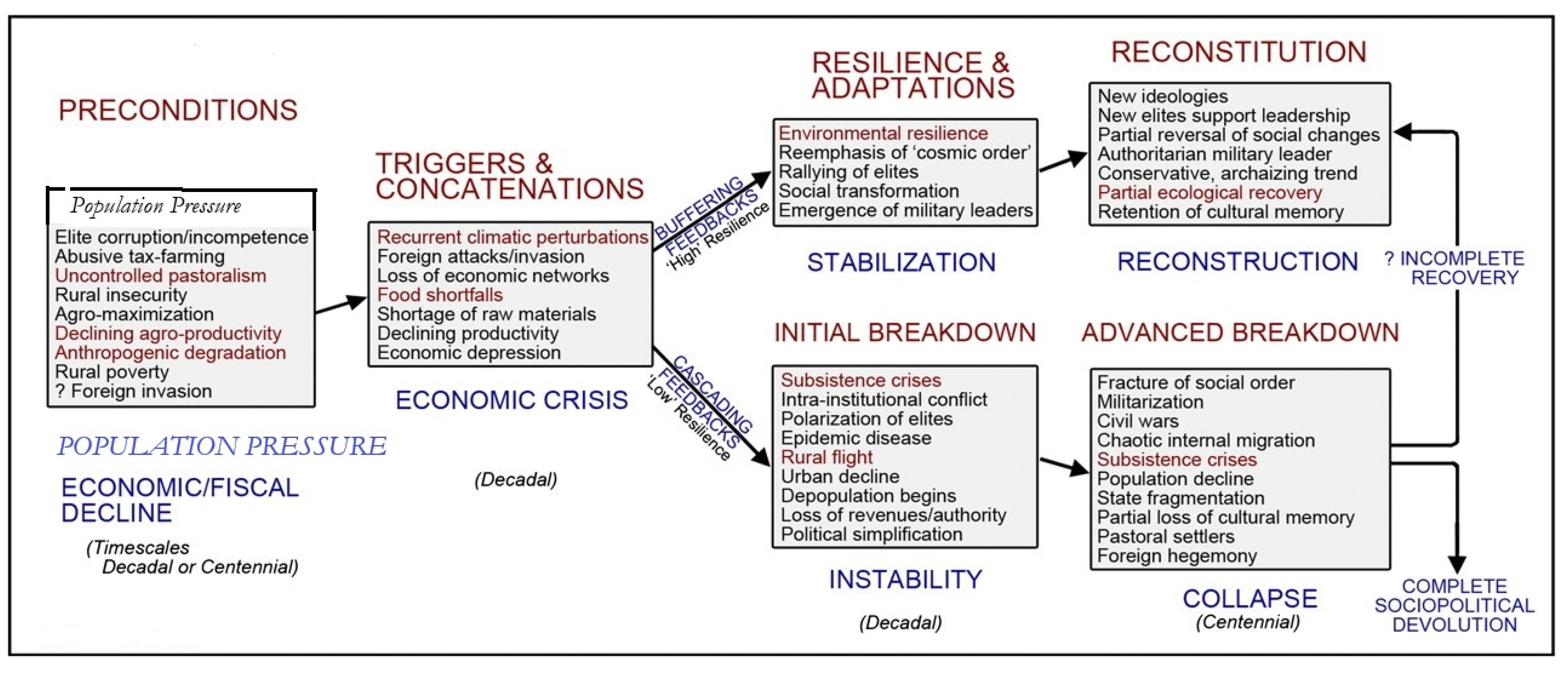
Butzer’s model postulates that social processes such as institutional failure and conflicts between elite factions have been more important in causing collapses than climate shock or environmental degradation (see Butzer 2012a, 2012b).21 In his collapse and reconstitution model shown in Figure 1, disasters such as climate shocks and pandemics operate as triggers that exacerbate existing economic and political troubles that led to instability and collapse, but that can also be met with resilient adaptations that led to reconstitution.
Chew (2001, 2007) saw dark ages in global history as periods in which a single global world-system was in crisis because population growth and urbanization had caused environment degradation and natural disasters such as droughts and volcanic eruptions that disrupted production systems. His causal logic is like that of Diamond (see above) but his unit of analysis is an alleged single global (Earth-wide) system that is thought to have existed since the rise in states and cities in Mesopotamia during the Bronze Age. Chew followed Frank and Gills (1994) in assuming that there was only one global world-system since the Bronze Age and so his designated Dark Ages are alleged to be periods in which all the core areas of the Earth were simultaneously experiencing crises.22 His is explicitly a theory that links natural and anthropogenic disasters with sociocultural evolution. The Dark Ages were not only periods in which economic and political systems fell apart and got reorganized, but they were also periods of environmental recovery because the degradation of natural resources and pollution of nature were reduced when the population declined. Chew also saw the periods of recovery as evolutionary because new technologies, as well as organizational and institutional forms, emerged during the recoveries from the Dark Ages.
Inoue et al. (2012, 2015) found that in regional interpolity networks (world-systems), there have been many declines in the territorial sizes of the largest polities and in the population sizes of the largest cities, but only three long collapses in which polities and cities failed to recover in the 3500-year period from 1500 BCE to 2000 CE. The three city-size collapses were 525, 850 and 750 years long when measured from the peak population size before the collapse to the recovery of that same size. So more than half of the whole study period was spent in collapse recoveries (See Figure 1 in Chase-Dunn and Harper 2026).
The polities and cities that emerged after both short and long declines were often different from those that were formerly the largest in each region, and in about half of the cases these were upwardly mobile polities that had formerly been in non-core positions within the regional world-systems (Inoue et al. 2016). The frequent upward mobility of non-core polities supports the idea that uneven and combined development is an important framework for explaining sociocultural evolution.
Modelski and Thompson (1999) published a chapter on incursions from the hinterlands in 1999 and Thompson (2026) strengthens the hypotheses linking incursions, driven by climate stress, to sociocultural collapses and reorganizations during recovery. This is a conflict theory because it is about warfare between nomads and sedentary populations and their agrarian states. Thompson (2026) says:
….incursions from the mountains, steppes, and deserts were part of recurring processes that stimulated societal organization and re-organizations throughout recorded history, and probably before that time as well. Eurasia became a more integrated system in part due to the role of incursions, at least in the long term if not always in the short term.
Climate-driven incursions were a force in sociocultural evolution and in the expansion of Eurasian interaction networks. Climate worsening weakened both nomadic and agrarian polities because droughts and cold weather made hunting and pastoralism harder and reduced the productivity of farming. Lattimore (1940) had argued that nomadic hunters on the Central Asian steppes became pastoralists to trade livestock for vegetable foods with the adjacent oases gardeners in Central Asia and the loess plateau Chinese farmers—a social coevolution that produced both cooperation and competition in a linked division of labor and interpolity system (see also Zhang et al. 2007; Pei et al. 2019).
H. F. Lee (2018) found that a worsening (cold and dry) climate that caused decline in agricultural productivity usually set the stage for both natural disasters (floods) and for what Lee calls sociocultural catastrophes (famines,23 epidemics) that served as the proximate causes of the outbreak of civil wars and peasant rebellions in both the wheat and the rice regions of China from 1470 CE to 1911 CE. These findings are important because they show a causal chain in which compound disasters caused one another and provoked political instability that sometimes led to the collapse of states. M. Lee’s (2023) study of the factors that make pandemics more deadly, especially financialization, has important implications regarding theories of the evolution of global governance.
The structural demographic model developed by Jack Goldstone, Peter Turchin and their colleagues is mostly about why polities collapsed but increasingly pays attention to how new dynasties arose after collapses. The demographic and political processes analyzed in this approach are mainly processes operating within a polity and the formal model tends to ignore interpolity interactions. But in other publications, Turchin contends that interstate warfare is an important selection mechanism that drives the formation of empires (e.g., Turchin et al. 2013). Turchin adds the idea of elite overexpansion to the model. As regimes age and become more complex, the number of elite positions expands, which increases pressure on the availability of resources (along with overall population growth) and competition for more upward mobility leads to the emergence of constraints. Frustrated aspirants challenge the older elite groups and mobilize mass movements. That is part of the process of regime collapse and recovery from collapse. Taking all together the structural-demographic theoretical approach combines functionalist and conflict explanations into an insightful prehension of the causes of social change (see also Turchin 2025).24
The inequality overshoot bi-level world-system model of sociocultural evolution (Inoue and Chase-Dunn 2020; Chase-Dunn and Inoue 2024) combines two levels of analysis: the processes internal to each polity and the processes that involve competition, conflict and cooperation among a set of systemically connected polities. This model includes pandemics, climate worsening, immigration, emigration and environmental degradation as triggers of the sort proposed by Butzer.
The Inoue and Chase-Dunn (2020) article provides an overview of theoretical explanations of sociocultural evolution and proposes revised versions of the structural demographic model of within-polity dynamics and of the world-system level iteration model first proposed in Chapter 6 in Chase-Dunn and Hall’s (1997b) Rise and Demise: Comparing World-Systems. The revisions of the polity and whole interpolity system models are depicted and discussed in Inoue and Chase-Dunn (2020), as is the bi-level combination of these submodels. This is available at https://irows.ucr.edu/papers/irows126/irows126.htm (accessed on 23 May 2026).
The main idea is that optimal levels of inequality and hierarchy within polities and interpolity networks are functional for regulating increased complexity, but that inequality overshoot repeatedly occurs because elites use their powers to protect their privileges at the expense of non-elites and that this leads to more inequality than is needed for the regulation of complexity. Excess inequality is one of the main causes of collapses. This also suggests why egalitarian distributive justice political ideologies persist across the long-term trajectory of larger and more hierarchical organizational forms.
Our broad definition of disasters is meant to promote examination of different kinds of disasters and how they may be related to one another, and how they may have similar or different consequences for sociocultural evolution. What is needed now is computational modeling and empirical model-testing of the sort proposed by Butzer and Endfield (2012). Studies of disasters and resilience are currently salient because the contemporary world-system is well into another time of troubles, as anthropogenic climate change is occurring at the same time as the decline of U.S. and Western hegemony and the emergence of a more multipolar global political economy. A better understanding of how these things have happened in the past will suggest helpful ideas about how to deal with the problems now at hand.

9. Conclusions

Anthropogenic and natural disasters act as triggers that release pent-up strains and forces that cause social collapses. These collapses are opportunities for modifying social structures and institutions. Over the long run human polities are selected for those that are resilient. Specialized institutions emerge to prevent and mitigate some kinds of disasters and to preserve knowledge that allows for more rapid recovery. The contemporary and near-future global situation is particularly vulnerable to anthropogenic disasters, especially global warming and large-scale warfare among powerful states armed with weapons of mass destruction. At the international and global levels, what Turner et al. (2017) call Durkheimian selection—institutions that promote solidarity and cooperation—have been emerging for centuries, but Spencerian and Durkheimian selection contradict one another and waves of Durkheimian multilateral institution-formation have been, and still are, interrupted by renewed waves of beggar-thy-neighbor nationalism. The increasingly obvious global nature of imminent disasters increases the pressure for global cooperation, but other processes drive populist nationalism and reduce the capabilities of multilateral institutions to coordinate prevention and mitigation. Catastrophic global warming and/or World War 3 will probably not kill off all humans or destroy all the life forms, so the processes of increasing sociocultural complexity, the formation of hierarchies and the continued evolution of other species are likely to recover and to continue after another long period of collapse (Chase-Dunn and Harper 2026). One big question is what will happen the next time human sociocultural evolution gets to the point at which it is now. Will it collapse again or will our species learn from its self-caused disasters and do what needs to be done to prevent another catastrophic setback?

Author Contributions

Conceptualization, C.C.-D. and Q.P.; investigation, C.C.-D. and Q.P.; resources, C.C.-D. and Q.P.; writing—original draft preparation, C.C.-D.; writing—review and editing C.C.-D. and Q.P. All authors have read and agreed to the published version of the manuscript.

Funding

This research received no external funding.

Institutional Review Board Statement

Not applicable.

Informed Consent Statement

Not applicable.

Data Availability Statement

No new data were created or analyzed in this study. Data sharing is not applicable to this article.

Acknowledgments

Thanks to Marilyn Grell-Brisk for helpful comments and suggestions.

Conflicts of Interest

The authors declare no conflict of interest.

Notes

1
We use the term sociocultural instead of just social because social insects, especially ants, evolved a complex division of labor 30 million years ago in the absence of culture. By culture we mean complex languages that enable passing skills and information to the young.
2
Methods for spatially and temporally bounding whole systemic interaction that are not yet global are the subject of a forthcoming volume of essays (Chase-Dunn and Inoue 2026).
3
This is a focus of study of the Settlements and Polities Research Working Group at the Institute for Research on World-Systems at the University of California-Riverside. The framework of comparison and main empirical foci—settlement sizes and the territorial sizes of polities are outlined in (Chase-Dunn et al. 2020).
4
Exogenous factors are external variables or influences that impact a sociocultural system but are not impacted by that system. In macroeconomics exogenous factors are often modeled as random shocks.
5
Settlements are spatially bounded for comparative purposes as contiguous built-up areas.
6
If the internal heat of the Earth’s core were to cease producing volcanoes and magma upthrusts the land areas of the Earth would be worn down by weather to produce a planet that was completely covered by ocean water in about 45 million years (Abbott 2017, p. 4).
7
Examples of slow onset disasters are: lead-poisoning before the discovery of the dangers of lead, soil depletion and salinization, sea-level rise, land subsidence, mass bio-extinctions, upward trends in obesity and drug addiction/overdose death rates.
8
Countries in the Global South also have disaster industries, at least on paper, but these are usually poorly supported and have low capacity.
9
In the summer of 2022, a California militia organization dressed in combat outfits handed out sandwiches to people who were fleeing massive wildfires (Collins and Sottile 2022).
10
This ignores the evolution of Marxism in the 20th and 21st centuries in which world revolutions and analyses of capitalism have gone beyond the 19th century version of Marxism to include the global, cultural and material aspects of the evolution of capitalism.
11
Stinchcomb (1968, pp. 180–81) examined the logical structure of functional explanations and showed that adding differential power of persons and classes produces a functionalist version of Marxist analysis. He showed that functionalism need not support conservative notions about the value of existing institutions if power differences within polities are considered.
12
Maryanski and Turner’s (2024) examination of primate evolution says: “Unlike teleological reasoning in classical functional analysis where a need for something magically makes it happen, selection is not teleological: Phenotypes good enough to survive and reproduce pass their genes on to the next generation.” (Maryanski and Turner 2024, p. 361, Fn 7).
13
We use the designations now employed by most world historians. B.C.E. means “before common era,” and C.E. means “common era”.
14
The panarchy model in ecology describes how ecosystems change through nested adaptive cycles—recurring phases of growth, conservation, collapse, and reorganization—operating across multiple scales. The core idea is that large, slow cycles (like landscapes or climate patterns) interact with small, fast cycles (like local populations or disturbances), shaping resilience, vulnerability, and the likelihood of abrupt change (Allen et al. 2014).
15
The resilience phenomenon was also emphasized in McAnany and Yoffee (2010).
16
The Younger Dryas—harsh cold/dry conditions that emerged from about 10800 BCE to about 9700 BCE.
17
Their depiction of the role of climate change in the fall of the Akkadian Empire based on research by Weiss et al. (1993) is convincingly critiqued by Karl Butzer (2012a, p. 1).
18
This is also the point made by McPhee’s (1990) The Control of Nature, a study of flood control projects in the United States.
19
Michel Foucault used the term “technologies of power” in his analysis of discipline and prisons in European polities, but Mann was discussing how empires invented institutions that enabled control and extraction of conquered peoples in the Bronze Age.
20
The case studies of collapses provided by Butzer (2012a, 2012b) and his comparisons of them are very insightful but population pressure as a driving force is missing from Butzer’s model and from his descriptions of cases. Population pressure is a central feature of many theories of sociocultural evolution (e.g., Johnson and Earle 1987; Turchin and Nefedov 2009; Inoue and Chase-Dunn 2020). We have added Population Pressure in italics to Figure 1 below. Population pressure arises when population growth impinges on the availability of needed resources.
21
Anderson’s (2019) study of climate change and dynastic rise and fall in East Asia agrees with Butzer that climate change operates more as a trigger than as a stressor.
22
When world-systems are defined as systemic interaction networks as Immanuel Wallerstein and Janet Abu-Lughod did, there were small regional systems that became linked with one another to eventuate in the contemporary global world-system (Chase-Dunn and Inoue 2026).
23
24
Most of the essays in (Centeno et al. 2023) on complexity, collapse and resilience also combine functional and conflict approaches.

References

  1. Abbott, Patrick L. 2017. Natural Disasters. New York: McGraw-Hill. [Google Scholar]
  2. Alfani, Guido, and Cormac Ó Gráda, eds. 2017. Famines in Europe: An Overview. In Famine in European History, 1st ed. Cambridge: Cambridge University Press, pp. 1–24. [Google Scholar] [CrossRef]
  3. Alfani, Guido, and Cormac Ó Gráda. 2018. The timing and causes of famines in Europe. Nature Sustainability 1: 283–88. [Google Scholar] [CrossRef]
  4. Allen, Craig R., David G. Angeler, Ahjond S. Garmestani, Lance H. Gunderson, and Crawford S. Holling. 2014. Panarchy: Theory and application. Ecosystems 17: 578–89. [Google Scholar] [CrossRef]
  5. Allen, Robert, and Rainer Luptowitz. 2017. El Niño-like teleconnection increases California precipitation in response to warming. Nature Communications 8: 16055. [Google Scholar] [CrossRef] [PubMed]
  6. Anderson, Eugene N. 2019. The East Asian World-System. Berlin: Springer. [Google Scholar]
  7. Braidwood, Robert J. 1963. Prehistoric Men. Chicago: Field Natural History Museum. [Google Scholar]
  8. Butzer, Karl W. 1976. Early Hydraulic Civilization in Egypt. Chicago: University of Chicago Press. [Google Scholar]
  9. Butzer, Karl W. 2012a. Collapse, Environment and Society. Proceedings of the National Academy of Sciences of the United States of America 109: 3632–39. [Google Scholar] [CrossRef] [PubMed]
  10. Butzer, Karl W. 2012b. Collapse, Environment, and Society. Supporting Information Butzer. Available online: https://www.pnas.org/doi/suppl/10.1073/pnas.1114845109/suppl_file/pnas.201114845si.pdf (accessed on 23 May 2026).
  11. Butzer, Karl W., and Georgina H. Endfield. 2012. Critical perspectives on historical collapse. Proceedings of the National Academy of Sciences of the United States of America 109: 3628–31. [Google Scholar] [CrossRef] [PubMed]
  12. Carneiro, Robert L. 1978. Political expansion as an expression of the principle of competitive exclusion. In Origins of the State: The Anthropology of Political Evolution. Edited by Ronald Cohen and Elman R. Service. Philadelphia: Institute for the Study of Human Issues, pp. 205–23. [Google Scholar]
  13. Centeno, Miguel, Peter W. Callahan, Paul A Larcey, and Thayer S. Patterson, eds. 2023. How Worlds Collapse: What History, Systems and Complexity Can Teach Us About Our Modern World and Fragile Future. London: Routledge. [Google Scholar]
  14. Chase-Dunn, Christopher, and Antony Harper. 2026. After the Big One: World War: And the Prospects for Survival, Recovery and Restarting the Upward Trend in Sociocultural Complexity and Hierarchy” Submitted to a special issue of Social Sciences on Disasters, Social Movements, Policy Responses and Sociocultural Evolution. Available online: https://www.mdpi.com/journal/socsci/special_issues/WA160H4TGW (accessed on 23 May 2026).
  15. Chase-Dunn, Christopher, and Bruce Lerro. 2016. Social Change: Globalization from the Stone Age to the Present. London: Routledge. [Google Scholar]
  16. Chase-Dunn, Christopher, and Hiroko Inoue. 2024. Inequalities Within-Polities and in Interpolity Relations Since the Paleolithic Age. Paper presented at the American Sociological Association Section on Political Economy of the World System Roundtables, Montréal, QC, Canada, August 11; This is IROWS Working Paper #146. Available online: https://irows.ucr.edu/papers/irows146/irows146.pdf (accessed on 23 May 2026).
  17. Chase-Dunn, Christopher, and Hiroko Inoue. 2026. The Globalization of World-Systems: Time-Mapping Systemic Boundaries. Cham: Springer Nature. [Google Scholar]
  18. Chase-Dunn, Christopher, and Thomas D. Hall. 1997a. Ecological degradation and the evolution of world-systems. Journal of World-Systems Research 3: 403–31. [Google Scholar] [CrossRef]
  19. Chase-Dunn, Christopher, and Thomas D. Hall. 1997b. Rise and Demise: Comparing World-Systems. Boulder: Routledge. [Google Scholar]
  20. Chase-Dunn, Christopher, Marilyn Grell-Brisk, and Hiroko Inoue. 2020. The SetPol Frameworks for Comparing World-Systems. IROWS Working Paper #138. Available online: https://irows.ucr.edu/papers/irows138/irows138.htm (accessed on 23 May 2026).
  21. Chew, Sing C. 2001. World Ecological Degradation: Accumulation, Urbanization, and Deforestation, 3000 B.C.–A.D. Walnut Creek: Altamira Press. [Google Scholar]
  22. Chew, Sing C. 2007. The Recurring Dark Ages: Ecological Stress, Climate Changes, and System Transformation. Walnut Creek: Altamira Press. [Google Scholar]
  23. Cioffi-Revilla, Claudio. 2016. Universal Laws of Disaster. Paper presented at IEEE Global Humanitarian Technology Conference (GHTC), Seattle, WA, USA, October 13–16; pp. 272–79. Available online: https://ieeexplore.ieee.org/document/7857292/ (accessed on 23 May 2026).
  24. Cliff, Andrew, Peter Haggett, and Matthew Smallman-Raynor. 1998. Deciphering Global Epidemics: Analytical Approaches to the Disease Records of World Cities, 1888–1912. Cambridge: Cambridge University Press. [Google Scholar]
  25. Collins, Ben, and Chiara Sottile. 2022. In a California town, a militia is welcomed by some, cautioned by others. NBC News. July 23. Available online: https://www.nbcnews.com/news/us-news/california-town-militias-help-welcomed-cautioned-others-rcna40218 (accessed on 23 May 2026).
  26. Collins, Randall. 1971. Functional and Conflict Theories of Educational Stratification. American Sociological Review 36: 1002–19. [Google Scholar] [CrossRef]
  27. Davis, Mike. 1999. Ecology of Fear: Los Angeles and the Imagination of Disaster. London: Verso. [Google Scholar]
  28. Davis, Mike. 2001. Late Victorian Holocausts: El Niño and the Making of the Third World. New York: Verso. [Google Scholar]
  29. Denemark, Robert A. 2022. Pandemics in global and historical perspective. Globalizations 19: 380–96. [Google Scholar] [CrossRef]
  30. Diamond, Jared. 1999. Guns, Germs and Steel. New York: Norton. [Google Scholar]
  31. Diamond, Jared. 2005. Collapse. New York: Viking. [Google Scholar]
  32. Fagan, M. Brian. 1991. Ancient North America: The Archaeology of a Continent. London: Thames & Hudson. [Google Scholar]
  33. Fan, Shaohua, Matthew E. B. Hansen, Yancy Lo, and Sarah A. Tishkoff. 2016. Going global by adapting local: A review of recent human adaptation. Science 354: 54–59. [Google Scholar] [CrossRef]
  34. Flannery, Kent V. 1971. Archeological systems theory and early Mesoamerica. In Prehistoric Agriculture. Edited by Stuart Struever. Garden City: Natural History Press, pp. 80–100. [Google Scholar]
  35. Frank, Andre Gunder, and Barry Gills. 1994. The World System: 500 or 5000 Years? London: Routledge. [Google Scholar]
  36. Gao, Ziyue. 2024. Unveiling recent and ongoing adaptive selection in human populations. PLoS Biology 22: e3002469. [Google Scholar] [CrossRef]
  37. Glassner, Barry. 2018. The Culture of Fear. New York: Basic Books. [Google Scholar]
  38. Gould, Stephen Jay. 2002. The Structure of Evolutionary Theory. Cambridge: Harvard University Press. [Google Scholar]
  39. Gunewardena, Nandini, and Mark Schuller, eds. 2008. Capitalizing on Catastrophe: Neoliberal Strategies in Disaster Reconstruction. Walnut Creek: AltaMira Press. [Google Scholar]
  40. Hayden, Brian. 1981. Research and Development in the Stone Age: Technological Transitions among Hunter-Gatherers. Current Anthropology 22: 519–48. [Google Scholar] [CrossRef] [PubMed]
  41. Hopkins, Keith. 1978. Conqueror and Slaves. Cambridge: Cambridge University Press. [Google Scholar]
  42. Hugget, Richard. 1997. Catastrophism: Asteroids, Comets, and Other Dynamic Events in Earth History. London: Verso. [Google Scholar]
  43. Huntington, Ellsworth. 1915. Civilization and Climate. New York: Harper and Brothers. [Google Scholar]
  44. Inoue, Hiroko, Alexis Alvarez, Eugene N. Anderson, Andrew Owen, Rebecca Alvarez, Kirk Lawrence, and Christopher Chase-Dunn. 2015. Urban Scale Shifts Since the Bronze Age: Upsweeps, Collapses and Semiperipheral Development. Social Science History 39: 175–200. [Google Scholar] [CrossRef]
  45. Inoue, Hiroko, Alexis Alvarez, Eugene N. Anderson, Kirk Lawrence, Teresa Neal, Dmytro Khutkyy, Sandor Nagy, Walter DeWinter, and Christopher Chase-Dunn. 2016. Comparing World-Systems: Empire Upsweeps and Non-Core Marcher States Since the Bronze Age. IROWS Working Paper 56. Available online: https://irows.ucr.edu/papers/irows56/irows56.htm (accessed on 23 May 2026).
  46. Inoue, Hiroko, Alexis Alvarez, Kirk Lawrence, Anthony Roberts, Eugene N. Anderson, and Christopher Chase-Dunn. 2012. Polity Scale Shifts in World-Systems Since the Bronze Age: A Comparative Inventory of Upsweeps and Collapses. International Journal of Comparative Sociology 53: 210–29. [Google Scholar] [CrossRef]
  47. Inoue, Hiroko, and Christopher Chase-Dunn. 2020. A Multilevel Spiral Model of Sociocultural Evolution: Polities and Interpolity Systems. IROWS Working Paper 126. Available online: http://irows.ucr.edu/papers/irows126/irows126.htm (accessed on 23 May 2026).
  48. Johnson, Allen W., and Timothy Earle. 1987. The Evolution of Human Societies: From Foraging Group to Agrarian State. Stanford: Stanford University Press. [Google Scholar]
  49. Jones, Eric C., and Arthur D. Murphy, eds. 2009. The Political Economy of Hazards and Disasters. Lanham: Rowman. [Google Scholar]
  50. Kradin, Nikolay N. 2002. Nomadism, Evolution and World-Systems: Pastoral Societies in Theories of Historical Development. Journal of World-Systems Research 8: 3. [Google Scholar] [CrossRef]
  51. Kreps, G. A. 1984. Sociological Inquiry and Disaster Research. Annual Review of Sociology 10: 309–30. [Google Scholar] [CrossRef]
  52. Kuecker, Glen. 2007. The perfect storm. International Journal of Environmental, Cultural and Social Sustainability 3: 1–10. [Google Scholar]
  53. Lattimore, Owen. 1940. Inner Asian Frontiers of China. New York: American Geographical Society. [Google Scholar]
  54. Leckson, Stephen H. 1999. The Chaco Meridian: Centers of Political Power in the Ancient Southwest. Walnut Creek: Altamira Press. [Google Scholar]
  55. Lee, Harry F. 2018. Internal wars in history: Triggered by natural disasters or socio-ecological catastrophes? The Holocene 28: 1071–81. [Google Scholar] [CrossRef]
  56. Lee, Michael. 2023. Financialization and Global Health: Lessons from Pandemics Past and Present. Paper Presented at the First International Studies Association Virtual Conference, Virtual, August 1–4. [Google Scholar]
  57. Le Roy Ladurie, Emmanuel. 1971. Times of Feast, Times of Famine: A History of Climate Since the Year 1000. Garden City: Doubleday and Co. [Google Scholar]
  58. Mann, Michael. 1986. The Sources of Social Power, Volume 1: A History of Power from the Beginning to A.D. 1760. Cambridge: Cambridge University Press. [Google Scholar]
  59. Marriner, Nick, Christophe Morhange, and Stefan Skrimshire. 2010. Geoscience meets the four horsemen?: Tracking the rise of neocatastrophism. Global and Planetary Change 74: 43–48. [Google Scholar] [CrossRef]
  60. Maryanski, Alexandra, and Jonathan H. Turner. 2024. An Approach to Evolutionary Sociology and its Implications for Theorizing on Socio-Cultural Evolution. Kölner Zeitschrift fur Soziologie und Sozialpsychologie 76: 351–89. [Google Scholar] [CrossRef]
  61. McAnany, Patricia A., and Norman Yoffee, eds. 2010. Questioning Collapse: Human Resilience, Ecological Vulnerability and the Aftermath of Empire. Cambridge: Cambridge University Press. [Google Scholar]
  62. McNeill, William. 2010. Plagues and Peoples. Garden City: Anchor. First published 1976. [Google Scholar]
  63. McPhee, John. 1990. The Control of Nature. New York: Farrar, Straus and Giroux. [Google Scholar]
  64. Modelski, George, and William R. Thompson. 1996. Leading Sectors and World Powers: The Co-Evolution of Global Politics and Economics. Columbia: University of South Carolina Press. [Google Scholar]
  65. Modelski, George, and William R. Thompson. 1999. Pulsations in the World System: Hinterland to Center Incursions and Migrations, 4000 B.C. to 1500 A.D. In Leadership, Production and Exchange: World Systems Theory in Practice. Edited by Nicholas Kardulias. Boulder: Rowman and Littlefield. [Google Scholar]
  66. Modelski, George, Tessaleno Devezas, and William R. Thompson, eds. 2007. Globalization as Evolutionary Process. New York: Routledge. [Google Scholar]
  67. Morris, Ian. 2013. The Measure of Civilization. Princeton: Princeton University Press. [Google Scholar]
  68. Mostern, Ruth. 2021. The Yellow River: A Natural and Unnatural History. New Haven: Yale University Press. [Google Scholar]
  69. Pei, Qing, David D. Zhang, Guodong Li, Bruce Winterhalder, and Harry F. Lee. 2015. Epidemics in Ming and Qing China: Impacts of changes of climate and economic well-being. Social Science & Medicine 136–137: 73–80. [Google Scholar] [CrossRef]
  70. Pei, Qing, Harry F. Lee, David D. Zhang, and Jie Fei. 2019. Climate change, state capacity and nomad–agriculturalist conflicts in Chinese history. Quaternary International 508: 36–42. [Google Scholar] [CrossRef]
  71. Price Equation. n.d. Wikipedia. Available online: https://en.wikipedia.org/wiki/Price_equation (accessed on 24 May 2026).
  72. Sandberg, Anders. 2023. The Lifespan of Civilizations: Do Societies “Age” or Is Collapse Just Bad Luck? In How Worlds Collapse: What History, Systems and Complexity Can Teach Us About Our Modern World and Fragile Future. Edited by Miguel Centeno, Peter W. Callahan, Paul A Larcey and Thayer S. Patterson. London: Routledge, pp. 375–96. [Google Scholar]
  73. Scott, James C. 1998. Seeing Like a State: How Certain Schemes to Improve the Human Condition Have Failed. New Haven: Yale University Press. [Google Scholar]
  74. Scott, James C. 2017. Against the Grain: A Deep History of the Earliest States. New Haven: Yale University Press. [Google Scholar]
  75. Service, Elman R. 1975. Origins of the State and Civilization: The Process of Cultural Evolution. New York: Norton. [Google Scholar]
  76. Stinchcomb, Arthur L. 1968 Constructing Social Theories. Chicago: University of Chicago Press.
  77. Tainter, Joseph. 1988. The Collapse of Complex Societies. Cambridge: Cambridge University Press. [Google Scholar]
  78. Tainter, Joseph. 2023. How Scholars Explain Collapse. In How Worlds Collapse: What History, Systems and Complexity Can Teach Us About Our Modern World and Fragile Future. Edited by Miguel Centeno, Peter W. Callahan, Paul A Larcey and Thayer S. Patterson. London: Routledge, pp. 25–36. [Google Scholar]
  79. Thompson, Wiliam R. 2026. Incursions, Climate Change, and Early Globalization Patterns. In The Globalization of World-Systems: Time-Mapping Systemic Boundaries. Edited by C. Chase-Dunn and Hiroko Inoue. Cham: Springer Nature. [Google Scholar]
  80. Thompson, Wiliam R., and Leila Zhakhirova. 2022. Climate Change in the Middle East and North Africa: 15,000 Thousand Years of Crises, Setbacks and Adaptation. London: Routledge. [Google Scholar]
  81. Tierney, Kathleen J. 2007. From the Margins to the Mainstream? Disaster Research at the Crossroads. Annual Review of Sociology 33: 503–25. [Google Scholar] [CrossRef]
  82. Tierney, Kathleen J. 2012. Disaster Governance: Social, Political, and Economic Dimensions. Annual Review of Environment and Resources 37: 341–63. [Google Scholar] [CrossRef]
  83. Tilly, Charles. 1984. Big Structures, Large Processes, Huge Comparisons. New York: Russell Sage. [Google Scholar]
  84. Toynbee, Arnold J. 1946. A Study of History. Abridged by David C. Somervell. Oxford: Oxford University Press, vol. 1. [Google Scholar]
  85. Turchin, Peter. 2016. Ultrasociety. Chaplin: Beresta Books. [Google Scholar]
  86. Turchin, Peter. 2025. The Great Holocene Transformation: What Complexity Science Tells Us about the Evolution of Complex Societies. Chaplin: Beresta Books. [Google Scholar]
  87. Turchin, Peter, and Sergey Nefedov. 2009. Secular Cycles. Princeton: Princeton University Press. [Google Scholar]
  88. Turchin, Peter, Harvey Whitehouse, Andrey Korotayev, Pieter Francois, Daniel Hoyer, Peter Peregrine, Gary Feinman, Charles Spencer, Nikolay Kradin, and Thomas E. Currie. 2018a. Evolutionary Pathways to Statehood: Old Theories and New Data. SocArXiv. Preprints 10 h. Available online: https://osf.io/preprints/socarxiv/h7tr6_v1 (accessed on 24 May 2026).
  89. Turchin, Peter, Nina Witoszek, Stefan Thurner, David Garcia, Roger Griffin, Daniel Hoyer, Atle Midttun, James Bennett, Knut Myrum Nuss, and Sergey Gavrilets. 2018b. History of Possible Futures: Multipath Forecasting of Social Breakdown, Recovery, and Resilience. Cliodynamics 9: 39. [Google Scholar] [CrossRef]
  90. Turchin, Peter, Thomas E. Currie, Edward A. L. Turner, and Sergey Gavrilets. 2013. War, Space, and the Evolution of Old World Complex Societies. Proceedings of the National Academy of Sciences of the United States of America 110: 16384–89. [Google Scholar] [CrossRef] [PubMed]
  91. Turner, Jonathan H., Aleksandra Maryanski, Anders K. Petersen, and Armin W. Geertz. 2017. The Emergence and Evolution of Religion: By Means of Natural Selection. London: Routledge. [Google Scholar]
  92. Weiss, Harvey, and Raymond S. Bradley. 2001. What drives societal collapse? Science 291: 609–10. [Google Scholar] [CrossRef]
  93. Weiss, Harvey, M.-A. Courty, Wilma Wetterstrom, François Guichard, Louise Senior, Richard Meadow, and Anna Curnow. 1993. The genesis and collapse of third millennium north Mesopotamian civilization. Science 261: 995–1004. [Google Scholar] [CrossRef]
  94. Wittfogel, Karl. 1957. Oriental Despotism: A Comparative Study of Total Power. New Haven: Yale University Press. [Google Scholar]
  95. Zhang, David D., Jane Zhang, Harry F. Lee, and Yuan-qing He. 2007. Climate change and war frequency in eastern China over the last millennium. Human Ecology 35: 403–14. [Google Scholar] [CrossRef]
  96. Zhang, David D., Qing Pei, Harry F. Lee, C. Y. Jim, Guodong Li, Mandy Zhang, Jinhao Li, Zhifeng Wu, Leibin Wang, Ricci P. H. Yue, and et al. 2020. Climate change fostered cultural dynamics of human resilience in Europe in the past 2500 years. Science of the Total Environment 744: 14082. Available online: https://www.sciencedirect.com/science/article/abs/pii/S0048969720343667?via%3Dihub (accessed on 24 May 2026). [CrossRef]
Figure 1. Collapse and Resilience Model (modified from Butzer 2012a, p. 3636). Butzer’s note to Figure 1 says “Timescales range from multidecadal to centennial. Alternate pathways point to important qualities of resilience. Red superscripts identify stages that are elaborated by blue subscripts. Environmental components (red within boxes) are secondary to sociopolitical factors.”.
Socsci 15 00383 g001
Disclaimer/Publisher’s Note: The statements, opinions and data contained in all publications are solely those of the individual author(s) and contributor(s) and not of MDPI and/or the editor(s). MDPI and/or the editor(s) disclaim responsibility for any injury to people or property resulting from any ideas, methods, instructions or products referred to in the content.