1. Introduction
Daoist talismanic writing (fulu shuxie 符箓書寫) constitutes a central modality of Daoist spiritual inscription and a privileged vehicle for the tradition’s sacred knowledge and occult power. Its semiotic deep-structure is continuous with archaic totemism. As Tang Mingbang observes in his preface to A Study of the Culture of Daoist Memorials, Talismans and Seals,
Fu and Lu emerged from primordial totem-worship and shamanic technique; they became the mysterious medium through which the Daoist community projects its collective psyche. Although their forms are esoteric, they can be drawn and manipulated by the ordained—so-called dragon-seal and phoenix-script, cloud-seal and heaven-book.
Despite their frequent collocation in Daoist literature, Fu (符 talisman) and Lu (箓 register) are rigorously distinguished. Fu, also styled divine talisman (shenfu 神符), secret talisman (mifu 秘 符), or spiritual talisman (lingfu 靈 符), is a credential held by a High Master (gaogong 高 功) to communicate with the gods. It functions as a passport authorising passage into the spirit world. Its primary ritual task is the summoning and indicting (zhao 召) of spirits to call them into presence, and to interrogate and command (he 劾) them. When the High Master’s cultivation is sufficient, he can invite the gods to enter the talisman, draw stellar pneumas into it, rescue lost souls, and dispatch legions of spirits, thereby dispelling calamities, stabilising the realm, and saving the people in the world.
Lu, variously precious register (baolu 寶箓, ritual register (falu 法箓), or milu (secret register 秘箓), a person who is being ordained as a Daoist priest (Daoshi 道士) is issued a certificate of affiliation. Daoist practitioners must first complete the ordination (shoulu 授 箓). This rite concludes a covenant with the spirit world and is popularly understood as the licence to communicate with gods. By virtue of the ordination, the recipient passes from the mundane to the sacred. He is then qualified to act as priest or ritual director for liturgies, penitential rites, or any other thaumaturgic ceremony. Only after he has received this credential and acknowledges its authority may he command the various spirits at will.
Liu Zhongyu summarises the difference trenchantly:
A talisman is like a military tally: once you hold it, you can give orders to spirit-generals and transcendent clerks. A register is like an earthly patent of nobility: it records the title, fief and roll of subjects; with it you can undertake great affairs, but it is not itself a weapon to be wielded in battle.
In addition, the conferral of a lu follows a fixed ritual protocol. Once completed, the document remains valid for life and functions as a “liturgical credential.” It may neither be re-conferred nor altered, no added sketches, tracings, or copies are allowed, and must be kept pure and inviolate. A fu, by contrast, is discarded after use, and a High Master may redraw it whenever circumstances require. Thus, the two instruments differ in function yet form a single system: anyone who writes or employs a fu must hold an authorized lu as legal warranty; otherwise, the talisman is deemed illicit. Conversely, the lu itself often embeds miniature fu.
Liu Zhongyu writes in his Study on the Daoist Register-Conferral System that
The lu is normally composed of text and of images of spirit-generals or other ritual implements; here and there it also has talismans embedded in it.
Because they are interwoven and must cooperate, canonical literature regularly couples them as fulu.
In Daoism, the talisman and register inscribed by an accomplished gaogong are believed to wield potent numinous power. Lu Xiujing’s Upper-Purity Numinous Treasure True Talismans of the Unhewn Cavern (Tai Shang Dong Xuan Ling Bao Su Ling Zhen Fu 太上洞玄靈寶素靈真符) states that
Every single fu sign is in fact a written character, yet ordinary people cannot decipher it. Whoever can read these talismanic graphs may use the lu to summon the myriad spirits and command the hundred ghosts—nothing lies beyond his reach.
(Author’s translation)
凡一切符文,皆有文字,但人不解識之。若解讀符字者,可以箓召萬靈,役使百鬼,無所不通也。
This study continues the inquiry into the source of numinous power inherent in Daoist talismanic writing. Once that origin is clarified, the study proceeds to ask what implications this finding holds for contemporary innovations in graphic art.
Fieldwork and textual analysis converge on a three-tier model: (1) external divine spiritual power, (2) adept’s innate pre-celestial qi, and (3) Dao as an ontological source. Each tier is examined sequentially below.
2. External Divine Spiritual Power
External divine spiritual power can be further subdivided into transcendent deities (gods and immortals), numinous beasts, supernatural creatures, and the creative forces of Heaven and Earth. All of whom serve as representative agents of Daoist sacred authority.
The Brief Rites of Orthodox-Oneness Cultivation (Zhengyi Xiuzhen Lüeyi 正一修真略儀), a Song dynasty manual on lu conferral and inner alchemy, states that
Lu is a register. When the practitioner of cultivation has aligned the chamber of spirit, he commands the lingqi, numinous powers of Heaven and Earth, subdues demons and controls ghosts. According to his merit he is ranked among the immortal hierarchy, passes in and out of existence, attains long life and transcends the world, becoming one with the Dao. Hence he can deliver the dead from peril.
(Author’s translation)
箓,錄也。修真之士,既神室正然,攝天地靈衹,製魔伏鬼,隨其功業,列品仙階,出有入無,長生度世,與道玄合,故能濟度死厄。
By deploying a register, the Daoist adept mobilizes the ling qi to subdue malevolent forces. ling qi means the numina of Heaven and Earth, i.e., the gods and goddesses of both celestial and terrestrial realms.
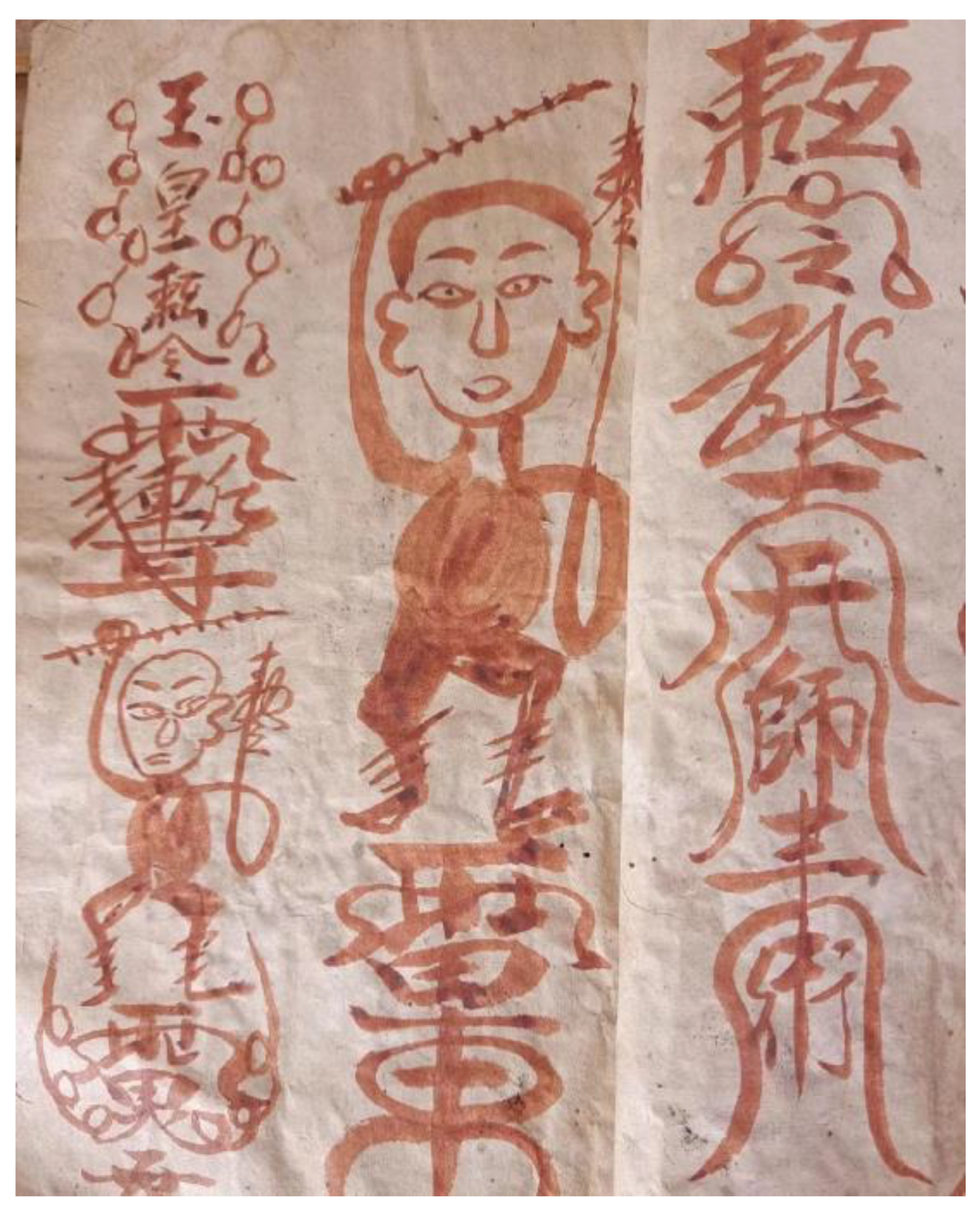
In the manuscript Secret Talismans of the Pre-Heaven (
Xiantian Fumi 先天符秘) reproduced below (
Figure 1), the inscription “By Imperial Command of the Jade Emperor” (
Yuhuang Chiling 玉皇敕令) invokes the Jade Emperor (
Yuhuang Dadi 玉皇大帝), the supreme celestial sovereign in Chinese popular religion, the highest ruler of the myriad spirits, and the leader of the Daoist pantheon.
To legitimately command the numina of Heaven and Earth, the officiant must present the credential conferred at ordination. Its bestowal is marked by the solemn shou lu, a ceremony held inviolate within the Daoist community as the sacred moment when the adept’s name is entered into the celestial registers and he is authorized to summon spirit officers at will.
Liu Zhongyu summarises its meaning:
What inspires devotees is the radical change of status that occurs the moment the register is granted. After shou lu the initiate possesses a recognised place in the world of the immortals, an official entry in the Daoist rolls, and a publicly visible charisma that sets him or her apart from the un-ordained.
(Author’s translation,
Liu 2014, p. 210)
Within the Daoist community, therefore, there is a clear hierarchy between masters who have received the Lu and those who have not. An ordained practitioner possesses liturgical legitimacy recognised by the Daoist community: every rite he performs is lawful and regular, a form of “legal power” sanctioned by the tradition. A practitioner without ordination risks being branded heterodox. His practice is treated as illicit and potentially dangerous. Among believers, prestige, perceived thaumaturgic ability, and even material patronage correlate directly with possession of the Lu, the ordained command greater authority, are credited with stronger spirit-medium powers, and consequently receive more generous support.
Following the Tang–Song convergence of the Three Teachings, the Daoist pantheon underwent significant expansion. Deities originally native to Buddhist cosmology (Śākyamuni, Avalokiteśvara) and to the Confucian ritual order (the Three Sovereigns, Kongzi) were progressively assimilated into the Daoist talismanic writing. Consequently, these once-extraneous figures now function as integral components of the Daoist lingqi complex and constitute an additional reservoir of external divine spiritual power available for talismatic writing.
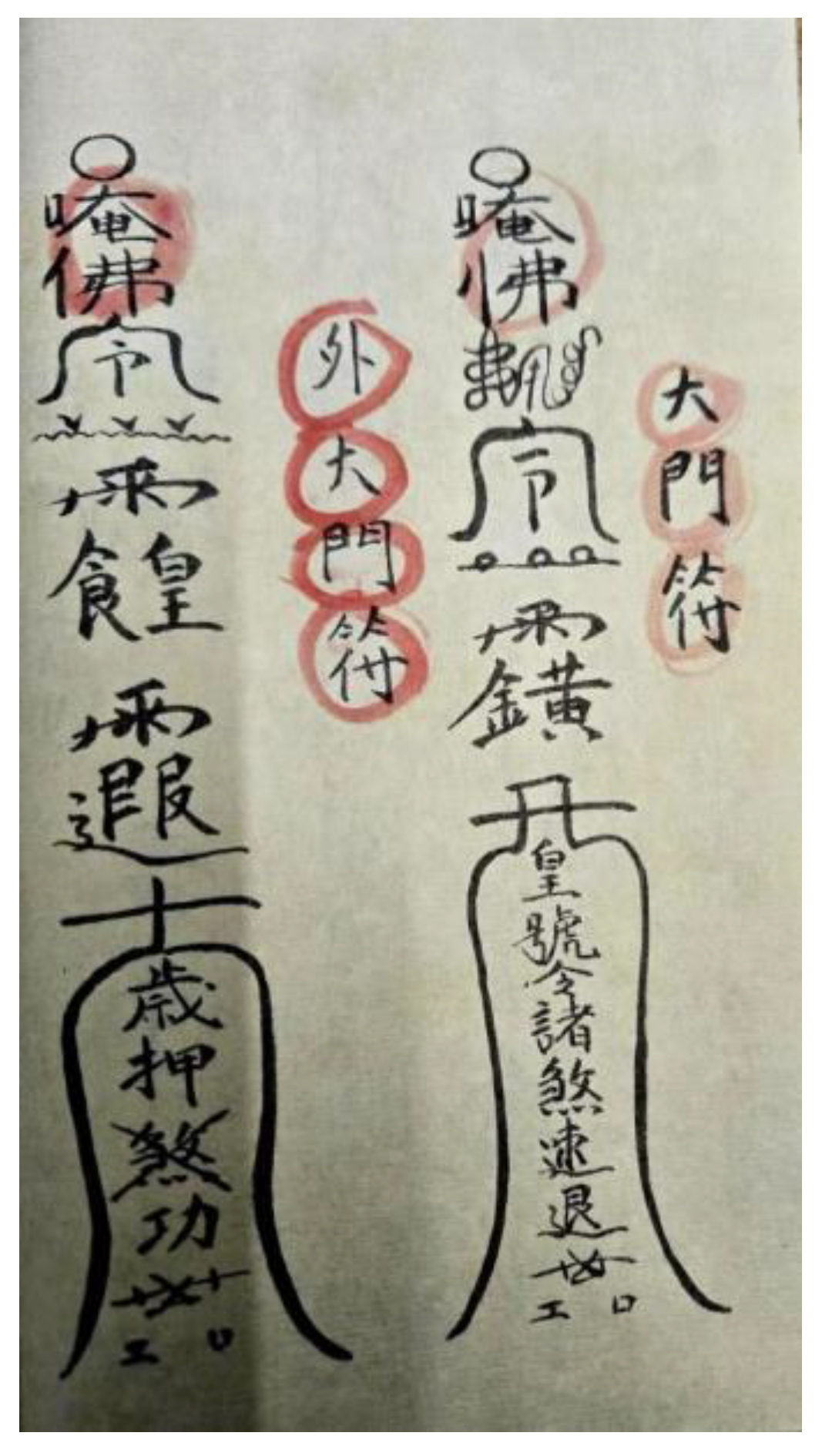
In the folk manuscript
Fashu (法書), both the Great-Gate Talisman (大門符) and the Outer-Gate Talisman (外大門符) (
Figure 2) carry the character
fo (佛), denoting the Buddha. In Buddhism, the Buddha is the archetype of the awakened human, not a deity. Yet, in popular devotion, he is revered as the supreme teacher and the most potent source of numinous power. It is therefore unremarkable that Daoist masters summon him through talismans to “handle affairs.” Moreover, talismanic culture abounds in totemic images of numinous beasts and supernatural creatures, all of which constitute additional reservoirs of external divine spiritual power.
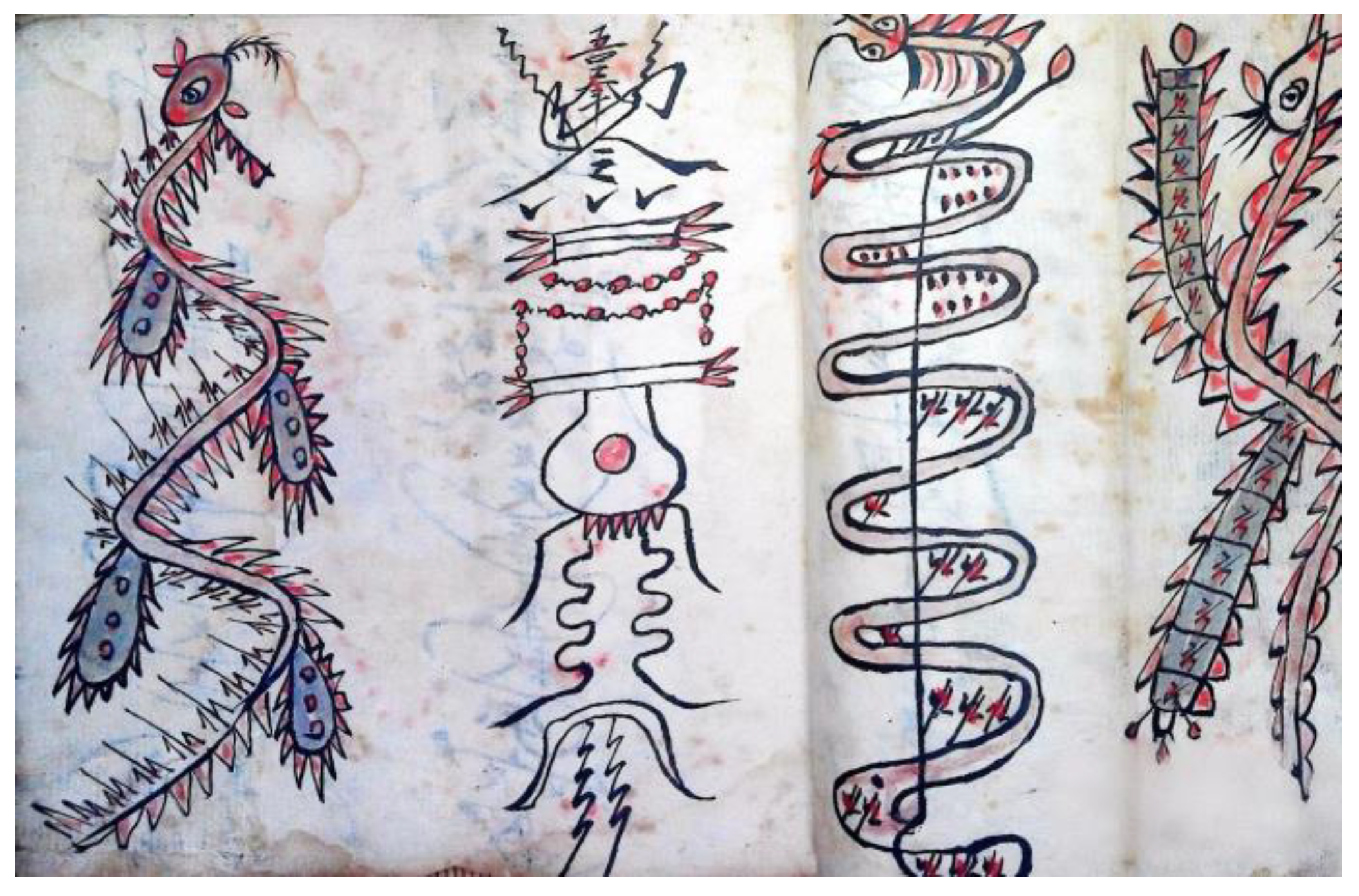
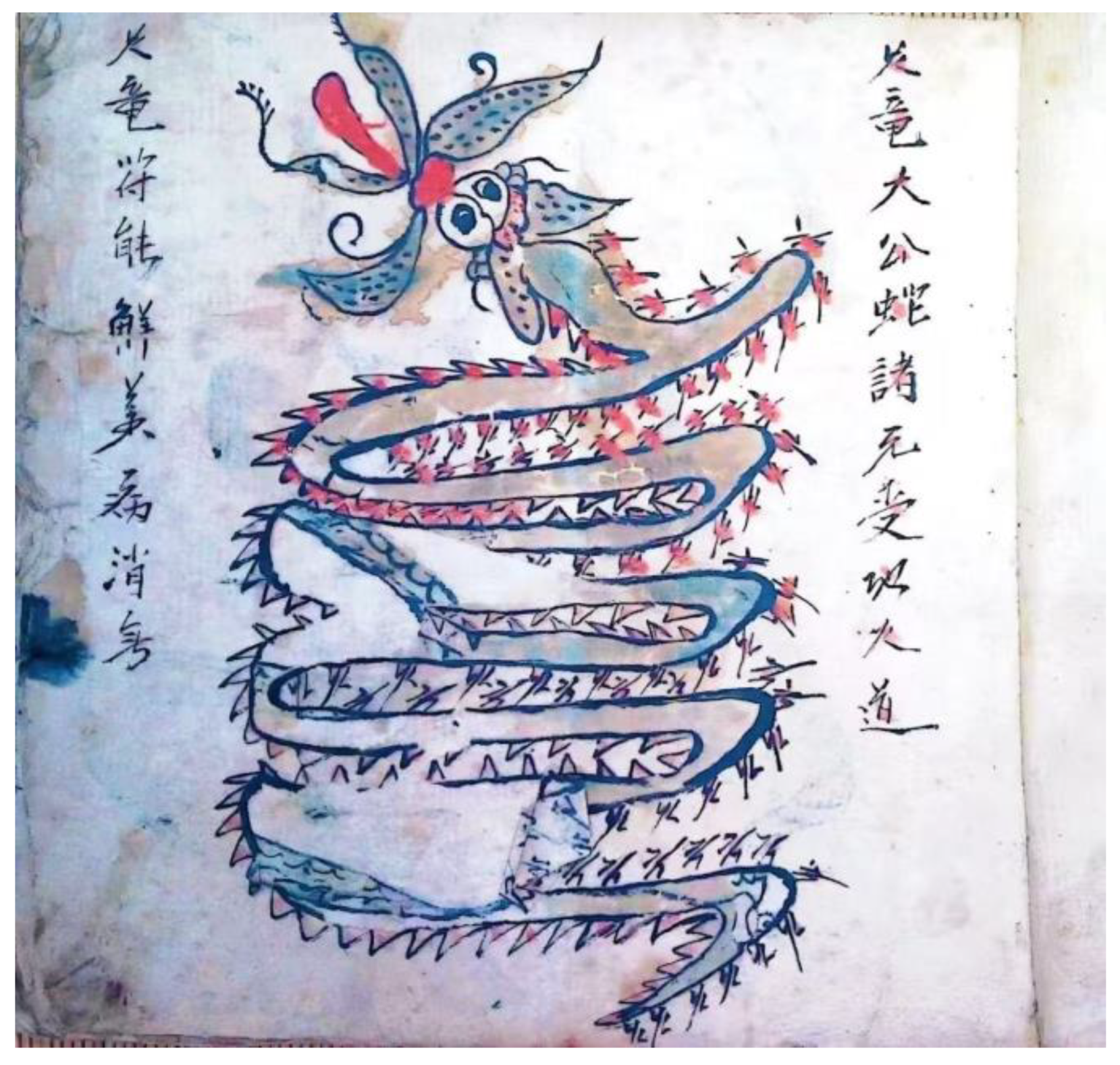
This Fire-Dragon Talisman (
Figure 3) is a typical Dragon-totem seal. In classical Chinese, the character “竜” is simply an alternate form of character “龍”, and both are read as dragon, so their graphic shape is the same. What catches the eye, however, is the caption “Great Lord Snake” (大公蛇) written beside the dragon. In folk religion, the snake is regarded as the prototype of the Dragon. Snakes are commonly called “little Dragon,” and in that register the full-grown Dragon can be addressed—half playfully, half respectfully, as the “Great Lord Snake.”
In the image above (
Figure 4), the talisman contains both Dragon and serpent totems. Along the totems’ body and beside each emblem, the character fire (火) is written over and over. This technique of repeatedly inscribing the same Chinese character is widespread in Daoist talismanic writing. It foregrounds the talisman’s nature and function and intensify the its numinous power.
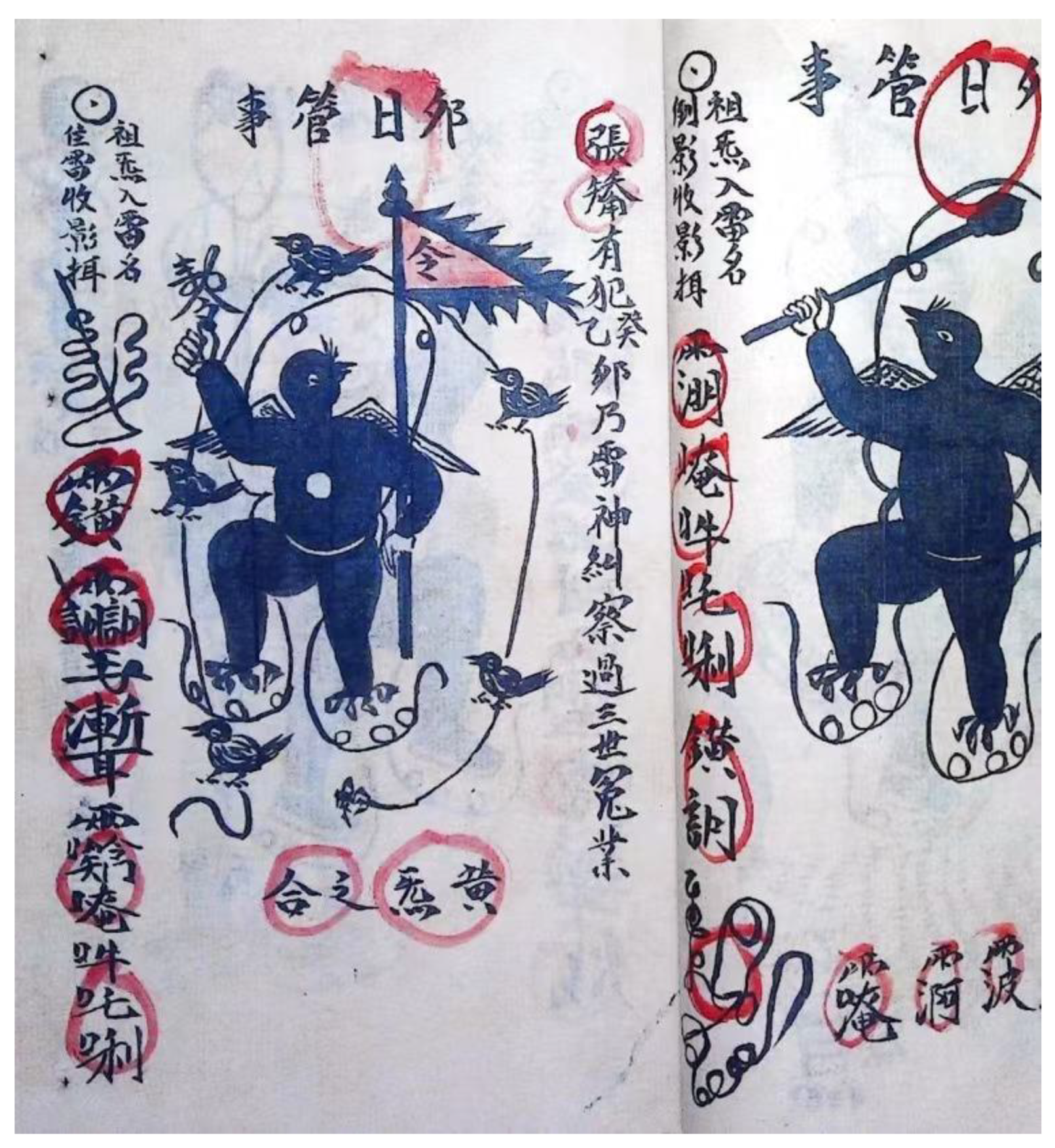
The manuscript Thunder Rites (
Figure 5): Duties on the mao-day are filled with avian totems. Their prominence rests on a cluster of Daoist associations. In early canonical texts, the Original Beginning does not reside in the later
San-qing heaven but in a side palace on Mount Human-Bird (人鳥山), so birds became the conduit through which his power is tapped. Because immortals and birds are interwoven in mythic genealogy, the totem functions as a communicative bridge to the divine. At the same time, the image is believed to bear auspicious force and to amplify the talisman’s efficacy and spiritual potency.
The ancients believed that all beings are animate. Beyond the power lodged in numinous beasts and monsters, they also credited the stars, lightning, clouds and other natural phenomena with exceptional spiritual force. The Yunji qiqian (雲笈七簽, a collection of Daoist texts, systematically collects doctrines, rituals, hagiographies and esoteric techniques from the Six Dynasties through the early Song, and is regarded by scholars as a “minor Dao Zang”) states
Talisman seizes the configurational force of clouds and stars. Writing analyses the phonetic clauses and metrical meanings of characters. Image depicts the shapes of spirit-transformation. In every talisman, writing is inseparable from image, and in every script, image is inherent; consequently, form and sound function as a unity. From this unity emerge the “eight styles and six scripts,” each defined through its relation to the others.
(Author’s translation)
符者,通取雲物星辰之勢;書者,另析音句詮量之旨;圖者,畫取靈變之狀。然符中有書,參以圖像;書中有圖,形聲並用。故有八體六文,更相顯發。
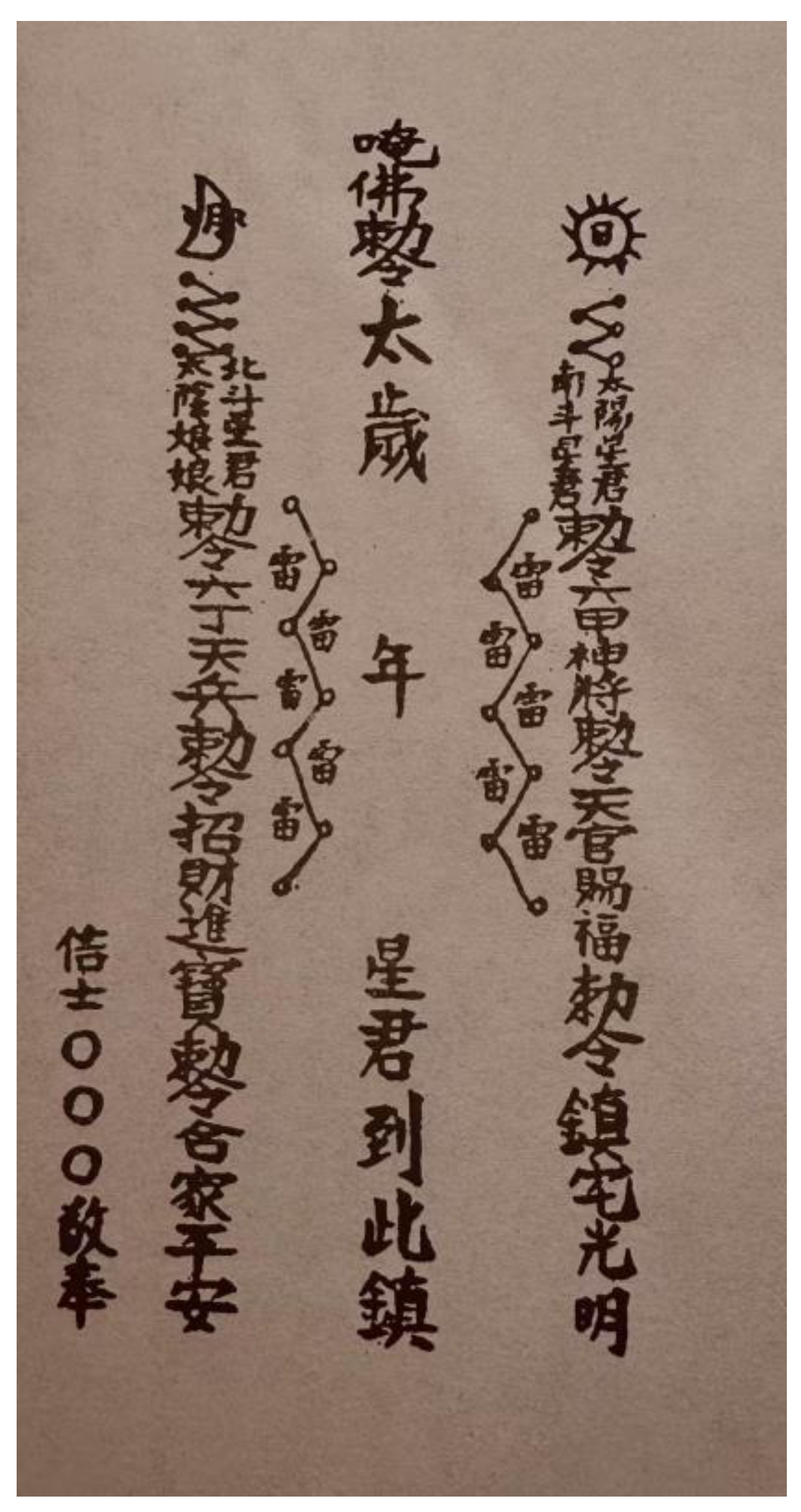
It is clear that a talisman can draw its potency from the inherent momentum of the cosmos itself. Such talismans are regularly accompanied by icons of sun and moon, constellations, vaporous clouds or forked lightning. By depicting solar, lunar, and stellar totems, the ancients sought to seize power through image: the icon itself invokes the corresponding cosmic force.
Taisui, or the Grand-Year, is a personified stellar deity who governs the annual cycle in Daoist cosmology. Believed to reside in a specific sector of the sky, he oversees fortune and misfortune for that year. Talismans bearing his name are used to secure his protection and avert the misfortunes associated with his directional influence. The
Taisui Talisman (see
Figure 6) recorded in the
Maoshan Talisman-Curse Marvelous Book (
Maoshan Fuzhou Qishu 茅山符咒奇書) places the sun and moon at its core, thereby borrowing the mystical energy of the two luminaries to charge the talisman with external divine spiritual power.
This Taisui Talisman incorporates solar and lunar totems that emblematize both the passage of time and the numinous authority of the Grand-Year star-lord.
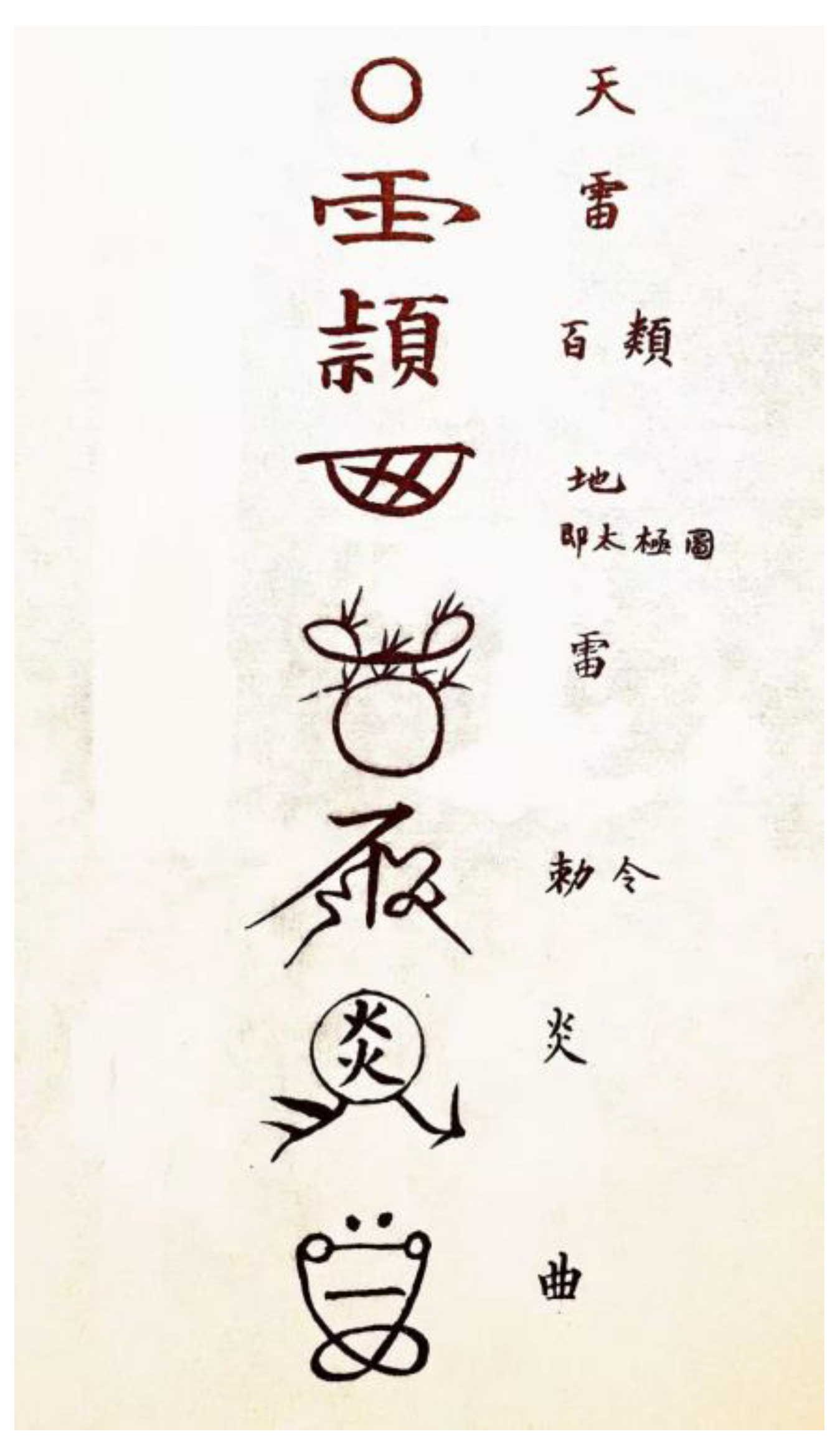
Talismans also contain single iconic signs for Heaven and Earth, as illustrated in the Escort Talisman shown below:
In this talisman (
Figure 7), Heaven and Earth are rendered as two distinct totemic icons. No longer mere physical realms, they are deified, charged with numinous power. The entire design declares that Thunder Ancestor (
Lei Zu 雷祖) issues his decree from the depths of the earth, sending forth dazzling light to shield the mariner who petitions him. The Thunder Ancestor places the supplicant under the guardianship of the Confucius Star, also known as
Wen-qu (the Literary-Crooked Star). Then, he towers over the boundless cosmos, his personal, blazing seal of power. This is the Thunder Ancestor’s own hand and seal, an irresistible mandate vested with supreme, unchallengeable authority.
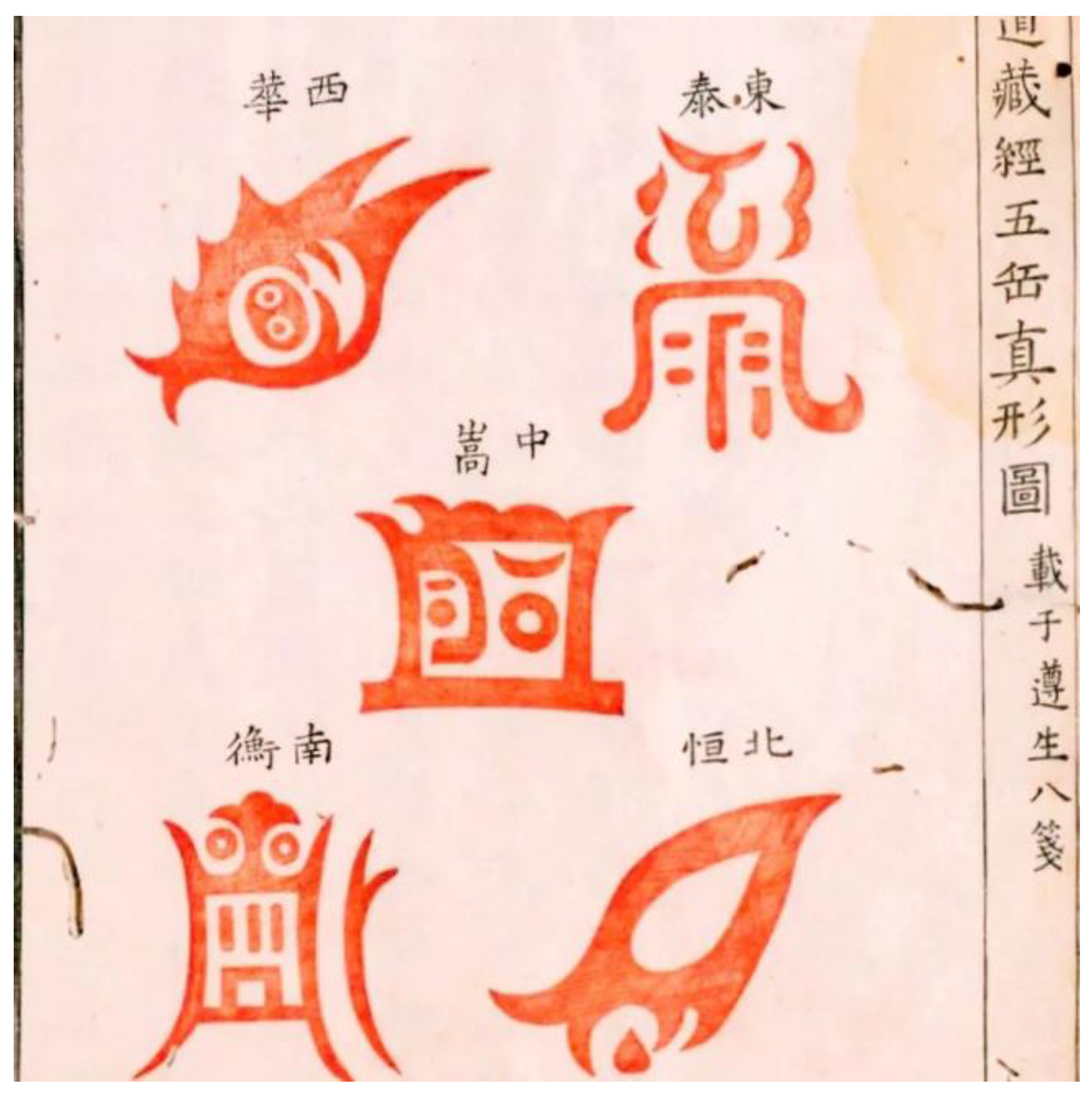
Among mountain-and-river totems, the most emblematic is the Wuyue zhenxing tu 五嶽真形圖 (True Forms of the Five Marchmounts).
The preface to the Wuyue Zhenxing Tu, attributed to Dongfang Shuo (東方朔), states
The True Forms of the Five Marchmounts (
Figure 8) are the images of mountain and water.
(Author’s translation)
《五嶽真形》者,山水之象也。
Figure 8.
Wuyue Zhenxing Tu from the Daoist Canon, Ming Wan-li block-print edition.
Figure 8.
Wuyue Zhenxing Tu from the Daoist Canon, Ming Wan-li block-print edition.
The True Forms of the Five Marchmounts is not a topographic map but a set of five talismanic glyphs that encode the hidden structures of the sacred peaks. Mountains that serve as cosmic axes between Heaven and Earth and as symbols of supreme religious authority.
The protective power of the Wuyue Zhenxing Tu is clearly documented by the Eastern-Jin Daoist master Ge Hong (葛洪 283–343CE). In the Nei Pien (Inner Chapters) of the Baopuzi (抱樸子, Master Who Embraces Simplicity), particularly in the chapter “Climbing and Mountain Travel” (Dengshe 登涉), Ge Hong writes that
When the superior adept enters the mountains carrying the Scripture of the Three Sovereigns and the True Forms of the Five Marchmounts, he can summon the mountain gods wherever he goes, so that the sprites of wood and stone and the essences of rivers and peaks dare not approach.
(Author’s translation)
上士入山,持《三皇內文》及《五嶽真形圖》,所在召山神,乃按鬼錄,召州社及山卿、宅尉問之,則木石之怪、山川之精,不敢來試人。
The True Forms of the Five Marchmounts is above all a protective talisman. Worn while traveling. All evil demons, mountain sprites, water monsters and noxious spirits will hide and flee, not daring to inflict harm. Hung at home, it serves the same purpose. Ge Hong notes in the Baopuzi Outer Chapters, Chapter Broad Overview (Xialan 遐覽) that
A household that keeps the True Forms will avert disaster. Anyone who tries to harm its members will bring the evil back upon himself.
For this reason, some Daoists and devotees have mounted the talisman as a wall hanging and installed it in their homes to ensure lasting peace.
In sum, external divine spiritual power constitutes one of the principal reservoirs from which the efficacy of Daoist talismanic writing is drawn.
3. Innate Primordial qi Spiritual Power
Besides external divine spiritual power, High Master’s own innate pre-celestial_qi_ is equally indispensable. The Qingwei Yuanjiang Dafa (清微元降大法) states tersely that
Spirit is none other than my true qi.
(Author’s translation)
靈者,我之真炁也。
Without this interior luminescence the priest has no resonance-rod with which to invoke deities. The Daofa Huiyuan drives the point home:
I penetrate Heaven and Earth, move from darkness into light, and transform in countless ways—what among these is not myself? If within there is no ruling core, my vital breath scatters and my spirit grows dim; during ritual I rely solely on talismans and spells, hoping for a one-in-ten-thousand chance of success. I have never seen such a person succeed.
(Author’s translation)
通天徹地,出幽入明,千變萬化,何者非我?倘中無所主,氣散神昏,行持之際,徒以符咒為靈,僥幸於萬一,吾見其不得也矣。
Daoism equates qi with spirit and with numen itself. Hence, every High Master is obsessed with refining qi. The tradition distinguishes at least two strata of qi:
Post-celestial breath (houtian zhi qi 後天之氣): the ordinary life-force that pervades the cosmos and sustains the body; it is the air we inhale, the ubiquitous vitality common to all phenomena.
Pre-celestial breath (xiantian zhi qi 先天之氣) written with the archaic character 炁 to signal its primordial status. This is the energy that antedates Heaven and Earth, the mother-stuff from which the cosmos was woven. Identical with the Dao’s own substrate, it is variously styled Original Qi of the Pre-celestial One, Pre-celestial True Qi, or Grand Unity Embryonic Qi. Finer, purer and of a higher vibrational order than post-celestial qi, it constitutes the adept’s inner power.
Whether a talisman “works well” depends above all on the presence of this Gao Gong’s pre-celestial. The act of infusing one’s self-cultivated qi into the paper is called buqi (布氣) “deploying breath.” The adept who has realized the Dao distills his own jing (精), qi (氣) and shen (神) (essence, vitality, spirit) and spreads them through the strokes of the talisman. The secret manual of Daoist talismanic writing, Methods for Writing Talismans (Shu Fu Bi Fa書符筆法) states that
A talisman is union and trust: my spirit joins the other spirit, my breath joins the other breath; spirit and breath are formless, yet they take form in the fu. My act evokes response, my summons evokes numen—does this not reside in the fu ? … The numinous is numinous of itself; the responding is responding of itself. No further question need be asked.
(Author’s translation)
符者,合也,信也。以我之神,合彼之神;以我之氣,合彼之氣,神氣無形而形於符。此作而彼應,此感而彼靈,非於符乎? 靈者自靈,不必問其所以靈;應者自應,不必問其所以應。
The efficacy of a talisman is determined less by the external divine spiritual power than by the adept’s own cultivation. Whether the fu responds depends on the fullness of his pre-celestial vital essence and the clarity of his original spirit: luminous qi makes a luminous talisman, divine spirit makes a divine talisman. When the adept’s spirit is luminous, every object he touches becomes, in effect, a talisman, charged with the same numinous power that already resides within his qi. As stated in Qingwei Yuanjiang Dafa, scroll 25:
The talisman is the true message between Heaven and Earth. Most people borrow only vermilion, ink, paper and brush, but the enlightened know that a single ray of inner light can pierce the cosmos and penetrate the earth. Wherever the spirit is lodged, there is the talisman. It may dwell in emptiness, in water and fire, in tiles and shards, in soil and stone, in plants and trees, in food and drink; it can be present or absent, it can connect and it can transform. This is called the Dao.
(Author’s translation)
符者,天地之真信。人皆假之以朱墨紙筆,悟獨謂一點靈光通天徹地,精神所寓,何者非符?可虛空,可水火,可瓦磔,可土石,可草木,可飲食,可有,可無,可通,可變,是謂道法。
The qi stored in the dantian (丹田,the abdominal qi reservoir) is called the talisman’s secret node of power (fuqiao 符竅). Dantian of the talisman-writer is a primary source of the fu’s numinous power. As Daofa Huiyuan warns,
Draw a talisman without knowing its node and even ghosts will laugh.
Draw it with the node and ghosts will cry out in alarm.
(Author’s translation)
畫符不知竅,反惹鬼神笑。
畫符若知竅,驚得鬼神叫。
To be more precise:
Practitioners today, unaware of the root of the Dao, squander their efforts on paper and take any random stroke to be the talisman’s node. They fail to realize that this node is no ordinary aperture—it is produced by the union of Heaven and Earth and is called the ‘Spirit-Qi Cavity’; within it lie the essences of Kan (the yang-fire hidden in water) and Li (the yin-water hidden in fire). You must seek it inside your own body; never look for it outside. Whoever understands this single node grasps the true secret of all Daoist arts. These words have already been spoken too plainly—ponder them well.
(Author’s translation)
今之行持者,不明道法之根源,妄於紙上作用,以為符竅。殊不知此竅非凡竅,乾坤共合成,名為神炁穴,內有坎離精。當於身中而求之,不可求之他也。人能知此一竅,道法之中真要妙。此漏瀉之言也,子其味之。
Although the foregoing citation identifies the fuqiao with the qi stored in the dantian, Daoist and medical texts never pin that region to a single acupuncture point. Consensus locates it only in the lower abdomen. The decisive question remains: by what concrete technique is the adept’s dantian-qi transmuted from an intra-somatic reservoir into the graphic substance of the talisman itself? In Wang Shichen (王侍宸)’s Eight-Section Brocade for Prayer, chapter On Writing Talismans (祈禱八段錦·書符章), the method is given in detail:
Do you wish to know the secret of writing a talisman?
Shichen said: The breath must be full, only then can it reach Heaven above, subdue demons below, and move wind, rain, thunder and lightning in between. When you take up the brush, first still your breath. Hold the brush firmly; draw a long, slow inhalation through the nose, purest air, no turbidity. Then hold the breath: not the slightest leak. With the breath still sealed, write the talisman at once. When the stroke is finished, flash the summoned officers into the paper with the Celestial Eye (between the brows), exhale mightily upon the talisman so a mantle of golden light covers it, and visualize the invoked divine officers standing inside the characters. Immediately seal the talisman with three breath-syllables.
If, while writing, you let the breath escape or fail to hold it, the fu will not respond; any result you obtain is mere accident, not the power of the talisman itself.
(Author’s translation)
書符秘訣,願聞其妙。
侍宸曰:氣在乎全,則上可以達天真,下可以伏妖魅,中可以感動風雨雷電。當書符之時,先須定息,乘筆,以鼻引氣,長引一吸,不可濁,最要清氣。然後閉氣,全無呼吸。急以筆書符,畢,以天目爍入所召將吏入符中,口大呵出氣於符,金光罩符,存見所書符中,有所召將吏在內,急用口、口、口三字,押符上。若書符之時,走泄口中之氣,或口不閉氣書符,其符不靈。縱有靈驗,偶然一時耳,非符之力也。
When deploying qi, three conditions must be met simultaneously: the breath must be full, it must be the purest pre-celestial qi, and the respiratory seal must remain unbroken: no leak, no pause, one single exhalation from start to finish. Only when the pure current runs uninterrupted does the true innate breath enter the talisman. The slightest escape turns it into post-celestial turbidity and the talisman loses all power.
How is pre-celestial true qi acquired or cultivated? Daoists agree that the first step is zhai (齋), ritual fasting and ablution to cleanse body, heart, and mind. The exact regimen varies. The Yunji qiqian, Fasting and Precepts Section (Zhaijie bu齋戒部) states that
The Shang-qing order recognizes two levels of fasting: first, severing all company and dwelling alone, so that the breath is stilled and the body forgotten. Purifying the altar and solemnizing the companions, performing the rites according to the Taizhen ceremonial code. And second, heart-fasting, a process of dredging the heart and bathing the spirit—metaphors for an inner cleansing that washes away turbid emotions and restores the mind to empty tranquility, uniting it with the Dao.
(Author’s translation)
上清齋有二法:一者絕群獨宴,靜氣遺形,清壇肅侶,依太真儀格;二者心齋,謂疏淪其心,澡雪精神。
Among these three, heart-fasting, also termed inner fasting, is regarded as the root, a disciplined cultivation of interior purity whose ultimate aim is to render the adept’s mind limpid, empty, and consubstantial with the Dao.
Persistent training in mind-method (xinfa 心法) is equally essential for engendering pre-celestial breath. At the core of these disciplines lie retentive contemplation (cunsi 存思) and retentive visualization (cunxiang 存想). Liu Zhongyu observes in Study on the Daoist Register-Conferral System that
The ritual transformation of the altar (huatan 化壇) and the summoning of the generals (zhaojiang 召將) … are the pre-conditions for any Daoist liturgical offering (zhaijiao 齋醮). The ascent of the altar marks the commencement of ritual action, while the visualization of gods is the method for summoning of the generals. The former converts the mundane arena into a celestial realm, the latter employs the invoked generals to bear the memorials to the sage courts of the Three Clarities or the Jade Emperor’s golden hall and to execute divine authority, arresting and beheading demons. Without these steps there is no access to the gods. The key to both lies in retentive visualization. Apart from the episodes of altar-transformation and general-summoning, the acts of self-deification, presenting memorials, offering incense, and invoking the sages all depend on retentive visualization. Indeed, they are ultimately accomplished by it. Throughout the entire liturgy, altar arrangement, music, scripture recitation, incantation, talisman writing, pacing the Dipper (bugang 步罡), and finger-knotting seals (qiajue 掐决), everything is an external, visible form. Only retentive visualization is the interior movement of the master. It is precisely this inner visualization, carried out in concert with the outer forms, that constitutes the substantive conduit linking the human and the divine.
(Author’s translation,
Liu 2014, p. 291)
Because retentive visualization is an “interior movement” of the master, it is inevitably the most hidden and least accessible dimension of the entire ritual process. The Daozang supplies the operational sequence:
Before writing any category of talisman the officiant must enter the jing or purified chamber where incense lamps paper and inkstone are all in place then perform the inner refinement called Ten Rotations Return to Spirit. Sitting motionless he regulates breath and mind and settles awareness in the Yuanquan Palace within the lower dantian. He visualises the primordial qi of the Celestial Treasure rising from the centre ascending through the twenty four spinal nodes to the Niwan Palace of Mud Pellet at the crown and descending again to the lower palace completing ten full cycles. Next he contemplates three luminous deities each riding coloured clouds rising from the three dantian regions and stationing themselves within the Niwan. Then three corresponding celestial deities descend through coloured clouds into the Niwan and all six merge into one. In this interior Niwan Palace, he clearly beholds his own Dan Yuan Lord presenting the petition. The Jade Emperor graciously assents and orders the attendant perfected golden lads and jade maidens to deliver a jade casket and a precious scroll amid a hundredfold radiance of treasures. After offering silent thanks, the adept channels a stream of jeweled light from his crown, merging it with divine qi to illumine all within and beyond. Phoenix seals and dragon script hover above the table as he clicks his teeth twelve times, sealing the vision.
(Author’s translation)
凡書符篆諸品,須依法入靖,香燈紙劄筆硯之屬,一一備具,先行內煉十轉回靈之道。法師靜座調息神息,澄虛存下丹田淵泉宮。靈寶先天祖無自中而歷二十四節,直透泥丸頂門,又復降下元宮,復升周回十過,畢次存三田中,有三尊乘三色雲氣,上升端坐泥丸之中。次有天上三色雲氣中三尊,降自泥丸,混合為一,如此分明自己丹元君上朝心奏所陳之事,須臾慈顏允奏,敕命左右侍真,金童玉女,捧函玉笈在百寶光中,降付容臣。奉行即密謝畢,自己真人頂出寶光,混合神無,內外洞明,鳳篆龍章,徘徊於幾案之上,叩齒十二通。
During cunxiang (存想), the mind is likened to a clear mirror reflecting every phenomenon. At the same time, the practitioner must mobilize deliberate intent and imaginative power to resonate and commune with the object of visualization. When the practitioner wishes to summon the Celestial Worthy of Numinous Treasure, he must silently intone that very name within his heart. When he wishes to summon the tri coloured cloud vapours, he must give his whole mind to those clouds without the slightest wavering. He must focus his imagination utterly never allowing distraction or doubt about the reality of these images to enter his awareness. As stated in the Supreme Numinous Treasure Great Method (太上靈寶大法),
When visualization and intent achieve sympathetic resonance, auspicious responses are inevitably manifested.
(Author’s translation)
存念感通,克彰嘉應。
Hence, it can also be said that the talismanic method is none other than mind-method. Focused intent is itself numinous power. When the deity is present in the heart, it is present in the talisman.
Beyond deploying breath and retentive visualization, the concrete handling of the brush determines whether the finished talisman will be judged efficacious. Stroke order, pressure, speed and the ritual choreography that accompanies it must all be meticulously controlled. The Shu Fu Bi Fa (書符筆法) gives the full drill:
First cleanse the mind to crystal stillness and cut off every stray thought. Let your awareness fill the eight directions so that spirit returns and breath gathers. Only when the original god stands before you do you grip the brush. Fix your eyes on the tip and visualize a beam of inner light issuing from both eyes. Watch it merge at the brow-center into a millet-sized golden bead that at once stretches into a golden thread flowing down the hairs of the brush. Silently recite the Thunder Canon and see the radiance widen until it fills heaven and earth while you whisper the san-wu secret names. If you are writing a talisman for zhaojiang use the method of your own lineage and layer seals or titles as the moment requires. Yet the crux is always that single ray of inner light. Before the vermilion even touches the paper the universe is already illuminated and the true subtlety lies in the work done beyond ink and brush.
(Author’s translation)
其决曰:先澄澄湛湛,絕慮凝神。使其心識,洞然八荒,皆在我闥,則神歸氣,復元神現前,方可叮執筆。以眼瞪視筆端,思吾身神光自兩規中出,合乎眉心,為一粒黍珠在面前,即成金線一條,光註毫端,便以法書篆。心悟雷篇,思金光漸漸廣大,充塞天地心,念三五諱。如召將書符則用本法。召咒或疊書諸號,皆隨意運用。雖然如是,一點靈光,輝天朗地。未曾下筆,已自分明,妙於行持者,尤當於朱墨外用工夫。
When writing a talisman, the scribe must infuse it with both retentive visualization and pre-celestial breath. He need not fret over minor details. What matters is that the entire stroke be executed in one unbroken flow. The Record of the Divine Talismans of the Three Caverns (Sandong Shenfu Ji 三洞 神符記) states that
The practitioner must withdraw the senses and gather every wandering thought, maintaining utmost sincerity so that the mind becomes like boundless space, pure and luminous within and without. At this moment the Original Beginning is none other than myself, and I am the Original Beginning. The instant intention arrives the brush moves, and the talisman is completed in one unbroken breath. Should a stroke or dot vary slightly, one need not cling to rigid rules. What matters is to let the brush follow its own momentum so that the subtle inner meaning is fully realized.
(Author’s translation)
收視反聽,攝念存誠,心若太虛,內外貞白,元始即我,我即元始,意到運筆,一氣成符。若符中點畫,微有不同,不必拘泥,貴乎信筆而成,心中得意妙處也。
The essential point is to keep the mind free from all distractions and obstructions, letting the talisman take shape in harmony with the qi.
While writing, the adept must also recite the appropriate spell in order to charge the talisman with additional numinous power. For example, when writing the Blood-Lake Soul-Recalling Talisman (Jing Xuehu Zhuihun Fu 凈血湖追魂符), the priest simultaneously recites the following incantation:
Dì dǎng dì dǎng, the Dharma-water rolls vast;
the tower has its officer, who drags the soul before the altar.
Swiftly, as the agony of birth, protect and confirm the True Constant!
Swiftly, as the statute commands!
(Author’s translation)
諦讜諦讜,法水浩蕩
圊樓有將,攝赴壇前
急急如產苦、護證真常
急急如律令。
4. Fundamental Dao Spiritual Power
In plain terms, both the numinous power delegated by external deities and the innate pre-celestial qi cultivated within the adept are simply two modalities of the single potency that is the Dao itself. As the Qingwei Daofa Shuniu (清微道法樞紐) section of Daofa Huiyuan, succinctly states,
Dao transforms into ling (numen), ling into jing (essence), jing into qi (breath), and qi into shen (spirit).
(Author’s translation)
道化靈,靈化精,精化氣,氣化神。
Thus, the Dao comes first, and ling, qi, and shen are all derivative. The essence that the priest refines is none other than “ the Dao’s own essence.” Inscribing a talisman means deploying this Dao-essential qi upon paper so that it mingles with the essential qi of all existence.
Across the Daoist canon, it is consistently asserted that the Dao-as-source constitutes the fundamental wellspring of all talismanic efficacy. In Declarations of the Perfected (Zhengao 真诰) describe the celestial seal-script (tianzhang yunzhuan 天章雲篆) as
The Three Primes and Eight Convergences, the luminous seal of brilliant radiance, the characters of spirit-script and divine writing, sever all corpse-taint and vulgar forms of the human world, thereby revealing that the root of writing lies in the Mysterious Ruler.
(Author’s translation)
三元八會,靈篆明光之章,神靈符書之字,絕去人間屍穢俗體,而知書法本乎玄宰。
Mysterious Ruler is the symbol of Dao. In Daoist symbolism, xuan (玄 mystery) denotes the Dao itself, while zai (宰) carries the archaic sense “to govern.” Together, they form a deliberate conceptual cluster: if xuan is the primordial source and mother of the myriad things, zai is the immanent “governing mechanism” of that abyssal origin. Thus, xuanzai is understood as the wondrous Great Dao that transcends form yet steers all cosmic operations. Ontologically, it is simply another name for the Dao. The phrase therefore announces a methodology of “letting the Dao rule itself”. The priest’s talismanic act is the conduit through which the Dao’s own regulatory power becomes operative.
Talismanic writing, therefore, has no higher aim than to manifest this ontological power of the Dao as operative glyphs on paper.
Although essence, qi, and spirit all originate in the Dao, their latent power can be converted into talismanic efficacy only through the adept’s own jing, qi, and shen, entering into sympathetic resonance with them. Philosophically, this demands the unity of substance and function, subject and object: without the subject’s function, the Dao’s substance has no conduit. Without the Dao’s substance, the subject’s function is a flame without fuel. Only when the two inter-depend does the talisman’s luminosity fully appear. As Shu Fu Bi Fa (書符筆法) states:
The method of writing a talisman is nothing more than issuing the marvelous function of the xiantian and circulating qi to complete the fu.
書符之法,不過發先天之妙用,運一氣以成符。
The pivotal term here is xiantian (pre-celestial). In Chinese philosophical discourse, xiantian carries several strata of meaning. From the perspective of Daoist philosophy, xiantian (pre-celestial) refers to “that which precedes Heaven”. The primordial state in which Heaven and Earth have not yet differentiated and yin and yang remain undivided. Tao Teh King Chapter 25 declares
有物混成,先天地生。寂兮寥兮,獨立而不改,周行而不殆,可以為天地母。
There is something undifferentiated yet complete, born before Heaven and Earth.
Empty and still, solitary and unchanging, ever-circling and inexhaustible, it can be called the mother of the world.
(Translated by Legge, James)
It denotes the ontological condition prior to the differentiation of Heaven and Earth. The pre-celestial qi is the essence of Dao. In contrast to xiantian, houtian (post-celestial) designates the subsequent cosmogonic phase during which yin and yang bifurcate, the myriad beings proliferate, and Heaven and Earth assume their manifest configurations, thereby constituting the phenomenal world as man perceives it. Moreover, the Daoist notion of xiantian is never merely a chronological marker. It is fundamentally an ontological and axiological category that designates the primordial root of the cosmos, the spontaneous order of nature, and the original wellspring of life itself. Functioning as a limpid mirror, it reflects and thereby relativizes every configuration of the houtian world.
Thus, xiantian is the substance (ti 體) and houtian the function (yong 用). Their unity constitutes the integral, ever-changing world. Yet, the objective pole, the cosmic source and the transformations of Heaven and Earth remains insufficient on its own. It requires the subjective pole, the Daoist priest, to draw forth and deploy the numinous power inherent within it. Only when this power is infused into the talisman does the talisman acquire true numinous power (lingqi灵气) and divine efficacy. As stated in the Qingwei Daofa Shuniu (清微道法樞紐) section of Daofa Huiyuan (道法會元),
The wonder of qi is the ancestor of the myriad methods. A spell becomes efficacious only when my own spirit is luminous. Once my spirit shines, the spell shines through. Exorcism, aversion, and petition all rely on spirit-officers, yet those officers have no fixed form. … In short, the method walks the pre-celestial Great Dao, and the generals employed are one’s own Original Spirit.
(Author’s translation)
一氣之妙,萬道之宗。法靈須在我神靈,我神靈兮法通靈。祛禳禱祈憑神將,神將何曾有正形。 。所謂法行先天大道,將用自己元神。
It makes clear that talismanic efficacy does not flow one-sidedly from either the objective “Great Dao as substance” or the subjective “adept’s cultivation,” but demands their mutual resonance and response. Only when subject and object are perfectly interfused, substance manifesting as function and function revealing substance, the latent power of the Dao fully appear as concrete talismanic result. In short, without the adept’s “functional spirit” to activate and mirror it, the objective “substantial Dao” cannot self-disclose. Without the Dao as foundation, the adept’s functional power has nothing to draw upon. The two must inter-penetrate and mutually authenticate before the fu can truly “become luminous.”
Besides the act of writing itself, several external variables can modulate a talisman’s efficacy. Timing is one: the chapter “Essentials of Spirit Talismans” in the Maoshan Talisman-Curse Marvelous Book (茅山符咒奇書) recommends the zi hour (子時 23:00–01:00):
The hinge between yin and yang when the response of the myriad things is most potent.
Equally important is the factor of belief: both the officiating High Master and the recipient must invest genuine faith. If the recipient dismisses the fu as superstition, the channel of resonance narrows and the effect is blunted; conversely, a devout recipient can enter stronger sympathetic vibration with the talisman’s numinous power, amplifying its potential.
5. Talismanic Writing as a Catalyst for Contemporary Graphic Innovation
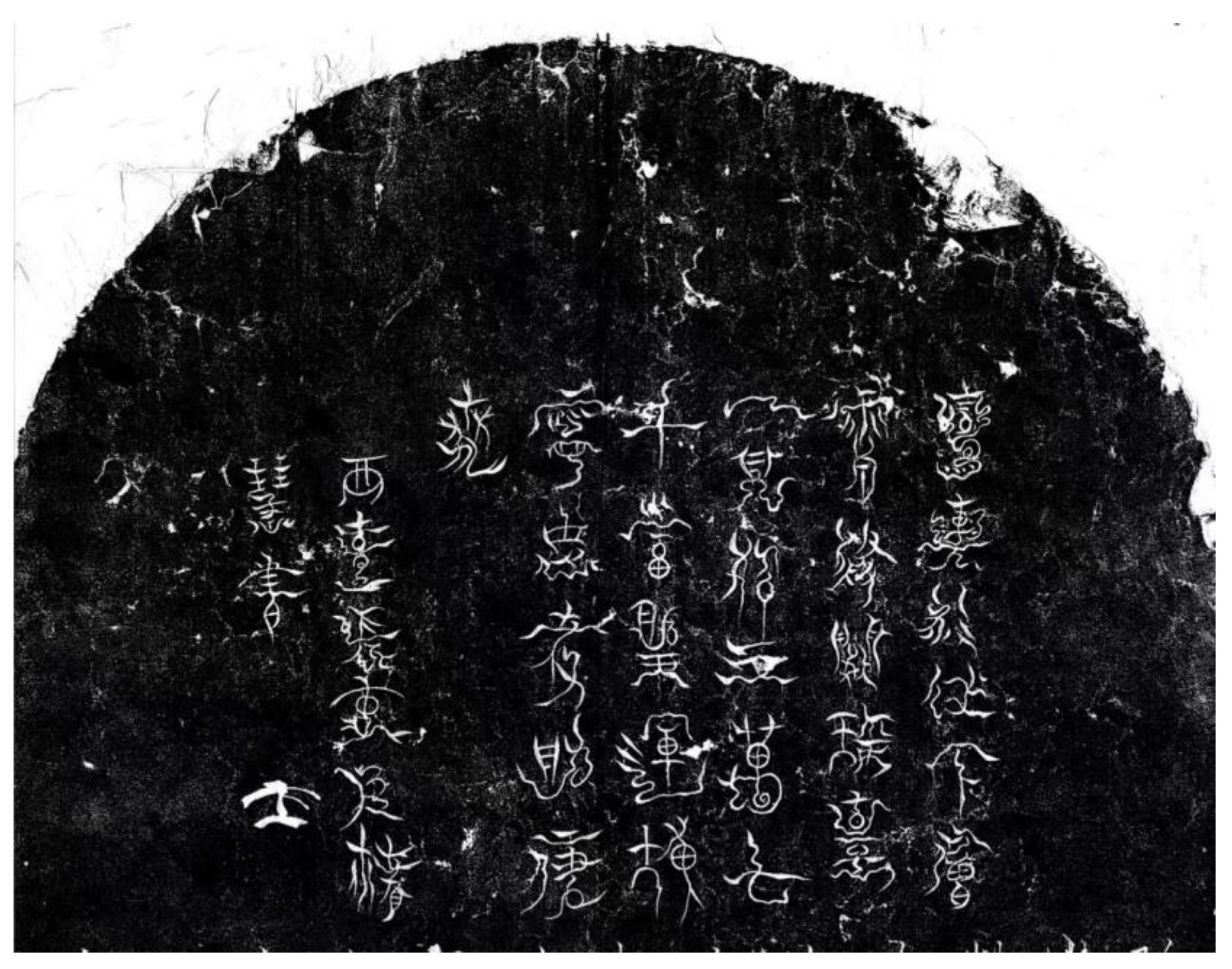
Talismanic writing exerted profound influence upon the artistic creation of ancient Chinese calligraphers. Tang Dynasty Daoist calligrapher Sima Chengzhen (司馬承禎), Song Dynasty imperial artist Zhao Ji (趙佶), Southern Song Daoist calligrapher Bai Yuchan (白玉蟾), and successive generations of Celestial Masters all absorbed, to varying degrees, the visual language and somatic techniques of talismanic writing.
Taking the stele header of Emperor
Huizong of Song’s
Longzhang Yunzhuan Bei (龍章雲篆碑 Stele of Dragon Script and Cloud Seal Script) as an example (
Figure 9), its cloud seal script typography and compositional layout clearly inherit Daoist talismanic traditions—cloud seal script, as sacred writing within the talismanic system, itself carries the symbolic connotation of containing the primordial
qi of heaven and earth.
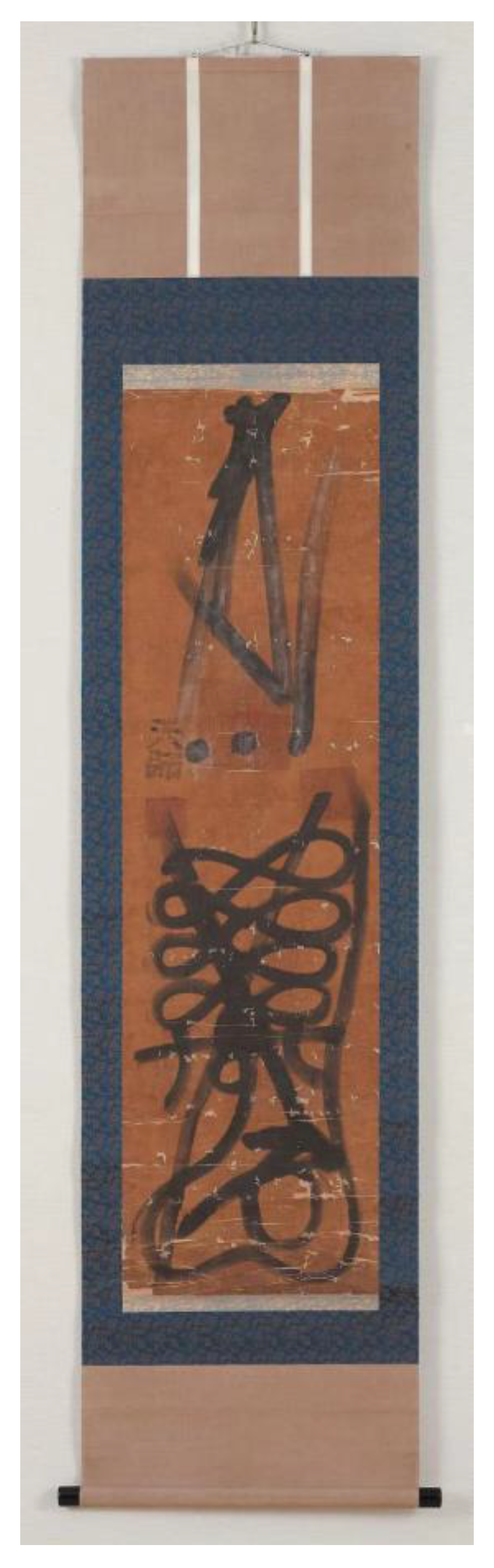
The relationship between the writing practices of successive Celestial Masters and talismanic traditions is even more direct, as exemplified by the hand-drawn Celestial Master talisman by the 45th Celestial Master
Maocheng (懋丞) of the Ming Dynasty (
Figure 10). The upper portion of the work features vigorous, unrestrained brushwork, while the lower portion employs repetitive, entwined strokes, presenting overall intense exaggeration and mystical visual characteristics.
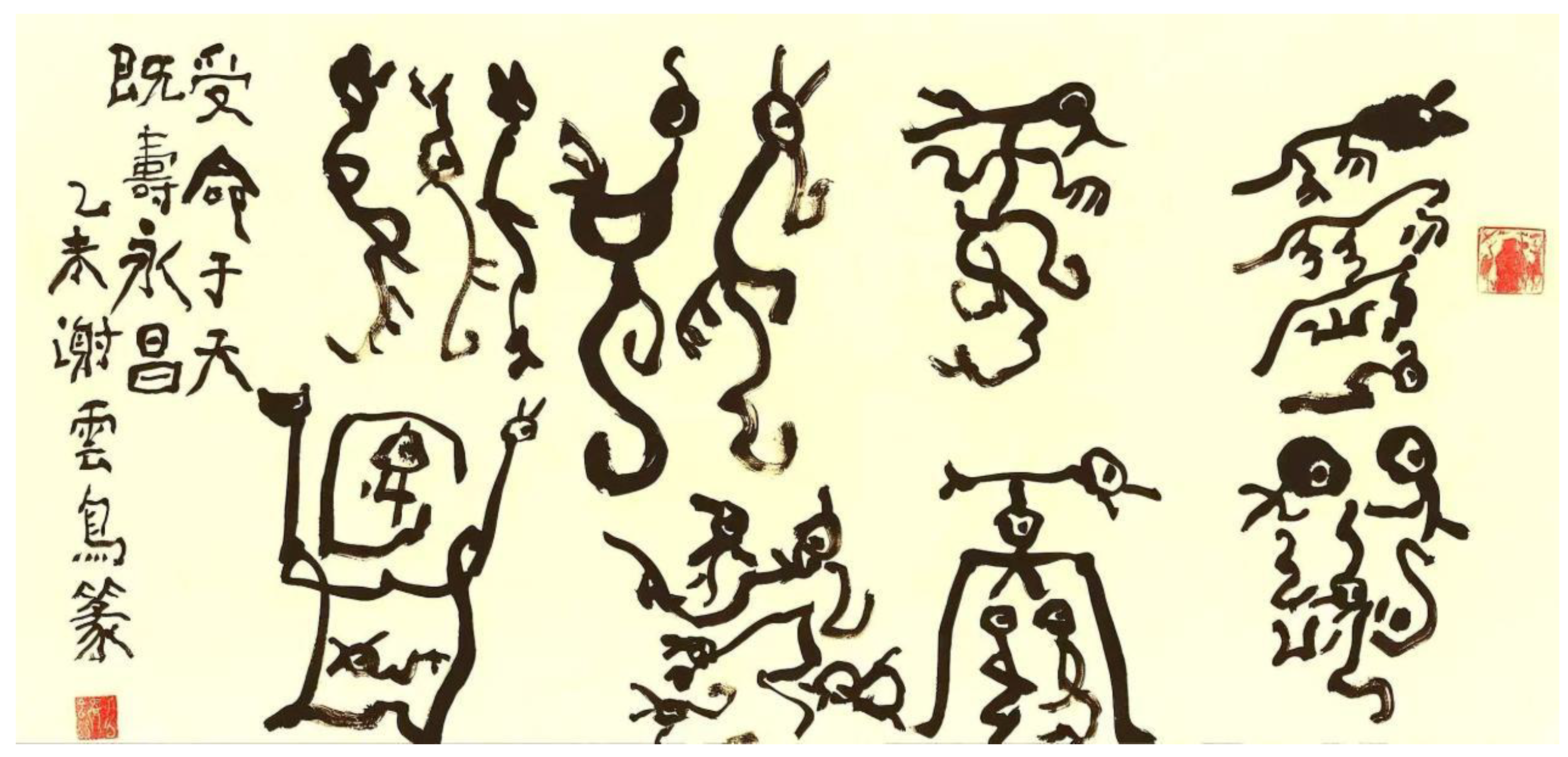
In the field of contemporary art, the revelatory value of talismanic writing has similarly received practical response. The writing practices of contemporary calligrapher Xie Yun (謝雲 1929–2021) and scholar-artist Gong Pengcheng (龔鵬程 1956–) may serve as representative case studies. Xie Yun’s Bird-Worm Seal Script Writing (
Figure 11) series integrates totemic symbols into stroke structures, employing entwined and coiling brush techniques to form a visual language combining pictographic and abstract qualities, creating an intertextual relationship with the totemic expression of talismanic writing.
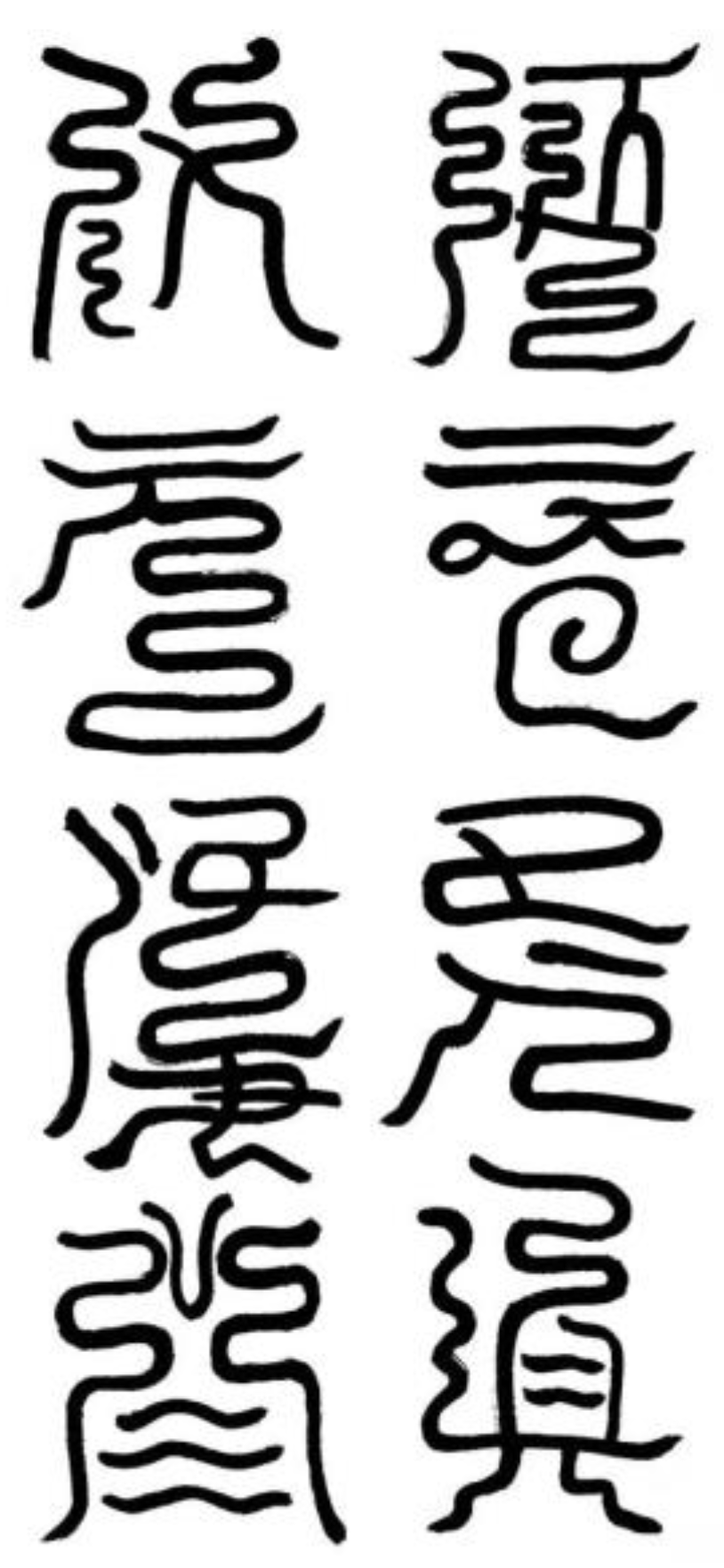
Gong Pengcheng’s Cloud Seal Script Writing (
Figure 12), on the other hand, directly invokes the Daoist cloud seal tradition. According to Daoist cosmology, cloud seal script constitutes celestial writing formed by the condensation of cloud
qi, tangled and woven into patterns, containing the primordial
qi of heaven and earth. Gong’s work employs rounded, vigorous, and extended brushwork, suffused with
qi, demonstrating the artist’s somatic mastery and visual expression of innate primordial
qi of the Great
Dao.
Beyond the aforementioned cases, the authors’ own artistic creation has also been deeply influenced by Daoist talismanic writing. The following section will combine Daoist cultivation experience with creative practice to specifically elaborate the conceptual revelations and methodological references that talismanic writing offers for contemporary writing art.
5.1. Enhancing the Adept’s Pre-Celestial qi for Writing Power
The efficacy of a talisman ultimately arises when the officiant activates the pre-celestial ontological power of the Dao itself, the wellspring of all numinous force. This insight indicates that the refinement of calligraphic art cannot rely on paper and ink alone. It demands disciplines beyond writing, namely awakening to the Dao and cultivating perfection through inner refinement of authentic qi. Only sustained practice that purifies mind nature and replenishes vital breath endows the brush with spirit.
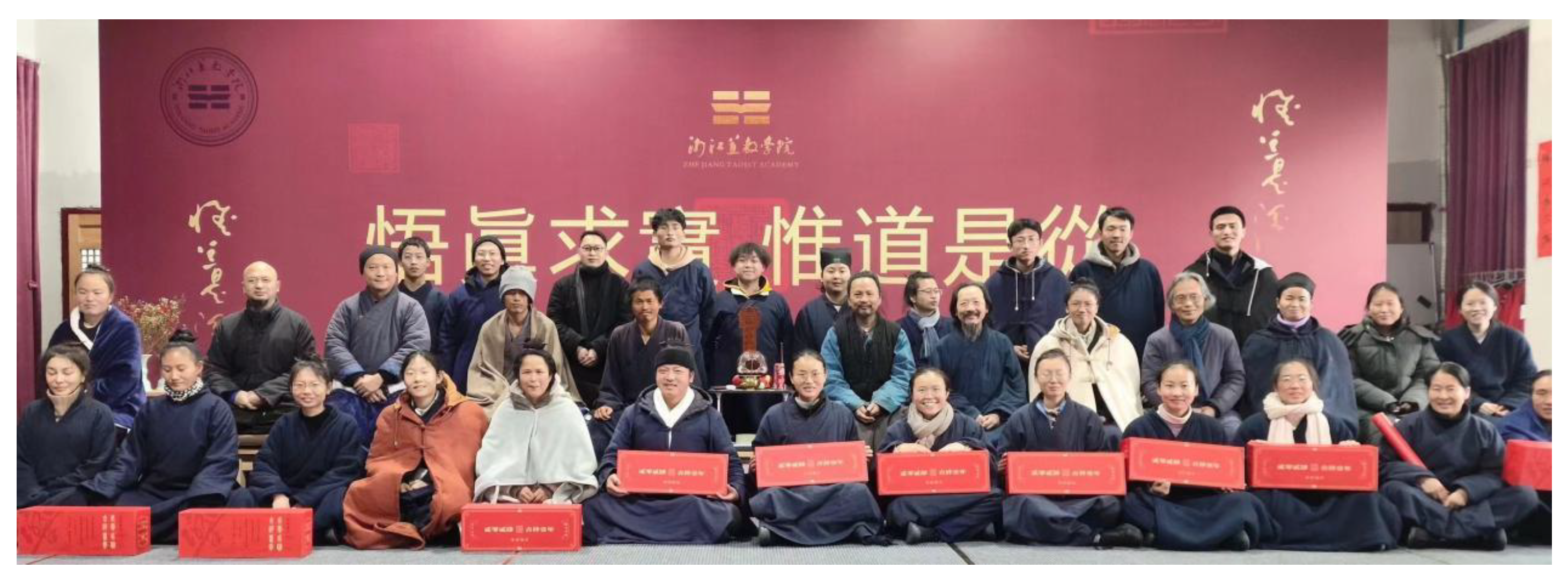
The author both advocates and embodies this position. To deepen cultivation and
Dao-realization, the author entered the
Quanzhen (全真) Southern Lineage’s ancestral seat,
Tongbai Palace (桐柏宮) on
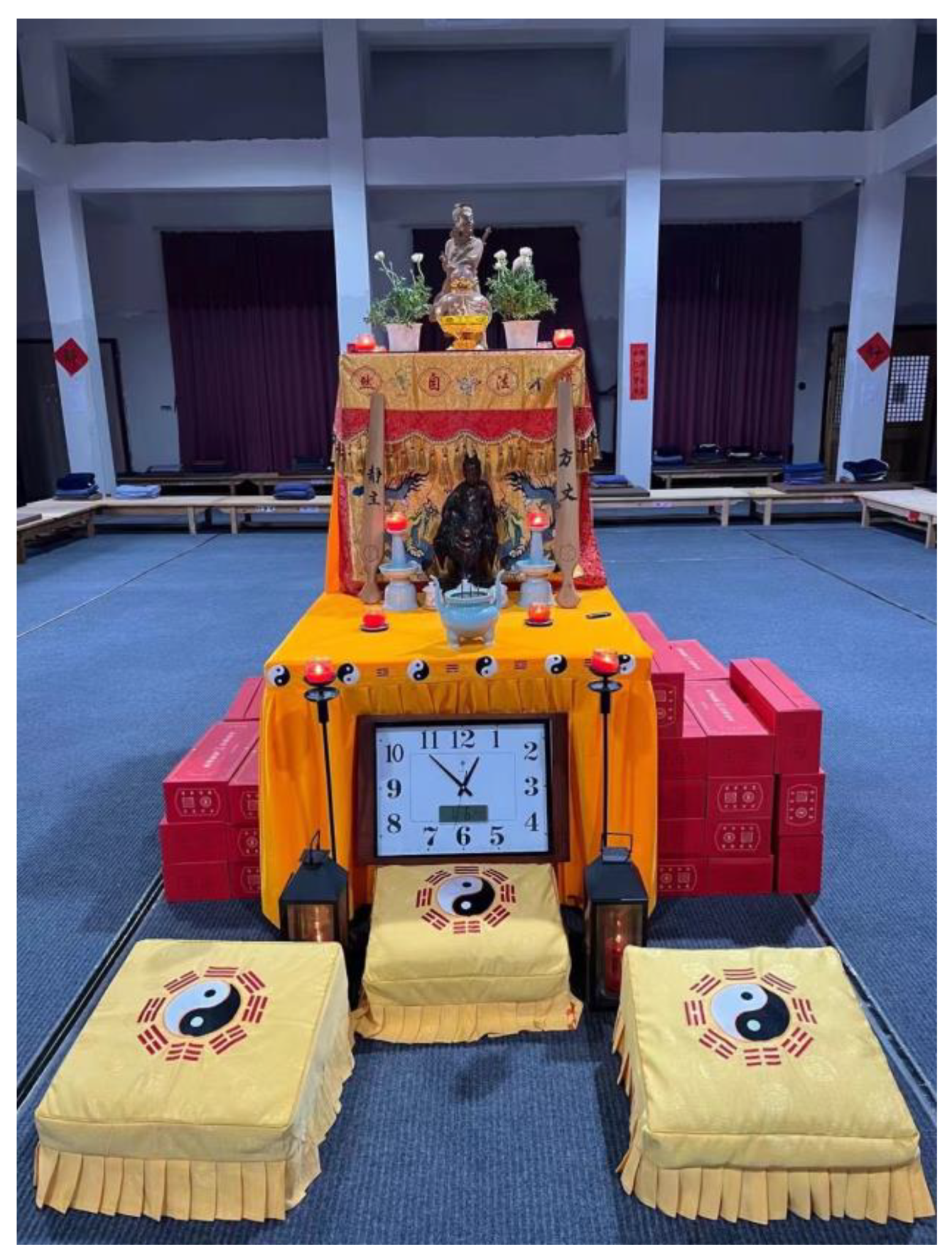
Mount Tiantai (天臺山), in January 2024, and completed its seven-day
Huantang (圜堂,
Figure 13) intensive retreat (a Daoist cloistered chamber for collective or solitary intensive meditation, in which practitioners perform “sit-circle stillness” 坐圜守静 to refine inner
qi and realize the
Dao), a Daoist analogue to a
Chan Buddhist sesshin.
Tongbai Palace is one of China’s most renowned Daoist monasteries. It was founded in the Zhou dynasty, gained numinous repute under the
Jin (晋), flourished in the
Tang (唐), and was expanded during the
Liang (梁) and
Song (宋). Over the centuries, Ge Hong (葛洪), Tao Hongjing (陶弘景), Du Guangting (杜光庭), Lü Dongbin (呂洞賓), Sima Chengzhen (司馬承禎), Li Bai (李白), Zhang Ziyang (張紫陽), Bai Yuchan (白玉蟾) and many other celebrated masters cultivated and preached there, while scholars and poets such as Su Shi (蘇軾), Lu You (陸遊), Zhu Xi (朱熹), Zhang Yu (張雨) and Kang Youwei (康有為) came in droves to seek the
Dao.
Tongbai Palace is also home to the Zhejiang Daoist Academy. Its abbot, Zhang Gaocheng (張高澄), vice-president of the China Daoist Association, serves as the Academy’s president. His senior disciple, Master Dong Ming (董明), acted as retreat director for the Huantang (圜堂) intensive. Master Dong comes from a family steeped in both Daoist and Buddhist traditions. His mother, Ye Qiumei (葉秋梅 ordination name Gao-xing 高行), was the previous abbot of Tongbai Palace and renowned for her expertise in medicine, internal alchemy and qigong (氣功); she once taught in the United States. His father is a contemporary Buddhist monk now in solitary retreat in Zhoushan. Master Dong himself is a graduate of the China Academy of Art, holding a degree in design, and shares a keen interest in culture and the arts. Conversation between us was lively and fruitful. The monastery grounds are exceptionally pure: Master Dong keeps four red-crowned cranes that glide and dance amid the pines, a sight found nowhere else in China.
The seven-day
Huantang intensive followed a fixed regimen (
Figure 14): rising at 4:30, all the participants engaged in three hours of standing meditation (zhanzhuang 站樁) or seated meditation (
dazuo 打坐). At 8:00 a vegetarian breakfast was served, followed by a two-and-a-half-hour rest period. A second three-hour meditation block began at 10:30, concluding with a vegetarian lunch at 13:30 and an identical rest interval. The cycle resumed at 16:00 for a further three hours of meditation, broken at 19:00 by a light vegetarian supper. After a thirty-minute question-and-answer session, the final three-hour meditation commenced at 20:00, ending at 1:30. Thus, each twenty-four-hour period contained exactly twelve hours of meditative stillness, repeated without alteration for seven consecutive days.
The first day proved the most severe. During the inaugural three-hour sit, lower-limb circulation ceased and numbness rapidly escalated into paraesthetic pain so acute that the bones felt fractured. Upon release, the participant could not stand without support. Master Dong Ming (董明), who supervised the retreat, explained that this reaction is normative since ordinary practice rarely exceeds thirty minutes, whereas the present load was twelve times longer. He attributed the distress to temporary jing-luo (經絡) obstruction and qi-stasis and advised continued practice.
By the third day the author felt clear and refreshed, warmth rising in the dantian as qi ascended. During the sixth and seventh days, my body became buoyant, hearing, smell and taste grew sharper, and sensitivity to the external world increased. The bodily sensations and mental acuity before and after the intensive retreat are indeed markedly different, particularly regarding the unique and tangible experience of innate primordial qi spiritual power. Although imperceptible to the naked eye, its formless presence can be clearly sensed by the inner mind. This demonstrates that Daoist cultivation practices are by no means empty rhetoric; rather, they possess substantial practical foundations and scientific validity. Similarly, for us as artists, engaging in Daoist cultivation and spiritual refinement can genuinely enhance our own primordial qi spiritual power.
5.2. Elevating the Creativity and Artistry of Writing
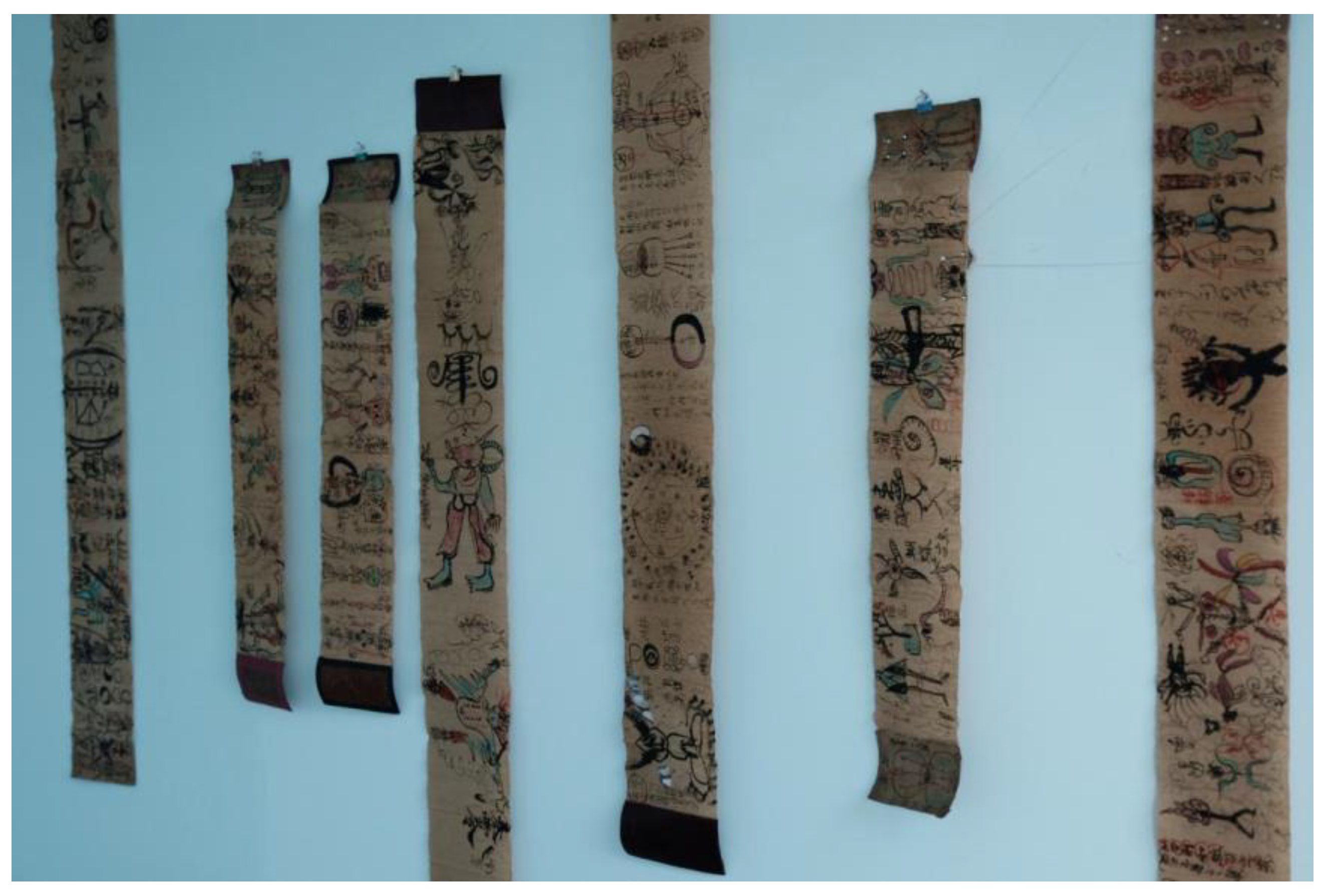
Today’s most avant-garde calligraphy still takes its cues from Inoue Yūichi or American Abstract Expressionism. Almost no one innovates from the angle of Daoist talismatic writing. Yet, within the Daoist tradition (
Figure 15), this esoteric script offers a ready reservoir of formal and semantic novelty that can radically expand the creative and artistic range of contemporary graphic practice.
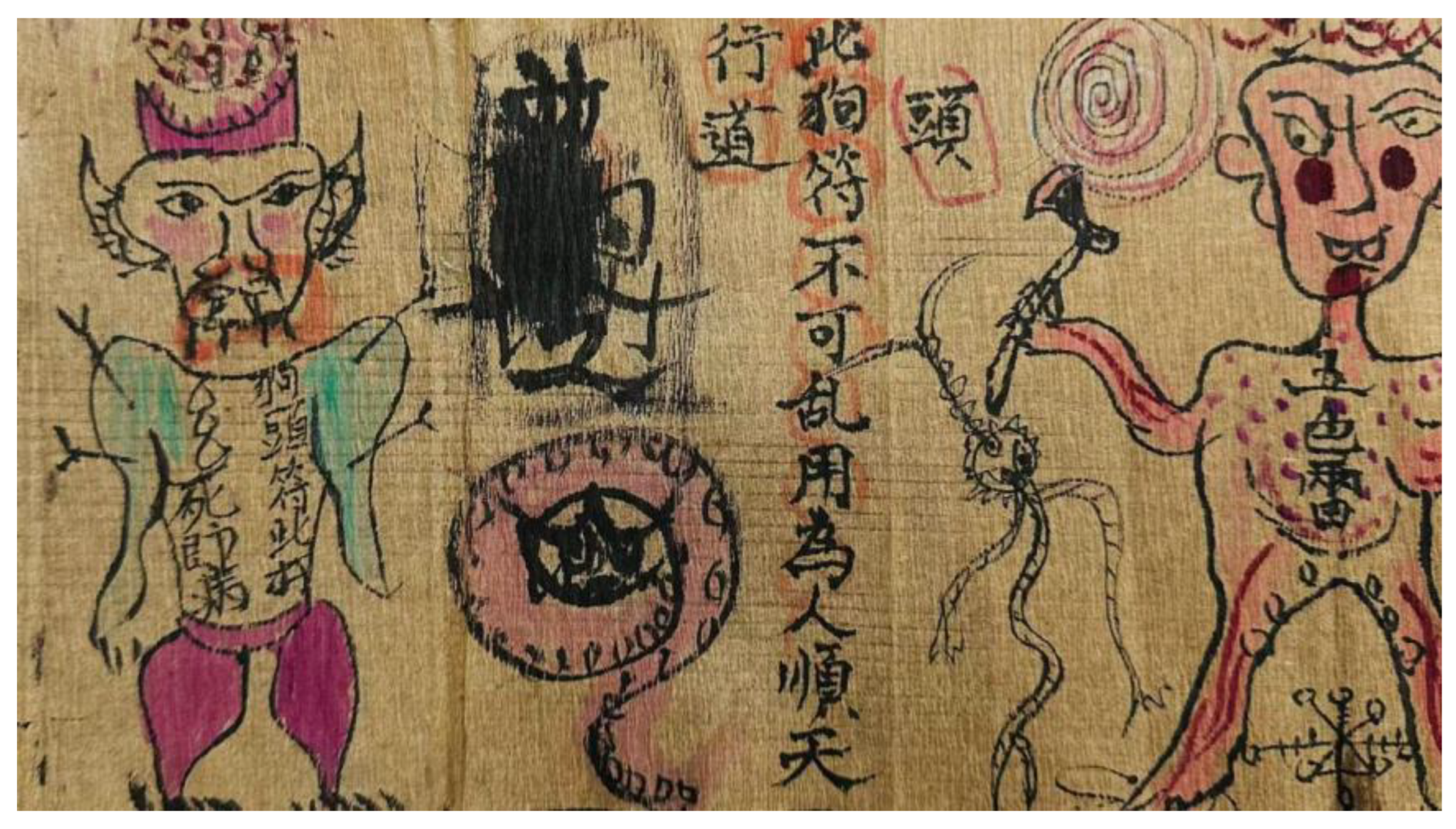
In Dog-Head Talisman (
Figure 16), the central figure fuses a canine head with a human body, turning the dog into an anthropomorphic spirit capable of subduing demons. The image applies the Daoist tenet that “the myriad things possess spirit.” To heighten visual tension, a serpent totem taken from
fu iconography is painted in the lower right, amplifying the figure’s power. Above the serpent, smear-and-obliterate techniques borrowed from talismanic practice thicken the visual density of the surface.
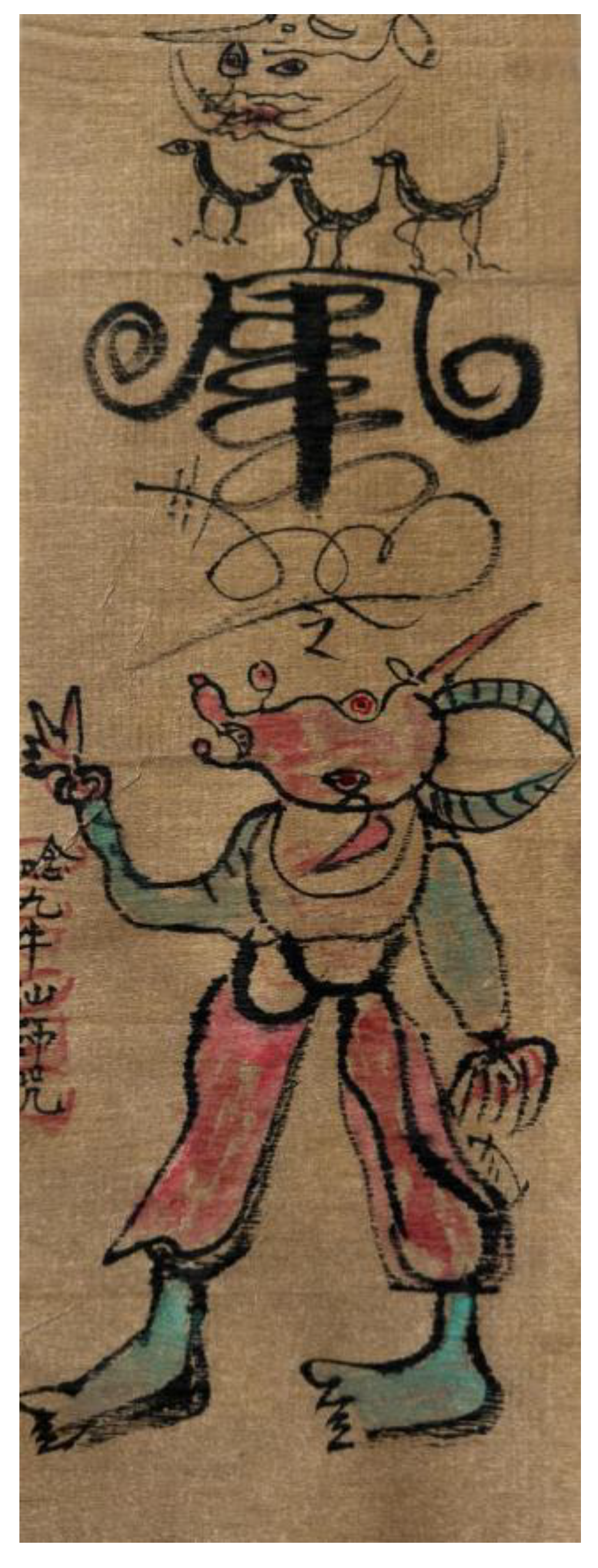
In the Nine-Ox Immortal Master Spell Talisman (
Figure 17), the ox is rendered as an anthropomorphic being with a bovine head and a human torso. To magnify its numinous authority, three avian totems are placed above the ox’s head. Within the symbolic logic of Daoist
fu, birds function as psychopomps, mediators between the human and divine realms. The function of this talisman is to summon and release souls, as well as dispatching the hundred ghosts.
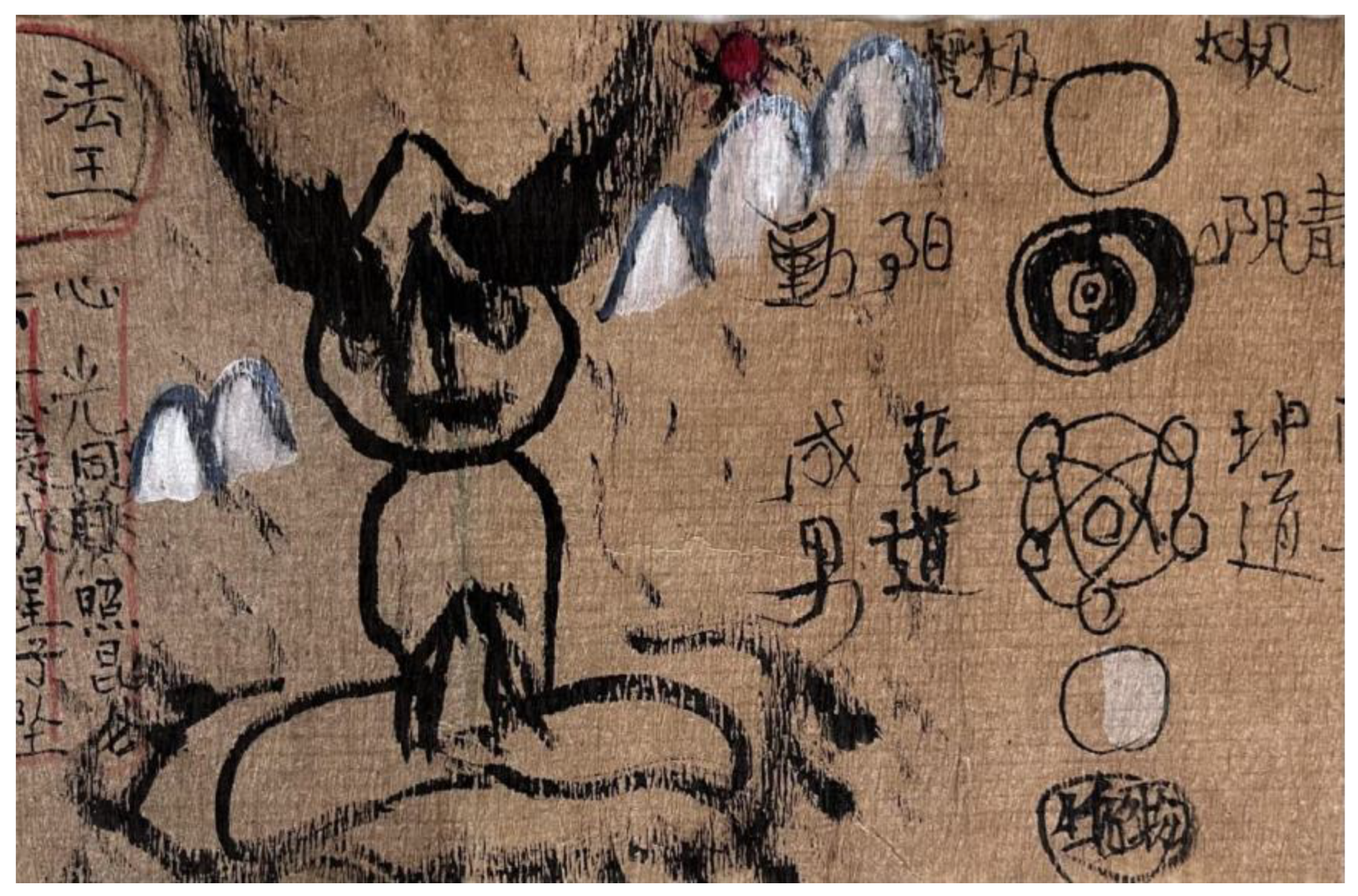
The author created Dharma-King Talisman (
Figure 18) by integrating Daoist
fu-writing methods. On the right stands a
Taiji transformation diagram and in the centre a yogic dharma-king sits in meditation. The snow-capped peaks are the Kailas Range with Kangrinboqe its summit revered as the axis mundi of Bon Hindu Shaivism Jainism and Zoroastrianism. Because the dharma-king cultivates on this supremely numinous mountain, his power surpasses that of ordinary adepts. To signal this, the painter elongates the eyebrows a standard device in talismanic iconography for magnifying authority.
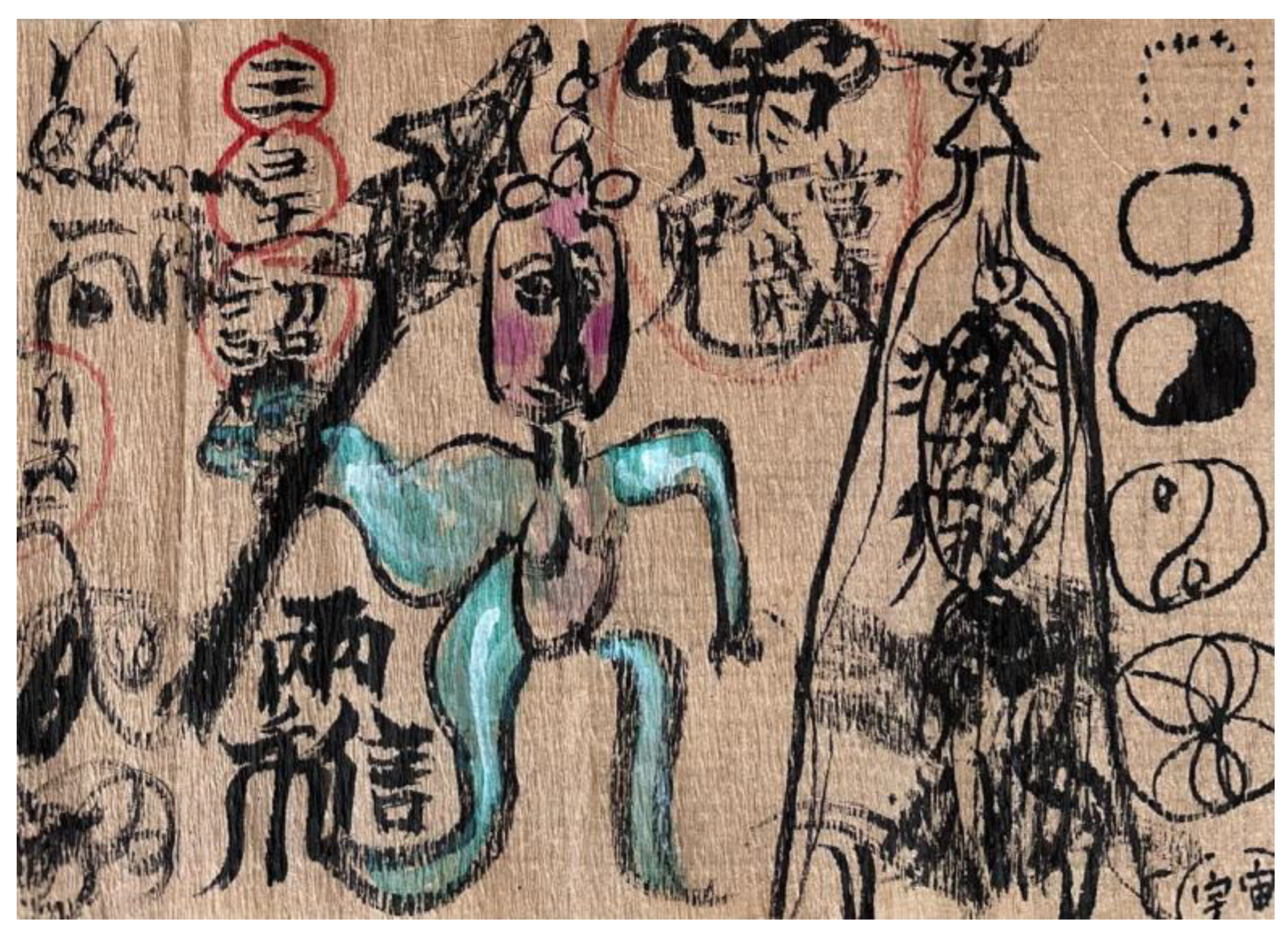
In this
Taisui Talisman (
Figure 19) fish and bird totems intertwine to form a new cryptic emblem, while a
Taiji evolution diagram again frames the composition. The four characters (
dangnian Taisui 當年太歲, the Grand-Year of the current year) are squeezed beside the graph
gui (鬼, ghost), a common technique in talismanic writing that fuses logograms into a single visual unit. The compression foregrounds the semantic core, generates graphic tension and heightens both artistic appeal and visual impact.
5.3. Enhancing the Spiritual and Mysterious Dimensions of Writing
Fu and lu not only convey the numinous power of the gods, testifying to the creative brilliance of medieval Daoist masters, but they also radiate an intense spirituality and mystery. This affective charge stems from archaic, primal religious consciousness: the belief that every animal, plant or phenomenon is animated by a spirit. To magnify the potency and omnipresence of such beings, Daoshi systematically exaggerated, etherealised and sacralised their icons, thereby deepening the talisman’s aura of the sacred.
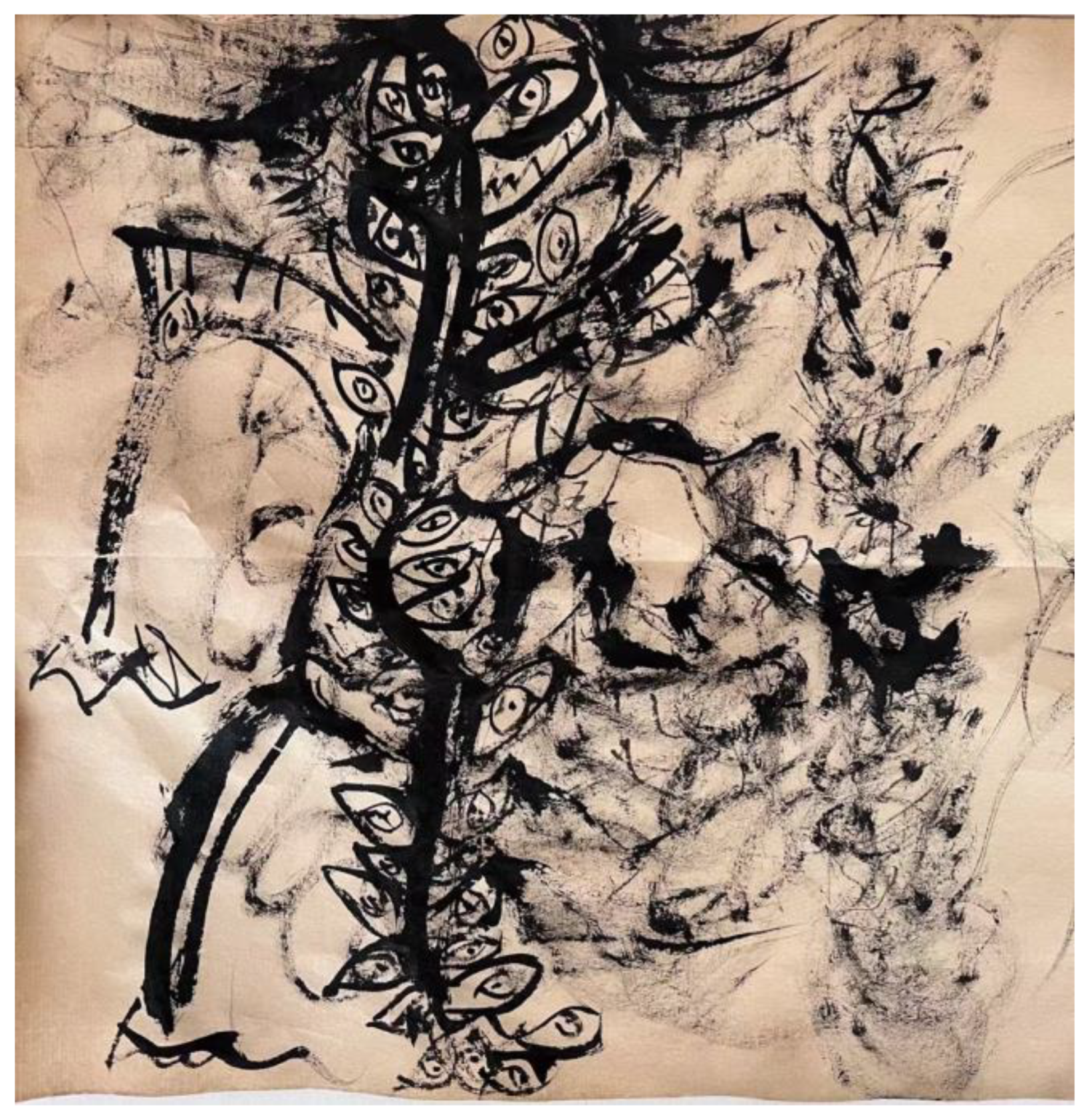
The Thousand-Eye Talisman (
Figure 20) takes its cue from the mythic figure Thousand-Mile Eye (千裏眼), also named
Gao Ming (高明) or
Liu Gui (柳鬼), who always appears with his companion All-Round Ear (順風耳). Possessed of superhuman sight, he can penetrate mountains, seas and every obstacle, discerning the minutest detail. To intensify the image’s occult power, the artist multiplies eyes across the surface, implying that every inch of the god’s body is a retina. Thus, he sees not only the tangible world but also the invisible spirit-realm—no demon can hide from his incandescent gaze.
Known also as “Queen-Mother of the West,”
Xiwangmu rules the female transcendents of Heaven. The Classic of Mountains and Seas places her on Mount
Kunlun, keeper of the elixir of immortality. In this image (
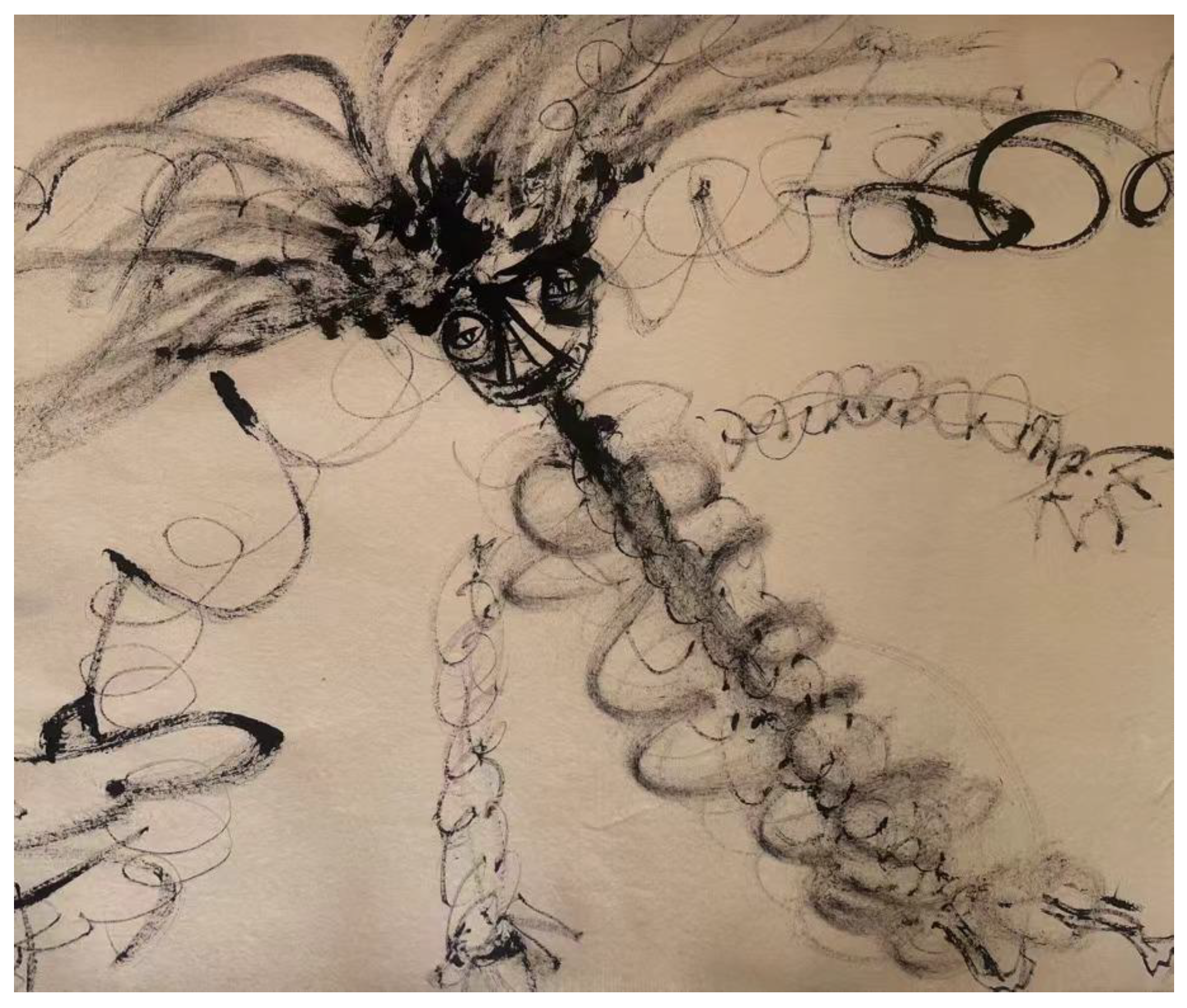
Figure 21) the artist renders her body entirely from sinuous lines of
Dao-qi, visualizing the magnitude of her inner power. To heighten her mystery, unbroken single-stroke lines are added beside each ear. These lines, extending from both ears, seem to listen to the myriad sounds of creation, lending the whole figure an aura of uncanny majesty. The image was created by the author as an artistic enactment of the precept quoted earlier from
Shu Fu Bi Fa (書符筆法): “The method of writing a talisman is nothing more than issuing the marvellous function of the xiantian and circulating qi to complete the
fu.” (
Dao Zang 1988h, vol. 50, p. 370).
A similar use of
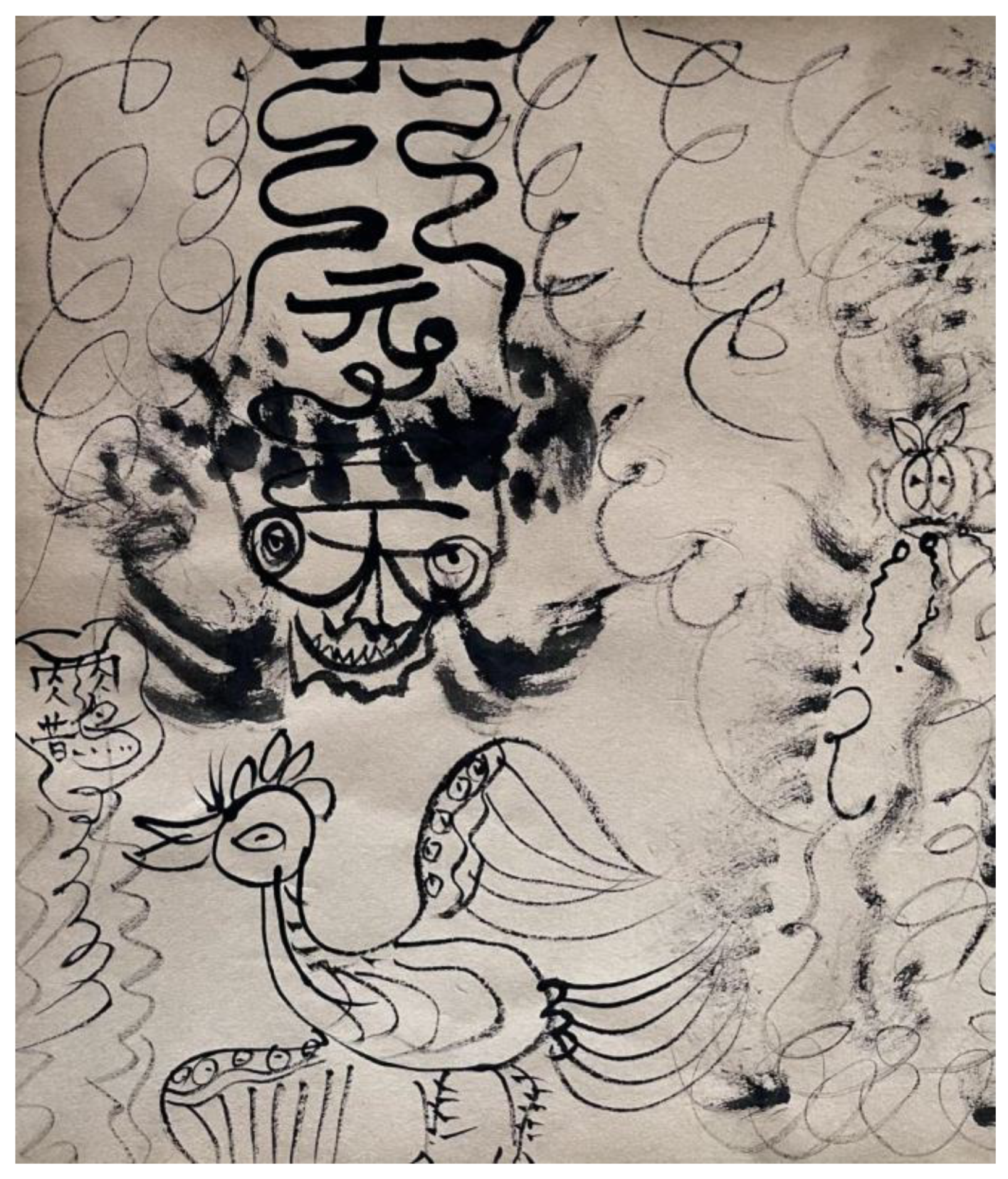
Dao-qi to intensify mystery appears in Bird Totem (
Figure 22), as shown below.
This piece is saturated with seemingly unconscious linear marks. Lines that descend from top to bottom in the upper part evoke celestial qi falling earthward, while those that rise from bottom to top in the lower part suggest terrestrial qi ascending to meet it. They emblematize the yin-yang breath cycling between Heaven and Earth. Dotted lines encircling the bird totem and the spirit figure denote the dao-qi and ling-qi proper to the sprite itself, its own luminous envelope of vital breath. As Daofa Huiyuan, Qingwei Daofa Shuniu states,
The Dao pervades the Three Realms—Heaven, Earth, and Humanity—as a single qi. By this qi the heavens revolve, the earth brings forth life, yin and yang ebb and flow, wind and thunder surge and subside. Humans draw breath through qi, Daoist rites communicate through qi. When the Original Spirit shines of itself, evil is quelled and demons bow in submission.
(Author’s translation)
道貫三才為一炁耳。天以氣而運行,地以氣而發生,陰陽以炁而慘舒,風雷以炁而動蕩,人身以炁而呼吸,道法以炁而感通。 用將元神自靈,製邪則鬼神自伏。
Hence, the stronger the qi, the more luminous the original spirit, an intensification that constitutes both the apotropaic core and the spiritual–mystical resonance of the work.
6. Conclusions
This study investigates the source of numinous power inherent in Daoist talismanic writing. Fieldwork and textual analysis converge on a three-tier model that locates efficacy in the delegated authority of external deities, the adept’s own pre-celestial qi, and the primordial dynamism of the Dao itself. These strata are not isolable but must act in concert. Only when the practitioner fuses the ontological power of the Dao with innate vital breath can the luminous force of the gods be mobilized. Only when subject and object, substance and function, form a closed circuit is the talisman’s power fully released.
The results also open a path for contemporary art. By integrating Daoist cultivation with studio practice, the author shows how fulu writing can refresh graphic innovation. Its demand for self-cultivation enlarges the adept’s reservoir of authentic qi, while its symbols and procedures offer new means to heighten creativity, artistry and mystery in current writing work.