1. Bely, “Literature of Fact,” and the Art of Seeing
In an article entitled “Na novosel’e” (“To a New Home”) published in 1928 in
Novyi Lef and later included in the seminal LEF collection
Literatura fakta, poet Petr Neznamov marvels at the recent commercial success of travel writings (
Neznamov 2000).
1 This should be good news for the “literature of fact”, which, according to LEFists, is destined to replace the literature of fiction. After all, it is precisely travel narratives that Nikolai Chuzhak’s programmatic introduction (
Chuzhak 2000) to the collection identifies as such literature’s distant antecedents: Chuzhak claims Radishchev’s
Journey from Petersburg to Moscow, Pushkin’s
Journey to Arzrum, and Goncharov’s
Frigate Pallada as part of the foundation on which the new type of literature is being built. At the same time, Neznamov is wary of the competition that proliferating Soviet travel writings of the 1920s present for LEF’s own, written in accordance with the group’s strict criteria of “artlessness.” He notes that travel diaries and narratives now compete with novels by Konstantin Fedin and Vsevolod Ivanov and then exclaims sarcastically, “И даже Андрей Белый выпустил книгу очерков «Ветер с Кавказа» Вот уж подлинно можно воскликнуть: —Андрей Белый! Каким ветром?” (“And even Andrei Bely published a book of [travel] essays
Wind from the Caucasus. Here one really can exclaim: ‘Andrei Bely! What wind brought him?’”) (
Neznamov 2000, p. 262).
2 Neznamov’s irony is of course due to the fact that few other figures of the Soviet literary marketplace could be further away from LEF’s “literature of fact” and the kind of travel writing it propagates than the Symbolist author and ardent anthroposophist Bely. In the same article, Neznamov castigates most
ocherkisty for excessive “
literaturshchina” of their essays (which Bely’s
Wind presumably epitomises), emphasising the need to “see and hear” the ordinary and the quotidian in Soviet life: “to see and scrutinise
the ordinary, that past which we walk with indifference, is very difficult.”
3 Sergey Tretyakov, in another contribution to the volume, provides a specially prepared sample of what this new art of seeing might entail. The crucial difference his new approach (“
opyt novoocherkovogo podkhoda”) makes, he claims, is the subject position of the observer: one must stop being a consumer of images and see things with a producer’s eyes: “Landscape is nature seen with the eyes of the consumer… Nobody sees things or people in art with consumer’s eyes. One must start to learn this.”
4 Consumers see life “through foggy glasses” (the title of the essay is “Skvoz’ neprotertye ochki”), processing visual information and habitually representing it with verbal means of a poet or a belletrist, “a chain of primitive associations, reducing everything visible… to so-called artistic images” (ibid.). Describing his journey on an airplane, Tretyakov first provides a typically poetic, i.e., “consumer” version of the landscape one sees from the altitude of the flight, replete with metaphors and similes, i.e., a version that, to him, has no true concern for the social transformation the landscape is undergoing. This traditional position must be discarded; the eye must see through the fascinating interplay of colours and shapes and focus on the only thing that matters: signs of social change. One would then see not simply objects curiously diminished by the altitude but a canvas of socialist construction:
Когда по-настоящему заточится глаз, он станет различать сверху разницу между посевами коммун и крестьян-одиночек, он будет диктовать мозгу рефлекс восхищения над сводными массивами совхозных нив, сменяющих лоскутное одеяло деревенской чересполосицы. Уход старых каменных городов в зеленую сетку садов, новизну и прямые просторы рабочих поселков. Тогда мы станем зрячими не только на биологически-термитные работы человека, но и на то, чем по-новому будет социализм перечерчивать лицо земного шара.
When the eye gets truly sharpened, it will begin to distinguish the difference from above between the crops of communes and of individual peasants; it will dictate to the brain the reflex of admiring joint blocks of Soviet farm fields that come to replace the quilt of village strips. The disappearance of old stone cities in a green network of gardens, the novelty and straight expanses of industrial townships. Then we will begin to see not only biological, termite work of man, but also that with which socialism for the first time will score out the face of the planet.
Tretyakov envisages that a certain biological reflex is bound to develop in the artist who has moved to the position of a class-conscious producer. “Sharpening the eye” then would no doubt require a major shift in the actual form of the travel narrative, which Тretyakov wants to move closer to the sober, objective format of newspaper reportage.
5Walter Benjamin famously extols this position in the 1934 article “The Author as Producer” where he hails Tretyakov’s work as a prime example of an art that combines “the correct political tendency and the progressive literary technique” (
Benjamin 1999, p. 770). What this means in practice to Benjamin is that the political commitment of a given author is not a sufficient condition for a work of art. Only by pursuing the most advanced artistic technique can the link between tendency and quality be guaranteed. Andrey Bely, whose
Wind from the Caucasus Neznamov ridicules, could not have agreed more with Benjamin’s stipulation. In his attempt to become a Soviet writer in the late 20s–early 30s, Bely tried hard to marry the “correct” political disposition with a form that would be an extension of his earlier work while also adapting to the demands of the day. His efforts became especially desperate after the “anthroposophers’ affair” of 1931, in which Bely was heavily implicated even though he did not get officially charged.
6 He never wrote a proper production novel, for which he had plans in the last months of his life,
7 but he did try his best at Soviet travel narratives and even theorised about the genre in a talk he presented to the Regional Ethnography (“kraevedy”) section of the Organising Committee of the Soviet Writers’ Congress in 1932. It is in this talk that he expresses a sentiment that is curiously similar to the tenor of Benjamin’s 1934 essay, yet implicitly critical of any radical productionist stance, such as Tretyakov’s. Advocating a fundamentally new literary form, Bely nonetheless insists on the value of its
artistic aspect. “Краеведение,” declares Bely, “предестинирует очерк, как новую, нигде не бывшую форму” (“regional ethnography predestines the essay as a new form that never existed before”): In it, the artist merges with the scientist (
Bely 1933, p. 269). Bely’s authority here is Goethe, who enriched natural science with the insights of a poet and vice versa; closer to home, Lomonosov is cited as an example of the same. As the task of regional ethnography is “melting down the past,” the specifics of the contemporary
ocherk is “the fact that it is an incursion into the new area where national cultures regenerate into the culture of the international that presents them in a new light” (
Bely 1933, p. 269). The melting down of the past causes a certain melting down of traditional forms: “the purpose of our essay is to sing scientifically [
nauchno vospet’] the picture of life of the peoples of the USSR” (
Bely 1933, p. 275). Bely adamantly insists that production alone is not enough for such “scientific singing”; political expedience makes him even go so far as to brand strict productionism Trotskyite. He knows full well that in 1932 nothing could be heavier than this charge: “the study of production ‘minus’ everything else turns
kraevedenie onto the path of mechanicism; politically speaking, this is Trotskyism.”
8 Yet it is vitally important for him to defend the artistic dimension of
kraevedenie against LEFists (admittedly defeated by this point as a movement)
9 because it certainly aligns with his life-long project of creative cognition, which he advanced first through the language of Symbolism, then anthroposophy, and now wanted to pursue through that of a Soviet writer. He always conceived of this project as thoroughly critical, steeped in the spirit of Kantian philosophy, at every point vigorously refuting any accusations of mysticism and always taking pains to separate himself from “bad” (i.e., uncritical) Symbolists and anthroposophists. The problem, however, was that the new language of a Stalin-era Soviet writer he was now trying to master did not allow for any testing of its representational limits, with which he is supremely concerned in
Wind from the Caucasus (
Bely 1928b), a travelogue of a trip to Georgia and the North Caucasus undertaken the previous year. This is why Bely ends the 1932 talk by admitting that his own experiments with
kraevedcheskii ocherk were more than wanting. He dismisses the book
Veter s Kavkaza as overly “subjective,” finds the essay “Armenia” (
Bely 1928a) closer to target, yet far too short, and confesses that he was unable to produce a more perfect third attempt after his second trip to Armenia in the following year. He concludes the talk by saying that “стать очеркистом значит: перекинуть мост через грань, отделяющую отобразителя от деятеля культурной революции” (“becoming an
ocherkist means throwing a bridge over the line that separates a mere reflector of, from an active participant in, cultural revolution”). Much as he imagined such crossing, he himself was never quite able to make it. In what follows, I will consider the question why the passage from “reflection” to “participation” proved to be so difficult for Bely the
ocherkist. 2. Seeing Time: Goethe and Kant in the Caucasus
Just as Neznamov and just as Tretyakov, Bely the
kraeved is also squarely focused on the art of seeing, which is the key concept of his
Wind from the Caucasus. The pathos of seeing permeates his travel account and is ultimately his most fundamental preoccupation in this text: “Мало видеть, надо
уметь увидеть” (“It is not enough to see, one must know how to see), he preaches in the introduction to the book (
Bely 1928b, p. 3). There are several obvious reasons why the art of seeing is to be learned while travelling away from the familiar, in the spectacular land of the Caucasus. But what does it mean to know how to see? His understanding of this art is quite different from that of the LEFists, to whom
Veter s Kavkaza was a prime example of consumer prose (they no doubt took literally Bely’s own ironic reference to his travel notes in the preface as “a book for relaxation”). On the very first page of
Veter s Kavkaza, Bely declares that he is modelling his Caucasus impressions on Goethe’s Italian ones; it is Goethe who helps him develop his mode of seeing:
Скажу о себе: итальянские впечатления Гете ввели меня в Италию и Сицилию; в бытность мою там—Гете был настольной книгой; через него я своими глазами увидел Сицилию; без него не увидел бы; это увиденье легло в основу моего интереса к культуре Италии; отсюда мои позднейшие чтения по истории Ренессанса; углубление в историю, географию, краеведение есть органическое продолжение того, чего начало—увиденье места.
I’ll say about myself: Goethe’s Italian impressions introduced me to Italy and Sicily; while I was there, Goethe was my guidebook; through him I saw Sicily with my own eyes; without him, I would not have seen it. This seeing became the foundation of my interest in Italian culture; hence my later readings on the history of the Renaissance; the study of history, geography, regional ethnography is an organic continuation of that which has its beginning in seeing a place.
The opening passage of
Veter s Kavkaza talks about the art of seeing as a necessary prerequisite for appreciating the Caucasus, “a Soviet resort with an enormous future socio-economic potential.” Thus seeing to him is not merely a spatial category but a temporal one too. “
Uviden’e mesta” to Bely is not three- but four-dimensional from the very outset as he strives to glimpse the region’s future while also immersing himself in its past.
10 This type of vision requires its own particular focus: “Every picture has its focal point; it must be found; every location, too, has its own focal point, it is only from this point that one can see anything.”
11 And further,
Наше городское восприятие природы иное—не она бежит к нам, а мы должны ее найти в красоте; то, что необходимо для понимания полотен той или иной школы живописи,—необходимо и для художественной оценки местности; […] горожанину свойственен подход к природе через воспитание глаза культурою; горожанину свойственно говорить: ‘скала, как… у Врубеля’ […]; сельчанину свойственно, наоборот, стоя перед Врубелем, говорить: ‘как у нас… в Грузии’.
Our city perception of nature is different—it is not that nature that runs to us, but we ourselves must find it in beauty. That which is necessary for understanding canvasses of this or that school of painting is necessary for the artistic appreciation of a place: I saw a lot in nature through educating the eye in museums. A city dweller approaches nature through educating the eye by culture; a city dweller would say, “a rock like… Vrubel’s […]; a rural dweller would, on the contrary, stand in front of Vrubel saying “like in our land… In Georgia.”
As a city dweller, Bely resolutely takes the former stand; he also explains that natural beauty is a category of culture and as such, something that a savage is unable to see. This is precisely why his perception of Georgian natural wonders is always mediated by works of art he either remembers or tries to produce himself before putting the landscape into words. Vrubel, for example, makes a prominent appearance later in the text when his fellow traveller Vsevolod Meyerkhold notices a pile of rocks strikingly reminiscent of Vrubel’s painterly technique. On his journey through the Caucasus mountains, Bely also “encounters” the Georgian artist Gudiashvili, Kandinsky, Picasso, Rafael, Delacroix, Michelangelo and Leonardo da Vinci, and then Vrubel time and time again. Bely sits down to draw his own sketches of the landscapes of which a fair number have survived, and these later enter the text as lavish, rhythmical, syntactically excessive descriptions. In fact, visual arts are not the only ones Bely invokes in his travel impressions. Pushkin’s and Lermontov’s Caucasus is just as significant in his storehouse of images through which he
sees the actual landscapes. Finally, theatre joins the other arts through whose medium nature is perceived. Not only does Bely reflect at length on Meyerkhold’s theatrical productions he saw in Tiflis, but he also talks about the actor Mikhail Chekhov, whose art of the pause contains colossal energies akin to the might of the mountains. Such extensive recourse to various modes of representation is necessary to Bely in order to overstep the boundaries of mimesis within which these modes operate. It is by thematising modes of seeing that Bely strives to arrive at some sort of metavision, which would do justice not only to the majestic scenery but also to the task of developing a radically new form of the travel narrative, the new
kraevedcheskii ocherk. The 1932 talk “Kultura kraevedcheskogo ocherka” poignantly equates culture with image and the latter with a high-voltage electric wire in which a myriad of ideas are perilously condensed. The danger of such condensation is clearly presented in
Veter s Kavkaza, not as an example of something to avoid but as the ultimate representational technique. This is the point in the travelogue at which previously deployed verbal images and ekphrastic comparisons begin to fail the narrator. Confronted with the main Caucasus chain, he no longer has the verbal means to do it justice: words are “put to shame.” Consider the following lengthy passage:
Разорвался круг гор ближней Грузии—справа в окне; и взгребенилось утесами левое полукружие […]; вот Кавказ—настоящий приподнятый: неимоверен, чудовищен, неописуемо близок […] Я—нем: возникающая тишина исполинов, незвучных и вещеглядящих в сознании не умещаема; средства язычные—посрамлены; пейзажа такого не видывал; […] приоткрытое тут,—убивает сравненья.
Схвативши рукой за товарища, […] друга рывком тащил я к окну.
–Вы смотрите же!
–Да!
–Что вы скажете?
–Что тут сказать?
–Вы такое видали когда-нибудь?
–Нет.
–И я—тоже.
Взглянув друг на друга, молчали: что скажешь? Молчанием разве.
The circle of near Georgia mountains is broken –in the window on the right […]; here’s the real, raised Caucasus: incredible, monstrous, indescribably close (it’s an illusion), a family of Big Heads, White Granddads, hairy, bearded, in silver clothes, risen up to their chests from the ground, screening off a large piece of sky.
I am mute: the emerging silence of the giants, soundless, prophetic, is uncontainable in consciousness: linguistic means are put to shame. I’ve never seen such a landscape […]; what one glimpses here kills any comparisons.
Grabbing the hand of my comrade […], I pull him to the window.
–Look, look!
–Yes!
–What will you say?
–What can I say?
–Have you seen anything like this?
–No.
–Me neither.
Looking at each other, we fell silent: what can one say? Silence is the only response.
He goes on to suggest that in order to give an accurate account of this picture one thing is left: cover a dozen pages with frenetic but useless writing and then burn the manuscript, leaving just a record of the number of pages thrown into the flames. This passage is remarkable for the fact that it directly articulates the central proposition of Kant’s
Critique of Judgment (
Kant 1993) where the philosopher stipulates that nature is sublime in those of its appearances whose intuition carries with it the idea of their infinity. But the only way for this to occur is through the inadequacy of even the greatest effort of our imagination to estimate an object’s magnitude. True sublimity, then, says Kant—and this sends us back to Bely’s introduction—“must be sought only in the mind of the judging person, not in the natural object. … Indeed, who would want to call sublime such things as shapeless mountain masses piled on one another in wild disarray, with their pyramids of ice, or the raging sea? But the mind feels elevated in its own judgment of itself when it […] finds all the might of the imagination still inadequate to reason’s ideas” (
Kant 1987, p. 112).
Bely’s familiarity with Kant is of course a commonplace, as is the perception that his knowledge of Kant’s philosophy was rather superficial.
12 His maddeningly confusing worldview, which he took pains to lay out and defend against multiple accusations of mysticism in a massive body of theoretical writings was to him a return to the spirit of Kantian criticism which he nevertheless attempted to reconcile with various dogmatic systems of thought in a way conceived of as anything but dogmatic. In an early article “Criticism and Symbolism” (written in 1904 on the centennial of Kant’s death), he declares boldly that “true symbolism begins only beyond the gates of criticism. Symbolism born of criticism, becomes a living method that equally differs from dogmatic empiricism and abstract criticism by overcoming them both” (
Bely 1910, p. 29). He argues that the difference Symbolism makes lies in its ability to overcome the “purely scientific” character of knowledge in Kant and ultimately bridge the schism between phenomena and noumena—this “Scylla and Charybdis of Kantian philosophy”—by means of creative cognition, which in these early works is prominently bound up with the art of seeing (
Bely 1910, p. 25). According to the 1902 essay “Formy iskusstva,” “
Умение видеть есть умение понимать в образах их
вечный смысл, их идею” (“The
ability to see is the ability to understand in images their
eternal meaning, their idea”) (
Bely 1994: 103). The obvious conflation of the spheres of pure reason, practical reason and aesthetic judgment that Bely proposes to overcome through this peculiar act of seeing collapses Kant’s distinctions most violently. The sublime, which Kant uses to stipulate that purposefulness can never cover up the gap separating the world of phenomena from that of noumena, is conspicuously absent from Belyi’s early theory of the symbol.
Not so in the Caucasus text, where Bely the thinker now faces up to the Kantian cuts that aestheticians since Goethe have been attempting to heal and recognises the heterogeneity and incompatibility of different intellectual and affective faculties of human thought. The “scientific” character of knowledge is now equally important. There is little doubt that the reference to the Kantian sublime is made consciously. Kant, in fact, is a much more significant guide to Bely’s Caucasus than Goethe. Bely records a number of dreams in
Veter s Kavkaza, and one of them is a strange visualisation of the rift between the two faculties at play in the third Critique: understanding and reason,
Verstand and
Vernunft. The aesthetic power of judgement in judging the beautiful refers the imagination in its free play to understanding and its concepts, whereas in judging the sublime, it refers the imagination to reason and its ideas. In Bely’s dream, both
Verstand and
Vernunft figure as a pair of arms, one regular, growing from the shoulders (reason) and one growing from the head, like horns (understanding). In the dream, he rides a tricycle attempting to steer with the arms of understanding that grow from the head. He then proceeds to draw figures over his head with the “normal” arms of reason, meant for motor movement, and declares the problem solved.
13Essentially, this so-called solution would be in describing what he has learned to see not by way of verbal images supplied by the senses, but by means of schemes generating ideas: where imagination fails him, he wants to employ reason. This is how he describes this in a letter to Boris Pasternak written in 1928, during his next trip to the same area of Kadzhory: “It is strange that mountains are sketched not in verbal images but in thoughts that they bring. Before giving a verbal image, one must study
seeing for months […] and in particular, the landscape of Kadzhory, without yielding to me verbally, has wholly passed into my thought; I think
geographically and describe landscapes in philosophemes and mental peeps”.
14Bely seems to be suggesting here that it is possible to proceed beyond the point at which imagination falters, making the activity of representation exceed the representational limits of experience and continuing down the schematic path, through topography, mapping, and formulae. The obvious continuous difficulty here is that of distinguishing such “thinking” and “philosophising” from representation, which Bely is quite aware of. He nonetheless takes this logic one step further, arriving, unsurprisingly, at the term “symbol”—but with a difference. Travelling over the Caucasus range on the Georgian Military Road, on the approach to Krestovy pass, the highest point of his journey, he says the following: “все стало—лишь символом, умопостижным и пoлупостижным; глаз, ставши понятием, силлогизировал местности” (“everything became just a symbol, comprehensible to the mind and half-comprehensible; the eye has become a concept and syllogised locations) (
Bely 1928b, p. 215). Suddenly the eye becomes nothing but a concept, somehow detaching itself from the observer and entering the formulaic landscape which it “syllogises.” The emerging symbol is accessible to the mind as a concept but only “half-comprehensible” as an image, which is to say, its true meaning escapes understanding in its entirety. Finally, the eye is declared altogether redundant; Bely takes his eyes off, “like spectacles”—this, presumably, is the ultimate stage of the art of seeing. When the travellers finally reach the actual pass, it disappoints them just as crossing the Alps disappointed the protagonist of Wordsworth’s
Prelude. Draped in clouds, Krestovy pass shows them nothing save some murky patches of muddy grass. Bely’s Georgian companions are furious; he, however, claims to have developed a certain “sixth sense” which cancels the need to see altogether. This strange sense is a kind of inner vision, physiologically connected with hearing: “Вижу очами ушей, иль шестым своим чувством […] Надо где нужно увидеть; и надо, где нужно, не видеть; […] Увидеть глазами невидимо вас посетившее чувство высот невозможно никак” (“I see with the eyes of the ears or with my sixth sense […] One must see where one needs to see, and one must not see where one does not need to see” (
Bely 1928a, p. 223). This sense can only be experienced by the body, so nothing further could be reported. It is indeed a formula, a quasi-scientific gesture on Bely’s part as he, like Goethe, refers to anatomic detail and mentions semi-circular ducts of the inner ear through which this sense is supposedly experienced. The fact that the experience is immediate and unpresentable is, however, what matters the most.
Crucially—and with this we approach the crux of my reflections here—Bely also connects this sixth sense with time. Evidence of this is certainly present in
Veter s Kavkaza, but it is in the same letter to Pasternak from 1928 (
Bely 1988) that we find the link articulated most clearly:
[…] на высотах присоединенной глубинной перспективы, качественно противоположной перспективе высотной, мы видим пространство не 3-х, а четырех измерений: воочию. Но четвертое измерение (во время—пространстве) есть время. Итак: на вершинах гор мы видим время: глазами из него выходя
(ibid.)
[…] at the altitudes of added deep perspective, qualitatively different to the perspective of heights, we see space not in 3 but in four dimensions: with our own eyes. But the fourth perspective (in time-space) is time. Thus: on peaks of mountains we see time: stepping out of it with our eyes.
The “scientific” tenor of this observation, in which Einstein’s relativity theory is alluded to, continues Bely’s experiment with “schematic” representation on the far side of the sublime event in the mountains.
15 Time in Kant’s first Critique is “the pure image of all objects of sense in general” (
Kant 1987, p. 146). Bely’s “formula” of “seeing” time “voochiiu” while “stepping outside of it with one’s eyes” certainly brings us no closer to imagining or understanding this a priori form. Yet the fact that Bely claims to see time in the context of imagination’s failure to represent nature’s magnitude is in itself supremely significant, considering Bely’s intention to write about a journey not just through space but also through time. According to Mikhail Bakhtin, Goethe’s
Italienische Reise does something similar. In his essay on the
Bildungsroman, Bakhtin notes that Goethe, like no other, could visualise time, even while observing seemingly static, immutable objects, such as mountains: “Everywhere here the
seeing eye seeks and finds
time—development, emergence, and history” (
Bakhtin 1986, p. 29). Bely’s narrative of crossing the Caucasus chain in many ways follows Goethe’s account of crossing the Alps, as it connects the experience of altitude and the magnitude of nature with time, and especially with history.
Kraevedenie, as defined in the introduction to Veter s Kavkaza, encompasses the history of the described place as well as glimpses into its future. What Bely does not say, however, and what transpires upon closer examination of his representational pangs is that the focal point he postulates as a necessary condition of “seeing a place” (“uvidenie mesta”) is in this case a non-place, a position high up near the top of the mountains, the locus sublimitas where he claims to be able to see time without employing vision as a sensory organ. The focus of vision is thus a blind spot.
It is from this position that he can now descend into the timeline of history with a memory of that indescribable inner sense: “descending into Tiflis that lies 1.5 kilometres under my feet, I enter
history, the time line, and ascending to Kadzhory and leaving the time line, I see it as the fourth dimension of
depth”.
16 From this it follows that Bely cannot be satisfied with a travel narrative that does not aspire to four-dimensionality. It is impossible for him to do justice to a location undergoing vast social transformations without first finding the required vantage point from which the four dimensions could be adequately captured.
3. Seeing History: The Soviet Sublime at Zages
Tretyakov, we remember, is happy simply to observe from an airplane how individual peasants’ strips merge into vast collective farm fields. To him and to other adherents of the positivist “literature of fact,” historical time is here and now: capturing socialist construction through dispassionate, participatory observation amounts to capturing historical time; no reflection is required. At about the same time as Bely visited Georgia, Tretyakov went to the remote Georgian region of Upper Svanetia, which until recently had been virtually cut off from the rest of the world by mountains and glaciers. Tretyakov depicted this journey in his own
ocherk “Strana Svan” (
Tretiakov 1927), which in 1929, after a second visit to Svanetia, he developed into a screenplay for Mikhail Kalatozov’s film
Sol’ Svanetii (
The Salt of Svanetia) (1929) (
Tretiakov 2000). In this film, the very majestic mountains atop which Bely experiences time with his “sixth sense” are depicted as a powerful enemy, for they force the natives to live primitive lives, full of privations, hardship, cruel, anachronistic customs, and superstition. In one particularly telling sequence, a Svan woman with some handiwork and a baby in a crib sits atop a thresher pulled by a bull, which does its work going round in circles. Kalatozov’s camera takes a shot of the sky and village towers going round in circles, which eventually makes the woman dizzy and exhausted. This circularity mirrors the circular march of ancient time; the titles read: “Завертелся век каменный” (“Stone age starts going round”), time of prehistory that knows only hard work, subsistence living, and suffering, coupled with a chronic lack of salt that plagues this region. Historical time only breaks through when Soviet Georgia puts an end to Svans’ medieval existence and literally blows up its way into the Stone Age of Upper Svanetia by building a road to the remote communities over prohibitive mountains. In Tretyakov’s and Kalatozov’s cinematic narrative, entry into historical time coincides with victory over the mountains, over nature. By the same token, the salt so lacking in the Svanetia of old becomes a metaphor for the time of history to which the region is now connected (see
Figure 1).
17Bely, by contrast,
needs the mountains in order to experience the inner sense of time, which would then help him experience history in the making and subsequently narrate it in comprehensible images without, as he puts it in the 1932 article, being a “mere reflector of,” as opposed to an “active participant in, the cultural revolution.” The participation, to him, is inconceivable without representing his own, personal, subjective experience, for which a proper focal point must be found. One problem, however, is that in
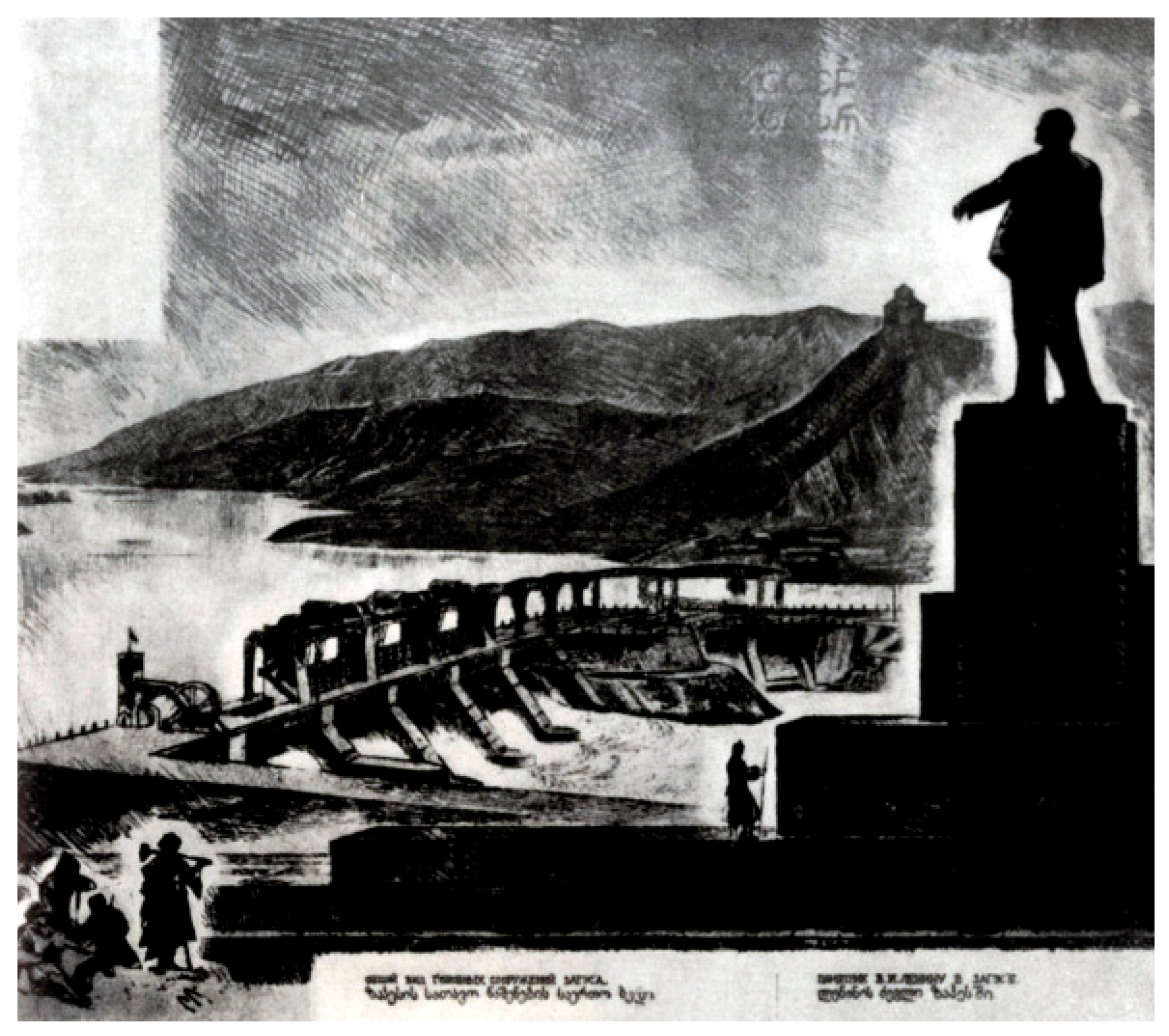
Veter s Kavkaza he is so consumed by the search for proper representational means, as well as the task of finding the coveted focus, that not much time is left for the actual impressions of socialist construction in the region. There is one notable exception, however: an account of his trip to Zemo-Avchalsky Hydropower Plant (Zages) on the Kura River near Mtskheta, constructed in accordance with Lenin’s electrification plan. It is at Zages that Bely evokes the theme of time and history, but in a key very different from Tretyakov’s. The dam is set in a spectacular spot in the mountains, at the confluence of the Aragvi and the Kura, where the ancient city of Mtskheta, with its old monastery and an enormous cultural and literary heritage (Lermontov set his “Mtsyri” in this very spot), is now overpowered by a gigantic statue of Lenin towering above the futuristic concrete structure of the power plant. The statue with its finger pointing downward ostensibly lends Bely just the opportunity for a four-dimensional vision he describes to Pasternak:
[…] статуя Ленина, есть продолженье ландшафта; и ею показана: новая эра земли […] Над ревом Куры, обрамленный отвесами, Мцхетом, плотиной, под Мцыри –уместен он: в фокусе прошлого, будущего,—настоящего; Мцыри, и Ленин; иль: “Свети Цховели” […]
[…] the statue of Lenin is the extension of the landscape and it shows the new era of the land […] Over the roaring Kura, framed by the cliffs, Mtskheta, and the dam, under Mtsyri, he is appropriate: in the focus of the past, the future, and the present; Mtsyri and Lenin, or: “Sveti Tskhoveli.”
Bely, however, is not entirely sincere in his exalted admiration of the extraordinary overlay of nature and history in this particular focal point (to which Lenin presumably points, see
Figure 2). He recalls that the ancient monastery where Lermontov found his Mtsyri was built on the spot where a pagan idol once stood: “here before him, a shrine of the idol rose above the landscape, a place of crossing cultures (Christian and pagan); it also became a third culture: one of concrete.”
18 Just as the monastery once put an end to paganism in Georgia, so does Lenin put an end to the era of Christian culture. Yet implicitly one is made to think about the new idol erected on the same spot and whether this idol too may have to make way for whatever comes next. Bely’s enthusiasm for the futuristic culture of concrete is also rather ambiguous. He describes the actual power plant with references to H. G. Welles’ Mars. In another passage, he calls it “a piece of the twenty-third century” and also “a phantasmagoria”, which brings to mind another novel by the writer of “Russia in the Shadows,” this time Wells’ very pessimistic
Time Machine. It is also important to note that Bely’s temporal vision is vertical, with the “Mtsyri” monastery (past) sitting high above the Lenin statue (present), which itself towers above the “Martian” power plant down below (future). The descent into the phantasmagorical future, where Bely, Meyerkhold, and their companions are shown a terrifying wall of water moving giant machinery, is a glimpse of time itself, as it were, but time
seen rather than experienced on an inner level, and seen in all its uncanniness: “Waters build quite a static form here with the power of their speed, a form of solid bodies; solid bodies are an interference of mad forces, insane speeds; there would be an explosion if they get out of balance. [..] and so Heraclitus is right […] all being is becoming, nothing is at a standstill; all constants are a ghost.”
19 Far from celebrating Zages and Lenin’s genius, this image of history’s inexorable march encapsulated in the horrifying wall of water is instead strangely unsettling. Both Bely and Meyrkhold want to leave.
This is further accentuated by the guide telling Bely and his companions that a beautiful old bridge nearby, half sunk in the dammed river, is actually ancient, built by the Roman general Pompey. In a letter Bely sent to R. V. Ivanov-Razumnik after the trip to the Caucasus, the following candid passage may give us an idea of what he really thought about the place: “Mtskheta area, the ancient cathedral and the magnificent “Mtsyri” under which now there is Zages and a giant statue of Lenin: “Mtsyri” and… “Lenin”; “electrification” and the bridge across the Kura it destroyed… built by Pompey… A piquant sort of place!”
20 It is quite evident from these parallel depictions that what really ought to be the highlight of Bely’s Soviet travelogue is at best problematic—but not only, and perhaps not so much because Bely finds the imprint of Lenin’s electrification on the ancient landscape so objectionable but rather because the “four-dimensional picture” he portrays is not one in which he is able to participate. It is awe-inspiring, uncanny, and yet of the order of a theatrical phantasmagoria: the solid wall of the Kura harnessed by Lenin’s electrification simply cannot be entered. As we saw, in order to be successfully represented, time, to Bely, paradoxically, must not be seen, but rather heard, felt or otherwise experienced in an utterly unpresentable way.
4. Production and Rhythm
For the remainder of his travelogue, Bely struggles to find a form that would do justice to the experience and incorporate the blind spot at its heart. Towards the end of his journey, he unexpectedly brings up fellow anthroposopher Mikhail Chekhov’s art of the rhythmical gesture and that of the pause in the context of his grappling with yet another mountain—this time Kazbek. Somehow, Chekhov’s acting appears as a perfect analogy to Bely’s impressions:
Еще аналогия—в паузе: Чехов играет—от паузы, а не от слова […] но в паузе—силища потенциальной энергии, данной кинетикой жеста в миг следующий, где все тело, как молния; из острия этой молнии, как из разряда энергии—с л о в о […] Сперва подается сознание звука неслышного; после, как эхо,—ритмический жест, или очерк зигзага; позднее же—стабилизация образа, голосовой аппарат, или э т и граниты […] В поэзии: в паузной форме—энергия ритма, реально стверженного в треск инкрустаций согласного твердого тела (касания к полости рта—языком).
Another analogy is in the pause: Chekhov plays from the pause, not from the word. […] but in his pause there is an enormous power of potential energy given by the kinetics of the gesture in the following moment, when the entire body is like lightning, the w o r d jets out of this lightning like from energy discharge […] First, one is given the consciousness of a quiet sound, then, like an echo—a rhythmic gesture or an outline of a zigzag; later, the image gets stabilised in the voice apparatus or in these granits […] In poetry: in the form of the pause is the energy of rhythm solidified for real into the crackling of the inlaid, solid body of the consonant (when the tongue touches the mouth cavity).
This, it appears, is the type of
ocherk (the literal meaning of artistic “sketching” transpires here, from the Russian
ocherchivat’) that Bely aspires to: rhythmical prose shot through with mighty pauses—in a sense, the kind of prose that is really poetry. One of the two texts Bely hails as exemplary in his 1932 talk on the
kraevedcheskii ocherk actually
is a poem, his friend Grigory Sannikov’s “poem about cotton”
V gostiakh u egiptian (
Visiting the Egyptians), which Bely also lavishly praises in a separate
Novyi mir essay published in the same year.
21 In Sannikov’s poem, “the past, the present, and the future of production are presented in intonational verse capable of sparking off scientific interest to cotton in any reader” (“Kultura” 273). It mattered little that the actual poetry in question was at best mediocre; Bely’s praises were due, to some extent, to his friendship with Sannikov and to the latter’s influential position in the literary establishment—but only partially. There is little doubt that it was the
rhythmical aspect of Sannikov’s “poetic
ocherk” that Bely seized upon so ecstatically. Bely’s life-long obsession with poetic rhythm is well known. He continued working on his study of rhythm in Pushkin’s
Bronze Horseman while travelling to the Caucasus in 1927; the book
Ritm kak dialektika i “Mednyi vsadnik” was eventually published by Federatsia in 1929. Rhythm is so important to the
ocherk because it is through rhythm that time, the Kantian “pure image of all objects of sense” makes itself felt. According to Bely’s 1917 essay “Ritm i smysl” (“Rhythm and meaning” (
Bely 1927)), rhythm is a curious thing, if it could be called a thing at all. It is neither image, nor content, nor form; it is immaterial, has nothing to do with abstractions and can never be fully comprehended by understanding. It comes from the region of pure meaning:
вне-содержателен—ритм; и—вне-материален; в материи—жеста нет; материалистический взгляд на ритм не дает представлений о том, что он—жест; как таковой он—вне-форменен; вне-содержателен—он же […] Область чистого смысла—в пределах иного сознания, могущего отпечатлеться на гранях сознания нашего—ритмом; и—только
rhythm is outside of content and outside of matter; there is no gesture in matter; the materialistic view of rhythm does not give us the idea that it is gesture; as such it is formess; it is also content-less […] A region of pure meaning within limits of another consciosness that can imprint itself on the limits of our own as rhythm and nothing else
These views were shaped in Bely already after his conversion to anthroposophy and extended his earlier interest in rhythm beyond the sphere of poetry into all aspects of human experience: according to Steiner’s precepts, world rhythm penetrates everything, and it is through rhythm that the human subject can know the universe and the universe can know itself. Bely talks about “social rhythm” in his 1928 confession “Why I Became a Symbolist…” (
Bely 1994, p. 473) and in a very curious letter to two unknown addressees written in January of 1927, the year of the Caucasus trip described in
Veter s Kavkaza. In this letter, among arcane astrological and anthroposophic reflections that invoke Kamaloka, Karma and signs of the Zodiac, he insists on the need to master the rhythm of the year:
если мы не согласуем с этим нашим развиваемым слухом ко времени все отвлеченные наши знания об антропософском пути, этот путь, абстрактно изучаемый, нуль: ничто; надо уметь править временем: правильно вести время в себе, то есть читать ритмы, подпевать им жизнью; праведник ведь в наше время—ритмист; не нарушающий тактов социальных и индивидуальных
22
if we do not correlate all our abstract knowledge about the anthroposophic path with our developing ear for time, this abstractly studied path is a zero, nothing. One must be able to rule time, steer time correctly inside oneself, that is, to read rhythms, sing along with them with one’s life; a righteous person these days is a rhythmist who does not violate social and individual beats.
Such understanding of this key concept certainly has far-reaching implications for Bely’s theory of the
ocherk. In the Sannikov review, he tries his best to clothe his thoroughly un-Marxist convictions about rhythm in proper ideological language but the reason for this is not just political expedience, but also Bely’s own desire to “sing along with the social rhythms”, as his very private letter from 1927 testifies. He claims that Sannikov succeeded in carrying out a “chemical synthesis from the spirit of the time and from elements of the past required for the proletarian revolution.”
23 The product of this chemical alloy manages to navigate between the “Scylla” of a dry
ocherkovyi doklad and the “Charybdis” of “lyric superstructures” (Poema 233)—all thanks to its superior rhythm, which Bely studies at length, deploying mathematical methods he developed in
Dialektika ritma.
Finally, it is rhythm that he puts at the core of his one and only Soviet ocherk “Armenia”, with which he was at least partly satisfied.
24 Unlike
Veter s Kavkaza, this piece is much more compact and far less concerned with its own representational method. In it, Bely seems to have found a balance between nature, history, culture, and of course socialist construction that heralds Armenia’s future. Much like Sannikov, except in a different genre, he switches rhapsodically between ancient churches, the tragedy of the massacres, volcanic scenery, disappearing Persian architecture, the art of Martiros Saryan, who guides him through most of his trip, yet again helping him see, and various sites of future socialist Armenia. The theme of futurity necessarily dominates the sketch, as the real achievements of socialism to date are somewhat modest; unlike the “Martian” future seen for real at Zages, Armenia’s future is deeply rooted in its past. Even the power station he visits near Erivan is not an alien pile of concrete, but rather a structure that pays tribute to ancient Armenian architecture while also incorporating modern forms and engineering requirements. Armenia’s future is merely anticipated yet palpable even in the unlikeliest places. Bely spends a whole paragraph complaining about the brand new hotel in which he and Klavdia Bugaeva were accommodated, where spacious rooms with million-dollar views are not yet equipped with running water or toilets, and all the guests have to queue up by a filthy outhouse in the morning: “you can’t get anything in an exemplary hotel of a grand design, full of tomorrow’s life” (Armenia 224). There are, however, plenty of more encouraging signs of future Armenia—in fact, there are so many of them that in the end Bely does not really know what to do with this multitude. In Armenia, it is not just the impressions of mountains, but also of people, sights, history, and production that overwhelm him: “Days tightly clothed in a motley stream of impressions: I am lost in them—what, where when?”
25 What helps him make sense of the experience and present it in a coherent form is not a focal point of a critical observer but rather the rhythm of the narrative, the breaks and the pauses, and finally images the rhythm produces, including the one on which the essay closes:
Глубокая ночь; засыпаю, качаясь под жесткой вагонной стеной; стук колес отдается повторами дней, поднимающих тему Советской Армении.
—Строимся!
—Выстроили!
—Будем строить!
Late night; I fall asleep, rocking under the hard wall of the carriage; the knocking of the wheels echoes the repeated days which raised the theme of Soviet Armenia.
“We’re building!”
“We have built!”
“We will build!
The three tenses of this refrain add the fourth dimension to his story; they also underscore that which is most important for Bely, the Soviet regional ethnographer, namely that which “throws streams of melted images onto our conscious shores” (Ritm i smysl 144), while coming from “regions of another consciousness” forever hidden from ours: time itself. It appears that to him, the term “деятель культурной революции” [“an actor of the cultural revolution”] only made sense when applied to a writer who “sings along” to the “social rhythms” by locating himself in the blind focal spot from where everything can be seen clearly and thus maintaining inner connection to these otherworldly regions. The problem for Bely, however, is that hae, ever the Kantian and ever the “reflector,” could never quite shut down his critical faculties and was always aware that the ability to represent these pulsations has its limits. Needless to say that by the early 1930s, such a position was no more tenable than the radical productionism of the “literature of fact.” Marrying what Walter Benjamin calls “the correct political tendency and the progressive literary technique” may have been what Bely was after in the final years of his life, but achieving this goal was for him a near-impossible task. Little wonder then that much as he would have loved to, he penned no more kraevedcheskie ocherki after 1929.