1. Introduction
Irish traditional music is typically characterised as an ‘oral tradition’ wherein the repertoire and aspects of performance style are transmitted by ear. Carolan describes it as a ‘living popular tradition’ in a state of fluidity ‘handed down from one generation to the next or passed from one performer to another’ (
Carolan 1991, p. 2). He recognises that the music is changed as it passes from performer to performer and that the ‘creative altering’ is a core tenet that occurs slowly according to a set of principles that have been agreed upon by a conservative community of practice. While performance style has been the subject of considerable debate, with concepts and definitions of personal and regional styles being central to that discourse, little consideration has been given to the ways in which the music develops diachronically as it is passed from one generation to another and what factors influence these musical decisions. This article seeks to examine the process by which a melody can enter the tradition and through the process of creative alteration be considered ‘traditional’. Ó Suilleabháin identifies the process of reworking as central to the definition of Irish traditional music, saying that its music ‘discard elements and acquire new ones according to its needs and circumstances’ (
Ó Suilleabháin 1981, p. 83). Cottrell considers the act of performance to create a palimpsest where traces of earlier performances can still be identified (
Cottrell 2024, pp. 141–51). Taking the example of ‘
The Japanese Hornpipe’, this article will consider the journey of the melody from circus performance piece to an element of the Irish traditional repertory, considering the way it has been reshaped by successive practitioners in the Donegal fiddle tradition, the Wexford mouth organ tradition and the whistling competition at
Fleadh Cheoil na hÉireann and the various physical, instrumental, stylistic and ideological forces shaping successive approaches to performance.
2. Structural Characteristics of the Hornpipe
The hornpipe is a tune-type that appears to have originated in the middle of the eighteenth century associated with sailors. A version of the tune-type in common time made its way to Ireland where its relatively slow tempo and dotted rhythm led to it being adopted by dancing masters as a show piece to demonstrate virtuosity (
L. Doherty 2011). In my consideration of the composition of Irish traditional dance music since 1950, I have suggested five parameters by which a melody can be considered appropriate for acceptance into the Irish repertoire, namely motor rhythm, modality, morphology, ambit and motifs (
Harvey 2018). Motor rhythm refers to the predominant recurring rhythm pattern relating the tune to its corresponding dance, distinguishing it as the primary criteria for identifying tune-types. The hornpipe is characterised by its dotted crotchet-quaver rhythm, though the extent to which the dotted rhythm is observed may be highly dependent upon regional and individual interpretation. Early examples of the hornpipe feature a characteristic phrase ending of three crotchet beats, though this feature has become somewhat redundant in newly composed melodies as tune-writers became increasingly divorced from the functional performance of hornpipes for dancing through the mid twentieth century (
Harvey 2018, p. 69). Breathnach observes the existence of the Ionian, Mixolydian, Dorian and Aeolian modes in Irish traditional dance music (
Breathnach 1971, p. 14). Morphology is a term that encompasses phrase plans and set accented tones. Most traditional dance tunes are typically composed in two eight-bar parts that are repeated, called ‘round’, so that the phrase plan is AABB. The thirty-two bar ‘round’ is repeated at least twice and it is common to perform a medley of two or more tunes in succession. An eight-bar part can be subdivided into two four-bar phrases and can be further subdivided into four two-bar phrases. Set accented tones, intrinsically connected with motor rhythm, can be defined as the notes that occur on the primary beats in each bar of a dance tune. The study of set accented tones appears to perpetuate the notion that all tunes in the traditional repertoire are variants of a small number of basic underlying patterns. Proposed by Ó Suilleabháin, set accented tones have primarily been used as a tool for the analysis of variation in performance practice, though I have proposed the existence of several recurring contour archetypes that act as a structural device in traditional dance music (
Ó Suilleabháin 1987;
Harvey 2018, pp. 381–87). Ambit refers to the range of the melody. Breathnach notes that most traditional melodies have a range of between nine and eleven notes, and few tunes exceed a range of a thirteenth (
Breathnach 1971, p. 14). It is common for traditional tunes to be composed within a range d′-b″ as this is the maximum comfortable range accessible on instruments such as the uilleann pipes, flute and tin whistle (
Harvey 2018, p. 369). Motifs refer to small musical units, typically four note pattern in hornpipes, described by O Canainn as ‘building blocks’ (
Canainn 1978, p. 3). In hornpipes, arpeggiated motifs and passages moving by step are common. In any given tune, these elements must correspond with the musician’s perception of ‘traditional’ and remain consistent in all examples of a tune-type for a melody to gain admittance by the community. Though conservative in nature, O Canainn claims that the musician ‘cannot see the tradition as being any way restrictive’ (ibid., p. 4). The establishment of the rules of ‘traditionalism’ will be discussed in
Section 5.
3. Performance Styles
O’Riada’s seminal radio documentary
Our Musical Heritage introduced a number of regional fiddle styles, highlighting the distinctiveness of the Donegal style, taking John Doherty as exemplar (
O’Riada 1982). In the decades since then, the Donegal fiddle tradition has been the subject of a number of publications (
Feldman and O’Doherty 1979;
MacAodh 2021;
Caldwell 2013;
Neff 2008;
L. Doherty 2010).
Cairdeas na bhFidiléirí, an organisation formed to promote and preserve Donegal fiddle music in the 1980s, continue to produce CDs and books highlighting the practice of individual exponents within the region.
1 The Wexford performance style, particularly, the mouth organ tradition, has been the subject of little scholarly examination to date.
Feadaíl: The Whistling Tradition in Ireland c.1800–2021 is the first major study to consider performance styles and exponents of the whistling tradition (
Harvey 2024).
In a paper presented at the Blas conference and published in 1997 titled ‘The verbal context of style in Irish traditional music’, Keegan outlines five conceptual units for the consideration of performance styles. These are as follows:
The style which is the Irish musical tradition.
The style associated with a particular instrument.
The style of any one of the musical dialects which are characterised by different levels of predominance of certain techniques, methods and repertoire.
The style of an individual musician.
The style of an individual performance (
Keegan 1997, p. 121).
Keegan later returned to the discussion of performance style, identifying thirteen parameters that can be employed as a methodological framework for the analysis of performance style in Irish traditional music, namely ornamentation, phrasing, articulation, variation, intonation, tone, dynamics, repertoire, duration, emphasis, speed, instrumentation and instrument-specific techniques (
Keegan 2010, p. 66). This article seeks to consider the diachronic evolution of ‘
The Japanese Hornpipe’ from its origins as a circus performance piece through its initial adoption into the traditional repertoire via the Donegal fiddle tradition to its current status as a competitive showpiece in the whistling competition at
Fleadh Cheoil na hÉireann. Using these thirteen parameters and five conceptual units, this article will consider the ways in which individual and regional styles can reshape fundamental melodic characteristics through creative reimagining in successive performances as the melody passes from generation to generation.
5. Establishing the Rules of Traditionalism
The whistling tradition in Ireland underwent a decline in the wake of the Great Irish Famine (1845–1852). The visit of internationally renowned celebrity performer Alice Shaw (d.1918) to Ireland in October 1889 sparked a resurgence of interest in whistling as a feature in theatre variety shows where popular and traditional melodies, as well as bird imitations and comedy acts featuring whistling, became a popular attraction. International whistling celebrities toured a circuit across the United States, Europe, Great Britain, Ireland and elsewhere, and their acts were imitated by local performers in towns and villages throughout Ireland.
2 The emergence of whistling as a performance art coincided with the establishment of the Gaelic League who instituted a Gaelic revival, organising music festivals called
feiseanna with concerts and competitions among other events. Given its contemporary popularity and accessibility, whistling was included among the competitive events at
feiseanna nationwide. However, a debate arose around the Irish nature of whistling which coincided with the expansion of the Gaelic League to the working classes in urban centres in 1904.
3 Certain dances and their associated melodies that had been practiced in rural Ireland throughout the nineteenth century, such as the quadrille, lancers, polka, highland scottische and barndance, among others, were deemed foreign, and as such not permitted to be performed at Gaelic League events. The asseveration of leading members of the organisation often turned to denigration through which the isolationist policies of the organisation became apparent. The word ‘vulgar’ was commonly applied to melodies that were considered outside the tradition. In a speech delivered by future vice president of the organisation Fr. Matt Ryan at the Knockavilla
Feis in 1904, he asked that adjudicators should ‘kick vulgar whistling from off any platform. He would ask them to banish vulgar music from amongst them and by so doing would help to keep up the music of Ireland, the music he had learned from his mother, God rest her soul’.
4 In an attempt to discourage entrants from whistling melodies that did not correspond with the ideals of the organisation, the Munster Council of the Gaelic League proposed a ruling that saw competitors disqualified saying
‘any competitors not receiving 25 per cent of the marks for traditionalism should be disqualified. Traditionalism is shown in scale, in timbre or tone, colour, and in the use of certain ornaments or pauses. […] Tunes should be marked in accordance with the Irish scale, and the special Irish quality should be looked for in the matter of tone. When the question of Irish music is better understood, it will not be necessary to mark separately for traditionalism.’
5
Following the introduction of these rules, it became common for entrants to perform a jig, reel, hornpipe and, though some
feiseanna such as those in Munster or Dundalk prescribed tunes such as ‘
The Blackbird’ or ‘
The Coolin’, respectively. Over time, these rules had the desired normative effect over the selection of repertoire both in competition and in daily practice, delineating between the whistling of Irish ‘traditional’ music and the music that could be found on the variety show stage. Adjudicators held influence over which melodies were acceptable for performance. Patrick O’Shea and Dennis Finn commented at the Strokestown
Feis, for example, that ‘one competitor lost a number of marks for selecting airs that were not Irish though of Irish sentiment’.
6The stage hornpipe occupies a liminal space between variety show and Irish music, largely conforming to the structure of Irish traditional dance music, with minor deviations in rhythm, modality, ambit and morphology. On occasion, performance of these tunes at Gaelic League events came in for criticism. Richard Henebry, frequent adjudicator of whistling competitions at
feiseanna in the early years of the twentieth century wrote of the ‘purposeless vapidity’ of ‘
The Liverpool Hornpipe’, for example, while Francis O’Neill later commented that the tune ‘has not entirely escaped misunderstandings’ (
Henebry 1928, p. 170;
O’Neill 1910, p. 116). Characterised by complex melodies, extended sequences of triplets and series of arpeggiated passages implying harmonic progressions typically found in Victorian popular music, Feldman and O’Doherty describe these melodies as a ‘short step in musical taste’ from modern popular music (
Feldman and O’Doherty 1979, p. 47). Consequentially, these tunes were considered inappropriate in competitive settings but continued to enjoy popularity on the Vaudeville stage until the mid-twentieth century. The whistling competition declined in popularity from c.1916 and was largely discontinued at most
feiseanna nationwide, though a short-lived effort to reinstate the competition in the 1930s was largely unsuccessful.
Comhaltas Ceoltóirí Éireann was founded in 1951 when members of the Dublin Pipers Club met with the committee of
Feis Lar na hÉireann to form a national music organisation, issuing an invitation to musicians nationwide to attend a music gathering to coincide with the
Feis on Whitsun weekend in June 1951. The first
Fleadh Cheoil was held in Monaghan town in 1952 hosting a range of instrumental, singing and dancing competitions.
7 A dedicated competition for whistling was introduced in 1954 when the event was held in Cavan town.
8 Sean White’s (d. 2025) All-Ireland winning performances in 1956–1958 had a normative influence on the direction of performance practice and repertoire. His selection of ‘
The Sweeps Hornpipe’ at the
Feis Concert broadcast on RTÉ radio on 21 May 1956, along with his choice to perform ‘
The Wonder’ and ‘
The Golden Eagle’ at the competition in 1958, inspired other competitors to seek out similar hornpipes, leading to the institution of the stage hornpipe as an appropriate selection for the competition. Some competitors such as Robbie McMahon
9 perpetuated the performance of ‘
The Sweeps’, while others, like Paddy Berry
10, sought out other similar hornpipes such as ‘
The High Level’ to demonstrate their virtuosity. Julie Anne Barry selected ‘
Her Golden Hair was Curling Down’ for performance on the occasion of her All-Ireland win in 1998, a popular song titled recorded by Felix McGlennon and Maud Foster for Berliner Gramophone in 1896. The melody was subjected to the process of melodic metamorphosis by
Sliabh Luachra fiddle exponent Padraig O’Keefe (1887–1963).
11 White’s practice as a fiddle player and whistler allowed him to interpret these melodies in a traditional fashion and led younger exponents in the years that followed to seek out similar melodies that had been subjected to the process of traditionalism by a reputed fiddle player. It was in this environment that Alan Dwyer selected ‘
The Japanese Hornpipe’ as a showpiece.
6. Doherty’s Setting of ‘The Japanese Hornpipe’
The precise origins of the ‘
The Japanese Hornpipe’ are unknown at the time of writing, though it is reputed to have been performed by a travelling circus that visited Donegal at the beginning of the twentieth century. The melody was used to accompany a comedy sketch wherein an acted performance was presented accompanied by the first part and a dance was performed alongside the second part. The tune was repeated a number of times in its entirety until the conclusion of the comedy performance. The description is reminiscent of the whistling comedy routines that were popular in Vaudeville in the early twentieth century and may have been whistled or performed by an instrumentalist as part of the circus show. It was common for whistlers to travel with the circus at the beginning of the twentieth century: Duffy’s Circus employed Jackie Walsh as a whistler in 1942, for example, and by 1944 he was back on the variety theatre circuit whistling, singing and playing the saxophone in addition to performing comedic sketches. Another performer named Foley had taken his place by 1948.
12 The melody appears to have been adopted by fiddle players in the Donegal region and assimilated into the local repertoire.
13 Speaking of the interest in these melodies in the region, Feldman and O’Doherty observe that
‘Some of the hornpipes […] reveal the influence of the Victorian classical style with their unusual scales and tricky fingering. In this class of tune, there is a prevalence of form over musical content, and the most accomplished Donegal players learned them as a challenge to their technical mastery of their instrument, or as a response to the dancers who wanted to dance the new steps associated with the music. Their presence in Doherty’s repertoire testifies to the growing influence of external culture in Donegal’.
John Doherty (1900–1980) was a member of a well-known fiddle-playing and tinsmith family who travelled central and south-west Donegal teaching fiddle and performing for house dances and other social events. Visited by a number of collectors in the 1950s, his reputation was bolstered by the release of commercial recordings in the 1970s, cementing his playing as the archetype of Donegal fiddle tradition (
MacAodh 2011). Displaying a clear Scottish influence, Donegal fiddle players are often described as having a bright tone, staccato bowing changing direction on every note, and a preference for triplets instead of rolls (
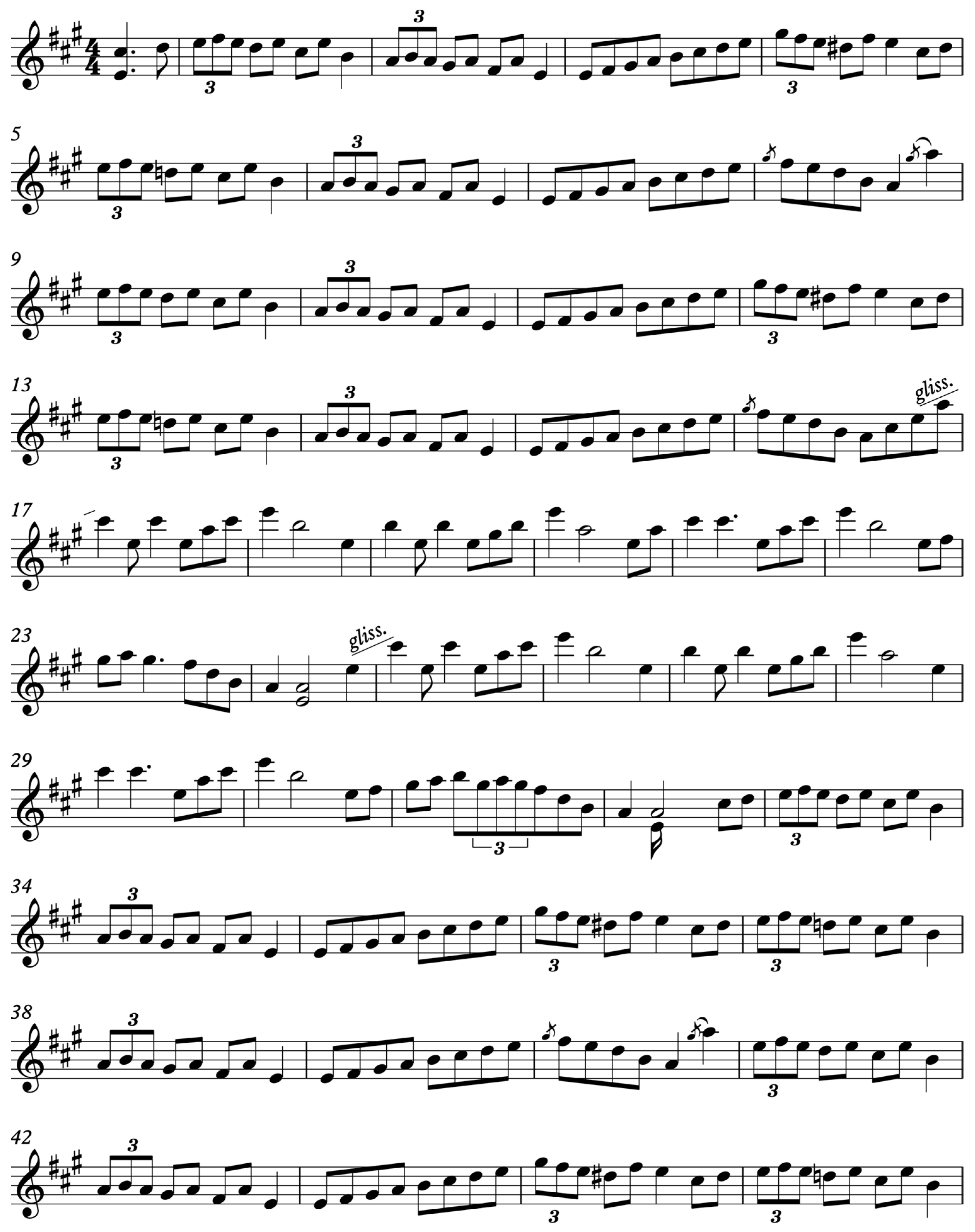
McBride 2011). John Doherty’s 1974 recording is credited with popularising the tune (
Figure 1).
Taking A as the tonal centre, the melody is based around the Ionian scale featuring a raised fourth in an unaccented position in bar four, alluding to a modulation to the dominant indicative of the melody’s origins in the popular genre (
Harvey 2018, p. 285). The range of the tune is a fifteenth e′-e″’. Neff has suggested that the solitude of the soloist may have encouraged the Donegal fiddlers to explore the range of the instrument to fill out the sonic spectrum to create an idiomatic repertoire informed by instrumental limitations (
Neff 2008). The requirement to transition to second position is consistent with Feldman’s assertion that Donegal fiddlers played these challenging melodies to display their dexterity.
Programmatic tunes occupy an important place in the Donegal fiddle tradition: ‘
The Four Posts of the Bed’, for example, requires percussive use of the bow against the fiddle along with left-hand pizzicato to musically depict a story about a traveller who was offered a bed for the night, but fell out of it. (
Caldwell 2013) ‘
Tuaim na Farraige’ makes use of timbral and tempo changes to imitate the sounds of the waves on the shore, while ‘
The Hounds and The Hare’ is a fiddle arrangement of ‘
The Foxchase’ in which the sounds of the hunt are illustrated through a suite of interconnected tune-types. In this case, the change in function between the parts of the tune is evident in alternating tempi and changes in swing. He presents the first part at approximately crotchet = 212, though he starts the part significantly faster than this, slowing in the second part to approximately crotchet = 165. There is considerable inconsistency in tempo where Doherty pushes and pulls phrases faster and slower without a discernible pattern. While the first part has a swing typically associated with the traditional hornpipe dance, the feel of the second part is considerably different. The absence of a consistent rhythm and tempo seems to indicate that the melody was not used for a typical hornpipe dance in the traditional sense, correlating with Neff’s assertion that Doherty’s music was not exclusively dance music (
Neff 2008, p. 84). Indeed, the shifting tempi and changes in swing may be related to the comedy/dance routine that the melody once accompanied instead of the strict dance that we now associate with the hornpipe. The second part features rhythmic syncopation that would typically be considered outside the ambit of the tradition with recurring crotchet-quaver-crotchet-quaver-quaver-quaver-crotchet-minim rhythm. Doherty tends to play the minim slightly longer than two beats, at times, which creates an inconsistent pulse in the second part. Consequentially, the set accented tones (
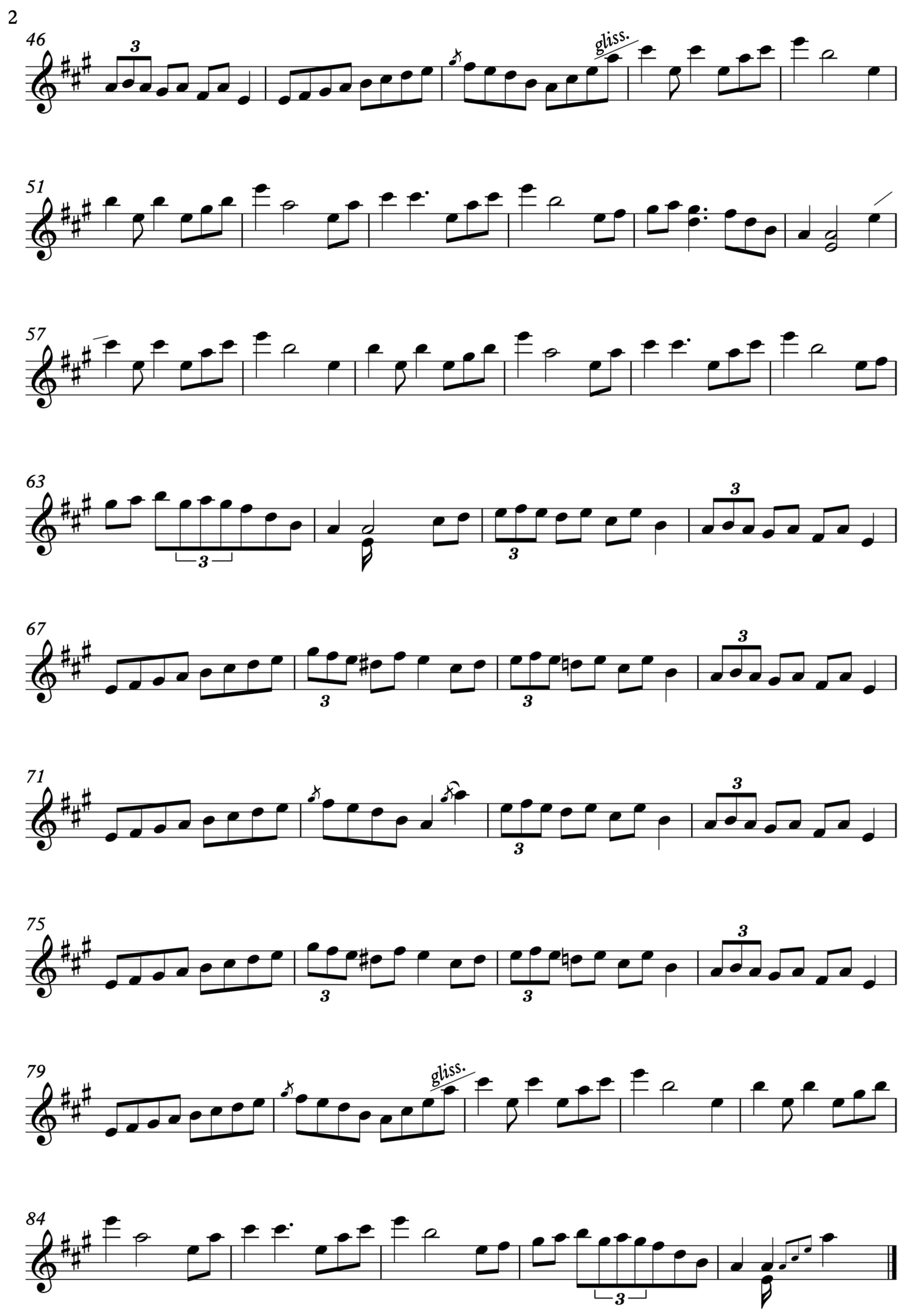
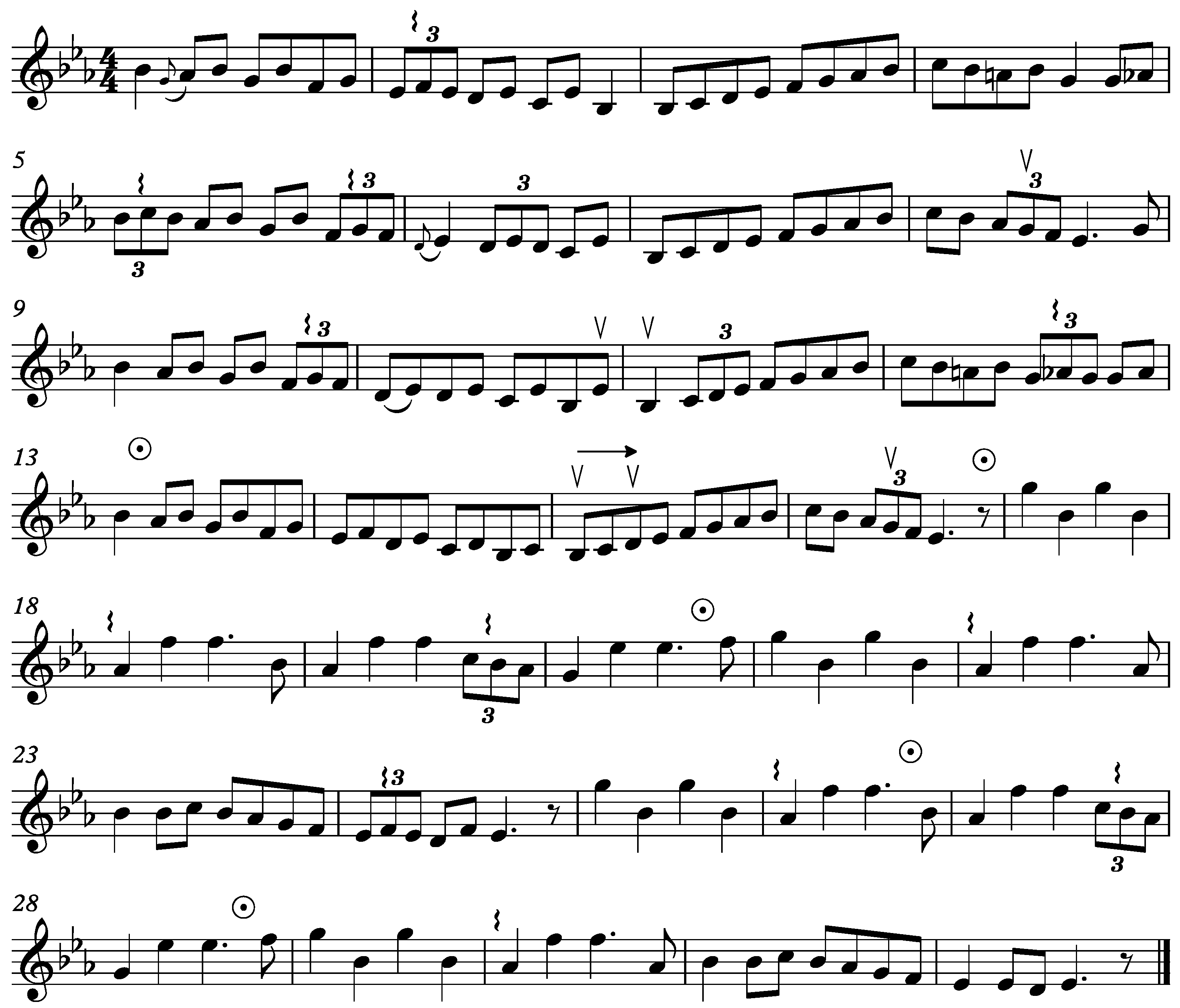
Figure 2) in the first part create a descending scale consistent with hornpipes in the tradition. However, the syncopation distorts the placement of the set tones with the result that the contour of the second part is inconsistent with traditional melodies.
Doherty’s performance features short bows creating staccato phrasing commonly associated with the region. The absence of left-hand finger ornamentation is typical also: Neff argues that the demands of the intricate melodies leave little space for the incorporation of ornamentation such as rolls, cuts, grace notes or crans (ibid., p. 77). While finger ornamentation is sparse, triplets are articulated by the bow creating a staccato effect. Doherty is consistent in his placement of triplets at the beginning of bars one, two, five and six, avoiding subtle variation on repeated iterations. A single cut-like ornament is used at the beginning of bar eight to decorate the highest note of the phrase. An exhibitionist aspect of the melody belying its popular origins, the first part ends with an octave leap a′-a″ decorated by a slide from the note below. There are elements of microtonality at play in the second part, which may be explained by the high register with some notes realised slightly below concert pitch. Doherty approaches the note c♯″’ with a glissando to help with tone and intonation while also establishing the change in tempo and feel between parts. Double stopping is used sparingly on the final note of the eight-bar part to help establish tonality. Doherty ends the tune with an arpeggiated flourish from a′-a″. The absence of variation, either through the changing of ornamentation, phrasing or more expansive rewriting of melodic material is noteworthy. Overall, Doherty’s interpretation exhibits several traditional characteristics, but alternating tempi and syncopation are indicative of the origins of this tune outside of the tradition.
7. Dwyer’s Setting of ‘The Japanese Hornpipe’
‘
The Japanese Hornpipe’ made its way from Donegal to Wexford via fiddle player Paddy Glackin (b.1954).
14 Though born in Dublin, Glackin’s father was from Donegal and they made trips to record John Doherty during his childhood (
Vallely 2011, p. 306). Glackin recorded ‘The Japanese Hornpipe’ on the album
Hidden Ground with Jolyon Jackson in 1980.
15 He was a frequent visitor to Carrig-on-Bannow where he met mouth organ players Phil (1917–1989), John and Pip Murphy, where they learned the tune.
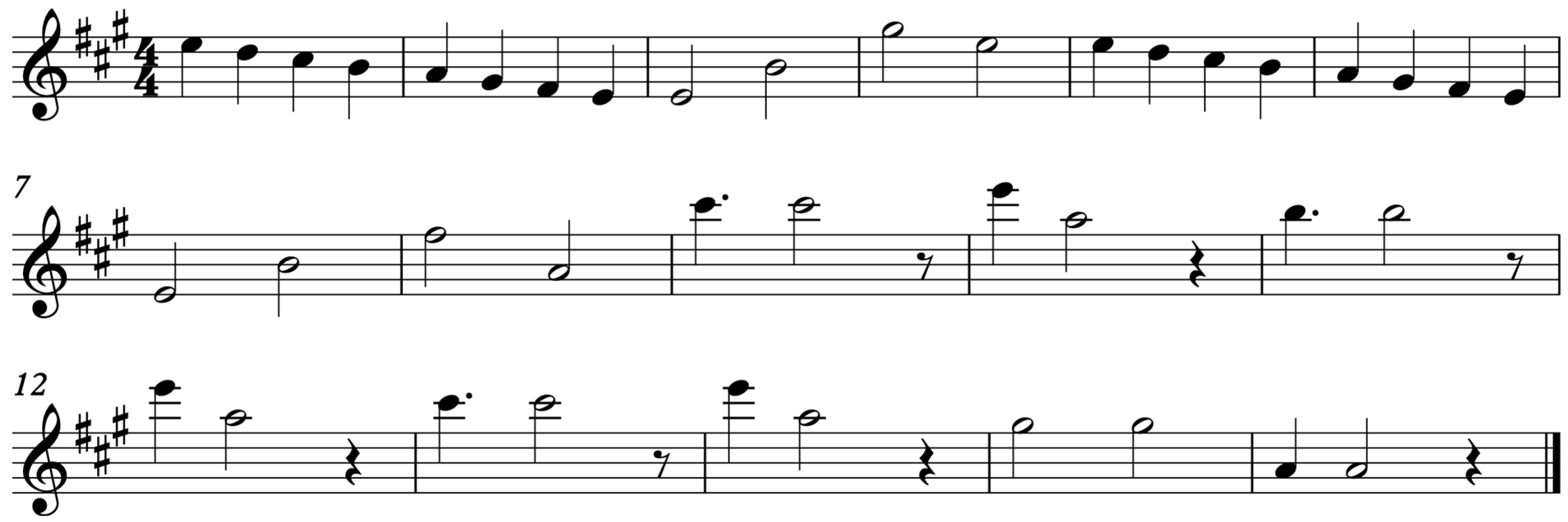
16 A student of theirs on the mouth organ, Alan Dwyer first began taking part in the whistling competition at the Fleadh at the age of ten. He was greatly influenced by his father, and fellow Wexford exponents Sean White and Paddy Berry. He won the 15–18 competition three times in a row, 1988–1990, before winning the senior category in 1991, 2010, 2011, 2012 and 2013. Alan learned ‘
The Japanese Hornpipe’ from the Murphys, adapting it for performance as a whistling showpiece (
Figure 3).
In his interpretation of the tune, Dwyer has changed the key from A Ionian to E♭ Ionian, which is more accessible for the range of the whistler. He changes the highest note in bar ten to a
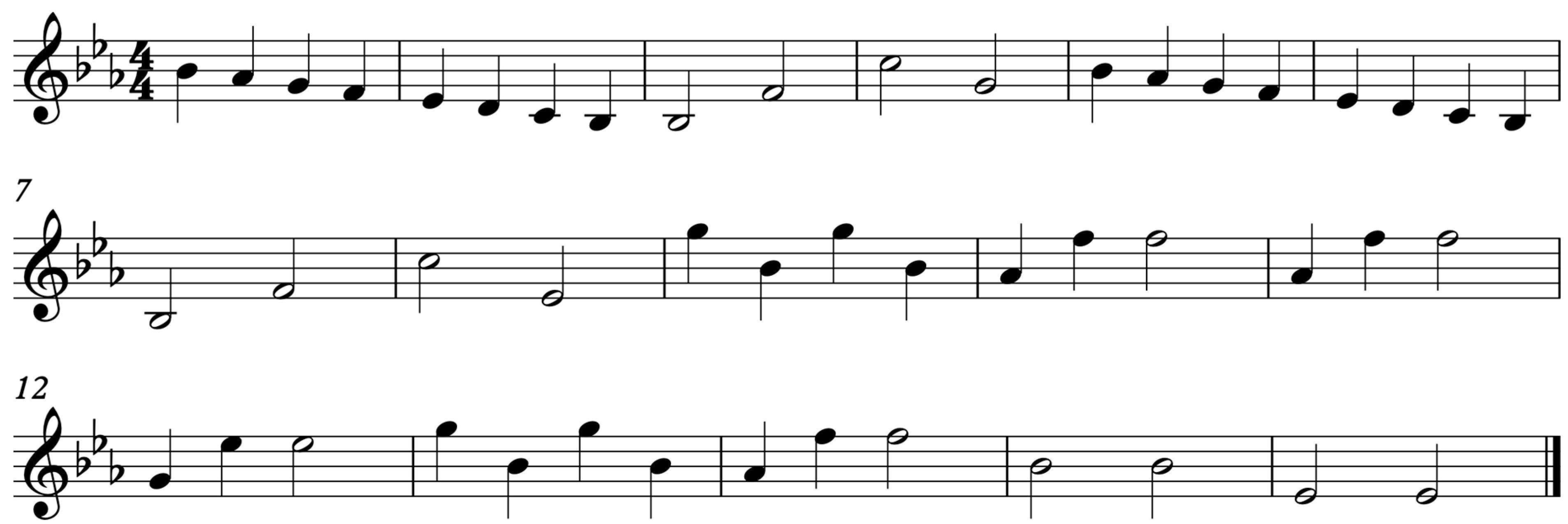
♭’, bringing the melody within the ambitus associated with traditional music. Dwyer observes the raised fourth in bar four but changes the final note of the phrase from the fifth to the third, avoiding any allusion to a modulation which might associate the melody with popular or classical genre. Dwyer does not observe the change in tempo between parts; instead, both parts are performed at approximately crotchet = 156. The consistent tempo is perhaps indicative of the influence of competition on performance practice where the function of the melody has shifted from being an accompaniment for a comedy and dance routine to a solo recital performance. Dwyer has amended the rhythm in the second part, removing syncopation so that the melody moves in crotchets in closer keeping with typical hornpipe rhythm. Of particular note is his alteration of the crotchet-minim rhythm in the second part to crotchet-crotchet-crotchet, in keeping with the typical phrase ending in hornpipes (
L. Doherty 2011, p. 352). This brings the melody closer in line with the requirements for the traditional hornpipe dance instead of the comedy/dance routine that it once accompanied. Consequentially, the set accented tones align with standard convention (
Figure 4).
Typically, the performer employs a type of circular breathing that involves the creation of sound by blowing outwards, called ‘push’, alternating with an inwards suck called ‘draw’, allowing for uninterrupted melodic continuity. This is the style of whistling favoured by Wexford exponents such as White and Berry. There is greater clarity of tone on the push, with draw notes exhibiting a breathy or airy quality, though Wexford whistlers aim for parity of tonal clarity on both push and draw. An alternative breathing style also exists in which exponents whistle exclusively on the push and drop a note to take a breath in the same way that a flute of tin whistle player might. Breaths in this style are typically taken on long notes. Dwyer alternates between both approaches, exhibiting the push/draw style in the first part and the push-only style in the second. Whistling primarily on the push creates a far less staccato phrase than Doherty’s, maintaining a flow that is more consistent with the Wexford tradition, and may also reveal in influence of the network of contacts that Dwyer made through the competition at the Fleadh. When competing as a teenager, Dwyer met senior winners Paddy and Michael Rafferty from East Galway who encouraged him and sent recordings on cassette tapes of tunes for him to learn. The East Galway style is characterised by a fluid legato phrasing evident in his approach here. His use of breaths to create short two-bar phrases in the second part may harken back to Doherty’s shorter phrases.
Typically, in whistling, triplets are executed using a technique called ‘curling’ wherein the tongue is flicked against the back of the teeth or the hard palette to interrupt the airstream, resulting in a change in pitch. Employed on notes of a crotchet value, the resultant effect is a raise in pitch by either a single tone or a third on the second note, creating a triplet effect. This is the approach used by White and Berry. Dwyer, however, employs a different technique to effectuate this ornament achieved through the changing of the direction of the airstream by moving the muscles of the lower lip and jaw forwards in a manner similar to speaking the letter ‘d’. The movement is similar to that employed in mouth organ technique and may have been influenced by the Murphys’ practice. Dwyer begins by placing the triplet in the same place as Doherty at the beginning of bar two and at the start of the second phrase in bar five. He then varies the phrasing, moving away from Doherty’s interpretation by placing a triplet one crotchet earlier at the end of bar five instead of the start of bar six, where he instead elects to slide up to a long note, following that with a triplet. Instead of the cut in bar eight, Dwyer decorates the final phrase with a descending triplet moving by step. Dwyer’s rendition of the second part is sparse, with cuts articulated at the beginning of bars 18, 22, 26 and 30. A triplet is used to decorate the final bar of the second part on its first iteration, but Dwyer avoids displays of exhibitionism at the end of the performance, ending the tune in typical hornpipe fashion with crotchet-quaver-quaver-crotchet rhythm.