Article

Integrated Life Cycle Environmental Impact and Mechanical Durability-Related Assessment of Sustainable Pozzolanic Mortars


1
Geological Sciences Department, Faculty of Biological and Agronomic Sciences (FSBSA), Mouloud Mammeri University of Tizi-Ouzou, Tizi Ouzou 15000, Algeria
2
Civil Engineering Research Laboratory of Setif (LRGCS), Department of Civil Engineering, Setif 1 University-Ferhat Abbas, Setif 19000, Algeria
3
Emergent Materials Research Unit (EMRU), Setif 1 University-Ferhat Abbas, Setif 19000, Algeria
4
Department of Civil Engineering, College of Engineering, Qassim University, Buraidah 52571, Saudi Arabia
5
Department of Civil, Constructional and Environmental Engineering, Sapienza University of Rome, Via Eudossiana 18, 00184 Rome, Italy
*
Authors to whom correspondence should be addressed.
Buildings 2026, 16(9), 1834; https://doi.org/10.3390/buildings16091834
Submission received: 1 March 2026 / Revised: 24 April 2026 / Accepted: 27 April 2026 / Published: 4 May 2026
(This article belongs to the Section Building Materials, and Repair & Renovation)

Abstract

The cement industry is a major contributor to global energy consumption and greenhouse gas emissions, motivating the development of sustainable cementitious materials through partial cement substitution. This study investigates the combined mechanical, durability-related, and environmental performance of mortars incorporating a 20% replacement of Portland cement by volume with different natural and waste-derived mineral additions, including natural pozzolan, brick waste, glass powder, recycled concrete powder, and calcined clay as pozzolanic or potentially reactive supplementary materials, while silica sand was used as an inert mineral filler. Mechanical performance was evaluated through compressive strength, while durability-related behavior was assessed using water absorption by immersion at 28 days. In parallel, a Life Cycle Assessment (LCA) was conducted to quantify the environmental impacts associated with climate change, acidification, eutrophication, photochemical oxidant formation, material resource depletion, and non-renewable energy consumption. The results show that mortars incorporating natural pozzolan and brick waste achieved compressive strengths comparable to the reference mortar, while maintaining low water absorption values, indicating effective microstructural densification. Glass powder also provided acceptable mechanical and durability-related performances, whereas silica sand, recycled concrete powder, and calcined clay exhibited reduced strength and increased absorption due to dilution effects, inherited porosity, or delayed pozzolanic activity. From an environmental perspective, all cement-substituted mortars demonstrated significant reductions across all assessed LCA impact categories, with decreases typically ranging from 15% to 20% relative to the reference mix. The most pronounced environmental benefits were observed for mortars incorporating waste-derived materials, particularly brick waste. Overall, the combined mechanical and environmental assessment demonstrates that a 20% cement substitution using supplementary materials can substantially reduce the environmental footprint of mortars without compromising essential engineering properties.

1. Introduction

Cement-based materials are extensively used in construction worldwide due to their availability, versatility, and mechanical performance [1]. However, cement production is among the most energy-intensive industrial processes and represents a major source of greenhouse gas emissions, particularly carbon dioxide (CO2) [2]. The continuous increase in atmospheric greenhouse gases has led to global warming, which is manifested by a steady rise in average surface temperatures and associated climatic disturbances [3,4]. On a global scale, approximately one ton of concrete is produced annually per capita [5], while the manufacture of one ton of cement requires nearly 7 GJ of energy and releases close to one ton of CO2 [6]. Although technological advancements have reduced energy consumption in some developed countries [7], global cement production currently exceeds 4 billion tons per year, accounting for nearly 8% of total anthropogenic CO2 emissions [8].
In response to international climate commitments, particularly the Paris Climate Agreement, the cement industry has been urged to significantly reduce its carbon footprint. The Global Cement and Concrete Association has set a target to reduce CO2 emissions by at least 16% by 2030, in line with sustainable development objectives [8]. In parallel, institutions such as the U.S. Green Building Council emphasize energy efficiency, material optimization, and waste valorization as essential strategies for sustainable construction practices [9]. Consequently, reducing cement consumption through the partial replacement of clinker with alternative materials has become a critical research focus. One of the most promising approaches to lowering the environmental impact of cement-based materials is the incorporation of supplementary cementitious materials (SCMs), including natural pozzolans and industrial by-products. Numerous studies have demonstrated that partial cement replacement with pozzolanic materials can significantly reduce environmental impacts while maintaining or even enhancing mechanical and durability-related properties [10,11,12]. According to ASTM C311 [13], pozzolans are siliceous or aluminous materials that exhibit little cementitious activity on their own but react chemically with calcium hydroxide in the presence of moisture to form additional calcium silicate hydrate (C–S–H) gel. This reaction contributes to microstructural refinement, improved durability, and long-term strength development.
Experimental investigations have confirmed that the incorporation of pozzolanic materials such as silica fume, metakaolin, fly ash, and pumice can improve compressive strength, reduce permeability, and enhance resistance to aggressive environments [14,15,16]. While some studies report a temporary reduction in early-age strength due to clinker dilution, long-term performance is often improved as secondary hydration reactions progress [17,18,19]. These findings indicate that the performance of blended mortars is strongly influenced by the nature, fineness, and replacement level of the pozzolanic material.
In recent years, increasing attention has been directed toward the valorization of construction and demolition waste (CDW) as a source of alternative cementitious materials. CDW represents more than 30% of global solid waste generation, with brick waste constituting over 50% in some countries [20,21]. Although recycled aggregates are commonly used as replacements for natural aggregates [22,23], this approach does not significantly reduce cement consumption. A more effective strategy involves the use of finely ground recycled brick powder (RBP) as an SCM. Existing studies suggest that RBP can exhibit pozzolanic activity and contribute to strength development when used at appropriate replacement levels [24,25,26]. However, reported results vary widely, indicating that the performance of RBP-based systems is highly dependent on particle size, mineralogical composition, and substitution ratio.
Similarly, waste glass powder (WGP) has emerged as a promising SCM due to its high amorphous silica content. Previous research has shown that the pozzolanic reactivity of WGP increases significantly as particle size decreases, leading to improved mechanical properties and durability [27,28,29]. Nonetheless, variability in glass sources and processing methods results in inconsistent performance, highlighting the need for systematic evaluation.
Another promising class of SCMs is calcined clays, particularly metakaolin-rich kaolinitic clays, which are increasingly recognized as low-carbon alternatives to Portland cement. Calcined clays exhibit high reactivity, enabling the formation of additional C–S–H and calcium–alumino–silicate hydrate (C–A–S–H) phases that enhance matrix densification and reduce permeability [30,31,32]. Limestone–calcined clay cement (LC3) systems allow clinker replacement levels of up to 50% while maintaining satisfactory mechanical performance and achieving CO2 emission reductions of up to 30% [33].
While the mechanical and durability performance of blended mortars has been extensively investigated, fewer studies have adopted a comprehensive environmental assessment framework. According to ISO 14040 [34], Life Cycle Assessment (LCA) provides a systematic methodology for quantifying environmental impacts across the entire life cycle of a product, from raw material extraction to end-of-life. LCA is a multi-criteria decision-support tool that enables the evaluation of trade-offs between environmental performance, resource consumption, and technical properties, making it particularly suitable for assessing sustainable cementitious materials.
Based on previous research indicating that Portland cement can be partially substituted by pozzolanic materials at replacement levels of up to 20% without significantly compromising mechanical performance [35,36,37], the present study aims to provide a comprehensive evaluation of both the technical and environmental performance of mortar mixtures incorporating different pozzolanic and alternative mineral additions. More specifically, this work focuses on the comparative assessment of the compressive strength and water absorption of mortars in which 20% of the cement content is replaced by various natural and waste-derived pozzolanic materials. These properties are selected as key indicators of mechanical performance and durability-related behavior, allowing the identification of potential trade-offs between strength development, pore structure refinement, and moisture transport characteristics. In addition to the experimental characterization, a LCA is conducted to quantify the environmental impacts associated with each mortar formulation. The LCA focuses on several relevant impact categories, including climate change, acidification, material resource depletion (metals and minerals), and energy resource consumption, which are directly linked to cement production, raw material extraction, and material processing. This multi-criteria environmental evaluation enables a consistent comparison between the reference mortar and the mixtures incorporating cement substitution. By combining mechanical testing with environmental impact assessment, this study seeks to identify mortar formulations that achieve an optimal balance between engineering performance and environmental sustainability. The results are intended to contribute to the development of low-carbon and resource-efficient cementitious materials and to support the wider adoption of pozzolanic materials as viable partial substitutes for Portland cement in sustainable construction practices.

2. Materials and Methods

2.1. Materials

The chemical composition and physical characteristics of the binder and SCMs used in this study are presented in Table 1. The binder consisted of an ordinary Portland cement (OPC) classified as CEM I 42.5 R, manufactured by the Biskria cement plant (Algeria) in accordance with the EN197-1 [38] standard, and characterized by a high CaO content (64.47%) and a Blaine specific surface area of 320 m2/kg, typical of Portland cement clinker and conducive to adequate early and long-term strength development. In contrast, the supplementary materials exhibit distinct chemical and physical profiles reflecting their different origins and reactivity. Natural pozzolan and calcined clay are rich in reactive silica and alumina, indicating a strong potential for pozzolanic activity through the formation of additional C–S–H and C–A–S–H phases. Recycled brick waste also presents a high aluminosilicate content, confirming its suitability as a supplementary cementitious material, while glass powder is dominated by amorphous silica with a significant alkali content, enhancing its reactivity when finely ground. Silica sand, composed almost entirely of SiO2, behaves predominantly as an inert filler, whereas crushed concrete exhibits a chemical composition close to that of cement due to the presence of residual hydrated phases and unreacted clinker. The loss on ignition values reflect differences in bound water, carbonation, and mineral transformations, particularly for brick waste and calcined clay. From a physical perspective, the absolute densities of the SCMs range from 2.45 to 2.65 g/cm3, compared with 3.20 g/cm3 for cement, which affects volumetric mixture proportions. Moreover, all SCMs were ground to fineness levels comparable to or higher than that of cement, with Blaine specific surface areas ranging from 410 to 552 m2/kg, thereby promoting particle packing and, where applicable, enhanced pozzolanic reactivity. It should be noted that, although Blaine fineness values were available, detailed particle size distribution data were not obtained for all supplementary materials, which may also influence their reactivity and overall performance.

2.2. Mixture Proportions and Methods

The experimental program was designed to investigate the influence of different supplementary mineral additions, namely natural pozzolan, silica sand, recycled brick waste, crushed concrete powder, glass powder, and calcined clay, on the performance of cementitious mortars (i.e., M-PZ, M-SS, M-BW, M-CRC, M-GP, and M-CC). All mixtures were formulated using constant binder-to-sand (B/S) and water-to-binder (W/B) ratios of 0.33 and 0.50, respectively, to ensure consistent workability and comparability among the tested formulations. The protocol described in mixing [39] was followed to mix the mortars. Fresh mortars were cast into 40 × 40 × 160 mm3 prismatic molds. After an initial curing period of 24 h, the specimens were demolded and subsequently cured by immersion in water at ambient temperature until the testing age. A total of seven mortar mixtures were prepared and evaluated. For each mixture, three replicate specimens were produced and tested to ensure statistical reliability, as summarized in Table 2.
Compressive strength was determined after 28 days of curing in accordance with EN 12390-3 [40], and the reported values correspond to the average of three measurements. Water absorption by immersion was assessed after 28 days of curing following ASTM C1403 [41], where specimens were immersed in water at 20 ± 2 °C until constant mass was achieved, and the absorption percentage was calculated based on the mass difference between dry and saturated states using Equation (1).
A ( % ) = m f m 0 m 0  
where m f and m 0 are the specimen masses after and before immersion, respectively.

2.3. Life Cycle Assessment (LCA) Methodology

The environmental performance of the developed mortar mixtures was evaluated using a LCA framework in accordance with the ISO 14040 and ISO 14044 standards [42]. The primary objective of this assessment was to quantify and compare the environmental impacts associated with mortars incorporating SCMs as partial substitutes for Portland cement, in comparison with a reference mortar produced using conventional constituents.
The functional unit (FU) was defined as 1 m3 of mortar, ensuring a consistent basis for comparison among mixtures with different material compositions and densities. This choice allows the direct evaluation of environmental performance while preserving the functional equivalence of the investigated mixtures.
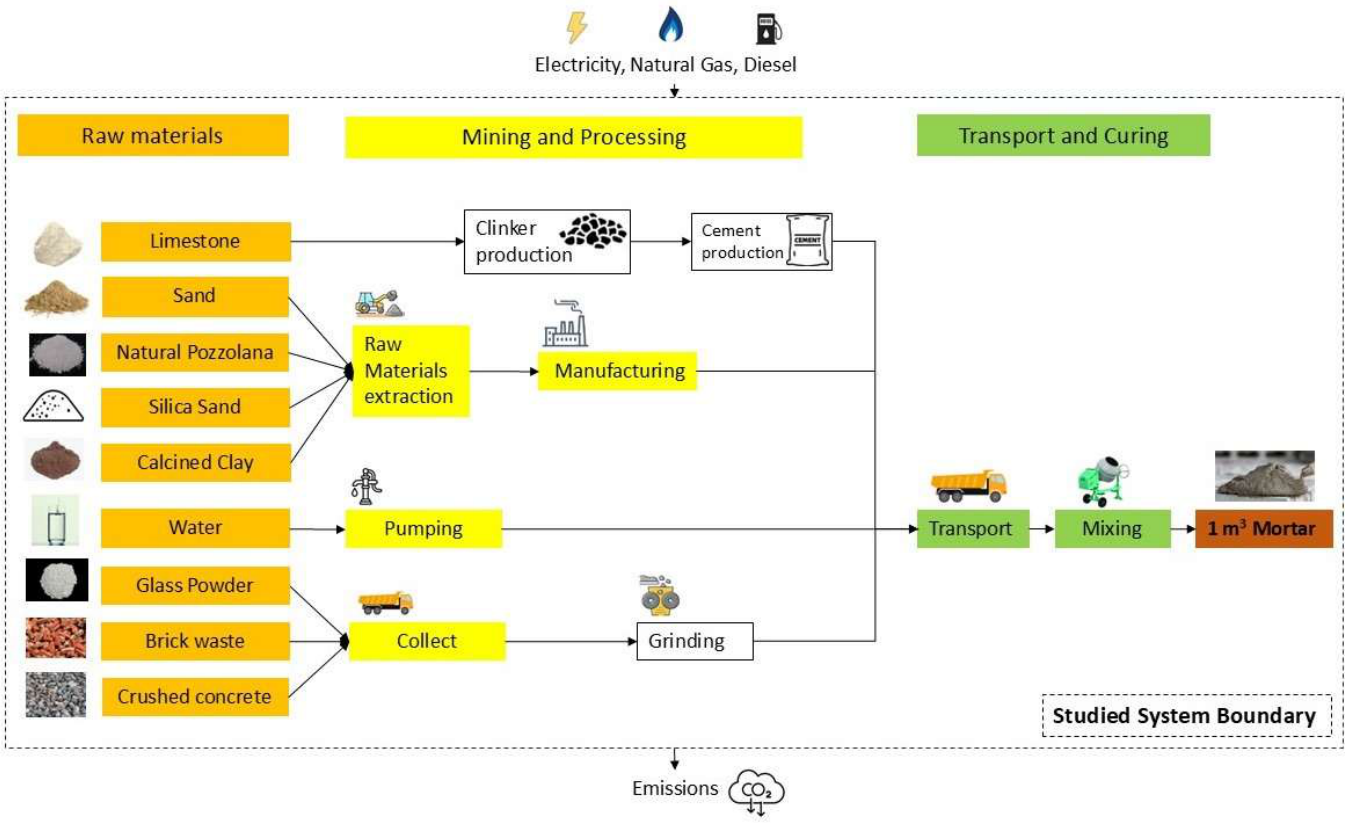
The system boundaries were established according to a cradle-to-gate approach, encompassing raw material extraction, material processing, transportation, batching, and mortar mixing (Figure 1). The use phase, end-of-life stage, and impacts related to infrastructure construction and maintenance were excluded from the analysis, as they were assumed to be identical for all mixtures and therefore outside the scope of this comparative study.
The life cycle inventory (LCI) was developed using the EcoInvent v3.10 database. Material quantities were directly derived from the experimentally validated mix designs. Primary data related to cement production were obtained from Makhlouf et al. [43], while secondary data for aggregates, supplementary cementitious materials, water, and superplasticizer were sourced from the EcoInvent database. Energy consumption for production and processing stages was modeled using the Algerian average electricity mix available in EcoInvent v3.10, while natural gas consumption data were extracted from the same database. The energy demand associated with gravel crushing and SCM processing was adopted from the literature [1,44].
Transportation processes were included using harmonized assumptions for minimizing variability related to logistical factors. All raw materials were assumed to be transported by diesel-powered trucks over a fixed distance of 50 km, ensuring that differences in environmental impacts were primarily driven by material substitution strategies rather than transport-related effects.
The life cycle impact assessment (LCIA) was performed using Activity Browser software (version 2.11.1) based on the Brightway2 framework. Environmental impacts were calculated using the CML v4.8 (2016) midpoint method, which provides a robust and transparent multi-criteria evaluation. The selected impact categories included climate change, acidification, eutrophication, photochemical oxidant formation, ozone layer depletion, human toxicity, ecotoxicity, and abiotic resource depletion.
Finally, the interpretation of results was conducted in direct relation to the mortar mix compositions. Since the supplementary materials were introduced on a volumetric basis, functional equivalence among mixtures was preserved. Consequently, variations in environmental performance were mainly attributed to differences in material composition and processing requirements, rather than external parameters such as transport distances or infrastructure-related impacts.

3. Results and Discussion

3.1. Compressive Strength Analysis

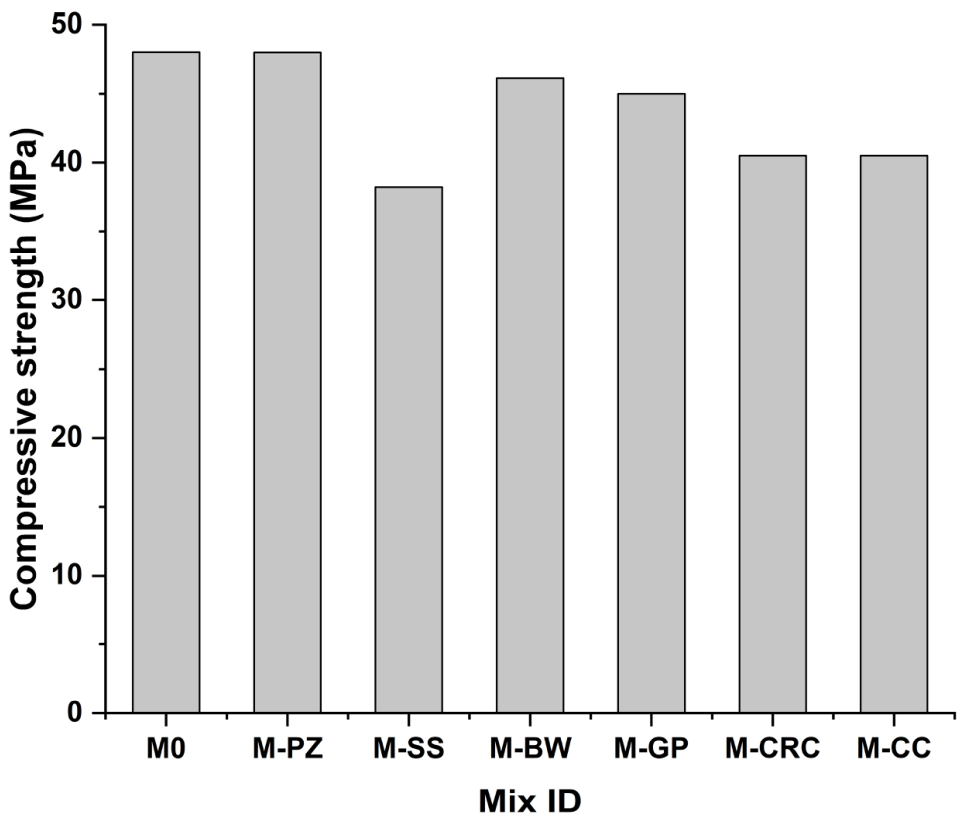
The compressive strength results of the investigated mortars, as shown in Figure 2, provide valuable insight into the mechanical performance of cementitious systems incorporating a 20% cement substitution with different mineral additions. The reference mortar (M0) exhibits the highest compressive strength, reaching 48 MPa, which is consistent with the high clinker content and the fully developed hydration products typically associated with ordinary Portland cement-based mortars.
Mortars incorporating natural pozzolan (M-PZ) show a compressive strength of 47.99 MPa, which is virtually equivalent to that of the reference mortar (M0). This result indicates that the pozzolanic reactivity of the natural pozzolan effectively compensates for the reduction in clinker content. The reaction between the pozzolan and calcium hydroxide released during cement hydration leads to the formation of additional calcium silicate hydrate (C–S–H), resulting in a dense microstructure and efficient load transfer within the matrix. Similar observations have been reported in the literature, where natural pozzolans used at replacement levels up to 20% maintained or slightly improved compressive strength at medium to long curing ages [45,46,47].
The mortar incorporating brick waste (M-BW) exhibits a compressive strength of 46.12 MPa, slightly lower than the reference mortar but still within a comparable range. This behavior can be attributed to the partial pozzolanic activity of finely ground brick waste, which contains amorphous aluminosilicate phases capable of reacting with calcium hydroxide. In addition, the SCM effect associated with fine brick particles contributes to pore refinement and improved packing density. This trend aligns with prior findings reporting that recycled brick powder used at moderate replacement levels (10–20%) can maintain acceptable compressive strength, although higher replacement ratios may lead to strength reductions due to dilution effects [47,48].
Mortars incorporating glass powder (M-GP) reach a compressive strength of 45 MPa, indicating a moderate reduction compared with the reference mortar. While glass powder is rich in amorphous silica and exhibits pozzolanic potential, its reactivity strongly depends on particle fineness and curing conditions. The observed reduction suggests that, under the present conditions, the pozzolanic reaction of glass powder may not fully compensate for clinker dilution. Similar trends have been reported in the literature, where compressive strength improvements were observed only when glass powder particle sizes were below critical thresholds (typically <40 µm) or at extended curing ages [49,50].
The lowest compressive strength values are observed for mortars incorporating silica sand (M-SS) (38.2 MPa) and crushed recycled concrete (M-CRC) and calcined clay (M-CC) (both 40.5 MPa). In the case of silica sand, the reduction is primarily attributed to its inert nature, which results in a dilution effect due to reduced clinker content without any compensating pozzolanic reaction. For crushed recycled concrete, the lower strength can be explained by the presence of residual hydrated phases and higher porosity, which limit its contribution to strength development. Calcined clay, despite its high pozzolanic potential, may exhibit reduced early-age strength when used without optimization of calcination conditions or particle fineness, as the formation of secondary hydration products requires sufficient curing time.
Overall, the compressive strength results demonstrate that partial cement substitution at a 20% replacement level does not necessarily compromise mechanical performance when reactive pozzolanic materials are used. Natural pozzolan and brick waste show particularly favorable behavior, achieving compressive strengths comparable to the reference mortar, while inert or less reactive materials result in more pronounced strength reductions. These findings are in good agreement with existing literature, which indicates that the mechanical performance of blended mortars strongly depends on the reactivity, fineness, and mineralogical composition of the substituted material, as well as on curing conditions [51,52].

3.2. Water Absorption by Immersion

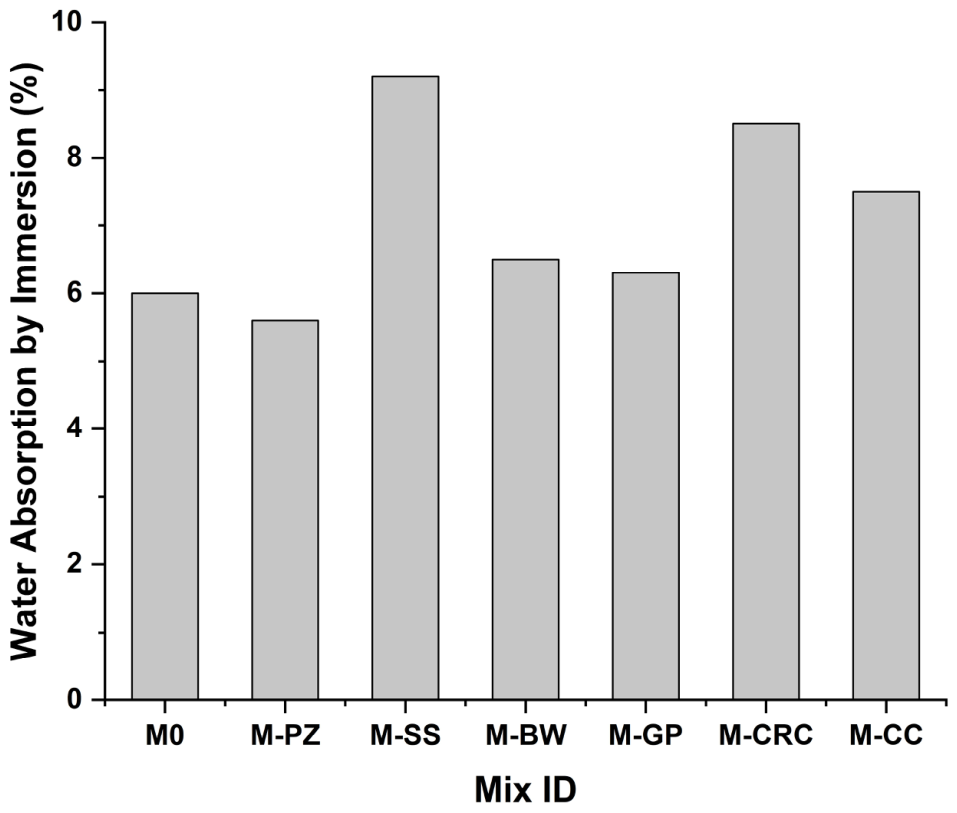
The water absorption by immersion results, as shown in Figure 3, provides important insight into the pore structure and durability-related behavior of mortars incorporating a 20% cement substitution. The control mortar (M0) exhibits an absorption value of 6.0%, which is representative of a dense cementitious matrix with a relatively low fraction of interconnected capillary pores.
Compared with M0, the mortar M-PZ shows a lower absorption value (5.6%), corresponding to a reduction of approximately 6.7%. This improvement can be attributed to the combined filler effect and pozzolanic reaction, whereby the fine pozzolan particles enhance particle packing and react with calcium hydroxide to form additional C–S–H, leading to pore refinement and reduced water-accessible porosity. Similar reductions in absorption associated with natural pozzolans at moderate replacement levels have been widely reported in the literature [53,54].
The mortars M-GP and M-BW exhibit absorption values of 6.3% and 6.5%, corresponding to moderate increases of approximately 5.0% and 8.3% relative to M0, respectively. These results suggest that although both materials contribute to improved particle packing, their pozzolanic reactivity at 28 days may be partially limited by particle fineness and heterogeneity. Nevertheless, the absorption values remain close to the reference mortar, indicating that no significant deterioration in pore connectivity occurs. Comparable behavior has been observed in previous studies on glass powder and recycled brick powder used as partial cement replacements [50,55]. A more pronounced increase in water absorption is observed for the mortar M-CC, which reaches 7.5%, corresponding to an increase of approximately 25% compared with M0. Although calcined clays are known for their high pozzolanic potential, this result indicates that, under the present curing and processing conditions, the refinement of the pore structure at 28 days is not yet fully developed. This behavior has also been reported in the literature, where insufficient fineness, suboptimal calcination conditions, or increased water demand can delay the beneficial effects of calcined clays on pore refinement [51].
The mortars M-CRC and M-SS show the highest absorption values, 8.5% and 9.2%, corresponding to increases of approximately 41.7% and 53.3% relative to M0. These results reflect the combined effects of clinker dilution and inherited porosity in recycled materials, as well as the low reactivity of silica sand under the present experimental conditions when used as a cement substitute. The limited formation of additional hydration products results in a more connected capillary pore network, thereby increasing water uptake. Similar observations have been reported for recycled concrete powder and inert fillers in cementitious systems [48,56].

3.3. Impact of SCM Type on Climate Change

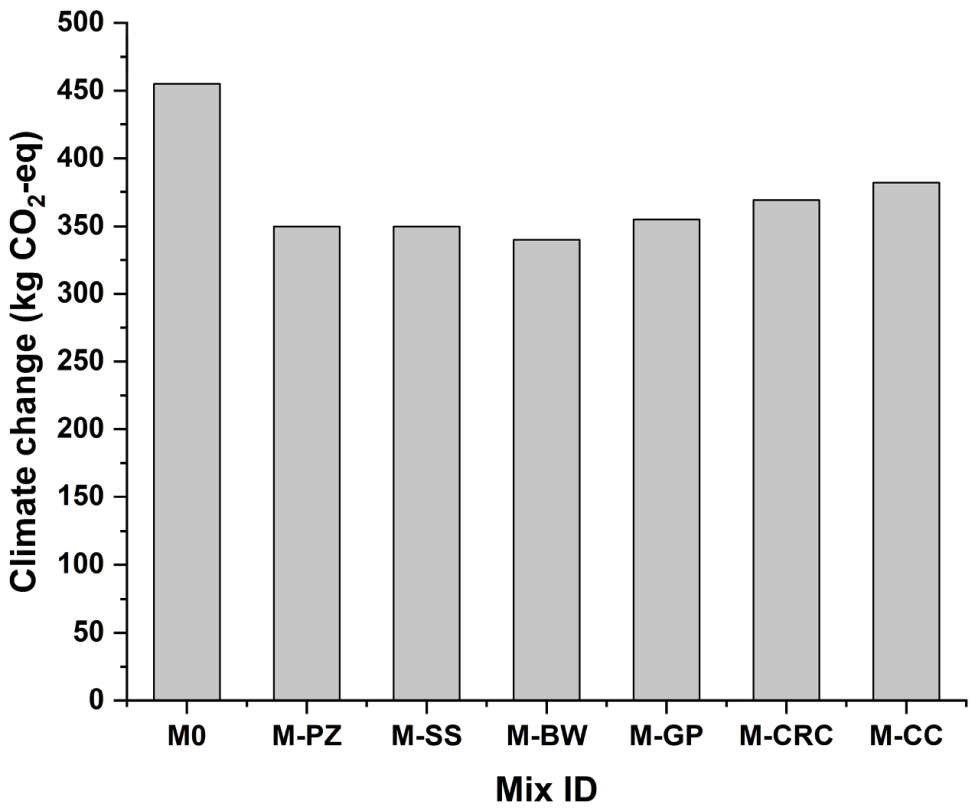
The climate change impact results, as shown in Figure 4, demonstrate the effectiveness of partial cement substitution in reducing the environmental footprint of mortar production. The reference mortar (M0) exhibited the highest Global Warming Potential (GWP), with a value of 4.29 × 10² kg CO2-eq, which is primarily attributed to the high carbon intensity of Portland cement clinker production. Cement manufacturing is known to be responsible for significant CO2 emissions due to both limestone calcination and fossil fuel combustion, making it the dominant contributor to climate change impacts in cement-based materials.
In contrast, all mortars incorporating a 20% replacement of cement showed a marked reduction in climate change impact, with GWP values ranging from 3.46 × 10² to 3.85 × 10² kg CO2-eq, corresponding to a reduction of approximately 10.3–19.3% relative to the reference mortar. These results confirm that clinker substitution is the principal mechanism driving greenhouse gas emission reductions, regardless of the type of substituted material.
Among the investigated mixtures, the mortars M-BW achieved the lowest GWP value (3.46 × 10² kg CO2-eq), followed closely by M-PZ and M-SS (3.48 × 10² kg CO2-eq). The superior environmental performance of these mixtures can be attributed to the low embodied carbon of these materials and, in the case of brick waste, to the valorization of construction and demolition waste requiring minimal additional processing. Similar findings have been widely reported in the literature, where waste-derived and naturally occurring mineral additions have been shown to significantly reduce climate change impacts through clinker avoidance and reduced upstream emissions [57].
The mortars M-GP and M-CRC also exhibited substantial reductions in climate change impact, with values of 3.56 × 10² and 3.66 × 10² kg CO2-eq, respectively. These results are consistent with previous LCA studies, which highlight that additional processing steps such as crushing, grinding, and transportation may partially offset the environmental benefits of cement substitution [58]. The highest GWP among the modified mortars was observed for M-CC (3.85 × 10² kg CO2-eq), a trend that aligns well with existing literature emphasizing the influence of calcination energy demand on the overall environmental balance of calcined clay-based binders [59].
Overall, the close agreement between the magnitude and trends of the GWP reductions observed in this study and those reported in previous research strengthens the robustness of the adopted LCA methodology. The obtained reduction levels fall within the range commonly reported in the literature for blended cements and eco-efficient mortars (15–30%), thereby confirming that partial cement substitution using alternative mineral additions is an effective and reliable strategy for mitigating climate change impacts in the construction sector.

3.4. Impact of SCM Type on Materials Resources

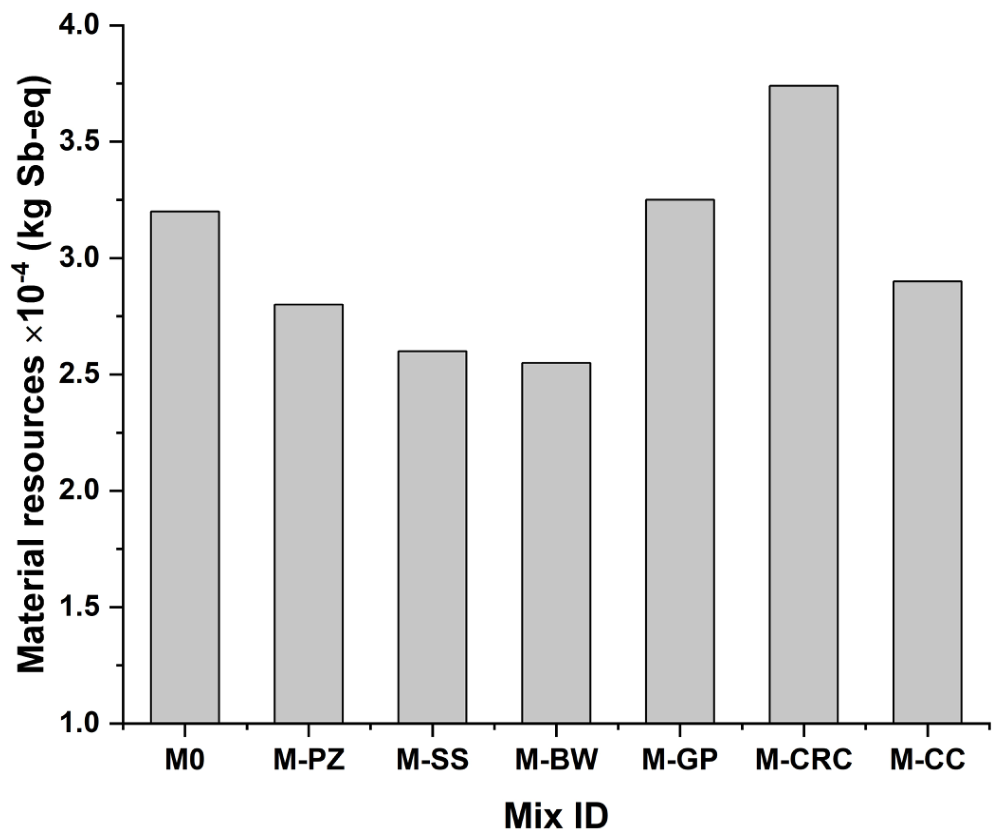
The results for material resource depletion (metals and minerals), as shown in Figure 5, highlight the influence of cement substitution on the consumption of non-renewable mineral resources in mortar production. The reference mortar (M0) presents a material resource impact of 3.12 × 10⁻⁴ kg Sb-eq, reflecting the intensive use of virgin mineral resources associated with Portland cement clinker production, including limestone, clay, and gypsum extraction, as well as the consumption of metallic resources related to fuel and electricity generation.
Mortars incorporating a 20% replacement of cement generally exhibit a reduction in mineral and metal resource depletion, with values ranging from 2.53 × 10⁻⁴ to 2.92 × 10⁻⁴ kg Sb-eq for M-PZ, M-SS, M-BW, and M-CC. This corresponds to a reduction of approximately 6.4–18.9% relative to the reference mortar, confirming that lowering clinker content effectively decreases the demand for virgin mineral resources. In particular, the mortars M-BW and M-SS show the lowest impact values (2.53 × 10⁻⁴ and 2.56 × 10⁻⁴ kg Sb-eq, respectively), which can be attributed to the reuse of abundant or waste-derived mineral materials that require limited extraction of primary resources.
By contrast, the mortars M-GP and M-CRC exhibit higher material resource impacts than the reference mortar, with values of 3.22 × 10⁻⁴ and 3.72 × 10⁻⁴ kg Sb-eq, respectively. This increase is mainly associated with additional processing requirements, such as intensive crushing, grinding, and sorting operations, as well as the potential involvement of metal-intensive equipment and transportation processes. Similar observations have been reported in previous studies, where recycled materials were shown to increase mineral resource depletion when extensive processing was required to meet performance specifications [60].
The mortar M-CC shows an intermediate behavior, with a material resource impact of 2.92 × 10⁻⁴ kg Sb-eq, reflecting a balance between reduced clinker consumption and additional resource use associated with clay extraction and thermal activation. Comparable trends have been reported for calcined clay-based binders, where the environmental benefits strongly depend on the calcination process efficiency and the availability of suitable raw materials [61].
Overall, the observed trends are consistent with existing LCA literature [62,63], which emphasizes that material resource depletion is not solely governed by cement substitution rate but also influenced by the nature of the substituted material and its associated processing chain. The present results fall within the range reported for blended cements and recycled-material-based mortars, confirming that the use of low-processing, waste-derived mineral additions offers the greatest potential for reducing mineral and metal resource depletion in cementitious systems.

3.5. Impact of SCM Type on Energy Resources

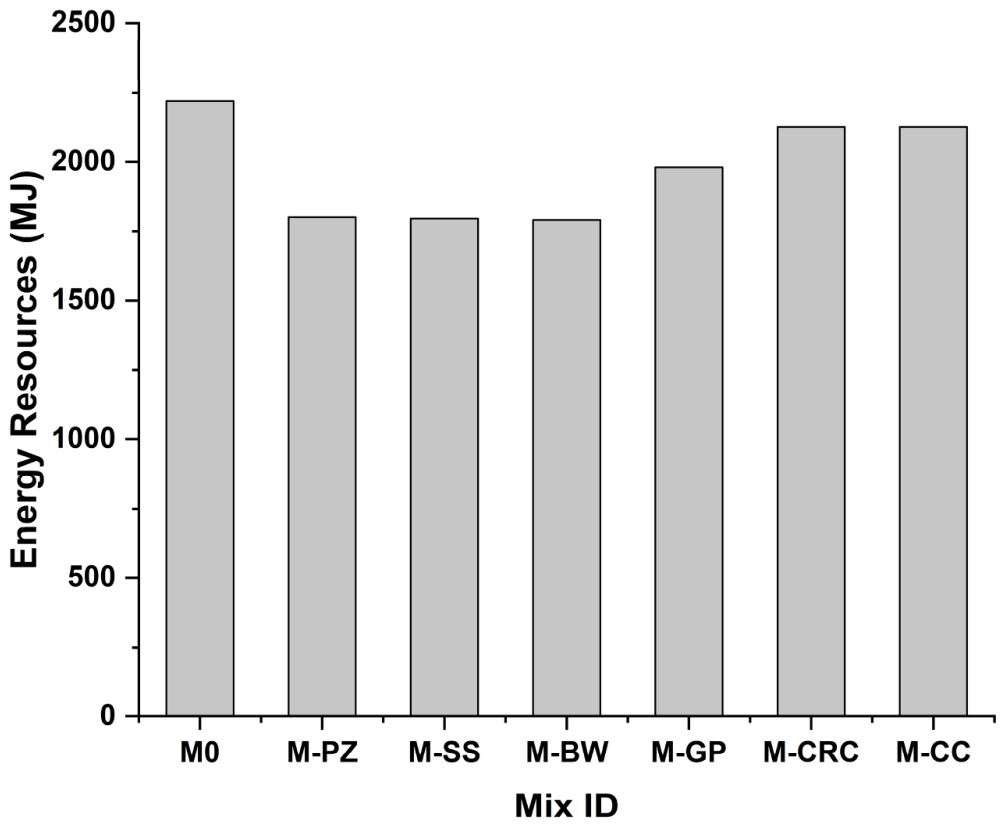
The assessment of non-renewable energy resource consumption, as shown in Figure 6, highlights the beneficial effect of partial cement substitution on the energy efficiency of mortar production. Compared with the reference mortar (M0), all mixtures incorporating a 20% cement replacement exhibit a reduction in non-renewable energy demand, with decreases ranging from approximately 4% to 18%. This overall trend reflects the high fossil energy intensity of Portland cement clinker production and confirms that clinker reduction is a key lever for lowering energy consumption in cement-based materials. Among the investigated mixtures, mortars incorporating brick waste show the highest reduction in non-renewable energy use, reaching approximately 18% relative to the reference mortar. Similar reduction levels (17–18%) are observed for mortars containing silica sand and natural pozzolan, indicating that materials requiring limited mechanical or thermal processing are particularly effective in reducing fossil energy demand.
These results are consistent with previous LCA studies, which reported energy savings in the range of 15–25% when Portland cement is partially replaced by natural pozzolans or low-processing supplementary cementitious materials [64,65]. Mortars incorporating glass powder exhibit a moderate reduction in non-renewable energy consumption, on the order of 11–12%, suggesting that although clinker substitution contributes to energy savings, additional processing steps such as crushing and fine grinding partially offset these benefits. Similar observations have been reported in the literature, where the environmental advantages of recycled glass as a cement substitute were shown to depend strongly on particle size and grinding energy [66].
In contrast, mortars containing crushed recycled concrete and calcined clay show the lowest reductions, limited to approximately 4%. In these cases, the energy savings associated with clinker reduction are largely counterbalanced by intensive mechanical processing and, for calcined clay, by the thermal energy required for calcination. This behavior highlights that the net energy benefit of calcined clay-based binders is highly sensitive to calcination temperature, fuel type, and process efficiency [67].

3.6. Impact of SCM Type on Acidification

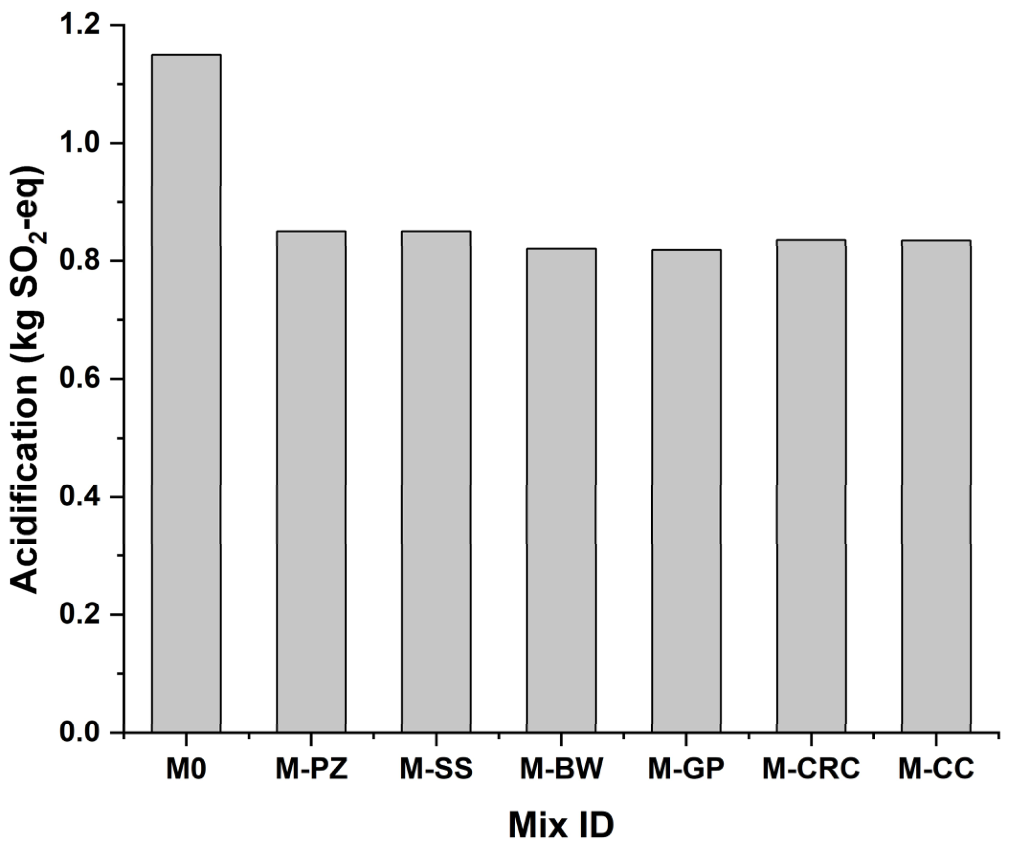
The acidification potential results, as shown in Figure 7, indicate that the partial substitution of Portland cement leads to a significant reduction in environmental impacts compared with the reference mortar. The reference mix (M0) exhibited the highest acidification potential, with a value of 1.02 kg SO2-eq, which is mainly attributed to emissions of sulfur dioxide (SO2), nitrogen oxides (NOₓ), and ammonia (NH3) associated with clinker production. In contrast, all modified mortars incorporating a 20% cement replacement showed lower acidification values, ranging from 0.828 to 0.847 kg SO2-eq, corresponding to a reduction of approximately 17.0–18.8% relative to the reference mortar.
Among the investigated mixtures, M-BW and M-GP presented the lowest acidification potential (0.828 kg SO2-eq), highlighting the environmental benefits of valorizing waste-derived materials as cement substitutes. The reduced impact is primarily associated with the lower embodied emissions of these materials and the avoidance of energy-intensive clinker manufacturing processes. The mortars M-PZ, M-SS, M-CRC, and M-CC also demonstrated notable reductions in acidification potential, confirming that clinker reduction is the dominant factor governing this impact category. The slightly higher acidification value observed for calcined clay may be explained by the additional thermal energy required for the calcination process.
Overall, the results demonstrate that cement substitution, regardless of the type of mineral addition, is an effective strategy for reducing acidification-related environmental burdens in mortar production. These findings are in good agreement with previous LCA studies, which reported comparable reductions in acidification potential (typically 15–25%) for cement-based materials incorporating supplementary cementitious materials and recycled mineral additions [51,57,68].

3.7. Impact of SCM Type on the Eutrophication

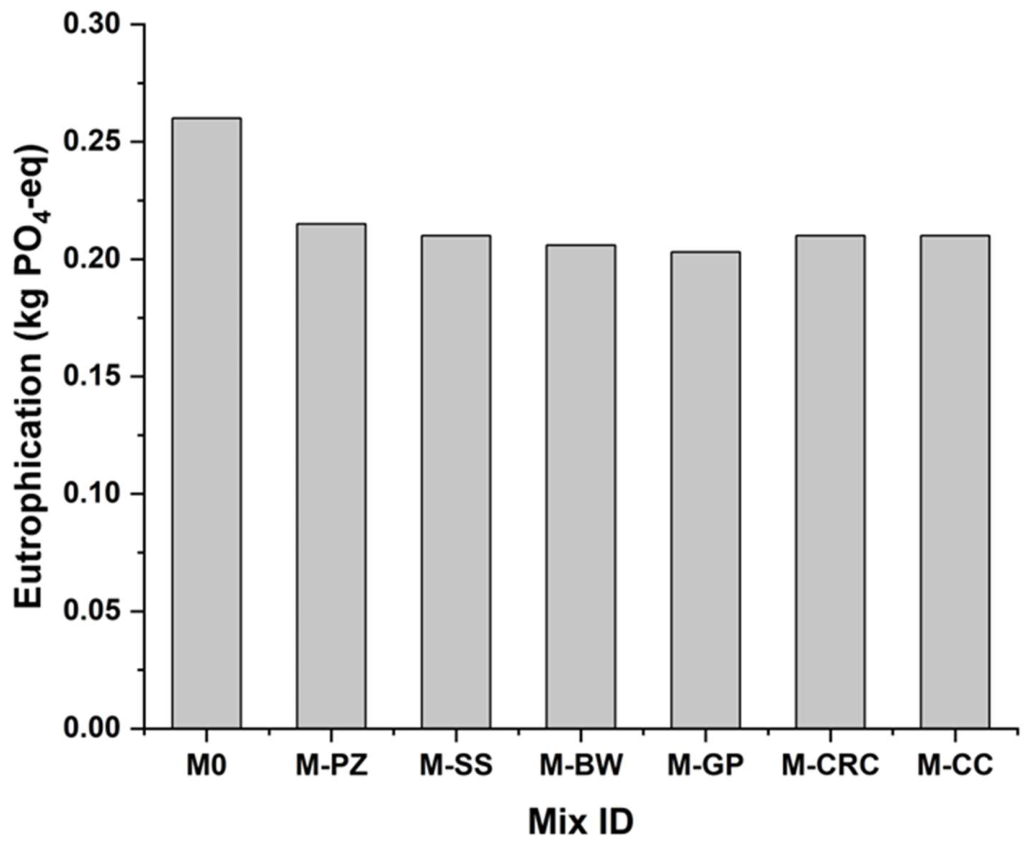
The eutrophication impact results, as shown in Figure 8, further confirm the environmental benefits associated with partial substitution of Portland cement by alternative mineral additions. The reference mortar (M0) presents the highest eutrophication potential, with a value of 2.57 × 10⁻¹ kg PO4-eq, which can be primarily attributed to emissions of nitrogen- and phosphorus-containing compounds originating from cement clinker production, raw material extraction, and energy generation processes.
In contrast, all mortars incorporating a 20% cement replacement (M-PZ to M-CC) exhibit a consistent reduction in eutrophication potential, with values ranging from 2.07 × 10⁻¹ to 2.16 × 10⁻¹ kg PO4-eq, corresponding to a reduction of approximately 16.0–19.5% relative to the reference mortar. This systematic decrease highlights the strong influence of clinker reduction on eutrophication-related environmental impacts.
Among the investigated mixtures, the mortar M-GP exhibits the lowest eutrophication potential (2.07 × 10⁻¹ kg PO4-eq), followed closely by M-BW (2.10 × 10⁻¹ kg PO4-eq). The improved environmental performance of these formulations can be attributed to the reuse of waste-derived materials with low upstream nutrient emissions and limited additional processing requirements. Similar reductions have been reported in the literature for cementitious systems incorporating recycled glass and ceramic waste, where eutrophication impacts were significantly reduced due to the avoidance of clinker-related emissions and raw material extraction [56,69]. The mortars M-PZ, M-SS, M-CRC, and M-CC also demonstrate notable reductions in eutrophication potential, confirming that the decrease in cement content is the dominant factor governing this impact category. The slightly higher eutrophication value observed for calcined clay-containing mortars may be related to the energy-intensive calcination process, which has been shown to contribute to nutrient emissions through fuel combustion and electricity consumption. Comparable trends have been observed in previous LCA studies on calcined clay and blended cement systems [67,70].
Overall, the magnitude and trend of eutrophication reductions observed in this study are in strong agreement with existing literature [71,72], which generally reports eutrophication impact reductions in the range of 15–25% for cement-based materials incorporating supplementary cementitious materials and recycled mineral additions. Therefore, the present results further confirm that partial cement substitution represents an effective strategy for mitigating eutrophication-related environmental impacts in mortar production, contributing to more sustainable construction practices.

3.8. Impact of SCM Type on Photochemical Oxidant Formation

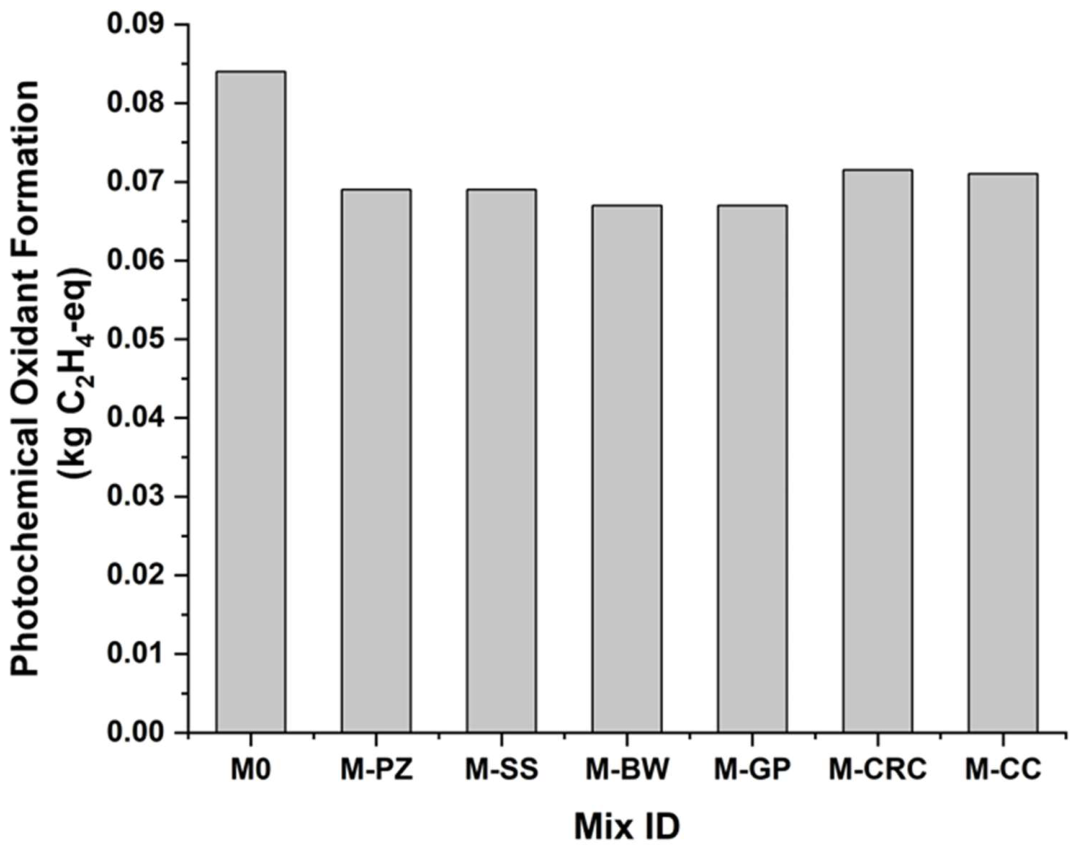
The results related to photochemical oxidant formation, as shown in Figure 9, provide further evidence of the environmental advantages associated with partial cement substitution in mortar production. The reference mortar (M0) exhibits the highest photochemical oxidant formation potential, with a value of 8.44 × 10⁻² kg C2H4-eq, reflecting the significant contribution of Portland cement clinker production to emissions of ozone precursor substances, mainly nitrogen oxides (NOₓ) and volatile organic compounds (VOCs), which are released during fuel combustion and raw material processing.
In contrast, all mortars incorporating a 20% replacement of cement demonstrate a consistent reduction in photochemical oxidant formation potential, with values ranging from 6.85 × 10⁻² to 7.05 × 10⁻² kg C2H4-eq, corresponding to a reduction of approximately 16.5–18.8% compared with the reference mortar. This reduction confirms that clinker content is a key driver of photochemical smog formation in cement-based materials, and that its partial substitution significantly mitigates ozone-related environmental impacts.
Among the investigated formulations, the mortars M-GP and M-BW exhibit the lowest photochemical oxidant formation potentials (6.85 × 10⁻² and 6.86 × 10⁻² kg C2H4-eq, respectively). This behavior can be attributed to the reuse of waste-derived materials with low associated emissions of ozone precursors and reduced reliance on energy-intensive clinker production. Similar trends have been reported in LCA studies focusing on recycled mineral additions, where the incorporation of construction and demolition waste led to notable reductions in photochemical smog formation [73,74].
Mortars M-PZ and M-SS show comparable photochemical oxidant formation values (6.97 × 10⁻² kg C2H4-eq), confirming that even inert or weakly reactive mineral additions can provide significant environmental benefits through clinker reduction alone. Mortars M-CRC and M-CC present slightly higher values (7.05 × 10⁻² and 7.03 × 10⁻² kg C2H4-eq, respectively), which can be explained by additional processing and energy requirements related to crushing, grinding, and thermal activation. Comparable findings have been reported in previous LCA studies, where the environmental benefits of recycled or thermally treated materials were partially offset by increased energy consumption and associated emissions [75,76].

4. Practical Implications, Limitations, and Future Directions

The results of this study demonstrate that a 20% partial substitution of Portland cement with selected pozzolanic and waste-derived materials can achieve a favorable balance between mechanical performance and environmental impact reduction, particularly when reactive materials such as natural pozzolan and recycled brick powder are employed. From a practical perspective, the combined assessment of compressive strength and water absorption confirms that appropriate control of material fineness and reactivity is essential to ensure adequate matrix densification and durability-related performance. However, the study is limited by the investigation of a single replacement level and curing age, as well as by the use of water absorption as the sole durability indicator and a cradle-to-gate LCA boundary. Future research should therefore extend the analysis to multiple substitution rates, longer curing periods, additional durability parameters, and full life-cycle scenarios, while also incorporating microstructural characterization and region-specific inventory data to further enhance the robustness and applicability of sustainable mortar design strategies. In addition, detailed particle size distribution data were not available for all supplementary materials, which may also influence their reactivity and overall performance. Future research should therefore extend the analysis to multiple substitution rates, longer curing periods, additional durability parameters, and full life-cycle scenarios, while also incorporating comprehensive particle size characterization, microstructural analysis, and region-specific inventory data to further enhance the robustness and applicability of sustainable mortar design strategies.

5. Conclusions

This study investigated the feasibility of partially replacing Portland cement with various pozzolanic and alternative mineral materials at a 20% substitution level, through an integrated evaluation of compressive strength, water absorption by immersion, and LCA indicators. The combined mechanical, durability-related, and environmental analysis allows drawing the following main conclusions:
  • Natural pozzolan and brick waste achieved compressive strengths very close to the reference mortar, with reductions lower than 1% and 4%, respectively, indicating that their pozzolanic reactivity and SCM effect effectively compensated for clinker dilution.
  • Glass powder showed a moderate strength reduction of approximately 6–7%, which remains acceptable for many structural and non-structural applications.
  • Silica sand, recycled concrete powder, and calcined clay exhibited more pronounced strength reductions, ranging from approximately 15% to 20%, mainly due to clinker dilution, inherited porosity, and limited or delayed pozzolanic activity.
  • The incorporation of natural pozzolan reduced water absorption by approximately 7% compared with the reference mortar, indicating enhanced pore refinement and matrix densification.
  • Brick waste and glass powder resulted in slight increases in absorption, limited to approximately 5–8%, suggesting that their use does not significantly deteriorate the pore structure.
  • Calcined clay, recycled concrete powder, and silica sand led to higher increases in water absorption, ranging from approximately 25% to over 50%, reflecting increased connected capillary porosity and potential durability concerns.
  • All mortars incorporating 20% cement substitution exhibited significant reductions across the assessed LCA impact categories.
  • Reductions of approximately 15–20% were consistently observed for climate change, acidification, eutrophication, photochemical oxidant formation, non-renewable energy consumption, and material resource depletion, relative to the reference mortar.
  • Waste-derived materials, particularly brick waste, provided the most favorable environmental performance due to clinker reduction and material valorization, while materials requiring intensive processing showed slightly lower but still substantial environmental gains.

Author Contributions

Conceptualization, A.M., A.D., K.H., M.B. and C.B.; methodology, A.D., E.A. and L.M.; software, A.M., K.H., M.B. and C.B.; validation, E.A. and L.M.; formal analysis, K.H., M.B., C.B. and L.M.; investigation A.M. and A.D.; resources, K.H., M.B. and C.B.; data curation, A.M. and A.D.; writing—original draft preparation, A.M., A.D. and L.M.; writing—review and editing, E.A., K.H., M.B., C.B. and L.M.; visualization, K.H., M.B. and C.B.; supervision, E.A. and L.M.; project administration, E.A. and L.M.; funding acquisition, A.D. and L.M. All authors have read and agreed to the published version of the manuscript.

Funding

This research received no external funding.

Data Availability Statement

The original contributions presented in this study are included in the article. Further inquiries can be directed to the corresponding authors.

Acknowledgments

The authors would like to express their sincere gratitude to the URME laboratory team for their valuable technical support and assistance during the experimental work, which was essential for the successful completion of the testing program.

Conflicts of Interest

The authors declare no conflicts of interest.

References

  1. Douadi, A.; Makhlouf, A.; Belebchouche, C.; Hebbache, K.; Boutlikht, M.; Moretti, L.; Faria, P.; Abderazek, H.; Czarnecki, S.; Chajec, A. Synergistic optimization of mortar performance and carbon footprint reduction using quarry wastes and natural pozzolana: A statistical and experimental study. Sustainability 2025, 17, 7346. [Google Scholar] [CrossRef]
  2. Khitas, N.E.H.; Hebbache, K.; Douadi, A.; Boutlikht, M.; Belebchouche, C.; Messai, A.; Mahar, N.E.-H.; Del Serrone, G.; Moretti, L.; Czarnecki, S. Modeling and optimizing the properties of mortars based on natural pozzolan, silica sand, and recycled brick waste mixture design: A technical and environmental study. Constr. Build. Mater. 2025, 459, 139706. [Google Scholar] [CrossRef]
  3. Kweku, D.W.; Bismark, O.; Maxwell, A.; Desmond, K.A.; Danso, K.B.; Oti-Mensah, E.A.; Quachie, A.T.; Adormaa, B.B. Greenhouse effect: Greenhouse gases and their impact on global warming. J. Sci. Res. Rep. 2018, 17, 1–9. [Google Scholar] [CrossRef]
  4. Thanatrakolsri, P.; Sirithian, D. Evaluation of greenhouse gas emissions and mitigation measures at Thammasat University’s Lampang campus in Thailand. Environ. Health Insights 2024, 18, 11786302241253589. [Google Scholar] [CrossRef] [PubMed]
  5. Assadi, N. Environmental Impacts of Cement Production with LCA: A Case Study on Ghori Cement Plant in Afghanistan. Master’s Thesis, Akita University, Akita, Japan, 2020. [Google Scholar]
  6. Wahedy, M.N.; Sharbatdar, M.K.; Rezaifar, O. Mechanical, environmental, and economic assessment of sustainable cement mortar using Afghan natural pozzolan as a partial replacement for cement. Constr. Build. Mater. 2023, 386, 131574. [Google Scholar] [CrossRef]
  7. Kaygusuz, K. Energy for sustainable development: A case of developing countries. Renew. Sustain. Energy Rev. 2012, 16, 1116–1126. [Google Scholar] [CrossRef]
  8. Lehne, J.; Preston, F. Making Concrete Change. Innovation in Low-Carbon Cement and Concrete; Chatham House: London, UK, 2018; pp. 1–66. [Google Scholar]
  9. Reeder, L. Guide to Green Building Rating Systems: Understanding LEED, Green Globes, Energy Star, the National Green Building Standard, and More; John Wiley & Sons: Hoboken, NJ, USA, 2010; Volume 12. [Google Scholar]
  10. Gautam, L.; Purbe, M.K.; Sharma, K.V.; Kumar, C.; Kalita, P.P. Environmental impact mitigation and durability enhancement of concrete through fly ash substitution: A comprehensive review. J. Build. Pathol. Rehabil. 2025, 10, 99. [Google Scholar] [CrossRef]
  11. Soldado, E.; Antunes, A.; Costa, H.; Do Carmo, R.; Júlio, E. Influence of pozzolan, slag and recycled aggregates on the mechanical and durability properties of low cement concrete. Materials 2021, 14, 4173. [Google Scholar] [CrossRef] [PubMed]
  12. Hasan, M.T.; Abdul-Hamead, A.A.; Othman, F.M. Sustainable Concrete Using Porcelain and Clay Brick Waste as Partial Sand Replacement: Evaluation of Mechanical and Durability Properties. Constr. Mater. 2025, 5, 78. [Google Scholar] [CrossRef]
  13. Testing, A.S.f.; Concrete, M.C.C.-o.; Aggregates, C. Standard Test Methods for Sampling and Testing Fly Ash or Natural Pozzolans for Use in Portland-Cement Concrete; ASTM International: West Conshohocken, PA, USA, 2019. [Google Scholar]
  14. Madani, H.; Norouzifar, M.N.; Rostami, J. The synergistic effect of pumice and silica fume on the durability and mechanical characteristics of eco-friendly concrete. Constr. Build. Mater. 2018, 174, 356–368. [Google Scholar] [CrossRef]
  15. Moolchandani, K. Advancements in pumice-based concrete: A comprehensive review. Next Mater. 2025, 8, 100646. [Google Scholar] [CrossRef]
  16. Tahwia, A.M.; Abdellatief, M.; Salah, A.; Youssf, O. Valorization of recycled concrete powder, clay brick powder, and volcanic pumice powder in sustainable geopolymer concrete. Sci. Rep. 2025, 15, 11049. [Google Scholar] [CrossRef] [PubMed]
  17. Subaşı, A.; Emiroğlu, M. Effect of metakaolin substitution on physical, mechanical and hydration process of White Portland cement. Constr. Build. Mater. 2015, 95, 257–268. [Google Scholar] [CrossRef]
  18. Lv, X.; Dong, Y.; Wang, R.; Lu, C.; Wang, X. Resistance improvement of cement mortar containing silica fume to external sulfate attacks at normal temperature. Constr. Build. Mater. 2020, 258, 119630. [Google Scholar] [CrossRef]
  19. Hsu, S.; Chi, M.; Huang, R. Effect of fineness and replacement ratio of ground fly ash on properties of blended cement mortar. Constr. Build. Mater. 2018, 176, 250–258. [Google Scholar] [CrossRef]
  20. Tang, Q.; Ma, Z.; Wu, H.; Wang, W. The utilization of eco-friendly recycled powder from concrete and brick waste in new concrete: A critical review. Cem. Concr. Compos. 2020, 114, 103807. [Google Scholar] [CrossRef]
  21. Thomas, B.S.; Kumar, S.; Arel, H.S. Sustainable concrete containing palm oil fuel ash as a supplementary cementitious material–A review. Renew. Sustain. Energy Rev. 2017, 80, 550–561. [Google Scholar] [CrossRef]
  22. Jagadesh, P.; Ramachandramurthy, A.; Murugesan, R. Processing of sugar cane bagasse ash and properties of processed sugar cane bagasse ash blended cements. Sādhanā 2022, 47, 187. [Google Scholar] [CrossRef]
  23. Fernando, S.; Gunasekara, C.; Law, D.W.; Nasvi, M.; Setunge, S.; Dissanayake, R. Life cycle assessment and cost analysis of fly ash–rice husk ash blended alkali-activated concrete. J. Environ. Manag. 2021, 295, 113140. [Google Scholar] [CrossRef]
  24. Vashistha, P.; Oinam, Y.; Kim, H.-K.; Pyo, S. Effect of thermo-mechanical activation of waste concrete powder (WCP) on the characteristics of cement mixtures. Constr. Build. Mater. 2023, 362, 129713. [Google Scholar] [CrossRef]
  25. Shen, P.; Zhang, Y.; Jiang, Y.; Zhan, B.; Lu, J.; Zhang, S.; Xuan, D.; Poon, C.S. Phase assemblance evolution during wet carbonation of recycled concrete fines. Cem. Concr. Res. 2022, 154, 106733. [Google Scholar] [CrossRef]
  26. Sui, Y.; Ou, C.; Liu, S.; Zhang, J.; Tian, Q. Study on properties of waste concrete powder by thermal treatment and application in mortar. Appl. Sci. 2020, 10, 998. [Google Scholar] [CrossRef]
  27. Jain, K.L.; Sancheti, G.; Gupta, L.K. Durability performance of waste granite and glass powder added concrete. Constr. Build. Mater. 2020, 252, 119075. [Google Scholar] [CrossRef]
  28. Idir, R.; Cyr, M.; Tagnit-Hamou, A. Pozzolanic properties of fine and coarse color-mixed glass cullet. Cem. Concr. Compos. 2011, 33, 19–29. [Google Scholar] [CrossRef]
  29. Matos, A.M.; Sousa-Coutinho, J. Durability of mortar using waste glass powder as cement replacement. Constr. Build. Mater. 2012, 36, 205–215. [Google Scholar] [CrossRef]
  30. Rakhimova, N.R. A review of calcined clays and ceramic wastes as sources for alkali-activated materials. Geosystem Eng. 2020, 23, 287–298. [Google Scholar] [CrossRef]
  31. Zunino, F.; Dhandapani, Y.; Ben Haha, M.; Skibsted, J.; Joseph, S.; Krishnan, S.; Parashar, A.; Juenger, M.C.; Hanein, T.; Bernal, S.A. Hydration and mixture design of calcined clay blended cements: Review by the RILEM TC 282-CCL. Mater. Struct. 2022, 55, 234. [Google Scholar] [CrossRef]
  32. Krishnan, S.; Bishnoi, S. Understanding the hydration of dolomite in cementitious systems with reactive aluminosilicates such as calcined clay. Cem. Concr. Res. 2018, 108, 116–128. [Google Scholar] [CrossRef]
  33. Shao, J.; Guo, S.; Wang, H. A review of the performance, sustainable applications, and research challenges of limestone-calcined clay-cement (LC3) systems. Coatings 2025, 15, 611. [Google Scholar] [CrossRef]
  34. Finkbeiner, M.; Inaba, A.; Tan, R.; Christiansen, K.; Klüppel, H.-J. The new international standards for life cycle assessment: ISO 14040 and ISO 14044. Int. J. Life Cycle Assess. 2006, 11, 80–85. [Google Scholar] [CrossRef]
  35. Belkadi, A.A.; Kessal, O.; Berkouche, A.; Noui, A.; Daguiani, S.E.; Dridi, M.; Benaniba, S.; Tayebi, T. Experimental investigation into the potential of recycled concrete and waste glass powders for improving the sustainability and performance of cement mortars properties. Sustain. Energy Technol. Assess. 2024, 64, 103710. [Google Scholar]
  36. Daguiani, S.E.; Kessal, O.; Mokhtari, A. Modelling of fresh properties and strength activity index with microstructure characterisation of ternary cement incorporating waste glass and granulated blast furnace slag. Fract. Struct. Integr. 2023, 17, 88–111. [Google Scholar] [CrossRef]
  37. Hebbache, K.; Boutlikht, M.; Douadi, A.; Belebchouche, C.; Benrebouh, I.; Hammouche, R.; Moretti, L.; Chajec, A.; Czarnecki, S. Integrated techno-environmental analysis of finely ground silica sand in sustainable mortar production. Buildings 2024, 14, 3295. [Google Scholar] [CrossRef]
  38. NF EN 197-1:2012; Ciment—Partie 1: Composition, Spécifications et Critères de Conformité des Ciments Courants. AFNOR: Saint Denis, France, 2012.
  39. EN 196-1:2016; Methods of Testing Cement—Part 1: Determination of Strength. CEN (European Committee for Standardization): Brussels, Belgium, 2016.
  40. EN 12390-3:2009; Testing Hardened Concrete—Part 3: Compressive Strength of Test Specimens. CEN (European Committee for Standardization): Brussels, Belgium, 2009.
  41. ASTM C1403-15; Standard Test Method for Rate of Water Absorption of Masonry Mortars. ASTM International: West Conshohocken, PA, USA, 2015.
  42. Finkbeiner, M. The international standards as the constitution of life cycle assessment: The ISO 14040 series and its offspring. In Background and Future Prospects in Life Cycle Assessment; Springer: Berlin/Heidelberg, Germany, 2014; pp. 85–106. [Google Scholar]
  43. Makhlouf, A.; Kardache, R.; Chaabia, R.; Drouiche, A.; Brahmi, B. Environmental Impact Assessment of the Algerian Cement Industry: A Case Study with Life Cycle Assessment Methodology. In Proceedings of the Conference of the Arabian Journal of Geosciences, Virtual, 2–5 November 2020; Springer: Cham, Switzerland, 2020; pp. 83–85. [Google Scholar]
  44. Bellara, S.; Maherzi, W.; Mezazigh, S.; Senouci, A. Mineral waste valorization in road subgrade construction: Algerian case study based on technical and environmental features. Case Stud. Constr. Mater. 2024, 20, e02764. [Google Scholar] [CrossRef]
  45. Camerini, R.; Poggi, G.; Ridi, F.; Baglioni, P. The kinetic of calcium silicate hydrate formation from silica and calcium hydroxide nanoparticles. J. Colloid Interface Sci. 2022, 605, 33–43. [Google Scholar] [CrossRef]
  46. Ulusu, H.; Aruntaş, H.Y.; Gültekin, A.B.; Dayı, M.; Çavuş, M.; Kaplan, G. Mechanical, durability and microstructural characteristics of Portland pozzolan cement (PPC) produced with high volume pumice: Green, cleaner and sustainable cement development. Constr. Build. Mater. 2023, 378, 131070. [Google Scholar] [CrossRef]
  47. Nanthini, M.; Ganesan, R.; Jaganathan, V. Studies on alkaline activator, manufacturing methods and mechanical properties of geopolymer Concrete-A. J. Environ. Nanotechnol. 2024, 13, 52–72. [Google Scholar] [CrossRef]
  48. Naceri, A.; Hamina, M.C. Use of waste brick as a partial replacement of cement in mortar. Waste Manag. 2009, 29, 2378–2384. [Google Scholar] [CrossRef]
  49. Shao, Y.; Lefort, T.; Moras, S.; Rodriguez, D. Studies on concrete containing ground waste glass. Cem. Concr. Res. 2000, 30, 91–100. [Google Scholar] [CrossRef]
  50. Mirzahosseini, M.; Riding, K.A. Influence of different particle sizes on reactivity of finely ground glass as supplementary cementitious material (SCM). Cem. Concr. Compos. 2015, 56, 95–105. [Google Scholar] [CrossRef]
  51. Environment, U.; Scrivener, K.L.; John, V.M.; Gartner, E.M. Eco-efficient cements: Potential economically viable solutions for a low-CO2 cement-based materials industry. Cem. Concr. Res. 2018, 114, 2–26. [Google Scholar]
  52. Hemalatha, M.; Santhanam, M. Characterizing supplementary cementing materials in blended mortars. Constr. Build. Mater. 2018, 191, 440–459. [Google Scholar] [CrossRef]
  53. Gupta, S.; Muthukrishnan, S.; Kua, H.W. Comparing influence of inert biochar and silica rich biochar on cement mortar–Hydration kinetics and durability under chloride and sulfate environment. Constr. Build. Mater. 2021, 268, 121142. [Google Scholar] [CrossRef]
  54. Du, H. Properties of ultra-lightweight cement composites with nano-silica. Constr. Build. Mater. 2019, 199, 696–704. [Google Scholar] [CrossRef]
  55. Ge, Z.; Sun, R.J.; Zheng, L. Mechanical properties of concrete with recycled clay-brick-powder. Adv. Mater. Res. 2011, 250, 360–364. [Google Scholar] [CrossRef]
  56. Van den Heede, P.; De Belie, N. Environmental impact and life cycle assessment (LCA) of traditional and ‘green’concretes: Literature review and theoretical calculations. Cem. Concr. Compos. 2012, 34, 431–442. [Google Scholar] [CrossRef]
  57. Marinković, S.; Radonjanin, V.; Malešev, M.; Ignjatović, I. Comparative environmental assessment of natural and recycled aggregate concrete. Waste Manag. 2010, 30, 2255–2264. [Google Scholar] [CrossRef]
  58. Habert, G. Environmental impact of Portland cement production. In Eco-Efficient Concrete; Elsevier: Amsterdam, The Netherlands, 2013; pp. 3–25. [Google Scholar]
  59. Miller, S.A.; Horvath, A.; Monteiro, P.J. Readily implementable techniques can cut annual CO2 emissions from the production of concrete by over 20%. Environ. Res. Lett. 2016, 11, 074029. [Google Scholar] [CrossRef]
  60. Guinée, J.B. Handbook on Life Cycle Assessment: Operational Guide to the ISO Standards; Springer Science & Business Media: Berlin/Heidelberg, Germany, 2002; Volume 7. [Google Scholar]
  61. Schneider, M.; Romer, M.; Tschudin, M.; Bolio, H. Sustainable cement production—Present and future. Cem. Concr. Res. 2011, 41, 642–650. [Google Scholar] [CrossRef]
  62. Farahzadi, L.; Tellnes, L.G.F.; Shafei, B.; Kioumarsi, M. Life-cycle environmental assessment of ultra-high-performance concrete with sustainable materials and fiber substitutions. Clean. Eng. Technol. 2024, 23, 100846. [Google Scholar] [CrossRef]
  63. Generowicz-Caba, N.; Kulczycka, J. LCA of cement with alternative additives: Pathways to sustainable production. Materials 2025, 18, 3057. [Google Scholar] [CrossRef] [PubMed]
  64. Hossain, M.U.; Cai, R.; Ng, S.T.; Xuan, D.; Ye, H. Sustainable natural pozzolana concrete–A comparative study on its environmental performance against concretes with other industrial by-products. Constr. Build. Mater. 2021, 270, 121429. [Google Scholar] [CrossRef]
  65. Huntzinger, D.N.; Eatmon, T.D. A life-cycle assessment of Portland cement manufacturing: Comparing the traditional process with alternative technologies. J. Clean. Prod. 2009, 17, 668–675. [Google Scholar] [CrossRef]
  66. Blengini, G.; Mathieux, F.; Mancini, L.; Nyberg, M.; Viegas, H. Recovery of critical and other raw materials from mining waste and landfills. In State of play on Existing Practices; European Commission: Brussels, Belgium, 2019; pp. 1–125. [Google Scholar]
  67. Damineli, B.L.; Kemeid, F.M.; Aguiar, P.S.; John, V.M. Measuring the eco-efficiency of cement use. Cem. Concr. Compos. 2010, 32, 555–562. [Google Scholar] [CrossRef]
  68. Habert, G.; Billard, C.; Rossi, P.; Chen, C.; Roussel, N. Cement production technology improvement compared to factor 4 objectives. Cem. Concr. Res. 2010, 40, 820–826. [Google Scholar] [CrossRef]
  69. Chen, C.; Habert, G.; Bouzidi, Y.; Jullien, A. Environmental impact of cement production: Detail of the different processes and cement plant variability evaluation. J. Clean. Prod. 2010, 18, 478–485. [Google Scholar] [CrossRef]
  70. Favier, A.; De Wolf, C.; Scrivener, K.; Habert, G. A Sustainable Future for the European Cement and Concrete Industry: Technology Assessment for Full Decarbonisation of the Industry by 2050; ETH Zurich: Zurich, Switzerland, 2018. [Google Scholar]
  71. Manan, A.; Pu, Z.; Sabri, M.M.; Alattyih, W.; Ahmad, J.; Alzlfawi, A. Environmental and human health impact of recycle concrete powder: An emergy-based LCA approach. Front. Environ. Sci. 2025, 12, 1505312. [Google Scholar] [CrossRef]
  72. Ahmed, A. Assessing the effects of supplementary cementitious materials on concrete properties: A review. Discov. Civ. Eng. 2024, 1, 145. [Google Scholar] [CrossRef]
  73. Blengini, G.A.; Garbarino, E. Resources and waste management in Turin (Italy): The role of recycled aggregates in the sustainable supply mix. J. Clean. Prod. 2010, 18, 1021–1030. [Google Scholar] [CrossRef]
  74. Borghi, G.; Pantini, S.; Rigamonti, L. Life cycle assessment of non-hazardous Construction and Demolition Waste (CDW) management in Lombardy Region (Italy). J. Clean. Prod. 2018, 184, 815–825. [Google Scholar] [CrossRef]
  75. Nguyen, T.K.L.; Ngo, H.H.; Guo, W.; Nguyen, T.L.H.; Chang, S.W.; Nguyen, D.D.; Varjani, S.; Lei, Z.; Deng, L. Environmental impacts and greenhouse gas emissions assessment for energy recovery and material recycle of the wastewater treatment plant. Sci. Total Environ. 2021, 784, 147135. [Google Scholar] [CrossRef]
  76. García-Gusano, D.; Herrera, I.; Garraín, D.; Lechón, Y.; Cabal, H. Life cycle assessment of the Spanish cement industry: Implementation of environmental-friendly solutions. Clean. Technol. Environ. Policy 2015, 17, 59–73. [Google Scholar] [CrossRef]
Figure 1. System boundary for the production of 1 m3 of mortar.
Buildings 16 01834 g001
Figure 2. Compressive strength of mortars after 28 days of curing.
Buildings 16 01834 g002
Figure 3. Results for water absorption by immersion after 28 days of curing.
Buildings 16 01834 g003
Figure 4. LCA results for climate change.
Buildings 16 01834 g004
Figure 5. LCA results for natural resources use (metals/minerals).
Buildings 16 01834 g005
Figure 6. LCA results for energy resources use (non-renewable).
Buildings 16 01834 g006
Figure 7. LCA results for acidification.
Buildings 16 01834 g007
Figure 8. LCA results for eutrophication.
Buildings 16 01834 g008
Figure 9. LCA results for photochemical oxidant formation.
Buildings 16 01834 g009
Table 1. Chemical composition and physical properties of cement and supplementary cementitious materials.
Chemical Content (wt.%)CementNatural
Pozzolan
Silica SandBrick WasteGlass PowderCrushed ConcreteCalcined Clay
SiO221.6944.196.0551.270.92148.12
Al2O34.3917.421.3217.421.934.4133.04
Fe2O358.970.35.950.43.621.69
CaO64.4710.350.529.913.364.670.65
MgO1.213.580.232.720.182.370.7
SO32.010.02-0.150.062.7-
K2O0.141.47-1.570.33-0.12
Na2O0.193.2--12.4-0.15
P2O5-0.72--- -
TiO2-----2.92-
LOI0.878.070.6810.490.5-14.37
Specific gravity3.22.552.652.452.52.52.6
Blaine specific surface (m2/kg)320455422502552420410
Table 2. Mix proportions of mortar mixtures incorporating 20% cement replacement by volume using SCMs.
MixturesComponents (g)SCMs (g, Equivalent Mass for 20% Cement Replacement by Volume)
CementSandWaterNatural
Pozzolan
Silica SandBrick Waste Glass PowderCrushed ConcreteCalcined Clay
Control Mortar (M0)4501350225000000
M-PZ360135022571.7100000
M-SS074.530000
M-BW0068.90000
M-GP00070.3100
M-CRC000070.310
M-CC0000073.12
Disclaimer/Publisher’s Note: The statements, opinions and data contained in all publications are solely those of the individual author(s) and contributor(s) and not of MDPI and/or the editor(s). MDPI and/or the editor(s) disclaim responsibility for any injury to people or property resulting from any ideas, methods, instructions or products referred to in the content.