


Abstract
As demand for energy-efficient buildings grows, the use of expanded polystyrene (EPS) insulation is expected to increase, intensifying the need for material-efficient strategies such as recycling and reuse. This study investigates the technical feasibility, chemical safety, and climate implications of reusing EPS insulation recovered from building and infrastructure applications. EPS boards with service lives exceeding 20 years were collected from demolition sites and characterised for density, compressive strength, thermal conductivity, and hazardous substance content. Measured material properties were compared with historical test reports from 1976 to 2009 to assess long-term performance. The thermal conductivity and compressive strength of the used EPS samples fell within or close to the 95% prediction intervals for the corresponding products at the time of production, indicating limited long-term degradation. No brominated flame retardants or other substances of concern were detected above the detection limits. Life cycle assessment (LCA) results showed that reuse provides greater greenhouse gas (GHG) emission reduction potential than improved recycling alone, primarily through avoided virgin EPS production and reduced processing needs. An important insight from this study is that key material properties of used EPS can be reliably estimated from simple measurements of density, dimensions, and weight, and that direct reuse is feasible for less demanding applications. Additionally, further work is needed to test additional samples from diverse demolition sites across various applications and climates to establish a consistent basis for reuse.
1. Introduction
1.1. Background
Expanded polystyrene (EPS) is a lightweight insulation material composed of agglomerated polystyrene spheres with a predominantly closed-cell pore structure and an overall porosity of approximately 98% [1]. Owing to its low thermal conductivity (typically 0.031–0.041 W/(m·K)), as well as its dimensional stability, moisture resistance, and ease of handling, EPS is widely used in building and infrastructure applications. It is commonly used in roof, wall and foundation insulation, as well as in geotechnical applications, such as road embankments and lightweight fill [2]. Although EPS is also used in packaging and consumer goods, this study focuses specifically on EPS from building and infrastructure contexts.
Demand for EPS insulation is expected to rise as progressively stricter energy efficiency requirements apply to both new construction and renovation projects [3]. However, EPS is a fossil-derived polymer that does not biodegrade, raising concerns about greenhouse gas (GHG) emissions, waste accumulation, and resource use [4]. These pressures have prompted policymakers and industry stakeholders to promote circular economy approaches that minimise the extraction of virgin materials and reduce end-of-life impacts.
In practice, circular strategies for EPS have largely centred on recycling [5,6,7]. Producers have expanded take-back systems and developed technological pathways for both mechanical and chemical reprocessing. EPS is considered 100% recyclable at the material level, and several strategies exist for its collection, transport and recycling, ranging from simple grinding to advanced processes involving purification and the removal of harmful substances [8]. Despite these advances, the main barriers to increased circularity lie in collection, sorting and transportation. Recycling of EPS insulation is challenged by its low bulk density, which entails substantial transport, storage and handling costs that must be considered in the reverse logistics network design [9].
Attention is increasingly turning to reuse as a complementary circular strategy. Reuse of building materials offers additional advantages over recycling: it avoids the material and energy inputs associated with reprocessing, may reduce time and transport requirements if applied in a smaller geographic region, and thus increases environmental and economic benefits [10]. Nevertheless, reuse of EPS insulation has not yet been widely implemented, largely due to the absence of established qualification schemes and the need for coordinated logistics and market infrastructure.
1.2. Challenges for EPS Reuse
In addition to transport and logistics challenges that affect recycling, several technical and regulatory barriers specific to reuse currently limit its practical implementation. The foremost constraint arises from uncertainty about the long-term performance of EPS after decades of service in building envelopes or infrastructure applications. Additionally, reuse remains limited because standardised grading protocols, certification pathways, and design guidance for the reuse of EPS elements are vague.
1.2.1. Degradation Risk of Long-Term EPS
The long-term use of EPS raises concerns about degradation, particularly as environmental exposure and material ageing can gradually compromise its structural and functional performance. Thus, a sound assessment of the risk of performance loss during continued service requires knowledge of polystyrene’s stability when exposed to relevant degradation agents, combined with an understanding of the actual in-use exposure conditions of EPS insulation in buildings and infrastructure. Various forms of degradation can affect the material:
- Thermal degradation
EPS typically exhibits a glass transition temperature around 100 °C, and the polymer bead structure has been reported to collapse at approximately 110–120 °C [11]. Below this range, short-term exposure is generally considered to have limited influence on bulk material integrity. However, microstructural studies have observed surface wrinkling and local deformation of EPS beads after exposure to temperatures above about 60–70 °C [12], indicating that sub-critical heat exposure can still produce measurable morphological changes. While such temperatures are intermittent in building envelopes, localised overheating may occur in certain assemblies. Over multi-decade time horizons, even moderate, repeated thermal exposure could, in theory, contribute to gradual property drift. Furthermore, thermally induced oxidative degradation of polystyrene typically leads to scission and crosslinking of the polymer chains, which may, over time, influence the material’s mechanical properties [13]. Therefore, durability-focused studies that examine EPS insulation under realistic service temperatures are particularly relevant for assessing long-term performance and suitability for reuse.
- Thermal cycling degradation
In EPS insulation, the primary impact of cycling arises from repeated expansion–contraction and freeze–thaw action, which generate mechanical stresses and microstructural fatigue rather than direct heat-driven polymer breakdown. Many published experiments evaluate EPS within sandwich panels or composite systems, often under sustained compressive load [14,15,16], making it difficult to isolate pure cycling effects from load interaction and differential thermal expansion between bonded layers. Experimental cycling between 24 °C and 80 °C on metal-faced sandwich panels with EPS cores resulted in measurable stiffness losses, including reductions in compressive, tensile, and shear moduli, with further losses observed after high-temperature exposure following the cycling phase [17]. In contrast, thermal conductivity is generally more stable under cycling exposure. Tests on façade insulation systems subjected to combined heat–rain, heat–cold, and freeze–thaw cycles up to 80 °C showed negligible change in thermal performance [15], and field ageing studies over 2 years in urban and marine environments likewise reported no significant change in conductivity [18]. Targeted freeze–thaw testing for EPS insulation has shown moderate mechanical impact, including a 7.6% decrease in compressive stress at 10% strain and a 5% increase in thermal conductivity after 40 freeze–thaw cycles [19], confirming that cyclic thermo-mechanical loading can influence EPS performance even when peak temperatures remain well below critical thermal degradation thresholds.
- Moisture ingress
EPS has a partially open pore structure and will absorb water when submerged in, or exposed to, water. For building applications in walls, floors, and roofs, EPS is protected against water exposure, whereas for applications on or near the ground, it absorbs water. The thermal conductivity of insulation materials increases with moisture content; this is typically accounted for in building and infrastructure design using tabulated values from manufacturers and/or design guides. A review of the moisture behaviour of polystyrene insulation in building applications revealed that laboratory tests generally provide higher moisture content values and larger absorption rates than field tests for EPS and XPS [20]. Non-aged EPS insulation has low moisture absorption due to the hydrophobicity of polystyrene and its partially closed pore structure. Therefore, the effect of moisture saturation on thermal conductivity is limited relative to that of many other insulation materials. Even fully saturated with water, the thermal conductivity of non-aged EPS is approximately 0.05 W/(m·K) [21]. Furthermore, the water absorption of EPS is largely reversible [14]. There is, however, some concern that the moisture absorption of EPS insulation may increase with ageing.
- Biodegradation
In moisture-exposed applications, EPS insulation may be exposed to biological degradation agents. However, several studies emphasise polystyrene’s high resistance to biological degradation due to its chemical structure, classifying it as one of the most biodegradation-resistant polymers in the environment [22,23,24]. This conclusion is also supported by studies on the biological degradation of building materials, which conclude that polystyrene-based insulation is very resistant to mould growth [14,25,26].
- Photodegradation
Photodegradation of polystyrene in air results in rapid yellowing of the exposed surface and gradual embrittlement [27]. Though photodegradation is usually confined to a near-surface layer of some tens of microns [28], the mechanical properties of EPS insulation could, in theory, be impaired by prolonged exposure to sunlight, considering the low density of EPS and the open porosity between the spheres. However, except during the installation and construction phase, EPS insulation is rarely exposed to sunlight during use.
1.2.2. Lack of Regulatory Framework for the Reuse of EPS
EPS insulation, whether new or used, must meet the technical specifications of its intended application and the structure in which it will be installed. In European building and infrastructure projects, these requirements are defined in regulations and implemented through harmonised product standards and conformity documentation, primarily driven by the Construction Products Regulation (CPR) [29]. For factory-made EPS used as thermal insulation in buildings, compliance is typically demonstrated using EN 13163 [30], which specifies documentation for dimensions, thermal conductivity, and fire performance. The standard also outlines test methods for mechanical properties (e.g., compressive, tensile and bending strength), deformation and cyclic loading behaviour, hygroscopic properties, density, and freeze–thaw resistance. Declared thermal conductivity and reaction-to-fire classes are considered stable for product designation and conformity assessments.
Within the European Economic Area, European Conformity (CE) marking confirms that a product complies with applicable European Union (EU) regulations and harmonised standards [31]. For new EPS, manufacturers demonstrate CE through a declaration of performance (DoP) based on type testing and factory production control [29]. For used EPS, achieving equivalent confidence in product performance is necessary; however, testing every reclaimed batch is rarely practical. A more feasible approach is to rely on typical ageing behaviour, targeted sampling and testing, and appropriate safety factors to ensure alignment with the intent of EN 13163 and CE principles while avoiding disproportionate testing requirements.
In addition to physical performance, chemical safety must be verified. Historical EPS may contain legacy brominated flame retardants, which are regulated due to risks to human health and the environment [32]. European chemicals legislation, including Registration, Evaluation, Authorisation and Restriction of Chemicals (REACH), requires control of substances of very high concern (SVHCs) and compliance with restrictions governing materials placed on the market [33]. Where documentation of non-presence is lacking, some national authorities classify EPS as hazardous waste; for example, Norwegian regulations define EPS from buildings and infrastructure as dangerous waste unless evidence confirms that it is free of restricted substances [34]. Proportionate screening or analytical testing should therefore be incorporated into reuse workflows.
Effective reuse also depends on traceability and documentation. Information on material origin, exposure conditions, and dismantling methods supports accurate classification and reuse decisions. Additional documentation—such as conditioning steps and screening for substances of concern—helps ensure compliance. In the absence of unified European procedures for secondary insulation products, the literature highlights the value of material passports, quality-grading protocols, and standardised sampling plans to support procurement and regulatory acceptance in renovation and new-build projects [35,36]. Establishing such practices increases confidence among designers, contractors and clients, contributing to wider market uptake of used EPS.
1.3. Opportunities for EPS Reuse
In building envelope applications, EPS insulation maintains stable functional characteristics, such as thermal capacity and moisture resistance, over a long service life [20], making recovered EPS from building and infrastructure projects a largely untapped secondary resource with preserved functional value. Although reuse has traditionally received less emphasis than recycling, recent research on the long-term performance of foam insulation materials shows that EPS retains durable thermal properties, suggesting substantial potential to extend its service life by reintegrating it into construction and infrastructure applications [37]. Recent investigations further demonstrate that used EPS particles or insulation fragments can be effectively incorporated into mortars and lightweight cementitious composites, highlighting their suitability for lightweight elements with minimal structural load requirements [38,39,40,41]. Furthermore, large EPS blocks as geofoam in geotechnical works (such as embankments, retaining structures, and slope stabilisation) exhibit stable mechanical properties under loading conditions and can be kept intact during removal excavation works [42]. The maintained structural integrity and ease of handling of such EPS blocks indicate their suitability for reuse. Such a component-level reuse pathway highlights the opportunity to reuse entire elements, rather than relying solely on recycling or reintegration into new materials.
From a circular economy perspective, direct reuse for the same purpose retains more functional and economic value than closed-loop recycling when effective quality-assurance processes and regional logistics networks are in place [43]. Life cycle assessment (LCA) studies further support reuse-first strategies, demonstrating that reused products can substantially reduce environmental impacts by avoiding virgin material production and minimising processing requirements for recycling [10,44]. Although LCAs specifically addressing the direct reuse of EPS insulation are not yet widely published, these findings indicate that its direct reuse in construction and infrastructure applications can deliver measurable lifecycle benefits while preserving functional performance, particularly when combined with appropriate testing, documentation, and circular design frameworks.
1.4. Research Objectives
Given the growing interest in circular construction and the limited empirical evidence supporting the reuse of EPS insulation, the primary aim of this study is to evaluate whether recovered EPS from building and infrastructure applications meets the performance, safety, and environmental criteria required for its redeployment. This overarching aim is addressed through three specific objectives:
- Identifying existing key technical barriers, particularly long-term ageing mechanisms that affect the performance of EPS insulation, and legislative barriers, including testing and standardisation procedures, to determine the key factors influencing its suitability for reuse;
- Assessing the technical performance and chemical safety profile of EPS samples collected from demolition sites by conducting laboratory tests on thermal conductivity, compressive strength and hazardous substance content;
- Quantifying the environmental implications of EPS reuse relative to recycling through a simplified LCA, with particular emphasis on embodied carbon and avoided impacts.
These objectives were selected to provide a scientifically grounded basis for assessing the feasibility of reuse, discussing documentation and acceptance requirements for secondary EPS, and informing circular economy frameworks that support practical reuse in European construction markets.
The paper is structured as follows: Section 1 (Introduction) outlines the key challenges, particularly long-term ageing processes and regulatory barriers, as well as the emerging opportunities related to the reuse of EPS insulation. Section 2 (Materials and Methods) describes the sample sourcing approach, laboratory procedures, and the LCA framework, including the system boundaries, functional unit, inventory data, and impact categories. These methodological approaches support experimental testing of the thermal conductivity, compressive strength, and hazardous substance content of EPS insulation recovered from demolition sites, comparisons with historical data, and a simplified LCA evaluating the carbon footprint of reuse and recycling scenarios. Our findings from applying these methods are reported in Section 3 (Results). Section 4 (Discussion) examines the feasibility of reuse, addresses uncertainties related to ageing, moisture exposure, and quality assurance, and outlines study limitations and potential documentation pathways. Finally, Section 5 (Conclusions and Further Work) summarises the main findings and priorities for future research and standardisation.
2. Materials and Methods
To assess the feasibility of EPS recovered from buildings and infrastructure, our study integrated empirical laboratory testing with life cycle modelling to provide a comprehensive evaluation of technical performance, chemical safety, and environmental implications of reuse. The laboratory test methods applied to the used EPS covered thermal conductivity measurements, compressive testing, density determination, and hazardous substance screening. These tests were selected to reflect the performance attributes most relevant to regulatory acceptance and the safe reuse of construction materials.
As presented in Section 1.2.1, most published studies on long-term EPS properties rely on accelerated ageing or short natural ageing (≤2 years). To complement these findings, this study included laboratory measurements of EPS that have been in service for >20 years, sampled from actual demolition projects in building and infrastructure contexts.
In addition to laboratory activities, the LCA methodology was used to compare the environmental impacts of EPS reuse and recycling.
2.1. Sourcing of Test Samples
Used EPS materials were collected from three sites in southeastern Norway: two grocery stores that were demolished and a construction worksite near a road, where EPS was used as ground lightweight fill. One of the grocery stores contained EPS insulation from both the original construction (ground) and later retrofitting (roof). Thus, EPS from two different production years was tested from this site. An overview of the EPS insulation boards used in material testing is presented in Table 1, sorted by year of production.
Table 1.
Overview of the used EPS insulation boards that underwent material testing.
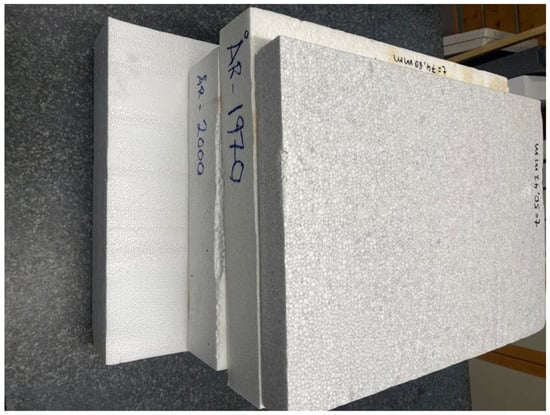
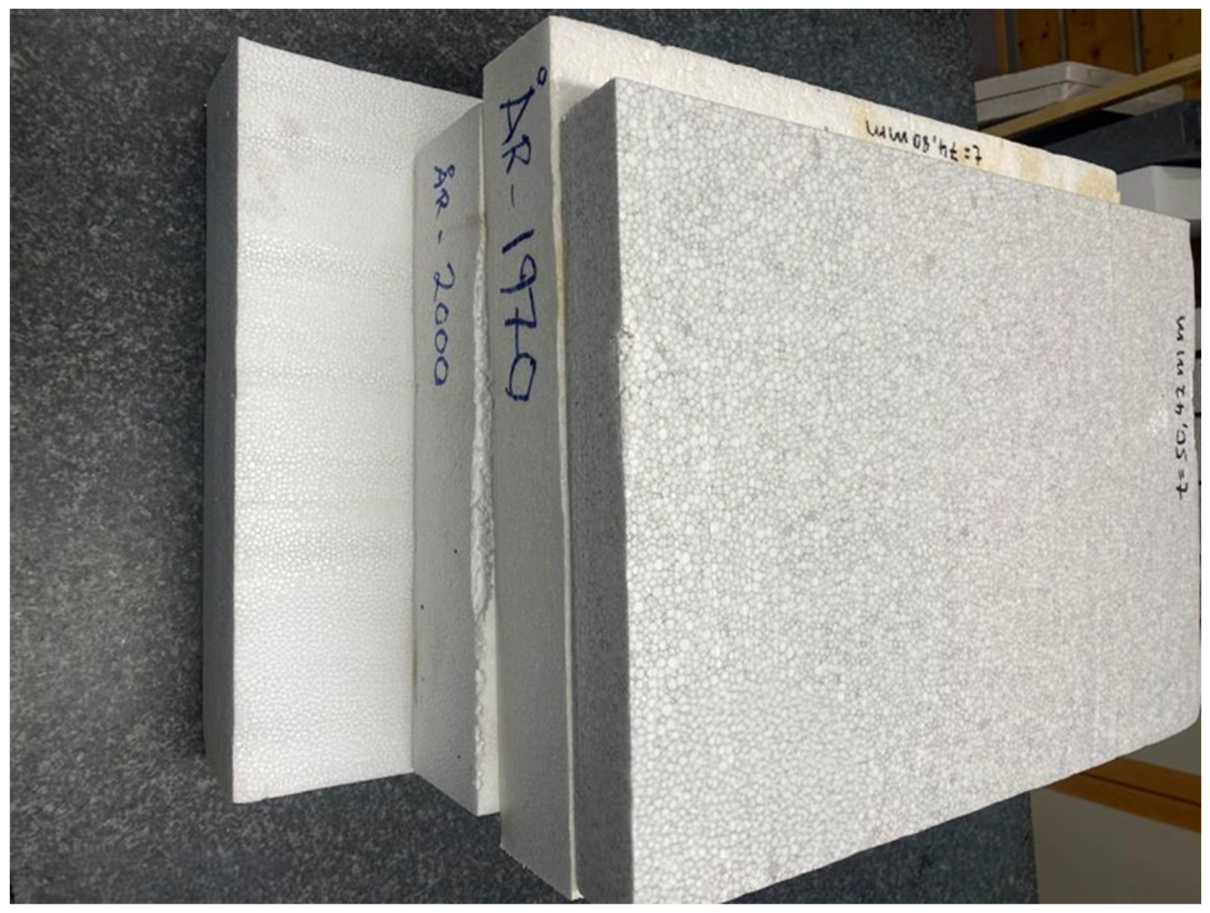
One sample was tested from each year of production. Samples 1, 2, and 4 were protected from moisture and were observed to be dry at collection from the demolition site. Sample 3, from a landfill for lightweight material, was not protected from moisture during use, and moisture was found at collection. Therefore, sample 3 was dried at 65 °C for 24 h before laboratory analyses. An image of the tested samples is provided in Figure 1.
Figure 1.
Image of the used EPS insulation boards that underwent material testing.
A reference sample of EPS manufactured in January 2024 by BEWI Insulation AS, Fredrikstad, Norway was included in the investigation into the presence of dangerous substances.
2.2. Laboratory Test Methods
- Thermal conductivity
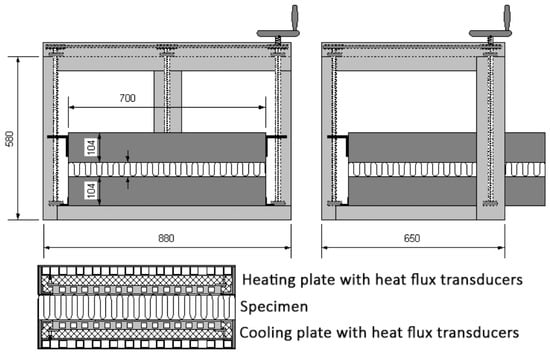
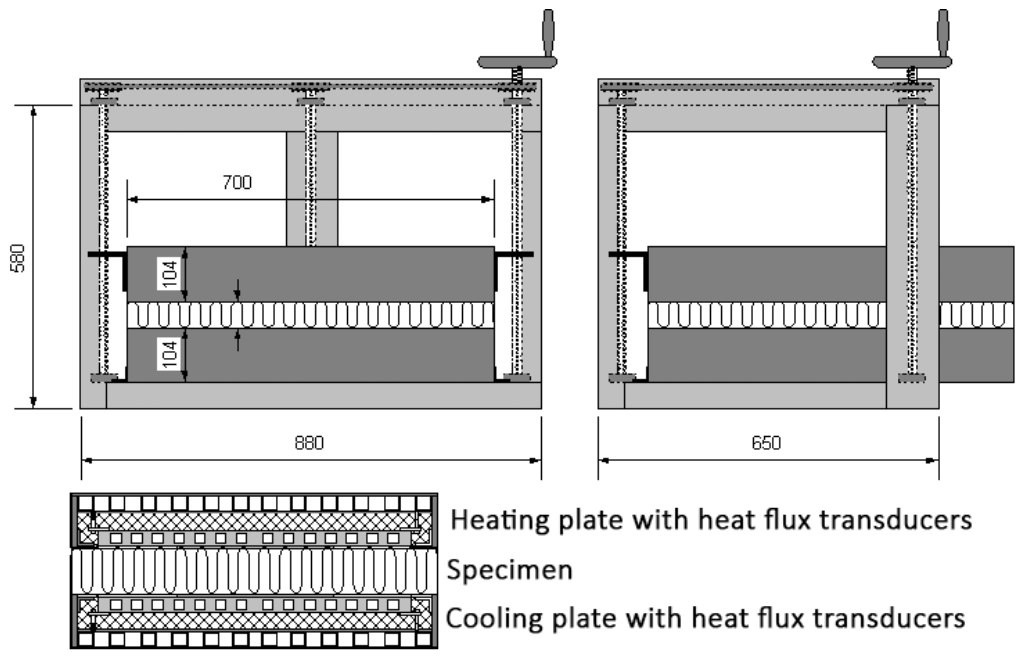
The thermal conductivity of the used EPS was measured using a heat flow meter in the single-specimen symmetrical configuration, as described in NS-EN 12667 [45] and ISO 8301 [46], at an accredited laboratory (SINTEF, Trondheim, Norway). The heat flow meter apparatus used consists of two parallel plates with integrated heat flux transducers on both the hot and cold sides (Figure 2). Each transducer comprised a thermopile with 625 type T thermocouples and was constructed in accordance with principle (c) in NS-EN 12667, Annex D. Measurements were performed under steady-state conditions, with a constant mean temperature in the specimen and a constant temperature difference across it. A one-dimensional, uniform heat flux was established through the specimen from the hot to the cold plate. Stabilising the heat flux took about 6 h.
Figure 2.
Schematic diagram of the heat flow meter with dimensions in millimetres.
The heat flow meter was placed in a room maintained at 10 °C. The relative humidity in the measurement chamber was maintained at a low level to prevent moisture diffusion and condensation effects, in accordance with the requirements of NS-EN 12667. The humidity was controlled using a continuously operating dehumidification system, was monitored and logged, and was approximately 7.5% during the measurement period. The temperature in the middle of the test samples was set to 10.0 °C. The mean temperature difference across the samples during measurements was 19.6 °C for sample 1 and 20.2 °C for samples 2–4. Only one specimen from each sample in Table 1 was measured. The heat flow meter and method used have a documented measurement uncertainty of ± 1.9% with a coverage factor k = 2.
Historical data on the thermal conductivity and density of EPS were collected from test reports in the archives of the Norwegian Building Research Institute (NBI, now part of SINTEF) for the period 1976–2007. The test reports included measurements on samples from four EPS producers on the Norwegian market. All historical measurements of thermal conductivity were conducted using a heat flow meter., The temperature in the middle of the samples was set to 10 °C, and the temperature difference across the samples was set to 20 °C.
- Compressive strength
Compressive strength testing, in the form of compressive stress at 10% strain, was carried out according to NS-EN ISO 29469 [47] in an accredited laboratory (SINTEF, Trondheim, Norway). Three cubic specimens with dimensions corresponding to the initial thickness of each insulation board were cut and tested. The specimen dimensions were determined in accordance with ISO 29768. Each specimen was placed centrally between the platens of a compression testing machine and subjected to a preload of (250 ± 10) Pa. The initial thickness, d, was determined under this preload. Compression was applied using movable platens at a constant displacement rate of 0.1 d/min. Loading was continued until after the specimen reached 10% strain. The compressive stress at 10% strain was determined from the force measured at 10% deformation divided by the initial cross-sectional area of the specimen.
Historical data on compressive strength (compressive stress at 10% strain) and density of EPS were collected from test reports in the archives of Norges Byggforskningsinstitutt (NBI, now part of SINTEF) for the period 2002–2009. The test reports included measurements on samples from two EPS producers on the Norwegian market. All historical compressive strength measurements were made in accordance with the retrieved NS-EN 826, later replaced by NS-EN ISO 29469.
- Hazardous substances
The content of brominated flame retardants was measured by gas chromatography–mass spectrometry (GC-MS) in accordance with DIN-EN ISO 22032-07 [48] in an accredited laboratory (GBA, Pinneberg, Germany). The elemental content of arsenic, cadmium, chromium, copper, nickel, lead and zinc was measured by inductively coupled plasma optical emission spectrometry (ICP-OES) in accordance with DS-EN ISO 22036 [49] in an accredited laboratory (ALS Denmark, Humlebæk, Denmark). The elemental content of mercury was determined by cold vapour-atomic absorption spectrometry (CV-AAS) in accordance with DS-EN 16175-1 [50] in an accredited laboratory (ALS Denmark, Humlebæk, Denmark).
2.3. LCA Methodology
LCA is a widely used method for assessing the potential environmental impacts, benefits, and trade-offs of products or services. In the context of EPS in the construction sector, LCA is a useful tool for exploring the potential for higher circularity through material recycling and reuse.
In this study, an LCA of EPS used as a thermal insulation material in buildings or infrastructure was conducted. The LCA follows the Norwegian standards NS-EN 15804 [51] and NS 3720 [52]. These standards present a modular system for the life stages of buildings and construction materials, including the following: the production stage (A1–A3), installation stage (A4–A5), use stage (B1–B8), end-of-life stage (C1–C4), and consequences outside the system boundaries (D). For the current study, the system boundary is set to the production stage (A1–A3), transport (A4), end-of-life (C2–C4), and consequences outside the system boundaries (D), as shown in Table 2.
Table 2.
Lifecycle stages for buildings and construction components according to NS-EN 15804 and NS 3720. The modules included in this study are outlined in blue.
Several end-of-life scenarios (Table 3) were developed to investigate and compare the environmental sustainability of increased material recycling and reuse as alternatives to the current practice, in which EPS is either disposed of in landfills or incinerated with energy recovery. The baseline scenario reflects current practice for treating EPS waste from the construction and demolition of buildings and infrastructure. Only a negligible fraction of the recovered material is recycled. Waste treatment companies state that clean EPS is incinerated with energy recovery, and that EPS with impurities, such as dirt and concrete, is disposed of in landfills. No statistics are available on volumes sent to combustion or landfill, and a 50:50 split between incineration and landfilling is used in estimates in the literature [53]. The “Resilient Recycling” scenario concerns improved, and thus more resilient, recycling processes that enable the recycling of EPS with impurities, thereby reducing the amount of EPS sent to landfills or incinerated with energy recovery. In the “EPS Improved Collection” scenario, the potential for dedicated EPS containers on construction sites is explored. In “Reuse”, the potential of starting to reuse undamaged EPS rather than recycling is explored. The “Recycling + Reuse” scenario includes the reuse of whole composite systems with EPS. These composite systems, such as External Thermal Insulation Composite System (ETICS) or Insulated Concrete, are often difficult to recycle due to contamination with concrete and the complexity of separation processes. Hence, reuse would not come at the expense of recycling.
Table 3.
Scenarios used in the LCA.
Emission intensities for both virgin [54] and recycled [55] EPS manufacturing, as well as transport distances, were taken from the Environmental Product Declarations (EPDs) of BEWI Insulation Norway, a Norwegian EPS producer, and subsequently converted to the functional unit of 1 kg of EPS. The transportation distance from the factory to the building site was set at 300 km. A distance of 83 km was used from the building site to the waste treatment or reuse site (C2).
3. Results
3.1. Laboratory Test Results
Table 4 summarises the test results for thermal conductivity and compressive stress at 10% strain for the used EPS.
Table 4.
Test results for thermal conductivity and compressive stress at 10% strain on used EPS.
The results from the analysis of brominated flame retardants are given in Table 5, and the results from elemental analysis of heavy metals are given in Table 6. No brominated flame retardants were detected above the respective detection limits in any of the tested EPS samples. Except for zinc, no heavy metals were detected above the measurement uncertainty and/or detection limit. The detected zinc concentration was 40–120 mg/kg, which is also low. Zinc is not on the REACH restriction list for building materials, and the detected levels are well within the acceptable range set by Norwegian building regulations. Furthermore, detection of zinc was not unexpected, as zinc is a common element in lubricants used in the casting process for EPS production. In conclusion, no substances of concern to human health or the environment that would restrict commercial distribution and/or reuse were detected in the used EPS samples tested in this study.
Table 5.
Content of brominated flame retardants in used EPS, measured by GC-MS.
Table 6.
Content of heavy metals in used EPS, measured by ICP-OES and CV-AAS (for Hg).
3.2. Comparison to Historical Data
No specific reference data were available for the tested EPS panels, as the exact product and manufacturer information for the reclaimed panels installed between 1970 and 2000 was unknown. The comparison is therefore based on a broader set of historical data representing the typical properties of as-produced EPS during this period. Both the historical data and the present measurements were obtained using standardised test methods with equivalent measurement setups, procedures and conditions.
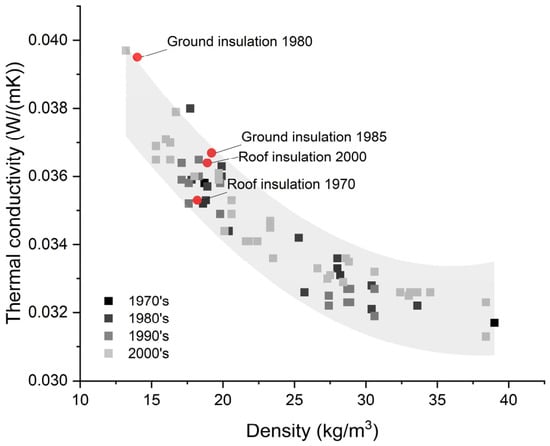
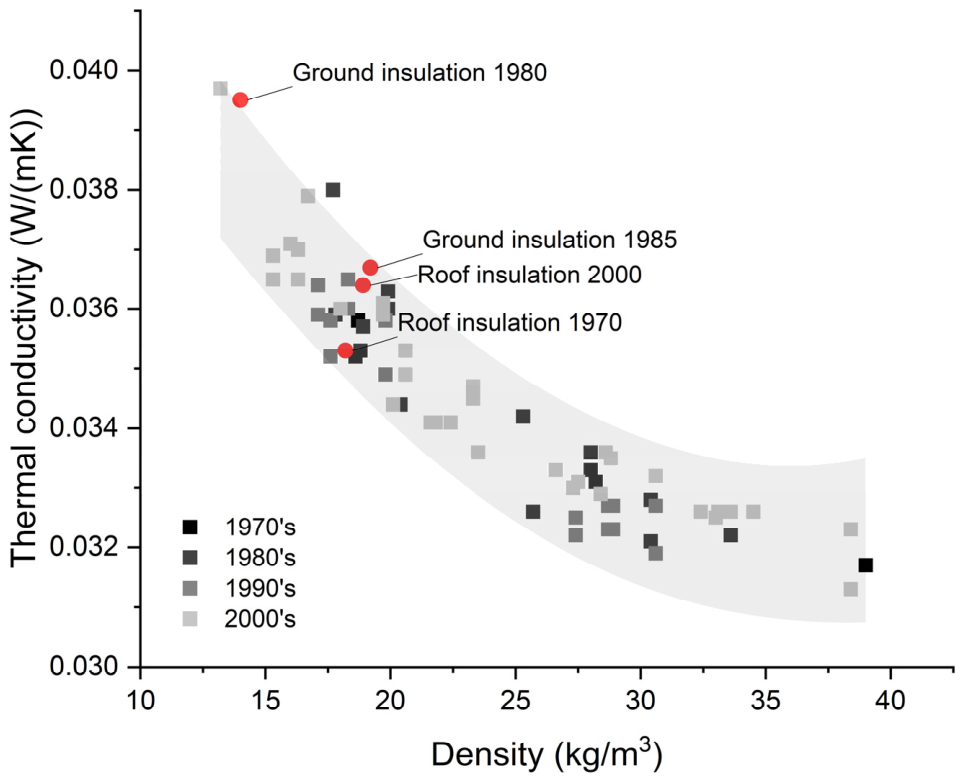
The thermal conductivity of EPS insulation products measured between 1976 and 2007 is plotted as a function of density in Figure 3. The shaded area represents a 95% prediction interval based on a second-degree polynomial regression of the historical data points:
y = 0.048 − 8.517∙10−4x + 1.157∙10−5x2, R2 = 0.889
Figure 3.
Grey/black squares: thermal conductivity of EPS measured in the period 1976–2007. Grayscale indicates the decade of measurement. Shaded area: 95% prediction interval for compressive strength of fresh samples from the period. Red dots: Thermal conductivity of used EPS.
The second-degree polynomial was selected as the lowest-order model, which provides an adequate fit to the data while capturing the observed curvature and avoiding unnecessary complexity. The interval reflects the expected spread of individual observations around the empirical trend derived from historical data and is based on the regression’s residual variability. The thermal conductivity measured on the used EPS reclaimed in 2023 is shown as red dots in the same plot. The thermal conductivity of used EPS falls within, or close to, the expected range for fresh samples from the same time.
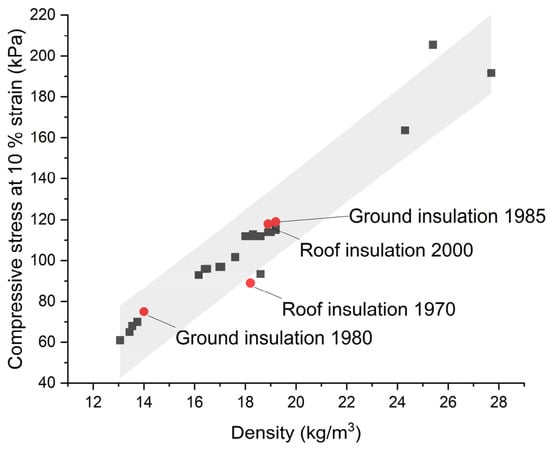
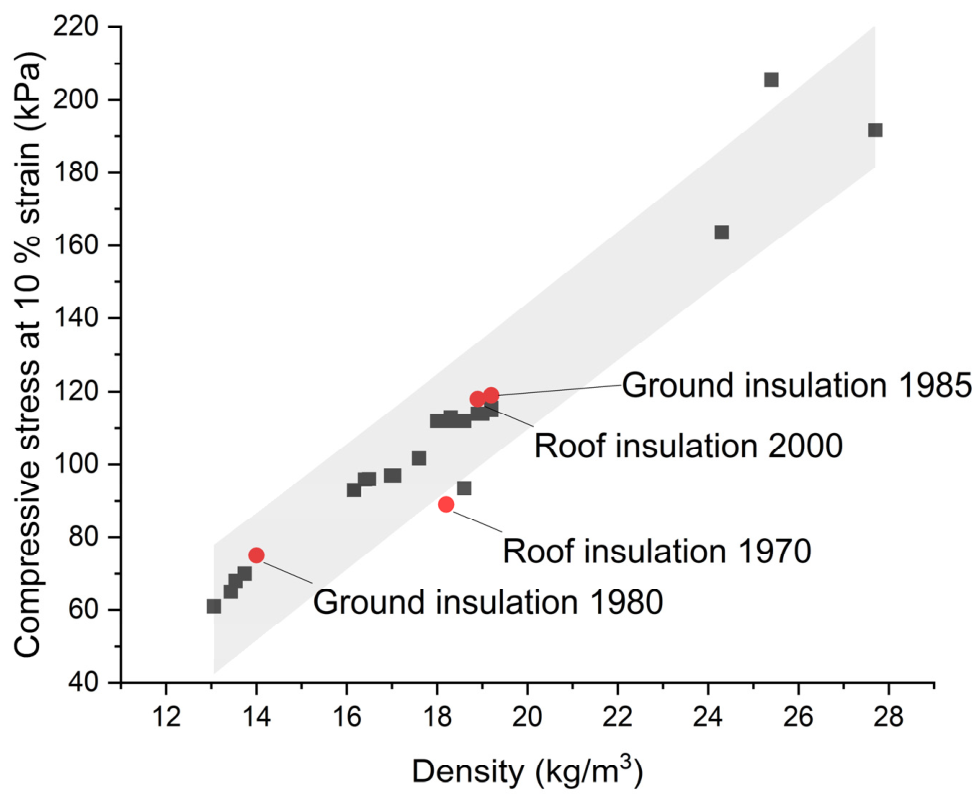
The compressive strength of EPS measured from 2002 to 2009 is plotted as a function of density in Figure 4. The shaded area represents a 95% prediction interval for the compressive strength of fresh samples from the period based on a linear regression model:
y = −65.558 + 9.622x, R2 = 0.949
Figure 4.
Black squares: compressive strength of EPS measured in the period 2002–2009. Shaded area: 95% prediction interval for compressive strength of fresh samples from the period. Red dots: compressive strength of used EPS.
The compressive strength of the EPS reclaimed in 2023 is shown as red dots in the same plot. The compressive strength of used EPS falls within or close to the expected range for fresh samples from 2002 to 2009.
Tabulated values for prediction intervals of thermal conductivity and compressive strength across different density ranges of EPS insulation are shown in Table 7. The density ranges in which the used EPS tested in this study fall are marked with asterisks, and the corresponding measurement values are shown in the table footnotes for comparison. As shown in Table 7, as well as in Figure 3 and Figure 4, the thermal conductivity of Sample 2 was slightly higher than the prediction interval for its density range, and the compressive strength of Sample 1 was slightly lower than the prediction interval. All other measurements fell within the prediction intervals. Thus, no marked difference in thermal conductivity or compressive strength was observed between the used EPS tested in this study and the as-produced samples within the same density range.
Table 7.
Tabulated values for prediction intervals of thermal conductivity and compressive strength across different density ranges of EPS insulation.
3.3. LCA Results
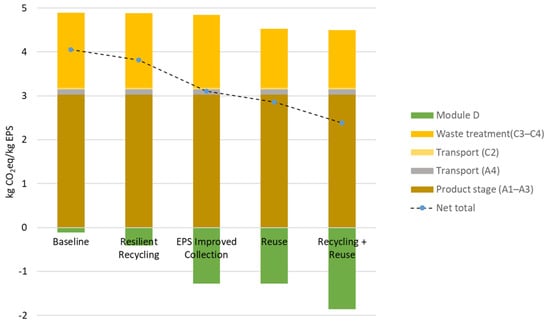
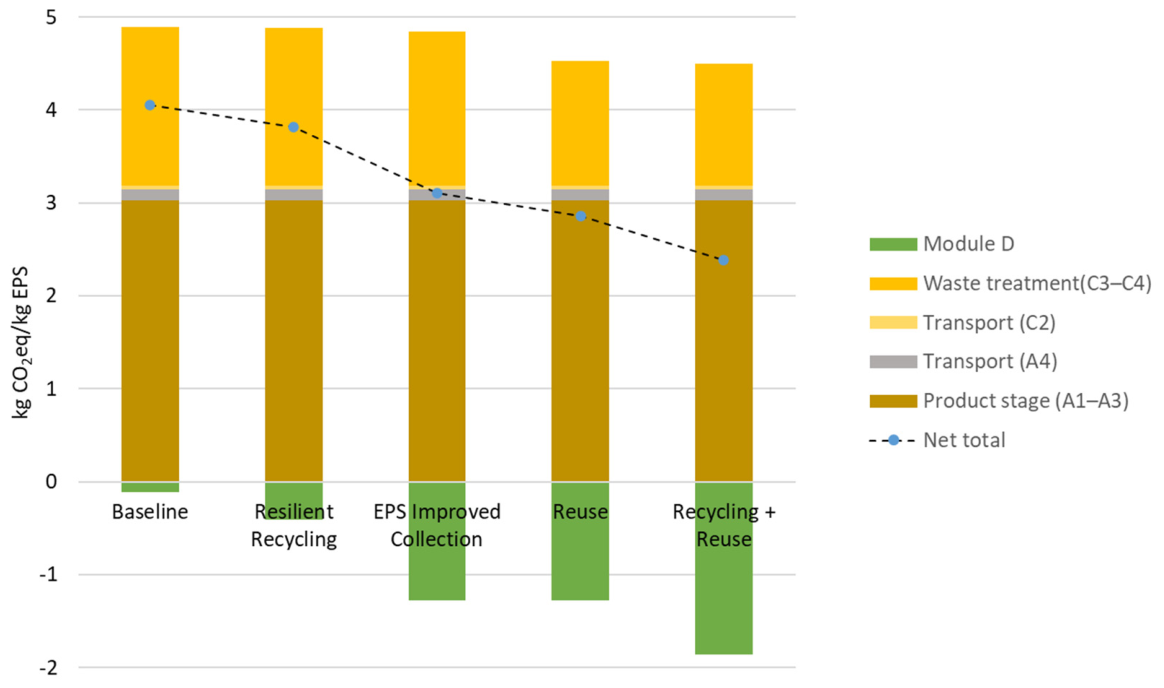
The LCA results are visualised in Figure 5. Across the scenarios, the production stage accounts for the majority of GHG emissions, contributing 62–67% of the total. Waste treatment (C3) accounts for 29–35%, and transport (A4 + C2) for 3–4%. The life cycle results for the baseline scenario are 4.9 kg CO2eq./kg EPS and 4.7 kg CO2eq./kg EPS, including consequences outside the system boundary (D). Compared with the baseline, “Resilient Recycling” reduces the lifecycle impact, including impacts outside the system boundary (D), by 5%; “EPS Improved Collection” by 24%; “Reuse” by 31%; and “Recycling and Reuse” by 44%.
Figure 5.
GHG emissions for different EPS end-of-life scenarios. The scenarios are described in the text.
The combination of material recycling and EPS reuse holds the greatest potential but is also the most challenging in terms of product documentation, as it involves reusing composites made from different materials and often used in load-bearing applications. It is therefore interesting to note that reusing undamaged EPS boards that would otherwise go to recycling also offers greater potential to reduce GHG emissions than improved recycling and collection alone.
4. Discussion
4.1. Implications for Reuse
Because this feasibility study showed good correspondence between the critical material properties of reclaimed EPS insulation and predictions based on density and historical data, one approach to documenting used EPS could be to develop a simple model to predict thermal conductivity and compressive strength based on density ranges. Before acceptance as documentation, the model should be verified by laboratory testing of a large sample of used EPS. In addition, the absence of substances harmful to human health and the environment must be documented. For EPS, the main risk is the possible presence of brominated flame retardants. Although no brominated flame retardants were found in the samples analysed in this study, they have been used in EPS insulation for buildings, and the extent of their application in fire-retarded EPS has varied between countries, e.g., based on national fire requirements [57]. Hand-held XRF is a possible time- and cost-effective analysis method that yielded no false negatives for brominated flame retardants at or above the GC-MS detection limit in at least two studies [58,59]. Sampling tests on a few EPS boards from each demolition site could be conducted using hand-held XRF before collection for reuse. For large volumes enabling a more advanced reuse “production line”, one could also envisage a conveyor belt with integrated scales, dimensional measurements, and fixed XRF instruments for documentation and sorting of used EPS.
The most important properties of EPS insulation for buildings and infrastructure are the physical dimensions, density, thermal conductivity and mechanical strength (depending on the application). In practice, dimensions must be known and documented for reuse in all cases. They can be measured manually using simple tools such as rulers, tapes and callipers, or automatically, for example, using optical methods. Density can be calculated from the dimensions and the weight of the EPS boards considered for reuse. According to the available scientific literature, the thermal conductivity of EPS remains practically unchanged over time, and laboratory measurements indicate that measured density, in combination with historical data, can be a good predictor of both the thermal conductivity and the compressive strength of used EPS. Thus, the most important material properties of used EPS can hypothetically be estimated from simple measures of weight and dimensions, without the need for extensive or advanced laboratory testing.
4.2. Limitations
A major limitation of this study is the small number of samples collected for laboratory analysis. Used EPS materials were collected from three sites in southeastern Norway. This region is characterised by a temperate, semi-continental climate, with relatively warm, sunny summers and cold, snowy winters, especially inland. Consequently, the test results and reuse implications are limited to areas with similar climatic conditions. Expanding sample sourcing to include additional samples from diverse demolition sites across different geographic locations and climates, and from several building and infrastructure applications, would strengthen the analysis and provide a more comprehensive basis for reuse recommendations.
Another limitation is the lack of available archival data from before 2002 for standardised testing of compressive stress at 10% strain. Furthermore, the effects of sustained loads, high temperatures, and/or temperature cycling on the mechanical properties of EPS insulation should be further investigated before existing EPS can be safely employed in load-bearing applications. Alternatively, large safety factors should be used to account for the uncertainty.
The LCA results have been reported only in terms of climate impact. To provide a comprehensive representation of the environmental impacts and potential trade-offs across the baseline and the scenarios, several impact categories should be included in future work. Additionally, the lifecycle inventory data are based on producer data and thus representative of Norwegian conditions.
4.3. Policy Implications
The findings of this study point to several policy implications for enabling large-scale reuse of EPS insulation. Current regulations largely focus on waste handling and recycling, while the absence of dedicated requirements for separate collection, documentation, and quality assurance of EPS in demolition projects hinders reuse. EPS is rarely prioritised for selective collection, despite being fully recyclable, because existing rules emphasise weight-based sorting, lack specific obligations for EPS separation, and provide limited economic incentives for reuse-oriented handling.
Strengthening regulatory frameworks to require or incentivise the separate collection of EPS, for example by shifting from weight-based to volume-based sorting criteria, would significantly increase the availability of clean material flows for reuse. Moreover, establishing clearer acceptance criteria for used EPS that align with the regulations on technical requirements for construction works (TEK17) [60] and are supported by simple testing protocols could reduce uncertainty for designers and contractors and lower barriers to market uptake.
Policies that encourage regional hubs for cleaning and pre-processing would also reduce transport burdens and facilitate short-loop reuse pathways. Finally, integrating reuse targets into national circular economy strategies and public procurement could accelerate the development of the logistics, documentation practices, and business models needed to support a stable market for secondary EPS.
5. Conclusions and Future Work
This study showed that the key technical barrier to EPS reuse is not intrinsic material degradation, as both thermal and mechanical properties were found to remain largely stable after long-term service. Although some uncertainty remains regarding the potential effects of thermal exposure, cyclic loading and moisture on mechanical properties, the primary challenge lies in the lack of practicable documentation routes to verify that used EPS meets the technical requirements of its intended application. The main legislative barriers arise from the absence of harmonised procedures for the testing, classification, and certification of used EPS, combined with regulatory frameworks, particularly in chemicals and waste legislation, that prioritise waste disposal or recycling over reuse.
Laboratory testing demonstrated that EPS insulation recovered from building and infrastructure applications retains key functional properties, including thermal conductivity, compressive strength, and chemical safety, at levels comparable to historical benchmarks for new materials. Testing of samples with more than 20 years of service revealed no significant ageing-related decline in conductivity or strength and no detectable substances of concern, indicating that reclaimed EPS can meet fundamental technical and regulatory requirements for reuse when appropriate documentation and screening are applied. Furthermore, good agreement was observed between measured properties of used EPS and predictions based on density and historical laboratory test results, indicating that key performance properties could be documented solely from density measurements, without additional laboratory testing. However, this approach should be validated through testing on a larger and more representative sample set before being adopted in practice.
No harmful substances of concern were found in the reused samples in this study; however, given the known use of brominated flame retardants in EPS insulation, appropriate screening methods should nevertheless be included in a documentation route for used EPS.
The environmental assessment showed that reuse delivers substantially greater climate benefits than improved recycling alone, highlighting its strategic role in advancing circularity for EPS-based construction materials.
Future research should prioritise expanding the empirical dataset to encompass a broader range of EPS products, service environments, and geographic contexts to characterise variability in long-term performance. Additional studies examining the effects of sustained loading, sub-critical thermal exposure, freeze–thaw cycling, and moisture ingress under realistic service conditions are essential to address remaining uncertainties, particularly for load-bearing or partially exposed applications. Further development of practical reuse frameworks, including standardised grading protocols, simple performance prediction models, and streamlined documentation pathways, will also be critical for scaling reuse. As circular economy strategies evolve, coordinated research across materials science, demolition logistics, and regulatory standardisation will be needed to unlock the full technical and environmental potential of EPS reuse in European construction markets.
Author Contributions
Conceptualisation, M.S., B.R. and C.L.; methodology, M.S., A.L. and C.L.; software, M.S. and C.L.; validation, M.S.; formal analysis, M.S. and C.L.; investigation, M.S., A.L. and C.L.; resources, M.S. and B.R.; data curation, M.S. and C.L.; writing—original draft preparation, M.S. and C.L.; writing—review and editing, M.S., A.L. and C.L.; visualisation, M.S. and C.L.; supervision, C.L.; project administration, B.R. and C.L.; funding acquisition, B.R. and C.L. All authors have read and agreed to the published version of the manuscript.
Funding
This research is part of the Norwegian project “Circular EPS–Circular Economy Solutions for reuse and recycling of EPS from buildings and infrastructure”, partly funded by the Research Council of Norway (grant no. 340863).
Data Availability Statement
The raw data supporting the conclusions of this article will be made available by the authors on request.
Acknowledgments
The authors gratefully acknowledge senior engineer Stian Gjønnes Jørgensen at SINTEF Community for performing the laboratory analyses of the reclaimed EPS insulation samples. We also thank product manager Svein Tore Larsen at Bewi Insulation Norway for arranging the collection and logistics of the samples used in this study.
Conflicts of Interest
The authors declare no conflicts of interest. The funders had no role in the design of the study; the collection, analysis, or interpretation of data; the writing of the manuscript; or the decision to publish the results.
Abbreviations
The following abbreviations are used in this manuscript:
| CE | European Conformity (Conformité Européenne) |
| CPR | Construction Products Regulation |
| CV-AAS | Cold Vapour-Atomic Absorption Spectrometry |
| DoP | Declaration of Performance |
| EPD | Environmental Product Declaration |
| EPS | Expanded Polystyrene |
| ETICS | External Thermal Insulation Composite System |
| EU | European Union |
| GC-MS | Gas Chromatography–Mass Spectrometry |
| GHG | Greenhouse Gas |
| ICP-OES | Inductively Coupled Plasma–Optical Emission Spectrometry |
| LCA | Life Cycle Assessment |
| REACH | Registration, Evaluation, Authorisation and Restriction of Chemicals |
| SVHC | Substance of Very High Concern |
| TEK17 | Norwegian Building Regulations |
| XRF | X-ray Fluorescence |
References
- The European Manufacturers of Expanded Polystyrene (EUMEPS). Sustainable Construction with EPS Insulation; EUMEPS: Brussels, Belgium, 2021; Available online: https://build-up.ec.europa.eu/sites/default/files/content/EUMEPS%20brochure%20Environment%20LowRes%20web_0.pdf (accessed on 24 February 2026).
- Sulong, N.H.R.; Mustapa, S.A.S.; Rashid, M.K.A. Application of expanded polystyrene (EPS) in buildings and constructions: A review. J. Appl. Polym. Sci. 2019, 136, 47529. [Google Scholar] [CrossRef] [Scilit]
- Klemczak, B.; Kucharczyk-Brus, B.; Sulimowska, A.; Radziewicz-Winnicki, R. Historical Evolution and Current Developments in Building Thermal Insulation Materials—A Review. Energies 2024, 17, 5535. [Google Scholar] [CrossRef] [Scilit]
- Singh, A.; Chauhan, A.; Gaur, R. A comprehensive review on the synthesis, properties, environmental impacts, and chemiluminescence applications of polystyrene (PS). Discov. Chem. 2025, 2, 47. [Google Scholar] [CrossRef] [Scilit]
- Netsch, N.; Simons, M.; Feil, A.; Leibold, H.; Richter, F.; Slama, J.; Yogish, S.P.; Greiff, K.; Stapf, D. Recycling of polystyrene-based external thermal insulation composite systems—Application of combined mechanical and chemical recycling. Waste Manag. 2022, 150, 141–150. [Google Scholar] [CrossRef] [Scilit]
- Fitriasari, E.I.; Akhtar, M.S.; Hwang, D.W.; Liu, J.J. Circular economy of expanded polystyrene waste: Techno-economic and life cycle assessments of chemical recycling processes. J. Clean. Prod. 2025, 503, 145416. [Google Scholar] [CrossRef] [Scilit]
- Tkalčić, D.; Vukadin, J.; Milovanović, B.; Pečur, I.B. Performance Assessment of Mechanically Recycled EPS. Materials 2025, 18, 4547. [Google Scholar] [CrossRef] [Scilit]
- Xu, Z.; Sun, D.; Xu, J.; Yang, R.; Russell, J.D.; Liu, G. Progress and Challenges in Polystyrene Recycling and Upcycling. ChemSusChem 2024, 17, e202400474. [Google Scholar] [CrossRef] [Scilit]
- Schleier, J.; Walther, G. Robust design of recycling networks considering uncertain regulatory, economic, and technological conditions—The case of recovering polystyrene from building insulation. Comput. Ind. Eng. 2025, 208, 111254. [Google Scholar] [CrossRef] [Scilit]
- Zheng, B.; Yang, Y.; Chan, A.P.; Jiang, H.; Bao, Z. A meta-analysis of environmental impacts of building reuse and recycling. J. Clean. Prod. 2025, 520, 146149. [Google Scholar] [CrossRef] [Scilit]
- Mehta, S.; Biederman, S.; Shivkumar, S. Thermal degradation of foamed polystyrene. J. Mater. Sci. 1995, 30, 2944–2949. [Google Scholar] [CrossRef] [Scilit]
- Simpson, A.; Rattigan, I.; Kalavsky, E.; Parr, G. Thermal conductivity and conditioning of grey expanded polystyrene foams. Cell. Polym. 2020, 39, 238–262. [Google Scholar] [CrossRef] [Scilit]
- Singh, B.; Sharma, N. Mechanistic implications of plastic degradation. Polym. Degrad. Stab. 2008, 93, 561–584. [Google Scholar] [CrossRef] [Scilit]
- Parracha, J.L.; Borsoi, G.; Flores-Colen, I.; Veiga, R.; Nunes, L.; Dionísio, A.; Gomes, M.G.; Faria, P. Performance parameters of ETICS: Correlating water resistance, bio-susceptibility and surface properties. Constr. Build. Mater. 2021, 272, 121956. [Google Scholar] [CrossRef] [Scilit]
- D’Agostino, D.; Landolfi, R.; Nicolella, M.; Minichiello, F. Experimental Study on the Performance Decay of Thermal Insulation and Related Influence on Heating Energy Consumption in Buildings. Sustainability 2022, 14, 2947. [Google Scholar] [CrossRef] [Scilit]
- Krundaeva, A.; De Bruyne, G.; Gagliardi, F.; Van Paepegem, W. Dynamic compressive strength and crushing properties of expanded polystyrene foam for different strain rates and different temperatures. Polym. Test. 2016, 55, 61–68. [Google Scholar] [CrossRef] [Scilit]
- Tahir, M.N.; Hamed, E. Effects of temperature and thermal cycles on the mechanical properties of expanded polystyrene foam. J. Sandw. Struct. Mater. 2022, 24, 1535–1555. [Google Scholar] [CrossRef] [Scilit]
- Parracha, J.L.; Borsoi, G.; Veiga, R.; Flores-Colen, I.; Nunes, L.; Viegas, C.; Moreira, L.; Dionísio, A.; Gomes, M.G.; Faria, P. Durability assessment of external thermal insulation composite systems in urban and maritime environments. Sci. Total Environ. 2022, 849, 157828. [Google Scholar] [CrossRef] [Scilit] [PubMed]
- Petre, S.G.; Isopescu, D.N.; Pruteanu, M.; Cojocaru, A. Effect of Exposure to Environmental Cycling on the Thermal Conductivity of Expanded Polystyrene. Materials 2022, 15, 6921. [Google Scholar] [CrossRef] [Scilit]
- Cai, S.; Zhang, B.; Cremaschi, L. Review of moisture behavior and thermal performance of polystyrene insulation in building applications. Build. Environ. 2017, 123, 50–65. [Google Scholar] [CrossRef] [Scilit]
- Jerman, M.; Černý, R. Effect of moisture content on heat and moisture transport and storage properties of thermal insulation materials. Energy Build. 2012, 53, 39–46. [Google Scholar] [CrossRef] [Scilit]
- Gewert, B.; Plassmann, M.M.; MacLeod, M. Pathways for degradation of plastic polymers floating in the marine environment. Environ. Sci. Process. Impacts 2015, 17, 1513–1521. [Google Scholar] [CrossRef] [Scilit]
- Kim, H.-W.; Jo, J.H.; Kim, Y.-B.; Le, T.-K.; Cho, C.-W.; Yun, C.-H.; Chi, W.S.; Yeom, S.-J. Biodegradation of polystyrene by bacteria from the soil in common environments. J. Hazard. Mater. 2021, 416, 126239. [Google Scholar] [CrossRef] [Scilit] [PubMed]
- Sun, J.; Prabhu, A.; Aroney, S.T.N.; Rinke, C. Insights into plastic biodegradation: Community composition and functional capabilities of the superworm (Zophobas morio) microbiome in styrofoam feeding trials. Microb. Genom. 2022, 8, 000842. [Google Scholar] [CrossRef] [Scilit] [PubMed]
- Jeřábková, E.; Tesařová, D.; Polášková, H. Resistance of various materials and coatings used in wood constructions to growth of microorganisms. Wood Res. 2018, 63, 993–1002. [Google Scholar]
- Nunes, L.; Duarte, S.; Parracha, J.L.; Jones, D.; Paulmier, I.; Kutnik, M. Insulation Materials Susceptibility to Biological Degradation Agents: Molds and Subterranean Termites. Appl. Sci. 2023, 13, 11311. [Google Scholar] [CrossRef] [Scilit]
- Yousif, E.; Haddad, R. Photodegradation and photostabilization of polymers, especially polystyrene: Review. SpringerPlus 2013, 2, 398. [Google Scholar] [CrossRef] [Scilit]
- Meides, N.; Menzel, T.; Poetzschner, B.; Löder, M.G.J.; Mansfeld, U.; Strohriegl, P.; Altstaedt, V.; Senker, J. Reconstructing the Environmental Degradation of Polystyrene by Accelerated Weathering. Environ. Sci. Technol. 2021, 55, 7930–7938. [Google Scholar] [CrossRef] [Scilit]
- European Parliament. Regulation (EU) No2011 of the European Parliament and of the Council of 9 March 2011 Laying Down Harmonised Conditions for the Marketing of Construction Products and Repealing Council Directive 89/106/EEC (Text with EEA Relevance); 02011R0305; Official Journal of the European Union: Brussels, Belgium, 2024. Available online: https://eur-lex.europa.eu/legal-content/EN/TXT/PDF/?uri=CELEX:02011R0305-20241117 (accessed on 24 February 2026).
- European Committee for Standardization (CEN). EN 13163:2012+A2:2016 Thermal Insulation Products for Buildings-Factory Made Expanded Polystyrene (EPS) Products-Specification; European Committee for Standardization (CEN): Brussels, Belgium, 2016; Available online: https://online.standard.no/nb/ns-en-13163-2012a2-2016 (accessed on 24 February 2026).
- European Commission. CE Marking. Available online: https://single-market-economy.ec.europa.eu/single-market/ce-marking_en (accessed on 11 March 2025).
- Zhang, H.; Kuo, Y.-Y.; Gerecke, A.C.; Wang, J. Co-Release of Hexabromocyclododecane (HBCD) and Nano- and Microparticles from Thermal Cutting of Polystyrene Foams. Environ. Sci. Technol. 2012, 46, 10990–10996. [Google Scholar] [CrossRef] [Scilit]
- European Commission. REACH Regulation. Available online: https://environment.ec.europa.eu/topics/chemicals/reach-regulation_en (accessed on 24 February 2026).
- Miljødirektoratet. Farlig Avfall Fra Bygg Og Anlegg, Oslo, Norway, M–29. 2013. Available online: https://www.miljodirektoratet.no/globalassets/publikasjoner/m29/m29.pdf (accessed on 2 March 2026).
- Mao, S.; Cao, W.-J. Evaluating material passports for circularity in the construction industry. Sustain. Prod. Consum. 2025, 54, 88–101. [Google Scholar] [CrossRef] [Scilit]
- Costa, A.R.; Hoolahan, R.; Charef, R. Eight recommendations to adopt materials passports and accelerate material reuse in construction: Insights from academia and practice. npj Mater. Sustain. 2025, 3, 33. [Google Scholar] [CrossRef] [Scilit]
- Bae, M.; Ahn, H.; Kang, J.; Choi, G.; Choi, H. Determination of the Long-Term Thermal Performance of Foam Insulation Materials through Heat and Slicing Acceleration. Polymers 2022, 14, 4926. [Google Scholar] [CrossRef] [Scilit]
- Colangelo, F.; Roviello, G.; Ricciotti, L.; Ferrándiz-Mas, V.; Messina, F.; Ferone, C.; Tarallo, O.; Cioffi, R.; Cheeseman, C. Mechanical and thermal properties of lightweight geopolymer composites. Cem. Concr. Compos. 2018, 86, 266–272. [Google Scholar] [CrossRef] [Scilit]
- Pokorný, J.; Zárybnická, L.; Ševčík, R.; Podolka, L. Utilization of Waste-Expanded Thermoplastic as a Sustainable Filler for Cement-Based Composites for Greener Construction. Buildings 2024, 14, 990. [Google Scholar] [CrossRef] [Scilit]
- El Gamal, S.; Al-Jardani, Y.; Meddah, M.S.; Sohel, K.A.; Al-Saidy, A. Mechanical and thermal properties of lightweight concrete with recycled expanded polystyrene beads. Eur. J. Environ. Civ. Eng. 2024, 28, 80–94. [Google Scholar] [CrossRef] [Scilit]
- Elghomari, A.; Tilioua, A. Investigation and valorization of expanded polystyrene waste in building materials: Thermal and mechanical characterization. Results Mater. 2025, 28, 100782. [Google Scholar] [CrossRef] [Scilit]
- Akis, E.; Guven, G.; Lotfisadigh, B. Predictive models for mechanical properties of expanded polystyrene (EPS) geofoam using regression analysis and artificial neural networks. Neural Comput. Appl. 2022, 34, 10845–10884. [Google Scholar] [CrossRef] [Scilit]
- Krajewska, A.; Siewczyńska, M. Circular Economy in the Construction Sector in Materials, Processes, and Case Studies: Research Review. Sustainability 2025, 17, 7029. [Google Scholar] [CrossRef] [Scilit]
- Minunno, R.; O’Grady, T.; Morrison, G.M.; Gruner, R.L. Exploring environmental benefits of reuse and recycle practices: A circular economy case study of a modular building. Resour. Conserv. Recycl. 2020, 160, 104855. [Google Scholar] [CrossRef] [Scilit]
- Standards Norway. NS-EN 12667:2001 Thermal Performance of Building Materials and Products—Determination of Thermal Resistance by Means of Guarded Hot Plate and Heat Flow Meter Methods—Products of High and Medium Thermal Resistance; Standard Norge: Lysaker, Norway, 2001; Available online: https://online.standard.no/nb/ns-en-12667-2001 (accessed on 25 February 2026).
- Standards Norway. ISO 8301:1991 Thermal Insulation—Determination of Steady-State Thermal Resistance and Related Properties—Heat Flow Meter Apparatus; Standards Norway: Lysaker, Norway, 1991; Available online: https://online.standard.no/nb/iso-8301-1991 (accessed on 25 February 2026).
- Standards Norway. NS-EN ISO 29469:2022 Thermal Insulating Products for Building Applications-Determination of Compression Behaviour; Standards Norway: Lysaker, Norway, 2022; Available online: https://online.standard.no/nb/ns-en-iso-29469-2022 (accessed on 25 February 2026).
- German Institute for Standardisation (DIN). DIN-EN ISO 22032:2009-07 Water Quality-Determination of Selected Polybrominated Diphenyl Ethers in Sediment and Sewage Sludge-Method Using Extraction and Gas Chromatography/Mass Spectrometry; German Institute for Standardisation (DIN): Berlin, Germany, 2009; Available online: https://www.dinmedia.de/en/standard/din-en-iso-22032/116496877 (accessed on 25 February 2026).
- Danish Standards Foundation. DS-EN ISO 22036:2024 Environmental Solid Matrices—Determination of Elements Using Inductively Coupled Plasma Optical Emission Spectrometry (ICP-OES); Danish Standards Foundation: Copenhagen, Denmark, 2024; Available online: https://webshop.ds.dk/en/standard/M363498/ds-en-iso-22036-2024 (accessed on 25 February 2026).
- Danish Standards Foundation. DS-EN 16175-1:2016 Sludge, Treated Biowaste and Soil—Determination of Mercury—Part 1: Cold-Vapour Atomic Absorption Spectrometry (CV-AAS); Danish Standards Foundation: Copenhagen, Denmark, 2016; Available online: https://webshop.ds.dk/en/standard/M300705/ds-en-16175-1-2016 (accessed on 25 February 2026).
- Standards Norway. NS-EN 15804:2012+A2:2019+AC:2021 Sustainability of Construction Works-Environmental Product Declarations-Core Rules for the Product Category of Construction Products; Standards Norway: Lysaker, Norway, 2023; Available online: https://online.standard.no/nb/ns-en-15804-2012a2-2019ac-2021 (accessed on 25 February 2026).
- Standards Norway. NS 3720:2018 Metode for Klimagassberegninger for Bygninger; Standards Norway: Lysaker, Norway, 2018; Available online: https://online.standard.no/nb/ns-3720-2018 (accessed on 25 February 2026).
- Eggen, S.; Kristensen, K.; Sklet, S. Reduced Littering from Expanded Plastics-Mapping and Evaluation of Measures, Oslo, Norway, M-2189. 2022. Available online: https://www.miljodirektoratet.no/publikasjoner/2022/januar/reduced-littering-from-expanded-plastics-mapping-and-evaluation-of-measures/ (accessed on 17 April 2026).
- The Norwegian EPD Foundation. JACKOPOR EPS NORWAY, Oslo, Norway, NEPD-4452-3704-EN. 2023. Available online: https://www.epd-global.com/getfile.php/13193817-1741697181/EPDer/Byggevarer/Isolasjon/NEPD-4452-3704_JACKOPOR-EPS-NORWAY.pdf (accessed on 27 February 2026).
- The Norwegian EPD Foundation. Greenline EPS Norway Fredrikstad, Oslo, Norway, NEPD-6921-6315-EN. 2024. Available online: https://www.epd-global.com/getfile.php/13193270-1741693634/EPDer/Byggevarer/Isolasjon/NEPD-6921-6315_Greenline-EPS-Norway--Fredrikstad.pdf (accessed on 27 February 2026).
- Joint Committee for Guides in Metrology (JCGM). Evaluation of Measurement Data—Guide to the Expression of Uncertainty in Measurement; JCGM 100:2008; Bureau International des Poids et Mesures (BIPM): Sèvres Cedex, France, 2008. Available online: https://www.bipm.org/documents/20126/2071204/JCGM_100_2008_E.pdf (accessed on 2 March 2026).
- Posner, S.; Blomqvist, P.; McNamee, M.S.; Thureson, P. Assessment of the Consumption of HBCDD in EPS and XPS in Conjunction with National Fire Requirements; Climate and Pollution Agency: Oslo, Norway, 2011; Available online: https://www.miljodirektoratet.no/globalassets/publikasjoner/klifsft/publikasjoner/2819/ta2819.pdf (accessed on 12 December 2025).
- Harrad, S.; Drage, D.; Abdallah, M.; Sharkey, M.; Berresheim, H. Evaluation of Hand-Held XRF for Screening Waste Articles for Exceedances of Limit Values for Brominated Flame Retardants; Ireland Environmental Protection Agency: Wexford, Ireland, 2019. [Google Scholar] [CrossRef]
- Knutsen, H.; Arp, H.P.H. Preventing brominated flame retardants from occurring in recycled expanded polystyrene: Comparing Norwegian visual sorting with advanced screening methods. J. Hazard. Mater. Lett. 2021, 2, 100016. [Google Scholar] [CrossRef] [Scilit]
- Ministry of Local Government and Modernisation. Regulations on Technical Requirements for Construction Works (TEK17). Oslo, Norway. 2017. Available online: https://www.dibk.no/globalassets/byggeregler/regulation-on-technical-requirements-for-construction-works--technical-regulations.pdf (accessed on 25 February 2026).

Disclaimer/Publisher’s Note: The statements, opinions and data contained in all publications are solely those of the individual author(s) and contributor(s) and not of MDPI and/or the editor(s). MDPI and/or the editor(s) disclaim responsibility for any injury to people or property resulting from any ideas, methods, instructions or products referred to in the content. |
© 2026 by the authors. Licensee MDPI, Basel, Switzerland. This article is an open access article distributed under the terms and conditions of the Creative Commons Attribution (CC BY) license.