Article

User Behavior and Preferences in Metro-Led Urban Underground Public Spaces: The Role of Environmental Factors


Landscape Architecture Department, Huazhong Agricultural University, Wuhan 430070, China
*
Author to whom correspondence should be addressed.
Buildings 2026, 16(9), 1689; https://doi.org/10.3390/buildings16091689
Submission received: 26 March 2026 / Revised: 21 April 2026 / Accepted: 24 April 2026 / Published: 25 April 2026
(This article belongs to the Section Building Structures)

Abstract

The development of metro-led urban underground public spaces (UUPSs) provides urban residents with extensive pedestrian-friendly activity areas sheltered from rain, snow, strong winds, and other extreme weather conditions. Although an increasing number of people are engaging in daily commercial and leisure activities within UUPSs, problems such as inconvenient transfer, poor visibility, and a lack of natural light, which indicate poor environmental quality, have led to an uneven distribution of user behavior, thereby reducing the efficiency of space utilization. Our aim in this study was to predict UUPS utilization rates by investigating the relationship between UUPS environmental attributes and user behavior characteristics and preferences. Six typical UUPSs in Wuhan were selected as case studies. User behavior data were collected using panoramic camera recordings, on-site observations, and space syntax methods, while spatial environmental factors were quantified. The correlation between various factors and multi-dimensional user behavior characteristics was discussed, and a Random Forest model was established to predict behavioral preferences. Our results indicate that accessibility and visibility are fundamental factors influencing user behavior characteristics, while the impact of landscape elements is relatively low. Regarding behavioral preference prediction, UUPS environmental features achieved the highest prediction accuracy for leisure behaviors, whereas the predictive performance for sports activities was lower. In this study, we reveal the influence of UUPS environmental factors on user behavior characteristics and predict preference patterns of different behaviors for space types. Focusing on the behavioral needs of space users, we provide a reference for the subsequent human-centered design of UUPSs.

1. Introduction

1.1. Research Background

Due to the high-density development of large cities, continuous population growth, and scarce land resources, the development of above-ground public activity spaces is constrained, and many urban researchers have begun to shift their focus underground [1]. In recent years, alongside the rapid development of metro systems, UUPSs have been constructed around core metro stations in large cities, providing a climate-controlled environment for all-weather human activities, supplementing the public space system in dominant urban areas, and enhancing the quality of life for urban residents without increasing land supply [2].
Metro-led urban underground public spaces refer to various types of underground venues open to the public for walking and use within metro-dominated areas [3]. Specifically, these include transportation spaces (e.g., underground public pedestrian systems), service spaces serving urban functions (e.g., commerce, catering, leisure, entertainment, cultural exhibitions), public activity and nodal spaces (e.g., sunken plazas, atriums, ground entrances/exits), and auxiliary functional spaces (e.g., staff offices, restrooms) [4]. UUPSs connect surface plots, form convenient underground pedestrian networks, achieve pedestrian–vehicle separation, promote sustainable urban development, and act as key catalysts in urban renewal processes [5].
In recent years, with the continuous development of subway systems in major cities worldwide and the advancement of urban renewal projects, more and more UUPS projects led by subways have been established [6,7,8]. These typically connect metro stations and commercial buildings via underground walking networks, forming large three-dimensional urban underground complexes [9]. Increasingly, people work and conduct daily commercial and leisure activities within metro-led UUPSs [10,11]. However, even within the same underground space system, user behavior (UB) is often unevenly distributed: some underground sections are crowded and frequently visited, while others are underutilized and remain largely empty [12,13]. Therefore, studying the characteristics and key influencing factors of user behavior in UUPSs to align spatial design and layout with user behavioral needs has become an important direction for enhancing the comprehensive benefits of underground spaces and achieving sustainable underground development.

1.2. Literature Review

1.2.1. Environmental Behavior Studies in Underground Space

The core objective of environmental behavior studies in underground spaces is to understand how the particularities of underground environments affect human perception, emotion, and behavior patterns, and to enhance the functionality, comfort, and safety of underground spaces through optimized spatial design. Previous research can generally be divided into two categories: behavioral patterns and activity rhythms in underground spaces, and the interaction between underground space design and behavior.
Regarding behavioral patterns and activity rhythms, previous studies have shown that user walking behavior exhibits significant spatiotemporal distribution characteristics in different scenarios. For instance, research by Li [14] using cordon line counting in underground spaces around Shanghai Hongqiao Business District showed that weekday pedestrian flow is generally about 40% higher than on weekends, a phenomenon similar to business districts in North American cities like Toronto, Minneapolis, and Houston, but contrary to situations in downtown areas like Nanjing Yuantong [15] or Shanghai Wujiaochang in China [16]. At the spatial distribution level, studies generally indicate a high concentration of pedestrian flow around transportation hubs. Metro station concourses are usually the main walking destinations, while sunken plazas primarily serve public activity functions. Regarding non-walking behaviors, some scholars have conducted specialized research. For example, Wang used behavioral mapping to analyze static behaviors to assess spatial quality, finding that social behaviors are mostly concentrated in nodal spaces like halls, atriums, and entrances; commercial behaviors are mainly distributed inside or near shops; and cultural behaviors are closely related to the distribution of exhibits [17]. Furthermore, with technological advancements, related research has begun exploring user movement characteristics through methods like video coding and trajectory modeling, though these methods have spatial scale limitations [18,19].
Regarding the interaction between underground space design and behavior, past studies often involve two indicator systems. The first system is primarily based on user comfort, studying the impact of elements of the physical environment like sound [20], light [21], heat [22], and their interactions on users’ subjective perceptions and behaviors [23]. For example, Kim et al. [24], based on the Kano model, proposed that temperature and noise levels are important factors that need maintenance and improvement for perceptual comfort in underground spaces. Burnett et al. [25], through evaluations of users in related underground pedestrian systems, found that an illuminance of 100 Lx was almost unacceptable to users, and brighter illumination is needed to create a comfortable indoor environment. As underground spaces develop, related research has gradually focused on the impact of spatial design elements on user perception, exploring the relationship between spatial attributes, service facilities, atmosphere, intelligent systems, and users’ subjective perceptions [26].
As shown in Table 1, the second system explores the driving effect of different spatial environmental elements on specific user behaviors. Given that underground space environments are complex and relatively enclosed, often leading to spatial cognition difficulties, their design and construction require special attention to core user needs such as wayfinding, orientation, and visibility. Therefore, spatial orientation research is a key direction in underground space user behavior studies, specifically including wayfinding, transfer, evacuation, spatial accessibility, and spatial signage systems. Other research focuses on path choice, consumption preferences, usage intention, and social opportunities, subsequently proposing optimization strategies for functional design and spatial form. It is worth mentioning that individual differences (e.g., psychological, physiological state) significantly influence user behavior, manifesting as behavioral differences across dimensions like gender, age, and identity. Regarding data acquisition methods, the existing research primarily employs field surveys, questionnaires, virtual reality experiments, and techniques combining electroencephalography (EEG) and eye-tracking.

1.2.2. UUPS Environmental Elements Influencing User Behavior

UUPSs host diverse urban functions such as transportation, shopping, dining, leisure, entertainment, and cultural displays, and the types of behavioral activities generated by users within them are diverse, with longer dwell times. Therefore, considering the relationship between the spatial environment and user behavioral needs is crucial. According to Maslow’s hierarchy of needs [37], user needs are hierarchical. Based on the particularities of UUPSs, user needs are divided from basic to advance into four levels, from physiological needs to emotional needs. Our corresponding evaluation objectives and their key elements are shown in Figure 1.
(1)
The physical environment is the foundation affecting the hierarchy of user needs. While previous studies have explored the impact of physical factors such as temperature, humidity, air quality, lighting, and noise on users’ perceptual comfort [38], only “illumination” has been found to be related to the spatial distribution of user behavior [39]. The light environment in underground spaces is made up of artificial and natural light sources. Adam et al. found that increasing lighting brightness in underground pedestrian systems helps create a comfortable indoor environment and promotes social interaction [40]. However, subsequent studies pointed out that entirely static artificial lighting has negative effects on underground spaces: as the proportion of natural light decreases, users’ task performance, mood state, and cognitive evaluation significantly decline [41]. Therefore, while increasing the brightness of artificial light sources, actively introducing natural light is crucial for underground spaces.
(2)
Spatial structure is significantly related to users’ safety needs, including integration (measuring space accessibility), visibility (measuring the degree of visual integration of a space), and connectivity value (measuring the degree of aggregation or dispersion between a space and other spaces). Due to their grand spatial scale, complex spatial structure, and multi-level underground layout, UUPSs are more prone to causing problems like wayfinding difficulties and psychological panic [42]. Thus, enhancing visual permeability and spatial accessibility is paramount. Clear visual corridors allow users to perceive spatial boundaries and the overall layout, facilitating orientation and monitoring [43]. In order to calculate these values, previous studies often use space syntax, which describes the topological structural relationships between various elements in a spatial system and is therefore widely used in spatial structure analysis in architecture, urban studies, and underground space fields [44].
(3)
The transportation environment mainly refers to the ease with which users can reach transfer stations from their location. Firstly, distance to the transfer station inhibits pedestrian flow, as people typically gather around transfer stations, serving as primary trip origins and destinations [45]. Secondly, the number of turns from a node to the transfer station also affects behavioral activities: excessive turns within an underground space can weaken the sense of direction, cause wayfinding difficulties, and consequently reduce passenger flow [46]. Additionally, vertical facilities (e.g., stairs, elevators) effectively promote user behavioral activities by connecting underground and above-ground spaces [47].
(4)
Business layout directly shapes UUPS users’ consumption path choices, dwell time, and cross-scenario interaction behaviors. It is usually evaluated using the quantity and density of related catering, retail, entertainment, offices, etc. Research by Zacharias & Wang [48] indicates that a higher shop density increases people’s willingness to walk in underground spaces, and changes in site function also affect the redistribution of pedestrian flow.
(5)
Service facilities provide essential support for people’s travel: the more adequate the service facilities, the safer people feel, thereby improving travel quality. Among these, rest seats are the most frequently mentioned element for improving the usability of underground spaces. With the development of communication technology, smartphones and other wearable devices have become indispensable parts of people’s lives, and scholars have emphasized the importance of wireless and wired network signals and charging facilities for stay behaviors in underground space users [49].
(6)
Human-centered spatial design profoundly affects the psychological perception and behavioral experience of underground space users. Research has shown that “sidewalk width” and “activity area” are positively correlated with the vitality of underground spaces. Wider sidewalks increase people’s willingness to walk in underground spaces [48], and larger open spaces can accommodate more people for a range of activities [50]. Secondly, a lack of connection to the outside world and insufficient external stimulation in UUPSs can easily harm health, and hence the introduction of natural elements has received much attention [51]. Li and Wu’s research found that cognitive performance in scenes surrounded by green plants was significantly better than in red, blue, or ordinary indoor environments; compared to blue interiors, cognitive performance in green wall scenes improved by up to 6.71%. Furthermore, underground spaces containing cultural and spiritual identity can better meet users’ physical and mental needs, promote relaxation, and produce positive therapeutic effects [42].

1.3. Research Gaps and Our Study

In summary, although some studies have explored factors influencing user behavior in UUPSs, several research gaps still exist. Firstly, previous research has focused on single types of behavioral activities, predominantly commuting and consumption, neglecting the leisure, entertainment, and cultural functions of underground spaces. Compared to above-ground spaces, there is a lack of systematic investigations considering all user behaviors in the space, possibly because large-scale crowd and behavior data must be collected through long-term observation and recording. Secondly, the existing studies often use pedestrian flow volume as the measure for user behavior data, which only reflects the degree of crowd aggregation in spaces and cannot thoroughly measure the deeper connotations of user behavior in spaces. Thirdly, past behavior studies are fragmented, each involving only a single behavior pattern or influencing factor, failing to form a comprehensive research system for the space–behavior linkage mechanism. Additionally, previous studies have primarily used correlation analysis or multiple regression models on data collected at different times, lacking comparative analysis between models and an exploration of nonlinear relationships between variables.
To address the above issues, we take Wuhan as an example in this paper to explore user behavior characteristics and preferences under the influence of UUPS environmental elements. Firstly, through long-term field investigations, we construct a database of user behaviors in UUPSs and develop a comprehensive framework for measuring different dimensions of environmental characteristics in UUPSs. Secondly, we comprehensively analyze the relationship between UUPS environmental attributes and user behavior characteristics (e.g., number of participants, behavioral diversity, and dwell time) and establish an analytical model based on the Random Forest (RF) algorithm to explore the potential influence of multi-dimensional UUPS environmental elements on users’ preferences for activity space selection. This research contributes to a better understanding of the interaction mechanisms between UUPS environments and user behavior, providing a scientific basis for the design and optimization of underground public spaces tailored to different behavior types.

2. Methodology

2.1. Research Framework

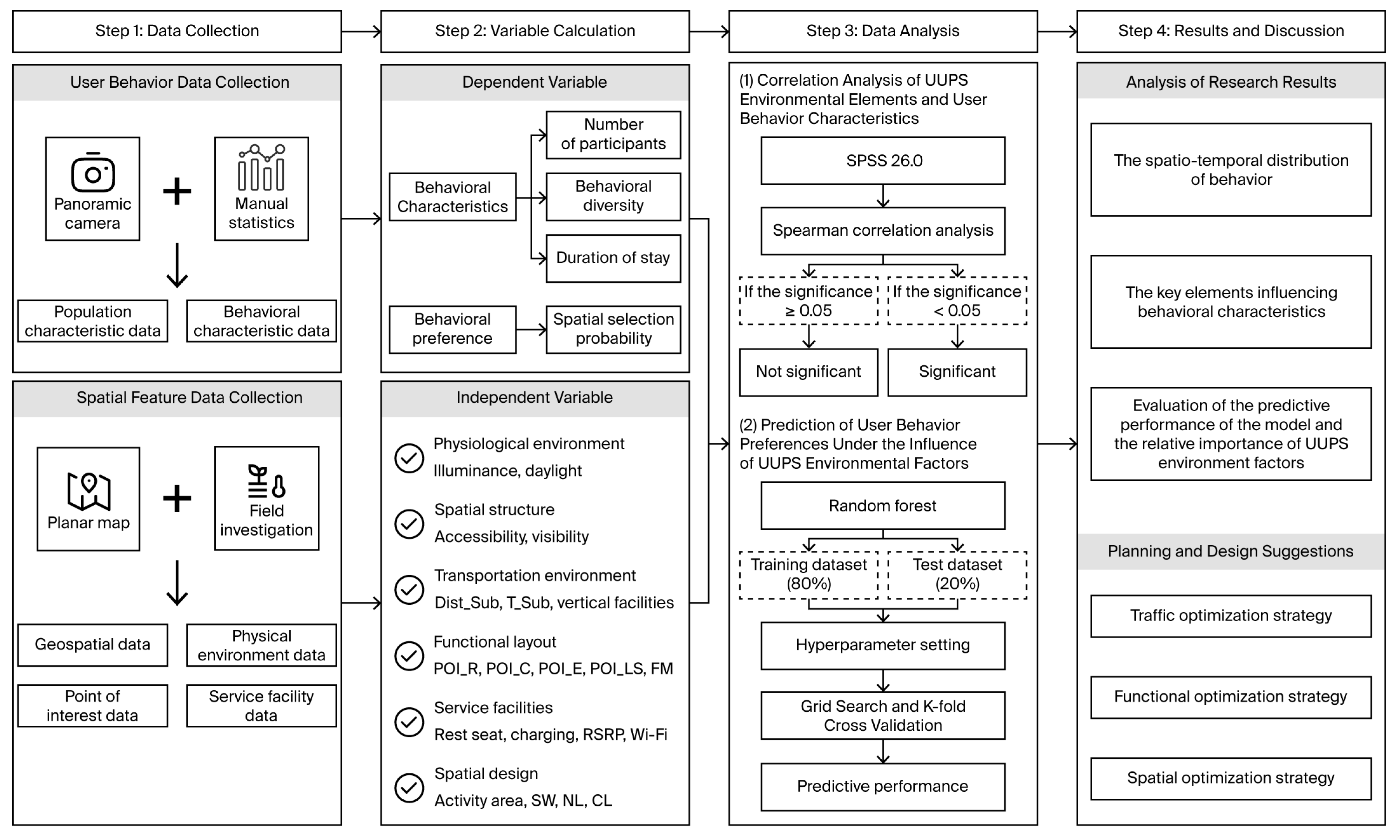
In this study, we use a Random Forest model to explore different types of user behaviors under the influence of UUPS environmental elements. As shown in Figure 2, the research workflow mainly includes four steps: (1) data collection, including behavioral data and spatial environmental data; (2) variable calculation, where the independent variables are UUPS environmental elements and dependent variables include behavioral characteristics and behavioral preferences; (3) data analysis, including the correlation between UUPS environmental elements and user behavior characteristics, and the prediction of user behavioral preferences under the influence of UUPS environmental elements; and (4) results and discussion, including an analysis of research findings and a proposal for planning and design suggestions.

2.2. Research Area Selection

Wuhan has one of the most rapidly expanding metro systems in China. By the end of 2022, the Wuhan Metro operated 11 lines with 282 stations, covering a total length of 460 km, and daily ridership exceeded 3 million passengers on weekdays [52]. This extensive network includes numerous metro-led UUPSs, providing a rich sample for behavioral studies. Secondly, Wuhan’s urban morphology features a high-density, polycentric structure with strong land-use mixing around metro stations, which is typical of many large Chinese cities undergoing transit-oriented development (TOD) [53]. Studying Wuhan thus offers insights applicable to other rapidly urbanizing regions both in China and worldwide. Moreover, the city exhibits four distinct seasons, with hot summers and cold winters, which increases the year-round utilization of underground spaces as climate-resilient environments [54].
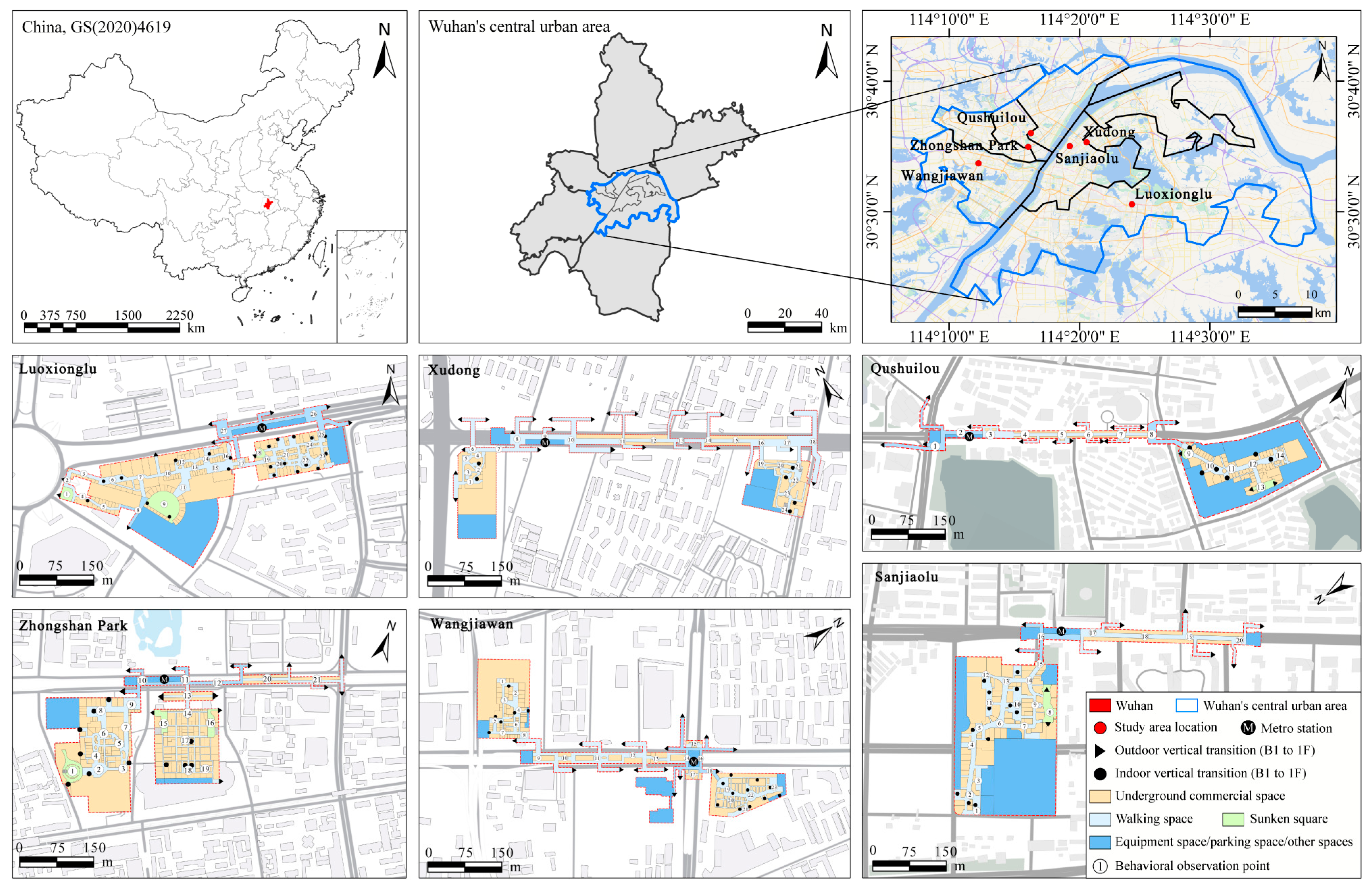
Based on these characteristics, six typical metro-led UUPSs in Wuhan’s central urban area were selected as data sources for model evaluation: Luoxiong Road (LXL), Zhongshan Park (ZSP), Xudong Street (XDS), Wangjiawan (WJW), Qushuilou (QSL), and Sanjiaolu (SJL). These UUPSs are located in commercial agglomeration areas in downtown Wuhan, with relatively mixed surrounding land-use functions and well-developed urban amenities, providing users access to various activities such as commuting, leisure, and commerce, which is significant for the comprehensive analysis and comparison of user behavior. Furthermore, for ease of analysis, several sample nodes were selected from each UUPS and categorized into transportation spaces and commercial spaces based on their usage function. Commercial spaces consist of underground streets and mall basements connected to metro stations, while transportation spaces include underground public walking spaces connected to stations, such as metro station concourses, underground passages, and sunken plazas. As shown in Figure 3, 129 nodes were selected in total.

2.3. User Behavior Selection and Measurement

2.3.1. Behavior Selection

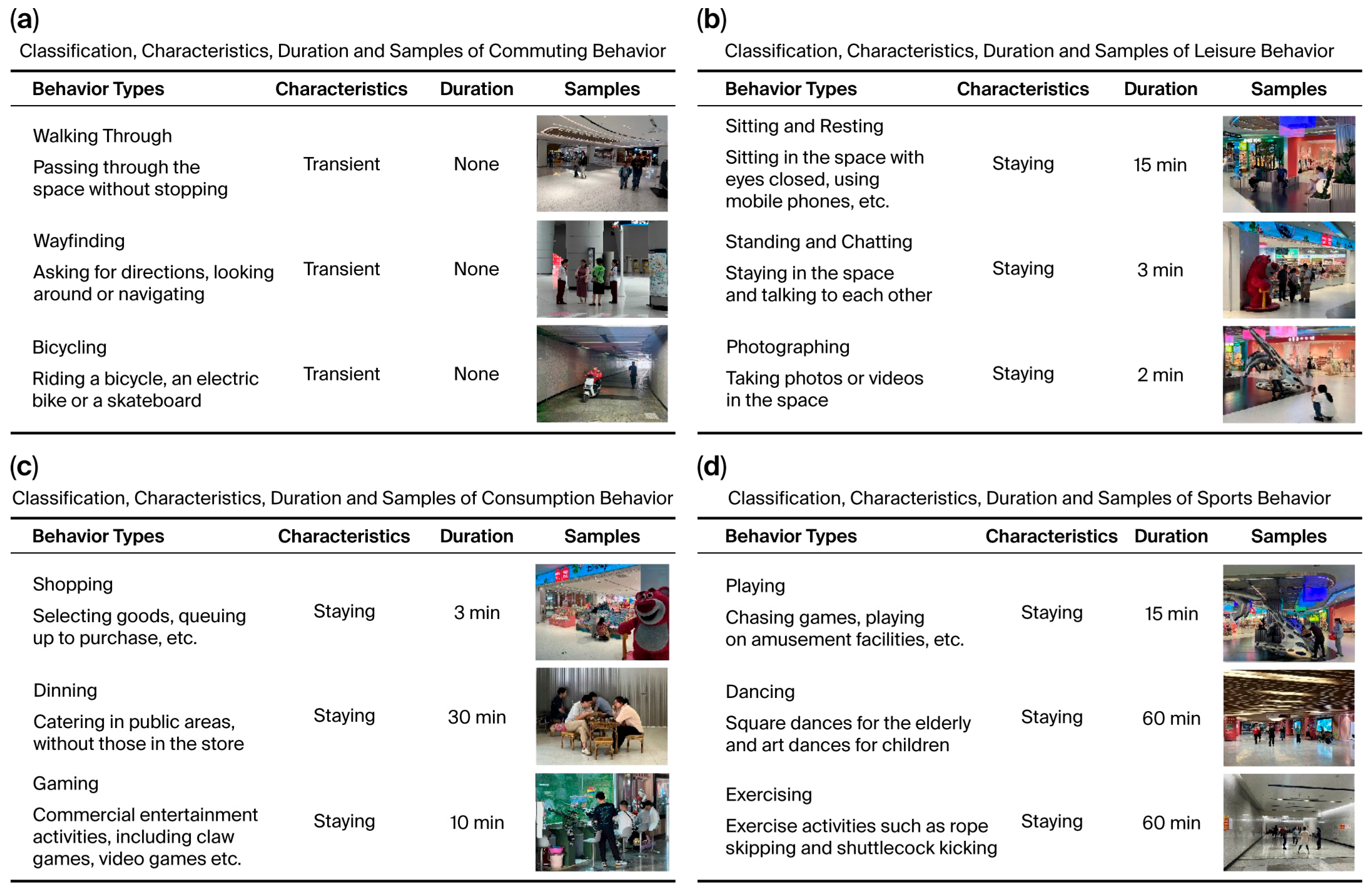
According to Gehl [55], a high-quality environment promotes a wide range of rich and diverse human activities, whereas only absolutely necessary activities occur when the spatial environmental quality is poor. Specifically, Gehl categorizes behaviors in public spaces into three types: necessary activities, optional activities, and social activities. Necessary activities are those that must be completed in daily life or routines and are less influenced by the external environment, with a lower degree of autonomy and leisure; optional activities occur only when time and place are suitable and participants are willing, and are highly dependent on external material conditions, especially sufficient high-quality outdoor activity spaces; social activities depend to some extent on the participation of others and the support of the external material environment. In metro-led urban underground spaces, passage usually belongs to necessary activities, while resting, stopping to communicate, sightseeing, photography, etc., are more often optional or social behaviors. Based on preliminary surveys, we further categorize the above activities into four major types based on behavioral purpose—commuting, leisure, consumption, and sports—which can be subdivided into 12 subcategories. The characteristics, duration, and samples of different activity types are shown in Figure 4.

2.3.2. Data Collection and Processing

In this study, we used manual observation and panoramic camera recording methods to collect behavioral data, providing objective, detailed, and reproducible data for subsequent analysis. Before conducting the panoramic image collection, we referred to the existing behavioral observation research norms and formulated a detailed data collection plan and research ethics protocol to ensure that the entire research process met academic ethical requirements [56,57,58,59]. The ethical safeguards during the data collection stage mainly included two aspects: Firstly, the research team obtained the permission of the relevant district management departments and signed agreements with the management parties of the UUPSs, clearly stating that the collected image data will only be used for academic research, the data will not be shared with third parties, and the personal information will be blurred during the post-processing. Secondly, informed notice prompts were posted in the shooting area, informing the public that the video recording happening at the site they were entering was only for group behavior research, not for individual identification. At the same time, the prompts promised that all identifiable information such as faces and voices in the images would be anonymized. In addition, since the shooting scene was located in an urban underground public space, even if pedestrians did not pay attention to the notice, they could intuitively perceive that there was observation being conducted at the scene, further reducing the risk of privacy infringement.
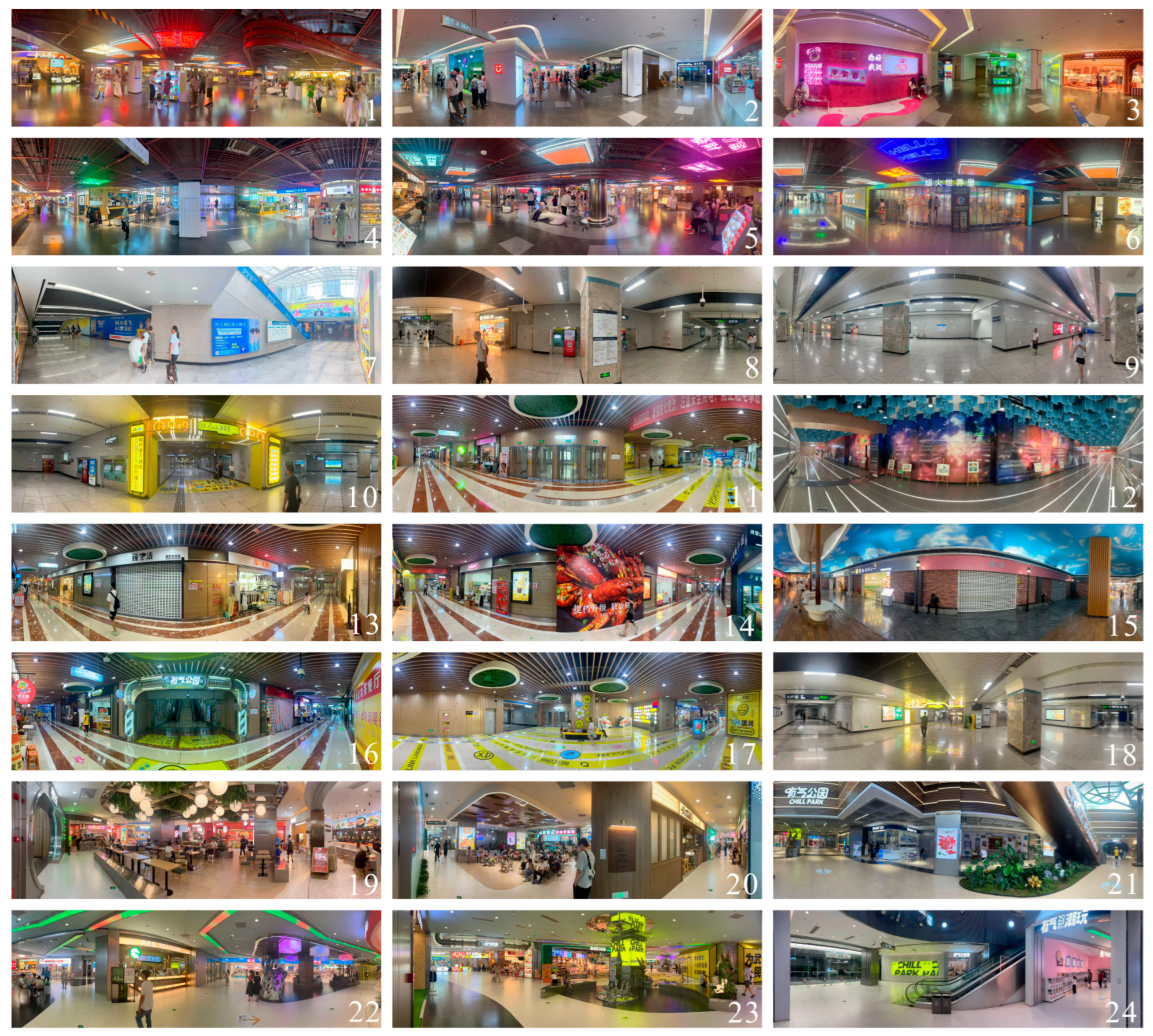
Field surveys were conducted from September to November 2024. Each site was measured twice, once on a weekday and once on a weekend, to ensure the completeness and comprehensiveness of recorded pedestrian activities. Due to mall operating hours (10:00 AM–9:00 PM), testing times were divided into three phases: noon (11:00 AM–14:00 PM), afternoon (14:00 PM–17:00 PM), and evening (17:00 PM–20:00 PM). During recording, researchers ensured that panoramic images were taken without disturbing users. To ensure statistical richness, recorded data were overlapped and accumulated every 1 h to improve reliability. A total of 2322 panoramic images were collected (example shown in Figure 5). Subsequently, the research team extracted multi-dimensional information such as user gender, age, behavior type, and activity location through extensive post-processing and manual counting of the image data, recording it in an ArcGIS 10.2 database to support subsequent quantitative calculation and in-depth analysis. It is worth noting that our results exclude pedestrians who were severely obscured or too small to be clearly identified in the images.

2.4. Variables

2.4.1. Independent Variables

After systematically reviewing the literature on human needs in the context of underground space environments, we selected 20 environmental element indicators influencing UUPS user behavior belonging to six categories: spatial basic characteristics, transportation environment, physical environment, spatial aesthetics, business layout, and service facilities (Table 2) [4,26,39,60,61]. The selection of these environmental attributes is based on extensive research conducted in China and other East Asian countries, providing a robust framework for assessing UUPS environmental quality and its impact on user behavior.
It is worth noting that, in this study, the “Daylight (DL)” indicator was characterized by the proportion of natural light in panoramic images, calculated using Adobe Photoshop 2020 software. However, this method is not a standard approach commonly used for calculating the proportion of natural light. Therefore, we validated this method against a standard illuminance metric (daylight factor), and our validation results demonstrate that the image-based estimation of natural light proportion is feasible and reliable. For further details, please refer to the Appendix A.

2.4.2. Dependent Variables

To examine the contribution of indoor environmental attributes to promoting the inclusivity, overall usability, and overall function and attractiveness of the underground environment, we thoroughly analyze the precise relationship between UUPS environmental characteristics and multiple dimensions of user behavior characteristics, including the “Number of Participants,” “Behavioral Diversity,” and “Estimated Dwell Time Index”. These are commonly used indicators in environmental behavior studies for measuring the quality of activities and the degree to which space supports activities. Previous research has indicated that different types of activities involve different demands and preferences in the indoor environment. Therefore, it is necessary to explore the synergistic influence mechanism of UUPS environmental attributes on pedestrian activities and compare the preferences involved in different behavioral activities in order to predict underground public space utilization. We use the spatial selection probability of user behavior to measure spatial choices for different activities. The detailed calculation methods for all indicators are shown in Table 3.

2.5. Data Analysis Method

In this study, we employed quantitative methods to investigate the correlations between underground built environment characteristics and user behavior and their overlap. Excel software was used for statistics and to plot the temporal distribution of usage behavior to visually reflect time variations, while ArcMap 10.2 software was used to process spatial distribution data of user behavior and calculate kernel density to identify the main concentration areas of user activities within the UUPS [62].
Spearman correlation analysis in the SPSS 26 software was used to establish the links between UUPS spatial environmental factors and multi-dimensional user behavior characteristics such as the number of participants, diversity, and stay proportion. This method is particularly important in research related to urban spatial environments and user behavior activities because the relationship between variables may not always be strictly linear, and Spearman’s rank correlation can capture these more general associations.
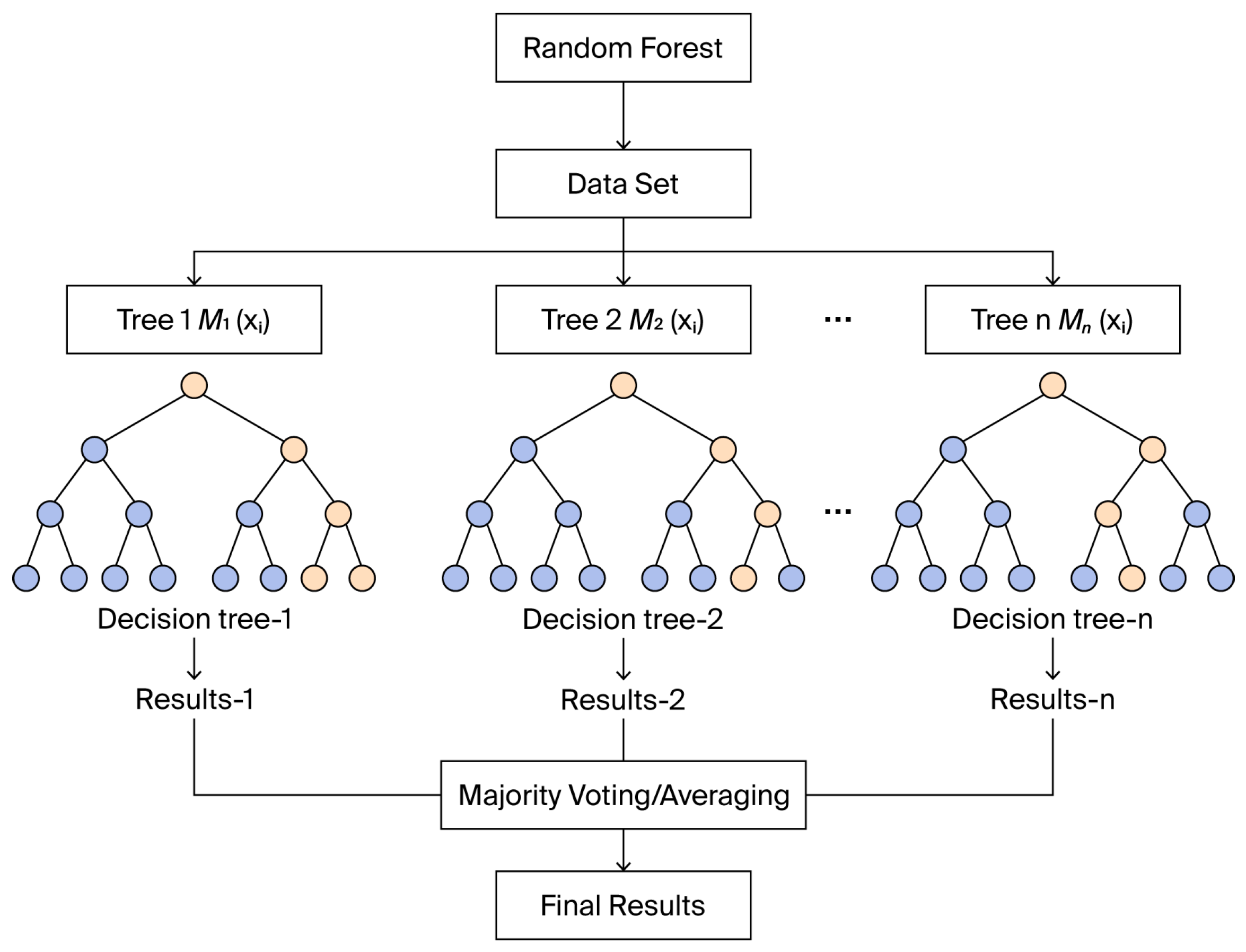
Furthermore, we used the Random Forest algorithm to predict the explanatory power of UUPS environmental characteristics on different types of user behavior preferences. Random Forest is an ensemble learning method used for regression and classification [63]. As shown in Figure 6, the Random Forest model uses the bootstrap resampling method to select a fixed number of sample sets from the entire training sample set, then selects a fixed number of feature sets to construct numerous decision trees, forming a Random Forest [64]. Compared to other tree-based machine learning algorithms, RF significantly reduces overfitting by averaging bootstrapped trees with randomly selected features. Additionally, RF models typically perform well in small sample size analyses, making them suitable for this study [65]. To clearly explain and visualize the results of the RF model, we evaluated the relative importance of UUPS environmental attributes on preferences for different types of activities.

3. Results

3.1. User Behavior Characteristics

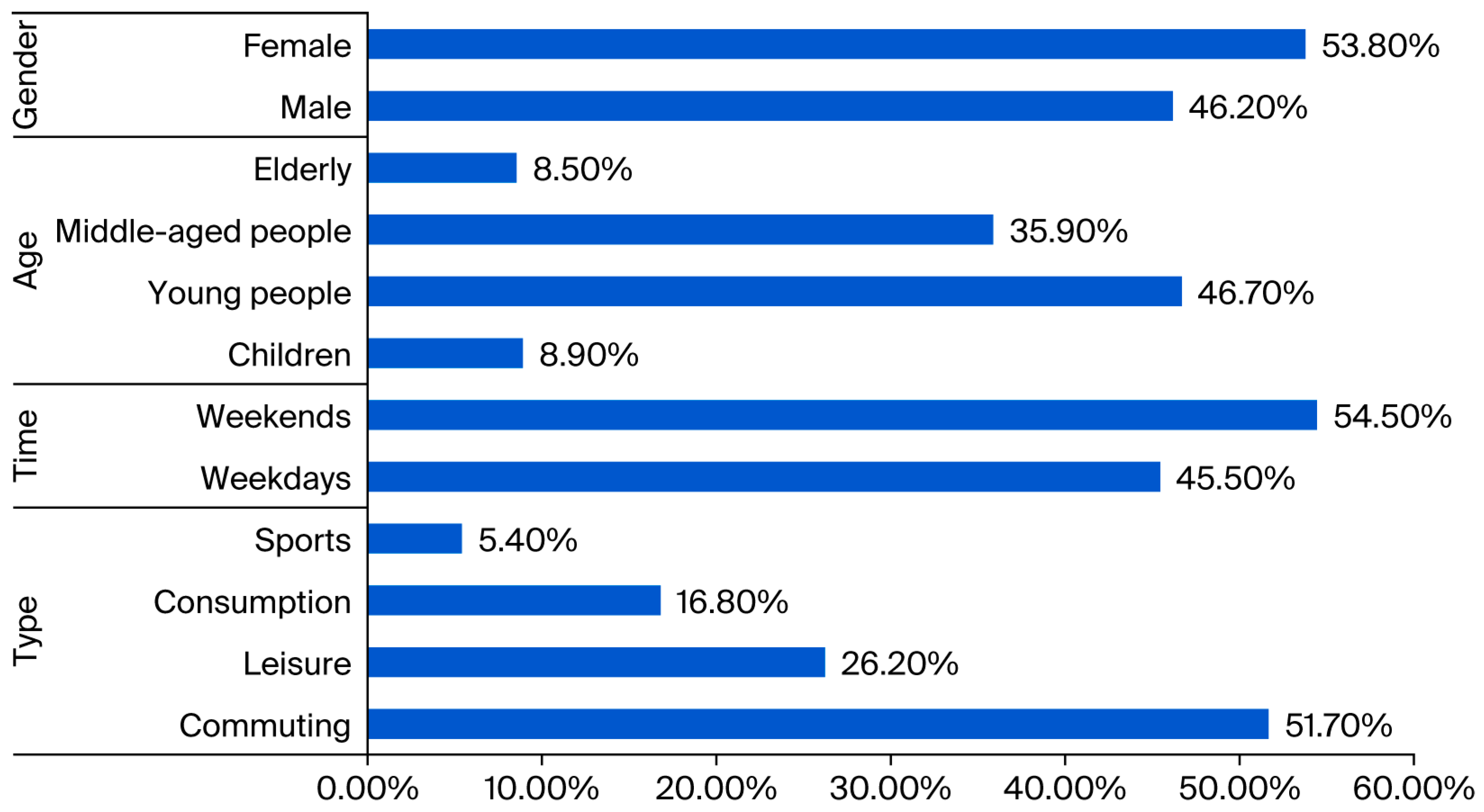
Behavioral data were collected from 129 survey points in six test areas, totaling 47,728 samples. As shown in Figure 7, commuting is the most dominant behavior in UUPSs (51.7%), followed by leisure and consumption. The proportion of female users was 7.6% higher than that of male users, similar to the findings in research from Shanghai’s Wujiaochang area [16]. Since the selected test areas are located in commercial agglomeration centers in downtown Wuhan, the abundance of commercial facilities increases the spatial attractiveness of UUPSs for women. Secondly, samples were divided into four age groups: children (<18), young adults (18–40), middle-aged adults (41–60), and elderly adults (>60). Among these groups, young adults and children account for 55.6% of samples, indicating a trend towards younger users in UUPSs. Furthermore, an analysis of the behavioral data reveals that the distribution of UUPS activities has certain regularities in both time and space.

3.1.1. Temporal Distribution Characteristics

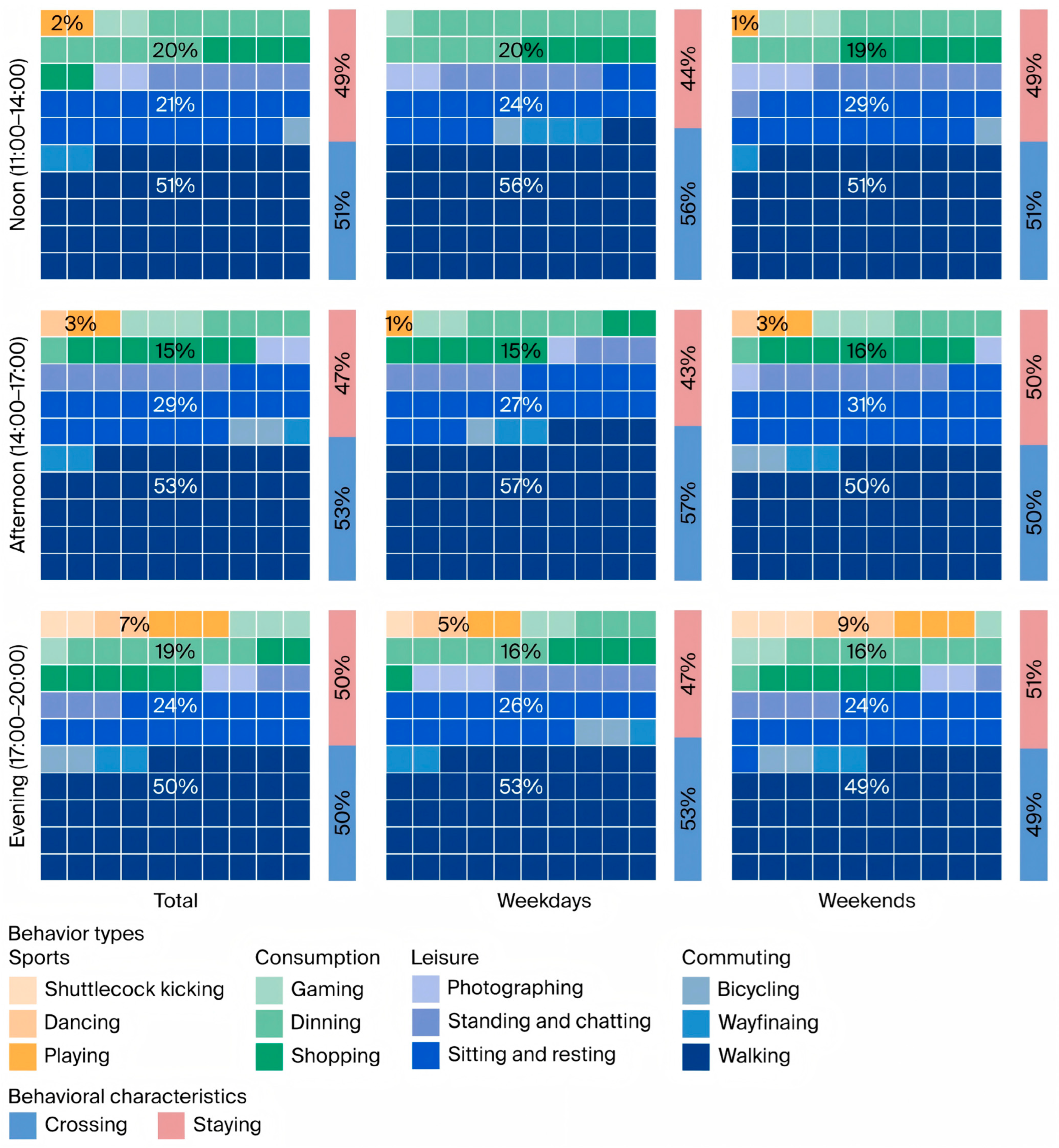
Firstly, within a day, the proportion of behavior types in UUPSs changes over time. As shown in Figure 8, unlike above-ground spaces, physical activities like exercise and play are concentrated in the evening (17:00–20:00), while leisure behaviors represent a higher proportion in the afternoon (14:00–17:00). As time changes during the day, the proportion of user stay behavior gradually decreases from 49% at noon to 47% in the afternoon, but rises again to 50% in the evening. Secondly, the proportion of stay activities on weekends is higher than on weekdays, reaching 51% on weekend evenings. On weekdays, people’s activities in UUPSs are mainly necessary, and include eating and commuting. Particularly, at noon, UUPS catering facilities that provide fast food, coffee, and beverages attract office workers for lunch or short breaks. On weekends, the proportion of spontaneous behaviors like consumption and entertainment among people in UUPSs is higher, confirming the pattern that UUPSs are primarily used for leisure and entertainment on weekends.

3.1.2. Spatial Distribution Characteristics

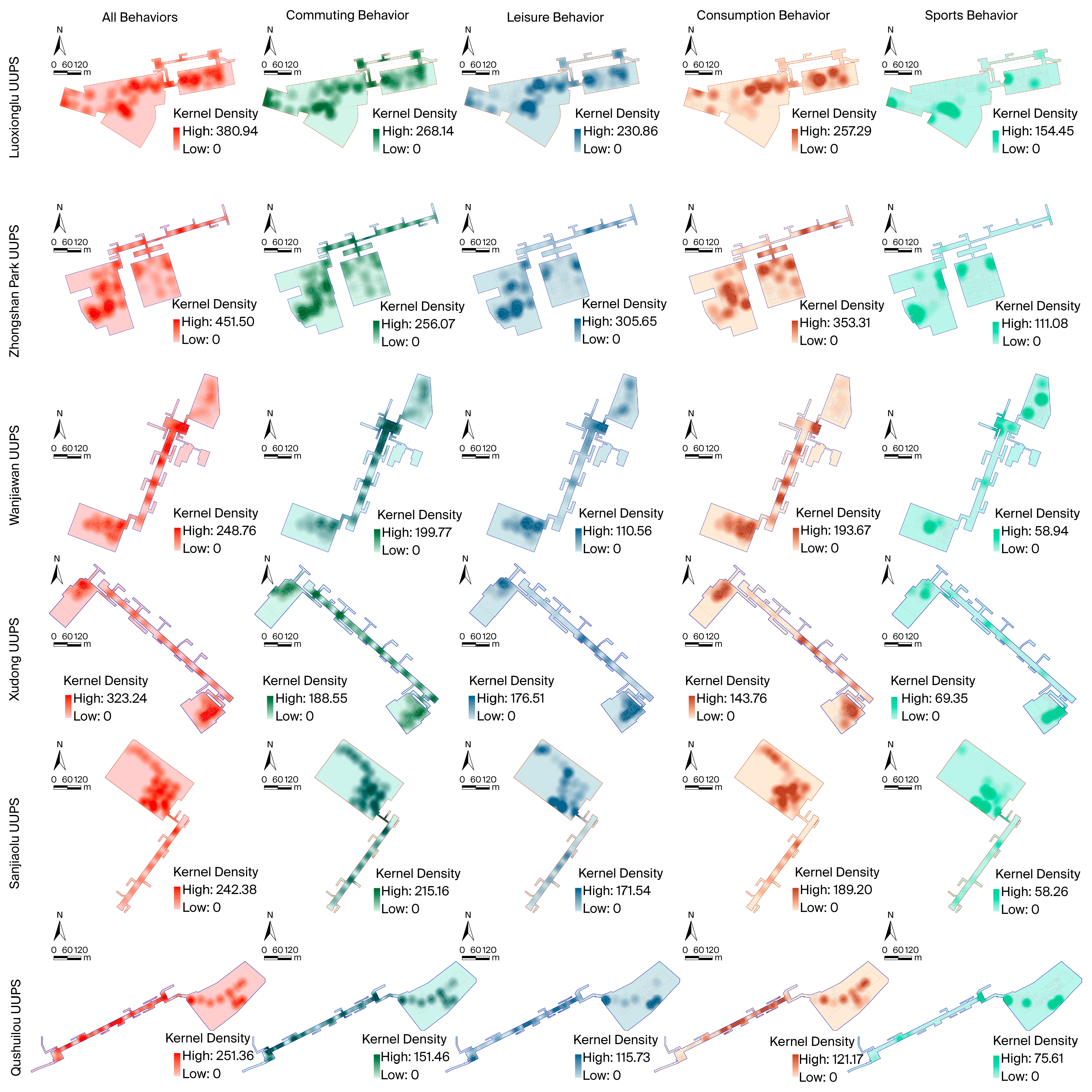
As shown in Figure 9, the distribution of different types of user behavior in UUPSs exhibits clear spatial patterns. Areas with strong transportation convenience, such as metro transfer halls, connecting passages, and spaces connected to multiple roads, tend to attract more pedestrian flow and are primarily used for commuting behaviors. Public open sunken plazas and underground commercial spaces with flat, smooth activity areas, complete service facilities, and functions often attract collective activities, such as social gatherings aimed at leisure and entertainment, and play behaviors like roller skating, skateboarding, and children cycling. Bright, spacious underground passages less affected by the external environment also attract elderly people for physical activities like shuttlecock kicking and square dancing. Furthermore, underground streets connected to metro station concourses, possessing both transportation and commercial attributes, can attract passers-by for leisure and consumption activities.

3.2. The Spatial Characteristics of UUPSs

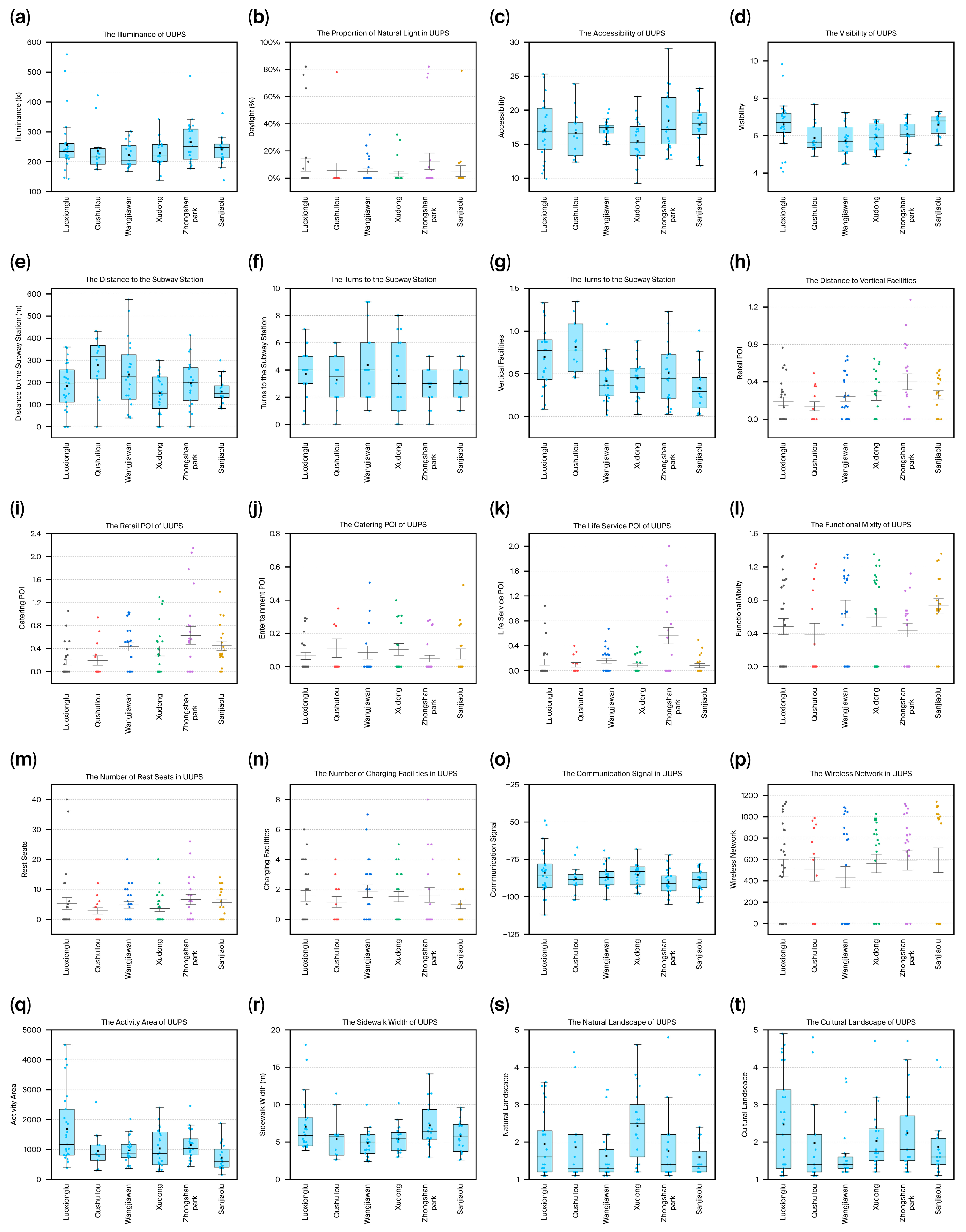
Figure 10 presents the statistical distribution of 20 spatial characteristic elements in six typical UUPSs. To avoid the interference of zero-value data on the visualization effect of the box plot, scatter plots are used to display the data distribution characteristics of the elements with a zero-value proportion exceeding 20%; the remaining elements are reflected through box plots to show the distribution and dispersion. Overall, the six UUPSs perform relatively well for the basic indicators of the spatial structure (accessibility, visibility, c,d) and the traffic environment (distance from the subway station) dimensions. The overall level is at a medium-high position, indicating that the existing underground public spaces have relatively complete planning in terms of traffic connection and basic traffic efficiency, providing reliable spatial accessibility guarantees for users.
However, there are still significant shortcomings in each dimension that need to be optimized. In the physical environment dimension, the overall level of illumination and natural light proportion (a,b) are low, reflecting the common problem of insufficient natural lighting resource allocation and the lack of humanized design in the light environments of underground spaces. In the functional layout and service facilities dimension, the spatial distribution density of many elements is at a low level, and the high number of zero-value data highlight the current situation of insufficient coverage for basic convenience services and the absence of a humanized service supply. In the spatial design dimension, the activity area, sidewalk width, and landscape elements show significant differentiation among different samples, and some areas have problems of insufficient spatial scale and a poor integration of functions and landscape. These results indicate that conducting refined renovations and utilizing humanized designs for the shortcomings of each dimension can significantly improve the physical environment quality, functional service density, and spatial experience texture of UUPSs, promoting the development of underground public spaces towards a more balanced and more livable direction.

3.3. Correlation Between UUPS Environmental Elements and User Behavior Characteristics

As shown in Table 4, we used Spearman correlation analysis in SPSS to correlate environmental factors of metro-led urban underground spaces with various dimensions of user behavior characteristics, resulting in three models.

3.3.1. Correlation Between Number of Participants and UUPS Environmental Elements

The number of participants primarily measures the space’s attractiveness to pedestrian flow. Consistent with previous studies, the roles of indicators such as “Accessibility,” “Visibility,” “Vertical Facilities,” and “Sidewalk Width” in attracting underground pedestrian flow, and the negative impact of “Distance to subway station” on the number of participants, were validated in this study [14,15,16]. Some indicators, however, differed in correlation strength: for example, in this study, “Accessibility (0.388 **)” had the highest correlation with the number of participants, highlighting its role as a core element attracting pedestrian flow. Furthermore, this study revealed some important findings. In terms of service facilities, “Charging Facilities (0.262 **)” and “Communication Signal (0.286 **)” meeting modern needs showed a significant attractiveness and have become indispensable basic service elements. In the spatial design dimension, the significant correlations of “Activity Area (0.273 **)” and “Natural Landscape (0.268 **)” with the number of participants reflect the important role of human-centered spatial design in enhancing the attractiveness of underground spaces.

3.3.2. Correlation Between Behavioral Diversity and UUPS Environmental Elements

In metro-led UUPSs, the diversity of user behavior is closely related to elements in the spatial structure and functional layout dimensions. Spatial accessibility and visual accessibility provide basic conditions for the occurrence of diverse behaviors, while formats such as retail (0.227 **), catering (0.398 **), and entertainment (0.429 **) serve as key functional carriers, significantly promoting the development of diverse user activities. Furthermore, some elements in the service facilities dimension also showed significant correlations with behavioral diversity, such as sufficient rest seats (0.437 **), quality communication signals (0.614 **), and wireless network (0.588 **), supporting modern leisure behaviors like mobile phone use, remote work, and social sharing and significantly expanding behavior types. Additionally, the illuminance level was also confirmed to be highly correlated with behavioral diversity: a good lighting environment enhances users’ sense of security, thereby promoting a richer diversity of activities.

3.3.3. Correlation Between Duration of Stay and UUPS Environmental Elements

The overall social activity and vitality level of an environment essentially depends on the combined effects of the number of people in that environment and their dwell time. Our results show that elements in the service facilities dimension play key roles in prolonging people’s dwell time. The more complete the service facilities, the more they enhance people’s sense of security and comfort, thereby significantly improving the quality of their travel experience. Secondly, various elements in the spatial structure and transportation environment dimensions also showed significant positive correlations with dwell time, indicating that good accessibility and reasonable circulation design help attract people and extend their activity time. Furthermore, in terms of functional layout, POI_C (0.633 **) and functional mixity (0.413 **) were highly correlated with dwell time. In contrast, the elements in the spatial design dimension did not show statistically significant correlations with dwell time.

3.4. Prediction Results of User Behavior Preferences Under the Influence of UUPS Environmental Elements

3.4.1. Model Training and Evaluation

In this study, we used Random Forest models to analyze the influence of UUPS environmental elements on preferences for different behavior types. Before constructing the RF models, the multicollinearity of variables was checked to remove variables with Variance Inflation Factor (VIF) > 5 [66], including T_Sub, FM, CS, and Wi-Fi. Then, four models were established, each corresponding to a specific behavior type. The experimental dataset was randomly split into a training set (80%) and a test set (20%) to examine the performance of the RF models. The grid search method and 5-fold cross-validation were used to determine the optimal parameter combinations and prevent potential overfitting [67,68]. Table 5 shows the optimal parameters and accuracy values for the four RF models. It can be seen that UUPS environmental features achieved the highest prediction accuracy (R2) for leisure behavior, reaching 0.710, while the prediction accuracy for sports activities was lower, at only 0.434.

3.4.2. Evaluating the Importance of UUPS Environmental Characteristics for Different Behavioral Preferences

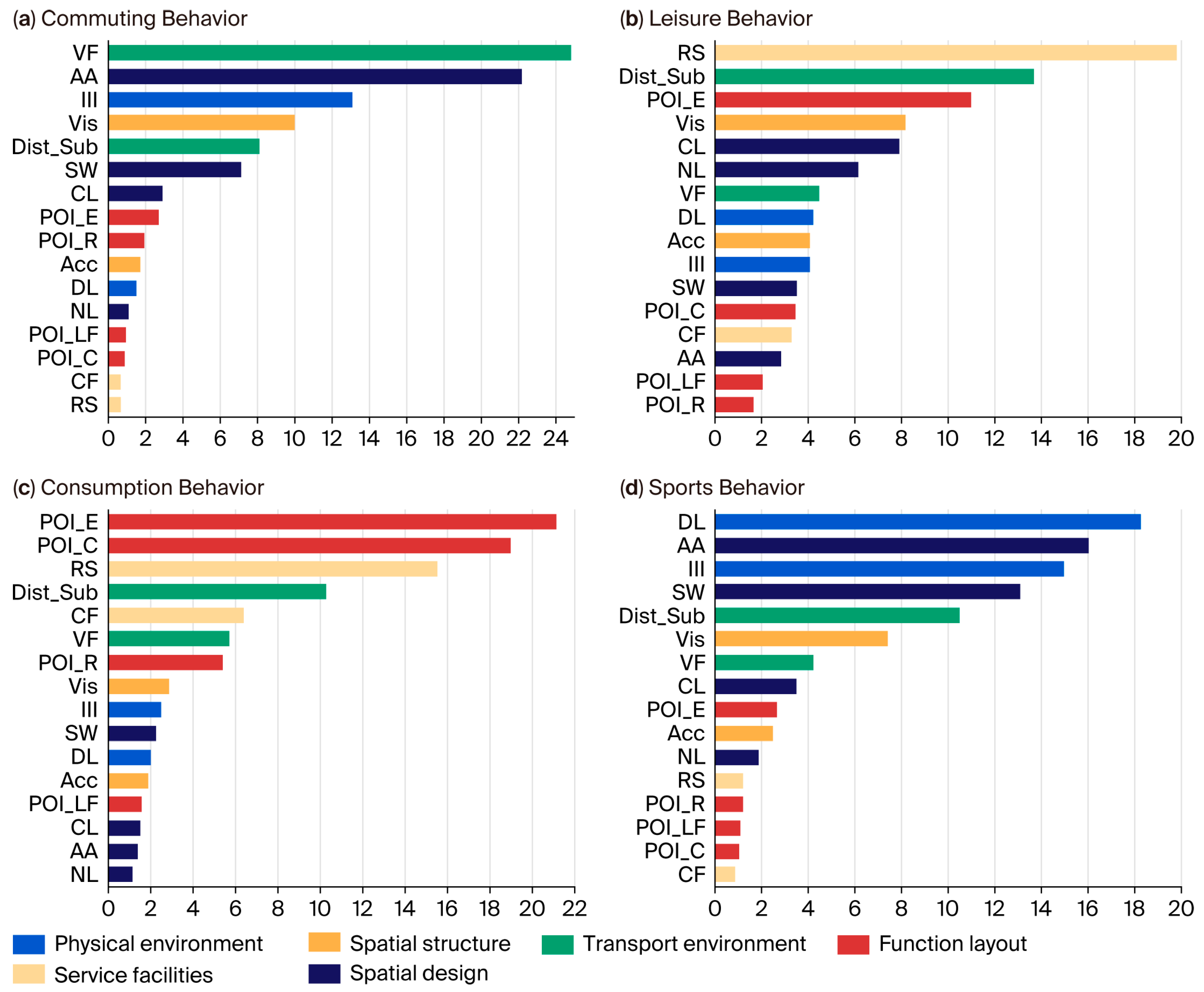
Figure 11 and Table 6, respectively, show the relative importance ranking and specific values of UUPS environmental elements for different behavioral preference types. The total contribution of all independent variables is 100%. We ranked the variables based on their relative contribution in the behavior models, and our results indicate that the dominant environmental factors influencing different behavioral preferences vary.
When predicting commuting behavior preferences, vertical facilities showed the highest relative importance at 24.80%, demonstrating their critical role in connecting above-ground and underground spaces. The second most important indicator was activity area, explaining 22.18% of the importance. Several other relatively important indicators included the illuminance (13.08%), visibility (10.00%), distance to subway station (8.11%), and sidewalk width (7.14%). The importances of the remaining indicators were all below 3%, indicating their relatively limited explanatory power for commuting behavior preferences.
For leisure behavior, rest seats (RSs) ranked highest in importance for predicting user preferences and accounted for 19.80% of the total variance, highlighting users’ high demand for stopping and resting. Additionally, the relative importance of Dist_Sub and Entertainment POI_E both exceeded 10%, showing their effective explanatory power for predicting leisure behavior preferences. It is worth mentioning that, compared to commuting behavior, the rankings of cultural landscape (7.90%) and natural landscape (6.12%) increased significantly, indicating the attractiveness of landscape elements for this type of user.
In predicting consumption behavior preferences, elements from the three dimensions of function layout, service facilities, and transport environment explained a large portion of the characteristic variation, accounting for 84.71% of the total variance. Specifically, POI_E was the most important covariate, with a contribution rate of 21.10%. The relative importance of POI_C, rest seats, and Dist_Sub exceeded 10%, while the contribution rates of CF, VF, and POI_R were all around 6%. In contrast, the importance rankings of indicators from the remaining three dimensions were lower, having a limited influence on consumption behavior preferences.
In predicting user spatial preferences for sports activities, the physical environment dimension contributed 33.17% of the explanatory power. Among them, daylight ranked first, with a relative importance of 18.25%, while the relative importance of illuminance ranked third, reaching 14.92%. Furthermore, within the spatial design dimension, scale-related elements performed prominently: activity area ranked second, with 16.01% importance, and sidewalk width ranked fourth at 13.06%. In contrast, the importance of landscape elements such as NL and CL was relatively low, and elements from the function layout and service facilities dimensions ranked at the bottom in predicting sports activities.

4. Discussion

4.1. Key Elements Influencing User Behavior Characteristics in UUPSs: A Multi-Dimensional Perspective

While the current evidence suggests that pedestrian flow in underground spaces is influenced by function, spatial configuration, the transportation environment, aesthetics, and the physical environment [14], few studies have addressed characteristics such as behavior type and behavior duration. This study represents the first large-scale field research targeting metro-led underground public spaces, aiming to systematically collect and analyze user behavioral activity data and spatial environmental characteristics in this environment. By establishing associations between underground space environmental attributes and various dimensions of user behavior characteristics, the study deepens our understanding of small-scale spatial elements that promote various types of behaviors, providing an empirical basis for the design and planning of underground public spaces and supporting designers in more scientifically and rationally arranging public functional areas within underground built environments.
Firstly, the influence of different environmental attributes on user behavior characteristics in UUPSs varies significantly. The key to attracting pedestrian flow lies in transportation efficiency and humanized spatial design, incorporating good accessibility, proximity to metro stations, and wide walking paths. Regarding the role of vertical facilities, the existing literature presents conflicting conclusions: studies by Xu [44] and Li et al. [14] regarded them as important factors affecting pedestrian flow, while Ma et al.’s study [16] did not find a significant effect. The results of this study support that the quantity and proximity of vertical facilities are key environmental elements affecting the number of participants in the space. Unlike the number of participants, behavioral diversity and dwell time are more susceptible to elements from other dimensions: service facilities and mixed, diverse functional layouts are the main factors promoting diverse activities, while prolonging dwell time significantly relies on comfort and service facilities such as catering services, rest seats, and network signals. Therefore, different strategies need to be adopted for specific behavioral objectives in underground space design.
Another major finding is that both elements in the spatial structure dimension, namely accessibility and visibility, showed significant positive correlations with all three behavior characteristics, indicating their key role in shaping user behavior characteristics in underground spaces. Previous research has confirmed the important role of accessibility and visibility in attracting pedestrian flow in underground spaces [69,70]. Our results further demonstrate that clear spatial organization, good visual connection, and smooth circulation design also support a richer diversity of activities and encourage users to extend their stay, highlighting the decisive role of spatial configuration at the prerequisite level.
Furthermore, our results show that the impact of landscape elements (natural and cultural landscapes) on behavior characteristics is limited: only natural landscapes were correlated with the number of participants, while no significant relationship was found with behavioral diversity or dwell time. Although many studies point out that natural and cultural landscapes positively alleviate user psychological stress and enhance the perception of underground space environmental quality [71,72,73,74], our field survey results showed that a large number of natural and cultural landscapes are arranged in transportation spaces. These landscape facilities can attract passers-by to stop and admire, even triggering photography behaviors in some users. One possible hypothesis-generating explanation for the observed correlation pattern (i.e., the association with participant count but not with diversity or dwell time) is that the absence of supporting rest, interaction, or service facilities near these landscape features may limit their ability to foster richer or more prolonged activities. However, because our study did not directly measure or control for the availability of such facilities (e.g., seating, sheltered areas) relative to landscape locations, this interpretation remains speculative and requires further testing. Future research should explicitly measure rest facility provision and conduct mediation analyses to determine whether this factor mediates the relationship between landscape types and behavioral outcomes. Alternative explanations, such as differences in spatial configuration, visibility, or visitor purpose, cannot be ruled out at this stage.

4.2. Predictive Analysis of UUPS Environmental Attributes on Different Behavioral Preferences

Current research on the impact of spatial and physical environmental factors on human activities mainly focuses on the indoor environments of various building types such as residences [75], offices [76], and schools [77] to accurately predict occupant comfort, behavior patterns, and energy consumption. However, studies targeting the relationship between underground space environments and user behavior remain relatively limited, possibly due to the diversity and complexity of pedestrian activities in underground public open spaces, requiring a reliance on extensive experimental data to ensure research reliability. Furthermore, human activities in underground public spaces are often simultaneously influenced by multiple dimensional elements, forming a typical complex system that requires multi-factor collaborative evaluation to better describe the characteristics of the association mechanism. Through extensive field investigation, we constructed a behavior–environment association framework in this study to predict user behavior preferences in underground spaces.
The spatial distribution of commuting behavior is primarily determined by the quantity and proximity of vertical facilities near nodes. Previous studies have shown that vertical facilities can increase pedestrian flow and spatial vitality by connecting underground and above-ground urban spaces. However, field surveys have also found that the spatial environment around nodes with more vertical facilities is often more complex, increasing the number of directions pedestrians can choose and greatly increasing the probability of wayfinding behavior occurring. This finding is consistent with previous evidence [78,79]. Therefore, when optional paths increase, it is necessary to provide clear guiding signs to improve users’ wayfinding efficiency.
Leisure and consumption behaviors exhibited similar characteristics, where the importance of rest seats and entertainment formats both ranked in the top three. Commercial entertainment facilities such as claw machines, gashapon machines, and electronic game machines installed in underground spaces attract large numbers of children and teenagers to participate in consumption activities. More importantly, these entertainment facilities are usually not arranged in isolation; their surroundings are often equipped with numerous service facilities, together forming complete interactive scenarios. Field observations found that, when children play games, parents often sit on adjacent seats for supervision and companionship. During this time, some parents engage in activities like photography and dining, and social interactions often occur between parents. However, such vibrant composite scenarios are still relatively rare in current underground spaces. Additionally, it is worth noting that, compared to other behavior types, landscape elements play a more important role in promoting leisure behavior. Stay activities such as sitting quietly, talking, and photography have longer durations, so users are more sensitive to the landscape environment around the node.
For sports activities, the goodness of fit (R2) of the prediction model is 0.434, indicating that its predictive ability is limited. One possible explanation is that the breathing regulation and body posture changes accompanying sports activities consume a significant amount of attention resources, thereby weakening the perception of the surrounding environment. When people enter a high-intensity exercise state, they often enter a deeply immersive “flow” state [80], which further reduces their sensitivity and response ability to external environmental stimuli, leading to a decrease in spatial perception levels. In addition, apart from the environmental variables included in this study, there are many unobserved factors (such as personal preferences, temporary opportunities, and group dynamics) that affect sports behavior, thus resulting in a low predictive ability. Therefore, the distribution in space is highly random.
However, despite this randomness, the importance analysis results show that natural daylight, activity area, and illuminance are still key environmental elements influencing the spatial distribution of sports activities. Open spaces provide basic venue support for various sports activities. Furthermore, compared to other behavior types, sports activities are more concentrated in the late afternoon and evening, and hence they have a higher sensitivity to spatial lighting conditions.

4.3. Planning and Design Suggestions

4.3.1. Flow Optimization Strategies

Attracting pedestrians into a space is the first step in encouraging activities and social interactions. In metro-led UUPSs, accessibility is a key factor affecting pedestrian flow. Therefore, the most direct way to optimize underground transportation and improve travel efficiency is to enhance spatial accessibility. Specifically, on one hand, the connectivity between plots can be significantly enhanced by connecting the main nodal spaces of various plots to central passages; on the other hand, adding vertical facilities can effectively link above-ground and underground spaces, integrating UUPSs organically into the city’s three-dimensional spatial system [81]. However, since UUPSs are typically large in scale and complex in structure, pedestrians rely on their cognition of the underground environment for path selection [46]. For most users, UUPSs are not the final destination but rather serve as convenient and comfortable passage shortcuts. Pedestrians tend to choose simple paths with a low cognitive load, clear direction, and forward bias to save energy and avoid getting lost [82]. Therefore, while enhancing physical connectivity, attention must also be paid to enhancing spatial direction identifiability. Setting up clear, accurate, continuous, and conspicuous guiding signs is the most direct and effective measure to improve wayfinding efficiency.

4.3.2. Functional Optimization Strategies

The main purpose of functional optimization is to promote behavioral diversity and extend dwell time through functional integration. Our results show that service facilities and mixed functional formats are two key influencing elements. Therefore, rationally configuring retail, catering, entertainment, and service facilities and focusing on the spatial connection and complementarity of different functions is a targeted approach. Specifically, commercial and entertainment functions should be laid out at main circulation nodes and areas concentrating pedestrian flow, combined with rest seats, charging facilities, and wireless networks to form composite areas where people can stay and consume. However, before this, the fundamental role of spatial configuration cannot be ignored. As pointed out by scholars like Ma [16] based on research in Shanghai’s Wujiaochang sub-center, even with high-quality commercial formats, if the spatial structure configuration is unreasonable, its attractiveness cannot offset the negative experience caused by wayfinding difficulties and poor accessibility. Therefore, on one hand, the layout of commercial and service facilities should be scientifically arranged based on pedestrian behavior characteristics; on the other hand, functional nodes need to be evenly set in locations that are easy to reach, easy to stay in, and easy to see, thereby jointly supporting the efficient and friendly use of underground spaces at both structural and functional levels.

4.3.3. Spatial Optimization Strategies

The core goal of spatial optimization is to effectively support diverse human activities through environmental creation. In path design, it should be ensured that all plots within the underground space have multiple paths connecting to other plots or metro stations to enhance inter-regional accessibility and visual permeability, and to minimize the distance from various points on the main path to the metro station as much as possible. In atmosphere creation, rest areas should reasonably introduce natural light and set up green plants, landscape features, and public art installations to enhance visual experience and promote leisure behaviors. Consumption areas should create a bright and active atmosphere, using accent lighting to highlight shop interfaces and merchandise displays. Furthermore, to meet sports needs, open and unobstructed activity venues can be reserved in passages, atriums, sunken plazas, and other areas, under the premise of meeting fire evacuation requirements, to support impromptu sports activities. Simultaneously, children’s play facilities should be reasonably configured, and illumination levels should be appropriately increased at night to ensure activity safety and spatial vitality.

4.4. Research Limitations and Future Directions

Our study has some limitations, which indicate pathways for future research. Firstly, in this study, we used panoramic camera recording and manual identification methods to collect behavioral data, which carries certain error risks and is time-consuming and labor-intensive. Subsequent research could apply behavior recognition technologies like computer vision to improve the accuracy and efficiency of data collection. Secondly, some indicators, such as natural and cultural landscapes, etc., are related to the researcher’s subjective feelings, and measurement results may have slight errors. Future research could combine neurophysiological techniques to reduce subjective bias. Thirdly, only data from winter in Wuhan were used, failing to reflect the impact of seasonal and regional differences on user behavior. Future work should conduct cross-seasonal and cross-regional comparative studies to explore the influence mechanisms of spatiotemporal factors on urban space usage behavior to enhance the universality of the research conclusions.
In addition, we employed the standardized Shannon diversity index in this study to measure the behavioral diversity of each node. This standardized form facilitates horizontal comparisons between different spatial units, but, when the number of behavioral types k is small, the index shows a high sensitivity to rare behaviors. For example, when k = 2, the second type of activity, which accounts for approximately 1%, can cause the index to suddenly rise from 0 to around 0.14, potentially leading to biased results in the assessment of behavioral diversity. Although the majority of nodes in the dataset of this study had a behavioral type number k > 3, the impact of this issue was limited. However, we still consider this as a methodological limitation of our study. It is recommended that future research using scenarios with smaller k adopt bias-corrected estimation methods (such as the Chao–Jaccard correction scheme) or expand the sample size to improve the stability of the index.
Finally, this study uses the “estimated duration index” as a variable to represent the duration of behavior. However, this is an estimated indicator rather than the actual duration of the observed behavior and is specifically calculated by multiplying the frequency of the behavior occurrence (from the panoramic image) by the empirically determined duration constant. However, these calculation results may not fully reflect the actual duration of activities within the underground space. Future research should adopt continuous monitoring methods (such as video tracking, sensor-based systems) to obtain real duration data, thereby enabling a more accurate assessment of the occupancy and attractiveness of the space.

5. Conclusions

In this study, we collected environmental characteristics and user behavior data from six typical metro-led UUPSs in Wuhan, explored the relationship between UUPS attributes and multi-dimensional behavior characteristics, established prediction models for behavioral preferences, and analyzed the impact of UUPS environmental characteristics on UB. Our main conclusions are as follows.
In metro-led UUPSs, commuting and eating are the main behavior types on weekdays, while leisure and consumption are the main behavior types on weekends. In comparison, the number of users is higher on weekends, and UUPSs are more attractive to female users and younger age groups.
Elements in the spatial structure dimension, including accessibility and visibility, significantly influence the number of participants, behavioral diversity, and dwell time of UB. In contrast, natural and cultural landscape elements are not main factors influencing UB.
UUPS environmental characteristics had the highest prediction accuracy for leisure behaviors, while the predictive performance for sports activities was lower. In terms of importance, the quantity and proximity of vertical facilities are key factors determining commuting behavior preferences, rest seats and entertainment facilities significantly promote leisure and consumption behaviors, and sports activities are more concerned with spatial scale and the lighting environment. Furthermore, compared to other behaviors, leisure behavior is influenced by landscape elements to a considerable extent.
To enhance the people-oriented quality of UUPSs, priority should be given to spatial structure (including accessibility and visibility), and interventions should be provided for specific behaviors: for commuting, ensure clearly marked vertical facilities; for leisure and consumption behaviors, group rest seats, entertainment facilities, and Wi-Fi together; and for sports activities, reserve open and well-lit areas. Selectively integrate landscape elements, as they can attract participants without prolonging the stay time. Additionally, a phased approach can be adopted: first, improve accessibility and visibility; then, enrich functions and services; and finally, add landscape and artistic elements.
In this study, we explored the impact of environmental elements in metro-led urban underground public spaces on different dimensions of behavior characteristics and different types of user behavior preferences, focusing on the role of the spatial environment in their activity location decision-making. Adopting a bottom-up analytical perspective based on the actual needs of space users, we analyze the intervention mechanism of the underground commercial space environment on user behavior, providing a theoretical basis and decision-making reference for the human-centered design and refined operational optimization of urban underground commercial spaces.

Author Contributions

Z.Z.: Conceptualization, Data curation, Investigation, Methodology, Visualization, Writing—original draft/review and editing; Y.C.: Conceptualization, Investigation, Supervision; X.L.: Investigation, Methodology, Software; R.L.: Conceptualization, Investigation, Formal analysis. All authors have read and agreed to the published version of the manuscript.

Funding

The work presented in this paper was supported by the National Key Research and Development Program of China: 2023YFC3807500; National Natural Science Foundation of China: 52478057; Housing and Urban-Rural Development Science and Technology Plan: 2022-H-001.

Institutional Review Board Statement

Ethical review and approval were waived for this study due to the following: the research team obtained permission from district management departments and signed agreements with UUPS management parties confirming that collected image data would be used only for academic research, not shared with third parties, and anonymized during post-processing; additionally, informed notices were posted in the shooting area informing the public that video recording was for group behavior research only, with all identifiable information anonymized, and the public space setting allowed intuitive perception of observation, further reducing privacy risks.

Informed Consent Statement

Patient consent was waived due to the following reason: the shooting location was a public space where ongoing observation could be intuitively perceived by anyone present. In such a public setting, no reasonable expectation of privacy existed for group behavior recording; hence, individual participant consent was not required.

Data Availability Statement

Data will be made available on request.

Conflicts of Interest

The authors declare no conflicts of interest.

Abbreviations

The following abbreviations are used in this manuscript:
UUPSUrban Underground Public Spaces
UBUser Behavior
RFRandom Forest
TODTransit-Oriented Development

Appendix A

In architecture, the daylight factor—i.e., the ratio of indoor illuminance at a reference point to the outdoor horizontal illuminance under a standard overcast sky—is commonly used to evaluate the natural lighting level at that point. Most underground spaces rely entirely on artificial lighting for long periods, whereas shallow underground spaces equipped with skylights or light pipes typically present a mixed lighting environment where natural and artificial light coexist. To quantify the proportion of natural light in underground spaces, the following Equation (A1) can be used [41].
R p = E D a y l i g h t E T o t a l = M D a y M n i g h t M D a y
where R p is the daylight proportion, consisting of both natural and artificial light; E D a y l i g h t is the illuminance from natural light; M D a y is the illuminance measured during daytime, including both natural and artificial light; M n i g h t is the artificial lighting illuminance measured at night.
However, this study involves numerous test nodes. Applying the above standard measurement method to all nodes for spatial analysis would be time-consuming and resource-intensive. To efficiently obtain the natural light proportion for each node at the early stage of the research, we first adopted the method of Xu et al. [44]., which assigns scores based on the area proportion of natural light in the field of view: area proportions >30%, >20%, >10%, and <10% are assigned scores of 5, 4, 3, and 2, respectively; areas without natural light receive a score of 1. Subsequent analysis revealed that this method is susceptible to subjective judgement by the researcher, potentially leading to scoring discrepancies among different evaluators.
To overcome the shortcomings of this subjective scoring method, this study further drew on the calculation approach of the “green view index” and attempted to use Photoshop software to calculate the proportion of visible natural light pixels in panoramic images, thereby quantifying the “Daylight” indicator for each node. This method lies between traditional illuminance measurement and subjective scoring: it avoids the high cost of large-scale on-site photometric measurements while eliminating human scoring bias through objective pixel-level calculations, thus striking a reasonable balance between efficiency and accuracy.
Nevertheless, this study has not yet directly validated this method against standard illuminance metrics (e.g., daylight factor). To demonstrate the reliability of the image-based estimation method for spatial analysis, the research team randomly selected 15 urban underground public space nodes within the study area, measured and calculated their daylight factors, and performed a correlation analysis with the image-based results. The results are shown in Table A1.
Table A1. The proportion of natural light based on measured illuminance and image methods for 15 nodes.
NodeIlluminance (Lux)Proportion of Daylight (Rp)Image-Based Method
DaytimeNighttime
Xudong-7568351 38.28%12.43%
Xudong-21469411 12.42%5.28%
Luoxionglu-11006205 79.65%67.66%
Luoxionglu-11324314 3.24%4.37%
Luoxionglu-23962401 58.27%66.51%
Zhongshan Park-1489480 1.84%3.28%
Zhongshan Park-2182218 0.00%0.00%
Zhongshan Park-13284303 0.00%0.00%
Wangjiawan-3424266 37.17%23.79%
Wangjiawan-19387291 24.88%14.42%
Wangjiawan-22446355 20.44%18.63%
Wangjiawan-23894153 82.91%53.81%
sanjiaolu-8355346 2.67%6.42%
Qushuilou-9799172 78.42%32.11%
Qushuilou-12321333 0.00%0.00%
We conducted a simple linear regression analysis, taking the illuminance-based daylight proportion ( R p ) as the dependent variable and the image-based natural light proportion ( M p ) as the independent variable. The resulting Equation (A2) is:
R p =   0.05   +   1.18   ×   M p .
The model explains 80% of the variance (R2 = 0.80) and shows a strong positive correlation (standardised β= 0.89, p < 0.01). Therefore, the image-based estimation of natural light proportion is feasible and reliable, especially for relative comparisons across multiple nodes. However, it should be noted that the image-based method is essentially an indirect estimation technique, and its accuracy is influenced by factors such as camera settings, image segmentation thresholds, and ambient light stability. Consequently, in future studies, the standard daylight factor measurement method should still be prioritised, using standardised illuminance measurements to obtain absolute quantitative data, thereby minimising experimental errors and ensuring accuracy and comparability of the results.

References

  1. Jia, X.; Wang, J.; Yan, B. Evaluation of existing underground public space supply based on the Node-Place-Experience model. Tunn. Undergr. Space Technol. 2024, 144, 105517. [Google Scholar] [CrossRef]
  2. Cui, J. Building three-dimensional pedestrian networks in cities. Undergr. Space 2021, 6, 217–224. [Google Scholar] [CrossRef]
  3. Besner, J. Cities Think Underground—Underground Space (also) for People. Procedia Eng. 2017, 209, 49–55. [Google Scholar] [CrossRef]
  4. Zeng, R.; Shen, Z.; Luo, J. Post-occupancy evaluation of user satisfaction: Case studies of 10 urban underground complexes in China. Tunn. Undergr. Space Technol. 2024, 143, 105500. [Google Scholar] [CrossRef]
  5. Cui, J.; Allan, A.; Lin, D. SWOT analysis and development strategies for underground pedestrian systems. Tunn. Undergr. Space Technol. 2019, 87, 127–133. [Google Scholar] [CrossRef]
  6. Yu, H.; Chen, Z.; Hu, W.; Zhang, J.; Xu, C.; Hu, B. Urban underground space value assessment and regeneration strategies in symbiosis with the urban block: A case study of large residential areas in Beijing. Tunn. Undergr. Space Technol. 2025, 163, 106728. [Google Scholar] [CrossRef]
  7. Debrock, S.; Van Acker, M.; Admiraal, H. Design recommendations for sustainable urban underground spaces. Tunn. Undergr. Space Technol. 2023, 140, 105332. [Google Scholar] [CrossRef]
  8. Kumar, V.; Das, B.K.; Vivek, A.K. Mass rapid transit systems and sustainable urban development: A review of impacts and implications. City Environ. Interact. 2026, 29, 100318. [Google Scholar] [CrossRef]
  9. Wang, B.S.; Liu, Y.; Tong, Z.; An, R.; Xu, J. Spatiotemporal Dynamic Characteristics of Land Use Intensity in Rapidly Urbanizing Areas from Urban Underground Space Perspectives. Sustainability 2023, 15, 13008. [Google Scholar] [CrossRef]
  10. Zhu, L.; Liu, Z.; Chen, Q. Review and Prospect of Urban Underground Space Planning Practices in China. In Proceedings of the Conference of the Associated Research Centers for the Urban Underground Space; Springer: Singapore, 2024. [Google Scholar] [CrossRef]
  11. Wu, J.; Yue, W.; Wang, E. Characteristics and trends of research on development and utilization of urban underground space in China from 2001 to 2023:based on knowledge graph analysis of CiteSpace and VOSviewer. J. Saf. Sci. Technol. 2025, 21, 83–89. [Google Scholar]
  12. Li, X.; Xu, H.; Li, C.; Sun, L.; Wang, R. Study on the demand and driving factors of urban underground space use. Tunn. Undergr. Space Technol. 2016, 55, 52–58. [Google Scholar] [CrossRef]
  13. Zhao, J.; Peng, F.-L.; Wang, T.-Q.; Zhang, X.-Y.; Jiang, B.-N. Advances in master planning of urban underground space (UUS) in China. Tunn. Undergr. Space Technol. 2016, 55, 290–307. [Google Scholar] [CrossRef]
  14. Li, Z.; Lu, Y.; Zhuang, Y.; Yang, L. Influencing factors of spatial vitality in underground space around railway stations: A case study in Shanghai. Tunn. Undergr. Space Technol. 2024, 147, 105730. [Google Scholar] [CrossRef]
  15. Sun, L.; Leng, J. Research on influencing factors of travel in underground space based on multi-source data: Spatial optimization design for low-carbon travel. Energy Build. 2021, 253, 111524. [Google Scholar] [CrossRef]
  16. Ma, C.; Peng, F.-L.; Qiao, Y.-K.; Li, H. Influential factors of spatial performance in metro-led urban underground public space: A case study in Shanghai. Undergr. Space 2023, 8, 229–251. [Google Scholar] [CrossRef]
  17. Wang, Y. Study on people’s use preference of underground commercial space in subway station. J. Undergr. Space Eng. 2018, 14, 18–26. [Google Scholar]
  18. Gu, Z.C.; Osaragi, T.; Lu, W. Simulating pedestrians’ spatio-temporal distribution in underground spaces. Sustain. Cities Soc. 2019, 48, 101552. [Google Scholar] [CrossRef]
  19. Niu, T.; Qing, L.; Han, L.; Long, Y.; Hou, J.; Li, L.; Tang, W.; Teng, Q. Small public space vitality analysis and evaluation based on human trajectory modeling using video data. Build. Environ. 2022, 225, 109563. [Google Scholar] [CrossRef]
  20. Chen, X.; Kang, J. The sound level threshold in underground dining spaces in terms of acoustic comfort. J. Appl. Acoust. 2016, 35, 157–164. [Google Scholar]
  21. Cai, X.Y.; Zhao, H.; Lei, X.; Fang, Z.; Liu, Y. Green Lighting Design of Underground Space from the Perspective of Health. In 2024 the 8th International Conference on Energy and Environmental Science, ICEES 2024; Liu, Y., Ed.; Springer: Cham, Switzerland, 2024; pp. 645–657. [Google Scholar] [CrossRef]
  22. Sui, X.M.; Chen, S.; Han, B.; Yu, S. Evaluation of the Thermal Environment of Xi’an Subway Stations in Summer and Determination of the Indoor Air Design Temperature for Air-Conditioning. Sustainability 2023, 15, 6111. [Google Scholar] [CrossRef]
  23. Dong, X.; Wu, Y.; Chen, X.; Li, H.; Cao, B.; Zhang, X.; Yan, X.; Li, Z.; Long, Y.; Li, X. Effect of thermal, acoustic, and lighting environment in underground space on human comfort and work efficiency: A review. Sci. Total Environ. 2021, 786, 147537. [Google Scholar] [CrossRef]
  24. Kim, J.; de Dear, R. Nonlinear relationships between individual IEQ factors and overall workspace satisfaction. Build. Environ. 2012, 49, 33–40. [Google Scholar] [CrossRef]
  25. Burnett, J.; Pang, A. Design and performance of pedestrian subway lighting systems. Tunn. Undergr. Space Technol. 2004, 19, 619–628. [Google Scholar] [CrossRef]
  26. Wang, X.; Shen, L.; Shi, S. Evaluation of underground space perception: A user-perspective investigation. Tunn. Undergr. Space Technol. 2023, 131, 104822. [Google Scholar] [CrossRef]
  27. Tang, S.N.; Wang, J.; Liu, W.; Tian, Y.; Ma, Z.; He, G.; Yang, H. A study of the cognitive process of pedestrian avoidance behavior based on synchronous EEG and eye movement detection. Heliyon 2023, 9, e13788. [Google Scholar] [CrossRef]
  28. Wang, D.; Liang, S.; Chen, B.; Wu, C. Investigation on the impacts of natural lighting on occupants’ wayfinding behavior during emergency evacuation in underground space. Energy Build. 2022, 255, 111613. [Google Scholar] [CrossRef]
  29. Wei, S.X.; Xu, D.; Wu, J.; Shen, Q.; Nie, T. An Experiment in Wayfinding in a Subway Station Based on Eye Tracker Analytical Techniques for Universal and Age-Friendly Design. Buildings 2025, 15, 1583. [Google Scholar] [CrossRef]
  30. Chan, H.Y.; Ip, L.-C.; Mansoor, U.; Chen, A. Pedestrian route choice with respect to new lift-only entrances to underground space: Case study of a metro station area in hilly terrain in Hong Kong. Tunn. Undergr. Space Technol. 2022, 129, 104678. [Google Scholar] [CrossRef]
  31. Swamidurai, S. Evaluation of people’s willingness to use underground space using structural equation modeling—Case of Phoenix market city mall in Chennai city, India. Tunn. Undergr. Space Technol. 2019, 91, 103012. [Google Scholar] [CrossRef]
  32. Lee, E.H.; Christopoulos, G.I.; Lu, M.; Heo, M.Q.; Soh, C.-K. Social aspects of working in underground spaces. Tunn. Undergr. Space Technol. 2016, 55, 135–145. [Google Scholar] [CrossRef]
  33. Peng, C.; Ma, C.X.; Dong, Y.H. Unravelling the Formation Mechanism of Sustainable Underground Pedestrian Systems: Two Case Studies in Shanghai. Sustainability 2023, 15, 11819. [Google Scholar] [CrossRef]
  34. Yan, B. Research on the Restoration of Underground Commercial Space from the Perspective of Female Shopping. Chin. J. Undergr. Space Eng. 2022, 18, 543–553. [Google Scholar]
  35. Peng, J.; Ren, C.; Lan, L.; Cui, X.; Zhang, L.; Wu, M. Effects of pedestrians’ visual search effectiveness and behavioral characteristics on the wayfinding performance at underground rail interchange stations: A field test study. Tunn. Undergr. Space Technol. 2025, 162, 106617. [Google Scholar] [CrossRef]
  36. Yang, H.; Peng, J.; Lu, Y.; Wang, J.; Yan, X. Nonlinear impact of built environment on people with disabilities’ metro use behavior. Appl. Geogr. 2024, 169, 103323. [Google Scholar] [CrossRef]
  37. Maslow, A.H. A Theory of Human Motivation. Psychol. Rev. 1943, 50, 370–396. [Google Scholar] [CrossRef]
  38. Cao, S.; Leng, J.; Qi, D.; Kumar, P.; Chen, T. Sustainable underground spaces: Design, environmental control and energy conservation. Energy Build. 2022, 257, 111779. [Google Scholar] [CrossRef]
  39. Xu, Y.; Chen, X. Uncovering the relationship among spatial vitality, perception, and environment of urban underground space in the metro zone. Undergr. Space 2023, 12, 167–182. [Google Scholar] [CrossRef]
  40. Roberts, A.C.; Christopoulos, G.I.; Car, J.; Soh, C.-K.; Lu, M. Psycho-biological factors associated with underground spaces: What can the new era of cognitive neuroscience offer to their study? Tunn. Undergr. Space Technol. 2016, 55, 118–134. [Google Scholar] [CrossRef]
  41. Su, H.; Wei, W.; Liu, X.; Wang, Q.; Yang, B. A pilot study exploring the impact of daylight gradient on occupant in underground space. Dev. Built Environ. 2025, 22, 100658. [Google Scholar] [CrossRef]
  42. Li, J.; Wu, W.; Jin, Y.; Zhao, R.; Bian, W. Research on environmental comfort and cognitive performance based on EEG + VR + LEC evaluation method in underground space. Build. Environ. 2021, 198, 107886. [Google Scholar] [CrossRef]
  43. Zhou, B.; Gui, Y.; Xie, X.; Li, W.; Li, Q. A multi-category intelligent method for the evaluation of visual comfort in underground space. Tunn. Undergr. Space Technol. 2022, 124, 104488. [Google Scholar] [CrossRef]
  44. Xu, Y.; Chen, X. Quantitative analysis of spatial vitality and spatial characteristics of urban underground space (UUS) in metro area. Tunn. Undergr. Space Technol. 2021, 111, 103875. [Google Scholar] [CrossRef]
  45. Xu, Y.; Chen, X. The spatial vitality and spatial environments of urban underground space (UUS) in metro area based on the spatiotemporal analysis. Tunn. Undergr. Space Technol. 2022, 123, 104401. [Google Scholar] [CrossRef]
  46. Cui, J.; Allan, A.; Taylor, M.A.; Lin, D. An Examination of Pedestrian Trip Behaviour in Underground Pedestrian Systems. Int. Plan. Stud. 2015, 20, 209–227. [Google Scholar] [CrossRef]
  47. Ota, A.; Mizuno, R.; Garrido, G.U.; Kaneda, T. Analysis of the Correlation Between Underground Spatial Configurations and Pedestrian Flows Using Space Syntax Measures: A Case Study of the Sakae District Underground Mall Complex. In Downtown Dynamics; Kaneda, T., Ed.; Springer: Tokyo, Japan, 2020; pp. 65–83. [Google Scholar] [CrossRef]
  48. Zacharias, J.; Wang, B. Willingness to walk in underground space—Evidence from Singapore. IOP Conf. Ser. Earth Environ. Sci. 2021, 703, 012002. [Google Scholar] [CrossRef]
  49. Venugopal, V.; Roberts, A.C.; Kwok, K.-W.; Christopoulos, G.I.; Soh, C.-K. Employee experiences in underground workplaces: A qualitative investigation. Ergonomics 2020, 63, 1337–1349. [Google Scholar] [CrossRef]
  50. Hong, X.; Li, S.; Sun, W.; Ji, X. Assessment and spatial variation analysis of the collaborative development potential between underground public spaces and urban rail transit in China’s urban central areas. Tunn. Undergr. Space Technol. 2025, 158, 106415. [Google Scholar] [CrossRef]
  51. Chan, I.Y.S.; Dong, Z.; Chen, H. Impacts of connections to the outside on underground space occupants’ psychophysiological health: A virtual reality-based experimental approach. Tunn. Undergr. Space Technol. 2024, 147, 105675. [Google Scholar] [CrossRef]
  52. Wuhan Metro Daily Average Passenger Volume Data Comes from the Official Website of Wuhan Municipal People’s Government. [EB/OL]. Available online: https://www.wuhan.gov.cn/sy/whyw/202407/t20240729_2434302.shtml (accessed on 16 April 2026).
  53. Liu, L.; Zhang, M.; Xu, T. A conceptual framework and implementation tool for land use planning for corridor transit oriented development. Cities 2020, 107, 102939. [Google Scholar] [CrossRef]
  54. Yang, Y.N.; Zeng, J.; Yin, J.; Wu, P.; Xu, G.; Jing, C.; Zhou, J.; Wen, X.; Reinders, J.; Amatyakul, W.; et al. Metro Stations as Catalysts for Land Use Patterns: Evidence from Wuhan Line 11. Sustainability 2024, 16, 6320. [Google Scholar] [CrossRef]
  55. Gehl, J. Life Between Buildings: Using Public Space; VAN Nosrand Reinhold: New York, NY, USA, 1987. [Google Scholar]
  56. Zhang, J.; Zhou, W.; Lian, H.; Hu, R. Research on Optimization Strategy of Commercial Street Spatial Vitality Based on Pedestrian Trajecto-ries. Buildings 2024, 14, 1240. [Google Scholar] [CrossRef]
  57. Mu, B.; Liu, C.; Mu, T.; Xu, X.; Tian, G.; Zhang, Y.; Kim, G. Spatiotemporal fluctuations in urban park spatial vitality determined by on-site observation and behavior mapping: A case study of three parks in Zhengzhou City, China. Urban For. Urban Green. 2021, 64, 127246. [Google Scholar] [CrossRef]
  58. Liu, M.; Yang, C.; Fan, Z.; Yuan, C. Prediction approach on pedestrian outdoor activity preference under factors of public open space integrated microclimate. Build. Environ. 2023, 244, 110761. [Google Scholar] [CrossRef]
  59. Wang, X.; Tang, P.; He, Y.; Woolley, H.; Hu, X.; Yang, L.; Luo, J. The correlation between children’s outdoor activities and community space characteristics: A case study utilizing SOPARC and KDE methods in Chengdu, China. Cities 2024, 150, 105002. [Google Scholar] [CrossRef]
  60. Zeng, R.; Zhao, Z.; Zhang, J.; Shen, Z.; Luo, J. Indoor environmental quality and user satisfaction: Post-occupancy evaluation of urban underground complex. Build. Environ. 2025, 270, 112492. [Google Scholar] [CrossRef]
  61. Zhang, Y.; Xie, Z.; Zhao, X.; Pu, J.; Wang, Y.; Xiong, B. UPUCS: Spatial evaluation of user-perceived comfort in underground commercial space. Tunn. Undergr. Space Technol. 2025, 155, 106169. [Google Scholar] [CrossRef]
  62. Borruso, G. Network Density Estimation: A GIS Approach for Analysing Point Patterns in a Network Space. Trans. Gis 2010, 12, 377–402. [Google Scholar] [CrossRef]
  63. Breiman, L. Random Forests. Machine Learning. J. Clin. Microbiol. 2001, 45, 5–32. [Google Scholar]
  64. Sexton, J.; Laake, P. Standard errors for bagged and random forest estimators. Comput. Stat. Data Anal. 2009, 53, 801–811. [Google Scholar] [CrossRef]
  65. Chen, M.; Bai, J.; Zhu, S.; Yang, B.; Dai, F. The influence of neighborhood-level urban morphology on PM2.5 variation based on random forest regression. Atmos. Pollut. Res. 2021, 12, 101147. [Google Scholar] [CrossRef]
  66. Chen, E.; Ye, Z. Identifying the nonlinear relationship between free-floating bike sharing usage and built environment. J. Clean. Prod. 2021, 280, 124281. [Google Scholar] [CrossRef]
  67. Huang, X.; Lu, G.; Yin, J.; Tan, W. Non-linear associations between the built environment and the physical activity of children. Transp. Res. Part D Transp. Environ. 2021, 98, 102968. [Google Scholar] [CrossRef]
  68. Yang, L.; Ao, Y.; Ke, J.; Lu, Y.; Liang, Y. To walk or not to walk? Examining non-linear effects of streetscape greenery on walking propensity of older adults. J. Transp. Geogr. 2021, 94, 103099. [Google Scholar] [CrossRef]
  69. Shang, Q.; Meng, F. Factors Affecting the Vitality of Underground Commercial Space. Chin. J. Undergr. Space Eng. 2024, 20, 1073–1085. [Google Scholar]
  70. Dong, Y.H.; Peng, F.L.; Guo, T.F. Quantitative assessment method on urban vitality of metro-led underground space based on multi-source data: A case study of Shanghai Inner Ring area. Tunn. Undergr. Space Technol. 2021, 116, 104108. [Google Scholar] [CrossRef]
  71. Zhao, X.X.; Chen, Y.; Wu, Y.; Guo, D.; Chen, Z. Enhancing Urban Landscapes through Underground Space Utilization: Public Perceptions. Sustainability 2024, 16, 4501. [Google Scholar] [CrossRef]
  72. Liu, W.; Du, M.; Hong, B. Effects of underground green walls on human cognitive performance and physiological responses: A virtual reality simulation study. Landsc. Archit. Sustain. 2025, 1, 100005. [Google Scholar] [CrossRef]
  73. Yao, T.N.; Ding, S.; Zhang, Y.; Chen, X.; Xu, Y.; Hu, K.; Xu, X.; Sun, L.; Liang, Z.; Huang, Y.; et al. Research on Range of Appropriate Spatial Scale of Underground Commercial Street Based on Psychological Perception Evaluation. Appl. Sci. 2010, 14, 5435. [Google Scholar] [CrossRef]
  74. Sun, L.; Fang, T.; Sun, Y.; Wang, B.; Shao, Z. Research on the correlation between component elements and psychological perception of the spatial form of underground commercial street corners based on virtual reality technology. Front. Psychol. 2022, 13, 950593. [Google Scholar] [CrossRef] [PubMed]
  75. Indraganti, M.; Rao, K.D. Effect of age, gender, economic group and tenure on thermal comfort: A field study in residential buildings in hot and dry climate with seasonal variations. Energy Build. 2010, 42, 273–281. [Google Scholar] [CrossRef]
  76. Cheberiachko, I.M.; Stolbchenko, O.V.; Yurchenko, A.A.; Luts, I.O. Defining the level of human comfort in the office environment by thermal factor. Nauk. Visnyk Natsionalnoho Hirnychoho Universytetu 2022, 1, 69–75. [Google Scholar] [CrossRef]
  77. Hamzah, B.; Mulyadi, R.; Amin, S.; Kusno, A. Adaptive thermal comfort of naturally ventilated classrooms of elementary schools in the tropics. IOP Conf. Ser. Earth Environ. Sci. 2020, 402, 012021. [Google Scholar] [CrossRef]
  78. Tang, S.N.; Xiang, D.; Yang, H.; Liu, W.; He, G.; Ma, Z.; Wang, J.; Meng, Y.; Shen, S. Research on pathfinding cognition in complex underground public space utilizing eye movement and EEG synchronous detection. Dev. Built Environ. 2023, 16, 100251. [Google Scholar] [CrossRef]
  79. Tang, Y.; Ji, Y. Study on the commercial connection space and wayfinding signage system in the Metro of Xi′an. J. Xi’an Univ. Archit. Technol. Nat. Sci. Ed. 2013, 45, 726–731. [Google Scholar] [CrossRef]
  80. Martland, R.; Mondelli, V.; Gaughran, F.; Stubbs, B. Can high-intensity interval training improve physical and mental health outcomes? A meta-review of 33 systematic reviews across the lifespan. J. Sports Sci. 2020, 38, 430–469. [Google Scholar] [CrossRef]
  81. Hong, X.C.; Li, S.; Chen, T.; Ji, X.; Song, X. Spatial performance evaluation and optimization of integrated aboveground and underground spaces in urban commercial complexes. J. Asian Archit. Build. Eng. 2025, 24, 623–649. [Google Scholar] [CrossRef]
  82. Zacharias, J. Planning Underground Urban Space—Where, When and How? In Proceedings of the 11th ACUUS Conference: “Underground Space: Expanding the Frontiers”, Athens, Greece, 10–13 September 2007. [Google Scholar]
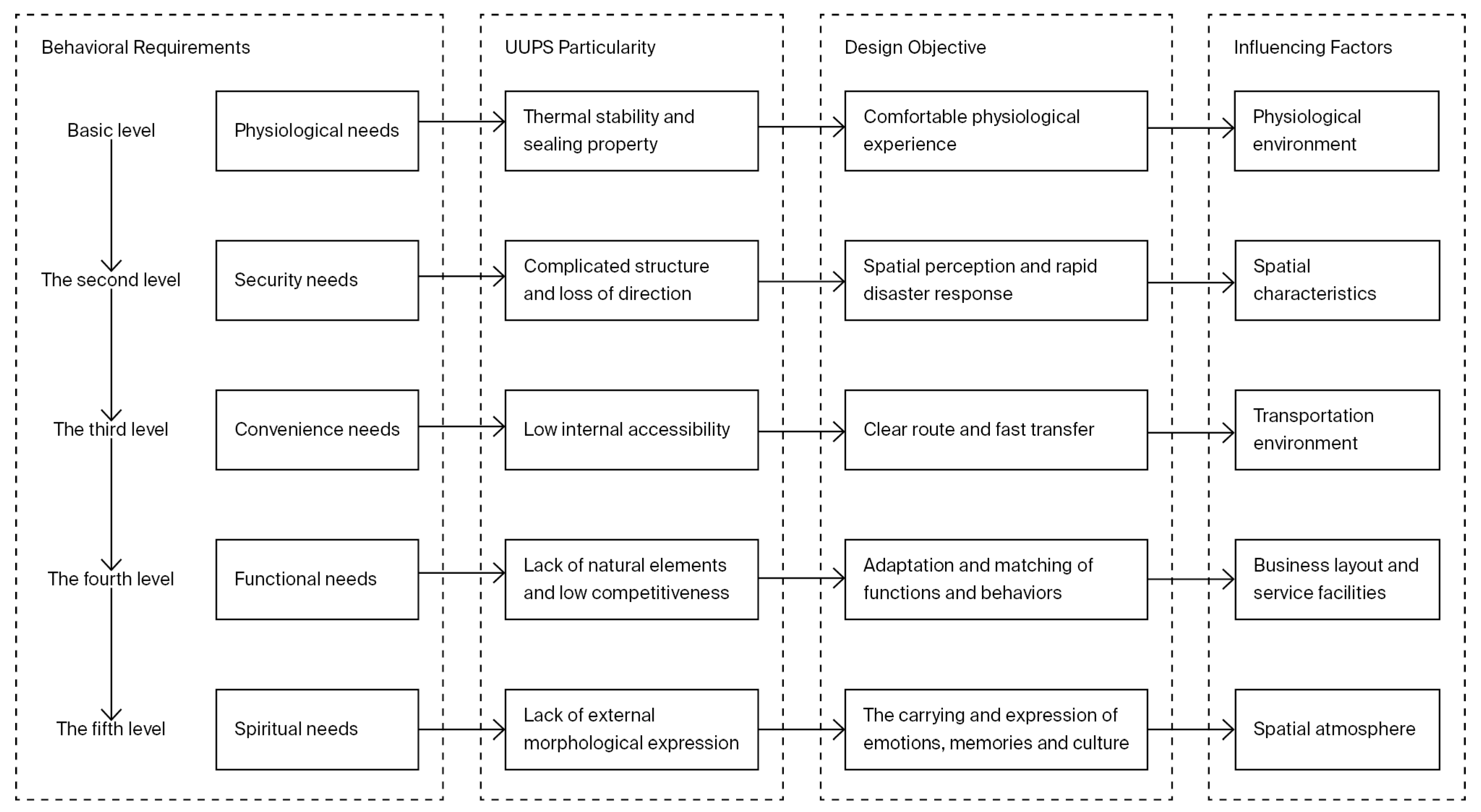
Figure 1. Design objectives and influencing factors based on user behavioral needs and the environmental particularities of UUPSs (authors’ own creation).
Buildings 16 01689 g001
Figure 2. Flow chart.
Buildings 16 01689 g002
Figure 3. Study areas and behavior observation locations.
Buildings 16 01689 g003
Figure 4. Characteristics, duration, and samples of different activity types.
Buildings 16 01689 g004
Figure 5. Panoramic overview of behavior measurement points (Taking Xudong Street UUPS as an example, the non-English labels in the figure are merely for environmental records and do not affect the interpretation of the main conclusions of this article).
Buildings 16 01689 g005
Figure 6. Model structure of the Random Forest algorithm.
Buildings 16 01689 g006
Figure 7. Basic characteristics of user behavior in UUPS.
Buildings 16 01689 g007
Figure 8. Proportion and temporal distribution of UUPS user behaviors.
Buildings 16 01689 g008
Figure 9. Spatial distribution of different types of user behavior in UUPSs.
Buildings 16 01689 g009
Figure 10. The spatial characteristics of six UUPSs.
Buildings 16 01689 g010
Figure 11. Variable importance ranking for the four RF models.
Buildings 16 01689 g011
Table 1. Main research directions in studying people’s behavior in underground public spaces.
Research DirectionBehavior TypeMain Research ContentsBehavioral Measurement IndicatorsData Collection MethodReference
The driving force of spatial environmental elements on behavior
Influence on transient behaviorPedestrian avoidancePersonal factors mainly affect the avoidance patterns of pedestrians, while environmental factors mainly affect the frequency of pedestrians’ avoidance behaviors.Avoidance mode, avoidance frequencyElectroencephalogram and eye movement detection[27]
EvacuationNatural lighting, spatial familiarity, and crowd effects have a more significant impact on overall human decision-making, while habits and brightness have a smaller influence.Evacuation efficiencyVirtual reality[28]
PathfindingThe signage system, vertical facilities, color, lighting, and structure affect the wayfinding efficiency of users, among which the signage system has the greatest impact.Display ratioElectroencephalogram and eye movement detection[29]
Path selectionRoute attributes, especially the travel time and the existence of only elevator exits, have a significant impact on the intention to use underground routes.Route selection ratioQuestionnaire survey[30]
Influence on staying behaviorConsumptionAppropriate planning in terms of comfort, safety, and form enhances people’s willingness to consume in underground commercial spaces.Consuming willingnessQuestionnaire survey[31]
SocialA spacious and high-ceiling space deprives users of opportunities for social activities, but it is conducive to the basic elements of casual conversation, such as gazing and taking turns to talk.Pedestrian flowField investigation[32]
Population segmentation and behavioral differences
Gender differenceWalkingThere is no significant difference in the time distribution pattern between men and women in UUPSs, but there are more female users.Pedestrian flowCount of the cordon[33]
ConsumptionThe business format configuration and sense of security of UCSs have a certain restorative effect on women’s shopping experience, but the effects of environmental atmosphere and guiding signs are relatively poor.Restorative evaluationQuestionnaire survey[34]
Age differencePathfindingThe elderly group showed the lowest orientation performance, and elderly women represent the most vulnerable group.Effective visual recognition rate and effective fixation duration rateOn-site eye-tracking test[35]
Identity differenceCommutingPeople with disabilities take the subway more frequently and for shorter distances than non-disabled people.The number of subway passengers with disabilitiesStatistics of transportation card data[36]
Table 2. Calculation methods and measurement systems for the environmental characteristics of UUPSs.
DimensionIndicatorAbbCalculation MethodUnitInstrument/
Software
Physical environmentIlluminanceIllVertical measurement at the sampling point with a handheld illuminance meter and the average value within the time period calculation.lxUT383 Illuminance meter, UNI-TREND TECHNOLOGY Co., Ltd., Dongguan, China.
DaylightDLCalculation of the proportion of natural light in panoramic images.%Photoshop
Spatial structureAccessibilityAccThe local integration degree calculation using the spatial syntactic line segment model (r = 600 m).Depthmap X 0.6
VisibilityVisThe calculation of the degree of visual integration in a visibility graph model with a grid size of 1 m × 1 m (r = 3 m).
Transportation environmentDistance to the subway stationDist_SubThe walking distance from the subway station.mMap recording
Turns to the subway stationT_SubThe number of turns from the subway station.
Vertical facilitiesVFThe reverse distance weighting method is used for evaluation: N = i = 1 n 1 d , where d refers to the straight-line distance from the center of the node to the vertical facility.
Function layoutRetail POIPOI_RThe number of various types of POIs within a 50 m walking range of the node was obtained from the online map. Field investigations were conducted to verify the distribution and location information of the points of interest.Gaode Maps 16.13.1
Catering POIPOI_C
Entertainment POIPOI_E
Life service POIPOI_LS
Functional mixityFMEntropy of POIs at the node:
H ( x ) = i = 1 n   P i l o g   P i , where H ( x ) represents the entropy of the random variable x. Pi is the probability that x takes xi. The larger the entropy value, the higher the degree of function mixing.
Service facilitiesRest seatRSThe number of elements near the node location with field investigation.Map recording
Charging facilitiesCF
Communication signalCSDetermined by holding a mobile phone, standing at the sampling point for 1 min, measuring RSRP (Reference Signal Receiving Power) data, and taking the mean.dBm
Wireless networkWi-FiDetermined by holding a mobile phone and standing at the sampling point to measure the average Wi-Fi download rate.KB/s
Spatial designActivity areaAAThe area available for activities at the nodes in the filed investigation.m2ArcGIS
Sidewalk widthSWThe width of the sidewalk at the nodes in the filed investigation.mInfrared distance meter
Natural landscapeNLA Likert scale with a score of 0 to 5 was used for evaluation, with the higher scores indicating a more comprehensive consideration of landscape factors.Map recording
Cultural landscapeCL
Table 3. The calculation methods for multi-dimensional characteristics of user behavior.
DimensionIndicatorCalculation MethodExplanation
Behavioral characteristicsNumber of ParticipantsThe number of people observed at the nodes during the test period
Behavioral Diversity D = k q i ln   q i / ln   k k represents the types of activities carried out by the user in the space, and q i is the ratio of the quantity of a certain type of activity to the total number of activities occurring in the space.
Estimated Dwell Time IndexThe total length of stay including each person engaged in fixed or continuous activities: d u r = i = 1 n ( c k × d k ) dur represents the total dwell time, c k is the number of occurrences of the behavior type k in the space, and d k is the duration of the behavior type k.
Behavioral preferenceSpatial Selection Probability P = N S u b / N T o t a l × 100 % P represents the probability of pedestrians appearing in the subspace, N S u b represents the number of users of a specific behavior type in the subspace, and N T o t a l represents the total number of users conducting the same behavior in the test field at the same time.
Table 4. Correlation analysis models for environmental elements of metro-led urban underground spaces and user behavior characteristics.
DimensionIndicatorNumber of ParticipantsBehavioral DiversityDuration of Stay
Correlation Coefficientp-ValueCorrelation Coefficientp-ValueCorrelation Coefficientp-Value
Physical environmentIll−0.0050.9540.334 **0.0000.185 *0.036
DL0.0390.6650.0100.9110.0610.489
Spatial structureAcc0.388 **0.0000.282 **0.0010.272 **0.002
Vis0.178 *0.0440.414 **00.254 **0.004
Transport environmentDist_Sub−0.283 **0.0010.1090.2170.271 **0.002
T_Sub−0.1020.2490.1350.1260.263 **0.003
VF0.202 *0.022−0.0870.3250.0270.762
Function layoutPOI_R0.0350.6920.227 **0.0100.1530.083
POI_C0.1300.1410.398 **00.633 **0
POI_E0.1450.1000.429 **00.1040.121
POI_LS−0.1660.0590.0030.971−0.0700.430
FM0.0950.2850.448 **00.413 **0
Service facilitiesRS0.1690.0550.437 **00.638 **0
CF0.262 **0.0030.1570.0750.246 **0.005
CS0.286 **0.0010.614 **00.487 **0
Wi-Fi−0.0320.7230.588 **00.381 **0.000
Spatial designAA0.273 **0.002−0.1570.076−0.1220.169
SW0.255 **0.0040.1740.0790.1290.146
NL0.268 **0.0020.1030.2470.1080.223
CL0.1570.0780.0700.432−0.0260.768
Note: ** at the 0.01 level (double tail) with significant correlation; * at the 0.05 level (double-tailed) with a significant correlation.
Table 5. Optimal parameters and performance values of the four RF models.
ModelSample SizeParametersPerformance
n_EstimatorsMax_DepthMin_Smaples_SplitMAERMSER2
Commuting24,629650430.0350.0500.561
Leisure13,932500520.0170.0240.710
Consumption8010600520.0210.0310.658
Sports1157750350.0410.0550.434
Table 6. Relative variable importance for the four RF models.
VariableCommutingLeisureConsumptionSports
Relative
Importance (%)
RankRelative
Importance (%)
RankRelative
Importance (%)
RankRelative
Importance (%)
Rank
Physical environment
Ill13.0834.05102.45914.923
DL1.49114.1981.991118.251
Spatial structure
Acc1.68104.0691.85122.4710
Vis10.0048.1542.8287.386
Transport environment
Dist_Sub8.11513.64210.21411.475
VF24.8014.4675.7064.207
Function layout
POI_R1.8891.62165.3871.1813
POI_C0.86143.431218.9520.6015
POI_E2.69810.96321.1012.659
POI_LF0.89132.04151.53131.0714
Service facilities
RS0.631519.80115.4731.1912
CF0.62163.26136.3650.2416
Spatial design
AA22.1822.83141.351516.012
SW7.1463.49112.241013.064
NL1.08126.1261.12161.8311
CL2.8777.9051.48143.488
Note: Variables with VIF > 5 were excluded from RF models; see Section 3.3.1.
Disclaimer/Publisher’s Note: The statements, opinions and data contained in all publications are solely those of the individual author(s) and contributor(s) and not of MDPI and/or the editor(s). MDPI and/or the editor(s) disclaim responsibility for any injury to people or property resulting from any ideas, methods, instructions or products referred to in the content.