1. Introduction
Cement stabilized macadam (CSM) bases are widely used in pavement structures in China because of their high stiffness, low elastic deformation, and strong load-bearing capacity [
1]. Due to the continuous influence of vehicle loads and environmental factors, bases are highly susceptible to cracking and progressive deterioration [
2,
3]. In particular, crack development facilitates water ingress into the pavement structure, which may further induce inter-layer debonding, internal voids, and other defects, thereby accelerating the coupled deterioration of both the base layer and the asphalt surface layer [
4,
5].
Grouting repair technology [
6] has become an important method for treating degradation in semi-rigid base layers. This is because it has the advantages of lower treatment cost, faster traffic reopening, and stronger adaptability to concealed distresses. By injecting grouting materials into the damaged area, the continuity of the base structure can be repaired to a certain extent, and the overall bearing capacity of the structure can be improved. Nevertheless, the repair effectiveness of grouting does not depend solely on the properties of the grouting material, but is also closely related to the distress type, the diffusion and filling state of the grout, and the cooperative behavior at the repaired interface [
7]. Therefore, a scientific and comprehensive evaluation of grouting repair effectiveness is essential for the further application and optimization of this technology.
At present, engineering evaluation of grouting repair mainly relies on ground-penetrating radar (GPR) to assess grout filling conditions [
8,
9] and the falling weight deflectometer (FWD) to evaluate the recovery of pavement bearing capacity [
10,
11]. Although these methods are practical for rapid field assessment, they provide limited information on the mesoscopic filling condition, internal structural reconstruction, and damage evolution after repair. In laboratory-scale studies, more refined characterization techniques are required. Among them, acoustic emission (AE) monitoring has been widely used to track crack initiation, propagation, and failure evolution in concrete, rock, and pavement materials [
12,
13]. Shi [
14] utilized AE to monitor the fatigue damage process of the geopolymer CSM material and analyzed the cracking patterns. Cai [
15] used AE to monitor the uniaxial compression process of the semi-flexible pavement material and analyzed the influence of material mechanical properties and the characteristics of AE signals. Computed tomography (CT) is capable of distinguishing aggregate, mortar, and pore phases through grayscale differences and is therefore effective for identifying pore distribution, fracture morphology, and interface characteristics [
16,
17]. Zhao [
18] used CT to analyze the spatial distribution of pores in CSM. Wu [
19] used CT technology to investigate pore evolution in grouting materials under different curing times and further linked this evolution to strength development. Capacitance measurement can reflect internal dielectric-state variation and has potential for characterizing spatial non-uniformity and internal-state evolution in cementitious materials. Hu [
20] employed capacitance measurement to evaluate the changes in CSM before and after freeze–thaw cycles, and verified its effectiveness in combination with ultrasonic testing. Ultrasonic testing [
21,
22,
23] is sensitive to wave propagation differences in materials with different internal conditions and is commonly used as an indirect indicator of compactness, continuity, and defect condition. Han [
24] identified different defect types during prestressed corrugated pipe grouting using ultrasonic testing. Cao [
25] evaluated the compactness of grout in sleeves based on ultrasonic propagation characteristics.
Overall, existing studies indicate that AE, CT, capacitance measurement, and ultrasonic testing each have good potential for detecting internal damage, characterizing structural condition, and identifying defects. However, systematic studies on the grouting repair of voids in CSM materials remain limited. In particular, there is still a lack of comprehensive evaluation of the internal filling state, structural reconstruction, and damage evolution of repaired CSM using multiple complementary characterization techniques. Therefore, it is necessary to introduce a multi-source characterization framework for a more systematic evaluation of grouting repair effectiveness. In this study, CSM specimens with different degrees of void damage are selected as the research object. An inorganic cementitious composite grouting material is used for repair, based on ultra-fine cement and high-belite sulphoaluminate cement (HBSAC), and modified with ethylene-vinyl acetate (EVA) latex, wollastonite (WO) whiskers, and polyvinyl alcohol (PVA) fibers. Ultrasonic testing, AE monitoring, capacitance measurement, and CT are combined to evaluate the repair effectiveness from the perspectives of wave propagation characteristics, crack activity evolution, dielectric response, and internal structural reconstruction. The results provide a basis for the scientific evaluation of grouting repair effectiveness in CSM base layers and offer a reference for the engineering application of grouting materials.
2. Materials and Methods
2.1. Composite Grouting Material
The composite grouting material used to repair CSM is formulated with K1000 ultra-fine Portland cement (Shandong Qingyun Kangjing Building Materials Co., Ltd., Dezhou, China) as the primary cementitious component, combined with the HBSAC (Tangshan Polar Bear Building Materials Co., Ltd., Tangshan, China). The grouting material also contains EVA latex (Beijing Dongfang Petrochemicals & Petrolium Industry Co., Ltd., Beijing, China), WO whisker (Dalian Global Minerals Co., Ltd., Dalian, China), and PVA fiber (Shanghai Chemical Building Materials Additives Company, Shanghai, China). These components are incorporated to enhance the toughness and deformation compatibility of the material. Additionally, chemical additives are added to improve the working performance and durability. The details of the materials used in the composite grouting material can be referred to in the relevant studies [
7,
26,
27]. The mixed proportions of the composite grouting material are listed in
Table 1, and its performance indicators are tested in
Table 2.
2.2. Design of Void Conditions
Firstly, core samples of the CSM base are obtained from the field test road [
28] in Zhenjiang, Jiangsu Province. The cores are then cut into cylindrical specimens with heights of 112.5 mm, 75 mm, and 37.5 mm, respectively, and placed in a cylindrical mold with a diameter of 150 mm and a height of 150 mm to simulate different void conditions. These segment heights correspond to 1/4, 2/4, and 3/4 void conditions, respectively, while the 4/4 condition represents the complete void case. All specimens are prepared as cylinders with a diameter of 150 mm and a height of 150 mm. Under long-term traffic loading and water erosion, the cementitious binder and fine aggregate in CSM are prone to being washed out or deteriorated, whereas the coarse aggregate skeleton can still maintain its structural integrity. Based on the relevant research [
29], it is assumed in this study that the cement binder and fine aggregate in CSM have been lost, leaving only coarse aggregates with particle size larger than 2.36 mm. These coarse aggregates are filled into the voids above the cut core specimens, thereby establishing four types of void conditions: 1/4 voids, 2/4 voids, 3/4 voids, and 4/4 (complete voids). The aggregates used for void repair are five particle sizes of limestone meeting the requirements: #1 (0~3 mm), #2 (3~5 mm), #3 (5~10 mm), #4 (10~20 mm), and #5 (20~25 mm). The C-B-3 gradation is selected because it provides a coarse-aggregate skeleton with good interlocking characteristics, which is representative of expressway base materials. In addition, this gradation is suitable for simulating the residual aggregate framework in void-damaged CSM after the deterioration or loss of binder and fine aggregates. The synthetic gradation is summarized in
Table 3.
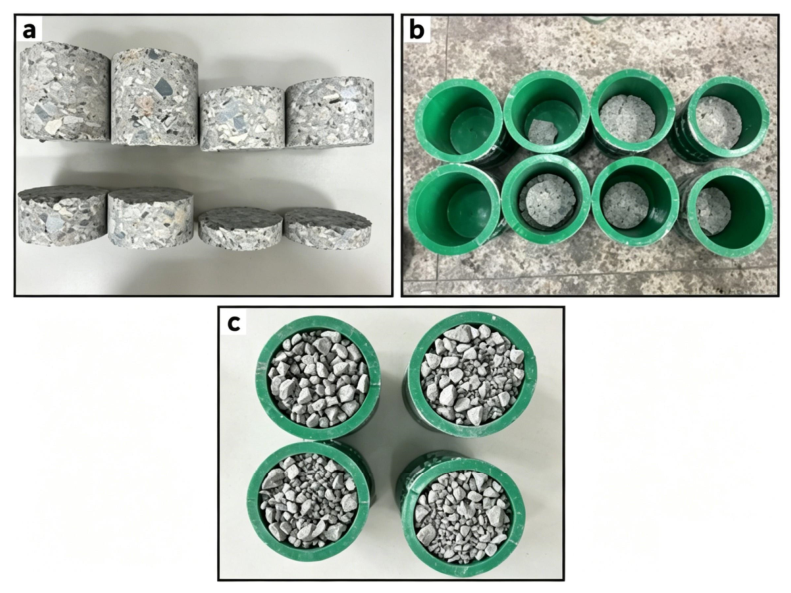
Figure 1 illustrates the specimen preparation process. Firstly, the mass of each type of aggregate is calculated and weighed according to the degree of voids. After uniform mixing, the coarse aggregates are placed into the mold containing the pre-cut CSM core. Subsequently, the composite grouting material is prepared and poured for repair. In this study, the grouting repair is performed via self-weight pouring without applying external pressure, which is a reasonable simplification of the on-site grouting process for laboratory simulation. The pouring is terminated when the grouting material fills the top surface of the specimen without obvious subsidence. Immediately after pouring, the surface of the specimen is covered with plastic film, followed by standard curing conditions. All specimens are prepared following the same unified procedure to improve the reproducibility and comparability of the test results. Two groups of specimens are prepared with four replicates in each group: one group for ultrasonic and capacitance non-destructive tests, and the other for AE monitoring and mechanical tests.
2.3. Ultrasonic Testing
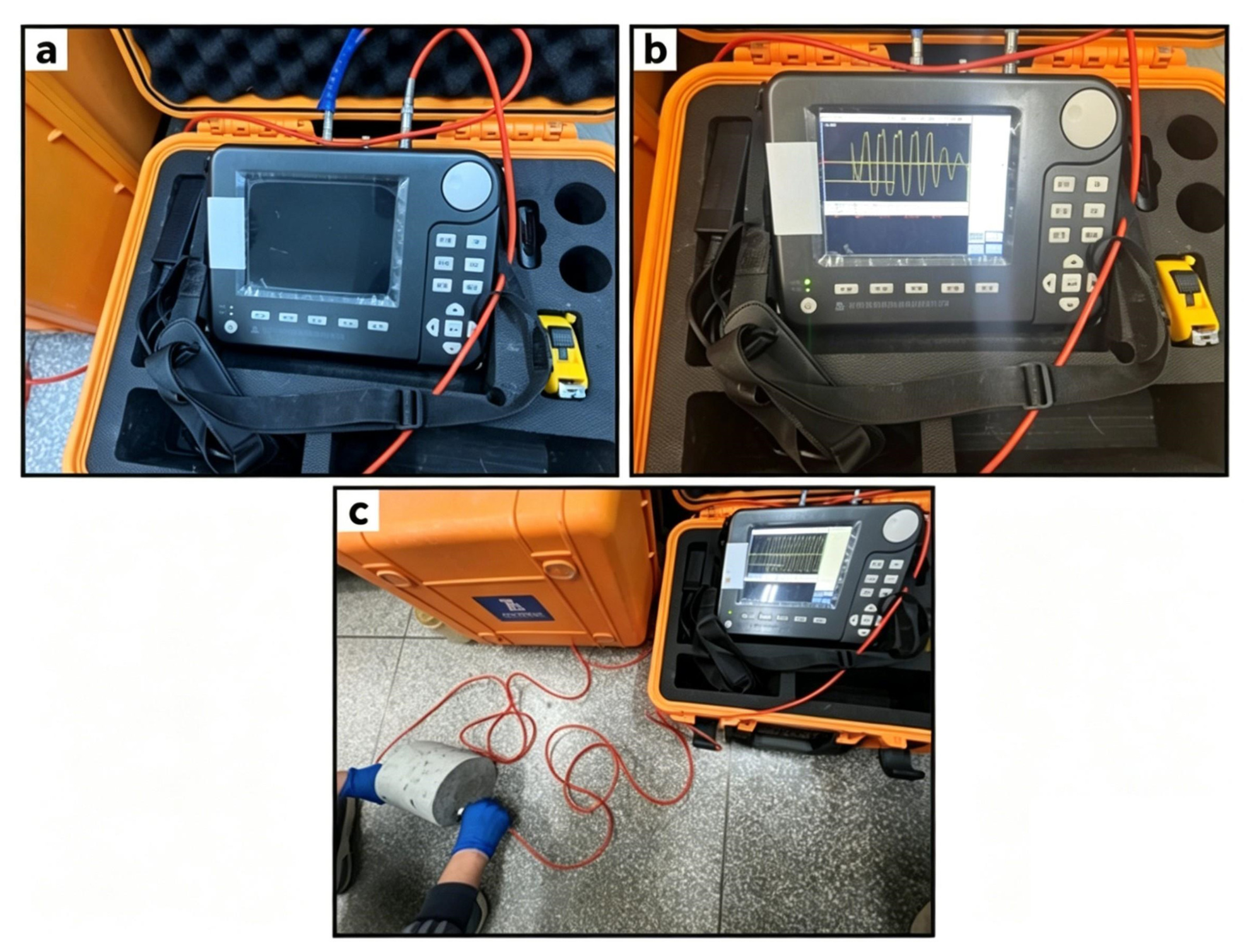
Ultrasonic pulse velocity measurements are performed using a ZBL-U52 non-metallic ultrasonic tester (Beijing Times Linkong Technology Co., Ltd., Beijing, China). The longitudinal wave velocity propagation time of the specimen is measured using the contralateral method in
Figure 2. Five measurement points are preset on each of the two test surfaces of the specimen. Each point is tested three times and the average values are taken. The average values of the five measurement points are calculated to obtain the representative value of the longitudinal wave velocity of the specimen.
For the grouting repair specimens, the height and transit time are recorded at the curing time of 1, 3, 7, 14, and 28 days, respectively, and the longitudinal wave velocity is calculated based on these data. During the ultrasonic test, a thin layer of ultrasonic couplant is applied between the transducers and the specimen surface to ensure reliable acoustic coupling and minimize interfacial interference.
2.4. Capacitance Measurement
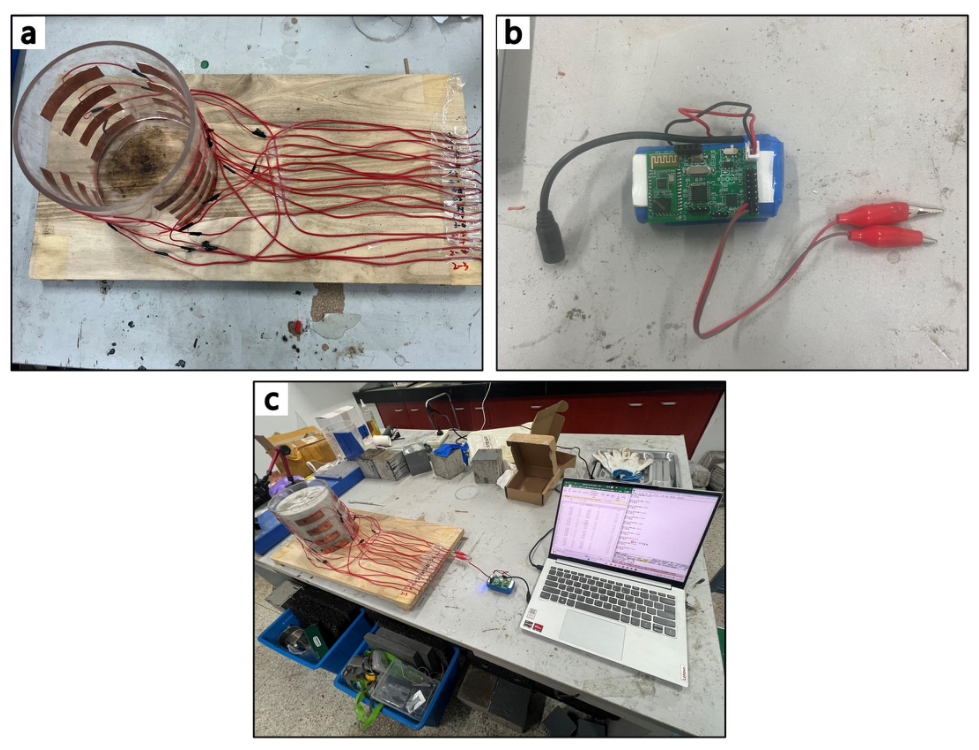
The capacitance measurement method is based on the ring-shaped capacitance sensor, and a capacitance monitoring system has been developed. This sensor consists of a 4-layer electrode array distributed along the height of the sample in
Figure 3 [
20]. Considering the potential inhomogeneity of the grouting repair sample along the thickness direction, the sample is divided into 4 sensing layers, with 4 electrodes arranged in each layer. This configuration results in 6 pairs of capacitance measurement paths (i.e., the paths between any two electrodes) per layer, enabling three-dimensional monitoring of capacitance changes at different depths.
Capacitance measurements are conducted at the same curing time (1, 3, 7, 14, and 28 days) as the ultrasonic tests. Before each measurement, the capacitance reading in free space (air) is recorded as the reference baseline. The specimen is then placed in a ring-shaped sensor, and the capacitance values of all electrode pairs are collected layer by layer. To eliminate background interference, the differential capacitance is calculated as the difference between the raw measured data and the air baseline. Subsequently, a unified normalization coefficient, defined as a value slightly greater than the maximum differential capacitance among all measurements, is adopted. All differential capacitance values are divided by this coefficient and scaled to the range of 0–1. The resulting dimensionless value is defined as the normalized capacitance response for each sensing layer. This normalization procedure reduces the influence of background signals and absolute capacitance differences, thereby facilitating comparison among different specimens and curing times.
2.5. Acoustic Emission Testing
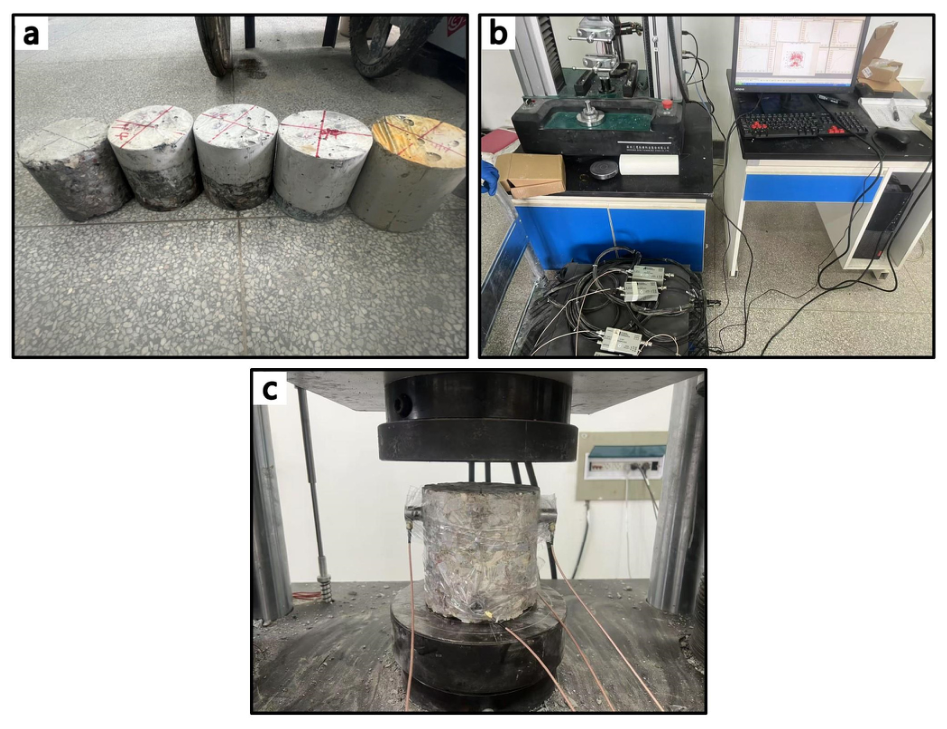
Uniaxial compression tests are conducted on the grouting repair specimens, and AE monitoring is also carried out simultaneously. Before the tests, the surfaces of each specimen are treated with rapid-setting cement to ensure flatness. An electro-hydraulic servo universal testing machine (WAW-2000) (Sansitaijie, Zhuhai, China) is used to apply the loading at a rate of 1 mm/min under displacement control. Before loading, a spherical support is adjusted to ensure axial alignment and concentric compression.
During the loading, AE signals are acquired synchronously using a PCL-2 AE system with four acquisition channels (American Acoustic Physics Company, West Windsor Township, NJ, USA). Four AE sensors (type 6α) are mounted around the specimen circumference at 180° intervals in a staggered (upper–lower cross) arrangement at heights of 30 mm and 120 mm in
Figure 4. During the test, the threshold is set to 40 dB to suppress environmental noise. The peak definition time (PDT), hit definition time (HDT), and hit lockout time (HLT) are set to 150 μs, 300 μs, and 500 μs, respectively.
2.6. Computed Tomography Testing
CT scans are performed on samples of CSM and fully voided grouting repair using YXLON FF35 (Comet Yxlon, Hamburg, Germany) to observe the internal microstructure and defect characteristics. Other void repair groups are not adopted for CT scanning, as core-drilling sampling may cause interface damage and thus affect the accuracy of CT results. The scanning parameters are set as follows: acceleration voltage 210 kV, tube current 0.12 mA, image resolution 3000 × 3000 pixels, magnification 8 times, and the cone-beam scanning mode. Under these settings, the achievable minimum voxel size is approximately 17 μm.
Considering the scanning accuracy, for both types of samples, a cylindrical core with a diameter of 50 mm and a height of 50 mm is selected as the CT sample. The slice interval is set at 0.1 mm, allowing each sample to generate nearly 500 cross-sectional images. After data collection, the images are reconstructed, three-dimensional visualization, and subsequent quantitative analysis of the pore structure.
3. Results and Discussion
3.1. Ultrasonic Pulse Velocity Results
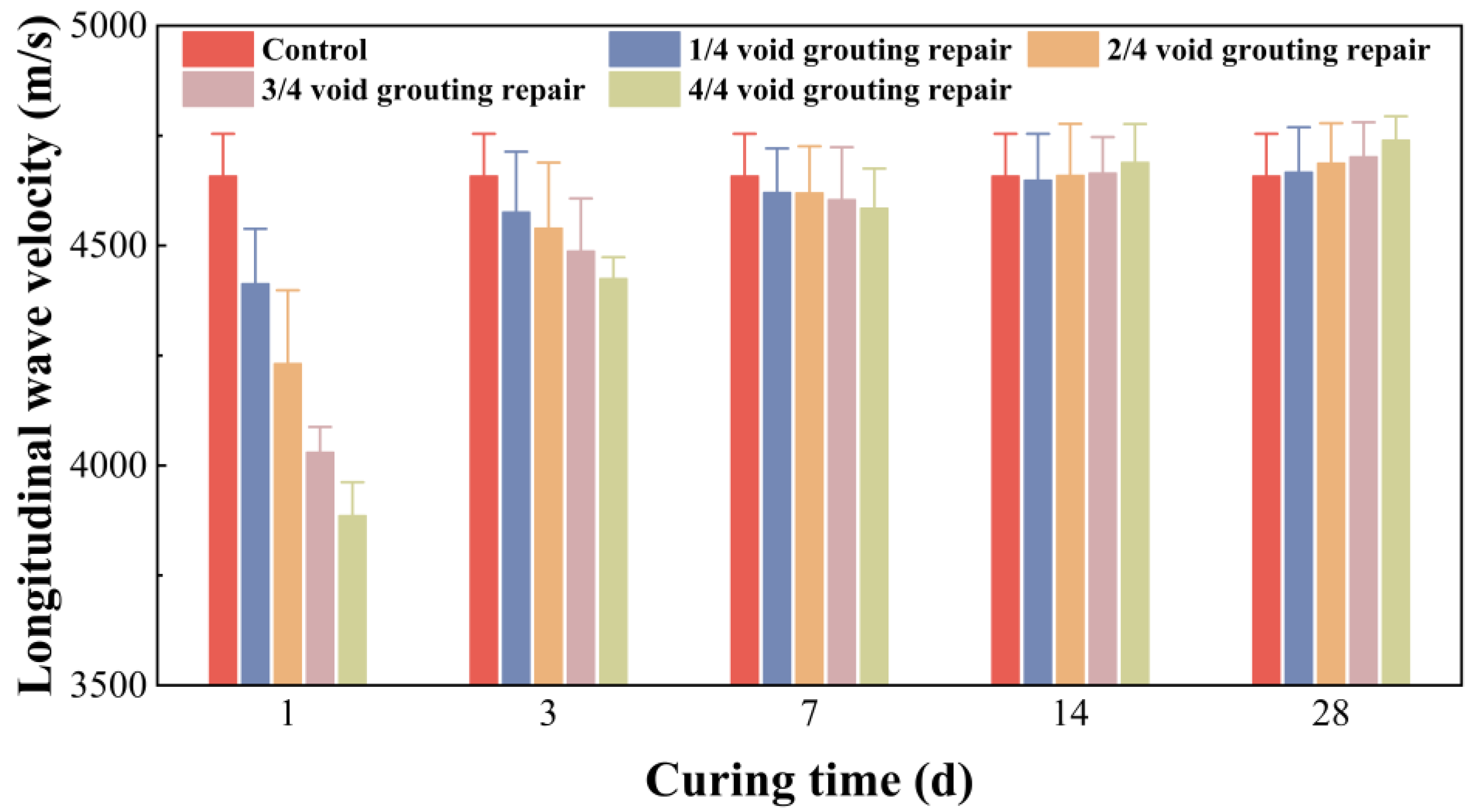
Figure 5 presents the longitudinal wave velocity results obtained from ultrasonic testing. The longitudinal wave velocity of the repaired groups with different void degrees generally increases with curing time. This trend suggests a progressive improvement in internal continuity and compactness during the hydration process of the composite grouting material. Initial wave velocity measurements are first conducted on the original cores with different heights, and only small differences are observed among them, indicating that the initial conditions of the specimens are generally comparable.
At 1 day, the longitudinal wave velocities of all grouting repaired specimens are markedly lower than that of the reference specimen (4658.39 m/s). Specifically, the 1/4, 2/4, 3/4, and 4/4 void repair groups exhibit velocities of 4413.42, 4231.56, 4030.02, and 3886.00 m/s, corresponding to reductions of approximately 5.2%, 9.1%, 13.5%, and 16.6%, respectively. A clear decrease in longitudinal wave velocity is observed with increasing grouting thickness. This phenomenon is likely associated with the early hydration stage of the grouted region, in which the internal structure remains relatively loose and discontinuous, thereby weakening wave propagation. As the curing time increases to 3 days, the longitudinal wave velocity shows a rapid upward trend. This change may be attributed to the progressive hydration of the composite grouting material and the gradual development of a more continuous internal structure. By 7 days, the rate of increase begins to slow. The 1/4 and 2/4 void groups reach 4620.51 and 4619.56 m/s, respectively, approaching the reference level, while the 3/4 and 4/4 void groups increase to 4604.49 and 4585.00 m/s. This suggests that, as curing proceeds, the influence of grouting thickness on wave propagation gradually decreases.
At 14 days, the longitudinal wave velocity of each group continues to increase. At 28 days, all repaired groups exhibit higher longitudinal wave velocities than the control group, with values of 4666.9, 4687.37, 4701.99, and 4740.00 m/s for the 1/4, 2/4, 3/4, and 4/4 void groups, respectively. Compared with the values at 1 day, the corresponding increases are approximately 5.76%, 10.83%, 16.65%, and 21.98%. These results suggest that increasing repair thickness is associated with a more pronounced improvement in wave propagation characteristics, which may reflect a better filling condition and enhanced internal continuity of the repaired region. However, this interpretation should be considered together with the results of the other characterization methods.
The evolution of longitudinal wave velocity can be roughly divided into three stages: a rapid increase from 1 to 7 days, a slower increase from 7 to 14 days, and a relatively stable stage from 14 to 28 days. This trend is generally consistent with the hydration development of the composite grouting material. Ultrasonic wave velocity can be used as an effective indirect indicator for evaluating the evolution of internal structural condition during repair.
3.2. Normalized Capacitance Response
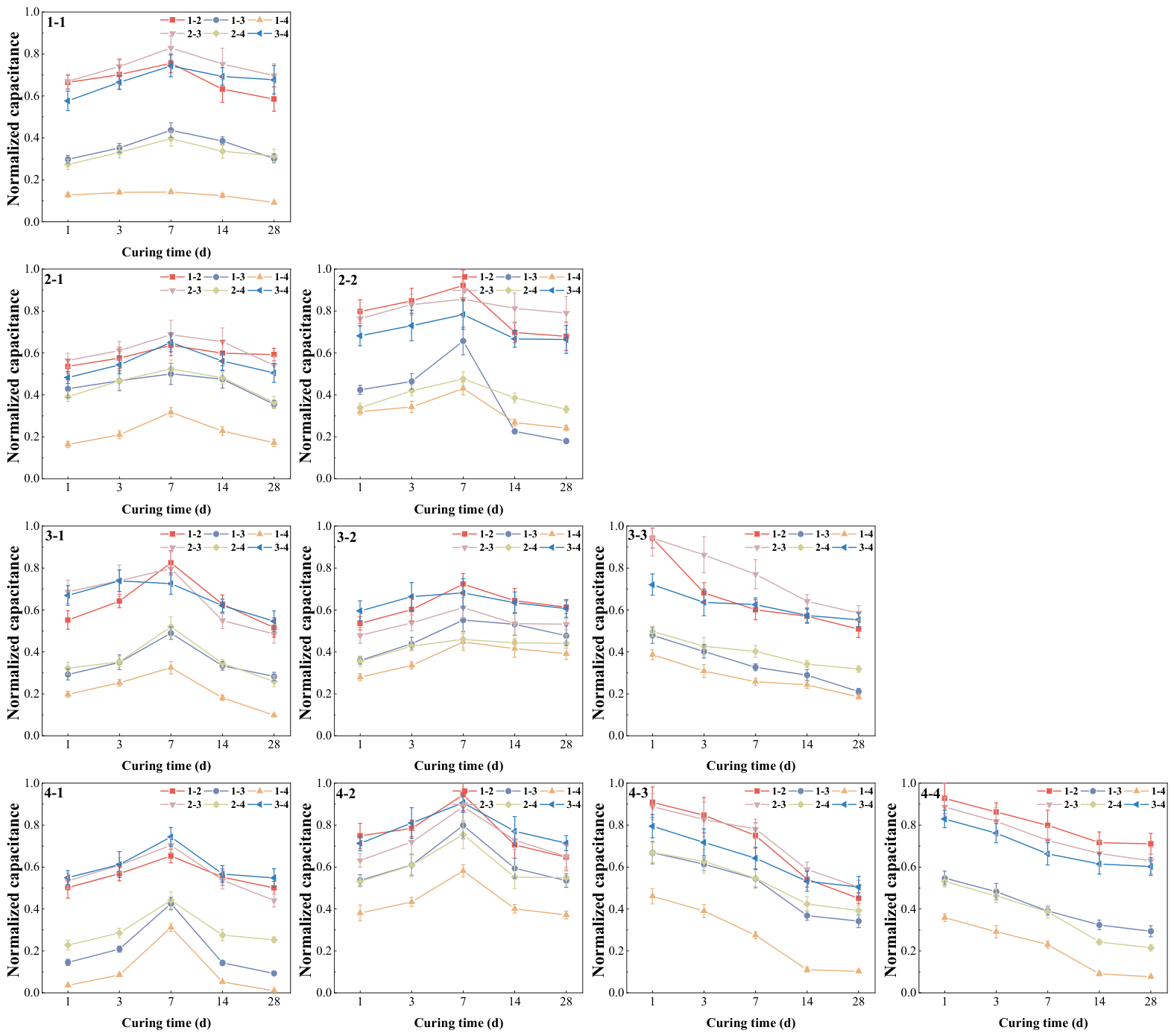
Figure 6 shows the normalized capacitance responses of the void repair groups with different void degrees at 1, 3, 7, 14, and 28 days. Capacitive sensing and electrical capacitance tomography (ECT) have been reported to be sensitive to internal permittivity distribution and moisture-related spatial variation in soils and cement-based materials, and can therefore be used as indirect indicators of internal-state evolution during curing [
30,
31]. Owing to the structural configuration of the electrode arrangement, the adjacent electrode pairs (1–2, 2–3, and 3–4) exhibit the highest normalized capacitance values, followed by the second-nearest pairs (1–3 and 2–4), whereas the opposite pair (1–4) shows the lowest values. This distribution is generally consistent with the electric field characteristics of the annular coplanar capacitance sensor, indicating that the normalized capacitance results can effectively reflect the spatial response characteristics of the measurement system.
For the 1/4 void repair group, the normalized capacitance values gradually increase from 1 day to 7 days and reach a peak at approximately 7 days, followed by a gradual decrease toward 28 days. This result indicates that the repaired region undergoes a continuous internal evolution during curing. The early increase is likely associated with the progressive development of the repaired structure, whereas the subsequent decrease suggests that moisture redistribution and moisture loss gradually become more pronounced with curing time, thereby changing the internal dielectric response. For the 2/4 void repair group, both the first and second layers exhibit a similar pattern of first increasing and then decreasing. In contrast, for the 3/4 and 4/4 void repair groups, the normalized capacitance values in the third and fourth layers reach their highest levels at 1 day and then show a continuous downward trend with curing time. This result suggests that the lower layers maintain a different internal state from the upper layers at the early curing stage and that the subsequent curing evolution is spatially non-uniform. In the 4/4 void repair group, the inter-layer difference is the most pronounced. Except for the top layer, the normalized capacitance values of the other layers increase with depth at 1 day, indicating a clear spatial variation in internal dielectric response. In this group, the first and second layers exhibit a trend of first increasing and then decreasing, whereas the third and fourth layers show a continuous decline. These results demonstrate that the internal evolution of the repaired region becomes more heterogeneous as the repair thickness increases, and that the layer-dependent capacitance response is capable of characterizing such spatial non-uniformity.
Overall, the variation in normalized capacitance response indicates that the internal state of the repaired region evolves continuously with curing time and exhibits clear spatial heterogeneity. The trend of first increasing and then decreasing suggests that the repaired structure experiences progressive curing-related development, whereas the persistent decline observed in some lower layers indicates a more pronounced influence of moisture redistribution and moisture loss in thicker repair sections. Therefore, the normalized capacitance response can be used as an effective indirect indicator for evaluating the curing-related internal evolution and spatial heterogeneity of the repaired region. These changes are likely related to the combined effects of structural development and internal moisture-state variation during curing.
3.3. Analysis of the Uniaxial Compression Process Based on AE Parameters
3.3.1. Relationship Between Ringing and Load Variation with Time
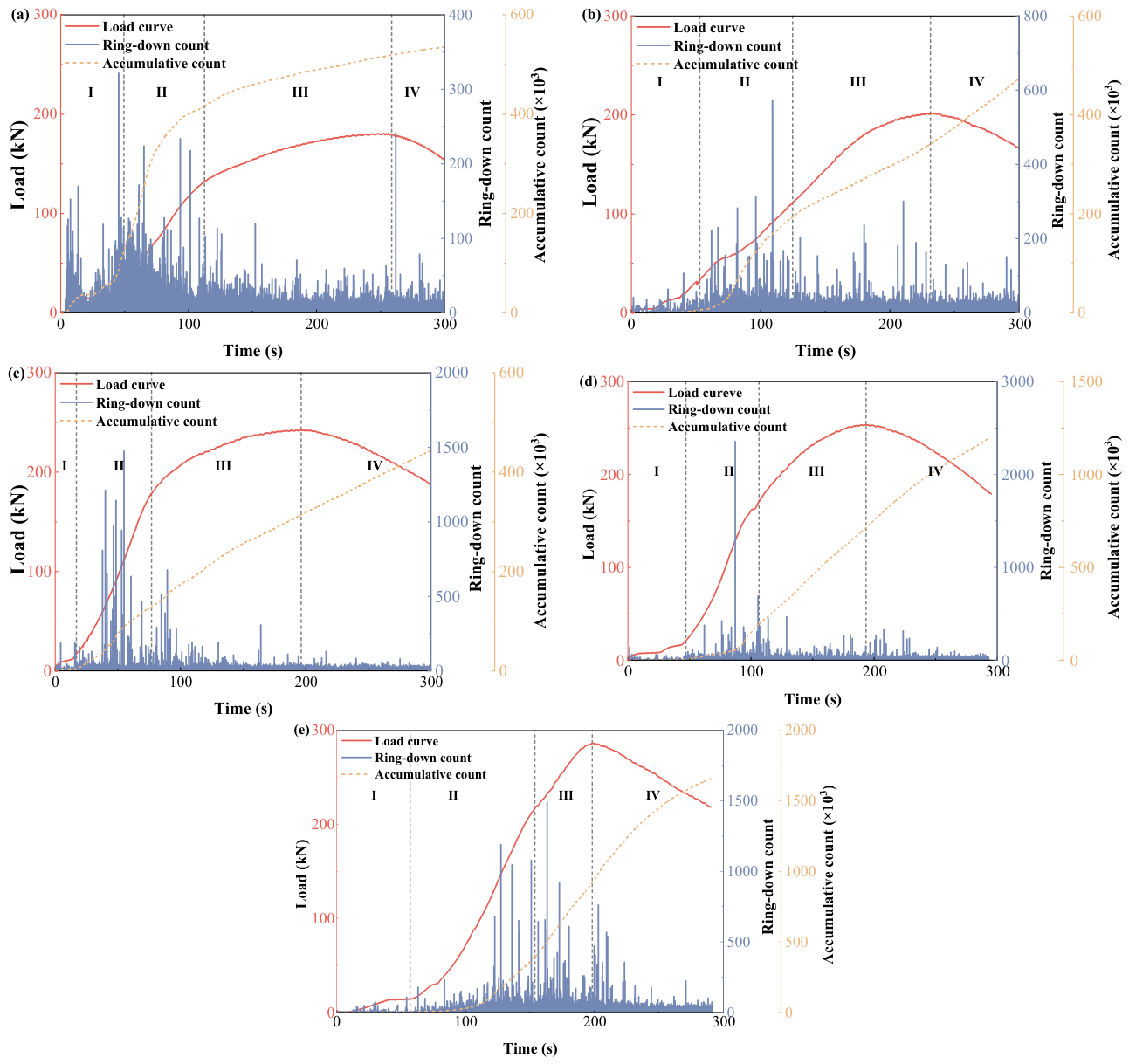
Figure 7 presents the load/AE ringing count/cumulative ringing count-time curves of each group of specimens during the loading process. From the load curve, the control group specimens exhibit certain brittle failure characteristics. After reaching the peak load (181 kN), the bearing capacity rapidly declines. As the void repair degree increases from 1/4 to 4/4, the peak load of the groups significantly increases from 201 kN to 286 kN. The subsequent decline process after the peak also becomes more gradual, while still maintaining a relatively high residual bearing capacity. This indicates that the composite grouting material can effectively enhance the overall stiffness and toughness of the structure, and transform the failure process from a sudden instability to a gradual failure.
The composite grouting material not only significantly improves the bearing capacity, but also enhances the ductility and modifies the failure mode of the structure. Compared with the control group, the time corresponding to the peak load in the void repair structure is slightly earlier. The analysis suggests that this phenomenon may be due to the presence of a large number of microcracks and pores in the original CSM in the initial loading stage, requiring a longer compaction process, resulting in delayed deformation and a lag in the load peak. After grouting repair, the internal density of the structure significantly improves, the stress transmission path becomes more direct, and crack extension is restricted, but it is more likely to concentrate and evolve in the middle and later stages, thus causing the peak load to appear earlier.
By jointly examining the load curve, the instantaneous AE ring-down count, and the turning points of the cumulative AE count curve, the uniaxial compression process is divided into four stages for each specimen. The stage boundaries are identified from curve-shape changes rather than from fixed time thresholds: (1) Compaction stage: This stage spans from the start of loading to the first inflection point of the cumulative AE count curve. During the initial loading period, the inherent pores and microcracks in the material gradually close under compressive load, resulting in an increase in overall displacement. AE signals remain relatively sparse throughout this stage, reflecting the closure of pre-existing defects rather than new crack initiation. (2) Stable microcrack development stage: This stage is defined by the linear elastic region of the load curve, extending from the end of the compaction stage to the onset of the load’s nonlinear ascent. As the load enters the nearly linear ascending phase, microcracks initiate and propagate stably along aggregate interfaces. The AE ring-down counts increase rapidly and maintain a steady frequency, with the overall structure remaining in a stable state. (3) Macroscopic propagation: This stage covers the nonlinear ascending segment of the load curve prior to the peak load, from the end of the linear elastic stage to the peak load point. The load continues to rise slowly, while microcracks gradually accumulate, coalesce, and penetrate to form macroscopic main fractures. The AE ring-down counts exhibit frequent and intense fluctuations, indicating that the structure is approaching instability. (4) Residual failure stage: This stage starts from the peak load point and continues until the end of loading. After reaching the peak load, the structure loses stability, and its bearing capacity decreases significantly, though a certain residual strength is retained. AE signals persist continuously, and the cumulative AE energy increases at a reduced rate, reflecting post-peak friction, slip, and residual fracture behavior of the damaged structure.
From the perspective of the AE ringing count response characteristics, the control group exhibits higher activity of AE signals during the compaction stage due to more internal pores and initial defects. The ringing count accumulates to a certain level at the initial loading stage. During the subsequent microcrack development stage, the cumulative ringing count increases rapidly, with the maximum ringing count ranging from 300 to 400. Subsequently, there are certain fluctuations in the residual failure stage. For the void repair groups, as the repair degree increases, the internal compactness of the structure significantly enhances, and crack propagation is effectively constrained. The peak of the ringing count significantly increases, exceeding 1000. Among them, the 3/4 void repair group has the highest count of 2300, indicating that the energy release during the crack development process is more intense. It can also be observed that the high-activity zone of the ringing count gradually shifted from the microcrack development stage to the macroscopic cracking stage, indicating that the structure begins to undergo significant damage evolution at higher load levels, and the overall failure process tends to be delayed. In the 4/4 void repair group, this feature is particularly significant. The cumulative ringing count in the macroscopic cracking stage increases sharply, indicating that the main cracks are concentrated and interconnected, demonstrating that the structure has a stronger energy absorption capacity and damage delay ability.
3.3.2. Rise Angle-Average Frequency Analyses
During the uniaxial compression test, multiple crack propagation modes develop within the specimens, primarily including tensile cracking and shear-related cracking. The parameters rise angle (RA) and average frequency (AF) are employed to characterize crack propagation behavior, where RA = rise time/amplitude and AF = ring-down count/signal duration.
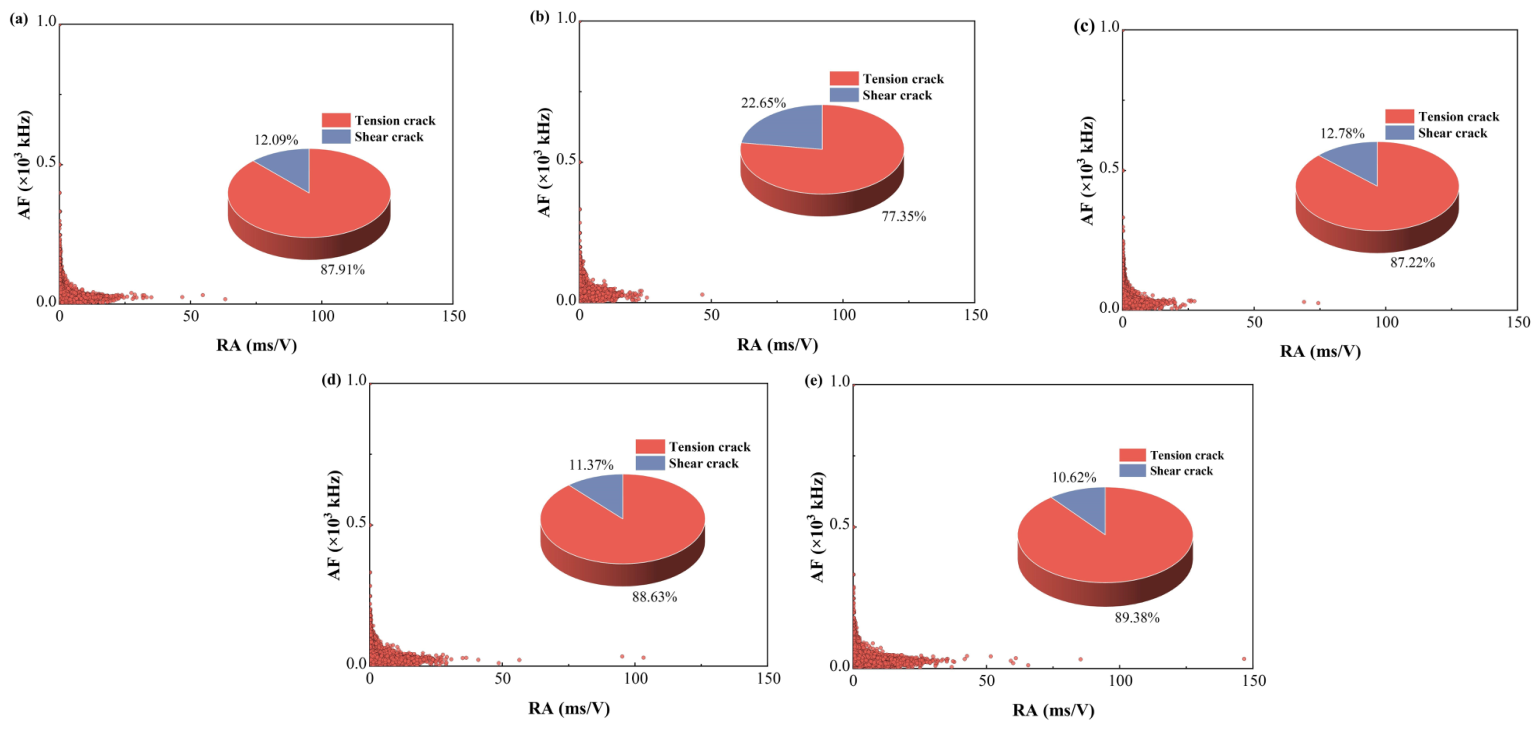
Figure 8 presents the two-dimensional RA-AF scatter-density distributions for the different void repair groups. To facilitate comparison among groups, a unified coordinate scale is adopted for all specimens. The inset pie charts summarize the proportions of tensile-related and shear-related AE events, which are calculated from the original RA-AF data using the adopted ratio [
32].
For all groups, the AE events are predominantly concentrated in the lower-left region of the RA-AF plots, corresponding to generally low RA values and relatively high AF values. This distribution indicates that the fracture process is mainly characterized by short-duration, high-frequency AE activity, suggesting an overall tensile-dominated cracking tendency. In the control group, tensile-related events account for 87.91% of the total AE activity, whereas shear-related events account for 12.09%. In addition, the RA distribution is relatively dispersed, indicating the presence of numerous pre-existing microcracks and a relatively weak interfacial transition zone within the specimen. Local sliding at the aggregate–cement mortar interface may also induce a certain level of shear-related AE activity.
For the 1/4 void repair group, the proportion of tensile-related events decreases to 77.35%, while that of shear-related events increases to 22.65%. The RA values remain mainly below 50 ms/V, indicating that the corresponding shear-related cracking activity is limited in duration and energy release and is more likely associated with localized micro-slip behavior. This phenomenon may be attributed to the inherent damage characteristics of the CSM itself. When the repair thickness increases to 2/4, the proportion of tensile-related events rises to 87.22%, whereas that of shear-related events decreases to 12.78%, indicating that the composite grouting material begins to play an important role in filling the void region and improving structural integrity. Under this condition, crack propagation becomes more stable and remains dominated by tensile-related damage. In the 3/4 and 4/4 groups, the proportion of tensile-related events further increases to 88.63% and 89.38%, respectively, while the proportion of shear-related events decreases to 11.37% and 10.62%. These results indicate an increasingly pronounced tensile-dominated failure tendency with increasing repair thickness.
This behavior suggests that the synergistic toughening effects of polymer latex, whiskers, and PVA fibers in the composite grouting material significantly enhance the continuity and stability of the repaired structure, while effectively suppressing interfacial slip-related damage. A small number of events with relatively high RA values are still observed in several repaired groups. These events may be associated with prolonged local crack activity after the overall load-bearing capacity of the repaired structure is improved. Such atypical AE responses under the ultimate bearing state do not alter the overall fracture tendency reflected by the RA-AF distributions and the corresponding statistical results.
3.3.3. b-Value Characteristics
In AE analysis, the b-value represents the relative proportion of low-amplitude events to high-amplitude events and reflects the energy-release distribution within the material. A higher b-value indicates that AE activity is dominated by low-energy events and that crack propagation remains relatively stable. Considering that the least-squares method is advantageous for tracking the temporal evolution of the b-value within a given interval, this study adopts this method for b-value calculation. The fitting relationship is expressed as [
33,
34]
where
N is the cumulative number of AE events with magnitude greater than or equal to
M,
a is a regression constant representing the overall AE activity level, and
b is the b-value. When the AE amplitude is recorded in decibels, the magnitude-like parameter
M is defined as
where
AdB denotes the AE amplitude in dB. In the calculation, the converted magnitude data are grouped with an interval of Δ
M, and the cumulative event number corresponding to each magnitude level is determined. The
b is then obtained from the slope of the least-squares linear fitting between log
10N and
M.
A sliding-window strategy is adopted for b-value analysis. Specifically, each sampling window contains 1000 AE amplitude data points, with a sliding step of 50, and the magnitude interval Δ
M is set to 0.5.
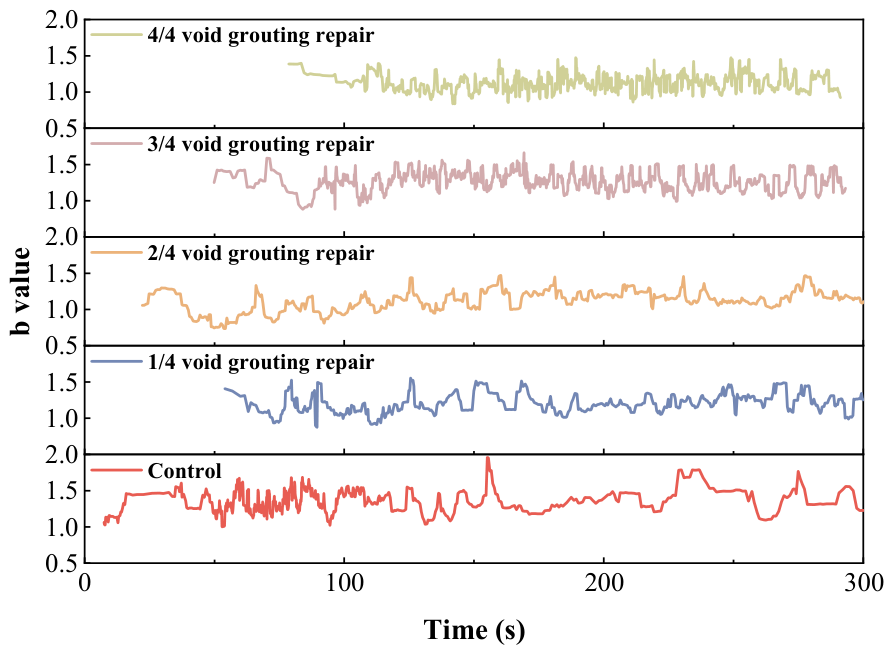
Figure 9 shows the temporal evolution of the b-value for the different void repair groups during AE monitoring. Overall, the b-value in each group remains generally above 1, indicating that the AE activity during loading is mainly dominated by low-energy microcracking events rather than concentrated high-energy release. At the initial loading stage, the b-value exhibits noticeable fluctuations and rapid increases, which can be attributed to the activation and extension of pre-existing microcracks under compression. With continued loading, the b-value shows significant fluctuations and an overall decreasing trend after approximately 120 s, indicating progressive crack accumulation and coalescence and suggesting the onset of macroscopic structural failure.
For the 1/4 void repair group, the b-value still shows significant fluctuations during the loading mid-stage, with a distinct curve fluctuation. This indicates that the fibers and other components in the composite grouting material have a certain inhibitory effect on microcracks. However, due to the limited height of void repair, the overall collaborative ability of the structure is insufficient, and the failure mode is mainly brittle. When the repair degree increases to 2/4, the fluctuations of the b value gradually slow down. The composite grouting material enhances the integrity of the overall structure and delays the generation and expansion of cracks. For the 3/4 void repair groups, the b-value curve tends to be stable, with most intervals stabilizing between 1 and 1.2. The crack propagation process of the structure is relatively uniform, and the composite grouting material has effectively covered the main void areas. When the composite grouting material fills the void area, the b-value changes are the most stable, with the smallest fluctuation, demonstrating the optimal crack control and energy-release regulation ability. Meanwhile, the group exhibits ductile failure behavior, and the energy-release process of the AE events is smooth and controllable.
3.4. CT-Based Pore Structure Reconstruction and Analysis
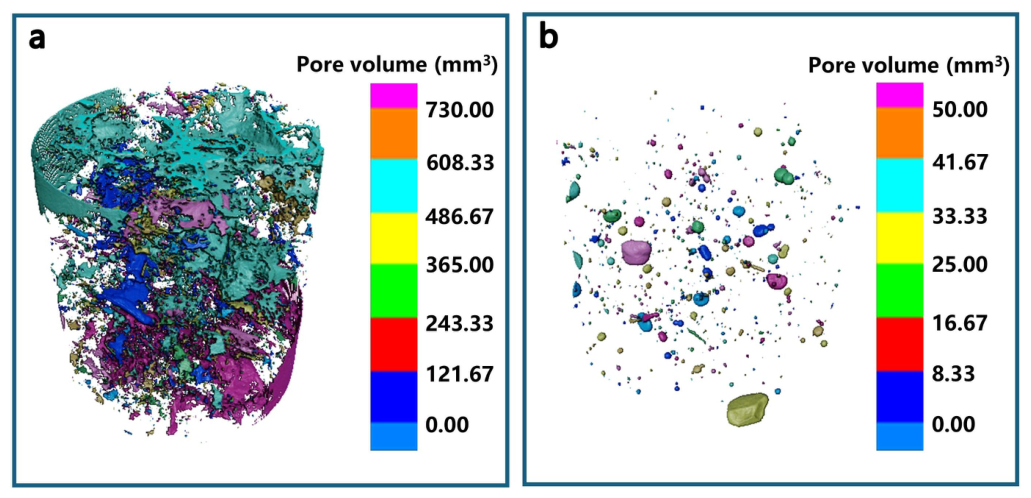
The CT two-dimensional slices are preprocessed to extract pore parameters, including position, volume, and surface area, and the resulting three-dimensional pore distribution is shown in
Figure 10. There are significant differences in pore structure and fracture space between the CSM material and the fully voided grouting repair material. The former as a whole is characterized by a dense fracture network, strong connectivity, and a large fracture scale, presenting a certain degree of penetration, which reflects the poor integrity of its internal structure. In contrast, the number of cracks in the void repair material is significantly reduced, the pores are mostly in the form of individual micropores, the size is small, and the distribution is more dispersed, and the overall structure tends to be dense. There are still a few large-pore voids in the void repair material. This might be due to the current grouting method mainly relying on gravity seepage and lacking vibration, resulting in insufficient grouting density in some local areas. The composite grouting material can effectively fill the voided areas and promote the formation of a more continuous and dense internal structure, indicating favorable structural reconstruction ability.
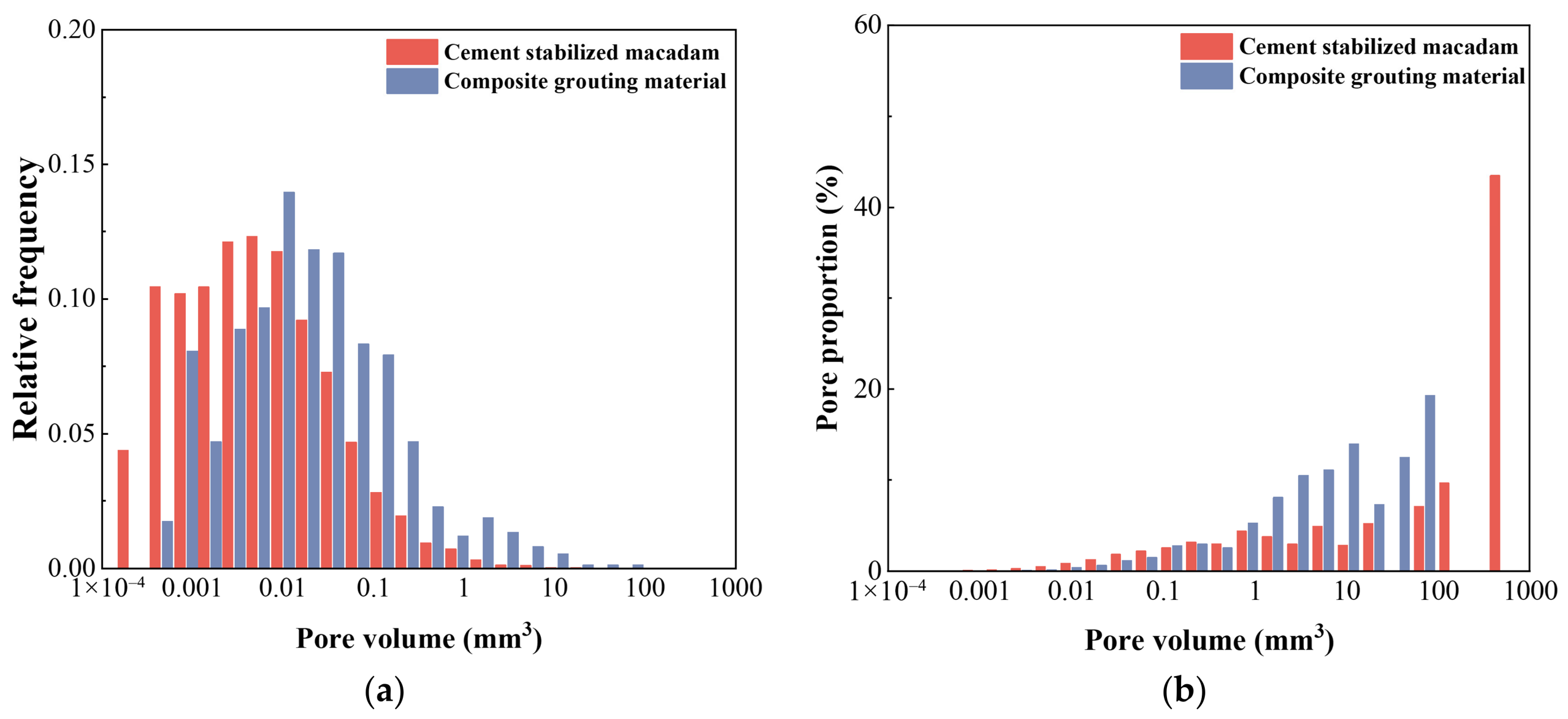
In terms of the frequency distribution of pore volume in
Figure 11, the pores of the CSM material are mainly concentrated within the range of 0.0053 mm
3 to 0.00995 mm
3, with a peak frequency of 0.14. However, the pore volume of the void repair material is mainly distributed in the adjacent range of 0.01 mm
3 to 0.1 mm
3, with a peak frequency of 0.12. From the overall distribution characteristics, the pore volume distribution curve of the grouting repair material is more concentrated and narrower, with the number of pores in the large volume range rapidly decreasing, indicating that the number of large pores is relatively small and the structure is more compact. While the CSM material still retains a certain number of pores in the high volume range, reflecting the unevenness of its pore distribution. Especially in the pore range larger than 100 mm
3, the cumulative pore percentage of the CSM material is close to 46.5%, while that of the void repair material is only 21.6%. On the contrary, in the micro-pore range smaller than 1 mm
3, the proportion of the void repair material is as high as 82.7%, significantly higher than the 66.3% of the CSM material. The composite grouting material improves the pore structure distribution at the microscopic scale, thereby enhancing the homogeneity and compactness of the internal structure.
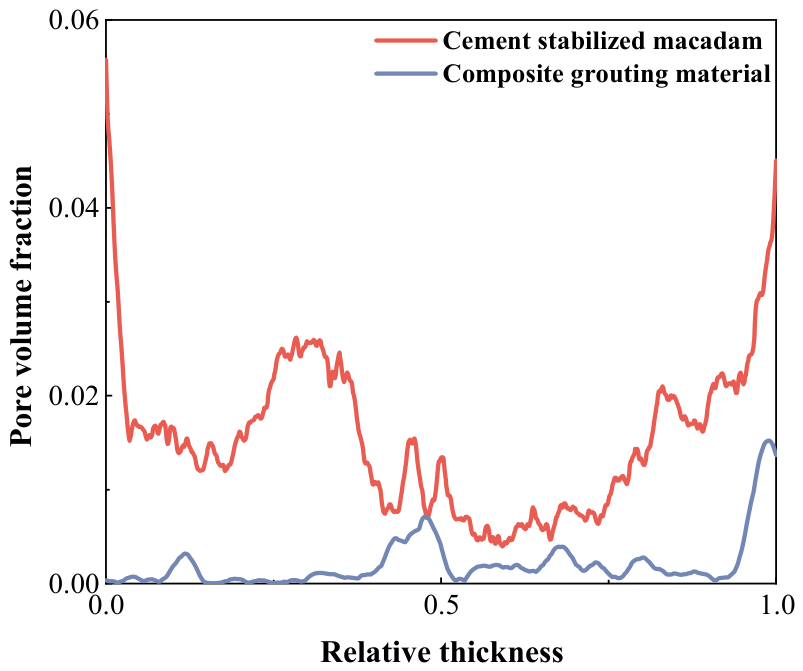
The distribution characteristics of pore volume fractions along the thickness direction of the two groups of materials are further compared and analyzed in
Figure 12. The pore volume fraction in the upper and lower edge areas of the CSM material is significantly higher than that in the middle area. This phenomenon is related to a certain degree of unevenness of the cutting surfaces on both sides of the groups and, on the other hand, to the local peeling of the edge aggregate particles during core extraction or cutting. All these factors may be mistakenly identified as pores during the CT image segmentation process and included in the statistics, thereby slightly increasing the pore volume fraction in the edge area. In addition, insufficient local vibration compaction or uneven aggregate accumulation during the original molding process may also have certain effects on the pore distribution in the edge area. The pore volume fraction of the void repair material in the upper and lower edges is significantly reduced, indicating that the composite grouting material can effectively fill the original defects and loose areas near the interface, which is conducive to enhancing the interface bonding effect between it and the original aggregate skeleton, thereby improving the continuity and stability of the overall structure. From the overall trend in the thickness direction, the pore volume fraction of the CSM material fluctuates significantly in the relative height range of 0.3 to 0.6, reflecting a certain degree of heterogeneity within this area. The pore volume fraction of the void repair material is generally stable in the range of 0.2 to 0.9. There are certain pores at the bottom, indicating the upward permeation and filling characteristic of the composite grouting material along the height direction.




 ,
,