1. Introduction
Recent catastrophic earthquakes have demonstrated the extreme vulnerability of building structures under strong seismic excitations. The 2023 Kahramanmaraş earthquakes (Mw 7.7 and 7.6) in Türkiye caused massive destruction across Kahramanmaraş, Hatay, Gaziantep, Malatya, Adıyaman and other severely stricken regions. Extensive field investigations revealed widespread collapse and severe damage of reinforced concrete and masonry buildings, mainly due to ground motions exceeding code-specified design spectra, inadequate seismic detailing and poor construction quality, resulting in huge casualties and economic losses [
1]. Under such intense seismic excitations, building structures are subjected to intense dynamic loads. In the absence of effective energy dissipation measures, structures may undergo significant plastic deformation, and critical load-bearing components will sustain irreversible damage; in severe cases, this can even induce overall structural failure or collapse. In this context, dampers, as typical passive energy dissipation devices, have been widely adopted in the field of structural seismic design. These devices enhance structural safety and resilience by introducing supplemental energy dissipation pathways that substantially reduce the energy imparted to the primary structure. Current mainstream damper types include metallic yielding dampers, friction dampers, viscoelastic dampers, and viscous dampers [
2], all of which have seen extensive application in engineering practice both domestically and internationally [
3]. However, most of these conventional dampers rely on a single working mechanism. Under seismic loading, they exhibit limitations such as restricted energy dissipation capacity, a narrow effective frequency band, and insufficient cyclic fatigue performance. Consequently, they struggle to meet the multi-level performance objectives required by modern performance-based seismic design.
To overcome the aforementioned limitations, researchers have proposed the concept of multi-stage energy dissipation. A multi-stage energy-dissipating damper refers to a device that integrates multiple dissipative elements with different yield thresholds or dissipation mechanisms, enabling these elements to be activated sequentially as seismic intensity increases. Such a configuration can not only dissipate energy under minor seismic events but also continuously exert energy dissipation effects under moderate and major seismic events. Moreover, it can significantly improve the shape of the hysteretic curves [
4], mitigate concentration of deformation in the primary structure, and provide a promising technical approach to breaking through the limitations of the conventional single-mechanism dampers and thus enhancing overall seismic performance. Based on this, researchers worldwide have developed various novel configurations of multi-stage energy-dissipating dampers, mainly including stage-yielding metallic dampers, stage-friction dampers, metal-friction hybrid dampers, and metal-viscoelastic hybrid dampers [
5]. Research has advanced in areas such as structural design optimization and hysteretic-performance characterization. Moreover, the excellent seismic mitigation effects of such dampers have been verified through cyclic tests, numerical simulations, and some field implementations.
This paper systematically summarizes the advantages of multi-stage energy-dissipating dampers, classifies the main types of existing multi-stage energy-dissipating dampers, summarizes the research findings on their performance, and identifies the current limitations. Furthermore, the progress of relevant numerical simulations and experimental studies is outlined. Finally, the paper discusses prospective research directions for multi-stage energy-dissipating dampers, aiming to guide subsequent theoretical frameworks and support their practical engineering applications.
This review was conducted by searching major scientific databases, including Web of Science, ScienceDirect, ASCE Library, SpringerLink, and CNKI, using combinations of keywords such as “multi-stage damper,” “staged yielding,” “double-stage yield,” “buckling-restrained brace,” “friction damper,” and “hybrid damper.” The search was limited to studies published in English and Chinese that were directly related to multi-stage energy-dissipating mechanisms. Studies were included if they provided representative structural configurations, experimental tests, numerical simulations, or analytical models of staged energy dissipation. Studies were excluded if they focused only on single-stage dampers, lacked sufficient mechanical information, or were duplicated across databases. The final set of references was screened through title, abstract, and full-text review to ensure relevance and representativeness.
2. Stage-Yielding Metallic Dampers
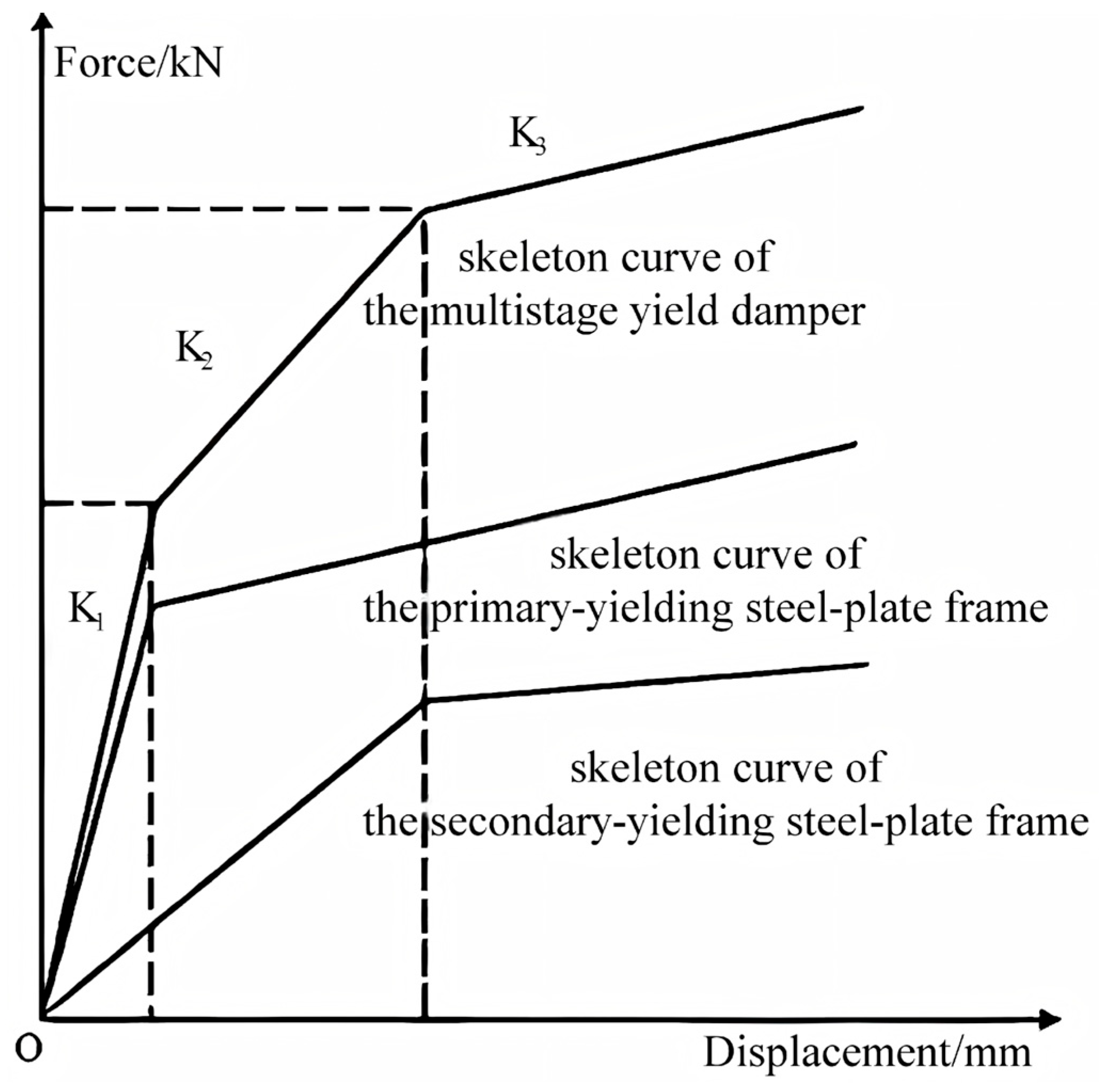
Stage-yielding metallic dampers are the most widely studied type of multi-stage energy-dissipating dampers. These dampers integrate several metal energy dissipation elements with distinct yield thresholds or mechanisms into a single assembly, producing stage-yielding energy dissipation as seismic intensity increases, thereby increasing load-bearing capacity and widening the range of energy absorption. The principal implementation approach is to integrate multiple independent working units within a single component by varying design parameters—such as force-transmission mechanisms, cross-sectional geometry, and the material properties of the energy-dissipating steel plates—such that the mechanical responses of the individual units superimpose to produce a multi-stage yield skeleton curve, as shown in
Figure 1 [
6]. From a mechanical perspective, these dampers adopt a superposed bilinear elastoplastic constitutive model, with the total damping force described by the simple analytical formula Equation (1).
where F
1(u) and F
2(u) are the resisting forces of the primary-yielding and secondary-yielding steel plate units, respectively.
As clearly illustrated in
Figure 1, the multi-stage yield skeleton curve is formed by the superposition of the two units’ individual skeleton curves, presenting three distinct stiffness segments (K
1, K
2, K
3) corresponding to the initial elastic stage, first yielding of the primary unit, and second yielding of the secondary unit. This configuration achieves stepwise stiffness degradation and stable, full hysteretic loops, realizing graded energy dissipation under increasing seismic loads. Compared with conventional single-stage metallic dampers, installing multi-stage energy-dissipating dampers promotes a more uniform structural plastic deformation [
5], reduces the risk of damage to critical components, and significantly enhances overall seismic performance.
2.1. Flexural-Yielding Type
The flexural-yielding metallic dampers dissipate energy through plastic deformation in the flexural zones of components, characterized by large yield displacement and stable hysteretic behavior [
7]. The stage-yielding response is typically achieved [
8,
9,
10] through telescopic configurations, optimization of the cross-sectional geometry, or the arrangement of plates in specific shapes such as X-shaped [
11], triangular [
12], or U-shaped [
13] configurations.
In terms of adopting nested structures, Chen et al. [
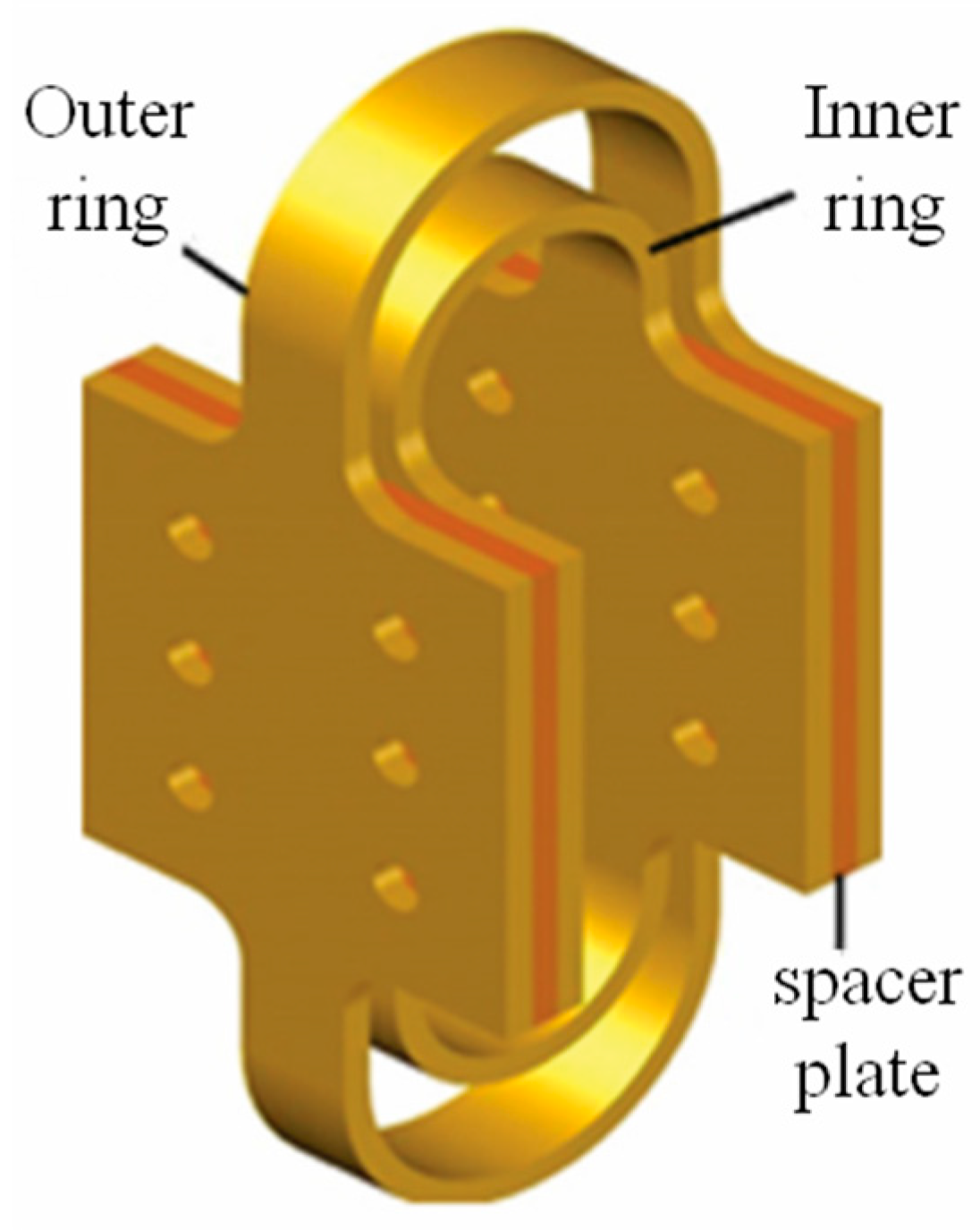
10] proposed a graded yielding metal damper composed of two nested annular metal energy-dissipating units of different sizes, as shown in
Figure 2. As a coaxially nested hollow multi-stage damper with smooth filet transitions at the critical zones to avoid stress concentrations, it achieves rolling-bending deformation and multi-section yielding. By adjusting the cross-sectional parameters of the inner and outer rings, the inner ring yields and dissipates energy under minor earthquakes, while both rings engage synergistically under moderate to major earthquake events, thereby increasing energy dissipation efficiency. Experimental results validated its distinct stage-yielding behavior and excellent long-term fatigue performance with negligible strength degradation after 30 fatigue cycles. Wu et al. [
14,
15] developed a multi-stage yielding metal tubular damper by placing energy-dissipating steel strips with varying aspect ratios between inner and outer tubes. Through quasi-static cyclic tests, they investigated the influence of different aspect-ratio combinations on the multi-stage dissipation mechanism and derived calculation formulas for key performance parameters, providing a theoretical basis for engineering application. This tubular configuration exhibits stable global response, favorable deformation and energy dissipation capacity, and reliable stage-yielding behavior. Moreover, this configuration facilitates integration with buckling-restrained systems, offering potential for further improving overall damper performance.
In terms of cross-sectional shape optimization, Liu et al. [
16] achieved stage-yielding by optimizing the cross-sectional geometry through the parallel arrangement of energy-dissipating steel plates with different heights. This configuration offers advantages in terms of structural simplicity and ease of fabrication, but it is necessary to set filet transitions in the weak-plate zones to reduce the fatigue risk caused by local stress concentrations. Liang and Zhang [
17] proposed and experimentally validated a graded-yield design based on U-shaped energy-dissipating steel plates. Obvious local stress concentrations occur at the bolt holes of U-shaped plates, which are the critical regions governing fatigue failure. By modifying the geometric dimensions and bending parameters of the U-shaped plates, this design enables small plates to yield first and large plates to yield subsequently, realizing sequential energy dissipation. Fatigue tests show that the damper remains stable with negligible strength degradation after 30 cycles at the design displacement, demonstrating excellent long-term fatigue performance. Feng [
18] proposed a novel stage-yielding metallic damper composed of multiple U-shaped energy dissipation plates, upper and lower connection plates, and spacers. By bending the steel plates into a combined shape of arc segments and straight segments, the stage-yielding and multi-stage energy dissipation functions are realized. Studies have shown that the U-shaped configuration offers good controllability in realizing two-stage or multi-stage energy dissipation, but its performance is highly sensitive to the precision of bending details and manufacturing deviations, which need to be strictly controlled during fabrication. Ghasemi et al. [
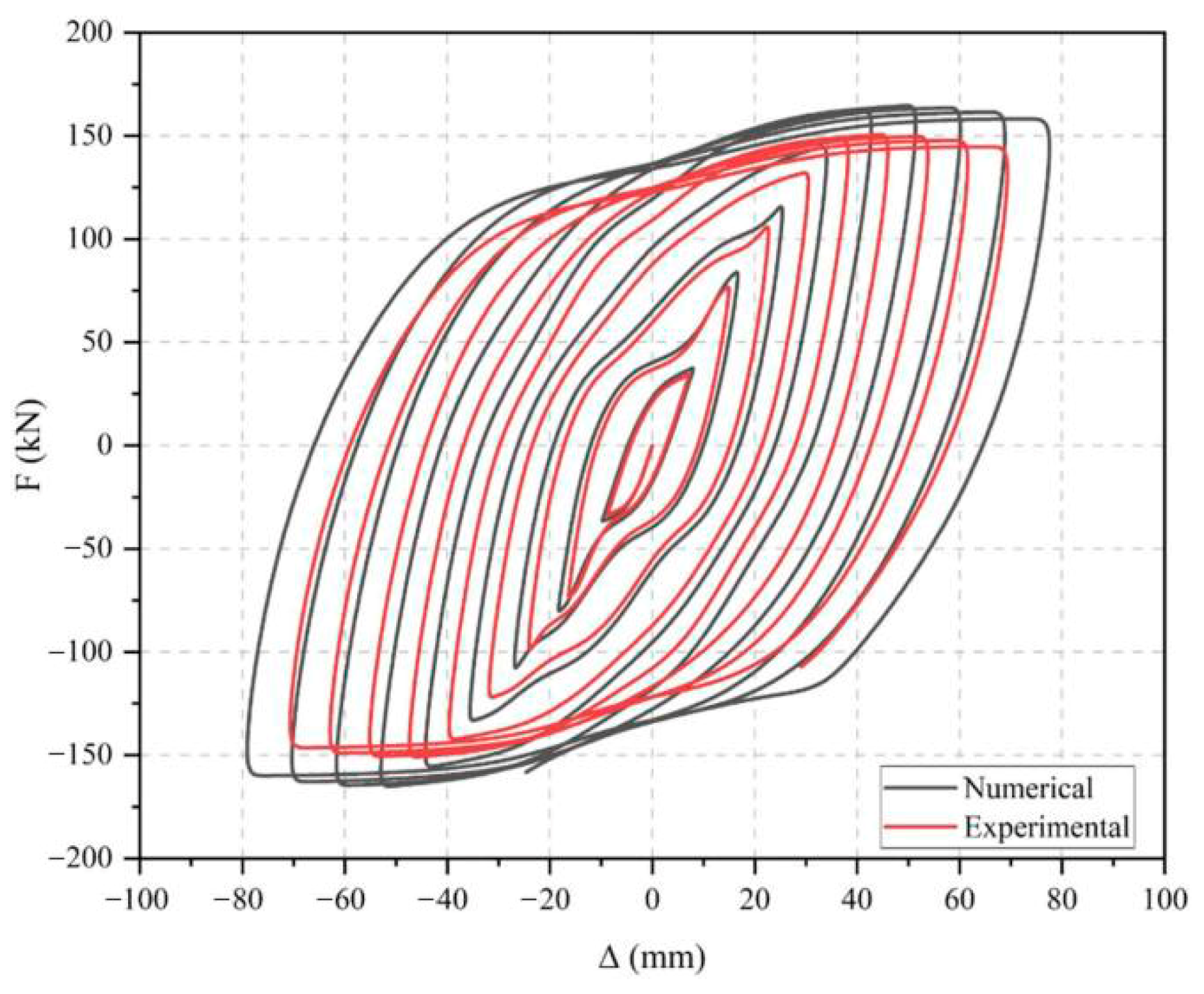
19] proposed an innovative multi-stage steel yielding damper composed of top and bottom end plates, six trapezoidal steel plates with differentiated thicknesses, filler components, and stoppers arranged between trapezoidal plates. The trapezoidal plates at both edges yielded first, followed by the central plates with higher stiffness, enabling sequential energy dissipation under varying seismic intensities. Quasi-static tests and finite element analysis results indicated that, as shown in
Figure 3, the damper’s typical hysteretic curve presents full, pinching-free loops, with the experimental (red) and numerical (black) results in excellent agreement, validating the accuracy of the finite element model. The damper exhibits a clear three-stage yielding behavior with four-stage decreasing stiffness. When integrated into the controlled soft first story system, the solution provided a cost reduction of approximately 70% compared with conventional base isolation systems, enhancing its engineering application potential.
In terms of composite plate configurations, Xin [
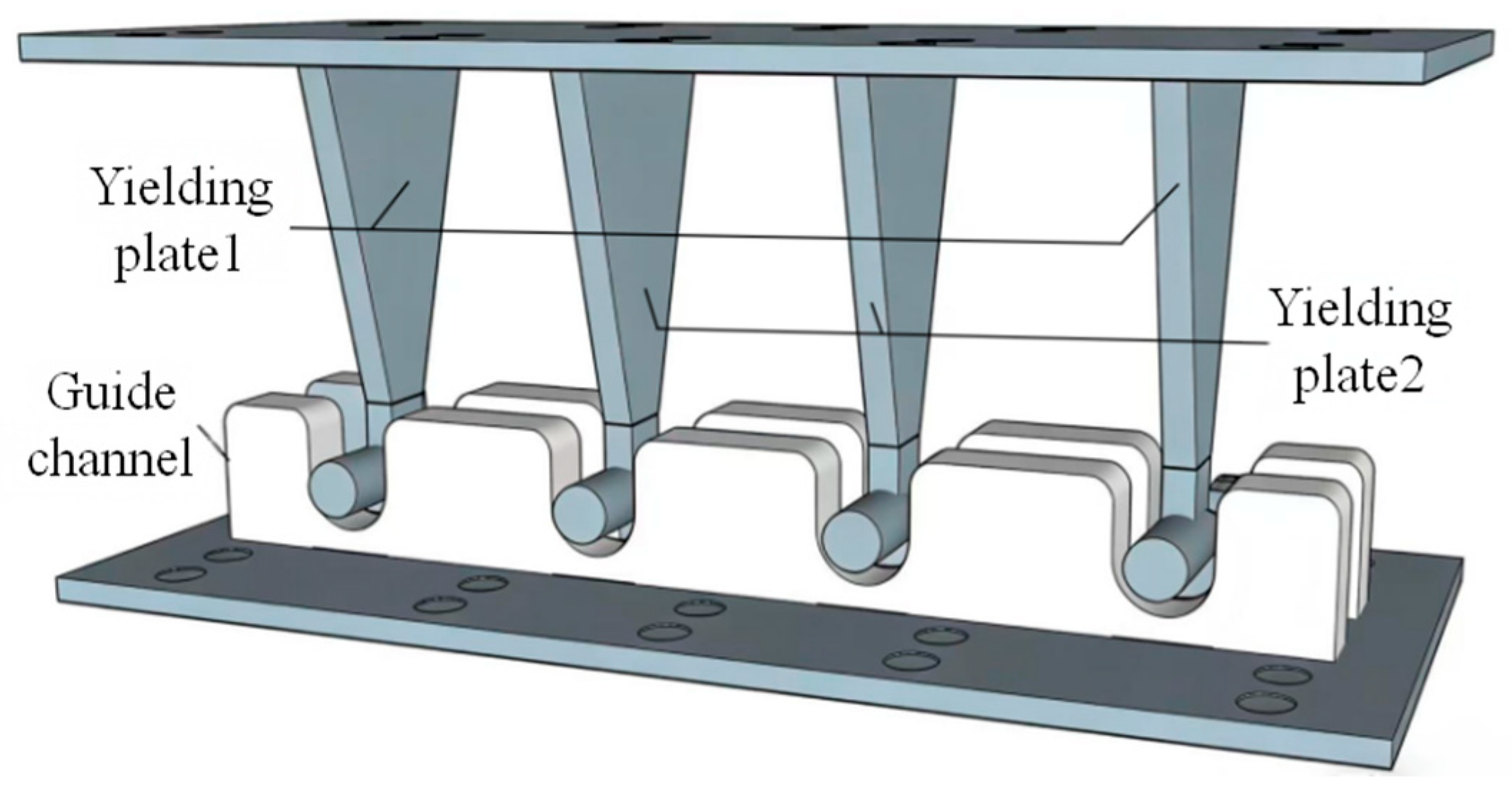
20] adopted a composite plate configuration by combining two energy-dissipating steels, i.e., LYP160 low-yield-point steel and Q345 steel plates. The three-dimensional configuration of this damper is illustrated in
Figure 4, where two sets of yielding plates (yielding plate 1 and yielding plate 2) with different yield strengths are connected to the upper and lower connecting plates, and the guide channel structure ensures unidirectional deformation of the plates to achieve sequential yielding. Quasi-static cyclic tests were performed to investigate the mechanical properties of single-plate models and the full assembly model. Results revealed that all specimens developed full and non-pinched hysteretic curves, and confirmed the superior energy dissipation capability of the proposed damper. By combining the U-shaped and X-shaped metallic plates, Wu et al. [
21] proposed a new combined bending metallic damper. Numerical analysis based on ABAQUS software demonstrated significantly improved hysteretic performance and load-bearing capacity, along with a rapid increase in the equivalent viscous damping coefficient. However, the flexibility in controlling the yield displacement required further optimization.
In practical terms, several slit and tubular dampers show good repairability and constructability, while U-shaped and combined bending members are more sensitive to manufacturing accuracy. At present, most configurations have been verified by tests and simulations to possess reliable energy dissipation capacity, but unified design indicators and standardized construction specifications for engineering applications are still insufficient, and the correlation between post-earthquake maintainability and multi-stage yield performance has not been fully discussed. For a straightforward overview,
Table 1 summarizes the advantages, limitations and application scenarios of such dampers.
2.2. Shear-Yielding Type
Shear-yielding metallic dampers dissipate energy through the plastic deformation of components such as thin steel plates or shear plates under shear force. This type of damper features a compact structural form, making it easy to arrange at structural joints or in web regions. To obtain stage-yielding, shear plates of different sizes are typically connected in series or parallel, or the yielding process is regulated through constructional measures such as altering the openings in the energy-dissipating steel plates, thereby optimizing their seismic performance.
Tagawa et al. [
22] performed six cyclic tests on a seesaw energy dissipation system integrated with steel slit dampers. They systematically investigated the influence of shear plane geometry and connection methods on energy dissipation, providing a basis for the configuration optimization of shear-type dampers. Ke et al. [
23] proposed a repairable multi-stage yielding steel slit damper by connecting two types of slotted steel plates and a rigid connecting beam in series. Q235B steel with stable plastic deformation ability was adopted to ensure reliable yielding, stable hysteretic behavior and post-earthquake repairability. Under low-level loads, the weak slit plates dissipate energy through shear deformation, while under high-level loads, both the strong and weak slit plates undergo shear deformation, exhibiting multi-stage axial resistance. Experimental results indicated that the damper possessed good energy dissipation capacity and ductility, and demonstrated excellent post-earthquake repairability. Benefiting from easy fabrication and repairability, the damper presents good cost-effectiveness for practical seismic mitigation. Bu et al. [
24] developed a restoring-force model and parameter identification procedure for shear-type metal dampers, and proposed a shear restoring-force model suitable for structural-system analysis. They also evaluated the model’s sensitivity to joint stiffness and hysteretic degradation, providing methodological support for the integrated application of such dampers in structural analysis tools like OpenSees.
Based on connecting multiple shear plates in series and parallel, Yang et al. [
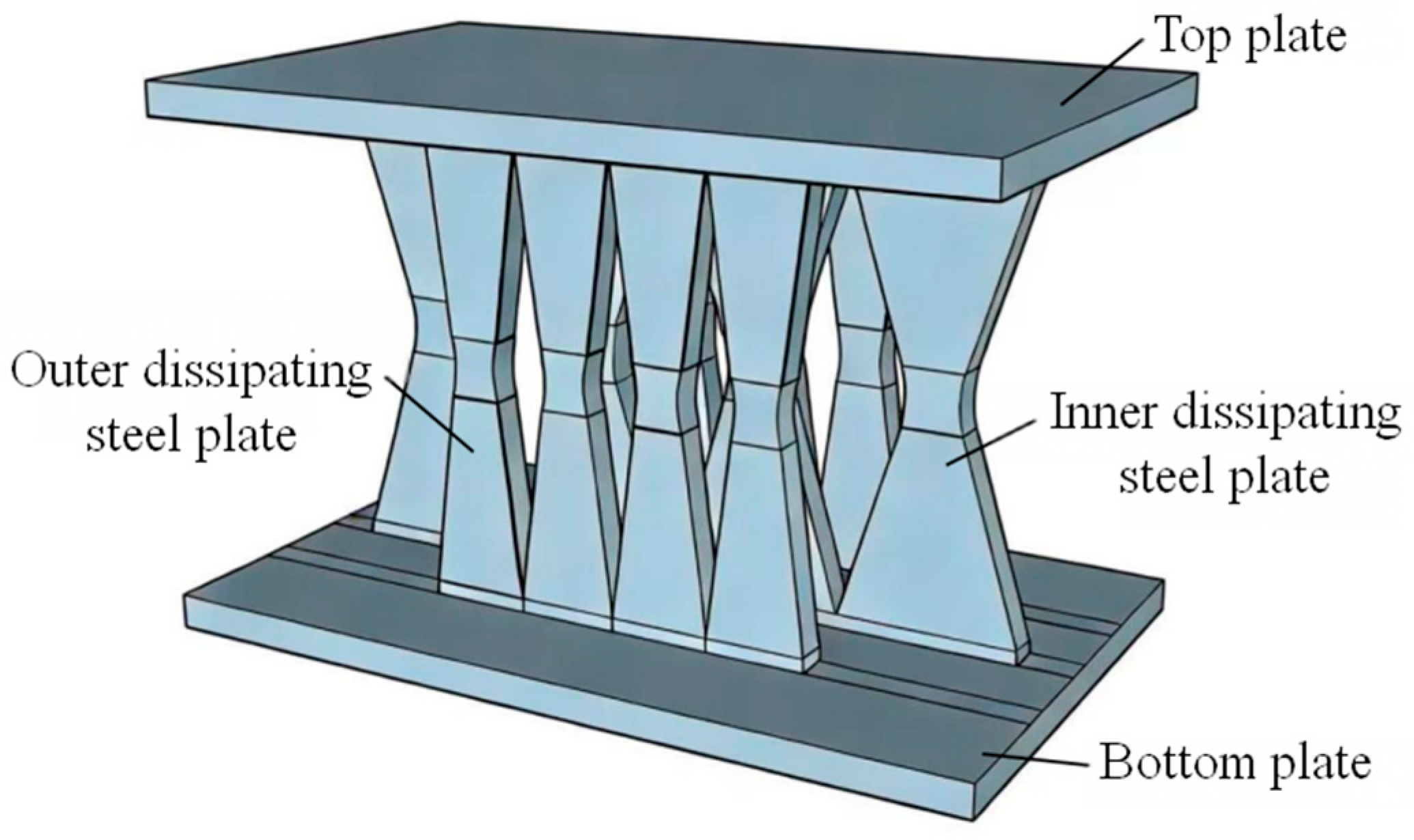
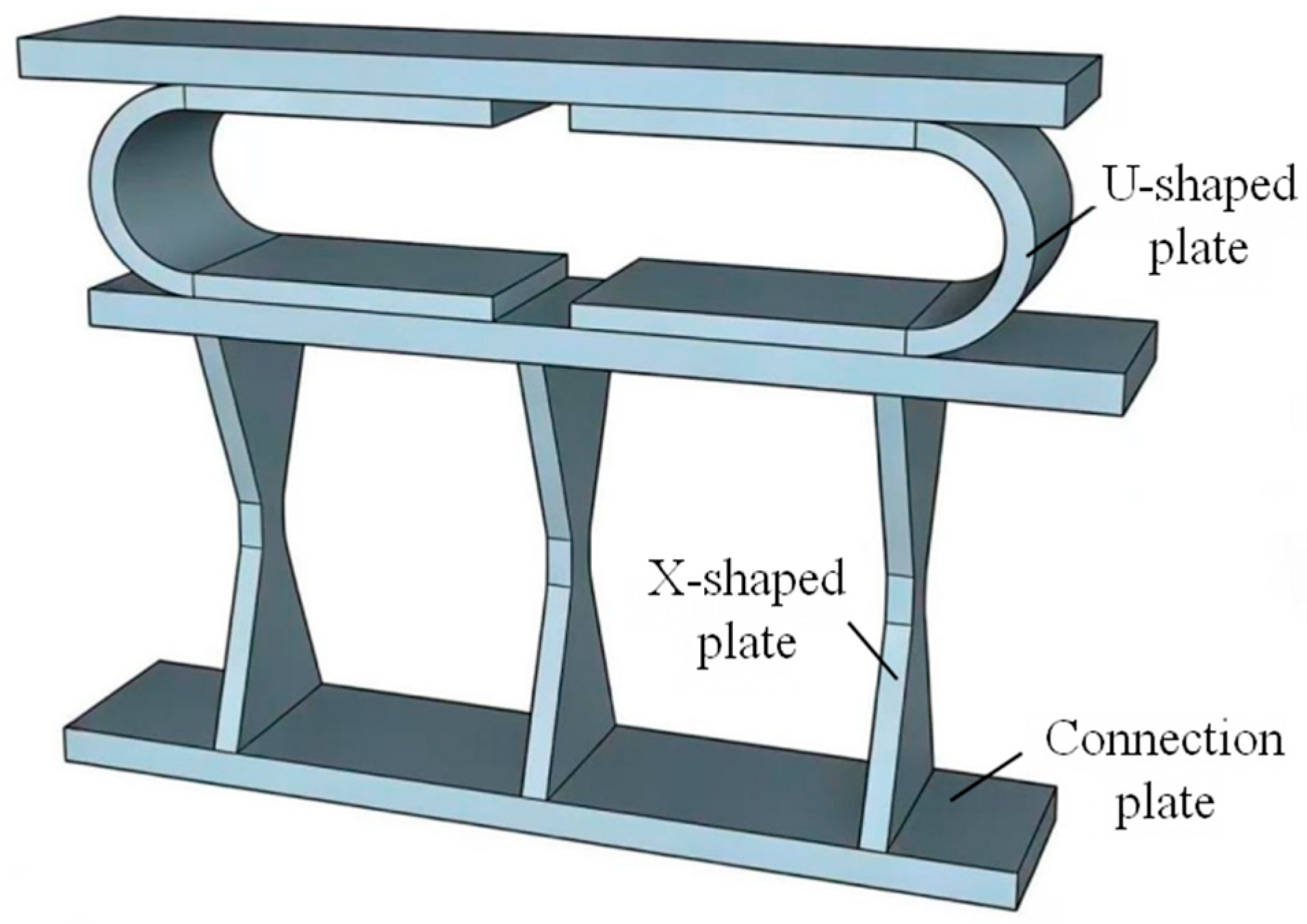
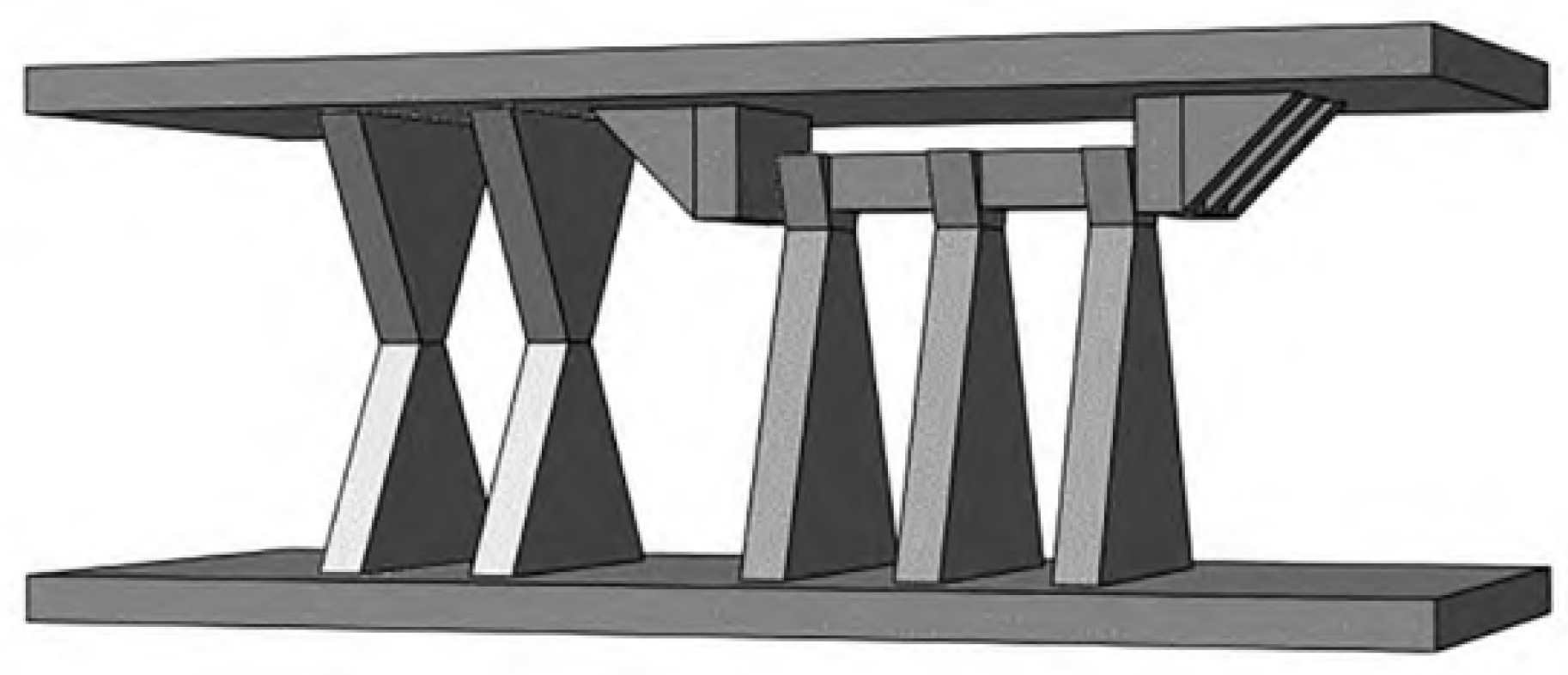
25] proposed a double-shear damper consisting of two U-shaped mild-steel plates, three X-shaped mild-steel plates arranged in series, and rigid connection plates, as shown in
Figure 5. By adjusting the geometry and material properties of each steel plate, the U-shaped elements yield first and dissipate energy during the small displacement stage, while the X-shaped plates become engaged and dissipate energy during the larger displacement stage, resulting in full and stable hysteretic curves for the damper. To promote the practical application of the staged energy dissipation concept, Yang et al. [
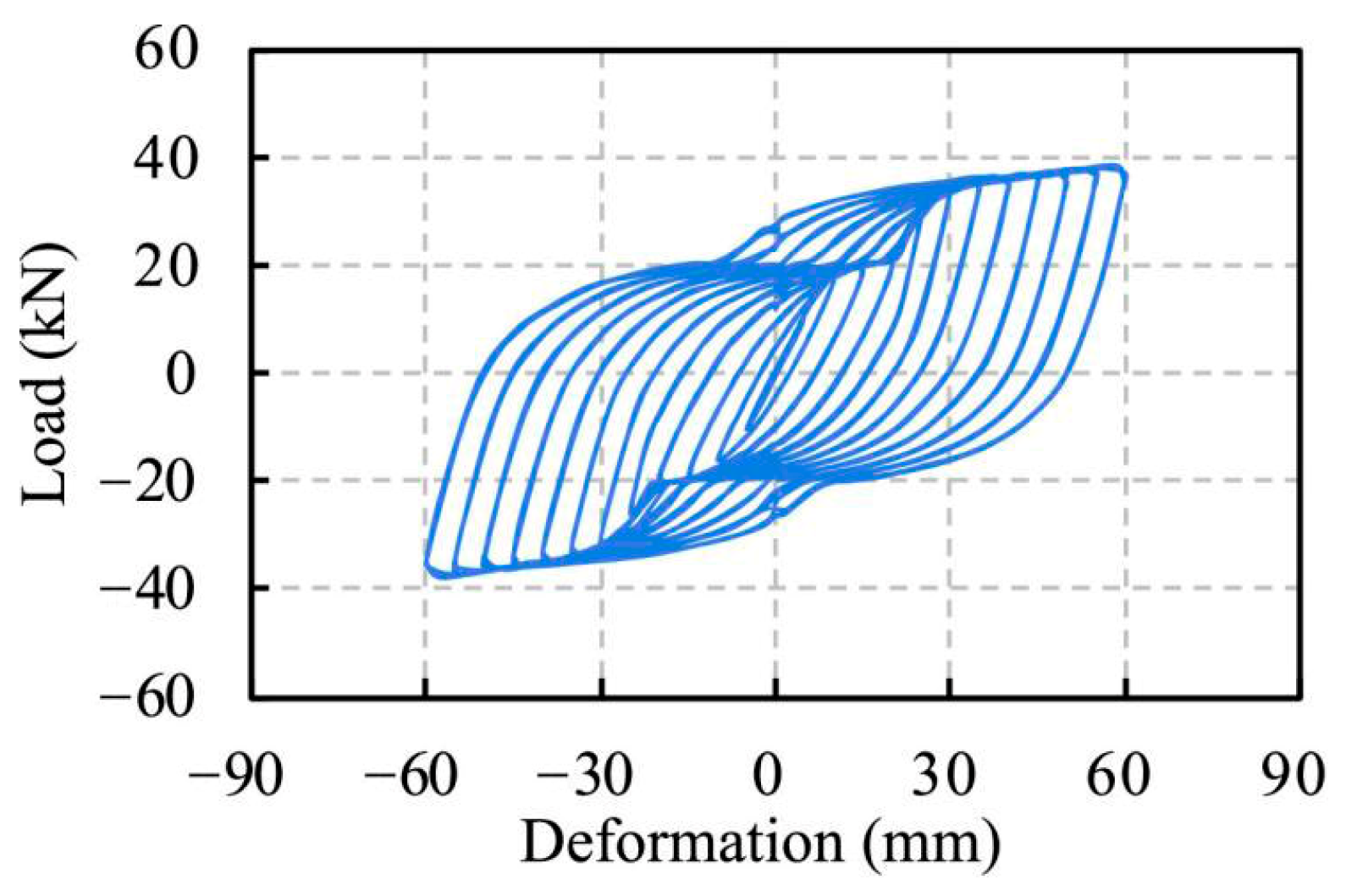
26] developed a novel parallel double-stage crawler-track-shaped shear damper (PDCSD) composed of inner and outer crawler-track-shaped steel plates in parallel, cooperating with restraining plates and a load-transfer system. The damper dissipates energy mainly through plastic yielding and hysteretic deformation of the double-stage steel plates. Low-yield-point LY225 and Q235 steel were used for the inner and outer crawler-track plates to achieve asynchronous yielding at different deformation levels, while high-strength Q345 steel was adopted for the load-transfer and restraining components to remain elastic; such material matching ensures the stable asynchronous two-stage mechanism and fatigue performance. Made of thin-walled steel plates with simple fabrication and assembly, the damper presents favorable cost-effectiveness for engineering applications. Full-scale low-cycle reversed loading tests verified that, as shown in
Figure 6, the damper exhibits full, symmetric hysteretic loops with clear two-stage yielding characteristics.
In terms of utilizing openings to achieve multi-stage yielding, Shang et al. [
27] proposed an energy dissipation device composed of two mild steel energy dissipation plates with parabolic openings of different sizes, based on the mild steel damper with parabolic openings, thereby achieving multi-stage energy dissipation. The influence of cross-sectional dimensions and opening parameters on this damper was systematically investigated through numerical simulation. The results indicated that the opening form and size were the primary factors controlling whether the device exhibited simultaneous cross-sectional yielding or stage-yielding. Building upon this work, Fan et al. [
28] designed a two-stage energy dissipation device combining parabolic perforations, low-yield-point steel, and Q235 steel, as shown in
Figure 7. The study verified that specific opening shapes can lead to fuller hysteretic curves and pronounced multi-stage energy dissipation characteristics. However, stress concentration tends to occur at the edges of the openings, necessitating the use of rounded corners and local stiffening details to improve fatigue performance.
In practical terms, shear-yielding metallic dampers feature a compact form and flexible arrangement in structural joints. Most configurations achieve stable and full hysteretic behavior through series-parallel combination or opening optimization, with satisfactory multi-stage energy dissipation capacity. Steel slit and crawler-tracked dampers exhibit good post-earthquake repairability and cost-effectiveness, whereas perforated shear dampers are prone to stress concentration around opening edges and require local stiffening measures. Although corresponding restoring-force models and analysis methods have been proposed, unified design specifications and construction guidelines for engineering practice remain insufficient, and the fatigue performance and long-term service behavior of such dampers still need further systematic study.
Table 2 summarizes the advantages, limitations and application scenarios of typical shear-yielding dampers.
2.3. Axial-Yielding Type
Axial-yielding metallic dampers dissipate energy through plastic deformation of axially loaded components under tension and compression. Typical examples include buckling-restrained axial dampers (BRADs) [
29] and buckling-restrained braces (BRBs), both of which are widely used for seismic protection and structural vibration control. On this basis, staged-yield characteristics have been developed by tailoring the configuration of yielding cores, restraining mechanisms, and load-transfer paths, leading to series-, parallel-, and hybrid-configured double-stage yield buckling-restrained braces (DYBRBs).
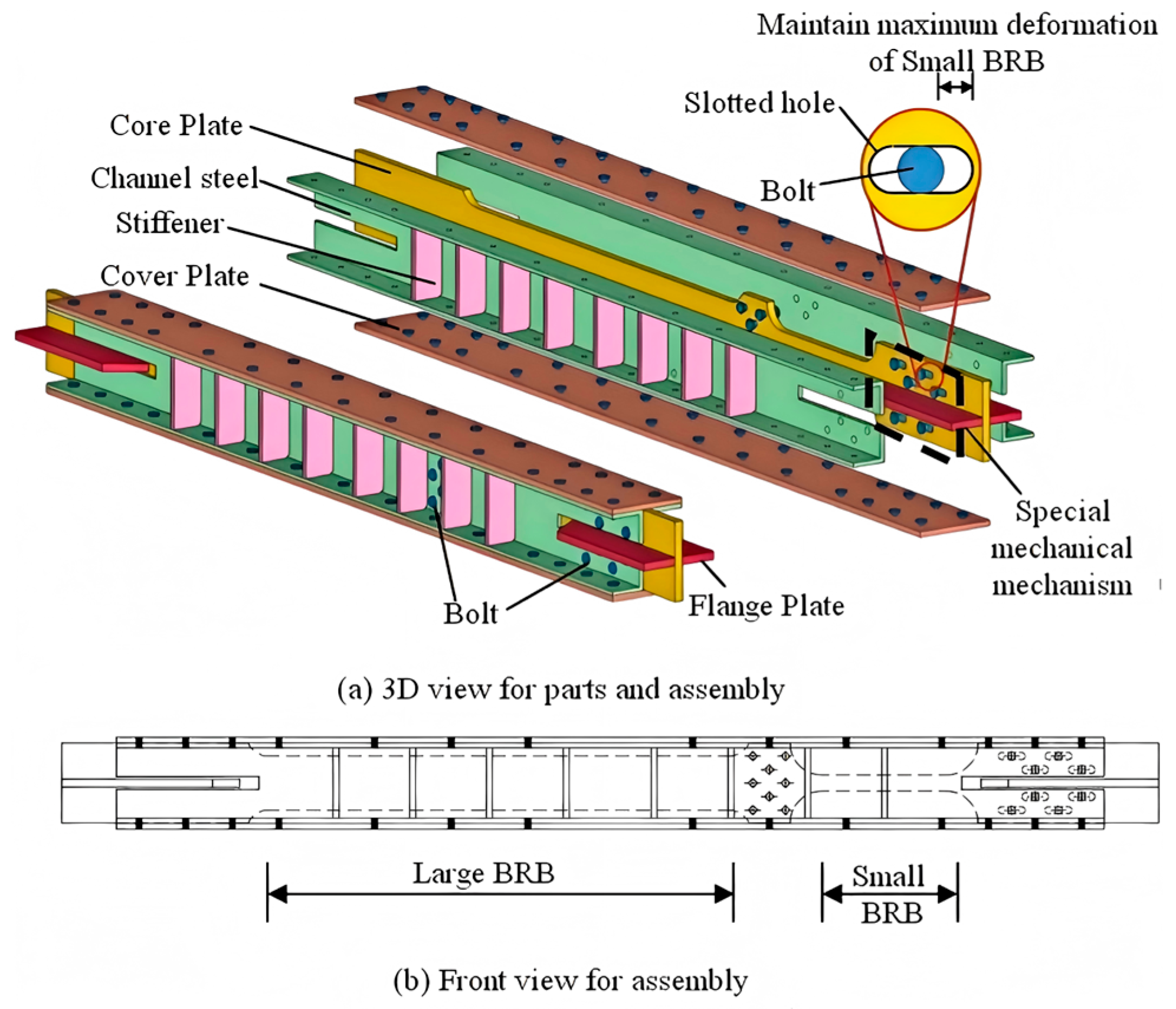
Among these staged-yield derivatives, series-configured DYBRBs represent an important research direction. They achieve staged yielding and energy dissipation by coaxially connecting BRB units with different yield strengths and sectional sizes in series, combined with a slotted-hole limiting restraint mechanism. Pan et al. [
30] proposed a double-stage yield BRB (DYB). It consists of two traditional BRBs with different yield strengths arranged in series, and a restraining mechanism with slotted holes, as shown in
Figure 8. Under external force, the maximum deformation of the smaller BRB is limited to a predetermined range. As the force increases, the restraining mechanism is activated, and the deformation of the brace is primarily concentrated in the larger BRB. Quasi-static tests on three specimens showed that this novel brace exhibited good ductility, and stable, and repeatable hysteretic behavior. On this basis, Kazemi et al. [
31] proposed a novel series system of steel slit damper-double-stage yield buckling-restrained brace (SSD-DYB), which took the shear steel slit damper as the first-stage energy-dissipating unit connected in series with DYB. The slotted-hole limit realized precise control of two-stage deformation: the slit damper yielded first to dissipate energy under minor earthquakes, greatly improving the energy dissipation efficiency at small deformations. This system featured a lightweight and replaceable core, with a fuller hysteretic curve. Xiong et al. [
32] developed a repairable double-stage yield buckling-restrained brace (RDYB) with a fully bolted assembly, where a short core plate and a long core plate with different cross-sectional widths are arranged in series and equipped with a displacement-limiting device. Q235 steel was adopted for both core and restraining components; energy-dissipating cores yield sequentially while restraining parts remain elastic, ensuring stable double-stage performance and repairability. The short core plate yields first to dissipate energy under small-to-moderate seismic actions, and the long core plate is activated to provide secondary bearing capacity once the displacement limit is reached. The core plates can be replaced individually without dismantling the external restraining plates, which significantly simplifies post-earthquake repair and reduces post-earthquake repair costs. Cyclic test results indicate that the RDYB shows stable double-stage hysteretic behavior, and its yield strengths and hysteretic performance remain almost consistent before and after core plate replacement.
Parallel-configured DYBRBs adopt multiple energy-dissipating cores with differentiated yield strengths in a parallel arrangement and synergistic force-bearing. Sitler et al. [
33] proposed a novel multi-stage BRB composed of two low-yield-point (LYP) steel energy dissipation cores with lower yield strength and shorter yield lengths, and one high-yield-point (HYP) steel energy dissipation core with higher yield strength and a longer yield length. LYP steel yields first for energy dissipation under moderate earthquakes, while HYP steel provides elastic restoring force to reduce residual drifts; the material properties are directly correlated with the staged energy dissipation and residual drift control of the damper. Key parameters, including core strength grade and yield length ratio, can accurately regulate the yielding sequence, energy dissipation efficiency and post-yield stiffness to realize the expected trilinear hysteretic behavior.
Series-configured DYBRBs tend to suffer from stress concentrations at welded joints and core splices. In contrast, parallel-configured double-stage yield BRBs (PDY-BRBs) feature more uniform force distribution and mitigated local stress concentrations, thus exhibiting superior low-cycle fatigue life over series-type counterparts. Based on the Coffin-Manson fatigue model and Miner damage index, Azizi et al. [
34] quantified the fatigue performance of PDY-BRBs with different steel cores (LYP, HSS, UHSS) and determined the minimum yielding length to avoid low-cycle fatigue fracture. The results show that shortening the LYP core length can reduce the plastic strain of the HSS core by about 20% and enhance the self-centering capacity, but significantly increases the plastic strain amplitude of the LYP core, which should be balanced in seismic design. Moreover, using continuous spacer plates and reasonable bolt spacing can effectively alleviate localized stress concentrations at the corners of the restraining system. The fully bolted assembly also delivers better long-term fatigue performance than welded connections. Azizi et al. [
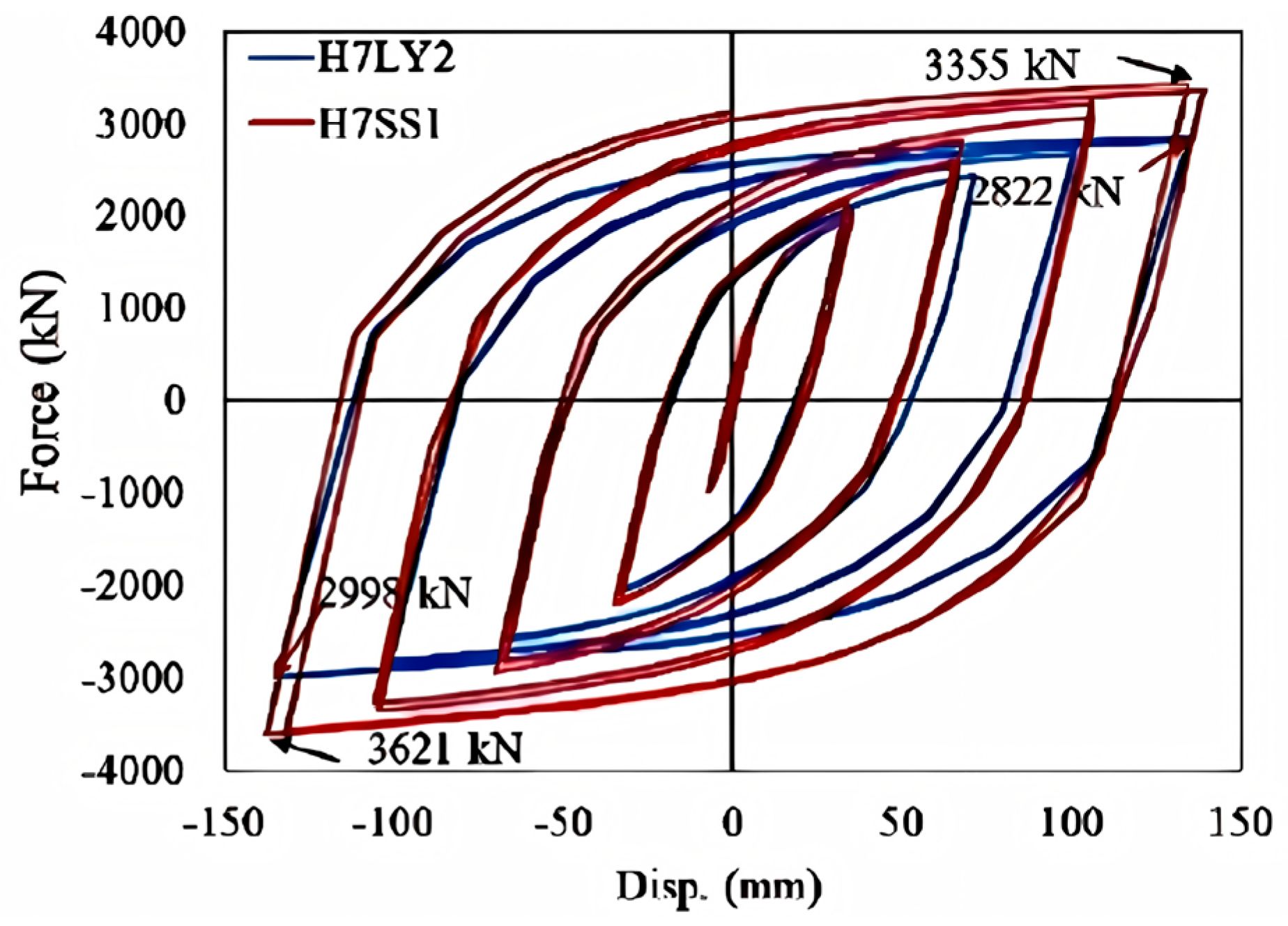
35] developed a synchronized double-stage yield buckling-restrained brace (SDY-BRB), which consists of a central LYP steel core plate and two parallel HSS tubes confined by an external restraining tube to prevent buckling. Low-yield-point (LYP) steel is used for early energy dissipation, and high-strength steel tubes provide post-yield stiffness and partial self-centering; this material combination achieves graded yielding and reduced residual drift. This synchronous parallel configuration provides favorable post-yield stiffness and partial self-centering capacity. As shown in
Figure 9, the SDY-BRB presents plump, symmetric hysteretic loops with high bearing capacity and stable post-yield stiffness. Its all-steel, mortar-free configuration brings favorable fabrication and maintenance cost-effectiveness, effectively improving structural seismic resilience. Yang et al. [
36] developed a new parallel double-stage yielding buckling-restrained brace (PDYBRB) consisting of a parallel core system, a load-transfer system and a restrainer system, where the first-stage core and two second-stage cores are arranged in parallel and activated asynchronously. The load-transfer system adopts slotted holes on the second-stage cores and load-transfer bolts fixed to the first-stage core to realize the staged activation of the two cores, and the restrainer system with in-plane and out-of-plane constraints and PTFE low-friction plates effectively prevents buckling of the core system. Theoretical equations for the skeleton curve and load-transfer bolts were derived, and full-scale cyclic tests verified that the PDYBRB exhibits a clear four-segment skeleton curve and stable, full hysteretic behavior without strength or stiffness degradation.
Wu et al. [
37] developed a multi-stage yield and failure metal sleeve damper (MMD) with a perforated outer steel tube, which is a typical axial-yielding multi-stage damper with a hollow/plated configuration; it adopts a series-parallel hybrid layout where the inner tube, outer tube and energy dissipation modules are connected in series and the steel strips are in parallel, achieving dual-stage energy dissipation by using steel strips with different aspect ratios that yield sequentially under earthquakes of different intensities. Obvious local stress concentrations occur at the ends of the energy dissipation steel strips, which are the critical parts controlling fatigue failure, and the aspect ratio of steel strips dominates the low-cycle fatigue performance—strips with a small aspect ratio have worse fatigue resistance and fail earlier while those with a large aspect ratio show better fatigue durability; besides, using low-yield-point steel (LYP160) can significantly improve the fatigue ductility, as the displacement ductility coefficient of LYP160-based MMD (67.25) is 2.46 times that of Q235B-based MMD (27.33), and the multi-stage failure mechanism avoids the simultaneous fracture of all components, effectively enhancing the long-term cyclic fatigue performance of the multi-stage damper.
Axial-yielding metallic dampers dissipate seismic energy via plastic deformation of axially loaded members, with staged yielding achieved through the design of yielding core layouts, restraining mechanisms and load-transfer paths. Series-configured DYBRBs exhibit sequential yielding with a distinct stepwise skeleton curve, while parallel-type counterparts provide higher initial stiffness, fuller hysteretic loops and superior residual-drift control; hybrid configurations further combine the merits of both forms to improve ductility, replaceability and post-earthquake resilience. Represented by DYBRBs, such dampers feature high bearing capacity and stable hysteretic behavior, and bolted assemblies with replaceable cores effectively enhance their post-earthquake repairability, yet issues including fatigue performance under cyclic loading and yield-threshold matching still require further optimization.
Table 3 summarizes the advantages, limitations and application scenarios of typical axial-yielding dampers.
2.4. Shear-Flexural Combined Yielding Type
Shear-flexural combined yielding type metallic dampers achieve a multi-stage energy dissipation mechanism through serial, parallel, or coupled integration of shear-yielding and bending-yielding components. These dampers are characterized by shear yielding prior to bending yielding or synergistic shear-flexural action. This enables them to balance energy dissipation efficiency and maintain stable cyclic performance under varying seismic intensities.
Cheng et al. [
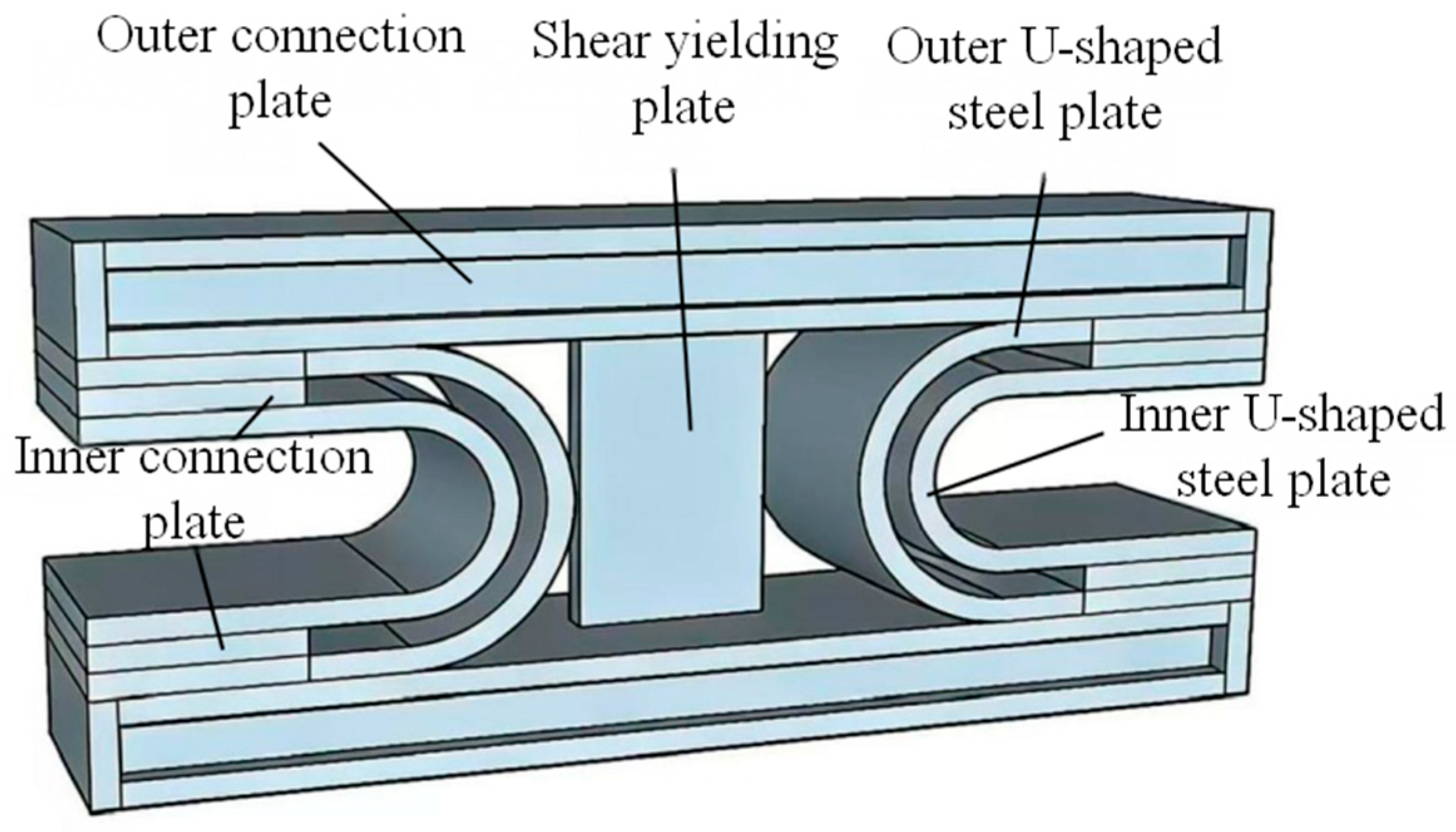
4] proposed and refined the three-stage yielding design concept, and then developed a multi-stage energy-dissipating damper by combining shear yielding rectangular plates with inner and outer U-shaped bending steel plates, integrated by inner and outer connection plates, as clearly illustrated in
Figure 10. Finite element analysis showed that the damper exhibited sequential yielding of individual energy-dissipating components, resulting in full hysteretic curves and enhanced energy dissipation capacity under different seismic intensities. Zhang et al. [
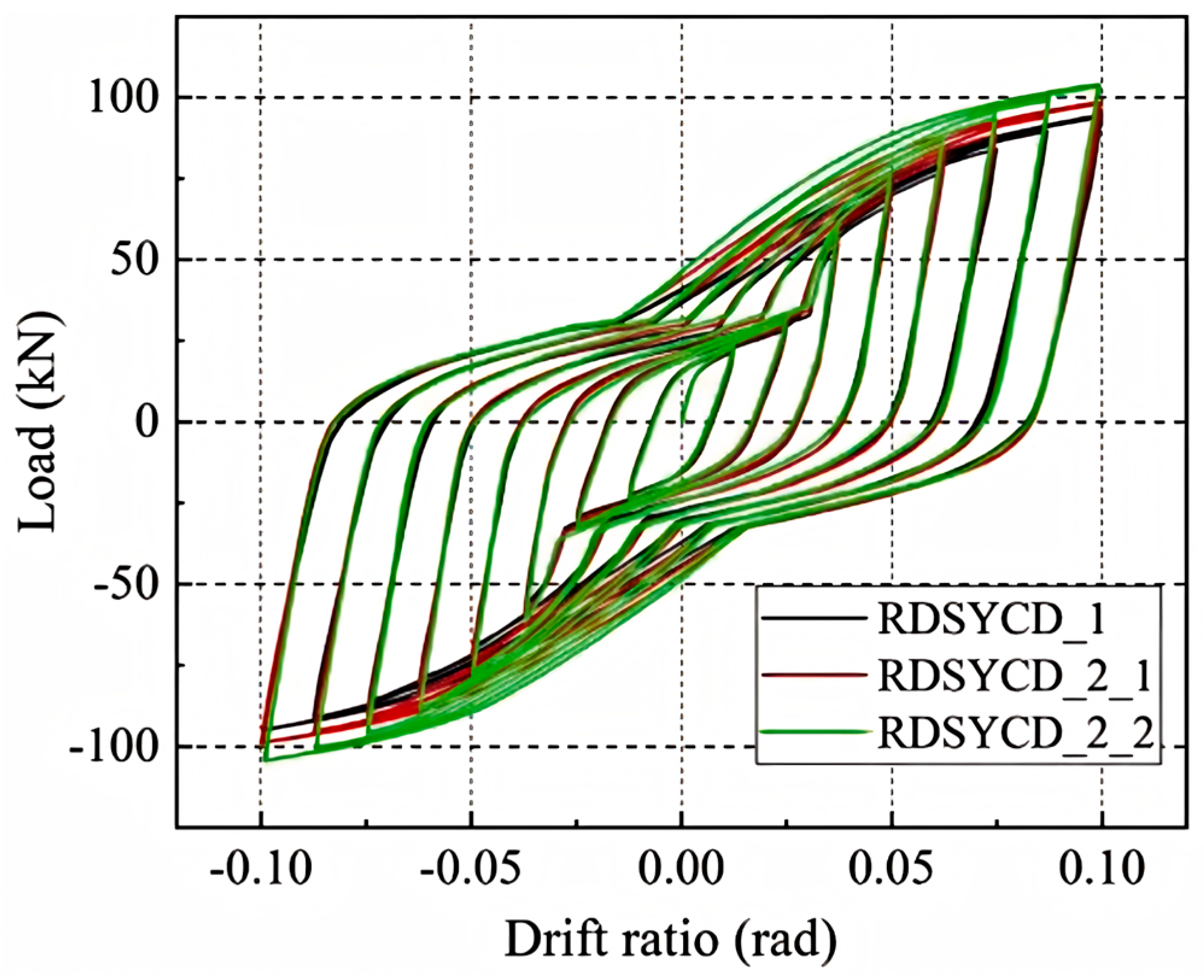
38] proposed an enhanced dual-stage yielding hybrid damper, consisting of U-shaped dampers (UDs) coupled with steel slit dampers (SSD). Q235 structural steel was adopted for all components, selected for its stable yield strength and favorable plastic deformability, which ensures the sequential yielding behavior and stable energy dissipation of the damper. Initially, the primary assembly dissipated energy while the secondary remained elastic as bolts slid in slotted holes. When the bolts reach the holes’ ends, the secondary component is triggered and works collaboratively with the primary assembly for combined energy dissipation. As shown in
Figure 11, the damper exhibits full, stable hysteretic loops with clear dual-stage yielding characteristics across different design configurations. Mechanical performance analysis conducted using finite element models established in ABAQUS and OpenSees demonstrated that the damper possesses stable and excellent energy dissipation capacity. Benefiting from widely available Q235 steel and bolted assembly, the damper features favorable cost-effectiveness for engineering applications. Yang et al. [
39] developed a bending-shear combined graded-yield damper by augmenting a conventional curved steel-plate damper with mild-steel rods. Finite-element analyses indicated that, compared to traditional configurations, the stiffness and multi-stage energy dissipation capacity of the shear-flexural combined damper were effectively enhanced. However, its energy dissipation capacity was significantly influenced by the rod diameter and the radius and thickness of the arc-shaped plates.
To address the issue of indistinct stage-yielding effects in some configurations, Yu and Chen [
40] proposed a novel graded yielding metallic damper mainly composed of X-shaped and triangular energy-dissipating steel plates, along with a baffle. By adjusting the gap between the triangular plates and the baffle, combined with the different stiffness and yield displacement of the two types of energy-dissipating steel plates, two-stage yielding is achieved, as shown in
Figure 12. Test results demonstrated that the bearing capacity in the second stage is significantly higher than that in the first stage, with stable mechanical performance and evident graded energy dissipation. To ensure orderly realization of stage-yielding, Zhang et al. [
41,
42] developed a buckling-restrained graded yielding metal damper. By installing buckling-restrained plates on both sides of the shear energy dissipation plates and symmetrically arranging K-shaped flexural elements, the yield displacement of different energy dissipation plates is regulated to achieve stage-yielding. Cyclic tests and finite element analysis indicated that the buckling-restraining plates effectively suppressed out-of-plane buckling deformation of the shear energy dissipation plate, inducing higher-mode buckling deformation. This improved the damper’s load-bearing capacity, rendered the stage-yielding characteristics more pronounced, and resulted in better energy dissipation capacity.
Shear-flexural combined yielding metallic dampers achieve multi-stage energy dissipation by integrating shear-yielding and flexural-yielding components, typically featuring sequential or synergistic shear-flexural action to balance energy dissipation efficiency and cyclic stability under different seismic intensities. Most configurations, such as shear-flexural serial-parallel combinations and anti-buckling graded-yield designs, exhibit clear staged yielding, full hysteretic behavior and favorable cost-effectiveness due to the use of common Q235 steel and bolted assembly. However, some configurations have indistinct stage-yielding effects, and their performance is highly sensitive to geometric parameters (e.g., rod diameter, arc plate size) and anti-buckling design details. Although finite element analysis and cyclic tests have verified their mechanical performance, unified design specifications for engineering applications are still lacking, and the influence of component matching on long-term fatigue performance needs further exploration.
Table 4 summarizes the advantages, limitations and application scenarios of typical shear-flexural combined yielding dampers.
3. Stage-Friction Dampers
Friction dampers, characterized by high energy dissipation efficiency, have become a research hotspot among damping devices and have been implemented in practical engineering applications [
43]. Multi-stage friction dampers typically establish a graded energy dissipation mechanism by adjusting bolt preload or modifying friction interface geometry, enabling sequential activation of energy-dissipating units under seismic loading. This design significantly enhances energy dissipation capacity and improves adaptability to varying earthquake intensities [
44].
From the mechanical characterization perspective, multi-stage friction dampers follow a hybrid elastic-Coulomb friction constitutive model based on classical Coulomb friction theory. The force–displacement relationship is governed by a piecewise analytical mathematical model, where the damping force is determined by the friction coefficient, number of friction surfaces, and bolt preload, expressed as Equation (2) for series-configured dual-stage friction dampers [
45].
where F is the output force of the friction damper, m is the number of friction surfaces, n is the number of bolts, f
pre is the preload force of the high-strength bolts, and μ is the kinetic friction coefficient of the flat surface device.
For rotational two-level friction dampers, the staged force is further calibrated by moment equilibrium and lever amplification mechanisms [
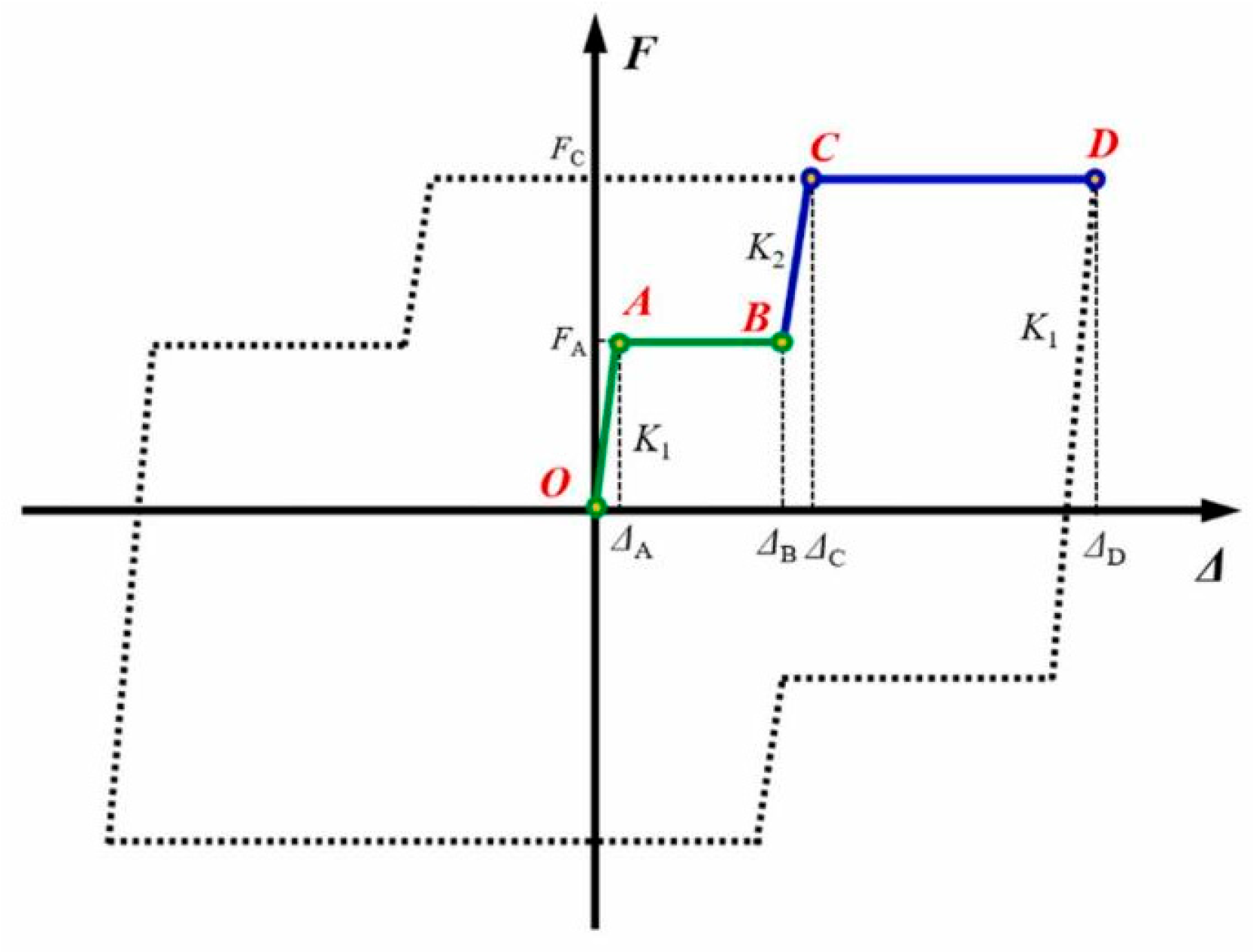
46]. As illustrated in
Figure 13, the skeleton curve exhibits a typical dual-platform rectangular shape with two distinct sliding force levels (F
A for the first-stage unit, F
C for the second-stage unit), corresponding to the sequential activation of energy-dissipating components. Stiffness evolves from a high initial elastic stiffness K
1 before sliding to nearly zero post-sliding stiffness at each stage, showing obvious staged degradation, with the second-stage stiffness K
2 activated after the first-stage yielding. The stage activation thresholds are quantitatively controlled by two key parameters: the preset angular gap and corresponding initial displacement u
ini for rotational dampers, and the differential bolt preload and sliding displacement for series dual-stage dampers, which realize orderly switching between energy dissipation stages.
Yang et al. [
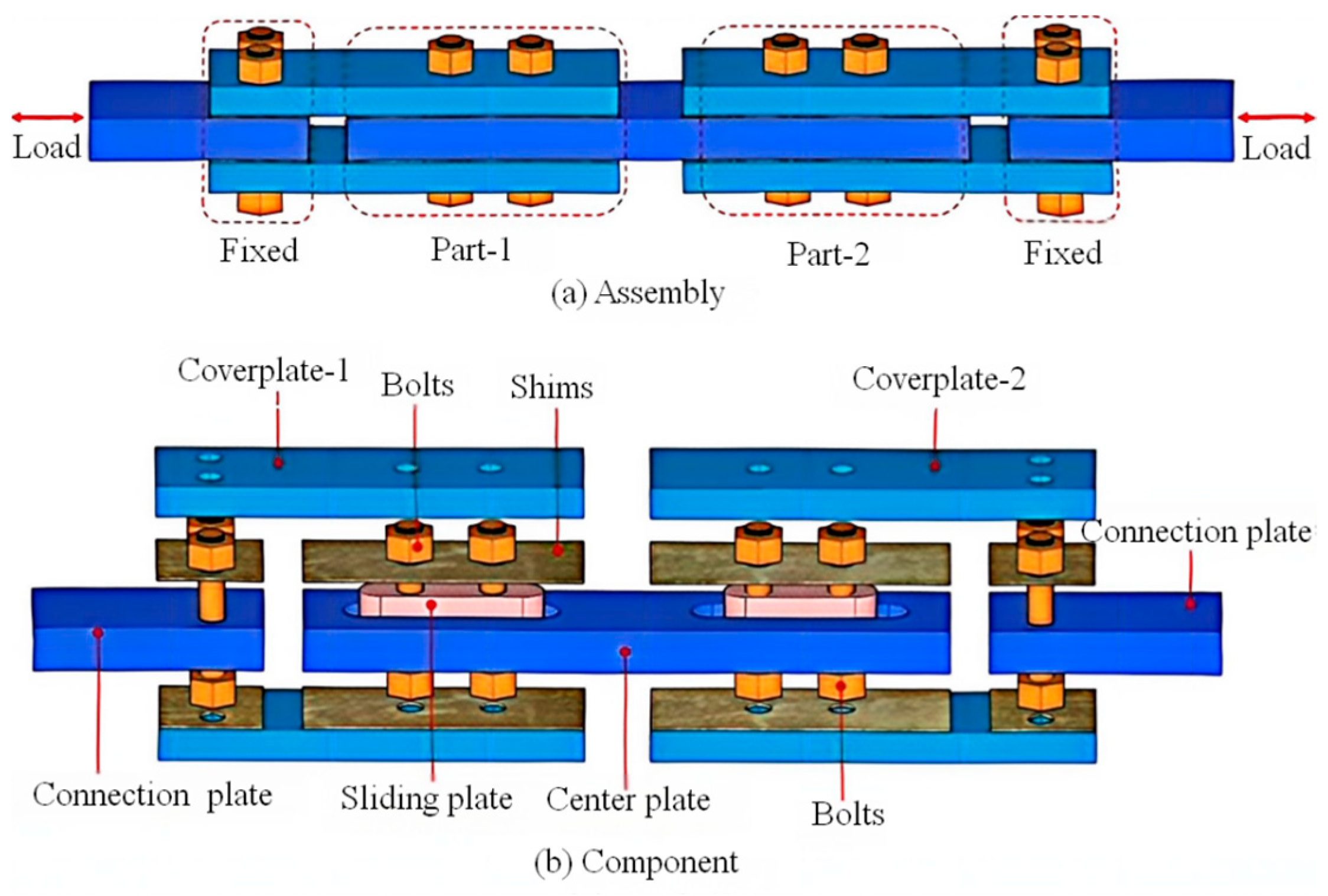
45] designed a dual-stage friction damper by connecting two friction elements with different preload levels in series, as shown in
Figure 14. Tests and finite-element analyses indicated that this innovative damper produced a stable hysteretic response and exhibited distinct dual-stage energy dissipation characteristics, providing a promising approach to multi-stage energy dissipation technology. Huang et al. [
46] proposed a novel rotational dual-stage friction damper, which achieves dual-stage energy dissipation characteristics through the gap between the rotating plate and inner plate, and utilizes a lever mechanism to amplify the bearing capacity and increase the deformation for higher energy dissipation efficiency. Experimental studies on six specimens demonstrated that the novel damper possessed stable hysteretic behavior and excellent dual-stage energy dissipation capacity. Subsequently, Huang et al. [
47] further optimized the welded connection between the damper end plate and connecting plate. By incorporating slotted holes in the end plate design, connection slippage and stress concentration were effectively suppressed, while axial tensile forces in the damper were prevented, significantly improving the energy dissipation capacity. Regarding variable friction, Huang et al. [
48] proposed a variable friction damper that integrates dual-stage energy dissipation with adjustable stiffness characteristics. This damper consists of flat steel plates, slotted steel plates, high-strength friction bolts, and disk springs, with the primary friction surface provided by non-asbestos organic friction pads and steel friction plates. Series tests on two specimens revealed that increasing the bolt preload significantly enhances the friction force in the flat segment, while increasing the slope angle and the stiffness of the disk spring assembly substantially improves both overall stiffness and friction resistance in the slope segment.
In terms of self-centering multi-stage energy dissipation, Li et al. [
49] developed a two-stage self-centering friction damper that integrates staged frictional energy dissipation with self-centering capabilities. Research results demonstrated that the novel damper exhibited stable dual-stage hysteretic characteristics with negligible residual displacement and could provide effective energy dissipation for structures under moderate and minor earthquakes. Yang et al. [
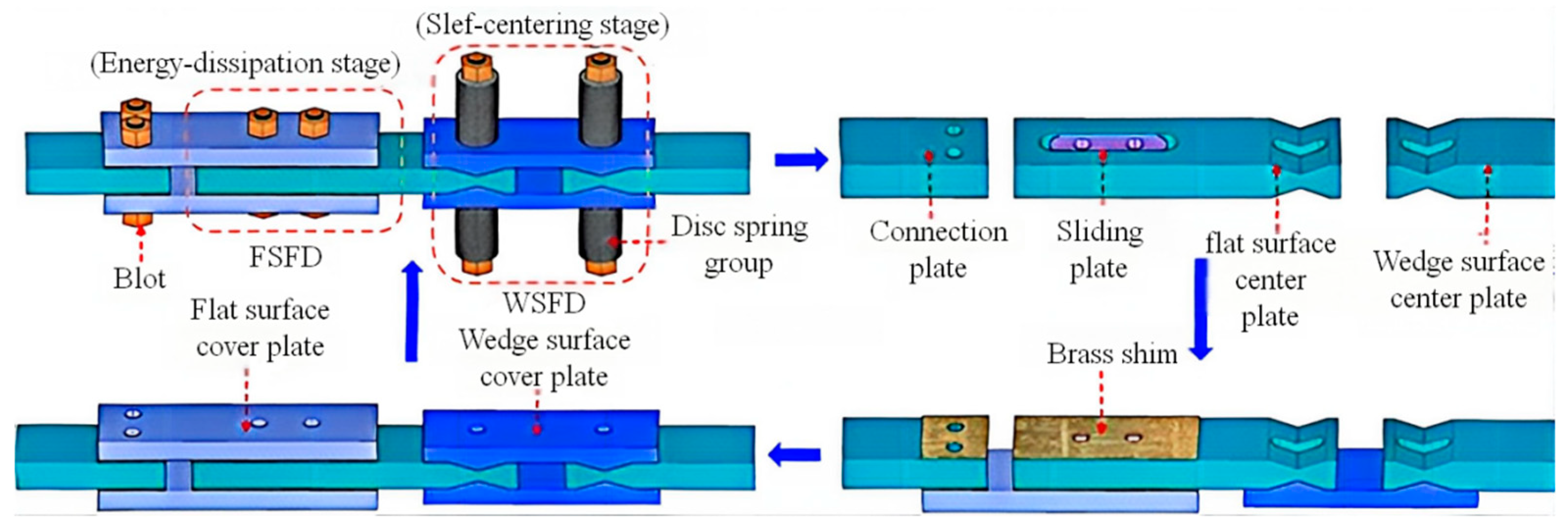
50,
51] developed a dual-stage friction self-centering damper by connecting a flat-surface friction device (FSFD) and a wedge-surface friction device (WSFD) in series, incorporating a self-centering component, as shown in
Figure 15. In the initial stage, the FSFD provides the majority of energy dissipation, while at greater demands, the wedge-surface friction device, together with the self-centering component, contributes additional dissipation and delivers the self-centering action. Research results demonstrated that adjusting the friction coefficient and the bolt preload effectively regulates the damper’s energy dissipation capacity and self-centering performance. Bai et al. [
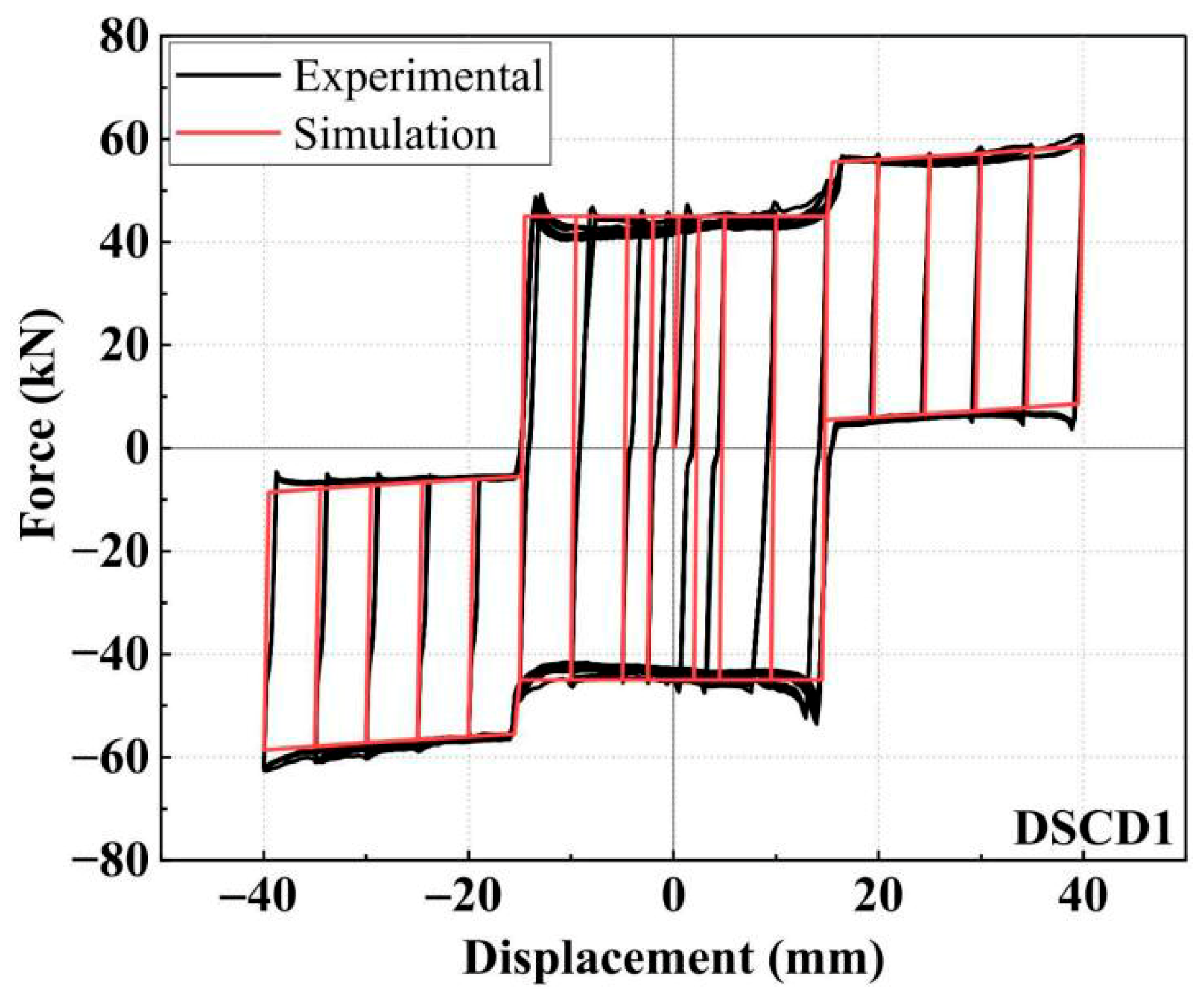
52] proposed a dual-stage friction self-centering damper composed of a conventional friction damper and a nitrogen-gas-spring-assisted self-centering friction unit, arranged in series with an adjustable slip gap between them. NM450 wear-resistant steel and sheet brass were adopted for friction interfaces to ensure stable energy dissipation, Q355 steel for structural components, and nitrogen gas springs (NGS) for self-centering to provide a stable restoring force without initial precompression. As shown in
Figure 16, the damper exhibits distinct two-stage hysteretic behavior (rectangular loop in the first stage and flag-shaped loop in the second stage) with consistent experimental and simulation results. Experimental studies indicated that this damper exhibited full hysteretic curves and strong energy dissipation capacity, while achieving reliable self-centering capability after major earthquakes. Benefiting from the low-cost NGS instead of expensive SMA or disk springs, the damper shows significant cost advantages and high cost-effectiveness.
Stage-friction dampers are featured with high energy dissipation efficiency, and their multi-stage energy dissipation is mainly achieved by adjusting bolt preload or optimizing friction interface geometry. Typical configurations include series dual-stage, rotational dual-stage and self-centering dual-stage types, which all exhibit stable hysteretic behavior and distinct staged energy dissipation characteristics. Some self-centering designs can effectively reduce residual displacement and have cost advantages, while the performance of such dampers is highly sensitive to bolt preload, friction coefficient and geometric parameters. In addition, connection slippage and stress concentration are common problems, and unified design specifications and engineering application guidelines for stage-friction dampers are still lacking.
Table 5 summarizes the advantages, limitations and application scenarios of typical stage-friction dampers.
4. Metal-Friction Hybrid Dampers
Metallic dampers exhibit advantages such as a clear energy dissipation mechanism and stable hysteretic performance. However, they suffer from excessive initial stiffness or excessive yield displacement, limiting their energy dissipation capacity during low-to-moderate seismic events. In contrast, friction dampers exhibit stable energy dissipation under small displacements but face challenges in dynamically adjusting friction forces, hindering their adaptation to different seismic intensities [
53]. Metal-friction hybrid dampers realize sequential activation and synergistic energy dissipation by regulating the parameter-matching relationship between metal energy-dissipating units and friction energy-dissipating units. This design accommodates energy dissipation requirements.
From the mechanical and analytical perspective, metal-friction hybrid dampers adopt a coupled constitutive model that integrates the bilinear elastoplastic behavior of metallic yielding components and the Coulomb friction constitutive relation of sliding interfaces. The force–displacement relationship follows a piecewise analytical mathematical model derived from the superposition of the metallic resisting force and friction force, expressed as Equation (3), where the friction force Equation (4) is governed by bolt preload, friction coefficient and contact area [
54], and the metallic force F
m follows the trilinear yielding rule of buckling-restrained cores or slit steel plates [
55].
where F(u) is the total resisting force of the hybrid damper; F
m(u) is the metallic yielding resisting force; F
f(u) is the friction sliding force; n
b is the number of bolts; μ is the sliding coefficient, calibrated as 0.3 in the test; and P
b is the bolt pre-tightening force.
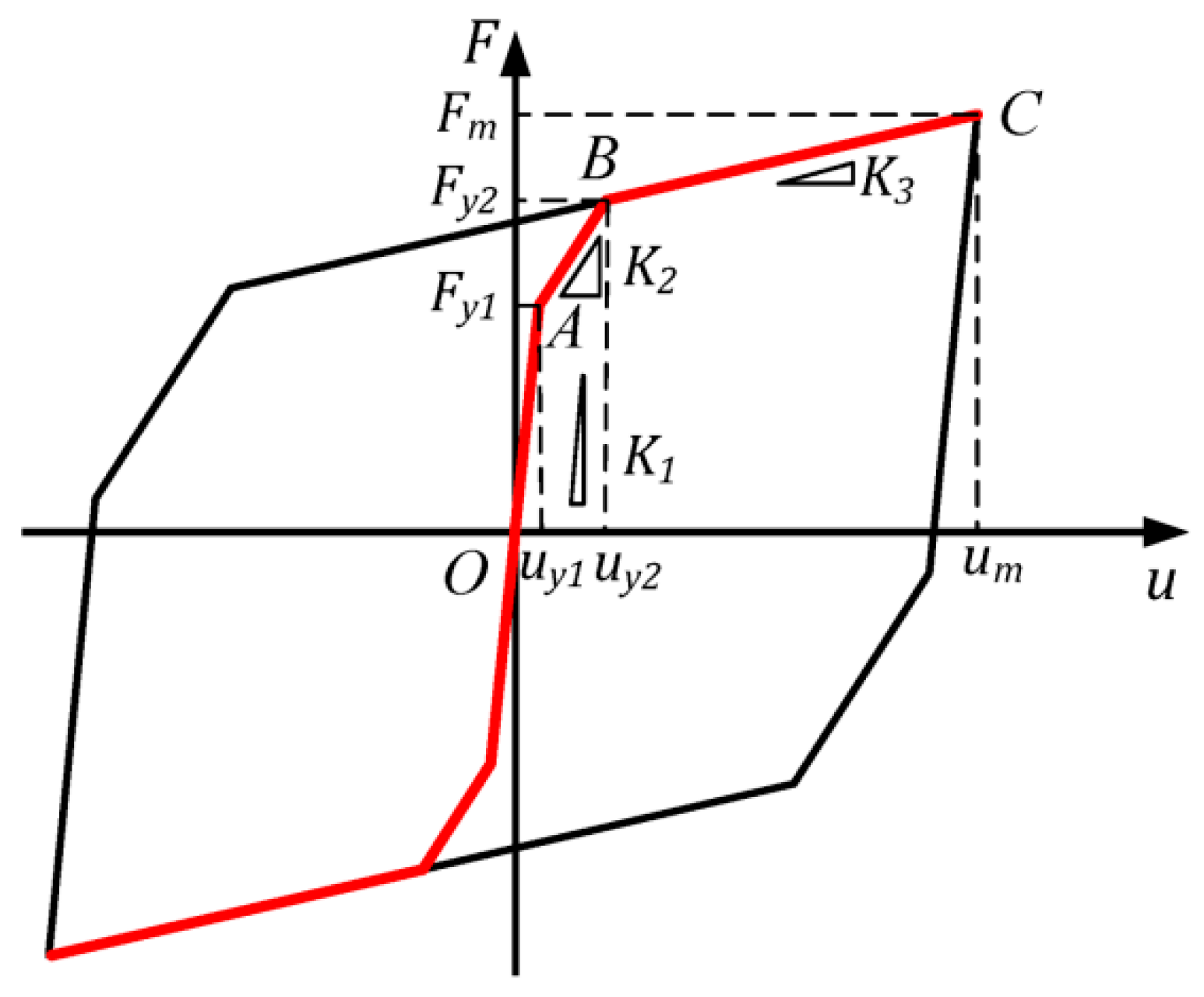
As illustrated in
Figure 17, the typical tri-linear skeleton curve of metal-friction hybrid dampers visually presents three distinct sequential segments corresponding to different working stages: (1) an initial elastic segment (OA) with stiffness K
1, where the damper behaves elastically and the total stiffness is contributed jointly by metallic units and friction interfaces; (2) a frictional sliding plateau (AB) with a nearly horizontal force level at F
y1, where the friction unit is activated to dissipate energy, resulting in a significant stiffness degradation; and (3) a combined yielding-friction strengthening segment (BC) with post-yield stiffness K
3, where the metallic core yields plastically while the friction unit continues to work synergistically, leading to an increase in load-bearing capacity up to the maximum force F
m at
um [
56]. The stage activation thresholds are analytically determined by two key parameters: the preset sliding displacement controlled by slotted-hole clearance or bolt gap, and the yield displacement of metallic components calibrated by cross-sectional area and material strength, ensuring sequential energy dissipation under small-to-large seismic demands.
Based on the research results of traditional bending or shear metallic dampers, Zhou et al. [
57] combined low-carbon steel with friction elements to propose a hybrid steel yielding-friction energy dissipator. This device exhibited three-stage working characteristics: providing stiffness primarily during minor earthquakes, activating friction units for energy dissipation during moderate earthquakes, and engaging metallic rings in yielding for energy dissipation during major earthquakes. Based on this three-stage response, the authors proposed a corresponding tri-linear restoring-force model, providing theoretical support for structural seismic analysis. Lee et al. [
58,
59] developed a hybrid damper combining a non-uniform steel strip damper with a friction element and performed quasi-static tests. The research showed that the damper had a stable hysteretic response, and the energy-dissipating units could be activated in stages as expected. However, the effectiveness still needs further verification in full-scale frame structural tests. Duan et al. [
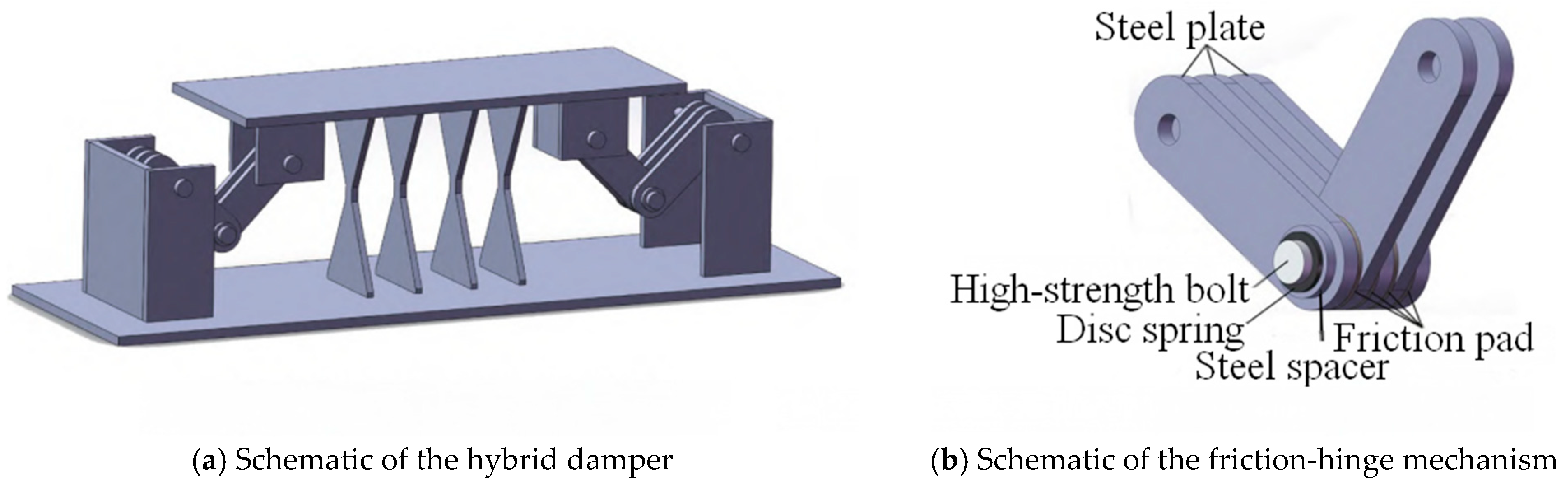
60] developed a composite energy dissipation damper by combining identical X-shaped flexural steel plates with dual friction hinge dampers, as illustrated in
Figure 18 ((a) overall schematic of the hybrid damper, (b) detailed schematic of the friction-hinge mechanism). During low-intensity seismic demands, the friction damper dissipates energy while the metal yielding unit remains elastic; under moderate and high seismic demands, both components contribute to energy dissipation. Experimental results indicated that this device exhibited staged energy dissipation behavior while retaining high load-bearing capacity and a substantial reserve of energy dissipation capacity under major earthquakes. Ke et al. [
55,
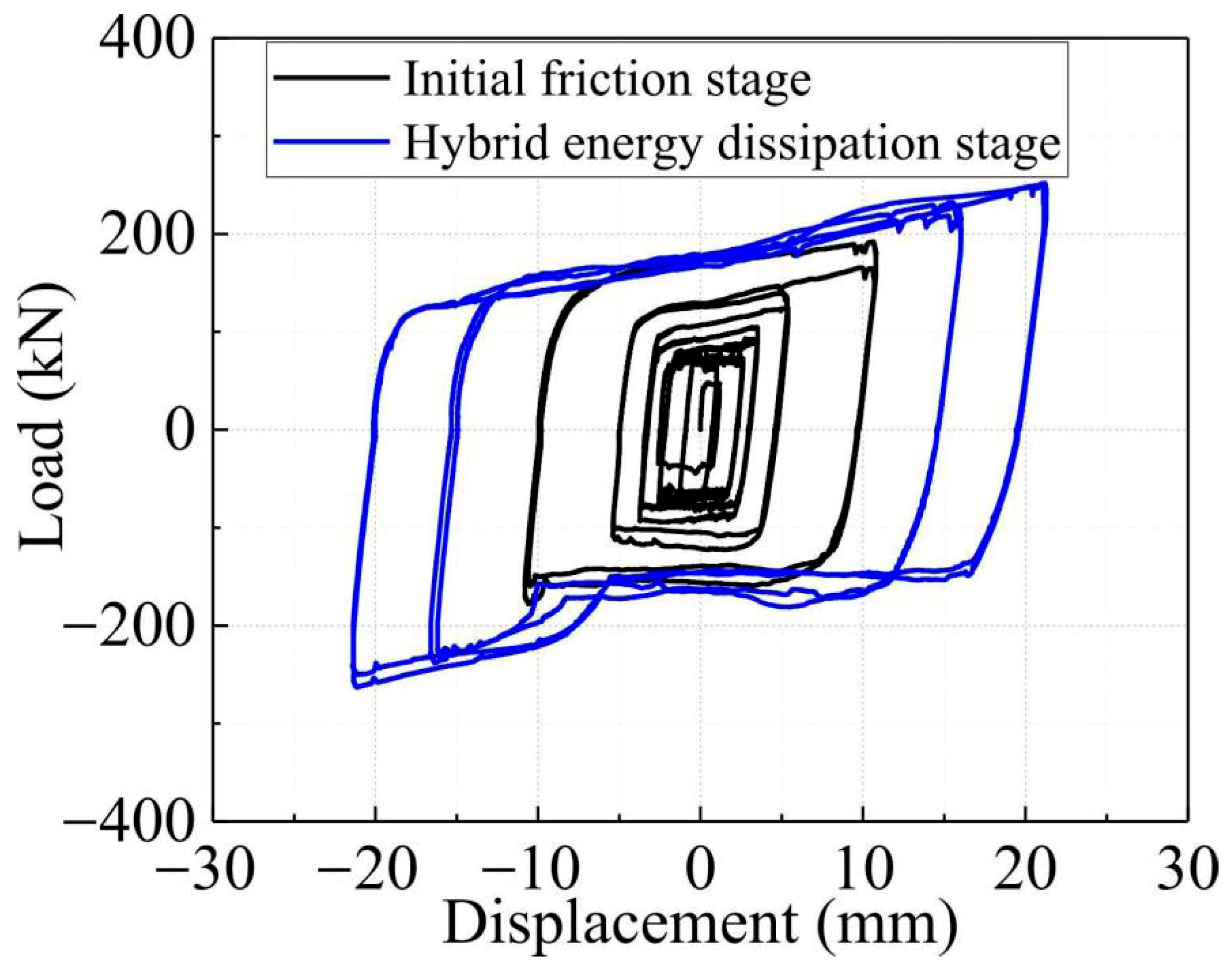
61] proposed a brace-type hybrid damper by combining a friction damper with a steel slit plate damper. Q235 steel was adopted for slit plates due to its stable plasticity and easy fabrication, while friction interfaces and high-strength bolts ensured stable friction energy dissipation. As shown in
Figure 19, the damper exhibits distinct staged hysteretic behavior, with the friction-governed stage and hybrid energy dissipation stage presenting full, progressively expanded hysteretic loops. Quasi-static cyclic tests and finite element analyses indicated that this damper effectively improves structural energy dissipation capacity and ductility. With laser cutting and bolted assembly, it features low cost and high cost-effectiveness for engineering applications.
To further improve the graded energy dissipation effect of the damper, Cai et al. [
62] proposed a staged energy dissipation friction-metal hybrid damper by connecting a metallic-strip energy dissipation element and friction energy-dissipating units in series. This damper dissipates energy through friction during small displacement stages, while metallic strips enter plasticity and cooperate with friction units during large displacement stages, demonstrating favorable staged energy dissipation characteristics. By combining lead with friction units, Yan et al. [
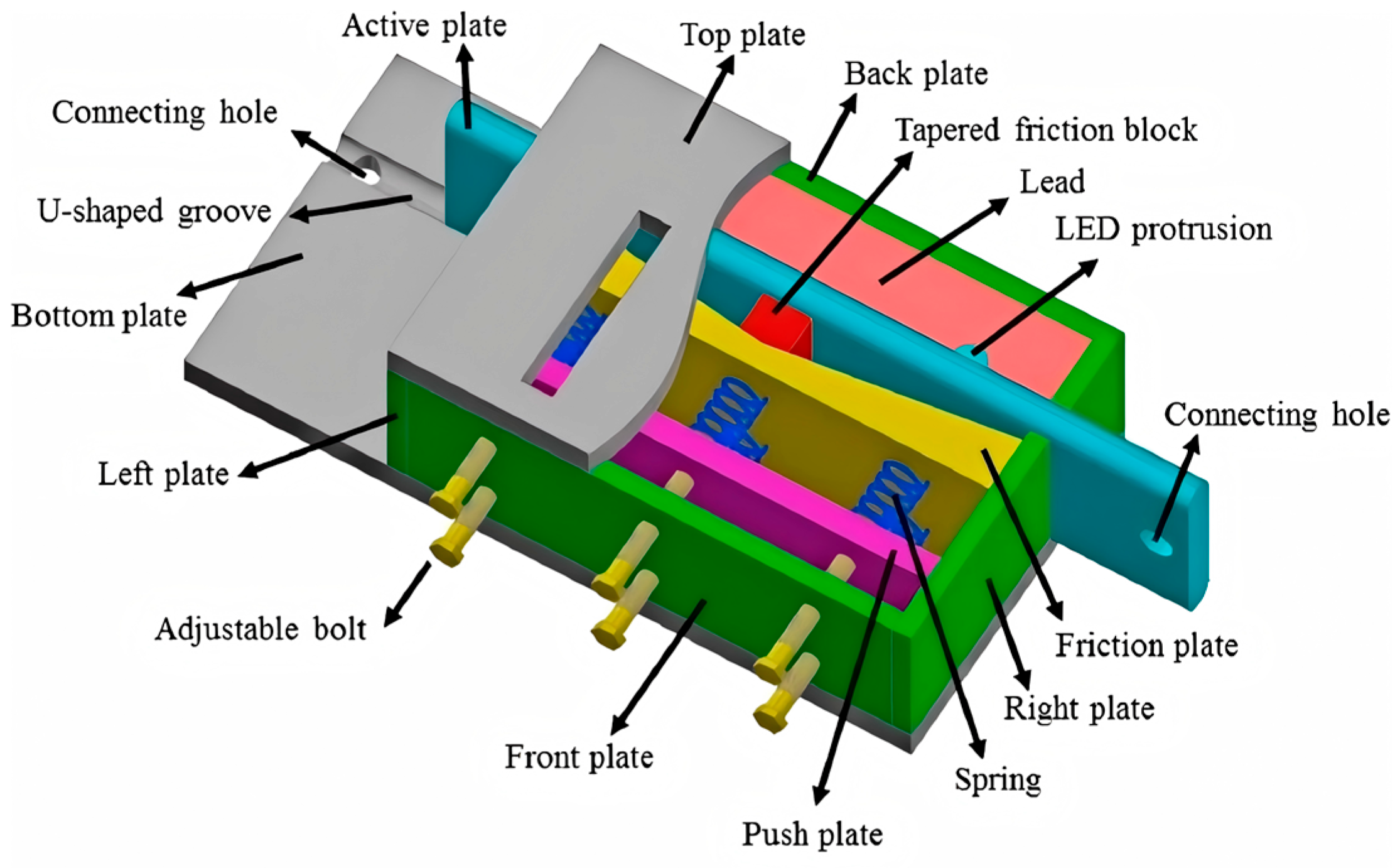
63] proposed a lead extrusion and friction hybrid damper, with an energy dissipation component capable of lead extrusion in the upper portion and an adjustable pre-tensioned friction plate in the lower portion, as shown in
Figure 20. Research results showed that adjusting bolt positions enables the achievement of mechanical performance requirements for different design objectives, accommodating continuous energy dissipation under both small and large displacements. However, manufacturing tolerances require further reduction to enhance performance stability. Ke et al. [
64] proposed a hybrid self-centering damper by integrating a variable friction device with a tapered strip metallic energy-dissipating device. The damper achieves self-centering functionality through disk springs, with friction energy dissipation dominating in the small displacement stage; when the displacement exceeds the preset slip value, tapered strip metallic energy dissipation works collaboratively with friction units, exhibiting pronounced graded energy dissipation characteristics. Zhang et al. [
65] developed a novel multi-stage hybrid damper by integrating a variable friction damper, a slotted steel plate damper, disk springs, and an adjustment mechanism with slotted holes. By modifying the slit width and aspect ratio of the steel plates, flexible adjustment of the hysteretic curve shape is achieved. Experimental studies demonstrated that this damper possesses significant multi-stage energy dissipation mechanisms, exhibiting stable performance and excellent energy dissipation capacity under cyclic loading.
Based on the excellent hysteresis behavior of BRBs, Zhang et al. [
66] developed a novel metal-friction damper by drilling elliptical bolt holes in the core plate and stiffeners at one end of a conventional BRB and connecting it in series with a friction damper using high-strength bolts, as illustrated in
Figure 21. By varying the preload on the high-strength bolts, the friction element can be adjusted, enabling stage-yielding and energy dissipation at different displacement levels. Low-cycle cyclic tests indicated the damper exhibited full hysteretic curves and stable sliding resistance, but its fatigue resistance needs further verification. In a similar approach integrating BRB with a friction damper, Zhou et al. [
56] proposed a frictional-yielding compounded BRB (FBRB) characterized by adaptive passive-control and multi-stage energy dissipation capabilities. The friction damper (FD) is arranged in parallel with the BRB core plate, while being connected in series with the BRB’s outer tube through high-strength bolts. Quasi-static reversed-cyclic tests confirmed that the FBRB maintained elastic behavior with stable friction damping under frequent earthquakes, while exhibiting combined yielding-friction energy dissipation under severe ground motions, demonstrating a rational configuration with full hysteretic curves and pronounced two-stage working characteristics. Even under extreme loading conditions, the FBRB preserved structural integrity and energy dissipation capacity, outperforming conventional BRBs in terms of seismic resilience. Lu et al. [
54] proposed a buckling-restrained damper incorporating supplementary friction-based energy dissipation. In this configuration, an inner core consisting of a small-yield segment (SYS) and a large-yield segment (LYS) connected in series is combined with a friction device arranged in parallel with the SYS. Q235B steel was used for the inner core and outer tube for stable yielding, and H62 brass was selected for the friction plates to provide a steady friction force. The friction device provides an additional energy dissipation path, while the series arrangement of SYS and LYS yields dual stiffness and staged energy dissipation behavior. Quasi-static cyclic tests conducted on nine specimens demonstrated pronounced two-stage energy dissipation characteristics and stable hysteretic response. The authors also noted that although the friction unit enhances energy dissipation throughout the entire working process, increased maximum strain in the LYS adversely affects low-cycle fatigue life. This all-steel and brass configuration without mortar offers simple manufacturing and good cost-effectiveness.
Metal-friction hybrid dampers integrate the advantages of metallic yielding and friction energy dissipation, achieving sequential unit activation and synergistic energy dissipation under different seismic intensities. Most configurations present obvious tri-linear mechanical characteristics and full, stable hysteretic curves, with improved energy dissipation performance at small displacements and favorable cost-effectiveness from bolted assembly. Although various forms have been validated by tests, issues such as manufacturing precision, fatigue performance and low-cycle fatigue life still need to be improved. In addition, unified design specifications and engineering application guidelines for such hybrid dampers remain insufficient, and the parameter matching between metallic and friction components requires further systematic optimization.
Table 6 summarizes the advantages, limitations and application scenarios of typical metal-friction hybrid dampers.
5. Metal-Viscoelastic Hybrid Dampers
Metal-viscoelastic hybrid dampers integrate the high elastic modulus characteristics of metallic materials with the high damping properties of viscoelastic materials, achieving energy dissipation through the synergistic utilization of plastic deformation in metallic units and shear deformation in viscoelastic units. These dampers exhibit combined mechanical behavior encompassing both displacement-dependent and velocity-dependent damping mechanisms, enabling multi-stage yielding energy dissipation that accommodates vibration mitigation requirements under varying seismic intensities.
From the mechanical and analytical perspective, metal-viscoelastic hybrid dampers adopt a coupled constitutive model that unites the bilinear elastoplastic behavior of metallic yielding units and the strain- and frequency-dependent viscoelastic constitutive model based on the generalized Voigt element. The force–displacement relationship follows a superposed piecewise analytical mathematical model expressed as Equation (5) where F
m denotes the displacement-dependent metallic force governed by post-yield stiffness K
ul, and F
ve represents the velocity-dependent viscoelastic force determined by shear deformation [
67].
where
is the total resisting force of the hybrid damper, F
m(δ) is the displacement-dependent metallic yielding force,
is the strain-, velocity- and frequency-dependent viscoelastic force,
is the axial deformation of the damper,
is the deformation velocity, and ω is the vibration frequency.
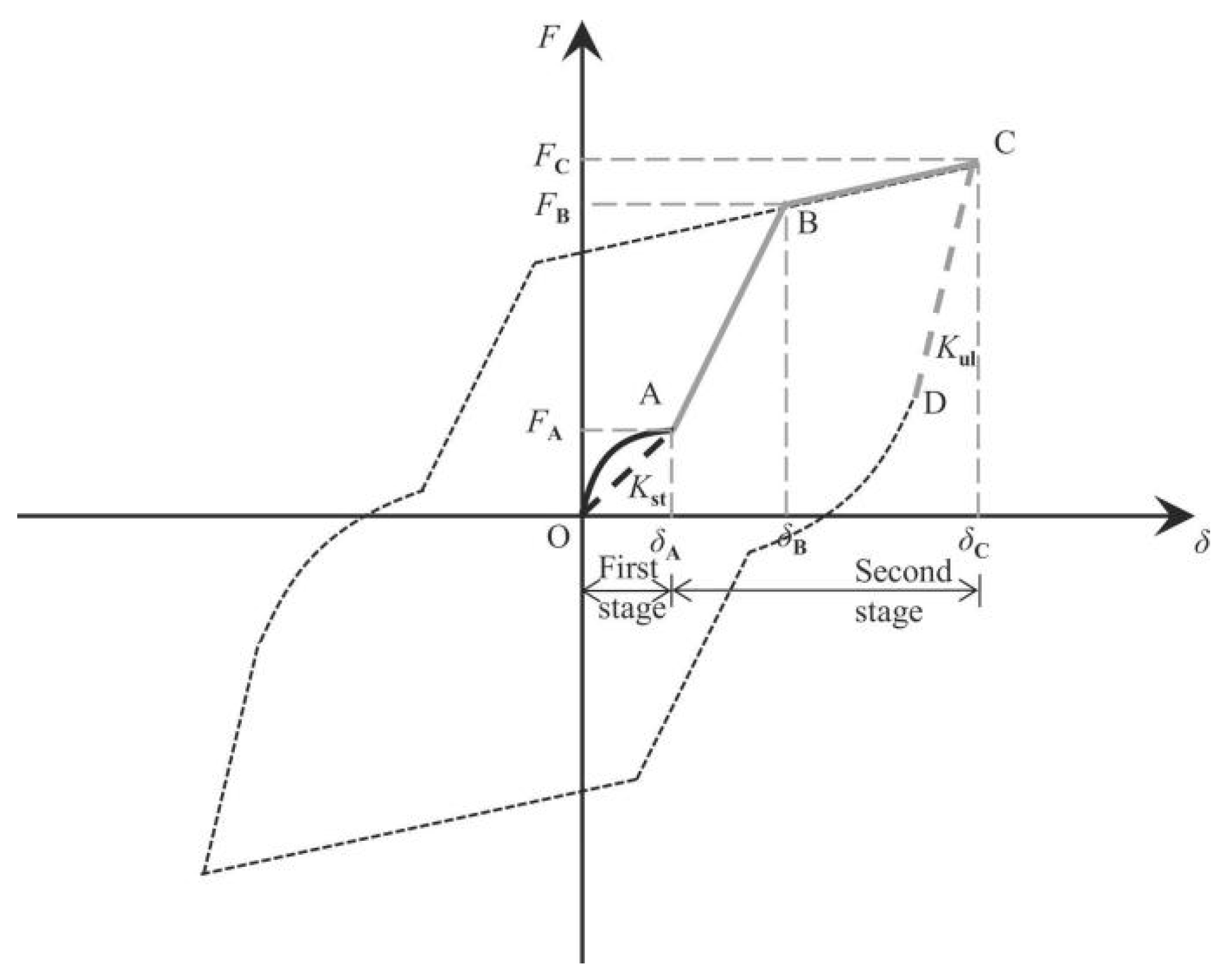
As illustrated in
Figure 22, the typical multi-segment skeleton curve of such hybrid dampers visually presents a distinct two-stage evolution: an initial stiff segment with stiffness K
st dominated by the viscoelastic shear layer at small deformations, followed by a transition to a post-yield stiffness K
ul after the metallic core is triggered at the threshold displacement δ
A [
68]. Stiffness evolves in a clear graded pattern: the initial combined stiffness K
st provides high rigidity for wind-induced vibration control; after reaching the preset activation threshold δ
A, the stiffness degrades and the system transitions into a synergistic working stage dominated by metallic yielding, ensuring stable energy dissipation under multi-level seismic excitations. The stage switching is quantitatively controlled by δ
A, which can be regulated by matching the viscoelastic shear capacity and metallic yield strength [
69].
Zhou et al. [
70,
71,
72,
73] systematically investigated hybrid dampers incorporating lead-rubber and lead-viscoelastic coupling beams, and validated the advantages of such hybrid configurations in terms of energy dissipation capacity and fatigue resistance through cyclic tests and finite element simulations. They also proposed strategies for arranging such devices in frame joint regions to facilitate engineering installation [
74,
75]. Marshall and Charney [
76,
77] proposed a novel hybrid passive control device consisting of a high-damping rubber element connected in series with a BRB. This damper achieved a staged mechanism where rubber units dissipate energy in the small displacement stage and BRBs subsequently engage in the large displacement stage. Finite element results validated the effectiveness of this staged energy dissipation mechanism. Aguaguina et al. [
67] systematically evaluated the seismic performance of three configurations of a brace-type hybrid damper composed of BRBs and viscoelastic dampers: in-parallel, in-series, and a novel gap-incorporated configuration. Nonlinear response history analyses of key indicators including hysteretic response, energy dissipation, inter-story drift, floor acceleration, and base shear demonstrated that the in-parallel configuration delivered the most balanced control of seismic responses. Its energy dissipation mode gradually transitioned from viscoelastic damper-dominated to BRB-dominated as seismic intensity increased, adapting to earthquakes of different magnitudes. To prevent overall performance degradation caused by the failure of a single component, Chen et al. [
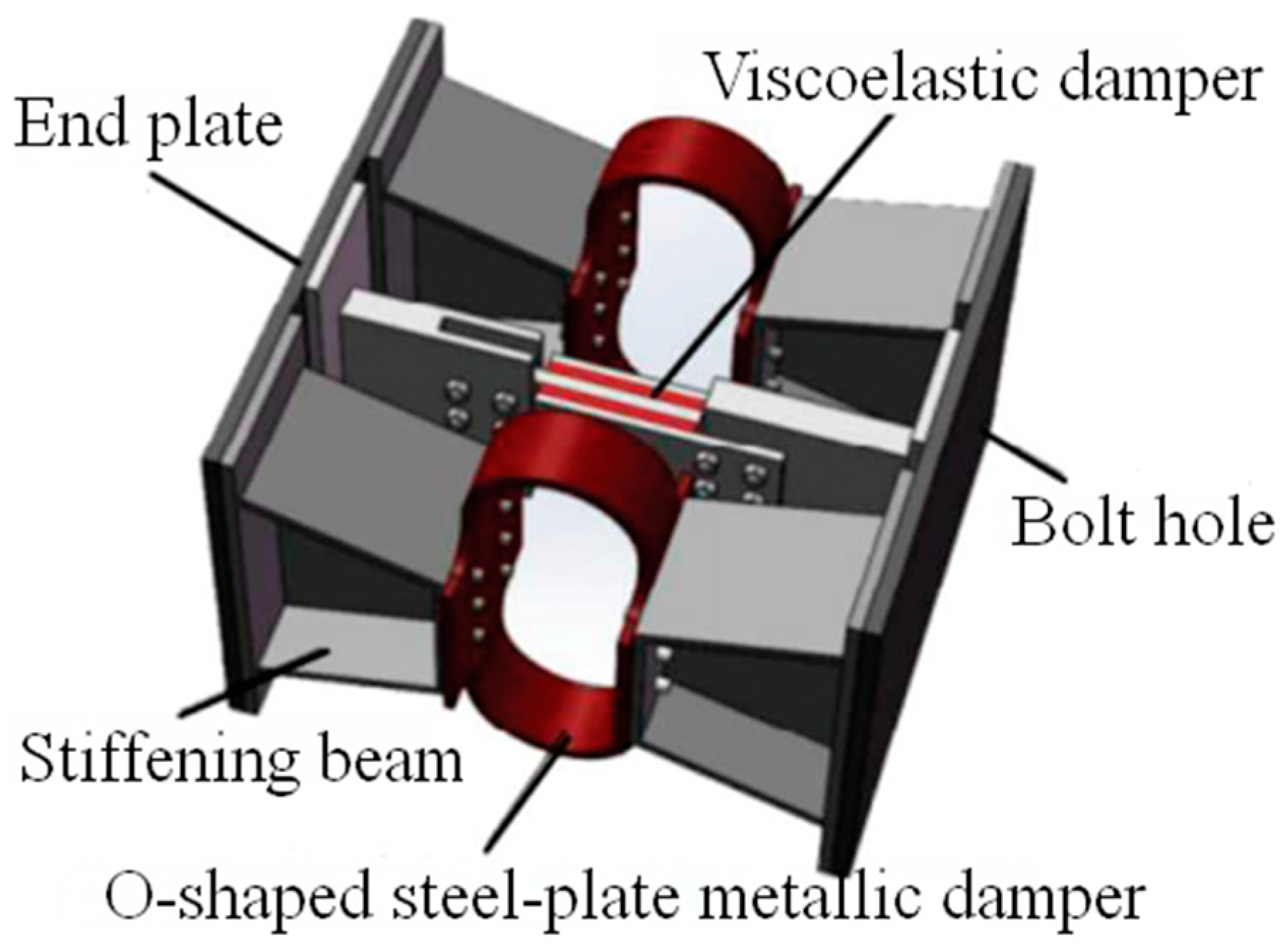
78] proposed a new composite energy dissipator configuration consisting of an O-shaped steel plate metallic damper connected in parallel with a high-damping viscoelastic damper, integrated with end plates, stiffening beams, and bolted connection interfaces, as clearly shown in
Figure 23. Experimental results indicated that this parallel configuration relies primarily on the viscoelastic unit for energy dissipation during small deformation stages, while both components work synergistically during large deformation stages. Even upon the failure of a single component, the overall system maintained stable energy dissipation capability.
Leveraging the configurational advantages of shear-type metallic dampers, Li et al. [
79] proposed a novel hybrid energy dissipator by connecting viscoelastic materials in series with mild steel shear plates. Under wind-induced vibration or minor earthquake excitation, the viscoelastic material layers undergo shear deformation for energy dissipation. Under moderate-to-major earthquake excitation, the mild steel shear plates further undergo shear deformation and enter yielding, establishing a dual-mechanism energy dissipation system with the viscoelastic material. Cyclic tests validated that this damper possesses favorable seismic performance and staged energy dissipation capability. Hu et al. [
80] developed a novel metal-viscoelastic hybrid damper comprising an upper viscoelastic damper and a lower shear steel plate damper. Research indicated that under both frequent and rare earthquake scenarios, the novel hybrid damper effectively dissipated seismic energy, demonstrating significant vibration mitigation effects for building structures. Pan et al. [
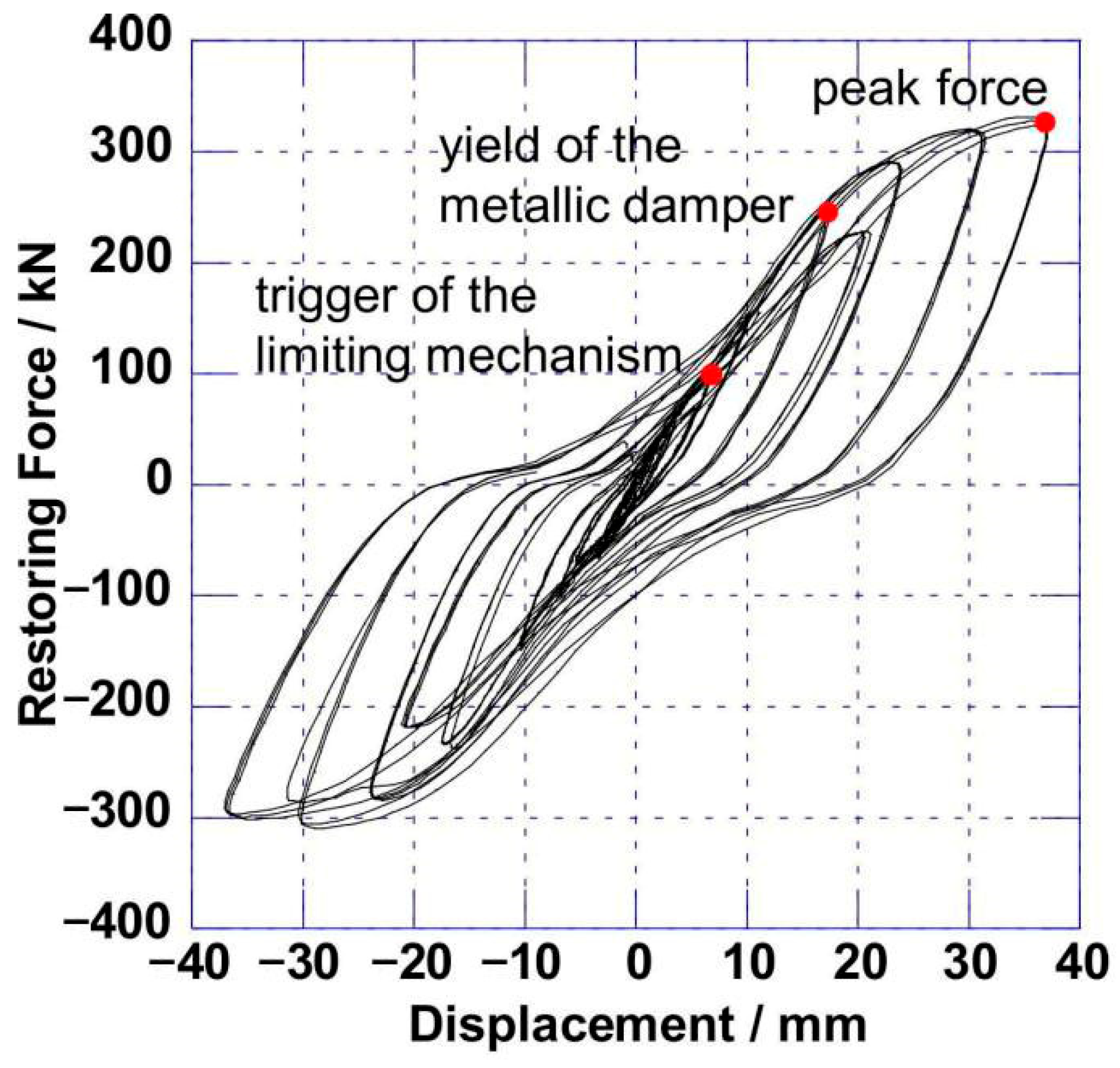
68] proposed a novel replaceable two-stage coupling beam damper by connecting a viscoelastic energy dissipation unit in series with a metallic shear unit and incorporating a displacement-triggered limiting mechanism. Q355B steel was used for structural components to ensure elastic stiffness, LY160 low-yield steel for the shear panel to yield stably at large deformations, and viscoelastic material for small-displacement damping; this material combination ensures sequential two-stage energy dissipation. As shown in
Figure 24, the damper exhibits full, progressively expanded hysteretic loops with distinct two-stage energy dissipation, significantly enhancing the seismic performance of the primary structure. Benefiting from the replaceable energy dissipation segment, only the damaged unit needs replacement after earthquakes, which greatly reduces repair costs and improves cost-effectiveness. Ke et al. [
69] developed a novel hybrid damper configuration consisting of a buckling-restrained stainless steel plate connected in parallel with two viscoelastic dampers symmetrically arranged on either side. Experimental and numerical simulations indicated that this damper achieved stable multi-level vibration control in structures subjected to dynamic loads of varying intensities, though its load-bearing capacity was significantly influenced by loading frequency and ambient temperature.
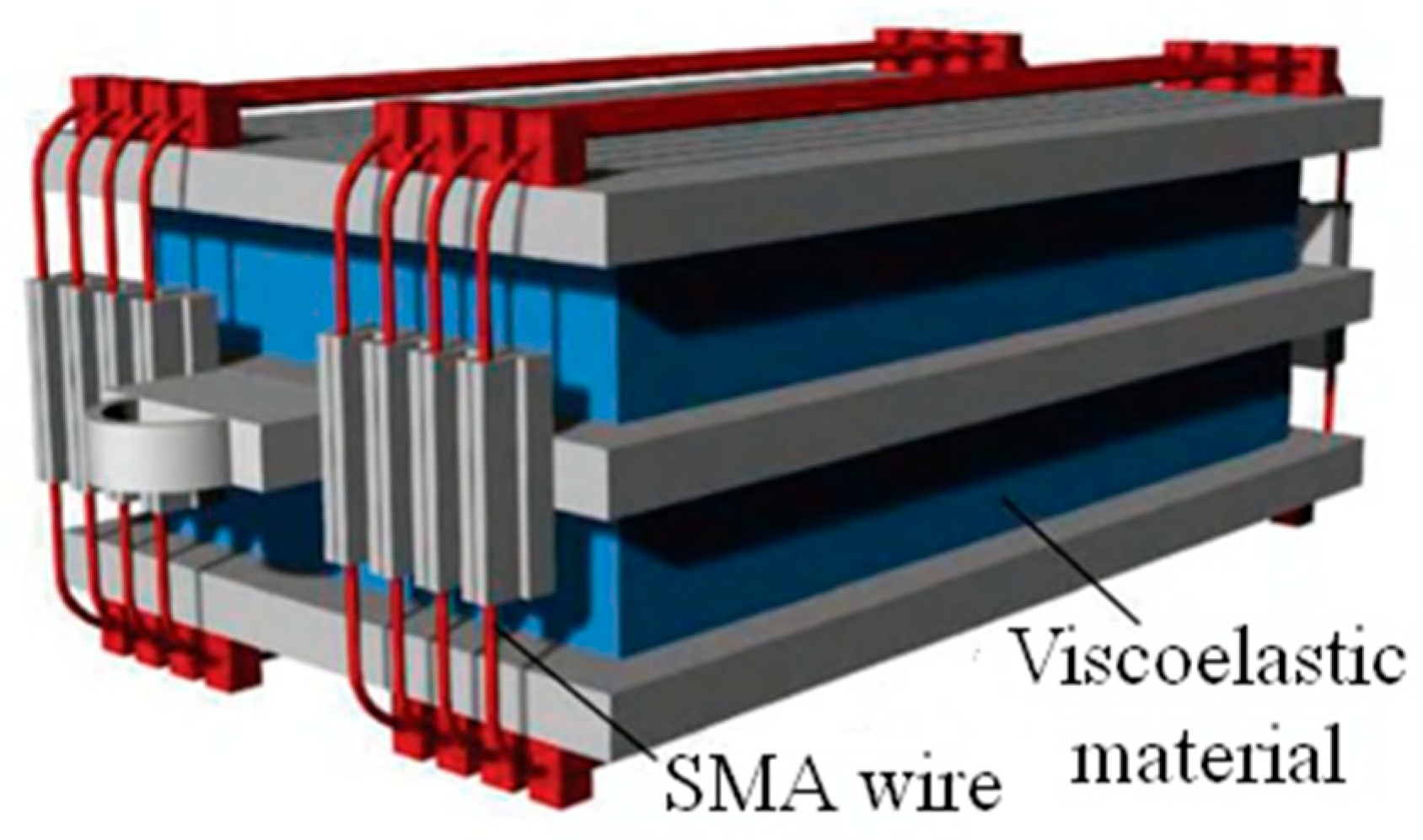
Shape memory alloys (SMA) have garnered considerable attention in recent years for seismic mitigation applications due to their superelasticity and self-centering characteristics. Baikuntha et al. [
81,
82] proposed a self-centering superelastic-viscoelastic hybrid damper by connecting superelastic SMA in parallel with a viscoelastic damper, as illustrated in
Figure 25. Research demonstrated that this hybrid damper significantly improved structural performance under aftershocks following major earthquakes. Shi et al. [
83] developed a hybrid self-centering brace (HSB) that strategically combines NiTi superelastic cables with viscoelastic (VE) dampers in parallel. The VE dampers were specifically chosen to enhance energy dissipation capacity while maintaining recoverable performance, unlike metal or friction materials. Experimental testing and numerical analysis of a prototype building indicated that the HSB effectively controlled both peak inter-story drifts and floor accelerations, with the SMA cables providing self-centering capability to minimize residual deformations and the VE dampers introducing supplemental hysteretic damping for enhanced energy dissipation. Hu et al. [
84] developed a novel hybrid self-centering brace by connecting a NiTi SMA U-shaped damper in parallel with a frequency-dependent viscoelastic damper. Research demonstrated that this hybrid device maintained near-zero residual displacement while significantly reducing inter-story acceleration response, thereby achieving simultaneous control of both structural and non-structural damage.
Metal-viscoelastic hybrid dampers combine the high elastic modulus of metallic materials and the high damping capacity of viscoelastic materials, realizing staged energy dissipation through the synergy of metallic plastic deformation and viscoelastic shear deformation. They feature both displacement-dependent and velocity-dependent mechanical properties, with obvious multi-stage stiffness evolution and good adaptability to wind vibration and multi-level seismic effects. Parallel layouts usually provide more balanced seismic responses, and replaceable or SMA-integrated configurations further enhance post-earthquake repairability and self-centering performance. However, the overall performance is significantly affected by loading frequency and ambient temperature, and the long-term durability of viscoelastic materials still needs improvement. Unified design specifications and engineering application guidelines for such hybrid dampers remain insufficient.
Table 7 summarizes the advantages, limitations and application scenarios of typical metal-viscoelastic hybrid dampers.
6. Other Important Damper Typologies
6.1. Viscous Dampers
Fluid viscous dampers (FVDs) are mature velocity-dependent supplemental energy dissipation devices that have been widely used in seismic and wind vibration control [
85]. Unlike yielding dampers, they dissipate energy through the resistance generated by viscous fluid flow, and their stiffness contribution to the primary structure is generally limited. In the context of multi-level energy dissipation, FVDs usually do not rely on plastic yielding; instead, staged response is achieved by introducing a variable damping coefficient, adjusting the flow passage or gap geometry, or using semi-active bypass/valve-controlled mechanisms so that the damper force changes with displacement or velocity levels.
Typical realizations of staged energy dissipation in viscous dampers have been proposed and verified through theoretical derivation, performance tests and structural validation. Shi et al. [
86] developed a velocity-related variable damping viscous damper (VDVD), in which the movable disk was driven by fluid pressure to adjust the damping orifice area, and the damping coefficient increased nonlinearly with loading velocity; the spring pre-pressure and orifice shape were confirmed as key parameters governing the critical velocity of damping variation. Xu et al. [
87] proposed a three-stage variable-damping-coefficient fluid damper (VCVFD) based on annular gap variation, which realized displacement-dependent staged energy dissipation by changing the cylinder inner diameter along the stroke; its damping force and energy dissipation capacity increased more significantly than conventional dampers at large displacements, and shaking table tests proved its superior seismic mitigation effect under high-intensity earthquakes. Farahpour et al. [
88] developed an integrated semi-active adaptive vibration control system consisting of a semi-active bypass fluid damper (SABFD), PLC and fuzzy control algorithm. The system adjusted the fluid flow rate in real time via motorized valves according to bridge displacement and damper pressure responses, realizing continuous conversion between low and high damping states to effectively suppress traffic-induced vibrations of bridge structures.
6.2. Elastomeric Dampers
Elastomeric dampers, typically represented by high-damping rubber dampers and laminated rubber-based devices, dissipate energy mainly through shear deformation and material hysteresis rather than conventional plastic yielding. They are widely used in seismic isolation and vibration mitigation because of their high flexibility, stable restoring capability, and relatively simple construction. In a multi-level or staged context, their response is usually achieved by tailoring rubber formulation, layer configuration, and confinement details, or by coupling rubber elements with restraining plates, metallic components, or self-centering devices, so that stiffness and damping vary progressively with deformation demand.
Typical staged energy dissipation implementations and performance verification of elastomeric dampers have been reported through full-scale tests, multiaxial loading investigations, and hybrid composite developments. Yu et al. [
89] proposed a damping plate-restrained isolation bearing (DP-bearing) as a staged friction-damping isolation system, in which preset horizontal gaps were designed to activate shear damping plates and tensile damping plates sequentially at targeted displacements; this layered activation mechanism realized clear multi-stage energy dissipation and multi-directional restraint, and shear damping plates alone contributed over 70% of total energy dissipation with convenient post-earthquake replacement of damaged core components. Li et al. [
90] conducted six-degree-of-freedom quasi-static tests on high-damping rubber bearings (HDRBs) and revealed the inherent staged mechanical behavior of elastomeric devices: HDRBs exhibited high initial stiffness to resist small deformations, reduced stiffness at medium shear strains, and increased stiffening at large shear strains, while axial pressure effectively adjusted the switching points of staged stiffness and damping, confirming that layer configuration and confinement details can be deliberately designed to regulate progressive force-deformation evolution. Wei et al. [
91] developed a novel self-centering SMA-high-damping rubber damper by combining superelastic SMA cables with high-damping rubber dampers, in which the rubber component provided stable hysteretic dissipation and the SMA assembly introduced controllable post-yield stiffness and restoring force; this hybrid design achieved staged variation in damping and stiffness under sequential mainshock-aftershock excitations, drastically reducing residual interstory drift and enhancing structural seismic resilience compared with conventional elastomeric dampers.
6.3. SMA-Based Dampers
Shape memory alloy (SMA)-based dampers are smart-material devices that dissipate energy through stress-induced martensitic transformation, superelasticity, and the shape-memory effect, while also providing self-centering capability. In contrast to classical yielding dampers, their multi-level or staged response is usually realized by combining SMA elements with different activation thresholds, arranging them in series or parallel, or embedding them in gap- or bearing-type subassemblies so that different components are progressively mobilized as the demand increases.
Typical staged energy dissipation implementations of SMA-based dampers have been proposed via serial or parallel configuration, hybrid self-centering mechanisms, and multi-level activation design, with verified superior self-centering and seismic resilience. Qiu et al. [
92] developed a double-stage SMA slip friction damper composed of stacked disk springs and SMA bars in series, where the composite spring system enabled clear double-stage yielding: disk springs deformed first at small displacements, and SMA bars were subsequently activated to provide secondary stiffness and self-centering capacity; cyclic tests confirmed symmetric flag-shaped hysteresis, stable double-stage energy dissipation, and enhanced deformability compared with single-stage SMA dampers. Guo et al. [
93] proposed a multi-level SMA cable damper for near-fault bridge protection, consisting of three-level SMA cables in parallel with preset relaxation lengths to realize step-by-step activation and gradually increased stiffness; the numerical model considered strength degradation and residual strain accumulation of SMA cables, and seismic fragility analyses verified that the damper remarkably reduced damage probabilities of bridge bearings and piers under multiple seismic hazard levels. Qu et al. [
94] invented a dual self-centering friction damper (D-SCFD) with coil springs and SMA elements in parallel for dual self-centering, combined with friction energy dissipation modules; this hybrid design reduced SMA consumption while achieving staged stiffness variation and controllable residual deformation, and nonlinear time-history analyses proved its effective mitigation of peak and residual inter-story drift ratios of multi-story steel frames under mainshock-aftershock sequences.
6.4. Outlook on Hybrid Development of Multi-Stage Dampers
Overall, although viscous, elastomeric, and SMA-based dampers are not always classified as multi-stage dampers in a strict sense, they provide valuable mechanisms and design concepts for the development of new multi-stage or hybrid energy-dissipating systems. By combining rate-dependent dissipation, shear hysteresis, and self-centering functions with metallic or frictional components through serial, parallel, or coupled configurations, these devices can achieve staged activation, wider effective damping ranges, and improved control of stiffness, residual deformation, and post-earthquake recoverability. Therefore, these typologies should be regarded not only as independent damping solutions but also as important building blocks for next-generation hybrid dampers with enhanced seismic resilience.
7. Critical Discussion and Engineering Implications
7.1. Damper Distribution and Optimization Approaches
In the seismic design of structural systems, the selection of damper typology constitutes only one core link; the spatial distribution of dampers within the structure is equally critical to the overall seismic mitigation effect. Even with identical damper configurations, different installation locations will lead to drastically different structural dynamic responses, inter-story drift distributions, and energy dissipation efficiencies. This coupling effect is particularly prominent for multi-stage energy-dissipating dampers, because their staged activation mechanism relies on the sliding threshold and the structural-level deformation demand for precise matching.
Alibrandi and Falsone [
95] proposed a mature optimal layout method based on the expected value of the stochastic dissipated power. This method minimizes the expected stochastic dissipated power of the main structure, and can quantitatively determine the optimal distribution, total damping capacity, and upper limit of story-wise damping coefficients for viscous or viscoelastic dampers under stochastic ground motions. It has been verified on 10-story shear buildings, showing that the optimized layout can effectively reduce structural response while balancing energy distribution among stories. Search-based optimization determines the optimal layout by iteratively searching for the best damper placement, which is suitable for solving complex combinatorial optimization problems with discrete variables. Takewaki et al. [
96] developed a steepest direction search algorithm to minimize the dynamic compliance of 3D shear buildings. This algorithm can automatically search for the optimal damper position step-by-step, and solve the non-monotonic optimization path and negative damping coefficient problems through parameter switching, which is especially suitable for torsional vibration control of irregular structures. Performance-based optimization takes structural seismic performance indices as the optimization objective, covering multiple performance levels under frequent, moderate, and major earthquakes. De Domenico and Hajirasouliha [
97] proposed a multi-level performance-based optimization framework for steel frames with nonlinear viscous dampers, taking the maximum inter-story drift ratio as the core optimization objective and using the global damage index as a key evaluation indicator. The effectiveness of the proposed method was verified through nonlinear time-history analyses of 3-, 7-, and 12-story steel frames.
Therefore, for multi-stage energy-dissipating dampers, damper layout optimization constitutes a coupled design problem that integrates configuration selection, spatial distribution and parameter matching. The three aforementioned typical optimization approaches provide reliable theoretical support for achieving orderly staged activation and giving full play to the multi-stage energy dissipation advantages in practical structural systems.
7.2. Manufacturing Tolerance and Sensitivity Analysis
Multi-stage energy-dissipating dampers rely on the sequential activation of multiple dissipative units with distinct working thresholds, rendering them inherently more sensitive to millimeter-scale manufacturing tolerances than conventional single-stage dampers. Minor deviations in geometric dimensions, assembly clearances, or mechanical parameters can easily disrupt the preset yield/slip sequence, intensify local stress concentrations, distort hysteretic behavior, and degrade low-cycle fatigue life. The most sensitive parameters include the size and positioning of slotted holes, yield segment length, steel plate thickness, assembly gaps, bolt preload, and welding quality.
Chen et al. [
98] numerically investigated the influence of manufacturing tolerance on the initial stiffness of SMA-based variable friction dampers, and confirmed that a 0.2 mm assembly clearance between internal and external friction plates evidently reduced the initial stiffness, whereas the load-carrying capacity at each loading step was insensitive to such tolerance. Gao et al. [
99] performed parameter sensitivity analysis on U-shaped steel dampers, indicating that variations in straight segment length, circular arc radius, plate thickness and width caused significant changes in initial stiffness; increasing the straight segment length and arc radius reduced initial stiffness, while increasing thickness and width imposed the opposite effect. Tamimi et al. [
100] adopted machine learning-assisted finite element simulation to assess the parameter sensitivity and reliability of BRBs, and identified that the gap between the steel core and restraining infill, the friction coefficient at the steel-concrete interface, and the thickness/width of the steel core are the most influential factors governing hysteretic performance and load-bearing capacity; millimeter-scale deviations in gap size directly alter local buckling modes and energy dissipation stability.
Accordingly, the favorable staged energy dissipation performance of multi-stage dampers is highly dependent on strict manufacturing precision. Reasonable tolerance control and standardized quality inspection are essential prerequisites to ensure the sequential activation mechanism and expected seismic performance in engineering applications.
7.3. Applicability and Limitations in Practical Engineering
Different types of multi-stage energy-dissipating dampers present distinct applicable engineering scenarios, verified project cases and practical constraints, which are highly matched with structural forms, seismic fortification intensity, resilience demand and construction conditions.
DYBRBs with a cross-shaped core proposed by Hu et al. [
101] are suitable for multi-story and high-rise reinforced concrete frame structures, seismic retrofitting projects of existing buildings, and frame structures in 8-degree seismic fortification areas. In a verified 7-story RC frame engineering case (fortification intensity 8, design acceleration 0.3 g, total height 24 m), DYBRBs were arranged at story braces, and numerical results showed that the maximum inter-story drift under frequent earthquakes was reduced by 43.27% compared with undamped structure, and by 38.23% compared with traditional BRB structure; under rare earthquakes, the inter-story drift was reduced by 18.08% and 6.3% respectively, and the energy dissipation rate reached 55.75% under frequent earthquakes, which was much higher than that of traditional BRBs. However, DYBRBs have obvious limitations: the welding quality of core plates directly affects the staged yield sequence, and the length ratio, strengthening ratio and bearing capacity ratio need precise control, resulting in high requirements for manufacturing and installation.
Reinforced double-stage-yield composite energy dissipation dampers (RDSYCDs) composed of U-shaped dampers and steel slit dampers developed by Zhang et al. [
38] are applicable to steel frame structures and prefabricated assembled buildings, and can be installed at beam-column joints, herringbone braces and seismic isolation bearings. In a 5-story rigid-connected steel frame engineering case (fortification intensity 8, site class II), 35 RDSYCDs were arranged symmetrically in X and Y directions, and the results showed that the maximum inter-story drift was reduced by 49.9% compared with the original steel frame, showing an excellent seismic control effect. RDSYCDs can flexibly adjust the second-stage activation displacement through slotted holes, which is suitable for performance-based seismic design. Nevertheless, RDSYCDs have structural complexity: the thickness of U-shaped dampers and the width of steel slit dampers are highly sensitive parameters, the welding connection between UDs and SSDs requires high precision, and the staged mechanical performance is easily affected by manufacturing deviations, which increases the construction difficulty.
Two-stage friction self-centering dampers (TFSDs) composed of a friction damper and a self-centering friction damper in series, proposed by Liu et al. [
102], are suitable for high-resilience frame structures and buildings requiring strict control of residual deformation. In a 6-story braced frame office building case, TFSD braces were used to replace traditional BRBs, and parametric analysis and fragility analysis showed that when the strength ratio α = 0.3–0.7 and gap ratio γ = 0.5%, the peak inter-story drift and floor acceleration were minimized, the residual inter-story drift was controlled within 0.5% (repairable threshold), and the collapse resistance was better than BRBF and SCFDF. Under the maximum considered earthquake, the peak inter-story drift was reduced by 26% compared with the single-stage self-centering damper frame. The limitations of TFSDs are: the first-stage friction unit has no self-centering capacity, and SMA bolts have relatively high material cost.
In summary, the engineering value of multi-stage energy-dissipating dampers is ultimately determined by the balance among configuration, layout, cost and maintenance conditions.
7.4. Post-Earthquake Maintenance and Re-Centering Capacity
Post-earthquake structural resilience is dominated by two coupled performances: easy repairability of dampers after earthquakes and effective re-centering capacity to control residual drifts. For multi-stage energy-dissipating systems, these two indicators directly determine the speed of function recovery and the cost of post-earthquake repair. Representative studies on repairable and self-centering multi-stage dampers provide clear engineering implications as follows.
Xiong et al. [
32] proposed a repairable double-stage yield buckling-restrained brace (RDYB) with a fully bolted assembly. The core innovation lies in the fact that the damaged short and long core plates can be replaced individually without removing the heavy restraining plates, which greatly simplifies on-site repair and reduces reliance on lifting equipment. Experimental results confirm that the hysteretic performance, yield strength and stiffness of the repaired RDYB remain almost consistent with the original specimen, with yield strength differences less than 10%. However, the RDYB relies purely on steel yielding for energy dissipation; its re-centering capacity is relatively weak, and obvious residual deformation occurs under strong earthquakes. Therefore, additional structural resetting construction is required during post-earthquake repair.
Ke et al. [
23] developed a repairable multi-stage yielding steel slit damper (RMYD) composed of weak slit plates, strong slit plates and a rigid link beam connected by bolts. The weak and strong slit plates serve as the first and second stage energy dissipation units respectively, and can be disassembled and replaced independently after earthquakes. Test results show that the repaired RMYD specimen exhibits nearly identical hysteretic responses, load-bearing capacity and energy dissipation capacity as the original specimen, proving excellent post-earthquake repairability. Similar to conventional metallic dampers, the self-centering capacity of RMYD comes from the elastic recovery of undamaged components, which is limited. Residual drift cannot be eliminated automatically, and a manual reset is still needed in practical repair.
Zhang et al. [
103] proposed an assembled self-centering dual-stage yield buckling-restrained brace (ASCDYB) that integrates dual-stage energy dissipation and self-centering functions. The self-centering system is composed of high-strength steel rods and pre-compressed disk springs, and the second-stage energy-dissipating cores are designed with slotted holes to optimize self-centering performance. Nonlinear time-history analyses indicate that, compared with traditional self-centering BRBs, ASCDYB reduces residual displacement by approximately 40% under the maximum considered earthquake, while increasing peak displacement by less than 9%. Meanwhile, the energy-dissipating cores serve as replaceable fuses, and seismic damage is concentrated in these replaceable components. More importantly, ASCDYB achieves satisfactory self-centering performance with lower pre-stress demand, making it more feasible in engineering applications.
In summary, the post-earthquake maintenance performance and re-centering capacity of multi-stage energy-dissipating dampers are mutually complementary. Configurations with bolted assembly and replaceable energy-dissipating units significantly improve repairability, while devices equipped with disk springs, SMA or other self-centering modules can effectively reduce residual drifts. The collaborative optimization of repairability and re-centering capacity is the key to promoting multi-stage dampers toward resilient and practical engineering applications.