Effects of Web Thickness and Flange Thickness on Flexural Crack Evolution and Ductility of H-Shaped UHPC Piles Based on DIC and Finite Element Analysis

 ,
,
Abstract
1. Introduction
2. Experimental Program and DIC Measurement Method
2.1. Materials
2.2. Specimen Preparation
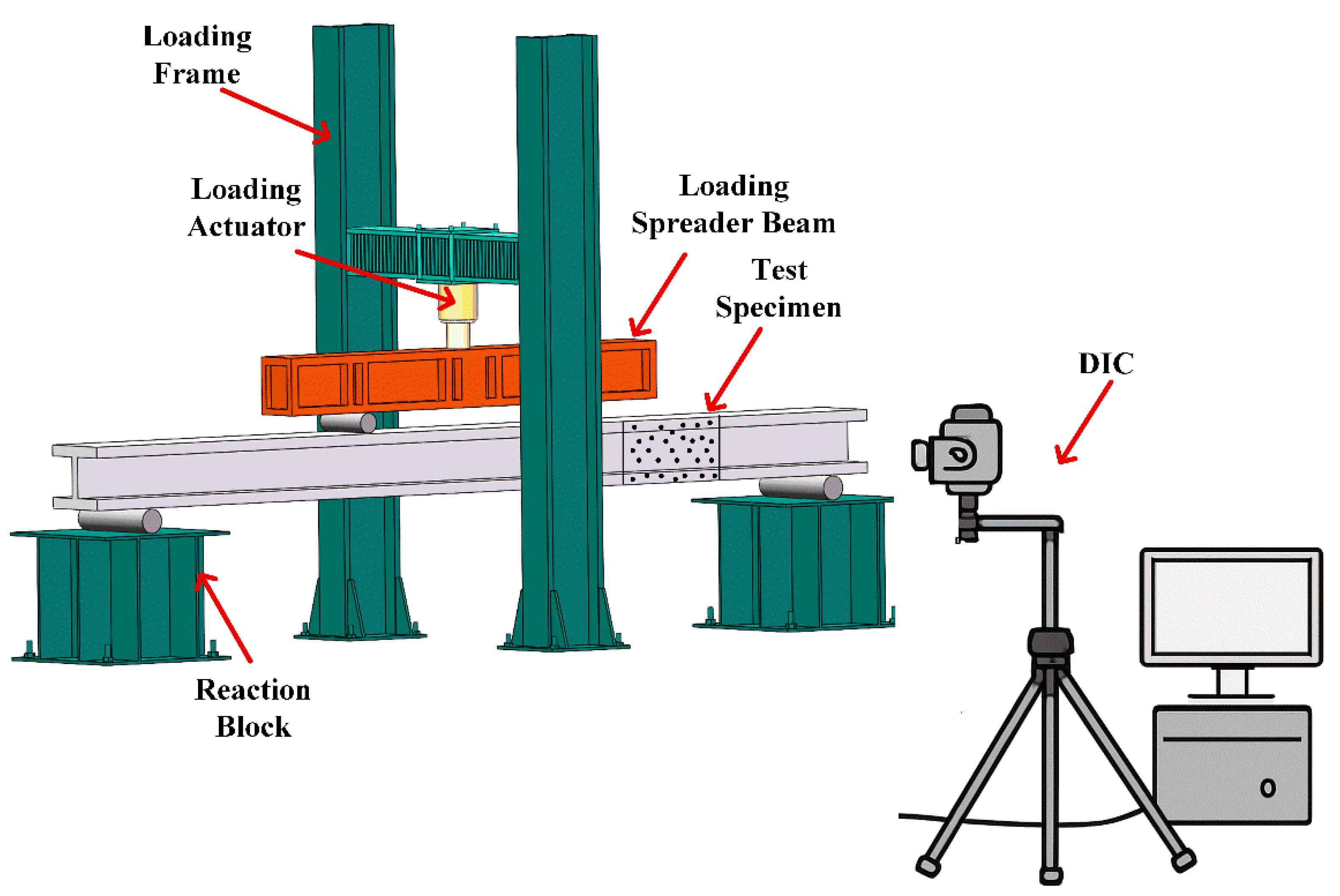
2.3. DIC Measurement System and Loading Protocol
3. Results and Discussion
3.1. Load–Deflection Curve Analysis
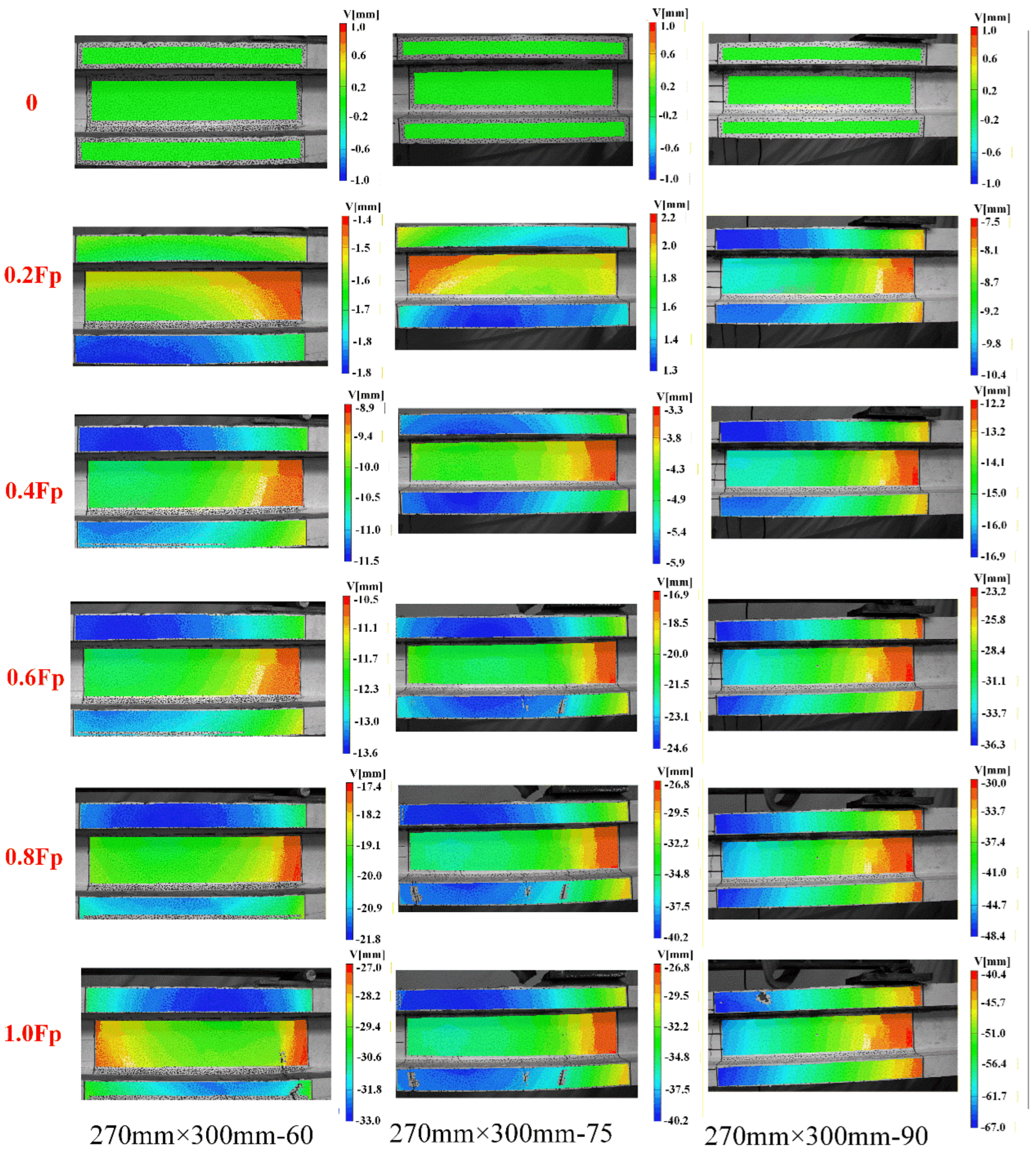
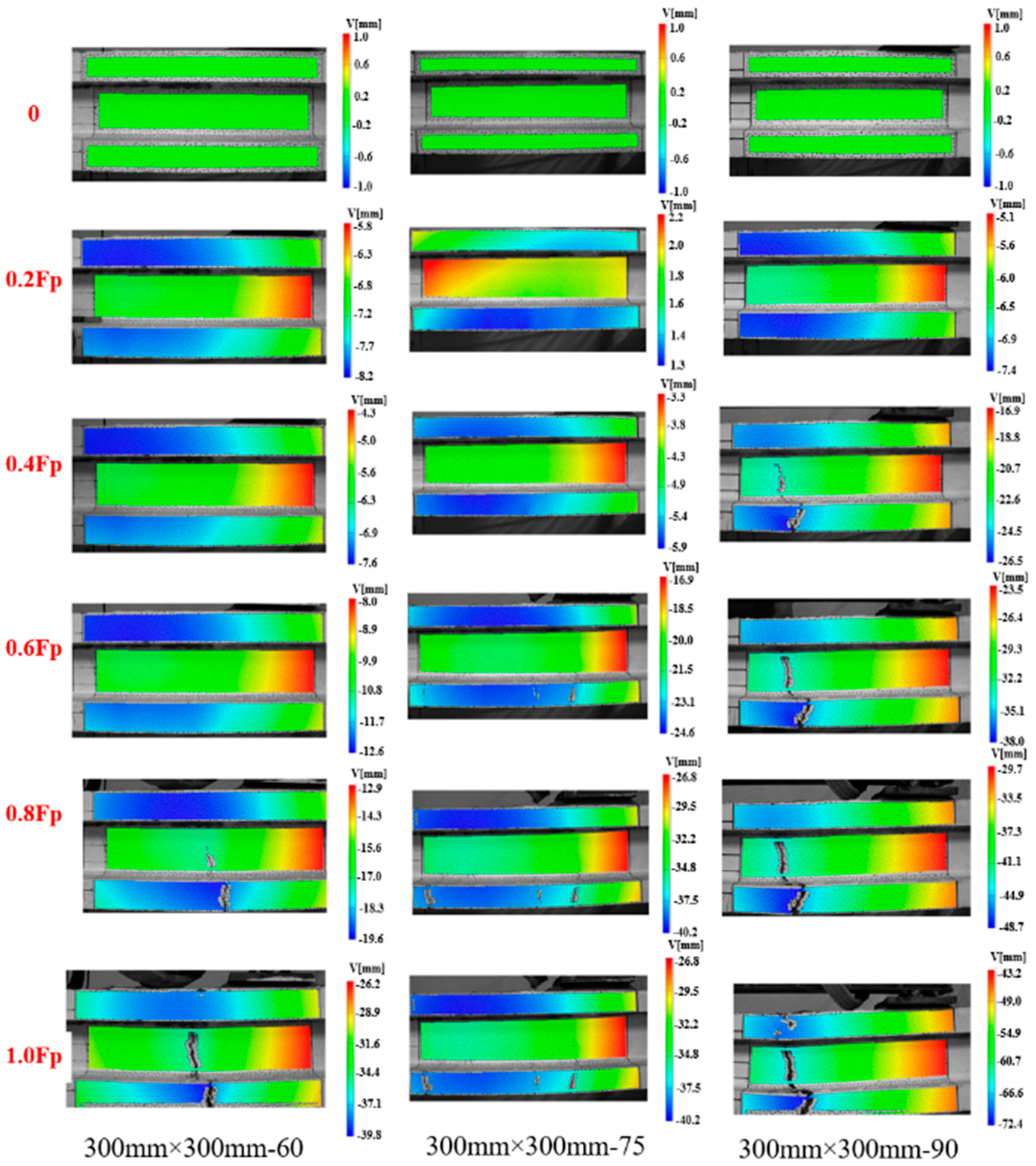
3.2. Principal Strain Contours and Crack Propagation Trajectories
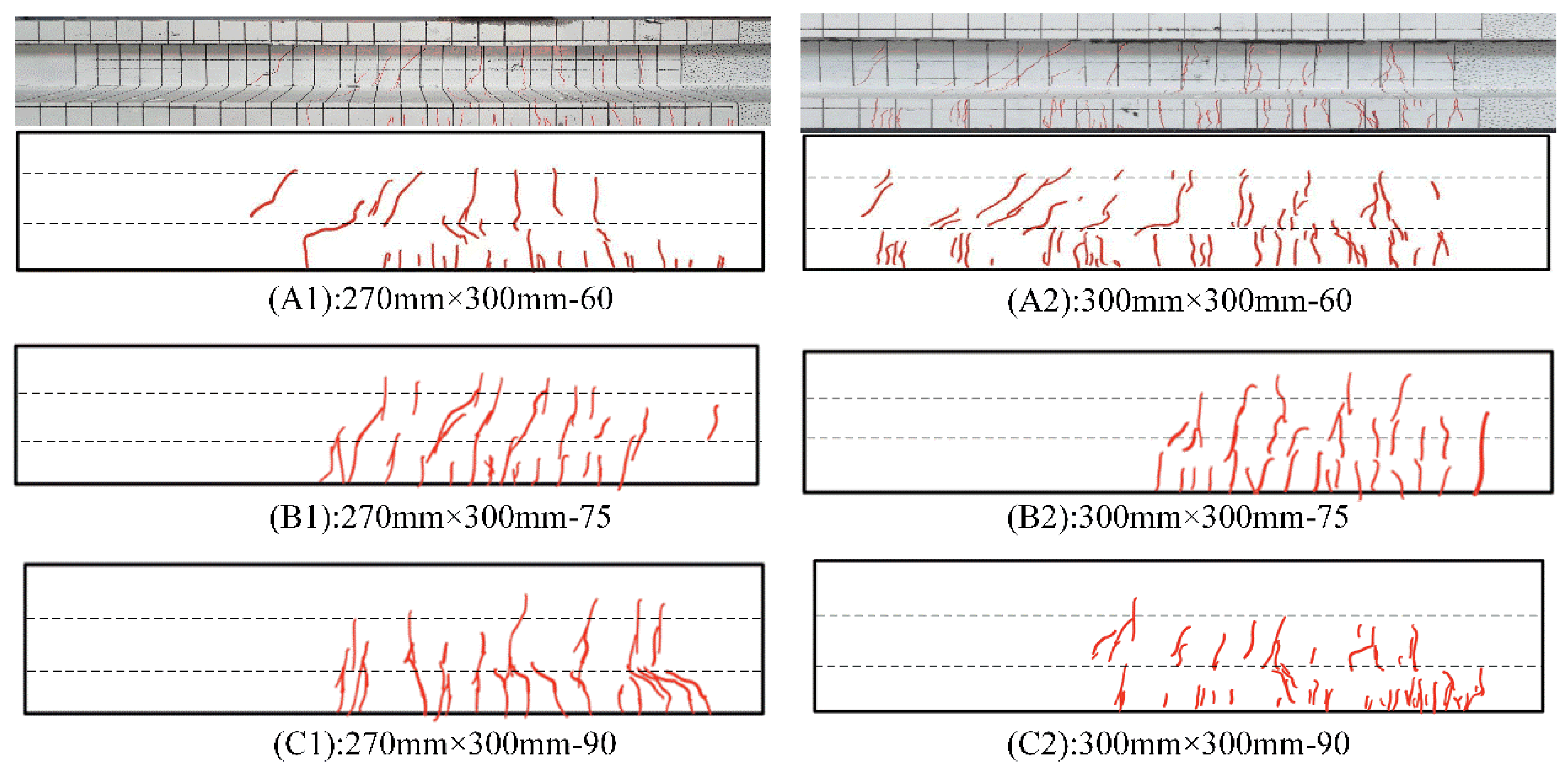
3.3. Failure Modes and Crack Localization Characteristics
3.4. Ductility and Energy Absorption Characteristics
4. Finite Element Simulation and Experimental Validation
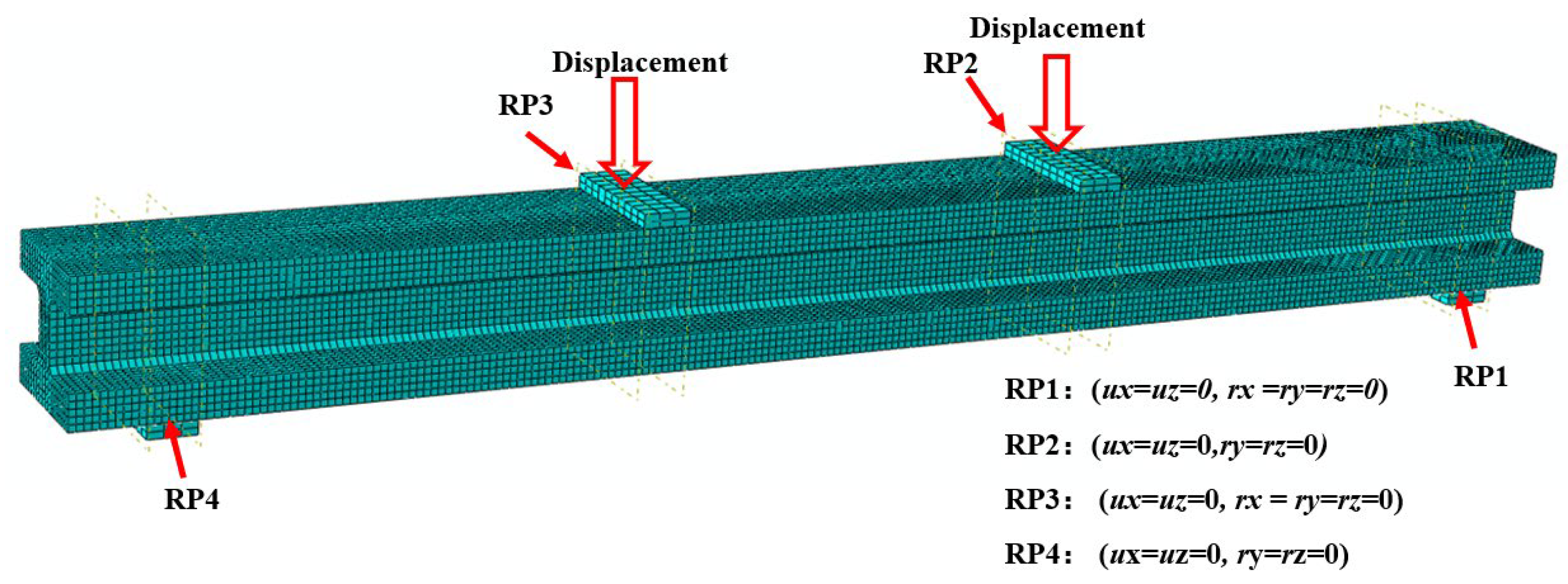
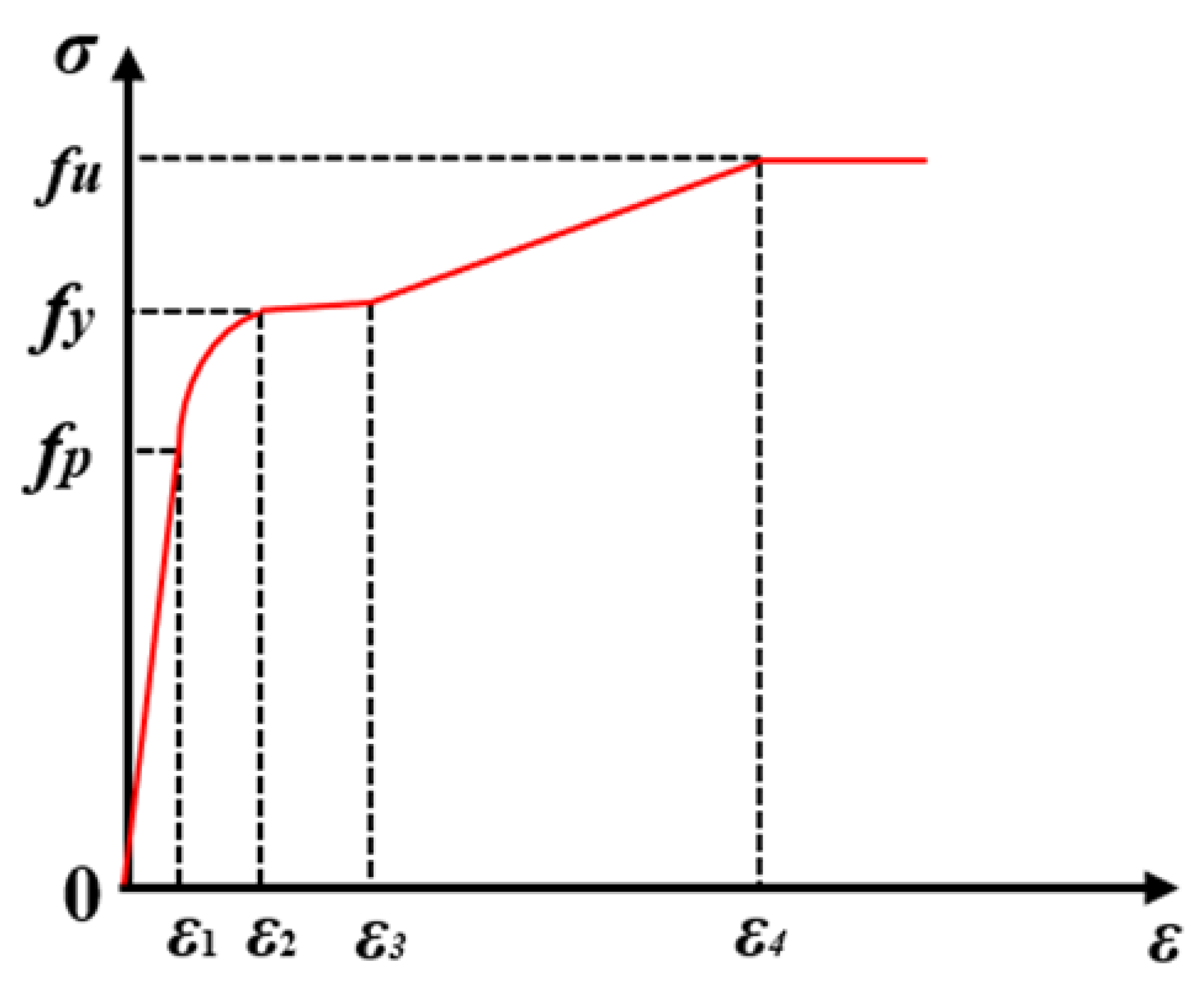
4.1. Model Development and Material Parameters
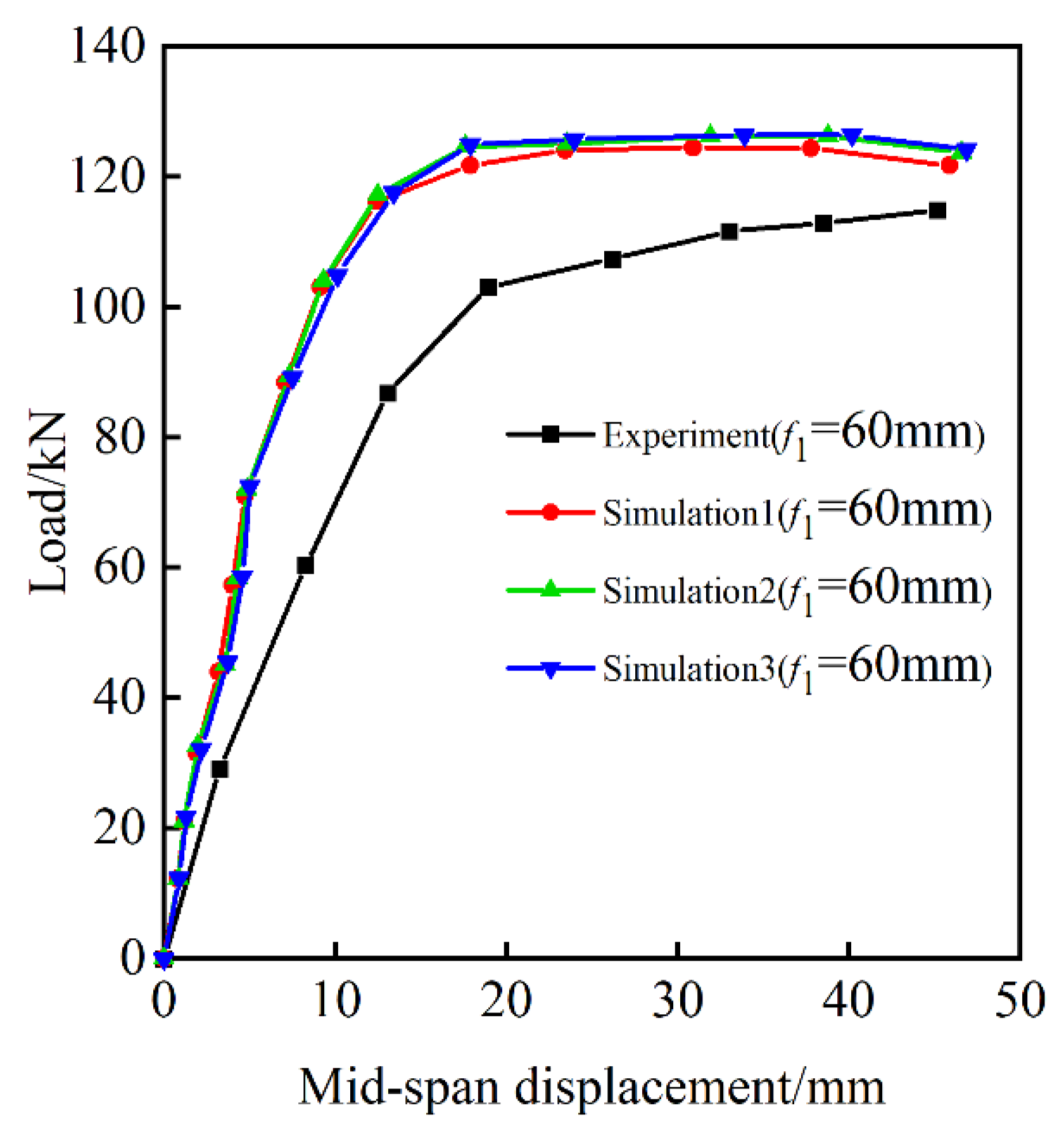
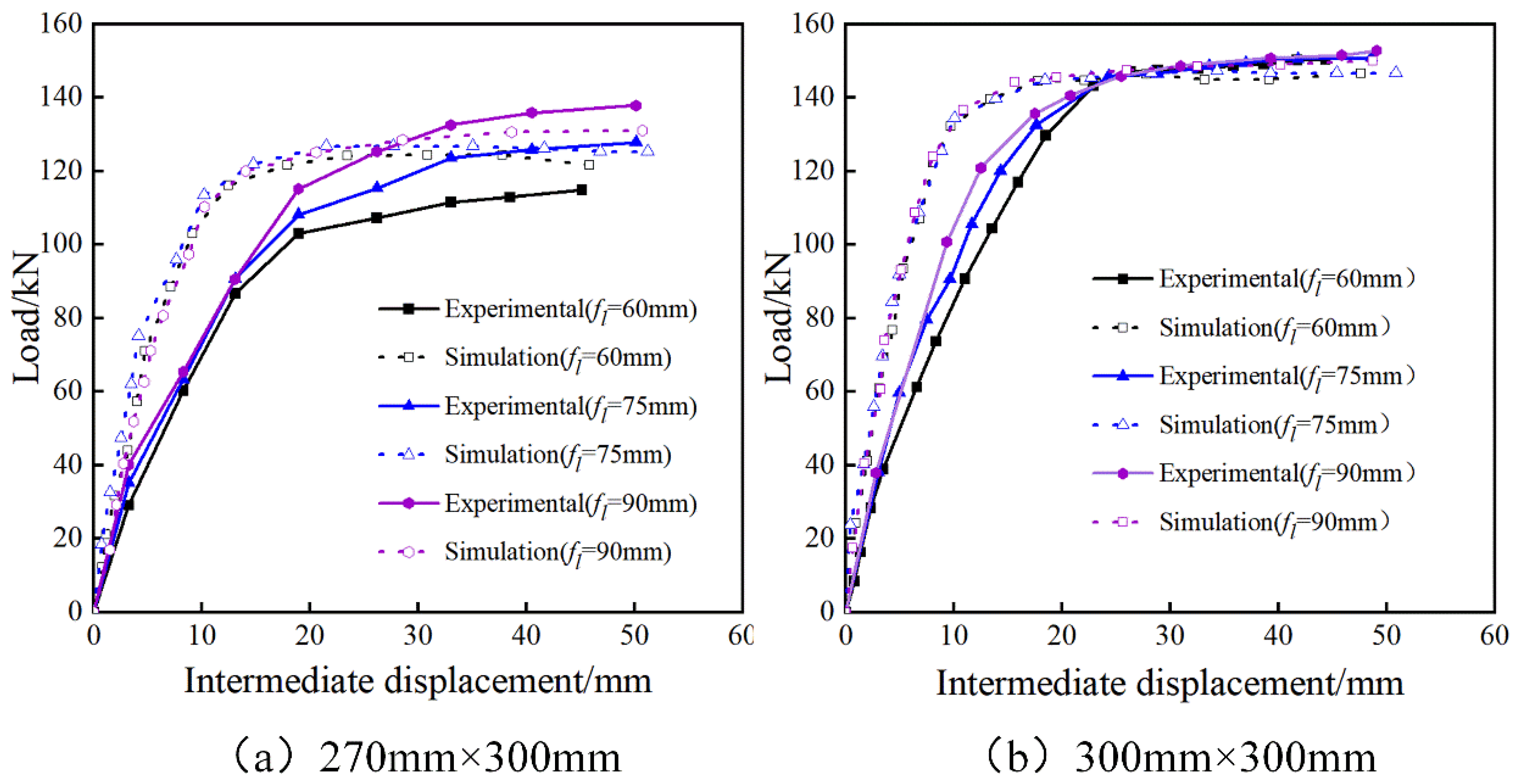
4.2. Comparison of Load–Mid-Span Displacement Curves Between Simulation and Experiment
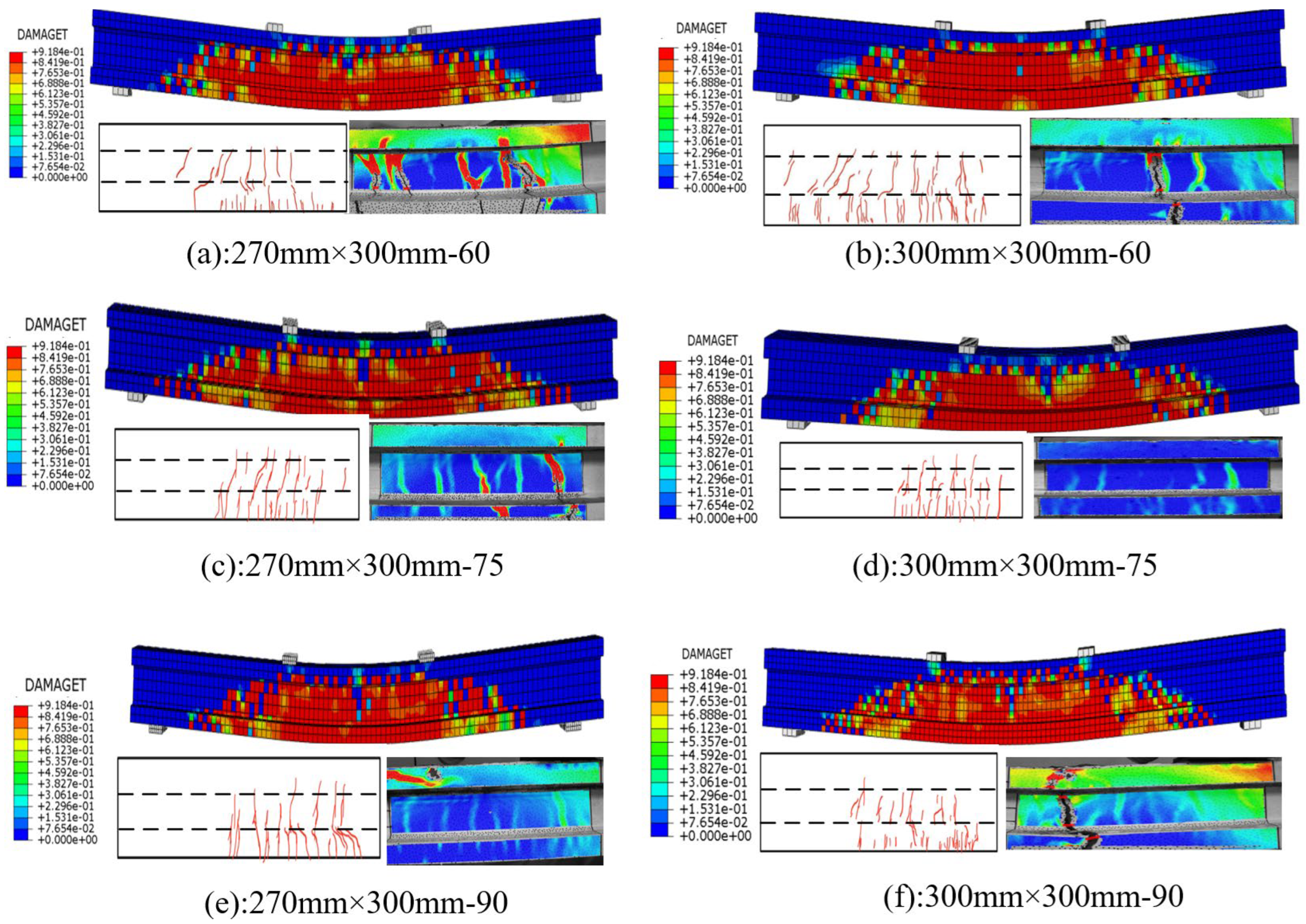
4.3. Comparison of Crack Propagation Between Simulation and Experiment
5. Conclusions
- (1)
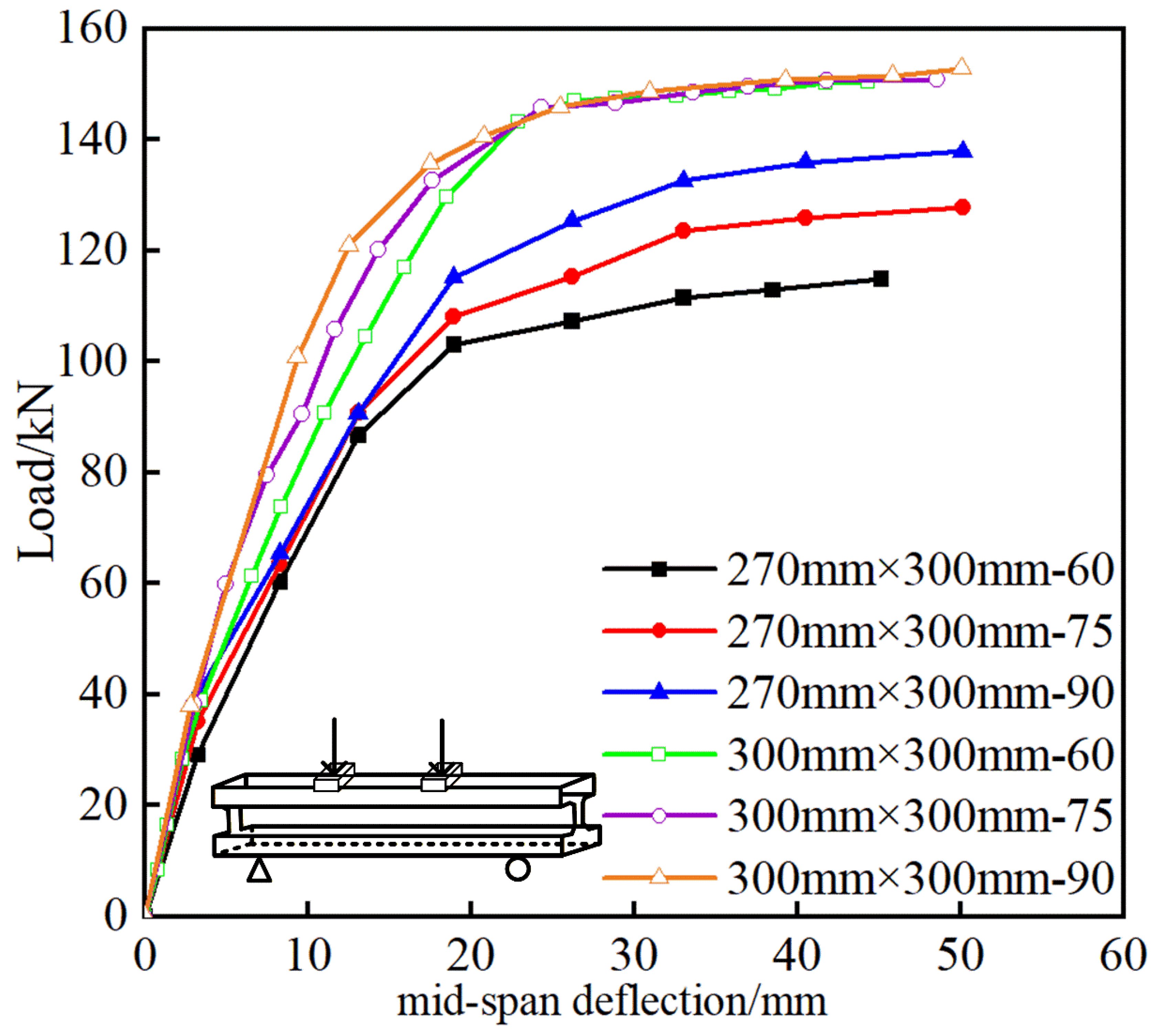
- Under the condition of a constant flange thickness, as the web thickness increases, the energy absorption of the specimen increases, while the ductility coefficient decreases. Within the section parameter combination range set in this paper (with the flange thickness fixed and the web thickness varying but the flange width and reinforcement ratio being adjusted in tandem), it was observed that the energy absorption increased by approximately 6% to 10%, and the ductility coefficient decreased by approximately 9% to 15%. This change reflects the combined influence of multiple parameters and should not be attributed solely to the web thickness. Specifically, the energy absorption increased by about 6% to 10%, and the ductility coefficient decreased by about 9% to 15%. The results indicate that increasing the web thickness is beneficial for enhancing the energy absorption of the component, but it will reduce its relative ductility level.
- (2)
- Under the condition of a constant web plate thickness, when the flange thickness increases from 60 mm to 75 mm, the ductility coefficient and energy absorption capacity of the specimen significantly decrease. Under the parameter combination of the test specimens in this paper, the ductility coefficient shows a trend of approximately a 21% to 25% reduction. Specifically, the ductility coefficient decreases by about 21% to 25%, and the energy absorption decreases by about 27% to 29%. This indicates that an increase in flange thickness is not conducive to the deformation capacity and energy absorption of the component.
- (3)
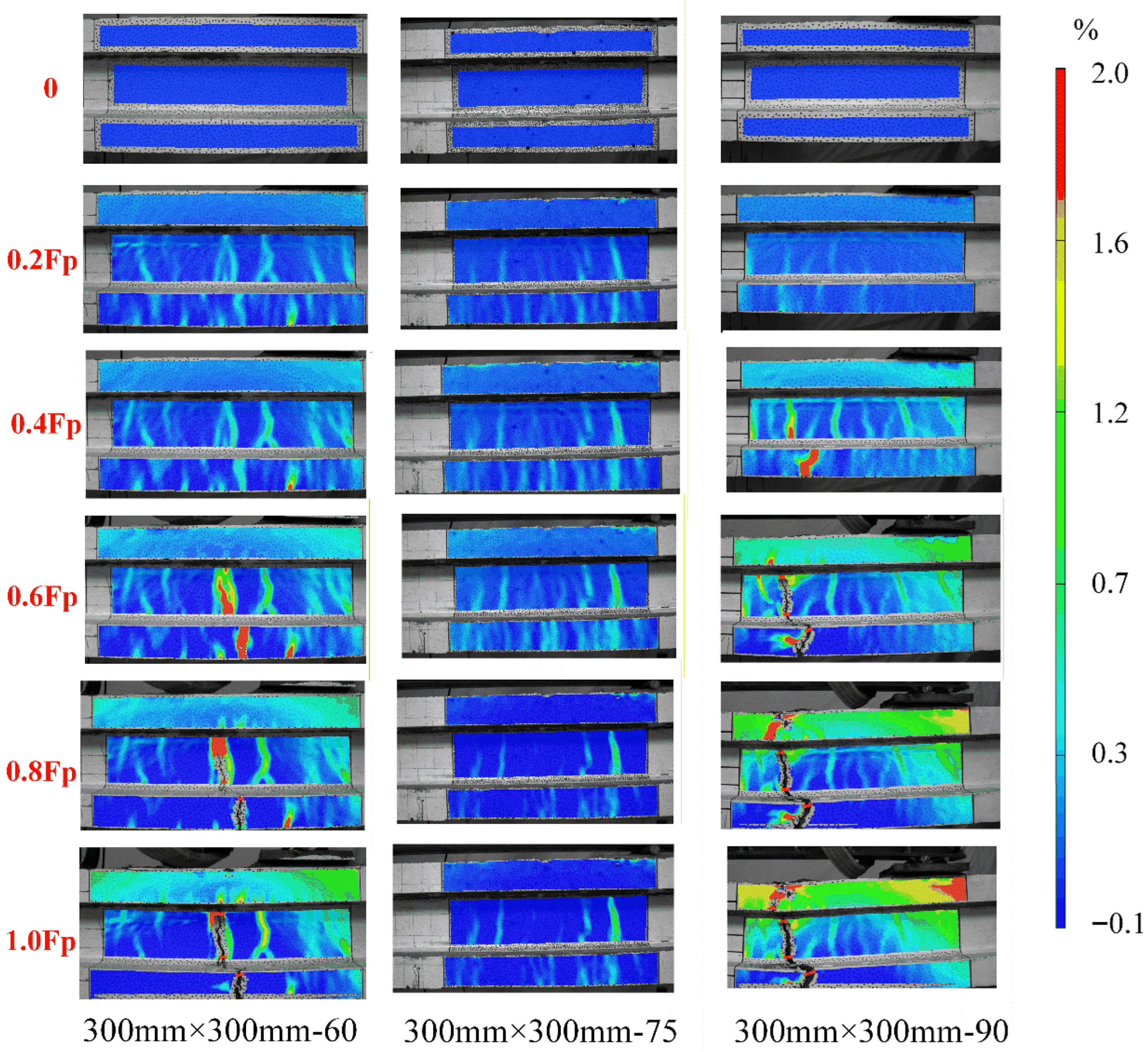
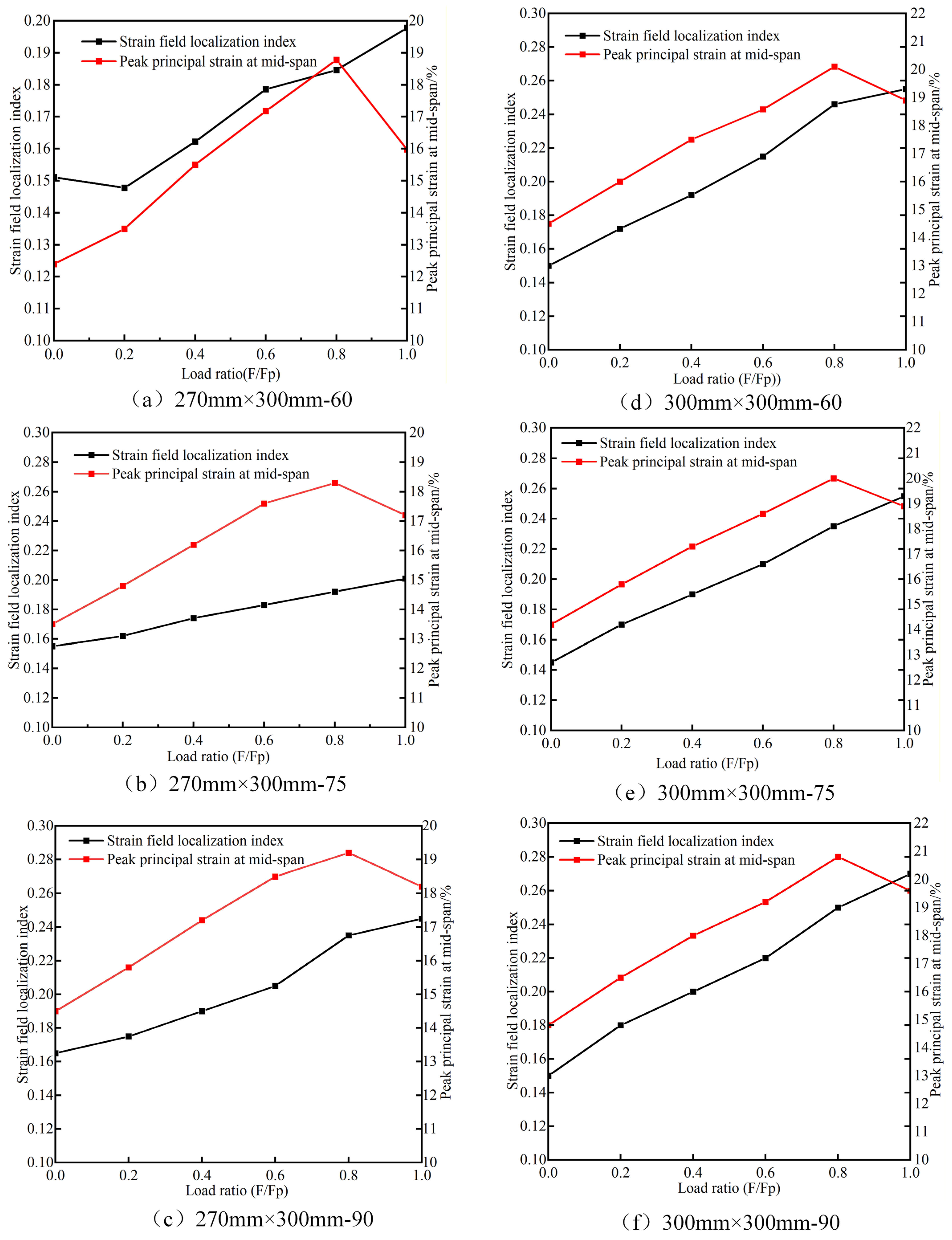
- With increasing load ratio, both the strain field localization index and the peak principal strain at mid-span exhibit an overall increasing trend, and crack evolution gradually transitions from dispersed development to localization-dominated behavior. When the load ratio approaches 1.0, the strain field localization index and the peak principal strain increase markedly. Specimens with larger sectional dimensions exhibit superior load-carrying capacity, while differences in mid-span deformation remain within a reasonable range. Increasing flange thickness further promotes the concentration of strain and cracking in localized regions, but contributes limited improvement to the global deformation capacity.
- (4)
- The finite element simulation captures the overall load–displacement response reasonably well, with peak load and ultimate displacement errors within 5%.
- (5)
- The strain field localization index proposed in this study can effectively quantify the degree of crack localization during the flexural process of H-shaped UHPC piles. It provides a quantitative tool for evaluating ductility degradation and failure modes from the perspective of strain fields, and offers useful references for crack control and ductility-oriented design optimization of such members.
Author Contributions
Funding
Data Availability Statement
Conflicts of Interest
References
- Mirzaaghabeik, H.; Shukla, S.K.; Mashaan, N.S. Effects of vertical reinforcement on the shear performance of UHPC deep beams with synthetic and steel fibres. Structures 2025, 76, 109038. [Google Scholar] [CrossRef]
- Odelola, M.; Dolati, S.S.K.; Mehrabi, A.; Garber, D. Ultra-High-Performance Concrete (UHPC) Piles and Splicing Options. Appl. Sci. 2024, 14, 827. [Google Scholar] [CrossRef]
- Mirzaaghabeik, H.; Mashaan, N.S.; Shukla, S.K. Impact of geometrical dimensions on the shear behaviour of UHPC deep beams reinforced with steel and synthetic fibres. Structures 2025, 78, 109260. [Google Scholar] [CrossRef]
- Mirzaaghabeik, H.; Mashaan, N.S.; Shukla, S.K. Shear behavior of ultra-high-performance concrete deep beams reinforced with fibers: A state-of-the-art review. Infrastructures 2025, 10, 67. [Google Scholar] [CrossRef]
- Zhu, Y.; Zhang, Y.; Hussein, H.H.; Chen, G. Flexural strengthening of reinforced concrete beams or slabs using ultra-high performance concrete (UHPC): A state of the art review. Eng. Struct. 2020, 205, 110035. [Google Scholar] [CrossRef]
- Amran, M.; Huang, S.S.; Onaizi, A.M.; Makul, N.; Abdelgader, H.S.; Ozbakkaloglu, T. Recent trends in ultra-high performance concrete (UHPC): Current status, challenges, and future prospects. Constr. Build. Mater. 2022, 352, 129029. [Google Scholar] [CrossRef]
- Zong, Z.; Qu, P.; An, G.; Guo, L.; XIE, Q. Flexural behavior of rectangular hollow UHPC beams using glazed hollow beads. Case Stud. Constr. Mater. 2025, 23, e05050. [Google Scholar] [CrossRef]
- Huang, S.; Xi, Y.; Li, X.; Meng, P.; Wu, G. Flexural behaviour of damaged concrete T-beams reinforced with ultra-high performance concrete filling. Front. Mater. 2024, 11, 1410016. [Google Scholar] [CrossRef]
- Song, Z.; Li, S.; Cheng, L.; Yu, Q. Corrosion-induced deterioration and fracture mechanisms in ultra-high-performance fiber-reinforced concretet. Constr. Build. Mater. 2024, 423, 135886. [Google Scholar] [CrossRef]
- Al-Obaidi, S.; Davolio, M.; Dicembre, S.; Del-Galdo, M.; Lo-Monte, F.; Ferrara, L. Flexural performance of pre-cracked UHPC slabs exposed to aggressive environments. Constr. Build. Mater. 2025, 466, 140315. [Google Scholar] [CrossRef]
- Lu, X.; Tu, L.; Tan, C.; Zhao, H. Effect of Steel Fiber on First-Cracking Behavior of Ultra-High-Performance Concrete: New Insights from Digital Image Correlation Analysis. Buildings 2025, 15, 1727. [Google Scholar] [CrossRef]
- Jiayuan, H.; Weizhen, C.; Boshan, Z.; Jiangjiang, Y.; Huang, L. The Mechanical Properties and Damage Evolution of UHPC Reinforced with Glass Fibers and High-Performance Polypropylene Fibers. Materials 2021, 14, 2455. [Google Scholar] [CrossRef] [PubMed]
- Birol, T.; Avcıalp, A. Impact of Macro-Polypropylene Fiber on the Mechanical Properties of Ultra-High-Performance Concrete. Polymers 2025, 17, 1232. [Google Scholar] [CrossRef]
- Herbers, M.; Richter, B.; Marx, S. Rayleigh-based crack monitoring with distributed fiber optic sensors: Experimental study on the interaction of spatial resolution and sensor type. J. Civ. Struct. Health Monit. 2024, 15, 1439–1463. [Google Scholar] [CrossRef]
- Fan, C.; Ding, Y.; Liu, X.; Yang, K. A review of crack research in concrete structures based on data-driven and intelligent algorithms. Structures 2025, 75, 108800. [Google Scholar] [CrossRef]
- Lak, E.Z.; Valikhah, F.; Das, S.; Loh, P. Structural behaviour of precast prestressed H-shaped ultra-high performance concrete (UHPC) pile with steel spliced joint. Eng. Struct. 2025, 345, 121491. [Google Scholar] [CrossRef]
- Jeong, J.P.; Kang, D.H. Study on the bending performance of composite H-shaped piles. J. Test. Eval. 2019, 47, 3836–3849. [Google Scholar] [CrossRef]
- Ng, K.W.; Garder, J.; Sritharan, S. Investigation of ultra high performance concrete piles for integral abutment bridges. Eng. Struct. 2015, 105, 220–230. [Google Scholar] [CrossRef]
- Wang, S.; Zhu, Z.; Ma, T.; Fan, J. Asphalt Concrete Characterization Using Digital Image Correlation: A Systematic Review of Best Practices, Applications, and Future Vision. J. Test. Eval. 2024, 52, 2589–2623. [Google Scholar] [CrossRef]
- Ascona García, P.P.; Ordoñez Carpio, G.E.; Zelada Zamora, W.M.; Aguirre Camacho, M.A.; Rojas Pintado, W.; Cuados Rojas, W.M.; Mundaca Ramos, H.M.; Arce Fernández, N. Intelligent automated monitoring and curing system for cracks in concrete elements using integrated sensors and embedded controllers. Technologies 2025, 13, 284. [Google Scholar] [CrossRef]
- Shahrokhinasab, E.; Hosseinzadeh, N.; Monirabbasi, A.; Torkaman, S. Performance of image-based crack detection systems in concrete structures. J. Soft Comput. Civ. Eng. 2020, 4, 127–139. [Google Scholar]
- Trinh-Duc, D.; Piotrowski, A.; Ajdukiewicz, C.; Woyciechowski, P.; Gajewski, M. Estimation of post-cracking dissipation capabilities of fiber reinforced concretes in three point bending test monitored with application of digital image correlation system. Materials 2021, 14, 5088. [Google Scholar] [CrossRef]
- Jiang, H.; Sui, H.; Zou, F.; Yu, S.; Qian, W.P.; Liu, B.; Liu, Y.; Gao, Y. Mechanical performance and crack propagation characteristics of the recycled concrete using fractal gradation. Constr. Build. Mater. 2025, 492, 143101. [Google Scholar] [CrossRef]
- Becks, H.; Högemann, M.; Hegger, J.; Class, M. Assessing crack formation and strain distribution in concrete structures using externally installed fiber optic sensors. Case Stud. Constr. Mater. 2025, 22, e04744. [Google Scholar] [CrossRef]
- Haghighi, H.; Urgessa, G. Finite Element Analysis of Pre-Stressed Ultra High-Performance Concrete (UHPC) Girders. Eng 2024, 5, 2362–2378. [Google Scholar] [CrossRef]
- Tammo, K.; Thelandersson, S. Crack widths near reinforcement bars for beams in bending. Struct. Concr. 2009, 10, 27–34. [Google Scholar] [CrossRef]
- Faron, A.; Rombach, G.A. Simulation of crack growth in reinforced concrete beams using extended finite element method. Eng. Fail. Anal. 2020, 116, 104698. [Google Scholar] [CrossRef]
- Bendezu, M.A.L.; Romanel, C.; Roehl, D.M. A comparative study on finite element methods for crack propagation in concrete. In Proceedings of the XXXVI Iberian Latin-American Congress on Computational Methods in Engineering, Rio de Janeiro, Brazil, 22–25 November 2015; Available online: https://www.researchgate.net/publication/296695019 (accessed on 16 April 2026).
- Patel, R.; Scheiden, T.; Hüpgen, M.; Rozanski, C.; Loehnert, S.; Oneschkow, N. Simulating 3D crack propagation with XFEM to investigate failure mechanism in high strength concrete. PAMM 2021, 20, e202000296. [Google Scholar] [CrossRef]
- Chen, H.; Xu, B.; Wang, J.; Nie, X.; Mo, Y.L. XFEM-based multiscale simulation on monotonic and hysteretic behavior of reinforced-concrete columns. Appl. Sci. 2020, 10, 7899. [Google Scholar] [CrossRef]
- Ooi, E.T.; Yang, Z.J. Modelling crack propagation in reinforced concrete using a hybrid finite element–scaled boundary finite element method. Eng. Fract. Mech. 2011, 78, 252–273. [Google Scholar] [CrossRef]
- Duarte, A.P.C.; Silvestre, N.; De Brito, J.; Júlio. Numerical study of the compressive mechanical behaviour of rubberized concrete using the eXtended Finite Element Method (XFEM). Compos. Struct. 2017, 179, 132–145. [Google Scholar] [CrossRef]
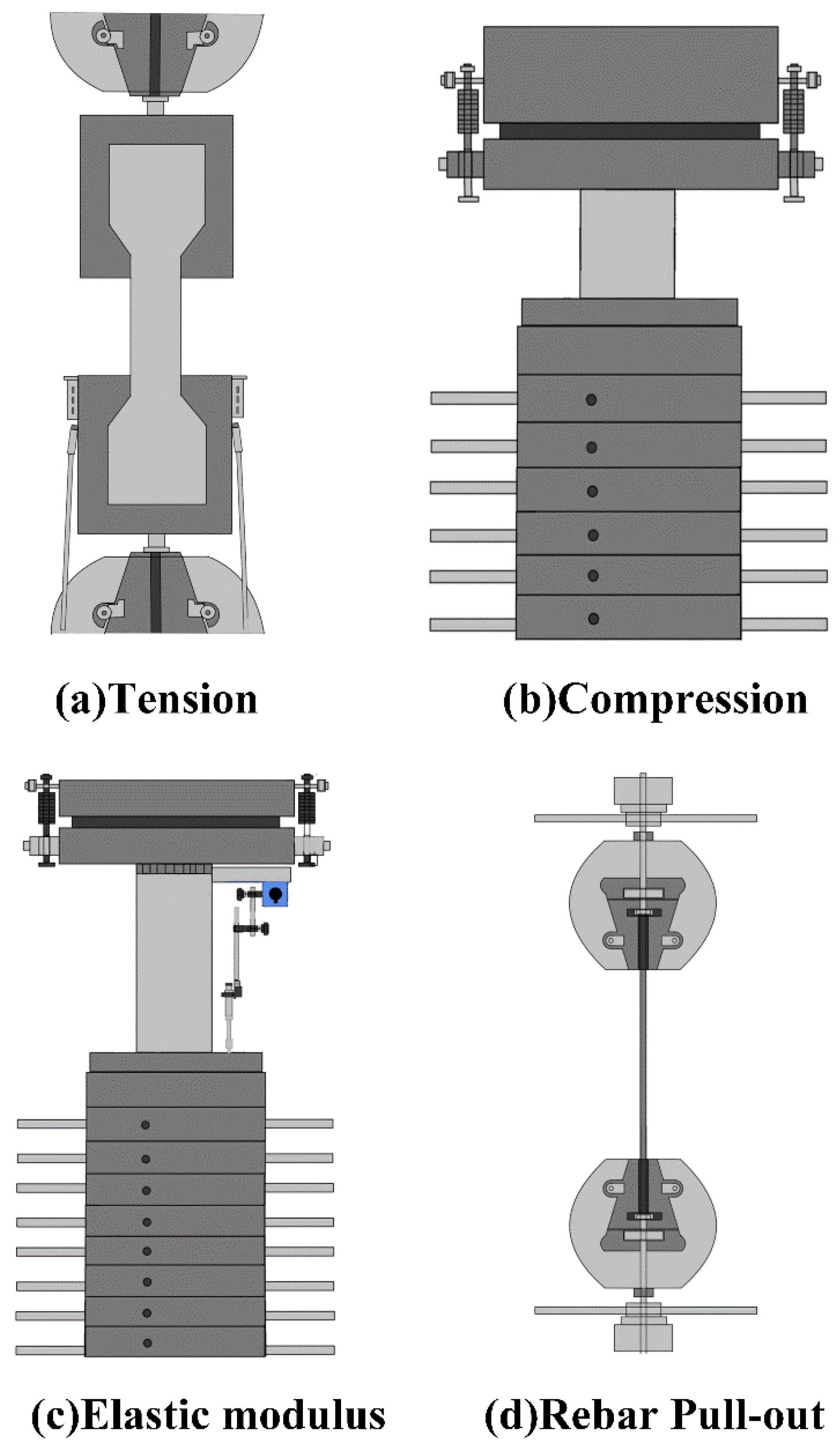
- GB/T 31387-2015; Reactive Powder Concrete. Standards Press of China: Beijing, China, 2015.
- GB/T 228.1-2021; Metallic Materials—Tensile Testing—Part 1: Method of Test at Room Temperature. Standards Press of China: Beijing, China, 2021.
- Lu, C.G.; Zhang, X.C.; Chen, W.Z.; Chen, X.F. Quantitative Analysis of Crack Propagation Behavior in Recycled Concrete Subjected to Axial Compression Using Digital Image Correlation (DIC) Technology and Fractal Theory. Fractal Fract. 2024, 8, 686. [Google Scholar] [CrossRef]
- Wang, J.; Lei, D.; Zhou, K.; He, J.; Zhu, F.P.; Bai, P.X. Crack identification in concrete, using digital image correlation and neural network. Front. Struct. Civ. Eng. 2024, 18, 536–550. [Google Scholar] [CrossRef]
- Suleiman, T.M.; Voort, V.T.; Sritharan, S. Behavior of Driven Ultrahigh-Performance Concrete H-Piles Subjected to Vertical and Lateral Loadings. J. Geotech. Geoenviron. Eng. 2010, 136, 1403–1413. [Google Scholar] [CrossRef]
- Niu, Y.; Wei, J.; Jiao, C. Crack propagation behavior of ultra-high-performance concrete (UHPC) reinforced with hybrid steel fibers under flexural loading. Constr. Build. Mater. 2021, 294, 123510. [Google Scholar] [CrossRef]
- Qasem, A.; Sallam, Y.S.; Eldien, H.H.; Ahangam, B.H. Bond-slip behavior between ultra-high-performance concrete and carbon fiber reinforced polymer bars using a pull-out test and numerical modelling. Constr. Build. Mater. 2020, 260, 119857. [Google Scholar] [CrossRef]
- Luo, J.; Hu, M.; Ren, X.; Zhang, B.; Cao, Q.; Shun, J.; Yang, S. Flexural behavior and crack width predictions of RC beams with different pre-damage degrees strengthened by UHPC. Eng. Struct. 2025, 340, 120742. [Google Scholar] [CrossRef]
- Zhou, Y.; Sui, L.; Huang, X.; Guo, M.; Luo, M.; Hu, B.; Chen, C. Enhancing the EB-FRP strengthening effectiveness by incorporating a cracking-control layer of ECC with different thicknesses. Constr. Build. Mater. 2021, 286, 122975. [Google Scholar] [CrossRef]
- Dong, W.; Rong, H.; Wu, Q.; Li, J. Investigations on the FPZ evolution of concrete after sustained loading by means of the DIC technique. Constr. Build. Mater. 2018, 188, 49–57. [Google Scholar] [CrossRef]
- Tian, T.; Jiang, Y.; Yi, Y.; Nie, C.L.; Deng, C. Fatigue Cracking Characteristics of Ultra-Large Particle Size Asphalt Mixture Under Temperature and Loading Using Digital Image Correlation Techniques. Materials 2025, 18, 1475. [Google Scholar] [CrossRef]
- Wu, F.; Fan, Z.; He, L.; Liu, S.; Zuo, J.; Yang, F. Comparative study of the negative bending behaviour of corrugated web steel–concrete composite beams using NC, ECC and UHPC. Eng. Struct. 2023, 283, 115925. [Google Scholar] [CrossRef]
- Yin, H.; Shirai, K.; Teo, W. Finite element modelling to predict the flexural behaviour of ultra-high performance concrete members. Eng. Struct. 2019, 183, 741–755. [Google Scholar] [CrossRef]
- Shafieifar, M.; Farzad, M.; Azizinamini, A. A comparison of existing analytical methods to predict the flexural capacity of Ultra High Performance Concrete (UHPC) beams. Constr. Build. Mater. 2018, 172, 10–18. [Google Scholar] [CrossRef]
- Minh, H.L.; Khatir, S.; Wahab, M.A.; Thanh, C. A concrete damage plasticity model for predicting the effects of compressive high-strength concrete under static and dynamic loads. J. Build. Eng. 2021, 44, 103239. [Google Scholar] [CrossRef]
- Alfarah, B.; López-Almansa, F.; Oller, S. New methodology for calculating damage variables evolution in Plastic Damage Model for RC structures. Eng. Struct. 2017, 132, 70–86. [Google Scholar] [CrossRef]
- Guo, Y.B.; Gao, G.F.; Jing, L.; Shim, V.P.W. Response of high-strength concrete to dynamic compressive loading. Int. J. Impact Eng. 2017, 108, 114–135. [Google Scholar] [CrossRef]









| Cement (kg/m3) | Manufactured Sand (kg/m3) | Silica Fume (kg/m3) | Fly Ash (kg/m3) | GGBS (kg/m3) | Rheology Modifier (kg/m3) | Water (kg/m3) | Superplasticizer (kg/m3) | Steel Fibers (kg/m3) |
|---|---|---|---|---|---|---|---|---|
| 800 | 850 | 250 | 100 | 160 | 131 | 200 | 35 | 155 |
| SiO2 (%) | Loss on Ignition (%) | Specific Surface Area (m2/g) | Chloride Content (%) |
|---|---|---|---|
| 92.4 | 3.92 | 19.1 | 0.07 |
| Chemical Composition | Al2O3 | SiO2 | SO3 | CaO | Others |
|---|---|---|---|---|---|
| Mass fraction (%) | 24.3 | 45.1 | 2.1 | 5.6 | 23.0 |
| Density (g/cm3) | Specific Surface Area (m2/g) | 7-Day Activity Index (%) | Flowability Ratio (%) | SO3 (%) |
|---|---|---|---|---|
| 2.9 | 420 | 420 | 104 | 0.11 |
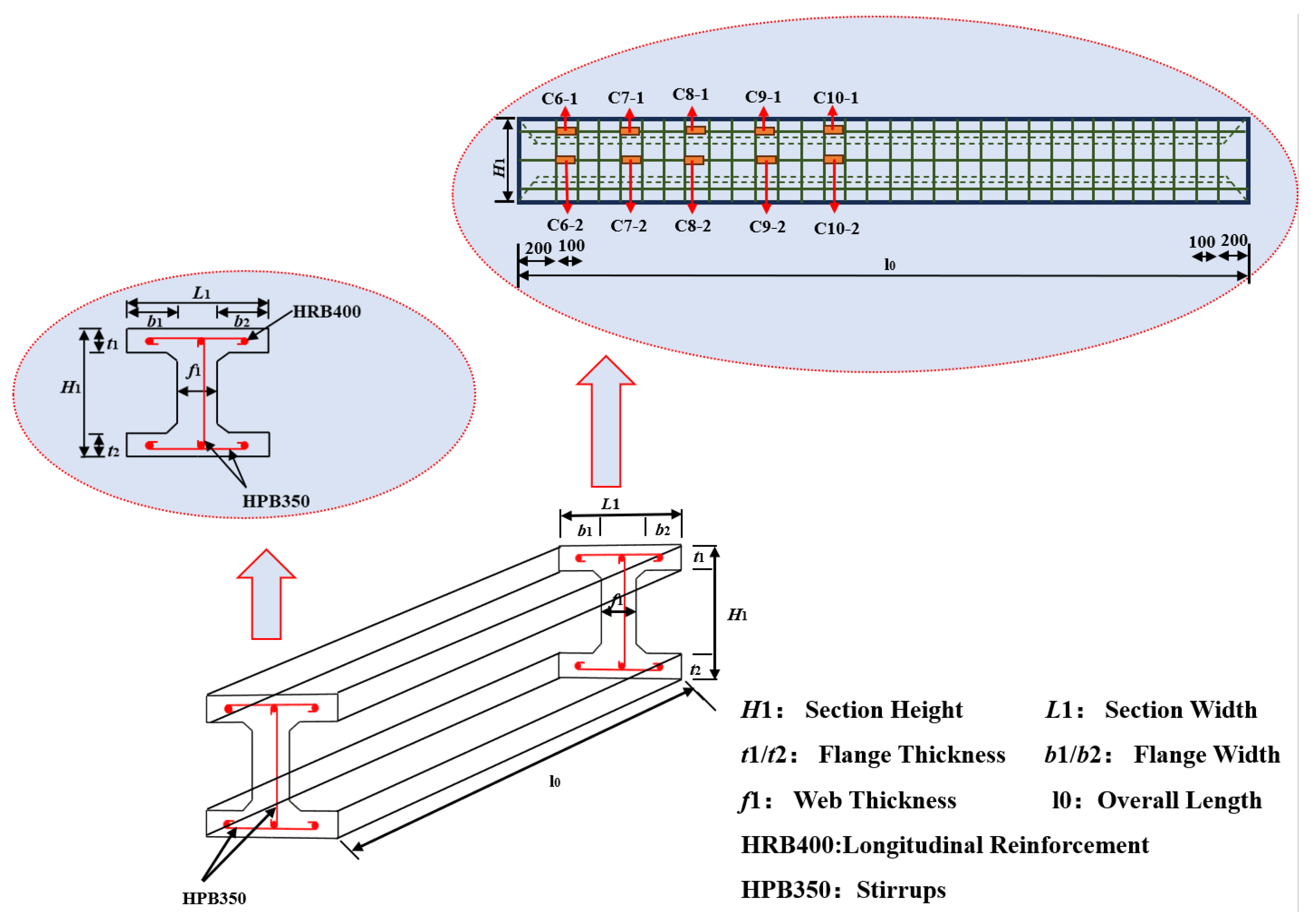
| Specimens | Specimen ID | Sectional Dimensions (mm) | Flange Thickness t1/t2 (mm) | Web Thickness f1 (mm) | Flange Width b1/b2 (mm) | Reinforcement Ratio (%) |
|---|---|---|---|---|---|---|
| Group A | Sample1 | 270 × 300 | 60 | 60 | 120/120 | 2.05 |
| Sample2 | 75 | 112.5/112.5 | 1.95 | |||
| Sample3 | 90 | 105/105 | 1.87 | |||
| Group B | Sample1 | 300 × 300 | 75 | 60 | 120/120 | 1.71 |
| Sample2 | 75 | 112.5/112.5 | 1.64 | |||
| Sample3 | 90 | 105/105 | 1.57 |
| Test objective: | Based on digital image correlation (DIC) technology, the flexural crack evolution and ductility behavior of H-shaped UHPC piles were investigated. By monitoring the crack development process, a strain field localization index was proposed, and its quantitative relationship with ductility was analyzed. The findings provide a reference for evaluating the flexural performance of H-shaped UHPC piles and for optimizing their structural design. | |
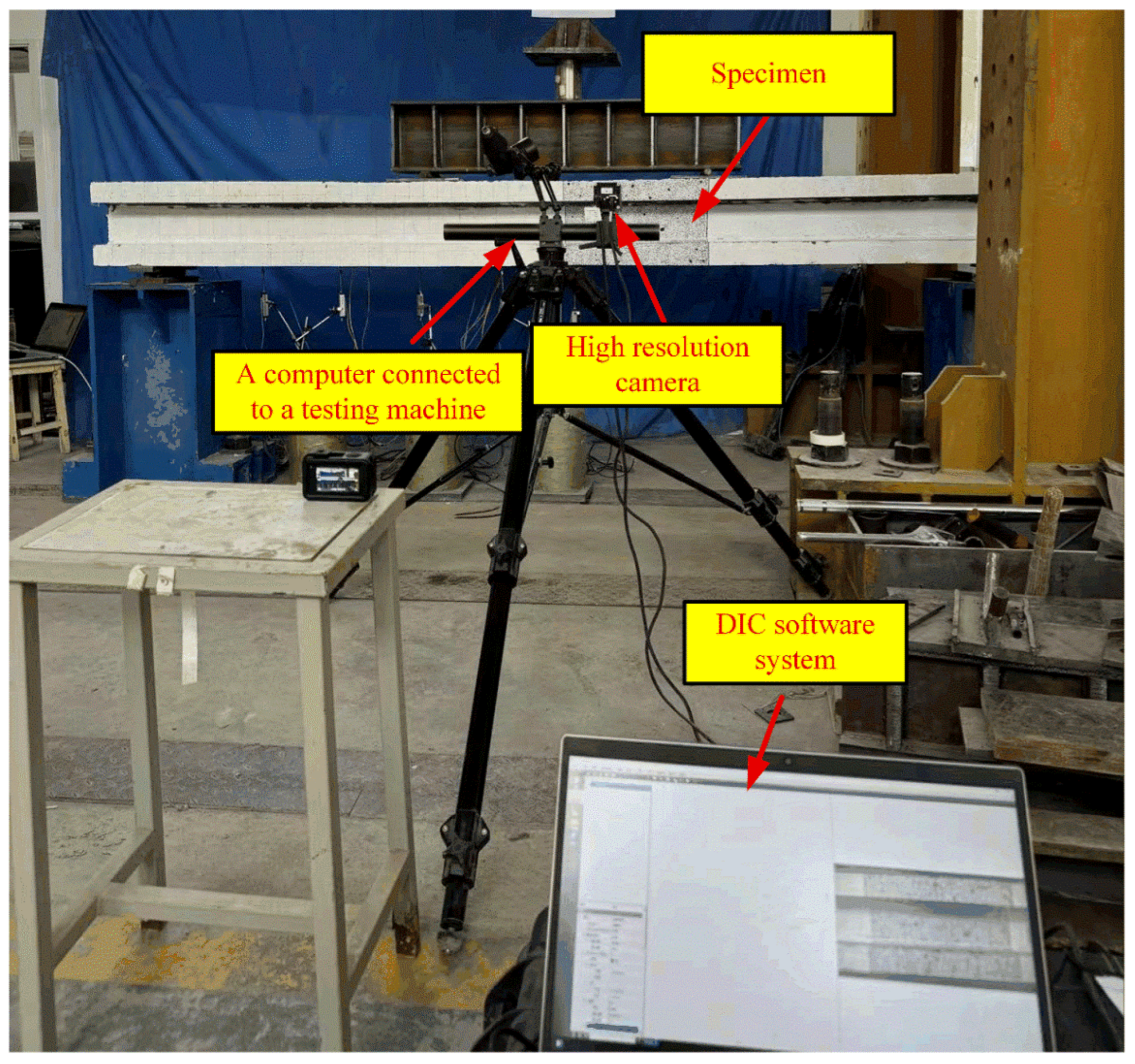
| Type | Parameters | Equipment |
| Basic information | Camera resolution | 4000 × 3000 pixels |
| Acquisition frequency | Dynamic loading: 5 Hz; Static loading: 1–2 Hz | |
| Measurement accuracy | Standard accuracy | ±0.1 mm |
| Subset size | 25 × 25 pixels | |
| Step size | 5 pixels | |
| Image quality | Image contrast quality | High contrast |
| Lighting conditions | Illumination uniformity | Uniform light source |
| Technical features: | ||
| ① | Digital image correlation (DIC) technology enables dynamic monitoring of crack evolution and provides accurate strain and displacement data, offering a reliable basis for crack localization analysis. | |
| ② | Under varying loading conditions, DIC is capable of capturing crack development trends, which aids in analyzing the influence of different parameters on the performance of H-shaped UHPC piles. | |
|
Method/ Literature | Principle |
Data Type |
Applicable Stage | The Association with Ductility/Energy Absorption | Limitations |
|---|---|---|---|---|---|
| Traditional measurement of a crack width/spacing (empirical method) | Manual or semi-automatic measurement of the geometric parameters of cracks | Discrete point data | Once the cracks appeared | No direct connection | Due to relying on visual recognition, it is impossible to detect early damage. |
| Strain gradient method | Calculate the spatial gradient of the strain field | Overall Response (DIC) | Linear elasticity to localization | No quantitative relationship has been established. | Sensitive to noise, and the physical meaning is not intuitive enough. |
| Localized crack model | Based on the statistics of the crack area/density | Binaryized crack image | The stage of stable expansion of cracks | No quantitative relationship has been established. | Image segmentation is required, but it is difficult to achieve automation. |
| Concentration of the strain field | Ratio of variance to the sum of squares | Overall Response (DIC) | From the stage of elasticity to the stage of destruction | Preliminary quantitative correlation observed | Due to the precision of DIC, the threshold needs to be further calibrated. |
| Specimens | Load (kN) | Deflection (mm) | (kN⋅mm) | |||||
|---|---|---|---|---|---|---|---|---|
| Group A | Sample1 | 96.7 | 128.5 | 10 | 25 | 45.1 | 6400.9 | 4.5 |
| Sample2 | 110 | 132.4 | 12 | 28 | 49.4 | 6657.2 | 4.11 | |
| Sample3 | 107.7 | 134.1 | 13 | 30 | 51.7 | 6830.3 | 3.98 | |
| Group B | Sample1 | 130 | 150.1 | 13 | 32 | 44.3 | 4524.4 | 3.41 |
| Sample2 | 134 | 152.2 | 15 | 35 | 48.5 | 4786.6 | 3.23 | |
| Sample3 | 137 | 152.8 | 16 | 37 | 49.1 | 4938.7 | 3.07 | |
| Sectional Parameters (mm × mm) | Experimental Peak Load (kN) | Numerical Peak Load (kN) | Peak Load Error (kN) | Experimental Midspan Displacement (mm) | Numerical Midspan Displacement (mm) | Displacement Error (mm) |
|---|---|---|---|---|---|---|
| 270 × 300-60 | 128.5 | 124.8 | −3.7 | 45.1 | 46.8 | +1.7 mm |
| 270 × 300-75 | 132.4 | 130.1 | −2.3 | 49.4 | 51.2 | +1.8 mm |
| 270 × 300-90 | 134.1 | 127.8 | −6.3 | 51.7 | 50.1 | −1.6 mm |
| 300 × 300-60 | 150.1 | 146.1 | −4.0 | 44.3 | 47.6 | +3.3 mm |
| 300 × 300-75 | 152.2 | 148.7 | −3.5 | 48.5 | 50.8 | +2.3 mm |
| 300 × 300-90 | 152.8 | 151.9 | −0.9 | 49.1 | 48.7 | −0.4 mm |
| Response Indicators | Experimental Value | Finite Element Value | Absolute Error | Relative Error |
|---|---|---|---|---|
| Initial stiffness (kN/mm) | 12.8 | 13.9 | +1.1 | +8.6% |
| Peak load (kN) | 152.2 | 148.7 | −3.5 | −2.3% |
| Limit displacement (mm) | 48.5 | 50.8 | +2.3 | +4.7% |
Disclaimer/Publisher’s Note: The statements, opinions and data contained in all publications are solely those of the individual author(s) and contributor(s) and not of MDPI and/or the editor(s). MDPI and/or the editor(s) disclaim responsibility for any injury to people or property resulting from any ideas, methods, instructions or products referred to in the content. |
© 2026 by the authors. Licensee MDPI, Basel, Switzerland. This article is an open access article distributed under the terms and conditions of the Creative Commons Attribution (CC BY) license.
Share and Cite
Zong, Z.; Qu, P.; Zhang, D.; Xie, Q.; Feng, X.; An, G.; Meng, J. Effects of Web Thickness and Flange Thickness on Flexural Crack Evolution and Ductility of H-Shaped UHPC Piles Based on DIC and Finite Element Analysis. Buildings 2026, 16, 1609. https://doi.org/10.3390/buildings16081609
Zong Z, Qu P, Zhang D, Xie Q, Feng X, An G, Meng J. Effects of Web Thickness and Flange Thickness on Flexural Crack Evolution and Ductility of H-Shaped UHPC Piles Based on DIC and Finite Element Analysis. Buildings. 2026; 16(8):1609. https://doi.org/10.3390/buildings16081609
Chicago/Turabian StyleZong, Zhongling, Peiliang Qu, Dashuai Zhang, Qinghai Xie, Xiaotian Feng, Guoqing An, and Jinxin Meng. 2026. "Effects of Web Thickness and Flange Thickness on Flexural Crack Evolution and Ductility of H-Shaped UHPC Piles Based on DIC and Finite Element Analysis" Buildings 16, no. 8: 1609. https://doi.org/10.3390/buildings16081609
APA StyleZong, Z., Qu, P., Zhang, D., Xie, Q., Feng, X., An, G., & Meng, J. (2026). Effects of Web Thickness and Flange Thickness on Flexural Crack Evolution and Ductility of H-Shaped UHPC Piles Based on DIC and Finite Element Analysis. Buildings, 16(8), 1609. https://doi.org/10.3390/buildings16081609