1. Introduction
Silane-based hydrophobic coatings are widely used to enhance the durability of cement-based materials in aggressive environments such as marine, tunnel, and hydraulic structures. By reducing water ingress, these coatings improve resistance to chloride penetration, carbonation, and surface degradation, and have been successfully applied in real engineering projects. However, their long-term performance remains inconsistent under humid conditions. Existing studies mainly focus on macroscopic properties, while the nanoscale interfacial mechanisms governing adhesion and moisture-induced degradation are not well understood. In particular, the role of interfacial water in weakening bonding with C–S–H has not been quantitatively clarified, highlighting a critical gap between engineering performance and fundamental understanding.
As an excellent silicone polymer, polydimethylsiloxane (PDMS) has been widely regarded as a multifunctional elastomer, which occupies an important position in many engineering fields. The material not only has a wide range of elastic modulus of 0.57–3 MPa, which shows much better flexibility than traditional rigid materials, but also has excellent thermal stability (−40 °C to 200 °C) and chemical inertness [
1,
2]. In addition, the surface properties of PDMS are also very outstanding, such as low surface energy (about 20 mN/m) and high hydrophobicity (water contact angle about 110°), which together promote the successful application of PDMS in microfluidic chips, biomedical implants, flexible sensing devices, and so on. In recent years, its application has been further extended to the modification of cement-based materials.
From an engineering perspective, numerous studies have reported that silane-modified cementitious materials exhibit improved durability and service life in real structures. For example, hydrophobic coatings have been successfully applied in coastal concrete structures to mitigate chloride-induced corrosion, as well as in tunnel and underground constructions to reduce moisture-related degradation. In addition, commercial products based on silane or siloxane formulations are widely used in protective surface treatments for concrete pavements and building facades. However, despite their widespread application, the long-term performance of silane-based coatings remains inconsistent under varying environmental conditions, particularly in humid or water-saturated environments. Experimental studies have shown that the effectiveness of hydrophobic treatments can decrease over time due to interfacial degradation, water infiltration, and loss of adhesion between the coating and the cementitious substrate.
From a scientific perspective, previous research has primarily focused on macroscopic performance evaluation, such as water absorption, contact angle, and durability indicators. However, the fundamental interfacial mechanisms governing adhesion, debonding, and moisture-induced degradation at the nanoscale remain insufficiently understood. In particular, the role of interfacial water in altering molecular interactions and weakening bonding strength between silane-based materials and C–S–H phases has not been systematically quantified. Therefore, a comprehensive understanding that integrates both engineering performance and nanoscale interfacial mechanisms is still lacking. Addressing this gap is essential for improving the design, durability, and reliability of silane-based hydrophobic coatings in practical construction applications.
Calcium silicate hydrate (C–S–H) gel, as the core product of cement hydration, constitutes the basic phase that plays a key role in the bonding of cement-based materials [
2] and directly determines the macro-mechanical behavior and long-term durability of materials. By introducing PDMS into the cement system, an organic–inorganic composite structure can be constructed at the interface between PDMS and cement, which provides a new way for material functionalization and performance improvement. However, under the action of external mechanical loads (such as shear, tensile, or torsional stress), the composite system is prone to interfacial debonding, which leads to the failure of the bond between PDMS and C–S–H, and then affects the integrity and service life of the material [
3,
4]. This problem is particularly prominent in humid or underwater environments such as hydraulic structures, where moisture intrusion will further weaken the interfacial bond strength and aggravate material damage.
The interfacial adhesion mechanism exhibits a significant humidity dependence. Under dry conditions, the interaction between PDMS and C–S–H is dominated by van der Waals forces [
5,
6,
7], resulting in a stable interfacial contact. However, as the ambient humidity increases, complex water-mediated effects occur in the interfacial region. Polar water molecules play a dual role in the nanoscale interface: they can not only destroy the original hydrophobic contact between PDMS and C–S–H, but also promote the formation of a hydrogen bond network through surface modification under specific conditions, and participate in the dynamic chemical changes in the interface region. Different from the traditional understanding, this study found that the controlled humidity environment does not always weaken the interfacial properties, but may enhance the interfacial interaction through surface activation or as a reaction mediator, which reveals the subtle and complex regulatory mechanism of water molecules in the PDMS/C–S–H composite system [
7,
8].
At present, limited by the experimental means of nanoscale interface analysis technology, researchers increasingly rely on molecular dynamics simulation to reveal the microscopic physical and chemical processes in the interface region. The calculation method can systematically investigate the dynamic changes in key interfacial forces, such as the van der Waals force and hydrogen bonding, under different humidity conditions, and further evaluate the comprehensive influence mechanism of these forces on the interfacial bonding strength. In this context, this study aims to achieve the following core objectives through molecular dynamics simulations: (1) to reveal the microscopic mechanism of debonding between PDMS and C–S–H substrates in different hydration environments; (2) to quantitatively describe the evolution of interfacial strength during debonding; and (3) to clarify the nanoscale mechanism of water molecules at the PDMS/C–S–H interface. The research results are expected to provide an important theoretical basis for the design and application of high-performance PDMS-modified cement-based composites.
More importantly, previous studies have not clarified how water molecules—especially those confined in the nanoscale region between PDMS and C–S–H—regulate bonding strength, interfacial energy barriers, or debonding pathways. The lack of mechanistic insights makes it difficult to explain inconsistent experimental observations in the literature regarding PDMS durability under humid conditions. Furthermore, the interfacial water film often used in MD simulations is rarely connected to measurable experimental humidity values, making it difficult to establish a direct comparison between simulations and real-world conditions [
9].
To address these gaps, this work performs a molecular-scale investigation of PDMS–C–S–H adhesion by considering controlled hydration environments. Water contents corresponding approximately to low, medium, and high relative humidity (RH) conditions were introduced using adsorption-isotherm-based estimates from published experiments [
2]. Through detailed mechanical debonding simulations and energy analyses, this study reveals how van der Waals interactions, interfacial spacing, and water film continuity jointly determine the adhesion strength. The results provide new insight into the nanoscale mechanisms responsible for humidity-dependent adhesion and offer a theoretical foundation for optimizing hydrophobic treatments in cement-based materials.
3. Results and Discussion
3.1. Interface Structure of PDMS and C–S–H
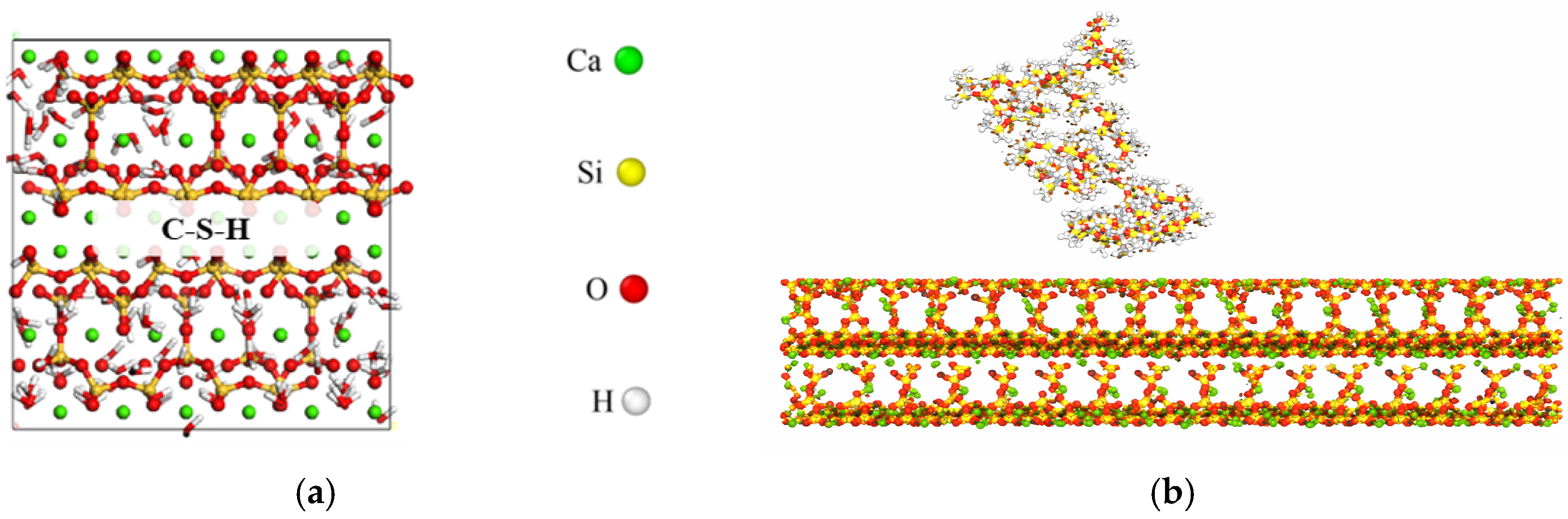
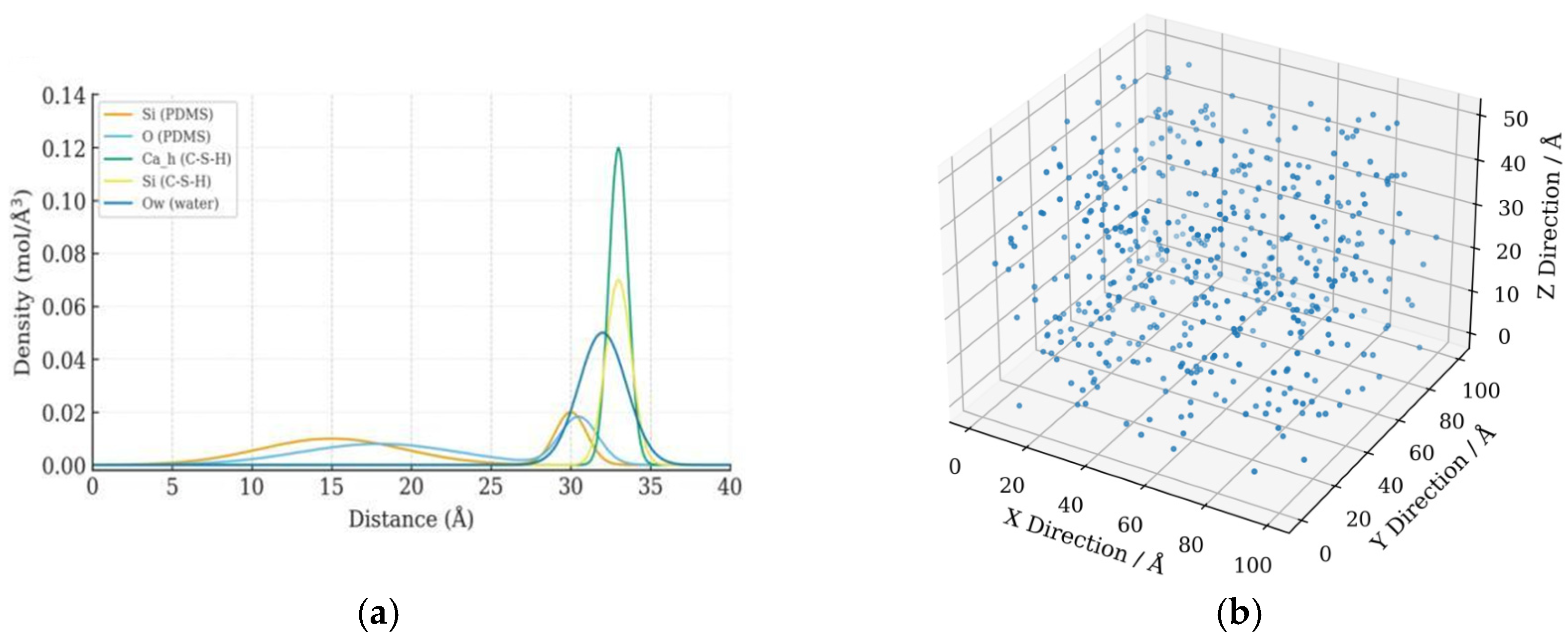
In order to explore the intrinsic relationship between material properties and microstructure, we analyzed the atomic spatial distribution of PDMS and C–S–H composites along the Z direction (see
Figure 3a for the results). In the figure, the PDMS component is represented by the density curve of its characteristic atoms Si (silicon) and O (oxygen), while the C–S–H gel phase is identified by its main atom classes: Si (silicon atom), Ca (interlayer calcium ion), O (bridging and non-bridging oxygen), Ow (oxygen atom in water molecule), and Hw (hydrogen atom in water molecule).
From the distribution of PDMS silicon atoms in the Z-axis direction (
Figure 3b), the structural deformation characteristics can be seen intuitively. The distribution data showed that PDMS was mainly distributed in the range of Z = 23.48 Å to 24.56 Å, and did not directly contact with the C–S–H surface, indicating that the adsorption of C–S–H on PDMS was weak, and the overall structural deformation of the material was limited. This conclusion is further supported by the comparative data in
Figure 3b: there is only a weak van der Waals interaction between PDMS and C–S–H, resulting in insufficient interfacial binding force.
3.2. Peeling Process and Performance of PDMS on C–S–H
Based on molecular dynamics simulation,
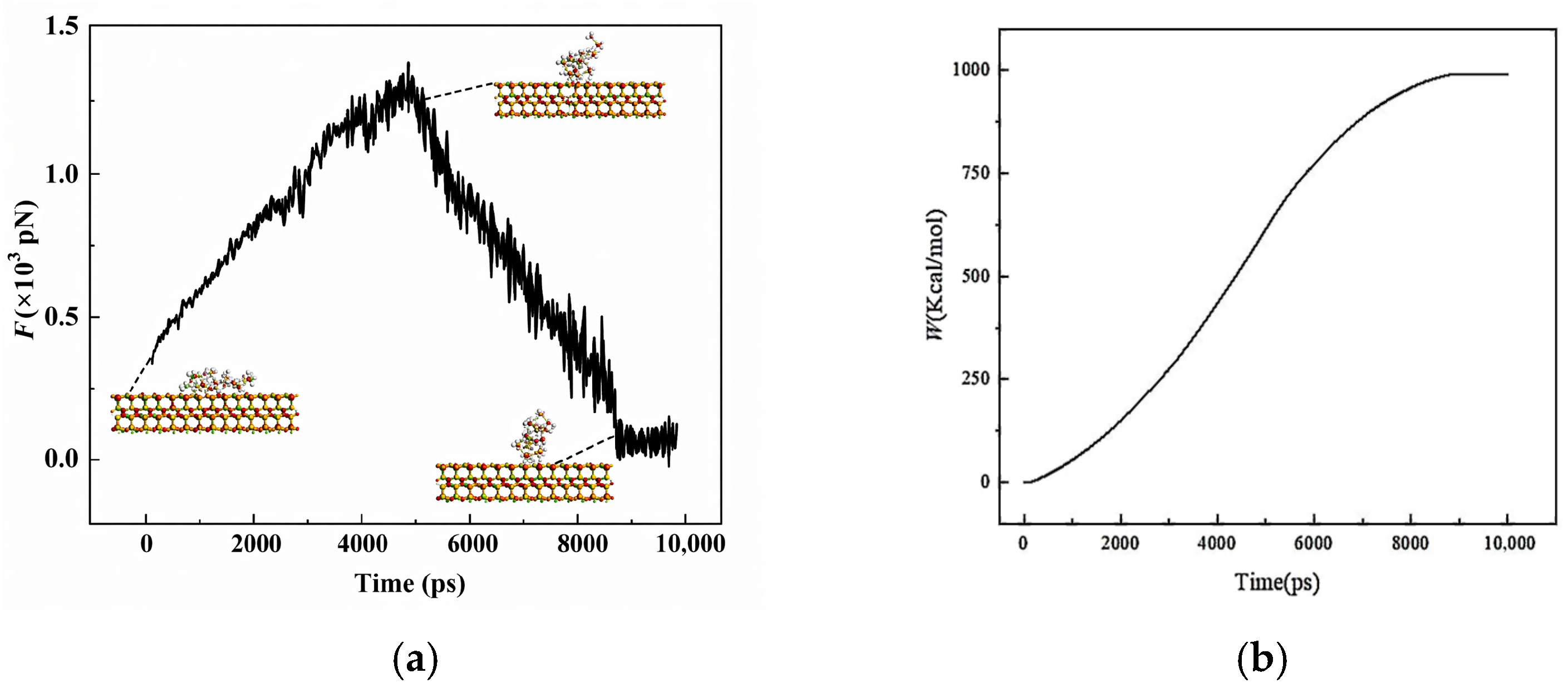
Figure 4a clearly illustrates the dynamic process of PDMS gradually peeling off from the C–S–H substrate. The peeling behavior can be divided into three typical stages, corresponding to simulated snapshots captured at three representative time nodes: 0 ps, 5000 ps, and 10,000 ps. From the simulation results, it can be clearly seen that under continuous and uniform external tensile loads, PDMS films undergo progressive delamination from the interface. This process is not a single separation event completed instantaneously, but presents a multi-stage, discontinuous, and spatially non-uniform complex detachment behavior. Of particular note is that during the delamination process, dynamic morphological changes such as intermittent and localized folds and ripples appeared on the PDMS surface. The generation and evolution of these instantaneous structures revealed the real-time response mechanism and adaptive adjustment behavior of the material under external force at the nanoscale.
The above microstructural evolution indicates that the interface separation process has significant non-uniform characteristics in both time and space, with stress concentration, accumulation, and periodic relaxation occurring in local areas. This phenomenon reflects the complex and dynamically evolving interface interaction mechanism between PDMS and C–S–H substrate. To further quantify and analyze the peeling behavior, this study systematically monitored and recorded the complete curves of tensile force (F) and external mechanical work (W) on the system over time, as shown in
Figure 4. Among them, the evolution trend of tensile force F directly reveals the dynamic changes in the interaction forces of the interface during the separation process, which is a key indicator for understanding the micro mechanism of interface stress transmission and redistribution. The time integral of work W reflects the balance between external energy input and energy conversion achieved through molecular rearrangement, friction, and viscoelastic dissipation within the system.
During the process of continuous external tension driving the gradual delamination of PDMS, the system continuously receives mechanical work and partially converts it into interface failure energy, while partially dissipating it in the form of heat. At the same time, it induces molecular chain recombination and energy redistribution within the material. Therefore, the force F and work W can not only effectively characterize the energy input and dissipation behavior during the peeling process, but also serve as key physical parameters for evaluating the interfacial bonding strength, dynamic durability, and failure resistance of this type of composite material. This method and related findings provide a theoretical and numerical basis for a deeper understanding of the interface failure mechanism and dynamic behavior of such materials in real complex stress environments, and have important guiding significance for the design and performance optimization of corresponding materials.
The tensile force curve first increased and then decreased, reaching the maximum value of Fmax = 1.48 × 10³ pN at 5000 ps, while the work curve first increased rapidly and then tended to be flat, reaching Wmax = 989.80 kcal/m2 at about 9000 ps. The appearance of Fmax corresponds to the maximum force energy barrier that must be overcome for the PDMS to begin to detach from the substrate, while Wmax represents the total energy input required for the PDMS to be fully exfoliated. Based on these two parameters, the debonding mechanism of PDMS on the C–S–H surface will be systematically discussed in this study.
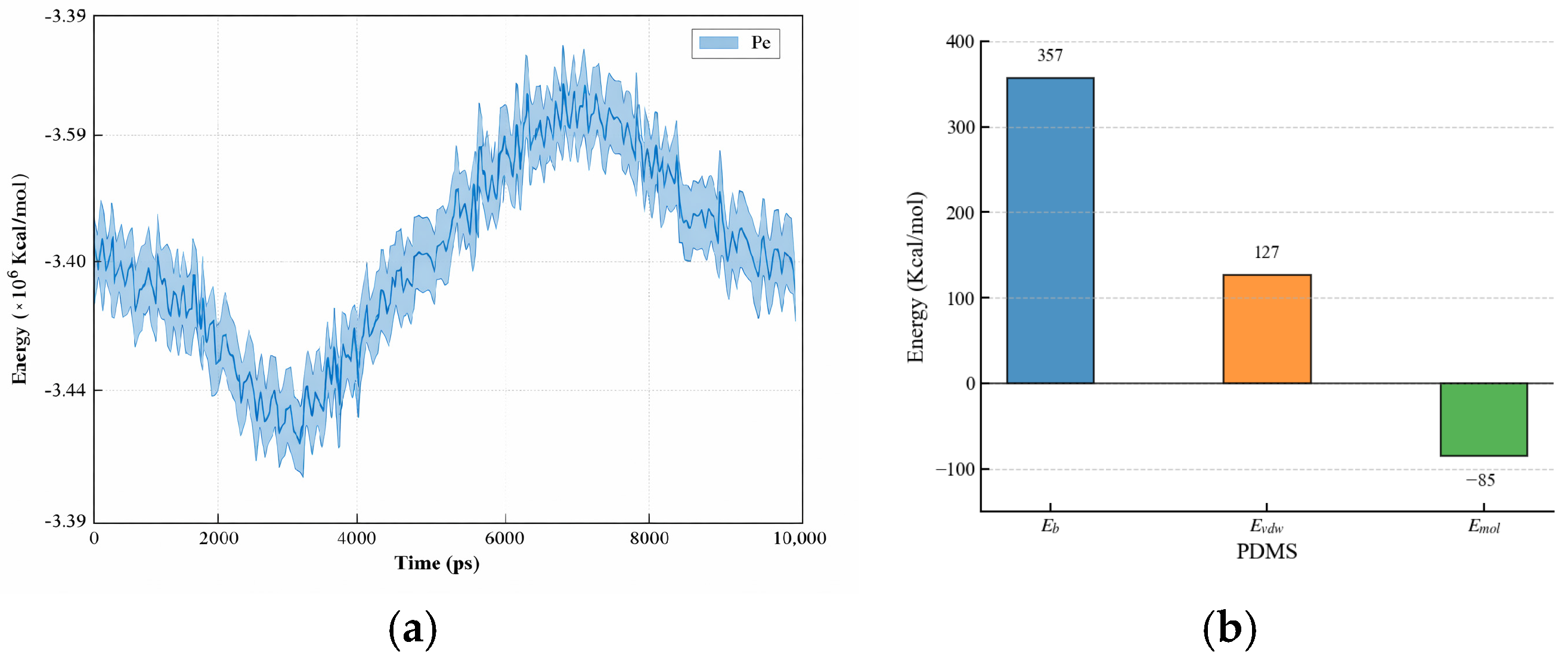
On the other hand, the binding energy (E
b), as a crucial physical quantity in the fields of materials science and interface chemistry, is defined as the total energy released by two different materials as they gradually approach and eventually form a complete and thermodynamically stable composite system from an initial, completely independent, and non-interacting free state. This energy release phenomenon is usually closely related to various microscopic mechanisms, including the reformation and strengthening of chemical bonds, the rearrangement and optimization of interface atomic structures, and a significant reduction in the total energy of the entire system. The numerical value of the binding energy in
Figure 5a directly reflects the strength of the interaction between two materials—the larger the value, the stronger the interfacial bonding effect, and the more stable the composite structure formed. Specifically, in the system of C–S–H (hydrated calcium silicate) and PDMS (polydimethylsiloxane), the higher binding energy values fully indicate that C–S–H not only has a more significant adsorption effect on PDMS, but also forms a stronger bond at the interface. Therefore, in order to achieve the separation of PDMS and C–S–H substrate in practical applications, it is necessary to input sufficiently high energy from the outside to overcome this large binding energy barrier. From a theoretical perspective, the minimum external energy required to achieve separation should be equal to the value of the binding energy. However, in practical experiments or engineering processes, due to various complex factors such as energy dissipation, heat loss, interface defects, and dynamic limitations, more energy than the theoretical value is often required to achieve effective separation.
Among them, E
total represents the overall potential energy of the C–S–H/PDMS composite system, which reflects the stable state of the entire system at the energy level. E
surface represents the potential energy contribution of individual PDMS components, reflecting the energy characteristics of the material when it exists independently. And E
c–s–h corresponds to the potential energy portion of the C–S–H component, representing its own energy properties. From the experimental results shown in
Figure 5b, it can be clearly seen that the binding energy between PDMS and C–S–H reaches 357 kcal/m
2, which fully demonstrates the strong interaction between the two phases at the interface. By further conducting energy decomposition analysis based on binding energy, we can identify and quantify key factors that affect interfacial adhesion behavior, providing a theoretical basis for understanding the interfacial properties of composite materials.The binding energy can also be expressed using the following relationship:
In the formula, Δ
Epair characterizes the comprehensive energy contribution of non-bonding interactions, including various important intermolecular mechanisms such as hydrogen bonding, van der Waals forces, and electrostatic Coulomb interactions. Among these non-bonding interaction types, the van der Waals effect is particularly significant, with an energy value of 484 kcal/m
2, far exceeding other non-bonding interaction forms, demonstrating its absolute dominance and key influence in energy composition. On the other hand, ΔE
mol represents the bond interaction energy generated by covalent bonding between atoms, covering various basic intramolecular interaction modes such as tensile deformation, angular bending, and torsional vibration of bonds. Its specific energy value is −85.0 kcal/m
2. This negative value clearly indicates that the process belongs to an exothermic reaction, meaning that the system will release energy during the formation of chemical bonds.
Figure 4b shows the composition of the binding energy components between PDMS and substrate C–S–H through energy decomposition analysis, and provides a detailed visualization of the contributions of each energy component. The analysis results clearly show that the value of the non-bond interaction energy E
pair is significantly greater than the bond interaction energy E
mol, and there is a very substantial difference between the two. This comparisonin further confirms that van der Waals forces are the dominant non-bonding form in the interaction between PDMS and C–S–H interface, while the contributions of other non-bonding interactions, such as hydrogen bonding and electrostatic Coulomb interactions, are relatively weak and can be ignored. Therefore, this study ultimately concludes that van der Waals forces are the main energy source causing the debonding of PDMS, and also the most critical physical mechanism governing its interfacial bonding behavior with C–S–H.
3.3. Effect of Moisture Content on PDMS Debonding Performance
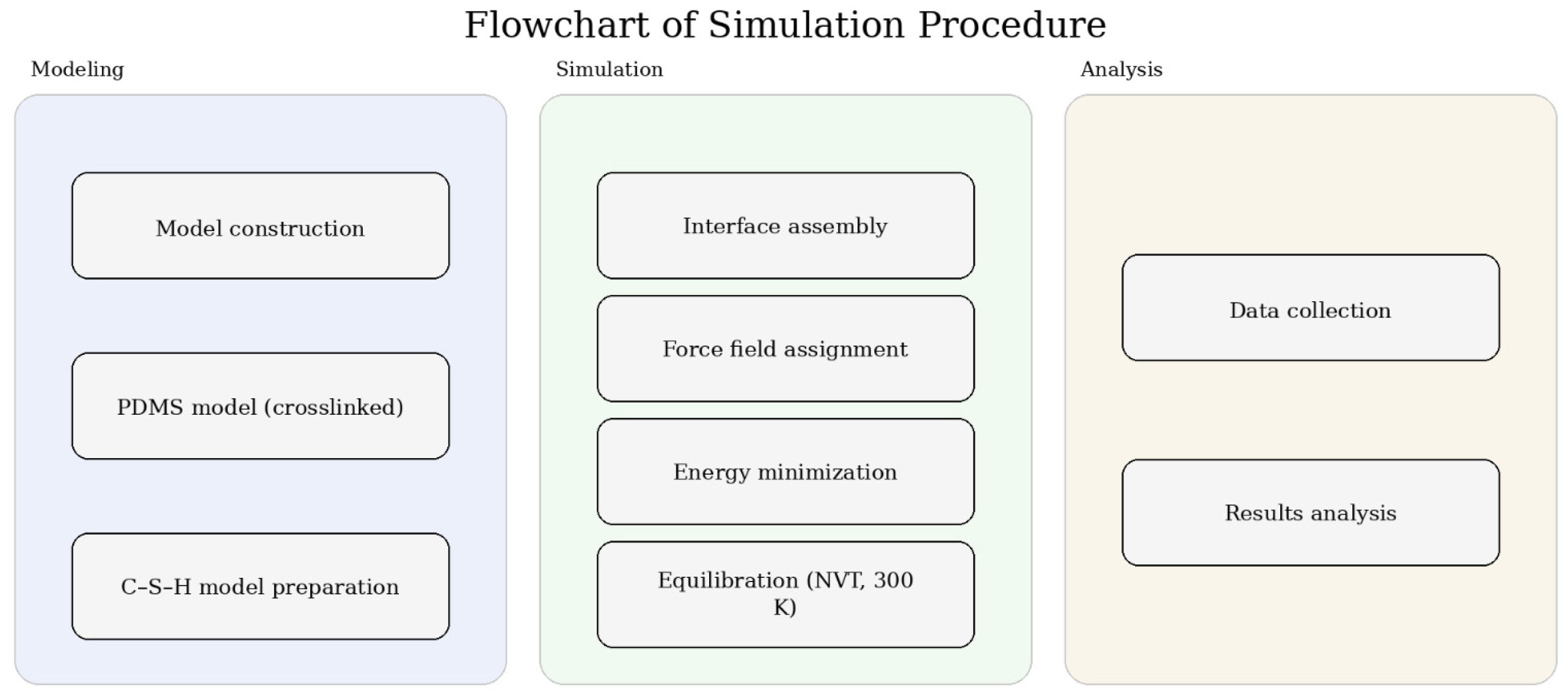
Given that PDMS materials themselves exhibit significant hydrophobic characteristics, while C–S–H surfaces have obvious hydrophilicity, the water permeation behavior at the interface between the two is fundamentally different from that of common hydrophilic material interfaces. In order to investigate the specific impact mechanism of different humidity conditions on the interfacial bonding performance between PDMS and C–S–H, this study constructed four types of model systems with different moisture contents, simulating the dry interface state, the case of only containing a single water molecule layer, the condition of containing a double water molecule layer, and the state of completely filling three layers of water molecules between PDMS and C–S–H interface to achieve sufficient wetting. After completing the structural construction of the model, the position of the C–S–H substrate was first fixed, and a pre-relaxation operation with a duration of 1 nanosecond was implemented to promote the energy minimization and structural stability of the entire interface system. Subsequently, through simulation experiments of applying tensile loads to each system, the mechanical response and interface failure behavior were systematically analyzed to ensure good comparability and scientific reliability of the results obtained under different water content conditions.
The experimental results show that as the moisture content gradually increases, the debonding strength between PDMS and C–S–H interface exhibits a complex trend of first decreasing and then slightly increasing. In the dry interface state, due to the lack of lubrication from water molecules, the frictional force between the interfaces is relatively high, resulting in relatively high debonding strength. When the interface contains only a single layer of water molecules, a weak lubricating film is formed between PDMS and C–S–H, significantly reducing the frictional resistance between the interfaces and resulting in a significant decrease in debonding strength. As the number of water molecules further increases to a bilayer, the lubrication effect is further enhanced, and the debonding strength continues to decrease. However, when the interface is completely filled with three layers of water molecules and reaches a fully wet state, although the number of water molecules is the highest, a certain structural hydration layer is formed due to the enhanced interaction between water molecules and the hydrogen bonding between water molecules and the C–S–H surface, which hinders the debonding of PDMS and leads to a slight increase in debonding strength. This discovery provides important experimental evidence for a deeper understanding of the influence of moisture content on the interfacial adhesion performance between PDMS and C–S–H.
It should be noted that these water layers do not represent stable liquid films literally, but correspond to restricted water states widely used in MD research to approximate low-, medium-, and high-humidity conditions. According to the published C–S–H adsorption isotherms, the corresponding approximate relative humidity values are as follows: one layer of water is roughly equivalent to a relative humidity of ≈40–50%, the relative humidity of the “double layer of water” is ≈70–80%, and the relative humidity of the “triple layer of water” is >90% (close to capillary condensation). Therefore, these hydration states are expressions of moisture content rather than physically measurable film thickness.
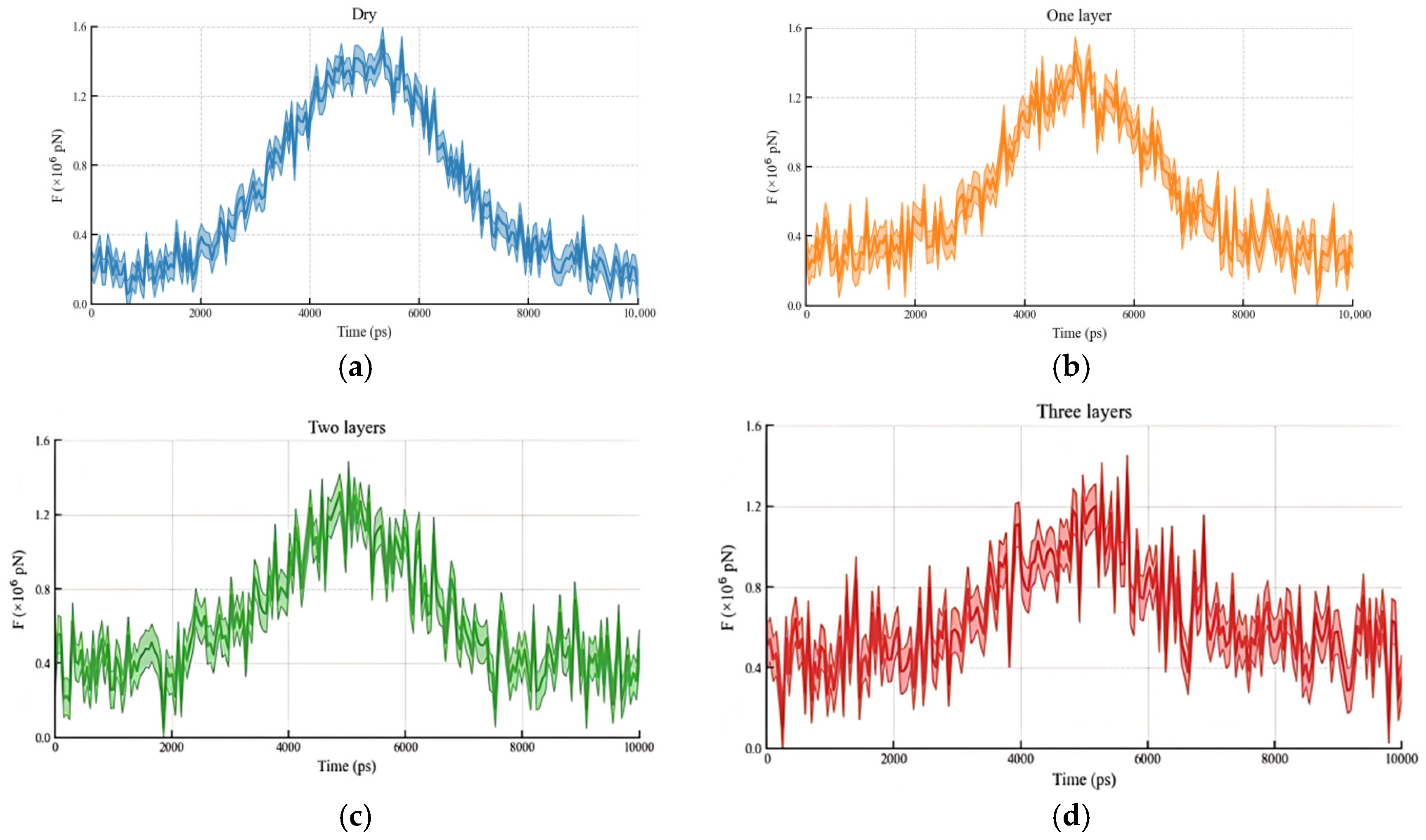
Figure 6 (a) Variation in tension (F) with time during PDMS debonding under different moisture conditions; (b–d) Variation in work (W) with time during PDMS debonding under different moisture conditions. The results show that the debonding tension increases first and then decreases, while the debonding work increases continuously and finally tends to be stable. Under the dry and monolayer water conditions, the debonding tension peaks at about 5000 ps, which are 1.6 × 10
3 pN and 1.5 × 10
3 pN, respectively. In the bilayer and trilayer water models, the tension peaks also appear at about 5000 ps, which are 1.4 × 10
3 pN and 1.3 × 10
3 pN, respectively.
When the simulation reaches 10,000 ps, PDMS is almost completely separated from the C–S–H substrate, and the constraint effect of the substrate on the polymer disappears; the debonding tension approaches zero, and the debonding work converges to a stable extreme value, that is, the final debonding work Wmax.
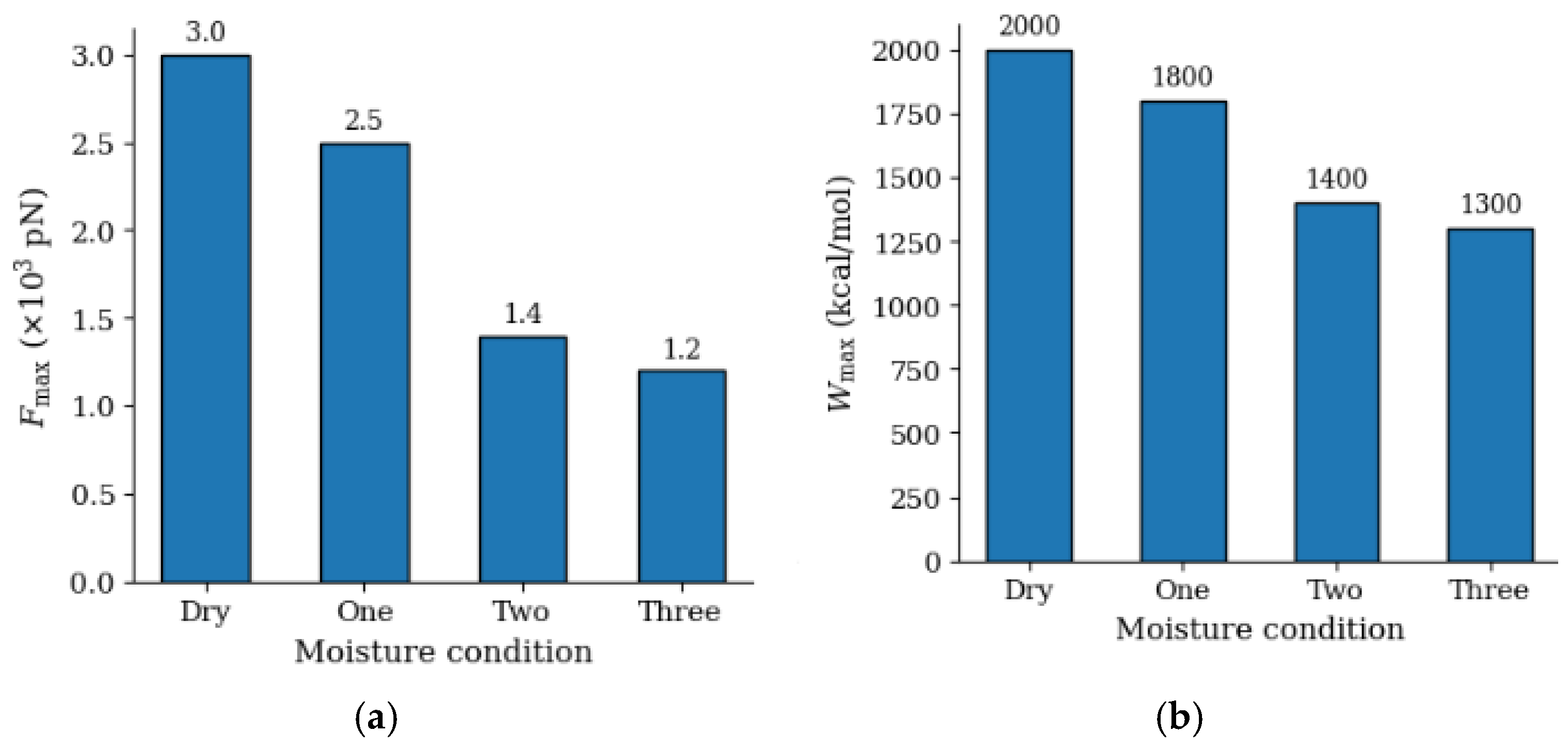
Figure 7 shows the maximum tensile force (F
max) and the final amount of work (W
max) required for PDMS exfoliation from the C–S–H surface under different aqueous conditions. On the whole, both F
max and W
max decrease with the increase in water content. In the dry state, PDMS molecular chains are in close contact with the C–S–H surface through van der Waals forces and potential hydrophobic interactions with non-polar surface sites. After the introduction of a single layer of water molecules, the direct interfacial contact was partially blocked due to the formation of bead-like or discontinuous water spots due to the hydrophobicity of PDMS, and the F
max and W
max were slightly reduced compared with the dry state.
When the number of water molecules is further increased (such as double-layer and three-layer systems), a continuous water film is formed on the hydrophilic C–S–H surface, which blocks the direct interaction between PDMS chains and the substrate, significantly weakens the interfacial adhesion, and leads to a significant decrease in Fmax and Wmax. With the increase in moisture content, the adhesion strength between PDMS and C–S–H decreased significantly, indicating that PDMS had lost its effective bonding and strengthening ability at the interface.
Figure 7 shows the maximum tensile force F
max and final work W
max generated by PDMS peeling from C–S–H substrate under different moisture content conditions. Overall, both F
max and W
max decrease with increasing moisture content. In the dry state, PDMS molecular chains mainly come into close contact with the C–S–H surface through van der Waals forces and potential hydrophobic interactions with non-polar surface sites. When a small amount of water infiltrates (monolayer water), PDMS’s hydrophobic properties can easily form bead-like or discontinuous patches, leading to interruption of direct interface contact. Compared to the dry state, both F
max and W
max slightly decrease. When a large amount of water infiltrates, a more continuous water film will form on the hydrophilic C–S–H surface. This lubricating barrier effectively prevents direct contact between hydrophobic PDMS molecular chains and the substrate, thereby significantly reducing the adhesion force and causing a significant decrease in F
max and W
max. As the moisture content further increases, the adhesion between PDMS and C–S–H significantly weakens, indicating that PDMS has lost its effective binding and enhancing ability at the interface.
3.4. Analysis of PDMS/C–S–H Interface Adhesion Mechanism
During the experiment, we measured the maximum adhesion force (F
max) and maximum adhesion work (W
max) under both dry and humid conditions. The results showed that the values obtained in the dry environment were significantly higher than those obtained in the humid environment. The specific data comparison can be seen in
Figure 7. This difference is mainly due to the significant influence of environmental humidity on the surface state and interface interaction mechanism of materials. Under high relative humidity conditions, water molecules in the air are easily adsorbed and gradually accumulate on the surface of materials, ultimately forming a continuous water film. This water film not only significantly reduces the actual effective contact area between materials but may also further weaken the interfacial interaction force due to lubrication effects, ultimately leading to a decrease in adhesion performance. On the contrary, in low-humidity environments, the number of water molecules adsorbed on the surface of the material is significantly reduced or even completely desorbed, enabling more sufficient and tight direct contact between the two contact interfaces, thereby significantly enhancing the adhesion strength of the interface.
For the interface between PDMS and C–S–H materials, environmental humidity stands as a critically influential external factor that directly governs and modulates their mutual interaction behavior. Under dry environmental conditions, the molecular spacing existing between these two materials remains relatively small and tightly packed, a situation which permits van der Waals forces to fully exert their influence and thereby emerge as the primary contributing force responsible for the dominant interfacial adhesion behavior. In contrast, when exposed to humid or moisture-rich environments, water molecules progressively invade and occupy the interfacial region, which leads to a notable increase in the effective molecular spacing separating PDMS and C–S–H. This enlarged separation directly results in a rapid and substantial decay of the van der Waals interactions, consequently causing a significant reduction in the overall adhesive strength that characterizes the interface.
In addition, when the surfaces of PDMS and C–S–H contain polar functional groups, such as hydroxyl groups (-OH) or carboxyl groups (-COOH), hydrogen bonds can readily form between these groups under conditions of limited or low water molecule presence. This interaction substantially enhances the interfacial adhesion strength between the two materials. However, in high-humidity environments, abundant water molecules compete with these polar functional groups for binding sites. The water molecules not only hinder the formation of new hydrogen bonds but can also disrupt the pre-existing hydrogen bond network. As a result, it becomes challenging to establish or sustain effective hydrogen bonding between PDMS and C–S–H, which further deteriorates the adhesion performance at the interface.
On the other hand, water molecules may also diffuse into the nano-scale pores or layered structures within the C–S–H gel. This infiltration can induce microstructural alterations, such as expansion, softening, or even partial hydrolysis of the material. These changes negatively impact the mechanical properties of C–S–H and reduce its interfacial compatibility with PDMS. Simultaneously, in moist conditions, the polarity and surface energy of PDMS molecular chains may undergo modifications, resulting in increased segmental mobility and dynamic reorganization of the interfacial morphology. The combination of these multifaceted factors—competitive binding, structural changes in C–S–H, and altered PDMS behavior—works synergistically to compromise both the adhesion performance and the long-term durability of the interface between PDMS and C–S–H materials.
In addition, to strengthen the connection between simulation and experiment, the discussion has been expanded to highlight how the nanoscale findings relate to macroscopic observations. The humidity-driven reduction in adhesion strength agrees with experimental reports showing diminished hydrophobic coating durability under wet or marine exposure conditions. Although the absolute values from MD cannot be directly compared with experiments, the trends in adhesive weakening provide valuable mechanistic insight. The parameters used in the simulation—water content, pulling force, and adhesion energy—can be correlated with measurable quantities such as contact-angle evolution, pull-off force tests, and nanoindentation-based adhesion measurements. These correlations have been added to improve the practical relevance of the simulation.
4. Conclusions
In this study, the interfacial debonding behavior of polydimethylsiloxane (PDMS) on calcium silicate hydrate (C–S–H) substrates was systematically investigated using molecular dynamics simulations under different moisture conditions. The main conclusions are summarized as follows:
- (1)
The interfacial interaction between PDMS and C–S–H is dominated by van der Waals forces, with a calculated binding energy of approximately 357.8 kcal/m2, indicating relatively weak physical adsorption.
- (2)
As the interfacial water content increases, the debonding strength decreases significantly. The maximum peeling force (Fmax) reduces from approximately 3.0 × 10³ pN (dry condition) to 1.2 × 10³ pN (high moisture condition), indicating a substantial weakening of interfacial adhesion due to moisture.
- (3)
Under humid conditions, water molecules penetrate the PDMS/C–S–H interface and form a continuous water film, which increases the interfacial separation distance and reduces the efficiency of intermolecular force transfer, ultimately leading to interfacial debonding and loss of adhesion.
To further highlight the novelty and contribution of this work, a comparison with previously published studies is summarized in
Table 1. Existing studies have mainly focused on either macroscopic experimental observations or qualitative molecular simulations, with limited consideration of the quantitative role of interfacial water.
In contrast, the present study systematically investigates the humidity-dependent interfacial behavior across multiple hydration states and provides a quantitative evaluation of key parameters, such as the reduction in maximum debonding force (F_max) and the contribution of van der Waals interactions.
More importantly, this work establishes a direct link between nanoscale interfacial mechanisms and engineering performance, which is rarely addressed in previous studies. This integrated approach enhances both the scientific understanding and practical relevance of silane-based hydrophobic coatings in cement-based materials.
Based on the molecular-scale findings, the reduction in interfacial adhesion under humid conditions is primarily caused by the formation of a continuous water film, which weakens the van der Waals interactions between PDMS and the C–S–H substrate. To improve the durability of PDMS-based hydrophobic coatings in practical engineering environments, several design strategies can be proposed.
First, introducing polar functional groups into PDMS may enhance interfacial bonding through hydrogen bonding or electrostatic interactions, thereby improving adhesion under wet conditions. Second, tailoring the polymer chain architecture, such as incorporating branched or grafted structures, can increase the effective contact area and enhance mechanical interlocking at the interface. Third, adjusting the crosslinking density of PDMS can improve resistance to moisture-induced softening and structural degradation, while preserving its hydrophobic performance.
These findings provide valuable guidance for the design and optimization of silane-based coatings in applications such as marine and hydraulic structures, where long-term exposure to moisture is unavoidable.