Article

Fineness Optimization of Waste Glass Powder as a Sustainable Alternative to Fly Ash in Cementitious Mixtures


1
Centre for Territory, Environment and Construction (CTAC), Department of Civil Engineering, University of Minho, Azurém Campus, 4800-058 Guimarães, Portugal
2
proMetheus—Research Unit in Materials, Energy and Environment for Sustainability, Polytechnic Institute of Viana do Castelo, 4900-347 Viana do Castelo, Portugal
3
C-MADE, The Centre of Materials and Civil Engineering for Sustainability, Universidade da Beira Interior (UBI), 6201-001 Covilhã, Portugal
*
Author to whom correspondence should be addressed.
Buildings 2026, 16(8), 1560; https://doi.org/10.3390/buildings16081560
Submission received: 27 February 2026 / Revised: 27 March 2026 / Accepted: 3 April 2026 / Published: 16 April 2026

Abstract

The progressive phase-out of coal-fired power plants in Portugal has significantly reduced the availability of fly ash (FA) as a supplementary cementitious material (SCM), reinforcing the need for sustainable alternatives. Waste glass powder (WGP), characterized by its high amorphous silica content, has emerged as a promising candidate; however, most studies focus on ultrafine particles or isolated performance indicators, lacking an integrated technical, environmental, and economic assessment. This study evaluates cement pastes incorporating 25% WGP (by volume) with different particle size distributions, including fineness levels comparable to cement and FA. Mechanical performance, grinding energy demand, carbon footprint, and cost were systematically analyzed. The results indicate that WGP is technically viable as an SCM, with a median particle size (D50) of approximately 48 µm providing the most balanced performance. Although finer particles enhance pozzolanic reactivity, the associated increase in grinding energy and economic cost offsets these gains. The findings demonstrate that optimizing particle size, rather than maximizing fineness, enables a technically robust and industrially realistic use of WGP. This approach supports circular economic strategies and contributes to the decarbonization of the construction sector by identifying an efficient replacement pathway for FA under resource-scarcity conditions.

1. Introduction

Climate change and the decarbonization of energy-intensive industries represent some of the most pressing global challenges of the present century. The cement industry, in particular, is responsible for approximately 7% of global anthropogenic CO2 emissions, mainly associated with clinker production [1,2]. These emissions arise primarily from two sources: the calcination of limestone, which generates process-related CO2 [2], and the high thermal energy demand required during clinker manufacturing [1,3].
Global cement production reached approximately 4.1 billion tons in 2020 and is expected to continue increasing over the coming decades due to growing urbanization and infrastructure [4,5]. This sustained growth places increasing pressure on the sector to reconcile production expansion with stringent environmental and decarbonization targets [3,6].
In Europe, national and regional decarbonization strategies, such as the Roadmap for Carbon Neutrality 2050 (RNC2050), have accelerated the phase-out of coal-fired power generation [7]. In Portugal, this transition has resulted in the complete shutdown of coal-based power plants, effectively eliminating FA as a widely available SCM. In parallel, the limited availability of ground granulated blast furnace slag (GGBFS) further constrains the supply of conventional SCMs. Although global production of FA and slag remains significant, current estimates indicate that future supply will be insufficient to meet growing demand, particularly in regions undergoing rapid energy transition [8]. This emerging structural scarcity highlights the need for alternative SCMs that are both technically viable and regionally available.
In response, significant research efforts have focused on reducing cement content through the incorporation of SCMs [9], which are known to enhance durability and improve long-term performance of cementitious systems through pozzolanic and latent hydraulic reactions [10,11]. SCMs act primarily through filler and pozzolanic mechanisms, the effectiveness of which depends on chemical composition, particle size distribution, specific surface area, and curing conditions [12,13,14,15]. Pozzolanic materials react with calcium hydroxide (CH) to form additional calcium silicate hydrate (C–S–H), leading to matrix densification and improved mechanical performance [10,16,17,18,19,20]. Fine particles further contribute by providing nucleation sites that accelerate early hydration reactions [21].
Among potential alternatives, waste glass has attracted increasing attention due to its abundance, non-biodegradable nature, and limited end-of-life valorization options [22,23]. Finely ground WGP, characterized by a high content of amorphous silica, has demonstrated pozzolanic behavior in cementitious systems and has been investigated in pastes, mortars, and concretes [24,25]. Previous studies have reported that the incorporation of waste glass powder (WGP) as a partial cement replacement improves workability and enhances long-term compressive strength (CS), particularly at low to moderate substitution levels [26,27]. These effects are associated with the combined action of particle packing (filler effect) at early ages and the delayed pozzolanic reactivity of amorphous silica, which promotes secondary C–S–H formation and microstructural densification [26].
The performance of WGP-based systems is strongly influenced by particle size distribution (PSD), with finer particles significantly enhancing pozzolanic reactivity through increased specific surface area and accelerated dissolution kinetics of amorphous silica [25,28]. Moreover, the use of finely ground glass has been demonstrated to mitigate alkali–silica reaction (ASR), primarily by consuming portlandite and altering pore solution chemistry, thereby limiting deleterious expansion mechanisms [29,30]. These effects underpin current technical specifications for ground-glass pozzolans in cementitious materials [31].
This trend is consistent with previous studies. Mirzahosseini et al. [32] evaluated mortars containing 25% cement replaced by ground green glass and observed that finer fractions (0–25 µm) resulted in significantly higher compressive strength compared to coarser fractions (63–75 µm). This behavior was attributed to the higher specific surface area, which enhances nucleation and promotes a denser microstructure. Furthermore, finely ground WGP has been shown to match or even surpass the pozzolanic activity of FA at equivalent replacement levels, reinforcing its potential as an effective and sustainable SCM [32,33].
At the microstructural level, the formation of C–S–H is a key process governing strength development in cementitious materials. Both FA and WGP, being rich in amorphous silica, react with CH produced during cement hydration to form additional C–S–H through pozzolanic reactions [11,34,35]. Particle size plays a critical role in this process: smaller particles provide greater surface area for reaction, leading to increased C–S–H formation and improved strength. However, excessive fineness may promote particle agglomeration, reduce effective reactivity and potentially compromise mechanical performance [36].
In addition, fine particles act as nucleation sites, accelerating hydration kinetics and contributing to the formation of a denser microstructure [37]. This effect is associated with improved particle packing, reduced porosity, and the formation of hydration products such as C–S–H and calcium aluminate hydrates (CAH), which enhance matrix strength and durability. Consistently, several studies report that WGP incorporation leads to a denser microstructure with reduced porosity due to the formation of secondary C–S–H [25]. Furthermore, a linear relationship between chemically combined water and CH consumption has been reported, supporting the role of pozzolanic reactions in microstructural development [38].
Despite these advances, the existing literature predominantly focuses on very fine WGP particles (typically <30–45 µm) or evaluates performance based on isolated indicators, such as compressive strength or durability. As a result, the energy demand associated with grinding, as well as the environmental and economic implications of increased fineness, are often overlooked. The combined assessment of fineness, grinding energy, mechanical performance, and life-cycle impacts remains limited, particularly under realistic scenarios of FA scarcity.
Moreover, although qualitative comparisons between WGP and conventional SCMs such as FA are common, there is a lack of quantitative guidance regarding the particle size distribution required for WGP to achieve comparable performance. This knowledge gap is particularly relevant from an industrial perspective, where excessive grinding may offset the environmental and economic benefits of SCM substitution.
Additionally, some studies have reported that increasing WGP content (e.g., from 0% to 30%) can lead to higher calcite formation, associated with enhanced calcium leaching and subsequent carbonation processes. This may increase the risk of durability-related issues, suggesting that WGP incorporation should be carefully optimized, with some authors recommending replacement levels around 20% [39].
Against this background, the present study adopts an integrated, multi-criteria approach to evaluate the technical, environmental, and economic performance of cement pastes incorporating recycled WGP. A volumetric cement replacement level of 25% is investigated, with controlled variation of the median particle size (D50) across a range representative of both cement and FA. The assessment framework combines physical, chemical, and mechanical characterization with sustainability indicators, including embodied energy, global warming potential, and cost efficiency.
The use of cement pastes in this study enables the isolation of binder-related mechanisms, allowing a fundamental understanding of the influence of particle size on reactivity and microstructural evolution.
Accordingly, this study shifts the focus from maximizing reactivity to optimizing fineness, aiming to identify a technically viable and industrially realistic particle size for WGP. This work therefore establishes a practical pathway for the valorization of WGP as a sustainable alternative SCM, aligned with circular economy principles and the decarbonization objectives of the construction sector.

2. Experimental Program

In the first step, to obtain different glass powder sizes, several samples of the same green soda-lime WGP were collected. The preparation of the glass bottle waste was performed at different milling times, until obtaining a similar particle size to the cement. In the second step, microstructure analysis, the samples of cement, FA and WGP were characterized through combination with different tests: laser granulometry, specific surface area (SSA), density, scanning electron microscopy (SEM), energy-dispersive spectroscopy (EDS), and X-ray diffraction (XRD). In the third step of the study, the rheological and mechanical behavior of the pastes with different types of additions were analyzed. These analyses were complemented by microstructural analysis, particularly with thermogravimetry (TG), SEM, EDS and XRD.

2.1. Obtaining Glass Powder—Phase 1

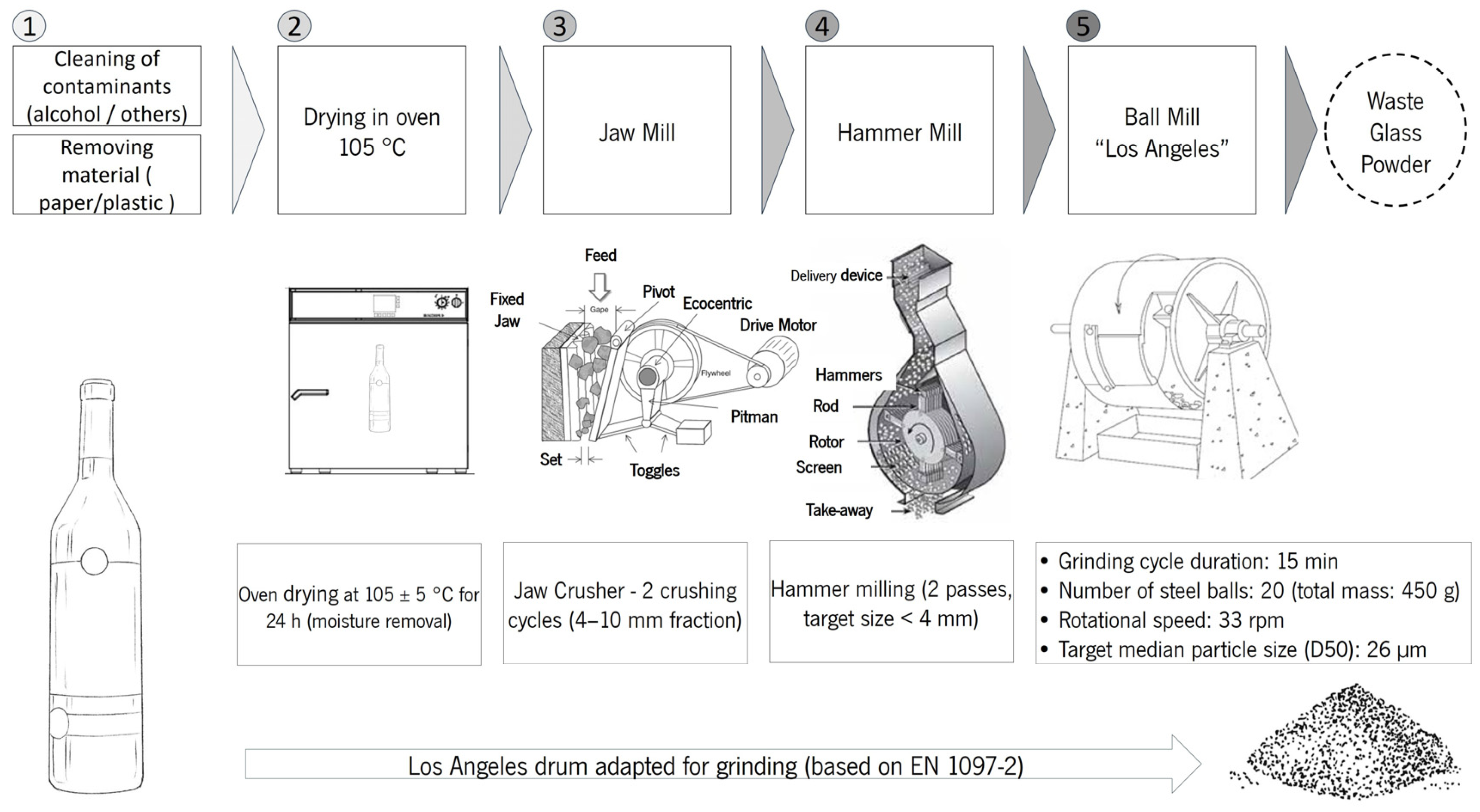
The glass was collected in the city of Guimarães, Portugal, and subjected to a cleaning and decontamination process. After that, it was ground in a laboratory environment to obtain a PSD similar to the cement. Considering previous studies, green soda-lime glasses were utilized because they show a good performance regarding the mechanical properties [40]. The general procedure to obtain the WGP is described in Figure 1.
The procedure was carried out in 5 stages until the WGP was obtained.
  • Cleaning of contaminants and removing adherent materials: The bottles were immersed in tap water to facilitate the cleaning and the removal of contaminants such as glue, paper, adhesives, and plastics. Then, they were brushed inside and outside under running water;
  • Drying and weight control: They were placed in a Binder Model FED 720 forced convection drying and heating chamber at a controlled temperature of 105 ± 1 °C for one hour to ensure proper drying and weight control;
  • Glass shard production: The bottles were broken manually, resulting in glass cullet. The glass cullet was introduced into a RETSCH Jaw Crusher BB 500 (RETSCH, Haan, Germany) and passed through two stages (2 cycles), resulting in smaller cullet grains;
  • Intermediate grinding: The glass cullet obtained in the previous stage was inserted into a RETSCH Hammer Mill HM 200 (RETSCH, Haan, Germany), making two passages in the equipment, until a homogeneous material with a dimension of 0/4 mm was produced;
  • Final grinding: The material from the previous stage, in portions of 5 kg, was introduced into a metal ball mill or “Los Angeles” Matest mill (Matest, Treviolo, Italy) with an abrasive mass of 8.410 kg (20 steel balls, approximately 450 g per ball). The equipment worked for periods of 15 min, which corresponded to 1 cycle, at a speed of 33 rpm, according to the EN1097-2 [41] standard procedure. Samples were taken before (0 min) and after (75, 225, 375, 525 and 600 min). The final product obtained was the WGP used in the paste’s composition.
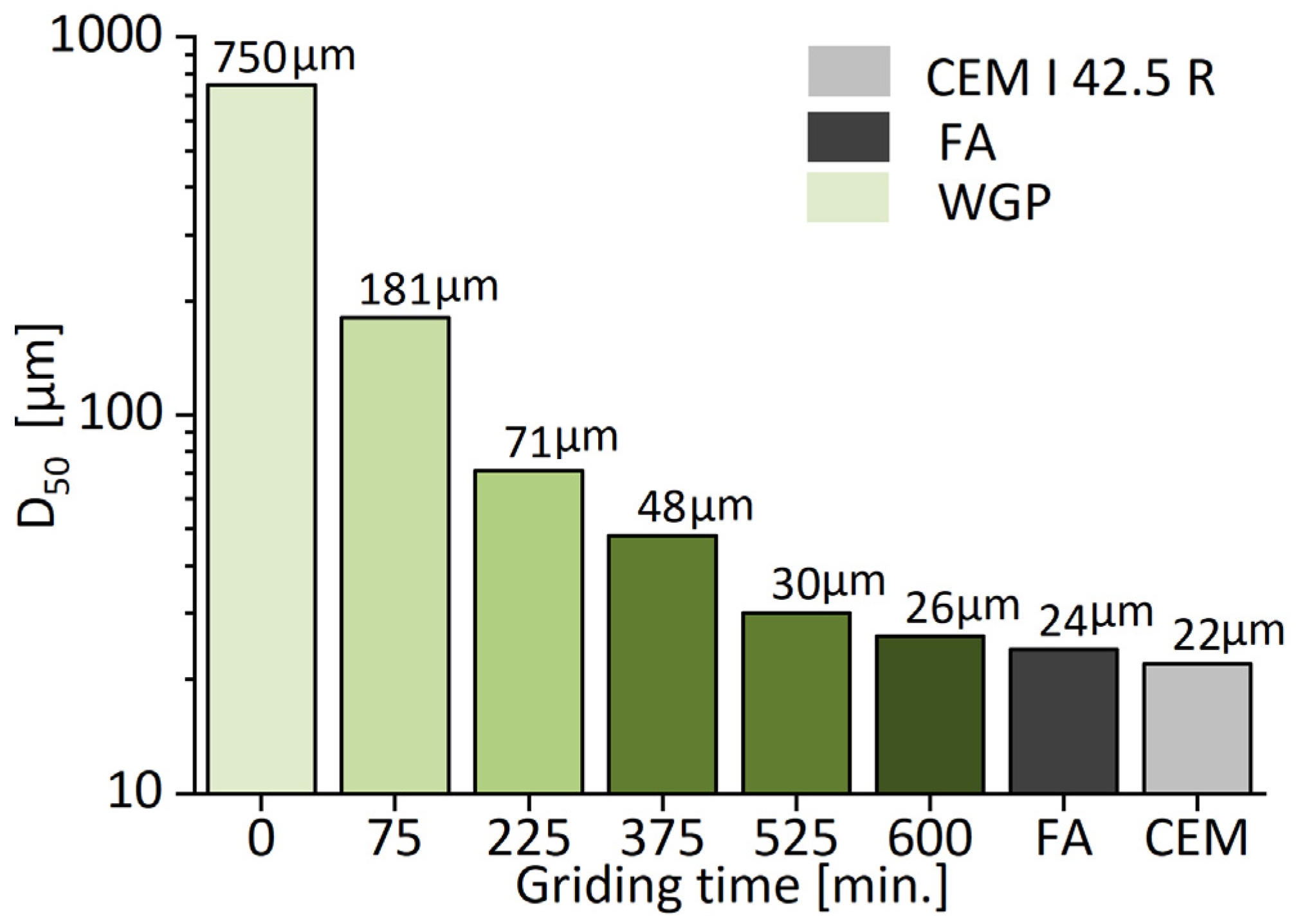
In the “Los Angeles” milling equipment, the first and last stages of grinding had milling times in the order of 75 min, and the remaining intermediate stages had milling differences of 150 min. In all the stages, samples were collected for their characterization, Figure 2.

2.2. Microstructural Analysis—Phase 2

2.2.1. Chemical Composition

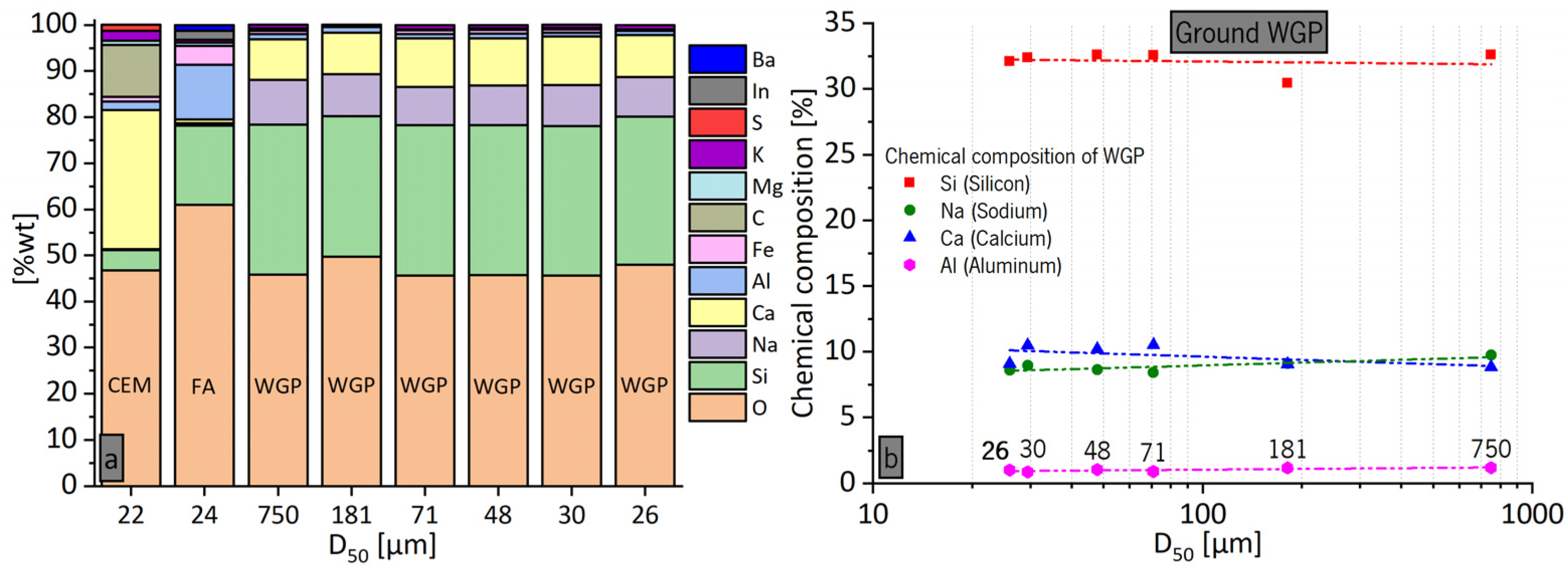
Figure 3 displays the chemical compositions of the cement, FA and WGP as determined by energy-dispersive X-ray spectroscopy (EDS) (Hitachi—EA1000VX, Hitachi, Tokyo, Japan). During the WGP grinding cycles, the chemical composition of the materials was checked for each cycle to determine if there was any contamination caused by the grinding process. The results are presented in simple elements, meaning the actual results of the assay. Calcium can be incorporated into different compounds, including tricalcium silicate, dicalcium silicate, tricalcium aluminate, tetracalcium aluminoferrite, calcium carbonate, and others. The remaining elements, iron, magnesium, and potassium, have values below 1%. It should be noted that the type of milling process used does not cause any significant contamination to the WGP samples (Figure 3a). As the average particle size decreased, the samples preserved the same order of quantity of the principal chemical elements in the structure of the material. Silica is around 30.5 to 32.6%, sodium is 8.4 to 9.7%, calcium is 8.8 to 10.5%, and aluminum is 0.9 to 1.2% (Figure 3b).

2.2.2. Particle Size Distribution

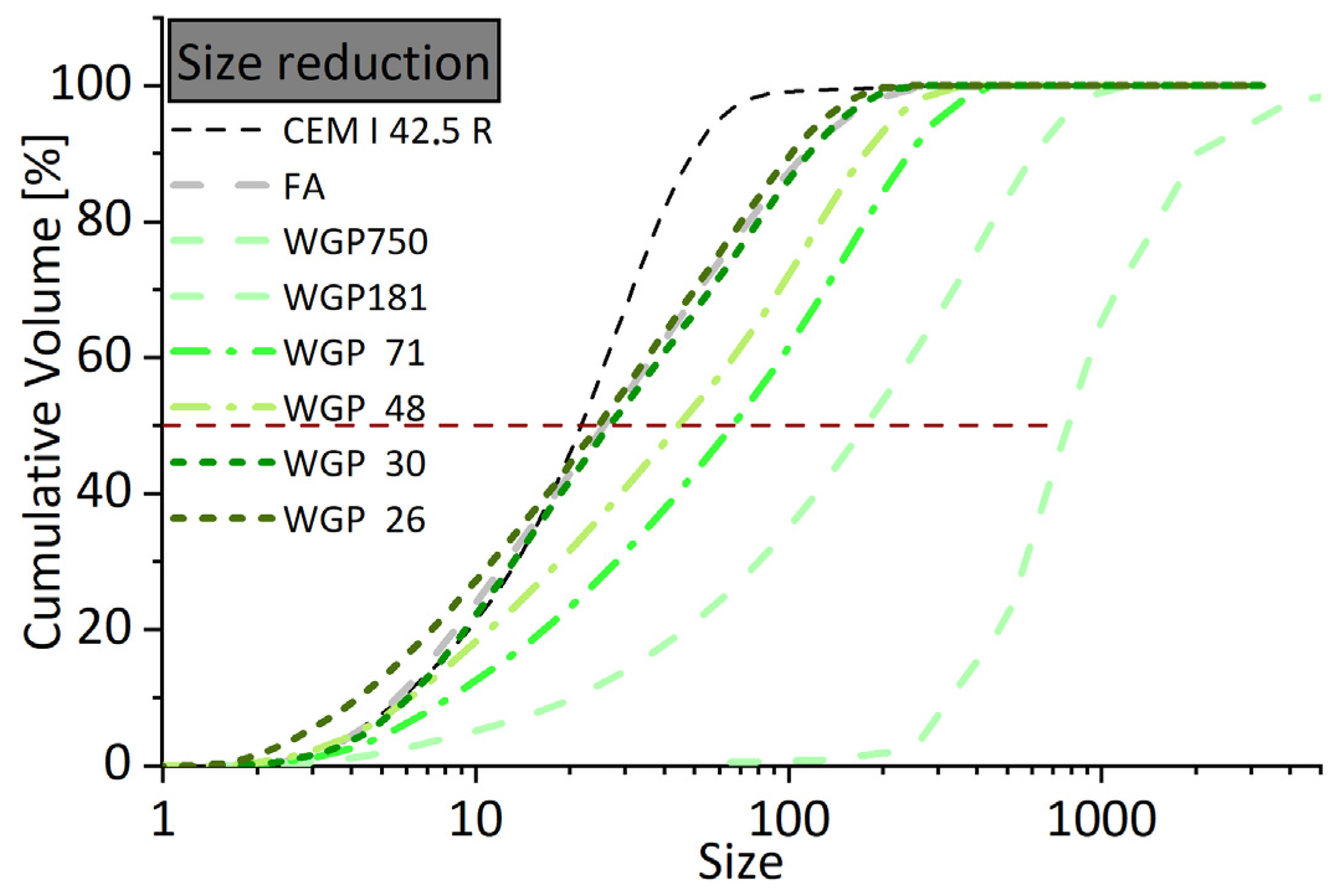
The PSD of the studied powder materials was determined using the laser diffraction method (Malvern Mastersizer 3000 equipment, Malvern Panalytical Ltd., Malvern, UK). Figure 4 shows the PSDs of the cement, FA and the grinding performance of the WGP.
The maximum glass grinding was conducted in such a way as to produce a powder with an average particle size of D50 [mm] close to that of the cement. Figure 5 illustrates the grinding times of the WGP for each average particle size. It can be seen that the grinding process is quite effective. As expected, the median particle size decreases significantly as grinding time increases, mainly up to 225 min, but decreases continuously up to 750 μm. To roughly match the median size of the WGP to that of the cement, it was necessary to grind for 600 min.
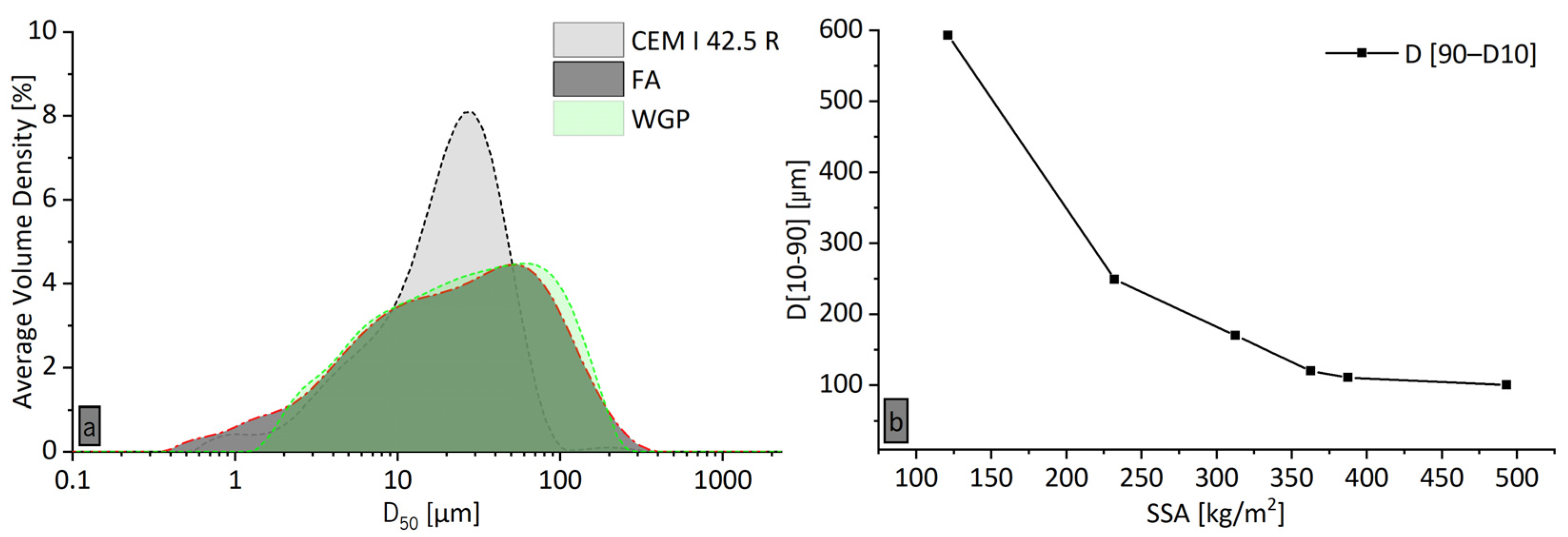
Figure 6a presents the volume-based particle size distributions of cement, FA and WGP. Cement exhibits a comparatively narrower and more monomodal distribution, characterized by a sharper and more concentrated peak, indicating a higher degree of granulometric uniformity. In contrast, both FA and WGP display broader size-frequency distributions. Although WGP and FA show similar overall trends, FA still contains a wider range of both finer and coarser particles, whereas the WGP distribution is comparatively more constrained.
Figure 6b illustrates the evolution of the characteristic particle size interval D90–D10 of WGP as a function of specific surface area (SSA), reflecting the progressive effect of milling. The D10, D50, and D90 values represent the particle diameters below which 10%, 50%, and 90% of the cumulative particle volume (or mass) are contained, respectively. In practical terms, D10 corresponds to the fine fraction, D90 represents the coarse tail of the distribution, and D50 provides a representative median size.
As milling progresses, a systematic reduction in D10, D50, and D90 is observed, with these parameters exhibiting a consistent slope behavior. This indicates that particle refinement occurs uniformly across the entire size spectrum, leading to both a decrease in the average particle size and a progressive narrowing of the particle size distribution. During the initial milling stages, corresponding to lower SSA values, the reduction is more pronounced, suggesting intense particle fragmentation. At higher SSA levels, the rate of reduction decreases, indicating the approach to a practical grinding limit beyond which further particle breakage becomes increasingly difficult and energy-intensive.
The observed reduction in the D90–D10 interval highlights a decrease in the disparity between the coarsest and finest particle fractions, reflecting increased granulometric homogeneity. Such a narrower particle size distribution is associated with improved packing density, more uniform particle dispersion, and a higher density of potential nucleation sites [42,43]. In cementitious systems or pozzolanic admixtures, this enhanced homogeneity can promote improved hydration kinetics and contribute to refined microstructure and improved mechanical performance, either through filler effects or through more effective pozzolanic reactions [28,42,43].
The combined analysis of D10, D50, and D90 provides a robust framework for assessing both the efficiency of the fragmentation process and its implications for the microstructural development and mechanical performance of cementitious composites incorporating WGP.

2.2.3. Specific Surface Area/Bulk Density

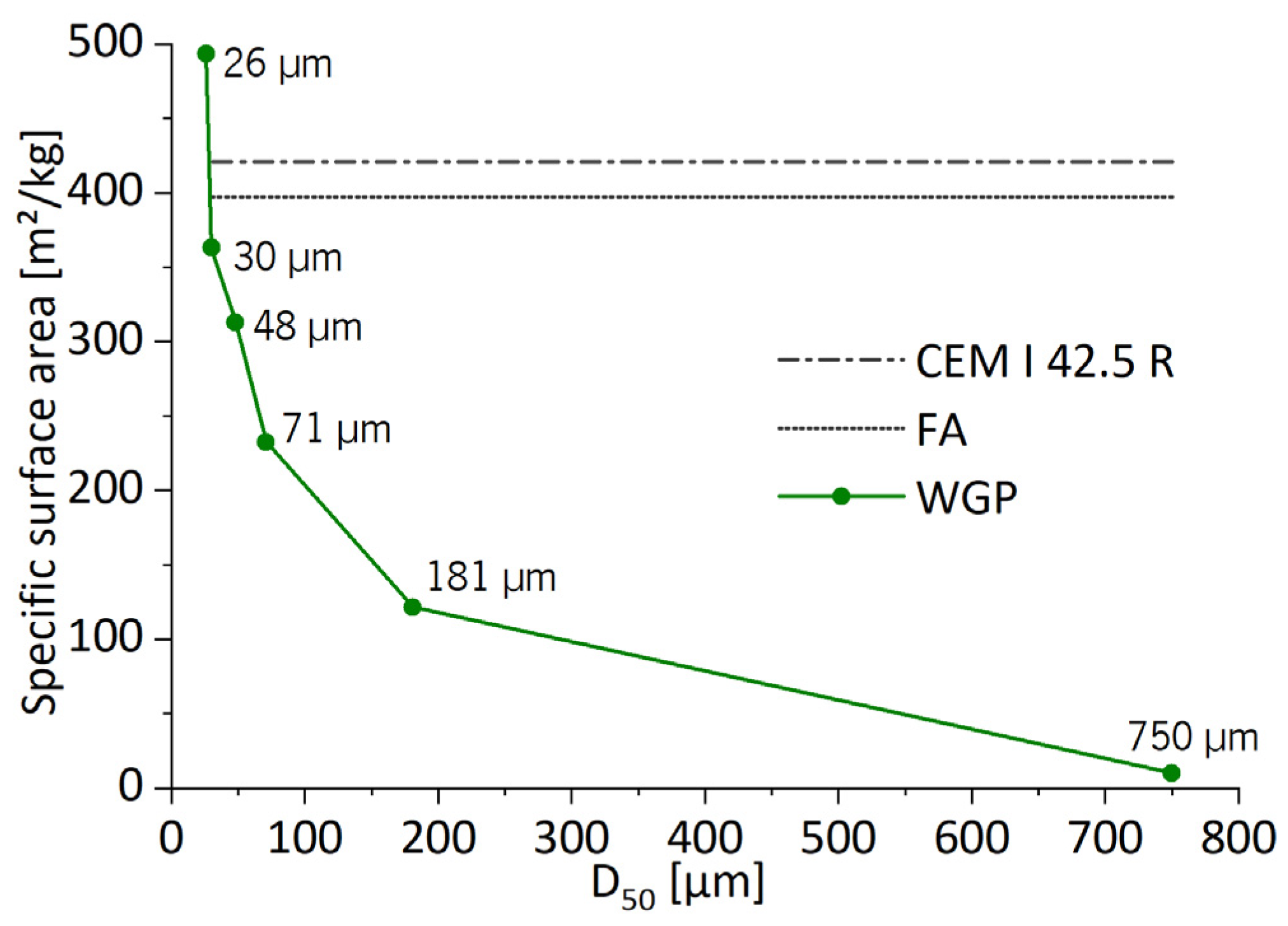
The specific surface area (SSA) was determined using a laser diffraction technique. This method estimates the SSA based on the assumption that particles are spherical and monodisperse within each size fraction. Under these assumptions, the equipment calculates the SSA using the mathematical relationship presented in Equation (1). The SSA values obtained for the various WGP particle size distributions are illustrated in Figure 7.
S S A = 6 p f i d i
(SSA)—total particle area divided by the total weight;
p—particle density [kg/m3];
fi—mass fraction of particles within size interval I;
di—mean class diameter.
The densities of the cement, FA, and WGP were determined in accordance with NP EN 1097-6 [44]. Different density values were found for each material: cement exhibited the highest density (3142 kg/m3), while FA and WGP showed densities of 2364 kg/m3 and 2604 kg/m3, respectively.
An analysis of WGP particles (Figure 7) reveals a significant increase in SSA as particle size decreases. The SSA demonstrates a sharp rise for D50 smaller than approximately 50 μm, with a particularly pronounced increase below 30 μm, as shown in the trend. This behavior is attributed to the reduction in particle size and the associated increase in surface area per unit mass. The particles’ morphology also plays a critical role, influencing their packing density and compaction. These changes in SSA values are crucial for understanding the flowability and reactivity of glass powder in cementitious systems, highlighting its potential for enhanced performance in such applications.
Although the SSA value of cement is higher than that of the other materials, the WGP indicates a relatively high SSA, which may contribute to its reactivity when incorporated into cementitious composites.

2.2.4. Morphology

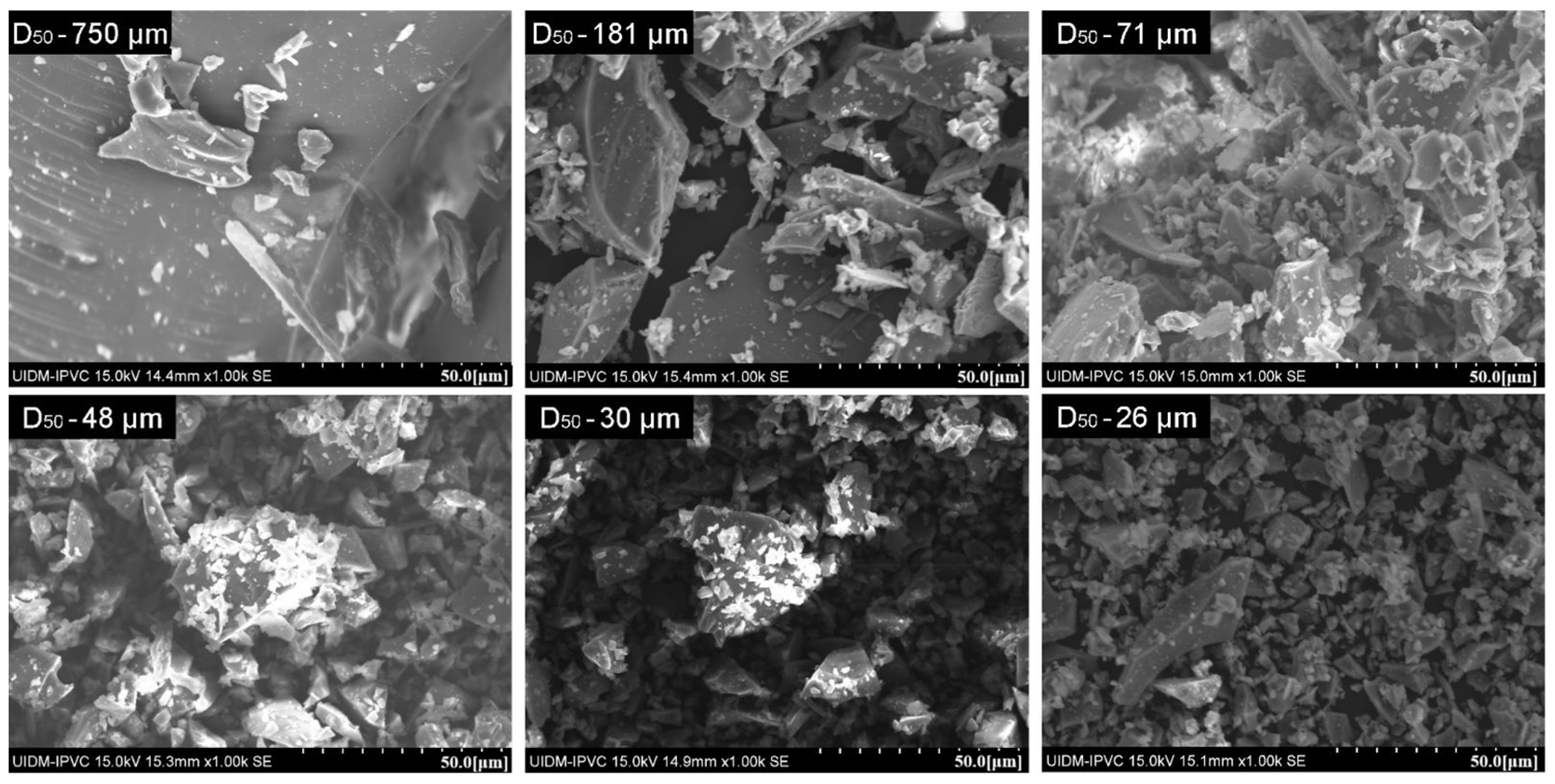
Scanning electron microscopy (SEM—Hitachi SU1510, Hitachi, Tokyo, Japan) was used to verify the morphology of cement, FA and WGP particles. Regarding WGP, different glass milling times were examined, evaluating particle size and morphology, and comparing the influence of grinding between different milling times (Figure 8).
The WGP particles have smooth and sharp surfaces, as well as defined edges and angular shapes. It was found that as the particle size decreases, there is a greater arrangement between the particles and the formation of agglomerations of small particles into larger ones. However, the shape of the particle does not change.
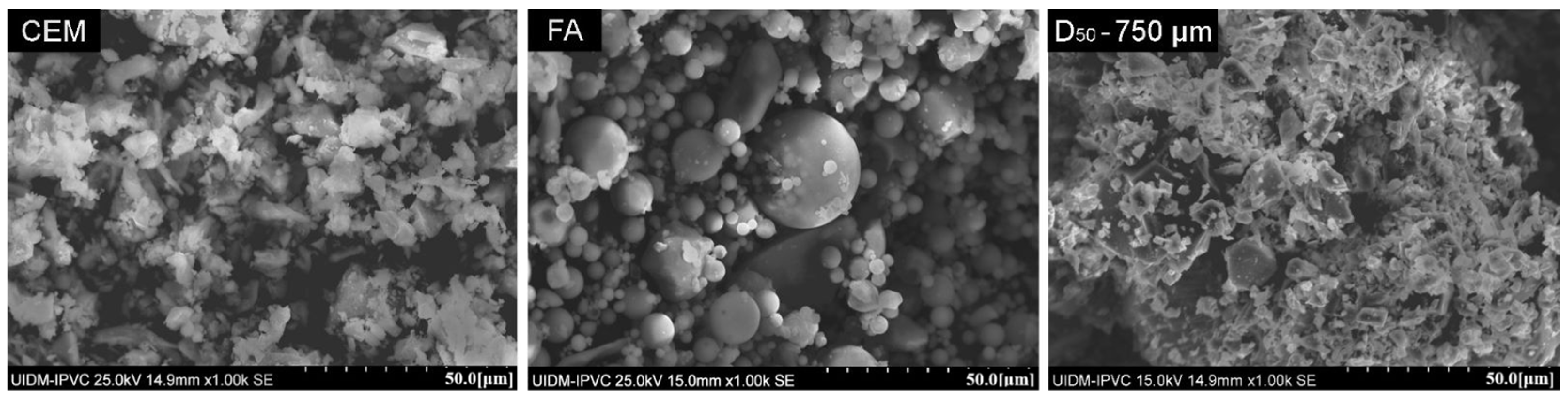
Three SEM images were taken at 1000 magnification to compare the morphological properties of WGP, cement, and FA (Figure 9). WGP has a similar particle morphology to cement; however, it has a very different shape than FA particles. Angular particles can be found in both cement and WGP instead of FA ones, which are predominantly spherical.

2.2.5. X-Ray Diffraction

The crystalline minerals present in the cement, FA and WGP were analyzed by X-ray diffraction (XRD) using a Bruker D8 Advance DaVinci diffractometer (Bruker, Billerica, MA, USA). The test conditions were Ni filtered Cu-Kα radiation; 40 kV applied voltage; 40 mA current intensity; 2θ range from 10 to 80° (0.02° step and 0.5 s per step); and approximate test time of 40 min. This device was equipped with two software packages from Bruker, one for qualitative analysis (EVA) and another for quantitative analysis, using Rietveld refinement (TOPAS), with an associated Joint Committee on Powder Data Systems (JCPDS) database.
Phase identification was performed by comparing the experimental diffraction patterns with reference data from the ICDD database. The identification of crystalline phases was validated by the presence of at least three characteristic reflections with the highest relative intensities for each phase.
The main interplanar spacings (d, Å) used for phase identification include: portlandite (CH, d ≈ 4.90, 2.63, 1.93 Å), calcite (CaCO3, d ≈ 3.03, 2.28, 2.09 Å), quartz (SiO2, d ≈ 3.34 Å), and clinker phases such as alite (C3S) and belite (C2S), based on standard reference patterns.
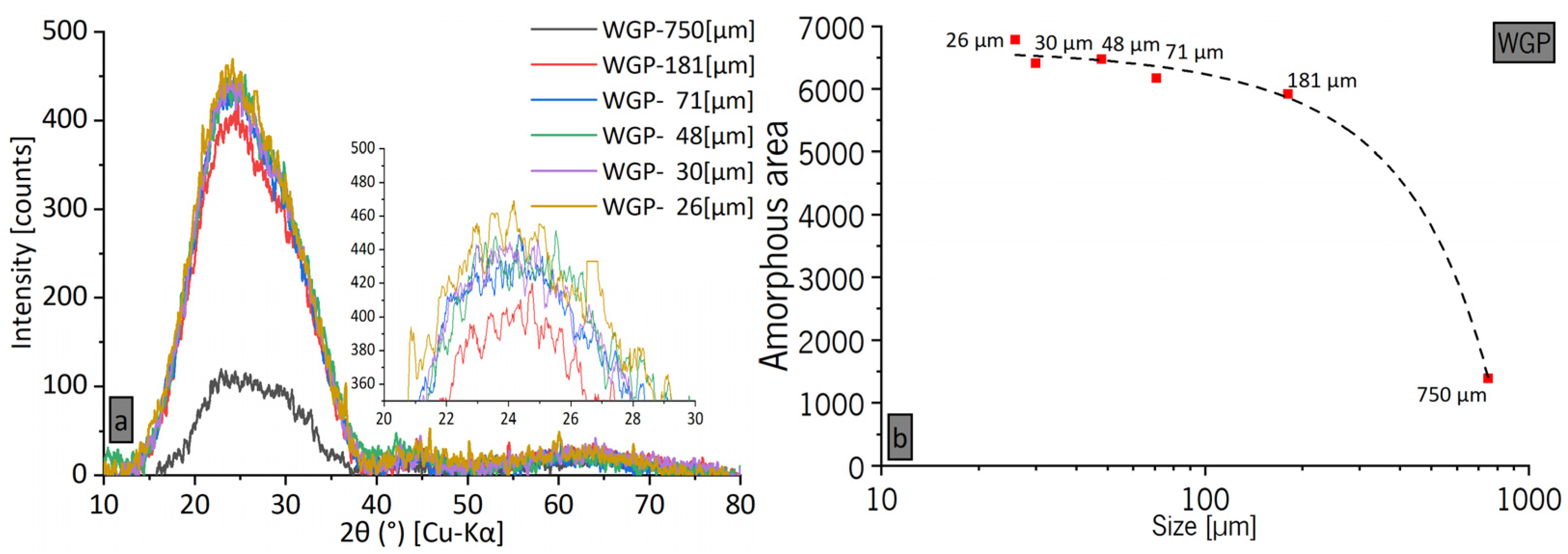
In Figure 10, an increase in the amorphous halo is observed as particle size decreases. This phenomenon can be explained by the fact that prolonged grinding promotes the decrease in particle size and consequent increase in powder compaction in the sample holder, decreasing the surface roughness of the sample under analysis.
In amorphous materials, since there are no well-defined crystalline planes, X-ray diffraction generates a diffuse halo (or “hump”) instead of Bragg peaks. If the sample surface is rough, this diffuse scattering increases even further. This can mask or smooth the amorphous halo profile and, as observed, increasing the sample’s roughness reduces the intensity of the amorphous halo.
This result clearly demonstrates that WGP is entirely amorphous and that grinding does not induce any crystallization.

2.3. Pastes Production and Performance Evaluation Methodology–Phase 3

2.3.1. Specimen Production

Different cement paste mixtures were produced, including a reference mixture composed of 100% Portland cement (100PC) and blended mixtures incorporating 25% ground waste glass powder (WGP) as a cement replacement. The use of cement pastes, without aggregates, was intentionally adopted to isolate binder-phase mechanisms, thereby enabling a controlled evaluation of the influence of particle size on hydration behavior and microstructural development.
In all blended formulations, 25% of the cement was replaced on a volumetric basis by WGP. This approach was adopted to maintain a constant solid volume fraction, accounting for the differences in density between cement and WGP. Six mixtures with different WGP particle size distributions were prepared and compared with the reference paste. A constant water-to-binder ratio (w/b = 0.50) was used for all mixtures to ensure comparability and to isolate the effect of particle size on the observed properties. The water/binder ratio (w/b = 0.5) was set to guarantee a conventional flow spread of the paste.
Paste specimens were prepared using CEM I 42.5 R cement (containing approximately 95% clinker) and WGP. The use of a non-blended cement ensured that the results were not influenced by additional constituents. Distilled water was used in the preparation of the paste to prevent any external chemical interference during subsequent analyses.
Cubic specimens with dimensions of 20 × 20 × 20 mm3 were prepared following the principles of EN 196-1 [45], adapted for cement paste specimens (without aggregates). The mixtures were cast in a single layer and compacted to minimize entrapped air. After casting, the specimens were stored in a moist chamber (relative humidity > 95%, temperature 23 ± 2 °C) for 24 h.
After demolding, the specimens were cured in lime-saturated water until testing at curing ages of 7, 28, and 90 days. The curing procedure was based on ASTM C31/C31M-19 [44], adapted for cement paste specimens. Lime-saturated water was used to minimize calcium hydroxide leaching and to maintain stable hydration conditions. This curing method was applied consistently to all mixtures, ensuring reliable comparative evaluation of mechanical performance.
The compositions of the mixtures are presented in Table 1.
Eight pastes were prepared according to the procedure described in NP EN 196-1 [45]: a control mixture with 100% cement (100PC), mixtures with 25% FA (P25FA) and mixtures with 25% WGP with different grain sizes.

2.3.2. Evaluation in Fresh and Hardened States: Methodology

  • Flow test
After the pastes were mixed, the spreading test was performed for each mixture using a flow table. The test was based on standard EN 1015-3 [46] applied to cement pastes, and the procedure and the equipment were maintained.
Prior to each test, the disk, inner surface, and mold edges were carefully cleaned with a damp cloth, allowed to dry, and lightly lubricated with a very low-viscosity, non-resinous mineral oil. To ensure accurate results, the mold was placed at the flow table center for each test.
The paste was introduced into the mold in a single layer and poured slowly to ensure uniform filling. During this process, the mold was held firmly against the disk with one hand while excess paste was leveled off with a spatula. The free area of the disk was then thoroughly cleaned and dried, with particular attention given to removing any water from around the disk. Once the mold was filled, it was carefully removed vertically. Finally, the diameter of the spread paste was measured in millimeters (mm) along two perpendicular directions using a caliper. It should be noted that the test procedure was adapted by omitting the aggregate fraction, while preserving the fundamental principles of the standard.
Workability is an important property of cementitious materials. When glass waste is added to cementitious compounds, the fresh properties are affected by several factors, including the physical properties of the particles, such as their water absorption, their morphology and their size [47].
  • Dry bulk density test
Concerning the hardened state, the dry bulk density of the cementitious paste including glass powders was determined based on EN 1015-10 [48] adapted for paste specimens without aggregates. Due to the physical and morphological characteristics of ground glass waste, it was necessary to evaluate the influence of particle size reduction on density. The samples were subjected to a drying process at 70 °C ± 5 °C until a constant mass was achieved, verified by successive weighing at two-hour intervals with a maximum variation of 0.2%. Subsequently, the immersed saturated mass was determined by submerging the specimens in water at 20 °C ± 2 °C until stabilization, defined as a mass variation lower than 0.2% between two measurements taken 15 min apart. After removing surface water, the saturated mass was recorded, followed by weighing in the immersed condition to obtain the immersed mass. As in the flow test, the methodology was adapted by removing the aggregate phase while maintaining the measurement principles defined in the standard.
  • Compressive strength test
The compressive strength test was measured for cubic paste specimens (20 × 20 × 20 mm3) with a curing age of 7, 28 and 90 days, based on EN 1015-11 [49], adapted for cement paste specimens. Loading was applied perpendicular to the specimen surface at a constant rate of 50 N/s. For each mixture and curing age, three specimens were tested (n = 3), and results are reported as the mean value ± standard deviation. All measured coefficients of variation remained below 10%, indicating acceptable repeatability and statistical consistency of the experimental results. Error bars representing one standard deviation are included in the compressive strength figures. The procedure follows the core testing principles of the standard, adapted to cubic paste specimens without aggregates, allowing the evaluation to focus exclusively on binder-phase behavior.
  • Relative compressive strength
The values obtained for the mechanical performance of WGP were compared with the reference mixtures, 100% cement (100PC) and 25% FA as a cement substitute. A relative compressive strength (RCS) was calculated to evaluate the performance of blended pastes in comparison with the reference mixture.
R e l a t i v e   C o m p r e s s i v e   S t r e n g t h   [ % ] = A B × 100
A—average compressive strength of blended cement paste specimens.
B—average compressive strength of control paste specimens.
This parameter provides a comparative measure of the mechanical performance of the mixtures relative to the reference paste.
Although it is based on ASTM C311 [50], the methodology was adapted for cement paste systems.
As recommended in ASTM C109 [51], the result of each batch’s compressive strength at a given age is the average of three tests. A limit of 10% standard deviation was ensured in all the tests carried out on all the mixtures.
For comparative purposes, reference thresholds of 75% (28 days) and 85% (90 days), commonly used in the literature for SCM evaluation, were considered as indicative values rather than strict acceptance criteria.
  • Thermogravimetric analysis
After curing for 7, 28 and 90 days, the cubic paste specimens for TG were carefully prepared. At each curing age, the samples were taken and tested at that age. For each composition and the different curing ages mentioned, samples, about 5 mm thick, were cut from each one.
For the thermogravimetric analysis, fragments were collected from the specimens after mechanical testing at the selected curing ages (7, 28, and 90 days). The samples were carefully retrieved to avoid contamination and subsequently ground to a particle size below 63 µm.
Approximately 15 mg of the resulting powder was then subjected to TG analysis, being heated at a rate of 10 °C/min up to 1000 °C (differential scanning calorimetry—DSC, Netzsch STA 449 F3, Netzsch, Selb, Germany).
Direct (TG) and derivative (DTG) curves were registered and then used to determine mass loss. With the data obtained, the dehydration (Ldh), dehydroxylation (Ldx) and decarbonization (Ldc) phases that occur during the heating of the sample were quantified [52,53].
According to previous studies [54,55,56], several reactions occur as the temperature of cement paste increases. To properly interpret the experimental results, it is important to consider the microstructural changes associated with temperature in hydrated cement systems.
Hydrated cement paste consists mainly of hydration products such as calcium silicate hydrate (C–S–H), portlandite (CH), and calcium aluminate phases (e.g., ettringite and monosulfate), along with residual unhydrated clinker minerals (C3S, C2S, and C4AF), whose content decreases as hydration progresses.
Calcium silicate hydrate and portlandite are among the primary products formed during cement hydration [57], although CH is generally considered less beneficial for durability due to its lower stability and higher solubility.
Several authors have identified the reactions that occur as the temperature increases in the cement paste. Following the authors’ indications, the following phases were considered when studying the reduction in the WGP particles incorporated into the cement:
HPG1—60–250 °C: C-S-H, C2ASH8, ettringite, AFmss, mono-carbonate (Mc).
It is generally considered that the evaporable water is eliminated at 120 °C [58], the decomposition of gypsum (with a double endothermic reaction) [58,59], the decomposition of ettringite [60] and the loss of water related to the carboaluminates hydrates [61];
HPG2—250–400 °C: C2AH8, C3AH6, loss of binding water from the C-S-H hydrates and carboaluminates [58,62];
CH—400–500 °C: CH, dehydroxylation of portlandite (CH) [58,59];
CaCO3—500–900 °C: decarbonation of calcium carbonate (CaCO3) [58,60];

3. Life Cycle Assessment

The environmental and economic sustainability assessment of the different mixtures was carried out, focused on the material production stage (gate-to-gate). This methodology was implemented using Granta Selector 2024 R1 software, in accordance with the guidelines outlined in ISO 14040/14044 [63,64] and EN 15804:2012 + A2:2019 [65] standards. The main objective of the analysis was to quantify CO2 emissions associated with material production and energy consumption related to the grinding of WGP.
The primary goal was to optimize environmental and economic performance by evaluating energy consumption, CO2 emissions, and production costs of the cement pastes incorporating various SCMs. For this purpose, a standard volumetric mix design was adopted with a water-to-binder ratio of 0.5, yielding a total of 1 m3 of material. This formulation was applied across all mixes containing different SCMs, and compressive strength was assessed at 90 days.
The study encompassed the production, transportation, and mixing stages, excluding the use and end-of-life phases. The system boundaries included raw material extraction and processing, transport to the batching facility (located at the University of Minho—Guimarães), and final paste production.
For cement production, transportation from the Maceira-Liz plant (Leiria), covering a distance of 245 km, was considered. The system boundaries included limestone extraction, crushing, transport to the plant, and the cement manufacturing process itself.
The CO2 emissions associated with cement production were estimated based on literature data [66,67], considering both clinker production (0.830 kg CO2/kg) and subsequent processing stages (0.036 kg CO2/kg), resulting in a total of approximately 0.866 kg CO2/kg (866 kg CO2eq/t).
FA, on the other hand, is considered an industrial by-product from coal combustion and does not require additional processing. Therefore, only the environmental impact of transportation was considered, assuming a 300 km distance from the Pego Thermoelectric Power Plant. For this material, emissions of 10 kg CO2eq/t, an embodied energy of 0.1 kWh/kg, and a market cost of €20/t were assumed [68,69]. Additionally, the market price of CEM I 42.5 R cement is estimated at approximately 170 €/t, which represents a significant cost factor in the overall environmental and economic assessment of cementitious mixtures [26].
Recycled glass powder (WGP) was analyzed for six particle size distributions (D50 ranging from 750 μm to 26 μm), all transported 70 km to the batching facility. As WGP is an industrial waste with no acquisition cost, its environmental impact and production cost result exclusively from energy consumed during grinding and transportation. It was observed that decreasing particle size led to a significant increase in energy consumption and associated emissions. For instance, WGP with D50 = 750 μm required only 5.0 kWh/t and emitted 0.5 kg CO2eq/t, whereas the finest fraction (D50 = 26 μm) consumed 50.1 kWh/t, resulting in 21.7 kg CO2eq/t. Electricity was priced at €0.192/kWh, yielding grinding costs between €0.96/t and €9.62/t, depending on fineness [70].
It is important to note that the emission factor for electricity consumption was calculated based on natural gas combustion, assuming a 55% conversion efficiency and a higher heating value (HHV) of 50 MJ/kg. To generate 1 kWh (equivalent to 3.6 MJ), approximately 0.131 kg of methane is required, which emits 2.74 kg CO2/kg CH4 upon combustion. Therefore, the emission associated with electricity production was estimated as 0.36 kg CO2eq/kWh, which was applied to assess the environmental impact of electrical consumption in all operations, particularly WGP grinding [71].
Water was assumed to be locally sourced (0 km), with an estimated impact of 5.0 kg CO2eq/t and energy consumption of 0.3 kWh/kg, related to treatment and pumping processes [69].
Transport inventory was also included as a relevant component of the environmental impact modeling. A one-way transportation system was assumed, from the material sources to the batching facility, using a diesel truck with a capacity between 7.5 and 16 tons, with an emission factor of 2.68 kg CO2 per liter of diesel, in accordance with IPCC (2023) [72] guidelines. Transport activity was expressed in ton·km, with an average energy consumption of 1.4 MJ/t·km, a cost of €0.02/t·km, and an emission factor of 0.045 kg CO2eq/t·km ([72]).
These data supported the development of a Life Cycle Assessment for the various cement paste formulations, enabling a comprehensive comparison of the environmental and economic performance of mixtures incorporating different SCMs—specifically FA and recycled glass powder—and informing the adoption of more efficient and sustainable strategies for the production of low-impact hydraulic binders.
It is also worth noting that the results obtained for cement paste formulations can be extrapolated to standard concrete compositions, considering that paste typically represents approximately 30% of the total volume per cubic meter of concrete, as stated in [73]. Accordingly, the environmental and economic impacts calculated for cement pastes can be reasonably estimated for structural concrete applications.

4. Evaluation of Pastes Performance

4.1. The Fresh State Performance of Pastes

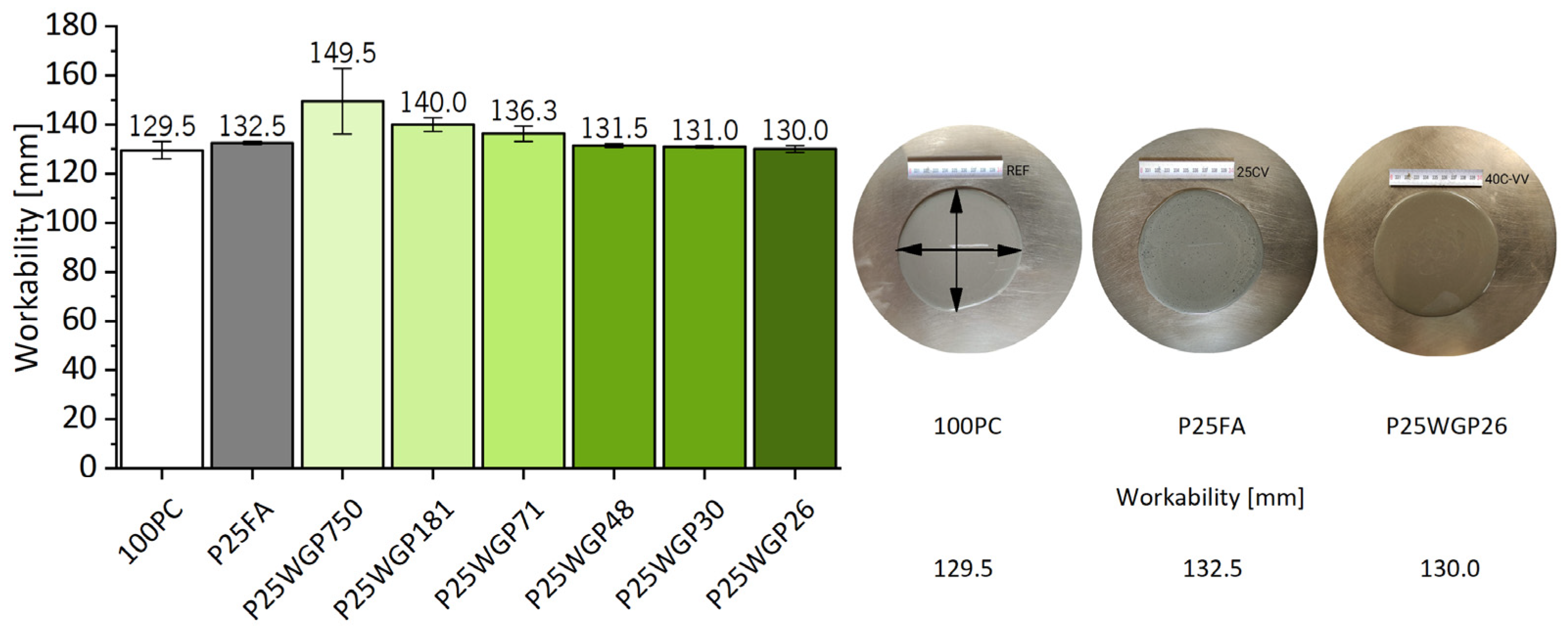
According to the data presented in Figure 11, the workability values of the reference cement paste (100PC) and the P25FA are very similar, measuring 129.5 mm and 132.5 mm, respectively. These relatively low spread values are consistent with the behavior of cement pastes (without aggregates), which typically exhibit limited flowability due to their higher cohesion compared to mortars. Similar ranges have been reported in the literature for cement pastes with comparable water-to-binder ratios [28].
This result confirms that replacing 25% of the cement with FA did not significantly alter the paste’s consistency.
In the mixtures incorporating WGP, a clear trend of decreasing workability is observed as the average particle size (D50) decreases. The P25WGP750 mixture, containing the coarse WGP particles, exhibited the highest flow value (149.5 mm), but also showed the largest standard deviation, indicating slightly less consistent behavior. As particle size decreased, the workability gradually reduced: 140.0 mm (P25WGP181), 136.3 mm (P25WGP71), 131.5 mm (P25WGP48), 131.0 mm (P25WGP30), and 130.0 mm (P25WGP26).
These results suggest that the non-absorbent nature of glass positively influences fluidity, particularly when the particles are coarser. However, this effect decreases as particle size is reduced, which may be associated with the higher surface area and increased water demand observed for finer particles.
Furthermore, the relatively low flow values observed in this study can be attributed to the absence of aggregates and the inherently higher cohesion of cement pastes at a fixed water-to-binder ratio (w/b = 0.50), which limits deformation under flow table conditions. In addition, similar flow ranges for cement pastes have been reported in the literature, particularly in studies involving fine SCM, where increased specific surface area and particle packing effects contribute to reduced spreadability [25,28].
Although only a modest increase in workability was observed with WGP in this study, it may still be beneficial. Similar flow values for cement pastes have been reported by Shi et al. [28] and Li et al. [25], where finer particles and higher specific surface area lead to reduced flowability. Any gain in paste flowability can potentially be used to reduce the water-to-cement ratio or total binder content, thus mitigating shrinkage and thermal issues [74].
In conclusion, the workability of WGP-based pastes was found to be comparable or slightly superior to that of the control and FA-based pastes, without compromising rheological performance. These findings reinforce the technical feasibility of WGP as an effective SCM, supporting its role in sustainable construction practices.

4.2. Performance of Pastes in the Hardened State

4.2.1. Dry Bulk Density

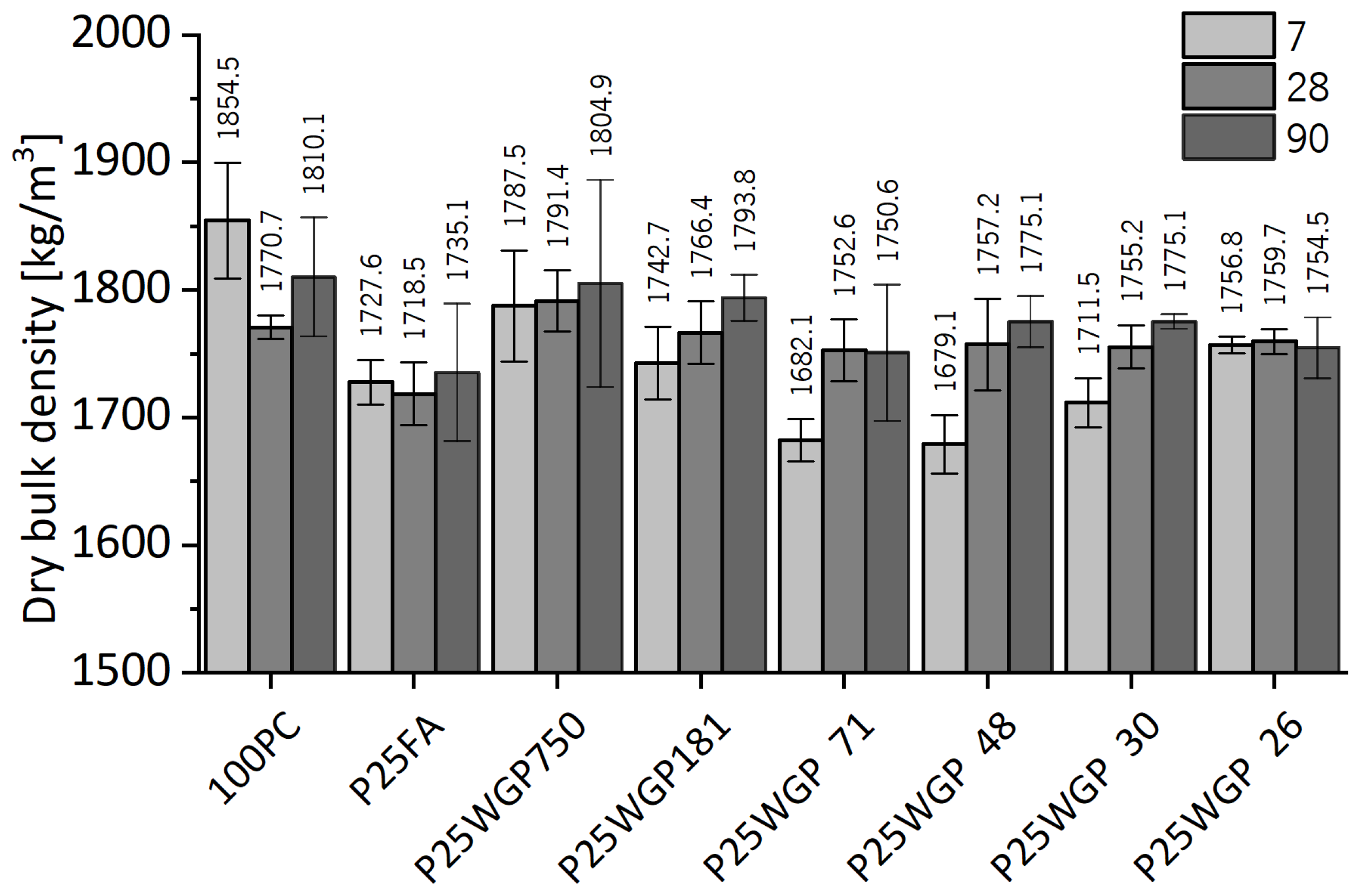
Figure 12 shows the dry bulk density pastes for different curing ages. The reference cement (100PC) exhibited the highest dry bulk density values across all curing ages, ranging from 1893 kg/m3 (at 90 days of curing) to 1856 kg/m3 (at 7 days of curing).
Conversely, incorporating P25FA resulted in slightly lower densities, ranging between 1758 kg/m3 (at 90 days) and 1682 kg/m3 (at 7 days). In the WGP-containing formulations, the dry bulk density values were generally between those of 100PC and P25FA, varying from 1792 kg/m3 (P25WGP, 90 days) to 1675 kg/m3 (P25WGP, 7 days), indicating that milled glass can partially replace cement without causing a marked reduction in density. A gradual decrease in density was observed as the glass particles became finer, with the values for P25WGP750 (at 7 days) being 1678 kg/m3 compared to 1643 kg/m3 for P25WGP26 (at 7 days). This decrease may be associated with increased porosity resulting from less efficient particle packing and/or higher effective water demand. Nevertheless, this variation was not particularly pronounced, remaining within an intermediate range. The results demonstrate that an appropriate particle size selection can balance reactivity gains with a moderate decrease in density, without significantly compromising the composite’s properties. Consequently, the results indicate that controlling the fineness of the milled glass is a key factor in optimizing performance while limiting potential adverse effects.

4.2.2. Mechanical Strength and Pozzolanic Activity of WGP

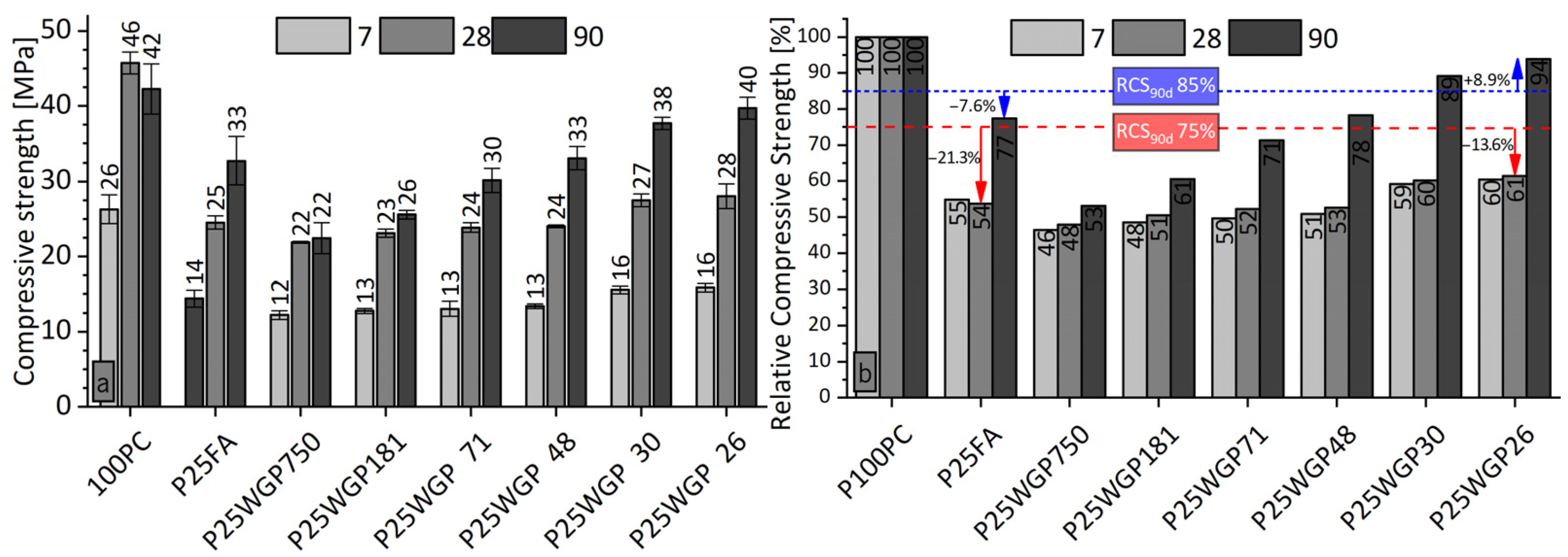
Figure 13 presents the compressive strength results of the hardened pastes at different curing ages, with absolute values shown on the left and relative compressive strength (RCS) on the right. As expected, the reference mixture (100PC), composed entirely of Portland cement, exhibited the highest compressive strength across all ages (26 MPa at 7 days, 42 MPa at 28 days, and 46 MPa at 90 days), reflecting the rapid hydration of cement. In contrast, mixtures incorporating WGP showed lower strength at early ages, mainly due to clinker dilution and slower pozzolanic reaction kinetics [33,75].
The compressive strength of WGP-based mixtures varied significantly with particle size distribution. A clear trend was observed in which finer WGP particles resulted in higher strength values. Specifically, the mixture with D50 ≈ 48 µm reached 33 MPa at 90 days, approaching the performance of the reference system. The finest particles (D50 ≈ 26 µm) showed the highest performance among WGP mixtures, reaching 40 MPa at 90 days and RCS values up to 94%, indicating enhanced reactivity.
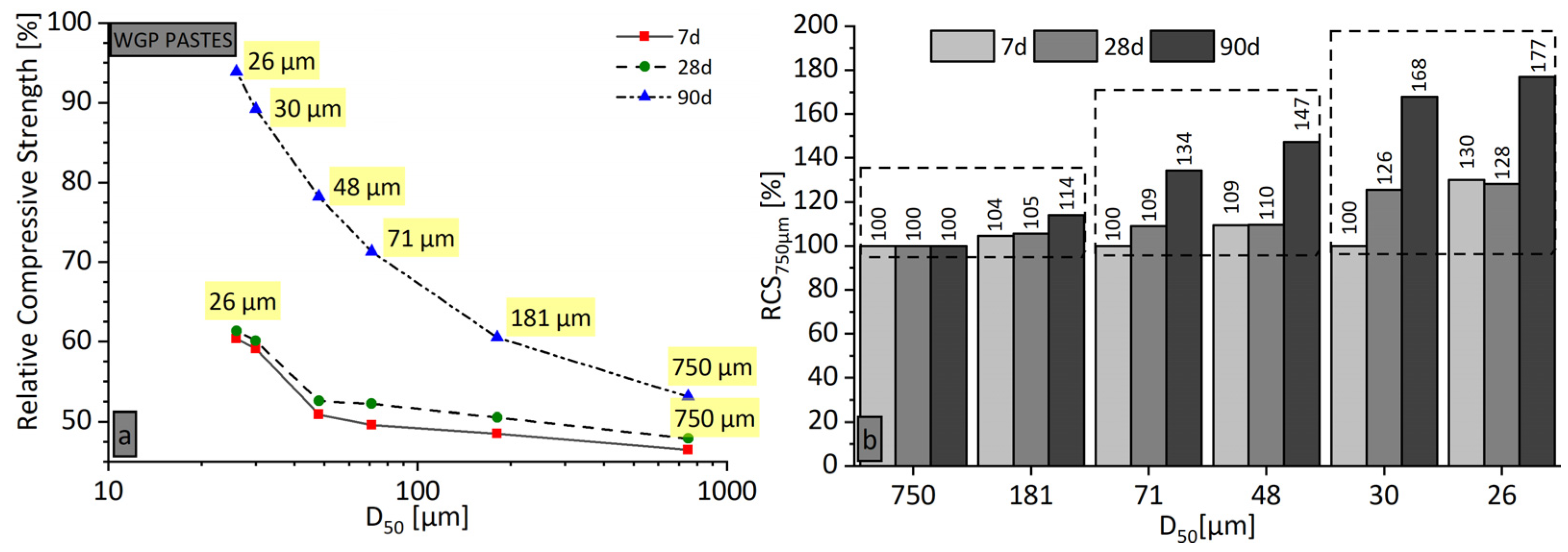
The evolution of strength with curing time is shown in Figure 14. At 7 days, all mixtures exhibited lower strength, while a significant increase was observed at 90 days, particularly for finer particles.
The improvement in performance of finer WGP mixtures can be attributed to their higher specific surface area, which enhances reactivity and promotes the formation of hydration products. This effect becomes more pronounced between 28 and 90 days, indicating the progressive development of pozzolanic reactions. Mixtures with particle sizes ≤ 48 µm exhibited a marked increase in relative strength, while coarser particles showed limited reactivity and lower strength gain.
The RCS results further confirm this behavior, showing a clear increase with decreasing particle size. It should be noted that this index represents a relative (conditional) measure of reactivity, as it is normalized with respect to the reference mixture. Mixtures with particles smaller than 71 µm exceeded the reference threshold, while the finest particles (26 µm) reached values up to 1.77 times higher than the coarse reference (750 µm) at 90 days. This trend highlights the strong influence of particle size on reactivity and mechanical performance.
In contrast, coarse particles (e.g., 750 µm) exhibited significantly lower RCS values, indicating a limited pozzolanic contribution and behavior closer to inert filler materials.
The results demonstrate that reducing particle size enhances the reactivity of WGP and improves strength development over time, confirming the critical role of particle size distribution in optimizing the performance of ground glass powder as a supplementary cementitious material.

4.2.3. Thermogravimetric Analysis—(TGA/DTG)

The TG results for the cement pastes at 7, 28, and 90 days of curing reveal the evolution of thermal decomposition processes associated with the hydration and carbonation of the different paste compositions.
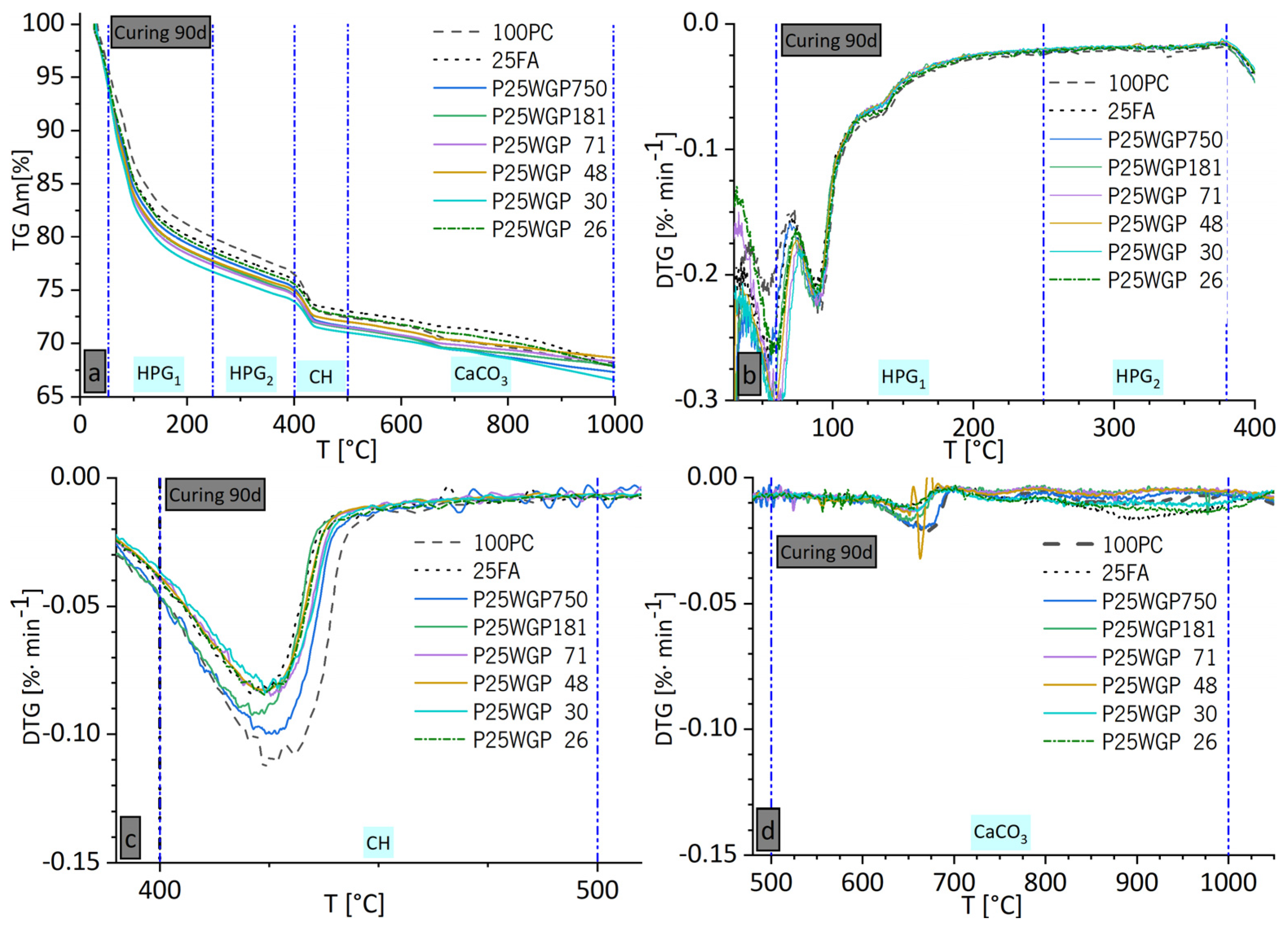
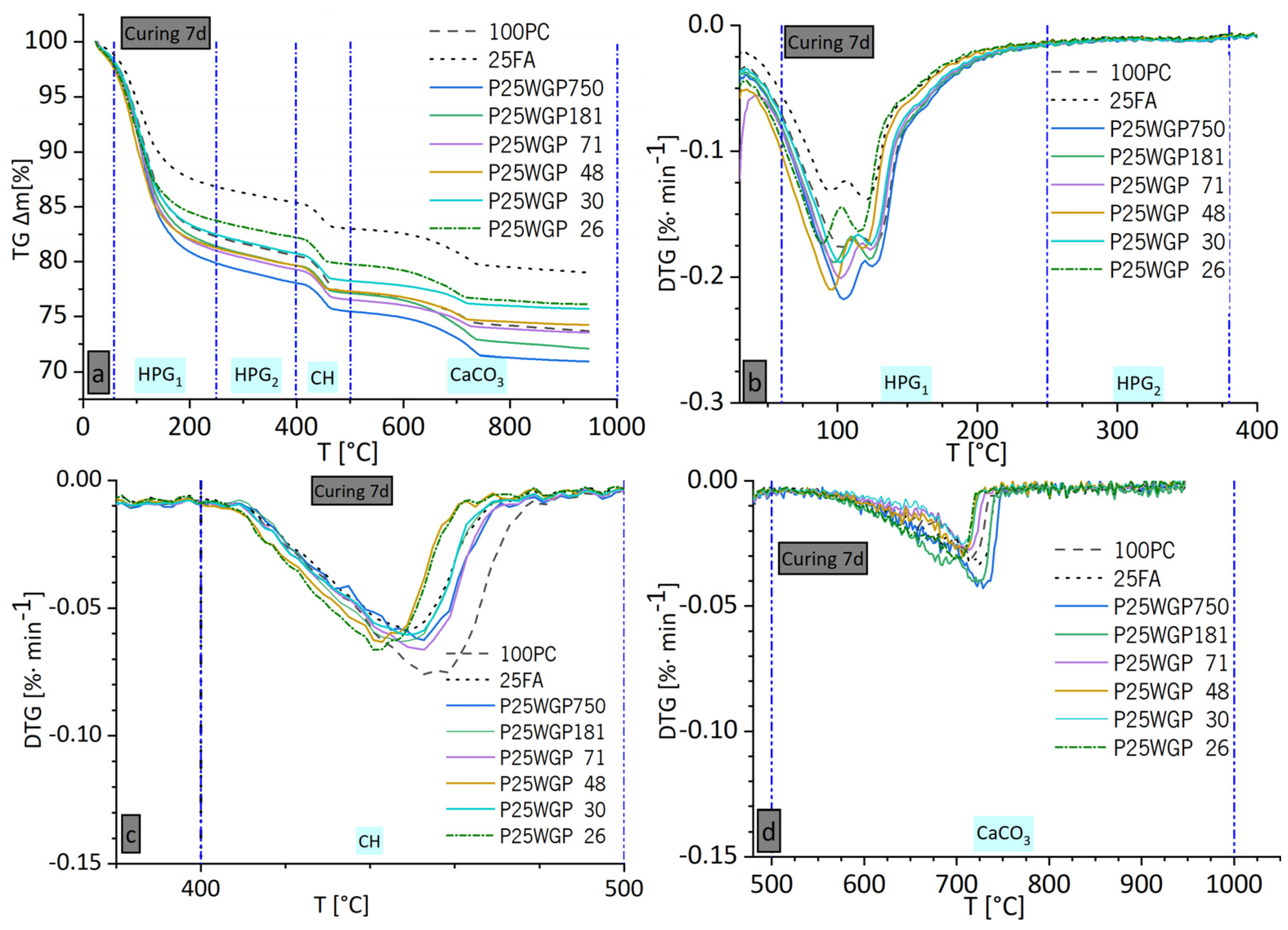
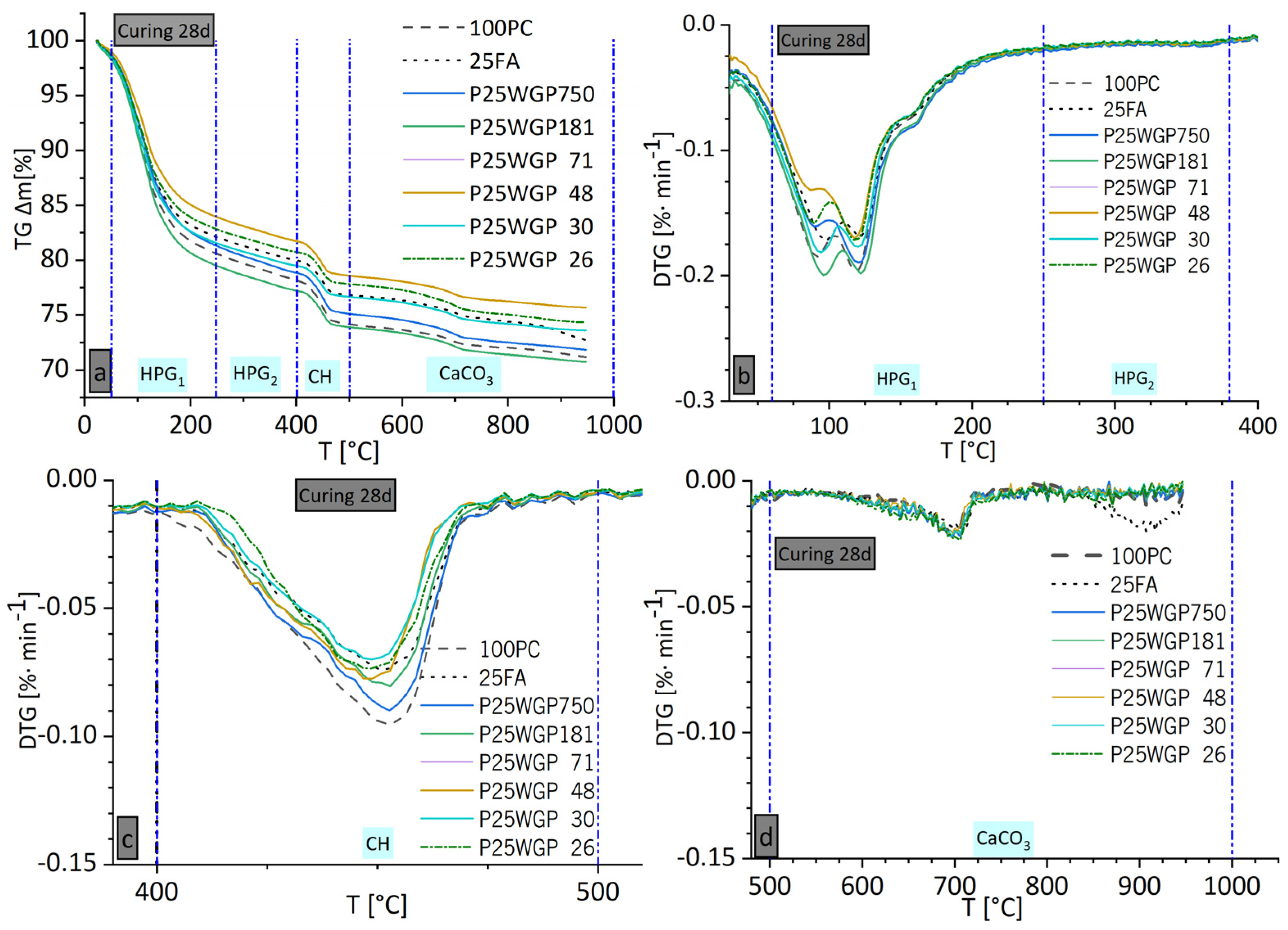
The TG curves show the mass loss corresponding to various thermal events, including the decomposition of hydration products grouped into operationally defined regions (HPG1 and HPG2), which correspond to different ranges of bound water release from poorly crystalline hydrated phases (e.g., C–S–H and related calcium silicate hydrates), as well as CH and calcium carbonate (CaCO3). The vertical blue dashed lines indicate the temperature intervals associated with each of these hydration products (HPG1, HPG2, CH, and CaCO3), as defined in the analysis. This approach allows a comparative evaluation of pastes with and without WGP.
The TG and DTG curves are presented in Figure 15, Figure 16 and Figure 17.
At 7 days of curing, the TG curves highlight significant differences in the CH region (~400–500 °C). The 100% Portland cement paste (100PC) exhibits the highest mass loss in this range, indicating abundant portlandite formation due to hydration. In contrast, mixtures containing WGP, particularly those with smaller particle sizes (e.g., P25WGP30 and P25WGP26), show reduced CH content, suggesting the onset of pozzolanic reactions, where WGP particles react with CH to form additional C–S–H [11]. The CaCO3 decomposition (~600–800 °C) at this early stage is relatively low for all mixtures, reflecting minimal carbonate content.
At 28 days of curing, the CH content decreases significantly for WGP-containing pastes compared to the 100PC mixture, indicating the progression of pozzolanic activity. Mixtures with smaller WGP particles (e.g., P25WGP26) exhibit greater reductions in CH, attributed to their higher specific surface area and associated reactivity [28]. The CaCO3 content begins to increase across all mixtures, particularly for those containing WGP, as carbonation of residual CH occurs. This trend suggests that the incorporation of WGP contributes to portlandite consumption and may enhance matrix densification over time.
At 90 days of curing, the TG curves confirm a further reduction in CH content for WGP-containing mixtures, particularly for pastes with finer particles (P25WGP30 and P25WGP26), demonstrating the sustained pozzolanic activity of WGP over prolonged curing periods. In contrast, the 100PC mixture retains the highest CH content, as no pozzolanic reactions are expected in this system.
The CaCO3 content is notably higher at this stage, especially in WGP-containing pastes, reflecting advanced carbonation. The increased formation of CaCO3 highlights the role of WGP in consuming residual CH and contributing to the formation of secondary reaction products.
In Figure 15, Figure 16 and Figure 17, a decrease in TG values is observed for different ages. The reduction in mass with age is associated with ongoing hydration processes and the progressive consumption of free water within the material.
During the cement curing process, hydration of the clinker particles occurs, resulting in the formation of hydration products such as C–S–H and CH [76], as well as C-A-H or, potentially, calcium silico-aluminates (C-A-S-H).
As the cement cures and hydration products form, water is consumed to react with the cement components, becoming combined water. All these elements resulting from the hydration process cannot be distinguished or separated in the test due to the overlap of the peaks.
In general, at 7 days, thermogravimetric analysis (TGA) indicates a mass loss ranging from 72.5% to 82.5%, while at 28 days, this range decreases from 70.0% to 77.5%. At 90 days, the loss of mass is further increased, ranging from 67.5 to 70.0 percent. This gradual increase in mass loss, as observed in the thermogravimetric curve, is attributed to continued hydration reactions and the progressive consumption of free water during the formation of hydrated phases [76] in the concrete. As the mixture ages and cures, the available free water is increasingly consumed in the formation of hydrated phases such as C-S-H, ettringite, and aluminates.
The comparison of the TG curves over the curing periods reveals that the incorporation of WGP reduces CH content and increases CaCO3 formation over time, with finer WGP particles exhibiting higher reactivity. These findings confirm the potential of WGP as an SCM, which can improve hydration and durability and contribute to the sustainability of cementitious systems.
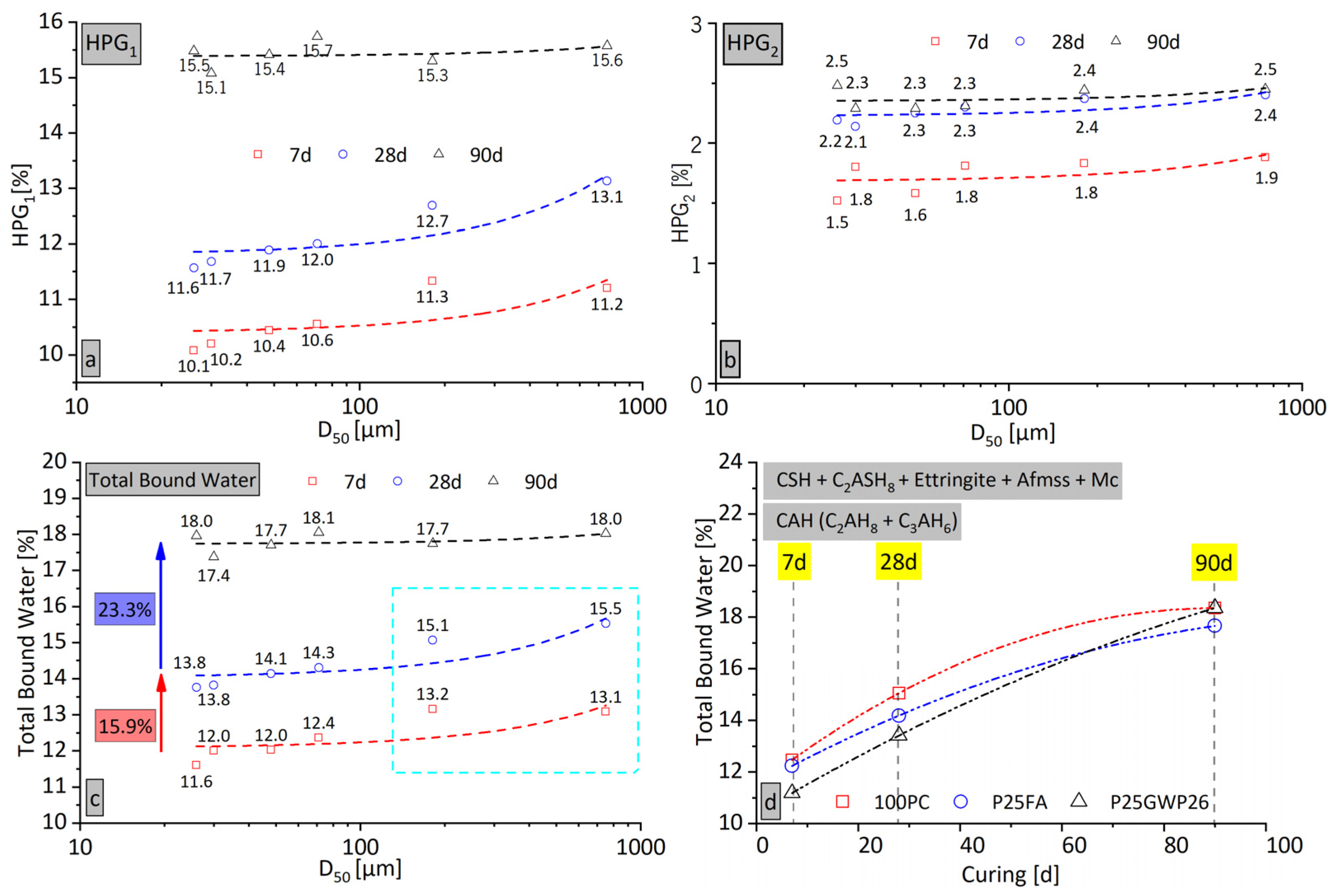
Figure 18 presents the values of HPG1 and HPG2, as well as the total bound water (BW), as a function of the reduction in WGP particle size, and compares these results with the main reference mixtures (100PC, P25FA, and P25WGP26), all with equivalent particle size. The grey boxes indicate the different operational decomposition regions associated with hydration products (HPG1 and HPG2), corresponding to distinct temperature ranges of bound water release from poorly crystalline hydrated phases (e.g., C–S–H and related calcium silicate hydrates), as well as the total bound water (BW) content, as described above in the text.
Figure 18 shows the variation in BW content of pastes containing ground WGP depending on the PSD and the curing period. The graphs analyze the weight loss due to the dehydration of hydrated products (HPG1 and HPG2) (graphs Figure 18a,b), the evolution of total BW as a function of the average particle size (D50) (graph Figure 18c), and a comparison between different mixtures (100PC, P25FA, and P25WGP26) over curing time (graph Figure 18d).
Graphs Figure 18a,b show that the total BW content (HPG1 + HPG2) increases as the particle size of WGP decreases. Finer particles (≤71 µm) exhibit greater water incorporation into hydrated products, indicating enhanced reactivity and increased formation of hydration products over time. In contrast, coarser particles (≥181 µm) exhibit a lower variation in BW content, suggesting limited reactivity and, consequently, a reduced contribution to cement matrix hydration. However, graph Figure 18c shows that despite the general trend of increasing BW with curing time, the relationship between particle size and hydration is not entirely linear. While smaller particles enhance pozzolanic reactivity and the consumption of Ca(OH)2, larger particles still retain significant BW over time. This behavior may be associated with the retention of structurally bound water in hydrated phases [76].
Graph Figure 18d compares the evolution of BW across different mixtures, revealing that the paste with P25WGP26 initially exhibits lower BW content at early ages (7 and 28 days) compared to 100PC and P25FA. However, at 90 days, P25WGP26 shows a significant increase, surpassing the other mixtures. This behavior suggests that the hydration of finer ground glass particles occurs more progressively over time, suggesting the progressive formation of secondary reaction products at later ages. In contrast, P25FA demonstrates an intermediate performance, indicating that its pozzolanic reaction may be less pronounced in the early curing stages. The results demonstrate that the hydration of WGP-containing mixtures is not solely dependent on particle fineness but also on the interaction between particle packing, water availability, and the reaction kinetics of pozzolanic compounds. Therefore, indicating that particle size distribution plays an important role in balancing hydration behavior and mechanical performance.
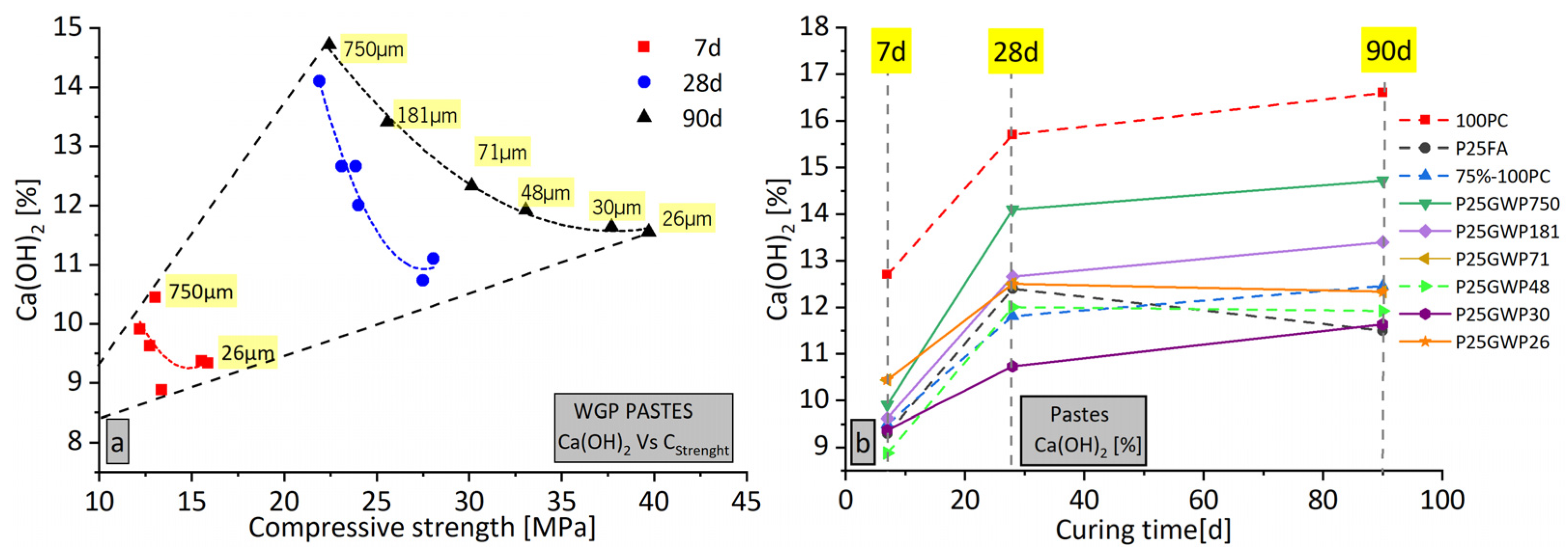
Figure 19a indicates that as compressive strength increases, the Ca(OH)2 content (% CH) decreases, with this effect being more pronounced for smaller particle sizes. In the case of larger particles, a higher CH content is observed alongside lower mechanical strength. The values shown correspond to the median particle size (D50) associated with each data point, while the black dashed lines represent the temporal trend of these values. The progressive widening of the dashed-line envelope with curing time reflects an increase in pozzolanic activity, associated with enhanced Ca(OH)2 consumption and the formation of secondary C–S–H, which contributes to the observed improvement in mechanical strength. This behavior suggests that the reduction in CH is associated with its progressive consumption in the pozzolanic reaction induced by the addition of WGP in the cement paste. Consequently, finer particles exhibit greater reactivity, promoting higher conversion of CH into secondary cementitious products, which may contribute to improved mechanical performance. Cement hydration leads to the formation of portlandite over time, as seen in Figure 19b. This portlandite can be partially consumed in the presence of WGP through pozzolanic reactions. Figure 19b shows the quantity of CH for different curing ages and mixes with the same particle size. A 25% reduction in the quantity of CH was applied to the reference mix to allow for comparison with other mixes containing different types of additives. Mixes with additives exhibit very similar CH values across all ages, but with values lower than the reference by 25%.
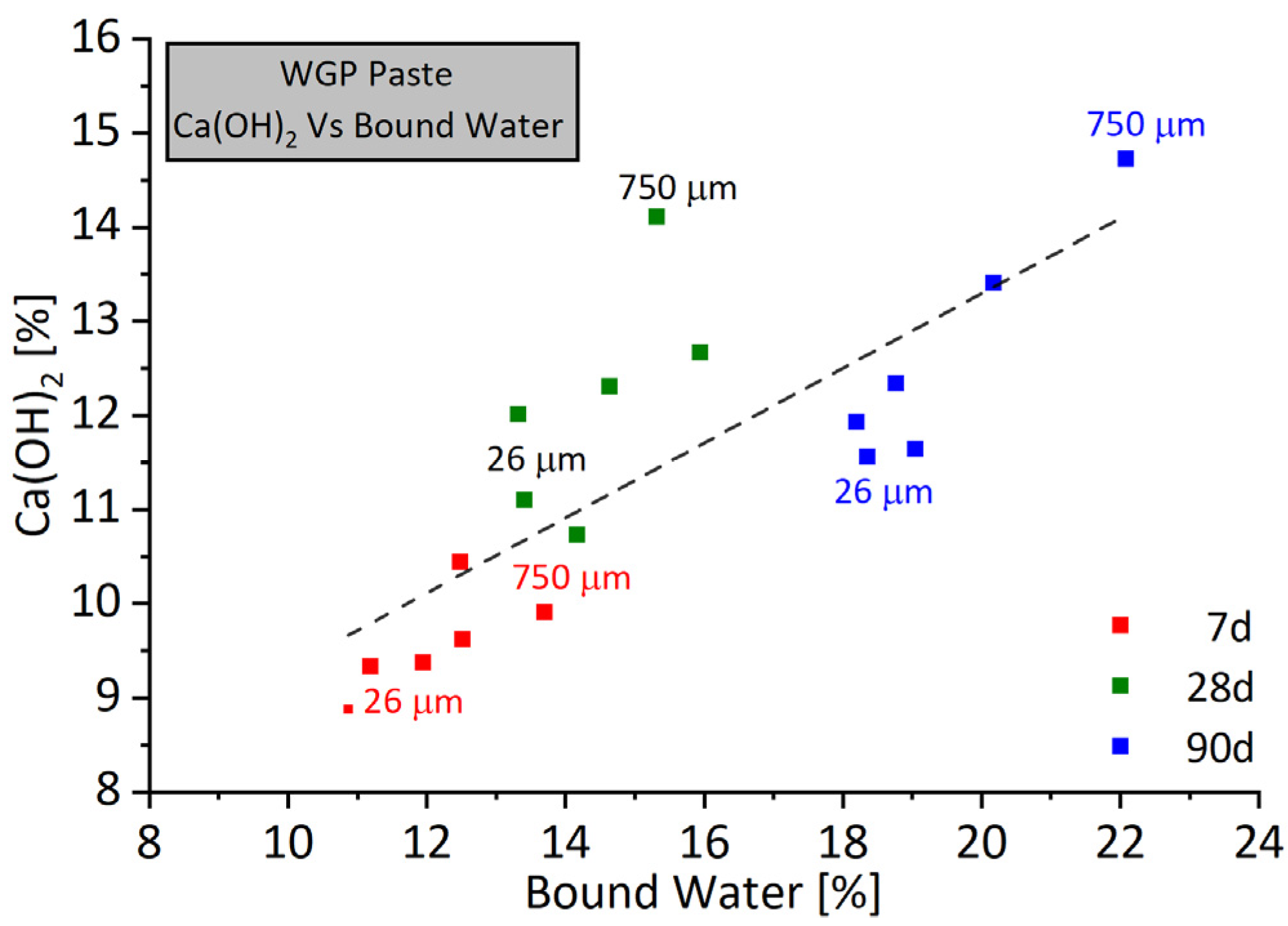
The relationship between chemical BW and portlandite content in WGP pastes, as shown in Figure 20, highlights a positive correlation between the two parameters across different particle sizes (26 μm and 750 μm) and curing ages (7, 28, and 90 days). The black dashed line represents the overall trend between Ca(OH)2 content and bound water (BW), highlighting the correlation between these parameters across different curing ages and particle sizes. This trend reflects the progressive consumption of Ca(OH)2 and the simultaneous formation of hydration products associated with increasing bound water content.
However, in the case of WGP incorporation, variations in this linear proportion are observed, reflecting the gradual and sustained consumption of CH over time. Smaller WGP particles (26 μm) exhibit higher levels of BW and lower CH content compared to larger particles (750 μm) at the same curing ages. This is consistent with the enhanced pozzolanic activity of finer particles, which react more readily with portlandite to form additional hydration products, such as C-S-H. Over time, the reduction in CH content becomes more pronounced in the finer WGP pastes, indicating sustained pozzolanic reactions and greater matrix densification. This linear relationship between CH and BW content provides valuable insights into the reaction kinetics and reactivity of WGP as an additive. Quantifying the consumption of CH over time can serve as an indicator of SCM reactivity. Particle size plays a critical role in influencing hydration behavior, as finer WGP particles exhibit greater pozzolanic reactivity, leading to increased chemical BW and reduced portlandite content. These findings further validate the suitability of WGP as an SCM, particularly when ground to finer sizes.
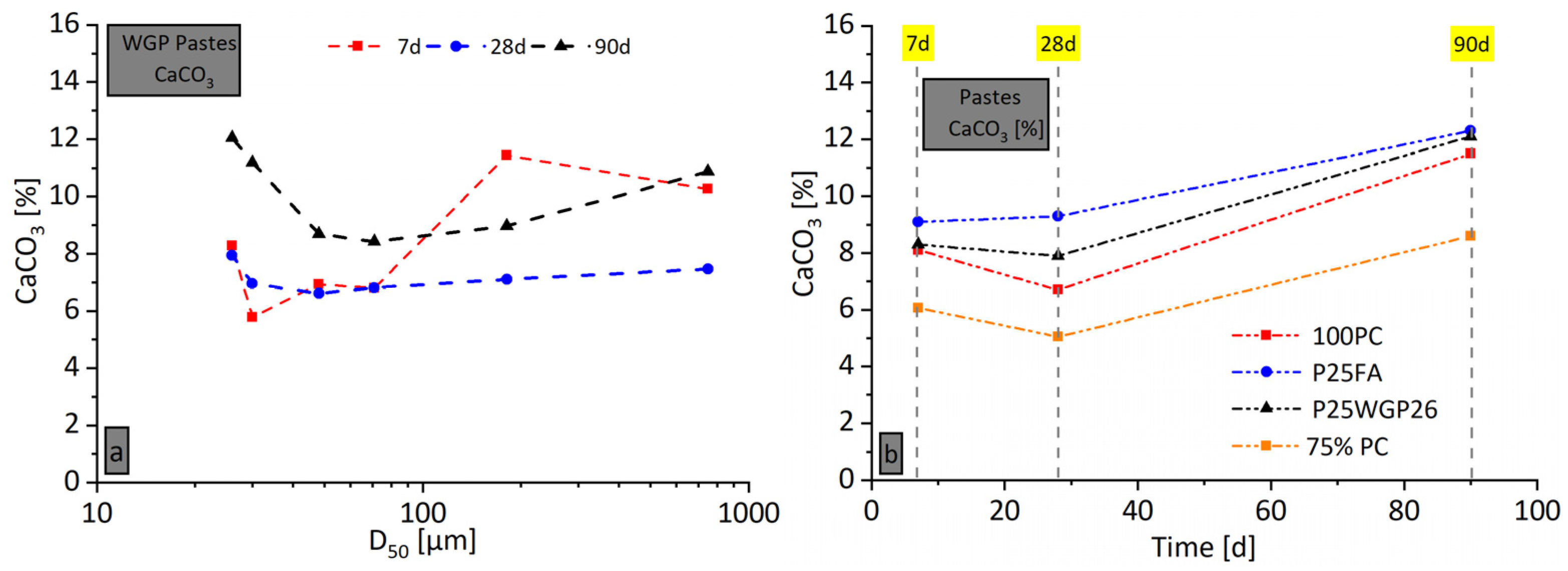
Figure 21a illustrates the variation in CaCO3 percentage in pastes containing WGP as a function of the mean particle size (D50) over 7, 28, and 90 days. It is evident that the CaCO3 percentage significantly decreases with the reduction in particle size at earlier curing times (7 days), indicating higher reactivity of smaller particles due to their increased SSA. As curing progresses to 28 and 90 days, the formation of CaCO3 stabilizes and slightly increases, particularly for larger particles.
The presence of calcium carbonate (CaCO3) in the analyzed samples is attributed to the carbonation of hydrated cement phases, primarily portlandite (CH), during sample handling, storage, and preparation [42]. Although the original cement does not contain carbonate additives, exposure to atmospheric CO2 can lead to partial carbonation over time, a phenomenon widely reported in cementitious systems. This effect is difficult to completely avoid, particularly during drying, grinding, and TG sample preparation.
This behavior suggests that residual reactions with portlandite occur at later stages and for finer particles. The second graph (Figure 21b) shows the evolution of CaCO3 percentage over time (7, 28, and 90 days) for different paste compositions: 100% Portland cement (100PC), 25% P25FA, 25% glass waste powder (P25WGP26), and 75% Portland cement (75%PC). It is observed that pastes with 25% glass waste powder (P25WGP26) exhibit CaCO3 formation comparable to other mixtures over time, indicating the effective contribution of WGP to pozzolanic reactions by consuming portlandite and forming secondary compounds. In contrast, the mixture with 25% (P25FA) shows slightly lower CaCO3 percentages, suggesting differences in reactivity between the supplementary materials.
The findings demonstrate that reducing the particle size of glass waste powder enhances its initial reactivity, leading to lower CaCO3 formation at early curing stages, while larger particles contribute to delayed reactivity over time. Pastes containing 25% glass waste powder show comparable performance to those with FA, supporting its potential use as an SCM. The results highlight the influence of particle size and material type on carbonated compound formation, which directly affects the long-term properties and durability of cementitious matrices.

4.2.4. Mineralogical Evolution and Amorphous Phase Development of Cement Pastes with WGP

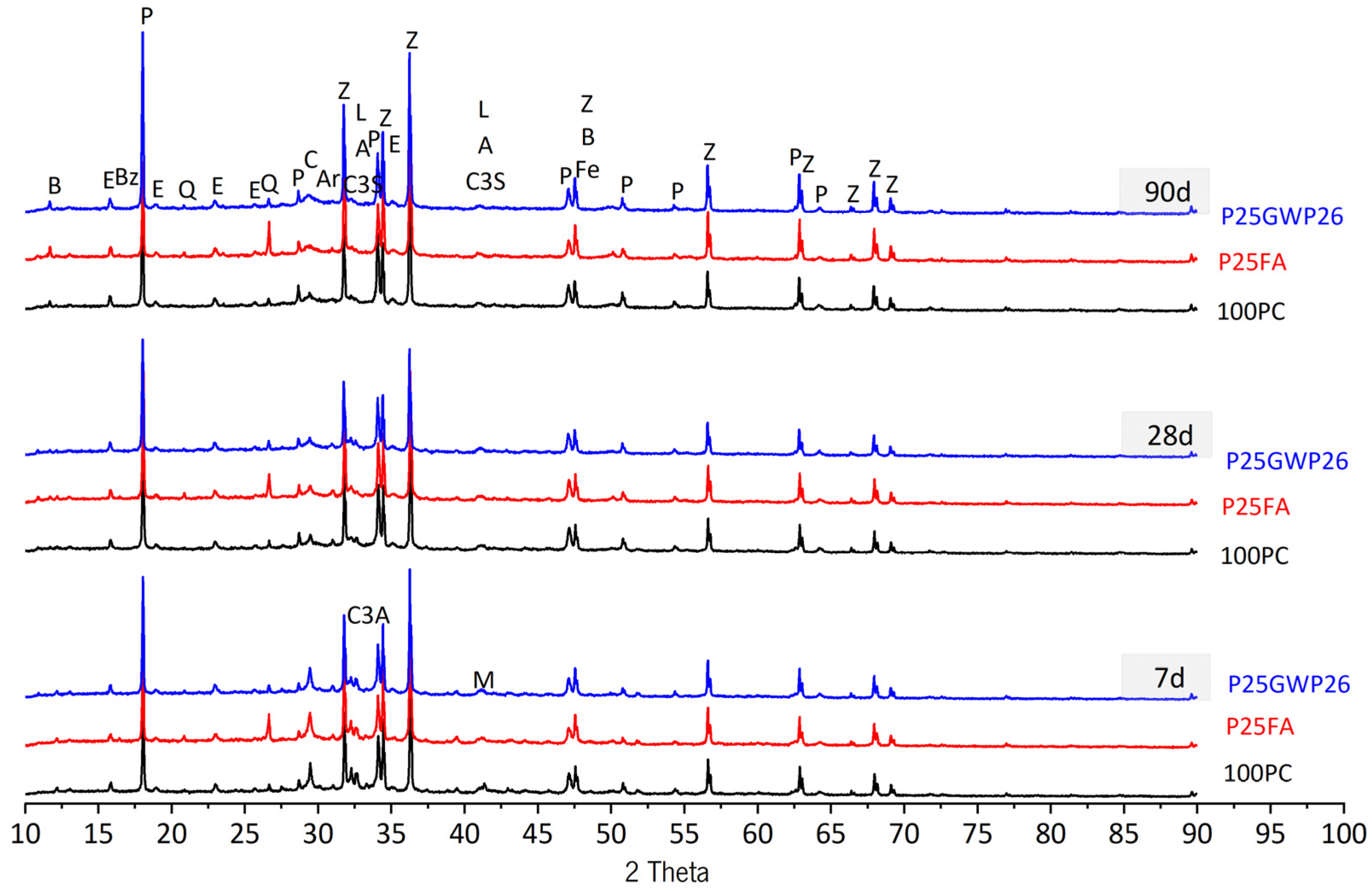
The mineralogical evolution of the cement pastes was investigated by X-ray diffraction (XRD) at 7, 28 and 90 days of curing in order to assess the progression of hydration reactions and the pozzolanic reactivity associated with FA and WGP. The XRD patterns presented in Figure 22 reveal the presence of the typical crystalline phases of hydrated cementitious systems, including portlandite, ettringite, calcite, and residual anhydrous clinker phases such as alite, belite and calcium aluminates. With increasing curing time, a progressive reduction in the intensity of peaks related to anhydrous phases is observed, indicating the advancement of cement hydration. In parallel, a noticeable decrease in the intensity of portlandite peaks occurs in the pastes containing FA and, more markedly, in those incorporating WGP, particularly at later ages, suggesting the consumption of Ca(OH)2 through secondary pozzolanic reactions [11].
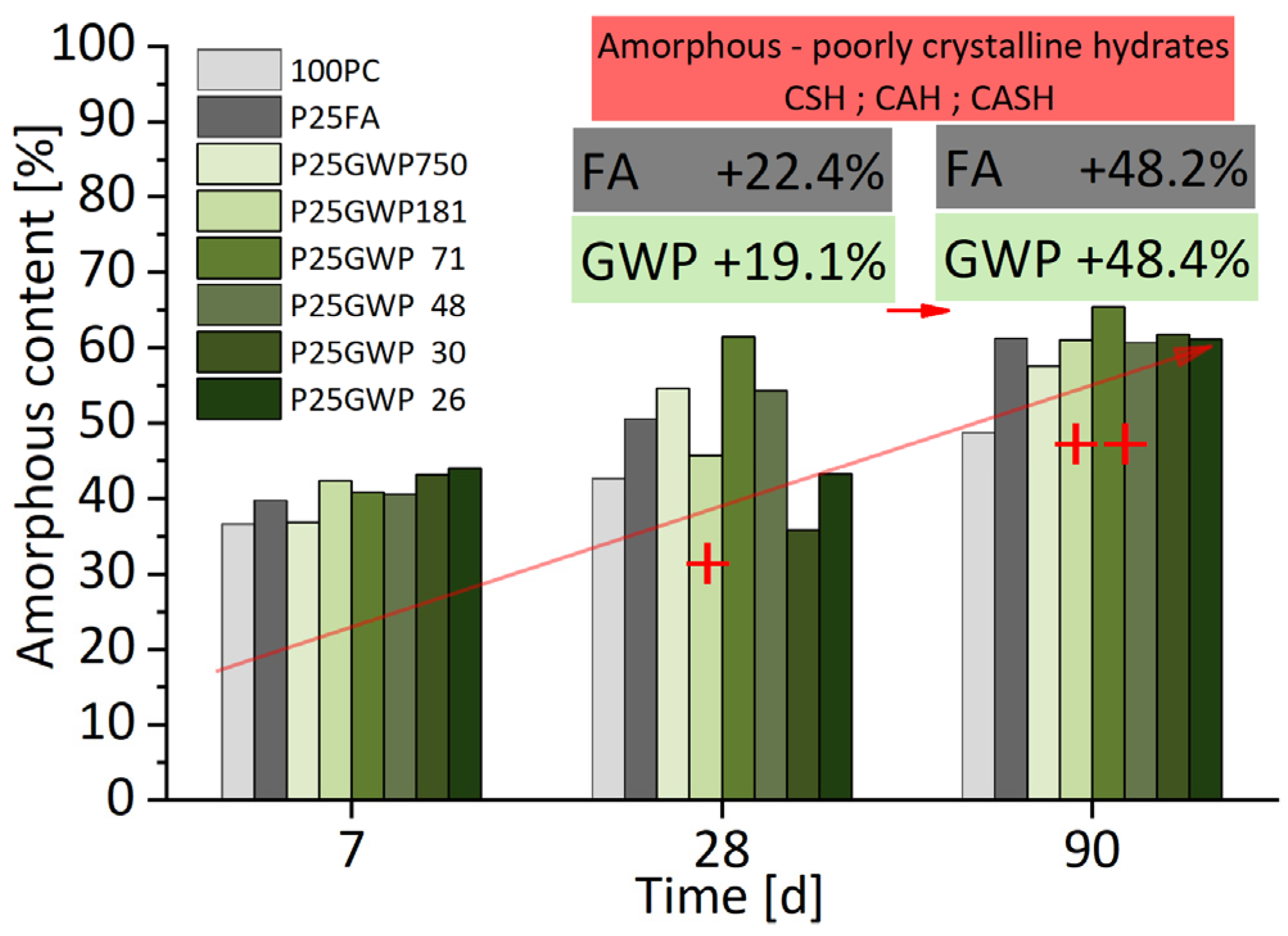
The amorphous phase quantified in this study corresponds to poorly crystalline or nanocrystalline hydration products that are not directly detectable by conventional XRD analysis. These mainly include C–S–H-type gels and related calcium silicate and aluminosilicate hydrates (e.g., C–A–H and C–A–S–H). Although some of these phases may exhibit short-range structural order similar to crystalline compounds such as tobermorite, in cementitious systems they are typically disordered and are therefore operationally quantified as part of the amorphous fraction.
The quantification of the amorphous phase was carried out through Rietveld refinement of the XRD patterns, using the crystalline phases identified in the system and estimating the non-crystalline fraction from the difference between the total diffracted intensity and the modeled crystalline contribution. This approach enables an indirect but robust quantification of poorly crystalline hydration products in cementitious materials.
Thus, the increase in amorphous content observed in Figure 23 reflects the progressive formation of these poorly crystalline hydration products during hydration and pozzolanic reactions. The red “+” symbols indicate the increase in amorphous phase content between curing ages, highlighting the progressive formation of hydration and pozzolanic reaction products.
The results show a consistent increase in the amorphous phase content with curing time for all mixtures, reflecting the continuous formation of hydration and pozzolanic reaction products. Between 28 and 90 days, the pastes incorporating FA exhibit an increase in amorphous content from approximately 22.4% to 48.2%. A similar but slightly more pronounced trend is observed for the WGP-based pastes, in which the amorphous fraction increases from about 19.1% to 48.4% over the same period. This behavior clearly demonstrates the effective pozzolanic contribution of WGP at medium and long curing ages, associated with the progressive dissolution of amorphous silica in the alkaline pore solution and the subsequent formation of secondary hydrated phases [28,29].
At 90 days, the amorphous content of the WGP-containing pastes is slightly higher than that of the FA-based system, regardless of the particle size considered, as shown in Figure 23. This confirms that WGP provides a pozzolanic contribution at least comparable to that of FA. Moreover, a subtle but systematic influence of particle size is observed, with finer glass powders tending to promote higher amorphous contents, particularly at later ages. This effect is attributed to the increase in specific surface area, which enhances silica dissolution and accelerates pozzolanic reactions [28].
The increase in pozzolanic activity of WGP with decreasing particle size can therefore be directly correlated with the progressive formation of secondary C–S–H and related hydration products [11]. This interpretation is further supported by thermogravimetric analysis (TG/DTG), which shows a progressive reduction in portlandite content and a simultaneous increase in chemical BW as WGP particle size decreases, particularly at 28 and 90 days. This behavior reflects the conversion of Ca(OH)2 into secondary C–S–H through pozzolanic reactions [56]. Finer particles provide a larger reactive surface, accelerating silica dissolution in the alkaline pore solution and promoting sustained C–S–H formation [28].
In parallel, the microstructural role of fine WGP particles extends beyond chemical reactivity. Scanning electron microscopy observations indicate that WGP particles maintain an angular morphology across all size ranges, contributing to improved particle packing and acting as nucleation sites for C–S–H precipitation [10]. This combined filler–nucleation effect enhances the distribution of hydration products and contributes to a denser microstructure [42]. As particle size decreases, the increased number of nucleation sites further accelerates local C–S–H growth around WGP particles, strengthening the particle–matrix interface.
The mechanical performance of the pastes reflects this microstructural evolution. Both compressive strength and RCS increase systematically with decreasing WGP particle size, particularly between 28 and 90 days. The mixture containing WGP with D50 ≈ 48 µm achieves strength values comparable to those of the FA-based system, while the finest fraction (D50 ≈ 26 µm) approaches the performance of the reference cement paste. This behavior confirms that strength improvement is governed by both filler effects at early ages and continued formation of hydration products at later ages.
The combined evidence from XRD (Figure 22), amorphous phase quantification (Figure 23), TG/DTG and SEM analyses demonstrates that the increase in pozzolanic activity of WGP with fineness is associated with increased formation of C–S–H and other hydration products. This process is influenced by particle size-dependent surface area and nucleation effects [10].
From an engineering point of view, the determination of the optimal particle size of WGP is not only driven by reactivity and strength evolution, but also by the feasibility of mass production. Although finer glass powders (e.g., D50 ≈ 26 µm) exhibit slightly higher amorphous contents and pozzolanic reactivity, the results demonstrate that WGP with D50 ≈ 48 µm already achieves mechanical and microstructural performance comparable to FA. This particle size, therefore, represents a favorable compromise between pozzolanic efficiency and grinding energy demand. In industrial milling processes, achieving D50 values in the range of 40–50 µm is significantly less energy-intensive than producing ultrafine powders below 30 µm, where grinding energy increases disproportionately. Consequently, the use of WGP with D50 ≈ 48 µm can be considered technically effective while remaining compatible with realistic industrial grinding strategies, supporting its potential application in large-scale cementitious systems.

5. Economic and Environmental Impact of Mixes with WGP

In general, all mixtures containing WGP showed a lower environmental impact than the reference cement paste (100PC). As shown in the environmental indicators (Table 2 and Figure 24a), the pastes with coarser WGP particles—namely P750WGP and P181WGP—exhibited the lowest global warming potential (GWP), with values of 1017.26 and 1017.69 kg CO2eq emissions, respectively. These represent a carbon footprint reduction of over 25% compared to 100PC (1353.70 kg CO2eq) and approximately 0.3% lower than the F-based paste P25FA (1020.32 kg CO2eq).
Furthermore, the remaining WGP-based pastes—P71WGP, P48WGP, P30WGP, and P26WGP—also showed GWP values lower than both P25FA and 100PC. This demonstrates that even without extensive grinding, WGP can achieve a lower carbon footprint than FA, which is frequently used as a benchmark SCM in sustainable cementitious systems. Although the finer pastes P30WGP and P26WGP had slightly higher GWP values (1022.12 and 1022.62 kg CO2eq, respectively) than P25FA, these remain significantly below the value of 100PC.
Regarding cumulative energy demand (CED), WGP pastes ranged between 1671.98 kWh (P750WGP) and 1717.08 kWh (P26WGP), values in line with P25FA (1710.98 kWh) and clearly lower than 100PC (2194.40 kWh), confirming that WGP, like FA, helps to reduce the embodied energy of cementitious pastes. The Ca(OH)2 values reported in Table 2 are expressed in relative terms (normalized to the reference mixture), whereas absolute values obtained from TGA are presented in Figure 20.
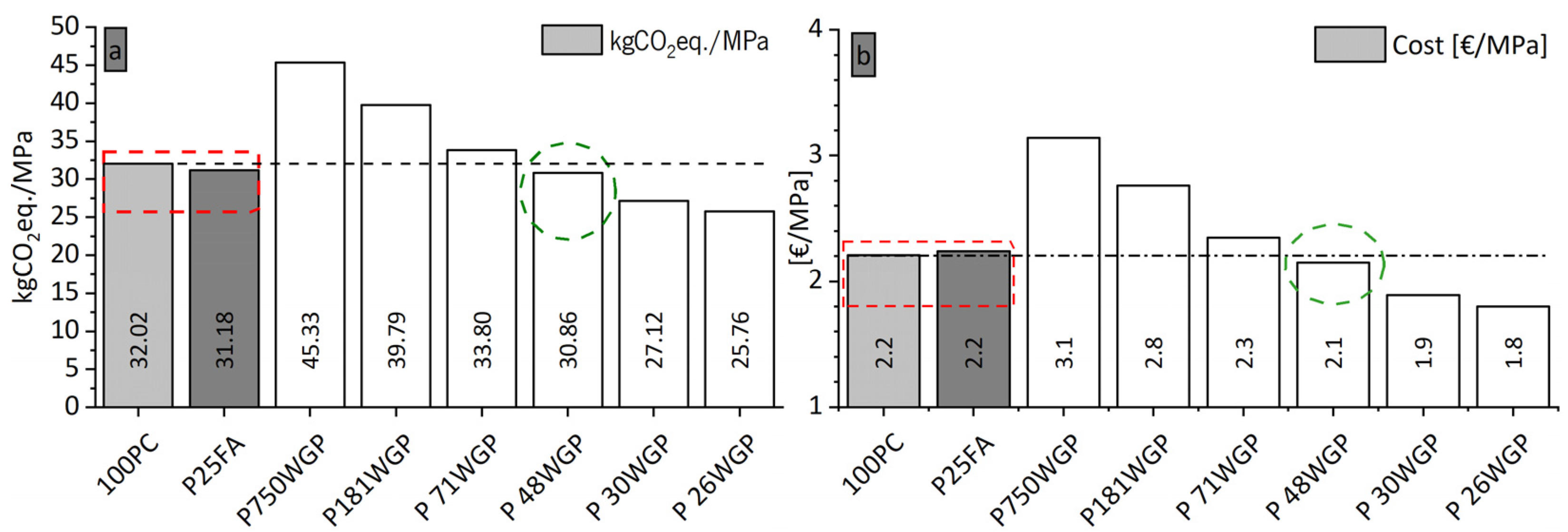
In terms of environmental impact, the results illustrated in (Figure 24a) confirm that most mixtures incorporating WGP outperform both the FA-based mixture P25FA and the reference (100PC). Notably, P48WGP exhibited one of the lowest specific carbon emissions at 30.86 kg CO2eq/MPa, lower than those recorded for P25FA (31.18 kg CO2eq/MPa) and 100PC (32.02 kg CO2eq/MPa). However, the lowest values were achieved by finer WGP-based pastes, particularly P30WGP and P26WGP, which reached 27.12 and 25.76 kg CO2eq/MPa, respectively, highlighting their superior eco-efficiency.
These results demonstrate the significant potential of WGP to reduce environmental impact while maintaining or even enhancing mechanical performance.
As presented in Table 2 and illustrated in Figure 24b, the economic analysis reinforces the viability of WGP-based mixtures. The horizontal dashed line represents the reference mixture (100PC), serving as a baseline for comparison. The red dashed boxes highlight the values of the reference mixture (100PC) and the P25FA mixture, while the green dashed circles identify the WGP-based mixtures with the best performance in terms of environmental impact and cost efficient. Both P25FA and 100PC exhibited a specific cost of 2.2 €/MPa, whereas several WGP mixtures showed superior cost-efficiency. In particular, P48WGP achieved a specific cost of 2.1 €/MPa, similar to P25FA, while delivering improved environmental and mechanical performance. The finest WGP pastes, P30WGP and P26WGP, showed the most favorable results, with specific costs of 1.9 €/MPa and 1.8 €/MPa, respectively, confirming their superior economic efficiency.
Conversely, coarser formulations like P750WGP (3.1 €/MPa) and P181WGP (2.8 €/MPa) demonstrated a higher cost per strength unit due to their lower compressive strength. The intermediate formulation P71WGP remained reasonably competitive at 2.3 €/MPa.
These results clearly highlight that finer WGP fractions (particularly P30WGP and P26WGP) provide the best combined environmental and economic performance when normalized by mechanical strength.
However, despite the superior eco-efficiency of P26WGP, the performance gains relative to intermediate particle sizes (e.g., P48WGP) become progressively smaller, indicating diminishing returns with increasing fineness.
An integrated analysis of all environmental and performance indicators (Table 2 and Figure 24) confirms that P48WGP represents a balanced formulation, achieving a compressive strength of 33.07 MPa, a GWP of 1020.46 kg CO2eq/m3, and a CED of 1697.38 kWh/m3, combined with competitive cost performance.
Compared to the reference mix 100PC, which recorded a cost of €93.30 per cubic meter, the P48WGP blend achieved a notable economic saving of €22.29, reducing the cost to €71.01/m3. Moreover, when compared to the P25FA mixture (€73.27/m3), the P48WGP mixture still demonstrates a cost advantage of €2.26/m3.
This indicates that replacing FA with WGP does not lead to an increase in production costs. Additionally, the functional performance of P48WGP is slightly higher, with a compressive strength of 33.07 MPa compared to 32.73 MPa for P25FA, while also achieving slightly better environmental efficiency in terms of CO2 emissions per MPa (30.86 vs. 31.18 kg CO2eq/MPa).
These combined results highlight that the use of WGP is not only economically viable but also technically and environmentally advantageous.
While the finest WGP (P26WGP) provides the highest eco-efficiency in terms of CO2 emissions and cost per MPa, intermediate particle sizes (around 48 µm) offer a more balanced and scalable solution when considering grinding energy, performance gains, and industrial feasibility.
Consequently, WGP emerges as a technically sound and sustainable solution, aligned with contemporary strategies for decarbonization and the valorization of industrial waste in the construction sector.

6. Conclusions

This study evaluated the feasibility of using recycled WGP as an SCM to partially replace Portland cement, positioning it as a sustainable alternative to FA from environmental, technical and economic perspectives.
The results demonstrate that WGP exhibits significant potential as an SCM when ground to suitable particle sizes. Although grinding WGP to particle sizes finer than 48 μm enhances its physical, chemical and mechanical performance, achieving a median particle size (D50) of approximately 48 μm is sufficient to reach a performance level comparable to FA-based systems.
Compressive strength increased consistently with decreasing particle size. At 90 days, cement pastes incorporating WGP with D50 ≈ 48 μm (P48WGP) matched the mechanical performance of FA-based compositions, while finer WGP (D50 ≈ 26 μm) surpassed FA and approached the strength of the 100% Portland cement reference. This trend is reflected in the relative compressive strength, which reached 94% for P26WGP compared to 77% for the FA reference.
Environmental and economic assessments confirmed that WGP-based mixtures reduce CO2 emissions by more than 25% relative to the reference mix composed solely of Portland cement. Among the investigated mixtures, P48WGP provided the most balanced performance, combining competitive compressive strength (33.07 MPa), reduced environmental impact (1020.46 kg CO2eq/m3), and improved cost-efficiency (2.1 €/MPa), resulting in a cost saving of €22.29 per cubic meter compared to the control mixture.
However, the finest mixture (P26WGP) demonstrated the highest eco-efficiency, achieving the lowest CO2 emissions and cost per unit of mechanical performance (kg CO2eq/MPa and €/MPa), as well as the highest compressive strength among all WGP mixtures.
Despite this superior performance, the incremental gains obtained by reducing particle size below 48 μm become progressively smaller when compared to the associated increase in grinding energy, indicating the presence of diminishing returns from an engineering perspective.
Therefore, targeting a WGP particle size around D50 ≈ 48 μm represents an optimal compromise between performance enhancement and industrial feasibility.
Overall, P26WGP presents the best functional and eco-efficient performance, while P48WGP represents the optimal balance between mechanical behavior, environmental impact, energy demand, and practical large-scale applicability.
These findings confirm the technical, environmental and economic viability of incorporating finely ground WGP as an SCM in cement-based systems. WGP thus emerges as a promising and sustainable alternative to FA, capable of delivering competitive mechanical performance while significantly reducing the carbon footprint of cementitious materials and supporting circular economic strategies within the construction sector.

Author Contributions

Conceptualization, C.J., R.R., R.C. and K.P.; methodology, C.J., K.P., A.C., R.M. and M.R.; software, C.J. and J.C.C.A.; validation, A.C., M.R. and R.M.; formal analysis, J.C.-G., R.R., R.C. and J.C.C.A.; investigation, C.J.; resources, R.M.; data curation, C.J.; writing—original draft preparation, C.J.; writing—review and editing, A.C., M.R., R.M. and J.C.-G.; visualization, C.J.; supervision, A.C. and J.C.-G.; project administration, A.C. and R.M.; funding acquisition, A.C. and R.M. All authors have read and agreed to the published version of the manuscript.

Funding

The authors thank the Portuguese Foundation for Science and Technology (FCT) for its institutional support in the framework of scientific research activities and the Centre for Territory, Environment and Construction (CTAC) for institutional support (https://doi.org/10.54499/UID/04047/2025). This work also was supported from FEDER, COMPETE2030-FEDER-00773100, through the GlassCON_4low project, no. 16557.

Data Availability Statement

The original contributions presented in this study are included in the article. Further inquiries can be directed to the corresponding author.

Acknowledgments

The authors would like to thank the Department of Civil Engineering at the University of Minho for providing the laboratory facilities and technical support essential for conducting this research. The authors also acknowledge SECIL for supplying the materials used in this study.

Conflicts of Interest

The authors declare no conflicts of interest.

References

  1. IEA. Cement. 2023. Available online: https://www.iea.org/reports/cement-3 (accessed on 7 March 2026).
  2. Schneider, M.; Romer, M.; Tschudin, M.; Bolio, H. Sustainable cement production—Present and future. Cem. Concr. Res. 2011, 41, 642–650. [Google Scholar] [CrossRef]
  3. Amran, M.; Makul, N.; Fediuk, R.; Lee, Y.H.; Vatin, N.I.; Lee, Y.Y.; Mohammed, K. Global carbon recoverability experiences from the cement industry. Case Stud. Constr. Mater. 2022, 17, e01439. [Google Scholar] [CrossRef]
  4. Andrew, R.M. Global CO2 emissions from cement production, 1928–2018. Earth Syst. Sci. Data 2019, 11, 1675–1710. [Google Scholar] [CrossRef]
  5. Huang, L.; Krigsvoll, G.; Johansen, F.; Liu, Y.; Zhang, X. Carbon emission of global construction sector. Renew. Sustain. Energy Rev. 2018, 81, 1906–1916. [Google Scholar] [CrossRef]
  6. Han, S.; Kim, J.H.; Singh, R.K.; Shah, S.P. CO2 utilization for cementitious materials—A review. KSCE J. Civ. Eng. 2025, 29, 100227. [Google Scholar] [CrossRef]
  7. República Portuguesa. Portuguese Carbon Neutrality Roadmap, Roadmap for Carbon Neutrality 2050; República Portuguesa: Lisboa, Portugal, 2019; pp. 1–102. [Google Scholar]
  8. Kaplan, G.; Bayraktar, O.Y.; Li, Z.; Bodur, B.; Yılmazoglu, M.U.; Alcan, B.A. Improving the eco-efficiency of fiber reinforced composite by ultra-low cement content/high FA-GBFS addition for structural applications: Minimization of cost, CO2 emissions and embodied energy. J. Build. Eng. 2023, 76, 107280. [Google Scholar] [CrossRef]
  9. Barbhuiya, S.; Kanavaris, F.; Das, B.B.; Idrees, M. Decarbonising cement and concrete production: Strategies, challenges and pathways for sustainable development. J. Build. Eng. 2024, 86, 108861. [Google Scholar] [CrossRef]
  10. Juenger, M.C.G.; Siddique, R. Recent advances in understanding the role of supplementary cementitious materials in concrete. Cem. Concr. Res. 2015, 78, 71–80. [Google Scholar] [CrossRef]
  11. Skibsted, J.; Snellings, R. Reactivity of supplementary cementitious materials (SCMs) in cement blends. Cem. Concr. Res. 2019, 124, 105799. [Google Scholar] [CrossRef]
  12. Wang, T.; Medepalli, S.; Zheng, Y.; Krishnan, S.; Li, N.; Ishida, T.; Zhang, Z.; Bishnoi, S.; Zhang, K. An efficient method for determining the pozzolanic reaction degrees of low-calcium supplementary cementitious materials in blended cement pastes. Cem. Concr. Compos. 2024, 151, 105595. [Google Scholar] [CrossRef]
  13. Zunino, F.; Lopez, M. Decoupling the physical and chemical effects of supplementary cementitious materials on strength and permeability: A multi-level approach. Cem. Concr. Compos. 2016, 65, 19–28. [Google Scholar] [CrossRef]
  14. Lothenbach, B.; Scrivener, K.; Hooton, R.D. Supplementary cementitious materials. Cem. Concr. Res. 2011, 41, 1244–1256. [Google Scholar] [CrossRef]
  15. Ndahirwa, D.; Zmamou, H.; Lenormand, H.; Leblanc, N. The role of supplementary cementitious materials in hydration, durability and shrinkage of cement-based materials, their environmental and economic benefits: A review. Clean. Mater. 2022, 5, 100123. [Google Scholar] [CrossRef]
  16. Wang, T.; Medepalli, S.; Zheng, Y.; Zhang, W.; Ishida, T.; Bishnoi, S.; Hou, D.; Shi, Z. Retardation effect of the pozzolanic reaction of low-calcium supplementary cementitious materials on clinker hydration at later age: Effects of pore solution, foreign ions, and pH. Cem. Concr. Res. 2024, 177, 107416. [Google Scholar] [CrossRef]
  17. Wang, T.; Ishida, T.; Gu, R.; Luan, Y. Experimental investigation of pozzolanic reaction and curing temperature-dependence of low-calcium fly ash in cement system and Ca-Si-Al element distribution of fly ash-blended cement paste. Constr. Build. Mater. 2021, 267, 121012. [Google Scholar] [CrossRef]
  18. Shah, V.; Bishnoi, S. Carbonation resistance of cements containing supplementary cementitious materials and its relation to various parameters of concrete. Constr. Build. Mater. 2018, 178, 219–232. [Google Scholar] [CrossRef]
  19. Borges, A.L.; Soares, S.M.; Freitas, T.O.G.; de Oliveira Júnior, A.; Ferreira, E.B.; Ferreira, F.G.d.S. Evaluation of the Pozzolanic Activity of Glass Powder in Three Maximum Grain Sizes. Mater. Res. 2021, 24, e20200496. [Google Scholar] [CrossRef]
  20. Liu, Q.; Hosseini, P.; Wang, B. Improving the performance of SiO2 nanoparticles in portland-limestone cementitious systems using silica-limestone composites. Cem. Concr. Compos. 2025, 157, 105961. [Google Scholar] [CrossRef]
  21. Cocco, G.D.; Vieira, A.P.; de Moraes Rego Fairbairn, E.; Reales, O.A.M. Hydration kinetics of Portland cement pastes blended with C-S-H seeds and low initial reactivity supplementary cementitious materials. Mater. Today Proc. 2023; in press. [CrossRef]
  22. Hashim, A.A.; Anaee, R.; Nasr, M.S. Enhancing the sustainability, mechanical and durability properties of recycled aggregate concrete using calcium-rich waste glass powder as a supplementary cementitious material: An experimental study and environmental assessment. Sustain. Chem. Pharm. 2025, 44, 101985. [Google Scholar] [CrossRef]
  23. Jin, Z.; Liang, K.; Liu, C.; Yang, G.; Cui, K.; Mao, S. Mechanical properties and life cycle assessment (LCA) of waste glass reinforced concrete. J. Build. Eng. 2024, 96, 110643. [Google Scholar] [CrossRef]
  24. Paul, D.; Bindhu, K.R.; Matos, A.M.; Delgado, J. Eco-friendly concrete with waste glass powder: A sustainable and circular solution. Constr. Build. Mater. 2022, 355, 129217. [Google Scholar] [CrossRef]
  25. Li, Q.; Qiao, H.; Li, A.; Li, G. Performance of waste glass powder as a pozzolanic material in blended cement mortar. Constr. Build. Mater. 2022, 324, 126531. [Google Scholar] [CrossRef]
  26. Moreira, O.; Camões, A.; Malheiro, R.; Jesus, C. High Glass Waste Incorporation towards Sustainable High-Performance Concrete. CivilEng 2024, 5, 41–64. [Google Scholar] [CrossRef]
  27. Du, H.; Tan, K.H. Concrete with recycled glass as fine aggregates. ACI Mater. J. 2014, 111, 47–58. [Google Scholar] [CrossRef]
  28. Shi, C.; Wu, Y.; Riefler, C.; Wang, H. Characteristics and pozzolanic reactivity of glass powders. Cem. Concr. Res. 2005, 35, 987–993. [Google Scholar] [CrossRef]
  29. Zheng, K. Pozzolanic reaction of glass powder and its role in controlling alkali–silica reaction. Cem. Concr. Compos. 2016, 67, 30–38. [Google Scholar] [CrossRef]
  30. Shayan, A.; Xu, A. Value-added utilisation of waste glass in concrete. Cem. Concr. Res. 2004, 34, 81–89. [Google Scholar] [CrossRef]
  31. ASTM C1866/C1866M-20; Standard Specification for Ground-Glass Pozzolan for Use in Concrete. ASTM International: West Conshohocken, PA, USA, 2020. [CrossRef]
  32. Mirzahosseini, M.; Riding, K.A. Influence of different particle sizes on reactivity of finely ground glass as supplementary cementitious material (SCM). Cem. Concr. Compos. 2015, 56, 95–105. [Google Scholar] [CrossRef]
  33. Zhao, J.; Wang, D.; Wang, X.; Liao, S.; Lin, H. Ultrafine grinding of fly ash with grinding aids: Impact on particle characteristics of ultrafine fly ash and properties of blended cement containing ultrafine fly ash. Constr. Build. Mater. 2015, 78, 250–259. [Google Scholar] [CrossRef]
  34. Scrivener, K.L.; John, V.M.; Gartner, E.M. Eco-efficient cements: Potential economically viable solutions for a low-CO2 cement-based materials industry. Cem. Concr. Res. 2018, 114, 2–26. [Google Scholar] [CrossRef]
  35. Nie, S.; Thomsen, R.M.; Skibsted, J. Impact of Mg substitution on the structure and pozzolanic reactivity of calcium aluminosilicate (CaO-Al2O3-SiO2) glasses. Cem. Concr. Res. 2020, 138, 106231. [Google Scholar] [CrossRef]
  36. Kong, D.; Du, X.; Wei, S.; Zhang, H.; Yang, Y.; Shah, S.P. Influence of nano-silica agglomeration on microstructure and properties of the hardened cement-based materials. Constr. Build. Mater. 2012, 37, 707–715. [Google Scholar] [CrossRef]
  37. Land, G.; Stephan, D. The effect of synthesis conditions on the efficiency of C-S-H seeds to accelerate cement hydration. Cem. Concr. Compos. 2018, 87, 73–78. [Google Scholar] [CrossRef]
  38. Biernacki, J.J.; Williams, P.J.; Stutzman, P.E. Kinetics of reaction of calcium hydroxide and fly ash. ACI Mater. J. 2001, 98, 340–349. [Google Scholar] [CrossRef] [PubMed]
  39. Tho-In, T.; Sata, V.; Boonserm, K.; Chindaprasirt, P. Compressive strength and microstructure analysis of geopolymer paste using waste glass powder and fly ash. J. Clean. Prod. 2018, 172, 2892–2898. [Google Scholar] [CrossRef]
  40. da Silva Moreira, B.A. Incorporação de Resíduo de Vidro Moído em Argamassas Como Substituto Parcial do Cimento. Master’s Thesis, Universidade do Minho, Braga, Portugal, 2022. [Google Scholar]
  41. EN 1097-2:2020; Tests for Mechanical and Physical Properties of Aggregates—Methods for the Determination of Resistance to Fragmentation. European Committee for Standardization: Brussels, Belgium, 2020.
  42. Scrivener, K.L.; Juilland, P.; Monteiro, P.J.M. Advances in understanding hydration of Portland cement. Cem. Concr. Res. 2015, 78, 38–56. [Google Scholar] [CrossRef]
  43. Juenger, M.C.G.; Snellings, R.; Bernal, S.A. Supplementary cementitious materials: New sources, characterization, and performance insights. Cem. Concr. Res. 2019, 122, 257–273. [Google Scholar] [CrossRef]
  44. EN 1097-6:2013; Tests for Mechanical and Physical Properties of Aggregates. Determination of Particle Density and Water Absorption. European Committee for Standardization: Brussels, Belgium, 2013.
  45. EN 196-1:2018; Methods of Testing Cement—Part 1: Determination of Strength. European Committee for Standardization: Brussels, Belgium, 2018.
  46. BS EN 1015-3:1999; Methods of Test for Mortar for Masonry Determination of Consistence of Fresh Mortar (by Flow Table). European Committee for Standardization: Brussels, Belgium, 1999.
  47. Jiang, Y.; Ling, T.-C.; Mo, K.H.; Shi, C. A critical review of waste glass powder—Multiple roles of utilization in cement-based materials and construction products. J. Environ. Manag. 2019, 242, 440–449. [Google Scholar] [CrossRef]
  48. EN 1015-10:2000/A1:2007; Methods of Test for Mortar for Masonry—Part 10: Determination of Dry Bulk Density of Hardened Mortar. European Committee for Standardization: Brussels, Belgium, 2007. Available online: https://standards.cencenelec.eu (accessed on 16 March 2026).
  49. EN 1015-11:2019; Methods of Test for Mortar for Masonry Determination of Flexural and Compressive Strength of Hardened Mortar. European Committee for Standardization: Brussels, Belgium, 2019.
  50. ASTM C 311-04; Standard Test Methods for Sampling and Testing Fly Ash or Natural Pozzolans for Use in Portland-Cement Concrete. ASTM International: West Conshohocken, PA, USA, 2005.
  51. ASTM C109/C109M-16a; Standard Test Method for Compressive Strength of Hydraulic Cement Mortars (Using 2-in. or [50-mm] Cube Specimens). ASTM International: West Conshohocken, PA, USA, 2016.
  52. Monteagudo, S.M.; Moragues, A.; Gálvez, J.C.; Casati, M.J.; Reyes, E. The degree of hydration assessment of blended cement pastes by differential thermal and thermogravimetric analysis. Morphological evolution of the solid phases. Thermochim. Acta 2014, 592, 37–51. [Google Scholar] [CrossRef]
  53. Braun, R. Chapter 27: Thermal analysis. In Introduction to Expressional Analysis; MCGraw-Hill: New York, NY, USA, 1987. [Google Scholar]
  54. Taylor, H.F.W. Cement Chemistry; Thomas Telford: London, UK, 1997. [Google Scholar] [CrossRef]
  55. Scrivener, K.L.; Nonat, A. Hydration of cementitious materials, present and future. Cem. Concr. Res. 2011, 41, 651–665. [Google Scholar] [CrossRef]
  56. Ramachandran, V.S. Concrete Admixtures Handbook: Properties, Science and Technology; William Andrew: Norwich, NY, USA, 1996; Available online: https://books.google.pt/books?id=aSjXbx9H9WAC (accessed on 16 March 2026).
  57. Sha, W.; O’Neill, E.A.; Guo, Z. Differential scanning calorimetry study of ordinary Portland cement. Cem. Concr. Res. 1999, 29, 1487–1489. [Google Scholar] [CrossRef]
  58. Noumowe, A. Effet de Hautes Températures (20–600 °C) Sur le Béton: Cas Particulier du Béton a Hautes Performances. Ph.D. Thesis, INSA Lyon, Lyon, France, 1995. [Google Scholar]
  59. Bordy, A. Influence des Conditions Thermo-Hydriques de Conservation sur L’hydratation de Matériaux Cimentaires à Base D’une Fine Recyclée. Ph.D. Thesis, Université de Cergy Pontoise, Cergy, France, 2016. [Google Scholar]
  60. Grattan-Bellew, P.E. Microstructural investigation of deteriorated Portland cement concretes. Constr. Build. Mater. 1996, 10, 3–16. [Google Scholar] [CrossRef]
  61. Nonnet, E.; Lequeux, N.; Boch, P. Elastic properties of high alumina cement castables from room temperature to 1600 °C. J. Eur. Ceram. Soc. 1999, 19, 1575–1583. [Google Scholar] [CrossRef]
  62. Zhang, Y. Comportement Hydrique et Poro-Mécanique des Bétons à Hautes Performanc. Ph.D. Thesis, École Centrale de Lille, Villeneuve-d’Ascq, France, 2015. [Google Scholar]
  63. ISO 14040; Environmental Assessment—Life Cycle Assessment—Principles and Framework. International Organization for Standardization (ISO): Geneva, Switzerland, 2006.
  64. ISO 14044; Environmental Management—Life Cycle Assessment—Requirements and Guidelines. International Organization for Standardization (ISO): Geneva, Switzerland, 2006.
  65. EN 15804:2012+A2:2019/AC:2021; Sustainability of Construction Works—Environmental Product Declarations—Core Rules for the Product Category of Construction Products. European Committee for Standardization: Brussels, Belgium, 2021.
  66. Bajpai, R.; Choudhary, K.; Srivastava, A.; Sangwan, K.S.; Singh, M. Environmental impact assessment of fly ash and silica fume based geopolymer concrete. J. Clean. Prod. 2020, 254, 120147. [Google Scholar] [CrossRef]
  67. Miller, S.A. Supplementary cementitious materials to mitigate greenhouse gas emissions from concrete: Can there be too much of a good thing? J. Clean. Prod. 2018, 178, 587–598. [Google Scholar] [CrossRef]
  68. Guignone, G.; Calmon, J.L.; Vieira, G.; Zulcão, R.; Rebello, T.A. Life Cycle Assessment of Waste Glass Powder Incorporation on Concrete: A Bridge Retrofit Study Case. Appl. Sci. 2022, 12, 3353. [Google Scholar] [CrossRef]
  69. Singh, G.B.; Prasad, V.D. Environmental impact of concrete containing high volume fly ash and ground granulated blast furnace slag. J. Clean. Prod. 2024, 448, 141729. [Google Scholar] [CrossRef]
  70. Letelier, V.; Henríquez-Jara, B.I.; Manosalva, M.; Parodi, C.; Ortega, J.M. Use of waste glass as a replacement for raw materials in mortars with a lower environmental impact. Energies 2019, 12, 1974. [Google Scholar] [CrossRef]
  71. Concawe. E-Fuels: A Techno-Economic Assessment of European Domestic Production and Imports Towards 2050—Update. Report No. 4/24; 432p. Available online: https://www.concawe.eu/publication/e-fuels-a-techno-economic-assessment-of-european-domestic-production-and-imports-towards-2050-update/ (accessed on 15 March 2026).
  72. IPCC. Adoption of the provisional agenda. In Proceedings of the Session of the IPCC, Kyoto, Japan, 8–12 May 2019; Decisions adopted by the Panel Decision IPCC-XLIX-1; IPCC: Geneva, Switzerland; pp. 1–17.
  73. Mehta, P.; Monteiro, P.J.M. Concrete: Microstructure, Properties, and Materials; McGraw-Hill Education: New York, NY, USA, 2005; Available online: https://books.google.pt/books?id=Y4zlKBBW7nEC (accessed on 17 March 2026).
  74. Schwarz, N.; Cam, H.; Neithalath, N. Influence of a fine glass powder on the durability characteristics of concrete and its comparison to fly ash. Cem. Concr. Compos. 2008, 30, 486–496. [Google Scholar] [CrossRef]
  75. Zeng, Q.; Li, K. Reaction and microstructure of cement–fly-ash system. Mater. Struct. 2015, 48, 1703–1716. [Google Scholar] [CrossRef]
  76. Taylor, H.F.W. Cement Chemistry, 2nd ed.; Academic Press: Cambridge, MA, USA, 1997; pp. 93–95. [Google Scholar] [CrossRef]
Figure 1. Sequential steps and information in the process to obtain WGP. The grinding procedure was adapted from EN 1097-2 [41].
Buildings 16 01560 g001
Figure 2. Schematic diagram of the research mixtures and process to obtain WGP.
Buildings 16 01560 g002
Figure 3. Percentage of the main chemical elements in WGP as the average particle size D50 [μm] decreases (a); the behavior of the main chemical elements in WGP for the average particle size D50 [μm] (b).
Buildings 16 01560 g003
Figure 4. Particle size distribution curves of WGP at different grinding times. The red dashed line represents the 50% cumulative volume, corresponding to the median particle size (D50).
Buildings 16 01560 g004
Figure 5. Grinding time performance with WGP median particle size and compared with cement and FA.
Buildings 16 01560 g005
Figure 6. Volume-based particle size distributions of cement, WGP, and FA (a); evolution of the D90–D10 particle size interval of WGP as a function of specific surface area (SSA) (b).
Buildings 16 01560 g006
Figure 7. Values of SSA with an average particle size of WGP.
Buildings 16 01560 g007
Figure 8. Morphology of glass powder particles with grinding time performance (×1000).
Buildings 16 01560 g008
Figure 9. Morphology of cement, FA and WGP particles (×1000).
Buildings 16 01560 g009
Figure 10. XRD patterns of ground WGP for various particle sizes (a); the intensity of the XRD diffractogram, zoom (b).
Buildings 16 01560 g010
Figure 11. Spreading diameter measurement of the different mixtures (cement pastes) showing representative flow patterns and absence of segregation.
Buildings 16 01560 g011
Figure 12. Dry bulk density pastes for different curing ages.
Buildings 16 01560 g012
Figure 13. Compressive strength of the pastes. Absolute results (a) and Relative Compressive Strength for all mixes (b).
Buildings 16 01560 g013
Figure 14. (a) Relative compressive strength (RCS) of WGP pastes as a function of particle size (D50) and curing age (7, 28, and 90 days); (b) RCS values normalized with respect to the 750 µm particle size (RCS = 100%), used as a reference for comparison.
Buildings 16 01560 g014
Figure 15. Thermogravimetric analysis at 7 days of age: (a); TG curves; (b) first derivative (DTG); (c) DTG in the range of Ca(OH)2, portlandite; (d) range of CaCO3, calcium carbonate.
Buildings 16 01560 g015
Figure 16. Thermogravimetric analysis at 28 days of age: (a) TG curves; (b) first derivative (DTG); (c) DTG in the range of Ca(OH)2, portlandite; (d) range of CaCO3, calcium carbonate.
Buildings 16 01560 g016
Figure 17. Thermogravimetric analysis at 90 days of age: (a) TG curves; (b) first derivative (DTG); (c) DTG in the range of Ca(OH)2, portlandite; (d) range of CaCO3, calcium carbonate.
Buildings 16 01560 g017
Figure 18. Variation in BW content for different WGP pastes. Graphs (a,b) show the percentage weight loss of BW (HPG1 + HPG2) with decreasing particle size. Graph (c) illustrates the total BW content over curing time (7, 28, and 90 days) for different particle sizes. Graph (d) compares total BW evolution in pastes with different additions (100PC, P25FA, P25WGP26), highlighting the enhanced hydration of finer WGP particles).
Buildings 16 01560 g018
Figure 19. (a) Range interval of Ca(OH)2 relative to the mechanical performance of pastes with different WGP particle sizes; (b) variation in Ca(OH)2 over time for reference paste, FA, and WGP pastes.
Buildings 16 01560 g019
Figure 20. Relationship established over different ages for Ca(OH)2, with BW for mixtures with different sizes of WGP.
Buildings 16 01560 g020
Figure 21. Variation in CaCO3 content (%) in pastes with glass waste powder (WGP) as a function of particle size (D50) at 7, 28, and 90 days, illustrating the influence of particle size on reactivity and carbonation (a); evolution of CaCO3 content (%) over time (7, 28, and 90 days) for pastes with different compositions: 100% Portland cement (100PC), 25% P25FA, 25% glass waste powder (P25WGP26), and 75% Portland cement (75%PC), highlighting the role of supplementary materials in carbonation behavior (b).
Buildings 16 01560 g021
Figure 22. X-ray diffraction (XRD) patterns of cement pastes: reference paste (100PC) and pastes with 25% cement replacement by fly ash (P25FA) and WGP with D50 ≈ 26 µm (P25GWP26), at curing ages of 7, 28 and 90 days. P—portlandite; C3S—alite; C2S—belite; C3A—tricalcium aluminate; E—ettringite; C—calcite; Q—quartz; Z—zinc (internal standard); B—brownmillerite; M—monosulphate.
Buildings 16 01560 g022
Figure 23. Evolution of the amorphous phase content in cement pastes: reference paste (100PC), paste with 25% cement replacement by fly ash (P25FA), and pastes with 25% cement replacement by P25GWP with different median particle sizes (D50 = 750, 181, 71, 48, 30 and 26 µm), at curing ages of 7, 28 and 90 days.
Buildings 16 01560 g023
Figure 24. (a) GWP per MPa indicates improved environmental performance for mixtures with finer WGP particles compared to 100PC and P25FA, with P48WGP showing a comparable value to P25FA; (b) the specific cost per MPa shows that WGP mixtures, particularly P48WGP, P30WGP, and P26WGP, offer better cost-efficiency than the reference formulations.
Buildings 16 01560 g024
Table 1. Mix proportion of pastes.
IDD50 WGP Particle Size [µm]Cementing MaterialWater/Binder Ratio
100PC22 (cement)100% cement0.5
P25FA24 (FA)75% cement + 25% FA
P25WGP 75075075% Portland cement + 25% Glass Waste Powder
P25WGP 181181
P25WGP 7171
P25WGP 4848
P25WGP 3030
P25WGP 2626
Table 2. Environmental, functional, and economic indicators of formulations with WGP and FA.
MixesEnvironmental IndicatorsFunctional IndicatorsEconomic Indicator
GWP [kgCO2eq]Cumulative Energy Demand
[kWh]
Compressive Strength [MPa]Bound Water
[%]
Relative Ca(OH)2 Content [% of 100PC]Economical Cost
(€/m3)
100PC1353.702194.4042.2718.3501.00093.30
P25FA1020.321710.9832.7317.6600.00073.27
P750WGP1017.261671.9822.4422.0900.63270.49
P181WGP1017.691678.6825.5820.1800.37670.63
P 71WGP1019.081684.7830.1518.7700.16870.75
P 48WGP1020.461697.3833.0718.2000.08871.01
P 30WGP1022.121712.4837.6919.0500.03271.32
P 26WGP1022.621717.0839.7018.3600.01671.41
Disclaimer/Publisher’s Note: The statements, opinions and data contained in all publications are solely those of the individual author(s) and contributor(s) and not of MDPI and/or the editor(s). MDPI and/or the editor(s) disclaim responsibility for any injury to people or property resulting from any ideas, methods, instructions or products referred to in the content.