Article

Experimental Characterisation of Translucent High-Performance Concrete Tiles Incorporating Recycled Glass for Architectural Envelopes


by
Oriol Paris-Viviana
1,*,
Paula Martin-Goñi
2,
Andreu Corominas
1 and
Oriol Pons-Valladares
2
1
Departament de Tecnología de l’Arquitectura, Escuela Politécnica Superior d’Edificació de Barcelona—EPSEB, Universitat Politècnica de Catalunya—BarcelonaTech (UPC), 08028 Barcelona, Spain
2
Departament de Tecnología de l’Arquitectura, Escuela Técnica Superior d’Arquitectura de Barcelona—ETSAB, Universitat Politècnica de Catalunya—BarcelonaTech (UPC), 08028 Barcelona, Spain
*
Author to whom correspondence should be addressed.
Buildings 2026, 16(6), 1163; https://doi.org/10.3390/buildings16061163
Submission received: 9 February 2026 / Revised: 3 March 2026 / Accepted: 11 March 2026 / Published: 16 March 2026

Abstract

The construction sector faces environmental challenges related to material consumption, waste generation and energy efficiency. In this context, light-transmitting concrete tiles incorporating recycled glass offer a favourable solution for the construction of lightweight building envelope systems combining circularity, functional performance and design value. This research project developed novel self-compacting high-performance concrete tiles integrating coarse waste-glass aggregates to develop translucent components for use as solar filters. To the authors’ best knowledge there is a gap in the market regarding this type of envelope. Three concrete mixtures were developed, including the reference mix and two waste-glass-based mixtures with different glass contents, colours and nominal size distributions. Concrete tiles with thicknesses between 4 and 20 mm were analysed regarding their overall physical, mechanical, durability and luminous performance. This research paper’s conclusions confirm the suitability of recycled glass concrete tiles for facade applications and support the selection of the minimum viable thickness as a design approach. An optimal thickness of 8 mm was determined, providing the optimal balance between translucency (8–4% light transmittance), structural behaviour (flexural strength > 7 MPa) and durability performance (mass losses < 2.34%). Improving the mechanical performance of slender elements by increasing both the contribution of fibres and matrix–waste bonding are among the future follow-up steps.

1. Introduction

Mainly, the construction sector continues to follow a conventional linear economy rather than a circular economy [1]. This means that it is one of the sectors with the highest waste generation level and has a high potential for material circulation [2]. At the same time, there is an urgent need for energy-efficient refurbishment of a significant portion of building stock [3]. For instance, in Europe, approximately 60% of the building stock constructed before the 2000s has an unacceptable energy performance (EU COM/2020/662 Final) [4]. A crucial construction element when improving the energy performance of buildings is the building envelope [5], because facades define the boundary between interior spaces and the exterior. Therefore, building envelopes are responsible for different exchanges between both environments—air, heat, solar radiation, natural light, and sound—and these exchanges determine the comfort of the interior spaces. The refurbishment of building stock and their facades can be carried out within the framework of the circular economy [6] and it can be conducted by adding new exterior layers [7], thus reducing the nuisance to occupants. These outer layers must be lightweight solutions because the added weight to the existing structure must be minimal [8]. They also need to have outstanding fire reaction poperties and performance [9].
In this sense, the project Waste-based Intelligent Solar Control Devices For Envelope Refurbishment (WiSeR), led by the Universitat Politècnica de Catalunya (UPC), has developed new circular facade systems for the energy-efficient refurbishment of building stock. To achieve the aforementioned requirements, the new system is composed of waste-based lightweight concrete tiles that are compatible with current tensed facades. These tiles are translucent and can be used in shapes and positions that enable them to optimise the control of solar radiation control on the facade [10].
Among the research projects developing new materials, there have been numerous studies focused on reinforced concrete incorporating translucent materials such as waste glass (WG) [11]. Recent advances in concrete technology, along with contemporary construction techniques, have enabled the development of translucent concrete components, commonly known as light-transmitting concrete (LTC) components. Previous research has shown that the main application of this innovative material is in the building envelope, particularly in facade systems [12,13], where translucent concrete provides a double benefit. On one hand, it introduces a new visual dynamism to the building through the intrinsic luminosity of the material. On the other hand, it has the potential to contribute to better thermal performance of the building, resulting from the combination of the material’s thermal capacity and its ability to transmit natural light [14,15].
Up to the present, LTC has mainly incorporated glass rods, glow-in-the-dark powder, plastic pipes, optical fibre, resins and WG [16]. The most researched materials have been WG since the 1970s [17], optical fibre since the 1990s [18] and polymer resin since the 2010s [19]. These three top-researched alternatives have a similar light translucency. WG is the most studied case, and its use in LTC increases the circularity of the material, reduces costs [15], and enhances air purification [20], but requires controlling and minimising or preventing the alkali–silica reaction that could reduce the durability of the concrete [21]. Thus, incorporating WG in concrete improves its environmental performance, for example by enhancing the efficiency of photocatalytic oxidation through the lightweight properties of WG, which further activates TiO2 particles and improves the air purification capacity of the material [22]. Optical fibre is the most researched and used alternative when focusing on light transmission, due to its excellent performance in this field [23]. The main drawbacks of optical fibre are its cost and the complexity of its installation, which can be improved by using plastic or textile-based materials instead of glass fibre [24]. Polymer resin allows for a reduction in labour cost and material weight, but it has limitations concerning its matrix–resin adhesion [25]. These last two alternatives are also further from industrial applications, before which additional research on their properties and durability will be required [15]. Fewer projects have carried out research about glass rods [26], glow-in-the-dark powder [27], or plastic pipes [28], most of the properties of which will also require further future investigations before moving to wider application in the construction sector.
With the aforementioned considerations, the most feasible alternative for this project is the WG alternative, because it provides translucence and aesthetic possibilities while also having better fire [29] and environmental [15] performance compared to other potential materials. Architectural elements incorporating WG have already had numerous applications [30]. In real projects there are examples from the late 19th and early 20th centuries, such as Sagrada Familia by Antoni Gaudí [31], shelters during the gold rush in the USA, and numerous similar examples worldwide [32]. There are already numerous articles that study concrete that incorporate this waste product [33] and these studies have been extensively reviewed in the literature [10]. Most articles and reviews point out the environmental impact reduction [34] and mechanical properties [35] of the resulting concrete and the benefits in terms of cost. For this alternative only coarse glass particles are considered because they allow light transmittance, while fine WG powder as an eco-friendly substitute for sand is outside the scope of this project. Some of the findings from former projects on the introduction of coarse WG that could be useful for this work are as follows: compressive strengths of 24–48 MPa were found with WG particle sizes ≤ 5 mm or ≤20 mm and substitution percentages of 10–50% in weight; flexural strengths of 4.4–4.5 MPa were found with WG particle sizes ≤ 5 mm and substitution percentages of 50–100% in volume and 15%, 20%, 30% and 50% in weight [36].
Only some studies consider other issues, such as WG colour. Qaidi et al. found out that most research projects have exclusively analysed concrete incorporating soda-lime WG [37]. This article also concludes that when comparing tests with concrete incorporating other colours of glass—white, clear, flint, amber, brown, and green—the colour of the glass does not have a substantial influence on the strength of the concrete. Only a few articles focus on its aesthetic potential. Lakhouit points out the aesthetic potential and value of concrete incorporating glass, which can be applied for numerous decorative and creative applications that interest many designers and architects [38]. More related to the present research, other projects include the environmentally friendly LTC composed of WG created by Qaidi et al. [37], the prototypes of concrete panels incorporating WG and its light transmittance studied by Pagliolico et al. [39], and the experimental campaign to study the incorporation of WG in translucent and photocatalytic concrete by Spiesz [20]. These researchers have already carried out important studies on the incorporation of WG in concrete and have reached interesting conclusions that have been useful in the present project. Nevertheless, to the authors’ best knowledge, there are no previous studies or real applications focused on the development of WG concrete for application in environmentally friendly lightweight translucent building envelopes. Up to the present day, the authors have only found previous studies and real applications of lightweight waste-based light-transmitting envelopes not incorporating WG concrete [33] as well as former experimental campaigns on WG concrete [10].
To this end, this article aims to develop LTC flat components intended to function as solar-filtering elements for the building envelope, satisfying the technical requirements of these elements while contributing to the development of lightweight facade solutions promoting a circular economy. The proposed materials are designed by learning from previous similar studies with the aim of combining aesthetic performance with the functional requirements of the aforementioned novel application. To assess their suitability for these applications, the mechanical, thermal, and luminous behaviour of the developed elements is systematically evaluated, as well as their durability performance under relevant exposure conditions. The following sections present the project materials, the experimental campaign testing procedure, its results and discussion, and, finally, the research conclusions and future work.

2. Materials

This project has chosen materials that could be used for a real application within the aforementioned research scope, based on their market availability and affordability. Therefore, both the wasted and non-wasted materials were supplied by local providers.

2.1. Reference Concrete Components

White Portland Cement (WPC) BL I 52.5 R (ASTM Type III) (Molins S.A., Sant Vicenç dels Horts, Barcelona, Spain) was used as the main binder due to its high early-age strength and high characteristic mechanical performance. The WPC was supplied by a local manufacturer, and its chemical composition is presented in Table 1. Limestone powder was incorporated as a supplementary cementitious material, acting as an inert mineral filler to optimise particle packing, improve workability, and contribute to a refined and homogeneous microstructure, which is particularly relevant in thin architectural elements.
Additionally, a colloidal nanosilica admixture based on a 40% solid suspension of amorphous silica (density ≈ 1.3 g/cm3; pH ≈ 9.4) was incorporated to enhance matrix densification and rheological stability in the self-compacting system. Due to its ultra-fine particle size, the nanosilica completes the grading curve at the nano-scale, increasing cohesion and reducing porosity, segregation, and bleeding in high-flow mixtures. Its high pozzolanic reactivity promotes additional C–S–H formation and accelerates hydration, resulting in improved compressive and flexural strength as well as a denser, more durable cementitious matrix suitable for slender translucent concrete elements.
To achieve the required flowability of the fresh SCC mixtures, a polycarboxylate-based superplasticizer (SP) was used at 2.5% of the binder content. Also, a shrinkage-reducing admixture (SRA) at 1% of the binder content was added to minimise autogenous shrinkage and early-age cracking, thereby enhancing dimensional stability and long-term durability. The two chemical admixtures were employed as a function of the weight of the cement (Table 2).
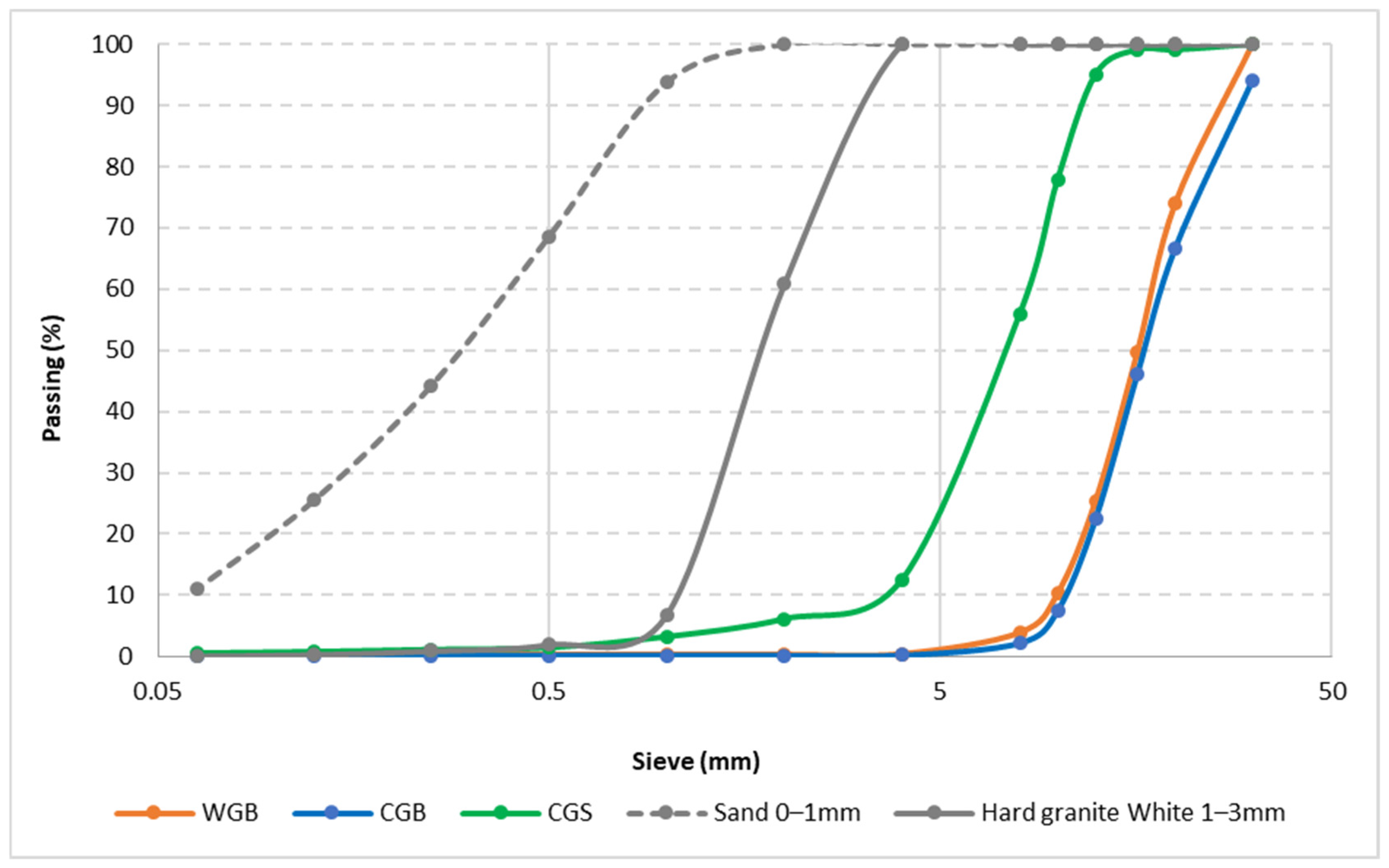
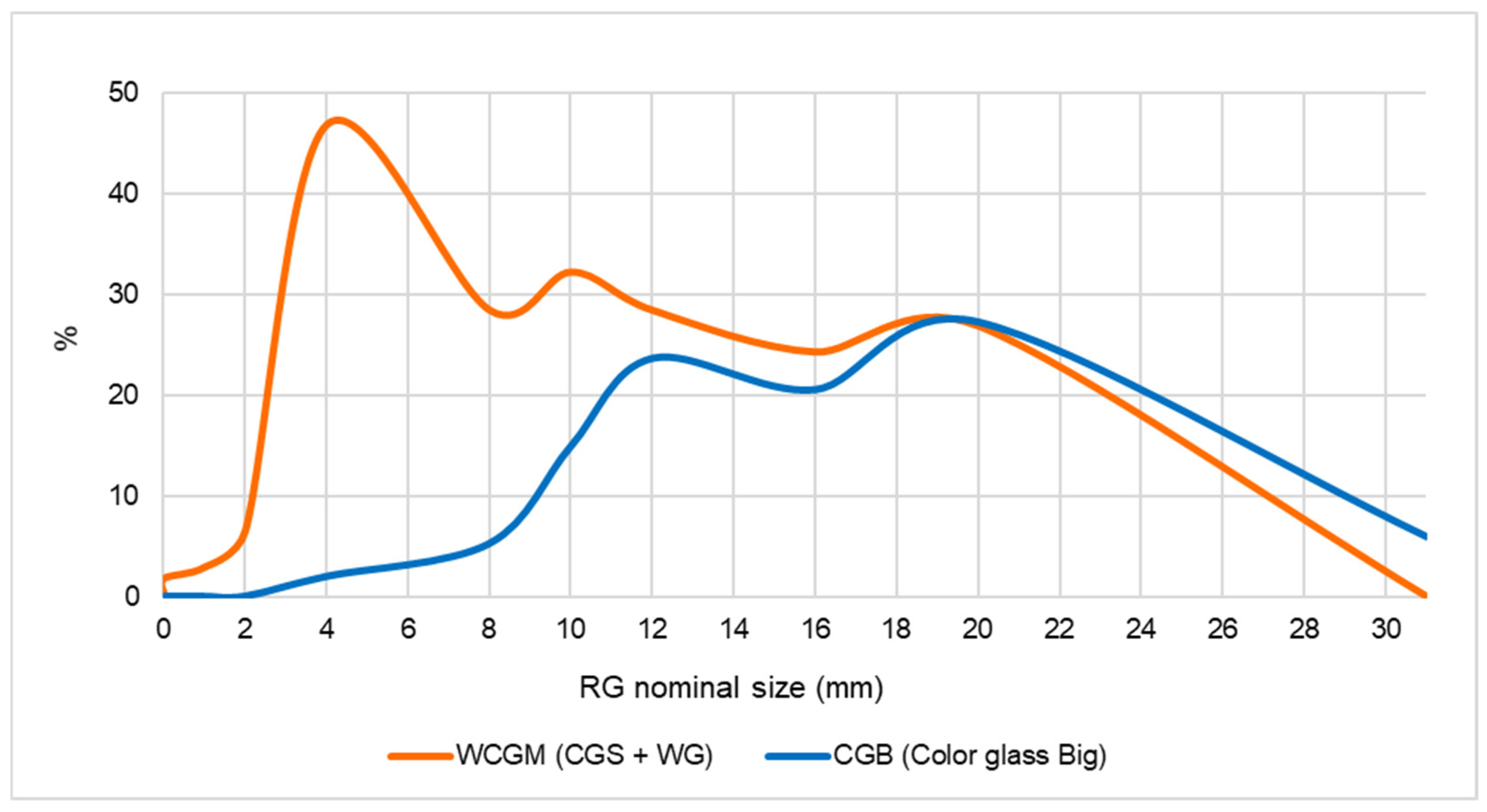
The aggregates were used only in a fine fraction, consisting of white calcareous sand (0–1 mm) and white granite sand (1–3 mm). The particle size distribution (PSD) and the physical properties of the fine aggregates can be seen in Figure 1 and Table 3, respectively.

2.2. Wasted Glass and Particle Size Distribution Characterisation

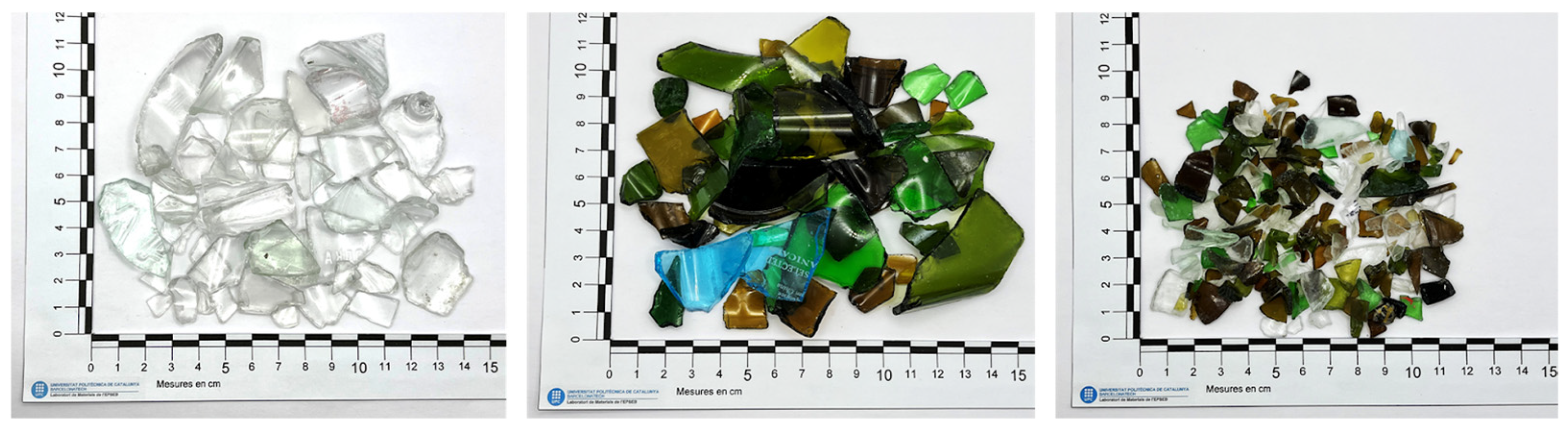
In this study, WG cullet was sourced from a specialised recycling facility, which accepts post-consumer glass containers such as bottles and jars for treatment. Upon arrival at the plant, the material undergoes a series of mechanical operations to remove contaminants and non-glass impurities, including manual and automated sorting to eliminate metal closures, labels, plastics, and other foreign matter. The clean material is then crushed into small fragments, producing a high-quality recycled glass fraction commonly known as cullet, which serves as the primary recyclable output of the process (see Figure 2). This cullet, originally intended for glass-making furnaces to produce new containers, can also be valorised as a secondary raw material in construction applications.
In this study, the WG aggregates were manually cleaned with water to remove any decomposed organic matter that they may contain, which was mainly food and paper remains. The WG utilised in this study features a particle size ranging from 0 to 31.5 mm. As illustrated in Figure 2, three distinct glass fractions were employed: white WG big (WGB, 10–31.5 mm), colour WG big (CGB, 10–31.5 mm), and colour WG small (CGS, 4–12 mm). To characterise each WG fraction in greater detail, the PSD curves for each cullet type were determined (Figure 1).

2.3. Mix Design and Proportioning of Concrete with Recycled Glass

This study developed a reference mix with high resistance and fluidity, being both a high-performance concrete (HPC) and a self-compacting concrete (SCC) according to UNE-EN 12350-8:2020 [39] and UNE-EN 206:2013+A2 [40] standards. Based on this reference SCC, two additional mixtures were produced that incorporated WG to achieve translucency in this material (Table 4). The base concrete composition was kept unchanged for all mixtures, and the WG was added to the reference formulation rather than replacing the original aggregates. This approach allowed a direct assessment of the effect of WG addition while preserving a consistent cementitious matrix. The exact mix proportions of all concrete formulations are reported in Table 5.
The mixtures incorporating WG were designed to improve the final aesthetic properties of the HPC. On the one hand, white cement was used to enhance the colours of the WG and on the other, the aim was to incorporate the effect of translucency into the concrete tiles.
Given the final application of the concrete elements developed with this reference HPC, alkali-resistant (AR) glass fibres were incorporated in order to enhance the impact resistance and flexural performance of the resulting pieces while maintaining workability. The fibres exhibit a tensile strength of 1.5 GN/m2, a Young’s modulus of 74 GN/m2, and a strain to failure of approximately 2%, providing an effective contribution to the crack-bridging capacity and post-cracking behaviour of the cementitious composite. They present a minimum zirconia content of 17%, ensuring AR within the cementitious matrix, and a moisture content below 0.5%, contributing to stable dispersion and consistent performance during mixing. In this context, the incorporation of WG was not conceived as a strict 1:1 replacement of a specific natural aggregate fraction. Rather, the mix design strategy aimed to introduce the highest feasible amount of WG to maximise light transmission through the element. Consequently, WG was added as an additional aggregate component, and the formulation was iteratively adjusted to preserve adequate workability and fresh-state performance of the base mix. In this aesthetic improvement process, the purpose was to maintain satisfactory mechanical performance and minimise the risk of alkali–silica reaction (ASR). SEM-EDS analysis of the recycled glass HPC confirmed the absence of ASR gels which can be attributed to the specific particle size distribution of the aggregates, in line with the findings of Abalouch et al. [41]. ASR is highly sensitive and finely ground glass (powder or sand-sized particles) provides the high specific surface area necessary to trigger rapid expansive reactions [42]. In this study, the WG aggregates were all used in a coarse fraction (>4 and 10 mm), with which the available reactive surface area was significantly minimised.
Although the water-to-cement ratio (w/c) was kept constant at 0.20 for all mixtures, the incorporation of WG resulted in an increase in the total aggregate content per cubic metre compared to the reference mixture. This increase in solid content, together with the angular morphology of the WG particles, significantly affected the fresh-state behaviour of the concrete. Consequently, a higher dosage of superplasticiser was required to preserve the self-compacting properties and adequate workability. The WG was incorporated in a washed and dried condition; despite the presence of limited surface moisture, no adjustment of the mixing water was necessary.
Table 5. Concrete mixture proportions and compressive strength at 7 and 28 days according to EN 12390-3 [43].
MaterialsMixture
REFCGBWCGM
Binders (kg/m3)BL I 52.5 R White800528616
Aggregates and filler (kg/m3)Sand 0–1720476555
Hard Granite White 1–3440290340
Limestone Powder200132154
WG aggregates (kg/m3)CGB-790-
WGB--273
CGS--270
Fibres (kg/m3)AR Glass Fibres 13 mm281822
Water (L/m3) (20% Binder) 160106125
Superplasticiser (SP) (L/m3) (2.5% Binder)2013.215.4
Shrinkage-reducing adm. (SRA) (L/m3)(1% Binder)85.36.2
Nanosilica (kg/m3) (5% Binder)4026.430.8
Compressive Strength (MPa)
7-day64.145.448.1
28-day70.058.356.2
Based on the reference HPC (REF), two additional mixtures were developed by adding WG aggregates, as detailed in Table 5. The mixture identified as colour glass big (CGB) incorporates 790 kg/m3 of WG aggregates with sizes between 10 and 31.5 mm. The white colour glass (WCGM) mixture includes 545 kg/m3 of WG aggregates, composed of 272.5 kg/m3 of WGB with sizes between 10 and 31.5 mm, and 272.5 kg/m3 of CGS with particles between 4 and 12 mm. Despite the increase in the proportion of aggregates compared to the REF mix, the CGB and WCGM concretes maintained the performance of a SCC. This is because the WG aggregate has zero accessible porosity, which prevents the absorption of mixing water and allows all the water in the mix to contribute to the flowability of the paste. In this case, no segregation was observed either. However, the compressive strength was affected by the incorporation of WG, as other studies have previously reported [37]. The reference HPC reached 70.7 MPa at 28 days, while CGB and WCGM achieved 58.3 and 56.2 MPa, respectively, as can be seen in Table 5.
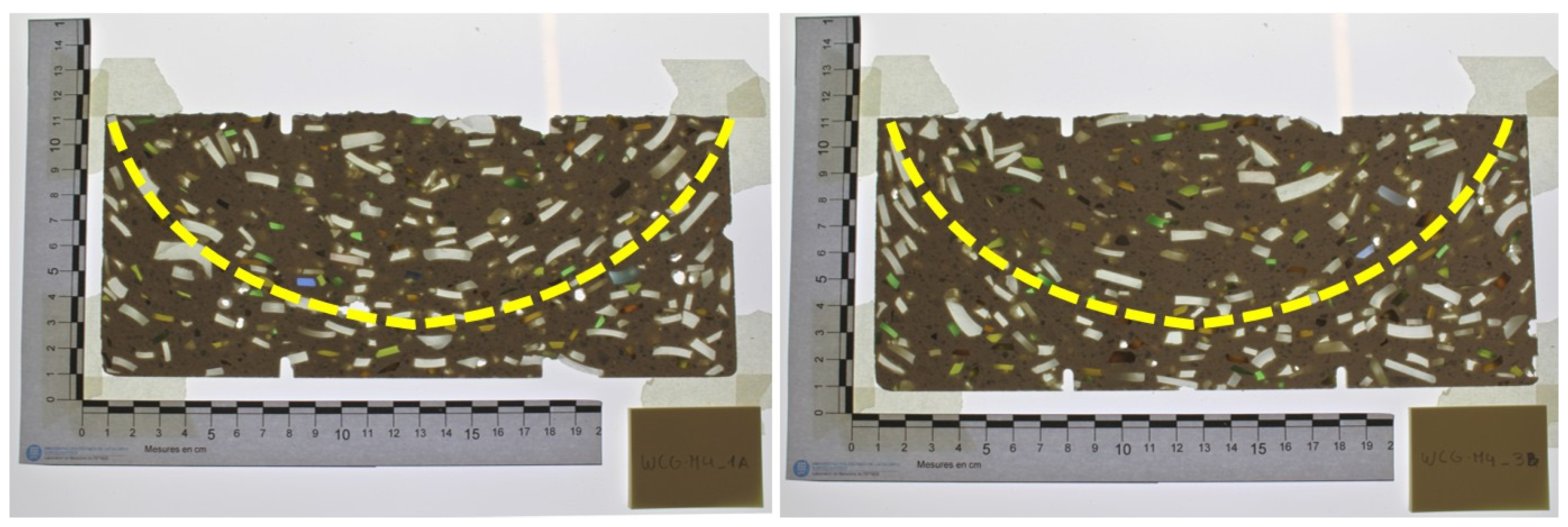
The results show that no stratification of the WG particles happened in the SCC. This performance can be mainly attributed to the correspondence between the densities of the HPC matrix and the WG, which reduces the predisposition of the WG particles to segregation or settling during casting. As a result, the WG particles followed the flow of the fresh SCC during casting, leading to a characteristic curved or arch-shaped distribution within the mould, as observed in Figure 3. This flow-induced pattern confirms that the WG particles were carried homogeneously by the matrix rather than being accumulated at the bottom of the mould. The combined effect of suitable flowability and viscosity ensured a uniform WG distribution throughout the concrete blocks, which is crucial for achieving suitable performance in translucent concrete facade elements.

2.4. Concrete Tile Preparation: Moulding, Cutting and Thickness Definition

Considering that the WG concrete tiles are being developed for application as solar-shading filters in building envelopes, a series of small-scale components with different thicknesses was produced. Consequently, the WG concrete tiles were required to meet specific dimensional constraints in order to ensure compatibility with the facade system.
To fabricate the translucent WG concrete tiles, concrete blocks with dimensions of 250 mm × 100 mm × 900 mm were initially cast and demoulded after 1–3 days. The blocks were subsequently sliced into thin plates using an industrial CNC diamond wheel cutting machine (Tecnika ELITE, equipped with X-DRIVE technology, Denver S.r.l., Piacenza, Italy). This process resulted in plates with final dimensions of 250 mm × 100 mm and varying thicknesses. Table 6 summarises the category of WG concrete tiles that are objects of study in this research, including the three concrete mixtures (REF, CGB, and WCGM) and the series of different thicknesses considered, from 4 to 20 mm.
In order to define the appropriate WG concrete tile thickness, the research started with the selection of an initial maximum thickness of 20 mm as the upper limit to ensure some translucency while controlling the overall weight of the elements, an essential feature in light facade systems. From this reference value, the WG concrete tile thickness was progressively reduced to 15, 10, 8, 6, and 4 mm in order to identify the minimum achievable by both the concrete mix and the cutting process. This approach aimed to determine the minimum thickness in order to maximise translucency. The minimum achievable thickness was determined by the granulometry of the WG and the mechanical integrity of the material mixture. Finally, 4 mm thickness was identified as the lower limit that could be cut without inducing fracture or damage. Accordingly, for each concrete mixture (REF, CGB and WCGM), WG concrete tiles with thicknesses of 4, 6, 8, 10, 15, and 20 mm were obtained.

3. Test Procedure

The experimental programme was designed to assess both the intrinsic properties of the concrete and the performance of the tiles as thin, prefabricated facade elements subject to mechanical, environmental and functional requirements. Thus, the development of the concrete mixtures and the selection of the laboratory tests were specifically oriented towards the application of the material and the final product as facade concrete tiles. Accordingly, the experimental programme was structured into three main groups of tests. First, the physical and mechanical tests evaluated the density, porosity and water absorption of the elements and the flexural performance of concrete tiles with different thicknesses, which are critical parameters for the handling, cutting, installation and service behaviour of facade elements. Second, the durability tests assessed the resistance of the material under aggressive exposure conditions representative of facade environments, including salt crystallisation and thermal shock cycles, in order to analyse the stability of the cementitious matrix and the glass–matrix interfaces. Finally, the luminous tests focused on the functional performance of the material as a translucent facade element, quantifying the opaque-to-translucent glass ratio and the luminous transmittance of the tiles as a function of thickness and recycled-glass granulometry.

3.1. Physical and Mechanical Tests

The experimental programme included a comprehensive characterisation of the specimens, targeting the main physical and mechanical properties of the facade elements. The apparent density, water absorption and effective porosity test provides insight into the composite’s permeability and internal matrix quality. The structural capacity of the components was quantified via flexural strength testing. Additionally, impact resistance tests were performed to evaluate the material’s energy absorption capacity and fragility, simulating real-world dynamic stressors such as hailstones or accidental impacts. All procedures were conducted in accordance with international standards to ensure reproducibility and data reliability. In these physical and mechanical tests, each mean value represents the average of three separate specimens for every combination of mix design and tile thickness.

3.1.1. Apparent Density, Water Absorption and Effective Porosity Test

The physical characterisation of the specimens was conducted according to the UNE 83980:2014 standard [44], which outlines the procedure for determining the apparent density, water absorption and effective porosity. Specimens are placed in a vacuum chamber to remove air from the internal pores, followed by gradual immersion in water to ensure all accessible voids are filled. After immersion, saturated surface-dry weights are recorded, followed by the hydrostatic mass of the submerged specimens and finally the oven-dried mass after reaching a constant weight at 105 °C. These masses allow for the calculation of apparent density, the percentage of water absorption by mass, and the effective porosity (the volume of open pores relative to the total volume).

3.1.2. Flexural Strength Test

The flexural strength of the developed concrete elements was determined in accordance with UNE-EN ISO 10545-4:2019 [45], which specifies the procedure for assessing the flexural strength of ceramic tiles. This standard was selected due to the plate-like geometry and reduced thickness of the specimens, which are more representative of tile-type elements than conventional concrete beams. Prismatic specimens with dimensions of 240 mm × 100 mm and varying thicknesses (4–20 mm) were tested under three-point bending conditions using a Wykeham Farrance (ELE International Ltd., Leighton Buzzard, UK) compressive machine with a loading capacity of 50 kN. The span length for all specimens was 160 mm according to the requirements from the standard for the 20 mm thick prisms and the loading rate was reduced to 1 mm/min to adapted to the 4 mm thick prisms. This test configuration allows the evaluation of tensile behaviour under flexural loading, which is particularly relevant for slender facade elements subjected to bending stresses in service. The use of this standard provides a suitable and conservative approach for characterising the flexural performance of the developed translucent concrete components.
Additionally, scanning electron microscopy (SEM) observation of the HPC mixtures coated in carbon was performed by using a Quanta 200 FEI, XTE 325/D8395 (FEI Company, Hillsboro, OR, USA), obtaining micrographs by backscattered and secondary electrons to assess the ITZ.

3.1.3. Impact Resistance Test

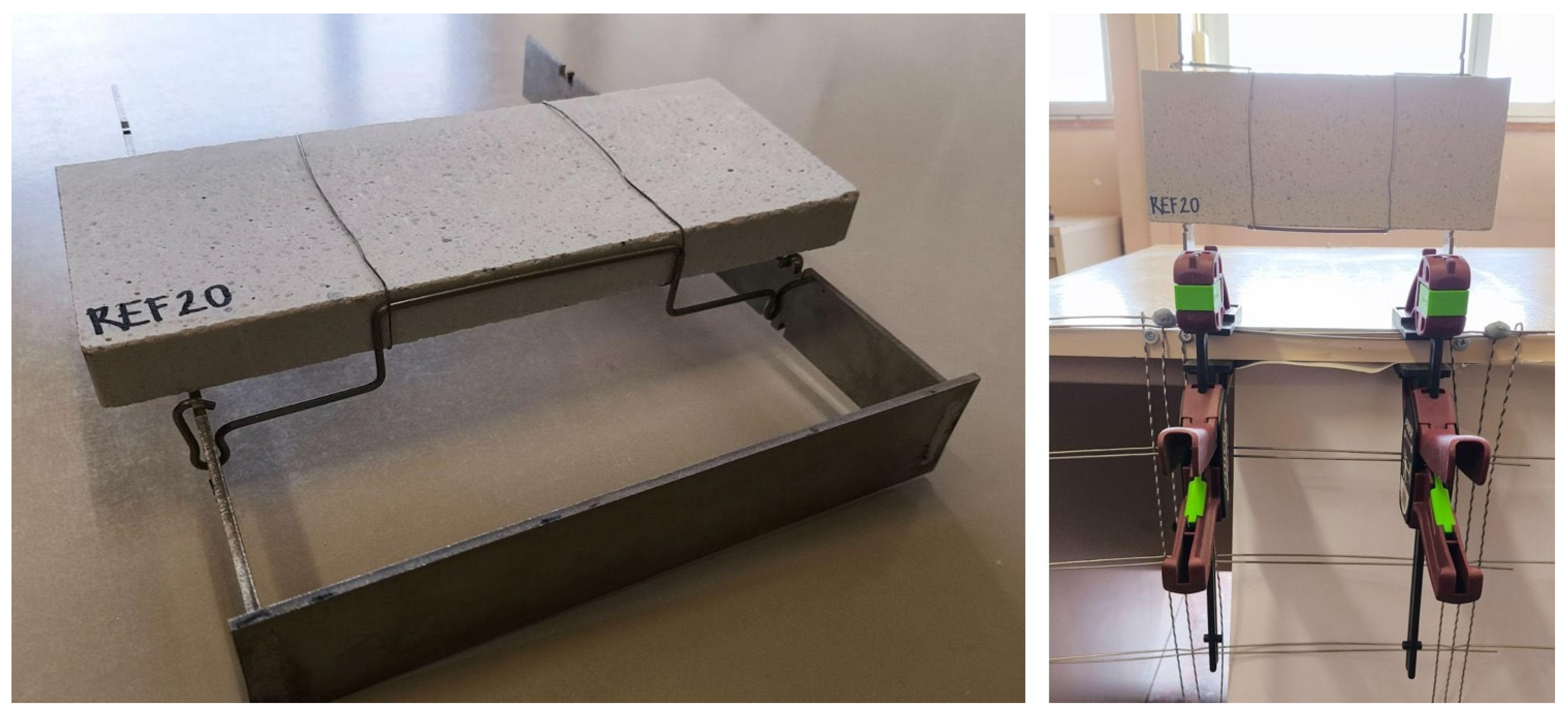
These tests were conducted in accordance with Annex G of the European Assessment Document (EAD) 090062-01-0404 [46] regarding impact resistance, because of the WG concrete tiles’ aforementioned application as lightweight facade components, to determine the level of exposure. This resistance is a critical performance requirement for facades, especially for slender geometries like WG concrete tiles. These tests assessed the impact response under realistic boundary conditions. To do so, the WG concrete tiles were assembled on a stainless-steel substructure representative of the intended facade installation system (Figure 4).
The testing sequence commenced with the small soft-body impact tests, performing the S1 and S2 impact categories. If the WG concrete tiles did not experience any damage, hard-body impact tests were subsequently conducted, including the H1 and H2 impact categories. These test procedures were applied to WG concrete tiles of 250 mm × 100 mm with different thicknesses. The initial thickness of 20 mm was progressively reduced if the impact test was successfully passed. In both impact categories, impacts were applied at the weakest point, identified as the middle of the tile. The test used same WG concrete tiles, and the impact performance was evaluated based on the cumulative damage observed after completion of the full impact sequence.

3.2. Durability Test

To evaluate the resilience of the glass–matrix composite, the specimens were subjected to two critical durability protocols: salt crystallization and thermal shock. These tests are necessary to simulate the extreme service conditions of building skins, where exposure to saline environments can lead to internal pressures and surface scaling, while rapid fluctuations in solar radiation induce significant thermal gradients. By subjecting the tiles to these cyclic stresses, the study assesses the stability of the Interfacial Transition Zone (ITZ) between the WG and the cementitious matrix. This assessment aims to evaluate the components’ ability to withstand environmental degradation without loss of cohesion.

3.2.1. Salt Crystallisation Test

The test was carried out in accordance with UNE-EN 12370 [47]. Before testing, all specimens were visually inspected, photographed, and weighed in a dry condition. The specimens were then subjected to cyclic exposure consisting of immersion in a sodium sulphate (Na2SO4·10 H2O) solution for 2 h at 20 °C, followed by drying in an oven at 105 °C for a minimum of 16 h and then cooled down for 2 h, completing one full cycle. After each cycle, the specimens were weighed—acknowledging that mass gain may occur due to salt crystallisation—and photographed to document any visual changes. The procedure was repeated for up to 7 cycles. Upon completion of the test, the specimens were rinsed with distilled water to remove residual surface salt and to allow an accurate assessment of damage induced by salt crystallisation. The test focused exclusively on the durability of the cementitious matrix and the glass–matrix interfaces and failure modes were assessed by visual and microscopic analysis. The reported results were derived from the testing of three independent specimens (tiles) for each mixture and thickness.

3.2.2. Thermal Shock Test

The thermal shock resistance of the concrete elements was evaluated following the procedure described in UNE-EN ISO 10545-9:2013 [48], originally developed for ceramic tiles and adapted in this study due to the plate-like geometry of the specimens. This test was selected to assess the ability of the elements to withstand abrupt temperature variations, which are particularly relevant for facade applications exposed to solar radiation and rapid environmental temperature changes. The test consisted of subjecting the specimens to repeated thermal shock cycles. Each cycle involved heating the specimens in an oven at 150 °C for 20 min, followed by sudden cooling through immersion in water at 15 °C for 15 min. A total of 10 thermal shock cycles was applied to each specimen. Before testing, the specimens were weighed and visually inspected. After each thermal cycle, visual inspections were carried out to detect the presence of cracking, spalling, delamination, or other signs of damage. Upon completion of the 10 cycles, the specimens were weighed again to identify any mass variation associated with thermal degradation or material loss. This procedure provides an accelerated assessment of the thermal stability and integrity of the cementitious matrix and glass–matrix interfaces under severe temperature gradients. This is representative of service conditions in facade elements. Each mean value represents the average of three separate specimens for every combination of mix design and tile thickness.

3.3. Luminous Tests

The light behaviour of WG concrete tiles was analysed to assess their potential application as translucent elements in building envelopes. The experimental approach combines a geometric characterisation of the surface distribution of translucent glass with photometric measurements of transmitted illuminance under controlled conditions. This dual methodology allows related material parameters—such as the size, colour, and thickness of the WG tiles—to be related to the resulting light transmission performance. This relation provides a basis for evaluating the ability of these WG tiles to serve as cladding when modulation of natural light is required. Both types of tests—opaque-to-translucent glass ratio and luminous transmittance—tested three specimens for each experimental variable and calculated the mean value to derive the final reported results.

3.3.1. Opaque-to-Translucent Glass Ratio Test

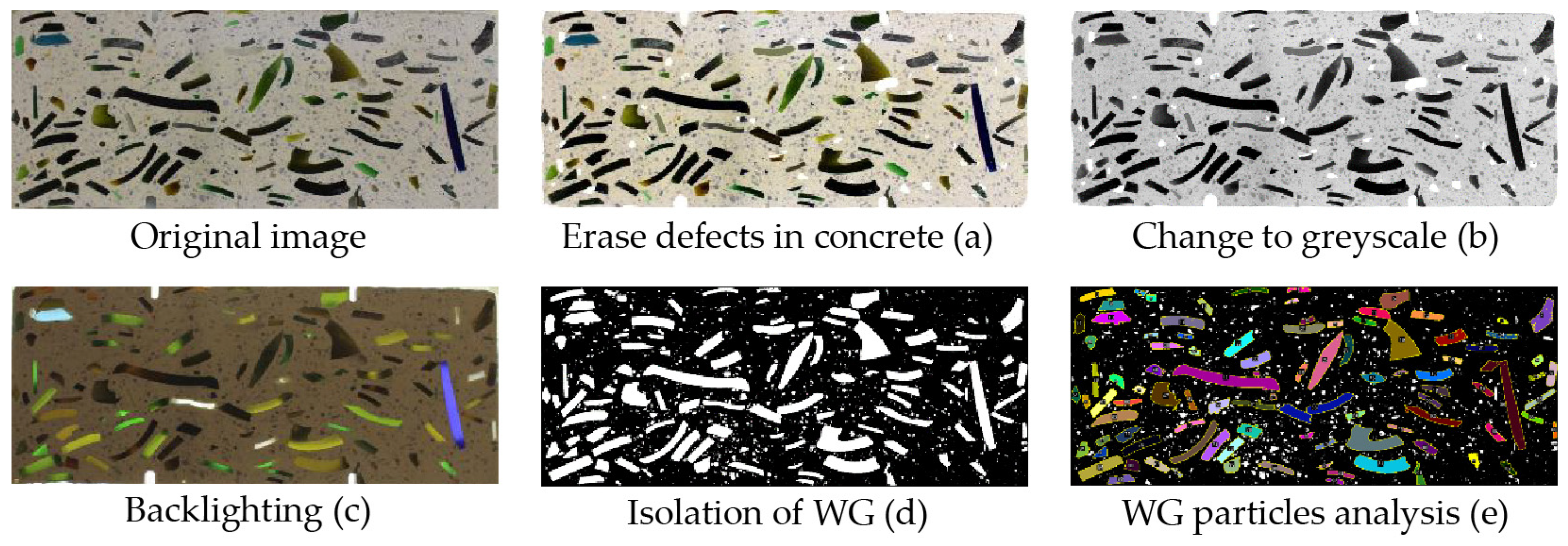
The aim of the test was to quantify the relationship between opaque glass and translucent glass in each specimen by distinguishing between the total visible surface area of glass (Ag,s) on both faces and the fraction of WG which effectively transmitted light (Ag,lt). The analysis was carried out through digital image processing using Fiji (ImageJ) v1.54p software. The images were acquired under both frontal illumination and backlighting conditions (Figure 5c), using a Canon EOS 2000D (Canon Inc., Tokyo, Japan) camera located at a constant distance of approximately 30 cm, placing the WG concrete tiles on an HSK A2 LED light table (5500 lux). The images were pre-processed by adjusting the contrast and saturation, which removed local imperfections of the cementitious matrix (Figure 5a). Afterwards, the images were converted to greyscale (Figure 5b) and a segmentation threshold was applied together with a particle size filter to isolate the WG granules (Figure 5d). The WG particles were automatically identified and analysed, obtaining parameters such as projected area, number of particles and percentage of WG surface area relative to the total tile area (Figure 5e). Based on the generated mask, the particles were then compared with the backlit images, allowing the determination of the translucent glass fraction responsible for light transmission through the element.

3.3.2. Luminous Transmittance Test

To evaluate the light performance of the tiles, experimental tests measured the transmitted illuminance under controlled lighting conditions, expressed in Luxes (lm/m2). The measurements followed widely accepted photometric principles in accordance with the recommendations of the Commission Internationale de l’Éclairage (CIE). Similarly, the guidelines of the CIE S 017/E:2020—ILV (International Lighting Vocabulary) [49] and CIE 013.3-1995 (Method of Measuring and Specifying Colour Rendering Properties of Light Sources) [50] were incorporated. The objective was to analyse the influence on the light translucency, which is defined according to ISO 9050:2003 [51] as the % ratio between the luminance (lux) of the light passing through the concrete tile and the luminance of the lighting source. All tests were carried out under the same conditions regarding the procedure, geometric configuration and the light position, power and source.
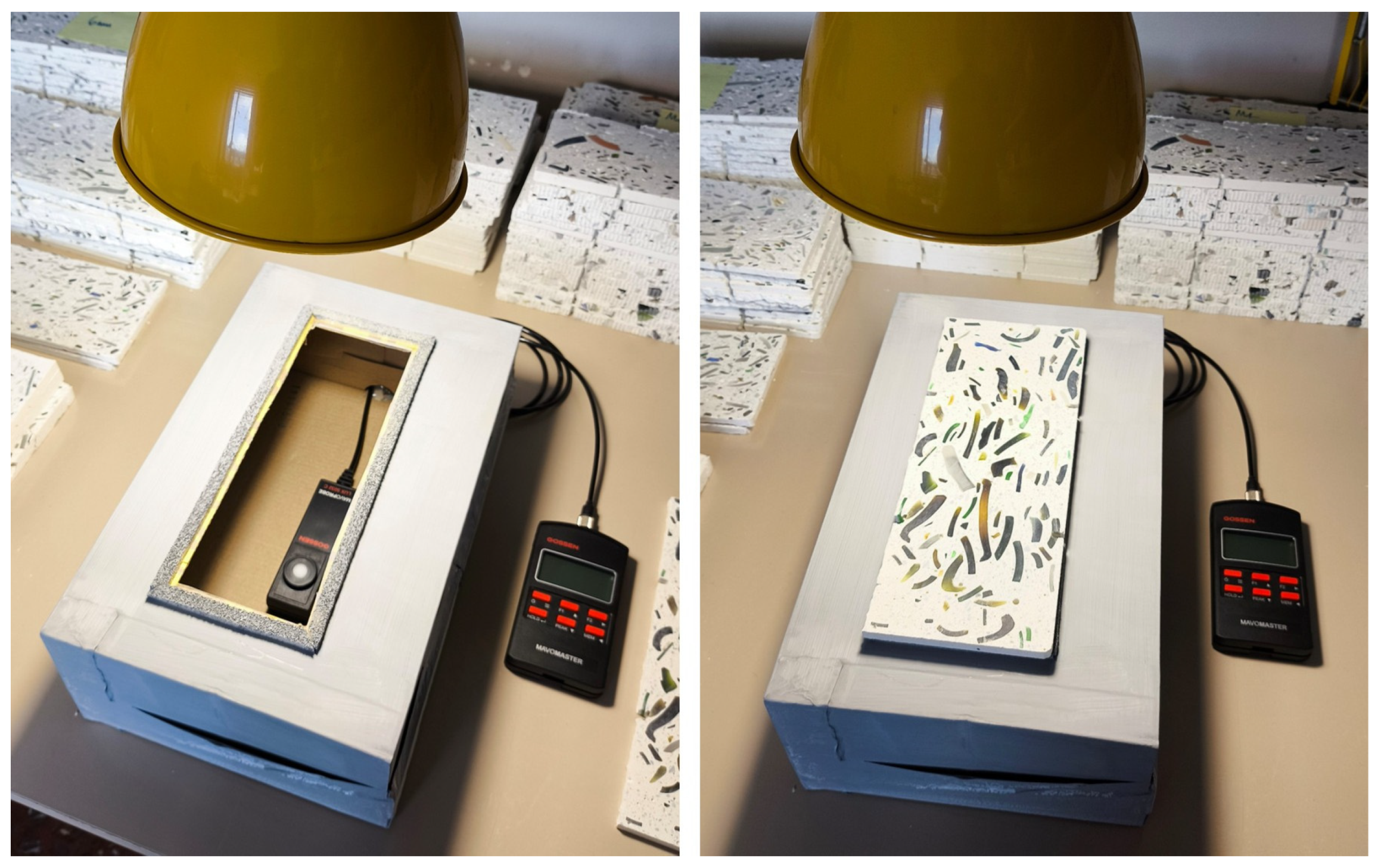
The tests used an opaque box measuring 200 mm × 320 mm × 120 mm, with matt black anti-reflective interior surfaces, in order to eliminate the influence of ambient light and minimise internal reflections. A stable artificial light source was placed on the upper side of the box, 200 mm away from the translucent concrete sample tile (250 mm × 100 mm) placed horizontally, completely sealing the opening. Illuminance measurements were obtained using a digital lux meter (Velleman DEM301, Velleman Group NV, Gavere, Belgium) connected to a lux sensor (Gossen Mavo-Master, Gossen Metrawatt GmbH, Nürnberg, Germany) equipped with a photopic silicon detector corrected according to the V(λ) function. The sensor was positioned inside the test box, 120 mm under the sample and aligned with its geometric centre (Figure 6). The test allowed comparison of the effect of the tile thickness and dimensions and colour of the WG on the light transmission of the material.

4. Results and Discussion

4.1. Physical and Mechanical Properties

4.1.1. Apparent Density, Water Absorption and Effective Porosity

The physical characterisation of the concrete specimens reveals a clear correlation between tile thickness and WG aggregate content, influencing the resulting matrix compactness. Across all mixtures (REF, CGB and WCGM), there is a consistent increase in apparent density and a corresponding decrease in effective porosity and water absorption as the tile thickness increases from 4 mm to 20 mm (see Table 7).
Thin tiles (4–6 mm) exhibit the lowest densities (ranging from 1950 to 2150 kg/m3) and the highest porosity levels (reaching up to 10.41%). This is likely due to the higher specific surface of the elements, increasing the number of accessible pores and leading to a higher concentration of surface voids. On the other hand, thick tiles (8–20 mm) achieve, in most cases, standard concrete densities (ranging from 2200 to 2400 kg/m3). These results are consistent with common findings in former studies of concrete containing waste glass [37]. As thickness increases, the density increases due to accessible pore reduction. As expected, 20 mm tiles produce significant porosity and water absorption reductions, in the range of 3.91–5.06% and 2.61–3.19%, respectively, which suggest a much more confined pore structure and higher amounts of inaccessible pores.
The incorporation of WG slightly alters the physical matrix compared to the reference HPC, though the impact depends on the PSD. CGB mixtures, characterised by higher amounts of large particles (10–31.5 mm), generally display higher densities than the REF and WCGM mixtures for the same thicknesses (reaching 2452 kg/m3 at 20 mm). Due to glass being a non-porous and denser material compared to the mortar it replaces in the matrix, the large aggregate volume effectively influences potential void spaces, leading to the lowest observed porosity (3.91% at 20 mm) among the glass-based mixtures. The WCGM mix, which utilises a finer distribution (CGS is 0–10 mm) and lower amounts of glass, shows slightly lower densities and higher absorption rates than CGB. This suggests that the finer glass particles may introduce more ITZ within the cementitious matrix, slightly increasing the accessible porosity compared to the mix dominated by large, continuous WG aggregates.
Low water absorption is a critical indicator of durability for facade elements, as it suggests the material will be less susceptible to degradation agents. The transition from 4 mm to 8 mm appears to be a critical threshold where water absorption drops by nearly 40–50%, significantly enhancing the material’s durability.

4.1.2. Flexural Strength

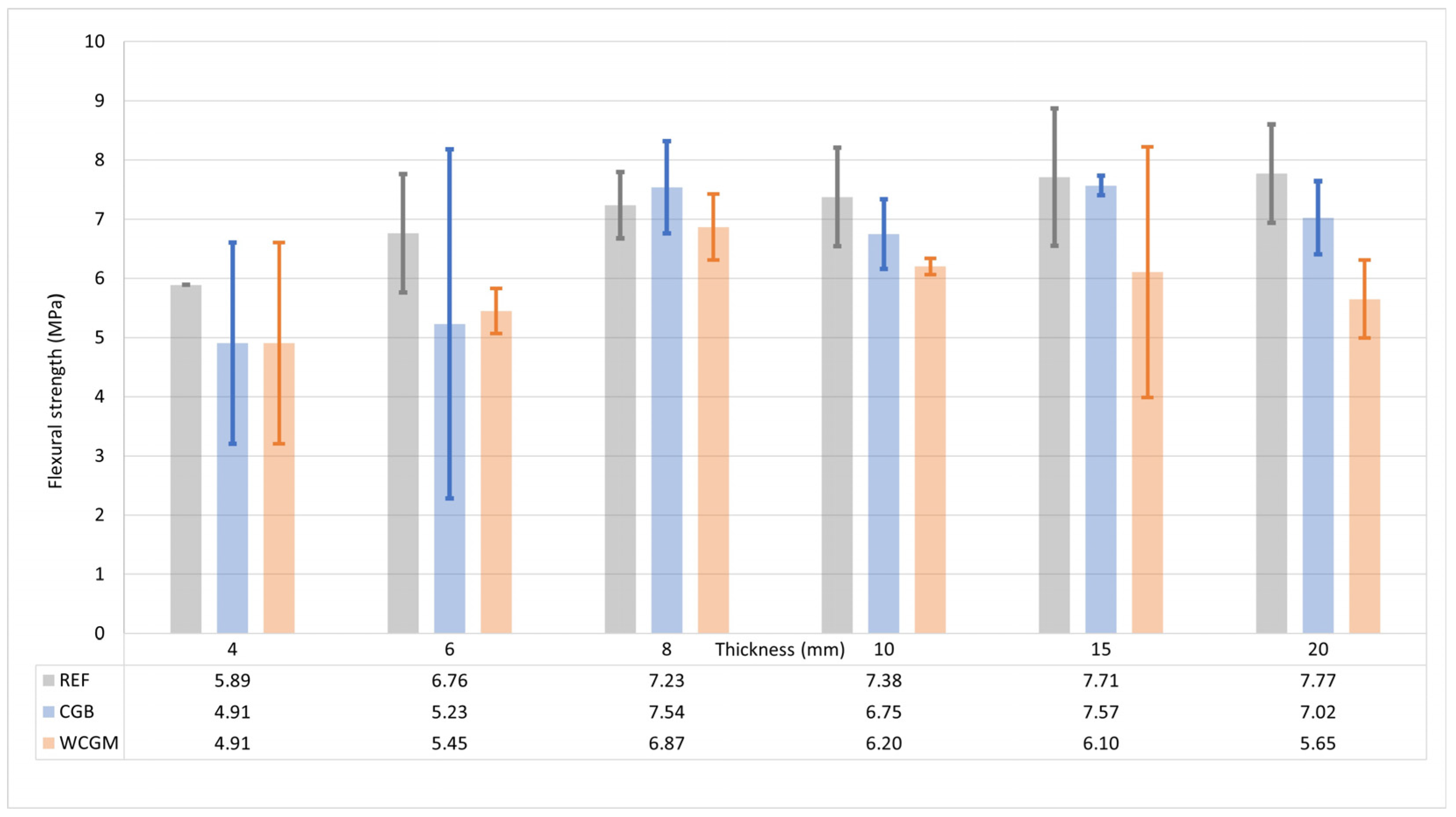
The flexural strength values across all mixtures range from 4.91 MPa to 7.77 MPa (see Figure 7), demonstrating that the HPC components containing WG maintain sufficient structural integrity for facade applications despite the high volume of glass incorporated, in accordance with previous related studies [52].
In general, a slight trend of increasing flexural strength with panel thickness is observed, particularly when moving from the 4 mm to the 8 mm thickness. All mixtures exhibited their lowest strengths at 4 mm. This is attributed to the reduced effective cross-section available to distribute tensile stresses and the increased severity of defects (porosity) in very thin elements, as noted in the physical property tests. Beyond 8 mm, the strength values tend to stabilise or increase slightly. For the REF and CGB mixtures, the maximum strengths were achieved at 20 mm and 15 mm, respectively, suggesting that thicker sections allow for a more uniform distribution of the cementitious matrix and better aggregate interlocking. In the case of the REF and CGB mixtures, the peak flexural strengths were recorded at thicknesses of 20 mm and 15 mm, respectively. Since the specimens were produced by cutting a larger monolithic beam, these results suggest that thicker sections statistically favour a more uniform distribution of both the cementitious matrix and the glass aggregates throughout the cross-section. According to Ichino et al. [53], the mechanical performance of concrete composites is heavily dependent on the quality of the ITZ and the homogeneity of the mixture. In thicker sections, the material maintains a more continuous cementitious phase relative to the aggregate size; this prevents the glass particles from acting as localised points of weakness and ensures a more effective load-transfer mechanism, ultimately hindering tensile fracture initiation.
The incorporation of WG aggregates yields mechanical responses that are broadly consistent with those of the reference concrete, in spite of containing lower cement amounts, which indicates enhanced flexural strength [38]. Remarkably, the CGB mix showed a 7.45 MPa strength at 8 mm, actually surpassing the REF mix (7.23 MPa) at that same thickness. At the maximum thickness of 20 mm, CGB (7.02 MPa) slightly underperforms compared to REF (7.77 MPa); however, the results were still considered comparable. According to Epure et al. [54], several studies have shown that WG aggregates can enhance the flexural/tensile behaviour of concrete compared to reference mixtures. This occurs especially at suitable replacement ratios and suggests a reinforcing action of the glass particles within the matrix. The WCGM mix consistently exhibited the lowest flexural values among the three groups, except at the 4 and 6 mm thicknesses, where it showed comparable performance to CGB, being approximately 4% higher. The higher concentration of smaller glass particles (0–10 mm) increases the total surface area of the glass–matrix interface. The bond between cement and glass is purely mechanical and lacks the intricate adhesion commonly found in the case of natural aggregates. In consequence, in WCGM, the higher frequency of these interfaces probably generates more paths for crack propagation under flexural loading, despite the lower content of WG. This is in accordance with Celik et al. [55], who reported that the use of waste glass as a fine aggregate reduces the bond quality with the cement paste because of the smooth glass surface, providing additional pathways for crack initiation and propagation.
The data indicates that 8 mm represents an optimal efficiency point for the glass-bearing mixtures. At this thickness, CGB and WCGM achieve their peak performance, showing comparable results to REF. However, thinner tiles containing glass have a significantly lower mechanical performance in terms of flexural strength (20%), thus decreasing their potential application as facade elements.
In general terms, Figure 7 shows that the flexural strength evolution of the REF mixture remains stable or nearly stable for thicknesses greater than 8 mm, whereas the CGB and WCGM mixtures exhibit a localised decrease in strength at a thickness of 10 mm. This behaviour suggests an influence of thickness on the interaction between glass aggregate distribution and stress-transfer mechanisms within the cross-section.
Given that the bond between the glass and the cement paste is primarily mechanical in nature, the higher presence of glass–matrix interfaces may, at certain intermediate thicknesses, promote localised stress concentrations under flexural loading. In thicker sections (≥15 mm), the greater continuity of the cementitious matrix throughout the cross-section may contribute to a more homogeneous stress distribution, thereby helping to stabilise the observed flexural response.
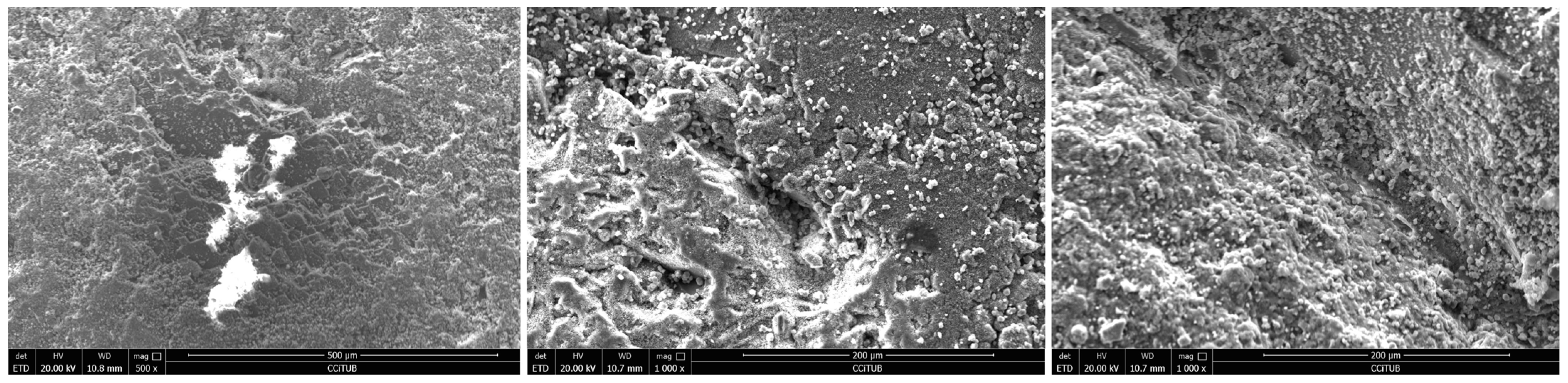
The microstructural evidence provided by the SEM micrographs offers a fundamental explanation for the mechanical performance of the high-performance concrete (HPC) components. By analysing the Interfacial Transition Zone (ITZ), which is typically the weakest region, the global flexural behaviour of the different mixtures can be correlated with the localised porosity. The SEM analysis reveals a marked contrast in the quality of the bond between the cementitious matrix and the two types of aggregates (natural and recycled waste glass). While the natural aggregate–paste interphase in the REF mixes exhibits a dense, low-porosity structure, the glass–paste interface is characterised by significantly higher microporosity, as can be seen in Figure 8.
The SEM micrographs confirm that the recycled WG aggregates, due to their non-absorbent, smooth surfaces, limit the physical interlocking with the cement paste [56]. The WG aggregates create a wall effect at the micro-scale that leads to a higher water-to-cement ratio locally around the glass, resulting in the observed higher porosity. Under flexural loading, the tensile stresses concentrated at the bottom of the specimen seek the path of least resistance. The porous ITZ of the glass aggregates acts as a primary site for crack initiation and propagation [57].

4.1.3. Impact Resistance

The results of the impact tests (Table 8) show a clear relationship between WG concrete tile thickness and the impact category achieved during the test. This project developed WG concrete tiles capable of achieving category IV impact performance at greater thicknesses, while the thinner elements were initially limited by their resistance to hard-body impacts. Thus, the comparison between the reference concrete (REF) and the mixtures developed in this research (CGB and MCGM) reveals a similar thickness-dependent trend in impact performance. The incorporation of WG did not result in significant changes in the impact response; nevertheless, it did influence the minimum thickness required to successfully pass the test at the lowest impact category.
In this context, thicker WG concrete tiles (REF-20, REF-15, REF-10, CGB-20, CGB-15, and WCGM-20) show good initial responses to small soft-body impacts, successfully passing impact levels S1 and S2 and thus achieving a category I classification. This classification allows their application in facade areas classified as “readily exposed to impacts but not subject to abnormally rough use”, without significant damage being observed. When the thickness diminished (REF-8, CGB-10, and WCGM-15), the performance changed and the WG concrete tiles did not pass the test, breaking without prior visible cracking. This behaviour indicates a brittle fracture once a certain slenderness is reached.
Conversely, the WG concrete tiles proved to be more vulnerable to hard-body impact, highlighting the dependence of impact performance on specimen thickness. The results show that fracture happens in a thickness-dependent way, taking place at earlier stages of the test and progressing gradually. Moreover, in almost all cases, cracking prior to complete fracture was observed, showing a cumulative damage process that increases with successive impacts at the same location. This progressive damage allows the inspection and replacement of the damaged WG concrete tiles before the occurrence of further impacts. As a result, this test reduces the number of WG concrete tiles that achieve a suitable classification for use and changes their classification to category IV, allowing their application in “zones out of reach from ground level, in which the risk of being hit by a thrown object is very low because the height of the kit limits the size of the impact”.
Impact tests also showed that some WG concrete tiles maintained their cohesion without any fragment detachment despite having fractured. This behaviour highlights the key role of the 13 mm long glass fibres incorporated into the mixture, which not only contribute to improving the mechanical performance but also improve durability and safety under accidental actions, acting as crack-bridging elements. This behaviour suggests that the fragment retention capacity could be further enhanced by optimising the fibre reinforcement, for instance by adjusting fibre length or dosage.
This response mode is particularly relevant for facade applications, where safety requirements extend beyond preventing initial failure and include the mitigation of secondary risks associated with falling fragments. This “failure without fall” behaviour represents a key contribution to the durability, safety, and robustness of slender facade components subjected to impact actions.
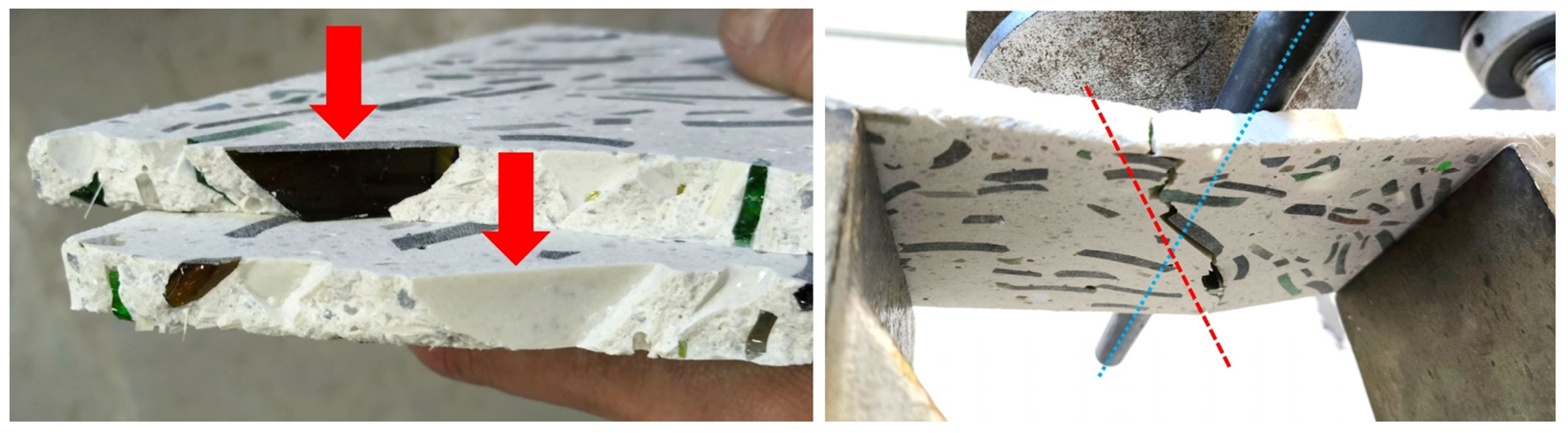
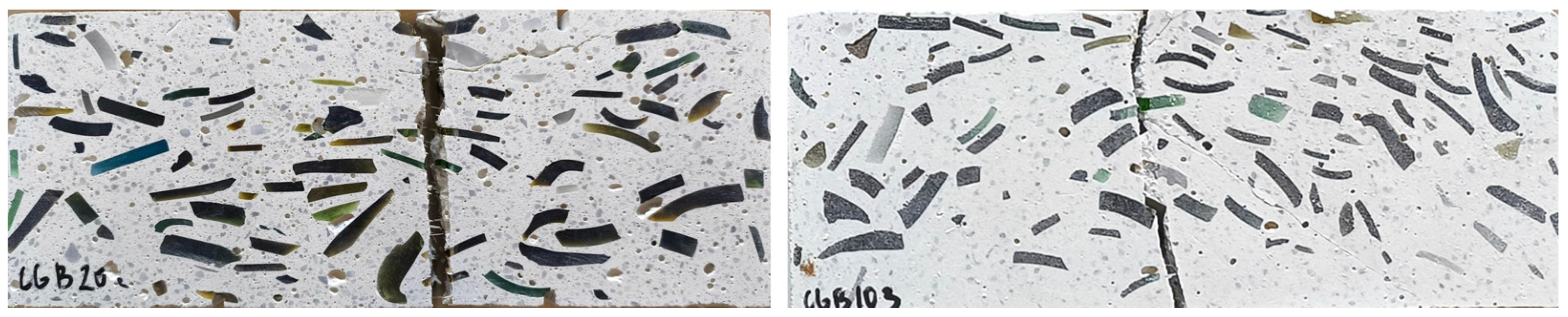
Visual inspection of the fractured WG concrete tiles after flexural and impact tests revealed two clearly differentiated fracture mechanisms, strongly dependent on the type of mechanical stress applied. Under flexural loads, the fracture pattern was governed by the presence and spatial distribution of WG particles within the cementitious matrix. The crack propagated following a preferential fracture path, associated with areas of reduced resistance induced by the WG inclusions. This behaviour indicates that, under bending, WG particles act as stress concentrators, facilitating crack propagation along weak paths rather than through the matrix. In this case, a poor-quality ITZ was observed, resulting in limited adhesion between the WRG and the cement paste. This is attributed to the smooth, non-porous surface of the WRG, which promotes interfacial debonding during flexural failure (Figure 9).
In contrast, the fracture behaviour observed during the impact tests was substantially different, resulting in a rapid and localised fracture, characterised by a nearly vertical fracture line (Figure 10), originating at the point of impact. In this case, fractures often crossed the WG particles themselves, indicating that the WG actively participated in load transfer rather than behaving as a weak interface. This behaviour suggests a more effective stress transfer between the HPC matrix and the WG, leading to a more resistant glass–matrix interaction under dynamic loads. This improvement can be attributed to the angular geometry of the WG particles and their effective embedding within the cementitious matrix, which enhance mechanical anchoring and limit interfacial separation.
This distinction is particularly relevant for facade applications, where impact actions are critical and the ability of the composite material to maintain cohesion under dynamic loads constitutes a key performance parameter.

4.2. Durability Properties

The durability performance of the HPC components was evaluated through cyclic exposure to potential external aggressive agents, revealing the specimens’ resilience to chemical and thermal degradation. The following sections detail the observed results from the salt crystallisation and thermal shock tests of the three HPC mixtures according to the thickness of the tiles.

4.2.1. Salt Crystallisation

The salt crystallisation test highlights the chemical and physical durability of the HPC tiles when subjected to the expansive pressures of sodium sulphate (Na2SO4·10 H2O) crystals. The results indicate that the internal pore structure, cracks and the aggregate–matrix bond play decisive roles in the material’s resistance to spalling. By cross-referencing the quantitative mass-loss data with the qualitative morphological observations of the tiles following the seven-cycle salt exposure, the tile thickness and nominal glass size were revealed to have a large influence. Table 9 shows the results from the quantitative and qualitative analysis performed.
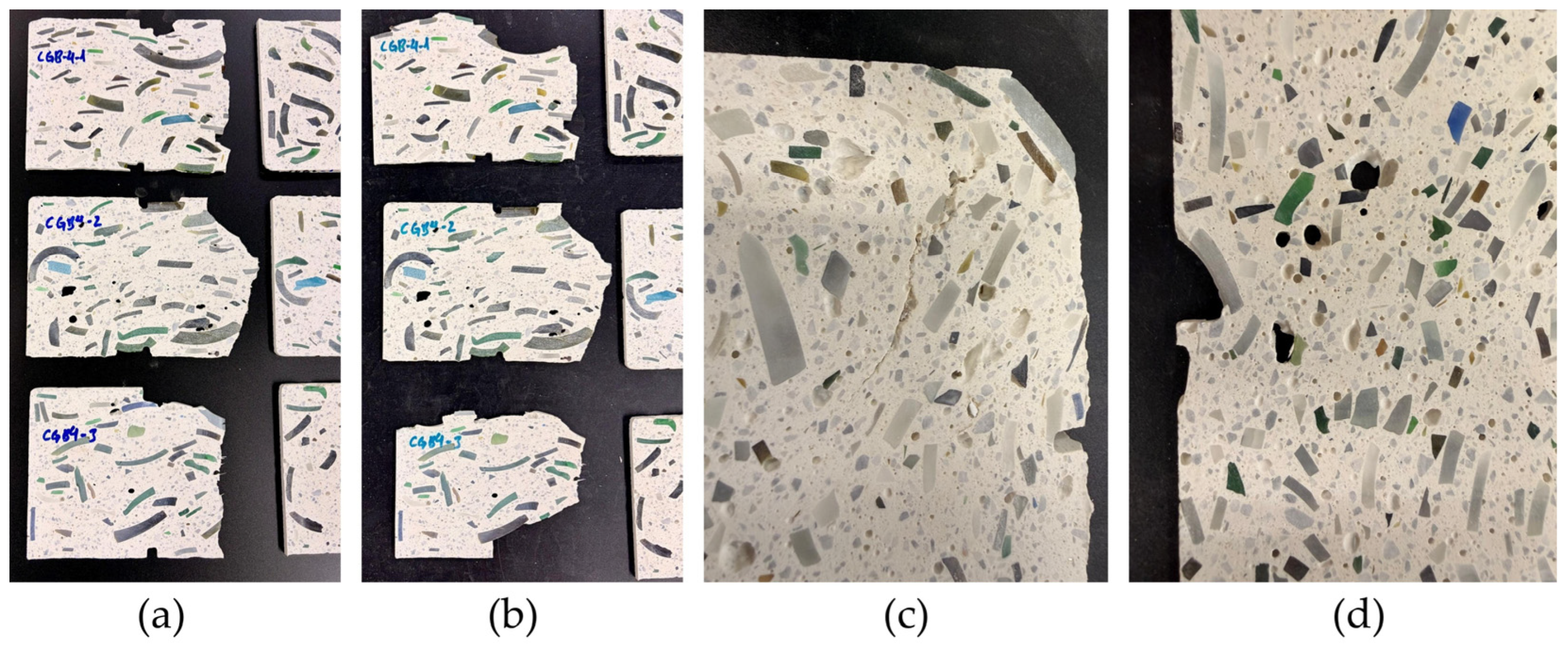
On visual inspection, it was found that the relationship between panel thickness and salt resistance is dictated by the ratio of aggregate size to the surrounding cementitious cover. The CGB mixture at 4 mm exhibited the most severe degradation (See Figure 11a,b), with an average mass loss of 11.56%. Qualitatively, this represents unsatisfactory behaviour, with two-thirds of the samples losing almost 1/4 of their volume due to ITZ debonding and crack propagation following ITZ paths, with the exception of one sample that only showed slight ITZ debonding at corners and notches (producing a high standard deviation in the weight of CGB4). This confirms that in thin panels, coarse WG aggregates (10–31.5 mm) acted as structural discontinuities; the lack of a sufficient matrix envelope allows salt pressure to easily detach entire sections of the panel. For intermediate and large thicknesses between 10 mm and 20 mm, the mass loss across all mixtures stabilised (1.26–2.74% and 0.52–2.82%, respectively). Qualitative analysis for these ranges described damage as merely rounded edges and corners for 10–20 mm tiles, however in some cases 6–8 mm tiles showed small debonding on the glass–matrix ITZ. This suggests that once the thickness reaches 10 mm, the matrix provides enough anchor depth to confine crystallisation pressure to the surface, preventing internal fractures.
The nominal WG size significantly influenced the specific nature of the material loss. CGB, beyond the critical 4 mm threshold, maintained relatively constant mass losses (1.2% to 2.8%). The qualitative record noted debonding on the glass–matrix ITZ for the 6 mm and 8 mm specimens. The high mass loss at these thicknesses is directly linked to the failure of the mechanical bond between the smooth glass faces and the cement, causing larger fragments of the matrix to flake away. However, WCGM showed lower mass losses at most thicknesses (0.52–2.34%), which correlates with the qualitative description of only minor edge erosion in 6–20 mm tiles and small breaks at corners and notches at 4 mm (Figure 11c,d). Previous projects on different, though related, applications reached similar mass losses, for instance in the case of durable structural concrete incorporating recycled aggregate [58]. Also observed on one 10 mm tile sample was the extrusion of a coarse WG aggregate. The finer particles in WCGM appear to create a better anchoring of the WG aggregates that resists salt-expansion tensions better than CGB, provided the panel is thick enough to prevent spalling.

4.2.2. Thermal Shock Test Results

The thermal shock test results demonstrate the critical role of the tile thickness and WG content in maintaining the structural integrity of HPC components under extreme temperature gradients. Mass loss serves as the primary indicator of material degradation, typically manifesting as micro-cracking, crack widening, spalling, or debonding at the glass–matrix interface.
Across all mixtures, mass loss is inversely proportional to specimen thickness (see Table 10). The 4 mm specimens exhibited the highest degradation, with an average mass loss reaching as high as 17.57% for WCGM (including two specimens reaching higher weight losses than 25%), 9.74% for CGB (including one specimen reaching 17.29% of weight loss) and 4.99% for the REF mixture. In thinner tiles, the rapid transition from 150 °C to 15 °C induced severe differential expansion throughout the entire cross-section, leading to significant structural weakening. However, as thickness increases, the mass loss rapidly stabilises, dropping from 3–4% for 6 mm tiles to 1–2% at 20 mm. In thicker tiles, the larger thermal mass of these specimens likely dampens the rate of internal temperature change, confining the thermal stresses primarily to the surface layers and preserving the core integrity.
Considering the response of the tiles to WG incorporation, it was observed that it only significantly impacts thermal durability in sections thinner than 6 mm. The CGB and WCGM 4 mm tiles showed important disintegration of the tiles, with crack widening and development, and important debonding at the glass–matrix interface. The REF tiles displayed the highest thermal stability, particularly at lower thicknesses. REF’s more homogeneous internal structure allows for more uniform thermal expansion compared to the glass–composite mixtures. At thicknesses higher than 6 mm, CGB performed similarly to the REF mix. However, at 4 mm, it suffered nearly double the mass loss (9.74%) of the REF. This suggests that while large glass aggregates are stable in thicker matrices, they create significant planes of weakness in thin sections where the glass-to-thickness ratio is high. A similar behaviour was observed on the WCGM tiles. The WCGM mixture proved the most susceptible to thermal degradation, particularly at 4 mm (mean weight loss was 17.57%), with one sample reaching a reduction as much as 44.47%, which was four times more than the REF mixture. Nevertheless, WCGM showed consistent higher losses compared to CGB for the 10–20 mm thicknesses; however, these can be considered non-dangerous since the mass losses were in the range of 2–4%. The higher surface area of the smaller glass particles in WCGM increases the total area of the ITZ. Since the thermal expansion coefficient of glass differs from the cement paste, these numerous interfaces act as initiation sites for micro-cracks during rapid cooling.
The thermal shock resistance showed a threshold at 6 mm for the CGB and WCGM mixtures, showing similar behaviour than REF for tiles thicker than 6 mm. These tiles (>6 mm) only showed edge rounding and small debonding at the glass–matrix interface when WG aggregates were near the edges of the tile. Also, the low standard deviation of the tiles thicker than 6 mm suggested a predictable and localised degradation. This pattern makes these tiles more reliable for facade applications that may suffer thermal fatigue and sudden environmental temperature drops.

4.3. Luminous Properties

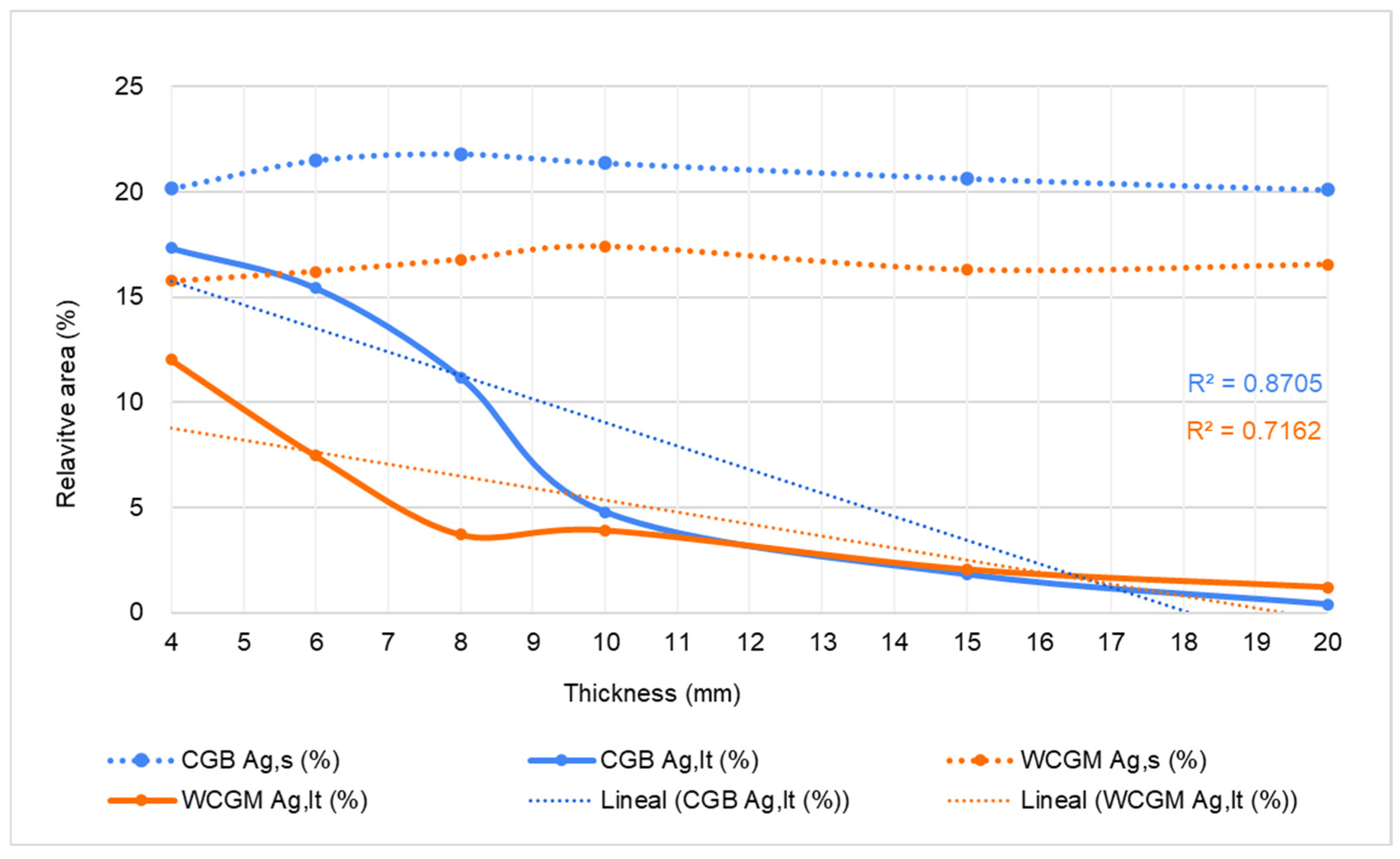
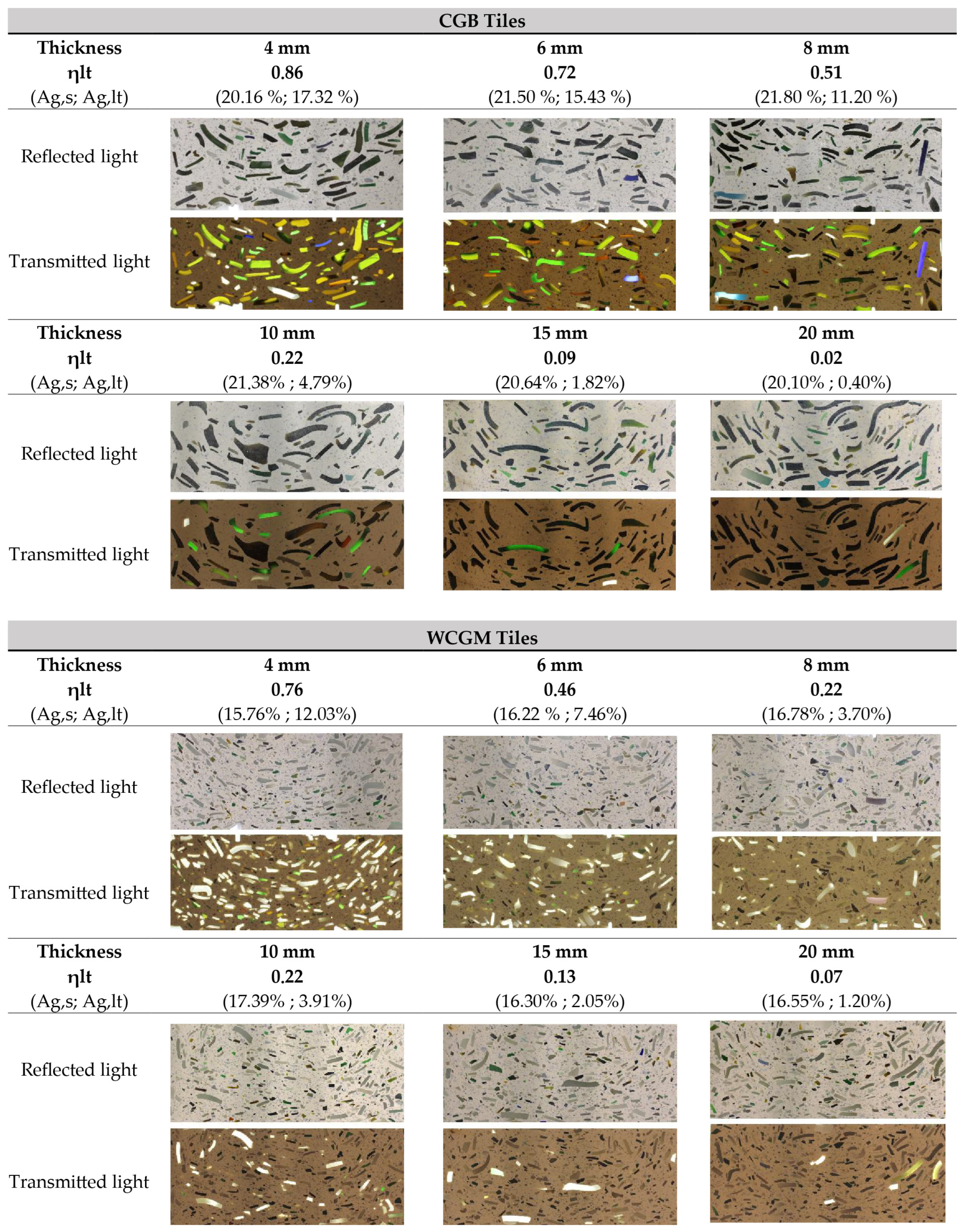
This section analyses the relationship between the surface glass area (Ag,s) and the light-transmitting glass area (Ag,lt) of the concrete tiles as a function of specimen thickness and glass granulometry. As illustrated in Figure 12, the Ag,s remains nearly constant in the two mix designs (CGB and WCGM), independent of the tile thickness of the WG concrete tile. Despite this apparently nominal stability, the values fluctuate by approximately ±9% in both mixtures, reaching average values of 20.93% for the CGB mixture and 16.50% for the WCGM mixture. The difference in the average Ag,s values between the two mixtures is attributed to the higher WG content per cubic metre in the CGB mix composition.
Similarly, Figure 12 reveals that the light transmittance values (Ag,lt) decrease progressively when the thickness diminishes from 4 to 8 mm of thickness for the WCGM mixture and from 4 to 10 mm for the CGB mixture. Above 10 mm, both curves tend to stabilise at around 4% light transmittance, gradually reaching values close to 0% for thicknesses greater than 20 mm. These values verify the initial hypothesis of limiting the production of WG concrete tiles to a maximum thickness of 20 mm, as no significant light contribution is achieved through the WG concrete tiles at greater thicknesses.
This differentiated behaviour between both mix designs is driven by two fundamental considerations. On the one hand, the CGB WG concrete tiles contain approximately 50% more WG per cubic metre (Table 5) than those produced with the WCGM mixture. On the other hand, 95% of the WG aggregates in the CGB mixture have particle sizes between 10 and 30 mm (Figure 12). These two factors increase the probability that when cutting the concrete blocks to produce thinner WG concrete tiles (4–10 mm), glass particles with dimensions larger than the tile thickness can be intersected. By contrast, tiles produced with the WCGM mixture contain a lower amount of WG per cubic metre, with approximately 50% of the aggregate fraction in the 2–10 mm size range (Figure 13). This explains why the light-transmitting area is significantly smaller and decreases more rapidly for the WCGM mixture.
In general terms, above 10 mm thicknesses, the WG concrete tiles lead to a reduction in light transmission through the element as the thickness increases. Despite the CGB mix containing a higher amount of WG per cubic metre and larger particles (10–30 mm), both the low shape factor of the WG particles and their darker colours, such as green, blue and brown, cause an exponential reduction in light transmission through the WG concrete tiles. In the case of the WCGM mix, it contains a higher proportion of fine WG particles (2–8 mm), causing the WG to be confined within the cross-section of the WG concrete tile for thicknesses bigger than 10 mm, thereby preventing effective light conduction through the element.
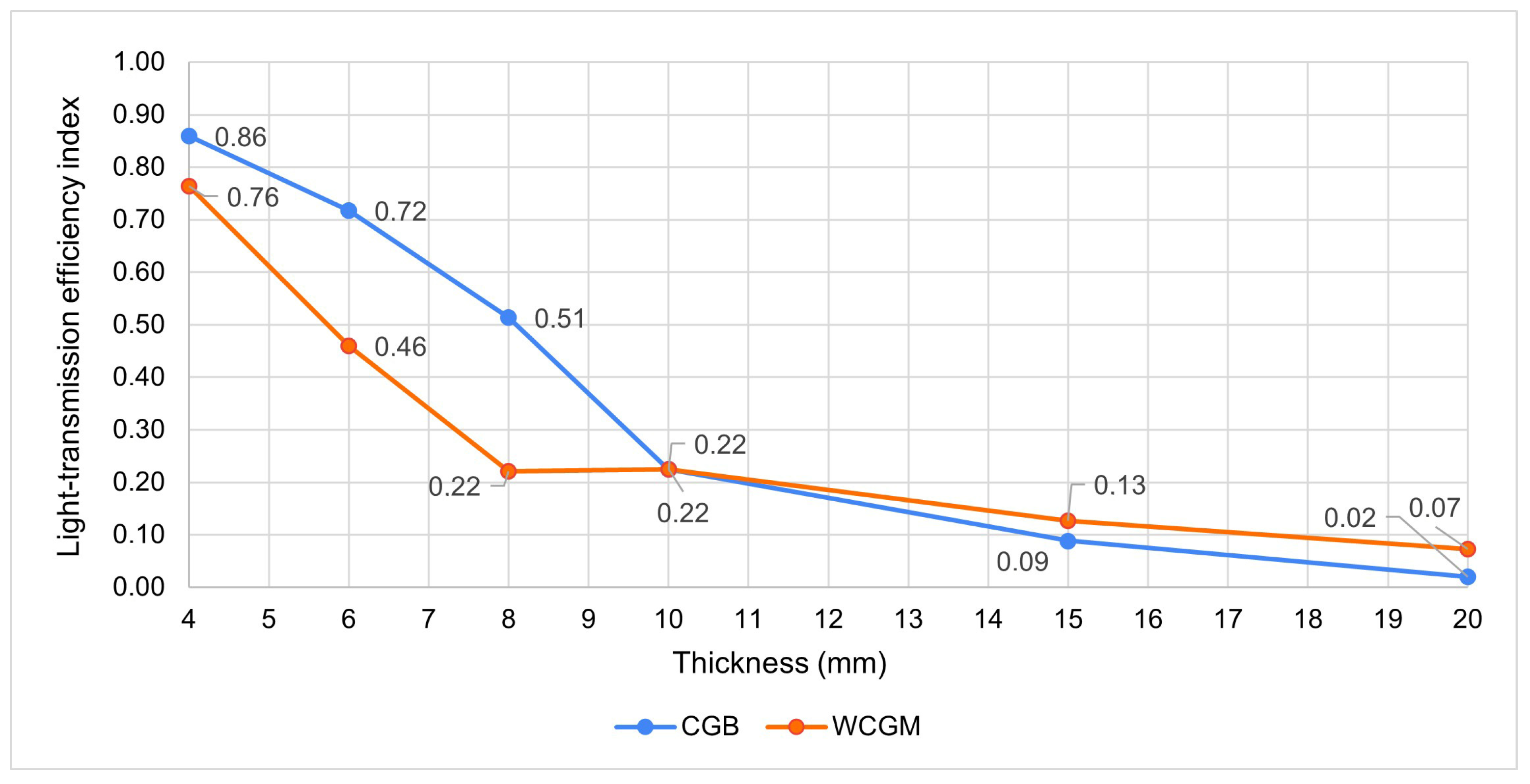
Based on the variables of nominal WG size, WG concrete tile thickness, and light transmittance, the efficiency index (ηlt) of the surface glass contributing to light transmission has been calculated. This index is defined as the ratio between the light-transmitting glass area (Ag,lt) and the total surface glass area (Ag,s) for each tile thickness.
η l t = A g , l t A g , s
The findings presented in Figure 14 demonstrate two distinct performances in the growth of the efficiency indices as a function of WG concrete tile thickness [20,59]. For thicknesses up to 10 mm, the CGB mixture exhibits higher efficiency indices, characterised by a higher proportion of large particles despite being dark coloured WG particles. On the other hand, for thicknesses greater than 10 mm, the colour of the WG becomes a relevant factor. The depth of the WG and their colour result in a complete loss of transparency. On the other hand, Figure 14 also shows that the WCGM mixture achieves a higher light-efficiency index for thicknesses above 10 mm, due to the higher presence of white WG that ensures improved light transmittance at thicknesses greater than 10 mm. This effect becomes particularly evident when comparing the 15 and 20 mm WG concrete tiles shown in Figure 14.
Figure 15 presents the selected WG concrete tiles subsequently illuminated with artificial light for the opaque-to-translucent glass ratio test. The figure shows a higher percentage of coloured and larger WG particles in the CGB tiles, and a greater presence of white WG with smaller particle sizes in the WCGM tile samples.
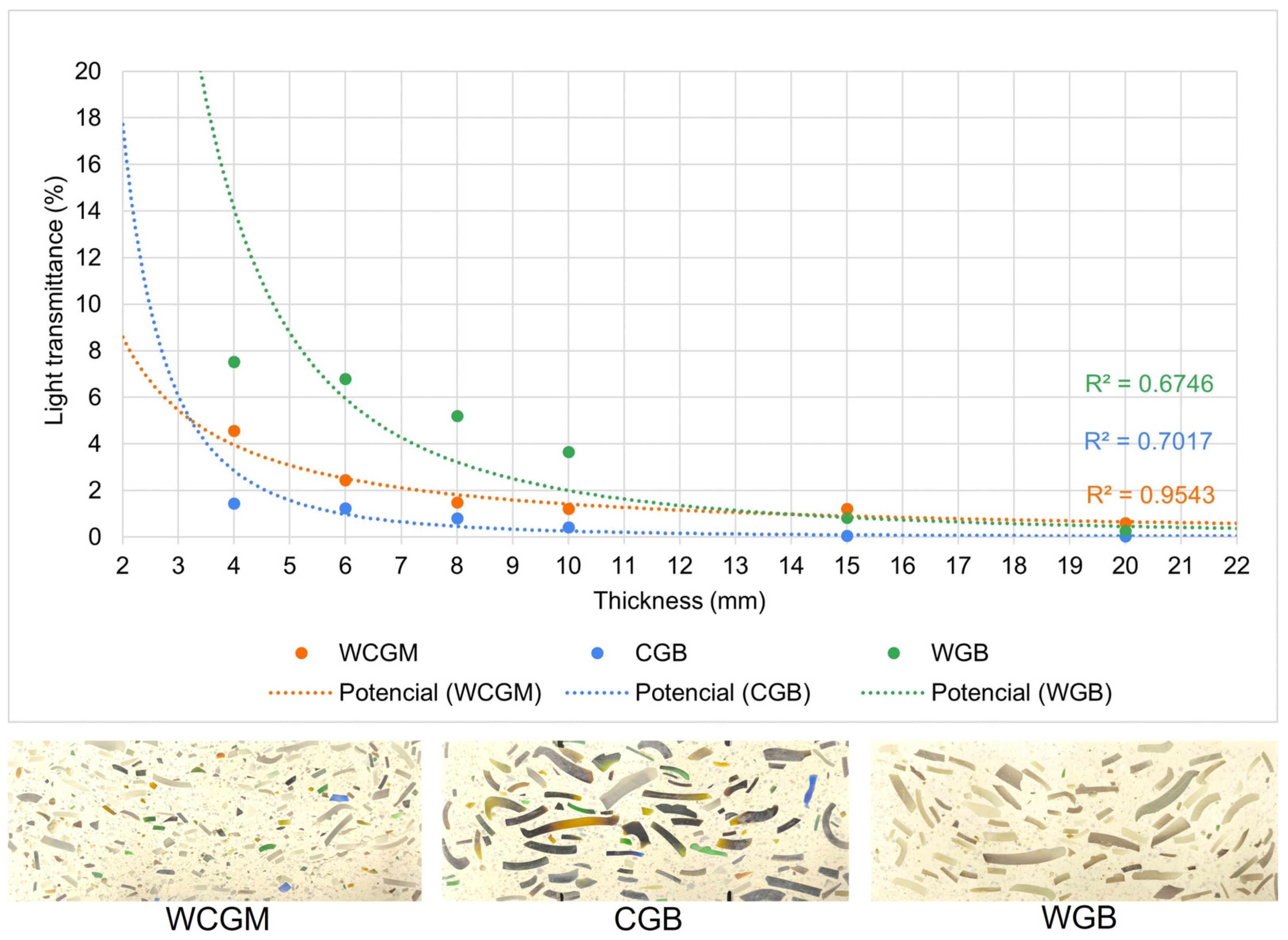
The light transmittance test allowed the researchers to quantify the previous results and to highlight the importance of WG colour on light transmittance (lux). As shown in Figure 15, the overall transmittance behaviours of the two main mix designs (CGB and WCGM) are very similar when the specimen thicknesses increase. For thicknesses between 4 and 10 mm, Figure 16 shows that the light transmittance values of the WCGM mixture are approximately two to three times higher than those of the CGB mixture. For thicknesses greater than 10 mm, the light transmittance of the CGB mixture decreases markedly, and the difference increases to nearly one order of magnitude, although the absolute transmittance values are already very low and close to 1%.
In the interest of gaining a broader overview, the project included an additional mix design incorporating white WG (WGB, white glass big) exclusively to observe the differential influence of glass colour on light transmission. This mixture was designed with the same nominal particle size and WG content as the CGB mixture, and concrete tiles were subsequently manufactured with the same dimensions and thicknesses as those produced with the previous mixtures. As shown in Figure 16, this new WGB mixture significantly increases the light transmittance of the WG concrete tiles, reaching maximum values of up to 8% for 4 mm thick tiles and approximately 4% for a tile thickness of 10 mm. A light transmittance of 8% is an adequate value for solar-filter elements, as previous studies have pointed out [60].
In contrast to other studies [20], this test confirms the importance of WG colour in enhancing the light transmittance of the tiles [15,61], which may even become more relevant than the amount of recycled glass per cubic metre or the nominal particle size of the WG aggregates. However, when the variable of colour is excluded, it can be stated that the relationship between tile thickness and WG aggregate size is also a key factor in achieving higher or lower light transmittance, provided that the same WG proportion is maintained. Therefore, from a lighting-performance perspective, it is essential to combine minimum concrete-tile thicknesses (<10 mm) with medium-to-large WG aggregate sizes (>10 mm), which is an accordance with previous studies [20].

5. Conclusions

This study developed a novel high-performance concrete (HPC) that achieved a 25–30% incorporation of waste in concrete tiles designed for building envelopes. Waste glass (WG) was included according to the presented dosages, enhancing the circularity and sustainability of the resulting solar-shading elements. The process of defining both the optimum cementitious mix and geometry followed an experimental path that considered the specific demands by full-scale construction, which has resulted in the following key findings:
  • Minimising the component thickness is essential to reach the main goal of developing translucent concrete, reaching the 8% light transmittance that is adequate for solar filters. Focusing on this goal, the best thicknesses are of 8 mm or less, as then the aggregate size of the WG is less restrictive because it fits within the element’s cross-section. However, once the thickness exceeds 10 mm, the optical properties change significantly. Light transmittance drops off sharply with darker glass—particularly amber, brown, and green—thus effectively forcing the use of white waste glass to maintain any functional transparency.
  • A minimum thickness of 8 mm is necessary to achieve the minimum acceptable mechanical and durability performance. These are a flexural strength of more than 7 MPa and mass losses inferior to 2.34%. Also, large WG aggregates are particularly problematic in thinner tiles, tending to trigger continuous failure because of a weak Interfacial Transition Zone (ITZ), which compromises the overall flexural strength. Furthermore, durability tests—specifically those involving salt crystallisation and thermal shock—confirm that the ITZ is the real bottleneck.
  • There is room for improvement on the impact and flexural performance of the 8 mm wide tiles, which are the best in terms of translucency, durability and other mechanical properties, as previously concluded.
Considering these findings, future research needs to improve the physical, mechanical and durability performance of WG translucent concrete tiles at minimum thicknesses for facade purposes. This also implies improving the ITZ between the matrix and the RG. There are different potential research lines, addressing these issues either independently or in combination. First, increasing both the proportion and length of alkali-resistant (AR) glass fibres, as well as incorporating other fibre typologies with higher tensile strengths, in order to improve the tile response to impact and flexural loading. Second, modifying the production sequence or incorporating resin-based treatments to improve the ITZ. Third, developing laminated glass–concrete solutions, using polyvinyl butyral (PVB) interlayers or bonding resins to incorporate an additional glass layer, which could enhance the mechanical performance, impact resistance and durability of the thin translucent WG concrete tiles. Fourth, further optimising the geometric facade tile design, format and cross-section, to develop more rigid and larger elements. Finally, all improvements should be systematically supported by a Life Cycle Assessment (LCA) framework, enabling informed decision-making throughout the research process and reinforcing the sustainability-driven development of the proposed improved solutions.

Author Contributions

Conceptualization, O.P.-V. (Oriol Paris-Viviana) and P.M.-G.; methodology, O.P.-V. (Oriol Paris-Viviana) and P.M.-G.; validation, O.P.-V. (Oriol Paris-Viviana) and P.M.-G.; formal analysis, O.P.-V. (Oriol Paris-Viviana) and P.M.-G.; investigation, O.P.-V. (Oriol Paris-Viviana), P.M.-G. and A.C.; resources, O.P.-V. (Oriol Paris-Viviana); data curation, O.P.-V. (Oriol Paris-Viviana), P.M.-G., and A.C.; writing—original draft preparation, O.P.-V. (Oriol Paris-Viviana), P.M.-G., O.P.-V. (Oriol Pons-Valladares) and A.C.; writing—review and editing, O.P.-V. (Oriol Paris-Viviana) and P.M.-G.; visualisation, O.P.-V. (Oriol Paris-Viviana) and P.M.-G.; supervision, O.P.-V. (Oriol Paris-Viviana) and P.M.-G.; project administration, O.P.-V. (Oriol Pons-Valladares); funding acquisition, O.P.-V. (Oriol Pons-Valladares). All authors have read and agreed to the published version of the manuscript.

Funding

This research paper is part of the project Waste-based Intelligent Solar Control Devices for Envelope Refurbishment (WISER) with the reference TED2021-130155B-I00, funded by MCIN/AEI/10.13039/501100011033 and by the European Union “NextGenerationEU”/PRTR.

Data Availability Statement

The data presented in this study are available in the article.

Acknowledgments

The authors would like to thank Daniel Rosas S.A. for supplying the waste glass (cullet) samples. The authors also acknowledge the collaboration of the Materials Laboratory of the EPSEB (Universitat Politècnica de Catalunya), Amanda Rivera, and Alex Escofet and Laia Pons for their work and contributions during the development of the experimental program of this research. During the preparation of this manuscript/study, the authors used AI tools, including ChatGPT 5.2 and Gemini 3 Flash, for the purposes of language translation into English. The authors have reviewed and edited the output and take full responsibility for the content of this publication.

Conflicts of Interest

The authors declare no conflicts of interest.

Abbreviations

The following abbreviations are used in this manuscript:
WGWaste Glass
CGBColour Waste Glass Big (10–31.5 mm)
CGSColour Waste Glass Small (4–10 mm)
WCGMWhite Waste Glass Mix
WGBWhite Waste Glass Big (10–31.5 mm)
SCCSelf-Compacting Concrete
SPSuperplasticizer
PSDParticle Size Distribution
HPCHigh-Performance Concrete
EADEuropean Assessment Document
LTCLight-Transmitting Concrete
Ag,sSurface Glass Area (%)
Ag,ltLight-Transmitting Surface Glass Area (%)
ηltLight-Transmission-Efficiency Index
WPCWhite Portland Cement
SCMSupplementary Cementitious Material
ITZInterfacial Transition Zones
LPLimestone Powder
PVBPolyvinyl Butyral

References

  1. Jayakodi, S.; Senaratne, S.; Perera, S. Circular Economy Business Model in the Construction Industry: A Systematic Review. Buildings 2024, 14, 379. [Google Scholar] [CrossRef]
  2. Moschen-Schimek, J.; Kasper, T.; Huber-Humer, M. Critical review of the recovery rates of construction and demolition waste in the European Union—An analysis of influencing factors in selected EU countries. Waste Manag. 2023, 167, 150–164. [Google Scholar] [CrossRef]
  3. Yildirim, M.; Polat, H. Building Information Modeling Applications in Energy-Efficient Refurbishment of Existing Building Stock: A Case Study. Sustainability 2023, 15, 13600. [Google Scholar] [CrossRef]
  4. Comisión Europea. Oleada de Renovación para Europa: Ecologizar Nuestros Edificios, Crear Empleo y Mejorar Vidas. Bruselas. 2020. Available online: https://eur-lex.europa.eu/legal-content/EN-ES/TXT/?uri=CELEX:52020DC0662 (accessed on 10 March 2026).
  5. Ascione, F.; Bianco, N.; Iovane, T.; Mastellone, M.; Mauro, G.M. The evolution of building energy retrofit via double-skin and responsive façades: A review. Sol. Energy 2021, 224, 703–717. [Google Scholar] [CrossRef]
  6. Masseck, T.; París-Viviana, O.; Habibi, S.; Pons-Valladares, O. Integrated sustainability assessment of construction waste-based shading devices for the refurbishment of obsolete educational public building stock. J. Build. Eng. 2024, 87, 109024. [Google Scholar] [CrossRef]
  7. Vilhena, A.; Silva, C.; Fonseca, P.; Couto, S. Exterior walls covering system to improve thermal performance and increase service life of walls in rehabilitation interventions. Constr. Build. Mater. 2017, 142, 354–362. [Google Scholar] [CrossRef]
  8. Martin-Goñi, P.; Avellaneda, J.; González, J.M. Energetic and Functional Rehabilitation of Residential Buildings in Europe: Analysis and Cataloguing of the Strategies Used. Buildings 2024, 14, 525. [Google Scholar] [CrossRef]
  9. Godakandage, R.; Weerasinghe, P.; Gamage, K.; Adnan, H.; Nguyen, K. A Systematic Review on Cavity Fires in Buildings: Flame Spread Characteristics, Fire Risks, and Safety Measures. Fire 2024, 7, 12. [Google Scholar] [CrossRef]
  10. Mo, X.; Pons-Valladares, O.; Donoso, S.I.O. Model to Improve Classrooms’ Visual Comfort Using Waste-Based Shading and Its Validation in Mediterranean Schools. Sustainability 2024, 16, 10176. [Google Scholar] [CrossRef]
  11. Lakhouit, A. Revolutionizing urban solid waste management with AI and IoT: A review of smart solutions for waste collection, sorting, and recycling. Results Eng. 2025, 25, 104018. [Google Scholar] [CrossRef]
  12. Alsayed, H.; Wehbi, N.; Khatib, J.; Kırgız, M.S.; El-Hassan, H. Light transmitting concrete with glass and optical fibers: A solution for sustainable buildings—A review. Mech. Compos. Mater. 2025, 61, 785–806. [Google Scholar] [CrossRef]
  13. Bai, J.; Zhang, W.; Tian, J.; Wu, X.; Zheng, M. Development of Optical Fiber Light-Transmitting Concrete (LTC)—A Review. Buildings 2025, 15, 104. [Google Scholar] [CrossRef]
  14. Al-Sodani, K.A.A. Production, Thermal, Durability, Mechanical Properties of Translucent Concrete and Its Applications in Sustainable Construction: A Review. Buildings 2025, 15, 3314. [Google Scholar] [CrossRef]
  15. Luhar, I.; Luhar, S.; Savva, P.; Theodosiou, A.; Petrou, M.F.; Nicolaides, D. Light transmitting concrete: A review. Buildings 2021, 11, 480. [Google Scholar] [CrossRef]
  16. Chiew, S.M.; Ibrahim, I.S.; Ariffin, M.A.M.; Lee, H.S.; Singh, J.K. Development and properties of light-transmitting concrete (LTC)—A review. J. Clean. Prod. 2021, 284, 124780. [Google Scholar] [CrossRef]
  17. Johnston, C.D. Waste Glass as Coarse Aggregate for Concrete. J. Test. Eval. 1974, 2, 344–350. [Google Scholar] [CrossRef]
  18. Merzbacher, C.I.; Kersey, A.D.; Friebele, E.J. Fiber optic sensors in concrete structures: A review. Smart Mater. Struct. 1996, 5, 196. [Google Scholar] [CrossRef]
  19. Mainini, A.G.; Poli, T.; Zinzi, M.; Cangiano, S. Spectral light transmission measure and radiance model validation of an innovative transparent concrete panel for façades. Energy Procedia 2012, 30, 1184–1194. [Google Scholar] [CrossRef]
  20. Spiesz, P.; Rouvas, S.; Brouwers, H.J.H. Utilization of waste glass in translucent and photocatalytic concrete. Constr. Build. Mater. 2016, 128, 436–448. [Google Scholar] [CrossRef]
  21. Rajabipour, F.; Giannini, E.; Dunant, C.; Ideker, J.H.; Thomas, M.D.A. Alkali-silica reaction: Current understanding of the reaction mechanisms and the knowledge gaps. Cem. Concr. Res. 2015, 76, 130–146. [Google Scholar] [CrossRef]
  22. Chen, J.; Poon, C.S. Photocatalytic activity of titanium dioxide modified concrete materials—Influence of utilizing recycled glass cullets as aggregates. J. Environ. Manag. 2009, 90, 3436–3442. [Google Scholar] [CrossRef]
  23. Han, B.; Zhang, L.; Ou, J. (Eds.) Light-Transmitting Concrete. In Smart and Multifunctional Concrete Toward Sustainable Infrastructures; Springer: Singapore, 2017; pp. 273–283. [Google Scholar] [CrossRef]
  24. Shenoy, A.; Nayak, G.; Tantri, A.; Shetty, K.K. Thermal transmission characteristics of plastic optical fibre embedded light transmitting concrete. Mater. Today Proc. 2022, 65, 1759–1773. [Google Scholar] [CrossRef]
  25. Juan, S.; Zhi, Z. Preparation and Study of Resin Translucent Concrete Products. Adv. Civ. Eng. 2019, 2019, 8196967. [Google Scholar] [CrossRef]
  26. Momin, A.A.; Kadiranaikar, R.B.; Jagirdar, S.; Arshad, M.; Inamdar, A. Study on Light Transmittance of Concrete Using Optical Fibers and Glass Rods. IOSR J. Mech. Civ. Eng. 2014, 67, 67–72. Available online: https://www.iosrjournals.org/iosr-jmce/papers/ICAET-2014/ce/volume-1/11.pdf (accessed on 21 January 2026).
  27. Muhammad, S.; Morsi, E.M.; Muhammad, N. Development, Testing, and Implementation Strategy of a Translucent Concrete-Based Smart Lane Separator for Increased Traffic Safety. J. Constr. Eng. Manag. 2017, 143, 04016129. [Google Scholar] [CrossRef]
  28. Kim, B. Light Transmitting Lightweight Concrete with Transparent Plastic Bar. Open Civ. Eng. J. 2017, 11, 615–626. [Google Scholar] [CrossRef]
  29. Pons, O.; Abt, T. Evaluation of household waste materials for façade components in primary educational workshops. Mechanical and fire properties. J. Build. Eng. 2020, 29, 101202. [Google Scholar] [CrossRef]
  30. Hillebrandt, A.; Riegler-Floors, P.; Rosen, A.; Seggewies, J.-K. Manual of Recycling. Building as Sources of Materials; Detail Business Information GmbH: Munich, Germany, 2018. [Google Scholar]
  31. Gómez-Ramió, J.; Cavalaro, S.; Aguado, A. The Trencadis Mosaic on the Pinnacles of the Sagrada Familia Cathedral. Int. J. Archit. Herit. 2015, 9, 594–604. [Google Scholar] [CrossRef][Green Version]
  32. Pons, O.; Habibi, S.; Peña, D. Sustainability assessment of household waste based solar control devices for workshops in primary schools. Sustainability 2018, 10, 4071. [Google Scholar] [CrossRef]
  33. Mansour, M.A.; Ismail, M.H.B.; Latif, Q.B.A.I.; Alshalif, A.F.; Milad, A.; Al Bargi, W.A. A Systematic Review of the Concrete Durability Incorporating Recycled Glass. Sustainability 2023, 15, 3568. [Google Scholar] [CrossRef]
  34. Marey, H.; Kozma, G.; Szabó, G. Green concrete materials selection for achieving circular economy in residential buildings using system dynamics. Clean. Mater. 2024, 11, 100221. [Google Scholar] [CrossRef]
  35. Esmaeili, J.; Ghaffarinia, M.; Nodehi, M.; Gencel, O.; Shi, J.; Ozbakkaloglu, T. Mechanical and fractural characteristics of structural lightweight fiber reinforced concrete. Struct. Concr. 2023, 24, 2420–2439. [Google Scholar] [CrossRef]
  36. Pagliolico, S.L.; Verso, V.R.M.L.; Torta, A.; Giraud, M.; Canonico, F.; Ligi, L. A preliminary study on light transmittance properties of translucent concrete panels with coarse waste glass inclusions. Energy Procedia 2015, 78, 1811–1816. [Google Scholar] [CrossRef]
  37. Qaidi, S.; Najm, H.M.; Abed, S.M.; Özkılıç, Y.O.; Al Dughaishi, H.; Alosta, M.; Sabri, M.M.S.; Alkhatib, F.; Milad, A. Concrete Containing Waste Glass as an Environmentally Friendly Aggregate: A Review on Fresh and Mechanical Characteristics. Materials 2022, 15, 6222. [Google Scholar] [CrossRef]
  38. Lakhouit, A. Enhancing environmental benefits through recycling glass to improve soil properties and concrete. Clean. Waste Syst. 2025, 11, 100301. [Google Scholar] [CrossRef]
  39. UNE-EN 12350-8; Testing Fresh Concrete Part 8: Self-Compacting Concrete Slump-Flow Test. AENOR Asociación Española de Normalización y Certificación: Madrid, Spain, 2020; p. 11.
  40. UNE-EN 206:2013+A2; Concrete Specification, Performance, Production and Conformity. AENOR Asociación Española de Normalización y Certificación: Madrid, Spain, 2021; p. 103.
  41. Abalouch, I.; Sakami, S.; Elabbassi, F.E.; Boukhattem, L. Effects of recycled fine glass aggregates on alkali silica reaction and thermo-mechanical behavior of modified concrete. Appl. Sci. 2021, 11, 9045. [Google Scholar] [CrossRef]
  42. Khalooee, S.; Ahmadi, B.; Askarinejad, A.; Nekooei, M. Tackling the issues of self-compacting concrete containing high volume of waste glass aggregate by zeolite. Struct. Concr. 2021, 22, E207–E227. [Google Scholar] [CrossRef]
  43. UNE-EN 12390-3; Testing Hardened Concrete—Part 3: Compressive Strength of Test Specimens. BSI Standards: London, UK, 2020; Volume 38, p. 18.
  44. UNE 83980; Durabilidad del Hormigón. Métodos de Ensayo. Determinación de la Absorción de Agua, la Densidad y la Porosidad Accesible al Agua del Hormigón. European Standards: Plzen, Czech Republic, 2014.
  45. UNE-EN ISO 10545-4; Ceramic Tiles. Part 4: Determination of Modulus of Rupture and Breaking Strength. ISO: Geneva, Switzerland, 2019; p. 9.
  46. Kits for External Wall Claddings Mechanically Fixed European Assessment Document for. 2021. Available online: https://www.eota.eu (accessed on 21 January 2026).
  47. UNE-EN 12370; Natural Stone Test Methods Determination of Resistance to Salt Crystallisation. European Standards: Plzen, Czech Republic, 2020; p. 10.
  48. UNE-EN ISO 10545-9; Ceramic tiles Part 9: Determination of Resistance to Thermal Shock. ISO: Geneva, Switzerland, 2013.
  49. CIE—Comission Internationale de l’Eclairage. ILV: International Lighting Vocabulary; International Commission on Illumination (CIE): Vienna, Austria, 2020. [Google Scholar] [CrossRef]
  50. CIE—Comission Internationale de l’Eclairage. Method of Measuring and Specifying Colour Rendering Properties of Light Sources; Commission Internationale de L’éclairage, CIE Central Bureau: Vienna, Austria, 1995. [Google Scholar]
  51. ISO 9050:2003; Glass in Building—Determination of Light Transmittance, Solar Direct Transmittance, Total Solar Energy Transmittance, Ultraviolet Transmittance and Related Glazing Factors. ISO: Geneva, Switzerland, 2003.
  52. Chandrathilaka, E.R.K.; Baduge, S.K.; Mendis, P.; Thilakarathna, P.S.M. Flexural performance of prefabricated ultra-high-strength textile reinforced concrete (UHSTRC): An experimental and analytical investigation. Buildings 2020, 10, 68. [Google Scholar] [CrossRef]
  53. Ichino, H.; Kuwahara, N.; Beppu, M.; Williamson, E.B.; Himi, A. Effects of the shape, size, and surface roughness of glass coarse aggregate on the mechanical properties of two-stage concrete. Constr. Build. Mater. 2024, 411, 134296. [Google Scholar] [CrossRef]
  54. Epure, C.; Munteanu, C.; Istrate, B.; Harja, M.; Buium, F. Applications of Recycled and Crushed Glass (RCG) as a Substitute for Natural Materials in Various Fields—A Review. Materials 2023, 16, 5957. [Google Scholar] [CrossRef]
  55. Çelik, A.İ.; Özkılıç, Y.O.; Zeybek, Ö.; Karalar, M.; Qaidi, S.; Ahmad, J.; Burduhos-Nergis, D.D.; Bejinariu, C. Mechanical Behavior of Crushed Waste Glass as Replacement of Aggregates. Materials 2022, 15, 8093. [Google Scholar] [CrossRef]
  56. Mallum, I.; Mohd, A.R.; Lim, N.H.A.S.; Omolayo, N. Sustainable Utilization of Waste Glass in Concrete: A Review. Silicon 2022, 14, 3199–3214. [Google Scholar] [CrossRef]
  57. Omoding, N.; Cunningham, L.S.; Lane-Serff, G.F. Effect of using recycled waste glass coarse aggregates on the hydrodynamic abrasion resistance of concrete. Constr. Build. Mater. 2021, 268, 121177. [Google Scholar] [CrossRef]
  58. Vintimilla, C.; Etxeberria, M.; Li, Z. Durable Structural Concrete Produced with Coarse and Fine Recycled Aggregates Using Different Cement Types. Sustainability 2023, 15, 14272. [Google Scholar] [CrossRef]
  59. Li, Y.; Zhang, J.; Cao, Y.; Hu, Q.; Guo, X. Design and evaluation of light-transmitting concrete (LTC) using waste tempered glass: A novel concrete for future photovoltaic road. Constr. Build. Mater. 2021, 280, 122551. [Google Scholar] [CrossRef]
  60. Chavez-Galan, J.; Almanza, R. Solar filters based on iron oxides used as efficient windows for energy savings. Sol. Energy 2007, 81, 13–19. [Google Scholar] [CrossRef]
  61. de Rosso, L.T.; de Melo, J.V.S. Impact of incorporating recycled glass on the photocatalytic capacity of paving concrete blocks. Constr. Build. Mater. 2020, 259, 119778. [Google Scholar] [CrossRef]
Figure 1. PSD of the fine aggregates and the WG cullets.
Buildings 16 01163 g001
Figure 2. Detail photographs of each WG cullet type: WGB, CGB and CGS (from left to right).
Buildings 16 01163 g002
Figure 3. Flow-induced distribution of WG particles in self-compacting concrete, showing the characteristic arch-shaped arrangement within the specimen, indicated by the yellow line. Sample WCGM4_3B and WCGM4_1A.
Buildings 16 01163 g003
Figure 4. Experimental prototype used for impact tests: (left) small-scale prototype showing the supporting substructure and the concrete tile specimen; (right) prototype installed in its final position at the testing location.
Buildings 16 01163 g004
Figure 5. Screenshots of the “opaque-to-translucent glass ratio” analysis process.
Buildings 16 01163 g005
Figure 6. Configuration and light and lux meter equipment for the luminous transmittance tests.
Buildings 16 01163 g006
Figure 7. Flexural strength results in relation to tile thickness for the three mixtures evaluated.
Buildings 16 01163 g007
Figure 8. SEM micrographs of the HPC mixtures detailing the ITZ in REF, CGB and WCGM (from left to right, respectively).
Buildings 16 01163 g008
Figure 9. (Left): Minimal adhesion between the HPC and the WG, creating a shear failure. (Right): The blue dashed line indicates the desirable fracture direction of a specimen without WG, while the red dashed line highlights the fracture path caused by the presence of WG particles. Sample CGB15-2.
Buildings 16 01163 g009
Figure 10. Brittle and straight breakage, breaking the WG aggregates. Impact test sample CGB-20(2) and CGB-10(3).
Buildings 16 01163 g010
Figure 11. Photographs and details of the tiles during the salt crystallisation test. From left to right: (a) CGB-4 before testing, (b) CGB-4 after 7 cycles, (c) WCGM-4 corner break due to debonding on the glass–matrix ITZ, (d) WCGM notch break.
Buildings 16 01163 g011
Figure 12. Evolution of areas related to surface glass (Ag,s) and light-transmitting glass (Ag,lt) as a function of concrete tile thickness.
Buildings 16 01163 g012
Figure 13. PSD of WG for the CGB and WCGM mixture.
Buildings 16 01163 g013
Figure 14. Light-transmission-efficiency index (ηlt) for CGB and MCGM concrete mixtures.
Buildings 16 01163 g014
Figure 15. Surface appearance and light-transmitting regions of CGB and WCGM WG concrete tiles at different thicknesses, including the corresponding values of Ag,s and Ag,lt.
Buildings 16 01163 g015
Figure 16. Light transmittance versus specimen thickness for WCGM, CGB, and WGB mixtures. Dotted lines indicate the power-law fitting and the corresponding R2 values.
Buildings 16 01163 g016
Table 1. Binder compositions (as a percentage of the total weight).
Binder and SCM
TypeSiO2
(%)
CaO
(%)
Fe2O3 (%)AI2O3
(%)
MgO
(%)
SO3
(%)
Na2O
(%)
K2O
(%)
P2O5
(%)
TiO2
(%)
LOI
(%)
WPC19.8867.520.293.791.243.280.090.800.190.162.76
LP0.9155.890.150.370.40-0.020.070.220.0641.89
Table 2. Admixture details.
Admixtures
TypeBaseDensity (kg/m3)Recommendations
SPBased on polycarboxylate ether10480.3–2.0%
SRAWater surface tension reducer9703.0–7.5%
Table 3. Physical and mechanical properties of two fine aggregates and three glass types.
MaterialsOven-Dried Particle (kg/m3)Water Absorption (%)Amount of Fine Aggregates (%)LA Index (%)
Dolomitic Sand 0–126501.6011.13-
Granite Sand 1–327001.000.12-
WGB2474-0.3040
CGB2499-0.1742
CGS2439-0.5442
Table 4. Characterisation of concrete mixtures according to UNE-EN 12350-8:2020 and UNE-EN 206:2013+A2.
t500 (sg)Viscosity
Class
d1
(mm)
d2
(mm)
SF (d1 + d2)/2
(mm)
Slump-Flow Class
REF3.5VS2810790800SF3
CGB4.5VS2800780790SF3
WCGM5.0VS2770755760SF3
Legend: t500: Time in seconds to flow to a diameter of 500 mm in a slump-flow test; VS1, VS2: viscosity classes from t500; SF1 to SF3: consistence classes expressed by slump flow.
Table 6. Codes assigned to the concrete tiles analysed according to WG type and component thickness.
CodeThickness of WG Concrete Tiles
4 mm6 mm8 mm10 mm15 mm20 mm
REFREF-4REF-6REF-8REF-10REF-15REF-20
CGBCGB-4CGB-6CGB-8CGB-10CGB-15CGB-20
WCGMWCGM-4WCGM-6WCGM-8WCGM-10WCGM-15WCGM-20
Table 7. Dry weight, apparent density, water absorption and effective porosity results for the three mixtures according to each thickness.
Thickness
(mm)
Dry Weight
(g)
Apparent Density (kg/m3)Accessible Porosity
(%)
Water Absorption
(%)
REF4196.852050.4710.416.68
6312.232168.267.204.42
8424.492210.865.663.55
10538.522243.834.862.96
15812.382256.616.273.11
201113.542319.865.062.61
CGB4203.412118.859.415.95
6309.102146.497.774.90
8434.472262.847.384.51
10579.092412.884.933.08
15898.542495.944.323.22
201177.242452.583.912.67
WCGM4182.381951.8210.256.55
6309.102146.537.895.13
8417.722175.67.124.36
10531.222213.46.553.97
15838.272328.536.493.98
201165.372427.855.283.19
Table 8. Impact results in WG concrete tiles with REF mixture. Legend: (1) Superficial damage, provided there is no cracking, is considered to show “no deterioration” for all the impacts; (2) superficial cracking, but no penetration, is allowed; (3) collapse or any other dangerous failure.
CodeSoft-Body ImpactCategoryHard-Body ImpactCategory
S1S2H1H2
REF-20okokIok3IV
REF-15okokIok2IV
REF-10okokI2--
REF-8 ok3----
CGB-20 okokI13IV
CGB-15 okokI2--
CGB-10 ok3----
WCGM-20 okokI3--
WCGM-15ok3----
Table 9. Weight loss results and failure mode from salt crystallisation test for each of the three mixtures according to tile thicknesses.
CodeThickness (mm)Weight Loss (%)St. Deviation (%)Key Qualitative Failure Mode
REF4–80.63–2.310.92–3.96Small corner breaks and eroded edges.
CGB411.569.56Structural loss (1/4 of piece); important ITZ debonding.
CGB6–101.26–2.820.41–0.99Slight ITZ debonding at corners and notches.
WCGM41.80.53Small corner and notch spalling and eroded edges.
WCGM6–101.67–2.340.11–0.67Surface erosion (top face); aggregate extrusion.
ALL15–200.52–2.110.07–1.16Minor rounding of edges and corners.
Table 10. Weight-loss results from the thermal shock test and the standard deviation for each result of the three mixtures according to each tile thickness.
CodeThickness (mm)Weight Lost (%)St. Dev. (%)
REF44.990.80
64.020.30
83.080.52
101.340.43
150.590.68
200.540.37
CGB49.746.69
63.870.04
83.200.54
101.490.60
151.220.28
200.660.34
WCGM417.5723.30
63.630.26
83.490.38
103.670.37
152.140.05
202.060.49
Disclaimer/Publisher’s Note: The statements, opinions and data contained in all publications are solely those of the individual author(s) and contributor(s) and not of MDPI and/or the editor(s). MDPI and/or the editor(s) disclaim responsibility for any injury to people or property resulting from any ideas, methods, instructions or products referred to in the content.