2.4. Design Codes and Verification
Structural and geotechnical verifications for the original and reinforced foundations were based on IEC 61400-1, IEC 61400-6, DNVGL-ST-0126, and Eurocode 2, alongside classic wind turbine foundation formulations [
12,
15,
16,
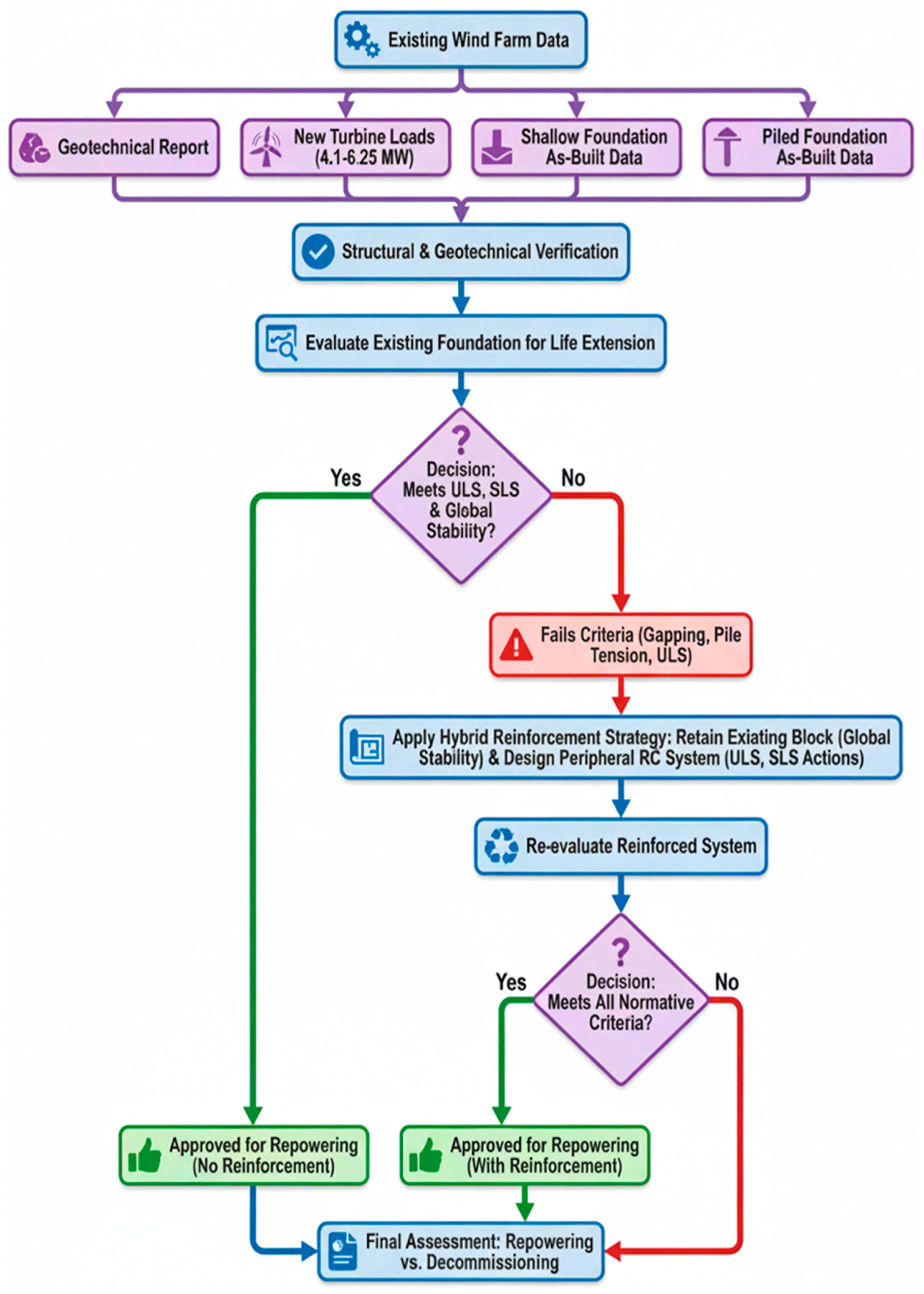
18]. Specifically, IEC 61400-6 served as the primary guideline for global stability and Serviceability Limit State (SLS) criteria, enforcing ‘no tension’ conditions for piled foundations and ‘no gapping’ for shallow units. DNVGL-ST-0126 provided supplementary limits for soil–structure interaction and deformation. For the reinforced concrete retrofit, Eurocode 2 was applied to size the reinforcement and verify critical sections under the Ultimate Limit State (ULS), as well as to evaluate cracking and fatigue under the Serviceability Limit State (SLS). Consequently, the existing foundation is utilized primarily for its mass, acting in conjunction with the hybrid reinforcement to satisfy the ‘no gapping’ and ‘no pile tension’ criteria. Meanwhile, the proposed new structural system is designed to independently resist all Ultimate Limit State (ULS) loads, undergoing comprehensive SLS and ULS evaluations. Only the standards and expressions directly applied in these analyses are detailed in this section.
For shallow gravity foundations, the concrete block is commonly modeled as a rigid body resting on a circular base with diameter D, radius R = D/2, and area A = πR
2. When subjected to an axial load and an overturning moment about its centroid, the soil contact pressure is assumed to follow a linear distribution, consistent with classical rigid body mechanics. The maximum contact pressure is expressed by Equation (1):
where
is the maximum soil pressure, N is the applied vertical load,
is the overturning resultant moment,
is the ultimate bearing resistance of the soil, and
is the geotechnical partial safety factor.
The bearing capacity adopted herein was determined from plate load tests performed at the foundation bearing level. This standardized procedure, following guidelines such as [
23], consists of applying incremental static loads to a rigid plate under slow loading and unloading cycles, recording the corresponding deflections and settlements. The interpretation of these results and their extrapolation to the in situ behavior of the circular wind turbine foundation were based on established methodologies from the geotechnical literature [
30,
31]. From the ultimate bearing capacity obtained in the test, an appropriate safety factor is applied to determine the design bearing capacity. These values are then utilized for the verification of soil–structure interface stresses and to obtain fundamental parameters, such as the vertical soil reaction.
For shallow foundations under the Serviceability Limit State (SLS), the ‘no gapping’ condition requires full compression across the soil–structure interface, which is satisfied when the load eccentricity is less than one-quarter of the foundation radius (Equation (2)). Under the Ultimate Limit State (ULS), this full compression constraint is relaxed; instead, it is required that at least 50% of the foundation area remains in contact with the soil, applying the same eccentricity-based formulation (Equation (3)):
Overturning stability is evaluated according to IEC 61400-6 [
12] by comparing the design stabilizing moment with the design overturning moment. The destabilizing moment includes wind actions and all horizontal and torsional effects, applying unfavorable partial safety factors. Conversely, the stabilizing moment is derived from the total gravity load (including the foundation, turbine, and backfill contributions) multiplied by the foundation radius, using favorable resistance factors. The foundation is considered stable when the ratio between the stabilizing and overturning moments exceeds unity under ULS conditions (Equation (4)):
where
is the design stabilizing moment and
is the design overturning moment and the criterion is satisfied when
> 1.
Sliding stability is assessed by comparing the design horizontal load at the soil–foundation interface with the design sliding resistance, in accordance with IEC 61400-6 [
12]. The design shear stress is determined from the horizontal action using unfavorable partial factors, while the sliding resistance is calculated based on the soil shear capacity incorporating favorable resistance factors. Stability under ULS is ensured when the design shear demand does not exceed the available resistance (Equation (5)):
where
is the design horizontal load acting at the interface, A is the effective contact area around the resultant vertical load,
is the design shear stress,
is the design sliding resistance.
For piled foundations, the pile group is generally idealized as a rigid section formed by
n piles uniformly arranged at a constant radius around the foundation center. When the system is subjected to a vertical load
and a resultant overturning moment
, and assuming that plane sections remain plane, the axial load in the
i-th pile located at coordinate
along the bending direction can be expressed by Equation (6):
In this formulation,
represents the axial load acting on pile i,
is the total applied vertical load,
is the number of piles in the group,
is the resultant bending moment acting on the foundation,
is the position of pile I measured along the moment axis, and
corresponds to the second geometric moment of the pile layout, representing the contribution of all pile positions to resisting the applied moment. The “no tension” condition for the pile group, as per IEC 61400-6, is checked as follows (Equation (7)):
For pile foundations, the total axial resistance is the sum of the base resistance and the shaft resistance mobilized along the embedded length. The characteristic base resistance and the characteristic shaft resistance are expressed by (Equations (8) and (9)):
where
is the characteristic base resistance,
is the characteristic unit base resistance acting at the pile tip, and
is the area of the pile base.
denotes the characteristic shaft resistance, Σ represents the contribution of all soil layers intersected by the pile,
is the characteristic unit shaft resistance in soil layer i, and
is the lateral surface area of the pile in contact with that layer.
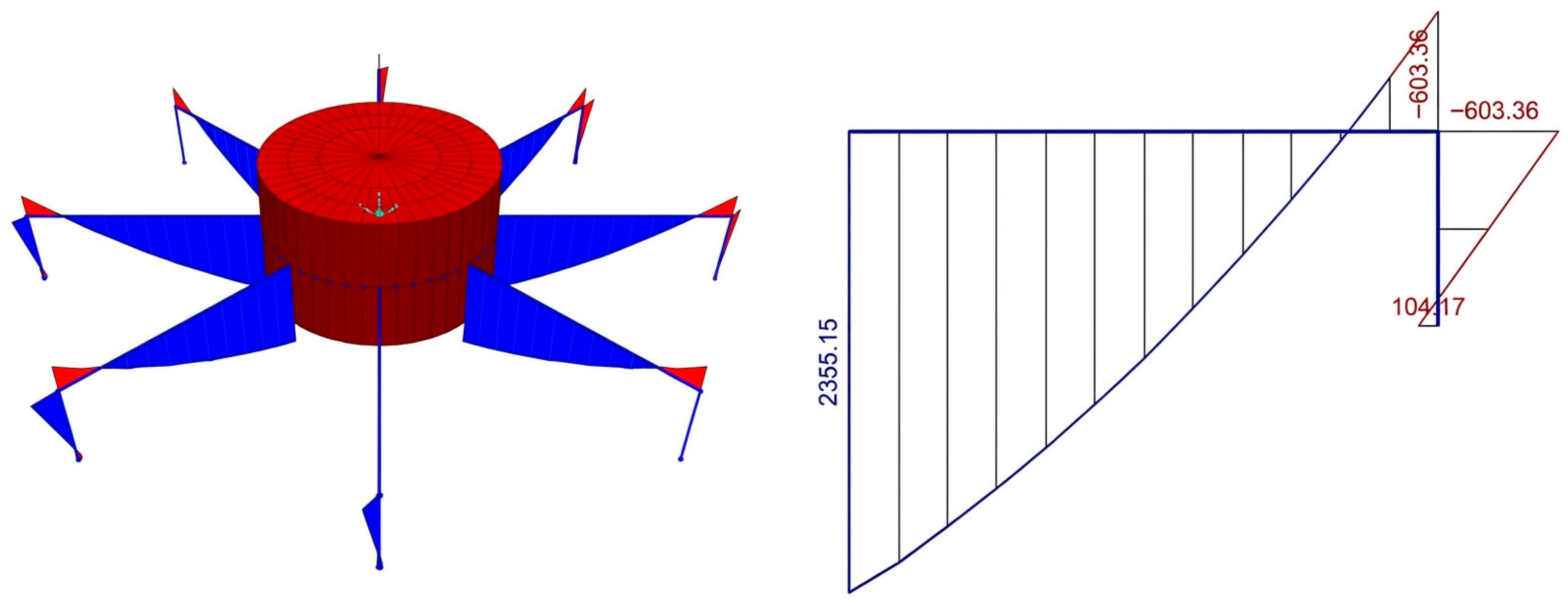
Design of the structural reinforcement elements (i.e., the main shaft, radial beams, and transition section) was performed for ULS considering global actions derived from the numerical model. All sections were assumed to behave linearly elastically up to the resistance limit. The radial beams are treated as reinforced concrete beams in simple flexure, evaluated under ULS per Eurocode 2. The objective is to ensure sufficient flexural (Equation (10)) and shear capacity, with geometry predetermined (Equation (11)):
where
denotes the required tensile steel area,
is the design bending moment,
is the internal lever arm, and
is the design yield strength of the reinforcement. The shear resistance expression includes the design concrete shear capacity
, the shear coefficient
, the size-effect factor
, the longitudinal reinforcement ratio
, and the concrete compressive strength
. The term
accounts for the contribution of the mean compressive stress
arising from the axial load, while
and
are the effective web width and effective depth of the section, respectively.
The transition section is checked at ULS as a compressed and bent member, following Eurocode 2 [
18] standards, based on the N-M interaction diagram representing simultaneous compressive and flexural resistance. The normal force and overturning moment from the numerical model are checked at selection section to ensure the representative point falls within the resistance envelope. The geometry and longitudinal/transverse reinforcement are sized to ensure sufficient flexural, compressive, and global stability (Equation (12)):
where
is the design axial force acting on the section;
is the design axial resistance;
is the design bending moment;
is the design flexural resistance.
Serviceability limit state verifications for the main shaft, radial beams, and transition section were conducted. However, due to their geometry and the load levels obtained from the numerical model, no SLS check was critical for final sizing. The following checks are presented for code completeness. Crack width is limited per Eurocode 2 to ensure durability and prevent reinforcement corrosion (Equation (13)):
where
is the characteristic crack width in the serviceability limit state,
is the maximum crack spacing determined by the steel-concrete bond-mechanics model,
is the mean strain in the tensile reinforcement after crack formation, and
is the mean concrete strain between cracks, accounting for the combined effects of shrinkage, creep, and stress transfer through bond. Concrete fatigue was assessed by typical EC2/classical relations (Equation (14)):
where
is the maximum compressive stress in the concrete under the considered fatigue load combination,
is the corresponding minimum compressive stress in the same loading cycle. The variable
corresponds to the design compressive strength of concrete for fatigue verification, incorporating the appropriate material partial factor and the fatigue reduction coefficient applied to the characteristic compressive strength
. The upper limit of 0.9 is applicable for concretes with
, as prescribed by the fatigue criteria for concrete in the governing standards. Fatigue in reinforcement is checked against the stress range (Equation (15)):
where
is the variation in steel stress induced by the cyclic load range considered in the fatigue verification and
is the characteristic fatigue stress range capacity of the reinforcing steel. For conventional reinforcing steel, the standard limit for the characteristic fatigue stress range is
, which establishes the upper admissible difference between the maximum and minimum steel stresses within each load cycle.