1. Introduction
Slender structures constitute a remarkable portion of the seismic studies of historical masonry structures. On the one hand, owing to their tall and slender geometry, which approximates cantilever beam behavior, and the weak tensile strength of their masonry material, they are highly susceptible to horizontal wind and earthquake forces. On the other hand, scarce documentation on their construction and the difficulties in reflecting the intrinsically complex behavior of masonry in numerical simulations impose important limitations on their vulnerability assessment. Among these structures, some of the prominent typologies are towers, industrial chimneys, buttresses, windcatchers, columns and obelisks, slender walls, and minarets.
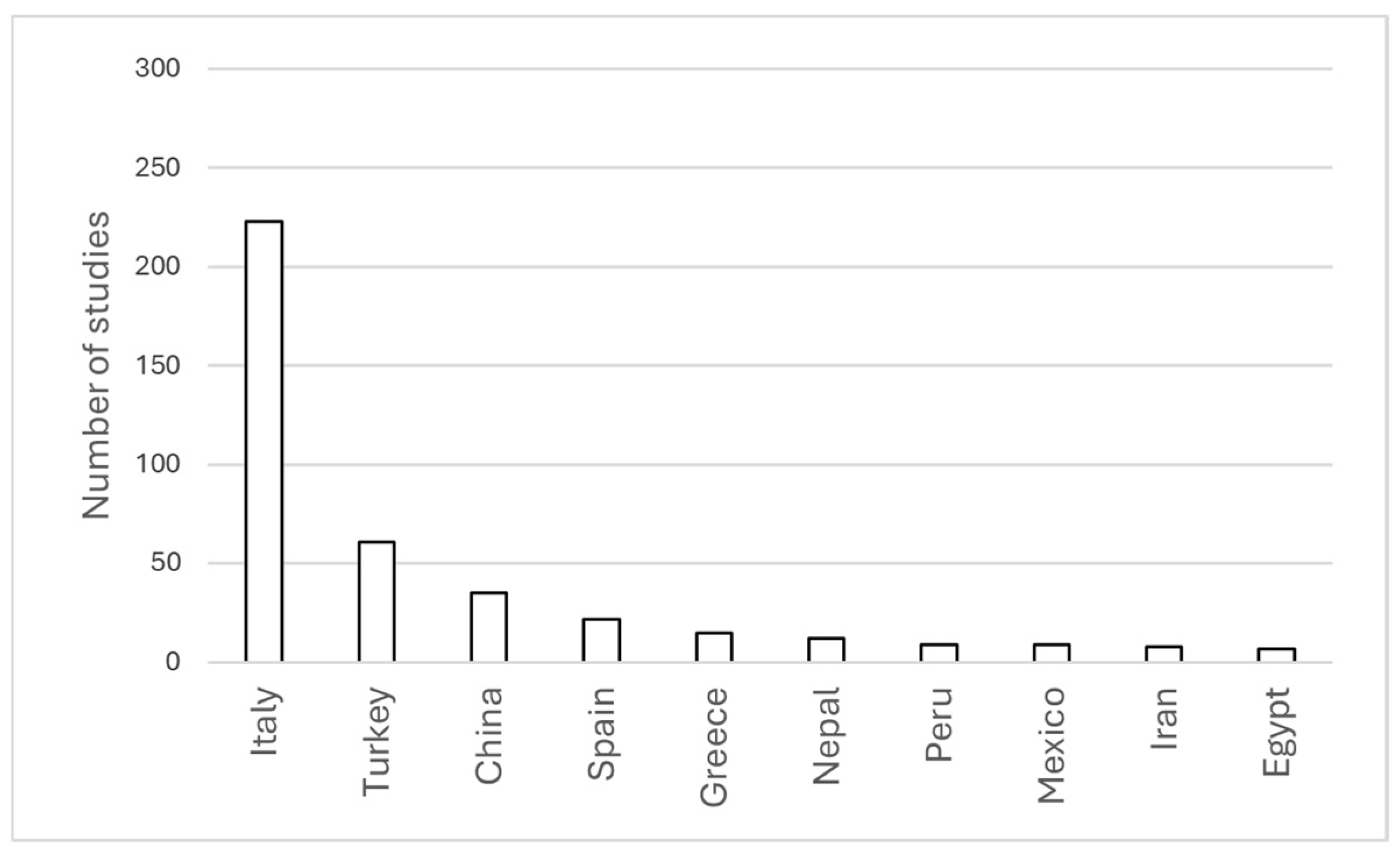
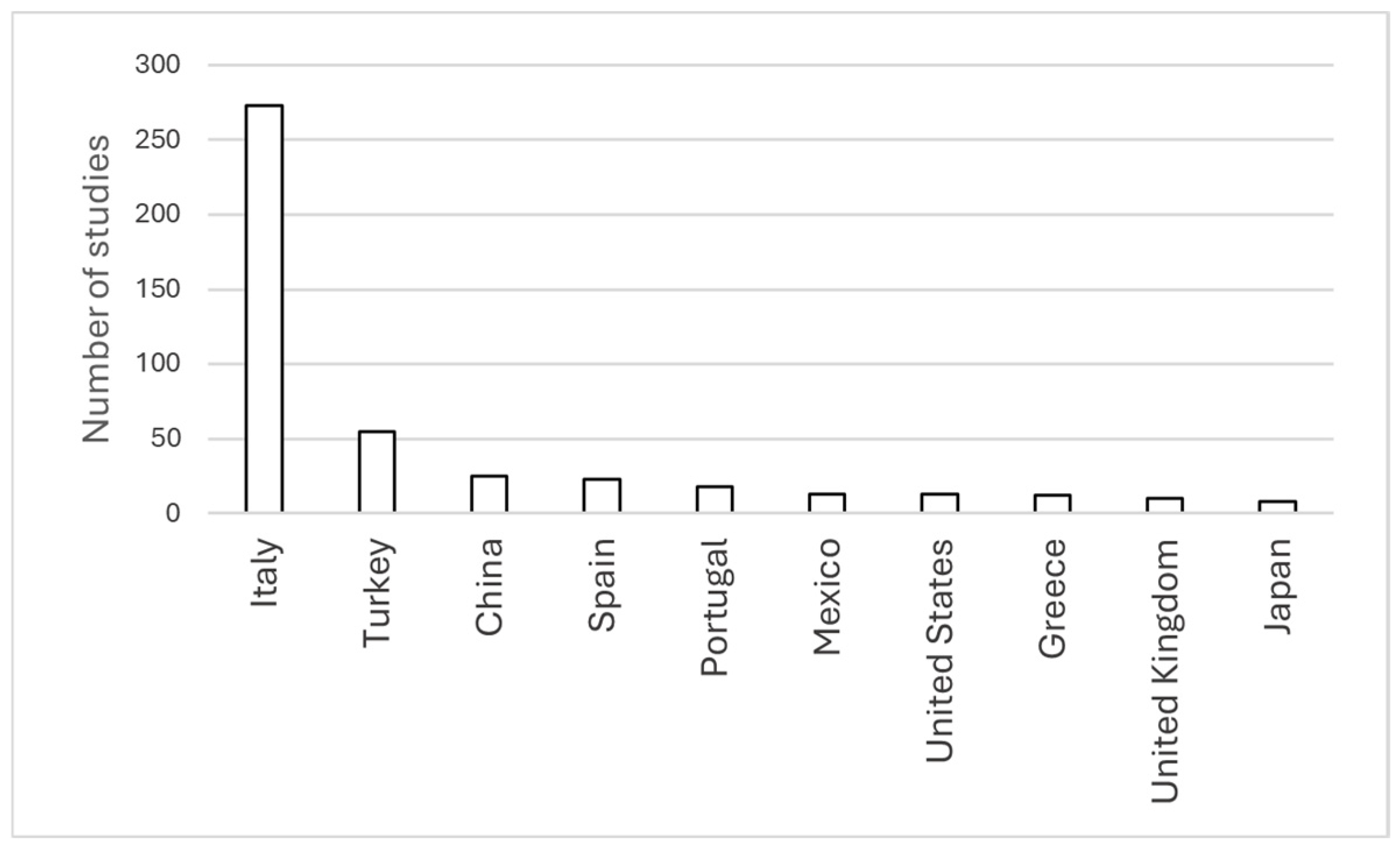
The seismic behavior of slender masonry structures has received increasing attention, especially after the L’Aquila (2009) and Amatrice (2016) earthquakes in Italy. To evaluate the current state of the art in the seismic assessment of slender masonry structures, a Scopus database search was conducted using search strings for relevant material, typology, and analysis types, followed by a detailed manual review of titles, keywords, and abstracts. The results indicate that the primary geographic focus of this research is centered on Italy, Turkey, China, Spain, and Greece (
Figure 1). According to the correspondence addresses of the researchers, the most active countries in this field are Italy, Turkey, China, Spain, and Portugal (
Figure 2). Italy has also been one of the leading countries in developing preservation policies for historical towers after the abovementioned earthquakes [
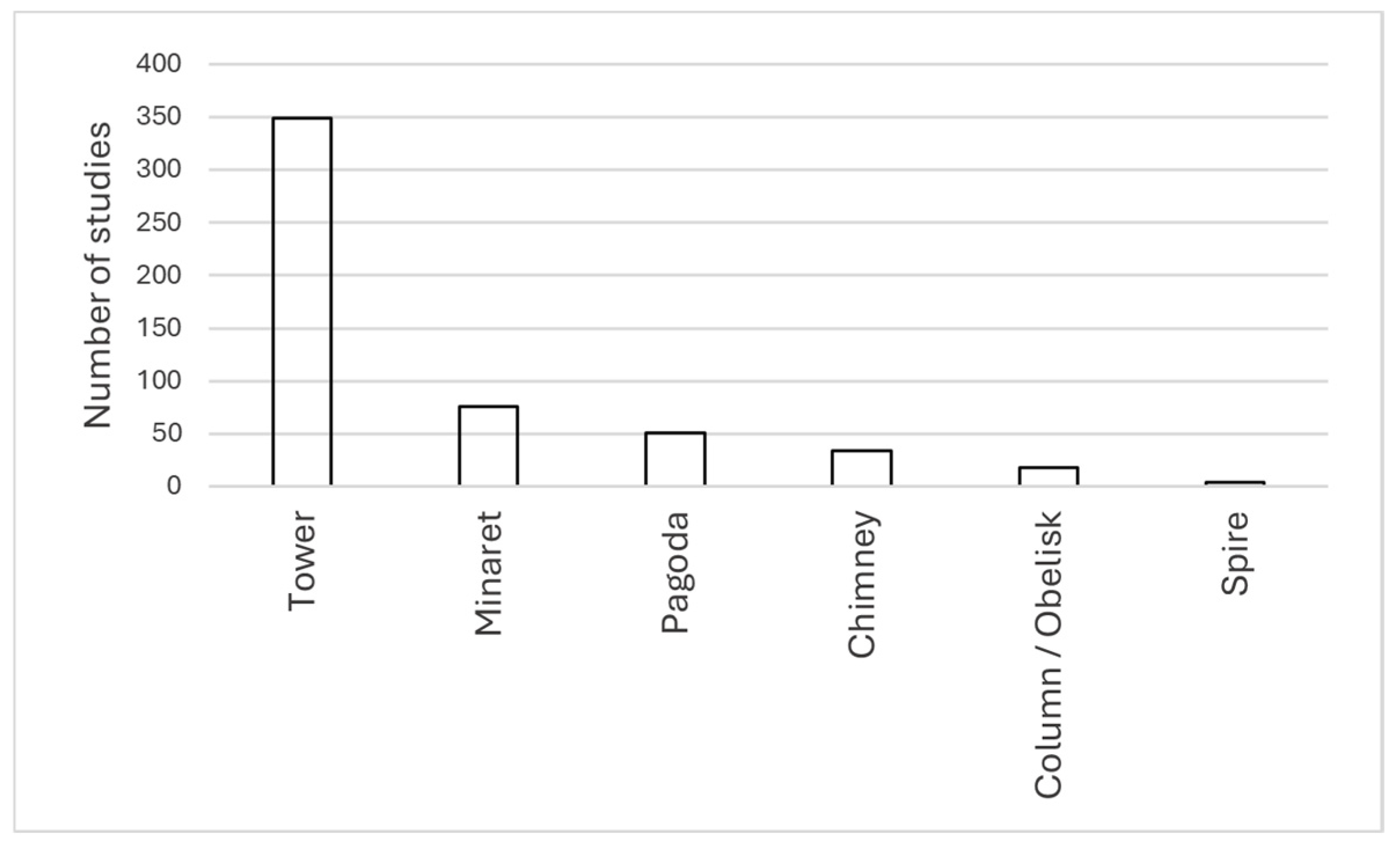
1]. The most frequently studied slender structure typology is towers (bell, civic, defense, and clock towers) (
Figure 3) [
2], while minarets, pagodas, and industrial chimneys constitute the other major groups.
The research trends and geographic distribution of the broader category of slender structures inform the specific context of minarets. Minarets exhibit similar fundamental dynamic characteristics to other slender structures. Owing to cantilever beam behavior, they are highly vulnerable to seismic effects. Furthermore, minarets are distinguished by their compact cross-sections, the connection types they form with neighboring buildings, construction techniques, and the morphology of segments that result in significant stylistic diversity. Thus, a dedicated framework is required to capture these differences, which are overlooked in more generalized studies of slender masonry structures. There is a growing body of research dealing with the seismic behavior and strengthening of minarets in different geographies, yet existing guidelines and standards are inadequate for improving their seismic resilience [
3,
4]. Likewise, a systematic investigation into their seismic vulnerability assessment, encompassing a diversity of styles, is still lacking.
This study presents a state-of-the-art review of seismic vulnerability assessments of masonry minarets. Focusing on the Southwest Asian and Mediterranean contexts, it includes minarets with differing morphologies and construction techniques. This study aims to evaluate the existing approaches, ranging from simplified models to advanced computational procedures, and proposes a simplified Kinematic Limit Analysis framework, an under-explored methodology for minaret structures. For this aim, a database is compiled from the minarets examined in the literature. Some geometric analyses are performed to delve into the relationship between their vulnerability and geometric features. Finally, the preliminary steps of the Kinematic Limit Analysis framework are introduced.
In the
Section 1, an introduction to the definition and styles of minarets in relation to the geographical scope of this research is provided.
Section 2 presents the compiled database of minarets with statistical and descriptive details. The main factors affecting their seismic performance are critically examined, particularly focusing on the structural elements identified as the most vulnerable. This contributes to deducing common failure mechanisms for the limit analysis procedure. A comprehensive literature review on minarets subjected to seismic excitation, where a variety of analytical, experimental, and numerical approaches are used, is presented. In
Section 3, a Kinematic Limit Analysis (KLA) approach based on pre-assigned failure mechanisms is proposed. As a rapid vulnerability assessment method, it identifies the most critical instances of structures, prioritizing them for sophisticated numerical analyses that would otherwise be unfeasible to implement across large-scale building stocks. First, based on the minarets compiled in the database, a geometry parametrization is provided to simplify and standardize the minaret structure for the KLA framework. Secondly, five pre-assigned failure mechanisms are introduced. Lastly, in
Section 4, four minaret examples from the database are used to demonstrate the applicability of the proposed approach.
1.1. Minarets
A minaret is a typology in Islamic religious architecture. It is a tower built for a mosque with the main function of calling the believers to pray. With the spread of Islam, in contact with different cultures, minarets evolved to show differences in architectural style, geometry, and material. There are also atypical examples, where existing bell towers or clock towers were converted into minarets, or vice versa. The diffusion of minaret typologies can be approximately traced from South and East Asia to Central Asia, the Middle East, Africa, Turkey, and Eastern and Southern Europe. They are generally classified into two groups: Eastern minarets are slender, cylindrical towers mostly found in Iran, Iraq, and Turkey; Western minarets, prevalent in North Africa, Spain, and Syria, are square-planned, shorter towers that sometimes include windows [
5]. While the latter group greatly resembles the bell tower typology already well established in the literature, the former exhibits a more compact and slender profile with a segmented morphology. Accordingly, this study focuses on the Southwest Asia and Mediterranean regions, associated with the more distinct group of Eastern minarets.
As slender structures, minarets are highly vulnerable to earthquakes. Southwest Asia and the Mediterranean are among the most seismically active regions in the world. In parallel to this, the literature on the seismic vulnerability of slender masonry structures, including minaret typology, is concentrated in this area. In Turkey, especially after the 1999 and 2023 earthquakes, studies on the seismic performance of masonry and reinforced concrete minarets increased. However, seismic design and preservation guidelines specific to minarets are still lacking [
6,
7,
8,
9]. Balkan countries and Greece have high seismic risks, coupled with a significant heritage building stock, including mosques and minarets that are predominantly from the Ottoman period (14th–19th centuries) [
10,
11,
12]. Their minaret styles are largely coherent among each other, as well as with Turkey, although the number of preserved structures has diminished over the last century [
13,
14]. In Egypt, studies on minarets have been increasing since historical minarets are reported to fail under soil/ground conditions, material degradation and neglect, but particularly because of earthquakes. Despite Egypt having low to moderate seismicity, the Dahshur Earthquake in 1992 was a milestone for Egypt, where many monuments in historical Cairo, including minarets, were severely damaged. As a challenge to their preservation, there is a great diversity of minarets from different Islamic periods and a lack of preservation policy [
15,
16,
17,
18]. In Iran, the rich minaret heritage from the early Islamic, Seljuk, and Safavid periods remains largely understudied in terms of seismic analysis, while the most earthquake-prone cities, like Tehran, Tabriz, and Isfahan, have a great number of vulnerable heritage minarets [
19,
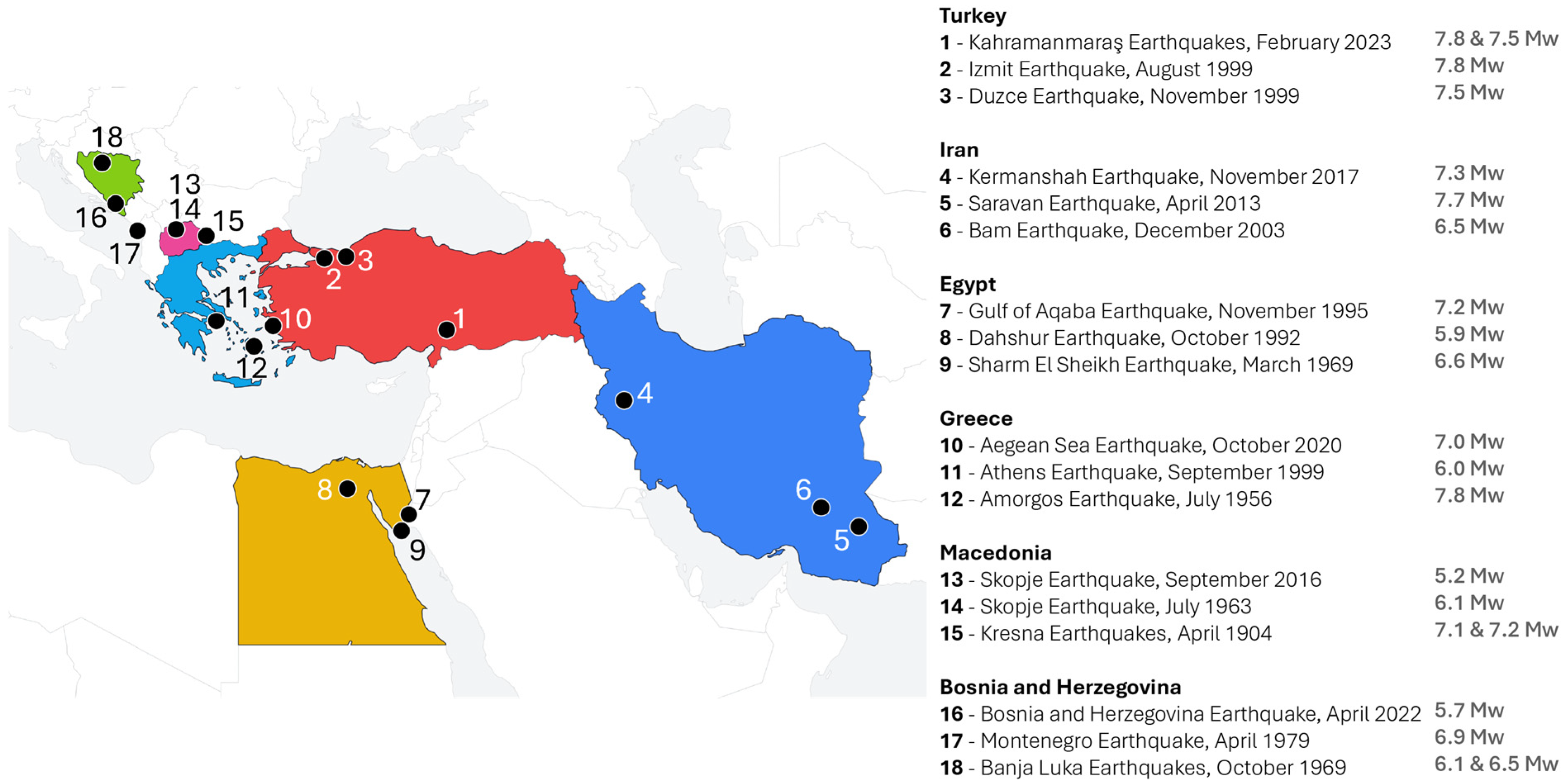
20]. Due to the stylistic differences between minarets in these regions, their high seismic risk, and the geographic coverage of the existing literature, the present research focuses on minarets in Turkey, Iran, Egypt, Greece, Macedonia, and Bosnia and Herzegovina (
Figure 4). The minaret styles across these regions differ predominantly in their morphology, while some core segments are common. The geometry, segments, and construction of minarets in selected countries are explained below in detail.
1.2. Turkey
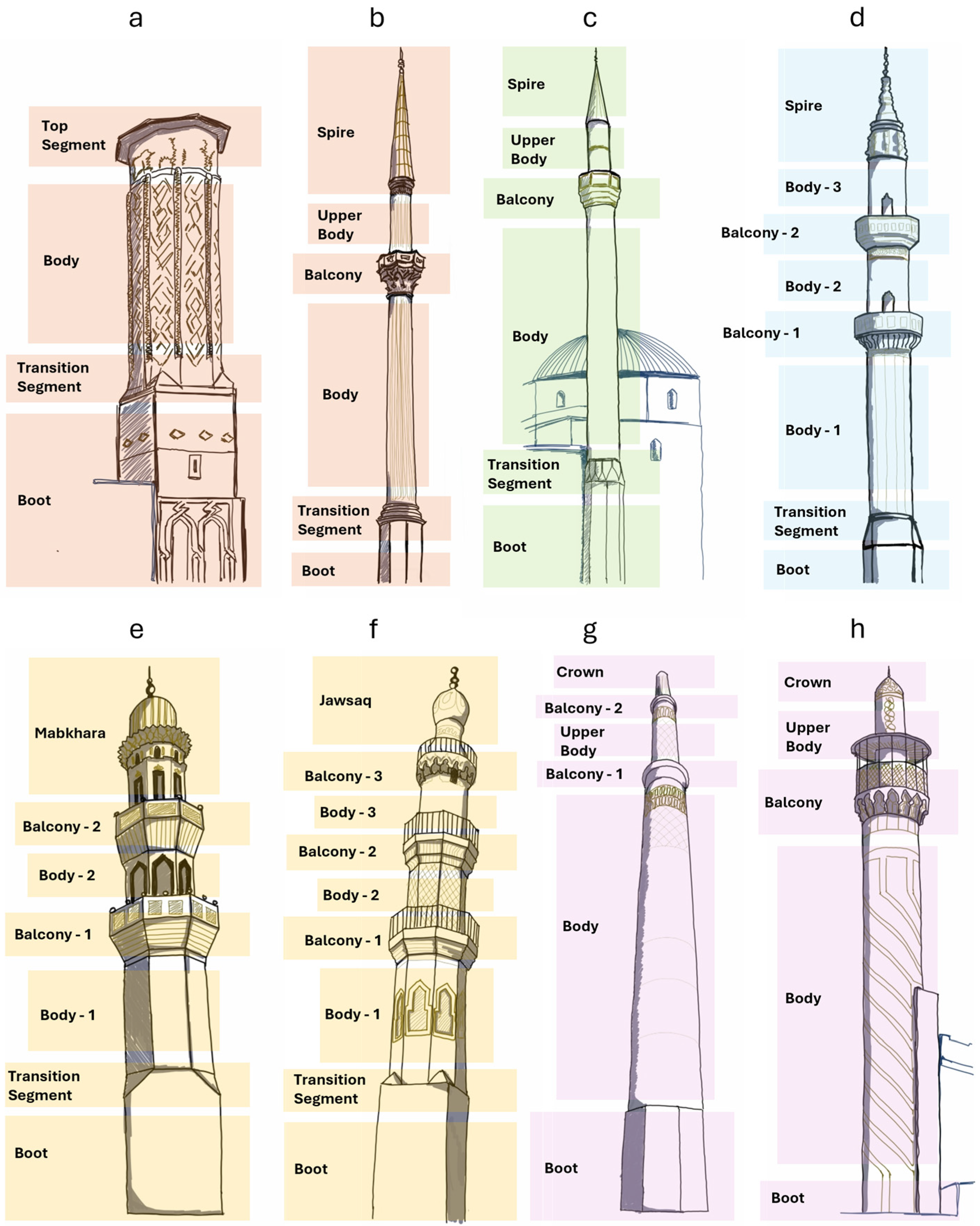
In Turkey, minarets can be generally examined under the Seljuk and Early and Classical Ottoman periods. A regional typology can be observed in early minarets from the Anatolian Emirates period in East Anatolia, which, with their rectangular tower-like bodies, were influenced by the Syrian style. Predominantly built in brick and decorated with glazed tiles, Seljuk minarets share characteristics with their Central Asian and Iranian counterparts. They are usually built connected to the main building, or on top of portals, sometimes as twins flanking two sides. They have shorter and thicker bodies compared to later-period minarets in Turkey (
Figure 5a) [
21].
The minarets from the Early to Classical Ottoman periods gradually gained more slender profiles and employed stone masonry as the main building material. In the 16–17th centuries, a classical form composed of the core segments (boot–transition segment–body–balcony–upper body–spire) developed (
Figure 5b). A minaret with many balconies and a greater height signified royal patronage. After the 18th century, Baroque, Rococo, Ampiric, and other decorative styles were integrated into minarets. Up to the current date, despite these architectural influences and the widespread use of new construction techniques like steel and reinforced concrete, minarets in Turkey have deviated very little from the Classical Ottoman style [
6,
21,
22]. In the Ottoman period, as a particular minaret building technique, metal clamps and dowels were used as a strengthening measure. The horizontally and vertically connected stone blocks worked as drums, increasing the tensile resistance of the structure against earthquakes [
22].
1.3. Balkans and the Mediterranean
The minarets in Balkan and Mediterranean countries that were under Ottoman reign, approximately between the 14th and 19th centuries (Albania, Bosnia and Herzegovina, Bulgaria, Croatia, Cyprus, Greece, Hungary, Kosovo, Macedonia, Montenegro, Romania, and Serbia), generally follow the Ottoman minaret style (
Figure 5c,d). As a result, they show great resemblance to each other and the examples in Turkey. Besides this representative style, certain local variations can be observed, such as the campanile minarets in Bosnia and Herzegovina, which resemble bell towers with their rectangular cross-sections [
23]. As considered in this study, in Bosnia and Herzegovina, Greece, and Macedonia, the common building materials are locally available stone, wood, and a few examples of brick. Metal clamps and dowels were used in these minarets as well [
24,
25,
26,
27].
1.4. Egypt
Minarets in Egypt are investigated under five historical periods. The earliest minarets belong to the Tulunid period (827–904), though very few examples have survived to the present day. In the Fatimid period (969–1171), the boot (mostly square planned), body, and the Mabkhara top appeared as typical segments. Later in the Ayyubid period (1171–1250) (
Figure 5e), the minarets became slenderer. In the Mamluk period (1250–1517), the geometric irregularities increased with the inclusion of smooth transition segments and decorative moldings and grooves. Jawsaqs started to be used as a top segment variation (
Figure 5f). Lastly, in the Ottoman Turk period (1517–1848), minarets were similar to Classical Ottoman minarets, with slender, pencil-like bodies and spires [
28,
29,
30].
Egyptian minarets can have multiple bodies along the height with diverse cross-sections, and the transitions between them are made with balconies or stalactites. The upper body is usually a pavilion encircled by columns and arches supporting the top segment, which is a combination referred to as a Mabkhara-style minaret (
Figure 5e). The commonly used materials are stone (particularly limestone) and brick, as well as wood and marble as secondary elements. The top segments from the Ottoman period are usually spires made of wooden frames covered with lead plates. Jawsaq and Mabkhara tops are mostly made of masonry [
15,
31].
1.5. Iran
The earliest minarets in Iran were usually single and stand-alone structures. During the Seljuk period, they started to be attached to or placed on top of the buildings, sometimes as twins flanking two sides. The cross-sectional shape of the base is usually maintained along the height, resulting in a more uniform structure (
Figure 5g). Likewise, some minarets lack the boot and transition segment. The balcony can be in the middle or at the end of the body. Iranian minarets are usually in a truncated form for better resistance to lateral loads. The building material is predominantly brick, with glazed tiles and bricks used as decoration, especially in the Safavid period (
Figure 5h) [
20,
29,
32,
33].
2. Creation of a Database and Seismic Vulnerability Assessment of Masonry Minarets
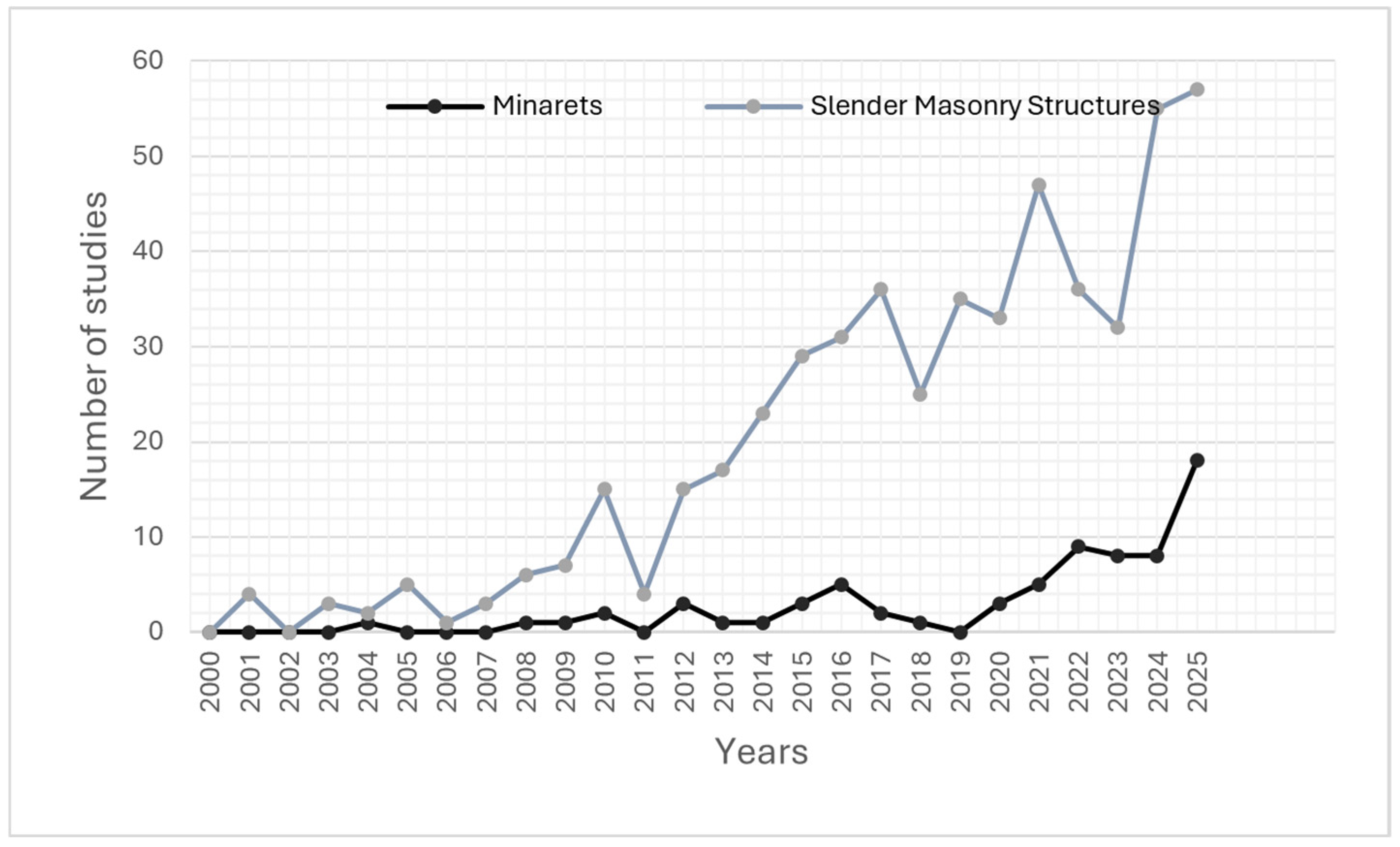
In parallel with studies on the seismic assessment of the general category of slender structures, research focusing on masonry minarets has seen a notable increase since 2019 (
Figure 6), although it remains significantly lower than the growth observed in the general category. The focus and affiliations of research on minarets are concentrated in Turkey because of the influence of the 1999 Kocaeli and Düzce Earthquakes and the more recent 2023 Turkey–Syria earthquakes. In these events, minarets were severely damaged, highlighting the urgency of finding effective protection measures and developing special regulations and standards for the design and preservation of these structures [
8,
34,
35].
A comprehensive literature review on the seismic vulnerability of diverse masonry minaret styles allowed the authors to create a database of the real minaret information given in these studies. For this, systematic research across major databases and thesis repositories from the examined countries was conducted to search articles, book chapters, conference proceedings, and theses on the seismic and structural performance of masonry minarets. A database was compiled in Microsoft Excel (version 2603; Microsoft Corp., Redmond, WA, USA) from case studies that provide explicit structural, modal, and geometric details of existing minarets from the Southwest Asia and Mediterranean regions. In the case of duplicates, the study with a more comprehensive technical analysis was considered. For some studies, the authors were contacted to request unpublished critical details. The geometrical and material properties and the fundamental period data of the minarets were extracted. To ensure consistency, all entries were processed according to the simplified parametrization proposed in this study, which is detailed in the following sections. Where applicable, the regions that were previously damaged, collapsed, rebuilt, or identified as vulnerable through the analysis were marked. Finally, the methodologies of analysis were examined and classified.
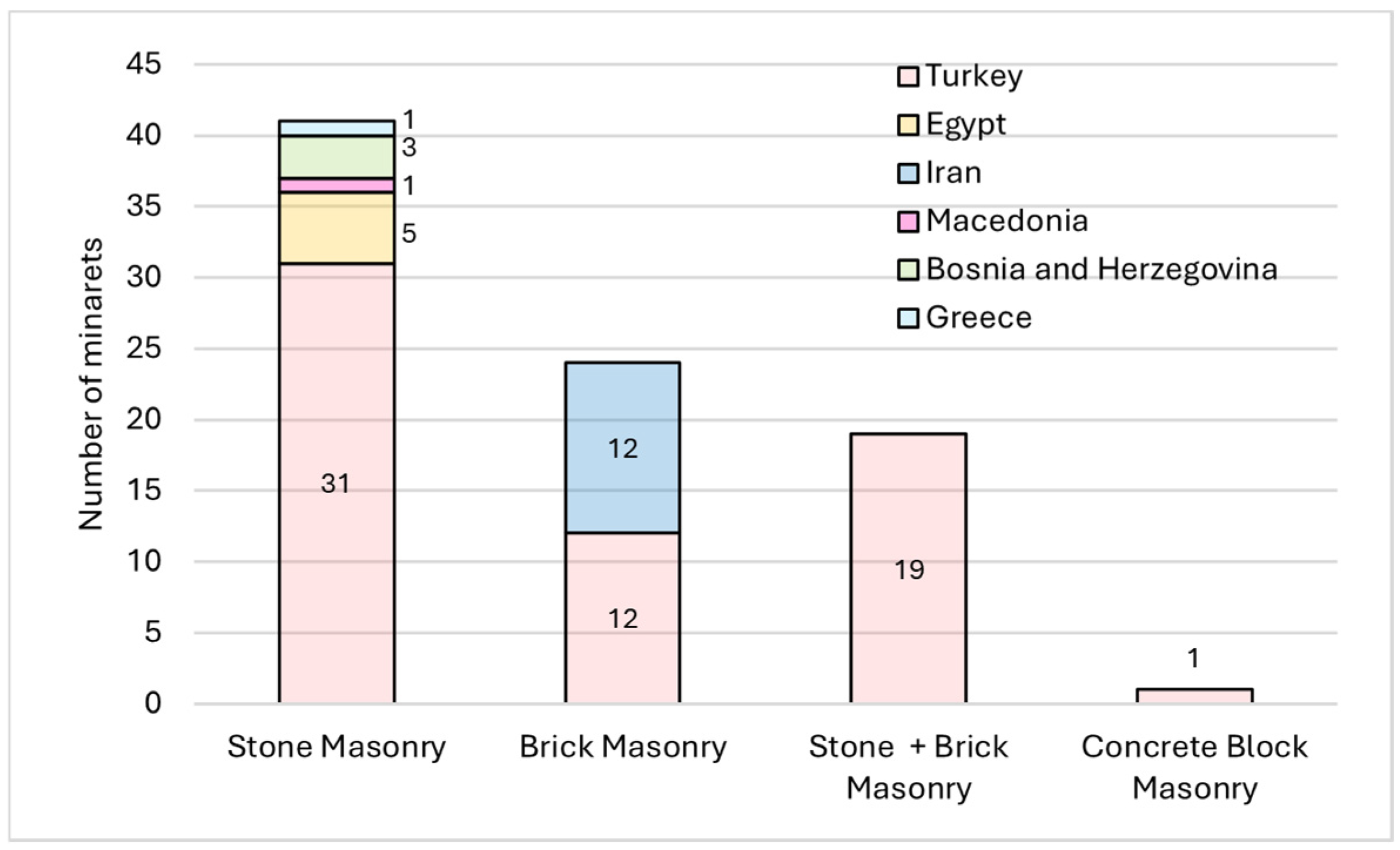
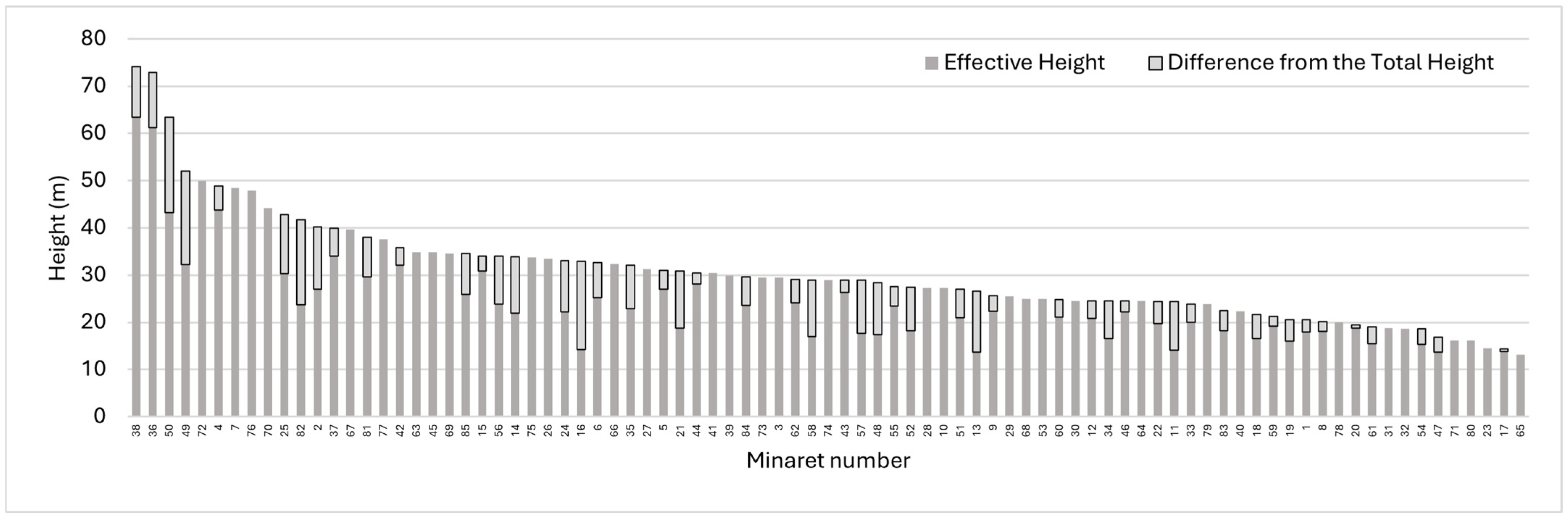
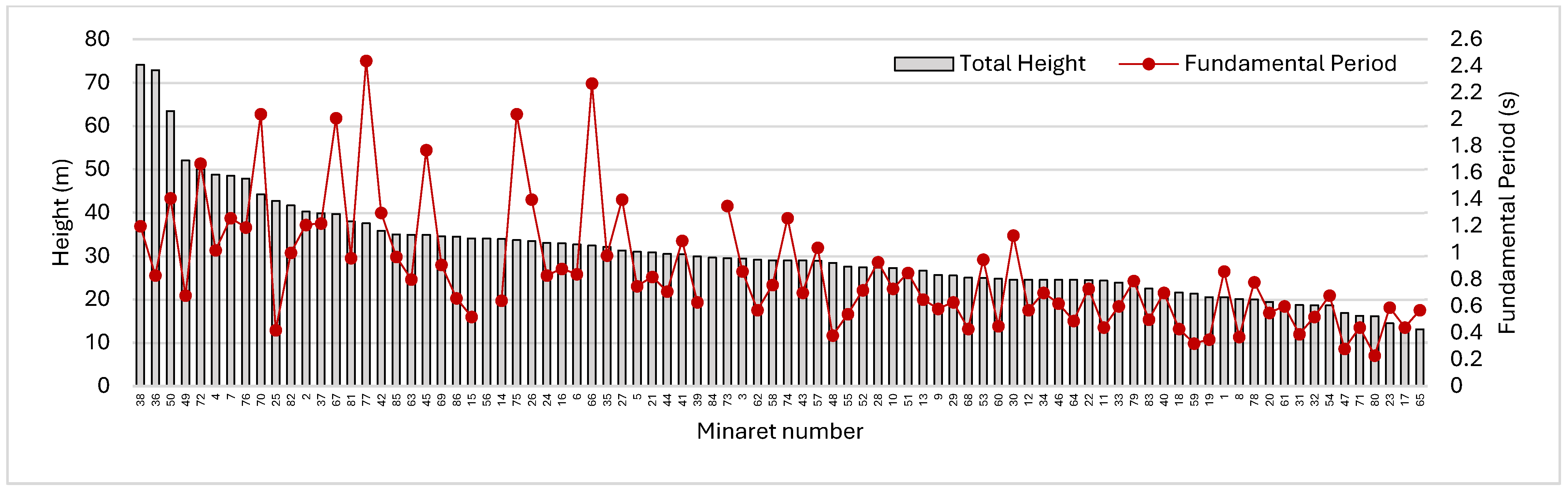
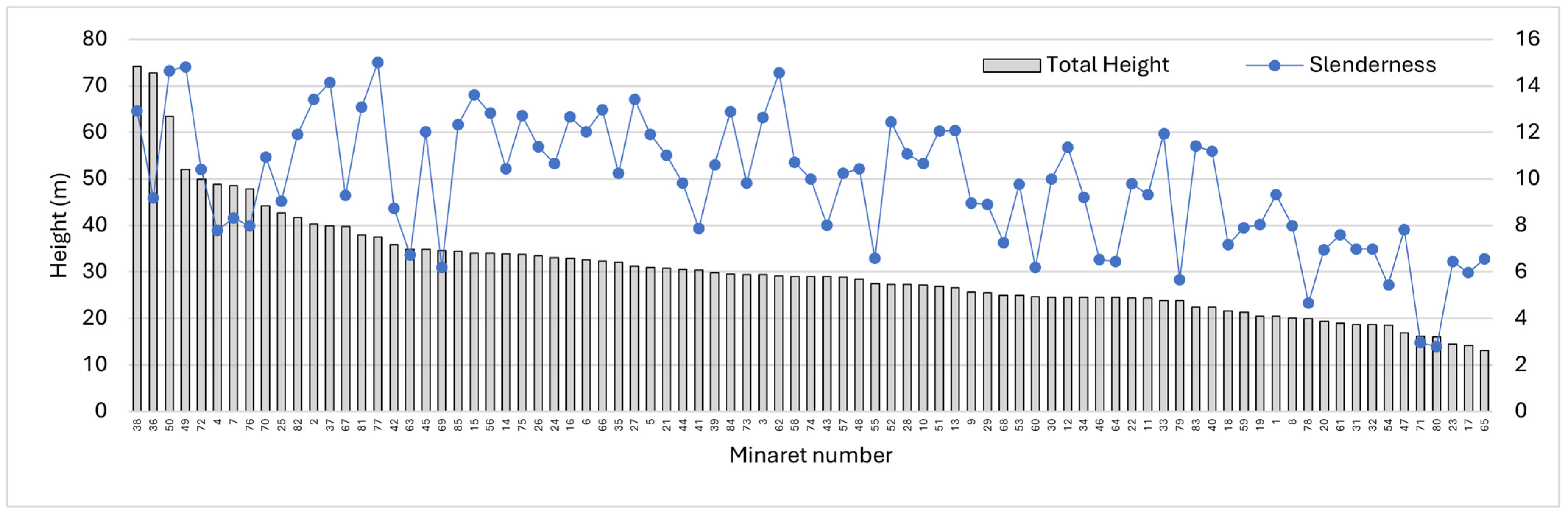
The database is composed of 86 masonry minarets built between the 8th and 21st centuries. Among them, 63 minarets are from Turkey, 5 are from Egypt, 12 are from Iran, 1 is from Macedonia, 3 are from Bosnia and Herzegovina, and 2 are from Greece (
Table A1). They vary between 74.16 m and 13.11 m in height and 2.77 and 15.16 in slenderness ratios. The related statistical descriptions are given in
Figure 7,
Figure 8,
Figure 9 and
Figure 10.
It should be noted that for the height of the minaret, two parameters, total and effective height, are used. If the minaret is structurally connected to another building, this part is excluded from the total height to obtain the effective height. Since the influence of the boundary conditions on the seismic response of minarets is an often-discussed topic, it is necessary to make such a distinction. In addition, if the top segment is built with a material with a clearly smaller specific weight than masonry (like spires made of timber frames covered in lead sheets), its height is excluded, which is a decision parallel to the majority of experimental and analytical studies.
Seismic vulnerability studies on masonry minarets can be divided into empirical, analytical, numerical, experimental, and hybrid approaches. Empirical approaches use qualitative observations and/or cause–effect inference. Analytical and numerical approaches typically study the structure by means of computer tools or—less frequently—with closed-form solutions and manual procedures. Experimental approaches are based on material and dynamic tests. Finally, hybrid approaches are a combination of the above [
36]. Field surveys and experimental tests on minarets (on the structure or the masonry material) can be seen under the empirical category, although in the currently investigated literature, they are often combined with analytical methods.
2.1. Field Surveys
Post-earthquake surveys have provided valuable qualitative information on the failures observed in minarets. The condition of specific segments, boundary conditions, materials, construction techniques, etc., is reported to be a key factor in predicting minarets’ vulnerability. However, the recurring damage mechanisms are usually not described with a sufficient level of detail in terms of specific crack patterns or the precise location of failure. Moreover, they often consider specific paradigmatic examples that cannot be generalized to create consistent evaluation frameworks. Due to this research gap, recently, there has been an emerging focus on developing qualitative damage parameters, damage assessment forms, and seismic fragility curves [
6,
15,
37,
38,
39,
40,
41]. In this regard, some performance limits and damage standardization proposed for masonry minarets are presented in
Table 1. Among these, the performance levels based on the drift ratio presented by the General Directorate of Foundations of Turkey [
38] are for historical buildings in general, but they are used by several studies for masonry minarets. Yet, other studies define damage types specific to minarets and their certain segments, informed by field survey observations. Overall, they indicate that the damage level increases with scale and the structural importance of the collapsing section.
A vulnerability index is proposed by Shakya [
36] for slender structures based on a qualitative evaluation system from Italy [
42]. In this index, the most important parameters for minarets are defined as the quality and shear resistance of masonry, the slenderness ratio, interaction with adjacent structures, irregularity in elevation due to wall thickness variation, flooring and roofing typologies, the presence of non-structural elements such as balconies, and the soil type. Regarding this index, Sallam et al. [
15] suggested removing the floor and roof parameters, as they were deemed less significant factors. In Turkey, Mişe et al. [
43] adopted a risk assessment method developed for Italian churches into a rapid damage assessment form for mosques [
44]. Based on damage probability matrices and vulnerability curves, Yılmaz et al. [
41] presented a post-earthquake survey damage assessment form for mosques and minarets.
2.2. Experimental Studies
Experimental studies on masonry structures employ destructive, minor destructive (MDTs) or non-destructive tests (NDTs), with the latter two being more common due to the overriding need to preserve the integrity of the heritage asset [
2]. These tests detail the material characteristics, organization of masonry leaves, heterogeneity of the wall texture, damage conditions, and ultimately the global behavior of the structure. Dynamic tests with Operational Modal Analysis (OMA) and Ambient Vibration Testing (AVT) are widely used for the determination of the natural frequencies, mode shapes, and damping of structures. Within OMA, several algorithms are applied, such as Frequency Domain Decomposition (FDD), Enhanced Frequency Domain Decomposition (EFDD), and Stochastic Subspace Identification (SSI) [
11]. By accurately accounting for material properties and soil effects, OMA reconciles discrepancies between real-world data and numerical model assumptions, enabling model updating and calibration [
45,
46,
47].
In a few studies, scaled minaret models were built to perform shaking table tests [
11,
48,
49] and experiments with accelerometers [
50,
51]. To track the dynamic data and cracks on minarets, classic Structural Health Monitoring (SHM) is the most common method [
52], but recently, some innovative approaches have been proposed, including video-based SHM [
51], terrestrial laser scanners [
53,
54], damage detection through Machine Learning (ML) [
55], and digital twin creation [
56,
57].
2.3. Analytical and Numerical Studies
Several numerical approaches, ranging from simplified methods to advanced computational models, are available for evaluating the seismic performance of masonry minarets.
2.3.1. Modal Analysis
Modal analysis is important for identifying mode shapes, frequencies, and corresponding participating mass, which are used to compare the fundamental period of the structure with the site spectrum. The elastic dynamic behavior of a minaret is typically compared to that of a cantilever beam. Therefore, formulas that are derived from closed-form solutions based on average geometric and material properties can be used. In the earliest studies on the fundamental period estimation of minarets [
58,
59], they are considered under the larger category of slender structures. Yet, minarets present particular features in terms of geometry (segments and mass irregularity), boundary conditions, and building techniques. Therefore, different empirical formulas specific to minarets are proposed to estimate their fundamental and higher periods [
15,
46,
60,
61,
62,
63], and the results have been found to be reliable. In the study by Erkal and Hilmi [
64], empirical formulas are derived using parametric modal analyses on a large set of virtually generated minaret models validated against real minaret data from the literature. Recently, innovative Artificial Neural Network (ANN) and ML approaches have been developed for the period estimation of Ottoman minarets [
65,
66,
67]. In cases of irregularities in the mass distribution, complex boundary conditions, and varying cross-sections, 3D finite element (FE) modeling is also useful.
It is worth mentioning that the main limitations in modal analyses available in the literature are that they usually focus on a specific typology (predominantly Turkey), and the consideration of the minaret segments in the calculations is not consistent between them. It is widely recognized that the linear elastic procedure in modal analysis fails to capture progressive degradation of stiffness and the manifestation of material nonlinearity, which triggers a shift in the effective period. Furthermore, modal data alone is insufficient to fully describe the seismic response in terms of estimating failure mode and location.
2.3.2. Finite Element Method (FEM)
The FEM is the most widely used tool for assessing the seismic behavior of masonry structures [
68], and minarets do not represent an exception. In this method, the structure is typically discretized by means of 3D elements. In several cases, nonlinear masonry behavior is assumed, including softening, plasticity and damage. Different element types can be used (e.g., plates, shells and frames) to model the structure or its parts. To represent the masonry in different scales and components, there are modeling strategies ranging from detailed micro-modeling to macro-modeling. While the latter is the most preferred due to its feasibility for large and complicated structures, others have been mostly applied to small-scale models [
69]. In the examined literature on minarets, most studies employ the FEM as a numerical procedure. With this approach, minarets are studied in the elastic, nonlinear static, linear and nonlinear dynamic ranges. Nevertheless, due to the typical material nonlinearity and in consideration of the limited potential of the elastic assumption, the FEM remains a sophisticated tool that is demanding of time and resources. Geometric simplifications and material assumptions made to manage uncertainties regarding a building’s construction remain a critical challenge—an issue that concerns numerical modeling approaches in general. Reflecting the actual state of a structure requires further calibration or experimental validation; however, the feasibility of such procedures is often constrained by budgetary limits and the scope of the study. As these buildings are often designated cultural heritage monuments, obtaining permission is a constraint. Moreover, the reliability of the results of FE analysis is strongly dependent on the practitioner’s experience.
2.3.3. Discrete Element Method (DEM)
In this approach, masonry is modeled with rigid, elastic, or elastoplastic blocks interacting through frictional interfaces. Giving detailed information on crack formation and collapse mechanisms, the DEM is commonly considered more suitable than the FEM in the reproduction of masonry geometry and damage progression [
70]. However, the intrinsic dynamic nature of the approach and the use of detailed micro-modeling can be time-consuming and have very high computational costs, which makes it more suitable for small-scale structures or specific parts. Furthermore, the DEM requires careful material calibration with the definition of a suitable interface model [
68]. For minarets, several studies have employed the DEM with the utilization of commercial software, in combination with the FEM, or using the FEM with contact interface elements. For instance, in Kazaz et al. [
71], the base of the minaret—composed of dry joint columns and lintels—was modeled with an explicit finite element code, which imposed discrete behavior on this part. In Erdoğan et al. [
72], a combined finite/discrete element approach was used in which each section of the minaret was represented as a cylindrical unit (composed of stones connected by metal clamps) using brick elements, and a linear elastic material assumption was adopted. Also, in Çaktı et al. [
73], the metal clamps of the minaret were modeled between the stone units, and rigid blocks were employed for numerical modeling in 3DEC (
https://itascasoftware.com/products/3dec/, accessed on 17 March 2026). In Aslan et al. [
56], the DEM was employed through a Blender plugin (
https://www.blender.org/, accessed on 17 March 2026) for the high-fidelity modeling of the brick units.
2.3.4. Applied Element Method (AEM)
As a numerical method bridging the FEM and DEM, the Applied Element Method is regarded as being very effective in tracking crack propagation while being computationally faster than the DEM [
74]. In the AEM, spring connections are used between small masonry elements where crack openings are possible. This way, the structure is simulated at the initial load stages as a continuum, similar to the FEM, while at higher loads, as the cracks are progressively activated, the material separation is exhibited as in the DEM. Therefore, realistic crack patterns, failure, and even post-failure representations are achieved. For minarets, in several studies [
11,
74,
75], nonlinear dynamic analyses were performed using AEM models in the ELS software (
https://www.extremeloading.com/structural-analysis-software/aem-solver/, accessed on 17 March 2026). Compared to the FEM and DEM, the required computational resources and expertise are moderate, yet AEM can still pose a limitation for large-scale rapid screening.
2.3.5. Limit Analysis
Limit analysis concepts were first applied to masonry structures by Heyman [
76] using a lower-bound approach (thrust line). This has the advantage of providing predictions of collapse loads on the safe side, with solutions in equilibrium featuring material admissibility. This method is based on three main theoretical assumptions made by Heyman [
76]: (i) masonry is unable to withstand tensile stresses, (ii) masonry has infinite compressive strength, and (iii) sliding between blocks is not allowed. The working principle involves calculating equilibrium and imposing material admissibility on internal actions or stresses. The Kinematic (upper-bound) approach provides the same collapse multiplier, which can be calculated by applying the principle of virtual work on kinematic chains. These are noted as collapse mechanisms, which are constituted by rigid macro-blocks mutually roto-translating around cylindrical flexural hinges with vanishing plastic dissipation [
77]. Different mechanisms are tested to identify the most probable mechanism with a minimum collapse multiplier. For the manual implementation of Kinematic Limit Analysis, a priori knowledge of collapse mechanisms for the structure is required, which is typically deduced from failure modes and crack patterns observed in similar structures during post-earthquake surveys.
The Kinematic approach is regarded as more straightforward and intuitive and has received great attention since the 1990s [
78]. It has been applied to a variety of problems, including masonry aggregates [
79,
80,
81] and historical buildings [
82,
83,
84], arches [
85], bridges [
77,
86], domes [
87], vaults [
88,
89], towers [
90,
91,
92,
93,
94], and pagodas [
95]. In Italy, it represents the base of so-called “linear kinematic analysis” [
96], implemented for the identification of partial failure mechanisms in existing buildings. This has been further specialized by the Guidelines for Built Heritage [
44], resulting in 28 mechanisms used to evaluate the seismic vulnerability of masonry churches.
With a manual procedure, limit analysis requires minimal structural data, including geometrical information and loading conditions. The accuracy of the analysis depends on the correct identification of the set of collapse mechanisms since the main drawback of the method is the risk of overestimating the load-carrying capacity in line with the upper-bound theorem [
97]. The idealization of the structure is another challenge that is being overcome with new geometric tools suitable for dealing with complex geometries [
90,
98]. The kinematic theorem of limit analysis has also been combined with both the FEM [
79,
99] and DEM [
100] while sharing similar problems of complexity, already pointed out above. Still, it must be acknowledged that automatization of the problem leads to consistent and robust solutions [
99]. Despite the wide literature that is available nowadays for masonry minarets, there is a limited number of studies employing limit analysis for this typology. Gunes et al. [
84] and Kılınçarslan [
101] employed this approach for two case studies of minarets with one pre-determined mechanism of collapse from the transition segment. Sesigur et al. [
102] tested four failure mechanisms for a minaret in Algeria. Izol et al. [
103] applied limit analysis to a square-based minaret, considering five collapse mechanisms proposed by Sarhosis et al. [
91] for towers. In the present research, the authors propose following a more systematic approach applicable to different minaret typologies by considering the commonly observed failures as pre-determined collapse mechanisms.
3. Limit Analysis Framework
To propose a Kinematic Limit Analysis framework for minarets, it is necessary to examine and categorize the geometry and possible collapse mechanisms in a taxonomy. For these purposes, in the first part of this section, a geometric parametrization for minarets is introduced. In the second part, the main features rendering minarets vulnerable to seismic actions and commonly observed damage patterns are presented, which provides a sound basis for the critical stage of identifying the collapse mechanisms. Lastly, the proposed KLA framework is applied to four minarets.
3.1. Proposed Geometric Parameters
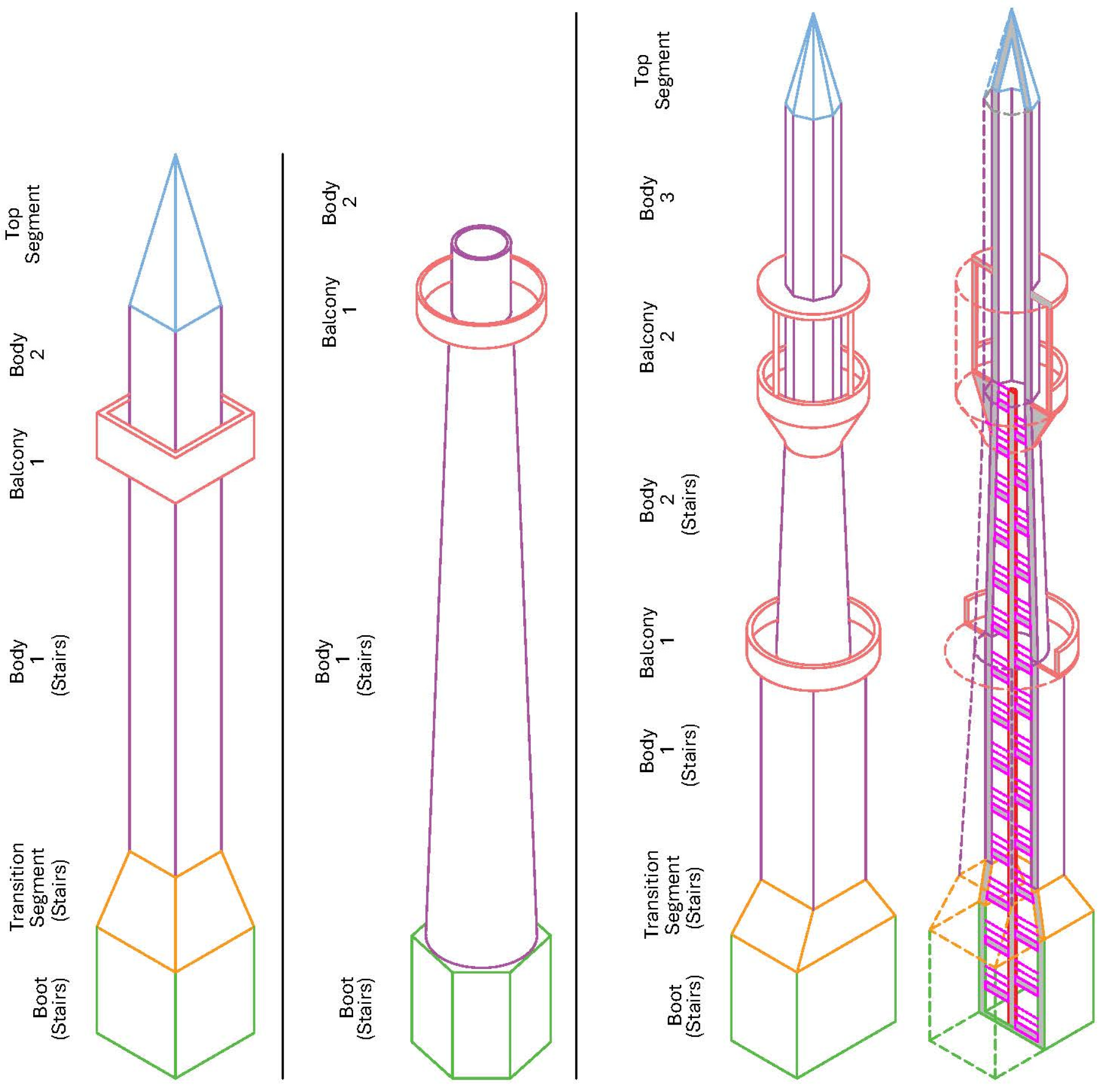
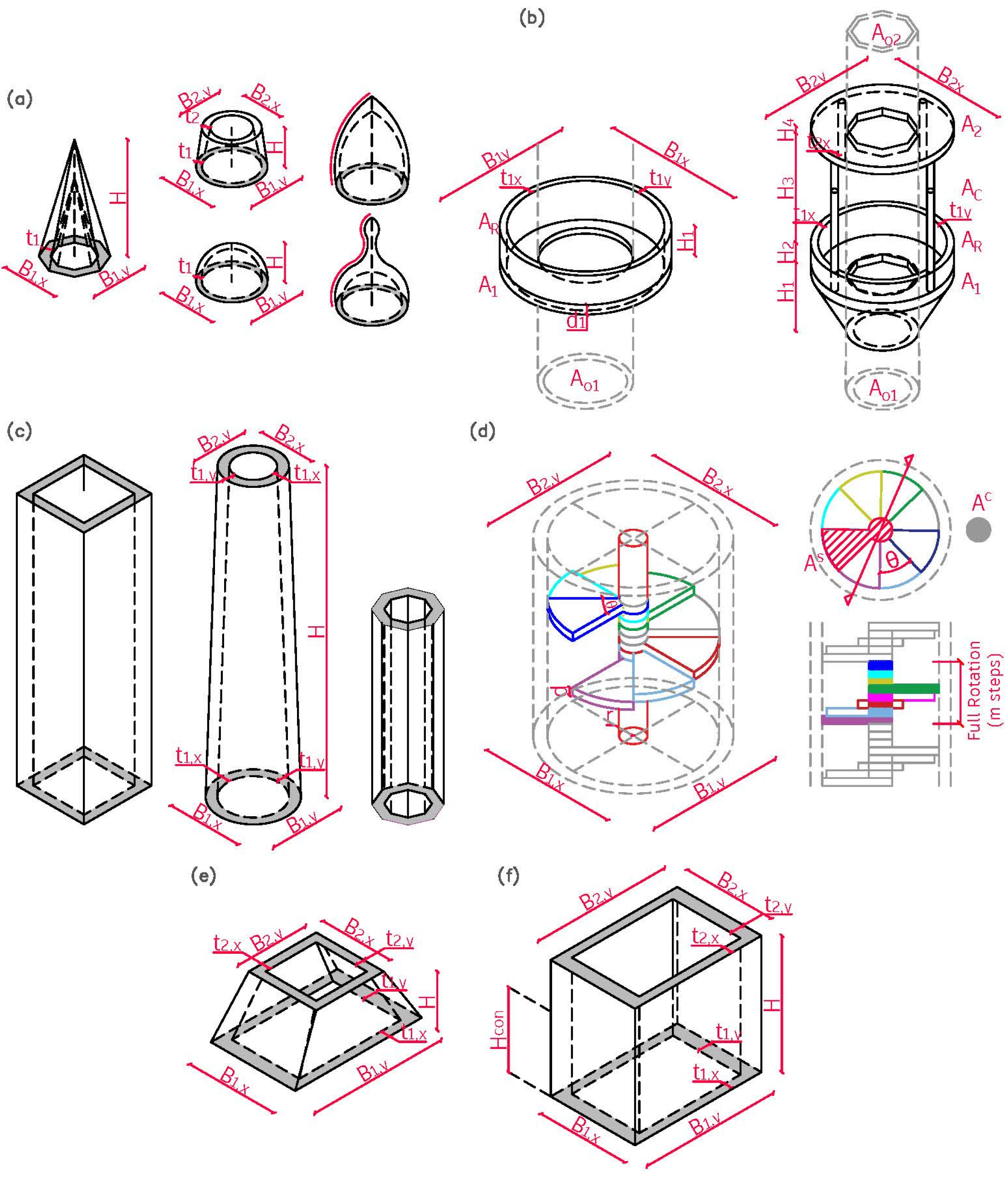
To standardize the minaret geometry and identify the required input for further stages of the KLA framework, a series of parameters is presented for six minaret segments (
Figure 11). The parameters can be used to obtain the area, volume, and the location of the center of weight of the structures. Among the typologies from selected countries, while some styles lack certain segments, the framework remains valid, and calculations can proceed by excluding them.
3.1.1. Boot
The boot is the base of the minaret, which can be circular, rectangular, or polygonal in plan. The stairs and core usually start from the boot. Some minarets are confined to another building along the boot. The effective height is derived by subtracting this connected height from the total height (
Figure 12f).
3.1.2. Transition Segment
Transition segment connects the boot (via its bottom-side profile) to the body (via the top-side profile). Two profiles usually have different shapes and sizes (
Figure 12e).
3.1.3. Body
The body can have a circular, rectangular, or polygonal cross-section. A minaret can consist of multiple vertically stacked bodies separated by balconies, and the one above the final balcony is noted as the upper body. The cross-sectional features (shape, vertical profile, and wall thickness) can differ among the bodies (
Figure 12c).
3.1.4. Stairs
The spiral staircase inside each segment consists of steps radiating from the center—usually a core—supported at the other end by the perimeter wall (
Figure 12d). Although in some Iranian minarets the masonry stairs and core run until the very top, in minarets from Turkey, Egypt, the Balkans, and Greece, they usually stop at the upper body. A wooden pole can be placed to sustain the connection from there to the top segment. The stairs and the core contribute to the stiffness and structural stability of the minaret. Thus, in most studies, their inclusion in the numerical models is regarded as important [
5,
9,
31,
50,
60,
64].
3.1.5. Balcony
The balcony is a platform cantilevering from the perimeter wall. It can be circular, rectangular, or polygonal in plan and in multiple numbers. The cantilevering part can be a plain slab or a tapering form made in masonry stalactites [
22]. On the bottom slab of the balcony, there is a void in the footprint of the associated body’s upper profile. In closed balconies and Mabkhara segments, another slab supported by columns covers the top (
Figure 12b).
3.1.6. Top Segment
The top of the minaret can end with a pointed roof (spire), straight extrusion (crown), or dome with a specific profile (hemispherical, bulb, or onion) (
Figure 12a). The spires in Turkey, Egypt, the Balkans, and Greece are usually built as a wooden frame covered in lead, the weight of which is ignored in the scope of this study. Most spires carry an end ornament at the end as a metal emblem, which is also neglected due to its non-structural function and negligible mass.
3.2. Construction and Structural Details Effective on Seismic Performance
The vulnerability aspects and root causes of failure in minarets are presented below.
3.2.1. Height and Slenderness
The height and slenderness of minarets are regarded as primary factors in their seismic failure. The exceptional height and flexibility of these structures result in large period values [
37]. There are many historical examples of minarets that have been shortened after earthquake damage.
3.2.2. Boundary Conditions
In numerical analyses, a commonly accepted hypothesis is to consider the minaret as a fixed base. Some studies deal with the soil–structure interaction (SSI) for a more realistic representation of seismic behavior [
104,
105,
106], but its accurate incorporation into seismic models remains a challenge. It is known that even for structures located at the same distance from an epicenter, the seismic response varies significantly due to local soil conditions [
107]. On soft soil, the minaret’s fundamental period and inter-story drift increase, while amplified acceleration is observed at the top. Yet, by considering the SSI in numerical models, it has been demonstrated that the soil layer can behave like a natural damper and decrease the damage on the structure compared to fixed-base models [
104,
105,
108].
The effect of the minaret’s interaction with other buildings is also an important topic in the literature. The minaret can be isolated from or attached to another building. The connection can be partial (from one or two sides), or the minaret can be built together with or on the roof of the building. However, this connection can be difficult to recognize visually since, in some cases, although the minaret is very close to the building, it dynamically works independently. In the attached case, the unconnected part oscillates freely compared to the lower segments, and the resulting difference in the natural periods leads to a contradictory dynamic. Overall, this connection can impact the dynamic behavior of the structure and needs to be considered in the analyses [
12,
61,
72,
109]. In addition, the attached minarets can be more resistant to lateral loads since the free (effective) height is reduced [
62]. In Serhatoğlu & Livaoğlu [
61], some coefficients are given to calculate the effective height of the minaret according to the boundary condition. In some studies, the minaret–mosque connection is ignored by simply removing the boot from the total height and considering the minaret to be freestanding from this point on [
60,
110,
111].
In Torelli et al. [
112], a Level 1 seismic risk assessment according to the Italian Guidelines is provided by considering the tower’s connection to other buildings. Represented as a simple cantilever beam, the height of the tower is taken from the top level of confinement, and in one mechanism, the hinge develops at this point. For minarets, the connection typically ends with the boot segment, which would indicate a possible collapse triggering from the base of the transition segment. On the other hand, post-earthquake observations show almost no evidence for such failure since this segment is relatively short and very rigid, while the top of the transition segment is proven to be a critical area [
34,
37,
65,
74,
111].
3.2.3. Vertical Section
The vertical section of minaret bodies can be straight or truncated. It is empirically demonstrated by historical Iranian minarets that tapering can increase their resistance to lateral loads [
32].
3.2.4. Cross-Section Irregularities
Abrupt rigidity shifts due to changes in the cross-section between the boot and body, which is along the transition segment, lead to the most common failure in minarets [
41]. In minarets from Egypt, especially of the Mamluk period, such transitions also occur between the body and balcony segments, rendering these regions weaker [
17,
113].
3.2.5. Mass Distribution Irregularities
Irregular mass distribution can be observed in damage to the upper body [
3], balcony and Mabkhara segments [
16,
18]. In Egypt, elaborate Mamluk minarets with irregular geometries were proven to be the most vulnerable to earthquakes [
17].
3.2.6. Construction and Material
Masonry unit type, size, texture, internal organization (masonry leaves), mortar type and wall thickness are important in analyses of masonry structures, including minarets [
114]. Providing a sufficiently strong connection between masonry units and segments is related to mortar quality and reinforcement techniques (like traditional metal dowels and clamps). Similarly, both for masonry and RC minarets, a lack of conformance with local seismic codes can result in construction- and material-related failures [
3,
37].
It is important to note that, different from towers, the minaret styles examined in this study rarely have openings (except for doors, small air slits, and sometimes windows). While their surroundings can become high-stress regions, openings are mostly seen as insignificant for global seismic behavior and are ignored in most numerical and experimental studies [
36,
115]. The geometry parametrization proposed in this study also disregards them while accounting for large openings in Mabkhara segments and closed balconies.
3.3. Recurring Damage to Minarets
In this section, recurring damage patterns in minarets are explained in reference to the literature based on field observations, experiments, and numerical analyses. As seen in
Table 1, these damage types are also identified in several studies. The recurring damage patterns explained here are consistent with the visual evidence and damage descriptions from field surveys and reconnaissance reports. For the sake of brevity and maintaining the analytical focus of the current paper, readers are referred to those studies [
3,
8,
9,
17,
39,
116,
117,
118,
119].
3.3.1. Boot Damage
There are cases where full collapse occurs under larger base shear forces [
39]. For uniform minarets like in Iran, stress concentration occurs near the base, indicating failure at this segment [
20].
3.3.2. Transition Segment Damage
Due to sudden changes in geometry and cross-sections, the region above the transition segment is vulnerable to bending and torsion [
34,
39,
111]. Overall, most observed damage occurs between the transition segment and the body, and the height of these segments can impact this vulnerability [
120]. Even in cases where it is not a separate segment, the transition from boot to body is a critical region.
3.3.3. Body Damage
A tall and slender body is vulnerable to lateral loads. Rocking behavior in both the lower bodies and the upper body can be observed. In addition, shear sliding with different angles can be observed at different locations along the bodies [
121].
3.3.4. Balcony Damage
Balconies are concentrated masses placed irregularly along the body. They can collapse together with the segments above due to high tensile stress at their bottom portion [
122]. An increasing number of balconies decreases the fundamental period [
120].
3.3.5. Upper Body Damage
Above the highest balcony, the stairs’ connection to the walls ends, which leads to a decrease in mass and rigidity, making the upper body vulnerable [
123]. In Egyptian minarets, the Mabkhara is usually supported by highly fragile, thin columns, rendering this segment vulnerable [
17].
3.3.6. Top Segment
The end of the structure is where the maximum displacements occur [
6,
69,
123]. Top segment collapse is one of the most common failure types even under low earthquake loads [
39]. In cases where the top segment material is inconsistent with the rest of the structure, the mass significantly changes, and critical structural connection mistakes can occur [
116].
3.4. Collapse Mechanism Predefinition
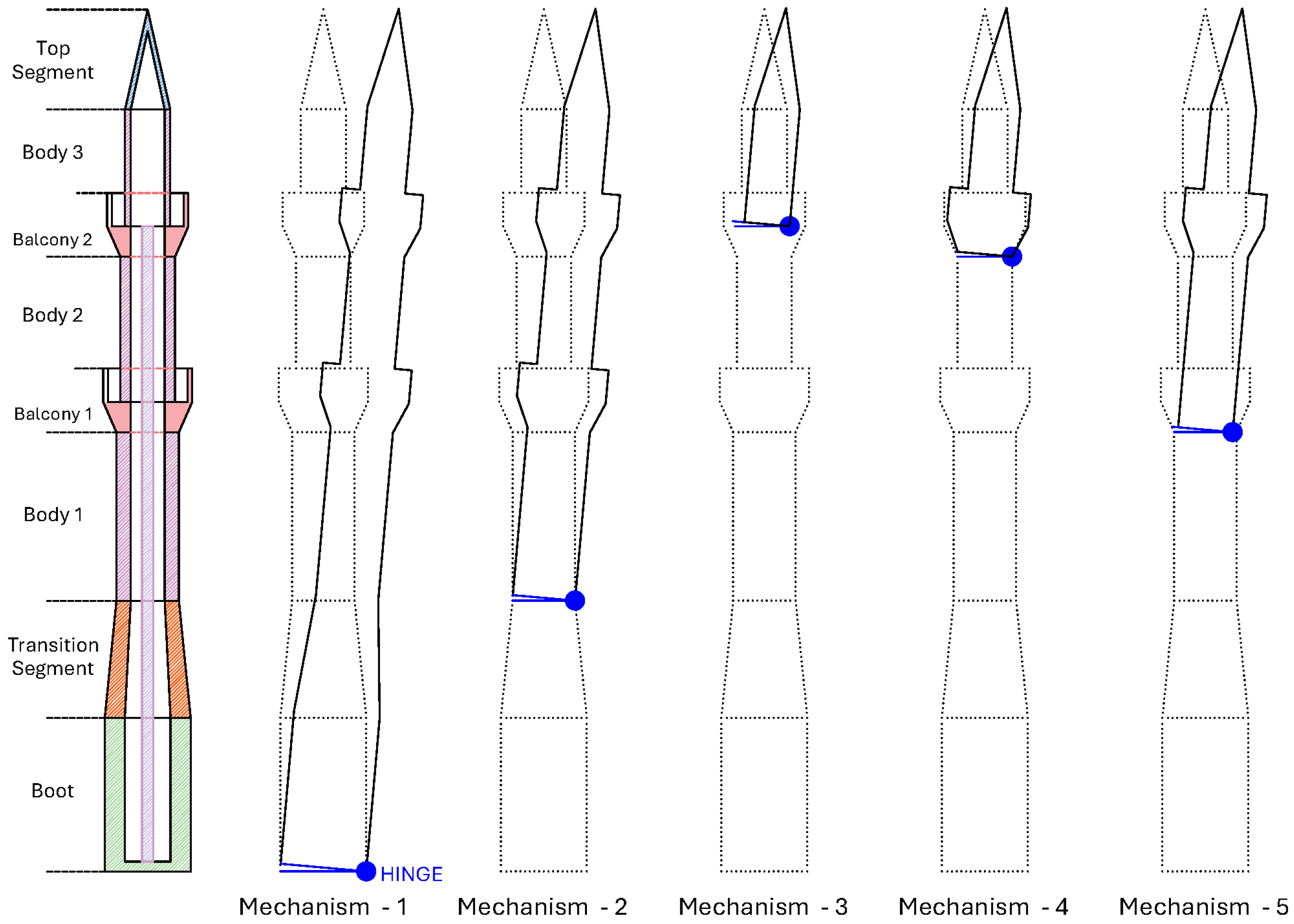
The vulnerability factors and recurring damage patterns observed in masonry minarets indicate that seismic failure is predominantly governed by rocking and shear failure between distinct segments acting as macro-elements. Certain complex factors requiring high-fidelity nonlinear analyses or site-specific data, such as soil–structure interaction (SSI), foundation settlement, minaret inclination, and local material degradation, fall beyond the limits of rapid screening. Accordingly, the framework proposed here is oriented toward the global responses rooted in structure-related failure. As a preliminary step for conducting manual limit analysis on masonry minarets, five rocking collapse mechanisms are explicitly defined in reference to the seismic performance parameters explained before, as well as the performance level and damage description defined for minarets in several previous studies (
Table 1). The minaret segments and mechanisms are shown in
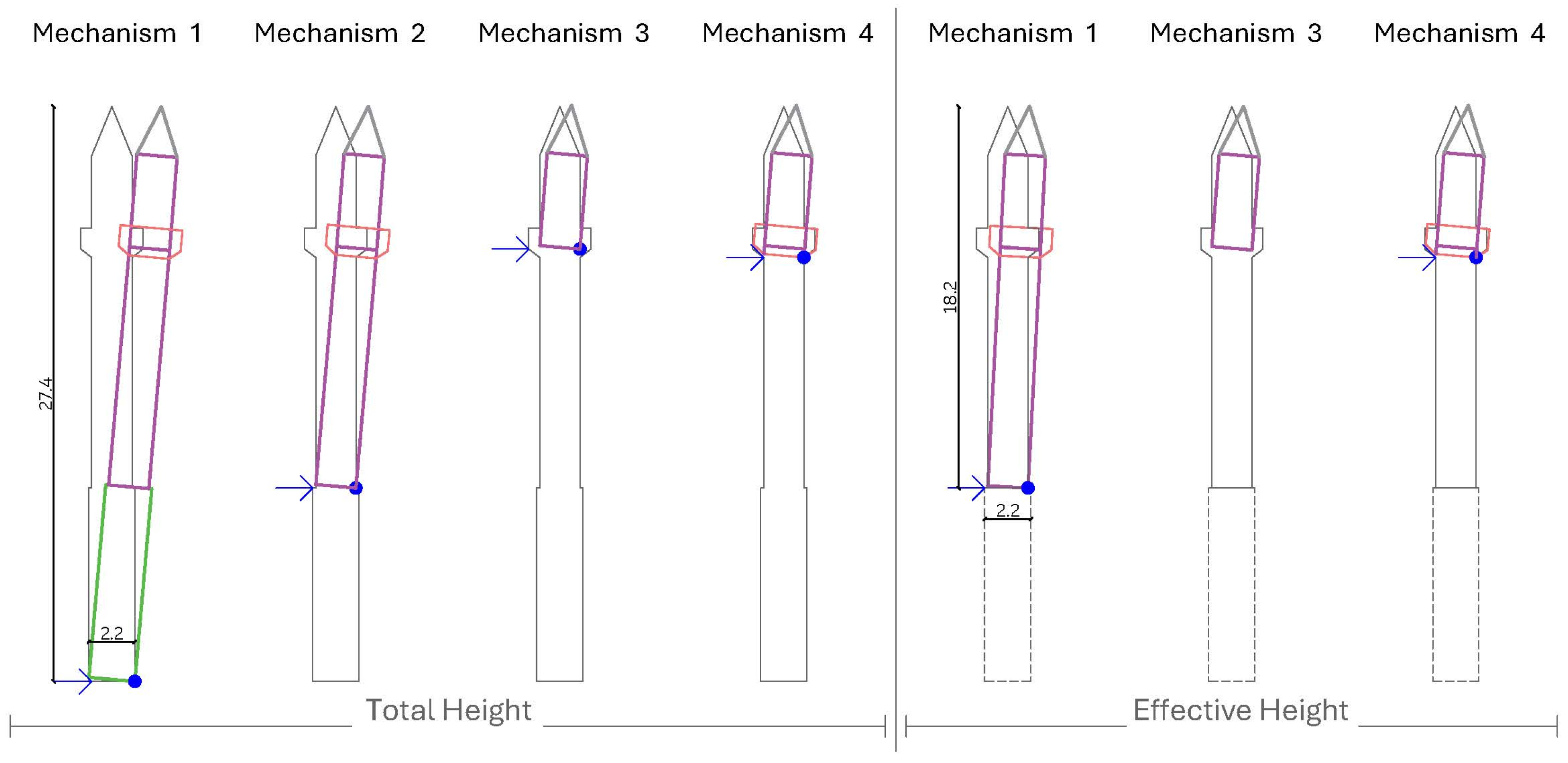
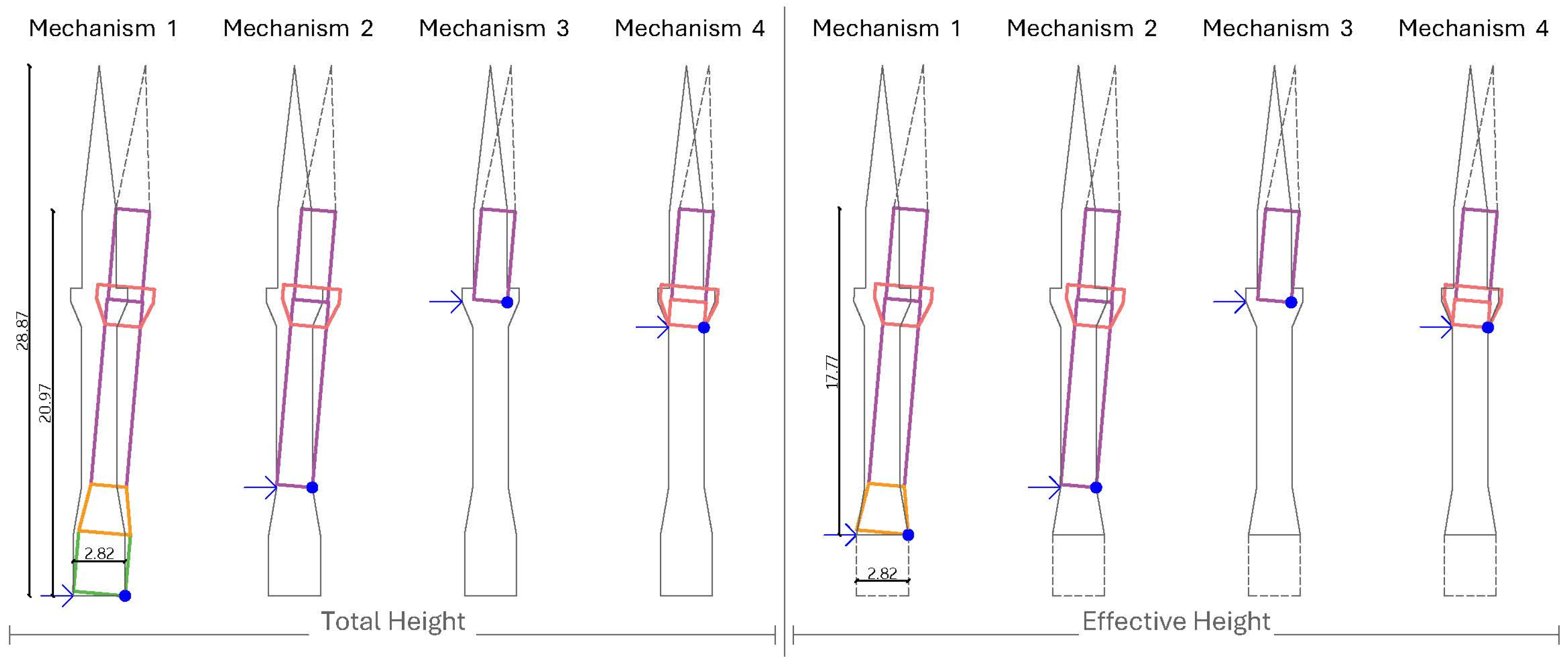
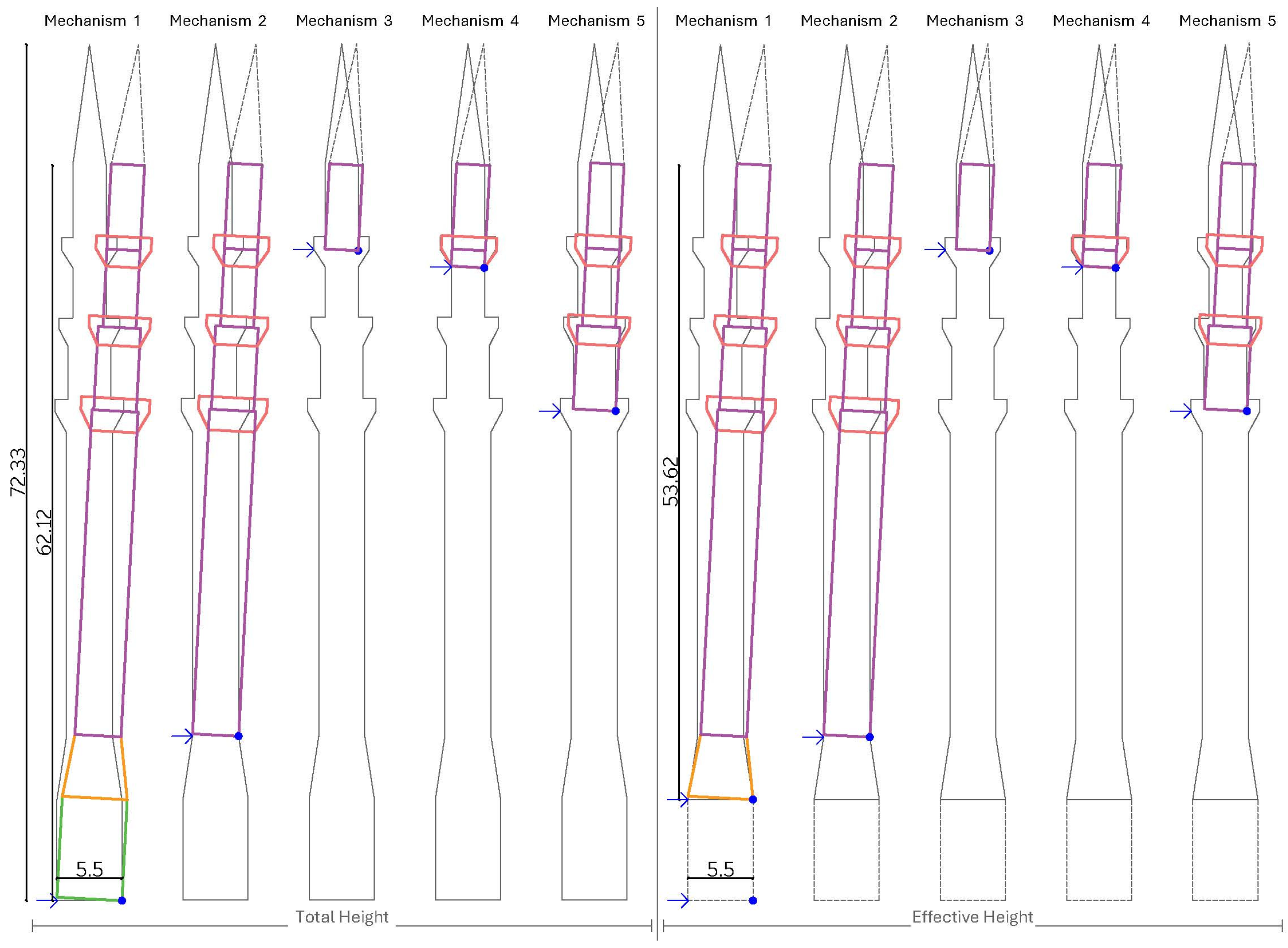
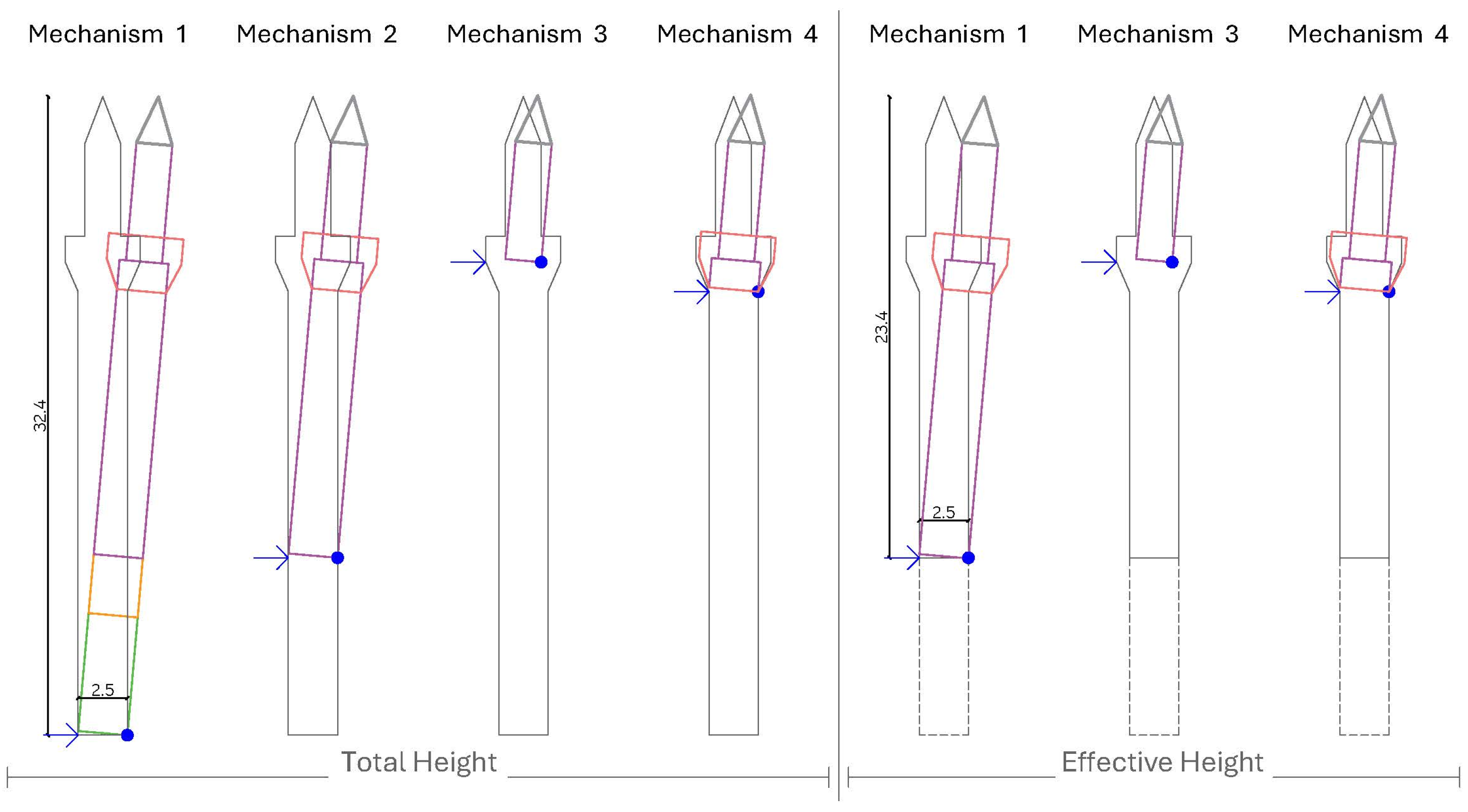
Figure 13. The first mechanism is full rocking at the base (1), where the whole structure overturns around a hinge located near the base. Such full collapses can be observed during strong ground motion. Although it is acknowledged that the SSI can influence the damage propagation in the minaret due to soil flexibility and damping, in the current study, hinges are assumed to be fixed pivot points. Transition segment rocking (2) is the most commonly observed failure type, in which a hinge develops between the boot and the body—coinciding with the top profile of the transition segment, if present—and results in the rocking of the above segments. Another common collapse type is upper body rocking (3), where the top segment and the last body segment of the minaret rock from its bottom. According to the morphology of a minaret, this can be the second, third or fourth body. Except for cases where the minaret ends with a balcony at the very top, the upper body lacks a staircase inside, which yields Mechanism 3. In Mechanism 4, the balcony rocking, the last body segment and the top segment overturn together with the balcony they are attached to from below. The last mechanism referred to here is the body rocking mechanism (5), in which a lower-body segment—a body below the upper body and above the first body—rocks.
3.5. Kinematic Limit Analysis Procedure
The power,
, expended by the load multiplier on a rocking volume,
, in the minaret—here considered any segment,
E, and the stabilizing power expended by self-weight (
)—can be expressed as Equation (1).
where
is a numerical coefficient related to the horizontal acceleration distribution pattern,
is the volume of the segment,
is the collapse multiplier,
is the weight, and
is the force vertically applied to the centroid of
(
). For the horizontal,
, and vertical,
, components of the velocity of the centroid of
, the expressions can be rewritten as
and
, where
and
are constants depending on the
geometry. For the whole minaret, constituted by
segments, the total power expended by the collapse multiplier and gravity loads is provided in the following Equation (2).
Using the Virtual Work Theorem, the horizontal load multiplier,
, for a specific mechanism is found in Equation (3).
The value, as a coefficient, is translated into the collapse multiplier, ag/g, for comparison with the seismic risk at the investigated area during the seismic analysis.
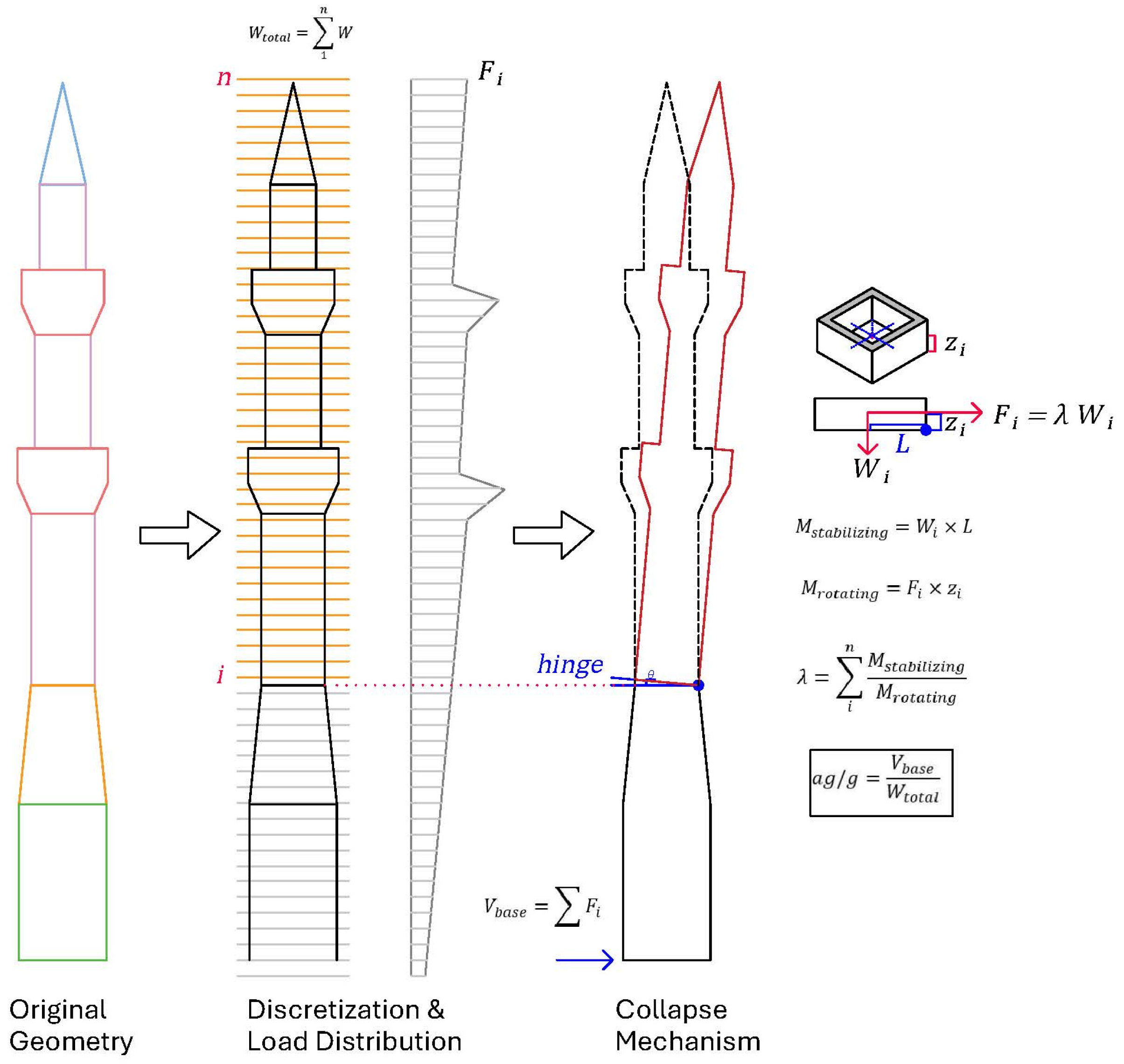
Looking at the procedure at the structural scale, this procedure is explained in
Figure 14. Considering the collapse mechanisms between minaret segments as macro-elements, the hinge location is identified according to the proposed segmentation (
Figure 11) and predefined mechanisms (
Figure 13). To enhance the accuracy of the model, the segments were further discretized into slices of 1 m intervals. The inverse triangular load distribution is applied. For each collapse mechanism, the horizontal load multiplier (
is derived by establishing the equilibrium between the rotating moments induced by the unit lateral loads and the stabilizing moments (due to self-weight) of the volumes above the hinge. The load multiplier is normalized against gravity acceleration to obtain the collapse multiplier value at failure (
ag/
g).
3.6. Limit Analysis Application
For a preliminary application of the proposed limit analysis framework, four minarets are selected from previous case studies in the database.
The minaret of Vanikoy Mosque in Istanbul, Turkey, studied by Kılınçarslan [
101], is predominantly made of brick and has a single balcony. In [
101], a comprehensive examination of the minaret was conducted, including site inspections to assess the state of damage, proposals for restoration works, and nonlinear incremental pushover analyses on the finite element models of both the existing and retrofitted structure. According to the considered earthquake level, it was found that the material damage limits at the part between the body and the transition segment were exceeded. In addition, Kinematic Limit Analysis was performed on the minaret, considering only the overturning mechanism above the transition segment, and the results confirmed the findings of the FE analysis. In these analyses, the minaret’s connection to the mosque at the boot level was considered.
Erkek and Yetkin [
124] studied the Envar-ul Hamit Mosque Minaret in Osmaniye, Turkey, which was severely damaged during the 2023 Kahramanmaraş Earthquakes. The minaret was built from stone masonry and has a single balcony. Its connection to the mosque from the boot is considered in the analyses. In [
124], nonlinear time history analyses were performed on the FE model, which was updated after the OMA and laboratory material tests conducted on the minaret. The results showed a collapse between the boot and the body, confirming the actual situation of the minaret after the earthquake.
Calp [
125] analyzed the Suleymaniye Mosque Minaret in Istanbul, Turkey. The stone masonry minaret has three balconies and is connected to the mosque by the boot, which was considered in this study. The linear time-history analysis revealed that the highest compressive and tensile stresses were observed between the body and the transition segment. The Suleymaniye Mosque Minaret was also studied by Çaktı et al. [
73], in which nonlinear static pushover (with uniform loading) and dynamic nonlinear analysis were conducted with the Discrete Element Method. According to the former, rocking occurred between the transition segment and the first body, while the latter analysis showed failure at the connection of the third body and balcony.
Abdel-Halim et al. [
126] examined the minaret of Fatma El-Shaqra Mosque in Cairo, Egypt. The stone masonry structure has one balcony. It is adjacent to the terrain on one side, extending to the top of its transition segment, while the entrance is located at street level, which sits 9 m above the base. The minaret was subjected to linear dynamic analysis using shell and solid elements in the finite element model. The maximum stress region was observed between the body and transition segment.
For the Kinematic Limit Analysis, first, the simplified geometric models of the minarets are created based on the parametrization introduced above. The material density is taken from the reference studies (
Table 2), which, in combination with the 3D simplified geometric models, allows for a straightforward calculation of the weight and location of the centroid of the segments. The inverse triangular load distribution is applied. The tensile stresses are ignored according to the no-tension material assumption. As reflected in the representations of the mechanisms for each minaret (
Figure 15,
Figure 16,
Figure 17 and
Figure 18), two cases are considered for each minaret: the confined case accounting for its connection with the surrounding buildings (effective height) and the isolated case treating the structure with its full height, independent of this connection (total height). In this regard, when modeled in the isolated case, the Fatma El-Shaqra Mosque Minaret has a hinge in Mechanism 2 at the top of its transition segment, which shifts to that of Mechanism 1 (base level) in the confined case. Similarly, for the Envar-ul Hamit Mosque Minaret, which lacks a transition segment, the top of the boot, which is the hinge location of Mechanism 2 in the isolated case, aligns with that of Mechanism 1 in the confined case. Hence, to avoid redundancy, Mechanism 2 in the effective height case is not illustrated in
Figure 16 and
Figure 18.
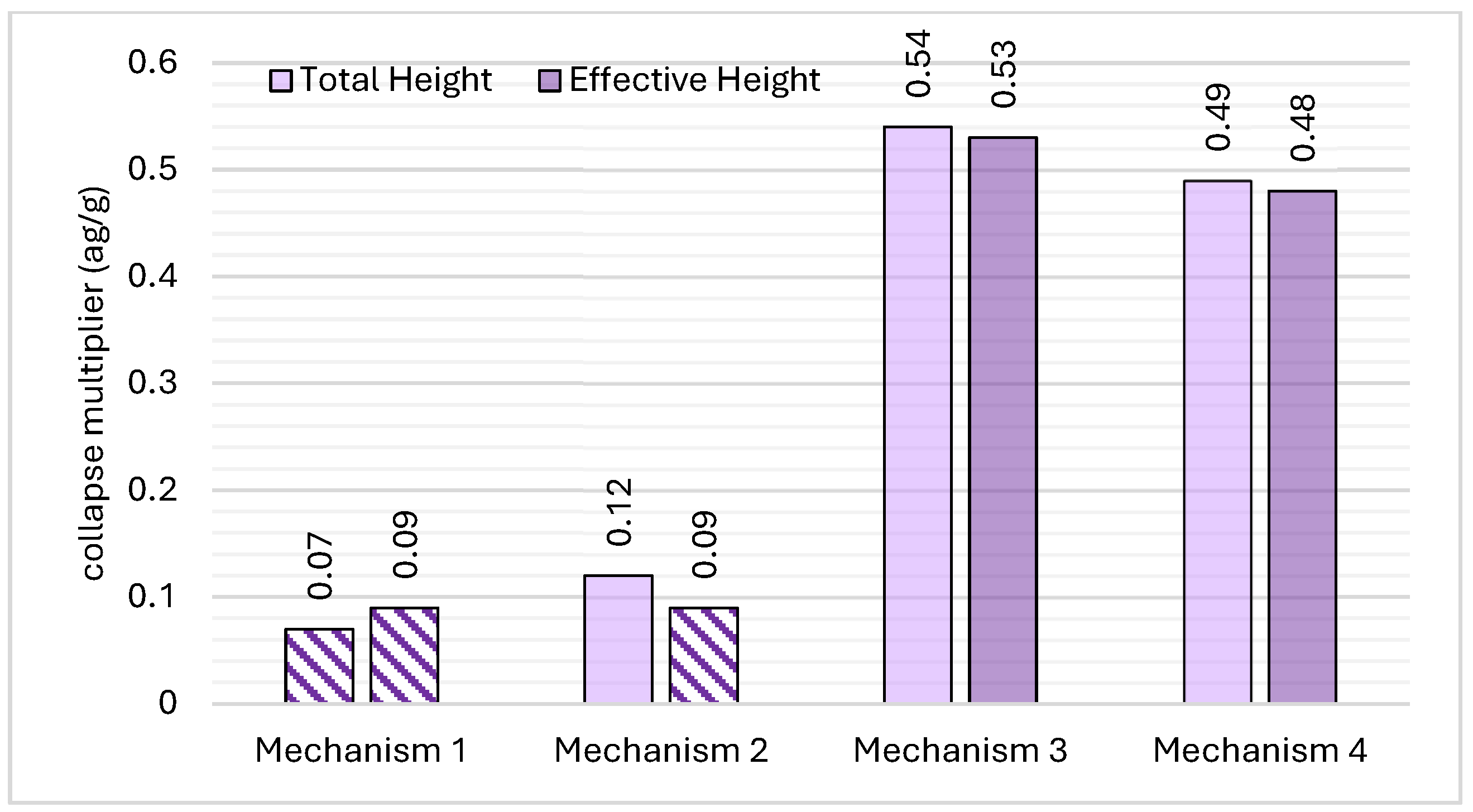
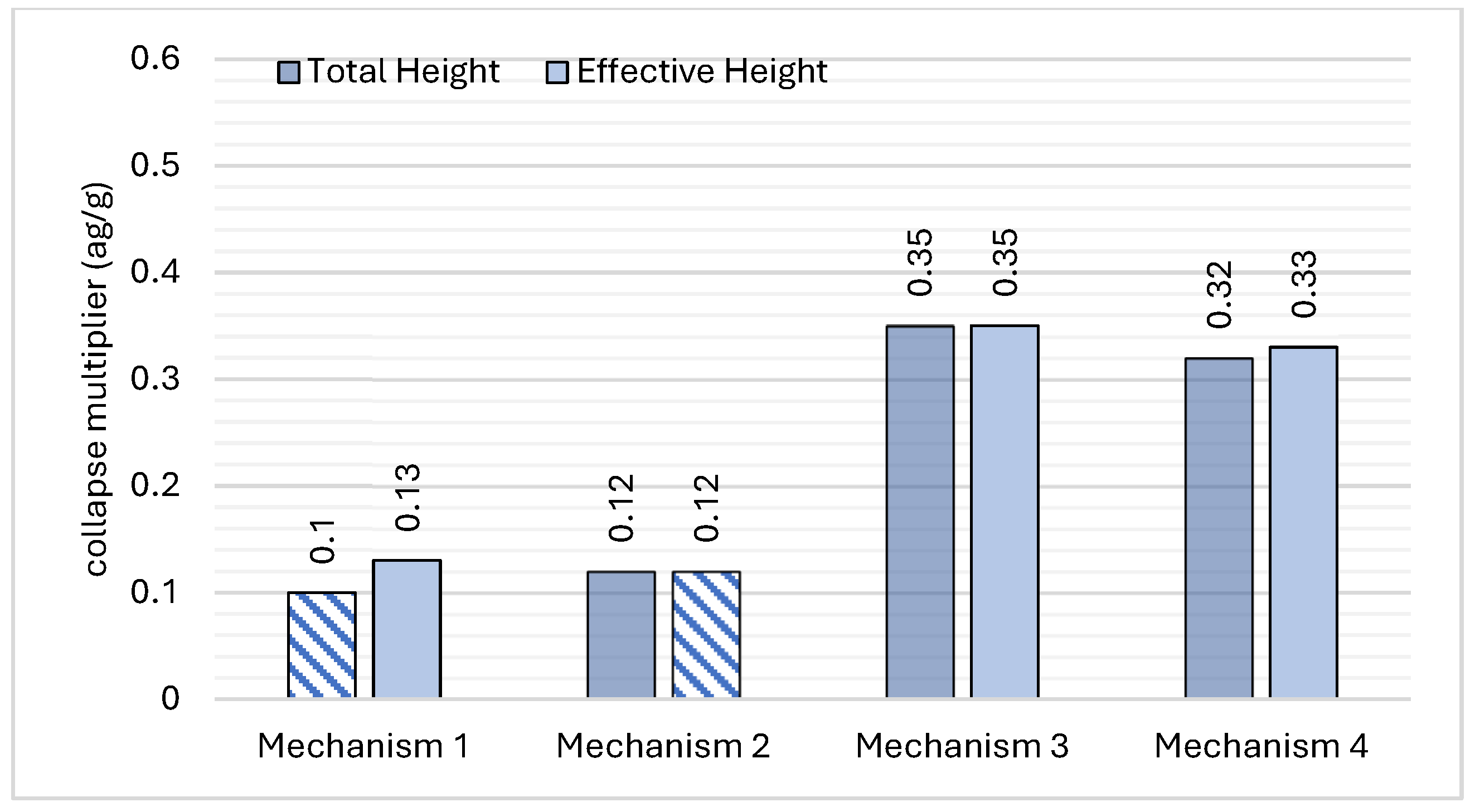
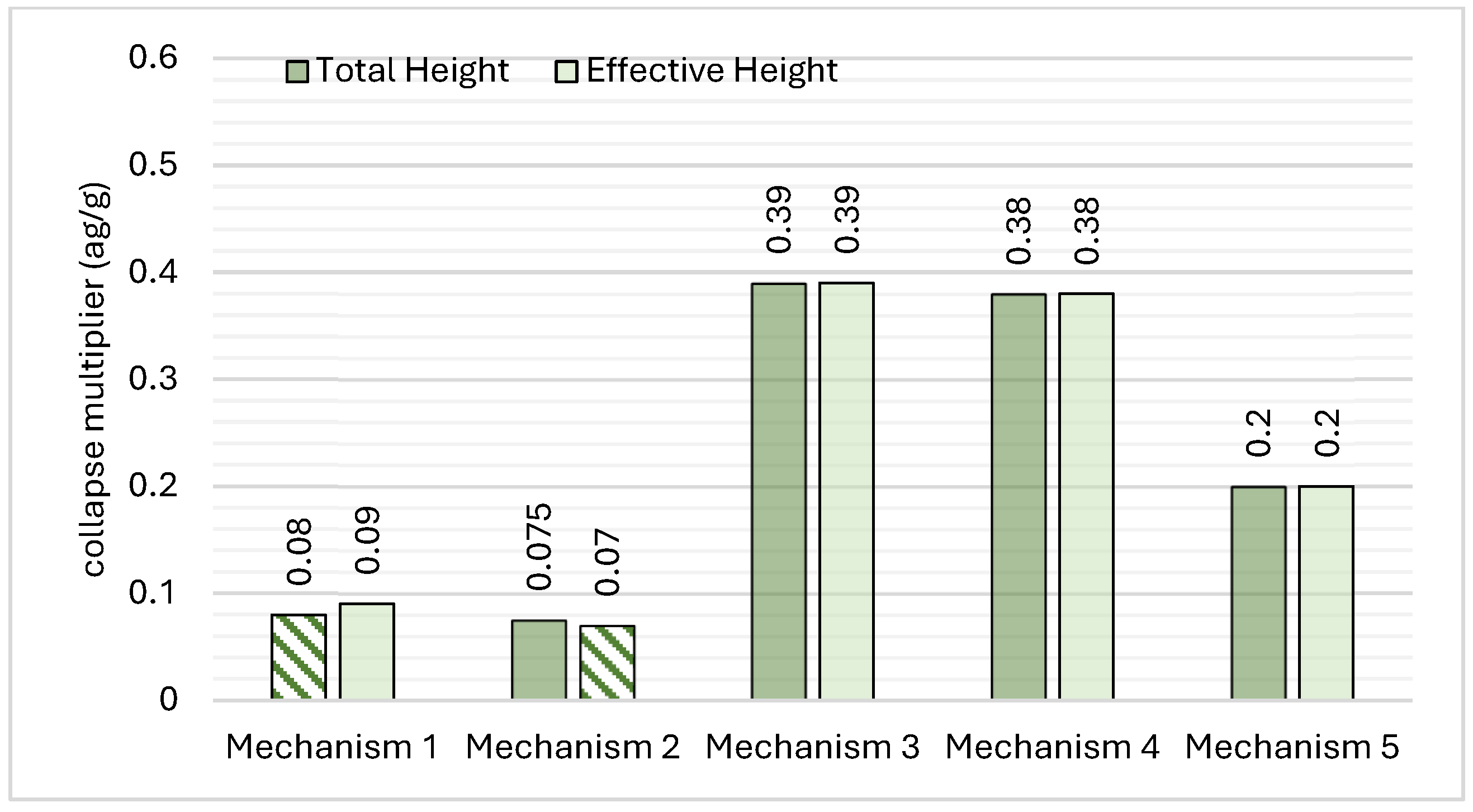
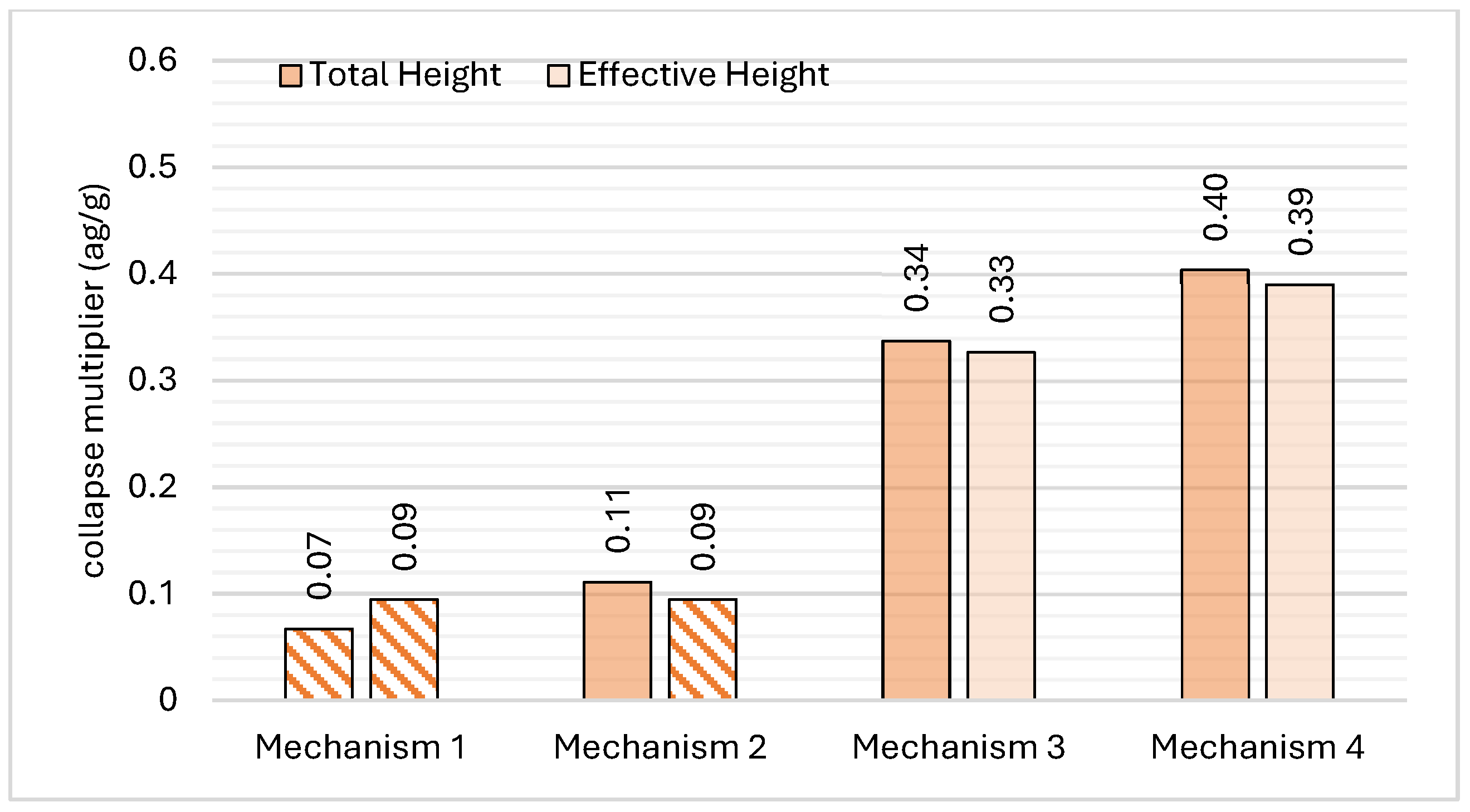
Based on their segmentation, the Vanikoy, Envar-ul Hamit, and Fatma El-Shaqra Mosque Minarets are analyzed for Mechanisms 1–4, while the Suleymaniye Mosque Minaret is tested for Mechanisms 1–5. The results of the analyses with the values of the collapse multiplier normalized against gravity acceleration (
ag/
g) are given in
Figure 19,
Figure 20,
Figure 21 and
Figure 22.
As a result of the analyses, for the Vanikoy Mosque Minaret, the smallest collapse multiplier is obtained from Mechanism 1 in total height and Mechanism 2 for the effective height (
Figure 19). Both values are near the collapse multiplier value of 0.12 found in the study by Kılınçarslan [
101], where only the transition segment collapse was tested.
In the Envar-ul Hamit Mosque Minaret, Mechanism 1 is activated for the total height case (
Figure 20). In the effective height case, collapse occurs below body 1, which is the base of the minaret without the boot, corresponding to Mechanism 1. Therefore, the KLA results overlap with the FEM analysis [
124] and the real collapse state of the minaret.
For the Suleymaniye Mosque Minaret, transition segment rocking is expected for both the total and effective height conditions (
Figure 21). These results match the linear time-history analysis by Calp [
125] and the static pushover analysis by Çaktı et al. [
73]. This demonstrates a certain compatibility between the presented KLA and more complex and time-demanding nonlinear pushover analysis approaches. This outcome is generally expected because of the exclusion of inertial effects, but on the condition that the actual mechanism triggering failure is the partial or total overturning of the structure. As far as the values of collapse accelerations are concerned, floor amplification effects should be considered in the limit analysis approach, which can be reflected in the distribution of applied horizontal loads, though this matter goes beyond the literature review of the present paper.
In the Fatma El-Shaqra Mosque Minaret, for the total height, Mechanism 1 is activated (
Figure 22). Similar to Envar-ul Hamit Mosque, in the effective height condition, the hinge for the lowest collapse multiplier is formed below body 1, corresponding to Mechanism 1. Therefore, the results of the KLA confirm the FEM results in [
126].
4. Conclusions
Protecting masonry minarets against earthquakes’ hazardous effects is an important task for engineers, architects, conservation specialists, and policy makers. The collapse and damage to minarets during earthquakes threaten human lives in the vicinity and the surrounding built environment, including other cultural monuments. Furthermore, these structures are part of the religious landscape and identity landmarks for their community. Lastly, minarets are part of the universal heritage owing to their historical and architectural value. They have withstood many natural and human hazards, experienced repairs and reconstructions, and continue to survive new challenges. Establishing robust and reliable methodologies for assessing their seismic performance requires different scales of analysis.
In this study, the Kinematic Limit Analysis framework is proposed as a preliminary tool through which a rapid vulnerability assessment at the regional scale can be performed. This allows us to identify the most dangerous cases requiring immediate intervention among a large number of structures. The structures filtered from this assessment can be further studied under sophisticated numerical approaches. In this approach, predefinition of the most common and accurate collapse mechanisms is important since they enable a reliable prediction of the vulnerable segments of the minaret, which can be later considered the focus of immediate strengthening interventions. In addition, the proposed KLA framework is advantageous because it sets a geometry segmentation for minarets that is transferable across diverse typologies.
Within the scope of the four case studies examined, the presented approach can yield results consistent with more sophisticated numerical procedures adopted in the literature, which exhibit a high level of complexity and require many input parameters. Kinematic Limit Analysis is simple and versatile, being founded on a sufficiently realistic geometry creation and specific mass properties, although its broader application remains to be tested on larger and more diverse datasets.
The benchmark studies in this research put forward the matter of interaction with neighboring structures. The difference is mostly apparent for Mechanisms 1 and 2, which are related to the lower segments. While the results for the total and effective height cases are generally similar, for a structure like the Envar-ul Hamit Mosque Minaret, which is characterized by a relatively long boot, considering the connected height can be important in deriving the expected failure mechanism. For confined minarets, the current study assumes a restraint at the connection level and deduces the effective height by simply subtracting the connected height from the total height. The real-life dynamic effects observed in such minarets are more complex, suggesting that the current assumption can be enriched in a future study by evaluating different calculation methods.
It should be highlighted that the database creation and benchmark stage were subject to certain constraints stemming from the scarcity of research on the minaret typologies from the investigated regions, as well as the limitation of only searching the literature in Turkish and English. The current database mostly features minarets from Turkey owing to the availability of detailed and comprehensive structural data among the studied regions. For future studies, we aim to include a broader range of typologies from Iran and Balkan and Mediterranean countries to validate the proposed KLA approach. Furthermore, post-earthquake observation data featuring detailed documentation of crack patterns and damage locations would facilitate a more comprehensive definition of minaret failures, ultimately refining the reliability of the predefined collapse mechanisms established in this study.
The correlation between the predominant period, slenderness, and height of the minarets, as shown in
Figure 8,
Figure 9 and
Figure 10, indicates a trend that could potentially be used to derive simplified empirical formulas for the seismic vulnerability assessment of masonry minarets. While the current study focuses on establishing a limit analysis framework, the observed relations across the created database provide a baseline for developing such formulas, which is a key objective for our future research. Finally, further studies are foreseen in integrating the proposed geometry parametrization and Kinematic Limit Analysis framework with existing architectural software to provide an efficient connection between the modeling environment and collapse mechanism calculations.
Author Contributions
Conceptualization, S.N.A., G.M. and M.V.V.; methodology, S.N.A. and G.M.; validation, S.N.A. and G.M.; formal analysis, S.N.A.; investigation, S.N.A.; data curation, S.N.A.; writing—original draft preparation, S.N.A.; writing—review and editing, G.M. and M.V.V.; visualization, S.N.A.; supervision, G.M. and M.V.V. All authors have read and agreed to the published version of the manuscript.
Funding
This research received no external funding.
Data Availability Statement
The data that supports the findings of the study were curated from previously published sources, as cited in the text and presented in the relevant figures.
Acknowledgments
The authors gratefully acknowledge that the doctoral studies of S.N.A. at Politecnico di Milano are supported by a scholarship from the Ministry of National Education of the Republic of Türkiye through its Study Abroad Program. The authors would also like to thank H. Hassan, N. Ademović, C. Calp, and M. Al-Aswad for providing unpublished data from their previous research, which significantly contributed to the comparative analysis of this study.
Conflicts of Interest
The authors declare no conflicts of interest.
Appendix A
Table A1.
Minarets in the database listed according to the publication year.
Table A1.
Minarets in the database listed according to the publication year.
| Reference | No | Name |
|---|
| Turkey |
| [127] | 1 | İskenderpaşa |
| [128] | 2 | Dolmabahçe West |
| [129] | 3 | Muradiye West |
| 4 | Ulucami West |
| 5 | Muradiye East |
| 6 | Şehadet |
| 7 | Ulucami East |
| 8 | Ali Paşa |
| 9 | Altıparmak |
| 10 | Ismail Hakkı |
| 11 | Molla Arap |
| 12 | Sultan Aladdin |
| 13 | Üftade |
| 14 | Yeşil West |
| 15 | Yıldırım Beyazıt West |
| 16 | Murat Hüdavendigar |
| [62] | 17 | Hoca Tabip |
| 18 | Hoca Muslihiddin |
| 19 | Bedrettin |
| 20 | Kayhan |
| 21 | Emir Sultan |
| 22 | Hacılar |
| [130] | 23 | Rahmanlar |
| [131] | 24 | Hafsa Sultan |
| [132] | 25 | Diyarbakır Ulu |
| [133] | 26 | Atasaray |
| 27 | Özkanlı |
| 28 | Kurşunlu |
| 29 | Somuncu Baba |
| 30 | Kılıçarslan |
| 31 | Feriştah Hatun |
| 32 | Zafer |
| [71] | 33 | Seyh Mutahhar |
| [134] | 34 | Afyon Imaret |
| [135] | 35 | Samsun Buyuk |
| [73] | 36 | Hagia Sophia |
| 37 | Mihrimah |
| 38 | Süleymaniye (II) |
| [105] | 39 | Ibrahim Celebi |
| [136] | 40 | Mustafa Şahin |
| [137] | 41 | Aksaray Inclined |
| 42 | Sivas Inclined |
| [138] | 43 | Bayburt Ulu |
| [139] | 44 | Bitlis Ulu |
| [129] | 45 | Gökmeydan |
| [125] | 46 | Meydan |
| [140] | 47 | Bitlis Kalealtı |
| 48 | Ramazan Efendi |
| 49 | Süleymaniye (I) |
| | 50 | Yeni |
| [141] | 51 | Hocaalizade |
| [124] | 52 | Envar-ül Hamit |
| [142] | 53 | Alacakapı |
| [143] | 54 | Melik Sunullah |
| [111] | 55 | Murat Pasha |
| [74] | 56 | Şirvani |
| [101] | 57 | Vaniköy |
| [144] | 58 | Uşak Ulu |
| [145] | 59 | Devrek Yeni |
| [8] | 60 | Habib-i Neccar |
| [146] | 61 | Toptaş |
| [147] | 62 | Kabasakal |
| [103] | 63 | Harran Ulu |
| Egypt |
| [18] | 64 | Manjaq Al-Yusufi |
| [148] | 65 | Prince Shaykoun |
| [126] | 66 | Fatma El-Shaqra |
| [113] | 67 | Al-Rifa’i |
| [31] | 68 | Princess Tatar |
| Iran |
| [20] | 69 | Barsian |
| 70 | Sareban |
| 71 | Ghar |
| 72 | Ziar |
| 73 | Rahravan |
| 74 | Chehel-Dukhtaran |
| 75 | Sin |
| 76 | Ali |
| 77 | Bagh-e-Ghoushkhane |
| [149] | 78 | Zein-o-din |
| [4] | 79 | Tarikhaneh |
| [150] | 80 | Gaskar |
| Macedonia |
| [12] | 81 | Mustapha Pasha |
| Bosnia and Herzegovina |
| [151] | 82 | Ferhad Pasha |
| [11] | 83 | Tabacica |
| [53] | 84 | Bjelave |
| Greece |
| [152] | 85 | Rotunda |
| [153] | 86 | Suleiman |
References
- Montabert, A.; Giry, C.; Limoge Schraen, C.; Lépine, J.; Choueiri, C.; Mercerat, E.; Guéguen, P. An Open Database to Evaluate the Fundamental Frequency of Historical Masonry Towers through Empirical and Physics-Based Formulations. Buildings 2023, 13, 2168. [Google Scholar] [CrossRef] [Scilit]
- Pallarés, F.J.; Betti, M.; Bartoli, G.; Pallarés, L. Structural Health Monitoring (SHM) and Nondestructive Testing (NDT) of Slender Masonry Structures: A Practical Review. Constr. Build. Mater. 2021, 297, 123768. [Google Scholar] [CrossRef] [Scilit]
- Atmaca, B.; Ertürk Atmaca, E.; Roudane, B.; Güleş, O.; Demirkaya, E.; Aykanat, B.; Altunişik, A.C.; Günaydin, M.; Arslan, M.E.; Kahya, V.; et al. Field Observations and Numerical Investigations on Seismic Damage Assessment of RC and Masonry Minarets During the February 6th, 2023, Kahramanmaraş (Mw 7.7 Pazarcık and Mw 7.6 Elbistan) Earthquakes in Türkiye. Int. J. Archit. Herit. 2024, 19, 1117–1142. [Google Scholar] [CrossRef] [Scilit]
- Hoseynzadeh, H.; Mortezaei, A. Seismic Vulnerability and Rehabilitation of One of the World’s Oldest Masonry Minaret under the Different Earthquake Frequency Contents. J. Rehabil. Civ. Eng. 2021, 9, 12–36. [Google Scholar] [CrossRef] [Scilit]
- Ertek, E. Osmanlı Minarelerinin Yapısal Modellenmesi ve Deprem Analizi [Structural Modeling and Earthquake Analysis of Ottoman Minarets]. Master’s Thesis, Gebze Technical University, Kocaeli, Turkey, 2009. [Google Scholar]
- Doğangün, A.; Sezen, H.; Tuluk, Ö.İ.; Livaoğlu, R.; Acar, R. Traditional Turkish Masonry Monumental Structures and Their Earthquake Response. Int. J. Archit. Herit. 2007, 1, 251–271. [Google Scholar] [CrossRef] [Scilit]
- Sezen, H.; Acar, R.; Doğangün, A.; Livaoğlu, R. Dynamic Analysis and Seismic Performance of Reinforced Concrete Minarets. Eng. Struct. 2008, 30, 2253–2264. [Google Scholar] [CrossRef] [Scilit]
- Ertürk Atmaca, E.; Genç, A.F.; Altunişik, A.C.; Yilmaz, S.; Yavru, T.E.; İmamoğlu Yılmaz, E.; Adanur, S.; Günaydin, M.; Sunca, F. Damage Assessment of Regional Cultural Heritage Assets Following the February 6, 2023, Kahramanmaraş-Türkiye Earthquakes: Habib-i Neccar Mosque with Numerical Validation. Results Eng. 2025, 27, 106306. [Google Scholar] [CrossRef] [Scilit]
- Çetin, K.Ö.; Ilgaç, M.; Can, G.; Çakır, E. Preliminary Reconnaissance Report on February 6, 2023, Kahramanmaraş-Pazarcık and Elbistan Earthquakes; Middle East Technical University Earthquake Engineering Research Center: Ankara, Turkey, 2023; p. 91. [Google Scholar]
- Penelis, G.O.; Ivankov, Y.; Zamba, C.; Feher, B.; Pupavac, D.; Lukic, D.; Antic, B. Repair and Strengthening of Historical Monuments and Buildings in Urban Nuclei; Volume 6: Building Construction under Seismic Conditions in the Balkan Region; United Nations Industrial Development Organization: Vienna, Austria, 1984. [Google Scholar]
- Trešnjo, F.; Humo, M.; Casarin, F.; Ademović, N. Experimental Investigations and Seismic Assessment of a Historical Stone Minaret in Mostar. Buildings 2023, 13, 536. [Google Scholar] [CrossRef] [Scilit]
- Portioli, F.; Mammana, O.; Landolfo, R.; Mazzolani, F.M.; Krstevska, L.; Tashkov, L.; Gramatikov, K. Seismic Retrofitting of Mustafa Pasha Mosque in Skopje: Finite Element Analysis. J. Earthq. Eng. 2011, 15, 620–639. [Google Scholar] [CrossRef] [Scilit]
- Hrasnica, M.; Medic, S. Seismic Strengthening of Historical Stone Masonry Structures in Bosnia Herzegovina. In Proceedings of the 15th World Conference on Earthquake Engineering 2012 (15WCEE), Lisbon, Portugal, 24–28 September 2012; Sociedade Portuguesa de Engenharia Sismica (SPES): Lisbon, Portugal, 2012. [Google Scholar]
- Tzanakis, M.J.; Papagiannopoulos, G.A.; Hatzigeorgiou, G.D. Seismic Response and Retrofitting Proposals of the St. Titus Chruch, Heraklion, Crete, Greece. Earthq. Struct. 2016, 10, 1347–1367. [Google Scholar] [CrossRef] [Scilit]
- Sallam, M.A.; Hassan, H.M.; Sayed, M.A.; Abdel Hafiez, H.E.; Zahra, H.S.; Salem, M. Seismic Vulnerability Assessment of Historical Minarets in Cairo. Geoenviron. Disasters 2023, 10, 30. [Google Scholar] [CrossRef] [Scilit]
- Hassan, H.M.; Abdel Hafiez, H.E.; Sallam, M.A.; Bedon, C.; Fasan, M.; Henaish, A. Multidisciplinary Approach of Proactive Preservation of the Religions Complex in Old Cairo—Part 2: Structural Challenges. Heritage 2025, 8, 89. [Google Scholar] [CrossRef] [Scilit]
- Sykora, D.; Look, D.; Croci, G.; Karaesmen, E.; Karaesmen, E. Reconnaissance Report of Damage to Historic Monuments in Cairo, Egypt Following the October 12, 1992 Dahshur Earthquake; National Center for Earthquake Engineering Research State University of New York at Buffalo: Buffalo, NY, USA, 1993; p. 172. [Google Scholar]
- El-Attar, A.G.; Saleh, A.M.; Zaghw, A.H. Conservation of a Slender Historical Mamluk-Style Minaret by Passive Control Techniques. Struct. Control Health Monit. 2005, 12, 157–177. [Google Scholar] [CrossRef] [Scilit]
- Maheri, M.R. Seismic Vulnerability of Post-Islamic Monumental Structures in Iran: Review of Historical Sources. J. Archit. Eng. 2004, 10, 160–166. [Google Scholar] [CrossRef] [Scilit]
- Hejazi, M.; Moayedian, S.M.; Daei, M. Structural Analysis of Persian Historical Brick Masonry Minarets. J. Perform. Constr. Facil. 2015, 30, 04015009. [Google Scholar] [CrossRef] [Scilit]
- Ülgen, A. Türk Mimarisinde Minarenin Gelişimi [Development of Minaret in Turkish Architecture]. In Hakkı Dursun Yıldız Armağanı; Marmara Üniversitesi Yayınları: Istanbul, Turkey, 1995; pp. 495–508. [Google Scholar]
- Kuşüzümü, K.H. İstanbul Minarelerinin Geleneksel Yapım Teknikleri ve Günümüzdeki Restorasyonu [Traditional Construction Techniques and Current Restoration of Istanbul Minarets]. Master’s Thesis, Mimar Sinan Fine Arts University, Istanbul, Turkey, 2010. [Google Scholar]
- Hartmuth, M. Mosque-Building on the Ottoman-Venetian Frontier, circa 1550–1650: The Phenomenon of Square-Tower Minarets Revisited. Muqarnas 2018, 35, 175–191. [Google Scholar] [CrossRef] [Scilit]
- Ayverdi, E.H. Avrupa’da Osmanlı Mimari Eserleri [Ottoman Architectural Monuments in Europe]; İstanbul Fetih Cemiyeti: İstanbul, Turkey, 1981. [Google Scholar]
- Kuran, A. The Mosque in Early Ottoman Architecture; Publications of the Center for Middle Eastern Studies, University of Chicago; University of Chicago Press: Chicago, IL, USA; London, UK, 1968; Volume xvi. [Google Scholar]
- Jahic, E. Mosques of Ottoman Period in Bosnia and Herzegovina: A Typological Classification of Historical Forms. Period. Eng. Nat. Sci. 2022, 10, 115–135. [Google Scholar] [CrossRef] [Scilit]
- Causevic, A.; Idrizbegovic-Zgonic, A.; Rustempasic, N.; Handzic, L.K. Restoring Minarets as A Dominant Part of Urban Landscape Restoration of Stone and Wooden Minarets in Bosnia and Herzegovina—Materials, Structure and Urban Form. In IOP Conference Series: Materials Science and Engineering; IOP Publishing: Bristol, UK, 2019; Volume 471, p. 082003. [Google Scholar]
- Behrens-Abouseif, D. Islamic Architecture in Cairo: An Introduction; American Univ. in Cairo Press: Cairo, Egypt, 1989. [Google Scholar]
- Pereira, J. Islamic Sacred Architecture: A Stylistic History; Books & Books: New Delhi, India, 1994. [Google Scholar]
- Higazy, E.M. Vulnerability of Historical Minarets; Investigation of Their Seismic Assessment & Retrofitting. Emir. J. Eng. Res. 2004, 9, 59–64. [Google Scholar]
- Hassan, H.M.; Sayed, M.A.; Fasan, M.; Romanelli, F.; Amadio, C.; Hamed, A.; ElGabry, M.; Hamama, I. Seismic Assessment of a Cultural Heritage Minaret in Cairo. In Sustainable Conservation of UNESCO and Other Heritage Sites Through Proactive Geosciences; El-Qady, G.M., Margottini, C., Eds.; Springer Geology; Springer International Publishing: Cham, Switzerland, 2023; pp. 541–565. [Google Scholar]
- Safaeianpour, A.; Valibeig, N. A Study on the Construction Technology of the Seljuk Minarets in Isfahan with Focus on Their Geometric Brick Pattern. Curved Layer. Struct. 2022, 9, 13–24. [Google Scholar] [CrossRef] [Scilit]
- Feizolahbeigi, A.; Ramirez, R.; Lourenço, P.B. Seismic Assessment of a Dome Structure with Minarets as Secondary Elements: The Case of Soltaniyeh Dome in Iran. Structures 2024, 63, 106408. [Google Scholar] [CrossRef] [Scilit]
- Doğangün, A.; Acar, R.; Sezen, H.; Livaoglu, R. Investigation of Dynamic Response of Masonry Minaret Structures. Bull. Earthq. Eng. 2008, 6, 505–517. [Google Scholar] [CrossRef] [Scilit]
- Kocaman, I.; Gedik, B.; Okuyucu, D. The Effects of the Kahramanmaraş Earthquakes on Historical Masonry Minarets in Hatay, Türkiye. Sādhanā 2025, 50, 155. [Google Scholar] [CrossRef] [Scilit]
- Shakya, M. Seismic Vulnerability Assessment of Slender Masonry Structures. Ph.D. Thesis, University of Aveiro, Aveiro, Portugal, 2014. [Google Scholar]
- Sezen, H.; Doğangün, A. Seismic Performance of Historical and Monumental Structures. In Earthquake Engineering; Sezen, H., Ed.; InTech: Garching bei München, Germany, 2012. [Google Scholar]
- Vakıflar Genel Müdürlüğü. Tarihi Yapılarda Deprem Risklerinin Yönetimi Kılavuzu (A Guideline for Earthquake Risk Management of Historical Structures); Vakıflar Genel Müdürlüğü Yayınları: Ankara, Turkey, 2017. Available online: https://cdn.vgm.gov.tr/yayin/dergi/muhtelif/tarihi-yapilarda-deprem-risklerinin-yonetimi-kilav.pdf (accessed on 7 April 2026).
- Işık, E.; Avcil, F.; Arkan, E.; Büyüksaraç, A.; İzol, R.; Topalan, M. Structural Damage Evaluation of Mosques and Minarets in Adıyaman Due to the 06 February 2023 Kahramanmaraş Earthquakes. Eng. Fail. Anal. 2023, 151, 107345. [Google Scholar] [CrossRef] [Scilit]
- Kocaman, İ.; Kazaz, İ. Global Drift Ratio Limits for Historical Masonry Mosques. Bull. Earthq. Eng. 2023, 21, 3011–3040. [Google Scholar] [CrossRef] [Scilit]
- Yılmaz, S.; Arslan, M.; Demir, A.D.; Yavru, T.E.; Yılmaz, E.İ.; Cebir, F.; Aydın, Ç.; Baş, G.Y.; Demir, S. Seismic Damage Assessment of Historical Mosques and Minarets in Antakya/Türkiye after the February 6, 2023, Kahramanmaraş Earthquake Sequence. Eng. Fail. Anal. 2025, 182, 110125. [Google Scholar] [CrossRef] [Scilit]
- Gruppo Nazionale per la Difesa dai Terremoti (GNDT). Scheda Di Esposizione e Vulnerabilità e Di Rilevamento Danni Di Primo Livello e Secondo Livello; GNDT/Servizio Sismico Nazionale (SSN): Rome, Italy, 1994. [Google Scholar]
- Mişe, O.; Işık, E.; Arkan, E.; Avcil, F. Structural and Rapid Assessment of Registered Historical Mosques; A Case Study for Bitlis. In 33rd International Conference on Organization and Technology of Maintenance (OTO 2024); Glavaš, H., Hadzima-Nyarko, M., Ademović, N., Hanák, T., Eds.; Lecture Notes in Networks and Systems; Springer Nature: Cham, Switzerland, 2025; Volume 1242, pp. 439–453. [Google Scholar]
- MiBACT, Ministry of Cultural Heritage MiBACT—Ministero per i Beni e Le Attività Culturali e per Il Turismo. Guidelines for Evaluation and Mitigation of Seismic Risk to Cultural Heritage: Linee Guida per La Valutazione e Riduzione Del Rischio Sismico Del Patrimonio Culturale Con Riferimento Alle Norme Tecniche per Le Costruzioni; DPCM: Rome, Italy, 2011. [Google Scholar]
- Başaran, H.; Demir, A.; Ercan, E.; Nohutcu, H.; Hokelekli, E.; Kozanoglu, C. Investigation of Seismic Safety of a Masonry Minaret Using Its Dynamic Characteristics. Earthq. Struct. 2016, 10, 523–538. [Google Scholar] [CrossRef] [Scilit]
- Bayraktar, A.; Çalik, İ.; Türker, T.; Ashour, A. Restoration Effects on Experimental Dynamic Characteristics of Masonry Stone Minarets. Mater. Struct. 2018, 51, 141. [Google Scholar] [CrossRef] [Scilit]
- Erdil, B.; Tapan, M.; Akkaya, İ.; Korkut, F. Effects of Structural Parameters on Seismic Behaviour of Historical Masonry Minaret. Period. Polytech. Civ. Eng. 2018, 62, 148–161. [Google Scholar] [CrossRef] [Scilit]
- Birel Akay, A. Shaking Table Test Under Two Ground Motion Records of a Historical Brick Minaret. Master’s Thesis, Istanbul Technical University, Istanbul, Turkey, 2023. [Google Scholar]
- Khider, T.A.; Al-Baghdadi, H.A. Dynamic Response of Historical Masonry Minaret under Seismic Excitation. Civ. Eng. J. 2020, 6, 142–155. [Google Scholar] [CrossRef] [Scilit]
- Hejazi, M.; Talebi, R.; Dabanlı, Ö. Parametric Finite Element Updating of Brick Minaret Using Operational Modal Analysis Method. Int. J. Earthq. Eng. 2023, 40, 1–24. [Google Scholar]
- Aslan, T. Video Camera-Based Structural Health Monitoring of Historical Masonry Minarets. Master’s Thesis, Karadeniz Technical University, Trabzon, Turkey, 2024. [Google Scholar]
- Yanık, Y.; Aymelek, A.; Yildirim, Ö.; Demirtaş, B.; Türker, T. Variations of Natural Frequencies of Masonry Minarets Due to Environmental Effects. J. Civ. Struct. Health Monit. 2024, 14, 635–661. [Google Scholar] [CrossRef] [Scilit]
- Hamzić, A.; Kulo, N.; Đidelija, M.; Topoljak, J.; Mulahusić, A.; Tuno, N.; Ademović, N. Assessment of Minaret Inclination and Structural Capacity Using Terrestrial Laser Scanning and 3D Numerical Modeling: A Case Study of the Bjelave Mosque. Geomatics 2025, 5, 8. [Google Scholar] [CrossRef] [Scilit]
- Abdel-Wahab, A.M.; Badawy, A.H.; El-Feky, M.S. Seismic Analysis of Islamic Egyptian Minarets through 3D Scanning and Dynamic Simulation. Sci. Rep. 2024, 14, 20392. [Google Scholar] [CrossRef] [Scilit] [PubMed]
- Duman, C.; Hacıefendioğlu, K.; Gültop, T.; Altunışık, A.C. Damage Detection in Historical Masonry Minarets Using Machine Learning and Optimization-Based Structural Assessment. J. Earthq. Tsunami 2026, 20, 2550023. [Google Scholar] [CrossRef] [Scilit]
- Aslan, T.; Hacıefendioğlu, K.; Duman, C. Multiple Camera-Based Digital Twin Creation and Dynamic Earthquake Simulation of Historical Masonry Minarets. J. Comput. Civ. Eng. 2025, 39, 04025046. [Google Scholar] [CrossRef] [Scilit]
- Nasery, M.M. Post-Earthquake Damage Assessment of Inaccessible Areas in the Harran Grand Mosque (Ulu Cami) Minaret Using Digital Twin Modeling. In Proceedings of the 3rd International Civil Engineering & Architecture Conference Volume 1: Civil Engineering; Golden Light Publishing: Trabzon, Turkey, 2023. [Google Scholar]
- Shakya, M.; Varum, H.; Vicente, R.; Costa, A. Empirical Formulation for Estimating the Fundamental Frequency of Slender Masonry Structures. Int. J. Archit. Herit. 2016, 10, 55–66. [Google Scholar] [CrossRef] [Scilit]
- Bartoli, G.; Betti, M.; Marra, A.M.; Monchetti, S. Semiempirical Formulations for Estimating the Main Frequency of Slender Masonry Towers. J. Perform. Constr. Facil. 2017, 31, 04017025. [Google Scholar] [CrossRef] [Scilit]
- Oliveira, C.S.; Çakti, E.; Camacho, V.; Dar, E. Revisiting the Frequency Laws for Ottoman Minarets. Analysis of Uncertainties. Int. J. Archit. Herit. 2023, 17, 1648–1668. [Google Scholar] [CrossRef] [Scilit]
- Serhatoğlu, C.; Livaoğlu, R. A Fast and Practical Approximations for Fundamental Period of Historical Ottoman Minarets. Soil Dyn. Earthq. Eng. 2019, 120, 320–331. [Google Scholar] [CrossRef] [Scilit]
- Livaoğlu, R.; Baştürk, M.H.; Doğangün, A.; Serhatoğlu, C. Effect of Geometric Properties on Dynamic Behavior of Historic Masonry Minaret. KSCE J. Civ. Eng. 2016, 20, 2392–2402. [Google Scholar] [CrossRef] [Scilit]
- Usta, P. Assessment of Seismic Behavior of Historic Masonry Minarets in Antalya, Turkey. Case Stud. Constr. Mater. 2021, 15, e00665. [Google Scholar] [CrossRef] [Scilit]
- Erkal, A.; Hilmi, Z.H.I. Effective Expressions for the Estimation of the First and Third Natural Periods of Minarets Based on Extensive and Comprehensive Parametric Modal Analyses. Structures 2025, 72, 108275. [Google Scholar] [CrossRef] [Scilit]
- Işık, E.; Ademović, N.; Harirchian, E.; Avcil, F.; Büyüksaraç, A.; Hadzima-Nyarko, M.; Akif Bülbül, M.; Işık, M.F.; Antep, B. Determination of Natural Fundamental Period of Minarets by Using Artificial Neural Network and Assess the Impact of Different Materials on Their Seismic Vulnerability. Appl. Sci. 2023, 13, 809. [Google Scholar] [CrossRef] [Scilit]
- Nguyen, Q.T.; Vu, V.T.; Livaoğlu, R. Artificial Neural Network-Based Robust Technique for Period Prediction of Ottoman Minarets in Türkiye. Structures 2024, 61, 106087. [Google Scholar] [CrossRef] [Scilit]
- Tran, C.; Nguyen, N.T.V.; Le, D.T.; Nguyen, Q.T.; Livaoğlu, R. Optimized Supervised Machine Learning for Accurate Prediction of Periods in Türkiye’s Heritage Minarets. Bull. Earthq. Eng. 2025. [Google Scholar] [CrossRef] [Scilit]
- D’Altri, A.M.; Sarhosis, V.; Milani, G.; Rots, J.; Cattari, S.; Lagomarsino, S.; Sacco, E.; Tralli, A.; Castellazzi, G.; De Miranda, S. Modeling Strategies for the Computational Analysis of Unreinforced Masonry Structures: Review and Classification. Arch. Comput. Methods Eng. 2020, 27, 1153–1185. [Google Scholar] [CrossRef] [Scilit]
- Peña, F.; Lourenço, P.B.; Mendes, N.; Oliveira, D.V. Numerical Models for the Seismic Assessment of an Old Masonry Tower. Eng. Struct. 2010, 32, 1466–1478. [Google Scholar] [CrossRef] [Scilit]
- Lemos, J. Discrete Element Modeling of the Seismic Behavior of Masonry Construction. Buildings 2019, 9, 43. [Google Scholar] [CrossRef] [Scilit]
- Kazaz, İ.; Gülkan, P.; Kazaz, E. Numerical Assessment of Cracks on a Freestanding Masonry Minaret. Int. J. Archit. Herit. 2021, 15, 526–547. [Google Scholar] [CrossRef] [Scilit]
- Erdoğan, Y.S.; Kocatürk, T.; Demir, C. Investigation of the Seismic Behavior of a Historical Masonry Minaret Considering the Interaction with Surrounding Structures. J. Earthq. Eng. 2019, 23, 112–140. [Google Scholar] [CrossRef] [Scilit]
- Çaktı, E.; Saygılı, Ö.; Lemos, J.V.; Oliveira, C.S. Nonlinear Dynamic Response of Stone Masonry Minarets under Harmonic Excitation. Bull. Earthq. Eng. 2020, 18, 4813–4838. [Google Scholar] [CrossRef] [Scilit]
- Jadallah, M.; Alghamri, R.; Doğangün, A. Seismic Retrofitting of the Historic Şirvani Mosque Using Fiber-Reinforced Polymer (FRP): A Case Study. Eng. Fail. Anal. 2025, 180, 109898. [Google Scholar] [CrossRef] [Scilit]
- Jadallah, M.; Cicos, C.; Doğangün, A. Evaluation of Earthquake Behaviour of Historic Şirvani Mosque’s Stone Minaret. In Proceedings of the 6th International Black Sea Modern Scientific Research Congress, Trabzon, Turkey, 23–25 August 2024. [Google Scholar]
- Heyman, J. The Stone Skeleton. Int. J. Solids Struct. 1966, 2, 249–279. [Google Scholar] [CrossRef] [Scilit]
- Zampieri, P.; Tecchio, G.; Da Porto, F.; Modena, C. Limit Analysis of Transverse Seismic Capacity of Multi-Span Masonry Arch Bridges. Bull. Earthq. Eng. 2015, 13, 1557–1579. [Google Scholar] [CrossRef] [Scilit]
- Giuffrè, A.; Carocci, C. (Eds.) Sicurezza e Conservazione dei Centri Storici: Il Caso Ortigia; Codice di Pratica per Gli Interventi Antisismici Nel Centro Storico; Laterza: Roma, Italy; Bari, Italy, 1993. [Google Scholar]
- Wang, P.; Milani, G. Seismic Vulnerability Prediction of Masonry Aggregates: Iterative Finite Element Upper Bound Limit Analysis Approximating No Tensile Resistance. Eng. Struct. 2023, 293, 116595. [Google Scholar] [CrossRef] [Scilit]
- Grillanda, N.; Valente, M.; Milani, G. ANUB-Aggregates: A Fully Automatic NURBS-Based Software for Advanced Local Failure Analyses of Historical Masonry Aggregates. Bull. Earthq. Eng. 2020, 18, 3935–3961. [Google Scholar] [CrossRef] [Scilit]
- Buzzetti, M.; Pingaro, N.; Gandolfi, A.; Milani, G. Limit Analysis-Based Approach for the Assessment of Local Failures in Masonry Aggregates According to Italian Standards. In Protection of Historical Constructions; Mazzolani, F.M., Landolfo, R., Faggiano, B., Eds.; Lecture Notes in Civil Engineering; Springer Nature: Cham, Switzerland, 2025; Volume 596, pp. 168–175. [Google Scholar]
- Garofano, A.; Lestuzzi, P. Seismic Assessment of a Historical Masonry Building in Switzerland: The “Ancien Hôpital De Sion”. Int. J. Archit. Herit. 2016, 10, 975–992. [Google Scholar] [CrossRef] [Scilit]
- Ersoy, S. Evaluation of Seismic Behavior of the Cultural Heritage Buildings in an Ancient District of Antakya after the Kahramanmaraş Earthquakes (Mw 7.7 and Mw 7.6). J. Build. Rehabil. 2024, 9, 41. [Google Scholar] [CrossRef] [Scilit]
- Gunes, B.; Cosgun, T.; Sayin, B.; Ceylan, O.; Mangir, A.; Gumusdag, G. Seismic Assessment of a Reconstructed Historic Masonry Structure: A Case Study on the Ruins of Bigali Castle Mosque Built in the Early 1800s. J. Build. Eng. 2021, 39, 102240. [Google Scholar] [CrossRef] [Scilit]
- Iannuzzo, A.; Dell’Endice, A.; Van Mele, T.; Block, P. Numerical Limit Analysis-Based Modelling of Masonry Structures Subjected to Large Displacements. Comput. Struct. 2021, 242, 106372. [Google Scholar] [CrossRef] [Scilit]
- Hua, Y.; Milani, G. Full Modelling of Backfill in 3D Limit Analysis of Masonry Arch Bridges. In Proceedings of the 4th International Conference of Steel and Composite for Engineering Structures; Milani, G., Magagnini, E., Khatir, S., Eds.; Lecture Notes in Civil Engineering; Springer Nature: Cham, Switzerland, 2025; Volume 746, pp. 529–543. [Google Scholar]
- Funari, M.F.; Silva, L.C.; Mousavian, E.; Lourenço, P.B. Real-Time Structural Stability of Domes through Limit Analysis: Application to St. Peter’s Dome. Int. J. Archit. Herit. 2023, 17, 915–937. [Google Scholar] [CrossRef] [Scilit]
- Chiozzi, A.; Milani, G.; Tralli, A. Fast Kinematic Limit Analysis of FRP-Reinforced Masonry Vaults. I: General Genetic Algorithm–NURBS–Based Formulation. J. Eng. Mech. 2017, 143, 04017071. [Google Scholar] [CrossRef] [Scilit]
- Pourfouladi, M.; Pingaro, N.; Milani, G. Collapse Risk Assessment of Long-Span Masonry Cloister Vaults Under Paradigmatic Crown Loading: A Heterogeneous Limit Analysis Approach with Stereotomy. In Proceedings of the 4th International Conference of Steel and Composite for Engineering Structures; Milani, G., Magagnini, E., Khatir, S., Eds.; Lecture Notes in Civil Engineering; Springer Nature: Cham, Switzerland, 2025; Volume 746, pp. 123–134. [Google Scholar]
- Milani, G. Fast Vulnerability Evaluation of Masonry Towers by Means of an Interactive and Adaptive 3D Kinematic Limit Analysis with Pre-Assigned Failure Mechanisms. Int. J. Archit. Herit. 2019, 13, 941–962. [Google Scholar] [CrossRef] [Scilit]
- Sarhosis, V.; Milani, G.; Formisano, A.; Fabbrocino, F. Evaluation of Different Approaches for the Estimation of the Seismic Vulnerability of Masonry Towers. Bull. Earthq. Eng. 2018, 16, 1511–1545. [Google Scholar] [CrossRef] [Scilit]
- Milani, G.; Shehu, R.; Valente, M. A Kinematic Limit Analysis Approach for Seismic Retrofitting of Masonry Towers through Steel Tie-Rods. Eng. Struct. 2018, 160, 212–228. [Google Scholar] [CrossRef] [Scilit]
- Pingaro, N.; Milani, G.; Tiberti, S. Automatic CAD Kinematic Limit Analysis Approach for the Limit Analysis of Masonry Towers. In AIP Conference Proceedings; AIP Publishing LLC: Rhodes, Greece, 2020; p. 380006. [Google Scholar]
- Pingaro, N.; Buzzetti, M. Automatic 3D CAD-Based Kinematic Limit Analysis for the Rapid Seismic Assessment of Masonry Towers Validated Through Tilting Table Tests on Toy Models. In Proceedings of the 4th International Conference of Steel and Composite for Engineering Structures; Milani, G., Magagnini, E., Khatir, S., Eds.; Lecture Notes in Civil Engineering; Springer Nature: Cham, Switzerland, 2025; Volume 746, pp. 111–122. [Google Scholar]
- Shehu, R. Methods of Analysis and Innovative Strategies for Seismic Assessment and Retrofitting of Existing Masonry Structures. Ph.D. Thesis, Politecnico di Milano, Milan, Italy, 2018. [Google Scholar]
- Ministero delle Infrastrutture e dei Trasporti. D.M. 17 Gennaio 2018—Aggiornamento Delle «Norme Tecniche per Le Costruzioni; Circolare C.S.LL.PP. 21 gennaio 2019, n. 7; Ministero delle Infrastrutture e dei Trasporti: Roma, Italy, 2018. [Google Scholar]
- Masciotta, M.G.; Lourenço, P.B. Seismic Analysis of Slender Monumental Structures: Current Strategies and Challenges. Appl. Sci. 2022, 12, 7340. [Google Scholar] [CrossRef] [Scilit]
- Chiozzi, A.; Grillanda, N.; Milani, G.; Tralli, A. UB-ALMANAC: An Adaptive Limit Analysis NURBS-Based Program for the Automatic Assessment of Partial Failure Mechanisms in Masonry Churches. Eng. Fail. Anal. 2018, 85, 201–220. [Google Scholar] [CrossRef] [Scilit]
- Buzzetti, M.; Pingaro, N.; Milani, G. Automatic Detection of Local Collapse Mechanisms in Historical Masonry Buildings: Fast and Robust FE Upper Bound Limit Analysis. Eng. Fail. Anal. 2025, 170, 109310. [Google Scholar] [CrossRef] [Scilit]
- Wang, P.; Milani, G. Specialized 3D Distinct Element Limit Analysis Approach for a Fast Seismic Vulnerability Evaluation of Massive Masonry Structures: Application on Traditional Pagodas. Eng. Struct. 2023, 282, 115792. [Google Scholar] [CrossRef] [Scilit]
- Kılınçarslan, F. Tarihi Vaniköy Cami Minaresinin Deprem Performansının Doğrusal Olmayan Analiz Yöntemleriyle Belirlenmesi ve İyileştirilmesi [Seismic Assessment and Rehabilitation of The Historical Vaniköy Mosque Minaret with Non-linear Analysis Methods]. Master’s Thesis, Istanbul University, Istanbul, Turkey, 2024. [Google Scholar]
- Sesigur, H.; Erol, G.; Soyoz, S.; Kaynardag, K.; Gonen, S. Repair and Retrofit of Ketchaoua Mosque in Algeria. In Structural Analysis of Historical Constructions: Anamnesis, Diagnosis, Therapy, Controls, Proceedings of the 10th International Conference on Structural Analysis of Historical Constructions (SAHC), Leuven, Belgium, 13–15 September 2016; CRC Press: London, UK, 2016. [Google Scholar]
- İzol, R.; Fatih Bayrak, O.; Ilki, A.; Lourenco, P.B.; Avcil, F.; Altunisik, A.C. Seismic Behavior of Historic Square Cross-Section Masonry Minarets: The Minaret of the Harran Ulu Mosque in Şanliurfa (Türkiye). Structures 2025, 82, 110504. [Google Scholar] [CrossRef] [Scilit]
- Bayraktar, A.; Hökelekli, E. Influences of Earthquake Input Models on Nonlinear Seismic Performances of Minaret-Foundation-Soil Interaction Systems. Soil Dyn. Earthq. Eng. 2020, 139, 106368. [Google Scholar] [CrossRef] [Scilit]
- Altıok, T.Y.; Demir, A. Seismic Damage Assessment of a Historical Masonry Minaret Considering Soil-Structure Interaction. J. Struct. Eng. Appl. Mech. 2021, 4, 196–212. [Google Scholar] [CrossRef] [Scilit]
- Hacıefendioğlu, K. Seasonally Frozen Soil’s Effect on Stochastic Response of Masonry Minaret–Soil Interaction Systems to Random Seismic Excitation. Cold Reg. Sci. Technol. 2010, 60, 66–74. [Google Scholar] [CrossRef] [Scilit]
- Hassan, H.M.; Abdel Hafiez, H.E.; Sallam, M.A.; Bedon, C.; Fasan, M.; Henaish, A. Multidisciplinary Approach of Proactive Preservation of the Religions Complex in Old Cairo—Part 1: Geoscience Aspects. Heritage 2025, 8, 56. [Google Scholar] [CrossRef] [Scilit]
- Hadi, M.S.; Mekkiyah, H.M. The Behavior of the Al-Kadhim Minaret during Earthquakes: A Virtual Study. J. Eng. 2023, 29, 1–13. [Google Scholar] [CrossRef] [Scilit]
- Oliveira, C.S.; Çaktı, E.; Stengel, D.; Branco, M. Minaret Behavior under Earthquake Loading: The Case of Historical Istanbul. Earthq. Eng. Struct. Dyn. 2012, 41, 19–39. [Google Scholar] [CrossRef] [Scilit]
- Doğangün, A.; Sezen, H. Seismic Vulnerability and Preservation of Historical Masonry Monumental Structures. Earthq. Struct. 2012, 3, 83–95. [Google Scholar] [CrossRef] [Scilit]
- Gürbüz, M.; Kocaman, İ. Enhancing Seismic Resilience: A Proposed Reinforcement Technique for Historical Minarets. Eng. Fail. Anal. 2024, 156, 107832. [Google Scholar] [CrossRef] [Scilit]
- Torelli, G.; D’Ayala, D.; Betti, M.; Bartoli, G. Analytical and Numerical Seismic Assessment of Heritage Masonry Towers. Bull. Earthq. Eng. 2020, 18, 969–1008. [Google Scholar] [CrossRef] [Scilit]
- Adam, M.A.; El-Salakawy, T.S.; Salama, M.A.; Mohamed, A.A. Assessment of Structural Condition of a Historic Masonry Minaret in Egypt. Case Stud. Constr. Mater. 2020, 13, e00409. [Google Scholar] [CrossRef] [Scilit]
- Saisi, A.; Borlenghi, P.; Gentile, C. Between Safety and Conservation—Procedure for the Assessment of Heritage Buildings Based on Historic Research. Buildings 2023, 13, 2236. [Google Scholar] [CrossRef] [Scilit]
- Mutlu, Ö.; Şahin, A. Investigating The Effect of Modeling Approaches on Earthquake Behavior of Historical Masonry Minarets—Bursa Grand Mosque Case Study. Sigma J. Eng. Nat. Sci. 2016, 7, 123–136. [Google Scholar]
- Atmaca, B.; Demir, S.; Günaydin, M.; Altunişik, A.C.; Hüsem, M.; Ateş, Ş.; Adanur, S.; Angin, Z. Field Investigation on the Performance of Mosques and Minarets during the Elazig-Sivrice Earthquake. J. Perform. Constr. Facil. 2020, 34, 04020120. [Google Scholar] [CrossRef] [Scilit]
- Bayraktar, A.; Hökelekli, E.; Şermet, F.; Özcan, Z. Effects of Velocity Pulse-Like Ground Motions on the Seismic Failure Behavior of Masonry Minarets. Int. J. Archit. Herit. 2025, 19, 2355–2368. [Google Scholar] [CrossRef] [Scilit]
- Damcı, E.; Temür, R.; Kanbir, Z.; Şekerci, Ç.; Öztorun Köroğlu, E. Comprehensive Investigation of Damage Due to 2023 Kahramanmaraş Earthquakes in Türkiye: Causes, Consequences, and Mitigation. J. Build. Eng. 2025, 99, 111420. [Google Scholar] [CrossRef] [Scilit]
- Yetkin, M.; Dedeoğlu, İ.Ö.; Erkek, H.; Calayir, Y. Damage/Collapse Types of Minarets for the February 6, 2023 Pazarcık and Elbistan Earthquakes: Comparative Evaluation of Field Studies and Numerical Analyses. Thin-Walled Struct. 2026, 114033. [Google Scholar] [CrossRef] [Scilit]
- Duman, C. Investigation of the Effects of Height and Number of Balcony on Dynamic Behavior of Masonry Minarets. Master’s Thesis, Adıyaman University, Adıyaman, Turkey, 2020. [Google Scholar]
- Acar, M.R. Anıtsal Kule Türü Yapıların Deprem Davranışlarının İncelenmesi ve Alternatif Sistemlerin Geliştirilmesi [Examining the Earthquake Behavior of Monumental Tower Type Structures and Development of Alternative Systems]. Master’s Thesis, Karadeniz Technical University, Trabzon, Turkey, 2009. [Google Scholar]
- Clemente, P.; Saitta, F.; Buffarini, G.; Platania, L. Stability and Seismic Analyses of Leaning Towers: The Case of the Minaret in Jam. Struct. Des. Tall Spec. Build. 2015, 24, 40–58. [Google Scholar] [CrossRef] [Scilit]
- Kocaman, İ. The Effect of the Kahramanmaraş Earthquakes (Mw 7.7 and Mw 7.6) on Historical Masonry Mosques and Minarets. Eng. Fail. Anal. 2023, 149, 107225. [Google Scholar] [CrossRef] [Scilit]
- Erkek, H.; Yetkin, M. Assessment of the Performance of a Historic Minaret during the Kahramanmaraş Earthquakes (Mw 7.7 and Mw 7.6). Structures 2023, 58, 105620. [Google Scholar] [CrossRef] [Scilit]
- Calp, C. Dynamic Properties of the Historic Minarets and their Earthquake Performance. Master’s Thesis, Istanbul Technical University, Istanbul, Turkey, 2018. [Google Scholar]
- Abdel-Halim, A.M.; Fayed, M.N.; Hamdy, G.A. Numerical Study of the Seismic Behavior of a Historic Stone MasonryTower. J. Mech. Civ. Eng. (IOSR-JMCE) 2020, 17, 21–30. [Google Scholar]
- Bayraktar, A.; Altunişik, A.C.; Sevim, B.; Türker, T. Seismic Response of a Historical Masonry Minaret Using a Finite Element Model Updated with Operational Modal Testing. J. Vib. Control 2011, 17, 129–149. [Google Scholar] [CrossRef] [Scilit]
- Türk, A.M.; Coşgun, C. Seismic Behaviour and Retrofit of Historic Masonry Minaret. Građevinar 2012, 64, 39–45. [Google Scholar] [CrossRef] [Scilit]
- Serhatoğlu, C. Bursa Tarihi Minarelerinin Dinamik Davranışlarının ve Performanslarının İncelemesi [Numerical and Emprical Investigation of Dynamic Performance of Historical Masonry Minarets in Bursa]. Master’s Thesis, Uludağ University, Bursa, Turkey, 2015. [Google Scholar]
- Ercan, E.; Arisoy, B.; Hökelekli, E.; Nuhoğlu, A. Estimation of Seismic Damage Propagation in A Historical Masonry Minaret. Sigma J. Eng. Nat. Sci. 2017, 35, 647–666. [Google Scholar]
- Nohutçu, H.; Hokelekli, E.; Ercan, E.; Demir, A.; Altintas, G. Collapse Mechanism Estimation of a Historical Slender Minaret. Struct. Eng. Mech. 2017, 64, 653–660. [Google Scholar] [CrossRef]
- Bayraktar, A.; Hökelekli, E.; Halifeoğlu, F.M.; Mosallam, A.; Karadeniz, H. Vertical Strong Ground Motion Effects on Seismic Damage Propagations of Historical Masonry Rectangular Minarets. Eng. Fail. Anal. 2018, 91, 115–128. [Google Scholar] [CrossRef] [Scilit]
- Ural, A.; Çelik, T. Dynamic Analyses and Seismic Behavior of Masonry Minarets with single Balcony. Aksaray Univ. J. Sci. Eng. 2018, 2, 13–27. [Google Scholar] [CrossRef] [Scilit]
- Nohutçu, H. Seismic Failure Pattern Prediction in a Historical Masonry Minaret under Different Earthquakes. Adv. Civ. Eng. 2019, 2019, 8752465. [Google Scholar] [CrossRef] [Scilit]
- Alpaslan, E.; Hacıefendioğlu, K.; Demir, G.; Birinci, F. Response Surface-based Finite-element Model Updating of a Historic Masonry Minaret for Operational Modal Analysis. Struct. Des. Tall Spec. Build. 2020, 29, e1733. [Google Scholar] [CrossRef] [Scilit]
- Calayır, Y.; Yetkin, M.; Erkek, H. Finite Element Model Updating of Masonry Minarets by Using Operational Modal Analysis Method. Structures 2021, 34, 3501–3507. [Google Scholar] [CrossRef] [Scilit]
- Türker, T.; Demirtaş, B.; Ural, A.; Kömür, M.A. Seismic Behavior of Historical Inclined Minarets under near and Far Fault Ground Motions. J. Earthq. Eng. 2022, 26, 5866–5880. [Google Scholar] [CrossRef] [Scilit]
- Yurdakul, M.; Yılmaz, F.; Artar, M.; Can, Ö.; Öner, E.; Daloğlu, A.T. Investigation of Time-History Response of a Historical Masonry Minaret under Seismic Loads. Structures 2021, 30, 265–276. [Google Scholar] [CrossRef] [Scilit]
- Işık, E.; Harirchian, E.; Arkan, E.; Avcil, F.; Günay, M. Structural Analysis of Five Historical Minarets in Bitlis (Turkey). Buildings 2022, 12, 159. [Google Scholar] [CrossRef] [Scilit]
- Al-Aswad, M. Assesment of the Dynamic Properties and Response of Masonry Minarets in Istanbul. Master’s Thesis, Istanbul Altınbaş University, Istanbul, Turkey, 2023. [Google Scholar]
- Durgut, E. Bursa Hocaalizade Cami Minaresi Davranışının Farklı Deprem Kayıtları Altında Doğrusal ve Doğrusal Olmayan Analiz Yaklaşımları ile İncelenmesi [Investigation of the Bursa Hocaalizade Mosque Minaret Behaviour Under Different Earthquake Records with Linear and Nonlinear Analysis Approaches]. Master’s Thesis, Istanbul Technical University, Istanbul, Turkey, 2021. [Google Scholar]
- Onat, O.; Toy, A.T.; Özdemir, E. Block Masonry Equation-Based Model Updating of a Masonry Minaret and Seismic Performance Evaluation. J. Civ. Struct. Health Monit. 2023, 13, 1221–1241. [Google Scholar] [CrossRef] [Scilit]
- Ay, E. Seismic Performance Assessment of a Historical Masonry Minaret: A Case Study Vaiz Baba Sunullah Melik Mosque Minaret. Master’s Thesis, Inönü University, Malatya, Turkey, 2024. [Google Scholar]
- Seker, S.; Sahin, H. Numerical Investigation of A Historic Masonry Minaret Subjected To Seismic Excitation. Iran. J. Sci. Technol. Trans. Civ. Eng. 2024, 48, 2249–2262. [Google Scholar] [CrossRef] [Scilit]
- Cavuslu, M.; Ülger, T. Seismic Failure Assessment of a 19th-Century Masonry Minaret with and without Iron Clamp and Dowel Retrofit: Experimental Testing, Ambient Vibration Validation and Numerical Modeling. Eng. Fail. Anal. 2025, 182, 110006. [Google Scholar] [CrossRef] [Scilit]
- Jadallah, M.; Almustafa, M.K.; Doğangün, A.; Nehdi, M.L. Nonlinear Analysis of Historical Toptaş Minaret and FRP Strengthening for Sequence Earthquake Events. J. Build. Rehabil. 2025, 10, 57. [Google Scholar] [CrossRef] [Scilit]
- Kocaman, İ.; Ertosun Yıldız, M.; Yıldız, M.A.; Eroğlu, E.; Çetin, S. A Proposal for Reinforcement of Historical Masonry Minarets: Gaziantep Kabasakal Mosque Minaret. Buildings 2025, 15, 1213. [Google Scholar] [CrossRef] [Scilit]
- Zaki, M.A.; Hassan, A.F.; Mourad, S.A.; Osman, A.M. Evaluation of the Structural Integrity of Historical Stone Minarets. In Proceedings of the 14th World Conference on Earthquake Engineering, Beijing, China, 12–17 October 2008. [Google Scholar] [CrossRef] [Scilit]
- Mirtaheri, M.; Abbasi, A.; Salari, N. A Seismic Behavior and Rehabilitation of the Historic Masonry Minaret by Experimental and Numerical Methods. Asian J. Civ. Eng. 2017, 18, 807–822. [Google Scholar]
- Pouraminian, M. Multi-Hazard Reliability Assessment of Historical Brick Minarets. J. Build. Rehabil. 2022, 7, 10. [Google Scholar] [CrossRef] [Scilit]
- Causevic, A.; Rustempasic, N. Evaluation of Stability of Masonry Minaret in High Seismicity Region—The Case of the Ferhad-Pasha’s Mosque Minaret. AR Arhit. Raziskave 2012, 2012. [Google Scholar]
- Penelis, G.; Papayianni, I.; Stylianidis, K. Strengthening of a 400 Year Old Ottoman Minaret. In IABSE Reports; ETH Zurich: Zurich, Switzerland, 1993; pp. 629–636. [Google Scholar] [CrossRef] [Scilit]
- Karatzetzou, A.; Pitilakis, D.; Karafagka, S. System Identification of Mosques Resting on Soft Soil. The Case of the Suleiman Mosque in the Medieval City of Rhodes, Greece. Geosciences 2021, 11, 275. [Google Scholar] [CrossRef] [Scilit]
Figure 1.
Primary countries by research focus.
Figure 1.
Primary countries by research focus.
Figure 2.
Primary countries by research affiliation.
Figure 2.
Primary countries by research affiliation.
Figure 3.
Taxonomy of the examined slender masonry structures in the literature.
Figure 3.
Taxonomy of the examined slender masonry structures in the literature.
Figure 4.
Countries selected for the studied minaret typologies and major earthquake locations from the 20th to 21st centuries: Bosnia and Herzegovina (green); Macedonia (pink); Greece (light blue); Turkey (red); Egypt (yellow); and Iran (dark blue).
Figure 4.
Countries selected for the studied minaret typologies and major earthquake locations from the 20th to 21st centuries: Bosnia and Herzegovina (green); Macedonia (pink); Greece (light blue); Turkey (red); Egypt (yellow); and Iran (dark blue).
Figure 5.
Minaret examples from the examined countries. Turkey: Slender Minaret Madrasa, 13th century, Konya (a). Dolmabahçe Mosque Minaret, 19th century, Istanbul (b). Macedonia: Mustafa Pasha Mosque Minaret, 15th century, Skopje (c). Greece: Suleymaniye Mosque Minaret, 16th century, Rhodes (d). Egypt: Salihhiya Mosque—Madrasah Minaret, 13th century, Cairo (e). Amir Shakyu Mosque Minaret, 14th century, Cairo (f). Iran: Ziar Minaret, 12th century, Isfahan (g); Shah Mosque Minaret, 17th century, Isfahan (h).
Figure 5.
Minaret examples from the examined countries. Turkey: Slender Minaret Madrasa, 13th century, Konya (a). Dolmabahçe Mosque Minaret, 19th century, Istanbul (b). Macedonia: Mustafa Pasha Mosque Minaret, 15th century, Skopje (c). Greece: Suleymaniye Mosque Minaret, 16th century, Rhodes (d). Egypt: Salihhiya Mosque—Madrasah Minaret, 13th century, Cairo (e). Amir Shakyu Mosque Minaret, 14th century, Cairo (f). Iran: Ziar Minaret, 12th century, Isfahan (g); Shah Mosque Minaret, 17th century, Isfahan (h).
Figure 6.
Number of publications on minarets and the general category of slender structures by year.
Figure 6.
Number of publications on minarets and the general category of slender structures by year.
Figure 7.
Material distribution of the examined minarets.
Figure 7.
Material distribution of the examined minarets.
Figure 8.
Effective height and difference from the total height (in descending order of the total height).
Figure 8.
Effective height and difference from the total height (in descending order of the total height).
Figure 9.
Total height (in descending order) and corresponding fundamental period values.
Figure 9.
Total height (in descending order) and corresponding fundamental period values.
Figure 10.
Total height (in descending order) and corresponding slenderness values (as the ratio between the total height and the lowest segment’s width).
Figure 10.
Total height (in descending order) and corresponding slenderness values (as the ratio between the total height and the lowest segment’s width).
Figure 11.
Minaret segments in varying representative combinations.
Figure 11.
Minaret segments in varying representative combinations.
Figure 12.
Representative minaret segments and parameters: top segment (a), closed and open balcony (b), body segments (c), stairs (d), transition segment (e), and boot (f).
Figure 12.
Representative minaret segments and parameters: top segment (a), closed and open balcony (b), body segments (c), stairs (d), transition segment (e), and boot (f).
Figure 13.
Predefined collapse mechanisms presented on a generic minaret: Mechanism 1—full body rocking; Mechanism 2—transition segment rocking; Mechanism 3—upper body rocking; Mechanism 4—balcony rocking; Mechanism 5—lower body rocking.
Figure 13.
Predefined collapse mechanisms presented on a generic minaret: Mechanism 1—full body rocking; Mechanism 2—transition segment rocking; Mechanism 3—upper body rocking; Mechanism 4—balcony rocking; Mechanism 5—lower body rocking.
Figure 14.
Flowchart explaining the Kinematic Limit Analysis procedure.
Figure 14.
Flowchart explaining the Kinematic Limit Analysis procedure.
Figure 15.
Collapse mechanisms for Vanikoy Mosque Minaret (for the Total and Effective heights).
Figure 15.
Collapse mechanisms for Vanikoy Mosque Minaret (for the Total and Effective heights).
Figure 16.
Collapse mechanisms for Envar-ul Hamit Mosque Minaret (for the Total and Effective heights).
Figure 16.
Collapse mechanisms for Envar-ul Hamit Mosque Minaret (for the Total and Effective heights).
Figure 17.
Collapse mechanisms for Suleymaniye Mosque Minaret (for the Total and Effective heights).
Figure 17.
Collapse mechanisms for Suleymaniye Mosque Minaret (for the Total and Effective heights).
Figure 18.
Collapse mechanisms for Fatma El-Shaqra Mosque Minaret (for the Total and Effective heights).
Figure 18.
Collapse mechanisms for Fatma El-Shaqra Mosque Minaret (for the Total and Effective heights).
Figure 19.
Collapse multiplier values of Vanikoy Mosque Minaret (the hatched columns indicate the most probable collapse mechanism).
Figure 19.
Collapse multiplier values of Vanikoy Mosque Minaret (the hatched columns indicate the most probable collapse mechanism).
Figure 20.
Collapse multiplier values of Envar-ul Hamit Mosque Minaret (the hatched columns indicate the most probable collapse mechanism).
Figure 20.
Collapse multiplier values of Envar-ul Hamit Mosque Minaret (the hatched columns indicate the most probable collapse mechanism).
Figure 21.
Collapse multiplier values of Suleymaniye Mosque Minaret (the hatched columns indicate the most probable collapse mechanism).
Figure 21.
Collapse multiplier values of Suleymaniye Mosque Minaret (the hatched columns indicate the most probable collapse mechanism).
Figure 22.
Collapse multiplier values of Fatma El-Shaqra Mosque Minaret (the hatched columns in-dicate the most probable collapse mechanism).
Figure 22.
Collapse multiplier values of Fatma El-Shaqra Mosque Minaret (the hatched columns in-dicate the most probable collapse mechanism).
Table 1.
Performance levels and damage description for minarets in different studies.
Table 1.
Performance levels and damage description for minarets in different studies.
| Reference | Performance Level &
Damage Description | Description |
|---|
| [38] | LD | Limited Damage | 0.3% Drift Ratio |
| CD | Controlled Damage | 0.7% Drift Ratio |
| CP | Collapse Prevention | 1% Drift Ratio |
| [6] | Damage Type 1 | Spire Damage/Collapse |
| Damage Type 2 | Upper Body Damage/Collapse |
| Damage Type 3 | Balcony Damage/Collapse |
| Damage Type 4 | Body Damage |
| Damage Type 5 | Body Collapse (Above Transition Segment) |
| [37] | I | None | Negligible Damage |
| II | Light | Minor Cracks |
| III | Moderate | Significant Boot Cracks |
| IV | Major | Wide Cracks, Permanent Drift |
| V | Collapse | Collapse |
| [39] | Damage Type 1 | End Ornament Collapse |
| Damage Type 2 | Spire Damage/Collapse |
| Damage Type 3 | Upper Body Collapse, Body Cracks |
| Damage Type 4 | Body Collapse (Above Transition Segment) |
| Damage Type 5 | Full Collapse |
| [41] | A | Light | Spire or Balcony failure |
| B | Moderate | Upper Body Collapse and Body Cracks |
| C | Severe | Body Collapse (above Transition Segment) |
Table 2.
Main structural and mechanical properties of the minarets.
Table 2.
Main structural and mechanical properties of the minarets.
| Minaret | Height (m) | Masonry Specific Mass (kg/m3) | Calculated Weight (kN) |
|---|
| Vanikoy Mosque [101] | 28.87 | Brick and stone: 2000
Stone: 2100
Brick: 1800 | 1616 |
| Envar-ul Hamit Mosque [124] | 27.4 | Stone: 2200 | 1061 |
| Suleymaniye Mosque [125] | 72.33 | Stone: 2190 | 17,218 |
Fatma El-Shaqra Mosque
Minaret [126] | 32.4 | Stone: 1936 | 926 |
| Disclaimer/Publisher’s Note: The statements, opinions and data contained in all publications are solely those of the individual author(s) and contributor(s) and not of MDPI and/or the editor(s). MDPI and/or the editor(s) disclaim responsibility for any injury to people or property resulting from any ideas, methods, instructions or products referred to in the content. |