Review

A Review of Construction and Demolition Waste Management: Resource Coordination and Multidimensional Interaction


School of Civil Engineering, Southeast University, Nanjing 211189, China
*
Author to whom correspondence should be addressed.
Buildings 2026, 16(7), 1437; https://doi.org/10.3390/buildings16071437
Submission received: 26 January 2026 / Revised: 26 March 2026 / Accepted: 2 April 2026 / Published: 5 April 2026

Abstract

Accelerated urbanization and continuous infrastructure renewal have led to a rapid increase in construction and demolition waste (CDW), which accounts for approximately 20–50% of municipal solid waste in many developed countries. Consequently, effective management and resource utilization of CDW have become critical challenges for sustainable urban development. To address these challenges, this study develops an integrated analytical framework for CDW recycling systems. Specifically, it constructs a “cloud-edge-terminal” collaborative recycling system and clarifies the interactions among material, information, and value flows. A three-dimensional coupling framework is further established to reconceptualize CDW management as a multivariate decision-making problem, alongside a multidimensional evaluation structure to support practical implementation and system optimization. Methodologically, the study adopts an integrative review approach supported by knowledge mapping analysis. A structured literature search and screening process was conducted using the Web of Science Core Collection (2015–2026) to ensure transparency and reproducibility in the literature identification and sample construction. The results propose a multidimensional coupling framework integrating resource coordination, information communication, and market trading into a unified decision system. The framework contributes an engineering-oriented analytical paradigm that promotes hierarchical decision coordination, dynamic multi-objective regulation, and integrated management of CDW recycling systems.

1. Introduction

According to the United Nations’ World Urbanization Prospects 2022 report, the global urban population is projected to increase by 2.2 billion by 2050, raising the urbanization rate to 68% [1]. Accelerated urbanization and continuous infrastructure renewal have driven a sharp rise in construction and demolition waste (CDW) generation, which may account for 20% to 50% of total municipal waste in developed countries [2,3,4]. As a result, the management and resource utilization of CDW have become critical challenges [5,6]. Data from the China Academy of Urban Planning and Design indicate that China’s annual CDW generation has exceeded 2 billion metric tons. However, its resource utilization rate remains far lower than that of developed countries [7]. Large volumes of CDW are improperly managed, with landfilling and illegal dumping creating severe environmental and land-use resource pressures [8,9]. China’s construction sector largely operates under a linear economy model, expressed as take-make-consume-dispose, which depends heavily on virgin raw materials [10,11]. Improper CDW disposal not only occupies valuable land resources but also poses persistent threats to soil, water, and air through dust, leachate, and heavy metal pollution [12].
CDW holds substantial potential for resource utilization. From an economic perspective, discarded concrete, bricks, tiles, and metals represent underutilized urban mineral resources [13]. Converting these materials into green building products, such as recycled aggregates and permeable bricks, can alleviate pressure on natural sand and gravel resources while fostering a circular economy industry [14,15]. Despite this potential, a significant gap remains between theoretical resource value and actual industrial performance. The CDW recovery sector is technically feasible but economically inefficient. This limitation stems less from technological immaturity than from fragmented management systems and the absence of systematic coordination [16].
CDW management is a complex systems engineering problem that spans planning, design, construction, demolition, transportation, disposal, and reuse [17], and it involves multiple stakeholders, including governments, communities, developers, contractors, transporters, recovery plants, and end users of recycled products [18,19]. Recent research has shifted from isolated treatment technologies toward lifecycle and supply chain perspectives. Nevertheless, dispersed waste sources, heterogeneous material composition, fluctuating market demand, and uneven treatment capacity create a highly uncertain operational environment [6,20,21]. The fundamental challenge is how to coordinate distributed resources, fragmented information, and diverse value flows within an integrated decision framework.
At the resource level, CDW generation is characterized by spatial dispersion and small batch sizes, leading to high logistics costs; transportation alone may account for over 50% of total disposal expenses [16]. Material heterogeneity further complicates sorting and recovery processes, affecting the quality of recycled products and market acceptance [22].
At the information level, data silos persist among stakeholders, and inconsistent data standards limit interoperability [23]. Blockchain technology has been proposed to address trust deficits by enabling decentralization, transparency, and traceability [24]. However, most applications remain conceptual or are limited to isolated traceability functions, without integration into system-level scheduling and optimization.
At the market level, incentive misalignment remains a structural constraint. Illegal dumping is often cheaper than compliant disposal, whereas recycled products struggle to achieve price premiums sufficient to offset additional processing costs [25]. Command-and-control regulation is costly and difficult to enforce, and market-based instruments such as disposal fees, subsidies, and carbon credits depend on accurate measurement and credible implementation systems that are often inadequate [26].
Although previous studies have examined treatment technologies, lifecycle assessment, and policy instruments [27,28,29,30,31], few integrate material flow optimization, information architecture design, and market incentive mechanisms into a unified system for coupled analysis [32]. This fragmentation limits improvements in system-level performance.
To address this gap, this study conceptualizes CDW recycling as a “virtual resource recovery plant” that aggregates dispersed waste sources, transport fleets, heterogeneous processing facilities, and dynamic market demand into a coordinated network. Drawing on complex systems theory and interdisciplinary insights [33,34], it proposes a three-dimensional “resource–information–market” coupling framework supported by a cloud-edge-terminal collaborative architecture. Shenzhen, a pilot “Zero-Waste City” with an established digital supervision infrastructure [5,23,33], is used as an illustrative application environment.
This study addresses three research questions: (1) What functional requirements define an integrated CDW recycling system? (2) Which key technologies influence coordination across the resource, information, and market dimensions? (3) How can the proposed architecture promote efficient CDW management and support circular economy development?
To systematically address these questions, this study adopts an integrative review design supported by knowledge mapping analysis [33]. Rather than conducting a purely statistical systematic review, this study employs a structured search and screening process in the Web of Science Core Collection to retrieve publications from 2015 to 2026 (accessed on January 2026). This approach ensures transparency in the literature identification and sample construction. On this basis, keyword co-occurrence analysis is used to reveal thematic distributions and knowledge clusters, and conceptual synthesis is subsequently carried out to reorganize fragmented research into a unified “resource-information-value” analytical framework. This approach helps identify structural gaps and integration pathways in CDW management.
The main objectives of this study are (1) to construct an integrated CDW recycling system based on a “cloud-edge-terminal” collaboration and clarify interactions among material, information, and value flows, (2) to establish a three-dimensional coupling framework that reframes CDW management as a multivariate decision-making problem, and (3) to develop a multidimensional evaluation structure to support practical implementation.
The contribution of this study lies in transforming CDW management from a set of isolated optimization problems into an integrated decision system composed of interdependent modules. The proposed framework provides a reference architecture for practical system design and policy-supported implementation.

2. Research Methodology

2.1. Problem Identification and Rationale for an Integrative Review

CDW management can be conceptualized as a multilayer engineering system that integrates physical material flows, digital information infrastructures, and governance and economic mechanisms. Comparable multidimensional interaction mechanisms have been identified in complex energy systems, where energy, information, and market subsystems coevolve and mutually constrain system performance [34,35]. In this study, multidimensional interaction refers to structured cross-layer coupling among resource coordination, information communication, and market trading.
Adopting an interdisciplinary perspective, this study conceptualizes CDW resource utilization as a multi-flow coupled system encompassing both resource and information flows, ranging from physical recycling and reuse processes to decision support and coordination mechanisms embedded within broader market and value distribution structures [36]. Despite this inherent complexity, the existing literature remains highly fragmented across disciplinary boundaries.
Within the resource coordination dimension, previous studies have applied GIS-based optimization and vehicle routing models to improve logistics networks [37], machine learning and metaheuristic algorithms to enhance the stability of recycled aggregate performance [38], and digital twin technologies to simulate recovery plant operations [39]. However, these approaches often assume transparent information flows and overlook real-world uncertainties caused by data asymmetry and coordination failures.
In the information communication dimension, blockchain-based frameworks have been proposed to ensure the immutability and traceability of generation, transportation, and disposal data [28,40]. However, these systems primarily focus on record storage and data integrity, with limited integration into dynamic scheduling, quality prediction, or adaptive decision-making processes. Scalability and interoperability also remain significant challenges.
In the market trading dimension, evolutionary game theory and system dynamics have been used to analyze stakeholder strategies and policy incentive mechanisms [41], whereas life cycle assessment (LCA) has been applied to quantify environmental and carbon reduction benefits [42]. However, these governance mechanisms often rely on centralized enforcement and ex-post auditing, lacking automated, real-time incentive alignment and cross-dimensional feedback coordination.
The proposed three-dimensional coupling framework, based on a cloud-edge-terminal collaborative architecture, directly addresses fragmentation across these dimensions. Its core contribution lies not in aggregating existing technical tools but in enabling deep coupling and closed-loop interactions across resource, information, and value subsystems. Accordingly, the framework goes beyond the simple juxtaposition of solutions summarized in Table 1.
The absence of a unified analytical logic across these dimensions has hindered the development of an integrated governance structure. Because CDW research spans engineering optimization, digital systems design, policy analysis, and market mechanism modeling, a strictly statistical systematic review would be insufficient to capture its interdisciplinary complexity. Therefore, this study adopts an integrative review approach [43,44]. Unlike traditional systematic reviews or meta-analyses that prioritize hierarchical evidence ranking, integrative reviews emphasize conceptual synthesis and theory development. The objective is not to quantify effect sizes but to reconstruct structural linkages among heterogeneous research streams and to develop a multidimensional analytical framework.
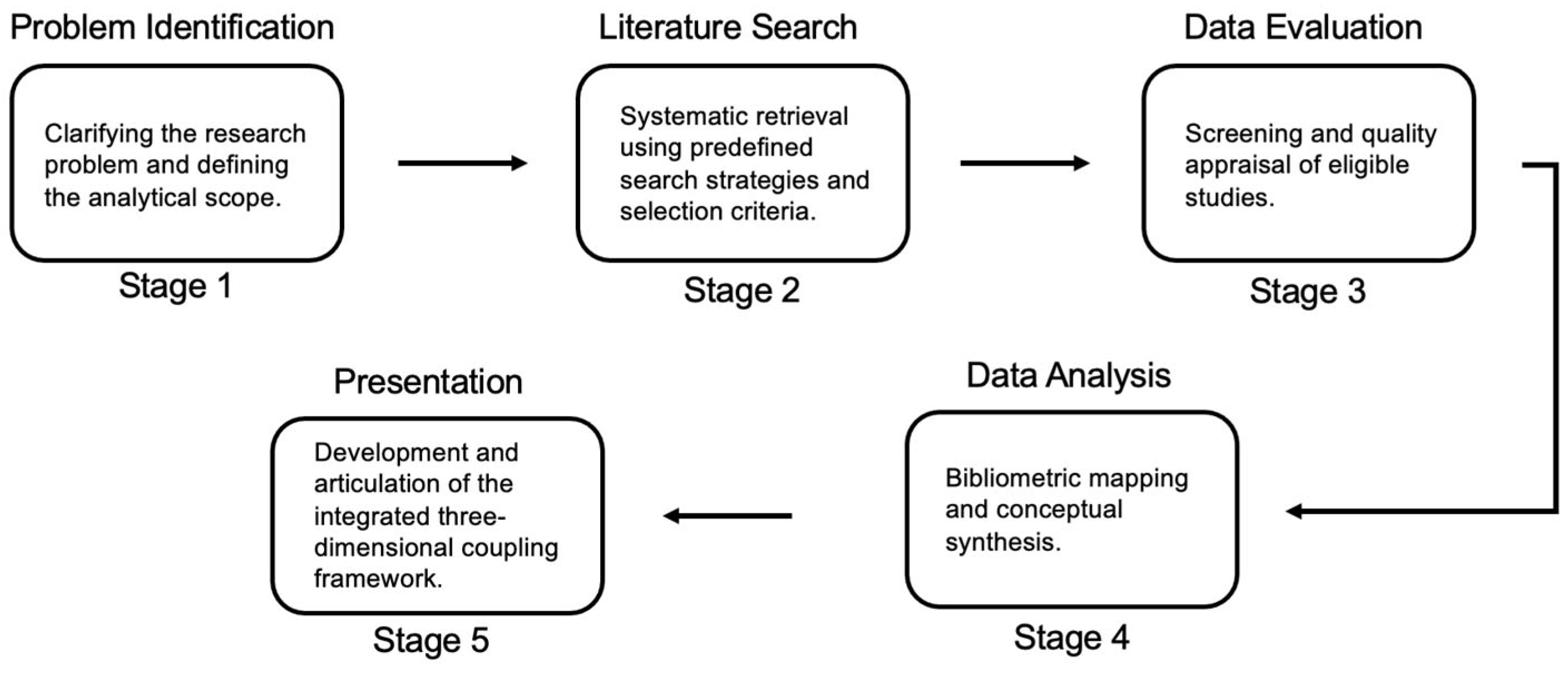
Following the methodological framework for integrative reviews proposed by Whittemore and Knafl [45], which has been widely adopted as a procedural standard in such studies [46,47,48], this study proceeds through five structured stages: (1) problem identification, (2) systematic literature search, (3) data evaluation, (4) data analysis and synthesis, and (5) presentation of an integrated framework. The preceding discussion fulfills Stage 1 (problem identification) by clarifying research fragmentation and establishing the need for cross-dimensional conceptual integration. Figure 1 illustrates the five-stage integrative review process adopted in this study.

2.2. Literature Search and Data Evaluation

To operationalize Stages 2 and 3 of the integrative review frameworks, namely literature search and data evaluation, a structured retrieval and multilayer screening strategy was implemented and supplemented by knowledge mapping as an analytical support tool. In contrast to traditional systematic reviews aimed at hierarchical evidence grading, this stage emphasizes conceptual relevance, structural completeness, and interdisciplinary coverage.
To ensure consistency in indexing and citation structures, the literature was retrieved from the Web of Science Core Collection. Because CDW resource utilization research has evolved across technological processes, digital infrastructures, governance arrangements, and market mechanisms, reliance on a single search string could bias the sample toward material performance studies and reduce the visibility of information and value dimensions. Therefore, a dimension-based retrieval strategy was adopted. Three separate search strings corresponding to the resource, information, and governance/value dimensions were constructed and subsequently merged into a unified dataset.
The time span was limited to 2015–2026 to capture the accelerated development of digital technologies, circular economy paradigms, and institutional innovation over the past decade. Document types were restricted to Articles and Reviews. Subject categories were limited to Environmental Sciences, Green and Sustainable Science and Technology, Environmental Engineering, Civil Engineering, Construction and Building Technology, Management, and Operations Research and Management Science, thereby reducing interference from studies focused solely on materials science and chemistry.
The first search group focused on the resource and process dimension:
TS = ((“construction and demolition waste” OR “C&D waste” OR CDW OR “construction waste” OR “demolition waste”) AND (recycle* OR reuse OR valor* OR “resource recover*” OR “material recover*”) AND (“waste management” OR management OR system* OR process* OR framework OR model* OR optimization OR logistics OR “supply chain”)).
The second group focused on the information and digital technology dimension:
TS = ((“construction and demolition waste” OR “C&D waste” OR CDW) AND (blockchain OR IoT OR RFID OR “digital twin” OR BIM OR tracking OR monitoring OR traceability OR “information platform”)).
The third group focused on governance and value realization mechanisms:
TS = ((“construction and demolition waste” OR “C&D waste” OR CDW) AND (“circular economy” OR policy OR governance OR incentive* OR subsidy OR pricing OR “market mechanism*” OR “business model*” OR stakeholder*)).
After merging the three search groups, duplicate records were removed using a “DOI-priority + title-verification” strategy. First, records with identical DOIs were eliminated. When DOI data were missing, exact title matching was applied as a secondary verification method. The initial merged dataset comprised N1 = 2818 records; after deduplication, N2 = 2282 unique records remained. This procedure ensured that subsequent thematic statistics and network analyses were not distorted by duplication.
A layered screening procedure was then conducted. The first-level screening, consisting of document type verification and rapid semantic exclusion, removed records clearly unrelated to CDW resource utilization and management processes. The second-level screening excluded studies focused solely on material performance. Given the high proportion of experimental material research within the CDW domain, a rule-based criterion was established based on “material performance keywords + absence of system-context keywords.” If titles or abstracts predominantly contained terms such as strength, microstructure, and reaction mechanisms, while lacking system-oriented terms (e.g., management, policy, governance, logistics, framework, optimization, supply chain, lifecycle, circular economy, or market mechanism), the study was classified as material performance research and excluded from the conceptual structure sample. This strategy does not diminish the importance of material research; rather, it balances the dataset structurally to prevent material-focused topics from dominating the thematic map.
After screening, the final sample for knowledge mapping comprised N3 = 1634 publications. This dataset preserved technological and process-oriented research while substantially enhancing the representation of information, governance, and value realization studies, providing a balanced evidence base for clustering and conceptual synthesis. In line with established bibliometric guidelines, robust co-occurrence mapping and cluster stability generally require several hundred to several thousand publications. The inclusion of 1634 documents, therefore, ensures structural representativeness and reduces selection bias in knowledge mapping [49].
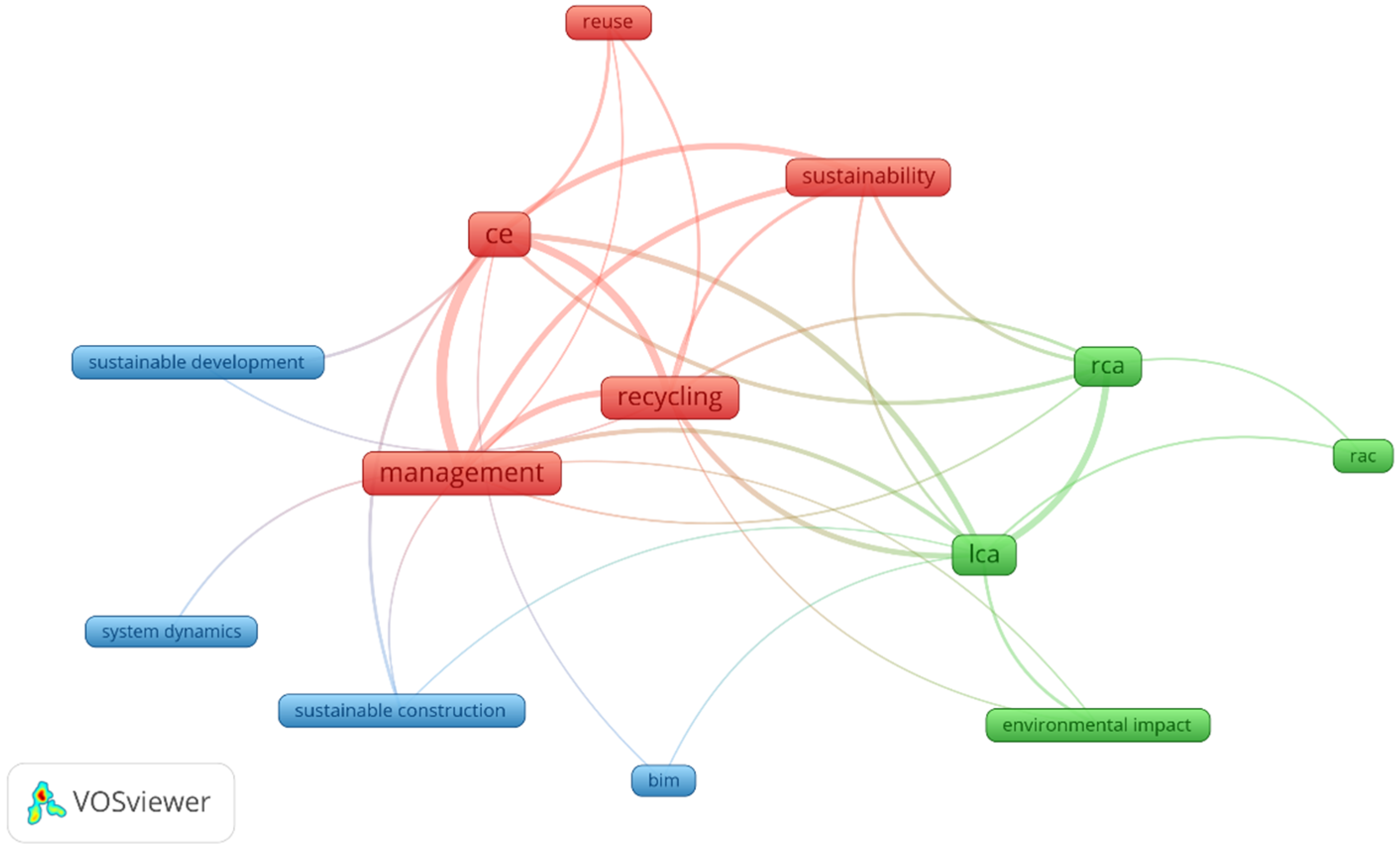
Keyword co-occurrence analysis was conducted using VOSviewer (version 1.6.20). To enhance thematic precision and reduce noise from generic terms, Author Keywords were prioritized. A thesaurus file was developed to merge synonyms and remove generalized background terms, such as unifying “CDW” and “C&D waste” expressions, standardizing “LCA” and “RCA/RAC,” and deleting high-frequency generic terms such as “CDW,” “construction,” and “waste.” Fractional counting was adopted to mitigate the dominance of high-frequency keywords. The minimum occurrence threshold was iteratively adjusted to balance structural clarity and thematic coverage, resulting in the hotspot map presented in Figure 2.

2.3. Data Analysis and Conceptual Synthesis

In accordance with Stage 4 of the integrative review framework, this study conducts thematic comparison, cluster interpretation, and cross-dimensional abstraction based on the knowledge mapping results. The objective is not merely descriptive clustering but conceptual synthesis, reorganizing fragmented research streams into an integrated analytical structure.
The keyword co-occurrence network reveals three relatively independent yet interconnected knowledge clusters:
The first cluster focuses on governance and value realization. Centered on keywords such as circular economy, recycling, reuse, sustainability, and management, this cluster focuses on institutional arrangements, policy instruments, market mechanisms, and sustainable development objectives. It emphasizes how regulatory and incentive structures can facilitate resource loops and improve environmental performance.
The second cluster represents resource and physical processes. Revolving around life cycle assessment (LCA), recycled concrete aggregate (RCA), recycled aggregate concrete (RAC), and environmental impact, this cluster represents technically oriented research on resource processing pathways, environmental performance assessment, and material utilization efficiency.
The third cluster reflects digital systems and modeling. Including keywords such as BIM, system dynamics, and sustainable construction, this cluster reflects the role of digital tools, system modeling approaches, and simulation techniques in resource coordination and decision support.
Although these clusters intersect through bridging concepts such as “management” and “sustainability,” the overall structure remains modular rather than systemically integrated. Technical studies rarely connect explicitly with governance design; policy-oriented research often overlooks physical and logistical constraints; and the development of digital tools seldom addresses value realization and incentive alignment mechanisms.
To overcome this fragmentation, this study proposes the Resource–Information–Market (RIM) framework, comprising three interdependent dimensions:
First, the resource dimension addresses logistics optimization, processing allocation, and physical flow coordination.
Second, the information dimension enables sensing, traceability, data integration, and decision support.
Third, the market dimension coordinates incentives, pricing mechanisms, and benefit distribution among stakeholders.
Unlike linear improvement strategies, the Resource–Information–Market (RIM) framework emphasizes cross-dimensional feedback loops and system-level coordination, thereby forming the conceptual foundation for the subsequent three-dimensional coupling architecture proposed in this study.

3. Description of CDW Management and Multidimensional Interaction

3.1. Architectural Rationale and System Decomposition

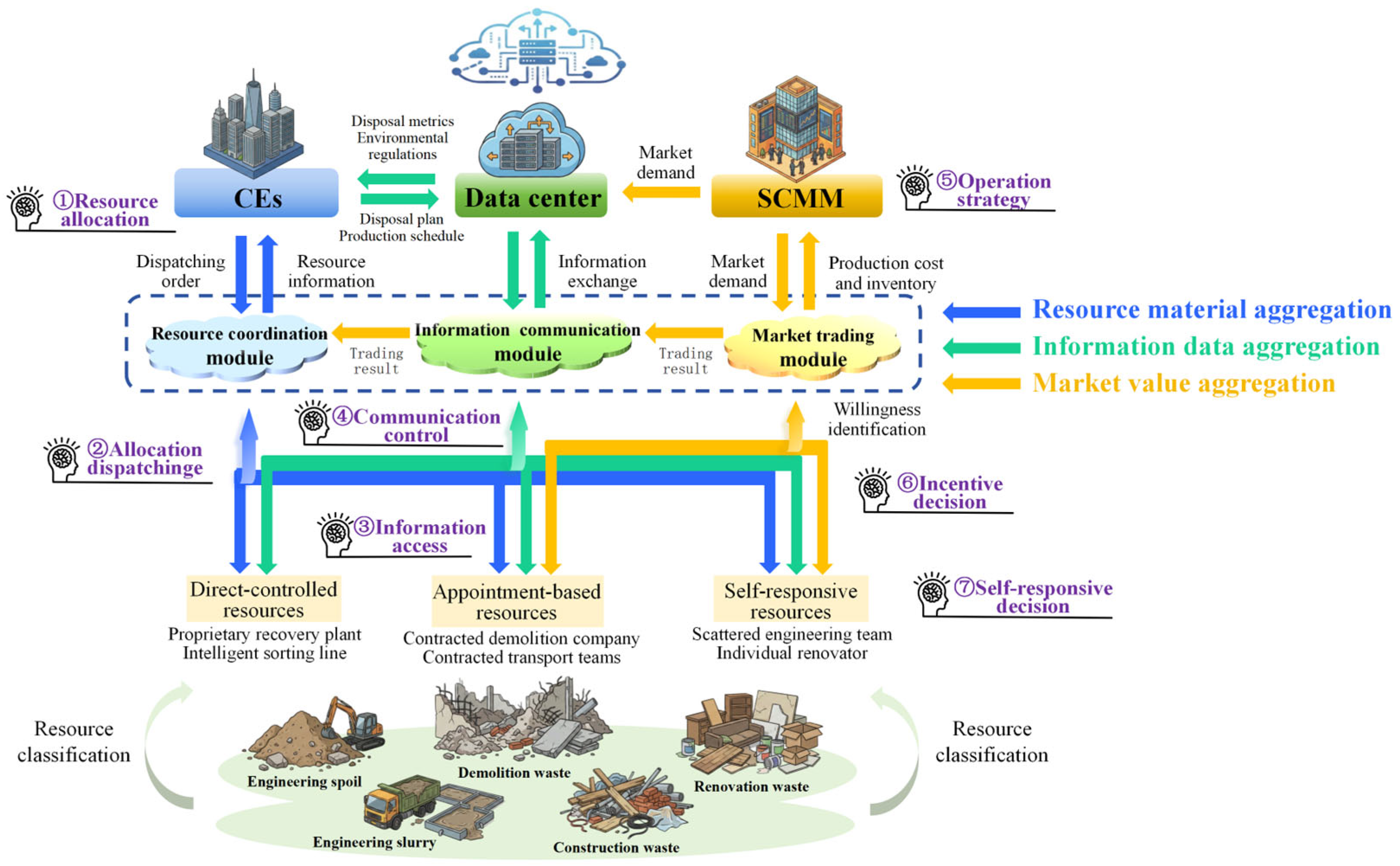
To address the decentralized generation, compositional heterogeneity, and weak supervision characteristics of CDW [50], this study adopts a “cloud-edge-terminal” collaborative architecture as the foundational operational structure for an integrated CDW recycling system [51,52,53]. Drawing inspiration from distributed coordination mechanisms in virtual power plant operations [34], the architecture decomposes the reverse supply chain into hierarchical yet interlinked decision layers [54]. The overall interaction is illustrated in Figure 3.
  • Cloud layer: Comprising construction enterprises (CEs), the sustainable construction materials market (SCMM), and centralized data centers embedded in the integrated CDW recycling system. This layer performs global coordination through data aggregation, forecasting, optimization, and policy alignment but does not directly control physical devices.
  • Edge layer: Consisting of geographically distributed CDW recovery plants that manage distributed material resources (DMRs). Each recovery plant serves as a regional operational unit characterized by specific processing capacity, service coverage, and equipment configuration.
  • Terminal layer: Including CDW generation and transportation entities such as construction sites, renovation projects, self-operated facilities, muck trucks, and freight vehicles. This layer generates real-time operational data and executes dispatching instructions.
With the edge layer serving as the system boundary, interactions are divided into upper-layer (cloud-edge) interactions, covering strategic coordination, forecasting, pricing, and regulatory alignment, and lower-layer (edge-terminal) interactions, which involve real-time aggregation, dispatching, and physical execution [55]. This layered decomposition establishes the structural basis for distributed yet coordinated decision-making.

3.2. Hierarchical Operational Coordination

In the context of an integrated CDW recycling system, hierarchical operational coordination involves division of decision-making responsibilities into upper-layer and lower-layer operations [34]. The upper layer is responsible for strategic coordination among construction enterprises, market entities, and regulators through forecasting, optimization, and policy alignment. In contrast, the lower layer handles real-time dispatching, dynamic aggregation, and execution control in response to spatially dispersed and temporally uncertain waste generation [21]. This layered structure enables the system to balance global optimization with local responsiveness.
Upper-layer operations govern interactions among the integrated CDW recycling system, CEs, SCMM, and regulatory authorities. The primary objective is to align resource allocation with market demand and policy targets [34]. Decision-making in this layer is driven by data flows processed through three functional modules: the resource coordination module, the information communication module, and the market trading module. The information communication module enables upstream and downstream coordination. The data center applies ML-based forecasting models to estimate regional CDW generation volumes and recycled material demand. Based on these predictive outputs, optimization algorithms determine inventory targets and pricing strategies, and match transactions with downstream DMRs. Simultaneously, regulatory platforms connect through blockchain nodes. Key records, including waste origin, transport trajectories, and disposal volumes, are hashed and stored at the point of generation, ensuring traceability and mitigating illegal dumping caused by information asymmetry [23,28]. Thus, upper-layer operations convert fragmented data streams into coordinated strategic decisions.
Lower-layer operations focus on real-time coordination between the integrated system and DMRs. Due to spatial dispersion and temporal randomness in CDW generation, this layer emphasizes decoupled control, dynamic aggregation and adaptive dispatching [37,56]. When CEs submit weekly or monthly production plans, macro-level targets are decomposed into operational instructions through reinforcement learning–assisted scheduling mechanisms, enabling DMRs to autonomously contribute to shared goals. The system also determines differentiated incentive mechanisms for three types of DMRs:
  • Appointment-based DMRs: pre-scheduled participation;
  • Self-responsive DMRs: reacting to price signals;
  • Direct-control DMRs: real-time dispatch for emergency balancing.
Terminal entities continuously upload operational data, such as fill levels, GPS positions, and energy consumption, through IoT networks. Edge computing nodes perform real-time data cleaning and preprocessing, transmitting only high-value decision variables to the cloud [23,56]. This process reduces latency and enhances data security. Lower-layer operations, therefore, ensure that physical execution remains synchronized with strategic objectives.

3.3. Functional Modules and Three-Dimensional Coupling

The operational logic of the integrated CDW recycling system is realized through three interdependent modules:
1.
Resource Coordination
This module governs material resource aggregation and addresses spatiotemporal heterogeneity and compositional variability through dynamic combination optimization, limited supply allocation, cross-facility dispatching [57,58]. Detailed decision formulations are presented in Section 4.
2.
Information Communication
This module addresses data fragmentation and trust deficits by establishing a traceable digital infrastructure supported by IoT and blockchain technologies [23,56]. It ensures data integrity and supplies reliable inputs for optimization algorithms, as presented in Section 5.
3.
Market Trading
This module facilitates value realization through supply–demand forecasting, automated transaction matching, and incentive-compatible pricing mechanisms [41]. It connects environmental value creation with economic returns, which are detailed in Section 6.
Rather than functioning independently, these modules form a three-dimensional coupling structure: resource coordination depends on credible data from the information communication module; information communication gains relevance through market execution; and market trading reshapes resource allocation via dynamic price signals.
The system objective is therefore to achieve global optimization across operational stages rather than isolated performance improvements.

3.4. Decision Problem Structure

The integrated CDW recycling system must achieve both holistic coordination of distributed resources and multidimensional interaction capabilities. Holistic coordination includes material combination decisions, dispatching allocation, incentive parameter setting, and device access to meet operational requirements [59], while multidimensional interaction encompasses interaction with CEs and the SCMM to support trading market participation and communication control for operational optimization [39]. The multidimensional interaction in this study does not merely denote the coexistence of resource coordination, information communication, and market trading modules. Instead, it emphasizes the bidirectional feedback among them. Ultimately, the core objective of system operation is global optimization through the resolution of decision-making problems across different operational stages [59].
The integrated operation gives rise to multiple interconnected decision problems, summarized in Table 2. Each problem involves distinct decision-makers and action variables but remains structurally coupled within the system.

3.5. Applicability Conditions and Boundary Assumptions

The proposed framework is particularly suited to CDW streams characterized by high spatial dispersion and compositional heterogeneity, such as those generated by urban renewal and dispersed demolition activities [22,64]. Its implementation depends on three interrelated conditions:
1.
Resource condition
CDW sources distributed across multiple locations and characterized by complex material composition must make collaborative treatment more efficient than centralized models [37,65].
2.
Information condition
Key logistics nodes require reliable sensing capabilities, such as vehicle positioning and smart weighing systems, as well as stable connectivity to support digital-twin synchronization [23,56].
3.
Market condition
The SCMM must exhibit functioning price signals and substitution demand for recycled materials, while stakeholders demonstrate a willingness to collaborate within a supportive policy environment [41].
Only when these conditions are satisfied, or can be progressively established, can CDW management transition from fragmented end-of-pipe treatment to an integrated, data-driven, and incentive-compatible operational system.
The operationalization of this three-dimensional coupling framework is implemented through the resource coordination module (Section 4), the information communication module (Section 5), and the market trading module (Section 6).

4. Module for Resource Coordination

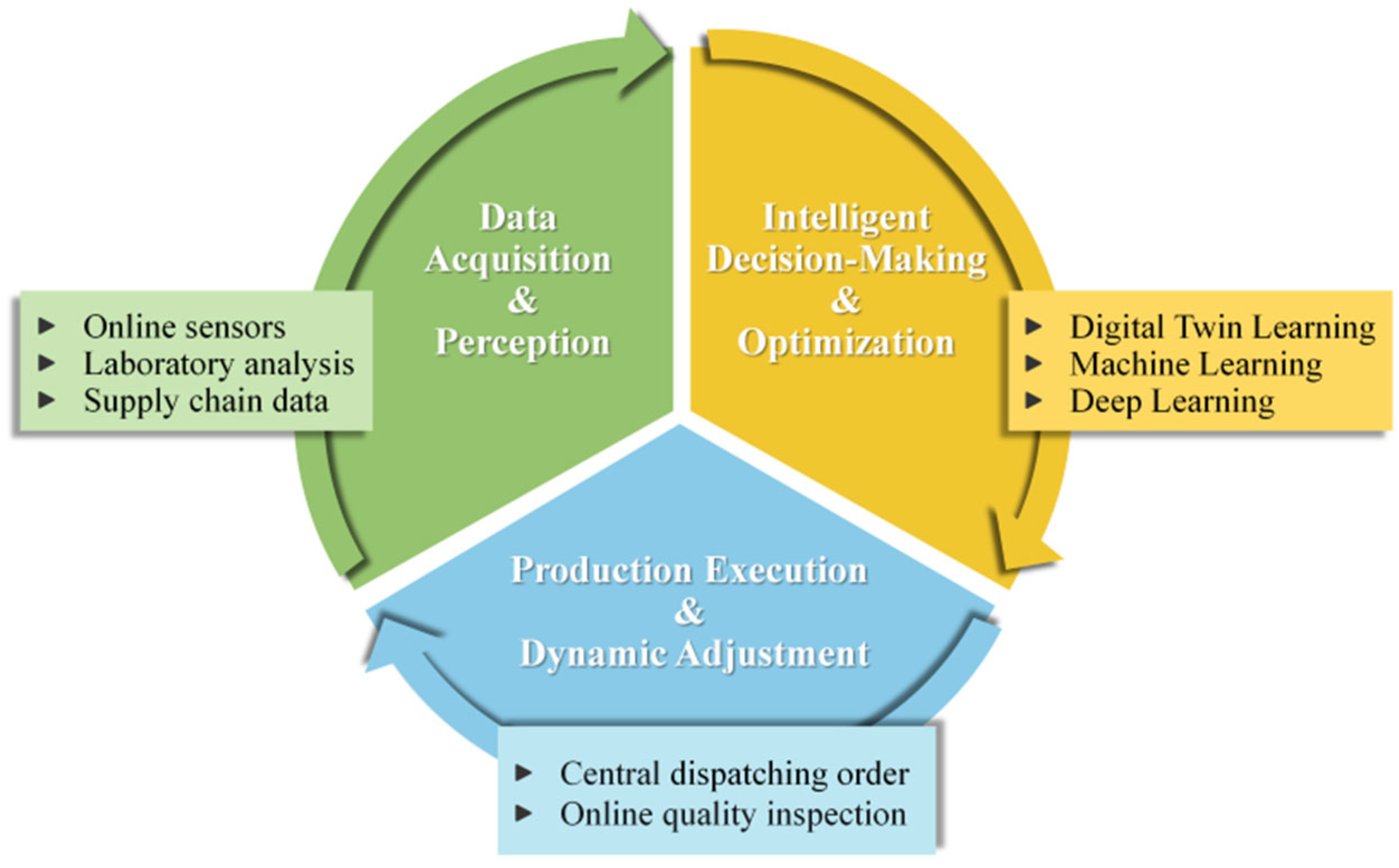
The resource coordination module constitutes the physical decision core of the integrated CDW recycling system. Its primary function is to convert dispersed and heterogeneous CDW streams into stable, grade-controlled recycled materials through dynamic allocation and dispatching under multiple constraints. From an engineering systems perspective, this module addresses three closely related decision problems: (1) resource combination optimization; (2) allocation of limited recycled materials; and (3) coordinated dispatching across facilities.
The module operates through a perception–decision–execution loop (Figure 4). Multisource CDW composition data are collected through IoT-enabled sensing devices, together with inventory data from distributed material recovery facilities (DMRs) and real-time vehicle status information. These inputs form a digital representation of material stocks and flows. Embedded optimization algorithms then generate allocation schemes and dispatching instructions, which are executed in the physical system and continuously updated through feedback control.
Resource material aggregation is constrained by spatial distribution, transport network topology, and carrier availability [57]. Cross-regional coordination is highly sensitive to disruptions such as extreme weather or traffic restrictions and therefore requires dynamic substitution with local alternatives to maintain operational continuity [66]. Resource coordination must balance economic efficiency, environmental performance, operational feasibility, and market impacts under physical constraints [67,68]. Thus, it represents a multi-objective optimization problem within a distributed production network.

4.1. Resource Combination Optimization

Prior studies have modeled CDW classification, transportation, and storage at the system level [57,58]. However, in an integrated recycling network, combinations of DMRs must be treated as a coupled optimization problem rather than as independent attribute aggregation [57,69]. The problem is multi-regional, multi-period, and uncertainty-sensitive.
Two modeling requirements are critical.
First, allocation must account for regional heterogeneity in CDW composition and variability in demand. Dynamic classification and priority ranking mechanisms are required to meet minimum material standards while adapting to the diverse needs of construction enterprises (CEs) [70].
Second, optimization must incorporate interaction effects among materials. Performance indicators such as strength and durability [71,72] are insufficient when evaluated independently. Synergistic and antagonistic effects in composite applications must also be considered [72,73]. Multi-objective models enable trade-offs between utilization efficiency and quality stability [58]. Cross-regional allocation further requires integration of cost, time, and carbon metrics [74].
CDW heterogeneity poses additional challenges. Demolition, renovation, and excavation waste streams exhibit significant variation in physical and chemical properties [64,69,75]. Recognition accuracy in intelligent sensing systems varies across material categories. For example, brick identification rates may exceed 98%, whereas predicting the gradation of recycled aggregates is more complex because of surface texture variability. Deep feature fusion techniques have been shown to improve segmentation performance [76,77]. Consequently, fixed-ratio processing is inadequate.
To address these limitations, a four-stage intelligent decision process—perception, prediction, optimization, and execution—is adopted [66].
1.
Multi-source sensing layer
Radio frequency identification (RFID) and related tracking technologies are used to record material properties, supplemented by sampling and laboratory analysis to enable near-real-time quantification [78,79]. Supply chain attributes (origin, storage duration, cost) are integrated into feature vectors.
2.
Prediction layer
Machine learning models such as gradient boosting decision trees (GBDT) and random forests (RF) are used to predict intermediate or final product performance based on mixing ratios and quantified features [57,58]. This transforms nonlinear material interactions into computable surrogate functions.
3.
Multi-objective optimization layer
Mixing proportions serve as decision variables. The objectives include cost minimization or maximization of waste utilization, subject to quality constraints derived from predictive models [80]. Bayesian optimization and evolutionary algorithms address high-dimensional nonlinear search spaces [70,81,82].
4.
Robustness control
Extreme events such as earthquakes, typhoons, and public emergencies can cause abrupt changes in waste composition [70,83], which may degrade model performance. Lightweight anomaly detection at edge nodes monitors shifts in feature distributions. When deviations are detected, the system switches to conservative scheduling while uploading anomalous data to the cloud for model retraining [84]. Incremental learning and edge–cloud collaborative training reduce computational demands and maintain real-time responsiveness [85,86].
Despite these advances, current models remain less effective in identifying pollutants, such as heavy metals and microplastics, and require alignment with evolving policy and certification standards.

4.2. Limited Recycled Materials Allocation

Beyond quality stabilization, the system must allocate limited recycled outputs among competing downstream demands [87]. This constitutes a constrained multi-objective allocation problem that integrates economic returns, environmental benefits, and equity considerations [88].
Traditional proportional allocation does not maximize system-level benefits. Therefore, the allocation quantity assigned to each demander is defined as the primary decision variable and is optimized under supply and demand constraints [89]. The objective function integrates economic, environmental, and governance dimensions.
The model incorporates:
  • AI-driven demand forecasting using real-time and historical data [6];
  • Blockchain-based smart contracts for transaction and revenue regulation [28];
  • Robust optimization to manage demand uncertainty [41,80].
Stakeholder preference heterogeneity introduces additional complexity. Governments prioritize carbon reduction, enterprises prioritize profit, and communities demand environmental justice. Persistent bias toward a single objective may trigger resistance or NIMBY conflicts.
To quantify preference structures, multi-criteria decision-making (MCDM) tools such as Analytic Hierarchy Process (AHP) and entropy-fuzzy evaluation are employed [90,91]. Real-time indicators, such as dust concentration and complaint frequency, can be used to adjust weights dynamically through entropy methods [70].
A dual-layer governance mechanism is proposed. Baseline weights are determined through Delphi or voting processes led by regulators and stakeholders [92]. These parameters are encoded into blockchain smart contracts for automated execution. On-chain voting enables dynamic adjustment based on stakeholder contributions [23,93]. This mechanism links optimization weights to transparent governance structures and mitigates long-term trade-offs between economic and environmental objectives [94].
The allocation model shifts the operational logic from production-push to demand-pull, directing limited resources toward higher-value or critical projects during periods of scarcity, thereby enhancing resilience and customer satisfaction [95]. Allocation can also be coordinated with pricing strategies to support differentiated services and revenue management [41,96].

4.3. Allocation Dispatching Coordination

As CDW treatment evolves toward distributed and networked configurations, the system must coordinate multiple plants with heterogeneous capacities and technologies [11,97]. Allocation and dispatching, therefore, become collaborative optimization problems across facilities and transportation networks.
Traditional scheduling relies on manual rules and static contracts [65,87,98]. Data fragmentation limits the accuracy of production planning [56], and manual scheduling cannot accommodate interacting constraints such as equipment availability, material variability, compliance requirements, and delivery deadlines [99].
To overcome these limitations, digital twin-based dispatching systems have been introduced [100]. IoT sensors collect real-time data on equipment status, inventory levels, and material characteristics to construct high-fidelity virtual replicas of the resource network [101,102]. Metaheuristic algorithms and ML techniques are then used to address coupled allocation, sequencing, and routing problems [103,104].
In particular, adaptive learning approaches, including reinforcement learning, provide a potential mechanism for translating macro-level optimization objectives into micro-level dispatching strategies. By continuously updating decision policies according to feedback signals related to operational efficiency, environmental performance, and resource utilization, such approaches enable the system to gradually improve allocation decisions under evolving waste generation patterns and market conditions [105]. However, reinforcement learning–based coordination inherently involves an exploration–exploitation trade-off [106]. Excessive exploitation of previously successful strategies may reduce the system’s ability to respond to new conditions, such as sudden changes in waste composition, facility availability, or regulatory constraints. Conversely, excessive exploration may temporarily reduce dispatching efficiency and lead to suboptimal resource allocation in the short term. In order to achieve equilibrium between these competing dynamics, practical implementations frequently employ adaptive exploration strategies [107]. These include gradually decaying exploration rates, hybrid rule-based constraints, and multi-objective reward mechanisms that integrate operational stability with long-term learning capability [106].
Dynamic rescheduling improves responsiveness to emergency orders and equipment failures. Optimized routing and facility selection can reduce transportation emissions by approximately 0.0046 t CO2-eq per ton of waste [108], contributing to green manufacturing objectives [88]. Table 3 summarizes the key technologies and application scenarios that form the basis of allocation and dispatching in the integrated CDW recycling system.
However, the deployment of digital twins faces several engineering constraints. Maintaining real-time synchronization requires dense sensing and continuous calibration [145]. Communication delays, sensor drift, and unexpected failures can introduce data gaps that compromise scheduling reliability [146].
Several mitigation strategies include multi-source data fusion that combines mechanistic models with historical patterns for missing value imputation [147], embedded fault diagnosis and adaptive reconfiguration within digital twins [148], and the incorporation of uncertainty quantification into scheduling models through robust and chance-constrained optimization [149]. Emerging digital twin frameworks oriented toward the circular economy provide useful methodological references [150].
Nevertheless, current models tend to emphasize quantifiable economic objectives and struggle to incorporate policy heterogeneity, community dynamics, extreme weather events, and human factors. Their reliance on historical data also limits predictive capacity under unprecedented disruptions.

4.4. Module Interdependence and Limitations

The resource coordination module operationalizes material aggregation through multi-objective optimization, ML prediction, and digital twin-based dispatching [57,58]. It addresses spatiotemporal heterogeneity through a perception–prediction–optimization–execution loop. However, its effectiveness depends on the timeliness and credibility of data [79]. Without verified records of waste sources and transportation trajectories, optimization results lack reliability [56].
Furthermore, allocation objectives require price signals and incentive parameters generated by the market trading module [41,88]. Thus, while resource coordination forms the physical foundation of multidimensional interaction, it does not resolve issues of data authenticity verification or market price formation. Standardized data interfaces enable bidirectional information exchange: verified inputs from the information communication module guide optimization, and allocation outcomes feed into the market trading module.

5. Module for Information Communication

To address information asymmetry and data fragmentation in the integrated CDW recycling system, this section defines the information communication module as a decision-support infrastructure rather than merely a data transmission layer. The module addresses two interrelated decision problems: (1) information access decisions concerning storage modes and value-based classification, and (2) communication control decisions that balance centralized coordination with distributed autonomy.
Through standardized interface integration, blockchain-based dual storage, and cloud–edge collaborative control, the module ensures data authenticity, interoperability, and real-time responsiveness. It provides structured and verifiable data inputs for the resource optimization and market trading modules.
CDW recycling involves multiple stakeholders, including government regulatory platforms (GRPs), CEs, demolition households, CDW resource recovery plants, and communities. Divergent interests and strategic interactions among these actors create high entity complexity [3,151]. Throughout the CDW life cycle, heterogeneous sensing devices, such as RFID for batch identification, GPS for transport monitoring, and smart weighing and storage sensors for quantity tracking, generate high-frequency, multi-source data streams [152].
These devices differ substantially in hardware architecture, communication protocols, and deployment environments [153,154,155]. Variations in radio frequency standards, bandwidth requirements, power supply conditions, and network technologies, such as short-range wireless, cellular IoT, and LPWAN, complicate hardware-level integration and coordinated data fusion [156,157,158,159]. Without a unified and credible information interaction mechanism [160,161], data remain fragmented across operational stages, exacerbating information asymmetry [162] and hindering efficient supply–demand matching [163].
Accordingly, establishing a communication decision architecture that ensures data authenticity, traceability, and real-time sharing becomes a prerequisite for effective CDW governance [164,165].
The module ingests heterogeneous data from diverse sources, including RFID, GPS, and IoT platforms. Through standardized modeling, it implements a mechanism that combines cloud–edge collaboration with dual-layer storage to support data provenance and layered decision-making. The resulting structured interfaces and blockchain-authenticated records provide a reliable foundation for optimization and execution.
Rather than requiring hardware compatibility, the framework enables protocol-agnostic access through abstraction [28]. By using a unified data model together with lightweight protocols such as MQTT, the system supports cross-device information fusion [166]. MQTT is particularly suitable in this context; its minimal overhead and asynchronous communication help mitigate the constraints of limited computing power and unstable connectivity in distributed sensing environments [167,168].
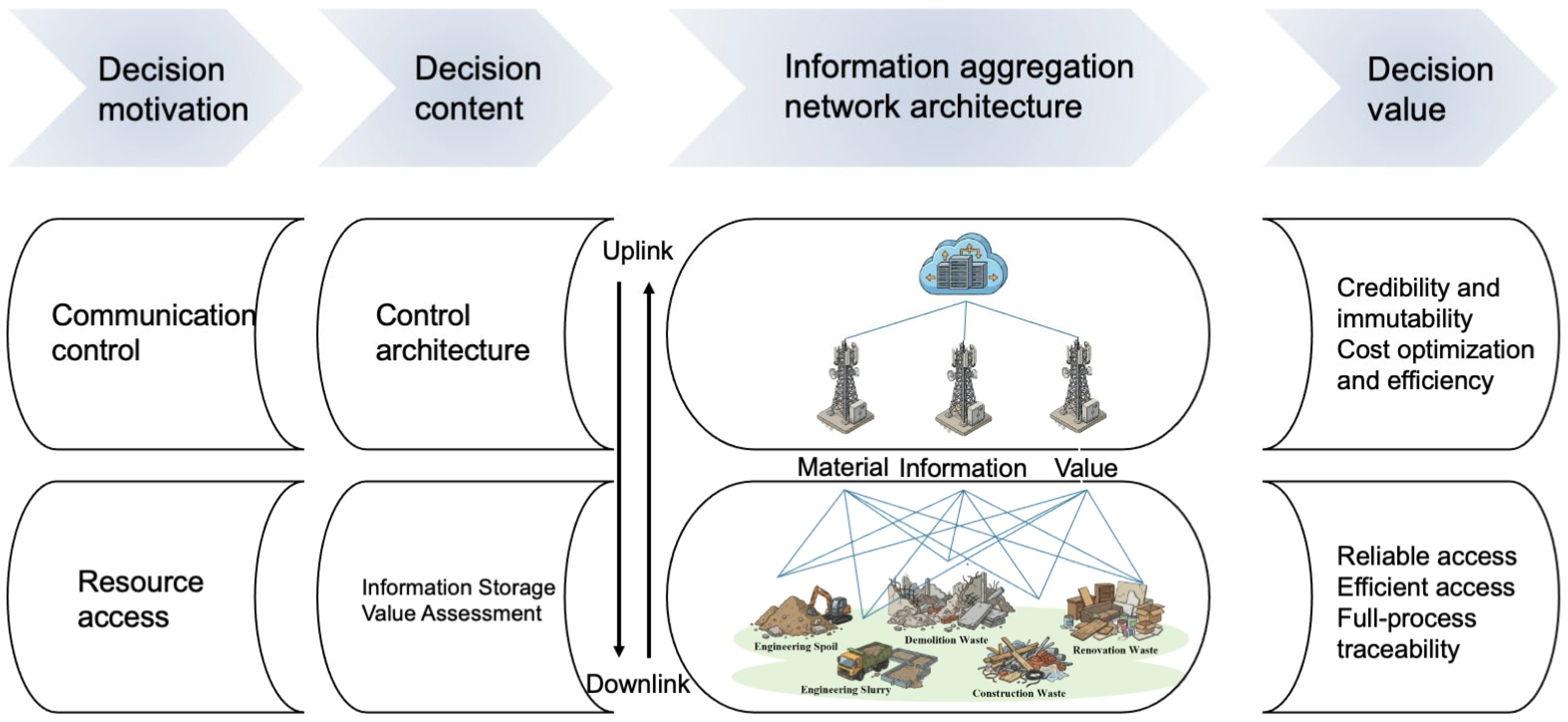
The operational efficiency of this “cloud-edge-terminal” architecture hinges on two critical decision-making dimensions:
  • Access decisions: Evaluating subordinate resource capacity and ensuring the fidelity of data uploads during transportation.
  • Control decisions: Designing an upper-layer architecture to optimize multi-entity permission allocation and enhance cloud processing reliability, thereby bridging information silos.
The decision content, decision value, and corresponding network architecture of the information aggregation layer are illustrated in Figure 5.

5.1. Information Access

5.1.1. Information Storage Decision

Given the spatial dispersion and high data volume of CDW operations, efficient communication between terminal devices and edge servers is critical. The selection of storage modes must consider data volume, evidentiary requirements, on-chain costs, and operational value, with the objective of minimizing system-wide storage and transaction burdens.
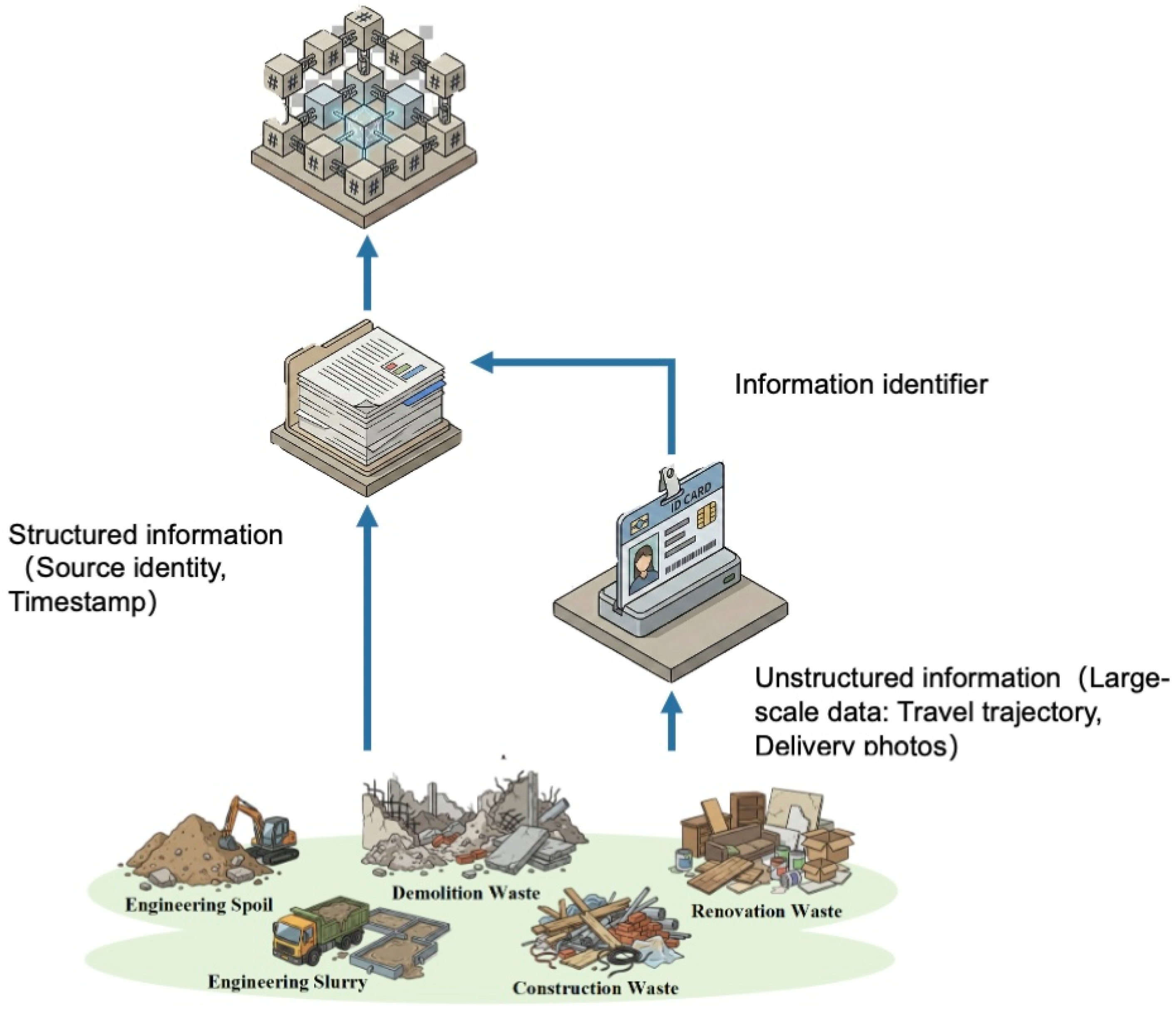
Traditional centralized storage aggregates weighbridge records, transport trajectories, and surveillance data on a single platform [169]. However, such systems face two structural limitations. First, unilateral data submission without multi-party consensus creates credibility risks [170]. Second, direct on-chain storage of large unstructured files leads to blockchain congestion and excessive trading costs [171,172,173,174]. Figure 6 illustrates the information storage model.
To overcome these constraints, this study adopts an on-chain and off-chain dual-storage architecture that integrates blockchain with the Inter-Planetary File System (IPFS) [63]. Under this model:
Large, low-frequency raw data, such as surveillance videos and transport records, are stored off-chain, generating immutable content identifiers (CIDs) through hash algorithms [175].
Critical metadata, including CIDs, timestamps, and entity identifiers, is recorded on-chain to ensure consensus and evidentiary validity.
This layered design reduces network congestion [176,177,178,179,180], preserves data integrity through hash consistency, and enables full life cycle traceability [181].
Importantly, blockchain functions as an immutable evidence anchor rather than a comprehensive verification tool. Data integrity is validated at edge nodes prior to IPFS storage, and only hash values are recorded on-chain [182,183]. In cases of inconsistency or corruption, dispute resolution relies on predefined governance mechanisms and regulatory arbitration rather than purely cryptographic adjudication [184]. This hybrid approach enhances both technical robustness and institutional feasibility.

5.1.2. Value Evaluation Decision

Because CDW operations involve heterogeneous resources, such as transport vehicles, demolition robots, and weighing systems, the informational value of the data generated varies across scenarios and over time [185,186]. A uniform transmission strategy would therefore allocate computational and storage resources inefficiently.
Data are evaluated across four dimensions: urgency, risk impact, decision relevance, and real-time requirements [45]. High-risk and time-sensitive events, such as illegal dumping alerts or abnormal transport deviations, are classified as high priority and processed through real-time edge analysis or on-chain confirmation [184]. Lower-priority data, such as empty vehicle trajectories or historical inventory records, are deferred for long-term analytical use, including route optimization and forecasting model training [187].
Lower priority does not imply lower value. Rather, differentiated governance enables efficient resource allocation while preserving long-term analytical and optimization potential.
To prevent congestion caused by low-value submissions, access control incorporates device authentication and smart contract–based verification. Digital signatures from authorized devices are validated, and dynamic access weights regulate transmission frequency [188]. This mechanism improves energy efficiency, reduces backlog risks, and enhances service reliability.
In summary, information access decisions follow a two-step logic: (1) value-based classification at the edge, and (2) differentiated storage through the dual on-chain and off-chain architecture. This process ensures reliable information at the cloud level while controlling operational costs.

5.2. Communication Control

Effective CDW management requires continuous coordination of heterogeneous devices, including weighbridges, transport fleets, and mobile robotic systems [189]. The choice of control architecture directly influences scalability, privacy protection, and computational efficiency.
Traditional centralized control assigns all decision authority to a cloud server [190,191]. While this approach enables system-wide optimization, it also introduces bandwidth bottlenecks, privacy risks, and single-point-of-failure vulnerabilities [192,193].
Fully distributed control grants autonomy to edge agents [194,195], reducing latency and improving system robustness. However, limited global visibility may lead to local optima and coordination inefficiencies [196,197,198].
To reconcile these trade-offs, this study proposes a cloud–edge collaborative architecture [199,200,201]. The cloud layer performs strategic planning tasks, including regional target setting, cross-regional coordination, and long-term analytics. Edge nodes execute real-time operational control functions, such as violation detection, dynamic routing, and device-level responses [86,202,203].
Rather than forming a hierarchical command structure, the cloud and edge operate across complementary temporal scales [204,205,206]. The cloud establishes the overall decision boundaries, while edge nodes maintain operational autonomy within these limits. When unexpected events cause temporary deviations, edge nodes prioritize maintaining system continuity and then transmit state updates to the cloud for recalibration [207].
This layered coordination mitigates control conflicts, preserves supply chain continuity, and maintains alignment between local responsiveness and global objectives.

5.3. Module Interdependence and Limitations

The information communication module provides the digital infrastructure that supports reliable coordination across the integrated CDW recycling system. Through standardized data interfaces, cloud–edge collaborative processing, and blockchain-based verification mechanisms, the module enables operational data from distributed devices to be securely collected, authenticated, and shared across system layers.
However, the effectiveness of this infrastructure depends on its interaction with the other functional modules. The resource coordination module relies on timely and credible operational data, such as vehicle trajectories, material composition records, and facility inventories, to support optimization algorithms and digital twin–based scheduling. Similarly, the market trading module requires verified transaction records and supply–demand information to enable automated settlement, price signaling, and incentive mechanisms.
Conversely, resource allocation outcomes and market trading activities continuously generate new operational data, which are fed back into the information system and incorporated into the decision-support infrastructure. The information communication module, therefore, functions as the connective layer of the integrated framework, enabling bidirectional data flows that sustain coordination between resource optimization and market execution.
Nevertheless, existing computer-based document management and information processing systems still face notable constraints. These include limited accuracy in the automated recognition of unstructured data, high interface adaptation costs resulting from inconsistent cross-platform standards, insufficient capacity to detect abnormal scenarios and reduce reliance on manual intervention, and substantial computational and energy demands associated with large-scale on-chain data management and model training.

6. Module for CDW Market Trading

To address barriers to value realization in the CDW recycling market, this section conceptualizes market trading as a structured decision subsystem rather than a simple exchange platform. It addresses three interrelated decision problems: (1) supply–demand perception; (2) trading value execution; and (3) incentive alignment.
Building on verified data from the information module, this subsystem integrates AI-based forecasting and blockchain smart contracts to improve pricing transparency, trading automation, and endogenous participation. The module generates supply–demand forecasts, indicative prices, automated trading orders, real-time settlement results, and dynamic incentive signals, while transmitting demand and price feedback to the resource coordination module.
CDW recycling is not merely an activity for environmental compliance; it is a value-creation process embedded within broader market systems [205]. Recovered materials, such as recycled aggregates, permeable bricks, and subgrade materials, re-enter the secondary construction materials market (SCMM) as substitutes for primary resources [178,205,206,207,208,209,210,211]. This substitution generates revenue for recovery plants and reduces procurement costs for downstream projects [97,212].
However, structural disincentives persist. For CEs, illegal dumping is often cheaper than compliant disposal, which undermines both environmental and economic value [213]. In addition, the environmental benefits of recycled products are difficult to monetize directly, weakening endogenous market incentives [214].
The value module, therefore, aims to convert dispersed, low-value waste into standardized, tradable recycled products within an integrated system. By linking emission reduction incentives with market returns, it aligns environmental objectives with economic incentives [215,216].
This requires coordinated decisions across three levels:
Market operation decisions: AI-based forecasting of supply, demand, inventories, and prices, combined with smart contract automation to reduce mismatch risks [217].
Incentive decisions: Data-driven performance quantification for appointment-based DMRs to correct disincentives in source separation.
Self-responsive decisions: Decentralized order-grabbing mechanisms for scattered waste streams to address regulatory blind spots [218].
Through interaction among these layers, the platform shifts CDW governance from passive compliance toward profit-oriented participation.
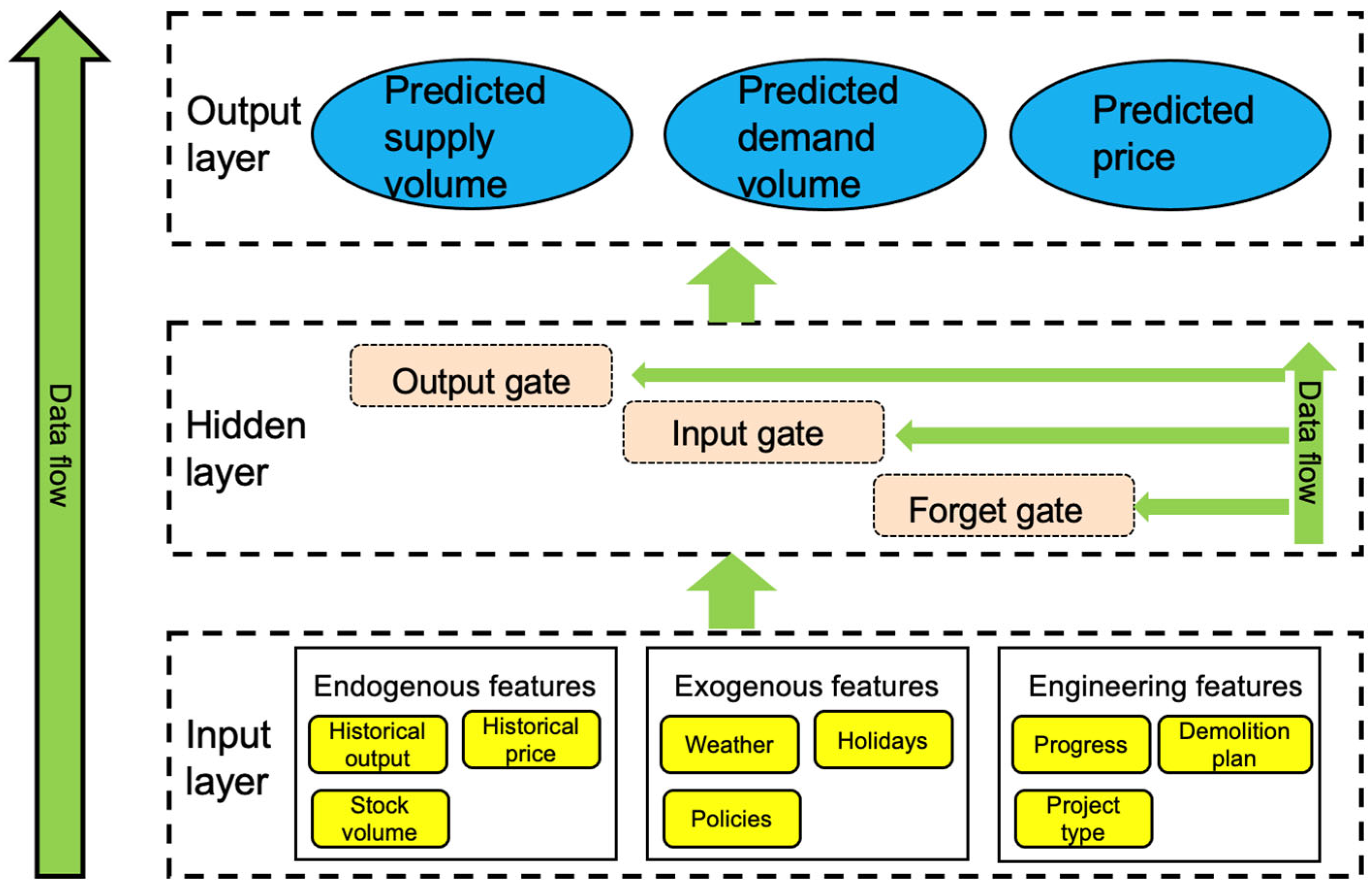
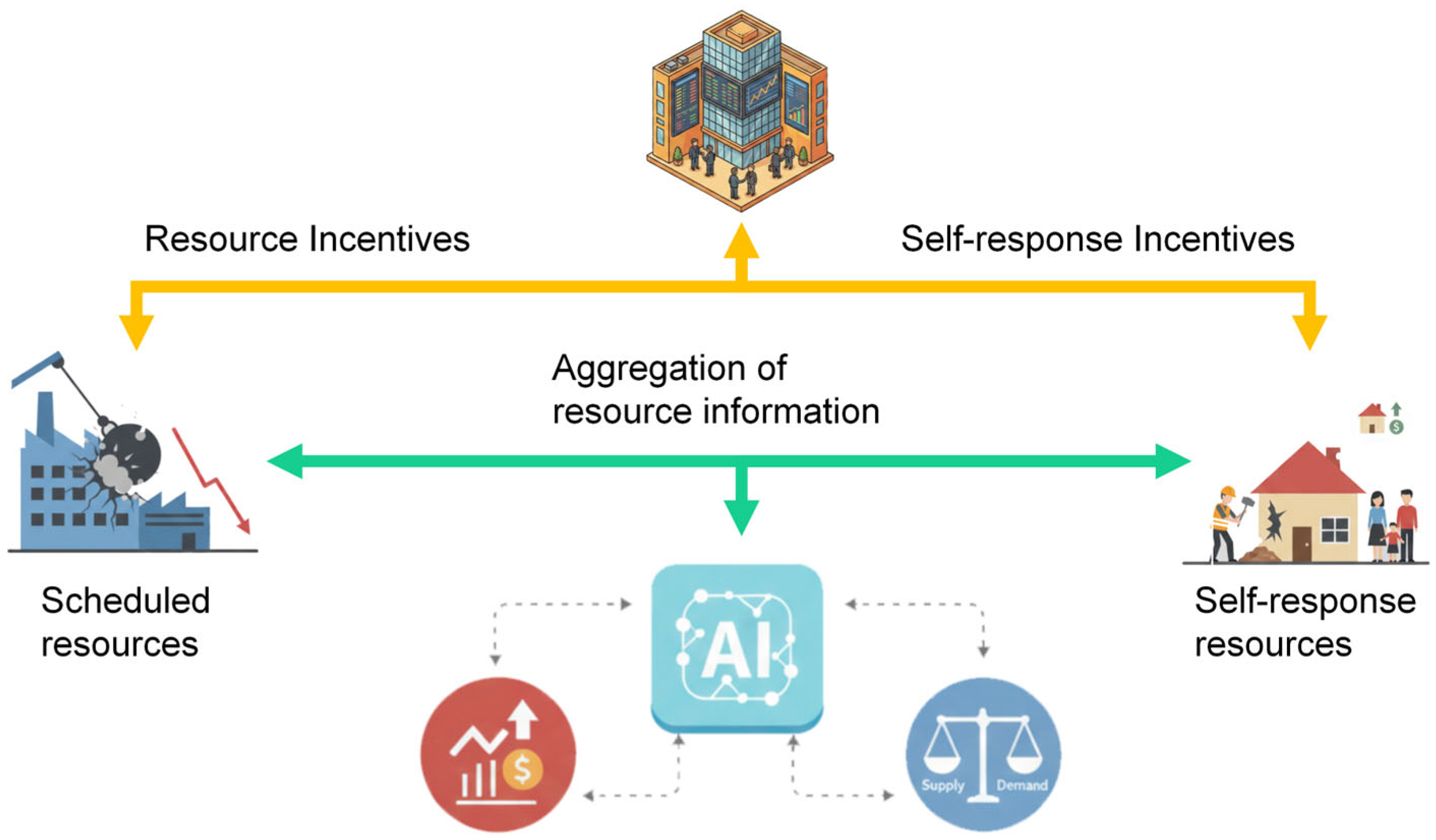
This module receives verified inventory and trading data from the information module, together with market demand signals, project progress information, and external environmental variables. Based on these inputs, it employs an integrated mechanism that combines supply–demand forecasting, smart contract–based trading execution, and incentive decision-making. The long short-term memory (LSTM) model is used for dynamic prediction of supply and prices, while blockchain smart contracts enable automated matching and settlement and support both credit-based and price-based incentives. The module generates supply–demand forecasts, indicative prices, automatically generated trading orders, instant settlement results, and dynamic incentive signals to guide market participation and resource allocation. The corresponding process flow is illustrated in Figure 7.

6.1. Market Operation Decisions

6.1.1. Supply–Demand Perception Decision

Efficient allocation requires an accurate perception of dynamic supply and demand [219,220,221]. In practice, CDW generation is highly stochastic and subject to temporal lags caused by construction schedules, weather conditions, and the heterogeneous nature of demolition activities [83,93,222,223,224]. Static empirical coefficients and linear regression models are unable to capture these nonlinear dynamics and multi-factor interactions [225].
To address this limitation, this study employs an LSTM model capable of capturing temporal dependencies in high-dimensional time series data [70,226,227,228,229]. The model integrates historical generation records, real-time inventory levels, and environmental variables to generate forward-looking forecasts of supply, demand, and indicative prices, as illustrated in Figure 8.
Compared with traditional regression approaches, LSTM provides greater robustness under nonlinear and delayed generation patterns, offering quantitative support for bidding and allocation decisions [230,231,232].
Macroeconomic variables, such as fluctuations in virgin material prices and shifts in construction cycles, also influence CDW markets [233]. Although regional data inconsistencies prevent unified modeling in this study, these factors can be incorporated as exogenous variables in extended applications [70,234].

6.1.2. Trading Value Decision

Traditional CDW trading relies on offline negotiation and intermediaries, resulting in high search costs, long settlement cycles, and exposure to credit risk [235]. The absence of credible enforcement mechanisms often creates “payment-first vs. delivery-first” dilemmas.
To reduce trading friction, this study proposes a smart contract–driven trading framework based on forecast-based matching outcomes. The blockchain-based workflow includes automatic order matching, fund locking, delivery verification, and instant settlement [236].
Once matching instructions are generated, the smart contract locks the buyer’s margin and monitors delivery data through IoT devices [237]. Verified weighing and quality data trigger automatic settlement according to predefined rules, eliminating the risk of arrears and accelerating capital turnover [238,239].
By embedding trading logic in executable code, the model establishes rule-based trust and transforms CDW exchange into a verifiable, low-friction value circulation process.

6.2. Incentive Decision

Within the closed-loop supply chain [1], appointment-based DMRs rely on effective source separation and compliant transportation [240]. However, additional sorting costs and higher disposal fees discourage compliance, often leading to mixed loading or illegal dumping [116,241]. Static subsidies and ex post penalties lack both precision and timeliness [242,243].
This study proposes a dynamic incentive mechanism based on blockchain-recorded performance indicators [8]. Smart contracts calculate environmental performance indices using on-chain data such as material saving rates, classification purity, and violation histories [244,245,246]. These indices are then mapped to digital credit scores that influence disposal fee discounts, fiscal subsidies, bidding privileges, access to green financing, and inspection frequency.
To mitigate the risk of manipulation, indicators undergo multi-source verification before on-chain recording, including IoT sensing, AI-assisted image recognition, third-party inspection, and cross-validation of transport records [247,248,249]. Only verified results are hashed and uploaded, combining off-chain validation with on-chain immutability [250].
Community impacts are incorporated through a “market externality constraint parameter,” which integrates transportation distance, night operation ratios, and dust monitoring indicators into performance evaluation [251,252]. This approach transforms market externalities into quantifiable governance variables.
To mitigate these concerns, the proposed system incorporates a multi-dimensional verification and hierarchical incentive structure.
First, to reduce the possibility of score manipulation, the system adopts cross-validation mechanisms, including blockchain-based on-chain traceability, random regulatory inspections, and third-party auditing. These mechanisms enable multi-source verification of operational data and significantly compress the space for opportunistic manipulation [250].
Second, to prevent structural advantages of large enterprises from translating into disproportionate credit dominance, the scoring framework introduces scale-adjustment coefficients and behavioral improvement indicators. These indicators emphasize relative performance improvement rather than absolute operational scale, allowing small and medium-sized enterprises (SMEs) to progressively improve their credit standing through consistent behavioral optimization [253].
Third, the incentive system adopts a tiered access structure of “basic participation rights–advanced incentive privileges.” While all qualified participants retain fundamental market access, higher-level incentives are linked to verified performance improvements rather than firm size alone. This mechanism helps ensure stable participation opportunities for SMEs and reduces the risk of resource-driven monopolization [254].
Through the institutional combination of risk control mechanisms, scale-adjusted scoring, and hierarchical access rules, the dynamic credit incentive system aims to enhance source classification efficiency while maintaining market fairness, inclusiveness, and long-term system sustainability [62].
Multi-objective weight allocation is determined through stakeholder consultation and encoded into smart contracts to ensure rule stability [253,255]. Periodic review mechanisms allow parameter updates while preserving transparency [62,93].
In the resource incentive process described above, smart incentive contracts do not function as rigid rule sets. Their primary role is to automatically execute transaction and incentive logic that has already been agreed upon. Specific parameters, such as pricing rules, subsidy levels, and carbon credit coefficients, can be configured and updated by governance-authorized nodes in response to policy adjustments.

6.3. Self-Responsive Decision

Scattered decoration waste and small-scale demolition materials represent persistent regulatory blind spots because of their dispersed origins and fragmented transportation arrangements [256].
The proposed decentralized “order-grabbing–self-proof” mechanism enables autonomous participation through blockchain-based smart contracts [257]. Standardized digital orders are broadcast through a location-based matching system similar to ride-hailing platforms [258]. Participants respond according to real-time capacity and proximity.
Once an order is accepted, a digital deposit is locked as a performance bond. Qualification verification considers declared capacity, historical performance, and geographic suitability [259]. Timestamped tracking and IoT-uploaded evidence trigger automated settlement or penalties [260].
Orders not confirmed within specified timeframes are automatically released, creating a dynamic self-screening mechanism. Performance history continuously influences future participation rights, reducing management costs under decentralized conditions [261].

6.4. Module Independence and Limitations

The market trading module transforms CDW management from disposal-oriented governance to value-oriented coordination. By integrating forecasting, automated trading, and dynamic incentives, it establishes a closed-loop process of perception, analysis, execution, and feedback.
Verified data from the information module supports trading decisions, while price and demand signals guide adjustments within the resource coordination module. In addition, price signals are transmitted to the resource coordination module as updated objective coefficients or constraint parameters. This feedback structure strengthens the coupling among material, information, and market flows.
Nevertheless, implementation challenges remain. SMEs may face significant initial investment burdens associated with IoT devices and blockchain integration [262]. To address this, a “platform-based access + hierarchical deployment” strategy is proposed. This approach enables participation through shared nodes and pay-as-you-go cost structures, supplemented by phased subsidies or equipment leasing mechanisms [263].
In addition, adaptive learning algorithms inevitably involve exploration–exploitation trade-offs. While exploration enables the discovery of new allocation strategies under changing CDW generation patterns and market conditions, excessive exploration may temporarily reduce operational efficiency, whereas over-reliance on exploitation may limit system adaptability. Balancing these competing dynamics remains an important challenge for practical implementation. Despite these constraints, the market trading module closes the system feedback loop through price signaling and automated settlement, thereby reinforcing both information credibility and resource-allocation efficiency.

7. Discussion

7.1. System Operation Mechanism and Evaluation Framework

With the accelerating diffusion of digital transformation and Industry 4.0 technologies, CDW management is shifting from terminal treatment toward system-level coordination. Rather than operating as a linear disposal chain, the proposed framework forms a coupled governance system that integrates resource material flows, information data flows, and market value flows.
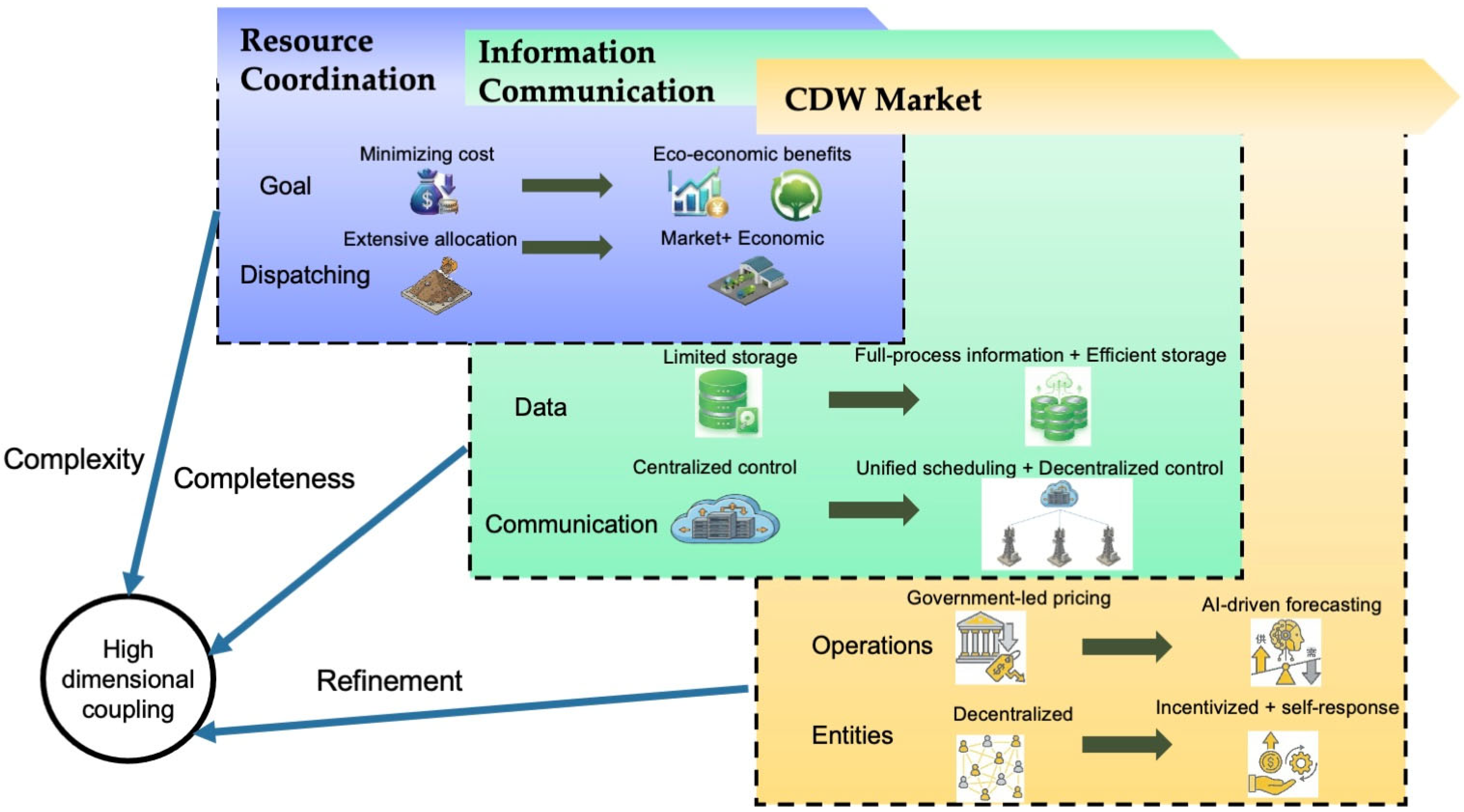
This transformation is not merely a technological upgrade but an expansion of governance dimensionality through cross-layer aggregation and feedback coupling. Figure 9 illustrates this evolutionary trajectory.
1.
Efficiency enhancement at the resource layer
Traditional CDW management prioritizes disposal cost minimization through experience-based dispatching. Under the integrated framework (Section 4), the objective shifts toward multi-objective coordination of economic and environmental performance. Dynamic optimization algorithms enable life cycle resource configuration rather than static task allocation, thereby improving material recycling rates and reducing system-level carbon intensity.
2.
Technological integration at the information layer
As discussed in Section 5, the standardized cloud-edge-terminal architecture establishes a trusted data infrastructure. Through IoT sensing, blockchain anchoring, and IPFS-based layered storage, fragmented data streams are transformed into verifiable and structured decision inputs. Governance, therefore, evolves from ex post supervision toward real-time monitoring and parameterized control, reducing information asymmetry and coordination costs.
3.
Endogenous activation at the market layer
Section 6 demonstrates how AI-based forecasting and smart contract execution convert verified data into actionable market signals. LSTM-based supply–demand perception and automated settlement mechanisms enable forward-looking pricing and incentive alignment. The operational logic, therefore, shifts from administrative pricing and passive compliance toward market-responsive participation driven by dynamic value signals.

7.1.1. System Operation Mechanism

From a system perspective, the architecture shown in Figure 9 is not a simple aggregation of three modules but a nested feedback structure: resource optimization relies on high-integrity data inputs, while the value of data is realized through pricing and incentive mechanisms; in turn, market signals reshape scheduling priorities and data acquisition strategies.
Together, these interactions form a closed-loop evolutionary mechanism of perception, decision, execution, and feedback. System complexity and governance effectiveness are therefore reconciled through structured coupling rather than centralized control. Functional upgrading across the three dimensions occurs through cross-layer interaction rather than isolated improvement.

7.1.2. Evaluation Framework

To assess the effectiveness of the integrated CDW recycling system, a multidimensional evaluation structure is required. Drawing on the Triple Bottom Line (TBL) framework used in CDW management [264] and considering data limitations during Shenzhen’s pilot stage, this study adopts three assessment dimensions: operational, environmental, and market.
Specifically, the operational dimension includes resource scheduling efficiency, data authenticity, forecast accuracy, and changes in operational costs [265], where operational efficiency indicators serve as proxies for economic feasibility. Meanwhile, the environmental dimension focuses on resource utilization rate, carbon emission reduction, and pollution control performance [266]. In addition, the market dimension captures stakeholder collaboration, policy alignment, and public acceptance [267].
In addition, guidelines from the Ministry of Housing and Urban-Rural Development of the People’s Republic of China are incorporated to establish reference benchmarks. Table 4 presents the comprehensive evaluation criteria.
This framework ensures that performance measurement aligns with the three-dimensional coupling logic rather than relying solely on environmental indicators.

7.2. Shenzhen Construction Waste Smart Management System

To illustrate the practical application of the proposed architecture, this study takes Shenzhen as a case for analysis. As a megacity and a designated “Zero-Waste City” pilot, Shenzhen faces high waste generation intensity, limited disposal capacity, and complex regulatory coordination challenges [21].
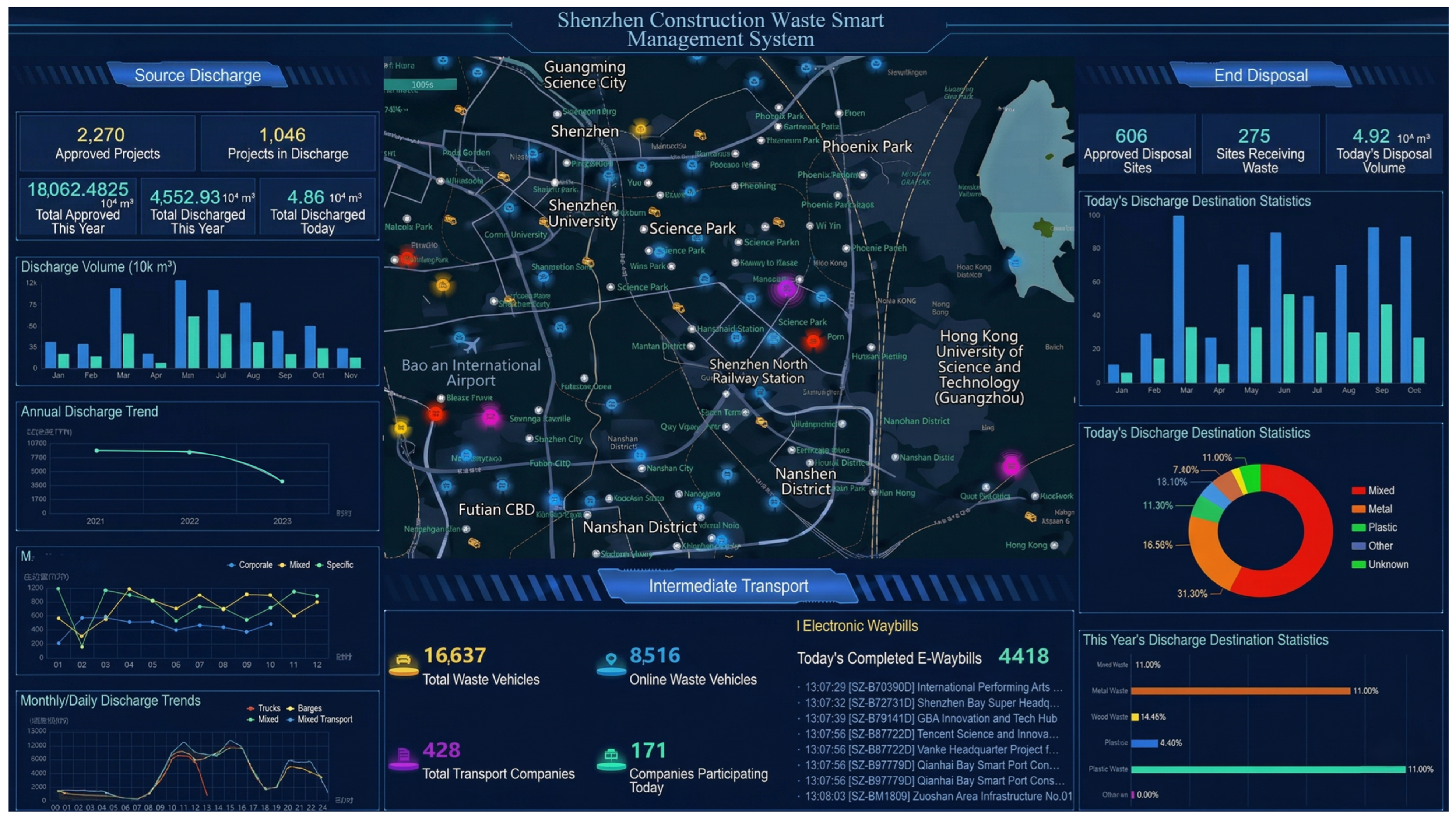
The Shenzhen Housing and Urban-Rural Development Bureau has established a digital supervision platform enabling vehicle and site monitoring (Figure 10) [268]. Previous applications of GIS have demonstrated logistics optimization potential [116], while agent-based modeling indicates improvements in economic viability [21]. These initiatives provide an empirical foundation for extending toward the integrated cloud-edge-terminal architecture proposed in this study.
Building on the existing digital infrastructure, the enhanced system connects demolition sites, transport fleets, recycling plants, and downstream markets within a unified operational network supported by blockchain-based data certification and AI-driven forecasting.

7.2.1. Implementation Roadmap

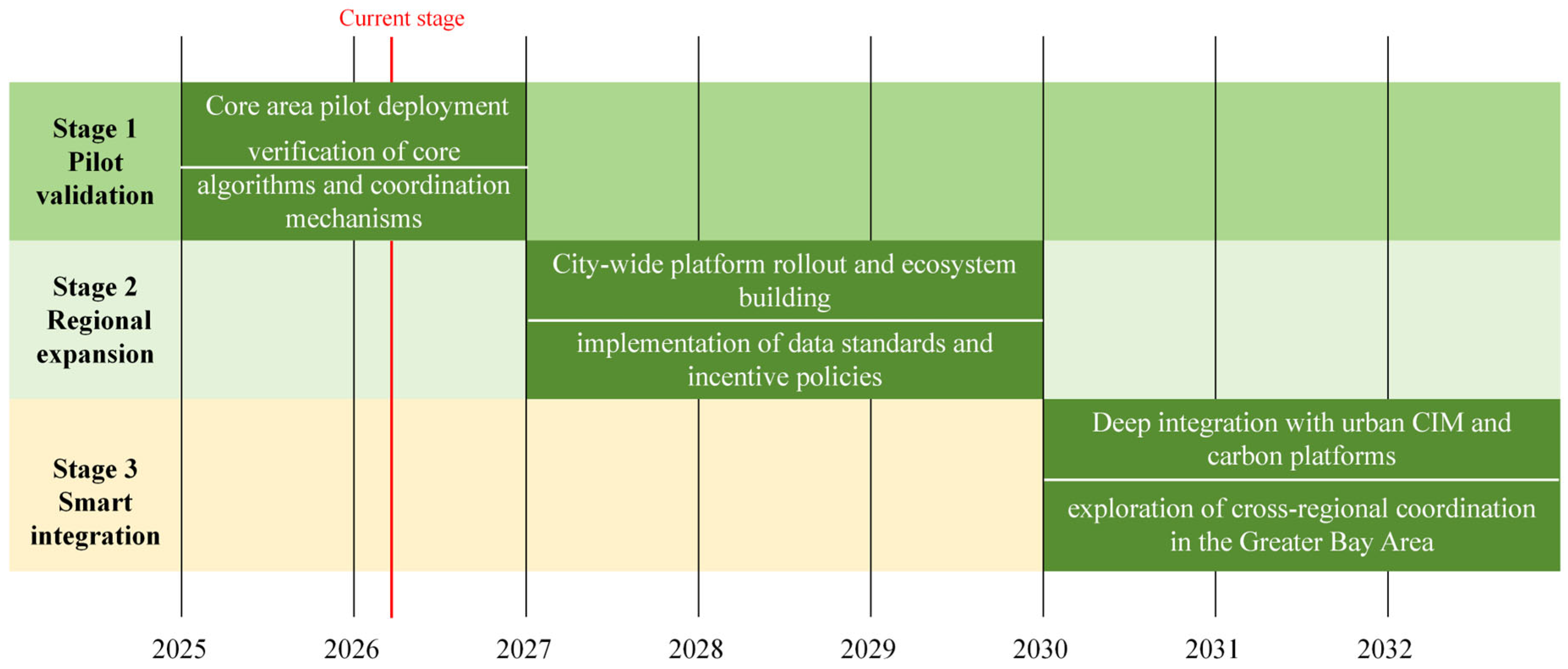
The implementation roadmap (Figure 11) follows a staged progression aligned with Shenzhen’s “Zero-Waste City” objectives and relevant planning documents.
Stage 1: Pilot Validation (1–2 years)
IoT terminals, edge nodes, and blockchain networks are deployed in selected districts and major recycling facilities. The objectives are to verify architectural stability, assess the accuracy of core algorithms such as dynamic scheduling and LSTM forecasting, and evaluate the feasibility of coordination among multiple stakeholders.
Stage 2: Regional Expansion (2–3 years)
This stage includes citywide system scaling, integration of SMEs, and the establishment of local data standards and blockchain-based green subsidy mechanisms. This stage aims to develop a regional CDW resource ecosystem.
Stage 3: Smart Integration (3–5+ years)
Further development involves deep integration with city information models and carbon monitoring platforms, as well as exploration of cross-regional collaborative scheduling within the Guangdong–Hong Kong–Macao Greater Bay Area. Expansion beyond the pilot stage depends on demonstrated reliability and replicability.
This staged pathway reduces systemic risk by ensuring technological maturity before regional expansion.

7.2.2. KPI System and Performance Governance

To monitor phased implementation, a multidimensional KPI system is established (Table 5). Indicators are selected based on Shenzhen’s smart city development status and the policy targets of the “Zero-Waste City” initiative, with reference to government reports and official statistics. In addition to traditional environmental indicators, such as virgin material substitution rates and carbon reduction, the KPI system incorporates digital governance metrics, including on-chain data authenticity rates and automated settlement efficiency. This ensures alignment between evaluation metrics and the technological features of the integrated architecture.
The KPI framework provides quantitative feedback for iterative policy and operational adjustments, reinforcing the perception–decision–execution–feedback loop defined earlier. KPI outcomes are periodically fed back to adjust model parameters related to resource scheduling, data prioritization, and incentive weighting.
The Shenzhen case demonstrates how the proposed integrated framework can shift CDW management from a linear disposal model toward a data-driven circular system. Digital infrastructure serves as the enabling foundation, while staged deployment ensures institutional and technical compatibility.
Through the structured coupling of material, data, and value flows, the system achieves coordinated improvements in environmental performance, operational efficiency, and market governance capacity. Rather than replacing existing mechanisms, the architecture reorganizes them into a coherent and adaptive governance structure.

8. Conclusions

This study proposes a multidimensional coupling framework that integrates resource coordination, information communication, and market mechanisms into a unified decision-support system for CDW management. It addresses the three research questions by defining system functional requirements, identifying key enabling technologies, and demonstrating how an integrated architecture can support efficient resource management and circular economy development. Furthermore, the study achieves its research objectives by constructing a cloud–edge–terminal collaborative system architecture, establishing a three-dimensional coupling mechanism, and developing a multidimensional evaluation framework to support implementation and assessment. The Shenzhen “Zero-Waste City” case, analyzed based on policy documents and literature sources, provides contextual support for the applicability of the proposed framework. The findings suggest that such an integrated approach has the potential to enhance resource utilization efficiency, improve carbon reduction performance, and strengthen coordination among multiple stakeholders within the CDW recycling network. More importantly, the study provides a system-oriented analytical paradigm for integrating technological tools, market incentives, and governance rules in CDW management. The findings offer practical insights for policymakers and infrastructure managers seeking to design scalable, data-driven, and circular-economy-oriented waste management systems in rapidly urbanizing regions.
Nevertheless, several limitations remain. First, although the proposed framework provides a structured decision architecture, validation relies primarily on the case study. Large-scale field implementation and longitudinal operational datasets are needed to verify robustness under real-world disturbances. Second, although the study highlights the integration of AI- and blockchain-based mechanisms, institutional compatibility across heterogeneous regulatory environments remains insufficiently examined. The alignment between algorithmic decision rules and existing policy instruments may vary significantly across jurisdictions. Third, the determination of multi-objective weights and governance parameters is context sensitive. Differences in stakeholder priorities, regulatory intensity, and market maturity may influence model performance and transferability. Future research should therefore focus on (1) contextualized empirical validation across multiple cities, (2) adaptive parameter learning under dynamic policy conditions, and (3) institutional–technical co-design to enhance scalability and regulatory compatibility.

Author Contributions

Conceptualization, W.Y., T.W. and Y.-H.L.; methodology, Y.-H.L., W.Y. and T.W.; formal analysis, W.Y. and T.W.; investigation, W.Y. and T.W.; writing—original draft preparation, W.Y. and T.W.; writing—review and editing, Y.-H.L.; supervision, Y.-H.L.; project administration, Y.-H.L. All authors have read and agreed to the published version of the manuscript.

Funding

This research did not receive any specific grant from funding agencies in the public, commercial, or not-for-profit sectors.

Data Availability Statement

No new data were created or analyzed in this study.

Conflicts of Interest

The authors declare that they have no known competing financial interests or personal relationships that could have appeared to influence the work reported in this paper.

Abbreviations

The following abbreviations are used in this manuscript:
CDWConstruction and demolition waste
SCMMSustainable construction materials market
CEsConstruction enterprises
IoTInternet of Things
DMRDistributed material resource
GBDTGradient boosting decision trees
RFRandom forests
MLMachine learning
AIArtificial intelligence
GPSGlobal Positioning System
GISGeographic Information System
GRPsGovernment regulatory platforms
CIDContent Identifier
LSTMLong short-term memory
LBSLocation-based services
SMEsSmall and Medium Enterprises
TBLTriple Bottom Line Theory
KPIKey Performance indicator

References

  1. UN-Habitat. World Cities Report 2022: Envisaging the Future of Cities [Report]. 2022. Available online: https://unhabitat.org/world-cities-report-2022 (accessed on 21 February 2026).
  2. Lv, H.; Li, Y.; Yan, H.-B.; Wu, D.; Shi, G.; Xu, Q. Examining Construction Waste Management Policies in Mainland China for Potential Performance Improvements. Clean Technol. Environ. Policy 2021, 23, 445–462. [Google Scholar] [CrossRef]
  3. Bonifazi, G.; Grosso, C.; Palmieri, R.; Serranti, S. Current Trends and Challenges in Construction and Demolition Waste Recycling. Curr. Opin. Green Sustain. Chem. 2025, 53, 101032. [Google Scholar] [CrossRef]
  4. Huang, B.; Wang, X.; Kua, H.; Geng, Y.; Bleischwitz, R.; Ren, J. Construction and Demolition Waste Management in China through the 3R Principle. Resour. Conserv. Recycl. 2018, 129, 36–44. [Google Scholar] [CrossRef]
  5. Aslam, M.S.; Huang, B.; Cui, L. Review of Construction and Demolition Waste Management in China and USA. J. Environ. Manag. 2020, 264, 110445. [Google Scholar] [CrossRef] [PubMed]
  6. Abideen, A.Z.; Pyeman, J.; Sundram, V.P.K.; Tseng, M.-L.; Sorooshian, S. Leveraging Capabilities of Technology into a Circular Supply Chain to Build Circular Business Models: A State-of-the-Art Systematic Review. Sustainability 2021, 13, 8997. [Google Scholar] [CrossRef]
  7. Fonseca, F.C.; Carcel-Carrasco, J.; Preciado, A.; Martinez-Corral, A.; Montoya, A.S. Comparative Analysis of the European Regulatory Framework for C&D Waste Management. Adv. Civ. Eng. 2023, 2023, 6421442. [Google Scholar] [CrossRef]
  8. Idir, R.; Djerbi, A.; Tazi, N. Optimising the Circular Economy for Construction and Demolition Waste Management in Europe: Best Practices, Innovations and Regulatory Avenues. Sustainability 2025, 17, 3586. [Google Scholar] [CrossRef]
  9. Zhang, Y.; Xian, B.; Liao, C.; Lu, R.; Sun, W.; Wang, M.; Bai, S.; Zhang, Q.; Liu, H.; Xu, D.; et al. The Hazards and Resource Utilization of Construction and Demolition Waste. J. Environ. Manag. 2026, 397, 128218. [Google Scholar] [CrossRef]
  10. Ma, W.; Liu, T.; Hao, J.L.; Wu, W.; Gu, X. Towards a Circular Economy for Construction and Demolition Waste Management in China: Critical Success Factors. Sustain. Chem. Pharm. 2023, 35, 101226. [Google Scholar] [CrossRef]
  11. Ma, W.; Hao, J.L. Enhancing a Circular Economy for Construction and Demolition Waste Management in China: A Stakeholder Engagement and Key Strategy Approach. J. Clean. Prod. 2024, 450, 141763. [Google Scholar] [CrossRef]
  12. Sun, W.; Tushar, Q.; Zhang, G.; Song, A.; Hou, L.; Zhang, J.; Wang, S. An Analytical Review of Construction and Demolition Waste Management and Quantification Methods Using a Science Mapping Approach. Recycling 2025, 10, 115. [Google Scholar] [CrossRef]
  13. Su, T.; Yu, X.; Jin, H.; Chen, L.; Tan, Z.; Ngo, T. Macro-Mechanical Properties and Freeze Thaw Evaluation of Innovative Nano-Silica Modified Concrete Reinforced by Recycled Carpet Fibers. Constr. Build. Mater. 2025, 492, 142894. [Google Scholar] [CrossRef]
  14. Ghisellini, P.; Ripa, M.; Ulgiati, S. Exploring Environmental and Economic Costs and Benefits of a Circular Economy Approach to the Construction and Demolition Sector. A Literature Review. J. Clean. Prod. 2018, 178, 618–643. [Google Scholar] [CrossRef]
  15. Lara, J.C.F.; El-Fadel, M.; Rauf, A.; Khalfan, M.M.A. Insights and Innovations in Construction and Demolition Waste Management: Strategic Framework for Circular Market Development. Resour. Conserv. Recycl. Adv. 2025, 28, 200288. [Google Scholar] [CrossRef]
  16. Ding, Z.; Cao, X.; Wang, Y.; Wu, H.; Zuo, J.; Zillante, G. Cost-Benefit Analysis of Demolition Waste Management via Agent-Based Modelling: A Case Study in Shenzhen. Waste Manag. 2022, 137, 169–178. [Google Scholar] [CrossRef]
  17. Wang, J.; Wu, H.; Duan, H.; Zillante, G.; Zuo, J.; Yuan, H. Combining Life Cycle Assessment and Building Information Modelling to Account for Carbon Emission of Building Demolition Waste: A Case Study. J. Clean. Prod. 2018, 172, 3154–3166. [Google Scholar] [CrossRef]
  18. Sreckovic, M.; Hartmann, D.; Schuetzenhofer, S.; Kotecki, A. Bridging Theory and Practice: Stakeholder Insights on Circular Economy in the Building Life Cycle. Energy Rep. 2024, 12, 3291–3301. [Google Scholar] [CrossRef]
  19. Barakat, B.; Srour, I. A Multi-Stakeholder Digital Platform for Regional Construction and Demolition Waste Management. Waste Manag. Res. 2024, 42, 178–188. [Google Scholar] [CrossRef]
  20. Ghaffar, S.H.; Burman, M.; Braimah, N. Pathways to Circular Construction: An Integrated Management of Construction and Demolition Waste for Resource Recovery. J. Clean. Prod. 2020, 244, 118710. [Google Scholar] [CrossRef]
  21. Bao, Z.; Lu, W. Developing Efficient Circularity for Construction and Demolition Waste Management in Fast Emerging Economies: Lessons Learned from Shenzhen, China. Sci. Total Environ. 2020, 724, 138264. [Google Scholar] [CrossRef]
  22. de Andrade Salgado, F.; de Andrade Silva, F. Recycled Aggregates from Construction and Demolition Waste towards an Application on Structural Concrete: A Review. J. Build. Eng. 2022, 52, 104452. [Google Scholar] [CrossRef]
  23. Lin, Y.-H.; Wang, J.; Niu, D.; Tao, X. Blockchain-Driven Framework for Construction Waste Recycling and Reuse. J. Build. Eng. 2024, 89, 109355. [Google Scholar] [CrossRef]
  24. Jayarathna, H.; Perera, B.; Atapattu, D.; Rodrigo, N. Circular Economy and Blockchain-Integrated Road Map to Improve Construction Waste Management. Constr. Innov. Inf. Process Manag. 2025, 25, 23–49. [Google Scholar] [CrossRef]
  25. Wu, H.; Zuo, J.; Zillante, G.; Wang, J.; Yuan, H. Status Quo and Future Directions of Construction and Demolition Waste Research: A Critical Review. J. Clean. Prod. 2019, 240, 118163. [Google Scholar] [CrossRef]
  26. Miatto, A.; Schandl, H.; Tanikawa, H. How Important Are Realistic Building Lifespan Assumptions for Material Stock and Demolition Waste Accounts? Resour. Conserv. Recycl. 2017, 122, 143–154. [Google Scholar] [CrossRef]
  27. Jawaid, M.; Singh, B.; Kian, L.K.; Zaki, S.A.; Radzi, A.M. Processing Techniques on Plastic Waste Materials for Construction and Building Applications. Curr. Opin. Green Sustain. Chem. 2023, 40, 100761. [Google Scholar] [CrossRef]
  28. Lin, Y.-H.; Dai, J.; Li, J.; Tao, X. Efficient Classification and Disposal Management of Construction Waste Using Blockchain Technology and System Dynamics. J. Constr. Eng. Manag. 2026, 152, 04025242. [Google Scholar] [CrossRef]
  29. Iyiola, C.O.; Shakantu, W.; Daniel, E.I. Digital Technologies for Promoting Construction and Demolition Waste Management: A Systematic Review. Buildings 2024, 14, 3234. [Google Scholar] [CrossRef]
  30. Naghibalsadati, F.; Karimi, N.; Mim, S.J.; Ng, K.T.W. Thematic Evolution of Life Cycle Assessment in Construction and Demolition Waste Management: Before and after ISO 14040 and the Paris Agreement. J. Build. Eng. 2025, 111, 113482. [Google Scholar] [CrossRef]
  31. Milutinović, B.; Stefanović, G.; Đekić, P.S.; Mijailović, I.; Tomić, M. Environmental Assessment of Waste Management Scenarios with Energy Recovery Using Life Cycle Assessment and Multi-Criteria Analysis. Energy 2017, 137, 917–926. [Google Scholar] [CrossRef]
  32. Baralla, G.; Pinna, A.; Tonelli, R.; Marchesi, M. Waste Management: A Comprehensive State of the Art about the Rise of Blockchain Technology. Comput. Ind. 2023, 145, 103812. [Google Scholar] [CrossRef]
  33. Russell, C.L. An Overview of the Integrative Research Review. Prog. Transpl. 2005, 15, 8–13. [Google Scholar] [CrossRef]
  34. Gao, H.; Jin, T.; Feng, C.; Li, C.; Chen, Q.; Kang, C. Review of Virtual Power Plant Operations: Resource Coordination and Multidimensional Interaction. Appl. Energy 2024, 357, 122284. [Google Scholar] [CrossRef]
  35. Havas, A.; Schartinger, D.; Weber, K.M. Innovation Studies, Social Innovation, and Sustainability Transitions Research: From Mutual Ignorance towards an Integrative Perspective? Environ. Innov. Soc. Transit. 2023, 48, 100754. [Google Scholar] [CrossRef]
  36. Brandão, R.; Edwards, D.J.; Hosseini, M.R.; Silva Melo, A.C.; Macêdo, A.N. Reverse Supply Chain Conceptual Model for Construction and Demolition Waste. Waste Manag. Res. 2021, 39, 1341–1355. [Google Scholar] [CrossRef] [PubMed]
  37. Mohammadi, M.; Rahmanifar, G.; Hajiaghaei-Keshteli, M.; Fusco, G.; Colombaroni, C.; Sherafat, A. A Dynamic Approach for the Multi-Compartment Vehicle Routing Problem in Waste Management. Renew. Sustain. Energy Rev. 2023, 184, 113526. [Google Scholar] [CrossRef]
  38. Wang, S.; Xia, P.; Gong, F.; Zeng, Q.; Chen, K.; Zhao, Y. Multi Objective Optimization of Recycled Aggregate Concrete Based on Explainable Machine Learning. J. Clean. Prod. 2024, 445, 141045. [Google Scholar] [CrossRef]
  39. Su, S.; Yu, C.; Jiang, Y.; Zhong, R.Y. Digital Twin-Enabled Building Demolition Waste Trading: A Demonstrative Case. IEEE Trans. Autom. Sci. Eng. 2026, 23, 2245–2255. [Google Scholar] [CrossRef]
  40. Li, C.Z.; Chen, Z.; Xue, F.; Kong, X.T.R.; Xiao, B.; Lai, X.; Zhao, Y. A Blockchain- and IoT-Based Smart Product-Service System for the Sustainability of Prefabricated Housing Construction. J. Clean. Prod. 2021, 286, 125391. [Google Scholar] [CrossRef]
  41. Su, Y.; Chen, J.; Si, H.; Wu, G.; Zhang, R.; Lei, W. Decision-Making Interaction among Stakeholders Regarding Construction and Demolition Waste Recycling under Different Power Structures. Waste Manag. 2021, 131, 491–502. [Google Scholar] [CrossRef]
  42. Chen, Y.; Ou, Y.; Mohamed, M.S.; Bao, Z. Life Cycle Assessment of Construction and Demolition Waste Upcycling: A Critical Review of Studies from 2010 to 2025. Dev. Built Environ. 2025, 22, 100685. [Google Scholar] [CrossRef]
  43. Bernardi, F.A.; Alves, D.; Crepaldi, N.; Yamada, D.B.; Lima, V.C.; Rijo, R. Data Quality in Health Research: Integrative Literature Review. J. Med. Internet Res. 2023, 25, e41446. [Google Scholar] [CrossRef] [PubMed]
  44. Dhollande, S.; Taylor, A.; Meyer, S.; Scott, M. Conducting Integrative Reviews: A Guide for Novice Nursing Researchers. J. Res. Nurs. 2021, 26, 427–438. [Google Scholar] [CrossRef] [PubMed]
  45. Whittemore, R.; Knafl, K. The Integrative Review: Updated Methodology. J. Adv. Nurs. 2005, 52, 546–553. [Google Scholar] [CrossRef]
  46. Forde-Johnston, C.; Butcher, D.; Aveyard, H. An Integrative Review Exploring the Impact of Electronic Health Records (EHR) on the Quality of Nurse–Patient Interactions and Communication. J. Adv. Nurs. 2023, 79, 48–67. [Google Scholar] [CrossRef]
  47. Thennakoon, S.; Ang, S.G.M.; Traynor, V.; Strickland, K. An Integrative Review of Specialised Nursing Career Frameworks to Develop a Nursing Career Framework for Registered Nurses Working in Aged Care. J. Adv. Nurs. 2025, 81, 4447–4464. [Google Scholar] [CrossRef]
  48. Fossum, M.; Opsal, A.; Ehrenberg, A. Nurses’ Sources of Information to Inform Clinical Practice: An Integrative Review to Guide Evidence-based Practice. Worldviews Evid.-Based Nurs. 2022, 19, 372–379. [Google Scholar] [CrossRef]
  49. Donthu, N.; Kumar, S.; Mukherjee, D.; Pandey, N.; Lim, W.M. How to Conduct a Bibliometric Analysis: An Overview and Guidelines. J. Bus. Res. 2021, 133, 285–296. [Google Scholar] [CrossRef]
  50. Liu, J.; Teng, Y. Evolution Game Analysis on Behavioral Strategies of Multiple Stakeholders in Construction Waste Resource Industry Chain. Environ. Sci. Pollut. Res. 2023, 30, 19030–19046. [Google Scholar] [CrossRef] [PubMed]
  51. Ye, X.; Zeng, N.; Tao, X.; Han, D.; König, M. Smart Contract Generation and Visualization for Construction Business Process Collaboration and Automation: Upgraded Workflow Engine. J. Comput. Civ. Eng. 2024, 38, 04024030. [Google Scholar] [CrossRef]
  52. Zhang, X.; Liu, T.; Rahman, A.; Zhou, L. Blockchain Applications for Construction Contract Management: A Systematic Literature Review. J. Constr. Eng. Manag. 2023, 149, 03122011. [Google Scholar] [CrossRef]
  53. Mahmudnia, D.; Arashpour, M.; Yang, R. Blockchain in Construction Management: Applications, Advantages and Limitations. Autom. Constr. 2022, 140, 104379. [Google Scholar] [CrossRef]
  54. Zhao, X. Stakeholder-Associated Factors Influencing Construction and Demolition Waste Management: A Systematic Review. Buildings 2021, 11, 149. [Google Scholar] [CrossRef]
  55. Ahmed, S.U.; Danish, A.; Ahmad, N.; Ahmad, T. Smart Contract Generation through NLP and Blockchain for Legal Documents. Procedia Comput. Sci. 2024, 235, 2529–2537. [Google Scholar] [CrossRef]
  56. Liu, X.; Antwi-Afari, M.F.; Li, J.; Zhang, Y.; Manu, P. BIM, IoT, and GIS Integration in Construction Resource Monitoring. Autom. Constr. 2025, 174, 106149. [Google Scholar] [CrossRef]
  57. Oluleye, B.I.; Chan, D.W.M.; Antwi-Afari, P. Adopting Artificial Intelligence for Enhancing the Implementation of Systemic Circularity in the Construction Industry: A Critical Review. Sustain. Prod. Consum. 2023, 35, 509–524. [Google Scholar] [CrossRef]
  58. Hu, S.; An, L.; Shen, L. A Multi-Objective Modeling and Optimization Approach to Municipal Solid Waste Collection for Classified Treatment in China towards Sustainable Development. Sustain. Cities Soc. 2023, 98, 104846. [Google Scholar] [CrossRef]
  59. Xie, C.; Deng, X.; Zhang, J.; Wang, Y.; Zheng, L.; Ding, X.; Li, X.; Wu, L. Multi-Period Design and Optimization of Classified Municipal Solid Waste Supply Chain Integrating Seasonal Fluctuations in Waste Generation. Sustain. Cities Soc. 2023, 93, 104522. [Google Scholar] [CrossRef]
  60. Yue, H.; Wang, Q.; Zhao, M.; Yang, Z.; Lu, L. Advancements in Digital Twin Applications for Intelligent Construction Quality Management. J. Constr. Eng. Manag. 2026, 152, 03125011. [Google Scholar] [CrossRef]
  61. Hochreiter, S.; Schmidhuber, J. Long Short-Term Memory. Neural Comput. 1997, 9, 1735–1780. [Google Scholar] [CrossRef]
  62. Saberi, S.; Kouhizadeh, M.; Sarkis, J.; Shen, L. Blockchain Technology and Its Relationships to Sustainable Supply Chain Management. Int. J. Prod. Res. 2019, 57, 2117–2135. [Google Scholar] [CrossRef]
  63. Lin, Y.-H.; Wu, F.; Wang, R.; Gu, S.; Xu, Z. Spatiotemporal Analysis of Overloaded Vehicles on a Highway Using Weigh-in-Motion Data. J. Transp. Eng. Part A Syst. 2022, 148, 04021098. [Google Scholar] [CrossRef]
  64. Langley, A.; Lonergan, M.; Huang, T.; Azghadi, M.R. Analyzing Mixed Construction and Demolition Waste in Material Recovery Facilities: Evolution, Challenges, and Applications of Computer Vision and Deep Learning. Resour. Conserv. Recycl. 2025, 217, 108218. [Google Scholar] [CrossRef]
  65. Bao, Z.; Li, S.; Chen, Y.; Xie, H.; Long, W.; Chen, W.-Q. Applications of Geospatial Technologies for Construction and Demolition Waste Management: A Systematic Literature Review. J. Ind. Ecol. 2025, 29, 279–297. [Google Scholar] [CrossRef]
  66. Beheshti, S.; Heydari, J.; Sazvar, Z. Food Waste Recycling Closed Loop Supply Chain Optimization through Renting Waste Recycling Facilities. Sustain. Cities Soc. 2022, 78, 103644. [Google Scholar] [CrossRef]
  67. Akinade, O.O.; Oyedele, L.O. Integrating Construction Supply Chains within a Circular Economy: An ANFIS-Based Waste Analytics System (A-WAS). J. Clean. Prod. 2019, 229, 863–873. [Google Scholar] [CrossRef]
  68. Cheng, H.; Hao, Z.; Li, X.; Huang, S. Selection of Recycling Model and Investment Strategy from Economic and Environmental Perspectives. Ain Shams Eng. J. 2026, 17, 103900. [Google Scholar] [CrossRef]
  69. Gálvez-Martos, J.-L.; Styles, D.; Schoenberger, H.; Zeschmar-Lahl, B. Construction and Demolition Waste Best Management Practice in Europe. Resour. Conserv. Recycl. 2018, 136, 166–178. [Google Scholar] [CrossRef]
  70. Chen, J.; Wen, Z.; Tian, Y. A Novel IoT-Based Deep Learning Framework for Real-Time Waste Forecasting: Optimizing Multi-Waste Categories Using AutoML. Resour. Conserv. Recycl. 2025, 220, 108378. [Google Scholar] [CrossRef]
  71. Luo, B.; Su, Y.; Hu, X.; Chen, Z.; Chen, Y.; Ding, X. Strength Behavior and Microscopic Mechanisms of Geopolymer-Stabilized Waste Clays Considering Clay Mineralogy. J. Clean. Prod. 2025, 530, 146877. [Google Scholar] [CrossRef]
  72. Liu, H.; Chen, J.; Zhang, P.; Li, W.; Su, W.; Su, T.; Gong, S.; Li, B. Freeze-Thaw Behavior and Damage Prediction of Mixed Recycled Coarse Aggregate Concrete. Buildings 2026, 16, 368. [Google Scholar] [CrossRef]
  73. Su, Y.; Luo, B.; Luo, Z.; Xu, F.; Huang, H.; Long, Z.; Shen, C. Mechanical Characteristics and Solidification Mechanism of Slag/Fly Ash-Based Geopolymer and Cement Solidified Organic Clay: A Comparative Study. J. Build. Eng. 2023, 71, 106459. [Google Scholar] [CrossRef]
  74. Kashyap, S.; Anilkumar, M.; Ramaprasad, A. A Systematic Study of Construction and Demolition Waste Management. Environ. Dev. Sustain. 2025. Advance online publication. [Google Scholar] [CrossRef]
  75. Coronado, M.; Dosal, E.; Coz, A.; Viguri, J.R.; Andrés, A. Estimation of Construction and Demolition Waste (C&DW) Generation and Multicriteria Analysis of C&DW Management Alternatives: A Case Study in Spain. Waste Biomass Valorization 2011, 2, 209–225. [Google Scholar] [CrossRef]
  76. Könke, C. Image Analysis for the Sorting of Brick and Masonry Waste Using Machine Learning Methods. Acta IMEKO 2023, 12, 15. [Google Scholar] [CrossRef]
  77. Bahreini, F.; Hammad, A. Dynamic Graph CNN Based Semantic Segmentation of Concrete Defects and As-Inspected Modeling. Autom. Constr. 2024, 159, 105282. [Google Scholar] [CrossRef]
  78. Wang, M.; Wang, C.C.; Sepasgozar, S.; Zlatanova, S. A Systematic Review of Digital Technology Adoption in Off-Site Construction: Current Status and Future Direction towards Industry 4.0. Buildings 2020, 10, 204. [Google Scholar] [CrossRef]
  79. Zhao, W.; Hao, J.L.; Gong, G.; Fischer, T.; Liu, Y. Applying Digital Technologies in Construction Waste Management for Facilitating Sustainability. J. Environ. Manag. 2025, 373, 123560. [Google Scholar] [CrossRef] [PubMed]
  80. Pouriani, S.; Asadi-Gangraj, E.; Paydar, M.M. A Robust Bi-Level Optimization Modelling Approach for Municipal Solid Waste Management; a Real Case Study of Iran. J. Clean. Prod. 2019, 240, 118125. [Google Scholar] [CrossRef]
  81. Lu, X.; Pu, X.; Han, X. Sustainable Smart Waste Classification and Collection System: A Bi-Objective Modeling and Optimization Approach. J. Clean. Prod. 2020, 276, 124183. [Google Scholar] [CrossRef]
  82. Cao, X.; Wen, Z.; Xu, J.; De Clercq, D.; Wang, Y.; Tao, Y. Many-Objective Optimization of Technology Implementation in the Industrial Symbiosis System Based on a Modified NSGA-III. J. Clean. Prod. 2020, 245, 118810. [Google Scholar] [CrossRef]
  83. Farshadfar, Z.; Khajavi, S.H.; Mucha, T.; Tanskanen, K. Machine Learning-Based Automated Waste Sorting in the Construction Industry: A Comparative Competitiveness Case Study. Waste Manag. 2025, 194, 77–87. [Google Scholar] [CrossRef]
  84. Mamashli, Z.; Nayeri, S.; Tavakkoli-Moghaddam, R.; Sazvar, Z.; Javadian, N. Designing a Sustainable–Resilient Disaster Waste Management System under Hybrid Uncertainty: A Case Study. Eng. Appl. Artif. Intell. 2021, 106, 104459. [Google Scholar] [CrossRef]
  85. Xu, D.; Li, T.; Li, Y.; Su, X.; Tarkoma, S.; Jiang, T.; Crowcroft, J.; Hui, P. Edge Intelligence: Empowering Intelligence to the Edge of Network. Proc. IEEE 2021, 109, 1778–1837. [Google Scholar] [CrossRef]
  86. Duan, S.; Wang, D.; Ren, J.; Lyu, F.; Zhang, Y.; Wu, H.; Shen, X. Distributed Artificial Intelligence Empowered by End-Edge-Cloud Computing: A Survey. IEEE Commun. Surv. Tutor. 2023, 25, 591–624. [Google Scholar] [CrossRef]
  87. Hasselsteen, L.; Lindhard, S.M.; Kanafani, K. Resource Management at Modern Construction Sites: Bridging the Gap between Scientific Knowledge and Industry Practice and Needs. J. Environ. Manag. 2024, 366, 121835. [Google Scholar] [CrossRef] [PubMed]
  88. Ding, L.; Wang, T.; Chan, P.W. Forward and Reverse Logistics for Circular Economy in Construction: A Systematic Literature Review. J. Clean. Prod. 2023, 388, 135981. [Google Scholar] [CrossRef]
  89. Sun, L.; Bai, C.; Sarkis, J. Corporate ESG Performance and Operational Efficiency: The Moderating Effect of Supply Chain Concentration. Transp. Res. Part E Logist. Transp. Rev. 2025, 204, 104446. [Google Scholar] [CrossRef]
  90. Kumar, A.; Sah, B.; Singh, A.R.; Deng, Y.; He, X.; Kumar, P.; Bansal, R.C. A Review of Multi Criteria Decision Making (MCDM) towards Sustainable Renewable Energy Development. Renew. Sustain. Energy Rev. 2017, 69, 596–609. [Google Scholar] [CrossRef]
  91. Zavadskas, E.K.; Antucheviciene, J.; Chatterjee, P. Multiple-Criteria Decision-Making (MCDM) Techniques for Business Processes Information Management. Information 2018, 10, 4. [Google Scholar] [CrossRef]
  92. Liu, J.; Liu, H.; Li, Y. Facilitating Collaborative Construction and Demolition Waste Governance: An SFIC Approach. Int. J. Constr. Manag. 2025, 0, 1–23. [Google Scholar] [CrossRef]
  93. Kouhizadeh, M.; Saberi, S.; Sarkis, J. Blockchain Technology and the Sustainable Supply Chain: Theoretically Exploring Adoption Barriers. Int. J. Prod. Econ. 2021, 231, 107831. [Google Scholar] [CrossRef]
  94. Tang, L.; Wu, T.; Li, Q. Construction and Optimization Strategy for Collaborative Governance of Construction Waste Resource Utilization. KSCE J. Civ. Eng. 2025, 29, 100034. [Google Scholar] [CrossRef]
  95. Xu, X.; Zhang, M.; He, P. Coordination of a Supply Chain with Online Platform Considering Delivery Time Decision. Transp. Res. Part E Logist. Transp. Rev. 2020, 141, 101990. [Google Scholar] [CrossRef]
  96. Chen, X.; Zhang, C. A Dynamic Analysis of a Green Closed-Loop Supply Chain with Different on-Line Platform Smart Recycling and Selling Models. Comput. Ind. Eng. 2025, 200, 110748. [Google Scholar] [CrossRef]
  97. Coelho, A.; de Brito, J. Economic Viability Analysis of a Construction and Demolition Waste Recycling Plant in Portugal—Part I: Location, Materials, Technology and Economic Analysis. J. Clean. Prod. 2013, 39, 338–352. [Google Scholar] [CrossRef]
  98. Bao, Z.; Lu, W.; Chi, B.; Yuan, H.; Hao, J. Procurement Innovation for a Circular Economy of Construction and Demolition Waste: Lessons Learnt from Suzhou, China. Waste Manag. 2019, 99, 12–21. [Google Scholar] [CrossRef] [PubMed]
  99. De Bruecker, P.; Beliën, J.; De Boeck, L.; De Jaeger, S.; Demeulemeester, E. A Model Enhancement Approach for Optimizing the Integrated Shift Scheduling and Vehicle Routing Problem in Waste Collection. Eur. J. Oper. Res. 2018, 266, 278–290. [Google Scholar] [CrossRef]
  100. Fang, B.; Yu, J.; Chen, Z.; Osman, A.I.; Farghali, M.; Ihara, I.; Hamza, E.H.; Rooney, D.W.; Yap, P.-S. Artificial Intelligence for Waste Management in Smart Cities: A Review. Environ. Chem. Lett. 2023, 21, 1959–1989. [Google Scholar] [CrossRef]
  101. Rahman, M.W.; Islam, R.; Hasan, A.; Bithi, N.I.; Hasan, M.M.; Rahman, M.M. Intelligent Waste Management System Using Deep Learning with IoT. J. King Saud Univ.-Comput. Inf. Sci. 2022, 34, 2072–2087. [Google Scholar] [CrossRef]
  102. Ateeq, M.; Zhang, N.; Zhao, W.; Gu, Y.; Wen, Z.; Zheng, C.; Hao, J. Enhancing Construction Waste Transportation Management Using Internet of Things (IoT): An Evaluation Framework Based on AHP-FCE Method. Buildings 2025, 15, 1381. [Google Scholar] [CrossRef]
  103. Gao, Y.; Wang, J.; Xu, X. Machine Learning in Construction and Demolition Waste Management: Progress, Challenges, and Future Directions. Autom. Constr. 2024, 162, 105380. [Google Scholar] [CrossRef]
  104. Wang, Z.; Li, H.; Yang, X. Vision-Based Robotic System for on-Site Construction and Demolition Waste Sorting and Recycling. J. Build. Eng. 2020, 32, 101769. [Google Scholar] [CrossRef]
  105. Chen, Y.-J.; Jiang, W.-C. Entropy-Based Tuning Approach for Q-Learning in an Unstructured Environment. Robot. Auton. Syst. 2025, 187, 104924. [Google Scholar] [CrossRef]
  106. Zangirolami, V.; Borrotti, M. Dealing with Uncertainty: Balancing Exploration and Exploitation in Deep Recurrent Reinforcement Learning. Knowl.-Based Syst. 2024, 293, 111663. [Google Scholar] [CrossRef]
  107. Hassani, H.; Nikan, S.; Shami, A. Improved Exploration–Exploitation Trade-off through Adaptive Prioritized Experience Replay. Neurocomputing 2025, 614, 128836. [Google Scholar] [CrossRef]
  108. Bi, W.; Lu, W.; Zhao, Z.; Webster, C.J. Combinatorial Optimization of Construction Waste Collection and Transportation: A Case Study of Hong Kong. Resour. Conserv. Recycl. 2022, 179, 106043. [Google Scholar] [CrossRef]
  109. Maqbool, R.; Saiba, M.R.; Ashfaq, S. Emerging Industry 4.0 and Internet of Things (IoT) Technologies in the Ghanaian Construction Industry: Sustainability, Implementation Challenges, and Benefits. Environ. Sci. Pollut. Res. 2023, 30, 37076–37091. [Google Scholar] [CrossRef] [PubMed]
  110. Sharma, M.; Joshi, S.; Kannan, D.; Govindan, K.; Singh, R.; Purohit, H.C. Internet of Things (IoT) Adoption Barriers of Smart Cities’ Waste Management: An Indian Context. J. Clean. Prod. 2020, 270, 122047. [Google Scholar] [CrossRef]
  111. Cao, B.; Chen, X.; Lv, Z.; Li, R.; Fan, S. Optimization of Classified Municipal Waste Collection Based on the Internet of Connected Vehicles. IEEE Trans. Intell. Transp. Syst. 2021, 22, 5364–5373. [Google Scholar] [CrossRef]
  112. AlZaghrini, N.; Srour, F.J.; Srour, I. Using GIS and Optimization to Manage Construction and Demolition Waste: The Case of Abandoned Quarries in Lebanon. Waste Manag. 2019, 95, 139–149. [Google Scholar] [CrossRef] [PubMed]
  113. Chandrasekaran, H.; Subramani, S.E.; Partheeban, P.; Sridhar, M. IoT- and GIS-Based Environmental Impact Assessment of Construction and Demolition Waste Dump Yards. Sustainability 2023, 15, 13013. [Google Scholar] [CrossRef]
  114. Qu, Z.; Wang, X.; Song, X.; Pan, Z.; Li, H. Location Optimization for Urban Taxi Stands Based on Taxi GPS Trajectory Big Data. IEEE Access 2019, 7, 62273–62283. [Google Scholar] [CrossRef]
  115. Irizarry, J.; Karan, E.P.; Jalaei, F. Integrating BIM and GIS to Improve the Visual Monitoring of Construction Supply Chain Management. Autom. Constr. 2013, 31, 241–254. [Google Scholar] [CrossRef]
  116. Wu, H.; Wang, J.; Duan, H.; Ouyang, L.; Huang, W.; Zuo, J. An Innovative Approach to Managing Demolition Waste via GIS (Geographic Information System): A Case Study in Shenzhen City, China. J. Clean. Prod. 2016, 112, 494–503. [Google Scholar] [CrossRef]
  117. Lin, T.J.; Aziz, N.M. Embracing The Digital Twin for Construction Monitoring and Controlling to Mitigate the Impact of COVID-19. J. Des. Built Environ. 2022, 22, 40–59. [Google Scholar] [CrossRef]
  118. Chen, J.; Lu, W.; Ji, X.; Fu, Y. Improving Interoperability in Robot Digital Twinning for Facility Management: An Industry Foundation Class-Represented RoboAvatar Approach. Comput. Ind. 2025, 173, 104384. [Google Scholar] [CrossRef]
  119. Manzoor, B.; Antwi-Afari, M.F.; Alotaibi, K.S.; Edwards, D.J.; Posillico, J.J. Critical Success Factors for Implementing Digital Twin Technology in Construction Projects: A Systematic and Bibliometric Approach. J. Constr. Eng. Manag. 2025, 151, 03125008. [Google Scholar] [CrossRef]
  120. Figueiredo, K.; Hammad, A.W.A.; Pierott, R.; Tam, V.W.Y.; Haddad, A. Integrating Digital Twin and Blockchain for Dynamic Building Life Cycle Sustainability Assessment. J. Build. Eng. 2024, 97, 111018. [Google Scholar] [CrossRef]
  121. Fu, S.; Antwi-Afari, M.F.; Anwer, S.; Chen, Z.-S.; Li, H. A State-of-the-Art Review of Digital Twin-Enabled Human-Robot Collaboration in Smart Energy Management Systems. Results Eng. 2025, 27, 106524. [Google Scholar] [CrossRef]
  122. Cao, K.; Liu, Y.; Meng, G.; Sun, Q. An Overview on Edge Computing Research. IEEE Access 2020, 8, 85714–85728. [Google Scholar] [CrossRef]
  123. Wang, Y.-C.; Xue, J.; Wei, C.; Kuo, C.-C.J. An Overview on Generative AI at Scale With Edge–Cloud Computing. IEEE Open J. Commun. Soc. 2023, 4, 2952–2971. [Google Scholar] [CrossRef]
  124. Ren, J.; Yu, G.; He, Y.; Li, G.Y. Collaborative Cloud and Edge Computing for Latency Minimization. IEEE Trans. Veh. Technol. 2019, 68, 5031–5044. [Google Scholar] [CrossRef]
  125. Yao, J.; Zhang, S.; Yao, Y.; Wang, F.; Ma, J.; Zhang, J.; Chu, Y.; Ji, L.; Jia, K.; Shen, T.; et al. Edge-Cloud Polarization and Collaboration: A Comprehensive Survey for AI. IEEE Trans. Knowl. Data Eng. 2023, 35, 6866–6886. [Google Scholar] [CrossRef]
  126. Liu, Y.; Yang, C.; Chen, X.; Wu, F. Joint Hybrid Caching and Replacement Scheme for UAV-Assisted Vehicular Edge Computing Networks. IEEE Trans. Intell. Veh. 2024, 9, 866–878. [Google Scholar] [CrossRef]
  127. Andeobu, L.; Wibowo, S.; Grandhi, S. Artificial Intelligence Applications for Sustainable Solid Waste Management Practices in Australia: A Systematic Review. Sci. Total Environ. 2022, 834, 155389. [Google Scholar] [CrossRef]
  128. Ma, M.; Tam, V.W.Y.; Le, K.N.; Osei-Kyei, R. Factors Affecting the Price of Recycled Concrete: A Critical Review. J. Build. Eng. 2022, 46, 103743. [Google Scholar] [CrossRef]
  129. Hou, Y.; Shen, Y.; Han, H.; Wang, J. Multi-Task Differential Evolution Algorithm with Dynamic Resource Allocation: A Study on e-Waste Recycling Vehicle Routing Problem. Swarm Evol. Comput. 2025, 92, 101806. [Google Scholar] [CrossRef]
  130. Jerbi, H.; Vincy, V.G.A.G.; Aoun, S.B.; Abbassi, R.; Kchaou, M. Optimizing Waste Management in Smart Cities: An IoT-Based Approach Using Dynamic Bald Eagle Search Optimization Algorithm (DBESO) and Machine Learning. J. Urban Manag. 2025, 15, 114–130. [Google Scholar] [CrossRef]
  131. Hannan, M.A.; Hossain Lipu, M.S.; Akhtar, M.; Begum, R.A.; Al Mamun, M.A.; Hussain, A.; Mia, M.S.; Basri, H. Solid Waste Collection Optimization Objectives, Constraints, Modeling Approaches, and Their Challenges toward Achieving Sustainable Development Goals. J. Clean. Prod. 2020, 277, 123557. [Google Scholar] [CrossRef]
  132. Wang, Y.; Mao, Q.; Zhu, H.; Deng, J.; Zhang, Y.; Ji, J.; Li, H.; Zhang, Y. Multi-Modal 3D Object Detection in Autonomous Driving: A Survey. Int. J. Comput. Vis. 2023, 131, 2122–2152. [Google Scholar] [CrossRef]
  133. Zhuang, Y.; Sun, X.; Li, Y.; Huai, J.; Hua, L.; Yang, X.; Cao, X.; Zhang, P.; Cao, Y.; Qi, L.; et al. Multi-Sensor Integrated Navigation/Positioning Systems Using Data Fusion: From Analytics-Based to Learning-Based Approaches. Inf. Fusion 2023, 95, 62–90. [Google Scholar] [CrossRef]
  134. Atakishiyev, S.; Salameh, M.; Yao, H.; Goebel, R. Explainable Artificial Intelligence for Autonomous Driving: A Comprehensive Overview and Field Guide for Future Research Directions. IEEE Access 2024, 12, 101603–101625. [Google Scholar] [CrossRef]
  135. Wang, T. Smart Mapping of Recyclable Construction Materials Using UAV Remote Sensing and Optimised YOLOv8 Deep Learning within a GIS Framework. Microchem. J. 2025, 218, 115185. [Google Scholar] [CrossRef]
  136. Zhang, H.; Wang, L.; Tian, T.; Yin, J. A Review of Unmanned Aerial Vehicle Low-Altitude Remote Sensing (UAV-LARS) Use in Agricultural Monitoring in China. Remote Sens. 2021, 13, 1221. [Google Scholar] [CrossRef]
  137. Messaoudi, K.; Oubbati, O.S.; Rachedi, A.; Lakas, A.; Bendouma, T.; Chaib, N. A Survey of UAV-Based Data Collection: Challenges, Solutions and Future Perspectives. J. Netw. Comput. Appl. 2023, 216, 103670. [Google Scholar] [CrossRef]
  138. Guo, H.; Wang, Y.; Liu, J.; Liu, C. Multi-UAV Cooperative Task Offloading and Resource Allocation in 5G Advanced and Beyond. IEEE Trans. Wirel. Commun. 2024, 23, 347–359. [Google Scholar] [CrossRef]
  139. Ahmed, F.; Mohanta, J.C.; Keshari, A.; Yadav, P.S. Recent Advances in Unmanned Aerial Vehicles: A Review. Arab. J. Sci. Eng. 2022, 47, 7963–7984. [Google Scholar] [CrossRef]
  140. Wang, S.; Qi, N.; Jiang, H.; Xiao, M.; Liu, H.; Jia, L.; Zhao, D. Trajectory Planning for UAV-Assisted Data Collection in IoT Network: A Double Deep Q Network Approach. Electronics 2024, 13, 1592. [Google Scholar] [CrossRef]
  141. Meng, K.; Wu, Q.; Xu, J.; Chen, W.; Feng, Z.; Schober, R.; Swindlehurst, A.L. Uav-Enabled Integrated Sensing and Communication: Opportunities and Challenges. IEEE Wirel. Commun. 2024, 31, 97–104. [Google Scholar] [CrossRef]
  142. Chen, X.; Huang, H.; Liu, Y.; Li, J.; Liu, M. Robot for Automatic Waste Sorting on Construction Sites. Autom. Constr. 2022, 141, 104387. [Google Scholar] [CrossRef]
  143. Koskinopoulou, M.; Raptopoulos, F.; Papadopoulos, G.; Mavrakis, N.; Maniadakis, M. Robotic Waste Sorting Technology: Toward a Vision-Based Categorization System for the Industrial Robotic Separation of Recyclable Waste. IEEE Robot. Autom. Mag. 2021, 28, 50–60. [Google Scholar] [CrossRef]
  144. Nežerka, V.; Zbíral, T.; Trejbal, J. Machine-Learning-Assisted Classification of Construction and Demolition Waste Fragments Using Computer Vision: Convolution versus Extraction of Selected Features. Expert Syst. Appl. 2024, 238, 121568. [Google Scholar] [CrossRef]
  145. Rasheed, A.; San, O.; Kvamsdal, T. Digital Twin: Values, Challenges and Enablers From a Modeling Perspective. IEEE Access 2020, 8, 21980–22012. [Google Scholar] [CrossRef]
  146. Neupane, D.; Bouadjenek, M.R.; Dazeley, R.; Aryal, S. Data-Driven Machinery Fault Diagnosis: A Comprehensive Review. Neurocomputing 2025, 627, 129588. [Google Scholar] [CrossRef]
  147. Jones, D.; Snider, C.; Nassehi, A.; Yon, J.; Hicks, B. Characterising the Digital Twin: A Systematic Literature Review. CIRP J. Manuf. Sci. Technol. 2020, 29, 36–52. [Google Scholar] [CrossRef]
  148. Ming, Z.; Tang, B.; Deng, L.; Yang, Q.; Li, Q. Digital Twin-Assisted Fault Diagnosis Framework for Rolling Bearings under Imbalanced Data. Appl. Soft Comput. 2025, 168, 112528. [Google Scholar] [CrossRef]
  149. Lin, L.; Bao, H.; Dinh, N. Uncertainty Quantification and Software Risk Analysis for Digital Twins in the Nearly Autonomous Management and Control Systems: A Review. Ann. Nucl. Energy 2021, 160, 108362. [Google Scholar] [CrossRef]
  150. Anitha, R.; Parthiban, A. Smart Waste Ecosystems under Industry 5.0: A Framework Integrating Digital Twins, Edge-AI, Graph Theory, and 9R Circularity. Results Eng. 2025, 28, 107988. [Google Scholar] [CrossRef]
  151. Henaien, A.; Ben Elhadj, H.; Chaari Fourati, L. A Sustainable Smart IoT-Based Solid Waste Management System. Future Gener. Comput. Syst. 2024, 157, 587–602. [Google Scholar] [CrossRef]
  152. A Framework for BIM-Enabled Life-Cycle Information Management of Construction Project. Available online: https://journals.sagepub.com/doi/epdf/10.5772/58445?src=getftr&utm_source=clarivate&getft_integrator=clarivate (accessed on 11 January 2026).
  153. Wang, Y.; Ren, W.; Zhang, C.; Zhao, X. Bill of Material Consistency Reconstruction Method for Complex Products Driven by Digital Twin. Int. J. Adv. Manuf. Technol. 2022, 120, 185–202. [Google Scholar] [CrossRef]
  154. Sanfilippo, R.; Esfandiari, M.; Foria, F.; Garbutt, D.; Glab, K.; Karlovšek, J.; Menozzi, A.; Paskaleva, G.; Robert, F. ITA—AITES Tunnelling Information Modelling—A BIM Approach for a Sustainable Life Cycle Management. Tunn. Undergr. Space Technol. 2025, 165, 106711. [Google Scholar] [CrossRef]
  155. Yang, Z.; Xue, F.; Lu, W. Handling Missing Data for Construction Waste Management: Machine Learning Based on Aggregated Waste Generation Behaviors. Resour. Conserv. Recycl. 2021, 175, 105809. [Google Scholar] [CrossRef]
  156. Domingo, N.; Luo, H. Canterbury Earthquake Construction and Demolition Waste Management: Issues and Improvement Suggestions. Int. J. Disaster Risk Reduct. 2017, 22, 130–138. [Google Scholar] [CrossRef]
  157. Tang, Z.; Tan, R.; Zhang, J.; Zheng, J.; Yu, M. Incentive Contract for High-Quality Recycling of Construction Waste: Considering Fairness Concerns and Information Asymmetry. JIMO 2025, 21, 1706–1734. [Google Scholar] [CrossRef]
  158. Gautam, B.; Arashpour, M. Advanced Data Augmentation Techniques to Enhance Instance Segmentation Dataset for Construction and Demolition Waste Management. Waste Manag. 2025, 200, 114744. [Google Scholar] [CrossRef]
  159. Liu, Z.; Wu, T.; Wang, F.; Osmani, M.; Demian, P. Blockchain Enhanced Construction Waste Information Management: A Conceptual Framework. Sustainability 2022, 14, 12145. [Google Scholar] [CrossRef]
  160. Nguyen, D.C.; Pathirana, P.N.; Ding, M.; Seneviratne, A. Blockchain for Secure EHRs Sharing of Mobile Cloud Based E-Health Systems. IEEE Access 2019, 7, 66792–66806. [Google Scholar] [CrossRef]
  161. Janssen, M.; Brous, P.; Estevez, E.; Barbosa, L.S.; Janowski, T. Data Governance: Organizing Data for Trustworthy Artificial Intelligence. Gov. Inf. Q. 2020, 37, 101493. [Google Scholar] [CrossRef]
  162. Mohammad El-Basioni, B.M. A Conceptual Modeling Approach of MQTT for IoT-Based Systems. J. Electr. Syst. Inf. Technol. 2024, 11, 62. [Google Scholar] [CrossRef]
  163. Mansour, M.; Gamal, A.; Ahmed, A.I.; Said, L.A.; Elbaz, A.; Herencsar, N.; Soltan, A. Internet of Things: A Comprehensive Overview on Protocols, Architectures, Technologies, Simulation Tools, and Future Directions. Energies 2023, 16, 3465. [Google Scholar] [CrossRef]
  164. Hanif, A.A.; Ilyas, M. Effective Feature Engineering Framework for Securing MQTT Protocol in IoT Environments. Sensors 2024, 24, 1782. [Google Scholar] [CrossRef] [PubMed]
  165. Stangaciu, V.; Stangaciu, C.; Gusita, B.; Curiac, D.-I. Integrating Real-Time Wireless Sensor Networks into IoT Using MQTT-SN. J. Netw. Syst. Manag. 2025, 33, 37. [Google Scholar] [CrossRef]
  166. Lu, W.; Chen, J.; Xue, F. Using Computer Vision to Recognize Composition of Construction Waste Mixtures: A Semantic Segmentation Approach. Resour. Conserv. Recycl. 2022, 178, 106022. [Google Scholar] [CrossRef]
  167. Deepa, N.; Pham, Q.-V.; Nguyen, D.C.; Bhattacharya, S.; Prabadevi, B.; Gadekallu, T.R.; Maddikunta, P.K.R.; Fang, F.; Pathirana, P.N. A Survey on Blockchain for Big Data: Approaches, Opportunities, and Future Directions. Future Gener. Comput. Syst. 2022, 131, 209–226. [Google Scholar] [CrossRef]
  168. Eren, H.; Karaduman, Ö.; Gençoğlu, M.T.; Eren, H.; Karaduman, Ö.; Gençoğlu, M.T. Security Challenges and Performance Trade-Offs in On-Chain and Off-Chain Blockchain Storage: A Comprehensive Review. Appl. Sci. 2025, 15, 3225. [Google Scholar] [CrossRef]
  169. Wang, Y.; Wang, H.; Cao, Y.; Wang, Y.; Wang, H.; Cao, Y. Comprehensive Review of Storage Optimization Techniques in Blockchain Systems. Appl. Sci. 2024, 15, 243. [Google Scholar] [CrossRef]
  170. Li, D.; Deng, L.; Cai, Z.; Souri, A. Blockchain as a Service Models in the Internet of Things Management: Systematic Review. Trans. Emerg. Telecommun. Technol. 2022, 33, e4139. [Google Scholar] [CrossRef]
  171. Nizamuddin, N.; Salah, K.; Ajmal Azad, M.; Arshad, J.; Rehman, M.H. Decentralized Document Version Control Using Ethereum Blockchain and IPFS. Comput. Electr. Eng. 2019, 76, 183–197. [Google Scholar] [CrossRef]
  172. Kumar, R.; Tripathi, R.; Marchang, N.; Srivastava, G.; Gadekallu, T.R.; Xiong, N.N. A Secured Distributed Detection System Based on IPFS and Blockchain for Industrial Image and Video Data Security. J. Parallel Distrib. Comput. 2021, 152, 128–143. [Google Scholar] [CrossRef]
  173. Leng, J.; Zhou, M.; Zhao, J.L.; Huang, Y.; Bian, Y. Blockchain Security: A Survey of Techniques and Research Directions. IEEE Trans. Serv. Comput. 2022, 15, 2490–2510. [Google Scholar] [CrossRef]
  174. Xu, J.; Wang, C.; Jia, X. A Survey of Blockchain Consensus Protocols. ACM Comput. Surv. 2023, 55, 278. [Google Scholar] [CrossRef]
  175. Berdik, D.; Otoum, S.; Schmidt, N.; Porter, D.; Jararweh, Y. A Survey on Blockchain for Information Systems Management and Security. Inf. Process. Manag. 2021, 58, 102397. [Google Scholar] [CrossRef]
  176. Miyachi, K.; Mackey, T.K. hOCBS: A Privacy-Preserving Blockchain Framework for Healthcare Data Leveraging an On-Chain and Off-Chain System Design. Inf. Process. Manag. 2021, 58, 102535. [Google Scholar] [CrossRef]
  177. Haque, M.R.; Munna, S.I.; Ahmed, S.; Islam, M.T.; Onik, M.M.H.; Rahman, A.B.M.A. An Integrated Blockchain and IPFS-Based Solution for Secure and Efficient Source Code Repository Hosting Using Middleman Approach. PLoS ONE 2025, 20, e0331131. [Google Scholar] [CrossRef] [PubMed]
  178. Nguyen, T.; Nguyen, H.; Nguyen Gia, T. Exploring the Integration of Edge Computing and Blockchain IoT: Principles, Architectures, Security, and Applications. J. Netw. Comput. Appl. 2024, 226, 103884. [Google Scholar] [CrossRef]
  179. Karaduman, Ö.; Gülhas, G. Blockchain-Enabled Supply Chain Management: A Review of Security, Traceability, and Data Integrity Amid the Evolving Systemic Demand. Appl. Sci. 2025, 15, 5168. [Google Scholar] [CrossRef]
  180. Alite, M.; Abu-Omar, H.; Agurcia, M.T.; Jácome, M.; Kenney, J.; Tapia, A.; Siebel, M. Construction and Demolition Waste Management in Kosovo: A Survey of Challenges and Opportunities on the Road to Circular Economy. J. Mater. Cycles Waste Manag. 2023, 25, 1191–1203. [Google Scholar] [CrossRef]
  181. Hewa, T.; Ylianttila, M.; Liyanage, M. Survey on Blockchain Based Smart Contracts: Applications, Opportunities and Challenges. J. Netw. Comput. Appl. 2021, 177, 102857. [Google Scholar] [CrossRef]
  182. Bisdikian, C.; Kaplan, L.M.; Srivastava, M.B. On the Quality and Value of Information in Sensor Networks. ACM Trans. Sen. Netw. 2013, 9, 48. [Google Scholar] [CrossRef]
  183. Hashem, I.A.T.; Chang, V.; Anuar, N.B.; Adewole, K.; Yaqoob, I.; Gani, A.; Ahmed, E.; Chiroma, H. The Role of Big Data in Smart City. Int. J. Inf. Manag. 2016, 36, 748–758. [Google Scholar] [CrossRef]
  184. Shi, W.; Cao, J.; Zhang, Q.; Li, Y.; Xu, L. Edge Computing: Vision and Challenges. IEEE Internet Things J. 2016, 3, 637–646. [Google Scholar] [CrossRef]
  185. Qiu, X.; Lee, C.-Y. Quantity Discount Pricing for Rail Transport in a Dry Port System. Transp. Res. Part E Logist. Transp. Rev. 2019, 122, 563–580. [Google Scholar] [CrossRef]
  186. Feng, C.; Wang, Y.; Wang, X.; Chen, Q. Device Access Optimization for Virtual Power Plants in Heterogeneous Networks. IEEE Trans. Smart Grid 2022, 13, 1478–1489. [Google Scholar] [CrossRef]
  187. Yan, X.; Li, J.; Mei, B. Collaborative Optimization Design for Centralized Networked Control System. IEEE Access 2021, 9, 19479–19487. [Google Scholar] [CrossRef]
  188. Satyanarayanan, M. The Emergence of Edge Computing. Computer 2017, 50, 30–39. [Google Scholar] [CrossRef]
  189. Kshetri, N. 1 Blockchain’s Roles in Meeting Key Supply Chain Management Objectives. Int. J. Inf. Manag. 2018, 39, 80–89. [Google Scholar] [CrossRef]
  190. Chiang, M.; Zhang, T. Fog and IoT: An Overview of Research Opportunities. IEEE Internet Things J. 2016, 3, 854–864. [Google Scholar] [CrossRef]
  191. Alrawais, A.; Alhothaily, A.; Hu, C.; Cheng, X. Fog Computing for the Internet of Things: Security and Privacy Issues. IEEE Internet Comput. 2017, 21, 34–42. [Google Scholar] [CrossRef]
  192. Zhang, K.; Mao, Y.; Leng, S.; Zhao, Q.; Li, L.; Peng, X.; Pan, L.; Maharjan, S.; Zhang, Y. Energy-Efficient Offloading for Mobile Edge Computing in 5G Heterogeneous Networks. IEEE Access 2016, 4, 5896–5907. [Google Scholar] [CrossRef]
  193. Urbaniak, D.; Bro Damsgaard, S.; Zhang, W.; Rosell, J.; Suárez, R.; Suppa, M. Distributed Control for Collaborative Robotic Systems Using 5G Edge Computing. IEEE Access 2024, 12, 148706–148718. [Google Scholar] [CrossRef]
  194. Alzoubi, Y.I.; Gill, A.; Mishra, A. A Systematic Review of the Purposes of Blockchain and Fog Computing Integration: Classification and Open Issues. J. Cloud Comput. 2022, 11, 80. [Google Scholar] [CrossRef] [PubMed]
  195. Network Realization Functions for Optimal Distributed Control. Available online: https://xplorestaging.ieee.org/document/10192324 (accessed on 11 January 2026).
  196. Deep Reinforcement Learning for Load-Balancing Aware Network Control in IoT Edge Systems. Available online: https://xplorestaging.ieee.org/document/9555233 (accessed on 11 January 2026).
  197. Enabling Cyber-Resilient Distribution Systems with DERs: Distributed vs. Centralized Control. Available online: https://xplorestaging.ieee.org/document/11218818 (accessed on 11 January 2026).
  198. Enabling Efficient and Distributed Access Control for Pervasive Edge Computing Services. Available online: https://xplorestaging.ieee.org/document/10516262 (accessed on 11 January 2026).
  199. Liao, H.; Zhou, Z.; Liu, N.; Zhang, Y.; Xu, G.; Wang, Z.; Mumtaz, S. Cloud-Edge-Device Collaborative Reliable and Communication-Efficient Digital Twin for Low-Carbon Electrical Equipment Management. IEEE Trans. Ind. Inform. 2023, 19, 1715–1724. [Google Scholar] [CrossRef]
  200. Fan, W.; Zhao, L.; Liu, X.; Su, Y.; Li, S.; Wu, F.; Liu, Y. Collaborative Service Placement, Task Scheduling, and Resource Allocation for Task Offloading With Edge-Cloud Cooperation. IEEE Trans. Mob. Comput. 2024, 23, 238–256. [Google Scholar] [CrossRef]
  201. Yuan, H.; Zhou, M. Profit-Maximized Collaborative Computation Offloading and Resource Allocation in Distributed Cloud and Edge Computing Systems. IEEE Trans. Autom. Sci. Eng. 2021, 18, 1277–1287. [Google Scholar] [CrossRef]
  202. Cao, K.; Hu, S.; Shi, Y.; Colombo, A.; Karnouskos, S.; Li, X. A Survey on Edge and Edge-Cloud Computing Assisted Cyber-Physical Systems. IEEE Trans. Ind. Inform. 2021, 17, 7806–7819. [Google Scholar] [CrossRef]
  203. DTAS: An Adaptive Critical Scenarios Generation Method for Decision Boundary Assessment. Available online: https://xplorestaging.ieee.org/document/10834805 (accessed on 14 February 2026).
  204. Yuan, H.; Shen, L. Trend of the Research on Construction and Demolition Waste Management. Waste Manag. 2011, 31, 670–679. [Google Scholar] [CrossRef] [PubMed]
  205. Construction and Demolition Waste Framework of Circular Economy: A Mini Review. Available online: https://journals.sagepub.com/doi/epdf/10.1177/0734242X231190804?src=getftr&utm_source=clarivate&getft_integrator=clarivate (accessed on 11 January 2026).
  206. Li, L.; Zuo, J.; Duan, X.; Wang, S.; Chang, R. Converting Waste Plastics into Construction Applications: A Business Perspective. Environ. Impact Assess. Rev. 2022, 96, 106814. [Google Scholar] [CrossRef]
  207. Yu, Y.; Yazan, D.M.; Bhochhibhoya, S.; Volker, L. Towards Circular Economy through Industrial Symbiosis in the Dutch Construction Industry: A Case of Recycled Concrete Aggregates. J. Clean. Prod. 2021, 293, 126083. [Google Scholar] [CrossRef]
  208. Salehi, S.; Arashpour, M.; Kodikara, J.; Guppy, R. Sustainable Pavement Construction: A Systematic Literature Review of Environmental and Economic Analysis of Recycled Materials. J. Clean. Prod. 2021, 313, 127936. [Google Scholar] [CrossRef]
  209. Santos-Ortega, J.L.; Fraile-García, E.; Ferreiro-Cabello, J.; Santos-Ortega, J.L.; Fraile-García, E.; Ferreiro-Cabello, J. Environmental and Economic Viability of Using Concrete Block Wastes from a Concrete Production Plant as Recycled Coarse Aggregates. Materials 2024, 17, 1560. [Google Scholar] [CrossRef]
  210. Tam, V.W.Y.; Tam, C.M. Evaluations of Existing Waste Recycling Methods: A Hong Kong Study. Build. Environ. 2006, 41, 1649–1660. [Google Scholar] [CrossRef]
  211. Ma, X.; Yuan, H.; Du, W. Blockchain-Enabled Construction and Demolition Waste Management: Advancing Information Management for Enhanced Sustainability and Efficiency. Sustainability 2024, 16, 721. [Google Scholar] [CrossRef]
  212. Yuan, H.; Wu, H.; Zuo, J. Understanding Factors Influencing Project Managers’ Behavioral Intentions to Reduce Waste in Construction Projects. J. Manag. Eng. 2018, 34, 04018031. [Google Scholar] [CrossRef]
  213. Poon, C.S.; Yu, A.T.W.; Ng, L.H. On-Site Sorting of Construction and Demolition Waste in Hong Kong. Resour. Conserv. Recycl. 2001, 32, 157–172. [Google Scholar] [CrossRef]
  214. Lu, W.; Yuan, H. Exploring Critical Success Factors for Waste Management in Construction Projects of China. Resour. Conserv. Recycl. 2010, 55, 201–208. [Google Scholar] [CrossRef]
  215. Geng, Y.; Fu, J.; Sarkis, J.; Xue, B. Towards a National Circular Economy Indicator System in China: An Evaluation and Critical Analysis. J. Clean. Prod. 2012, 23, 216–224. [Google Scholar] [CrossRef]
  216. Negash, Y.T.; Hassan, A.M.; Tseng, M.-L.; Wu, K.-J.; Ali, M.H. Sustainable Construction and Demolition Waste Management in Somaliland: Regulatory Barriers Lead to Technical and Environmental Barriers. J. Clean Prod. 2021, 297, 126717. [Google Scholar] [CrossRef]
  217. Lu, W.; Yuan, H. A Framework for Understanding Waste Management Studies in Construction. Waste Manag. 2011, 31, 1252–1260. [Google Scholar] [CrossRef]
  218. Lim, B.T.H.; Oo, B.L.; McLeod, C.; Yang, P. Institutional and Actor Network Perspectives of Waste Management in Australia: Is the Construction Industry Prepared for a Circular Economy? Sustainability 2024, 16, 617. [Google Scholar] [CrossRef]
  219. Tian, K.; Zhu, Z.; Mbachu, J.; Ghanbaripour, A.; Moorhead, M. Artificial Intelligence in Risk Management within the Realm of Construction Projects: A Bibliometric Analysis and Systematic Literature Review. J. Innov. Knowl. 2025, 10, 100711. [Google Scholar] [CrossRef]
  220. Mlybari, E.A.; Elgohary, H.A. AI-Driven Value Management in Construction: A Theoretically-Grounded Framework with Empirical Validation. J. Umm Al-Qura Univ. Eng. Archit. 2025, 16, 1686–1705. [Google Scholar] [CrossRef]
  221. Taiwo, R.; Bello, I.T.; Abdulai, S.F.; Yussif, A.-M.; Salami, B.A.; Saka, A.; Zayed, T. Generative AI in the Construction Industry: A State-of-the-Art Analysis. arXiv 2024, arXiv:2402.09939. [Google Scholar]
  222. Wang, L.; Zeng, Y.; Xu, Y.; Cheng, M. The Impact of AI on Construction Supply Chain Performance: A Mediated Moderation Model. Eng. Constr. Archit. Manag. 2025. ahead-of-print. [Google Scholar] [CrossRef]
  223. Brusselaers, N.; Hjorth, S.; Fredriksson, A.; Gundlegård, D. The Potential of Machine Learning Modeling to Predict Urban Construction Transport Demand. Smart Sustain. Built Environ. 2025. ahead-of-print. [Google Scholar] [CrossRef]
  224. Jafari, M.; Mousavi, E. Machine Learning-Based Prediction of Construction and Demolition Waste Generation in Developing Countries: A Case Study. Environ. Sci. Pollut. Res. 2025, 32, 19562–19573. [Google Scholar] [CrossRef] [PubMed]
  225. Chen, L.; Xu, C.; Lim, W.H.; Sharma, A.; Tiang, S.S.; Chong, K.S.; El-kenawy, E.-S.M.; Alhussan, A.A.; Eid, M.M.; Khafaga, D.S. Transparent and Reliable Construction Cost Prediction Using Advanced Machine Learning and Explainable AI. Eng. Sci. Technol. Int. J. 2025, 70, 102159. [Google Scholar] [CrossRef]
  226. Jafary, P.; Shojaei, D.; Rajabifard, A.; Ngo, T. AI-Augmented Construction Cost Estimation: An Ensemble Natural Language Processing (NLP) Model to Align Quantity Take-Offs with Cost Indexes. Int. J. Constr. Manag. 2025, 1–19. [Google Scholar] [CrossRef]
  227. Alhathlaul, N.; Lakhouit, A.; Abdalla, G.M.T.; Alghamdi, A.; Shaban, M.; Alshahir, A.; Alshahr, S.; Alali, I.; Mutlaq Alshammari, F. Assessing Waste Management Using Machine Learning Forecasting for Sustainable Development Goal Driven. Sustainability 2025, 17, 8654. [Google Scholar] [CrossRef]
  228. Dawar, I.; Srivastava, A.; Singal, M.; Dhyani, N.; Rastogi, S. A Systematic Literature Review on Municipal Solid Waste Management Using Machine Learning and Deep Learning. Artif. Intell. Rev. 2025, 58, 183. [Google Scholar] [CrossRef]
  229. Lilhore, U.K.; Simaiya, S.; Dalal, S.; Radulescu, M.; Balsalobre-Lorente, D. Intelligent Waste Sorting for Sustainable Environment: A Hybrid Deep Learning and Transfer Learning Model. Gondwana Res. 2025, 146, 252–266. [Google Scholar] [CrossRef]
  230. Greff, K.; Srivastava, R.K.; Koutník, J.; Steunebrink, B.R.; Schmidhuber, J. LSTM: A Search Space Odyssey. IEEE Trans. Neural Netw. Learn. Syst. 2017, 28, 2222–2232. [Google Scholar] [CrossRef] [PubMed]
  231. Ma, M.; Tam, V.W.Y.; Le, K.N.; Osei-Kyei, R. A Systematic Literature Review on Price Forecasting Models in Construction Industry. Int. J. Constr. Manag. 2024, 24, 1191–1200. [Google Scholar] [CrossRef]
  232. Zhao, X.; Hwang, B.-G.; Gao, Y. A Fuzzy Synthetic Evaluation Approach for Risk Assessment: A Case of Singapore’s Green Projects. J. Clean. Prod. 2016, 115, 203–213. [Google Scholar] [CrossRef]
  233. Gherman, I.-E.; Lakatos, E.-S.; Clinci, S.D.; Lungu, F.; Constandoiu, V.V.; Cioca, L.I.; Rada, E.C. Circularity Outlines in the Construction and Demolition Waste Management: A Literature Review. Recycling 2023, 8, 69. [Google Scholar] [CrossRef]
  234. Alsheddi, W.N.; Aljayan, S.E.; Alshehri, A.Z.; Alenzi, M.F.; Alnaim, N.M.; Alshammari, M.M.; AL-Saleem, N.K.; Almulhim, A.I. Green Ground: Construction and Demolition Waste Prediction Using a Deep Learning Algorithm. Technologies 2025, 13, 247. [Google Scholar] [CrossRef]
  235. Hart, O.; Moore, J. Contracts as Reference Points. Q. J. Econ. 2008, 123, 1–48. [Google Scholar] [CrossRef]
  236. Buterin, V. A Next Generation Smart Contract & Decentralized Application Platform. Ethereum.org. 2014. Available online: https://ethereum.org/en/whitepaper/ (accessed on 1 April 2026).
  237. Christidis, K.; Devetsikiotis, M. Blockchains and Smart Contracts for the Internet of Things. IEEE Access 2016, 4, 2292–2303. [Google Scholar] [CrossRef]
  238. Szabo, N. Formalizing and Securing Relationships on Public Networks. First Monday 1997, 2. [Google Scholar] [CrossRef]
  239. Catalini, C.; Gans, J.S. Some Simple Economics of the Blockchain. Commun. ACM 2020, 63, 80–90. [Google Scholar] [CrossRef]
  240. Elshaboury, N.; Al-Sakkaf, A.; Abdelkader, E.M.; Alfalah, G.; Elshaboury, N.; Al-Sakkaf, A.; Abdelkader, E.M.; Alfalah, G. Construction and Demolition Waste Management Research: A Science Mapping Analysis. Int. J. Environ. Res. Public Health 2022, 19, 4496. [Google Scholar] [CrossRef]
  241. Li, X.; Chen, W. Can Ecological Compensation Promote Cross-Regional Collaborative Governance of Construction and Demolition Waste? Evidence from Prospect Theory. Dev. Built Environ. 2025, 22, 100679. [Google Scholar] [CrossRef]
  242. Smart Regulation: Designing Environmental Policy; Oxford Academic: Oxford, UK, 1998; Available online: https://academic.oup.com/book/52519 (accessed on 6 January 2026).
  243. Akerlof, G.A. The market for “lemons”: Quality uncertainty and the market mechanism. In Uncertainty in Economics; Academic Press: Cambridge, MA, USA, 1978; pp. 235–251. [Google Scholar]
  244. Wei, J.; Yi, X.; Yang, X.; Liu, Y.; Wei, J.; Yi, X.; Yang, X.; Liu, Y. Blockchain-Based Design of a Government Incentive Mechanism for Manufacturing Supply Chain Data Governance. Sustainability 2023, 15, 6968. [Google Scholar] [CrossRef]
  245. Liao, C.; Lu, Q.; Ghamat, S.; Cai, H.H. Blockchain Adoption and Coordination Strategies for Green Supply Chains Considering Consumer Privacy Concern. Eur. J. Oper. Res. 2025, 323, 525–539. [Google Scholar] [CrossRef]
  246. Game-Theoretic Incentive Mechanism for Collaborative Quality Control in Blockchain-Enhanced Carbon Emissions Verification. Available online: https://xplorestaging.ieee.org/document/10669789 (accessed on 11 January 2026).
  247. Emerald Publishing. Securing Information Flow: A Data Traceability Schema—dtsBC for IoT, BIM and Blockchain Integrations. Smart and Sustainable Built Environment. Available online: https://www.emerald.com/sasbe/article-abstract/doi/10.1108/SASBE-01-2025-0040/1303127/Securing-information-flow-a-data-traceability?redirectedFrom=fulltext (accessed on 15 February 2026).
  248. Cammarano, A.; Varriale, V.; Michelino, F.; Caputo, M. Blockchain as Enabling Factor for Implementing RFID and IoT Technologies in VMI: A Simulation on the Parmigiano Reggiano Supply Chain. Oper. Manag. Res. 2023, 16, 726–754. [Google Scholar] [CrossRef]
  249. Almarri, S.; Aljughaiman, A. Blockchain Technology for IoT Security and Trust: A Comprehensive SLR. Sustainability 2024, 16, 177. [Google Scholar] [CrossRef]
  250. Bułkowska, K.; Zielińska, M.; Bułkowski, M. Implementation of Blockchain Technology in Waste Management. Energies 2023, 16, 7742. [Google Scholar] [CrossRef]
  251. Yuan, H. Barriers and Countermeasures for Managing Construction and Demolition Waste: A Case of Shenzhen in China. J. Clean. Prod. 2017, 157, 84–93. [Google Scholar] [CrossRef]
  252. Lu, W.; Webster, C.; Peng, Y.; Chen, X.; Zhang, X. Estimating and Calibrating the Amount of Building-Related Construction and Demolition Waste in Urban China. Int. J. Constr. Manag. 2017, 17, 13–24. [Google Scholar] [CrossRef]
  253. Ghisellini, P.; Cialani, C.; Ulgiati, S. A Review on Circular Economy: The Expected Transition to a Balanced Interplay of Environmental and Economic Systems. J. Clean. Prod. 2016, 114, 11–32. [Google Scholar] [CrossRef]
  254. Wang, Y.; Han, J.H.; Beynon-Davies, P. Understanding Blockchain Technology for Future Supply Chains: A Systematic Literature Review and Research Agenda. Supply Chain Manag. 2018, 24, 62–84. [Google Scholar] [CrossRef]
  255. Govindan, K.; Jepsen, M.B. ELECTRE: A Comprehensive Literature Review on Methodologies and Applications. Eur. J. Oper. Res. 2016, 250, 1–29. [Google Scholar] [CrossRef]
  256. Williams, I.D.; Kelly, J. Green Waste Collection and the Public’s Recycling Behaviour in the Borough of Wyre, England. Resour. Conserv. Recycl. 2003, 38, 139–159. [Google Scholar] [CrossRef]
  257. Reyna, A.; Martín, C.; Chen, J.; Soler, E.; Díaz, M. On Blockchain and Its Integration with IoT. Challenges and Opportunities. Future Gener. Comput. Syst. 2018, 88, 173–190. [Google Scholar] [CrossRef]
  258. Crainic, T.G.; Ricciardi, N.; Storchi, G. Models for Evaluating and Planning City Logistics Systems. Transp. Sci. 2009, 43, 432–454. [Google Scholar] [CrossRef]
  259. Dynamic, Decentralized Task Allocation for UAS Swarms. Available online: https://www.spiedigitallibrary.org/conference-proceedings-of-spie/13055/3013032/Dynamic-decentralized-task-allocation-for-UAS-swarms/10.1117/12.3013032.short (accessed on 15 February 2026).
  260. Wang, W.; Xia, L.; Zhang, Z.; Meng, X. Smart Contract Timestamp Vulnerability Detection Based on Code Homogeneity. IEICE Trans. Inf. Syst. 2024, E107.D, 1362–1366. [Google Scholar] [CrossRef]
  261. Mrabet, K.; Bouanani, F.E.; Ben-Azza, H. Dynamic Decentralized Reputation System from Blockchain and Secure Multiparty Computation. J. Sens. Actuator Netw. 2023, 12, 14. [Google Scholar] [CrossRef]
  262. Javed, M.H.; Ahmad, A.; Rehan, M.; Farooq, M.; Farhan, M.; Raza, M.A.; Nizami, A.-S. Advancing Circular Economy Through Optimized Construction and Demolition Waste Management Under Life Cycle Approach. Sustainability 2025, 17, 4882. [Google Scholar] [CrossRef]
  263. Kahveci, E. Digital Transformation in SMEs: Enablers, Interconnections, and a Framework for Sustainable Competitive Advantage. Adm. Sci. 2025, 15, 107. [Google Scholar] [CrossRef]
  264. Tseng, M.-L.; Jeng, S.-Y.; Lin, C.-W.; Lim, M.K. Recycled Construction and Demolition Waste Material: A Cost-Benefit Analysis under Uncertainty. Manag. Environ. Qual. 2021, 32, 665–680. [Google Scholar] [CrossRef]
  265. Amaral, R.E.C.; Brito, J.; Buckman, M.; Drake, E.; Ilatova, E.; Rice, P.; Sabbagh, C.; Voronkin, S.; Abraham, Y.S. Waste Management and Operational Energy for Sustainable Buildings: A Review. Sustainability 2020, 12, 5337. [Google Scholar] [CrossRef]
  266. Finamore, M.; Oltean-Dumbrava, C. Emerging Trends in the Circular Economy: Multidimensional Perspective in the Building Sector. Circ. Econ. Sust. 2025, 5, 3017–3052. [Google Scholar] [CrossRef]
  267. Yuan, H. A Model for Evaluating the Social Performance of Construction Waste Management. Waste Manag. 2012, 32, 1218–1228. [Google Scholar] [CrossRef] [PubMed]
  268. Shenzhen Construction Waste Smart Management System. Available online: https://construct.zjj.sz.gov.cn/jzfqwjg/jzlj-main/client-login (accessed on 21 February 2026).
Figure 1. Five-stage integrative review process.
Buildings 16 01437 g001
Figure 2. Hotspot map of CDW. The color gradient represents the intensity of CDW generation, where red indicates high intensity, green indicates medium intensity, and blue indicates low intensity.
Buildings 16 01437 g002
Figure 3. Interaction and decision-making framework in CDW management.
Buildings 16 01437 g003
Figure 4. Resource coordination process from perception to execution.
Buildings 16 01437 g004
Figure 5. Decision-making for information access and communication control.
Buildings 16 01437 g005
Figure 6. Models of information storage.
Buildings 16 01437 g006
Figure 7. Price and supply-demand forecasting based on the LSTM algorithm. Yellow arrows indicate the flow of resource incentives, green arrows represent the aggregation of resource information, and dashed lines denote the feedback data interaction between AI and information modules.
Buildings 16 01437 g007
Figure 8. LSTM Model.
Buildings 16 01437 g008
Figure 9. Evolution of CDW resource recovery.
Buildings 16 01437 g009
Figure 10. Interface of the Shenzhen Construction Waste Smart Management System. Note: Adapted from “Shenzhen Construction Waste Smart Management System”. The original Chinese text has been translated into English.
Buildings 16 01437 g010
Figure 11. Implementation roadmap for Shenzhen construction waste smart management system. The vertical red line indicates the current status.
Buildings 16 01437 g011
Table 1. The key results of the CDW management research.
DimensionKey ChallengesSolutionsAdvantagesDisadvantages
Resource coordinationSpatiotemporal dispersion and compositional heterogeneity; high collection and transportation costsGIS-VRP route optimization [37];
ML-driven dynamic mix optimization [38];
Digital twin plant simulation [39]
Improves local logistics efficiency; enhances product quality and stability; supports predictive maintenanceStrong assumptions about information availability; optimization objectives do not consider market value or environmental benefits
Information communicationData silos and information asymmetry; records prone to tampering and difficult to traceBlockchain data storage framework [28];
Blockchain-IoT integrated traceability [40]
Establishes end-to-end data trust and immutability; enables automated data collectionPrimarily focuses on data storage and is not deeply integrated into real-time operational decisions; trade-offs between performance and the cost of on-chain data remain
Market tradingMisaligned incentives, illegal dumping, and low market acceptance of recycled materialsMulti-agent game and policy simulation models [41];
LCA and environmental benefit quantification [42]
Provides a theoretical basis for policy making; quantifies the environmental value of recycled materialsPolicy tools struggle to match micro-level, real-time behaviors and contributions; lacks a technical architecture for automated and programmatic implementation of theoretical mechanisms
Table 2. Integrated CDW recycling system multiple decision problems.
No.TitleDescriptionObjectTargetReferences
1Resource allocationCombinations of DMRs or limited capacity allocationDecision-maker: integrated CDW recycling system;
Target object: CEs
Resource combination optimization under specific system requirements and capacity segmentation preference under different system conditions.[59]
2Allocation dispatchingClassify, coordinate, and transport to DMRs based on the dispatching order from the integrated CDW recycling systemDecision-maker: integrated CDW recycling system;
Target object: DMRs
Local dispatching order for DMRs oriented toward a certain optimization objective[58]
3Information accessDecisions on information value assessment and storage modesDecision-maker: Edge resource recovery plants;
Target object:
Terminal DMRs
Optimal information storage modes in edge resource recovery plants and terminal DMRs[23]
4Communication controlDecisions of cloud–edge communication network capacity and network-topology self-organizing control architecture modesDecision-maker: system architect;
Target object:
Internal or external transportation networks
Integrating the strengths of centralized and distributed control[60]
5Operational decisionDynamic pricing and profit allocationDecision-maker: system architect;
Target object:
SCMM
Inventory and price information across different CDW markets[61]
6Incentive decisionDynamic pricing and profit allocation between the integrated CDW recycling system and CEsDecision-maker: system architect;
Target object: CEs
Incentive strength and price signals for different recycled materials users[62]
7Self-responsive decisionAutomatic judgment of participating in CDW trading market for self-responsive resourcesDecision-maker: Self-responsive resources;
Target object:
system architect
Market participation willingness of resource holders under a certain incentive decision[63]
Table 3. Allocation dispatching technology and application scenarios for integrated CDW recycling systems.
Technology Function and Description Typical Application Scenarios
IoT
[6,56,70,101,109,110,111]
Real-time perception and automated collection of whole-process data through sensor networksMonitoring facility inventories, equipment status, and vehicle locations to provide real-time data for scheduling.
GIS and GPS
[6,56,65,112,113,114,115,116]
Spatial information management and precise positioning supporting geographic analysis and logistics optimizationOptimizing collection and transportation routes, planning facility siting, and enabling real-time tracking of transport vehicles.
Digital Twins
[6,79,117,118,119,120,121]
High-fidelity virtual representation of physical systems for simulation, prediction, and optimizationSimulating and testing dispatching schemes in a virtual environment to support predictive maintenance.
Cloud Computing and Edge Computing
[6,86,109,122,123,124,125,126]
Elastic computing resources, with the cloud handling global optimization and the edge responsible for real-time responseProcessing large datasets and complex algorithms in the cloud, while enabling rapid local decision-making at the workshop level through edge computing.
AI and ML
[6,56,57,80,101,127,128,129,130,131]
Learning from data to support intelligent prediction and decision-makingDemand forecasting, fault early warning, dynamic route planning, and intelligent production scheduling.
Unmanned Vehicles
[132,133,134] and Unmanned Aerial Vehicles [135,136,137,138,139,140,141]
Automated and flexible material transport within confined operational areasAutomatically transporting materials within large plants and connecting different production processes.
Intelligent Sorting Robots
[100,104,142,143,144]
Machine vision and robotic arms for automated identification and sorting of CDWPrecisely separating impurities such as metals and plastics on production lines to improve material purity.
Table 4. Comprehensive evaluation criteria for the integrated CDW recycling system.
Evaluation Dimension Evaluation Indicator Indicator Description Reference Standard
Operational dimensionResource scheduling efficiencyImprovement in CDW processing volume, reduction in transportation distances, and decreases in equipment idle rates following system optimization.Processing volume increase ≥15%;
transport distance reduction ≥20%
Data trustworthinessTamper detection rate for on-chain data, coverage rate of evidence storage at critical nodes, and success rate of data traceability.Tamper detection rate = 100%;
traceability success rate ≥95%
Forecast accuracyPrediction error rates for CDW generation and recycled material demand.MAPE ≤15%
Operational cost changePercentage change in unit costs for CDW transportation, processing, and management compared with traditional models.Comprehensive cost reduction ≥10%
Environmental DimensionResource utilization rateVirgin material substitution rate, waste landfill reduction rate, and recycled material output rate.Virgin substitution rate ≥30%;
landfill reduction rate ≥40%
Carbon emission reductionCarbon reduction resulting from decreased transportation distances and carbon savings achieved through recycling compared with landfill or incineration.Carbon reduction per ton ≥25%
Pollution control rateReduction in illegal dumping incidents and decreases in pollution emissions.Illegal dumping reduction ≥50%
Market DimensionMultistakeholder collaborationWillingness of government, CEs, and the public to use the platform, frequency of collaboration, and level of information sharing.Collaboration score ≥4.0 (on a 5-point scale) in market project evaluations
Policy supportLevel of local government subsidies for system implementation, number of pilot projects, and frequency of policy document references.Inclusion in local pilot programs or special policies
Public acceptanceCommunity and resident acceptance of, and willingness to participate in, source separation and recycling systems.Participation rate ≥30%; Satisfaction rate ≥80% in market project evaluations
Table 5. KPIs for phased implementation of the Shenzhen construction waste smart management system.
Evaluation Indicator Current City Status Stage 1 Target Stage 2 Target Stage 3 Target
Resource scheduling efficiencyGeneration decreased by 41% (2019–2023)Pilot project processing volume increase ≥15%; Transport distance reduction ≥20%; Equipment idle rate decrease ≥15%Regional processing volume increase ≥25%; Transport distance reduction ≥30%; Equipment idle rate decrease ≥25%Citywide processing volume increase ≥35%; Transport distance reduction ≥40%; Equipment idle rate decrease ≥35%
Data trustworthinessSmart supervision system covers 2485 construction projects, 16,660 vehicles, and 244 disposal sites.Key node data on-chain coverage 80%Whole-process automated data collection coverage 95%100% data stored on-chain
Forecast accuracyA citywide forecasting model has not yet been established.Pilot forecast MAPE ≤20%Regional forecast MAPE ≤15%Multisource fusion forecasting, MAPE ≤10%
Operational cost changeSubsidies of 5.2 billion CNY have been allocated for collection, transportation, and disposal, along with a 56.9 million CNY special fund for the solid waste utilization industry, which has driven 227 million CNY in enterprise investment.Single-point cost reduction 5%Regional cost reduction 15%Cost reduction 25% due to scale effects
Resource utilization rateThe local CDW resource utilization rate is 13.5%, while the utilization rate of building demolition waste has increased to 97%Pilot virgin substitution rate ≥30%, landfill reduction ≥40%Regional virgin substitution rate ≥40%, landfill reduction ≥50%Citywide virgin substitution rate ≥50%, approaching zero landfill
Carbon emission reductionA pilot project with 440,000 m3 of waste soil reduced emissions by 30,615.5 tons totalPilot project carbon reduction per ton ≥25%Regional carbon reduction per ton ≥30%Carbon reduction in city’s construction waste sector ≥40%
Pollution control rateOver 3000 online and offline law enforcement inspections were conducted cumulatively by the end of 2023Pilot illegal dumping reduction ≥50%Illegal dumping reduction ≥70%Illegal dumping rate approaching zero
Multistakeholder collaborationThe Housing and Construction Bureau, Transport Bureau, and Traffic Police have issued a joint work plan for the rapid investigation of illegal transport.Cross-departmental collaboration score ≥3.5Cross-regional collaboration score ≥4.0Greater Bay Area collaboration system mature, score ≥4.5
Policy supportA total of 20 policy documents and 6 standard specifications have been issued, and “Zero-Waste City” construction has been incorporated into the city’s ecological civilization assessment.Pilot special policy support in placeFull life cycle policy system establishedBecomes national standard blueprint
Public acceptanceEach district has established at least one high-quality waste sorting education base, and two demonstration bases for comprehensive CDW utilization and sludge utilization and disposal have been completed.Pilot participation rate ≥20%, satisfaction ≥75%Participation rate ≥30%, satisfaction ≥80%Nationwide “Zero-Waste Culture”, participation ≥40%
Disclaimer/Publisher’s Note: The statements, opinions and data contained in all publications are solely those of the individual author(s) and contributor(s) and not of MDPI and/or the editor(s). MDPI and/or the editor(s) disclaim responsibility for any injury to people or property resulting from any ideas, methods, instructions or products referred to in the content.