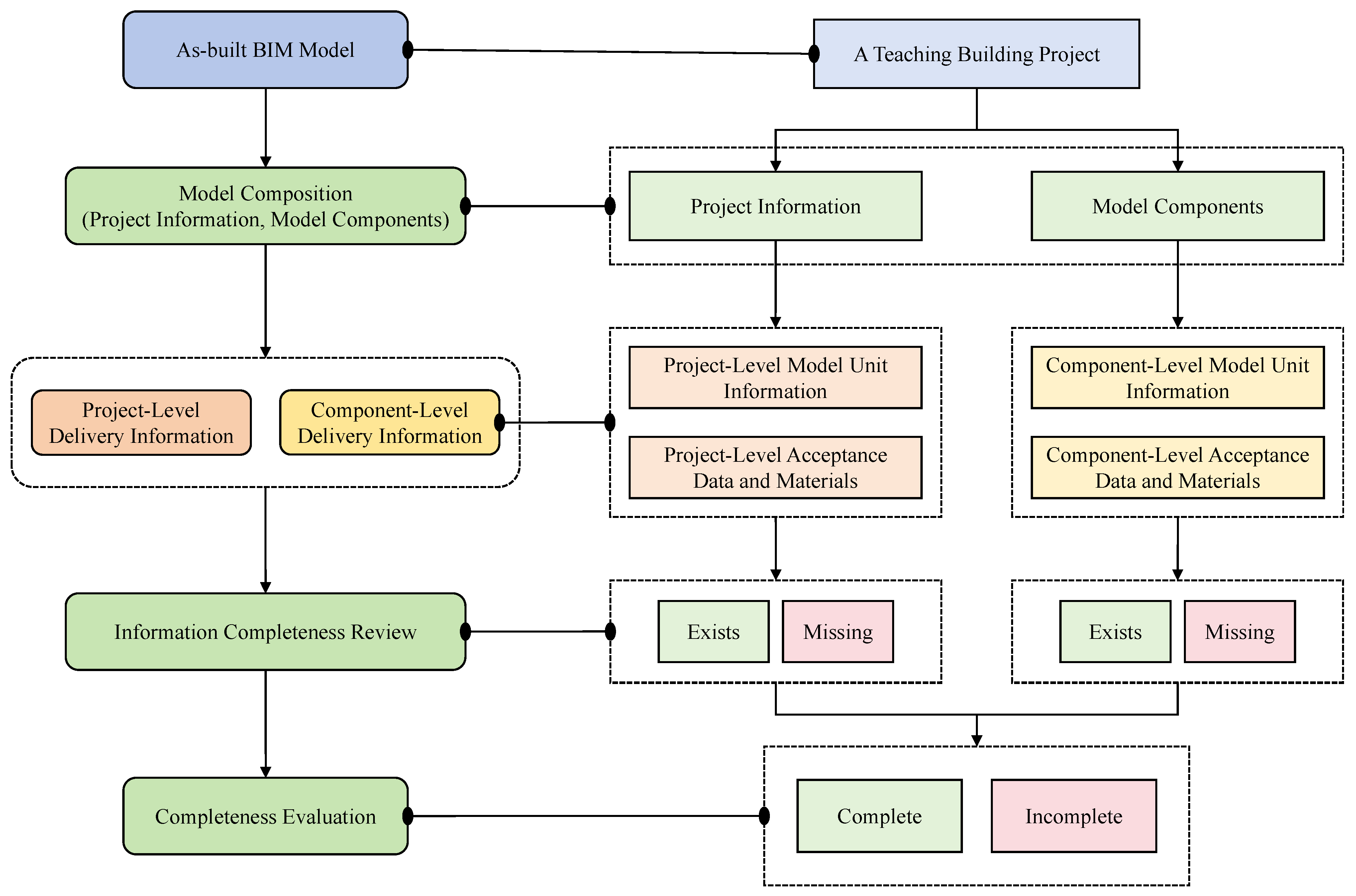
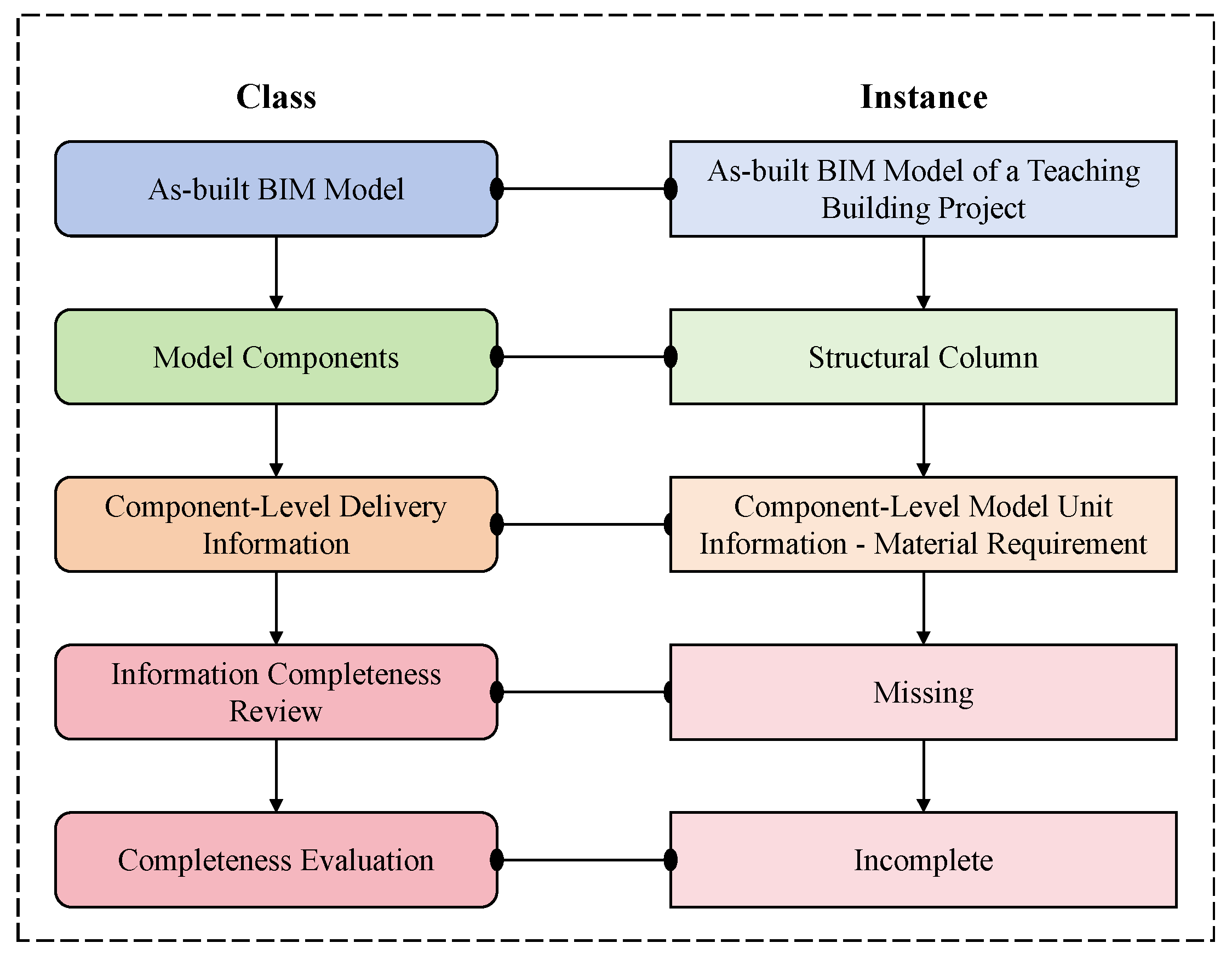
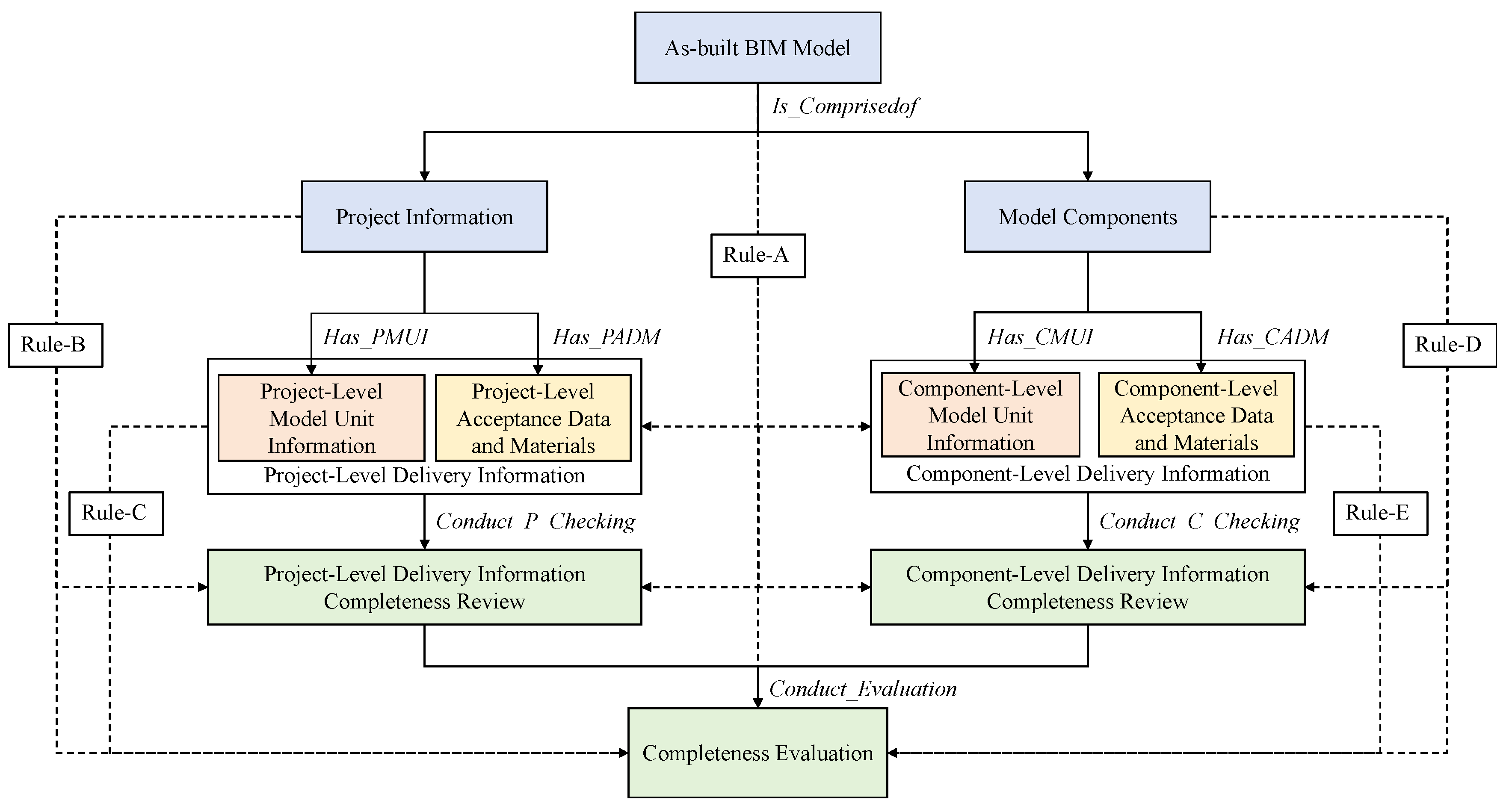
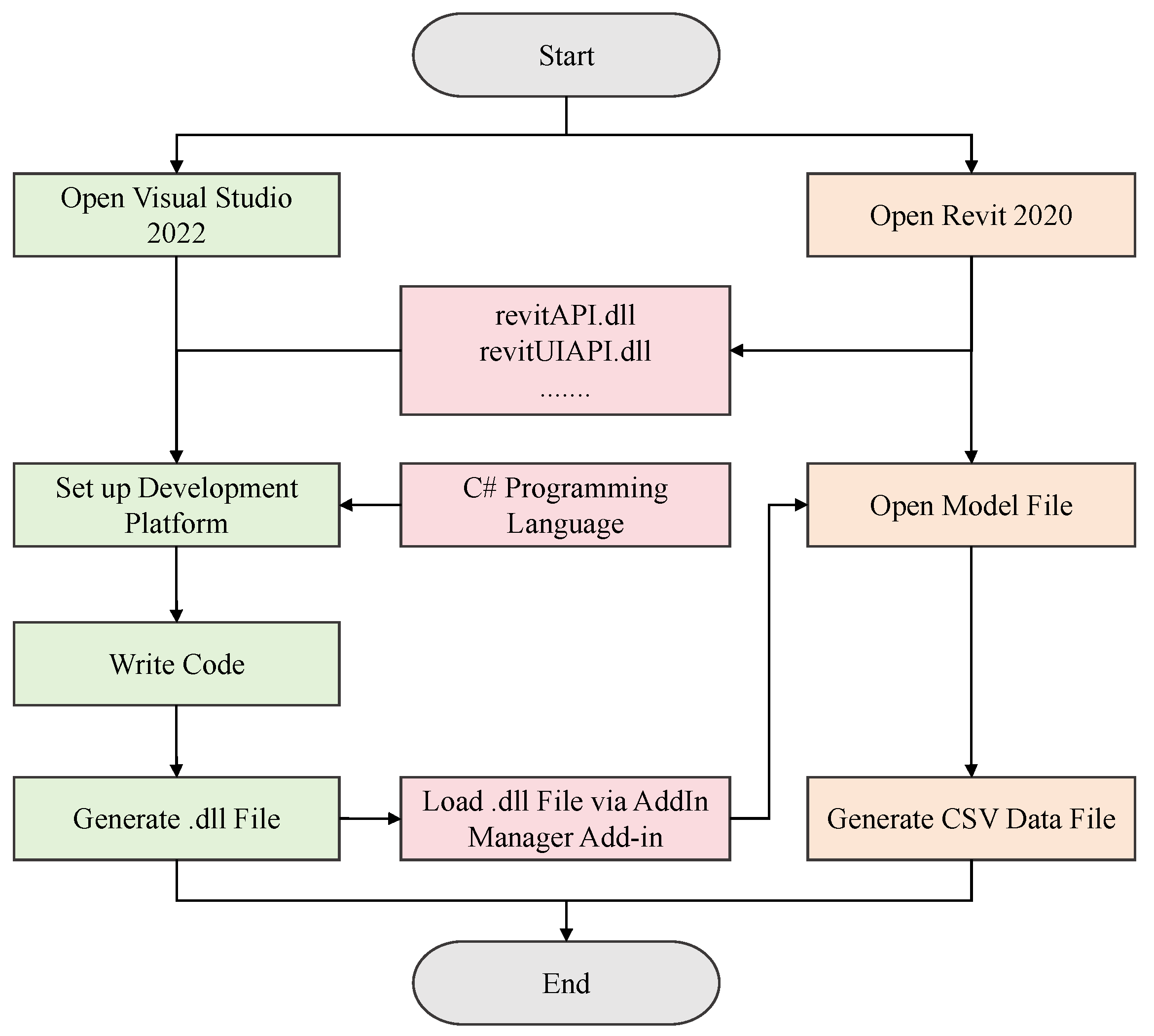
To transform the aforementioned theoretical methods into operational, verifiable, practical tools, this study designed and built the As-built Architectural Engineering BIM Information Completeness Review System. The system aims to automate the entire workflow from As-built BIM import, information extraction and semantic conversion, ontology-based rule reasoning, to result output, providing an integrated solution for Information Completeness Review at the as-built delivery stage. This section first explains the system’s review principles and logical architecture, then describes in detail the design and implementation of the system framework and its functional modules, and finally validates the system’s feasibility and effectiveness through a practical case.
3.4.1. Principles of As-Built BIM Information Completeness Review
The core of the review lies in establishing an integrated theoretical system of Knowledge Support—Data Processing—Reasoning Judgment. Through systematic methodological design, comprehensive and precise verification of As-built BIM information is achieved. Its essence combines standardized review knowledge with normalized data processing workflows to construct a logical pathway from raw model data to completeness conclusions, ensuring the scientific nature of the review process and the reliability of results.
- (1)
Mechanism for Data and Knowledge Integration
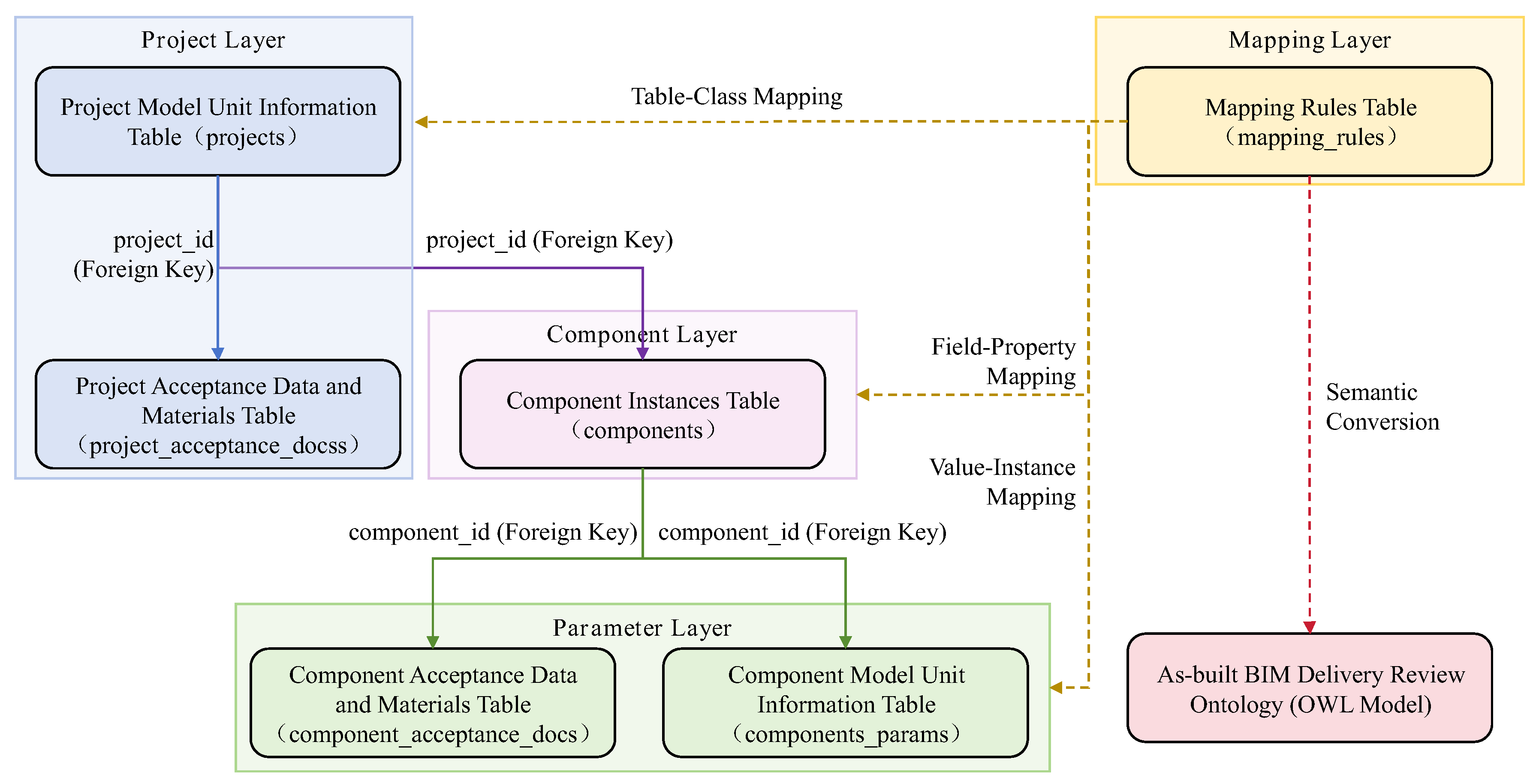
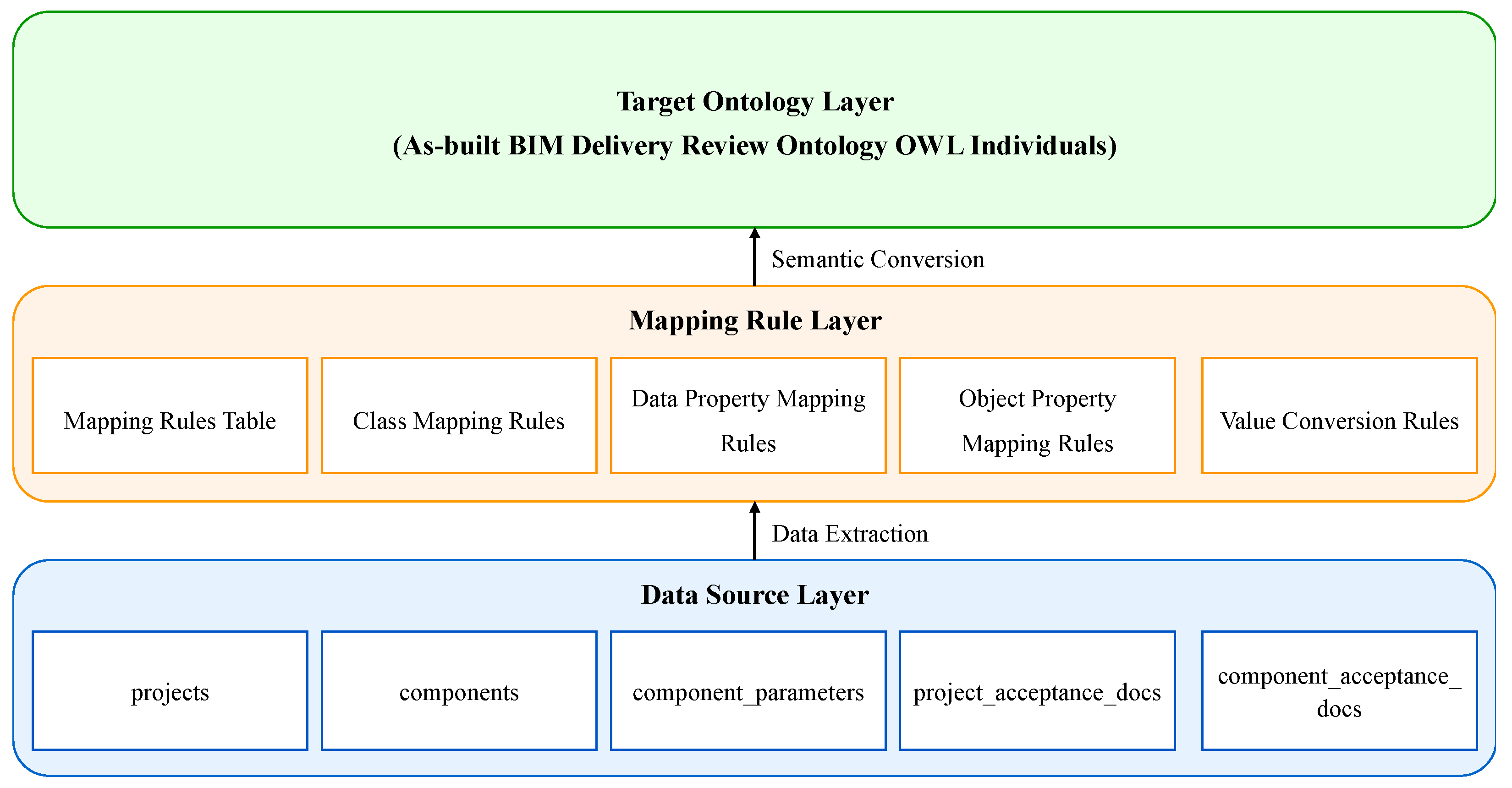
The deep integration of data and knowledge is the core link of the review principle. Its core logic, through standardized process design, achieves a precise connection between structured data and the ontological knowledge base, forming an integration chain of Data Loading—Semantic Enhancement—Knowledge Association, as illustrated in
Figure 11.
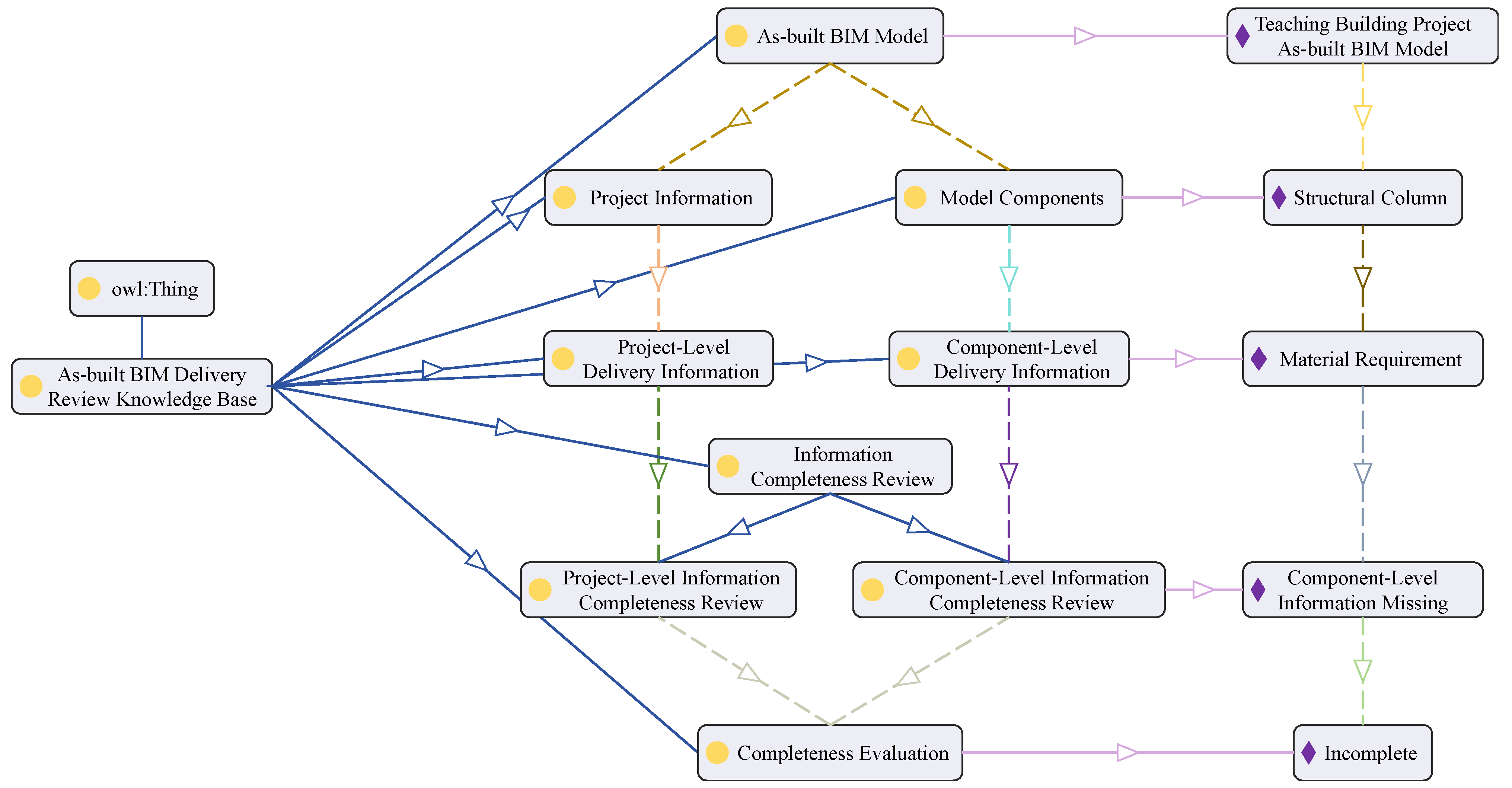
First, standardized processing of structured data is the prerequisite for integration. Raw data extracted from the As-built BIM undergoes preprocessing such as format validation, null handling, and attribute name unification before storage in the structured database. This ensures data format consistency with the property specifications defined in the ontology, eliminating integration barriers caused by data heterogeneity. Second, semantic mapping is the key bridge for integration. Through preset mapping rules, one-to-one correspondences are established between database tables/fields/records and ontology classes/properties/instances, realizing the transformation of structured data into ontological instances and endowing data with semantic attributes. Finally, knowledge association building achieves deep binding between data and knowledge. Based on class hierarchies and object properties defined in the ontological knowledge base, semantic associations among instances are automatically established, such as the ownership relationship between a component and its project, or the linkage between a component and its corresponding acceptance documents. This integrates scattered instance data into the overall knowledge system. Through this integration mechanism, data is no longer isolated information units but becomes knowledge carriers with semantic logic, laying the foundation for subsequent rule matching and reasoning.
- (2)
Logic for Completeness Judgment Based on Knowledge Reasoning
The core of completeness judgment is to perform automated judgment on information completeness through rule matching and logical reasoning based on the semantically enriched integrated data. The logical flow follows the closed loop of instance loading—rule matching—logical reasoning—conclusion generation.
First, the Reasoning Engine loads the integrated ontology instances and the preset review rule set, constructing the semantic environment required for reasoning. The review rule set covers multi-dimensional review requirements, including core information existence, semantic association integrity, format specification compliance, and hierarchical coverage comprehensiveness. Each rule corresponds to clear knowledge logic and a standard basis. Second, rule matching is executed according to a preset priority order. The Reasoning Engine validates each ontology instance against the rules one by one, identifying non-compliance, missing information, or anomaly issues.
During matching, logical reasoning and conflict resolution are performed by combining axiom constraints and class hierarchy relationships from the ontological knowledge base, ensuring consistency and accuracy of judgment results. For example, if a component instance is not associated with any acceptance documents, through the axiom constraint in the ontology that structural components must be associated with acceptance documents and the corresponding rule match, the reasoning concludes Semantic Association Missing. Finally, all matching results are classified and organized to generate completeness judgment conclusions containing information such as problem type, associated instance, triggering rule, and standard basis, providing precise guidance for subsequent rectification.
3.4.2. System Framework
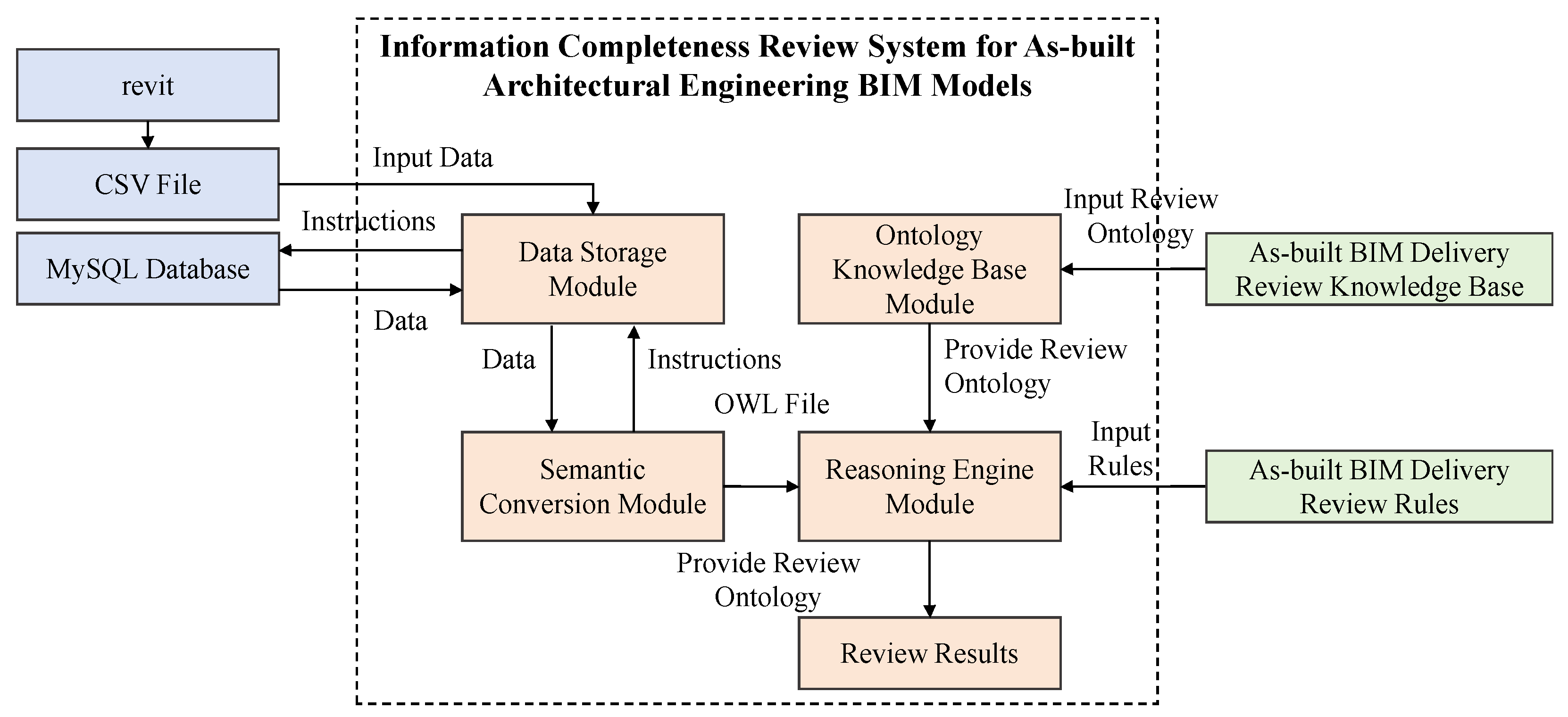
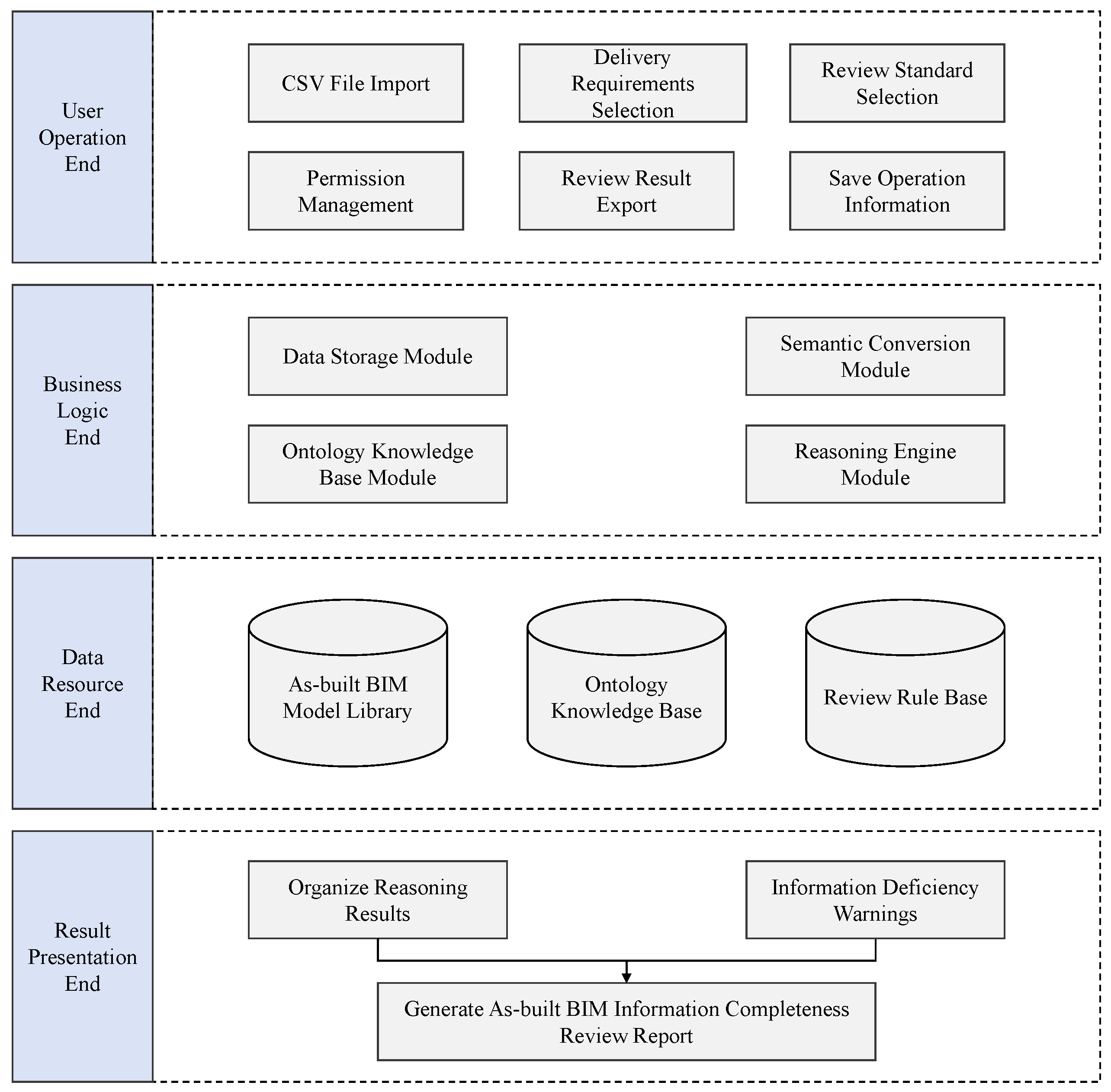
Based on the above principles, this study designed and implemented the As-built Architectural Engineering BIM Information Completeness Review System. The system adopts a modular design, user-operation oriented, with data processing and reasoning at its core. Its overall framework is shown in
Figure 12.
- (1)
User Operation End
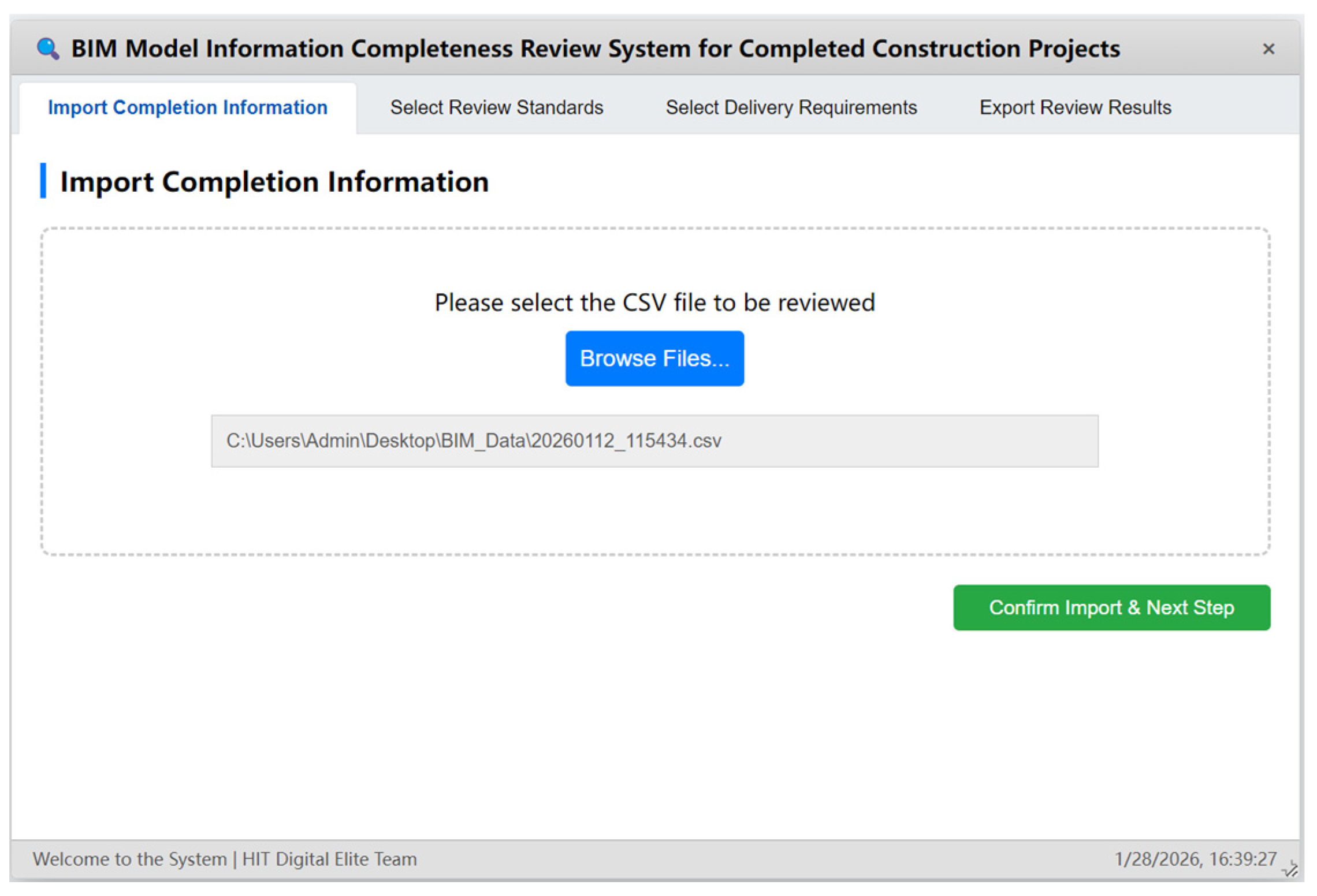
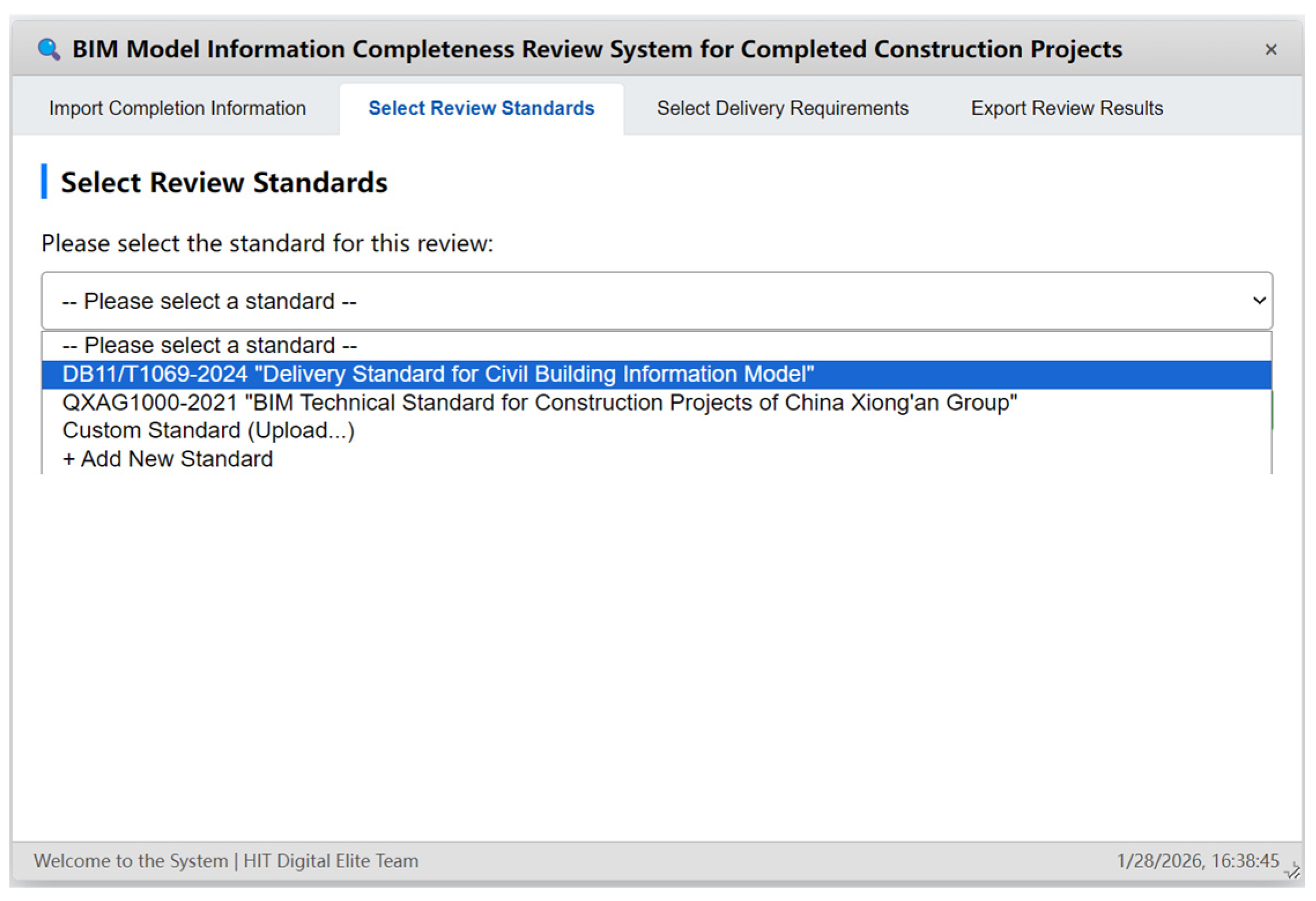
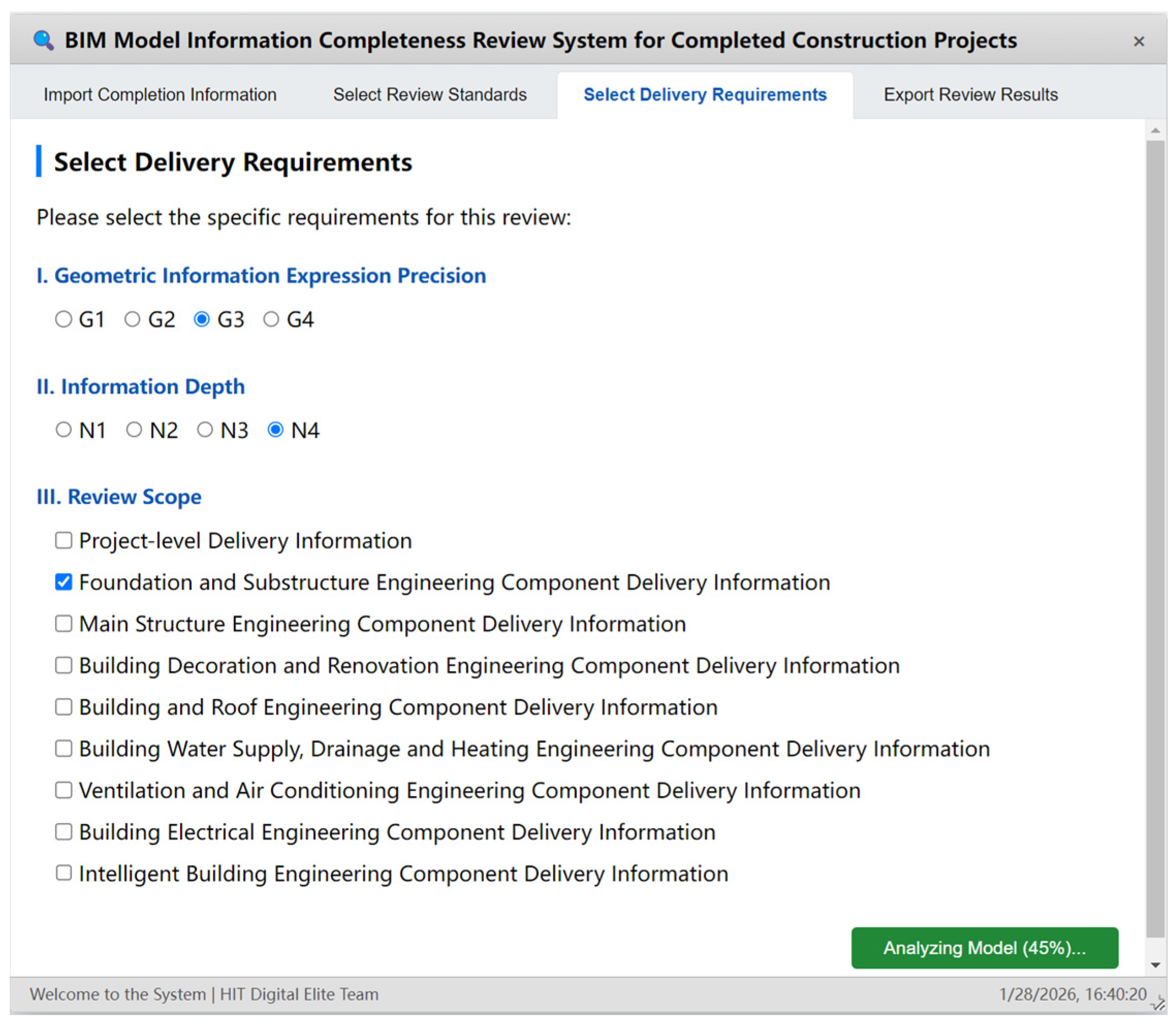
As the direct interaction interface between the system and the user, it carries core functions for initiating operations, selecting configurations, and providing decision feedback. Corresponding modules include CSV File Import, Delivery Requirement Selection, and Review Standard Selection. The CSV File Import module supports uploading structured data files exported by the extraction add-in, containing core information like project, components, parameters, and acceptance documents. The Delivery Requirement Selection module provides options for information depth at the as-built delivery stage, directly linked to the ontology information dimensions defined earlier, ensuring the review scope matches project delivery needs. The Review Standard Selection module has built-in BIM delivery standards from multiple regions and industries; users can select as needed, and the system automatically associates the corresponding ontological knowledge base and Review Rule Base. The Permission Management module supports role-based access control, ensuring compliant data access and review decisions. The Review Result Export module provides functionality to export review reports, enabling visual management of results. The Save Operation Information module automatically records user actions like standard selection, data import, and decision results, forming a traceable operation log for process auditing. The user login and operation interfaces are shown in
Figure 13.
- (2)
Business Logic End
This is the central nervous system of the system, receiving instructions and data from the User Operation End, calling support resources from the Data Resource End, and completing the core processing for automated review. It contains the Data Storage Module, Semantic Conversion Module, Ontology Knowledge Base Module, and Reasoning Engine Module.
The Data Storage Module receives CSV files uploaded from the User Operation End, performs data cleaning, format validation, and batch storage according to the designed database schema, building a standardized, structured data model for As-built BIM, providing a stable data source for subsequent semantic conversion.
The Semantic Conversion Module reads structured data from the Data Storage Module and, based on the defined Database-Ontology Mapping rules, converts relational data into OWL instances conforming to the As-built BIM Delivery Review Ontology, automatically establishing semantic associations among instances, achieving the semantic leap from data to knowledge.
The Ontology Knowledge Base Module loads the As-built BIM Delivery Review Ontology file constructed earlier, providing the unified framework of classes, properties, and semantic constraints for semantic conversion and the Reasoning Engine, serving as the knowledge benchmark for review logic.
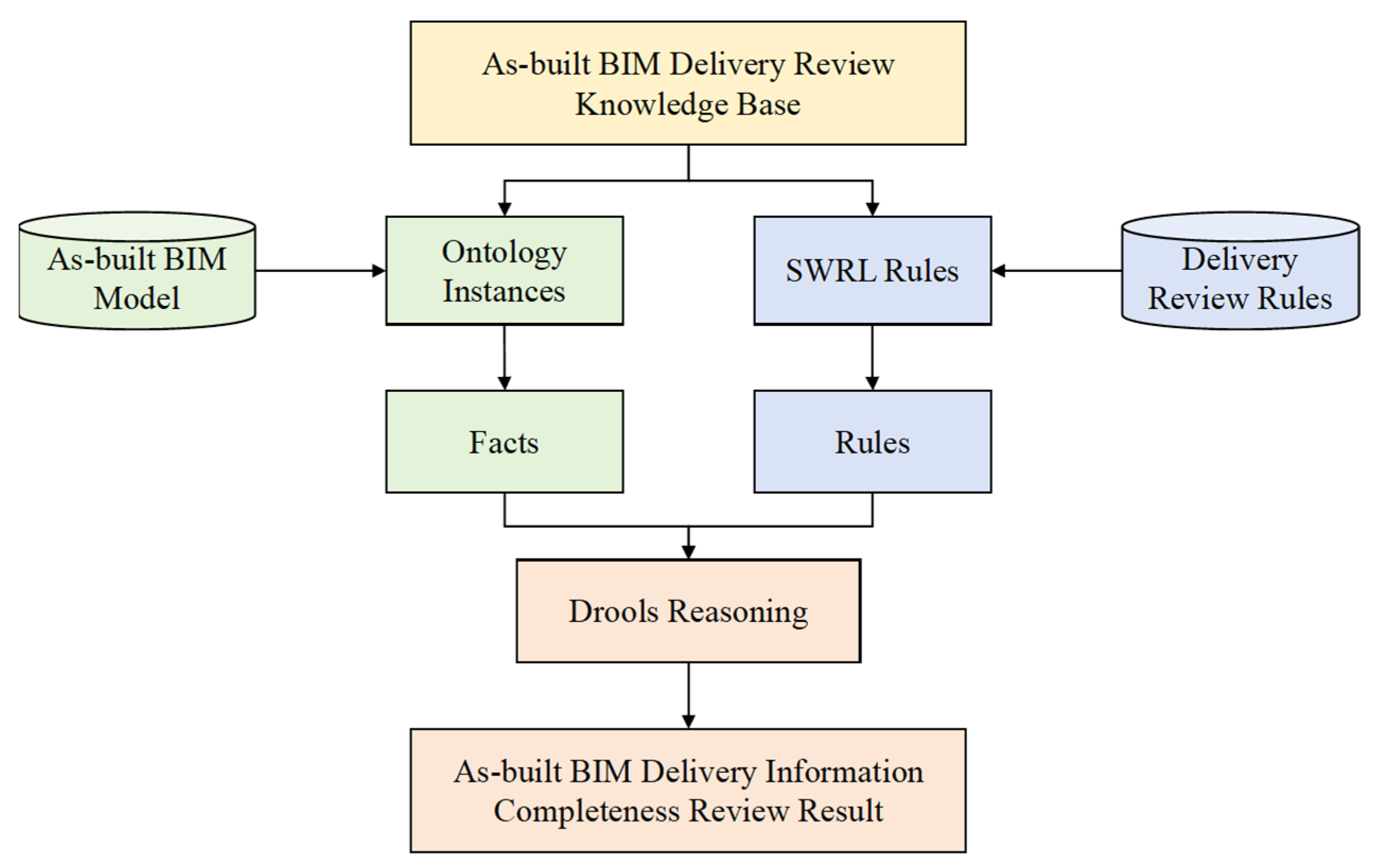
The Reasoning Engine Module loads the SWRL Review Rule Base defined earlier, receives OWL instances generated by the Semantic Conversion Module, performs rule matching and logical reasoning through the Drools inference engine, automatically identifies issues like missing information and broken associations, and outputs preliminary reasoning conclusions.
- (3)
Data Resource End
This is the foundational support layer for system operation, storing core data and knowledge resources required for review. Corresponding modules include the As-built BIM Library, Ontology Knowledge Base, and Review Rule Base. The As-built BIM Library stores user-uploaded CSV files and project data structured by the Data Storage Module, serving as the raw data carrier for review. The Ontology Knowledge Base stores the multi-version As-built BIM Delivery Review Ontology, supporting dynamic invocation based on project type and delivery standard. The Review Rule Base stores the SWRL review rule set corresponding to the ontology, covering multi-dimensional review logic like core information existence and semantic association integrity, consistent with the earlier rule system.
- (4)
Result Presentation End
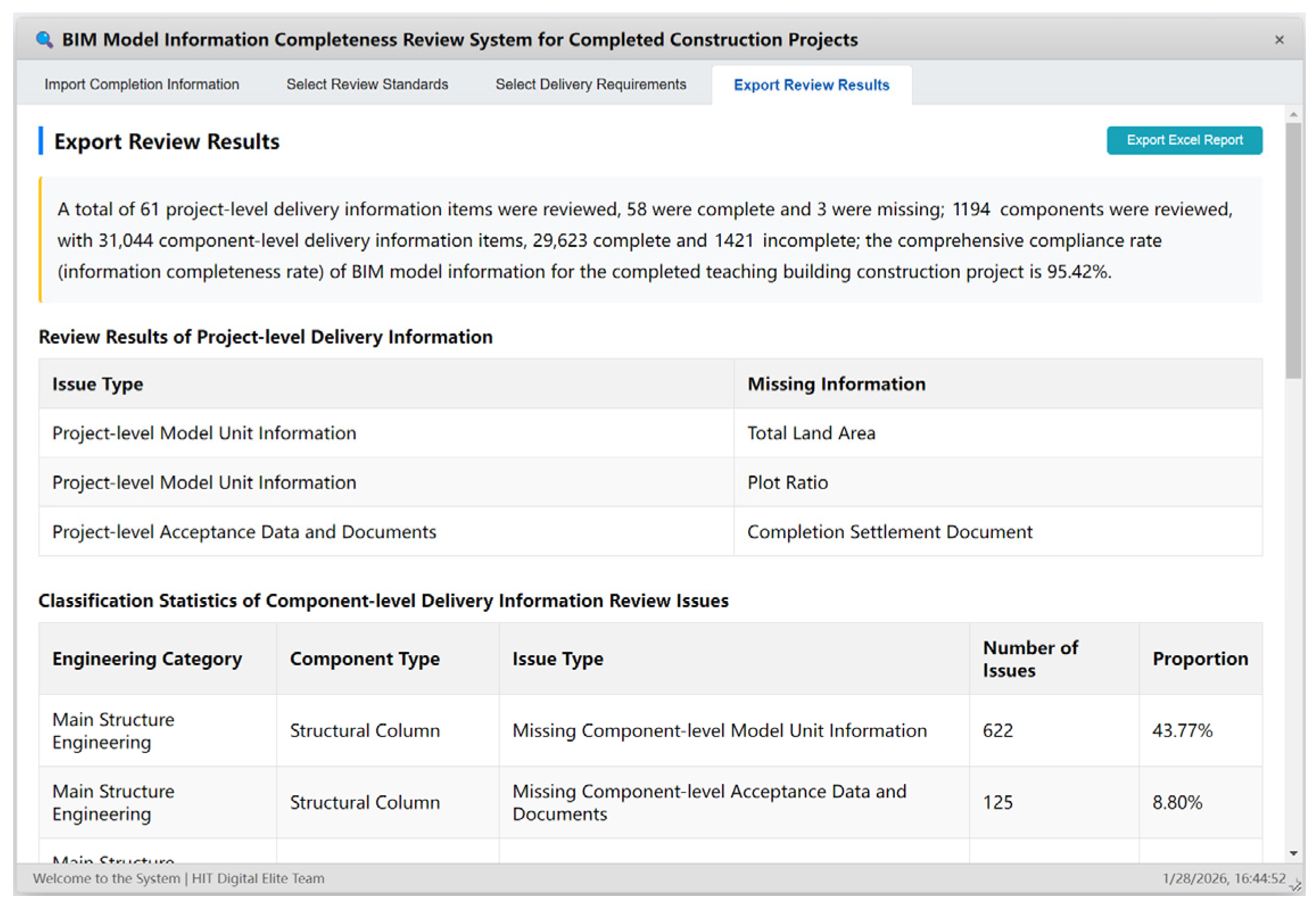
This layer presents the review outcomes in a user-readable professional format. It first organizes reasoning results, classifying and aggregating the preliminary conclusions from the Reasoning Engine, statistics problem distribution by engineering category, component type, and problem severity to form a structured result dataset. It also generates warning prompts for critical issues like core information missing or key documents unlinked, helping users quickly locate major rectification items. Finally, it integrates statistical results with detailed problem lists, supporting export in Excel format.
3.4.3. Design of Core System Modules
The system’s functional modules cover user interaction, data processing, knowledge support, and result presentation. However, the Business Logic End constitutes the core component of the entire review system, with other modules revolving around it. Among these, the Data Storage, Semantic Conversion, Ontology Knowledge Base, and Reasoning Engine modules run through the entire workflow of raw data reception, semantic conversion, and knowledge-driven reasoning, forming the technical hub for realizing the As-built BIM Information Completeness Review. Therefore, this section focuses on elaborating the design and implementation of these four core modules.
- (1)
Data Storage Module
This module is the data center of the system. Its core functions include receiving, validating, storing, and managing structured data, providing a stable and reliable data source for subsequent semantic conversion and rule reasoning. The module needs to be compatible with CSV format data extracted from BIMs while establishing efficient data interaction mechanisms with the structured database, ensuring data integrity, consistency, and traceability.
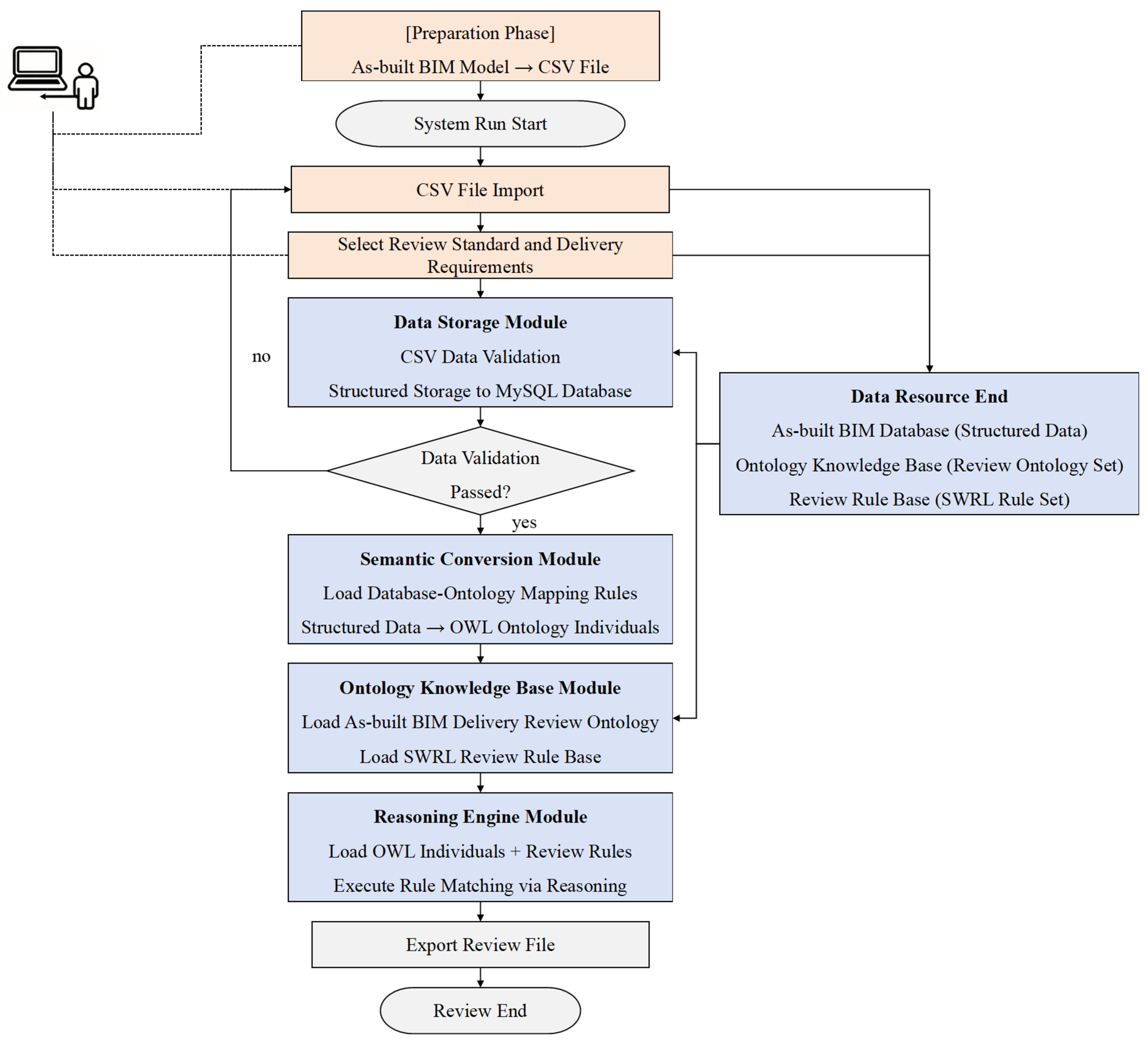
Implementation follows the development workflow of data validation, structured storage, and data indexing. First, a data format validation interface is developed to automatically validate field types, attribute names, data formats, etc., in CSV files, supporting the identification of illegal characters, format errors, and generating validation reports for user correction. Validated data is then stored in corresponding database tables according to preset data mapping relationships, ensuring normative data storage. Second, a structured storage system is built using MySQL, designing reasonable table structures and field relationships, establishing primary and foreign key constraints for core identifiers like project_id and component_id to ensure relational integrity. Data read/write optimization mechanisms are also developed, using connection pooling to enhance database access efficiency and supporting fast storage and query of large-scale data. Finally, a data indexing mechanism is established, creating indexes for commonly queried fields to optimize query performance, ensuring the Semantic Conversion Module can quickly retrieve required data.
- (2)
Semantic Conversion Module
This module is the key hub connecting data storage and rule reasoning. Its core function is to convert data from the structured database into semantically associated OWL format ontology instances, achieving semantic enhancement of data and providing a semantic data foundation for rule matching. The module must ensure the accuracy of the conversion process, making the class membership, property assignment, and relationship establishment of ontology instances consistent with the preset ontological knowledge base.
The implementation workflow includes Mapping Rule Configuration, Data Reading and Conversion, Semantic Association Building, and Conversion Result Validation. First, based on the preset ontology framework, a mapping rule base is configured, establishing Table-to-Class, Field-to-Property, and Record-to-Instance correspondences, clearly defining the relationships between database tables/fields and ontology classes/properties. The rule base supports addition, editing, and export of rules, ensuring flexibility and maintainability. Second, data reading interfaces are developed to read structured data from the database by category. Based on the mapping rule base, data type conversion and property assignment are performed automatically, transforming each database record into a corresponding ontology instance. During conversion, semantic associations between instances are simultaneously built. Based on foreign key relationships between database tables, corresponding object property relationships in the ontology are automatically added. Then, a Conversion Result Validation mechanism is developed. The generated OWL file is validated for semantic consistency through an ontology reasoner, checking for errors like incorrect instance class membership, anomalous property assignment, or missing semantic associations, and generating validation logs. Validated OWL files are stored in a designated directory as ontologies-to-be-reviewed, providing input for the Reasoning Engine Module.
- (3)
Ontology Knowledge Base Module
This module is the knowledge support core of the system, containing two core components: the Ontology Framework and the Review Rule Base. The Ontology Framework defines core concepts (classes), properties (data and object properties), and semantic constraints (axioms) related to As-built BIMs, building a unified knowledge semantic system. The Review Rule Base translates standards and professional expertise into executable standardized rules, providing a specific review basis for completeness judgment.
Implementation follows the development workflow of ontology construction, rule authoring, knowledge base integration, and dynamic updates. First, based on As-built BIM delivery standards and professional knowledge, the ontology framework is constructed using the Protégé tool. Core class hierarchies for Project, Component, Parameter, Acceptance Document, etc., are defined; mandatory and optional data properties for each type of instance are specified; object property associations between instances are established; necessary axiom constraints are added; and an OWL format ontology file is generated. Second, based on the ontology framework and standards, review rules are authored using SWRL, covering multi-dimensional review requirements like core information existence and semantic association integrity. Each rule clearly defines preconditions and conclusions, ensuring executability. Authored rules are organized by review dimension and standard source to build the Review Rule Base, supporting categorized retrieval and batch loading. Then, knowledge base integration interfaces are developed to integrate the ontology file and rule base, supporting loading into the Reasoning Engine to provide knowledge support for rule matching. Finally, a dynamic update mechanism is designed, allowing users to extend ontology classes/properties and add/modify review rules based on new standards or project needs, enhancing the knowledge base’s generality and adaptability.
- (4)
Reasoning Engine Module
This module is the decision-making core of the system. Its core function is to load the ontology-to-be-reviewed and the Review Rule Base, perform automated rule matching and logical reasoning to identify completeness issues in the As-built BIM information, and generate structured review results. The module must ensure the efficiency of the reasoning process and the accuracy of results, supporting rapid processing of large-scale ontology instances and precise identification of multi-dimensional problems.
The implementation workflow includes knowledge base and instance loading, rule matching, logical reasoning, and result generation, as well as storage. First, loading interfaces are developed to support batch loading of the ontology framework, Review Rule Base from the knowledge base, and the ontology-to-be-reviewed from the Semantic Conversion Module into the Reasoning Engine. The OWL API is used to parse class membership, property information, and semantic associations of ontology instances, building a semantic network in memory. Second, rule-matching algorithms are designed. Rule matching is performed on instances in the semantic network rule by rule, following a priority order like Mandatory Standard Rules, Core Information Rules, Association and Format Rules. Parallel computing techniques are employed to support simultaneous matching of multiple rules and instances, improving reasoning efficiency. During matching, a conflict resolution mechanism is developed to resolve logical conflicts in rule matching based on ontology axioms, ensuring reasoning consistency. Then, based on rule matching results, logical reasoning is performed, adding associated information for each problem, including problem instance ID, triggering rule ID, associated standard clause, problem severity, etc., generating structured review results. Finally, result storage and output interfaces are developed, storing review results categorized in the database, supporting fast query and statistical analysis. Review results are also formatted to provide standardized result data for the Presentation Layer, ensuring users can intuitively view and export results.
The overall system runtime workflow is illustrated in
Figure 14.




 ,
,