Systematic Review

Trash to Treasure for Housing Resilience: A Systematic Literature Review of Community-Based Waste-to-Resource Innovations in the Built Environment


by
Funmilayo Ebun Rotimi
*,
Mahesh Babu Purushothaman
and
Yakubu George Warkaka
Built Environment Engineering, School of Future Environment, Faculty of Design and Creative Technology, Auckland University of Technology, Auckland 1010, New Zealand
*
Author to whom correspondence should be addressed.
Buildings 2026, 16(7), 1399; https://doi.org/10.3390/buildings16071399
Submission received: 24 February 2026 / Revised: 18 March 2026 / Accepted: 19 March 2026 / Published: 1 April 2026

Abstract

The built environment continues to encounter significant challenges related to waste generation and resource depletion, driving increased interest in circular economy strategies that extend material lifecycles and mitigate environmental impacts. This systematic review synthesises findings from 60 studies on waste-to-resource innovations across construction and household contexts. Although the existing literature predominantly addresses construction and demolition waste, this review foregrounds household operational waste, an area that remains insufficiently explored despite its importance for everyday resource recovery. The analysis examines how materials generated through routine use, maintenance, and minor renovation activities can be captured and redirected into productive resource streams, with particular attention to governance mechanisms such as Extended Producer Responsibility (EPR). The findings indicate that effective waste-to-resource systems depend on coherent regulatory frameworks and enforcement, economic incentives, enabling technologies, community engagement, and product design that facilitates reuse and disassembly. Key barriers include low public awareness, fragmented supply chains, high recovery costs, weak compliance mechanisms, and materials that are difficult to separate. The review concludes that improving waste-to-resource outcomes in the built environment requires coordinated action among producers, households, local authorities, and technology providers, and it articulates policy-relevant and community-oriented pathways to support more effective resource recovery systems.

1. Introduction

Sustainable construction and material recovery have become central themes in global debates on the future of the built environment. The construction sector consumes an estimated 40% of extracted raw materials and generates almost one-third of global solid waste, making it one of the most resource-intensive industries worldwide [1,2]. These pressures are amplified by rapid urban growth, rising infrastructure demand, and increased volumes of household and building-related waste, which strain local waste management systems and accelerate ecological degradation [3]. As these challenges intensify, researchers and practitioners have turned their attention to circular economy thinking, which promotes the continual circulation of materials through reuse, recycling, and resource optimisation rather than disposal [4]. This transition redefines waste as a valuable secondary resource and advances models for recovering construction materials from household waste, maintenance activities, renovation work, and community waste streams for productive use.
A growing body of evidence shows that waste generated during building occupancy, such as furniture, carpets, fixtures, electronic devices, plastics, timber fragments, and minor demolition debris, can be recovered through innovative processes that transform discarded materials into construction inputs [5,6,7,8,9]. Community groups, local recyclers, and small-scale enterprises increasingly participate in these resource loops, demonstrating the social and economic potential of decentralised recovery systems that reduce landfill pressure while supporting local employment and skills development [10,11]. However, despite progress in material reuse and recycling technologies, the knowledge base remains fragmented. Many studies focus on technical performance while overlooking the broader social, policy, and market conditions that determine whether waste-to-resource innovations succeed, scale, or remain isolated pilot initiatives [12,13,14,15]. This fragmentation underscores the need for a systematic, interdisciplinary synthesis of evidence spanning construction materials, community practices, behavioural factors, and governance mechanisms.
Extended Producer Responsibility offers a compelling framework for understanding and improving material recovery within the built environment. Extended Producer Responsibility treats waste management as an upstream responsibility. It expects producers, suppliers, and construction professionals to manage material impacts from the design stage onward [16,17]. This shift aligns with circular economy principles by positioning producers and construction stakeholders as active participants in resource recovery rather than passive contributors to waste generation [3,8,18]. Integrating EPR with community-based initiatives has shown promise in both developed and emerging economies where collaborations between suppliers, builders, recyclers, and households have supported reuse markets, improved resource efficiency, and strengthened circular local economies [8]. Yet further clarity is needed regarding how these systems function across diverse contexts and how actors at different levels contribute to material recovery outcomes.
This study aligns with the United Nations Sustainable Development Goals (SDGs) set in 2015, particularly SDG 11 on sustainable cities and communities and SDG 12 on responsible consumption and production. SDG 11 emphasises the need to improve the environmental performance of urban areas, including the management of waste generated through construction and everyday household activities. The focus of this review on material recovery within buildings and communities supports this goal by identifying ways to reduce landfill disposal and encourage more efficient resource use. SDG 12 calls for responsible production systems in which materials are designed, used, and recovered in ways that minimise environmental harm. The extended producer responsibility framework examined in this study contributes to the circular economy objective by encouraging producers and supply chain actors to redesign materials for durability, reuse, and improved traceability. By analysing how waste-to-resource systems operate across households, producers, and local authorities, this review provides evidence that connects material recovery practices within the circular economy broader international efforts to promote sustainable production and resilient urban environments [12,17,19].
Despite the increasing volume of research on circular economy practices and material recovery in the built environment, a noticeable imbalance remains in the literature. Much of the existing research concentrates on construction and demolition waste streams due to their large material volumes and regulatory attention [7]. In contrast, operational phase waste generated during everyday building use, including discarded household items, fixtures, appliances, and small renovation debris, remains comparatively under examined. This imbalance limits a comprehensive understanding of how waste to resource strategies can operate at the household and community level, where a significant proportion of material flows originate during the life cycle of buildings. Given these gaps, a systematic review is required to consolidate global knowledge on waste-to-resource innovations within the built environment, including the material types recovered, the technologies used, and the socio-economic and governance conditions that shape adoption. By examining evidence through the lens of EPR and circular economy practice, this study aims to identify the enabling factors that allow communities, industries, and policymakers to translate waste into valuable resources. The review also seeks to clarify the barriers to recovery efforts, including regulatory constraints, limited community awareness, technological challenges, and weak market incentives. In doing so, the study contributes to international conversations on sustainable construction and material accountability while providing insights that support more resilient and equitable waste management systems. The objective of this study is to systematically synthesise existing research on waste-to-resource innovations within the built environment, with particular emphasis on household operational waste generated during the use, maintenance, and minor renovation of buildings. By examining the types of materials recovered, the technological systems applied, and the governance mechanisms that influence recovery processes, the study aims to identify the key enablers and barriers shaping the transformation of discarded household materials into valuable resources.
To address these gaps and provide clearer insight into how waste-to-resource practices operate within the built environment, the study defines the following research questions.
  • What types of household-based waste-to-resource innovations are applied within the built environment?
  • What household materials and technological systems are most recovered, reused, or recycled through these waste-to-resource innovations?
  • What key enablers and barriers influence the implementation and scaling of household waste-to-resource practices within the built environment?

2. Literature Review

2.1. Circular Economy Transitions in the Built Environment

Recent literature underscores the growing importance of circular economy transitions in the built environment, noting that construction activities continue to place substantial pressure on global resource systems. Ref. [8] explains that circular practices in construction involve designing materials and processes that allow components to be reused, repurposed, or reintegrated into new production cycles with minimal environmental impact. Gonzalez et al. [4] adds that circularity in buildings can reduce the extraction of virgin materials and support lower-carbon outcomes when supported by policy direction and supply chain coordination. Studies further show that digital tracking systems, improved procurement models, and early design interventions are essential to achieving circular outcomes [20]. However, the literature also reports that many construction systems remain dependent on traditional linear models that prioritise disposal, creating structural barriers to circularity, particularly in regions experiencing rapid urbanisation [20]. These studies collectively argue that transitioning the built environment toward circularity requires integrated strategies that operate across the design, construction, operation, and end-of-life phases.
Scholars have also emphasised that operational-phase waste is a critical but often under-examined component of circular economy transitions. Guo et al. [20] shows that household-level waste streams, including furniture, textiles, fixtures, plastics, and electronic items, represent a significant resource base with high recovery potential when adequate systems are in place. Rahman and Mahmud [3] argues that circular outcomes depend not only on technological solutions but also on community-level engagement and the willingness of occupants to participate in sorting and recovery programmes. Studies further indicate that differences in infrastructure, local policies, and socio-economic conditions influence households’ participation in circular initiatives [21]. Dushmantha et al. [22] adds that behavioural drivers such as awareness, convenience, and perceived benefits strongly shape the effectiveness of material recovery systems. These findings highlight that research on circular transitions must integrate both technical and social dimensions to develop context-appropriate material loops within residential and community settings.

2.2. Extended Producer Responsibility and Material Accountability

The literature consistently identifies Extended Producer Responsibility as a key approach to improving material accountability and reducing waste across construction and household systems. Meng et al. [18] explains that EPR frameworks shift responsibility from end users to producers and suppliers by requiring materials to be designed for durability, disassembly, and improved traceability. Hammoud et al. [23] similarly reports that EPR schemes encourage producers to take an active role in post-use material management through takeback systems, product redesign, and improved information sharing along the supply chain. Alev et al. [17] shows that EPR can reshape supply chain operations by promoting closed-loop systems in which producers retain some degree of responsibility for material recovery. When digital technologies and clear regulatory structures support these systems, studies indicate that recovery rates improve and environmental impacts decline [24]. However, scholars also note that EPR effectiveness is uneven across contexts, particularly in regions where regulatory enforcement is weak or inconsistent.
More recent studies highlight that EPR success depends on cooperation among multiple actors in the built environment, including manufacturers, contractors, recyclers, local authorities, and building occupants. Ahmad et al. [25] reports that shared responsibility models improve circular outcomes by aligning producer roles with community-level initiatives that manage household operational waste. Dushmantha et al. [22] also emphasises that EPR functions best when supported by strong behavioural and institutional frameworks that encourage collaboration across the supply chain. Rahman and Mahmud [3] argues that producer involvement must be complemented by community participation and effective local infrastructure for sorting and collection. Luo et al. [26] further demonstrates that household appliance waste can be more efficiently recovered when producers engage in tracking, takeback, and information exchange processes. Together, these studies suggest that EPR can make significant contributions to circularity, but only when embedded within broader systems that integrate producers, communities, and recovery organisations.

2.3. Waste to Resource Practices Across Construction and Household Settings

Recent research provides extensive evidence on the diverse strategies used to convert discarded materials into valuable construction resources. Jiang et al. [24] shows that improved processing technologies and material redesign can increase the quality and reliability of recycled aggregates and other recovered products. Ahmed and Sanam. [27] demonstrates that IoT-enabled sorting and routing systems improve the efficiency of e-waste collection in urban areas and support higher-value recovery. Guggemos and Horvath. [28] reports that advanced recycling and remanufacturing systems can support circular transitions by reducing the environmental impacts associated with new material production. Studies also highlight the role of community-based recovery initiatives, which often capture operational-phase waste, such as plastics, furniture, and small electronics, that might otherwise be landfilled [29,30]. These findings indicate that waste-to-resource systems rely on a combination of technological tools, coordinated infrastructure, and community participation.
The literature also identifies a range of barriers that constrain the effectiveness of waste-to-resource practices across different contexts. Mehmood et al. [21] reports that limited awareness, weak incentives, and inadequate sorting practices reduce household participation in recovery systems. Guggemos and Horvath. [28] notes that technical challenges, including insufficient recycling infrastructure and outdated equipment, limit local authorities’ and private operators’ ability to process diverse waste streams. Economic constraints, including low market value for recycled materials, remain a significant barrier in many regions [31]. Regulatory weaknesses further compound the problem, with several studies showing that unclear mandates and weak enforcement undermine the implementation of waste-to-resource policies [32]. These findings collectively suggest that while waste-to-resource strategies show promise, their success depends on aligning social, technical, and policy conditions within local contexts.

2.4. Conceptual Framework

This review is guided by the Extended Producer Responsibility concept, which promotes a shift in accountability for waste generation and material recovery from end users to actors within the production and supply chain. The core idea of this concept is that responsibility for managing waste should begin with those who design, manufacture, supply, or install construction materials, rather than resting solely with building occupants or local authorities [16]. Within this system, producers are encouraged to design materials that last longer and can be recovered without difficulty. Suppliers are expected to support traceable distribution pathways and encourage responsible material return, while builders and recycling organisations participate in the safe recovery and reintegration of discarded materials into productive use [3,18].
For this review, operation-phase waste refers to materials produced after a building has been completed and handed over to its owner or occupants [16]. These materials arise during everyday use, maintenance, and small renovation activities. They include plumbing fixtures, taps, electrical items such as switches and cables, carpets, furniture, interior fittings, minor demolition fragments such as timber off-cuts or floor tiles, and discarded household devices that fall under the category of electronic waste [27]. These materials are usually managed through community-based disposal and recovery systems, including council collection programmes, private recycling services, resource recovery centres, transfer stations, and informal reuse pathways [33,34]. This classification provides a clear structure for understanding how different forms of waste move from households and building owners into broader material recovery streams.
The framework used in this review integrates three connected ideas. The first is the recognition that household operational activities generate significant amounts of waste that require distinct recovery strategies. The second is the distribution of responsibility for this waste across producers, suppliers, owners, and local recovery systems, consistent with the principles of Extended Producer Responsibility. The third is the role of material and technological innovation, which enables discarded household materials to be transformed into valuable resources through reuse, recycling, or remanufacturing. Together, these ideas guide the review in organising and interpreting existing studies, understanding variations in household waste recovery practice, and identifying the conditions that support successful waste to resource initiatives within the built environment.

3. Research Method

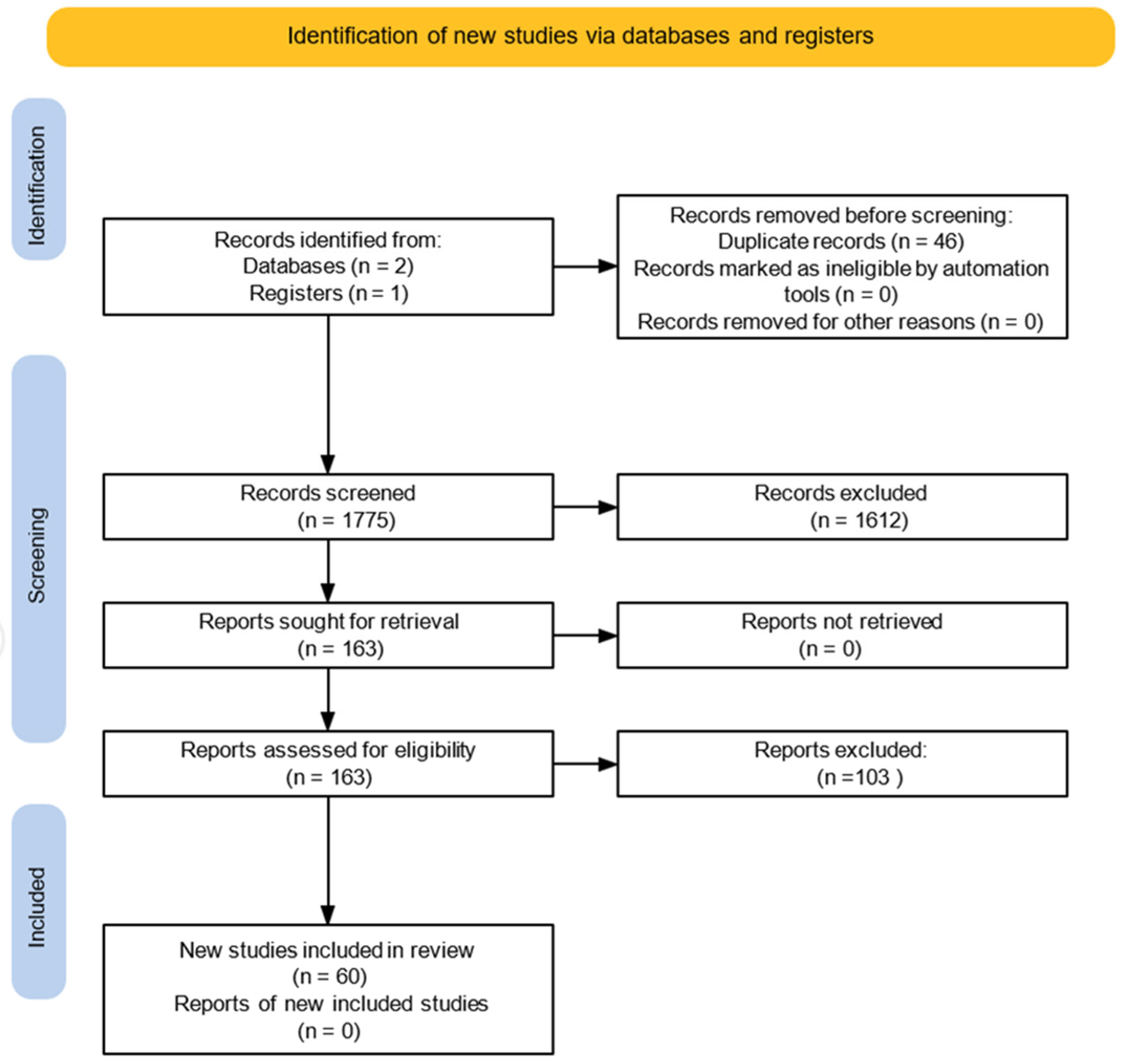
This study employed a systematic literature review methodology, following structured and replicable procedures to identify, screen, and synthesise peer-reviewed evidence on waste-to-resource practices in the built environment. Adopting this approach, the study aims to provide a transparent and reproducible synthesis of existing evidence on waste-to-resource strategies within the built environment [35,36]. The study identification, screening, and eligibility assessment followed the Preferred Reporting Items for Systematic Reviews and Meta-Analyses (PRISMA) 2020 guidelines, which provide updated standards for transparency and reproducibility in systematic evidence synthesis [36,37]. This structured approach aligns with established protocols for rigorous systematic reviews [38,39], thereby ensuring clarity in the processes of identifying, screening, excluding, and including records. The flow of studies through the screening stages is summarised in the PRISMA 2020 flow diagram 1 (see Figure 1).

3.1. Search Strategy

The search strategy was developed to capture three connected ideas in the conceptual framework:
  • Waste generated in buildings and communities during use, maintenance and minor renovation.
  • The distribution of responsibility for this waste across producers, suppliers, builders, owners and recovery systems.
  • Material and technological innovations that convert discarded materials into new resources through reuse, recycling or remanufacturing.
The study selection process followed the PRISMA 2020 framework and was conducted in multiple stages. First, duplicate records were removed. Second, titles and abstracts were screened against predefined inclusion and exclusion criteria (See Table 1). Third, full text articles were assessed for eligibility based on relevance to waste to resource practices in the built environment. Only studies that met all inclusion criteria were retained for final analysis. A structured keyword search strategy was developed to capture studies related to waste to resource systems within the built environment. Key search terms included combinations of “circular economy”, “waste to resource”, “construction waste”, “household waste”, “material recovery”, and “built environment”. Boolean operators such as AND and OR were used to refine the search and ensure relevance.
The literature search was conducted using two major academic databases, Scopus and EBSCO, selected for their comprehensive coverage of peer reviewed research in the built environment, sustainability, and waste management domains. Scopus and EBSCO were selected as the primary databases for this review because they provide broad, multidisciplinary coverage of peer-reviewed research relevant to the built environment, waste management, circular economy practices, and extended producer responsibility systems. Scopus is widely recognised as one of the largest abstract and citation databases, offering extensive indexing of engineering, environmental science, sustainability, and policy-related journals that are central to the focus of this study [40]. Its wide subject coverage ensures that research on construction waste, material recovery technologies and producer responsibility schemes is captured across both technical and social science domains. EBSCO complements this coverage by providing access to collections that include design, planning, community studies, and behavioural research, which are essential for understanding household and operational-phase waste streams, as well as community participation in recovery systems [41].
Using both databases strengthens the reliability of the search process by reducing the risk of missing relevant studies that may be indexed in one database but not the other. Systematic review guidance emphasises that using multiple multidisciplinary databases improves the completeness of evidence retrieval and supports a more transparent and reproducible search process [36].
Scopus is consistently identified as one of the most comprehensive indexing platforms for engineering, construction, and environmental science research, making it suitable for capturing studies on material recovery and resource use across the period under review from 2010 to 2026 [42]. Its broad disciplinary coverage allows the retrieval of research on circular economy practices, waste management technologies, and producer responsibility systems that have developed over the past decade. EBSCO databases complement this coverage by providing strong access to applied social science, planning and behavioural studies, which are essential for understanding household waste practices, community participation and institutional influences on recovery systems across the same review period [43]. Using both databases therefore supports a balanced, interdisciplinary evidence base that aligns with the scope and time frame of this systematic review.

3.2. Screening and Eligibility

The combined database searches produced 1800 records. Duplicates were removed, and the remaining records were imported into Rayyan for screening support. Titles and abstracts were screened in two stages. The database search was conducted between 6 October and 20 October 2025. This period was selected to ensure the inclusion of the most recent developments in waste to resource research, particularly studies reflecting the rapid evolution of circular economy practices and producer responsibility systems over the past decade. Conducting the search within this defined window allowed for a consistent and comprehensive retrieval of studies while ensuring that the evidence base reflects up to date technological, policy, and community-based innovations.
After this assessment, 60 studies met all inclusion criteria and were retained for coding and synthesis. These studies cover a range of waste-to-resource practices across construction and operational phases. Still, they were all analysed through the lens of their implications for household and operational-phase waste streams, including furniture, metals, fixtures, consumer devices, and other discarded materials that flow through inhabited buildings. The primary database search was completed on 15 October 2025, with updates performed on 18 October 2025 to ensure inclusion of recently published studies. All articles indexed in Scopus and EBSCOhost up to this date were eligible for screening.

3.3. Data Extraction and Coding

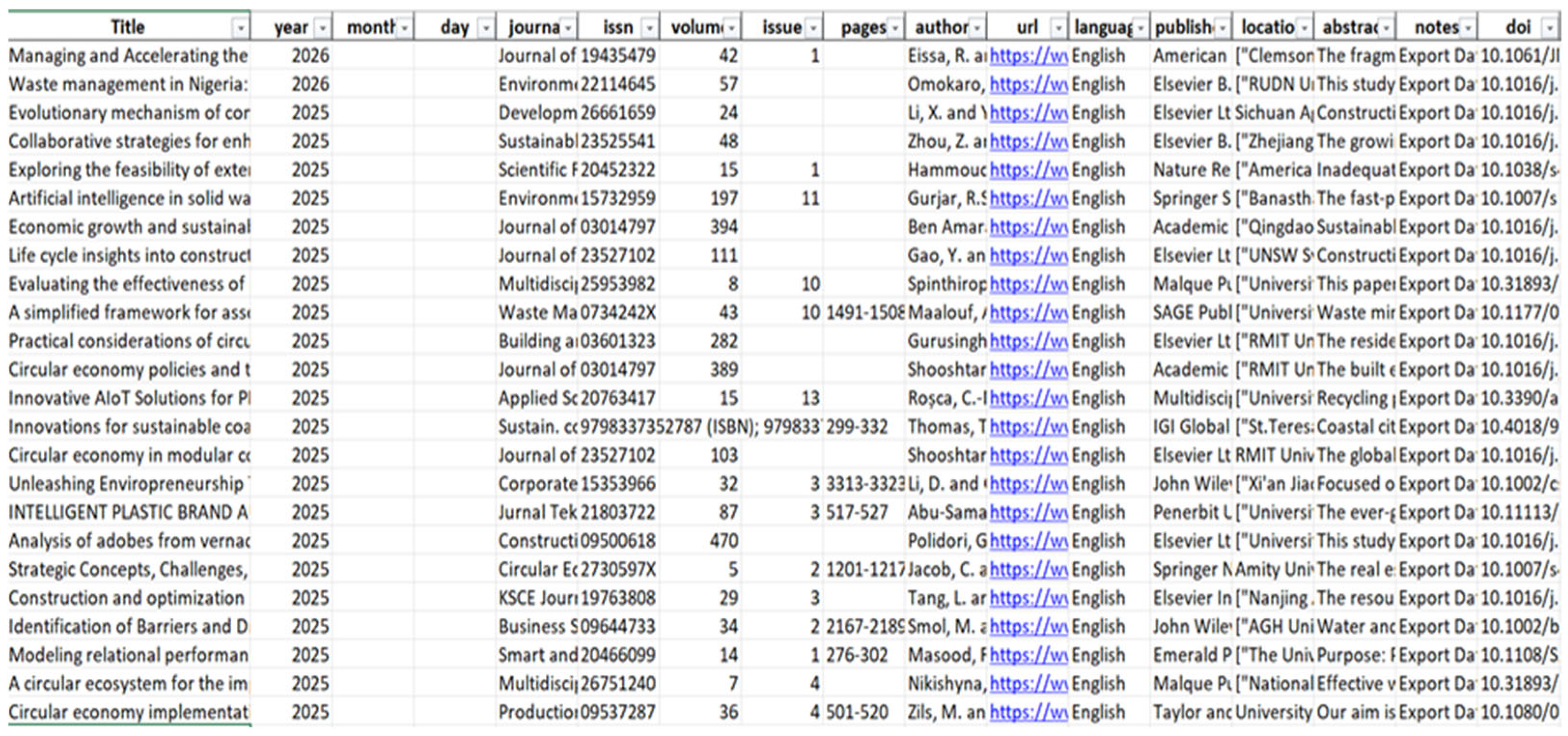
Data extraction was conducted using a structured Excel template aligned with the Extended Producer Responsibility framework and the focus of this review on operational-phase waste, including household-level discards such as furniture, metals, plastics, textiles, minor renovation debris, and small electrical or electronic items. For each of the sixty included studies, key descriptive and analytical information was systematically recorded to ensure consistency and comparability during synthesis. Extracted information included publication details such as authors, year, study location and research purpose, which allowed us to situate each study within global waste-to-resource practice. In addition, methodological characteristics, the type of waste addressed, and the sectoral setting were documented to distinguish studies focusing on construction-related operational waste from those examining domestic disposal behaviour or producer-side interventions. Coding also captured the specific waste-to-resource pathways examined in each study, including reuse, recycling, remanufacturing, upcycling, material substitution, or policy-driven recovery systems.
To ensure systematic referencing throughout the findings, each included study was assigned a unique numerical identifier during data extraction. These identifiers (e.g., Study 1, Study 2, Study 3, refer to Appendix A correspond to the order in which studies appear in the final list of included papers and are used consistently in the Results and Discussion sections to reference specific evidence. Assigning numeric IDs improves traceability, enables clearer comparisons across themes, and prevents the repetition of full citations within tables and narrative descriptions. A complete list of all included studies, including their corresponding study numbers, full bibliographic details, and coding attributes, is provided in Appendix A.
Further coding focused on enablers and barriers relevant to material recovery, producer responsibility, and the adoption of circular practices. These included regulatory mechanisms, economic drivers, technological innovations, social behaviours, institutional capacity, supply-chain coordination, and governance structures. Special attention was given to whether studies examined producer-side strategies, household behaviours, local authority interventions, or market-based incentives, as this allowed the analysis to map how responsibility shifts across the lifecycle in line with the EPR framework. Finally, each study was coded for key findings and implications, enabling deeper synthesis into thematic clusters that reflect global progress in transitioning household and operational waste streams into productive resource loops. This structured approach ensured that data across all sixty studies were consistently captured and positioned for robust thematic and conceptual analysis as shown in Figure 2.

3.4. Thematic Development

The evidence from the 60 included studies converges around five interconnected themes that explain how waste-to-resource practices can be strengthened within household and building operations. The first theme concerns policy and governance models that shift accountability for waste generation and recovery upstream through mechanisms such as extended producer responsibility, eco-modulated fees, product stewardship and zero-waste urban strategies. These approaches redefine waste as a shared responsibility among producers, suppliers, and local authorities, thereby supporting community-level recovery systems accessible to households. The second theme centres on advancements in recycling technologies and digital traceability systems, including material passports, blockchain-enabled information platforms, machine-learning estimation tools and intelligent collection or sorting devices. These tools enhance visibility of material flows, particularly household fixtures, electronics, furniture, and small demolition residues, making recovery operations more efficient and reducing landfill waste.
The third theme focuses on circular and low-impact materials and components. Studies highlight the reuse of structural elements, the conversion of discarded products into new building materials, and the development of innovative formulations that incorporate household waste streams, such as plastics, timber fractions, and e-waste. These material innovations support resource circulation in both residential settings and wider built-environment applications. The fourth theme relates to business and supply-chain models that demonstrate how organisations capture value from waste-to-resource initiatives. Examples include reverse logistics systems, manufacturer takeback schemes, reuse markets, and community-based recovery networks that connect households with recycling centres and producers. These models illustrate the economic and environmental benefits of closing material loops.
The fifth theme emphasises behavioural and community-driven interventions. Studies in this group explore household sorting behaviours, participation in reverse-exchange programmes for e-waste, door-to-door recycling schemes, awareness campaigns and incentives that shape how residents dispose of furniture, fixtures, electrical items and everyday materials arising during the building operation phase. Collectively, these themes provide the analytical structure for presenting the review findings. They also form a coherent bridge between the Extended Producer Responsibility framework guiding this study and the practical design of waste-to-resource practices at household, building and community recovery levels.

4. Integrated Results and Discussion

4.1. Introduction to the Findings

The analysis of the 60 included studies revealed a rich but uneven body of evidence on waste-to-resource innovation across the built environment. Although the studies varied in geographical scope, methodological approach, and technological maturity, clear thematic patterns emerged that offer insight into how different waste streams, actors, and systems contribute to circular practices. Presenting the results and discussion together allows the narrative to move beyond a simple description of the findings and instead position them within broader debates on sustainable resource management, community participation, and extended producer responsibility. The findings demonstrate that while substantial progress has been made in the reuse and recovery of construction-related waste, there is growing recognition of the need to integrate household-level waste systems and producer accountability to achieve circular outcomes. These insights help address the three research questions guiding this review.

4.2. Study Focus and Dominant Methodological Approaches in the Reviewed Literature

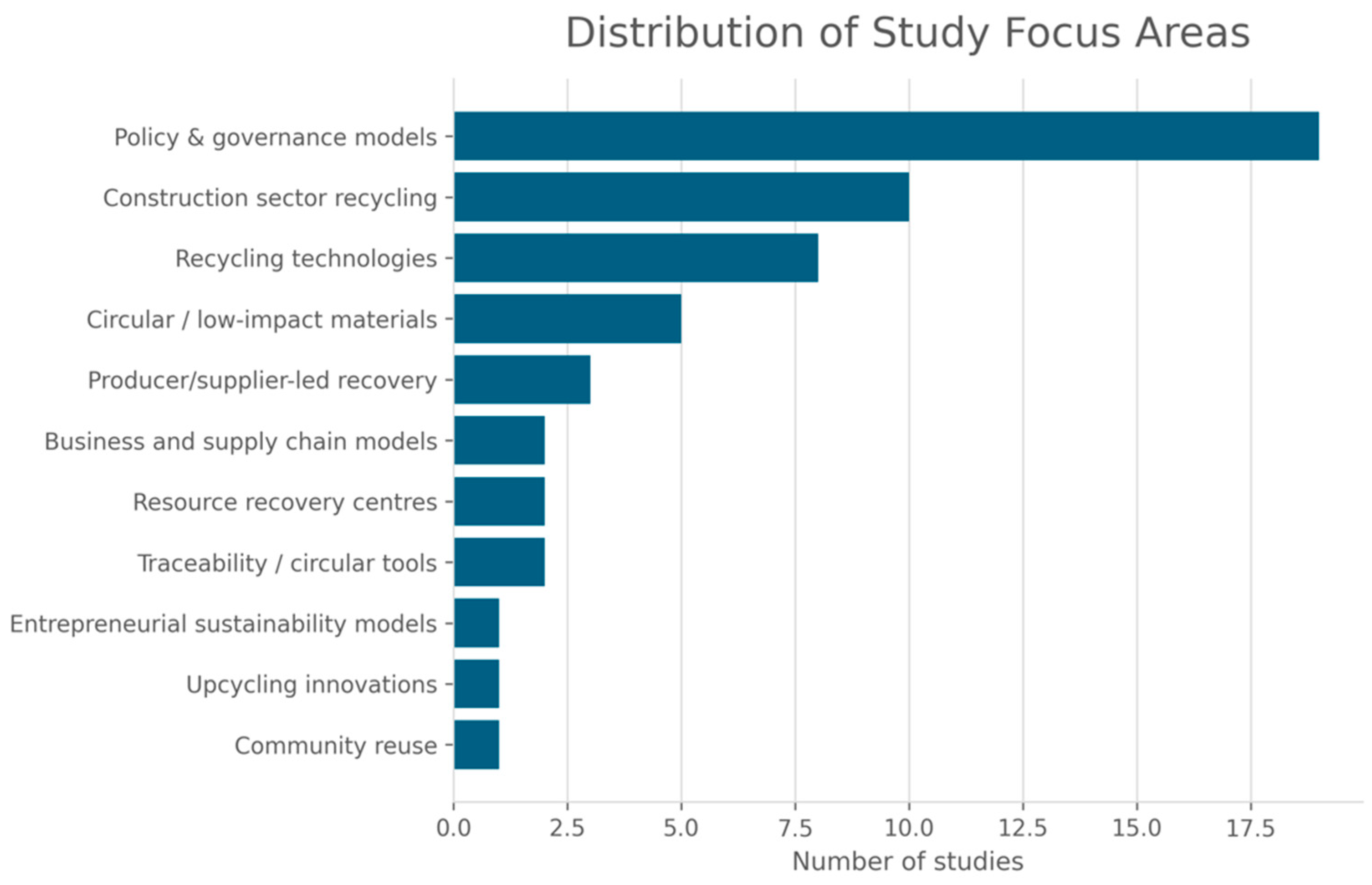
The reviewed studies exhibit a diverse but uneven distribution of thematic focus areas and methodological approaches, reflecting differing research priorities within household waste-to-resource reviewed literatures in the built environment. Across the literatures, research attention is primarily directed toward policy and governance mechanisms, construction sector recycling, and technical assessments of material recovery, while comparatively fewer studies engage with producer-led recovery systems, digital traceability tools, and community-based reuse practices. Methodologically, the evidence base is dominated by quantitative, experimental, and assessment-oriented approaches, with more limited application of system modelling, mixed-methods designs, and socially oriented qualitative inquiry. This pattern suggests that, while the technical and regulatory dimensions of waste-to-resource systems are relatively well developed, there remains a need for broader methodological integration to better capture behavioural, institutional, and system-level dynamics that shape household-scale resource recovery.
Figure 3 synthesises the dominant study focus areas and methodological approaches identified across the reviewed literature. The results indicate a strong concentration of studies on policy and governance models and construction sector recycling, reflecting the prominence of regulatory and technical perspectives within waste-to-resource research. Recycling technologies and circular material innovations are also well represented, predominantly examined through quantitative, experimental, and life cycle–based methods. In contrast, studies focusing on producer-led recovery, traceability tools, and community reuse initiatives remain comparatively limited in number, despite their relevance to household-level resource recovery. This distribution highlights an imbalance in the literature, with system modelling, digital traceability, and community-oriented approaches receiving less analytical attention relative to policy and material performance studies.

4.3. Year-Wise/Country-Wise Distribution of Included Studies

A preliminary descriptive analysis of the 60 included studies was conducted to illustrate publication trends and the geographical distribution of research on waste-to-resource practices within the built environment. These descriptive patterns strengthen the interpretation of the findings by showing how evidence has evolved and where research activity is most concentrated.
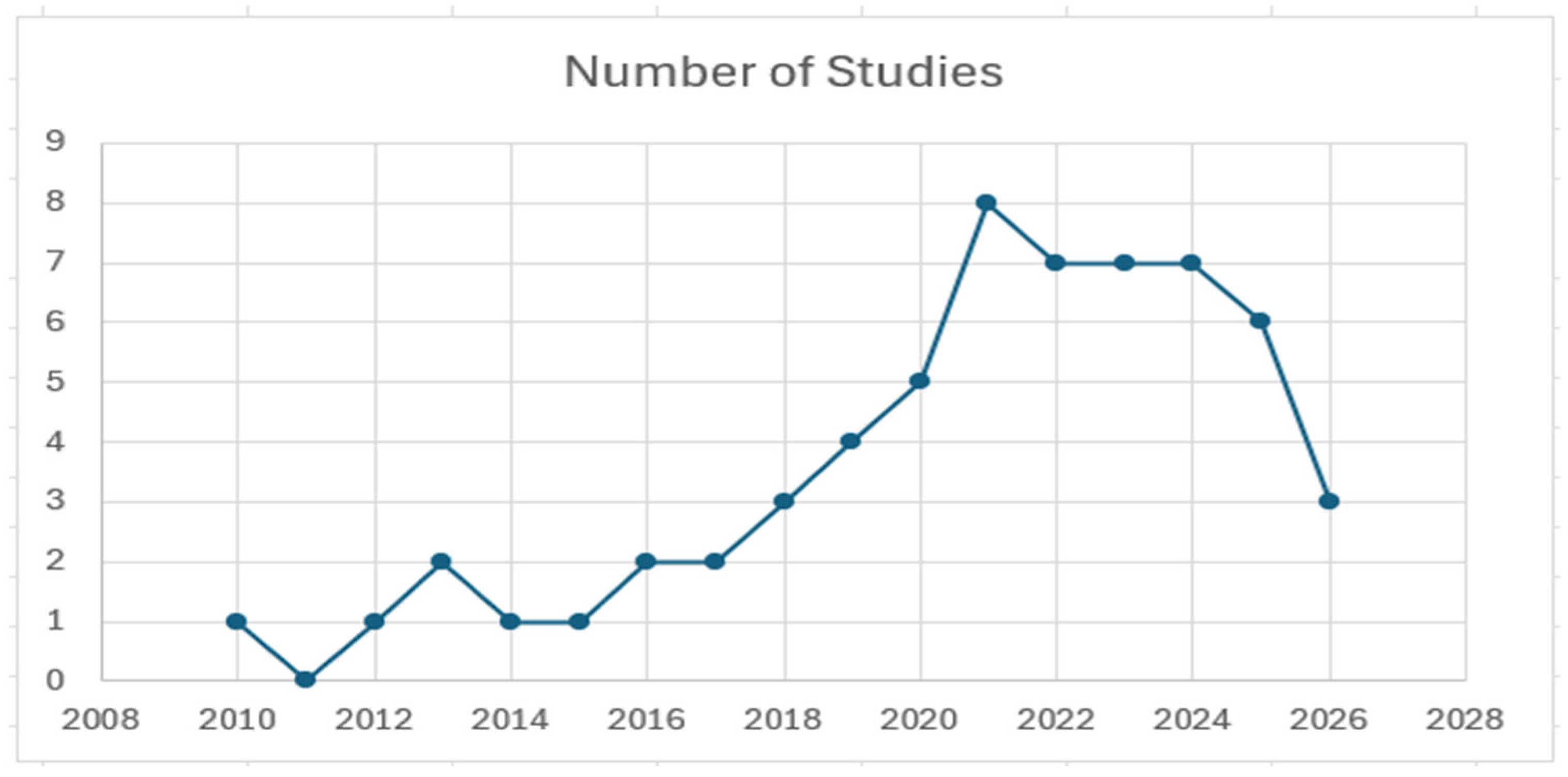
Figure 4 presents the year-wise distribution of studies, showing a steady increase in publications from 2010 to 2026. Research output remained relatively low between 2010 and 2015, with fewer than three studies published per year. A noticeable rise began after 2018, as global attention increased toward circular economy transitions and producer responsibility systems. The most substantial growth occurred between 2020 and 2024, during which annual publications consistently exceeded six studies. This increase reflects expanding interest in construction waste recovery, digital waste-tracking technologies, and household-level resource systems. A slight decline in 2025 and 2026 is visible in the chart, though this is likely due to indexing delays rather than a reduction in research activity. Overall, the trend indicates that waste-to-resource innovation has become an emerging, rapidly expanding research area.
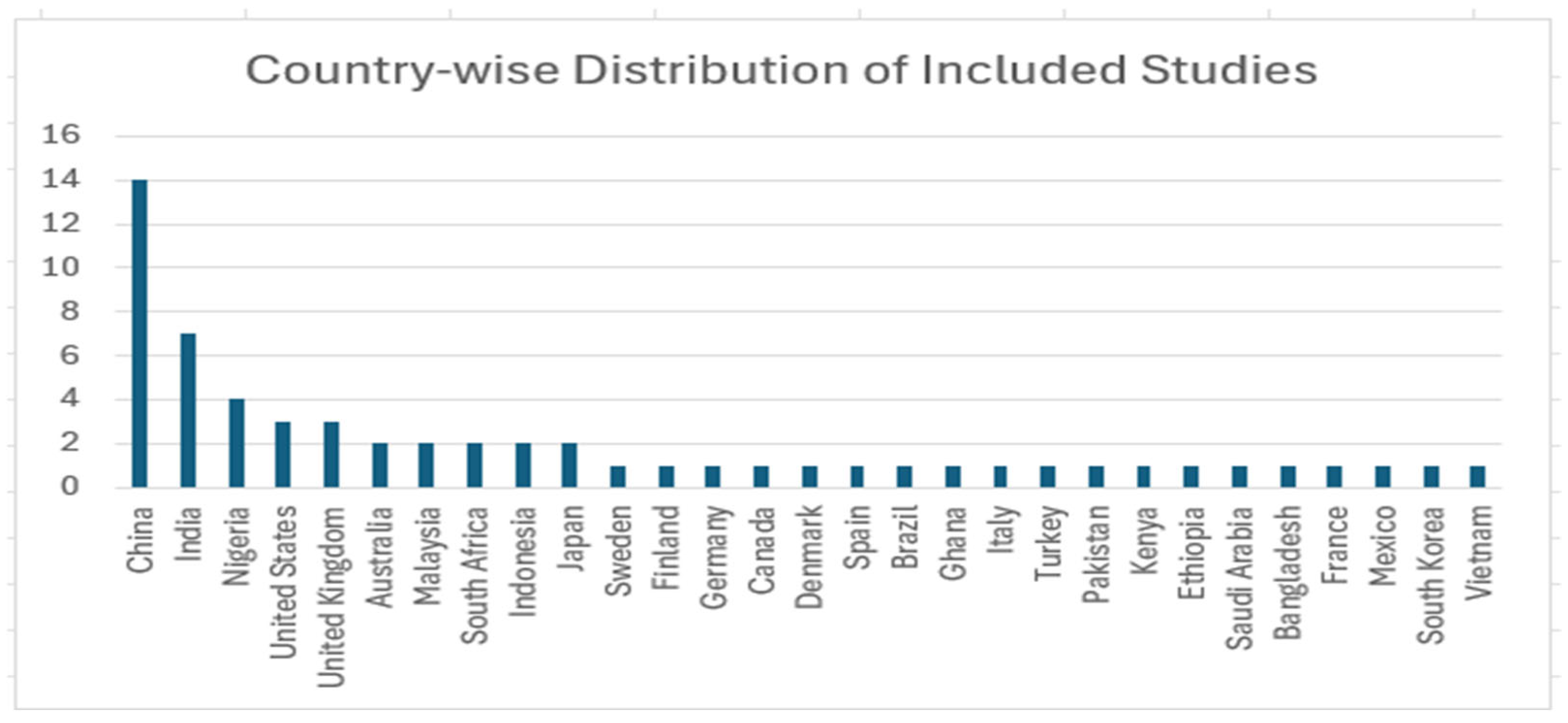
Figure 5 displays the country-wise distribution of the included studies, revealing a strong concentration of research in a small number of countries. China contributes the most studies, reflecting rapid urban growth, high construction activity, and increasing policy commitment to circular-economy practices. India follows with a significant number of publications, driven by expanding infrastructure and growing interest in resource recovery. Countries such as Nigeria, the United States, and the United Kingdom also appear prominently, each bringing different perspectives shaped by their institutional and policy environments. Several countries, including Australia, Malaysia, South Africa, Indonesia, and Japan, provide a moderate number of studies, often focused on technological development, behavioural factors, or improvements in municipal waste systems. The long list of countries that contribute one or two studies shows that the topic has global relevance, but it also highlights uneven research capacity and uneven engagement with waste-to-resource policies.
Together, these descriptive patterns provide essential context for interpreting the thematic findings presented in the later sections. The upward trend in publication years reflects a growing international interest in sustainable construction, circular resource systems, and extended producer responsibility. The strong contribution of studies from Asia and parts of Africa highlights regions experiencing rising waste volumes and increasing policy reform. These patterns demonstrate the importance of a systematic review and support the analysis developed in the results and discussion that follow.

4.4. Classification of Waste Types in Built Environment

The classification of waste types across the sixty reviewed studies provides important insight into how waste-to-resource research is distributed within the built environment literature. The analysis reveals that construction and demolition waste remains the dominant research focus, reflecting global concern about the large volumes of materials generated during building construction, renovation, and demolition activities (see Table 2). However, the review also identifies an emerging body of research addressing operational-phase waste streams generated during the everyday use of buildings [44]. These include household materials such as furniture, small appliances, plastics, textiles, and minor renovation debris. Although this category appears less frequently in the literature compared with construction and demolition waste, its presence indicates a growing recognition of the role that building occupants and community-level practices play in circular resource recovery systems. This pattern suggests a gradual shift in research attention toward integrating household material flows within broader waste-to-resource strategies in the built environment.
A significant number of studies (Studies 13, 27, 35, 37, 40, 55) examined electronic waste (e-waste), highlighting a rising global concern around recycling systems, informal collection networks, reverse logistics, and innovations in brand auditing, IoT-enabled collection, and consumer behavioural drivers. E-waste was identified as a critical waste stream due to its toxicity, complexity, and potential for high-value material recovery.
Studies that explored plastics, packaging, and polymer waste (Studies 17, 48, 51, 59) focused on improving material recovery through design thinking, blockchain tracking, recycling incentives, producer responsibility schemes, and low-carbon strategies in circular value chains. These studies emphasised the unique environmental burden of plastics and the opportunities to repurpose polymer-based materials for construction applications.
A few studies (Studies 38, 56) investigated organic and biodegradable waste in the context of urban circularity and regenerative settlement planning. Although these represent a smaller portion of the total dataset, their presence demonstrates the expanding scope of waste-to-resource approaches beyond traditional construction sectors.
Finally, some studies addressed mixed municipal waste streams (Studies 24, 31, 32, 45), where construction-related materials, household waste, food waste, plastics, and hazardous waste are co-generated within communities. These studies provide insights into policy mechanisms, behavioural influences, and supply chain governance that affect waste sorting and recovery.
Collectively, Table 2 demonstrates that although CDW dominates the circular economy literature, there is a growing shift toward understanding household-level operational waste, e-waste, and plastics within waste-to-resource transitions. This distribution aligns with the present study’s focus, which aims to understand how everyday building occupants contribute to and benefit from EPR-driven resource recovery systems.

4.5. Enablers of Waste-to-Resource Practices

The review identified several interrelated enabling conditions that support the transition from waste generation to resource recovery within the built environment as indicated in Table 3. Across the sixty analysed studies, policy and regulatory frameworks emerged as the most influential enabling factor. Mechanisms such as extended producer responsibility regulations, recycling mandates, and environmental compliance requirements consistently influenced organisational behaviour by shifting responsibility for material recovery from households and municipalities toward producers and supply chain actors. Economic incentives also play a critical role, as subsidies, tax reductions, and financial penalties create market conditions that make recycling and reuse activities more economically viable. In addition, technological innovations including artificial intelligence sorting systems, Internet of Things collection technologies, and digital material tracking tools significantly improve the efficiency and traceability of resource recovery systems.

4.6. Barriers to Waste-to-Resource Practices

Barriers to the implementation of waste-to-resource practices within the built environment were consistently reported across technical, economic, behavioural, regulatory, design-related, and supply chain dimensions as indicated in Table 4. Technical barriers were among the most frequently identified, with many studies highlighting inadequate infrastructure and limited technological capacity as constraints on the scale and efficiency of recycling systems, particularly for complex waste streams such as electronic waste and construction materials. Economic barriers further compounded these challenges, as high costs associated with collection, transportation, and processing often outweigh the market value of recovered materials, discouraging both public and private sector investment. At the household level, behavioural barriers were repeatedly emphasised, with low awareness, limited knowledge of appropriate sorting practices, and resistance to behavioural change undermining system performance. Regulatory barriers were also prominent, as several studies reported weak policy enforcement, outdated standards, and unclear institutional responsibilities despite the existence of formal regulatory frameworks. In addition, design-related barriers were widely observed, as many products and building materials are not designed for disassembly, recovery, or reuse, resulting in high levels of residual waste. These challenges are further reinforced by supply chain barriers, including poor coordination among manufacturers, contractors, recyclers, and local authorities, which limits material circulation and constrains the development of effective circular resource systems.

4.7. Technologies Used Across the Included Studies

Table 5 summarises the technological systems used across the included studies to support waste-to-resource activities. These technologies range from artificial intelligence and machine learning to building information modelling and blockchain. Technology plays different roles, including forecasting waste volumes, improving sorting accuracy, supporting traceability during material recovery, and promoting transparency in recycling markets. These systems work at both household and construction levels, which aligns with the conceptual framework by strengthening the responsibilities of producers, suppliers, and recyclers. The table allows the study to identify how digital systems enhance circular activities and where technological gaps remain in the transition toward resource recovery.

4.8. Policy and Regulatory Drivers

Table 6 identifies the policy and regulatory mechanisms that influence waste-to-resource activities. These policies include extended producer responsibility, deposit return systems, landfill bans, waste levies, and mandatory recycling targets. They exist to shift responsibility away from households and toward producers, suppliers, and recycling agents. This connects directly with your conceptual framework by demonstrating how regulatory structures reinforce accountability along the supply chain. The table also reveals significant differences between countries, showing how strong regulation accelerates resource recovery, while regions with weak regulatory enforcement struggle to implement circular practices. This table supports the interpretation of global variations and highlights policy conditions that enable successful waste-to-resource transitions.

4.9. Discussion

This discussion brings together the main insights from the 60 included studies and explains how the evidence addresses the research questions guiding this review. It interprets the results by examining the relationships among waste types, enabling conditions, barriers, technologies, and policy environments, and considers what these patterns mean for strengthening waste-to-resource practices within the built environment. The findings, drawn from studies published between 2010 and 2026, provide a comprehensive view of how material recovery systems are evolving across different contexts and scales. Overall, the results show that waste-to-resource practices are not shaped by a single factor but instead emerge from the interaction of policy frameworks, technological innovation, supply chain structures, and the behaviour of households and communities, as summarised in Table 7. This systems-based understanding is consistent with earlier circular economy research that emphasises coordinated socio-technical transitions across multiple actors and institutional levels [12,13]. More specifically, the review of the 60 included studies shows that household-level waste streams represent an underutilised but viable pathway for circular resource recovery, with the potential to support both material reuse and community-based income generation when embedded within supportive policy and institutional frameworks, which is consistent with previous studies [23,32,45]. This finding reinforces the growing recognition that household participation is central to the efficiency and sustainability of recovery systems. Studies on waste sorting behaviour demonstrate that when households actively engage in separation practices, materials are more likely to be recovered, reused, or redirected into secondary markets [14]. Behavioural and institutional research further shows that awareness, social norms, and governance structures significantly influence participation rates and recovery outcomes at the community level [18,46]. At the same time, the review confirms that construction and demolition waste continues to dominate both research attention and practical implementation due to its scale and established recovery pathways [7,9]. However, the increasing attention to operational-phase waste suggests a gradual shift toward more decentralised and community-driven recovery models. Supporting evidence also indicates that broader circular economy and waste management innovations can contribute to economic growth and improved resource efficiency when effectively integrated into local systems [31,47]. Despite these opportunities, persistent barriers such as weak regulatory enforcement, limited infrastructure, low confidence in secondary materials, and cultural resistance continue to constrain progress. Taken together, these findings highlight that strengthening waste-to-resource systems in the built environment requires integrated strategies that connect household behaviour, policy support, technological innovation, and market development to enable sustainable material recovery and value creation.
The patterns identified in this review broadly align with previous systematic analyses of circular economy transitions in the built environment [12,13]. Similar studies have reported that construction and demolition waste continues to dominate circular economy research due to its large material volumes and regulatory attention [7,9]. However, recent literature increasingly emphasises the importance of operational-phase waste streams generated during building use [14,18]. This review confirms that while research on household operational waste remains comparatively limited, emerging studies highlight its growing relevance for circular resource systems, particularly as urban consumption patterns continue to evolve [48].

4.10. Classification of Waste Types and Their Relevance to Waste to Resource Pathways

The systematic screening process identified six dominant waste categories that shape waste-to-resource activities in the built environment. These include construction and demolition waste, household operational waste, electronic waste, plastics and packaging waste, organic waste, and mixed municipal waste. Construction and demolition waste formed the largest cluster, indicating the global attention given to high-volume waste streams generated during building, renovation, and demolition activities. This pattern is consistent with recent studies that identify construction and demolition waste as the most significant contributor to urban waste streams [3,44]. These studies focused on concrete, timber, metals, aggregates, and demolition residues. They showed strong alignment with reuse and recycling strategies that enable the transformation of large quantities of materials into secondary resources. The prominence of this category suggests that construction actors remain central to circular economy transitions, which aligns with findings that extended producer responsibility can influence early-stage material decisions and design practices [45].
Household operational waste formed the second key category and contributed directly to the focus of this review. Recent research shows a similar trend, noting that household-generated materials are becoming increasingly important in circular resource systems due to shorter product life cycles and increased material turnover [4,49]. Studies addressing this waste stream explored materials generated during everyday building use, including furniture, textiles, fixtures, household chemicals, appliances, and small renovation offcuts. These studies highlighted the importance of household participation, awareness, and sorting behaviour while also demonstrating that the effective recovery of these materials depends heavily on producer responsibility schemes. This connection illustrates the relevance of extended producer responsibility as a framework that shifts accountability for post-occupancy waste from households to producers and supply chain actors, as emphasised in recent policy evaluations [50].
Electronic waste represented a growing concern, with studies demonstrating the complexity, toxicity, and high-value potential of discarded electronics. This aligns with updated global reports showing that electronic waste remains the fastest-growing solid waste stream worldwide [51]. Research in this category examined IoT-enabled collection systems, behavioural determinants of recycling, and machine learning tools for brand auditing. The evidence suggests that electronic waste provides unique opportunities for material recovery but requires coordinated policy and technological systems to manage its risks and value, a conclusion similarly noted in recent digital waste management studies [2].
Plastics and packaging waste formed another important category, with studies exploring the environmental burden of plastics and the potential to transform polymer-based materials into construction products. Current research confirms that plastics remain a priority area for circular innovation due to their persistence and volume [52]. These studies highlighted design thinking, blockchain tracking, and producer responsibility policies as essential drivers for improving collection and recycling systems.
Organic and biodegradable waste appeared in fewer studies, yet these works demonstrated increasing interest in regenerative practices that integrate community-based circular systems into urban planning. This reflects recent literature calling for nature-based circular strategies to complement technological approaches [47]. Mixed municipal waste was distributed and reflected household and community waste streams, including plastics, food waste, electronics, and hazardous household materials co-generated. These studies provided important insights into policy frameworks, behavioural patterns, and municipal systems that influence waste sorting and recovery, which corresponds with updated reviews of integrated municipal waste governance [53]. Together, the findings show a gradual shift from construction-dominant waste streams toward more inclusive models that incorporate household contributions and extended producer responsibility obligations.

4.11. Technologies Supporting Waste to Resource Transitions

The review identified a wide range of technologies used to support waste-to-resource initiatives, including artificial intelligence, machine learning, building information modelling, blockchain, digital material banks, and robotics. These technologies contributed to more efficient sorting, better prediction of waste volumes, improved traceability of materials, and stronger verification systems within recycling markets. Recent studies similarly report that digital technologies enhance material tracking and improve circular system performance [54,55]. The findings reveal that digital technologies reinforce the principles of extended producer responsibility by enabling transparent tracking of materials across their life cycles, supporting producer accountability, and improving the quality of recovered materials, in line with recent evidence on digital EPR implementation [4]. However, the evidence also shows uneven adoption across regions, indicating gaps in digital infrastructure and capacity that must be addressed for the full benefits of these technologies to be realised, a challenge also highlighted in comparative digital readiness studies [56].

4.12. Policy and Regulatory Conditions Influencing Circular Practices

Policy mechanisms across the studies varied significantly by region, but several recurring themes emerged. Extended producer responsibility was central in many contexts and strongly influenced shifting responsibility for end-of-life materials from households to producers. This is consistent with recent assessments across multiple regions, which show that extended producer responsibility remains one of the most effective policy instruments for improving material collection and redesign [57]. Additional regulatory tools such as waste levies, recycling mandates, deposit return systems, landfill restrictions, and green procurement policies also played important roles. These policies created structured pathways for material recovery, encouraged innovation, and supported both community and industry participation, similar to findings in contemporary circular policy evaluations [21,58]. However, the effectiveness of these policies depended heavily on enforcement strength, institutional coordination, and public awareness. The findings indicate that robust regulatory environments correlate strongly with higher levels of circular activity and improved waste recovery outcomes, a conclusion also noted in recent multi-region policy performance studies [53].

4.13. Enablers of Waste to Resource Practices

Across the included studies, several enablers were consistently identified as essential to advancing waste-to-resource innovations. Policy and regulatory frameworks emerged as the most dominant enablers, particularly where extended producer responsibility systems, recycling mandates, and environmental compliance mechanisms were well established. This aligns with recent evidence showing that strong governance structures significantly enhance circular economy performance and producer accountability [58,59]. The evidence indicates that strong regulation reshapes organisational behaviour by assigning responsibility to producers, suppliers, and market intermediaries, rather than relying solely on households or local authorities to manage waste. This finding supports the conceptual framework and aligns with recent studies that highlight extended producer responsibility as both a regulatory and a behavioural driver within circular resource systems [57].
Economic incentives also played a prominent role, with studies showing that subsidies, tax relief, and penalty-based mechanisms significantly increase participation in recycling and reuse initiatives. These observations corroborate recent research has demonstrated that financial incentives remain effective tools for increasing material recovery and promoting business engagement in circular practices [60]. Technological innovation represented another major enabler, with artificial intelligence, IoT-based collection systems, digital material banks, and life-cycle assessment tools improving the efficiency and transparency of material flows. This pattern aligns with studies that show digital systems enhance traceability, accuracy, and data-driven decision-making across waste management networks [4].
Community participation played a central role, particularly in studies focusing on household operational waste. Recent behavioural studies confirm that awareness, sorting behaviour, and willingness to engage in recycling programs are essential determinants of waste recovery outcomes [61]. Producer responsibility systems also enabled circular activity by encouraging manufacturers to incorporate design for disassembly, product takeback, and traceable supply chain systems, which align with emerging evaluations of producer responsibility performance across Asia and Europe [50].

4.14. Barriers to Waste-to-Resource Practices

The analysis revealed six main categories of barriers to the successful adoption of waste-to-resource practices. Technical barriers were among the most prominent, with many studies noting insufficient recycling infrastructure, outdated sorting technologies, and limited digital systems for tracking materials. These challenges are similar to recent findings that infrastructure limitations remain among the most common constraints in circular waste systems globally [20]. These barriers were especially pronounced in regions with rapidly growing construction sectors but inadequate environmental capacity.
Economic barriers also played a strong role, as the high costs of waste collection, processing, and transportation often outweigh the financial benefits of recovered materials. This is consistent with new analyses demonstrating that unstable secondary material markets frequently undermine investment in recycling initiatives [48]. Low market demand for recycled goods further discourages investment in waste-to-resource activities.
Behavioural and social barriers emerged as critical challenges, particularly in studies related to household and community waste streams. Recent behavioural research confirms that low awareness, resistance to change, and insufficient sorting knowledge significantly reduce the effectiveness of recycling systems [46]. Regulatory barriers posed another major challenge, as weak enforcement, outdated policies, or conflicting institutional mandates hinder the adoption of circular strategies. These patterns align with the current literature, which shows that circular economy reforms often fail due to implementation gaps rather than policy design [62].
Design-related barriers were common across construction-focused studies, with many materials not designed for disassembly or reuse, resulting in high levels of residual waste. This observation is consistent with recent work calling for stronger design for circularity guidelines across material-intensive sectors [58]. Supply chain barriers such as fragmented recovery pathways, weak coordination between producers and recyclers, and limited information sharing also restricted material circulation and reduced the efficiency of recovery systems. These issues align with recent studies highlighting the importance of integrated, transparent supply networks for circular resource flows [17].

4.15. Theoretical and Practical Implication

From a theoretical perspective, this review advances waste to resource and circular economy literature within the built environment by repositioning household operational waste as a central rather than peripheral component of resource recovery systems. While existing theoretical frameworks in construction and circular economic research have predominantly focused on construction and demolition waste, material efficiency at the production stage, or end of life recycling performance, household generated waste has often been treated as a downstream or purely behavioural issue. Building on the findings presented in the preceding sections, this review demonstrates that waste to resource transitions is shaped by interconnected socio technical systems operating across multiple scales. By synthesising evidence across material recovery practices, governance mechanisms, technological systems, and community behaviour, the study extends current theory by showing how these elements interact to influence recovery outcomes. In particular, the findings highlight the role of extended producer responsibility, behavioural drivers, and design for disassembly principles as critical mediating mechanisms linking household practices with broader circular material flows. This integrative perspective contributes to theory by bridging technical material recovery models with governance and behavioural frameworks, offering a more holistic conceptualisation of circularity within the built environment. As such, the review supports a shift from linear, material centric interpretations of waste management towards systems based theoretical models that recognise the interdependence of policy, technology, social behaviour, and market structures in enabling sustainable resource recovery.
From a practical perspective, the findings of this review provide actionable insights for policy makers, industry actors, and community stakeholders seeking to operationalise waste to resource strategies within household and neighbourhood contexts. Drawing directly from the patterns identified in the results and discussion, the synthesis underscores the importance of coherent regulatory frameworks, particularly extended producer responsibility schemes, in reallocating responsibility for waste management and incentivising upstream design changes that facilitate reuse and recovery. For local authorities and planners, the results highlight the need to integrate technological tools such as digital tracking systems, smart collection infrastructure, and data driven planning approaches to improve recovery efficiency and system transparency. At the community level, the evidence demonstrates that awareness, knowledge, and behavioural engagement are decisive factors influencing recovery outcomes, reinforcing the value of targeted education programmes and participatory initiatives. For producers and supply chain actors, the review emphasises the practical benefits of designing products and building components for durability, disassembly, and take back, thereby reducing recovery costs and material losses. Collectively, these insights provide a coherent pathway for aligning policy design, technological investment, and community engagement to support scalable and resilient waste to resource systems within the built environment, particularly in contexts seeking to balance environmental performance with social and economic outcomes.

5. Conclusions

This systematic review synthesised evidence from sixty peer-reviewed studies examining waste generation and resource recovery within the built environment. Three major insights emerge from the analysis. First, construction and demolition waste continues to dominate the circular economy literature; however, operational-phase household waste is increasingly recognised as an important but under-examined resource stream. Second, successful waste-to-resource systems depend on the interaction of multiple enabling conditions, including supportive regulatory frameworks, economic incentives, technological innovation, and community participation. Third, the effectiveness of these systems is constrained by persistent technical, economic, behavioural, and institutional barriers that limit the scalability of circular resource recovery practices.
Building on these observations, three key insights emerge from the reviewed literature. First, technological innovation is increasingly shaping waste-to-resource transitions within the built environment. Tools such as artificial intelligence-based sorting systems, digital material tracking platforms, and automated recovery technologies are improving the efficiency and traceability of material flows, thereby supporting higher recovery rates and expanding opportunities for reuse and remanufacturing. Second, despite these advances, multiple barriers continue to constrain circular practices. Weak regulatory enforcement, limited producer engagement, inadequate recycling infrastructure, and persistent social perceptions regarding the quality of secondary materials all restrict the broader adoption of recovery systems. Third, the evidence indicates that waste-to-resource initiatives are most effective where enabling conditions operate in combination. In particular, coordinated policy frameworks, active community participation, and producer involvement create mutually reinforcing conditions that strengthen circular material flows, whereas isolated technological or regulatory interventions tend to produce more limited outcomes.
The overall evidence suggests that successful waste-to-resource transitions depend on a coordinated system in which producers design materials for long life and easy recovery, suppliers maintain traceable distribution pathways, builders adopt circular construction practices, and households participate in well-supported collection and recovery schemes. When these conditions are present, discarded materials can be transformed into productive resources that support environmental goals, reduce landfill pressures, and strengthen local economies.

5.1. Research Gaps and Future Directions

Despite the increasing scholarly attention given to circular economic transitions and waste-to-resource innovations in the built environment, several research gaps remain evident. Most existing studies continue to concentrate on construction and demolition waste due to its high material volume and regulatory significance, while operational-phase waste generated during everyday building use remains comparatively underexplored. Household materials such as furniture, small appliances, plastics, textiles, and minor renovation debris represent a significant yet insufficiently analysed component of urban material flows. Furthermore, there is limited empirical research examining how Extended Producer Responsibility frameworks influence the recovery of these materials at the household and community level. Future studies should therefore prioritise the investigation of operational-phase waste streams, evaluate the effectiveness of producer-led recovery systems, and assess the practical performance of emerging digital technologies such as material passports, blockchain tracking, and intelligent waste sorting systems. Such research would provide a stronger empirical foundation for developing integrated waste-to-resource strategies that connect household behaviour, producer accountability, and municipal recovery infrastructure.
Moreso, future research should give greater attention to operational phase waste and the everyday materials that circulate through residential and community spaces. Studies could examine how households interpret and respond to recovery initiatives and how local authorities and private operators design systems that are accessible and easy to use [25]. There is also a clear need for empirical research evaluating the practical impacts of EPR on producers, recyclers, and building practitioners, especially in regions where regulatory frameworks are still emerging [3]. Digital technologies such as material passports, blockchain tracking, and automated sorting systems present promising opportunities, but their real-world performance and scalability require more rigorous assessment [24,27]. Future research should also explore multi-stakeholder collaboration models that bring producers, councils, recyclers, and communities into shared decision-making processes. This could help identify the institutional arrangements that best support circular resource use across the building life cycle. By addressing these gaps, scholars can contribute to more consistent, evidence-based strategies for reducing waste and strengthening circularity in the built environment.

5.2. Research Limitations

This review has several limitations that should be acknowledged. The search strategy, although structured and comprehensive, was limited to studies published in English and indexed in selected academic databases. This introduces the possibility of publication and language bias, as noted in methodological guidance that warns that database-restricted searches may exclude relevant studies produced in local or regional contexts. Important insights from industry reports, local authority documents, and community-level recycling initiatives may therefore not have been captured, thereby narrowing the range of practices represented in the evidence base.
Another limitation relates to the uneven distribution of research across the waste streams examined. The included studies show a strong concentration of evidence on construction and demolition waste, while operational phase waste from households appears far less frequently. Several authors note that research on household-level recovery systems remains limited and fragmented compared with work on construction materials and demolition waste. This imbalance means that the conclusions drawn about household waste should be interpreted with caution, as the available studies do not allow for wide generalisation across different regions or socio-economic settings.
In addition to the limitations identified, this study is subject to methodological constraints inherent in the adopted review design. The reliance on peer reviewed academic databases, while ensuring the quality and reliability of included studies, may have resulted in the exclusion of relevant grey literature such as industry reports, government publications, and community-based project documentation, which often provide context specific and practice-oriented insights into household level waste to resource systems. Furthermore, the quality and methodological depth of the included studies vary widely, with some offering detailed empirical analyses and others presenting conceptual discussions with limited data or unclear analytical procedures. Such variation in study design, geographical focus, and reporting standards introduces challenges in comparability and generalisability. Methodological assessments suggest that these differences can influence the strength and consistency of review findings, particularly when synthesising diverse forms of evidence. This variation also makes cross study comparisons more complex and may affect the stability of the patterns identified in the synthesis. Despite these limitations, the systematic approach adopted provides a transparent and robust synthesis of existing knowledge while highlighting areas requiring further empirical and practice based research.
Finally, the literature indicates that circular economy practices and waste-to-resource innovations are evolving rapidly. New technologies, producer responsibility schemes, and community-based recovery approaches continue to emerge, often faster than academic publishing can document. As a result, this review represents a snapshot of what is currently available in peer-reviewed sources rather than a complete account of all ongoing developments in material recovery and circular practice. Future updates will be necessary as more empirical studies are published and as operational-phase waste receives greater research attention.

Author Contributions

Conceptualization, F.E.R.; methodology, F.E.R. and Y.G.W.; software, Y.G.W.; validation, F.E.R. and M.B.P.; formal analysis, F.E.R., M.B.P. and Y.G.W.; investigation, F.E.R., M.B.P. and Y.G.W.; resources, F.E.R.; data curation, Y.G.W.; writing—original draft preparation, F.E.R., M.B.P. and Y.G.W.; writing—review and editing, F.E.R., M.B.P. and Y.G.W.; visualization, F.E.R. and M.B.P.; supervision, F.E.R. and M.B.P.; project administration, F.E.R. and M.B.P.; funding acquisition, F.E.R. All authors have read and agreed to the published version of the manuscript.

Funding

Funding for this project was provided by the Auckland University of Technology, Faculty of Design and Creative Technology Summer scholarship.

Data Availability Statement

Data sharing does not apply to this article as no datasets were generated or analysed during the current study.

Conflicts of Interest

The authors declare no conflicts of interest relating to the material presented in this Article. Its contents, including any opinions and/or conclusions expressed, are solely those of the authors.

Appendix A

Table A1. Comprehensive Overview of Included Studies.
Study IDAuthor/YearCountryWaste TypeEnablers of Waste-to-Resource PracticesBarriers to Waste-to-Resource Practices
CDW
Household operational waste
E-waste
Plastic and packaging waste
Organic & Biodegradable Waste
Mixed Municipal Solid Waste
Policy & regulation
Economic Incentives
Technology and innovation
Community Participation
EPR
Material Innovations
Poor recycling infrastructure, lack of sorting tech
High cost of recycling, low market value for recycled goods
Low awareness, resistance to change, poor sorting habits
Weak enforcement, outdated laws, unclear mandates
Materials not designed for disassembly or reuse
Fragmented recovery pathways, poor coordination
1Eissa et al. [15]US
2Omokaro et al. [63]Nigeria
3Li X. et al. [64]China
4Zhou Z. [43]China
5Hammoud et al. [23]Lebanon
6Gurjar et al. [65]India
7Ben Amara et al. [31]Nigeria
8Gao Y. et al. [66]China
9Konstantinos et al. [67]Greece
10Maalouf et al. [68]Pakistan
11Gurusinghe et al. [1]India
12Shooshtarian et al. [69]India
13Rosca et al. [70]United States
14Thomas, et al. [71]United Knigdom
15Shoostarian et al. [72]India
16Li D. et al. [73]China
17Abu-Samah et al. [74]Indonesia
18Polidori et al. [75]France
19Jacob C. et al. [76]United Kingdom
20Tang L. et al. [77]China
21Smol M. et al. [78]Indonesia
22Masood R. et al. [79]New Zealand
23Nikishyna et al. [80]Ukraine
24Zils M. et al. [81]Malaysia
25Guo F. et al. [20]China
26Bello et al. [32]Nigeria
27Mishra S. et al. [82]Saudi Arabia
28Sinha S. et al. [83]Spain
29Singh V. et al. [84]India
30Zhu s. et al. [85]China
31Mallick P. et al. [86]Mexico
32Dagadu P. et al. [87]Kenya
33Ning X. et al. [88]China
34Buchard M. et al. [11]Ethiopia
35Ahmed S. et al. [27]Nigeria
36Osei-Tutu et al. [89]Ghana
37Sabbir M. et al. [90]Sweden
38Tantiyaswasdiku et al. [91]Denmark
39Liu Z. et al. [92]China
40Cheng B. et al. [93]China
41Oluleye B. et al. [94]United Kingdom
42Shoostarian [95]India
43Soharu et al. [96]Australia
44Lu W. et al. [97]China
45Wang Y. et al. [98]China
46Micheaux et al. [99]France
47Shooshtarian et al. [100]Australia
48Dey S. et al. [101]India
49Joensuu et al. [102]Brazil
50Huang B, et al. [103]South Korea
51Su P. et al. [104]South Korea
52Alev I. et al. [17]Europe
53Rose C. et al. [105]Canada
54Zheng P. et al. [106]Japan
55Bob U. et al. [29]South Africa
56Lehmann et al. [107]Germany
57Tosa C. et al. [108]Europe
58Kupfer C. et al. [109]Global
59Wiedenhofer D. et al. [110]Global
60Sobotka A. et al. [111]Europe

References

  1. Gurusinghe, D.I.; Iyer-Raniga, U.; Moore, T. A whole life cycle approach to circular economy interventions in the residential sector: Systematic literature review. CIB Conf. 2025, 1, 303. [Google Scholar] [CrossRef] [Scilit]
  2. Zhang, N.; Konyalioglu, A.K.; Duan, H.; Feng, H.; Li, H. The impact of innovative technologies in construction activities on concrete debris recycling in China: A system dynamics-based analysis. Environ. Dev. Sustain. 2024, 26, 14039–14064. [Google Scholar] [CrossRef] [Scilit]
  3. Rahman, M.; Mahmud, M. Sustainability of low-income housing and the success of slum improvement programs in Bangladesh. J. Soc. Econ. Dev. 2012, 1, 1–19. [Google Scholar]
  4. González, E.; Kandpal, V.; Machado, M.; Martens, M.; Majumdar, S. A Bibliometric Analysis of Circular Economies through Sustainable Smart Cities. Sustainability 2023, 15, 15892. [Google Scholar] [CrossRef] [Scilit]
  5. D’Amico, B.; Pomponi, F. Embodied carbon and construction. In The Routledge Handbook of Embodied Carbon in the Built Environment; Routledge: Oxford, UK, 2023. [Google Scholar]
  6. Ajayi, S.O.; Oyedele, L.O.; Bilal, M.; Akinade, O.O.; Alaka, H.A.; Owolabi, H.A.; Kadiri, K.O. Waste effectiveness of the construction industry: Understanding impediments and requisites for improvement. Resour. Conserv. Recycl. 2017, 102, 101–112. [Google Scholar] [CrossRef] [Scilit]
  7. Akanbi, L.A.; Oyedele, L.O.; Akinade, O.O.; Ajayi, S.O.; Delgado, J.M.D.; Bilal, M.; Bello, S.A. Salvaging building materials for reuse: A systematic review. Resour. Conserv. Recycl. 2023, 181, 106260. [Google Scholar] [CrossRef] [Scilit]
  8. Song, W.; Hou, G.; Yang, L.; Wang, P.; Guo, Y. Evolutionary game analysis for promoting construction waste recycling and resource utilization based on a multi-agent collaboration perspective. Buildings 2024, 14, 2368. [Google Scholar] [CrossRef] [Scilit]
  9. She, Y.; Udawatta, N.; Liu, C.; Tokede, O. Circular economy strategies to minimise construction and demolition waste generation in Australian construction projects. Buildings 2024, 14, 2487. [Google Scholar] [CrossRef] [Scilit]
  10. Ofori, J.N.; Agyekum, A.K.; Khalfan, M.M.; Botchway, B.; Antwi-Afari, P. Enabling circular construction: Barriers to zero waste in the Ghanaian construction industry. Int. J. Build. Pathol. Adapt. 2025, 2, 1–23. [Google Scholar] [CrossRef] [Scilit]
  11. Buchard, M.V.; Christensen, T.B. Business models for the reuse of construction and demolition waste. Waste Manag. Res. 2024, 42, 359–371. [Google Scholar] [CrossRef] [Scilit]
  12. Kirchherr, J.; Reike, D.; Hekkert, M. Conceptualizing the circular economy: An analysis of 114 definitions. Resour. Conserv. Recycl. 2017, 127, 221–232. [Google Scholar] [CrossRef] [Scilit]
  13. Geissdoerfer, M.; Savaget, P.; Bocken, N.M.P.; Hultink, E.J. The circular economy: A new sustainability paradigm. J. Clean. Prod. 2017, 143, 757–768. [Google Scholar] [CrossRef] [Scilit]
  14. Rousta, K.; Zisen, L.; Hellwig, C. Household waste sorting participation in developing countries: A meta-analysis. Recycling 2020, 5, 6. [Google Scholar] [CrossRef] [Scilit]
  15. Eissa, R.; El-Adaway, I.H. Managing and accelerating the circular economy transitions within the construction value chain using network governance and game theory systems perspectives. J. Manag. Eng. 2026, 42, 04025051. [Google Scholar] [CrossRef] [Scilit]
  16. Xu, S. AI-assisted sustainability assessment of building materials and its application in green architectural design. J. Ind. Eng. Appl. Sci. 2025, 3, 1–3. [Google Scholar] [CrossRef] [Scilit]
  17. Alev, I.; Agrawal, V.V.; Atasu, A. Extended producer responsibility: Implications for supply chain management. Manuf. Serv. Oper. Manag. 2020, 22, 364–382. [Google Scholar] [CrossRef] [Scilit]
  18. Meng, X.; Zhang, H.; Liu, Z. A systematic investigation of waste sorting behaviour. Waste Manag. 2024, 180, 745–759. [Google Scholar] [CrossRef] [Scilit]
  19. United Nations. Transforming Our World: The 2030 Agenda for Sustainable Development; United Nations: New York, NY, USA, 2015.
  20. Guo, X.; Yuan, Y.; Wang, Y.; Yang, T.; Chen, T. Prediction of construction waste generation in China based on grey model and management recommendations. Sustainability 2025, 17, 1711. [Google Scholar] [CrossRef] [Scilit]
  21. Mehmood, S.A.; Khan, M.I.; Ahmed, S.; Al-Nawasir, R.; Choudhry, R.M. From waste to roads: Improving pavement performance and sustainability with recycled steel slag and polyethylene. Buildings 2025, 15, 476. [Google Scholar] [CrossRef] [Scilit]
  22. Dushmantha, H.G.; Kulatunga, U.; Nanayakkara, N.B.; Perera, W.S. Green adaptive reuse of buildings in Sri Lanka. In Proceedings of the 13th World Construction Symposium, Colombo, Sri Lanka, 15–16 August 2025. [Google Scholar]
  23. Hammoud, R.; Massoud, M.A.; Chalak, A.; Abiad, M.G. Exploring the feasibility of extended producer responsibility for efficient waste management in Lebanon. Sci. Rep. 2025, 15, 15444. [Google Scholar] [CrossRef] [Scilit]
  24. Jiang, J.; Li, X.; Yu, L.; Jin, J.; Liang, X. A quantified methodology for evaluating engineering sustainability: Ecological footprint measurement modeling. Buildings 2024, 14, 3552. [Google Scholar] [CrossRef] [Scilit]
  25. Ahmad, R.; Haq, M.A.; Mehmood, I. Assessing infrastructure-led recovery of resilient housing development in Chak Patiyat, Rajanpur. J. Curr. Sign 2025, 3, 577–597. [Google Scholar]
  26. Luo, H.; Wu, H.; Bao, D.; Wu, Y.F. Building information modeling applications in off-site construction: A comprehensive analysis. Archit. Sci. Rev. 2025, 1–16. [Google Scholar] [CrossRef] [Scilit]
  27. Ahmed, S.; Sanam, T.F. An end-to-end e-waste collection and sorting system for optimized flow regulation. In Proceedings of the 27th IEEE International Conference on Computer and Information Technology, Cox’s Bazar, Bangladesh, 20–22 December 2024; pp. 2369–2374. [Google Scholar] [CrossRef] [Scilit]
  28. Guggemos, A.A.; Horvath, A. Strategies of extended producer responsibility for buildings. J. Infrastruct. Syst. 2003, 9, 65–74. [Google Scholar] [CrossRef] [Scilit]
  29. Bob, U.; Padayachee, A.; Gordon, M.; Moutlana, I. Enhancing innovation and technological capabilities in the management of e-waste: Case study of South African government sector. Sci. Tech Soc. 2017, 22, 332–349. [Google Scholar] [CrossRef] [Scilit]
  30. Yaro, N.S.; Jele, L.N.; Adedeji, J.A.; Ngubane, Z.; Ikotun, J.O. From waste to sustainable pavements: A systematic and scientometric assessment of e-waste materials in asphalt. Sustainability 2025, 18, 12. [Google Scholar] [CrossRef] [Scilit]
  31. Ben-Amara, D.; Ben-Arfi, R.; Rafique, M.; Ghorbal, A.; Yong, J. Economic growth and sustainable material management through recycling innovation. J. Environ. Manag. 2025, 394, 127410. [Google Scholar] [CrossRef] [Scilit]
  32. Bello, A.O. Towards achieving circular economy in the Nigerian construction industry: Policymakers’ perspectives and framework development. Smart Sustain. Built Environ. 2025. ahead of print. [Google Scholar] [CrossRef] [Scilit]
  33. Auckland Council. Waste Management and Minimisation Plan 2023; Auckland Council: Auckland, New Zealand, 2023.
  34. Lunny, C.; Jain, N.; Nazari, T.; Kosaner-Kliess, M.; Santos, L.; Goodman, I.; Osman, A.A.M.; Berrone, S.; Dada, M.N.; Brenna, C.; et al. Exploring methodological quality and risk of bias in 200 systematic reviews: A comparative study of ROBIS and AMSTAR-2 tools. Res. Synth. Methods 2025, 17, 63–92. [Google Scholar] [CrossRef] [Scilit]
  35. Page, M.J.; McKenzie, J.E.; Bossuyt, P.M.; Boutron, I.; Hoffmann, T.C.; Mulrow, C.D.; Shamseer, L.; Tetzlaff, J.M.; Akl, E.A.; Brennan, S.E.; et al. The PRISMA 2020 statement. BMJ 2021, 372, n71. [Google Scholar] [CrossRef] [Scilit]
  36. Ferreira, D.B.B.; Santos, R.M.S.; Machado, M.C.L.; Rezende, V.H.M.; de Marco, P.G.; Romano-Silva, M.A.; de Miranda, D.M. Suicidality and self-harm in adolescents before and after the COVID-19 pandemic: A systematic review. Front. Psychiatry 2025, 16, 1643145. [Google Scholar] [CrossRef] [Scilit] [PubMed]
  37. Moher, D.; Liberati, A.; Tetzlaff, J.; Altman, D.G. Preferred reporting items for systematic reviews and meta-analyses: The PRISMA statement. BMJ 2009, 339, b2535. [Google Scholar] [CrossRef] [PubMed]
  38. Liberati, A.; Altman, D.G.; Tetzlaff, J.; Mulrow, C.; Gotzsche, P.C.; Ioannidis, J.P.A.; Clarke, M.; Devereaux, P.J.; Kleijnen, J.; Moher, D. The PRISMA statement: Explanation and elaboration. BMJ 2009, 339, b2700. [Google Scholar] [CrossRef] [Scilit] [PubMed]
  39. Xiao, Y.; Watson, M. Guidance on conducting a systematic literature review. J. Plan. Educ. Res. 2019, 39, 93–112. [Google Scholar] [CrossRef] [Scilit]
  40. Booth, A.; Sutton, A.; Papaioannou, D. Systematic Approaches to a Successful Literature Review, 3rd ed.; SAGE Publications: London, UK, 2021. [Google Scholar]
  41. Martin-Martin, A.; Thelwall, M.; Orduna-Malea, E.; Delgado-Lopez-Cozar, E. Google Scholar, Scopus, Web of Science and other databases: A multidisciplinary comparison. Scientometrics 2021, 126, 871–906. [Google Scholar] [CrossRef] [Scilit]
  42. Jackson, L.; Greenfield, M.; Payne, E.; Burgess, K.; Oza, M.; Storey, C.; Davies, S.M.; De Backer, K.; Kent-Nye, F.E.; Pilav, S.; et al. A consensus statement on perinatal mental health during COVID-19. Front. Glob. Women’s Health 2024, 5, 1347388. [Google Scholar] [CrossRef] [Scilit]
  43. Zhou, S.; Cai, L.; Xie, D.; Xia, Y.; Chang, M. Evaluating critical barriers to utilization of solid waste as building material in China. Buildings 2025, 15, 3679. [Google Scholar] [CrossRef] [Scilit]
  44. Arpitha, L.M.; Fathima, Z.; Dhanyashree, G.; Yeshaswini, R. Construction and demolition waste: Overview, management insights and future prospects. In Smart Cities and Sustainable Manufacturing; Elsevier: Amsterdam, The Netherlands, 2025. [Google Scholar]
  45. Sharma, A.; Bhardwaj, S.K.; Aggarwal, R.K.; Sharma, R.; Agrawal, G. Navigating the heights of environmentalimpacts of the Himalayan waste management system through life cycle assessment. Environ. Monit. Assess. 2025, 197, 662. [Google Scholar] [CrossRef] [Scilit]
  46. Tan, S.; Li, W.; Liu, X.; Wang, Y. Influence of institutional perception factors on household waste separation behaviour: Evidence from Ganzhou, China. J. Environ. Plan. Manag. 2025, 68, 1761–1787. [Google Scholar] [CrossRef] [Scilit]
  47. Wilson, D.C.; Paul, J.; Ramola, A.; Filho, C.S. Unlocking the worldwide potential of better waste and resource management for climate mitigation: With particular focus on the Global South. Waste Manag. Res. 2024, 42, 860–872. [Google Scholar] [CrossRef] [Scilit]
  48. Adepoju, A.O.; Oloye, A.R.; Lawal, F.A. Investigating innovative construction waste management practices on project performance in Lagos State. Afr. J. Sci. Policy Innov. Manag. 2024, 4, 42–59. [Google Scholar]
  49. Cha, G.W.; Park, C.W.; Kim, Y.C. Optimal machine learning model to predict demolition waste generation for a circular economy. Sustainability 2024, 16, 7064. [Google Scholar] [CrossRef] [Scilit]
  50. Lobelle, D.; Shen, L.; van Huet, B.; van Emmerik, T.; Kaandorp, M.; Iattoni, G.; Blade, C.P.; Law, K.L.; Sebille, E.V. Knowns and unknowns of plastic waste flows in the Netherlands. Waste Manag. Res. 2024, 42, 27–40. [Google Scholar] [CrossRef] [Scilit] [PubMed]
  51. Geyer, H.S.; Van Lille, G. The medicalisation of solid waste: Coordination challenges of domestic biomedical risk waste in informal settlements. Habitat Int. 2024, 146, 103042. [Google Scholar] [CrossRef] [Scilit]
  52. Fernando, C. Adaptation of Sustainable Waste Management Practices from Finland to Enhance Household Waste Management in Sri Lanka. Bachelor’s Thesis, Satakunta University of Applied Sciences, Pori, Finland, 2024. [Google Scholar]
  53. Costa, L.S.; Pelegrino, M.H.; Villela, B.S.; Monteiro, M.E.; Vilela, R.B.; Pedroso, D.D.; Naime, I.H.A.; Leite, I.M.P.; Silva, B.M.; Curi, N.; et al. Disposal of solid waste from civil construction: A screening proposal. Rev. Bras. Cienc. Solo 2024, 48, e0230044. [Google Scholar] [CrossRef] [Scilit]
  54. Weerakoon, T.G.; Zvirgzdins, J.; Lapuke, S.; Wimalasena, S.; Drukis, P. Integrating circular economy principles into construction waste management. Sustainability 2025, 17, 7770. [Google Scholar] [CrossRef] [Scilit]
  55. Hao, M.G.; Xu, S.C.; Meng, X.N.; Xue, X.F. How the digital economy affect the provincial “zero-waste city” construction? Evidence from China. Environ. Sci. Pollut. Res. 2024, 31, 18448–18464. [Google Scholar] [CrossRef] [Scilit]
  56. OECD. Extended Producer Responsibility: Updated Guidance for Efficient Waste Management; OECD Publishing: Paris, France, 2024. [Google Scholar]
  57. Wang, Z.; Zhou, Y.; Wang, T.; Zhao, N. Efficiency of construction waste and carbon reduction in the construction industry: Based on improved three stage SBM-DEA model in China. Eng. Constr. Archit. Manag. 2025, 32, 5328–5349. [Google Scholar] [CrossRef] [Scilit]
  58. Alam, F.; Salam, M.; Bo, D.; Vambol, V.; Ullah, W.; Riaz, N. Assessing municipal solid waste generation and management practices. In Environment, Development and Sustainability; Springer: Berlin/Heidelberg, Germany, 2025. [Google Scholar] [CrossRef] [Scilit]
  59. Hussain, B.; Naqvi, S.A.; Balsalobre-Lorente, D. Green building technology and sustainable construction: The case of Pakistan. J. Urban Technol. 2025, 32, 77–101. [Google Scholar] [CrossRef] [Scilit]
  60. Da’u, S.S.; Mohammed, M.U.; Zakari, N.; Zangina, A.S.; Muhammad, H.M. Upcycling plastic waste into building blocks: A sustainable strategy for waste management in Kano, Nigeria. Sokoto J. Geogr. Stud. 2025, 3, 265–276. [Google Scholar]
  61. Melo, H.D.; Souza-Araujo, J.; Cardoso, R.; Frascareli, D.; Gontijo, E.S.; Mancini, S.D.; Harrad, S.; Rosa, A.H. PBDE concentrations in wastes from construction and demolition and other sectors in Brazil. Environ. Res. 2025, 287, 122963. [Google Scholar] [CrossRef] [Scilit] [PubMed]
  62. Zeng, B.; Xia, C.; Yang, Y. Forecasting domestic waste clearance in Shenzhen with an optimized grey model. Stoch. Environ. Res. Risk Assess. 2024, 38, 2711–2729. [Google Scholar] [CrossRef] [Scilit]
  63. Omokaro, G.O.; Michael, I.; Efeni, O.S.; Adeyanju, O.I.; Obomejero, J. Waste management in Nigeria: Systemic failures, circular economy pathways and sustainable solutions. Environ. Dev. 2025, 57, 101363. [Google Scholar] [CrossRef] [Scilit]
  64. Li, X.; Yi, B.; Peng, B. Evolutionary mechanism of construction enterprises’ construction and demolition waste management under dual effects of public attention. Dev. Built Environ. 2025, 24, 100766. [Google Scholar] [CrossRef] [Scilit]
  65. Gurjar, R.S.; Kumar, S.; Kuila, A. Artificial intelligence in solid waste management in India: Current status and future prospects. Environ. Monit. Assess. 2025, 197, 1278. [Google Scholar] [CrossRef] [Scilit]
  66. Gao, Y.; Yiu, T.W.; Shen, X.; Tam, V.W. Life cycle insights into construction and demolition waste management: Past, present and emerging futures. J. Build. Eng. 2025, 111, 113441. [Google Scholar] [CrossRef] [Scilit]
  67. Konstantinos, S.; Kalogiannidis, S.; Chatzitheodoridis, F.; Kalfas, D.; Parri, I. Evaluating the effectiveness of circular economy initiatives in reducing urban waste and promoting sustainable development: A case study of Greece. Multidiscip. Rev. 2025, 8, 2025316. [Google Scholar] [CrossRef] [Scilit]
  68. Maalouf, A.; Garcia-Tabar, A.; Castro, A.M.; Kaur, A.; Saini, A.; Somani, M.; Islam, M.A.; Khanal, A.; Shuaib, N.A.; Kapoor, K.; et al. A simplified framework for assessing waste prevention and minimisation in developing countries within the context of CE, SDGs and ESG principles. Waste Manag. Res. 2025, 43, 1491–1508. [Google Scholar] [CrossRef] [Scilit]
  69. Shooshtarian, S.; Wong, P.S.; Caldera, S.; Jayarathna, C.; Ryley, T.; Maqsood, T.; Zaman, A.; Ruiz, A.M. Circular economy policies and the use of recycled materials in the Australian built environment. J. Environ. Manag. 2025, 389, 126108. [Google Scholar] [CrossRef] [Scilit]
  70. Rosca, C.-M.; Stancu, A. Innovative AIoT Solutions for PET Waste Collection in the Circular Economy Towards a Sustainable Future. Appl. Sci. 2025, 15, 7353. [Google Scholar] [CrossRef] [Scilit]
  71. Thomas, T.S.; Leon, L. Innovations for Sustainable Coastal Cities: Strategies for Water and Waste Management. In Sustainable Construction and Heritage Conservation in the Digital Age; IGI Global Scientific Publishing: Hershey, PA, USA, 2026; pp. 305–338. [Google Scholar] [CrossRef] [Scilit]
  72. Shooshtarian, S.; Caldera, S.; Maqsood, T.; Ryley, T.; Khalfan, M. An investigation into challenges and opportunities in the Australian construction and demolition waste management system. Eng. Constr. Archit. Manag. 2022, 29, 4313–4330. [Google Scholar] [CrossRef] [Scilit]
  73. Li, D.; Gong, C.; Palazzo, M.; Yousaf, Z. Unleashing enviropreneurship toward innovation: Unraveling frugal innovation and green innovation through zero waste management in circular economy. Corp. Soc. Responsib. Environ. Manag. 2025, 32, 3313–3323. [Google Scholar] [CrossRef] [Scilit]
  74. Abu-Samah, A.; Abdullah, N.; Saad, M.; Xian, L.; Yew, L.; Hao, S.W.; Hao, T.; Lii, W.W.; Nordin, R. Intelligent plastic brand audit for extended producer responsibility initiatives using machine learning model. J. Teknol. 2025, 87, 517–527. [Google Scholar] [CrossRef] [Scilit]
  75. Polidori, G.; Aras-Gaudry, A.; Rousse, C.; Beaumont, F.; Bogard, F.; Murer, S.; Moussa, T.; Bliard, C.; Fronteau, G.; Hamard, E. Analysis of adobes from vernacular raw earth buildings in the Champagne region (France). Constr. Build. Mater. 2025, 470, 140582. [Google Scholar] [CrossRef] [Scilit]
  76. Jacob, C.; Nandra, A.; Gupta, J. Strategic concepts, challenges, and life-cycle assessment for sustainable construction and building circularity in the real estate sector. Circ. Econ. Sustain. 2025, 5, 1201–1217. [Google Scholar] [CrossRef] [Scilit]
  77. Tang, L.; Wu, T.; Li, Q. Construction and optimization strategy for collaborative governance of construction waste resource utilization. KSCE J. Civ. Eng. 2025, 29, 100034. [Google Scholar] [CrossRef] [Scilit]
  78. Smol, M.; Szołdrowska, D.; Duda, J. Identification of barriers and driving forces for circular economy implementation in water and wastewater companies. Bus. Strategy Environ. 2025, 34, 2167–2189. [Google Scholar] [CrossRef] [Scilit]
  79. Masood, R.; Roy, K.; Gonzalez, V.A.; Lim, J.B.; Nasir, A.R. Modeling relational performance of the supply chains for prefabricated housebuilding in New Zealand. Smart Sustain. Built Environ. 2025, 14, 276–302. [Google Scholar] [CrossRef] [Scilit]
  80. Nikishyna, O.; Bondarenko, S.; Zybareva, O.; Verbivska, L.; Zerkina, O.; Chebotarova, N. A circular ecosystem for the implementation of sustainable development goals based on extended producer responsibility. Multidiscip. Sci. J. 2025, 7, 2025071. [Google Scholar] [CrossRef] [Scilit]
  81. Zils, M.; Howard, M.; Hopkinson, P. Circular economy implementation in operations and supply chain management: Building a pathway to business transformation. Prod. Plan. Control 2025, 36, 501–520. [Google Scholar] [CrossRef] [Scilit]
  82. Mishra, S.S.; Maralapalle, V.; Shruthi, B.K. E-wastes in construction industry. In Binding Materials for Sustainable Construction; Singh, N.B., Goyal, R., Middendorf, B., Eds.; Woodhead Publishing: Cambridge, UK, 2025; pp. 601–628. [Google Scholar] [CrossRef] [Scilit]
  83. Sinha, S.; Jayaraman Sethuraman, S. Unveiling success determinants for circular economy adoption in construction and the built environment: An empirical study using AHP and PLS-SEM. Smart Sustain. Built Environ. 2025, 1–25. [Google Scholar] [CrossRef] [Scilit]
  84. Singh, V.; Pathak, V.; Kumari, A.; Roushan, R. Comparative study of waste management to fulfill induced producer responsibility. In Proceedings of the 2025 3rd International Conference on Communication, Security, and Artificial Intelligence (ICCSAI), Greater Noida, India, 4–6 April 2025; pp. 710–715. [Google Scholar] [CrossRef] [Scilit]
  85. Zhu, S.; Feng, H. Construction and demolition waste circulation and its sustainability performance in the building sector: Current trend and future directions. Eng. Constr. Archit. Manag. 2025, 1–24. [Google Scholar] [CrossRef] [Scilit]
  86. Mallick, P.K.; Salling, K.B.; Pigosso, D.C.; McAloone, T.C. Designing and operationalising extended producer responsibility under the EU Green Deal. Environ. Chall. 2024, 16, 100977. [Google Scholar] [CrossRef] [Scilit]
  87. Dagadu, P.K.; Sagoe, G.; Oteng-Ababio, M. Household hazardous waste: Gauging knowledge level and its implication for domestic waste handling and disposal practices. Detritus 2024, 27, 99. [Google Scholar] [CrossRef] [Scilit]
  88. Ning, X.; Ye, X.; Li, H.; Rajendra, D.; Skitmore, M. Evolutionary game analysis of optimal strategies for construction stakeholders in promoting the adoption of green building technology innovation. J. Constr. Eng. Manag. 2024, 150, 04024037. [Google Scholar] [CrossRef] [Scilit]
  89. Osei-Tutu, S.; Ayarkwa, J.; Osei-Asibey, D.; Nani, G.; Afful, A.E. Barriers impeding circular economy uptake in the construction industry. Smart Sustain. Built Environ. 2023, 12, 892–918. [Google Scholar] [CrossRef] [Scilit]
  90. Sabbir, M.M.; Khan, T.T.; Das, A.; Akter, S.; Hossain, M.A. Understanding the determinants of consumers’ reverse exchange intention as an approach to e-waste recycling: A developing country perspective. Asia-Pac. J. Bus. Adm. 2023, 15, 411–439. [Google Scholar] [CrossRef] [Scilit]
  91. Tantiyaswasdikul, K. Design thinking for innovation in sustainable built environments and the integration of an inclusive foresight and design thinking framework. Int. J. Sustain. Dev. Plan. 2023, 18, 781. [Google Scholar] [CrossRef] [Scilit]
  92. Liu, Z.; Wu, T.; Wang, F.; Osmani, M.; Demian, P. Blockchain enhanced construction waste information management: A conceptual framework. Sustainability 2022, 14, 12145. [Google Scholar] [CrossRef] [Scilit]
  93. Cheng, B.; Huang, J.; Li, J.; Chen, S.; Chen, H. Improving contractors’ participation of resource utilization in construction and demolition waste through government incentives and punishments. Environ. Manag. 2022, 70, 666–680. [Google Scholar] [CrossRef] [Scilit]
  94. Oluleye, B.I.; Chan, D.W.; Olawumi, T.O. Barriers to circular economy adoption and concomitant implementation strategies in building construction and demolition waste management: An interpretive structural modeling approach. Habitat Int. 2022, 126, 102615. [Google Scholar] [CrossRef] [Scilit]
  95. Shooshtarian, S.; Wong, P.S.; Maqsood, T. Circular economy in modular construction: An Australian case study. J. Build. Eng. 2025, 103, 112182. [Google Scholar] [CrossRef] [Scilit]
  96. Soharu, A.; Naveen, B.P.; Sil, A. An approach towards zero-waste building construction. In Advances in Construction Materials and Sustainable Environment; Gupta, A.K., Shukla, S.K., Azamathulla, H., Eds.; Lecture Notes in Civil Engineering; Springer: Singapore, 2022; Volume 196, pp. 239–257. [Google Scholar] [CrossRef] [Scilit]
  97. Lu, W.; Lou, J.; Webster, C.; Xue, F.; Bao, Z.; Chi, B. Estimating construction waste generation in the Greater Bay Area, China using machine learning. Waste Manag. 2021, 134, 78–88. [Google Scholar] [CrossRef] [Scilit] [PubMed]
  98. Wang, Y.; Long, X.; Li, L.; Wang, Q.; Ding, X.; Cai, S. Extending theory of planned behavior in household waste sorting in China: The moderating effect of knowledge, personal involvement, and moral responsibility. Environ. Dev. Sustain. 2021, 23, 7230–7250. [Google Scholar] [CrossRef] [Scilit]
  99. Micheaux, H.; Aggeri, F. Eco-modulation as a driver for eco-design: A dynamic view of the French collective EPR scheme. J. Clean. Prod. 2021, 289, 125714. [Google Scholar] [CrossRef] [Scilit]
  100. Shooshtarian, S.; Maqsood, T.; Caldera, S.; Ryley, T. Transformation towards a circular economy in the Australian construction and demolition waste management system. Sustain. Prod. Consum. 2022, 30, 89–106. [Google Scholar] [CrossRef] [Scilit]
  101. Dey, S.; Iulo, M.; Lisa, D. The circular economy of Dharavi: Making building materials from waste. Enquiry 2021, 18, 4–28. [Google Scholar] [CrossRef] [Scilit]
  102. Joensuu, T.; Edelman, H.; Saari, A. Circular economy practices in the built environment. J. Clean. Prod. 2020, 276, 124215. [Google Scholar] [CrossRef] [Scilit]
  103. Huang, B.; Gao, X.; Xu, X.; Song, J.; Geng, Y.; Sarkis, J.; Fishman, T.; Kua, H.; Nakatani, J. A life cycle thinking framework to mitigate the environmental impact of building materials. One Earth 2020, 3, 564–573. [Google Scholar] [CrossRef] [Scilit]
  104. Su, P.; Peng, Y.; Hu, Q.; Tan, R. Incentive mechanism and subsidy design for construction and demolition waste recycling under information asymmetry with reciprocal behaviors. Int. J. Environ. Res. Public Health 2020, 17, 4346. [Google Scholar] [CrossRef] [Scilit]
  105. Rose, C.M.; Stegemann, J.A. Characterising existing buildings as material banks (E-BAMB) to enable component reuse. Proc. Inst. Civ. Eng. Eng. Sustain. 2019, 172, 129–140. [Google Scholar] [CrossRef] [Scilit]
  106. Zheng, P.; Zhang, K.; Zhang, S.; Wang, R.; Wang, H. The door-to-door recycling scheme of household solid wastes in urban areas: A case study from Nagoya, Japan. J. Clean. Prod. 2017, 163, S366–S373. [Google Scholar] [CrossRef] [Scilit]
  107. Lehmann, S. Optimizing urban material flows and waste streams in urban development through principles of zero waste and sustainable consumption. Sustainability 2011, 3, 155–183. [Google Scholar] [CrossRef] [Scilit]
  108. Toșa, C. From decay to resource: A regenerative community approach to more sustainable development of building infrastructures in rural regions. Eur. Urban Reg. Stud. 2025, 32, 353–358. [Google Scholar] [CrossRef] [Scilit]
  109. Küpfer, C.; Bertola, N.; Fivet, C. Reuse of cut concrete slabs in new buildings for circular ultra-low-carbon floor designs. J. Clean. Prod. 2024, 448, 141566. [Google Scholar] [CrossRef] [Scilit]
  110. Wiedenhofer, D.; Schug, F.; Gauch, H.; Lanau, M.; Drewniok, M.P.; Baumgart, A.; Virág, D.; Watt, H.; Serrenho, A.C.; Tingley, D.D.; et al. Mapping material stocks of buildings and mobility infrastructure in the United Kingdom and the Republic of Ireland. Resour. Conserv. Recycl. 2024, 206, 107630. [Google Scholar] [CrossRef] [Scilit]
  111. Sobotka, A.; Sagan, J. Decision support system in management of concrete demolition waste. Autom. Constr. 2021, 128, 103734. [Google Scholar] [CrossRef] [Scilit]
Figure 1. PRISMA 2020 Flow Diagram.
Buildings 16 01399 g001
Figure 2. Cross-section of Included/Excluded studies.
Buildings 16 01399 g002
Figure 3. Distribution of study focus area.
Buildings 16 01399 g003
Figure 4. Year-wise distribution of included studies.
Buildings 16 01399 g004
Figure 5. Country-wise distribution of included studies.
Buildings 16 01399 g005
Table 1. Inclusion/Exclusion Criteria.
StageDescriptionInclusion CriteriaExclusion CriteriaOutcome
1. IdentificationDatabase searches were conducted across Scopus and EBSCO. All retrieved records were exported, and duplicates were removed. The remaining records were imported into Rayyan for screening.1918 records identified
2. Title & Abstract Screening (Stage 1)Titles and abstracts were screened for relevance to built environment waste-to-resource practices. Screening focused on eliminating clearly irrelevant topics and non-research items.Articles that referenced buildings, housing, construction, or operational/household materials.
Articles with any link to circular economy (CE), extended producer responsibility (EPR), reuse, recycling, material recovery, or household waste in built environments.
Articles not in English.
No connection to the built environment or housing.
General waste-management papers with no link to resource recovery, CE, or EPR.
Industrial-only systems are not connected to buildings or communities.
Editorials, opinion pieces, conference summaries, or grey literature without methodological detail.
163 studies remained for full-text review
3. Full-Text Screening (Stage 2)Full texts of all 163 papers were retrieved and screened against detailed criteria related to waste-to-resource practices and methodological clarity.Examined waste-to-resource strategies involving materials arising from construction or operation phases, including household waste such as furniture, appliances, fixtures, electrical items, hazardous household waste, etc.
Reported empirical studies, structured case studies, modelling, or conceptual frameworks connected to material recovery, reuse, recycling, remanufacturing, or circular design.
Provided sufficient details for the extraction of materials, technologies, responsible actors, and outcomes.
Purely theoretical papers with no link to practical waste-to-resource strategies.
Systematic reviews or narrative reviews (to avoid “review of reviews”).
Textbooks or book chapters without peer review.
Studies focusing only on high-level demolition waste, with no transferable insights into operation-phase or household material streams.
60 studies included in final review
Table 2. Classification of Waste Type.
Waste CategoryStudies IncludedDescriptionRelevance to Waste-to-Resource Pathways
Construction & Demolition Waste (CDW)1, 5, 8, 15, 20, 23, 25, 30, 34, 36, 41, 42, 43, 58, 60Includes concrete, aggregates, metals, timber, brick, and demolition residuesHigh potential for reuse, recycling, and downcycling; the most significant research cluster
Household Operational Waste14, 32, 45, 56Furniture, fixtures, flooring, textiles, cables, electronics, and household chemicalsDirectly connects with EPR, the core focus of this study.
Electronic Waste (E-waste)13, 27, 35, 37, 40, 55Small devices, appliances, ICT equipment, circuit boards, batteriesHigh-value recovery; toxic waste; strong behavioural and policy links
Plastics & Packaging Waste17, 48, 51, 59Plastic components, packaging, polymer waste, composite plasticsSignificant environmental burden; opportunities for remanufacturing and design innovation
Organic & Biodegradable Waste38, 56Food waste, biodegradable community waste, and natural materialsRelevant in regenerative design and community circularity models
Mixed Municipal Solid Waste24, 31, 32, 45Household mixed waste, sorted waste streams, hazardous household wasteEmphasises behavioural factors and municipal recovery systems
Table 3. Enablers.
Table 3. Enablers.
Enabler CategoryDescriptionTypical Evidence from StudiesExamples (Study IDs)
Policy & RegulationGovernment directives, mandatory recycling rules, and EPR lawsStrongest driver in most regions; enforcement increases compliance10, 21, 23, 31, 41, 42
Economic IncentivesSubsidies, tax reliefs, penalties, and market demandRecycling and reuse become profitable; cost savings motivate firms20, 24, 40, 51
Technology & InnovationAI, IoT, BIM, GIS, material recovery techIncreases efficiency, accuracy, and recovery rates7, 9, 13, 30, 35, 39
Community ParticipationHouseholds’ willingness to sort wasteBehavioural factors deeply influence recycling outcomes32, 37, 45
Producer Responsibility SystemsEPR-based systems for product takeback and reuseShifts the burden from households to manufacturers23, 31, 47, 52
Material InnovationDesigning recyclable, reusable, long-lasting materialsEnables easy recovery and reintegration15, 18, 53, 58
Table 4. Barriers.
Table 4. Barriers.
Barrier CategoryDescriptionCommon Evidence from StudiesExamples (Study IDs)
Technical BarriersPoor recycling infrastructure, lack of sorting techEspecially weak in developing regions30, 35, 36
Economic BarriersHigh cost of recycling, low market value for recycled goodsMakes reuse commercially unattractive20, 36
Behavioural & Social BarriersLow awareness, resistance to change, poor sorting habitsSignificant burden of household-level waste32, 37, 45
Regulatory BarriersWeak enforcement, outdated laws, unclear mandatesPolicies exist but lack implementation26, 41, 47
Design-Related BarriersMaterials not designed for disassembly or reuseHinders recyclability at end-of-life15, 53, 58
Supply Chain BarriersFragmented recovery pathways, poor coordinationLimits efficient material recirculation22, 25, 34
Table 5. Technology used.
Study IDTechnology UsedApplication AreaWaste to Resource Contribution
1Artificial intelligenceWaste sorting and optimisationEnhances material recovery accuracy and reduces operational waste
2Machine learningForecasting and decision supportEnables prediction of waste generation trends and supports planning
3Geographic information systemsSpatial mapping of waste flowsImproves allocation of recovery infrastructure in high-volume areas
4Building information modellingDemolition planningSupports material traceability and reuse planning
5Internet of Things systemsCollection and monitoringImproves the efficiency of household and community recycling systems
6Robotics and automated sortingHigh-volume waste streamsIncreases recovery rates by reducing contamination
7Life cycle assessment toolsEnvironmental impact evaluationIdentifies materials with reuse or recycling potential
8Digital material banksListing and tracking reusable componentsFacilitates the reuse of building elements in new projects
9BlockchainSecure verification of waste transactionsStrengthens trust and transparency in recovery markets
10Sensor-based monitoringResource recovery facilitiesProvides real-time quality control for recyclable materials
Table 6. Policies and Regulatory Drivers Across the Included Studies.
Study IDPolicy DriverCountry or RegionContribution to Waste to Resource Practice
1Extended producer responsibilityEuropean regionShifts accountability for product end-of-life management to producers
2Pay-as-you-throw regulationJapanEncourages households to minimise waste and sort materials more effectively
3Mandatory recycling targetsChinaIncreases recycling volumes and reduces disposal to landfills
4Building code requirements for reused materialsAustraliaPromotes the reuse of safe structural components and fittings
5Deposit return systemsEuropean regionImproves collection rates for high-value materials such as plastics
6Waste levyNew ZealandEncourages diversion of household waste to recovery facilities
7Green procurement policyUnited KingdomPromotes the use of recovered and low-impact materials in public projects
8Landfill restriction lawsDenmarkForces high-value waste streams into recycling pathways
9Circular economy strategyNigeriaGuides the shift away from a linear disposal culture
10Community participation lawsGhanaSupports local involvement in household hazardous waste programmes
Table 7. Framework Summarising the Key Factors Influencing Household Waste to Resource Practices in the Built Environment.
DimensionKey Elements Identified in the ReviewRelevance to Household Waste to Resource Systems
Policy and GovernanceExtended Producer Responsibility, recycling mandates, waste levies, household-targeted regulationsDefines accountability for post-occupancy waste, strengthens upstream responsibility for materials entering homes
Economic DriversSubsidies, incentives, take-back credits, market value of recovered materialsShapes household participation and producer engagement in recovery loops
Technological ToolsAI sorting, digital material passports, IoT collection systems, small-scale recycling technologiesEnhances traceability, sorting accuracy, and recovery of household items such as fixtures and electronics
Community and Behavioural FactorsHousehold sorting behaviour, awareness programs, participation in collection schemesDetermines the quality and quantity of household waste entering recovery systems
Material and Product DesignDesign for disassembly, durable products, modular componentsReduces barriers to reuse and recycling at the household level
Supply Chain and InfrastructureLocal authority systems, recycling facilities, reverse logisticsSupports timely, accessible household waste recovery and reduces leakage to landfill
Disclaimer/Publisher’s Note: The statements, opinions and data contained in all publications are solely those of the individual author(s) and contributor(s) and not of MDPI and/or the editor(s). MDPI and/or the editor(s) disclaim responsibility for any injury to people or property resulting from any ideas, methods, instructions or products referred to in the content.