Deconstruction, Disassembly, or Selective Demolition: A Review of Terminology and Conceptual Challenges in Literature

Abstract
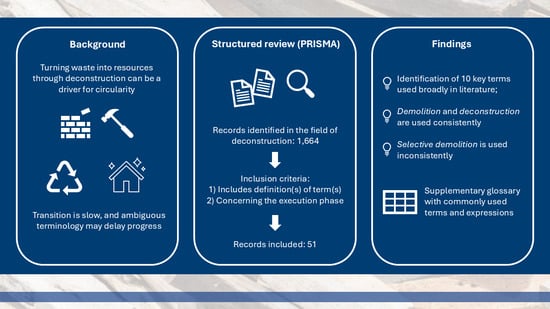
1. Introduction
2. Materials and Methods
2.1. Identification
2.2. Initial Screening
- Studies focusing on management aspects and/or the generation (rate) of the construction and demolition waste produced, but not on the on-site processes
- Technical and mechanical properties of demolition waste for reusing, e.g., aggregates for concrete production
- Recycling potential of construction and demolition waste, often presented through case studies, representing practices in different regions and countries worldwide
- Non-destructive testing
2.3. Eligibility Assessment
2.4. Descriptive Bibliometric and Terminology Analyses
3. Results and Discussion
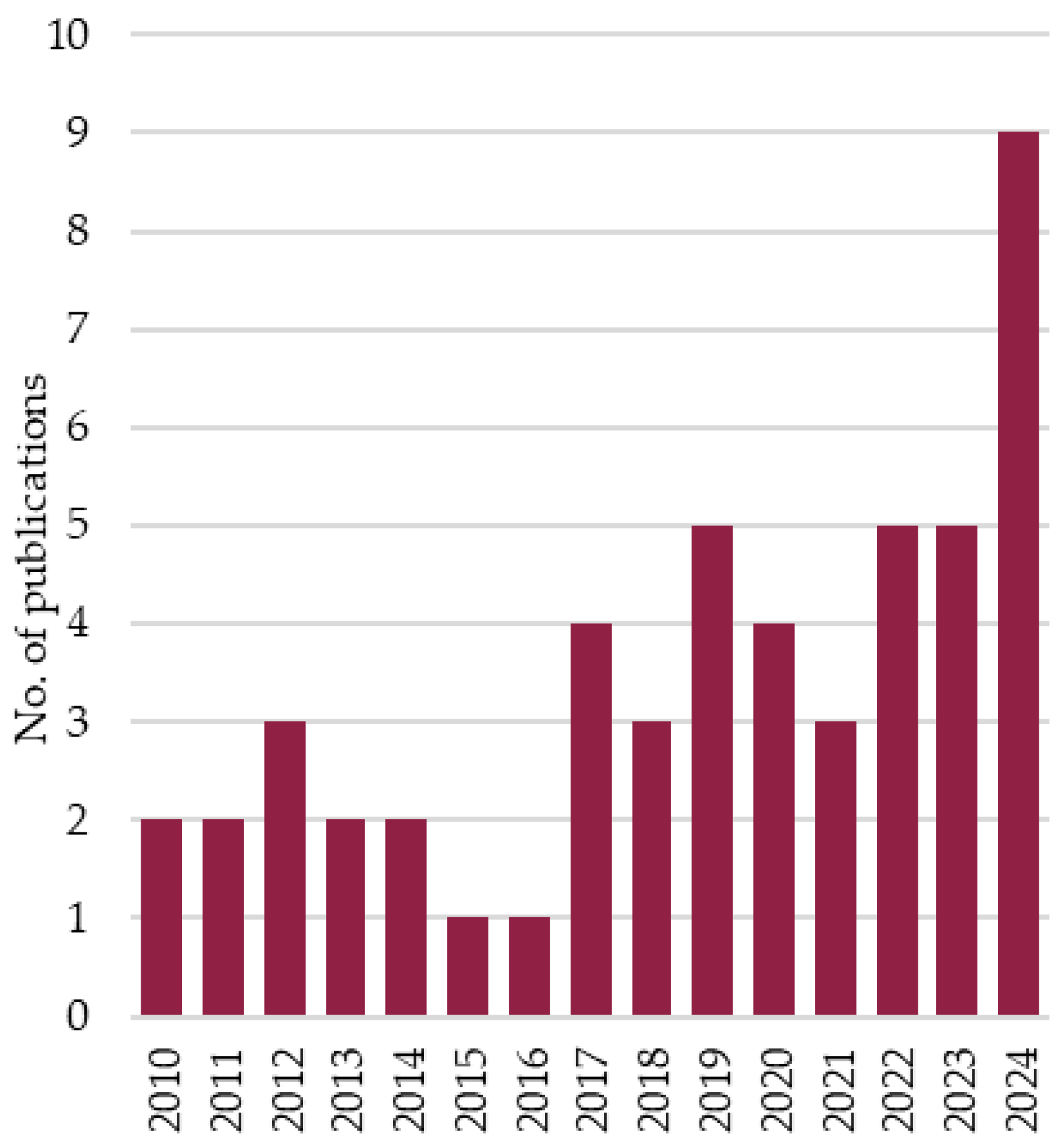
3.1. Descriptive Bibliometric Results
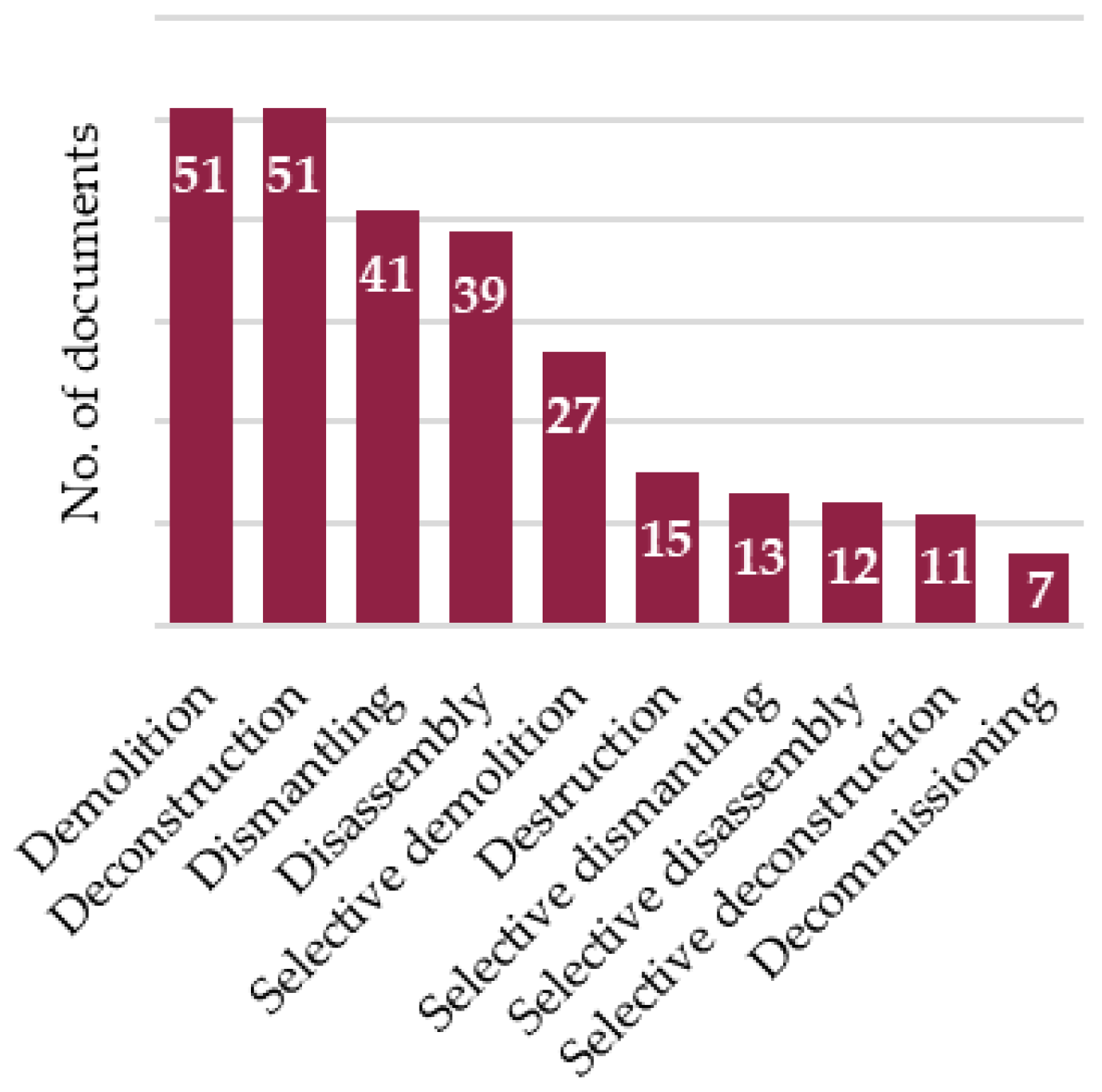
3.2. Core Terms to Describe the Deconstruction Process
3.3. Additional Terminology Related to Deconstruction
3.4. Strengths and Limitations of the Study
4. Conclusions
Supplementary Materials
Author Contributions
Funding
Data Availability Statement
Acknowledgments
Conflicts of Interest
Abbreviations
| CE | Circular Economy |
| EoL | End-of-Life |
| C&D | Construction & Demolition |
| DfD | Design for Disassembly |
| BIM | Building Information Modelling |
| LCA | Life Cycle Assessment |
Appendix A

| Source | Demolition | Deconstruction | Dismantling | Disassembly | Selective Demolition | Destruction | Selective Dismantling | Selective Disassembly | Selective Deconstruction | Decommissioning | Sum |
|---|---|---|---|---|---|---|---|---|---|---|---|
| [2] | 1 | 1 | 0 | 1 | 0 | 0 | 0 | 0 | 0 | 0 | 3 |
| [35] | 1 | 1 | 1 | 1 | 1 | 0 | 0 | 0 | 0 | 0 | 5 |
| [32] | 1 | 1 | 1 | 1 | 1 | 0 | 0 | 0 | 1 | 0 | 6 |
| [51] | 1 | 1 | 0 | 0 | 0 | 1 | 0 | 0 | 0 | 0 | 3 |
| [47] | 1 | 1 | 0 | 1 | 1 | 0 | 0 | 0 | 0 | 0 | 4 |
| [33] | 1 | 1 | 1 | 1 | 1 | 0 | 0 | 0 | 0 | 0 | 5 |
| [40] | 1 | 1 | 1 | 1 | 0 | 0 | 1 | 0 | 1 | 0 | 6 |
| [8] | 1 | 1 | 1 | 1 | 0 | 0 | 0 | 0 | 0 | 0 | 4 |
| [36] | 1 | 1 | 0 | 1 | 1 | 0 | 0 | 0 | 0 | 0 | 4 |
| [43] | 1 | 1 | 1 | 1 | 1 | 1 | 1 | 0 | 1 | 0 | 8 |
| [52] | 1 | 1 | 1 | 0 | 1 | 0 | 0 | 0 | 0 | 0 | 4 |
| [48] | 1 | 1 | 1 | 1 | 0 | 0 | 0 | 0 | 0 | 0 | 4 |
| [11] | 1 | 1 | 1 | 1 | 1 | 1 | 0 | 0 | 0 | 0 | 6 |
| [28] | 1 | 1 | 0 | 1 | 1 | 0 | 0 | 0 | 0 | 0 | 4 |
| [45] | 1 | 1 | 1 | 1 | 0 | 0 | 0 | 0 | 0 | 0 | 4 |
| [37] | 1 | 1 | 1 | 0 | 0 | 0 | 1 | 0 | 1 | 1 | 6 |
| [53] | 1 | 1 | 0 | 1 | 0 | 1 | 0 | 0 | 0 | 0 | 4 |
| [34] | 1 | 1 | 1 | 1 | 1 | 0 | 0 | 1 | 0 | 0 | 6 |
| [38] | 1 | 1 | 0 | 0 | 0 | 1 | 0 | 0 | 0 | 0 | 3 |
| [54] | 1 | 1 | 1 | 0 | 1 | 0 | 1 | 0 | 0 | 1 | 6 |
| [30] | 1 | 1 | 1 | 1 | 0 | 0 | 0 | 0 | 1 | 0 | 5 |
| [42] | 1 | 1 | 1 | 1 | 0 | 1 | 1 | 0 | 0 | 0 | 6 |
| [55] | 1 | 1 | 1 | 0 | 0 | 0 | 0 | 0 | 0 | 0 | 3 |
| [56] | 1 | 1 | 1 | 1 | 0 | 0 | 0 | 1 | 1 | 0 | 6 |
| [3] | 1 | 1 | 1 | 1 | 1 | 1 | 1 | 0 | 0 | 0 | 7 |
| [18] | 1 | 1 | 1 | 1 | 0 | 0 | 0 | 0 | 0 | 1 | 5 |
| [57] | 1 | 1 | 1 | 0 | 1 | 0 | 0 | 0 | 0 | 0 | 4 |
| [44] | 1 | 1 | 1 | 1 | 1 | 1 | 1 | 1 | 1 | 1 | 10 |
| [6] | 1 | 1 | 1 | 1 | 1 | 1 | 0 | 0 | 0 | 0 | 6 |
| [10] | 1 | 1 | 1 | 1 | 0 | 1 | 1 | 0 | 0 | 0 | 6 |
| [58] | 1 | 1 | 1 | 1 | 0 | 0 | 0 | 1 | 1 | 1 | 7 |
| [59] | 1 | 1 | 1 | 1 | 1 | 0 | 0 | 1 | 1 | 0 | 7 |
| [60] | 1 | 1 | 1 | 1 | 1 | 0 | 0 | 1 | 0 | 0 | 6 |
| [61] | 1 | 1 | 0 | 0 | 1 | 0 | 0 | 0 | 0 | 0 | 3 |
| [39] | 1 | 1 | 1 | 1 | 1 | 0 | 1 | 1 | 0 | 0 | 7 |
| [62] | 1 | 1 | 1 | 0 | 1 | 0 | 0 | 0 | 0 | 0 | 4 |
| [1] | 1 | 1 | 1 | 0 | 1 | 0 | 0 | 0 | 0 | 0 | 4 |
| [63] | 1 | 1 | 0 | 1 | 0 | 0 | 0 | 0 | 0 | 0 | 3 |
| [16] | 1 | 1 | 1 | 1 | 0 | 1 | 0 | 1 | 0 | 0 | 6 |
| [31] | 1 | 1 | 1 | 0 | 1 | 1 | 1 | 0 | 1 | 0 | 7 |
| [22] | 1 | 1 | 1 | 1 | 0 | 1 | 0 | 1 | 1 | 1 | 8 |
| [64] | 1 | 1 | 1 | 1 | 1 | 0 | 1 | 0 | 0 | 0 | 6 |
| [7] | 1 | 1 | 1 | 1 | 1 | 0 | 0 | 1 | 0 | 0 | 6 |
| [65] | 1 | 1 | 1 | 1 | 1 | 0 | 0 | 0 | 0 | 0 | 5 |
| [17] | 1 | 1 | 1 | 1 | 0 | 1 | 1 | 1 | 0 | 0 | 7 |
| [66] | 1 | 1 | 1 | 1 | 0 | 1 | 0 | 0 | 0 | 0 | 5 |
| [67] | 1 | 1 | 0 | 1 | 0 | 0 | 0 | 0 | 0 | 0 | 3 |
| [68] | 1 | 1 | 1 | 1 | 0 | 0 | 0 | 0 | 0 | 0 | 4 |
| [24] | 1 | 1 | 1 | 0 | 0 | 0 | 1 | 0 | 0 | 1 | 5 |
| [15] | 1 | 1 | 1 | 1 | 1 | 0 | 0 | 0 | 0 | 0 | 5 |
| [41] | 1 | 1 | 1 | 1 | 1 | 0 | 0 | 1 | 0 | 0 | 6 |
| Sum | 51 | 51 | 41 | 39 | 27 | 15 | 13 | 12 | 11 | 7 |
References
- Zhang, C.; Hu, M.; Di Maio, F.; Sprecher, B.; Yang, X.; Tukker, A. An overview of the waste hierarchy framework for analyzing the circularity in construction and demolition waste management in Europe. Sci. Total Environ. 2022, 803, 149892. [Google Scholar] [CrossRef] [Scilit] [PubMed]
- Guy, B. Building Deconstruction. In Green Building: Project Planning & Cost Estimating; RSMeans: Norwell, MA, USA, 2010; pp. 69–82. [Google Scholar]
- Van den Berg, M. Managing Circular Building Projects. Ph.D. Thesis, University of Twente, Enschede, The Netherlands, 2019. [Google Scholar]
- Circle Economy. The Circularity Gap Report 2023; Circle Economy: Amsterdam, The Netherlands, 2023. [Google Scholar]
- European Environment Agency. Addressing the Environmental and Climate Footprint of Buildings; European Environment Agency: Copenhagen, Denmark, 2024. [Google Scholar] [CrossRef]
- Van den Berg, M.; Voordijk, H.; Adriaanse, A. Recovering building elements for reuse (or not)—Ethnographic insights into selective demolition practices. J. Clean. Prod. 2020, 256, 120332. [Google Scholar] [CrossRef] [Scilit]
- Allam, A.S.; Nik-Bakht, M. Supporting circularity in construction with performance-based deconstruction. Sustain. Prod. Consum. 2024, 45, 1–14. [Google Scholar] [CrossRef] [Scilit]
- Coelho, A.; de Brito, J. Conventional demolition versus deconstruction techniques in managing construction and demolition waste (CDW). In Handbook of Recycled Concrete and Demolition Waste; Woodhead Publishing: Cambridge, UK, 2013; pp. 141–185. [Google Scholar]
- Machado, R.C.; de Souza, H.A.; Veríssimo, G.D. Analysis of Guidelines and Identification of Characteristics Influencing the Deconstruction Potential of Buildings. Sustainability 2018, 10, 2604. [Google Scholar] [CrossRef] [Scilit]
- Bertino, G.; Kisser, J.; Zeilinger, J.; Langergraber, G.; Fischer, T.; Österreicher, D. Fundamentals of Building Deconstruction as a Circular Economy Strategy for the Reuse of Construction Materials. Appl. Sci. 2021, 11, 939. [Google Scholar] [CrossRef] [Scilit]
- EU. EU Construction & Demolition Waste Management Protocol; European Commission: Brussels, Belgium, 2016. [Google Scholar]
- Kirchherr, J.; Reike, D.; Hekkert, M. Conceptualizing the circular economy: An analysis of 114 definitions. Resour. Conserv. Recycl. 2017, 127, 221–232. [Google Scholar] [CrossRef] [Scilit]
- Kirchherr, J.; Yang, N.-H.N.; Schulze-Spüntrup, F.; Heerink, M.J.; Hartley, K. Conceptualizing the Circular Economy (Revisited): An Analysis of 221 Definitions. Resour. Conserv. Recycl. 2023, 194, 107001. [Google Scholar] [CrossRef] [Scilit]
- Olanrewaju, A.; Tan, S.Y.; Kwan, L.F. Roles of Communication on Performance of the Construction Sector. Procedia Eng. 2017, 196, 763–770. [Google Scholar] [CrossRef] [Scilit]
- Pristerà, G.; Tonini, D.; Tornaghi, M.L.; Caro, D.; Sala, S. Taxonomy of design for deconstruction options to enable circular economy in buildings. Resour. Environ. Sustain. 2024, 15, 100153. [Google Scholar] [CrossRef] [Scilit]
- Balogun, H.; Alaka, H.; Egwim, C.N.; Ajayi, S. Systematic review of drivers influencing building deconstructability: Towards a construct-based conceptual framework. Waste Manag. Res. 2023, 41, 512–530. [Google Scholar] [CrossRef] [Scilit]
- Attia, S.; Al-Obaidy, M.; Mori, M.; Campain, C.; Giannasi, E.; van Vliet, M.; Gasparri, E. Disassembly calculation criteria and methods for circular construction. Autom. Constr. 2024, 165, 105521. [Google Scholar] [CrossRef] [Scilit]
- ISO 20887:2020; Sustainability in Buildings and Civil Engineering Works—Design for Disassembly and Adaptability—Principles, Requirements and Guidance. ISO: Geneva, Switzerland, 2020.
- Designing Buildings. Designing Buildings Wiki. Available online: https://www.designingbuildings.co.uk/wiki/Glossaries (accessed on 24 February 2026).
- Andabaka, A.; Basarac Sertić, M.; Palić, P.; Burmester, I.; Pedroso, M.F. Glossary. In Shaping Circular Transitions in the Built Environment; Springer Tracts in Civil Engineering: Cham, Switzerland, 2026; pp. 491–578. [Google Scholar]
- Ferriz-Papi, J.; Valentin, J.; Bedrich, S.; Goicolea, E.; Nikolakopoulou, G. Glossary of Terms for Circular Economy and Waste Management in Construction; University of Salford: Salford, UK, 2024; p. 68. [Google Scholar]
- Volk, R. Building Information Modeling for Existing Buildings—Deconstruction Planning and Management. In Building Information Modeling: Shared Modeling, Mutual Data, the New Art of Building; WILEY: Hoboken, NJ, USA, 2023; pp. 147–169. [Google Scholar]
- Page, M.J.; McKenzie, J.E.; Bossuyt, P.M.; Boutron, I.; Hoffmann, T.C.; Mulrow, C.D.; Shamseer, L.; Tetzlaff, J.M.; Akl, E.A.; Brennan, S.E.; et al. The PRISMA 2020 statement: An updated guideline for reporting systematic reviews. BMJ 2021, 372, n71. [Google Scholar] [CrossRef] [Scilit] [PubMed]
- Ohueri, C.C.; Masrom, M.A.N.; Noguchi, M. Human-robot collaboration for building deconstruction in the context of construction 5.0. Autom. Constr. 2024, 167, 105723. [Google Scholar] [CrossRef] [Scilit]
- Finamore, M.; Oltean-Dumbrava, C. Circular economy in construction—Findings from a literature review. Heliyon 2024, 10, e34647. [Google Scholar] [CrossRef] [Scilit] [PubMed]
- Allam, A.S.; Nik-Bakht, M. From demolition to deconstruction of the built environment: A synthesis of the literature. J. Build. Eng. 2023, 64, 105679. [Google Scholar] [CrossRef] [Scilit]
- Lausselet, C.; Dahlstrom, O.A.; Thyholt, M.; Eghbali, A.; Schneider-Marin, P. Methods to Account for Design for Disassembly: Status of the Building Sector. Buildings 2023, 13, 1012. [Google Scholar] [CrossRef] [Scilit]
- Adams, K.T.; Osmani, M.; Thorpe, T.; Thornback, J. Circular economy in construction: Current awareness, challenges and enablers. Proc. Inst. Civ. Eng. Waste Resour. Manag. 2017, 170, 15–24. [Google Scholar] [CrossRef] [Scilit]
- AntLab Solutions AntConc. A Corpus Analysis Toolkit for Researchers, Teachers, and Learners, 4.3.1; Waseda University: Toyo, Japan, 2024.
- Aidonis, D. Multiobjective Mathematical Programming Model for the Optimization of End-of-Life Buildings’ Deconstruction and Demolition Processes. Sustainability 2019, 11, 1426. [Google Scholar] [CrossRef] [Scilit]
- Hammel, L.; Otto, J.; Will, F.; Lehmann, F.; Anders, E.; Voigt, M. Electric-impulse-technology: Results of a basic investigation into the use of the technology as a selective demolition method in the construction industry. Asian J. Civ. Eng. 2023, 24, 1981–1995. [Google Scholar] [CrossRef] [Scilit]
- Coelho, A.; de Brito, J. Economic analysis of conventional versus selective demolition—A case study. Resour. Conserv. Recycl. 2011, 55, 382–392. [Google Scholar] [CrossRef] [Scilit]
- Elias Özkan, S.T. Selective Demolition of Redundant and Earthquake Damaged Buildings in Turkey. METU J. Fac. Archit. 2012, 29, 139–152. [Google Scholar] [CrossRef] [Scilit]
- Sanchez, B.; Haas, C. A novel selective disassembly sequence planning method for adaptive reuse of buildings. J. Clean. Prod. 2018, 183, 998–1010. [Google Scholar] [CrossRef] [Scilit]
- Couto, J.; Couto, A. Analysis of Barriers and the Potential for Exploration of Deconstruction Techniques in Portuguese Construction Sites. Sustainability 2010, 2, 428–442. [Google Scholar] [CrossRef] [Scilit]
- Kamrath, P. Demolition techniques and production of construction and demolition waste (CDW) for recycling. In Handbook of Recycled Concrete and Demolition Waste; Woodhead Publishing: Cambridge, UK, 2013; pp. 186–209. [Google Scholar]
- Hübner, F.; Volk, R.; Kühlen, A.; Schultmann, F. Review of project planning methods for deconstruction projects of buildings. Built Environ. Proj. Asset Manag. 2017, 7, 212–226. [Google Scholar] [CrossRef] [Scilit]
- Tatiya, A.; Zhao, D.; Syal, M.; Berghorn, G.H.; LaMore, R. Cost prediction model for building deconstruction in urban areas. J. Clean. Prod. 2018, 195, 1572–1580. [Google Scholar] [CrossRef] [Scilit]
- Hoang, N.H.; Ishigaki, T.; Watari, T.; Yamada, M.; Kawamoto, K. Current state of building demolition and potential for selective dismantling in Vietnam. Waste Manage. 2022, 149, 218–227. [Google Scholar] [CrossRef] [Scilit]
- Xanthopoulos, A.; Aidonis, D.; Vlachos, D.; Iakovou, E. A planning optimisation framework for construction and demolition waste management. Int. J. Ind. Syst. Eng. 2012, 10, 257–276. [Google Scholar] [CrossRef] [Scilit]
- Sanchez, B.; Honic, M.; Leite, F.; Herthogs, P.; Stouffs, R. Augmenting materials passports to support disassembly planning based on building information modelling standards. J. Build. Eng. 2024, 90, 109083. [Google Scholar] [CrossRef] [Scilit]
- Marzouk, M.; Elmaraghy, A.; Voordijk, H. Lean deconstruction approach for buildings demolition processes using BIM. Lean Constr. J. 2019, 2019, 147–173. [Google Scholar]
- CIB. Barriers for Deconstruction and Reuse/Recycling of Construction Materials; International Council for Research and Innovation in Building and Construction (CIB): Ottawa, Canada, 2014. [Google Scholar]
- Sanchez, B.; Rausch, C.; Haas, C.; Saari, R. A selective disassembly multi-objective optimization approach for adaptive reuse of building components. Resour. Conserv. Recycl. 2020, 154, 104605. [Google Scholar] [CrossRef] [Scilit]
- Chau, C.K.; Xu, J.M.; Leung, T.M.; Ng, W.Y. Evaluation of the impacts of end-of-life management strategies for deconstruction of a high-rise concrete framed office building. Appl. Energy 2017, 185, 1595–1603. [Google Scholar] [CrossRef] [Scilit]
- EU. Guidance on the Interpretation of Key Provisions of Directive 2008/98/EC on Waste; European Commission: Brussels, Belgium, 2012. [Google Scholar]
- Coelho, A.; de Brito, J. Influence of construction and demolition waste management on the environmental impact of buildings. Waste Manage. 2012, 32, 532–541. [Google Scholar] [CrossRef] [Scilit] [PubMed]
- Rios, F.C.; Chong, W.K.; Grau, D. Design for Disassembly and Deconstruction—Challenges and Opportunities. Procedia Eng. 2015, 118, 1296–1304. [Google Scholar] [CrossRef] [Scilit]
- Heras-Saizarbitoria, I.; Boiral, O.; Testa, F. ISO 59000 Standards for the Circular Economy: A Call for Accuracy. Circ. Econ. Sustain. 2024, 4, 1669–1675. [Google Scholar] [CrossRef] [Scilit]
- Spengler, T.; Püchert, H.; Penkuhn, T.; Rentz, O. Environmental integrated production and recycling management. Eur. J. Oper. Res. 1997, 97, 308–326. [Google Scholar] [CrossRef] [Scilit]
- Thomsen, A.; Schultmann, F.; Kohler, N. Deconstruction, demolition and destruction. Build. Res. Inf. 2011, 39, 327–332. [Google Scholar] [CrossRef] [Scilit]
- Elias-Ozkan, S.T. Demolition Versus Deconstruction: Impacts of Fenestration Disposal in Building Renovation Projects. Open House Int. 2014, 39, 48–55. [Google Scholar] [CrossRef] [Scilit]
- Zabek, M.; Hildebrand, L.; Wirth, M.; Brell-Cokcan, S. Used building materials as secondary resources—Identification of valuable building material and automized deconstruction. J. Facade Des. Eng. 2017, 5, 25–33. [Google Scholar] [CrossRef]
- Volk, R.; Luu, T.H.; Mueller-Roemer, J.S.; Sevilmis, N.; Schultmann, F. Deconstruction project planning of existing buildings based on automated acquisition and reconstruction of building information. Autom. Constr. 2018, 91, 226–245. [Google Scholar] [CrossRef] [Scilit]
- Queheille, E.; Taillandier, F.; Saiyouri, N. Optimization of strategy planning for building deconstruction. Autom. Constr. 2019, 98, 236–247. [Google Scholar] [CrossRef] [Scilit]
- Sanchez, B.; Rausch, C.; Haas, C. Deconstruction programming for adaptive reuse of buildings. Autom. Constr. 2019, 107, 102921. [Google Scholar] [CrossRef] [Scilit]
- Pantini, S.; Rigamonti, L. Is selective demolition always a sustainable choice? Waste Manage. 2020, 103, 169–176. [Google Scholar] [CrossRef] [Scilit]
- Motahar, M.M.; Nourzad, S.H.H. A hybrid method for optimizing selective disassembly sequence planning in adaptive reuse of buildings. Eng. Constr. Archit. 2021, 29, 307–332. [Google Scholar] [CrossRef] [Scilit]
- Sanchez, B.; Rausch, C.; Haas, C.; Hartmann, T. A framework for BIM-based disassembly models to support reuse of building components. Resour. Conserv. Recycl. 2021, 175, 105825. [Google Scholar] [CrossRef] [Scilit]
- Andersen, R.; Ravn, A.S.; Ryberg, M.W. Environmental benefits of applying selective demolition to buildings: A case study of the reuse of façade steel cladding. Resour. Conserv. Recycl. 2022, 184, 106430. [Google Scholar] [CrossRef] [Scilit]
- Christensen, T.B.; Johansen, M.R.; Buchard, M.V.; Glarborg, C.N. Closing the material loops for construction and demolition waste: The circular economy on the island Bornholm, Denmark. Resour. Conserv. Recycl. Adv. 2022, 15, 200104. [Google Scholar] [CrossRef] [Scilit]
- Quéheille, E.; Ventura, A.; Saiyouri, N.; Taillandier, F. A Life Cycle Assessment model of End-of-life scenarios for building deconstruction and waste management. J. Clean. Prod. 2022, 339, 130694. [Google Scholar] [CrossRef] [Scilit]
- Anastasiades, K.; Dockx, J.; van den Berg, M.; Rinke, M.; Blom, J.; Audenaert, A. Stakeholder perceptions on implementing design for disassembly and standardisation for heterogeneous construction components. Waste Manag. Res. 2023, 41, 1372–1381. [Google Scholar] [CrossRef] [Scilit]
- Xiao, J.Z.; Zeng, L.; Ding, T.; Xu, H.; Tang, H.C. Deconstruction evaluation method of building structures based on digital technology. J. Build. Eng. 2023, 66, 105901. [Google Scholar] [CrossRef] [Scilit]
- Antunes, A.; Silvestre, J.; Costa, H.; Carmo, R.d.; Júlio, E. Reducing the environmental impact of the end-of-life of buildings depending on interrelated demolition strategies, transport distances and disposal scenarios. J. Build. Eng. 2024, 82, 108197. [Google Scholar] [CrossRef] [Scilit]
- Balogun, H.; Alaka, H.; Ajayi, S.; Egwim, C.N. Critical factors for assessing building deconstructability: Exploratory and confirmatory factor analysis. Cleaner Eng. Technol. 2024, 21, 100790. [Google Scholar] [CrossRef] [Scilit]
- Hei, S.G.; Zhang, H.; Luo, S.; Zhang, R.Z.; Zhou, C.; Cong, M.; Ye, H.Y. Implementing BIM and Lean Construction Methods for the Improved Performance of a Construction Project at the Disassembly and Reuse Stage: A Case Study in Dezhou, China. Sustainability 2024, 16, 656. [Google Scholar] [CrossRef] [Scilit]
- Murali, D.; Suresh, M.; Raman, R. Breaking down to build up: How deconstruction and carbon finance foster sustainable, resilient construction in the industry 5.0 era. Constr. Innov. 2024. [Google Scholar] [CrossRef] [Scilit]



| Keywords 1 | Languages | Document Types | Subject Areas | Years |
|---|---|---|---|---|
| TITLE ((deconstruct* OR disassembl* OR dismantl* OR demolition OR destruct* OR decommission*) AND (building OR construction OR “built environment”)) | English | Article Review Book chapter Book | Engineering Environmental Science Earth and Planetary Sciences | 2010–10 February 2025 |
| Term | Definition/Example Phrase | Source(s) |
|---|---|---|
| Demolition | “tends to have a much lower threshold for recovering reusable materials [than deconstruction] and is typically focused on speed and the mechanical reduction of the mass of a building in order to make the disposal of materials as efficient as possible.” | [2] (p. 71) |
| “The most common method of conventional demolition is (…) the “top-down” method. As indicated by the method’s name, demolition works take place along a vertical axis. In other words, demolition work begins with the dismantling of the roof and is completed on the ground…” | [30] (p. 2) | |
| “Removal by destructive methods.” “Demolition by pushing or pulling, fragmenting by crushing or shearing, implosion or rapid progressive failure of construction works or their component parts.” | [18] (p. 3) | |
| Converting the building into waste. | [6] | |
| “an arbitrary and destructive process, and although faster and cheaper [than deconstruction], it typically creates a substantial amount of waste.” | [10] (p. 1) | |
| Two basic [demolition] methods are defined: “…mechanical destruction of the structure by external application of force (caulking, milling, drilling, sawing) or media-transporting blasting methods (high pressure water jetting, solid-state blasting).” | [31] (p. 1981) | |
| Selective demolition | “(…) also named deconstruction.” | [32] (p. 382) |
| “a mix of both partial deconstruction and demolition…” | [33] (p. 140) | |
| “involves sequencing the demolition activities to allow the separation and sorting of building materials.” | [11] (p. 30) | |
| Disassembly process using destructive methods that destroy the functional capabilities of the components. | [34] (p. 1000) | |
| Destructing the building while keeping the non-stony stream—e.g., wood, plastics, and steel—from waste concrete. | [1] | |
| Deconstruction | “the disassembly of buildings to recover the maximum amount of reusable and recyclable materials in a safe, environmentally responsible, cost-effective manner.” | [2] (p. 70) |
| “the process of taking a building or structure apart (…) in the reverse order to that in which it was constructed.” | [35] (p. 429) | |
| = building clearance, deconstructing all non-load bearing parts and rebuilding from the old skeleton. | [36] | |
| The same as selective deconstruction. “…is at least as complex and sophisticated as the construction process, especially because of many undocumented conditions of the building, which lead to many uncertainties during deconstruction.” | [37] (p. 212) | |
| “…closes the loop of linear use of resources, reduces dependence on new materials, and decreases waste disposals in landfills” | [38] (p. 1573) | |
| Non-destructive disassembly. | [34] | |
| The same as complete selective demolition. | [6] | |
| Contributes to circularity and is “…a cleaner and more sustainable process than demolition, with less pollution released into the atmosphere and waterways.” | [10] (p. 2) | |
| The same as selective dismantling. | [39] | |
| “Green demolition”. | [16] (p. 3) | |
| Selective deconstruction | “seeks to maximize the value gained from the materials of an EOL building, in a manner that it allows the reuse or efficient recycling of the materials that comprise the structure.” | [40] (p. 264) |
| Disassembly | “the process of taking an assemblage to pieces.” = Dismantling. | [34] (p. 1000) |
| “non-destructive taking-apart of a construction work or constructed asset into constituent materials or components” | [18] (p. 3) | |
| The same as deconstruction. | [16] | |
| Selective disassembly | “a process for analyzing and judging the component or sub-assembly accessibility as well as for assessing the disassembly paths of the components.” Used in manufacturing. | [41] (p. 2) |
| Dismantling | Synonymous with deconstruction | [7] |
| Selective dismantling | The process behind deconstruction, which involves separating building components into smaller parts. | [10] |
| Destruction | “Process of turning material into waste, which may or may not be recycled.” | [3] (p. 239) |
| Decommissioning | Often used synonymously with the terms disassembly, reverse engineering and deconstruction, this approach aims at avoiding demolition as an EoL option. | [22] |
| Term/Concept | Definition/Example Phrase | Source |
|---|---|---|
| Adaptive reuse | A combination of renovation and transformation. “It takes existing buildings that are obsolete, restores them, and in some cases, changes their use.” | [34] (p. 999) |
| Closed loop cycle (CLC) materials | Materials that are “extracted from buildings and reintegrated directly or reprocessed and then reintegrated into buildings or put to useful purpose in other sectors without creating any waste.” | [35] (pp. 434–435) |
| Design for Deconstruction/Disassembly (DfD) | “an approach to the design of a product or constructed asset that facilitates disassembly at the end of its useful life in such a way that it enables components and parts to be reused, recycled, recovered for energy or, in some other way, diverted from the waste stream.” | [18] (p. 3) |
| Digital twin | “a virtual model, (…) equivalent to the real building, thus having many details regarding the composition of the materials of each element.” | [10] (p. 5) |
| Downcycling | “the recycling process where the new recycled material is of lower quality and functionality than the original material, due to the presence of pollutants, safety concerns, and/or acceptance, which do not allow high-quality applications.” | [10] (p. 9) |
| Life Cycle Assessment (LCA) | “compilation and evaluation of the inputs, outputs and the potential environmental impacts of a product system throughout its life cycle.” | [18] (p. 4) |
| Life Cycle Energy Assessment (LCEA) | “a variant of the LCA method to evaluate the lifecycle energy flows of buildings, building elements, materials and/or services throughout their lifecycle phases.” | [45] (p. 1595) |
| Material passport | “sets of data describing defined characteristics of materials in products that give them value for recovery and reuse.” Cited from the Horizon 2020 project Buildings as Material Banks. | [41] (p. 2) |
| Pre-demolition audit | “a preparatory activity with the purpose of (1) collecting information about the qualities and quantities of the C&D waste materials that will be released during the demolition or renovation works and (2) giving general and site-specific recommendations regarding the demolition process.” | [11] (p. 29) |
| Recover | Recovery is the opposite of disposal. “waste serving a useful purpose by replacing other materials which would otherwise have been used to fulfil a particular function” | [46] (p. 30) |
| Recycling | “Recycling involves reprocessing salvaged elements with a manufacturing process and making it into a (component for a) final element again. (…) the strategy is less preferable because it typically reduces the element’s quality (…).” | [6] (p. 2) |
| Refurbishment | “modification and improvements to an existing building (3.4) or civil engineering works (3.6) in order to bring it up to an acceptable condition.” | [18] (p. 5) |
| Rehabilitation | “the extensive repair, renovation and modification of a building to have it suit economic or functional criteria equivalent to those expected of a new building that serves the same purpose.” | [35] (p. 430) |
| Reuse | “any operation by which products or components that are not waste are used again for the same purpose for which they were conceived.” “Reuse is a means of waste prevention; it is not a waste management operation.” | [46] (p. 30) |
| Scavenging | “is the activity of identifying usable materials that takes place after demolition; in this context, particularly re-usable and recyclable materials.” | [11] (p. 30) |
| Site assessment/Environmental Site Assessment | “analyzing the building and site, including salvageable materials, space for equipment and storage/processing of removed materials, presence of hazardous materials, and site and safety constraints for deconstruction.” | [2] (p. 72) |
| Soft-stripping | Removal of non-structural elements (e.g., drainage pipes, electrical cables, doors, windows) for recycling. | [47] |
| Stripping | “is the activity of removing valuable materials from a site, installation or building that takes place before demolition.” | [11] (p. 30) |
| Technical metabolism | “an analogy to the biological metabolism present in Nature, where “waste” is turned into “feed”. (…) this endless cycle turns the reused and recycled waste into “nutrients” (i.e., new materials or uses) for new buildings.” | [48] (p. 1298) |
| Waste hierarchy | “an order of preference for waste management and resource conservation options” | [1] (p. 3) |
Disclaimer/Publisher’s Note: The statements, opinions and data contained in all publications are solely those of the individual author(s) and contributor(s) and not of MDPI and/or the editor(s). MDPI and/or the editor(s) disclaim responsibility for any injury to people or property resulting from any ideas, methods, instructions or products referred to in the content. |
© 2026 by the authors. Licensee MDPI, Basel, Switzerland. This article is an open access article distributed under the terms and conditions of the Creative Commons Attribution (CC BY) license.
Share and Cite
Salling, S.T.; Wandahl, S.; Pérez, C.T. Deconstruction, Disassembly, or Selective Demolition: A Review of Terminology and Conceptual Challenges in Literature. Buildings 2026, 16, 1302. https://doi.org/10.3390/buildings16071302
Salling ST, Wandahl S, Pérez CT. Deconstruction, Disassembly, or Selective Demolition: A Review of Terminology and Conceptual Challenges in Literature. Buildings. 2026; 16(7):1302. https://doi.org/10.3390/buildings16071302
Chicago/Turabian StyleSalling, Stephanie Therkelsen, Søren Wandahl, and Cristina Toca Pérez. 2026. "Deconstruction, Disassembly, or Selective Demolition: A Review of Terminology and Conceptual Challenges in Literature" Buildings 16, no. 7: 1302. https://doi.org/10.3390/buildings16071302
APA StyleSalling, S. T., Wandahl, S., & Pérez, C. T. (2026). Deconstruction, Disassembly, or Selective Demolition: A Review of Terminology and Conceptual Challenges in Literature. Buildings, 16(7), 1302. https://doi.org/10.3390/buildings16071302