Study on Maximum Vertical Prestressing Spacing for Long-Span PC Continuous Rigid-Frame Bridges



Abstract
1. Introduction
2. Engineering Background
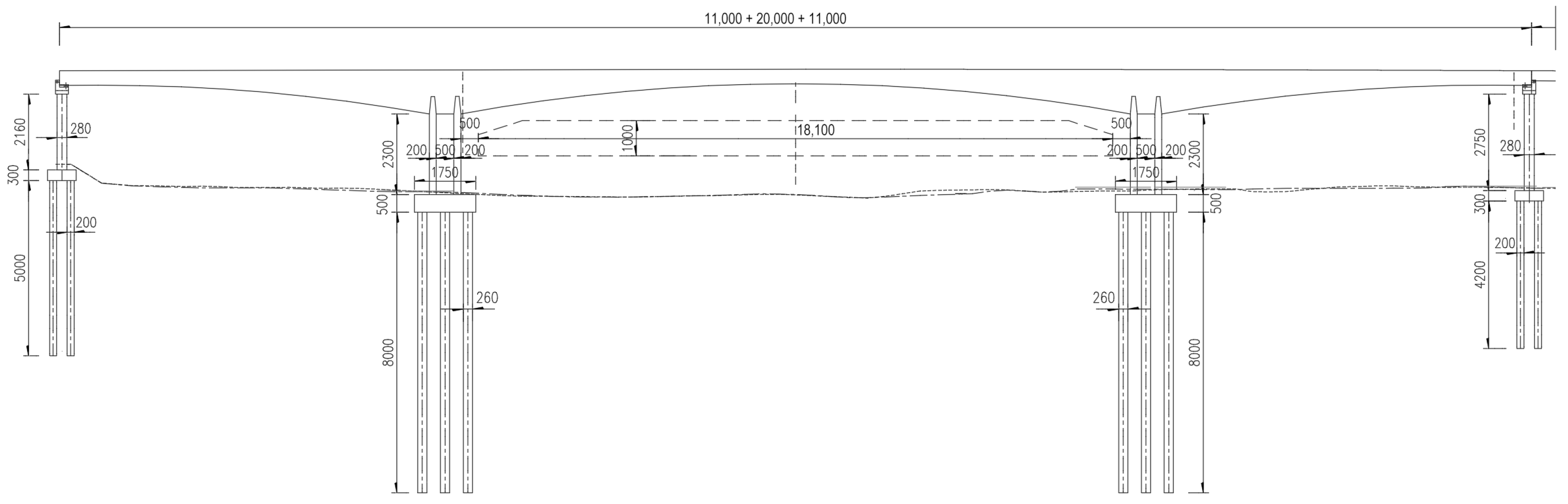
2.1. The Yicheng Hanjiang Second Bridge: A Representative Case Study
2.2. The Engineering Problem: Inadequacy of Current Design Rules
“Addressing the problem that existing vertical prestressing spacing regulations are too general, investigate the maximum and minimum vertical prestressing spacing based on the criteria that prestress in the blind zone exceeds cracking stress and that vertical prestress tensioning loss is minimized.”
2.3. The Prestressing Blind Zone and Research Significance
3. Theoretical Derivation of Vertical Stress Field Under Multi-Tendon Action
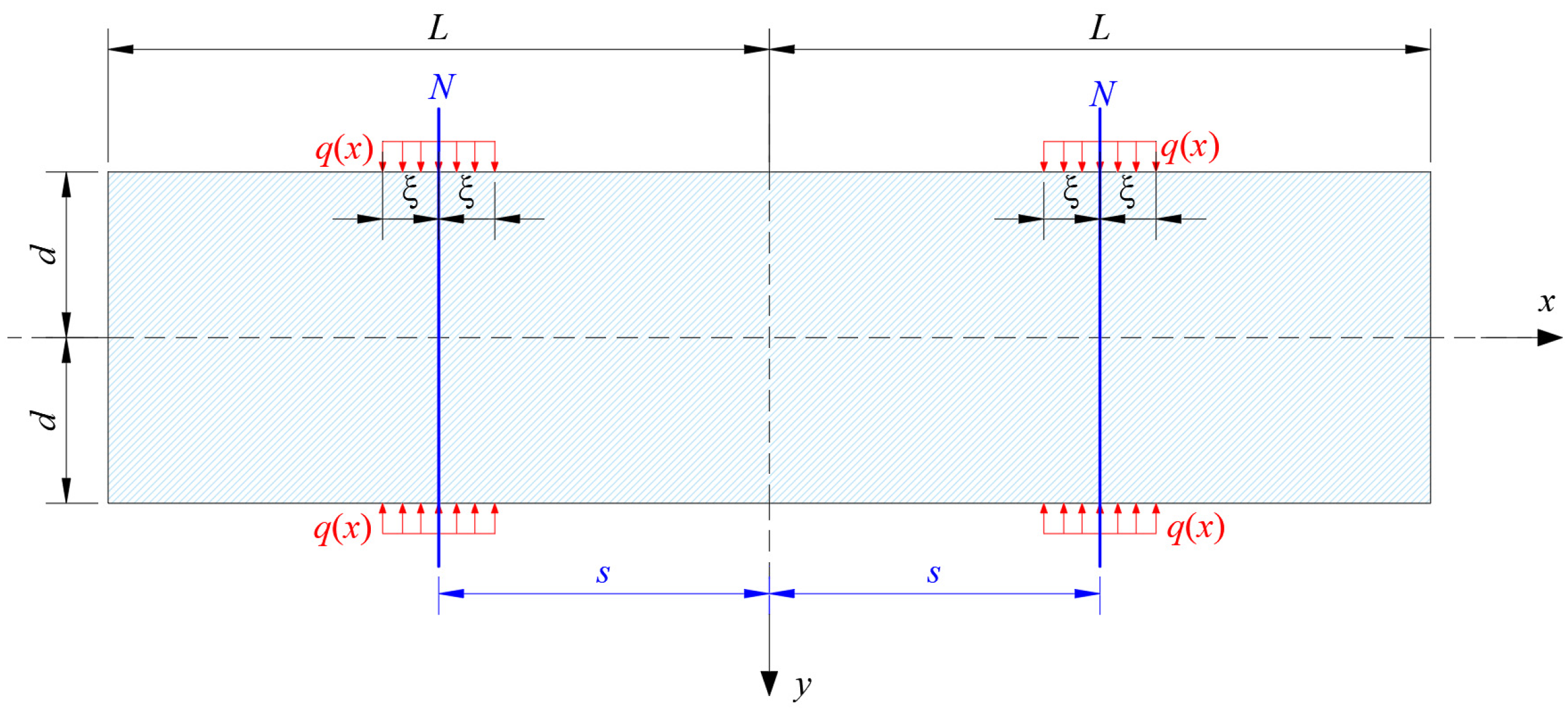
3.1. Elasticity Solution for Vertical Normal Stress Under Two Prestressing Tendons
3.1.1. Problem Formulation and Assumptions
3.1.2. Fourier Expansion of Load Distribution the Load Function
3.1.3. Decomposition into Uniform and Diffusion Components
3.1.4. Stress Function Formulation and General Solution
3.1.5. Boundary Conditions and Coefficient Determination
- Shear stress condition: τxy (x, ±a) = 0.
- Normal stress condition: σy (x, ±a) = ±q(x).
3.1.6. Vertical Normal Stress Expression
3.1.7. Concentrated Load Limit and Final Analytical Solution
3.1.8. Convergence and Truncation Criterion
3.2. Mechanism of Stress Interaction and Diffusion
3.2.1. Mathematical Representation of Tendon Interaction
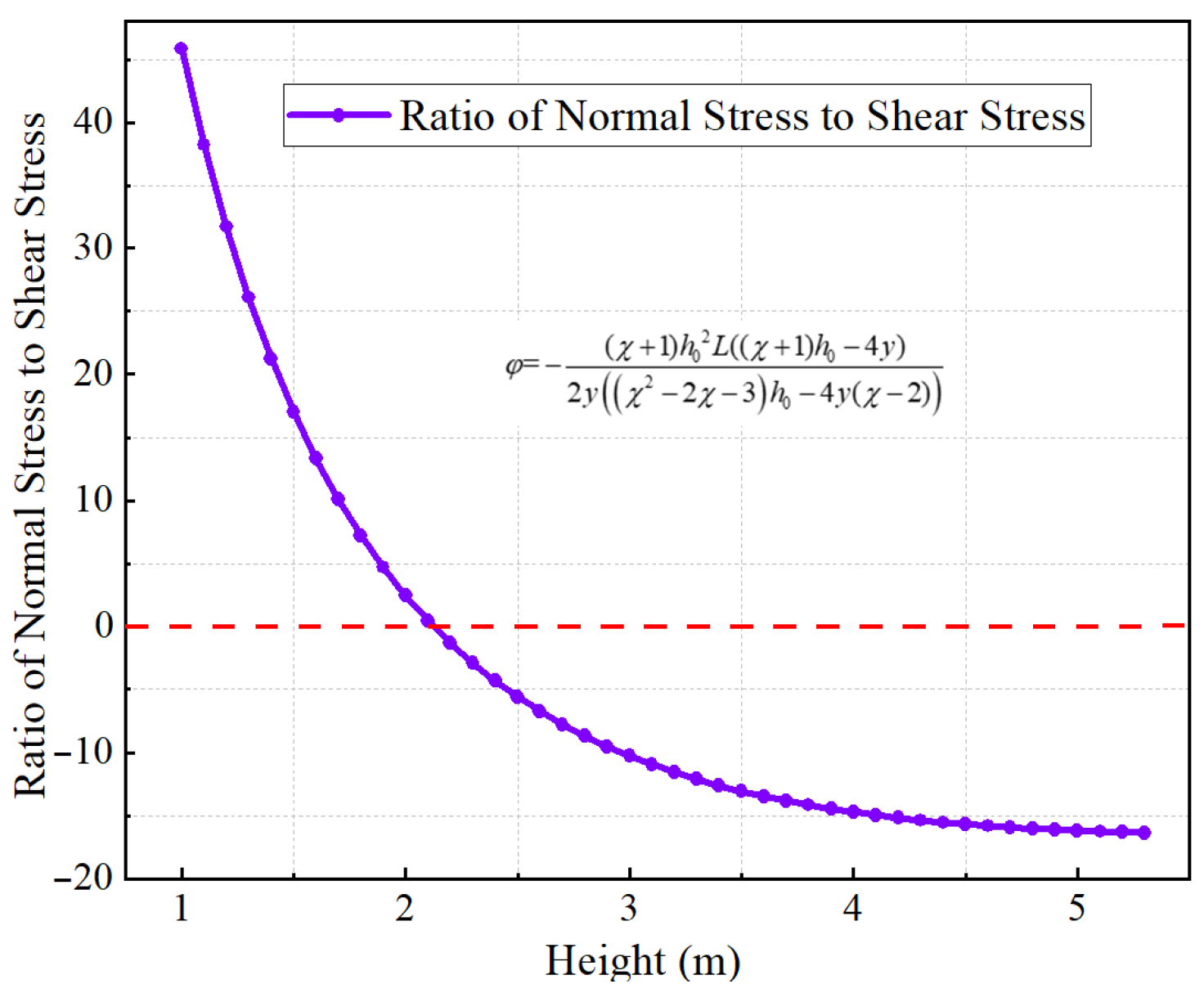
3.2.2. Transition of Stress States with Spacing
3.2.3. Implications for Existing Design Practice
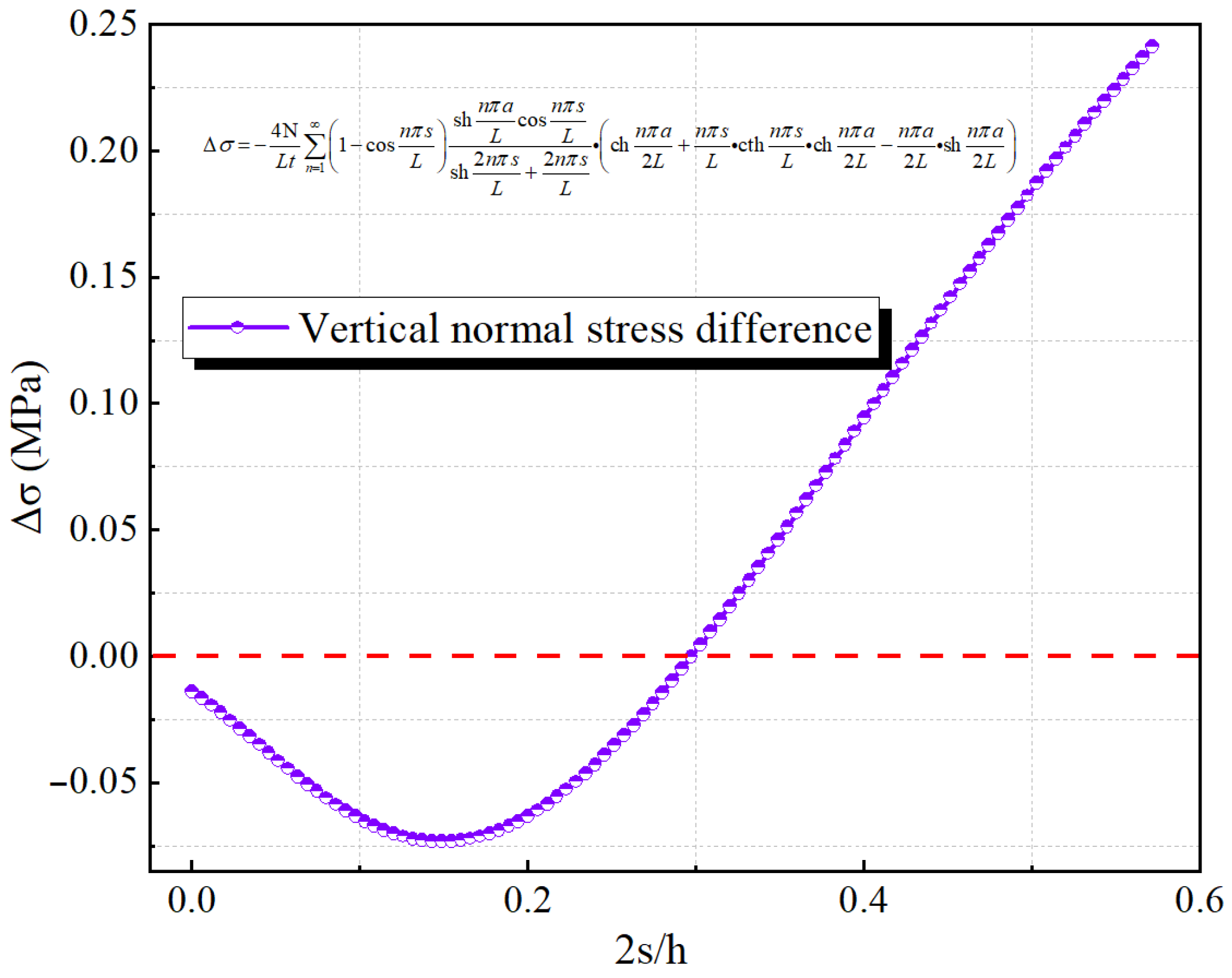
3.3. Validation of Mathematical Consistency
4. Numerical Verification and Parametric Analysis
4.1. Finite Element Modeling and Validation of Analytical Solution
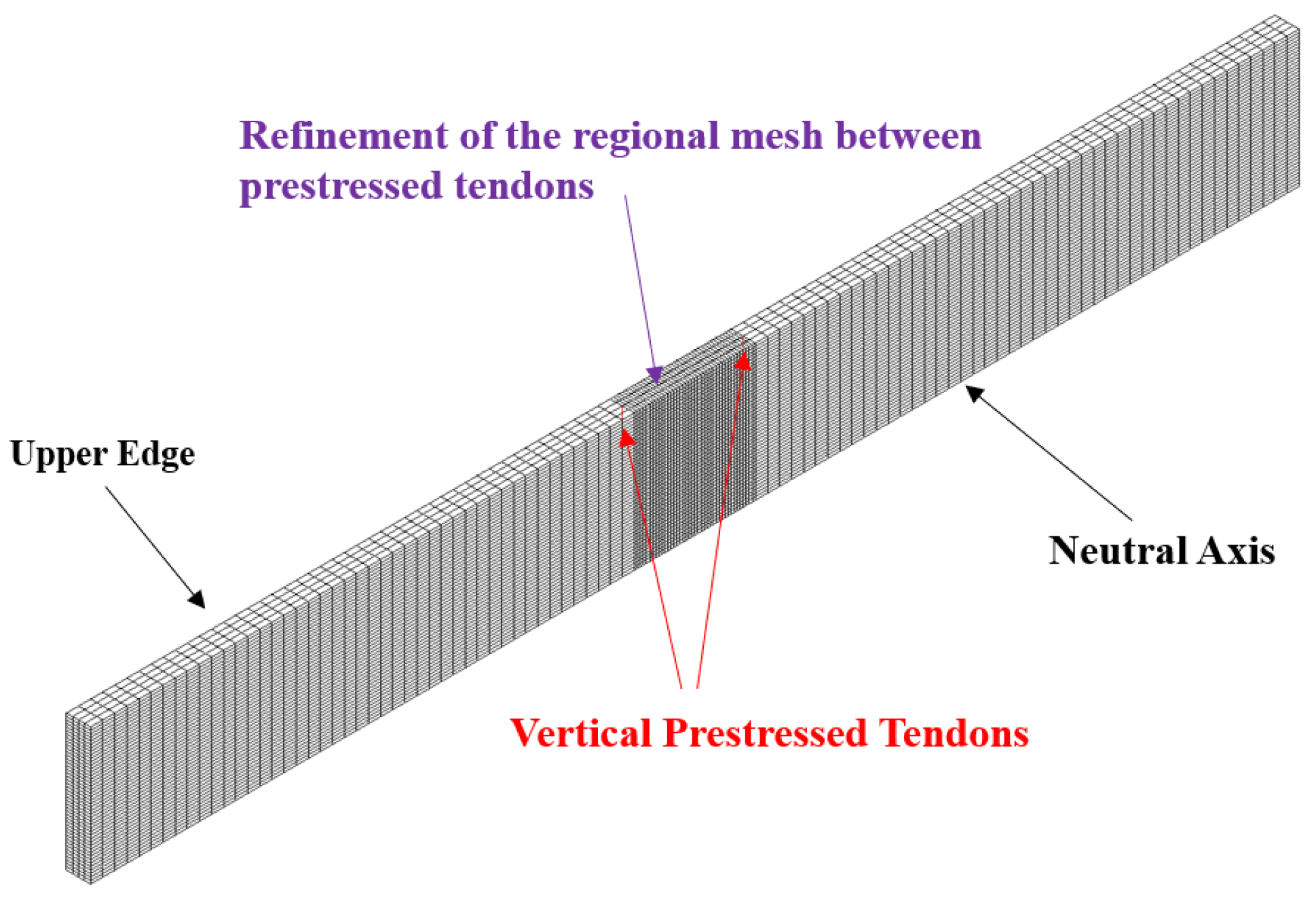
4.1.1. Model Configuration
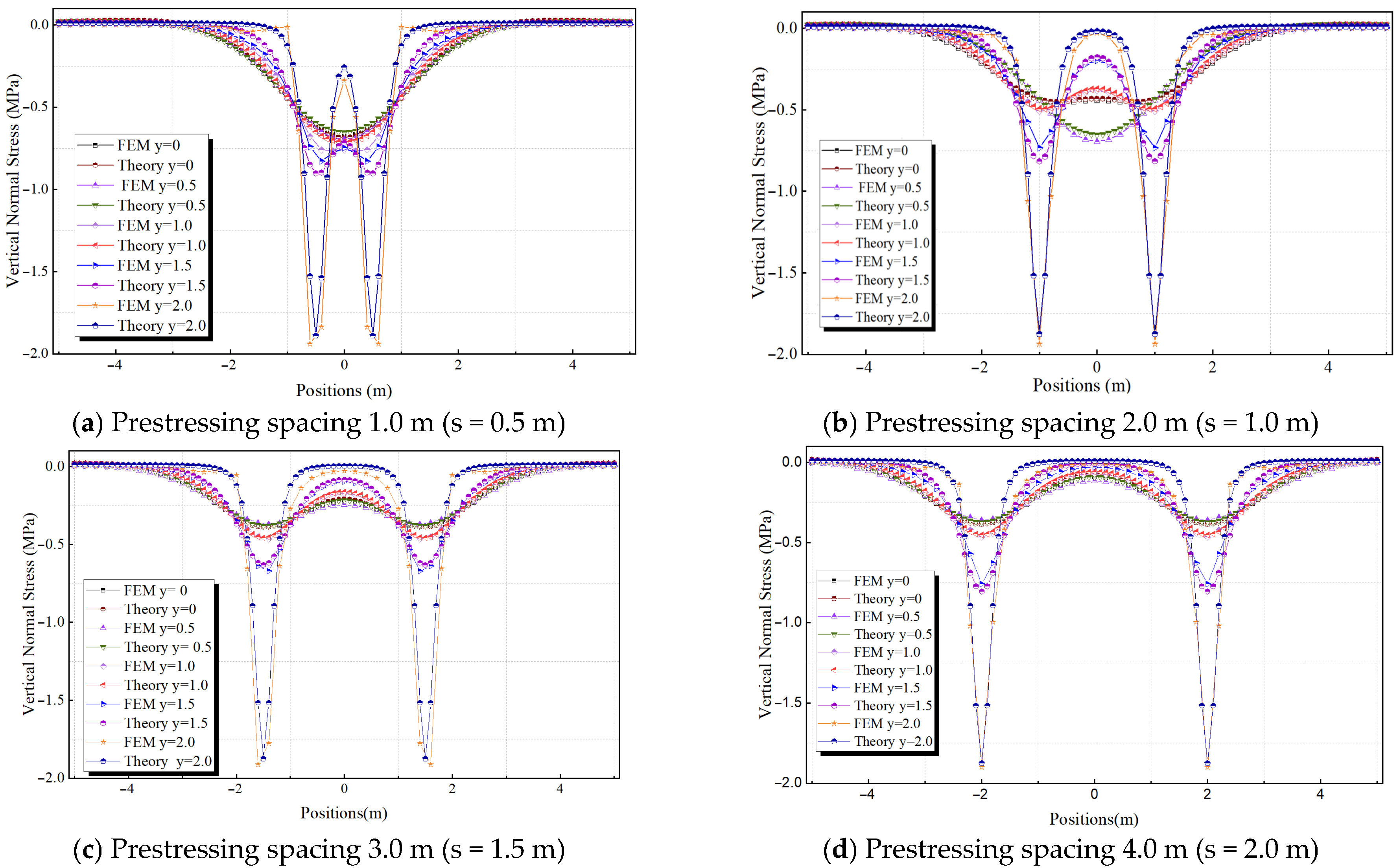
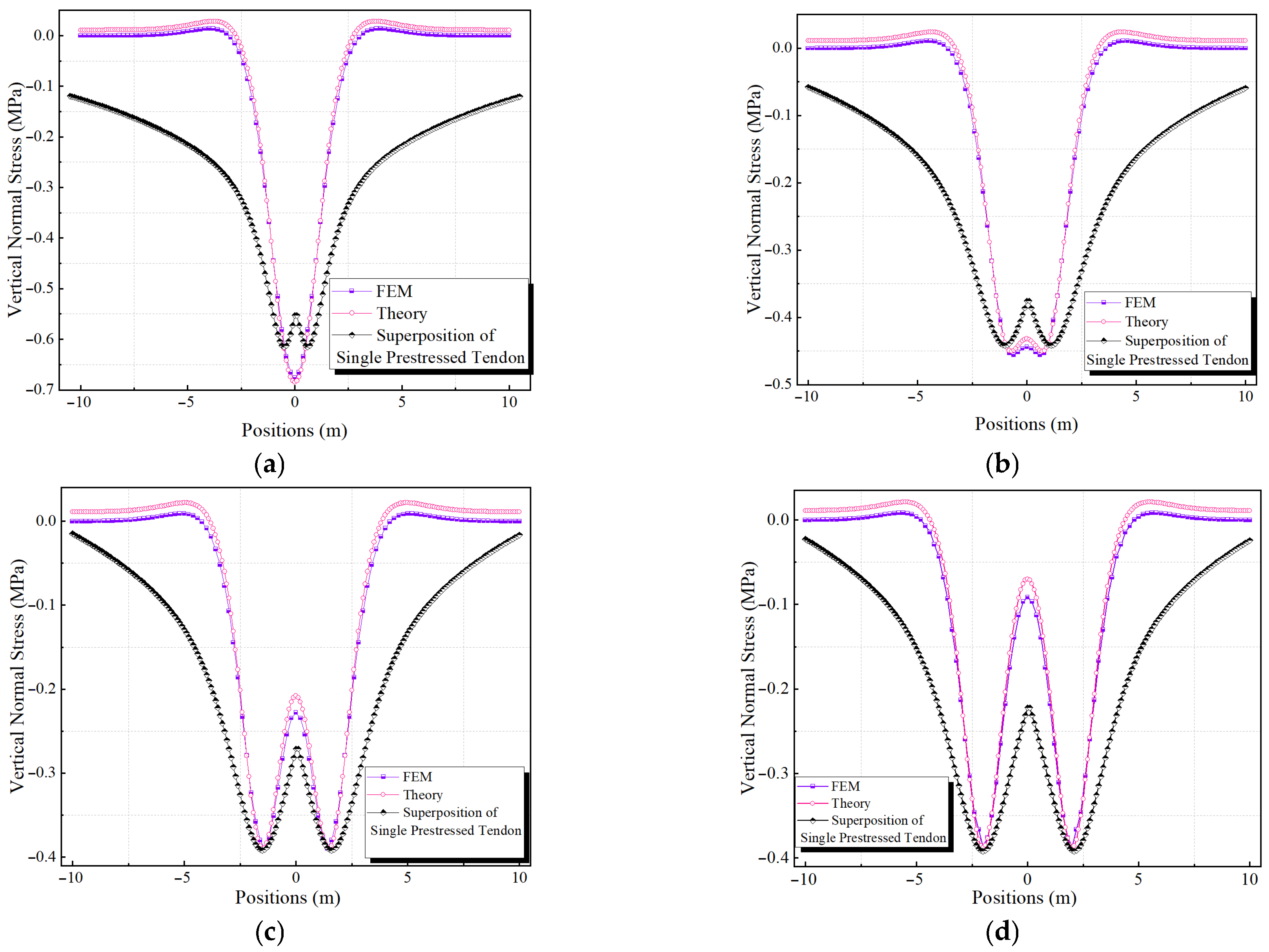
4.1.2. Comparative Validation
4.2. Comparison with Superposition Calculation Results of Single Vertical Normal Stress Formula
4.2.1. Comparative Assessment
4.2.2. Systematic Error Patterns
4.3. Evolution of Stress Distribution and Blind Zone Mechanism
4.3.1. Definition of Stress Uniformity Coefficient
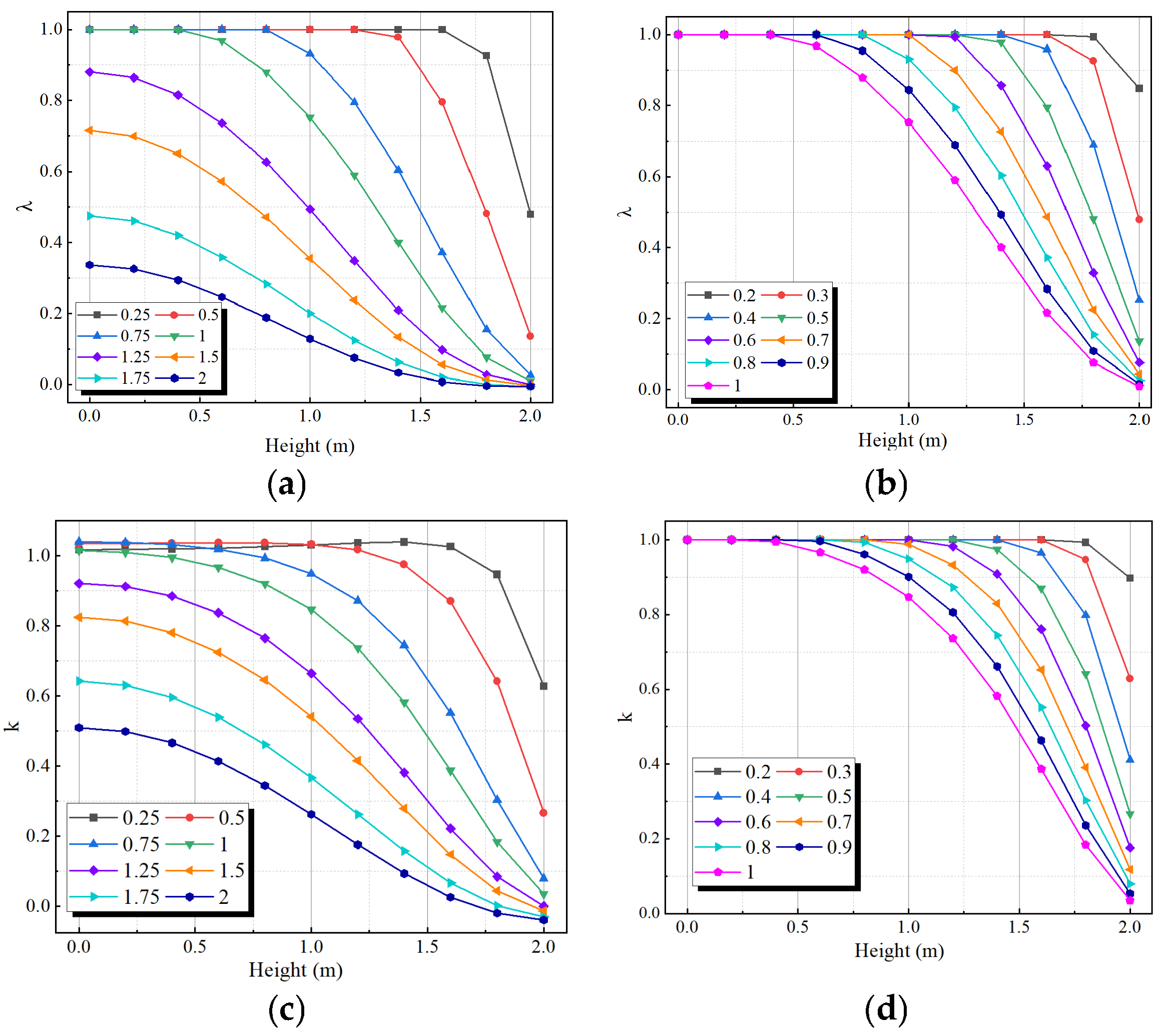
4.3.2. Transition of Stress States
4.3.3. Quantitative Characterization of Prestressing Blind Zone
4.4. Discussion of Verification Limitations
5. Determination of Maximum Vertical Prestressing Spacing
5.1. Mechanism of the Blind Zone and Control Section Selection
5.2. Quantitative Criteria for Stress Uniformity
5.3. Derivation of Maximum Spacing Criterion
5.4. Design Application and Practical Implications
- At mid-span (h = 4.0 m): 2smax = 0.34 × 4.0 = 1.36 m.
- At quarter-span (h ≈ 6.0 m): 2smax0.34 × 6.0 = 2.04 m.
- At the root section (h = 12.5 m): 2smax = 0.34 × 12.5 = 4.25 m.
5.5. Limitations
6. Conclusions
- (1)
- A closed-form elastic analytical solution for the vertical normal stress field under two interacting tendons was successfully derived. Validated against high-fidelity Finite Element Analysis, the solution achieves a Mean Absolute Percentage Error below 6.8%, successfully overcoming the theoretical limitations of conventional single-tendon superposition methods.
- (2)
- The study quantitatively demonstrated that conventional superposition methods introduce systematic errors ranging from 12% to 22%, with unconservative overestimation up to 26% at wide spacings. The proposed two-tendon solution effectively corrects these deviations by accounting for the coupling interaction term, improving prediction accuracy by 6.8–17.7 percentage points compared to conventional methods.
- (3)
- The mechanism of the prestressing blind zone was clarified, identifying three distinct stress regimes: superposition-dominated (spacing-to-height ratio less than 0.3), transition (ratio between 0.3 and 0.34), and diffusion-dominated (ratio greater than 0.34). The blind zone depth follows a linear relationship with the spacing-to-height ratio. The section at one-fourth of the web height below the top edge was identified as the critical control section for evaluating shear safety.
- (4)
- A mechanics-based maximum spacing criterion of 0.34 times the web height was established to maintain a stress uniformity coefficient greater than 0.95. This represents a 27.5% increase over the absolute limit in Chinese code JTG 3362-2018 and a 13.3% increase over common empirical rules. Implementation enables a 13% reduction in tendon quantity (26 fewer tendons per span), translating to estimated savings of 52,000 CNY per typical four-span bridge while maintaining structural safety.
- (5)
- The proposed threshold is justified by a less than 3% reduction in the cracking safety margin, which is well within standard engineering tolerances. Time-dependent effects such as creep and shrinkage may reduce stress uniformity by an estimated 8% to 15% over the service life, indicating the need for further research incorporating viscoelastic material models. Experimental validation on full-scale bridge specimens is recommended before code adoption.
Author Contributions
Funding
Data Availability Statement
Conflicts of Interest
References
- Nguyen, T.X.; Van Ngo, M.; Ng, L.; Pham, D.T. Effect of creep and shrinkage model in calculation of long-term deflection of three-span solid slab continuous prestressed concrete bridge. J. Mater. Eng. Struct. 2022, 9, 427–434. [Google Scholar]
- Hu, Z.; Shah, Y.I.; Yao, P. Experimental and numerical study on interface bond strength and anchorage performance of steel bars within prefabricated concrete. Materials 2021, 14, 3713. [Google Scholar] [CrossRef] [PubMed]
- Shang, S.; Jiang, L.; Dong, Y.; Li, Z.; Pei, R. Trial Design of a Truss Bridge Prefabricated Using a Rectangular Steel Tube—Ultra-High-Performance Concrete Composite. Appl. Sci. 2024, 14, 11244. [Google Scholar] [CrossRef]
- Leng, J.; Yang, J.; Zhang, Z.; Zou, Y.; Chen, J.; Zhou, J. Experimental and numerical investigations on force transfer mechanism of steel-concrete joint in hybrid girder bridges. Structures 2023, 54, 153–170. [Google Scholar] [CrossRef]
- AASHTO. AASHTO LRFD Bridge Design Specifications, 9th ed.; American Association of State Highway and Transportation Officials: Washington, DC, USA, 2020. [Google Scholar]
- Huang, Z.; Yu, W.; Shan, D. Response Characteristics of Irregular Continuous Rigid Frame Bridges with Long-Span and High-Rise Piers under Ground Motion Excitations with Different Fault Distances. Sustainability 2024, 16, 962. [Google Scholar] [CrossRef]
- Wu, D.; Wang, H.; Wang, R.; Lv, C. Crack Resistance of Pre-Stressed Steel-Reinforced Concrete Composite Simple Supported Beams. Buildings 2024, 14, 201. [Google Scholar] [CrossRef]
- Maya, L.; Graybeal, B. Experimental study of strand splice connections in UHPC for continuous precast prestressed concrete bridges. Eng. Struct. 2017, 133, 81–90. [Google Scholar] [CrossRef]
- Wang, Z.; Deng, X.; Luo, X.; Dang, X.; Guo, J. Aftershock fragility assessment of continuous RC girder bridges using a modified damage index. Buildings 2022, 12, 1675. [Google Scholar] [CrossRef]
- Shah, Y.I.; Zhou, H.; Shah, D. Sustainable UHPC wet joints for precast slab: Material efficiency, structural performance, and lifecycle benefits. J. Build. Eng. 2026, 123, 115728. [Google Scholar] [CrossRef]
- Han, X.; Li, W.; Li, P. Long-term deflection analysis of large-span continuous prestressed concrete rigid-frame bridges based on a refined modeling approach. Appl. Sci. 2023, 13, 9727. [Google Scholar] [CrossRef]
- Li, Z.; Song, Y.; Zhao, Y. Analysis of Linear Influence of Long-span PC Continuous Rigid Frame Bridge during the Winter Break. IOP Conf. Ser. Earth Environ. Sci. 2020, 446, 052015. [Google Scholar] [CrossRef]
- EN 1992-1-1; Eurocode 2: Design of Concrete Structures—Part 1-1: General Rules and Rules for Buildings. European Committee for Standardization: Brussels, Belgium, 2004.
- Sun, Y.; Zhan, Y.; Li, P.; Li, Z.; Li, Y.; Zhang, Z. Long-term creep prediction for a PC bridge with stiffened steel truss based on field testing. Adv. Struct. Eng. 2025, 28, 2276–2292. [Google Scholar] [CrossRef]
- Zhao, H.; Luo, S.; Hu, J.; Tan, C.; Qian, P.; Qian, H.; Liao, Z.; Hu, Z.; Yi, D. Experimental investigation on flexural behavior of precast segmental ultra-high-performance concrete box-girder with external tendons for long-span highway bridges. Buildings 2025, 15, 642. [Google Scholar] [CrossRef]
- Zhang, X.; Luo, J.; Dong, Z.; Jiang, L. The influence of shear surface quality on the mechanical properties of long-span prestressed continuous rigid-frame bridge. Int. J. Struct. Integr. 2024, 15, 594–612. [Google Scholar] [CrossRef]
- Chen, D.; Yang, Y.; Liu, P. Analysis of Deflection Problems of Large-span Continuous Rigid Frame Bridge and Prevention Measures. MATEC Web Conf. 2015, 22, 04021. [Google Scholar] [CrossRef]
- Shah, Y.I.; Hu, Z.; Du, R. Stress evaluation of prestressed concrete beam based on cracking and incompatible deformation. J. Civ. Struct. Health Monit. 2022, 12, 1427–1442. [Google Scholar] [CrossRef]
- Ye, X.; Yang, N.; Chen, H.; Yang, M.; Wu, T. Damage Identification and Safety Threshold During the Construction and Operation Phases of Cast-in-Place Continuous Rigid Frame Bridges. Buildings 2025, 15, 3282. [Google Scholar] [CrossRef]
- Zhang, S.; Hu, Z.; Shah, Y.I.; Geng, H. Experimental and numerical analysis of shear-dominated mechanical behavior in large cantilevered PC beams. Structures 2025, 82, 110621. [Google Scholar] [CrossRef]
- Zhang, S.; Hu, Z.; Shah, Y.I.; Feng, X. Shear stress distribution dynamics in large-span PC box girders: Effects of prestress diffusion and axial force gradients. Structures 2026, 86, 111491. [Google Scholar] [CrossRef]
- Zeng, X.; Deng, K.; Wang, Y.; Yan, G.; Zhao, C. Field investigation and numerical analysis of damage to a high-pier long-span continuous rigid frame bridge in the 2008 Wenchuan earthquake. J. Earthq. Eng. 2022, 26, 5204–5220. [Google Scholar] [CrossRef]
- Zhan, J. Key technology on improving the durability of long-span bridges. In Bridge Maintenance, Safety, Management, Life-Cycle Sustainability and Innovations; CRC Press: Boca Raton, FL, USA, 2021; pp. 1218–1224. [Google Scholar]
- Zhang, Y.; Wang, J.; Wu, X.; Yin, J.; Shi, Y. Study on the Shear Lag Calculation Method for Damaged Box Girder. Buildings 2025, 15, 1901. [Google Scholar] [CrossRef]
- Gou, H.; Long, H.; Bao, Y.; Chen, G.; Pu, Q.; Kang, R. Stress distributions in girder-arch-pier connections of long-span continuous rigid frame arch railway bridges. J. Bridge Eng. 2018, 23, 04018039. [Google Scholar] [CrossRef]
- Zhang, Y.; Zhu, Y.; Shao, X.; Li, B. Double-tensioned steel strands vertical prestress system on the webs of long-span PC box-girder bridges. J. Bridge Eng. 2021, 26, 05021005. [Google Scholar] [CrossRef]
- Li, X.; Hu, Z.; Shah, Y.I. Transverse connection performance of prefabricated PC box girder bridge with transverse pre-stress. Int. J. Civ. Eng. 2022, 20, 957–966. [Google Scholar] [CrossRef]
- Ghayeb, H.H.; Sulong, N.H.R.; Razak, H.A.; Mo, K.H.; Ismail, Z.; Hashim, H.; Gordan, M. A review of the seismic performance behaviour of hybrid precast beam-to-column connections. Arch. Civ. Mech. Eng. 2022, 23, 35. [Google Scholar] [CrossRef]
- Liu, F.; Gu, L.; Fu, H.; Li, X.; Zhao, X.; Ma, N.; Guo, Z. Research on the Method of Prestressing Tendon Layout for Large-Span Prestressed Components Continuous Rigid Frame Bridge Based on “Zero Bending Moment Dead Load Theory”. Buildings 2024, 14, 1588. [Google Scholar] [CrossRef]
- Yang, X.L.; Niu, L.M.; Zhang, R.L.; Wei, G.X. Study on web parameters of prestressed concrete composite box girder with corrugated steel web. Adv. Mater. Res. 2011, 255–260, 1087–1091. [Google Scholar] [CrossRef]
- Ouyang, X. Box-Girder Bridges Based on Analytic Hierarchy Process. In Proceedings of the 2025 8th International Conference on Traffic Transportation and Civil Architecture (ICTTCA 2025); Springer Nature: Berlin/Heidelberg, Germany, 2025. [Google Scholar]
- CSA S6:19; Canadian Highway Bridge Design Code. CSA Group: Toronto, ON, Canada, 2019.
- Moldovan, I.; Mathe, A. A Study on a Two-Way Post-Tensioned Concrete Waffle Slab. Procedia Technol. 2016, 22, 227–234. [Google Scholar] [CrossRef]
- Bai, Z.; Zhu, E. Study on the Internal Force and Deformation of Double-System Composite Guideway for Monorail Transit Based on Energy Theory. Urban Rail Transit 2025, 11, 138–177. [Google Scholar] [CrossRef]
- Cao, G.; Han, C.; Dai, Y.; Zhang, W. Long-term experimental study on prestressed steel–concrete composite continuous box beams. J. Bridge Eng. 2018, 23, 04018067. [Google Scholar] [CrossRef]
- Biswal, A.; Prasad, A.M.; Sengupta, A.K. Influence of diagonal reinforcement in grouted vertical joints between precast concrete wall panels, part I: Experimental investigation. Struct. Concr. 2024, 26, 3365–3395. [Google Scholar] [CrossRef]
- Xu, X.; Zhang, F.; Li, S. Research on the influence of the inclination errors of vertically prestressed anchor plates of concrete box beams to it’s prestress loss. In Proceedings of the 2011 International Conference on Electric Technology and Civil Engineering (ICETCE), Lushan, China, 22–24 April 2011; IEEE: Piscataway, NJ, USA, 2011. [Google Scholar]
- fib Model Code for Concrete Structures; fib Model Code 2020; International Federation for Structural Concrete: Lausanne, Switzerland, 2023.
- Japan Society of Civil Engineers (JSCE). Standard Specifications for Concrete Structures—Maintenance; JSCE Guidelines for Concrete No. 17; JSCE: Tokyo, Japan, 2017. [Google Scholar]
- Zhang, L.; Zhou, X.; Li, Y.; Li, Y.; Li, P.; Han, X. Test and correction of effective prestress in bridges based on X-ray diffraction. J. China Foreign Highw. 2025, 45, 194–203. [Google Scholar]
- Shao, X.; Pan, R.; Zhao, H.; Shao, Z. Prestress loss of a new vertical prestressing anchorage system on concrete box-girder webs. J. Bridge Eng. 2014, 19, 210–219. [Google Scholar] [CrossRef]
- JTG 3362-2018; Specifications for Design of Highway Reinforced Concrete and Prestressed Concrete Bridges and Culverts. China Communications Press: Beijing, China, 2018.
- Zhang, K.; Duan, Z.; Liu, Y. Dynamic Parameters identification and finite element model updating for continuous rigid frame bridge. J. Highw. Transp. Res. Dev. (Engl. Ed.) 2009, 4, 53–59. [Google Scholar] [CrossRef]
- Sun, Z.; Shi, Y.; Xiong, W.; Tang, P. Vision-Based Correlated Change Analysis for Supporting Finite Element Model Updating on Curved Continuous Rigid Frame Bridges. In Construction Research Congress 2020; American Society of Civil Engineers: Reston, VA, USA, 2020; pp. 380–389. [Google Scholar]
- Chen, T.; Shen, Y.; Wang, X.; Li, J. Seismic Performance of Rocking Column–Supported Continuous Rigid-Frame Bridge: Phenomenological Damage State Definitions, Computations, and Fragility Assessment. J. Struct. Eng. 2025, 151, 04025158. [Google Scholar] [CrossRef]
- Yang, S.; Hong, Y.; Pu, Q.; Ling, X.; Chen, X.; Wu, K. Mechanical behaviour of steel–concrete joints in railway rigid frame-continuous composite system bridge. J. Constr. Steel Res. 2024, 222, 108946. [Google Scholar] [CrossRef]
- Baran, B. Dynamic response of damaged rigid-frame bridges subjected to moving loads using analytical based formulations. Eng. Comput. 2023, 40, 793–822. [Google Scholar]





| n | σy at x = 0 (MPa) | Change from Previous | Relative Error ϵ |
|---|---|---|---|
| 5 | 6.82 | — | — |
| 10 | 6.91 | +0.09 | 1.30% |
| 20 | 6.94 | +0.03 | 0.43% |
| 30 | 6.948 | +0.008 | 0.12% |
| 40 | 6.949 | +0.001 | 0.014% |
| 50 | 6.950 | +0.001 | 0.009% |
| 100 | 6.951 | +0.001 | 0.004% |
| Material | Parameter | Value | Unit | Notes |
|---|---|---|---|---|
| Concrete (C50) | Elastic Modulus (Ec) | 34.5 | GPa | JTG 3362-2018 |
| Poisson’s Ratio (ν) | 0.2 | – | Typical value | |
| Compressive Strength (fcd) 1 | 22.4 | MPa | Design value for SLS | |
| Density (ρ) | 2500 | kg/m3 | Reinforced concrete | |
| Prestressing Steel (PSB830) | Elastic Modulus (Es) | 200 | GPa | Standard value |
| Yield Strength (fpy) 2 | 785 | MPa | Design value (830/1.05) |
| Mesh Level | Element Size (Far Field) | Element Size (Near Tendon) | Total Elements | σy at (x = s, y = 2.0 m) (MPa) | Relative Change |
|---|---|---|---|---|---|
| Coarse | 0.4 m | 0.2 m | 38,400 | 8.24 | – |
| Medium | 0.2 m | 0.1 m | 124,800 | 8.53 | +3.5% |
| Fine | 0.1 m | 0.05 m | 412,600 | 8.61 | +0.9% |
| Ultra-fine | 0.05 m | 0.025 m | 1,562,400 | 8.63 | +0.2% |
| Configuration | Half-Spacing s (m) | Full Spacing 2s (m) | Spacing-to-Height Ratio 2s/h | Engineering Classification |
|---|---|---|---|---|
| SP-05 | 0.5 | 1.0 | 0.33 | Close spacing |
| SP-10 | 1.0 | 2.0 | 0.67 | Intermediate spacing |
| SP-15 | 1.5 | 3.0 | 1.00 | Wide spacing |
| SP-20 | 2.0 | 4.0 | 1.33 | Very wide spacing |
| Spacing 2s (m) | MAPE (%) | RMSE (MPa) | Peak Error (MPa) | Peak Error (%) |
|---|---|---|---|---|
| 1.0 | 6.8 | 0.41 | 0.21 | 6.2 |
| 2.0 | 5.9 | 0.33 | 0.18 | 5.1 |
| 3.0 | 5.2 | 0.28 | 0.15 | 4.3 |
| 4.0 | 4.7 | 0.24 | 0.12 | 3.8 |
| Spacing 2s (m) | Metric | Proposed Solution | Superposition Method | Improvement |
|---|---|---|---|---|
| 1.0 (close) | MAPE (%) | 6.8 | 18.3 | 11.5 pp |
| Peak error (%) | 6.2 | 21.4 | 15.2 pp | |
| 2.0 (intermediate) | MAPE (%) | 5.9 | 12.7 | 6.8 pp |
| Peak error (%) | 5.1 | 15.8 | 10.7 pp | |
| 3.0 (wide) | MAPE (%) | 5.2 | 15.2 | 10.0 pp |
| Peak error (%) | 4.3 | 18.6 | 14.3 pp | |
| 4.0 (very wide) | MAPE (%) | 4.7 | 22.4 | 17.7 pp |
| Peak error (%) | 3.8 | 26.1 | 22.3 pp |
| Source | Maximum Spacing Criterion | Equivalent 2s/h (h = 3.0 m) | Relative Economy |
|---|---|---|---|
| Proposed criterion | 2s ≤ 0.34 h | 1.02 m | – |
| Chinese JTG 3362-2018 | 2s ≤ 0.8 m | 0.80 m | +27.5% |
| AASHTO LRFD (2017) [5] | 2s ≤ 1.2× slab thickness | N/A | Not comparable |
| Eurocode 2 (2004) [45] | No explicit criterion | N/A | – |
| Common practice (China) | 2s ≤ 0.3 h | 0.90 m | +13.3% |
Disclaimer/Publisher’s Note: The statements, opinions and data contained in all publications are solely those of the individual author(s) and contributor(s) and not of MDPI and/or the editor(s). MDPI and/or the editor(s) disclaim responsibility for any injury to people or property resulting from any ideas, methods, instructions or products referred to in the content. |
© 2026 by the authors. Licensee MDPI, Basel, Switzerland. This article is an open access article distributed under the terms and conditions of the Creative Commons Attribution (CC BY) license.
Share and Cite
Xia, F.; Zhang, S.; Shah, Y.I. Study on Maximum Vertical Prestressing Spacing for Long-Span PC Continuous Rigid-Frame Bridges. Buildings 2026, 16, 1363. https://doi.org/10.3390/buildings16071363
Xia F, Zhang S, Shah YI. Study on Maximum Vertical Prestressing Spacing for Long-Span PC Continuous Rigid-Frame Bridges. Buildings. 2026; 16(7):1363. https://doi.org/10.3390/buildings16071363
Chicago/Turabian StyleXia, Fei, Shenxin Zhang, and Yasir Ibrahim Shah. 2026. "Study on Maximum Vertical Prestressing Spacing for Long-Span PC Continuous Rigid-Frame Bridges" Buildings 16, no. 7: 1363. https://doi.org/10.3390/buildings16071363
APA StyleXia, F., Zhang, S., & Shah, Y. I. (2026). Study on Maximum Vertical Prestressing Spacing for Long-Span PC Continuous Rigid-Frame Bridges. Buildings, 16(7), 1363. https://doi.org/10.3390/buildings16071363