A Multi-Level Analytical Framework for Street Spatial Elements and Its Vitality Mechanisms: A Case Study of Seats on Pingdeng Street, Zhengzhou
Abstract
1. Introduction
2. Materials and Methods
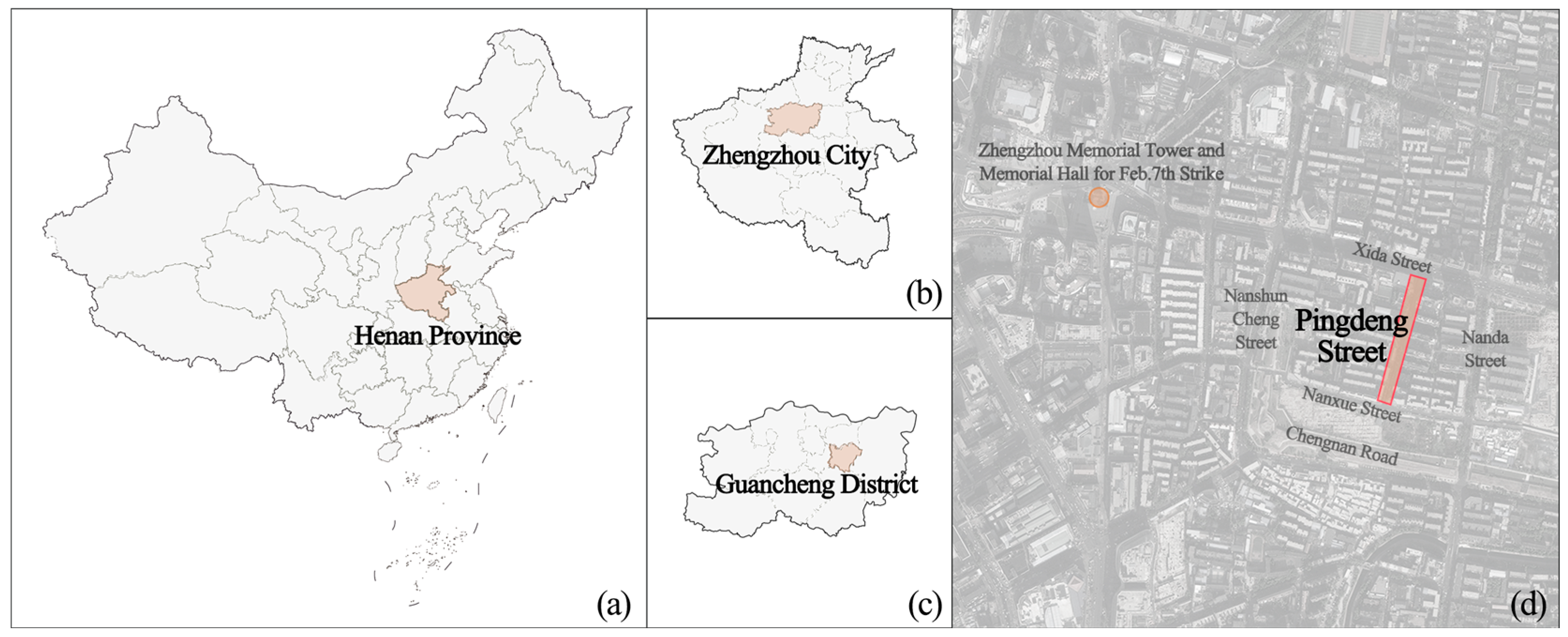
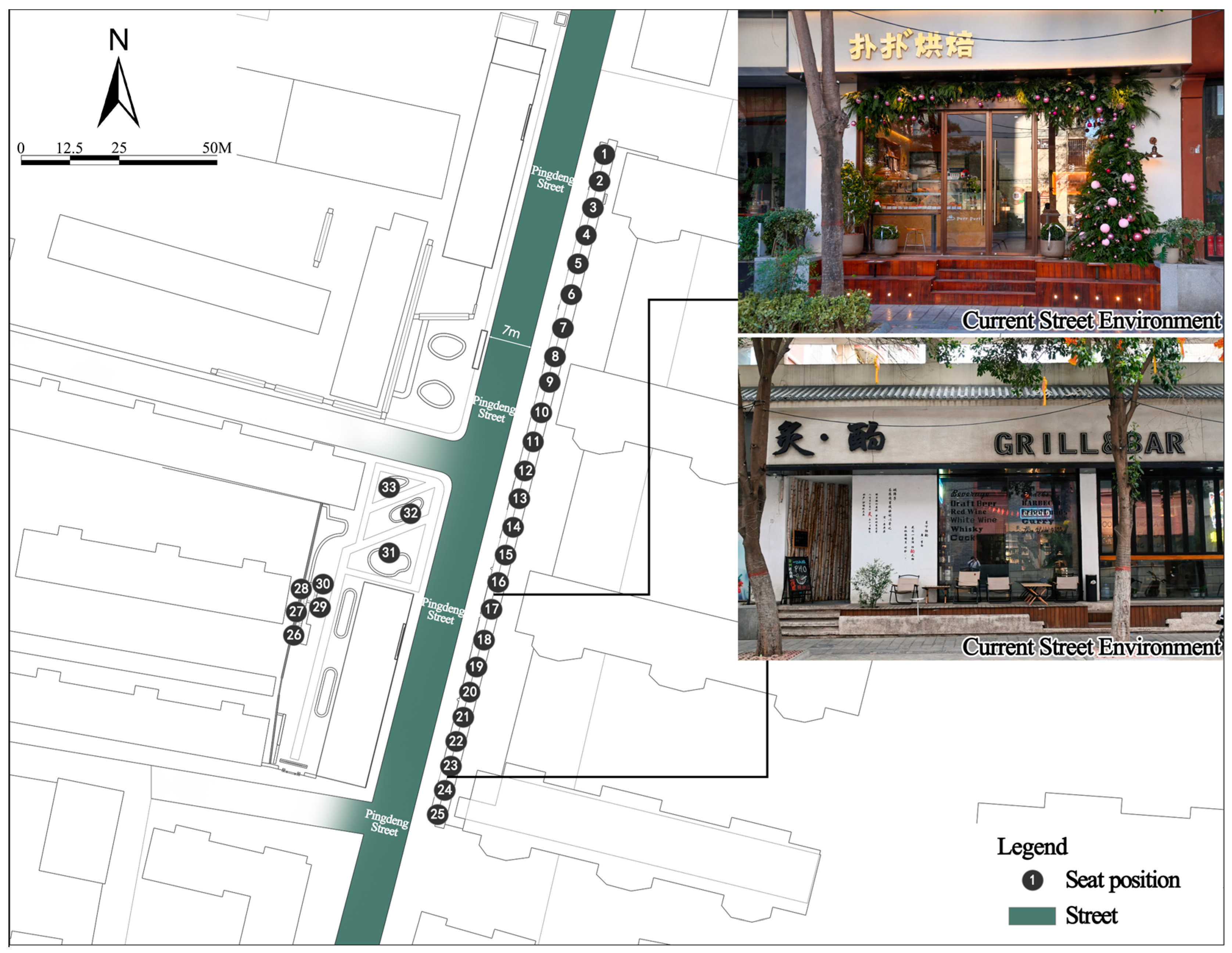
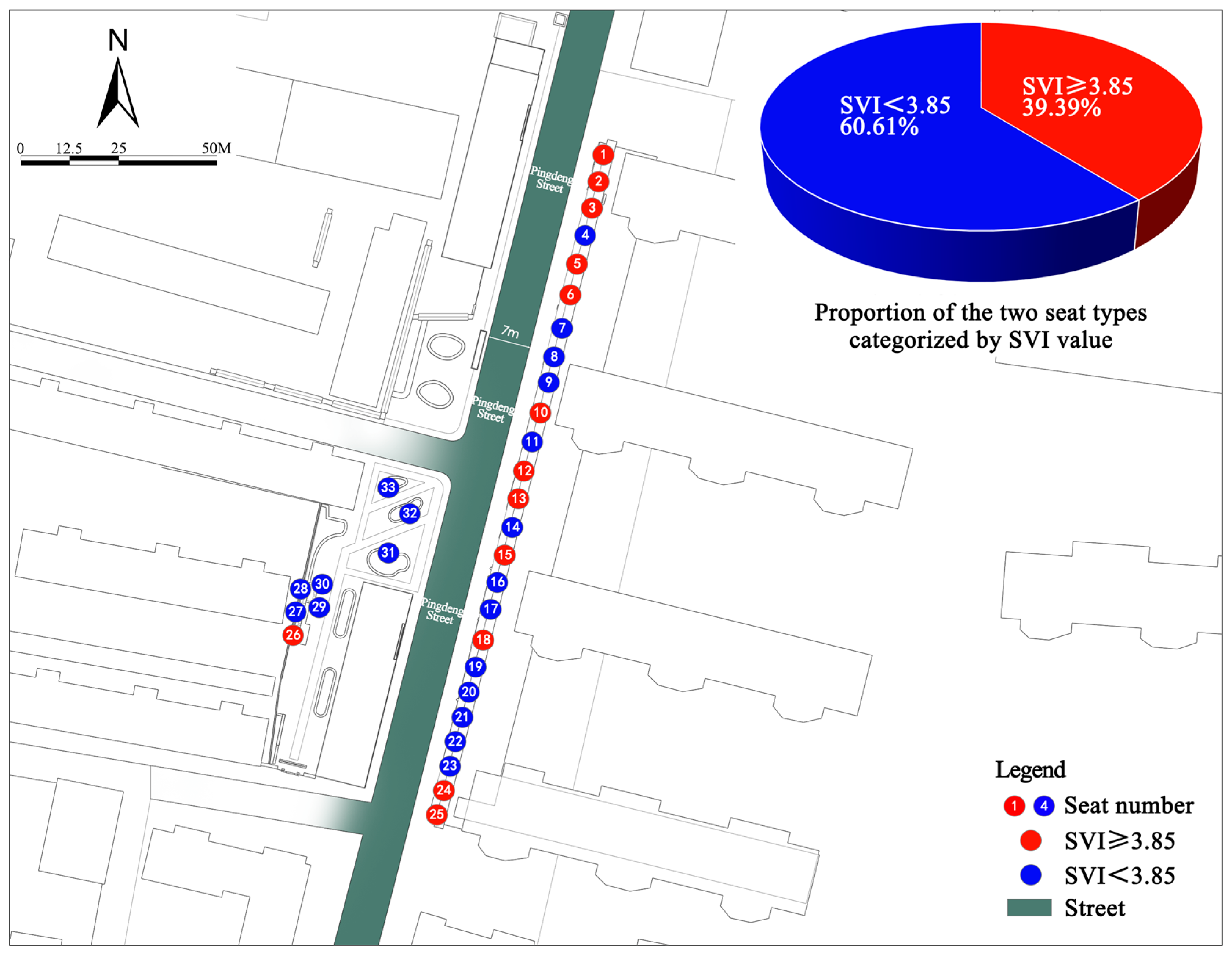
2.1. Study Area and Research Objects
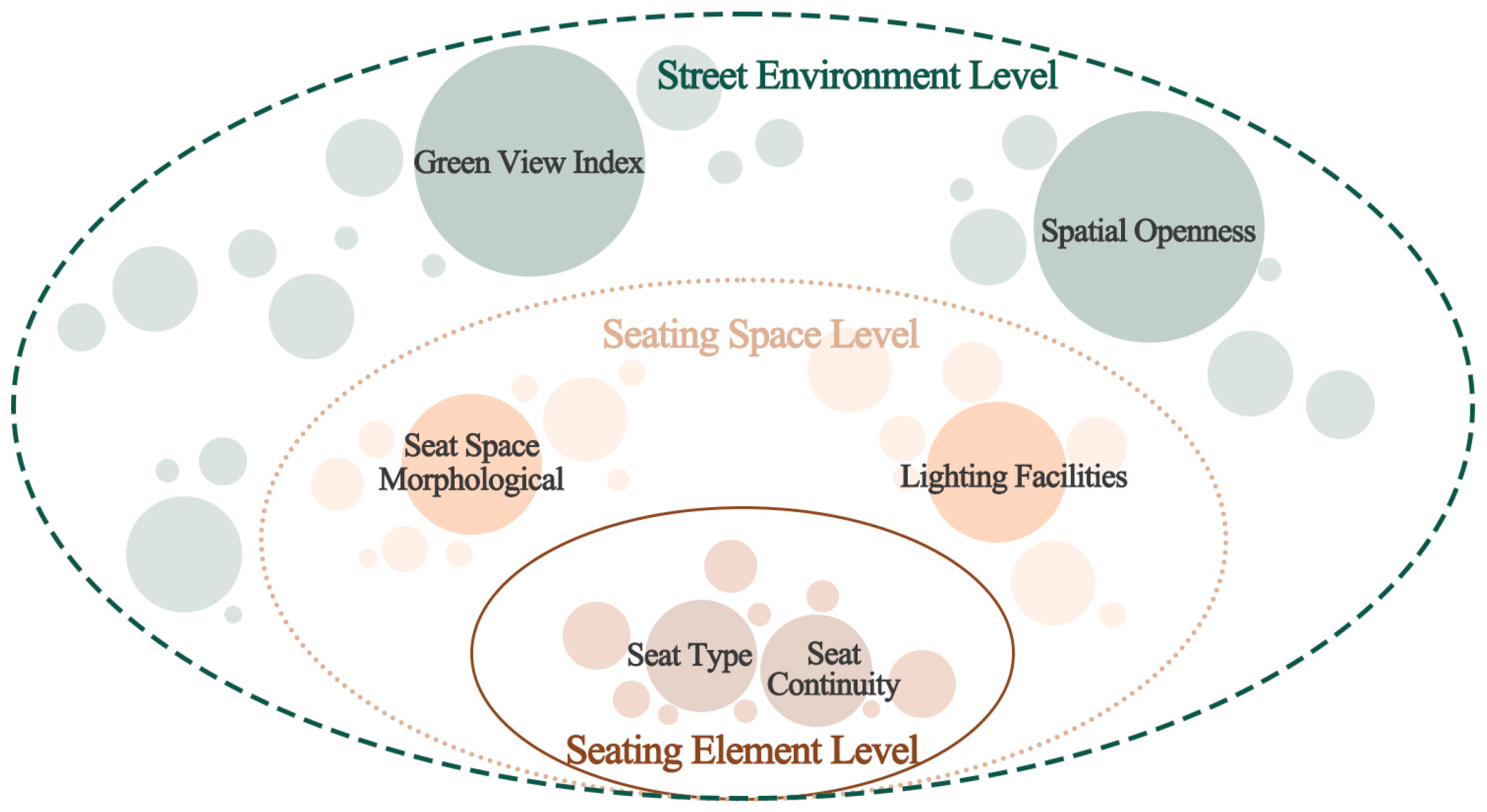
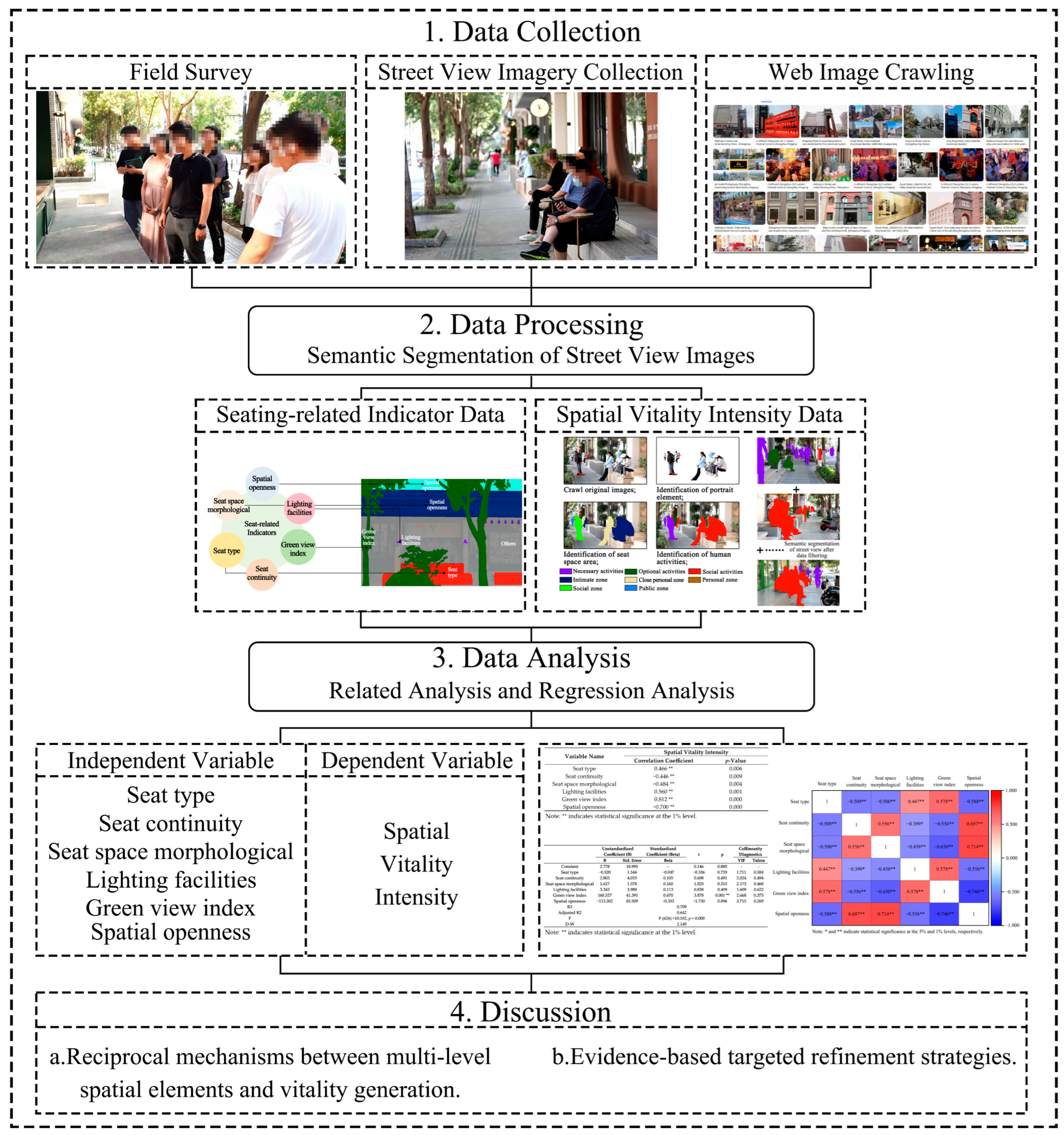
2.2. Research Framework
2.3. Data Collection and Processing of Seating-Related Indicators
2.3.1. Street View Image Acquisition and Pre-Processing
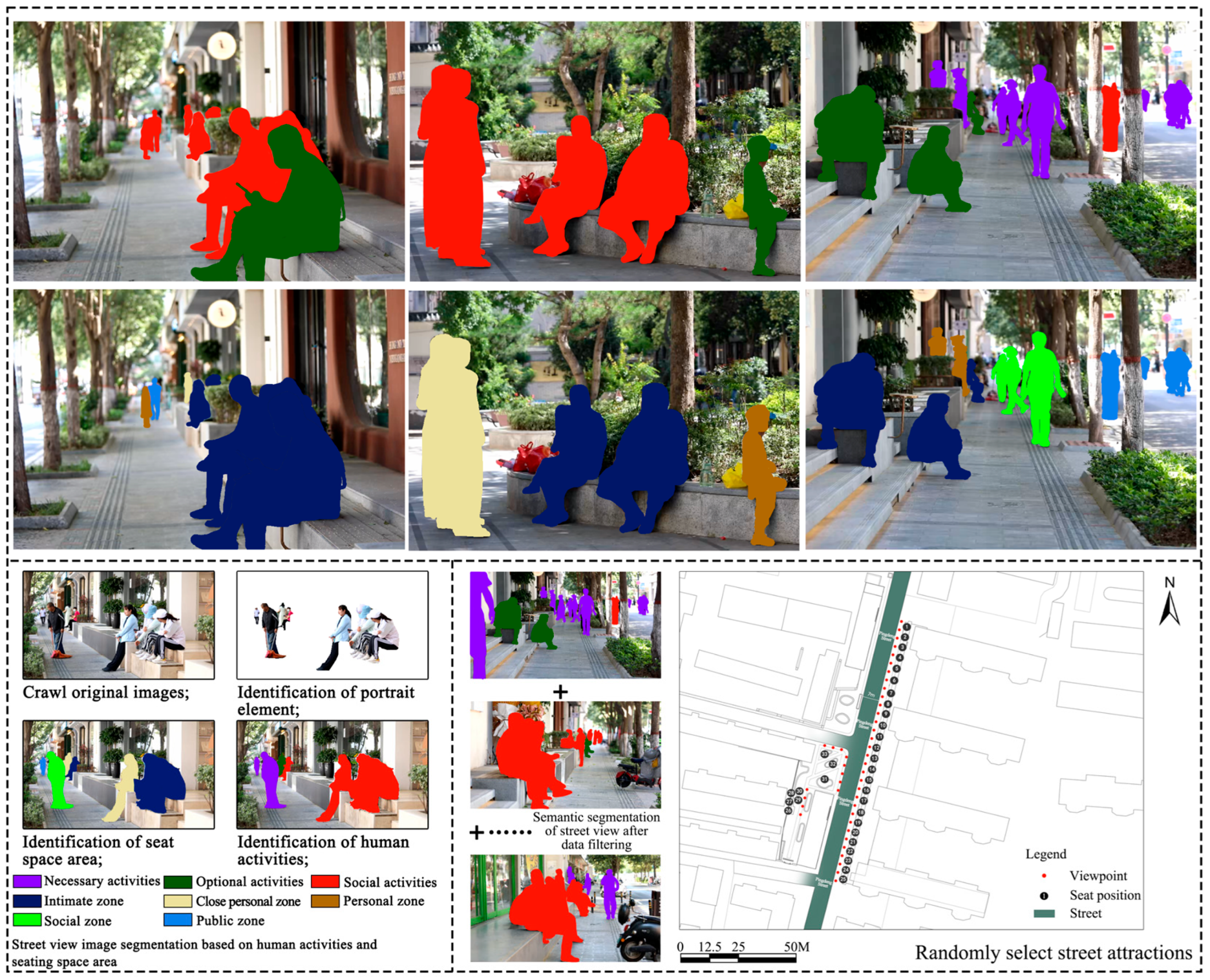
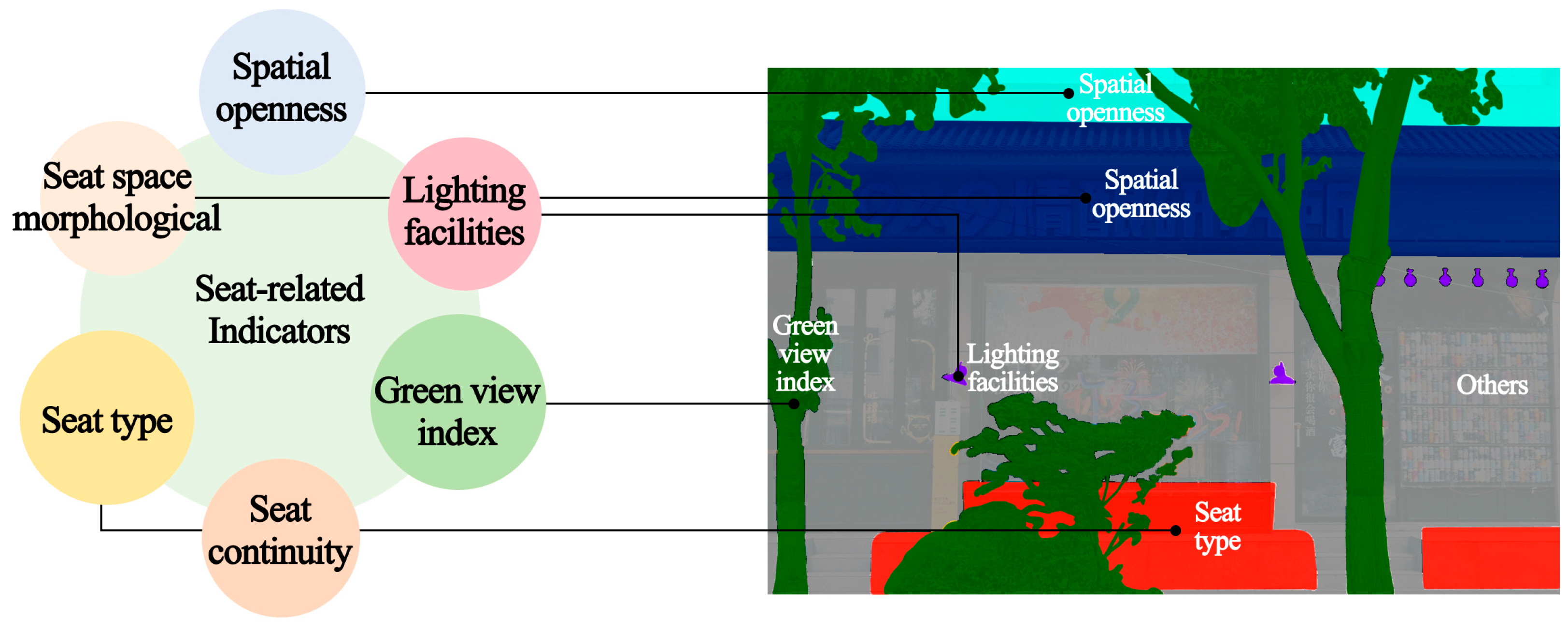
2.3.2. Quantification of Indicators Based on Semantic Segmentation
2.3.3. Indicator Acquisition Based on Field Survey
2.4. Data Collection and Processing of Spatial Vitality Intensity
2.4.1. Image Data Collection
- (1)
- Field survey statistics: Research team members conducted on-site observations and photography during three time periods—morning (8:00–10:00), afternoon (14:00–16:00), and evening (19:00–21:00). They recorded the total pedestrian flow passing each observation point, the number of people staying within seating areas and adjacent spaces, and the primary types of activities observed.
- (2)
- Online image scraping: A Python-based web crawler (Python 3.11) was employed to collect publicly available images from social media platforms, including Douyin, Xiaohongshu, and Weibo [36]. Using “Pingdeng Street” and related landmarks as keywords, images containing relevant tags or textual descriptions were retrieved. A large dataset of valid images was subsequently constructed. These images, voluntarily shared by users, provide visual evidence of actual patterns of spatial use.
2.4.2. Quantification of Image Data Based on Semantic Segmentation
2.4.3. Calculation of Spatial Vitality Intensity
3. Results
3.1. Seating-Related Indicators and Spatial Vitality Intensity
3.1.1. Spatial Vitality Intensity
3.1.2. Seating-Related Indicators
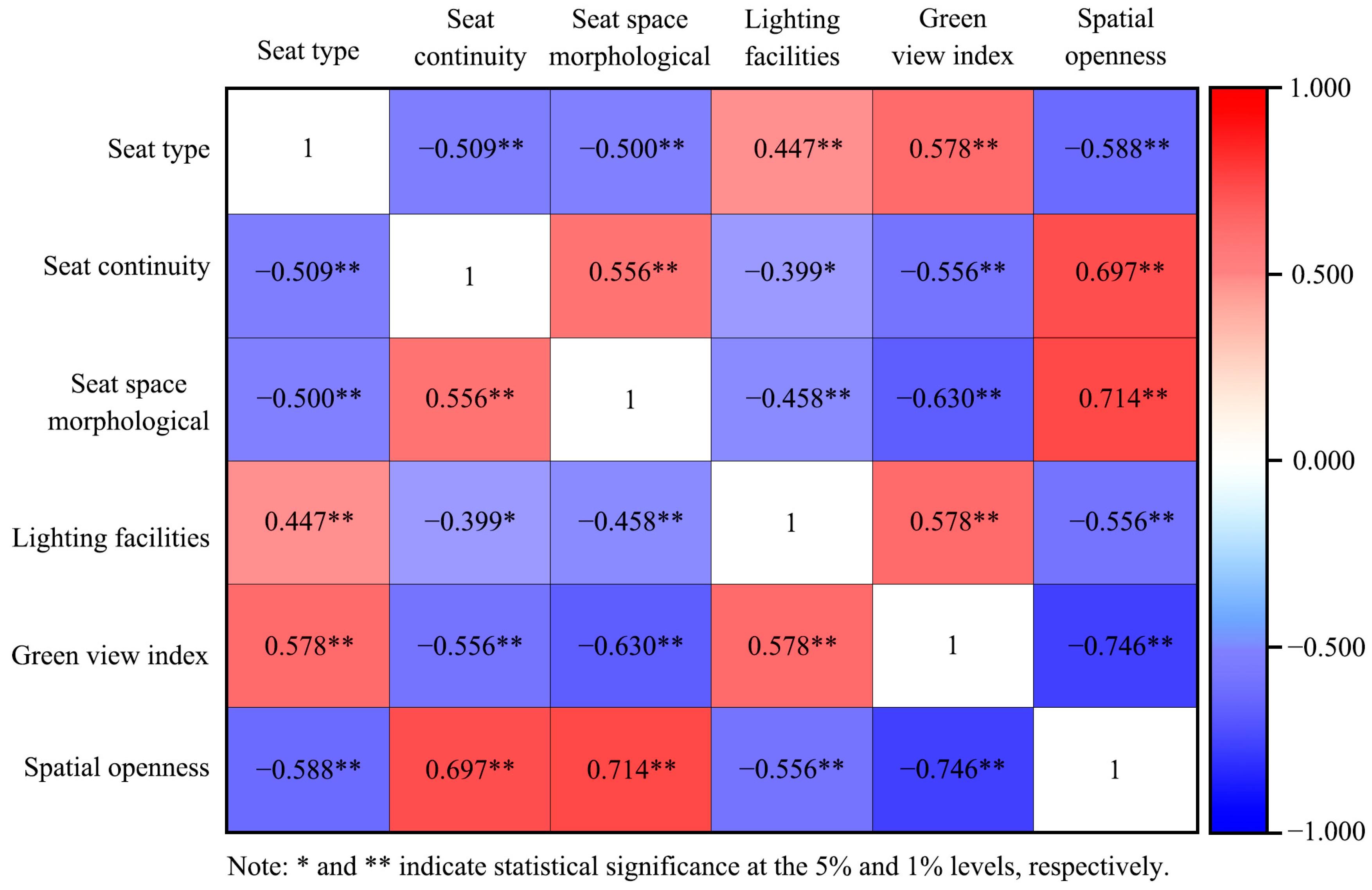
3.2. Correlation and Regression Analysis Between Seating-Related Indicators and Spatial Vitality Intensity
3.2.1. Correlation Analysis: The Influence of Seating at Different Levels on the Intensity of Spatial Vitality
3.2.2. Regression Analysis: Key Indicators of the Impact of Seating on Spatial Vitality Intensity
4. Discussion
4.1. Construction of a Multi-Level Analytical Framework for Street Spatial Elements
4.2. Logic of Element Selection and Driving Mechanisms Across Spatial Typologies
4.3. Systematic Analysis of Impact Factor Extraction and Mechanisms Based on Multi-Source Data Integration
4.4. Translating Design Strategies into Quantitative Threshold Guidelines for Urban Renewal
4.5. Limitations
5. Conclusions
- (1)
- Within the context of living streets such as Pingdeng Street, the GVI at the street environment level represents a key driving factor of vitality enhancement. The vitality-promoting effect is most pronounced when GVI ranges between 28% and 35%.
- (2)
- The synergistic coupling of multi-level elements is critical to maximizing spatial vitality. At the seating ontology level, high-comfort types with backrests should be selected, with seat continuity controlled within 0.63–0.90. At the seating space level, enclosed spatial forms such as eave-covered spaces should be adopted and supplemented with lighting facilities. At the street environment level, GVI should be maintained within 28–35%, and spatial openness should be controlled within 9–18%.
- (3)
- Distinct optimization pathways are required for different functional seating types. Seating associated with commercial catering should prioritize high comfort, adequate lighting provision, and a relatively high GVI. Culturally experiential seating should balance cultural expression with spatial comfort. Independent public recreational seating should enhance environmental adaptability while maintaining inclusiveness.
Author Contributions
Funding
Data Availability Statement
Conflicts of Interest
Abbreviations
| CDA | Commercial Dining-Associated |
| CEA | Cultural Experience-Associated |
| IPR | Independent Public Recreation |
| GVI | Green View Index |
Appendix A. Methods and Procedure for Determining Spatial Vitality Index Weights
Appendix A.1. Determination of Activity Weights (ωt)
Appendix A.1.1. Data Sources and Preliminary Survey Design
Appendix A.1.2. Activity Classification and Coding
Appendix A.1.3. Activity Frequency Statistics
Appendix A.1.4. Expert Consultation and Analytic Hierarchy Process
| Activity Type | Necessary | Spontaneous | Social |
| Necessary | 1 | 1/5 | 1/5 |
| Spontaneous | 5 | 1 | 1 |
| Social | 5 | 1 | 1 |
Appendix A.2. Determination of Spatial-Domain Weights (ωn)
Appendix A.2.1. Theoretical Basis
Appendix A.2.2. Behavioral Annotation Observation
Appendix A.2.3. Weight Calculation Logic
Appendix A.2.4. Expert Validation and Normalization
Appendix A.3. Sensitivity Analysis of Weights
| Weight Adjustment Range | Spearman Correlation with Original Ranking | p-Value |
| ωt ± 10% | 0.96 | <0.01 |
| ωt ± 20% | 0.92 | <0.01 |
| ωn ± 10% | 0.95 | <0.01 |
| ωn ± 20% | 0.91 | <0.01 |
| Both weights ± 10% | 0.93 | <0.01 |
Appendix A.4. Summary of Weights
| Weight Category | Indicator | Weight | Basis for Determination |
| Activity Weights (ωt) | Necessary activities | 0.10 | Behavioral pre-survey (13.0%) + AHP expert evaluation |
| Spontaneous activities | 0.45 | Behavioral pre-survey (44.2%) + AHP expert evaluation | |
| Social activities | 0.45 | Behavioral pre-survey (42.8%) + AHP expert evaluation | |
| Spatial Domain Weights (ωn) | Seat domain (0–0.2 m) | 0.21 | Behavioral annotation (20.7%) + expert validation |
| Intimate distance (0.2–0.5 m) | 0.27 | Behavioral annotation (27.1%) + expert validation | |
| Personal distance (0.5–1.2 m) | 0.18 | Behavioral annotation (18.1%) + expert validation | |
| Social distance (1.2–3.7 m) | 0.24 | Behavioral annotation (24.0%) + expert validation | |
| Public distance (>3.7 m) | 0.10 | Behavioral annotation (10.1%) + expert validation |
References
- Salazar-Miranda, A.; Zhang, F.; Sun, M.; Leoni, P.; Duarte, F.; Ratti, C. Smart curbs: Measuring street activities in real-time using computer vision. Landsc. Urban Plan. 2023, 234, 104715. [Google Scholar] [CrossRef]
- Bai, Z.; Huang, S.; Wang, L.; Qi, J. Refined understanding of street vitality: Comparing the spatial effects of pedestrian vitality and cycling vitality and the spatial heterogeneity of factors. Int. J. Digit. Earth 2025, 18. [Google Scholar] [CrossRef]
- Whyte, W.H. The Social Life of Small Urban Spaces; Ye, Q.; Ni, X., Translators; Shanghai Translation Publishing House: Shanghai, China, 2016; pp. 21–41. [Google Scholar]
- Gehl, J. Life Between Buildings: Using Public Space, 6th ed.; Danish Architectural Press: Copenhagen, Denmark, 2011; pp. 161–166. [Google Scholar]
- Kefale, A.; Fetene, A.; Desta, H. Urban green space cover change analysis using GIS and remote sensing in two rapidly urbanized cities, Debre Berhan and Debre Markos, Ethiopia. Appl. Geomat. 2024, 16, 905–922. [Google Scholar] [CrossRef]
- Sarker, T.; Fan, P.; Messina, J.P.; Mujahid, N.; Aldrian, E.; Chen, J. Impact of urban built-up volume on urban environment: A case of Jakarta. Sustain. Cities Soc. 2024, 105, 105346. [Google Scholar] [CrossRef]
- Hua, C.; Lv, W.; Zhang, Y. Spatiotemporal coupling analysis of street vitality and built environment: A multisource data-driven dynamic assessment model. Sustainability 2025, 17, 9517. [Google Scholar] [CrossRef]
- Chuanglin, F.; Sanwei, H.; Lei, W. Spatial characterization of urban vitality and the association with various street network metrics from the multi-scalar perspective. Front. Public Health 2021, 9, 677910. [Google Scholar] [CrossRef]
- Li, M.; Pan, J. Assessment of influence mechanisms of built environment on street vitality using multisource spatial data: A case study in Qingdao, China. Sustainability 2023, 15, 1518. [Google Scholar] [CrossRef]
- Nathvani, R.; Cavanaugh, A.; Suel, E.; Bixby, H.; Clark, S.N.; Metzler, A.B.; Nimo, J.; Moses, J.B.; Baah, S.; Arku, R.E.; et al. Measurement of urban vitality with time-lapsed street-view images and object-detection for scalable assessment of pedestrian-sidewalk dynamics. ISPRS J. Photogramm. Remote Sens. 2025, 221, 251–264. [Google Scholar] [CrossRef]
- Xu, Y.; Ma, X. Assessing urban street vitality through visual and auditory perception. Int. Rev. Spat. Plan. Sustain. Dev. 2024, 12, 57–76. [Google Scholar] [CrossRef]
- Zhang, J.; Zhou, W.; Lian, H.; Hu, R. Research on optimization strategy of commercial street spatial vitality based on pedestrian trajectories. Buildings 2024, 14, 1240. [Google Scholar] [CrossRef]
- Wu, W.; Niu, X.; Li, M. Influence of built environment on street vitality: A case study of West Nanjing Road in Shanghai based on mobile location data. Sustainability 2021, 13, 1840. [Google Scholar] [CrossRef]
- Nikpour, A.; Yarahmadi, M. Recognizing the components of street vitality as promoting the quality of social life in small urban spaces: Case study: Chamran Street, Shiraz. Sustain. City 2020, 3, 41–54. [Google Scholar] [CrossRef]
- Li, Y.; Yabuki, N.; Fukuda, T. Exploring the association between street built environment and street vitality using deep learning methods. Sustain. Cities Soc. 2022, 79, 103656. [Google Scholar] [CrossRef]
- Jinollo, G.T.; Workalemahu, L.; Adugna, D. Spatial distribution of urban land-use in Addis Ababa, Ethiopia. Urban Plan. Transp. Res. 2024, 12, 2307364. [Google Scholar] [CrossRef]
- Wu, W.; Ma, Z.; Guo, J.; Niu, X.; Zhao, K. Evaluating the effects of built environment on street vitality at the city level: An empirical research based on spatial panel Durbin model. Int. J. Environ. Res. Public Health 2022, 19, 1664. [Google Scholar] [CrossRef] [PubMed]
- Galaktionova, A.; Istrate, A.-L. Assessing street vitality using functional density as a proxy. Environ. Plan. B Urban Anal. City Sci. 2025, 1–16. [Google Scholar] [CrossRef]
- Gómez-Varo, I.; Delclòs-Alió, X.; Miralles-Guasch, C.; Marquet, O. Youth perception of urban vitality: A PhotoVoice study on the everyday experiences of public space. J. Plan. Educ. Res. 2023, 44, 2196–2213. [Google Scholar] [CrossRef]
- Seong, E.Y.; Kim, H.M.; Kang, J.; Choi, C.G. Developing pedestrian cities: The contribution of land readjustment projects to street vitality in Seoul, South Korea. Land Use Policy 2023, 131, 106735. [Google Scholar] [CrossRef]
- Zhang, Y.; Jin, S.T.; Luo, H.; Yu, Y.; Kong, H. Street environments and recovery experience: A cycling perspective analysis using machine learning and natural language processing. Travel Behav. Soc. 2026, 44, 101238. [Google Scholar] [CrossRef]
- Cheng, J.; Hu, L.; Zhang, J.; Lei, D. Understanding the synergistic effects of walking accessibility and the built environment on street vitality in high-speed railway station areas. Sustainability 2024, 16, 5524. [Google Scholar] [CrossRef]
- Khaleghımoghaddam, N. Evaluating the effective architectural factors enhancing sense of vitality in urban spaces. Anadolu Univ. Soc. Sci. J. 2025, 25, 371–396. [Google Scholar] [CrossRef]
- Hiemstra-van Mastrigt, S.; Groenesteijn, L.; Vink, P.; Kuijt-Evers, L.F.M. Predicting passenger seat comfort and discomfort on the basis of human, context and seat characteristics: A literature review. Ergonomics 2017, 60, 889–911. [Google Scholar] [CrossRef] [PubMed]
- Beyaert-Geslin, A. Şehirde birlikte yaşam için koltuklar. TAMGA-Türk. Göstergebilim Araştırmaları Derg. 2023, 1, 14–25. [Google Scholar] [CrossRef]
- Ihtiyar, T.N.; Yücel, G.F. Evaluations of urban seating design criteria in case of Zorlu Center and Margi Outlet Malls. CAP-Cad. Arte Pública Public Art J. 2021, 3, 72–93. [Google Scholar] [CrossRef]
- Aziz, A. Active Behaviour for Social Sustainability Through Street Seating Design in Urban Public Spaces. Ph.D. Thesis, Lancaster University, Lancaster, UK, 2025. [Google Scholar] [CrossRef]
- Rangelov, D.; Waanders, S.; Waanders, K.; van Keulen, M.; Miltchev, R. Impact of Camera Settings on 3D Reconstruction Quality: Insights from NeRF and Gaussian Splatting. Sensors 2024, 24, 7594. [Google Scholar] [CrossRef]
- Larkin, A.; Gu, X.; Chen, L.; Hystad, P. Predicting perceptions of the built environment using GIS, satellite and street view image approaches. Landsc. Urban Plan. 2021, 216, 104257. [Google Scholar] [CrossRef]
- Biljecki, F.; Zhao, T.; Liang, X.; Hou, Y. Sensitivity of measuring the urban form and greenery using street-level imagery: A comparative study of approaches and visual perspectives. Int. J. Appl. Earth Obs. Geoinf. 2023, 122, 103385. [Google Scholar] [CrossRef]
- Yu, L.; Zeng, Z.; Liu, A.; Xie, X.; Wang, H.; Xu, F.; Hong, W. A lightweight complex-valued DeepLabv3+ for semantic segmentation of PolSAR image. IEEE J. Sel. Top. Appl. Earth Obs. Remote Sens. 2022, 15, 930–943. [Google Scholar] [CrossRef]
- Gou, A.; Zhang, C.; Wang, J. Study on the identification and dynamics of green vision rate in Jing’an district, Shanghai based on DeepLab V3+ model. Earth Sci. Inform. 2022, 15, 163–181. [Google Scholar] [CrossRef]
- Lesan, M.; Gjerde, M. Sidewalk design in multi-cultural settings: A study of street furniture layout and design. Urban Des. Int. 2021, 26, 21–41. [Google Scholar] [CrossRef]
- Srikanth, A.D.; Anklesaria, F.; Zhong, Y.; Zhang, X.; Schroepfer, T. Verticality in Urban Spaces: Analysing Seating Preferences and the Spatial Network. In Proceedings of the Space Syntax Symposium 14; Tab Edizioni: Rome, Italy, 2024; pp. 633–653. [Google Scholar]
- Al-Ansari, H.A.; Al-Khafaji, A.S. The role of safety and security in achieving urban space vitality. Int. J. Saf. Sec. Eng. 2024, 14, 613–622. [Google Scholar] [CrossRef]
- Ramalingam, S.P.; Kumar, V. Automatizing the generation of building usage maps from geotagged street view images using deep learning. Build. Environ. 2023, 235, 110215. [Google Scholar] [CrossRef]
- Wang, Y.; Yang, L.; Liu, X.; Yan, P. An improved semantic segmentation algorithm for high-resolution remote sensing images based on DeepLabv3+. Sci. Rep. 2024, 14, 9716. [Google Scholar] [CrossRef]
- Benton, J.S.; Anderson, J.; Pulis, M.; Cotterill, S.; Hunter, R.F.; French, D.P. Method for observing physical activity and wellbeing (MOHAWk): Validation of an observation tool to assess physical activity and other wellbeing behaviours in urban spaces. Cities Health 2022, 6, 818–832. [Google Scholar] [CrossRef]
- Li, X.; Chen, J.; Feng, H.; Brown, R.; Zhu, R. Development and application of a street furniture design evaluation framework: Empirical evidence from the Yangzhou ecological science and technology new town. Buildings 2025, 15, 2973. [Google Scholar] [CrossRef]
- Mumcu, S.; Yılmaz, S.; Düzenli, T. The factors related to the design of open space seating furniture and locations. İnönü Üniversitesi Sanat Ve Tasarım Derg. 2017, 7, 1–16. [Google Scholar] [CrossRef]
- Wang, Z.; Han, C.; Yu, B.; Wei, K.; Li, Y.; Jin, S.; Bai, P. The emotional design of street furniture based on Kano Modeling. Buildings 2024, 14, 3896. [Google Scholar] [CrossRef]
- Mu, X.; Mu, L.; Zhang, J. The impact of street elements on pedestrian stopping behavior in commercial pedestrian streets from the perspective of commercial vitality. Sustainability 2024, 16, 7727. [Google Scholar] [CrossRef]
- Marshall, N.; Bishop, K.; Rahmat, H.; Thompson, S.; Steinmetz-Weiss, C. Smart street furniture: User and non-user perspectives of the ChillOUT hub. Land 2024, 13, 2084. [Google Scholar] [CrossRef]
- Xie, Y.; Zhang, J.; Li, Y.; Zhu, Z.; Deng, J.; Li, Z. Integrating multi-source urban data with interpretable machine learning for uncovering the multidimensional drivers of urban vitality. Land 2024, 13, 2028. [Google Scholar] [CrossRef]
- Li, J.; Kong, N.; Lin, S.; Zeng, J.; Ke, Y.; Chen, J. Spatial nonlinear effects of street vitality constrained by construction intensity and functional diversity—A case study from the streets of Shenzhen. ISPRS Int. J. Geo-Inf. 2024, 13, 238. [Google Scholar] [CrossRef]
- Yücel, G.F.; Uzgör, O. Urban outdoor seating elements, an assessment for the post-pandemic era. SAUC-Str. Art Urban Creat. 2021, 7, 48–65. [Google Scholar] [CrossRef]
- Wang, K.; Shmelova-Nesterenko, O. Design of pedestrian street environments based on behavioral typologies: Pausing and passing. Theory Pract. Design 2025, 35, 120–130. [Google Scholar] [CrossRef]
- Bachanek, K.H.; Tundys, B.; Wiśniewski, T.; Puzio, E.; Maroušková, A. Intelligent street lighting in a smart city concepts—A direction to energy saving in cities: An overview and case study. Energies 2021, 14, 3018. [Google Scholar] [CrossRef]
- Seanders, O.; Fitri, R.; Fauzi, R.; Widjaja, H.; Shadrina, N.N.; Harlisana, R.H.; Besari, R.B. Mapping the landscape potential of Jakarta’s Old Town area based on the spirit of place’s concept. IOP Conf. Ser. Earth Environ. Sci. 2024, 1356, 012057. [Google Scholar] [CrossRef]
- Simončič, A.; Mohorčič, M.; Mohorčič, M.; Hrovat, A. Non-intrusive privacy-preserving approach for presence monitoring based on WiFi probe requests. Sensors 2023, 23, 2588. [Google Scholar] [CrossRef]
- Huang, Q.; Yang, Y.; Xu, Y.; Yang, F.; Yuan, Z.; Sun, Y. Citywide road-network traffic monitoring using large-scale mobile signaling data. Neurocomputing 2021, 444, 136–146. [Google Scholar] [CrossRef]
- Galaktionova, A.; Istrate, A.-L.; Carroll, P. A systematic review of regression models for street vitality. J. Urban Mobil. 2025, 8, 100158. [Google Scholar] [CrossRef]
- Huang, Y.; Chen, M.; Zhang, X.; Shimoda, R.; Yang, R. Multi-scale street vitality analytics: A comprehensive review of technologies, data, and applications. Buildings 2025, 15, 3987. [Google Scholar] [CrossRef]
- Liu, L.; Dong, Y.; Lang, W.; Yang, H.; Wang, B. The impact of commercial-industry development of urban vitality: A study on the central urban area of Guangzhou using multisource data. Land 2024, 13, 250. [Google Scholar] [CrossRef]
- Xu, Y.; Yang, J.; Zheng, Y.; Li, W. Impacts of two-dimensional and three-dimensional urban morphology on urban thermal environments in high-density cities: A case study of Hong Kong. Build. Environ. 2024, 252, 111249. [Google Scholar] [CrossRef]
- Xie, Q.; Cai, C.; Jiang, Y.; Zhang, H.; Wu, Z.; Xu, J. Investigating the performance of SDGSAT-1/GIU and NPP/VIIRS nighttime light data in representing nighttime vitality and its relationship with the built environment: A comparative study in Shanghai, China. Ecol. Indic. 2024, 160, 111945. [Google Scholar] [CrossRef]
- Wang, X.; Mo, J.; Zhou, Y.; Long, Z. Psychophysiological Effects of Shooting Tree Light Colors on Alertness: A Controlled Laboratory Study. Buildings 2025, 15, 2907. [Google Scholar] [CrossRef]
- Gao, J.; Xie, J.; Liu, F.; Huang, Y.; Zhang, B. Pedestrian–environment interactions: Multivariate data-based correlations between street morphology and urban vitality. J. Urban Plan. Dev. 2026, 152, 05025047. [Google Scholar] [CrossRef]
- Chen, H. Strategies of Enhancing the Vitality of Pedestrian Spaces Based on Multi-Factor Assessment. Doctoral Dissertation, Politecnico di Torino, Turin, Italy, 2022. [Google Scholar]
- Hall, E.T. The Hidden Dimension; Anchor Books: New York, NY, USA, 1988; pp. 116–124. [Google Scholar]






| Variable Name | Formula | Expression | Definition |
|---|---|---|---|
| Seat type | — | A 5-level quantification standard was adopted: seats with backrests were assigned 5 points; those incorporating small tables were assigned 4 points; seats without backrests were assigned 3 points; foldable seats were assigned 2 points; and integrated bench-type seating (e.g., along planter edges) was assigned 1 point. | Characterize the functional configurations and comfort attributes of seating, and quantify the supporting capacity of different seat types for people’s willingness to sit. |
| Seat continuity | denotes the angle formed between the i-th seat and the two adjacent seats in front and behind, and represents the distance between the i-th seat and the preceding seat. | Used to measure the continuity and clustering characteristics of seating arrangements within street spaces. | |
| Seat space morphological | — | A six-level quantitative scoring system was adopted: overhanging spaces were assigned 1 point; recessed spaces were assigned 2 points; platform spaces were assigned 3 points; hybrid spaces were assigned 4 points; setback spaces were assigned 5 points; and open spaces were assigned 6 points. | Characterize the enclosure and shelter features of the space surrounding seating areas, and quantify the impact of spatial morphology on the comfort level of people’s lingering. |
| Lighting facilities | = The number of lighting facilities | — | Quantify the actual number of lighting facilities within a 5-m radius around the seating area, including street lights, landscape lights, and supplementary lighting from shops, to reflect the nighttime usability and safety conditions of the seating space. |
| Green view index | represents the number of valid images collected at the j-th seating space, denotes the area of green vegetation in the i-th image, and is the total area of the i-th image. | Indicates the proportion of green vegetation visible in the human field of view, reflecting the visibility of natural elements within the street environment. | |
| Spatial openness | represents the number of valid images collected at the j-th seating space, denotes the area of the sky region in the i-th image, and is the total area of the i-th image. | Analyzed the proportion of the sky area within the field of view, representing the degree of spatial openness perceived by a person at a specific seating location. |
| Type | Count/Rate | SVI-Max | SVI-Min | SVI-Average |
|---|---|---|---|---|
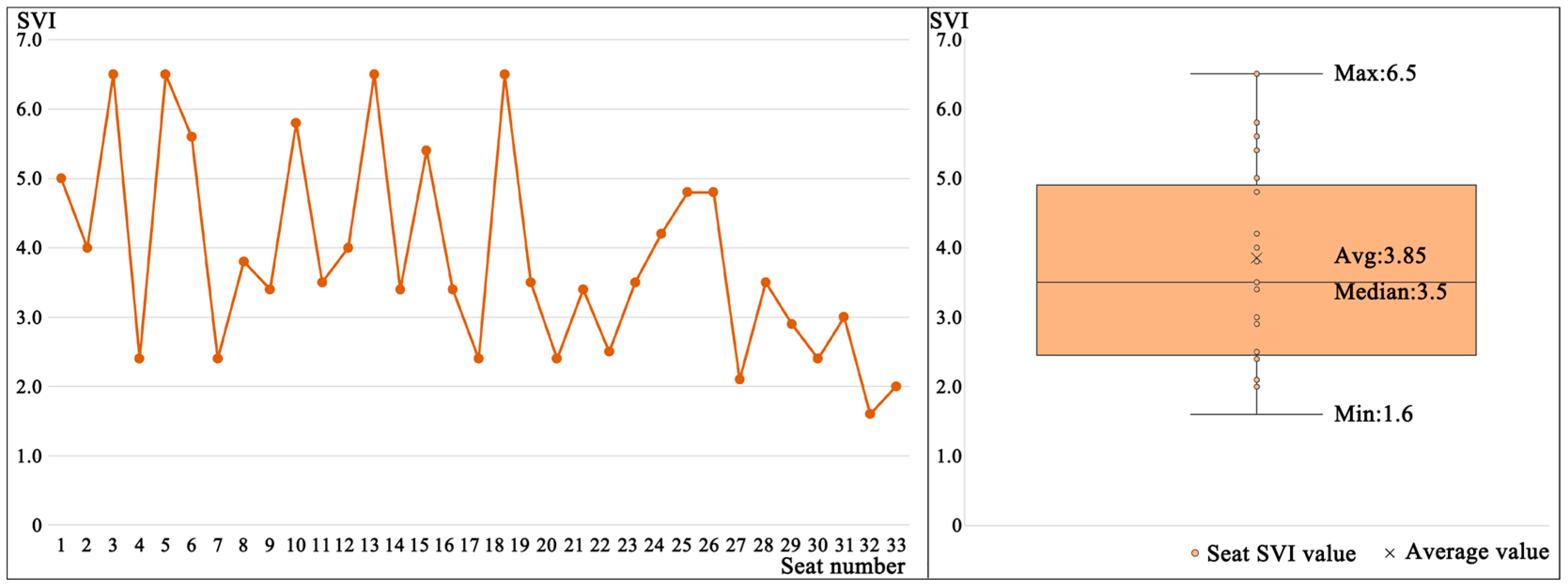
| Commercial & dining affiliated | 16/48.5% | 6.5 | 2.4 | 4.4 |
| Cultural experience affiliated | 9/27.3% | 6.5 | 2.4 | 3.8 |
| Independent public recreation | 8/24.2% | 4.8 | 1.6 | 2.8 |
| Variable Name | Commercial & Dining Affiliated | Cultural Experience Affiliated | Independent Public recreation |
|---|---|---|---|
| Seat type | 4.19 | 4.33 | 2.25 |
| Seat continuity | 0.67 | 0.83 | 1.47 |
| Seat space morphological | 2.69 | 2.89 | 5.38 |
| Lighting facilities | 0.88 | 0.67 | 0.13 |
| Green view index | 0.31 | 0.30 | 0.22 |
| Spatial openness | 0.14 | 0.14 | 0.22 |
| Variable Name | Spatial Vitality Intensity | |
|---|---|---|
| Correlation Coefficient | p-Value | |
| Seat type | 0.466 ** | 0.006 |
| Seat continuity | −0.446 ** | 0.009 |
| Seat space morphological | −0.484 ** | 0.004 |
| Lighting facilities | 0.560 ** | 0.001 |
| Green view index | 0.812 ** | 0.000 |
| Spatial openness | −0.700 ** | 0.000 |
| Unstandardized Coefficient (B) | Standardized Coefficient (Beta) | t | p | Collinearity Diagnostics | ||||||
|---|---|---|---|---|---|---|---|---|---|---|
| B | Std. Error | Beta | VIF | Tolera | ||||||
| Constant | 2.778 | 18.995 | - | 0.146 | 0.885 | - | - | |||
| Seat type | −0.520 | 1.546 | −0.047 | −0.336 | 0.739 | 1.711 | 0.584 | |||
| Seat continuity | 2.803 | 4.015 | 0.105 | 0.698 | 0.491 | 2.024 | 0.494 | |||
| Seat space morphological | 1.617 | 1.578 | 0.160 | 1.025 | 0.315 | 2.173 | 0.460 | |||
| Lighting facilities | 3.345 | 3.989 | 0.113 | 0.838 | 0.409 | 1.609 | 0.622 | |||
| Green view index | 160.527 | 41.391 | 0.670 | 3.878 | 0.001 ** | 2.668 | 0.375 | |||
| Spatial openness | −113.302 | 65.509 | −0.353 | −1.730 | 0.096 | 3.715 | 0.269 | |||
| R2 | 0.709 | |||||||||
| Adjusted R2 | 0.642 | |||||||||
| F | F (626) = 10.552, p = 0.000 | |||||||||
| D-W | 2.149 | |||||||||
Disclaimer/Publisher’s Note: The statements, opinions and data contained in all publications are solely those of the individual author(s) and contributor(s) and not of MDPI and/or the editor(s). MDPI and/or the editor(s) disclaim responsibility for any injury to people or property resulting from any ideas, methods, instructions or products referred to in the content. |
© 2026 by the authors. Licensee MDPI, Basel, Switzerland. This article is an open access article distributed under the terms and conditions of the Creative Commons Attribution (CC BY) license.
Share and Cite
Song, Y.; Shi, H.; Liu, C.; Bai, Q.; Li, J. A Multi-Level Analytical Framework for Street Spatial Elements and Its Vitality Mechanisms: A Case Study of Seats on Pingdeng Street, Zhengzhou. Buildings 2026, 16, 1362. https://doi.org/10.3390/buildings16071362
Song Y, Shi H, Liu C, Bai Q, Li J. A Multi-Level Analytical Framework for Street Spatial Elements and Its Vitality Mechanisms: A Case Study of Seats on Pingdeng Street, Zhengzhou. Buildings. 2026; 16(7):1362. https://doi.org/10.3390/buildings16071362
Chicago/Turabian StyleSong, Yating, Hongfei Shi, Cuiping Liu, Qingtao Bai, and Jiandong Li. 2026. "A Multi-Level Analytical Framework for Street Spatial Elements and Its Vitality Mechanisms: A Case Study of Seats on Pingdeng Street, Zhengzhou" Buildings 16, no. 7: 1362. https://doi.org/10.3390/buildings16071362
APA StyleSong, Y., Shi, H., Liu, C., Bai, Q., & Li, J. (2026). A Multi-Level Analytical Framework for Street Spatial Elements and Its Vitality Mechanisms: A Case Study of Seats on Pingdeng Street, Zhengzhou. Buildings, 16(7), 1362. https://doi.org/10.3390/buildings16071362