Seismic Response and Mitigation Measures of Large Unequal-Span Subway Station Structures in Liquefiable Sites


Abstract
1. Introduction
2. Numerical Model
3. Results
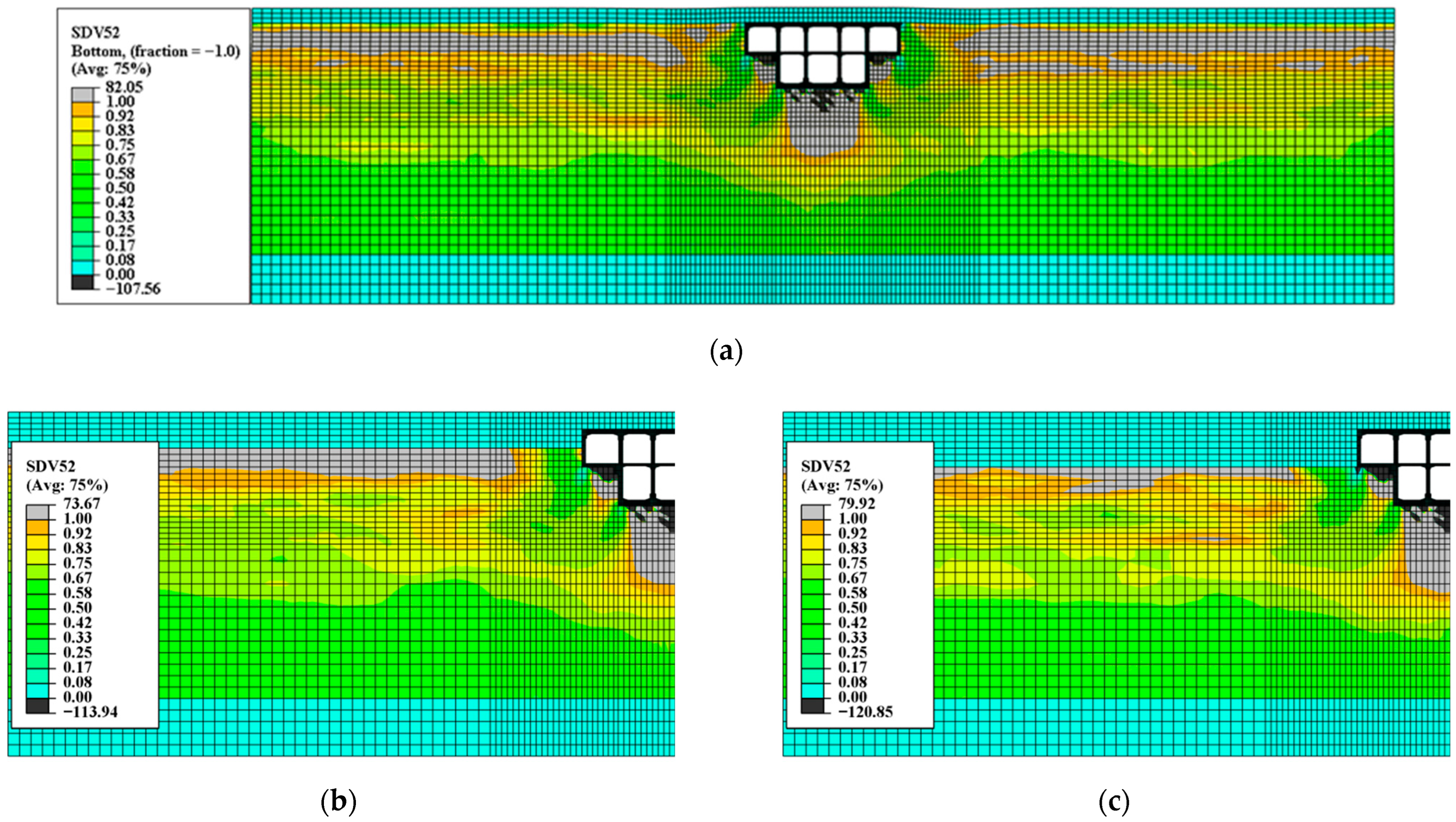
3.1. Site Liquefaction
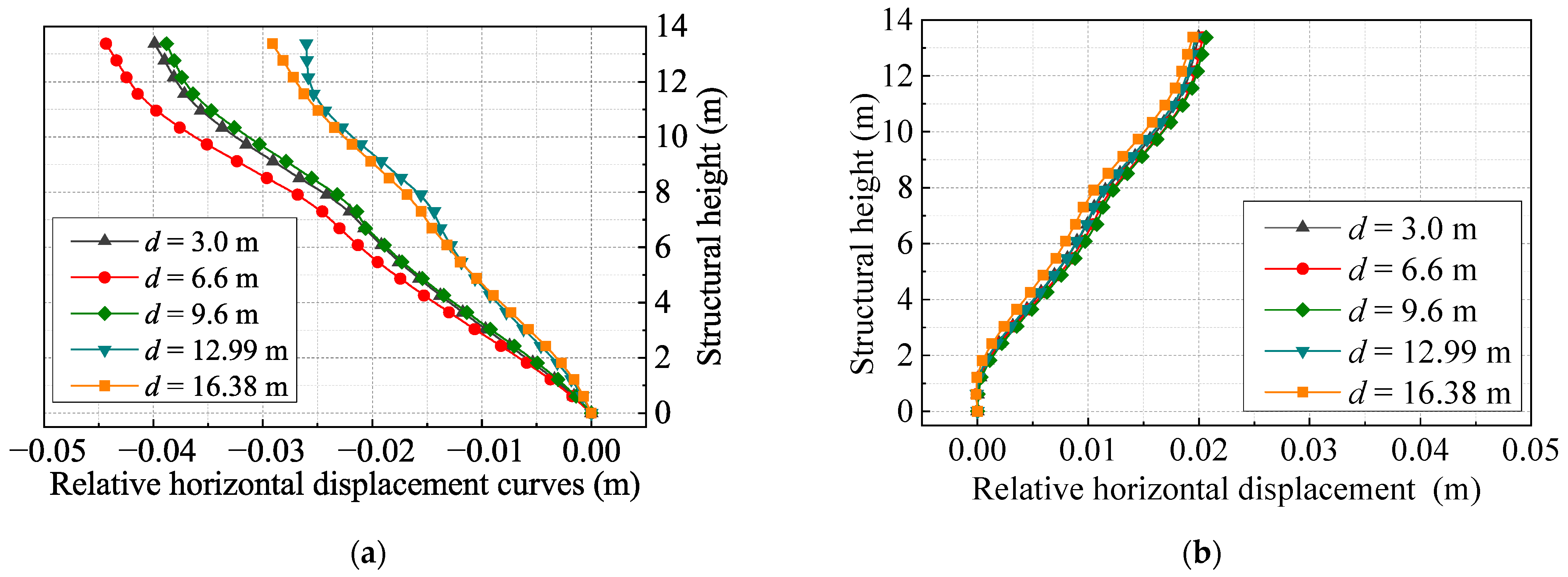
3.2. Structural Deformation
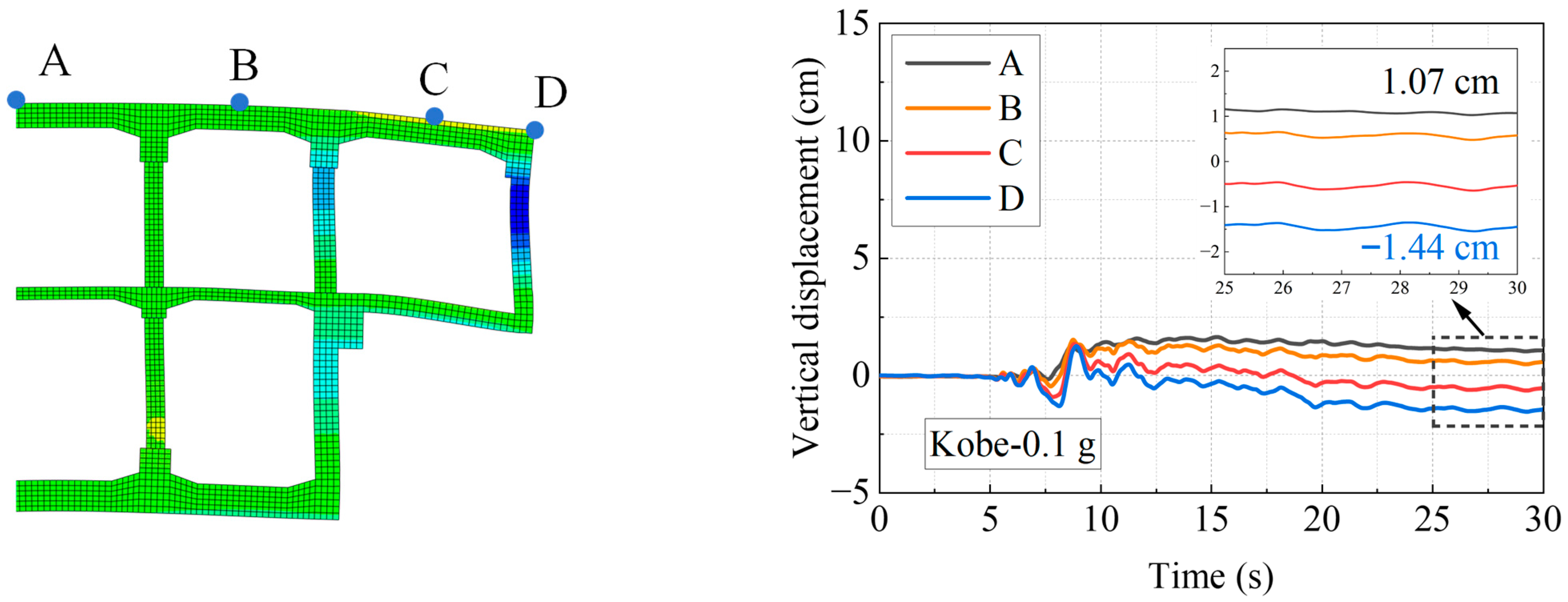
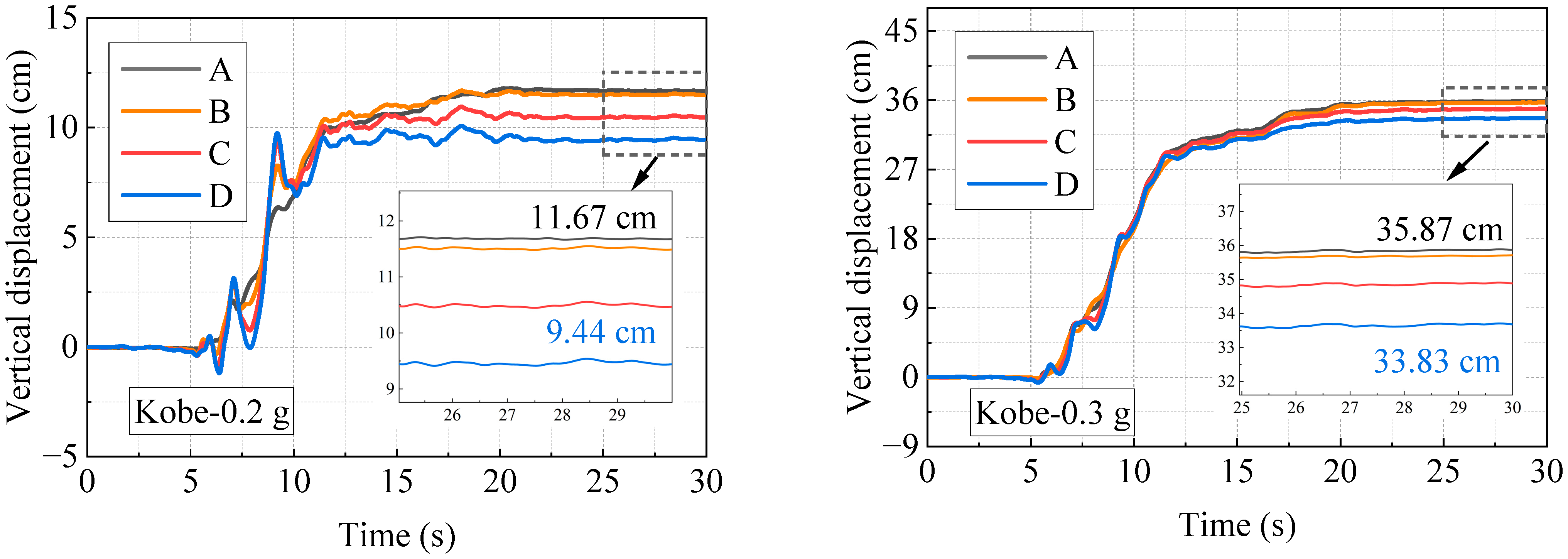
3.3. Structural Uplift
4. Anti-Uplift Measure
4.1. Numerical Modeling of Foundation Reinforcement
4.2. Site Liquefaction After Reinforcement
4.3. Structural Uplift After Reinforcement
5. Conclusions
- (1)
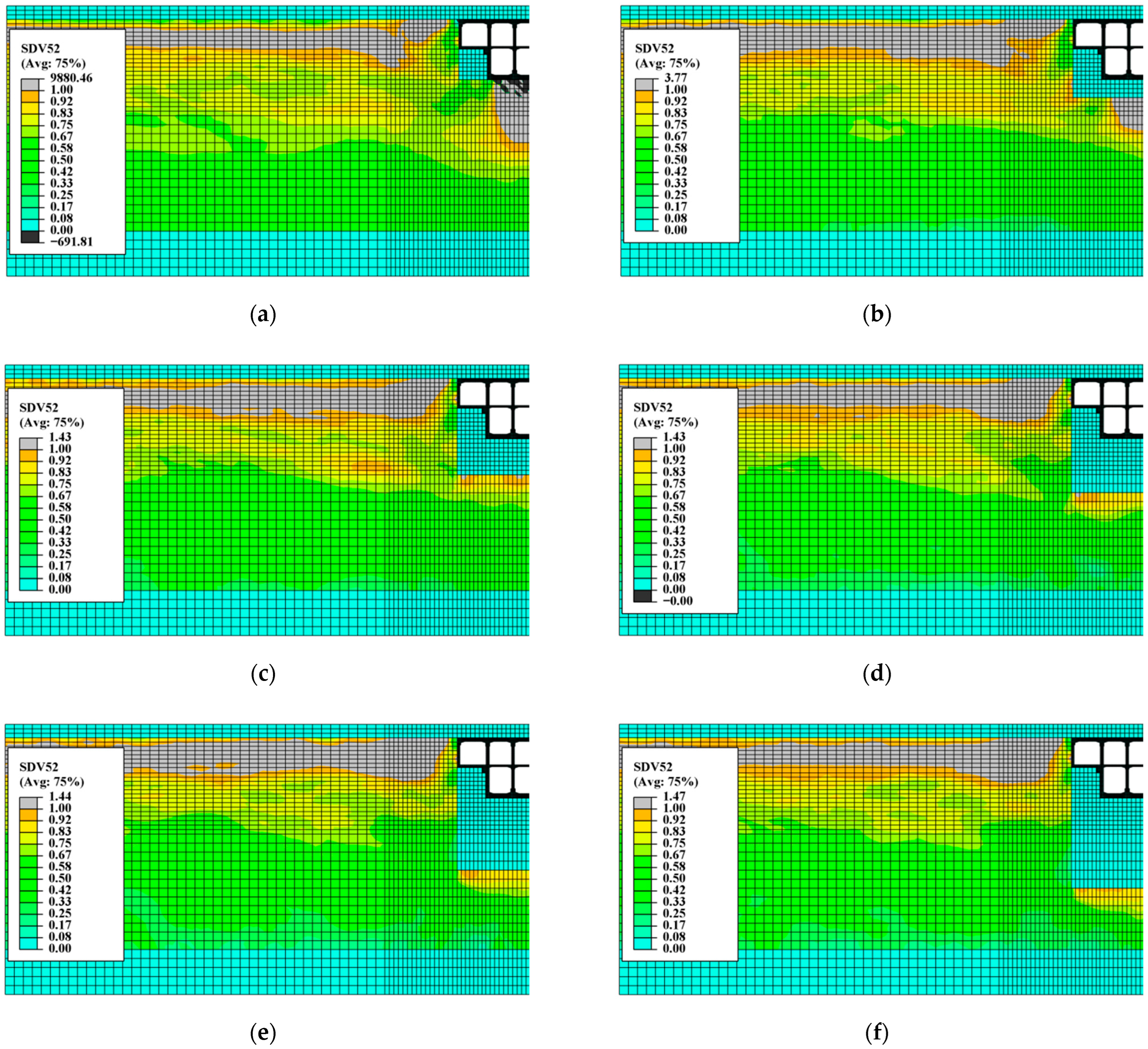
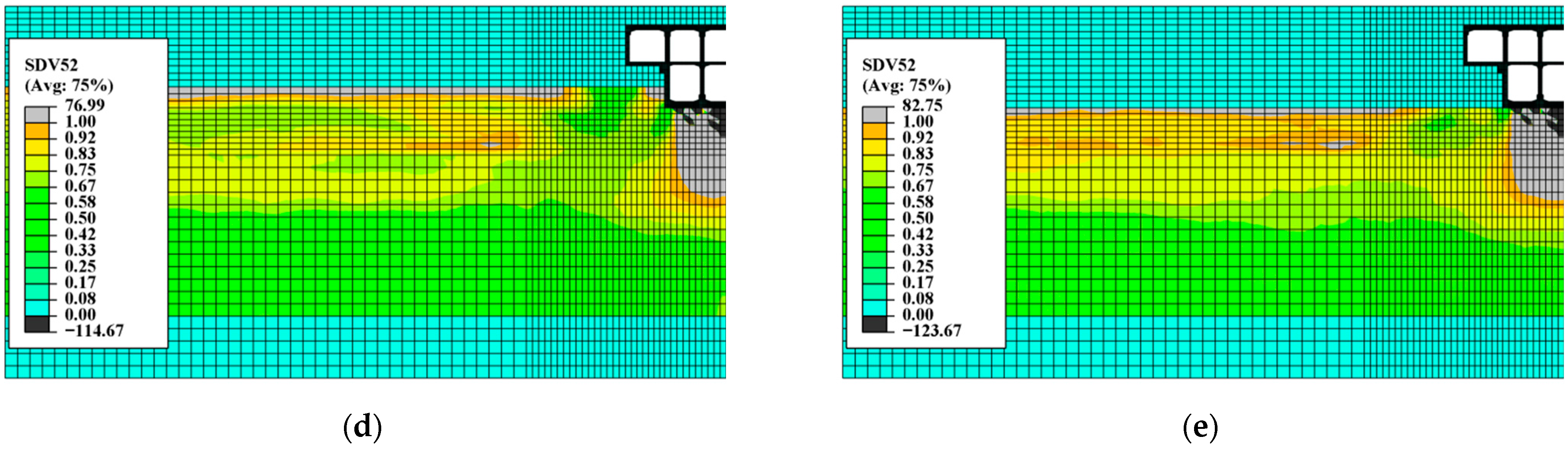
- The unequal-span subway station structure inhibits liquefaction in the lateral foundation zones, while significant liquefaction occurs beneath the base and cantilevered slabs. Specifically, the liquefaction zone under the cantilevered slabs is restricted to the height of the lower story. In contrast, the liquefaction depth beneath the base slab is extensive and increases progressively with seismic intensity. Furthermore, the burial depth of the liquefiable layer has a negligible impact on the liquefaction state directly beneath the center span.
- (2)
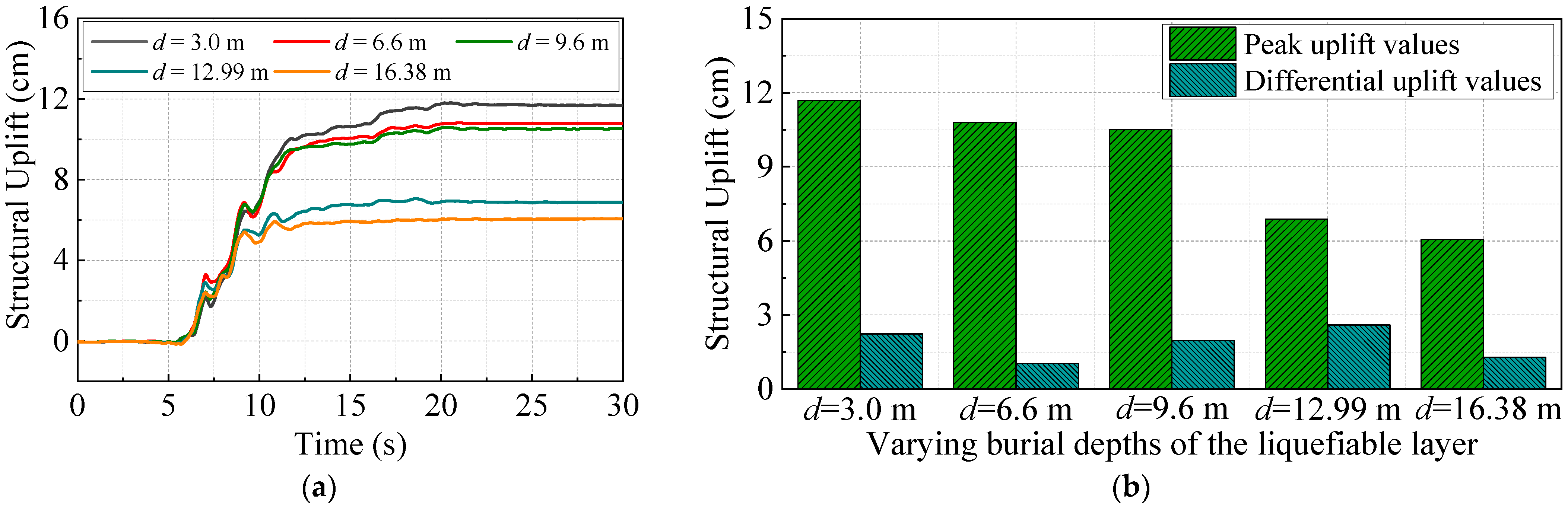
- The global uplift of the unequal-span structure increases with ground motion intensity and consistently shows non-uniform spatial patterns. Specifically, the uplift peaks at the center span and diminishes laterally as the distance from the center increases. This resulting differential uplift between the cantilevered and center spans is detrimental to the overall seismic performance of structures.
- (3)
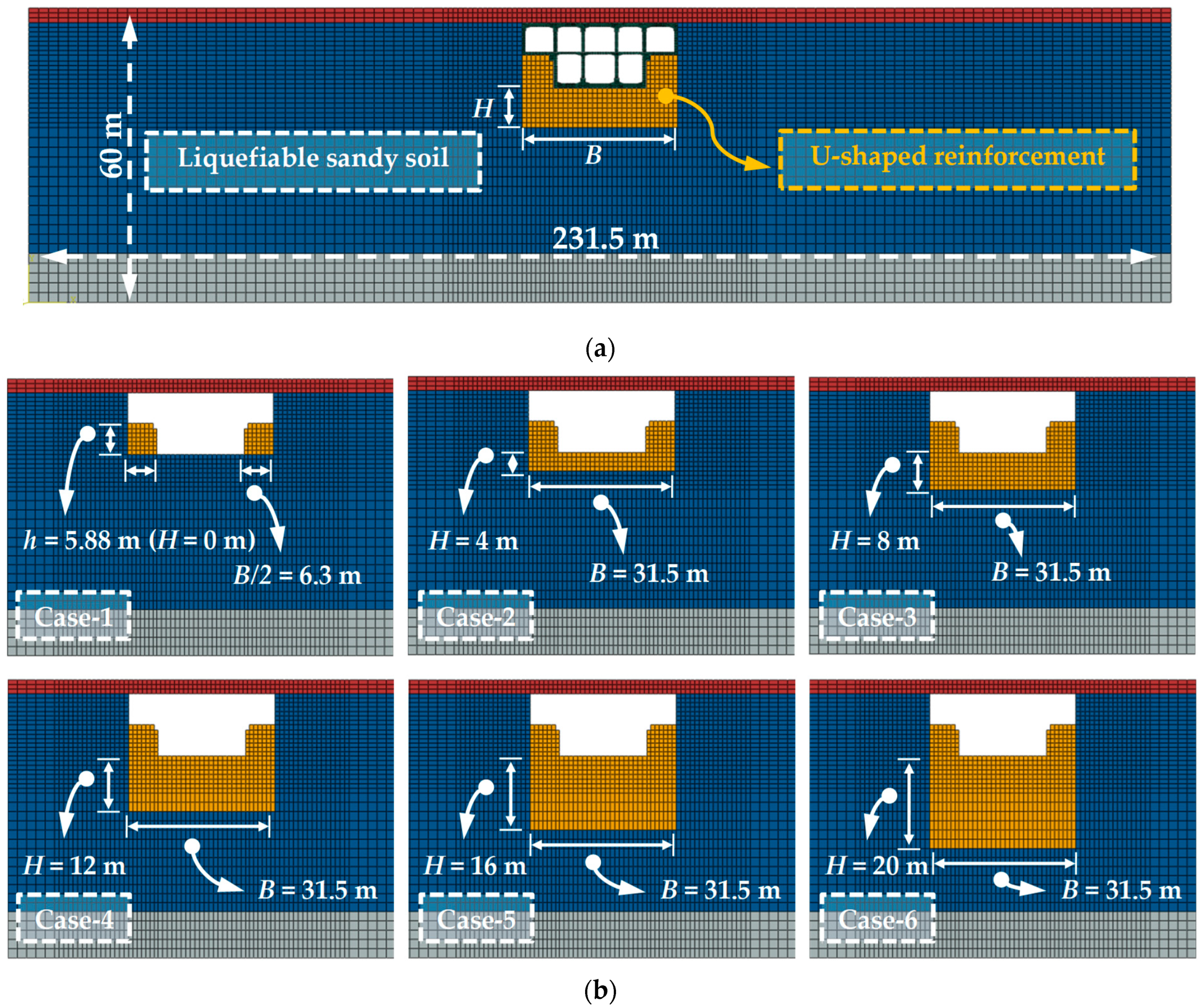
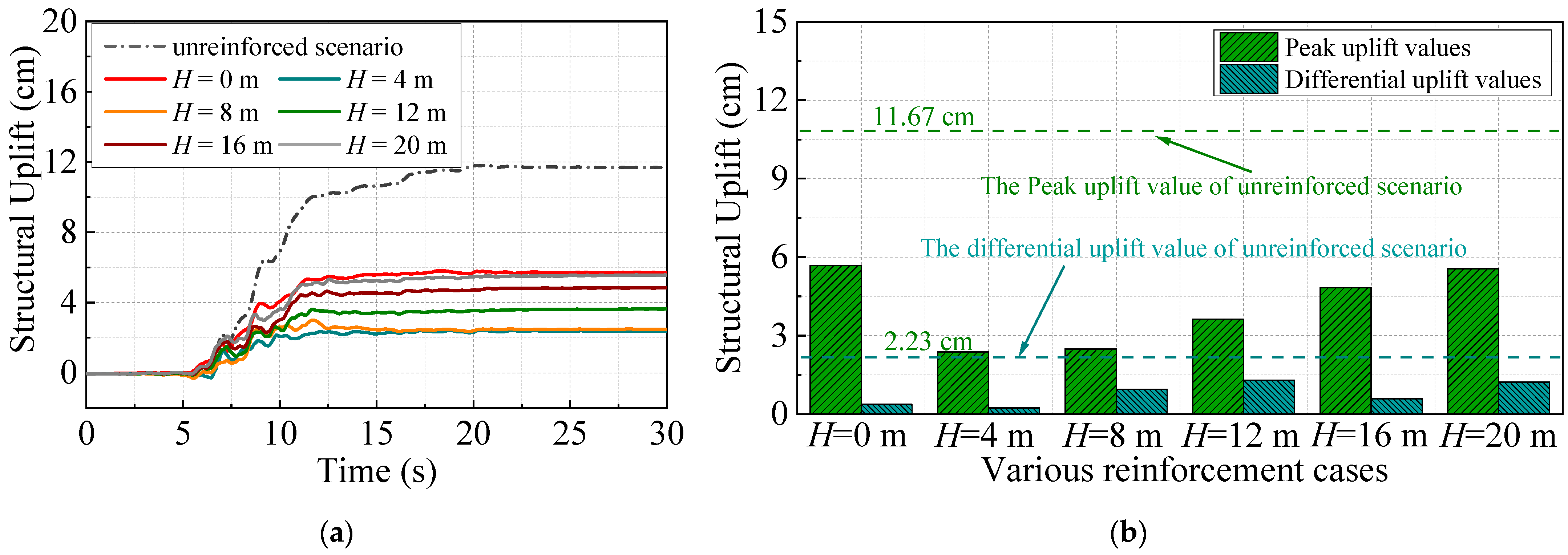
- The proposed U-shaped reinforcement method significantly mitigates both global and differential uplift of the unequal-span structure, thereby improving its seismic resilience. However, this method does not fundamentally alter the underlying uplift mechanism. This is because flow paths and hydraulic connectivity persist within the deeper liquefied soil layers. Furthermore, increasing the reinforcement depth eventually yields diminishing returns. For large unequal-span structures, targeted treatment of the sand beneath cantilevered spans—rather than indiscriminately increasing the overall reinforcement depth—offers a more efficient and cost-effective approach to controlling differential uplift.
Author Contributions
Funding
Data Availability Statement
Conflicts of Interest
References
- Iida, H.; Hiroto, T.; Yoshida, N.; Iwafuji, M. Damage to Daikai Subway Station. Soils Found. 1996, 36, 283–300. [Google Scholar] [CrossRef]
- Maurer, B.W.; Green, R.A.; Cubrinovski, M.; Bradley, B.A. Evaluation of the Liquefaction Potential Index for Assessing Liquefaction Hazard in Christchurch, New Zealand. J. Geotech. Geoenviron. Eng. 2014, 140, 04014032. [Google Scholar] [CrossRef]
- Cubrinovski, M.; Bray, J.D.; Taylor, M.; Giorgini, S.; Bradley, B.; Wotherspoon, L.; Zupan, J. Soil Liquefaction Effects in the Central Business District during the February 2011 Christchurch Earthquake. Seismol. Res. Lett. 2011, 82, 893–904. [Google Scholar] [CrossRef]
- Yasuda, S.; Harada, K.; Ishikawa, K.; Kanemaru, Y. Characteristics of Liquefaction in Tokyo Bay Area by the 2011 Great East Japan Earthquake. Soils Found. 2012, 52, 793–810. [Google Scholar] [CrossRef]
- Van Ballegooy, S.; Malan, P.; Lacrosse, V.; Jacka, M.E.; Cubrinovski, M.; Bray, J.D.; O’Rourke, T.D.; Crawford, S.A.; Cowan, H. Assessment of Liquefaction-induced Land Damage for Residential Christchurch. Earthq. Spectra 2014, 30, 31–55. [Google Scholar] [CrossRef]
- Yang, C.-Y.; Cai, X.-S.; Yuan, Y.; Ma, Y.-C. Hybrid Simulation of Soil Station System Response to Two-Dimensional Earthquake Excitation. Sustainability 2019, 11, 2582. [Google Scholar] [CrossRef]
- Chen, C.; Zou, W.; Geng, P.; Gu, W.; Yuan, F.; He, C. Study on Seismic Damage Risk Assessment of Mountain Tunnel Based on the Extension Theory. Sustainability 2023, 15, 5294. [Google Scholar] [CrossRef]
- Huang, Z.; Deng, X.; Lei, C.; Cheng, Y.; Zhang, C.; Sun, Q. Probabilistic Seismic Risk Assessment of Metro Tunnels in Soft Soils. Sustainability 2024, 16, 8218. [Google Scholar] [CrossRef]
- Chian, S.C.; Tokimatsu, K.; Madabhushi, S.P.G. Soil Liquefaction–Induced Uplift of Underground Structures: Physical and Numerical Modeling. J. Geotech. Geoenviron. Eng. 2014, 140, 04014057. [Google Scholar] [CrossRef]
- Cheng, X.; Xu, X.; Hu, Z.; Jing, L.; Liang, H.; Cui, J. Seismic Response of a Liquefiable Site-Underground Structure System. Buildings 2022, 12, 1751. [Google Scholar] [CrossRef]
- Chen, G.; Wang, Z.; Zuo, X.; Du, X.; Gao, H. Shaking Table Test on the Seismic Failure Characteristics of a Subway Station Structure on Liquefiable Ground. Earthq. Eng. Struct. Dyn. 2013, 42, 1489–1507. [Google Scholar] [CrossRef]
- Zhuang, H.; Wang, R.; Chen, G.; Miao, Y.; Zhao, K. Shear Modulus Reduction of Saturated Sand under Large Liquefaction-Induced Deformation in Cyclic Torsional Shear Tests. Eng. Geol. 2018, 240, 110–122. [Google Scholar] [CrossRef]
- Bao, X.; Xia, Z.; Ye, G.; Fu, Y.; Su, D. Numerical Analysis on the Seismic Behavior of a Large Metro Subway Tunnel in Liquefiable Ground. Tunnel. Undergr. Space Technol. 2017, 66, 91–106. [Google Scholar] [CrossRef]
- Zhuang, H.; Chen, G.; Hu, Z.; Qi, C. Influence of Soil Liquefaction on the Seismic Response of a Subway Station in Model Tests. Bull. Eng. Geol. Environ. 2016, 75, 1169–1182. [Google Scholar] [CrossRef]
- Liu, H.; Song, E. Working Mechanism of Cutoff Walls in Reducing Uplift of Large Underground Structures Induced by Soil Liquefaction. Comput. Geotech. 2006, 33, 209–221. [Google Scholar] [CrossRef]
- Wang, R.; Zhu, T.; Yu, J.-K.; Zhang, J.-M. Influence of Vertical Ground Motion on the Seismic Response of Underground Structures and Underground-Aboveground Structure Systems in Liquefiable Ground. Tunnel. Undergr. Space Technol. 2022, 122, 104351. [Google Scholar] [CrossRef]
- Hu, J.; Pang, L. Identifying the Optimal Intensity Measure and Key Factors of Earthquake Liquefaction-Induced Uplift of Underground Structures. Bull. Eng. Geol. Environ. 2023, 82, 31. [Google Scholar] [CrossRef]
- Guo, H.; Zhang, C.; Fang, H.; Rabczuk, T.; Zhuang, X. Deep Learning to Evaluate Seismic-Induced Soil Liquefaction and Modified Transfer Learning between Various Data Sources. Undergr. Space 2025, 23, 220–242. [Google Scholar] [CrossRef]
- Shen, Y.; Hesham El Naggar, M.; Zhang, D.-M.; Huang, Z.-K.; Du, X. Scalar- and Vector-Valued Seismic Fragility Assessment of Segmental Shield Tunnel Lining in Liquefiable Soil Deposits. Tunnel. Undergr. Space Technol. 2025, 155, 106171. [Google Scholar] [CrossRef]
- Zhang, X.; Pan, Y.; Su, L.; Ou, E.; Liu, H.; Liu, C.; Cui, J. Seismic Fragility Assessment of Shield Tunnels in Liquefiable Soil-Rock Strata Using Fuzzy Method for IM Optimization. Tunnel. Undergr. Space Technol. 2024, 152, 105957. [Google Scholar] [CrossRef]
- Shen, Y.; Hesham El Naggar, M.; Zhang, D.; Huang, Z.; Du, X. Optimal Intensity Measure for Seismic Performance Assessment of Shield Tunnels in Liquefiable and Non-Liquefiable Soils. Undergr. Space 2025, 21, 149–163. [Google Scholar] [CrossRef]
- Lu, C.; Doan, M.; Chen, S.; Shi, J. Probabilistic Fragility Assessment of Shallow-Founded Buildings in Liquefiable Soils Treated by Enhanced Drainage and Densification Considering Short and Long-Term Responses. Comput. Geotech. 2025, 183, 107213. [Google Scholar] [CrossRef]
- Shen, Y.; Zhong, Z.; Li, L.; Du, X.; Hesham El Naggar, M. Seismic Response of Shield Tunnel Structure Embedded in Soil Deposit with Liquefiable Interlayer. Comput. Geotech. 2022, 152, 105015. [Google Scholar] [CrossRef]
- Yao, J.; Lin, Y. Influence Analysis of Liquefiable Interlayer on Seismic Response of Underground Station Structure. Appl. Sci. 2023, 13, 9210. [Google Scholar] [CrossRef]
- Yan, G.; Xu, C.; Zhang, Z.; Du, X.; Wang, X. Numerical Analysis on Seismic Performance of Underground Structures in Liquefiable Interlayer Sites from Centrifuge Shaking Table Test. Earthq. Eng. Eng. Vib. 2024, 23, 781–798. [Google Scholar] [CrossRef]
- Wang, J.; Ma, G.; Zhuang, H.; Dou, Y.; Fu, J. Influence of Diaphragm Wall on Seismic Responses of Large Unequal-Span Subway Station in Liquefiable Soils. Tunnel. Undergr. Space Technol. 2019, 91, 102988. [Google Scholar] [CrossRef]
- Moshirabadi, S.; Soltani, M.; Maekawa, K. Seismic Interaction of Underground RC Ducts and Neighboring Bridge Piers in Liquefiable Soil Foundation. Acta Geotech. 2015, 10, 761–780. [Google Scholar] [CrossRef]
- Yao, A.; Tian, T.; Gong, Y.; Li, H. Shaking Table Tests of Seismic Response of Multi-Segment Utility Tunnels in a Layered Liquefiable Site. Sustainability 2023, 15, 6030. [Google Scholar] [CrossRef]
- Huang, Y.; Wen, Z. Recent Developments of Soil Improvement Methods for Seismic Liquefaction Mitigation. Nat. Hazard. 2015, 76, 1927–1938. [Google Scholar] [CrossRef]
- Kang, G.-C.; Tobita, T.; Iai, S.; Ge, L. Centrifuge Modeling and Mitigation of Manhole Uplift Due to Liquefaction. J. Geotech. Geoenviron. Eng. 2013, 139, 458–469. [Google Scholar] [CrossRef]
- Mahmoud, A.O.; Hussien, M.N.; Karray, M.; Chekired, M.; Bessette, C.; Jinga, L. Mitigation of Liquefaction-Induced Uplift of Underground Structures. Comput. Geotech. 2020, 125, 103663. [Google Scholar] [CrossRef]
- Valizadeh, H.; Ecemis, N. Soil Liquefaction-Induced Uplift of Buried Pipes in Sand-Granulated-Rubber Mixture: Numerical Modeling. Transp. Geotech. 2022, 33, 100719. [Google Scholar] [CrossRef]
- Zhou, Y.; Zhang, D.; Liu, K.; Chen, Y. Post-Liquefaction Deformation Mechanisms of Stone Column-Improved Liquefiable Sloping Ground under Cyclic Loadings. Soil Dyn. Earthq. Eng. 2024, 177, 108340. [Google Scholar] [CrossRef]
- Kuhlemeyer, R.L.; Lysmer, J. Finite Element Method Accuracy for Wave Propagation Problems. J. Soil Mech. Found. Div. 1973, 99, 421–427. [Google Scholar] [CrossRef]
- Huo, H.; Bobet, A.; Fernández, G.; Ramírez, J. Load Transfer Mechanisms between Underground Structure and Surrounding Ground: Evaluation of the Failure of the Daikai Station. J. Geotech. Geoenviron. Eng. 2005, 131, 1522–1533. [Google Scholar] [CrossRef]
- Zhuang, H.; Chen, G.; Zhu, D. Dynamic Visco-Plastic Memorial Nested Yield Surface Model of Soil. Front. Archit. Civ. Eng. China 2008, 2, 49–55. [Google Scholar] [CrossRef]
- Zhuang, H.; Chen, G. Constitutive model for large liquefaction deformation of sand and its implementation in ABAQUS software. World Earthq. Eng. 2011, 27, 45–50. [Google Scholar]
- Yang, Z.; Elgamal, A. Influence of permeability on liquefaction-induced shear deformation. J. Eng. Mech. 2002, 128, 720–729. [Google Scholar] [CrossRef]
- Zhuang, H.; Hu, Z.; Wang, X.; Chen, G. Seismic Responses of a Large Underground Structure in Liquefied Soils by FEM Numerical Modelling. Bull. Earthq. Eng. 2015, 13, 3645–3668. [Google Scholar] [CrossRef]
- Li, X.; Zhuang, H.; Ruan, B.; Zhao, K.; Chen, G. Longitudinal Seismic Responses of Large Diameter Shield Tunnel Crossing Liquefied Bank Slope. Sci. Rep. 2025, 15, 13473. [Google Scholar] [CrossRef] [PubMed]
- Chen, S.; Tang, B.; Zhuang, H.; Wang, J.; Li, X.; Zhao, K. Experimental Investigation of the Seismic Response of Shallow-Buried Subway Station in Liquefied Soil. Soil Dyn. Earthq. Eng. 2020, 136, 106153. [Google Scholar] [CrossRef]
- Zhuang, H.; Li, X.; Zhao, K.; Wu, S.; Li, Z.; Chen, G. Liquefaction-Induced Lateral Spreading Characteristics of the Fluvial Terraces at the Lower Reaches of Yangtze River. Eng. Geol. 2025, 346, 107900. [Google Scholar] [CrossRef]
- Lee, J.; Fenves, G.L. Plastic-Damage Model for Cyclic Loading of Concrete Structures. J. Eng. Mech. 1998, 124, 892–900. [Google Scholar] [CrossRef]
- Zienkiewicz, O.C.; Bicanic, N.; Shen, F.Q. Earthquake Input Definition and the Trasmitting Boundary Conditions. In Advances in Computational Nonlinear Mechanics; Doltsinis, I.S., Ed.; Springer: Vienna, Austria, 1989; pp. 109–138. [Google Scholar]
- Li, Y.; Zhao, M.; Xu, C.; Du, X.; Li, Z. Earthquake Input for Finite Element Analysis of Soil-Structure Interaction on Rigid Bedrock. Tunnel. Undergr. Space Technol. 2018, 79, 250–262. [Google Scholar] [CrossRef]
- Wang, J.; Yang, J.; Zhuang, H.; Ma, G.; Sun, Y. Seismic Responses of a Large Unequal-Span Underground Subway Station in Liquefiable Soil Using Shaking Table Test. J. Earthq. Eng. 2022, 26, 8446–8467. [Google Scholar] [CrossRef]
- GB 18306-2015; Standardization Administration of China. Seismic Ground Motion Parameters Zonation Map of China. Standards Press of China: Beijing, China, 2015.






| Soil Layer | Classification | Thickness (m) | Density (kg/m3) | Shear Modulus (MPa) | Elastic Modulus (MPa) | Friction Angle (°) | Poisson Ratio | Void Ratio |
|---|---|---|---|---|---|---|---|---|
| 1 | Plain fill | 3.0 | 1930 | 25.2 | 7.0 | 16 | 0.30 | - |
| 2 | Fine sand (medium dense) | 47.0 | 1930 | 60.0 | 7.0 | 30 | 0.30 | 0.474 |
| 3 | Old clay (stiff) | 10.0 | 1930 | 120.2 | 7.0 | 18 | 0.35 | - |
| Parameters | Values | Parameters | Values |
|---|---|---|---|
| Elastic modulus (MPa) | 3.0 × 10⁴ | Limited compressive yield stress (MPa) | 20.1 |
| Poisson’s ratio | 0.18 | Initial tensile yield stress (MPa) | 2.4 |
| Density (kg/m3) | 2500 | Compression stiffness recovery parameter | 0.7 |
| Dilation angle (°) | 36.31 | Tensile stiffness recovery parameter | 0.0 |
| Initial compressive yield stress (MPa) | 14.64 | Damage factors | dc, dt |
| Plastic strain (%) | 0.00 | 0.04 | 0.08 | 0.12 | 0.16 | 0.20 | 0.24 | 0.36 | 0.50 | 0.75 | 1.00 |
| Compression stress (MPa) | 14.6 | 17.3 | 19.4 | 20.1 | 20.2 | 18.7 | 17.3 | 12.9 | 8.66 | 6.25 | 3.98 |
| dc | 0.00 | 0.11 | 0.25 | 0.34 | 0.43 | 0.50 | 0.57 | 0.71 | 0.82 | 0.92 | 0.97 |
| Crack displacement (mm) | 0.000 | 0.066 | 0.123 | 0.173 | 0.220 | 0.308 | 0.351 | 0.394 | 0.438 | 0.482 |
| Tension stress (MPa) | 2.400 | 1.617 | 1.084 | 0.726 | 0.487 | 0.219 | 0.147 | 0.098 | 0.066 | 0.042 |
| dt | 0.000 | 0.381 | 0.617 | 0.763 | 0.853 | 0.944 | 0.965 | 0.978 | 0.987 | 0.992 |
| Ground Motions | PBA | Position | Differential Uplift | ||
|---|---|---|---|---|---|
| A | B | C | |||
| Kobe motion | 0.1 g | 1.07 | −0.53 | −1.44 | 2.51 |
| 0.2 g | 11.67 | 10.46 | 9.44 | 2.23 | |
| 0.3 g | 35.87 | 34.89 | 33.83 | 2.04 | |
Disclaimer/Publisher’s Note: The statements, opinions and data contained in all publications are solely those of the individual author(s) and contributor(s) and not of MDPI and/or the editor(s). MDPI and/or the editor(s) disclaim responsibility for any injury to people or property resulting from any ideas, methods, instructions or products referred to in the content. |
© 2026 by the authors. Licensee MDPI, Basel, Switzerland. This article is an open access article distributed under the terms and conditions of the Creative Commons Attribution (CC BY) license.
Share and Cite
Yang, J.; Wang, J.; Xu, Z.; Wang, C.; Xia, R. Seismic Response and Mitigation Measures of Large Unequal-Span Subway Station Structures in Liquefiable Sites. Buildings 2026, 16, 1359. https://doi.org/10.3390/buildings16071359
Yang J, Wang J, Xu Z, Wang C, Xia R. Seismic Response and Mitigation Measures of Large Unequal-Span Subway Station Structures in Liquefiable Sites. Buildings. 2026; 16(7):1359. https://doi.org/10.3390/buildings16071359
Chicago/Turabian StyleYang, Jing, Jianning Wang, Zigang Xu, Chen Wang, and Ruimeng Xia. 2026. "Seismic Response and Mitigation Measures of Large Unequal-Span Subway Station Structures in Liquefiable Sites" Buildings 16, no. 7: 1359. https://doi.org/10.3390/buildings16071359
APA StyleYang, J., Wang, J., Xu, Z., Wang, C., & Xia, R. (2026). Seismic Response and Mitigation Measures of Large Unequal-Span Subway Station Structures in Liquefiable Sites. Buildings, 16(7), 1359. https://doi.org/10.3390/buildings16071359