Article

Resilience-Based Seismic Optimization of Buildings Using Tuned Mass Dampers

1
Shenzhen Academy of Disaster Prevention and Reduction, China Earthquake Administration, Shenzhen 518003, China
2
China-Pakistan Belt and Road Joint Laboratory on Smart Disaster, Prevention of Major Infrastructures, Southeast University, Nanjing 210096, China
3
Department of Civil and Environmental Engineering, Hong Kong Polytechnic University, Hong Kong 999077, China
4
Faculty of Agriculture, Civil and Environmental Engineering, University of Rostock, 18059 Rostock, Germany
*
Authors to whom correspondence should be addressed.
These authors contributed equally to this work.
Buildings 2026, 16(7), 1360; https://doi.org/10.3390/buildings16071360
Submission received: 5 March 2026 / Revised: 24 March 2026 / Accepted: 27 March 2026 / Published: 29 March 2026

Abstract

A multi-objective tuning framework for optimizing Tuned Mass Damper (TMD) systems is presented. This framework optimizes the controlling parameters of TMDs while considering building resilience. The employed optimizer is the multi-objective HBA. Since TMDs are used in tall structures to mitigate seismic-induced structural responses, the proposed framework must be applicable to real-world scenarios; therefore, it determines both the placement and parameters of TMDs by accounting for the effects of various soil types and multiple earthquake records. Based on the obtained results, the optimal TMDs achieved an average roof-displacement reduction of 17% in soft soil, 7% in fixed-base conditions, and only 4% in dense soil, highlighting the decisive influence of soil–structure interaction on system efficiency. Moreover, there was considerable outcome variability across different earthquake records—ranging from 0.8% to 26% reduction—along with the observed negative effect (response amplification of up to 13.9% in certain fixed-base cases), which occurs when the TMD becomes detuned relative to the dominant frequency of the specific ground motion. This confirms the necessity for a robust design approach that simultaneously considers an ensemble of ground motions rather than optimizing for a single record.

1. Introduction

Earthquakes represent one of the most destructive natural hazards, capable of causing catastrophic human casualties and financial losses. The 2023 Kahramanmaraş earthquake sequence in Turkey, with a magnitude of Mw 7.8, served as a stark illustration of critical infrastructure vulnerability, resulting in the collapse of thousands of buildings and over 50,000 fatalities [1,2]. Consequently, these events underscore the urgent need to develop and implement strategies that, beyond providing seismic protection, ensure the operational continuity of structures during and after major seismic events.
In this context, Tuned Mass Dampers (TMDs) have emerged as a promising passive control solution. By absorbing and dissipating the vibrational energy transferred to the structure, TMDs prevent excessive oscillations and protect the structure from potential damage. Despite their advantages, the practical implementation of TMDs involves significant challenges, including the determination of their optimal placement within the building’s floors and the fine-tuning of their dynamic parameters, both of which critically influence their performance in vibration suppression. Addressing these challenges is essential for designers aiming to maximize structural safety and cost-efficiency in modern tall buildings.
In this regard, various numerical approaches have been rapidly developed and applied to structures [3,4,5,6,7]. With advances in science and the emergence of new computing technologies, researchers have turned to optimization approaches—particularly metaheuristic optimization methods, which offer high capability for comprehensive exploration of the solution space while maintaining acceptable computational costs and accuracy in solving complex engineering problems—for optimizing both the placement and parameters of TMDs [8]. For instance, Zhang and Zhang [9] developed a novel optimization framework to determine the optimal parameters of a TMD for mitigating the displacements of a tall reinforced concrete building under seismic excitation, based on the Harmony Search algorithm. The results demonstrated the effectiveness of the Harmony Search algorithm in reducing the structural response to seismic forces. In another study, Bekdaş et al. [10] conducted a performance evaluation of metaheuristic algorithms for optimizing TMD parameters in tall buildings. In this study, where the objective function involved minimizing the nonlinear dynamic response under a set of ground motion records, the Bat Algorithm was found to outperform other metaheuristic algorithms examined, providing robust and reliable results.
Other notable studies include that of Salvi et al. [11], who proposed an optimization framework to prevent TMD detuning caused by soil–structure interaction. Additionally, Di Matteo et al. [12] introduced a novel TMD configuration in which a viscous damper is connected to the ground, enabling effective control of displacements in a base-isolated structure. In a study conducted by Sgobba and Marano [13], a multi-objective optimization approach was employed to simultaneously minimize both the energy dissipated by the structure and its displacements. The results indicated that TMDs exhibit higher efficiency in structures with medium to long natural periods compared to short and stiff structures. In another study, Matta [14] proposed a new framework for the placement of TMDs in tall structures by considering the life-cycle cost of the structural TMDs. By assuming the TMD cost to be proportional to its mass, it was determined that the optimal TMD mass ratio falls within the range of 6% to 17%.
In recent years, various alternative approaches have been suggested to enhance the robustness of TMDs and reduce detuning effects. For example, Elias et al. [15] investigated the use of single and multiple TMDs for controlling the seismic response of structures. The results indicated that a parallel arrangement of six TMDs, with the same total mass and tuning, provides satisfactory performance. In another study, Bagheri and Rahmani-Dabbagh [16] focused on optimizing TMD parameters and claimed that replacing the classical linear spring with an elastoplastic spring while removing the viscous damper leads to improved efficiency.
In the study by Boccamazzo et al. [17], the use of a TMD with a pinching hysteretic spring behavior was proposed. Optimization was conducted under constant harmonic loading as well as in the time domain using seismic records, yielding consistent results for this type of TMD. The findings demonstrated that, compared to the classical TMD, the proposed configuration exhibits higher resistance across different levels of seismic intensity and greater effectiveness in controlling the nonlinear response of the main structure. Domizio et al. [8] optimized three different configurations of TMDs—including the classical single-mass TMD, two parallel TMDs, and two series TMDs—using the Particle Swarm Optimization algorithm to control the seismic response of nonlinear structures under far-field and near-field ground motion records. To this end, two objective functions were defined: one to enhance the efficiency and another to improve the robustness of the TMDs against structural stiffness degradation. The results demonstrated that the two-series TMD configuration performed best in most scenarios, particularly when the structure undergoes stiffness degradation and requires high ductility demands. This configuration can achieve up to a 26% reduction in ductility demand for structures with medium periods, using a mass ratio of 25%. It was also observed that the effectiveness of TMDs is lower under near-field records, especially for short-period structures. These findings indicate that the use of multiple TMDs along with proper parameter optimization can serve as an effective strategy for controlling the seismic response of nonlinear structures.
Recently, machine learning-based approaches have been integrated with optimization techniques for the tuning and placement of TMDs in high-rise buildings to accelerate convergence and enhance generalization capability [18]. Parallel efforts have focused on data-driven approaches for the multi-hazard design of TMDs under combined wind and seismic loading in multistory concrete structures [19]. Furthermore, the influence of structural nonlinearity on optimal TMD parameters has been investigated across various ductility demand levels [20]. From a resilience perspective, Cimellaro et al. [21] established a quantitative framework for analytical resilience assessment, which was subsequently extended by several authors to incorporate community-level recovery modeling [22,23]. The interaction between passive control systems and post-earthquake recovery has been explored in a limited number of studies [24], representing a significant research gap that the present work aims to address. Based on the aforementioned research, it is evident that optimization methods, particularly metaheuristic algorithms, have been widely applied to tune the parameters of TMDs. These studies have primarily focused on reducing dynamic structural responses such as displacement or acceleration. However, most of this research has been conducted using single-objective frameworks and has not systematically integrated the effects of soil–structure interaction or resilience-based criteria into the optimization process. Moreover, the performance evaluation of TMDs has typically been limited to a small number of earthquake records without considering varying soil conditions.
Meanwhile, the concept of structural resilience was introduced years ago by Bruneau et al. [25] based on four fundamental dimensions: robustness, redundancy, resourcefulness, and rapidity. These dimensions have rapidly gained attention among researchers in structural design. Among other significant contributions, Cimellaro et al. [21] operationalized resilience as the normalized area under the performance curve during a recovery period, facilitating quantitative assessment in seismic engineering. Subsequently, Dong and Frangopol [26] extended the resilience framework into a life-cycle context, accounting for the occurrence of multiple hazards and time-dependent deterioration. Recently, resilience metrics have been integrated with fragility functions and damage models from FEMA P-58 [27] and HAZUS [28] to generate operational tools for performance-based earthquake engineering. Despite these advancements, the direct integration of resilience-based metrics into the TMD optimization loop while accounting for soil–structure interaction remains largely unexplored.
To address these research gaps, the present study proposes a multi-objective optimization framework for the simultaneous determination of TMD placement and parameters, explicitly incorporating soil–structure interaction and resilience-based performance criteria. The primary novelties of this work are fourfold:
  • A resilience-based multi-objective optimization framework is proposed that simultaneously minimizes TMD mass and count while maximizing structural resilience—a combination not previously reported in the literature.
  • The framework explicitly incorporates three foundation conditions (fixed base, soft soil, and dense soil) within the optimization loop, enabling site-specific TMD design.
  • The performance of the optimized configurations is evaluated under a suite of seven near-field earthquake records, capturing the inherent variability of seismic excitation.
  • The adopted resilience metric, calibrated against FEMA P-58 and HAZUS damage-functionality relationships, provides a practical and operationally meaningful objective function for passive control design.
This holistic approach bridges conventional vibration control design with modern performance-based and resilience-oriented design philosophies.

2. Materials and Methods

2.1. Resilience Analysis

Structural resilience quantifies a system’s ability not only to resist damage but also to recover functionality after a disruptive event. Unlike conventional performance criteria based solely on peak response (e.g., maximum displacement or acceleration), resilience captures both the immediate post-event state and the trajectory of recovery, making it a more holistic measure of seismic performance. The following formulation adopts the framework established by Cimellaro et al. [21] and Dong and Frangopol [26].
R = t 0 t 0 + T L Q t d t   t 0 t 0 + T L Q t a r g e t t d t   ,
where Q ( t ) is the performance level at time t Q target ( t ) is the target performance level, t 0 is the time of earthquake occurrence, and T L is the recovery duration.
To apply this conceptual framework within a practical optimization process, the continuous time-dependent performance function Q ( t ) must be related to a measurable engineering demand parameter. In this study, the maximum interstory drift ratio δ m a x is adopted as the primary indicator of structural damage and performance loss. A simplified, yet practical, recovery model is thus implemented, where the post-earthquake performance level and recovery duration are deterministic functions of δ m a x , calibrated based on engineering judgment and guidelines such as FEMA P-58 [27,29].
Consequently, the resilience index R for a single earthquake scenario is computed as:
R i = 1 A loss T L · Q target ,
where A loss represents the integral of the performance deficit (the area between the target and actual performance curves), and Q target = 1 signifies full functionality. For a triangular recovery model, A loss is given by:
A loss = ( 1 F m i n ) · T rec 2 ,
Here, F m i n ( δ m a x ) is the immediate post-earthquake functionality level, and T rec ( δ m a x ) is the estimated recovery time, both derived from the relationships presented in Table 1. The final resilience metric for design comparison is the average R value across all considered ground motion records:
R avg = 1 N EQ i = 1 N EQ R i ,
The value of R avg = 1.0 corresponds to full functionality maintained throughout all considered earthquake scenarios (no damage or instantaneous recovery), while R avg = 0 indicates complete and permanent loss of functionality. In practice, values above 0.85 correspond to structures that suffer at most moderate damage and recover within 90 days across the ensemble of ground motions. The F m i n and T rec values in Table 1, derived from FEMA P-58 and HAZUS damage state thresholds, translate the peak interstory drift ratio ( δ m a x )—the primary engineering demand parameter in the structural analysis—into a dimensionless resilience score suitable for use as an objective function in the multi-objective optimization framework (Equation (18)).

2.2. TMD Configurations

A simplified shear-building model is commonly used to represent the seismic behavior of multi-story structures, where each floor is modeled as a single degree of freedom connected by shear springs and dampers. To incorporate soil–structure interaction, the foundation is modeled as a movable base with additional horizontal and rotational degrees of freedom, and the mechanical properties of the supporting soil are included in the system. When TMDs are installed on the floors, their corresponding degrees of freedom are also added to the structural model. This extended formulation enables the simulation of both the building response and the motion of the TMDs under seismic excitation. The governing dynamic equations for such a two-dimensional model with soil–structure interaction and floor-mounted TMDs follow the standard multi-degree-of-freedom formulation [30].
M X ¨ ( t ) + C X ˙ ( t ) + K X ( t ) = M X ¨ g ,
Soil–structure interaction is modeled using a Frequency-Independent Lumped-Parameter approach, based on the cone model formulation implemented within the structural earthquake engineering context by Wang et al. [30]. The foundation is idealized as a rigid circular mat resting on a viscoelastic half-space. Soil mechanical properties are characterized by four key parameters: swaying stiffness and damping coefficient, resisting horizontal translation, rocking stiffness and damping coefficient, resisting foundation rotation. These parameters, which depend on the soil’s shear wave velocity, density, and Poisson’s ratio, are calculated in accordance with FEMA P-1051 provisions for the three considered scenarios (fixed-base, dense soil, and soft soil). Notably, the fixed-base condition is simulated by assigning infinite values to both the swaying stiffness and the rocking stiffness, thereby effectively constraining all foundation degrees of freedom. Where M, K, and C represent the mass, stiffness, and damping matrices, respectively. X(t), X ˙ ( t ) , and X ¨ ( t ) represent the displacement, velocity, and acceleration vectors, respectively. X ¨ g denotes the earthquake acceleration on the building.
with,
M = [ M f ] [ M υ ] [ M H ] [ M υ ] T   m 0 + i = 1 N m i + m d i = 1 N m i h i + m d h N [ M H ] T i = 1 N m i h i + m d h N i = 1 N m i h i 2 + m d h N 2 + I 0 + i = 1 N I i       ,
C = c 1 + c 2 c 2                 c 2 c 2 + c 3 c 3                   c 3                       c N + c d c d                   c d c d                       c s                         c r ,
K = k 1 + k 2 k 2                 k 2 k 2 + k 3 k 3                   k 3                       k N + k d k d                   k d k d                       k s                         k r ,
M = m 1 , m 2 , , m N 1 , m N , m d , m 0 + i = 1 N m i + m d , i = 1 N m i , h i + m i h N T ,
where m i , c i , k i , h i , and I i denote the mass, damping coefficient, stiffness, story height, and moment of inertia of the i -th floor, respectively. Likewise, m 0 , I 0 , x 0 , and θ 0   represent the mass, moment of inertia, horizontal displacement, and rotation of the foundation. The parameters c s , c r , k s , and k r correspond to the soil’s swaying damping, rocking damping, swaying stiffness, and rocking stiffness, respectively [30].
with
M v = m 1 , m 2 , , m N 1 , m N , m d T ,
M H = m 1 h 1 , m 2 h 2 , , m N 1 h N 1 , m N h N , m d h N T ,
M f = m 1                   m 2                                     m N 1                 m N                 m d ,
Since x t in Equation (5) is defined as follows, the total displacement of each story can be computed using Equation (14).
x t = x 1 , x 2 , , x N 1 , x N , X 0 , θ 0 T ,
X i = x i + X 0 + θ 0 h i ,
In this study, a unidirectional translational TMD is adopted, consisting of a mass, spring, and viscous damper connected to the structure to mitigate dynamic response. The TMD mass is typically defined as a fraction of the total structural mass, while its natural frequency is tuned close to the fundamental mode of the building to ensure effective energy dissipation. The damping of the device is determined from the selected damping ratio relative to its critical damping. The corresponding mathematical formulation of the TMD parameters follows the approach presented by Salvi et al. [11]:
m t m d = m 0 × m B u i l d i n g ,
k t m d = m t m d × ( β ω 1 ) 2 ,
c t m d = 2 ζ t m d × k t m d × m t m d ,
Since this study aims to determine the optimal values of the TMD parameters, the optimization problem is formulated using three design variables for each installed TMD, namely the mass ratio m 0 , the frequency ratio β , and the damping ratio ζ tmd .

2.3. Statement of the Optimization Problem

To achieve the objectives of this study, a multi-objective optimization framework is developed in which minimizing the number and total mass of the TMDs and maximizing structural resilience are defined as the optimization goals. The problem is solved under the constraints imposed on the decision variables, which correspond to the TMD design parameters.
m i n x   f ( x ) = N TMD j = 1 N TMD m 0 , j R ( x ) ,
where R ( x ) denotes the resilience index of the structure equipped with the optimized TMDs. Let each TMD be characterized by the design variables:
x j = m 0 , j β j ζ tmd , j , j = 1 , , N TMD ,
The complete decision vector is
x = x 1 T , , x N TMD T T ,
The design variables are constrained within their allowable bounds:
m 0 , j m i n m 0 , j m 0 , j m a x ,   β j m i n β j β j m a x , ζ tmd , j m i n ζ tmd , j ζ tmd , j m a x , j = 1 , , N TMD .
It is noted that the TMD mass is adopted as a proxy for the total installation cost, consistent with the framework of Matta [14], who demonstrated that for conventional TMD systems, the procurement and installation cost is approximately proportional to the device mass. This simplification enables a tractable multi-objective formulation. A full life-cycle cost model incorporating maintenance, inspection, and post-earthquake repair costs would be a valuable extension and is recommended for future work.

2.4. Optimization Algorithm

In recent years, advanced nature-inspired optimization methods have been widely adopted in structural optimization [31,32,33,34]. These metaheuristic algorithms, which overcome the limitations of gradient-based techniques, have demonstrated strong capability in solving complex engineering optimization problems. In this study, the multi-objective version of the Honey Badger Algorithm (HBA), developed by Jafari-Asl et al. [35], is employed to solve the optimization problem formulated in the previous section. This algorithm is an enhanced form of the original HBA introduced by Essam et al. [36], which is inspired by the foraging behavior of honey badgers.
The HBA mimics two primary food-searching strategies: digging based on smell intensity and following the honeyguide bird. The algorithm begins with a randomly generated population of candidate solutions and evaluates their “intensity” according to their distance from the best solution found so far. A density factor is gradually reduced to transition the search from exploration to exploitation, while a directional flag helps the algorithm escape local optima. The positions of the search agents are updated through two behavioral modes—digging and honey-following—which together enable an effective balance between global exploration and local refinement. Readers are referred to [35,36] for additional information about HBA.
To verify the suitability of the selected optimization algorithm, its performance is compared with two widely used multi-objective algorithms, Non-Dominated Sorting Genetic Algorithm II (NSGA-II) [37] and Multi-Objective Particle Swarm Optimization (MOPSO) [38], both of which are extensively applied in engineering optimization. The comparison is performed using four standard performance metrics: number of non-dominated solutions (NS), spacing metrics (SP1 and SP2), and hole relative size (HRS). NS quantifies the extent of Pareto optimality, while SP1 and SP2 evaluate the uniformity of solution distribution. HRS measures the largest gap between adjacent solutions on the Pareto front. The mathematical definitions of these metrics are provided in Table 2 [39].

3. Numerical Example

For the numerical analysis, a 10-story steel building with a regular and symmetric layout is considered, comprising 3 bays along the x-axis and 4 bays along the y-axis. The steel material properties used in the model include a unit weight of 7850 kg/m3, yield strength of 235.4 MPa, ultimate tensile strength of 353.1 MPa, Poisson’s ratio of 0.3, and a modulus of elasticity of 196.1 GPa. The structural properties of the high-rise building used for the analysis are presented in Table 3.
The fundamental natural frequency of the building, determined from the eigenvalue analysis of the shear-building model, is ω1 = 3.84 rad/s, corresponding to a fundamental period of T1 = 1.64 s (f1 = 0.611 Hz). This places the structure in the medium-to-long period range, consistent with its total height of H = 32 m. The total seismic mass, obtained by summing the floor masses in Table 3, is M T o t a l = 3,172,690 kg. The TMD parameters are defined relative to this total mass as described in Equations (15)–(17), with the frequency tuning ratio β defined with respect to ω1 to ensure TMD tuning near the fundamental mode. soil–structure interaction is considered by examining three foundation conditions: fixed base, stiff soil, and soft soil. The associated soil properties, such as swaying stiffness (Cs), rocking stiffness (Cr), and their corresponding damping coefficients ( k s , k r ), are provided in Table 4. The seven near-field ground motion records used in the analyses are listed in Table 5. These records were selected based on the following criteria: (i) moment magnitude Mw ≥ 6.5; (ii) closest rupture distance R ≤ 15 km; and (iii) exclusion of records with significant signal-to-noise ratio issues below 0.1 Hz. All records were applied without amplitude scaling, using the actual recorded PGA values listed in Table 5. This approach avoids scaling bias and is consistent with the robust design objective of the framework, which accounts for record-to-record variability through the average resilience metric (Equation (4)).

4. Results

In this section, the results of the framework presented in the previous section are provided for the case study structure. Table 6 shows the tuning parameters of the three optimization algorithms used, which were set according to recommendations from previous studies. Regarding the algorithmic configuration, the population size (N) and the maximum number of iterations were set to 50 and 500, respectively. The archive size for storing non-dominated solutions was fixed at 100, with the termination criterion defined as reaching the maximum number of iterations. To ensure a fair comparison, each algorithm was executed independently for 10 runs. Consequently, the maximum number of function evaluations (FEs) per run was 50 × 500 = 25,000.
The average values of the statistical parameters for each algorithm and each scenario are presented in Table 7. Based on the obtained results, the MOHBA algorithm has demonstrated overall balanced and reliable performance. This algorithm successfully generated a considerable number of Pareto solutions under all three foundation conditions: 7 solutions for the fixed base, 28 solutions for soft soil, and 10 solutions for stiff soil. Among these, the performance of MOHBA in soft soil with Ns = 28 stands out as the highest number of Pareto solutions among all algorithms and conditions. In terms of distribution quality, MOHBA achieved the best SP1 value of 0.37 for the fixed base, indicating a highly uniform distribution of solutions. Moreover, in stiff soil, the algorithm yielded appropriate values of SP1 = 0.56 and SP2 = 0.87. Regarding the uniformity of solutions, MOHBA performed better than MOPSO in soft soil with HRS = 2.58 compared to MOPSO’s HRS of 4.46. Another strength of MOHBA is its stability across different conditions; while NSGA-II produced only 2 solutions for the fixed base (indicating premature convergence), MOHBA delivered acceptable results in all scenarios. Considering the balance between solution quantity (highest Ns in soft soil) and distribution quality (lowest SP1 in fixed base), MOHBA can be identified as the superior algorithm for multi-objective optimization in this study.
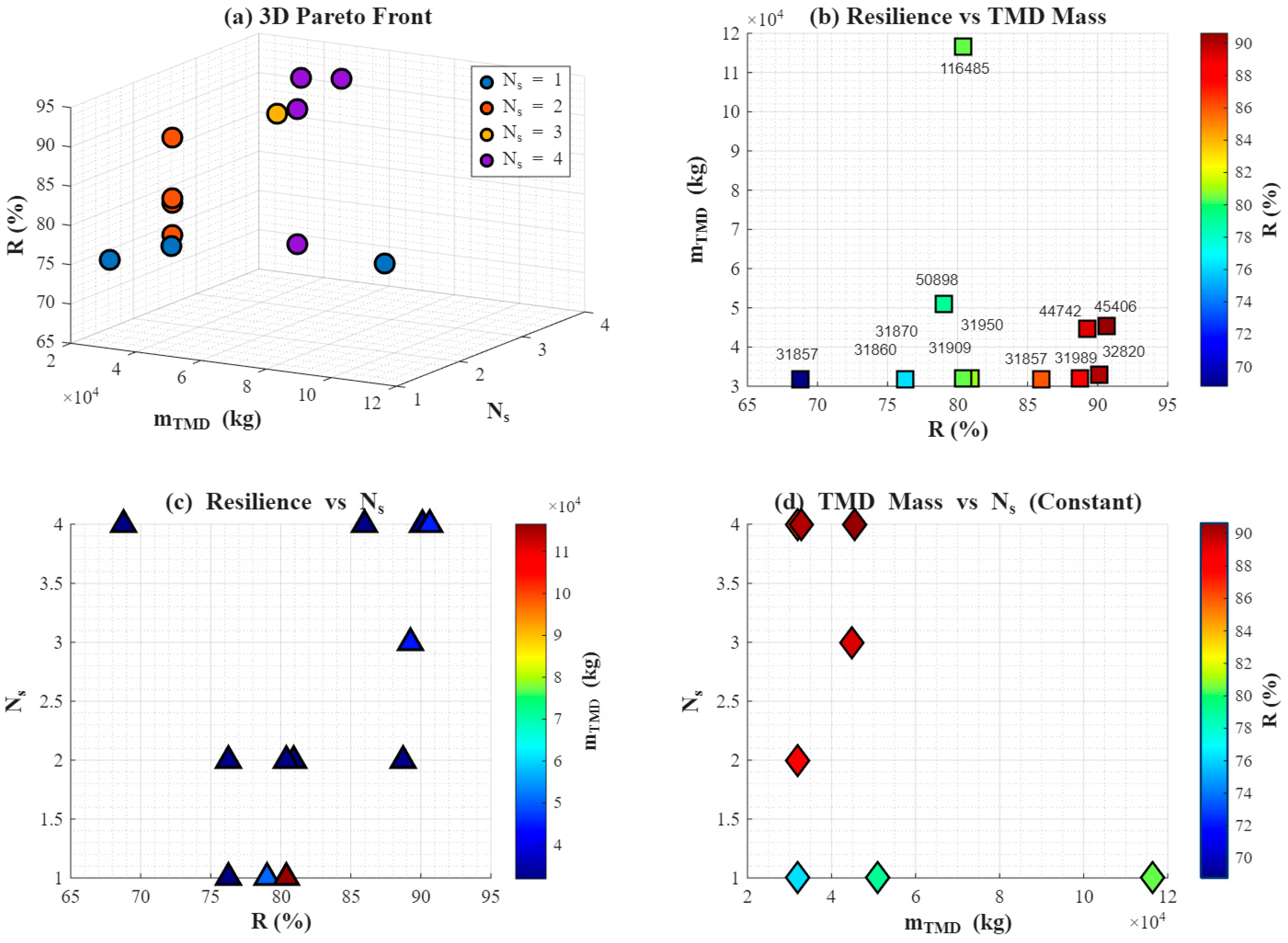
Accordingly, for each scenario, the best solution obtained by MOHBA is presented and discussed. The Pareto front corresponding to the fixed-base structural scenario is illustrated in Figure 1 and summarized in Table 8 in terms of resilience (R%), TMD mass, and the number of TMDs (Ns).
As shown in Figure 1a, the 3D Pareto front indicates that the highest resilience values—up to R = 90.61%—are consistently associated with configurations having four TMDs (Ns = 4), with TMD masses ranging from approximately 31,857 kg to 45,406 kg. In contrast, solutions with one TMD (Ns = 1) exhibit noticeably lower resilience, generally between 76.26% and 80.39%, even when the TMD mass increases substantially (e.g., 116,485 kg yields only R = 80.39%). Figure 1b further shows that moderate TMD masses around 31,800–32,000 kg can achieve a wide range of resilience levels (76.26% to 90.08%), depending on the number of TMDs. Figure 1c highlights that for similar TMD mass ranges (~31,860–31,900 kg), increasing the number of TMDs significantly improves resilience: R = 76.26% for Ns = 1, 76.26–80.92% for Ns = 2, 85.94–90.08% for Ns = 4. The three-TMD configuration with moderate mass (~44,742 kg) also achieves high resilience (89.26%).
Finally, Figure 1d confirms that the most resilient solutions (R > 89%) correspond to combinations of higher TMD counts (3–4) and moderate TMD masses (approximately 32,000–45,000 kg). Overall, the results demonstrate that resilience is influenced more strongly by the number of TMDs than by total TMD mass alone, and optimal performance emerges from a balanced combination of structural height and damper mass.
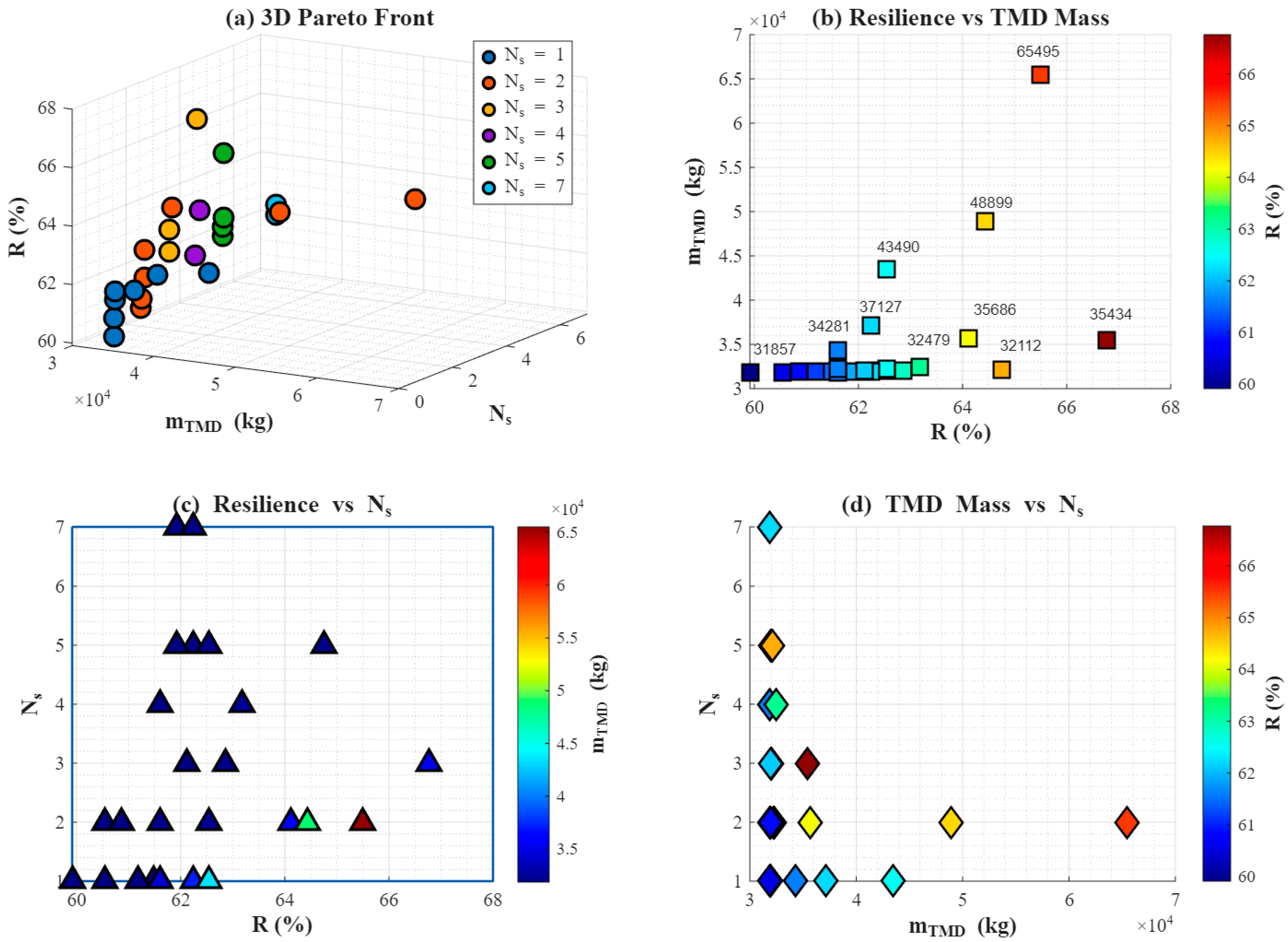
Figure 2 and Table 9 present the Pareto-optimal solutions obtained for the soft-base building scenario, highlighting the interplay between resilience (R%), TMD mass, and the number of TMD systems (Ns). The results demonstrate that the highest resilience value (R = 66.76%) is achieved with a moderate TMD mass of 35,434 kg distributed across three systems. This configuration represents an optimal balance between damper mass and system distribution for soft-soil conditions. A notable observation is that configurations with only one TMD system (Ns = 1) consistently yield the lowest resilience values (59.91–62.55%), even when TMD mass increases substantially. For example, solution #19 (see Table 9) with a large mass of 65,495 kg achieves only R = 65.50% despite employing two TMDs, indicating diminishing returns from mass increase alone.
Moderate-mass solutions (approximately 31,800–35,500 kg) show considerable variation in resilience (60.55–66.76%) depending on system count, with three-system arrangements generally performing best. Interestingly, configurations with higher TMD counts (Ns = 5, 7) do not consistently outperform those with 2–4 TMDs, suggesting an optimal range. The TMD configurations exhibit the widest resilience range (60.55–65.50%) and mass variation (31,863–65,495 kg), indicating flexibility in design trade-offs for soft-base conditions.
Overall, the Pareto front reveals that for soft-base buildings, optimal seismic resilience is achieved not through maximized mass or TMD count individually, but through strategic combinations where moderate mass (∼32,000–36,000 kg) is effectively distributed across 2–4 TMD systems. This represents a distinct optimization pattern compared to fixed-base structures, emphasizing the importance of system distribution over sheer mass in soil–structure interaction scenarios.
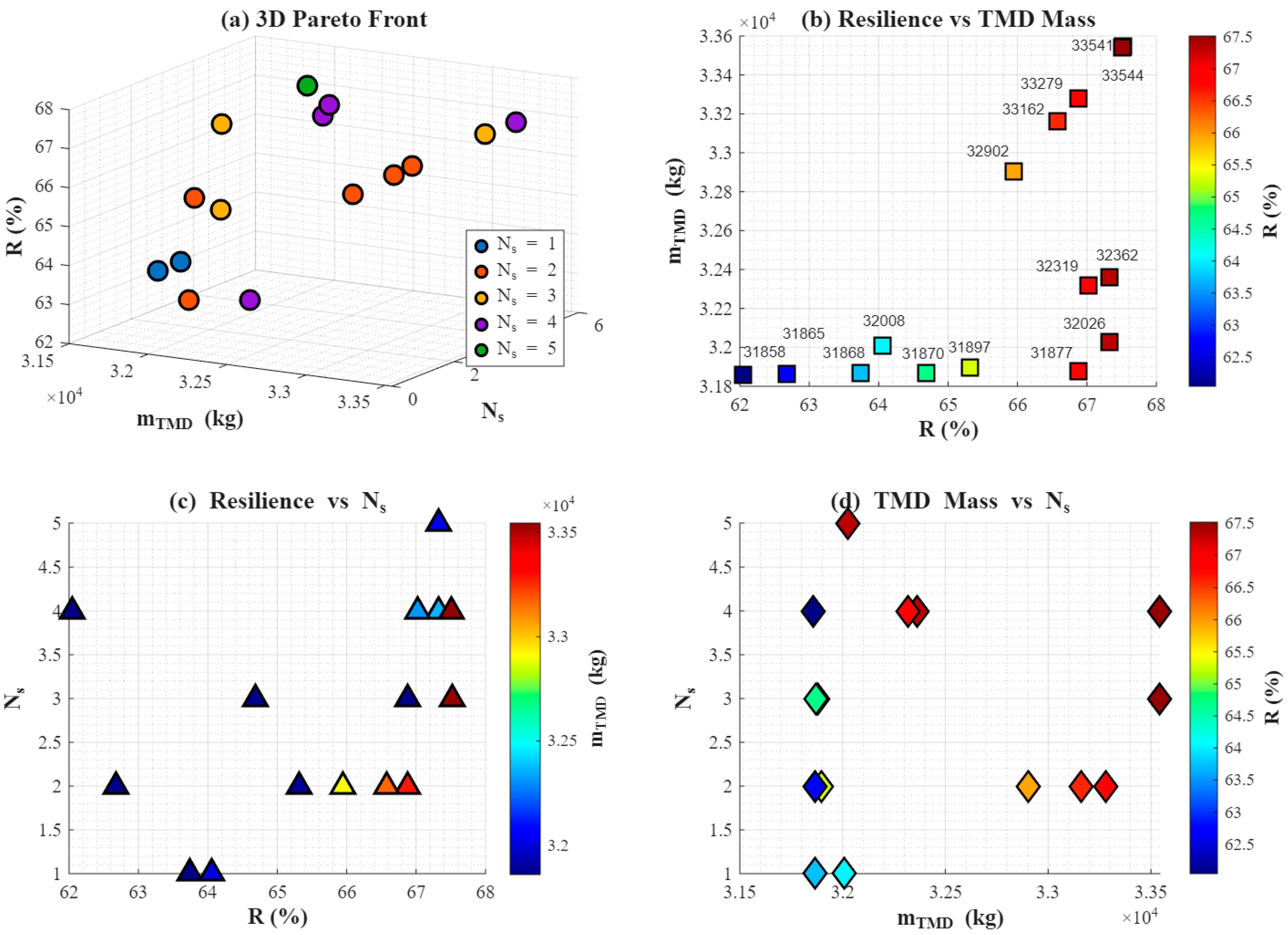
Figure 3 and Table 10 present the Pareto-optimal solutions for the dense-base building scenario, illustrating the relationships between seismic resilience (R%), TMD mass, and the number of TMD systems ( N s ). The highest resilience value (R = 67.52%) is achieved with a moderate TMD mass of 33,544 kg distributed across three TMDs. This outcome highlights that a distributed configuration with intermediate mass can yield optimal performance. Other high-performing solutions include configurations with four or five TMDs and masses within the 32,000–33,500 kg range, achieving resilience levels of R = 67.33% and R = 67.51%, respectively. In stark contrast, configurations employing only a single TMD system ( N s = 1 ) exhibit significantly lower resilience, ranging from R = 63.74% to 64.05%, despite utilizing similar or even slightly lower TMD masses. This trend is visually corroborated by the Pareto plots, where resilience consistently improves with an increasing number of systems ( N s ), particularly when coupled with an optimized mass value.
Overall, the results demonstrate that for dense-base buildings, enhancing seismic resilience is not merely a function of increasing the TMD mass. Instead, it is achieved through a strategic balance between mass and system distribution, with configurations incorporating three to five TMD systems offering the most favorable outcomes.
Based on the results obtained from the execution of the three aforementioned scenarios, it can be stated that the fundamental principle of combining intermediate mass with an optimal number of distributed TMDs is the primary factor in achieving maximum resilience. However, the characteristics of these optimal outcomes are effectively influenced by the type of building foundation soil. Therefore, in general, the following conclusion can be drawn:
  • In every case, single-TMD configurations yielded the lowest resilience values, even with significantly high masses. However, a clear optimal range exists for the number of systems: 3 or 4 TMDs for the fixed base, 2 to 4 for the soft base, and 3 to 5 for the dense base delivered the best performance. This indicates that soil–structure interaction dictates the ideal number of dampers.
  • Achieving maximum resilience in all soil conditions requires employing intermediate mass ranges in combination with the optimal TMD count. This optimal mass was approximately 32,000–45,000 kg for the fixed base, 32,000–36,000 kg for the soft base, and 32,000–33,500 kg for the dense base. Increasing the mass beyond these thresholds resulted in diminishing returns, failing to proportionally improve resilience. Therefore, the optimal combination of parameters is superior to the mere maximization of mass.
  • The contrasting resilience ranges across the three foundation conditions—approximately 68–91% (fixed base), 60–67% (soft soil), and 62–68% (dense soil)—reflect fundamentally different SSI–TMD interaction mechanisms. In the fixed-base case, the structural frequency is well-defined and the TMD can be accurately tuned, yielding the highest resilience and displacement reductions. In soft-soil conditions, SSI elongates the effective structural period (due to foundation flexibility and rocking), which, counterintuitively, can enhance TMD effectiveness for displacement reduction (17% average) because the longer-period response is closer to the TMD’s tuned frequency. However, the overall resilience in soft soil is lower than fixed-base because the same SSI effect increases peak interstory drift ratios through rocking-induced story deformations, pushing the structure into higher damage states. In dense soil, the period shift is smaller than in soft soil but sufficient to partially detune the TMD, resulting in the lowest displacement reduction (4%). These observations collectively demonstrate that the relationship between soil conditions and TMD effectiveness is non-monotonic and must be evaluated through integrated SSI–TMD analysis rather than estimated from fixed-base results alone.
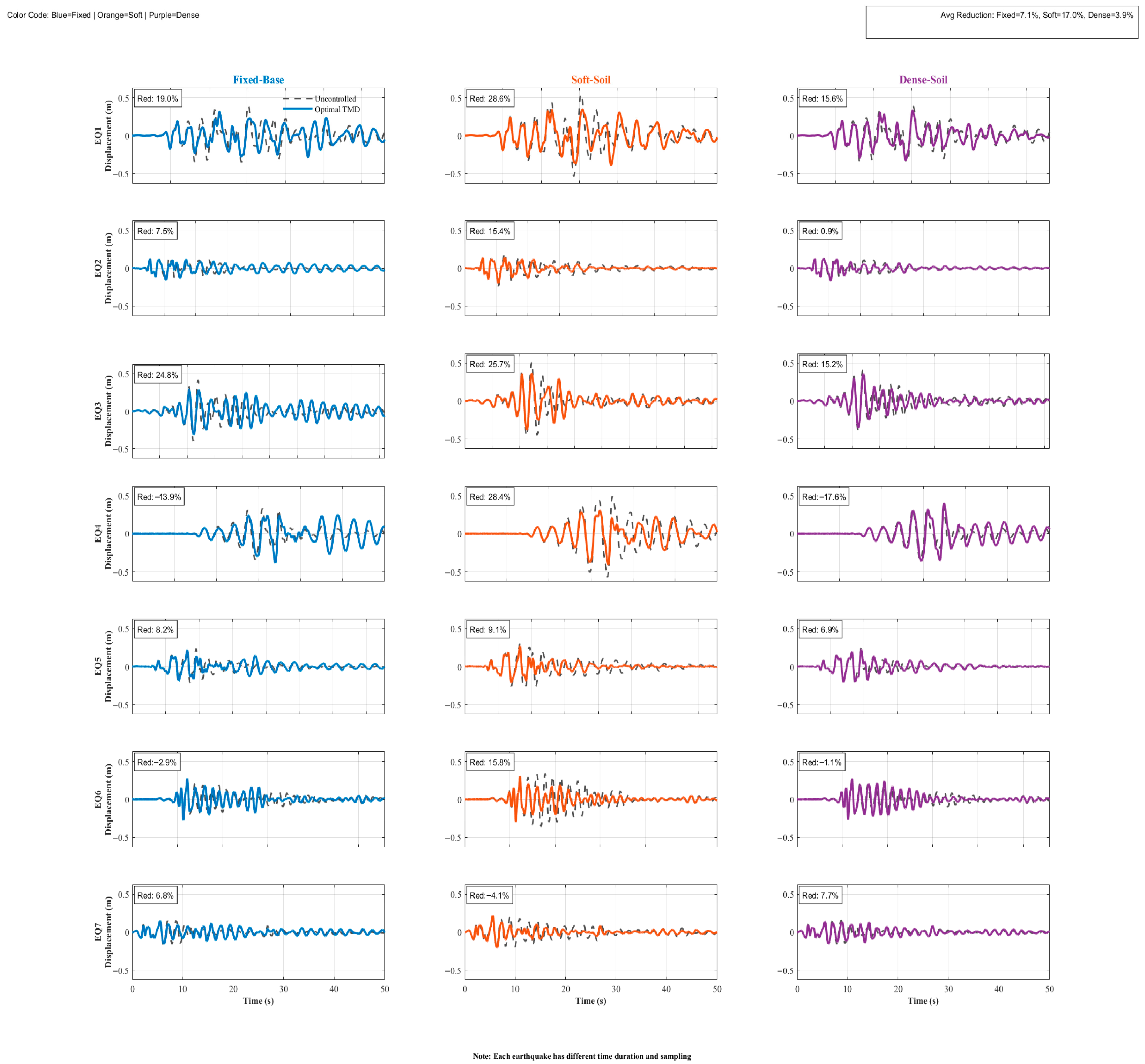
Furthermore, the performance of the optimal TMD configurations for all scenarios in controlling the displacement of the 10th floor (roof) under seven earthquake records is presented in Figure 4. The results highlight the decisive influence of both soil–structure interaction and the variability in ground motion frequency content on system efficacy. On average, TMDs were most effective in soft soil conditions, achieving a 17% reduction in roof displacement. This performance diminished to 7% for fixed-base conditions and further dropped to just 4% for dense soil scenarios. This pronounced performance gradient underscores how intrinsic soil damping and a broadened structural frequency response can complement and enhance TMD effectiveness. Considerable outcome variability was also observed across different earthquake records, with displacement reductions ranging from 0.8% to 26%. Notably, a negative effect (response amplification) was recorded for certain motions, underscoring the risk of a detuned TMD.
Regarding the relatively small average displacement reductions observed in structures with dense soil, the following three mechanisms can be implicated: First, soil–structure interaction in dense soil elongates the structural period relative to the fixed-base case, partially detuning the TMD from its target frequency. As a result, the TMD dissipates less energy at the predominant excitation frequencies. Second, TMDs are inherently single-mode devices; when higher modes contribute significantly to the structural response (which is more pronounced in near-field records with broadband frequency content), a single TMD tuned to the fundamental mode provides limited benefit. Third, for certain earthquake records, the ground motion energy is concentrated near the tuned frequency of the TMD, causing the device to undergo large strokes and momentarily transfer energy back to the structure—the so-called detuned TMD effect. These findings collectively emphasize the necessity for a robust design approach and multi-objective optimization that simultaneously considers an ensemble of seismic records and geotechnical conditions. Overall, this study confirms that the successful implementation of TMDs requires not only precise dynamic tuning but also an intelligent integration of site-specific soil characteristics and the inherent uncertainties in seismic excitation.

5. Conclusions

In this study, the optimal design of a TMD for a 10-story steel building under seismic forces, incorporating soil–structure interaction effects, was investigated using MOHBA—a novel multi-objective metaheuristic algorithm. The algorithm’s performance was validated against NSGA-II and MOPSO, demonstrating competitive solution diversity and convergence across fixed-base, soft soil, and dense soil conditions.
The optimized TMD’s efficiency was found to be strongly dependent on soil type. The highest average reduction in roof displacement occurred under soft soil conditions (17%), compared to 7% for fixed-base and 4% for dense soil—a clear gradient that underscores the decisive role of soil damping and dynamic SSI effects on passive control performance. Considerable variability across earthquake records was also observed (0.8–26% reduction), with occasional response amplification, reinforcing the necessity of ensemble-based ground motion selection and a robust multi-objective design framework that simultaneously targets stability, resilience, and efficiency.
Overall, MOHBA proved capable of delivering optimal TMD configurations while concurrently handling complex design variables, varying soil conditions, and seismic frequency-content uncertainties—offering a practical basis for passive control design in high-rise structures.
These findings are subject to several limitations. The study is confined to a regular 10-story steel frame; generalization to irregular or taller structures requires further investigation. Linear elastic structural behavior and frequency-independent soil parameters are assumed, which may not fully capture nonlinear or frequency-dependent responses under intense shaking. Additionally, the seismic suite comprises only seven near-field records; incorporating far-field and pulse-like motions would strengthen the robustness of conclusions. For future research, treating subsoil properties and earthquake intensity as probabilistic variables within a reliability-based design framework would bring the findings closer to real-world engineering applicability.


Author Contributions

Methodology, formal analysis, and writing—original draft preparation, L.W.; formal analysis, writing—original draft preparation, J.L.; formal analysis, visualization, writing—review and editing, S.L.; formal analysis, visualization, writing—review and editing, Z.Z.; formal analysis, writing—review & editing, Supervision, Y.D.; software, conceptualization, methodology, formal analysis, validation, and writing—review and editing, J.J.-A.; formal analysis, visualization, writing—review and editing, J.Z. All authors have read and agreed to the published version of the manuscript.

Funding

This research was funded by Shenzhen Sustainable Development Science and Technology Project, Grant No. KCXFZ20211020165543004 and Guangdong Special Support Plan, Grant No. 2023TQ07G906.

Data Availability Statement

The data presented in this study are available on request from the corresponding authors.

Acknowledgments

The authors acknowledge the support from the Shenzhen Sustainable Development Science and Technology Project (Grant No. KCXFZ20211020165543004) and Guangdong Special Support Plan (Grant No. 2023TQ07G906). During the preparation of this work the authors used ChatGPT(GPT-5.3) in order to proofread and improve the writing. After using this tool/service, the authors reviewed and edited the content as needed and take full responsibility for the content of the publication.

Conflicts of Interest

The authors declare no conflicts of interest.

References

  1. Galasso, C.; Opabola, E.A. The 2023 Kahramanmaraş Earthquake Sequence: Finding a Path to a More Resilient, Sustainable, and Equitable Society. Commun. Eng. 2024, 3, 24. [Google Scholar] [CrossRef]
  2. Işık, E.; Avcil, F.; Hadzima-Nyarko, M.; İzol, R.; Büyüksaraç, A.; Arkan, E.; Radu, D.; Özcan, Z. Seismic Performance and Failure Mechanisms of Reinforced Concrete Structures Subject to the Earthquakes in Türkiye. Sustainability 2024, 16, 6473. [Google Scholar] [CrossRef]
  3. Rathi, A.K.; Chakraborty, A. Reliability-Based Performance Optimization of TMD for Vibration Control of Structures with Uncertainty in Parameters and Excitation. Struct. Control. Health Monit. 2017, 24, e1857. [Google Scholar] [CrossRef]
  4. Miguel, L.F.F.; Lopez, R.H.; Torii, A.J. A Novel Approach to the Optimum Design of MTMDs Under Seismic Excitations. Struct. Control. Health Monit. 2016, 23, 1290–1313. [Google Scholar] [CrossRef]
  5. Farshidianfar, A.; Soheili, S. Ant Colony Optimization of Tuned Mass Dampers for Earthquake Oscillations of High-Rise Structures Including Soil-Structure Interaction. Soil Dyn. Earthq. Eng. 2013, 51, 14–22. [Google Scholar] [CrossRef]
  6. Yucel, M.; Bekdaş, G.; Nigdeli, S.M.; Sevgen, S. Estimation of Optimum Tuned Mass Damper Parameters via Machine Learning. J. Build. Eng. 2019, 26, 100847. [Google Scholar] [CrossRef]
  7. Mrabet, E.; Guedri, M.; Ichchou, M.N.; Ghanmi, S.; Soula, M. A New Reliability Based Optimization of Tuned Mass Damper Parameters Using Energy Approach. J. Vib. Control. 2018, 24, 153–170. [Google Scholar] [CrossRef]
  8. Domizio, M.; Garrido, H.; Ambrosini, D. Single and Multiple TMD Optimization to Control Seismic Response of Nonlinear Structures. Eng. Struct. 2022, 252, 113667. [Google Scholar] [CrossRef]
  9. Zhang, H.Y.; Zhang, L.J. Tuned Mass Damper System of High-Rise Intake Towers Optimized by Improved Harmony Search Algorithm. Eng. Struct. 2017, 138, 270–282. [Google Scholar] [CrossRef]
  10. Bekdaş, G.; Nigdeli, S.M.; Yang, X.S. A Novel Bat Algorithm Based Optimum Tuning of Mass Dampers for Improving the Seismic Safety of Structures. Eng. Struct. 2018, 159, 89–98. [Google Scholar] [CrossRef]
  11. Salvi, J.; Rizzi, E.; Rustighi, E.; Ferguson, N.S. Optimum Tuning of Passive Tuned Mass Dampers for the Mitigation of Pulse-Like Responses. J. Vib. Acoust. 2018, 140, 061014. [Google Scholar] [CrossRef]
  12. Di Matteo, A.; Masnata, C.; Pirrotta, A. Hybrid Passive Control Strategies for Reducing the Displacements at the Base of Seismic Isolated Structures. Front. Built Environ. 2019, 5, 132. [Google Scholar] [CrossRef]
  13. Sgobba, S.; Marano, G.C. Optimum Design of Linear Tuned Mass Dampers for Structures with Nonlinear Behavior. Mech. Syst. Signal Process. 2010, 24, 1739–1755. [Google Scholar] [CrossRef]
  14. Matta, E. Lifecycle Cost Optimization of Tuned Mass Dampers for the Seismic Improvement of Inelastic Structures. Earthq. Eng. Struct. Dyn. 2018, 47, 714–737. [Google Scholar] [CrossRef]
  15. Elias, S.; Rupakhety, R.; Ólafsson, S. Tuned Mass Dampers for Response Reduction of a Reinforced Concrete Chimney Under Near-Fault Pulse-Like Ground Motions. Front. Built Environ. 2020, 6, 92. [Google Scholar] [CrossRef]
  16. Bagheri, S.; Rahmani-Dabbagh, V. Seismic Response Control with Inelastic Tuned Mass Dampers. Eng. Struct. 2018, 172, 712–722. [Google Scholar] [CrossRef]
  17. Boccamazzo, A.; Carboni, B.; Quaranta, G.; Lacarbonara, W. Seismic Effectiveness of Hysteretic Tuned Mass Dampers for Inelastic Structures. Eng. Struct. 2020, 216, 110591. [Google Scholar] [CrossRef]
  18. Yucel, M.; Bekdaş, G.; Nigdeli, S.M. Machine Learning-Based Model for Prediction of Optimum TMD Parameters in Time-Domain History. J. Braz. Soc. Mech. Sci. Eng. 2024, 46, 192. [Google Scholar] [CrossRef]
  19. Kleingesinds, S.; Lavan, O. Multihazard Optimization-Based Simultaneous Design of Multistory Concrete Structures and TMDs. J. Struct. Eng. 2024, 150, 04024095. [Google Scholar] [CrossRef]
  20. Zhang, R.; Wen, X. Multiple Optimal Design Methods Comparison of Nontraditional Tuned Mass Damper (NTMD) System for Base Excited Structural Vibration Control. Mech. Based Des. Struct. Mach. 2026, 54, 2631691. [Google Scholar] [CrossRef]
  21. Cimellaro, G.P.; Reinhorn, A.M.; Bruneau, M. Framework for Analytical Quantification of Disaster Resilience. Eng. Struct. 2010, 32, 3639–3649. [Google Scholar] [CrossRef]
  22. Zhang, R.; Jiang, A.; Jiang, L. Exposure-Sensitivity-Adaptability (ESA) Framework Based Evaluation and Characteristics Analysis of Urban Disasters Vulnerability in China. Ecol. Indic. 2025, 176, 113662. [Google Scholar] [CrossRef]
  23. Kim, T.; Yi, S.R.; Kim, J.H.; Byun, J.E. Disaster Resilience Analysis Framework for Lifeline Networks: Integrating Reliability, Redundancy, and Recoverability. Int. J. Disaster Risk Reduct. 2025, 123, 105436. [Google Scholar] [CrossRef]
  24. Houri, A.A.L.; Habib, A.; Al-Sadoon, Z.A. Artificial Intelligence-Based Design and Analysis of Passive Control Structures: An Overview. J. Soft Comput. Civ. Eng. 2025, 9, 137–168. [Google Scholar] [CrossRef]
  25. Bruneau, M.; Chang, S.E.; Eguchi, R.T.; Lee, G.C.; O’Rourke, T.D.; Reinhorn, A.M.; Shinozuka, M.; Tierney, K.; Wallace, W.A.; Von Winterfeldt, D. A Framework to Quantitatively Assess and Enhance the Seismic Resilience of Communities. Earthq. Spectra 2003, 19, 733–752. [Google Scholar] [CrossRef]
  26. Dong, Y.; Frangopol, D.M. Resilience of Civil Infrastructure in a Life-Cycle Context. In Resilience of Critical Infrastructure Systems; CRC Press: Boca Raton, FL, USA, 2020. [Google Scholar]
  27. Xu, Z.; Zhang, H.; Lu, X.; Xu, Y.; Zhang, Z.; Li, Y. A Prediction Method of Building Seismic Loss Based on BIM and FEMA P-58. Autom. Constr. 2019, 102, 245–257. [Google Scholar] [CrossRef]
  28. Kircher, C.A.; Whitman, R.V.; Holmes, W.T. HAZUS Earthquake Loss Estimation Methods. Nat. Hazards Rev. 2006, 7, 45–59. [Google Scholar] [CrossRef]
  29. Koohfallah, K.; Raissi Dehkordi, M.; D’Ayala, D.; Ghodrati Amiri, G.; Eghbali, M.; Samadian, D. Seismic Resilience of Typical Steel School Building and Retrofitting Options Based on FEMA P-58 Under Mainshock-Aftershock Effects. J. Build. Eng. 2024, 86, 108636. [Google Scholar] [CrossRef]
  30. Wang, L.; Shi, W.; Zhou, Y. Adaptive-Passive Tuned Mass Damper for Structural Aseismic Protection Including Soil–Structure Interaction. Soil Dyn. Earthq. Eng. 2022, 158, 107298. [Google Scholar] [CrossRef]
  31. Jafari-Asl, J.; Lara Montaño, O.D.; Mirjalili, S.; Faes, M.G.R. A Meta-Heuristic Approach for Reliability-Based Design Optimization of Shell-and-Tube Heat Exchangers. Appl. Therm. Eng. 2024, 248, 123161. [Google Scholar] [CrossRef]
  32. Rahmanshahi, M.; Jafari-Asl, J.; Fathi-Moghadam, M.; Ohadi, S.; Mirjalili, S. Metaheuristic Learning Algorithms for Accurate Prediction of Hydraulic Performance of Porous Embankment Weirs. Appl. Soft Comput. 2024, 151, 111150. [Google Scholar] [CrossRef]
  33. Ahmadabadi, S.A.; Jafari-Asl, J.; Banifakhr, E.; Houssein, E.H.; Seghier, M.E.A.B. Risk-Based Design Optimization of Contamination Detection Sensors in Water Distribution Systems: Application of an Improved Whale Optimization Algorithm. Water 2023, 15, 2217. [Google Scholar] [CrossRef]
  34. Jafari-Asl, J.; Dong, Y.; Guo, H. Enhancing Structural Reliability Through AI-Driven Control Variates and Subset Simulation. ASCE-ASME J. Risk Uncertain. Eng. Syst. Part A Civ. Eng. 2025, 11, 04025056. [Google Scholar] [CrossRef]
  35. Jafari-Asl, J.; Hashemi Monfared, S.A.; Abolfathi, S. Reducing Water Conveyance Footprint Through an Advanced Optimization Framework. Water 2024, 16, 874. [Google Scholar] [CrossRef]
  36. Hashim, F.A.; Houssein, E.H.; Hussain, K.; Mabrouk, M.S.; Al-Atabany, W. Honey Badger Algorithm: New Metaheuristic Algorithm for Solving Optimization Problems. Math. Comput. Simul. 2022, 192, 84–110. [Google Scholar] [CrossRef]
  37. Deb, K.; Pratap, A.; Agarwal, S.; Meyarivan, T. A Fast and Elitist Multiobjective Genetic Algorithm: NSGA-II. IEEE Trans. Evol. Comput. 2002, 6, 182–197. [Google Scholar] [CrossRef]
  38. Mostaghim, S.; Teich, J. Strategies for Finding Good Local Guides in Multi-Objective Particle Swarm Optimization (MOPSO). In Proceedings of the 2003 IEEE Swarm Intelligence Symposium, SIS 2003—Proceedings, Indianapolis, IN, USA, 24–26 April 2003. [Google Scholar]
  39. Mellal, M.A.; Pecht, M. A Multi-Objective Design Optimization Framework for Wind Turbines Under Altitude Consideration. Energy Convers. Manag. 2020, 222, 113212. [Google Scholar] [CrossRef]
Figure 1. Pareto-optimal solutions obtained by MOHBA for the fixed-base structural scenario: (a) 3D Pareto front among resilience (R%), TMD mass ( m T M D ), and number of TMDs (Ns); (b) Resilience vs. TMD mass; (c) Resilience vs. Ns; (d) TMD mass vs. Ns. Color scales in (bd) represent Ns, m T M D , and (R%), respectively.
Buildings 16 01360 g001
Figure 2. Pareto-optimal solutions obtained by MOHBA for the soft-base structural scenario: (a) 3D Pareto front; (b) Resilience (R%) vs. TMD mass ( m T M D ); (c) Resilience vs. Ns; (d) TMD mass vs. Ns. The color scales in (bd) correspond to the third variable in each projection. The resilience values for this scenario range from 59.9% to 66.8%.
Buildings 16 01360 g002
Figure 3. Pareto-optimal solutions obtained by MOHBA for the dense-base structural scenario: (a) 3D Pareto front; (b) Resilience (R%) vs. TMD mass ( m T M D ); (c) Resilience vs. Ns; (d) TMD mass vs. Ns. The color scales in (bd) correspond to the third variable in each projection. For this scenario, the resilience values are observed within a range of 62.0% to 67.5%.
Buildings 16 01360 g003
Figure 4. Roof displacement time-histories for uncontrolled and optimally controlled structures under seven seismic records (EQ1–EQ7) across three foundation scenarios: fixed-base (blue), soft-soil (orange), and dense-soil (purple). Percentage values represent displacement reduction (positive) or amplification (negative) relative to the uncontrolled case. Average reductions are 7.1% (fixed), 17.0% (soft), and 3.9% (dense). Note: Due to varying durations and time steps among records, axes are not directly comparable across different earthquakes.
Buildings 16 01360 g004
Table 1. Post-earthquake performance and recovery parameters in this study.
Damage Level δ m a x F m i n T rec (Days)
Operational<0.5%1.000
Slight0.5–1.0%0.9030
Moderate1.0–2.0%0.7090
Severe2.0–4.0%0.40180
Collapse prevention>4.0%0.10365
Table 2. Statistical evaluation indicators.
ParameterFormula
SP1 1 n 1 i = 1 n d ¯ d i 2
SP2 1 n 1 i = 1 n 1 d ¯ d i 2
HRS m a x i d i d ¯
Where d i and d ¯ denote the distance between the adjacent two points and the mean of this distance, respectively.
Table 3. Properties of 10-story steel building.
Story h i (m) m i (kg) c i (N·s/m) k i (N/m) I i (kg·m2)
13.2 3.2695 × 10 5 4.4751 × 10 6 6.2986 × 10 8 8.37 × 10 5
26.4 3.2695 × 10 5 3.1746 × 10 6 4.4298 × 10 8 8.37 × 10 5
39.6 3.2570 × 10 5 2.8364 × 10 6 3.9443 × 10 8 8.3378 × 10 5
412.8 3.2464 × 10 5 2.6238 × 10 6 3.6393 × 10 8 8.3107 × 10 5
516.0 3.2464 × 10 5 2.5795 × 10 6 3.5755 × 10 8 8.3107 × 10 5
619.2 3.2199 × 10 5 2.2782 × 10 6 3.1436 × 10 8 8.2429 × 10 5
722.4 3.1953 × 10 5 1.9826 × 10 6 2.7199 × 10 8 8.1801 × 10 5
825.6 3.1953 × 10 5 1.9330 × 10 6 2.6486 × 10 8 8.1801 × 10 5
928.8 3.1953 × 10 5 1.7748 × 10 6 2.4212 × 10 8 8.1801 × 10 5
1032.0 2.7623 × 10 5 8.5689 × 10 5 1.1197 × 10 8 7.0716 × 10 5
Table 4. Properties summary of soils.
Soil Type C s N . s / m C r N . s / m k s N / m k r N / m
Soft2.19 × 1082.26 × 10101.91 × 1097.53 × 1011
Dense1.32 × 1091.15 × 10115.75 × 10101.91 × 1013
Table 5. Properties of the near-field earthquakes.
EarthquakeMwR (km)PGA (m/s2)
Tabas7.352.058.45
Loma Prieta6.933.856.32
Manjil7.3712.554.87
Chi Chi7.623.126.24
Imperial Valley6.532.665.87
Düzce7.1412.047.90
El Centro6.903.42
Table 6. Setting parameters of algorithms.
AlgorithmParameterValue
NSGA-IIProbability of crossover0.85
Probability of mutation0.43
Mutation rate0.02
MOPSOWeight factor (w)0.9
Acceleration coefficient (C1)1.5
Acceleration coefficient (C2)1.5
MOBHAC2
β 6
Table 7. Optimization results of TMDs obtained by the algorithms.
BaseParameterMOHBAMOPSONSGA-II
FixNs792
SP10.372.750.0
SP21.911.520.0
HRS5.24.981.0
SoftNs281821
SP11.632.580.58
SP20.731.431.06
HRS2.584.463.63
DenseNs101916
SP10.561.220.52
SP20.870.930.52
HRS2.213.651.99
Table 8. Details of obtained Pareto front for scenario fix-base building.
No.R (%)Mass (Kg)Ns
168.7831,857.084
285.9431,857.234
390.0832,819.754
476.2631,870.351
576.2631,860.042
680.9231,950.252
780.3931,908.592
889.2644,741.653
990.6145,405.644
1079.0350,898.151
1180.39116,484.911
1288.7231,989.142
Table 9. Details of obtained Pareto front for scenario soft-base building.
No.R (%)Mass (Kg)Ns
164.1235,686.122
261.4831,951.591
360.5531,863.32
462.2431,982.075
561.1831,914.621
666.7635,434.253
762.5532,039.055
864.4448,899.272
962.8732,048.683
1061.6131,868.254
1162.2437,126.621
1262.5543,489.941
1362.5532,284.292
1459.9131,857.311
1561.6134,2811
1661.9131,888.967
1763.1832,478.784
1860.5531,874.851
1965.5065,495.072
2061.9131,937.615
2164.7532,111.845
2261.6132,227.12
2362.2431,893.077
2460.8531,905.872
2562.1231,984.663
Table 10. Details of obtained Pareto front for scenario dense-base building.
No.R (%)Mass (Kg)Ns
167.5233,5443
267.3332,025.565
367.3332,361.684
463.7431,867.841
566.8831,877.413
665.9432,902.052
762.0431,858.54
867.0232,318.634
964.6831,870.273
1067.5133,541.354
1165.3131,896.872
1266.8833,278.772
1362.6731,865.282
1466.5833,162.032
1564.0532,008.471
Disclaimer/Publisher’s Note: The statements, opinions and data contained in all publications are solely those of the individual author(s) and contributor(s) and not of MDPI and/or the editor(s). MDPI and/or the editor(s) disclaim responsibility for any injury to people or property resulting from any ideas, methods, instructions or products referred to in the content.