Article

A Bayesian-Optimized LightGBM Approach for Reliable Cooling Load Prediction

College of Civil and Environmental Engineering, Hunan University of Technology, Zhuzhou 412007, China
*
Author to whom correspondence should be addressed.
Buildings 2026, 16(7), 1357; https://doi.org/10.3390/buildings16071357
Submission received: 9 February 2026 / Revised: 26 March 2026 / Accepted: 27 March 2026 / Published: 29 March 2026
(This article belongs to the Special Issue Research on Energy Efficiency and Low-Carbon Pathways in Buildings)

Abstract

With the rapid advancement of information technology, the energy consumption of data centers has become a critical issue. Accurate cooling load prediction is essential for optimizing cooling system operations and improving energy efficiency. However, conventional models often struggle to capture the complex nonlinearities and multi-variable coupling effects inherent in data centers. To address the limitations of existing models in terms of training efficiency and generalization performance, this study proposes a cooling load prediction model that integrates the light gradient boosting machine (LightGBM) algorithm with Bayesian optimization. The model was validated using data generated from an EnergyPlus simulation of a representative medium-scale data center. Comparative analysis demonstrates that the proposed model surpasses naive benchmarks (T-1, T-24, and T-168) and other machine learning models (SVR, XGBoost, and LSTM), achieving superior performance with a Root Mean Squared Error (RMSE) of 4.3234 kW, R2 of 0.9999, and Mean Absolute Percentage Error (MAPE) of 0.07%. A noise robustness analysis further reveals that the model maintains excellent performance under realistic uncertainties, achieving an R2 above 0.99 and an RPD exceeding 12 even at high noise levels (SNR = 20 dB). The total runtime and Relative Prediction Deviation (RPD) were 33.45 s and 86.2685, respectively, indicating an excellent balance between computational efficiency and robust predictive reliability. The key contribution of this research is the effective integration of LightGBM and Bayesian optimization to provide a highly accurate and efficient tool for data center cooling load prediction. This approach offers a scientific foundation for the intelligent control of cooling systems and energy efficiency optimization in data centers, with direct practical implications for building energy management.

1. Introduction

The rapid advancement of the information society has led to significant expansion in both the number and scale of data centers. According to recent statistics from Synergy Research Group [1], the number of large data centers operated by hyperscale providers increased to 1136 at the end of 2024, having doubled over the previous five years. Simultaneously, energy consumption and operational expenditures in data centers continue to rise significantly [2,3], with projections indicating they will constitute nearly 8% of global electricity demand by 2030 [4]. In addition to high energy requirements, data centers also suffer from notably low resource utilization. Relevant statistical reports show that the average resource utilization rate in typical data centers remains below 25% [5]. In a data center, the cooling system plays a crucial role, accounting for approximately 37% of the total energy consumption [6]. While diverse cooling technologies, including advanced rack-level solutions, continue to advance [7], their operational efficiency fundamentally relies on accurate anticipation of the cooling load. Precise cooling load prediction is therefore a critical enabler for energy optimization across the entire spectrum of cooling technologies. Within the cooling load, IT equipment constitutes the primary heat source, accounting for approximately 71~73% of the total cooling load. Additionally, uninterruptible power supply (UPS) systems contribute about 11~13% to the total cooling load [8,9]. Nowadays, most data centers experience significant overcooling, whereby the cooling systems frequently supply nearly twice the required cooling capacity. This results in an increase of over 50% in the energy consumption of cooling systems compared to their design specifications, thereby substantially elevating the operational costs of the data center [10]. Consequently, accurate and reliable prediction of cooling loads is essential for minimizing energy consumption, improving the operational efficiency of data center cooling systems, and establishing a robust foundation for effective energy management.
Cooling load prediction models have been developed across various domains and applications, typically categorized into two main approaches: physical models and data-driven models [11]. Physical models employ thermodynamics-based simulation tools such as EnergyPlus [12], Dymola [13], TRNSYS [14] and DOE-2 [15]. These models require detailed building parameter inputs, a requirement that often involves substantial labor costs [16] and may still suffer from limitations in predictive accuracy. This limitation stems from simplifications in modeling complex real-world phenomena, including uncertainties in occupant behavior, equipment degradation over time, and the stochastic nature of weather conditions. In contrast, data-driven models overcome these limitations associated with physical models by leveraging machine learning techniques. While physics-based and hybrid gray-box models offer interpretability and physical consistency, they often require detailed knowledge of building systems and can be computationally intensive for real-time control. The accuracy of the prediction model plays a critical role in determining the reliability of parameter prediction and the effectiveness of energy management system optimization. This relationship is reflected in improved decision-support robustness, as greater predictive precision leads to reduced operational uncertainty.
With the rapid advancement of artificial intelligence (AI) technologies [17], data-driven models have gained prominence in energy applications. A variety of machine learning algorithms have been widely adopted for predictive modeling, including backpropagation neural networks (BP) [18], artificial neural networks (ANNs) [19], support vector machines (SVMs) [20], long short-term memory (LSTM) [21], extreme gradient boosting (XGBoost) [22], light gradient boosting machine (LightGBM) [23] and other algorithms. Hu and Wei [24] developed a BP neural network with Bayesian regularization for hourly cooling load prediction of a large commercial building, achieving prediction errors of 1.60% and 1.18% for weekly and daily forecasts, respectively. Under dynamic operational scenarios, specifically varying occupancy flow and weather conditions, the maximum relative errors remained below 9.8257% and 11.675%, respectively, confirming its robustness across diverse boundary conditions. Chen et al. [25] proposed an SVM-based hourly air conditioning load prediction model, employing metaheuristic optimization techniques for parameter tuning, achieving a maximum relative error of 2.52%. In a related study, An et al. [26] developed support vector regression (SVR) models for data center cooling systems, demonstrating superior accuracy under small-sample conditions compared to conventional methods, which highlights SVR’s pronounced advantages for this application. Sha et al. [27] demonstrated that gradient tree boosting (GTB) models trained on 1 h resolution data achieved superior accuracy for building cooling load prediction compared to alternative approaches. Ji et al. [28] implemented a LightGBM-based framework for cooling load prediction, incorporating feature selection of key load determinants. The model, developed using Python(PyCharm Community Edition 2023.3.3) and validated with operational data from an office building in Beijing, consistently achieved prediction accuracies exceeding 90%. These results underscore the model’s practical applicability and effectiveness for real-world energy management scenarios. Hou et al. [29] evaluated five machine learning algorithms for hourly energy consumption prediction in a university office building. Among the evaluated models, the deep neural network (DNN) demonstrated the best performance, achieving optimal R2 values of 0.971 and 0.959, respectively, as well as optimal RMSEs of 4.139 kWh and 4.796 kWh, respectively. Additionally, the DNN achieved optimal metrics of Mean Absolute Percentage Error (MAPE) of 5.095% and 5.738%, respectively. In data center energy prediction, Li et al. [30] developed a hybrid physical–ANN model, where the ANN corrected errors from the physical model, reducing the Mean Relative Error (MRE) from 13.44% to 6.54% and the RMSE from 352.6 to 181.9. Further advancing this field, Dong et al. [31] developed a real-time server energy consumption prediction model using XGBoost, incorporating distance correlation coefficient-based feature selection to identify key parameters. This approach enhanced model accuracy, achieving a 4.698% reduction in MAPE compared to five benchmark regression models. Current research in this domain is characterized by three notable trends: the prevalence of gradient boosting models (e.g., XGBoost, LightGBM) due to their robust performance and capacity to handle high-dimensional data, the increasing application of deep learning architectures for capturing temporal dependencies, and the integration of advanced hyperparameter optimization techniques (e.g., Bayesian optimization, metaheuristic algorithms) to enhance model accuracy. Looking forward, hybrid models that combine physical insights with data-driven flexibility [30], along with interpretability tools such as SHAP, represent promising directions for future research.
Building on these advances, machine learning prediction models are widely recognized for their structural simplicity and broad applicability. Their powerful nonlinear fitting capabilities and strong generalization performance enable them to accommodate diverse building environments and dynamic operating conditions. However, when applied to data center cooling scenarios, existing approaches face two critical limitations: insufficient specialization for high-density, high-reliability cooling load profiles; and inherent trade-offs between computational speed and predictive accuracy. These challenges highlight the need for customized solutions that effectively balance efficiency, precision, and scalability to meet the stringent performance requirements of data center environments. The LightGBM algorithm presents a compelling solution for this domain, as its decision tree-based distributed gradient boosting framework is specifically optimized for large-scale, high-dimensional data processing. It offers fast training speeds, low memory consumption, and competitive predictive accuracy characteristics that align well with the unique requirements of data center cooling load prediction, including the need for high reliability, scalability, and real-time responsiveness.
To enhance the performance of predictive models, Bayesian optimization provides a probabilistic framework that systematically explores the hyperparameter space while incorporating uncertainty, leading to more robust and accurate model performance. These limitations have driven the growing adoption of probabilistic approaches like Bayesian optimization in recent years [29], as they systematically account for parameter uncertainty during the tuning process. Recent advances in hyperparameter optimization have demonstrated significant improvements in cooling load prediction accuracy. Yan et al. [32] developed an enhanced BiLSTM model incorporating PCANet for sensitivity analysis, retaining only features with correlation coefficients >0.2 to reduce dimensionality. By employing a hybrid strategy improved whale optimization algorithm (HSIWOA) for hyperparameter tuning, their approach achieved 50% lower MAPE compared to three benchmark models, with HSIWOA exhibiting superior convergence behavior versus six competing optimization methods. Complementing this work, Mao et al. [33] proposed a nonlinear chaotic Harris hawks algorithm (NCHHO)-optimized full Elman neural network (FENN), where the improved NCHHO outperformed particle swarm optimization (PSO), gray wolf optimizer (GWO), and standard Harris hawks algorithm (HHO) in convergence speed and solution quality. The NCHHO-FENN hybrid model reduced RMSE by 11.72% and increased R2 by 0.46% compared to the baseline FENN. As mentioned above, these studies demonstrate that integrating advanced hyperparameter optimization techniques, particularly metaheuristic algorithms, with neural network architectures can significantly improve both the efficiency and accuracy of data center cooling load prediction models. Notably, reported reductions in MAPE of up to 50%, along with improved convergence behavior, underscore the transformative potential of such algorithmic hybridization for next-generation building energy management systems.
In summary, data-driven models reduce dependence on a priori knowledge of building design and physical systems [34], instead utilizing historical operational data to uncover latent relationships between energy consumption (as the output) and a wide range of input variables, including meteorological conditions, building characteristics, occupancy patterns, and equipment schedules. This methodology offers greater flexibility and broader applicability for cooling load prediction compared to traditional physical models. Although various advanced prediction methods have been developed for commercial buildings [35], their research and application in data center environments remain relatively underdeveloped [36], despite their critical role in energy-efficient operation. Specifically, while LightGBM has been successfully applied in general building energy forecasting, systematic studies that optimize LightGBM with advanced hyperparameter tuning methods—tailored to the unique, high-density, and dynamically fluctuating cooling load profiles of data centers—remain scarce. This gap is particularly critical in the context of data centers, where cooling load profiles are uniquely high-density and dynamically fluctuating. Recent systematic reviews have identified this as a critical gap, highlighting the need for interpretable models and real-time adaptive solutions specifically designed for data center thermal management [37]. Unlike conventional buildings, data centers require 24 h cooling throughout the year, and their optimization control strategies are highly dependent on the precision of predictive models. This predictive accuracy is essential for ensuring both the safety and energy efficiency of cooling systems, highlighting the need for specialized predicting methods tailored to the operational characteristics of data centers.
The selection of an appropriate model is highly dependent on the specific characteristics of the target system and its operational data. In conventional buildings such as offices, cooling loads typically exhibit regular patterns governed by occupancy and diurnal cycles. For these settings, simpler models (e.g., linear regression, SVR) have been shown to provide adequate predictive efficiency [11]. This is corroborated by case studies where methods like Random Forest achieved competitive accuracy in such settings, benefiting from stable and periodic load profiles [38].
In contrast, data center cooling loads present a distinct challenge characterized by high dimensionality (multiple interacting variables), non-strict periodicity (load patterns that are not perfectly repetitive due to dynamic IT workloads), and transient fluctuations driven by sudden changes in computing demands. These complex, nonlinear dynamics exceed the representational capacity of simpler models, necessitating more advanced approaches. Gradient Boosting Decision Tree (GBDT) family models have proven particularly effective in capturing such patterns within data center energy systems [30]. Among these, LightGBM is particularly well-suited. Its algorithmic efficiency in handling high-dimensional data stems from a histogram-based approach and a leaf-wise growth strategy [23]. This efficiency allows it to effectively prioritize and model critical load variations.
To address this gap, a LightGBM model with Bayesian optimization is proposed, which is characterized by rapid training speed, low memory consumption, strong generalization capability, and precise adaptation to data center environments. The selection of LightGBM is motivated by its proven superiority over other ensemble methods in handling large-scale, high-dimensional datasets with complex feature interactions [39,40], as well as its algorithmic efficiency in capturing nonlinear dynamics through leaf-wise growth and histogram-based splitting [23]. The main contributions of this study are summarized as follows:
  • A LightGBM model is proposed specifically for data center cooling load prediction, addressing the unique challenges of high dimensionality and non-strict periodicity;
  • Bayesian optimization is employed to automatically tune hyperparameters, enhancing model accuracy and generalization;
  • Comprehensive comparisons with naive benchmarks (T-1, T-24, and T-168) and state-of-the-art models (SVR, XGBoost, and LSTM) validate the superiority of the proposed approach in terms of prediction accuracy, computational efficiency, and robustness to noise.
This paper is structured as follows: Section 2 details the LightGBM model, including the Bayesian hyperparameter optimization strategy and comparative model selection. Section 3 describes the data acquisition and preprocessing process, supplemented by SHAP (SHapley Additive exPlanations)-based feature importance analysis. Section 4 presents the experimental validation against baseline benchmarks.

2. Methodology

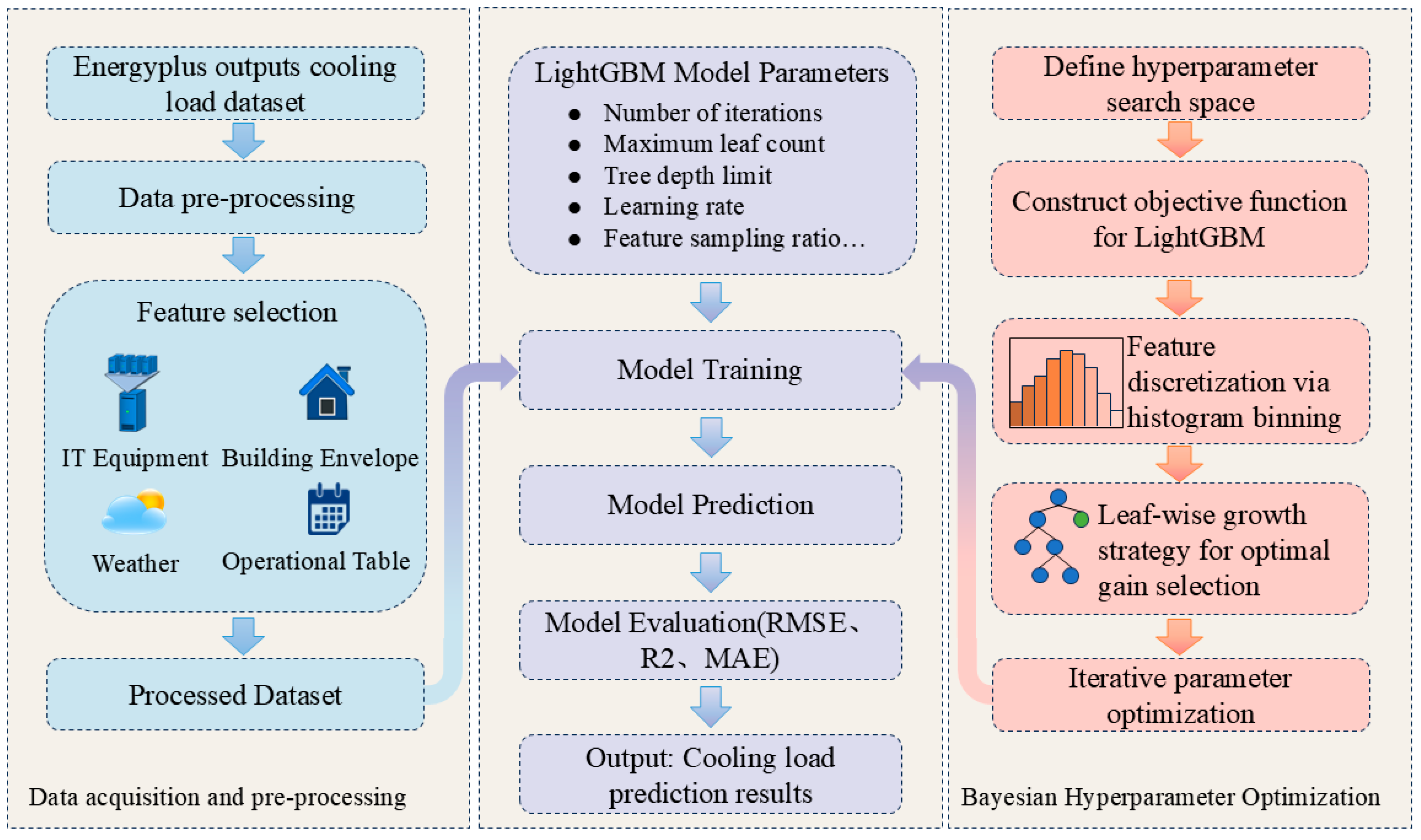
To develop a highly accurate algorithm for predicting the cooling load in data centers, the LightGBM model with Bayesian optimization was proposed. The cooling load prediction workflow of the proposed methodology is shown in Figure 1, which consists of three main components: (1) data acquisition and preprocessing, (2) cooling load prediction using the LightGBM model, and (3) hyperparameter tuning through Bayesian optimization. In the data preprocessing phase, operational parameters such as equipment cooling load, equipment power density, meteorological data, and other relevant variables are acquired from the data center. The raw data subsequently undergo preprocessing and feature selection to form a structured dataset suitable for model training. Owing to the large number of hyperparameters in the LightGBM model and the challenges associated with manual tuning, this study employs the Bayesian optimization algorithm to automatically optimize the hyperparameters and enhance model performance. The final prediction model is built using the LightGBM framework, incorporating the hyperparameters identified through Bayesian optimization. Following the training process, the model is evaluated to produce the final cooling load predictions.

2.1. LightGBM Model

The LightGBM model is a highly efficient gradient boosting framework that extends the conventional gradient boosting decision tree (GBDT) algorithm. Originally introduced by Microsoft in 2017, it is specifically designed to handle large-scale, high-dimensional datasets, making it particularly well-suited for tasks such as cooling load prediction in data centers. The core innovation of the LightGBM model lies in its integration of three key techniques: a histogram algorithm method, a leaf-wise growth strategy with depth constraints, and parallel computing optimization. These advancements collectively enhance training efficiency and predictive accuracy compared to conventional gradient boosting approaches [41]. The LightGBM model constructs an ensemble through an additive, iterative process, combining M weak regression trees to achieve superior predictive performance [42]. The final model after M iterations is expressed as follows:
F x = m = 1 M f m x
where x denotes the input feature vector, and fm is the mth tree.
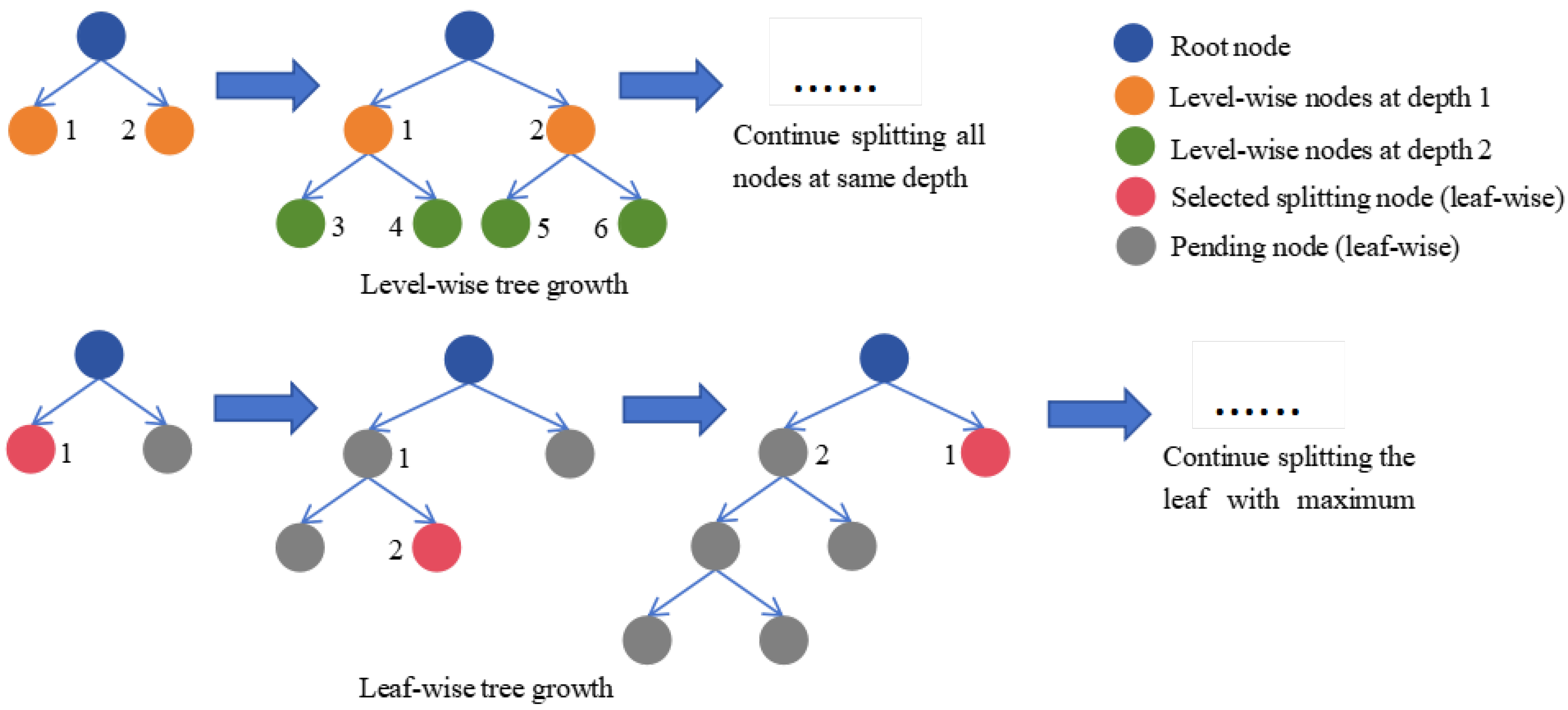
Compared to conventional GBDT, the LightGBM model demonstrates superior performance on large-scale, high-dimensional datasets, such as those encountered in data center cooling load prediction, by significantly improving both computational efficiency and predictive accuracy. To address the computational inefficiencies inherent in conventional GBDT when processing large-scale datasets, LightGBM employs a histogram-based optimization strategy, which discretizes continuous features into k bins. This method quantizes continuous features into discrete integer values, constructs k-bin histograms in a single data pass, accumulates statistical distributions for gain prediction, and determines the best segmentation point based on the maximum information gain criterion. This method effectively reduces computational complexity while maintaining high precision in split-point selection. To further enhance model performance and mitigate overfitting, the LightGBM model employs a leaf-wise tree growth strategy with depth constraints. This approach iteratively selects nodes with the highest gain for splitting, thereby optimizing model expressiveness and predictive accuracy while effectively controlling model complexity to ensure computational tractability. Conventional decision tree algorithms generally adopt a level-wise growth strategy, where all leaf nodes at the same depth are split simultaneously based on maximum impurity reduction (as shown in Figure 2). However, this method frequently introduces redundant computations, as certain leaf nodes may contribute minimal splitting gain, leading to increased computational overhead. In data center cooling systems, measured operational parameters typically exhibit minor fluctuations around their rated values [43]. Although large volumes of data are available, the measured operational parameters in data center cooling systems typically exhibit limited variability around their rated values under steady-state conditions. This characteristic, combined with the high dimensionality of the data, increases the risk of overfitting. LightGBM’s leaf-wise growth strategy mitigates this risk by dynamically selecting the leaf node with the maximum gain for splitting at each iteration. As a result, it not only improves computational efficiency but also mitigates overfitting, making it particularly effective for high-dimensional, low-variability datasets, such as those encountered in cooling load prediction tasks.
Furthermore, the LightGBM model integrates advanced parallel computing techniques, including feature parallelism, data parallelism, and histogram parallelism. These techniques enable the concurrent processing of features and the distribution of data blocks across multiple computational units, while utilizing multithreading for efficient histogram construction. By significantly reducing communication overhead, these techniques enhance both computational efficiency and memory utilization, which are advantages particularly critical for large-scale applications such as data center cooling load prediction. LightGBM incorporates Gradient-based One-Side Sampling (GOSS), a novel sampling method that addresses the computational cost of traditional gradient boosting, which requires scanning all data instances for every split. GOSS retains all data instances with large gradients (i.e., those that are under-trained and contribute significantly to information gain) while performing random sampling on instances with small gradients. By focusing on these high-gradient instances, GOSS ensures that the most informative data points, such as those representing sudden cooling load changes in a data center, are prioritized during training. Compared to uniform random sampling, this approach yields more accurate gain estimates, thereby improving learning efficiency and model performance without compromising accuracy.

2.2. Hyperparameter Tuning via Bayesian Optimization

The selection of optimal hyperparameters for the LightGBM model is crucial due to their direct impact on predictive accuracy. Effective hyperparameter tuning is essential for maximizing model performance [44], serving as a crucial component of the overall optimization process. Conventional hyperparameter tuning of the LightGBM model typically relies on manual trial-and-error methods, where parameters are adjusted empirically based on performance evaluation. However, this method proves inefficient and impractical for multi-parameter optimization scenarios, often resulting in suboptimal solutions due to premature convergence to a local optimum rather than the global optimum. To enhance the predictive accuracy of the LightGBM model for data center cooling load prediction, this study adopts Bayesian optimization, which facilitates the efficient and simultaneous tuning of multiple hyperparameters, thereby increasing the likelihood of achieving a globally optimal solution [45]. This approach enables the development of more accurate and robust predictive models. Bayesian optimization is a global optimization technique that has been successfully applied across various domains, including intelligent robotics [46], information processing, and combinatorial optimization [47]. Notably, Snoek et al. [48] introduced Bayesian optimization into machine learning, demonstrating its effectiveness for joint hyperparameter tuning in complex models. The theoretical foundation of this method is Bayes’ theorem, originally proposed by Reverend Thomas Bayes [49], which provides a probabilistic framework for updating beliefs based on observed data. It can be formally expressed as:
P o s t e r i o r = P r o b a b i l i t y   o f   t h e   d a t a × P r i o r A v e r a g e   p r o b a b i l i t y   o f   t h e   d a t a
The theorem can be written as:
p θ | y = p y | θ p θ p y
where p(θy) is the posterior probability of the parameters θ, given the observed data y; p(yθ) is the likelihood function of the data y, given the parameters θ; p(θ) is the prior probability of θ; and p(y) is the marginal likelihood.
The objective of applying Bayesian optimization to LightGBM hyperparameter tuning is to minimize the model’s validation loss function, formally expressed as:
f x = L y v a l , y v a l ^ x
where x is the combination of hyperparameters to be optimized, L is the loss function on the validation set, y v a l is the truth labels of the validation set, and y v a l ^ x is the predicted value on the validation set generated by the model trained with hyperparameters x .
The objective of applying Bayesian optimization to LightGBM hyperparameter tuning is to minimize the model’s validation loss function, formally expressed as:
E I = E m a x f x f x + , 0
where f x is the best observed value of the objective function.
The Bayesian optimization process operates iteratively through three key phases: (a) GP model construction using existing hyperparameter evaluations, followed by next-point selection via acquisition function maximization (Equation (5)); (b) objective function evaluation at the new candidate point and subsequent GP model updating; (c) iterative repetition of this cycle until termination conditions are satisfied, such as reaching the maximum number of iterations or achieving convergence. This closed-loop procedure represents the complete Bayesian optimization workflow, ultimately resulting in an optimized set of hyperparameters that enhance model performance.

2.3. Naive Benchmark Models

To establish a rigorous baseline that accounts for the inherent periodicity in data center cooling loads, the following naive time-lagged models were established as performance benchmarks. The T-1, T-24, and T-168 baseline models predict the current data center cooling load based on the cooling load value from the previous hour, the same hour of the previous day (24 h lag), and the same hour of the previous week (168 h lag), respectively. This approach can be mathematically formulated as:
y ^ _t = y_ T 1
y ^ _t = y_ T 24
y ^ _t = y_ T 168
These simple baseline models serve as critical benchmarks for evaluating whether the proposed model genuinely surpasses the predictive capability inherent in simple temporal lags, thereby achieving enhanced predictive performance. Notably, they rely exclusively on historical load values and do not require the training of complex algorithms, resulting in minimal computational overhead.

2.4. Three Comparative Models

To evaluate the performance of the proposed model, this study conducts a comparative analysis using XGBoost, SVR, and LSTM as benchmark models. Among these, XGBoost is an ensemble learning algorithm that iteratively trains multiple weak learners (decision trees) and combines their outputs to enhance predictive accuracy through the optimization of an objective function. In building cooling load prediction, XGBoost has exhibited strong capability in processing heterogeneous, multi-source data effectively. SVR extends SVM to regression tasks by identifying optimal hyperplanes in high-dimensional feature spaces. It is particularly effective for building cooling load prediction scenarios characterized by limited sample sizes and high-dimensional input features. LSTM, a specialized recurrent neural network (RNN) variant, resolves the gradient vanishing problem through its gated architecture (input, forget, and output gates). This structure enables the model to capture long-range temporal dependencies effectively, rendering it especially suitable for modeling complex sequential patterns in building cooling load prediction.
All three algorithms are widely recognized for their robust predictive performance. In this study, they serve as baseline benchmarks to evaluate and compare the performance of the proposed Bayesian-optimized LightGBM model.


3. Data Processing and Evaluation Indices

This study employs EnergyPlus to simulate the cooling load of a typical data center located in Nantong, Jiangsu Province, thereby generating the training and validation datasets required for model development. Python serves as the computational platform for both data preprocessing and implementation of the proposed prediction model. Model efficacy is quantified by comparing predicted values against actual values using standardized evaluation metrics. The hardware configuration employed in this case study is summarized in Table 1.

3.1. Data Source and Processing

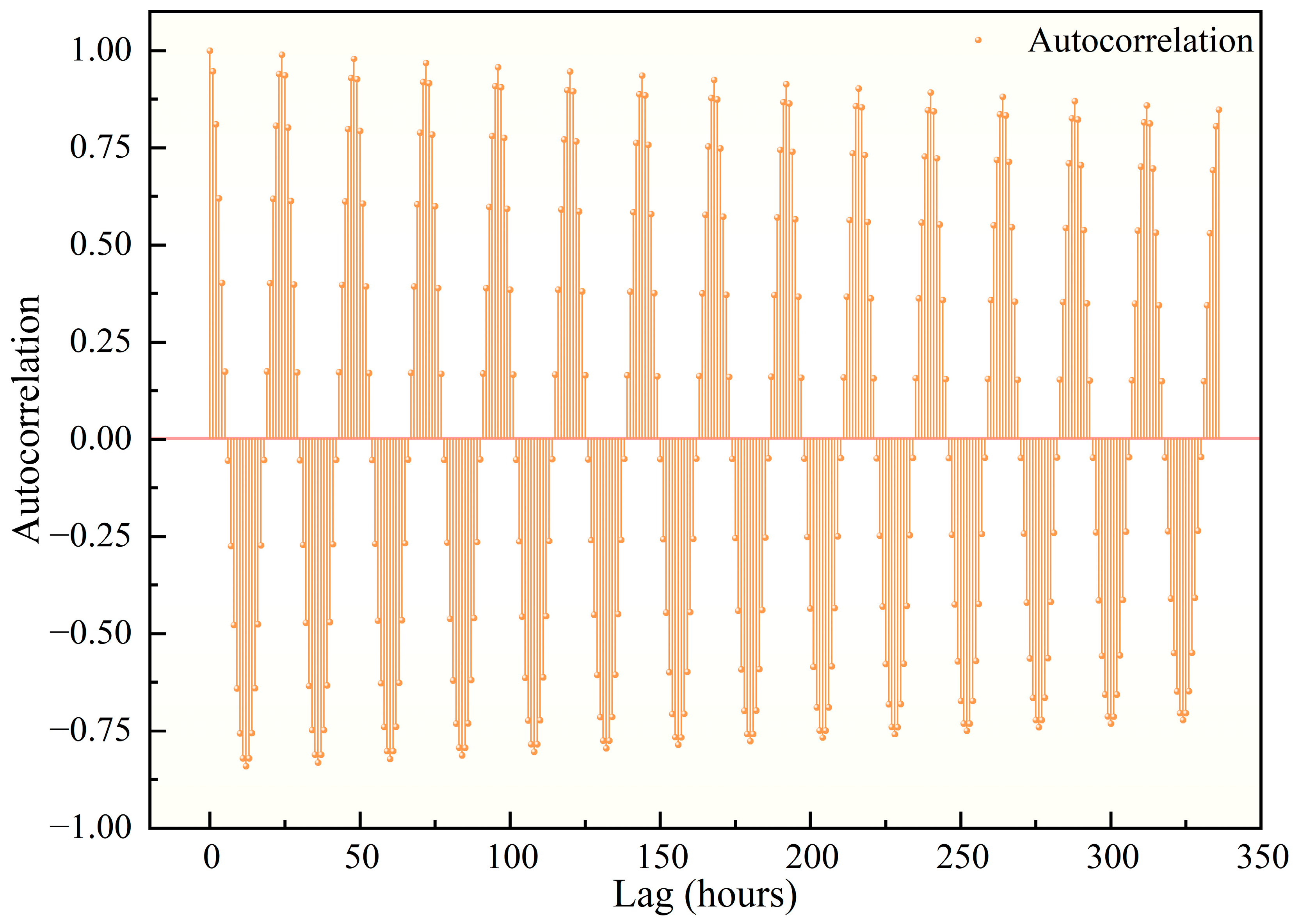
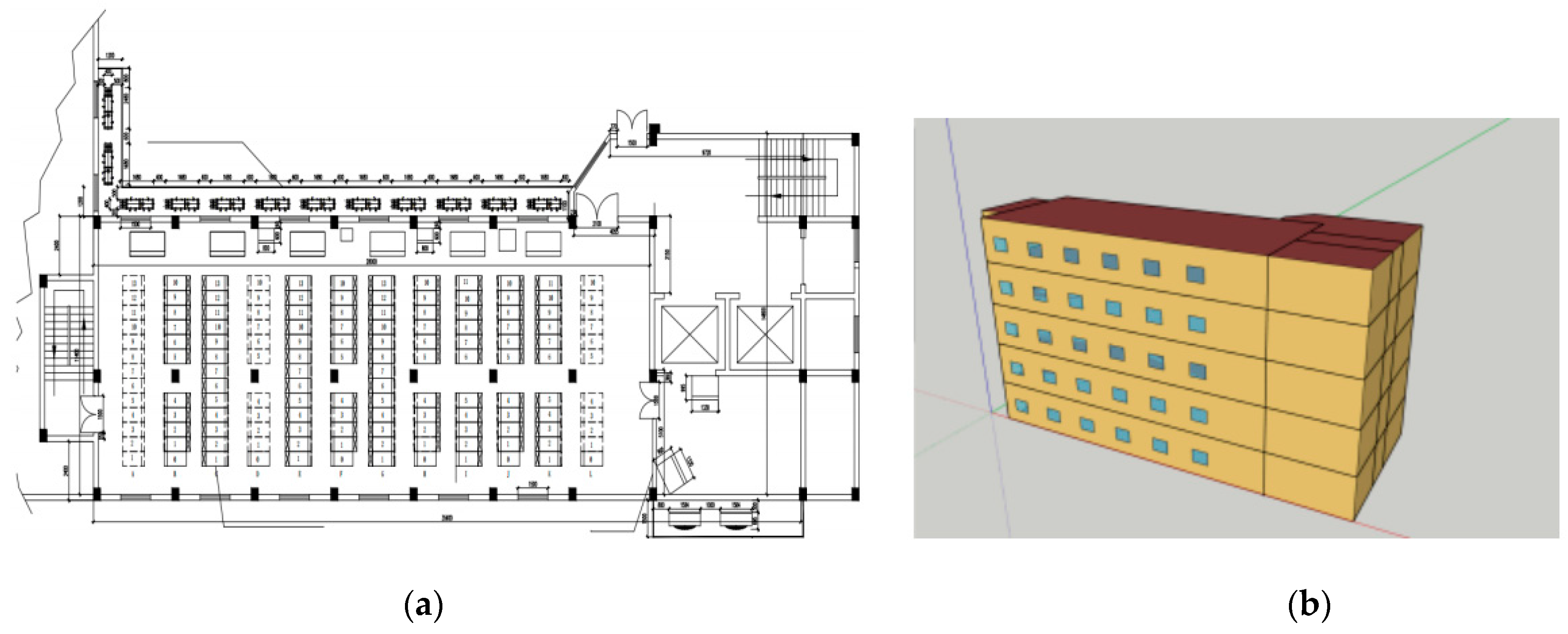
The case study focuses on a five-storey data center located in Nantong, Jiangsu Province, which is representative of a typical medium-scale data center, to generate the requisite datasets. Nantong is located in the hot summer and cold winter climate zone of China. The modeled building includes both server rooms and ancillary office spaces, reflecting the typical functional composition of a data center facility. The simulation was conducted using EnergyPlus, with meteorological data obtained from the EnergyPlus Weather (EPW) file repository. This model is representative in terms of its structural and operational characteristics, including IT load distribution, cooling system configuration, and local climate conditions. Consequently, it serves as an appropriate benchmark for validating the proposed prediction model. Figure 3a illustrates the architectural plan, while the corresponding 3D building model was developed using SketchUp (Figure 3b). The model was subsequently processed through OpenStudio, exported to the EnergyPlus input format, and simulated using meteorological data obtained from the EnergyPlus Weather (EPW) file repository [50]. The simulation incorporates key meteorological inputs, including dry-bulb temperature, relative humidity, wind speed, and solar radiation. The building model incorporates detailed operational parameters to realistically capture the characteristics of a data center. The IT equipment operates a dynamic workload schedule, with CPU utilization ranging from approximately 0.62 to 0.98 over a 24 h cycle, reflecting typical daily fluctuations in computing demand. Internal heat gains from lighting (12 W/m2), office equipment (15.7 W/m2), and occupancy (8 m2/person in office areas) are scheduled according to weekday/weekend patterns, with negligible occupancy in server rooms. Outdoor air ventilation rates are specified as 0.00236 m3/s·person for office zones and 1.0 ACH for server rooms, with an infiltration rate of 0.2 ACH. To accurately capture the dynamic heat dissipation from IT equipment, the specialized calculation module “Electric Equipment: ITE: Air Cooled” was activated in EnergyPlus [36]. The module calculates sensible heat gain based on the scheduled CPU loading, accounting for the non-linear relationship between utilization, power consumption, and heat dissipation through user-defined performance curves. Specifically, empirical curves derived from server performance data were used to define CPU power input as a function of loading and entering air temperature, airflow rate as a function of loading and temperature, and recirculation fraction as a function of loading and supply temperature. The fan power consumption was set at 40% of the total IT power input, with airflow proportional to fan power. Additionally, the UPS efficiency was modeled as a function of part-load ratio, with a design efficiency of 0.9. Upon completion of the simulation, hourly cooling load data (00:00–23:59) for the entire year were extracted. The cooling load, expressed in kW, yielded a total of 8760 data points at one-hour sampling intervals (24 h × 365 days). To quantitatively characterize the temporal patterns inherent in the simulated cooling load series, an autocorrelation analysis was conducted. As shown in Figure 4, the autocorrelation function (ACF) reveals a clear periodic structure, with positive peaks at lags of 24 h and its multiples (48 h, 72 h,…), and a pronounced peak at 168 h, corresponding to a weekly cycle. Conversely, strong negative correlations are observed at lags of 12 h and its odd multiples (36 h, 60 h,…). This confirms the strong diurnal and weekly periodicity of the data, which is a typical characteristic of building operations driven by repetitive occupancy schedules and cyclic weather patterns. The negative correlations at half-day intervals reflect the diurnal temperature variations and their impact on cooling load. This strong periodic structure also provides context for the performance of simple time-lagged benchmark models discussed in Section 4.2. The key building parameters used in the simulation are summarized in Table 2.
To ensure robust model evaluation, this study employs 5-fold cross-validation with stratified partitioning, allocating 80% of the dataset for training and the remaining 20% for testing. Given the critical influence of data quality on predictive accuracy, a comprehensive preprocessing pipeline was implemented prior to inputting data into the proposed LightGBM model with Bayesian optimization. Missing values were imputed using the mean of the corresponding feature. Subsequently, data normalization and standardization were performed to ensure comparability and reliability across features. The normalization process [51,52] is illustrated in Equation (9).
x = x m i n m a x m i n
where x is the original data, x* is the normalized value, min represents the minimum value, and max represents the maximum value in the dataset.

3.2. Feature Importance Assessment

The cooling load of a data center is influenced by multiple factors, making appropriate feature selection essential for improving the accuracy and reliability of the model’s prediction. While many current studies treat machine learning models as black boxes [53], this study employs the SHAP method to interpret model outputs. By quantifying the contribution of each feature to data center cooling load predictions, SHAP delivers both global and local explanations, thereby facilitating a comprehensive understanding of the relationships between input features and cooling load. In this study, a total of 12 features related to cooling load were collected, including CPU load factor, lighting power density, occupancy levels, other equipment power density, and meteorological parameters (dry-bulb temperature, dew-point temperature, relative humidity, atmospheric pressure, wind speed, wind direction, total cloud cover, and solar radiation). The specific input characteristics and units are shown in Table 3. The rationale for their selection is as follows: CPU load is selected as it represents the primary internal heat gain from IT equipment. Lighting power density, indoor occupancy density, and other equipment power density account for secondary internal heat sources. Meteorological variables, including dry-bulb temperature, dew-point temperature, relative humidity, atmospheric pressure, wind speed, wind direction, total cloud cover, and solar radiation intensity, are included because they significantly influence the heat transfer through the building envelope and the performance of cooling systems. SHAP analysis quantifies each feature’s importance through systematic evaluation of its contribution to predictive outcomes.
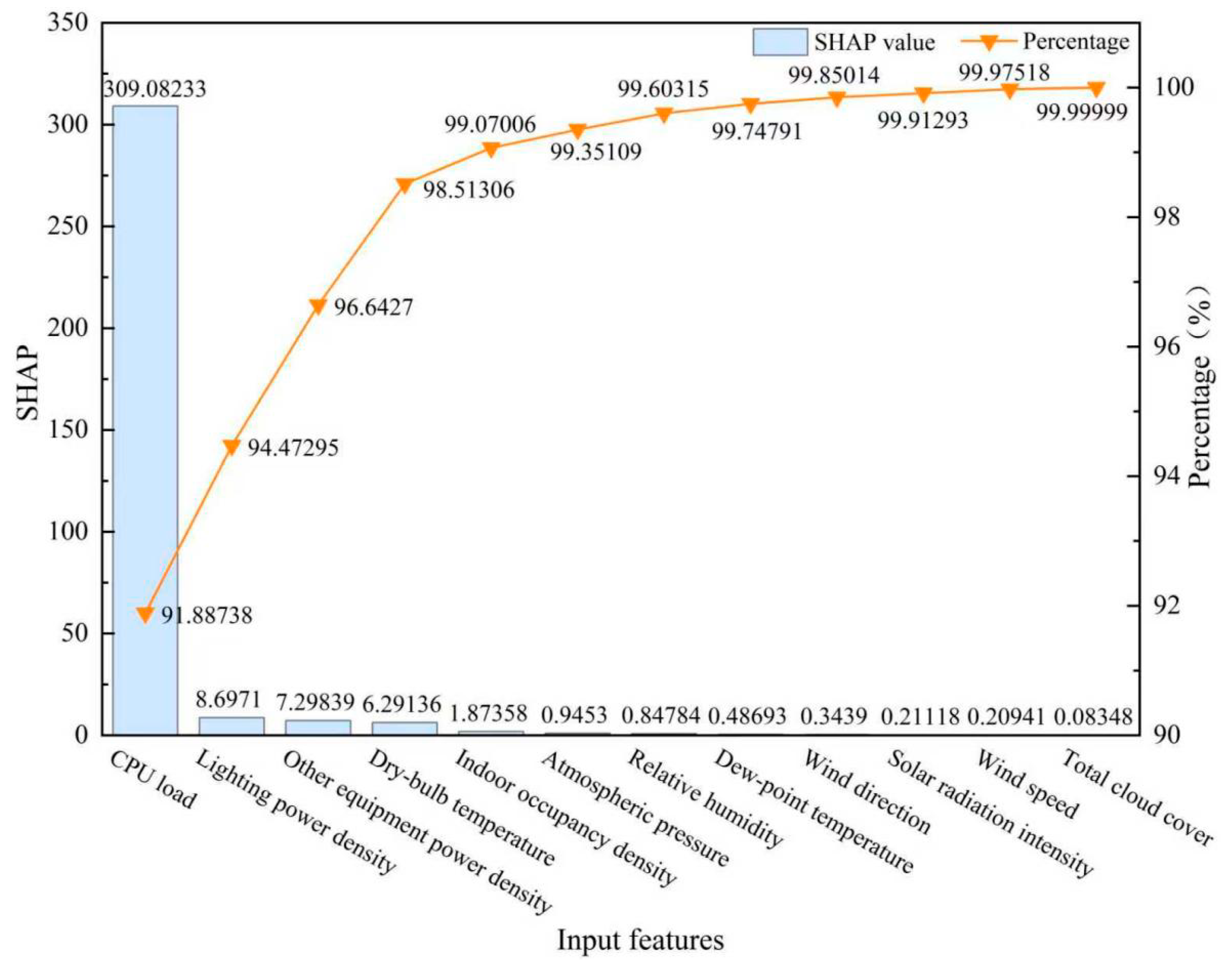
Figure 5 presents the cumulative SHAP value distribution across all features, revealing the CPU load factor as the dominant predictor of cooling load in the data center. It is important to clarify that the SHAP importance values shown in Figure 5 reflect the contribution of each feature to the prediction variability of the model, as opposed to the absolute contribution of individual heat gain components to the total cooling load. CPU load emerges as the dominant predictor due to its significant temporal variability and its direct representation of the primary heat source in data centers—IT equipment. In contrast, other heat sources, such as lighting and office equipment, follow relatively stable schedules and therefore contribute less to the variation in cooling load, even though their absolute magnitudes may be substantial. Five features (namely solar radiation intensity, dew-point temperature, wind speed, wind direction, and total cloud cover) each contribute below 0.2%. Due to their minimal influence, these low-impact features were excluded to streamline model inputs, thereby enhancing both predictive accuracy and computational efficiency.

3.3. Evaluation Indices

Standardized metrics are employed to evaluate the performance of the prediction models. This study uses three error indices: RMSE, R2, and MAPE. These metrics capture prediction error and accuracy from different perspectives, enabling a comprehensive assessment of the model’s performance. The RMSE quantifies the expected value of the squared prediction errors, reflecting typical deviations between predicted and observed values. The R2 measures the goodness of fit, where higher values correspond to superior model performance [32]. The MAPE ranges from 0 to +∞ and represents relative prediction accuracy, with lower values indicating higher precision. The mathematical definitions of these metrics are as follows:
R M S E = i = 1 n y ^ i y i 2 n
R 2 = 1 - i = 1 n y i y ^ i 2 i = 1 n y i y 2
M A P E = 100 % n i = 1 n y i y ^ i y i
where n is the total number of samples, yi is the actual value, and y i ^ is the predicted value.

4. Results and Discussion

To validate the performance of the proposed cooling load prediction model and assess the impact of Bayesian optimization, the processed dataset described in Section 3 is used as input for both the proposed and the comparative models. Section 4.1 presents regression and absolute error analyses, comparing the baseline and Bayesian-optimized models. Section 4.2 compares the evaluation metrics of the proposed model against the baseline model. Section 4.3 assesses the prediction accuracy relative to three benchmark models. Section 4.4 evaluates the computational efficiency and model stability. Subsequently, Section 4.5 examines the robustness of the proposed model under different levels of artificially injected Gaussian noise to simulate real-world measurement uncertainties and assess its practical reliability.

4.1. Comparative Results of Bayesian Optimization

As detailed in Section 2.2, Bayesian optimization was applied to the LightGBM model after inputting selected features. The final set of optimized hyperparameters, as presented in Table 4, includes: num_leaves, which controls the maximum complexity of individual trees; learning_rate, which determines the step size for gradient descent; feature_fraction, which specifies the proportion of features randomly selected for each iteration; n_estimators, which defines the number of boosting rounds; reg_alpha, the L1 regularization term used to prevent overfitting; and min_child_samples, which sets the minimum number of data instances required in a leaf node. Collectively, these hyperparameters are tuned to enhance predictive performance while reducing the risk of overfitting.
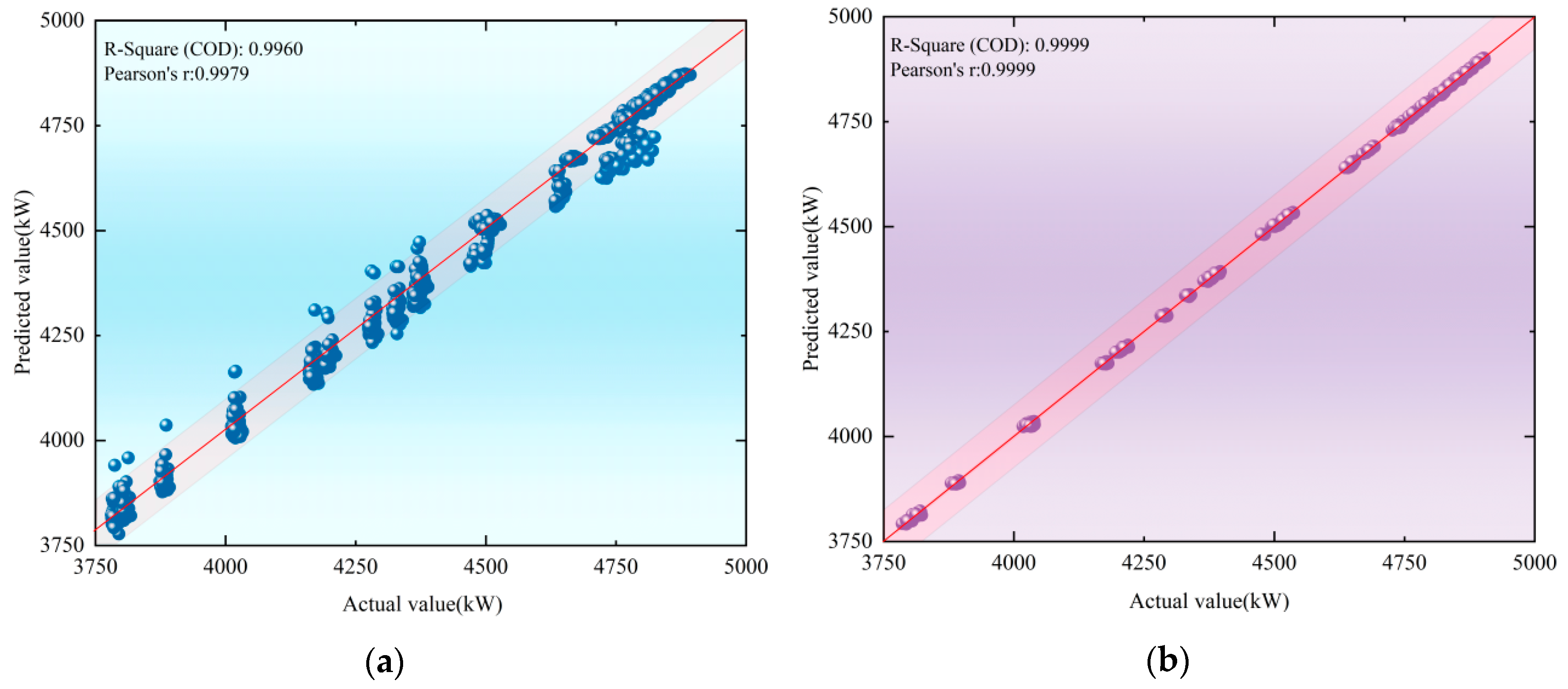
To evaluate the impact of Bayesian optimization on data center cooling load prediction, Figure 6 compares the performance of the LightGBM model with and without Bayesian optimization. Although the unoptimized LightGBM model already achieves strong performance (R2 = 0.9960), its predictions exhibit greater dispersion and deviation from the ideal line (y = x). In contrast, the optimized model achieves an R2 of 0.9999, with predicted points aligning almost perfectly along the ideal line. This enhancement can be attributed to the systematic exploration of the hyperparameter space facilitated by Bayesian optimization, which employs a Gaussian process surrogate model and balances exploration and exploitation through an acquisition function, such as EI. As a result, this approach identifies a superior hyperparameter combination (as shown in Table 4), thereby improving the model’s predictive performance and generalization performance, while mitigating the risk of converging to suboptimal solutions that often arise with manual tuning. These results collectively demonstrate the efficacy of Bayesian optimization in improving both hyperparameter selection and predictive performance.
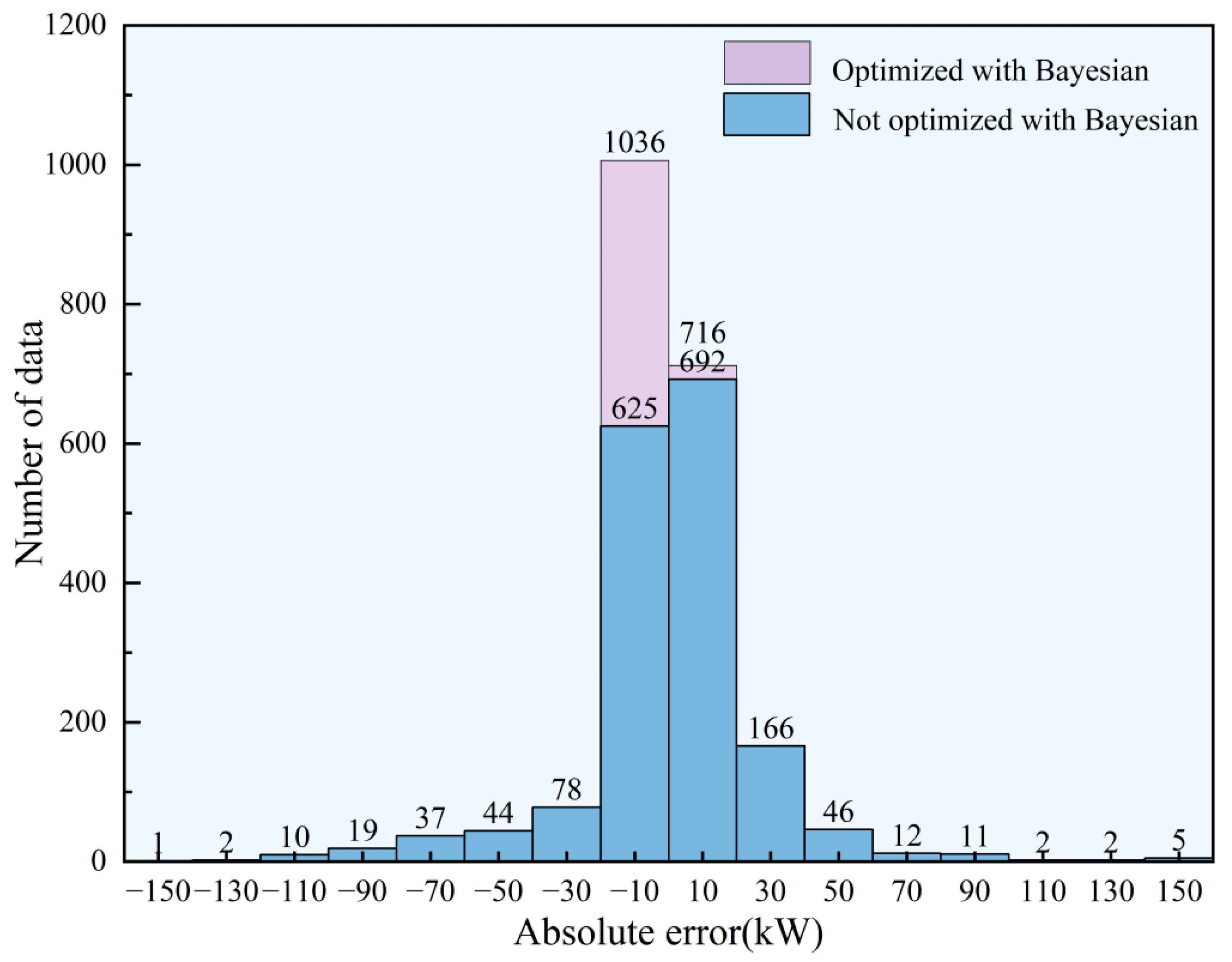
To further evaluate model performance, absolute prediction errors across 1752 data points were categorized into 16 intervals (as shown in Figure 7). The results indicate that the model optimized via Bayesian tuning exhibits a tighter clustering of absolute errors near zero, demonstrating a higher concentration of low-error predictions. This distribution pattern further validates the efficacy of Bayesian optimization in improving predictive accuracy.
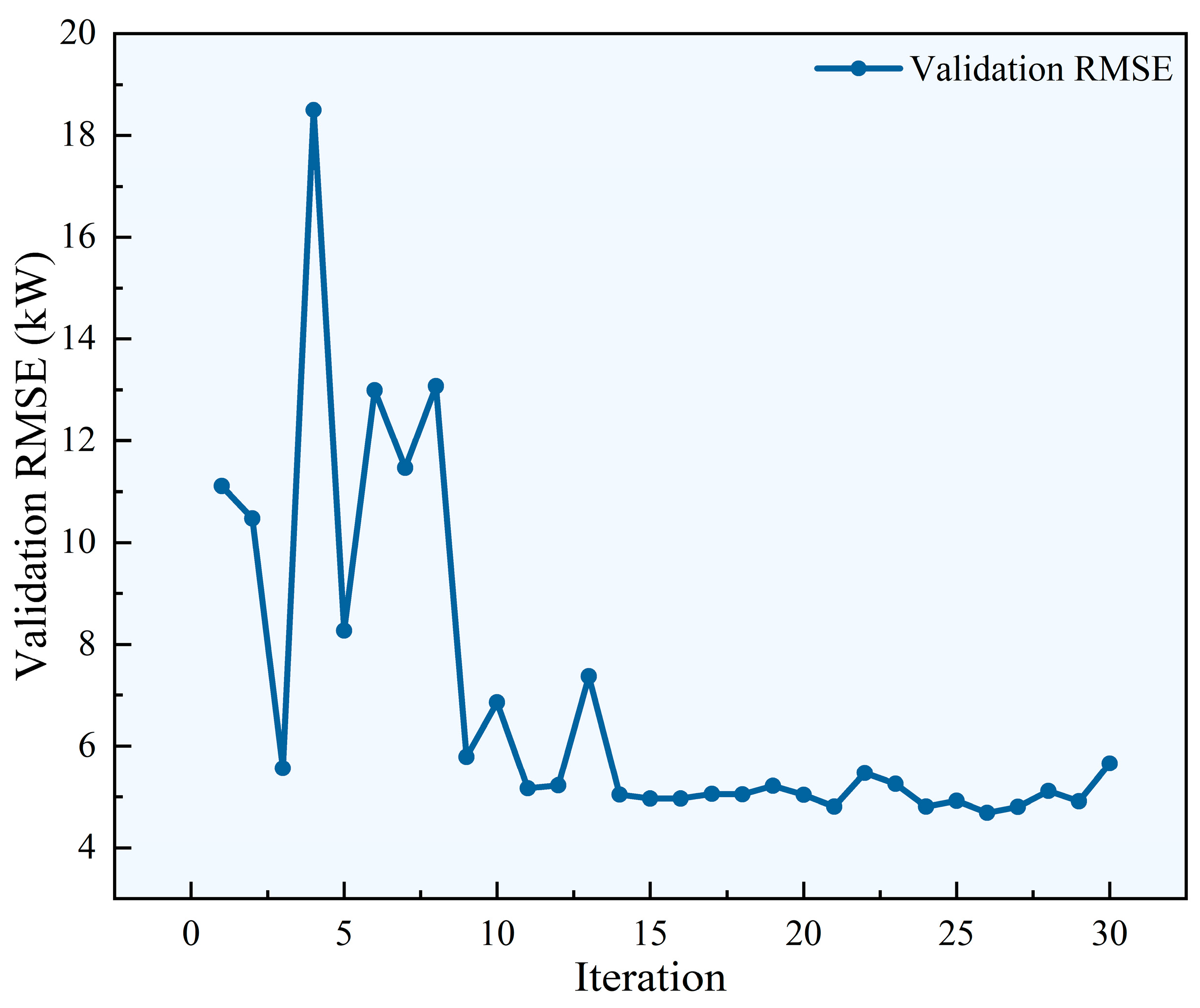
To further illustrate the effectiveness and transparency of the Bayesian optimization process, Figure 8 illustrates the convergence trajectory of the hyperparameter search. The validation RMSE (serving as the objective function) is plotted against the iteration number for all 30 optimization calls. The first 10 iterations correspond to the random exploration phase (n_random_starts = 10), which exhibits relatively high and considerable fluctuation. Subsequently, the algorithm enters the guided search phase based on the Gaussian process surrogate model, where the validation RMSE rapidly decreases and stabilizes after approximately 20 iterations. The minimum RMSE of 4.6899 kW is achieved at iteration 26, and subsequent iterations remain within a narrow range around 5 kW. This behavior confirms convergence to a near-optimal region and indicates that premature stopping was avoided. The final optimized hyperparameters selected for the LightGBM model (iteration 26) are listed in Table 4.

4.2. Comparison with Naive Models

To validate whether the proposed model outperforms simple temporal lag-based approaches and achieves superior predictive performance, it was compared with three naive baseline models. The corresponding evaluation metrics are summarized in Table 5. It can be observed that the T-168 model outperforms both the T-24 and T-1 models, primarily due to its ability to capture periodic patterns. This observation is consistent with the autocorrelation analysis presented in Section 3.1 (as shown in Figure 4), which confirmed the strong weekly periodicity (168 h lag) of the cooling load time series. However, all naive models perform significantly worse than the proposed model. Despite the strong periodicity inherent in the cooling load data (as evidenced by the ACF analysis), the LightGBM model achieves a substantial improvement in predictive accuracy, reducing the RMSE by 11% compared to T-168, by 80% compared to T-24, and by 96% compared to T-1. Furthermore, it attains a near-perfect R2 of 0.9999. These results highlight LightGBM’s capacity to learn complex temporal patterns beyond simple lag-based effects and underscore the importance of modeling nonlinear dynamics. Unlike the naive models, which fail to respond to real-time fluctuations (such as sudden server load spikes or abrupt weather shifts), LightGBM possesses the ability to capture real-time fluctuations and predict sudden events, which is crucial for safety-critical control. While the T-168 model effectively captures the dominant periodic component, it is inherently univariate and cannot incorporate multivariate information or react to abrupt changes; the proposed LightGBM model, by contrast, leverages real-time input features to dynamically adjust predictions, offering a level of adaptability that simple lag models cannot achieve.

4.3. Comparing the Prediction Results of Four Models

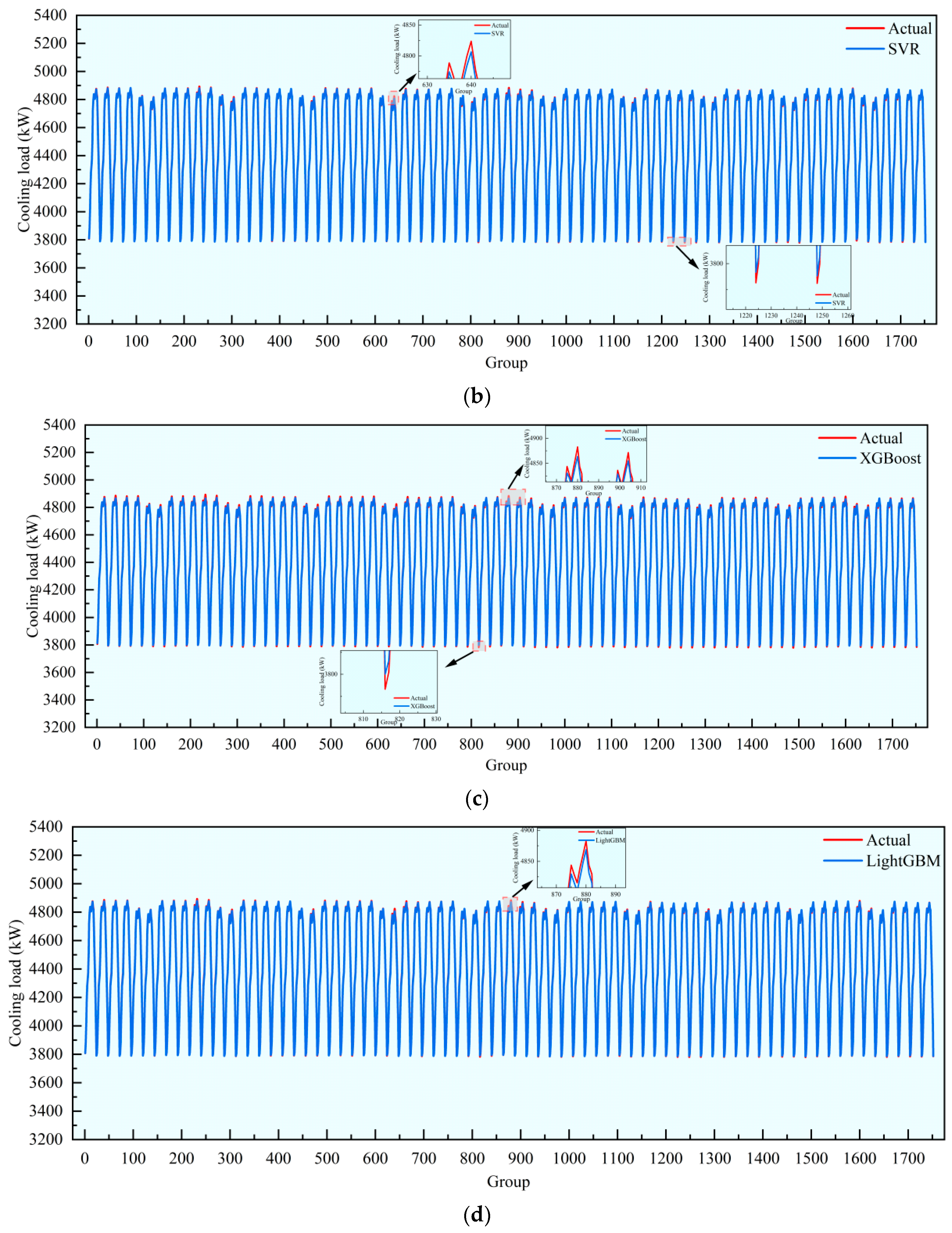
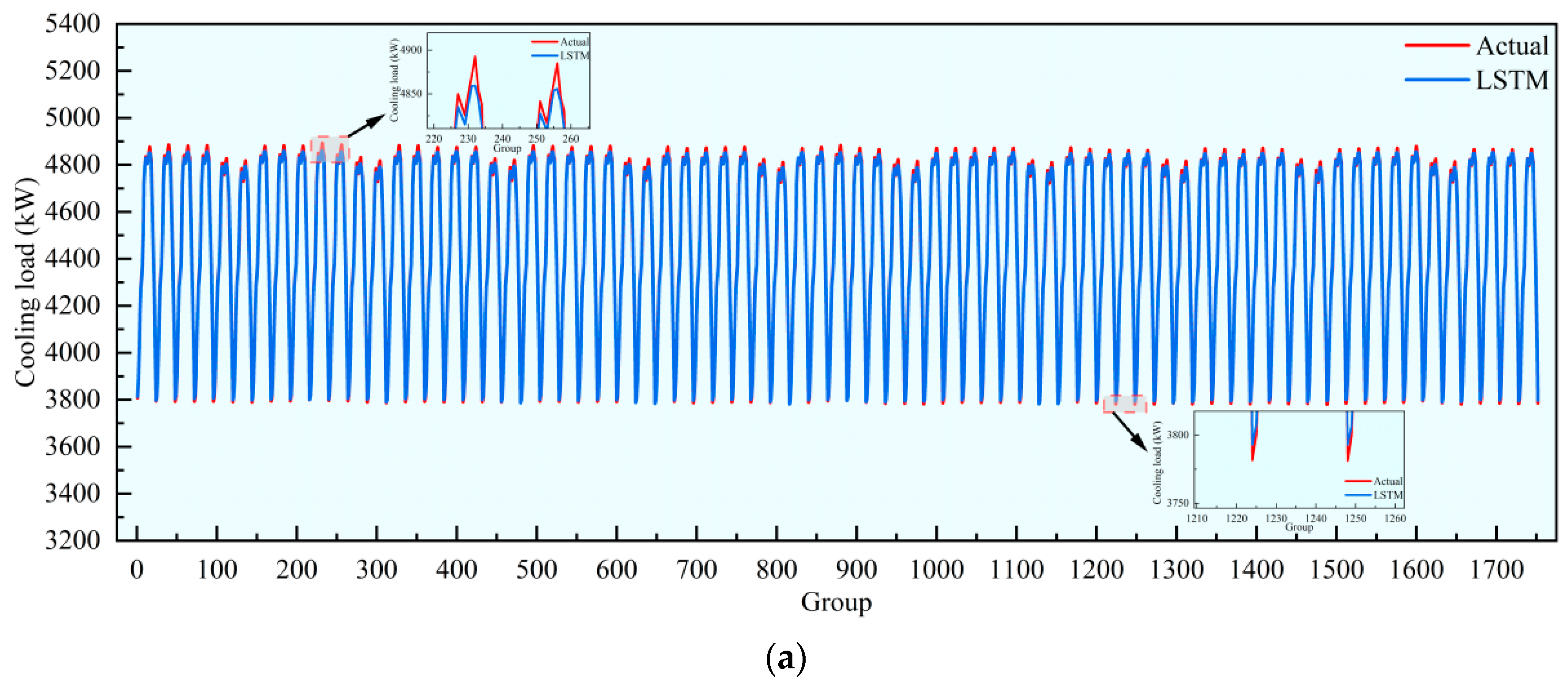
The comparative analysis highlights distinct performance characteristics among the models. The LSTM model exhibits significant deviations from the actual cooling load values, particularly during peak cooling load periods (4725–4908 kW) and low cooling load periods (3785–3850 kW). To evaluate the performance of the proposed model with Bayesian optimization for hyperparameter tuning, comparative analyses were conducted against three benchmark models: LSTM, SVR, and XGBoost. To ensure a fair comparison, all benchmark models were also optimized using the Bayesian optimization, maintaining consistency in hyperparameter tuning across experiments. Figure 9 illustrates a comparison of predicted versus actual cooling load values over a 1752 h prediction horizon for each model: (a) LSTM, (b) SVR, (c) XGBoost, and (d) the proposed LightGBM model.
The XGBoost demonstrates improved accuracy around 4850 kW but exhibits notable errors around 3810 kW. The SVR achieves stronger overall alignment with the measured values, although minor discrepancies remain in low-cooling-load regions. Most notably, the LightGBM model demonstrates near-perfect agreement between predicted and actual cooling loads, with significantly lower deviations than the baseline models. It maintains high predictive accuracy across both peak and partial-load conditions.
The results indicate a strong correlation between model architecture and predictive accuracy under both peak and partial-load operating conditions. This performance disparity primarily stems from the gradient-based mechanisms inherent in tree-structured models such as LightGBM and XGBoost, which are particularly effective at capturing the step-change characteristics typical of data center cooling loads. Specifically, the LightGBM’s leaf-wise growth strategy, combined with its Gradient-based One-Side Sampling (GOSS) algorithm, enhances learning in high-gradient regions—typically corresponding to critical load transitions—through dynamically weighted sampling of critical instances. This mechanism enables the model to more precisely identify and model key decision boundaries throughout the entire load spectrum.
Compared to the LightGBM model, the performance of SVR is limited by its reliance on kernel functions, particularly the radial basis function (RBF), which constrains its extrapolation capacity in edge-case scenarios such as extreme load fluctuations. Similarly, while the LSTM model demonstrates proficiency in sequential pattern recognition, it tends to exhibit performance degradation when faced with highly imbalanced training data. Specifically, when extreme cooling load instances comprise less than 10% of the dataset, the LSTM model becomes susceptible to vanishing gradients during backpropagation, thereby diminishing their ability to learn and represent rare but critical operational patterns.
Collectively, the comparative analysis substantiates the superior prediction capability of the LightGBM model, which consistently surpasses benchmark models by delivering quantifiable accuracy improvements across diverse operating regimes. Figure 9 illustrates the near-perfect alignment between the cooling loads predicted by the proposed LightGBM model and the actual values generated by EnergyPlus. This high degree of accuracy stems from two primary factors. First, the training data originates from a deterministic simulation, which exhibits consistent patterns and lacks the stochastic noise present in real-world measurements. When a sufficiently powerful machine learning model, such as LightGBM, is trained on such data, it effectively learns the underlying functional mapping of the simulator, resulting in near-perfect predictions. Second, the Bayesian optimization process ensures that the model hyperparameters are optimally tuned for this specific dataset, further enhancing predictive accuracy. While this level of performance is achievable on noise-free simulation data, it represents an upper bound that may not be attainable in real-world applications. This limitation has been explicitly acknowledged and addressed through the noise robustness analysis in Section 4.5.
Table 6 provides a comparative summary of evaluation metrics for the four prediction models. Using the performance metrics (R2, MAPE, and RMSE) defined in Section 3.3, a quantitative assessment of cooling load prediction accuracy was conducted. All models demonstrate strong fitting capabilities with R2 values exceeding 0.99. Among these, the LightGBM model achieves optimal performance with an R2 of 0.9999. In terms of error metrics, the LightGBM model consistently yields the lowest values in both MAPE and RMSE, followed by SVR, XGBoost, and LSTM. Specifically, the proposed model reduces MAPE by 0.02–0.08% and RMSE by 22–52% compared to the other models. These significantly lower error metrics provide empirical evidence of the LightGBM model’s superior predictive capability.
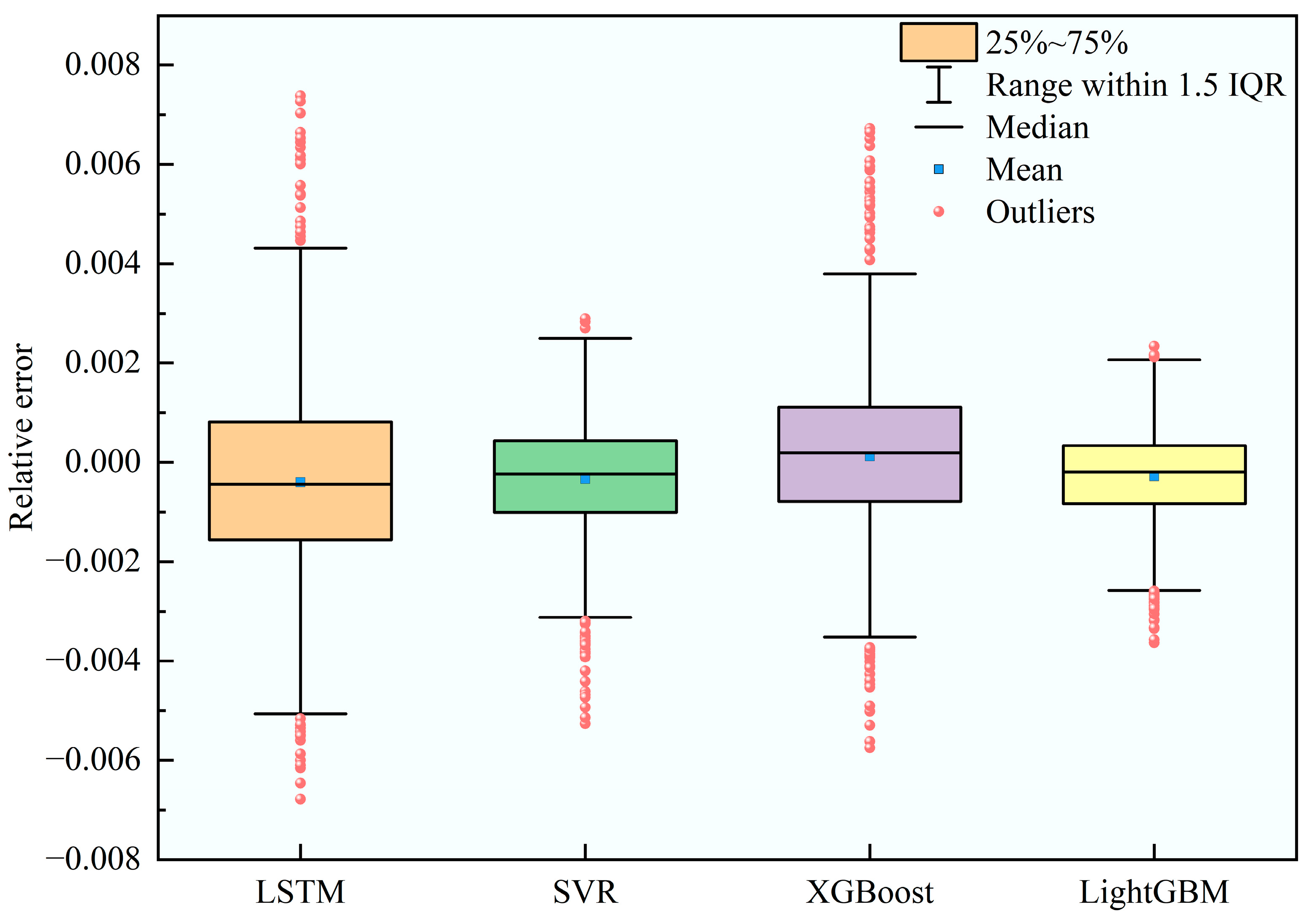
To further assess the predictive performance of model, Figure 10 illustrates the distribution of relative errors for all four models using box plots. The LightGBM model demonstrates the tightest error distribution, suggesting superior prediction accuracy and stability compared to the other models. While Bayesian-optimized benchmark models exhibit competent performance for general cooling load prediction, their accuracy degrades under extreme load conditions in data centers. This limitation primarily stems from the complex, context-specific correlation between CPU utilization dynamics and total cooling load, a relationship that is not adequately addressed by traditional methodologies. Notably, LSTM exhibits considerable prediction errors during extreme operational conditions, which can be attributed to its sensitivity to data imbalance. SVR and XGBoost demonstrate moderate performance, surpassing LSTM but falling short when compared to LightGBM. Using Bayesian optimization, the proposed LightGBM model provides high-precision predictions across all cooling load ranges, achieving minimal relative error and demonstrating robust stability. This advantage is rooted in its inherent architectural strengths, which enable it to effectively manage the unique, non-linear load dynamics characteristic of data center environments, where conventional building energy models often struggle.

4.4. Complexity and Operational Stability Verification

In addition to evaluating the prediction accuracy and stability of the model, this section further assesses the computational efficiency and robustness of the model by conducting a comparative analysis of runtime and relative prediction deviation (RPD) metrics. RPD is a widely used normalized measure of model reliability, defined as the ratio of the standard deviation (SD) of the observed data to the RMSE of the predictions. Mathematically, it is expressed as:
R P D = S D R M S E
The rationale behind this metric is to quantify the model’s prediction error (RMSE) relative to the inherent variability (SD) of the data. Consequently, a higher RPD value signifies that the model’s predictions are substantially more accurate than relying solely on the mean of the observed data, reflecting greater predictive robustness and reliability. The performance of the model is categorized into three distinct classifications: poor (RPD < 1.4, indicating the need for model redevelopment), acceptable (1.4 ≤ RPD ≤ 2.0), and excellent (RPD > 2.0). Models are considered sufficiently reliable for comprehensive analysis only if they exhibit an RPD value exceeding 2.0.
Table 7 compares the computational runtime of the four prediction models. During data preprocessing, LightGBM, XGBoost, and LSTM exhibit comparable processing times, while SVR shows markedly faster data handling. Notable differences arise during the hyperparameter optimization and training phases, where the training of the LSTM model requires over 300 s—exceeding the training times of other models by orders of magnitude. In the prediction phase, LightGBM demonstrates exceptional computational efficiency, achieving an execution time of 0.01 s, thereby highlighting its advantages in end-to-end performance.
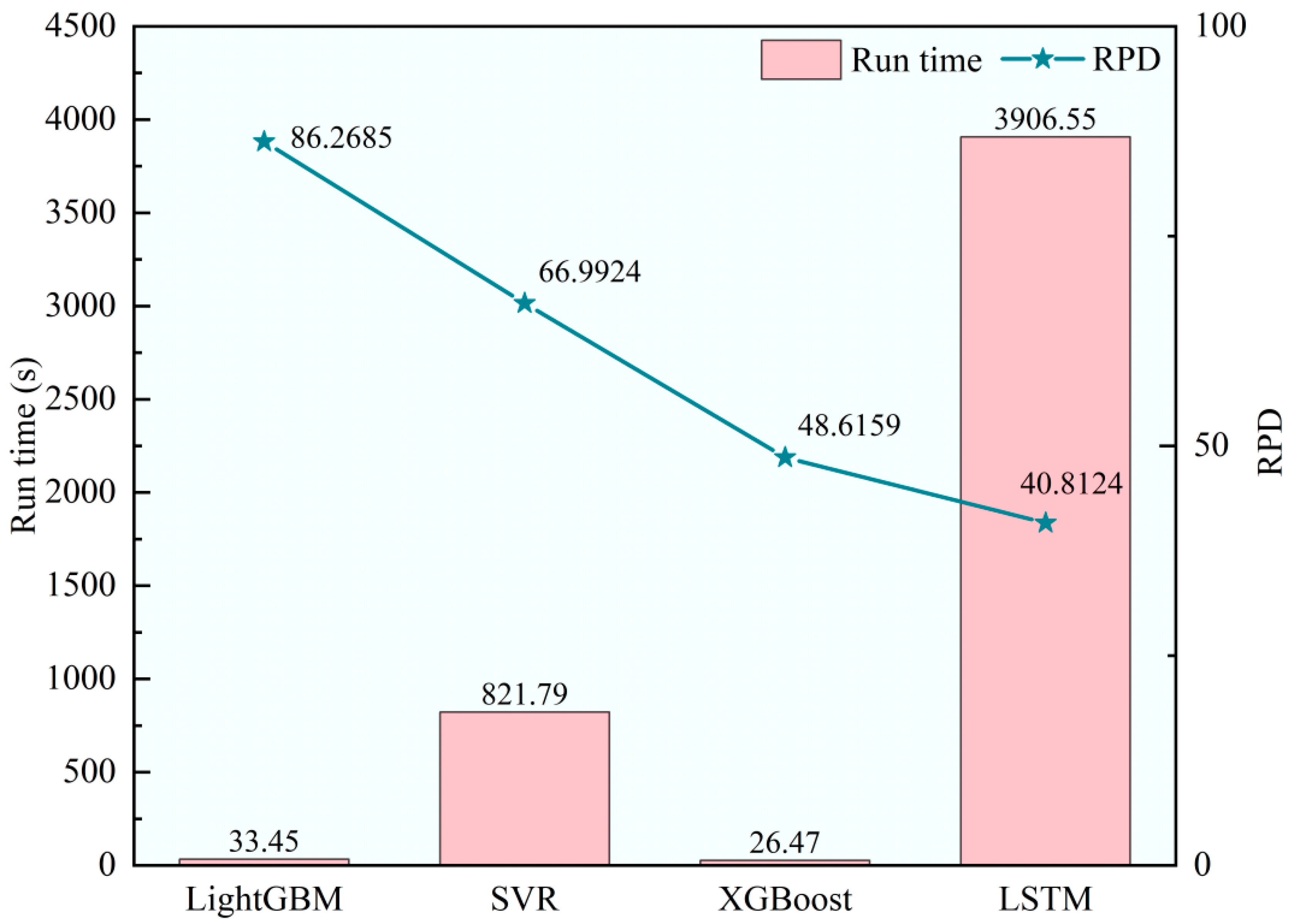
Figure 11 presents a comparative analysis of total runtime and RPD values for the four models used to predict data center cooling loads. The proposed LightGBM model has a total runtime that is 21% longer than that of XGBoost; however, it is significantly faster than SVR and LSTM, achieving 24.6 times and 116.79 times speedup, respectively. All models exceed the RPD threshold of 2.0, indicating an acceptable level of predictive capability. Notably, LightGBM achieves a markedly higher RPD of 86.2685, exceeding the performance of the other models by over 129% in terms of predictive reliability. This result stems from the combination of a consistently low data variability and the fact that the proposed Bayesian-optimized LightGBM model achieved the smallest RMSE (4.3234 kW) among all comparative models. This demonstrates the model’s exceptional effectiveness in capturing the complex nonlinear relationships in data center cooling loads, with its prediction error being substantially smaller than the natural fluctuations in the data. This finding illustrates an optimal equilibrium between accuracy, stability, and computational efficiency under consistent operational conditions. The exceptional reliability of LightGBM can be attributed to its inherent algorithmic efficiency, coupled with Bayesian optimization, thereby affirming its comprehensive effectiveness for applications in data center cooling load prediction.

4.5. Robustness Analysis to Data Noise

To address this limitation and quantitatively assess the model’s robustness, an additional experiment was conducted by artificially injecting Gaussian white noise into the original simulation data to emulate realistic sensor inaccuracies and environmental fluctuations. Four noise levels were considered: no noise (original simulation), and three signal-to-noise ratios (SNR) of 40 dB, 30 dB, and 20 dB, corresponding to low, medium, and high noise intensities, respectively. For each noise level, the model was retrained on the noisy training set and evaluated on a separately noised test set, while performance metrics (R2, MAPE, RMSE, and RPD) were calculated against the original (clean) test values to isolate the impact of noise. The results are summarized in Table 8. As expected, model performance degrades progressively with increasing noise levels. At a low noise (SNR = 40 dB), the model maintains excellent performance with an RMSE of 10.11 kW and an R2 of 0.9992, representing a moderate degradation from the noise-free baseline (RMSE = 5.09 kW). At medium noise (SNR = 30 dB), the RMSE increases to 11.69 kW, and at high noise (SNR = 20 dB), it reaches 29.22 kW. Despite this degradation, the model still achieves an R2 above 0.993 and an RPD well above the threshold of 2.0 (12.22) at high noise (SNR = 20 dB), indicating acceptable reliability even under substantial noise. This analysis demonstrates that while the proposed model achieves near-perfect accuracy on clean simulation data, its performance remains robust under realistic noise conditions. The observed degradation pattern confirms that the model has learned meaningful underlying relationships rather than merely memorizing the deterministic mapping of the simulator. These findings provide a more realistic estimate of the model’s expected performance in real-world deployment and underscore its potential for practical applications.

5. Conclusions

This study developed a cooling load prediction model for data centers by integrating the LightGBM algorithm with Bayesian optimization. The model was developed and validated using data generated from EnergyPlus simulations. This methodological choice ensures a controlled and consistent benchmark, which is essential for the fair comparative assessment of algorithmic performance, following established practices in both building energy [54] and machine learning research [22]. The principal findings are as follows:
  • The analysis of feature importance using SHAP quantifies the relative contributions of cooling load prediction. The CPU load emerges as the predominant variable, accounting for 91.9% of the total SHAP value, thereby establishing it as the primary predictive feature. In contrast, other factors exhibit considerably lower influence. This hierarchical ranking of importance facilitates the precise selection of inputs and the optimization of the predictive model.
  • Bayesian optimization significantly improves the predictive accuracy of the LightGBM model. Validation results indicate that the optimized model attains an R2 value of 0.9999, an improvement of 0.0039 over the unoptimized baseline (R2 = 0.9960). The regression slope is nearly equal to 1, suggesting an almost perfect correlation between the predicted and actual values. An analysis of absolute errors reveals a highly concentrated distribution around zero. These findings substantiate that Bayesian optimization enhances the reliability of the model by facilitating optimal hyperparameter tuning.
  • The proposed model exhibits significantly superior performance compared to the simple time-lagged benchmark models (T-1, T-24, and T-168). It achieves substantial improvements in predictive accuracy, reducing the RMSE by 11% relative to T-168, by 80% relative to T-24, and by 96% relative to T-1. In addition, it attains a near-perfect R2 of 0.9999. These results indicate that the LightGBM model effectively captures dynamic patterns, thereby confirming its critical capability for safety-critical control in data center cooling management.
  • The model demonstrates superior performance in predicting data center cooling load compared to other models, including XGBoost, SVR, and LSTM. It achieved significant error reductions, with MAPE decreased by 0.02% to 0.08% and RMSE reduced by 22% to 52% relative to the other models. The total runtime and RPD values of the LightGBM model with Bayesian optimization were 33.45 s and 86.2685, respectively. These results collectively demonstrate the superior performance of the proposed model in cooling load prediction under consistent conditions, achieved through an effective integration of high accuracy, operational stability, and computational efficiency.
  • The noise robustness analysis demonstrates that while the model achieves near-perfect accuracy on clean simulation data, its performance degrades gracefully under realistic noise conditions. Even at a high noise level (SNR = 20 dB), the model maintains an R2 above 0.99 and an RPD of 12.22, both well above acceptable thresholds. This confirms that the model has learned meaningful underlying relationships rather than merely memorizing the deterministic simulator output, providing confidence in its potential for real-world deployment.
The primary novelty of this work lies in the effective integration of LightGBM and Bayesian optimization, which provides a highly accurate and efficient solution for data center cooling load prediction and demonstrates significant advantages over common benchmarks. Its practical implementation can enable smarter, more energy-efficient cooling control.
A primary limitation of this study stems from its reliance on simulation data. While this approach is ideal for controlled comparative analysis, the reported performance metrics (e.g., R2, MAPE) may be more optimistic than those achievable with real-world data containing inherent noise and uncertainty. The noise robustness analysis provides a quantitative estimate of expected performance degradation under realistic conditions, showing that the model remains reliable even with substantial noise (R2 > 0.99 at SNR = 20 dB). Nonetheless, the relative performance ranking among the models and the structural advantages of the LightGBM framework are expected to remain valid. Therefore, future work will prioritize validating and refining the model using measured data from operational data centers to thoroughly assess its practical robustness and generalization capability.

Author Contributions

Conceptualization, Z.Z. and L.L.; methodology, Z.Z.; software, Z.Z.; validation, Z.Z., L.L. and J.H.; formal analysis, L.L.; investigation, J.H. and H.Y.; resources, Z.Z.; data curation, J.H.; writing—original draft preparation, Z.Z.; writing—review and editing, L.L.; visualization, Z.Z.; supervision, L.L.; project administration, L.L.; funding acquisition, L.L. All authors have read and agreed to the published version of the manuscript.

Funding

The present study was supported by the Excellent Youth Project of Hunan Provincial Department of Education (Grant No. 23B0542) and the Natural Science Foundation of Hunan Province, China (Grant No. 2024JJ7165).

Data Availability Statement

Data will be made available on request.

Conflicts of Interest

The authors declared that they have no conflicts of interest to this work.

Abbreviations

The following abbreviations are used in this manuscript:
List of abbreviations
AIArtificial intelligence
ACFAutocorrelation function
ANNArtificial neural network
BPBackpropagation neural network
CPUCentral Processing Unit
DNNDeep neural network
EIExpected Improvement
EPWEnergyPlus Weather
FENNFull Elman neural network
GBDTGradient boosting decision tree
GPGaussian process
GOSSGradient-based One-Side Sampling
GWOGray wolf optimizer
GTBGradient tree boosting
HHOHarris hawks optimization
HSIWOAHybrid strategy improved whale optimization algorithm
LightGBMLight gradient boosting machine
LPDLighting power density
LSTMLong short-term memory
MAPEMean Absolute Percentage Error
MREMean Relative Error
NCHHONonlinear chaotic Harris hawks optimization
PSOParticle swarm optimization
RBFRadial basis function
RMSERoot Mean Squared Error
RNNRecurrent neural network
RPDRelative prediction deviation
R2Coefficient of determination
SDStandard deviation
SHAPSHapley Additive exPlanations
SVMSupport vector machine
SVRSupport vector regression
UPSUninterruptible power supply
XGBoostExtreme gradient boosting
List of symbols
kNumber of bins in histogram algorithm
L The loss function on the validation set
MNumber of weak regression trees
nTotal number of samples
p(y)The prior probability of y
p(θ)The prior probability of θ
p y | θ The posterior probability of the given observation point
p θ | y The posterior distribution of the unknown parameter given the observed data
UHeat transfer coefficient, W/m2·K
xInput feature vector
xThe normalized data
yiActual cooling load value, kW
y i ^ Predicted cooling load value, kW
yvalThe truth labels of the validation set
y val ^ The predicted value on the validation set
σThe standard deviation of each feature
μThe mean value of each feature
θUnknown parameter in Bayesian theorem
List of subscripts
iData sample index
mTree index in LightGBM ensemble
valValidation set
+Current optimal value

References

  1. Synergy Research Group. Hyperscale Data Center Count Hits 1,136. Average Size Increases. US Accounts for 54% of Total Capacity. Available online: https://www.srgresearch.com/articles/hyperscale-data-center-count-hits-1136-average-size-increases-us-accounts-for-54-of-total-capacity (accessed on 19 March 2025).
  2. Breen, T.J.; Walsh, E.J.; Punch, J.; Shah, A.J.; Bash, C.E. From Chip to Cooling Tower Data Center Modeling: Part I Influence of Server Inlet Temperature and Temperature Rise Across Cabinet. In Proceedings of the 2010 12th IEEE Intersociety Conference on Thermal and Thermomechanical Phenomena in Electronic Systems, Las Vegas, NV, USA, 2–5 June 2010; pp. 1–8. [Google Scholar] [CrossRef]
  3. Ewim, D.R.E.; Ninduwezuor-Ehiobu, N.; Orikpete, O.F.; Egbokhaebho, B.A.; Fawole, A.A.; Onunka, C. Impact of Data Centers on Climate Change: A Review of Energy Efficient Strategies. J. Eng. Appl. Sci. 2023, 9, 16397-01e. [Google Scholar] [CrossRef]
  4. Güğül, G.N.; Gökçül, F.; Eicker, U. Sustainability Analysis of Zero Energy Consumption Data Centers with Free Cooling, Waste Heat Reuse and Renewable Energy Systems: A Feasibility Study. Energy 2023, 262, 125495. [Google Scholar] [CrossRef]
  5. Dayarathna, M.; Wen, Y.; Fan, R. Data Center Energy Consumption Modeling: A Survey. IEEE Commun. Surv. Tutor. 2016, 18, 732–794. [Google Scholar] [CrossRef]
  6. Zhang, Q.; Meng, Z.; Hong, X.; Zhan, Y.; Liu, J.; Dong, J.; Bai, T.; Niu, J.; Deen, M.J. A Survey on Data Center Cooling Systems: Technology, Power Consumption Modeling and Control Strategy Optimization. J. Syst. Archit. 2021, 119, 102253. [Google Scholar] [CrossRef]
  7. Li, X.; Li, M.; Zhang, Y.; Han, Z.; Wang, S. Rack-Level Cooling Technologies for Data Centers—A Comprehensive Review. J. Build. Eng. 2024, 90, 109535. [Google Scholar] [CrossRef]
  8. Rasmussen, N. Calculating Total Cooling Requirements for Data Centers. American Power Conversion, White Paper 25. 2003. Available online: https://www.apc.com/us/en/support/resources-tools/white-papers/calculating-total-cooling-requirements-for-data-centers.jsp (accessed on 15 April 2024).
  9. Wu, C.; Buyya, R. Data Center Cooling. In Cloud Data Centers and Cost Modeling; Morgan Kaufmann: Boston, MA, USA, 2015; Chapter 7; pp. 249–284. [Google Scholar]
  10. Yu, J. Analysis of the High PUE Value Problem in Data Center Computer Rooms and Solutions. Available online: https://www.cra-ccua.org.cn/site/content/8381.html (accessed on 15 April 2024). (In Chinese)
  11. Wei, Y.; Zhang, X.; Shi, Y.; Xia, L.; Pan, S.; Wu, J.; Han, M.; Zhao, X. A Review of Data-Driven Approaches for Prediction and Classification of Building Energy Consumption. Renew. Sustain. Energy Rev. 2018, 82, 1027–1047. [Google Scholar] [CrossRef]
  12. US Department of Energy. EnergyPlus Energy Simulation Software. Available online: https://energyplus.net/ (accessed on 15 April 2025).
  13. Lawrence Berkeley National Laboratory. Modelica Buildings Library. Available online: https://simulationresearch.lbl.gov/modelica/ (accessed on 15 April 2025).
  14. Thermal Energy System Specialists. TRNSYS Transient System Simulation Tool. Available online: https://www.trnsys.com/ (accessed on 15 April 2025).
  15. Tuhus-Dubrow, D.; Krarti, M. Genetic-Algorithm Based Approach to Optimize Building Envelope Design for Residential Buildings. Build. Environ. 2010, 45, 1574–1581. [Google Scholar] [CrossRef]
  16. Sun, K.; Hong, T.; Kim, J.; Hooper, B. Application and Evaluation of a Pattern-Based Building Energy Model Calibration Method Using Public Building Datasets. Build. Simul. 2022, 15, 1385–1400. [Google Scholar] [CrossRef]
  17. Yussuf, R.O.; Asfour, O.S. Applications of Artificial Intelligence for Energy Efficiency Throughout the Building Lifecycle: An Overview. Energy Build. 2024, 305, 113903. [Google Scholar] [CrossRef]
  18. McClelland, J.L.; Rumelhart, D.E. Parallel Distributed Processing: Explorations in the Microstructure of Cognition, Volume 2: Psychological and Biological Models; MIT Press: Cambridge, MA, USA, 1987. [Google Scholar]
  19. Kiartzis, S.J.; Bakirtzis, A.G.; Petridis, V. Short-Term Load Forecasting Using Neural Networks. Electr. Power Syst. Res. 1995, 33, 1–6. [Google Scholar] [CrossRef]
  20. Vapnik, V.N. The Nature of Statistical Learning Theory, 2nd ed.; Springer: New York, NY, USA, 2000. [Google Scholar]
  21. Hochreiter, S.; Schmidhuber, J. Long Short-Term Memory. Neural Comput. 1997, 9, 1735–1780. [Google Scholar] [CrossRef]
  22. Chen, T.; Guestrin, C. XGBoost: A Scalable Tree Boosting System. In Proceedings of the 22nd ACM SIGKDD International Conference on Knowledge Discovery and Data Mining, San Francisco, CA, USA, 13–17 August 2016; pp. 785–794. [Google Scholar] [CrossRef]
  23. Ke, G.; Meng, Q.; Finley, T.; Wang, T.; Chen, W.; Ma, W.; Ye, Q.; Liu, T.-Y. LightGBM: A Highly Efficient Gradient Boosting Decision Tree. Adv. Neural Inf. Process. Syst. 2017, 30, 3146–3154. [Google Scholar]
  24. Hu, C.; Wei, D. Prediction on Hourly Cooling Load of Buildings Based on Neural Networks. Int. J. Smart Home 2015, 9, 35–52. [Google Scholar] [CrossRef]
  25. Chen, Z.; Sun, Y.; Yang, G.; Wu, T.; Li, G.; Xin, L. Air Conditioning Load Prediction Based on DE-SVM Algorithm. In Proceedings of the 2010 Third International Symposium on Intelligent Information Technology and Security Informatics, Hiroshima, Japan, 2–4 April 2010; pp. 276–279. [Google Scholar] [CrossRef]
  26. An, C. Research on Forecast Model of Air Conditioning System in Data Center. Ph.D. Thesis, Beijing University of Civil Engineering and Architecture, Beijing, China, 2018. (In Chinese) [Google Scholar]
  27. Sha, H.; Moujahed, M.; Qi, D. Machine Learning-Based Cooling Load Prediction and Optimal Control for Mechanical Ventilative Cooling in High-Rise Buildings. Energy Build. 2021, 242, 110980. [Google Scholar] [CrossRef]
  28. Ji, Y.; Lian, H.; Chen, Y.; Xie, J.; Liu, J. Energy Consumption Prediction Method of Office Building Based on the Variables Extraction from a Large-Scale Simulation Database and a Case Study. J. Beijing Univ. Technol. 2023, 49, 386–394. (In Chinese) [Google Scholar] [CrossRef]
  29. Hou, D.; Hassan, I.G.; Wang, L. Review on Building Energy Model Calibration by Bayesian Inference. Renew. Sustain. Energy Rev. 2021, 143, 110930. [Google Scholar] [CrossRef]
  30. Li, X.; Wang, X.; He, Z.; Chen, X.; Li, Z. Combining Physical Laws and ANN for Predicting Energy Consumption of Data Center Cooling Systems. Energy Build. 2024, 311, 114170. [Google Scholar] [CrossRef]
  31. Dong, B.; Li, Z.; Rahman, S.M.M.; Vega, R. A Hybrid Model Approach for Forecasting Future Residential Electricity Consumption. Energy Build. 2016, 117, 341–351. [Google Scholar] [CrossRef]
  32. Yan, X.; Ji, X.; Meng, Q.; Sun, H.; Lei, Y. A Hybrid Prediction Model of Improved Bidirectional Long Short-Term Memory Network for Cooling Load Based on PCANet and Attention Mechanism. Energy 2024, 292, 130388. [Google Scholar] [CrossRef]
  33. Mao, Y.; Yu, J.; Zhang, N.; Dong, F.; Wang, M.; Li, X. A Hybrid Model of Commercial Building Cooling Load Prediction Based on the Improved NCHHO-FENN Algorithm. J. Build. Eng. 2023, 78, 107660. [Google Scholar] [CrossRef]
  34. Li, A.; Xiao, F.; Zhang, C.; Fan, C. Attention-Based Interpretable Neural Network for Building Cooling Load Prediction. Appl. Energy 2021, 299, 117238. [Google Scholar] [CrossRef]
  35. Chen, Y.; Guo, M.; Chen, Z.; Chen, Z.; Ji, Y. Physical Energy and Data-Driven Models in Building Energy Prediction: A Review. Energy Rep. 2022, 8, 2656–2671. [Google Scholar] [CrossRef]
  36. Li, L. Research on Cooling Load Forecasting and Cooling Supply and Demand Matching of Data Centers. Ph.D. Thesis, Chongqing University, Chongqing, China, 2023. (In Chinese) [Google Scholar] [CrossRef]
  37. Du, Y.; Zhou, Z.; Yang, X.; Yang, X.; Wang, C.; Liu, J.; Yuan, J. Dynamic Thermal Environment Management Technologies for Data Center: A Review. Renew. Sustain. Energy Rev. 2023, 187, 113761. [Google Scholar] [CrossRef]
  38. Fan, C.; Xiao, F.; Wang, S. Development of Prediction Models for Next-Day Building Energy Consumption and Peak Power Demand Using Data Mining Techniques. Appl. Energy 2014, 127, 1–10. [Google Scholar] [CrossRef]
  39. Indah, Y.M.; Aristawidya, R.; Fitrianto, A.; Erfiani, E. Comparison of Random Forest, XGBoost, and LightGBM Methods for the Human Development Index Classification. Jambura J. Math. 2025, 7, 14–18. [Google Scholar] [CrossRef]
  40. Stawarz, M.; Stasiak, M. Determining Multi-Class Trading Signals for Bitcoin: A Comparative Study of XGBoost, LightGBM, and Random Forest. In Proceedings of the 33rd International Conference on Information Systems Development (ISD2025), Belgrade, Serbia, 3–5 September 2025. [Google Scholar] [CrossRef]
  41. Xu, J.; Chen, Y.; Zhang, L.; Gao, M.; Liu, J. Research on Short-Term Power Load Forecasting Based on LightGBM Algorithm. Model. Simul. 2022, 11, 1071–1082. [Google Scholar] [CrossRef]
  42. Pan, Z.; Fang, S.; Wang, H. LightGBM Technique and Differential Evolution Algorithm-Based Multi-Objective Optimization Design of DS-APMM. IEEE Trans. Energy Convers. 2020, 35, 1885–1895. [Google Scholar] [CrossRef]
  43. Fu, Y.; Zuo, W.; Wetter, M.; VanGilder, J.W.; Han, X.; Plamondon, D. Equation-Based Object-Oriented Modeling and Simulation for Data Center Cooling: A Case Study. Energy Build. 2019, 186, 108–125. [Google Scholar] [CrossRef]
  44. Dasi, H.; Ying, Z.; Ashab, M.D.F.B. Proposing Hybrid Prediction Approaches with the Integration of Machine Learning Models and Metaheuristic Algorithms to Forecast the Cooling and Heating Load of Buildings. Energy 2024, 291, 130297. [Google Scholar] [CrossRef]
  45. Hao, X.; Zhang, Z.; Xu, Q.; Huang, G.; Wang, K. Prediction of f-CaO Content in Cement Clinker: A Novel Prediction Method Based on LightGBM and Bayesian Optimization. Chemom. Intell. Lab. Syst. 2022, 220, 104461. [Google Scholar] [CrossRef]
  46. Marchant, R.; Ramos, F. Bayesian Optimisation for Intelligent Environmental Monitoring. In Proceedings of the 2012 IEEE/RSJ International Conference on Intelligent Robots and Systems, Vilamoura, Portugal, 7–12 October 2012; pp. 2246–2252. [Google Scholar] [CrossRef]
  47. Zhu, Q.; Luo, Y.; He, Y. Novel Multiblock Transfer Entropy Based Bayesian Network and Its Application to Root Cause Analysis. Ind. Eng. Chem. Res. 2019, 58, 23145–23156. [Google Scholar] [CrossRef]
  48. Snoek, J.; Larochelle, H.; Adams, R.P. Practical Bayesian Optimization of Machine Learning Algorithms. Adv. Neural Inf. Process. Syst. 2012, 25, 2951–2959. [Google Scholar]
  49. Dale, A.I. Chapter 15—Thomas Bayes, An Essay Towards Solving a Problem in the Doctrine of Chances. In Landmark Writings in Western Mathematics 1640-1940; Elsevier: Amsterdam, The Netherlands, 2005; pp. 199–207. [Google Scholar] [CrossRef]
  50. U.S. Department of Energy. EnergyPlus Weather Data. Available online: https://energyplus.net/weather (accessed on 15 April 2024).
  51. Bian, S.; Wang, Z.; Song, W.; Zhou, X. Feature Extraction and Classification of Time-Varying Power Load Characteristics Based on PCANet and CNN+Bi-LSTM Algorithms. Electr. Power Syst. Res. 2023, 217, 109149. [Google Scholar] [CrossRef]
  52. Fan, C.; Liao, Y.; Zhou, G.; Zhou, X.; Ding, Y. Improving Cooling Load Prediction Reliability for HVAC System Using Monte-Carlo Simulation to Deal with Uncertainties in Input Variables. Energy Build. 2020, 226, 110372. [Google Scholar] [CrossRef]
  53. Bishop, C.M. Pattern Recognition and Machine Learning; Springer: New York, NY, USA, 2006. [Google Scholar]
  54. Nelson, F.; Mago, P.J.; Luck, R. Methodology to Estimate Building Energy Consumption Using EnergyPlus Benchmark Models. Energy Build. 2010, 42, 2331–2337. [Google Scholar] [CrossRef]
Figure 1. Cooling load prediction workflow of the LightGBM model with Bayesian optimization.
Buildings 16 01357 g001
Figure 2. Schematic diagram of level-wise and leaf-wise tree growth strategies. Level-wise tree growth strategy (conventional decision tree algorithms); leaf-wise tree growth strategy (the method used in this paper).
Buildings 16 01357 g002
Figure 3. Architectural floor plan and 3D model developed using SketchUp. (a) Architectural plan; (b) 3D building model developed using SketchUp.
Buildings 16 01357 g003
Figure 4. Autocorrelation function of the hourly cooling load time series.
Buildings 16 01357 g004
Figure 5. Cumulative SHAP value percentage plot for feature importance.
Buildings 16 01357 g005
Figure 6. The LightGBM models with and without Bayesian optimization. (a) Without Bayesian optimization; (b) with Bayesian optimization.
Buildings 16 01357 g006
Figure 7. Absolute error frequency histogram.
Buildings 16 01357 g007
Figure 8. Convergence curve of Bayesian optimization for LightGBM hyperparameter tuning.
Buildings 16 01357 g008
Figure 9. Comparison of predicted and actual cooling load values for the four models: (a) LSTM; (b) SVR; (c) XGBoost; (d) LightGBM.
Buildings 16 01357 g009aBuildings 16 01357 g009b
Figure 10. The box plots of the relative errors for all four models.
Buildings 16 01357 g010
Figure 11. Run time and RPD for four predictive models.
Buildings 16 01357 g011
Table 1. Hardware configuration used in the study.
ParametersSpecific Values
TrademarkHewlett-Packard, HP
ProcessorAMD-Ryzen 5-3500U CPU @ 2.10 GHz
Memory8.00 GB
Operating SystemWindows10 64-bit
Table 2. Building model design parameters.
Design ParametersValue
Floor area101,888.64 m2
Floors5
Office occupancy density8 m2/person
Lighting power density (LPD)12 W/m2
Equipment loadElevator 128 W
Office 15.7 W/m2
Server rack configuration 90 × 6 kW
Outdoor air ventilation rateOffice 0.00236 m3/s·people
Data room 1.0/h
Building envelopeExterior wall U = 0.450 W/m2·K
Roof U = 0.223 W/m2·K
Window U = 2.559 W/m2·K
Table 3. Input feature variables and units.
VariablesUnit
CPU load-
Lighting power densitykW/m2
Indoor occupancy densitykW/m2
Other equipment power densitykW/m2
Dry-bulb temperature°C
Dew-point temperature°C
Relative humidity%
Atmospheric pressurePa
Wind speedm/s
Wind direction°
Total cloud cover-
Solar radiation intensityWh/m2
Table 4. Optimized hyperparameter values after Bayesian tuning.
ParametersValue
num_leaves20
learning_rate0.01
feature_fraction0.99
n_estimators1000
reg_alpha0.001
min_child_samples50
Table 5. Performance of naive benchmark models versus the proposed model.
ModelR2MAPE (%)RMSE
T-10.89782.1380114.0360
T-240.99650.228621.1306
T-1680.99980.07864.8578
LightGBM0.99990.07434.3234
Table 6. Performance comparison of the proposed model with other machine learning models.
ModelR2MAPERMSE
LSTM0.99940.15%8.9652
SVR0.99980.09%5.5139
XGBoost0.99960.12%7.3454
LightGBM (proposed in this paper)0.99990.07%4.3234
Table 7. Comparison of the runtime for the four prediction models.
Running Time (s)LSTMSVRXGBoostLightGBM
Data loading and preprocessing0.980.011.221.57
Hyperparameter optimization1857.66128.2924.5428.07
Model training310.361.110.040.50
Prediction process4.820.080.020.06
Table 8. Performance of the proposed LightGBM model under different noise levels.
Noise LevelSNR (dB)R2MAPE (%)RMSE (kW)RPD
No noise 0.99980.08925.093576.2586
Low noise400.99920.133810.110036.5055
Medium noise300.99890.167711.694231.0574
High noise200.99330.458129.223512.2209
Disclaimer/Publisher’s Note: The statements, opinions and data contained in all publications are solely those of the individual author(s) and contributor(s) and not of MDPI and/or the editor(s). MDPI and/or the editor(s) disclaim responsibility for any injury to people or property resulting from any ideas, methods, instructions or products referred to in the content.