Article

Global Seismic Reliability Analysis of Reinforced Concrete Multi-Story Multi-Span Frame Structures Based on the Direct Probability Integral Method

School of Civil and Environmental Engineering, Changsha University of Science and Technology, Changsha 410114, China
*
Author to whom correspondence should be addressed.
Buildings 2026, 16(7), 1356; https://doi.org/10.3390/buildings16071356
Submission received: 3 March 2026 / Revised: 25 March 2026 / Accepted: 26 March 2026 / Published: 29 March 2026
(This article belongs to the Special Issue Advanced Structural Performance of Concrete Structures)

Abstract

Based on the Direct Probability Integral Method (DPIM), this study investigates the global seismic reliability of reinforced concrete (RC) frame structures considering the randomness of material parameters and the non-stationarity of ground motions. A doubly non-stationary ground motion model is established using evolutionary power spectrum theory combined with the spectral representation–stochastic function method. A dimensionality reduction technique is adopted to generate ground motion samples compatible with the design response spectrum. A finite element model of the RC frame is developed in Abaqus. Modal analysis and deterministic time history analysis are conducted to obtain the dynamic characteristics and seismic responses of the structure. Based on 600 representative ground motion time histories generated using the maximum frontier (MF) discrepancy sampling method, nonlinear time history analyses are performed. The DPIM is then employed to calculate the statistical characteristics of structural responses and quantify response variability, enabling a rational evaluation of the structural safety margin. Finally, based on the equivalent extreme value event theory and DPIM, the reliability of the structure under a single failure mode and the global reliability under multiple failure modes are computed. The results show that the global reliability of the structure is 82.088%, which is significantly lower than that of any single failure mode. This study provides a quantitative reference for evaluating the global seismic reliability of RC frame structures subjected to nonstationary seismic excitation.

1. Introduction

Seismic reliability analysis of engineering structures is a core aspect of performance-based seismic design. Traditional deterministic analysis methods face challenges in accurately evaluating the actual safety levels of structures [1]. Consequently, probabilistic theories have become a central focus in modern seismic engineering [2]. The transition from component reliability to global structural reliability is vital for a comprehensive understanding of seismic performance [3]. Research in the field of probabilistic seismic analysis has expanded from above-ground structures to underground lifeline infrastructure in urban areas. Shen et al. [4,5,6] conducted studies on the selection of seismic intensity indices and vulnerability analysis for shield-driven tunnels in sites with varying liquefaction characteristics, providing important guidance for engineering applications in this field.
Accurately describing the stochastic nature of seismic inputs is essential for seismic reliability analysis. Earlier studies often simplified seismic motions into stationary Gaussian processes, overlooking the significant nonstationary characteristics witnessed both in time and frequency domains. Shinozuka [7] laid the foundation for simulating multivariate and multidimensional random processes with the spectral representation method. To better capture the physical characteristics of seismic motions, Deodatis and Shinozuka [8] and Boore et al. [9] developed various nonstationary ground motion models. Liu Zhangjun et al. [10] proposed probabilistic models that effectively capture the time–frequency evolution characteristics of seismic motions. To address the high-dimensional random variable issue in traditional Stochastic Random Fields (SRM), Chen et al. [11] provided dimension reduction techniques based on random harmonic functions. Ruan et al. [12] further advanced dimension reduction representations using wavenumber-frequency spectra, vastly enhancing simulation efficiency of complex ground motion fields. Liu et al. [13] proposed a simulation method that combines the Random Function Spectral Representation (RFSRM) with Optimal Latinized Partial Stratified Sampling (OLPSS) to reduce the high-dimensional randomness of ground motion to two fundamental random variables. Wang et al. [14] introduced an energy-compatible simulation method, improving reproduction precision in the time–frequency domain of artificial ground motions, providing a refined input model for high-dimensional dynamic response analysis.
Equivalent linearization/nonlinearization is the most widely used method for solving the stochastic dynamic response of nonlinear systems [15,16,17]. For strongly nonlinear systems, Zhu [18] proposed a stochastic averaging method for dissipative Hamiltonian systems, which approximates the system response as a diffusion Markov process through dimensionality reduction. In terms of numerical methods, the Fokker-Planck-Kolmogorov (FPK) equations provide an exact evolution law for the response PDF [19]. However, solving high-dimensional FPK equations faces the “curse of dimensionality.” Kougioumtzoglou et al. [20] developed the Wiener Path Integral (WPI) technique, which uses the variational principle to find extreme paths to approximate the transition probability density. The reduced-order WPI formulation proposed by Petromichelakis et al. [21] handles high-dimensional systems through mixed boundary conditions, significantly reducing computational costs. To avoid the complexity of solving physical equations, the introduction of surrogate models can improve efficiency [22,23]. Jiang et al. [24] established a mapping relationship between the norm of the structural dynamic response operator and reliability metrics based on the Karhunen–Loève expansion under stochastic excitation, enabling the precise characterization of the probabilistic properties of nonlinear responses without extensive sampling. With the development of artificial intelligence, deep learning-based stochastic dynamic analysis has become a hot topic [25], though its physical interpretability and generalization capabilities still need improvement. The probability density evolution method (PDEM) proposed by Li and Chen [26] provides a rigorous physical foundation for stochastic dynamic analysis by solving generalized probability density evolution equations. Tong and Peng [22] optimized the computational efficiency of this method by introducing an adaptive active learning function. The improved parallel adaptive Bayesian quadrature (R-PABQ) method proposed by Wang et al. [27] achieves efficient solutions for the minimum failure probability of nonlinear structural responses through sequential sample enrichment and adaptive adjustment of the sampling domain.
Building upon probability density evolution methods, Chen and Yang [28] proposed the Direct Probability Integral Method (DPIM), which achieves complete decoupling of physical analysis and probabilistic computation through the Probability Density Integral Equation (PDIE). DPIM has been successfully applied to the stochastic dynamics analysis of multidimensional nonlinear systems [29,30] and is capable of addressing the integration of aleatory and cognitive uncertainties [31]. Recent studies have further integrated DPIM with neural networks to quantify uncertainty in complex structures containing multiple stochastic parameters [32], and it has also demonstrated good performance in stochastic optimal control and the analysis of nonlinear systems under parameter uncertainty [33,34].
In evaluating global seismic reliability, transitioning from component to system-level analysis is crucial [35,36]. This is also a key focus of current research on the seismic performance of RC frames. Sharafi et al. [37] conducted a regional-scale assessment of seismic vulnerability and global collapse reliability for RC school buildings with different seismic zoning and construction characteristics, confirming the important role of probabilistic methods in the classification and control of seismic safety. Zhang et al. [38] used experiments and simulations to reveal the influence of infill walls on the failure modes and global seismic response of RC frames. Zeng et al. [39] further quantified the impact of load-bearing capacity uncertainty on collapse resistance reliability, pointing out that deterministic methods tend to underestimate a structure’s collapse resistance. For reinforced RC frames, Jiang et al. [40] established a seismic resilience assessment method based on the deformation control mechanism of an external pendulum frame, overcoming the limitations of traditional deterministic assessment methods based on inter-story drift angles. Ma et al. [41], adopting a full-life-cycle perspective, developed a probabilistic prediction framework for corrosion-fatigue coupled damage, quantifying the impact of long-term material degradation on the system’s failure probability and providing a basis for time-dependent reliability assessment.
Traditional system reliability analysis methods (e.g., PNET) often face challenges of combinatorial explosions and low computational efficiency due to numerous failure modes and their complex correlations. Researchers strive for more efficient and accurate system reliability analysis frameworks, including integrated dynamic–static system reliability analysis [42] and multi-failure mode analysis structures based on probability density evolution [43]. Direct Probability Integral Method (DPIM) offers unique advantages in handling high-dimensional nonlinear stochastic dynamic systems and has been successfully applied across structural system reliability analysis with multi-modal distribution features [44], dynamic reliability robust design optimization [45], and large-span cable-stayed bridge reliability analysis [46,47]. The above studies showcase DPIM’s capacity to reconcile efficiency with analytical precision, offering powerful theoretical tools for complex RC frame structures’ global seismic reliability analysis.
To address the inherent challenges of traditional methods in assessing the reliability of multi-story, multi-span spatial frame structures with multiple failure modes, this paper employs the direct probabilistic integration method. Taking a 10-story, 5-span reinforced concrete frame structure as the subject, the study systematically examines the entire process—from non-stationary seismic motion simulation and stochastic dynamic response analysis to system reliability assessment—thereby providing a comprehensive and efficient new analytical approach for evaluating the probabilistic seismic performance of complex spatial frame structures.

2. Global Reliability Analysis Methods Based on Direct Probability Integral Method

2.1. Reliability Analysis Under Static and Dynamic Loading

Under static loading, the system performance function is expressed as a time-invariant mapping relationship:
G i : Z i = g i ( θ ) , i = 1 , 2 , , m ,
where θ = θ 1 , , θ n is a random vector encompassing geometrical parameters, material properties, and other uncertainties; m represents the number of failure modes.
In series systems, the failure of any component leads to system failure; the safe domain is defined as Ω r = θ i = 1 m g i θ > 0 , and reliability is given by:
P r , s y s s = P r [ i = 1 m Z i > 0 ] = Ω r p θ ( θ ) d θ ,
Parallel systems possess safety redundancy, requiring all components to fail for system failure; the safe domain is defined as Ω r = θ i = 1 m g i θ > 0 , and reliability is:
P r , sys p = P r [ i = 1 m Z i > 0 ] = Ω r p Θ ( θ ) d θ ,
Hybrid systems combine series and parallel configurations, necessitating union and intersection operations on subsystems for reliability calculations. Traditional methods, such as bounds estimation methods (e.g., Cornell bounds, Ditlevsen bounds) or point estimation methods (e.g., PNET), approximate failure mode correlations but struggle with high-dimensional integration complexities.
The extreme value mapping method simplifies the system’s functional function to G e x t : Z s y s = g e x t θ = e x t g i i = 1 , , m . Here, e x t denotes selecting the minimum value for series connections or the maximum value for parallel connections. This method infers correlations through extreme events but requires explicit construction of joint probability density functions.
For structural reliability problems under excitation from random dynamic processes (e.g., seismic ground motion), the functional takes a time-varying form:
G t , i : Z i ( t ) = g i ( θ , t ) , i = 1 , 2 , n ,
The input random vector θ comprises structural parameters θ 2 and external excitation parameters θ f . Based on the first-transient failure criterion, the reliability of the series system within time interval 0 , t is:
P r , s y s s ( t ) = P r i = 1 m g i ( θ , τ ) > 0 , τ [ 0 , t ] ,
The reliability of parallel and hybrid systems requires consideration of the joint exceedance probability. Through the extremum mapping G t , e x t :   Z s y s ( t ) = g t , e x t ( θ , t ) = min i = 1 , , k 1 max i = 1 , , m 1 g i ( θ , t ) , max i = ( 1 j m j ) + 1 , , ( 1 j m j ) + m j + 1 g i ( θ , t ) , the dynamic problem is transformed into a static extremum analysis, yet solving the joint PDF still faces a dimension catastrophe. Monte Carlo simulations can circumvent high-dimensional integrals, but computational costs grow exponentially with the dimension of random variables.

2.2. Probability Density Integral Equation and Its Solution

The direct probability integration method is based on the principle of probability conservation, directly solving the joint probability density function of the functional through the probability density integration equation. In static systems, the joint probability density function is expressed as:
p Z ( z 1 , z 2 , , z m ) = Ω θ p θ ( θ ) δ [ z 1 g 1 ( θ ) ] δ [ z 2 g 2 ( θ ) ] δ [ z m g m ( θ ) ] d θ ,
where δ · is the Dirac delta function. Utilizing its property 0 ω δ [ z 1 g 1 ( θ ) ] dz 1   =   1 , and H is the Heaviside step function, the reliability of the series system can be simplified to:
P r , s y s s = Ω θ p θ ( θ ) H g 1 ( θ ) H g 2 ( θ ) H g m ( θ ) d θ ,
Dynamic systems construct time-varying joint PDFs through extremum mapping a, with the first-order reliability expressed as:
P r , s y s s ( t ) = 0 0 p z e x t ( z e x t , t ) d z e x t = Ω θ p θ ( θ ) H g 1 ( θ , t ) H g 2 ( θ , t ) H g m ( θ , t ) d θ ,
The core steps of DPIM involve discretizing the random variable space and computing integral weights. DPIM employs maximum frontier expansion F-deviation sampling to generate a representative set of M n = θ q , q = 1 , 2 , , N points, minimizing the MF deviation by optimizing the uniformity of the point set:
D M F = max 1 i s sup 0 u 1 F e , i u F i u 1 i s ,
where F e , i u is the empirical distribution function. The MF bias global minimization strategy ensures the bias reaches the theoretical lower bound of 1/2N through coordinate transformations and random combinations.
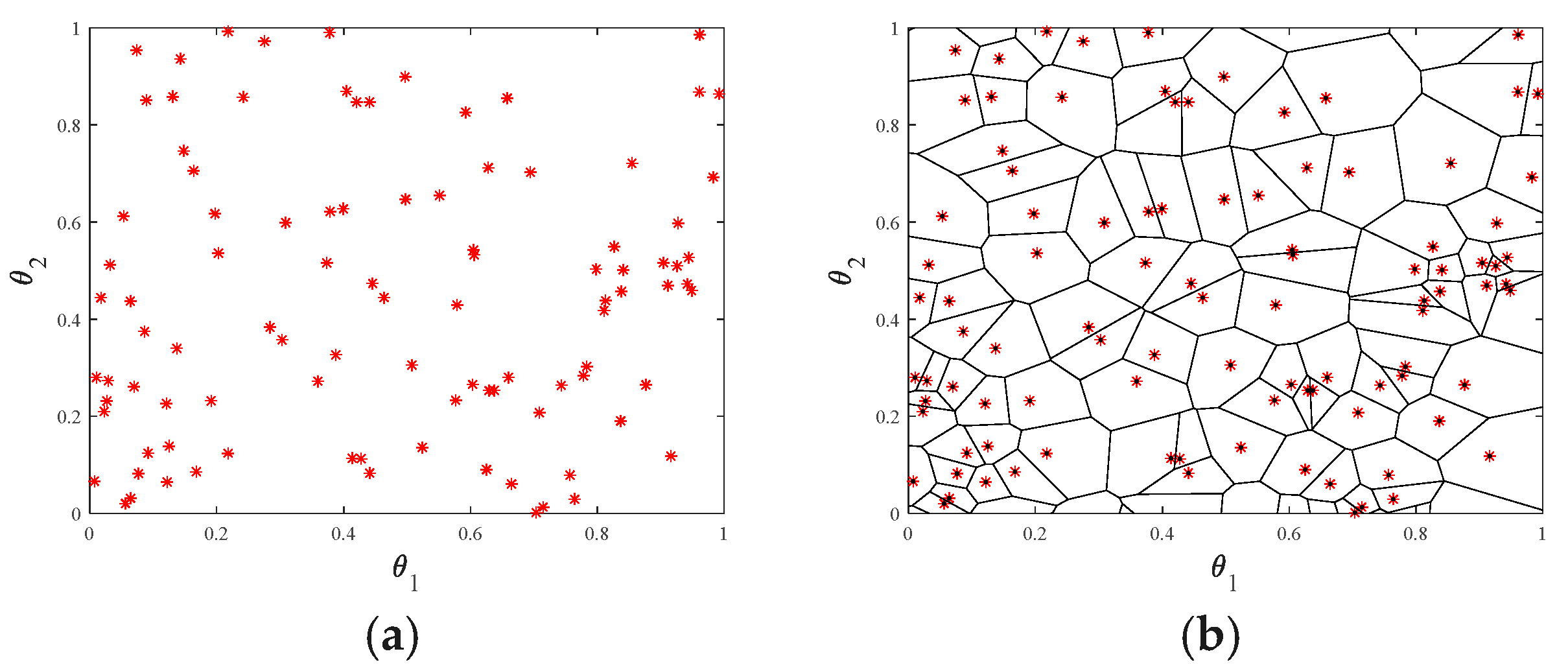
After generating the point set, the probability space is partitioned using Voronoi cells, this results in N non-overlapping subdomains, as shown in Figure 1:
Ω θ , q = x R n : x θ q x θ j   f o r   a l l   j ,   q = 1 , 2 , , N ,
The probability of assignment to each representative point is calculated through integration:
p q = Ω θ , q p θ ( θ ) d θ V t o t a l N t o t a l i = 1 n q p θ ( θ i ) ,
where a represents the average supervolume, typically set to b to ensure accuracy. The system reliability is ultimately converted into a weighted sum:
P r , s y s s = q = 1 N H g 1 ( θ ) H g 2 ( θ ) H g m ( θ ) p q ,
When solving for the response PDF, the smoothing of the Dirac function is crucial. By approximating it with a Gaussian function, the PDF of the extremum mapping is expressed as:
p Z e x t ( z e x t , t ) = q = 1 N 1 2 π σ e z e x t g e x t θ q , t 2 / 2 σ 2 p q ,
The smoothing parameter σ is calculated using an optimization formula:
σ o p t ( t ) = A N 1 / 5 min q = 1 , 2 , , N s t d g e x t θ q , t , i q r g e x t q θ , t 1.34 ,
where A is the smoothing factor within the range 0 , 1 . Smoothing techniques account for contributions from non-representative points, resulting in a smoother PDF curve and enhancing the integrity of probabilistic information. However, in system reliability analysis, since the Dirac delta function has been analytically transformed into a Heaviside step function, the smoothing step can be omitted to further improve computational efficiency.

2.3. Overall Reliability Analysis Process Based on the Direct Probability Integration Method

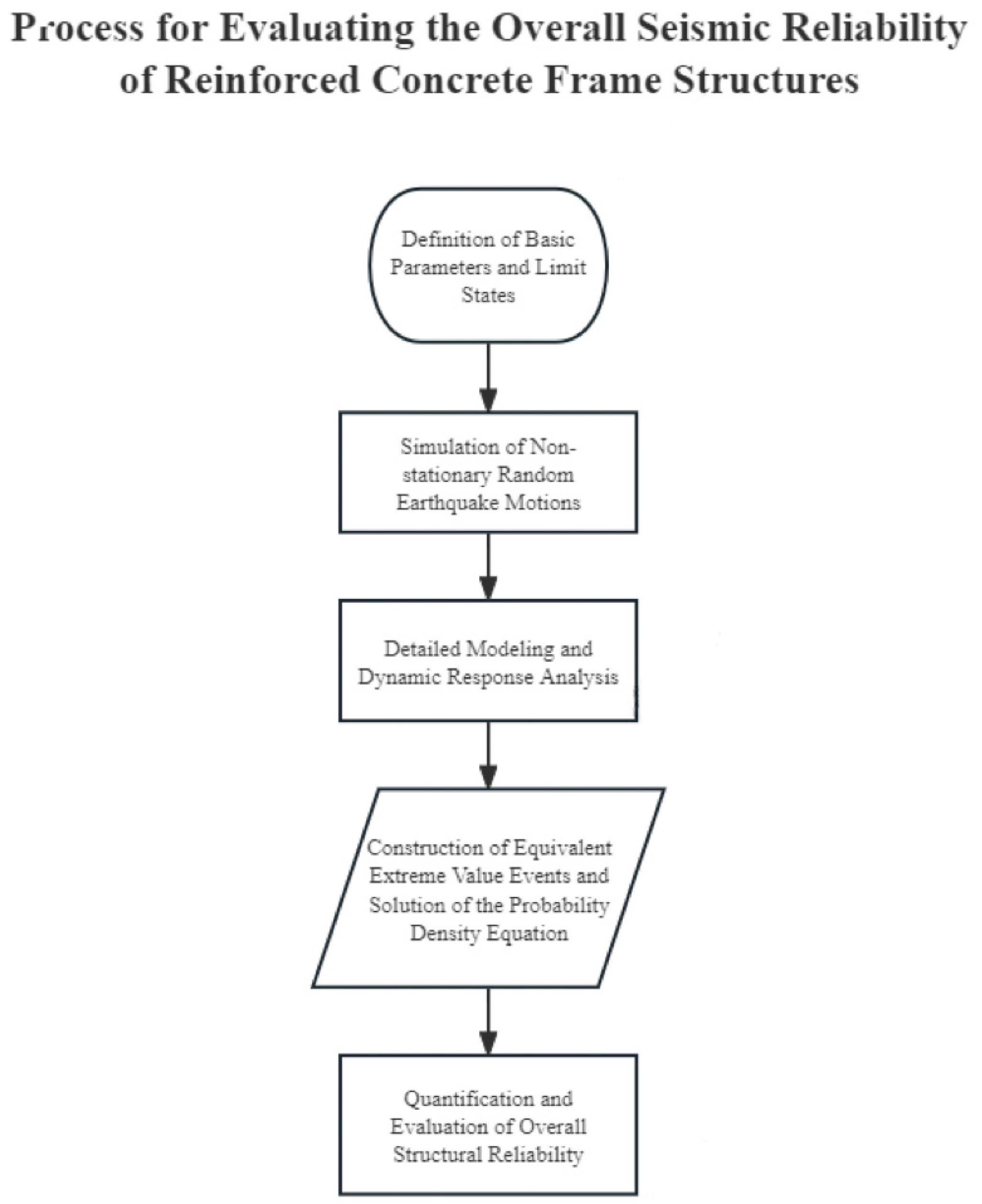
Based on the aforementioned theories of structural reliability and methods for solving probability density integral equations, this section establishes a standardized process for assessing the overall seismic reliability of RC frame structures, as shown in Figure 2. thereby translating theoretical methods into practical computational steps. The core steps are as follows:
(1)
Definition of Basic Parameters and Limit States: Clarify basic structural information; define overall failure limit states based on design codes and structural performance objectives; determine response thresholds such as inter-story drift angles; and establish reliability criteria.
(2)
Simulation of Non-stationary Random Earthquake Motions: Based on the seismic motion parameters of the target site, an evolving power spectrum model is constructed using the spectral representation–random function method to generate a set of random earthquake motion samples that meet code requirements, thereby providing excitation inputs for dynamic analysis.
(3)
Detailed Modeling and Dynamic Response Analysis: A detailed finite element model of the structure is established, specifying material constitutive models, reinforcement, and boundary conditions; nonlinear time history analysis is performed to extract key response data over the entire time history.
(4)
Construction of Equivalent Extreme Events and Solution of Probability Density Equations: Based on the principle of equivalent extreme events, the structural random dynamic response process is transformed into a probability distribution problem for extreme random variables. Probability density integral equations are established and numerically solved to obtain the probability density function of response extremes.
(5)
Quantification and evaluation of overall structural reliability: Based on the limit state thresholds and the probability density functions of response extremes, calculate the overall failure probability of the structure through probabilistic integration, identify seismic vulnerabilities, and complete a systematic evaluation of the structure’s overall seismic reliability.
This process is not dependent on specific structural forms or site conditions; it offers excellent versatility and scalability and can be adapted to reliability analyses for various types of reinforced concrete (RC) frames.

3. Non-Stationary Random Vibration Simulation

3.1. Non-Stationary Seismic Evolution Power Spectrum Model

Currently, there are two primary methods for constructing intensity–frequency non–stationary evolving power spectra: the first involves incorporating frequency–time variation into the parameters of the power spectrum model; the second introduces frequency components into the intensity modulation function, extending it into a time–frequency modulation function.
The first type of intensity–frequency non-stationary evolving power spectrum is:
S X ( t , ω ) = f ( t ) 2 S ( t , ω ) ,
The Second type of intensity–frequency non-stationary evolving power spectrum is:
S t , ω = A ( t , ω ) 2 S ( ω ) ,
Shinozuka [7] proposed an exponential time–frequency modulation function, expressed as:
A ( t , ω ) = exp ( a t ) exp [ ( c ω + b ) × t ] exp ( a t * ) exp [ ( c ω + b ) × t * ] , ( ω > 0 , t > 0 ) ,
t * = ln ( c ω + b ) ln ( a ) c ω + b a , ω > 0
Liu Zhangjun et al. [10] improved upon Shinozuka’s work, obtaining:
A ( t , ω ) = exp ( a t ) exp c ω ω g + b × t exp a t * exp c ω ω g + b × t * , ω > 0 , t > 0 ,
t * = ln c ω ω g + b ln a c ω ω g + b a , ω > 0
In the formula, the values of a , b , and c are determined based on site category and seismic grouping.
This paper adopts the evolution power spectrum model described by the second–class model of intensity–frequency non-stationary evolution power spectrum as its fundamental framework. It combines the classical Clough–Penzien power spectrum formula S ω = ω g 4 + 4 ξ g 2 ω g 2 ω 2 ω g 2 ω 2 2 + 4 ξ g 2 ω g 2 ω 2 ω 4 ω f 2 ω 2 2 + 4 ξ f 2 ω f 2 ω 2 S 0 as the power spectral density function for the stationary portion and employs the time–frequency modulation function defined by Equation (19) to construct a non–stationary seismic motion model.
The values of relevant parameters in the power spectrum model for non–stationary random seismic vibration evolution are shown in Table 1, Table 2, Table 3, Table 4 and Table 5.

3.2. Spectral Representation of Stochastic Processes—Stochastic Function Method

To efficiently simulate non–stationary random seismic motions, this paper constructs a random function model based on the discrete form of the first–type spectral representation, which is expressed as:
X t = k = 1 N 2 S X t , ω k Δ ω cos ω k t X k + sin ω k t Y k
This method requires 2N random variables (where N typically reaches hundreds), resulting in high computational costs. To address this, the concept of a random function is introduced, mapping standard orthogonal random variables to deterministic functions of a small number of basic random variables. The following expression is selected as the random function form, yielding the standard orthogonal random variable X ¯ n , Y ¯ n .
X ¯ n = c a s n Θ 1 , Y ¯ n = c a s n Θ 2 , n = 1 , 2 , , N
In the formula, c a s · = cos · + sin · , Θ 1 , and Θ 2 [ π , π ] are mutually independent, and each follows a uniform distribution.

3.3. Simulation of Non-Stationary Random Vibrations and Response Spectrum Fitting

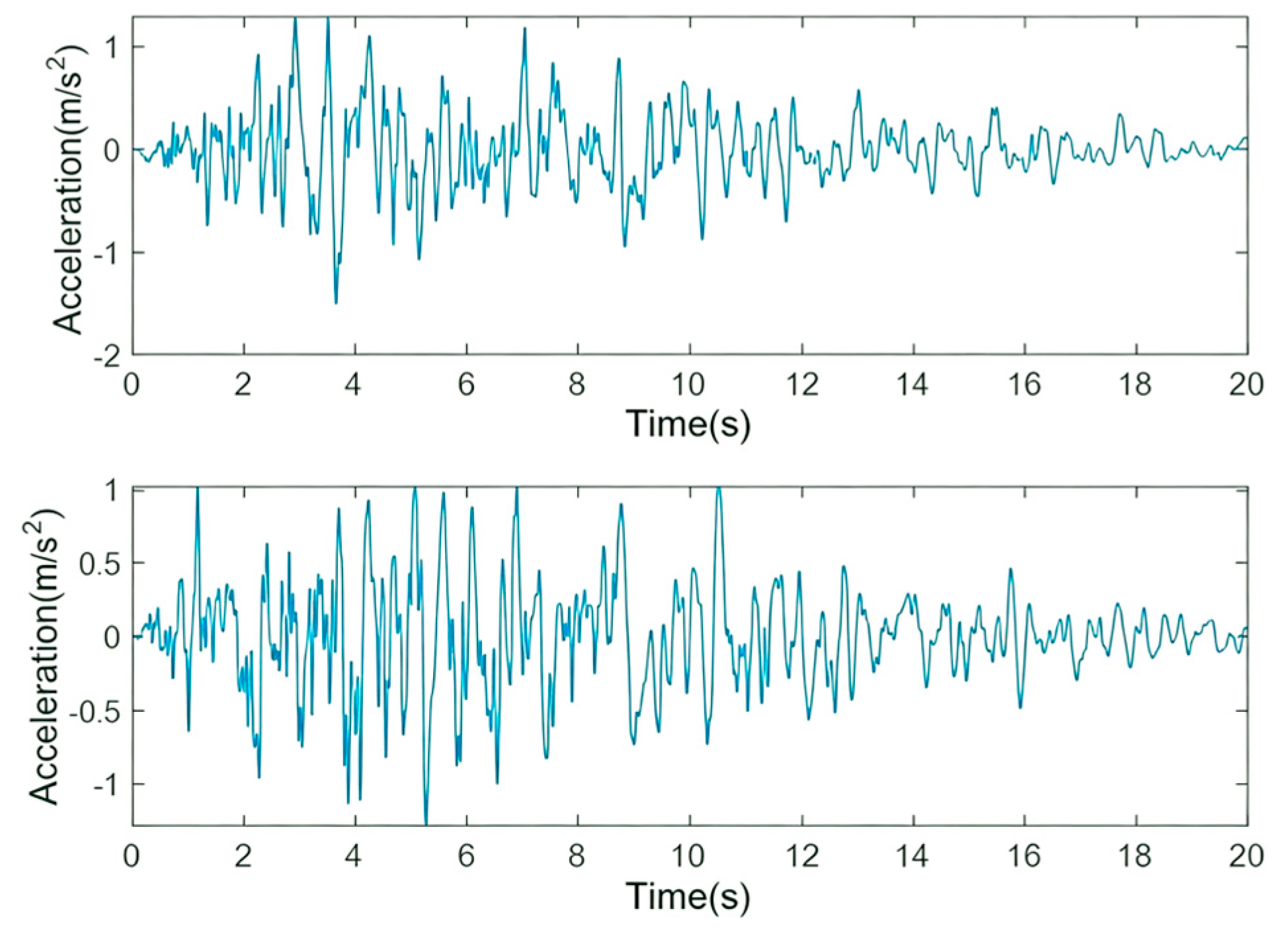
Determining Model Parameters: Considering seismic fortification intensity of 7 degrees, with Site Category II, the second design earthquake grouping, earthquake category as frequent earthquake, cutoff frequency of ω u = 240  rad/s, number of cutoff terms set to N = 1601 , and seismic motion time step of 0.01 s. Other parameters are selected according to Table 1, Table 2, Table 3, Table 4 and Table 5. The MF deviation selection method is employed to extract representative points of the random variable Θ = Θ 1 , Θ 2 . The probability space is then partitioned using Voronoi cells to compute the assignment probabilities for each sample point. Standard orthogonal function variables are generated according to the random function formula. Subsequently, the MATLAB function toolbox rand (‘state’, 0) and randperm (N) are utilized to randomly map these variables, yielding standard orthogonal random variables. Substituting all parameter values into the spectral representation formula yields a set of non-stationary random seismic motion samples containing probability information. The assigned probability at each sample point corresponds to the probability of the associated seismic motion sample. Figure 3 presents two representative seismic motion time history curves.
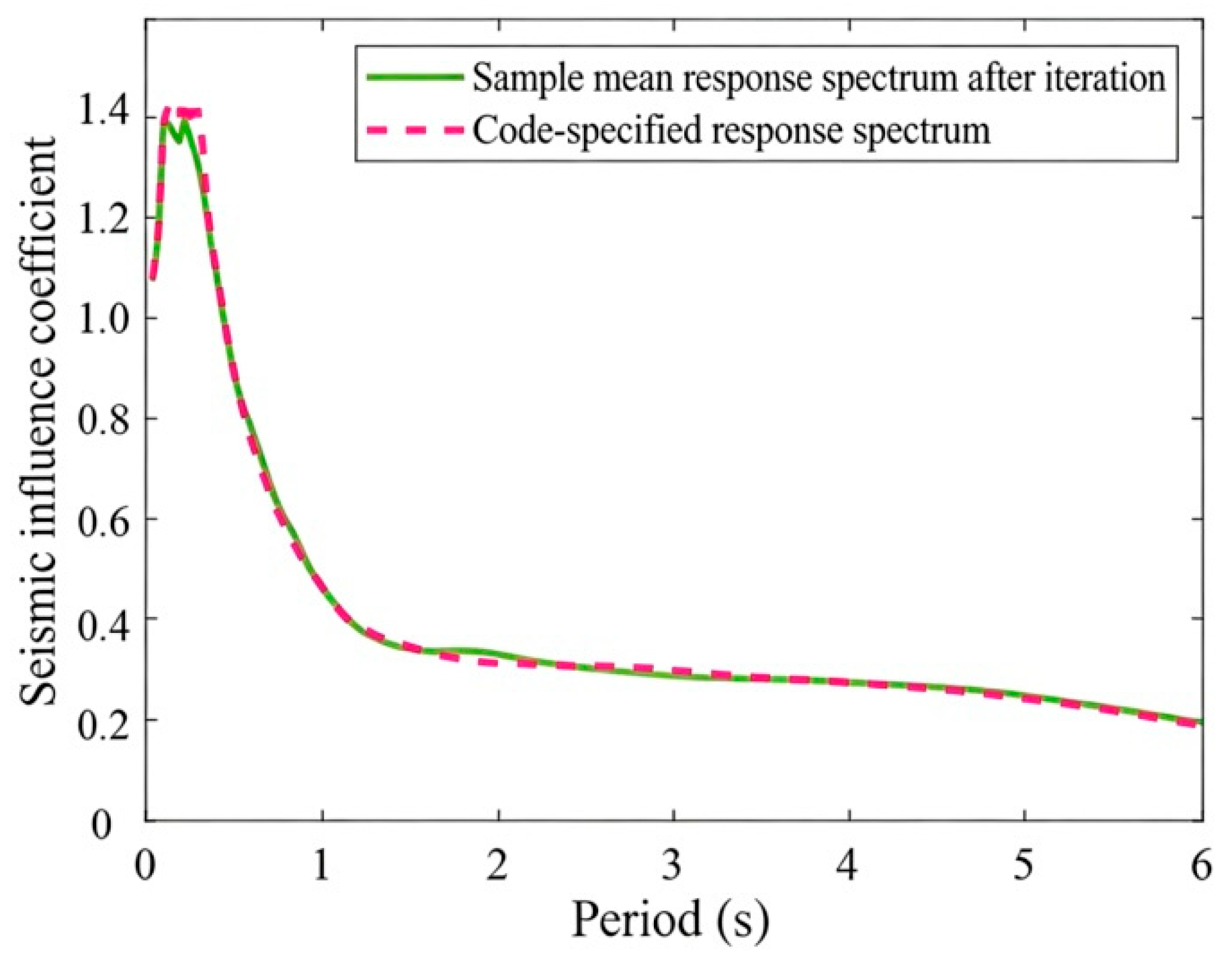
To ensure the long-period portion of the representative seismic time history maintains a high degree of conformity with the code response spectrum, it is necessary to correct the representative seismic time history. As shown in Figure 4, through iterative correction of the power spectrum, the average relative error after correction is 1.69%, and the maximum relative error is 9.27%, both falling within the permissible error range.

4. Deterministic and Random Seismic Response Analysis of Frame Structures

4.1. Framework Structure Modeling and Analysis

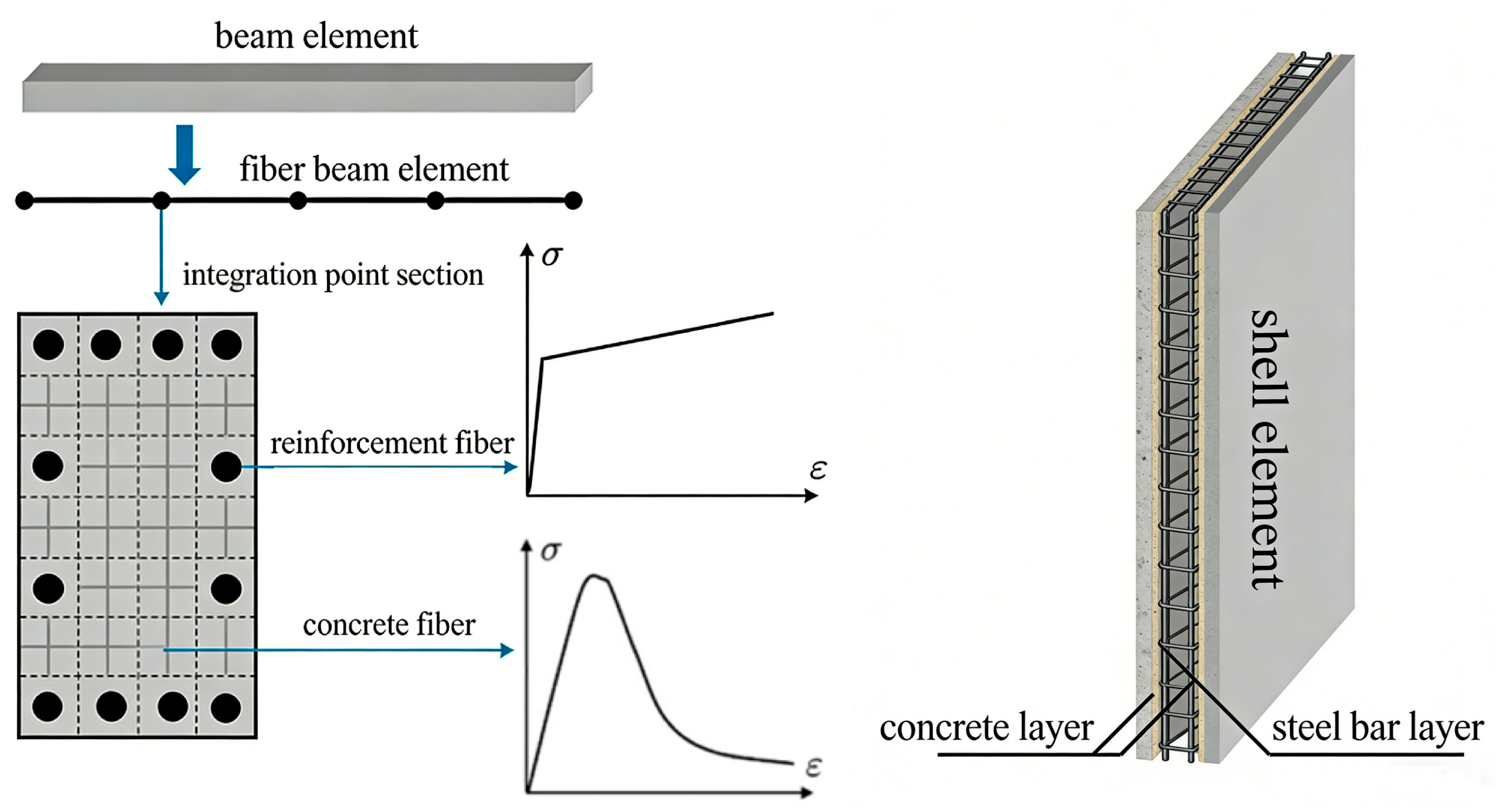
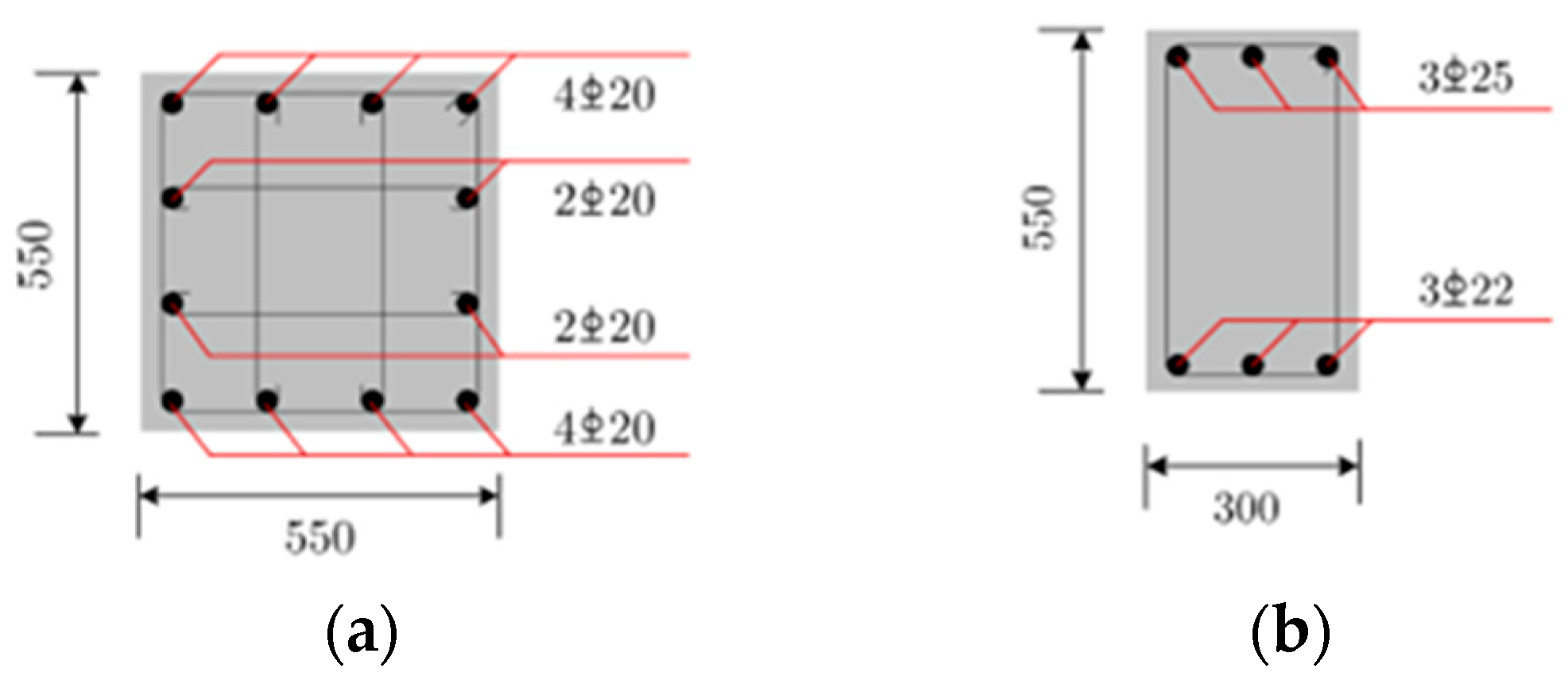
This study examines a 10-story reinforced concrete frame structure with a total height of 36.6 m, column spacing of 6.6 m, a ground floor height of 4.2 m, and a standard floor height of 3.6 m. Modeling was performed using Abaqus (2022 Edition) finite element software, employing fiber beam elements for beams and columns, and layered shell elements for floor slabs to balance computational efficiency and accuracy; see Figure 5 for the unit configuration and layout diagram. Material parameters were selected according to the Seismic Design Code GB50011-2010 [48]: concrete strength grade C30, HRB400 grade steel reinforcement, floor slab thickness 100 mm, main beam dimensions 300 × 550 mm, secondary beam dimensions 300 × 400 mm, and column cross-Section 550 × 550 mm. See Figure 6 for a schematic diagram of the cross-sectional reinforcement. The column cross-section is symmetrically reinforced with 12 HRB400-grade longitudinal bars of 20 mm diameter. The transverse stirrups consist of four-leg HRB400-grade stirrups with a diameter of 10 mm. A stirrup densification zone is provided in the plastic hinge core area at the column ends, with a spacing of 100 mm within the densification zone and a length of 550 mm; the spacing of stirrups in the non-densification zone is 200 mm. The top of the beam cross-section is reinforced with 3 HRB400-grade longitudinal bars with a diameter of 25 mm, and the bottom of the cross-section is reinforced with 3 HRB400-grade longitudinal bars with a diameter of 22 mm. The transverse stirrups consist of HRB400-grade double-leg stirrups with a diameter of 8 mm; A reinforced zone is provided in the plastic hinge region at the beam ends, with a spacing of 100 mm and a length of 825 mm; the spacing of stirrups in the non-reinforced zone at the mid-span of the beam is 200 mm; the floor slab reinforcement consists of HPB300 grade Φ8@150 bars arranged in both directions throughout the span.
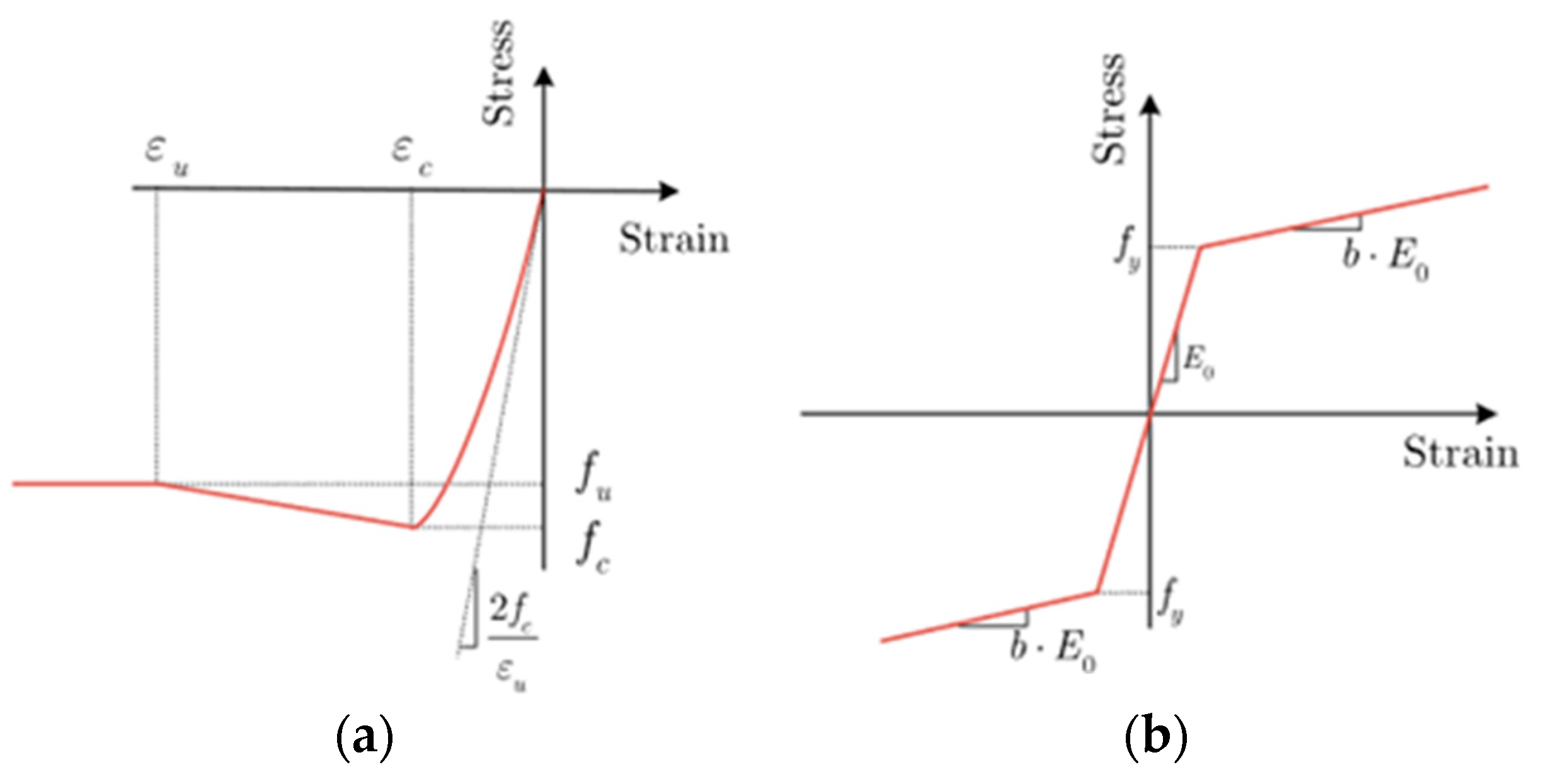
This study selected a material constitutive model suitable for analyzing seismic cyclic loading; the constitutive relationship curves are shown in Figure 7. For concrete, the Abaqus built–in Concrete Damage Plasticity (CDP) model was used, Figure 8 shows a schematic diagram of a ten-story frame structure, This model couples anisotropic damage with uncoupled plastic flow, enabling accurate representation of concrete’s tensile-compressive anisotropy, stiffness degradation, and cyclic hysteretic energy dissipation characteristics. The uniaxial compression constitutive model is described using the Hongnestad model, while uniaxial tension employs a fracture-energy-based linear softening law to match the quasi-brittle failure characteristics of concrete. Under cyclic loading, the Sidiroff energy equivalence principle is used to calculate the damage factor and quantify cumulative stiffness degradation, following the classical stiffness recovery assumption, which closely matches the cyclic behavior of concrete. The core model parameters were calibrated against codes and verified for convergence, with the following values: expansion angle 30°, eccentricity 0.1, ratio of biaxial to uniaxial compressive strength 1.16, constant stress ratio Kc = 0.667, and viscosity coefficient 0.005, ensuring simulation accuracy and computational stability. Reinforcement is modeled using a double-polynomial constitutive model, balancing the efficiency of dynamic time history analysis with engineering accuracy. During the elastic stage, the elastic modulus is set to 2.0 × 10⁵ MPa. In the post-yield hardening stage, the hardening modulus is calculated as the product of the initial elastic modulus and the hardening coefficient b = 0.01, which aligns with the actual hardening behavior of reinforcement.
The “rigid box effect” created by the high-stiffness floor–slab system provides a reliable mechanical foundation for the anchoring of column bases in the superstructure. The foundation is deeply embedded, with a bearing layer consisting of dense sandy soil, and the surrounding soil provides strong lateral confinement to the basement, effectively suppressing horizontal translational and rotational deformations of the foundation. Given the engineering conditions of Class II medium-stiff sites in this study, the influence of soil-structure interaction (SSI) on the overall dynamic response of the structure is limited. Existing research indicates that for high-rise buildings with long natural periods on such sites, the amplitude reduction in seismic acceleration due to the extension of the natural period is typically at a low level. Therefore, this study adopts the boundary condition of fully fixed column bases in the numerical model. At the same time, the reliability analysis framework established in this study does not rely on the assumption of rigidly fixed boundaries and can be easily extended to a refined analytical model that accounts for SSI effects.
The design variables of reinforced concrete frame structures directly influence the seismic reliability of the structure. Therefore, to identify the most influential random variables among all design variables, the following equation is employed in this paper for sensitivity analysis:
λ i = g x i P * σ x i k = 1 n ( g x k P * σ x k ) 2 ,
In the formula, λ i represents the sensitivity factor of the i–th random variable, and σ x i represents the mean square deviation of the i–th random variable.
The sensitivity factors significantly influencing the response results in this framework model were calculated using Equation (23). The values and normalized proportions of the sensitivity factors for each random variable are shown in Table 6.
It is evident that the tensile strength of reinforcing bars, compressive strength of concrete, density of concrete, strain rate of reinforcing bars, elastic modulus of reinforcing bars, and elastic modulus of concrete are the key random variables. In accordance with classical theories of structural reliability and the prevailing consensus in the field of seismic reliability of reinforced concrete, a log-normal distribution is adopted for material parameters—such as the elastic modulus of concrete—that do not take negative values. This approach avoids the theoretical flaw of negative values that may arise in a normal distribution, and the characteristics of the distribution’s tails closely match the actual stochastic evolution of the material’s mechanical properties; For parameters such as concrete and reinforcing steel strength, a normal distribution is adopted, with the standard value of the material strength serving as the lower limit for engineering truncation. This eliminates the interference of unreasonably low values in the left tail of the distribution on reliability calculation results, ensuring the accuracy of seismic failure probability calculations. The statistical characteristics (mean and coefficient of variation) of the adopted random variables are shown in Table 7.

4.2. Deterministic Seismic Response Analysis of Frame Structures

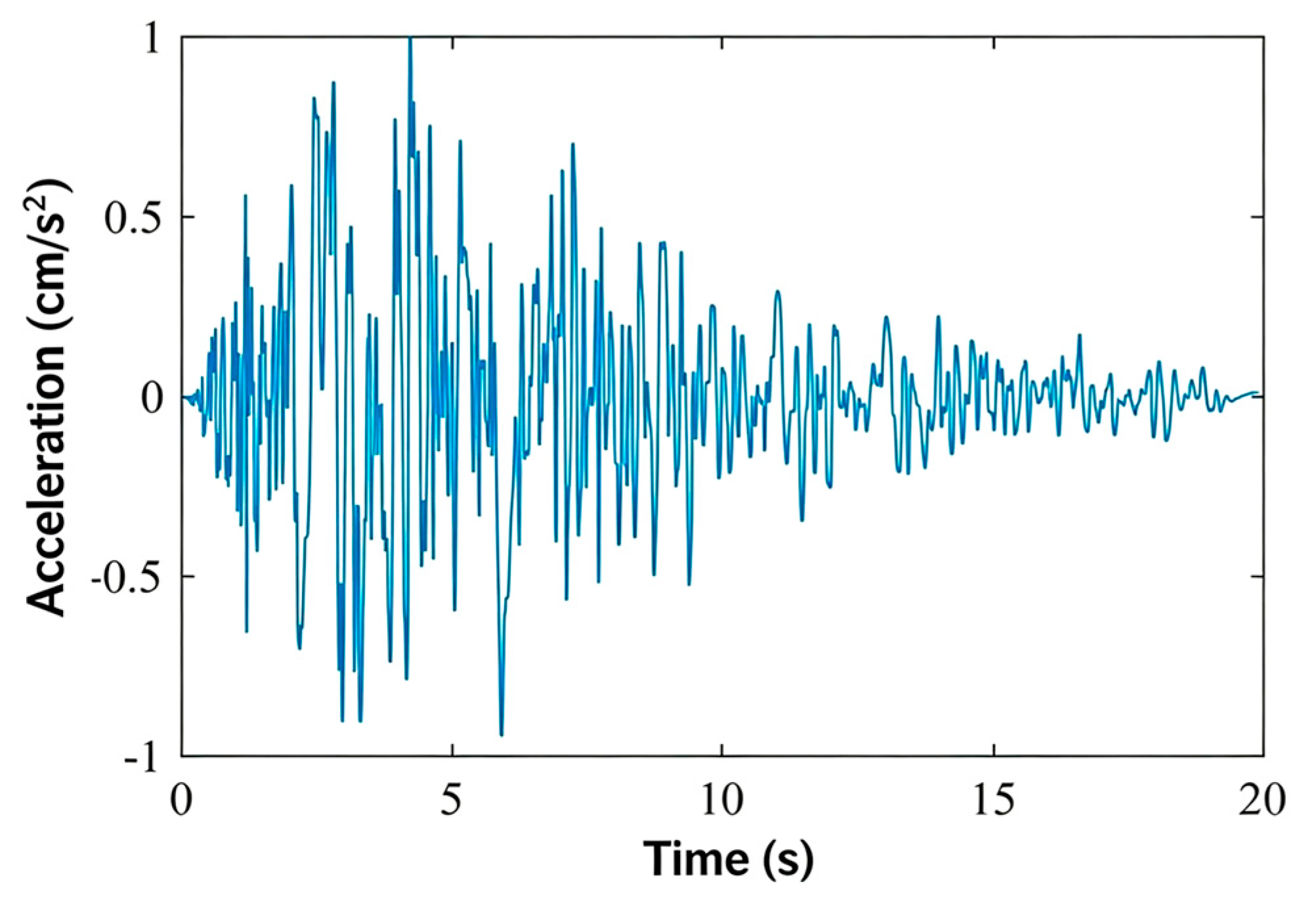
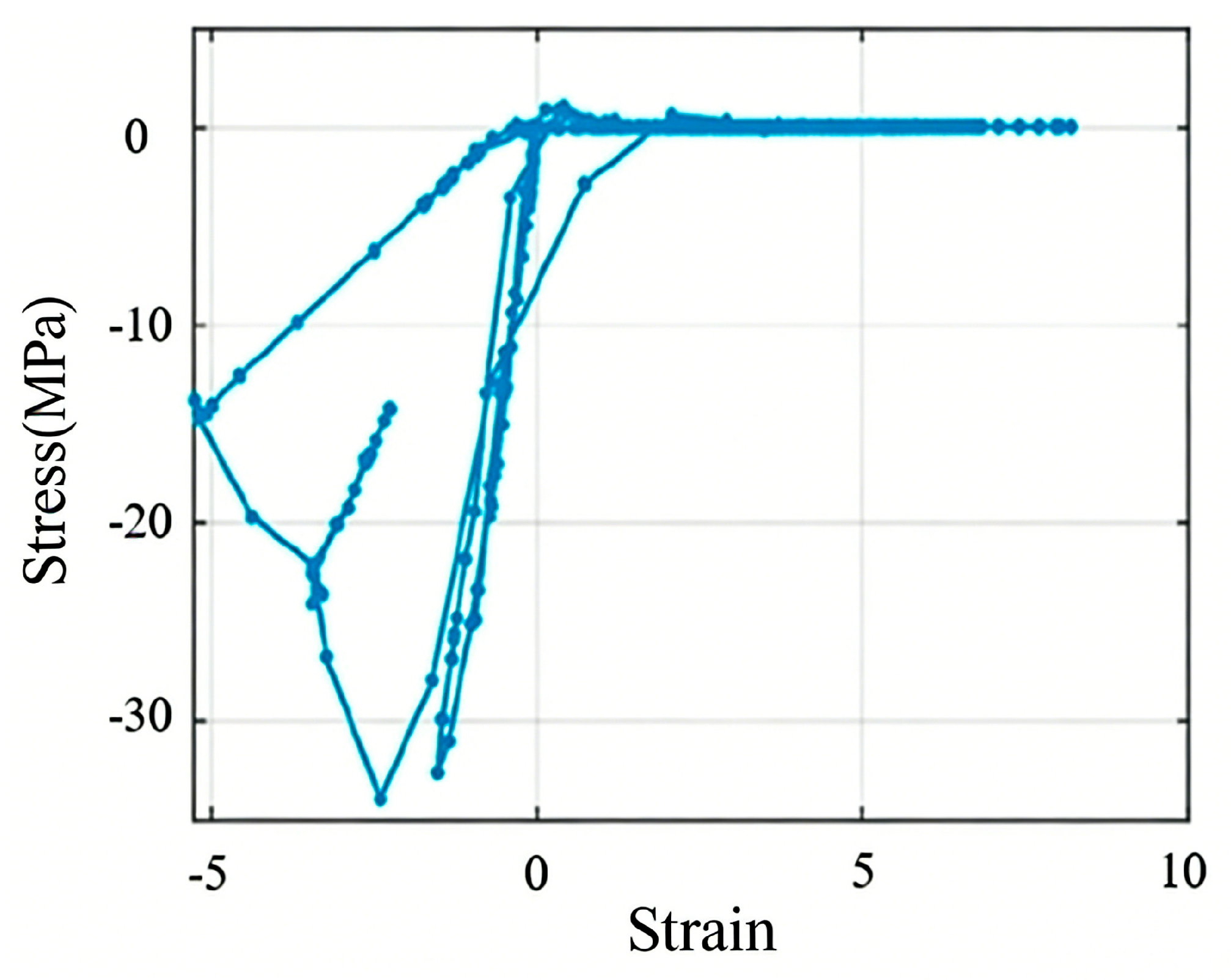
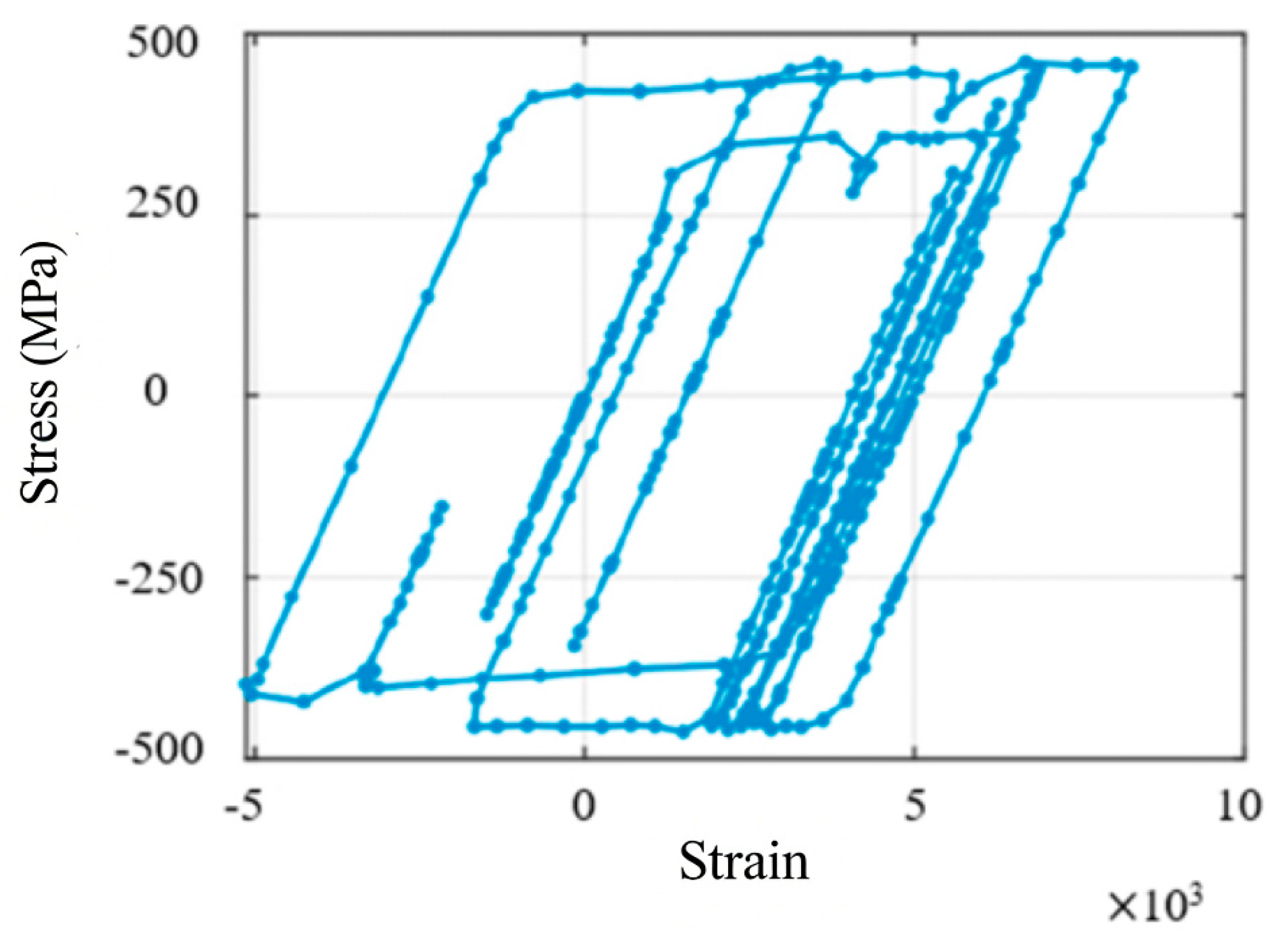
Figure 9 displays the normalized acceleration time history of a representative seismic wave, NGA#1063 (from the Rinaldi station during the 1994 Northridge earthquake), in the NGA-West2 database. This acceleration record, with a time step of 0.01 s, is applied to the building foundation. The absolute displacement of each structural story is extracted, and the relative inter-story displacement is calculated. Figure 10 and Figure 11 present the stress–strain curves for concrete and reinforcing steel under amplitude–modulated seismic loading. These curves reveal significant nonlinear behavior in the structure, validating that the employed CDP model and double–polyline constitutive model effectively simulate the elastic-plastic behavior of materials under seismic loading.
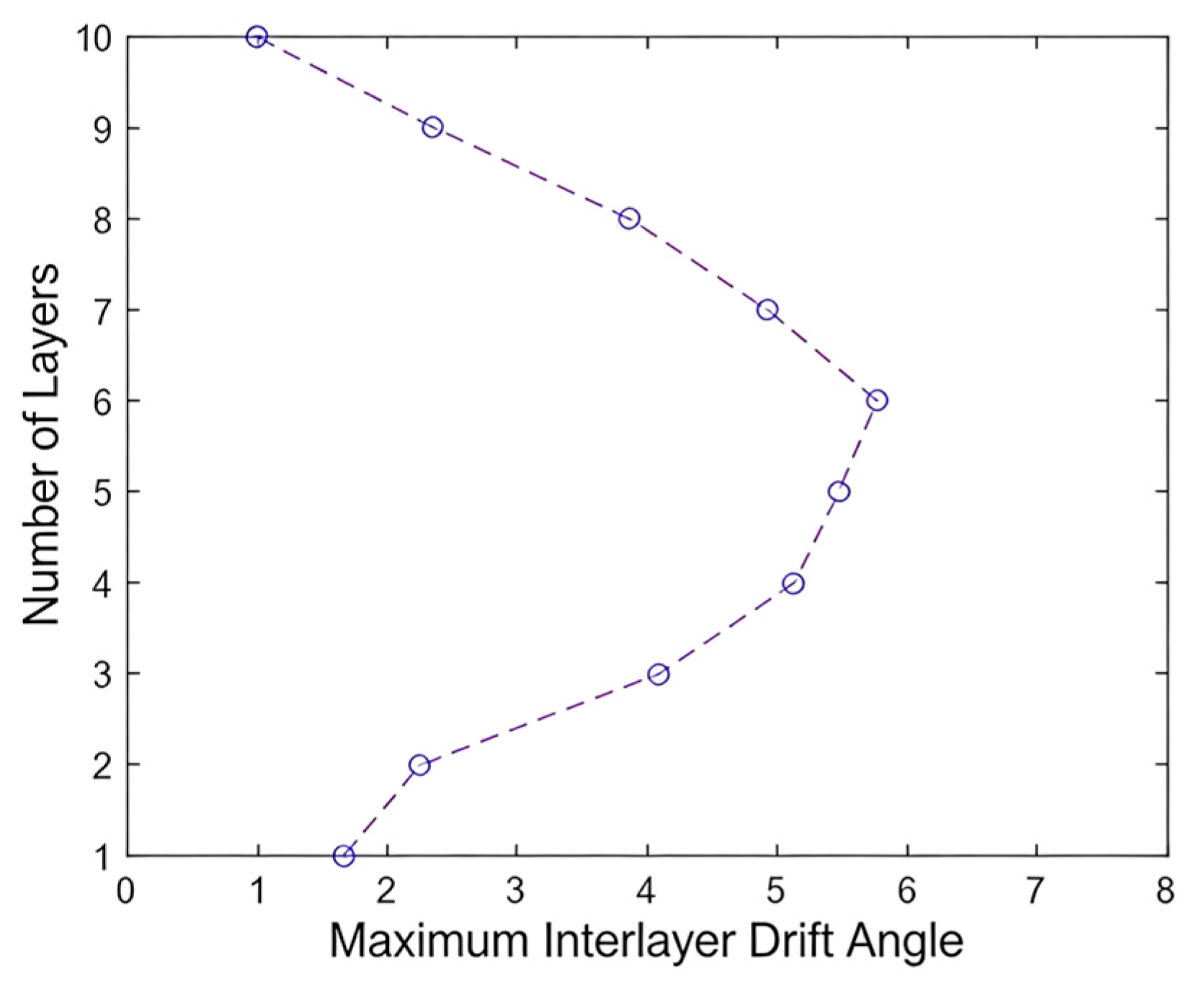
Figure 12 shows the maximum interlayer displacement angle of the structure under deterministic excitation. It can be seen that the sixth layer is the weakest, so the interlayer displacement angle of the sixth layer is selected as one of the key responses for the dynamic reliability analysis.

4.3. Random Seismic Response Analysis of Frame Structures

4.3.1. Random Seismic Vibration Sample Generation

Based on the direct probability integration method, the original probability space of the random variable is first partitioned to generate a certain number of representative points. The partition probability of each representative point is then calculated using the MCS and Voronoi partitioning methods.
The random representative point discretization in this study employs MF deviation sampling. Representative points are generated in quantities of 300, 400, 500, 600, and 700. Computational analysis yields the MF deviations for these representative points, with specific results shown in Table 8. It is evident that the MF deviations for all representative points fall below the specified tolerance deviation.
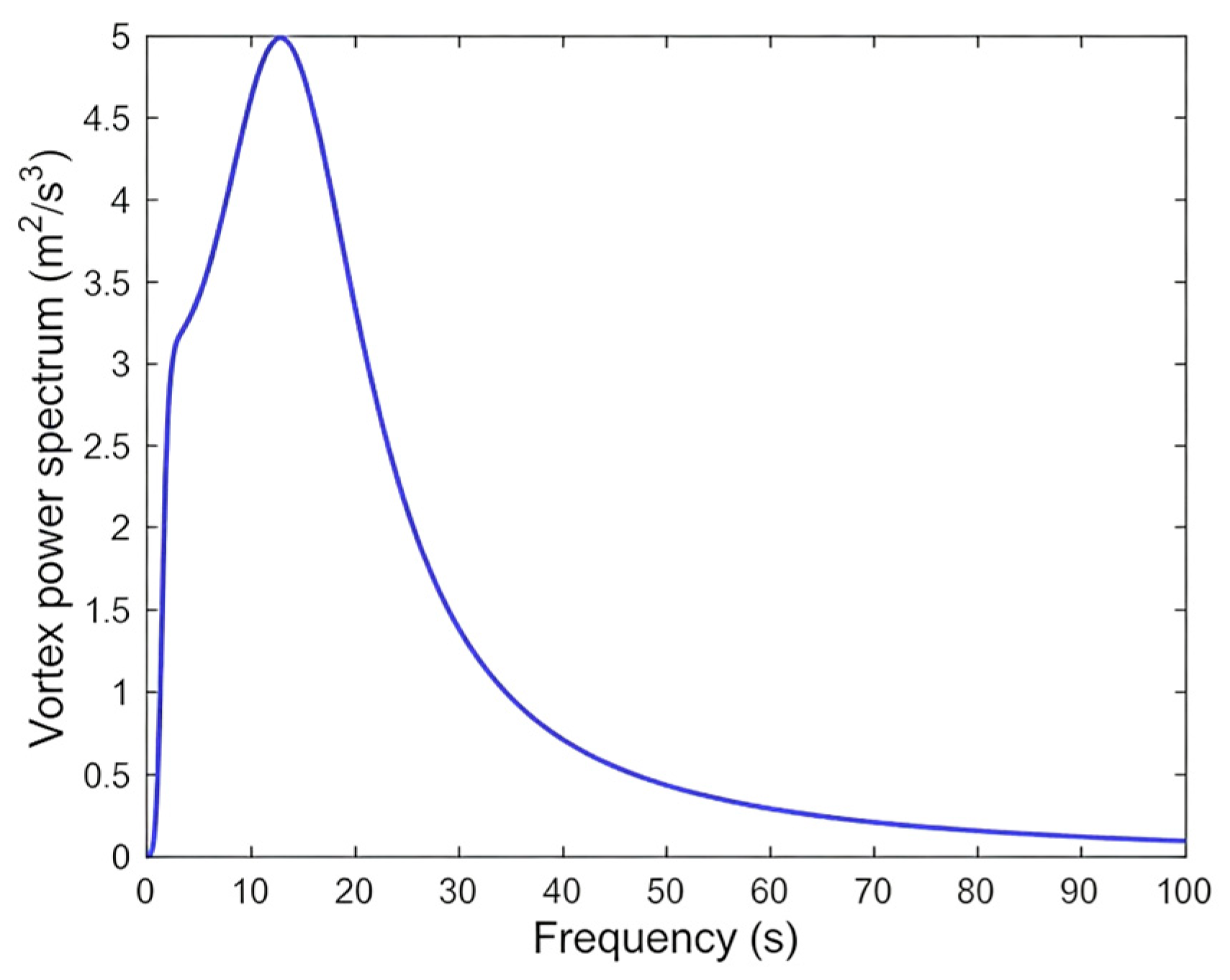
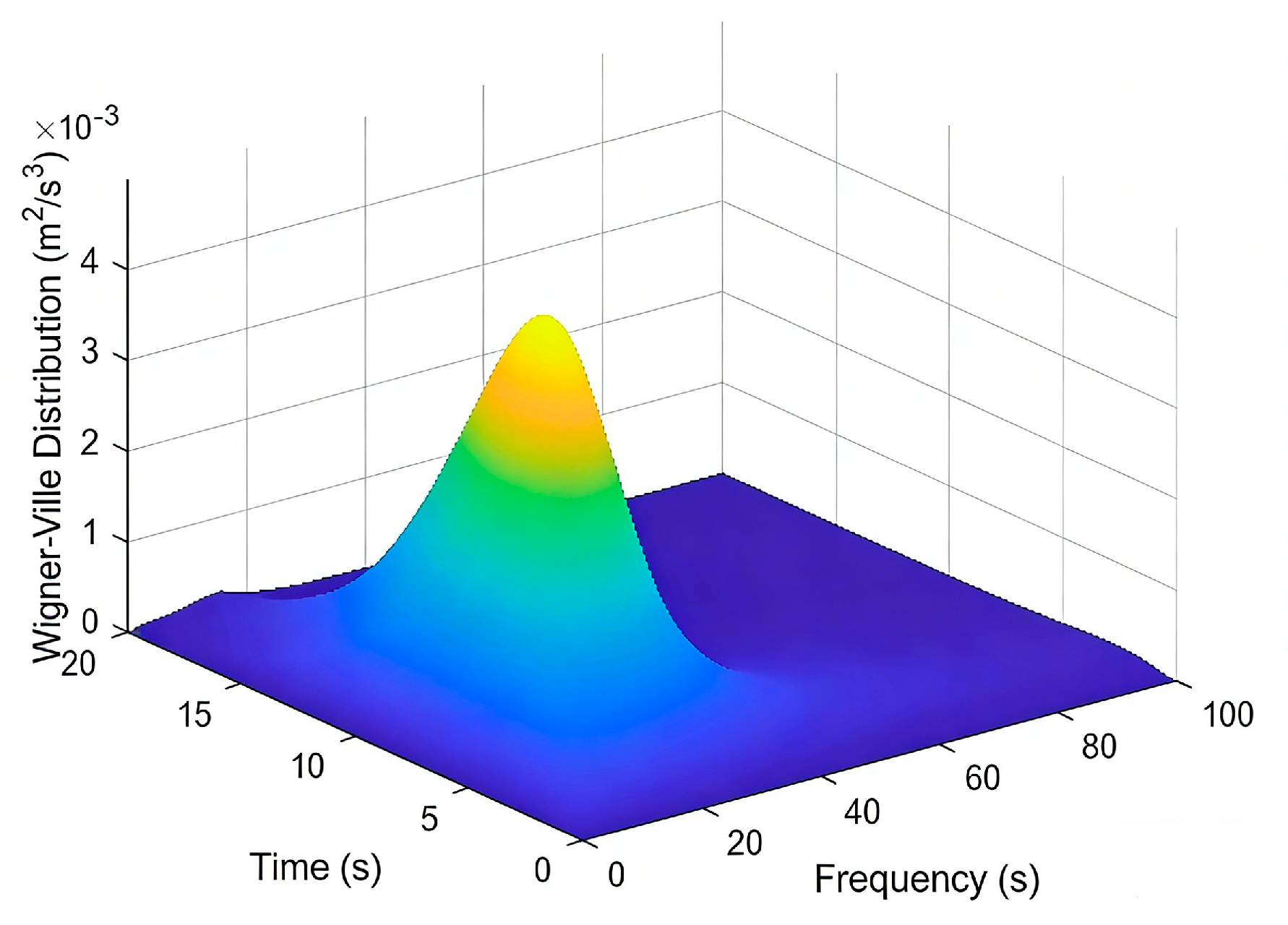
To balance computational accuracy and efficiency, this study selected 600 representative points for analysis. Based on these points, 600 original representative seismic acceleration time history curves were generated. Through iterative refinement, a random seismic motion sample set was ultimately obtained that exhibits good fit with the code response spectrum and possesses complete probabilistic information. Figure 13 and Figure 14 present the evolving power spectral density function and power spectral density function generated by combining the time–frequency modulation function with the Clough–Penzien spectrum. It is evident that the selected model effectively captures the non-stationarity in both intensity and frequency.
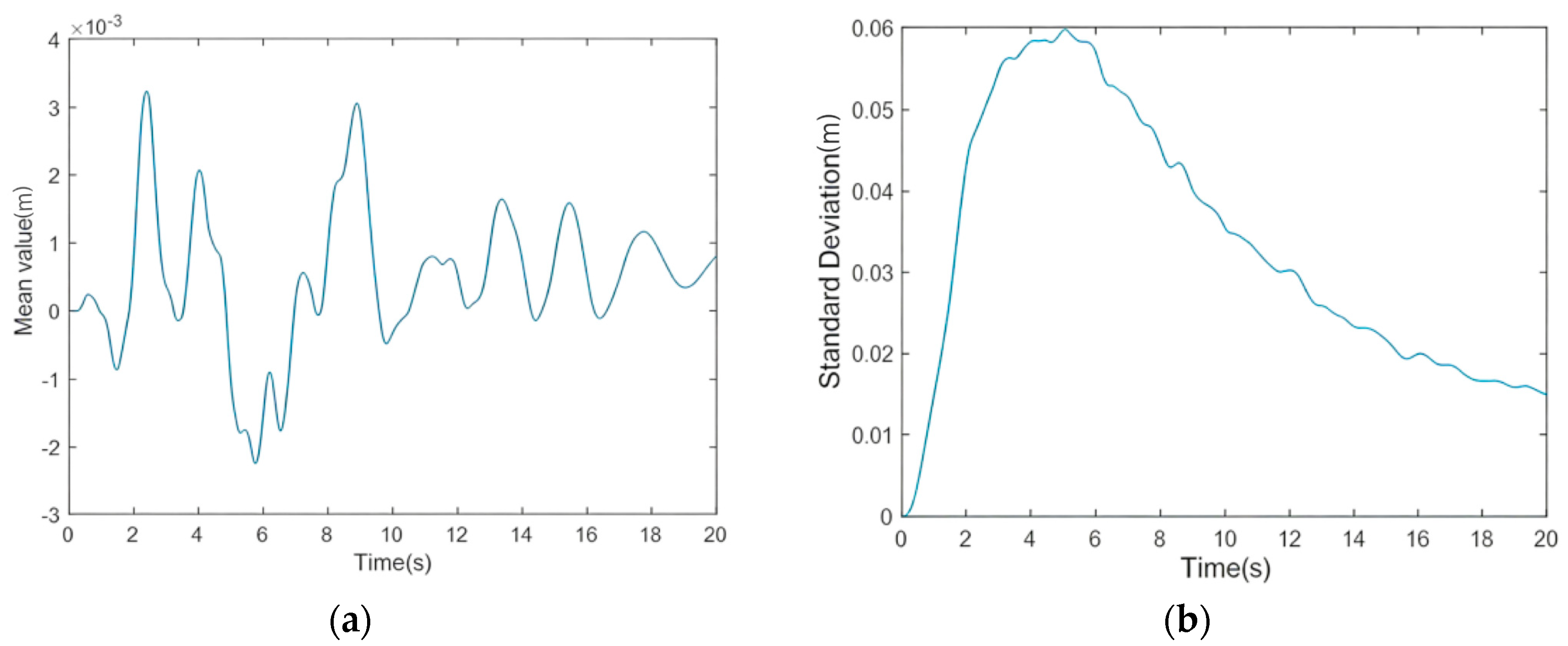
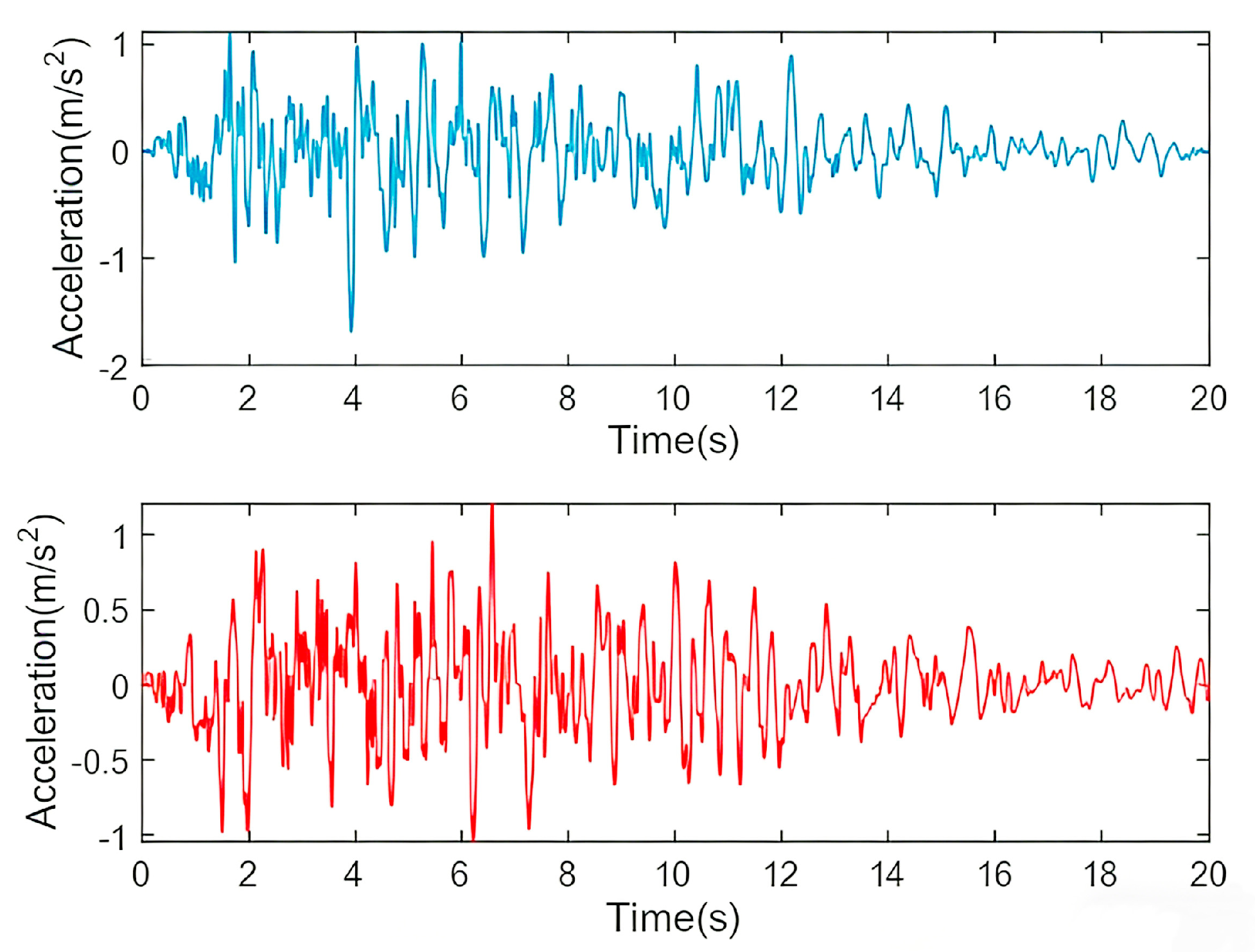
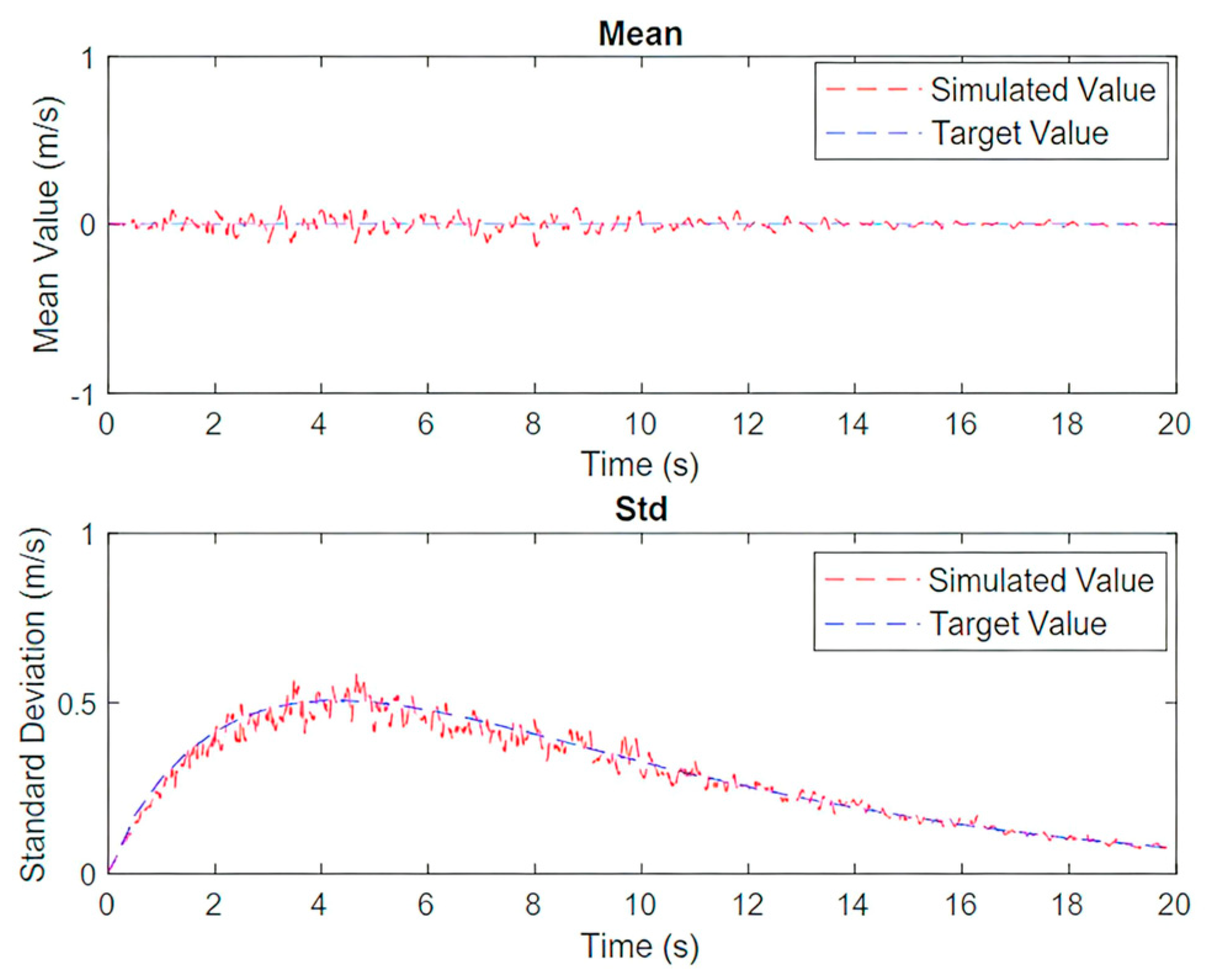
Figure 15 shows two representative acceleration time history curves of artificial seismic waves modeled using MF deviation sampling. The strong seismic events are primarily concentrated around 5 s, consistent with the temporal characteristics of the evolving power spectral density function. Figure 16 presents the mean time history curve and the standard deviation time history curve of the artificial seismic wave generated from 600 representative points. It is evident that the statistical characteristics of the artificially synthesized seismic wave fit well with the analytical solution, validating the model’s effectiveness.

4.3.2. Comparison of Deterministic and Random Seismic Response Results

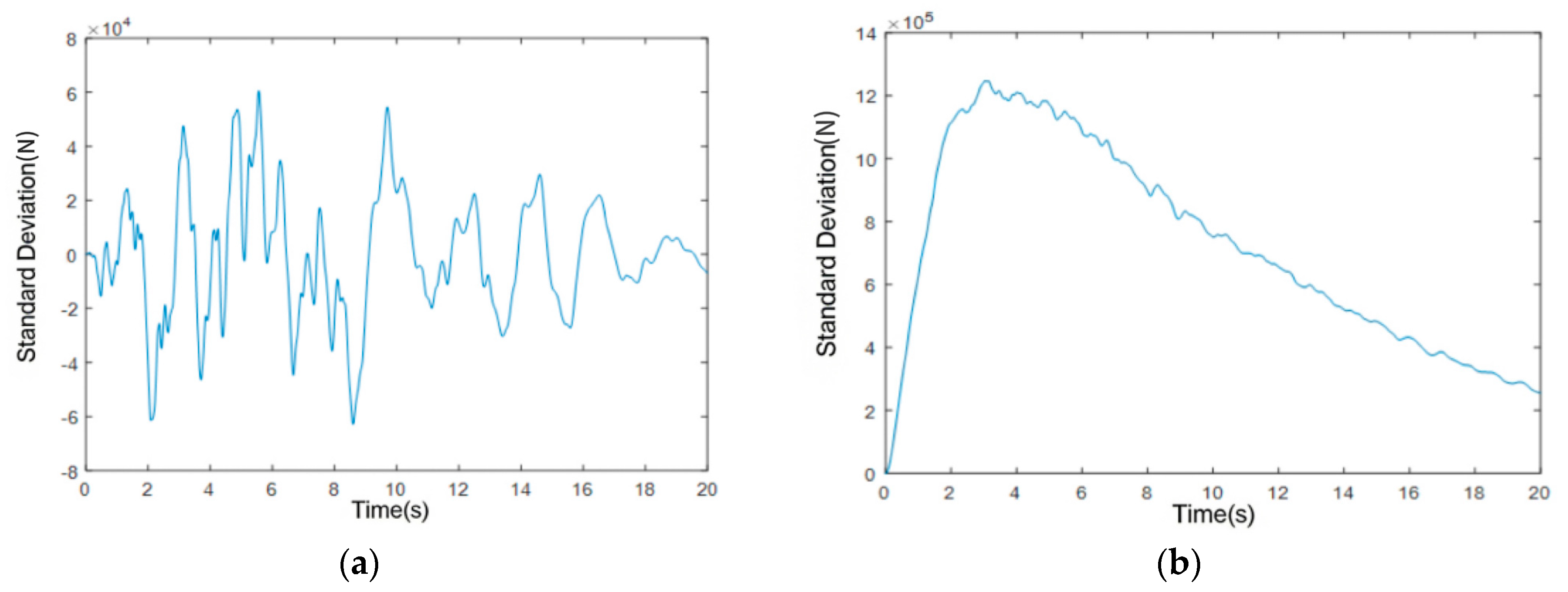
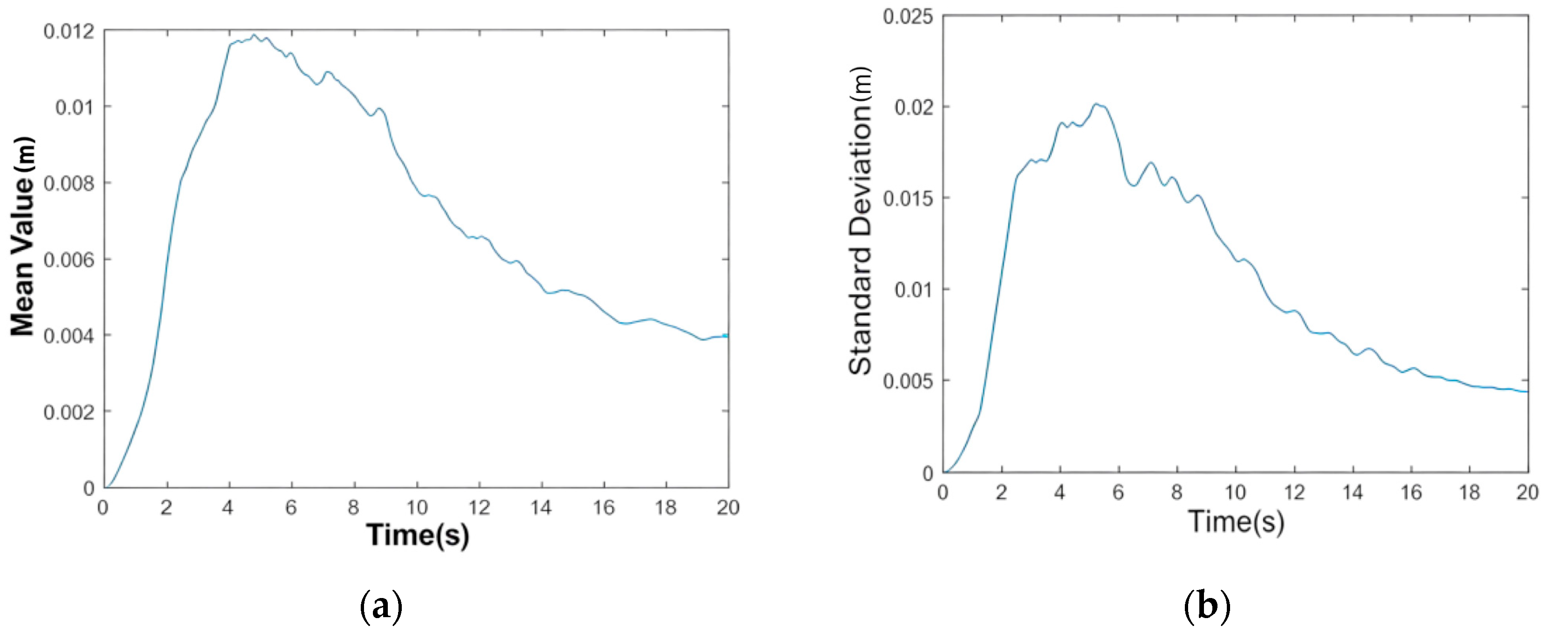
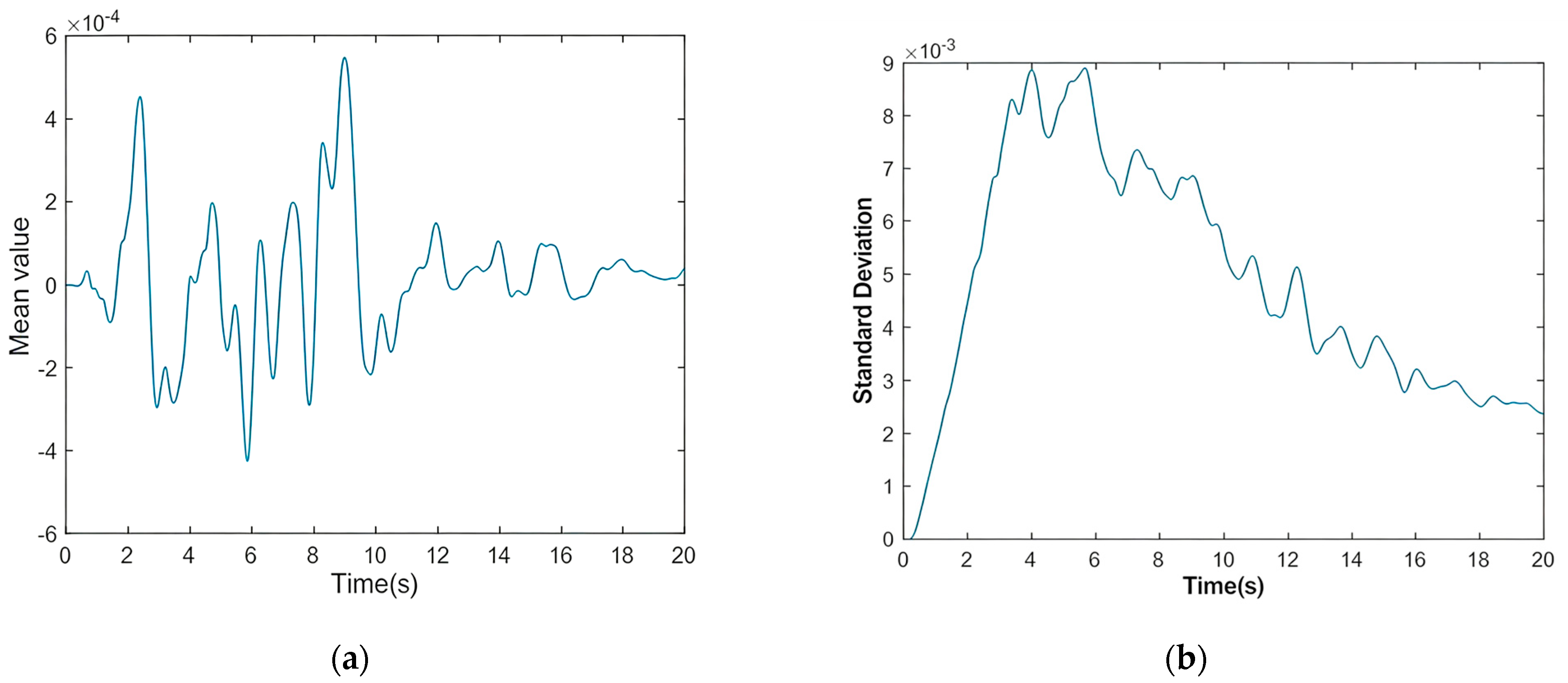
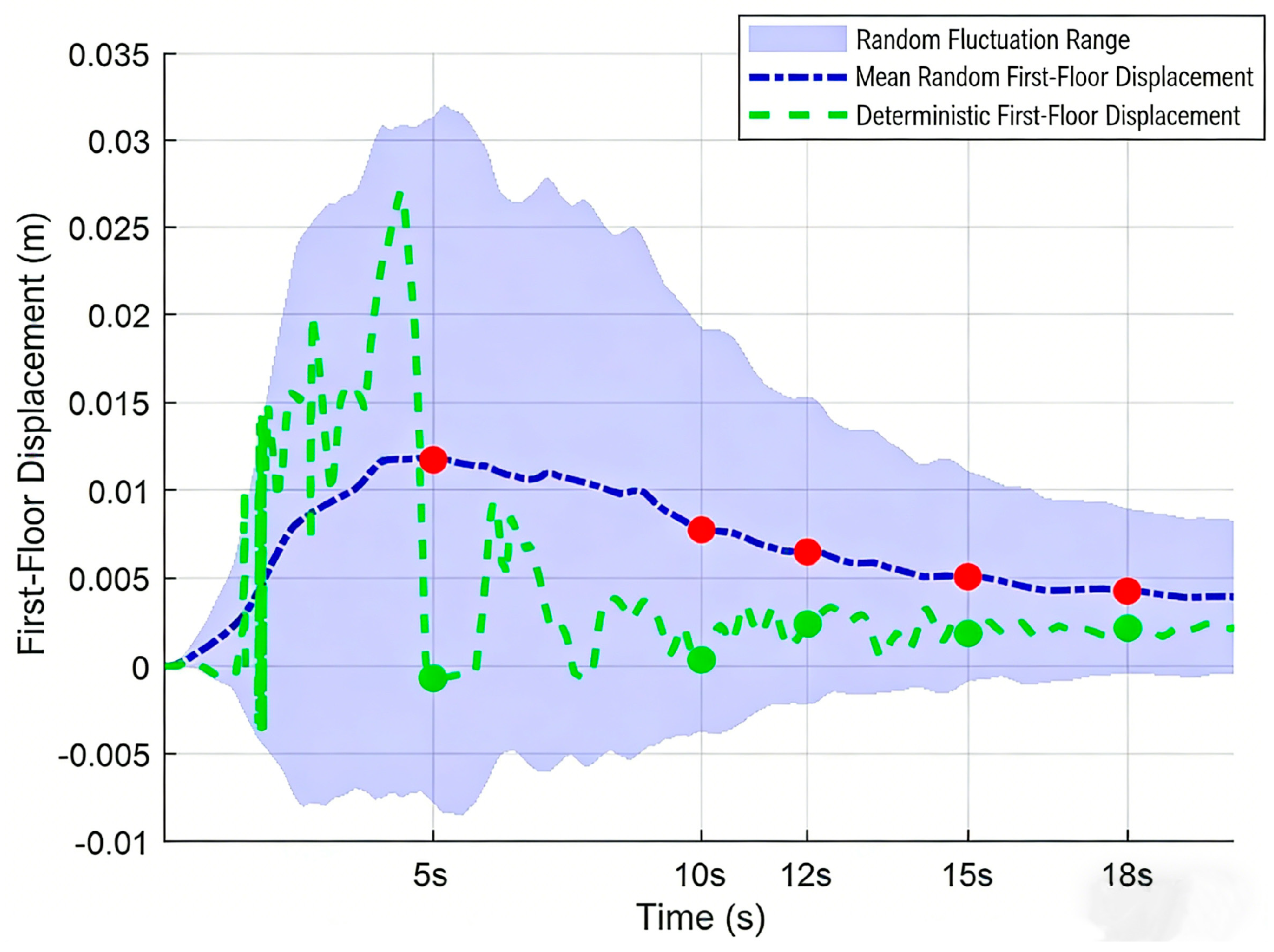
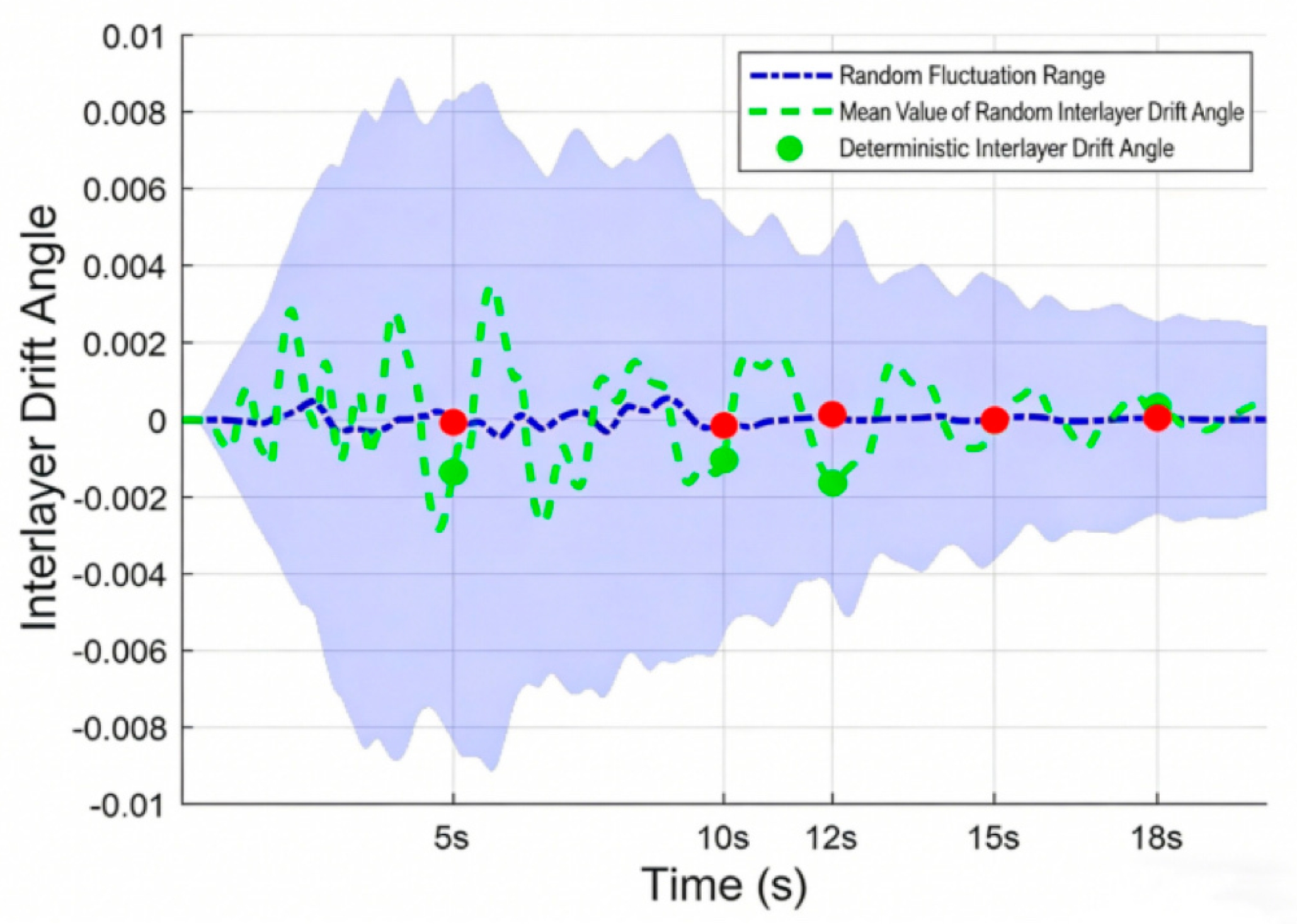
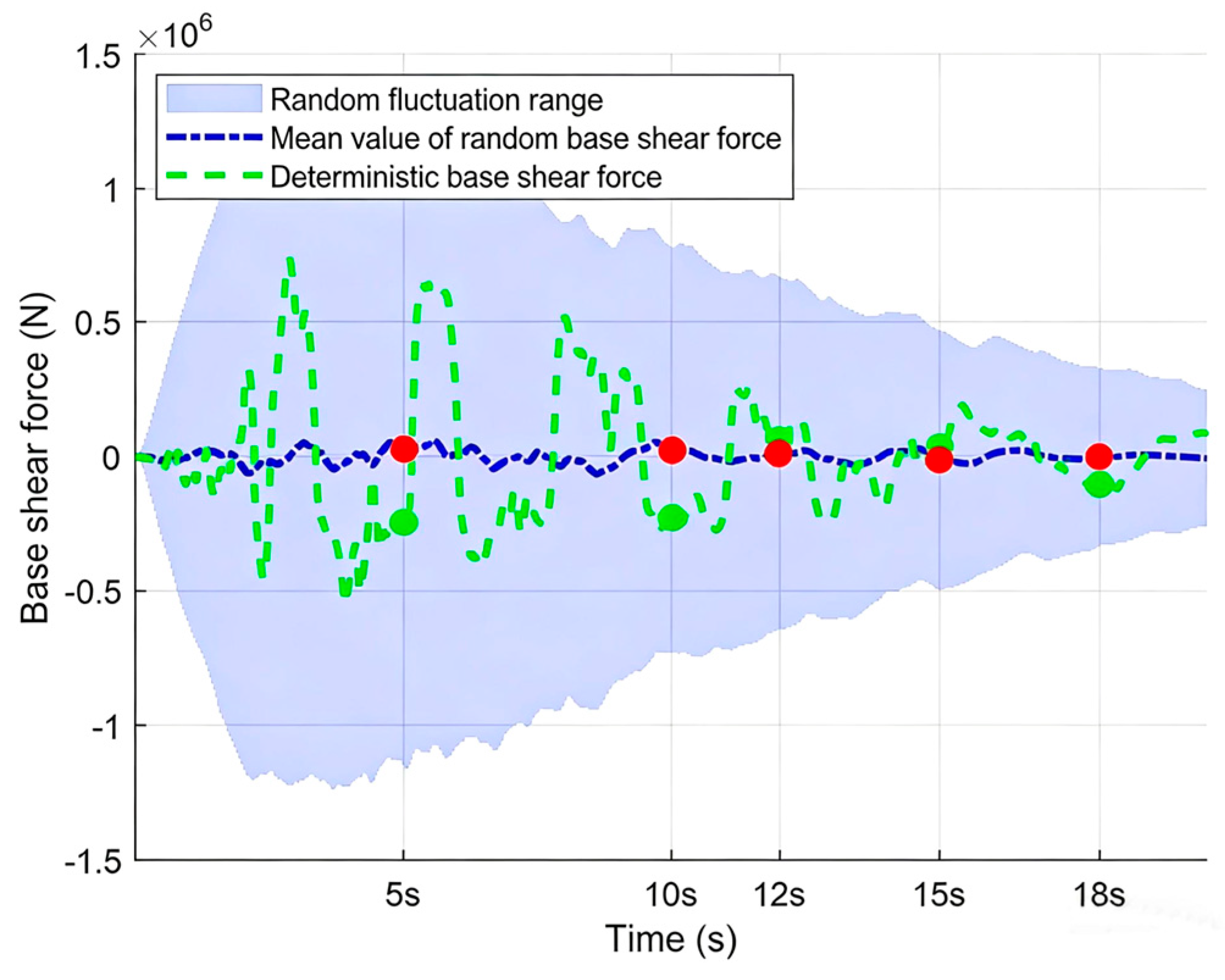
The primary analysis targets selected include top-story displacement, first-story displacement, inter-story displacement angle at the sixth story, and base shear. Results from deterministic seismic response analysis were compared with those from stochastic seismic response analysis. Figure 17, Figure 18, Figure 19 and Figure 20 present the mean and standard deviation curves of responses obtained through structural analysis of 600 sample points using the DPIM method.
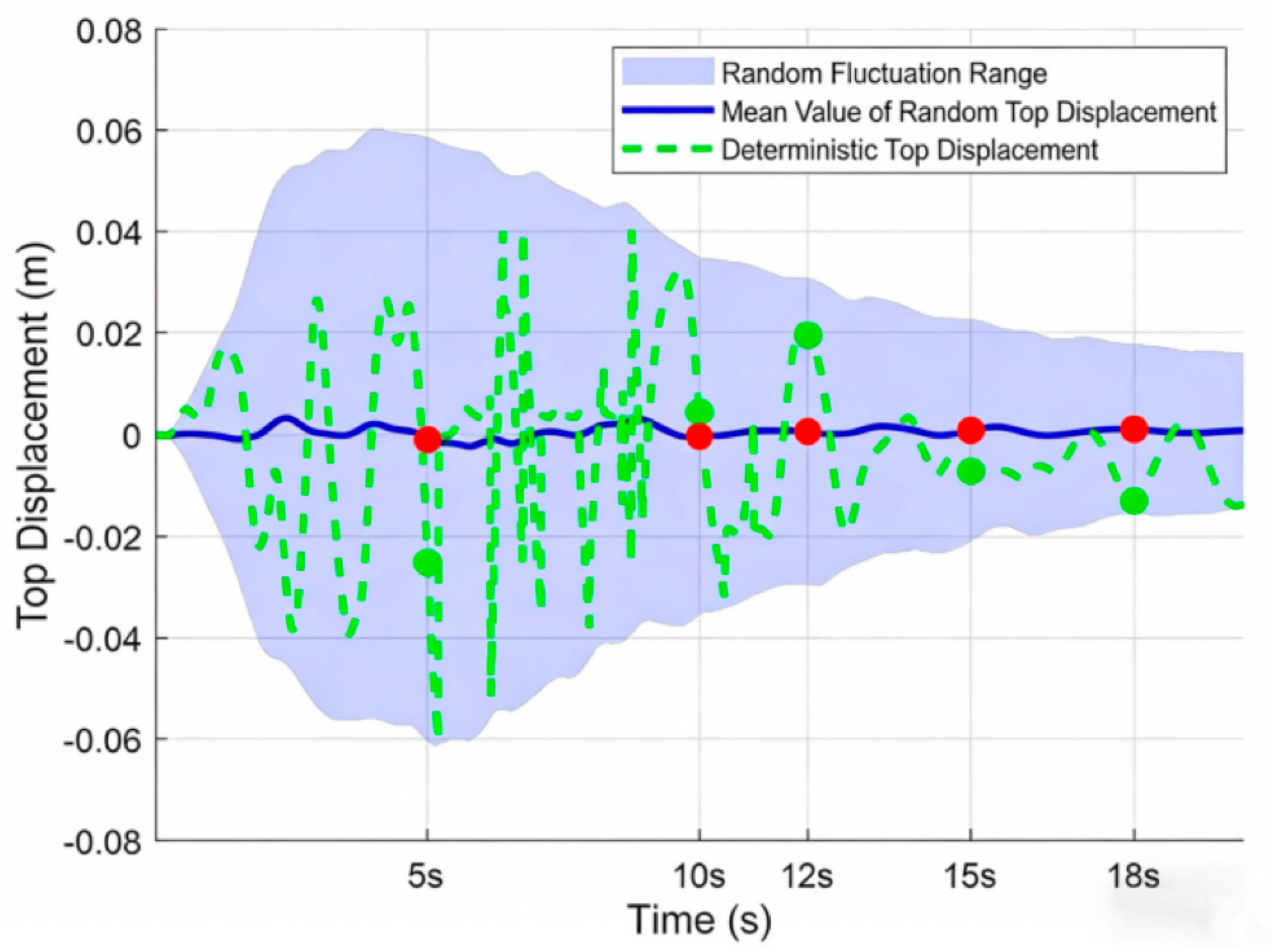
Figure 21 presents a comparison of top-layer displacement responses under deterministic and random seismic excitation. The blue shaded area indicates fluctuations within the mean ± standard deviation range of the random seismic response, reflecting the uncertainty introduced by seismic motion. Results show that the top-layer displacement obtained from deterministic analysis generally follows the overall trend of random fluctuations. Although response values at key time intervals such as 5 s, 10 s, 12 s, 15 s, and 18 s show variations, they all fall within the random fluctuation range. This indicates that the deterministic analysis results generally conform to the statistical characteristics of the random response, demonstrating their engineering validity.
Figure 22, Figure 23 and Figure 24 show the comparison results for first-story displacement, inter-story displacement angle at the sixth story, and base shear, respectively. As shown in Figure 22, the first-story displacement in the deterministic analysis consistently remains within the range of random fluctuations, indicating that this response is well captured by the deterministic analysis. Simultaneously, under random effects, the fluctuation pattern of first-story displacement resembles the initial rapid variation trend observed in the deterministic response during the first 10 s, subsequently stabilizing gradually. This reflects the significant influence of non-stationary seismic time–frequency characteristics on structural dynamic response and validates the effectiveness of random analysis in capturing the overall response patterns of the structure.

5. Integrated Seismic Reliability Analysis of Reinforced Concrete Frame Structures

5.1. Equivalent Extreme Value Event

In dynamic system reliability analysis, the equivalent extreme value event theory transforms time-varying reliability problems into static extreme value analysis, effectively resolving the challenge of handling time-varying failure domains in traditional methods. Based on probability density evolution methods, random processes are transformed into extremal random variables through extremal mappings, thereby simplifying computations. Regarding the selection of an extreme value function in the transformation of equivalent extreme events, this paper takes the seismic failure mechanism of reinforced concrete frame structures as its core basis: structural failure is controlled by the maximum inter-story displacement angle and inter-story displacement under seismic excitation exceeding code limits, which constitutes a typical upper-bound failure mode. Therefore, the maximum value mapping is selected as the extreme value function, as its physical significance fully aligns with the structural failure criteria. The performance function is defined as the difference between the extremum of the structural response over a time interval and a threshold value. For example, for interlayer displacement, the functional is defined as Z ( T ) = Y ¯ e x t t [ 0 , T ] ( X ( t ) ) = Y ¯ e x t t [ 0 , T ] ( H ( Θ , t ) ) , where Y ¯ is the threshold and X t is the random response process. This approach avoids high-dimensional integration by leveraging the principle of probability conservation, significantly enhancing computational efficiency.
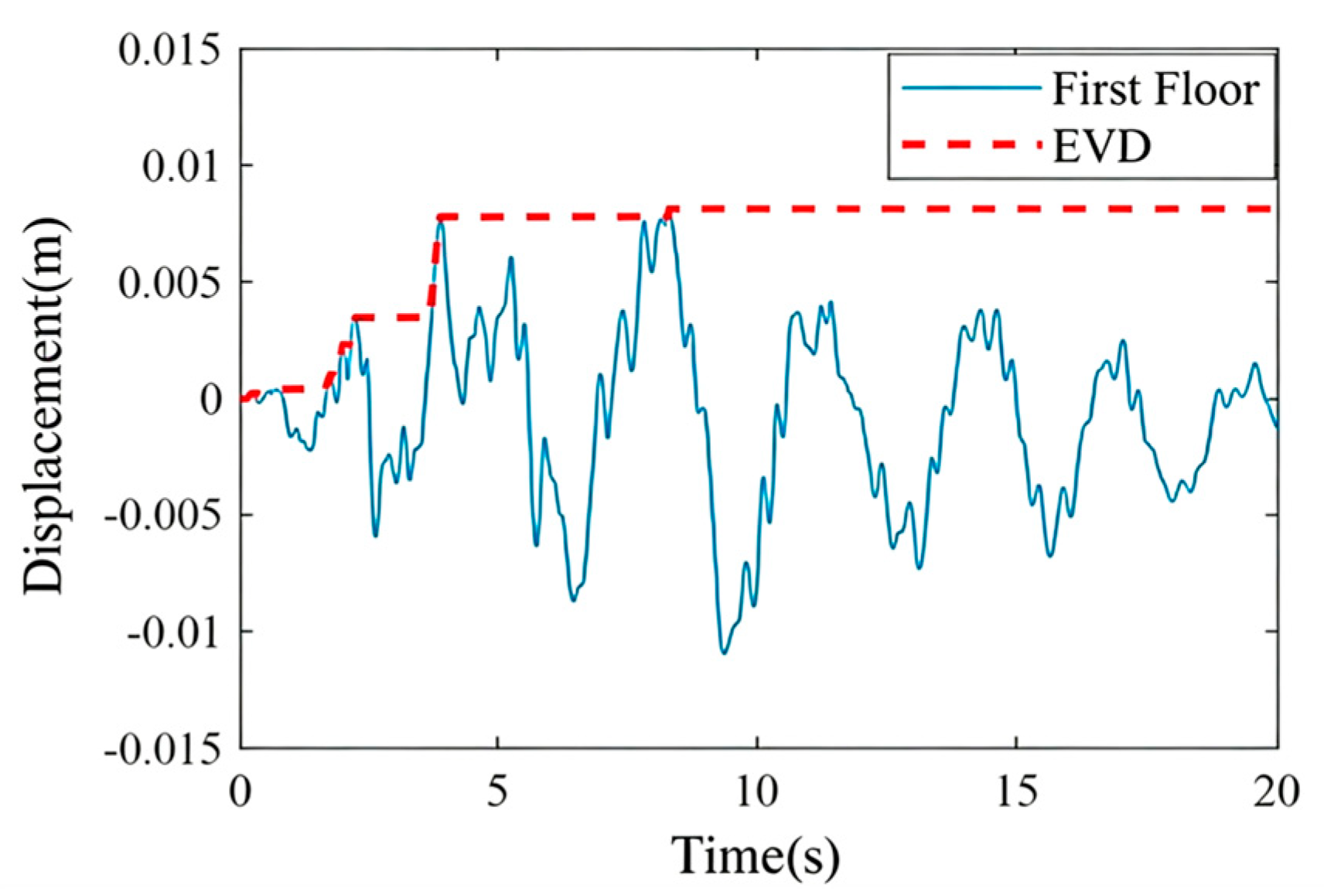
Figure 25 compares the time history curve of first-story displacement under a representative seismic excitation with the equivalent extreme event curve. It is evident that the equivalent extreme event focuses on the maximum value across the entire time domain. After 10 s of intense shaking, the curve stabilizes, reflecting the static nature of extreme events.

5.2. Framework Structure Single Failure Mode Reliability

Considering key failure modes such as inter-story drift, base shear, inter-story drift angle, and top-story displacement, reliability analysis for single failure modes is conducted based on the direct probability integration method. The performance functions for the four failure modes can be expressed as:
Z i ( t ) = Y ¯ e x t τ [ 0 , t ] ( Y i ( Θ , τ ) ) , i = 1 , 2 , ...10 Z 11 ( t ) = F ¯ e x t τ [ 0 , t ] ( F s h e a r ( Θ , τ ) ) Z 12 ( t ) = θ ¯ e x t τ [ 0 , t ] ( θ 6 ( Θ , τ ) ) Z 13 ( t ) = X ¯ e x t τ [ 0 , t ] ( X 10 ( Θ , τ ) )
Among these, Y ¯ represents the inter-story drift threshold, with inter-story drift denoted as Y 1 ( Θ , t ) = X 1 ( Θ , t ) 0 , Y i ( Θ , t ) = X i ( Θ , t ) X i 1 ( Θ , t ) , i = 2 , 3 , ...10 ; F ¯ represents the base shear threshold, with base shear denoted as F s h e a r ; θ ¯ represents the inter-story drift angle threshold, with the inter-story drift angle of the sixth story denoted as θ 6 ; X ¯ represents the top-story displacement threshold, with top-story displacement denoted as X 10 ( Θ , t ) . All thresholds are set according to China’s Code for Seismic Design of Buildings GB50011-2010 [48]: inter-story displacement threshold Y ¯ = 0.06 m, bottom shear threshold F ¯ = 7 × 10 6 N, inter-story displacement angle threshold θ ¯ = 1 / 250 , top-story displacement threshold X ¯ = 0.12 m. The seismic duration is set to 20 s. The failure probability for each mode is calculated through a discrete random parameter space of 600 representative points.
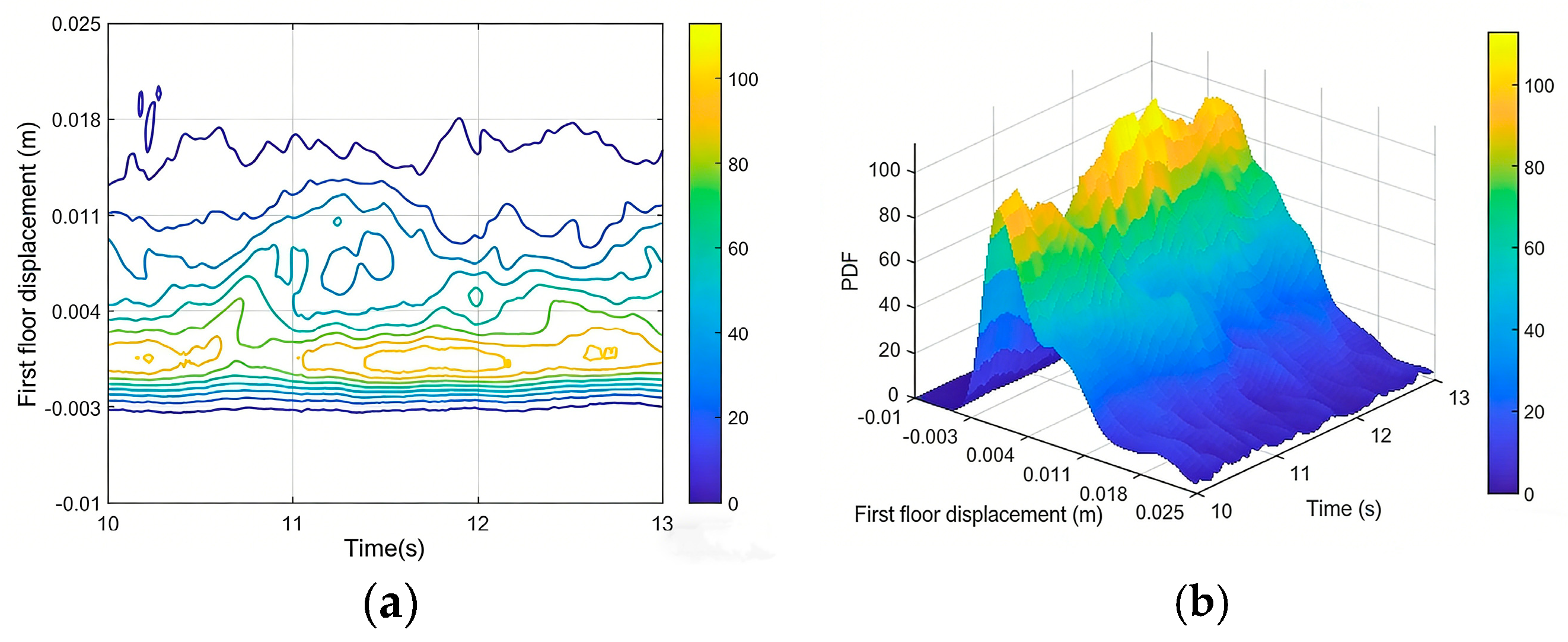
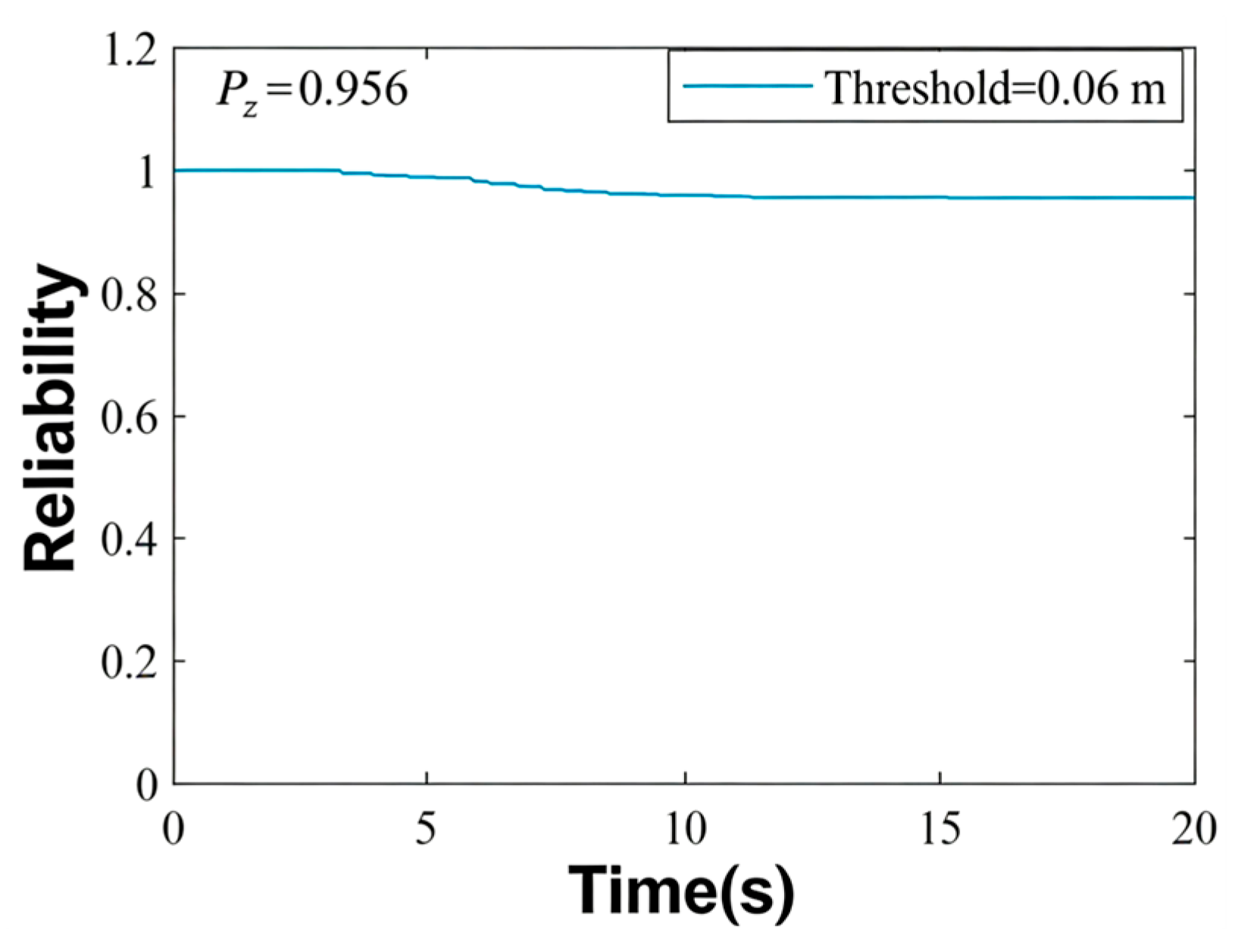
Figure 26 illustrates the evolution of the probability density of first-story displacement under random seismic excitation. Both the three-dimensional surface and two–dimensional contour lines reveal that the response exhibits pronounced non-stationary time-varying characteristics. The probability density gradually evolves from an initial high, narrow, single peak to a bimodal and multimodal distribution, indicating that the dynamic response mechanism of structural displacement undergoes complex changes over time. Figure 27 presents the reliability probability time history curve for the first-story displacement. After the seismic action exceeds 5 s, some samples have entered a failure state, ultimately yielding a reliability probability of Ps = 0.956 under this failure mode.
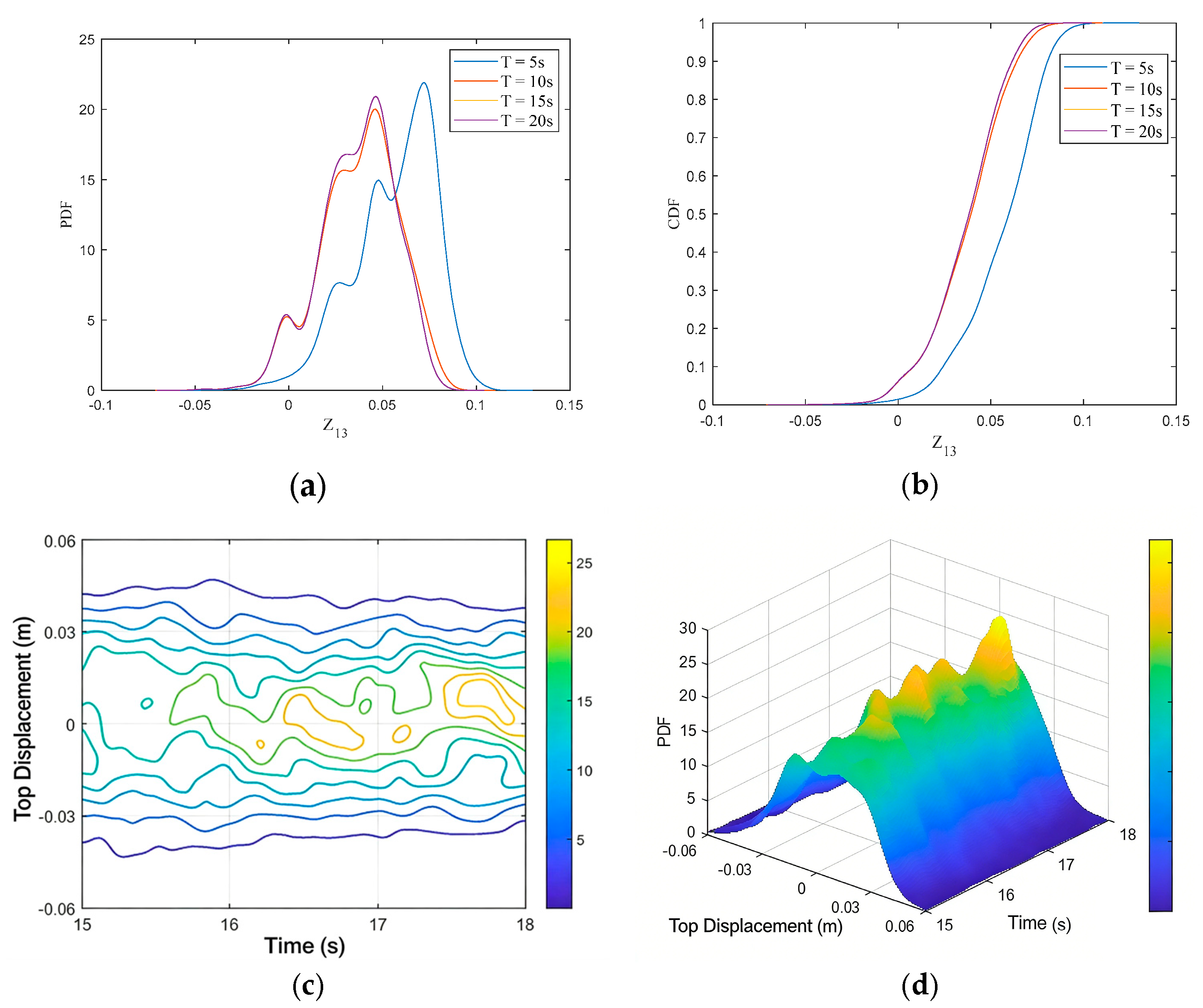
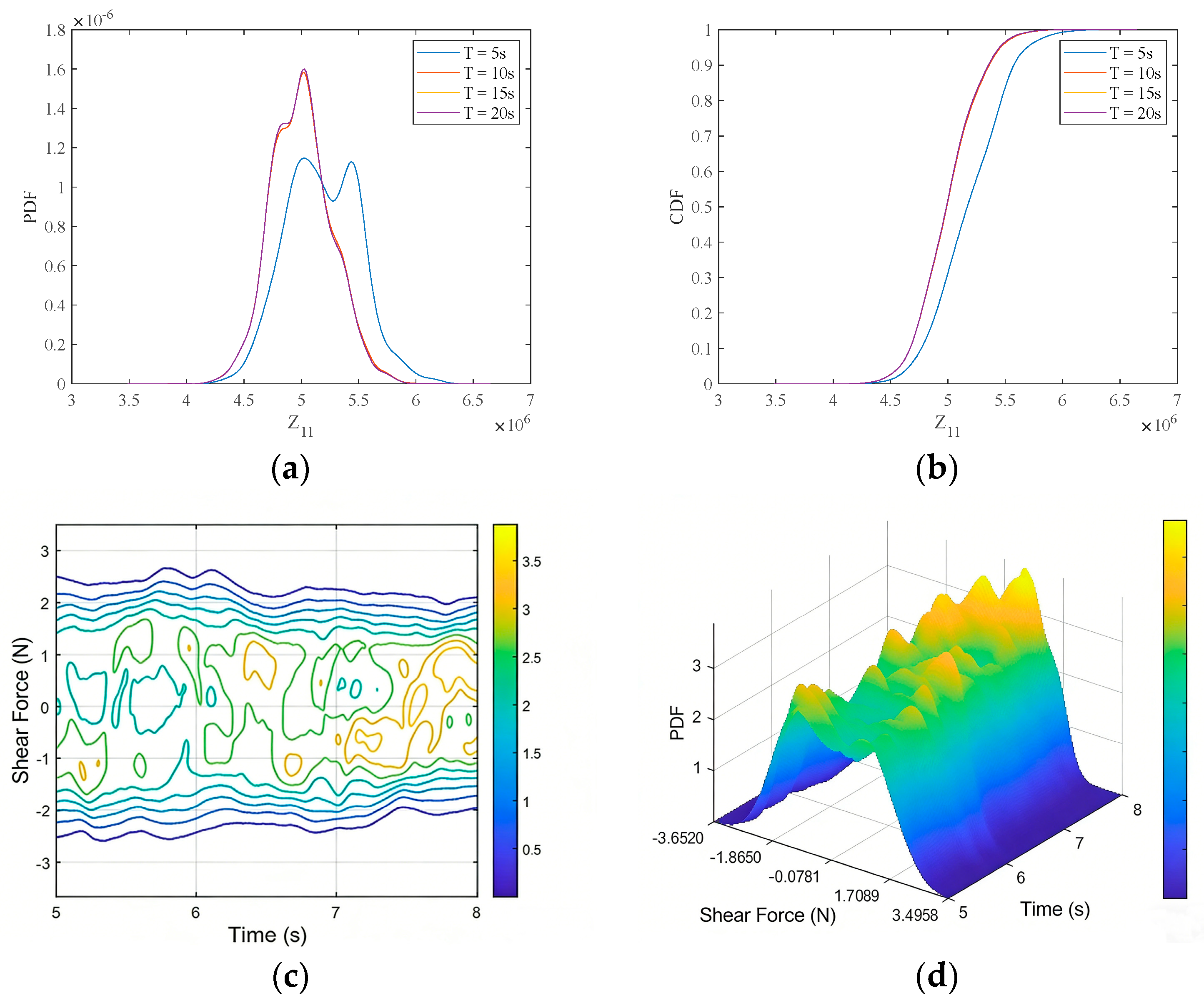
Figure 28 presents the probability information corresponding to the top-story displacement failure mode. At the 10 s, 15 s, and 20 s time points, its probability density function and cumulative distribution function are essentially identical, indicating that under the equivalent extreme event description, the first exceedance time is primarily concentrated in the early stages. This phenomenon indicates that after 10 s of seismic loading, the structural equivalent extreme events stabilize. This aligns with the characteristic that seismic energy is predominantly concentrated within the first 10 s and is consistent with the overall trend of the reliability time history curve. Figure 29 displays the time history variation of the reliable probability for top-floor displacement. Under conditions considering both external excitation and material randomness, the top–floor displacement of this structure has approximately a 6% probability of exceeding the defined safety threshold.
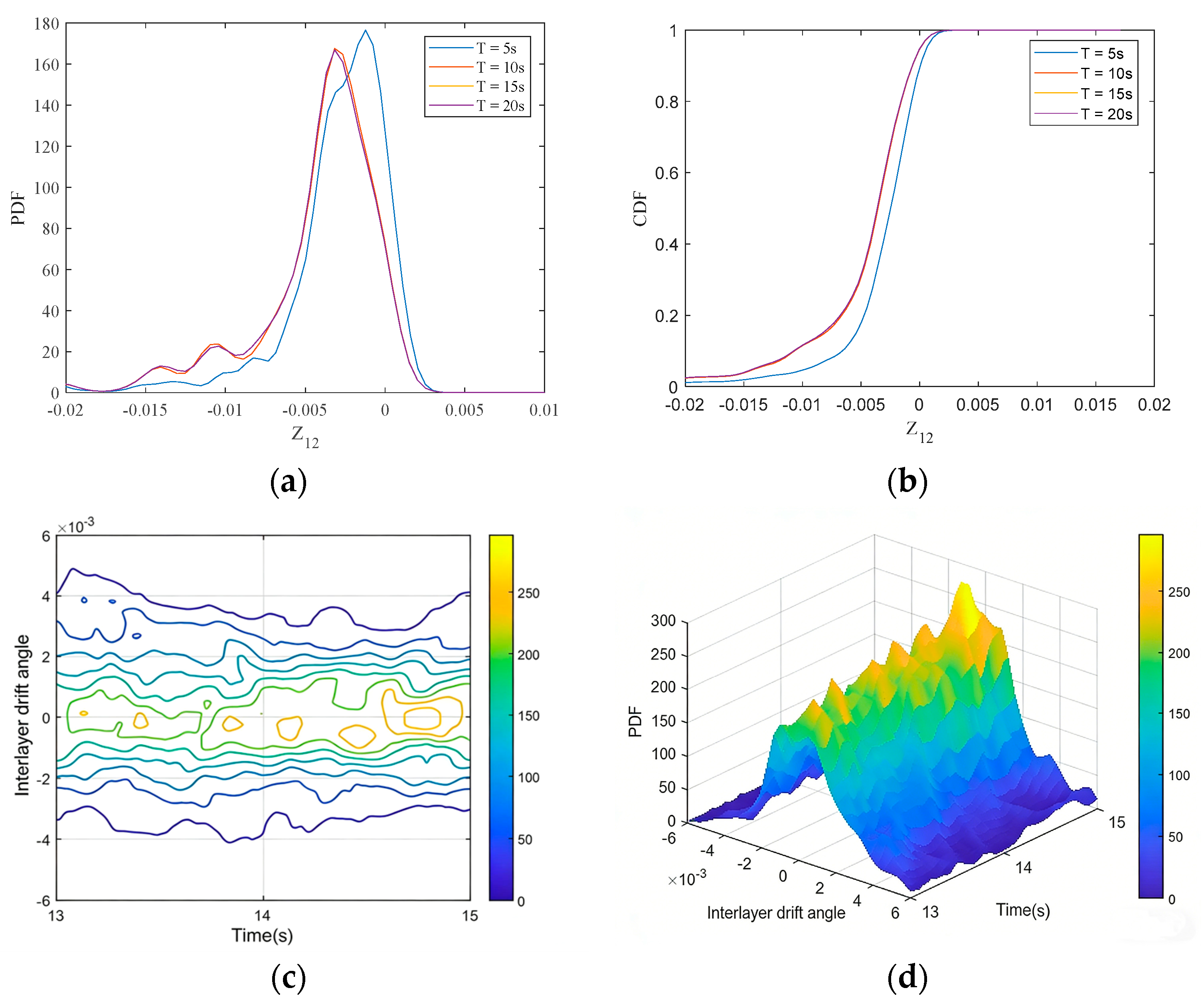
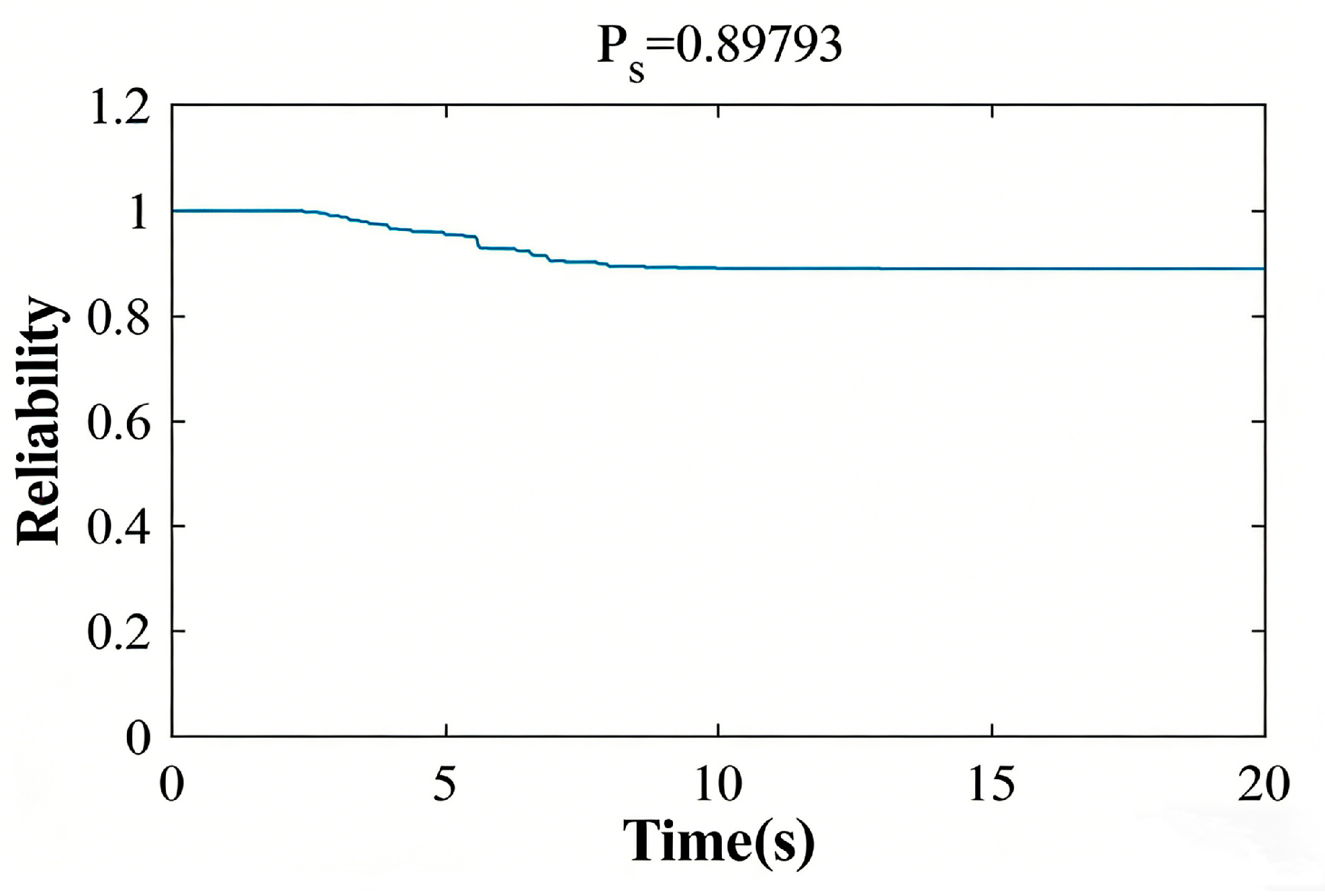
Figure 30 and Figure 31 show the probability distribution of the interlayer displacement angle at the sixth layer and its reliability time history curve, respectively. Compared with the aforementioned failure modes, they exhibit similar characteristics, indicating that these failure modes are associated with higher failure probabilities. Therefore, strengthening the reliability of vulnerable layers according to design principles enhances structural safety, embodying the concept of reliability-guided design.
Figure 32 and Figure 33 display the probability information for bottom shear forces and the reliability probability throughout the entire seismic action time domain. It is evident that the entire probability density function (PDF) curve remains unchanged after t = 5 s. According to the description of equivalent extreme events, the maximum extreme value at the structure’s base occurred before t = 5 s. Thus, if only the bottom shear failure mode is considered, the reliability probability of this frame structure approaches 1. This phenomenon does not indicate absolute structural safety under all conditions but stems from limitations in the threshold settings and the scope of uncertainties considered in the model.
The time-varying characteristics of the ground-story displacement, top-story displacement, inter-story displacement angle, and bottom shear force probability density are highly complex. The emergence of a multi-peaked probability density structure stems from the multipath and state-dependent nature of the dynamic response of nonlinear frame structures under strong seismic excitation. The multi-peaked structure of story displacements arises from the nonlinear coupling between first-order and higher-order mode shapes of the structure, corresponding to displacement “attractors” formed by different hysteretic states—such as elastic, cracked, and yielding—under cyclic loading. The multi-probability concentration zones at the peak times of top-story displacement correspond to high–probability stochastic dynamic paths of the structure’s maximum positive and negative displacements, respectively, quantifying the uncertainty in response direction under stiffness degradation. As a potential weak story, the multi–peak evolution of the inter-story displacement angle on the sixth floor directly reveals the multi-stage, high-probability characteristics of damage development at this level: the early probability peak corresponds to the deformation state of the first yielding of members, while the later peak with a high mean probability corresponds to the deformation state of fully developed plastic hinges and accumulated local damage, characterizing the dispersion of the damage evolution path of the weak story from a probabilistic perspective. The multi–peak characteristics of the base shear are directly related to the dynamic redistribution of the structure’s overall inertial forces and the nonlinear time-varying nature of internal force transfer paths. As members on each floor successively enter the nonlinear regime, the structure’s overall stiffness matrix undergoes probabilistic evolution, leading to a highly nonlinear dynamic relationship between the base shear and the response of the upper structure. This ultimately forms multiple probability concentration zones, reflecting the complex evolution of the probabilistic characteristics of the system’s internal force state.
The failure thresholds adopted in this study correspond to the three–level seismic design objectives and structural performance control requirements specified in China’s Code for Seismic Design of Buildings GB50011-2010 [48]. As the core quantitative boundaries defining the safe and failure states in structural seismic reliability analysis, the selection of these thresholds directly determines the scope of the failure region in probabilistic analysis. The stringency of deformation-related thresholds (inter-story displacement, inter-story displacement angle, and top-story displacement) shows a significant negative correlation with the calculated reliability, whereas the values of load–bearing capacity–related thresholds (base shear) exhibit a significant positive correlation with reliability. The above calculation results indicate that the structural reliability probability is highly sensitive to deformation–related indicators (especially the limit value of the inter-story drift angle), verifying that the failure mechanism of reinforced concrete frame structures under design seismic intensity is dominated by “deformation control” rather than “strength control”. In contrast, the bottom shear force threshold—a core indicator of strength control—has a relatively minor impact on the calculated structural reliability in frame structures that adhere to the “strong shear, weak bending” seismic design principle. By introducing four limit state values encompassing local displacement, inter-story deformation, global lateral displacement, and total bearing capacity, this study constructs complementary structural safety envelopes within the probability space.

5.3. Overall Reliability Analysis of Frame Structures

Most existing studies on the seismic reliability of frame structures focus on single failure modes, neglecting the coupling relationships among multiphysical responses. However, the overall failure of a structure is actually the result of the synergistic interaction of multiple failure modes, necessitating modeling and analysis based on system reliability theory. Lyu et al. [49] proposed, based on the probability density evolution equation, that under deterministic representative point conditions, each response component is conditionally independent, and its conditional probability density function can be decomposed into the product of marginal probability density functions, thereby achieving probabilistic decoupling. This concept is the core manifestation of the probability density evolution method; it not only achieves the decoupling of multi-physical response components but also provides a feasible approach for solving multi-dimensional joint probability density functions. Traditional series models tend to overestimate failure probabilities by neglecting positive correlations, whereas decoupling methods can accurately quantify such correlations. This paper integrates this decoupling concept with the direct probability integration method, incorporating the correlations among failure modes to calculate the overall seismic failure probability of the structural framework.
Each failure mode in the frame structure is treated as part of a series system, meaning that the occurrence of any single failure mode will result in the overall system failure. The overall functional performance is defined as the minimum value of the functional performance across all modes: Z s y s ( t ) = Z t , e x t ( Θ , t ) = min 0 τ t min i = 1 , , m { Z i ( t ) } . The overall reliability is calculated using the direct probability integration method and compared with Monte Carlo simulation (MCS) to verify accuracy.
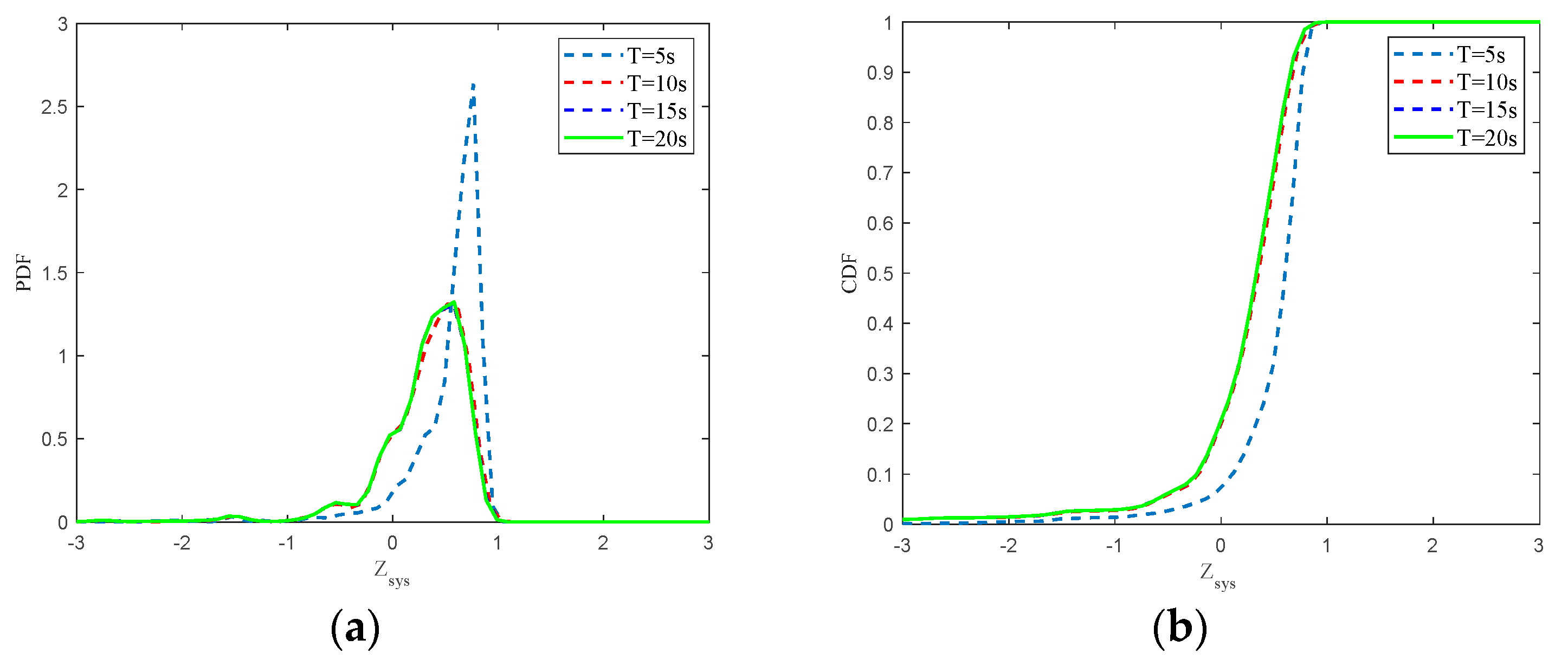
Figure 34 presents the probability density function (PDF) and cumulative distribution function (CDF) of the system reliability function Z s y s within the framework structure of this paper. Although the PDF and CDF are plotted for four different time points, their values remain largely consistent after t = 10 seconds.
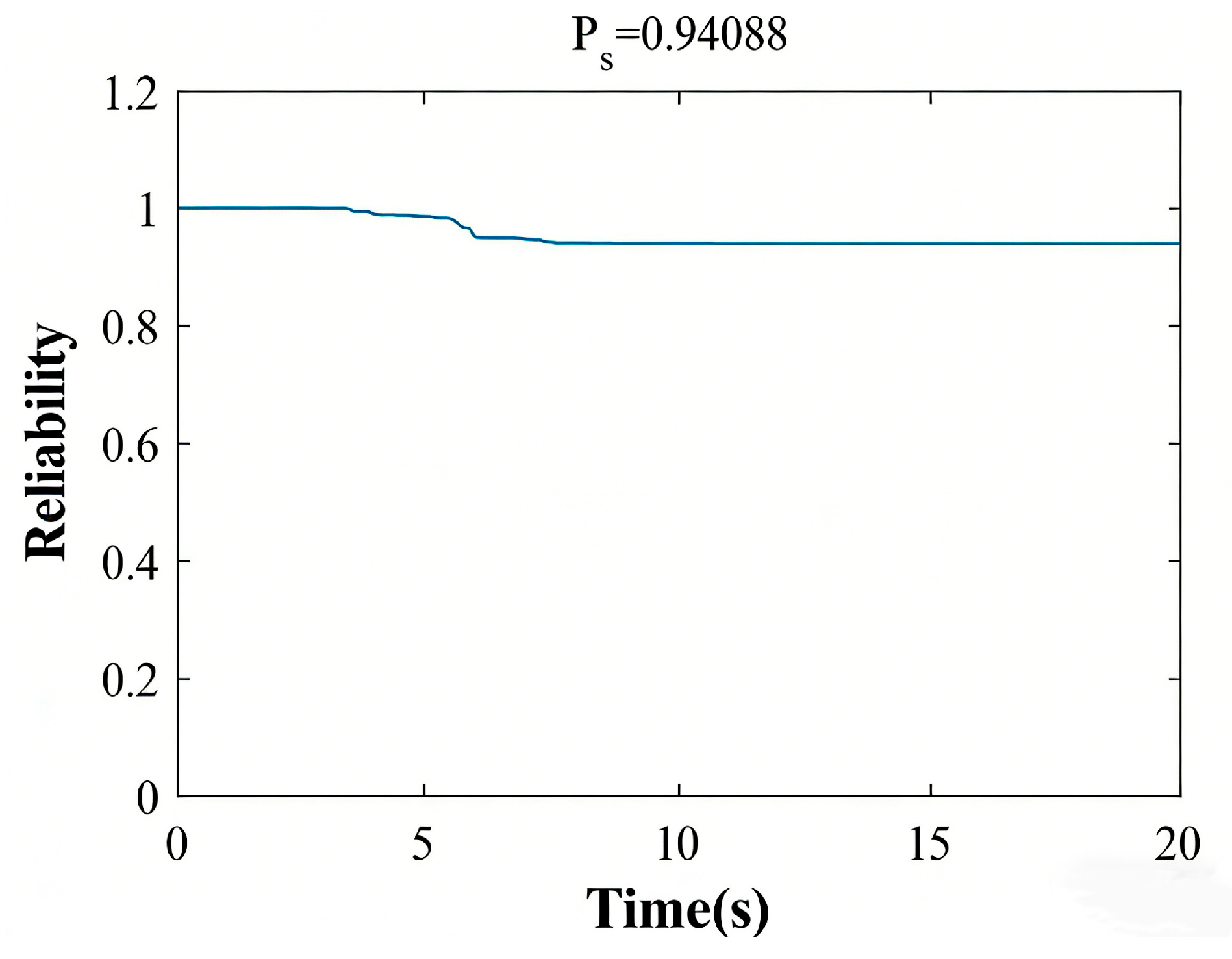
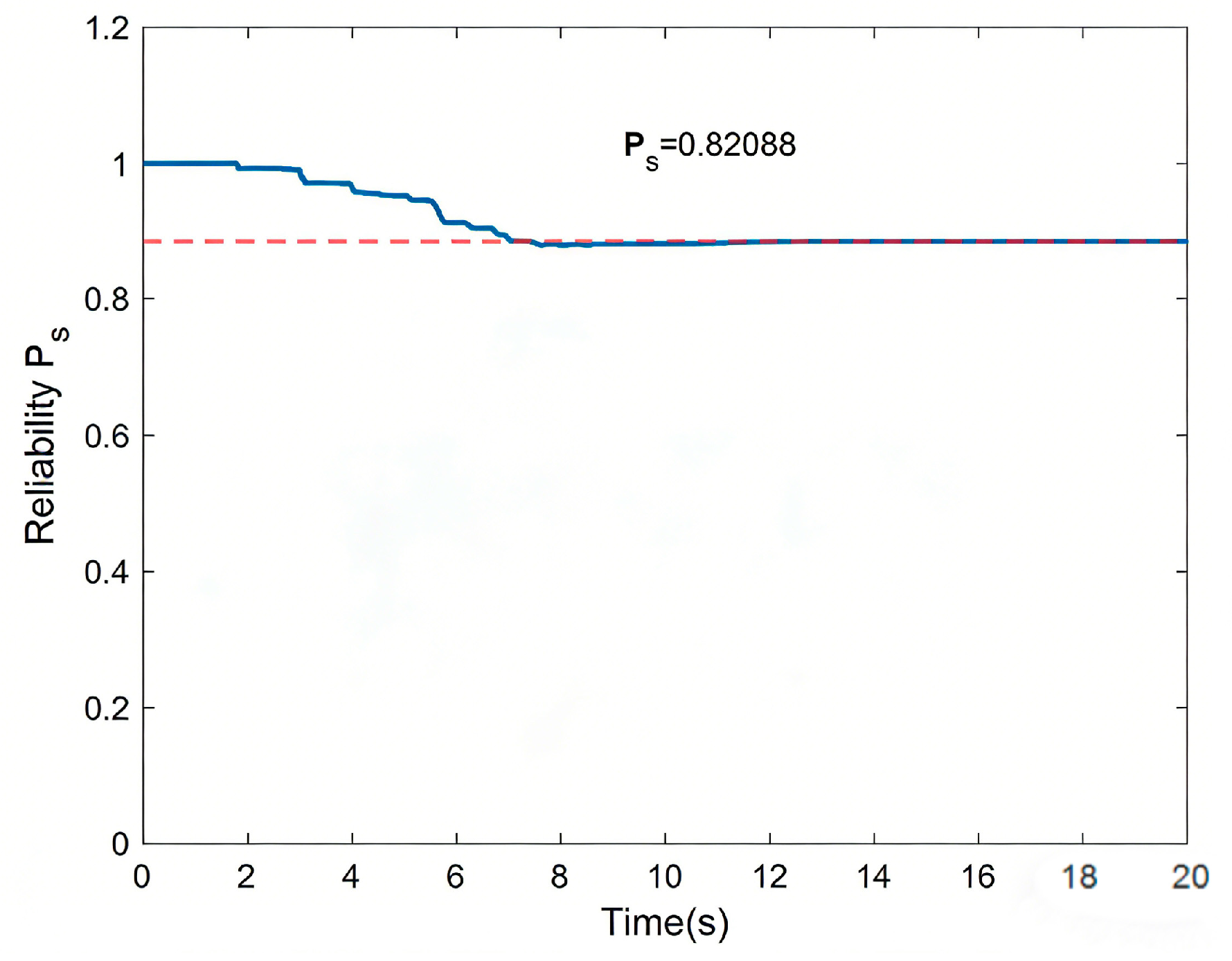
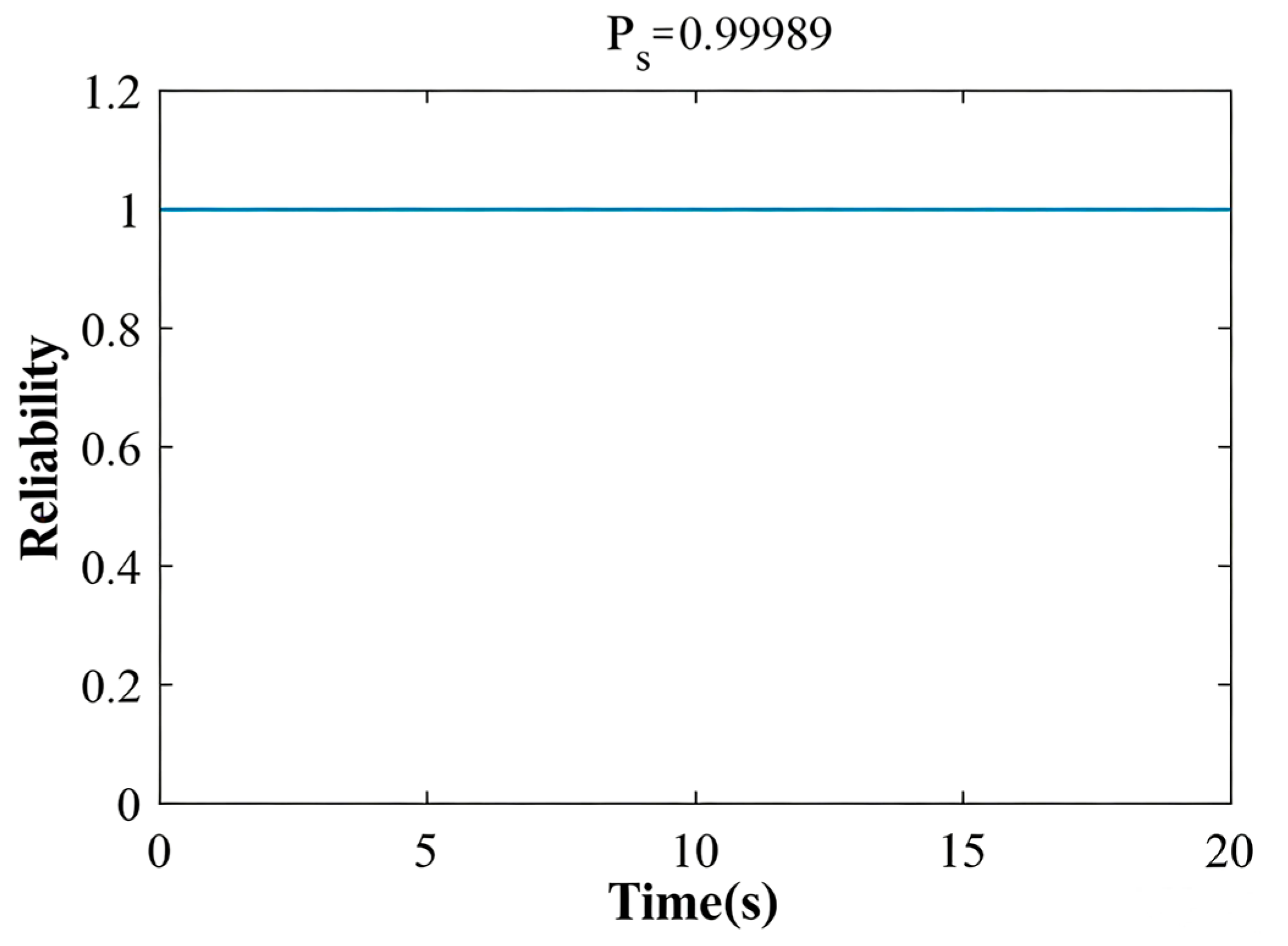
Figure 35 displays the overall reliability time curve for this framework structure. The figure reveals that after t = 10 seconds, the overall reliability of the structure maintains a straight line, consistent with the overlapping phenomenon of the PDF and CDF observed in Figure 34. Furthermore, based on the equivalent extreme event theory, the overall reliability of the framework structure under the entire seismic action is determined to be P s = 0.82088 .
Comparing with single reliability probability clearly reveals that under any single failure mode, the reliability of a structural component typically exceeds that of the entire system. This phenomenon indicates that when considering the mutual coupling of multiple failure modes, the risk of systemic failure in the structure significantly increases. Such analysis further demonstrates that relying solely on a single failure mode to assess structural reliability often fails to adequately reflect safety requirements and may even underestimate actual risks. Therefore, in practical engineering applications, considering the impact of multiple failure modes on the overall reliability of a structure not only provides a more comprehensive and accurate reflection of its safety but also offers a more scientific and reasonable reference basis for the design of frame structures. This approach facilitates the optimization of structural design, ensuring its safety and stability under various operating conditions.
To evaluate the effectiveness and stability of the direct probability integration method, this paper conducted a comprehensive reliability analysis across different sample sizes and performed comparative validation using Monte Carlo simulation. Results obtained through large-scale random sampling calculations are presented in Table 9. The analysis indicates that, at equivalent sample sizes, the computational outcomes of the direct probability integration method exhibit less than 1% error compared with the Monte Carlo sampling method, demonstrating excellent consistency and fully validating the effectiveness of the proposed method. Furthermore, compared with the Monte Carlo method, which requires extensive sample sizes, the direct probability integration method significantly reduces the necessary sample quantity while maintaining computational accuracy, thereby enhancing computational efficiency, lowering computational costs, and providing a more efficient approach for reliability assessment.


6. Conclusions

This paper systematically investigates the overall seismic reliability of reinforced concrete multi-story multi–span frame structures under non–stationary seismic ground motion using the direct probability integration method. The main conclusions are as follows:
(1)
Based on the spectral representation–random function method, a time–frequency modulation function and the Clough–Penzien power spectrum model were introduced to simulate the non-stationary characteristics of seismic intensity and frequency. Dimension reduction techniques were employed to simplify hundreds of variables into two, generating representative random samples. The generated samples undergo iterative refinement with code response spectra, achieving an average relative error below 1.69%. This yields seismic input that closely matches code spectra.
(2)
A ten-story frame finite element model is established in Abaqus to analyze dynamic behavior, identifying the inter-story displacement angle at the sixth story as the critical weak point. Using MF deviation sampling, 600 representative points were generated. Based on these points, 600 representative seismic acceleration time history curves were simulated and input into the finite element model for nonlinear time history analysis. Comparing the results from deterministic and stochastic methods demonstrated that the stochastic approach more comprehensively reflects the variability in structural response under seismic loading, thereby enabling a reasonable assessment of the structure’s safety margin.
(3)
Considering the randomness of structural materials and seismic motions, seismic reliability analysis for single and multiple failure modes was conducted on the ten-story frame using equivalent extreme event theory and direct probability integration. Results indicate that the overall reliability under multiple failure modes is 82.088%, significantly lower than that under single–mode reliability, quantifying the impact of uncertainty on seismic performance. Comparison with the Monte Carlo method shows an error of less than 1%, validating the computational accuracy of this approach.

Author Contributions

Conceptualization, Y.M. and Z.Z.; methodology, F.Y.; software, F.Y.; validation, Y.M., F.Y. and Z.Z.; formal analysis, Y.M. and F.Y.; investigation, F.Y.; resources, Z.Z.; data curation, F.Y.; writing—original draft preparation, Y.M.; writing—review and editing, Z.Z.; visualization, Y.M.; supervision, Z.Z.; project administration, Z.Z.; funding acquisition, Z.Z. All authors have read and agreed to the published version of the manuscript.

Funding

This work was jointly supported by Hunan Province College Students’ Innovation Training Program Project (grant no.S202410536086), and the Talent Recruitment Project of Hunan Province, China (grant no. 2023TJ-Z17).

Data Availability Statement

The original contributions presented in the study are included in the article, further inquiries can be directed to the corresponding author.

Conflicts of Interest

The authors declare no conflict of interest.

References

  1. Lu, N.; Wang, H.; Luo, Y.; Liu, X.; Liu, Y. Merging behaviour and fatigue life evaluation of multi-cracks in welds of OSDs. J. Constr. Steel Res. 2025, 225, 109189. [Google Scholar] [CrossRef]
  2. Li, J. Probability density evolution method: Background, significance and recent developments. Probabilistic Eng. Mech. 2016, 44, 111–117. [Google Scholar] [CrossRef]
  3. Yan, L.L.; Gong, J.X.; Zhang, Q. Investigation of global equivalent damping and statistical relationship of displacement between nonlinear static and dynamic analysis of reinforced concrete frame structures. Earthq. Spectra 2018, 34, 1311–1338. [Google Scholar] [CrossRef]
  4. Shen, Y.; El Naggar, M.H.; Zhang, D.; Huang, Z.; Du, X. Optimal intensity measure for seismic performance assessment of shield tunnels in liquefiable and non-liquefiable soils. Undergr. Space 2025, 21, 149–163. [Google Scholar] [CrossRef]
  5. Shen, Y.; El Naggar, M.H.; Zhang, D.-M.; Huang, Z.-K.; Du, X. Scalar- and vector-valued seismic fragility assessment of segmental shield tunnel lining in liquefiable soil deposits. Tunn. Undergr. Space Technol. 2025, 155, 106171. [Google Scholar] [CrossRef]
  6. Shen, Y.; El Naggar, M.H.; Zhang, D.-M.; Li, L.; Du, X. Seismic response characteristics of shield tunnel structures in liquefiable soils. Soil Dyn. Earthq. Eng. 2024, 182, 108701. [Google Scholar] [CrossRef]
  7. Shinozuka, M. Simulation of multivariate and multidimensional random processes. J. Acoust. Soc. Am. 1971, 49, 357–368. [Google Scholar] [CrossRef]
  8. Deodatis, G.; Shinozuka, M. Simulation of seismic ground motion using stochastic waves. J. Eng. Mech. 1989, 115, 2723–2737. [Google Scholar] [CrossRef]
  9. Boore, D.M. Simulation of ground motion using the stochastic method. Pure Appl. Geophys. 2003, 160, 635–676. [Google Scholar]
  10. Liu, Z.; Liu, Z.; Liu, W. Probabilistic Modeling and Response Spectrum Fitting of Completely Non-Stationary Seismic Processes. Vib. Shock. 2017, 36, 32–38. [Google Scholar]
  11. Chen, J.B.; Kong, F.; Peng, Y.B. A stochastic harmonic function representation for non-stationary stochastic processes. Mech. Syst. Signal Process. 2017, 96, 31–44. [Google Scholar] [CrossRef]
  12. Ruan, X.X.; Liu, Z.Z.; Liu, Z.X.; Fan, Y.F. Dimension-reduction representation of stochastic ground motion fields based on wavenumber-frequency spectrum for engineering purposes. Soil Dyn. Earthq. Eng. 2021, 143, 106604. [Google Scholar] [CrossRef]
  13. Liu, B.H.; Cao, Y.; Zhang, L.W. Optimal Latinized partially stratified sampling for high-efficiency nonstationary stochastic seismic excitation and response analysis. Mathematics 2026, 14, 140. [Google Scholar] [CrossRef]
  14. Wang, S.Q.; Yu, R.F.; De Risi, R.; Li, X.J. A new energy-compatible nonstationary stochastic ground-motion simulation method. Earthq. Eng. Struct. Dyn. 2021, 50, 1864–1883. [Google Scholar] [CrossRef]
  15. Kazakov, I.E. An approximate method for the statistical investigation for nonlinear systems. Trudy VVIA im Prof. NE Zhukovskogo 1954, 394, 1–52. [Google Scholar]
  16. Jalali, H. An alternative linearization approach applicable to hysteretic systems. Commun. Nonlinear Sci. Numer. Simul. 2014, 19, 245–257. [Google Scholar] [CrossRef]
  17. Zhang, Z.H.; Liu, M.H.; Zhou, M.L.; Chen, J.G. Dynamic reliability analysis of nonlinear structures using a Duffing-system-based equivalent nonlinear system method. Int. J. Approx. Reason. 2020, 126, 84–97. [Google Scholar] [CrossRef]
  18. Zhu, W.Q. Nonlinear stochastic dynamics and control in Hamiltonian formulation. Appl. Mech. Rev. 2006, 59, 230–248. [Google Scholar] [CrossRef]
  19. Chen, J.; Rui, Z. Dimension-reduced FPK equation for additive white-noise excited nonlinear structures. Probabilistic Eng. Mech. 2018, 53, 1–13. [Google Scholar] [CrossRef]
  20. Kougioumtzoglou, I.A.; Spanos, P.D. An analytical Wiener path integral technique for non-stationary response determination of nonlinear oscillators. Probabilistic Eng. Mech. 2012, 28, 125–131. [Google Scholar] [CrossRef]
  21. Petromichelakis, I.; Kougioumtzoglou, I.A. A reduced-order Wiener path integral formalism for stochastic response determination of nonlinear systems. ASCE-ASME J. Risk Uncertain. Eng. Syst. Part B Mech. Eng. 2023, 9, 031201. [Google Scholar]
  22. Tong, Z.; Peng, Y. A new active-learning function for adaptive Polynomial-Chaos Kriging probability density evolution method. Appl. Math. Model. 2022, 106, 86–99. [Google Scholar]
  23. Ouyang, J.Y.; Liu, Y. Model updating for slope stability assessment in spatially varying soil parameters using multi-type observations. Mech. Syst. Signal Process. 2022, 171, 108906. [Google Scholar] [CrossRef]
  24. Jiang, Y.; Zhang, X.; Beer, M.; Zhou, H.; Leng, Y. An efficient method for reliability-based design optimization of structures under random excitation by mapping between reliability and operator norm. Reliab. Eng. Syst. Saf. 2024, 245, 109972. [Google Scholar] [CrossRef]
  25. Zhang, R.; Liu, Y.; Sun, H. Physics-guided convolutional neural network (PhyCNN) for data-driven seismic response modeling. Eng. Struct. 2020, 215, 110704. [Google Scholar] [CrossRef]
  26. Li, J.; Chen, J. The probability density evolution method for dynamic response analysis of non-linear stochastic structures. Int. J. Numer. Methods Eng. 2006, 65, 882–903. [Google Scholar] [CrossRef]
  27. Wang, L.; Hu, Z.; Dang, C.; Beer, M. Refined parallel adaptive Bayesian quadrature for estimating small failure probabilities. Reliab. Eng. Syst. Saf. 2024, 244, 109953. [Google Scholar] [CrossRef]
  28. Chen, G.; Yang, D. Direct probability integral method for stochastic response analysis of static and dynamic structural systems. Comput. Methods Appl. Mech. Eng. 2019, 357, 112612. [Google Scholar] [CrossRef]
  29. Chen, H.; Chen, G.; Meng, Z.; Zhang, Y.; Yang, D. Stochastic dynamic analysis of nonlinear MDOF systems under combined Gaussian and Poisson noise excitation based on DPIM. Mech. Syst. Signal Process. 2022, 176, 109163. [Google Scholar] [CrossRef]
  30. Liu, J.; Chen, X.; Chen, G.; Li, R.; Yang, D. Exact Benchmark Solutions of Stochastic Responses and Reliabilities of Structures via the Probability Density Integral Equation. ASCE-ASME J. Risk Uncertain. Eng. Syst. Part A Civ. Eng. 2026, 12, 04025086. [Google Scholar] [CrossRef]
  31. Chen, J.; Wan, Z. A compatible probabilistic framework for quantification of simultaneous aleatory and epistemic uncertainty of basic parameters of structures by synthesizing the change of measure and change of random variables. Struct. Saf. 2019, 78, 76–87. [Google Scholar] [CrossRef]
  32. Chen, H.; Chen, G.; Yang, D.; Fu, Z. Neural network-based DPIM for uncertainty quantification of imperfect cylindrical stiffened shells with multiple random parameters. Eng. Anal. Bound. Elem. 2024, 166, 105795. [Google Scholar] [CrossRef]
  33. Li, X.; Ding, H.; Chen, L.Q. Effects of weights on vibration suppression via a nonlinear energy sink under vertical stochastic excitations. Mech. Syst. Signal Process. 2022, 173, 109073. [Google Scholar] [CrossRef]
  34. Wu, P.H.; Zhao, Y.; Mao, C.Y. A frequency-time approach of random vibration analysis for bolted structures based on a semi-analytic Jacobian matrix. Mech. Syst. Signal Process. 2024, 218, 111562. [Google Scholar] [CrossRef]
  35. Kim, D.S.; Ok, S.Y.; Song, J.; Koh, H.M. System reliability analysis using dominant failure modes identified by selective searching technique. Reliab. Eng. Syst. Saf. 2013, 119, 316–331. [Google Scholar] [CrossRef]
  36. Byun, J.E.; Royset, J.O. Data-driven optimization of reliability using buffered failure probability. Struct. Saf. 2022, 98, 102232. [Google Scholar] [CrossRef]
  37. Sharafi, S.Q.; Saito, T. Seismic damage probability assessment of existing reinforced concrete school buildings in Afghanistan. Buildings 2024, 14, 1054. [Google Scholar] [CrossRef]
  38. Zhang, X.; Zhou, Y.; Liu, X.; Zheng, Y.; Qi, Z. Study on seismic performance of RC frame structures considering the effect of infilled walls. Buildings 2024, 14, 1907. [Google Scholar] [CrossRef]
  39. Zeng, T.; Li, Y. Collapse fragility analysis of RC frame structures considering capacity uncertainty. Buildings 2025, 15, 694. [Google Scholar] [CrossRef]
  40. Jiang, S.; Chen, Q.; Li, C.; Song, H.; Lin, E.; Fu, C. Assessment of Soft-First-Floor Structures Reinforced by Rocking Frame Based on Seismic Resilience. Buildings 2024, 14, 197. [Google Scholar] [CrossRef]
  41. Ma, Y.; Guo, Z.; Wang, L.; Zhang, J. Probabilistic Life Prediction for Reinforced Concrete Structures Subjected to Seasonal Corrosion-Fatigue Damage. J. Struct. Eng. 2020, 146, 04020117. [Google Scholar] [CrossRef]
  42. Chen, G.; Yang, D.; Liu, Y.; Guo, H. System reliability analyses of static and dynamic structures via direct probability integral method. Comput. Methods Appl. Mech. Eng. 2022, 388, 114262. [Google Scholar] [CrossRef]
  43. Feng, D.C.; Cao, X.Y.; Beer, M. An enhanced PDEM-based framework for reliability analysis of structures considering multiple failure modes and limit states. Probabilistic Eng. Mech. 2022, 70, 103367. [Google Scholar] [CrossRef]
  44. Li, L.; Chen, G.; Fang, M.; Yang, D. Reliability analysis of structures with multimodal distributions based on direct probability integral method. Reliab. Eng. Syst. Saf. 2021, 215, 107885. [Google Scholar] [CrossRef]
  45. Li, H.; Zhong, T.; Chen, G.; Yang, D. Dynamic reliability-based robust design optimization for lead rubber bearings of girder bridges via direct probability integral method. Struct. Multidiscip. Optim. 2025, 68, 198. [Google Scholar] [CrossRef]
  46. Zhang, Z.H.; Tao, M.M.; Li, B.Z.; Wang, L.; Wei, G.Q. DPIM-based global reliability analysis method for the cable-stayed bridges and the determination of global target reliability index. Eng. Struct. 2024, 302, 117330. [Google Scholar] [CrossRef]
  47. Zhang, Z.H.; Zeng, Z.; Wei, G.Q.; Zhang, Y. Stochastic response and dynamic reliability analysis of long-span cable-stayed bridges under non-stationary ground motions via DPIM. Structures 2026, 84, 111050. [Google Scholar] [CrossRef]
  48. GB 50011-2010; Code for seismic design of buildings. China Architecture & Building Press: Beijing, China, 2010.
  49. Lyu, M.Z.; Feng, D.C.; Chen, J.B.; Li, J. A decoupled approach for determination of the joint probability density function of a high-dimensional nonlinear stochastic dynamical system via the probability density evolution method. Comput. Methods Appl. Mech. Eng. 2024, 418, 116443. [Google Scholar] [CrossRef]
Figure 1. Partition diagram of probability space: (a) Points. (b) Voronoi cell.
Buildings 16 01356 g001
Figure 2. Process for evaluating the overall seismic reliability of reinforced concrete frame structures.
Buildings 16 01356 g002
Figure 3. Two representative acceleration time history curves in a random seismic sample.
Buildings 16 01356 g003
Figure 4. Comparison of response spectra after iterative correction.
Buildings 16 01356 g004
Figure 5. Schematic diagram of beam–column beam elements and multi-layer shell elements for floor slabs.
Buildings 16 01356 g005
Figure 6. Schematic diagram of reinforcement for frame columns and beams: (a) Longitudinal reinforcement layout in frame columns. (b) Longitudinal reinforcement layout in frame beams.
Buildings 16 01356 g006
Figure 7. Schematic diagram of a beam cross-section and a double-curved model of the reinforcement: (a) Uniaxial stress–strain curve for concrete. (b) Double-bend test for reinforcing bars.
Buildings 16 01356 g007
Figure 8. Schematic of finite element analysis for a 10-story reinforced concrete frame structure.
Buildings 16 01356 g008
Figure 9. Normalized NGA#1063 seismic acceleration time history.
Buildings 16 01356 g009
Figure 10. Concrete stress–strain curve.
Buildings 16 01356 g010
Figure 11. Stress–strain curve of reinforcing steel.
Buildings 16 01356 g011
Figure 12. Maximum interlayer displacement angle.
Buildings 16 01356 g012
Figure 13. Evolving power spectrum density function.
Buildings 16 01356 g013
Figure 14. Power spectrum density function.
Buildings 16 01356 g014
Figure 15. Two representative acceleration time history curves in a random seismic sample.
Buildings 16 01356 g015
Figure 16. Mean and standard deviation time history curves for 600 seismic acceleration time histories.
Buildings 16 01356 g016
Figure 17. Mean and standard deviation of first-story displacement: (a) Mean. (b) Standard deviation.
Buildings 16 01356 g017
Figure 18. Mean and standard deviation of top-layer displacement: (a) Mean. (b) Standard deviation.
Buildings 16 01356 g018
Figure 19. Mean and standard deviation of interlayer displacement angle for the sixth layer: (a) Mean. (b) Standard deviation.
Buildings 16 01356 g019
Figure 20. Mean and standard deviation of bottom shear force: (a) Mean. (b) Standard deviation.
Buildings 16 01356 g020
Figure 21. Comparison of top-story displacement under deterministic and random seismic actions.
Buildings 16 01356 g021
Figure 22. Comparison of first-story displacement under deterministic and random seismic actions.
Buildings 16 01356 g022
Figure 23. Comparison of inter-story displacement angle at the sixth story under deterministic and random seismic actions.
Buildings 16 01356 g023
Figure 24. Comparison of bottom shear forces under deterministic and random seismic actions.
Buildings 16 01356 g024
Figure 25. Time history curve of the first-story displacement under a representative earthquake versus the time history curve of the equivalent peak event.
Buildings 16 01356 g025
Figure 26. Probability information of first-layer displacement: (a) Equivalent probability density curve for 10–13 s. (b) 3-D surface of probability density evolution for 10–13 s.
Buildings 16 01356 g026
Figure 27. Time history curve of reliable probability for first-story displacement.
Buildings 16 01356 g027
Figure 28. Probability information of top-layer displacement: (a) Probability density function at a typical time point. (b) Cumulative distribution function at a typical time point. (c) Equivalent probability density curve for 15–18 s. (d) 3-D surface of probability density evolution for 15–18 s.
Buildings 16 01356 g028
Figure 29. Time-dependent probability curve for top-level displacement reliability.
Buildings 16 01356 g029
Figure 30. Probability information for interlayer displacement angle in the sixth layer: (a) Probability density function at a typical time point. (b) Cumulative distribution function at a typical time point. (c) Equivalent probability density curve for 13–15 s. (d) 3-D surface of probability density evolution for 13–15 s.
Buildings 16 01356 g030
Figure 31. Reliability time history curve of interlayer displacement angle for the sixth layer.
Buildings 16 01356 g031
Figure 32. Probabilistic information of bottom shear: (a) Probability density function at a typical time point. (b) Cumulative distribution function at a typical time point. (c) Equivalent probability density curve for 5–18 s. (d) 3-D surface of probability density evolution for 5–8 s.
Buildings 16 01356 g032
Figure 33. Probability time history curve for bottom shear reliability.
Buildings 16 01356 g033
Figure 34. Framework structural system reliability PDF and CDF: (a) Probability density function of typical moments. (b) Cumulative distribution function of typical moments.
Buildings 16 01356 g034
Figure 35. Overall reliability probability time history curve for frame structure.
Buildings 16 01356 g035
Table 1. Site Soil Parameters.
ParameterDesign Earthquake GroupSite Category
I0I1IIIIIIV
ω g ( rad / s ) Group 131.4225.1317.9513.969.67
Group 225.1320.9415.7111.428.38
Group 320.9417.9513.969.676.98
ξ g 0.560.640.720.800.90
Table 2. Average Peak Acceleration a ¯ max ( cm / s 2 ) .
Earthquake Category Seismic Design Intensity
6789
Frequent1835 (55)70 (110)140
Design50100 (150)200 (300)400
Rare125220 (310)400 (510)620
Table 3. Peak Factor γ .
Earthquake CategoryDesign Earthquake GroupSite Category
I0I1IIIIIIV
Seismic Design Group 13.012.972.832.752.60
Group 23.042.932.832.772.60
Group 33.082.972.932.832.61
Rare EventGroup 13.073.002.882.792.60
Group 23.102.972.882.832.63
Group 33.143.023.002.882.61
Table 4. Seismic Motion Duration T s .
Design Earthquake GroupingSite Category
I0I1IIIIIIV
Group 11520253035
Group 21520253035
Group 32025303540
Table 5. Values of Parameter a (s−1).
Design Seismic ZonesVenue Category
I0I1IIIIIIV
Group 10.400.300.250.200.15
Group 20.300.250.200.150.12
Group 30.250.200.150.120.10
In the time–frequency modulation function, set b = a + 0.001 and c = 0.005.
Table 6. Sensitivity Factors for Each Random Variable.
Random Variable λ i Normalized Percentage
Reinforcing   Steel   Tensile   Strength   f y 0.5833.6%
Concrete   Compressive   Strength   f c 0.4217.6%
Concrete   Density   ρ c −0.3915.2%
Reinforcing   Steel   Strain   Rate   b 0.277.3%
Steel   bar   elastic   modulus   E 0 −0.214.4%
Concrete   elastic   modulus   E c 0.090.8%
Table 7. Random Parameter Data for Structural Materials.
VariableDescriptionDistribution TypeMeanCoefficient of Variation
fcConcrete Compressive StrengthNormal28 MPa0.12
EcConcrete Elastic ModulusLog-Normal30 GPa0.12
ρcConcrete DensityNormal2400 kg/m30.1
fyReinforcing steel tensile strengthNormal400 MPa0.25
E0Reinforcing steel elastic modulusNormal200 GPa0.25
bReinforcing steel strain ratioNormal0.0070.25
Table 8. MF Bias for Different Sample Sizes.
Number of Representative PointsMF Deviation
3000.063310
4000.039902
5000.056999
6000.056303
7000.054508
Table 9. Comparison of Overall Reliability Under Different Methods.
Calculation MethodNumber of SamplesOverall ReliabilityRelative Error
DPIM50081.56%0.65%
60082.09%0.36%
70082.83%0.54%
MCS10483.10%0.86%
10582.72%0.41%
10682.39%-
Disclaimer/Publisher’s Note: The statements, opinions and data contained in all publications are solely those of the individual author(s) and contributor(s) and not of MDPI and/or the editor(s). MDPI and/or the editor(s) disclaim responsibility for any injury to people or property resulting from any ideas, methods, instructions or products referred to in the content.