1. Introduction
In recent decades, high-speed transportation and heavy-load transportation have become the prevailing trends in road and railway development. With buildings growing increasingly taller, their foundations must bear progressively heavier loads. Piles, owing to their unique advantages, are being widely adopted, particularly in large-scale bridge foundation projects where pile foundations are now predominantly used. Compared to other foundation types, piles effectively transfer the loads of superstructures to deeper, stable soil layers or bedrock, significantly reducing foundation settlement and uneven settlement. This makes pile foundations widely applicable in earthquake-prone areas, soft soil regions, and permafrost zones.
The rock-socketed pile has strong ability to resist external action, such as external load, earthquake action and wind load, and also has strong ability to resist deformation, which can meet the bearing capacity requirements of high-rise building, large-span bridge, port, offshore oil drilling platforms and so on.
The behavior of piles in response to the surrounding rock mass is a critical factor influencing lateral bearing capacity. When subjected to lateral loads, pile foundations embedded in rock masses undergo deflection deformation, causing the rock mass to deform and generate restraint reactions. These ground reactions subsequently constrain the pile foundations, preventing further deformation. Based on the pile–rock mass interaction, lateral loads from superstructures can be transmitted to bedrock through rock-socketed piles. The relationship between piles and rock masses is highly complex, with numerous influencing factors. However, research on lateral bearing piles, particularly large-displacement piles and rock-socketed piles, remains insufficient both domestically and internationally.
So far, the research on the lateral bearing capacity of rock-socketed piles mainly draws on the research methods of pile foundations in soil [
1,
2,
3,
4,
5]. However, in the process of applying the research method of lateral bearing capacity of conventional pile foundation to the study of rock-socketed pile, the difference of rock and soil properties is often not considered sufficiently [
6,
7].
At present, the research methods for the response of rock-socketed piles under lateral load mainly include numerical analysis, field test and theoretical analysis, and there are few studies on rock-socketed piles. The study of lateral bearing characteristics of rock-socketed piles can be divided into two categories [
7]: (1) elastic or elastoplastic continuum method; (2) foundation reaction method.
Using finite element analysis, Carter et al. [
2] investigated the mechanical behavior of flexible and rigid rock-socketed bored piles, developing analytical formulas to calculate their lateral load-bearing capacity and displacement. Their solution indicates that the horizontal resistance of rock-socketed piles primarily stems from lateral friction at the pile–rock interface and the compressive strength of the pre-pile rock mass.
However, DiGioia et al. [
3] noted that this method is only valid under low loads (approximately 20–30% of the ultimate bearing capacity) and becomes inapplicable under high loads.
Zhang et al. [
6] employed the elastoplastic continuum method to analyze the lateral load-displacement response of rock-socketed piles. They assumed that the overlying soil layer was continuously distributed, with the soil and rock deformation moduli varying linearly with depth while the rock deformation modulus below the pile end remained constant.
Building upon the Hoek–Brown failure criterion, they developed a computational approach for determining the ultimate bearing capacity of rock masses. Zhang, drawing inspiration from the Cater method, demonstrated that the resistance per unit length consists of two components: the shear strength at the pile side and the normal resistance of the rock mass ahead of the pile. Chen et al. [
8] extended Zhang’s methodology to multi-layered soil or rock formations, incorporating soil yield behavior and stiffness reduction due to pile cracking into their calculations.
Vu T.T. [
9] conducted a systematic review of two analytical approaches proposed by Cater and Zhang. He noted that Cater’s method could predict lateral displacements of pile foundations under service conditions but failed to provide complete nonlinear load–displacement curves or shear and moment distributions of pile shafts for structural design guidance. Moreover, this method was only applicable to single-layer soil conditions and did not account for the nonlinear bending stiffness of reinforced concrete piles or the effects of vertical loads. Zhang’s method, based on continuum mechanics theory, involved certain simplifications in rock mass parameter values. It was only applicable to two-layer media (e.g., one soil layer and one rock layer, or both rock layers) and required the rock modulus to increase with depth.
A key limitation of the elastic–plastic continuum method is its inability to handle complex, nonlinear, and anisotropic rock masses, despite its strength in accurately reflecting the continuity of the surrounding rock.
Based on the idea of Winkler foundation beam model, Reese [
10] discretized the rock mass on the side of pile as a series of nonlinear springs and established the analysis model of a single pile with lateral load based on
p-
y curve method.
By integrating field measurements, laboratory tests, and finite element simulations, researchers developed a hyperbolic p-y curve model for rock-socketed piles in jointed rock masses. The model incorporates joint characteristics, RQD values, and unconfined compressive strength of intact rock, with its accuracy validated through field test data.
To investigate the lateral load-bearing behavior of pile foundations in weakly weathered gray sandstone, Guo et al. [
11,
12] conducted field experiments. The study revealed that neither the
p-
y curve model proposed by Reese for soft rock layers nor the model applicable to cohesive soils could accurately reflect the stress characteristics of pile foundations under such geological conditions. Liang et al. [
7] developed a hyperbolic
p-
y curve model, where the curve shape is determined by the unit length, ultimate bearing capacity and initial stiffness of the rock mass. The general expression of this model can be written as
In the traditional p-y curve model, the initial stiffness is only related to the soil properties and pile foundation parameters. The calculation of initial stiffness mainly considers the stress–strain relationship of the rock mass. However, there are essential differences in mechanical properties between rock mass and soil. Rock mass usually has higher compressive strength, elastic modulus and integrity, and its deformation characteristics are more complex, which may include the extension and closure of joints and fractures, and the shear sliding of rock mass.
Therefore, directly applying the initial stiffness calculation method based on soil properties for p-y curves fails to accurately reflect the true mechanical response of rock-socketed piles, potentially leading to deviations in predicting their lateral load-bearing behavior. This is particularly critical for large-diameter rock-socketed piles, which exhibit higher pile stiffness and correspondingly increased pile–rock contact areas. The stress state and deformation patterns of surrounding rock mass may differ significantly compared to small-diameter piles, posing greater challenges in determining initial stiffness. Establishing a theoretical model or calculation method that accurately describes the initial stiffness of large-diameter rock-socketed piles’ p-y curves based on inherent rock characteristics, including integrity coefficients, uniaxial compressive strength, elastic modulus, and joint distribution patterns, has become one of the key scientific issues requiring urgent resolution in the current research on their lateral load-bearing properties.
2. Extension of the Hoek-Brown Failure Criterion
2.1. Hoek–Brown Failure Criterion
Based on experimental analyses of numerous intact rock specimens and finite-joint rock masses, Hoek and Brown [
13] demonstrated that both the relationship between maximum and minimum principal stresses during failure and the relationship between shear stress and normal stress exhibit pronounced nonlinearity. Drawing on the nonlinear failure envelope concept from Griffith’s theory, they derived the following empirical formula for principal stress that characterizes the failure process of intact rocks:
where
is the uniaxial compressive;
is the strength parameter of intact rock determined according to rock type.
Hoek et al. [
14] proposed
using the unconfined compressive strength of intact rock. The uniaxial compressive strength (UCS) of rock is obtained through uniaxial tests, but the results are highly variable. The Hoek–Brown failure criterion requires that fitting parameters
should remain constant. Therefore, the verage UCS value should be adopted. Rock triaxial test data should be analyzed through regression to determine both the unconfined compressive strength
and the constant parameters
.
Based on the rock mass quality classification system, Hoek and Brown et al. [
15,
16,
17] developed a strength empirical criterion for jointed rock masses. This criterion has been validated in extensive engineering applications and is further utilized to determine the mechanical parameters of Hoek–Brown rock masses.
The mathematical expression of the criterion is as follows:
where
s indicates the fragmentation degree of the rock mass, where a complete rock mass is
s = 1.
D is the degree of rock mass disturbance caused by blasting operations or stress release.
GSI (Geological Strength Index) can be determined using the rock mass classification system RMR89, with the specific formula being GSI = RMR89-5.
Hoek et al. derived a linear failure criterion for rock masses through statistical analysis of extensive data, though the resulting formula proved overly complex and limited in applicability. Singh et al. established a rock standard using a secondary function decay index for confining pressure, with the decay index equaling the critical confining pressure when exceeding it. However, Singh’s approach relied on cohesion and friction angle under low confining pressure as fundamental parameters, neglecting their dependence on confining pressure variations.
The Mohr–Coulomb failure criterion derived by some researchers presents complex formulas, making it challenging to apply in calculating the lateral bearing capacity of rock-socketed piles. The Hoek–Brown failure criterion proposed by Hoek et al. captures the formation and progression of internal fracture failure in rock. Through extensive research, refinement, and validation by scholars, this criterion has proven applicable not only to intact rock but also to jointed rock masses, establishing itself as a widely adopted failure criterion for rock masses.
Based on the Hoek–Brown failure criterion and Serrano’s method [
18,
19], this section derives a formula for rock mass cohesion and internal friction angle that incorporates confining pressure. This formula is then applied to evaluate the lateral bearing capacity of rock-socketed piles.
2.2. Serrano Extension of the Hoek-Brown Failure Criterion
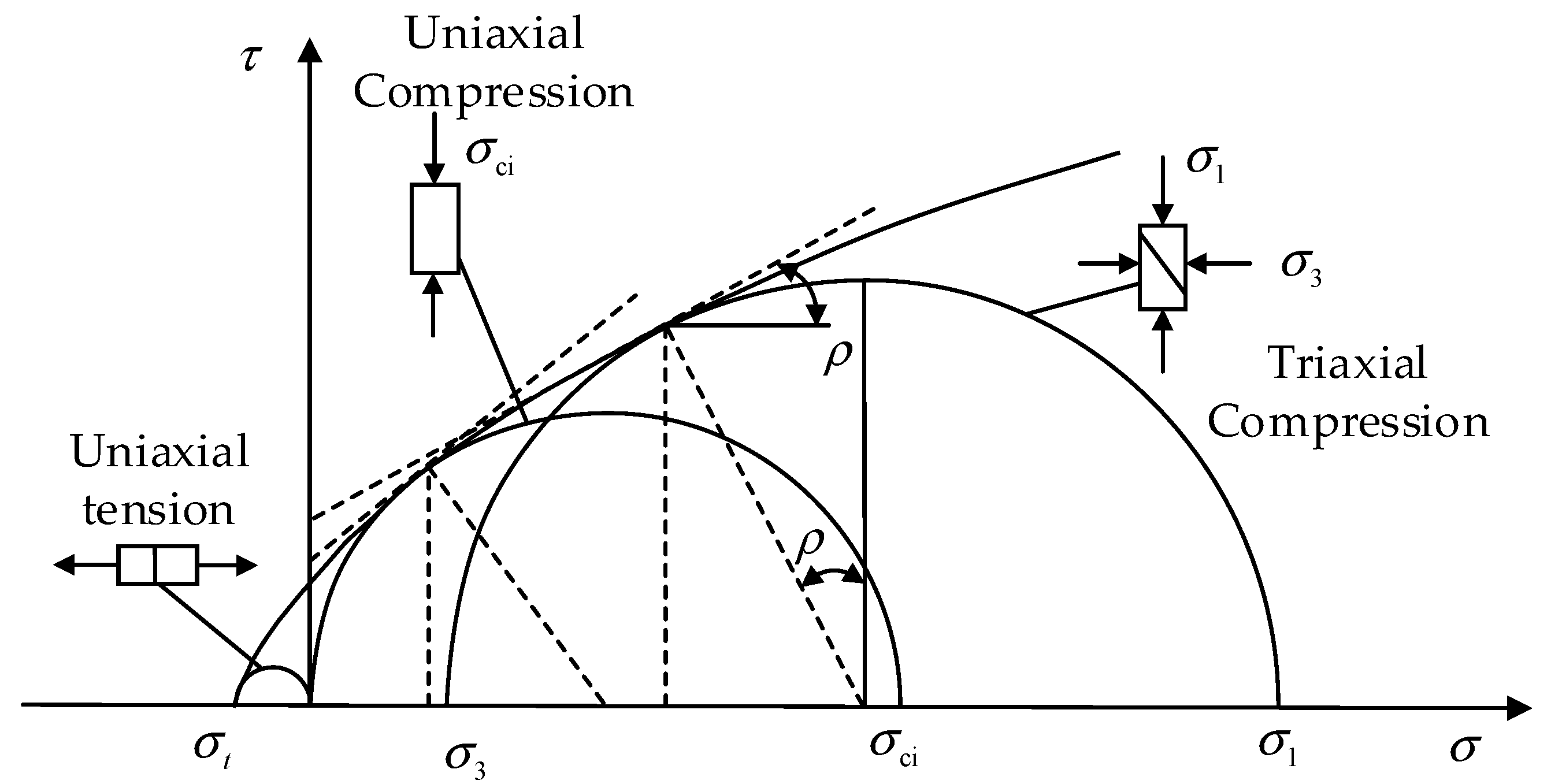
Serrano et al. simplified Equations (2) and (3) by adopting the Hoek–Brown failure criterion and the instantaneous friction angle
, as shown
Figure 1. For plane strain problems, the Lambe variable was introduced.
Then
,
, substituting into Equation (2) and simplifying yields
where
,
are divided into regularized and dimensionless Lambe variables of intact rock.
,
.
Substituting
,
into (3) and simplifying yields
where
,
are divided into regularized and dimensionless Lambe variables of rock mass.
,
,
and
.
The instantaneous friction angle
is the internal friction angle of rock under a given confining pressure, while the angle
between the fracture plane at failure and the plane of maximum principal stress is defined as the instantaneous friction angle:
The Mohr failure criterion strength envelope
can be expressed by the combination of large and small principal stresses and the instantaneous friction angle
:
Combining Equations (7) and (9)–(11) yields
Equations (12) and (13) are the expressions for normal stress and shear stress on the failure surface under a given stress state that satisfy the Hoek–Brown failure criterion. Their normalized expressions are as follows:
The expression of the instantaneous friction angle can be obtained from Equation (13):
where
.
The above formula shows that the instantaneous friction angle of rock is a single value function of confining pressure. According to the Hoek–Brown failure criterion, the lower the confining pressure, the lower the rock shear strength, and the rock shear strength is a nonlinear function of confining pressure.
When calculating the lateral ultimate resistance of pile using the elastoplastic theory method and the foundation reaction method, the failure surface is determined based on the soil shear strength theory. When using the Hoek–Brown failure criterion, it needs to be modified before being applied to the ultimate resistance calculation. Combining this with the Serrano method yields a new method for calculating the explicit rock mass cohesion and internal friction angle.
2.3. Intact Rock Cohesion and Internal Friction Angle
The instantaneous friction angle is calculated by the normal stress and the shear stress of the fracture surface. The angle between the fracture surface and the principal stress plane changes with the confining pressure. Therefore, the stress state of the fracture surface must be determined first.
Therefore, it is necessary to simplify the process and propose an explicit expression considering the influence of confining pressure. The subsequent content of this section references the Serrano method to introduce a new approach for calculating rock cohesion and internal friction angle.
From Equations (7) and (9), we can obtain
Substituting
and
into the above equation yields
where
.
The development of cracks during rock failure is related to confining pressure, and the friction angle of rock failure varies under different confining pressures. It can be seen that Equation (20) directly establishes the relationship between instantaneous friction angle and confining pressure. This expression is simple in form, and it intuitively shows the variation of instantaneous friction angle with confining pressure.
The Mohr–Coulomb failure criterion
, combined with Equations (10) and (14), yields
The Mohr–Coulomb failure criterion is derived from the Hoek–Brown failure criterion as follows:
The Formulas (20) and (21) are the complete formulas for calculating the internal friction angle and cohesion of rock related to confining pressure.
2.4. Cohesion and Internal Friction Angle of Jointed Rock Mass
Equations (20) and (21) are the formulas for calculating the internal friction angle and cohesion of intact rock, respectively, without considering the influence of joints. However, the geological strength index (GSI) reflects the impact of joints on rock strength. Therefore, the internal friction and cohesion of jointed rock are derived by referencing the derivation process of intact rock’s internal friction and cohesion. Differentiating both sides of Equation (8) and from Equation (9), we can derive
Substituting
and
into Equation (23) yields
From Equations (8) and (23), we can obtain
The cohesion of jointed rock mass can be calculated from equations the Mohr–Coulomb failure criterion and (23), (26) and (27).
For complete rock
:
which is the same as Equation (21).
Equations (25) and (28) are the formulas for calculating the cohesion and internal friction angle of jointed rock masses related to confining pressure. The cohesion and internal friction angle determined by Equations (20) and (21), as well as (25) and (28), are intrinsic rock parameters (mi, s). These parameters are functions of rock uniaxial compressive strength and confining pressure , reflecting the stress-dependent behavior of rock masses.
Using the rock’s inherent parameters
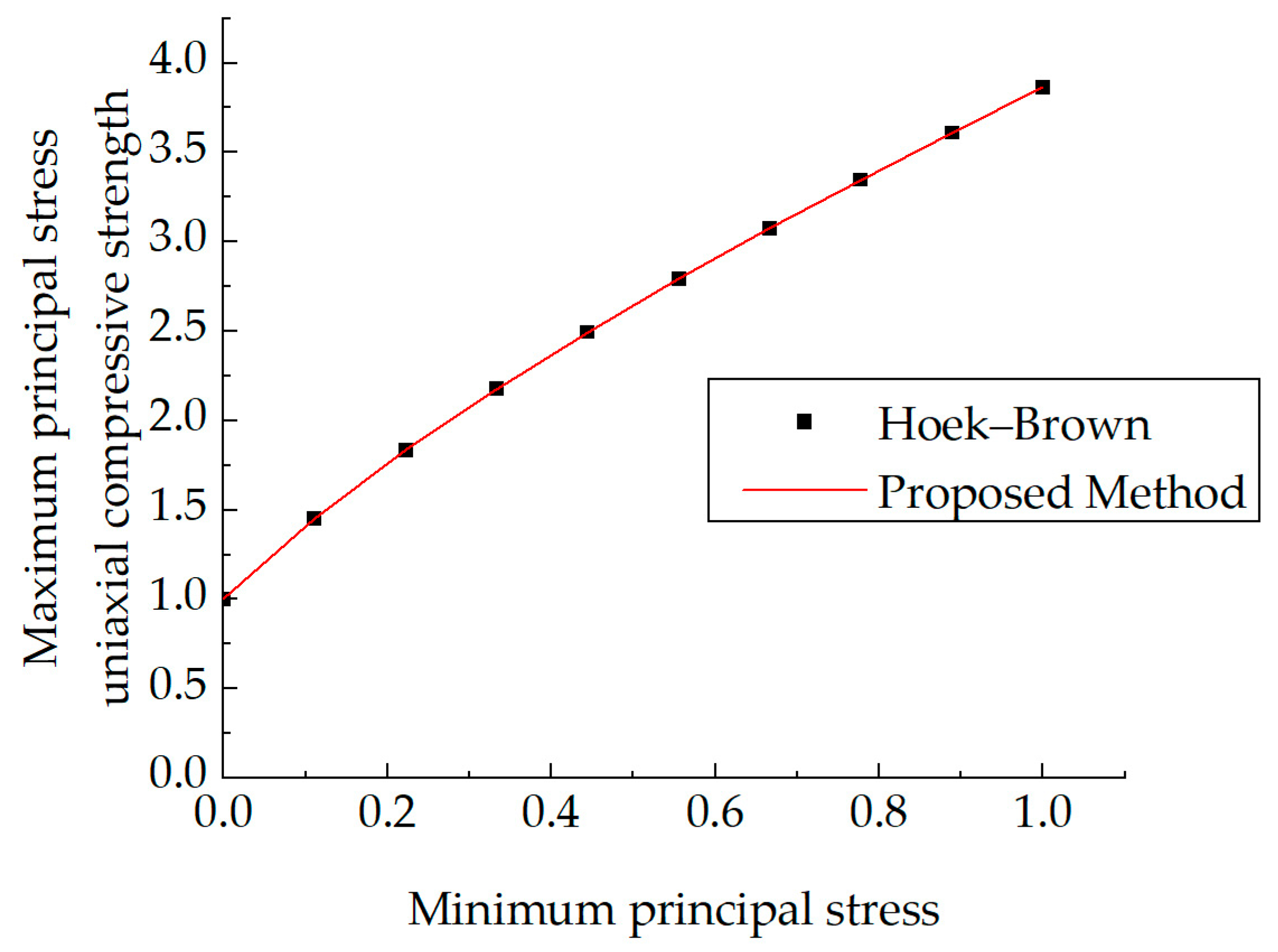
derived by Hoek et al., the minimum and maximum principal stress curves calculated by Equations (20) and (21) are shown in
Figure 2. The curves demonstrate perfect alignment with those obtained from the Hoek–Brown method, as this section’s approach is derived from the Hoek–Brown failure criterion. Both formulations represent identical rock strength relationships, differing only in their expression forms.
The cohesive force and internal friction angle calculation method proposed in this section is an extended form of the Hoek–Brown failure criterion. It considers the uniaxial compressive strength of intact rock, the inherent parameter mi of intact rock, the GSI of rock mass, and the influence of confining pressure, which can effectively capture the characteristics of stress variation within the rock mass.
Since the ultimate bearing capacity and wedge shape determination in traditional pile’s p-y curve models are based on the shear strength index of rock-soil masses, this section considers the nonlinear properties of rock masses. By deriving the Hoek–Brown failure criterion, we obtain the cohesion and internal friction angle of fractured rock masses related to confining pressure. Consequently, the fundamental parameters of the Hoek–Brown failure criterion can be determined based on rock mass characteristics. Subsequently, Equations (20) and (21), as well as Equations (25) and (28), are employed to calculate the cohesion and internal friction angle of rock masses. Finally, the traditional pile’s p-y curve model is directly applied to compute the lateral bearing capacity of pile foundations.
Observations of the rock strength criterion (3) indicate that the primary parameters influencing rock strength relationships include uniaxial compressive strength , inherent parameters , GSI, and rock disturbance coefficient D. The uniaxial compressive strength and inherent parameters can be derived through fitting triaxial test results of intact rock specimens. For pile foundation projects with minimal construction-induced disturbances, the rock disturbance coefficient D may be assumed to be zero. In fractured rock masses, GSI emerges as the critical parameter, with extensive research conducted by scholars on its estimation methodologies.
3. Analysis of Lateral Bearing Capacity Characteristics of Rock-Socketed Piles
To analyze the lateral bearing capacity of rock-socketed piles, three rock failure criteria were compared: (1) Hoek–Brown failure criterion; (2) Mohr–Coulomb failure criterion; (3) Mohr–Coulomb failure criterion with the cohesive force and internal friction angle calculated using the method from the previous section. The model was constrained in the normal direction at its periphery, while its base was restricted in the x, y, and z directions. FLAC3D (Fast Lagrangian Analysis for Continuum, 7.0), a finite difference software from ITASCA based on Lagrangian analysis for continuum simulation, was applied to evaluate the rock resistance per unit length. The pile foundation was subjected to velocity loading at its top. The calculation was terminated upon reaching the specified number of time steps. The results yielded the pile perimeter stress distribution, the load–displacement curve at the pile foundation top, and the p-y curve at a specified depth.
3.1. Numerical Model Validation
Field tests on the lateral bearing capacity of rock-socketed piles were carried out by Liang et al. at two bedrock sites [
7]. Detailed data are shown in
Table 1. At site 1, the rock-socketed piles had a diameter of 1.83 m and a socketed depth of 5.49 m. At site 2, the rock-socketed piles had a diameter of 2.44 m and a total length of 34.4 m, of which the socketed length was 17.31 m and the overburden thickness was 5.7 m. In order to eliminate the influence of the overburden on the lateral bearing capacity of the pile, a casing was installed within a range of 17.1 m from the top of the bedrock to the top of the pile. The casing had a diameter of 3.35 m and a wall thickness of 25.4 mm.
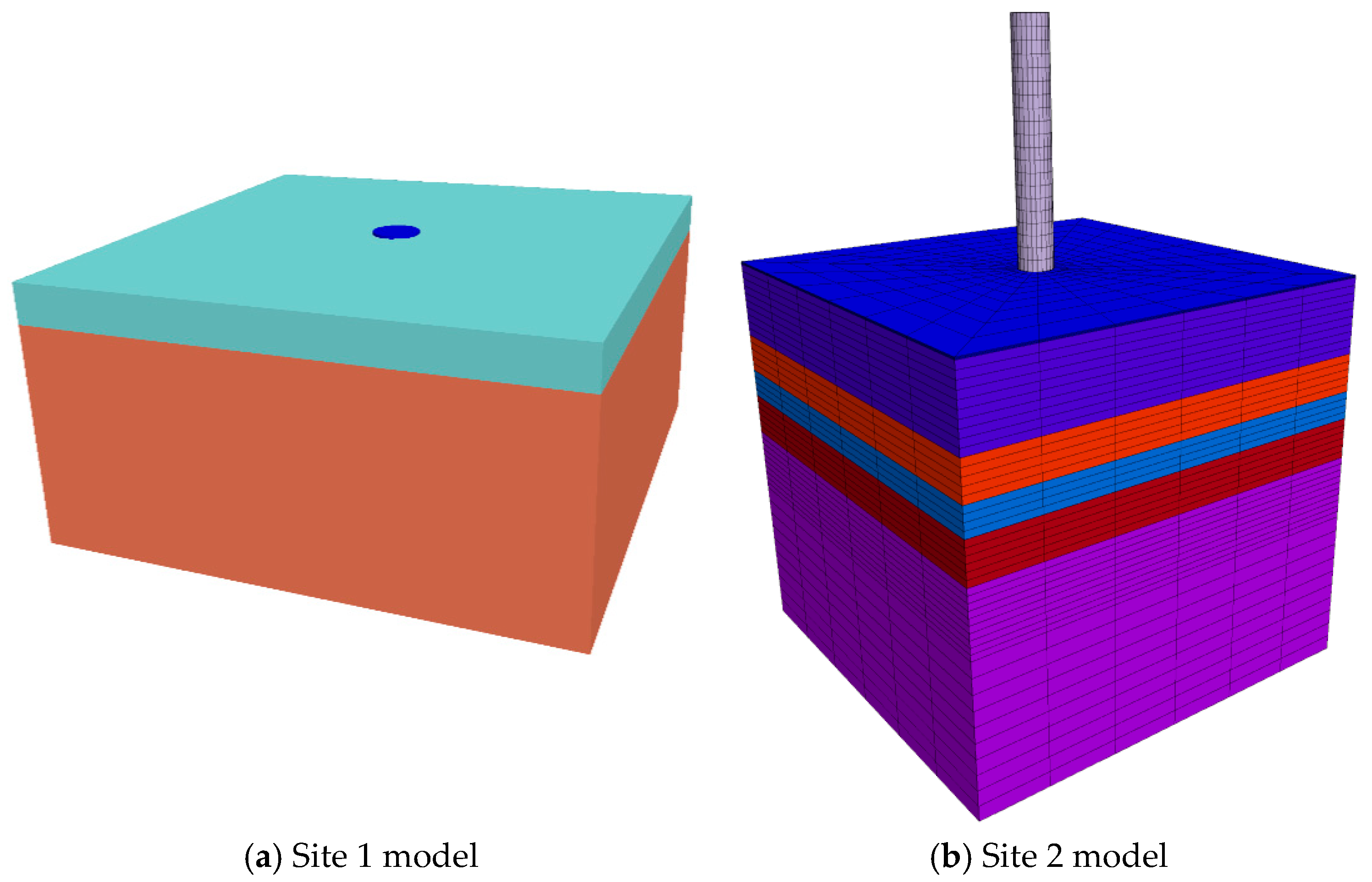
A numerical model was established as shown in
Figure 3 using the parameters from
Table 1. During model construction, an equivalent uniform load of 209.9 kPa was applied to the bedrock surface. For the rock mass, the Hoek–Brown failure criterion was used. For the pile, a linear elastic model was assigned, with an elastic modulus of 27.31 GPa and a Poisson’s ratio of 0.3. For the pile–rock interface, the Coulomb shear model was implemented, incorporating a friction angle of 10°, cohesion of 30 kPa, and normal and shear stiffness (kn and ks) both equal to 50 GPa/m. Lateral loads were applied at the pile top, with fixed boundary displacement conditions. In the numerical model, soil colors represent different soil layers, as detailed in
Table 1.
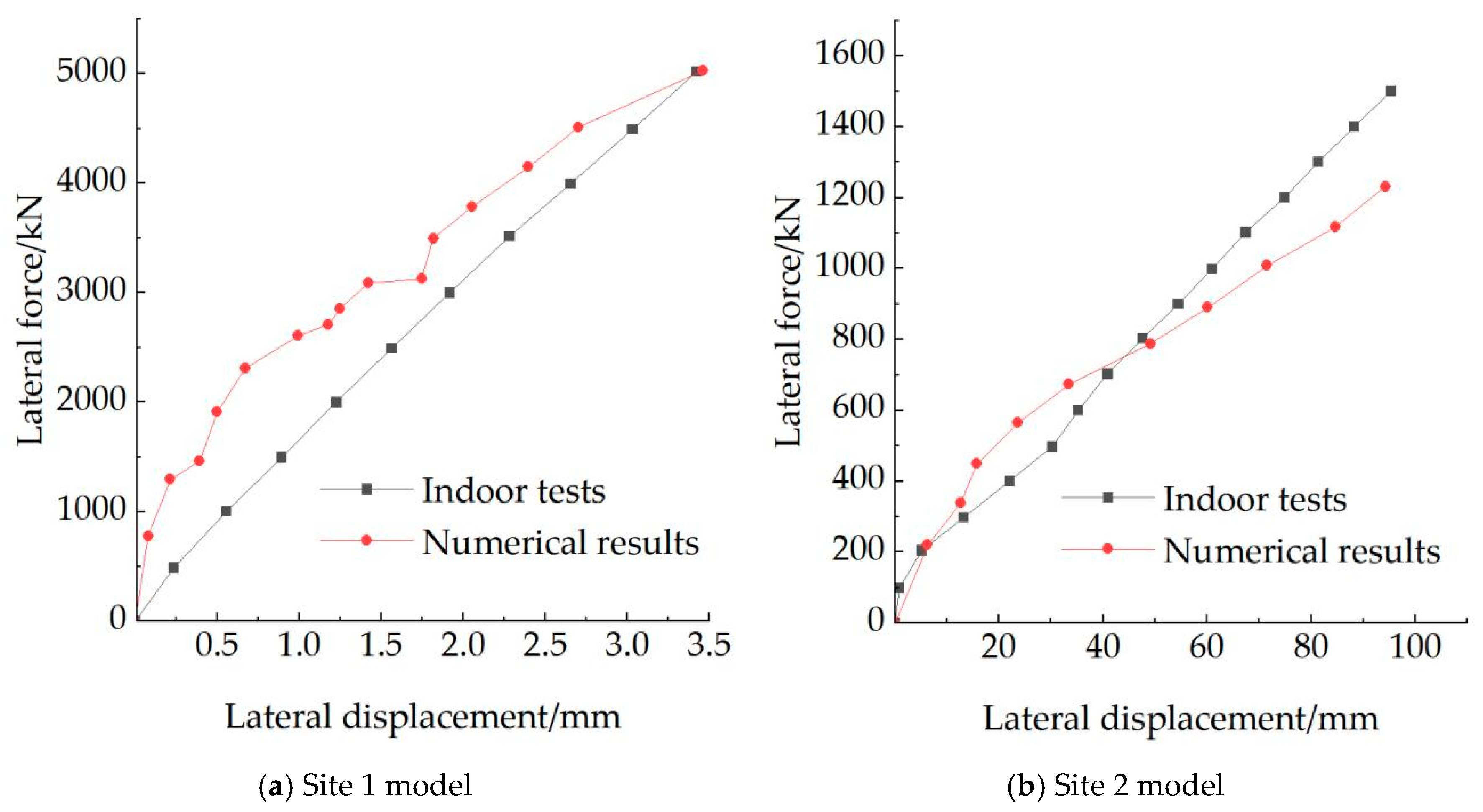
As can be seen from
Figure 4, the numerical model gives results that are close to linear. For Site 1, the predicted displacement at the pile top is somewhat larger than the field data. At Site 2, the model yields slightly greater displacements than the measurements at lower loads, whereas at higher loads, the predicted values fall slightly below the field results. Because the site conditions are complex, the numerical model is designed as a simplified representation of reality. While minor deviations are present, the overall results correspond well with the field observations. By establishing the numerical model in FLAC3D and calibrating the constitutive and interface parameters against field test data, the simulation is capable of closely matching the measured response.
3.2. Pile Surrounding Stress Distribution
This section employs FLAC3D to construct and analyze a numerical model of rock-socketed piles. The model dimensions are specified as follows: pile radius R = 1.0 m, pile length L = 20 m, model width 20R, and model height 10L + 10R. Rock parameters include: uniaxial compressive strength , elastic modulus Ei = 165 MPa, Poisson’s ratio , inherent parameters , rock parameter s = 1, GSI = 100, and rock density . To maintain linear elastic behavior of the pile foundation, a high elastic modulus is applied, adopting a linear elastic model with basic parameters: Ei = 32.5 GPa, density , and Poisson’s ratio . Displacement boundary conditions are implemented, with normal displacement restricted at the four edges of the model and x, y, z displacements restricted at the base surface. To obtain the lateral ultimate bearing capacity of the p-y curve, lateral displacement is applied at the pile top.
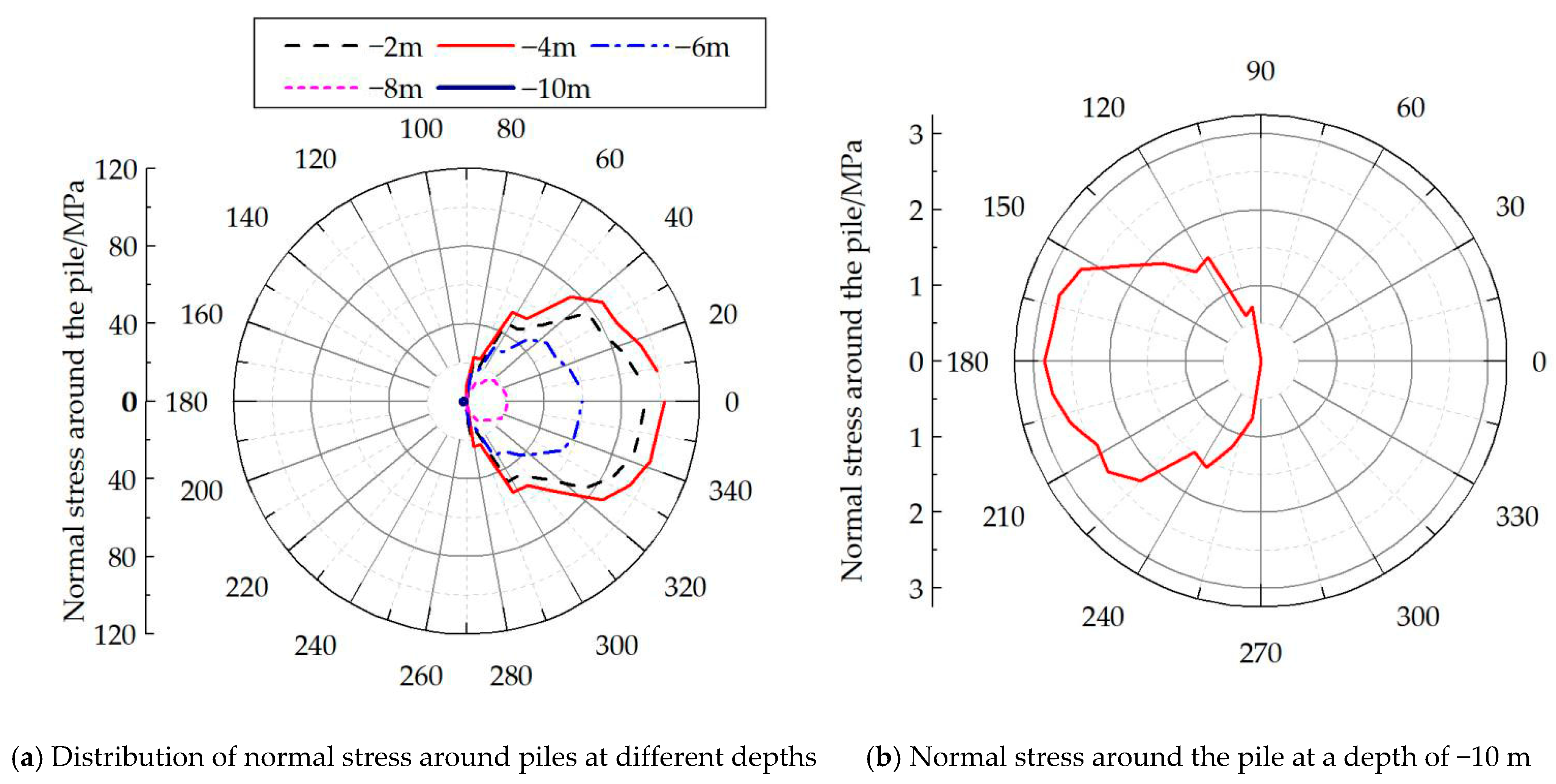
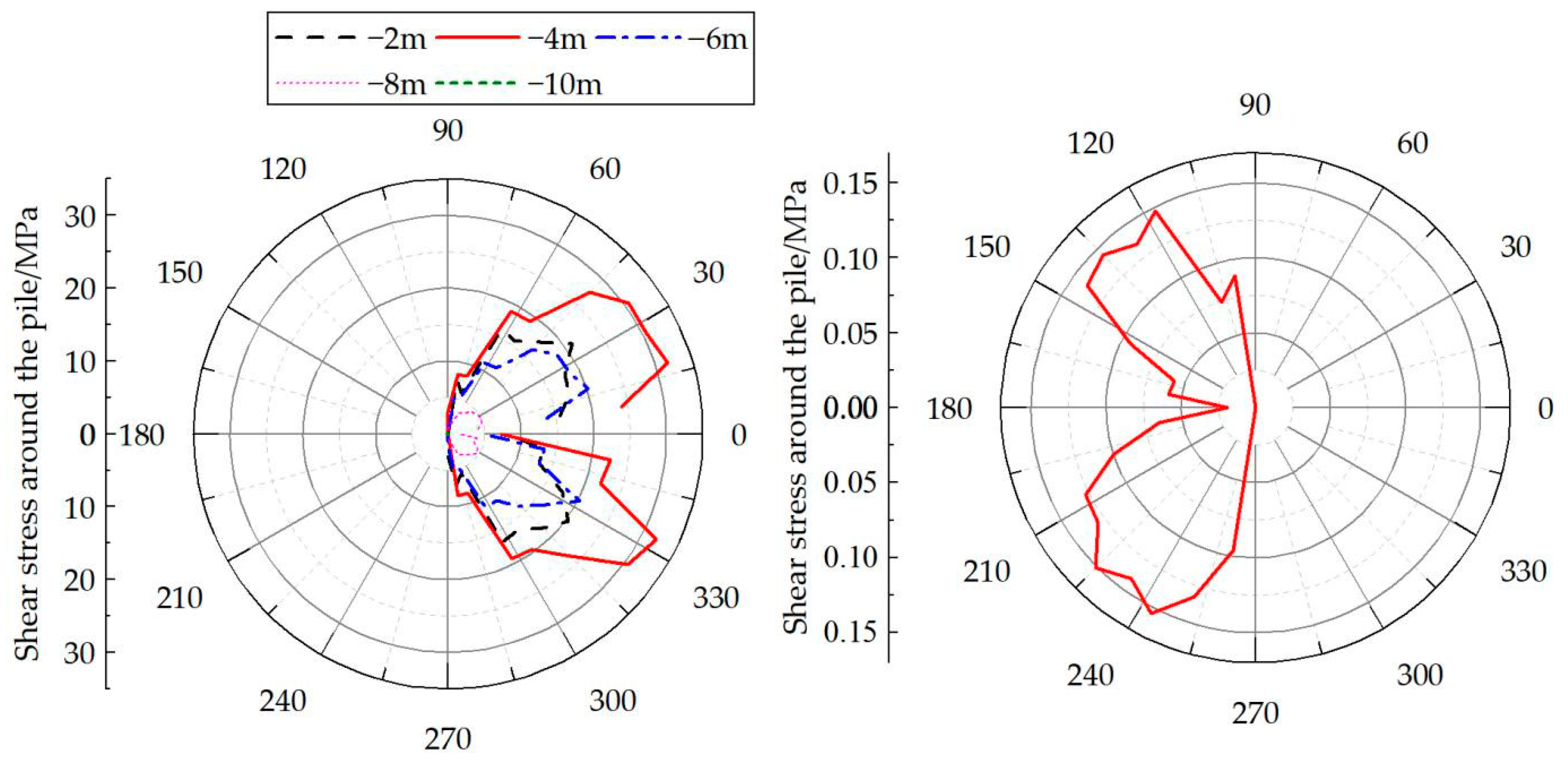
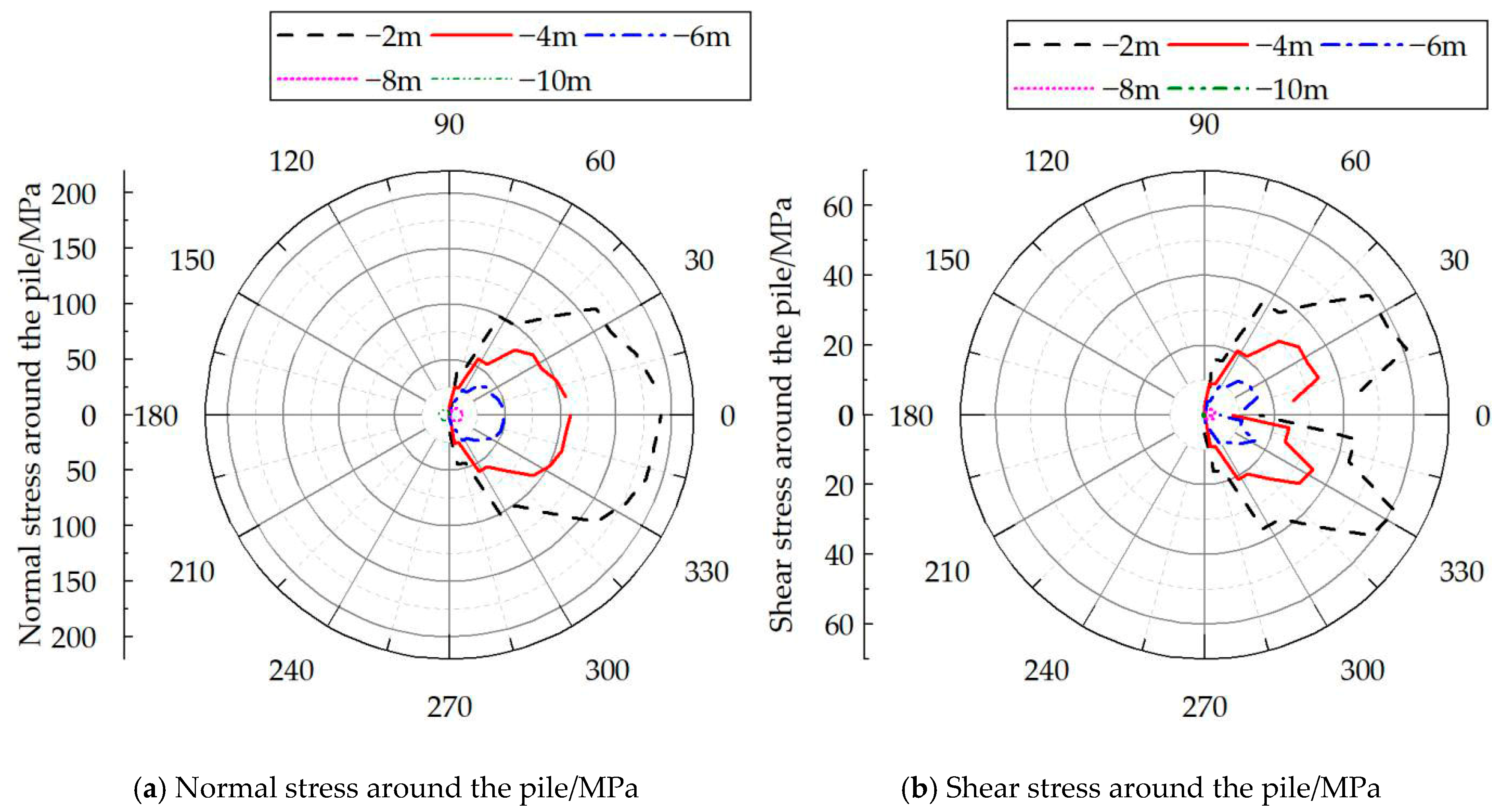
Figure 5 and
Figure 6 show the pile stress distribution at different depths calculated using the Hoek–Brown failure criterion. In the figures, 0° indicates the loading direction, and the angle values represent counterclockwise rotations from the loading direction.
Figure 5 demonstrates that the normal stress around the pile exhibits symmetrical distribution relative to the loading direction. The maximum normal stress is located directly in front of the pile, and it gradually decreases as the loading direction rotates counterclockwise around the pile, eventually reaching zero when perpendicular to the loading direction. The normal stress initially increases with depth before decreasing, reaching its peak at approximately 2D (with the model pile foundation diameter D = 2.0 m). When the pile depth is less than 5D, the normal stress is concentrated in front of the pile foundation, while no stress distribution occurs behind it. Conversely, when the pile depth exceeds 5D, the normal stress is concentrated behind the pile foundation, with no stress distribution in front. This indicates that within the 0–5D range, the rock mass resistance is borne by the front rock mass, whereas below 5D, the resistance is assumed to be borne by the rear rock mass.
As shown in
Figure 6, the circumferential shear stress of the pile exhibits a pattern of first increasing and then decreasing along its circumference. The stress reaches its maximum value at approximately a 30° counterclockwise (or clockwise) rotation from the loading direction, while decreasing to zero at the vertical direction perpendicular to the loading direction. The circumferential shear force increases with depth, peaking at approximately 2D of pile depth, then diminishing to zero at around 5D. Below 5D, the shear force distributes along the rear of the pile.
The above analysis shows that the pile lateral resistance is provided by the rock mass in front of the pile in the depth range of 0~5D, which increases first and then decreases along the pile depth, reaches the maximum value at 2D and decreases to zero at 5D.
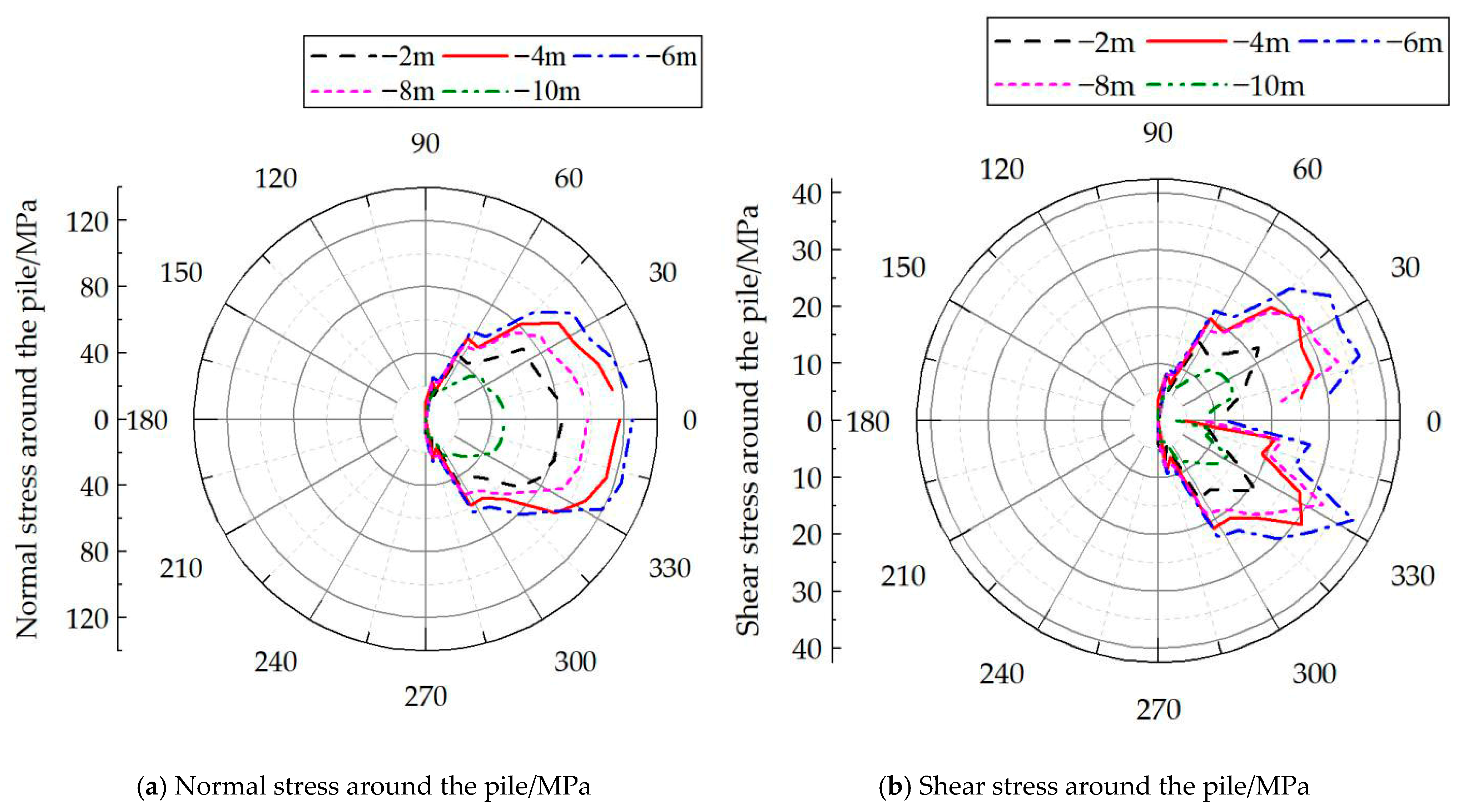
Figure 7 shows the distribution of normal and shear stresses around the pile, calculated using the proposed method for rock cohesion and internal friction angle.
Figure 8 displays the corresponding distributions calculated with the Mohr–Coulomb failure criterion.
Comparing
Figure 5,
Figure 6,
Figure 7 and
Figure 8, the stress distribution patterns around the pile produced by different calculation methods are consistent: normal stress peaks directly ahead of the pile, decreases counterclockwise along the circumference, and vanishes at the loading direction’s perpendicular plane. Shear stress exhibits a similar pattern—initially increasing and then decreasing around the pile, with maximum values occurring at approximately 30° from the loading direction, eventually vanishing perpendicular to the loading direction. However, the maximum stress values differ across the three methods. This discrepancy arises from the velocity loading approach in this section’s model, where the final loading step serves as the termination criterion. Different failure criteria result in varying convergence speeds during computation, leading to distinct final-pile top lateral displacements at the termination step and, consequently, divergent stress distributions around the pile.
The distribution patterns of normal and shear stresses around the pile perimeter exhibit similarity to trigonometric functions. Therefore, functions
and
were selected to fit the normal stress and shear stress distributions. Given the symmetry of the stress distribution relative to the loading direction, the stress values within the first quadrant were chosen for fitting. This symmetry allows the derivation of a complete stress distribution function along the pile perimeter. By dividing the normal and shear stresses by their maximum values, the dimensionless stress values for the first quadrant are obtained as shown in
Table 2.
Through curve fitting, the dimensionless normal stress relationships calculated using the H-B standard are , R = 0.9643; those using the modified M-C standard are , R = 0.9748; and those using the M-C standard are , R = 0.9453. The most suitable dimensionless normal stress relationship is .
The dimensionless shear stress relationships calculated using the H-B standard are , R = 0.5941; those using the modified M-C standard are , R = 0.6742; and those based on the M-C standard are , R = 0.6457. The dimensionless normal stress relationship can be expressed as .
The normal stress distribution function of the pile is taken as
The distribution function of the shear stress around the pile is given as
In the formula: and represent the normal stress and maximum normal stress around the pile, respectively; and denote the distribution of normal shear stress and maximum shear stress around the pile, respectively; and is the counterclockwise rotation angle of the loading direction.
3.3. Initial Stiffness of P-Y Curve
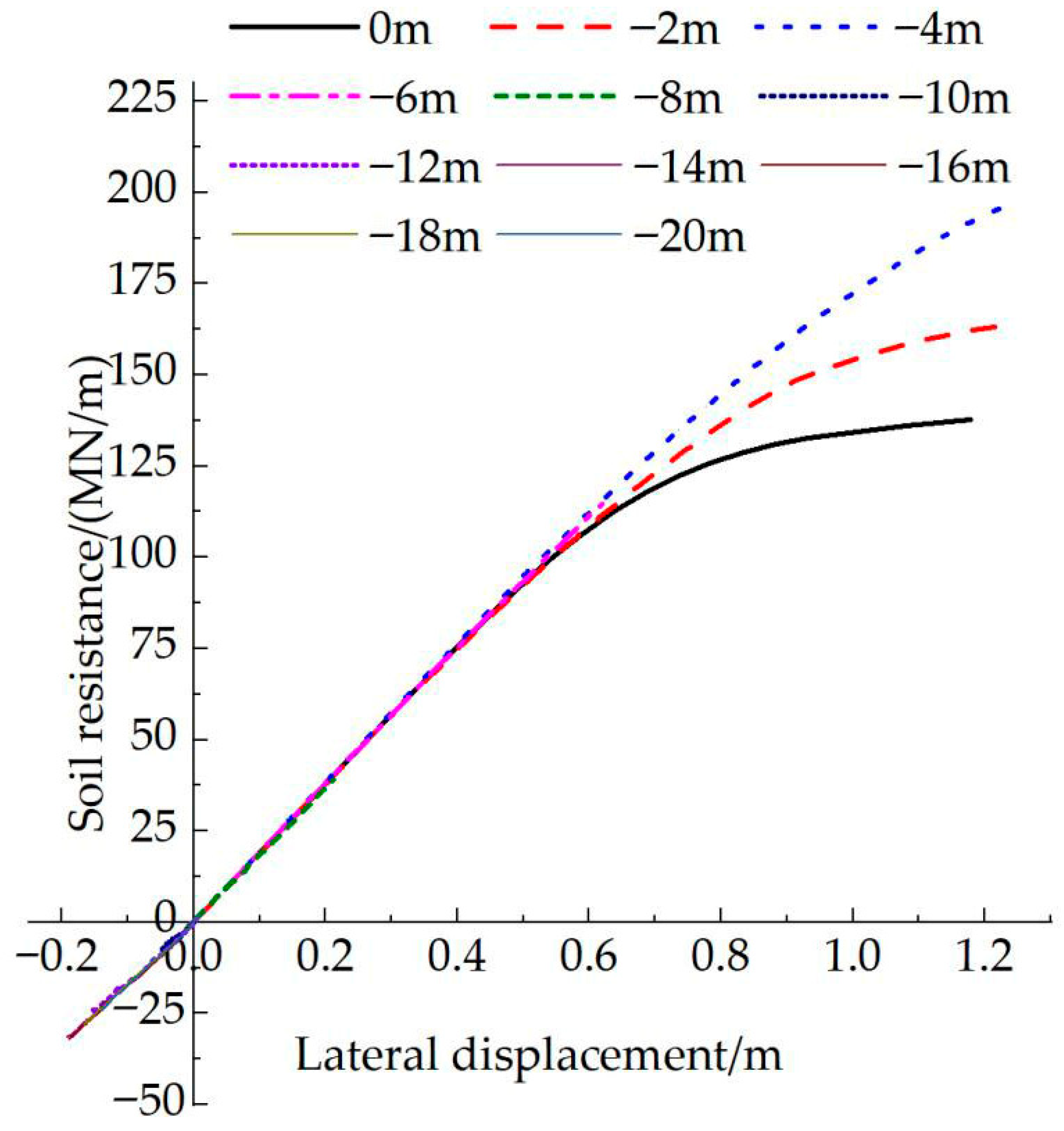
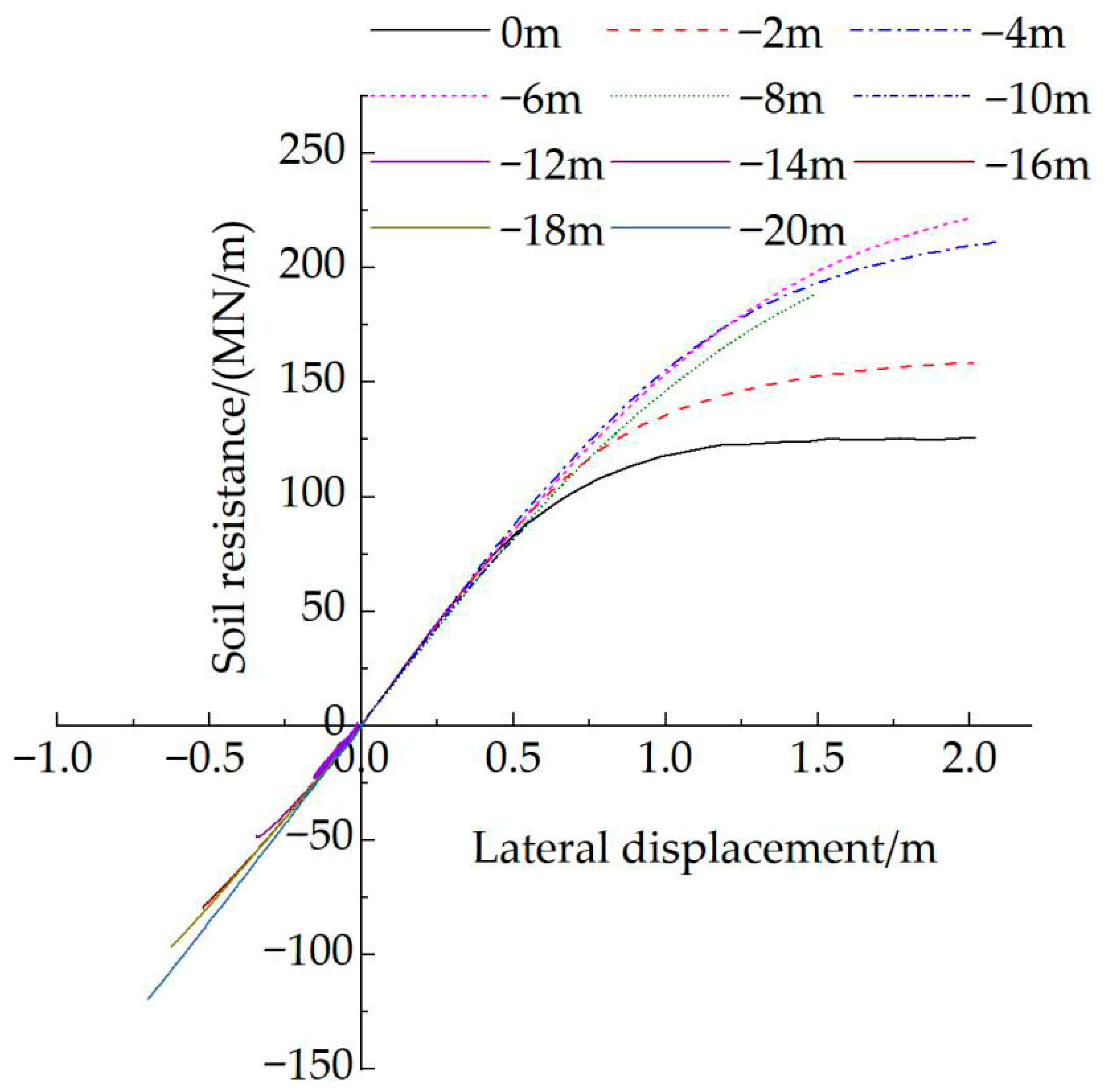
Figure 9 presents the
p-
y curves calculated using different methods at various depths of the pile foundation.
Figure 10 shows the results obtained by applying the modified Mohr–Coulomb failure criterion (i.e., the modified Hoek–Brown failure criterion). To determine the ultimate lateral resistance, numerical simulations were conducted by applying lateral displacement at the pile top, forcing significant displacement at the pile tip. The curves indicate that yielding begins when the unit-length lateral resistance at the rock surface reaches approximately
pu = 125 MN. Calculations show that the initial stiffness of the
p-
y curve calculated using the Hoek–Brown criterion is
Ki = 185 MN/m
2, while the modified Mohr–Coulomb criterion yields
Ki = 176 MN/m
2. The Hoek–Brown standard calculates the ultimate unit-length lateral resistance at the rock surface as
pu = 138.6 MN/m, and the ultimate resistance 2 m below the surface as
pu = 167.9 MN/m. The modified Mohr–Coulomb criterion was used to calculate the ultimate resistance of rock mass. The results are as follows:
pu = 125.5 MN/m at the top of rock mass,
pu = 159.3 MN/m at 2 m below the top,
pu = 218.5 MN/m at 4 m below the top, and
pu = 236.6 MN/m at 6 m below the top.
Liang et al. proposed a hyperbolic p-y curve for calculating pile lateral bearing capacity, with the curve form as shown in Equation (1).
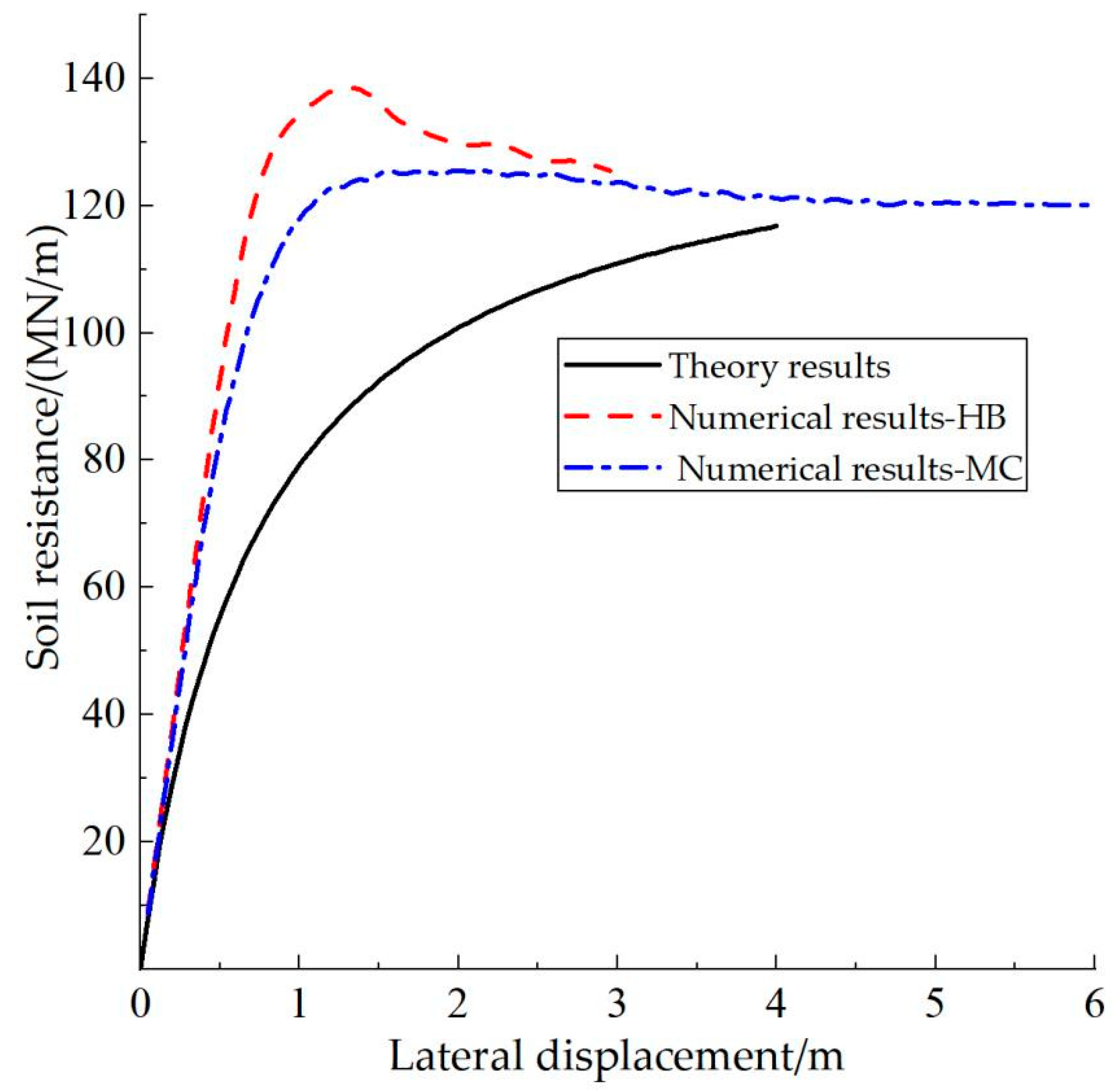
The numerical analysis in this section reveals that the ultimate pile resistance at the rock surface is
pu = 138.6 MN/m, with the initial stiffness of the
p-
y curve being
Ki = 185 MN/m
2.
Figure 11 compares the
p-
y curve derived from this formula with the numerical results. The figure demonstrates that the hyperbolic
p-
y curve fitting aligns well with the actual data in both the initial stiffness and ultimate resistance segments. However, significant discrepancies emerge between the theoretical and numerical hyperbolic
p-
y curves when displacement values are substantial.
Liang et al. derived the initial stiffness formula for the
p-
y curve of rock-socketed piles through numerical analysis and curve fitting.
where
Dref = 0.305 m. The initial stiffness of the
p-
y curve calculated using this formula is
This value is far greater than the initial stiffness calculated in this section, thus requiring re-fitting.
The initial stiffness of the different depths is obtained by fitting the calculated results of Hoek–Brown failure criterion and the modified Mohr–Coulomb failure criterion with the hyperbolic
p-
y curve as shown in
Table 3.
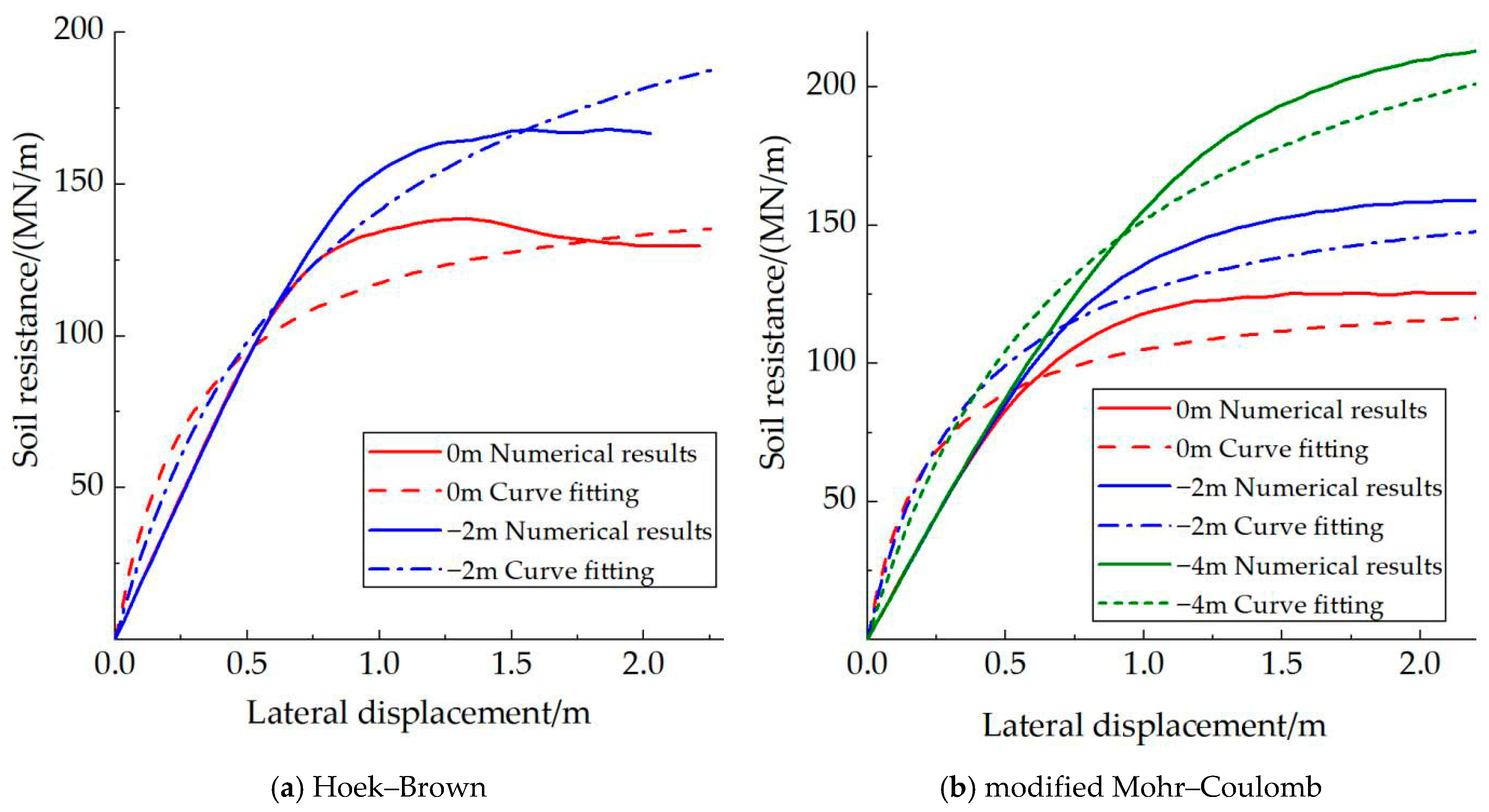
Figure 12 presents a comparison between the
p-
y curve obtained through curve fitting and numerical calculations. To determine the ultimate lateral resistance, numerical simulations were performed by applying lateral displacement at the pile top, which induced significant displacement. The fitting results indicate that both the initial stiffness and ultimate resistance values of the
p-
y curve differ substantially from the numerical calculation results.
Figure 12 demonstrates that the
p-
y curves derived from curve fitting and numerical calculations differ in both initial stiffness and ultimate bearing capacity. Therefore, it is not advisable to directly determine both parameters through curve fitting. Instead, the initial stiffness can be fitted, while the ultimate bearing capacity per unit length is calculated using theoretical methods. Comparing the
p-
y curves from
Figure 11 and
Figure 12, obtained via numerical calculation, theoretical calculation, and curve fitting, the fitted curves show significant deviations in initial stiffness and ultimate bearing capacity compared to numerical results, particularly at large displacements. Theoretical calculations yield curves with minimal differences in initial stiffness and ultimate bearing capacity, but substantial discrepancies emerge between the
p-
y curves in the intermediate segment and the numerical results.
Therefore, it is suggested that the initial stiffness of the p-y curve should be obtained by curve fitting method, and the ultimate resistance of the rock mass per unit length should be obtained by theoretical calculation.
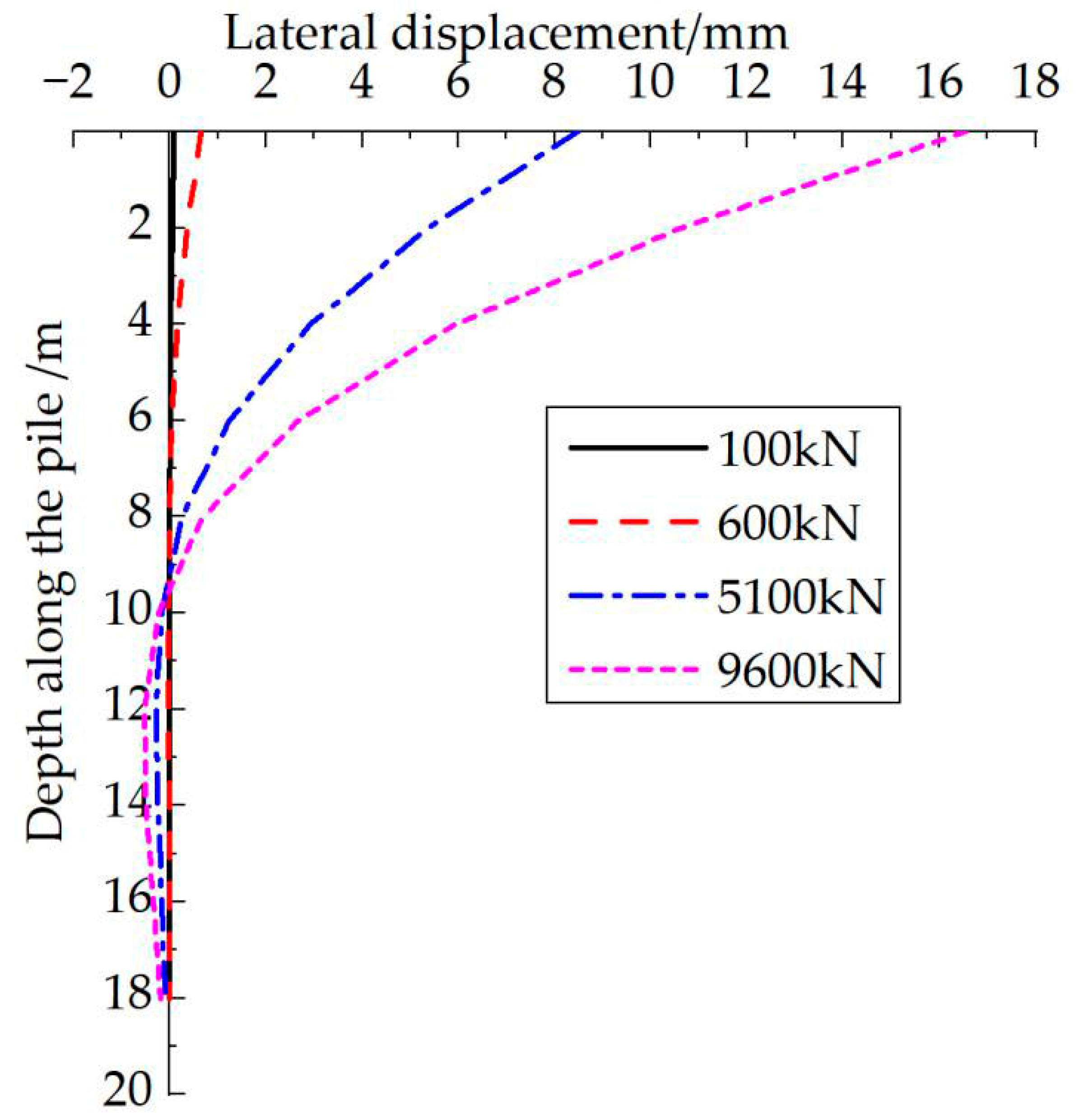
3.4. Lateral Displacement Curve of Pile Body
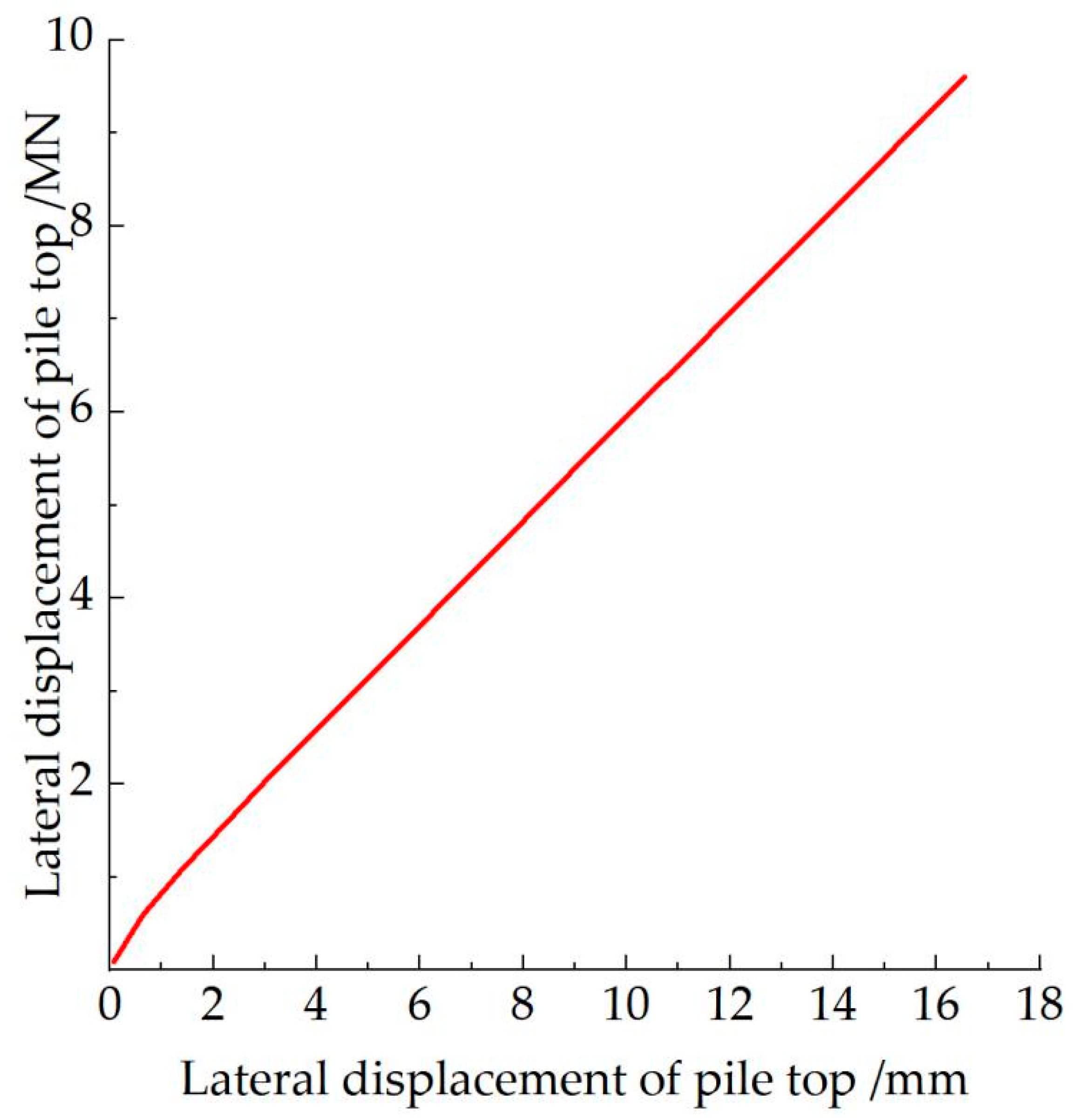
The figure demonstrates that the high rock mass strength results in significant lateral resistance. When the pile top experiences a lateral force of 9.6 MN, the displacement reaches 16.54 mm. Within the 0–3D range, the pile shows minimal deformation with nearly linear displacement changes. However, below 3D depth, significant flexural deformation occurs. As the load grade increases, the pile’s lateral displacement gradually rises, then decreases progressively along its length, eventually reaching zero at approximately 5D depth. This displacement pattern aligns with the circumferential stress distribution model.
Numerous researchers have obtained cross-sectional bending moments or lateral displacements at specific intervals of pile shafts through field tests, laboratory experiments, or numerical simulations, subsequently deriving deformation curves via curve fitting [
20,
21,
22,
23,
24,
25]. Existing studies predominantly employ polynomial fitting methods. Sinnreich et al. [
21] adopted a hybrid approach combining shape functions with polynomials, while Suryasentana et al. [
22] independently analyzed the proportionate influence of individual factors through component analysis. Haiderali et al. [
25] evaluated both up to 10th-order polynomial fitting and third-order spline interpolation, ultimately selecting spline interpolation for curve fitting. Guo et al. [
26] combined Sigmiod shape functions with polynomial methods to model the relationship between pile cross-sectional bending moments and pile depth. Hetenyii [
27] proposed the relationship between pile head load and pile shaft displacement in soil media:
where
;
k denotes the stiffness of the pile at a given depth on the
p-
y curve.
The polynomial fitting form is
When using the polynomial, the lateral displacement y should be at least the fifth power of the depth, i.e.,
, and the rock mass resistance of the pile side is
The rock mass resistance is only linearly related to the depth. According to the p-y curve analysis in this section, when the lateral displacement is large, both the pile depth and lateral displacement affect the rock mass resistance, meaning the rock mass resistance is a function of both the pile depth and lateral displacement.
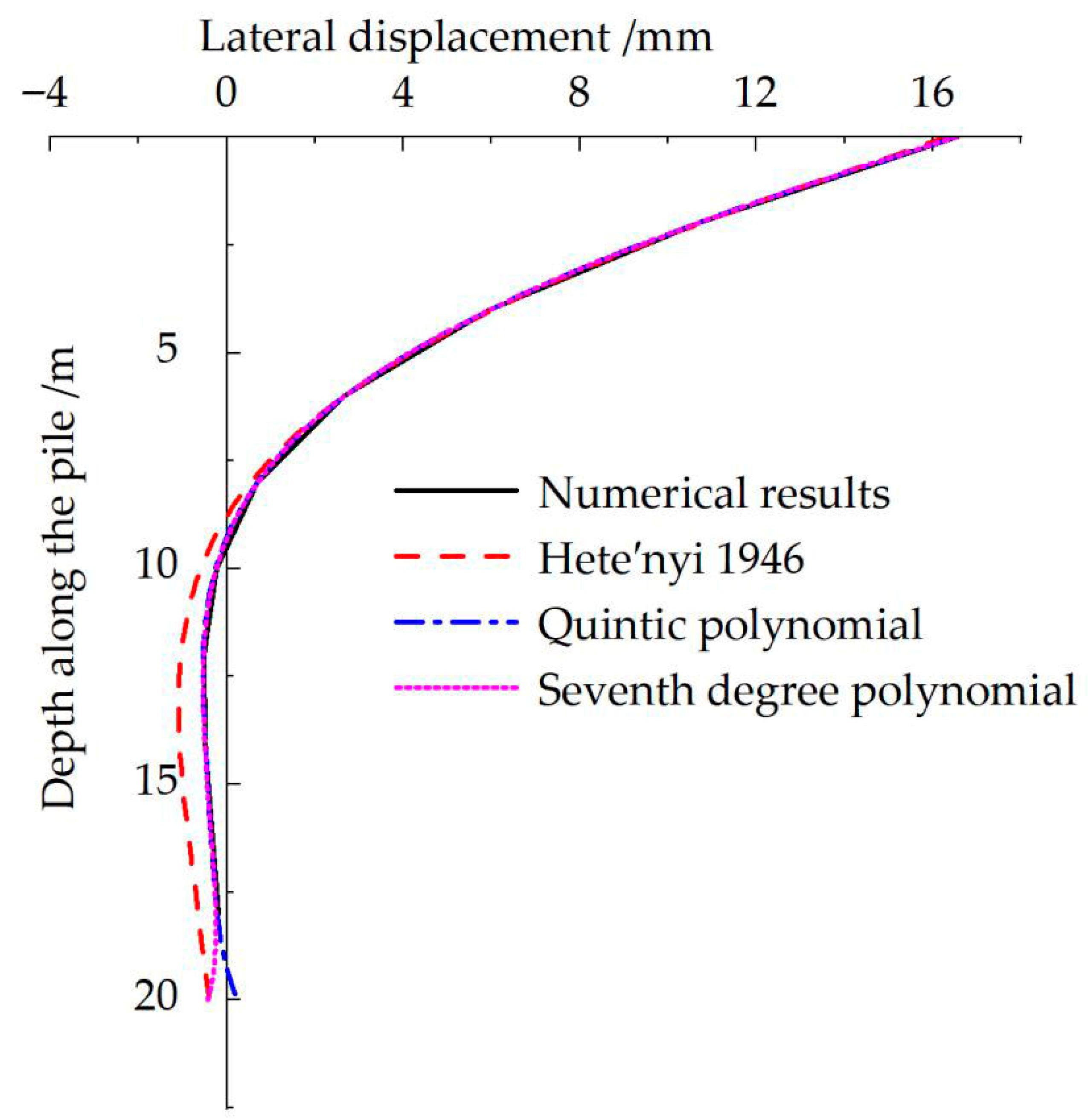
Figure 15 shows the lateral displacement curve of the pile body with the lateral force of 9600 kN at the pile head, which is fitted by polynomial form and Hetenyi method.
As shown in
Figure 15, the three fitting methods demonstrate comparable performance for shallow rock masses. However, the Hetenyi method shows significant differences in pile lateral displacement when applied to deep rock masses. Therefore, polynomial fitting is recommended. Considering that the lateral rock mass resistance is a function of lateral displacement and its value equals the negative fourth derivative of the displacement curve, we propose the following fitting equation based on the Hetenyi method:
where
the shape adjustment index is set to 0.1.
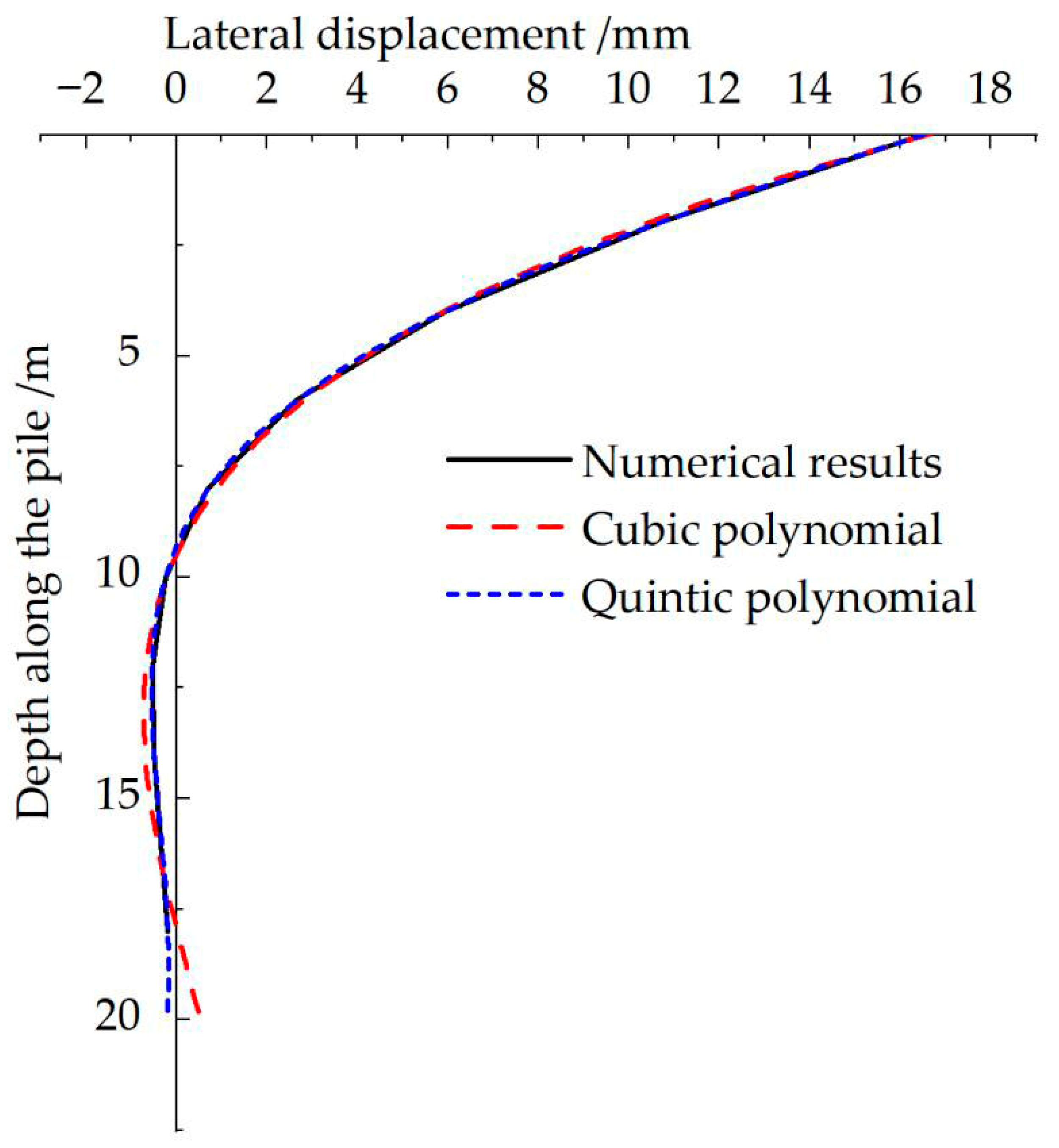
Figure 16 compares polynomial orders with numerical simulation results. The figure shows that the 5th-order polynomial achieves good agreement with the numerical results when fitting the pile body lateral displacement curve.
4. Study on the Influence Factors of Lateral Bearing Capacity of Rock-Inlaid Pile
Liang et al. [
7] investigated how rock uniaxial compressive strength, deformation modulus, GSI value, and inherent parameter mi affect the hyperbolic
p-
y curve. Their study revealed that the initial stiffness of the
p-
y curve exhibits greater sensitivity to rock uniaxial compressive strength, deformation modulus, and GSI value, while showing less sensitivity to
mi. In this section, we conduct parameter sensitivity analysis using numerical methods, with the following rock mass parameters:
,
Ei = 50 MPa,
mi = 5, and GSI = 100. The deformation modulus is calculated using the method proposed by Hoek et al. [
6,
28].
The fundamental parameters of rock mass failure criteria are calculated using Equation (3). The pile dimensions are specified as D = 2.0 m and L = 20.0 m. When analyzing individual parameters, the variation ranges are rock uniaxial compressive strength, rock elastic modulus
Ei = 50~1000 MPa, Poisson’s ratio
, rock inherent parameters
, GSI = 10~90, pile diameter D = 1~6 m, and pile length L = 5.0~20.0 m.
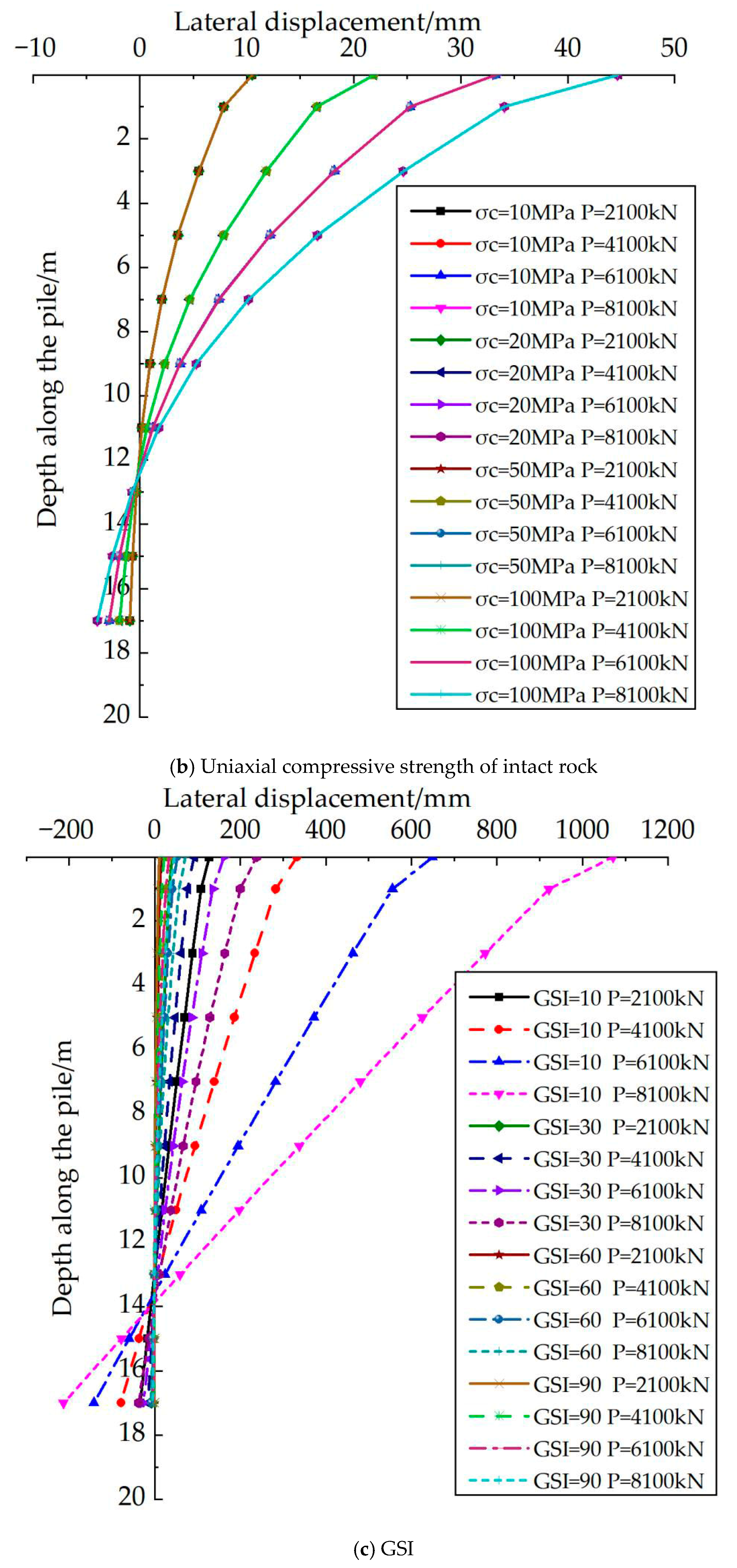
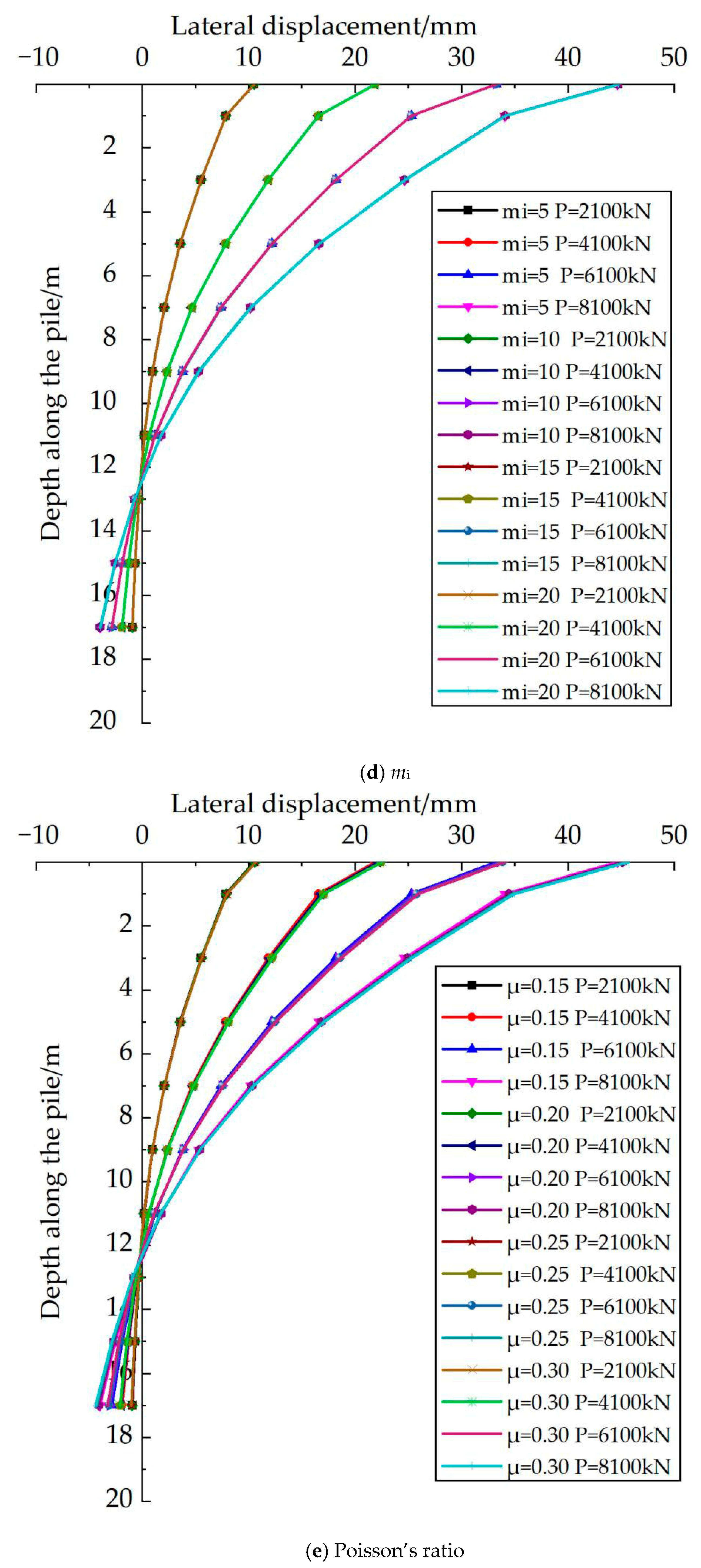
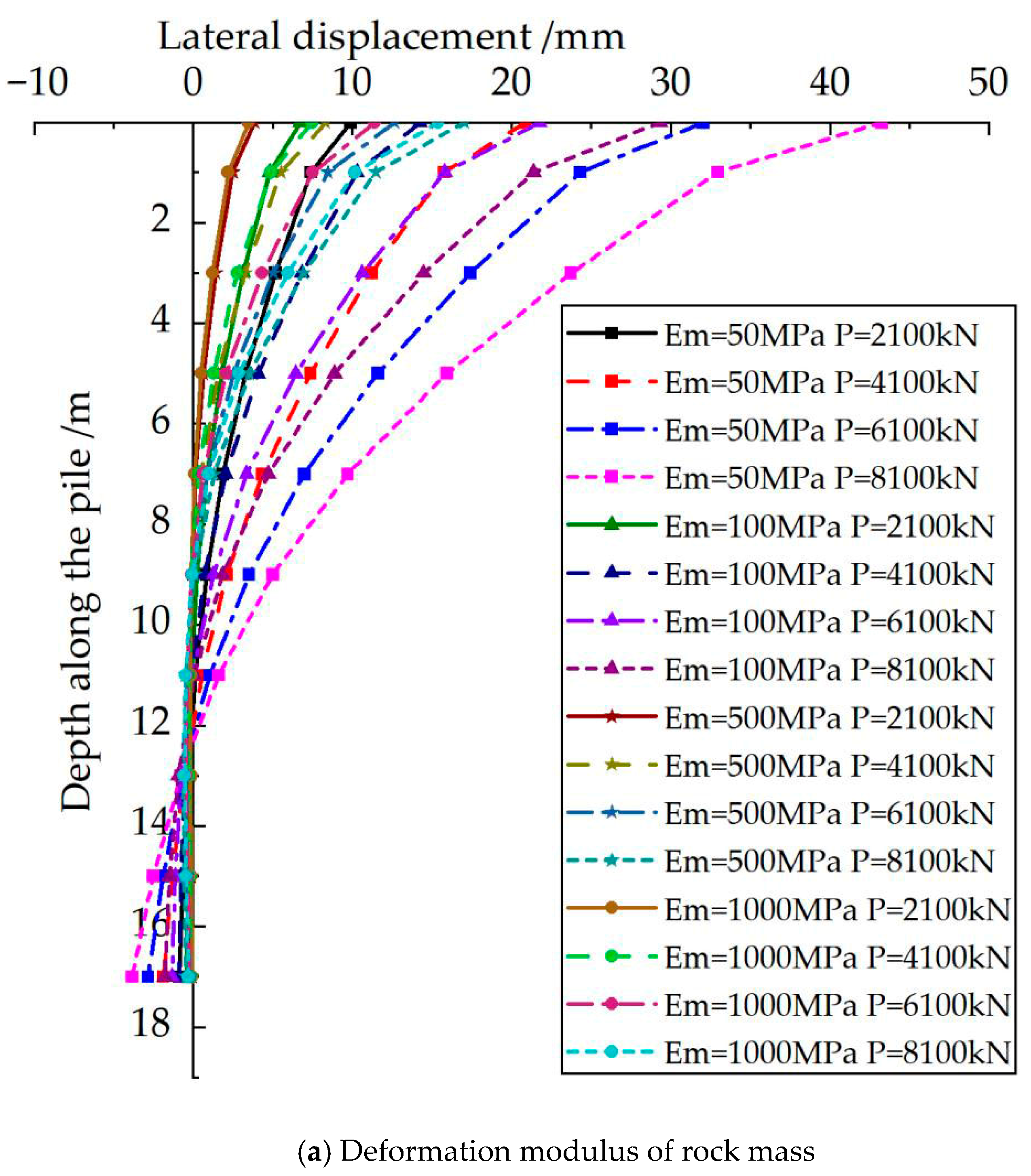
Figure 17 shows the lateral displacement along the pile body for different rock mass parameters.
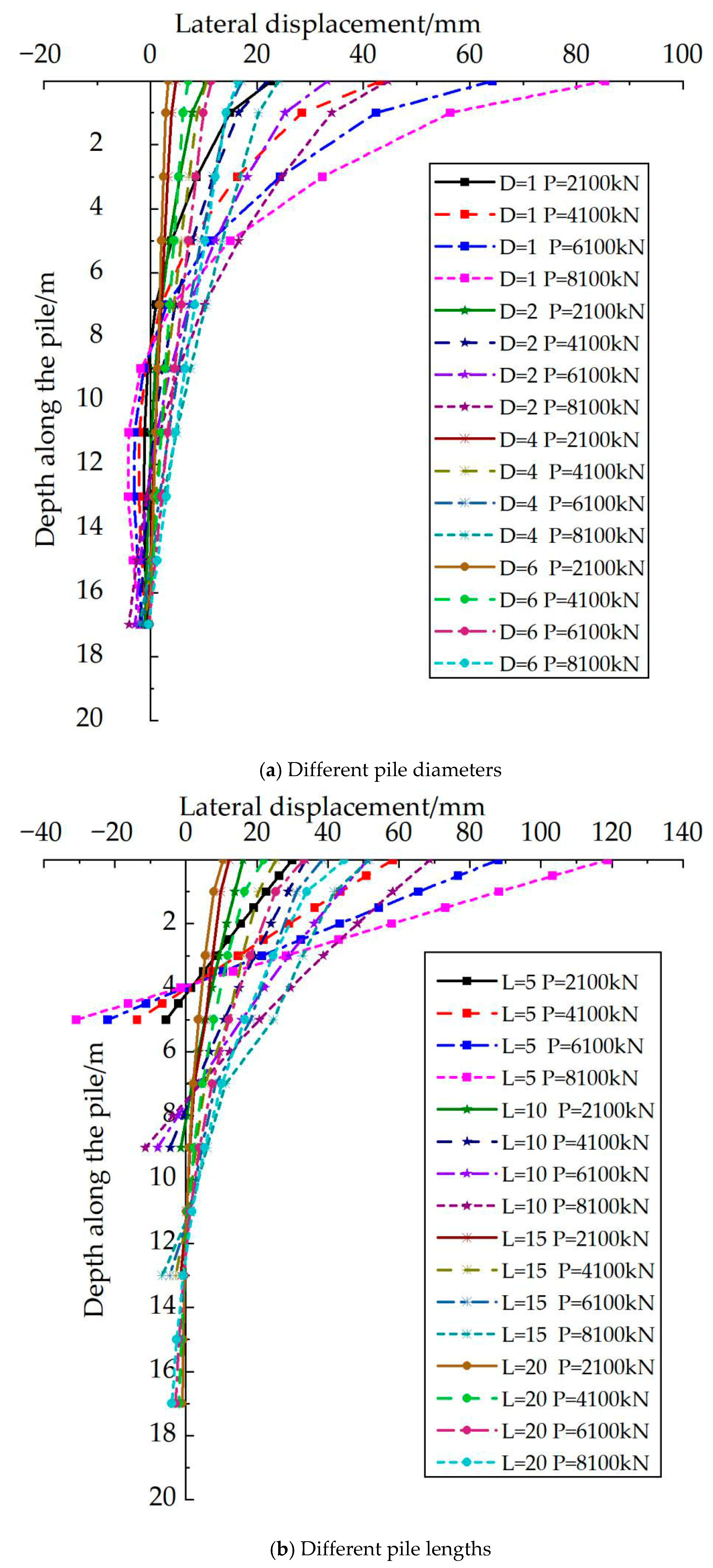
Figure 18 illustrates the lateral displacement along the pile body for different pile foundation dimensions.
As shown in
Figure 17, the lateral displacement of the pile exhibits a distinct nonlinear variation along its depth. The greater the lateral force at the pile top, the more pronounced the nonlinear change in displacement with depth. The pile top displacement increases linearly with the top lateral force. A zero-displacement point emerges at a specific depth, where the displacement curve reaches zero. Under different load conditions, these zero points converge at approximately 6D (11–13 m depth). When rock mass parameters remain constant, the zero-point depth stays consistent with increasing top load. Above this point, lateral resistance is provided by the front passive rock mass, while below it, the rear passive rock mass supplies resistance. Observing the impact of rock mass parameters, the deformation modulus and GSI value significantly influence displacement, whereas uniaxial compressive strength and inherent parameter mi show no effect. Poisson’s ratio has a minor impact. Since the deformation modulus and GSI value are correlated, the primary factor affecting displacement is the rock mass deformation modulus. When the top load is 8100 kN and the rock mass deformation modulus is 50 MPa, 100 MPa, 500 MPa, and 1000 MPa, the top displacements are 43.26 mm, 29.35 mm, 17.04 mm, and 15.37 mm respectively, demonstrating nonlinear variation between displacement and deformation modulus. The zero depth of pile lateral displacement varies with the rock mass deformation modulus. When the deformation modulus reaches 50 MPa, 100 MPa, 500 MPa, and 1000 MPa, the corresponding zero depths range from 11 m to 13 m, 9 m to 11 m, 7 m to 9 m, and 7 m to 9 m respectively. As the deformation modulus increases, the curvature of the pile’s lateral displacement curve decreases (i.e., the slope increases), indicating that the rock mass deformation modulus primarily affects the depth range of pile deformation and the bending deflection of the pile body. Analysis reveals that rock deformation parameters significantly influence pile lateral displacement, while rock strength parameters have no effect.
As shown in
Figure 18, pile foundation dimensions significantly influence lateral displacement, with both diameter and length variations having substantial effects. When examining diameter variations, smaller diameters exhibit pronounced nonlinear deformation. As diameter increases, the nonlinear depth-dependent displacement characteristics gradually diminish, exhibiting increasingly rigid pile behavior. For diameters of 1 m, 2 m, 4 m, and 6 m, the zero-displacement points correspond to depths of 7–9 m, 11–13 m, 15–17 m, and 15–17 m respectively, representing approximately 8D, 6D, 4D, and 3D of the pile diameter. This demonstrates the significant impact of diameter on deformation depth. Regarding length variations, 5 m and 10 m piles show linear displacement–depth relationships with minimal flexural deformation, exhibiting rigid behavior. At 15 m, the displacement curve becomes nonlinear. Notably, for short piles (5 m and 10 m in this case), the zero-displacement point occurs at approximately 3.8 m. However, under different load levels, the displacement curves converge at a single point slightly above the zero-displacement level, where displacement remains non-zero. This contrasts with
Figure 17 where load-level variations cause convergence at the zero point. As length increases, the convergence point’s displacement gradually decreases until reaching zero at 15 m. For 4 m and 6 m diameters, 5 m and 10 m lengths exhibit rigid behavior, while 1 m and 2 m diameters with 15 m and 20 m lengths demonstrate flexible behavior.
Piles can be classified as rigid or flexible based on their flexural deformation characteristics. Rigid piles, characterized by high stiffness or poor deformation resistance of the surrounding rock mass, exhibit rotational behavior around a specific depth point. Flexible piles, however, demonstrate nonlinear deformation under lateral forces, with their lateral displacement decreasing gradually from the pile top along the depth. Poulos et al. [
29] proposed a classification method for rigid and flexible piles based on the relative stiffness between the pile and soil.
where
is the soil elastic modulus;
is the length of the pile embedded in the geotechnical mass; and
and
are the pile’s elastic modulus and cross-sectional moment of inertia, respectively. A pile is classified as rigid when its value
is less than 4.8, and as flexible when it exceeds 388.6.
The port engineering pile [
30] determines the rigid–flexible pile by the pile–soil relative stiffness coefficient
.
Combined with
Figure 17 and
Figure 18, both the rock mass deformation modulus and pile foundation dimensions significantly influence the shape of pile flexural deformation. The values calculated for different pile foundation dimensions according to Equation (38) are presented in
Table 4, which
represent the rock mass deformation modulus.
The calculation in
Table 4 shows that the pile foundation is rigid when the pile length is 6 m and 5 m, and flexible when the pile diameter is 1 m. The other pile foundation is between rigid and flexible, and the calculation result is consistent with the numerical calculation result.
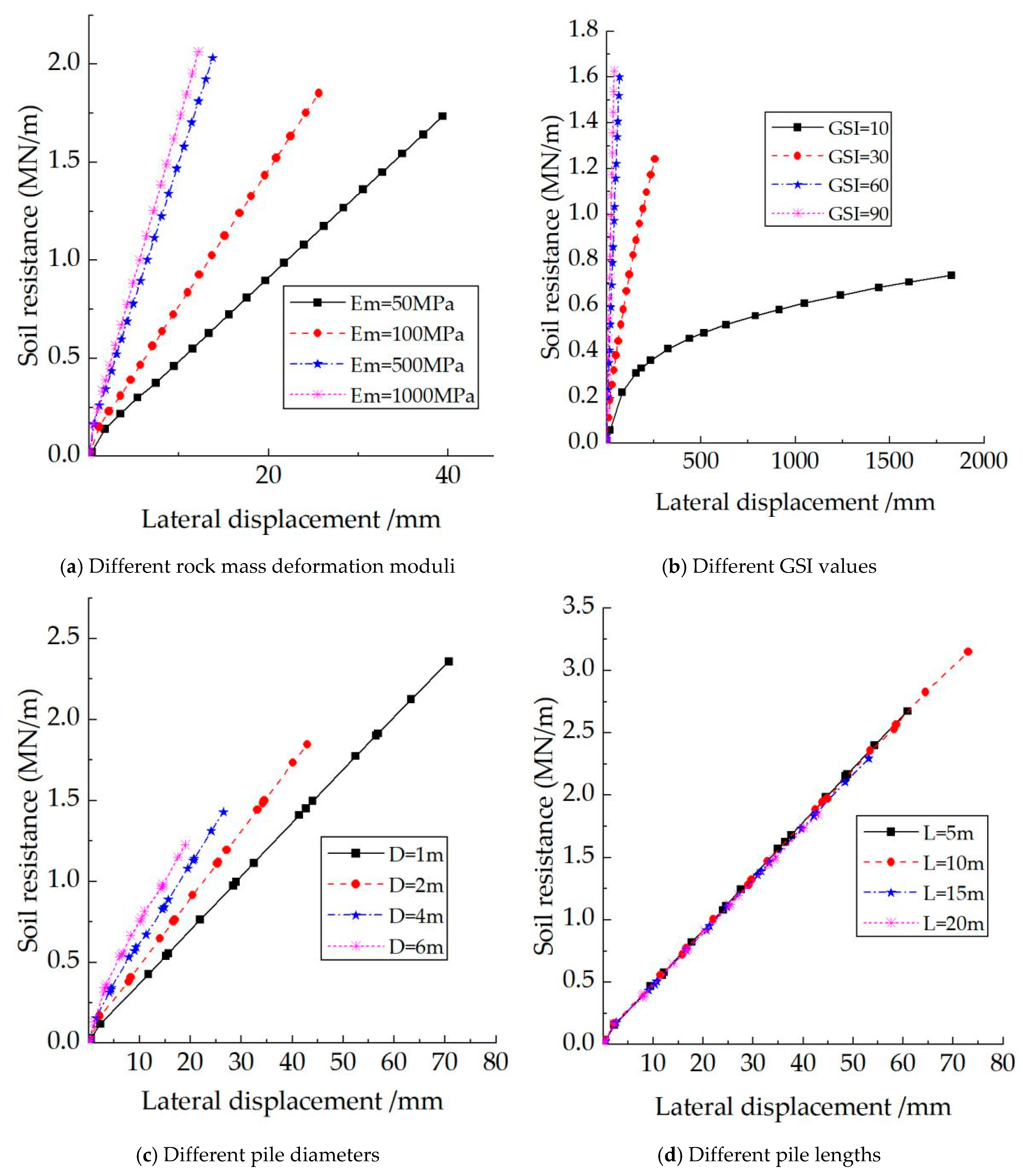
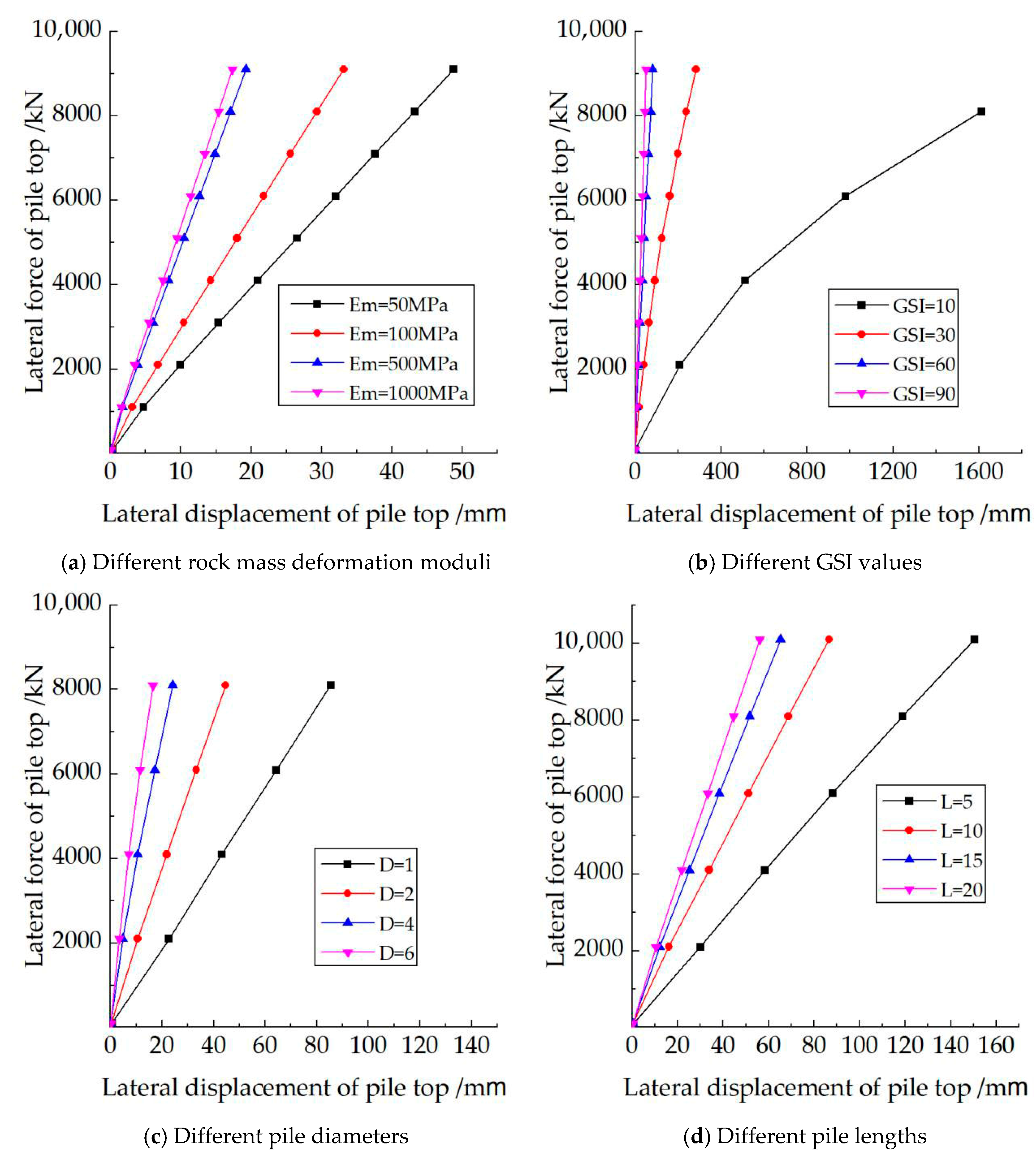
Figure 19 shows the load–displacement curves of pile tops with different pile foundations and rock mass parameters.
Figure 19 shows that, except for GSI 10, the piles never reached the ultimate state under 8.0 MN loading. As the deformation modulus, pile diameter, and pile length increased, the pile’s deformation resistance increased sharply, indicating that the lateral bearing capacity of pile foundations is related to both the rock mass deformation modulus and pile foundation dimensions. When the pile’s lateral displacement is small, the pile top’s lateral displacement and lateral force exhibit a linear relationship.
Figure 20 presents the
p-
y curves at −2 m depth for various pile foundation and rock mass parameters. The figure demonstrates that pile length variations do not affect the initial stiffness of the
p-
y curve. Compared with
Figure 18 and
Figure 19, it becomes evident that pile length significantly influences the deflection deformation of the pile body and the total lateral bearing capacity while having minimal impact on the initial stiffness of the pile’s
p-
y curve. Initial stiffness typically corresponds to the elastic stiffness of soil under small deformation. While pile length affects the overall pile stiffness, the initial stiffness of the
p-
y curve primarily depends on the properties of the surrounding rock mass and the pile–rock interaction mechanism. This is because initial stiffness corresponds to a small strain state where the rock mass has not yet undergone plastic yielding. At this point, the rock mass reaction force distribution depends only on the contact stiffness of the pile–rock interface and the local rock mass properties. The pile length, however, affects the overall deformation pattern and internal force distribution of the pile and does not alter the initial elastic support capacity of the rock mass at a fixed depth.
The primary factors affecting the initial stiffness of the pile’s
p-
y curve are the rock mass deformation modulus and pile diameter.
Table 5 and
Table 6 provide the initial stiffness values of the
p-
y curves corresponding to different rock mass parameters and pile foundation dimensions. Regression analysis of the
p-
y curves based on these data reveals relationships between the
p-
y curves and the rock mass deformation modulus, pile–rock relative stiffness, and pile diameter. Since pile length has no effect on the initial stiffness of the
p-
y curve, the pile–rock relative stiffness is calculated as
when considering the pile–rock relative stiffness.
The initial stiffness equation of the
p-
y curve used by Liang et al. [
7] is as follows:
In this formula, the pile foundation adopts the reference pile diameter, Dref = 0.305 m. The existing
p-
y curve initial stiffness is applicable to small-diameter piles. For large-diameter rock-socketed piles, the surrounding rock mass has a larger range of influence, and the increase in diameter has a significant impact on the initial stiffness of the
p-
y curve. Since the actual pile diameter is directly considered in this study when investigating the influence of pile diameter on pile deformation, rather than using the reference pile diameter, the initial stiffness relationship of the
p-
y curve is redefined as follows:
In the formula, a, b, and c are undetermined coefficients, while Dref = 1.0 represents the dimensionless reference pile diameter.
The initial stiffness of the
p-
y curve is obtained by regression analysis:
The Formula (40) is the empirical formula for calculating the initial stiffness of the p-y curve of the rock-socketed pile.
Table 7 compares the calculated
Ki values with those predicted by empirical formulas.
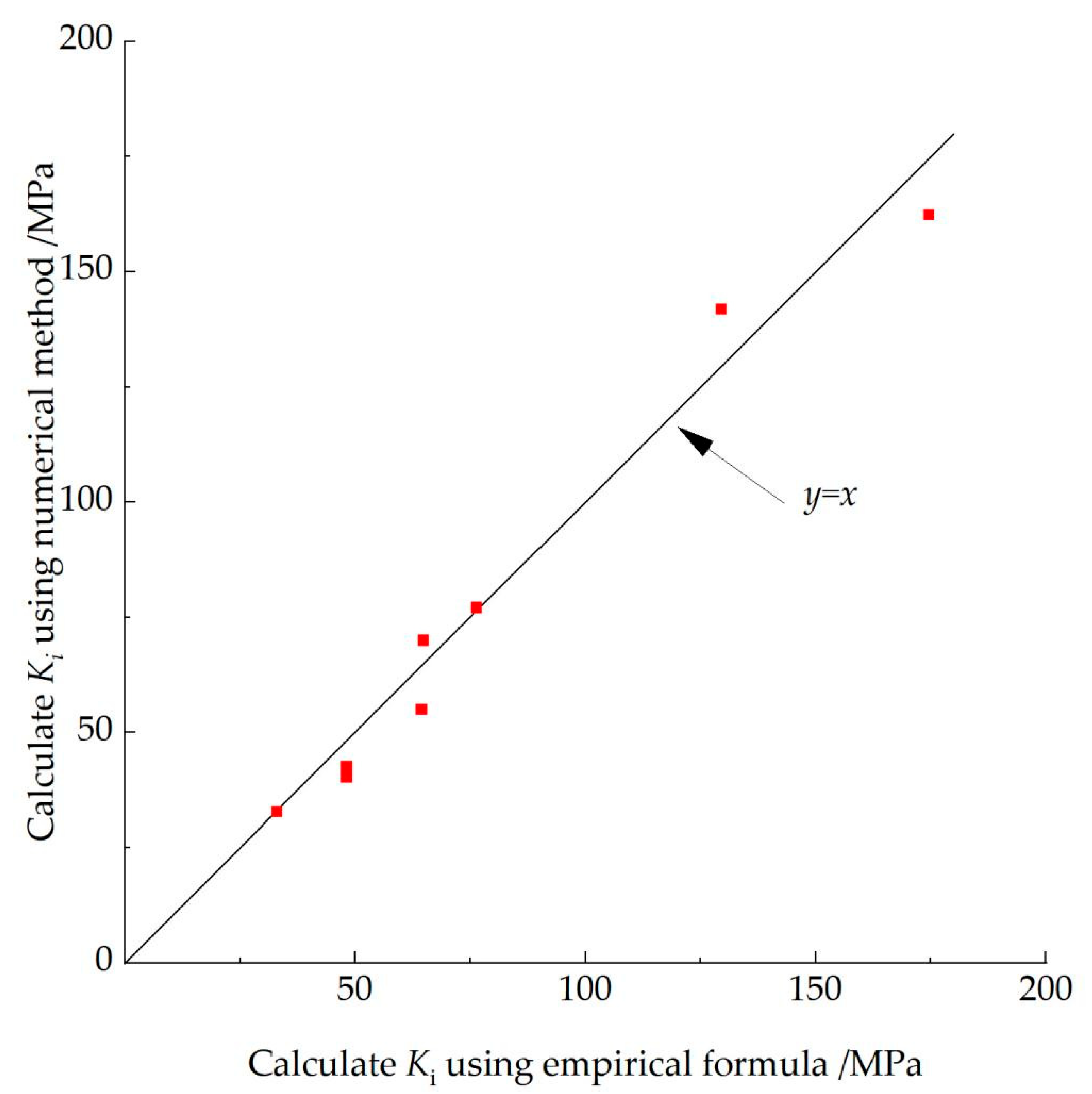
Figure 21 compares the numerical calculation of Ki with the empirical formula calculation of
Ki.
When a data point lies on the straight line y = x, the calculated Ki value equals the empirical formula Ki value. The greater the deviation of the data point from the line y = x, the larger the difference between the two values.
As shown in
Table 7 and
Figure 21, the
Ki values derived from empirical formulas show minimal deviation from those calculated numerically. This confirms the validity of the regression-based empirical formula, which can be effectively applied to determine the initial stiffness of
p-
y curves.
5. Discussion
The rock mass failure criterion was analyzed through comparative methods, revealing the distribution patterns of normal and shear stresses around the pile. Both stress types exhibit symmetry relative to the loading direction. The normal stress reaches its maximum at the pile’s leading edge and decreases progressively along the circumference, with the circumferential normal stress being minimal (zero) perpendicular to the loading direction. The shear stress starts at zero directly ahead of the pile, increases counterclockwise along the circumference, peaks at approximately 30°, and then diminishes gradually. The circumferential shear stress is also zero perpendicular to the loading direction. Through this analysis, the distribution functions of normal and shear stresses around the pile were established.
The lateral displacement of a pile reaches its maximum at the pile top and decreases progressively with depth. At a specific depth, the displacement becomes zero, known as the zero-displacement point. Under different load conditions, these zero-displacement points converge at a single location. The depth of the zero-displacement point is correlated with the rock mass deformation modulus, pile foundation dimensions, and the relative stiffness between the pile and rock. Notably, the lateral displacement at the intersection point of the rigid pile’s displacement curve is non-zero. A relationship equation for the pile body’s lateral displacement curve has been proposed, which can be used to calculate the pile body’s lateral displacement, cross-sectional rotation angle, bending moment, shear force, and circumferential lateral resistance.
The initial stiffness of p-y curves remains consistent across different depths, with its magnitude being influenced by both the rock mass modulus and pile diameter through a nonlinear relationship. While pile length affects pile foundation stiffness, it has no effect on the initial stiffness of p-y curves.
Similarly, rock mass strength parameters have no impact on the initial stiffness of p-y curves. The conclusion is only applicable to the initial stiffness of p-y curve, the main factors affecting the initial stiffness are the relative stiffness of pile rock, rock mass modulus and pile diameter.
Through analyzing the various influencing factors of p-y curves, an empirical formula for their initial stiffness was derived. By combining the initial stiffness with the ultimate bearing capacity per unit length, a hyperbolic p-y curve can be obtained.