Review

FRP–Steel Composite Tube Confined Seawater–Sea-Sand Concrete Columns: State-of-the-Art Review


1
School of Urban Construction, Hainan Vocational University of Science and Technology, Haikou 571137, China
2
Faculty of Engineering, Built Environment and Information Technology, SEGi University, Petaling Jaya 47810, Selangor, Malaysia
3
School of Physics and Telecommunication Engineering, Yulin Normal University, Yulin 537000, China
4
School of Environment and Civil Engineering, Dongguan University of Technology, Dongguan 523808, China
5
Department of Civil, Construction and Environmental Engineering, Iowa State University, Ames, IA 50011, USA
6
School of Engineering and Built Environment, Griffith University, Brisbane, QLD 4222, Australia
*
Authors to whom correspondence should be addressed.
These authors contributed equally to this work.
Buildings 2026, 16(7), 1351; https://doi.org/10.3390/buildings16071351
Submission received: 23 December 2025 / Revised: 17 March 2026 / Accepted: 23 March 2026 / Published: 29 March 2026
(This article belongs to the Section Building Structures)

Abstract

With the depletion of river sand and the rapid expansion of marine infrastructure, seawater–sea-sand concrete (SSC) has attracted increasing attention due to its low cost and sustainability. However, the high chloride content in SSC accelerates steel corrosion. This significantly limits its use in conventional reinforced concrete structures. In recent years, the rise in FRP–steel composite confinement has offered a new solution to this durability bottleneck. Based on this background, scholars have proposed a new type of FRP–steel composite tube confined seawater–sea-sand concrete (FCTSSC) column. This paper reviews the research progress on SSC, CFST, FCFST, and FCTSSC. The latter systems are developed based on the former. The results show that advanced FCTSSC columns exhibit strong synergistic confinement between the FRP and the steel tube when compared with CFST and FCFST. This synergy enhances the bearing capacity, ductility, and post-peak behavior of SSC. Both external and internal FRP configurations can reduce the brittleness and expansion of SSC. They also effectively restrain local buckling of the steel tube. Existing studies mainly focus on short columns. Research on intermediate slender and slender columns remains limited. This includes structural behavior, rational design models, and long-term durability. Finally, future research directions are proposed to support the practical application of FCTSSC in marine engineering.

1. Introduction

With the rapid development of marine engineering, the demand for concrete in ports, seawalls, and sea-crossing bridges continues to increase. Meanwhile, freshwater and river sand are becoming scarce. Seawater–sea-sand concrete (SSC) has therefore been considered a sustainable alternative. Previous studies show that SSC exhibits good workability, early strength, and impermeability. However, its high chloride content can induce steel corrosion, which limits its application in conventional reinforced concrete structures [1,2,3].
Concrete-filled steel tubes (CFST) benefit from the confinement provided by steel tubes. They exhibit high load capacity and ductility and are widely used in practice. In marine environments, however, CFST still suffers from steel corrosion, local buckling, and durability degradation. To address these issues, fiber-reinforced polymer (FRP) has been externally applied to steel tubes due to its great performance [4,5,6], forming FRP-confined CFST (FCFST). External FRP confinement delays steel buckling and enhances strength and ductility. Nevertheless, ordinary concrete remains the core material, and steel corrosion in chloride-rich environments cannot be fully avoided.
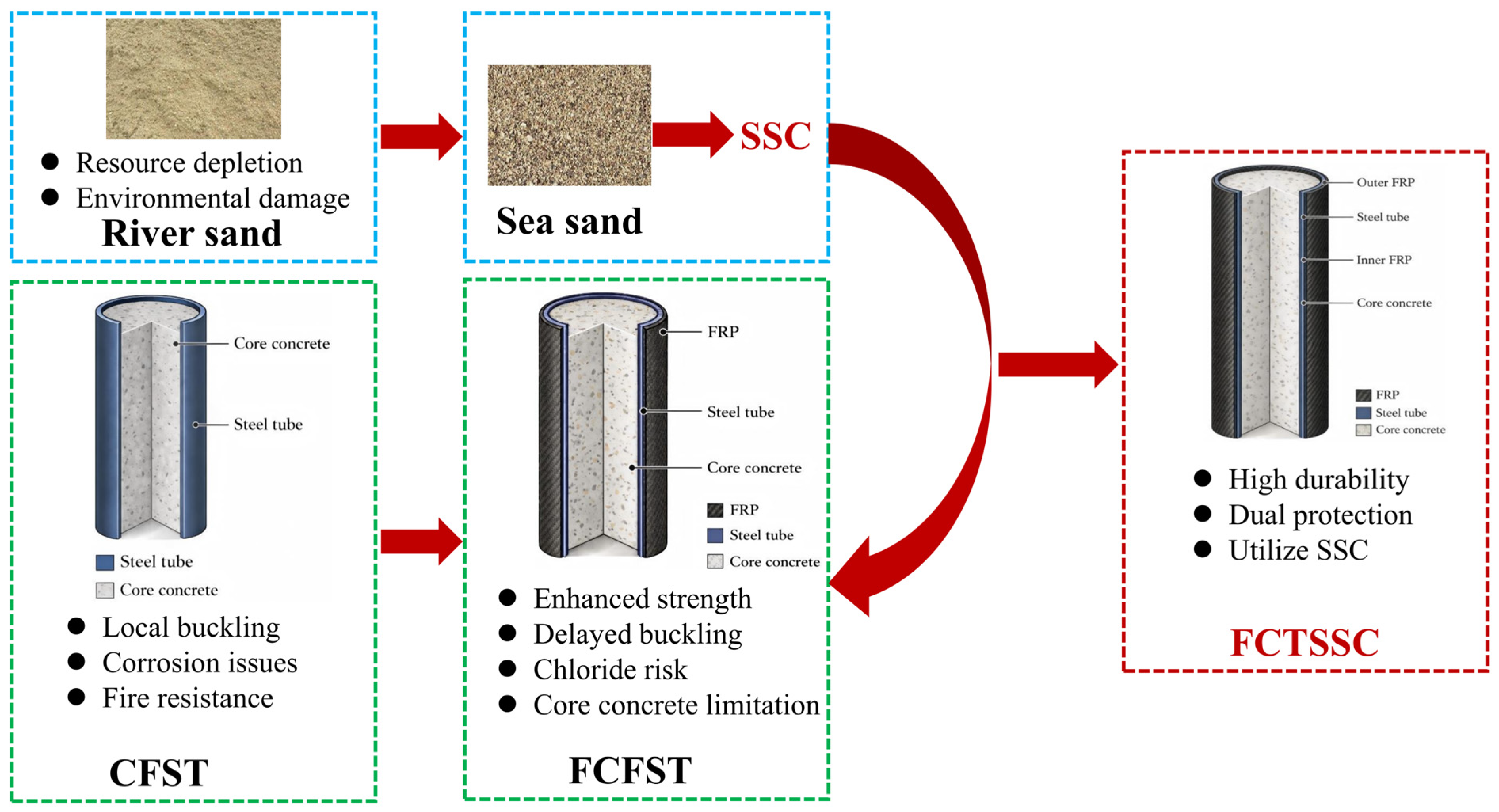
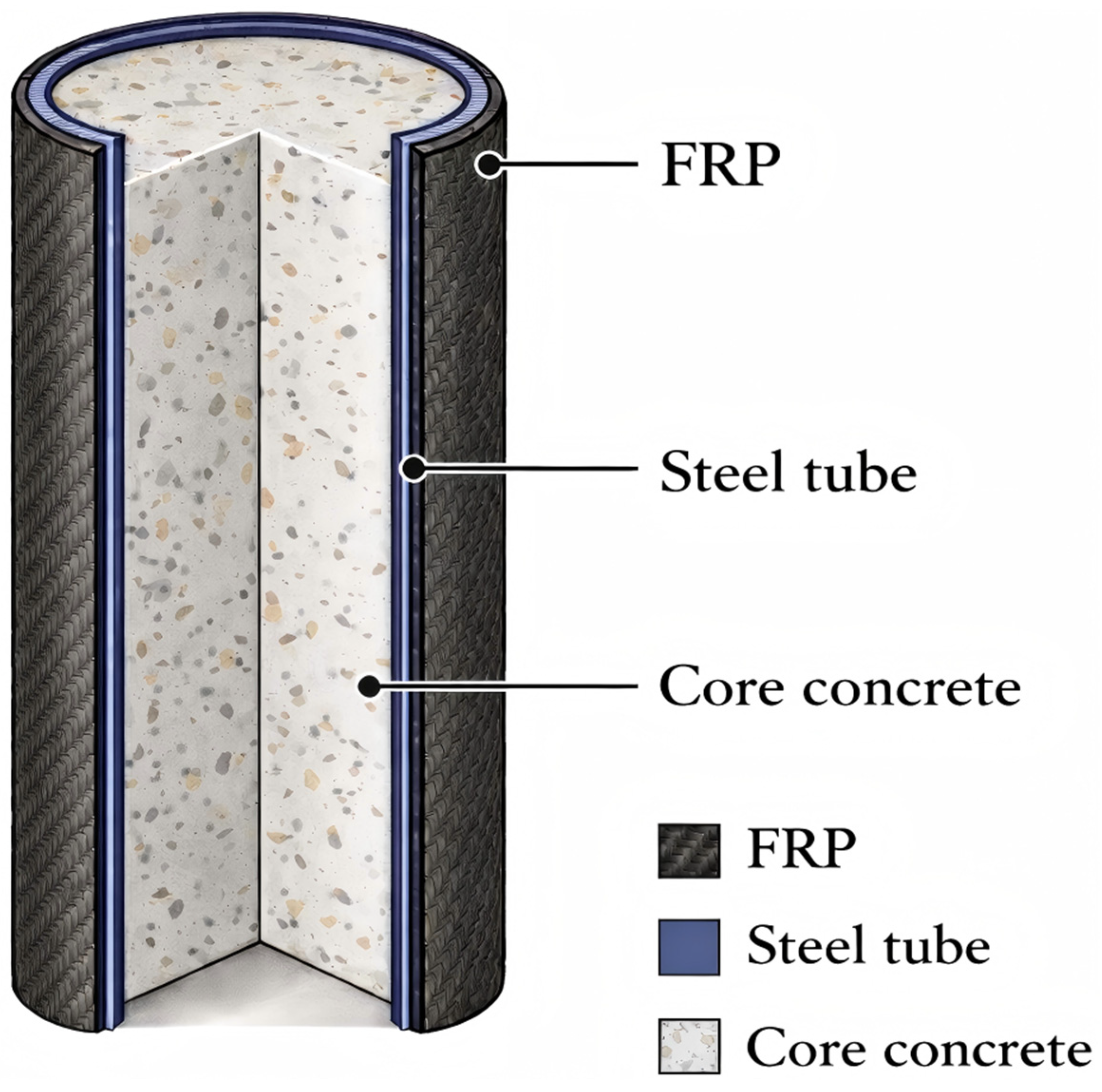
To address these challenges, a novel FRP–steel composite tube confined seawater–sea-sand concrete (FCTSSC) column has been proposed, as shown in Figure 1. Unlike CFST and FCFST, FCTSSC innovatively incorporates FRP layers on both the inner and outer surfaces of the steel tube. This configuration effectively isolates SSC from steel, suppresses chloride ingress, and provides dual-confinement through the combined action of inner FRP, steel, and outer FRP. Existing studies indicate that FCTSSC columns outperform CFST and FCFST in axial capacity, ductility, and buckling resistance. However, current research mainly focuses on short columns under monotonic axial loading. The behavior of slender FCTSSC columns remains insufficiently studied, and their performance under cyclic and dynamic loading is still unclear. Moreover, the research parameters are limited. Few studies have examined components fabricated with GFRP fabrics, which are more economical for practical engineering.
Based on the above background, the main objective of this paper is to provide a systematic and in-depth review of current research on FCTSSC columns. This review is not a simple compilation of previous studies. Instead, it aims to clarify the evolutionary development from SSC to CFST and FCFST, and finally to the FCTSSC system. The review highlights the dual-confinement mechanism introduced by the inner and outer FRP layers. This mechanism distinguishes FCTSSC columns from conventional composite columns.
To achieve this objective, the review systematically: (i) summarizes the development of SSC, CFST, and FCFST, which form the technological foundation of FCTSSC; (ii) synthesizes the available experimental and numerical evidence on FCTSSC columns; (iii) classifies the key parameters and loading conditions investigated in the literature; and (iv) identifies critical research gaps related to slenderness effects, durability performance, and design modeling. The ultimate goal is to establish a clearer research framework and to provide actionable insights for the future design and application of FCTSSC columns in marine infrastructure.

2. Literature Search and Selection Methodology

To enhance transparency and reproducibility, we identified the literature through structured searches in the Web of Science Core Collection and Scopus. The search strings combined keywords related to seawater–sea-sand concrete and composite confinement systems. Terms included “seawater–sea-sand concrete or SSC,” “concrete-filled steel tubes or CFST,” “FRP-confined concrete-filled steel tubes or FCFST,” and “FRP–steel composite tubes or FCTSSC.” We also used “axial compression,” “slenderness ratio,” “buckling,” “cyclic loading,” “impact,” “durability,” and “finite element.” The primary window for SSC/CFST/FCFST studies was 1990–2025. For the emerging FCTSSC system, the window was 2019–2025.
Studies included in the core evidence synthesis were restricted to peer-reviewed journal articles. These studies were required to report: (i) member-level mechanical behavior, confinement mechanisms, and durability responses of SSC/CFST/FCFST/FCTSSC columns; or (ii) validated numerical or theoretical models. Exclusion criteria included non-peer-reviewed outputs, studies lacking sufficient experimental or numerical details for interpretation, duplicate publications, and studies focusing only on material-scale properties without addressing structural member behavior.
The screening procedure followed the PRISMA workflow. Records were exported from the two databases, merged, and duplicates were removed. Title and abstract screening was then conducted, followed by full-text eligibility assessment. The selected studies were subsequently classified according to structural system (SSC/CFST/FCFST/FCTSSC), loading type (monotonic loading, cyclic loading, impact loading, and durability testing), and methodological approach (experimental, numerical, and theoretical methods).
The statistical details of the PRISMA process are as follows. A total of 1660 records were identified from the databases, including 742 from Web of Science and 918 from Scopus. After removing 452 duplicate records, 1208 records remained for title and abstract screening. Subsequently, 915 records were excluded, as they were not directly related to SSC/CFST/FCFST/FCTSSC structural systems, did not involve member-level behavior, or fell outside the scope of structural engineering. Full-text assessment was conducted for 293 articles. Among them, 113 studies were excluded due to insufficient methodological information, focus on non-member-scale topics, duplicated datasets, or lack of peer review. Ultimately, 180 peer-reviewed journal articles were included in the core evidence synthesis. In addition, some standards or guidelines were retained as supplementary references to clarify the background of design provisions and engineering practice, but they were not included in the PRISMA core synthesis dataset.

3. Evolution of Composite Confinement Systems

3.1. SSC as a Sustainable Concrete Material

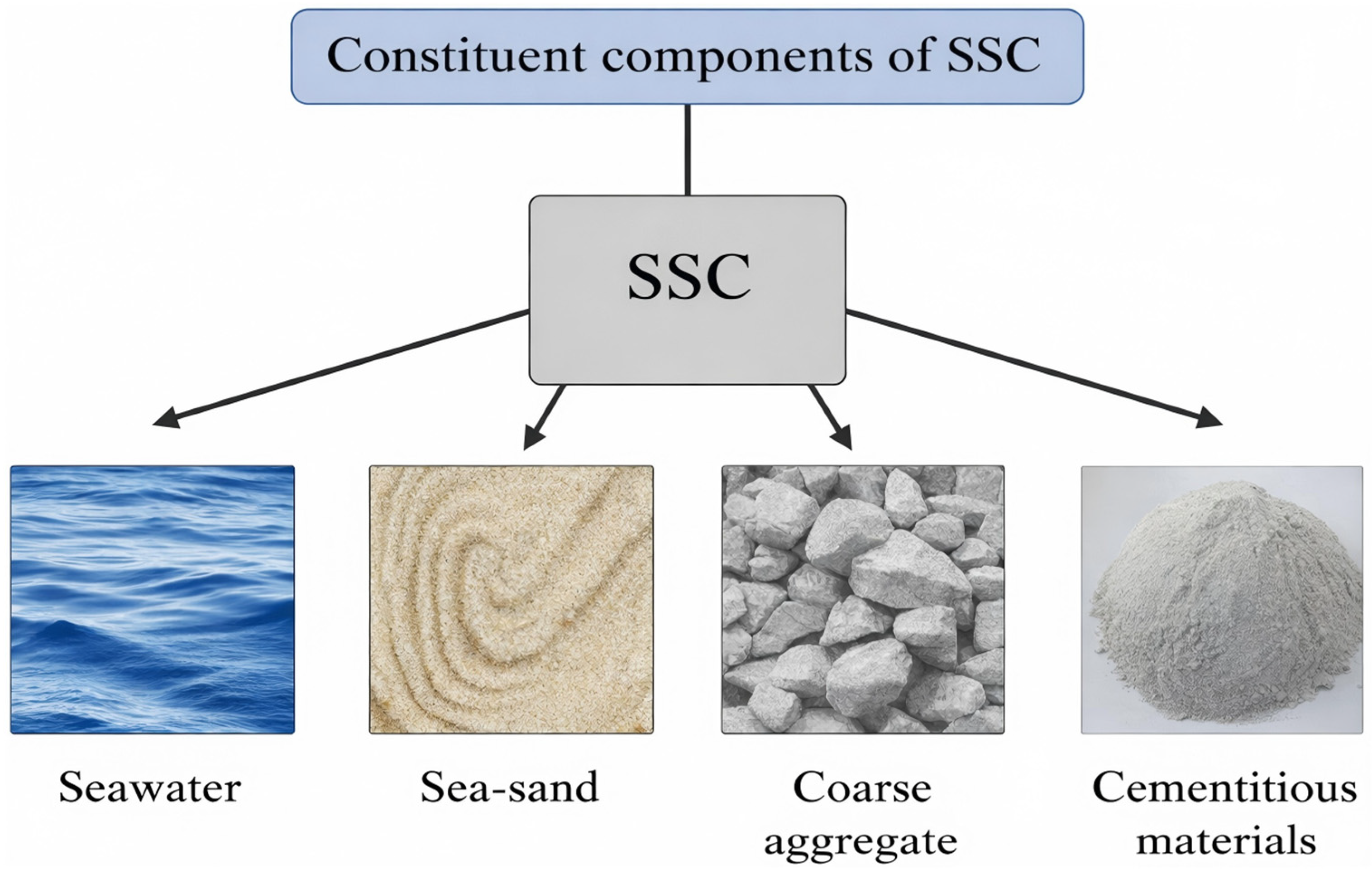
As shown in Figure 2, SSC is a new type of concrete. It uses seawater as mixing water and sea sand as fine aggregate, combined with coarse aggregate and cementitious materials. In the 1960s, British researchers pioneered a series of studies on the feasibility of using sea sand as a construction material [7,8,9]. Over time, research on SSC has focused on its workability, mechanical properties, and durability.

3.1.1. Workability

The workability of concrete mainly includes setting time and fluidity. It is commonly evaluated by the initial and final setting times and the slump. Existing studies generally show that SSC can accelerate cement hydration and shorten the setting time of concrete. Compared with conventional concrete, seawater concrete exhibits shorter initial and final setting times while maintaining similar consistency [10,11,12,13]. This acceleration is mainly attributed to the presence of salts in seawater. However, the effect depends on the salinity level. Moderate salt concentrations shorten the initial setting time. Excessively high salinity may partially offset this effect [12].
In contrast, the influence of sea sand on concrete fluidity remains inconsistent. Some studies report negligible effects or a slight increase in slump [14,15,16,17]. Other studies observe reduced workability with increasing sea-sand content [18]. These differences are mainly related to variations in sea-sand composition, particularly shell fragments and salt content. Shell particles can alter aggregate packing, whereas dissolved salts affect the rheological behavior of cement paste [19,20,21]. In addition, seawater and sea sand may improve pumpability and reduce autogenous shrinkage in high-performance marine concrete [22]. Overall, SSC generally accelerates the setting behavior. Their effects on workability are controlled by multiple factors, including salt concentration, shell content, and aggregate composition.

3.1.2. Mechanical Properties

The use of SSC in concrete production effectively alleviates the shortage of freshwater and natural river sand. However, the salinity of seawater and differences in aggregate properties may influence the mechanical performance of concrete. Many studies have shown that chlorides in seawater can accelerate cement hydration and enhance early compressive strength [17,23,24,25,26,27]. For example, seawater-mixed concrete usually exhibits higher strength at an early age, particularly at 7 days. This difference generally decreases with increasing curing time [17,25,26,27].
The development of compressive strength is also affected by curing conditions and salinity. Some studies indicate that seawater curing can accelerate early strength development [28,29]. However, excessively high salt concentrations may inhibit hydration and reduce long-term strength [12,19]. Similar trends have been reported in seawater coral concrete [30,31,32]. These findings suggest that salts in seawater can act as early-age activators and promote hydration reactions.
However, the long-term strength of SSC remains controversial. Some researchers reported that, with sufficient compaction and proper curing, the long-term strength of seawater-mixed concrete can be comparable to that of conventional concrete [17,33,34]. Other studies suggest that seawater curing or high salinity may reduce ultimate compressive strength or slow late-age strength development [12,26,28,35]. These discrepancies are mainly attributed to differences in mix design, concrete grade, and curing conditions [15,36]. In some cases, the long-term strength of seawater concrete is even slightly higher than that of ordinary concrete [37]. This phenomenon highlights the complex interactions between seawater chemistry and cement hydration.

3.1.3. Durability

Durability is another critical issue for SSC. It directly affects the long-term safety and service life of concrete structures. The durability of SSC is influenced by several factors. These include chloride ion penetration, carbonation resistance, permeability, freeze–thaw resistance, and environmental conditions.
Some studies report that SSC may exhibit a lower elastic modulus and reduced resistance to freeze–thaw cycles compared with conventional concrete. These drawbacks can be mitigated by incorporating supplementary cementitious materials, such as slag and pozzolans [38]. Chloride transport behavior has also been widely investigated. Some studies indicate that sea-sand concrete has higher chloride permeability [39]. In contrast, other studies report improved impermeability due to salt reactions and pore-filling effects that densify the matrix [13,19,40].
The carbonation resistance of SSC also remains controversial. Some researchers suggest that chloride ions refine the pore structure and enhance carbonation resistance [19,41,42]. Others report little difference between SSC and conventional concrete [12,15]. In addition, the interaction between chloride ions and carbonation introduces further durability challenges. Chloride ions may reduce porosity, whereas carbonation can release bound chlorides into free ionic forms, thereby accelerating steel corrosion [16].
Overall, SSC exhibits complex durability behavior. It may show advantages at early stages, but its long-term performance remains uncertain. These properties are strongly affected by salinity, aggregate impurities, mix design parameters, and curing conditions. Future studies should therefore clarify the coupled effects of chloride transport, carbonation, and environmental exposure. Such efforts will improve durability assessment and service-life prediction of SSC structures.

3.2. Development of CFST Column

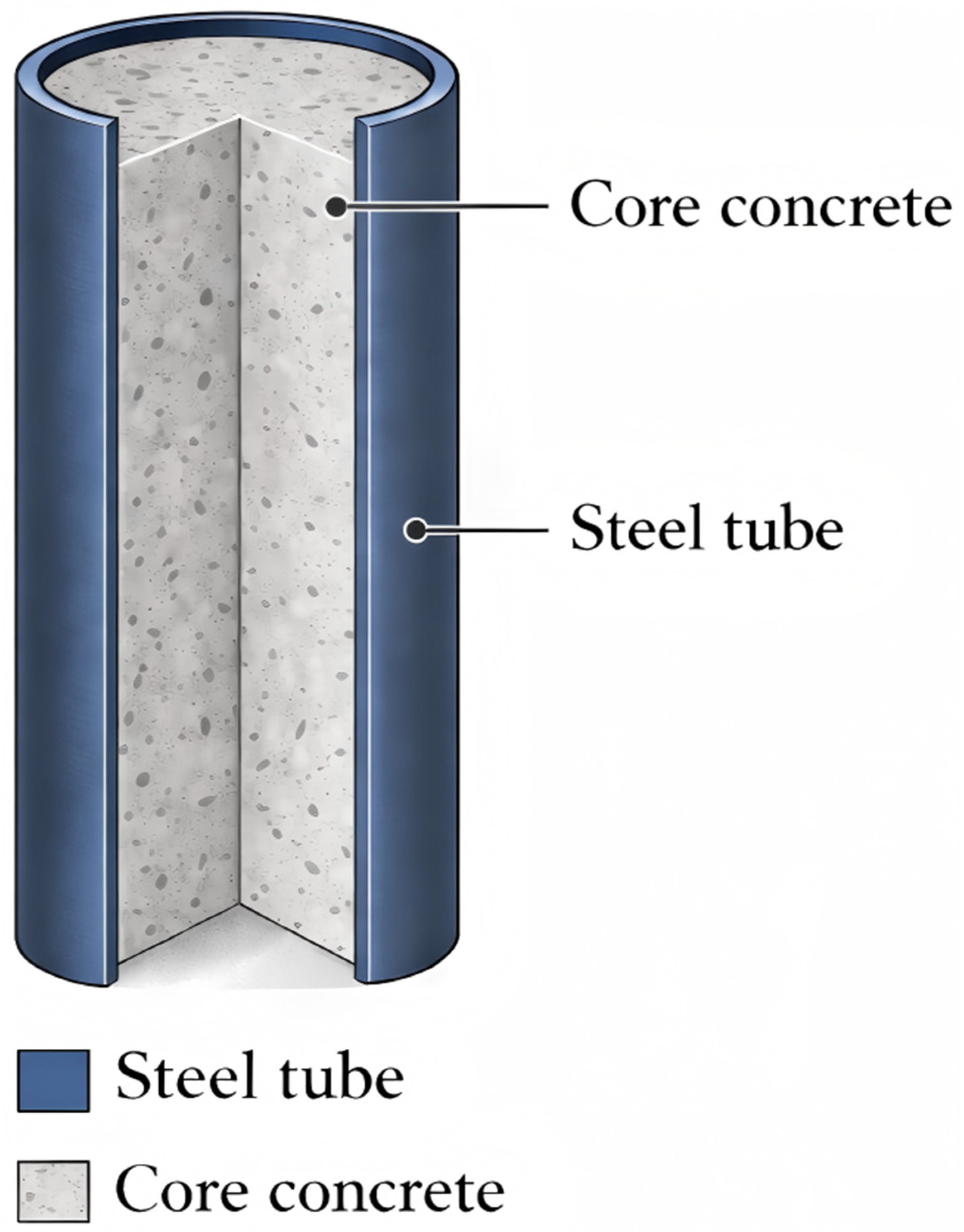
As early as 1879, the United Kingdom had been in the actual engineering application of the CFST column for the abutments of the Steven Railway Bridge. In 1926, Lally [43] first gave the formula for calculating the bearing capacity of a round CFST column; the structure schematic diagram is shown in Figure 3. And only after entering the second half of the 20th century, various countries began to conduct extensive and systematic research on CFST [44].

3.2.1. Compressive Performance

Compressive performance is a fundamental property of CFST columns and has been widely investigated. The axial behavior of CFST members is mainly controlled by several key parameters. These include the strength of the core concrete, the diameter-to-thickness ratio of the steel tube, steel strength, slenderness ratio, loading eccentricity, and cross-sectional configuration.
Increasing the strength of the core concrete generally enhances axial load capacity. However, high-strength concrete may reduce ductility because of its brittle nature [45,46,47,48,49,50]. A smaller diameter-to-thickness ratio increases the contribution of the steel tube. Higher steel strength further improves confinement efficiency and load-bearing capacity [51,52,53,54].
The slenderness ratio strongly affects the failure mode. Short columns usually fail due to material strength limits. Slender columns are governed by global instability induced by second-order effects. Intermediate columns exhibit elastic–plastic buckling between these two modes [55,56]. Increasing slenderness weakens the confinement provided by the steel tube. As a result, the overall mechanical performance of CFST columns decreases [57,58,59,60]. Under eccentric loading, bending effects become pronounced. Local outward bulging may occur on the compression side. This phenomenon reduces the compressive capacity [61,62].
Various cross-sectional forms have been studied. These include circular, square, rectangular, elliptical, and polygonal sections. Circular sections provide the strongest confinement because of uniform stress distribution. Square and rectangular sections are also widely used due to their advantages in structural connections.
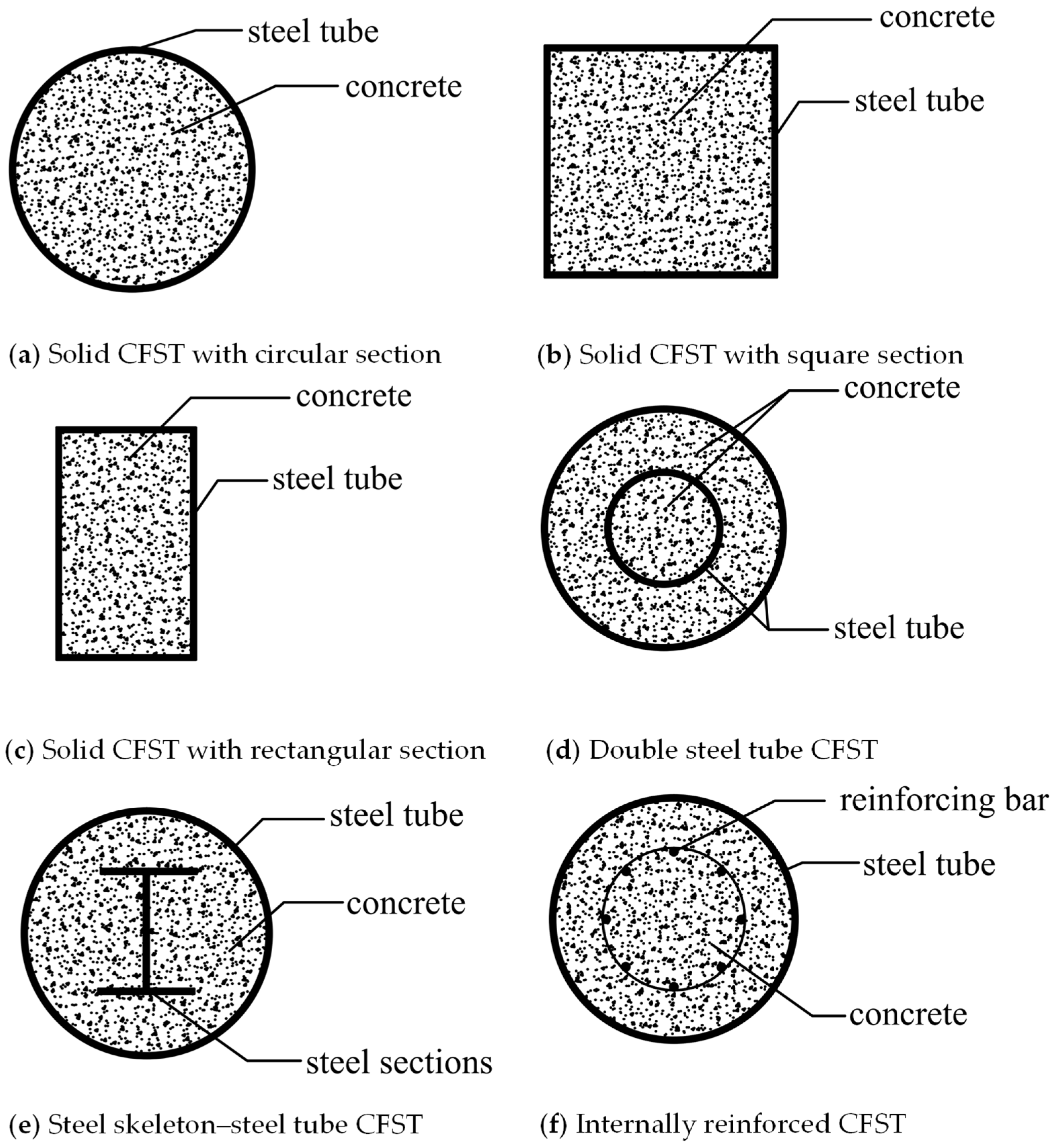
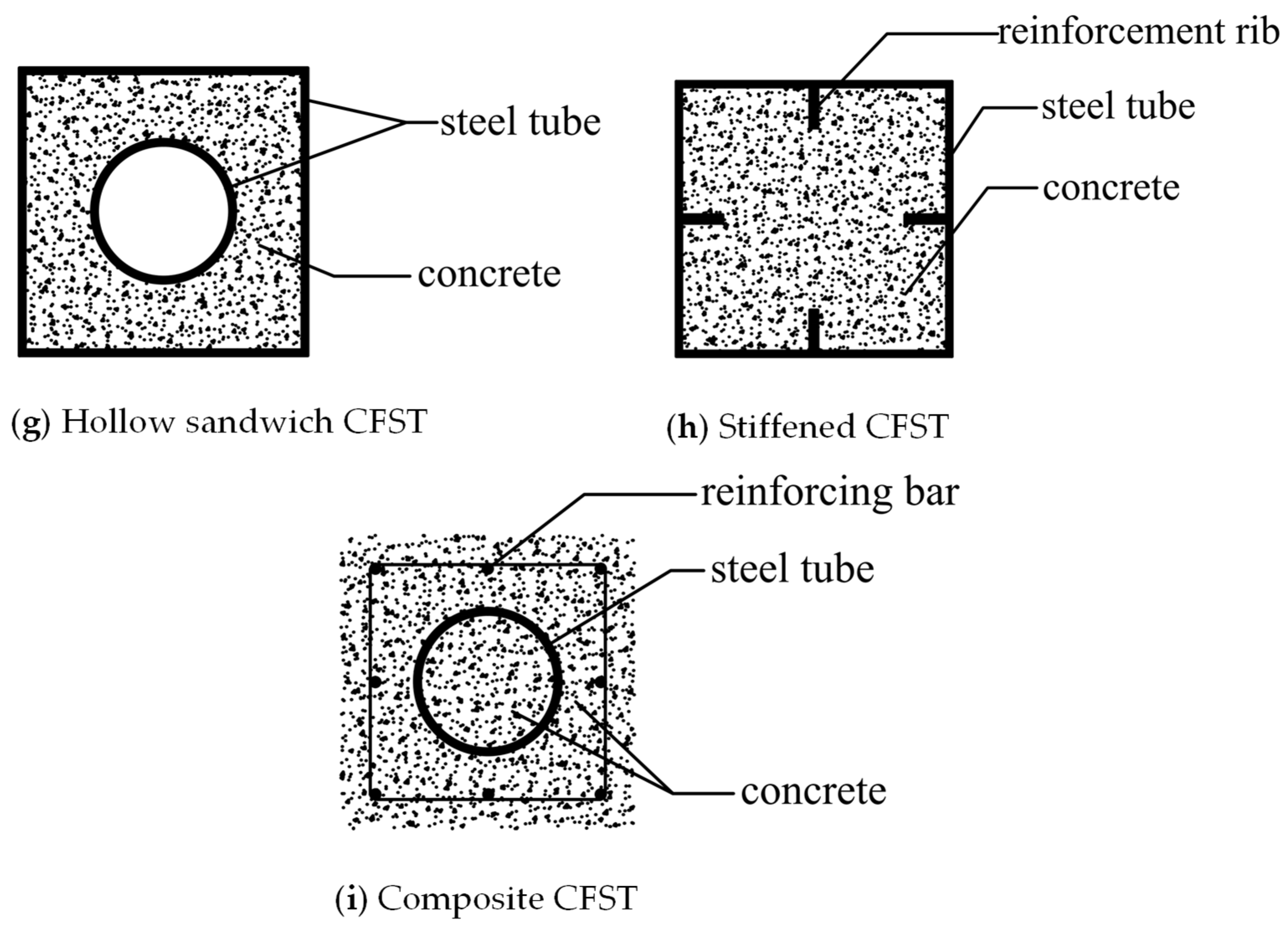
Beyond conventional solid CFST columns (Figure 4a–c), several advanced configurations have been developed to further enhance structural performance. These include double steel tube CFST columns, steel skeleton–steel tube CFST columns, internally reinforced CFST columns, hollow sandwich CFST columns, stiffened CFST columns, and composite CFST columns (Figure 4d–i). Systems with internal reinforcement can significantly increase load-bearing capacity [63,64,65,66,67,68], while hollow sandwich CFST columns exhibit higher bending stiffness and improved stability [69,70]. Stiffened CFST columns suppress local buckling of the steel tube through internal ribs [71,72,73], and composite CFST columns combine reinforced concrete with steel tube concrete to provide improved load capacity and protection against fire and corrosion [74,75].

3.2.2. Other Performance

In practical engineering structures, CFST members are often subjected to complex loading conditions. Therefore, their behavior under bending, shear, tension, torsion, and combined loads has been widely investigated.
During bending, the core concrete alters the failure mode of the steel tube. Wavy buckling usually appears in the compression zone, while multiple cracks form in the tension zone. Compared with conventional reinforced concrete members, CFST structures typically exhibit smaller crack spacing and narrower crack widths due to the confinement provided by the steel tube [76,77]. Under shear loading, the shear span-to-depth ratio governs the failure mechanism. A lower ratio leads to shear-dominated failure, whereas a higher ratio results in flexural behavior [78,79].
CFST members also show favorable tensile and torsional performance. Cracks in the core concrete are uniformly distributed, which promotes energy dissipation under tension [80]. Under torsion, the steel tube mainly resists diagonal tensile stresses, while the core concrete restrains local buckling of the steel tube [81].
Based on extensive experimental and analytical research, several international design standards have been developed to guide the application of CFST structures. These include ACI 318-19 [82], AISC 360-16 [83], Eurocode 4 [84], and the design recommendations of the Architectural Institute of Japan (AIJ) [85], as well as the Chinese national standard GB 50936-2014 [86]. These standards have played an important role in promoting the safe and standardized application of CFST structures.
Overall, CFST columns exhibit excellent load-carrying capacity, ductility, and structural stability under various loading conditions. However, steel tubes remain susceptible to corrosion in marine environments. This limitation has motivated the development of more durable composite material systems.

3.3. Emergence of FCFST Column

FRP materials emerged in the 1940s and were initially applied in aerospace and military fields due to their great performance. Since the 21st century, FRP has been used to strengthen CFSTs or combined with them to form innovative composite structures, prompting extensive investigations into their mechanical properties. Wang et al. [87] creatively proposed the idea of CFRP-confined CFST structure as shown in Figure 5, which is based on CFST and FRP cylinder filled with reinforced concrete. This demonstrates their feasibility and potential for civil engineering applications.

3.3.1. Fully Wrapped Structure

Fully wrapped FCFST columns are formed by externally wrapping CFST members with continuous FRP fabrics, as shown in Figure 5. This configuration provides additional confinement to the steel tube and the core concrete. Early studies by Xiao et al. [88,89,90] showed that CFRP confinement produces a bilinear load–displacement response under axial compression. It delays local buckling in potential plastic hinge regions. As a result, the load capacity, ductility, and hysteretic performance are significantly improved.
Subsequent studies further clarified the structural behavior of FCFST columns. Wang et al. [87,91,92,93,94,95,96,97,98] systematically investigated their responses under axial compression, bending, shear, and cyclic loading through experimental and numerical analyses. They also proposed design approaches for predicting the load capacity and restoring force of composite columns. Tao et al. [99,100,101,102,103] experimentally studied CFRP-confined circular and square CFST columns. The results showed that CFRP confinement significantly increases the load capacity of circular sections, while mainly enhancing the ductility of square sections. Their research also demonstrated that CFRP wrapping can effectively repair moderately damaged short columns after fire exposure.
Further studies by Lu et al. [104,105,106,107] and Teng et al. [108,109,110,111,112] extended the understanding of FCFST behavior under various loading conditions, including axial, cyclic axial, and lateral loads. The results confirmed that FRP confinement delays local buckling and significantly improves mechanical performance. These studies also established analytical models and stress–strain relationships for FCFST columns, providing an important basis for structural design.

3.3.2. Partially Wrapped Structure

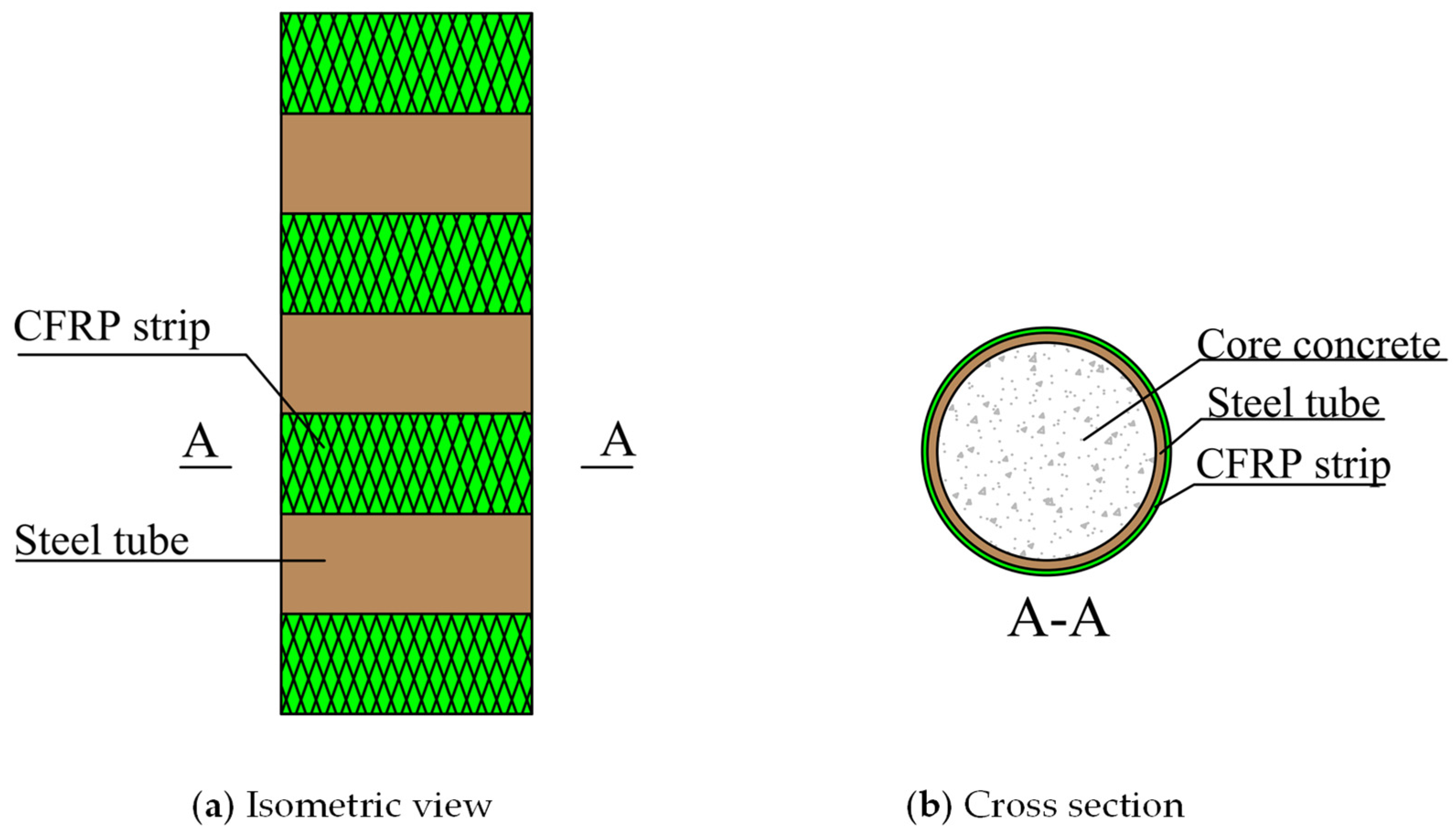
In addition to the fully wrapped system, partially wrapped FCFST columns using discontinuous FRP strips have also been investigated, as shown in Figure 6. Sundarraja et al. [113] demonstrated that reducing the spacing of CFRP strips improves confinement efficiency and increases load capacity. Shen et al. [114,115,116] further reported that CFRP strips effectively confine short CFST columns, although local buckling is more likely to occur in the uncovered regions. For slender columns, global bending becomes dominant. This behavior reduces the effectiveness of external confinement.
A comparative study by Zeng et al. [117] showed that both CFRP and PET-FRP strips enhance yield strength and stiffness. However, PET-FRP provides greater deformation capacity because of its higher ultimate tensile strain. Recent studies have further extended FCFST applications to different material combinations. Al-Osta et al. [118,119] investigated CFRP-strengthened stainless-steel CFST columns. Their results showed that FRP wrapping effectively suppresses local buckling and improves both axial and flexural capacities. Dong et al. [120,121] examined CFRP-confined recycled-aggregate concrete-filled steel tubes. They reported that full wrapping generally provides higher strength than strip wrapping. Circular sections also perform better than square sections. Liu et al. [122] and Cao et al. [123] further explored the influence of high-strength and ultra-high-performance concrete. Their findings indicate that higher concrete strength increases peak capacity but reduces the marginal confinement effectiveness of external FRP.
Overall, FCFST columns rely on the combined confinement of the steel tube, concrete core, and FRP jacket. This composite action significantly enhances load capacity, ductility, and energy dissipation. As summarized in Table 1, fully wrapped systems provide more uniform confinement and more stable failure modes. In contrast, partially wrapped systems offer advantages in material efficiency and construction economy. However, the effectiveness of FRP confinement decreases in slender members dominated by global buckling. These findings highlight the need for unified mechanical models and performance-based design approaches, particularly for marine environments where corrosion resistance and durability are critical.

4. State-of-the-Art of FCTSSC Column

4.1. Current Development on FCTSSC Column

FCTSSC columns have been proposed only in the past five years. Inspired by the replaceability of concrete types in FCFST columns, Wei et al. [124] used SSC and proposed a novel type of FCTSSC column. Unlike FCFST columns with single-layer FRP confinement, the inner FRP directly confines the lateral expansion of the SSC core. This promotes the early development of a triaxial compressive stress state. In contrast, the outer FRP mainly interacts with the steel tube and becomes effective after steel yielding. This sequential and complementary activation modifies the radial stress distribution. It reduces stress concentration at the steel–concrete interface. It also significantly delays the initiation and propagation of local steel buckling. Similar confinement mechanisms have been reported in past research [125]. Wei et al. [124] conducted axial compression tests on 36 FCTSSC columns. The experimental results indicated that under axial compression conditions, internal and outer FRP could synergistically enhance the structural bearing capacity and deformation capacity. Compared to the SFST column, the strength of FCTSSC columns could be increased by 11.7–66.5%. It can be observed that the essential difference between FCTSSC columns and FCFST columns lies in the presence of an inner FRP layer. This inner FRP enables an effective dual-confinement system. It significantly enhances the overall mechanical performance of the composite member. Meanwhile, the confinement mechanism is essentially similar to that of FCFST columns. Since FCFST and related composite members have been widely applied in practical engineering, such as buildings and bridges, the practical feasibility of FCTSSC columns can therefore be reasonably anticipated.
Based on that, several scholars investigated the mechanical properties of this column. Current research on FCTSSC columns primarily focuses on short columns with a slenderness ratio ranging from 5.6 to 8.4 [124,126,127,128,129,130,131,132], except for Refs. [1,2,3]. Experimental results show that these columns typically exhibited bulging or shear failure, accompanied by filament or banded rupture of the outer FRP fabrics. The number of FRP layers and the steel tube thickness have a significant positive effect on the ultimate stress of the specimens. Meanwhile, Wei et al. [126] proposed a classical model for predicting the ultimate bearing capacity of FCTSSC short columns. This model has been validated by a comprehensive database with favorable results. It can be observed that current research on FCTSSC columns is basically limited to short columns. There is a significant lack of studies on intermediate slender and slender columns, which are more applicable in actual engineering.
In addition, these studies utilize different composition materials to fabricate FCTSSC columns. In terms of the FRP fabrics, CFRP and BFRP are predominantly applied [2,3,124,126,127,128,129,130,131,133]. In contrast, studies on confinement using cost-effective GFRP materials remain very limited [1]. In some cases, the steel tube is replaced with steel wire mesh [129]. The core concrete includes common SSC [124,128,129,133], high-strength SSC [126,130], and coral aggregate SSC [127,131,132]. Compared with conventional SSC, coral aggregates typically exhibit higher porosity and greater brittleness. This degrades the strength of the aggregate skeleton. It also promotes microcrack initiation and crack propagation paths [134,135]. Such characteristics may influence the confinement efficiency by altering the lateral dilation behavior of the confined SCC core. Recent studies indicate that coral aggregate size significantly affects the uniformity of dilation and hoop strain. Existing stress–strain models developed for normal-aggregate concrete may not be directly applicable to coral aggregate concrete. This implies that the confinement efficiency requires recalibration [136]. In addition, the high porosity of coral aggregates accelerates the ingress and transport of aggressive ions. This leads to more pronounced durability degradation in marine environments. Therefore, for FCTSSC incorporating coral aggregates, these behaviors should be systematically investigated in future studies. In conclusion, the above results show that regardless of the FRP type, the FRP on both inner and outer surfaces works together effectively to provide confinement. CFCTSSC columns demonstrate higher ultimate strength, while BFCTSSC columns exhibit superior ultimate deformation capacity. For FCTSSC column specimens with higher concrete strength, the ultimate bearing capacity and its enhancement rate increase accordingly. Meanwhile, the steel wire mesh effectively reduced specimen damage and prevented sudden bearing capacity loss caused by FRP rupture.
Monotonic axial compression performance is fundamental to understanding the mechanical behavior of a kind of novel composite column structure. Current research on FCTSSC columns focuses primarily on this aspect [1,2,3,124,126,127,129,130,131,133]. Additionally, Zhang et al. [128] conducted cyclic axial compression tests on 12 FCTSSC columns. The results showed that FRP can effectively restrain the concrete expansion. Its strain recovery ability facilitates concrete shrinkage during unloading, and it slows down the development of plastic strain. Considering the different confinement mechanisms of the inner and outer FRP layers, a more rational cyclic stress–strain model is proposed.
As summarized in Table 2, research over the past five years on FCTSSC columns has systematically clarified the mechanisms of strength enhancement, deformation improvement, and typical failure modes of short columns under monotonic and cyclic axial compression. A database-validated framework for load-bearing capacity prediction has also been established. However, existing studies are largely limited to short columns with small slenderness ratios. The mechanical behavior of intermediate slender and slender columns remains insufficiently understood, particularly under the coupled effects of second-order actions, global stability, and material nonlinearity. Research on damage evolution under cyclic or dynamic loading is also limited. In addition, systematic evaluations of cost-effective GFRP-confined FCTSSC and long-term durability performance are still lacking. Field applications and pilot projects of FCTSSC columns remain very limited. Future studies should expand the ranges of slenderness and key parameters. More comprehensive experimental databases are needed. Unified design and predictive models should be developed. These models should incorporate the differentiated confinement from inner and outer FRP layers and the associated stability effects. Such efforts will better support practical engineering and promote actual application.

4.2. Comparative Synthesis Analysis

4.2.1. Slenderness Ratio and Slenderness Ratio Limit

For CFST columns, studies [57,137,138,139,140,141,142] have investigated the effects of slenderness ratio on the mechanical performance of CFST columns with various concrete and steel materials. Specifically, Refs. [57,142] conducted experimental investigations on the monotonic axial compression and cyclic axial compression behavior of conventional CFST columns. It was found that specimens with larger slenderness ratios (20.1 to 61) failed due to global buckling. Specimens with smaller slenderness ratios (14.4 to 46) also experienced global buckling. However, thicker columns failed due to concrete crushing and steel yielding. For cyclic axial compression, the slenderness ratio (8.4 to 28) significantly influenced post-peak behavior, with strength degradation increasing markedly as the slenderness ratio rose. This transition in failure mode indicates that with increasing slenderness ratio, global buckling gradually governs structural response. In contrast, the influence of material strength and confinement gradually diminishes. This is consistent with the results reported in previous studies [143,144].
On the other hand, Fu et al. [137] performed axial compression tests on slender CFST columns filled with lightweight aggregate concrete. They found that the slenderness ratio (12 to 60.8) was the primary factor affecting the axial compression performance. Higher slenderness ratios resulted in lower ultimate bearing capacity and stability coefficients. These phenomena can be attributed to the amplified second-order effects induced by large lateral deflections in slender members. Such effects accelerate stiffness degradation and reduce axial load-carrying capacity [144]. Tokgoz et al. [138] used steel fiber concrete and stainless steel tubes to construct CFST columns and conducted bending and axial compression tests. Similarly, the slenderness ratio (12 to 20) significantly affected slender column behavior. Specimens with smaller slenderness ratios exhibited greater resistance and less buckling. Specifically, little to no local buckling was observed near the mid-height or at the mid-height of the columns. Huang et al. [139] investigated square CFST columns made with S960 steel tubes and high-strength concrete under axial compression. They observed that specimens with larger slenderness ratios exhibited noticeable lateral deformation and gradually developed global buckling before reaching the ultimate load. Ultimately, the slenderness ratio limit of CFST columns was determined, which failed in local buckling (L/Ds < 7), a combination of local and global buckling (13 < L/Ds < 19), or only global buckling (L/Ds > 24.5).
The above studies were conducted on defect-free CFST columns. However, Luo et al. [141] performed eccentric compression tests on slender CFST columns with localized corrosion. These specimens generally failed through overall compression-bending failure. When the corrosion volume loss was less than 10%, the failure mode was similar to that of non-corroded specimens, with the maximum lateral deflection occurring at mid-height. However, as the corrosion volume loss increased, the failure mode of columns with localized circumferential corrosion at one or both ends differed significantly from that of non-corroded columns. The peak deflection position gradually shifted from mid-height to the middle or vicinity of the corroded region at the ends. Multiple outward local buckling points appeared within the corroded areas due to stress concentration or interaction effects. These results indicate that initial imperfections and local damage can significantly modify the second-order response of slender CFST columns and alter their global instability path.
For FCFST columns, Gu et al. [145,146] found that compared to CFST columns, the load-bearing capacity enhancement of CFRP decreases as the slenderness ratio of specimens (12 to 90.2) increases. When the slenderness ratio reaches a certain threshold, the enhancement becomes negligible. Simultaneously, the confinement effect of the steel tube and CFRP on the core concrete diminishes. This is attributed to greater second-order effects at higher slenderness ratios, leading to early buckling failure. Past research also shows that although FRP confinement can effectively delay local buckling, global buckling governed by second-order effects becomes increasingly dominant as the slenderness ratio increases [147]. Consequently, the contribution of FRP confinement to overall buckling is limited. Subsequently, Wang et al. [148,149] conducted experimental studies on the axial and eccentric compression performance of FCFST columns. Their results revealed a significant influence of the slenderness ratio on ultimate bearing capacity. Specimens with low slenderness ratios (3 to 9) exhibited local surface bulging and strength failure, while those with higher slenderness ratios (13.5 to 22.5) experienced global buckling failure. This transition further confirms that the slenderness ratio controls the shift in FCFST columns from confinement-controlled behavior to instability-controlled behavior [150]. Additionally, Zeng et al. [151] fabricated FCFST specimens using PET-FRP and high-strength steel tubes for eccentric compression tests. They observed that as the slenderness ratio (9.5 to 28.5) increased, the load-bearing capacity decreased. Compared to the eccentricity ratio, the sensitivity of load degradation to the slenderness ratio was lower. Apart from circular FCFST columns, Li et al. [152] and Du et al. [153] investigated the axial compression performance of square and rectangular FCFST columns. They analyzed the effects of concrete strength, section aspect ratio, and steel tube thickness on the mechanical behavior of intermediate slender columns.
The studies mentioned above focused on fully wrapped FCFST columns. However, Shen et al. [114] examined the axial compression behavior and failure mechanisms of partially wrapped FCFST columns. Test results indicated that failure modes for partially wrapped FCFST columns include steel tube bulging, severe FRP rupture, concrete crushing, and adhesive delamination, with bulging primarily occurring in unwrapped regions. As the slenderness ratio (12.9 to 65.7) increased, the ultimate load-bearing capacity decreased. Moreover, the axial capacity of slender columns was insensitive to FRP strip spacing and the number of FRP layers. In summary, related studies on slenderness ratios and slenderness ratio limits are summarized in Table 3.

4.2.2. Confinement Materials and Thickness

Due to the susceptibility of CFST columns to outward buckling of the steel tube and environmental corrosion, FCFST columns were developed by externally confining CFST with FRP. This highlights the crucial role of FRP in enhancing the mechanical properties of FCFST columns. Wang and Gu [145,146,149] conducted pioneering studies on FCFST columns using CFRP fabrics (1 to 3 layers). They found that CFRP and steel tubes work synergistically to significantly improve the ultimate load capacity and stiffness of CFST columns. Subsequent studies [114,160,161] performed axial compression tests on FCFST columns using CFRP-confined steel tubes and various concrete materials. Results showed that FRP confinement increased the load capacity of CFST specimens by up to 71.35%, with load capacity exhibiting an approximately linear growth as the number of CFRP layers increased.
Following these studies, researchers began exploring different types of FRP for FCFST columns to compare their mechanical performance. Hu et al. [108] investigated FCFST columns confined with GFRP fabrics (1 to 4 layers) through axial compression tests. Their results indicated that GFRP significantly delayed or even suppressed the local buckling of steel tubes. GFRP confinement also notably enhanced both the load capacity and ductility of CFST columns. Other studies [112,154,155,156,157] used both CFRP (1 to 3 layers) and GFRP (1 to 3 layers) to fabricate FCFST columns, examining their seismic, axial compression, cyclic loading, and lateral impact performance. The findings revealed that increasing the number of FRP layers, whether CFRP or GFRP, improved the mechanical properties. However, CFRP exhibited superior enhancement in seismic and axial compression performance, whereas GFRP provided better ductility. Under lateral impact, CFRP laminates showed brittleness, while GFRP wrapping significantly reduced FRP damage severity. In addition, Yang et al. [158] and Liu et al. [159] conducted axial compression tests on FCFST columns confined with BFRP and CFRP. Compared to CFST specimens, FCFST columns demonstrated significant improvements in ultimate load capacity and ductility. Moreover, CFRP exhibited superior enhancement in ultimate load capacity and post-yield stiffness compared to BFRP.
For FCTSSC columns, an internal FRP layer is added to FCFST to prevent chloride-induced corrosion in SSC. Wei et al. [124,126,127,128,129,130,131] investigated FCTSSC short columns confined with CFRP fabrics (1 to 3 layers) and BFRP (1 to 3 layers), using SSC types such as ordinary SSC, high-strength SSC, and coral aggregate SSC. Test results showed that the ultimate load capacity of FCTSSC columns increased by up to 66.5% compared to CFST columns. The ultimate load capacity also increased with additional FRP layers, consistent with the findings in Ref. [133]. Overall, CFRP-confined specimens exhibited superior enhancement in ultimate load capacity compared to BFRP-confined specimens, while the opposite trend was observed for ductility. Additionally, Sun et al. [132] replaced FRP fabrics with GFRP tubes to fabricate FCTSSC columns. Axial compression tests revealed that the thickness of the external GFRP tube had a more significant impact on compressive performance than the steel tube thickness. For specimens with the same steel tube wall thickness, the ultimate compressive load capacity increased by 66.5–131.9% compared to CFST columns. Moreover, the external GFRP tube provided significantly better confinement than the internal GFRP tube. In summary, related studies on confinement materials and thickness are summarized in Table 3.

4.2.3. Model Development

For finite element numerical models, the accuracy and effectiveness of finite element models for CFST columns have been developed and validated in the studies [139,140,162,163,164,165]. These studies employed appropriate material constitutive models, element types, interaction definitions, meshing strategies, and boundary conditions to realistically simulate the mechanical behavior of specimens. Various parameters influencing the compressive, flexural, seismic, impact, and durability performance of CFST columns were investigated. These parameters include steel yield strength, steel tube width-to-thickness ratio, concrete strength, slenderness ratio, eccentricity, and impact velocity. On the other hand, based on experimental studies, reasonable and effective finite element models for FCFST columns have also been developed [114,152,157,166]. These models examined the effects of FRP sectional ratio, steel tube wall thickness, and concrete strength on the axial compression behavior of FCFST specimens.
The development of these finite element models effectively captured the failure modes and stress distributions of the specimens. They allowed extending parameter ranges beyond experimental conditions, offering a more comprehensive understanding of the specimens’ mechanical behavior. In contrast, no finite element models have been developed for FCTSSC columns to date, excluding Ref. [133]. This gap highlights a major deficiency in current research on FCTSSC columns. The modeling of this novel structural system faces several challenges as follows: (1) The complex interactions among SSC, the steel tube, and the inner and outer FRP layers must be captured. (2) An appropriate constitutive model for concrete confined by FRP and steel is required. To address these issues, future model development for FCTSSC columns may adapt the following standardized frameworks: (1) Perfect bonding among FRP, steel, and concrete can be assumed, with interfacial slip neglected. (2) A validated concrete damage plasticity model, or an equivalent constitutive model calibrated specifically for confined SSC, can be adopted. (3) A benchmark experimental database should be established to support model validation and enable comparisons across different studies.
For bearing capacity prediction models, researchers have proposed models for CFST columns based on experimental studies and theoretical analyses, achieving good agreement with test results [50,141,162,163,164,167,168]. Some classical capacity and stress–strain models have been derived and validated through integrating CFST experimental databases and theoretical deductions [140,142,169]. Validation results show that these models exhibit high accuracy. For FCFST columns, experimental studies have examined monotonic axial compression, cyclic axial compression, and durability performance [111,114,146,153,155,157,159,160,161,170,171,172,173]. This leads to the development of corresponding bearing capacity models. Over time, these models have been continuously validated and updated, contributing to experimental databases and forming more comprehensive and reliable classical models for analysis and design [166,174,175,176,177,178].
However, for FCTSSC columns, only Wei et al. [126,128] and Chen et al. [133] have proposed capacity prediction models for short columns based on experiments. Due to the limited research on FCTSSC columns, the development of mature and accurate classical models remains a significant challenge. In summary, related studies to model development are summarized in Table 3.

4.3. Summary

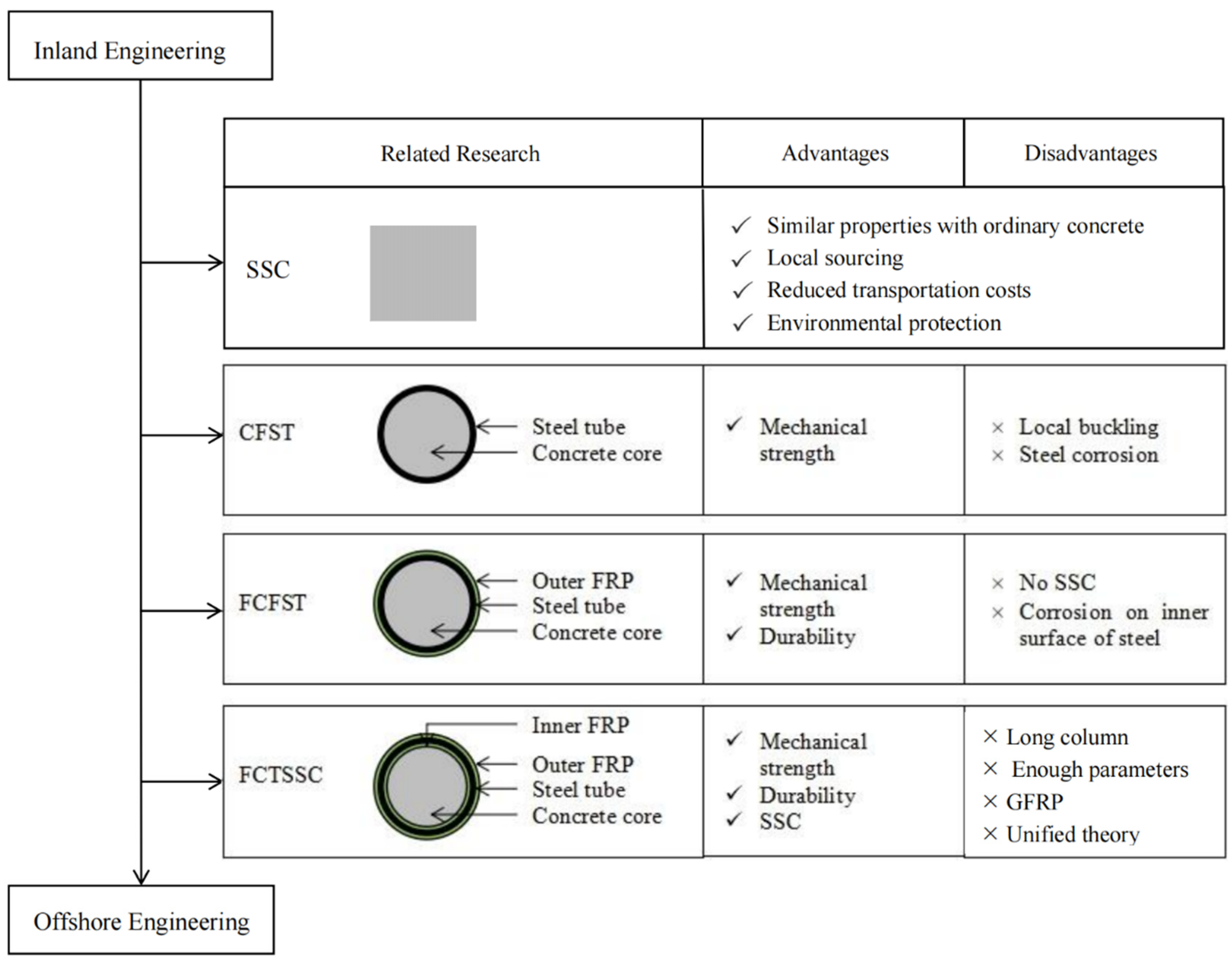
In summary, the current development of related research and the research and tests conducted by past research are illustrated in Table 4 and Figure 7, respectively. Durability research refers to the evolution of the structural performance of FCTSSC members under environmental exposure and subsequent loading. It is evident that SSC exhibits mechanical properties similar to those of conventional concrete, and its applicability in practical engineering has been demonstrated. Although CFST columns exhibit good mechanical performance, they suffer from local buckling and steel tube corrosion. FCFST columns address these issues. However, current research indicates that they are predominantly filled with ordinary concrete. When combined with SSC for practical engineering applications, the inner walls of the steel tubes still experience corrosion. This will reduce the strength and durability of the components. FCTSSC columns can effectively overcome these drawbacks. They offer superior mechanical properties compared to the aforementioned composite columns. Meanwhile, they can prevent corrosion of the steel tubes by external environments and internal seawater–sand concrete. This makes them highly suitable for marine engineering applications.
Based on Table 3 and Table 4, it can be seen that the CFST columns are a mature system with a wealth of experimental evidence, widely accepted theoretical models, and mature design specifications. Building on CFST columns, FCFST columns have been studied in considerable depth. Multiple design-oriented approaches have been proposed. However, broader standardization and unified codes remain limited. This is mainly due to the diversity of FRP configurations and failure mechanisms. In contrast, FCTSSC columns are still at an early stage of development. Existing evidence is limited in terms of specimen databases, loading conditions, slenderness ratio ranges, and durability verification. System-level numerical frameworks and design codes have not yet been standardized. Therefore, substantial advances are required before FCTSSC columns can be widely adopted in practical engineering applications.

5. Sustainability and Engineering Implications

5.1. Techno-Economic Feasibility, Sustainability Trade-Offs, and Scalability

For the practical adoption of emerging FCTSSC columns, techno-economic feasibility, sustainability trade-offs, and scalability must be carefully planned. Regarding the FRP materials used in FCTSSC columns, GFRP is generally considered more cost-effective than CFRP and BFRP. However, the economic feasibility of FCTSSC columns should be assessed from a life-cycle perspective rather than by initial cost alone. Compared with conventional corrosion-protection strategies for steel–concrete systems (e.g., coatings, cathodic protection, or stainless steel), the dual-layer FRP configuration in FCTSSC introduces additional upfront costs. These include FRP materials, fabrication of inner liners and outer wraps, and quality control during installation. Concrete materials with superior structural performance, such as engineered cementitious composites (ECC), and monitoring techniques required for post-service structural maintenance should be considered [179,180,181,182]. Recent studies on FRP structural systems indicate that the higher initial investment can be partially or fully offset by reduced maintenance, delayed corrosion initiation, and extended service life in aggressive marine environments. This highlights the necessity of life-cycle cost assessment rather than simple material cost comparison [183,184].
From an environmental perspective, the sustainability advantages of FCTSSC arise from the combined use of SSC and corrosion-resistant FRP confinement. Previous life-cycle assessment studies consistently show that SSC significantly reduces freshwater consumption and alleviates pressure on natural river sand resources. This is particularly beneficial in coastal and island regions [185]. However, FRP production, especially for carbon-fiber composites, is associated with relatively high embodied energy and environmental burdens. These burdens mainly stem from fiber manufacturing and resin synthesis processes [184,186]. Therefore, the net environmental benefit of FCTSSC depends on the balance among three factors: (1) the environmental benefits provided by SSC; (2) the embodied impacts of FRP materials; and (3) the extent to which FRP confinement extends service life and reduces repair or replacement frequency. Future studies should thus adopt consistent life-cycle assessment frameworks to evaluate the sustainability of FCTSSC at the structural system level, rather than at the material level alone.
Beyond economic and environmental considerations, the scalability and constructability of FCTSSC medium-to-long columns also pose practical challenges. The fabrication of long FCTSSC members requires stringent quality control of multi-interface systems. These include the SSC–inner FRP interface, the inner FRP–steel tube interface, and the steel tube–outer FRP interface. Potential defects, such as voids, debonding, or resin-rich zones, may impair confinement efficiency and durability. Transportation constraints often limit the feasible length of prefabricated members. As a result, segmented fabrication and on-site assembly represent a practical solution for future applications. In this context, the mechanical performance and durability of segmental joints, end anchorage of FRP layers, and continuity of confinement become critical issues for future design and construction.

5.2. Ethical and Regulatory Considerations

Beyond mechanical performance and durability, the application of FCTSSC columns in marine infrastructure requires careful consideration of ethical, regulatory, and environmental issues. From a structural safety perspective, current international design standards do not provide unified provisions for composite columns integrating SSC, steel tubes, and dual-layer FRP confinement. A pragmatic compliance pathway can be established by adopting Eurocode 4 [84] as the primary framework for steel–concrete composite action and stability design, while using ACI 318-19 [82] as a reference for fundamental concrete structural safety principles. The performance and long-term stability of FRP components can be guided by existing FRP-specific provisions, such as ACI 440.11-22 [187] for GFRP-reinforced concrete and ACI 440.1R-15 [188], particularly with respect to durability reduction factors and material safety considerations.
From an environmental and ethical standpoint, potential concerns must be addressed regarding the release of FRP-related debris or microplastics into marine ecosystems. In FCTSSC columns, FRP is typically embedded as inner liners and external wraps around steel tubes, rather than being directly exposed to freely flowing seawater. However, recent marine pollution studies indicate that GFRP fragments can be a source of marine debris and microplastic pollution under conditions of abrasion, accidental damage, or end-of-life disposal [189,190,191]. These findings suggest that ecological risks are primarily associated with damage scenarios (abrasion and impact), construction waste (cutting and grinding), and end-of-life disposal processes, rather than with normal and intact service conditions during routine operation.
Accordingly, responsible engineering practice for FCTSSC columns should incorporate both preventive and management measures. These include surface protection and inspection to minimize wear-induced damage, strict control and recycling of FRP waste during manufacturing and construction, and clearly defined end-of-life management strategies. By explicitly aligning emerging composite systems such as FCTSSC with existing structural codes, environmental regulations, and engineering ethics principles, future applications in marine infrastructure can better balance innovation, safety, and environmental protection.

6. Conclusions

This paper reviews the current research progress on SSC, CFST, FCFST, and FCTSSC structures. It focuses on their mechanical behavior, confinement mechanisms, material influencing factors, and existing key issues. The main conclusions are as follows:
(1) SSC offers advantages in workability and early-age strength. However, chloride ions in seawater and sea sand induce steel corrosion. This significantly reduces durability. Thus, the direct use of SSC in conventional reinforced concrete structures remains limited.
(2) CFST improves concrete strength and ductility through external steel confinement. Yet local buckling and corrosion of the steel tube remain major weaknesses. For CFST structures in marine environments, durability concerns are particularly critical and require further improvement.
(3) FCFST effectively delays steel-tube buckling and enhances overall behavior under axial, flexural, and cyclic loads. CFRP markedly improves load capacity. GFRP and BFRP provide better ductility. FRP thickness shows an approximately linear effect on strength enhancement. However, when SSC is used as infill, internal corrosion of the steel tube remains, limiting long-term use in marine engineering.
(4) FCTSSC applies inner and outer FRP confinement. This dual-layer system blocks chloride ingress into the steel tube and enables the feasible use of SSC in concrete-filled steel tube structures. Tests show that its load capacity exceeds that of CFST. Different FRP types also meet varied engineering demands. Expansion, shrinkage, and brittle behavior of SSC are significantly restrained under dual confinement.
(5) Current research on FCTSSC focuses mainly on short columns. Studies on global buckling of medium- and long-slenderness columns, second-order effects, and FRP–steel interaction mechanisms remain insufficient. Unified design theories and accurate nonlinear FE models are still lacking. Research on durability is very limited, especially regarding chloride transport, multi-factor coupling, and long-term behavior.
Overall, FCTSSC integrates resource sustainability with superior structural performance. It represents a promising system for future marine infrastructure. However, further studies are needed to establish a complete theoretical and design framework. Future research directions include:
(1) Investigating the mechanical behavior of medium- and long-slenderness columns under axial, flexural, and cyclic loading, and clarifying buckling evolution under dual confinement.
(2) Developing a comprehensive FRP–steel–SSC interaction model and corresponding design methods.
(3) Conducting systematic durability studies, including chloride transport based on rapid chloride migration tests and long-term natural diffusion tests, and freeze–thaw cycles based on cyclic freeze–thaw tests.
(4) Establishing high-accuracy FE frameworks and computational models for engineering optimization.
(5) Advancing engineering demonstrations and practical applications of FCTSSC in marine engineering, offshore wind power, and port structures.

Author Contributions

Conceptualization, S.J. and H.F.; methodology, L.W. and H.F.; validation, C.C., J.T. and P.L.; formal analysis, H.C. and C.C.; investigation, R.M. and H.C.; data curation, S.J.; writing—original draft preparation, S.J.; writing—review and editing, L.W., C.L., J.T. and P.L.; supervision, H.F.; funding acquisition, L.W. and C.L. All authors have read and agreed to the published version of the manuscript.

Funding

This research was funded by Scientific Research Basic Ability Improvement Project for Young and Middle-aged Teachers in Guangxi Universities, grant number 2024KY0599 and 2025KY0684. The authors acknowledge the funding support from Jiangxi Provincial Department of Education Science and Technology Project, China (No. GJJ2402901).

Data Availability Statement

All data supporting the findings of this study are available within the paper.

Conflicts of Interest

The authors declare no conflicts of interest.

References

  1. Fu, H.; Tian, J.; Chin, C.-L.; Liu, H.; Yuan, J.; Tang, S.; Mai, R.; Wu, X. Axial compression behavior of GFRP-steel composite tube confined seawater sea-sand concrete intermediate long columns. Eng. Struct. 2025, 333, 120157. [Google Scholar] [CrossRef]
  2. Fu, H.; Tian, J.; Chen, S.; Chin, C.-L.; Ma, C.-K. Axial compressive performance of CFRP-steel composite tube confined seawater sea-sand concrete intermediate slender columns. Constr. Build. Mater. 2024, 441, 137399. [Google Scholar] [CrossRef]
  3. Fu, H.; Guo, K.; Wu, Z.; Mai, R.; Chin, C.L.; Ma, C.-K. Experimental Investigation of a Novel CFRP-Steel Composite Tube-Confined Seawater-Sea Sand Concrete Intermediate Long Column. Int. J. Integr. Eng. 2024, 16, 466–475. [Google Scholar] [CrossRef]
  4. Fu, H.; Zhao, H.H.; Pan, Z.Y.; Wu, Z.Q.; Chin, C.L.; Ma, C.K. Behaviour of corroded circular steel tube strengthened with external FRP tube grouting under eccentric loading: Numerical study. Structures 2023, 56, 25. [Google Scholar] [CrossRef]
  5. Fu, H.; Zhang, J.Y.; Wu, Z.Q.; Chin, C.L.; Ma, C.K. Nonlinear analysis of axial-compressed corroded circular steel pipes reinforced by FRP-casing grouting. J. Constr. Steel Res. 2023, 201, 21. [Google Scholar] [CrossRef]
  6. Liu, M.; Tian, J.; Zhao, J.; Sun, Y.; Liang, J.; Zheng, Y.; Zhang, W.; Wu, X.; Yuan, J.; Fu, H. Seismic performance of CFRP-strengthened steel fiber reinforced concrete composite columns: Experimental, numerical and theoretical analyses. Constr. Build. Mater. 2025, 505, 144692. [Google Scholar] [CrossRef]
  7. Chapman, G. The sea-dredged sand and gravel industry of Great Britain. In Proceedings of a Symposium: Sea-Dredged Aggregates for Concrete; Sand and Gravel Association of Great Britain: Buckinghamshire, UK, 1968. [Google Scholar]
  8. Roeder, A. Some technical data on sea-dredged aggregates. In Proceedings of a Symposium: Sea-Dredged Aggregates For Concrete; Sand and Gravel Association of Great Britain: Buckinghamshire, UK, 1968. [Google Scholar]
  9. Shacklock, B. Durability of concrete made with sea-dredged aggregate. In Proceedings of a Symposium: Sea-Dredged Aggregates for Concrete; Sand and Gravel Association of Great Britain: Buckinghamshire, UK, 1968. [Google Scholar]
  10. Ghorab, H.Y.; Hilal, M.S.; Antar, A. Effect of mixing and curing waters on the behavior of cement pastes and concrete Part 2: Properties of cement paste and concrete. Cem. Concr. Res. 1990, 20, 69–72. [Google Scholar] [CrossRef]
  11. Zhang, M.H.; Jiang, J.T.; Feng, Z.N.; Sun, B.G.; Qin, Z.C.; Liang, F. Experimental study on mechanical properties of Qingdao seawater mixed concrete. J. Qingdao Ocean Univ. (Nat. Sci. Ed.) 1993, 23, 119–125. [Google Scholar]
  12. Kaushik, S.; Islam, S. Suitability of sea water for mixing structural concrete exposed to a marine environment. Cem. Concr. Compos. 1995, 17, 177–185. [Google Scholar] [CrossRef]
  13. Katano, K.; Takeda, N.; Ishizeki, Y.; Iriya, K. Properties and application of concrete made with sea water and un-washed sea sand. In Proceedings of the Third International Conference on Sustainable Construction Materials and Technologies, Kyoto, Japan, 18–22 August 2013; pp. 1–10. [Google Scholar]
  14. Limeira, J.; Etxeberria, M.; Agulló, L.; Molina, D. Mechanical and durability properties of concrete made with dredged marine sand. Constr. Build. Mater. 2011, 25, 4165–4174. [Google Scholar] [CrossRef]
  15. Limeira, J.; Agullo, L.; Etxeberria, M. Dredged marine sand in concrete: An experimental section of a harbor pavement. Constr. Build. Mater. 2010, 24, 863–870. [Google Scholar] [CrossRef]
  16. Liu, W.; Xie, Y.; Dong, B.; Xing, F. Study on characteristics of dredged marine sand and the mechanical properties of concrete made with dredged marine sand. Bull. Chin. Ceram. Soc. 2014, 33, 15–22. [Google Scholar]
  17. Xiao, J.Z.; Qiang, C.B.; Nanni, A.; Zhang, K.J. Use of sea-sand and seawater in concrete construction: Current status and future opportunities. Constr. Build. Mater. 2017, 155, 1101–1111. [Google Scholar] [CrossRef]
  18. Limeira, J.; Agulló, L.; Etxeberria, M. Dredged marine sand as a new source for construction materials. Mater. Constr. 2012, 62, 7–24. [Google Scholar] [CrossRef]
  19. Xing, L.; Xue, R.; Cao, X. Performance of concrete with sea sand and sea water. Concrete 2015, 11, 137–141. [Google Scholar]
  20. Renyun, C. Research on mechanical properties of seawater and sea sand concrete. Guangdong Build. Mater. 2017, 33, 26–28. [Google Scholar]
  21. Safi, B.; Saidi, M.; Daoui, A.; Bellal, A.; Mechekak, A.; Toumi, K. The use of seashells as a fine aggregate (by sand substitution) in self-compacting mortar (SCM). Constr. Build. Mater. 2015, 78, 430–438. [Google Scholar] [CrossRef]
  22. Li, T.; Zhang, Y.; Liu, X.; Yang, H.; Zhi, Z.; Liu, L.; Ma, W.; Shah, S.P.; Li, W. Study on mechanics and early workability of high performance marine concrete made of seawater and sea sand. Concrete 2019, 11, 1–5. [Google Scholar]
  23. Ning, B.; Ouyang, D.; Wen, X.-L. Experimental study on sea sand high-performance concrete. Concrete 2012, 1, 88–90. [Google Scholar]
  24. Guo, Q.Y.; Chen, L.; Zhao, H.J.; Admilson, J.; Zhang, W.S. The Effect of Mixing and Curing Sea Water on Concrete Strength at Different Ages. In International Conference on Materials Applications and Engineering (ICMAE); EDP Sciences: Les Ulis Cedex A, France, 2018. [Google Scholar]
  25. Etxeberria, M.; Fernandez, J.M.; Limeira, J. Secondary aggregates and seawater employment for sustainable concrete dyke blocks production: Case study. Constr. Build. Mater. 2016, 113, 586–595. [Google Scholar] [CrossRef]
  26. Abrams, D.A. Tests of Impure Waters for Mixing Concrete; Structural Materials Research Laboratory: Chicago, IL, USA, 1924. [Google Scholar]
  27. Chen, Z.L.; Sun, G.F.; Tang, X.N.; Liu, Y.L. Research on the repair and application of seawater mixed coral reef and sand concrete in island and reef engineering. Coast. Eng. 2008, 27, 60–69. [Google Scholar]
  28. Ming, C. Study on Mechanical Properties of Sea Sand and Seawater Concrete and Flexural Performance of Composite Beams with FRP Bars. Master’s Thesis, Harbin Engineering University, Harbin, China, 2015. [Google Scholar]
  29. Li, T.; Liu, X.; Zhang, Y.; Yang, H.; Zhi, Z.; Liu, L.; Ma, W.; Shah, S.P.; Li, W. Preparation of sea water sea sand high performance concrete (SHPC) and serving performance study in marine environment. Constr. Build. Mater. 2020, 254, 119114. [Google Scholar] [CrossRef]
  30. Chen, Z.; Chen, T.; Qu, J. Study on the feasibility of application of coral reef sand concrete. Ocean Eng. 1991, 9, 67–80. [Google Scholar]
  31. Arumugam, R.; Ramamurthy, K. Study of compressive strength characteristics of coral aggregate concrete. Mag. Concr. Res. 1996, 48, 141–148. [Google Scholar] [CrossRef]
  32. Qiang, Y. Mix design and compressive strength law of coral reef sand seawater concrete. Concrete 2017, 2, 155–157. [Google Scholar]
  33. Dempsey, J.G. Coral and salt water as concrete materials. J. Proc. 1951, 48, 157–166. [Google Scholar]
  34. Pan, B.; Wei, Z. Experimental study on the influence of raw materials on the compressive strength of coral sand concrete. Eng. Mech. 2015, 32, 221–225. [Google Scholar]
  35. Ramaswamy, S.; Aziz, M.; Murthy, C. Sea dredged sand for concrete. In Extending Aggregate Resources; ASTM International: West Conshohocken, PA, USA, 1982. [Google Scholar]
  36. Cao, W.; Su, Q.; Zhao, T.; Ba, G.Z. Experimental study on durability of sea sand concrete. In Proceedings of the 19th National Structural Engineering Academic Conference (Volume II); Engineering Mechanics Magazine: Beijing, China, 2010. [Google Scholar]
  37. Otsuki, N.; Saito, T.; Tadokoro, Y. Possibility of sea water as mixing water in concrete. In Proceedings of the 36th Conference on Our World in Concrete & Structures, Singapore, 14–16 August 2011; pp. 131–138. [Google Scholar]
  38. Li, Y.T.; Zhou, L.; Zhang, Y.; Cui, J.W.; Shao, J. Study on long-term performance of concrete based on seawater, sea sand and coral sand. Adv. Mater. Res. 2013, 706, 512–515. [Google Scholar] [CrossRef]
  39. Xiao, J.; Lu, F.; Sun, Z. Study on chloride ion permeability of desalinated sea sand high performance concrete. Ind. Constr. 2004, 34, 4–6. [Google Scholar]
  40. Huang, H.; Ouyang, D.; Cai, R. Experimental study on chloride ion permeability of simulated sea sand concrete. Concrete 2007, 3, 22–24. [Google Scholar]
  41. Liu, W.; Cui, H.; Dong, Z.; Xing, F.; Zhang, H.; Lo, T.Y. Carbonation of concrete made with dredged marine sand and its effect on chloride binding. Constr. Build. Mater. 2016, 120, 1–9. [Google Scholar] [CrossRef]
  42. Zhen, J. Effect of Combined Environmental Action on the Durability of Sea Sand Concrete. Master’s Thesis, Qingdao University of Technology, Qingdao, China, 2009. [Google Scholar]
  43. Companies, L.C. Lally handbook of Lally Column Construction (Steel Columns-Concrete Filled), 10th ed.; Griffith-Stillings Press: Boston, MA, USA, 1926. [Google Scholar]
  44. Tian, Z.; Liu, Y.; Jiang, L.; Zhu, W.; Ma, Y. A review on application of composite truss bridges composed of hollow structural section members. J. Traffic Transp. Eng. (Engl. Ed.) 2019, 6, 94–108. [Google Scholar] [CrossRef]
  45. Shanmugam, N.E.; Lakshmi, B. State of the art report on steel–concrete composite columns. J. Constr. Steel Res. 2001, 57, 1041–1080. [Google Scholar] [CrossRef]
  46. Cai, J.; Xie, X.; Yang, C.; He, J.; Chen, H. Experimental study on axial compression performance of core high-strength concrete-filled steel tube columns. J. South China Univ. Technol. Nat. Sci. Ed. 2002, 30, 81–85. [Google Scholar]
  47. Giakoumelis, G.; Lam, D. Axial capacity of circular concrete-filled tube columns. J. Constr. Steel Res. 2004, 60, 1049–1068. [Google Scholar] [CrossRef]
  48. Huang, H.; Ouyang, D.; Cai, R. Experimental study on the mechanical properties of thin-walled concrete-filled steel tube short columns under axial compression. Build. Struct. 2005, 35, 22–27. [Google Scholar]
  49. Han, L.-H.; Liu, W.; Yang, Y.-F. Behaviour of concrete-filled steel tubular stub columns subjected to axially local compression. J. Constr. Steel Res. 2008, 64, 377–387. [Google Scholar] [CrossRef]
  50. Chen, P.; Wang, Y.Y.; Zhang, S.M. Size effect prediction on axial compression strength of circular CFST columns. J. Constr. Steel Res. 2020, 172, 11. [Google Scholar] [CrossRef]
  51. Chitawadagi, M.V.; Narasimhan, M.C.; Kulkarni, S. Axial strength of circular concrete-filled steel tube columns—DOE approach. J. Constr. Steel Res. 2010, 66, 1248–1260. [Google Scholar] [CrossRef]
  52. Han, L.; Tao, Z. Theoretical analysis and experimental study on mechanical properties of concrete-filled square steel tubes under axial compression. China Civ. Eng. J. 2001, 34, 17–25. [Google Scholar]
  53. Liao, F.-Y.; Han, L.-H.; Tao, Z. Behaviour of CFST stub columns with initial concrete imperfection: Analysis and calculations. Thin-Walled Struct. 2013, 70, 57–69. [Google Scholar] [CrossRef]
  54. Wang, F.-C.; Han, L.-H. Analytical behavior of special-shaped CFST stub columns under axial compression. Thin-Walled Struct. 2018, 129, 404–417. [Google Scholar] [CrossRef]
  55. Hassanein, M.; Kharoob, O. Analysis of circular concrete-filled double skin tubular slender columns with external stainless steel tubes. Thin-Walled Struct. 2014, 79, 23–37. [Google Scholar] [CrossRef]
  56. Huang, D.; Bian, Y.; Huang, D.; Zhou, A.; Sheng, B. An ultimate-state-based-model for inelastic analysis of intermediate slenderness PSB columns under eccentrically compressive load. Constr. Build. Mater. 2015, 94, 306–314. [Google Scholar] [CrossRef]
  57. Dundu, M. Compressive strength of circular concrete filled steel tube columns. Thin-Walled Struct. 2012, 56, 62–70. [Google Scholar] [CrossRef]
  58. Gupta, P.; Sarda, S.; Kumar, M. Experimental and computational study of concrete filled steel tubular columns under axial loads. J. Constr. Steel Res. 2007, 63, 182–193. [Google Scholar] [CrossRef]
  59. Zhou, X.; Yan, B.; Liu, J.; Gan, D. Study on axial compressive bearing capacity of reinforced concrete columns confined by circular steel tubes with different aspect ratios. J. Build. Struct. 2018, 39, 11–21. [Google Scholar]
  60. Uy, B.; Tao, Z.; Han, L.-H. Behaviour of short and slender concrete-filled stainless steel tubular columns. J. Constr. Steel Res. 2011, 67, 360–378. [Google Scholar] [CrossRef]
  61. Li, G.; Chen, B.; Yang, Z.; Feng, Y. Experimental and numerical behaviour of eccentrically loaded high strength concrete filled high strength square steel tube stub columns. Thin-Walled Struct. 2018, 127, 483–499. [Google Scholar] [CrossRef]
  62. Portolés, J.; Romero, M.L.; Bonet, J.; Filippou, F. Experimental study of high strength concrete-filled circular tubular columns under eccentric loading. J. Constr. Steel Res. 2011, 67, 623–633. [Google Scholar] [CrossRef]
  63. Wang, Q.; Zhao, D.; Guan, P. Experimental study on mechanical properties of steel-reinforced high-strength concrete-filled steel tube composite columns under axial compression. J. Build. Struct. 2003, 24, 44–49. [Google Scholar]
  64. Ding, F.X.; Li, G.; Gong, Y.Z.; Yu, Z.W. Mechanical properties analysis of concrete-filled circular steel tube short columns under axial compression. J. Cent. South Univ. Sci. Technol. 2012, 43, 3625–3630. [Google Scholar]
  65. Shi, Y.; Che, X.; Wang, J. Parameter analysis of rectangular concrete-filled steel tube members with I-shaped steel. Eng. Mech. 2015, 32, 254–260. [Google Scholar]
  66. Shi, Y.; Wang, W.; Wang, Y. Mechanical properties and parameter analysis of concrete-filled square steel tube short columns under axial compression. Eng. Mech. 2014, 31, 201–206. [Google Scholar]
  67. Liew, J.R.; Xiong, D. Ultra-high strength concrete filled composite columns for multi-storey building construction. Adv. Struct. Eng. 2012, 15, 1487–1503. [Google Scholar] [CrossRef]
  68. Pons, D.; Espinós, A.; Albero, V.; Romero, M.L. Numerical study on axially loaded ultra-high strength concrete-filled dual steel columns. Steel Compos. Struct. Int. J. 2018, 26, 705–717. [Google Scholar]
  69. Huang, H.; Shui, W.; Chen, M.; Zeng, G. Experimental study on composite load of circular hollow sandwich concrete-filled steel tube short columns. J. Build. Struct. 2015, 36, 53–59. [Google Scholar]
  70. Han, L.-H.; Ren, Q.-X.; Li, W. Tests on stub stainless steel–concrete–carbon steel double-skin tubular (DST) columns. J. Constr. Steel Res. 2011, 67, 437–452. [Google Scholar] [CrossRef]
  71. Guo, L.; Zhang, S.; Xu, Z.; Ran, M. Experimental study and theoretical analysis of thin-walled rectangular steel tube concrete-filled with large aspect ratio and stiffening ribs. China Civ. Eng. J. 2011, 44, 42–49. [Google Scholar]
  72. Liu, Y.; Cheng, G.; Zhang, N. Experimental study on axially compressed short columns of square steel tube concrete reinforced with perforated steel plates. J. Build. Struct. 2014, 35, 39–46. [Google Scholar]
  73. Tao, Z.; Han, L.-H.; Wang, D.-Y. Strength and ductility of stiffened thin-walled hollow steel structural stub columns filled with concrete. Thin-Walled Struct. 2008, 46, 1113–1128. [Google Scholar] [CrossRef]
  74. Ke, X.; Su, Y.; Shang, X. Experimental study on compression-bending performance and bearing capacity calculation of steel tube concrete composite columns. Eng. Mech. 2018, 35, 134–142. [Google Scholar]
  75. Han, L.-H.; An, Y.-F. Performance of concrete-encased CFST stub columns under axial compression. J. Constr. Steel Res. 2014, 93, 62–76. [Google Scholar] [CrossRef]
  76. Al-Shaar, A.A.; Göğüş, M.T. Flexural behavior of lightweight concrete and self-compacting concrete-filled steel tube beams. J. Constr. Steel Res. 2018, 149, 153–164. [Google Scholar] [CrossRef]
  77. Han, L.-H. Flexural behaviour of concrete-filled steel tubes. J. Constr. Steel Res. 2004, 60, 313–337. [Google Scholar] [CrossRef]
  78. Ye, Y.; Han, L.-H.; Tao, Z.; Guo, S.-L. Experimental behaviour of concrete-filled steel tubular members under lateral shear loads. J. Constr. Steel Res. 2016, 122, 226–237. [Google Scholar] [CrossRef]
  79. Xu, C.; Lin, H.; Huang, C. Experimental study on shear resistance of self-stressing concrete filled circular steel tubes. J. Constr. Steel Res. 2009, 65, 801–807. [Google Scholar] [CrossRef]
  80. Han, L.-H.; He, S.-H.; Liao, F.-Y. Performance and calculations of concrete filled steel tubes (CFST) under axial tension. J. Constr. Steel Res. 2011, 67, 1699–1709. [Google Scholar] [CrossRef]
  81. Han, L.-H.; Yao, G.-H.; Tao, Z. Performance of concrete-filled thin-walled steel tubes under pure torsion. Thin-Walled Struct. 2007, 45, 24–36. [Google Scholar] [CrossRef]
  82. ACI 318-19; Building Code Requirements for Structural Concrete and Commentary. American Concrete Institute: Farmington Hills, MI, USA, 2019.
  83. AISC 360-16; Specification for Structural Steel Buildings. American Institute of Steel Construction: Chicago, IL, USA, 2016.
  84. EN 1994-1-1:2004; Design of Composite Steel and Concrete Structures. Part 1.1: General Rules and Rules for Buildings. British Standards Institution: London, UK, 2004.
  85. Architectural Institute of Japan. Recommendations for Design and Construction of Concrete Filled Steel Tubular Structures; Architectural Institute of Japan (AIJ): Tokyo, Japan, 1997. [Google Scholar]
  86. GB 50936-2014; Technical Code for Concrete Filled Steel Tubular Structures. China Architecture & Building Press: Beijing, China, 2014.
  87. Wang, Q.; Zhao, Y.; Wei, G. Research on circular cross-section CFRP-steel composite tube concrete structure. J. Shenyang Inst. Archit. Eng. Nat. Sci. Ed. 2003, 19, 272–274. [Google Scholar]
  88. Xiao, Y. Applications of FRP composites in concrete columns. Adv. Struct. Eng. 2004, 7, 335–343. [Google Scholar] [CrossRef]
  89. Xiao, Y.; He, W.; Choi, K.-K. Confined concrete-filled tubular columns. J. Struct. Eng. 2005, 131, 488–497. [Google Scholar] [CrossRef]
  90. Xiao, Y.; He, W.; Mao, X. Research on development of confined concrete-filled steel tube columns. J. Build. Struct. 2004, 25, 59–66. [Google Scholar]
  91. Wang, Q.; Li, N.; Han, F.; Zhu, H. Experimental study on CFRP-concrete-filled steel tube axial compression members. J. Shenyang Jianzhu Univ. (Nat. Sci. Ed.) 2006, 22, 709–712. [Google Scholar]
  92. Wang, Q.; Li, J.; Zhao, W. Analysis of bearing capacity of square section carbon fiber reinforced polymer concrete-filled steel tube columns under axial compression. J. Build. Struct. 2013, 1, 274–280. [Google Scholar]
  93. Wang, Q.; Zhao, W.; Li, J. Static test on axial compression of square section carbon fiber reinforced polymer concrete-filled steel tube columns. J. Build. Struct. 2013, 34, 267–273. [Google Scholar]
  94. Wang, Q.; Zhou, B.; Tan, P.; Shao, Y. Static properties of circular CFRP-concrete-filled steel tube (C-CFRP-CFST) compression-bending members. Eng. Mech. 2012, 29, 154–158. [Google Scholar]
  95. Wang, Q.; Che, Y.; Ye, M. Study on flexural properties of CFRP reinforced concrete-filled square steel tubes. China Civ. Eng. J. 2011, 44, 17–23. [Google Scholar]
  96. Li, J.; Wang, Q. Analysis of flexural performance of square CFRP-concrete filled steel tube (S-CFRP-CFST). Eng. Mech. 2013, 30, 142–148. [Google Scholar] [CrossRef]
  97. Liu, T.; Wang, Q.; Li, H. Experimental study on shear properties of circular CFRP-concrete-filled steel tubes. China Civ. Eng. J. 2018, 51, 44–49. [Google Scholar]
  98. Wang, Q.; Niu, X.; Feng, L. Parametric analysis and restoring force model of hysteretic behavior of circular CFRP-concrete-filled steel tube compression-bending members. Eng. Mech. 2017, 34, 159–166. [Google Scholar]
  99. Tao, Z.; Zhuang, J.; Yu, Q. Study on mechanical properties of FRP-confined concrete-filled steel tube members under axial compression. Ind. Constr. 2005, 35, 20–23. [Google Scholar]
  100. Tao, Z.; Han, L.H.; Zhuang, J.P. Axial loading behavior of CFRP strengthened concrete-filled steel tubular stub columns. Adv. Struct. Eng. 2007, 10, 37–46. [Google Scholar] [CrossRef]
  101. Tao, Z.; Han, L.-H. Behaviour of fire-exposed concrete-filled steel tubular beam columns repaired with CFRP wraps. Thin-Walled Struct. 2007, 45, 63–76. [Google Scholar] [CrossRef]
  102. Tao, Z.; Han, L.-H.; Wang, L.-L. Compressive and flexural behaviour of CFRP-repaired concrete-filled steel tubes after exposure to fire. J. Constr. Steel Res. 2007, 63, 1116–1126. [Google Scholar] [CrossRef]
  103. Tao, Z.; Han, L.-H.; Zhuang, J.-P. Cyclic performance of fire-damaged concrete-filled steel tubular beam–columns repaired with CFRP wraps. J. Constr. Steel Res. 2008, 64, 37–50. [Google Scholar] [CrossRef]
  104. Lu, Y.; Li, N.; Li, S.; Liang, H. Behavior of steel fiber reinforced concrete-filled steel tube columns under axial compression. Constr. Build. Mater. 2015, 95, 74–85. [Google Scholar] [CrossRef]
  105. Liu, L.; Lu, Y. Axial bearing capacity of short FRP confined concrete-filled steel tubular columns. J. Wuhan Univ. Technol.-Mater. Sci. Ed. 2010, 25, 454–458. [Google Scholar] [CrossRef]
  106. Lu, Y.; Li, N.; Li, S.; Liang, H. Study on axial compression performance of FRP-concrete-filled circular steel tube short columns. J. China Railw. Soc. 2016, 38, 105–111. [Google Scholar]
  107. Li, N.; Lu, Y.Y.; Li, S.; Liu, L. Slenderness effects on concrete-filled steel tube columns confined with CFRP. J. Constr. Steel Res. 2018, 143, 110–118. [Google Scholar] [CrossRef]
  108. Hu, Y.M.; Yu, T.; Teng, J.G. FRP-Confined Circular Concrete-Filled Thin Steel Tubes under Axial Compression. J. Compos. Constr. 2011, 15, 850–860. [Google Scholar] [CrossRef]
  109. Teng, J.; Yu, T.; Fernando, D. Strengthening of steel structures with fiber-reinforced polymer composites. J. Constr. Steel Res. 2012, 78, 131–143. [Google Scholar] [CrossRef]
  110. Yu, T.; Chan, C.; Teh, L.; Teng, J.G. Hybrid FRP-concrete-steel multitube concrete columns: Concept and behavior. J. Compos. Constr. 2017, 21, 04017044. [Google Scholar] [CrossRef]
  111. Yu, T.; Hu, Y.M.; Teng, J.G. FRP-confined circular concrete-filled steel tubular columns under cyclic axial compression. J. Constr. Steel Res. 2014, 94, 33–48. [Google Scholar] [CrossRef]
  112. Yu, T.; Hu, Y.M.; Teng, J.G. Cyclic lateral response of FRP-confined circular concrete-filled steel tubular columns. J. Constr. Steel Res. 2016, 124, 12–22. [Google Scholar] [CrossRef]
  113. Sundarraja, M.; Prabhu, G.G. Experimental study on CFST members strengthened by CFRP composites under compression. J. Constr. Steel Res. 2012, 72, 75–83. [Google Scholar] [CrossRef]
  114. Shen, Q.H.; Wang, J.F.; Wang, J.X.; Ding, Z.D. Axial compressive performance of circular CFST columns partially wrapped by carbon FRP. J. Constr. Steel Res. 2019, 155, 90–106. [Google Scholar] [CrossRef]
  115. Shen, Q.; Wang, J.; Xu, Q.; Cui, Y. Performance and design of partially CFRP-jacketed circular CFT column under eccentric compression. J. Constr. Steel Res. 2020, 166, 105925. [Google Scholar] [CrossRef]
  116. Wang, J.; Shen, Q.; Wang, F.; Wang, W. Experimental and analytical studies on CFRP strengthened circular thin-walled CFST stub columns under eccentric compression. Thin-Walled Struct. 2018, 127, 102–119. [Google Scholar] [CrossRef]
  117. Zeng, J.-J.; Zheng, Y.-W.; Liu, F.; Guo, Y.-C.; Hou, C. Behavior of FRP Ring-Confined CFST columns under axial compression. Compos. Struct. 2021, 257, 113166. [Google Scholar] [CrossRef]
  118. Sharif, A.M.; Al-Mekhlafi, G.M.; Al-Osta, M.A. Structural performance of CFRP-strengthened concrete-filled stainless steel tubu lar short columns. Eng. Struct. 2019, 183, 94–109. [Google Scholar]
  119. Al-Mekhlafi, G.M.; Al-Osta, M.A.; Sharif, A.M. Behavior of eccentrically loaded concrete-filled stainless steel tubular stub columns confined by CFRP composites. Eng. Struct. 2020, 205, 110113. [Google Scholar] [CrossRef]
  120. Dong, J.; Huang, M.; Wang, Q.; Hou, M. Mechanical properties of thin-walled steel tube recycled concrete short columns reinforced with carbon fiber cloth. J. Sichuan Univ. Eng. Sci. Ed. 2012, 44, 255–260. [Google Scholar]
  121. Dong, J.; Wang, Q.; Guan, Z. Structural behaviour of recycled aggregate concrete filled steel tube columns strengthened by CFRP. Eng. Struct. 2013, 48, 532–542. [Google Scholar] [CrossRef]
  122. Liu, J.; Xu, T.; Guo, Y.; Wang, X.; Chen, Y.F. Behavior of circular CFRP-steel composite tubed high-strength concrete columns under axial compression. Compos. Struct. 2019, 211, 596–609. [Google Scholar] [CrossRef]
  123. Cao, S.; Wu, C.; Wang, W. Behavior of FRP confined UHPFRC-filled steel tube columns under axial compressive loading. J. Build. Eng. 2020, 32, 101511. [Google Scholar] [CrossRef]
  124. Zhang, Y.R.; Wei, Y.; Bai, J.W.; Wu, G.; Dong, Z.Q. A novel seawater and sea sand concrete filled FRP-carbon steel composite tube column: Concept and behaviour. Compos. Struct. 2020, 246, 13. [Google Scholar] [CrossRef]
  125. Teng, J.; Yu, T.; Wong, Y.; Dong, S. Hybrid FRP–concrete–steel tubular columns: Concept and behavior. Constr. Build. Mater. 2007, 21, 846–854. [Google Scholar] [CrossRef]
  126. Wei, Y.; Bai, J.W.; Zhang, Y.R.; Miao, K.T.; Zheng, K.Q. Compressive performance of high-strength seawater and sea sand concrete-filled circular FRP-steel composite tube columns. Eng. Struct. 2021, 240, 18. [Google Scholar] [CrossRef]
  127. Wang, G.F.; Wei, Y.; Miao, K.T.; Zheng, K.Q.; Dong, F.H. Axial compressive behavior of seawater sea-sand coral aggregate concrete-filled circular FRP-steel composite tube columns. Constr. Build. Mater. 2022, 315, 21. [Google Scholar] [CrossRef]
  128. Zhang, Y.R.; Wei, Y.; Miao, K.T.; Li, B. A novel seawater and sea sand concrete-filled FRP-carbon steel composite tube column: Cyclic axial compression behaviour and modelling. Eng. Struct. 2022, 252, 17. [Google Scholar] [CrossRef]
  129. Wei, Y.; Xu, P.F.; Zhang, Y.R.; Wang, G.F.; Zheng, K.Q. Compressive behaviour of FRP-steel wire mesh composite tubes filled with seawater and sea sand concrete. Constr. Build. Mater. 2022, 314, 17. [Google Scholar] [CrossRef]
  130. Jiawen, B.; Yang, W.; Yirui, Z.; Shenting, M.; Kaiqi, Z. Axial compression behavior of new seawater and sea sand concrete filled circular carbon fiber reinforced polymer-steel composite tube columns. Acta Mater. Compos. Sin. 2021, 38, 3076–3085. [Google Scholar]
  131. Gaofei, W.; Yang, W.; Kunting, M.; Fenghui, D.; Kaiqi, Z. Experimental study on axial compression performance of CFRP-steel composite tube filled circular seawater sea-sand coral concrete columns. Acta Mater Compos Sin 2022, 39, 3982–3993. [Google Scholar]
  132. Sun, J.Z.; Wei, Y.M.; Wang, Z.Y.; Li, X.L. A new composite column of FRP-steel-FRP clad tube filled with seawater sea-sand coral aggregate concrete: Concept and compressive behavior. Constr. Build. Mater. 2021, 301, 13. [Google Scholar] [CrossRef]
  133. Chen, Z.P.; Pang, Y.S.; Xu, R.T.; Zhou, J.; Xu, W.S. Mechanical performance of ocean concrete-filled circular CFRP-steel tube columns under axial compression. J. Constr. Steel Res. 2022, 198, 21. [Google Scholar] [CrossRef]
  134. Zhang, B.; Zhu, H. Durability of seawater coral aggregate concrete under seawater immersion and dry-wet cycles. J. Build. Eng. 2023, 66, 105894. [Google Scholar] [CrossRef]
  135. Liu, J.; Ou, Z.; Peng, W.; Guo, T.; Deng, W.; Chen, Y. Literature review of coral concrete. Arab. J. Sci. Eng. 2018, 43, 1529–1541. [Google Scholar] [CrossRef]
  136. Li, P.; Huang, D.; Li, R.; Li, R.; Yuan, F. Effect of aggregate size on the axial compressive behavior of FRP-confined coral aggregate concrete. Polymers 2022, 14, 3877. [Google Scholar] [CrossRef]
  137. Fu, Z.Q.; Ji, B.H.; Lv, L.; Zhou, W.J. Behavior of lightweight aggregate concrete filled steel tubular slender columns under axial compression. Adv. Steel Constr. 2011, 7, 144–156. [Google Scholar]
  138. Tokgoz, S. Tests on plain and steel fiber concrete-filled stainless steel tubular columns. J. Constr. Steel Res. 2015, 114, 129–135. [Google Scholar] [CrossRef]
  139. Huang, Z.C.; Uy, B.; Li, D.X.; Wang, J. Behaviour and design of ultra-high-strength CFST members subjected to compression and bending. J. Constr. Steel Res. 2020, 175, 16. [Google Scholar] [CrossRef]
  140. Subedi, N.; Obara, T.; Kono, S. Noncompact and slender concrete-filled steel tubes under axial compression: Finite-element modeling and evaluation of stress-strain models for fiber-based analysis. J. Constr. Steel Res. 2022, 196, 25. [Google Scholar] [CrossRef]
  141. Luo, S.C.; Chen, M.C.; Huang, H.; Xv, K.; Fang, W.; Zhang, R. Eccentric compression test and ultimate load strength analysis of circular CFST long column with local corrosion. Structures 2023, 56, 18. [Google Scholar] [CrossRef]
  142. Bhartiya, R.; Sahoo, D.R.; Oinam, R.M. Cyclic axial stress-strain model for circular CFST columns under compression loading. Soil Dyn. Earthq. Eng. 2023, 164, 20. [Google Scholar] [CrossRef]
  143. Lin, S.; Yan, X.-F.; Yang, D.; Zhao, Y.-G. Behavior of circular concrete-filled steel tubular columns with different end moment ratios: Modelling and discussion. Constr. Build. Mater. 2023, 409, 133859. [Google Scholar] [CrossRef]
  144. Albero, V.; Ibáñez, C.; Hernández-Figueirido, D.; Piquer, A. Experimental analysis on circular concrete-filled steel tubular beam-columns under unequal load eccentricities. Eng. Struct. 2022, 259, 114206. [Google Scholar] [CrossRef]
  145. Wei, G. Research on Mechanical Properties of CFRP Concrete-filled Steel Tube Columns. Master’s Thesis, Dalian Maritime University, Dalian, China, 2007. [Google Scholar]
  146. Gu, W.; Zhao, Y. Experimental study on concrete filled CFRP-steel tube columns with axial compression. China Civ. Eng. J. 2007, 40, 23–28. [Google Scholar]
  147. Li, G.; Sun, X.; Yang, Z.; Fang, C.; Qiu, Z. Buckling behavior of slender square concrete filled steel tubular columns strengthened with CFRP profile under combined compression and bending. J. Build. Eng. 2022, 53, 104563. [Google Scholar] [CrossRef]
  148. Jiang, G.; Wang, Q.; Zhou, B. Analysis of load-deformation relationship of circular CFRP-concrete-filled steel tube eccentric members. J. Shenyang Jianzhu Univ. (Nat. Sci. Ed.) 2008, 24, 81–85. [Google Scholar]
  149. Wang, Q.; Yan, F.; Ren, Q. Study on static performance of concentrically compressed concrete filled circular CFRP-steel tubular members. China Civ. Eng. J. 2008, 41, 21–29. [Google Scholar]
  150. Lu, Y.; Li, N.; Li, S. Behavior of FRP-confined concrete-filled steel tube columns. Polymers 2014, 6, 1333–1349. [Google Scholar] [CrossRef]
  151. Zeng, J.J.; Guo, Y.C.; Liao, J.J.; Shi, S.W.; Bai, Y.L.; Zhang, L.H. Behavior of hybrid PET FRP confined concrete-filled high-strength steel tube columns under eccentric compression. Case Stud. Constr. Mater. 2022, 16, 21. [Google Scholar] [CrossRef]
  152. Li, G.C.; Zhang, R.R.; Yang, Z.J.; Zhou, B. Finite Element Analysis on Mechanical Performance of Middle Long CFST Column with Inner I-Shaped CFRP Profile under Axial Loading. Structures 2017, 9, 63–69. [Google Scholar] [CrossRef]
  153. Du, Y.S.; Zhang, Y.T.; Chen, Z.H.; Yan, J.B.; Zheng, Z.H. Axial compressive performance of CFRP confined rectangular CFST columns using high-strength materials with moderate slenderness. Constr. Build. Mater. 2021, 299, 16. [Google Scholar] [CrossRef]
  154. Zhang, C.; Zhang, Y.; Shi, L. Experiments on the Seismic Performance of FRP Confined Thin-walled Steel Tube Concrete. In Proceedings of the 25th National Structural Engineering Academic Conference, Hongkong, China, 1–13 December 2016; pp. 525–536. [Google Scholar]
  155. Lu, Y.; Li, S.; Li, S. Study on property of concentrically compressed concrete filled circular FRP-steel tube stub columns. J. China Railw. Soc. 2016, 4, 105–111. [Google Scholar]
  156. Alam, M.I.; Fawzia, S.; Zhao, X.L.; Remennikov, A.M.; Bambach, M.R.; Elchalakani, M. Performance and dynamic behaviour of FRP strengthened CFST members subjected to lateral impact. Eng. Struct. 2017, 147, 160–176. [Google Scholar] [CrossRef]
  157. Ma, Y.D.; Ma, K.Z.; Han, X.; Yao, T. Experimental investigation of FRP-confined HSC-filled steel tube stub columns under axial compression. Eng. Struct. 2023, 280, 14. [Google Scholar] [CrossRef]
  158. Yang, W.; Li, G.; Duan, M. Experimental study on rectangular concrete-filled FRP-steel Composite tube short columns under axial compression. Compos. Sci. Eng. 2014, 12, 47–51. [Google Scholar]
  159. Liu, J.; Wei, Y.; Liu, Z.X.; Cui, Z.Y. Effects of seawater corrosion on compression-induced buckling performance of FRP-CFST columns. Eng. Fail. Anal. 2024, 162, 15. [Google Scholar] [CrossRef]
  160. Tang, H.Y.; Chen, J.L.; Fan, L.Y.; Sun, X.J.; Peng, C.M. Experimental investigation of FRP-confined concrete-filled stainless steel tube stub columns under axial compression. Thin-Walled Struct. 2020, 146, 14. [Google Scholar] [CrossRef]
  161. Wang, J.L.; Chen, J.L.; Liu, M. Theoretical model for CFRP-confined spontaneous combustion gangue coarse aggregate concrete-filled steel tube stub columns under axial compression. Constr. Build. Mater. 2024, 415, 15. [Google Scholar] [CrossRef]
  162. Hua, Y.X.; Han, L.H.; Hou, C. Behaviour of square CFST beam-columns under combined sustained load and corrosion: FEA modelling and analysis. J. Constr. Steel Res. 2019, 157, 245–259. [Google Scholar] [CrossRef]
  163. Dong, H.Y.; Qin, J.; Cao, W.L.; Zhao, L.D. Seismic behavior of circular CFST columns with different internal constructions. Eng. Struct. 2022, 260, 19. [Google Scholar] [CrossRef]
  164. He, F.Y.; Li, C.; Chen, B.C.; Liu, J.P.; Zhang, M.J.; Briseghella, B. Compressive behavior of concrete-encased CFST column with initial stress. J. Constr. Steel Res. 2023, 201, 16. [Google Scholar] [CrossRef]
  165. Jin, L.; Liang, J.; Li, D.; Chen, F.J.; Du, X.L. Effects of structural size and confinement on CFST column plastic hinge length. J. Constr. Steel Res. 2023, 210, 14. [Google Scholar] [CrossRef]
  166. Choi, K.K.; Xiao, Y. Analytical Model of Circular CFRP Confined Concrete-Filled Steel Tubular Columns under Axial Compression. J. Compos. Constr. 2010, 14, 125–133. [Google Scholar] [CrossRef]
  167. Hua, Y.X.; Han, L.H.; Wang, Q.L.; Hou, C. Behaviour of square CFST beam-columns under combined sustained load and corrosion: Experiments. Thin-Walled Struct. 2019, 136, 353–366. [Google Scholar] [CrossRef]
  168. Yang, Y.K.; Wu, C.Q.; Liu, Z.X.; Qin, Y.; Wang, W.Q. Comparative study on square and rectangular UHPFRC-Filled steel tubular (CFST) columns under axial compression. Structures 2021, 34, 2054–2068. [Google Scholar] [CrossRef]
  169. Contento, A.; Aloisio, A.; Xue, J.Q.; Quaranta, G.; Briseghella, B.; Gardoni, P. Probabilistic axial capacity model for concrete-filled steel tubes accounting for load eccentricity and debonding. Eng. Struct. 2022, 268, 16. [Google Scholar] [CrossRef]
  170. Feng, Y.; Ditao, N.; Zhongwen, W. Analysis on bearing capacity of FRP confined concrete filled steel tubes. J. Harbin Inst. Technol. 2007, 39, 44–46. [Google Scholar]
  171. Park, J.W.; Hong, Y.K.; Hong, G.S.; Kim, J.H.; Choi, S.M. Design Formulas of Concrete Filled Circular Steel Tubes Reinforced by Carbon Fiber Reinforced Plastic Sheets. Procedia Eng. 2011, 14, 2916–2922. [Google Scholar] [CrossRef]
  172. Huang, P. Cyclic Axial Compression Mechanical Behavior Study of GFRP-Steel Composite Tube Confined RC Stub Columns. Master’s Thesis, Dept of Civil Engineering, Dalian Univ of Technology, Dalian, China, 2016. [Google Scholar]
  173. Ma, L.; Zhou, C.L.; Zhang, J. Experimental investigation into FRP-confined concrete-filled steel tubular columns under axial compression. Mag. Concr. Res. 2023, 75, 109–122. [Google Scholar] [CrossRef]
  174. Karimi, K.; Tait, M.J.; El-Dakhakhni, W.W. Analytical modeling and axial load design of a novel FRP-encased steel-concrete composite column for various slenderness ratios. Eng. Struct. 2013, 46, 526–534. [Google Scholar] [CrossRef]
  175. Teng, J.G.; Hu, Y.M.; Yu, T. Stress-strain model for concrete in FRP-confined steel tubular columns. Eng. Struct. 2013, 49, 156–167. [Google Scholar] [CrossRef]
  176. Teng, J.G.; Lin, G.; Yu, T. Analysis-Oriented Stress-Strain Model for Concrete under Combined FRP-Steel Confinement. J. Compos. Constr. 2015, 19, 14. [Google Scholar] [CrossRef]
  177. Zhang, Y.R.; Wei, Y.; Bai, J.W.; Zhang, Y.X. Stress-strain model of an FRP-confined concrete filled steel tube under axial compression. Thin-Walled Struct. 2019, 142, 149–159. [Google Scholar] [CrossRef]
  178. Hassanein, M.F.; Hamed, A.Y.; Cashell, K.A.; Shao, Y.B. Confinement-based direct design method for fibre reinforced polymer confined CFST short columns. Thin-Walled Struct. 2023, 192, 17. [Google Scholar] [CrossRef]
  179. Tian, J.; Zhang, S.; Wu, X.; Zheng, Y.; Yu, W.; Wang, W.W.; Yuan, J.; Fu, H.; Pang, S.; Zuo, Y. Study on the comprehensive performances of self-sensing ECC under coupling effect of temperature and load: Microscopic characterization, self-sensing performance, damage self-sensing theoretical model. Constr. Build. Mater. 2025, 499, 144088. [Google Scholar] [CrossRef]
  180. Wu, X.; He, J.; Tian, J.; Liu, M.; Zheng, Y.; Zhang, W.; Yuan, J.; Wang, W.W.; Fu, H.; Wang, R. Multi-scale performance of underwater-castable ultra-high-volume fly-ash eco-friendly engineered cementitious composites: Microstructural characterization, workability, mechanical properties and environmental effects. Constr. Build. Mater. 2026, 506, 144870. [Google Scholar] [CrossRef]
  181. Yao, Z.; Li, Y.; Fu, H.; Tian, J.; Zhou, Y.; Chin, C.L.; Ma, C.K. Research on concrete crack and depression detection method based on multi-level defect fusion segmentation network. Buildings 2025, 15, 1657. [Google Scholar] [CrossRef]
  182. Sun, Z.; Han, T.; Wang, X.; Wang, L.; Fu, H.; Li, Y.; Zhong, Z.; Liu, J.; Huang, H.; Wu, Z. Bidirectional mapping modeling of pipeline vertical deformation and axial strain based on multi-source monitoring data and machine learning. J. Pipeline Sci. Eng. 2026, 100432. [Google Scholar] [CrossRef]
  183. Kromoser, B.; Butler, M.; Hunger, M.; Kimm, M.; Kopf, F.; Mechtcherine, V.; Pressmair, N.; Traverso, M. Article of RILEM TC 292-MCC: Life cycle assessment (LCA) of non-metallic reinforcement for reinforcing concrete: Manufacturing, durability, dismantling, recycling and reuse: A review. Mater. Struct. 2023, 56, 126. [Google Scholar] [CrossRef]
  184. Moutik, B.; Summerscales, J.; Graham-Jones, J.; Pemberton, R. Quality assessment of life cycle inventory data for fibre-reinforced polymer composite materials. Sustain. Prod. Consum. 2024, 49, 474–491. [Google Scholar] [CrossRef]
  185. Zhang, K.; Ma, Z.; Zhang, Q. Carbon emission evaluation of seawater sea-sand recycled aggregate concrete based on cradle-to-grave theory. J. Sustain. Cem.-Based Mater. 2026, 15, 147–158. [Google Scholar] [CrossRef]
  186. Zubair, U. Life Cycle Assessment of Fiber-Reinforced Polymer Composites for Evaluating Sustainability in Recycling. In Sustainable Recycling of Fiber Reinforced Polymer Composites; Springer: Berlin/Heidelberg, Germany, 2025; pp. 203–243. [Google Scholar]
  187. ACI 440.11-22; Building Code Requirements for Structural Concrete Reinforced with Glass Fiber-Reinforced Polymer (GFRP) Bars: Code and Commentary. American Concrete Institute: Farmington Hills, MI, USA, 2022.
  188. ACI 440.1R-1; Guide for the Design and Construction of Structural Concrete Reinforced with Fiber-Reinforced Polymer FRP Bars. American Concrete Institute: Farmington Hills, MI, USA, 2015.
  189. Ciocan, C.; Kristova, P.; Annels, C.; Derjean, M.; Hopkinson, L. Glass reinforced plastic (GRP) a new emerging contaminant-First evidence of GRP impact on aquatic organisms. Mar. Pollut. Bull. 2020, 160, 111559. [Google Scholar] [CrossRef] [PubMed]
  190. Ciocan, C.; Annels, C.; Fitzpatrick, M.; Couceiro, F.; Steyl, I.; Bray, S. Glass reinforced plastic (GRP) boats and the impact on coastal environment–Evidence of fibreglass ingestion by marine bivalves from natural populations. J. Hazard. Mater. 2024, 472, 134619. [Google Scholar] [CrossRef]
  191. Lekshmi, N.M.; Kumar, S.S.; Ashraf, P.M.; Nehala, S.; Edwin, L.; Turner, A. Occurrence and characteristics of fibreglass-reinforced plastics and microplastics on a beach impacted by abandoned fishing boats: A case study from Chellanam, India. Mar. Pollut. Bull. 2023, 192, 114980. [Google Scholar] [CrossRef]
Figure 1. The research concept framework.
Buildings 16 01351 g001
Figure 2. The constituent components of SSC.
Buildings 16 01351 g002
Figure 3. The structure of the CFST column.
Buildings 16 01351 g003
Figure 4. CFST of different cross-sections.
Buildings 16 01351 g004aBuildings 16 01351 g004b
Figure 5. The structure of the FCFST column.
Buildings 16 01351 g005
Figure 6. The structure of a partially wrapped FCFST column.
Buildings 16 01351 g006
Figure 7. Current development of related research.
Buildings 16 01351 g007
Table 1. Comparison between fully and partially wrapped FCFST columns.
Comparison FactorsFully Wrapped FCFSTPartially Wrapped FCFST
FRP arrangement styleContinuous wrapping along the full member lengthDiscrete strip wrapping with partial coverage
Confinement continuityContinuous confinement, uniformly distributed along the axial directionDiscontinuous confinement, with localized effects
Core confinement mechanismStable and uniform triaxial confinement, with sufficient stress redistributionIntermittent lateral confinement, with stress concentrated in wrapped zones
Strength and ductility enhancementSignificant and stable improvement, with a smoother post-peak responseImprovement achievable, but highly dependent on strip spacing and layout parameters
Local buckling suppressionEffectively delays or suppresses the local buckling of the steel tubeLocal buckling often occurs in unwrapped regions
Stability of failure modesRelatively stable failure, typically concrete crushing accompanied by FRP ruptureNonuniform failure, often with localized and sudden collapse
Sensitivity to slenderness ratioEffective for short and moderately slender membersLimited effectiveness for slender members, often governed by global buckling
FRP material efficiencyHigher FRP consumption and higher material costLower FRP consumption and higher material efficiency
Construction complexityRelatively complex procedures with strict quality control requirementsSimpler construction, suitable for strengthening and repair
Engineering economyHigher initial cost but high-performance reliabilityLower cost but larger performance variability
Applicable scenariosNew structures, critical load-bearing members, and high-ductility demand projectsStrengthening of existing structures and cost-sensitive projects
Main limitationsHigh material cost and strict requirements on construction consistencyDiscontinuous confinement and strong dependence on parameter design
Table 2. Summary of current research on FCTSSC columns.
ReferencesSpecimen NumberSlenderness
Ratios
FRP TypesOuter FRP LayersSteel Thickness
(mm)
Key FindingsLimitations
[124]368.4BFRP, CFRP1–34.5–7.0The FCTSSC concept is innovatively proposed; significant improvements in axial strength and ductility are demonstrated.The effects of slenderness ratio, number of inner FRP layers, steel tube strength, and concrete strength have not been considered. Mechanical performance under eccentric, cyclic loading and durability are also lacking.
[126]368.4BFRP, CFRP1–34.5–7.0The results show that high-strength SSC increases peak load capacity and reduces post-peak ductility. Confinement efficiency exhibits a nonlinear relationship with concrete strength.The parameters of slenderness ratio, inner FRP layers, steel tube strength, and concrete strength are absent. Studies on mechanical behavior under eccentric, cyclic loads and durability are insufficient.
[127]368.4BFRP, CFRP1–34.5–6.0It is confirmed that coral-aggregate SSC alters expansion behavior and confinement efficiency due to its high porosity.Key variables, including slenderness ratio, inner FRP layers, steel tube strength, and concrete strength, are missing. The mechanical response under eccentric, cyclic conditions and durability remains unexplored.
[128]128.4BFRP, CFRP1–34.5Cyclic axial tests show that double FRP layers mitigate stiffness degradation and cumulative damage.The influences of slenderness ratio, steel tube thickness, inner FRP layers, steel tube strength, and concrete strength have not been addressed. Mechanical performance under eccentric loading and durability are not investigated.
[129]185.6BFRP, CFRP2–3-It is verified that replacing steel tubes with wire mesh reduces the sudden capacity drop after FRP rupture.The parameters of slenderness ratio, inner FRP layers, steel wire strength, mesh size of the steel wire, and concrete strength are not considered. Mechanical behavior under eccentric, cyclic loading and durability are not examined.
[130,131]248.4CFRP1–34.5The basic axial behavior and failure modes of CFRP–steel composite tubes confining SSC and coral-aggregate SSC are validated.The effects of slenderness ratio, FRP type, inner FRP layers, steel tube strength, and steel tube thickness are not evaluated. Studies on mechanical properties under eccentric, cyclic loading and durability are lacking.
[132]278.4GFRP2–44–6The outer GFRP-tube thickness has a stronger influence on the compressive behavior of SSCAC-filled FCTSSC columns than the steel-tube thickness.The parameters of slenderness ratio, FRP tube type, steel tube strength, and concrete strength are absent. The mechanical performance under eccentric, cyclic loads and durability remains unstudied.
[133]1811.2CFRP1–25The ultimate capacity increases with the number of CFRP layers, and inner CFRP layers yield higher ultimate strength.The influences of slenderness ratio, FRP type, steel tube thickness, steel tube strength, and concrete strength are not considered. Mechanical behavior under eccentric, cyclic loading and durability have not been investigated.
[1,2,3]188.4–16.8CFRP, GFRP1–34.5The GFRP system exhibits more progressive failure and better deformation compatibility than the CFRP system for the FCTSSC intermediate slender column.The effects of FRP type, inner FRP layers, steel tube strength, steel tube thickness, and concrete strength are not addressed. Research on mechanical performance under eccentric, cyclic conditions and durability is insufficient.
Table 3. Summary of parameters investigated by past research.
Parameter InvestigatedCFSTFCFSTFCTSSC
Slenderness ratio and slenderness ratio limit[57,137,138,139,140,141,142][114,145,146,147,148,149,150,151,152,153][1,2]
Confinement materials[112,114,154,155,156,157,158,159][124,126,127,128,129]
Confinement thickness[108,114,145,146,149,154,155,156,157,158,159,160,161][1,2,3,124,126,127,128,129,130,131,132,133]
Finite element model[139,140,162,163,164,165][114,152,157,166][133]
Empirical model[50,140,141,142,162,163,164,167,168,169][113,114,146,153,155,157,159,160,161,166,170,171,172,173,174,175,176,177,178][126,128,133]
Table 4. Research and tests conducted by past research.
TypeReferencesAxial-
Compressed
Eccentric-
Compressed
SeismicImpactDurability
SSC[7,8,9,10,11,12,13,14,15,16,17,18,19,20,21,22,23,24,25,26,27,28,29,30,31,32,33,34,35,36,37,38,39,40,41,42]
CFST[43,44,45,46,47,48,49,50,51,52,53,54,55,56,57,58,59,60,61,62,63,64,65,66,67,68,69,70,71,72,73,74,75,76,77,78,79,80,81,82,83,84,85,86,137,138,139,140,141,142,162,163,164,165,167,168,169]
FCFST[87,88,89,90,91,92,93,94,95,96,97,98,99,100,101,102,103,104,105,106,107,108,109,110,111,112,113,114,115,116,117,118,119,120,121,122,123,145,146,147,148,149,150,151,152,153,154,155,156,157,158,159,160,161,166,170,171,172,173,174,175,176,177,178]
FCTSSC[1,2,3,124,126,127,128,129,130,131,132,133]
Disclaimer/Publisher’s Note: The statements, opinions and data contained in all publications are solely those of the individual author(s) and contributor(s) and not of MDPI and/or the editor(s). MDPI and/or the editor(s) disclaim responsibility for any injury to people or property resulting from any ideas, methods, instructions or products referred to in the content.