Article

Evaluating Solar Energy Technical Feasibility for Football Stadium Lighting Under Changing Climate Scenarios

School of Architecture, University of Liverpool, Liverpool L69 7ZG, UK
Buildings 2026, 16(7), 1350; https://doi.org/10.3390/buildings16071350 (registering DOI)
Submission received: 26 January 2026 / Revised: 5 March 2026 / Accepted: 27 March 2026 / Published: 29 March 2026
(This article belongs to the Special Issue Energy Efficiency and Carbon Neutrality in Buildings—2nd Edition)

Abstract

Stadiums are large buildings that attract attention due to their high energy consumption and environmental impact. Considering the effects of climate change, the integration of sustainable energy solutions and energy efficiency is of great importance in the design and planning of these buildings. This study focuses on pitch lighting, which accounts for a significant and fluctuating share of energy consumption in stadiums, and aims to reduce its carbon footprint through the integration of renewable energy. This study aims to analyze the feasibility of achieving a net-zero annual energy balance for different levels of field lighting of a football stadium in accordance with FIFA lighting standards with solar energy systems in different climate zones and under future climate change scenarios. In addition, it is aimed at revealing the effect of climate change scenarios and climate zone differences on the azimuth angle, tilt angle, and area of the solar panel. In the study, a stadium model was created using parametric design—Grasshopper—and optimization software; lighting systems were designed according to FIFA standards, and lighting performance on the field was optimized with simulations through ClimateStudio and Galapagos. Based on Liverpool FC’s home match data, the annual illumination time is calculated, and the azimuth angle, tilt angle, and area of the solar panel systems are optimized for different climate scenarios. The most useful result of this study is that it demonstrates that the solar panel area required to meet stadium lighting needs varies depending on climate scenarios and geographical conditions and that the same energy production can be achieved with less panel area in low-emission scenarios. For instance, simulation results for Liverpool under the RCP 2.6 scenario show a decrease in the required panel area from 86.09 m2 in 2050 to 84.27 m2 by 2100. Similarly, in Moscow for the year 2050, the medium-emission scenario (RCP 4.5) requires a larger panel area (92.22 m2) compared to the low-emission RCP 2.6 scenario (88.12 m2) to achieve the same energy output.

1. Introduction

Stadiums consume significant amounts of energy due to their size and demands placed on them. Compared to the other types of buildings, stadiums need and use substantial amounts of energy because they have different types, sizes, features, and requirements. In the Middle East, the amount of energy usage was increased after 2010 with the increase in mega events. In addition to this, 10% of the annual energy consumption in Europe is based on sport and recreation buildings [1]. Furthermore, the energy used in a football match equals a residential building’s energy consumption in a year. For example, in the Premier League, each match needs a substantial amount of energy, ranging from 15,000 to 30,000 kWh. The lighting systems use a large part of this expenditure. Lighting during the match, scoreboards, and advertising LED boards use about 40% of the total energy. Catering also uses 20% of the total energy. Live broadcasting, satellite transmitters, HD cameras, and editing use 11% of the total energy used during the match [2].
The fact that the majority of the energy used in matches is used for lighting systems reveals the importance of lighting systems in stadiums. The fact that sports events are presented as a spectacle makes this process even more critical and increases the need for the visual presentation quality of stadiums. In particular, the increasing interest of Asian countries in the broadcast rights of European football matches is influencing global broadcast standards and raising expectations for television broadcast quality [3]. The evolution of broadcast formats to ultra-high resolution (4K and above) systems brings new requirements for stadium lighting.
Lighting systems used in stadiums are expected not only to provide sufficient illuminance but also to meet the requirements of elements that directly affect broadcast quality, such as uniformity, color rendering, and glare control. Standards such as EN 12193:2018, adopted by UEFA and FIFA, provide clear rules in this regard and are constantly updated [4,5,6]. The stadiums to be built must meet these standards.
These technical requirements for stadium lighting are accompanied by high levels of energy consumption. Floodlight systems, which are used intensively, especially on match days, create short-term but high power demand, and this increases the energy footprint of stadiums. At this point, meeting the energy needs with renewable resources is of critical importance in terms of both environmental sustainability and reducing long-term operating costs.
Solar energy is a very suitable alternative for stadiums with large roof areas. However, solar energy generation may vary according to geographical location, climatic conditions, and future climate change scenarios. Climate scenarios such as RCP 2.6, RCP 4.5, and RCP 8.5, put forward by Meteonorm, representing low, medium, and high greenhouse gas emission trajectories, respectively, predict changes in insolation duration and solar radiation potential in the coming years and provide a new evaluation framework for energy planning. Of these scenarios, RCP 2.6 represents the “low emissions” pathway, which includes strict emission cuts to limit global warming; RCP 4.5 represents the “medium emissions” pathway, where emissions peak in the middle of the century and then decline, while RCP 8.5 represents the “high emissions” (business as usual) pathway, where emissions continue at their current rate. These projections provide a standardized assessment framework for long-term efficiency analyses of energy systems by estimating changes in future sunshine duration and radiation potential. In this context, the feasibility of generating enough solar energy to meet the stadium lighting needs in different climate zones and under future conditions is an important research topic in terms of energy.

1.1. Literature Review

This section examines the following topics in order: Energy Consumption of Stadiums and Sustainability, Stadium Lighting Standards and Annual Requirements, Applicability of Solar Energy Systems, Impacts of Climate Scenarios on PV Performance, and PV Panel Orientation and Site Selection.

1.1.1. Energy Consumption of Stadiums and Sustainability

Football stadiums consume extraordinarily high energy due to their large capacity and intensity of events. In a review, Xuan et al. [7] emphasized that the majority of stadium carbon emissions come from energy consumption such as lighting and heating/cooling. As stated in UEFA’s sustainable stadium guidelines, stadiums can reach the highest environmental impact of all building types [8]. Qian et al. revealed that sports facilities are typically large structures with unique energy profiles and demand patterns, and climatic conditions significantly affect this demand [9]. Therefore, efficiency and renewable energy solutions are critical in stadium design. For example, Barbaro et al. showed that integrating PV panels into the stadium roof can transform the stadium into a facility that produces energy not only on match days but also throughout the year [8]. Barbaro et al. also examined the first examples of stadium rooftop PV in the world: 259 kWp at the Schwarzwald-Stadion in Germany in 1995, 1 MWp at the Johan Cruijff ArenA in Amsterdam, and 1.42 MWp at the Mineirão Stadium in Brazil [8]. These applications show that the roofs of stadiums can be transformed into large PV power plants. With this kind of integration, stadiums can become power plants that can produce clean energy for the local grid even outside of event days [8].

1.1.2. Stadium Lighting Standards and Annual Requirement

International sports federations have set strict requirements for stadium lighting due to high-definition broadcast standards. According to tables compiled by Orejón-Sánchez et al., for FIFA World Cup (Class V) matches, horizontal illumination at pitch level should be at least ~2000 lx, and vertical illumination should be ~1650 lx [4]. In the UEFA Champions League, horizontal ≥ 1500 lx and vertical ≥ 1250 lx values are required; horizontal and vertical uniformity ratios under these conditions should be U1 > 0.50, U2 > 0.70, and U1 > 0.40, U2 > 0.50, respectively [10]. These high illumination levels require large amounts of electrical energy. With the demands of ultra-HD broadcasting in recent years, the need for horizontal illumination in La Liga has increased to ~3000 lx. In addition, criteria such as pollution control (flicker < 5–6%), color rendering (CRI > 80), and glare ≤ 50% are also included in FIFA/UEFA standards [4]. These high standards increase the lighting energy consumption of stadiums; therefore, the integration of renewable resources gains importance. On the other hand, FIFA guidelines state that luminaires should be mounted at sufficient height and at an appropriate angle to provide high vertical illumination [11]. In other words, just as the angle of the beam is critical in lighting systems, panel tilt and orientation should be carefully selected in PV systems.
  • FIFA/UEFA requirements: FIFA World Cup (Class V) requires approximately 2000 lx horizontal and 1650 lx vertical illumination. The UEFA Champions League requires horizontal ≥ 1500 lx and vertical ≥ 1250 lx [10].
  • Uniformity and quality criteria: Maximum lighting uniformity (U1, U2), CRI, and flicker limits are included in FIFA/UEFA standards [4].
  • Design approach: FIFA technical guidelines emphasize the importance of planning luminaires at the correct height and orientation to meet the required vertical illumination for cameras [11]. Similarly, the angle and orientation of PV panels should be optimized according to the angles of the sun.

1.1.3. Applicability of Solar Energy Systems

BIPV (building-integrated PV) and BAPV (building-attached PV) solutions are becoming common in stadiums. Studies such as Devetaković et al. examine PV layouts that are compatible with stadium shapes [12]. For example, the double elliptical PV rings placed on the roof of the Maracanã Stadium in Brazil complement the building form, providing both energy production and architectural aesthetics. Similarly, at the Amsterdam ArenA, 4200 panels were placed on four sides of the roof, generating approximately 930,000 kWh of electricity per year, meeting 10% of the stadium’s electricity needs. According to Safarpour et al., at the Mercedes-Benz Stadium in Atlanta, ~4000 solar panels are installed on the roof, and most of the stadium’s energy needs are met by renewable sources [13]. These examples show that large PV installations at stadium scale are possible. In addition, modern parametric design tools (e.g., Grasshopper) and dynamic building simulations have been used to optimize PV schemes for the shape of stadium roofs; e.g., Barbaro et al. calculated the optimal panel area for the roof of the Olympic Stadium in Rome in 2024 with SAM simulation [8]. Thanks to these rooftop applications, energy can be provided to businesses and the environment even outside the match day [8].

1.1.4. Impacts of Climate Scenarios on PV Performance

Future climate scenarios can directly affect the efficiency of PV systems. Studies using IPCC’s AR5 RCP scenarios (RCP4.5, RCP8.5, etc.) and CMIP6 SSP scenarios have examined the changes in PV power generation in different regions. For example, Matera et al. simulated PV performance in Italy for RCP4.5 and RCP8.5 with EURO-CORDEX data and found that annual PV generation remained largely constant in both scenarios, with only periodic fluctuations and slight decreases [14]. Similarly, Zhao et al. reported that the PV potential in China under RCP4.5 and RCP8.5 will decline by up to 6% in most regions [15]. On the other hand, Hua et al., using China’s CMIP6 data, predicted a slight increase in PV output at SSP245 and a decrease at SSP585, showing that the increases offset the temperature rise and create regional differences [16]. Bozsik et al. concluded that for Central Europe (Hungary), although the temperature rise in RCP8.5 reduces the efficiency, increased insolation will compensate for this loss [17]. These changes at national and local scales should be taken into account in stadium design. To summarize:
  • RCP/SSP scenarios: Matera et al. found no significant change in annual PV production in Italy under RCP4.5/RCP8.5 [13]. Hua et al. found an increase in PV generation in China under SSP245 and a decrease under SSP585 [16]. Zhao et al. reported that PV potential across China will decline—up to about 6%—in RCP4.5/8.5 [15].
  • Regional differences: Increasing temperature and cloudiness may reduce PV efficiency in some regions, while it may gain, especially in arid/sunnier regions (Arabia, the Mediterranean, etc.). Bozsik et al. noted that in Central Europe in RCP8.5, efficiency loss is offset by increased irradiance [17].
  • Economic/carbon reduction effect: Zhang et al. calculated that in the global model, widespread rooftop PV deployment could have a cooling effect of approximately 0.05–0.13 °C by 2050 [18]. This indicates that PV investments can provide bidirectional benefits (energy generation and cooling) in combating climate change.
These findings emphasize the need to develop flexible strategies for stadium roof PV design in different climate zones and future climate scenarios. For example, at high latitudes in Northern Europe, where winter lighting is intense (65° N and above), placing PV panels at right angles (~90° in a south-southeast/west direction) can increase winter efficiency by a factor of six [19]. In tropical regions, since the sun is very high in the daytime, it is preferable to have panels with a low inclination (~0–15°), resembling a horizontal plane [20]. In the case of ice skating halls in China, Yang et al. showed that appropriate tilt can increase the PV contribution by 4–25%, reaching a 60% renewable share in mild climate Kunming [21]. Such regional and seasonal optimizations should be taken into account when determining the size and orientation of the stadium rooftop PV system.

1.1.5. PV Panel Orientation and Site Selection

PV performance is directly related to panel azimuth angle, tilt angle, and total panel area. Climatic differences affect these optimization parameters. At high latitudes, the sun is low most of the year, so panels need to be tilted more steeply (~45–90°); otherwise, winter efficiency is reduced [19]. In the tropics and near the equator, near-vertical inclinations (0–15°) are ideal as the sun is overhead [20]. In addition, regional cold and precipitation rates can create panel warming and pollution problems (e.g., dust and snowball cover reduces production) [21]. Therefore, multiple scenarios should be screened with parametric design tools and simulations (e.g., SAM and EnergyPlus). Park and Dave developed biomimetic-inspired systems that capture daylight with parametric facade designs; similar flexibility can be considered in PV systems [22]. Manni et al. proposed two models of PV systems (PV + heat pump and PV + biofuel) in the Dacia Arena stadium in Italy and calculated the annual energy production and environmental benefits through building simulation [23]. Such studies guide design decisions by revealing the impact of different slope and orientation options on the energy balance. As a result, azimuth and tilt angles should be optimized according to the climate zone and future climate projections, and sufficient panel area should be determined to meet the stadium needs. In summary, local climate, climate change scenarios, and the energy needs of FIFA/UEFA should be considered together in PV investments on stadium roofs.

1.2. Aim, Scope, and Importance

This study aims to analyze the performance of solar panel systems to achieve a net-zero annual energy balance for field lighting of stadiums in accordance with FIFA lighting standards under different climate zones and under the RCP 2.6, RCP 4.5, and RCP 8.5 scenarios for 2050, 2080, and 2100 as predicted by Meteonorm [24]. HVAC and other fixed loads are outside the scope of this study. The study evaluates how solar energy varies depending on local climatic conditions and future climate changes, thus enabling the development of future sustainable solutions in terms of energy planning for buildings with high energy consumption, such as stadiums.
The two cities analyzed in the study, Liverpool (53.40° N) and Moscow (55.75° N) (LatLong.net, n.d.), offer significant opportunities for changes in both location and climate. Both cities are located in the Northern Hemisphere and within the borders of the European continent. This locational similarity, especially in terms of sunlight and seasonal cycles, ensures that they have similar timings, increasing the comparability of the data obtained.
In terms of climate classification, Liverpool is defined as a CFB climate according to the Köppen-Geiger system, which refers to a temperate oceanic climate characterized by mild temperatures, no dry season, and warm summers, which were considered in the analysis. This climate type offers characteristics of balanced rainfall throughout the year, cool summers, and cold winters, with its mild and humid structure. In contrast, Moscow is in the DFB class and has more severe temperature transitions and low humidity rates due to the continental climate. These climatic differences between the two cities allow meaningful comparisons to be made in the evaluation of energy systems, such as solar panel performance. Despite their similar geographical locations, the fact that they offer different climatic conditions provides an important advantage in terms of validity and diversity of the results obtained in the study.
This study makes an important contribution to future energy planning by analyzing the effects of climate change scenarios on the efficiency of solar energy systems. It shows the changes in the energy production potential of solar panels under different scenarios, such as RCP 2.6, RCP 4.5, and RCP 8.5. Furthermore, comparisons in two different climate zones, cold-dry and cold-humid, reveal the regional effects of climate on the performance of solar energy systems. These analyses enable the development of optimized solar solutions suitable for regional climatic conditions and can improve the sustainable energy management of large energy consumers such as stadiums.
Consequently, the main contribution of this study is to bridge the gap between high-energy sports infrastructure design and long-term climate change adaptation strategies. Specifically, this research contributes to the existing literature by:
  • While the existing literature generally focuses on current climate data, this study presents projections for 2050, 2080, and 2100 using different global emission scenarios such as RCP 2.6, RCP 4.5, and RCP 8.5.
  • In the literature, stadium lighting and renewable energy are generally addressed separately. This study offers technical integration by directly linking the FIFA Lighting Standards (1500 lux and 2000 lux) with the solar panel area required to meet this need.
  • By combining architectural design tools (Grasshopper, ClimateStudio, and Galapagos) with energy simulations, it develops a multi-stage and parametric methodology that calculates the panel area requirement on the stadium roof to the nearest millimeter.
  • It reveals the direct impact of climate change on renewable energy infrastructure.
  • It demonstrates the “Annual Net Metering” model, which focuses on the “Net Zero” energy target on an annual basis for stadium lighting through a case study.

2. Methodology

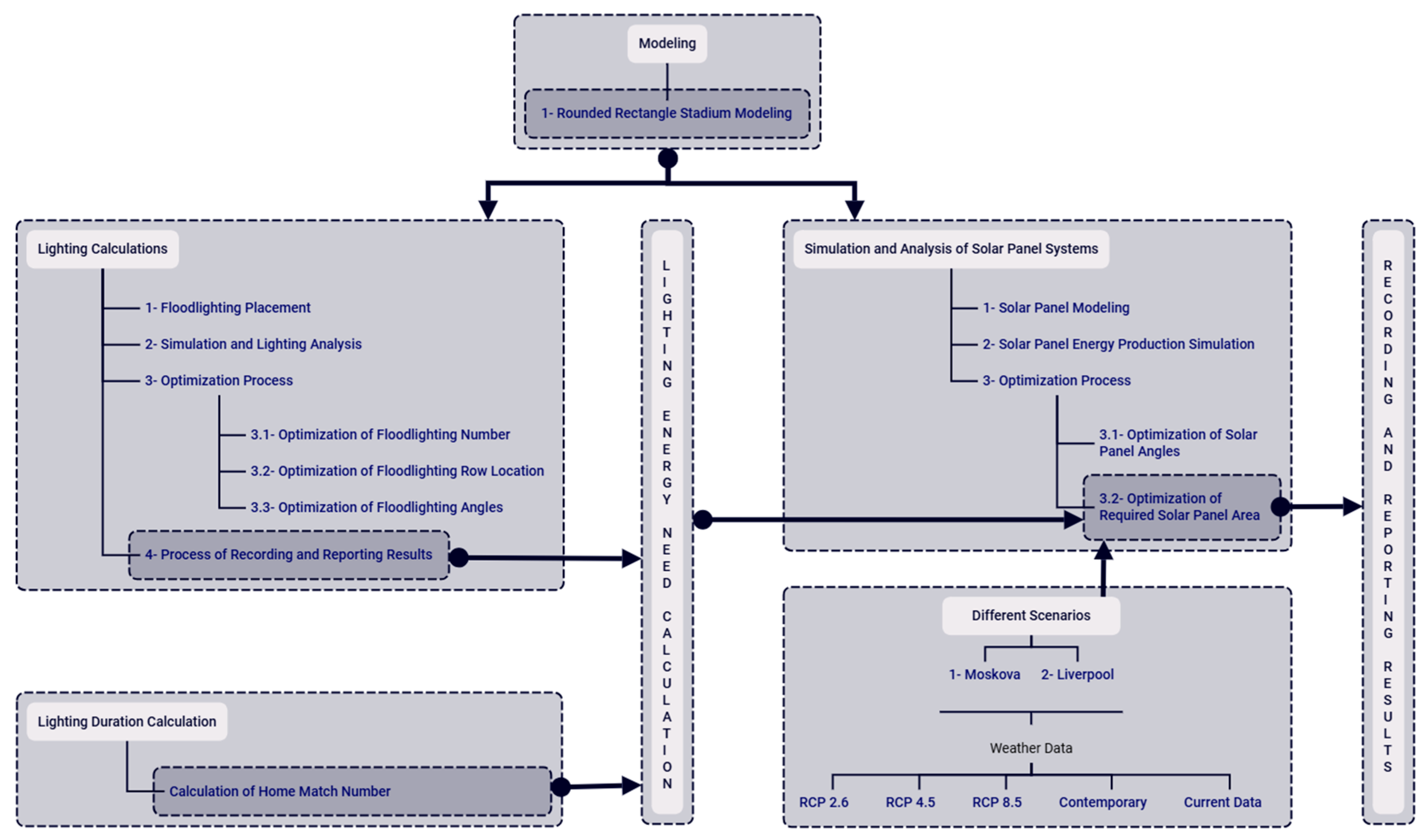
In this study, the feasibility of achieving a net-zero annual energy balance of a FIFA-standardized football stadium for pitch lighting during night matches with solar energy in a sustainable manner under different climatic zones and future climate scenarios is assessed. This study is based on the ‘Annual Net Metering’ model. The study assumes a grid-tied system where excess energy is exported during the day and consumed from the grid at night. Excess energy produced during the day is fed into the grid, while energy is drawn from the grid during night matches. The aim is to achieve ‘Net Zero’ lighting energy on an annual basis. The methodological approach is organized in five main stages: (1) stadium modeling, (2) lighting calculations, (3) lighting duration calculation, (4) simulation and analysis of solar panel systems, and (5) comparison of results according to different climate zones and climate scenarios. This structure aims to address both the present and future sustainability of the system in a multidimensional way (Figure 1).

2.1. Stadium Modeling

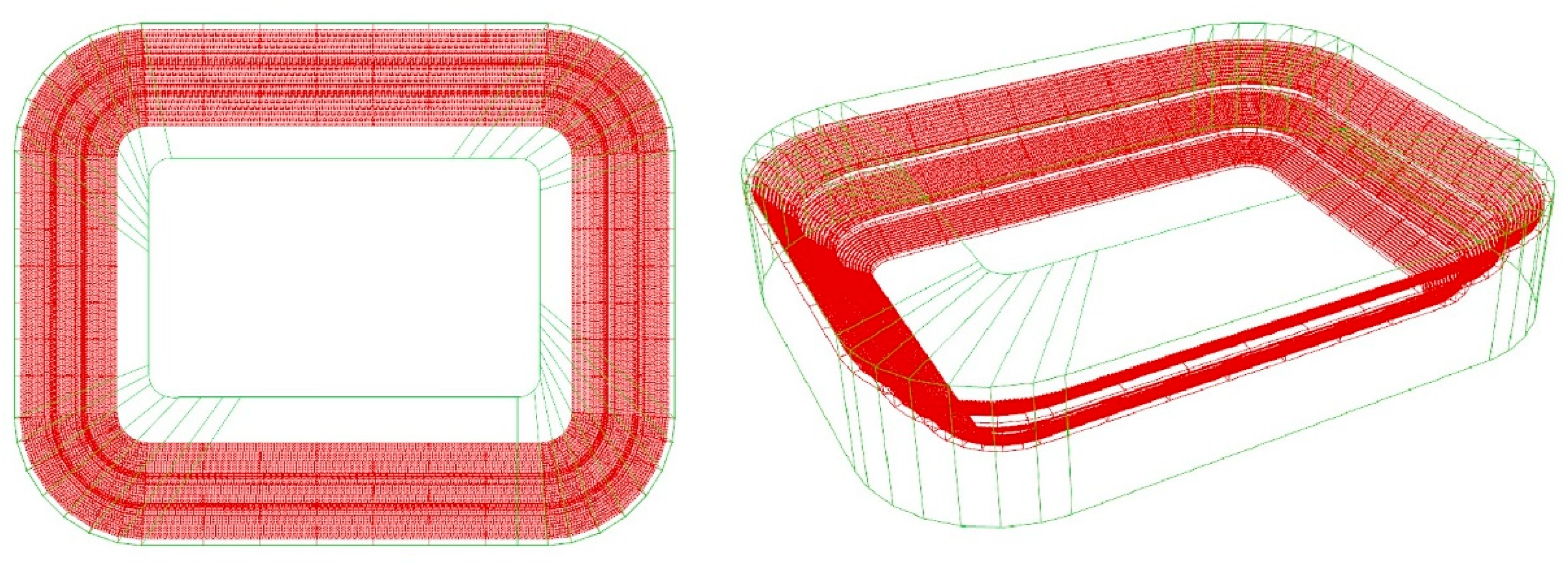
In the first step of the study, a stadium model was modeled in three dimensions using the parametric design software Grasshopper and its plugin Bowlbuilder. The rounded rectangle stadium type, among nine stadium types, was chosen for this research. The model is designed by taking into account the physical constraints of the field dimensions, the location of the stands, and the stadium geometry. A c-value of 0.12 is used in the model, and a 3-row design is preferred. In addition, a stadium with a capacity of 21,357 seats, with approximately 40 cm × 40 cm dimensions, representing a medium-sized stadium, was modeled as the number of seats. In the model, the roof center is modeled in such a way that the seats in the lowest row are located 15 degrees from the drip line, as specified by FIFA [11]. This model was used as a reference infrastructure for both lighting and photovoltaic system analyses (Figure 2).

2.2. Lighting Calculation

This part of the study aims to design the stadium’s electric lighting system according to FIFA regulations. The model stadium has been approved as a standard A stadium by FIFA, and it aims to meet the requirements of FIFA lighting standard A [11]. In addition, it is aimed that illuminance on the pitch is homogeneous and lighting components are used efficiently in the design process.
The software environment used for this study consists of an integrated suite of parametric and simulation tools. Detailed capabilities and limitations are provided in Table 1. Grasshopper was used as parametric design software in this part of the study. The choice of Galapagos as the optimization tool prolongs the process, but the ClimateStudio plugin does not work with other multi-objective optimization plugins. Moreover, the ClimateStudio plugin was used to calculate the illuminance to drop to the pitch, and the Galapagos plugin was used to optimize the results. Representations of lighting points were placed on the 4 sides of the stadium, under the eaves of the roof. This placement is an effective way to preserve the lighting components and to hide them to offer visual advantages. After that, lighting components were assigned to the lighting points by using the ClimateStudio plugin. When climate studio scripts were created, a “workflow template” was used. The “point-in-time illuminance” method was chosen, and the “simple office electric lighting” pattern was used to analyze the light distribution over the field in a certain time period. Grass was chosen as ground material. “Turbo” gradient mode was preferred to read the results easily in the visualization process. On the other hand, sunlight was not included in this calculation. It is calculated by using only artificial lighting.
As a floodlight, the Diadem Series LED Sports High Mast Lighting 1500 w (Unicornlite company, Shenzhen, China) was used. Diadem Series LED Sports Field High Mast Lighting fixtures offer brightness and light efficiency of up to 190 lm/W. The 1500 W model used in the study has an efficiency of 180 lm/W and provides a light flux of 180,000 lm. The fixture’s body is made of pure aluminum with a thermal conductivity of 96 W/m-K. Cree 5050 LEDs (Cree LED company, Huizhou, China) are used as the light source, with a Color Rendering Index (CRI) greater than 70 (Ra > 70). Additionally, it has a high TLCI index and a color rendering index of up to 90. These luminaires have electrical specifications of 180–305 V, 50/60 Hz. These products have IP66 water resistance and surge protection up to 6 KV. IES files were used to ensure the quality and accuracy of the simulation results. The model’s name is HM1K5DE6K-CS, and its dimensions are 831 × 772 × 571 mm. Other technical details of the product include SDCM < 6, power factor > 0.95, THD < 15%, Sosen driver usage, and driver efficiency > 97%. Additionally, it features OTP, OCP, OVP, SCP protections, IK08 impact testing, and an operating temperature range of −40 °C to 60 °C.
Regarding the optimization process, the Galapagos plugin was used. The optimization parameters are the floodlight’s locations, which slide 1 m for each slider; the floodlight’s vertical and horizontal angles, which change 1 degree for each slider; and the floodlight’s number, while the fitness functions are the minimum total number of floodlights, maximum uniformity, and lux, close and more than targets (1500 lux and 2000 lux) reaching the pitch. According to FIFA Lighting Standard A, the light level falling on the field should be at least 1500 lux; however, some stadiums prefer a lighting level of 2000 lux to enhance visual comfort and broadcast quality. As for optimization settings, the population size and maximum iteration number are 50 for each because these values were selected because larger values triggered computational constraints within ClimateStudio. During the optimization reporting process, the final positions of the lights, the final reflection angles of the lights, the total number of lights, and the mean and median lux values were recorded.
Objectives and fitness were defined for the Galapagos plugin. The optimization process was made up of 3 stages. The specific parameters, variables, and objectives for each sequential stage are summarized in Table 2. Firstly, all lights were located on the roof span border, and all lights’ angles were the same, vertically 45 and horizontally 0. In the optimization, the light number was used as the gene, while the other elements were the same. In addition, light locations on the same row were changed according to light number. The goal was to make the lux value of the pitch greater than 1500 lux and 2000 lux and closer to 1500 lux and 2000 lux. To achieve this goal, only the number of lights was used as a variable. The results were sorted from high to low. In this ranking, the number of lights belonging to the data with the smallest number of lights among values greater than 1500 lux and 2000 lux and the positions of these lights in the roof span border were selected.
Secondly, the new optimization was started by using a picked number of lights and their locations in the roof span border coming from the previous step’s results. In the optimization, the locations of light rows were used as the genes, while the number of lights and their angles remained the same. The goal was to reach the locations of light rows, which provide maximum lux on the pitch. The results were sorted from high to low, and the data belonging to the result providing maximum lux on the pitch was determined.
Thirdly, new optimization was started by using data coming from previous steps. In this step, the number of lights and their location were known. Therefore, the only variable was the angle of the lights. In the optimization, vertical angle degrees were changed between 30 and 55 by changing 1 degree for each step while horizontal angle degrees were changed between 345 and 15 degrees. The target of the optimization was to reach the lowest standard deviation among points on the grid, which has 96 points, including points at all corners and along boundary lines, and was used to divide the pitch. Concequently, when the results were sorted out from low to high, the lowest number of standard deviations was selected by checking its mean illuminance, which should be higher than 1500 lux and 2000 lux.

2.3. Lighting Duration Calculation

In this phase of the study, all official home matches played by Liverpool Football Club in the five-season period from the 2020–2021 season to the 2024–2025 season were analyzed on a season-by-season basis. Premier League, FA Cup, EFL Cup, UEFA events (Champions League, Europa League, or Conference League), and friendly matches are included in the analysis. For each season, the number of matches played by the club at Anfield Stadium was collected through official club data and reliable sports archive sources, and seasonal comparisons were made by calculating the total number of home matches per year. In this way, an average approach to the number of home matches played was used for the analysis. It was accepted as 30 matches per season. In addition, the working time of the lighting systems was planned to cover the pre-match, during the match, and after the match, and it was assumed that the lighting systems worked for an average of 5 h for each match. Even during daytime matches, stadium lighting systems are operated in accordance with FIFA regulations. This is mainly due to weather and climate factors that cause insufficient natural light. As a result, this study assumes that every match requires full artificial lighting.

2.4. Simulation and Analysis of Solar Panel Systems

The first step involves optimizing the orientation and tilt angles to maximize the efficiency of the solar panel. The process followed in this step is divided into two stages. Firstly, the tilt angle of the panel is optimized in such a way that the maximum amount of sunlight is received. The optimization of the tilt angle was determined to ensure that the sunlight falls steeply, taking into account the different seasonal conditions throughout the year. This is an important parameter that ensures the efficient operation of the panel. Secondly, the orientation of the panel was optimized. This optimization was performed in the east-west directions. This parameter was changed in order to capture sunlight in the most efficient way. Thus, the efficiency of the panel has been increased by providing more efficient reception of solar radiation throughout the year. At this stage, the best efficiency was achieved by considering the interaction between slope and direction. The Galapagos optimization plugin was used in these phases. As for optimization settings, the population size and maximum iteration number are 25 for each. These steps were calculated separately for each location using the available weather data.
The second stage involves the optimization of the panel area. This stage aims to minimize the unnecessary area for the efficient use of the solar panel. In this process, the solar panel used in this study was selected based on AJ Power’s AJ365-385WQHES (AJ Power, Seul, South Korea), a monocrystalline model that is compatible with the lightweight materials used in the roofing of the London Stadium. Since lightweight is a critical criterion for stadium roofs, this panel, weighing only 5.7 kg, stands out with its relatively low mass compared to conventional monocrystalline or polycrystalline panels. The panel’s specifications ensure high performance with 21.8% energy efficiency, operability under STC conditions (AM = 1.5, 1000 W/m2, 25 °C), and ±3% maximum power tolerance. The 1840 mm × 1040 mm × 2.5 mm panels were used in the study, and the width of the last panel was modeled to be modifiable by the Galapagos optimization in order to reach the target energy production. All panels have the same dimensions as the real panel until the final panel is reached. Thus, both structural load constraints and energy production targets are met together.
Panel models were created based on actual dimensions and specifications, and the most efficient system was attempted to be obtained in terms of energy production. At this stage, the height of the panel was kept constant, and only the width of the last panel was optimized. The target of the optimization is to produce the energy required to operate the lighting elements for 5 h for 1500 lux and 2000 lux illumination and to stay close to this target. Through a parametric evaluation, the ideal field size was obtained. This was a strategy to optimize the space utilization of the panel in the most efficient way. Using the hypothetical last panel dimension, it was assumed that the area was minimized. The Galapagos optimization plugin was used in the phase. As for optimization settings, the population size and maximum iteration number are 50 for each. Accepting the “stochastic” nature of the Galapagos, the study was conducted only once because 50 iterations were deemed sufficient for the complexity of this problem, and the result stabilized in the algorithm’s “convergence” graph. For each region, the simulations were re-performed, and the change in the panel area was analyzed using contemporary weather data obtained from Ladybug Tools EPW maps as a reference point, as well as the future insolation times and irradiance values of three different climate change scenarios defined by Meteonorm for the years 2050, 2080, and 2100, namely RCP 2.6, RCP 4.5, and RCP 8.5. The hourly meteorological data for Liverpool, UK (53.406° N, −2.981° W) were generated using Meteonorm version 8.2.0.24079. The dataset consists of hourly synthesis data (60-min resolution) to capture diurnal variations. For future climate analysis, the RCP 8.5 high-emission scenario was adopted for the target year 2100. The Perez model was utilized for calculating diffuse radiation, and the data includes hourly parameters for temperature, radiation, and humidity, derived from the software’s global climate database.

2.5. Comparison of Different Scenarios

At this stage, using three different climate change scenarios (RCP 2.6, RCP 4.5, and RCP 8.5) defined by Meteonorm and two climate zones (Liverpool and Moscow), the solar panel requirement needed to reach the 1500 lux and 2000 lux illumination level targets in the field as a result of the data for the years 2050, 2080, and 2100, was evaluated in terms of location, climate change scenarios, and years. Thus, the effect of both climate zones and climate change on system efficiency has been revealed.

3. Results

3.1. Findings of Lighting Calculation

Three stages were applied in the optimization process, and different parameters were considered at each stage. In the first stage, while determining the number of floodlights, a model was created in which the floodlight angles were fixed and the floodlight placements were located on the roof opening boundary. This stage aimed to ensure that the illumination level on the pitch reached the values closest to and above 1500 lux and 2000 lux. The results showed average illuminance values ranging from 1473 to 1512 lux with 88 floodlights and a standard deviation of around 592 for 1500 lux, and ranging from 1967 to 2014 lux with 104 floodlights and a standard deviation of around 600 for 2000 lux.
In the second phase, the placement of the light rows on the roof was optimized, retaining the number and position of floodlights selected from the previous phase. The objective of this phase was to maximize the illumination level over the pitch. The results with the highest lux value were determined, and appropriate placements were selected.
In the third stage, the number and placement of floodlights were kept constant, and only the light angles were optimized. The vertical angle was changed between 30 and 60 degrees, and the horizontal angle between 345 and 15 degrees in 1-degree increments. This phase aimed to increase the uniformity of the lighting over the pitch and to minimize the standard deviation value. When the results were analyzed, it was observed that the average illumination level of 1500 lux was achieved with a standard deviation of 575.54, and the average illumination level of 2035 lux was achieved with a standard deviation of 588.27.

3.2. Findings of Lighting Duration Calculation

As a result of the analysis, the number of home matches played by Liverpool Football Club at Anfield Stadium in the five-season period between the 2020–2021 and 2024–2025 seasons was analyzed, and an annual average of 29.8 matches was calculated. Accordingly, the number of home matches played per season is assumed to be 30 for the purposes of the analysis. With the assumption that the lighting systems operate for an average of 5 h before, during, and after the match, the total annual lighting time was calculated based on this number of matches. The assumption that stadium lighting will be operated for 5 h on match day is based on factors such as teams arriving at the stadium approximately 2 h before the match as per regulations; the process of fans entering the stadium; the match lasting approximately 2 h, including halftime and extra time; fans leaving the stadium after the match; teams’ recovery training sessions; and stadium security. This study assumes that every match requires full artificial lighting.

3.3. Findings of Simulation and Analysis of Solar Panel Systems

This section presents simulation and analysis results related to the orientation, tilt angle, and panel area optimization of solar panel systems for Liverpool and Moscow under different climate scenarios (RCP 2.6, 4.5, and 8.5) for the years 2050, 2080, and 2100. The study identifies panel configurations that will provide the energy required for stadium lighting and highlights potential future changes under different climate scenarios.

3.3.1. Optimization of Solar Panel Angles

Table 3 shows the optimal azimuth and tilt angles for solar panels in Liverpool and Moscow for three different RCP climate scenarios for the years 2050, 2080, and 2100. Currently available data and contemporary data are also presented for comparison.
Looking at the data for Liverpool in 2050, it is seen that azimuth angles vary between 178 and 181 degrees, while tilt angles are generally 40 or 41 degrees. The highest azimuth angle is 181 degrees in the RCP 4.5 scenario, while the lowest value is 178 degrees in the RCP 8.5 scenario. By 2080, azimuth angles are again between 180 and 181 degrees, while tilt angles remain at 40 or 41 degrees. In the RCP 2.6 scenario, the tilt angle is 41 degrees, while in the other two scenarios, it is 40 degrees. In 2100, a similar trend is observed. The lowest azimuth angle is 178 degrees in the RCP 8.5 scenario, and the highest is 181 degrees in the RCP 4.5 scenario. The tilt angle is in the range of 40–41 degrees. Finally, according to contemporary data, the optimum azimuth angle is 177 degrees and the tilt angle is 40 degrees. However, currently available data show an azimuth of 190 degrees and a tilt angle of 44 degrees.
Looking at the data for Moscow in 2050, it is evident that azimuth angles vary between 181 and 185 degrees, while tilt angles are between 40 and 41 degrees. The highest azimuth angle is 185 degrees in the RCP 8.5 scenario, while the lowest value is 181 degrees in the RCP 2.6 scenario. The tilt angle is 40 or 41 degrees in all scenarios. By 2080, azimuth angles range between 178 and 182 degrees. In this period, the tilt angle is 41 degrees in the RCP 2.6 and 8.5 scenarios, while it remains 40 degrees in the RCP 4.5 scenario. The scenario with the lowest azimuth angle is RCP 4.5 with 178 degrees, and the scenario with the highest azimuth angle is RCP 8.5 with 182 degrees. By 2100, a similar trend continues. The azimuth angles vary between 178 and 181 degrees, while the tilt angle varies between 40 and 41 degrees. The lowest azimuth value is 178 degrees in the RCP 4.5 scenario, and the highest value is 181 degrees in the RCP 8.5 scenario. According to contemporary data, the azimuth angle is estimated at 175 degrees and the tilt angle at 41 degrees. However, in the actual data available, the azimuth angle is 190 degrees and the tilt angle is 36 degrees.

3.3.2. Optimization of Required Solar Panel Area

Table 4 shows the optimization results for the amount of energy required to run 88 and 104 floodlights for 5 h in Liverpool and Moscow for different years under different climate scenarios.
The tables show the solar panel area, panel size, energy production, and the produced energy amount. Currently available and contemporary data are also included for comparison.
Looking at Table 5, in Liverpool in 2050, in the RCP 2.6 scenario, the panel width is 46.79 m, the panel area is 86.09 m2, and the amount of energy produced is calculated as 19,801.15 kWh. In the same year, in the RCP 4.5 scenario, these values were realized as 47.68 m, 87.73 m2, and 19,801.58 kWh, respectively. In the RCP 8.5 scenario, the panel width was 47.20 m, the area was 86.85 m2, and the energy generated was 19,802.69 kWh.
By 2080, for the RCP 2.6 scenario, the panel width is 46.22 m, the panel area is 85.04 m2, and the energy production is 19803.97 kWh. In the RCP 4.5 scenario for the same year, panel width is 47.39 m, panel area is 87.20 m2, and energy production is 19,803.75 kWh. In the RCP 8.5 scenario, these values are calculated as 46.96 m, 86.41 m2, and 19,802.42 kWh, respectively.
As of 2100, in the RCP 2.6 scenario, panel width is 45.80 m, panel area is 84.27 m2, and energy production is 19,803.79 kWh. In the RCP 4.5 scenario, these values are recorded as 47.37 m width, 87.16 m2 area, and 19,800.30 kWh energy. In the RCP 8.5 scenario, the panel width is 46.74 m, the area is 86.00 m2, and the energy production is 19,802.86 kWh.
In the contemporary data, the panel width is 49.81 m, the panel area is 91.65 m2, and the energy production is estimated at 19,803.26 kWh. Moreover, in the currently available data, the panel width is 46.99 m, the panel area is 86.46 m2, and the energy production is 19,802.13 kWh.
When Table 5 is analyzed, for Moscow in 2050, in the RCP 2.6 scenario, the panel width is 47.89 m, the panel area is 88.12 m2, and the amount of energy produced is calculated as 19,801.21 kWh. In the RCP 4.5 scenario for the same year, these values were realized as 50.12 m width, 92.22 m2 area, and 19,802.66 kWh energy production, respectively. In the RCP 8.5 scenario, the panel width is 49.71 m, the panel area is 91.47 m2, and the energy production is 19,800.37 kWh.
In 2080, under the RCP 2.6 scenario, the panel width was 46.27 m, the panel area was 85.12 m2, and the energy production was recorded as 19,803.40 kWh. In the same year, in the RCP 4.5 scenario, the panel width is 49.91 m, the panel area is 91.83 m2, and the energy production is calculated as 19,800.84 kWh. In the RCP 8.5 scenario, panel width is 48.90 m, panel area is 89.98 m2, and energy production is 19,801.30 kWh.
By 2100, in the RCP 2.6 scenario, panel width is 47.95 m, panel area is 88.23 m2, and energy production is 19,801.26 kWh. In the RCP 4.5 scenario, these values are realized as 49.18 m width, 90.49 m2 area, and 19,803.27 kWh energy production. In the RCP 8.5 scenario, the panel width is 48.72 m, the panel area is 89.64 m2, and the amount of energy produced is recorded as 19,801.60 kWh.
According to contemporary data, the panel width is 50.37 m, the panel area is 92.68 m2, and the energy production is estimated at 19,803.24 kWh. In contrast, according to the currently available data, the panel width is 54.48 m, the panel area is 100.24 m2, and the energy production is 19,801.20 kWh.
Looking at Table 6, the panel width is calculated as 55.30 m and the panel area as 101.75 m2 in the RCP 2.6 scenario in Liverpool in 2050. The amount of energy produced for this year is determined as 23,402.52 kWh. In the same year, in the RCP 4.5 scenario, the panel width is 56.35 m, the area is 103.68 m2, and the energy generated is 23,402.69 kWh. In the RCP 8.5 scenario, the panel width is 55.78 m, the area is 102.64 m2, and the energy production is 23,402.43 kWh.
By 2080, in the RCP 2.6 scenario, the panel width was 54.62 m, the area was 100.50 m2, and the energy generated was 23,403.13 kWh. In the same year, in the RCP 4.5 scenario, the panel width is 56.00 m, the panel area is 103.04 m2, and the energy production is 23,401.73 kWh. In the RCP 8.5 scenario, panel width was 55.50 m, panel area was 102.12 m2, and energy production was 23,403.63 kWh.
By 2100, in the RCP 2.6 scenario, the panel width is 54.12 m, the panel area is 99.58 m2, and the energy generated is 23,401.35 kWh. In the RCP 4.5 scenario, the panel width is 55.99 m, the area is 103.02 m2, and the energy generation is 23,403.84 kWh. In the RCP 8.5 scenario, the panel width is 55.24 m, the area is 101.64 m2, and the energy production is 23,404.14 kWh.
In the contemporary data, the panel width is 58.86 m, the panel area is 108.30 m2, and the energy production is estimated at 23,401.81 kWh. Also, in the currently available data, the panel width is 55.53 m, the panel area is 102.18 m2, and the energy production is 23,400.96 kWh.
In the RCP 2.6 scenario for the year 2050 in Moscow, the panel width is calculated at 56.60 m and the panel area at 104.14 m2. The amount of energy produced for this year is determined at 23,402.53 kWh. In the same year, in the RCP 4.5 scenario, the panel width was 59.23 m, the panel area was 108.98 m2, and the energy production was recorded at 23,401.58 kWh. In the RCP 8.5 scenario, the panel width at 58.75 m, the area was 108.10 m2, and the energy production was 23,402.13 kWh.
By 2080, in the RCP 2.6 scenario, the panel width was 56.64 m, the panel area was 104.22 m2, and the energy generated was 23,401.83 kWh. In the same year, in the RCP 4.5 scenario, the panel width was 58.99 m, the area was 108.54 m2, and the energy production was 23,402.16 kWh. In the RCP 8.5 scenario, the panel width was 57.79 m, the panel area was 106.33 m2, and the energy production was 23,401.18 kWh.
By 2100, in the RCP 2.6 scenario, the panel width is 56.67 m, the panel area is 104.27 m2, and the energy generated is 23,402.26 kWh. In the RCP 4.5 scenario, the panel width is 58.12 m, the area is 106.94 m2, and the energy generation is 23,403.15 kWh. In the RCP 8.5 scenario, the panel width is 57.58 m, the panel area is 105.95 m2, and the energy production is 23,402.63 kWh.
In the contemporary data, the panel width is 59.52 m, the panel area is 109.52 m2, and the energy production is estimated at 23,400.62 kWh. Also, in the currently available data, the panel width is 64.57 m, the panel area is 118.81 m2, and the energy production is 23,400.64 kWh.

4. Discussion

In this study, lighting optimization was carried out in a three-stage process. In the first stage, the number and placement of floodlights were determined to achieve the target values of 1500 lux and 2000 lux on the pitch. At this stage, 88 floodlights for 1500 lux achieved illumination levels ranging from 1473 to 1512 lux, and 104 floodlights for 2000 lux achieved illumination levels ranging from 1967 to 2014 lux. The second phase aimed to maximize lighting levels by optimizing the placement of the rows of lights. The third phase optimized the light angles to increase the uniformity of illumination over the pitch, with a standard deviation of 575.54 for 1500 lux and 588.27 for 2000 lux. The results show that each phase improved both the illumination levels and increased the uniformity.
Looking at the results of the optimization for the optimal azimuth and tilt angles for the solar panels, in general, very small variations in azimuth angles were observed in Liverpool between 178 and 181° over the years and scenarios. The tilt angle was generally maintained at 40° or 41°. This suggests that Liverpool could follow a stable strategy in terms of panel angle in response to climate change. However, the fact that the optimization results based on currently available data differ from the optimization results based on RCP scenarios suggests that current panel installations may be less efficient given future climate conditions.
When the findings in Table 5, for Liverpool, are analyzed over the years, a steady decrease in panel area and width is observed under the RCP 2.6 scenario. From 46.79 m in 2050, the panel width decreases to 46.22 m in 2080 and 45.80 m in 2100. The panel area similarly decreases from 86.09 m2 to 85.04 m2 and finally to 84.27 m2. This shows that the low-emission scenario can achieve the same energy production with less panel area in the long run. This trend can be explained by the positive contribution of climatic conditions to efficiency. In contrast, in the RCP 4.5 scenario, the panel width decreases slightly from 47.68 m to 47.37 m between 2050 and 2100, while the panel area decreases from 87.73 m2 to 87.16 m2. Similarly, in the RCP 8.5 scenario, the width decreases from 47.20 m to 46.74 m and the area from 86.85 m2 to 86.00 m2. In other words, in all three scenarios, the energy production remains constant while the panel area and width decrease very slightly over time.
On the other hand, comparing different scenarios in the same year also provides some important results. For example, looking at the data for the year 2050, the panel width varies between the RCP 2.6, 4.5, and 8.5 scenarios as 46.79 m, 47.68 m, and 47.20 m, respectively, while the panel area varies between 86.09 m2 and 87.73 m2, although the energy production remains constant at around 19,800 kWh. This reveals that the scenarios have an impact on the area used. In 2080 and 2100, a similar trend continues. For example, in 2100, although the energy production in the RCP 4.5 scenario is almost indistinguishable from the other scenarios, the panel area reaches the highest level of 87.16 m2 during the year.
Looking at the contemporary and currently available data, the energy production in both cases remains around 19,800 kWh, but in the contemporary conditions, the panel width is 49.81 m and the area is 91.65 m2, while the actual measurements show a width of 46.99 m and an area of 86.46 m2. This shows that the actual conditions are close to the optimized calculations and that the current technology is already working quite efficiently.
For Moscow, in 2050, in the RCP 2.6 scenario, the panel width is 47.89 m, the panel area is calculated as 88.12 m2, and the energy generated is 19,801.21 kWh. In the same year, in the RCP 4.5 scenario, these values are realized as 50.12 m, 92.22 m2, and 19,802.66 kWh, respectively. In the RCP 8.5 scenario, the panel width is 49.71 m, the area is 91.47 m2, and the energy production is 19,800.37 kWh. These data show that in higher emission scenarios, larger panels are needed to achieve similar energy production.
By 2080, in the RCP 2.6 scenario, the panel width is 46.27 m, the area is 85.12 m2, and the energy production is 19,803.40 kWh. In the same year, in the RCP 4.5 scenario, the panel width is 49.91 m, the area is 91.83 m2, and the energy production is recorded as 19,800.84 kWh. In the RCP 8.5 scenario, the panel width is 48.90 m, the area is 89.98 m2, and the energy production is calculated as 19,801.30 kWh. In this year, the panel width and area increase in parallel with the scenario changes.
As of 2100, in the RCP 2.6 scenario, panel width is 47.95 m, panel area is 88.23 m2, and energy generation is 19,801.26 kWh. In the RCP 4.5 scenario, the panel width is 49.18 m, the panel area is 90.49 m2, and the energy production is 19,803.27 kWh. In the RCP 8.5 scenario, the panel width is 48.72 m, the area is 89.64 m2, and the energy production is recorded as 19,801.60 kWh. In all three RCP scenarios, energy production remains almost constant, with only millimeter differences in panel size. This shows that the RCP 2.6 and 8.5 climate change scenarios have no significant impact on solar panel efficiency by 2100. However, the RCP 4.5 scenario shows the maximum value in terms of both area and production, albeit by a small margin. This can be interpreted that as the RCP 4.5 scenario offering optimum conditions.
In contemporary data, the panel width is 50.37 m, the panel area is 92.68 m2, and energy production is estimated at 19,803.24 kWh. This data reveals an increase in the panel area in the contemporary weather data generated by Meteonorm. However, looking at the currently available data, the panel width is 54.48 m and the area is measured at 100.24 m2. This highlights the small differences between the hypothetical models and the actual data, as well as the potential differences in panel design.
When the findings in Table 6 are evaluated for the year 2050, while the panel width is 55.30 m and the panel area is 101.75 m2 in the RCP 2.6 scenario, the width increases to 56.35 m and the area to 103.68 m2 in the RCP 4.5 scenario. In the RCP 8.5 scenario, the same level of energy production is achieved with panels that have a width of 55.78 m and a surface area of 102.64 m2. These results show that higher RCP scenarios in 2050 require a slightly larger area for similar energy output.
By 2080, in the RCP 2.6 scenario, the panel width decreases to 54.62 m and the area to 100.50 m2, indicating that similar energy production can be maintained compared to the previous period. RCP 4.5 and 8.5 scenarios maintained similar energy production with 56.00 m/103.04 m2 and 55.50 m/102.12 m2, respectively. From this, it is understood that medium and high emission scenarios require larger panel sizes, while energy efficiency increases in low-emission scenarios.
By 2100, this trend becomes more pronounced. In the RCP 2.6 scenario, the panel width decreases to 54.12 m and the area to 99.58 m2, thus sustaining energy production with the lowest surface area. In the same year, the RCP 4.5 scenario remained at 55.99 m/103.02 m2 and the RCP 8.5 scenario remained at 55.24 m/101.64 m2. This shows that the low-emission scenarios can provide similar energy efficiency with fewer resources in the long run and are therefore more advantageous in terms of panel area.
In addition, in the contemporary data, the panel width was estimated as 58.86 m and the panel area as 108.30 m2; the energy production remained at the level of 23,400 kWh. The currently available data shows that this output can be achieved with a width of 55.53 m and a panel area of 102.18 m2. This difference reveals that the hypothetical models predict more surface area.
For Moscow, in 2050, in the RCP 2.6 scenario, the panel width was 56.60 m, the panel area was 104.14 m2, and the amount of energy produced was 23,402.53 kWh. In the same year, in the RCP 4.5 scenario, the panel width was 59.23 m, the panel area was 108.98 m2, and the energy production was recorded as 23,401.58 kWh. In the RCP 8.5 scenario, the panel width was 58.75 m, the area was 108.10 m2 and the energy production was 23,402.13 kWh. This data shows that although energy production is almost at the same levels in different scenarios, larger panels are needed in the higher-emission RCP scenarios.
By 2080, in the RCP 2.6 scenario, the panel width is 56.64 m, the panel area is 104.22 m2, and the energy generated is 23,401.83 kWh. In the same year, in the RCP 4.5 scenario, the panel width is 58.99 m, the area is 108.54 m2, and the energy production is 23,402.16 kWh. In the RCP 8.5 scenario, the panel width is 57.79 m, the area is 106.33 m2, and the energy production is 23,401.18 kWh. A similar trend is observed this year: while energy production has changed only slightly, panel sizes and areas have become larger.
By 2100, in the RCP 2.6 scenario, the panel width is 56.67 m, the panel area is 104.27 m2, and the energy generated is 23,402.26 kWh. In the RCP 4.5 scenario, the panel width is 58.12 m, the area is 106.94 m2, and the energy production is 23,403.15 kWh. In the RCP 8.5 scenario, the panel width is 57.58 m, the panel area is 105.95 m2, and the energy production is 23,402.63 kWh. These results show that panel sizes have increased to meet the requirements of the higher emission RCP scenarios, but the differences in energy production remain small.
The results obtained for Liverpool and Moscow can also provide guidance for stadium lighting and photovoltaic integration strategies in other climate zones. Liverpool represents a temperate oceanic climate (Cfb) with moderate solar radiation and relatively stable seasonal variations, while Moscow reflects a humid continental climate (Dfb) characterized by colder winters and greater seasonal variability in solar availability. In regions with Mediterranean climates, such as Southern Europe, higher annual solar irradiation would likely reduce the photovoltaic area required to meet the same lighting energy demand. Conversely, in subarctic or high-latitude climates, lower winter solar radiation and shorter daylight hours may increase the required PV installation area or necessitate hybrid energy solutions. In arid and semi-arid climates, the higher solar potential may significantly enhance PV system efficiency, allowing stadium lighting energy demands to be met with smaller roof areas. Therefore, while the specific photovoltaic areas calculated in this study are location-dependent, the methodological framework combining lighting demand analysis, climate projections, and solar optimization can be applied to stadiums in different climatic regions to support climate-adaptive and energy-efficient design strategies.
In the contemporary data, the panel width is 59.52 m, the panel area is 109.52 m2, and the energy production is estimated at 23,400.62 kWh. In the currently available data, the panel width is 64.57 m, the panel area is 118.81 m2, and the energy production is 23,400.64 kWh. These data suggest that under currently available conditions, energy production does not increase with larger panels, but space utilization may be more efficient.

5. Conclusions

This study investigates the feasibility of solar energy generation for stadiums complying with FIFA lighting standards in different climate zones and under future climate scenarios. The lighting optimization results show that 88 floodlights are sufficient to achieve an average illumination level of approximately 1500 lx, while 104 floodlights are required for 2000 lx, meeting FIFA lighting standards. Based on the assumption of 30 home matches per year with 5 h of lighting per match, the annual lighting energy demand was calculated as 19,800 kWh for the 1500 lx scenario and 23,400 kWh for the 2000 lx scenario.
The solar panel optimization results demonstrate that the required photovoltaic area varies depending on climate scenarios and geographical conditions. For Liverpool, under the RCP 2.6 scenario, the required panel area decreases from 86.09 m2 in 2050 to 84.27 m2 in 2100, indicating that similar energy production can be achieved with a smaller installation area under low-emission conditions. In contrast, in Moscow for the year 2050, the required panel area ranges between 88.12 m2 (RCP 2.6) and 92.22 m2 (RCP 4.5) for the same energy demand. These results highlight that climate scenarios and regional climatic differences can directly influence the design parameters of stadium rooftop photovoltaic systems.
In particular, while low-emission scenarios such as RCP 2.6 provide the same energy production with less panel surface area in the long term, it is observed that the panel area increases in medium and high emission scenarios such as RCP 4.5 and RCP 8.5. This situation reveals that more surface area is needed in high-emission scenarios, and future energy planning should take this factor into consideration. In low-emission scenarios, more efficient energy production is achieved, which makes it possible to achieve the same energy output with less panel area.
The fact that Liverpool is located at approximately 53.40° north latitude and Moscow at 55.75° north latitude indicates that the latitudes of both cities can be used as direct parameters in determining the optimized tilt angles for photovoltaic (PV) panels. However, the fact that the optimal tilt angles obtained in our study differ from the latitudes of the cities indicates that this difference is not due to a single climatic factor but rather changes dynamically depending on seasonal variations, climate change scenarios, and specific environmental conditions such as shading at the panel installation location. Therefore, the necessity of a site-specific optimized static tilt strategy that maximizes solar radiation throughout the year, rather than a static angle based solely on geographical latitude, is emphasized to maximize the performance of PV systems.
The analyses in the Liverpool and Moscow cases assess changes in panel sizes with data for the years 2050, 2080, and 2100. The results show that there is a general reduction in panel sizes, but that this reduction does not significantly affect energy production. In Liverpool, in particular, the findings suggest that a more constant strategy can be pursued in response to climate change conditions and that optimization of panel angles can make this strategy more efficient. In Liverpool, azimuth angles generally showed small changes between 178° and 181°, while the tilt angle was maintained at 40° or 41°. This allows Liverpool to adopt a strategy that is less sensitive to climate change.
The data from Moscow emphasize the need for larger panels in high-emission scenarios. In 2050, 2080, and 2100, the same energy production can be achieved with smaller panel sizes in the RCP 2.6 scenario, while panel sizes increase in the RCP 4.5 and RCP 8.5 scenarios. This indicates that larger panel areas are needed to meet the requirements of higher emission scenarios.
In addition, in general, the sizes of the panel areas are ranked as RCP 4.5, RCP 8.5, and RCP 2.6 according to the RCP scenarios. This is thought to be related to the effects of the climatic conditions predicted by each scenario on panel efficiency. Since the RCP 2.6 scenario predicts a more stable climate, the panel efficiency remains more stable, and less space is needed. In the RCP 4.5 scenario, with climate change with moderate emissions, panel systems may need to be spread over a larger area, which increases the need for space. Since overheating and adverse atmospheric effects seen in the RCP 8.5 scenario may reduce the panel efficiency, the area requirement may be higher compared to RCP 2.6 but more limited compared to RCP 4.5.
According to the currently available data, existing panel designs yeild results in line with the optimized calculations. The existing technology is already operating very efficiently, and solar power generation has become more efficient over time. These findings reveal that the use of solar energy is a sustainable alternative to meet the energy needs of stadiums. Furthermore, it can be argued that solar energy will be an important resource in terms of environmental sustainability and has the potential to increase energy efficiency.
In conclusion, this study proposes an innovative approach to energy management of stadiums by examining how future climate changes will affect energy production and how solar energy can be a sustainable solution for large energy demands such as stadium lighting.

6. Limitation and Suggestion

This study calculates the theoretical maximum production. System losses such as cable, inverter, and pollution (15–20%) have not been included; the space requirement in actual applications will increase by this amount. On the other hand, the luminaire used in the simulation has a CRI > 70. It was assumed that luminaires with similar wattage but a CRI > 80 would have similar energy consumption.
The method used in this study includes some simplifications, such as not considering energy storage models, assuming a constant energy consumption profile, and ignoring operational variability. Accepting these limitations provides an important context for the practical applicability of the results obtained. In future research, incorporating these factors into the model will enhance the adaptability of the results to realistic scenarios.
Furthermore, the study was conducted in cold and humid climates such as Liverpool and cold and dry climates such as Moscow. Conducting similar analyses in the south and regions with different climatic conditions is considered important in terms of the generalizability of the findings and the identification of potential variations under different climatic scenarios.
The applicability of the proposed approach to other sports facilities, such as indoor arenas, tennis courts, or ice skating rinks, demonstrates the flexibility of the method and its adaptability to different usage scenarios. Additionally, the method’s scalable structure has the potential to provide an effective guide for energy production and space optimization in both small-scale facilities and large sports complexes. In this context, future studies could broaden the perspective on design and operational decision-making processes by adapting the method to different types and scales of sports facilities. Also, the static load capacity of the roof (snow/wind) is outside the scope of this study. It is recommended that static analyses be included in future studies.
On the other hand, the study’s findings provide important insights into how parameters such as panel orientation, tilt angle, and panel area should be prioritized under different climate conditions during the design phase. In particular, the conditions under which energy storage integration should be evaluated in regions where sunshine durations exhibit seasonal or daily variability emerge as a critical design consideration.

Funding

This research received no external funding.

Data Availability Statement

The data supporting the findings of this study are available from the corresponding author upon reasonable request. Public release is currently restricted due to ongoing research activities and related intellectual property considerations.

Acknowledgments

This research was supported by the University of Liverpool and the Republic of Türkiye. The author would like to thank both institutions for their financial and institutional contributions. The author would also like to express their sincere gratitude for the support provided throughout the study. During the preparation of this manuscript, the authors used generative AI tools (OpenAI ChatGPT (mainly used the version 5.2) and Anthropic Claude (mainly used the version Opus 4.5) for language polishing and improving clarity and concision of the writing. The author reviewed and edited the output and takes full responsibility for the content of this publication.

Conflicts of Interest

The author declares no conflicts of interest.

Abbreviations

The following abbreviations are used in this manuscript:
BAPVBuilding-Attached Photovoltaics
BIPVBuilding-Integrated Photovoltaics
CFBTemperate Oceanic Climate (Köppen–Geiger Classification)
CMIP6Coupled Model Intercomparison Project Phase 6
CRIColor Rendering Index
DFBHumid Continental Climate (Köppen–Geiger Classification)
FIFAFédération Internationale de Football Association
HVACHeating, Ventilation, and Air Conditioning
IESIlluminating Engineering Society
IPCCIntergovernmental Panel on Climate Change
LEDLight Emitting Diode
lxLux (unit of illuminance)
PVPhotovoltaic
RCPRepresentative Concentration Pathway
SAMSystem Advisor Model
SSPShared Socioeconomic Pathway
STCStandard Test Conditions
TLCITelevision Lighting Consistency Index
UEFAUnion of European Football Associations
U1/U2Lighting Uniformity Ratios
kWhKilowatt-hour
kWpKilowatt-peak

References

  1. Elnour, M.; Fadli, F.; Himeur, Y.; Petri, I.; Rezgui, Y.; Meskin, N.; Ahmad, A.M. Performance and energy optimization of building automation and management systems: Towards smart sustainable carbon-neutral sports facilities. Renew. Sustain. Energy Rev. 2022, 162, 112401. [Google Scholar] [CrossRef]
  2. Sports Journal. Premier League Football Clubs Stadium Costs Data 2022–23. 2022. Available online: https://sportsjournal.io/premier-league-football-clubs-stadium-costs-data-2022-23/ (accessed on 31 August 2025).
  3. Orejón-Sánchez, R.D.; Hermoso-Orzáez, M.J.; Gago-Calderón, A. LED Lighting Installations in Professional Stadiums: Energy Efficiency, Visual Comfort, and Requirements of 4K TV Broadcast. Sustainability 2020, 12, 7684. [Google Scholar] [CrossRef]
  4. EN 12193; Light and Lighting—Sports Lighting. European Committee for Standardization: Brussels, Belgium, 2018.
  5. UEFA. UEFA Stadium Lighting Guide. 2016. Available online: https://www.uefa.com/MultimediaFiles/Download/uefaorg/General/02/36/26/72/2362672_DOWNLOAD.pdf (accessed on 31 August 2025).
  6. UEFA. UEFA Stadium Lighting Guide 2023. 2023. Available online: https://documents.uefa.com/r/UEFA-Stadium-Lighting-Guide-2023-2023/Main-points-Online (accessed on 31 August 2025).
  7. Xuan, S.; Qin, Y.N.; Zhou, J.X.; Wu, J.P. The impact of stadiums on carbon emissions: A systematic review. Pol. J. Environ. Stud. 2025, 20, 1–11. [Google Scholar] [CrossRef] [PubMed]
  8. Barbaro, L.; Battista, G.; de Lieto Vollaro, E.; de Lieto Vollaro, R. Harnessing Stadium Roofs for Community Electrical Power: A Case Study of Rome’s Olympic Stadium Title. Appl. Sci. 2024, 14, 7344. [Google Scholar] [CrossRef]
  9. Qian, F.; Shi, Z.; Yang, L. A Review of Green, Low-Carbon, and Energy-Efficient Research in Sports Buildings. Energies 2024, 17, 4020. [Google Scholar] [CrossRef]
  10. UEFA. Article 36 Floodlights. Regulations of the UEFA Champions League. UEFA Documents. 2024. Available online: https://documents.uefa.com/r/Regulations-of-the-UEFA-Champions-League-2025/26/Article-36-Floodlights-Online (accessed on 31 August 2025).
  11. FIFA. 5.6 Technical Systems and Services. in Football Stadiums Guidelines. FIFA Publications. Available online: https://publications.fifa.com/en/football-stadiums-guidelines/technical-guideline/stadium-guidelines/technical-systems-and-services/ (accessed on 31 August 2025).
  12. Devetaković, M.; Djordjević, D.; Radojević, M.; Krstić-Furundžić, A.; Burduhos, B.-G.; Martinopoulos, G.; Neagoe, M.; Lobaccaro, G. Photovoltaics on Landmark Buildings with Distinctive Geometries. Appl. Sci. 2020, 10, 6696. [Google Scholar] [CrossRef]
  13. Safarpour, A.; Laleh, S.S.; Soltani, S. Identifying challenges, benefits, and recommendations for utilizing solar panels in sport stadiums: A thematic analysis. Prog. Eng. Sci. 2025, 2, 100035. [Google Scholar] [CrossRef]
  14. Matera, N.; Mazzeo, D.; Baglivo, C.; Congedo, P.M. Will Climate Change Affect Photovoltaic Performances? A Long-Term Analysis from 1971 to 2100 in Italy. Energies 2022, 15, 9546. [Google Scholar] [CrossRef]
  15. Zhao, X.; Huang, G.; Lu, C.; Zhou, X.; Li, Y. Impacts of climate change on photovoltaic energy potential: A case study of China. Appl. Energy 2020, 280, 115888. [Google Scholar] [CrossRef]
  16. Hua, Y.; Wei, M.; Yuan, J.; He, W.; Chen, L.; Gao, Y. The Impact of Climate Change on Solar Radiation and Photovoltaic Energy Yields in China. Atmosphere 2024, 15, 939. [Google Scholar] [CrossRef]
  17. Bozsik, N.; Szeberényi, A.; Bozsik, N. Impact of Climate Change on Electric Energy Production from Medium-Size Photovoltaic Module Systems Based on RCP Climate Scenarios. Energies 2024, 17, 4009. [Google Scholar] [CrossRef]
  18. Zhang, Z.; Qian, Z.; Chen, M.; Zhu, R.; Zhang, F.; Zhong, T.; Lin, J.; Ning, L.; Xie, W.; Creutzig, F.; et al. Worldwide rooftop photovoltaic electricity generation may mitigate global warming. Nat. Clim. Change 2025, 15, 393–402. [Google Scholar] [CrossRef]
  19. Shekar, V.; Caló, A.; Pongrácz, E. Optimising solar photovoltaic azimuth performance in Arctic conditions: An empirical techno-economic analysis. Renew. Energy 2025, 256, 124441. [Google Scholar] [CrossRef]
  20. Peter, U.; Mulati, D.; Kamau, J.; Soitah, T. The Optimal Tilt Angle for Maximizing Energy Production from Bifacial solar Panels Under Varying Height in Tropical Regions. J. Sustain. Dev. Energy Water Environ. Syst. 2025, 13, 1130628. [Google Scholar] [CrossRef]
  21. Yang, Y.; Li, J.; Zhang, W.; Zheng, F. Research on the contribution rate of photovoltaic power in indoor ice arenas across different climatic zones: A case study in China. Energy Built Environ. 2024, 7, 25–40. [Google Scholar] [CrossRef]
  22. Park, J.J.; Dave, B. Bio-inspired parametric design for adaptive stadium façades. Australas. J. Constr. Econ. Build.-Conf. Ser. 2014, 2, 27–35. [Google Scholar] [CrossRef]
  23. Manni, M.; Coccia, V.; Nicolini, A.; Marseglia, G.; Petrozzi, A. Towards Zero Energy Stadiums: The Case Study of the Dacia Arena in Udine, Italy. Energies 2018, 11, 2396. [Google Scholar] [CrossRef]
  24. Meteotest. Meteonorm, (Version 8.2.0.24079); Meteotest: Bern, İsviçre, 2024. Available online: https://meteonorm.com (accessed on 31 August 2025).
Figure 1. Research methodology.
Buildings 16 01350 g001
Figure 2. Stadium Model.
Buildings 16 01350 g002
Table 1. Summary of simulation software and plugins used in the methodology.
Software/PluginPrimary CapabilitiesLimitations
Grasshopper (Rhino 8 Plugin)Enables parametric modeling and algorithmic design control.Requires high computational power for complex 3D geometries.
ClimateStudio (v2.3)Performs high-fidelity lighting analysis, point-in-time illuminance, and spectral simulations.Limited direct compatibility with certain multi-objective optimization tools.
Galapagos
(Evolutionary Solver)
Utilizes genetic algorithms for single-objective optimization (e.g., minimizing standard deviation).As a stochastic solver, results may require multiple iterations to ensure convergence.
Meteonorm (v8.2)Generates hourly synthesized meteorological data and future climate scenarios (RCPs).Synthetic data generation may include slight regional variations compared to long-term physical sensors.
Bowlbuilder (v.alpha) (Grasshopper Plugin)Facilitates rapid parametric modeling of stadium seating, bowl geometry, and capacity.Restricted to standardized stadium types and fixed physical constraints.
Table 2. Summary of the three stage optimization process for stadium lighting.
StagesFitnessGenesConstant Parameters
Stage 1
Number of Fixtures
To reach a lux value > 1500 lx and 2000 lx, staying as close as possible to these targetsNumber of floodlights.Fixed angles (vertical: 45°, horizontal: 0°) and fixed location on the roof span border.
Stage 2
Placement
To maximize average illuminance (lux) on the pitch.Locations of the light rows.Number of lights (from Stage 1) and fixed angles (45°/0°).
Stage 3
Angles
To minimize standard deviation (maximize uniformity) while maintaining mean illuminance > 1500/2000 lx.Vertical angles (30–55°) and horizontal angles (345–15°)Final light count and row locations determined in previous stages.
Table 3. Optimal azimuth and tilt angles for solar panels.
YearRCP ScenarioLiverpoolMoscow
Azimuth
Angle
Tilt AngleAzimuth
Angle
Tilt Angle
20502.61804118141
4.51814018340
8.51784118540
20802.61814118041
4.51814017840
8.51804018241
21002.61794117941
4.51814017840
8.51784118141
Contemporary1774017541
Currently Available Data1904419036
Table 4. Optimization results of the amount of energy.
Target
Illuminance (Lux)
Number of Floodlights (Units)Power per Unit (kW)Match
Number
Working Hours
(Hour)
Annual
Operating Hours (h/Year)
Total
Annual
Energy
Demand (kWh)
1500 Lux881.530515019,800
2000 Lux1041.530515023,400
Table 5. Optimization of required solar panel area for 1500 lux.
YearRCP ScenarioLiverpoolMoscow
Panel Area (Square Meter)Panel Width (Meter) Produced
(kWh)
Panel Area (Square Meter)Panel Width (Meter) Produced
(kWh)
20502.686.0946.7919,801.1588.1247.8919,801.21
4.587.7347.6819,801.5892.2250.1219,802.66
8.586.8547.2019,802.6991.4749.7119,800.37
20802.685.0446.2219,803.9785.1246.2719,803.40
4.587.2047.3919,803.7591.8349.9119,800.84
8.586.4146.9619,802.4289.9848.9019,801.30
21002.684.2745.8019,803.7988.2347.9519,801.26
4.587.1647.3719,800.3090.4949.1819,803.27
8.586.0046.7419,802.8689.6448.7219,801.60
Contemporary Data91.6549.8119,803.2692.6850.3719,803.24
Current Real Data86.4646.9919,802.13100.2454.4819,801.20
Table 6. Optimization of required solar panel area for 2000 lux.
YearRCP ScenarioLiverpoolMoscow
Panel Area (Square Meter)Panel Width (Meter) Produced
(kWh)
Panel Area (Square Meter)Panel Width (Meter) Produced
(kWh)
20502.6101.7555.3023,402.52104.1456.6023,402.53
4.5103.6856.3523,402.69108.9859.2323,401.58
8.5102.6455.7823,402.43108.1058.7523,402.13
20802.6100.5054.6223,403.13104.2256.6423,401.83
4.5103.0456.0023,401.73108.5458.9923,402.16
8.5102.1255.5023,403.63106.3357.7923,401.18
21002.699.5854.1223,401.35104.2756.6723,402.26
4.5103.0255.9923,403.84106.9458.1223,403.15
8.5101.6455.2423,404.14105.9557.5823,402.63
Contemporary Data108.3058.8623,401.81109.5259.5223,400.62
Currently Available Data102.1855.5323,400.96118.8164.5723,400.64
Disclaimer/Publisher’s Note: The statements, opinions and data contained in all publications are solely those of the individual author(s) and contributor(s) and not of MDPI and/or the editor(s). MDPI and/or the editor(s) disclaim responsibility for any injury to people or property resulting from any ideas, methods, instructions or products referred to in the content.