Article

Automated Identification and Quantification of 3D Failure Domains in Spatially Variable Soil Slopes Under Rectangular Footings

Department of Geotechnical Engineering, College of Civil Engineering, Hunan University, Changsha 410082, China
*
Author to whom correspondence should be addressed.
Buildings 2026, 16(7), 1321; https://doi.org/10.3390/buildings16071321
Submission received: 12 February 2026 / Revised: 17 March 2026 / Accepted: 24 March 2026 / Published: 26 March 2026
(This article belongs to the Special Issue New Reinforcement Technologies Applied in Slope and Foundation)

Abstract

Accurate identification of slope failure mechanisms under shallow foundations is essential for reliable risk assessment and reinforcement design. However, existing studies often neglect the spatial variability of soil properties and the influence of footing shape. This study develops a non-intrusive stochastic finite difference framework integrating random field theory, Monte Carlo simulation, and a Gaussian mixture model to automatically characterize three-dimensional slope failure domains under rectangular footing loads. Results show that slope failure mechanisms are primarily governed by the footing aspect ratio and the scale of fluctuation in soil strength. Square footings mainly induce shallow slope face failure, whereas rectangular footings significantly increase the probability of deep toe failure as the scale of fluctuation increases. Stochastic analyses generally yield larger mean failure volumes than deterministic analyses. Risk assessment further indicates that risk levels are primarily controlled by the absolute failure volume at low safety factors, whereas failure variability becomes increasingly influential at higher safety factors.

1. Introduction

Driven by topographic constraints or economic considerations, building foundations are often constructed on or adjacent to slopes, rendering the evaluation of bearing capacity a persistent challenge in geotechnical engineering [1,2,3]. Traditional analytical approaches, including limit equilibrium methods, limit analysis, and the method of characteristics, have been widely applied to address this issue [4,5,6,7]. However, these methods generally rely on a priori assumptions of slope failure mechanisms to derive ultimate bearing capacity expressions. Advanced numerical simulation methods provide a powerful alternative for addressing these limitations, as they circumvent the need to predefine failure mechanisms and enable the analysis of soil–structure interaction problems under complex conditions [8,9,10,11]. However, natural slope soils inherently exhibit spatial variability and autocorrelation, manifesting as random fluctuations in physical and mechanical properties across three-dimensional (3D) space due to long-term geological processes [12,13]. Under such conditions, accurately characterizing the spatial evolution of slope failure modes becomes a key focus of current investigations, as it directly influences the determination of slope reinforcement strategies under foundation loading. When soil spatial variability is considered, potential failure domains at the ultimate limit state no longer conform to the regular geometries assumed in classical theories; instead, they propagate along irregular paths through local weak zones [14]. Consequently, the failure mechanism and ultimate bearing capacity of slopes exhibit inherent uncertainties that are difficult to adequately capture by deterministic analysis methods alone.
Random field theory offers a robust framework for characterizing the spatial variability of soils [15]. Griffiths and Fenton [16,17,18] integrated random field theory with finite element methods, establishing the random finite element method (RFEM) to analyze the probabilistic bearing capacity of strip footings on level ground under two-dimensional (2D) plane strain conditions. This approach captures the weakest-link phenomenon, where failure mechanisms propagate along paths of least resistance, leading to transitions in failure modes within spatially variable soils. Building on this framework, extensive studies have investigated slope failure behavior subjected to footing or surcharge loading. For instance, Luo and Bathurst [19] assessed the bearing capacity reliability of strip footings on cohesive soil slopes. Brahmi et al. [20] studied the stochastic bearing capacity of strip footings on slopes under inclined loading, employing random field theory combined with finite element limit analysis. Halder and Chakraborty [21,22] utilized lower-bound finite element limit analysis and the finite difference method (FDM), respectively, to evaluate the probabilistic bearing capacity of strip footings on reinforced soil slopes. Zhou et al. [23,24] demonstrated random transitions between local shear failure and global slope instability under strip footings. However, these analyses remain confined to 2D plane strain assumptions. For rectangular footings with low aspect ratios, plane strain simplifications overlook end constraints and 3D stress diffusion effects [25]. More importantly, under spatially variable soil conditions, the non-uniform distribution of soil properties along the longitudinal axis of the footing renders the plane strain assumption inapplicable [14,26]. Consequently, employing 3D stochastic analyses is essential to adequately capture the propagation of uncertainties in bearing capacity and failure modes for footing–slope systems.
Quantifying the failure volume of a slope offers critical indicators for assessing the consequences and risks associated with spatially variable slope failures. Hicks et al. [27,28] utilized nodal displacements at the numerical limit state, classifying a node as part of the failure mechanism when its displacement exceeded a predetermined threshold. However, relying on a predefined displacement threshold to identify the failure domain has significant limitations [29]. Unsupervised machine learning methods provide an effective means of distinguishing between failure and stable regions, with the K-means clustering method (KMCM) being widely adopted [29,30,31,32,33,34]. Huang et al. [29] pioneered the application of KMCM to automatically identify failure domains in spatially variable slope stability analysis using limit-state nodal displacement data. Building on this work, Wang et al. [31] and Wu et al. [33] validated the feasibility of clustering-based analysis in 2D and 3D slope stability problems, respectively. Furthermore, Luo et al. [32] applied KMCM to elucidate the influence of soil rotational anisotropy on the failure probability and risk of strip footing–slope systems. Remmerswaal et al. [34] employed KMCM to quantify the geometric consequences of complex retrogressive failure in 3D slopes subjected to rectangular foundation loads. However, KMCM minimizes the squared error based on Euclidean distance, inherently favoring cluster structures with similar densities and approximately spherical shapes [35]. In limit-state slope displacement data, where the variances of stable and failure domains differ significantly, cluster boundaries are easily skewed by large-displacement outliers, complicating the robust characterization of failure domain boundaries.
To address the above research gaps, this study develops a stochastic framework for identifying and quantifying slope failure domains under rectangular footing loads. The main contributions of this study can be summarized as follows: (1) A non-intrusive 3D stochastic finite difference framework integrating random field theory and Monte Carlo simulation is developed to analyze footing–slope systems with spatially variable soil properties. (2) A Gaussian mixture model (GMM)-based clustering approach is introduced to automatically identify slope failure domains from limit-state displacement fields. Compared with the conventional KMCM, the proposed approach more robustly characterizes failure boundaries in datasets with significantly different displacement variances. (3) A quantitative characterization scheme is established to describe the geometric features of 3D stochastic slope failure domains, enabling systematic evaluation of failure volumes and associated system risks. (4) Using the developed framework, the effects of the scale of fluctuation on stochastic slope failure mechanisms and mobilized failure volumes are systematically investigated for slopes subjected to rectangular footings with varying aspect ratios.
The remainder of this paper is organized as follows. Section 2 introduces the random field modeling of soil spatial variability. Section 3 details the finite difference modeling and the definition of the slope failure limit state. Section 4 describes the non-intrusive RFDM analysis framework. Section 5 presents the slope failure domain identification and characterization methods. Section 6 discusses the results on stochastic slope failure mechanisms and failure volumes. Section 7 addresses the limitations of the present study and outlines future research directions, and Section 8 concludes the paper.

2. Random Field Modeling of Soil Spatial Variability

Soil physical and mechanical properties typically exhibit spatial variability and autocorrelation, arising from variations in mineral composition, depositional environments, and complex stress histories. Within the framework of random field theory, a soil parameter is modeled as a random field characterized by its probability distribution, mean, coefficient of variation (CoV), and autocorrelation function (ACF) [15]. Among these parameters, the ACF is critical for quantifying the spatial correlation structure of soil properties between distinct spatial locations. In this study, a 3D Markovian exponential ACF is adopted, owing to its widespread application in geotechnical random field modeling [36]:
ρ ( ζ x , ζ y , ζ z ) = exp 2 ζ x θ x + ζ y θ y + ζ z θ z
where ζx = xixj, ζy = yiyj, ζz = zizj denote the separation distances between the centroids of the i-th and j-th finite difference elements along the three principal directions (i, j = 1, 2, …, En, with En being the total number of elements in the numerical model). Additionally, θx, θy, and θz represent the scales of fluctuation (SOF) along each respective direction, with larger SOF values corresponding to highly correlated and smoother spatial fields.
Utilizing Equation (1), a 3D autocorrelation matrix R (En × En) is constructed. Subsequently, the random field is generated via the Cholesky decomposition technique (R = LLT). However, for high-resolution 3D finite difference meshes, performing direct decomposition on the full autocorrelation matrix R entails prohibitive memory and computational costs [37]. To mitigate this computational burden, the separability property of the ACF allows R to be expressed as a Kronecker product of three one-dimensional (1D) autocorrelation matrices:
R = R x R y R z
where Rx (Ex × Ex), Ry (Ey × Ey), and Rz (Ez × Ez) denote the 1D autocorrelation matrices along the x, y, and z directions, and ⊗ represents the Kronecker product. Consequently, the 3D lower-triangular matrix L can be efficiently constructed from the Kronecker product of the 1D Cholesky factors:
R x = L x L x T R y = L y L y T R z = L z L z T
L = L x L y L z
where Lx, Ly, and Lz are obtained via Cholesky decomposition of Rx, Ry, and Rz, respectively. This approach substantially reduces memory requirements and enhances computational efficiency.
Following the construction of L, a correlated 3D standard normal random field is generated by multiplying the lower triangular matrix L by a vector of independent standard normal random variables Zj. For example, for cohesion c, the following equation is used:
G c = j = 1 i L i j Z j
The resulting field Gc is subsequently transformed to match the target probability distribution. In this study, soil strength parameters are assumed to follow a lognormal distribution, consistent with common practice in geotechnical reliability analysis [32]. Thus, the cohesion field c is obtained via the following transformation:
c = exp ( μ ln c + σ ln c G c )
where μlnc and σlnc denote the mean and standard deviation, respectively, of the underlying normal distribution of cohesion lnc. These parameters are derived from the physical mean (μc) and coefficient of variation (CoVc) of the soil cohesion:
σ ln c 2 = ln ( 1 + σ c 2 μ c 2 ) = ln ( 1 + C o V c 2 )
μ ln c = ln μ c 1 2 σ ln c 2
An analogous procedure is employed to generate the random field for the internal friction angle φ.

3. Details of Finite Difference Modeling

3.1. Numerical Model

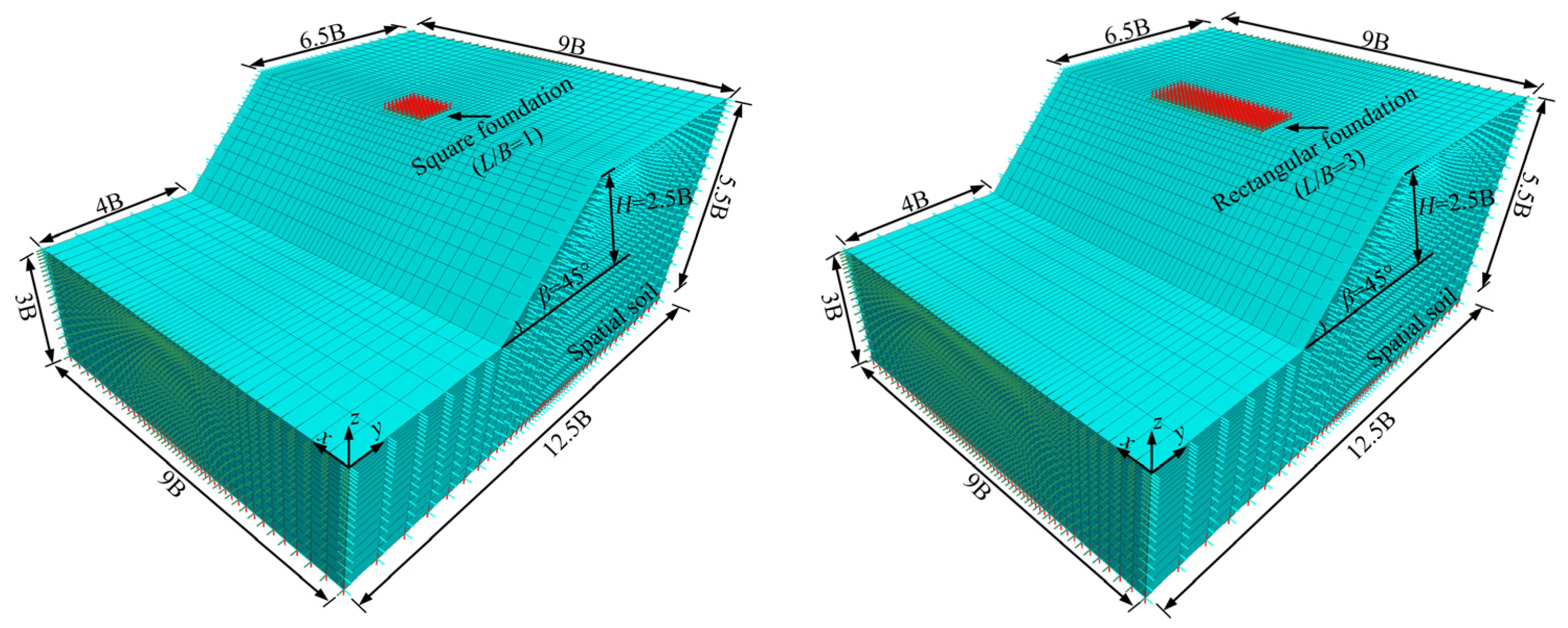
Figure 1 illustrates the geometry of the numerical model employed in this study. A rigid, rough footing with width B and length L is situated on a 3D slope of height H and inclination β. To ensure the generality of the findings, all geometric dimensions are normalized with respect to the footing width, B. The computational domain spans 9B, 12.5B, and 5.5B along the three principal axes, respectively. Sensitivity analyses confirmed that these dimensions are sufficient to minimize boundary effects on slope failure mechanisms.
Both deterministic and stochastic analyses were performed using the explicit finite difference code FLAC3D 6.00. The computational domain was discretized using eight-node hexahedral elements. To accurately capture stress concentrations beneath footing edges and the evolution of potential shear zones, while balancing computational efficiency, local mesh refinement was implemented in the vicinity of the foundation. Specifically, as illustrated in Figure 1, the numerical models for the square and rectangular footings comprise 34,776 and 45,540 elements, respectively. Grid sensitivity analysis was conducted prior to the stochastic simulations, confirming that the adopted mesh density provides a balance between numerical convergence and computational efficiency. The applied boundary conditions were as follows: the base was fixed against displacement in all directions, whereas lateral boundaries were constrained only in the normal direction, permitting free tangential deformation. The rigid and rough characteristics of the footing were simulated by constraining the horizontal displacements of soil–footing interface nodes to model rough contact. Simultaneously, a constant vertical velocity was applied to these nodes to enforce displacement-controlled loading until the slope reached the ultimate limit state.
The soil domain is modeled as an elastic perfectly plastic material governed by the Mohr–Coulomb yield criterion. Its mechanical behavior is defined by the elastic modulus E, Poisson’s ratio ν, cohesion c, unit weight γ, internal friction angle φ, and dilation angle ψ. Since the ultimate bearing capacity of slopes under rectangular footing loads is primarily governed by soil shear strength, c and φ are selected as random variables to capture the spatial variability of strength properties. To ensure physically valid values (0° < φ < 90°) and directly reflect variations in the friction coefficient, the random field is generated for tanφ rather than φ itself [38]. Furthermore, to account for non-associated flow characteristics, the dilation angle ψ is modeled as linearly dependent on the internal friction angle (ψ = φ/6), while the remaining elastic and physical parameters are treated as spatially homogeneous deterministic constants. Table 1 lists the adopted values for these deterministic constants and the statistical parameters governing the random fields. The statistical parameters in Table 1, such as the scale of fluctuation and the coefficient of variation, are key variables governing the stochastic response of the system. The selected parameter values and ranges are based on typical geotechnical statistics [35] and comparable probabilistic studies [19,23], thereby ensuring a realistic and comprehensive investigation of failure mechanism transitions.

3.2. Definition of Limit State for Slope Failure

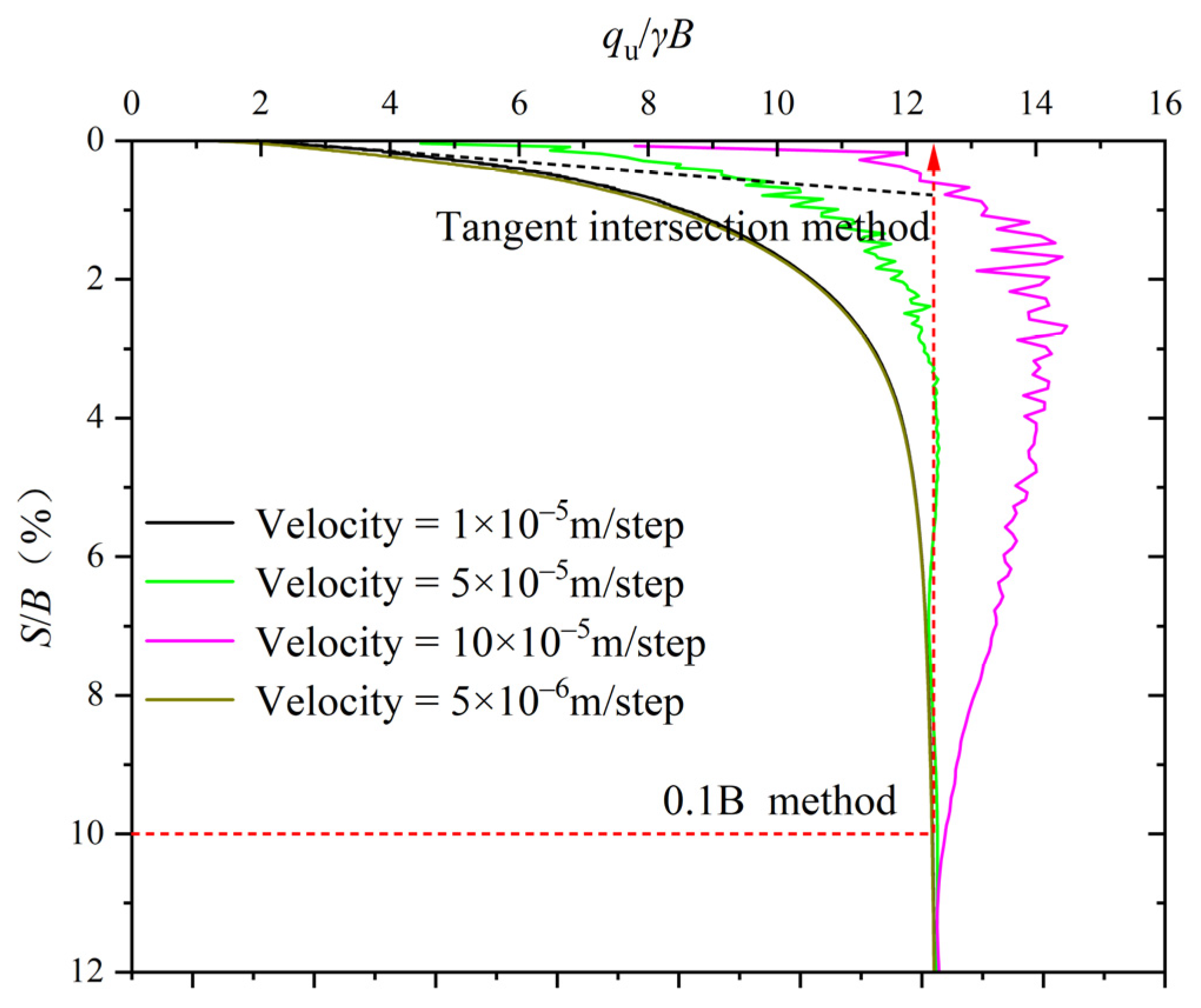
The numerical model is first subjected to gravity loading and solved to static equilibrium to establish the initial in situ stress field generated by the soil’s self-weight. Subsequently, nodal displacements across the entire domain are reset to zero to eliminate the influence of initial settlement on the footing loading phase, while preserving the established stress state. Following initialization, the rectangular footing is simulated as a rigid body and subjected to vertical loading via a displacement-controlled scheme, applying a constant vertical velocity to nodes at the soil–footing interface. In explicit finite difference analyses, the applied loading rate must be calibrated via sensitivity analysis to ensure quasi-static conditions, effectively minimizing inertial effects. Figure 2 illustrates the load–settlement responses obtained for various loading rates. The results indicate that bearing capacity response curves converge when the loading rate falls below 1.0 × 10⁻⁵ m/step, with further reductions yielding negligible differences. Balancing computational accuracy and efficiency, a loading rate of 1.0 × 10⁻⁵ m/step was utilized for all subsequent analyses.
The criterion defining the ultimate limit state determines the specific stage at which displacement field data are extracted, serving as a critical prerequisite for the subsequent identification and quantification of failure domains. Various bearing capacity criteria have been proposed in the literature, including the tangent intersection method, the hyperbolic method, and the empirical 0.1B criterion [39]. While their applicability has been extensively discussed within deterministic frameworks, in stochastic finite difference analyses, failure evolution paths and mechanisms may vary substantially across different random realizations. To ensure comparable mechanical states across random samples and allow potential shear slip zones to fully develop, a displacement-based 0.1B criterion is consistently adopted in this study. Specifically, the footing–slope system is considered to reach the ultimate limit state when the footing settlement equals 10% of its width (0.1B). It is worth noting that this criterion is not intended to pinpoint the exact ultimate bearing capacity for a single realization, but rather to establish a consistent and physically meaningful reference state across all random samples. At this specific displacement level, the bearing capacity curves for all random realizations fully plateau, indicating that plastic deformation within the soil mass is fully developed and the ultimate bearing capacity is completely mobilized. The average vertical stress beneath the footing at this limit state is defined as the ultimate bearing capacity, qu, which is subsequently normalized as qu/γB for further analysis.

4. Non-Intrusive Random Finite Difference Analysis Framework

4.1. Monte Carlo Simulation Workflow

Following the generation of 3D random fields and the numerical model, a random finite difference method (RFDM) analysis is executed using Monte Carlo simulation (MCS) to investigate the impact of soil spatial variability on slope stability. Although various surrogate models and advanced sampling strategies have been proposed to reduce computational costs, MCS remains the benchmark for reliability and robustness when assessing uncertainties in bearing capacity and failure mechanisms [13]. By evaluating probabilistic system responses through a large number of independent realizations, MCS is particularly effective at capturing complex 3D failure patterns and their statistical characteristics.
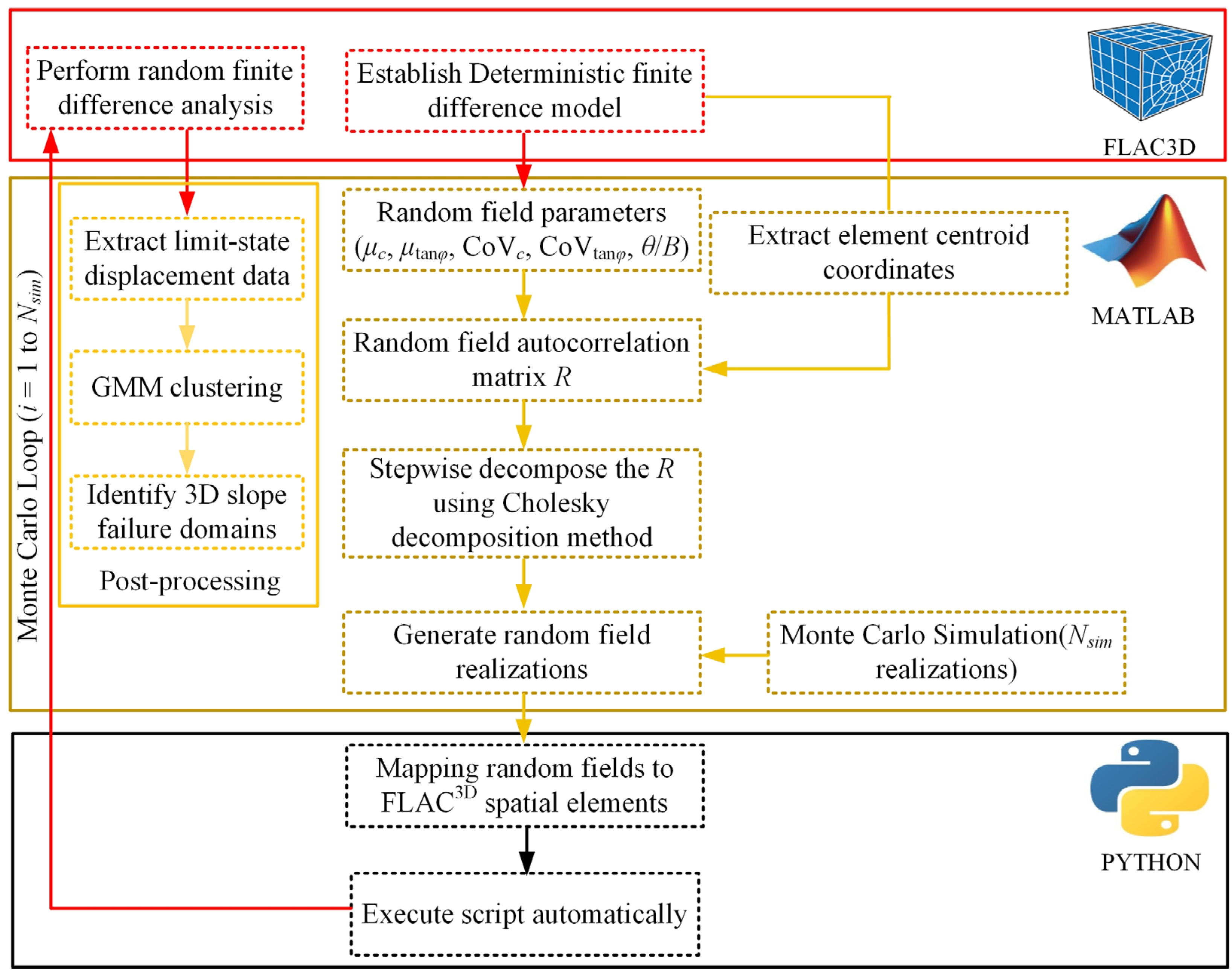
As illustrated in Figure 3, a non-intrusive RFDM framework was developed to integrate MCS with finite difference simulations. In this framework, FLAC3D functions as a “black-box” solver that exclusively receives input parameters and yields deterministic mechanical responses, while random field mapping, task scheduling, and data extraction are managed externally via scripting. This strategy leverages the robustness of commercial software for mechanical analysis while significantly enhancing probabilistic modeling flexibility, all without requiring modifications to the solver kernel. The non-intrusive RFDM workflow proceeds in three main stages:
  • First, a deterministic finite difference model is constructed using FLAC3D 6.00. Nodal coordinates and element indices are exported to serve as geometric references for subsequent random field mapping.
  • Utilizing the exported nodal coordinates and random field parameters, the decomposition algorithm and non-Gaussian transformation (Section 2) are implemented in MATLAB R2021a. A total of Nsim 3D multivariate random field realizations, possessing prescribed correlation structures, are generated and mapped onto the finite difference mesh.
  • Python 3.6 scripts are employed to orchestrate task execution and workflow control. FLAC3D is automatically executed to perform Nsim deterministic mechanical analyses sequentially. Upon reaching the ultimate limit state in each simulation, full-field nodal displacement vectors are extracted and stored for post-processing.
Figure 3. Flowchart of the non-intrusive random finite difference method (RFDM) analysis framework.
Buildings 16 01321 g003

4.2. Realization of Three Dimensional Random Field

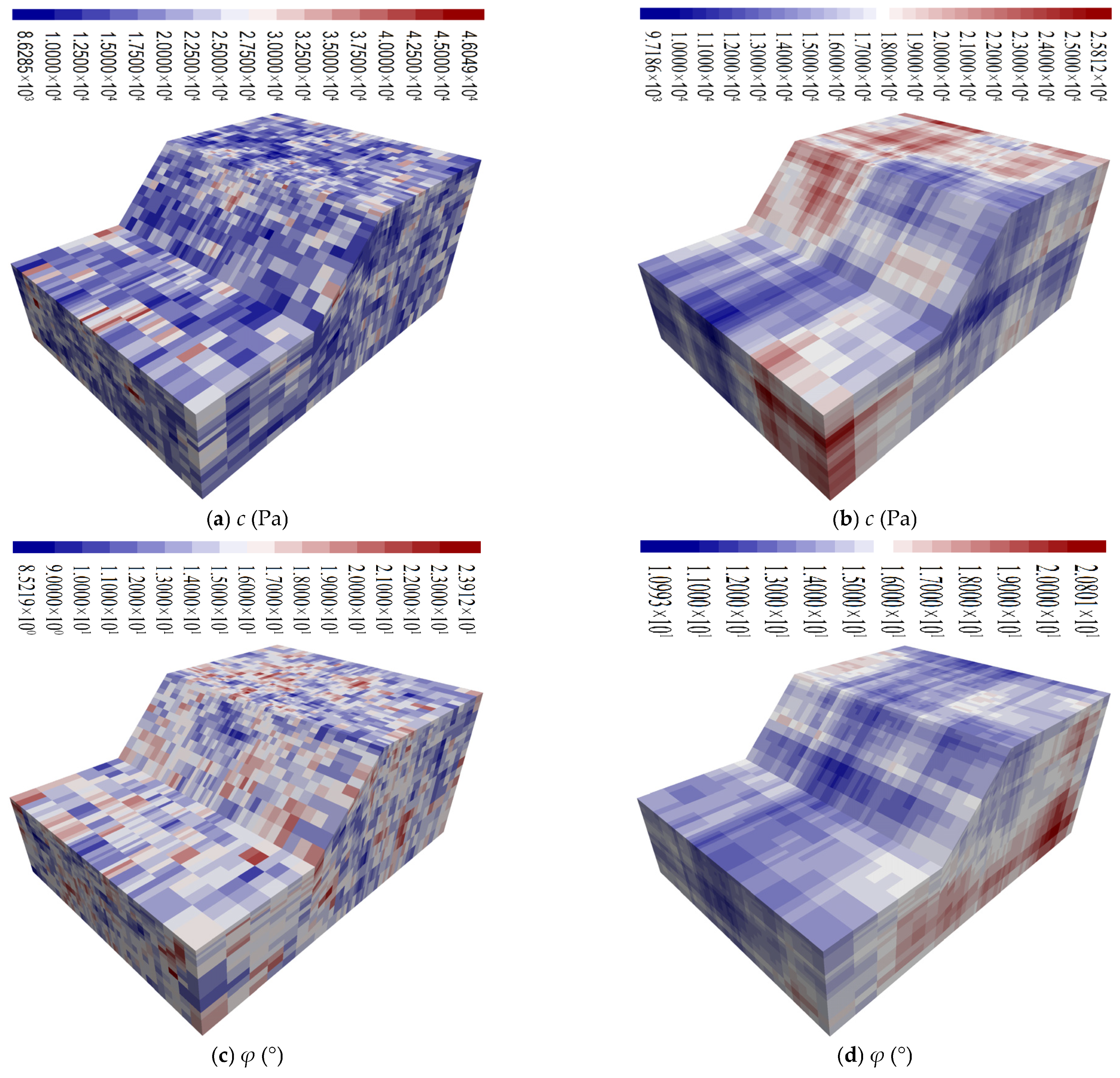
Figure 4 presents representative 3D realizations of soil shear strength parameters (c and φ) characterized by two distinct spatial correlation scales. Figure 4a,c depict the case with a small correlation length (θ/B = 0.75), where the random fields exhibit pronounced high-frequency spatial fluctuations. The resulting parameter distributions appear highly fragmented and heterogeneous, indicating a rapid decay of spatial correlation over short distances. In contrast, Figure 4b,d presents realizations with a large correlation length (θ/B = 20), in which the spatial variation in c and φ appears significantly smoother along the principal directions. These fields display continuous, stratified, or large-scale zonal patterns, reflecting strong spatial autocorrelation. These visual comparisons verify that the proposed random field generation procedure effectively captures the prescribed spatial variability and correlation structures.
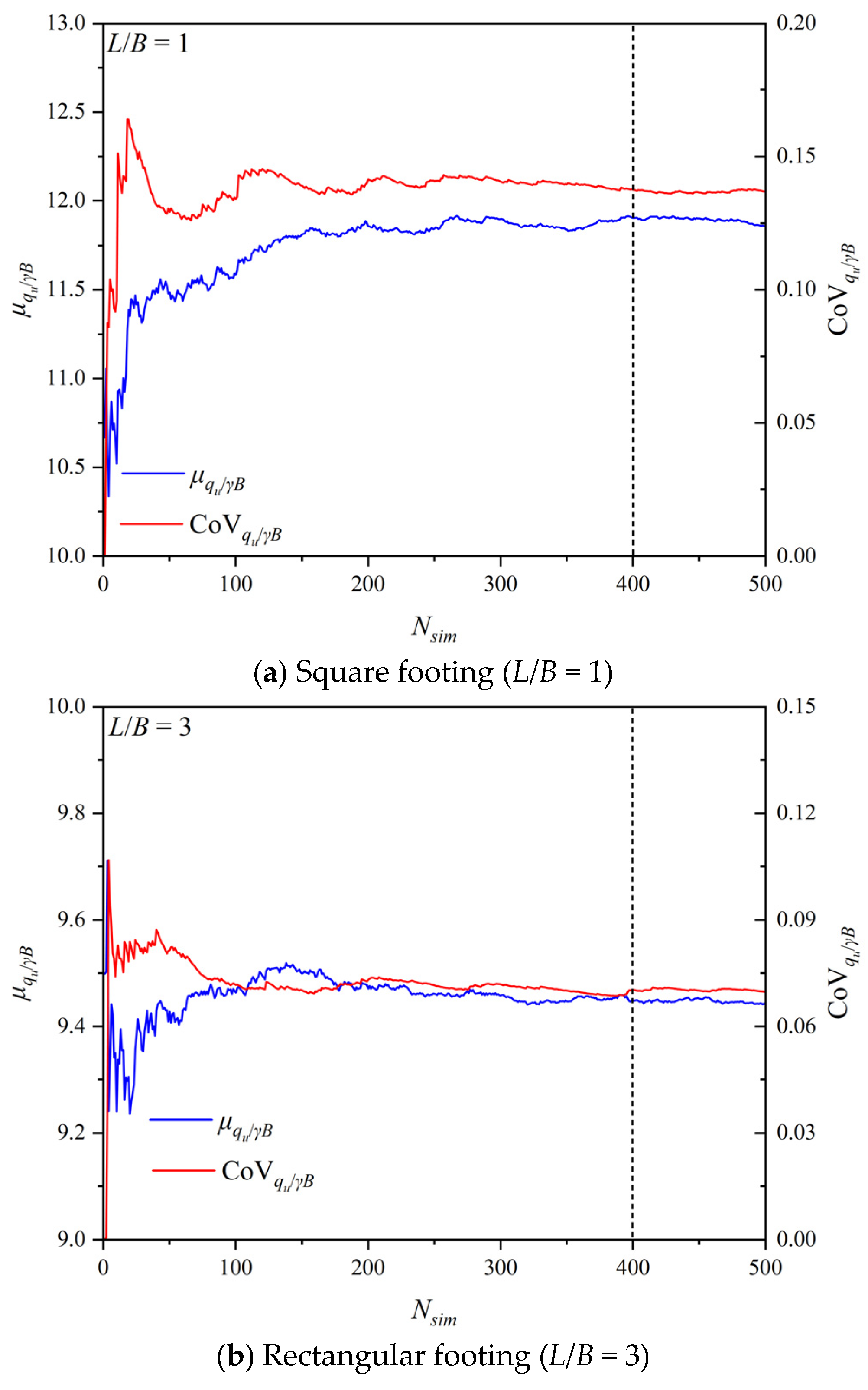
While the aforementioned realizations illustrate the spatial variability of soil properties, a sufficient number of MCS realizations (Nsim) is required to ensure the statistical stability of the probabilistic results. To determine the appropriate number of realizations, a convergence analysis was performed. Although this study focuses on the 3D characteristics of failure mechanisms, the normalized ultimate bearing capacity factor (qu/γB), representing the macroscopic system response, was adopted as the convergence metric. Figure 5 depicts the evolution of the mean (μqu/γB) and coefficient of variation (CoVqu/γB) of the bearing capacity factor with increasing simulation numbers for two representative cases. As the sample size increases, the cumulative estimates of μqu/γB and CoVqu/γB gradually stabilize, with fluctuations becoming negligible once Nsim exceeds approximately 400. Considering the high computational cost associated with 3D stochastic simulations, a fixed sample size of Nsim = 500 was adopted. This sample size provides a practical balance between computational efficiency and robust statistical convergence for μqu/γB and CoVqu/γB, which serve as the key parameters for subsequent failure domain characterization and risk assessment.

5. Slope Failure Domain Identification and Characterization

5.1. Gaussian Mixture Model (GMM)

Slope failure involves the mobilization of a sliding soil mass, potentially causing significant damage to infrastructure and buildings. Accurately delineating this sliding mass provides a quantitative basis for risk assessment. Furthermore, characterizing the spatial extent of the failure domain offers critical reference data for slope reinforcement design. Previous studies have estimated failure volumes based on limit-state nodal displacement data to quantify failure consequences [33]. These investigations demonstrated that traditional fixed-threshold methods are often insufficient for achieving consistent binary classification between stable and unstable regions [29]. Building upon these findings, this study utilizes limit-state nodal displacement data as the classification basis. The analysis is extended to a 3D framework, employing failure domain identification as a key descriptor for the stochasticity of failure mechanisms. However, the widely used KMCM inherently favors clusters with similar variances (spherical clusters). Consequently, it may be suboptimal for limit-state displacement data, where the variances between stable and failure regions differ significantly. To address these limitations, this study adopts the Gaussian mixture model (GMM) as a robust probabilistic clustering method [40].
The GMM is a probabilistic clustering model that posits that the observed displacement dataset v = {v1, v2, …, vn}, representing element displacement magnitudes (derived from nodal displacements); it is generated from a weighted mixture of K Gaussian components, each possessing independent parameters. The probability density function (PDF) of the displacement magnitude vi for element i is as follows:
P ( v i ) = k = 1 K π k N ( v i μ k , σ k 2 )
where K = 2 is adopted to differentiate between stable and failure domains, aligning with the binary mechanical state of the slope. πk represents the mixing weight of the k-th Gaussian component, subject to the constraint k = 1 K π k = 1 . N(v|μk, σk2) denotes the PDF of the k-th Gaussian component, uniquely defined by its mean μk and variance σk2:
N ( v μ k , σ k 2 ) = = 1 2 π k σ k 2 exp ( v μ k ) 2 2 σ k 2
Compared to KMCM, the primary advantage of GMM lies in its ability to assign independent variance parameters to each component. This enables adaptive fitting of displacement distributions that exhibit markedly different dispersion characteristics between stable and failure domains.
As displayed by Equation (10), the parameters governing the GMM comprise the mixing coefficients πk, the means μk, and the variances σk2. These parameters are estimated by maximizing the log-likelihood function for the observed data:
L ( π , μ , σ 2 ) = i = 1 E n ln k = 1 K π k N v n μ k , σ k 2
where En denotes the total number of observation points (corresponding to the total number of elements in the numerical model). Due to the presence of the logarithm of a summation term (the log-sum-exp problem), closed-form analytical solutions are intractable. Consequently, the Expectation–Maximization (EM) algorithm is employed for iterative optimization [41]. The EM algorithm alternates between an expectation step (E-step) and a maximization step (M-step). In the E-step, the responsibility γik, defined as the posterior probability that observation i belongs to component k, is computed:
γ i k = π k N ( v i μ k , σ k 2 ) j = 1 K π j N ( v i μ j , σ j 2 )
In the M-step, the parameters for each component are updated based on the computed responsibilities:
π k = 1 N i = 1 N γ i k
μ k = i = 1 N γ i k v i i = 1 N γ i k
σ k 2 = i = 1 N γ i k ( v i μ k ) 2 i = 1 N γ i k
These steps are repeated iteratively until convergence is achieved. Upon convergence, the two Gaussian components are compared based on their mean displacement magnitudes; the component with the larger mean is identified as the failure domain. For any observation i, if its posterior probability of belonging to the failure component satisfies γi, failure > 0.5, the element is classified as part of the failure domain; otherwise, it is assigned to the stable domain. This classification corresponds to a maximum a posteriori decision rule, providing a consistent, probabilistic basis for identifying 3D failure domains.

5.2. Failure Modes and Characterization Indicators

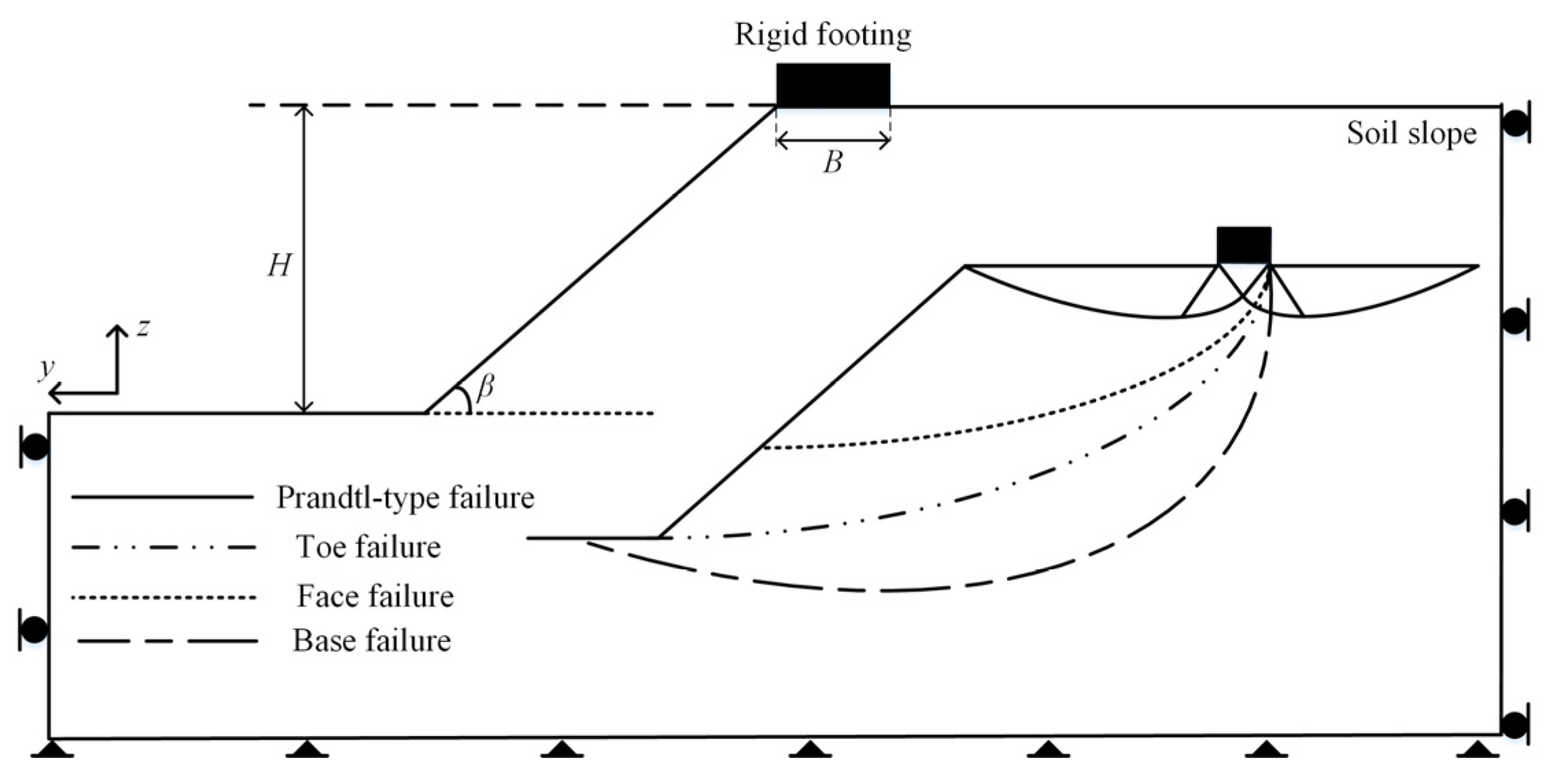
Upon obtaining classification results from each MCS realization, slope failure modes are categorized, and corresponding characterization indicators are computed based on the identified failure domains. In classical deterministic analyses of strip footing–slope systems, failure modes are commonly classified based on the termination point of the slip surface relative to the slope geometry: slope face failure, toe failure, and base failure [23,24]. Additionally, when the footing is located sufficiently far from the slope crest, minimizing geometric constraints, the failure mode transitions into a classical Prandtl-type bearing capacity failure. The geometric definitions of these four classical failure mechanisms are illustrated in Figure 6.
Incorporating soil spatial variability significantly intensifies the complexity and stochastic evolution of failure patterns. Potential slip surfaces are no longer confined to the smooth geometries assumed in analytical solutions; instead, they exhibit pronounced path dependency. Failure domains tend to propagate along spatially continuous weak zones and preferentially traverse local low-strength elements, resulting in irregular slip surfaces that often deviate from the footing centerline. Despite the variability induced by random fields, the macroscopic geometric characteristics of failure patterns can still be broadly categorized into the four classical modes mentioned above. Accordingly, an automated classification criterion based on the spatial location of the failure domain is proposed in this study. Each MCS realization is classified as slope face, toe, base, or bearing capacity (Prandtl-type) failure, determined by the coordinate of the lowest point of the GMM-identified failure domain along the slope profile. Crucially, this study focuses exclusively on bearing capacity failure induced by footing loading; global slope instability driven solely by self-weight is not considered [42].
Utilizing the binary clustering labels derived from GMM, two quantitative indicators are adopted to characterize the 3D failure domain: the failure volume and the normalized centroid location. The absolute failure volume, Vf, is defined as the cumulative volume of all elements classified as belonging to the failure domain. To facilitate comparisons across different footing dimensions, a normalized dimensionless failure volume, Vnorm, is introduced:
V n o r m = i = 1 N f V i B 2 L
where Nf denotes the total number of elements in the failure domain, Vi is the volume of the i-th element, and B and L represent the footing width and length, respectively. This indicator serves as a direct proxy for the magnitude and potential consequences of slope failure. Additionally, the centroid coordinates serve as an effective metric for capturing the spatial offset and asymmetry of 3D failure patterns. The geometric centroid of the failure domain, C(xc, yc, zc), is calculated as follows:
C x c , y c , z c = i = 1 N f C i V i i = 1 N f V i
where Ci = (xi, yi, zi) denotes the spatial coordinate vector of the geometric center of the i-th element within the failure domain. To ensure consistency, all centroid coordinates are normalized by the footing width, B. By tracking centroid migration across different MCS realizations, the dominant spatial trends and dispersion characteristics of 3D failure modes can be statistically characterized.
Finally, to quantify the system failure risk, a risk indicator R, based on the normalized failure volume, is introduced, aligning with the risk assessment framework proposed by Huang et al. [29]. Within this framework, the indicator represents the expected consequence of failure and is formulated as follows:
R = i = 1 N s i m I i ( V n o r m ) i N s i m
I i = 1 ,   ( q u / γ B ) r a n < ( q u / γ B ) det / F O S 0 ,   ( q u / γ B ) r a n ( q u / γ B ) det / F O S
where (Vnorm)i is the normalized failure volume determined via GMM for the i-th MCS realization; Ii is a binary indicator variable (1 for failure, 0 for safety); and Nsim is the total number of MCS realizations. The value of Ii is contingent upon the failure criterion and the applied Factor of Safety (FOS). In this study, the system is considered safe if the normalized bearing capacity obtained from random analysis (qu/γB)ran/FOS exceeds the allowable capacity derived from the deterministic analysis divided by the FOS, namely (qu/γB)det/FOS. Otherwise, the system is deemed to have failed. This formulation utilizes the indicator function to isolate failed samples and computes the probability-weighted average of failure volumes. Consequently, it provides a comprehensive risk measure that integrates both the likelihood of failure and the severity of consequences.

6. Results and Discussion

6.1. Failure Domain Identification Comparison Using GMM and KMCM

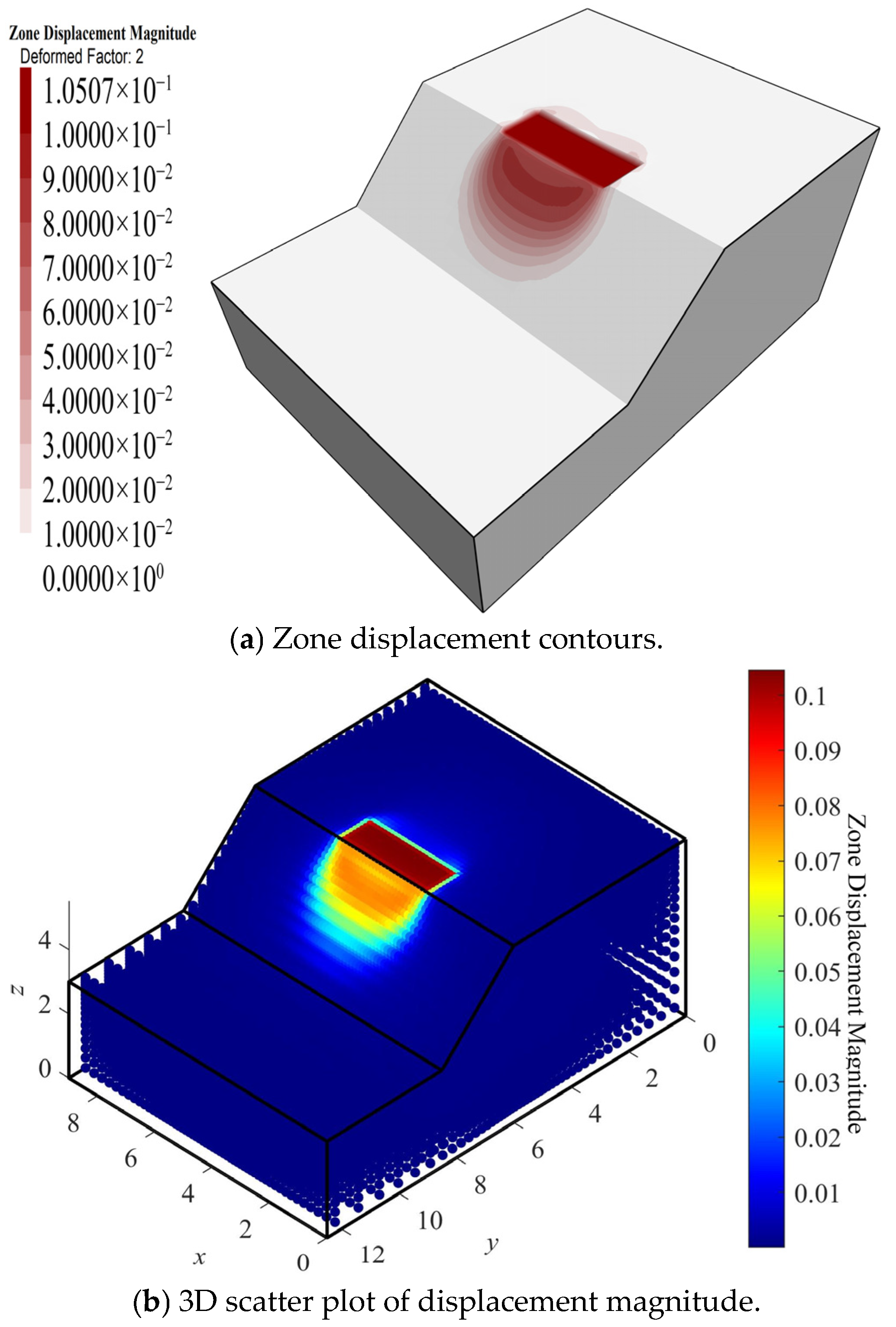
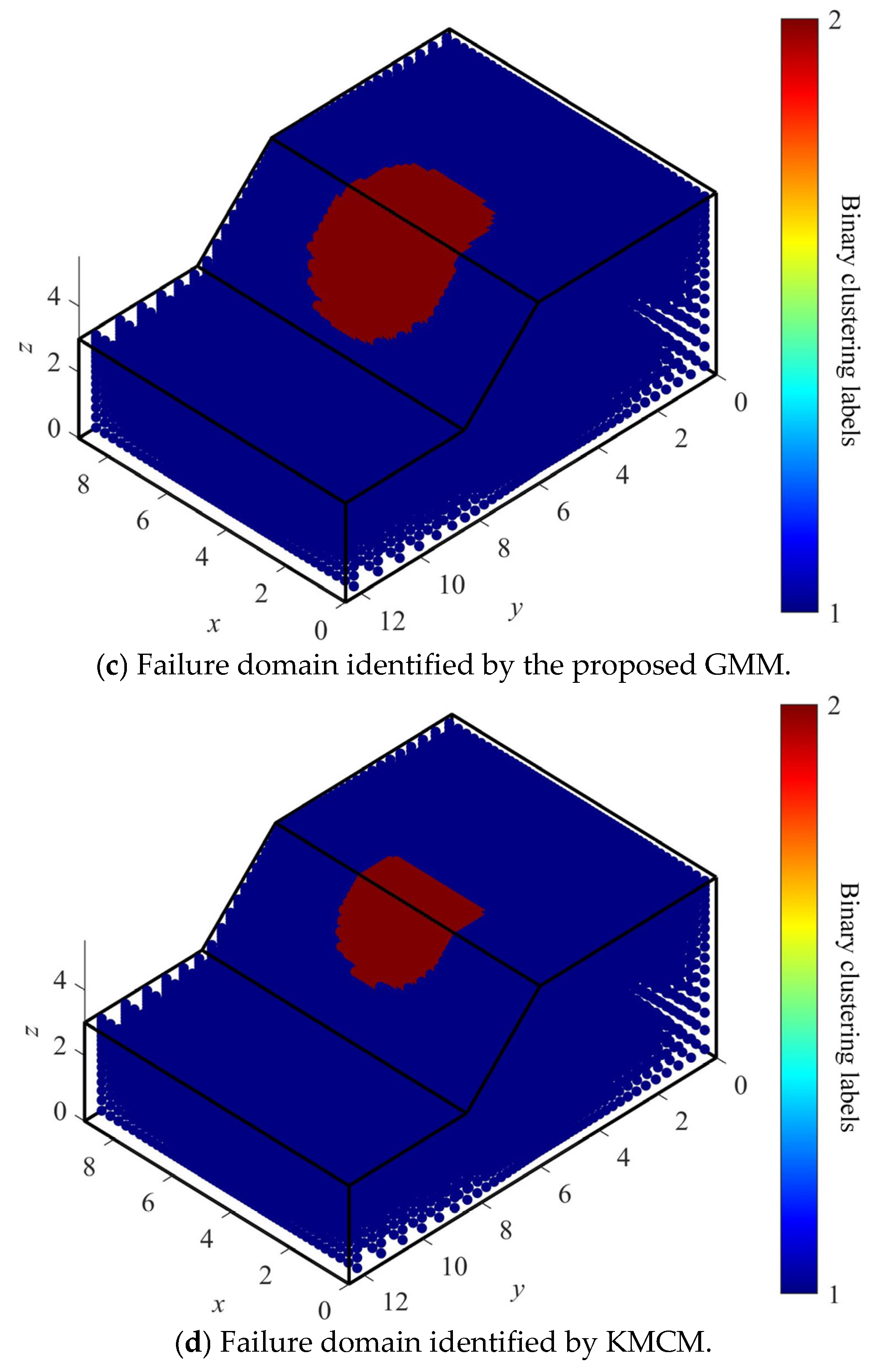
Deterministic analysis results of the slope failure domain at the ultimate limit state for a rectangular footing (L/B = 3) serve as a benchmark to evaluate the applicability and performance of KMCM and GMM. Figure 7a,b depicts the displacement contour and 3D scatter plot of the rectangular footing–slope system at failure. Due to the free boundary effect of the slope face, the deformation pattern exhibits pronounced spatial asymmetry, with zones of large displacement extending from beneath the footing towards the slope face, a characteristic feature of slope-influenced bearing capacity mechanisms [24]. Figure 7c,d presents the binary failure domain classification results obtained using GMM and KMCM, respectively. A comparison of their 3D spatial structures indicates that the failure domain identified by KMCM is primarily restricted to the region directly beneath the footing, corresponding to the zone of peak displacement. Its boundary terminates prematurely in the downslope direction, failing to form a continuous failure path connecting to the slope face. In contrast, the failure domain identified by GMM encompasses a substantially larger volume. In addition to capturing the core high-deformation region detected by KMCM, GMM successfully incorporates intermediate deformation zones extending towards the slope, thereby forming a more complete and spatially connected failure mechanism.
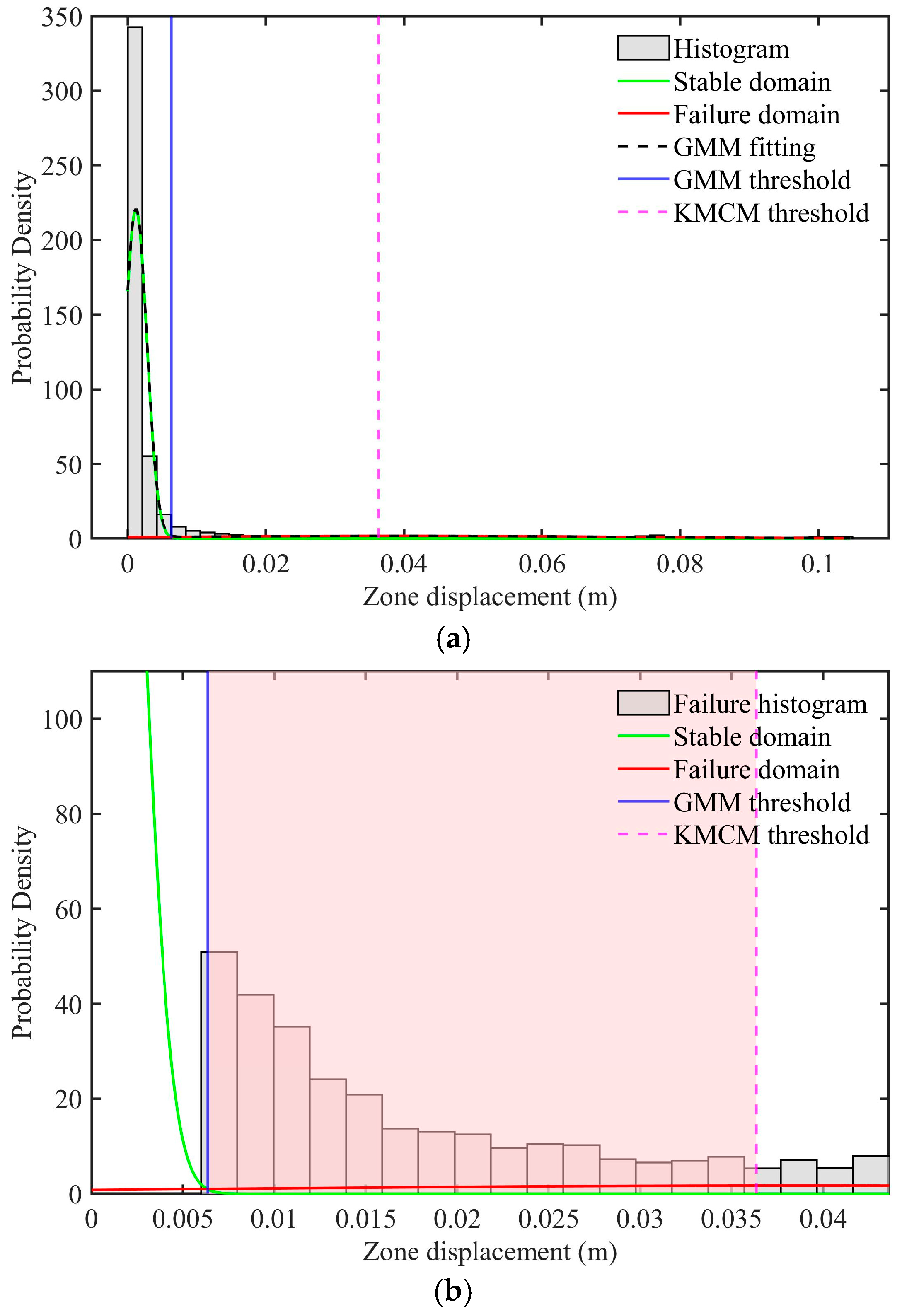
The discrepancies observed between GMM and KMCM identification results stem from the underlying statistical characteristics of the displacement data. Figure 8 illustrates the element-wise displacement magnitudes and the corresponding classification thresholds derived from KMCM and GMM for this representative case. As depicted in Figure 8a, element-wise displacement magnitudes at the ultimate limit state exhibit a highly skewed distribution, characterized by a distinct peak and a long tail. The stable region is characterized by a narrow distribution with low variance, whereas elements associated with failure display a markedly dispersed, long-tailed distribution. Quantitatively, the displacement variance in the failure domain exceeds that of the stable domain by more than two orders of magnitude, with a variance ratio above 660 in this representative case. This pronounced heteroscedasticity conflicts with KMCM’s implicit equal-variance assumption.
Since the KMCM minimizes the within-cluster sum of squared errors, it inherently favors clusters with similar variances. In the presence of long-tailed distributions, the clustering boundary is statistically skewed toward higher displacement values by large-displacement outliers. Consequently, transitional elements undergoing early-stage plastic deformation are frequently misclassified as stable. This sensitivity to extreme values renders KMCM-based failure identification relatively conservative. In contrast, GMM assigns an independent variance parameter to each component, allowing it to explicitly accommodate the pronounced heteroscedasticity between stable and failure regions. As a result, transitional deformation zones are more accurately captured within the identified failure domain. In this example, the displacement thresholds determined by KMCM and GMM are approximately 0.036 m and 0.007 m, respectively, corresponding to normalized failure volumes (Vnorm) of 2.08 and 5.47. This substantial discrepancy highlights the fundamental differences in statistical assumptions between the two methods. It indicates that KMCM-based identification may lead to a systematic underestimation of failure extent, potentially propagating into biased estimates of failure probability and risk within a stochastic analysis framework.

6.2. Effect of Scale of Fluctuation on Failure Modes

To evaluate the performance of clustering algorithms under spatially variable soil conditions, slope failure modes for square (L/B = 1) and rectangular (L/B = 3) footings were statistically analyzed across a range of normalized scales of fluctuation (θ/B). For square footings, results indicate that irrespective of the fluctuation scale, both KMCM and GMM consistently identified slope face failure across all Nsim = 500 realizations. This observation aligns with deterministic analysis, suggesting that under square footings, the failure mode is relatively insensitive to soil spatial variability due to strong geometric constraints imposed by the slope and footing. However, as detailed in Table 2, distinct discrepancies between the two algorithms were observed for rectangular footings. KMCM uniformly classified all 500 realizations as slope face failure, mirroring the deterministic result. In contrast, GMM results exhibited a systematic dependence on the fluctuation scale, identifying both slope face and toe failure modes. Although slope face failure remained dominant, the frequency of toe failure (indicative of deeper-seated instability) gradually rose as θ/B increased from 0.75 to 5, subsequently decreasing slightly as θ/B extended to 20. This trend underscores that under 3D random field conditions, footing geometry and fluctuation scale jointly govern the depth of the failure mechanism. Furthermore, it demonstrates that GMM is capable of capturing the transition from shallow to deep failure modes.
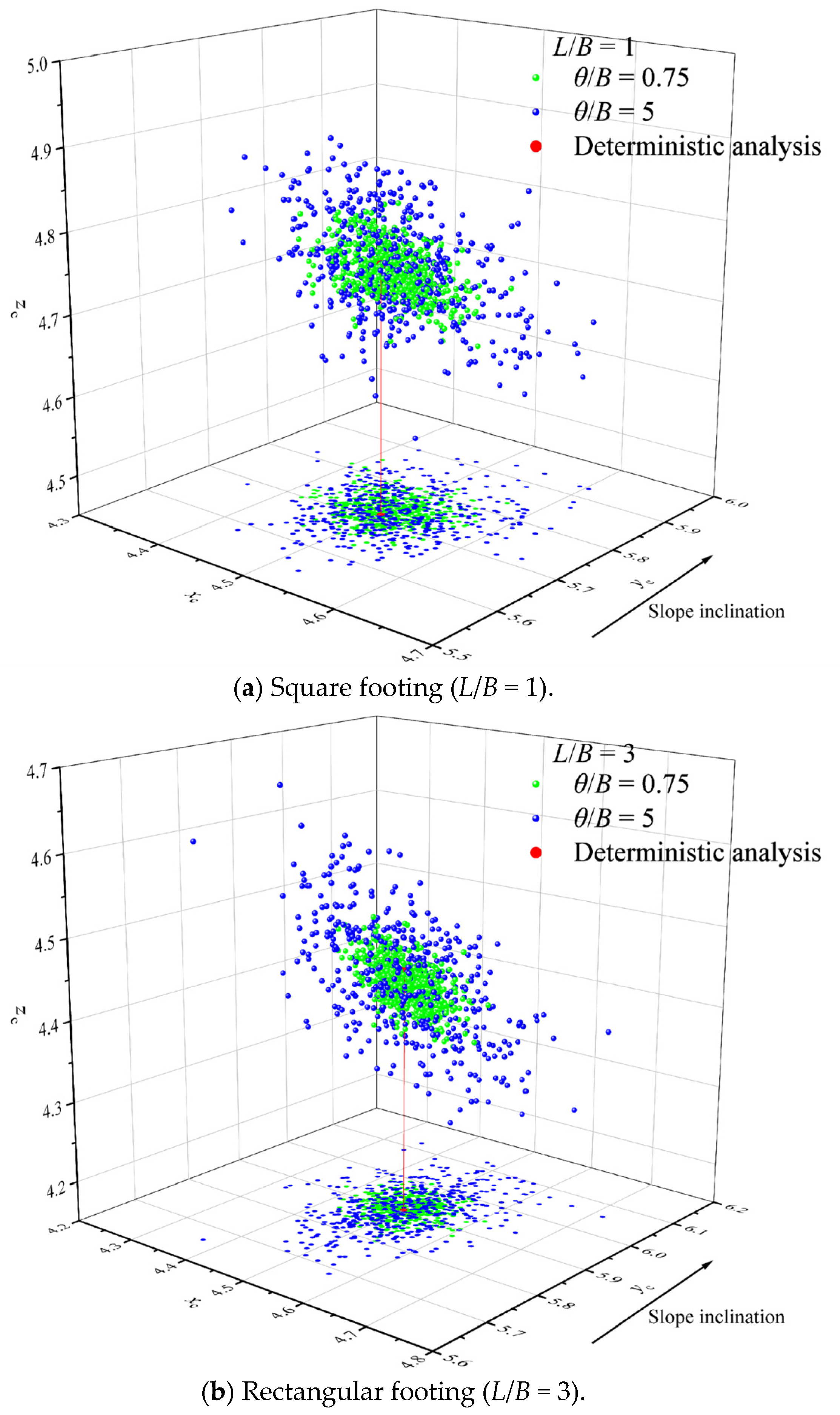
To further investigate the spatial characteristics of failure domains, Figure 9 displays the slope failure domain centroids derived from 500 MCS realizations identified by GMM for square and rectangular footings at θ/B = 0.75 and θ/B = 5. Compared with deterministic analyses, in which the failure domain is represented by a single fixed centroid, the stochastic results exhibit pronounced spatial dispersion in 3D space. This dispersion reflects the influence of spatial variability in soil strength, which modifies the distribution of local soil resistance and consequently shifts the failure domain across different realizations. As the SOF increases, the centroid distributions for both footing shapes become progressively more dispersed. A larger SOF indicates stronger spatial correlation in soil properties, resulting in the formation of larger spatially correlated regions that may be relatively strong or weak. These regions can substantially alter the preferred failure path across different realizations, thereby increasing the variability in the location of the failure domain centroid. Notably, rectangular footings exhibit a wider centroid distribution along the slope inclination direction (y-axis) and the depth direction (z-axis). This indicates that the failure domains induced by rectangular footings tend to extend further downslope and propagate deeper than those associated with square footings, reflecting the influence of footing aspect ratio on the 3D development of the failure mechanism.
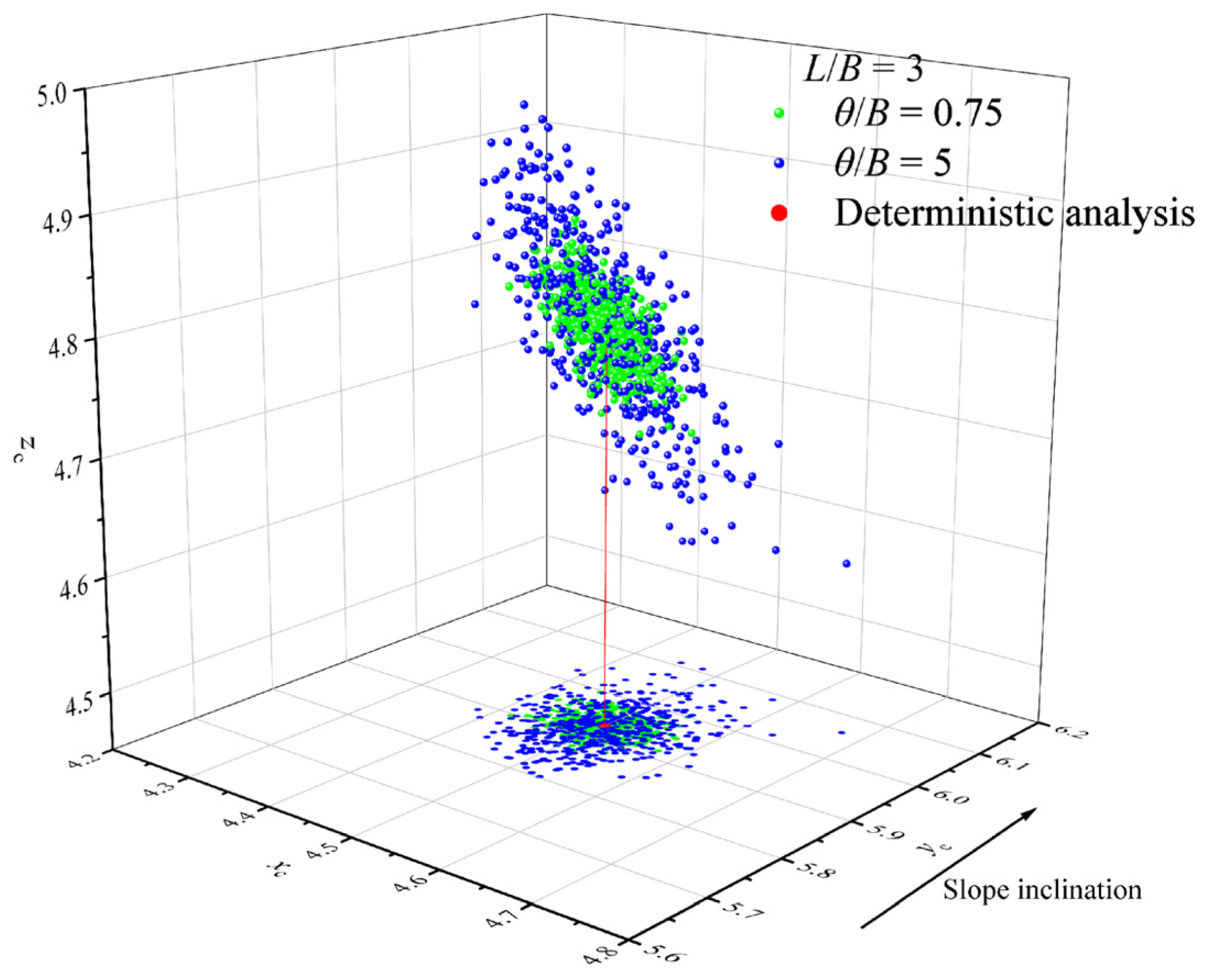
Figure 10 illustrates the centroid distributions for the rectangular footing identified using KMCM under identical conditions. Compared to GMM, KMCM-identified centroids are less dispersed in the horizontal plane (x- and y-directions). Although vertical (z-direction) dispersion exists, centroids remain largely concentrated in the shallow region above z = 4.5, failing to extend into the deeper layers observed in the GMM results. This comparison indicates that in stochastic analyses, KMCM primarily captures the shallow core of the failure domain, potentially missing the evolution of deeper-seated failures induced by soil spatial variability [43].

6.3. Effect of Scale of Fluctuation on Failure Volumes

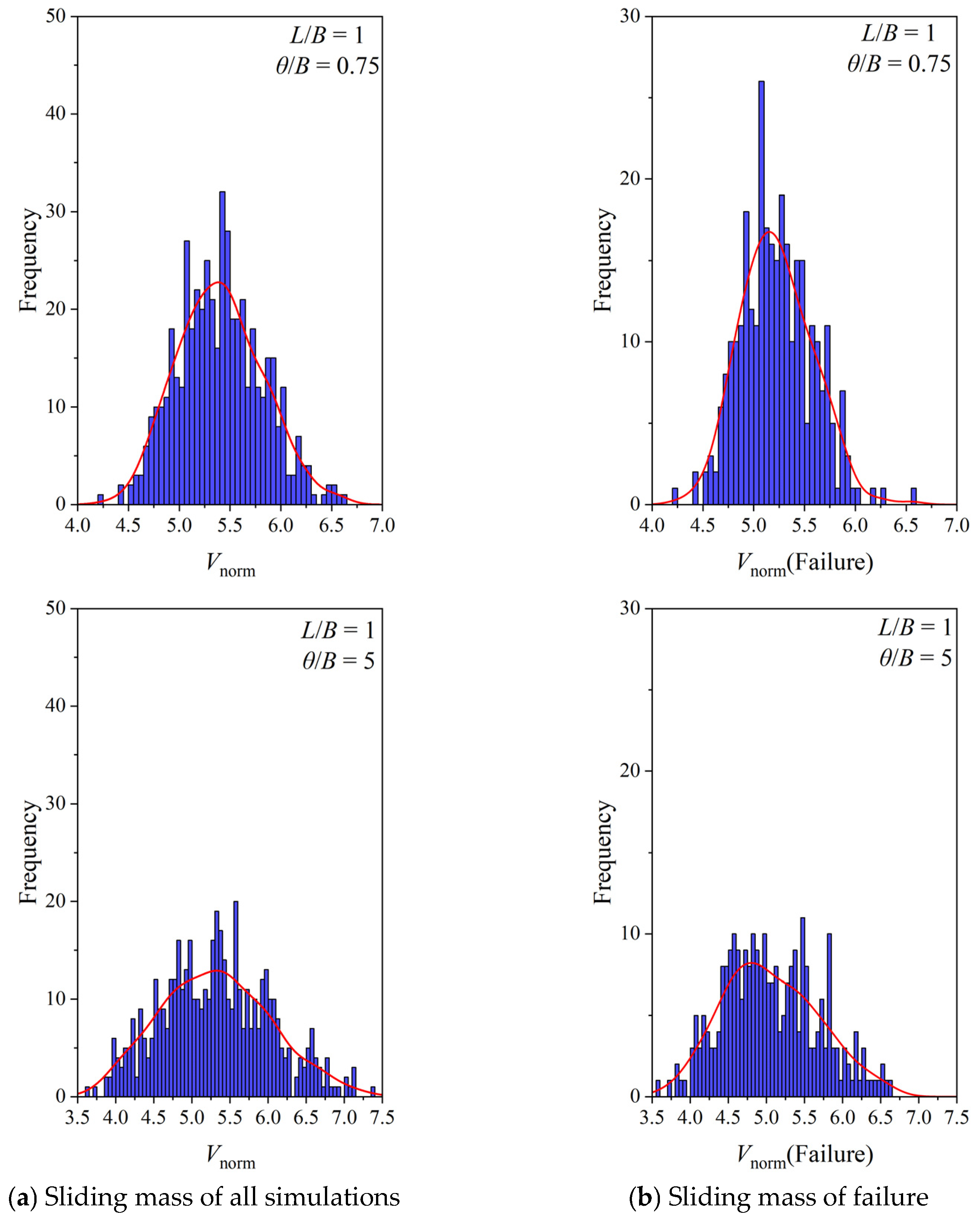
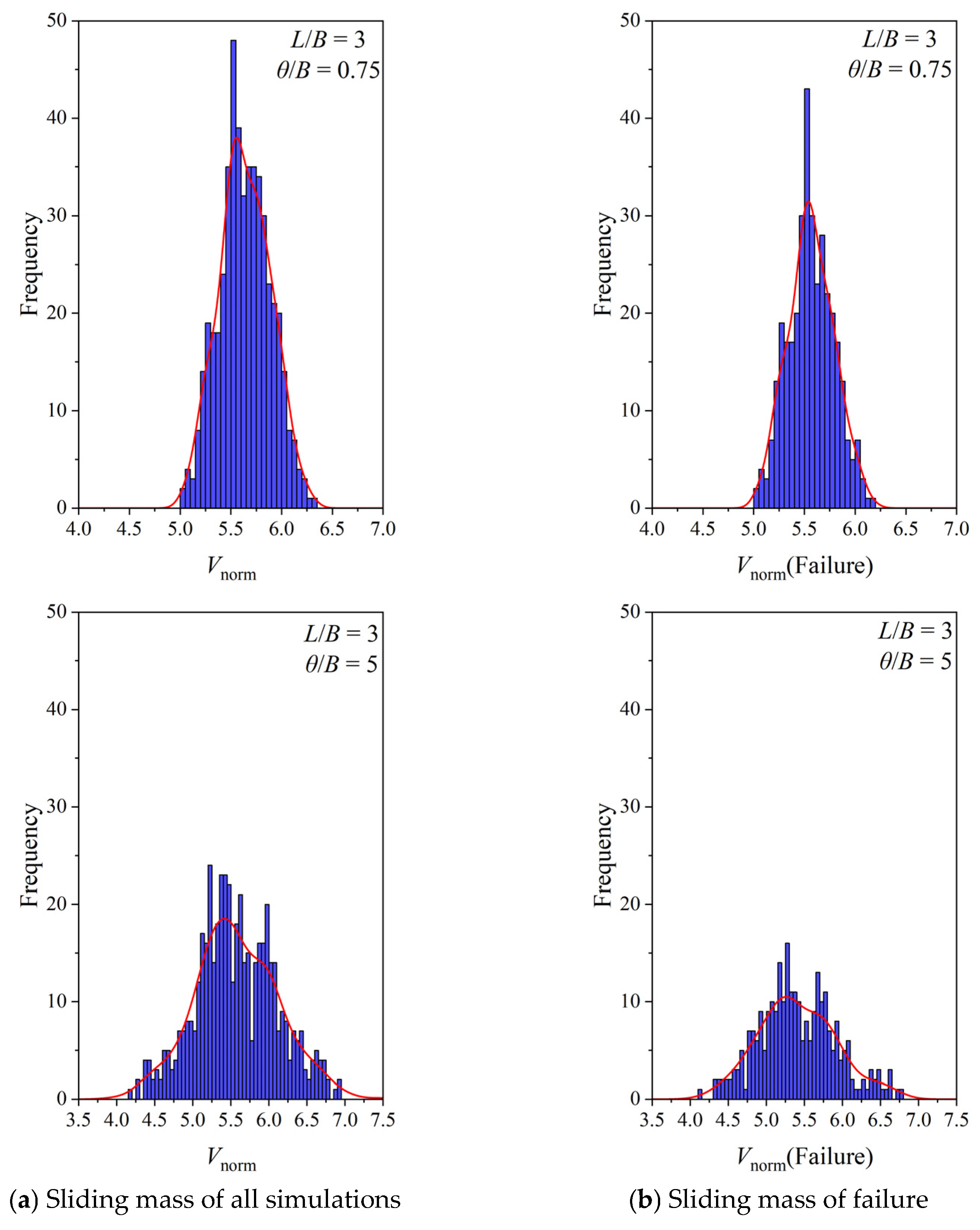
Figure 11 and Figure 12 present histograms of the normalized failure domain volume (Vnorm) at the ultimate limit state, derived from 500 MCS realizations for square and rectangular footings under different scales of fluctuation (θ/B = 0.75 and θ/B = 5). In each figure, the left histogram incorporates all realizations, whereas the right histogram displays only those classified as failures. Failure occurrence is determined based on the criteria defined in Equations (18) and (19). The results indicate that the characteristics of the volume distributions are sensitive to both the scale of fluctuation and the footing geometry. At θ/B = 0.75, the distributions for both footings are relatively concentrated and unimodal, indicating that shallow slope face failure strongly dominates the failure mechanism at this small scale. However, at θ/B = 5, the histograms become significantly flatter, more dispersed, and exhibit locally jagged or multi-peaked characteristics. For the square footing, this widely dispersed distribution reflects a significant increase in the spatial randomness of the failure volume; however, the extent of variation does not culminate in a transition of the macroscopic failure mode. Instead, it signifies that the slip surface fluctuates among varying local weak paths across the slope surface. In contrast, for the rectangular footing at θ/B = 5, the distribution exhibits a multimodal tendency, which physically corresponds to the transition between distinct macroscopic failure mechanisms. The data clustering within the lower volume range is governed by the dominant shallow slope face failures, whereas the localized clustering within the higher volume range corresponds directly to the increased proportion of deep toe failures.
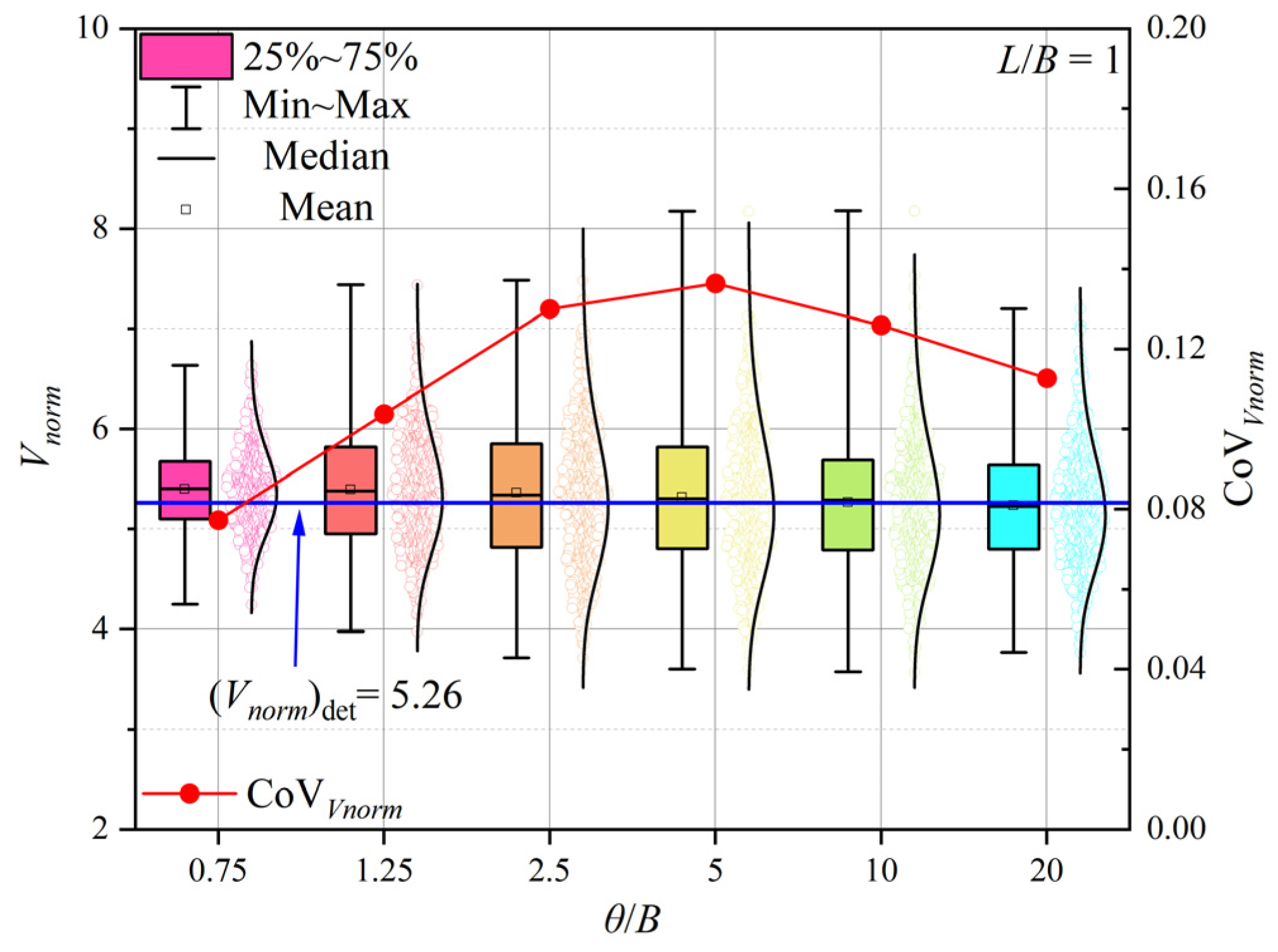
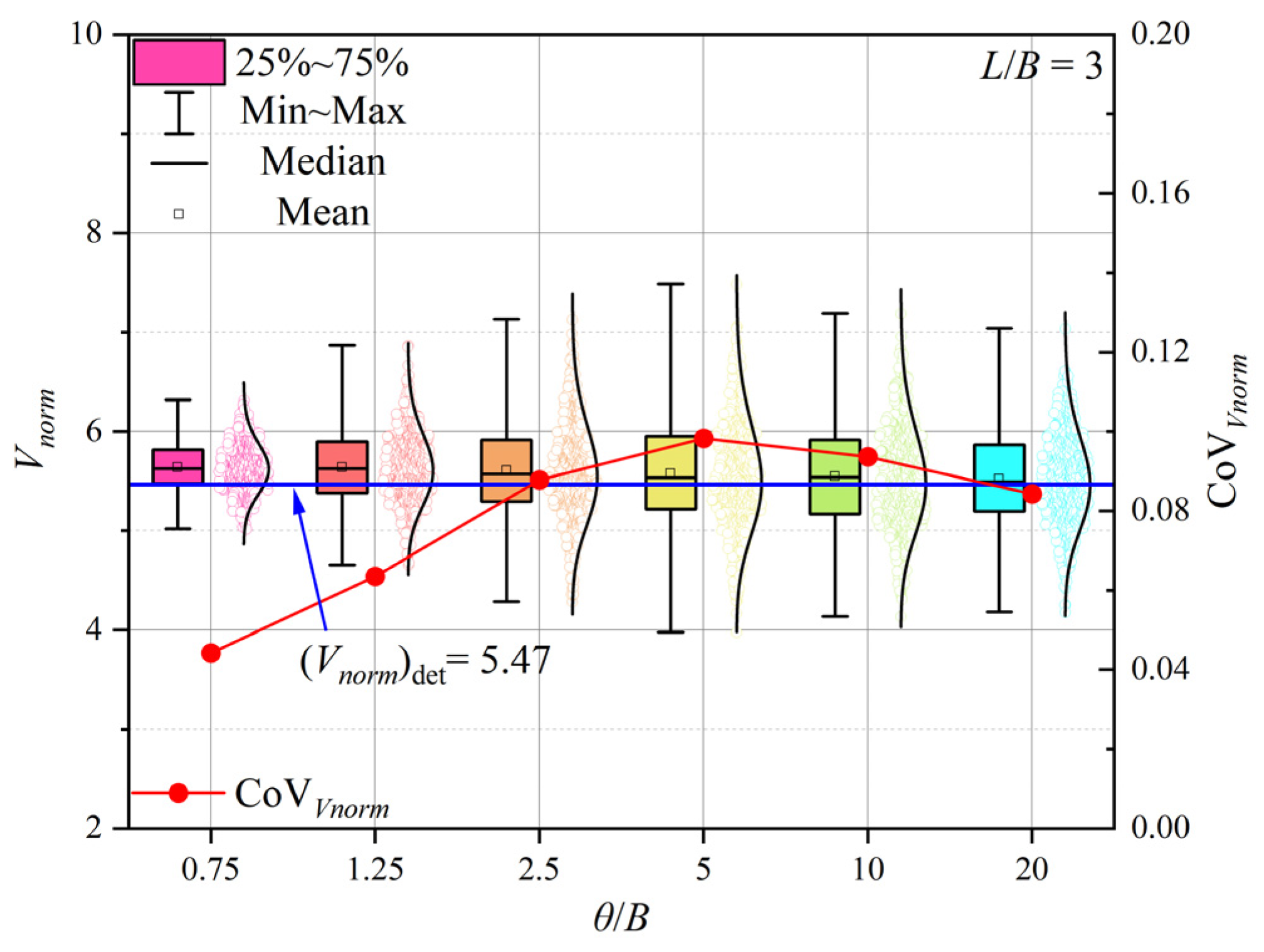
Figure 13 and Figure 14 illustrate the statistical parameters of Vnorm, specifically the mean (μVnorm) and coefficient of variation (CoVVnorm), as functions of the θ/B. The results indicate that the mean failure volume derived from stochastic analyses systematically exceeds the corresponding deterministic solution. This suggests that failure mechanisms tend to propagate through local weak zones, resulting in larger mobilized failure volumes compared to homogeneous soil conditions. The deviation of the mean from the deterministic value exhibits a non-monotonic trend with increasing θ/B, though the overall variation remains marginal. The CoVVnorm curves for both footing geometries display non-monotonic behavior, peaking near θ/B = 5, indicating that uncertainty regarding the failure volume is maximized at this specific correlation scale. Notably, while the trends are similar, the magnitude of CoVVnorm for rectangular footings is substantially lower than that for square footings across the entire range of θ/B, further confirming the influence of the 3D spatial averaging effect. This effect arises because a larger rectangular footing intersects a broader range of spatially varying soil zones, thereby smoothing local extremes and reducing the overall variability of the failure volume. Additionally, the extended failure surface mobilizes a larger soil mass, promoting greater energy dissipation and integrating both weaker and stronger zones. Therefore, although this study focuses on how parameter uncertainties propagate into failure mechanisms, accurate estimation of spatial statistical parameters through comprehensive site investigations remains essential for improving the practical reliability of random field-based analyses [44].
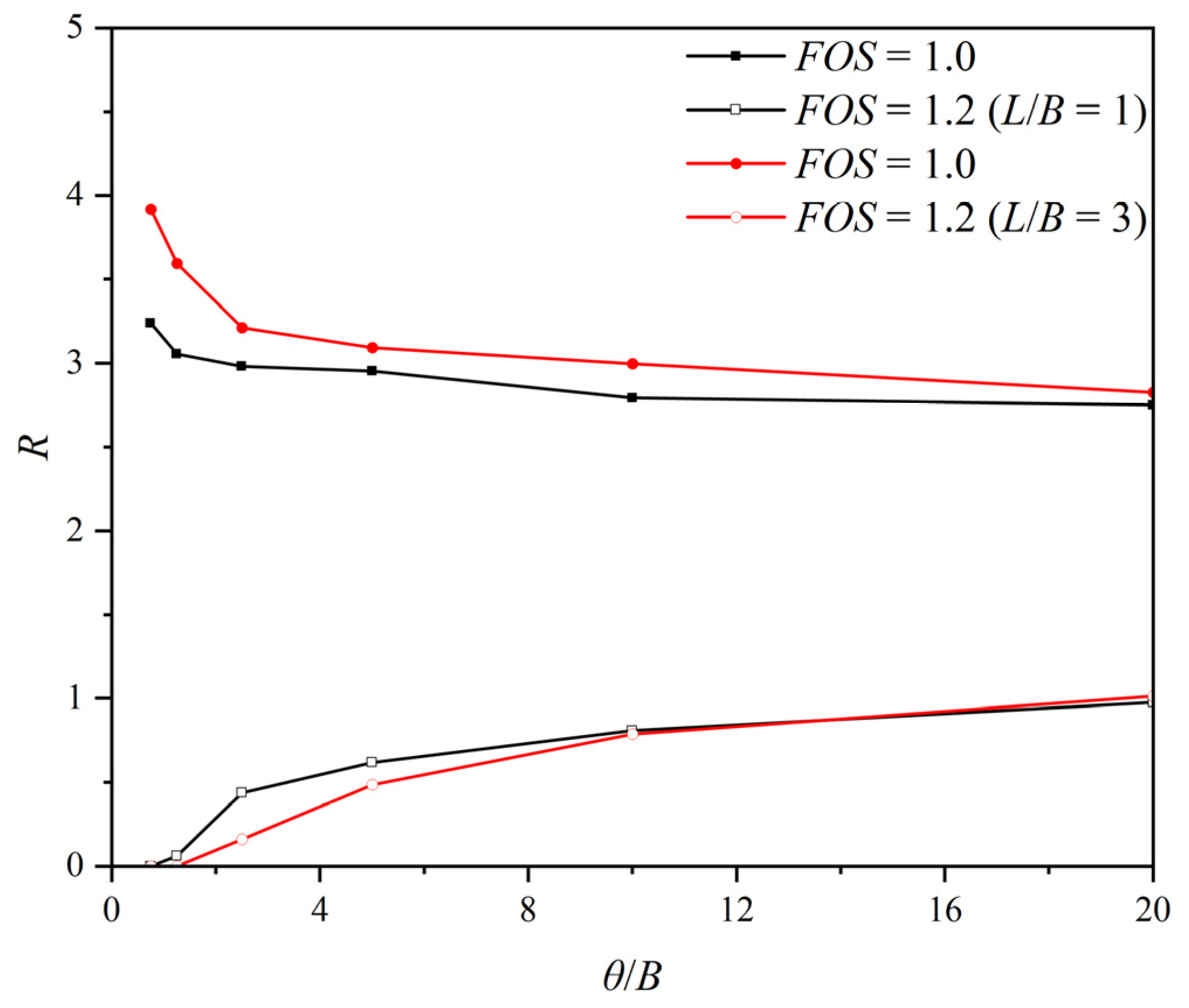
Figure 15 illustrates the influence of the θ/B on the failure risk (R) of the footing–slope system, as calculated using GMM-identified failure domains (Equations (18) and (19)). For a factor of safety (FOS) of 1.0, the failure risk for both square and rectangular footings exhibits a decreasing trend with increasing θ/B. In this scenario, the larger absolute failure volume associated with rectangular footings results in a higher overall risk compared to square footings. Conversely, at FOS = 1.2, failure risk increases with θ/B, with square footings exhibiting a slightly higher risk than their rectangular counterparts. These observations indicate that failure risk is governed by the interplay between failure probability and the magnitude of the failure domain. At low FOS levels, where failure probability is high, the larger absolute failure volume of rectangular footings dominates the overall risk. At higher FOS levels, although the mean safety margin is sufficient, the higher volume variability of square footings renders them more susceptible to extreme failure events under specific θ/B conditions, thereby elevating the associated risk.

7. Limitations and Future Research

While the proposed framework provides valuable insights into 3D stochastic slope failure under rectangular footings, several simplifying assumptions were adopted to maintain computational feasibility. These limitations also highlight several opportunities for future research:
(1)
This study primarily focuses on the influence of fluctuation scale on slope failure mechanisms and mobilized volumes. Future research could perform more comprehensive parametric analyses, such as systematically varying the coefficients of variation in soil properties and incorporating cross-correlations between different shear-strength parameters, to provide deeper insights into stochastic failure behavior.
(2)
The present analyses are limited to vertical static foundation loading applied at the slope crest. In practice, footing–slope systems may be subjected to more complex loading scenarios. Future studies may consider inclined or eccentric loading conditions, as well as hydro-mechanical effects associated with rainfall infiltration or groundwater fluctuations.
(3)
To isolate the fundamental influence of spatial autocorrelation, soil variability in this study was simulated using a stationary random field within a single homogeneous soil profile. Because natural slopes often exhibit complex geological stratigraphy, extending the proposed framework to multi-layered heterogeneous soil systems would improve its applicability to practical engineering scenarios.
(4)
To balance computational efficiency and statistical convergence, the number of Monte Carlo simulations was set to 500. While this sample size is sufficient to capture the general characteristics of slope failure mechanisms and geometric statistics, evaluating extremely low-probability failure events may require larger sample sizes. Future work may explore advanced variance-reduction techniques to improve the computational efficiency of stochastic analyses.

8. Conclusions

This study established a non-intrusive RFDM framework, integrating a GMM to facilitate the automated identification and quantification of 3D failure domains in rectangular footing–slope systems. The primary conclusions drawn from this research are summarized as follows:
  • The displacement data of the slope at the ultimate limit state under rectangular footing loads exhibit significant statistical heterogeneity, characterized by low variance in the stable domain and high variance in the failure domain. The KMCM favors clusters with similar variances, leading to a systematic underestimation of the failure domain volume. In contrast, the GMM explicitly accommodates independent covariance structures for each component, thereby effectively capturing disparate variance characteristics and more accurately delineating the complete sliding mass.
  • Slope failure modes are jointly governed by the footing aspect ratio and the spatial scale of fluctuation in soil properties. For square footings, shallow slope face failure predominates in both deterministic and stochastic analyses, demonstrating insensitivity to spatial variability. While shallow failures remain dominant under rectangular footings, an increase in the normalized scale of fluctuation correlates with a rising frequency of deeper slope toe failure mechanisms. The statistical migration of failure domain centroids in stochastic analyses quantitatively confirms this transition toward deeper failure modes.
  • The mean failure volume derived from stochastic analyses systematically exceeds deterministic analyses, driven by the preferential propagation of failure mechanisms through local weak zones within spatially variable soil. The coefficient of variation in the failure volume exhibits a non-monotonic relationship with the normalized scale of fluctuation, reaching a maximum when the correlation length is approximately five times the footing width. Furthermore, rectangular footings exhibit significantly lower volume variability compared to square footings, attributed to the 3D spatial averaging effect.
  • The failure risk of footing–slope systems is sensitive to the applied factor of safety (FOS). At a low safety margin (FOS = 1.0), failure risk decreases with increasing fluctuation scale. This trend is primarily driven by the magnitude of the absolute failure volume, resulting in a higher overall risk for rectangular footings. Conversely, at a higher safety margin (FOS = 1.2), failure risk increases with fluctuation scale. In this regime, risk is dominated by volume variability, with square footings exhibiting comparatively higher risk due to their greater susceptibility to extreme failure events.

Author Contributions

Conceptualization, Q.J. and C.C.; methodology, Q.J. and C.C.; software, Q.J.; writing—original draft, Q.J.; writing—review and editing, X.L., X.K. and C.C.; supervision, X.L. and C.C.; funding acquisition, X.L. and X.K. All authors have read and agreed to the published version of the manuscript.

Funding

The authors wish to acknowledge the financial support from the National Key Research and Development Program of China (Grant No. 2025YFE0107200).

Data Availability Statement

The datasets generated during this study are available from the corresponding author upon reasonable request and within the framework of cooperation agreements and scientific research projects.

Conflicts of Interest

The authors declare no conflicts of interest.

References

  1. Li, C.; Guan, Y.; Jiang, P.; Han, X. Oblique bearing capacity of shallow foundations placed near slopes determined by the method of rigorous characteristics. Géotechnique 2022, 72, 922–934. [Google Scholar] [CrossRef]
  2. Kumar, D.R.; Samui, P.; Wipulanusat, W.; Keawsawasvong, S.; Sangjinda, K.; Jitchaijaroen, W. Soft-computing techniques for predicting seismic bearing capacity of strip footings in slopes. Buildings 2023, 13, 1371. [Google Scholar] [CrossRef]
  3. Yan, Q.; Wang, Y.; Su, T.; Zhang, Z.; Sun, S. Ultimate Bearing Capacity of Vertically Uniform Loaded Strip Foundations near Slopes Considering Heterogeneity, Anisotropy, and Intermediate Principal Stress Effects. Buildings 2025, 15, 4386. [Google Scholar] [CrossRef]
  4. Yan, Q.; Cao, X.; Yang, Y.; Zhang, Z. Ultimate Bearing Capacity of Strip Foundations Adjacent to Heterogeneous and Anisotropic Slopes Based on the Meyerhof Theory. Buildings 2025, 15, 2231. [Google Scholar] [CrossRef]
  5. Peng, M.; Peng, H. The ultimate bearing capacity of shallow strip footings using slip-line method. Soils Found. 2019, 59, 601–616. [Google Scholar] [CrossRef]
  6. Yang, S.; Leshchinsky, B.; Cui, K.; Zhang, F.; Gao, Y. Influence of failure mechanism on seismic bearing capacity factors for shallow foundations near slopes. Géotechnique 2021, 71, 594–607. [Google Scholar] [CrossRef]
  7. Ye, M.; Tang, H. Calculating the Bearing Capacity of Foundations near Slopes Based on the Limit Equilibrium and Limit Analysis Methods. Buildings 2025, 15, 1106. [Google Scholar] [CrossRef]
  8. Li, C.; Zhou, A.; Jiang, P. Eccentric bearing capacity of embedded strip footings placed on slopes. Comput. Geotech. 2020, 119, 103352. [Google Scholar] [CrossRef]
  9. El-Emam, M.; El Berizi, Y.; Mabrouk, A.B.; Tabsh, S.W. Bearing capacity of strip footing on top of slope: Numerical parametric study. Ain Shams Eng. J. 2023, 14, 102522. [Google Scholar] [CrossRef]
  10. Mobaraki, B.; Vaghefi, M. The effect of protective barriers on the dynamic response of underground structures. Buildings 2024, 14, 3764. [Google Scholar] [CrossRef]
  11. Yang, G.; Xu, D.; Liu, X.; Jia, Q.; Xu, H. Ultimate bearing capacity of embedded strip footings on rock slopes under inclined loading conditions using adaptive finite element limit analysis. Sci. Rep. 2025, 15, 8641. [Google Scholar] [CrossRef] [PubMed]
  12. Phoon, K.K.; Kulhawy, F.H. Characterization of geotechnical variability. Can. Geotech. J. 1999, 36, 612–624. [Google Scholar] [CrossRef]
  13. Liu, X.; Jia, Q.; Galindo, R.; Mao, F. Probabilistic bearing capacity analysis of square and rectangular footings on cohesive soil slopes considering three-dimensional rotational anisotropy. Comput. Geotech. 2025, 181, 107117. [Google Scholar] [CrossRef]
  14. Li, Y.; Liu, K.; Zhang, B.; Xu, N. Reliability of Shape Factors for Bearing Capacity of Square Footings on Spatially Varying Cohesive Soils. Int. J. Geomech. 2020, 20, 04019195. [Google Scholar] [CrossRef]
  15. Vanmarcke, E.H. Probabilistic Modeling of Soil Profiles. J. Geotech. Eng. Div. 1977, 103, 1227–1246. [Google Scholar] [CrossRef]
  16. Griffiths, D.V.; Fenton, G.A. Bearing capacity of spatially random soil: The undrained clay Prandtl problem revisited. Géotechnique 2001, 51, 351–359. [Google Scholar] [CrossRef][Green Version]
  17. Griffiths, D.V.; Fenton, G.A.; Manoharan, N. Bearing Capacity of Rough Rigid Strip Footing on Cohesive Soil: Probabilistic Study. J. Geotech. Geoenviron. Eng. 2002, 128, 743–755. [Google Scholar] [CrossRef]
  18. Fenton, G.A.; Griffiths, D.V. Bearing-capacity prediction of spatially random c ϕ soils. Can. Geotech. J. 2003, 40, 54–65. [Google Scholar] [CrossRef]
  19. Luo, N.; Bathurst, R.J. Reliability bearing capacity analysis of footings on cohesive soil slopes using RFEM. Comput. Geotech. 2017, 89, 203–212. [Google Scholar] [CrossRef]
  20. Brahmi, N.; Ouahab, M.Y.; Mabrouki, A.; Benmeddour, D.; Mellas, M. Probabilistic analysis of the bearing capacity of inclined loaded strip footings near cohesive slopes. Int. J. Geotech. Eng. 2021, 15, 732–739. [Google Scholar] [CrossRef]
  21. Halder, K.; Chakraborty, D. Probabilistic bearing capacity of strip footing on reinforced soil slope. Comput. Geotech. 2019, 116, 103213. [Google Scholar] [CrossRef]
  22. Halder, K.; Chakraborty, D. Influence of soil spatial variability on the response of strip footing on geocell-reinforced slope. Comput. Geotech. 2020, 122, 103533. [Google Scholar] [CrossRef]
  23. Zhou, H.; Shi, Y.; Yu, X.; Xu, H.; Zheng, G.; Yang, S.; He, Y. Failure Mechanism and Bearing Capacity of Rigid Footings Placed on Top of Cohesive Soil Slopes in Spatially Random Soil. Int. J. Geomech. 2023, 23, 04023110. [Google Scholar] [CrossRef]
  24. Zhou, H.; Zhang, J.; Yu, X.; Hu, Q.; Zheng, G.; Xu, H.; Shi, Y.; He, Y.; Yang, S. Stochastic Bearing Capacity and Failure Mechanism of Footings Placed Adjacent to Slopes considering the Anisotropic Spatial Variability of the Clay Undrained Strength. Int. J. Geomech. 2024, 24, 04024022. [Google Scholar] [CrossRef]
  25. Yang, S.; Ci, W.; Leshchinsky, B.; Cui, K.; Zhang, F. Scale effects on the ultimate bearing capacity of rectangular footings placed on slopes. Comput. Geotech. 2021, 137, 104254. [Google Scholar] [CrossRef]
  26. Li, Y.; Fenton, G.A.; Hicks, M.A.; Xu, N. Probabilistic Bearing Capacity Prediction of Square Footings on 3D Spatially Varying Cohesive Soils. J. Geotech. Geoenviron. Eng. 2021, 147, 04021035. [Google Scholar] [CrossRef]
  27. Hicks, M.A.; Chen, J.; Spencer, W.A. Influence of spatial variability on 3D slope failures. In Proceedings of the 6th International Conference on Computer Simulation in Risk Analysis and Hazard Mitigation, Cephalonia, Greece, 5–7 May 2008; Brebbi, C.A., Beriatos, E., Eds.; WIT Press: Southampton, UK, 2008; pp. 335–342. [Google Scholar]
  28. Hicks, M.A.; Nuttall, J.D.; Chen, J. Influence of heterogeneity on 3D slope reliability and failure consequence. Comput. Geotech. 2014, 61, 198–208. [Google Scholar] [CrossRef]
  29. Huang, J.; Lyamin, A.; Griffiths, D.; Krabbenhoft, K.; Sloan, S. Quantitative risk assessment of landslide by limit analysis and random fields. Comput. Geotech. 2013, 53, 60–67. [Google Scholar] [CrossRef]
  30. Van Den Eijnden, A.P.; Hicks, M.A. Efficient subset simulation for evaluating the modes of improbable slope failure. Comput. Geotech. 2017, 88, 267–280. [Google Scholar] [CrossRef]
  31. Wang, Y.; Huang, J.; Tang, H. Automatic identification of the critical slip surface of slopes. Eng. Geol. 2020, 273, 105672. [Google Scholar] [CrossRef]
  32. Luo, N.; Luo, Z. Risk Assessment of Footings on Slopes in Spatially Variable Soils Considering Random Field Rotation. ASCE-ASME J. Risk Uncertain. Eng. Syst. Part A Civ. Eng. 2022, 8, 04022028. [Google Scholar] [CrossRef]
  33. Wu, C.; Wang, Z.Z.; Goh, S.H.; Zhang, W. Comparing 2D and 3D slope stability in spatially variable soils using random finite-element method. Comput. Geotech. 2024, 170, 106324. [Google Scholar] [CrossRef]
  34. Remmerswaal, G.; Vardon, P.J.; Hicks, M.A. Application of the random material point method to 3D slope failures. Acta Geotech. 2025, 20, 2779–2797. [Google Scholar] [CrossRef] [PubMed]
  35. Bishop, C.M.; Nasrabadi, N.M. Pattern Recognition and Machine Learning; Springer: Berlin/Heidelberg, Germany, 2006. [Google Scholar]
  36. Cami, B.; Javankhoshdel, S.; Phoon, K.K.; Ching, J. Scale of Fluctuation for Spatially Varying Soils: Estimation Methods and Values. ASCE-ASME J. Risk Uncertain. Eng. Syst. Part A Civ. Eng. 2020, 6, 03120002. [Google Scholar] [CrossRef]
  37. Li, D.Q.; Xiao, T.; Zhang, L.M.; Cao, Z.J. Stepwise covariance matrix decomposition for efficient simulation of multivariate large-scale three-dimensional random fields. Appl. Math. Model. 2019, 68, 169–181. [Google Scholar] [CrossRef]
  38. Choudhuri, K.; Chakraborty, D. Probability-based analyses of bearing capacity of square and rectangular footings resting on sandy soil considering rotational anisotropy. Acta Geotech. 2024, 19, 6195–6216. [Google Scholar] [CrossRef]
  39. Cerato, A.B.; Lutenegger, A.J. Scale Effects of Shallow Foundation Bearing Capacity on Granular Material. J. Geotech. Geoenviron. Eng. 2007, 133, 1192–1202. [Google Scholar] [CrossRef]
  40. Reynolds, D. Gaussian mixture models. In Encyclopedia of Biometrics; Li, S.Z., Jain, A., Eds.; Springer: Berlin/Heidelberg, Germany, 2009; pp. 659–663. [Google Scholar]
  41. Dempster, A.P.; Laird, N.M.; Rubin, D.B. Maximum Likelihood from Incomplete Data Via the EM Algorithm. J. R. Stat. Soc. Ser. B Stat. Methodol. 1977, 39, 1–38. [Google Scholar] [CrossRef]
  42. Pantelidis, L.; Griffiths, D.V. Footing on the Crest of Slope: Slope Stability or Bearing Capacity? In Engineering Geology for Society and Territory—Volume 2; Springer International Publishing: Cham, Switzerland, 2015; pp. 1231–1234. [Google Scholar]
  43. Shen, Z.; Chen, H.; Wang, L.; Tian, Y. Probabilistic Analysis of the Undrained Bearing Capacity of Rectangular Footings on Three-Dimensional Spatially Variable Clay. ASCE-ASME J. Risk Uncertain. Eng. Syst. Part A Civ. Eng. 2025, 11, 04025045. [Google Scholar] [CrossRef]
  44. Olinic, T.; Olinic, E.-D.; Boți, I.; Ciocaniu, I.-A. The role of spatial distribution of geotechnical soil parameters in site investigation. Stud. Geotech. Mech. 2024, 46, 230–243. [Google Scholar] [CrossRef]
Figure 1. Geometry and finite difference mesh of the 3D slope model subjected to rectangular footing loads.
Buildings 16 01321 g001
Figure 2. Load–settlement responses of the footing–slope system under various vertical loading rates.
Buildings 16 01321 g002
Figure 4. Typical 3D random field realizations of c and φ with different normalized SOF: (a,c) θ/B = 0.75; (b,d) θ/B = 20.
Buildings 16 01321 g004
Figure 5. Convergence analysis of Nsim.
Buildings 16 01321 g005
Figure 6. Illustration of the potential failure mechanisms of footings on slopes in deterministic analysis.
Buildings 16 01321 g006
Figure 7. Comparison of failure domain identification characteristics for a rectangular footing (L/B = 3) at the ultimate limit state.
Buildings 16 01321 g007aBuildings 16 01321 g007b
Figure 8. Statistical distribution of element displacement magnitudes at the ultimate limit state and comparison of classification thresholds identified by GMM and KMCM. (a) Overall distribution of the displacement data. (b) Magnified view of the classification threshold region, with the shaded region indicating transitional deformation zones.
Buildings 16 01321 g008
Figure 9. Three-dimensional spatial distribution of slope failure domain centroids identified via GMM.
Buildings 16 01321 g009
Figure 10. Three-dimensional spatial distribution of slope failure domain centroids identified via KMCM for the rectangular footing (L/B = 3).
Buildings 16 01321 g010
Figure 11. Histograms of the Vnorm for square footings under different scales of fluctuation (L/B = 1).
Buildings 16 01321 g011
Figure 12. Histograms of the Vnorm for rectangular footings under different scales of fluctuation (L/B = 3).
Buildings 16 01321 g012
Figure 13. Effect of SOF on the μVnorm and CoVVnorm for square footings (L/B = 1).
Buildings 16 01321 g013
Figure 14. Effect of SOF on the μVnorm and CoVVnorm for rectangular footings (L/B = 3).
Buildings 16 01321 g014
Figure 15. Effect of SOF on failure risk (R) of rectangular footing–slope system.
Buildings 16 01321 g015
Table 1. Summary of deterministic physico-mechanical parameters and statistical properties of soil random fields.
CategorySymbolDefinitionValueUnit
Random Field Statistical ParameterμcMean value of cohesion 20kPa
CoVcCoefficient of variation in cohesion0.25-
μtan(φ)Mean value of internal friction angletan(15)°
CoVφCoefficient of variation in internal friction angle0.15-
θ/BNormalized SOF0.75, 1.25, 2.5, 5, 10, 20-
Deterministic constantsEElastic modulus20Mpa
νPoisson’s ratio0.3-
γUnit weight20kN/m3
H/BSlope height2.5-
βSlope angle45°
Table 2. Summary of slope failure modes identified by KMCM and GMM for rectangular footings under varying scales of fluctuation.
MethodKMCMGMM
θ/B0.751.252.5510200.751.252.551020
Face failure500485456421413428433
Base failure00
Toe failure0154479877267
Total500500
Disclaimer/Publisher’s Note: The statements, opinions and data contained in all publications are solely those of the individual author(s) and contributor(s) and not of MDPI and/or the editor(s). MDPI and/or the editor(s) disclaim responsibility for any injury to people or property resulting from any ideas, methods, instructions or products referred to in the content.