Article

User-Centered Energy Management System for a University Laboratory Based on Intelligent Sensors and Fuzzy Logic

by
Cosmin-Florin Fudulu
1,*,
Mihaela-Gabriela Boicu
1,
Mihaela Vasluianu
2,
Giorgian Neculoiu
2 and
Marius-Alexandru Dobrea
2
1
Faculty of Automation and Computer Science, National University of Science and Technology POLITEHNICA Bucharest, 060042 București, Romania
2
Faculty of Hydrotechnics, Technical University of Civil Engineering Bucharest, 020396 București, Romania
*
Author to whom correspondence should be addressed.
Buildings 2026, 16(6), 1257; https://doi.org/10.3390/buildings16061257
Submission received: 3 February 2026 / Revised: 10 March 2026 / Accepted: 20 March 2026 / Published: 22 March 2026
(This article belongs to the Special Issue AI-Driven Distributed Optimization for Building Energy Management)

Abstract

The paper proposes an intelligent energy management system designed for a university laboratory room, centered on the user and based on the integration of smart sensors and fuzzy logic for the simultaneous optimization of thermal comfort and energy efficiency. The system architecture integrates three control methods, On/Off controller, Proportional Integral Derivative (PID) controller, and Fuzzy Logic, within a hybrid structure capable of managing multiple factors such as thermal comfort, energy consumption, and the availability of renewable energy sources. The system is implemented and tested using Zigbee 3.0 sensors, smart relays, and photovoltaic panels, while variables such as temperature, humidity, energy consumption, and user feedback are monitored. The simulation results, obtained in the MATLAB/Simulink development environment, demonstrate that the fuzzy algorithm reduces thermal oscillations, optimizes energy costs, and maintains perceived comfort within an optimal range. The main contribution of the study lies in the development of a user-centered, interpretable, and scalable architecture, along with a PowerApps application that records occupants’ feedback in real time, which can be implemented in smart buildings with limited computational resources. Two operating scenarios with different time periods were developed for the proposed system. The fuzzy controller maintained a mean temperature deviation below ±0.2 °C, reduced oscillatory behavior compared to PID controller, and enabled photovoltaic coverage of up to 29.97% during peak intervals, with an average daily contribution of 8.77%. The total simulated energy cost was 8.49 RON for the one-day scenario and 48.12 RON for the five-day interval.

1. Introduction

The continuous growth of global energy demand, correlated with the need to reduce greenhouse gas emissions, has led to intensified efforts to identify sustainable solutions for the efficient management of resources. In this context, the construction and building sector becomes a key player, as it is one of the main contributors to energy consumption and to the quality of the built environment [1].
The development of intelligent energy management systems is emerging as a major strategic direction, supporting the transition toward efficient, sustainable buildings adapted to contemporary requirements. Given that the building sector accounts for approximately 40% of total global energy consumption, it lies at the center of policies and strategies dedicated to energy efficiency and sustainability [2]. Within this framework, intelligent energy management systems become indispensable tools through the integration of real-time monitoring and advanced control algorithms, ensuring optimal resource utilization and a significant reduction in energy losses.
The choice of control strategy directly influences the performance, stability, and efficiency of a system. Among the most commonly used methods are the ON/OFF controller, the PID controller, and Fuzzy control, each with specific advantages and limitations [3].
The ON/OFF controller is the simplest form of control, based on switching between two states, and is ideal for applications where precision is not critical. The PID controller, considered the industry standard, provides fine regulation by combining proportional, integral, and derivative actions, making it suitable for a wide range of dynamic processes. In contrast, Fuzzy control introduces an approach inspired by human logic, enabling the management of nonlinear or hard-to-model systems through linguistic rules. The comparison of these three methods highlights differences in complexity, performance, and adaptability, offering a useful perspective for selecting the optimal solution depending on the application [4]. This paper analyzes the operating principles, advantages, and disadvantages of each strategy, as well as the scenarios in which they are most effectively applied. A key role in these systems is played by smart sensors, which collect information about environmental parameters such as temperature, humidity, illumination level, and user presence, and transmit accurate data to the control modules. The real-time information provided allows dynamic adjustment of energy consumption according to actual space conditions and occupant behavior, contributing to efficient and context-aware operation. In parallel, fuzzy logic stands out as an adaptive control method suitable for such applications, due to its ability to handle uncertainty, ambiguity, and variability in user preferences. Unlike conventional control systems based on strictly defined rules and fixed thresholds, fuzzy control offers a high level of flexibility and adaptability. It enables the conversion of subjective preferences and thermal comfort perceptions into coherent operational decisions, facilitating more efficient use of energy resources [5,6,7,8].
Energy management systems in buildings are defined as integrated monitoring and control systems oriented toward efficiency and sustainability, aiming to maintain a balance between energy performance and occupant comfort. Among various comfort domains (thermal, acoustic, visual), this research specifically addresses thermal comfort within an educational laboratory environment. Recent research in the field highlights several major directions of development [9,10].
One primary direction focuses on the integration of multi-sensor networks (light, motion, temperature, sound) into low-cost solutions capable of adjusting lighting and Heating, Ventilation and Air Conditioning (HVAC) systems in real time based on detected conditions. Another approach concentrates on the development of interpretable control strategies based on fuzzy logic, compliant with Institute of Electrical and Electronics Engineers (IEEE) standards and compatible with IoT platforms, in order to facilitate decision transparency and system scalability [11,12]. In parallel, the use of machine learning algorithms for adaptive optimization is increasingly noted, by combining fuzzy logic with machine learning techniques to improve estimation accuracy and overall performance.
At the same time, in the academic context, the study “Monitoring electrical consumption of equipment in a university laboratory” [13] highlights the importance of detailed monitoring of the energy consumption of individual equipment, demonstrating the usefulness of smart plugs and dedicated platforms for consumption diagnosis, waste reduction, and the development of energy efficiency strategies. The results of this study underline the need to move from passive monitoring to integrated solutions based on automated decisions and real-time data collection.
There is also growing interest in user-centered approaches, materialized in neuro-fuzzy systems with intuitive interfaces capable of translating occupant preferences into energy control rules while maintaining perceived thermal comfort levels. According to study [6], such adaptive and user-integrated control strategies significantly enhance system responsiveness and comfort optimization in smart building environments.
An additional important aspect in the current energy context is the growing necessity to implement renewable energy solutions to meet the energy demand of buildings in a sustainable manner. The authors of [14] present the development and implementation of a decision support system (DSS) based on a procedural algorithm designed for a low-voltage microgrid equipped with renewable energy sources such as photovoltaic panels and a wind turbine. The proposed system is validated using real experimental data and establishes a set of decision rules aimed at maintaining energy balance within the microgrid and reducing dependence on the public grid. The main contribution lies in introducing a rule-based procedural algorithm capable of efficiently managing energy flows and leveraging renewable resources to reduce operational costs.
These contributions outline the current directions of research in building energy management, oriented toward distributed systems that integrate smart sensors, fuzzy algorithms, and extensions to machine learning techniques. All these approaches converge toward the common objective of combining energy efficiency with the maintenance of user comfort [15]. The present paper follows this trend by proposing a user-centered system that combines the advantages of smart sensors with the flexibility of fuzzy logic to achieve a functional balance between energy efficiency and perceived thermal comfort.
Although numerous smart building energy management systems focus on optimizing HVAC operation based on temperature setpoints or occupancy detection, many existing approaches treat thermal comfort as a static constraint rather than a dynamically evolving perception influenced by user behavior, clothing insulation, metabolic activity, and contextual adaptation [16]. Furthermore, most control strategies prioritize energy efficiency metrics without explicitly integrating real-time subjective comfort feedback into the control loop. This creates a gap between technical system performance and actual occupant perception. The present study addresses this gap by embedding a structured user-reported thermal comfort mechanism directly into the control architecture, enabling dynamic adaptation of setpoints based on behavioral and perceptual variables.
The novelty of this study lies in the integration of a control architecture that explicitly combines contextual occupant detection with adaptive feedback mechanisms, all within an architecture designed for computational simplicity and real-time operation. Unlike previous approaches, the developed solution provides simultaneous multi-objective optimization of thermal comfort and cost savings, while remaining interpretable and feasible for implementation in smart buildings with limited computational resources. In this context, the proposed approach treats thermal comfort requirements as explicit constraints while seeking cost-aware control actions in real time. This formulation allows a balanced trade-off between energy efficiency and user satisfaction without requiring extensive training data or exploratory learning phases.
Although many studies integrate fuzzy control or renewable energy management, most focus either on residential environments, large-scale smart buildings, or simulation-based optimization without direct user feedback integration. Few studies [17] address small-scale educational laboratory environments combining, such as real sensor networks, user-reported comfort feedback, photovoltaic integration or time-of-use tariff penalization within a unified framework.
Although the experimental comparison is made with classical strategies (On/Off and PID controller), they are used as standardized benchmarks in HVAC to highlight the stability and robustness of fuzzy control. In recent years, several data-driven approaches have been proposed for building energy management, including artificial neural networks (ANN), decision tree-based models, and reinforcement learning (RL). Artificial neural networks are widely used due to their ability to model complex nonlinear relationships between environmental variables and energy consumption. Similarly, decision tree algorithms and ensemble learning methods can provide accurate predictions and adaptive control policies when sufficient historical data are available. In the recent literature, Reinforcement Learning methods are considered an advanced direction for optimizing energy consumption in buildings, as they can learn adaptive control policies from the interaction with the environment [18]. However, the application of this type of algorithm in real thermal control involves specific requirements regarding the dataset, exploration safety and computing resources, critical aspects in educational spaces with limited infrastructure [19]. In this study, the objective is not to maximize performance through long-term learning, but to design an interpretable, stable and implementable system in real time, which integrates user feedback and constraints related to minimizing electricity consumption depending on the dynamic energy tariff.
Table 1 compares fuzzy control with reinforcement learning. Therefore, fuzzy control is preferred due to the limited amount of available data, which is insufficient for robust training of a reinforcement learning policy. Also, the requirement for interpretability of decisions in a user-centered system and the need for stable and secure behavior without an exploration phase represent arguments for choosing implementation through fuzzy logic. While reinforcement learning can achieve long-term optimal policies, it requires extensive exploration and training data, which may not be compatible with real-time operation under thermal comfort constraints. In contrast, the fuzzy-based approach enables direct integration of linguistic user feedback, ensures predictable behavior, and avoids the risks associated with exploratory learning in energy-critical environments.
The main contribution of this study is not the development of a new fuzzy algorithm, but the design and validation of a user-centered energy management architecture that integrates real-time environmental monitoring, user-reported thermal comfort feedback, photovoltaic energy availability, and time-of-use electricity tariffs within a unified control framework. The proposed approach demonstrates how interpretable rule-based control can be effectively combined with smart sensing infrastructure and renewable energy integration in an educational laboratory environment. As a development direction, the architecture can be extended to a hybrid control (neuro-fuzzy or assisted RL), in which RL optimizes parameters or the penalty function, and the fuzzy system preserves interpretability and security.
The structure of the paper is organized as follows: Section 1 presents the introduction, providing the general research context. Section 2 describes the system architecture together with the detection module. Section 3 is dedicated to thermal comfort modeling, fuzzy control, and the cost optimization strategy. Simulation results and performance analysis are presented in Section 4. Section 5 highlights the final conclusions.

2. Architecture of the Electrical Power Supply System: Photovoltaic Panels, Grid, Sensors, and Electrical Outlets

The proposed power supply system integrates multiple energy sources, with the objective of optimizing energy efficiency and reducing consumption within the room. A central component is represented by photovoltaic panels (PV), which ensure the conversion of solar energy into electrical energy and constitute the main renewable energy source within the system. Through their use, dependence on the public grid is reduced, contributing to the mitigation of carbon emissions. Moreover, the integration of photovoltaic panels allows the system architecture to be adapted to local climatic conditions through appropriate sizing of the active surface and the associated storage capacity.
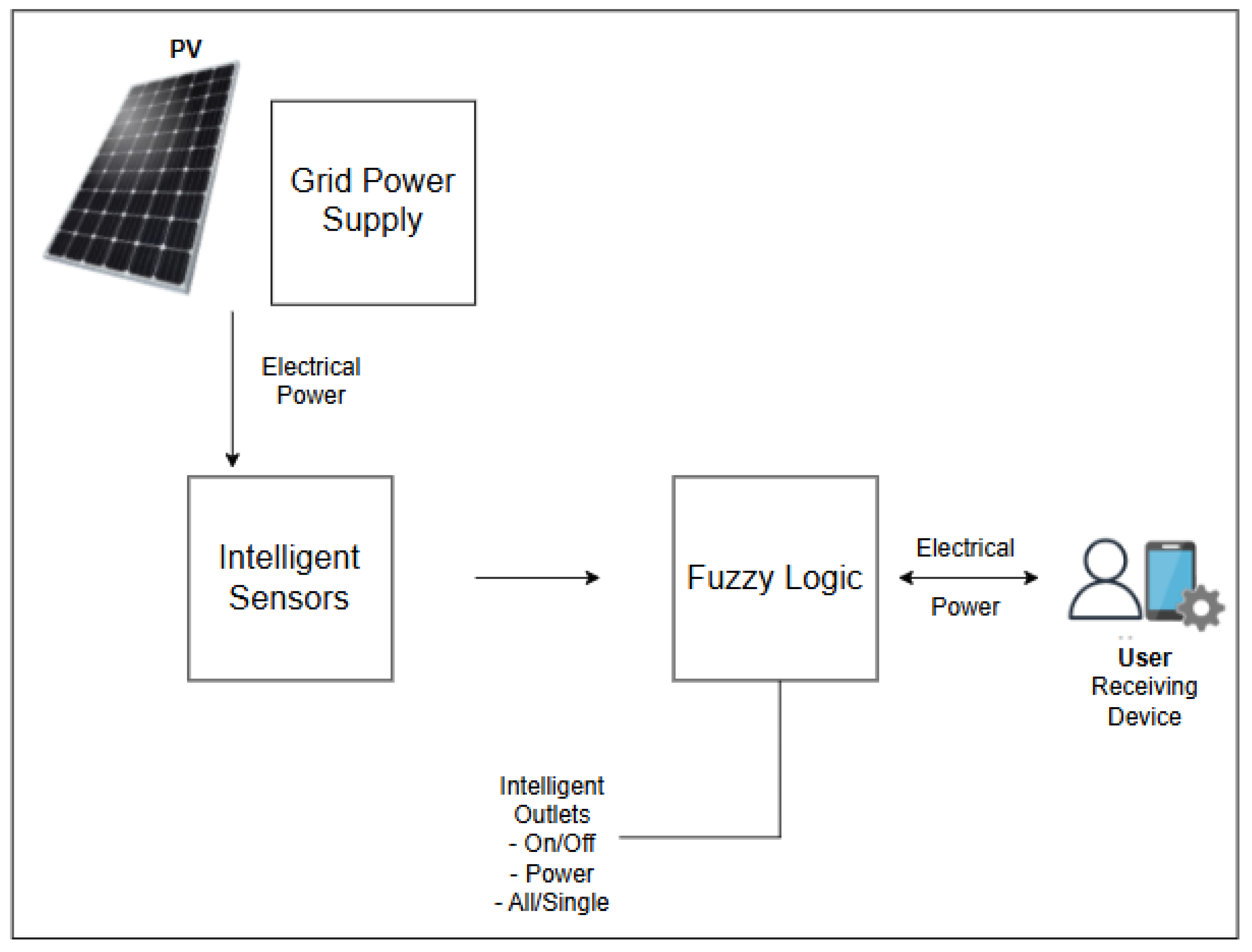
The proposed power supply system integrates multiple energy sources and is designed to optimize equipment operation and reduce energy consumption within the room as illustrated in Figure 1. A central element is the photovoltaic subsystem, which ensures the conversion of solar energy into electrical energy and provides a renewable source complementary to the public grid. Unlike purely technical descriptions, the present analysis emphasizes the system’s energy behavior: the PV panels are sized to provide sufficient installed power to cover the laboratory’s base load during periods of favorable solar irradiation. Within the experimental tests, PV production contributed an average of 1.98 kWh/day, representing approximately 10–15% of the room’s daily energy demand, directly influencing the reduction in energy drawn from the grid. This contribution is assessed using indicators such as the energy self-coverage ratio and load variation as a function of renewable source availability.
Interconnection with the public electrical grid is ensured through bidirectional inverters, which allow both supplementation of the supply when photovoltaic production is insufficient and injection of surplus energy into the grid. This hybrid architecture provides the redundancy required to maintain a stable power supply; however, its inclusion in the energy model requires consideration of conversion losses and source-switching latency.
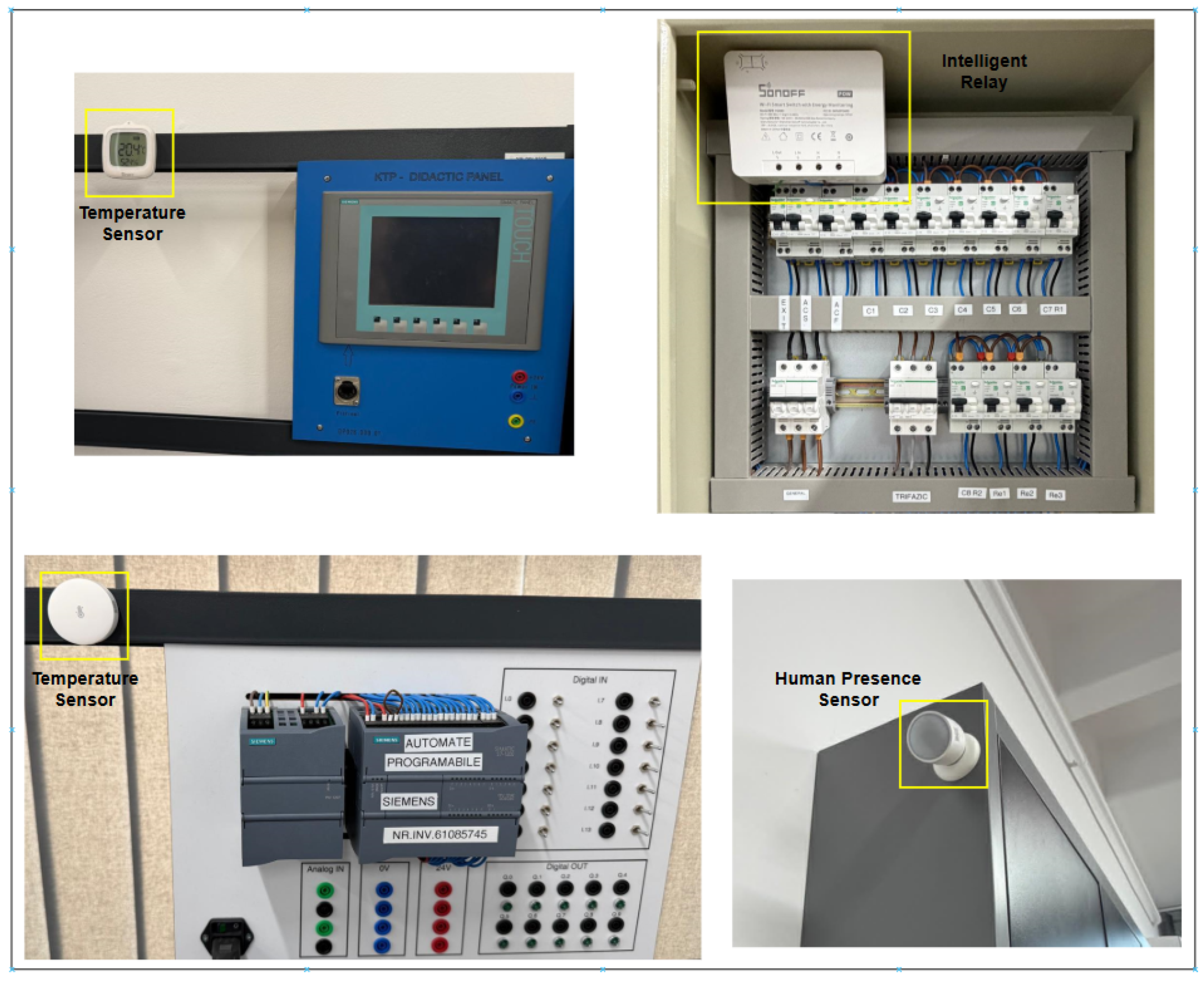
The smart sensors integrated within the room provide real-time monitoring of parameters relevant to energy control: voltage, current, instantaneous consumption, outlet status, temperature, humidity, and user presence. To increase system reliability, the sensors were calibrated prior to installation, and deviations recorded during testing remained below ±2% for electrical measurements and below ±0.3 °C for temperature measurements. The average communication latency between sensors and the control unit ranged between 80–120 ms, enabling real-time operation of the fuzzy algorithms without degrading system stability.
The collected data are transmitted to the central control unit, where they are analyzed using fuzzy algorithms to determine the optimal mode of energy distribution. In this way, the system goes beyond simple data acquisition, transforming information into operational decisions that are adapted in real time to user requirements. Integrating these data with adaptive control algorithms leads to more accurate decision-making and optimized equipment operation.
Among contemporary decision-making methods, fuzzy logic stands out due to its ability to model situations characterized by incomplete, uncertain, or difficult-to-quantify information. In a laboratory environment, many contexts cannot be described using exact values or strictly defined thresholds; expressions such as “the temperature is appropriate,” “the laboratory is crowded,” or “the equipment is operating intensively” illustrate intermediate states that are difficult to formalize using classical logic. Fuzzy logic enables the integration of these nuances into the decision-making process, providing a flexible, adaptive, and easily interpretable framework. Through this interpretability, the approach supports the development of user-centered systems capable of adjusting thermal comfort levels and energy performance according to the real and dynamic requirements of the environment [20,21,22].
Furthermore, smart electrical outlets extend the system’s functionality by enabling direct monitoring and control of connected equipment. They allow the management of consumption priorities, automatic shutdown of non-essential devices, or redirection of energy to areas with high demand. Moreover, users can interact with the system through mobile applications or intuitive graphical interfaces, which strengthens the user-centered nature of the architecture and supports efficient real-time decision-making.
The selection of hardware components represents a critical aspect in the design and implementation of a user-centered energy management system. The choice of sensors and smart relays is not limited to technical compatibility criteria, but also targets measurement accuracy, long-term reliability, and the ability to integrate into a scalable architecture. In this regard, Sonoff devices are selected due to their versatility, extensive support for modern communication protocols such as Zigbee and Wi-Fi and their ability to provide real-time data required by fuzzy control algorithms. The tables presented below summarize the relevant technical specifications of the temperature, humidity, and presence sensors, as well as the smart relays used in the system. This information underpins the performance analysis and justifies the inclusion of these devices in the proposed architecture. Prior to integration into the control architecture, all sensors were calibrated according to manufacturer specifications. Electrical measurements were validated against reference instrumentation, with deviations remaining below ±2%. To ensure temporal consistency, all datasets were resampled at 5-min intervals using synchronized timestamps. Data streams were aligned using a common system clock to avoid phase shifts between environmental measurements and energy consumption records.
Table 2, Table 3, Table 4 and Table 5 summarize the technical characteristics of the sensors, relays, and photovoltaic panels used in the proposed system. The temperature, humidity, and presence sensors (Table 2) ensure monitoring of microclimate conditions and occupancy levels, providing accurate measurements and frequent updates via the Zigbee 3.0 protocol. The photovoltaic panel specifications are presented in Table 3. The Sonoff Dual R3 smart relay (Table 4) enables equipment control and energy consumption monitoring, being compatible with the system’s Wi-Fi infrastructure. Additional environmental monitoring data are provided by the weather station, as detailed in Table 5.
The selection of hardware components was based on the need to ensure an optimal balance between data acquisition accuracy, transmission energy efficiency, and system interoperability. The implementation of temperature, humidity, and human presence sensors using the Zigbee 3.0 protocol is motivated by the mesh network topology, which guarantees superior signal stability in indoor environments.
Compared to Wi-Fi, Zigbee technology is distinguished by low power consumption (low-power design), an essential aspect for battery-powered devices. At the same time, it minimizes latency in microclimate parameter updates, thereby enabling real-time control of the Energy Management System (EMS).
The Sonoff Dual R3 smart relay fulfills not only the role of an actuator but also that of a measurement instrument. Its electrical energy monitoring capability (power monitoring) allows real-time validation of mathematical consumption models. Its integration via Wi-Fi facilitates high data throughput to the central gateway, making it suitable for the denser data streams generated by electrical load monitoring.
The inclusion of photovoltaic panels in the architecture transforms the system from a purely passive one into a proactive system. The technical data provided by the panels are critical for energy prediction algorithms, enabling the modeling of the production curve as a function of local solar irradiation and providing the necessary input variable for balancing the energy equation between renewable generation and grid consumption.
The proposed system integrates a professional weather station, the Sencor SWS 12500, responsible for acquiring exogenous climatic data. Monitoring external atmospheric parameters (temperature, humidity, wind speed, and precipitation intensity) is critical for calculating the building’s thermal load and for correlating photovoltaic energy production with cloudiness levels.
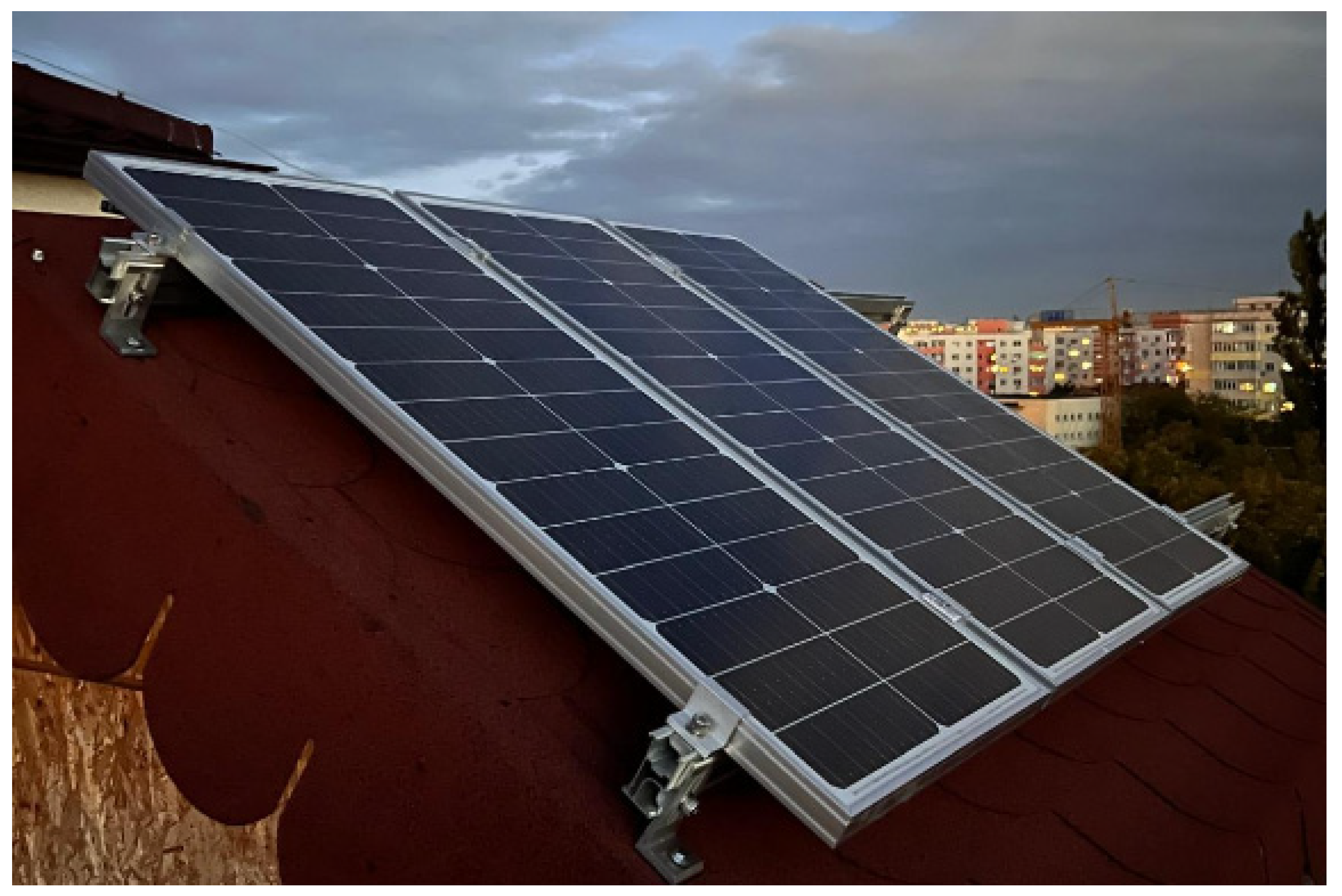
The photovoltaic panels included in the architecture provide essential parameters for modeling the renewable energy source. Through the selection of these devices, the table highlights hardware compatibility and the relevance of the components for the coordinated operation of the energy management system. The experimental configuration, comprising the three photovoltaic panels used at this stage, is illustrated in Figure 2.
The current system configuration includes three photovoltaic panels, used for the initial simulation and validation stage. However, the system architecture allows for the expansion of the number of units in later research phases, depending on the identified requirements.

3. Consumption Monitoring and Prediction System

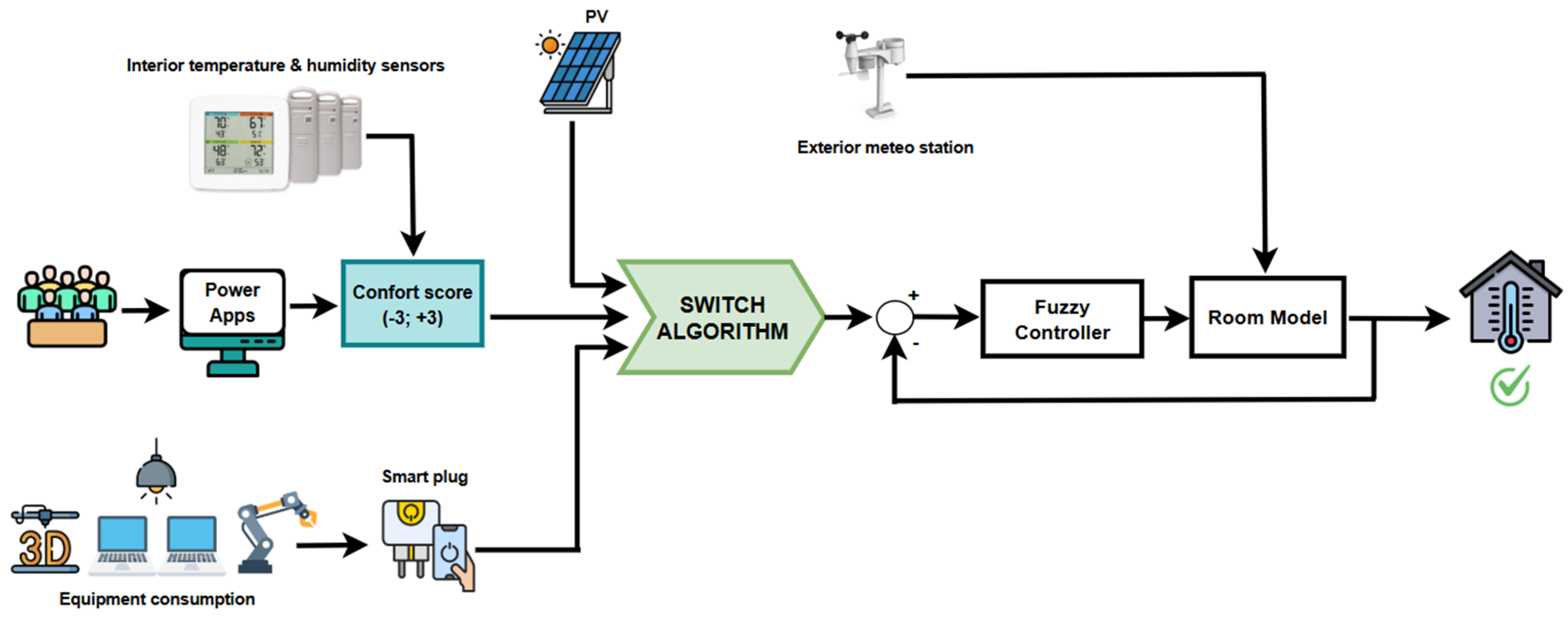
To ensure an indoor environment characterized by an optimal balance between user thermal comfort and the energy efficiency of the analyzed laboratory space, the proposed system integrates a control algorithm that simultaneously processes multiple categories of factors. It is designed to operate based on three essential types of constraints that guide the decision-making mechanism. This approach aims at the simultaneous optimization of usage conditions and energy costs, within a context where resources are limited and sustainability-related requirements are becoming increasingly important. The system architecture is illustrated in Figure 3.

3.1. Architecture of the Proposed System

In order to enable advanced process management, the proposed control architecture integrates three complementary methods: an On/Off regulator for direct actuation, a PID controller that ensures high steady-state accuracy, and a Fuzzy logic module capable of providing dynamic adaptability under disturbances. To simultaneously achieve thermal comfort and energy efficiency in the laboratory space, the central algorithm processes multiple environmental factors and operates based on three essential sets of constraints.
This approach targets the concurrent optimization of operating conditions and energy-related costs, in a context where energy resources are limited and sustainability requirements are increasingly relevant.
The first constraint category is associated with the level of comfort perceived by the occupants of the analyzed room. The system collects direct user feedback through a voting mechanism in which occupants evaluate their thermal comfort state based on two types of parameters: indoor parameters (temperature and humidity) and personal perception parameters (activity level, clothing insulation, and skin temperature). The data are stored and processed in real time, and the algorithm uses the average vote to estimate overall satisfaction. By integrating human perception into the control loop, the proposed system overcomes the limitations of traditional approaches that rely exclusively on a fixed temperature setpoint, enabling dynamic setpoint adjustment according to the current user profile and the specific variations in the occupied indoor environment.
Integrating user feedback into the control strategy is a key component of the proposed system; however, the use of subjective perceptions requires appropriate methodological validation. In this work, the thermal comfort data are collected from a sample of 15 to 20 users, depending on the students present in the laboratory room. User presence in the analyzed space is detected and logged during active hours using a human presence sensor installed at the laboratory entrance.
The second constraint category refers to the energy consumption of the equipment installed in the room, considering both the distribution of consumption across device types the HVAC system, lighting system, IT equipment (desktop computers and laptops), the 3D printer, and the KUKA robotic arm and the time varying electricity tariffs depending on the time interval. The algorithm implements a load management strategy by identifying periods characterized by high energy costs and adjusting equipment operation to limit consumption during those intervals.
The third constraint category is associated with the availability of renewable energy provided by the photovoltaic panels installed on the faculty buildings. The system monitors instantaneous PV generation in real time and integrates this information into the decision-making process. When solar energy is abundant, the system prioritizes the use of this renewable resource to supply laboratory equipment, thereby reducing dependence on the external power grid. During periods of reduced or absent generation—such as nighttime intervals or unfavorable weather conditions—the algorithm compensates for the deficit by shifting supply to the conventional grid.
The adopted ±3 comfort scale is conceptually aligned with the Predicted Mean Vote (PMV) framework defined in ASHRAE Standard 55, which quantifies thermal sensation on a seven-point scale ranging from cold (–3) to hot (+3). The PMV model, originally introduced by Fanger, evaluates thermal comfort as a function of air temperature, mean radiant temperature (MRT), humidity, air velocity, metabolic rate, and clothing insulation. In this paper, thermal comfort is predominantly assessed based on indoor air temperature, but this approach has certain limitations. According to ASHRAE Standard 55, thermal comfort is more rigorously described by the operative temperature, which integrates both air temperature and mean radiant temperature (MRT), the latter having an essential role in the thermal perception of occupants. Therefore, the exclusive use of air temperature may lead to an approximation of the real comfort conditions, which must be recognized as a limitation of the proposed study [23,24].
Although the present study does not perform full PMV/PPD calculations, the subjective voting mechanism implemented in the Power Apps interface follows the same conceptual structure, enabling a simplified but consistent representation of thermal perception within a real-time control context.
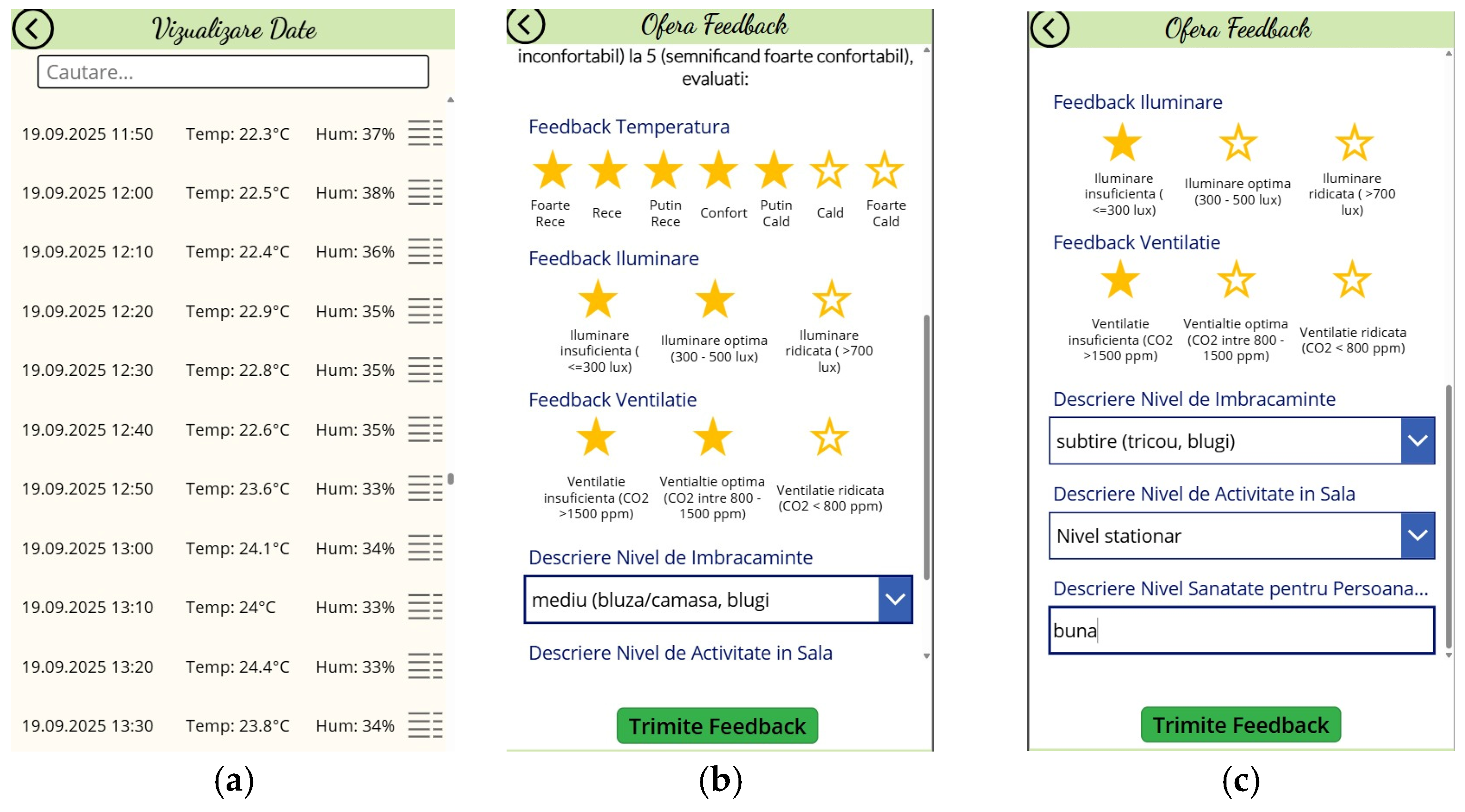
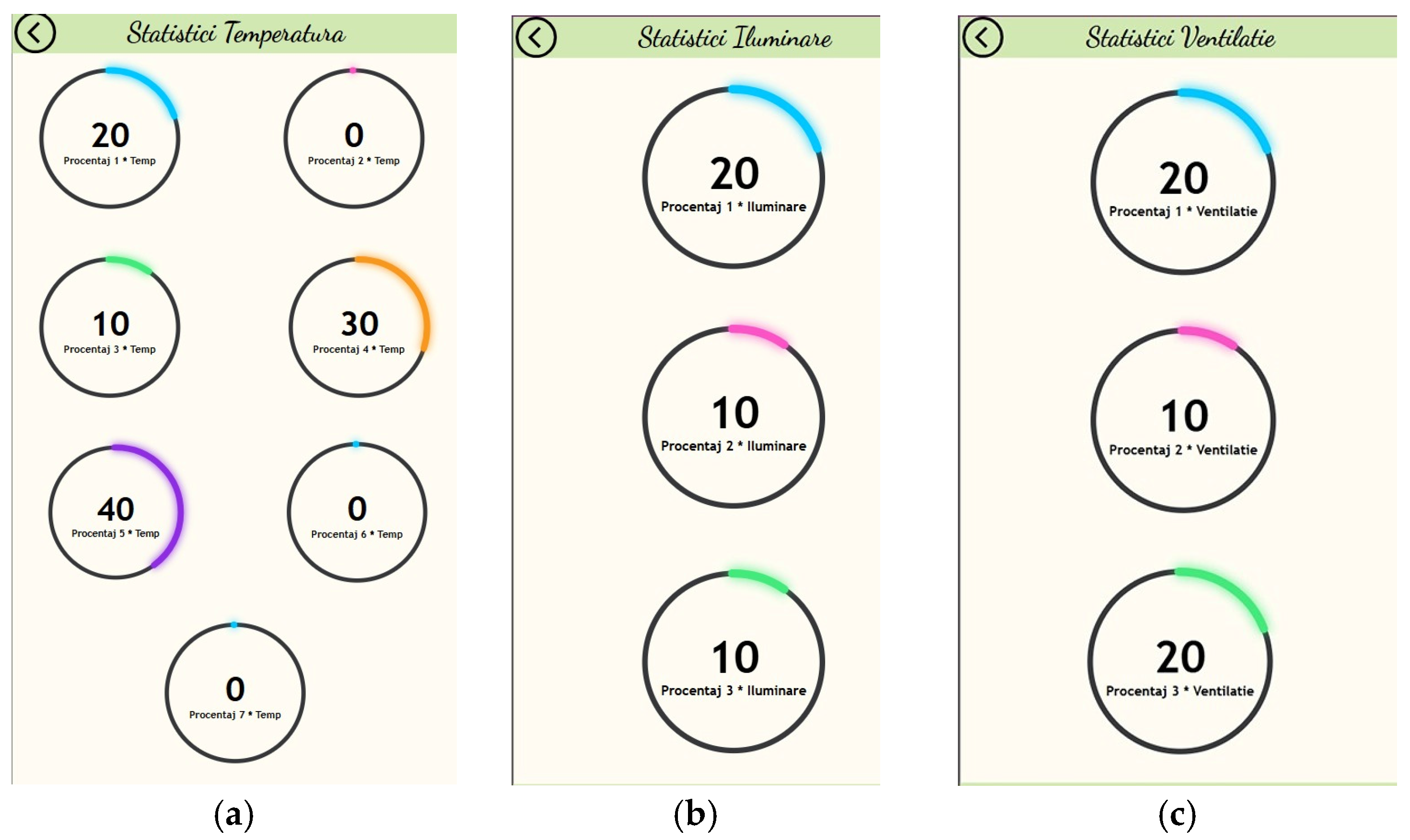
The indicator is determined by computing the arithmetic mean of the responses provided by students and teaching staff through a digital form implemented as an intuitive graphical user interface (Figure 4) developed in the Power Apps platform. This mechanism enables fast and standardized collection of thermal comfort perceptions, facilitating their integration into the system’s decision-making process.
In the Figure 5 illustrates the graphical interface of the data collection application, where temperature, lighting, and ventilation statistics are presented as percentage values. The symbol ‘*’ is used to indicate that each percentage value corresponds to the associated parameter (temperature, lighting, or ventilation). The form integrates a set of questions designed to enable the storage and processing of information relevant to the assessment of thermal and environmental comfort conditions. Users are asked to evaluate the perceived indoor temperature, lighting level, and skin temperature a parameter correlated with variations in physiological state. Skin temperature was self-reported qualitatively through predefined categories within the Power Apps interface. In addition, data regarding physical activity level and clothing insulation are collected, two variables widely recognized in the literature as having a direct influence on human thermal perception.
The questions are selected to directly reflect the input variables of the fuzzy system implemented in the Simulink environment, as detailed in previous studies [25]. Through this well-defined correspondence between the subjective parameters reported by users and the linguistic variables of the fuzzy model, the form functions not only as a data collection instrument but also as an integrated component of the control loop. After responses are collected from a sufficient number of participants, the application computes the arithmetic mean of the values, generating an average comfort level for the entire group of occupants.
The computed average comfort level is subsequently transmitted to the control algorithm and used as a primary constraint in the optimization process of the laboratory equipment operating parameters. By integrating subjective user perceptions and transforming them into objectively computed indicators, a decision-making model is obtained that effectively combines human feedback with mathematical analysis. This approach contributes to intelligent and adaptive indoor environment management, enabling equipment operation to be aligned with the actual needs of occupants.
Furthermore, in order to objectively evaluate the effectiveness of the fuzzy method, a comparative analysis is conducted against three classical control strategies commonly used in HVAC systems: ON/OFF control, PID control and fuzzy-rule-based control, which are widely adopted in conventional HVAC applications. The comparison is performed using standardized performance indicators such as settling time, steady-state error, mean absolute deviation from the setpoint, overshoot, and energy consumption. The results show that, under conditions of high variability in user preferences and in the presence of measurement noise, fuzzy control maintains a mean error below ±0.2 °C, reduces oscillations compared to PID control, and avoids the abrupt switching behavior characteristic of ON/OFF control.
In addition, the system is evaluated in terms of dynamic performance, including its responsiveness to rapid changes in user feedback and the resulting impact on energy consumption. The integration of these metrics validates the contribution of the fuzzy approach not only to comfort stabilization but also to peak load reduction and optimized energy utilization. Through these elements, the section provides a solid scientific foundation for the proposed approach and addresses methodological validation requirements, comparative assessment, and controller performance analysis.

3.2. Scenario Description Based on the Consumption Profile

The scenario used for system testing is configured within a laboratory room of the Faculty of Hydrotechnics, a space representative of modern educational environments. The laboratory is equipped with seven desktop computers, seven laptops, an air-conditioning system, a KUKA Ready2Educate robotic arm, and a FlashForge Creator 3 Pro 3D printer. All these devices are powered by energy supplied both from the photovoltaic system installed at the faculty level and from the national electrical grid, depending on source availability. Their operation is monitored both individually and in an integrated manner from an energy consumption perspective. The collected information plays a key role in evaluating the performance of the proposed algorithm.
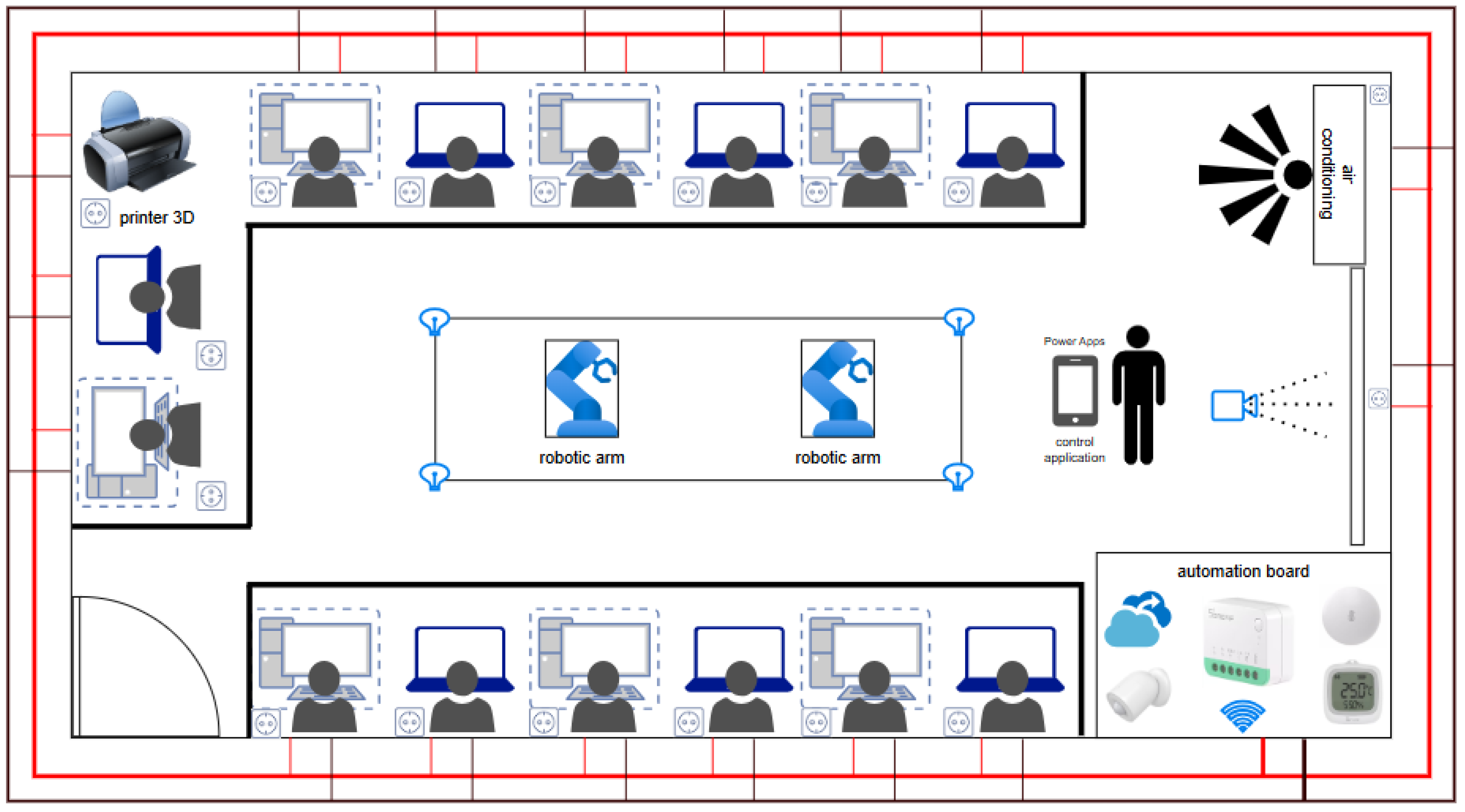
The physical layout of the room, together with sensor placement and equipment distribution, is presented in Figure 6. The laboratory floor plan highlights how measurement points were positioned to achieve uniform coverage and to minimize local influences on the recorded values, thereby ensuring an accurate and representative assessment of the indoor environment.
Figure 6 illustrates the configuration of a modern teaching laboratory designed for activities carried out together with faculty students. The space is organized to support both individual work at dedicated workstations and practical experiments in a central area reserved for educational robotic manipulation. The workstations are arranged along the perimeter and are equipped with computing stations, a layout that facilitates overall laboratory supervision and efficient coordination of activities.
Although two robotic arms are depicted in the figure, only one robotic arm is operational and monitored. On the left side of the room, a rapid prototyping area is installed, which includes a 3D printer. This section supports the development of functional prototypes and their integration into automation-related projects.
On the right side of the laboratory, the digital system for monitoring and storing data collected from the sensors installed in the room is located, managed through an application developed using Power Apps. This area also includes an automation panel integrating various hardware modules, such as presence, light, and temperature sensors, a control module, as well as cloud and wireless connectivity components. These elements enable continuous monitoring of environmental parameters and the implementation of intelligent control scenarios within the laboratory.
The figure also presents the heating, ventilation, and air conditioning (HVAC) system, which ensures control of ambient parameters and communicates with the integrated automation infrastructure. Together, these components reflect the configuration of a modern laboratory fully equipped for education, robot programming, and the exploration of automation technologies.
For the experimental evaluation, multiple monitoring scenarios were selected. Two scenarios were defined: system monitoring and management over a single day, and monitoring over a five-day period (Monday–Friday). The first scenario was conducted for a representative day in October, namely 15 October 2025, for which a complete dataset required for analysis was collected. The second scenario was carried out in November, specifically from 3–7 November 2025. Outdoor environmental conditions were recorded using a Sencor SWS 12500 weather station, which provides measurements of temperature, humidity, and other relevant atmospheric parameters.
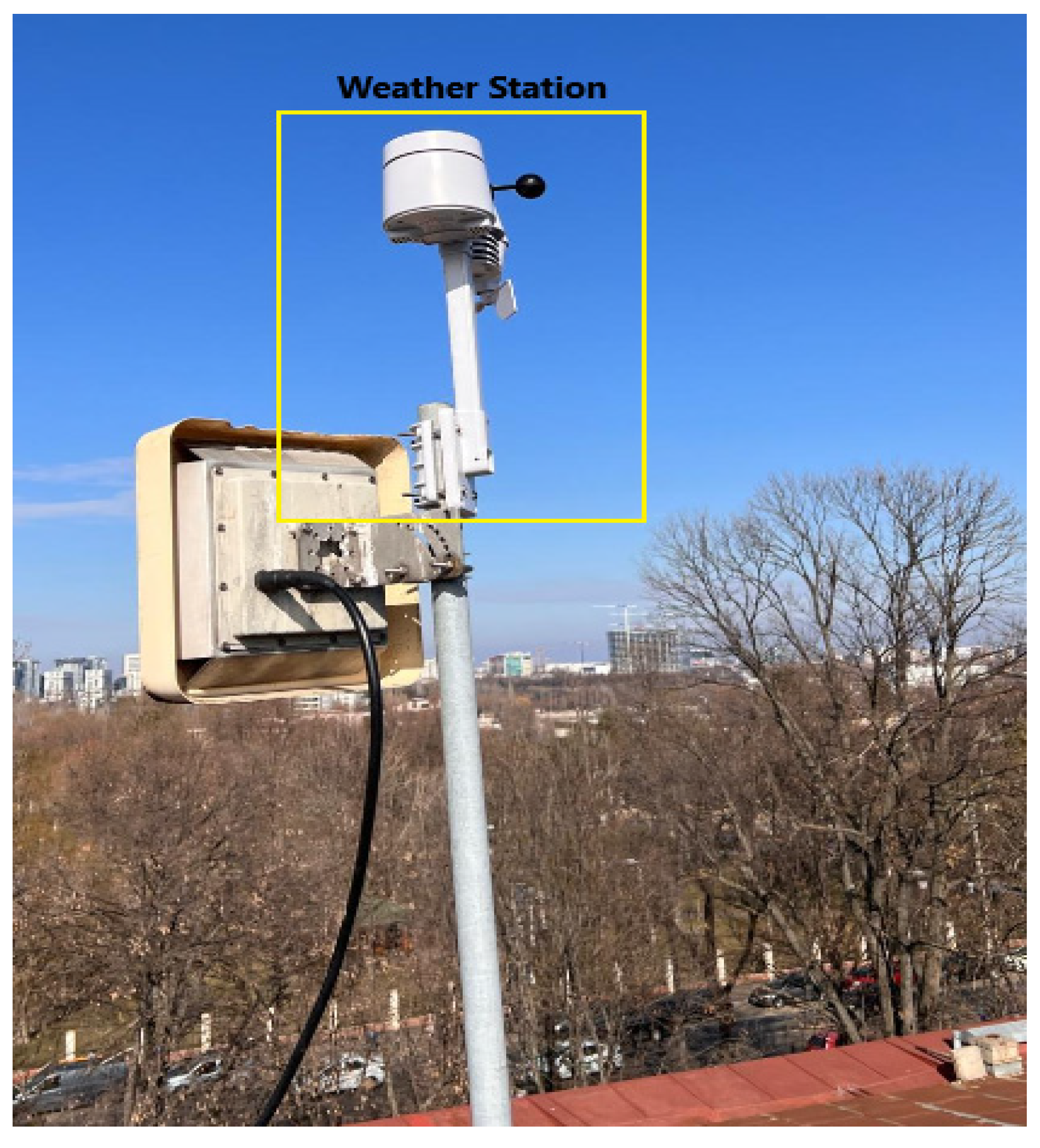
Figure 7 presents the weather station installed on the Faculty of Hydrotechnics building, above the monitored laboratory, for the collection of external environmental parameters.
Indoor environmental conditions, particularly temperature and humidity, are acquired from sensors strategically placed at various locations within the room in order to capture local variations and ensure data consistency with occupants perceived comfort, as illustrated in the following Figure 8.
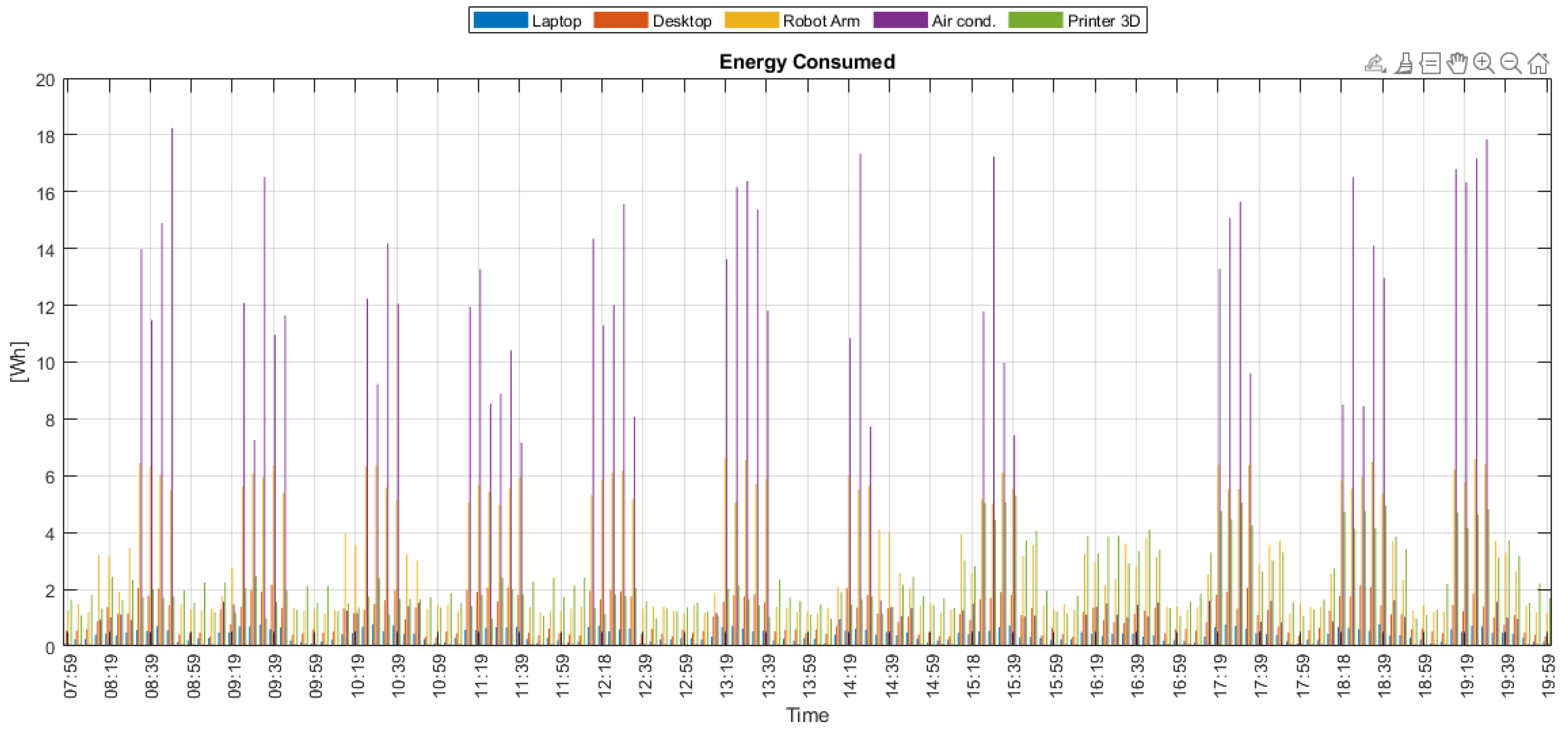
The energy consumption of the equipment is monitored using smart outlets in conjunction with a smart relay installed in the laboratory’s electrical automation panel, which enables the measurement of individual devices and, implicitly, the identification of both base consumption and variations associated with the activities carried out in the laboratory. Subsequently, the individual values are aggregated to determine the total energy consumption of the room, which is required in the analysis stages and for evaluating the impact of the algorithm on overall energy efficiency. The temporal evolution of electrical consumption is illustrated in Figure 9. The level of comfort perceived by users is obtained through an application developed in Power Apps, through which students and teaching staff periodically provide feedback regarding microclimate parameters. The collected subjective data are subsequently correlated with the objective measurements performed in the laboratory, thereby ensuring a comprehensive and coherent evaluation of indoor conditions.
Figure 9 presents the comparative evolution of energy consumption for all monitored equipment in the laboratory laptops, desktops, the robotic arm, the air-conditioning (HVAC) system, and the 3D printer over the 08:00–20:00 time interval. The graph provides an overall view of the energy consumption distribution and enables the identification of each device’s contribution to the total daily consumption.
Visual analysis highlights that the HVAC system is the primary energy consumer, with frequent peaks ranging between 11 and 18 kWh, significantly exceeding the values recorded for the other equipment. These periodic increases reflect the cyclic operation typical of HVAC systems, required to maintain a stable microclimate within the laboratory. In the case of the robotic arm, energy consumption generally ranges between 2 and 5 kWh, remaining consistently above that of IT equipment. The relatively high level and variability of consumption confirm the electromechanical nature of the equipment and the energy demands associated with repetitive motions, load handling, and the execution of programmed sequences.
The 3D printer occupies the next position in the energy consumption hierarchy, exhibiting peaks generally between 3 and 5.5 kWh, particularly during periods dedicated to large-scale prints or continuous extrusion and heating phases. Although lower than the consumption of the robotic arm or the HVAC system, the energy contribution of the 3D printer remains significant and adds to the laboratory’s overall load.
Desktop computers exhibit moderate consumption, generally below 2–3 kWh, but remain relatively constant throughout the day, indicating their role as continuous consumers influenced by high-power hardware components (CPU, GPU, power supply). In contrast, laptops show the lowest consumption among the analyzed devices, with values rarely exceeding 1 kWh, confirming the superior energy efficiency characteristic of this type of equipment.
A comparative analysis of the energy consumption profiles of all monitored equipment reveals several aspects that are relevant for understanding the laboratory’s overall energy behavior. The total energy demand is primarily driven by large technical systems, particularly the HVAC installation and the robotic arm, which consistently record the highest consumption levels. These devices largely determine the amplitude of daily consumption peaks.
By contrast, IT equipment contributes more moderately to the overall demand, but its consumption remains relatively constant throughout the day, reflecting continuous operation during laboratory activities. The 3D printer occupies an intermediate position in the energy hierarchy: its consumption is noticeably higher than that of laptops, yet remains below the levels associated with the robotic arm and the HVAC system.
An important observation concerns the complementary nature of these consumption patterns. While IT equipment produces a relatively uniform load profile, mechanical systems and climate control generate pronounced peaks. This interaction between steady background consumption and intermittent high-demand loads may lead to temporary stress on the electrical infrastructure during specific time intervals.
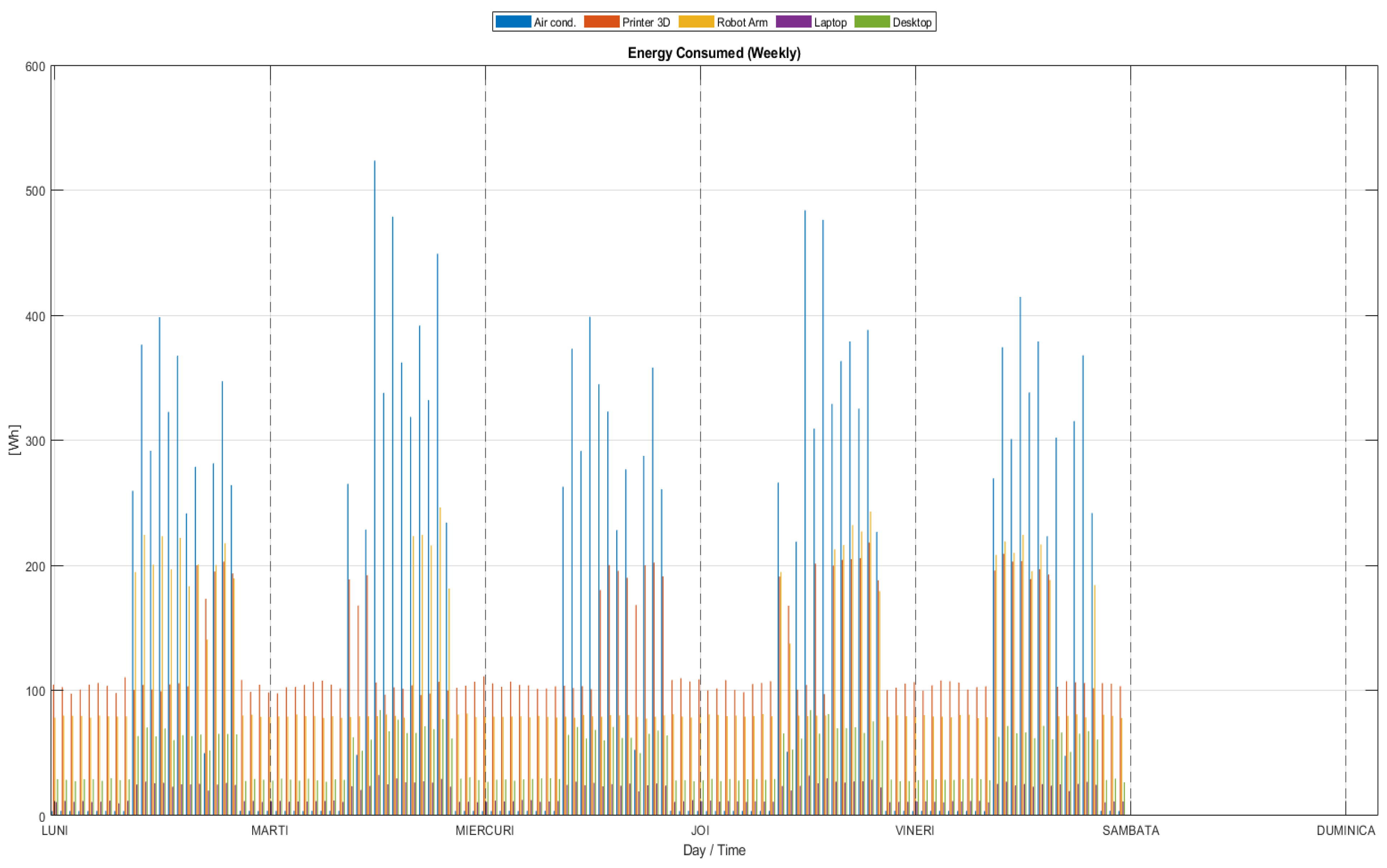
Figure 10 illustrates the hourly evolution of electrical energy consumption (Wh) for the monitored equipment over five consecutive working days (Monday–Friday, 3–7 November 2025). The figure reveals a well-defined daily energy consumption profile, characterized by low values during nighttime periods and significant increases throughout the daytime. Energy consumption begins to rise steadily in the 08:00–09:00 time interval, reaching peak values approximately between 10:00 and 18:00, which corresponds to periods of intensive equipment usage. This pattern is relatively consistent across all analyzed days, indicating a regular operational regime. Among the monitored equipment, the HVAC system exhibits the highest energy consumption values and the greatest variability, dominating the daily energy profile. The robotic arm and the 3D printer register pronounced consumption peaks, suggesting intermittent operation with high energy demand. In contrast, laptops and desktop systems display lower and relatively constant consumption throughout active periods.
Additionally, the graph reveals differences between weekdays in terms of the amplitude and duration of consumption peaks, particularly for high-power equipment, indicating variations in usage intensity. Overall, the figure highlights the dominant contribution of high-load equipment to total energy consumption, compared to office-type equipment, which has a more uniform and lower energy impact.
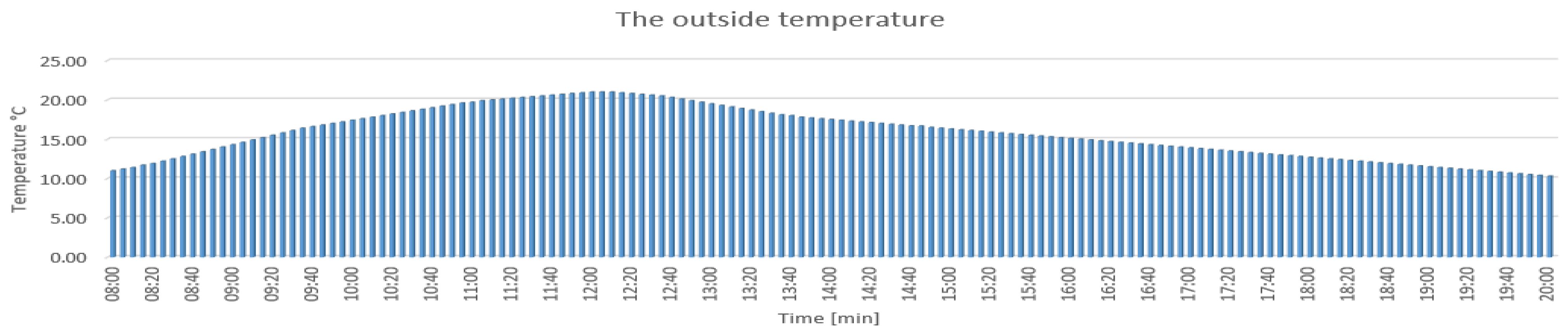
As shown in Figure 11, the outdoor temperature graph highlights a slow and wide variation over time. Initially, the temperature gradually increases to approximately 17–20 °C, after which it begins to decrease steadily, reaching a minimum of around 10 °C at approximately 20:00. The curve exhibits smooth evolution without rapid oscillations, which is characteristic of natural outdoor variations driven by the daily thermal cycle.
The data processing stage includes filtering and temporal synchronization procedures applied to all information sources, with the objective of obtaining a coherent, homogeneous, and complete dataset suitable for use in simulations performed in MATLAB/Simulink (MathWorks, Natick, MA, USA, version R2020a). To ensure uniform input data resolution, all records are sampled at five-minute intervals, corresponding to the time window between 08:00 and 20:00, during which the laboratory room is intensively used for educational activities.
Throughout the entire 08:00–20:00 interval, the testing scenario is structured into two-hour segments corresponding to the organization of university schedules, where a lecture or laboratory session lasts 50 min and is followed by a 10 min break. This temporal structure enables the capture of natural variations in human activity, as breaks influence both room occupancy levels and the energy behavior of equipment. In this context, the energy consumption fluctuations observed in the collected data can be correlated with periods of intensified or reduced activity, as well as with the time intervals during which the main equipment, the robotic arm, and the 3D printer are actively used.
In the first interval, between 08:00 and 10:00, the predominant activity consists of observing and analyzing the operation of the robotic arm; during this period, most participants wear slightly heavy clothing, typical of early morning hours in October. In the 10:00–12:00 interval, laboratory activities become more dynamic, involving standing and moderate movement around the robotic arm. Clothing levels during this stage vary between “light” and “slightly heavy,” reflecting both adaptation to the indoor microclimate and the intensity of the performed activities.
Between 12:00 and 14:00, activity returns to a predominantly observational profile similar to the first segment, but in a context where participants’ clothing becomes mostly light due to the significant increase in outdoor temperature around midday. The 14:00–16:00 period introduces a mixed scenario, combining robotic arm analysis with activities dedicated to operating the 3D printer, which requires occasional movement within the room. During this stage, clothing levels revert to the “slightly heavy” category, reflecting variations in thermal comfort perceived by occupants throughout the afternoon.
A similar profile is maintained in the 16:00–18:00 interval, during which participants continue to operate both the robotic arm and the 3D printer, alternating between standing and short movements between work areas. Clothing levels remain constant during this period, still classified as “slightly heavy.” In the final interval of the schedule, from 18:00 to 20:00, laboratory activities preserve the same combined profile of observation and 3D printer operation; however, clothing gradually shifts toward the “moderately heavy” category, driven by the decrease in outdoor temperature toward the end of the day.
By integrating all these elements, the experimental scenario enables system testing within a realistic framework, where the interaction between occupant comfort levels, equipment energy consumption, and time-varying energy tariffs can be observed. In this manner, the algorithm evaluation is conducted in a complex and dynamic environment that reflects real usage conditions and provides a comprehensive perspective on its performance under the specific constraints of a modern university laboratory.

3.3. Case Study: Energy Management System in Buildings

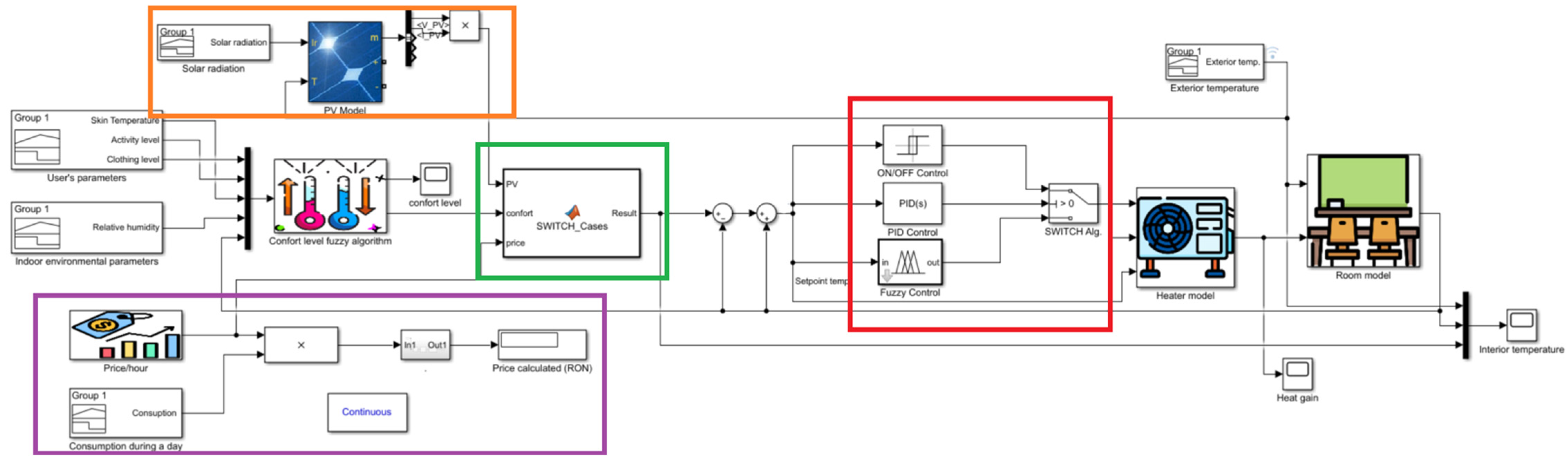
To evaluate the operation of the proposed algorithm in a controlled and implementable context, a complete mathematical model is developed in the MATLAB/Simulink environment. The model is organized into functional subsystems so that each component of the real system is faithfully represented within the simulation. The overall structure of the model is illustrated in Figure 12, where the main modules composing the simulation architecture are highlighted using color coding.
The subsystem highlighted in orange models the energy contribution from the photovoltaic panels, including the calculation logic related to the generated energy and its availability over the analyzed time interval. The purple-marked area integrates the energy cost calculation mechanism associated with monitored consumption, using a time-of-use tariff structure; within this subsystem, the Display block is used to show the total accumulated cost over the entire simulated day. The subsystem highlighted in green represents the switching algorithm responsible for generating the indoor temperature reference value, computed based on constraints imposed by occupant comfort, energy consumption, and photovoltaic resource availability. The red-marked area represents the types of control systems (ON/OFF, PID, and Fuzzy) that can be activated individually or jointly to obtain the results of the proposed system.
This modular organization enables a detailed analysis of the system’s operating behavior and facilitates the individual evaluation of each component within the energy control optimization process.
The modeling of the HVAC system and the room used in the simulation is carried out in accordance with the methodological framework presented in [26], subsequently adjusted to reflect the geometric characteristics and specific conditions of the analyzed space.
The comparison of the three control strategies is based on the analysis of the results obtained following the implementation of each type of controller, configured as follows: the ON/OFF controller is defined by a maximum variation range from the reference value of ±0.5 °C; the PID controller has parameters given by an experimental method; and the fuzzy controller uses as input variables the indoor temperature, humidity, skin temperature, activity level and clothing level of the occupants, these representing data series recorded through the implemented sensors and the information collected through the developed application. This adaptation involves updating the physical parameters of the room such as volume, glazed surface area, thermo-energetic properties of the building envelope, and air flow configuration so that the model accurately reproduces the real thermal behavior of the laboratory. This approach ensures conceptual consistency with the reference model presented in the literature, while maintaining the level of accuracy required for simulating the specific operational conditions of the experimental environment in MATLAB/Simulink.
The mathematical modeling of the photovoltaic panels is implemented in Simulink using the dedicated PV Array block, which incorporates a detailed physical model of a photovoltaic generator based on specified electrical and construction parameters. This block employs the characteristic equations of a diode-based photovoltaic cell, including the effects of open-circuit voltage, short-circuit current, temperature coefficients, irradiance level, and cell temperature.
One of the most widely used models for photovoltaic cell simulation is that proposed by Bellia et al. [27], which provides a detailed modeling and simulation approach applicable to any type of photovoltaic panel. In this model, the output variables are electrical current and power, while the input variables are temperature and solar irradiance.
The mathematical modeling of the photovoltaic cell can be expressed using differential equations, state-space equations, or transfer functions, depending on the desired level of analytical detail. Based on the model proposed by Bellia et al. [27] and considering the requirements for constructing an adapted model for the photovoltaic cells analyzed in this work [28], the following equations are obtained:
I = I L I 0 e x p q V + I R S γ k T C 1 γ = A · N S I L = G G R E F · I L , R E F + μ I S C ( T C T C , R E F ) I 0 = I 0 , R E F T C T C , R E F 3 · e x p q ε G k A 1 T C , R E F 1 T C
where:
  • I—current [A];
  • I L , I L , R E F —light-generated current (photocurrent) [A];
  • I 0 , I 0 , R E F —saturation current [A];
  • q—electron charge [C];
  • RS—series resistance [Ω];
  • k—Boltzmann constant [J/K];
  • T C , T C , R E F —photovoltaic cell temperature [K];
  • G, G R E F —solar irradiance [W/m2];
  • μISC—temperature coefficient of short circuit current [A/K];
  • ε G —semiconductor bandgap energy.
The model accurately reproduces the nonlinear behavior of the I–V and P–V curves under various irradiance and temperature conditions, enabling real-time simulation of the power variations generated by the photovoltaic panel. This capability to faithfully capture system dynamics confirms the usefulness of the model for energy performance analysis and for evaluating operating scenarios within the MATLAB/Simulink simulation environment.
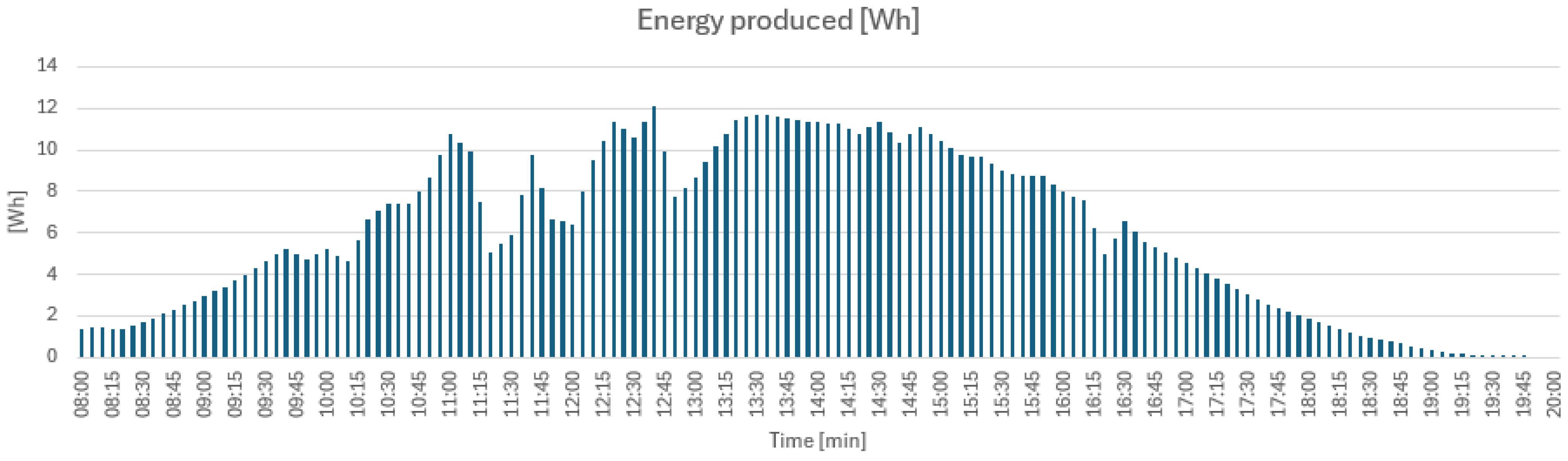
Within the simulation, the model corresponding to the previously described real scenario is implemented so that the parameter evolution reflects the experimental conditions as closely as possible. The graph generated as a result of the simulation accurately reproduces the behavior observed in the real case, thereby confirming the validity of the mathematical model structure and the input data used. In particular, the photovoltaic energy production curve shown in Figure 8 follows the typical evolution of a diurnal solar radiation cycle, highlighting both periods of maximum production and intervals characterized by reduced renewable energy availability. This agreement between simulated and real data supports the relevance of the analyzed scenario and provides the necessary basis for a reliable evaluation of the control algorithm’s performance.
Figure 13 presents the evolution of the energy produced by the photovoltaic system as a function of time over the 08:00–20:00 interval, with a temporal resolution of 5 min. Statistical analysis of the data indicates an average energy value of μ ≈ 5.97 Wh per interval and a standard deviation of σ ≈ 3.89 Wh, corresponding to a coefficient of variation of approximately 65%, highlighting the pronounced variability of the generation process. Individual energy values fall within the range [0, 12.11] Wh, with the maximum recorded around 12:40, near midday, when the instantaneous power reached approximately 145 W. From a statistical distribution perspective, the data exhibit slight skewness, with quartiles Q1 ≈ 2.29 Wh, median ≈ 5.76 Wh, and Q3 ≈ 9.73 Wh. This confirms that higher production levels are concentrated around the central part of the day, while lower values occur toward the extremes of the analyzed time window. Temporal integration of the data series results in a total daily energy production of approximately 0.87 kWh for the studied configuration.
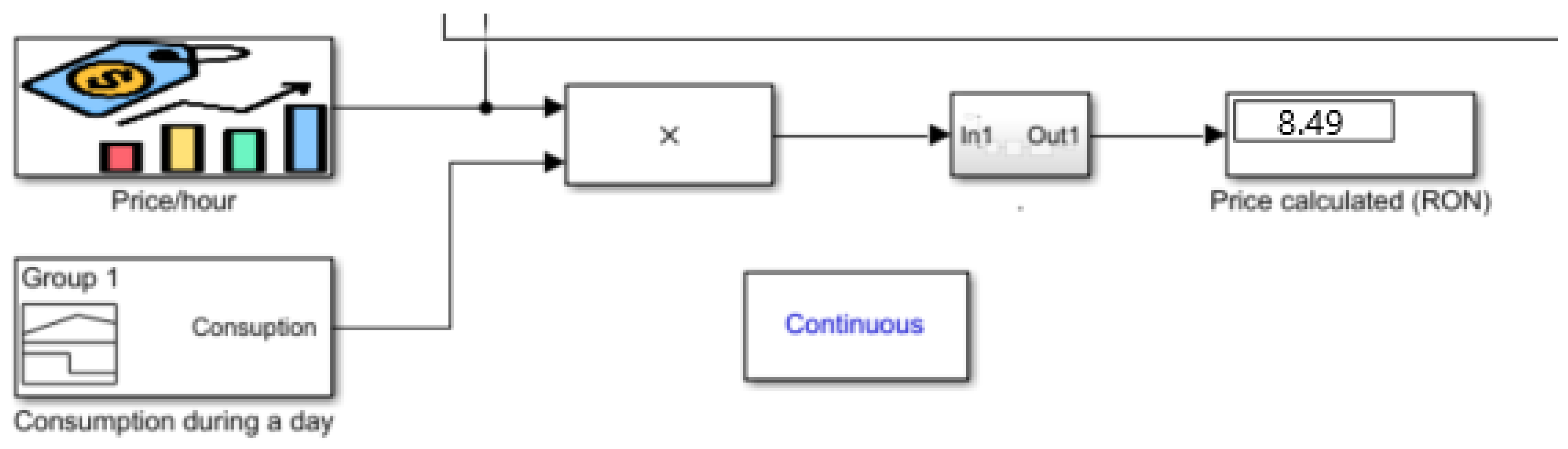
The subsystem responsible for calculating the electrical energy cost is designed to integrate both the information related to the total energy consumption recorded over the analyzed day and the time-of-use tariff structure. First, the subsystem receives as input the total energy consumption curve, obtained by summing the individual values of the monitored equipment. In parallel, it receives the tariff schedule, which contains the electricity prices associated with each time interval of the analyzed day. These two datasets are subsequently combined through a multiplication block, where the instantaneous consumption is multiplied by the tariff corresponding to the respective time interval. The resulting product represents the energy cost at that moment, while temporal integration of these values yields the total cost of the energy consumed over the entire day. The final result is displayed via the Display block, enabling direct evaluation of the impact of energy consumption on costs in the analyzed scenario.
The SWITCH block represents the central decision-making component of the control model and is responsible for determining the final reference temperature used by the HVAC system, based on three input variables: the level of energy available from the photovoltaic panels (PV), the average comfort level reported by occupants (comfort), and the electricity cost associated with the current time interval (price). This block is implemented as a MATLAB Function subsystem, within which a set of multicriteria logical rules is defined to enable switching between different decision scenarios according to the simultaneous evolution of these parameters. The rules are designed to allow the algorithm to respond adaptively to variations in energy price by reducing consumption during high-cost periods, without significantly compromising occupant comfort.


4. Results and Conclusions

4.1. System Simulation Scenario for 15 October 2025

According to the experimental scenario described in the previous sections, the graphs obtained from the simulation are presented in the following figures, each illustrating the evolution of a category of parameters relevant to the analysis of the control system.
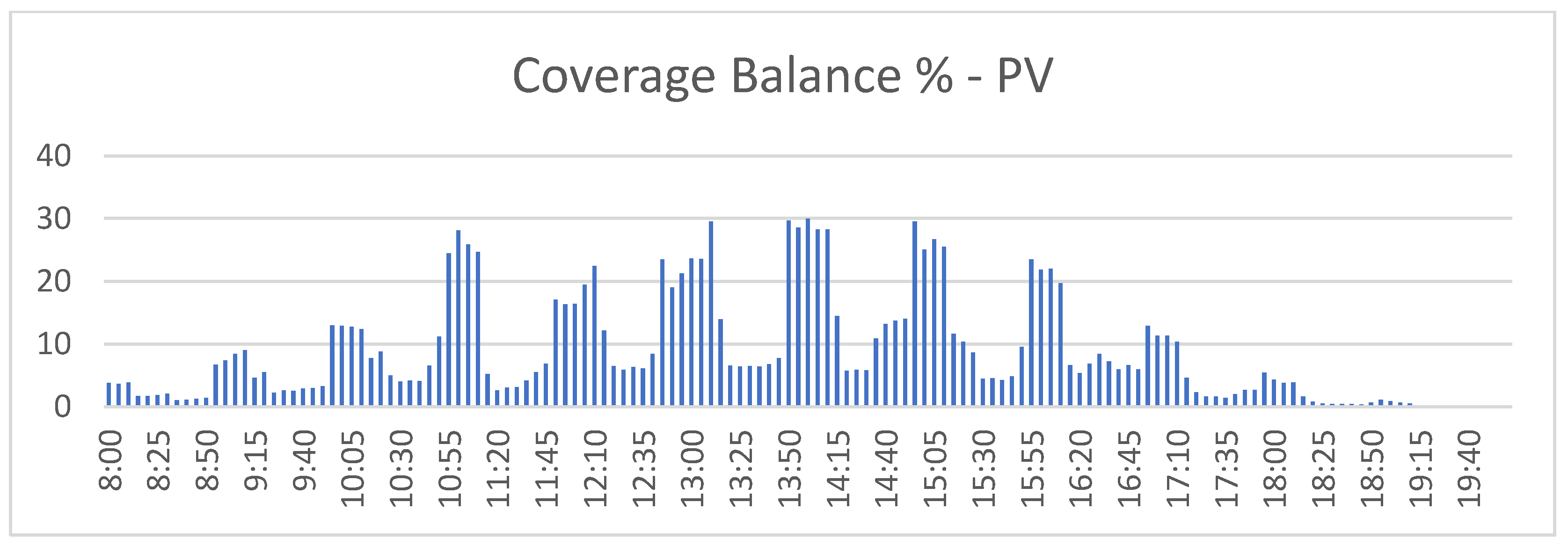
The graph in Figure 14 illustrates the temporal variation in the photovoltaic generation coverage level over the 08:00–20:00 time interval, with fine temporal resolution. The distribution of values highlights a strong dependence on the time of day, characterized by a gradual increase in the coverage level during the morning hours, followed by a maximum around midday and a pronounced decrease toward the evening, considering that the monitoring was carried out on a winter day, when sunset occurs earlier.
Minimum coverage values are recorded in the early morning and after 18:00, approaching 0–5%, indicating a reduced photovoltaic contribution during these intervals. The time window between 10:50 and 15:55 concentrates the highest values in certain intervals, with peaks reaching approximately 30%, suggesting periods of maximum solar irradiance and high photovoltaic system efficiency. This behavior indicates significant variability in the production coverage balance throughout the day, driven by solar radiation conditions and by the ratio between photovoltaic generation and energy consumption. Frequent oscillations in peak intervals suggest the high sensitivity of the indicator to variations in load demand or generation levels. Statistical analysis of the graph in Figure 14 reveals that photovoltaic coverage is concentrated within a limited temporal window, with a reduced contribution outside peak hours. This behavior emphasizes the need for temporal correlation strategies between photovoltaic production and energy consumption in order to increase the average level of energy coverage.
Table 6 presents the descriptive statistical indicators of the coverage percentage (%) resulting from electrical energy production by the photovoltaic panels, calculated based on a dataset of 145 time intervals. The obtained values reflect the extent to which the energy generated by the photovoltaic system succeeds in covering the energy demand of the analyzed system. The mean coverage level is 8.77%, indicating that, on average, photovoltaic production contributes less than 10% to the total energy consumption. The dispersion of individual values is considerable, as indicated by a standard deviation of 8.51% and a variation range between 0% and 29.97%. This highlights a high variability in photovoltaic production, driven by factors such as solar irradiance, meteorological conditions, and time of day. The presence of a minimum value of 0% confirms the existence of intervals in which the photovoltaic panels produce no energy or the production is negligible.
The positive skewness coefficient (Skewness = 1.14) indicates a right-skewed distribution, meaning that most time intervals are characterized by low coverage levels, while higher values occur less frequently under favorable production conditions. This observation is consistent with the characteristic behavior of renewable energy sources that depend on natural conditions.
The maximum value of 29.97% shows that, in certain intervals, photovoltaic production can cover a significant portion of the energy demand; however, such situations are temporally limited and do not decisively influence the overall mean. The low standard error (0.71%) indicates that the computed mean is representative of the analyzed sample. Interpretation of the results shows that the electrical energy produced by the photovoltaic panels provides partial and variable coverage of consumption, with a significant energy impact only seen during well-defined intervals. These results highlight the need for additional strategies such as increasing installed capacity, integrating energy storage solutions, or temporally correlating consumption with photovoltaic production to improve the overall coverage balance.
The following section details the consumption profile of the equipment within the monitored laboratory. After analyzing the photovoltaic panels, a graph highlighting the energy contribution of the studied equipment is integrated into the analysis.
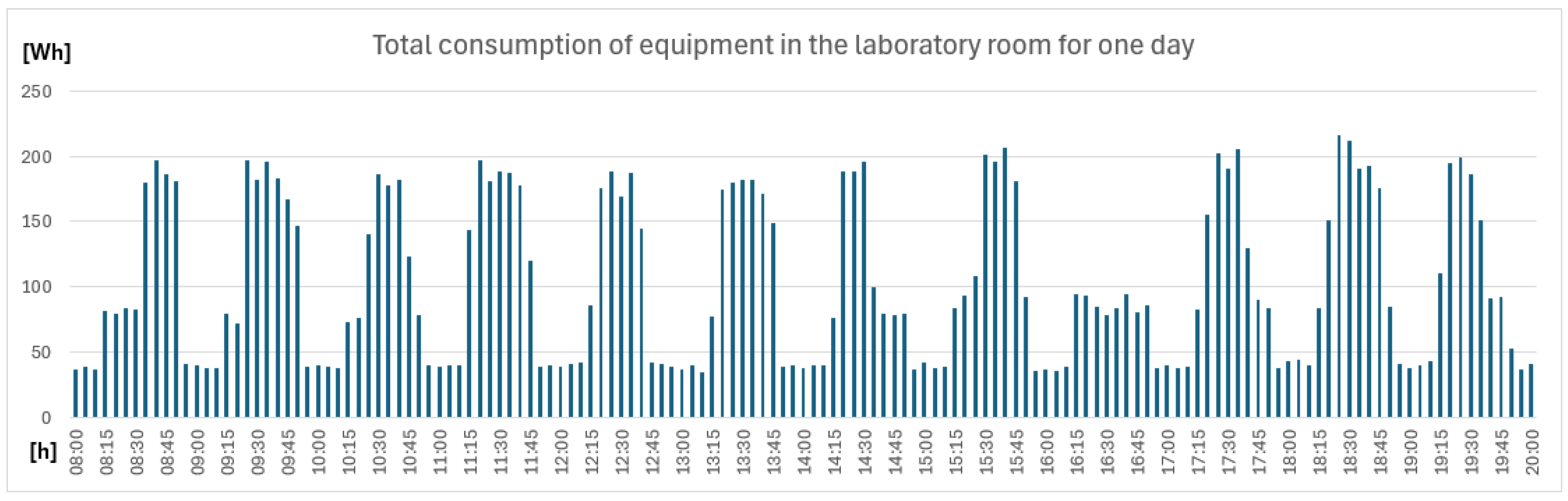
The graph in Figure 15 presents the evolution of the total electrical energy consumption (Wh) of the laboratory equipment over the course of a day, within the 08:00–20:00 time interval, with fine temporal resolution. The consumption profile highlights a cyclic behavior, characterized by the alternation of periods with low consumption and pronounced consumption peaks, as student working periods in this laboratory do not vary significantly from one hour to another.
At the beginning and end of the day, consumption remains at relatively low levels, generally below 50 Wh, corresponding to periods of reduced activity or partial laboratory occupancy. As activity intensifies, rapid increases in consumption can be observed, with repeated peaks reaching values between approximately 180 and 220 Wh. These peaks indicate the simultaneous activation of multiple devices or the operation of high-power loads. The distribution of consumption peaks is relatively uniform throughout the day, suggesting a repetitive equipment usage pattern typical of laboratory activities conducted in well-defined sessions or time intervals. At the same time, the rapid consumption variations reflect the dynamic nature of electrical loads, with frequent transitions between low and high consumption states. The graph reveals a highly variable consumption profile dominated by temporary peaks, which may have a significant impact on instantaneous energy demand. This behavior underlines the importance of detailed consumption monitoring and the implementation of load management strategies aimed at reducing peak demand and optimizing electrical energy usage in the laboratory.
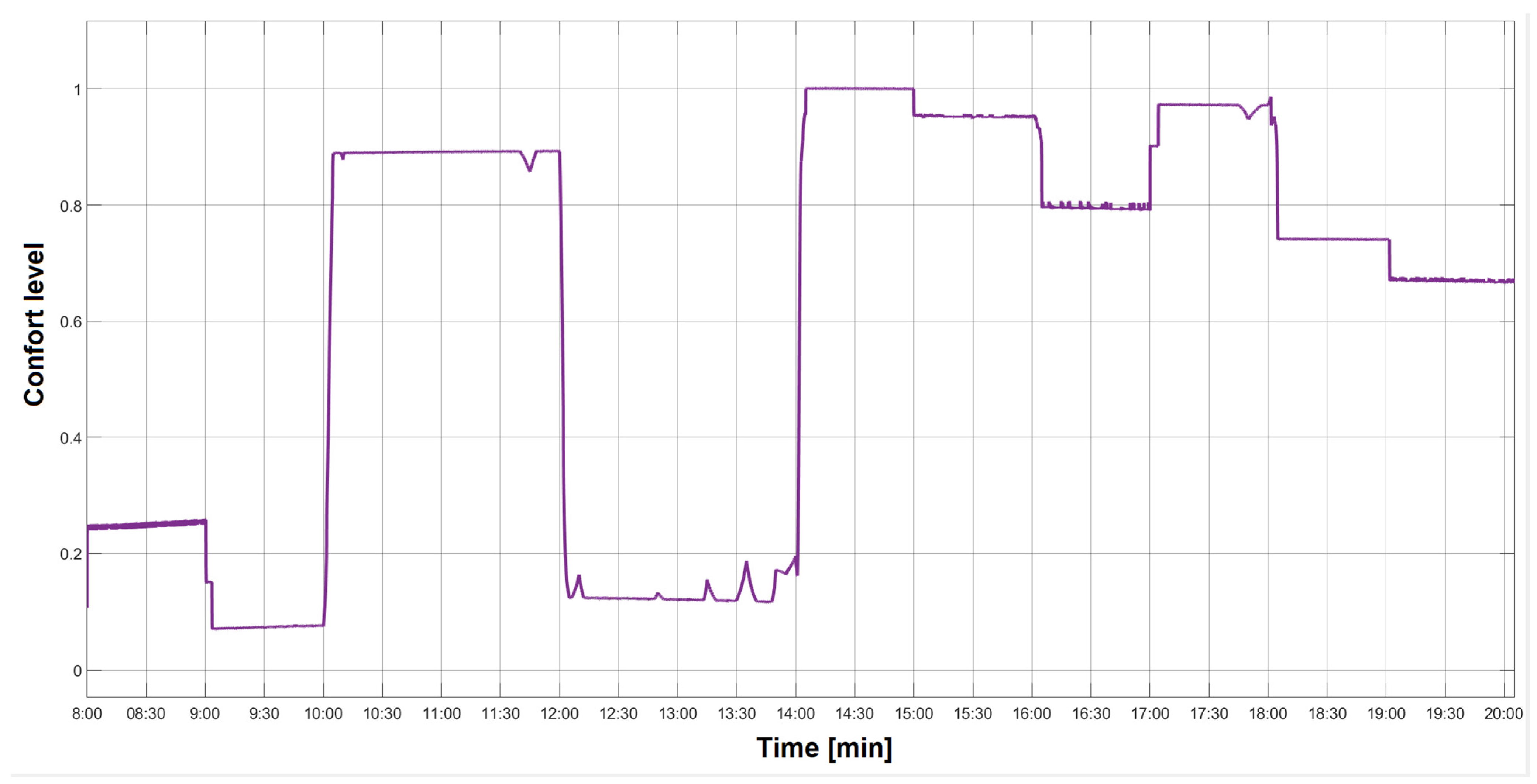
Figure 16 illustrates the evolution of the comfort level reported by occupants over the 08:00–20:00 interval, with values generated as a result of correlating the simulated indoor temperature with the votes submitted by users through the monitoring application. Distinct comfort variations can be observed across time segments, faithfully reflecting the dynamics of laboratory activities and the clothing level specific to an autumn scenario. Periods in which the indoor temperature is perceived as appropriate are associated with higher comfort values, while significant decreases correspond to intervals characterized by less favorable thermal conditions or changes in activity level that influence occupants’ thermal perception. The overall shape of the curve confirms that the simulation model realistically reproduces user behavior in relation to the indoor microclimate and reflects how occupants respond to temperature variations specific to 15 October, a day characterized by moderate outdoor temperature fluctuations.
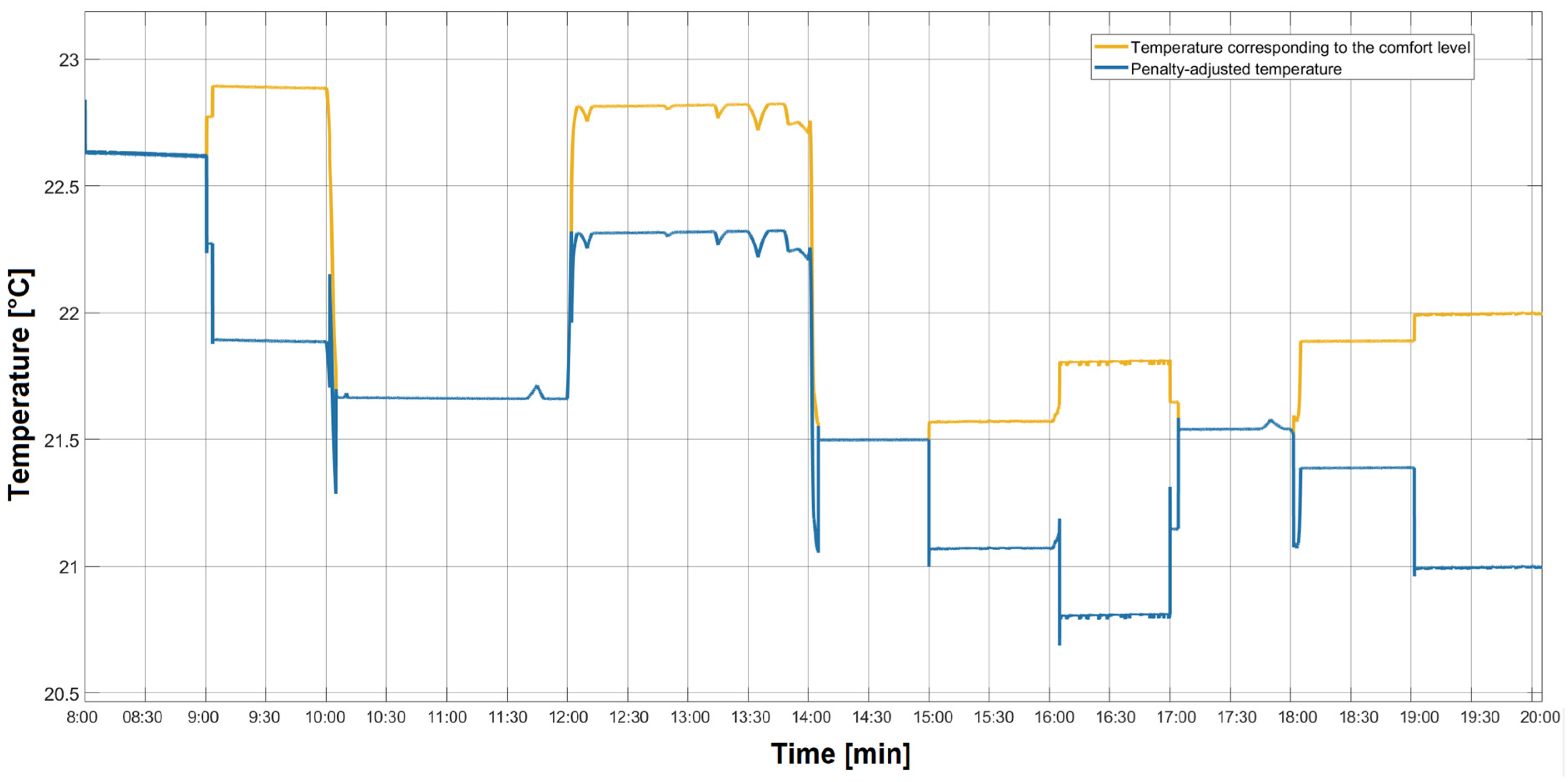
Figure 17 presents the comparative evolution of the temperature correlated with the comfort level and the penalized temperature resulting from the application of the control algorithm dependent on time-of-use energy tariffs. The curve associated with the comfort-based temperature directly reflects occupants’ perception of the indoor microclimate, generating higher setpoint values during periods when users report a sensation of cold and maintaining more stable temperatures during intervals in which the reported comfort level is optimal.
In contrast, the penalized temperature curve highlights how the algorithm adaptively adjusts the thermal setpoint by applying reductions of 0.5 °C or 1 °C depending on the energy tariff level, in accordance with the rules defined in the system’s logical structure. The difference between the two curves is particularly noticeable during periods of high energy prices (e.g., the 12:00–14:00 interval), when the algorithm prioritizes consumption reduction, while the maintenance of values close to the comfort temperature is observed during low-tariff periods (such as 10:00–12:00). This comparative evolution demonstrates the algorithm’s ability to simultaneously integrate user preferences and economic constraints, ensuring an efficient trade-off between comfort and energy efficiency.
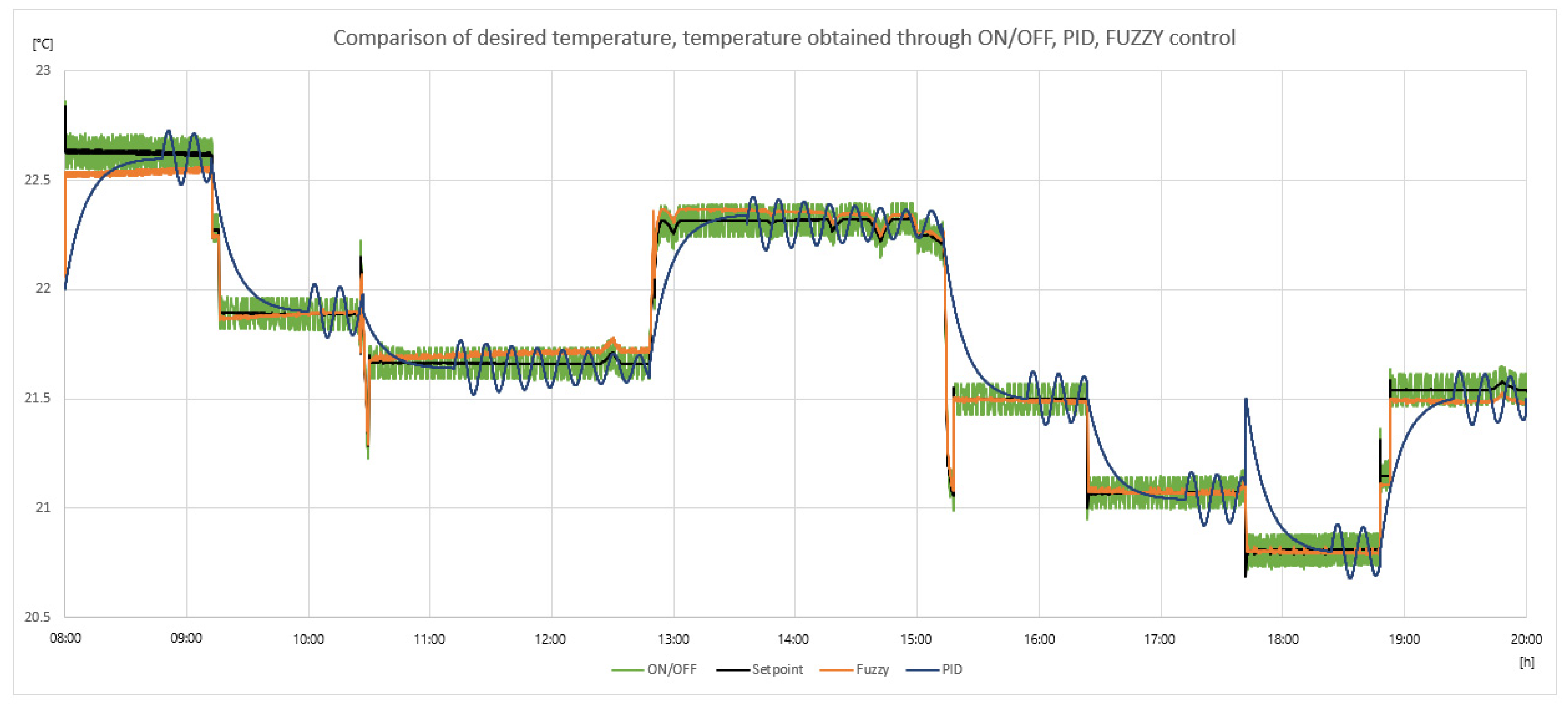
Within this study, simulations were performed in MATLAB/Simulink using the three control algorithms. Their comparative analysis, conducted with respect to variations in the prescribed reference value (setpoint), is illustrated in Figure 18.
Figure 18 illustrates the evolution of the desired indoor temperature relative to the reference temperature (setpoint), using three control strategies: ON/OFF, PID, and fuzzy over the 08:00–20:00 time interval. In the case of the ON/OFF controller, the temperature follows the setpoint rapidly but exhibits pronounced oscillations around the reference value. This behavior is characteristic of switching-type controllers, leading to frequent temperature fluctuations and reduced steady-state stability. The PID controller shows a slower response to setpoint changes, being characterized by overshoot and persistent oscillations before stabilization. Although it provides smoother tracking compared to ON/OFF control, the amplitude of oscillations indicates tuning limitations, especially during intervals with rapid reference variations.
The fuzzy control strategy demonstrates the most balanced behavior, with reduced overshoot, minimal oscillations, and accurate setpoint tracking. The response is fast, and the deviation from the desired temperature is maintained within a narrow range throughout the simulation period.
During intervals in which the setpoint decreases abruptly, both the fuzzy and ON/OFF controllers react quickly; however, the fuzzy controller achieves the new reference value with superior stability. In contrast, the PID controller exhibits delays and more pronounced fluctuations around the imposed value. The analysis highlights the advantage of fuzzy control in terms of dynamic performance and temperature stability compared to the classical ON/OFF and PID strategies. These results suggest that fuzzy logic is more suitable for HVAC applications requiring high thermal comfort and reduced temperature variations. Consequently, further analysis focuses exclusively on simulation and modeling using fuzzy control.
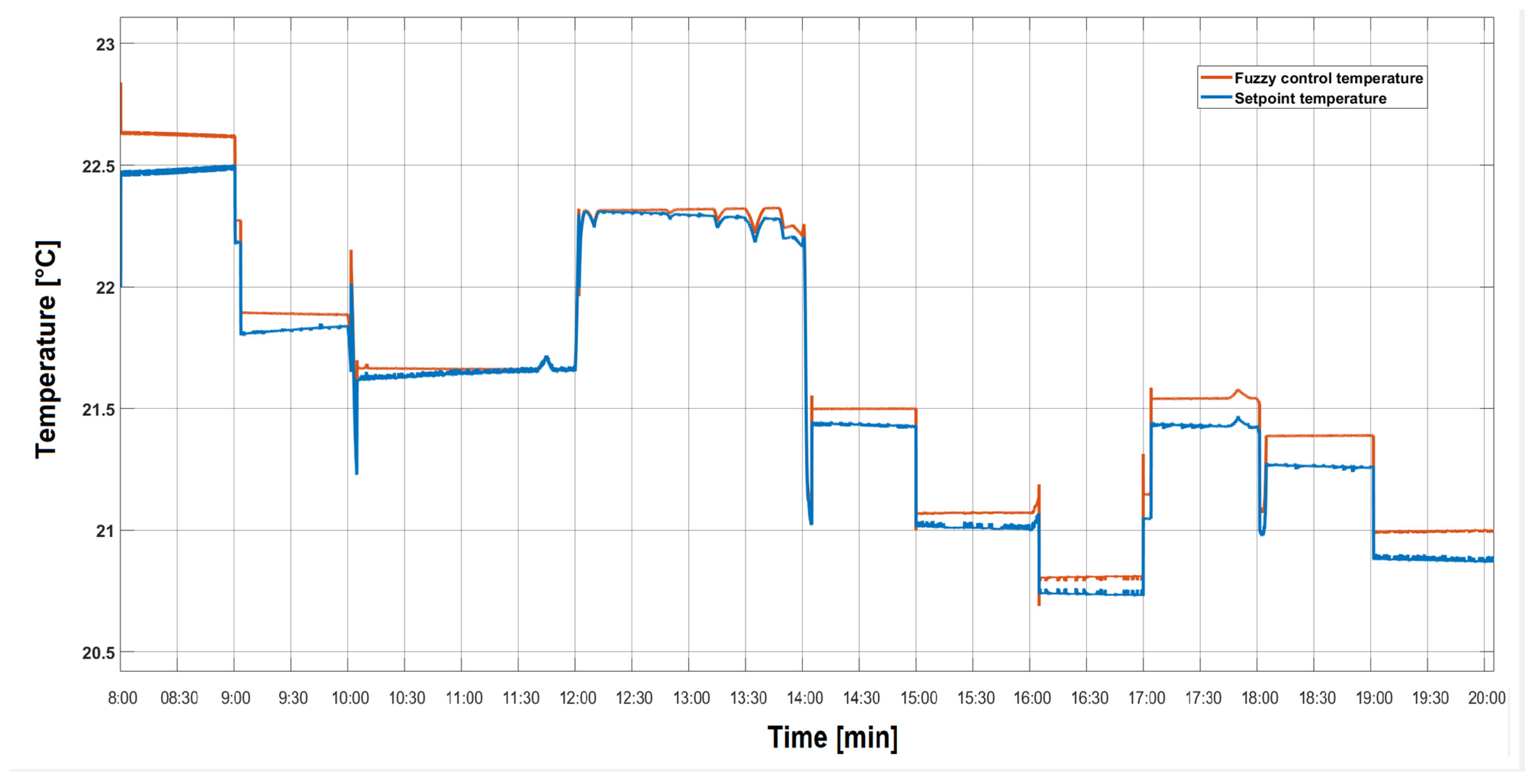
Figure 19 presents a direct comparison between the reference temperature generated by the optimization algorithm (blue curve) and the temperature resulting from the application of fuzzy control (red curve), highlighting the accuracy and tracking capability of the control system. It can be observed that throughout the analyzed interval, the fuzzy-controlled temperature consistently follows the setpoint evolution, with only minor deviations in transition regions, which are typical of rule-based control systems. These small deviations result from the fuzzy mechanism, which introduces gradual and robust transitions between varying environmental conditions, thereby avoiding abrupt temperature changes. The results indicate that the fuzzy controller effectively reproduces the settings imposed by the algorithm, maintaining stable and predictable behavior even during periods characterized by significant setpoint changes. Overall, this evolution confirms the compatibility between the computed temperature reference and the fuzzy system response, demonstrating that the proposed strategy can be successfully implemented in a real laboratory environment and can ensure precise, adaptive, and energy-efficient thermal control.
Figure 20 illustrates the total electrical energy cost calculated by the application based on the recorded consumption over the 08:00–20:00 time interval. The subsystem dedicated to cost determination processes the total consumption curve together with the applicable tariff structure. The displayed value of 8.49 RON represents the total cost associated with the studied scenario and confirms the accuracy of the calculation process implemented in Simulink. This estimate provides a solid quantitative basis for evaluating the efficiency of the control algorithm, enabling cost comparisons under different tariff conditions or across various consumption scenarios.

4.2. Five-Day System Simulation Scenario

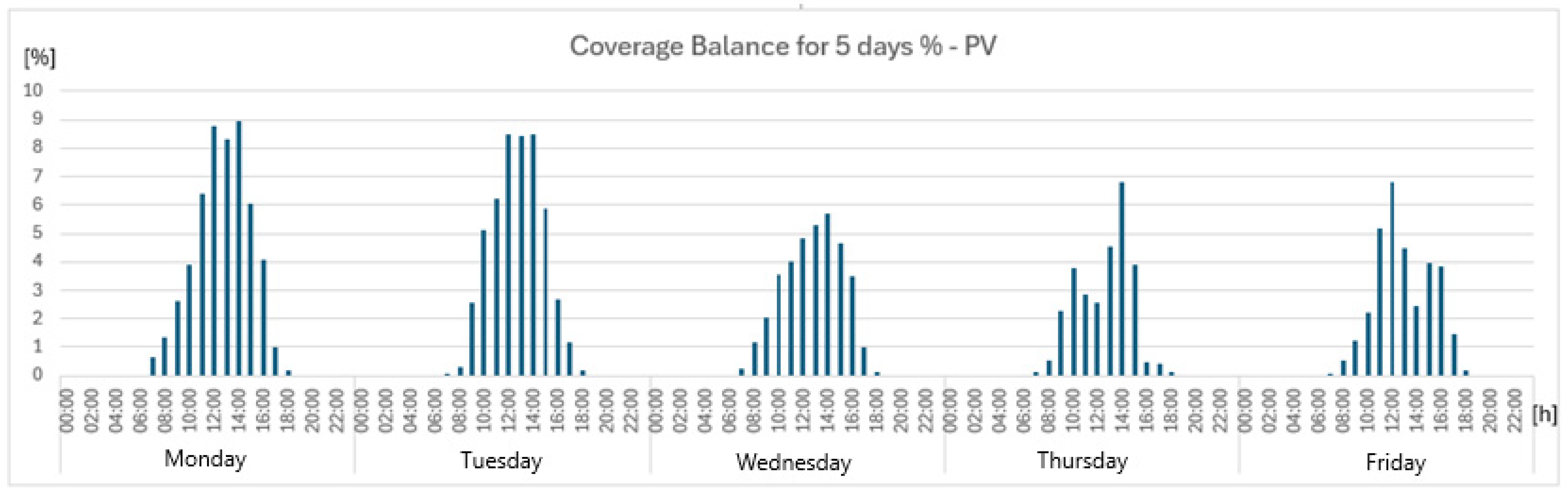
After modeling and simulating the proposed system for a period of one day, the analysis was extended to an interval of five consecutive days (Monday–Friday), in order to highlight the dynamic behavior of the system over time and its operation on complete daily cycles. In order to simulate the process, we extracted the electricity production data from the photovoltaic panels for the interval 3 November 2025–7 November 2025, presented in Figure 21.
The graph in the above figure presents the evolution of the photovoltaic production coverage percentage (%) over five consecutive operating days (Monday–Friday), with hourly representation. This indicator expresses the extent to which the energy generated by the photovoltaic panels contributes to covering the energy demand of the analyzed system.
The maximum coverage levels vary from day to day. On Monday and Tuesday, the highest coverage levels are recorded, with peaks exceeding 8–9%, indicating favorable photovoltaic production conditions. Wednesday exhibits lower maximum values, around 5–6%, suggesting reduced solar irradiance or a less favorable ratio between production and consumption. Thursday and Friday show intermediate behavior, with peak values ranging between 6% and 7%.
Table 7 presents the descriptive statistical indicators calculated for a dataset of 119 observations, highlighting a mean value of 1.67, associated with high data variability, as reflected by a standard deviation of 2.53 and a sample variance of 6.38. The distribution of values exhibits a pronounced positive skewness (skewness = 1.44), indicating the predominance of intervals with low production and the sporadic occurrence of high values. The wide variation range, with values between 0 and 8.94, confirms the intermittent nature of photovoltaic production, characterized by periods with no generation and limited episodes of maximum output. The low standard error (0.23) indicates a robust estimation of the mean value for the analyzed sample, while the cumulative sum of 198.74 reflects the total production over the considered period.
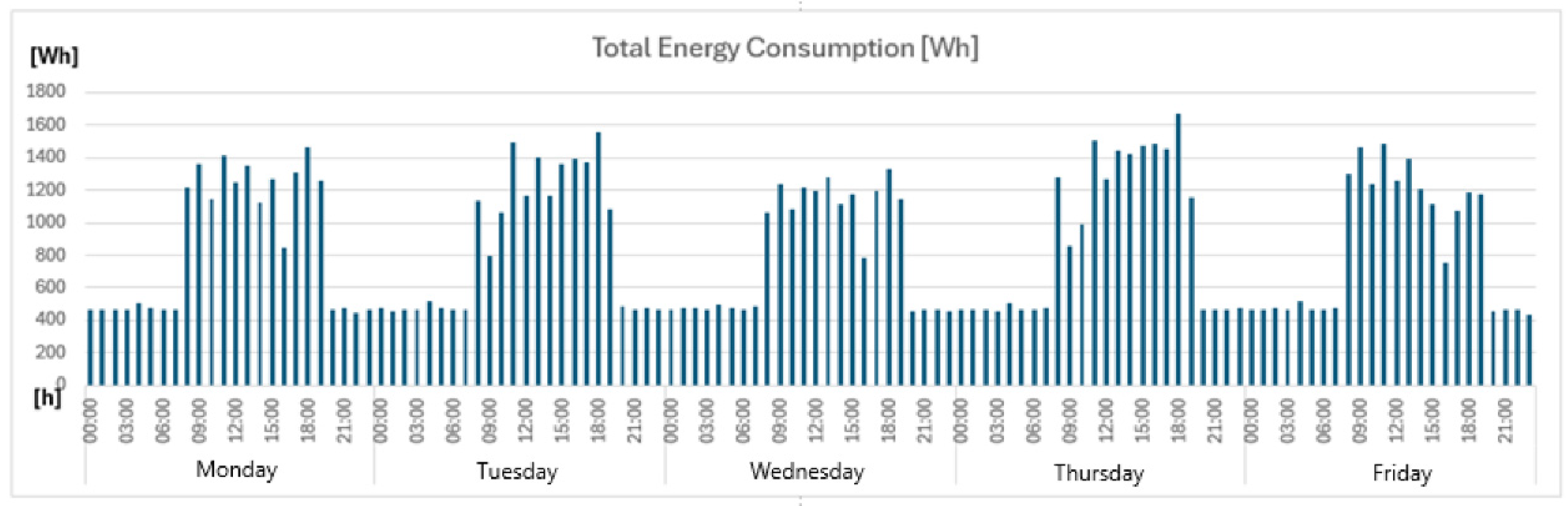
The following figure illustrates the energy consumption of all equipment in the studied laboratory over the five-day interval.
Figure 22 presents the evolution of the total electrical energy consumption (Wh) of the laboratory equipment over five consecutive days (Monday–Friday), within the 08:00–20:00 time interval. The consumption profile highlights cyclic behavior, characterized by the alternation of periods with low consumption and pronounced consumption peaks, as student working periods in this laboratory do not differ significantly from one day to another.
During nighttime hours and outside the operating schedule, consumption remains at relatively constant and low levels, around 400–500 Wh, indicating the presence of a base load associated with equipment in standby mode or the minimal operation of systems. Once daily activities begin, a marked increase in energy consumption can be observed, with maximum values recorded during the 08:00–20:00 interval.
Consumption peaks vary from day to day, reaching values between approximately 1200 Wh and 1600 Wh, suggesting variations in equipment usage intensity or operating conditions. Thursday exhibits the highest consumption levels, indicating increased activity, while Monday and Wednesday record slightly lower consumption, albeit with a similar overall profile.
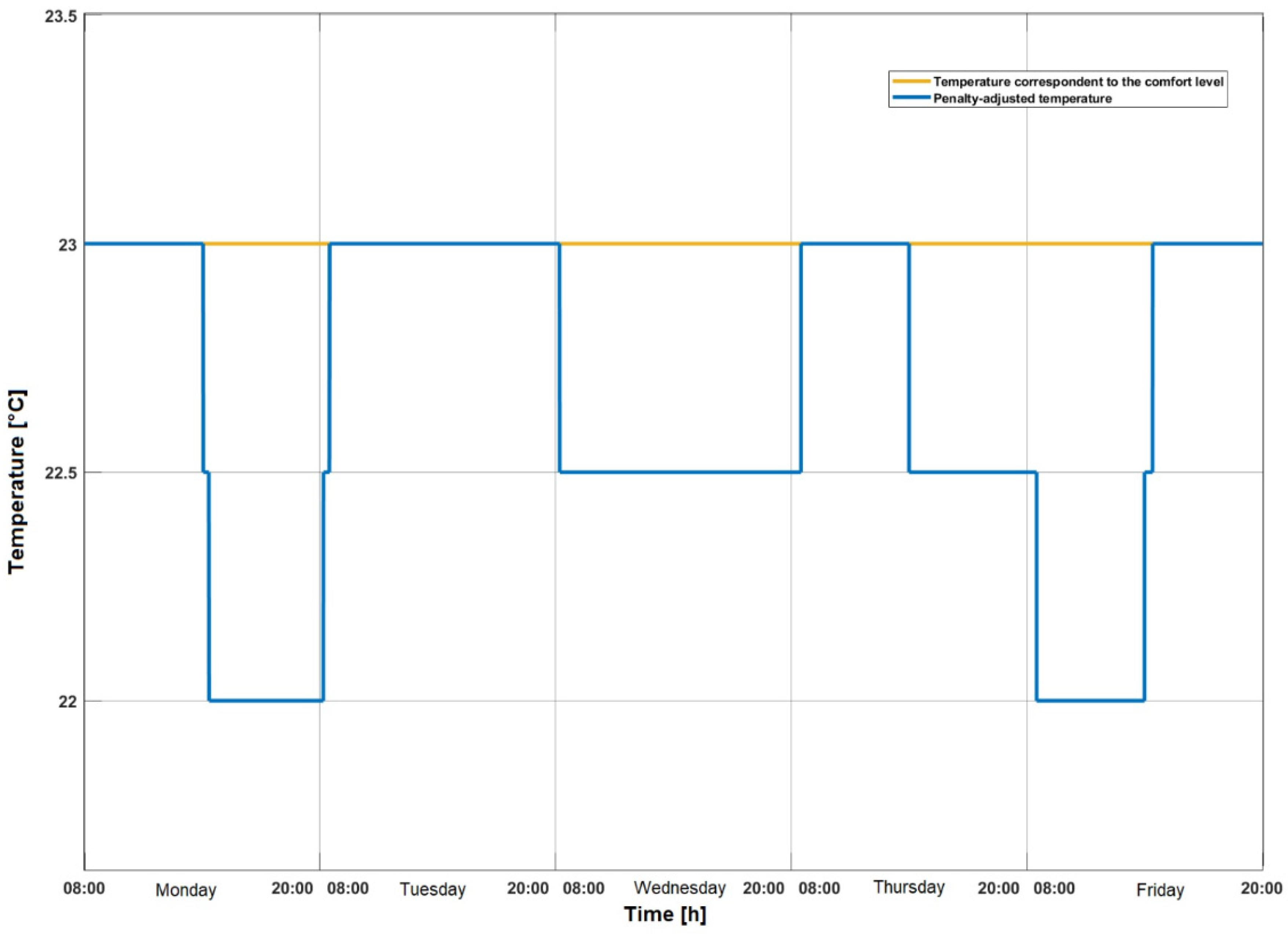
Figure 23 illustrates the evolution of the comfort-related temperature and the temperature adjusted through the penalization mechanism over a five-day interval (Monday–Friday). The comfort-related temperature remains constant throughout the analyzed period, representing the optimal value from a thermal comfort perspective.
In contrast, the penalized temperature exhibits discrete stepwise variations, reflecting the application of additional constraints on the reference value. Temporary temperature reductions occur during well-defined intervals and indicate moments when external criteria such as energy efficiency or consumption limitation influence the final value imposed on the control system. The repetitive behavior of the adjusted temperature over the five days indicates a consistent and predictable penalization strategy adapted to daily operating cycles.
Overall, the figure demonstrates that the penalization mechanism enables controlled modification of the reference temperature while maintaining values close to the comfort level and facilitating the integration of energy efficiency objectives into the thermal control strategy.
Beyond the quantitative performance analysis, it is necessary to discuss the implications of tariff-based temperature penalization on indoor environmental quality. It is important to emphasize that the proposed control strategy prioritizes maintaining thermal comfort within acceptable bounds and does not compromise indoor environmental quality. The penalization mechanism applied during high tariff periods is limited to small temperature adjustments (0.5–1 °C), ensuring that comfort remains within the acceptable PMV range defined by ASHRAE 55. The system is not designed to reduce ventilation rates or air exchange, thus avoiding negative impacts on indoor air quality (IAQ).
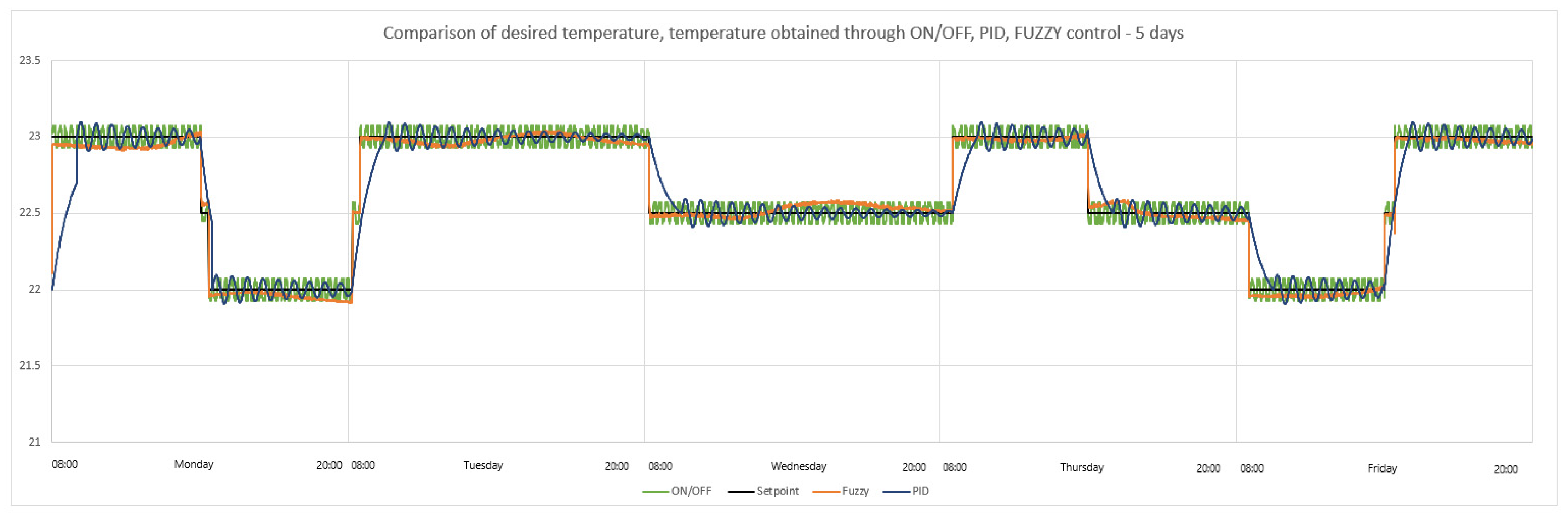
Within this study, simulations were performed in MATLAB/Simulink using the three control algorithms: ON/OFF, PID, and Fuzzy Logic. Their comparative analysis, conducted with respect to variations in the prescribed reference value (setpoint), is illustrated in Figure 24 for a five-day consecutive interval.
The figure presents the evolution of the indoor temperature relative to the desired temperature (setpoint) for three control strategies: ON/OFF, PID, and fuzzy, over five consecutive days of operation. The setpoint is defined through stepwise variations corresponding to successive changes in the desired temperature.
The results indicate that the ON/OFF controller responds rapidly to setpoint changes but generates significant and persistent oscillations around the desired value, leading to reduced steady-state stability. The PID controller provides smoother transitions between imposed temperature levels; however, it is characterized by delays in setpoint tracking, as well as overshoot and residual oscillations, particularly in the case of abrupt reference variations. By comparison, the fuzzy controller ensures the best tracking performance, with minimal overshoot, reduced oscillations, and limited deviation from the setpoint in both transient and steady-state regimes. This behavior remains consistent throughout the five analyzed daily cycles, highlighting superior robustness to setpoint variations and operating conditions. Overall, the results confirm the advantage of the fuzzy strategy in terms of temperature stability and control quality compared to the classical ON/OFF and PID strategies.
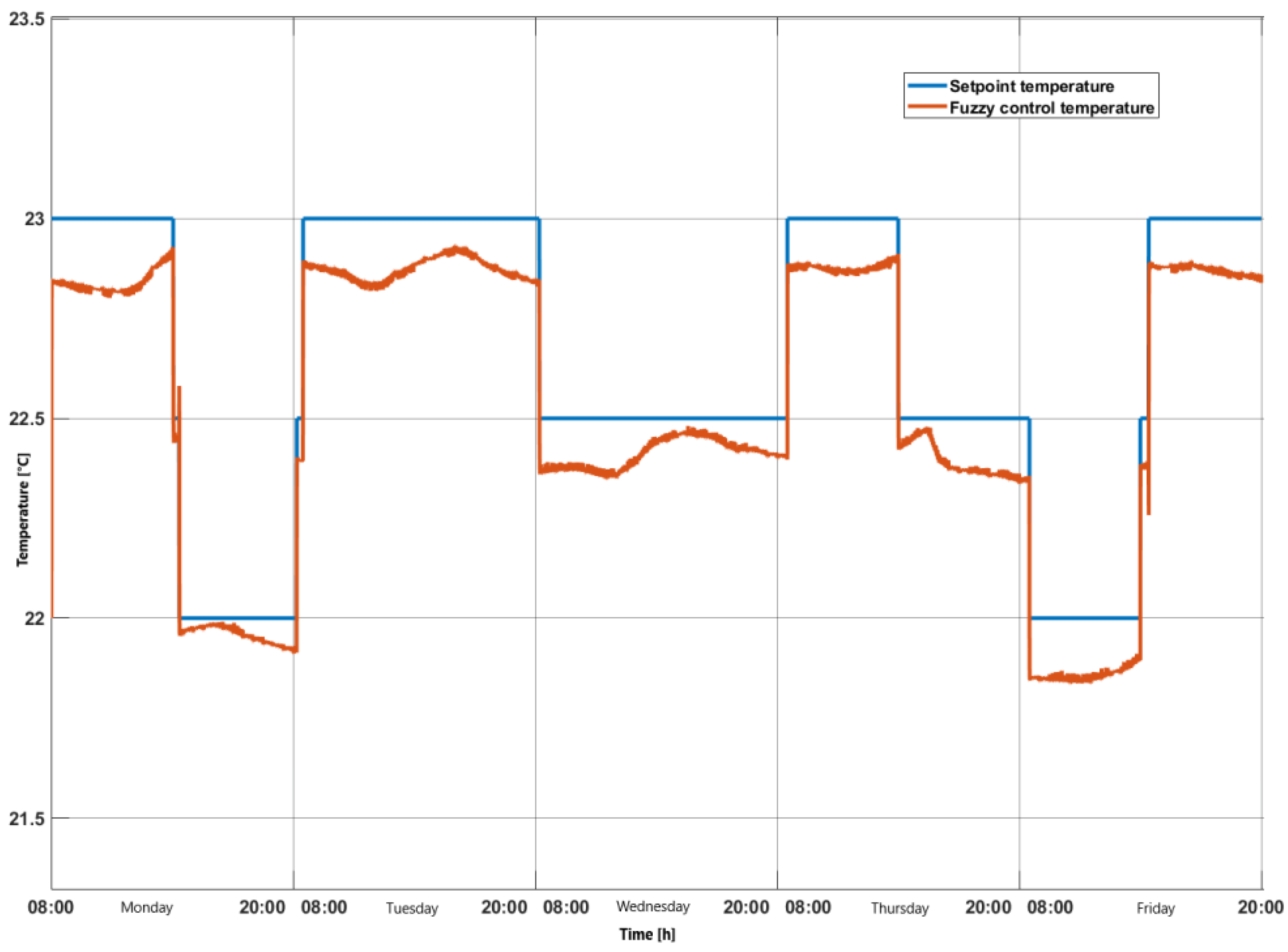
Figure 25 presents the result of the comparison between the reference temperature generated by the optimization algorithm and the temperature obtained by applying the fuzzy controller over five consecutive days of operation. Analysis of the graph shows that, throughout the analyzed period, the temperature controlled by fuzzy logic closely follows the evolution of the reference temperature, with small deviations observed mainly in the setpoint transition regions. These minor deviations occur during moments characterized by abrupt changes in the reference temperature and are typical of fuzzy rule-based control strategies, which ensure gradual and stable transitions between imposed levels. Through this approach, the fuzzy controller attenuates rapid temperature variations and contributes to maintaining robust system behavior under variable operating conditions.
The results presented in the figure below indicate that the fuzzy controller effectively reproduces the temperature values established by the optimization algorithm over the five analyzed days, maintaining a stable and predictable response even during intervals with significant setpoint variations. The presented evolution confirms the compatibility between the computed reference temperature and the response of the fuzzy system, demonstrating that the proposed strategy is suitable for implementation in a real laboratory environment and can ensure precise, adaptive, and energy-efficient thermal control.
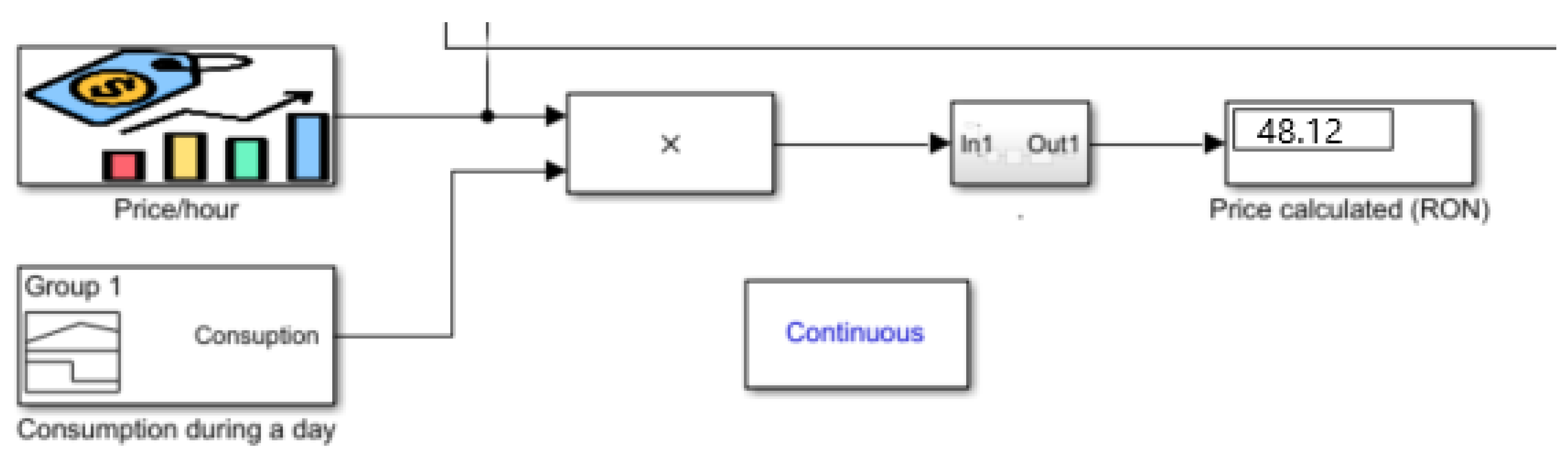
Figure 26 illustrates the total electrical energy cost calculated by the application based on the consumption recorded over the five-day period within the 08:00–20:00 time interval. The MATLAB/Simulink subsystem dedicated to cost determination processes the total consumption curve together with the applied tariff structure.
The displayed value of 48.12 RON represents the total cost associated with the analyzed scenario and confirms the accuracy of the calculation process implemented in Simulink. This estimate provides a solid quantitative basis for evaluating the efficiency of the control algorithm, enabling cost comparisons under different tariff conditions or across various consumption scenarios.
It should be acknowledged that the current implementation primarily relies on indoor air temperature as the main indicator for comfort control. However, according to ASHRAE Standard 55, thermal comfort is more accurately represented by operative temperature, which combines air temperature and mean radiant temperature (MRT). Full PMV-based calculations also require MRT as an input parameter. Due to practical deployment constraints and hardware simplicity, MRT was not directly measured in the present study. This approximation is common in real-time building control applications, where air temperature is frequently used as a proxy for thermal comfort. Recent advances in real-time MRT estimation, including thermal imaging systems and low-resolution optical sensing technologies, provide promising directions for improving comfort modeling accuracy in future implementations [29,30,31].

5. Conclusions

The study demonstrated that integrating smart sensors with fuzzy control algorithms within a user-centered energy management system enables the achievement of a functional balance between energy efficiency and occupant comfort. The simulation results obtained in the analyzed university laboratory show that the fuzzy control strategy provides superior stability compared to classical ON/OFF and PID methods, reducing temperature deviations and improving the dynamic response of the system.
The analysis of the simulation scenarios highlighted an effective correlation between photovoltaic production and energy consumption, with an average contribution of approximately 10% toward covering the daily energy demand. In addition, integrating user feedback into the decision-making process enabled dynamic adjustment of thermal setpoints, leading to increased perceived satisfaction.
Through the proposed architecture, the system demonstrates strong potential for implementation in smart buildings, universities, and commercial spaces, contributing to reduced energy costs and the promotion of sustainability.
An important element of novelty is represented by the Power Apps application developed for collecting subjective feedback related to thermal comfort, lighting, and ventilation. This application facilitated direct interaction between users and the control system, enabling rapid data collection and conversion into input variables for the fuzzy algorithm. Through this application, user perceptions were integrated into the automated decision-making process, contributing to real-time adaptability and personalization of the indoor environment.
The two experimental scenarios—one conducted over a single day and the other over five consecutive days (Monday–Friday)—provided complementary insights into system performance. The one-day scenario enabled detailed analysis of instantaneous variations in consumption and comfort, while the extended five-day scenario highlighted the consistency of system behavior under continuous operation, confirming the robustness and stability of the proposed control model. Both scenarios demonstrated the system’s ability to adaptively respond to load changes, climatic conditions, and user presence, while maintaining high performance in terms of energy efficiency and perceived comfort.
Future research will include the integration of mean radiant temperature measurement using thermal camera-based sensing or low-resolution optical systems, enabling full PMV-based comfort assessment.

Author Contributions

Writing—original draft preparation, C.-F.F., M.-G.B., M.V., G.N. and M.-A.D. All authors have read and agreed to the published version of the manuscript.

Funding

This work was supported by a national research grant of UTCB, project number GnaC ARUST 2024-UTCB-14.

Data Availability Statement

The data are contained within the article.

Conflicts of Interest

The authors declare no conflicts of interest.

References

  1. Xu, X.; Yu, H.; Sun, Q.; Tam, W.Y. A critical review of occupant energy consumption behavior in buildings: How we got here, where we are, and where we are headed. Renew. Sustain. Energy Rev. 2023, 182, 113396. [Google Scholar] [CrossRef]
  2. Vandenbogaerde, L.; Verbeke, S.; Audenaert, A. Optimizing building energy consumption in office buildings: A review of building automation and control systems and factors influencing energy savings. J. Build. Eng. 2023, 76, 107233. [Google Scholar] [CrossRef]
  3. Anil, S.; Srinaath, H.H.; Jayakumar, M. Comparative Analysis of ON/OFF, PID and Model Predictive Control System in HVAC Systems. In 2023 Innovations in Power and Advanced Computing Technologies (i-PACT); IEEE: New York, NY, USA, 2023. [Google Scholar]
  4. Dawood, S.M.; Hatami, A.; Homod, R.Z. HVAC system modeling and control methods: A review and case study. J. Energy Manag. Technol. 2022, 6, 217–231. [Google Scholar]
  5. Zhou, B.; Li, W.; Chan, K.W.; Cao, Y.; Kuang, Y.; Liu, X.; Wang, X. Smart home energy management systems: Concept, configurations, and scheduling strategies. Renew. Sustain. Energy Rev. 2016, 61, 30–40. [Google Scholar] [CrossRef]
  6. Baniyounes, A.M.; Ghadi, Y.Y.; Radwan, E.; Al-Olimat, K.S. Functions of fuzzy logic based controllers used in smart building. Int. J. Electr. Comput. Eng. (IJECE) 2022, 12, 3061–3071. [Google Scholar] [CrossRef]
  7. Imamguluyev, R.; Imanova, T.; Nabiyeva, C.; Poladova, U.; Amirova, R. Fuzzy logic-based energy management in IoT-Enabled buildings. In E3S Web of Conferences, ICCSEI 2023; EDP Sciences: Les Ulis, France, 2024; Volume 501, p. 01009. [Google Scholar] [CrossRef]
  8. Baniyounes, A.; Ghadi, Y.; Baker, A.A. Energy Performance of Fuzzy Logic Controllers in Smart Buildings. Int. J. Energy Econ. Policy 2019, 9, 41–47. [Google Scholar] [CrossRef]
  9. Tatari, M.; Agarwal, P.; Alam, M.A.; Ahmed, J. Review of smart building management system. In ICT Systems and Sustainability: Proceedings of ICT4SD 2021; Springer Nature: Singapore, 2022; Volume 1, pp. 167–176. [Google Scholar]
  10. Mischos, S.; Dalagdi, E.; Vrakas, D. Intelligent energy management systems: A review. Artif. Intell. Rev. 2023, 56, 11635–11674. [Google Scholar] [CrossRef]
  11. Chiesa, G.; Di Vita, D.; Ghadirzadeh, A.; Herrera, A.H.M.; Rodriguez, J.C.L. A fuzzy-logic IoT lighting and shading control system for smart buildings. Autom. Constr. 2020, 120, 103397. [Google Scholar] [CrossRef]
  12. Martínez-Rojas, M.; Cano, C.; Alcalá-Fdez, J.; Soto-Hidalgo, J.M. Interpretable Fuzzy Control for Energy Management in Smart Buildings Using JFML-IoT and IEEE Std 1855-2016. Appl. Sci. 2025, 15, 8208. [Google Scholar] [CrossRef]
  13. Fudulu, C.-F.; Făgărăşan, I.; Vasluianu, M.; Boicu, M.-G.; Sandu, A.-M.-C.; Neculoiu, G. Monitoring electrical consumption of equipment in a university laboratory. In Proceedings of the 2025 29th International Conference on System Theory, Control and Computing (ICSTCC), Cluj-Napoca, Romania, 9–11 October 2025. [Google Scholar]
  14. Stamatescu, I.; Arghitra, N.; Fagarasan, I.; Stamatescu, G.; Iliescu, S.S.; Calofir, V. Decision Support system for a Low Voltage Renewable Energy System. Energies 2017, 10, 118. [Google Scholar] [CrossRef]
  15. Arowoiya, V.A.; Onososen, A.O.; Moehler, R.C.; Fang, Y. Influence of thermal comfort on energy consumption for building occupants: The current state of the art. Buildings 2024, 14, 1310. [Google Scholar] [CrossRef]
  16. Martins Gnecco, V.; Pigliautile, I.; Pisello, A.L. Long-term thermal comfort monitoring via wearable sensing techniques: Correlation between environmental metrics and subjective perception. Sensors 2023, 23, 576. [Google Scholar] [CrossRef] [PubMed]
  17. Lamberti, G.; Salvadori, G.; Leccese, F.; Fantozzi, F.; Bluyssen, P. Advancement on thermal comfort in educational buildings: Current issues and way forward. Sustainability 2021, 13, 10315. [Google Scholar] [CrossRef]
  18. Liu, T.; Tan, Z.; Xu, C.; Chen, H.; Li, Z. Study on deep reinforcement learning techniques for building energy consumption forecasting. Energy Build. 2020, 208, 109675. [Google Scholar] [CrossRef]
  19. Srinivasan, A. Reinforcement learning: Advancements, limitations, and real-world applications. Int. J. Sci. Res. Eng. Manag. (IJSREM) 2023, 7, 8. [Google Scholar] [CrossRef]
  20. Omarov, B.; Altayeva, A.; Suleimenov, Z.; Cho, Y.I.; Omarov, B. Design of Fuzzy Logic Based Controller for Energy Efficient Operation in Smart Buildings. In Proceedings of the 2017 First IEEE International Conference on Robotic Computing (IRC), Taichung, Taiwan, 10–12 April 2017. [Google Scholar] [CrossRef]
  21. da Silva, L.; Coro, M.B.; Pessoa, E.G. Advances in fuzzy control systems for energy management in smart homes. Int. Seven Multidiscip.-Plinary J. 2023, 2. [Google Scholar] [CrossRef]
  22. Alghassab, M.A. Fuzzy-based smart energy management system for residential buildings in Saudi Arabia: A comparative study. Energy Rep. 2024, 11, 1212–1224. [Google Scholar] [CrossRef]
  23. ANSI/ASHRAE Standard 55-2020; Thermal Environmental Conditions for Human Occupancy. American Society of Heating, Refrigerating and Air-Conditioning Engineers: Atlanta, GA, USA, 2020. Available online: https://www.scribd.com/document/695087734/ASHRAE-55-2020 (accessed on 24 February 2026).
  24. de Dear, R.J.; Brager, G.S. Thermal comfort in naturally ventilated buildings: Revisions to ASHRAE Standard 55. Energy Build. 2002, 34, 549–561. [Google Scholar] [CrossRef]
  25. Boicu, M.-G.; Făgărăşan, I.; Stamatescu, G.; Vasluianu, M.; Fudulu, C.-F.; Do-brea, M.-A. An Occupant-Centric Comfort Control Strategy Using Wearable Smart Devices in Smart-Buildings. In Proceedings of the 2023 IEEE 12th International Conference on Intelligent Data Acquisition and Advanced Computing Systems: Technology and Applications (IDAACS), Dortmund, Germany, 7–9 September 2023. [Google Scholar]
  26. Sandu, A.-M.-C.; Boicu, M.-G.; Făgărăşan, I.; Vasluianu, M.; Dobrea, M.-A. Control strategy evaluation for indoor temperature—A Comfort-Centred Analysis. In Proceedings of the 2025 25th International Conference on Control Systems and Computer Science (CSCS), Bucharest, Romania, 27–30 May 2025. [Google Scholar]
  27. Habbati, B.; Youcef, R.; Fatima, M. A Detailed Modeling of Photovoltaic Module Using MATLAB. NRIAG J. Astron. Geophys. 2014, 3, 53–61. [Google Scholar] [CrossRef]
  28. Puianu, M.; Flangea, R.-O.; Arghira, N.; Iliescu, S.S. PV Panel-Wind Turbine Hybrid System Modelling. In Proceedings of the 2017 21st International Conference on Control Systems and Computer Science (CSCS), Bucharest, Romania, 29–31 May 2017; pp. 636–640. [Google Scholar] [CrossRef]
  29. Lee, D.-S.; Jo, J.-H. Measuring and implementing mean radiant temperature in buildings: Technical review. Renew. Sustain. Energy Rev. 2025, 207, 114908. [Google Scholar] [CrossRef]
  30. Evren, F.; Biswas, S.; Graves, R. Measuring mean radiant temperature for indoor comfort assessment using low-resolution optical sensors. Nat. Commun. 2025, 16, 1215. [Google Scholar] [CrossRef] [PubMed]
  31. Revel, G.M.; Arnesano, M.; Pietroni, F. Development and validation of a low-cost infrared measurement system for real-time monitoring of indoor thermal comfort. Meas. Sci. Technol. 2014, 25, 085101. [Google Scholar] [CrossRef]
Figure 1. Integrated System of the Proposed Process.
Buildings 16 01257 g001
Figure 2. Photovoltaic Panels Used in the Developed System.
Buildings 16 01257 g002
Figure 3. Conceptual Architecture of the System.
Buildings 16 01257 g003
Figure 4. Data Collection Application Interface—(a) Sensor Data Records, (b) Temperature, Lighting, and Ventilation Feedback, (c) Clothing Level and Health Feedback.
Buildings 16 01257 g004
Figure 5. Data Collection Application Statistics—(a) Temperature: Received Feedback, (b) Lighting: Received Feedback, (c) Ventilation: Received Feedback.
Buildings 16 01257 g005
Figure 6. Study room plan.
Buildings 16 01257 g006
Figure 7. The weather station is used to take in outdoor data.
Buildings 16 01257 g007
Figure 8. Sensors used in creating system operating scenarios.
Buildings 16 01257 g008
Figure 9. Energy Consumption Evolution over the Time Interval of 15 October.
Buildings 16 01257 g009
Figure 10. Energy Consumption Evolution over the Five-Day Time Interval.
Buildings 16 01257 g010
Figure 11. Evolution of the external temperature.
Buildings 16 01257 g011
Figure 12. Architecture of the Mathematical Model Implemented in Simulink.
Buildings 16 01257 g012
Figure 13. Energy curve produced by photovoltaic panels.
Buildings 16 01257 g013
Figure 14. Energy Produced by the Photovoltaic Panels for the One-Day Scenario Studied.
Buildings 16 01257 g014
Figure 15. Total consumption of monitoring equipment for one day.
Buildings 16 01257 g015
Figure 16. Variation in the comfort index for the scenario studied.
Buildings 16 01257 g016
Figure 17. Comparison between the temperature value defined by the comfort level obtained and the temperature penalized by the algorithm for one day.
Buildings 16 01257 g017
Figure 18. Comparison of desired temperature and temperature obtained by implementing ON/OFF, PID and fuzzy control.
Buildings 16 01257 g018
Figure 19. Comparison of reference temperature and temperature obtained by implementing the fuzzy controller for one day.
Buildings 16 01257 g019
Figure 20. Cost calculated through Simulink corresponding to the scenario studied for one day.
Buildings 16 01257 g020
Figure 21. Energy produced by photovoltaic panels for the scenario studied over a period of five days.
Buildings 16 01257 g021
Figure 22. Total consumption of monitoring equipment for five days.
Buildings 16 01257 g022
Figure 23. Comparison between the temperature value defined by the comfort level obtained and the temperature penalized by the algorithm for five day period.
Buildings 16 01257 g023
Figure 24. Comparison of desired temperature and temperature obtained by implementing ON/OFF, PID and fuzzy control for the five-day interval (Monday–Friday).
Buildings 16 01257 g024
Figure 25. Comparison of reference temperature and temperature obtained by implementing the fuzzy controller over a five day period.
Buildings 16 01257 g025
Figure 26. Cost calculated through Simulink corresponding to the scenario studied for five days.
Buildings 16 01257 g026
Table 1. Comparison of fuzzy control vs. reinforcement learning.
CriterionFuzzy ControlReinforcement Learning (RL)
Data/training neededreduced (does not require training)high (requires many episodes/data)
Operational stabilityhigh, deterministic behaviormay be unstable in the exploration phase
User feedback integrationdirectly, through rules/weightsindirectly, through the reward function
Ease of implementation on edge/IoThighmore difficult without dedicated hardware
Table 2. Sensor equipment technical specifications.
Sensor TypeModelMonitored ParametersAccuracyCommunication ProtocolUpdate FrequencyNotes
Temperature and HumiditySNZB-02P
(Sonoff, Shenzhen, China)
Temperature, humidity±0.2 °C/±2% RHZigbee 3.0Every 5 sHigh-precision Swiss sensor
Human PresenceSNZB-06P
(Sonoff, Shenzhen, China)
Motion, static presence5.8 GHz detectionZigbee 3.0ContinuousDetects individuals even when stationary
Table 3. Photovoltaic panel equipment technical specifications.
ModelSolar Cell TypeNominal Power (Pm)Vmp (Voltage at Max PowerVoc (Open Circuit Voltage)Maximum System VoltageMaximum Series Fuse Rating
PV—BSM70M-24
(Bluesun Solar Co., Ltd., Hefei, China)
Mono70 W17.22 V20.66 V500 V10 A
Table 4. Technical specifications of smart socket equipment.
Sensor TypeModelMaximum PowerSupply VoltageMain FunctionsProtocolNotes
Zigbee Smart RelaySonoff PowR3
(Sonoff, Shenzhen, China)
3300 W/25 A100–240 V ACDual-circuit control, energy consumption monitoringWi-FiIn-wall installation, compatible with eWeLink
Table 5. Weather station equipment technical specifications.
Sensor TypeModelMonitored ParametersResolutionAccuracyProtocolObservations
Weather StationSencor SWS 12500
(Sencor, Fast ČR, a.s., Prague, Czech Republic)
Temperature
Humidity
Wind speed
Precipitation
°C
1%
units
mm
±1 °C
±5%
±5%
±7%
Wi-Fi- Essential for thermal loss calculations
- Influences hygrothermal comfort and HVAC system performance
- Determines the convective heat transfer coefficient on the surface of PV panels
- Identifies periods with high cloudiness
Table 6. Parameters resulting from the production of electricity by PV.
Mean8.772828
Standard Deviation8.507263
Sample Variance72.37352
Skewness1.13716
Range29.97
Minimum0
Maximum29.97
Sum1272.06
Count145
Table 7. Parameters resulting from the production of electricity by PV for a period of five days.
Mean1.670084
Standard Error0.231562
Standard Deviation2.526042
Sample Variance6.380887
Skewness1.441029
Range8.94
Minimum0
Maximum8.94
Sum198.74
Count119
Disclaimer/Publisher’s Note: The statements, opinions and data contained in all publications are solely those of the individual author(s) and contributor(s) and not of MDPI and/or the editor(s). MDPI and/or the editor(s) disclaim responsibility for any injury to people or property resulting from any ideas, methods, instructions or products referred to in the content.