AI-Driven Content Quality Beyond Technological Convenience: A Dual-Track Model of Sustainable Architectural Heritage Engagement


Abstract
1. Introduction
1.1. Background and Research Questions
1.2. Literature Review and Theoretical Foundation
1.2.1. Extensions of the Technology Acceptance Model (TAM)
1.2.2. Conceptualization of AI Content Quality (AIQ)
1.2.3. Conceptual Introduction of Architectural Cultural Identity (ACI)
- Exploration (ACI_E): Tendencies to actively search for, follow, like, share, and actively learn about architectural cultural content;
- Commitment (ACI_C): Emotional identification with architectural cultural values and willingness to preserve them.
1.3. Research Framework and Hypotheses
1.3.1. Theoretical Integration Framework
- 1.
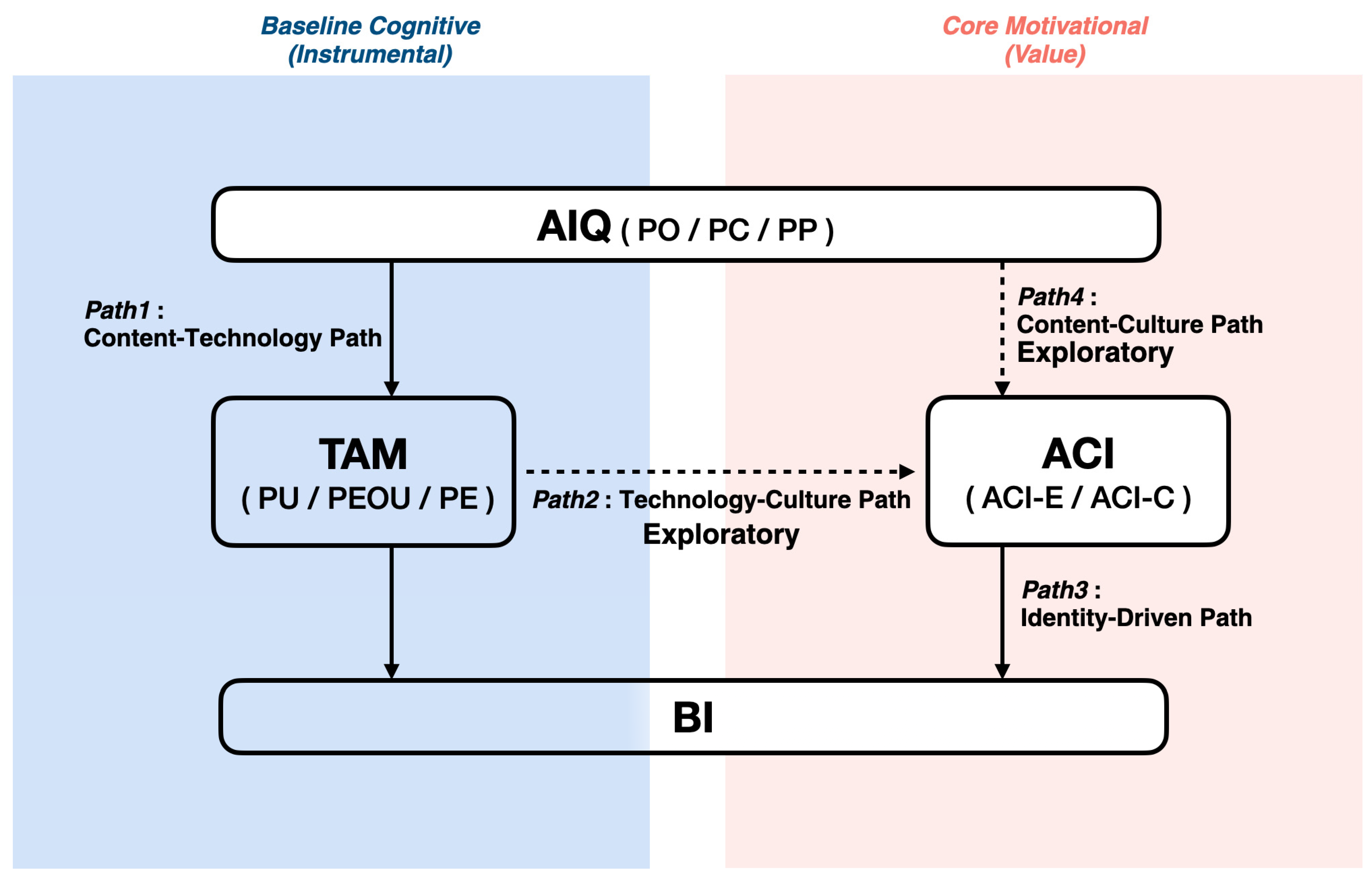
- Path 1: AIQ → TAM → BI (Content-Technology Path)
- 2.
- Path 2: TAM → ACI (Technology-Culture Path, Exploratory)
- 3.
- Path 3: ACI → BI (Identity-Driven Path)
- 4.
- Path 4: AIQ → ACI (Content-Culture Path, Exploratory)
1.3.2. Research Hypotheses
- 1.
- H1a–H1c: AI Content Quality and Technology Cognition
- H1a: AIQ positively influences PU.
- H1b: AIQ positively influences PEOU.
- H1c: AIQ positively influences PE.
- 2.
- H2a–H2c: Technology Cognition and Architectural Cultural Identity (Exploratory)In an algorithmic recommendation environment, the direction of influence between technology cognition and cultural identity is uncertain. A positive technological experience may enhance learning engagement and facilitate deeper cultural understanding, whereas excessive convenience could encourage superficial browsing and weaken cultural internalization [7,10].Therefore, this paper adopts an exploratory approach for H2a–H2c without presupposing the direction of influence:
- H2a: PU has an effect on ACI.
- H2b: PEOU has an effect on ACI.
- H2c: PE has an effect on ACI.
- 3.
- H3: Cultural Identity and Continuous Learning Intention
- 4.
- H4: AI Content Quality and Architectural Cultural Identity (Exploratory)
1.4. Research Objectives
2. Methods
2.1. Research Design and Procedures
- Reviewing relevant literature and developing the conceptual model and hypotheses;
- Adapting measurement scales with expert review and pilot testing;
- Administering the questionnaire and collecting data;
- Data screening and sample refinement;
- Assessing reliability and validity through EFA and CFA;
- Testing and refining the structural model using SEM.
2.2. Participants and Sampling
2.3. Research Instruments and Measurement Scales
2.4. Reliability and Validity Assessment
2.4.1. Normality Testing and Estimation Method
2.4.2. KMO and Bartlett’s Tests
2.4.3. Reliability Analysis
2.4.4. Validity Analysis
2.4.5. Common Method Bias Assessment
2.5. Data Analysis Methods
- Descriptive statistics: Means, standard deviations, skewness, and kurtosis were computed using IBM SPSS Statistics 29 (IBM Corp., Armonk, NY, USA).
- Reliability and validity testing: Cronbach’s α, composite reliability (CR), and average variance extracted (AVE) were assessed to evaluate measurement quality. Discriminant validity was further examined using the heterotrait–monotrait (HTMT) ratio of correlations.
- Confirmatory factor analysis: Measurement models were tested in Mplus 8.3 (Muthén & Muthén, Los Angeles, CA, USA) using WLSMV estimation to examine the structure of observed items for latent constructs and assess model fit.
- Structural equation modeling: The final retained structural model was specified to examine the effects of AIQ on TAM-related constructs, the association between AIQ and ACI, and the effects of the TAM and ACI on BI. Model fit was evaluated using multiple indices (χ2/df, RMSEA, CFI, TLI, SRMR) [37]. Path significance was assessed at p < 0.05. Variance inflation factor (VIF) values were computed to assess potential multicollinearity among structural predictors. In addition, indirect effects were examined using ML-based bias-corrected bootstrap resampling with 5000 iterations as a supplementary robustness check, because bootstrap estimation is not available under WLSMV in Mplus 8.3 [56].
2.6. Model Adjustments
- 1.
- Removal of the AIQ → ACI Direct PathAlthough the composite correlation between AIQ and ACI was moderate (r = 0.576, p < 0.001; Table 2), the SEM results revealed a high latent-level association between the two constructs (r = 0.719, p < 0.001), which raised identification and interpretability concerns when specifying a direct causal path. Conceptually, AIQ captures users’ evaluative perceptions of recommended content, whereas ACI reflects value-oriented cultural identification. Given the absence of clear theoretical directionality and the interpretive difficulty of specifying this relationship as a causal path, the direct path from AIQ to ACI was removed. Instead, their relationship was modeled as a correlation and examined under H4.
- 2.
- Treatment of the TAM → ACI PathsHypotheses H2a–H2c were exploratory, intended to test whether technology cognition contributes to the development of cultural identity. However, the initial model showed that none of the three paths (PU → ACI, PEOU → ACI, PE → ACI) provided theoretically interpretable support for technology-driven cultural identification, and one showed a significant negative coefficient. The overall model fit was also unsatisfactory. Theoretically, this divergence underscores the fundamental distinction between TAM—which measures instrumental evaluations of functional systems—and ACI, which reflects affective identification with cultural values [19,48,49]. These findings suggest that in algorithm-mediated environments, perceived content quality (AIQ) likely acts as a primary exogenous driver that independently shapes both technology acceptance and cultural identity, rather than following the traditional serial mediation via TAM.
- 3.
- Final Model RevisionBased on these theoretical and statistical considerations, the final structural model was revised as follows:Paths retained:
- AIQ → TAM
- TAM → BI
- ACI → BI
Paths removed:- AIQ → ACI (replaced with correlational analysis)
- TAM → ACI
Additional analysis:- Correlation between AIQ and ACI (H4)
2.7. Methods Summary
3. Results
3.1. Descriptive Statistics and Correlations
3.2. Measurement Model
3.3. Structural Model and Hypothesis Testing
3.3.1. Model Adjustment and Fit
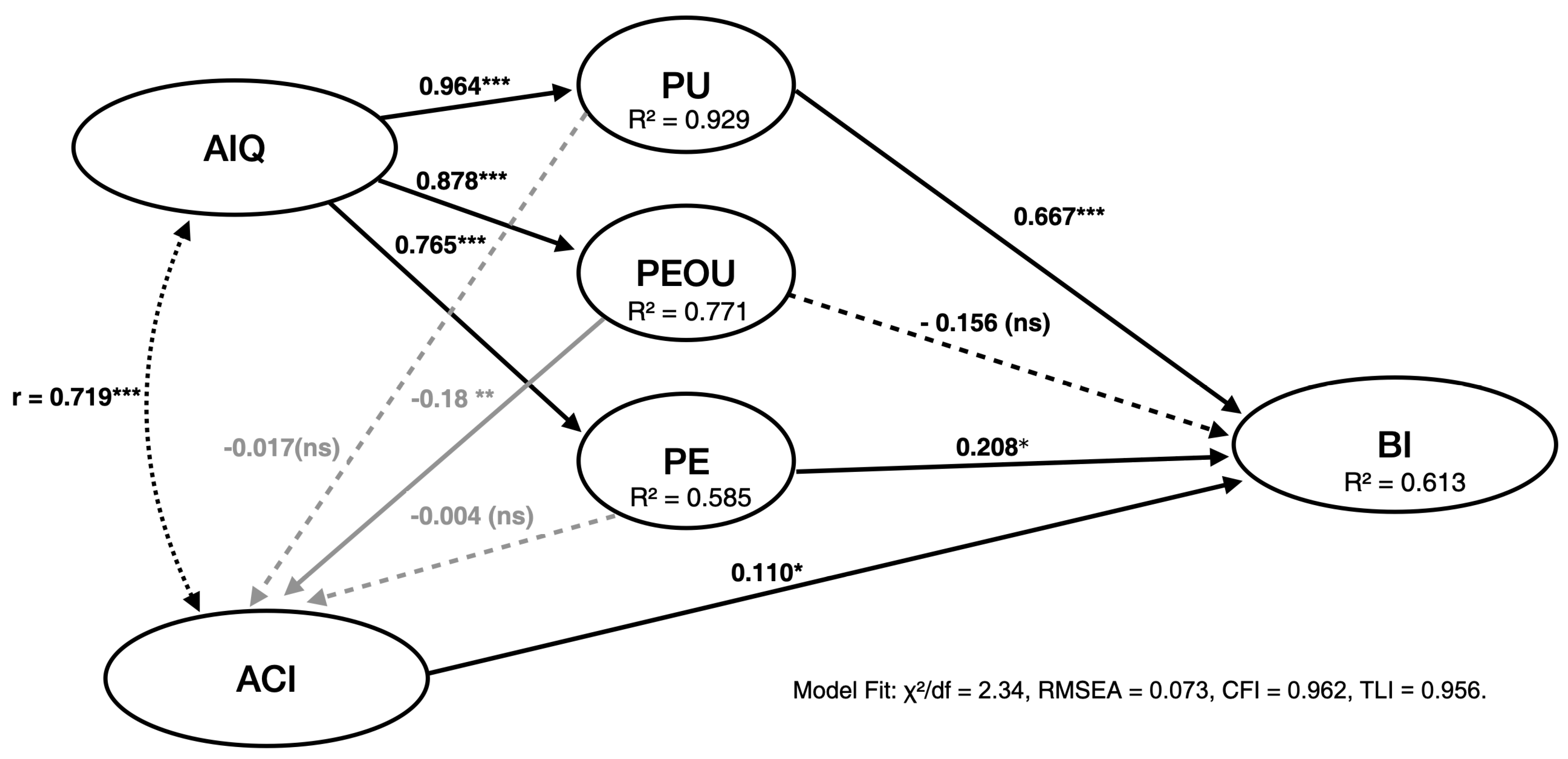
3.3.2. Hypothesis Testing Results
- AIQ → PU/PEOU/PE (content-driven technology acceptance);
- PU/PEOU/PE → BI (technology acceptance influencing behavioral intention);
- ACI → BI (cultural identity driving continuous learning);
- AIQ ↔ ACI (correlation relationship).
- PU → BI: β = 0.667, p < 0.001;
- PEOU → BI: β = −0.156, p > 0.05;
- PE → BI: β = 0.208, p < 0.05.
3.3.3. Explained Variance of Endogenous Variables
- 1.
- Technology acceptance dimensions:
- PU: R2 = 0.929, with AIQ explaining 92.9% of its variance;
- PEOU: R2 = 0.771, with AIQ explaining 77.1% of its variance;
- PE: R2 = 0.585, with AIQ explaining 58.5% of its variance.
- 2.
- Behavioral intention:
- BI: R2 = 0.613, with the TAM (PU, PEOU, PE) and ACI jointly explaining 61.3% of its variance.
3.3.4. Results Summary
4. Discussion
4.1. Findings Consistent with Expectations
4.1.1. Content-Driven Technology Cognition
4.1.2. The Additional Contribution of Architectural Cultural Identity
4.1.3. A Three-Dimensional Explanatory Pathway
4.2. Exploratory Hypotheses Not Supported
4.2.1. Independence Between Technology Cognition and Cultural Identity
- 1.
- Distinct Psychological ProcessesACI involves meaning construction and value internalization, whereas technology cognition concerns instrumental evaluation of functional systems [24].
- 2.
- The Invisibility of AlgorithmsIn recommendation-based environments, the actual algorithmic mechanisms remain opaque and “invisible” to the design learner [20,21,60]. As system mechanics recede into the background, the formation of attachment to heritage values relies almost entirely on the cultural value conveyed by the content, rather than on perceptions of functionality or convenience.
- 3.
- Content Value as the Primary Driver
4.2.2. The “Ease-of-Use Paradox” and Cognitive Friction
4.3. Theoretical Contributions
4.3.1. Content-Driven TAM
4.3.2. Independence of Technology Cognition and Cultural Identity
4.3.3. Cultural Identity as an Independent Driver
4.4. Revised Theoretical Model
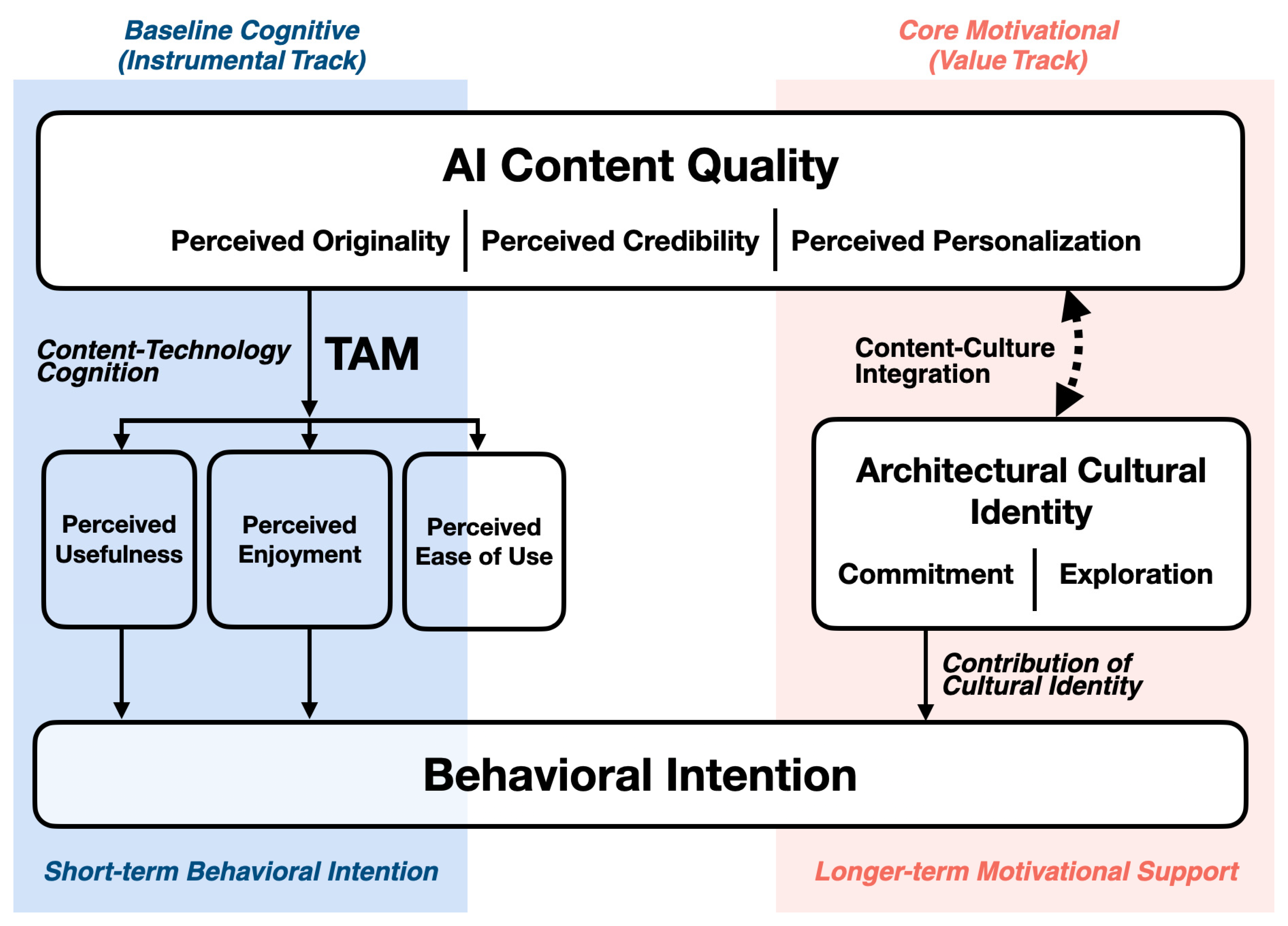
- As shown on the left side of the figure, the Baseline Cognitive Track (Instrumental Track) operates through content-technology cognition. AIQ drives technology acceptance (PU, PEOU, and PE), which facilitates short-term behavioral intention through instrumental rationality. This pathway explains immediate engagement driven by system utility perceptions.
- As shown on the right side of the figure, the Core Motivational Track (Value Track) operates through content-culture integration. AIQ is associated with architectural cultural identity (commitment and exploration), which independently predicts behavioral intention. This pathway reflects value-based motivation associated with distinct from instrumental technology evaluation;
4.5. Implications for Cultural Sustainability in the Built Environment
5. Conclusions and Prospects
5.1. Research Conclusions
5.2. Practical Implications
5.2.1. Professional Development in Architecture: Avoiding the “Technological Convenience Trap”
5.2.2. Cultural Communication: From “Traffic Logic” to “Identity Logic”
5.2.3. AI System Design: Cultural Semantics and Diversity
5.2.4. Connecting Identity to Action
5.3. Research Limitations and Future Directions
Author Contributions
Funding
Institutional Review Board Statement
Informed Consent Statement
Data Availability Statement
Acknowledgments
Conflicts of Interest
Appendix A
Appendix A.1. Definition and Scope of Architectural Cultural Content
Appendix A.2. Construct Operationalization

| Construct | Code | Construct Item | Source |
|---|---|---|---|
| Perceived Originality (PO) | PO1 | AI recommendations introduce me to architectural cultural content I wouldn’t discover on my own | AMCA-FIL [32], Pu et al. [39], Castells et al. [40]; adapted |
| PO2 | The recommended architectural content expands my cultural horizons with novel perspectives | ||
| PO3 | AI helps me explore diverse architectural cultural topics beyond my usual interests | ||
| Perceived Credibility (PC) | PC1 | The architectural cultural information in recommendations is factually accurate | AMCA-ETH [32], Flanagin & Metzger [41], Glikson & Woolley [42]; adapted |
| PC2 | Recommended architectural content comes from authoritative cultural sources | ||
| PC3 | AI recommendations present balanced perspectives on architectural cultural topics | ||
| Perceived Personalization (PP) | PP1 | Recommendations match my specific architectural cultural learning interests | AMCA-ADM & HAI [32], Tam & Ho [44], Tsai & Brusilovsky [45]; adapted |
| PP2 | The system improves understanding of my architectural cultural preferences over time | ||
| PP3 | AI recommendations are more relevant than my manual architectural content searches |
| Construct | Code | Item | Source |
|---|---|---|---|
| Perceived Usefulness (PU) | PU1 | Using the AI recommendation system improves my efficiency in finding architectural cultural information | Davis [24], Davis et al. [25]; adapted |
| PU2 | The recommendation system enhances my ability to accomplish architectural learning tasks | ||
| PU3 | Using the AI recommendation system increases my performance in architectural learning tasks | ||
| Perceived Ease of Use (PEOU) | PEOU1 | It is easy to discover architectural cultural content through AI recommendations | Davis [24]; adapted |
| PEOU2 | Learning to use AI recommendation features for architectural content is easy | ||
| PEOU3 | Browsing AI-recommended architectural content requires little effort | ||
| Perceived Enjoyment (PE) | PE1 | I enjoy browsing AI-recommended architectural cultural content | Davis et al. [25]; adapted |
| PE2 | Exploring architectural culture through AI recommendations is pleasant | ||
| Behavioral Intention (BI) | BI1 | I intend to continue using AI recommendations to learn about architectural culture | Davis [24], Davis et al. [25]; adapted |
| BI2 | I plan to regularly browse AI-recommended architectural cultural content |
| Construct | Code | Item | Source |
|---|---|---|---|
| Exploration (ACI_E) | ACI_E1 | Through social media, I actively search for and follow accounts that share architectural cultural content | MEIM-R [48,50], MENI [46]; adapted |
| ACI_E2 | I often like, save, share, or comment on architectural heritage content I encounter on social media | ||
| ACI_E3 | When I see interesting architectural content on social media, I seek to learn more about its historical and cultural background | ||
| Commitment (ACI_C) | ACI_C1 | Browsing architectural cultural content on social media strengthens my emotional connection to architectural heritage | MEIM-R [48,50], MENI [46]; adapted |
| ACI_C2 | Engaging with architectural heritage content online makes me feel that preserving these cultural values is personally important | ||
| ACI_C3 | Through exposure to architectural content on social media, I have developed a stronger sense of identification with architectural cultural traditions |
References
- Ahlava, A.; Fernandez, F.N. How can digital media be used as tools for architecture offices? Social media and video for sustainable architecture. In Visualising Our Future: Designing the Public Realm Together; Aalto University: Espoo, Finland, 2024; pp. 117–129. [Google Scholar]
- Huang, T.; Maalsen, S.; Fredericks, J. The built environment and social media: A semi-systematic review of architectural and design disciplines. Archnet-IJAR Int. J. Archit. Res. 2025, 19, 318–350. [Google Scholar] [CrossRef] [Scilit]
- Eloy, S.; Dias, M.S.; Lopes, P.F.; Vilar, E. Digital technologies in architecture and engineering: Exploring an engaged interaction within curricula. In Virtual and Augmented Reality: Concepts, Methodologies, Tools, and Applications; IGI Global: Hershey, PA, USA, 2018; pp. 618–653. [Google Scholar] [CrossRef] [Scilit]
- Xu, C.; Huang, Y. Technological innovation in architectural design education: Empirical analysis and future directions of Midjourney intelligent drawing software. Buildings 2024, 14, 3288. [Google Scholar] [CrossRef] [Scilit]
- Ortega-Fernández, A.; Martín-Rojas, R.; García-Morales, V.J. Artificial intelligence in the urban environment: Smart cities as models for developing innovation and sustainability. Sustainability 2020, 12, 7860. [Google Scholar] [CrossRef] [Scilit]
- Yigitcanlar, T.; Butler, L.; Windle, E.; Desouza, K.C.; Mehmood, R.; Corchado, J.M. Contributions and risks of artificial intelligence in building smarter cities: Insights from a systematic review of the literature. Energies 2020, 13, 1473. [Google Scholar] [CrossRef] [Scilit]
- Lindsay, G.; Sawyer, M.; Alaily-Mattar, N. Architecture in the age of social media: Introduction to the special issue. Archnet-IJAR Int. J. Archit. Res. 2025, 19, 311–317. [Google Scholar] [CrossRef] [Scilit]
- King, L.; Stark, J.F.; Cooke, P. Experiencing the digital world: The cultural value of digital engagement with heritage. Herit. Soc. 2016, 9, 76–101. [Google Scholar] [CrossRef] [Scilit]
- France24. Notre-Dame Cathedral Rises from the Ashes in Grand Reopening Ceremony. Available online: https://www.france24.com/en/europe/20241206-live-follow-grand-reopening-notre-dame-de-paris-cathedral (accessed on 7 November 2025).
- Meyerhofer-Parra, R. A systematic review of transmedia literacy: Implications for lifelong learning. J. Media Lit. Educ. 2025, 17, 110–124. [Google Scholar] [CrossRef] [Scilit]
- Ouyang, Z.; Feng, Z.; Xiao, Y.; Wei, W.; Liang, H.; Zhao, S. Disseminating excellent Chinese traditional culture via foreign language short videos: A case study of Escape from the British Museum. J. Lit. Arts Res. 2025, 2, 103–115. [Google Scholar] [CrossRef] [Scilit]
- Shi, X. The Audience Engagement for the TV Show of the Palace Museum: Case Study for the Social Media, Weibo Account of the TV Show, There is Something New in the Palace Museum. Master’s Thesis, Uppsala University, Uppsala, Sweden, 2020. [Google Scholar]
- Ai, Z.; Chiu, D.K.W.; Ho, K.K.W. Social media analytics of user evaluation for innovative digital cultural and creative products: Experiences regarding Dunhuang cultural heritage. ACM J. Comput. Cult. Herit. 2024, 17, 1–25. [Google Scholar] [CrossRef] [Scilit]
- Champion, E. Critical Gaming: Interactive History and Virtual Heritage; Routledge: London, UK, 2016. [Google Scholar] [CrossRef] [Scilit]
- Su, L.; Zhang, X.; Chen, Y.; Wang, H. Exploring city image perception in social media big data through deep learning: A case study of Zhongshan City. Sustainability 2023, 15, 3311. [Google Scholar] [CrossRef] [Scilit]
- Zhu, X.; Zhang, B.; Xiang, S.; Zhao, W.; Mihalko, C. Testing Olmsted’s Lasting Legacy Comparing Design Theory and the Post-Occupancy Conditions of New York Central Park. Buildings 2022, 12, 2217. [Google Scholar] [CrossRef] [Scilit]
- Knijnenburg, B.P.; Willemsen, M.C.; Gantner, Z.; Soncu, H.; Newell, C. Explaining the user experience of recommender systems. User Model. User-Adapt. Interact. 2012, 22, 441–504. [Google Scholar] [CrossRef] [Scilit]
- Gillespie, T. The relevance of algorithms. In Media Technologies: Essays on Communication, Materiality, and Society; Gillespie, T., Boczkowski, P.J., Foot, K.A., Eds.; MIT Press: Cambridge, MA, USA, 2014; pp. 167–194. [Google Scholar] [CrossRef] [Scilit]
- Beer, D. The social power of algorithms. Inf. Commun. Soc. 2017, 20, 1–13. [Google Scholar] [CrossRef] [Scilit]
- Bucher, T. The algorithmic imaginary: Exploring the ordinary affects of Facebook algorithms. Inf. Commun. Soc. 2017, 20, 30–44. [Google Scholar] [CrossRef] [Scilit]
- Pasquale, F. The Black Box Society: The Secret Algorithms That Control Money and Information; Harvard University Press: Cambridge, MA, USA, 2015. [Google Scholar] [CrossRef] [Scilit]
- Salama, A.M. Transformative Pedagogy in Architecture and Urbanism; Routledge: London, UK, 2021. [Google Scholar]
- Salama, A.M.; Wilkinson, N. Design Studio Pedagogy: Horizons for the Future; Urban International Press: Gateshead, UK, 2007. [Google Scholar]
- Davis, F.D. Perceived usefulness, perceived ease of use, and user acceptance of information technology. MIS Q. 1989, 13, 319–340. [Google Scholar] [CrossRef] [Scilit]
- Davis, F.D.; Bagozzi, R.P.; Warshaw, P.R. Extrinsic and intrinsic motivation to use computers in the workplace. J. Appl. Soc. Psychol. 1992, 22, 1111–1132. [Google Scholar] [CrossRef] [Scilit]
- Shin, D. The effects of explainability and causability on perception, trust, and acceptance: Implications for explainable AI. Int. J. Hum.-Comput. Stud. 2021, 146, 102551. [Google Scholar] [CrossRef] [Scilit]
- Sundar, S.S.; Jia, H.; Waddell, T.F.; Huang, Y. Toward a Theory of Interactive Media Effects (TIME): Four Models for Explaining How Interface Features Affect User Psychology. In The Handbook of the Psychology of Communication Technology; Sundar, S.S., Ed.; Wiley: Hoboken, NJ, USA, 2015; pp. 47–86. [Google Scholar] [CrossRef] [Scilit]
- Ashworth, G.J.; Larkham, P.J. Building a New Heritage: Tourism, Culture and Identity in the New Europe; Routledge: London, UK, 1994. [Google Scholar]
- Picon, A. Digital Culture in Architecture: An Introduction for the Design Professions; Birkhäuser: Basel, Switzerland, 2010. [Google Scholar]
- Berry, J.W. Globalisation and acculturation. Int. J. Intercult. Relat. 2008, 32, 328–336. [Google Scholar] [CrossRef] [Scilit]
- Wang, C.; Cui, W.; Zhang, Y.; Shen, H. Exploring short video apps users’ travel behavior intention: Empirical analysis based on SVA-TAM model. Front. Psychol. 2022, 13, 912177. [Google Scholar] [CrossRef] [Scilit]
- Zarouali, B.; Boerman, S.C.; de Vreese, C.H. Is this recommended by an algorithm? The development and validation of the algorithmic media content awareness scale (AMCA-scale). Telemat. Inform. 2021, 62, 101607. [Google Scholar] [CrossRef] [Scilit]
- Polat, M.; Kara, M.; Oppong, D.; Ahorsu, D.K. Adaptation of perceived social media literacy scale to Turkish culture: The case of educators. J. Soc. Media Res. 2025, 2, 90–103. [Google Scholar] [CrossRef] [Scilit]
- Fang, W.; Jin, J. Unpacking the effects of personality traits on algorithmic awareness: The mediating role of previous knowledge and moderating role of internet use. Front. Psychol. 2022, 13, 953892. [Google Scholar] [CrossRef] [Scilit]
- Alavi, S.; Iyer, P.; Bright, L.F. Advertisement avoidance and algorithmic media: The role of social media fatigue, algorithmic literacy and privacy concerns. J. Digit. Soc. Media Mark. 2024, 12, 276–292. [Google Scholar] [CrossRef] [Scilit]
- Tran, H.; Le, T.; Do, A.; Vu, T.; Bogaerts, S.; Howard, B. Emotion-aware music recommendation. In Proceedings of the AAAI Conference on Artificial Intelligence; AAAI Press: Washington, DC, USA, 2023; Volume 37, pp. 16087–16095. [Google Scholar] [CrossRef] [Scilit]
- Hair, J.F.; Black, W.C.; Babin, B.J.; Anderson, R.E. Multivariate Data Analysis, 8th ed.; Cengage: Boston, MA, USA, 2019. [Google Scholar]
- Zarouali, B.; Dobber, T.; De Pauw, G.; de Vreese, C.H. Using a personality-profiling algorithm to investigate political microtargeting: Assessing the persuasion effects of personality-tailored ads on social media. Commun. Res. 2022, 49, 1041–1070. [Google Scholar] [CrossRef] [Scilit]
- Pu, P.; Chen, L.; Hu, R. A user-centric evaluation framework for recommender systems. In Proceedings of the Fifth ACM Conference on Recommender Systems (RecSys ’11), Chicago, IL, USA, 23–27 October 2011; pp. 157–164. [Google Scholar] [CrossRef] [Scilit]
- Castells, P.; Hurley, N.; Vargas, S. Novelty and diversity in recommender systems. In Recommender Systems Handbook, 3rd ed.; Ricci, F., Rokach, L., Shapira, B., Eds.; Springer: New York, NY, USA, 2022; pp. 603–646. [Google Scholar] [CrossRef] [Scilit]
- Flanagin, A.J.; Metzger, M.J. The role of site features, user attributes, and information verification behaviors on the perceived credibility of web-based information. New Media Soc. 2007, 9, 319–342. [Google Scholar] [CrossRef] [Scilit]
- Glikson, E.; Woolley, A.W. Human trust in artificial intelligence: Review of empirical research. Acad. Manag. Ann. 2020, 14, 627–660. [Google Scholar] [CrossRef] [Scilit]
- Fan, H.; Poole, M.S. What is personalization? Perspectives on the design and implementation of personalization in information systems. J. Organ. Comput. Electron. Commer. 2006, 16, 179–202. [Google Scholar] [CrossRef] [Scilit]
- Tam, K.Y.; Ho, S.Y. Understanding the impact of web personalization on user information processing and decision outcomes. MIS Q. 2006, 30, 865–890. [Google Scholar] [CrossRef] [Scilit]
- Tsai, C.-H.; Brusilovsky, P. The effects of controllability and explainability in a social recommender system. User Model. User-Adapt. Interact. 2021, 31, 591–617. [Google Scholar] [CrossRef] [Scilit]
- Maehler, D.B.; Zabal, A.; Hanke, K. Adults’ identity in acculturation settings: The multigroup ethnic and national identity measure (MENI). Identity 2019, 19, 245–257. [Google Scholar] [CrossRef] [Scilit]
- Pujol, L.; Champion, E. Evaluating presence in cultural heritage projects. Int. J. Herit. Stud. 2012, 18, 83–102. [Google Scholar] [CrossRef] [Scilit]
- Phinney, J.S. The multigroup ethnic identity measure: A new scale for use with diverse groups. J. Adolesc. Res. 1992, 7, 156–176. [Google Scholar] [CrossRef] [Scilit]
- Maehler, D.B.; Bhaktha, N.; Poetzschke, S.; Ramos, H. Cultural identity development in adult forced migrants: The psychometrics of a measure in Arabic, Spanish, and Ukrainian. Int. J. Intercult. Relat. 2025, 105, 102134. [Google Scholar] [CrossRef] [Scilit]
- Phinney, J.S.; Ong, A.D. Conceptualization and measurement of ethnic identity: Current status and future directions. J. Couns. Psychol. 2007, 54, 271–281. [Google Scholar] [CrossRef] [Scilit]
- Zhao, Y.; Wang, P.; Lai, Y. Route generation and built environment behavioral mechanisms of Generation Z tourists: A case study of Macau. Buildings 2025, 15, 1947. [Google Scholar] [CrossRef] [Scilit]
- Phinney, J.S.; Jacoby, B.; Silva, C. Positive intergroup attitudes: The role of ethnic identity. Int. J. Behav. Dev. 2007, 31, 478–490. [Google Scholar] [CrossRef] [Scilit]
- Hu, L.-T.; Bentler, P.M. Cutoff criteria for fit indexes in covariance structure analysis: Conventional criteria versus new alternatives. Struct. Equ. Model. 1999, 6, 1–55. [Google Scholar] [CrossRef] [Scilit]
- Nunnally, J.C. Psychometric Theory, 2nd ed.; McGraw-Hill: New York, NY, USA, 1978. [Google Scholar]
- Podsakoff, P.M.; MacKenzie, S.B.; Lee, J.-Y.; Podsakoff, N.P. Common method biases in behavioral research: A critical review of the literature and recommended remedies. J. Appl. Psychol. 2003, 88, 879–903. [Google Scholar] [CrossRef] [Scilit] [PubMed]
- Preacher, K.J.; Hayes, A.F. Asymptotic and resampling strategies for assessing and comparing indirect effects in multiple mediator models. Behav. Res. Methods 2008, 40, 879–891. [Google Scholar] [CrossRef] [Scilit]
- Cohen, J. Statistical Power Analysis for the Behavioral Sciences, 2nd ed.; Lawrence Erlbaum: Hillsdale, NJ, USA, 1988. [Google Scholar]
- Fornell, C.; Larcker, D.F. Evaluating structural equation models with unobservable variables and measurement error. J. Mark. Res. 1981, 18, 39–50. [Google Scholar] [CrossRef] [Scilit]
- Henseler, J.; Ringle, C.M.; Sarstedt, M. A New Criterion for Assessing Discriminant Validity in Variance-Based Structural Equation Modeling. J. Acad. Mark. Sci. 2015, 43, 115–135. [Google Scholar] [CrossRef] [Scilit]
- Sundar, S.S. The MAIN model: A heuristic approach to understanding technology effects on credibility. In Digital Media, Youth, and Credibility; Metzger, M.J., Flanagin, A.J., Eds.; MIT Press: Cambridge, MA, USA, 2008; pp. 73–100. [Google Scholar]
- Han, B.-C. Saving Beauty; Polity Press: Cambridge, UK, 2017. [Google Scholar]
- Carr, N. The Shallows: What the Internet Is Doing to Our Brains; W.W. Norton & Company: New York, NY, USA, 2020. [Google Scholar]
- Song, L.; Li, R.Y.M.; Wareewanich, T. The cultivation effect of architectural heritage YouTube videos on perceived destination image. Buildings 2023, 13, 508. [Google Scholar] [CrossRef] [Scilit]
- Edwards, K.S.; Shin, M. Media multitasking and implicit learning. Atten. Percept. Psychophys. 2017, 79, 1537–1549. [Google Scholar] [CrossRef] [Scilit]
- Skulmowski, A.; Rey, G.D. Subjective cognitive load surveys lead to divergent results for interactive learning media. Hum. Behav. Emerg. Technol. 2020, 2, 149–157. [Google Scholar] [CrossRef] [Scilit]
- Chai, J.; Fan, K.K. Mobile inverted constructivism: Education of interaction technology in social media. Eurasia J. Math. Sci. Technol. Educ. 2016, 12, 1425–1442. [Google Scholar] [CrossRef] [Scilit]
- Peng, W.; Gao, C.; Zhu, B.; Zhu, X.; Jing, Q. Visitor behavioral preferences at cultural heritage museums: Evidence from social media data. Buildings 2025, 15, 3756. [Google Scholar] [CrossRef] [Scilit]
- Collier, J. The art of moral imagination: Ethics in the practice of architecture. J. Bus. Ethics 2006, 66, 307–317. [Google Scholar] [CrossRef] [Scilit]
- Raza, S.; Ding, C. News recommender system: A review of recent progress, challenges, and opportunities. Artif. Intell. Rev. 2022, 55, 749–800. [Google Scholar] [CrossRef] [Scilit] [PubMed]
- Carpo, M. The Second Digital Turn: Design Beyond Intelligence; MIT Press: Cambridge, MA, USA, 2017. [Google Scholar]
- Tang, Z.; Zhao, Y. Perception and evaluation of cultural heritage value in historic urban public parks based on social media data: A case study of Shanghai. Buildings 2025, 15, 3864. [Google Scholar] [CrossRef] [Scilit]
- Tepavčević, B. Design thinking models for architectural education. J. Public Space 2017, 2, 67–72. [Google Scholar] [CrossRef] [Scilit]
- Oxman, R. Digital architecture as a challenge for design pedagogy: Theory, knowledge, models and medium. Des. Stud. 2008, 29, 99–120. [Google Scholar] [CrossRef] [Scilit]
- Bindal, N. Experiential learning in design education: Teaching construction and technology through active experimentation in interior and architectural design. Int. J. Des. Educ. 2022, 16, 91–101. [Google Scholar] [CrossRef] [Scilit]
- Sheeran, P.; Webb, T.L. The intention–behavior gap. Soc. Pers. Psychol. Compass 2016, 10, 503–518. [Google Scholar] [CrossRef] [Scilit]


| Section | Construct | Items | Cronbach’s α | Source |
|---|---|---|---|---|
| Part 1 | AI Content Quality (AIQ) | 9 | Adapted from AMCA [32,38,39,40,41,42,44,45] | |
| - Perceived Originality (PO) | 3 | 0.787 | ||
| - Perceived Credibility (PC) | 3 | 0.828 | ||
| - Perceived Personalization (PP) | 3 | 0.761 | ||
| Part 2 | Technology Acceptance Model (TAM) | 8 | Adapted from the TAM [24,25] | |
| - Perceived Usefulness (PU) | 3 | 0.812 | ||
| - Perceived Ease of Use (PEOU) | 3 | 0.782 | ||
| - Perceived Enjoyment (PE) | 2 | 0.830 | ||
| Part 3 | Behavioral Intention (BI) | 2 | 0.926 | Extended TAM adapted [24,25] |
| Part 4 | Architectural Cultural Identity (ACI) | 6 | Adapted from MEIM-R and MENI [46,48,50,52] | |
| - Exploration (ACI_E) | 3 | 0.769 | ||
| - Commitment (ACI_C) | 3 | 0.805 | ||
| Part 5 | Demographics | 6 | — | Self-developed |
| Construct | Mean | SD | AIQ | PU | PEOU | PE | ACI | BI |
|---|---|---|---|---|---|---|---|---|
| AIQ | 3.53 | 0.63 | 1 | |||||
| PU | 3.63 | 0.81 | 0.772 *** | 1 | ||||
| PEOU | 3.69 | 0.8 | 0.695 *** | 0.639 *** | 1 | |||
| PE | 3.78 | 0.85 | 0.591 *** | 0.610 *** | 0.536 *** | 1 | ||
| ACI | 3.59 | 0.73 | 0.576 *** | 0.536 *** | 0.466 *** | 0.400 *** | 1 | |
| BI | 3.43 | 0.9 | 0.615 *** | 0.629 *** | 0.497 *** | 0.538 *** | 0.476 *** | 1 |
| Construct Type | Construct | Indicators | Factor Loadings | CR | AVE | Cronbach’s α |
|---|---|---|---|---|---|---|
| First-Order Constructs | PO | PO1 | 0.812 | 0.869 | 0.689 | 0.787 |
| PO2 | 0.852 | |||||
| PO3 | 0.791 | |||||
| PC | PC1 | 0.835 | 0.897 | 0.745 | 0.828 | |
| PC2 | 0.881 | |||||
| PC3 | 0.879 | |||||
| PP | PP1 | 0.675 | 0.847 | 0.652 | 0.761 | |
| PP2 | 0.753 | |||||
| PP3 | 0.891 | |||||
| PU | PU1 | 0.82 | 0.895 | 0.742 | 0.812 | |
| PU2 | 0.806 | |||||
| PU3 | 0.814 | |||||
| PEOU | PEOU1 | 0.843 | 0.875 | 0.701 | 0.782 | |
| PEOU2 | 0.776 | |||||
| PEOU3 | 0.737 | |||||
| PE | PE1 | 0.85 | 0.901 | 0.822 | 0.83 | |
| PE2 | 0.917 | |||||
| ACI_E | ACI_E1 | 0.751 | 0.847 | 0.649 | 0.769 | |
| ACI_E2 | 0.813 | |||||
| ACI_E3 | 0.728 | |||||
| ACI_C | ACI_C1 | 0.794 | 0.886 | 0.721 | 0.805 | |
| ACI_C2 | 0.865 | |||||
| ACI_C3 | 0.784 | |||||
| BI | BI1 | 0.955 | 0.945 | 0.895 | 0.926 | |
| BI2 | 0.937 | |||||
| Second-Order Constructs | AIQ | PO | 0.789 | 0.889 | 0.668 | 0.854 |
| PC | 0.851 | |||||
| PP | 0.821 | |||||
| ACI | ACI_E | 0.878 | 0.916 | 0.785 | 0.872 | |
| ACI_C | 0.962 |
| Panel A. First-order construct HTMT matrix | |||||||||
| Construct | PO | PC | PP | PU | PEOU | PE | BI | ACI_E | ACI_C |
| PO | — | ||||||||
| PC | 0.689 | — | |||||||
| PP | 0.585 | 0.604 | — | ||||||
| PU | 0.781 | 0.798 | 0.771 | — | |||||
| PEOU | 0.676 | 0.694 | 0.824 | 0.804 | — | ||||
| PE | 0.577 | 0.632 | 0.577 | 0.743 | 0.669 | — | |||
| BI | 0.515 | 0.663 | 0.572 | 0.725 | 0.584 | 0.615 | — | ||
| ACI_E | 0.441 | 0.544 | 0.522 | 0.602 | 0.531 | 0.434 | 0.488 | — | |
| ACI_C | 0.525 | 0.662 | 0.561 | 0.626 | 0.56 | 0.476 | 0.531 | 0.856 | — |
| Note: Most HTMT values were below the conservative threshold of 0.85. The HTMT value between ACI_E and ACI_C was 0.856, slightly exceeding the strict 0.85 criterion but remaining below the more liberal 0.90 threshold. | |||||||||
| Panel B. Second-order and key construct pairs | |||||||||
| Construct 1 | Construct 2 | HTMT | |||||||
| AIQ | PU | 0.924 | |||||||
| AIQ | PEOU | 0.859 | |||||||
| AIQ | PE | 0.702 | |||||||
| AIQ | ACI | 0.671 | |||||||
| PU | PEOU | 0.804 | |||||||
| PU | PE | 0.743 | |||||||
| PU | BI | 0.725 | |||||||
| PEOU | BI | 0.584 | |||||||
| PE | BI | 0.615 | |||||||
| ACI | BI | 0.533 | |||||||
| ACI | PU | 0.642 | |||||||
| ACI | PEOU | 0.571 | |||||||
| Note: the HTMT value between AIQ and PEOU was 0.859, and that between AIQ and PU was 0.924. These results indicate conceptual proximity among certain construct pairs and are therefore interpreted together with CFA evidence and VIF diagnostics in the text. | |||||||||
| Dependent Variable | Predictor | VIF | Tolerance |
|---|---|---|---|
| BI | PU | 2.236 | 0.447 |
| BI | PEOU | 1.849 | 0.541 |
| BI | PE | 1.697 | 0.589 |
| BI | ACI | 1.461 | 0.684 |
| PU | AIQ | 2.223 | 0.45 |
| PU | PEOU | 2.032 | 0.492 |
| PU | PE | 1.611 | 0.621 |
| PEOU | AIQ | 2.62 | 0.382 |
| PEOU | PU | 2.716 | 0.368 |
| PEOU | PE | 1.688 | 0.592 |
| Hypothesis | Path Relationship | Std. β | S.E. | t-Value | p-Value | Support |
|---|---|---|---|---|---|---|
| H1a | AIQ → PU | 0.964 | 0.011 | 84.729 | <0.001 | Supported |
| H1b | AIQ → PEOU | 0.878 | 0.015 | 59.103 | <0.001 | Supported |
| H1c | AIQ → PE | 0.765 | 0.018 | 43.017 | <0.001 | Supported |
| H2a | PU → ACI | −0.017 | 0.015 | 1.127 | 0.260 | Not Supported |
| H2b | PEOU → ACI | −0.18 | 0.064 | 2.807 | 0.005 | ⚠ Not Supported (Negative) |
| H2c | PE → ACI | −0.004 | 0.029 | 0.138 | 0.890 | Not Supported |
| H3 | ACI → BI | 0.110 | 0.045 | 2.281 | <0.05 | Supported |
| H4 * | AIQ ↔ ACI | 0.719 | 0.023 | 30.623 | <0.001 | Correlation |
| Model | χ2/df | RMSEA | CFI | TLI | Notes |
|---|---|---|---|---|---|
| Measurement Model (CFA) | 4.54 | 0.075 | 0.96 | 0.953 | Reported in Section 2.4 |
| Initial Model | 3.89 | 0.086 | 0.943 | 0.954 | TAM→ACI included |
| Final Model | 2.34 | 0.073 | 0.962 | 0.956 | TAM→ACI removed |
| Dimension | AIQ | ACI |
|---|---|---|
| Object of evaluation | External stimulus (recommended content) | Internal psychology (self-culture relationship) |
| Psychological nature | Cognitive appraisal of content quality | Affective identification with cultural values |
| Temporal characteristic | Immediate perception of current content | Developmental identity formed over time |
| Theoretical tradition | Information systems, HCI research | Social psychology, cultural identity theory |
Disclaimer/Publisher’s Note: The statements, opinions and data contained in all publications are solely those of the individual author(s) and contributor(s) and not of MDPI and/or the editor(s). MDPI and/or the editor(s) disclaim responsibility for any injury to people or property resulting from any ideas, methods, instructions or products referred to in the content. |
© 2026 by the authors. Licensee MDPI, Basel, Switzerland. This article is an open access article distributed under the terms and conditions of the Creative Commons Attribution (CC BY) license.
Share and Cite
Chai, J.-X.; Shen, S.-T. AI-Driven Content Quality Beyond Technological Convenience: A Dual-Track Model of Sustainable Architectural Heritage Engagement. Buildings 2026, 16, 1227. https://doi.org/10.3390/buildings16061227
Chai J-X, Shen S-T. AI-Driven Content Quality Beyond Technological Convenience: A Dual-Track Model of Sustainable Architectural Heritage Engagement. Buildings. 2026; 16(6):1227. https://doi.org/10.3390/buildings16061227
Chicago/Turabian StyleChai, Jia-Xiang, and Siu-Tsen Shen. 2026. "AI-Driven Content Quality Beyond Technological Convenience: A Dual-Track Model of Sustainable Architectural Heritage Engagement" Buildings 16, no. 6: 1227. https://doi.org/10.3390/buildings16061227
APA StyleChai, J.-X., & Shen, S.-T. (2026). AI-Driven Content Quality Beyond Technological Convenience: A Dual-Track Model of Sustainable Architectural Heritage Engagement. Buildings, 16(6), 1227. https://doi.org/10.3390/buildings16061227