Article

Inverse Calibration of Confinement and Softening in RC Beam-Column Joints for Improved DSFM Predictions


by
Mehmet Ozan Yılmaz
Civil Engineering Department, Civil Engineering Faculty, Yıldız Technical University, Istanbul 34220, Türkiye
Buildings 2026, 16(6), 1157; https://doi.org/10.3390/buildings16061157
Submission received: 9 February 2026 / Revised: 1 March 2026 / Accepted: 11 March 2026 / Published: 15 March 2026
(This article belongs to the Section Building Structures)

Abstract

Standard compatibility-based truss models, including the Disturbed Stress Field Model (DSFM), often underestimate the shear strength and deformation capacity of reinforced-concrete (RC) beam-column joints. This study investigates the origin of this bias through a systematic inverse identification framework and derives joint-core constitutive relationships tailored to the highly confined, nonuniform stress states of joints. Inverse analyses show that improving confinement effectiveness alone leads to unrealistic parameter saturation and cannot reproduce the measured energy absorption, indicating that conventional compression-softening formulations remain excessively punitive for joint cores. When confinement activation and softening are identified simultaneously, a clear mechanism shift emerges: unlike panel-based theories that link softening to tensile-cracking measures (principal strain ratio), joint softening is overwhelmingly governed by the principal compressive strain, consistent with crushing-dominated damage accumulation. Based on these trends, unified power-law expressions are proposed for both passive confinement activation and damage-induced softening as functions of principal compressive strain only, adhering to a parsimonious formulation without auxiliary variables such as concrete strength or reinforcement ratio ( R 2 0.89 ). The model is validated on an independent database of 113 specimens, including high-strength concrete and exterior joints, eliminating the systematic conservatism of the standard DSFM and improving the mean experimental-to-predicted strength ratio from 0.85 to 1.01 while reducing the coefficient of variation from 34.5% to 13%. The proposed formulation supports more reliable joint shear backbone predictions for seismic assessment of RC frame buildings.

1. Introduction

Reinforced concrete (RC) beam–column joints represent critical structural components that govern the overall behavior and safety of RC frame structures, particularly under seismic loading conditions. These joint regions experience complex three-dimensional stress states dominated by shear forces, making their accurate modeling essential for performance-based design and assessment [1,2]. The failure of joints can lead to catastrophic structural collapse, as evidenced by numerous earthquake reconnaissance reports documenting severe damage not only non-seismic designed structures but also in code-compliant structures [3,4,5,6]. Despite the critical importance of reliable performance prediction, traditional design approaches and current international codes, such as ACI 352R-02 [7] and Eurocode 8 [8], primarily rely on semi-empirical shear strength limits and prescriptive detailing requirements to ensure joint safety. These methods often fail to capture the complex nonlinear behavior of RC joints, including progressive cracking, tension stiffening, compression softening, and the interaction between concrete and reinforcement [5,9]. While ACI 318 [10] incorporates strut-and-tie modeling for discontinuity regions, these approaches are inherently static and lower-bound, often neglecting the kinematic compatibility conditions crucial for predicting post-peak response. Furthermore, performance-based assessment guidelines like ASCE 41 [11] typically employ simplified effective stiffness modifiers or rigid joint assumptions, which may fail to capture the significant shear deformations and softening mechanisms detailed in recent literature [12,13].
To address the geometric complexity and three-dimensional stress states of beam–column joints, several researchers have employed sophisticated 3D solid finite element models, often utilizing microplane-based formulations [14,15], while others have adopted plasticity-based continuum damage models such as the Drucker–Prager criterion [16,17] or the Concrete Damaged Plasticity formulation [18,19]. These micro-models can explicitly simulate the bond-slip behavior between reinforcement and concrete, as well as multi-axial confinement effects. However, their application remains limited in routine practice due to significant challenges. Beyond the high computational cost and numerical convergence issues associated with complex contact interfaces, these models require the calibration of a vast number of governing parameters [14,20]. Unlike standard macroscopic properties, these parameters are often non-physical or highly case-specific, rendering such approaches impractical for extensive parametric investigations or generalized design applications [21,22].
Continuum finite element modeling carries prohibitive computational cost for global seismic assessment of RC frames. Joint behavior is therefore commonly represented using macro-modeling approaches, often termed super-elements or lumped-plasticity joint elements [13,23]. Within this family, the simplest idealizations treat beam–column intersections as rigid/centerline joints, thereby neglecting joint flexibility [24].
A first level of refinement introduces rotational-spring (scissors-type) formulations that lump the inelastic joint response into one or more zero-length springs. These were later extended to separate key mechanisms (joint shear and bond-slip) through multiple localized components [25,26,27,28,29]. More advanced joint elements adopt a “panel/continuum + interface” idealization to better represent joint-core distortion and interface degradation, while remaining compatible with beam–column line elements [1,30]. Such joint models are widely used in nonlinear seismic analysis platforms (e.g., OpenSees) [31,32], and further discussion of these formulations is provided in Yilmaz [33].
While these macro-models effectively reduce computational demand, allowing for system-level dynamic analyses, they are inherently phenomenological; they do not derive behavior from first principles. Instead, they require a priori definition of the joint shear stress-strain (or moment-rotation) envelope [34,35]. Consequently, the reliability of a complex non-linear time history analysis becomes entirely dependent on the accuracy of the analytical model used to calibrate these components. Among the most consequential phenomena that this backbone must characterize is joint pinching (the marked reduction in reloading stiffness caused by shear crack reopening) which has been shown in numerical studies to substantially affect peak interstorey drift demands, energy dissipation capacity, and collapse fragility of RC frames [13,23,35]. In hysteretic joint macro-elements such as Pinching4 in OpenSees [31], pinching severity is governed directly by the backbone shape: the peak strength and post-peak softening slope define the force levels at which aggregate interlock re-engages during reloading and at which cyclic stiffness degrades. An  accurate monotonic backbone is therefore the necessary prerequisite for reliable pinching characterization, further motivating the present study’s focus on eliminating the systematic conservatism of the standard DSFM. While the direct simulation of cyclic degradation and pinching loop geometry is outside the scope of the present study, it is noted that all 113 specimens in the validation database were tested under reversed cyclic loading protocols; the favorable prediction statistics therefore reflect agreement against the cyclic strength envelope, confirming the indirect relevance of the proposed formulation to seismic response assessment.
To define this backbone, a range of empirical and semi-empirical formulations have been proposed. Pampanin et al. [36] introduced one of the earliest multilinear shear stress-strain laws specifically targeting poorly detailed non-seismic joints, a formulation that became widely adopted in vulnerability studies of existing buildings. Subsequently, Kim and LaFave [37] derived a comprehensive regression-based model from a Bayesian parameter estimation applied to a database of 341 interior and exterior joints, providing closed-form expressions for each characteristic point of the backbone curve. For exterior joints without transverse reinforcement (a configuration particularly prevalent in pre-seismic construction), Park and Mosalam [38] proposed an analytical backbone calibrated against a dedicated experimental database, while Hassan [39] developed an integrated demand-capacity model linking joint backbone parameters to global collapse fragility. More recently, Grande et al. [40] systematically evaluated combinations of existing backbone laws against an experimental database, highlighting the significant sensitivity of predicted frame response to the assumed joint constitutive definition. Despite their practical convenience, these models remain inherently empirical: their applicability is bounded by the calibration database, and they cannot capture specimen-specific mechanics (such as the interaction between confinement activation and compression softening) that govern the post-peak response outside their training domain.
In recent years, data-driven approaches utilizing Artificial Neural Networks (ANN) and Machine Learning (ML) have emerged as an alternative for defining these essential joint behavioral characteristics. While the majority of such studies focus solely on predicting ultimate strength, a limited number of researchers have extended these techniques to estimate deformation limits and full hysteretic envelopes. For instance, Gombosuren and Maki [41] developed data-driven equations to predict a joint shear deformation index, while Yilmaz and Bekiroglu [42] utilized Generalized Regression Neural Networks (GRNN) to generate the complete shear stress-strain envelope. More recently, Suwal and Guner [43] applied ANNs to derive plastic hinge curves specifically for global frame analysis. However, despite their predictive capability within the range of training databases, these ‘black-box’ models lack the mechanical transparency of rational theories and do not explicitly satisfy kinematic compatibility conditions. Given the inherent limitations of purely data-driven extrapolation, the focus directs toward analytical tools capable of predicting the monotonic shear stress-strain response of joints through first principles, without reliance on case-specific experimental data. Traditional Strut-and-Tie Models (STM), while useful for detailing, are typically rigid-plastic or elastic-perfectly plastic, failing to capture the softening branch and deformation characteristics essential for the definition of hysteretic rules [44]. Therefore, rational membrane theories based on the smeared-crack concept offer a more viable framework for generating these constitutive backbones. Among these, the Modified Compression Field Theory (MCFT) [45] and the Softened Membrane Model (SMM) [46] represent significant advancements, deriving response from equilibrium, compatibility, and average constitutive relationships. However, standard applications of these theories often assume coaxiality between principal stress and strain directions. This assumption can lead to inaccuracies in predicting deformation capacities, particularly in joints where significant shear slip along crack surfaces causes a lag in stress field rotation [47,48]. The Disturbed Stress Field Model (DSFM) addresses this by explicitly decoupling principal stress and strain orientations, yet even such advanced formulations require specific refinements to accurately predict the complex post-peak kinematics observed in recent joint shear failure benchmarks.
Several researchers have attempted to apply these membrane theories directly to beam–column joints. Shin and LaFave [29] developed an MCFT-based analytical scheme to approximate joint shear hysteresis, while Wong et al. [2] combined a modified rotating-angle softened-truss model with the deep beam analogy for exterior joints. Tran and Li [49] proposed an SMM-based macro-element for interior joints that maintains the original concrete strut formulation. More recently, Sagbas et al. [48] applied the DSFM framework to joint subassemblies, demonstrating its potential while exposing the limitations of standard panel-calibrated parameters in reproducing joint-specific post-peak behavior. These studies collectively confirm the viability of treating joint cores as membrane elements while revealing that standard panel-calibrated constitutive parameters remain the central obstacle to reliable joint-specific prediction.
However, despite its extensive validation on shear panels, a critical gap remains in the direct application of these rational theories to beam–column joints. The constitutive relationships inherent to the DSFM were originally derived and calibrated based on experiments conducted on membrane elements characterized by uniform stress fields and smeared reinforcement. Consequently, these standard formulations do not explicitly account for the complex boundary conditions, steep stress gradients, and localized confinement effects specific to the internal beam–column joint core. As a result, standard parameters often fail to capture the sophisticated softening and bond deterioration mechanisms observed in joints under severe seismic demands.
Inverse analysis techniques have been increasingly employed in structural engineering to extract constitutive parameters from global response measurements, including the identification of tension softening relationships from bending tests [50], calibration of concrete damage parameters using digital image correlation [51], and back-calculation of material degradation from in situ monitoring data [52]. Extending this paradigm to beam–column joints, the present study employs an inverse analysis methodology on a comprehensive database of internal joint experiments. By systematically back-calculating the material parameters required to satisfy instantaneous equilibrium and compatibility, this study proposes new constitutive relationships where these coefficients are defined as state-dependent functions of the principal compressive strain ( ε c 2 ) and the evolving joint deformation state.
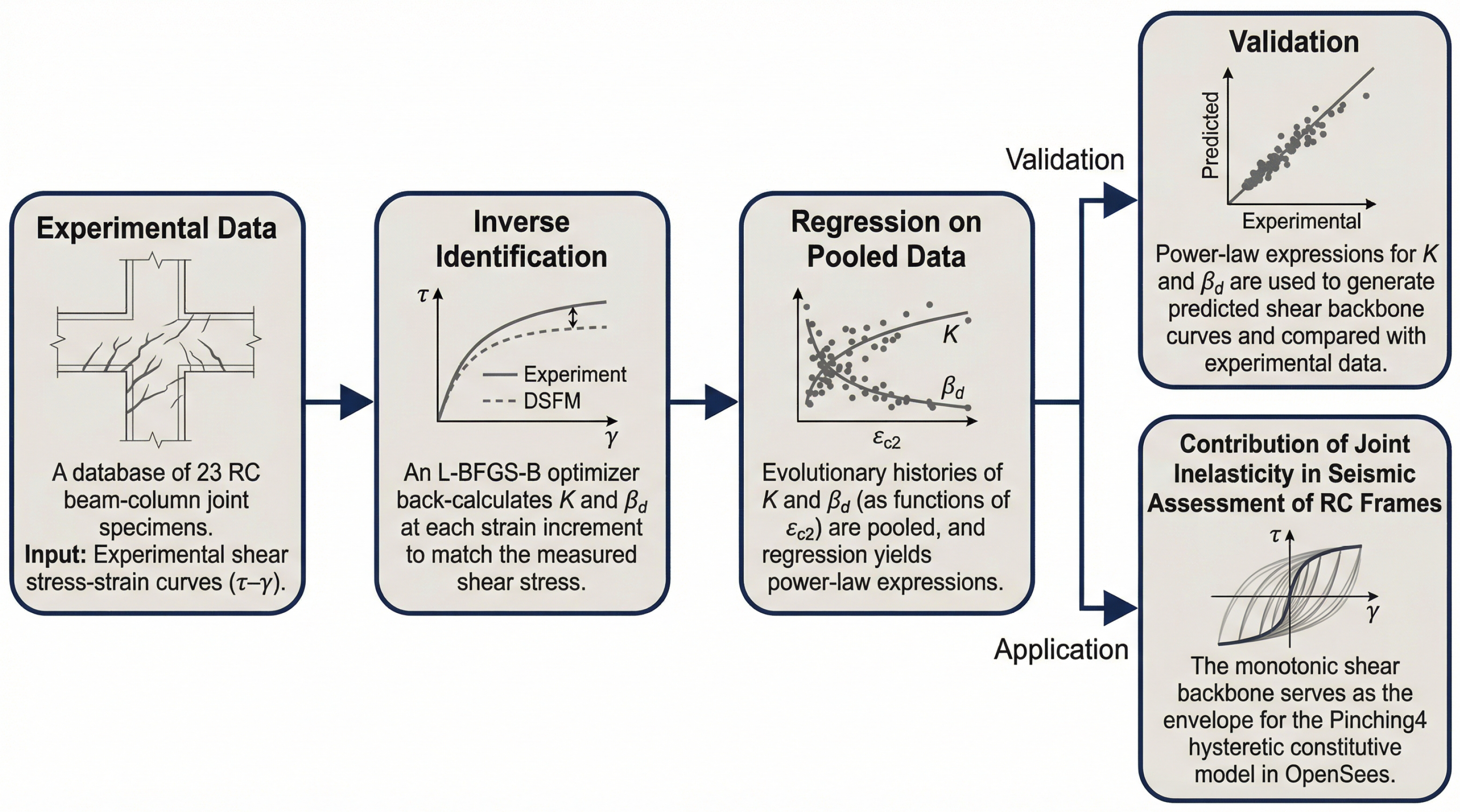
The contributions of this study are therefore threefold with direct practical consequences. First, a systematic inverse identification framework is established that extracts state-dependent constitutive parameters from experimental joint response data, departing from both conventional forward calibration and regression-based empirical models. Unlike empirical backbone formulations [36,37,38], the proposed approach is not bounded by its calibration database and does not require case-specific fitting. Unlike prior applications of membrane theories to joints [2,29,48], it resolves the systematic conservatism arising from panel-based constitutive parameters. Second, the inverse analysis reveals a fundamental mechanistic finding: softening in beam–column joint cores is governed by the principal compressive strain ε c 2 rather than the transverse strain ratio ε 1 / ε 2 assumed in panel-based theories, consistent with crushing-dominated rather than crack-widening damage. Third, the resulting unified formulation generates complete shear stress-strain backbone curves as a function of only ε c 2 , suitable for direct use as the constitutive envelope of macro-element and rotational spring joint models [1,31] employed in nonlinear seismic assessment of existing RC frame buildings. The overall methodology is summarized in Figure 1.

2. Theoretical Background

The analysis of reinforced concrete elements under complex shear conditions has evolved from empirical approaches to rational formulations based on the smeared-crack concept. Central to this evolution is the Modified Compression Field Theory (MCFT), developed by Vecchio and Collins [45], which treats cracked concrete as an orthotropic material. The MCFT derives the load-deformation response by satisfying equilibrium, compatibility, and average constitutive relationships, employing a rotating crack model where the orientation of principal stresses and strains changes progressively with loading. A distinguishing feature of MCFT is its explicit consideration of compression softening and tension stiffening mechanisms, allowing for the accurate prediction of post-cracking behavior in shear-critical members [53,54].
However, a fundamental limitation of the MCFT—and similar formulations like the Softened Membrane Model (SMM) [55]—is the assumption of coaxiality, which posits that the direction of principal compressive stress coincides exactly with the direction of principal compressive strain ( θ σ = θ ϵ ). While reasonable for elements dominated by flexure or pure shear, this assumption loses validity in regions where significant shear slip occurs along crack surfaces, such as beam–column joints. Experimental evidence demonstrates that aggregate interlock and bond mechanisms generate local shear stresses that cause the principal stress field to rotate or ‘lag’ behind the strain field, a phenomenon critical to the energy absorption capacity of the joint [47,56]. To address this kinematic inconsistency, Vecchio [47] proposed the Disturbed Stress Field Model (DSFM) as an advanced refinement of the MCFT. The DSFM explicitly decouples the orientation of principal stresses and strains by augmenting the compatibility conditions to include crack shear slip deformations. In this framework, the total strain is decomposed into a continuum component (due to elastic and plastic deformation of the concrete) and a slip component (due to rigid body movement along crack interfaces). This distinction makes the DSFM particularly distinct and advantageous for the analysis of beam–column joints, where the reliable prediction of shear deformation and pinching hysteresis relies heavily on capturing the interaction between crack slip and bulk concrete distortion.
In the formulation of the DSFM, the assumption of coaxiality is relaxed. Unlike MCFT, where the principal stress direction θ σ is forced to coincide with the principal strain direction θ ϵ , the DSFM accounts for the divergence of these fields due to shear slip. This is achieved through an augmented compatibility condition where the total strain [ ϵ ] is decomposed into continuum and slip components:
[ ϵ ] = [ ϵ c ] + [ ϵ s ] + [ ϵ c 0 ] + [ ϵ c p ]
where [ ϵ ] is the total strain vector { ϵ x , ϵ y , γ x y } T , [ ϵ c ] represents the net continuum strain of the concrete, and  [ ϵ s ] denotes the shear slip strain vector resulting from rigid body movement along crack interfaces. The terms [ ϵ c 0 ] and [ ϵ c p ] account for elastic offsets (e.g., thermal, shrinkage) and plastic offsets, respectively. The explicit calculation of shear slip strain permits the determination of the reorientation, or ’lag’, between the principal stress and strain fields, defined as:
Δ θ = θ ϵ θ σ
The magnitude of the shear slip strain is directly related to the local slip displacement δ s along the crack surface and the average crack spacing s, taken as 1.5 times the transverse reinforcement spacing within the joint core [29,48]:
γ s = δ s s
To determine the slip displacement δ s , the DSFM employs a constitutive relationship linking local shear stress to crack width. This study adopts the formulation proposed by Walraven [57], which defines the slip as a function of the interface shear stress v c i , the crack width w, and the concrete strength:
δ s = v c i 1.8 w 0.8 + ( 0.234 w 0.707 0.20 ) · f c c
where v c i is the shear stress on the crack face (MPa), w is the crack width (mm), and  f c c is the concrete cube compressive strength (MPa).
Equilibrium is satisfied in terms of average stresses smeared over the element area. For an orthogonally reinforced element with reinforcement aligned to the x and y axes, the equilibrium conditions are:
σ x = f c x + ρ x f s x
σ y = f c y + ρ y f s y
τ x y = v c x y
In the context of beam–column joints, the applied normal stresses σ x and σ y carry the flexural boundary conditions of the joint panel: σ y incorporates the column axial compressive stress P / A g , which is the primary mechanism through which the column bending state influences the shear response of the joint core.
A critical feature of the DSFM is the verification of local equilibrium at the crack surface to ensure that the average stresses can be sustained by the reinforcement crossing the crack. The local reinforcement stresses f s c r generate an interface shear stress v c i , calculated as:
v c i = i = 1 n ρ i ( f s c r i f s i ) cos θ n i sin θ n i
This interface shear stress serves as the driving force for the slip δ s in the compatibility formulation, thereby coupling the static and kinematic responses.
The constitutive response of the cracked concrete in compression is governed by the principal compressive stress f c 2 . The DSFM typically employs the Popovic function to describe the non-linear stress-strain response, accounting for the inherent brittleness of high-strength concrete:
f c 2 = f p n ( ϵ c 2 / ϵ p ) ( n 1 ) + ( ϵ c 2 / ϵ p ) n k
where ϵ p is the strain at peak stress, and n and k are curve-fitting parameters dependent on the peak compressive stress f p (MPa), defined as:
n = 0.80 + f p 17
k = 1.0 for | ϵ c 2 | < | ϵ p | ( Pre - peak ) 0.67 + f p 62 for | ϵ c 2 | > | ϵ p | ( Post - peak )
The achievable peak stress f p is reduced relative to the uniaxial cylinder strength f c by the compression softening parameter β d , which accounts for the damage induced by co-existing transverse tensile strains. In the standard DSFM formulation, this factor is given by:
β d = 1 1 + C s · C d 1.0
where the coefficient C d relates to the strain state:
C d = 0.35 ϵ c 1 ϵ c 2 0.28 0.8
Crucially, the parameter C s distinguishes the DSFM from the MCFT. While the MCFT assumes C s = 1.0 (implicitly accounting for slip within the continuum strain), the DSFM assigns C s = 0.55 [47]. This lower value reflects that a portion of the total damage is attributable to the explicitly modeled shear slip, thereby reducing the softening penalty applied to the continuum concrete strut.

Solution Algorithm

Since the shear slip strain [ ϵ s ] depends on the interface shear stress v c i —which in turn relies on the local reinforcement and concrete stress states—the DSFM formulation constitutes a system of coupled nonlinear equations. In a general finite element implementation, this requires a strain-driven iterative solution. Given a fixed total strain vector [ ϵ ] imposed by the global displacement field, the constitutive model must resolve the internal partitioning of deformation between continuum concrete straining and rigid crack slip to determine the corresponding average stresses.
The iterative procedure begins by initializing the shear slip strain vector, typically utilizing converged values from the previous load step. At the start of each iteration, kinematic compatibility is strictly enforced by isolating the net concrete strain [ ϵ c ] . Since the total strain is fixed, [ ϵ c ] is calculated as the dependent residual remaining after the current estimates of slip, elastic, and plastic offset strains are subtracted from the total strain. Based on this updated net concrete strain, the principal strains and their orientation are determined, which subsequently drive the update of state-dependent material parameters, including the compression softening factor β d (see Algorithm 1).
Algorithm 1 Iterative procedure for DSFM constitutive update
Require: Total strain vector [ ϵ ] = { ϵ x , ϵ y , γ x y } T
Ensure: Average stresses [ σ ] , Stiffness matrix [ D ]
   Variables: Slip strain [ ϵ s ] , Net concrete strain [ ϵ c ]
  1:
Initialize: Set [ ϵ s ] 0 equal to converged value from previous load step.
  2:
Iterative Loop ( k = 1 , 2 , . . . ):
  3:
     Calculate net concrete continuum strain:
  4:
         [ ϵ c ] k = [ ϵ ] [ ϵ s ] k 1 [ ϵ c 0 ] [ ϵ c p ]
  5:
     Determine principal strains ϵ c 1 , ϵ c 2 and orientation θ ϵ .
  6:
     Calculate material parameters (e.g., β d using Equation (12)).
  7:
     Calculate principal concrete stresses f c 1 , f c 2 .
  8:
     Check local equilibrium at crack to find v c i (Equation (8)).
  9:
     Calculate new slip δ s via Walraven’s Law (Equation (4)).
10:
   Update slip strain γ s = δ s / s .
11:
   Transform γ s to global coordinates to get [ ϵ s ] new .
12:
Convergence Check:
13:
if  | | [ ϵ s ] new [ ϵ s ] k 1 | | < Tolerance  then
14:
    Exit Loop
15:
else
16:
    Update [ ϵ s ] k = [ ϵ s ] new and return to Step 2.
17:
end if
With the material state defined, the principal concrete stresses f c 1 and f c 2 are evaluated using the constitutive relationships. The algorithm then verifies local equilibrium at the crack surface to determine the interface shear stress v c i generated by the reinforcement crossing the crack. This shear stress serves as the input for the slip constitutive law (e.g., Walraven’s equation), yielding a revised estimate of the slip displacement δ s and the corresponding slip strain [ ϵ s ] . This newly calculated slip strain is compared against the initial estimate used at the start of the iteration. If the difference exceeds a specified tolerance, the slip strain vector is updated, and the process repeats—recalculating the net concrete strain and subsequent stresses—until convergence is achieved.
To ensure robust convergence, particularly in the post-peak softening range where the material stiffness deteriorates rapidly, specific numerical stabilization techniques were integrated into the solver. The strain field update employs an adaptive relaxation algorithm [58], where the relaxation factor is dynamically reduced if the residual norm diverges. Furthermore, to capture the reserve strength of reinforcement at large deformations, a curvilinear hardening model adapted from Mander et al. [59] is utilized for strains exceeding the yield plateau. In instances of severe softening where the stiffness matrix approaches singularity, a numerical regularization scheme is applied to allow the solver to successfully traverse limit points characteristic of brittle shear failure.

3. Assessment of Standard DSFM Model

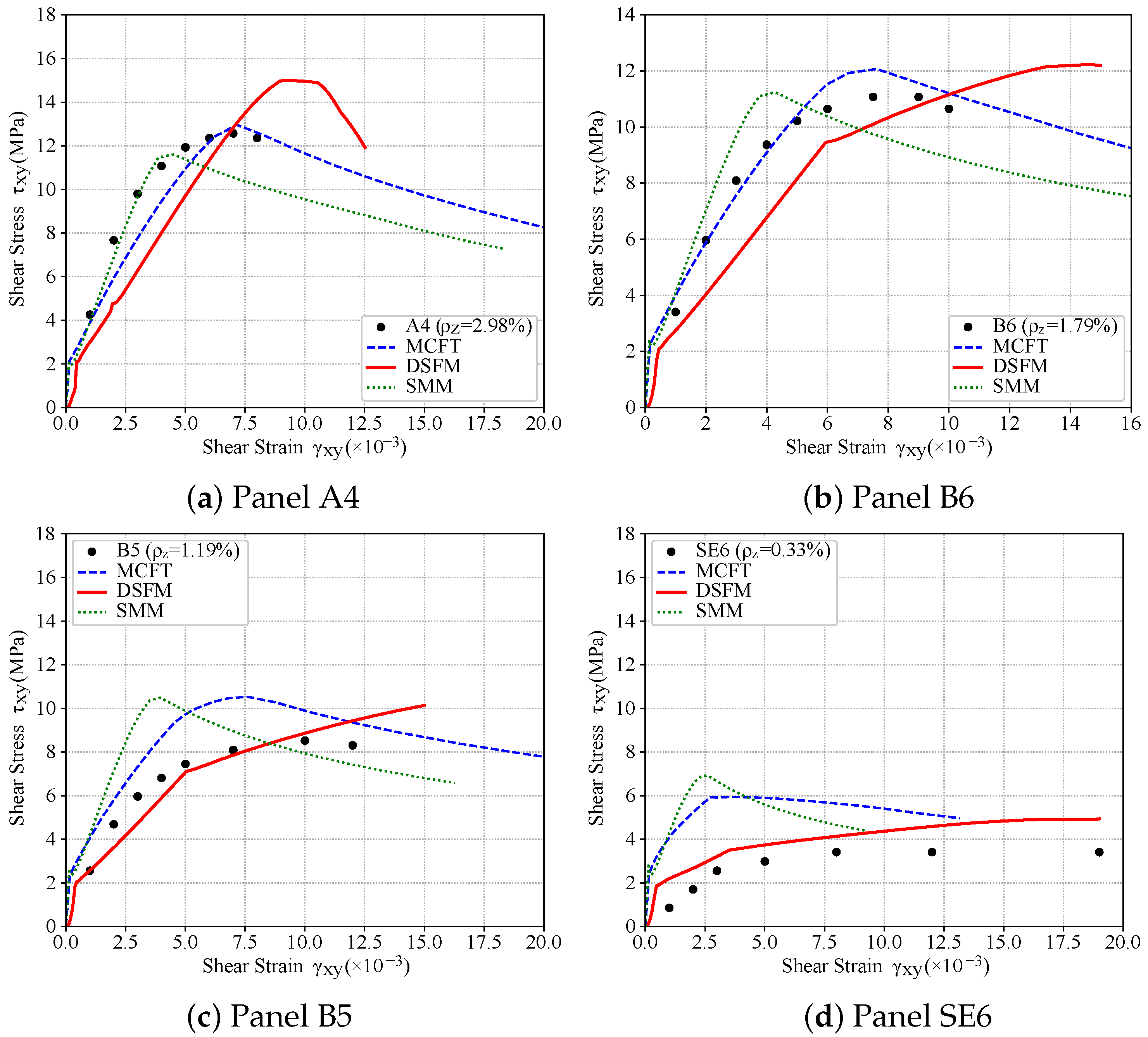
The limitations of fixed-parameter models are highlighted by benchmarking against Vecchio and Collins’ panels [45]. A clear performance bifurcation emerges based on reinforcement ratio. In heavily reinforced elements (e.g., Panels A4, B6), confinement minimizes slip; consequently, MCFT yields the lowest error (RMSE < 1.2 MPa), while standard DSFM ( C s = 0.55 ) proves overly conservative. Conversely, in lightly reinforced elements (e.g., Panel SE6), slip mechanics govern. Here, DSFM accurately predicts the reduced capacity (RMSE 1.07 MPa), whereas MCFT and SMM drastically overpredict strength (RMSE > 2.7 MPa) by neglecting slip limitations. Crucially, these discrepancies—observed even under idealized uniform stresses—suggest that predictive errors will be significantly amplified in beam–column joints, where steep stress gradients and severe bond deterioration prevail (see Figure 2).
To further evaluate the applicability of the standard DSFM to beam–column joints, a diverse database of joint specimens was assembled, representing a broad range of confinement conditions and loading scenarios. The selected specimens are categorized into four distinct series, each serving a specific validation purpose.
The Meinheit and Jirsa (MJ Series) [60]: This series focuses on interior beam–column joints and serves as a fundamental benchmark for evaluating the influence of transverse reinforcement variations on core confinement. By  providing a range of hoop reinforcement ratios, these specimens allow for the calibration of the confinement effectiveness factor (K) in joints where the core is fully confined by adjacent beams on all four faces. The Durrani and Wight (D Series) [61]: Complementing the MJ series, this work investigates interior connections subjected to rigorous seismic demands. These specimens are critical for assessing the model’s performance in well-detailed joints where high shear stresses are developed. They contribute to the study by verifying whether the proposed softening formulation ( β d ) can accurately predict the strength and deformability of modern, ductile connections without overestimating the damping provided by the hysteresis. The Fujii and Morita (F Series) [62]: This series is unique in providing a direct comparative study between interior and exterior joints constructed with identical material properties. Including these specimens is essential for isolating the “geometric effect” on the shear transfer mechanism. It allows the study to rigorously test the unified model’s capability to adapt to different boundary conditions—specifically, whether the same constitutive laws can predict behavior when the confinement is lost on the exterior face. The Walker (W Series) [63]: Representing older, non-seismic construction practices, this series typically investigates joints with zero or negligible transverse reinforcement (deficiencies common in existing infrastructure). These specimens are indispensable for verifying the model’s accuracy in the “slip-critical” regime. They ensure that the proposed formulation correctly captures the brittle failure modes and rapid strength degradation associated with unconfined cores, preventing the model from artificially inflating the capacity of hazardous, non-ductile joints. Together, these four series span the full spectrum of Strut-and-Tie load transfer mechanisms in joint cores-from diagonal-strut-dominated behavior in unconfined joints ( ρ j o i n t = 0 , Walker series) to fully activated truss-and-strut action in seismically detailed connections (D and F series), ensuring that the inverse analysis captures constitutive parameter trends across mechanistically distinct reinforcement configurations. Table 1 summarizes the key material and geometric properties of these specimens.
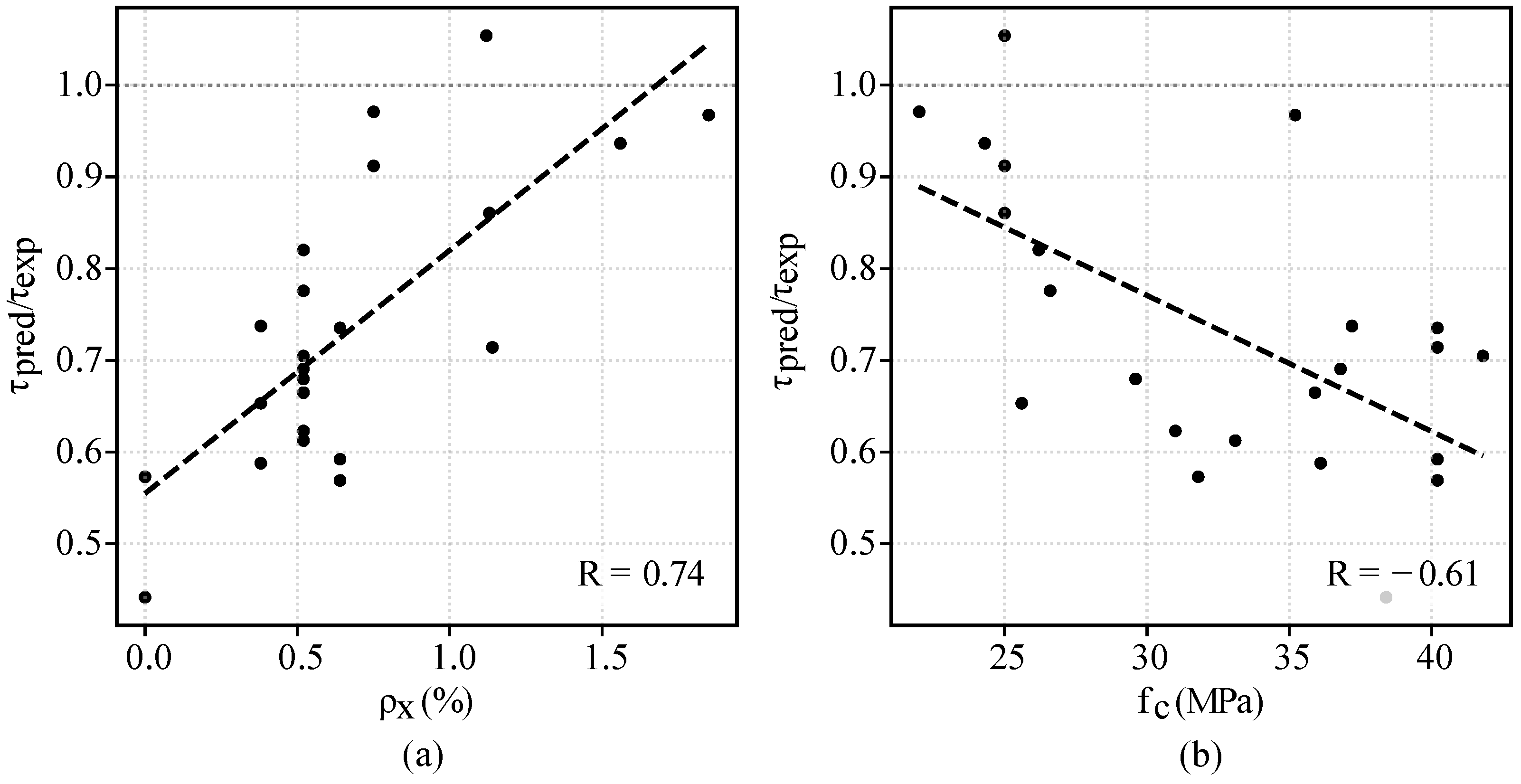
To quantify the model’s reliability across this diverse database, standard DSFM simulations were performed for all 23 joint specimens. The results reveal a systematic bias in predictive accuracy governed by the joint’s confinement characteristics.
As illustrated in the validation comparisons shown in Figure 3, the model accurately predicts the peak strength of highly confined joints, approaching a prediction-to-experimental ratio of 1.0. However, it significantly underestimates the strength of joints characterized by low transverse reinforcement or high concrete brittleness. This divergence confirms that the static constitutive parameters—particularly those governing aggregate interlock and compression softening—are overly conservative for unconfined concrete regions. The standard model fails to account for the inherent arching action and concrete strut contribution that sustain load in ‘as-built’ joints, necessitating a variable-parameter approach that dynamically adapts to the local confinement state.
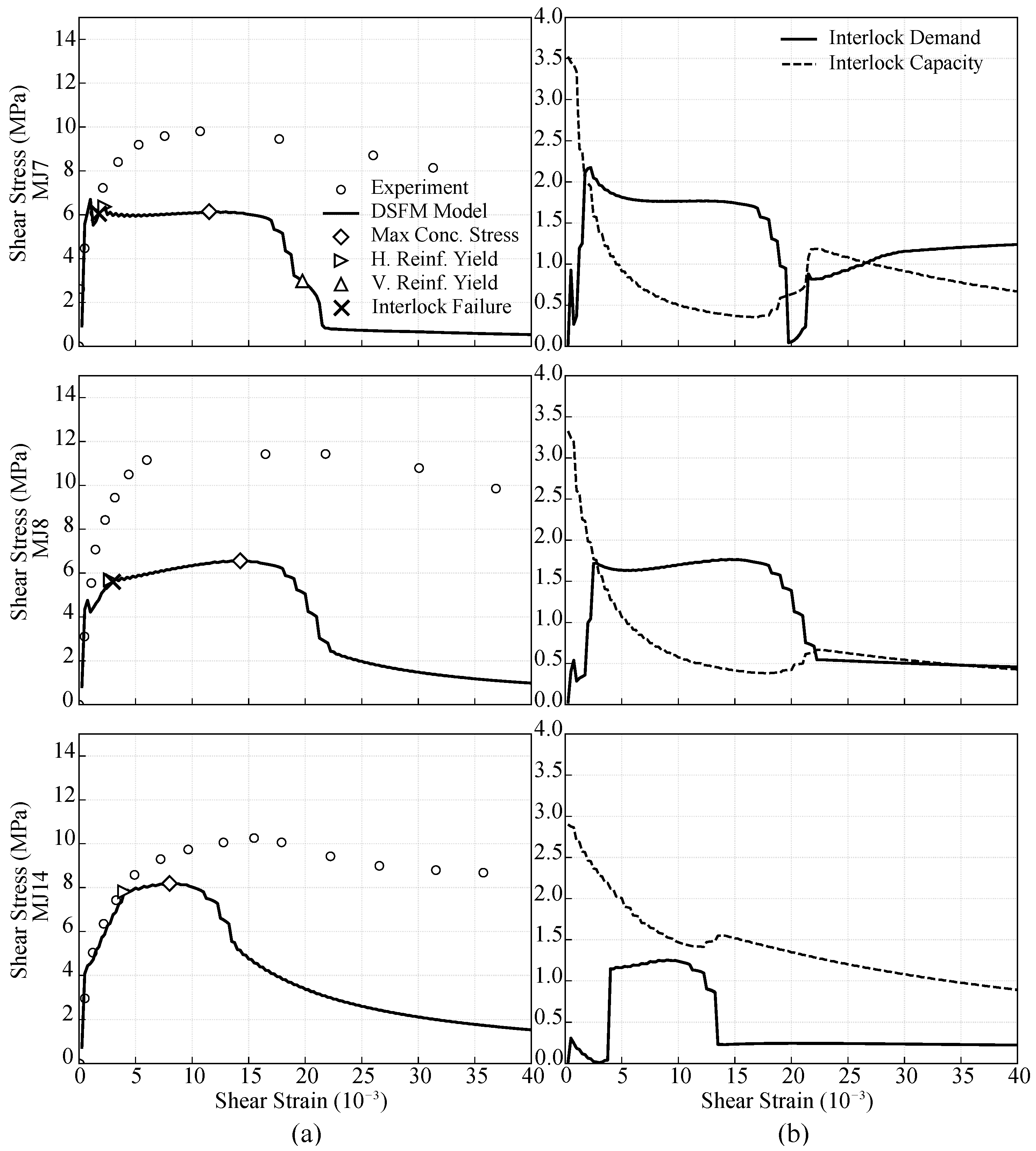
A detailed mechanism analysis elucidates the physical source of these discrepancies. Figure 4 presents the solution history for three representative MJ specimens, arranged by increasing transverse reinforcement ratio ( ρ x ). The analysis reveals that the Standard DSFM systematically underestimates performance due to a premature exhaustion of aggregate interlock capacity ( v c i m a x ).
For the lightly confined specimen (MJ7, ρ x = 0.38 % ), the model predicts a brittle “Interlock Failure” (marked by ×) occurring significantly prior to yielding. As shear cracks widen rapidly due to insufficient transverse restraint, the interlock capacity (dashed line) degrades sharply, intersecting the shear demand curve (solid line) at a low stress level. This results in a premature failure prediction that misses the experimental strength by a wide margin.
In the transition zone (e.g., MJ8, ρ x 0.52 % ), a competing mechanism is observed. While the model correctly predicts the onset of horizontal reinforcement yielding (▸), this ductile response is abruptly terminated by an interlock failure shortly thereafter. This “interrupted yielding” behavior prevents the development of the full plastic plateau observed in the experiment.
Even for the heavily confined specimen (MJ14, ρ x = 1.13 % ), where the failure is correctly governed by yielding, the model continues to underestimate the peak stress. This indicates that beyond the slip mechanism, the standard model fails to capture the confinement-induced enhancement of the concrete compressive strut, leading to conservative predictions.
This consistent pattern—where the premature intersection of interface shear demand and capacity dictates the failure envelope—demonstrates that standard membrane formulations, by neglecting the passive confinement provided by the surrounding frame, systematically underestimate the deformation capacity and shear strength of beam–column joints.

4. Inverse Analysis Methodology

To systematically address the underestimation observed in the forward analysis, this study employs a sequential inverse analysis methodology [64,65]. Unlike traditional calibration approaches that seek a single global set of parameters, the proposed method treats the governing material properties—specifically the confinement effectiveness factor K and the compression softening factor β d —as evolutionary state variables that adapt throughout the loading history.
The identification problem is formulated as a trajectory tracking optimization. The experimental shear stress-strain response is discretized into a series of strain steps γ e x p , i . For each step i, utilizing the internal state variables (stresses and strains) converged at step i 1 (warm start), the algorithm seeks the optimal parameter set x i that minimizes the discrepancy between the model prediction and the experimental observation.
To isolate the distinct contributions of confinement enhancement and compression softening, the optimization was structured in two sequential phases:
Phase 1: Confinement-Driven Optimization (K-Only). The initial phase tests the hypothesis that the standard DSFM’s underestimation stems solely from an inadequate representation of the confinement provided by the column and transverse reinforcement. In this phase, the softening parameter β d is fixed to the standard DSFM formulation (Equation (12)), while the confinement factor K is treated as the sole free variable. The objective is to determine if a theoretically feasible increase in confinement strength alone can align the model with experimental results. The optimization problem for Phase 1 is defined as:
min K Φ i ( K ) = τ D S F M ( γ e x p , i , K , β s t d ) τ e x p , i
subject to : 0.8 K 10.0
where the lower bound ( K = 0.8 ) admits slight deconfinement consistent with the D-region disturbance interpretation discussed in Section 6, and the upper bound ( K = 10.0 ) is intentionally set well above any physically achievable passive confinement level (approximately 3 × the theoretical maximum from confined concrete theory [59]) so that solutions converging to this boundary serve as a diagnostic signal that confinement enhancement alone cannot reproduce the observed response, motivating the two-parameter Phase 2 identification.
Phase 2: Simultaneous Identification ( β d and K). Following the isolation of confinement effects in Phase 1, the second phase expands the optimization space to identify both the confinement factor K and the softening parameter β d simultaneously. This coupled approach is essential to capture the global optimum. It resolves the competing effects of confinement-induced strength enhancement (governed by K) and damage-induced post-peak degradation (governed by β d ). The objective function for Phase 2 is defined as:
min K , β d Φ i = τ D S F M ( γ e x p , i , K , β d ) τ e x p , i
Subject to the physical constraints:
0.8 K 4.0 , 0.05 β d 1.0
The upper bound K 4.0 is grounded in Mander et al.’s confined concrete model [59]: for the lateral confinement pressure ratios achievable in the joint cores of the calibration database (governed by ρ j o i n t , f y h , and section geometry), the theoretical confinement factor ranges from approximately 1.3 to 2.5 . The 4.0 ceiling is therefore generous (approximately 60 % above the theoretical maximum) but was verified to be non-binding: across all 23 calibration specimens, the optimized Phase 2 K values remained below ≈2.5, confirming that the bound exerts no influence on the regression coefficients of Equation (18).
The non-linear optimization problem is solved using the L-BFGS-B (Limited-memory Broyden-Fletcher-Goldfarb-Shanno with Bounds) algorithm [66], a gradient-based quasi-Newton method that enforces hard physical constraints on the material parameters while providing efficient second-order convergence. By extracting the evolution histories of these constitutive parameters ( K ( ϵ ) and β d ( ϵ ) ) for each specimen, this phase generates the foundational dataset required for the multi-variable regression analysis presented in the subsequent sections.
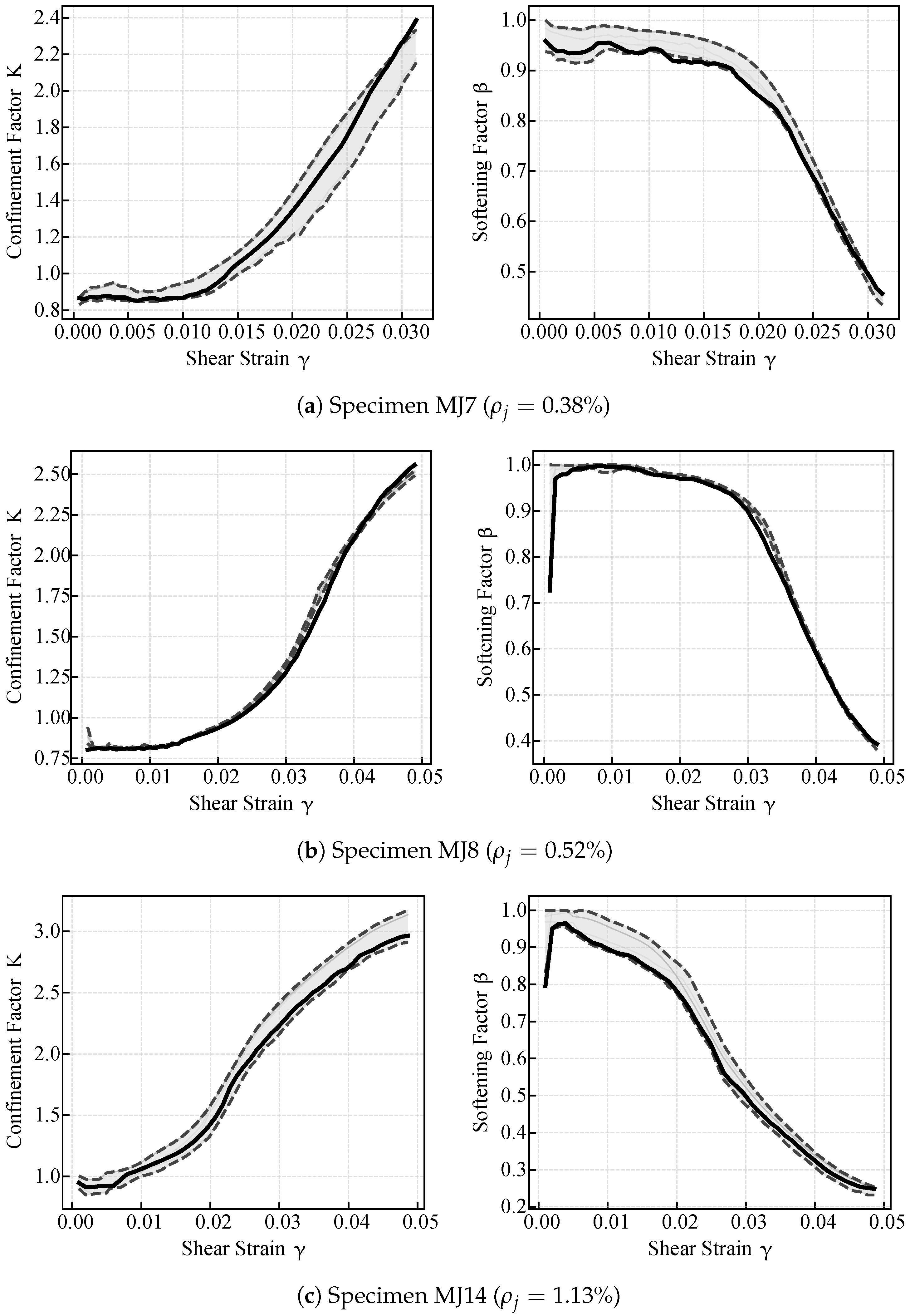
To verify that the gradient-based optimizer does not converge to local minima, a comparative study was conducted on specimens MJ7 ( ρ j = 0.38 % ), MJ8 ( ρ j = 0.52 % ), and MJ14 ( ρ j = 1.13 % ), representing varying levels of transverse reinforcement. The Phase 2 identification was repeated using (I) ten L-BFGS-B runs with randomly sampled initial conditions, and (II) a Dual Annealing algorithm [67], a stochastic global optimizer rooted in generalized simulated annealing, entirely independent of gradient information.
As illustrated in Figure 5, the Dual Annealing solution falls consistently within the min/max envelope of the multi-start L-BFGS-B runs for both K and β d across all three specimens. Minor deviations between the two methods are limited to the deep post-peak regime, where the deteriorating experimental signal-to-noise ratio admits multiple near-equivalent solutions, a  condition that does not affect the subsequent regression, which inherently filters such localized scatter. This agreement between two algorithmically distinct optimization families confirms that the bounded two-dimensional feasible domain is effectively unimodal, and that the identified constitutive trends are not artifacts of local trapping. The L-BFGS-B algorithm was therefore retained for the full database due to its superior computational efficiency for sequential, low-dimensional identification problems.
The computational framework implementing this simultaneous identification strategy is detailed in Algorithm 2. This procedure integrates the gradient-based L-BFGS-B optimizer with the fundamental DSFM solution routine (Algorithm 1), ensuring that the optimal parameter set { K , β d } is systematically extracted at each strain increment while satisfying the defined physical bounds.
Algorithm 2 Simultaneous parameter identification (Phase 2)
Require: Experimental response vectors γ e x p , τ e x p , Material properties
Ensure: Optimized evolution histories K o p t ( ϵ ) , β d , o p t ( ϵ )
  1:
Initialize: Set initial guess x 0 = { K = 1.0 , β d = 1.0 } and bounds L , U .
  2:
for each strain step i = 1 to N do
  3:
      Define Objective:
  4:
         Target: τ t a r g e t = τ e x p [ i ]
  5:
          Φ ( x ) = | τ D S F M ( γ e x p [ i ] , x ) τ t a r g e t |
  6:
      Optimization (L-BFGS-B):
  7:
         Find x * = { K * , β d * } minimizing Φ ( x ) subject to L x * U .
  8:
      Store & Update:
  9:
          K o p t [ i ] K * , β d , o p t [ i ] β d *
10:
        x 0 , i + 1 x * (Warm Start)
11:
end for
12:
Termination: Construct functions K ( ϵ ) , β d ( ϵ ) from arrays.

5. Results and Discussion

5.1. Phase 1: Limitations of the Confinement-Driven Strategy

The initial inverse analysis tested the hypothesis that the systematic underestimation of joint shear strength could be rectified solely by adjusting the confinement effectiveness factor (K), while maintaining the standard compression softening formulation ( β d , s t d ). For this exploratory phase, the upper bound for K was relaxed to 10.0 to investigate the solver’s behavior under extreme confinement assumptions.
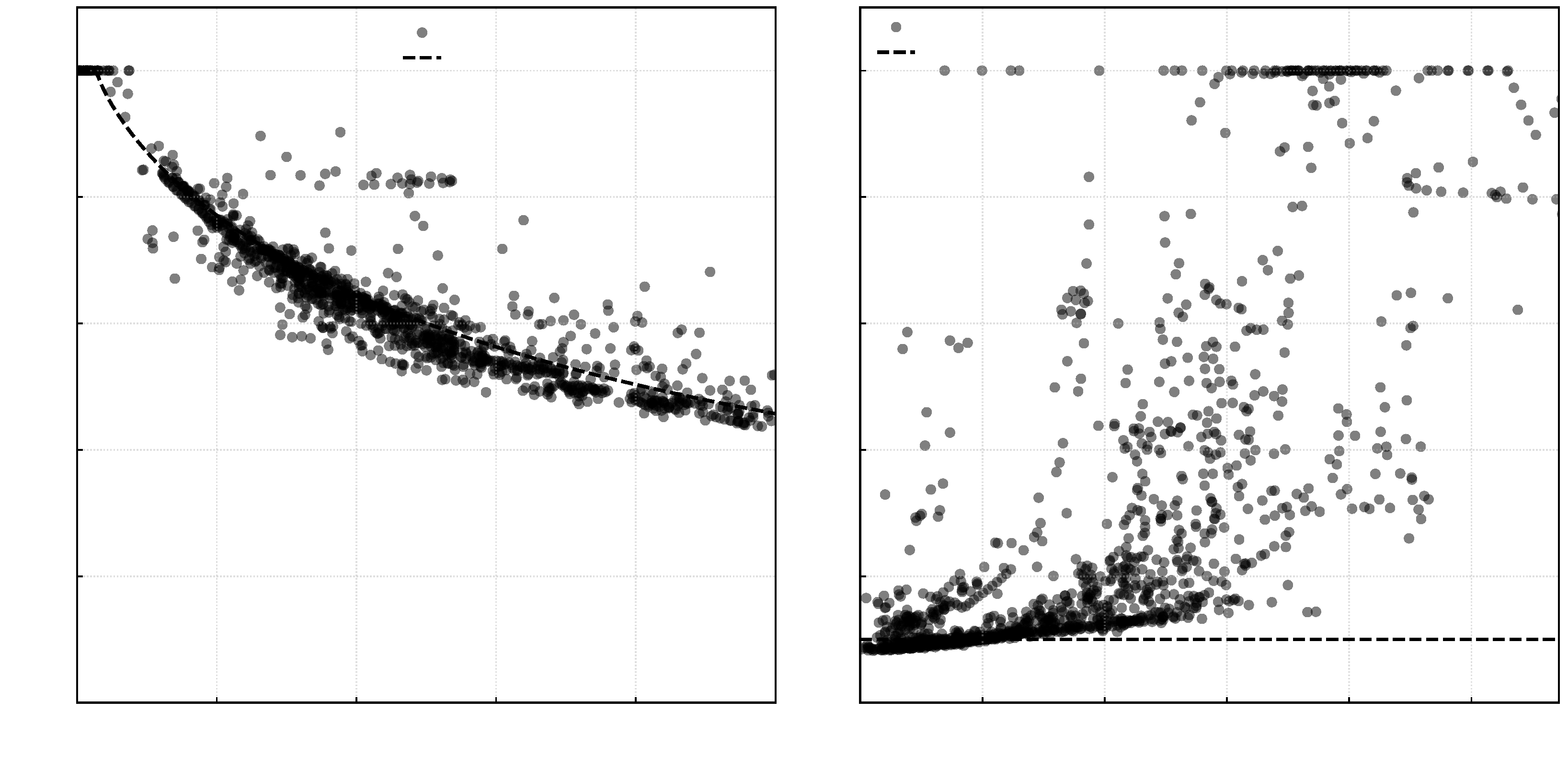
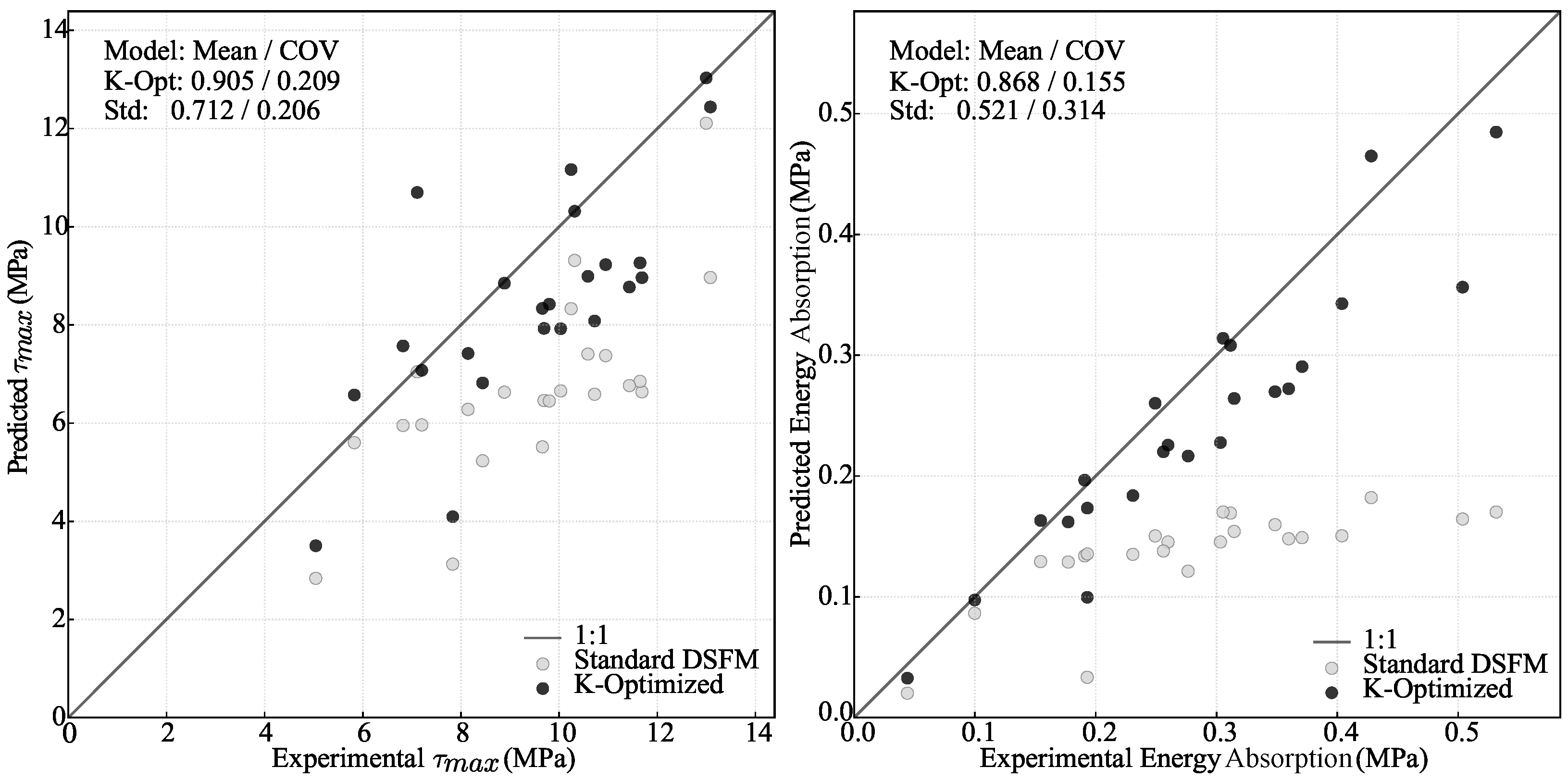
The results of the K-Only optimization are summarized in Figure 6 and Figure 7. Statistically, allowing K to vary yielded a notable improvement in peak strength predictions. As observed in the peak stress comparison (Figure 6, left), the mean predicted-to-experimental strength ratio improved to 0.905 (COV 20.9 % ), rectifying the severe conservatism of the standard model.
However, a closer examination of the internal parameter evolution reveals fundamental inconsistencies that invalidate this decoupled approach. As detailed in Figure 7, a significant portion of the optimized K values clustered at the upper bound limit ( K = 10.0 ). This indicates that the solver, constrained by the overly severe standard softening law, attempted to artificially inflate the confinement factor to physically unrealistic levels in an effort to delay failure. Furthermore, unlike physical material properties which follow continuous laws, the optimized K values exhibit a stochastic scattering against the principal compressive strain ( ϵ 2 ), with no discernible correlation or functional form.
Crucially, while the optimization could mathematically force a match for the peak strength ( τ m a x ), it failed to consistently capture the total energy absorption (Figure 6, right), particularly for ductile specimens. These findings confirm that the standard softening model is too punitive for joint cores and that confinement enhancement alone cannot compensate for this discrepancy. A simultaneous identification of both K and β d is therefore physically required.

5.2. Phase 2: Simultaneous Identification Strategy

Following the failure of the decoupled approach, the simultaneous identification of confinement (K) and softening ( β d ) parameters was executed using the L-BFGS-B algorithm. This coupled strategy yielded a dramatic improvement in predictive accuracy, effectively resolving the inconsistencies observed in Phase 1.
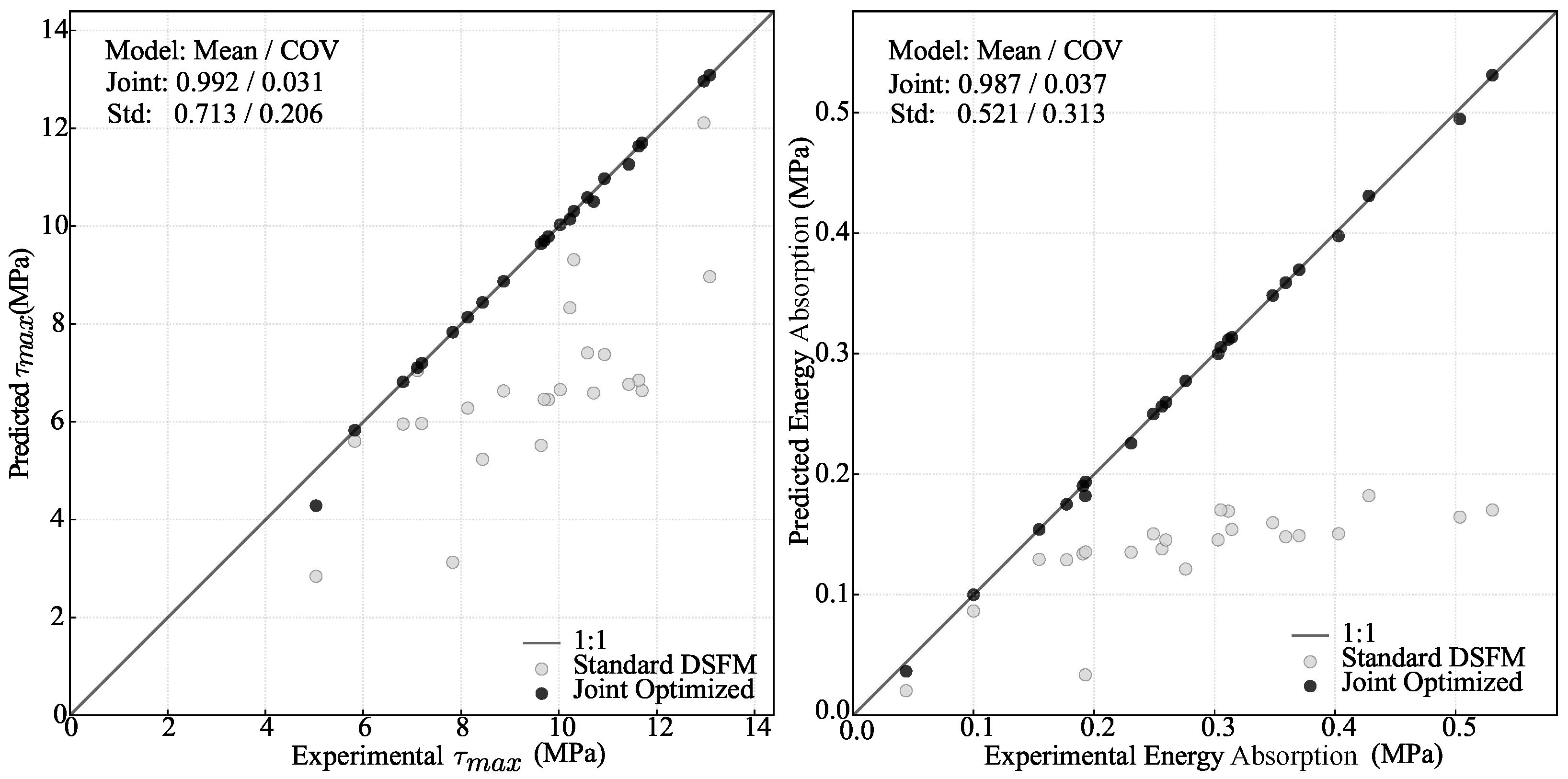
Figure 8 presents the comparison between experimental and predicted results for the complete joint database. Unlike the previous phase, the optimized variable-parameter model achieves a near-perfect correlation with experimental data. The mean predicted-to-experimental strength ratio stands at 0.992 with a negligible coefficient of variation ( 3.1 % ), confirming that the two-parameter formulation provides sufficient degrees of freedom to reproduce the experimental response at each strain step.
More importantly, the improvement extends beyond peak strength to the entire hysteretic behavior. As shown in the energy absorption comparison (Figure 8, right), the model accurately captures the area under the shear stress-strain curves ( R 2 0.99 ). This confirms that by allowing K and β d to evolve together, the formulation correctly reproduces both the strength enhancement provided by confinement and the ductility limitations imposed by concrete softening.
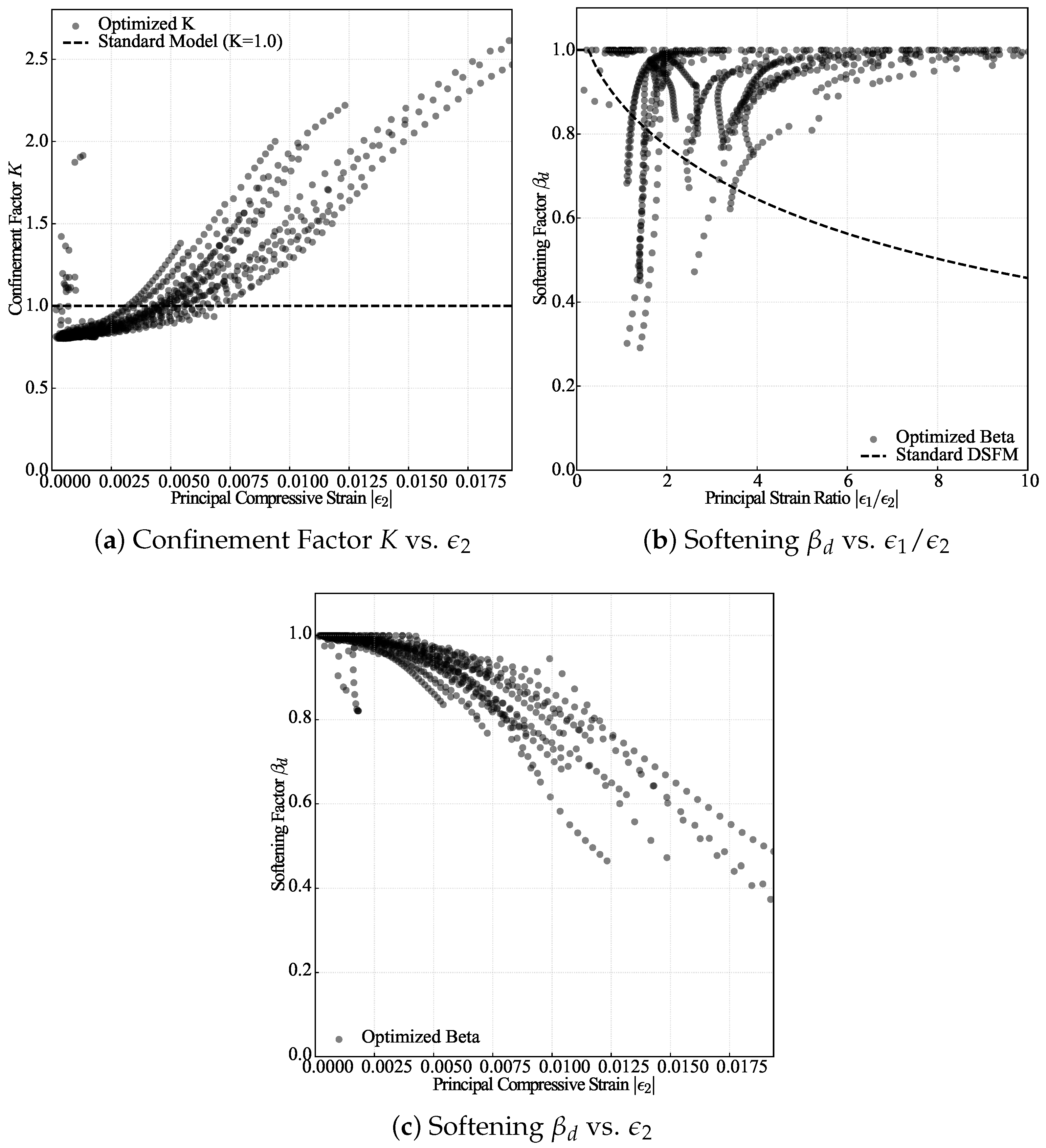
The extracting of evolutionary parameter histories ( K ( ϵ ) and β d ( ϵ ) ) provides deep insights into the physical mechanisms governing joint shear failure. These trends, visualized in Figure 9, challenge established conventions for membrane elements.
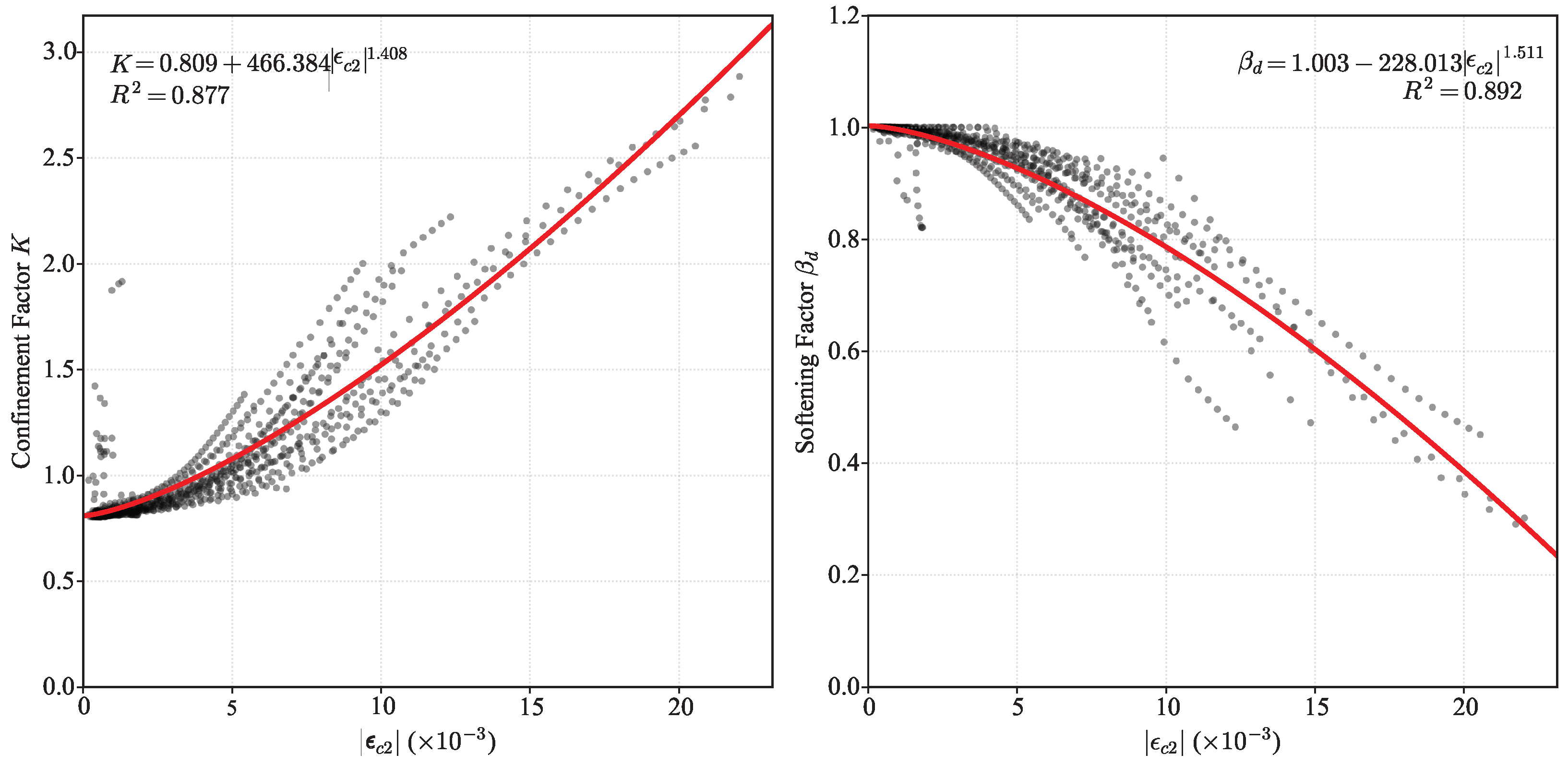
As illustrated in Figure 9a, the optimized confinement factor K exhibits a clear, non-linear positive correlation with the principal compressive strain ( ϵ 2 ). In the early loading stages ( ϵ 2 0 ), K remains near unity ( 1.0 ), reflecting the lack of passive confinement pressure. As deformation progresses and the concrete core expands laterally, the transverse reinforcement is activated, leading to a steady increase in K, reaching values between 2.0 and 2.5 at ultimate limit states. This trend aligns perfectly with the physical concept of “passive confinement” developing as a function of core dilation.
A critical finding of this study emerges from the analysis of the softening parameter β d . Standard theories (e.g., MCFT, DSFM) traditionally model β d as a function of the principal strain ratio ( ϵ 1 / ϵ 2 ), assuming that tensile cracking is the primary driver of strength degradation.
However, the inverse analysis results plotted against the strain ratio (Figure 9b) reveal a scattered, chaotic distribution with no discernible trend. This suggests that for beam–column joints—which are subjected to high shear stresses and distinct boundary conditions—the “disturbance” caused by transverse tensile strains is not the dominant governing variable.
In contrast, when the same optimized β d values are plotted against the principal compressive strain ( ϵ 2 ) (Figure 9c), a highly organized, monotonically decreasing trend emerges. This indicates a paradigm shift: the softening mechanism in joints is primarily driven by compressive damage accumulation rather than tensile crack widening. The relationship demonstrates that as the compressive strain demand increases, the effective concrete strength degrades following a consistent damage trajectory, independent of the transverse tensile state.

6. Proposed Constitutive Models

Based on the optimized parameter histories obtained from the simultaneous inverse analysis, a comprehensive regression analysis was performed to derive generalized constitutive models suitable for internal beam–column joints. While the potential predictive capability of secondary variables—including concrete compressive strength ( f c ) and horizontal reinforcement ratio ( ρ x )—was rigorously evaluated, statistical sensitivity analysis revealed that the principal compressive strain, | ϵ c 2 | , acts as the overwhelming dominant independent variable governing both confinement and softening behaviors.
Attempts to incorporate these auxiliary variables yielded statistically negligible improvements in correlation ( R 2 gains < 2 % ). Consequently, a unified approach based on the principle of parsimony was adopted. As illustrated in Figure 10, power-law functions were identified as the optimal mathematical form for the global dataset, capturing the nonlinear evolution of the constitutive properties with high fidelity.
For the confinement effectiveness factor K, the regression analysis yields the following expression ( R 2 = 0.877 ):
K = 0.809 + 466.38 | ϵ c 2 | 1.41 for K 4.0
This relationship (Figure 10, left) initiates at K 0.81 at the onset of loading. This sub-unity initial value reflects the pre-activation state of the joint core: prior to significant shear deformation, the transverse reinforcement has not yet been engaged by lateral dilation, and the concrete operates in a disturbed stress field characterized by multi-directional demands from the framing action, stress concentrations at the beam–column interface, and transverse tension from reinforcement anchorage. These conditions reduce the effective in situ concrete strength relative to the uniaxial cylinder strength f c , consistent with the well-established distinction between B-regions and D-regions. As deformation progresses and the concrete core expands laterally, the transverse reinforcement is progressively activated, leading to a rapid, non-linear increase in K (with the exponent 1.41 reflecting the characteristic passive confinement mechanism) eventually reaching values between 2.0 and 2.5 at ultimate limit states. It should be noted that at the very low strain levels where K < 1.0 , the joint is far from its strength limit, and the structural response is minimally sensitive to the exact value of the confinement factor.
Simultaneously, the compression softening factor β d is defined by a decay function ( R 2 = 0.892 ):
β d = 1.003 228.01 | ϵ c 2 | 1.51 for β d 0.1
As shown in Figure 10 (right), Equation (19) initiates at unity (≈1.0), consistent with undamaged concrete, and captures the progressive damage accumulation driven by compressive strains. The explicit dependence on | ϵ c 2 | rather than the traditional strain ratio ϵ 1 / ϵ 2 marks a fundamental deviation from standard panel-based theories, offering a more robust predictor for the shear-critical stress states observed in joint cores.
It is important to emphasize that the statistics reported in Figure 8 reflect the quality of the per-step inverse fit, not the predictive accuracy of a constitutive model. Since both K and β d are treated as free variables at each strain increment, the near-perfect agreement is expected by construction. The significance of these results lies in their comparison with the Phase 1 outcome (Figure 6): even with a free confinement factor at every step, optimizing K alone could not reproduce the experimental response, confirming the physical necessity of simultaneously recalibrating the softening law.
To verify that the proposed regression is not dominated by any individual specimen or test series, a leave-one-out cross-validation (LOOCV) was performed. Each of the 23 calibration specimens was sequentially excluded, and the power-law expressions (Equations (18) and (19)) were refitted on the remaining data. As summarized in Table 2, the physically governing exponents exhibit negligible sensitivity to specimen exclusion (COV = 1.5 % for K; COV = 1.7 % for β d ), and the full-dataset coefficients fall within one standard deviation of the LOOCV mean in all cases. The scale coefficients show moderately higher variation (COV ≈ 8–11%), which is expected given their sensitivity to the leverage of individual specimens at extreme strain levels, but their LOOCV means remain very close to the full-data values. This stability confirms that the parsimonious formulation captures a robust, specimen-independent constitutive trend rather than case-specific noise.

7. Validation of the Proposed Model

To ensure that the proposed constitutive models possess true predictive generality and are not merely artifacts of overfitting to the training dataset, an extensive independent validation database was constructed. It is emphasized that the calibration and validation databases are strictly disjointed. The 23 specimens used for the inverse identification (Table 1) belong exclusively to four test series and were not included in the validation database. The 113 validation specimens described below were compiled from entirely independent experimental campaigns and played no role in the parameter extraction or regression analysis. This repository comprises experimental data from a total of 113 beam–column joint specimens (79 interior and 34 exterior joints), collected from comprehensive experimental campaigns spanning over three decades [29,60,68]. The database integrates pivotal studies from major seismic research centers globally, including contributions from New Zealand [68], the United States [69,70,71], and extensive investigations in Japan [72,73,74,75,76].
To strictly verify the damage-based softening formulation (Equation (19)), the database explicitly includes specimens utilizing various concrete strengths and reinforcement configurations. This subset draws from the works of Joh et al. [77,78], Ehsani & Alameddine [79], Kitayama et al. [80], Noguchi & Kashiwazaki [81], Oka & Shiohara [82], and Guimaraes et al. [83]. Additionally, lightweight concrete variations studied by Endoh et al. [84] are included to test the model’s material versatility.
The robustness of the confinement formulation (Equation (18)) was challenged against specimens featuring complex geometric and loading conditions. This includes eccentric connections [71,85,86,87,88,89], bi-directional loading protocols [90,91,92], and varying bond conditions [93]. Furthermore, studies focusing on ductility estimation [94], deformation characteristics [95], and interior vs. exterior joint behavior comparisons [96] were incorporated to ensure a holistic evaluation of the unified model.
The statistical properties of the compiled validation database are summarized in Table 3. As tabulated, the dataset represents a highly heterogeneous collection of specimens. Notably, the concrete compressive strength ( f c ) ranges from normal strength ( 17.1 MPa) to high-strength concrete ( 92.1 MPa), which is critical for validating the proposed crushing-based softening law. Similarly, the horizontal reinforcement ratio ( ρ s h ) varies significantly from 0.10 % (representing poorly confined, non-seismic joints) to 2.40 % (highly confined, modern seismic joints). The inclusion of both interior and exterior sub-assemblages, with varying aspect ratios ( h b / h c ) and column axial load levels ( P / f c A g up to 0.48 ), ensures that the validation tests the model’s generality against diverse geometric and boundary conditions.
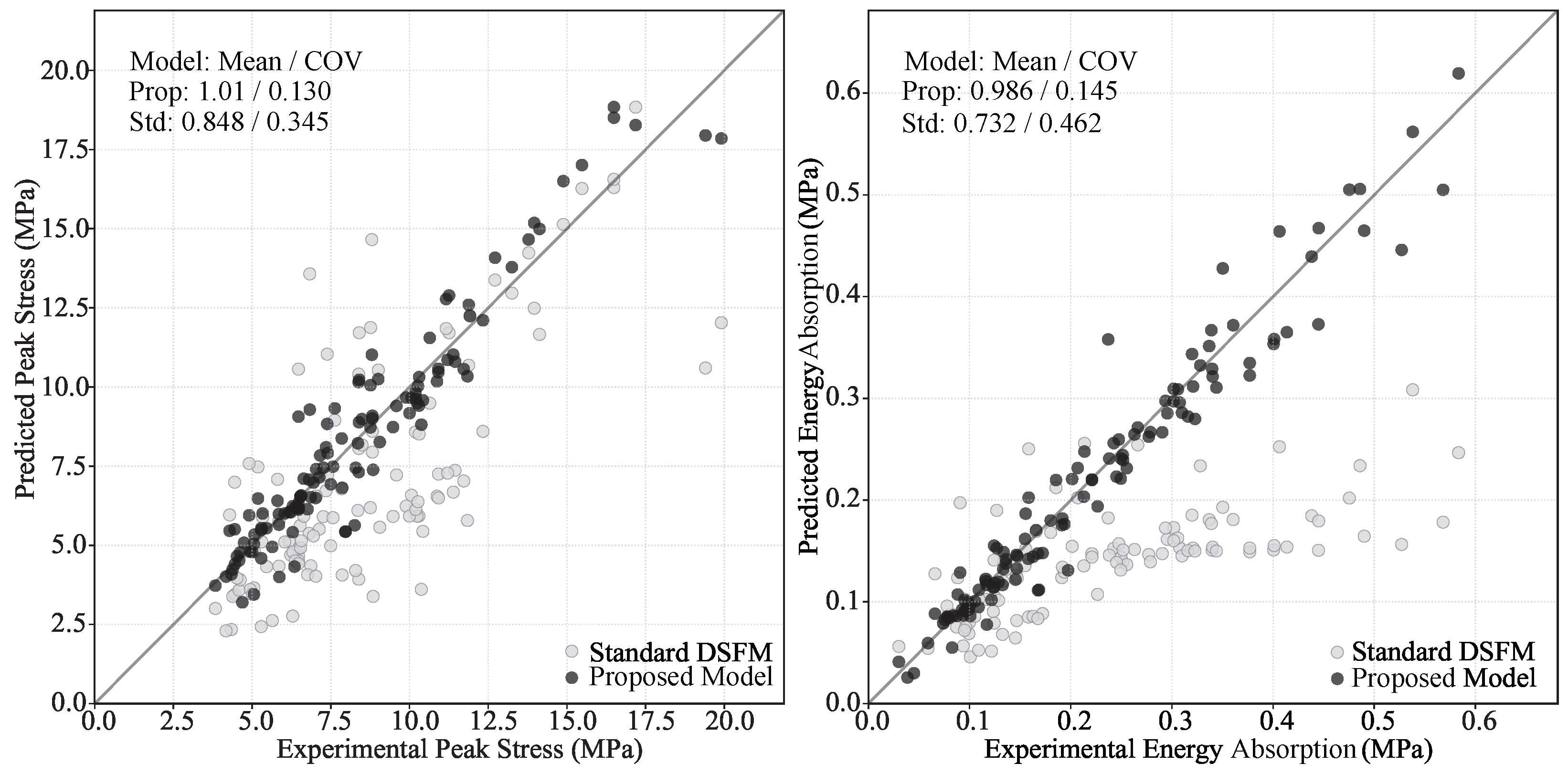
The predictive accuracy of the proposed unified model was evaluated against the independent validation database of 113 specimens, using the Standard DSFM formulation as a benchmark. Figure 11 illustrates the correlation between the experimental ( V e x p ) and predicted ( V p r e d ) joint shear strengths. The analysis reveals a remarkable improvement in global accuracy with the proposed formulation. While the Standard DSFM exhibited a systematic tendency towards conservatism—characterized by a mean experimental-to-predicted ratio of 0.85 and a high coefficient of variation of 34.5 % —the proposed unified model achieved a mean ratio of 1.01 with a significantly reduced coefficient of variation of 13.0%. This rectification addresses the standard model’s inherent limitation of predicting premature interlock failure in lightly reinforced joints.
Crucially, the improvement is even more pronounced in the prediction of energy absorption capacity, which serves as a vital proxy for the model’s ability to capture the full hysteretic loop. As demonstrated in Figure 11 (right), the Standard Model severely underestimated the energy absorption (Mean = 0.73 , COV = 46.2 % ), failing to account for the ductility enhancement provided by confinement. In contrast, the Proposed Model accurately reproduced the post-peak response, achieving a mean ratio of 0.99 and a COV of 14.5%.
The robustness of the unified formulation was further verified across the distinct and challenging subsets of the database. For specimens constructed with any concrete strength grade, the proposed damage-based softening law ( β d ) correctly captured the brittle post-peak response, effectively eliminating the overestimations often observed with conventional ductility-based models. Furthermore, the model demonstrated exceptional geometric versatility; the prediction error for exterior joints, which lack effective confinement on one face, was statistically indistinguishable from that of fully confined interior joints. This confirms that the unified confinement factor (K) successfully adapts to varying boundary conditions without requiring case-specific calibration.
While the proposed formulation demonstrates favorable predictive accuracy across the full range of the validation database, including high-strength concrete specimens up to 92.1 MPa and lightweight concrete, it should be noted that the inverse calibration was performed exclusively on normal-strength concrete ( f c = 22 –42 MPa). The absence of an explicit f c dependence in Equations (18) and (19), supported by the negligible improvement observed when f c was included as an auxiliary regression variable ( R 2 gain < 2 % ), suggests that the principal compressive strain serves as a sufficiently general damage indicator across the validated strength range. Nevertheless, high-strength concrete exhibits fundamentally different fracture characteristics—including aggregate fracture rather than interface debonding and reduced aggregate interlock capacity—that may alter the governing softening mechanism at strength levels substantially beyond the present validation domain. Extending the inverse calibration database to explicitly include high-strength and lightweight concrete specimens is therefore identified as a priority for future investigation.

8. Conclusions

The following key conclusions are drawn from this study:
  • Confinement-only optimization is physically insufficient: even when K is freely varied to its upper bound at every strain step, the standard compression-softening formulation cannot reproduce the measured energy absorption, confirming that β d must be recalibrated simultaneously.
  • Joint softening is governed by the principal compressive strain | ε c 2 | , not by the principal strain ratio ε 1 / ε 2 assumed in panel-based theories, indicating that failure in beam–column joint cores is driven by compressive damage accumulation rather than crack widening.
  • Parsimonious power-law expressions for K ( ε c 2 ) and β d ( ε c 2 ) as sole functions of | ε c 2 | achieve R 2 0.89 with no auxiliary variables, confirming that the principal compressive strain is a sufficient damage indicator for joint cores.
  • The proposed model eliminates the systematic conservatism of the standard DSFM: the mean experimental-to-predicted shear strength ratio improves from 0.85 to 1.01 and the coefficient of variation from 34.5 % to 13.0 % on an independent validation database of 113 specimens.
  • The improvement extends to energy absorption prediction (mean 0.99 , COV 14.5 % ), confirming that the recalibrated formulation captures the full post-peak response, not only peak strength.
From a practical standpoint, the proposed constitutive relationships (Equations (18) and (19)) are intended to replace the fixed parameters of the standard DSFM in a straightforward computational workflow. Given the material and geometric properties of a joint, the DSFM equilibrium-compatibility solver is run incrementally, with K and β d updated at each strain step according to the current value of | ε c 2 | . The output is the complete monotonic shear stress-strain backbone, which serves as the envelope for hysteretic constitutive models (e.g., Pinching4 in OpenSees) used in nonlinear time-history analysis of RC frame structures. This workflow requires no additional experimental data beyond standard material properties and is applicable to both interior and exterior joint configurations, as demonstrated in the validation phase.
While the proposed formulation is validated over a broad range of material and geometric conditions, three classes of scenarios lie outside the validated scope and warrant explicit acknowledgement. First, non-rectangular joint geometries (e.g., circular column sections or T-beam contributions to joint confinement) require reformulation of the DSFM panel equilibrium; the proposed constitutive functions K ( ε c 2 ) and β d ( ε c 2 ) remain applicable at the material level but must be embedded in an appropriately reformulated equilibrium solver, a task shared by any DSFM-based joint model and not specific to the present calibration. Second, configurations with substantially non-orthogonal seismic reinforcement (diagonal bars, skewed layouts) are not represented in either database; for moderate deviations from orthogonality (≲15°) the principal-strain formulation is expected to remain valid, but explicit calibration against specimens with such details would be prudent for larger deviations. Third, the calibration and validation databases consist of laboratory-scale specimens (column sections 200 –400 mm); the use of a dimensionless strain-based damage variable provides the best available basis for cross-scale application, but very large joints (column depth 600 mm) are outside the validated range and should be treated with additional caution.

Funding

This research received no external funding.

Data Availability Statement

The experimental data used for the validation and inverse analysis were compiled from publicly available literature sources as cited in the manuscript. The consolidated dataset and the source code used for the numerical implementation are available from the corresponding author upon reasonable request.

Acknowledgments

The author would like to thank the Department of Civil Engineering at Yıldız Technical University for providing the computational resources facilitating this study. The author also gratefully acknowledges the researchers whose experimental data were utilized in the validation phase; their meticulous reporting made this inverse analysis possible.

Conflicts of Interest

The author declares no conflicts of interest.

Abbreviations

The following abbreviations are used in this manuscript:
ACI      American Concrete Institute
ANN      Artificial Neural Networks
CEN      European Committee for Standardization
COV      Coefficient of Variation
DSFM      Disturbed Stress Field Model
GRNNGeneralized Regression Neural Networks
L-BFGS-BLimited-memory Broyden-Fletcher-Goldfarb-Shanno with Bounds
MCFTModified Compression Field Theory
MLMachine Learning
RCReinforced Concrete
RMSERoot Mean Square Error
SMMSoftened Membrane Model
STMStrut-and-Tie Models

References

  1. Altoontash, A. Simulation and Damage Models for Performance Assessment of Reinforced Concrete Beam-Column Joints. Ph.D. Thesis, Stanford University, Stanford, CA, USA, 2004. [Google Scholar]
  2. Wong, H.; Kuang, J. Predicting shear strength of RC interior beam-column joints by modified rotating-angle softened-truss model. Comput. Struct. 2014, 133, 12–17. [Google Scholar] [CrossRef]
  3. Eom, T.S.; Hwang, H.J.; Park, H.G. Energy-based hysteresis model for reinforced concrete beam-column connections. ACI Struct. J. 2015, 112, 157–166. [Google Scholar] [CrossRef]
  4. Sengupta, P.; Li, B. Hysteresis modeling of reinforced concrete structures: State of the art. ACI Struct. J. 2017, 114, 25–38. [Google Scholar] [CrossRef]
  5. Noor, U.; Javed, M.; Shahzada, K. Experimental and numerical approaches for evaluating steel fiber reinforced concrete beam column joints: A state-of-the-art review. Adv. Struct. Eng. 2025, 28, 2961–2998. [Google Scholar] [CrossRef]
  6. Öztürk, M.; Karan, M. Impact of near-fault seismic inputs on building performance: A case study informed by the 2023 Maras earthquakes. Appl. Sci. 2025, 15, 10142. [Google Scholar] [CrossRef]
  7. ACI Committee 352. Recommendations for Design of Beam-Column Connections in Monolithic Reinforced Concrete Structures (ACI 352R-02); American Concrete Institute: Farmington Hills, MI, USA, 2002. [Google Scholar]
  8. CEN (European Committee for Standardization). Eurocode 8: Design of Structures for Earthquake Resistance—Part 1: General Rules, Seismic Actions and Rules for Buildings; European Committee for Standardization: Brussels, Belgium, 2004. [Google Scholar]
  9. Unal, M.; Burak, B. Development and analytical verification of an inelastic reinforced concrete joint model. Eng. Struct. 2013, 52, 284–294. [Google Scholar] [CrossRef]
  10. ACI Committee 318. Building Code Requirements for Structural Concrete (ACI 318-19) and Commentary; American Concrete Institute: Farmington Hills, MI, USA, 2019. [Google Scholar]
  11. American Society of Civil Engineers. Seismic Evaluation and Retrofit of Existing Buildings (ASCE/SEI 41-17); American Society of Civil Engineers: Reston, VA, USA, 2017. [Google Scholar]
  12. Shiohara, H. New model for shear failure of reinforced concrete beam-column joints. J. Struct. Eng. 2001, 127, 152–160. [Google Scholar] [CrossRef]
  13. Mitra, N. Behavior, Modeling, and Design of Reinforced Concrete Beam-Column Connections. Ph.D. Thesis, University of Washington, Seattle, WA, USA, 2007. [Google Scholar]
  14. Ožbolt, J.; Li, Y.; Kožar, I. Microplane model for concrete with relaxed kinematic constraint. Int. J. Solids Struct. 2001, 38, 2683–2711. [Google Scholar] [CrossRef]
  15. Najafgholipour, M.; Dehghan, S.; Dooshabi, A.; Niroomandi, A. Finite element analysis of reinforced concrete beam-column connections with governing joint shear failure mode. Lat. Am. J. Solids Struct. 2017, 14, 1200–1225. [Google Scholar] [CrossRef]
  16. Barbosa, A.; Ribeiro, G. Analysis of reinforced concrete structures using ANSYS nonlinear concrete model. In Proceedings of the Computational Mechanics: New Trends and Applications; Idelsohn, S., Oñate, E., Dvorkin, E., Eds.; CIMNE: Barcelona, Spain, 1998; pp. 1–7. [Google Scholar]
  17. Wahalathantri, B.; Thambiratnam, D.; Chan, T.; Fawzia, S. A material model for flexural crack simulation in reinforced concrete elements using ABAQUS. In Proceedings of the 1st International Postgraduate Conference on Engineering, Designing and Developing the Built Environment for Sustainable Wellbeing (eddBE 2011), Brisbane, QLD, Australia, 27–29 April 2011; pp. 260–264. [Google Scholar]
  18. Lee, J.; Fenves, G. Plastic-damage model for cyclic loading of concrete structures. J. Eng. Mech. 1998, 124, 892–900. [Google Scholar] [CrossRef]
  19. Jankowiak, T.; Lodygowski, T. Identification of parameters of concrete damage plasticity constitutive model. Found. Civ. Environ. Eng. 2005, 6, 53–69. [Google Scholar]
  20. Zreid, I.; Kaliske, M. An implicit gradient formulation for microplane Drucker-Prager plasticity. Int. J. Plast. 2016, 83, 252–272. [Google Scholar] [CrossRef]
  21. Baktheer, A.; Aguilar, M.; Chudoba, R. Comprehensive review of the microplane framework for constitutive modeling focused on homogenization approaches. Arch. Comput. Methods Eng. 2025; Published online 9 September 2025. [Google Scholar] [CrossRef]
  22. Cotsovos, D. A simplified approach for assessing the load-carrying capacity of reinforced concrete beams under concentrated load applied at high rates. Int. J. Impact Eng. 2010, 37, 907–917. [Google Scholar] [CrossRef]
  23. Celik, O.; Ellingwood, B. Seismic fragilities for non-ductile reinforced concrete frames—Role of aleatoric and epistemic uncertainties. Struct. Saf. 2010, 32, 1–12. [Google Scholar] [CrossRef]
  24. Amirsardari, A.; Goldsworthy, H.; Lumantarna, E. Modelling non-ductile reinforced concrete beam-column joints. In Proceedings of the Tenth Pacific Conference on Earthquake Engineering (PCEE), Sydney, Australia, 6–8 November 2015. [Google Scholar]
  25. El-Metwally, S.; Chen, W. Moment-rotation modeling of reinforced concrete beam-column connections. ACI Struct. J. 1988, 85, 384–394. [Google Scholar] [CrossRef]
  26. Alath, S.; Kunnath, S. Modeling inelastic shear deformation in RC beam-column joints. In Proceedings of the Engineering Mechanics: Proceedings of the Tenth Conference, Boulder, CO, USA, 21–24 May 1995; pp. 822–825. [Google Scholar]
  27. Biddah, A.; Ghobarah, A. Modelling of shear deformation and bond slip in reinforced concrete joints. Struct. Eng. Mech. 1999, 7, 413–432. [Google Scholar] [CrossRef]
  28. Youssef, M.; Ghobarah, A. Modelling of RC beam-column joints and structural walls. J. Earthq. Eng. 2001, 5, 93–111. [Google Scholar] [CrossRef]
  29. Shin, M.; LaFave, J. Modeling of cyclic joint shear deformation contributions in RC beam-column connections to overall frame behavior. Struct. Eng. Mech. 2004, 18, 645–670. [Google Scholar] [CrossRef]
  30. Lowes, L.; Altoontash, A. Modeling reinforced-concrete beam-column joints under reversed cyclic loading. J. Struct. Eng. 2003, 129, 1696–1707. [Google Scholar] [CrossRef]
  31. McKenna, F.; Fenves, G.; Scott, M. Open system for earthquake engineering simulation. In Proceedings of the 12th World Conference on Earthquake Engineering, Auckland, New Zealand, 30 January–4 February 2000; Volume 1. [Google Scholar]
  32. Shafaei, J.; Hosseini, A.; Marefat, M. Seismic retrofit of external RC beam-column joints by joint enlargement using prestressed steel angles. Eng. Struct. 2014, 81, 265–288. [Google Scholar] [CrossRef]
  33. Yilmaz, M. Prediction of Response and Damage of Reinforced Concrete Joints Through Artificial Intelligence Techniques. Ph.D. Thesis, Yildiz Technical University (YTU), Graduate School of Natural and Applied Sciences, Istanbul, Türkiye, 2023. [Google Scholar]
  34. LaFave, J.; Kim, J.H. Joint shear behavior prediction for RC beam-column connections. Int. J. Concr. Struct. Mater. 2011, 5, 57–64. [Google Scholar] [CrossRef]
  35. Jeon, J.S.; Lowes, L.; DesRoches, R.; Brilakis, I. Fragility curves for non-ductile reinforced concrete frames that exhibit different component response mechanisms. Eng. Struct. 2015, 85, 127–143. [Google Scholar] [CrossRef]
  36. Pampanin, S.; Magenes, G.; Carr, A. Modelling of shear hinge mechanism in poorly detailed RC beam-column joints. In Proceedings of the Fib Symposium: Concrete Structures in Seismic Regions, Athens, Greece, 6–8 May 2003. [Google Scholar]
  37. Kim, J.; LaFave, J. A simplified approach to joint shear behavior prediction of RC beam-column connections. Earthq. Spectra 2012, 28, 1071–1096. [Google Scholar] [CrossRef]
  38. Park, S.; Mosalam, K. Parameters for shear strength prediction of exterior beam-column joints without transverse reinforcement. Eng. Struct. 2012, 36, 198–209. [Google Scholar] [CrossRef]
  39. Hassan, W. Analytical and Experimental Assessment of Seismic Vulnerability of Beam-Column Joints Without Transverse Reinforcement in Concrete Buildings. Ph.D. Thesis, University of California, Berkeley, CA, USA, 2011. [Google Scholar]
  40. Grande, E.; Imbimbo, M.; Marfia, S.; Sacco, E. A nonlinear macro-model for the analysis of monotonic and cyclic behaviour of exterior RC beam-column joints. Front. Mater. 2021, 8, 719716. [Google Scholar] [CrossRef]
  41. Gombosuren, D.; Maki, T. Prediction of joint shear deformation index of RC beam-column joints. Buildings 2020, 10, 176. [Google Scholar] [CrossRef]
  42. Yılmaz, M.; Bekiroğlu, S. Prediction of joint shear strain-stress envelope through generalized regression neural networks. Arab. J. Sci. Eng. 2021, 46, 10819–10833. [Google Scholar] [CrossRef]
  43. Suwal, N.; Guner, S. Plastic hinge modeling of reinforced concrete beam-column joints using artificial neural networks. Eng. Struct. 2024, 298, 117012. [Google Scholar] [CrossRef]
  44. Kang, T.K.; Shin, M.; Mitra, N.; Bonacci, J. Seismic design of reinforced concrete beam-column joints with headed bars. ACI Struct. J. 2009, 106, 868–877. [Google Scholar] [CrossRef]
  45. Vecchio, F.; Collins, M. The modified compression-field theory for reinforced concrete elements subjected to shear. ACI J. 1986, 83, 219–231. [Google Scholar] [CrossRef]
  46. Hsu, T. Unified Theory of Reinforced Concrete; CRC Press: Boca Raton, FL, USA, 1993. [Google Scholar] [CrossRef]
  47. Vecchio, F. Disturbed stress field model for reinforced concrete: Formulation. J. Struct. Eng. 2000, 126, 1070–1077. [Google Scholar] [CrossRef]
  48. Sagbas, G.; Vecchio, F.; Christopoulos, C. Computational modeling of the seismic performance of beam-column subassemblies. J. Earthq. Eng. 2011, 15, 640–663. [Google Scholar] [CrossRef]
  49. Tran, C.; Li, B. Modeling of interior reinforced concrete beam-column joint based on an innovative theory of joint shear failure. Jpn. Archit. Rev. 2019, 2, 53–68. [Google Scholar] [CrossRef]
  50. Slowik, V.; Villmann, B.; Bretschneider, N.; Villmann, T. Computational aspects of inverse analyses for determining softening curves of concrete. Comput. Methods Appl. Mech. Eng. 2006, 195, 7223–7236. [Google Scholar] [CrossRef]
  51. Gajewski, T.; Garbowski, T. Calibration of concrete parameters based on digital image correlation and inverse analysis. Arch. Civ. Mech. Eng. 2014, 14, 170–180. [Google Scholar] [CrossRef]
  52. Strauss, A.; Wendner, R.; Bergmeister, K.; Costa, C. Numerically and experimentally based reliability assessment of a concrete bridge subjected to chloride-induced deterioration. J. Infrastruct. Syst. 2013, 19, 166–175. [Google Scholar] [CrossRef]
  53. Vecchio, F. Analysis of shear-critical reinforced concrete beams. ACI Struct. J. 2000, 97, 102–110. [Google Scholar] [CrossRef]
  54. Sadeghian, V.; Vecchio, F. The modified compression field theory: Then and now. In Proceedings of the ACI Special Publication (SP-328), Las Vegas, NV, USA, 14–18 October 2018. [Google Scholar] [CrossRef]
  55. Foster, S.; Marti, P. Cracked membrane model: Finite element implementation. J. Struct. Eng. 2003, 129, 1155–1163. [Google Scholar] [CrossRef]
  56. Conforti, A.; Minelli, F. Compression field modelling of fibre reinforced concrete shear critical deep beams: A numerical study. Mater. Struct. 2016, 49, 3369–3383. [Google Scholar] [CrossRef]
  57. Walraven, J. Fundamental analysis of aggregate interlock. J. Struct. Div. 1981, 107, 2245–2270. [Google Scholar] [CrossRef]
  58. Crisfield, M. Non-Linear Finite Element Analysis of Solids and Structures, Vol. 1: Essentials; John Wiley & Sons: Hoboken, NJ, USA, 1991; Volume 1. [Google Scholar]
  59. Mander, J.; Priestley, M.; Park, R. Theoretical stress-strain model for confined concrete. J. Struct. Eng. 1988, 114, 1804–1826. [Google Scholar] [CrossRef]
  60. Meinheit, D.; Jirsa, J. Shear strength of R/C beam-column connections. J. Struct. Div. 1981, 107, 2227–2244. [Google Scholar] [CrossRef]
  61. Durrani, A.; Wight, J. Experimental and Analytical Study of Internal Beam to Column Connections Subjected to Reversed Cyclic Loading; Technical Report UMEE 82R3; Department of Civil Engineering, The University of Michigan: Ann Arbor, MI, USA, 1982. [Google Scholar]
  62. Fujii, S.; Morita, S. Comparison between interior and exterior R/C beam-column joint behavior. In Proceedings of the Design of Beam-Column Joints for Seismic Resistance; ACI SP-123; American Concrete Institute: Farmington Hills, MI, USA, 1991; pp. 145–166. [Google Scholar] [CrossRef]
  63. Walker, S. Seismic Performance of Existing Reinforced Concrete Beam-Column Joints. Ph.D. Thesis, University of Auckland, Auckland, New Zealand, 2000. [Google Scholar]
  64. Novák, D.; Lehký, D. ANN inverse analysis based on stochastic small-sample training set simulation. Eng. Appl. Artif. Intell. 2006, 19, 731–740. [Google Scholar] [CrossRef]
  65. Vorel, J.; Kabele, P. Inverse analysis of traction-separation relationship based on sequentially linear approach. Comput. Struct. 2019, 212, 125–136. [Google Scholar] [CrossRef]
  66. Byrd, R.; Lu, P.; Nocedal, J.; Zhu, C. A limited memory algorithm for bound constrained optimization. SIAM J. Sci. Comput. 1995, 16, 1190–1208. [Google Scholar] [CrossRef]
  67. Xiang, Y.; Sun, D.Y.; Fan, W.; Gong, X. Generalized simulated annealing algorithm and its application to the Thomson model. Phys. Lett. A 1997, 233, 216–220. [Google Scholar] [CrossRef]
  68. Megget, L. Cyclic behaviour of exterior reinforced concrete beam-column joints. Bull. N. Z. Soc. Earthq. Eng. 1974, 7, 27–47. [Google Scholar] [CrossRef]
  69. Ehsani, M.; Wight, J. Exterior reinforced concrete beam-to-column connections subjected to earthquake-type loading. ACI J. Proc. 1985, 82, 492–499. [Google Scholar] [CrossRef]
  70. Leon, R. Shear strength and hysteretic behavior of interior beam-column joints. ACI Struct. J. 1990, 87, 3–11. [Google Scholar] [CrossRef]
  71. Raffaelle, G.; Wight, J. Reinforced concrete eccentric beam-column connections subjected to earthquake-type loading. ACI Struct. J. 1995, 92, 45–55. [Google Scholar] [CrossRef]
  72. Watanabe, K.; Abe, K.; Murakawa, J.; Noguchi, H. Strength and deformation of reinforced concrete interior beam-column joints. Trans. Jpn. Concr. Inst. 1988, 10, 183–188. [Google Scholar]
  73. Noguchi, H.; Kurusu, K. Correlation of bond and shear in RC beam-column connections subjected to seismic forces. In Proceedings of the 9th World Conference on Earthquake Engineering (9WCEE), Tokyo, Japan, 2–9 August 1988; Volume 4, pp. 597–602. [Google Scholar]
  74. Joh, O.; Goto, Y.; Shibata, T. Influence of Joint Reinforcement to Shear Resistance Characteristic in RC Exterior Beam Column Connection; Japan Concrete Institute: Tokyo, Japan, 1989; Volume 11, pp. 537–542. [Google Scholar]
  75. Kitayama, K.; Otani, S.; Aoyama, H. Development of design criteria for RC interior beam-column joints. In Proceedings of the Design of Beam-Column Joints for Seismic Resistance; ACI SP-123; American Concrete Institute: Farmington Hills, MI, USA, 1991; pp. 97–124. [Google Scholar] [CrossRef]
  76. Goto, Y.; Joh, O. An experimental study on shear failure mechanism of RC interior beam-column joints. In Proceedings of the Eleventh World Conference on Earthquake Engineering (11WCEE), Acapulco, Mexico, 23–28 June 1996; p. 1194. [Google Scholar]
  77. Joh, O.; Goto, Y.; Shibata, T. Shear Resistance Characteristic of Exterior Beam Column Connection Using High Strength Concrete; Japan Concrete Institute: Tokyo, Japan, 1990; Volume 12, pp. 639–644. [Google Scholar]
  78. Joh, O.; Goto, Y.; Shibata, T. Shear Resistance Performance in RC Exterior Beam Column Connection Using High Strength Materials; Japan Concrete Institute: Tokyo, Japan, 1992; Volume 14, pp. 391–395. [Google Scholar]
  79. Ehsani, M.; Alameddine, F. Design recommendations for type 2 high-strength reinforced concrete connections. ACI Struct. J. 1991, 88, 277–291. [Google Scholar] [CrossRef]
  80. Kitayama, K.; Lee, S.; Otani, S.; Aoyama, H. Behavior of high-strength R/C beam-column joints. In Proceedings of the Tenth World Conference on Earthquake Engineering (10WCEE), Madrid, Spain, 19–24 July 1992; pp. 3151–3156. [Google Scholar]
  81. Noguchi, H.; Kashiwazaki, T. Experimental studies on shear performances of RC interior column-beam joints with high-strength materials. In Proceedings of the Tenth World Conference on Earthquake Engineering (10WCEE), Madrid, Spain, 19–24 July 1992; pp. 3163–3168. [Google Scholar]
  82. Oka, K.; Shiohara, H. Tests of high-strength concrete interior beam-column-joint subassemblages. In Proceedings of the Tenth World Conference on Earthquake Engineering (10WCEE), Madrid, Spain, 19–24 July 1992; pp. 3211–3217. [Google Scholar]
  83. Guimaraes, G.; Kreger, M.; Jirsa, J. Evaluation of joint-shear provisions for interior beam-column-slab connections using high-strength materials. ACI Struct. J. 1993, 89, 89–98. [Google Scholar] [CrossRef]
  84. Endoh, Y.; Kamura, T.; Otani, S.; Aoyama, H. Behavior of R/C beam-column connections using lightweight concrete. In Proceedings of the Transactions of the Japan Concrete Institute; Japan Concrete Institute: Tokyo, Japan, 1991; Volume 13, pp. 319–326. [Google Scholar]
  85. Joh, O.; Goto, Y.; Shibata, T. Behavior of reinforced concrete beam-column joints with eccentricity. In Proceedings of the Design of Beam-Column Joints for Seismic Resistance; ACI SP-123; Japan Concrete Institute: Tokyo, Japan, 1991; pp. 317–358. [Google Scholar] [CrossRef]
  86. Suzuki, K.; Okabe, H.; Takada, T.; Sato, M.; Kondo, T.; Hirosawa, M. Experimental Study on Seismic Performance of the RC Eccentric Beam-Column Joint; Architectural Institute of Japan: Tokyo, Japan, 2002; p. 23405. [Google Scholar]
  87. Kusuhara, F.; Azukawa, K.; Shiohara, H.; Otani, S. Tests of reinforced concrete interior beam-column joint subassemblage with eccentric beams. In Proceedings of the 13th World Conference on Earthquake Engineering (13WCEE), Vancouver, BC, Canada, 1–6 August 2004; p. 185. [Google Scholar]
  88. Goto, Y.; Joh, O. Shear resistance of RC interior eccentric beam-column joints. In Proceedings of the 13th World Conference on Earthquake Engineering (13WCEE), Vancouver, BC, Canada, 1–6 August 2004; pp. 1–13. [Google Scholar]
  89. Teng, S.; Zhou, H. Eccentric reinforced concrete beam-column joints subjected to cyclic loading. ACI Struct. J. 2003, 100, 139–148. [Google Scholar] [CrossRef] [PubMed]
  90. Kurose, Y.; Guimaraes, G.; Zuhua, L.; Kreger, M.; Jirsa, J. Evaluation of slab-beam-column connections subjected to bidirectional loading. In Proceedings of the Design of Beam-Column Joints for Seismic Resistance; ACI SP-123; American Concrete Institute: Farmington Hills, MI, USA, 1991; pp. 39–68. [Google Scholar] [CrossRef]
  91. Ishida, K.; Fujii, S.; Morita, S.; Choi, G. Shear Strength of Exterior Beam Column Connection Under Bi-Axial Earthquake Loading; Japan Concrete Institute: Tokyo, Japan, 1996; Volume 18, pp. 953–958. [Google Scholar]
  92. Tsubosaki, H.; Shiohara, H.; Oka, K.; Furukawa, J. Evaluation of Slab-Beam-Column Joints Subjected to Bi-Directional Loading; Architectural Institute of Japan (AIJ): Tokyo, Japan, 1993; p. 21362. [Google Scholar]
  93. Morita, S.; Kitayama, K.; Kishida, S.; Nishikawa, T. Shear force and capacity in reinforced concrete beam-column joints with good bond along beam and column bars. In Proceedings of the 13th World Conference on Earthquake Engineering (13WCEE), Vancouver, BC, Canada, 1–6 August 2004; Number Paper No. 1761. pp. 1–12. [Google Scholar]
  94. Kaku, T.; Asakusa, H. Ductility estimation of exterior beam-column subassemblages in reinforced concrete frames. In Proceedings of the Design of Beam-Column Joints for Seismic Resistance; ACI SP-123; American Concrete Institute: Farmington Hills, MI, USA, 1991; pp. 167–186. [Google Scholar] [CrossRef]
  95. Kaku, A.; Maso, K.; Kutoka, T.; Muguruma, T. Experimental Study About Deformation Characteristic of Beam Column Connection in RC Structure; Japan Concrete Institute: Tokyo, Japan, 1993; Volume 15, pp. 559–564. [Google Scholar]
  96. Yoshino, M.; Takeda, S.; Kamimura, T. Behavior of interior RC beam-column connections after yielding of longitudinal beam reinforcement. Proc. Jpn. Concr. Inst. 1997, 19, 987–992. [Google Scholar]
Figure 1. Overview of the inverse identification and validation framework.
Buildings 16 01157 g001
Figure 2. Comparative validation of DSFM, MCFT, and SMM predictions against experimental data for panels with varying transverse reinforcement ratios.
Buildings 16 01157 g002
Figure 3. Systematic bias in standard DSFM predictive accuracy relative to: (a) horizontal joint reinforcement ratio; and (b) concrete compressive strength.
Buildings 16 01157 g003
Figure 4. Mechanism analysis for varying transverse reinforcement ratios: (a) predicted vs. experimental global response; (b) evolution of interface shear demand ( v c i ) versus interlock capacity ( v c i m a x ).
Buildings 16 01157 g004
Figure 5. Comparison of multi-start L-BFGS-B and Dual Annealing for specimens with varying transverse reinforcement: (left) parameter K and (right) parameter β d . Dashed lines represent the min/max envelope of ten L-BFGS-B runs with random initial seeds, while solid lines represent the Dual Annealing results.
Buildings 16 01157 g005
Figure 6. Comparison of experimental and predicted results obtained from Phase 1 (K-Only) optimization: (left) peak shear strength; (right) energy absorption.
Buildings 16 01157 g006
Figure 7. Scatter plots of constitutive parameters during Phase 1: (left) fixed softening factor β d versus principal strain ratio; (right) optimized confinement factor K versus principal compressive strain.
Buildings 16 01157 g007
Figure 8. Global performance of Phase 2 (Simultaneous Optimization): (left) Excellent agreement in peak shear strength; (right) Accurate prediction of energy absorption capacity, verifying the capture of full hysteretic response.
Buildings 16 01157 g008
Figure 9. Constitutive parameter trends identifying the governing mechanisms: (a) K increases with compressive strain, reflecting passive confinement activation; (b) β d shows no correlation with the traditional strain ratio ϵ 1 / ϵ 2 , invalidating the standard formulation for joints; (c) β d exhibits a strong, cohesive correlation with compressive strain ϵ 2 , indicating a damage-controlled softening mechanism.
Buildings 16 01157 g009
Figure 10. Proposed generalized constitutive models for internal beam–column joints derived from regression analysis: (left) confinement effectiveness factor K vs. principal compressive strain; (right) compression softening factor β d vs. principal compressive strain. Solid red lines represent the best-fit power-law functions with corresponding equations and determination coefficients ( R 2 ).
Buildings 16 01157 g010
Figure 11. Comparative validation of the proposed model against the Standard DSFM using an independent database of 113 specimens: (left) Peak hear stress predictions showing the elimination of bias (Mean 1.01 ) and reduced scatter (COV 13.0 % ); (right) Energy absorption predictions demonstrating the model’s capability to capture full hysteretic behavior (Mean 0.99 , COV 14.5 % ).
Buildings 16 01157 g011
Table 1. Summary of joint specimens studied.
Specimen f c (MPa) ρ col (%) ρ joint (%) f yh (MPa) σ n (MPa)
Meinheit and Jirsa (1977)
MJ126.22.050.5240910.50
MJ241.84.310.5240910.60
MJ326.66.660.5240910.50
MJ436.13.120.384091.40
MJ535.94.310.524091.40
MJ636.84.310.5240917.80
MJ737.23.120.3840917.60
MJ833.14.310.5240910.50
MJ931.04.310.5240910.80
MJ1029.64.310.5240910.60
MJ1125.63.090.3840910.80
MJ1235.24.311.8542310.70
MJ1324.34.311.5640910.40
MJ1425.03.091.1340910.70
Walker (2000)
W131.81.650.0003.17
W238.41.500.0003.83
Durrani and Wight (1982)
D125.01.990.753521.87
D225.01.991.123521.87
D322.01.990.753521.64
Fujii and Morita (1991)
F140.24.200.642913.04
F240.24.200.642913.04
F340.24.200.642919.12
F440.24.201.142919.12
Note: ρ c o l = column longitudinal reinforcement; ρ j o i n t = horizontal joint reinforcement ( ρ x ).
Table 2. Leave-one-out cross-validation of regression coefficients.
ModelCoefficientFull DataLOOCV Mean ± StdCOV (%)
K (Equation (18))Intercept a0.809 0.809 ± 0.006 0.8
Scale b466.4 469.4 ± 38.7 8.2
Exponent c1.408 1.408 ± 0.021 1.5
β d (Equation (19))Intercept a1.004 1.004 ± 0.001 0.1
Scale b−228.0 230.5 ± 24.9 10.8
Exponent c1.511 1.512 ± 0.025 1.7
Table 3. Statistical properties of the independent validation database ( N = 113 ).
ParameterUnitMinMaxMeanStd. Dev.
Concrete Strength ( f c )MPa17.1092.1037.2815.56
Horiz. Reinforcement ( ρ s h )%0.102.400.640.44
Column Reinf. ( ρ c )%1.106.803.021.20
Yield Strength ( f y h )MPa235.00955.00442.27171.81
Axial Load Ratio ( P / f c A g )-0.000.480.120.12
Joint Aspect Ratio ( h b / h c )-0.882.001.140.20
Disclaimer/Publisher’s Note: The statements, opinions and data contained in all publications are solely those of the individual author(s) and contributor(s) and not of MDPI and/or the editor(s). MDPI and/or the editor(s) disclaim responsibility for any injury to people or property resulting from any ideas, methods, instructions or products referred to in the content.