1. Introduction
With the acceleration of urbanization, historical and cultural districts are increasingly exposed to physical degradation, functional decline, and the erosion of regional cultural identity. The contradiction between heritage conservation and modernization is not incidental, but rather deeply embedded in the historical trajectory of urban development [
1]. As urban spaces with high cultural value—characterized by distinctive architectural forms, spatial patterns, and collective memories—historical districts are particularly vulnerable to the homogenizing forces of modern construction and infrastructural expansion. Consequently, how to protect and revitalize historical and cultural districts while enabling their sustainable integration into contemporary urban systems has become an urgent issue in current urban planning and architectural discourse.
The evolution of international heritage conservation concepts since the early twentieth century reflects a gradual shift from object-oriented protection toward area-based and system-oriented approaches. Early legal frameworks, such as the Law for the Protection of Historical and Cultural Relics, first established cultural heritage as a shared asset of humanity. The Athens Charter expanded the scope of protection to include buildings and districts of historical value, advocating an integrated approach. The Venice Charter formally introduced the concept of “historical areas,” emphasizing the protection of ensembles of historic buildings and their surrounding environments. Subsequently, the Nairobi Recommendation highlighted the importance of incorporating historical district conservation into urban planning frameworks, underscoring its role in guiding modern urban development. The Washington Charter further extended the protection object to the entire “historic urban area,” stressing the preservation of street networks, spatial relationships, and historical functions. More recently, the Beijing Charter warned that large-scale cultural heritage destruction—particularly “constructive destruction”—poses a threat to human civilization itself, positioning the coordinated development of historical districts and modern cities as a core global concern.
Spatial integration is grounded in the holistic thinking of space, and there is a wealth of relevant theoretical research on urban spatial renewal. In A New Theory of Urban Design, Christopher Alexander proposed the wholeness of urban construction, arguing that every new construction act should, at a profound level, be related to everything that has occurred in the past. In the incremental process, he emphasized that each construction act should impact the whole and develop based on the existing conditions and content. In The City: Its Growth, Its Decay, Its Future, Eliel Saarinen explored the causes of urban decline from both artistic form and social conditions, and put forward the principles of mutual inclusiveness, integration, and coordinated development in urban construction—namely, the integration between the city and nature, among the various components within the city, and between urban building complexes. In The Architecture of the City, Aldo Rossi introduced the idea of the “analogous city,” proposing principles and methods for using modern means to continue traditional culture, enabling traditional spatial elements to coexist harmoniously and develop coordinately in modern urban space. In Architecture and Urban Context: The Compatibility of Old and New Buildings, Brent C. Brolin emphasized the role of “context” and called for architectural design to maintain harmony with the surrounding environment.
Furthermore, academia has conducted multi-dimensional and multi-disciplinary research on the integration of historic districts. Labadi et al. proposed integrating cultural heritage conservation into the framework of sustainable development goals, advocating for the synergistic and mutually promoting development of historic and cultural districts in social, economic, and environmental aspects [
2]. Taking Xidi and Hongcun in China as examples, Tu et al. analyzed the role of the “Historic Urban Landscape” approach in optimizing heritage management mechanisms, emphasizing the importance of comprehensive governance and coordinated development of multiple factors [
3]. From the perspective of spatial modernity, Zhang criticized the neglect of historical heritage in the modernization process of Chinese cities, which has led to the separation of historic and cultural districts from modern cities, and stressed the value of cultural inheritance in the coordinated development of cities [
4]. Vicente et al. proposed promoting the protective regeneration of urban historic districts based on an evaluation mechanism for old buildings [
5]. In historic districts in Egypt, Fouda et al. proposed design guidelines for new buildings to ensure their harmonious coexistence with the historical environment [
6]. Xia et al. summarized the trends in the conservation practices of traditional Chinese villages in urban renewal, emphasizing the need to integrate cultural heritage thinking into the logic of urban development [
7]. Taking the Meiguan Ancient Road in Guangdong as an example, Wu et al. proposed a dual-driven model of “spatial continuity restoration” and “cultural practice regeneration” to achieve the living inheritance of historical culture and the organic integration of historic and cultural districts with the environment [
8].
Technically, there are also numerous studies on the integrated conservation of historic and cultural districts based on advanced technologies. Zhang et al. constructed a diagnostic framework based on 3D spatial analysis to assess the sustainability of districts [
9]. In a study of Shichahai in Beijing, they used spatial syntax analysis to reveal the impact of street patterns on district vitality [
10]. Starting from the morphology of street interfaces, Huang et al. proposed a parametric index system including distance–height ratio and interface density to guide the morphological conservation and renewal of districts [
11]. Xia et al. integrated multi-source historical and modern data, established a spatiotemporal dataset of the ancient city of Suzhou through the YOLO model, and constructed an optimized spatial syntax model to reveal the evolution of its spatial structure, supporting the formulation of sustainable conservation strategies [
12].
Overall, current research has shifted from static, building-centered protection toward holistic investigations of historical districts as complex urban systems. Future trends increasingly emphasize sustainability, interdisciplinary integration, and the application of emerging technologies. In recent years, deep learning and artificial intelligence have begun to reshape urban spatial research, offering new possibilities for large-scale, fine-grained analysis. Street view-based machine learning studies can be broadly categorized into three types. Feature-oriented research employs semantic segmentation to quantify urban spatial elements, such as Shen et al.’s measurement of twelve street components [
13] and Zhang et al.’s place representation framework [
14]. Quality evaluation studies construct indicator systems to assess perceived spatial quality, as exemplified by analyses of Hutong visual quality and perceptual heterogeneity [
15,
16,
17]. Correlation analysis further explores relationships between street features and behavioral, social, or economic outcomes, including walking behavior, pedestrian flow, urban vitality, and real estate value [
18,
19,
20,
21,
22]. These studies demonstrate that machine learning techniques are technically mature and methodologically robust in urban spatial analysis.
However, despite these advances, the application of street view–based machine learning to historical and cultural districts remains limited, particularly with regard to their spatial integration with surrounding urban areas. Existing research tends to focus either on internal characteristics of historical districts or on general urban spaces, leaving a methodological gap in quantitatively evaluating how historical districts relate, adapt, and connect to their contemporary urban contexts.
From an architectural and urban planning perspective, this study responds to this gap by introducing a new analytical lens: the degree of spatial integration between historical and cultural districts and their surrounding areas, examined through street view images and machine learning. Building upon existing literature, the study proposes a street view–based evaluation framework, constructs a multi-level indicator system, and conducts a quantitative assessment of the Hankou Historical and Cultural District in Wuhan. By leveraging computer vision to capture perceptual and morphological characteristics at the human scale, this research demonstrates the feasibility and effectiveness of machine learning-based methods in revealing integration patterns that are difficult to discern through traditional planning tools. In doing so, it offers a novel, data-driven pathway for supporting the coordinated protection and regeneration of historical districts within rapidly evolving urban environments.
2. Materials and Methods
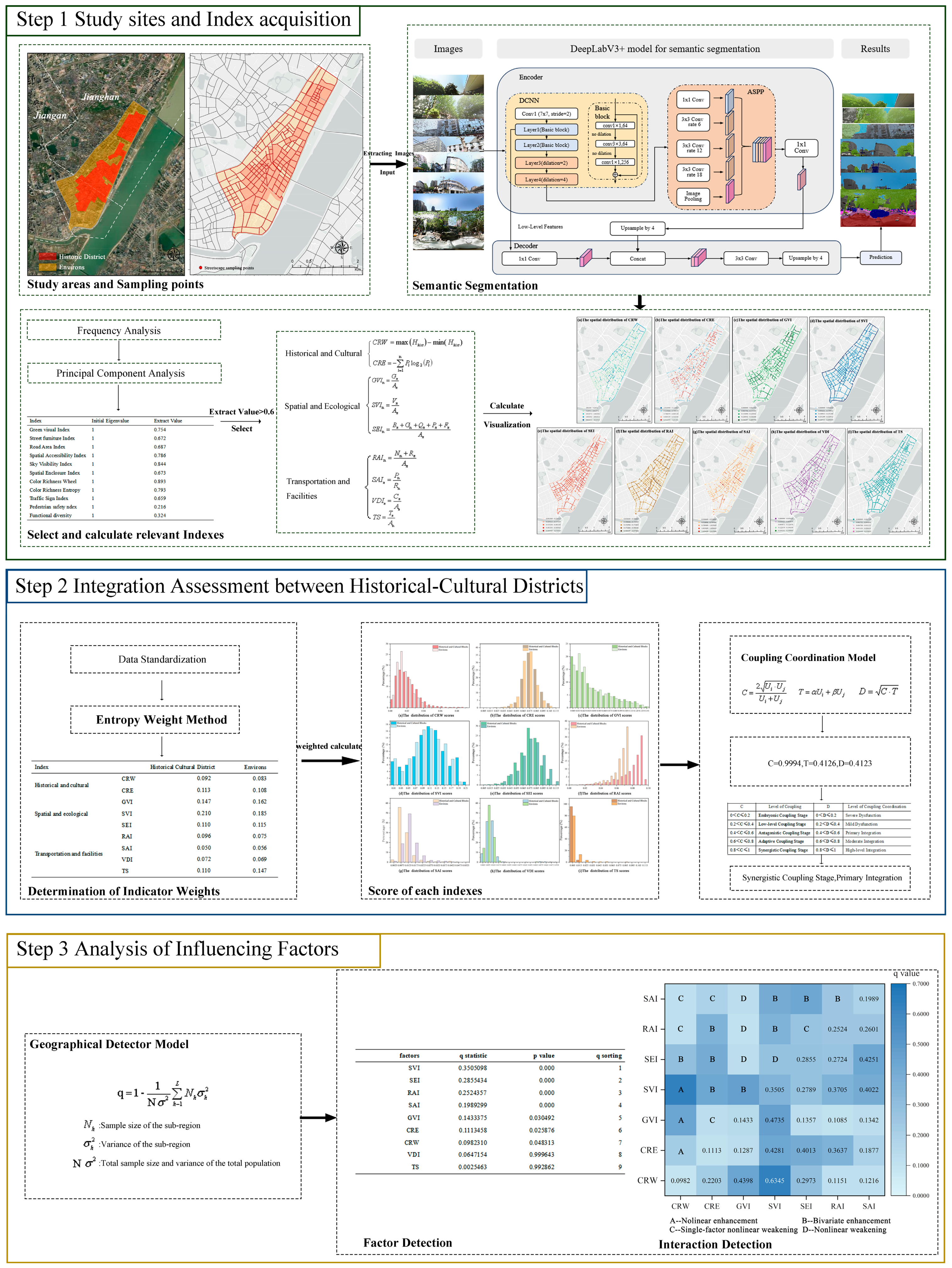
The evaluation of the spatial integration degree of the Hankou historical and cultural district in Wuhan based on street view images is divided into 3 step (
Figure 1): (1) Collection, processing, and calculation of street images in the study area. Street view data are crawled using Baidu Street View, and the semantic segmentation model DeepLabv3+ based on the Encoder–Decode structure is used for semantic segmentation to identify image elements, and corresponding indicators are selected and calculated. (2) Research on the integration degree between the historical and cultural district and its surrounding areas. The entropy weight method and the Coupling Coordination Degree (CCD) model are used to quantify the integration degree between the historical and cultural district and its surrounding areas. (3) Analysis of influencing factors of integration degree. The factor detection and interaction detection of the GDM model are used to analyze the interaction relationship between spatial integration and driving factors in this area.
2.1. Study Area
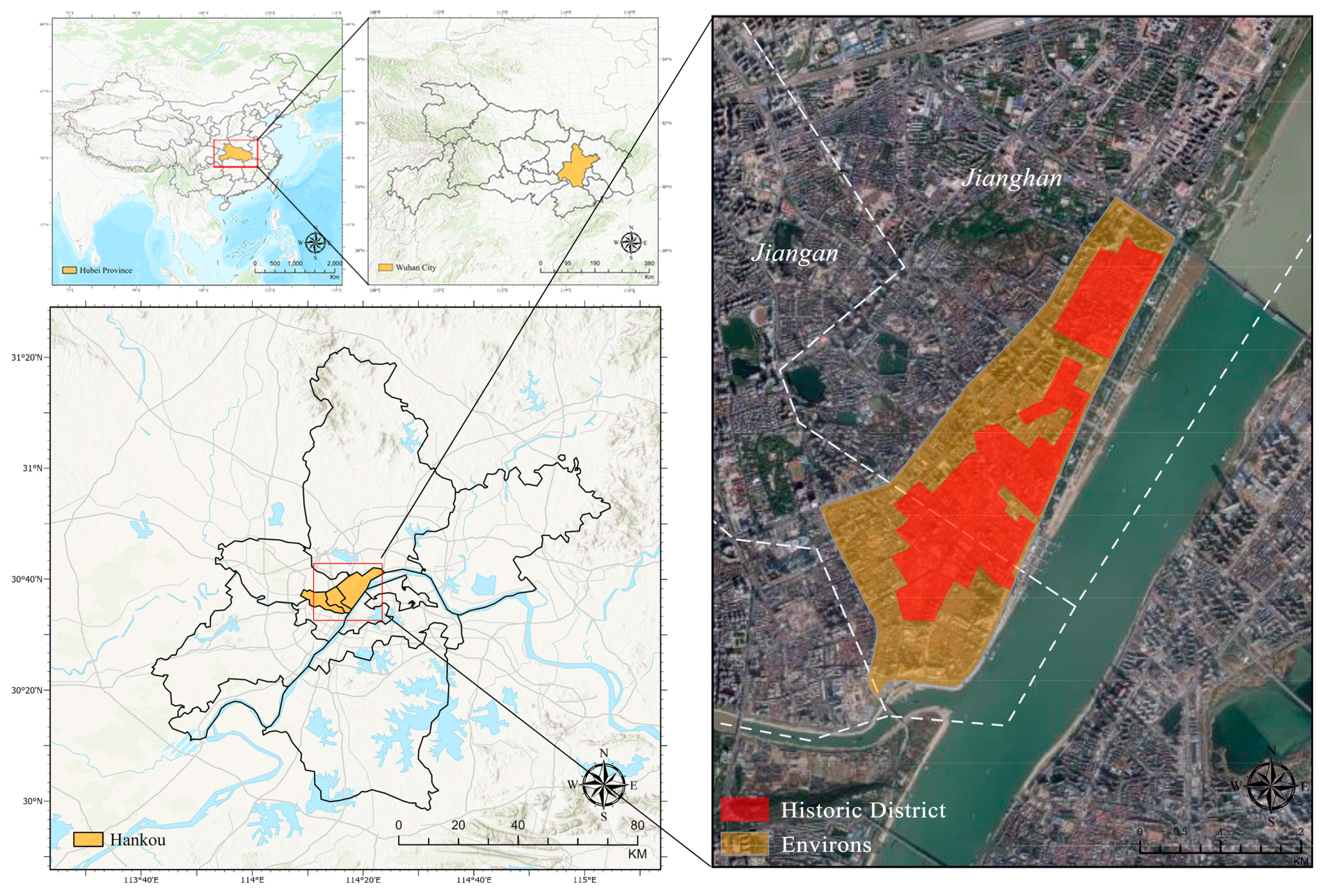
The study area is located in the former concession historical urban area of Hankou, Wuhan City, Hubei Province, China, with a total area of 4.08 square kilometers (
Figure 2). The historical and cultural districts include the Liuhe Road area, Yiyuan Road area, “7th August ” Conference Site area, Qingdao Road area, Jianghan Road and Zhongshan Avenue area, and Dazhi Road area [
23]. Wuhan is selected as the study area, primarily due to the unique value of the former concession historical urban area in Hankou. Since its opening as a treaty port in 1861, Hankou became home to concessions of multiple countries, serving as an important gateway for inland China’s modern trade and opening-up. It carries profound historical and cultural significance as well as diverse architectural values. The area preserves a large-scale cluster of modern historical buildings, forming a distinctive cluster of historical and cultural districts. The interaction between historical and modern spaces, along with the challenges of conservation and revitalization in its urban renewal, is highly representative. Moreover, the districts are densely laid out and closely connected to the modern urban fabric, facilitating relevant research and providing a valuable case reference for similar regions. The surrounding area of a historic and cultural district refers to the zone located outside the protected area of the district, which is spatially adjacent or functionally connected to it. In this study, historical and cultural districts are defined according to officially designated protection boundaries. The surrounding area is defined as a buffer zone extending 800 m to 1 km outward from the boundary of each historical district. This distance range corresponds to a typical 10–15 min walking distance, which has been widely adopted in studies of urban accessibility and spatial interaction. It represents the effective spatial influence zone where daily activities, visual perception, and functional interactions between historical districts and surrounding urban areas are most likely to occur. All spatial measurements and indicator calculations for the surrounding area are conducted based on this buffer zone.
2.2. Open Street View Images and Semantic Segmentation
The automatic capture of street view images is based on the Baidu Maps Open Platform and the location of sampling points, achieving 360° horizontal coverage and 180° vertical coverage. The Baidu Maps Open Platform provides API services to download street view images, with standard parameters including longitude and latitude, field of view, yaw angle, image size, and pitch angle [
24]. In this study, API parameters are set to capture one 360° panoramic image for each sampling point. The images are displayed as panoramic views, taken by Baidu Street View vehicle cameras at a height of 2.5 m, with a size of 4096 × 2048 pixels [
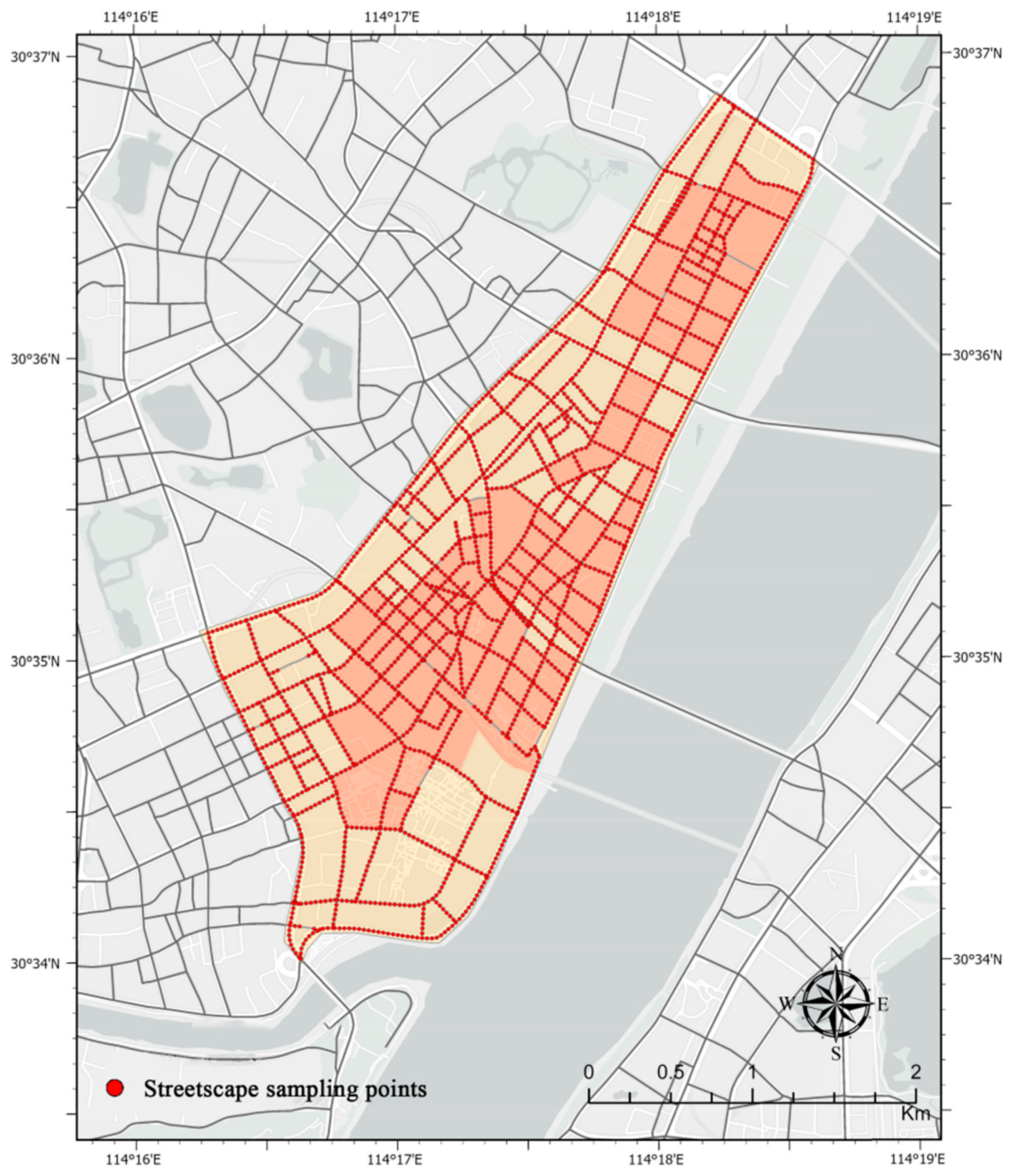
25]. The OSMnx Python package is used to download the road network of the Hankou historical and cultural district in Wuhan, and sample points are randomly generated with an average spacing of 50 m. Finally, 2721 sample points are collected, and 2721 street view image data points are obtained, covering all-round viewpoints (
Figure 3).
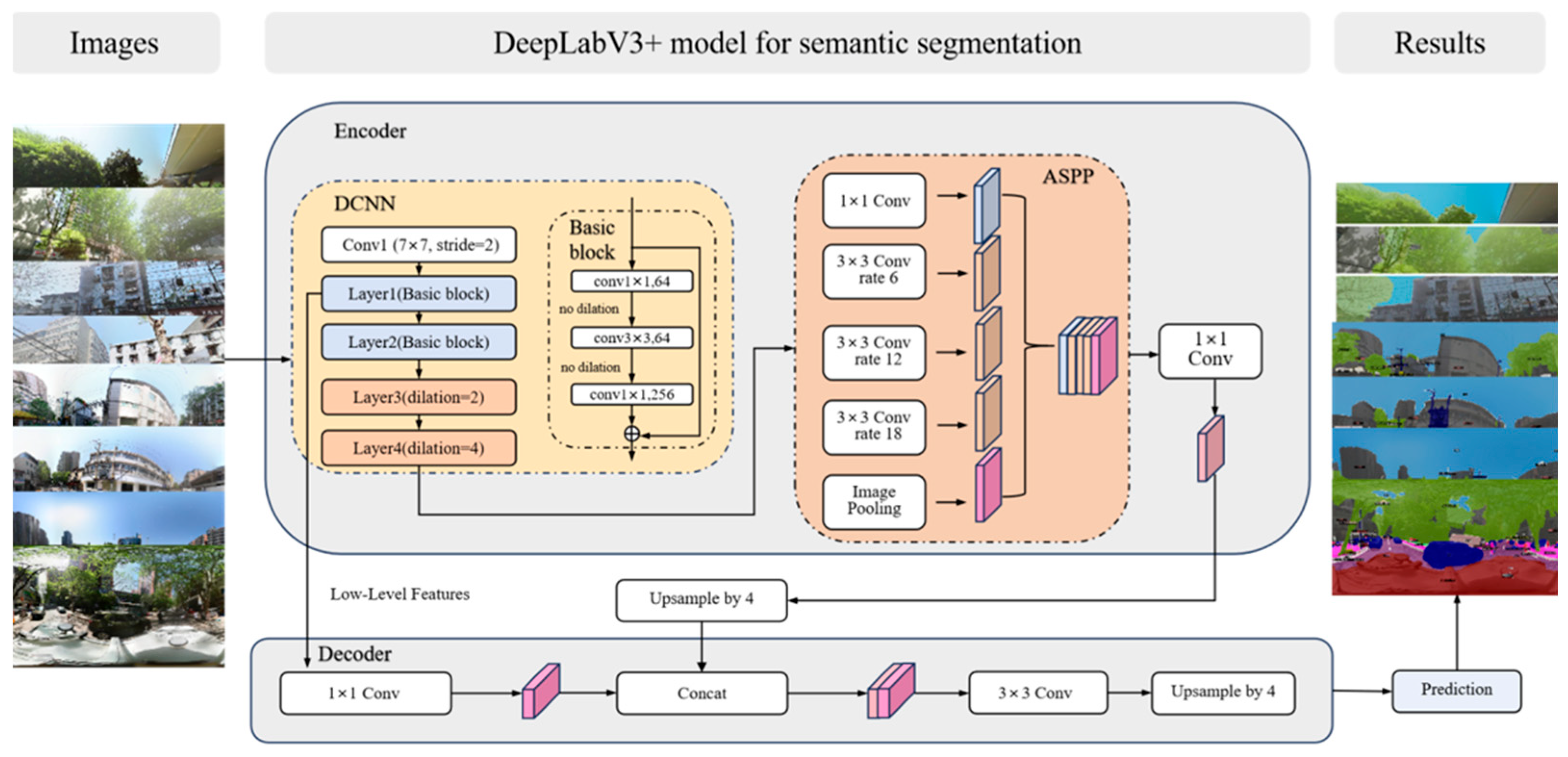
This study uses the DeepLab V3+ model for semantic segmentation of urban street views, dividing street view elements into 18 categories (e.g., sky, vegetation, roads, buildings, wall, fence, pole, traffic light, traffic sign, person, car, motorcycle, bicycle, bus, truck, terrain, sidewalk, lamp). Built on an encoder–decoder structure (
Figure 4), the model’s encoder comprises two parts: a feature extraction backbone (Backbone) and the Atrous Spatial Pyramid Pooling (ASPP) module [
26]. The backbone adopts an improved Resnet model to extract multi-level features of input street view images—output feature maps include deep high-semantic features (input to ASPP) and middle-level low-detail features (for later spatial information restoration). The ASPP module takes the deep features, using four dilated convolution blocks (different dilation rates) and one global average pooling block to extract multi-scale contextual information, capturing contextual dependencies of street view targets of varying scales. The decoder receives ASPP’s fused features and the backbone’s middle-level low-detail features. To prevent low-level features from masking semantic information during concatenation, 1 × 1 convolution is first used for channel dimension reduction; then bilinear interpolation upsamples ASPP’s high-level features to align with low-level features spatially. The concatenated feature maps are further fused via two consecutive 3 × 3 convolution blocks, and final upsampling generates semantic segmentation results matching the original image size. A final linear layer produces a classification of urban street view elements to facilitate subsequent quantitative and spatial analysis.
2.3. Indicators
This study employs the DeepLab V3+ model to perform semantic segmentation on street view images to obtain basic data [
27]. Therefore, the indicator selection in this chapter is based on the range of elements that can be identified and extracted by this semantic segmentation model. This study employs frequency analysis to systematically review the literature concerning the conservation of historical and cultural districts and related urban spatial research using street view images [
28]. By quantifying the occurrence frequency of evaluation indicators across multiple papers, this analysis identified 11 key street view-derived indicators (including Green View Index (GVI) and Sky View Index (SVI)) for use in subsequent research. A questionnaire is designed to conduct principal component analysis on the indicators. The extraction degree of the original indicator data is reflected by the common factor variance, with an initial eigenvalue of 1. The specific questionnaire content is presented in
Appendix A. Generally, a principal component analysis value greater than 0.6 indicates that the indicator is suitable for this evaluation. If the common factor variance is >0.6, the indicator is retained; otherwise, it is eliminated. According to the results (
Table 1), functional diversity and pedestrian safety are eliminated, and indicators such as vehicle disturbance, road feasibility, road area, green vision, sky openness, and spatial enclosure are obtained.
This study adopted frequency analysis and principal component analysis to construct a three-level evaluation framework encompassing historical–cultural integration, spatial–ecological integration, and transportation–facility integration, from which nine indicators were ultimately selected.
(1) The Vehicle Disturbance Index (VDI) measures the concentration of motor vehicles on streets. The number of motor vehicles determines urban residents’ travel mode and safety, and largely affects public evaluation of street landscapes. Thus, this study selects
VDI as an indicator to evaluate street landscapes.
In the formula: Cn is the number of motor vehicle pixels in the nth street view image, and An is the total number of pixels in the nth street view image.
(2) The Traffic Sign Index (TS) measures the clarity and coverage of street traffic signs. The number, visibility, and rationality of traffic signs directly affect drivers’ and pedestrians’ traffic behavior, and are key to maintaining street order and reducing accident rates. By analyzing the pixel proportion of traffic signs in street view images, this study uses
TS as a quantitative standard to evaluate street traffic management.
In the formula: Tn is the number of traffic sign pixels in the nth street view image, and An is the total number of pixels in the nth street view image. Through this indicator, the contribution of traffic signs to street traffic efficiency and safety can be evaluated.
(3) The Spatial Accessibility Index (SAI) measures street space layout and availability. Walkable area proportion reflects pedestrian-friendliness, affecting residents’ experience and street function—this study uses it to evaluate street space.
In the formula: Pn and Rn are the number of sidewalk and lane pixels in the nth street image.
(4) The Road Area Index (RAI) measures the proportion of street road area (including motor and non-motor vehicle lanes). Road area size directly affects traffic flow, street functions and landscape perception, and largely determines public evaluation of the street environment.
In the formula: Nn and Rn are the number of non-motor vehicle lane and motor vehicle lane pixels in the nth street image, and An is the total number of pixels in the nth street image.
(5) The Green Visual Index (GVI) is the proportion of green plants visible to the human eye, intuitively reflecting greening’s impact on visual perception. It aids street landscapes, urban microclimate regulation, and guides public space design, quantified as vegetation pixel percentage in street images.
In the formula: Gn is the number of plant pixels in the nth street view image, and An is the total number of pixels in the nth street view image.
(6) The Sky Visibility Index (SVI) is an indicator to measure the visibility of the sky above the street. The visibility of the sky reflects the openness of the street and the density of surrounding buildings and affects the spatial perception of residents and the transparency of the street. Therefore, this study selects
SVI as an evaluation indicator to measure the street landscape.
In the formula: Vn is the number of sky pixels in the nth street image, and An is the total number of pixels in the nth street image.
(7) The Spatial Enclosure Index (SEI) refers to the degree of enclosure of the overall space on both sides of the street. The spatial perception of urban residents towards the built environment depends on the comfort of the space, and an appropriate degree of enclosure brings a comfortable and harmonious environmental perception.
SEI is determined by the proportion of environmental factors such as buildings, plants, and walls.
In the formula: Bn, Gn, Qn, Pn, and Fn are the number of building, plant, fence, pillar, and fence pixels in the nth street image, and An is the total number of pixels in the nth street image.
(8) Color Richness (Wheel), based on hue histogram, quantifies street view color diversity. It evaluates street tone richness, reflects urban visual tonal features, and is calculated via hue histogram max-min difference in this study.
In the formula: Hhist is the hue histogram based on the HSV color space in the nth street view image, reflecting the range of hue distribution within the visible range.
(9) Color Richness (Entropy) based on information entropy quantifies the complexity of color distribution in urban street view images, a core indicator for measuring street landscape visual richness. This study calculates it using the information entropy formula.
In the formula: Pi is the frequency of the ith type of pixel color in the nth street view image, and n is the total number of all types of pixels within the visible range of the image.
2.4. Evaluation Method of Integration Degree Between Historical and Cultural Districts and Surrounding Areas Based on CCD
This study adopts the Coupling Coordination Degree (CCD) to characterize spatial integration, mainly based on the following considerations: Spatial integration is essentially an interactive and synergistic relationship between two spatial systems—the historical and cultural district and its surrounding area—rather than a simple difference in indicators. The CCD can simultaneously depict the coupling strength and coordination level between systems, reflecting the intrinsic mechanism of spatial integration more comprehensively and essentially. A higher CCD value implies closer connections, better matching of element allocation, and synergistic functional structures between the two systems, which can be reasonably interpreted as a higher degree of spatial integration. To explore the integration degree between historical and cultural districts and their surroundings, this study constructs an evaluation method based on Coupling Coordination Degree (CCD). The two are urban spatial subsets with basic elements like roads and green spaces, analogous to two subsystems in CCD. Driven by differences in these basic elements, their integration degree varies. This study quantifies element differences via indicators and judges integration degree by CCD ‘coupling coordination degree. The method includes three parts, with the first as follows: For indicator weight determination: To objectively quantify each indicator’s relative importance to integration degree and avoid subjective weighting bias, the entropy weight method is adopted. Nine types of indicator data from 1560 sample points in the historical district and 1161 in the surrounding area are standardized separately—positive indicators (e.g., GVI, SVI, CRW) and negative indicators (e.g., SEI, VDI) use the range method. Then information entropy (10), information entropy redundancy (11), and indicator weights (12) are calculated to obtain weight vectors of the nine indicators for both areas.
m is the total number of samples; pij the proportion of the ith sample under the jth indicator; yij the standardized indicator value; n the total number of indicators; dj the information entropy redundancy (a positive measure of indicator variation degree); wj the final weight of the jth indicator.
Calculate the comprehensive score of the subsystem: The standardized results of the 9 types of indicator data are extracted, and combined with the obtained weight vectors, weighted calculation is performed to obtain the corresponding scores of 9 indicators including Vehicle Disturbance Index, Traffic Sign Index, and Spatial Accessibility Index. The indicator scores of each sample point are summed to obtain the comprehensive score of each sample point. Then, the average value of the comprehensive scores of the sample points in the historical and cultural district and the surrounding area is calculated, which is used as the comprehensive score of the two subsystems: the historical and cultural district and the surrounding area.
Calculate the coupling coordination degree: On the basis of calculating the comprehensive scores of the two subsystems, the coupling degree and coordination degree index between the historical and cultural district and the surrounding area are further calculated. The coupling degree (13) measures the strength of the interaction between the subsystems. Taking this system as an example, the range of C value is strictly (0, 1], and the value closer to 1 indicates a stronger correlation between the two systems of the historical and cultural district and the surrounding area. The coordination degree index (14) reflects the overall development level of the two systems of the historical and cultural district and the surrounding area. The coupling coordination degree (15) is the comprehensive coupling degree and the overall development level.
Ui and Uj are the comprehensive scores of the two systems; C the coupling degree of the two, reflecting their interdependence closeness; T the comprehensive development index, reflecting their overall development level; D the coupling coordination degree, reflecting the comprehensive coupling degree and overall development level.
To clarify the integration and development degree between the historical and cultural district and the surrounding area, with reference to relevant studies, the types of coupling degree and coupling coordination development degree are divided (
Table 2). The (
D value) is the comprehensive coupling degree and the overall development level. The range of
D value [0, 1] is divided into 5 levels: [0.8, 1] is high-level integration, with high synergy and efficient resource allocation; [0.6, 0.8) is moderate integration, with positive interaction and partial optimization required; [0.4, 0.6) is primary integration, with basic integration and structural contradictions; [0.2, 0.4) is mild dysfunction, with significant conflicts and policy intervention required; [0, 0.2) is severe dysfunction, with mutual constraints and mechanism reconstruction required.
Based on the above CCD model, this study uses MATLAB2022a to design an integration degree evaluation program. First, the entire study area is divided into two subsystems: the historical and cultural district A and the surrounding area B. By weighting and calculating nine indicators at three levels: historical and cultural coordination, spatial and ecological coordination, and transportation and facility coordination, the UA and UB scores of the two subsystems of the historical and cultural district and the surrounding area are obtained; the coupling degree C value and coordination degree T value are calculated, and further calculation is performed to obtain the coupling coordination degree D value, and the integration degree is determined according to the range of D value.
2.5. Exploration of Influencing Factors of Integration Degree Between Historical and Cultural Districts and Surrounding Areas Based on GDM
To scientifically identify and quantitatively evaluate the key factors influencing the spatial integration degree between historical and cultural districts and their surrounding areas, as well as their mechanism of action, this study introduces the Geodetector Model (GDM) for empirical analysis. The core influencing factors selected include: indicators representing transportation and functional connections (Vehicle Disturbance Index, Spatial Accessibility Index, Road Area Index); indicators representing visual perception and spatial quality (Green Visual Index, Sky Visibility Index, Spatial Enclosure Index); and indicators representing aesthetic characteristics (Color Richness Index, Visual Entropy). All factors are quantified based on refined spatial units within the study area.
Prior to model application, continuous dependent variables and continuous independent variables are discretized and converted into categorical variables. Subsequently, the factor detector module of the Geodetector Model is used to calculate the q statistic for each influencing factor. A high q value indicates strong explanatory power, while a low q value indicates weak explanatory power.
N denotes the total number of units in the study area; Nₕ the number of units in the h-th layer; h the number of layers for continuous factors; with the factor variance of the h-th layer and that of the entire study area; the interaction detector examines the interaction effects between different factors X.
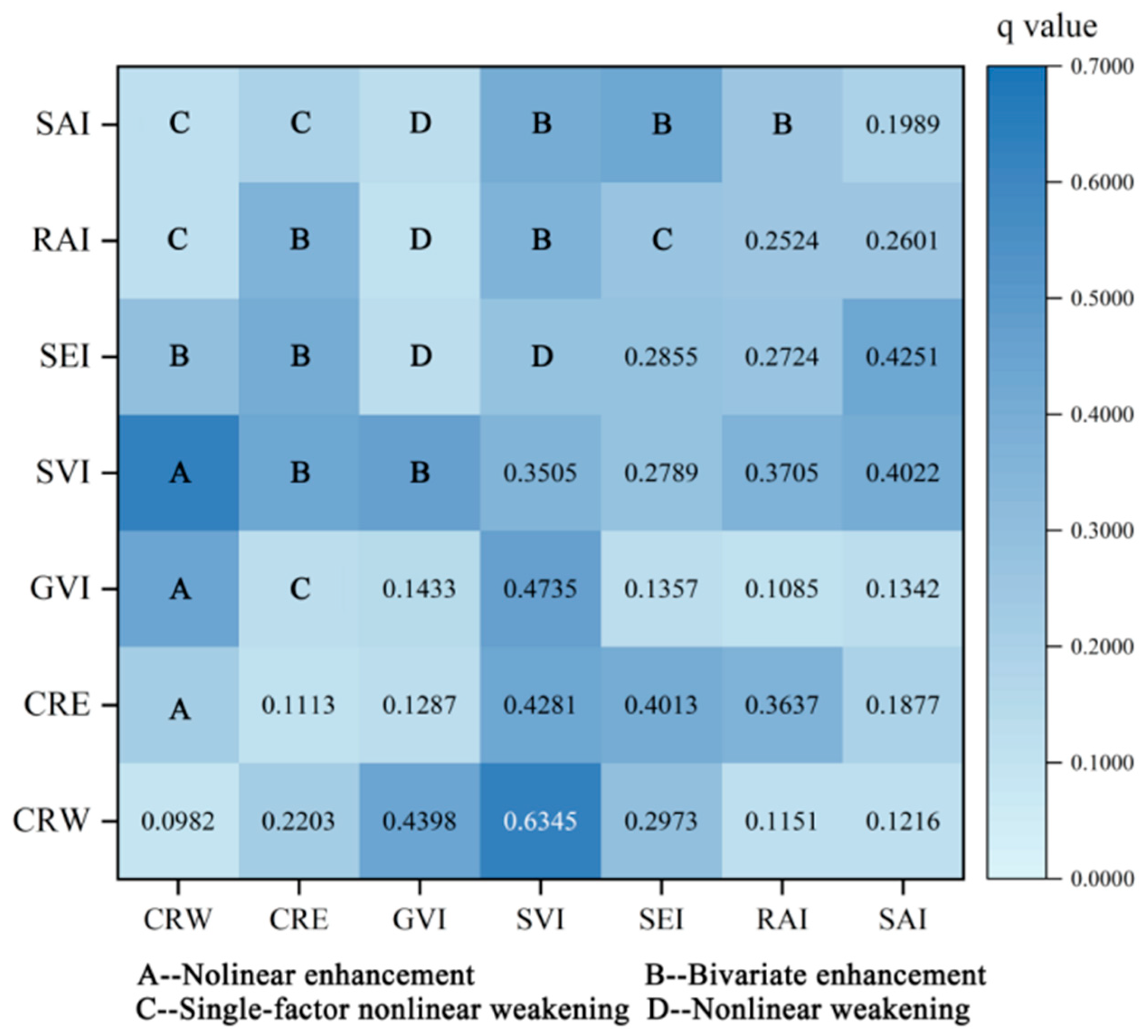
To further explore the complex effects of the combined action of multiple factors, this study applies the interaction detector module. By comparing the q value of the interaction between different factors with the q value of each individual factor, this module identifies the type of interaction between factors (e.g., nonlinear enhancement, bivariate enhancement, or independence). This helps to address the issue of the magnitude of influence exerted by each indicator on the degree of integration between historical and cultural districts and their surrounding areas. For example: “whether the combined effect of high vehicle disturbance and low spatial enclosure will significantly exacerbate integration barriers” and “whether the Green View Index and Color Richness have a synergistic effect in improving the degree of integration”.
3. Results
3.1. Characteristics of Integration Degree Evaluation Indicators
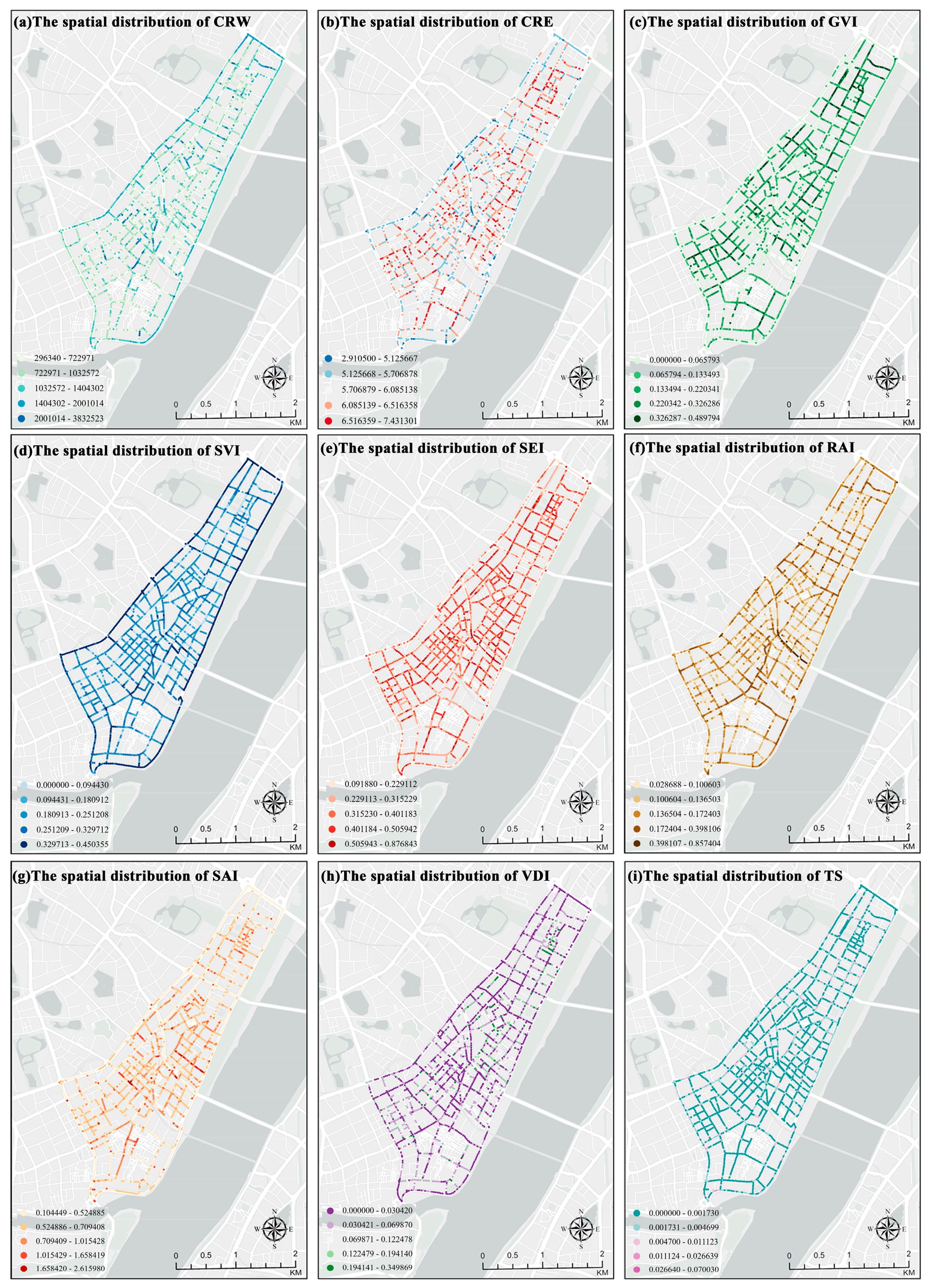
DeepLab V3+ performed semantic segmentation on images from 2721 sampling points and pixel classification for the final map, with color-displayed indicators across three dimensions: historical–cultural, spatial-ecological, and traffic-facility (
Figure 5).
Historical–cultural indicators (CRW/CRE) showed wide value ranges, with 17.84% (CRW) and 21.75% (CRE) concentrated in peak intervals, indicating rich street color composition and visually complex cultural landscapes.
Spatial–ecological indicators (GVI/SVI/SEI) were mainly distributed in mid-range intervals. The district exhibited higher average GVI (0.1464) and SEI than surrounding areas, reflecting compact spatial form and strong enclosure, while SVI was lower than outside areas, suggesting relatively constrained visual openness.
Traffic–facility indicators (RAI/SAI/VDI/TS) were predominantly clustered in moderate ranges. Higher RAI values indicate narrow roads and heavy traffic pressure within the district, whereas elevated SAI reflects sufficient pedestrian space. VDI remained stable, and TS showed balanced traffic service levels inside and outside the district.
Overall, the district demonstrates higher greenness and enclosure but lower visual openness compared with its surroundings, while both areas share common characteristics of high color richness, adequate pedestrian space, and stable traffic conditions. These patterns provide empirical support for subsequent integration analysis and highlight inherent tensions between heritage conservation and regional development.
3.2. Evaluation of Integration Degree of Historical and Cultural Districts
According to the selected indicator layers and formulas, the relevant original data of the integration degree between the historical and cultural district and the surrounding area are standardized. The weights are determined by the entropy weight method, and the evaluation indicator weights of the two subsystems are obtained (
Table 3). In the historical and cultural dimension, the weights of CRW and CRE in the historical and cultural district are both greater than those in the external environment, which confirms the control principle of “higher requirements for color continuity in the area than in the periphery” in the Guidelines for the Protection of Historical Urban Colors; in the spatial and ecological dimension, GVI and SVI have higher weights in both types of areas, highlighting the core position of green visibility rate and sky visibility in spatial ecology; in the transportation and facility dimension, the TS indicator has a higher weight.
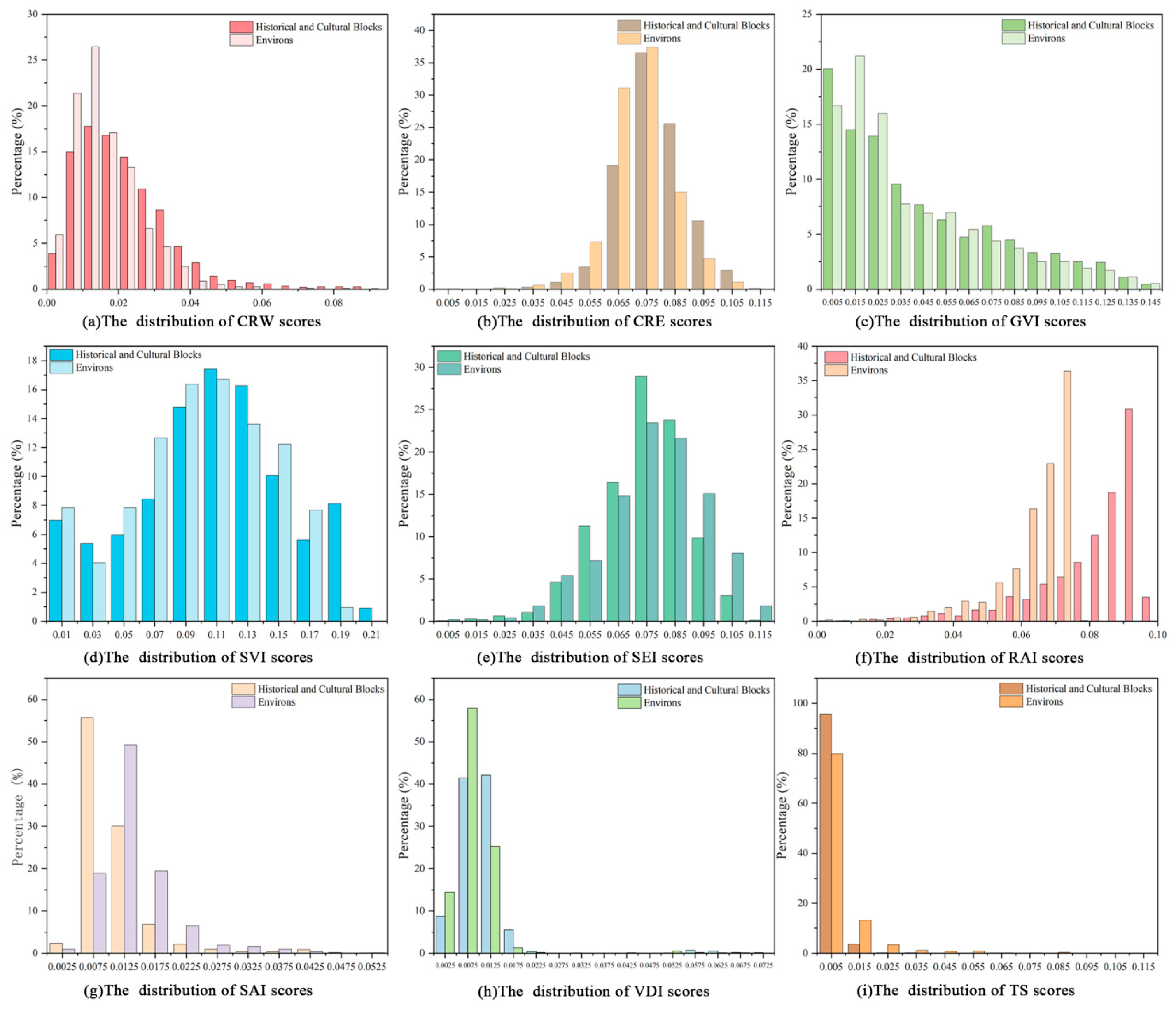
After standardizing each sampling point in the historical and cultural district and its surrounding area, indicator scores for each sampling point in the district were obtained via weighted calculation based on established weights (
Figure 6). The scores are distributed as follows: CRW concentrated in [0.0075, 0.0275], CRE in [0.065, 0.085], GVI in [0.001, 0.025], SVI in [0.07, 0.13], both SEI and RAI in [0.055, 0.095], SAI in [0.0050, 0.0175], VDI in [0.0075, 0.0125], and TS in [0.005, 0.015]. There are differences in indicator scores between the surrounding area and the district. For the surrounding area: CRW is more concentrated in [0.0075, 0.0125], CRE in [0.065, 0.075], GVI in [0.015, 0.025], SEI is relatively scattered, RAI in [0.08, 0.09], SAI in [0.0075, 0.0175], and VDI is more concentrated around 0.0075. Comprehensive scores of all sampling points in each area were summed and averaged: the district’s score is 0.4271, and the surrounding area is 0.3981. Based on this, the coupling degree C was calculated as 0.9994, close to the theoretical maximum of 1. This indicates that the district and its surrounding area have strong interaction in system structure and show a high coupling relationship across dimensions including history and culture, space and ecology, and transportation and facilities.
However, the coordination index (T = 0.4126) falls below the recognized threshold of 0.5. This indicates a relative lag in the comprehensive development levels between the two systems, revealing underlying obstacles to their coordinated advancement. Consequently, the calculated coupling coordination degree (D = 0.4123) suggests the current system exhibits only primary integration. While this signifies foundational coupling potential, it also underscores persistent practical challenges, including structural contradictions and functional disorders.
To elevate the coupling coordination between the historic–cultural district and its surroundings, it is imperative to investigate the mechanistic interactions among influencing factors. Future work must identify which factors act as catalysts for synergistic evolution and which function as inhibitors. By developing a refined analytical model of factor interactions, the coordination level and interactive dynamics can be systematically evaluated. This will provide a scientific foundation for formulating targeted spatial optimization strategies and renewal pathways, ultimately promoting the high-quality, integrated development of historic–cultural districts within the framework of their protection.
3.3. Analysis of Influencing Factors of Integration Degree Between Historical and Cultural Districts and Surrounding Areas
The integration degree between historic–cultural districts and their surrounding areas is influenced by a multitude of factors, making it challenging to quantify their individual impacts and interactive mechanisms uniformly. To address this, our study selected nine factors across three dimensions: history and culture, space and ecology, and transportation and facilities. The analysis was underpinned by the Geodetector (GDM) model, utilizing its factor, risk, and interaction detection functions to deeply analyze the spatial differentiation characteristics and the influencing mechanisms.
The results of the factor detection are presented in
Table 4. While the explanatory power (q-statistic) of individual factors was not exceptionally high, the results effectively reveal differential impacts on the integration degree. The factors are ranked by explanatory power as follows: sky visibility index (SVI) > spatial enclosure index (SEI) > road area index (RAI) > spatial accessibility index (SAI) > green visual index (GVI) > color richness wheel (CRW) > color richness entropy (CRE) > vehicle disturbance index (VDI) > traffic signs (TS). From the perspective of explanatory power, sky visibility, spatial enclosure, and road area ratio emerged as dominant factors, each with a q-value exceeding 25%. In contrast, the vehicle disturbance index and traffic signs exhibited excessively large
p-values, indicating statistically insignificant effects.
Following the removal of indicators with non-significant
p-values, interaction detection was performed on the remaining factors. The results, visualized in
Figure 7, demonstrate that the impacts of various indicators on the integration of the Hankou historic–cultural district and its surroundings are not independent; instead, they exhibit significant interactive relationships.
Among these interactions, that between Sky Visibility (SVI) and Continuity of Regional Walls (CRW) is the most pronounced, exhibiting a nonlinear enhancement relationship. Notably, SVI demonstrates the strongest interactive influence with other indicators, suggesting that it acts as a pivotal lever in enhancing the overall coordination between the historic–cultural district and its surroundings. In contrast, Spatial Enclosure (SEI) shows a nonlinear weakening (type D) interaction in most combinations. This indicates that excessive enclosure may diminish the positive effects of other factors. While an appropriate degree of enclosure can foster a unique atmosphere during conservation and renewal, overly enclosed spaces can impede organic integration with the surrounding urban fabric. The role of the Road Area Index (RAI) is dual-faceted. It can yield positive synergistic effects when combined with indicators of spatial openness or visual quality, yet may create interference when paired with a strongly enclosing factor like SEI. This reflects the complex trade-off between road network efficiency and spatial environmental quality. Finally, the Spatial Accessibility Index (SAI), which reflects connectivity, forms synergistic effects with most other positive indicators. This underscores the critical role of transportation connectivity and spatial permeability in strengthening both the external linkages and internal vitality of historic districts.
4. Discussion
This study presents a novel, quantifiable framework for assessing spatial integration by leveraging street view imagery and deep learning. The integration between the Hankou Historical and Cultural District and its surroundings was quantitatively assessed by integrating the DeepLab v3+ semantic segmentation model with the Coupling Coordination Degree (CCD) model. The results reveal a state of primary integration, with a coupling coordination degree (D) of 0.4123. This condition is characterized by a high coupling degree (C = 0.9994) but a notably low coordination degree (T = 0.4126), indicating an underlying structural imbalance within the system.
4.1. Spatial Integration as a Relational Rather than Internal Property of Historical Blocks
The findings of this study reaffirm that spatial integration is not an intrinsic attribute of historical and cultural blocks, but a relational property emerging from their interaction with surrounding urban areas. Although Hankou’s historical blocks retain strong spatial identity, their integration level remains low due to mismatches in visual openness, spatial enclosure, and traffic organization compared with adjacent areas.
This relational mismatch manifests most clearly at the street scale. Historical blocks exhibit compact street networks and high enclosure, which contribute to a coherent historical atmosphere but reduce visual permeability and spatial legibility. In contrast, surrounding areas tend to adopt more open spatial forms, resulting in higher SVI but weaker spatial continuity with the historical core. The juxtaposition of these contrasting spatial logics creates perceptual discontinuities for pedestrians, undermining the potential of historical blocks to function as integrated components of the urban spatial system.
These results suggest that integration problems in historical districts are less about insufficient vitality or environmental quality, and more about the lack of spatial translation mechanisms between historical morphology and modern urban form.
4.2. Visual Perception as a Key Mediator of Spatial Integration
One of the most significant findings of this study is the dominant role of visual perception—particularly Sky Visibility Index (SVI)—in shaping spatial integration outcomes. Unlike traditional indicators focusing on land use intensity or functional mix, SVI captures the experiential dimension of space, reflecting how pedestrians perceive openness, continuity, and enclosure along streets.
The Geodetector results demonstrate that SVI not only has strong independent explanatory power, but also exhibits the most pronounced interaction effects with other indicators, including SEI, GVI, and RAI. This indicates that visual openness acts as a mediator that amplifies or constrains the influence of morphological, ecological, and traffic-related factors on spatial integration.
Importantly, higher SVI does not necessarily imply better integration in historical contexts. Excessive visual openness may weaken spatial intimacy and historical character, while insufficient openness can result in spatial isolation. The results therefore highlight the importance of achieving an optimal range of visual openness that enhances spatial legibility without compromising historical authenticity.
4.3. Structural Constraints and Leverage Points: The Role of Traffic and Accessibility
Road Area Index (RAI) emerges as another critical factor influencing spatial integration, reflecting the dual role of traffic infrastructure in historical districts. Narrow roads and limited road areas are integral to historical spatial structure, yet they also intensify traffic pressure and reduce pedestrian comfort when contemporary mobility demands are imposed.
The relatively stable Vehicle Disturbance Index (VDI) and balanced Traffic Sign (TS) values indicate that traffic management in the study area has achieved a basic equilibrium. However, this stability does not translate into higher integration, suggesting that traffic optimization alone is insufficient unless coordinated with improvements in visual continuity and pedestrian accessibility.
These findings imply that traffic-related interventions should prioritize perceptual and spatial integration rather than merely efficiency. Measures such as shared streets, traffic calming, and interface redesign can transform traffic constraints into leverage points for improving spatial coordination between historical blocks and surrounding areas.
4.4. “High Interaction but Low Coordination”: A Structural Contradiction in Heritage Renewal
The coexistence of strong spatial interaction and low coordination reflects a structural contradiction commonly observed in historical district renewal. On the one hand, historical blocks are deeply embedded within urban centers, benefiting from surrounding infrastructure, population flows, and functional spillovers. On the other hand, strict conservation controls and fragmented governance often limit adaptive spatial adjustments, leading to integration stagnation.
This contradiction suggests that integration challenges cannot be resolved solely through micro-scale design interventions. Instead, they require coordinated governance frameworks that reconcile heritage protection objectives with broader urban development strategies. From this perspective, spatial integration becomes a governance issue as much as a spatial one.
4.5. Methodological Reflections and Broader Applicability
Methodologically, this study demonstrates the effectiveness of combining deep learning-based street view analysis with coupling coordination and Geodetector models to evaluate spatial integration at a fine-grained scale. Compared with traditional survey-based or land-use-based approaches, this framework captures both physical form and perceptual experience, offering a more comprehensive understanding of integration dynamics.
Nevertheless, the reliance on static street view images limits the ability to capture temporal variations in perception and use. Future studies could integrate multi-temporal imagery, pedestrian flow data, or behavioral observations to further enhance analytical depth.
5. Conclusions
This study develops a multi-dimensional and data-driven framework to quantitatively evaluate the spatial integration between historical and cultural blocks and their surrounding areas, using street view imagery, deep learning segmentation, and spatial interaction models. Taking Hankou’s historical and cultural districts as a case study, the research reveals nuanced integration patterns and underlying mechanisms at the street scale.
The results indicate that historical blocks and surrounding areas exhibit strong spatial interaction but low coordination, with integration remaining at a primary stage. Historical blocks demonstrate higher greenness and spatial enclosure but lower visual openness than surrounding areas, reflecting the persistence of compact historical morphology and its tension with contemporary urban spatial forms.
Among all indicators, Sky Visibility Index (SVI), Spatial Enclosure Index (SEI), and Road Area Index (RAI) are identified as the most influential drivers of spatial integration. Notably, SVI plays a pivotal leverage role through strong interaction effects with other indicators, highlighting visual perception as a key pathway for improving integration without undermining historical spatial integrity.
The contributions of this study are fourfold. First, it reframes historical district research from an internally oriented perspective to a relational integration perspective. Second, it introduces street-level visual perception indicators derived from deep learning as core variables in spatial integration analysis. Third, it reveals interactive mechanisms among spatial indicators, emphasizing the importance of coordinated, multi-dimensional interventions. Fourth, it provides empirical evidence to support human-scale, perception-oriented strategies for historical district renewal.
Despite its contributions, this study has limitations related to case representativeness and temporal dynamics. Future research could apply the proposed framework to multiple cities and cultural contexts, incorporate time-series data to capture integration evolution, and explore the relationship between spatial integration and socio-economic outcomes.
In the context of China’s transition from growth-oriented expansion to quality-oriented urban development, this study offers a robust analytical approach and practical insights for balancing heritage conservation with regional development, contributing to more integrated and sustainable urban renewal practices.